ON CHRISTMAS EVE, POOR TWINS ASK A YOUNG BILLIONAIRE FOR SANTA — WHAT FOLLOWS IS UNREAL
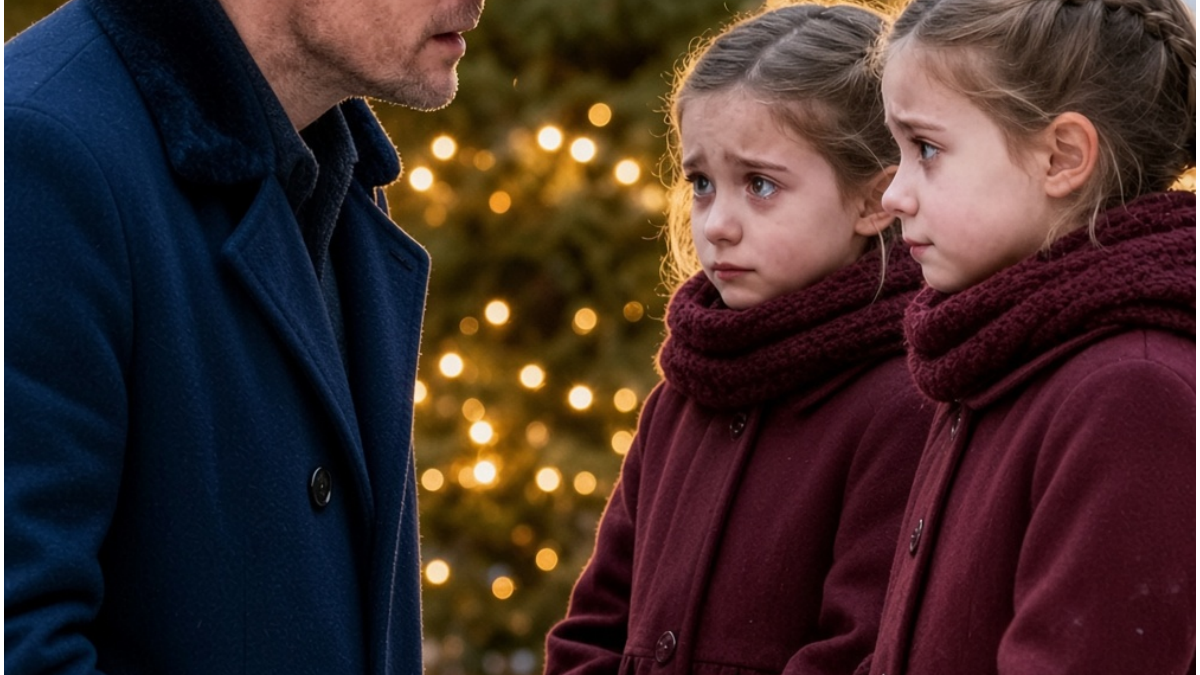
Poor twins speak to a young billionaire on Christmas Eve. We’ve never had a real Christmas.
Can you ask Santa Claus to come to our house? What happens next is unbelievable.
Reed pulled his coat tighter against his body as the icy Christmas Eve wind cut at his face.
The colorful lights from the shop windows lit his lonely path through downtown, reflecting in the empty eyes that watched families walk past him arm in-armm.
Every distant laugh seemed to amplify the silence he carried within him. The sounds of the festive city, Christmas carols escaping from stores, bells ringing on street corners, cheerful voices exchanging holiday wishes, formed a bubble from which Reed felt completely excluded.
It was like watching a movie he wasn’t a part of. He stopped for a moment, letting the snowflakes land on his shoulders.
The entire city was celebrating except for him. It had been 2 years since Christmas had lost its meaning.
2 years since his apartment had become too big, too quiet. A child ran past, dragging his father by the hand, pointing enthusiastically at a snowman in the window of a toy store.
Reed looked away, ignoring the pang he felt in his cheSt. He kept walking with no particular destination, just to avoid being still with his thoughts.
Beside the grand tree in the central plaza, Reed watched the ornaments sway gently in the wind.
The lights blinked in sequence, illuminating the faces of people taking photos, exchanging gifts, sharing moments.
He took a deep breath, trying to push away the memories that haunted him. That’s when he felt a slight tug on his coat.
Mister Reed looked down and met two pairs of eyes staring up at him. Two identical little girls, no more than 5 years old, with worn out hats and patched up gloves.
One of them, with a red bow in her hair, held her sister’s hand tightly.
Their faces, though chapped by the cold, had a luminous quality, as if the Christmas tree were reflecting in their expressions.
“Sorry to bother you,” the girl with the bull continued, her voice as soft as the snowflakes falling around them.
I’m Hazel and this is my sister Nora. Reed instinctively knelt, bringing himself to the little girl’s height.
Up close, he noticed the small differences between them. Hazel had a more direct, confident gaze, while Norah observed the world with cautious curiosity.
“Hi, Hazel. Hi, Nora. Are you lost?” He asked, noticing their red cheeks from the cold and their coats, which were too thin for the weather.
Norah shook her head, partially hiding behind her sister. Hazel glanced around quickly before stepping a little closer.
“We’ve never had a Christmas,” she whispered as if sharing an important secret. “Can you ask Santa Claus to stop by our house?”
The words hit Reed like a punch. “Something awakened in his chest, a feeling he hadn’t experienced in a long time.
His heart sped up, breaking the monotonous rhythm it had kept for years.” Never, he repeated, feeling the word hang heavy in the air between them.
Never, Hazel confirmed, the seriousness on her face contrasting with her age. Mommy said, “Santa Claus doesn’t know where we live.”
Reed swallowed hard, trying to fight back the lump forming in his throat. He thought of all the children around them, hugging their presence, while these two little ones didn’t even have the hope of receiving something.
“Where do you live?” He asked, his voice coming out softer than he intended. Hazel pointed to a narrow alleyway that led away from the brightly lit plaza.
Following her small finger, Reed saw only shadows and darkness. The contrast with the plaza’s lights could not have been more stark.
Over there, she answered, “It’s not far.” Reed hesitated for a moment, looking at the girls, and then in the direction she indicated.
What was he doing? He didn’t know these children. It wasn’t his responsibility. He could just smile, wish them a merry Christmas, and continue on his lonely way to the empty apartment that awaited him.
But something in the girl’s hopeful eyes stopped him. Something that spoke directly to the part of him he was trying to forget.
“Can I walk you there?” He offered, surprising himself. The smile that lit up Hazel’s face made the night seem less cold.
She extended her free hand, which Reed accepted automatically. The small hand fit into his, bringing an unexpected warmth.
Norah, still wary, stayed on her sister’s other side, watching him with curious eyes. “Do you know Santa Claus?”
Norah asked suddenly, her voice so low it was almost a whisper. “Reed met the girl’s eyes, seeing a hope so genuine it made his heart ache.”
“Everyone knows Santa a little bit,” he answered carefully, not wanting to promise something he couldn’t deliver.
They walked in silence for a few minutes, leaving the bright lights and store music behind.
With every step, the city grew darker, quieter. The houses became smaller, more crowded, some with broken windows covered by cardboard.
There were no festive decorations here, no sign of the Christmas spirit that overflowed just a few blocks away.
It was then that Norah finally spoke again, her voice so low, Reed had to lean in to hear, “Mommy’s going to be happy.”
she murmured. “We found a good man.” Reed felt a lump in his throat.
“A good man? When was the last time someone had seen him that way? For a moment, he felt like an impostor.
If they knew how he had shut himself off from the world for the last 2 years, how he avoided all contact, any connection.”
They stopped in front of a small structure at the end of the alley. You could barely call it a house.
It was a single room with a makeshift roof and a wooden door that didn’t close completely.
Through the only window, the faint light of a candle flickered, casting dancing shadows on the wall.
Hazel knocked on the door three times and apparently familiar code. Seconds later, the door opened, revealing a young woman with deep dark circles under her eyes and dark hair tied in a simple bun.
Despite her evident exhaustion, there was a dignity in her posture, a quiet pride that Reed recognized immediately.
Her eyes widened when she saw him. “Who is this man?” She asked, instinctively pulling the girls closer to her, her body positioning itself as a protective barrier.
“He wanted to make sure we got home okay,” Hazel explained, not letting go of Reed’s hand.
The woman looked at him with a mixture of suspicion and weariness. Reed noticed her thin fingers marked with calluses from hard work, and the way her eyes assessed his every move.
“I’m Reed,” he introduced himself, extending his hand. “I found your daughters near the Christmas tree.
They were alone.” “And well, I wanted to make sure they got home safely.” “Mara,” she replied after a moment’s hesitation, shaking his hand briefly.
Her grip was firm despite her workworn hands. Reed looked past her into the house.
A small table with three mismatched chairs. A stale loaf of bread cut in half.
A candle nearly burnt out. There was no tree, no decorations, no trace of Christmas.
Just the bare essentials for survival. Nothing more. Shame hit him hard. In his apartment, a full feast awaited him.
Enough food to feed a whole family for days. Dishes he had bought out of habit, not for need or pleasure.
An abundance he didn’t even appreciate. He ran a hand nervously through his hair, feeling his heart race again.
Hazel’s words echoed in his mind. “We’ve never had a Christmas.” He looked at the girls, at their hopeful little faces, and then at Mara with her quiet pride and her evident daily struggle.
“I know this sounds strange,” he began, the words tumbling out before he could think.
“But I have a whole dinner at my place. Way too much food for just me.
He paused, gathering his courage. If you’d like, you could have dinner with me. The silence that followed seemed to last an eternity.
Mara looked at him, then at her daughters, then back at him as if trying to decipher his intentions.
The girls watched their mother with hopeful eyes, Hazel squeezing her sister’s hand tightly.
Reed waited, bracing himself for refusal. After all, who would accept such an invitation from a stranger?
What was he thinking? Please, Mommy, Hazel whispered. He’s a good man. The girl’s trust, so pure and unwavering, touched something deep in Reed.
How could she be so sure? What had she seen in him that he himself could no longer see?
Mara looked deeply into Reed’s eyes, as if she could see his soul. What she saw there seemed to convince her.
Maybe it was the sincerity in his gaze. Or maybe just the desperation of a mother who didn’t want to see disappointment on her daughter’s faces on yet another Christmas Eve.
“Let all right,” she said finally, her voice barely audible. “We’ll just get our coats.”
Reed breathed a sigh of relief, surprised by the wave of gratitude that washed over him.
He didn’t know what he was doing or why he cared so much, but for the first time in 2 years, Christmas didn’t just feel like a day to endure.
As the girls ran to get their coats, exchanging excited glances, Reed realized his heart didn’t ache as much as before.
The emptiness he carried was still there, but now there seemed to be room for something else.
Maybe, just maybe, the silence within him was beginning to fade that night. The drive to the apartment was quiet.
Reed drove his car down the main avenue as snowflakes danced under the light of the lamposts.
Through the window, they could see decorated houses and Christmas trees shining through the windows of families celebrating the night.
Mara sat in the passenger seat, her hands tense in her lap. In the back seat, Hazel and Nora gazed out the window with wide eyes, pointing at the colorful lights passing by, their little faces lit up with each extravagant decoration.
“Do you live far away?” Hazel asked, breaking the silence. Reed glanced at her in the rearview mirror.
meeting the girl’s curious eyes. “Not too far,” he replied. “Just a few more minutes.”
The car entered a more elegant neighborhood with modern buildings and imposing facads. Mara shifted in her seat, uncomfortable, aware that she was entering a world different from her own.
When Reed finally stopped in front of a six-story building, Norah let out a soft wow.
“We’re here,” he announced, trying to sound casual. Reed helped them out of the car, noticing how Mara held her daughters hands tightly, as if afraid they might get lost in this strange place.
The lobby was spacious with marble floors and mirrored walls. A crystal chandelier hung from the high ceiling, creating small rainbows as the light touched the crystal droplets.
The doorman raised his eyebrows upon seeing him with company. In 2 years, Reed had never brought visitors.
He nodded with a forced smile as Reed guided the small family to the elevator.
“Your building is beautiful,” Mara commented, her voice almost a whisper as her eyes scanned the luxurious surroundings.
Reed just nodded, suddenly feeling self-conscious about the difference between their worlds. In the elevator, the girls were fascinated by the luminous buttons, but Mara held their hands as if afraid they might touch something they shouldn’t.
It’s on the top floor, Reed explained as the doors closed. The elevator ascended silently.
Reed watched the reflection of the four of them in the side mirror. He, tall and out of place in his own space.
Mara, with her dignified posture despite her simple clothes, and the twins, identical in their colorful hats, looking at everything with childish fascination.
For a moment, they almost looked like a family. When the doors opened, Reed led them to apartment 602, the only one on the floor.
As he opened the door, he stepped aside, allowing them to enter firSt. The smell of roasted turkey and cinnamon escaped into the hallway.
“Wow!” Exclaimed Hazel, her voice echoing in the large space. “It’s like a castle.” Reed’s apartment was spacious and minimaliSt. Large floor to-seeiling windows showcase the illuminated city, now covered in snow.
The living room with dark sofas and a lit electric fireplace led to the dining room where the table was already set.
An empty ritual he maintained out of habit even though he was always alone. Norah let go of her mother’s hand and took a few steps looking around with curiosity.
Her eyes scanned the light colored walls, the abstract paintings, the elegant furniture. Suddenly, she stopped and frowned as if she had noticed something was missing.
“Why don’t you have a Christmas tree?” She asked, her small voice tiny in the large space.
Reed felt his stomach sink. Of all the questions, that was the one he least wanted to answer.
Among the fine dishes and the well- set table, the absence of a Christmas tree seemed more evident, like a hole in the middle of the celebration.
Because, he began, searching for simple words to explain something complicated. I don’t have good memories of Christmas.
The comment hung in the air like a musical note that no one knew how to continue.
Mara looked at her daughters as if silently asking them not to insiSt. Luckily, Hazel’s attention had already turned to the table.
“Look at all the food,” she exclaimed, pointing to the feast, her eyes shining at the sight of the colorful dishes.
“Let’s eat,” Reed suggested, grateful for the change of subject. “It must be getting cold.”
Mara helped her daughters take off their coats, revealing simple but clean dresses. Reed pulled out their chairs for them, an automatic gesture he hadn’t performed in a long time.
He felt a strange familiarity in the movement, like a muscle remembering an old melody.
The table was set with fine china and silver cutlery. In the center, a golden brown turkey was surrounded by colorful dishes, rosemary roasted potatoes, grilled vegetables, sauces in small porcelain bowls, and various types of bread.
Candles created a soft light that softened the corners of the room and reflected in the crystal glasses.
Dinner began in silence. Reed served each dish carefully, watching the girls expressions as they tried each new flavor.
Mara ate slowly, her eyes attentive to her daughters, as if afraid they might do something wrong.
“This is so good,” Norah said after trying the turkey, her eyes shining. “I’ve never eaten anything so delicious in my life,” Reed felt a strange warmth in his chest, a warmth he hadn’t experienced in a long time.
It wasn’t pity, as he had feared he might feel, but something more genuine, perhaps satisfaction from providing a moment of joy.
Gradually, the atmosphere began to change. Hazel told a story about a kitten she had found on the street and hidden for 3 days until the animal started meowing at night and woke Mara up.
Norah talked about her preschool teacher and the stories she told using different voices for each character.
Reed found himself asking questions, wanting to know more about these lives so different from his own.
Mara, initially reserved, began to relax. The wine Reed had served helped soften her rigid posture.
She told them how the girls were born on a stormy night when the hospital’s power went out.
“Hazel was born first,” she explained, a smile softening her tired face. But Norah made more noise.
“Fear still like that today,” one plans, the other executes. The girls laughed, and Reed caught himself smiling, a gesture that had become rare on his face.
The sounds of cutlery, conversation, and laughter filled the apartment, which for the first time in years didn’t feel too big or too empty.
“How do you have a job?” Hazel asked, looking at him with the direct curiosity of children.
“Yes,” Reed replied, cutting another piece of turkey for her. “I write computer prograMs. I work from here most of the time.”
“Are you alone all day?” Norah questioned, seeming genuinely concerned by the idea. Reed hesitated, not used to considering his loneliness as something worrisome.
He had grown so accustomed to the silence that he had almost forgotten what it was like to live any other way.
I’m used to it, he said simply. Sometimes it’s good to have space to think.
Mommy cleans houses, Hazel informed him, changing the subject with the natural ease of children.
Ty, but now people have gone away for Christmas and don’t need her. Mara looked down, a faint blush coloring her cheeks.
That wasn’t how she would have wanted to be introduced, Reed realized. He noticed her discomfort and intervened.
“That’s an important job. I’ve worked in places where someone who took good care of the environment was greatly missed.
It makes a difference in people’s daily lives.” The grateful look Mara gave him was brief but significant.
There was a dignity in her that Reed admired, the strength to raise two daughters alone and maintain her pride even when circumstances were difficult.
When they finished dessert, an apple pie with cinnamon that the girls devoured enthusiastically, Reed offered Mara coffee.
As he prepared the cups in the kitchen, he saw out of the corner of his eye the girls exploring the living room with cautious steps, as if treading in a museum.
Hazel stopped in front of the fireplace where a few framed photographs rested on the mantle.
She carefully picked one up, her small fingers holding the silver frame as if it were made of thin glass.
“Who are they?” Sashi asked, turning to Reed. “Time seemed to freeze.” The cup Reed was holding trembled slightly, spilling a few drops of coffee on the counter.
“In the photo, a woman with brown hair smiled, hugging a girl of about four.
Both had the same smile, the same green eyes, the same dimple on the right corner of their mouths.
Mara noticed his expression and quickly approached Hazel. “Honey, we shouldn’t touch other people’s things without asking,” she said in a low voice, trying to take the photo from her daughter’s hands.
“It’s okay,” Reed replied, composing himself. He wiped his hands on a dish towel and walked into the living room.
He looked at the photograph in the little girl’s hands, feeling the familiar weight of pain, but strangely less crushing than usual.
“My wife and my daughter,” he said finally, his voice thick with emotion. “They’re no longer with me.”
The silence that followed was profound. Hazel looked at the photo, then at Reed, her 5-year-old eyes trying to process the meaning of those words.
Norah approached her sister, also looking at the image. Did they go to heaven?
Norah asked with the direct innocence of children. Reed nodded, unable to elaborate. He felt a lump in his throat and looked away towards the window where the snowflakes continued to fall in their quiet rhythm.
Some stories were too hard to share, especially on Christmas Eve. Mara came closer and, in a gesture that surprised him, lightly touched his arm.
A brief contact, but full of understanding. She said nothing, just stood there present. In that simple touch, Reed felt that she understood something about loss, about moving on, even when it seems impossible.
Hazel carefully returned the photograph to the mantle, placing it in the exact position it was before.
For a moment, she touched the smiling faces through the glass. “They were pretty,” she said simply, with the honesty only children possess.
Reed felt a tear roll down his face, the first he had allowed in months.
He didn’t wipe it away. “Yeah,” he replied. “They were.” The rest of the evening proceeded in a different, softer atmosphere.
When the living room clock struck 10, Mara looked at her daughters, who were already showing signs of tiredness.
Norah was yawning and Hazel was rubbing her eyes. “We should go,” she said gently.
“We’ve stayed too long.” Reed wanted to protest, to say they could stay as long as they wanted, that their presence had brought life to his dead apartment, but he understood that she needed to maintain her sense of independence.
He offered to call a cab. While they waited, Mara helped her daughters put on their coats.
Reed watched the affectionate gestures, the way she adjusted their hats, checked their buttons, small rituals of care that were once part of his life, too.
Gestures that carried love in every movement. At the door, they all stood in silence for a moment, as if no one wanted the evening to end.
Reed felt strangely torn between the relief of returning to his familiar solitude and the fear of the void that would soon reoccupy every corner of the apartment.
Mara held his hand, a light but meaningful touch. Her eyes met his, and Reed saw in them not just gratitude, but understanding.
This was the best Christmas we’ve had in a long time, she said, her voice low and sincere.
Before he could respond, he felt small arms wrap around his legs. Hazel and Nora were hugging him, looking up with wide smiles.
“This was the best Christmas we’ve ever had,” they said together, their voices synchronized as only twins can manage.
Reed felt an emotion so great he didn’t know whether to cry or smile. He ended up doing both.
Silent tears streamed down his face as a clumsy, almost forgotten smile formed on his lips.
He walked them to the elevator, waving as the doors closed. Norah pressed her nose against the glass, waving until the very last possible second.
Back in the apartment, Reed stood at the entrance, feeling the silence that was returning to every corner.
But it was no longer the same oppressive silence as before. It seemed lighter, as if the children’s voices and laughter still echoed.
The dirty dishes on the table, the crumpled napkins, a small drawing Norah had made on a napkin, traces of the life that had briefly filled the space.
Reed walked to the fireplace and picked up the photograph Hazel had held. He looked at the smiling faces staring back at him through the glass.
The pain was still there, but for the first time, it wasn’t the only thing he felt.
He held the picture frame to his chest and closed his eyes. For the first time since he lost his family, Christmas wasn’t just a day to endure.
It wasn’t a night of bitter memories and loneliness. For the first time in a long time, he felt that there could be a different tomorrow, that life could still hold moments of human warmth.
For the first time in many years, Reed felt at peace. Reed woke up before sunrise.
Sitting on the edge of the bed, he looked at the still dark sky beyond the window and thought of the three people who had transformed his Christmas night.
The echo of the twins laughter still seemed to float through the apartment, filling the empty corners with recent memories.
The small fingerprints on the glass coffee table. The napkin folded into the shape of a boat that Hazel had made.
The simple drawing Norah had scribbled. Small traces that proved it hadn’t been a dream.
For a moment, he could almost hear the small footsteps running down the hall, the curious questions, the sound of life he missed so much.
The contrast between before and after that night was so great, it felt as if he had woken up in a different apartment, even though physically nothing had changed.
He made a quick decision. He dressed hurriedly, grabbed his car keys, and left, driving through the empty streets of the still sleeping city.
The sky was beginning to lighten slightly when he stopped in front of a toy store that opened early, even on the day after Christmas.
It was one of those old-fashioned shops with a bell on the door that tinkled when he entered and shelves crammed to the ceiling with every kind of toy.
The gay-haired lady behind the counter looked up when he entered, surprised to have a customer so early.
“Good morning,” she greeted, adjusting her glasses. “Can I help you?” Reed hesitated, feeling strangely nervous, as if he were about to do something very important.
I need two dolls, he said finally. For 5-year-old girls, twins. The woman smiled in a way that suggested she understood more than he had said, and led him to a colorful section at the back of the store.
There were dolls of all kinds, some modern and stylish with trendy clothes, others more traditional with lace dresses.
“Any preference?” She asked. She. We have ones that talk, ones that walk, ones that cry.
Reed thought of the twins, of their worn hats and patched gloves, of the way they had looked with wonder at everything in his apartment, of the simplicity of the home where they lived.
He wanted to give them something special, something they could keep and love for a long time.
Not a toy that would soon break or lose its appeal. Something durable, he replied.
And beautiful, something they can take everywhere that doesn’t need batteries or parts that get lost easily.
The woman nodded, understanding something beyond his words. She walked down a different aisle and selected two cloth dolls with colorful dresses, one in shades of blue, the other in shades of red, and embroidered faces with gentle smiles.
They had yarn hair that wouldn’t come out and small handstitched details. These are made to last, she explained, handing the dolls to him to examine.
They’re made by local artisans, and they’re made to be loved, taken to bed, to school, everywhere.
The more they’re hugged, the prettier they get. Reed took the dolls, feeling the soft texture of the fabric.
He imagined Hazel and Norah hugging them at night, taking them to school, sharing secrets with them.
Something in his chest tightened. “I’ll take them,” he said, his voice firmer. Could you wrap them separately with colorful ribbons?
Really pretty. Of course, the woman smiled. A late Christmas present. Reed just nodded, unable to explain that they weren’t exactly presents from him.
As the saleswoman wrapped the dolls in shiny paper and elaborate ribbons, he asked for two tags.
On each one, he wrote in careful script for Hazel and off for Nora.
He hesitated, almost writing from Reed, but something stopped him. He left the space blank.
It was better for them to think they were from Santa Claus, as they had wished.
Let them have that magic at least once. The sky still held shades of pink and orange when he parked a few houses away from the small residence where Mara and her daughters lived.
The street was deserted with only a skinny cat lazily crossing to the other side.
He got out of the carrying the two colorful packages, feeling like a clandestine version of Santa Claus.
He approached the door silently. For a moment, he imagined what it would be like to knock, to see the girls faces when they opened the presents, to witness the surprise and joy in real time.
But something stopped him. He didn’t want them to know it was him. He wanted to give them the magic they had asked for, the belief that Santa Claus had really found them.
He placed the packages carefully on the doorstep, making sure they were clearly visible and protected from the dampness.
He took a few steps back, looking one last time at the silent house, imagining the moment they would wake up and find the gifts.
Then he turned and walked quickly back to the car with a smile he couldn’t contain.
He drove home with a strange feeling in his chest, a mix of satisfaction and emptiness, as if he had just closed a chapter and didn’t know what would come next.
After all, what else could he do? The Christmas dinner had been a one night thing, a moment outside of reality.
Now everyone would return to their normal lives, he to his silent apartment and solitary work, they to their daily struggle.
The day passed slowly. Reed tried to work on some code, but he couldn’t concentrate.
His mind kept returning to the small house, to the girls, Tamara, with her tired but dignified eyes.
He kept imagining the twins finding the presents, tearing open the wrapping with eager fingers, hugging the dolls.
Had Mara figured out who left them? Was she thinking of him as he was thinking of her?
By late afternoon, he couldn’t take it anymore. The idea of spending another day alone, another night in silence became unbearable.
He decided to go to a nearby market. As he walked through the aisles, his cart filled up.
Fresh fruit, various cheeses, whole wheat bread, chocolates, natural juices, cookies, rice, beans, pasta, sauces, foods he imagined the girls would like, things Mara probably didn’t buy often, and also basic items that would last for weeks.
The cashier looked curiously at the single man buying enough food for a large family.
Reed paid without explanation and arranged everything in a large basket he bought at the store, covering it with a colorful cloth.
He drove again to the simple neighborhood, this time without the cover of darkness. The sun was beginning to set when he parked in front of the small house.
He felt his heart race as he took the heavy basket and walked to the door.
For an instant, he almost turned back. Who was he to show up like this unannounced?
What if she didn’t want to see him? What if it had just been kindness on her part, nothing more?
He took a deep breath before knocking. Three soft knocks followed by silence. Then he heard quick footsteps on the other side and excited voices, little feet running.
The door opened, revealing Hazel with wide eyes. For a second she was frozen, as if she couldn’t believe what she was seeing.
Then a huge smile took over her face. “It’s the man!” She shouted, turning back into the house.
“Mommy, Nora! The Christmas man is back.” Before Reed could say anything, Hazel grabbed his free hand and pulled him inside with a strength surprising for someone so small.
Norah appeared, running from the other room, carrying a cloth doll against her chest, her eyes shining with excitement.
You came back, she exclaimed, hugging his legs as if they were old friends. Reed felt something warm and luminous spread inside him as if the sun had risen in his cheSt. He bent down to their height, balancing the heavy basket.
“I brought some things for you,” he said, showing them the basket. “Look what Santa brought.”
Norah held up the doll, showing it off with pride. “He didn’t forget us.
He found our house. I knew he would find it. We asked the man to talk to him, “Remember,” Hazel said to her sister, then looked at Reed with shining eyes.
“You talked to him, right? You told him where we lived.” Before Reed could answer, Hazel ran to get her own dolly, equally enthusiastic.
He exchanged a look with Mara, who appeared at the kitchen doorway, wiping her hands on a dish towel.
She smiled, a small, tired, but genuine smile that lit up her face in a way Reed hadn’t seen the night before.
Santa was very generous this year, she said with a look that made it clear she knew exactly who the real Santa was.
Reed placed the basket on the small table while the girls danced around him, showing off their dolls and chattering about how they had found the packages on the doorstep that morning.
We woke up and mommy told us to see if it had stopped raining, Hazel explained, gesturing widely.
When I opened the door, there they were. Two packages with our names on them.
And we didn’t see anyone,” Norah added, looking at her doll with adoration. “It was real magic.”
“It really was,” Reed agreed, helping to unload the basket he had brought. “And what did you name them?”
“Mine is Luna,” Hazel said, holding up the doll with the blue dress. “Shice, because she’ll be with me every night looking at the moon.”
“And mine is Star,” Nora informed him, hugging the one with the red dress. “Because she shines.”
Mara approached the table, her eyes widening slightly at the amount of food Reed was taking out of the basket.
You didn’t have to bring all this, she said quietly. But there was gratitude in her voice.
I wanted to, Reed replied simply. I thought you might like it. The girls continued to play with their dolls, creating elaborate stories as they ran around the small room.
Mara invited Reed to sit at the table and offered him a cup of tea.
He accepted, feeling strangely at ease in the simple space. He watched as she heated water in a small kettle on an old stove.
The kitchen was tiny with worn cabinets and a noisy refrigerator, but it was impeccably clean and organized.
There was a vase with wild flowers on the windowsill, an attempt to bring beauty to the austere environment.
When Mara sat across from him, placing two cups of tea on the table, Reed noticed the dark circles under her eyes, her rough hands from hard work, her hair tied in a simple bun.
Still, there was a strength in her, a dignity that impressed him more than any conventional beauty.
“Thank you for the dolls,” she said, her voice low so the girls wouldn’t hear.
“They don’t usually get presents. I can’t afford to buy much.” Reed nodded, suddenly feeling ashamed of his own abundance, of how much he had and how little he shared.
“It was good to see them happy,” he replied, looking at the girls who were now making their dolls dance in the middle of the room.
A comfortable silence settled between them, broken only by the laughter and animated conversations of the children.
There was something in that moment in that simple house with the dim light of the late afternoon that felt more real, more alive than anything Reed had experienced in years.
“They look like you,” he commented, watching the twins. Mara smiled, watching her daughters with a look full of love.
“Everyone says that. They have my eyes, my hair, but the smile, the smile is just like their fathers.”
There was a pause and then she added almost in a whisper, “He died when they were two.
They barely remember him.” Reed felt the familiarity of pain in her eyes. It was the same kind of pain he saw in the mirror every morning.
“I’m sorry,” he said, “and he truly was. It was an accident at work,” Mara continued, turning the cup between her fingers.
He was a construction worker. A scaffold collapsed. It was all very faSt. Reed nodded, respecting the weight of that loss.
He understood then why she hadn’t asked questions about his own story the night before.
She recognized pain when she saw it. “My wife and my daughter,” he began, the words feeling heavy on his tongue.
“They died in a car accident two years ago, just before Christmas.” Mara looked up, meeting his eyes.
There was no pity in her gaze, only understanding. The understanding that only someone who has gone through the same pain can offer.
“That’s why you don’t have a tree,” she said, not as a question, but as a statement.
Reed nodded, surprised at how easily the words came out. It had been so long since he had talked about them, about the accident, about the hole that was left in his life.
And now sitting in a small poorly lit kitchen with a woman he barely knew, the words flowed like water from a dam that finally breaks.
“They were coming back from buying presents,” he continued. “The snow was heavy. A truck lost control on the road, and his voice broke.”
Mara said nothing, just placed her hand over his on the table. A light touch, but one that conveyed more comfort than all the empty words of consolation he had ever heard.
There was no It’s going to be okay or time heals all wounds and that so many well-meaning people had told him just presence just understanding.
It’s hard to move on, she said after a moment, especially when you have to do it alone.
Reed looked at her really looked. He saw the daily struggle in the corners of her eyes, the strength in her premature expression lines, the weariness and determination mixed in her posture.
How do you do it? He asked genuinely curious. “But how do you manage to smile, to move on, to raise your daughters alone?”
Mara looked at the girls who were now sitting on the floor feeding their dolls an imaginary dinner.
“I don’t have a choice,” she answered simply. “They need me. I can’t afford to give up no matter how much I sometimes want to,” she paused, taking a sip of tea.
But and at the end of the day, when they smile or hug me, it makes everything bearable.
Reed felt a deep admiration. While he had shut himself away in his luxurious apartment, protecting himself from the world with silence and isolation, this woman faced life daily, fighting for her daughters, finding the strength to continue.
I got stuck, he admitted, more to himself than to her. On the day of the accident, the moment I knew they weren’t coming back, as if a part of me was buried with them.
“It’s easier to stay stuck,” Mara agreed. “Moving on hurts. Every step hurts. But you moved on.
For them,” she replied, looking at her daughters. “Always for them.” The girls approached the table, interrupting the moment.
Hazel carefully placed Luna on the edge of the table. “She wants tea, too,” she announced solemnly.
Mara smiled and pretended to pour a tiny cup of tea for the doll. Norah climbed onto Reed’s lap without asking permission as if it were the most natural thing in the world.
She placed Star on his shoulder. “She likes you,” she said, settling in as if it were her usual spot.
“Just like me.” Reed felt the light weight of the girl on his lap. The warmth of her trusting little body, and something inside him gave way.
A knot that had formed two years ago began very slowly to unravel. When he finally prepared to leave, the sky was completely dark.
The girls protested, asking him to stay a little longer to tell a story to see how Luna and Star slept.
Mara gently called them to order. “Mr. Reed needs to rest,” she explained. “And so do you.
It’s past your bedtime. Are you coming back tomorrow?” Hazel asked, her big eyes fixed on him with the worry of someone who has seen important people leave and not return.
Reed looked at Mara, uncertain. She smiled, a small but hopeful smile full of possibilities.
He can come back if he wants to, she answered for him. I’ll be back, Reed promised, surprising himself with the certainty in his voice.
At the door, as the girls waved excitedly, Mara looked at him with an expression he couldn’t quite decipher.
There was gratitude there and something more. Perhaps the same understanding he felt. The recognition of two people who knew loss and perhaps could help each other find their way back.
Thank you, she said, for everything. Reed shook his head. No, thank you for letting me in.
And they both knew he wasn’t just talking about the house. As he drove back to his apartment, the silence in the car didn’t feel so heavy.
There was something new growing inside him. Not exactly happiness, not yet. But maybe it was hope, the seed of something that could, with time and care, blossom again.
Dusk cast orange hues across the streets as Mara turned the corner toward her house.
Her steps were heavy, dragged down by the fatigue of a full day spent searching for a job.
She carried on her shoulders not just the weight of her own exhausted body, but also the burden of worry that accumulated with every closed door.
She had visited five different places. Two stores downtown, a small restaurant, a laundromat, and a cleaning company.
At each one, the same response. We’ll review your application and get in touch. Or more directly, “We’re not hiring at the moment.”
The politeness of the words didn’t disguise the rejection. As she walked, Mara tried to organize her thoughts.
There were only a few dollars left in the emergency jar she kept hidden at the back of the closet.
The bills were piling up. Rent a water electricity. Soon she would have to choose which one to pay firSt. The fear of not being able to support her daughters grew with each passing day.
As she got closer to home, she forced herself to straighten her posture. She couldn’t let the girls see her desperation.
They were too young to carry the weight of adult worries. Although Mara knew that somehow they already felt it.
The way Hazel looked at the coins before asking for anything. The way Nora hugged her stomach when she said she wasn’t hungry.
Small signs that broke her heart. She turned the last corner and noticed something different.
A car was parked a few feet from her house. It wasn’t common to see such new vehicles on that street.
Her heart quickened slightly as she recognized it. As she got closer, she saw that the front door was a jar.
Normally, this would have alarmed her, but before fear could set in, she heard her daughter’s laughter coming from inside.
She quickened her pace, pushing the door open carefully. The scene she found made her chest tighten in a way she didn’t expect.
In the small living room space, Reed was sitting on the floor with Hazel and Nora around him.
The three were involved in some elaborate game that seemed to involve the dolls, some old wooden blocks, and a story about dragons and princesses.
The girls gestured excitedly, and Reed listened to them with genuine attention, as if every word was precious.
For a moment, Mara stood frozen in the doorway, absorbing the image. There was something so familiar and yet so strange about that scene.
A man playing with her daughters, something that hadn’t happened since their father died. She felt a confusing mix of emotions, gratitude, nostalgia, and a kind of pain she couldn’t name.
It was Norah who saw her firSt. “Mommy!” She shouted, running towards her with Star clutched to her cheSt. The man is back.
We’re playing Enchanted ForeSt. Reed stood up quickly, suddenly looking embarrassed, as if he had been caught doing something wrong.
“Sorry to show up unannounced,” he said, running a hand through his hair in a nervous gesture.
“I was just passing by and thought I’d visit. Hazel ran to her, too, her eyes shining with excitement.
He’s been playing with us since lunch, Mommy. He made the best dragon ever.” Mara tried to smile, but the exhaustion weighed on her facial muscles.
She placed her worn purse on the small table. “Hi,” she managed to say, trying not to sound as exhausted as she felt.
“I hope they weren’t too much trouble.” “Not at all,” Reed replied, watching her attentively.
There was something in his gaze, a quiet perception that made her feel exposed, as if he could see beyond the facade she was trying to maintain.
“There wonderful.” The girls, sensing a change in the mood, went back to their makeshift house, resuming their game, now including the news they would have to tell their dolls about their mother’s arrival.
“Are you okay?” Reed asked in a low voice. Moving closer, Mara opened her mouth to say yes, to give the automatic response she always gave, that everything was under control, that she was just a little tired.
But something in the way he asked without false formalities made it impossible for her to lie.
“No,” she admitted, her voice almost breaking. She took a deep breath, composing herself. “I didn’t find anything today.
None of the places are hiring.” Reed nodded without offering false words of comfort or unsolicited advice.
He just listened. And somehow that meant more than anything he could have said.
“Can I make you some tea?” He offered after a moment. You look like you need to sit down for a bit.
Mara almost laughed at the irony. A guest offering to serve something in her own home, but she was too tired to refuse.
“That would be great,” she replied, slumping into the nearest chair. “Red moved carefully around the small kitchen as if trying not to take up too much space.
He found the kettle, filled it with water, and put it on the stove. His movements were precise, efficient.
While the water heated, he came back to her. “Hia, the girls told me you went looking for a job,” he commented.
“Three places,” they said. “It was five, actually,” Mara corrected, rubbing her eyes. “I walked all over the city, but it’s always the same thing.
No openings. They’ll review my resume. They’ll call me later.” She paused, looking at her rough hands.
“Nobody ever calls.” The kettle started to whistle and Reed went back to the kitchen.
She watched him carefully prepare the tea using the only two non-chipped cups she owned.
There was something comforting in seeing him move around her house as if he belonged there.
It’s really tough, he said, returning with the steaming cups. Especially this time of year, a lot of places downsize after the holidays.
Mara nodded gratefully, taking the hot drink. The warmth of the cup warmed her cold hands.
I used to clean a few houses regularly, but three families traveled for the holidays and don’t need me right now.
Another one moved. She blew on her tea before continuing. I only have one house to clean next week, and I don’t know when the other families will be back.
Reed took a sip of his tea, his expression thoughtful. The girls continued to play, oblivious to the adult conversation, creating a world where problems were always solved before sunset.
It’ll work out,” he said finally with a conviction that Mara envied. “Something will turn up.”
She gave a faint smile, too tired to share his optimism. “I hope so,” she replied simply.
“It has to.” They talked a little more about light things, the weather, the girls games, a new store that had opened downtown.
Reed didn’t bring up the job topic again, and Mara was silently grateful for that.
It was hard enough to face her situation without having to talk about it constantly.
Reed stayed a bit longer, helping her prepare a simple dinner with what was in the house.
Pasta with a makeshift source of tomatoes and herbs. The girls set the table, proud to show how they knew how to help.
There was something strangely domestic about the scene, as if it wasn’t the first time they had dinner together, as if Reed belonged in that small space.
When he finally said goodbye, it was already dark. The girls protested, asking him to stay longer to tell more stories.
Mara gently called them to order, reminding them that everyone needed to reSt. At the door, Reed paused, looking at her with an expression that seemed to want to say something more.
“Thanks for letting me stay,” he said. “It was nice to be here. You’re always welcome,” Mara replied.
And she realized she truly meant it. He nodded, smiling slightly. Rest well and don’t give up.
I’m sure something will turn up soon. After he left, Mara closed the door and leaned against it for a moment, letting out a long sigh.
The girls were already in the small room they shared, putting Luna and Star to bed.
She walked over, watching them from the doorway. “Time for bed, girls,” she announced, trying to sound firm despite her exhaustion as she helped them with their nightly routine.
Brushing teeth, putting on pajamas, arranging the thin blankets. Mara thought about Reed, about his kindness, about how he had suddenly appeared in their lives, bringing gifts, food, and now this comforting presence.
It was almost too good to be true. “Is the man coming back tomorrow?” Norah asked, already in bed, hugging Star.
“I don’t know, sweetie,” Mara replied, stroking her hair. He has his own life and his own work.
But he likes us, Hazel insisted. He said so. Yes, Mara agreed, feeling something warm in her cheSt. I think he really does.
After the girls finally fell asleep, Mara sat at the kitchen table alone with her thoughts.
Tomorrow would be another day of searching, another day of closed doors. But somehow the weight felt a little lighter now.
She looked at the cup Reed had used, still on the table. A man with so much drinking tea from a chipped cup, eating simple pasta with them, sitting on the floor, playing with her daughters.
Why? What did he see in them? The question lingered in her mind as she prepared for bed.
Reed drove slowly through the city’s illuminated streets, his hands gripping the steering wheel tighter than necessary.
The image of Mara coming home, tired and defeated after a full day of job hunting, wouldn’t leave his mind.
Nor would the look in the girls lies, so young and already so aware of their hardships, so worried about whether their mother would find a job.
He parked in front of his building, but didn’t get out of the car right away.
He sat there thinking he had resources, connections, he could easily help, but he knew Mara was proud that she wouldn’t accept direct charity.
He had to find a way to help without demeaning her. He then remembered Anna, his friend from college, who now ran a restaurant downtown.
Anna’s corner wasn’t big or luxurious, but it had a loyal clientele and good food.
They had talked the week before over a quick lunch and she had mentioned something about needing one more person on her team.
He looked at the clock. 9:30. It wasn’t that late. He took out his phone and dialed her number.
Hello. Anna’s cheerful voice sounded on the other end of the line. Anna, it’s Reed.
Sorry to call this late. Reed, it’s okay. It’s not that late. Is everything all right?
He hesitated for a moment, organizing his thoughts. Shall I remember you? You mentioned you were looking to hire someone for the restaurant.
Are you still? Yeah, I need a waitress. Jessica went on medical leave and will be out for a few months.
Why? Do you know someone? Reed shifted in his seat, feeling a wave of relief.
I do. Yes. An acquaintance of mine really needs a job. She has two young daughters to support and is going through a tough time.
Does she have experience as a waitress? Anna asked. Not that I know of, he admitted.
But she’s hardworking, responsible. I’m sure she’d learn faSt. There was a pause on the other end of the line.
Reed waited anxiously. He knew he was asking for a favor that Anna could easily refuse.
Look, she said finally, “Normally, I prefer someone with experience. Yet, you know how busy it can get.”
But, uh, she paused, “If you’re recommending her, she must be trustworthy. Can you tell her to come by tomorrow around 10:00 in the morning?
I’ll talk to her, see if it’s a good fit. Reed felt a wave of gratitude.
Of course, she’ll be there. Thanks, Anna. This means a lot. Don’t thank me yet, Anna replied, and he could hear the smile in her voice.
Let’s see if she fits the profile we need, but I’ll give her a chance for you.
After hanging up, Reed finally got out of the car and went up to his apartment.
He was eager to tell Mara the news to see the relief in her eyes.
The smile that would light up her tired face. But he decided to wait until the next day.
He would show up early, offer a ride to the restaurant, and then tell her about the interview.
As he prepared for bed, Reed realized he was genuinely excited about the prospect of helping this family.
It wasn’t just about charity or doing a good deed. It was about feeling useful, needed, a part of something again.
The girls with their simple and honest joy, Mara, with her quiet strength, they were slowly filling a void he had carried for years.
Tomorrow would be a new day with new possibilities. For the first time in a long time, Reed fell asleep, thinking not of the past he had lost, but of the future he could help build.
The next morning, Reed woke up early. The conversation with Anna the night before had given him a sense of purpose he hadn’t felt in a long time.
The prospect of helping Mara and the girls with something so concrete made him restless, eager to share the news.
He stopped at a bakery on the way and bought fresh bread, an excuse to show up so early, though he knew that somehow his presence no longer needed justification.
When he parked in front of the small house, the sun was still struggling to appear between the winter clouds.
He took a deep breath before knocking on the door, mentally organizing what he would say.
He wanted it to sound like a genuine opportunity, not charity. He knew Mara had her pride.
It was one of the qualities he admired most in her. He knocked softly, remembering that the girls might still be sleeping.
He heard adult footsteps from the other side, not the excited rush of the twins.
When the door opened, Mara appeared, already dressed, but with deep dark circles under her eyes.
She didn’t seem to have slept well. Reed, she said, surprise evident in her voice.
I didn’t expect you so early. I hope I’m not bothering you, he replied, holding up the bag of bread.
I brought breakfaSt. Mara hesitated for only a moment before opening the door wider, silently inviting him in.
“The house was quiet. Down the hall, Reed could see the door to the girls.
Room was closed. “They’re still asleep,” Mara explained, noticing his glance. They stayed up late talking about the stories you told yesterday.
Reed smiled, feeling a warmth in his chest as he imagined the twins retelling his stories to each other before bed.
He followed Mara to the small kitchen where she began to make coffee. It was then that he noticed the papers scattered on the table.
He didn’t try to read them, but it was impossible not to see what they were.
Bills, receipts, a notebook with numbers written down. Next to it, a small glass jar with a few coins.
Mara followed his gaze and quickly gathered the papers, stacking them clumsily. “Sorry for the mess,” she murmured, not looking at him.
“I was just organizing some things.” Reed noticed her embarrassment. He had seen enough numbers circled in red, due dates underlined.
The reality of Mara’s financial situation was laid bare in those papers. Mara,” he called softly, sitting at the table.
“I have some news that might help.” She paused mid-motion as she was about to put a coffee cup on the table.
Her eyes met his, a mixture of hope and skepticism. “What news?” Reed took a deep breath.
“This was it. I spoke with a friend of mine. She has a restaurant, and there’s an opening for a waitress.
If you want, you can go there tomorrow morning.” Time seemed to freeze. Mara stood completely still, only her eyes moving as if trying to process what she had just heard.
The cup in her hand trembled slightly. “A job?” She whispered finally, her voice so low Reed almost didn’t hear it.
“A real job?” “Yes,” he confirmed, feeling strangely nervous. “At Anna’s corner downtown. Anna is my friend from college.
She needs someone reliable, and I told her about you.” Mara placed the cup on the table carefully and sat down.
Her hands were shaking now, not from fear, but from a contained emotion. She lowered her face and to Reed’s surprise, began to cry.
These weren’t silent tears, but deep sobs that seemed to come from a very deep place within her.
She covered her face with her hands, as if ashamed of her vulnerability. Reed was momentarily unsure of what to do.
He hadn’t expected this reaction. Perhaps gratitude, perhaps joy, but not this raw emotion that seemed to unearth months, maybe years of accumulated worry.
“Mara,” he began uncertainly. “Thank you,” she said between sobbs, still hiding her face.
“For helping us.” “I I don’t know how to thank you.” There was so much vulnerability, so much honesty in her voice that Reed felt something stir within him.
Without much thought, he reached across the table and gently touched her hand. A light, respectful touch, just enough for her to know she wasn’t alone.
“You don’t have to thank me,” he replied softly. “You deserve this chance.” Mara finally uncovered her face, quickly, wiping away the tears.
There was something different in her eyes now, a sparkle, a small flame that wasn’t there before.
“Hope. It’s just an interview, she said as if trying to contain her own excitement.
It might not work out. It will, Reed assured her, still holding her hand lightly.
Anna needs someone, and you need a job. It’s a fair trade. Mara looked at their joined hands on the table.
For a long moment, she was silent, just letting the contact linger between them like an anchor in the midst of a storm of emotions.
Ever since the girl’s father died, she began, her voice almost a whisper. I’ve been fighting alone.
Every bill, every problem, every decision, all on my shoulders, she paused, lifting her eyes to meet his.
Sometimes it’s so heavy. I don’t know how I stay on my feet. Reed nodded, understanding perfectly.
He knew the weight of isolation well, the exhaustion of facing the world without anyone to share the burden with.
You’re not alone anymore,” he said, surprised by the firmness in his own voice.
Something changed in Mara’s gaze, a silent understanding, an acceptance. For the first time since she lost her husband, since she found herself alone with two young daughters to raise, Mara allowed herself to believe that maybe, just maybe, she no longer had to carry it all alone.
The weight she had always felt on her shoulders, the constant fear of not being able to support her daughters, the anxiety of every unpaid bill, the terror that something would go wrong and there would be no one to help, seemed in that moment a little less crushing.
It wasn’t just the possibility of a job, although that represented a concrete lifeline. It was the presence of this man who had entered their lives by chance on a Christmas Eve and somehow inexplicably seemed determined to stay.
It was knowing that for the first time in a long time she wasn’t completely alone in the fight.
Mara squeezed Reed’s hand lightly. A silent thank you that went beyond words. A small smile, still wet with tears but genuine, formed on her lips.
Hope. That rare visitor that hadn’t appeared in her life for so long had finally found its way back to her heart.
The day of the interview dawned gray. Mara woke up before her alarm after a night of restless sleep.
Confused dreams of restaurants, uniforms, and kind smiles had populated her reSt. She sat on the edge of the bed, allowing herself a few moments to gather her thoughts, mentally planning what she would wear, what she would say, how she would answer the questions that would surely come.
She wanted to be at her beSt. This interview could change everything. She got up silently, careful not to make any noise.
The girls needed to sleep a little longer before starting their day. While making coffee, she mentally reviewed what Reed had said about Anna and the restaurant, Anna’s Corner, downtown.
10:00, he would pick her up at 9:30. Mara chose her best blouse, a simple but wellpreserved piece in a light blue color.
She set aside the black skirt she saved for special occasions and the only pair of closed toe shoes that weren’t too worn.
It wasn’t an elegant outfit, but it was the best she had. She was brushing her hair when she heard a sound from the girl’s room.
Not the usual cheerful chatter, but a low groan, almost a whimper. Her heart instantly raced, that maternal sixth sense warning her that something was not right.
She hurried to the room, opening the door slowly. Nora was still sleeping soundly, hugging Star, but Hazel was tossing restlessly in bed, her little face red and shiny with sweat.
Mara quickly approached and touched her daughter’s forehead, recoiling from the heat she found. “Hazel, honey,” she called softly, sitting on the edge of the bed.
“The girl opened her eyes with difficulty, her gaze was glassy, unfocused.” “Mommy,” she murmured, her voice weak, and slurred.
“It’s hot and it hurts. What hurts, my love?” Mara asked, her heart tight. “Everything,” Hazel replied, closing her eyes again.
“My head, my tummy.” Mara ran to the bathroom and returned with the thermometer. While waiting for the reading, she dampened a small towel with cold water and placed it on her daughter’s forehead.
The thermometer confirmed her fear. 103.6 deg, a dangerously high fever. She looked at the clock on the wall.
7:15 in the morning. The interview was at 10:00. Maybe if she gave her the fever reducer now, the fever would go down in time.
Maybe she could ask her neighbor to watch the girls for a few hours. Maybe.
Hazel groaned again, turning in bed, her little face contorted in discomfort. And in that instant, Mara knew there was no choice to be made.
Not really. She fetched the medicine from the kitchen and helped her daughter swallow it with a little water.
Hazel coughed and almost choked, but managed to take the medicine. Mara changed the cold compress, feeling the heat of her daughter’s skin through the damp cloth.
The noise woke up Nora, who sat up in bed, rubbing her eyes. “Mommy,” she called, her voice still thick with sleep.
“What’s wrong?” “Hazel isn’t feeling well, honey.” Mara explained, trying to keep her voice calm so as not to frighten her other daughter.
“She has a fever.” Norah looked at her sister, her eyes widening with concern.
She got up and came closer, holding Star tightly to her cheSt. “Is she going to be okay?”
She asked, her voice small and scared. “Yes, she will,” Mara assured her, even as she felt the weight of uncertainty.
“She just needs rest and medicine.” The next few hours passed in a blur of changed compresses, more doses of medicine, and attempts to get Hazel to drink water.
The fever fluctuated but didn’t break completely. Around 9:00, Mara looked at the clock again, feeling the weight of the decision she had already made in her heart.
She couldn’t go to the interview. She couldn’t leave Hazel like this. She thought about calling Reed, about explaining the situation, but she didn’t have his number.
He had said he would pick her up. She would have to explain when he arrived.
She hoped he would understand that he could pass on her apologies to Anna. Maybe if luck was on her side, the job would still be available when Hazel got better.
The doorbell never rang. 9:30 came and went. 10:00 10:30. At Anna’s corner, the morning started busy.
Staff prepared the tables for lunch. The kitchen was bustling with preparations, and Anna alternated between supervising everything and checking the clock every few minutes.
At 10:15, she picked up the phone and dialed Reed’s number. Hello. His expectant voice sounded on the other end.
Reed, it’s Anna. Your friend didn’t show up for the interview. Is everything okay? There was a momentary silence on the other end of the line.
What do you mean she didn’t show up? He asked, confusion evident in his voice.
I was going to pick her up at 9:30. Well, it’s 10:15 and she’s not here, Anna replied.
I thought maybe you knew something. Another silence longer this time. No, I Reed hesitated.
Something must have happened. I’ll check and call you back. The position is still available, Anna assured him before hanging up.
If there’s a good reason. Reed stared at the phone for a few seconds after ending the call.
A bad feeling began to form in his cheSt. Mara wasn’t the type of person to miss an opportunity like that.
Not after the emotion she had shown the day before. Something had to be wrong.
Without a second thought, he grabbed his coat and car keys. The entire drive to Mara’s house, his mind spun with possibilities.
Maybe she had given up. Maybe she had found another job. Maybe. But his heart knew.
Something was wrong. He parked the car haphazardly and ran to the door. He knocked three times urgently.
Nothing. He knocked again, harder. After what felt like an eternity, he heard dragging footsteps on the other side.
The door opened slowly, revealing Nora with wide eyes, clutching Star as if the doll were a shield.
“Hi,” she said in a low voice, very different from her usual excitement. “Mommy’s with Hazel.
She’s sick.” Reed’s heart sank. He quickly entered and followed Nora to the small room.
The scene he found made his chest ache. Mara was kneeling by the bed, dabbing a compress on Hazel’s forehead.
The girl was clearly unwell. Her red face shone with sweat. Her hair was stuck to her forehead and her breathing seemed rapid and shallow.
Mara, focused on her daughter, didn’t even notice his presence until Norah spoke. “Mommy, the man is here.”
Mara turned surprised. Her face showed exhaustion and worry. Her eyes red from lack of sleep.
“Dor,” she said, her voice weak. “I I couldn’t go to the interview. Hazel has had a high fever since early this morning.
I can’t leave her like this. Reed approached silently, kneeling beside her. He looked at the girl, so small and fragile in bed, her breathing rapid and shallow.
He felt his heart tighten, a concern that surprised him with its intensity. “How long has she been like this?”
He asked softly. The fever started yesterday, but it got much worse during the night, Mara replied, changing the compress on her daughter’s forehead.
I’ve already given her fever reducer, but it’s not going down. Reed looked at the thermometer on the nightstand, 103.55°, too high.
She needs to see a doctor, he said, the decision forming instantly in his mind.
Mara nodded, biting her lip. I know. I was waiting for the medicine to take effect.
But her voice faltered. I didn’t know if I should call you. I don’t want to seem like like I’m using you.
The vulnerability in her voice made something inside Reed stir. Without hesitation, he took her hand firmly.
You’re not, he said with conviction. I’m here because I want to be. Mara nodded, trying to hold back the tears that threatened to fall.
I couldn’t leave. I I couldn’t leave her like this. Reed looked at Hazel again.
He gently touched her face, feeling the intense heat emanating from her skin. It wasn’t just a fever.
It was the kind of temperature that required immediate medical attention. She needs a doctor, he repeated.
This time with more urgency. I’ll take you, Mara hesitated, her gaze lowered. But I can’t afford a doctor’s visit.
I’ll pay, Reed interrupted without a second of hesitation. There was no room for discussion in his voice.
It wasn’t an offer. It was a decision. Mara looked at him for a moment, as if wanting to protest, but Hazel’s condition spoke louder than her pride.
Without another word, Reed helped Mara wrap the girl in a light blanket. Hazel barely reacted when she was moved, just whimpering softly.
Her small body was too warm, too light in Reed’s arms as he lifted her from the bed.
Norah watched everything from the corner of the room, her big eyes fixed on the scene.
When Reed turned to leave, she ran to him and held his free hand tightly, as if afraid of being left behind, as if she needed an anchor in the midst of the chaos.
“Is she going to be okay?” She asked, her voice so low he almost didn’t hear it.
Reed bent down, carefully balancing Hazel on one arm to be at Norah’s level.
He looked into her eyes, seeing the fear, the confusion, the desperate need for reassurance.
“Yes, she will,” he said firmly. “I promise.” He didn’t know if he could really promise that.
No one could. But at that moment, it was what Norah needed to hear. And he would do everything in his power to keep that promise.
They went out together into the cold, high, quiet street. Reed walked carefully, carrying Hazel in his arms, feeling the heat of her fever through the blanket.
Norah clung to his hand as if it were a life raft. Mara walked beside him, carrying Luna and Star.
The girls had insisted the dolls needed to come, too. Reed felt the weight of responsibility fall on his shoulders.
Not just the physical weight of the child in his arms, but the emotional weight of three lives that had somehow become intertwined with his.
It was scary and at the same time strangely right. When they got into the taxi Reed had called, Mara settled beside him, hazel between them.
Norah sat in the front seat, still clutching the dolls. For a moment, no one spoke.
The driver, sensing the urgency of the situation, sped towards the hospital without asking questions.
In the tense silence of the car, Mara slowly rested her head on Reed’s shoulder, as if finally allowing herself to share the burden to seek support.
They exchanged no words. None were necessary. The contact spoke for itself. In that moment, amidst the fear and worry, something new blossomed between them.
Not just gratitude or friendship, but the quiet certainty that they were already in some way a family.
No one had said it out loud, perhaps not even admitted it to themselves, but it was there in the way they moved together, how they supported each other, how they faced the crisis as a unit.
Reed looked at Hazel’s feverish little face, at Norah’s worried expression in the front seat, at Mara leaning on his shoulder, and he knew, with a clarity that startled him, that he would do anything for them.
Anything. The hospital’s waiting room was crowded, but Reed managed to get Hazel seen quickly.
Her high fever, combined with her age, classified the case as urgent. Mara didn’t leave her daughter’s side for a second, holding her little hand while the doctor examined her.
Norah stayed with Reed, sitting quietly beside him, clutching Star and watching everything with attentive, worried eyes.
The doctor, a middle-aged man with a kind gaze, examined Hazel meticulously, throat, ears, lungs.
He asked questions about symptoms, duration of the fever, medications already given. Mara answered everything precisely, her voice betraying her accumulated exhaustion and worry.
Finally, after what seemed like an eternity, the doctor smiled slightly. It’s a strong virus, he explained, putting away his stethoscope.
It’s going around a lot this time of year, especially among children. Nothing that a few days of rest, plenty of fluids, and the right medicine won’t fix.
Mara let out a breath she hadn’t realized she was holding. Her shoulders tense throughout the consultation, visibly relaxed.
“Is she really going to be okay?” She asked, her voice still uncertain. “Yes, she will,” the doctor assured her.
“I’ll prescribe a more effective fever reducer and a syrup for the cough that has started to appear.
The fever should break completely in 2 days, but she’ll need to rest for a week.”
While the doctor wrote the prescription, Mara hugged Hazel tightly, kissing her still warm forehead.
The girl, more alert after receiving intravenous medication to lower the fever, weakly returned the hug.
“It’s okay, Mommy,” she murmured. “I don’t hurt so much now.” Reed, watching the scene from the doorway, felt something tighten in his cheSt. Norah, sensing the change in mood, let go of his hand and ran to her sister, climbing onto the gurnie to hug her, too.
The three of them formed a small circle of love and relief that made him feel both a part of it and a privileged observer.
On the way back, Hazel slept in Mara’s arms, the fever finally subsiding. Norah sat on Reed’s lap, also exhausted from the tense morning.
They didn’t talk much during the ride, but the silence was comfortable, of a kind that only exists between people who don’t need to fill empty spaces with words.
Reed helped settle the girls at home, ran to the pharmacy to get the medications and made sure Mara had everything she needed.
He promised to come back the next day to check on Hazel and left with a tired but relieved smile.
Driving home, Key, he thought about the missed interview, about the opportunity that could have changed that family’s life, about Mara’s face when he told her about the opening, the hope in her eyes.
He couldn’t let it all end like this. The next morning, Reed woke up with the first ray of sunlight.
He hadn’t slept much, his mind occupied with plans and worries. He sat on the edge of the bed, looking at the phone on his nightstand.
It was early, but he knew Anna well enough to know she would already be awake, probably getting ready for another day at the restaurant.
He took a deep breath and dialed the number. “Hello,” Anna’s voice sounded after three rings, surprisingly awake.
“Hi, Anna. Sorry to bother you again,” Reed began, feeling as nervous as a teenager asking for a favor.
“Hi, Reed. Is everything okay?” She replied, and he could hear the sound of dishes being handled in the background.
“I wanted to ask.” He hesitated, choosing his words. “For a second chance for my friend.
She couldn’t make it yesterday because her daughter was sick. It was serious. She wouldn’t have missed it without a reason.”
There was a silence on the other end of the line. Reed waited, his heart racing.
“What kind of sick?” Anna finally asked. “A very high fever. We had to take her to the hospital,” he explained.
“She’s a 5-year-old girl. Mara is a single mother. She had no one to leave her daughter with in that condition.”
Another silence, longer this time. Reed could almost visualize Anna considering the situation, weighing the pros and cons.
He knew that thoughtful expression she always had when making decisions. “If it’s as you say,” she began, her voice sounding softer.
“Ask her to come this afternoon. I still need someone.” Reed felt a wave of relief and gratitude.
“Thank you, Anna. Really?” “At 3:00”? She specified, “And Reed, she must be very special for you to be insisting so much.”
He smiled, not denying the implicit observation. “She is.” As soon as he hung up, Reed quickly got ready and drove to Mara’s house.
The day was clear, the sky a deep blue that seemed auspicious. He parked and walked to the door with hurried steps, eager to share the good news.
He knocked softly, aware that Hazel might be sleeping. “It was Norah who opened the door, still in her pajamas, holding Star as always.
“Hi,” she exclaimed, a smile lighting up her face as she recognized him. “Mommy’s with Hazel.
She’s better today. That’s great. Reed smiled, stepping inside as she moved aside. Can I talk to your mom?
Norah nodded and led him to the small room. Hazel was sitting up in bed, propped up by pillows, with Luna by her side.
She had color in her cheeks, no longer the intense red of the fever, but a healthy pink.
Mara was sitting beside her, reading from an old story book. “Look who’s here, Mommy,” Nora announced.
Mara looked up surprised and her face broke into a tired but genuine smile. “Reed?”
She said, getting up. “I didn’t expect you so early.” “Hi, mister.” Hazel greeted with a weak voice but a small smile.
“How’s our patient?” He asked, approaching the bed. “Better?” Mara replied. “The fever has almost completely gone.
The doctor was right.” Reed sat on the edge of the bed and placed his hand on Hazel’s forehead, confirming it was only slightly warm.
The girl smiled at the gesture as if appreciating his concern. “I have some news,” he said, turning to Mara.
“I just spoke with Anna, the owner of the restaurant.” Mara froze and her eyes widening slightly.
“And she asked, her voice barely a whisper, she wants you to go this afternoon at 3:00.
She still needs someone. Time seemed to stop. Mara stood motionless, processing the information. Then slowly, she covered her mouth with her hand, her eyes welling up.
“You got me a second chance,” she asked, her voice thick with emotion. “Reed smiled, feeling inexplicably happy at her reaction.
You deserve it. For a moment, no one spoke.” Then to Reed’s surprise, Mara approached and hugged him, a quick but heartfelt hug, full of gratitude and something more he couldn’t quite define.
“Thank you,” she whispered, pulling away shily, as if suddenly realizing what she had done.
“What’s a second chance, Mommy?” Norah asked, curious. “It’s when you get another opportunity to do something that didn’t work out the first time,” Mara explained, wiping away a stubborn tear.
Foyer, and it’s very, very important. That same day, after making sure the neighbor would watch the girls, Mara got ready with the same care she had before.
Reed drove her to the restaurant, trying to reassure her the whole way. She was visibly nervous, her hands twisting in her lap.
“What if she doesn’t like me?” She asked quietly as they parked. “Impossible,” Reed replied with sincerity.
“Just be yourself.” He waited in the car while she went inside. An hour and a half later, when Mara came out of the restaurant, he knew the result before she even spoke.
There was a light in her eyes, a different way of walking, an energy he had never seen before.
She got into the car and looked at him, her eyes shining. “De got the job,” she announced, her voice brimming with contained joy.
“I start on Monday.” Reed smiled, feeling something open up inside him, a quiet, deep joy he hadn’t experienced in a long time.
The kind of happiness that comes from seeing someone you care about achieve something important.
I knew it,” he said simply. The following weeks brought rapid changes. “With a steady salary from the restaurant and generous tips from customers who loved Mara’s gentle smile, the family’s financial situation improved considerably.
The overdue bills were paid. The refrigerator was always stocked. And small comforts were added to the house.
New curtains on the windows. A colorful rug in the living room. New toys for the girls.
More important than the material improvements, there was a new lightness in Mara. The constant weight of financial worry had been lifted, allowing her to smile more, play more with her daughters, sleep better at night.
She was visibly flourishing like a plant finally receiving light after a long winter. Reed had become a constant presence in their lives.
He would stop by regularly to check on them, bring small gifts for the girls, and help with repairs around the house.
Gradually, without anyone noticing exactly when, his visits became part of the routine, something expected and celebrated, especially by the twins.
On a particularly cold evening about a month after Mara started at the restaurant, she invited him for dinner.
It wasn’t the first time, but there was something different about this invitation, a gentle formality, as if it were a special occasion.
When Reed arrived, the girls greeted him at the door with shouts of joy. “You’re here,” they exclaimed in unison, each grabbing one of his hands and pulling him inside.
The house was different. The table was set carefully. Candles were lit, probably at the girl’s request, and a delicious aroma wafted from the kitchen.
Mara appeared at the doorway, wiping her hands on a dish towel, smiling in a way that made Reed’s heart race.
“Welcome,” she said. “I hope you’re hungry.” The dinner was simple, but prepared with evident care.
A flavorful stew, fresh bread, a colorful salad. The girls chatted excitedly, talking about school, about the adventures of Luna and Star, about the new book Mara was reading to them before bed.
In the middle of the meal, Norah suddenly grew serious as if remembering something important.
She exchanged a look with Hazel and asked without a word. They both got down from their chairs and ran to their room.
They returned moments later, Norah carrying something hidden behind her back. We made something, Hazel announced, looking both nervous and proud.
Norah stepped forward and held out a colorful piece of paper toward Reed. We made it for you, she said shily.
Reed took the paper carefully. It was a drawing made with colored pencils and markers.
In the center, three figures held hands, two small ones wearing colorful dresses, and a larger one in the middle.
They were all smiling with exaggerated smiles that took up half their faces. Above in uneven colorful letters, it was written, “Our special friend.”
Something happened inside Reed at that moment. An emotion so intense and unexpected that he felt his throat tighten.
He tried to speak to say thank you, but his voice failed him. He swallowed hard, looking at the drawing, at those three figures holding hands, at that simple and profound representation of what they had become to each other.
He looked up and met Mara’s gaze. She was smiling, a calm and understanding smile, as if she knew exactly what he was feeling.
There was gratitude in that smile, but also something more, something warm and promising, something that spoke of future possibilities.
The girls watched anxiously, waiting for his reaction. “Do you like it?” Hazel asked, leaning in to get a better look at his face.
Reed nodded, finally finding his voice. Here, it’s the most beautiful gift I’ve ever received,” he said with sincerity.
The twins smiled, relieved and happy, and went back to their seats to finish dinner.
The conversation continued, but Reed was different, transformed by that simple piece of paper. In that instant, holding the drawing to his chest, Reed realized he was no longer just the man who had lost everything.
That definition no longer contained him. He had found something new, something that didn’t replace what he had lost, but that was equally precious, equally vital.
He looked around at the girls eating and laughing, at Mara serving more stew, at the small house warmed by their presence, by the shared moments, by the stories created together.
And he understood with crystal clarity that he had moved on. The grief was still there, a part of him always would be.
But it was no longer the dominant force in his life. It no longer defined who he was or how he lived.
The pain had transformed into something different. A bittersweet memory that could coexist with the new joy he had found.
Sitting at that simple table with the drawing in his hands and his heart finally at peace.
Reed knew he had also received his second chance. And like Mara, he was determined to make the most of it.








