Not One Penny Goes to Her — Duke of Gloucester’s Will Leaves Camilla Completely Frozen Out
The Unbroken Boundary
Chapter 1: The Reading at Clarence House
The morning rain over London fell in relentless, heavy sheets, painting the tall mahogany-framed windows of Clarence House in streaks of grey. Inside the private library, the atmosphere was rigid, thick with the subtle scents of aged leather, dried ink, and polished brass. A low fire burned in the hearth, but its heat failed to penetrate the quiet cold that had settled over the room.
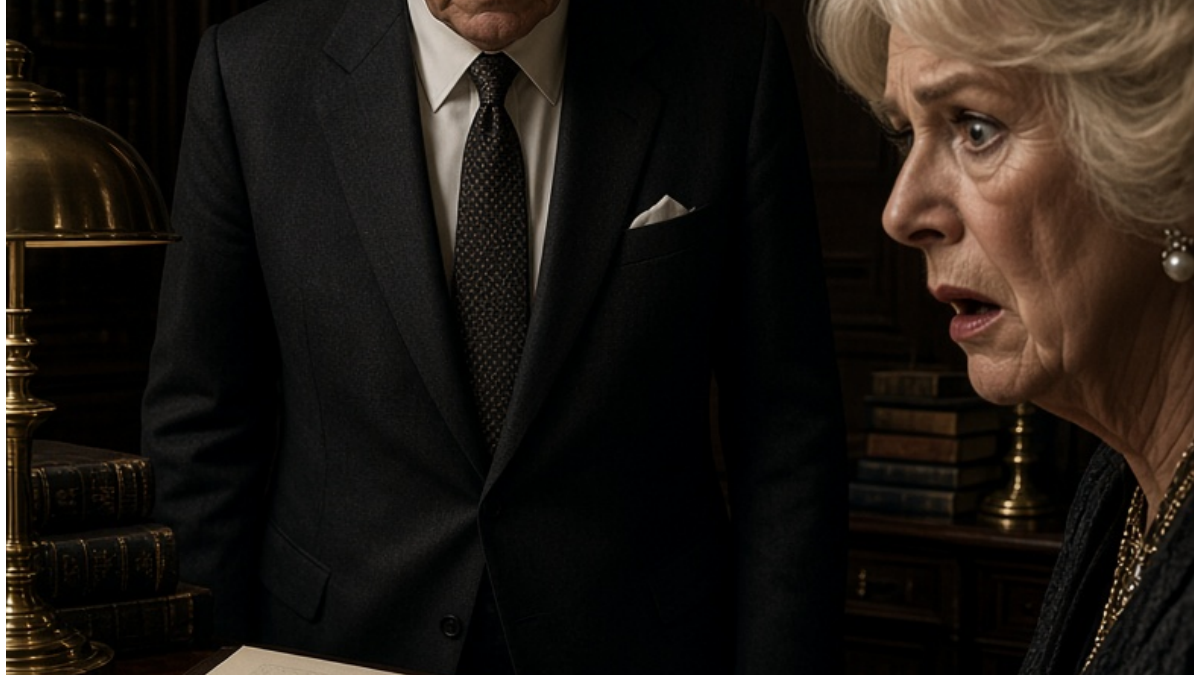
King Charles III sat in a high-backed armchair near the center table, his hands clasped tightly over his knee. Beside him sat Camilla, Her Majesty the Queen, posture erect, her expression composed into a neutral mask of formal grief. Across the table stood the senior estate solicitor, an elderly man whose dark suit and measured, unemotional demeanor seemed built to absorb the weight of royal legacies.
“We come now to the private estate and personal holdings of His Royal Highness, the late Duke of Gloucester,” the solicitor announced softly, clearing his throat. He adjusted his silver-rimmed spectacles, unfolding a thick manuscript of cream parchment.
Prince William stood near the edge of the room, leaning lightly against a tall bookcase, his eyes fixed on the legal papers. Beside him, Catherine, Princess of Wales, sat quietly, her posture poised, watching the solicitor’s hands rather than the faces around her.
“The Duke’s private estate,” the solicitor continued, his voice echoing flatly against the high ceiling, “comprises personal financial assets, private artwork, historical correspondence, and various family heirlooms accumulated across generations of royal service. Under the explicit terms of His Royal Highness’s final codicil, the distribution of these holdings is governed by absolute conditions.”
He paused, taking a slow breath before reading directly from the text:
“I hereby direct that my personal estate, including all monetary reserves, private property, jewelry, and personal keepsakes, be distributed among my designated family branches and charitable trusts as outlined in Schedule A. I explicitly direct that no portion of my financial estate, nor any individual object, artwork, or personal token of remembrance, shall be transferred to, inherited by, or placed under the discretionary control of Camilla, Queen Consort. This exclusion is total, absolute, and unalterable by any discretionary clause or administrative substitution.”
The room plunged into an immediate, suffocating silence.
For several seconds, no one moved. The faint ticking of a carriage clock on the mantelpiece sounded unnaturally loud. Camilla did not speak. Her fingers tightened around the velvet arm of her chair until her knuckles turned pale, then slowly—almost imperceptibly—she released her grip, keeping her gaze fixed on the table before her.
Charles tightened his jaw, his eyes darting toward the solicitor and then down at the floor. The King offered no immediate defense, no interruption, no attempt to challenge the reading. His silence carried its own devastating weight.
The solicitor reached into his leather briefcase and placed a second item beside the will: a thick paper envelope bound in dark red ribbon and sealed with black wax.
“In accordance with the late Duke’s instructions,” the solicitor added softly, “His Royal Highness has appended a private sealed memorandum setting out his reasoning in full. Under the terms of the instrument, access to this document is strictly limited to His Majesty the King, Prince William, and the designated estate trustees.”
William’s eyes narrowed as he looked at the wax seal. He recognized the shape of the crisis instantly. This was not a routine matter of money or land; it was a deliberate, legal judgment delivered from beyond the grave, drawing a line through the heart of the family.
Chapter 2: Shadows in the Corridor
When the reading concluded, the quiet protocol that governed palace gatherings frayed immediately. The solicitor bowed, gathered his folders, and was escorted out by a private secretary.
Camilla was the first to leave the library. She walked with deliberate, measured steps down the long, carpeted corridor, but the calm composure she had maintained during the reading was visibly slipping. Hearing footsteps behind her, she slowed near a tall arched window looking out over the inner courtyard.
Charles approached her, his face lined with visible strain.
Camilla turned to face him, her voice dropping into a low, controlled register that barely carried across the quiet hallway. “Did you know?”
Charles hesitated. That single second of hesitation landed with the sharpness of an admission.
“I had never seen the specific phrasing of the codicil, Camilla,” Charles said, his voice raspy. “I knew… I knew the Duke had held deep reservations for many years. But I was never shown the finalized legal text.”
“Reservations,” Camilla repeated, a cold, bitter edge cutting through her quiet tone. “He wrote a formal, legal exclusion into his estate papers. He instructed his executors that I should not receive a single token, a single penny, or a single photograph. And you knew he felt this way?”
“He was a man of the old court, Camilla,” Charles said quietly, looking away toward the courtyard. “He spent seventy years close to the working core of the monarchy. He held fiercely to traditional boundaries. I could not dictate how he chose to dispose of his private, personal property.”
“It is not about the money, Charles!” she whispered fiercely, stepping closer. “Money is irrelevant. To be denied a financial inheritance is a preference. To be written out of an entire family’s history—to be specifically named so that no executor could ever give me even a silver button as a keepsake—that is not estate planning. That is a public verdict!”
A short distance down the corridor, William and Catherine stood near the entrance of the morning room. William watched his father and stepmother in silence, his mind retracing years of family gatherings, commemorative dinners, and memorial services.
“He never greeted her the same way he greeted you, Catherine,” William murmured, his voice barely audible. “Do you remember? At the Garter services, at the Christmas lunches at Windsor… he was always warm toward you. But whenever conversation turned toward Camilla, he grew distant.”
“I remember,” Catherine said softly. Her expression was solemn. “At the time, we thought it was merely his quiet nature. But it wasn’t quietness, William. It was a boundary.”
“It was a line he drew years ago,” William said, looking toward the sealed red-ribboned envelope he now carried in his hand. “And he made sure it survived him.”
Chapter 3: The Dinner at St. George’s
To understand why a senior royal prince had taken such an uncompromising step in his final years, one had to look back several years—to a private dinner that followed a commemorative service at St. George’s Chapel in Windsor.
The service had been a solemn, traditional affair honoring historic royal orders, and the small dinner afterwards in the private dining rooms had begun comfortably. Attended by senior family members, the conversation initially revolved around church architecture, family archives, and historical preservation.
The Duke of Gloucester had sat near the head of the table. He was a quiet man, deeply protective of family history, who viewed his position not as a privilege of status, but as a strict trust handed down from his parents. To him, the private possessions of the various family branches—the engraved silver, the historical portraits, the presentation jewels gifted during historic overseas tours—were sacred relics of service, meant to remain tied to their specific hereditary lines.
As the second course was served, conversation turned toward the future organization of royal residences and collections.
Camilla, seated across from the Duke, spoke casually about long-term efficiency and royal representation. “With so many historical pieces scattered across secondary residences,” she suggested lightly, “it might make sense in the coming reign to consolidate several of the historic Gloucester and Kent heirlooms into the central Royal Collection. It would allow for better preservation and ensure they are used centrally for state occasions.”
The dinner table fell quiet. A butler holding a wine decanter paused mid-stride.
The Duke set his glass down slowly. He did not raise his voice. He did not strike the table. But when he looked at Camilla, his pale blue eyes were entirely devoid of warmth.
“Those items,” the Duke said, his voice level and ice-cold, “do not belong to a central administration. They carry the personal history, the sacrifices, and the private service of my parents and my family line. They are not administrative assets to be reorganized.”
Camilla tried to soften the moment with a quick, polite smile. “Of course, I meant only in terms of preservation and public display, Donald—ensuring the wider public can appreciate them.”
“Preservation does not require central ownership, Camilla,” the Duke replied evenly. “And rank must never be confused with entitlement over what belongs to others.”
He picked up his napkin, dabbed his lips, and did not speak another word to her for the remainder of the evening.
Later that night, as the guests were leaving, Catherine had encountered the Duke standing alone in the gallery. Seeing his visible strain, she had paused to speak with him.
“Sir,” Catherine had said gently, “it was a beautiful service today.”
The Duke had looked at her, his expression softening slightly. “Thank you, Catherine. You understand, don’t you? This institution functions only so long as we remember that we are stewards, not owners. The moment we begin to view family history as personal real estate to be claimed by rank, the entire structure begins to rot from within.”
“The history carries responsibilities, Sir,” Catherine had answered quietly. “Not just privileges.”
The Duke had looked at her for a long moment, nodding slowly. “Yes. Exactly so.”
Within forty-eight hours of that dinner, the Duke had summoned his private solicitor to his estate office. He requested a complete review of his private estate documents, issuing a written instruction that no future pressure, royal status, or administrative reorganizations should ever grant Camilla access or authority over his family’s personal heritage. That instruction, refined and protected over the subsequent years, became the rigid exclusion read aloud in the library of Clarence House.
Chapter 4: The Closed Door
In the King’s private study at Clarence House, the atmosphere was suffocating. Charles sat behind his large desk, the unsealed private memorandum lying before him.
The heavy oak door opened, and Camilla stepped inside. She closed the door firmly behind her, excluding all staff, private secretaries, and advisors. She did not sit down.
“Have you read it?” she asked.
Charles looked up, his expression heavy with fatigue. “I have read the relevant sections.”
“And?” she demanded, stepping toward the desk. “What justification does he give for inflicting such a deliberate public humiliation upon the Queen Consort?”
Charles picked up the document, his fingers tracing the neat, elegant handwriting. “Donald wrote at length about stewardship,” Charles said quietly. “He wrote about the boundaries that protect the private history of this family. He recounted the conversation at Windsor… the proposal regarding the Gloucester heirlooms.”
“A passing remark!” Camilla exclaimed, her voice rising slightly before she forced it back down. “A casual suggestion made at a dinner table years ago about preserving historic art! He turned a single, innocent conversation into a lifelong vendetta?”
“It was not a casual remark to him, Camilla,” Charles said firmly, setting the paper back down. “To him, it signaled a mindset—an assumption that holding high rank gives one the right to absorb the private heritage of secondary family branches into one’s own domain.”
Camilla’s face flushed with anger. “And you agree with him? You sit there and allow a dead man’s written spite to judge your wife?”
“I do not agree with the severity of his exclusion, Camilla!” Charles said, rising from his chair. “It has placed us in an agonizing position. But I cannot rewrite his legal will! I am the Sovereign, but I am not above the law of private property. I cannot force executors to violate a lawful mandate simply to shield us from embarrassment.”
Camilla sat down abruptly in the armchair facing the desk, her breath hitching slightly as the anger gave way to a deeper, far more painful realization.
“It is not about the money, Charles,” she said softly, staring at the desk. “It is the thought that after all these years—after all the work, the loyalty, the public duty, the endless efforts to serve this institution—there were senior members of your own family who sat across from me at dinner, smiled politely, and privately regarded me as an outsider who could not be trusted with a single silver spoon.”
Charles looked at her, his heart aching for her pain, yet unable to offer the one thing she wanted: a legal reversal.
“And what of Catherine?” Camilla asked suddenly, her eyes snapping back to his.
Charles paused, looking down at the memorandum again.
“He mentions her, doesn’t he?” Camilla said, her tone sharpening. “Tell me what he wrote about Catherine.”
Charles closed his eyes briefly. “He praised her,” he admitted softly. “He wrote that Catherine understood the fundamental difference between service and possession. He noted that she respected boundaries without needing to assert dominance.”
Camilla went completely still. The contrast was devastating: one woman specifically, legally barred from holding a single keepsake; the other singled out by name as the exemplary model of royal stewardship.
“And where do the Gloucester heirlooms go?” Camilla asked, her voice dropping into a dangerous, quiet register. “If I am denied even a token, who receives the core of his collection?”
Charles turned a page of the legal summary. “The primary historical pieces are placed into a protected family trust,” he explained carefully. “The trustees include independent legal executors, with future supervisory oversight assigned to William…” He hesitated slightly before adding, “…and a specific, intimate family keepsake left personally and directly to Catherine.”
Chapter 5: The Architecture of the Will
The legal framework built by the Duke of Gloucester was a masterpiece of ironclad estate planning. Designed specifically to resist royal influence, court pressure, or institutional compromise, it left no room for legal maneuver.
The following morning, Charles met privately with the chief executor of the Duke’s estate in the King’s writing room.
“Is there truly no discretionary latitude?” Charles asked, leaning over the legal briefs. “No standard clause permitting the executors to distribute small, symbolic tokens of remembrance to senior family members not explicitly listed in Schedule A?”
“None whatever, Your Majesty,” the chief executor replied politely but firmly. “The late Duke specifically drafted an anti-discretionary clause. It explicitly forbids the executors from creating, substituting, or approving any secondary gift, token, or financial equivalent for the Queen Consort. Should we attempt to do so, the entire estate trust immediately dissolves and transfers to a designated legal charity, which is legally bound to enforce the original terms.”
Charles leaned back, letting out a long, frustrated sigh. “He left no backdoor.”
“He spent three years refining these documents with senior counsel, Sire,” the executor explained. “His Royal Highness was acutely aware that pressure might be brought to bear upon his executors after his passing. He built a structure that makes compliance mandatory.”
The estate was divided into three distinct categories:
-
Financial Reserves & Real Estate: Allocated directly to his direct descendants and designated charitable trusts dedicated to architectural preservation and veteran care.
-
The Historical Gloucester Collection: Placed under the care of a closed board of trustees, with supervisory authority handed to Prince William upon his accession or designated milestone.
-
Personal Keepsakes: Distributed to specific individuals who had maintained close, respectful personal ties with the Duke over his lifetime.
Among those keepsakes was a rare, 18th-century miniature portrait of Queen Charlotte, set in an oval gold frame—a piece deeply cherished by the late Duke’s mother. It had been left explicitly to Catherine, Princess of Wales, accompanied by a short, handwritten card.
When William and Catherine received the formal notification in their office at Kensington Palace, the reality of the inheritance settled heavily upon them.
Catherine held the notification paper in her hands. “This is a terrible burden, William,” she said quietly. “Every piece left to us will be viewed through the lens of Camilla’s exclusion.”
“We didn’t ask for this, Catherine,” William said, sitting beside her. “But the Duke made his choice. He trusted you to protect these things because he knew you would treat them as history, not personal trophies.”
“It doesn’t make it any easier to look Camilla in the eye,” Catherine murmured. “She is hurting, William. Not because she wanted the miniature portrait, but because the entire world is about to learn that she was barred from receiving it.”
Chapter 6: The Physical Inventory
By the middle of the week, the theoretical clauses of the will moved into physical reality. Estate handlers, archivists, and legal clerks arrived at the Duke’s former residence to begin cataloging, packing, and transferring the estate.
In the private corridors of the palace, the atmosphere was fraught. Every crate moved, every inventory ledger signed, served as a quiet reminder of the boundary that had been drawn.
Camilla experienced the cold reality of the exclusion in small, agonizing details.
A small, antique enamel box—an item she had once admired during a visit to the Gloucester estate years ago—was listed on an inventory sheet being reviewed by the household staff. Camilla had subtly inquired whether the item might be retained for the public sitting rooms of Clarence House.
The private secretary had been forced to deliver the answer in a quiet, painful diplomatic formula: “Your Majesty, the item has been cataloged under Category 3 of the Gloucester Estate and is legally bound for transfer to the primary trust. The executors are unable to authorize a transfer to Clarence House.”
Camilla had received the news in her private sitting room. She did not argue. She did not raise her voice. She simply set the memo face down on her desk and dismissed the secretary with a brief nod.
Later that evening, William received an additional brief from the estate lawyers. It revealed that the Duke had revisited his estate documents less than two months before his passing, reviewing every clause line by line during his final illness, ensuring that the exclusion clause remained completely untouched.
“It wasn’t an old draft forgotten in a drawer,” William told Catherine as they reviewed the final papers. “He looked at it right at the end. He knew exactly what he was doing, and he chose to let it stand.”
Catherine pulled out the handwritten note that accompanied her miniature portrait. The script was frail, written in the Duke’s late, shaky hand:
“To Catherine—With gratitude for your understanding that our duty is to guard the story, not to possess it. Keep this safe.”
Catherine set the note down, closing her eyes for a brief moment. The gift was an undeniable gesture of profound trust, but its cost was a permanent, visible scar across the royal household.
Chapter 7: The Private Encounter
Knowing that allowing the situation to fester in silence would destroy any remaining working harmony within the family, Camilla made a decision that surprised the entire household.
She did not request a legal review. She did not ask Charles to issue a sovereign decree. Instead, she sent a personal message directly to Kensington Palace, asking to meet Catherine privately—with no husbands, no private secretaries, no courtiers, and no official notes taken.
The meeting took place in a small, quiet drawing room at Kensington Palace overlooking the private gardens. The room was warm, filled with soft afternoon light, but the air between the two women was taut.
Camilla sat in a high-backed armchair, holding a cup of tea that remained untouched. Catherine sat opposite her, quiet, composed, and attentive.
“I did not ask you here to demand that you surrender your inheritance, Catherine,” Camilla began, her voice steady, though her eyes bore the dark shadows of restless nights. “The legalities are clear. The Duke built a fortress around his estate, and Charles will not challenge it.”
“I know this has been deeply painful for you, Camilla,” Catherine said gently, her tone completely devoid of judgment or condescension.
Camilla let out a quiet, bitter breath. “Painful? It is humiliating, Catherine. To be told by the lawyers that I am explicitly barred from receiving even a wooden box… it feels as though thirty years of my life, of my service to Charles and to this monarchy, have been dismissed as irrelevant by the old guard.”
She looked directly at Catherine. “Did you know he was leaving that portrait to you?”
“No,” Catherine answered truthfully. “I knew nothing of the miniature portrait, nor of his final legal instructions, until the solicitor read the documents.”
“He saw you as the ideal custodian,” Camilla said, her tone a mix of sorrow and resentment. “And he saw me as a threat to his family’s legacy. Because of one conversation at a dinner table years ago.”
“Camilla,” Catherine said slowly, picking her words with extreme care, “the Duke was a man fiercely protective of boundaries. When he spoke to me after that dinner, he wasn’t merely angry about heirlooms. He was terrified that the modern court would forget that royal status is meant to serve history, not own it.”
She paused, leaning forward slightly. “His decision was about his own deep anxieties regarding the family’s future. But I know that one man’s final, rigid legal instruction does not erase the decades of daily public service you have given beside the King.”
Camilla sat silently, listening to Catherine’s words. The anger that had fueled her for days began to drain away, leaving behind a quiet, exhausted clarity.
“I will not refuse the miniature portrait,” Catherine added firmly. “To refuse it or to try to pass it over would be a lie—it would violate the trust he placed in me. But I promise you this: I will never use this inheritance as a symbol of status or victory. It will remain in private preservation, handled with respect, and never showcased to undermine your standing.”
Camilla stared at the younger woman for a long moment. The tension in her shoulders slowly eased. She recognized that Catherine was offering her the only thing truly possible under the circumstances: complete honesty without cruelty, and respect without pretense.
“Thank you, Catherine,” Camilla said softly, nodding once. “That… that is more than I expected.”
Chapter 8: The Media Reaction
Despite the family’s attempts to contain the drama behind palace walls, the story inevitably leaked to the national press.
Within forty-eight hours of the legal filings being registered, major broadsheets and broadcasting networks published lead stories analyzing the late Duke’s estate.
The headlines were stark and unforgiving:
“NOT ONE PENNY: DUKE OF GLOUCESTER’S WILL EXCLUDES QUEEN CAMILLA”
“Royal Archives Confirm Core Heirlooms Transferred to Princess of Wales and Future Trustees”
The press seized upon the stark contrast. TV commentators debated the legal precedent, with some framing the exclusion as a brutal, final rejection by an elder royal, while others described it as a necessary defense of hereditary family property.
Palace communications officers were caught in an impossible predicament. To deny the tension would appear absurd given the explicit text of the will; to comment directly would risk turning a private family inheritance into an official, ongoing constitutional dispute.
When Charles asked Camilla if she wanted the palace to issue a rebuttal challenging the harsh media interpretations, she shook her head firmly.
“No, Charles,” she said calmly as they sat together in the morning room. “Fighting headlines will not alter the legal parchment. It would only prolong the news cycle and make it appear as though the Queen Consort is waging war against a dead relative’s final wishes. Let the stories run. They will fade.”
Charles looked at her with quiet admiration. In her refusal to fight the press or challenge the will, she had found her own form of dignity.
Palace communications eventually issued a single, brief statement:
“The estate of the late Duke of Gloucester has been processed strictly in accordance with his long-standing private legal instructions. His Majesty the King and all members of the Royal Family respect the late Duke’s personal choices and ask for privacy as the family continues its period of remembrance.”
Chapter 9: The Final Boundary
Weeks later, the press storm had subsided, leaving behind a quiet, altered landscape within the palace.
The Duke’s estate was fully distributed according to his unalterable instructions. The monetary legacies were transferred to designated charities, the historical collection was locked securely inside the trust governed by William’s future oversight, and the small, 18th-century miniature portrait of Queen Charlotte rested safely inside a glass archival case in Catherine’s private study.
On a quiet Sunday afternoon, Charles and Camilla walked together through the gardens of Highgrove. The crisp autumn air was still, and the leaves drifted slowly onto the stone paths.
“Are you at peace with it, Camilla?” Charles asked softly, holding her hand.
Camilla paused, looking out over the quiet gardens.
“I have accepted it, Charles,” she replied, her voice soft but entirely composed. “The Duke drew his line, and he kept me outside it. I cannot change his verdict, nor can I force my way into a legacy that was denied to me. But my standing in this life is defined by what I do beside you today—not by the heirlooms I was refused.”
At Kensington Palace, Catherine sat at her writing desk, looking at the small miniature portrait. She touched the gold frame gently, remembering the Duke’s shaky handwriting on the card: Our duty is to guard the story, not to possess it.
She knew that the Duke’s final will had been a fierce, uncompromising assertion of personal choice—a final boundary drawn around a private legacy. But she also knew that the true strength of the monarchy lay not in enforcing exclusions, but in the quiet restraint, humility, and grace required to carry history forward without turning it into a weapon.
The legal documents were closed, the cabinets were locked, and the boundary stood complete. Not one penny had gone to Camilla, and nothing would ever change that. But in accepting the boundary with dignified restraint, the family had allowed both the dead man’s wishes and the living monarchy’s endurance to stand side by side, unbroken.








