“Nobody Wants To Dance With Me,” She Sobbed—Until the Quiet Millionaire Stepped Onto The Stage
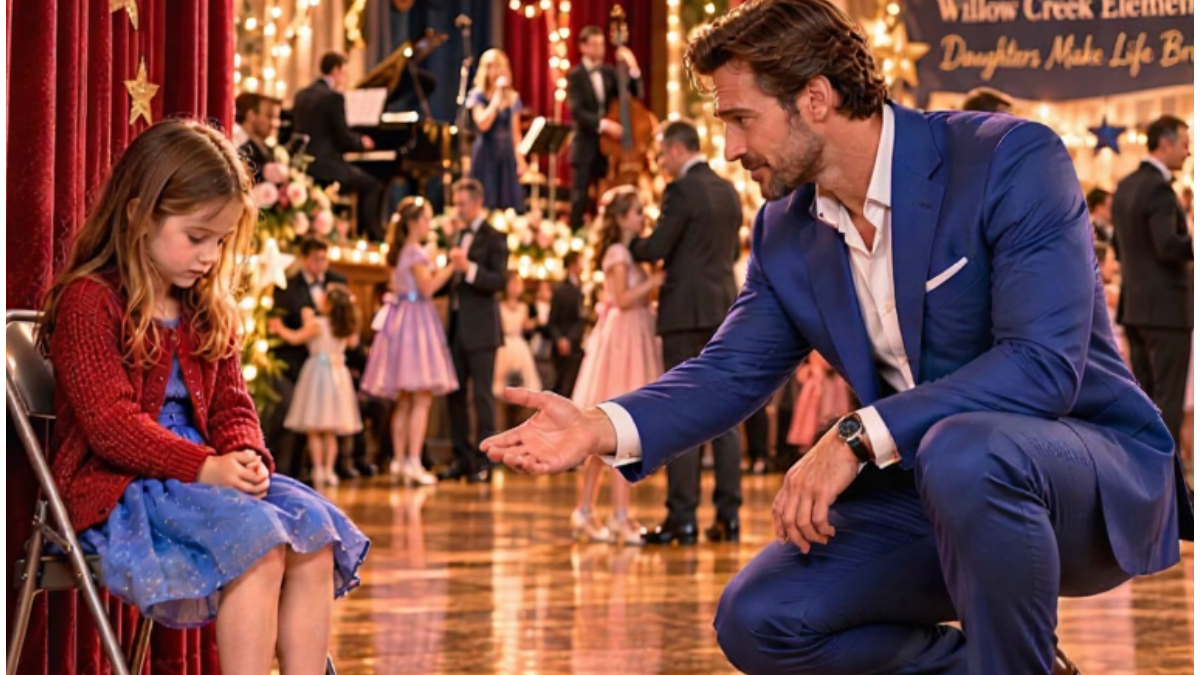
Nobody wants to dance with me,” she sobbed until the quiet millionaire stepped onto the stage.
The Willow Creek Elementary auditorium had not looked this good in 40 years. The new roof no longer leaked onto the stage.
Someone from the PTA had borrowed string lights from the hardware store and draped them along the balcony rail, giving the room a soft, forgiving glow.
Near the doors, two punch bowls sat on folding tables beside trays of sugar cookies.
On the floor below the stage, a piano, an upright bass, and a retired band teacher with a clarinet were playing the kind of songs people’s grandparents used to dance to.
It was the town’s annual charity dance. By 8:00, the room was full. Rosie Parker stood near the stage curtain, exactly where the heavy red velvet met the floor.
She was 8 years old. Her blue dress had faded to the color of an old pair of jeans, and the hem had been let out twice.
Her shoes pinched her heels, so every few minutes she shifted her weight from one foot to the other, careful not to look like she was fidgeting.
Around her wrist was a thin blue paper band from the admission table. She kept turning it with two fingers around and around.
An hour earlier, her teacher, Grace Miller, had shown her a text from her aunt.
On my way. So Rosie waited. She watched the doors. She watched fathers in pressed shirts straighten their daughter’s hair bows.
She watched a grandfather lift a little girl onto his shoes so she could reach his hands.
Every time the doors opened, Rosie stood a little straighter. Every time it was someone else, she went back to turning the wristband.
A girl in a yellow dress leaned toward her friend. Who’s she here with? The friend shrugged.
Nobody, I think. They didn’t say it to be cruel. Children rarely do. But Rosie heard it and her face went warm.
Then the principal stepped up to the microphone and smiled at the crowd. All right, folks.
Dads and daughters, grandpas and granddaughters, find your partner. This first one’s for you. The trio began.
Chairs scraped, the floor filled. Rosie stayed by the curtain with her hands at her sides, the way she stood for school pictures.
She told herself grown-ups got held up all the time. She told herself it was fine.
The first verse passed, then the second, nobody came. Her chin started to tremble, and she pressed her lips together to stop it.
It didn’t work. The tears came quietly at first, then all at once, and in the small pause between verses, her voice carried farther than she meant it to.
Nobody wants to dance with me. [snorts] A few heads turned. A mother near the punch table half rose from her chair, then sat back down when her own daughter tugged her toward the floor.
Grace was across the room, pinned between two parents. Everyone else looked away politely, the way decent people do when they aren’t sure it’s their place.
In the very last row sat a man who had not planned to be there this long.
Henry Caldwell was 45, gray at the temples and dressed in a good coat that didn’t try to look expensive.
He had built Caldwell roofing and restoration from one secondhand pickup truck, and he still had the hands to show for it.
He had paid for this auditorium’s new roof, new seats, and new stage floor. When the principal thanked him from the podium earlier, he had nodded once and said nothing.
He had checked his watch three times since. He meant to be gone before the family dances started.
But when the trio played the opening bars of that first song, his hand stopped halfway to his coat.
He knew this song. Some people carry a melody because they once danced to it.
Henry carried this one for a different reason, and he had never told anyone what it was.
Then he looked toward the stage and saw the little girl standing alone by the curtain twisting a paper band around her wriSt. For a long moment, he didn’t move.
He was a stranger here. It wasn’t his business. Surely, someone closer would step in, but nobody did.
And Henry understood something he had learned too late once before. Sitting still was not the same as staying out of it.
Staying in that chair was a choice, and a child would remember it. He set his coat down on the seat.
Then, Henry Caldwell stood up and began to walk down the long center aisle toward the stage.
Henry didn’t hurry. He walked the way a man walks toward something fragile. Steady and quiet, his eyes on one person only.
A few parents noticed and stepped aside. He climbed the three short steps at the side of the stage and stopped a respectful arm’s length from the curtain.
Rosie wiped her face fast with the back of her hand, the way children do when they’ve been caught crying.
Henry gave a small bow, the old-fashioned kind his grandfather used to give at church socials.
Then he held out his hand, palm up. I’m afraid I’m not much of a dancer, he said.
But if you’d let me have this one, I’d be honored. She looked at his hand, then at the crowd, then back at him, searching his face for the catch.
Whatever she was looking for, she didn’t find it. She rested just the tips of her fingers on his palm, barely touching as if he might take the offer back.
The room went quiet. Down on the floor, the clarinet player glanced up, understood, and nodded to the others.
The trio kept playing. It was a waltz and Henry was worse at it than he’d warned.
On the second measure, he started with the wrong foot. Other foot, Rosie whispered. Yes, ma’am.
You go back first, then side, then together. He did as he was told. I’m Henry, by the way.
Rosie. She didn’t smile, but some of the stiffness left her shoulders. Up close, Henry could hear her counting under her breath.
1 2 3 1 2 3. Slow and careful, like a child crossing ice. She wasn’t enjoying the dance so much as trying not to get it wrong.
Her free hand stayed clenched around that blue paper wristband. By the last note, it had creased straight down the middle.
When the song ended, Henry stepped back and bowed once more. Afterward, he kept it simple.
A paper cup of punch, a carton of chocolate milk from the children’s table, a folding chair beside Grace Miller, who had finally worked her way across the room and recognized him as the man whose name was printed on the renovation program.
“Mr. Caldwell,” she said quietly. “Thank you.” He only shook his head. Rosie held the punch with both hands and drank it in small sips as if someone might take it away.
“Is there somebody I can call for you?” Henry asked. No, it came out too faSt. My aunt’s just busy sometimes.
It’s okay. Grace tried anyway. Diane’s cell went to voicemail. So did the emergency contact on file.
By 9:30, the string lights were being unplugged. The punch bowls were empty. And Rosie was still sitting in the folding chair with her backpack on her lap watching the door.
I’ll drive her home, Grace said. Henry hesitated. Would you mind if I followed you?
Just far enough back to make sure somebody’s there. Grace studied him a moment, then nodded.
The house was on Sycamore Street, a small ranch with peeling shutters and every light on.
Henry parked across the road and left the engine running. Even from there, he could hear a toddler crying inside.
Two car seats sat stacked on the porch beside a folded stroller. None of it was meant for an 8-year-old.
Grace opened the back door and helped Rosie out. Before Ros’s shoes touched the driveway, the front door swung open.
Diane Mercer stood in it, a phone in one hand and a fussing little boy on her hip.
Tammy Sims texted me, she said. Said you had the whole auditorium staring at you.
I’m sorry, Aunt Diane. I told you I was coming. Rosie didn’t argue. She walked up the steps with her head down and slipped past her aunt into the house.
“Thanks for the ride, Grace,” Diane said flatly and shut the door. Henry sat in the dark truck with both hands on the wheel.
One song. That was all he’d given her. For 3 minutes, a little girl had been chosen in front of everyone.
Then she’d gone right back to apologizing for it. The dance had helped. It hadn’t changed a thing.
As Grace backed out of the driveway, her headlights swept across the mailbox at the curb.
The lid hung open, stuffed too full to close. After her car disappeared around the corner, Henry eased his truck across the street and pulled up beside it.
An official white envelope protruded from the stack, its corner caught beneath the bent metal lid.
He recognized the blue seal of the county benefits office. Then he saw the name printed in the little window.
Rosie Parker. 2 days after the Saturday night dance, Rosie Parker fell asleep at her desk before the first bell finished ringing on Monday morning.
Grace Miller didn’t wake her right away. She let the girl sleep 10 more minutes, cheek resting on her folded arMs. It wasn’t the first Monday this had happened.
It was just the first Monday Grace had started keeping track. Once she started, the pattern was hard to miss.
Rosie apologized before she asked for anything. Sorry, can I use the restroom? Sorry, I need a pencil.
She never raised her hand for help, only for permission. Her shoes were a full size too small.
And when the school nurse, Mrs. Hadley, offered her a pair from the lost and found bin, Rosie shook her head.
Mine are still fine. Then there was the drawing. During free time, Rosie drew a house with six small stick figures lined up on a rug and one bigger one standing apart holding what looked like a bottle.
Who’s that? Grace asked, pointing at the tall one. Me, Rosie said. I do the bottles.
Willow Creek was a small town, and people talked. Diane Mercer watched other people’s children out of her house on Sycamore Street.
No sign, no license, cash only. Five or six kids, most of them dropped off before sunrise and picked up after dark.
On paper, she was a single aunt raising her late sister’s child. In practice, she had an 8-year-old helping her run a daycare.
Diane had taken Rosie in when nobody else would, and that counted for something. But when Grace stopped her at pickup on Wednesday, she learned how quickly that door could close.
Diane stood by her car with a gas station coffee and the look of someone who hadn’t slept in a week.
“If this is about the dance, I already heard about it.” “It’s about Rosie being tired,” Grace said gently.
“And her shoes.” “Her shoes?” Diane gave a short laugh. “You know what I do all day?
I keep a roof over that kid. I get her survivor check every month, and it goes straight into bills, every cent.
So don’t stand here and tell me I’m not holding it together.” She wasn’t shouting.
She didn’t have to. She said it the way people do when they have told themselves the same story so many times, it started to sound like the truth.
That afternoon, Henry called the school. He didn’t ask to see Rosie. He asked Grace for a shoe size.
2 days later, a plain shoe box arrived at the front office. Inside was a pair of sturdy navy sneakers, the right size, no note.
Grace brought them to Rosie at recess. Rosie looked at the box for a long moment.
She didn’t touch it. I can’t take those. They’re yours, honey. Nobody’s going to be upset.
Rosie shook her head, eyes fixed on the lid. New things make grown-ups mad. She said it plainly, like a fact she’d learned the hard way.
Then she went back outside. That evening, Grace called Henry to tell him he was quiet on the line for a while.
Can I ask you something? He said finally. Why did that dance matter so much to her?
Grace looked at the drawing still pinned to the corkboard. Her mom, Laurel, used to love that dance.
She told Rosie once that when somebody picks you for a dance, it means they really see you.
The line went quiet so long that Grace thought the call had dropped. “Thank you for telling me,” Henry said.
That Friday, Rosie came to school with the blue paper wristband looped around one strap of her backpack tied in a careful little knot.
She touched it every time she walked past Grace’s desk. On her way out that evening, Grace crossed the newly restored auditorium lobby and stopped at a small brass plaque beside the doors.
Restored in honor of CC no full name, no dates. Nobody at the school or the PTA knew who that was.
Only Henry Caldwell knew, and he hadn’t said. At pickup, Diane mentioned almost in passing that she was thinking about moving Rosie to a school over in Dayton, someplace where people mind their own business.
Grace went back inside and sat at her desk for a long time. Then she opened the county reporting form and filed a formal concern.
On Monday afternoon, her classroom phone rang. Miss Miller, this is Angela Ruiz with County Children’s Services.
I’ve read your report. The woman paused. Is there anyone who can tell me what Ros’s life actually looks like after the last school bell rings?
Milliey’s Diner sat on the corner of Maine and Third. The mugs were chipped. The coffee was strong, and a lemon mering pie sat under a glass dome by the register.
The waitress, Bev, knew every teacher in town by name. Grace had chosen it because it was ordinary.
Henry was already there when they arrived, sitting alone in a back booth. He didn’t stand up to greet them.
He just nodded and kept his hands folded on the table like a man trying to take up as little room as possible.
In front of the empty seat across from him sat a to-go container of Milliey’s chicken noodle soup, lid on, spoon wrapped in a napkin beside it.
Grace said, “You like broth?” He said, “You can eat it here or take it with you.
Either way is fine.” Rosie slid into the booth, set her backpack beside her, and said, “Thank you, Mr. Caldwell.”
She said it the way children thank a dentiSt. At the counter a few stools down, a woman in a gray cardigan sipped coffee over a folded newspaper.
Grace had introduced her outside as Angela, a lady from the county who helped kids.
For a while, nobody said much. Rosie opened the soup but didn’t eat it. Under the table, her right hand stayed closed around something.
When Henry reached into his coat for his reading glasses, a folded slip of paper fell out and landed on the table between them.
It was small and yellowed, soft at the creases. Rosie read it upside down. Willow Creek Elementary father-daughter dance.
Admit one. Below that was a date from 15 years ago. She looked at it, then at him, and something in her face shut like a door.
“Grown-ups only act nice when other people are watching,” she said. Grace started to speak.
Henry lifted a hand slightly and she stopped. “That’s fair,” he said. “Some do.” Rosie stared at the ticket, then she asked very quietly.
“Did you stop wanting your daughter, too?” The diner noise seemed to fall away. Henry picked up the ticket and turned it over in his fingers.
Her name’s Caroline, he said. 15 years ago, she was eight, same as you. She stood by that same curtain in that same auditorium and waited for me.
She’d practiced the steps in our kitchen for a week. Where were you? Across town, signing a contract I thought mattered more.
He set the ticket down. She never brought it up again. She just never waited for me after that.
Rosie didn’t blink. “So, did you stop wanting her?” “No,” Henry said. “I didn’t stop wanting her.
She stopped waiting for me, and she was right, too.” Grace went still. The brass plaque in the lobby.
CC Caroline Caldwell. Rosie looked down at her soup. For the first time, she picked up the spoon.
Then, the bell over the diner door jangled hard. Diane Mercer came in still wearing her coat, car keys in her fiSt. Every head at the counter turned.
“Tammy saw your car,” she said to Grace, loud enough for the whole room. “So, this is what we’re doing now?
Rich man buys my niece lunch behind my back, and I’m the bad guy.” Rosie was already moving.
She dropped the spoon, grabbed her backpack, and slid out of the booth. I’m sorry, Aunt Diane.
I’m sorry. I didn’t know. I’m sorry. Three apologies, one after another, before anyone had even accused her of anything.
Henry watched her shoulders curl forward and her eyes dropped to the floor. 5 minutes ago, she had been reaching for the spoon.
Now, she was trying to make herself small enough to disappear. At the counter, Angela Ruiz had lowered her newspaper.
She wasn’t watching Diane. She was watching Rosie. And the way the girl’s whole body had changed the second that door opened.
Diane steered Rosie out by the shoulder. As they passed the booth, Ros’s fist opened just long enough for Henry to see the blue paper wristband crushed inside it and the red lines it had pressed into her palm.
The soup sat on the table, still steaming. Henry understood something then. To a child like Rosie, kindness wasn’t safe.
Every kind thing came with a bill, and she was always the one who paid it.
In the parking lot, Angela caught up with him by his truck. She kept her voice low.
Mr. Caldwell, I’ve done this job 19 years. That wasn’t a tired kid in trouble with her aunt.
She held his eyes. I don’t think this is simple neglect. I think somebody’s been using that little girl as free labor and calling it guardianship.
The case conference room at the county building had one window, a long laminate table, and fluorescent lights that made everyone look like they’d worked a double shift.
A pot of coffee sat on a hot plate in the corner, burned since morning.
It had taken Angela Ruiz, 10 days to build her file. Henry’s attorney, Evan Hollis, a soft-spoken family lawyer, had spent those same 10 days pulling records.
Now it was all on the table in Neat Manila folders. The state had no license on file for any child care operating out of the house on Sycamore Street.
There was no second adult listed anywhere. The parents Evan spoke with all described the same scene.
Diane at the door and a little girl in the back holding the baby. The school’s records filled in the reSt. Rosie had been marked unavailable for after school tutoring, two field trips, and six sessions of grief counseling, always during the hours the daycare ran.
Her pediatric checkups had been postponed three times. Then there were the receipts Diane herself had submitted to the county to show how she spent Rosy’s survivor benefits.
Evan laid them out one by one. A second play pen, two cribs, cases of infant formula, a secondhand minivan with three car seats.
Not one of them was for an 8-year-old. Diane sat across the table with her arms crossed and her purse in her lap.
She’d come without a lawyer. She looked tired, but she didn’t look beaten. “You want to know what that money bought?”
She said. “Grocies, heat, a roof over that kid’s head. I took her in when nobody else would.
I work 16 hours a day, and now I’ve got a teacher, a nurse, a county lady, and a millionaire sitting here telling me I’m doing it wrong.”
She shook her head. “Must be nice.” For a moment, it landed. Nobody at that table had ever had to choose between the electric bill and new shoes.
Diane knew it and she pressed harder. She turned to Henry. And you? I asked around about you.
A man who walked out on his own daughter wants to lecture me about raising a child.
The room went quiet. Even Angela’s pen stopped moving. Henry didn’t reach for a defense.
You’re right, he said. I wasn’t there for my daughter when it mattered. I’ve lived with that for 15 years.
He looked at Diane evenly. That’s exactly why I know what a child looks like when she’s waiting for someone who isn’t coming.
Diane opened her mouth, then closed it. Grace slid a folder forward. Attendance logs. Every Monday nap, every sorry, the drawing of six small children on a rug and one bigger girl holding the bottle.
Mrs. Hadley, the school nurse, went next. She described blisters on both of Rosy’s heels that had never been treated and checkups that kept getting skipped.
Then Angela opened her own file. On the night of the Willow Creek dance, she said Rosie was left with no ride home.
Ms. Mercer, you told the school you were on your way. According to two parents I spoke with, you were at home waiting on a late pickup because that family owed you $40.
She sat down a photograph. It showed the contents of Rosy’s backpack laid out on a table during her school interview.
A spelling workbook, a hair tie, and knotted around one strap, a creased blue paper wristband.
“That’s what she kept from that night,” Angela said quietly. “One dance.” Nobody spoke. Henry turned to Evan.
“File for emergency protective placement.” Evan nodded slowly. “And if the county asks where she goes, “My home if they approve it.
Only if they approve it.” Henry looked at Angela. Home checks, background checks, parenting classes, whatever oversight you need.
I won’t argue with any of it.” Angela studied him for a long moment. In 19 years, she’d heard plenty of people offer to help.
Very few had started by admitting what they’d done wrong. She closed her folder. I’ll schedule the emergency review for Thursday morning.
Diane stood, pulled her purse onto her shoulder, and walked out without a word. The review never happened.
>> [snorts] >> On Wednesday morning, Diane walked into the front office at Willow Creek Elementary and signed Rosie out early.
“Family emergency,” she wrote on the clipboard. The secretary didn’t think to call Grace until the minivan had already pulled away.
By noon, the house on Sycamore Street was dark and nobody in town knew where Rosie Parker was.
Diane had it all worked out by the time they reached the highway. Her boyfriend Wade had a place in Dayton and three kids of his own.
There was room, she said. Rosie wouldn’t have to worry about school for a while.
She could help out with WDE’s kids instead. Rosie sat in the back of the minivan beside two empty car seats and said nothing.
At the Sunnaco on the edge of town just before the on-ramp, Diane pulled in for gas and went inside to pay.
Rosie looked at the door handle for a long moment. Then she pulled her backpack onto her shoulders, opened the door, and walked away without running.
The way you walk when you don’t want anyone to notice you’re leaving. She knew the county road from the school bus window.
The gas station was a little more than 3 mi from Willow Creek Elementary, though she had never walked the whole way before.
She kept to the shoulder whenever cars passed, her backpack bouncing against her back. At the first intersection, she turned toward town.
School was the only place she could think of where someone might come looking for her.
She reached the school while the afternoon light was still fading. The doors were locked and the parking lot was nearly empty.
For a while, she sat behind the gym, too frightened to leave and too frightened to ask anyone for help.
When the air turned cold, she remembered the spare key beneath Grace’s car. She found it, climbed into the back seat, and pulled her teacher’s old cardigan over her shoulders.
By late afternoon, Angela had confirmed that Diane and Rosie were gone. She contacted the authorities while Grace joined Henry to search the roads leading out of town.
Grace left her car at the school and rode in his truck so they could check the bus stops, side streets, and places Rosie might recognize.
As the hours passed, the roads grew dark, and neither of them had found a trace of her.
It was after 10:00 that night when Grace and Henry finally pulled back into the Willow Creek Elementary parking lot.
They had spent the evening searching, and Grace had insisted on making one last stop at the school before going home.
Grace’s car sat alone under the one working light right where she’d left it. Something moved in the back seat.
Grace was out of the truck before it fully stopped. Through the fogged rear window, she saw a small shape curled under the gray cardigan she kept in the car.
Grace opened the door. Ros’s cheeks were red from the cold, and her sneakers were soaked through.
She didn’t cry. She just looked up and said, “I’m sorry I got in your car.”
“Oh, honey,” Grace whispered. “Don’t you ever be sorry for this.” Angela arrived 20 minutes later.
Diane had never called anyone to report Rosie missing. That alone told Angela plenty. She crouched by the open car door.
“Rosie, I need you to tell me the truth about home. But I can’t promise where you’ll stay after.
I won’t lie to you about that.” Rosie nodded like she’d expected nothing else. By midnight, the on call judge had signed an emergency order.
Henry’s preliminary background check had been completed, and Angela had arranged an expedited assessment of his home earlier that evening.
The emergency placement would remain subject to further review. Temporary placement pending review. “You’ll [snorts] stay with Mr. Caldwell for now,” Angela told her.
Rosie looked from Angela to Henry to Grace. Three grown-ups deciding where she belonged. She didn’t argue.
She just held her backpack tighter. Henry’s house made things worse before it made them better.
It was too big, too quiet. The floors shown, the furniture matched, and nothing looked like anyone had ever spilled anything on it.
Rosie stood in the front hall like she was afraid to touch anything. At the top of the stairs, one door stayed closed.
Henry didn’t take her up there. Caroline’s room was still exactly as she’d left it, kept for weekend visits that had stopped coming years ago.
It wasn’t a room for a scared little girl. It was a room for his regrets.
Instead, he made up the den sofa near the kitchen with clean sheets and two pillows.
He left the hall light on. He moved a box of cereal in a plastic bowl to the lowest shelf of the pantry where she could reach them.
“If you’re thirsty at night,” he said, “you just get water. You never need to ask me.”
Rosie nodded. She didn’t say anything. In the guest bathroom, she tried to slip the blue paper wristband off her backpack strap before washing her hands.
It had been damp all evening and it tore clean in two. She stared at the pieces for a long time.
Then she put them in her pocket and turned off the light. Later, when Henry lifted her backpack off the floor to set it on a chair, it felt heavier than it should have.
The zipper was half open. Inside were a sleeve of crackers, a fistful of ketchup packets, and half a dinner roll wrapped in a napkin.
He zipped it back up and set it exactly where he’d found it. Rosie hadn’t chosen to trust him.
She had only chosen the least dangerous place to sleep. The next morning, Angela came to the house for Ros’s first formal interview.
They sat at the kitchen table while Henry waited in the next room. Near the end, Angela asked gently why Rosie had worked so hard at home.
Rosie looked down at her hands. When she answered, it was barely a whisper. Aunt Diane always said, “Nobody keeps a kid unless the money comes with her.”
The truth came out in pieces. Rosie never said she felt unloved. She said smaller things at odd moments.
On the way to her first counseling appointment, she asked what it coSt. Then she looked out the window and said, “I’m expensive.”
At breakfast, she said being useful made grown-ups keep you. At the grocery store. She said being quiet made people less mad.
And one night brushing her teeth, she told him that saying sorry early sometimes helped.
Before they get upset, so it’s already done. None of it was dramatic. That was what made it so hard to hear.
Henry didn’t answer with speeches. On Saturday morning, he climbed the stairs and unlocked the door at the top.
Caroline’s room smelled like dust and old paper. An upright piano stood against the wall.
On its lid sat a stack of recital programs mailed to him by Caroline’s mother over the years, every envelope still sealed.
On the music stand was a worn sheet of the old walts Caroline had learned to play so she could practice the dance steps.
It was the same song the trio had played the night he met Rosie. The calendar on the wall was still turned to a month 15 years gone.
He wasn’t opening the room for Rosie. He wasn’t asking her to fill it. He was ending a habit.
For 15 years, keeping this door shut had felt like waiting. It had really been a way to avoid doing the harder thing.
That night, he sat on the piano bench and wrote to Caroline. It was his first letter in years.
He didn’t ask for her forgiveness. He told her about a little girl standing alone by a stage curtain.
And he told her he finally understood what he’d done. He mailed it Monday. He didn’t expect an answer.
Two weeks later, the hearing took place in Judge Kowalsski’s chambers, not a courtroom. Only the people who needed to be there sat at the round table.
Angela Evan Grace, a court clerk, and Diane, who had come back from Dayton with a public defender and the look of someone who had run out of arguments.
The county recommended temporary guardianship for Henry and an independent conservator to manage Ros’s benefits.
The judge agreed. Diane lost custody pending a full neglect finding, and her contact with Rosie would be supervised.
A separate referral went to the state for operating an unlicensed daycare. Diane [snorts] signed where she was told and left without looking at Henry.
But the real proof hadn’t happened in that room. It had happened an hour earlier on a wooden bench in the hallway outside.
Henry had been quizzing Rosie on spelling words while they waited. She reached for her juice box squeezed too hard and orange juice spilled down the front of his good wool coat.
Rosie froze. All the color left her face. I’m sorry. I’m sorry. I’m so sorry.
I didn’t mean I’m sorry. Henry took off the coat, folded it over the arm of the bench, and handed her a napkin for her hands.
Then he looked back at the liSt. “Okay,” he said. “Spell neighbor.” Rosie stared at him, waiting for the rest of it.
There was no rest of it. “No, R,” she said slowly. “That’s right.” Three nights later, Rosie woke from a bad dream and padded toward the kitchen.
The light was on. Henry sat at the table with a small sewing kit, working a needle carefully through faded blue fabric.
It was her old dress from the dance. Angela had brought it over in a trash bag with the rest of Rosy’s things.
It was too small to wear, but Rosie hadn’t been able to throw it away.
Henry had noticed. Now he was stitching it into a small square pillow, slow and a little crooked.
He didn’t ask about her dream. He just pulled out the chair beside him. Rosie stood there a long time.
Then she reached into her pajama pocket, took out the two torn pieces of the blue paper wristband, and set them on the table.
Without a word, Henry tucked both pieces inside the pillow before sewing the last seam closed.
Rosie sat down beside him and stayed. A week later, the county approved a longer placement.
Angela called with the news, then paused. Henry, a judge can make you her guardian in an afternoon.
Trust takes a lot longer than that. Out by the curb, the mailbox was empty again.
There was still no letter from Caroline. One year later, the string lights were back on the balcony rail at Willow Creek Elementary.
But the sign at the auditorium door had changed. It no longer said fatheraughter dance.
It said community partner line in Grace Miller’s need classroom lettering with one line underneath.
Everybody dances, nobody waits. It had been Grace’s idea, the PTO’s hard work, and Henry’s check.
The local VFW post had supplied the volunteers. At the admission table, every child received a small blue ribbon pin.
Any child who came alone was paired with someone who had shown up for exactly that reason.
A grandfather, a coach, a teacher, a veteran, an aunt, a neighbor. No child would stand by that curtain alone again.
The year in between had not been magic. It had been counseling appointments, adoption paperwork that took three tries to get right, an awkward first Thanksgiving, and one stomach virus that knocked them both flat for a weekend.
It had been several nights when Henry heard Rosie get up at 2:00 in the morning to check that the front door was locked.
He never told her not to. He just started checking it with her. Henry had learned the thing no amount of money could have taught him.
Being generous was easy. Being steady was the job. Rosie laughed more now. She had stopped hiding food.
She told him when she was hungry and when she was scared. That evening before the dance, Henry had stood behind her in the kitchen with a comb and a hair tie, trying to follow a video on his phone.
“You’re pulling too tight,” Rosie said. “No, cross the left one over, the other left.”
“Yes, ma’am.” It was the first braid he had ever made. He had never once done this for Caroline.
It came out a little lopsided and Rosie wore it anyway. Before the music began, Rosie walked to a chair set apart near the stage.
On it stood a framed photo of her mother, Laurel. Rosie set the small blue pillow beside the frame with its crooked seams and the torn wristband sealed safely inside and smoothed it flat with both hands.
Then the trio began to play. Halfway through the evening, Henry glanced toward the back of the auditorium and went still.
A young woman sat in the very last row in the same seat he had taken a year ago.
She had his eyes and her mother’s dark hair and in her lap she held a worn envelope soft at the edges from being opened too many times.
Carolyn. Neither of them moved. A year of silence, 15 years of distance, and the whole length of the room sat between them.
Rosie followed Henry’s gaze. She knew that face. She’d seen it in the photo on the piano upstairs.
She didn’t wait for anyone to decide what to do. She crossed the floor, walked up the center aisle, and stopped in front of Caroline.
Then she held out her hand. “We’re doing a partner line,” Rosie said. “Nobody sits out.
Want to come?” Caroline looked at the small hand, then at the girl’s lopsided braid, and something in her face gave way.
She stood. When they reached the front, Henry took a small yellowed slip of paper from his coat pocket.
Admit one. 15 years late. He placed it in Caroline’s palm. This was always yours.
She closed her fingers around it. She didn’t say she forgave him. It was too soon for that, but she didn’t let go of the ticket.
And she didn’t leave. For the first time, he was there. And so was she.
Then Rosie, in shoes that finally fit, took Henry’s other hand. Last year you said one dance, she reminded him.
I’ve been counting. You owe me another. So he danced with her badly as always.
She corrected his feet as always. This time the room was not watching a rescue.
It was watching a family that had been built the slow way by staying. At the door, a volunteer pinned a blue ribbon on a little boy who had come in alone.
He had a partner before he’d taken three steps inside. As the final song faded, Rosie leaned her head against Henry’s arm for one brief second.
Then she lifted it and kept dancing safe, changed and still becoming. And that’s where this story gently ends.
Even though all characters and events are fictional, this story was created for entertainment to inspire hope, compassion, and the kind of quiet strength that restores faith in humanity.
Like embers in a fireplace, the best stories leave a lingering warmth long after the fire fades.
Thank you for sitting by the hearth with me today. I’m James. May your days be filled with quiet resilience and gentle kindness until we meet again.








