No One Wanted to Care for the Dying Mafia Boss—Until the Maid’s 5-Year-Old Daughter Saved Him
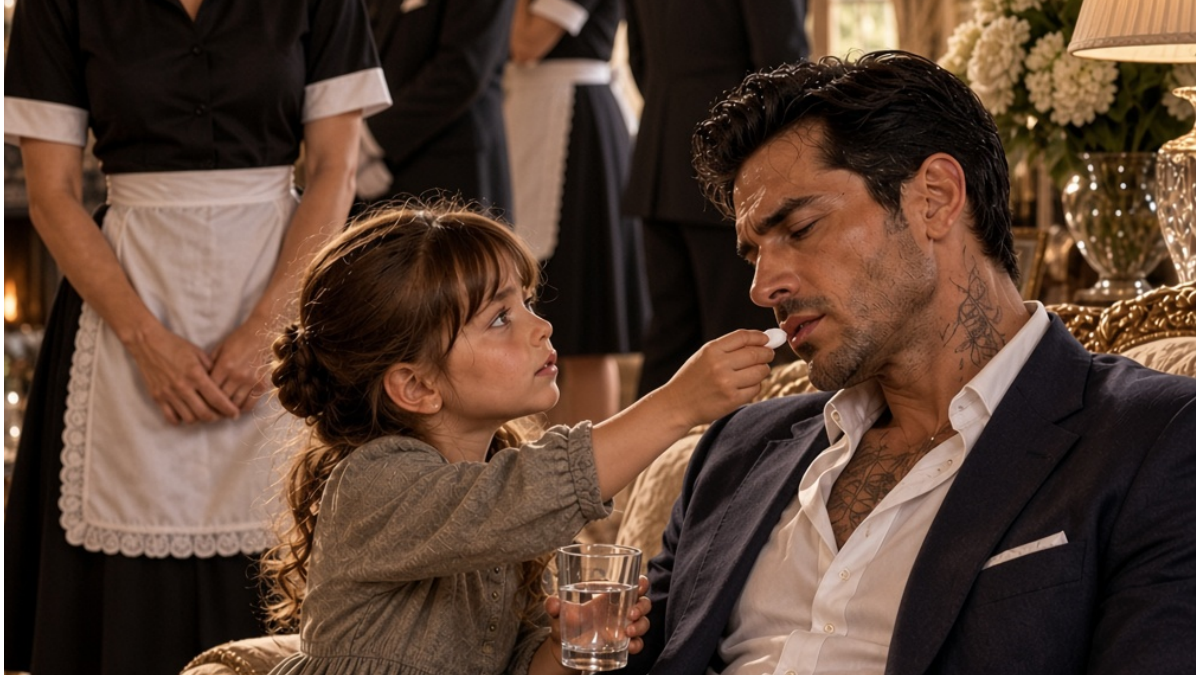
The most feared man on the east side was dying in a room no enemy could enter.
Alessandro Moretti had bulletproof windows, armed guards at every gate, cameras watching every corridor, doctors who answered his calls before their own families, and enough money to make almost any problem disappear.
None of it could make his right hand stop trembling. None of it could persuade his legs to carry him across the bedroom floor.
And none of it could give him one full night of sleep. For nearly two months, Alessandro had lain awake in the dark while the city outside quietly prepared for life after him.
Men who had lowered their voices when they spoke his name were beginning to speak a little louder.
Men who had waited years for a weakness were beginning to move closer. Even people inside his own house had started looking at him as though they were measuring the distance between the man he had been and the corpse they expected him to become.
Everyone seemed to understand that Aleandro Moretti was running out of time. Everyone except a 5-year-old girl who was not supposed to be inside his mansion at all.
Before winter was over, she would walk into the one room no one entered without permission.
Look directly at the man everyone else feared and do something his doctors, his soldiers, and his entire empire had failed to do.
She would give him a reason to want another mourning. And eventually that reason would become the most dangerous weakness he had ever possessed.
At 38, Aleandro controlled more of the Eastern Harbor than most politicians understood existed. Warehouses, trucking routes, dock contracts, unions, restaurants, construction companies, legitimate businesses, and less legitimate arrangements all bent directly or indirectly toward the Moretti name.
His father had built the foundation. Alessandro had turned it into a machine. He was not the loud kind of dangerous.
Loud men usually wanted witnesses. Alessandro preferred certainty. He rarely threatened anyone twice because he rarely needed to threaten them once.
A phone call from him could reopen a permit, close a nightclub, stop a shipment, or persuade a man who had been very confident at breakfast to reconsider his plans before dinner.
For almost 20 years, Aleandro had believed control was the closest thing the world offered to safety.
Then one evening, while lifting a cup of espresso, his right hand shook hard enough to spill coffee across a white tablecloth.
He stared at the stain longer than he stared at the hand. A week later came the insomnia, then the weakness in his legs.
Some mornings he could cross a room with nothing more than stiffness. On others, his muscles seemed to receive his instructions and simply refused them.
Specialists were brought through private entrances. Tests were performed under names that never reached ordinary hospital systeMs. The diagnosis was a rare degenerative neurological disorder, unpredictable in its pace and made significantly worse by stress and lack of sleep.
There were treatments, there were therapies, there were medications that might slow certain symptoMs. There were no promises.
Alessandro listened to all of it without changing expression. Then he went home and stopped allowing anyone to ask how he felt.
Illness did something that bullets, police investigations, rival families, and betrayal had never managed to do.
It made people around Aleandro careless. Vtorio Russo was the first person to show him exactly how quickly loyalty could become arithmetic.
Vtorio had stood beside him for nearly two decades. He knew which men could be trusted with cash, which judges could be approached, which captains hated one another, which properties belonged to the family on paper, and which belonged to them only because nobody was foolish enough to challenge the arrangement.
When Alessandro became too weak to attend meetings, Victoriao arrived at the mansion carrying a leather folder.
He sat at the foot of the bed and spoke gently about contingencies, continuity, protecting the family, avoiding panic.
Then he opened the folder. Inside were charts showing which accounts should transfer to whom, which crews would report to which captains, which businesses could survive without Aleandro’s direct authority.
The work was meticulous, too meticulous. Aleandro noticed that one page included access schedules to properties he had never authorized Vtorio to review.
He said nothing about it. He let his oldest friend finish. Then he closed the folder with one hand and said, “You planned my funeral before I stopped breathing.”
Vtorio went pale. I planned for the family to survive. Allesandre looked at him for several silent seconds.
Get out. Victoria gathered the papers so quickly that one slipped to the floor. Neither man bent to pick it up.
Others were less patient. Isabella Fontaine had been with Aleandro for 2 years, long enough to tell him in expensive hotel rooms that she loved the man beneath the name.
She cried when she learned he was sick. Three weeks later, she disappeared with a diamond bracelet from his dressing room safe and left no note.
Allesandro almost respected the efficiency. The captains were subtler. Payments arrived late. Percentages became strangely imprecise.
Men who once reported every movement began deciding which details were worth mentioning. Across the river, Dominic Falcone started placing people on streets that had belonged to the Morettis for 15 years.
One block became two. One warehouse changed hands. Nobody declared war. Wolves rarely attack the fence the first time they discover the current is gone.
They touch it carefully. Alessandro understood all of this. What disturbed him more was the information moving through the city.
People knew about the tremor. They knew about the sleepless nights. Someone even knew that he occasionally needed help standing.
Those details existed in only a few places. And one of them was the medical file maintained by Dr. Marquetti, his physician for 11 years.
Alessandro had no proof the doctor had betrayed him. Proof came later. Suspicion was enough for now.
He had built his life by noticing small changes in people. An answer delivered too quickly.
A man avoiding the left side of a room. A smile arriving half a second late.
Marchetti had begun speaking to him with the careful patience of a man who already knew more than he intended to admit.
So Aleandro made the mansion colder. New rules were given to the household. No personal questions, no unnecessary conversation, no lingering in his bedroom, no sympathy disguised as encouragement.
Most important, no pity. Staff members came and went. Some were afraid of him. Others found the atmosphere unbearable.
One woman stayed. Her name was Sophia Richi, and she had worked at the estate for almost a year without giving Alessandro any reason to remember much about her beyond competence.
She arrived before 7 each morning, tied back her dark hair, cleaned the west wing, helped wherever Senora Greco needed her, and left before evening.
She never stared at Alisandro when he passed. She never asked what the doctors had said.
She never whispered with the other employees about whether the great Moretti Empire was collapsing.
Allesandre assumed this meant she understood her place. The truth was less dramatic. Sophia was simply too tired to be curious about a rich man’s secrets.
She had rent due on the first, groceries that had to stretch through the week, busfair calculated almost to the dollar, and a 5-year-old daughter whose kindergarten cost more than Sophia liked to admit.
Her husband, Marco, had died 3 years earlier when a cable failed at a construction site.
The compensation payment had looked enormous until Sophia discovered how quickly grief could consume money.
Funeral costs, rent, unpaid leave, child care, food. Within a year, the number in her account had become small enough to frighten her.
Since then, she had treated every week like an equation. What could wait, what could not, what Emma needed, what Sophia could quietly go without.
Emmai was 5 years old, small even for five, with brown eyes that seemed to observe things adults assumed children missed.
She inherited Marco’s stubborn chin and Sophia’s habit of listening before speaking. Everywhere she went, she carried some trace of her father with her.
Most often, it was a faded red scarf that had once belonged to Marco. It was much too large, wrapped twice around her neck and still hanging almost to her knees.
Sophia had tried replacing it with warmer scarves. Emma rejected everyone. “This one has Papa’s brave in it,” she explained.
Sophia never argued. On difficult mornings, she suspected her daughter might be right. One gray morning in December, Sophia received a call while fastening her coat.
A pipe had burst at the kindergarten during the night. The building had no heat and would remain closed until repairs were completed.
Sophia stood in the kitchen with her phone pressed against her ear while Emma ate toast at the table and the familiar arithmetic began.
Her neighbor was away. Her closest friend was working at the hospital. Marco’s cousin lived too far across the city.
Emergency child care cost more for one day than Sophia had available until payday. Missing work was not an option.
The Moretti household did not operate like an ordinary employer, especially now. Positions disappeared quickly.
People were replaced even faster. Sophia stared at the numbers on her banking app until they blurred, then looked at her daughter.
Finish your toaSt. On the bus to the estate, Sophia explained the rules three times.
Emma would stay in the laundry room. She would keep her voice low. She would not wander.
She would not speak to anyone unless Sophia was there. Emma nodded solemnly each time, the red scarf bundled beneath her chin.
At the service entrance, Sophia knelt and held both of her daughters shoulders. This is not an adventure.
Emma looked past her at the huge stone house. It looks like a castle. It’s a house.
A very castle-l lookinging house. Sophia fought the beginning of a smile. Laundry room. Quiet.
No wandering. Emma placed one small hand over her heart. I promise. For nearly 2 hours, she kept that promise.
She colored half a page blue. She drank a juice box. She ate three crackers.
She examined the washing machines. Then she discovered that the laundry room door was unlocked, and 5-year-old promises have always struggled against unlocked doors.
The hallway outside seemed impossibly long. Emma moved through it slowly, not because she was frightened, but because everything was interesting.
Paintings of serious men watched her from the walls. Thick carpet swallowed the sound of her shoes.
Somewhere far away, a clock chimed. She followed the hallway until she reached a black wooden door standing open by several inches.
Through the gap, she saw a man sitting on the edge of an enormous bed.
He was dressed in dark trousers and a white shirt with the collar open. One hand gripped the mattress.
The other was trembling. He appeared to be trying to stand. Emma watched him push upward, fail, and sit down again.
Aleandro shut his eyes. Anger moved across his face with such force that an adult would have recognized it immediately and backed away.
Emma recognized only sadness wearing an angry expression. She pushed the door wider. Aleandro heard the hinge and turned.
For several seconds, neither of them spoke. Nobody entered this room uninvited. Not captains, not house staff, not even Victoriao anymore.
Yet standing 6 feet inside his bedroom was a little girl with two uneven braids and a red scarf large enough to wrap around both of them.
Who are you? Aleandro asked. His voice was rough from disuse. Emma. That was not what I meant.
She considered this. Sophia’s Emma. Alessandro knew the name Sophia. It took him another moment to connect it to the woman who cleaned the West Wing.
His hand moved toward the call button on the bedside table. Emma noticed. Are you calling somebody?
Yes. Am I in trouble? Yes. How much? Alisandro almost pressed the button. Instead, he looked at her.
Enough. Emma nodded, accepting this as useful information. Then her eyes moved to the untouched breakfast tray, the medication beside it, and finally the heavy curtains covering the windows.
Why are you still awake? It is morning. I mean, from last night, his hand stopped above the button.
What makes you think I was awake last night? You look like mama when she does bills.
For the first time in weeks, Aleandro did not know what to say. Emma took another step.
Mama says when people can’t sleep, they have too many things standing guard inside their head.
Your mother talks about this often. No, I listen when she thinks I’m coloring. A strange sound escaped Aleandro before he could prevent it.
Not laughter exactly, but close enough that it irritated him. Emma seemed encouraged. She walked toward the leather chair beside the bed and began climbing into it.
The scarf snagged under one knee. She pulled it free, turned around, and settled herself as if she had been invited.
What are you doing? Sitting. I can see that. Then why did you ask? This time the sound was unmistakable.
One short breath of laughter, gone almost as soon as it appeared. Alessandro stared at her as if she had committed an offense he had not yet decided how to punish.
Emma stared back without lowering her eyes. There was no fear in her face. More surprisingly, there was no pity.
Adults had begun looking at him differently since the illness. Some tried to hide it, some did not.
Emma looked at him the way she might look at a broken lamp she was curious about, but had no intention of throwing away.
“You should go,” he said. “Okay.” She did not move. Do you understand the word go?
Yes. Then why are you still here? Emma looked toward the dark curtains. Because you look like you don’t want to be by yourself.
The room became very quiet. Alessandro’s expression changed. Not softer but less certain. He had spent his entire adult life ensuring that nobody confused access with permission.
People entered his world because he summoned them, paid them, frightened them, needed them, or owed them.
No one stayed simply because they thought he should not be alone. Emma pointed toward his shaking hand.
Does that hurt? No. Does it make you mad? Aleandro looked down at it. Yes, that makes sense.
No reassurance. No promise that he would get better. No frightened glance toward the door.
Just acceptance. After a moment, she said, I can watch the things in your head for a little while.
What things? The things keeping you awake. You cannot see them. I know. Emma folded her hands in her lap.
That’s why they won’t know I’m watching. Alessandro stared at her. Then, very slowly, he moved his hand away from the call button.
11 minutes later, footsteps pounded down the hallway. Sophia appeared in the doorway, white-faced and breathless, one hand pressed to her cheSt. The instant she saw Emma in the chair beside Alesandre’s bed.
Terror replaced relief. Mr. Moretti, I am so sorry. I told her to stay downstairs.
I only looked away for a few minutes. Emma, get up now. She crossed the room already reaching for her daughter.
This will never happen again. Please, I stop. Sophia frozen. Allesandre looked at Emma. She had not moved.
Then he looked at Sophia, who was clearly trying to decide whether she would lose her job before or after being escorted from the property.
Let her stay. For the rest of that morning, Sophia worked as though every sound in the mansion might become the sound of someone coming to dismiss her.
She polished silver that was already clean, changed linens twice because she could not remember whether she had finished the first time, and checked the clock so often that Senora Greco finally asked whether she was expecting a train.
Emma remained upstairs. That fact alone felt impossible. Sophia had tried once after Allesandro told her to let the child stay, to insist that Emma had disrupted the household enough.
Allesandro had looked at her with the same expression men probably saw across negotiating tables and said, “She is sitting in a chair.”
Sophia had glanced at her daughter, who was indeed sitting in a chair with the semnity of someone performing public service, and found herself with no argument that did not sound ridiculous.
When she returned at noon, Emma was telling Alisandro a story about a princess who refused to marry a prince because his horse was rude.
Allesandre was listening with his arms folded. He looked exhausted, irritated, and more awake than Sophia had seen him in months.
“Time to go,” Sophia said. Emma slid down from the chair. Before leaving, she walked to the side of the bed and lowered her voice as though sharing classified information.
“I’ll come back if the things in your head are still there,” Allesandro raised one eyebrow.
“I was hoping your surveillance had frightened them away.” Emma considered that seriously. “They’re probably hiding.”
She nodded toward the dark corners of the room. They look sneaky. Then she took Sophia’s hand and left.
Allesandre watched the red scarf disappear through the doorway and discovered to his irritation that the room felt larger after it was gone.
The kindergarten reopened the following week, but only for shortened days while the heating system was repaired properly.
Sophia could manage mornings. Afternoons were another problem. On the first day, she brought Emma back to the estate.
She expected someone to stop them at the service entrance. Instead, Senora Greco looked at Emma, looked at the red scarf, and said, “There is a small table in the second laundry room.
Keep the crayons off the walls.” Sophia stared. “Did Mr. Moretti say she could be here?”
Senora Greco adjusted the clipboard under her arm. “Mister Moretti did not say she could not in that house.”
Sophia was beginning to understand. Silence could function as paperwork. Emma made it until shortly after lunch before asking whether the man upstairs was sleeping yet.
Sophia told her not to bother him. Emma nodded, waited until Sophia turned away, and went to find out for herself.
This time, she did not push open the black door. She knocked three times. Aleandro, who had been staring at a document for 10 minutes without absorbing a word, looked toward the door.
Three more knocks came, equally spaced. “Come in,” Emma appeared, clutching a sheet of paper against her cheSt. “Why three?”
He asked. “Three what knocks?” One sounds like an accident. Two sounds impatient. And three, three sounds important.
She entered before he could decide whether that logic deserved a response. The paper was a drawing made almost entirely in orange crayon.
Four crooked legs supported a round body beneath a mane that seemed to have exploded.
Two dark eyes had been pressed so hard into the page that the crayon had nearly torn through it.
“What is it?” Aleandro asked. Emma’s mouth fell open. “A lion?” “Of course it’s you.”
He looked at the creature again. One leg was twice the length of another. Its tail appeared to emerge from somewhere near its shoulder.
You have a generous imagination. Emma climbed into the chair. He’s sick. Alessandro’s expression changed.
Adults had developed elaborate ways of avoiding the word. Emma had no such instinct. Why make a sick lion?
Because sick lions are still lions. She pointed at the eyes. See, I made those extra fierce.
Aleandro looked from the drawing to the child. Very reassuring. Emma slid down again, walked to the bedside table, and propped the drawing against the lamp.
Then she stepped back, narrowed her eyes, and moved it slightly to the left. There.
What exactly is it doing there? Watching for what? She gave him the kind of look reserved for adults who forgot obvious things.
The sneaky stuff. The drawing remained beside the lamp after she left. Aleandro told himself it was because moving it would require unnecessary effort.
That explanation lasted until the next morning when a nurse shifted the paper while changing his water and Aleandro immediately said, “Put that back.”
The following afternoon, Emma arrived carrying a gray stone. It looked like something she had picked out of a gutter, which was exactly where she had found it.
“This one is lucky,” she said. Allesandre turned it over in his palm. “How can you tell?”
“It’s heavier than it looks.” “That is your definition of luck?” “Yes, interesting system. It works.
He weighed the stone again, then placed it beside the orange lion. On another day, she brought a battered book of fairy tales with a cracked blue cover.
Emma could recognize some words, guess others, and invent the rest with astonishing confidence. She opened to a picture of three rabbits and began telling Alisandro a story about a bear.
“There is no bear on that page,” he observed. “He comes later. There are rabbits.
They’re not important. They appear to be the main characters.” Emma sighed, flipped the page, and continued without acknowledging the objection.
Allesandro had sat through six-hour meetings involving millions of dollars without interrupting, as often as he interrupted Emma’s stories.
And yet, he never asked her to stop. The tales were structurally impossible. Wolves changed names midway through scenes.
Castles moved from mountains to oceans without explanation. Characters returned after being eaten because Emma had forgotten they were dead.
Somehow the emotional logic remained perfect. The lonely creature always found someone. The frightened child always discovered courage.
The lost person was always worth searching for. At noon, Emma developed another ritual. Before leaving, she would pull Alisandro’s blanket higher and smooth the sides down with both hands.
The first time she did it, Aleandro caught the edge before she could tuck it beneath his arm.
What are you doing? Closing the corners. Why? Nightmares look for loose ones. Who told you that?
Mama from the doorway. Sophia said, “I did not tell her that.” Emma looked offended by the correction.
You said blankets make people feel safe. That is not the same thing. Emma turned back to Aleandro.
It means the same thing. He released the blanket. Emma finished tucking it around him, inspected her work, and nodded.
That night, Aleandro fell asleep shortly after midnight. When he opened his eyes again, the room had changed color.
Pale winter light had reached the curtains. He stared at the clock, convinced for several seconds that it was wrong.
3 hours had passed. Three uninterrupted hours. It was not recovery. It was not a miracle.
The tremor remained. His legs still felt unreliable when he tested them against the floor.
But for the first time in more than a month, his mind did not feel as though someone had dragged it across broken glass all night.
He looked toward the orange lion beside the lamp. “Don’t get ambitious,” he muttered. The lion’s fierce, scribbled eyes offered no apology.
Sophia noticed the difference before anyone mentioned it. Aleandro began finishing more of his breakfaSt. He spoke to staff instead of communicating entirely through Senora Greco.
Once when Sophia was changing the sheets, he asked whether Emma always talked so much.
Only when she likes someone, Sophia said before she could stop herself. Allesandre looked at her.
That is unfortunate. Sophia almost smiled. The following day, she carried his lunch upstairs herself.
Salvatore, the estate chef, had prepared vegetable soup and bread. Sophia had no official reason to bring it.
A footman could have carried the tray. She told herself she was already going upstairs, and therefore it was efficient.
She placed everything beside the window, checked that the spoon was within easy reach of Aleandro’s steadier hand, and turned toward the door.
Sophia, she stopped. In nearly a year of working there, he had never spoken her name directly.
Yes, Mr. Moretti. Thank you. There were dozens of possible responses, but the simplicity of the moment seemed to require only one.
You’re welcome. She left before either of them could make it more complicated. The next day, she brought the tray again.
Then came the morning that reminded all of them that improvement was not the same as escape.
Allesandre woke before dawn with his right arm rigid and his legs heavy. He waited, breathing slowly, for the stiffness to loosen.
It did not. At 8, he tried to stand. His knees folded before he was fully upright, and he caught himself against the bed poSt. He tried again.
Failure. A third time, failure. By the fourth attempt, sweat had gathered along his hairline.
He sat on the edge of the mattress, staring at his own legs with hatred so concentrated it seemed almost calm.
The physician had warned him that symptoms would fluctuate. Better days could be followed by worse ones.
Aleandro understood the medical explanation. Understanding did not make obedience to his own body any easier.
He reached for a glass of water. The tremor surged. Water spilled across his hand and onto the floor.
Something inside him snapped. Aleandro hurled the glass across the room. It struck the wall and burst into glittering pieces.
For several seconds, there was only the sound of his breathing. He wanted another glass, another object, something large enough to break with him.
Three knocks sounded at the door. Go away. Silence. Then three more. I said, “Go away.”
The door opened by a few inches. Emma looked through the gap. Her eyes went first to Allesandro, then to the shattered glass.
There was an accident. “No.” She pushed the door wider. “Did somebody break in?” “No.”
“Did you throw it?” Aleandro’s jaw tightened. “Yes.” Oh, Emma absorbed this. So, it was an angry accident.
It was not an accident at all. She entered carefully, avoiding the glass. Then, it was just angry.
Any adult in the house would have heard the warning in Aleandro’s voice and retreated.
Emma went to the small fireplace broom, then stopped. “Am I allowed to touch this?”
The question was so absurd under the circumstances that Aleandro stared at her. “No.” “Okay.”
She left it where it was and climbed onto the chair instead. Someone else can clean it.
Aleandro turned away. His hand was still shaking violently. He closed it into a fist, but that only made the tremor travel into his wriSt. Emma watched without pretending not to.
Don’t, he said. Don’t what? Look at me like that. Like what? He almost laughed from frustration.
Forget it. Emma’s feet swung above the floor. Does today hurt? No. Does today make you mad?
Aleandro stared at the broken glass. Yes, that makes sense. He looked at her sharply.
You said that before because it still makes sense. What exactly would you know about this?
Emma became quiet. Her fingers touched the red scarf. Sometimes I get mad that Papa is dead.
Alessandro said nothing. Mama says being mad doesn’t make him less dead, but sometimes I’m mad anyway.
She looked down at her shoes. I used to kick the closet door. Did it help?
No, it hurt my toe. A pause. So I stopped. Something in Aleandro’s expression shifted despite him.
Emma looked at his trembling hand. Can you stand today? No. Maybe tomorrow. Maybe. And if not tomorrow, I don’t know.
She nodded as though uncertainty itself were an acceptable answer. Then she climbed off the chair and before he could object, pulled herself onto the edge of the bed.
She sat beside him without touching his arm or his hand. No soothing gesture, no childish promise.
She simply occupied the silence with him. After a while, she said, “Sick lions are still lions.”
Alisandre looked straight ahead. What if the lion can’t stand? Emma thought about that longer than he expected.
Then he lies down. That simple? No. She leaned back on her hands. He’s probably very mad about it.
A reluctant breath escaped him. But lying down isn’t the same as being dead. Alisandro turned toward her.
Emma shrugged. That’s different. For a long time, neither spoke. Eventually, Senora Greco arrived with someone to clean the broken glass.
Emma returned to her chair and opened her fairy tale book. She began another impossible story.
This one about a lion who had misplaced his roar and refused to admit he was looking for it.
Aleandro listened without correcting a single inconsistency. That evening, Sophia collected Emma and apologized for whatever her daughter had said.
Aleandro only shook his head. She said enough. Hours later, the house went silent. The blanket was tucked tightly along his sides because Emma had inspected the corners before leaving.
The orange lion stood beside the lamp. The lucky stone rested beneath it. Allesandro closed his eyes, expecting the familiar siege of thoughts, old faces, old debts, old violence, and the humiliating awareness of a body he could no longer command.
He woke 5 hours later to dawn touching the curtains. His right hand still trembled when he lifted it.
His legs were still uncertain beneath the blanket. Nothing had disappeared. Nothing had been cured.
But for 5 hours, the ghost had not found the loose corners. By January, the Moretti estate had begun to change in ways nobody announced, and nobody seemed willing to take responsibility for.
The first sign appeared in the kitchen. Salvatorei, who had cooked for the family for 30 years and treated his knives with more tenderness than most people treated relatives, started leaving a small tin of biscotti on the counter every Monday.
A strip of masking tape across the lid read in his careful handwriting for Emma.
When Sophia asked whether he wanted her to keep the tin in the laundry room, Salvatore looked offended.
The kitchen is where food belongs. That was the entire discussion. A week later, Emma was sitting on the counter while he needed bread.
Her red scarf looped safely behind her so it would not fall into the flower.
Salvatore gave her a lump of dough and showed her how to fold it with the heels of her hands.
Emma attacked it as if settling a personal dispute. Gentler, he told her. Bread remembers.
Emma stopped. It has feelings. Salvatore glanced at Sophia. Now look what you’ve done. Sophia said.
For the rest of the morning, Emma apologized to the dough every time she pressed too hard.
The next person to fall was Bruno Colbo, head of security. 6’4″ in tall and built like a man who had once considered walls an inconvenience.
Bruno spoke little, smiled less, and had a reputation among the crews for being impossible to surprise.
Emma surprised him on a Tuesday. Sophia was carrying fresh towels through the East sitting room when she heard a roar so deep she nearly dropped the entire stack.
She pushed open the door and stopped. Bruno was on his hands and knees on the carpet.
Emma stood on the sofa with a paper towel tube held like a sword. Again, she commanded.
Bruno inhaled and produced another carefully restrained roar. Sophia stared. Bruno slowly turned his head toward her.
For perhaps the first time in his adult life, the man looked embarrassed. He rose to one knee, straightened his jacket, and said with complete seriousness.
Tactical exercise. Emma lowered the cardboard sword. No, you’re losing. Sophia pressed her lips together so hard they hurt.
Bruno looked at the child, then at Sophia, and seemed to understand there was no dignified way out.
The gate needs checking, he muttered. Emma pointed the sword at him. Dragons always run when they’re losing.
He left the room without answering. Later that afternoon, Sophia passed him near the security office and noticed a small paper shield leaning against his desk.
Even Senora Greco changed, though she would have denied it under oath. Her morning inspections began passing through the West Wing at precisely the time Emma made her three knock visit.
She claimed the new route reduced unnecessary walking. Nobody pointed out that the old route had been shorter.
She also began keeping colored pencils in the bottom drawer of the household office. When Emma asked why, Senora Greo said they had always been there.
Emma accepted this. Sophia did not. The strangest change, however, was not what Emma was doing to the staff.
It was what Alessandro had started doing to himself. He no longer spent every morning in bed.
On better days, he dressed properly, usually dark trousers and a gray sweater, and moved to the chair near the window.
Then after another week, he asked Bruno to bring a cane. The request circulated through the house without anyone repeating it aloud.
Sophia knew because she saw the cane leaning against the wall outside his room. Black wood with a silver handle, elegant enough to look almost ceremonial.
The first afternoon, Aleandro used it. He made it only as far as the library.
Emma walked beside him in absolute silence for the entire distance, which was perhaps the greatest act of self-restraint she had ever performed.
When they reached the doorway, Allesandro looked at her. You may speak again. Emma released a breath.
I thought, “If I talked, you might fall. That is not how balance works. It could be.
It could not. You don’t know everything. I know that.” The answer came so quickly that Emma stopped arguing.
Sophia, following several steps behind, noticed it, too. The disease had not disappeared. There were mornings Alessandro could cross half the corridor and afternoons when standing from a chair required both hands and a minute of preparation.
There were nights when the insomnia returned with such force that the light beneath his door remained visible until dawn.
But the good days were no longer isolated accidents. He began spending more of them downstairs.
He took coffee in the library instead of the bedroom. He read newspapers again. Once Sophia found him at the window watching Emma chase fallen leaves around the garden with Thomas, the groundskeeper.
The girl had decided the oldest dog on the estate was cold and was arranging leaves across his back like a blanket.
The dog endured this with the resignation of an animal that had survived 17 winters and had no intention of arguing with a child.
She does that everywhere, Sophia said. Allesandro did not turn. Does what? Decides something needs taken care of.
Where did she learn it? Sophia looked out at her daughter. I don’t know. Alisandro glanced at her then.
That is rarely true. Sophia hesitated. Conversations with him had changed recently. They still began with ordinary questions, but he had a way of waiting after an answer, and the waiting made silence feel less like protection and more like an invitation.
Her father was like that. She said, “Marco.” Alisandro remembered the name. Sophia nodded. He could not walk past anything broken without trying to fix it.
Chairs, radios, people. Usually, the chairs went better. Alessandro almost smiled. How long were you married?
6 years. And he died three years ago. Sophia looked at him more carefully. You remember?
I asked. Most people ask and forget. Alessandro turned back toward the garden. Most people ask because they are waiting for their turn to speak.
That answer unsettled her more than she expected. Sophia adjusted the folded cloths in her hands even though they were already straight.
He died at work. Construction site. Cable failed. Alessandro said nothing, which made it easier to continue.
I was at a grocery store when they called. I remember the milk in my cart.
That is what I remember most clearly. Not the voice on the phone. Not the hospital.
A carton of milk going warm because I left the cart in the middle of the aisle.
She gave a small embarrassed shake of her head. Grief is strange. No, Aleandro said quietly.
Memory is strange. Sophia looked at him. There was something in his face she did not understand yet.
Afterward, everybody told me to take time, rest, heal. Very beautiful advice from people who were not paying my rent.
Her mouth tightened into something almost amused. Rent does not care what scares me. Allesandre repeated the sentence softly, as if testing its weight.
Rent doesn’t care what scares me. Exactly. And that is why you stayed here. Sophia looked around the room at paintings worth more than her apartment building, at shelves of books nobody seemed to touch.
I stayed because the paycheck arrived on time. He accepted the honesty without offense. Did you ever think of leaving?
Every difficult morning. And every morning you came back. That is what difficult mornings are for.
Alisandre looked at her for a long moment. You make survival sound like a job.
For some people it is. He did not ask about the settlement or whether she had family money or what she had left in savings.
Sophia noticed that. Men with Alessandro’s kind of power usually asked questions as if information itself were property.
His questions now seemed different, less interested in leverage, more interested in understanding the shape of a life he had never lived.
Over the next several days, their conversations continued in small pieces. Naples, her mother in Sicily, Marco singing badly while shaving because he knew it annoyed her.
Emma refusing to sleep without the red scarf for almost a year after his death.
Alessandro told Sophia almost nothing about himself. But she began learning him through what he did not say.
He never complained about pain. He hated being helped with doors. He preferred coffee too strong.
He reread the same page when tired rather than admit he had lost concentration. He disliked winter because the cold made the stiffness worse, though he pretended otherwise.
Most revealing of all, he was gentler when he believed nobody was watching. Sophia discovered that on a Thursday afternoon, Emma had been reading in the chair beside Aleandro, which meant she was improvising wildly from a book she could not fully read.
The story concerned a lion who had recovered his roar, but kept it in a box beneath his bed because, according to Emma, roaring all day was impolite.
Allesandro had just asked what sort of box could contain a roar when Emma stopped answering.
Her head tilted toward his arm. The book slipped from her lap. Within seconds, she was asleep against him, one crooked braid pressed to his sleeve.
Aleandro froze. He had endured police interviews, funerals, gunfire, and negotiations without showing uncertainty. A sleeping child apparently presented a different kind of crisis.
He looked at Emma, then at the door, as if expecting someone to provide instructions.
Nobody came. Slowly, carefully, he shifted his arm just enough to support her without waking her.
Then he sat completely still. That was how Sophia found them 20 minutes later. She entered quietly, saw her daughter asleep against the most feared man in the city, and stopped.
Allesandre looked up. I’ll take her, Sophia whispered. She’s fine. Your arm will go numb.
It already has then let me move her. She’ll wake. Sophia almost said that children woke and survived.
Instead, she looked at his face. Something there made her stay where she was. He was not enduring Emma’s weight.
He was protecting it. How are you today? Sophia asked quietly. Allesandre seemed surprised by the question.
Everyone asked about symptoMs. Almost nobody asked about him. Better, he said, his eyes dropped to Emma.
On the days she’s here, the room held the words for a moment. Then he added, “And the days you are.”
Sophia’s fingers tightened slightly around the folded blanket in her hands. Mr. Moretti Allesandro, it was not an order.
That was what made it difficult. Sophia looked at him, then at her sleeping daughter.
“Aleandro,” she said. His name sounded unfamiliar without the distance of a title. Emma stirred between them, eyes still closed.
One hand found the red scarf around her neck. She tugged at it clumsily until it came loose, then pushed the fabric toward Alisandro’s cheSt. “You can borrow Papa’s brave,” she mumbled.
“Just today.” Her breathing settled again before either adult could answer. Aleandro looked down at the scarf in his hand.
The faded red cloth lay across his trembling fingers. For once, he made no attempt to hide them.
Sophia watched his thumb move slowly over the worn fabric, and she understood that whatever was happening in this house had already gone further than any of them had intended.
Dr. Marchetti arrived the following morning for his scheduled examination. He checked reflexes, motor response, blood pressure, sleep logs, and medication levels.
Aleandro’s numbers had improved modestly, but consistently. Marchetti frowned at the chart. You are sleeping more.
Sometimes the better nights are becoming more frequent. Apparently, any change in stress. Alessandro glanced toward the doorway where three faint knocks had sounded before Emma remembered the doctor was inside and retreated.
The security has improved. Marquetti looked puzzled. Aleandro offered no explanation. The examination continued. When it was finished, Allesandro left for the library with Bruno.
Marchetti remained behind to organize the papers. He waited until the footsteps had faded down the hall.
Then he took out his phone, opened the camera, and photographed one page of Aleandro Moretti’s medical chart.
He checked the image for clarity, slipped the phone back into his pocket, and closed the folder as neatly as he had found it.
Dominic Falcone had spent 15 years learning what it felt like to live in another man’s shadow.
He owned restaurants, trucking companies, gambling rooms, two construction firms, and enough politicians to make ordinary men call him powerful.
None of it changed what happened whenever Allesandro Moretti entered the same room. Falcone remembered one meeting more clearly than all the others.
8 years earlier, he had arranged a shipping contract that would have given him access to three eastern docks without Moretti approval.
He had celebrated before the papers were signed. By sunrise the next morning, the insurance company had withdrawn coverage.
The union had refused labor. Two trucking firms had canceled their agreements, and the harbor authority had discovered an inspection problem that somehow affected only Falcone’s containers.
Alessandro never threatened him. He invited him to lunch. Falcone sat across from him in a quiet restaurant while his entire operation collapsed one phone call at a time.
At Itwin by the meal, Alessandro asked whether he still wanted the docks. Falcone said no.
Aleandro paid the bill. Falcone never forgot the humiliation of walking back to his own men and pretending the decision had been his.
Since then, he had expanded wherever Allesandro was not looking. He had made money in the spaces between Moretti interests, built influence in neighborhoods.
Allesandro considered inconvenient and told himself patience was strategy. Then the rumors began. Moretti was sick.
Moretti could not sleep. Moretti could barely walk. Falcone did not celebrate publicly, but inside him something old and cramped finally stretched its legs.
The first information from Dr. MarQuetti had been cautious. Medical language careful enough to protect the doctor if the arrangement was ever exposed.
Worsening tremor, intermittent mobility impairment, severe insomnia, prognosis uncertain. Falcone had read every report twice.
He did not need Alessandro dead tomorrow. He only needed him weak long enough for the city to adjuSt. Territory was habit.
If Falcone controlled a warehouse for 6 months, eventually everyone behaved as though he had always controlled it.
If Moretti captain started reporting to someone else, loyalty would learn a new address. That was why the next report disturbed him.
Sleep duration improved, appetite improved, mobility more consistent, patient ambulatory with assistance on multiple days.
Falcone sat alone in the back room of his restaurant and read the page again.
The words were not dramatic, but he understood what they meant. Alessandro was not recovering in the simple sense.
The disease remained, but the collapse Falcone had counted on was no longer moving in one direction.
A man did not need perfect health to become dangerous again. Alessandro Moretti only needed enough strength to sit at a table and make other men remember who they were afraid of.
Falcone summoned the intermediary who handled MarQuetti’s payments and told him to stop bringing numbers.
I know his blood pressure. I know his sleep. I know how far he walks.
None of that tells me why. The intermediary shifted in his chair. The doctor says treatment is helping.
Falcone looked at him until the man lowered his eyes. Then the doctor is lying to himself or to me.
He tapped the report. Medication doesn’t suddenly teach a man to eat breakfaSt. The next request sent back through the chain was simple.
What changed around Aleandro? Not in the prescription, not in the dosage around him. Marchetti resisted for several days.
Then money moved as it always did, and the answer arrived in fragments. A maid, a widow, her young daughter.
The child visited Allesandre daily. Staff members had noticed he slept better after she began appearing in his room.
He left the bed more often. He spent time downstairs. He spoke to people. Falcone read the information with growing disbelief.
He had spent years imagining the secret mechanism behind Allesandre Moretti’s composure. He had expected discipline, medication, fear, perhaps some private physician from Europe.
Instead, the answer was a child with a red scarf. At the estate, Allesandro knew none of this.
He only knew that January had stopped feeling like a month he needed to survive and begun feeling like time he might actually inhabit.
On one clear afternoon, when the cold had eased enough for the garden paths to dry, he told Bruno he wanted to go outside.
Bruno did not react, which was his way of reacting strongly. He brought the cane, followed several steps behind, and made no attempt to touch Allesandro unless asked.
Emma discovered them halfway across the terrace and came running. You’re outside. That appears to be the case by yourself.
Aleandro looked over his shoulder at Bruno, who stood near the door with the expression of a man being erased from official history.
Apparently, Emma accepted the fiction. She walked beside Aleandro toward the bare rose garden, matching her short steps to his slower ones without being told.
Sophia watched from the terrace. There was nothing spectacular about the scene. Aleandro did not throw away the cane.
He did not suddenly walk as he had before the illness. Twice he stopped to reSt. Once his left leg dragged slightly, and his jaw tightened, but he continued.
Emma pointed out stones, dead flowers, a bird’s nest in a low tree, and the old groundskeeper’s dog sleeping under a bench.
Aleandro listened. By the time they reached the fountain, he was exhausted. He sat on the stone edge and breathed slowly until the weakness passed.
Emma wandered several yards away to investigate a frozen puddle. Sophia approached with Allesandre’s coat folded over her arm.
You should put this on. I’m not cold. Your hands are. Aleandro looked at them.
The tremor was mild that afternoon, but his fingers were pale. You have developed an inconvenient habit of being correct.
Sophia draped the coat across his shoulders. I had practice. He glanced toward Emma. With her, with life.
They watch the child crouch near the puddle and test the ice with a stick.
She doesn’t seem afraid of much, Alisandro said. Sophia’s face softened. She is. She just doesn’t always understand when she should be.
That sounds more dangerous. It is. Emma struck the ice, broke through, and looked delighted with herself.
Aleandro’s mouth moved into the small smile Sophia had begun seeing more often. “Does she remember her father?”
He asked. “Pieces, his voice less every year. The way he carried her.” A song he used to sing.
Mostly she remembers what I tell her. Sophia looked at the red scar fluttering behind Emma.
Sometimes I worry I’m giving her my memory instead of hers. Allesandro considered that maybe that is what memory is after someone dies.
People carrying pieces for each other. Sophia turned toward him. It was not the sort of sentence she expected from Alessandro Moretti.
He noticed the look. What? Nothing. That was clearly something. I’m still getting used to you saying things that sound human.
He stared at her. Sophia realized what she had said and opened her mouth to correct it.
Alisandre laughed firSt. It was quiet, brief, but real. Emma heard it from across the garden and turned immediately.
What happened? Your mother insulted me. Emma looked concerned. Are you mad? I’m considering it.
Sophia folded her arMs. Take your time. Emma studied both adults, decided no emergency existed, and returned to the ice.
Aleandro’s smile faded more slowly this time. “You weren’t wrong,” he said. Sophia glanced at him.
“About what? Being human.” His eyes moved toward the house. “I had become very efficient at forgetting it.
The admission opened something Sophia had not expected him to reveal. He did not tell her the details of what he had done over the years.”
He did not ask for forgiveness, and she would not have offered it cheaply. Instead, he told her about the nights.
The illness had taken away his exhaustion before it took away his strength. When sleep disappeared, memory rushed into the empty space.
Faces, decisions, men whose names had once been problems to solve and were now simply dead men with families he had never bothered to imagine.
People think guilt arrives when you do something, he said. Sometimes it arrives years later when there is finally enough silence.
Sophia sat beside him on the fountain’s edge, leaving space between them. And Emma stops it.
No. Alisandro looked toward the child. She interrupts it. He turned the cane slowly between his hands.
There is a difference. Sophia understood. Healing was not eraser. Emma had not made the past disappear.
She had simply introduced something into the present powerful enough to compete with it. That evening, Victoriao came to the estate without an appointment.
Aleandro received him in the library rather than the bedroom. The change was deliberate. Vtorio noticed.
His eyes moved from the cane beside Aleandro’s chair to the untouched whiskey on the side table, then toward the sound of Emma laughing somewhere down the hall.
“You look better,” he said. “I am better today.” Aleandro emphasized the last word. Victoria smiled.
“Good. The family needs to see you. The family needs to learn how to function without measuring my pulse.”
Vtorio’s smile tightened. They discussed business. Falcone had taken another small freight contract near the northern docks.
Two capos wanted permission to respond. Aleandro refused. Not yet. Victoria leaned back. He thinks you’re weak.
He can think. Thinking becomes moving. Then we watch where he moves. Aleandro noticed something else.
Vtorio asked whether he had resumed his regular schedule. He asked whether Bruno still drove him to appointments.
He asked whether household security had changed since Emma began spending time there. Each question could be explained.
Together they formed a shape Aleandro did not like. “Why are you interested in my household?”
He asked. Victoria’s answer came immediately. “Because your household is now part of your security.”
“Too immediate?” Aleandro held his gaze for several seconds, then allowed the conversation to continue.
Afterward, Vtorio passed Senora Greco near the main staircase. He stopped with practiced casualness. “The little girl is here often now.”
Senor Greco looked over her glasses. Children tend to appear where people bring them. Vtorio gave a polite smile.
Her mother works full days. Most adults do. I only meant Alessandro seems attached. Then perhaps you should ask Aleandro.
She continued walking. Vtorio watched her go. From the west corridor came three small knocks, followed by Aleandro’s voice telling Emma to enter.
Vtorio stood still for one second longer than necessary. Across the river, Falcone received the next report that night.
The doctor had not provided it. Someone else had. The information was shorter and much more valuable.
Sophia Richi, widow, arrives early. Usually leaves with child before evening. Bus route varies depending on weather and work schedule.
Child has direct access to Aleandro. Security staff know her. Aleandro has begun leaving his room because of them.
Falcone placed the page flat against the table. One of his men asked whether he wanted the woman followed.
Falcone did not answer immediately. He was thinking about the Alessandro he had known for 15 years.
A man who protected businesses, routes, information, reputation, and territory with ruthless precision. Falcone had always assumed that was because those things mattered deeply to him.
Now he understood something else. They had mattered because Aleandro had possessed almost nothing else.
A man with no ordinary attachments was difficult to threaten. You could burn a warehouse and he would buy another.
Kill a lieutenant and he would promote someone. Freeze an account and he would open three more.
There had never been a soft place to press. Now there was. Falconee folded the report.
Don’t touch them. The man across from him frowned. Then what do you want? Nothing yet.
He stood and walked to the restaurant window. Snow had begun falling over the river, softening the lights on the opposite shore where Moretti territory began.
For months, Falcone had believed Alessandrore’s illness was the opening he had waited half his life to see.
Now he understood that illness had not created the most useful weakness. Recovery had somewhere inside that guarded estate.
The man who once seemed to need nobody had started caring whether two specific people walked through the door.
Falcone watched the snow for a long time before speaking again. First learn the routine.
The first Tuesday of February began before dawn with Aleandro standing beside his bed and realizing his legs were waiting for him.
Not perfect, not strong, not the legs he remembered from before illness turned every staircase into a negotiation, but responsive.
He shifted his weight carefully. No sudden collapse. He took one step, then another, crossed the bedroom without touching the wall and stopped at the open door.
The hallway beyond looked ordinary. That was what made it difficult. For months, ordinary distances had become borders.
The library was far, the garden was farther. The grand staircase might as well have led down the side of a mountain.
Aleandro walked toward it with the cane in his right hand and found Bruno already standing at the top landing.
“Did you sleep outside my door?” Aleandro asked. “No, you’re a terrible liar.” “I’m security.
Different profession.” Aleandro looked down the long staircase. “I’m going to the kitchen.” Bruno’s expression did not change, but his eyes did.
There is an elevator. “I know. There is breakfast upstairs. I know there are easier ways to prove a point.
Alessandro placed one hand on the banister. That is why they do not prove the same point.
Bruno said nothing after that. He simply moved three steps behind him and stayed there.
Allesandro descended slowly. The first six steps were almost easy. The seventh sent a tremor through his left thigh.
He stopped, breathed, and tightened his grip on the rail. Bruno did not reach for him.
That restraint was its own form of loyalty. Aleandro continued. Halfway down, he rested again.
His pride told him to resent the pause. Something newer told him that accepting a pause was not the same as surrendering.
By the time he reached the bottom, his breathing was heavy and sweat had gathered beneath his collar, but he was standing.
He looked back up the staircase. It seemed smaller from below. 4 minutes, Bruno said.
Aleandro glanced at him. You timed me security. Still a terrible profession. Bruno almost smiled.
They crossed the hall toward the kitchen where Salvatore was already at work. The old chef turned at the sound of the cane, saw Aleandro in the doorway and became completely still.
A lifetime of emotion moved across his face and disappeared before anyone could name it.
He did not congratulate Alessandro. He did not ask how he felt. He simply pulled out another chair, placed it at the kitchen table, and cracked two more eggs into the pan.
Coffee? He asked. Aleandro sat down. Strong, Salvatore grunted. There is no other kind. Emma arrived 20 minutes later and nearly collided with Senora Greco when she heard voices from the kitchen.
She ran in, red scarf flying behind her, and stopped so abruptly that one shoe squeaked against the tile.
Allesandre was sitting at the table in a dark sweater, coffee in front of him, one hand resting beside a plate of eggs.
Emma stared as if someone had moved the moon indoors. You’re downstairs, so I’ve been told.
Did you walk? Mostly. She rushed to him and inspected his face, then his legs, then the cane leaning against the table.
Did you fall? No. Did Bruno carry you? Bruno, standing near the doorway, looked offended.
Alisandre lifted his cup. He was emotionally supportive. Emma narrowed her eyes at Bruno. What did you do?
I stood there. That sounds right. Sophia entered behind her daughter carrying her coat, heard the exchange, and laughed before she could stop herself.
It was not the small, polite laugh Aleandro had occasionally drawn from her. It was open and warm, the kind that arrived before caution.
He looked up for one suspended second. Everything else in the kitchen seemed to recede the pan on the stove.
Bruno at the door. Emma pulling out a chair. Salvatore muttering about cold food. Sophia noticed Alessandre watching and the laugh faded into a smile.
“What?” She asked. “Nothing. That was clearly something. I was confirming you can laugh before 8 in the morning.
Only under exceptional circumstances. Emma climbed onto the chair beside him and immediately began inspecting his breakfaSt. You need more.
Allesandre looked at his plate. According to whom lions eat a lot. Have you studied lions?
Yes. Where books? Which books? Emma paused. The ones with lions. Salvatore placed a piece of sweet fried dough in front of her.
Eat. Emma took a bite and forgot the interrogation. Sophia sat across from Alessandro with her coffee.
For the first time since illness had closed the house around him. Breakfast did not feel like fuel or medicine or evidence that his body was still functioning.
It felt like a meal. Salvator complained about the price of oranges. Emma announced that Bruno had lost three consecutive dragon battles.
Sophia accused her daughter of changing the rules whenever she was losing. Bruno denied participating in any dragon related activity.
Nobody believed him. Alessandro listened more than he spoke, and somewhere between the coffee and the sound of Sophia laughing again, a thought arrived with frightening clarity.
He wanted more mornings like this. Not more territory, not more years in the abstract, this a kitchen noise, someone correcting Emma’s table manners, someone complaining that the coffee was too strong, a reason for the house to be awake.
At 11, Aleandro entered his study for the first time in nearly two months, and called Bianke, his attorney.
The room smelled faintly of leather and duSt. Documents had accumulated in neat stacks on the desk because nobody had known which ones he still intended to handle.
Bianke answered on the second ring. “Aleandro, you sound surprised. I was told you were resting.
People have confused resting with disappearing.” Bianke exhaled, “What do you need?” Aleandro looked at the ledgers spread across the desk.
For most of his life, numbers had meant leverage, revenue, ownership, loyalty, measured in percentages.
Today, they look different. I want an audit. Silence of what? Everything. That is not a small word in your case.
I am aware. What kind of audit? Allesandre leaned back. I want every legitimate business separated from anything that cannot survive daylight.
Logistics, warehouses, construction, property. I want to know what is clean, what can become clean, and what has to end.
Bianke did not answer for several seconds. You understand what you’re asking? Yes. Do you?
That is why I called you instead of a prieSt. Bianke ignored the joke. Some assets can be restructured.
Some can’t. Some money will create questions the moment we move it. There may be exposure, then identify it.
And the cruise? Not yet. First the structure, another pause. What changed? Bianke asked. Aleandro looked through the study window.
In the garden, Emma was standing on a low stone wall while Sophia held one hand beneath her without touching, close enough to catch her if necessary.
Breakfast, Allesandro said. That cannot possibly be the whole answer. It is enough of one.
He hung up before Bianke could ask more. If you’re already rooting for this strange little family, stay with me because this is the moment their happiness becomes dangerous.
Sophia found Allesandro later that afternoon in the library with several folders open around him.
Senora Greco says, “You skipped lunch. Senora Greco has developed intelligence capabilities I find concerning.”
Sophia sat down a tray anyway. Eat. Emma has corrupted the chain of command. “No,” she discovered there wasn’t one.
Aleandro looked at the soup, then at Sophia. “Sit for a minute.” She hesitated before taking the chair opposite him.
He closed the nearest folder. Do you believe people can change? Sophia studied his face.
That is a large question for Soup. Answer it anyway. She looked toward the fire.
Yes, but not the way people usually mean it. What way do they usually mean?
They mean they want to become someone new and have everyone forget who they were.
Allesandro said nothing. Sophia continued, “I think people can choose differently tomorrow. I think they can make different decisions, stop doing things they know are wrong, repair what can be repaired.”
Her eyes returned to his. But that doesn’t erase yesterday. The words landed without accusation.
That made them heavier. So there is no clean slate. I don’t think there should be.
And forgiveness not the same as forgetting. Redemption. Sophia’s mouth tightened slightly. I’m not qualified to issue it.
Neither are priests if we’re being honeSt. She almost smiled. Aleandro looked down at his hands.
The right one was steady at that moment. Suppose a man spent most of his life building something he no longer wanted to become.
Then he should stop building it. Simple. No. Sophia leaned forward. Clear. There’s a difference.
He met her eyes. And if stopping costs him everything, then he gets to find out whether he wanted to change or just wanted to feel better.
Aleandro sat very still. People had lied to him for years because honesty around powerful men was dangerous.
Sophia’s honesty did not feel brave. It felt practical. She simply refused to spend energy decorating the truth.
You are very severe for someone who brings soup. The soup is kind. I never said I was.
He smiled, then reached for the spoon. Sophia watched him take the first few bites before standing.
At the door, she paused. Whatever you’re doing in here, don’t do it because of Emma.
Alisandre looked up. Why not? Because she is five. She should not grow up believing she saved a grown man from himself.
He absorbed that. And you don’t do it because of me either. You are making this difficult.
Good. She opened the door. Do it because you know what comes next if you don’t.
After she left, Alisandro remained at the desk for a long time. Then he reoped Biankey’s folders.
3 days later, a gray sedan appeared two blocks from the service entrance shortly before Sophia’s shift ended.
It did not follow her home. The man inside photographed the bus she boarded, then drove away.
2 days after that, a delivery van waited near the kindergarten while another vehicle watched from across the street.
Neither approached Emma. The following week, a different man sat in a cafe near Sophia’s apartment and noted which mornings she left alone, which morning she held Emma’s hand, and which evenings a Moretti car brought them home instead of the bus.
The surveillance was careful enough that Bruno’s people did not notice immediately because there was no single car to notice.
No repeated face, no obvious shadow. Falcone’s men rotated vehicles, drivers, and locations. They were not looking for an opportunity yet.
They were building a routine on Thursday evening. Sophia and Emma left the estate just before 5.
Snow had started falling in thin, dry flakes. Emma stopped beneath a street lamp and tugged at the red scarf, which had twisted backward beneath her coat.
Sophia crouched and unwound it, then wrapped it properly around her daughter’s neck. Across the intersection, inside a parked car with fogged windows, a camera lens rose.
The shutter clicked three times. One image caught Sophia’s face. Another captured Emma looking up at her.
The third caught the red scarf bright against the gray evening. The photographer checked the pictures, selected the clearest one, and sent it without a message.
Across the river, Dominic Falconee opened the image and studied the little girl standing beneath the snow.
Then he enlarged the photograph until the red scarf filled the screen. The first thing Dominic Falconee learned about routines was that people rarely understood how much of themselves they revealed by repeating ordinary days.
Sophia left the Meridia estate through the service entrance unless it was raining hard. On clear evenings, she preferred the bus because she disliked feeling indebted to drivers Aleandro provided.
Emma held her mother’s left hand crossing the first intersection and switched to the right when they reached the bus stop because she liked standing closer to the curb.
On Tuesdays, Sophia sometimes stopped at a small grocery two blocks from their apartment. On Fridays, if her shift ended early, she bought Emma a pastry from the bakery beside the station.
Falcone’s men collected these details without touching either of them. That was the instruction. Watch, photograph, record, do not frighten them.
Fear changed behavior, and Falcone did not want behavior changed. He wanted predictability. Within two weeks, he knew which streets Sophia used, where she waited when buses ran late, which entrance she took at the kindergarten, and which evenings a dark Moretti sedan appeared instead.
What he did not know was why. Some nights Bruno sent a driver. Other nights, Sophia refused.
There seemed to be no pattern. Falcone disliked gaps. Gaps were where plans failed. “Find out who decides when the car goes,” he told the man running surveillance.
“The woman? Maybe.” Moretti? Maybe. Falcone looked at the photographs spread across the table. I don’t pay for maybe.
The answer came from inside the Moretti circle. Though Falcone did not receive a name.
He received only information. Car assignments were adjusted according to Aleandro’s security concerns. Bruno’s availability and Sophia’s refusal to accept an escort unless Aleandro insisted.
The schedule for a particular Tuesday would change because Bruno was expected at the northern docks after lunch.
Falcone read the message twice. That detail mattered. Bruno did not announce his movements publicly.
The household did not publish driver rotations. Someone close enough to the machinery of the estate was feeding information outward.
Falconee did not ask who. Not yet. An unnamed traitor was safer than a named one.
Names created relationships. Relationships created leverage in both directions. For now, the leak was useful.
He sent one instruction back through the chain. Tuesday. No mistakes. That same Monday afternoon, Vtorio visited Aleandro in the study.
He arrived carrying no folders this time, which Aleandro noticed immediately. Men changed their habits when they wanted to look less suspicious.
Victoriao sat across the desk and spoke about the northern docks. A shipping union representative had received threats.
Two containers connected to a Moretti logistics company had been delayed by inspectors. A foreman claimed Falcone’s people were testing access points after dark.
Bruno should go tomorrow, Vtorio said in person. Aleandro looked up from the document in front of him.
Why, Bruno? Because the dot crews trust him. They trust you. Vtorio’s face remained calm.
I’m not security. Neither was my father. He still managed to inspect a warehouse. Vtorio smiled faintly.
You want me to go? I asked why you want Bruno there. A pause brief enough to dismiss, but long enough for Aleandro to notice.
Because if Falcone is planning something, Bruno will see it faster than I will. The answer was reasonable.
Alessandro disliked how reasonable it sounded. He studied Victoria’s face, remembering the succession charts, the questions about household schedules, the page of unauthorized access information.
Suspicion had lived in the room between them for weeks. But suspicion without proof was a dangerous luxury.
Aleandro had built part of his reputation on not confusing instinct with evidence. Fine, he said.
Bruno goes after noon. Vtorio relaxed by less than an inch. Good. He stood to leave, then stopped at the door.
You know, I’m glad you’re back at the desk. Aleandro leaned against the chair. Am I back?
More than you were. That is not the same thing. Victoria looked at him for a moment.
No, but it’s enough. He left. Aleandro remained still after the door closed. The sentence bothered him.
Enough for what? He wondered. Enough to lead? Enough to threaten Falcone, enough to become inconvenient again.
Down the hall, Emma knocked three times and entered without waiting for his answer because she had recently decided the third knock counted as permission.
Allesandro heard her arguing with Senora Greco about whether a stuffed rabbit qualified as household property.
The sound pulled him out of the thought, but not completely. Tuesday arrived cold and bright.
Bruno left for the northern docks shortly after lunch with four men and two vehicles.
Nothing happened there. That was the point. The threatened Union representative denied receiving any threats.
The delayed containers had already cleared inspection. The foreman who supposedly saw Falconee men said he had reported no such thing.
By the time Bruno understood, he had been sent to investigate a problem manufactured from pieces of ordinary inconvenience.
He was 40 minutes from the estate. He called Aleandro immediately. Something’s wrong. Aleandro was in the library at the docks.
No, with Why I’m here. Aleandro stood too quickly, gripping the desk when his left leg failed to cooperate.
Explain. Bruno did. The non-existent threats, the false report, the timing. Alisandro looked toward the window.
The winter sun was already dropping. Where are Sophia and Emma? Still at the house.
Unless Alisandro was moving before Bruno finished. Get back. Sophia had already changed into her coat when Senora Greco told her the regular driver would be late.
It’s fine, Sophia said. Well take the bus. Emma was kneeling beside the service entrance, trying to zip her own boot with furious concentration.
Mr. Moretti asked that you wait, Senora Greco said. Sophia glanced at the clock. Why?
He did not say. If we wait, we miss the 5 to 10, then miss it.
Sophia smiled slightly. You sound like him. That is an accusation I will ignore. Before either could continue, a staff member called Senora Greco away to the pantry.
Sophia looked at Emma, looked at the clock again, and made the sort of ordinary decision people make without imagining anyone else has spent weeks preparing for it.
Come on, if we hurry, we’ll make the bus. They walked through the service gate at 4:52.
The street was busy enough to feel safe. A delivery truck idled near the corner.
Two teenagers crossed carrying grocery bags. A woman walked a terrier in a red coat.
Nothing looked wrong. That was another lesson Falcone understood. Danger was most effective when surrounded by ordinary things.
Sophia and Emma reached the second block before the black van turned onto the street.
It did not speed toward them. It passed once, continued to the next intersection, then disappeared.
Sophia never noticed. At the third block, she stopped to tighten Emma’s scarf. At the fourth, the van returned from the opposite direction and pulled to the curb 10 yard ahead.
The side door opened before Sophia understood why. Three men came out. A fourth remained behind the wheel.
Sophia knew immediately they were not thieves. Thieves looked at bags, watches, phones. These men looked at Emma.
Sophia moved before fear finished forming. She pulled her daughter behind her and stepped backward toward the nearest storefront.
“Run to the bakery,” she said. Emma froze now. The first man reached for Sophia’s arm.
She struck him across the face with the metal clasp of her handbag. He cursed and stumbled.
Sophia screamed. Not words at first, just sound. Enormous and sharp, meant for windows and pedestrians and anyone who might remember a van.
The second man grabbed her from behind. She dropped her weight, drove her heel backward, and twisted hard enough to tear part of her coat.
Emma, run. Emma ran toward the bakery. She made it three steps before the third man caught her around the waiSt. The sound she made changed Sophia completely.
She bit the hand over her shoulder until she tasted blood. Broke free for half a second and lunged toward her daughter.
Someone struck her across the cheek. Light burst in her vision. She stayed upright. A hand clamped over her mouth.
Another caught both wrists. She kicked, scratched, twisted, fought without strategy because strategy had disappeared and only one instruction remained inside her body.
Reach Emma. The men dragged them into the van in less than 20 seconds. To Sophia, it felt endless.
Emma’s scarf caught on the doorframe. She grabbed for it instinctively. The fabric tightened, then slipped free from her neck as the van door slammed.
It fell into the dirty snow beside the curb. The vehicle pulled away at exactly the speed limit.
A woman inside the bakery reached the sidewalk too late to see anything except tail lights turning at the intersection and a strip of faded red lying near the gutter.
At 5:14, Aleandro called Sophia. No answer. At 5:16, he called again. At 5:18, he asked the security office whether she had left the property.
The guard confirmed she had walked out with Emma 26 minutes earlier. Aleandro’s face changed.
Who authorized that? No one stopped her, sir. Bruno still returning from the docks. Aleandro hung up and called Sophia again.
Voicemail. He knew the bus route. He knew how long it took to reach her stop.
He also knew Sophia answered whenever Emma was with her because she understood what his security concerns meant, even when she resisted them.
By 5:23, he had three vehicles searching the route. By 5:27, Bruno was driving back through traffic at a speed that made two patrol cars briefly follow before recognizing the plates and reconsidering.
At 5:31, one of Aleandro’s men found the first witness outside the bakery. Woman, child, black van, several men, faSt. The witness had not seen a plate.
At 5:34, Bruno arrived and saw the red scarf before anyone pointed it out. He stepped into the street, picked it up from the wet snow, and held it in both hands.
When Bruno entered the study 20 minutes later, Allesandre was standing behind the desk. His cane rested against the chair untouched.
Men were talking into phones around the room. Traffic cameras were being requested through favors that had not been used in years.
Every hospital within 10 mi had already been checked. Bruno said nothing. He placed the scarf on the desk.
Aleandro stopped breathing for a second. He picked it up carefully. The edge was wet and gray from slush.
One end had torn where it caught on the van. Papa’s brave. The phone rang.
Every voice in the study went silent. Alessandro answered. Moreti. Falcone’s voice arrived calm and almost friendly.
Now we can finally speak without pretending. Where are they? You always did skip introductions.
Where are they? A small pause. Alive. Aleandro’s hand closed around the scarf. For now, Falcone added, I want the eastern docks.
Your northern freight routes, the warehouse contracts, and control of every crew currently answering to your captains.
You have until tomorrow night to begin transferring them. You think paper gives you my people?
No. Fear does. Paper just saves time. Aleandro said nothing. Falcone lowered his voice. You want proof?
There was movement on the other end. Then a child’s breath. Alessandro. Emma. His eyes closed.
I’m here. Mama’s here, too. I know. They took my scarf. I have it. A tiny pause.
Good. Someone pulled the phone away from her. Sophia shouted something in the background before the line shifted again.
Falconee returned. You understand now? Yes. Then you know what they’re worth? Aleandro looked at the red scarf spread across the desk.
No, he said quietly. You don’t. Falcone’s silence lasted half a second too long. Then the line went dead.
Nobody in the room moved. Bruno waited for the explosion that did not come. Allesandro placed the phone down with extraordinary care.
His face was calm in a way Bruno had only seen a few times before, and every one of those times had ended badly for someone.
But this was different. There was no rage in it. Rage was disorder. This was calculation.
Aleandro touched the torn edge of the scarf, then looked at Bruno. Find the leak before we find the van.
The search began with the van. But Aleandro refused to let the van become the only thing they searched for.
Vehicles could be changed. Plates could be stolen. Cameras could be avoided. Information was harder to disguise.
Somebody had known Sophia would leave without a driver. Somebody had known Bruno would be 40 minutes away at the northern docks.
Somebody had known exactly which two people mattered enough to Alisandro to make him answer Dominic Falcone’s call without negotiation.
That last fact narrowed the field more than any traffic camera. By 7 that evening, the study had become a command room.
Maps covered one table. Traffic footage played across three monitors. Bruno stood over a city grid while two men worked phones and another traced businesses connected to Falcone through shell companies.
Aleandro remained behind the desk with Emma’s torn scarf beside his left hand. His tremor had returned, but he no longer hid it.
“Start with the route,” he said. The black van appeared on a municipal camera six blocks from the bakery, disappeared beneath an overpass, then appeared again near the river.
10 minutes later, that same van entered a parking structure and never came out. Bruno sent men inside.
They found it abandoned on the third level, wiped clean enough to confirm professionals had prepared it, but a second camera across the street caught four people leaving the garage in two vehicles.
One sedan headed weSt. The other went north toward the industrial district. Both plates were false decoys, Bruno said.
Maybe. Aleandro stared at the screen. Or one is supposed to look like a decoy.
They followed both. The western sedan ended at an empty storage unit. The northern vehicle disappeared near a row of warehouses owned through companies that changed names every few years.
Three of those companies had indirect links to Falcone. That gave them locations, not certainty.
Aleandro refused to send men charging through every building while Sophia and Emma were inside one of them.
Falcone expects force, he said. He knows how I used to solve probleMs. Bruno glanced at him.
Used to. Aleandro looked at the scarf. Tonight, I need them alive more than I need him afraid.
The medical leak was easier. Aleandro called Marchetti and told him to come to the estate.
The doctor arrived at 8:40 wearing the expression of a man who had spent the entire drive rehearsing innocence.
Bruno searched him before allowing him into the study. Aleandro dismissed everyone except Bruno and pointed to a chair.
Marchetti sat. You know why you’re here? Aleandro said. I assume this is about Sophia and the child.
I heard. No. The doctor stopped. Aleandro slid a copy of his medical report across the desk.
It contained wording identical to information Falconee had repeated on the ransom call. Sleep improvement, mobility changes, treatment response.
Marchetti looked down but did not touch the paper. Medical details leave this room through only three people.
Aleandro continued. Me, you, and the specialist at the university. The specialist son does not suddenly have a condominium paid through a company registered in Delaware.
Marquet’s face lost color. Alessandro, do not insult me with denial. I am too tired.
Marchetti swallowed. For several seconds, the room held nothing but the ticking clock above the fireplace.
Then the doctor’s shoulders dropped. I gave them updates. Bruno shifted behind him. Marchetti spoke faster.
Nothing about your operations. Nothing about security. They wanted prognosis, symptoms, whether you were getting worse.
I thought that was all. Who paid you? An intermediary name. I never met Falconee.
I did not ask whether you met Falconee. Marquetti gave the intermediary’s name. A bookmaker from Queens with connections to several families.
Bruno wrote it down. Allesandro did not raise his voice. Did you tell them about Emma?
MarQuetti hesitated. That hesitation answered the question. I told them there was a child visiting.
The staff mentioned you were better when she was around. They asked what had changed.
I didn’t know they would stop. Alisandra’s voice was almost gentle. You sold measurements from my body because you thought numbers were harmless.
Then you sold the reason those numbers changed because you thought people were just another detail.
Marchetti stared at the floor. I’m sorry. That may become useful to you later. Aleandro nodded toward Bruno.
Get every account, every payment, every message, then keep him somewhere comfortable enough that he remembers we are being civilized.
Marchetti was taken out without resistance. It gave them the outside half of the betrayal.
It did not explain the schedule. That answer was sitting in Alisandra’s own files. Near 10:00, one of the men returned with records from the security office, driver assignments, gate logs, changes to Bruno’s movements, and a list of people who could authorize modifications.
Four names. Alessandro, Bruno, Senora Greco, Victoriao. Alessandro looked at the list for a long time.
Senora Greco had been with the family longer than half the captains and had spent the evening personally calling hospitals before anyone asked her to.
Bruno had discovered the scarf in the street and nearly broken the steering column driving home.
That left the man, whose name Allesandro had been avoiding since the first day illness entered the house.
He opened a drawer and removed the leather folder Vtorio had brought months earlier. Aleandro had never thrown it away.
He laid out the succession charts one by one. Assets, crews, accounts, properties. On the fifth page was a coded reference to estate access schedules.
At the time, Allesandro had only registered that Vtorio knew too much. Now he saw the date printed in the corner.
The schedule had been updated 3 weeks before Vtorio ever brought the folder into his bedroom.
Long before Allesandro authorized anyone to prepare for succession, long before Bruno’s movements should have mattered to anyone.
Allesandro touched the page with one finger. Bring him. Vtorio arrived shortly before midnight. Bruno had not dragged him from bed or put a gun to his head.
Two men simply appeared at his apartment and said Alisandre wanted to see him. That was enough.
Victoria walked into the study wearing an overcoat over his shirt. His hair still damp from the snow.
His eyes immediately found the scarf on the desk, then Marchetti’s report, then the old succession folder.
Something changed in his face. Alisandro motioned to the chair. Vtorio sat. Where are they?
Aleandro asked. Vtorio looked confused for exactly one second too long. “How would I know?”
Allessandro said. “Nothing.” Vtorio tried again. “If you think I had something to do with this, after 20 years,” Allesandro remained silent.
It had always been one of his most effective weapons. Men rushed to fill silence because silence allowed them to hear themselves thinking.
Vtorio lasted less than 3 minutes. “You were dying,” he said finally. The words came out almost angrily as if Alisandro had broken an agreement by remaining alive.
Bruno’s jaw tightened. Aleandro did not move. “Vito leaned forward.” “You were dying. Everyone knew it.
The doctors knew it. The captains knew it. Falcone knew it. Half the city was already dividing your territory in their heads.
And somebody had to make sure this family survived when you were gone. So you chose yourself.
I chose continuity. You prepared my succession before I asked because you never would have asked.
You gave Falconee my schedules. Vtorio looked away. Not at firSt. There should not have been a firSt. The room went still.
Vtorio rubbed both hands over his face. He approached me months ago before Sophia. Before the girl mattered, he wanted to know how sick you were, whether the crews would fracture, whether I could hold the east side together if something happened.
I gave him nothing that could hurt you. Aleandro’s expression did not change. You gave him enough to keep asking.
Vtorio had no answer. And when I didn’t die, Aleandro continued. Victoria’s eyes closed briefly.
Everything changed. For you, for everyone. You were getting stronger. You were talking about shutting operations down, auditing businesses, bringing lawyers into things we handled ourselves for 30 years.
Men were afraid you were going to destroy what they had spent their lives building.
Men? Yes. Name them. Vtorio hesitated. Allesandre leaned forward. Do not hide behind plural nouns.
Vtorio’s voice dropped. I was afraid. That was the first honest sentence he had spoken.
20 years, Allesandro. 20 years I stood beside you. I buried friends for this family.
I gave you everything. Then you got sick and I realized I had no life outside the machine we built.
If you died, I needed a place when the pieces fell. Falcone offered one. If you recovered and dismantled everything, I lost it anyway.
Alisandro looked at the man who had known him longer than almost anyone alive. So you sold me because you were frightened of being unnecessary.
Victoria flinched. I sold information. I did not sell a woman and a child. You gave him their routine.
I didn’t know he would take them. Bruno took one step forward. Aleandro lifted a hand, stopping him.
What did you think he wanted with the bus schedule of a 5-year-old? Victoriao’s mouth opened, but nothing came out.
Aleandro’s voice remained quiet. Do not lie to me now. Lie to yourself tomorrow if you survive tonight.
But not here. Vtorio stared at Emma’s torn scarf and finally looked away. He said he needed leverage.
And you decided they were acceptable leverage. I thought he would scare you. Force a deal.
Nobody was supposed to get hurt. Aleandro stood. The movement was slow because his left leg had begun to stiffen, but he stood anyway.
You were willing to betray me because you thought I was dying. I understand that more than you think.
Men like us built a world where weakness is an invitation. If you had sold a warehouse, an account, even one of my routes, 20 years might have bought you a door out of this house.
Victoria’s face crumpled slightly. Aleandro pointed toward the scarf. But you put a widow and her little girl into your calculation.
You took people who never chose this life and entered them into the ledger anyway.
He paused. That is where you stopped being my brother. Victoria’s eyes filled though he fought it.
Allessandro, where are they? I don’t know the exact building. Bruno moved again, then start remembering.
I know the transfer point. Vtorio spoke quickly now. Warehouse 9, Northern Industrial Docks. Falcone uses it when he doesn’t want cargo on his regular books, but he won’t keep them there.
Alessandro’s eyes sharpened. Why? Because he knows you’ll trace the properties. They’re moving them. Where?
A freighter. Vtorio swallowed. The Belladana Panameanian registry. False cargo manifeSt. It leaves before dawn.
Once it clears the harbor, Falcone can move them anywhere. Allesandre looked at the clock.
Just after midnight. What time? 4:30, maybe 5. Bruno was already reaching for his phone.
Aleandro stopped him. How certain. Certain enough that Falconee told me I would never have to worry about them being found afterward.
The words hung in the room. Victoria seemed to hear them fully only after saying them aloud.
In the warehouse district across town, Sophia sat on a concrete floor with her wrists bound in front of her while Emma leaned against her side beneath an old coat one of the guards had thrown into the room.
Sophia’s cheek was swollen. Her hands were raw where she had tested the plastic restraint until she understood it would not break.
She had stopped trying when Emma noticed the blood. Since then, she had focused on keeping her daughter warm.
“Tell me the lion story,” Sophia whispered. Emma shook her head. “You always tell it.
I want your version.” Emma stared at the metal door. Once there was a lion who lost his roar.
Her voice trembled and everyone thought he was just a cat. Sophia rested her head against Emma’s.
Then what? He looked everywhere. And Emma’s chin tightened. I forgot. You never forget. I forgot this time.
Somewhere outside, men shouted near the loading bay. An engine started. Sophia heard one guard say they were moving before 4.
She looked at her daughter and forced her voice to remain calm. Then we make a new ending.
Emma looked up. Can we do that? Always. What happens? Sophia wanted to tell her that Alisandre was coming.
She wanted to promise that Bruno had found the scarf, that the entire Moretti estate was searching, that powerful men would break down every door in the city before allowing Emma to disappear.
Promises were dangerous when you could not control the world. Sophia kissed her daughter’s forehead instead.
The lion remembers he never lost his roar. He was just saving it for when it mattered.
Back at the estate, Allesandro entered the garage wearing a dark coat over his sweater.
12 men were waiting beside three vehicles. Men who had remained when others began testing the fence.
Men who understood that tonight was not about reclaiming a warehouse. Bruno approached with a map.
Warehouse 9 here. River access on the east side. Two vehicle entrances. If Victoriao is right, the Belladonna is mored beyond the loading yard.
Aleandro looked at the route. How many? Falcone’s usual crew plus whoever he hired. Maybe 15.
Maybe more. Power. Separate transformer behind the south fence. Police. Bruno studied him. Not unless you want them there.
Aleandro thought of Sophia, telling him that choosing differently tomorrow did not erase yesterday. Not yet, but make sure evidence survives.
If Falcone walks out, I want nowhere left for him to walk to. Bruno nodded.
Alisandro wrapped Emma’s red scarf once around his neck, hiding the torn end beneath his coat.
One of the captains began talking about what territory they could take. While Falcone’s men were concentrated at the warehouse, Allesandro turned toward him.
No territory. The man stopped. But if Falcone is exposed, I said, “No.” Aleandro looked around the garage.
“Listen carefully. Nobody is taking docks tonight. Nobody is settling old debts. Nobody is proving loyalty by creating bodies I did not ask for.
We have one job.” He opened the car door. We bring them home. Across the city, a guard unlocked the room holding Sophia and Emma.
“Get up,” he said. Sophia rose, pulling Emma behind her. Where are we going? Move.
Through the open doorway, she could see men carrying bags toward the loading bay. Beyond them, through a narrow, dirty window, the black river reflected rows of industrial lights.
Farther out sat the silhouette of a frighter, smoke already rising from its stack. Emma reached for the place where her scarf should have been and found nothing.
Sophia squeezed her hand. Somewhere beyond the warehouses, too far away to hear, three dark vehicles turned off their headlights and entered the industrial district.
Warehouse 9 sat at the edge of the river like something the city had forgotten to demolish.
Rust streaked the corrugated walls. Half the exterior lights were dead. The ones that remained cast pale circles across the loading yard and left long strips of darkness between them.
Beyond the fence, the Belladonna rested against the dock with its engines idling low enough to feel through the ground.
Alisandro watched from inside the lead vehicle while Bruno studied the building through binoculars. Two at the main entrance, one on the roof.
At least four moving between the warehouse and the ship. Power? Aleandro asked. Transformer behind the south fence.
We cut it. Emergency lights come on inside. Dim, red, probably enough for them to move.
Good. Bruno looked at him. Good. I don’t want them blind. Blind men shoot at sounds.
Bruno nodded. That was the difference between an assault and a rescue. And Aleandro understood it now in a way he might not have six months earlier.
Once confusion would have been useful because frightened enemies made mistakes. Tonight, every frightened mistake could hit Sophia or Emma.
He looked toward the black shape of the warehouse. His left leg had stiffened during the drive.
He had hidden it until they arrived, but Bruno noticed everything. You stay with the second team, Bruno said.
Aleandro turned his head. No, your leg is bad. My leg is irrelevant. Not if I have to carry you out while someone else carries them.
Aleandro’s jaw tightened. The old version of him would have treated the sentence as insubordination.
The man Emma had taught to sit still beside a bad day heard something else.
Truth. He looked at the building again. I stay behind you until we’re inside. Bruno held his gaze.
And if I tell you to stop, I will consider it. That means no. It means you should give better orders.
Bruno exhaled through his nose, then raised two fingers toward the men waiting behind them.
The team separated without another word. Inside warehouse 9, Sophia counted footsteps. She had been doing it since the guard opened the room.
Two men outside, another farther down the corridor. Heavy steps near the loading bay every minute or so.
Someone was moving equipment toward the ship. Emma stood beside her. One hand locked around Sophia’s fingers.
The child had been quiet for too long. Sophia knew that kind of silence. It was not calm.
It was fear working hard not to be seen. Look at me, Sophia whispered. Emma did.
Whatever happens, you stay behind me. What if they take you? Then you run. Where?
Sophia looked around the corridor as if an answer might be written on the walls.
Away from them. That’s not a place. Even now. Even here. Emma needed instructions that made sense.
Sophia lowered herself slightly despite the pain in her wrists. If a door opens and nobody is holding you, you hide.
You do not look for me. You do not look for Aleandro. You hide until someone you know finds you.
Understand? Emma’s eyes filled, but she nodded. Say it. I hide. Good. A guard shouted for them to move.
Sophia straightened. At the far end of the corridor, another man pushed open the loading bay door and cold river air poured inside.
Beyond him, Sophia could see the ramp leading toward the Belladonna. Once they reached that ship, the city would disappear behind them.
That thought sharpened every sound in the building. The first Moretti team reached the south fence at 3:41 in the morning.
Bruno’s man cut through the chain link and slipped to the transformer. He did not destroy it.
He killed the main feed and left the warehouse on emergency power exactly as planned.
The yard lights died. Inside, red backup lamps flickered on one by one. Shouting began immediately.
A guard near the loading bay reached for his radio. Before he finished speaking, another Moretti team blocked the dock road with a truck.
The Belladana’s exit route was gone. Bruno moved toward the side door with three men behind him.
Aleandro followed, forcing his left leg to keep pace. The first 50 ft went well.
The next 10 did not. His knee buckled. His hand struck the wall hard enough to scrape skin from his palm.
Bruno turned. Stay. Allesandre pushed himself upright. Go. I said stay. And I said go.
Bruno stepped closer. If you collapse in there, you become another person I have to protect.
The words hit because they were true. Aleandro’s face hardened, then changed. He handed one of the men his heavier weapon and kept only the pistol at his side.
Then, don’t protect me. Bruno stared at him. Protect them. It was the only argument Bruno accepted.
He turned, raised his hand, and the side door opened under a controlled strike. The first gunfire was brief and ugly.
Falcone’s men had expected an attack eventually, but not one designed around avoiding the rooms where hostages might be held.
Bruno’s team advanced through the storage corridor while another group secured the main loading bay from the opposite side.
Aleandro stayed behind cover as promised until he heard a child cry somewhere ahead. Every agreement vanished.
He moved toward the sound. A guard stepped from behind a steel support and fired wild in the red light.
The shot struck the wall above Aleandro. Bruno returned fire once, controlled, and the guard dropped his weapon.
I told you behind me. You were moving too slowly. You’re limping. Then move faster.
They reached the corridor where Sophia and Emma had been held and found the door open.
Empty room. Cut restraint on the floor. Aleandro’s stomach dropped. They’re moving them. Bruno touched his radio.
Loading bay teaMs. Eyes on hostages. Repeat. Eyes on hostages. Sophia heard the first shots while a guard was pulling her toward the ramp.
Everyone froze for one second. That second was enough. A second explosion of gunfire came from deeper inside the building.
The man holding Emma turned his head toward the sound. Sophia grabbed the nearest thing she could reach, a metal shelf loaded with boxed machine parts, and threw her full weight against it.
The shelf tipped slowly at first, then came down with a crash that shook the concrete.
Boxes burst open. Metal components scattered across the floor. The guard holding Sophia stepped back instinctively.
The man holding Emma released her to protect his face. “Run!” Sophia screamed. Emma ran.
She did not run toward the gunfire. She remembered. She disappeared between rows of stacked crates just as the guard lunged after her.
Sophia caught his coat and pulled backward. He struck her across the shoulder, but she held on until another man seized both her arms and dragged her away.
“The kid!” Someone shouted. “Find the kid!” Emma crawled into the narrow space between two shipping pallets and pressed both hands over her mouth.
Red emergency light leaked beneath the crates. Boots pounded paSt. Somewhere nearby, her mother screamed her name.
Emma’s entire body shook. She wanted the scarf. She wanted Sophia. She wanted the laundry room and the stupid blue coloring page in the kitchen where Salvatore complained about bread.
Instead, she whispered the story into her knees because stories were something fear could not take away.
Once there was a lion who lost his roar. Her voice barely existed. Everyone thought he was just a cat.
She swallowed, but he wasn’t. Aleandro heard it. Not the whole sentence. Only a small voice behind a wall of crates.
He stopped so abruptly Bruno nearly collided with him. Emma. Silence. He moved closer. Emma.
A rustle. Then a whisper. Aleandro. He holstered the pistol before rounding the stack so she would not see it firSt. Emma crawled out and launched herself at him.
His bad leg nearly gave way under the impact, but he caught the crate with one hand and her with the other.
She buried her face against his coat. I knew you’d come. Aleandro closed his eyes for half a second.
I know. She pulled back. Mama, I know. They took her that way. She pointed toward the loading bay.
Bruno appeared beside them. Alessandro unwound the red scarf from his neck and placed it around Emma’s shoulders.
Her fingers closed over the fabric immediately. “Papa’s brave,” she whispered. “It found you.” Alisandro tightened it once around her.
“Close your eyes now.” Why? Because Bruno is taking you outside. Emma grabbed Alisandrore’s coat.
You’re coming. I’m getting your mother. But your leg, Emma, she looked at him. Trust me, her grip loosened.
Bruno lifted her into his arMs. I don’t need carrying. She protested automatically. Today you do, Bruno said.
I can walk. Today I outrank you. Emma frowned. Dragons don’t have ranks. Even Bruno almost smiled.
Then he carried her toward the secured corridor while Aleandro turned toward the loading bay.
Falcone had realized the operation was collapsing before most of his men did. The power was gone, the road was blocked, the ship could not depart without attracting attention, and two of his outer teams had stopped answering radios.
He grabbed Sophia by the back of her coat and pulled her toward the loading ramp.
A pistol pressed against her ribs. Move. Sophia stumbled, but stayed upright. You’re not getting out.
Maybe not. Falcone’s voice was breathless now, stripped of the calm he had performed over the phone.
But Moretti still pays, he dragged her into the open loading area just as Aleandro appeared between two rows of containers.
For the first time in 15 years, Falcone saw him not across a restaurant table or political fundraiser, but walking directly toward him through smoke and red emergency light.
Allesandre was limping. He looked tired. His left hand shook slightly. None of it made Falconee feel better.
He pulled Sophia tighter and raised the gun to her neck. Stop. Aleandro stopped. Sophia’s face was bruised.
One sleeve had torn. Blood marked one wriSt. She looked at him and shook her head once.
Do not trade yourself. Falcone saw the exchange. There. That’s what I never understood about you before.
He laughed, but the sound broke halfway through. All those years I thought you were strong because nobody could reach you.
Turns out nobody could reach you because there was nothing there. Alessandrore’s eyes stayed on Sophia.
Let her go and lose the only thing keeping me alive. You are already out.
Maybe, but I can still decide what it costs you. Falcone pushed the barrel harder against Sophia.
This is what happens when men like us pretend we can have ordinary things. Breakfast, gardens, women who tell us the truth, children who think we’re safe.
His mouth twisted. You were easier to deal with when you were empty. Aleandro finally looked at him.
You think having something to lose insentin? Sophia’s face changed, but Alisandro did not. That is why you loSt. Falcone frowned.
What? You still think power is about what a man can take. Aleandro took one slow step forward.
Falcone tightened his grip on Sophia. Don’t. Aleandro stopped again. Having something to lose did not make me weaker.
It taught me what was worth protecting. Sophia moved before Falcone understood what she was doing.
She dropped suddenly, twisting toward the gun rather than away from it. Aleandro’s world narrowed to the sight of her hitting the concrete.
Falconee raised the weapon again, but Bruno’s second team entered from the dock side at the same moment.
One shot shattered the gun from Falcone’s hand. He staggered backward. “Aleandro reached Sophia firSt. Blood spread beneath her coat near the upper chest and shoulder.
Her eyes were open.” “Emma,” she whispered. “Safe? Did she see?” No. Sophia closed her eyes in relief.
Bruno crossed the floor and kicked Falcone’s weapon away. Two men forced him to his knees.
Ambulance now, Aleandro said. His voice was shaking for the first time all night. One of the men called it in through a secure line already arranged for the operation.
Falconee looked up from the concrete. Finish it, he said. Aleandro did not respond. Go on.
You know how this ends. Aleandro stared at him. Years earlier, the answer would have been automatic.
A man endangered his people. He disappeared. No courtroom, no second chance, no paperwork. Falcone seemed to be counting on that version of him.
Perhaps because death was still simpler than everything waiting outside the warehouse. Aleandro looked down at Sophia.
Her breathing was shallow but steady. He looked toward the corridor where Bruno had carried Emma.
Then he looked back at Falcone. No. Falcone blinked. No. You wanted to prove I was still the man you understood.
Alessandro knelt beside Sophia and pressed folded cloth against the wound. You’re too late. He turned to Bruno.
Take him alive. Falcone’s face finally showed fear. Allesandro. Alive. Alessandro repeated. Every ledger, every account, every shipment, every name in this building goes with him.
By sunrise, federal prosecutors get enough evidence to make sure he spends the rest of his life explaining himself to men who don’t care about his reputation.
Falcone began shouting as they dragged him away. Aleandro never looked back. The ambulance reached them 8 minutes later.
Emma climbed inside before anyone could stop her, red scarf wrapped tightly around her neck.
When she saw Sophia on the stretcher, her face went white. Allesandro caught her before she reached the medical team and held her against his cheSt. They’re helping her.
Is she dying? The question was too direct for anyone but a child. Alessandro felt something break open inside him.
They’re helping her. He repeated because he would not lie. Emma pressed her face into the scarf.
Allesandro rode with them to the hospital, one hand around Emma, the other gripping the edge of Sophia’s stretcher whenever the road turned.
By dawn, he was sitting outside the operating room under fluorescent lights, still wearing blood on his sleeve.
Emma slept against his side with her head in his lap. Bruno stood at the end of the corridor, speaking quietly into a phone, turning the evidence from warehouse 9 into the first legal trap Falconee would not be able to buy his way out of.
Allesandro did not care about any of it yet. He watched the operating room doors.
One hour passed, then another. His right hand began trembling again. He closed it around the end of the red scarf.
For years, he had believed control meant eliminating uncertainty. Now he understood that some of the most important things in life required sitting still while somebody else decided whether the person you loved would come back through a door.
The doors finally opened shortly after sunrise. A surgeon stepped into the corridor and removed her mask.
Alessandro stood too quickly. His left leg almost failed beneath him, but he caught the chair and remained upright.
The surgeon looked at him then at Emma sleeping nearby. She made it. Sophia woke two days later with Emma asleep beside her and Alessandro sitting in the chair near the hospital window.
The bullet had passed through the upper part of her shoulder and damaged more muscle than bone.
The surgeon called the outcome fortunate, which seemed to Sophia like a strange word for being shot, but she accepted it because Emma was alive, Alisandre was alive, and she had opened her eyes to both of them in the same room.
Recovery came slowly after that. There were stitches, physical therapy, nights when pain woke her before the medication schedule allowed another dose, and mornings when lifting her arm a few inches felt like moving a wall.
Alessandro arranged for her to recover at the estate once the doctors approved the transfer.
Partly because the house could be made accessible, and partly because he refused to pretend he would sleep if she went anywhere else.
Sophia objected until Emma announced that the west guest room had better nightmare corners, which somehow ended the argument.
The rituals of the house reversed. Aleandro began arriving at Sophia’s door each morning carrying breakfast or soup, depending on what Salvatore had decided she needed.
He placed the tray beside the bed, arranged the spoon within reach of her uninjured hand, and behaved as though this were a purely logistical task.
On the fourth morning, Sophia watched him straighten the napkin for the third time, and said, “You realize you’re doing exactly what I used to do.”
Aleandro looked at the tray. “I am improving the system. Your returning soup. With better presentation, so this is revenge.
I prefer balance. Emma, stationed in the armchair with her fairy tale book, declared that both of them were talking too much and that injured people required stories.
Alisandro had somehow become the designated reader. His first attempt at performing a wolf was so flat that Emma stopped him after one sentence.
No, he’s scary. I am reading the words. The wolf doesn’t know he’s in a book.
Sophia laughed hard enough to clutch her shoulder. Aleandro stared at the page as though the wolf had personally betrayed him.
By the end of the week, his wolf had improved, his bear was acceptable, and everyone agreed his lion required no rehearsal.
One afternoon, after Emma had gone downstairs to help Salvatore with bread, Sophia asked the question that had been waiting since the warehouse.
Why didn’t you kill Falcone? Allesandre was sitting beside the window reading reports from Bianke.
He closed the folder. Would you have wanted me to? That isn’t what I asked.
He looked out at the winter garden. For most of my life, I thought power meant deciding what happened to other people.
Who worked, who paid, who stayed, who disappeared. If someone hurt one of mine, I knew exactly what came next.
He glanced at her shoulder. In that warehouse, I wanted him dead. Sophia did not look away.
But then I looked at you bleeding on the floor and realized there was only one decision in that room that mattered to me.
Whether you lived. He leaned back. Killing him would have been easy. Keeping my attention on you was harder.
Sophia was quiet. So, you spared him for me? No, I spared myself from becoming the same man for one more night.
Falcone’s future was now being decided somewhere Allesandro did not control. The evidence recovered from warehouse 9 connected him to kidnapping, extortion, weapons, raketeering, bribery, and financial crimes stretching back years.
Men who had protected themselves through his reputation began cooperating once it became clear the reputation could no longer protect them.
Vtorio agreed to testify in exchange for consideration at sentencing. Aleandro never visited him. When Bianke asked whether he wanted to know what Vtorio had said about their years together, Allesandro answered no.
Dr. Marchetti surrendered his medical license while prosecutors examined the payments he had accepted and the patient information he had sold.
There was no mysterious disappearance, no midnight punishment, no body in the river. For Alisandro, that restraint was not mercy.
It was recognition that consequences did not have to come from his hand to be real.
By March, Sophia could raise her arm above her shoulder again, and Alessandro could cross most of the main floor with only the cane.
Neither recovery was complete. That mattered. There were still bad days when his muscles stiffened without warning.
Sophia still woke sometimes from the sound of the warehouse gunshot repeating inside a dream.
Emma had begun insisting on keeping a nightlight again, though she denied being afraid. The house did not treat these things as failures.
It adjusted. That same month, Alessandro called the council together. The men who arrived expected revenge against whatever remained of Falcone’s organization.
Instead, they found Bianke seated at the long dining table beside stacks of legal documents.
Aleandro stood at the head with his cane resting against the chair. The organization as you know it is ending,” he said.
For several seconds, no one reacted because they assumed they had misunderstood. Aleandro explained the legitimate shipping businesses, warehouse leases, trucking contracts, and construction operations would be separated under formal corporate structures with outside accounting and legal oversight.
Protection payments stopped immediately. Illegal gambling rooms would close. Any route that required bribery, threats, or violence would be abandoned.
Assets that could not be legally retained would be identified and handled through Bianke before they became someone else’s evidence.
Men who wanted legitimate employment would be offered it where possible. Men who wanted to leave could leave without punishment.
One captain stood so quickly his chair scraped across the floor. You’re throwing away 30 years.
Allesandre looked at him. No, I’m ending the part that should have ended before it reached me.
Another man demanded to know what happened to loyalty. Loyalty does not require a crime attached to it.
Aleandro said, “If yours does, take the exit.” Two men did. Nobody stopped them. That fact changed the mood of the room more than any threat could have.
Before the meeting ended, Alessandro added one provision that Bianke had argued should be handled separately.
Aleandro refused. A fund would be established for the spouses and children of men who had died working for the Morettis.
Widows who had received envelopes irregularly would receive documented support. Children would have education accounts.
Medical expenses related to injuries from old operations would be reviewed and paid where legally possible.
One captain asked why they should spend money on people whose connection to the organization had ended years ago.
Allesandro looked down the table. Because their connection ended, their bills did not. Sophia’s words had survived in him.
Rent did not care about grief. Tuition did not care about loyalty. A dead father’s children still ate breakfast the following morning.
When the room finally emptied, Bruno remained near the door. 20 years, he said. Aleandro gathered the papers slowly.
“What about them?” “You spent 20 years building this?” “Yes, and now.” Alesandro looked toward the hallway where Emma’s three knocks could occasionally be heard against any door she considered worth entering.
I spent 20 years building walls because I thought being unreachable meant being safe. He picked up the cane.
Turns out it only meant nobody could reach me. Bruno considered that, then nodded. Where do you need me?
Security. Legal security. Try not to sound disappointed. I’m not. I just need to know whether paperwork can be intimidated.
From the kitchen, Salvatore called that dinner was getting cold. Aleandro and Bruno found him waiting with his arms crossed.
When Aleandro mentioned that the business was being reorganized, Salvatore asked one question. The kitchen unchanged.
Salvatore returned to the stove. Good. At least one department of this empire has always been properly managed.
The private arrangements were harder. Allesandre wanted to establish an education trust for Emma immediately.
Sophia refused when she first saw the number. No. Bianc looked at Aleandro as if he had predicted this.
Aleandro dismissed him from the room. It is for school. She has school for later.
She will have later, too. That is the purpose. Sophia pushed the documents back across the desk.
You cannot solve everything by placing money on a table. I know, do you? She stood, still favoring her recovering shoulder.
I did not bring you soup because I wanted this. Emma did not sit beside your bed because she wanted this.
I did not get shot because I expected to be paid afterward. I know. Then stop treating us like a debt.
Allesandre was silent long enough that she thought he might be angry. Instead, he pulled the papers back toward himself.
All right. Sophia blinked. All right. You’re right. He removed several pages. No house deed.
No salary arrangement you didn’t ask for. No pretending generosity gives me authority over your life.
He left the education trust on the desk. But this stays as a proposal, not payment.
Emma should have choices neither of us had when we were young. Sophia looked at the document.
And if I still say no, then Bianke will complain about the hours I wasted and I will survive the humiliation.
Her mouth twitched. You’re learning. Slowly, she eventually agreed to the education fund on terms they discussed together.
And she also chose to leave household service once her shoulder healed. Alessandro did not object.
Sophia began working part-time with a community legal aid office that helped families navigate workplace injury claiMs. A decision born partly from Marco’s death and partly from three years of learning how easily people without money could disappear inside paperwork.
For the first time since becoming a widow, she had work she wanted rather than work she simply needed.
Their relationship changed more quietly. There was no dramatic declaration beside a hospital bed and no attempt by Alessandro to turn gratitude into romance.
He asked Sophia to dinner after she returned to work. She said no the first time because she was tired.
He asked again a week later. She said yes. They ate in the kitchen because neither liked the dining room.
Months passed. Aleandro learned that loving Sophia required leaving room for Marco to exist in conversation without jealousy.
Sophia learned that loving Alessandro did not require pretending his past had become acceptable because his present was different.
One evening in early spring, they sat on the stone bench while Emma arranged her collection of lucky rocks around the tulip bed.
Aleandro said, “I cannot ask you to forget who I was.” “Good,” Sophia replied. “I wasn’t planning to.
I cannot promise I’ll become someone you approve of everyday. Nobody can.” He looked at his hands, then at her.
Can you stay long enough to see who I become? Sophia studied him for several seconds.
That depends. His expression tightened. On what whether you keep asking questions like that as if they’re business proposals.
He exhaled. I told you I’m learning slowly. She took his hand. Then I suppose I should monitor progress.
When spring finally reached the estate, Emma decided the orange lion needed a promotion. The drawing had spent months beside Aleandro’s bed, its corners bent, one edge smudged, the fierce eyes still pressed almost through the paper.
She carried it downstairs and announced that important art belonged in important places. Aleandro had it professionally framed, which Emma considered obvious.
Together they hung it in the main hall among generations of formal Moretti portraits. Stern men in dark suits stared down from gilded frames at a crooked orange lion with four mismatched legs.
Allesandre left the old portraits where they were. He had stopped believing a new life required, pretending the old one had never happened.
The lion simply occupied the space among them, impossible to ignore. By then, laughter traveled through the mansion often enough that nobody stopped working when they heard it.
The doors were open more frequently. Emma’s crayons appeared in rooms where crayons had no historical reason to exiSt. Sophia no longer entered through the service entrance unless it happened to be closeSt. Allesandro still had difficult nights.
On one of them, long after the house had gone quiet, he sat alone in the study with an old ledger open before him.
The numbers belong to a life he was still dismantling carefully, account by account, obligation by obligation.
His hand trembled badly enough that he stopped writing. Then three knocks sounded against the door.
Alisandro looked up. Come in. Emma opened the door, already taller than she had been that winter, though the red scarf was still far too long.
Sophia stood behind her. Emma studied Aleandro’s face. Are the ghosts bothering you? He looked at the ledger, then at Sophia, then back at the little girl who had once entered his bedroom because she did not know enough to be afraid of him.
No. Emma narrowed her eyes. Why not? Alisandro closed the ledger. Because they know I’m not alone anymore.
Emma considered this carefully. I should probably check anyway, just in case. She walked into the study.
Sophia followed and behind them, Alisandro left the door open. Some stories stay with us because the danger is extraordinary.
Others stay because something inside the danger feels painfully ordinary. This one does not linger because of guns, criminal power, or the idea of a feared man surrounded by enemies.
Those elements create scale. But scale is not what follows us afterward. What remains is the quieter fear that a person can build an entire life around protection and discover very late that protection has slowly become isolation.
There is something deeply recognizable in the instinct to make ourselves difficult to hurt. Most people will never command armed men or control a harbor, but many understand smaller versions of the same strategy.
We stop asking for help. We become careful about what we reveal. We learn which subjects to avoid.
We convince ourselves that independence is strength because dependence creates risk. Eventually, the method can work so well that nobody knows how to reach us anymore.
That is the first human fear this story activates. Not simply dying alone, but living in such a way that loneliness begins to resemble safety.
There is a difference between being protected and being unreachable. Yet from inside the walls, those conditions can feel almost identical.
Both are quiet. Both reduce uncertainty. Both keep other people at a distance. The difference only becomes visible when something happens that power, discipline, money, or control cannot solve.
Illness exposes that difference with unusual cruelty. A person who has organized life around competence suddenly encounters a body that does not negotiate.
The frightening part is not only pain or weakness. It is the collapse of identity.
If someone has spent decades believing worth comes from being decisive, dangerous, useful, or impossible to intimidate, what remains when those abilities begin to fail?
That question reaches far beyond the world of crime. Age, illness, unemployment, grief, and disability can force the same confrontation.
This is why the trembling hand matters more than the weapons surrounding it. A weapon confirms the old identity.
The trembling hand challenges it. It creates a private crisis that nobody else can solve by showing loyalty.
The person who has always been the center of other people’s calculations suddenly becomes dependent on patience, medicine, time, and care.
Those are uncomfortable currencies for anyone accustomed to command. They cannot be demanded effectively. Care offered under threat ceases to be care.
The story also stays because the person who reaches that isolation is not someone equipped with extraordinary wisdom.
It is a child. Children are dangerous to carefully maintained identities because they often fail to recognize the performance adults have agreed to respect.
Titles mean little to them. Reputation is abstract. Social hierarchies must be taught. A child can therefore ask a question that an adult has spent years learning not to ask or stare at a weakness everyone else politely pretends not to see.
That innocence is not magical in itself. What makes it powerful is the absence of calculation.
Adults living near power learn to measure consequences before speaking. They decide how long to look, what tone to use, which truth is safe, and whether compassion might be mistaken for pity.
A child may simply notice that somebody looks tired. In that moment, the person being observed is no longer a reputation, employer, threat, or legend.
He is merely someone who has not slept. The ordinary detail that makes this story feel close is not the warehouse or the criminal empire.
It is the repeated knock on a door. Three small knocks contain almost nothing dramatic, yet they carry the entire emotional logic of the story.
A closed door says access must be controlled. Knocking acknowledges the boundary without surrendering connection.
Repetition turns the sound into expectation. Eventually, the meaning changes from intrusion to reassurance. Someone is outside and that person has chosen to return.
That kind of ritual is how many real relationships become important. Rarely through one enormous declaration, more often through repeated cups of coffee, the same phone call every Sunday, a chair pulled closer, food left on a counter, a message asking whether someone got home safely.
These actions are unimpressive individually. Their power comes from recurrence. They quietly answer a question people do not always know they are asking.
If I disappear into a difficult day, will anyone notice? The red scarf works in a similar way.
It is only fabric. Yet objects often absorb meanings that people cannot carry comfortably in words.
Families do this constantly. A watch becomes a father. A recipe becomes a grandmother. An old coat becomes a marriage.
A child may understand grief through a scarf long before she can understand mortality. The object becomes portable memory.
And portable memory becomes courage because it allows someone absent to remain emotionally present. That detail matters because grief is rarely experienced as philosophy.
It lives in physical things. A voice message nobody deletes. A chair nobody moves. A shirt that still smells familiar for a little while.
The listener recognizes this even if the object is different. That recognition brings the story closer to ordinary life than any dramatic confrontation can.
Suddenly, the distance between a fictional mansion and a real kitchen becomes much smaller. Another reason the story remains unresolved emotionally is that transformation never answers the question of accountability.
If a person changes, what should happen to the person they used to be? There is an understandable desire for clean moral arithmetic.
We want repentance to erase guilt or guilt to make repentance irrelevant. Human lives rarely cooperate.
Someone can genuinely become kinder without making old harm disappear. Someone can regret what they did and still owe consequences for having done it.
That tension is more uncomfortable than a simple redemption story. It prevents change from becoming a bargain.
Become good now and receive forgiveness for everything before. Real moral change cannot guarantee that reward.
It may require a person to act differently even when nobody forgives them, trusts them, or believes the change is permanent.
That is a much harder standard because it removes applause from the equation. The question becomes not whether transformation is rewarded, but whether it is still chosen.
Sophia’s refusal to provide easy absolution is important for that reason. Compassion does not require historical amnesia.
Love does not automatically certify innocence. People sometimes assume that understanding someone’s wounds means excusing what those wounds produced.
It does not. Mature closeness can hold two truths at once. A person may deserve care in the present and that same person may remain responsible for choices made in the paSt. Those truths are difficult precisely because neither cancels the other.
The story also leaves behind a question about strength. Many cultures teach versions of the same lesson.
Strength means needing less. Do not depend too much. Do not show fear. Do not let anybody find the vulnerable place.
There is practical wisdom in caution. Especially for people who have been betrayed. But taken far enough, self-p protection becomes self- eraser.
If no one is permitted close enough to hurt us, no one is permitted close enough to know us either.
This is why vulnerability in the story feels dangerous rather than merely sentimental. Once someone cares, there is suddenly something to threaten.
That is true in ordinary life as well. Parents understand it immediately. So do people who have fallen deeply in love after years alone.
Connection expands joy and fear simultaneously. The world becomes more meaningful because another person matters and more frightening for exactly the same reason.
Love does not remove risk. It creates new forms of it that can make isolation look rational.
If attachment creates the possibility of loss, perhaps avoiding attachment appears safer. Yet, the story quietly challenges the usefulness of that safety.
A life without significant vulnerability may contain fewer emotional hostages, but it also contains fewer reasons to endure difficulty.
The same bond that creates fear can create direction. Something can become both the place where a person is easiest to wound and the reason they decide survival is worth the effort.
There is also an unsettling observation about betrayal beneath the emotional surface. The most damaging threat often comes not from strangers but from people who understand the routine.
Outsiders see defenses, insiders see habits. They know which door is usually unlocked, who leaves at what time, what matters privately, and which weakness would never appear on a balance sheet.
Trust is necessary for intimacy and cooperation. Yet trust inevitably gives another person information that could someday be misused.
That does not mean suspicion is wisdom. Permanent suspicion produces the same prison as permanent isolation.
The difficult truth is that there is no system that allows meaningful relationships without exposure.
We can choose carefully. We can recognize patterns. We can establish boundaries. We can leave when those boundaries are violated.
What we cannot do is eliminate uncertainty completely. Every genuine relationship contains a small surrender of control.
And adulthood often consists of learning which risks are worth taking. Perhaps the most uncomfortable question left behind is whether people change because goodness finally reaches them or because loss finally frightens them enough.
In reality, the answer is often both. Human motives are rarely pure. Someone may begin making better choices because they fear losing a person, then continue because those choices slowly reshape who they are.
The imperfect motive does not necessarily invalidate the change. But neither should the improved outcome erase the selfishness that helped begin it.
That ambiguity is part of why the story does not settle neatly after the final door opens.
There is no point at which a person becomes permanently redeemed and can stop choosing.
Character is not a verdict issued once. It is repetition. The same way isolation was built through repeated decisions.
A different life must be constructed through repeated decisions too. One honest conversation does not create honesty.
One act of restraint does not create restraint. Tomorrow always asks again, and that returns us to the ordinary details.
Soup. A blanket tucked carefully around the edges. A child sitting in a chair without trying to fix anything.
These gestures appear almost embarrassingly small beside the scale of the larger world. Yet, they are the parts most likely to feel familiar.
Most people are not rescued by dramatic speeches. They are kept from disappearing by someone noticing they have not eaten, calling twice, staying 10 minutes longer, or returning the next morning.
Maybe that is the deepest reason the story lingers. It touches the fear that we might become invisible inside our own defenses, but it also raises a quieter possibility.
Another person may notice anyway, not because they possess extraordinary power, but because they pay attention.
The possibility is comforting and frightening at once, because being noticed means being seen without full control over what someone sees.
It means allowing the door to remain open after spending years learning how to lock it.
The unresolved question then is not whether love can save someone. That is too simple.
The harder question is what happens after a person has been reached. Once the walls have opened, can they live differently without pretending the walls never existed?
Can they accept care without turning it into ownership? Can they protect someone without controlling them?
Can they carry guilt without returning to the identity that created it? Those questions have no permanent answer.
Only choices repeated over time. And perhaps that is why three knocks are enough to remain in the mind after everything louder has faded.
They are small, patient, and ordinary. They do not break the door down. They do not demand entry.
They simply announce that someone has come back. For a person who once believed strength meant nobody could reach him.
That sound becomes something more unsettling than danger and more valuable than safety. Proof that the distance between isolation and belonging can sometimes be no wider than a








