No Doctor Could Help the Billionaire Dad’s Son—Until a Shy Waitress Changed Everything
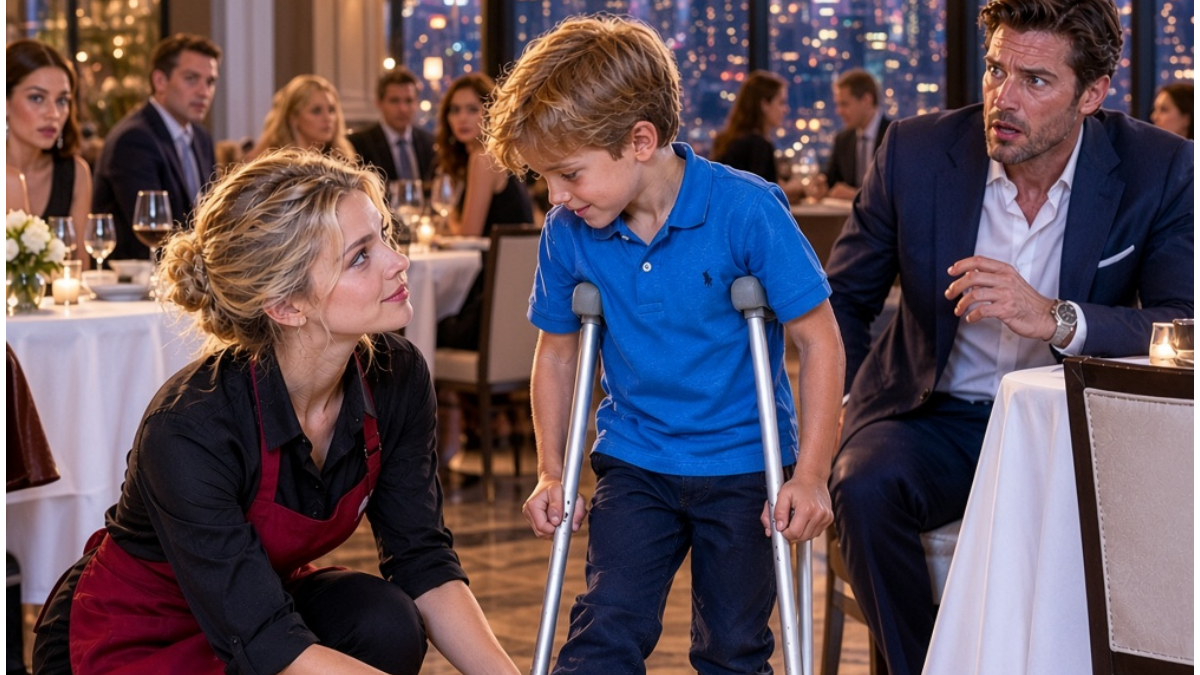
The moment Ethan Callaway watched a stranger’s hand guide his crippled son’s fingers into movement, doctor swore was impossible, he knew his carefully controlled world was about to shatter.
What he didn’t know was that the poised woman sitting across from him in that cheap diner wasn’t just hiding medical expertise.
She was hiding billions, a destroyed reputation, and a scandal that could end his son’s only chance at walking.
But we’re getting ahead of ourselves. If you want to see how a desperate father’s gamble on a mysterious woman leads to betrayal, conspiracy, and a love that breaks every rule he lived by, stick around until the end.
Hit that like button and drop a comment with your city so I can see how far this story travels.
The thing about wealth is that it makes you believe you can fix anything. Write the check, hire the expert, throw enough money at a problem and it crumbles.
Ethan Callaway had built his fortune on that principle. Identifying what’s broken, applying precise pressure, watching it bend to his will.
Real estate empires didn’t build themselves. Neither did the gleaming downtown skyline that bore his family’s name on three separate towers.
But money couldn’t fix Oliver. Ethan stood in the sterile hallway of Portland’s most exclusive pediatric neurology center, watching through the observation window as his 7-year-old son struggled through another round of motor function tests.
The specialist, Dr. Brennan, flown in from John’s Hopkins at $15,000 a day, made notes on his tablet while Oliver’s small hands fumbled with colored blocks that should have been child’s play.
They weren’t. Oliver’s fingers trembled, lost coordination halfway through the simplest tasks. His left leg dragged slightly when he walked, had dragged for 3 years now, despite the parade of specialists, the experimental treatments, the adaptive equipment that filled their home like monuments to medical failure.
The crutches leaning against the wall weren’t temporary anymore. Everyone had stopped pretending they were.
Mr. Callaway, doctor Brennan emerged from the testing room, his expression professionally neutral in that way that meant bad news delivered gently.
Could we speak in my office? Ethan had heard it all before. Rare neurological condition, degenerative elements, unclear ideology.
The words changed slightly depending on which specialist was failing his son that month, but the conclusion remained maddeningly consistent.
“We don’t know why. We can’t fix it. Here’s our bill.” “Just give me the summary,” Ethan said, not moving from the window.
Inside, a nurse was helping Oliver off the examination table. His son’s face held that careful blankness kids develop when they’re trying not to cry in front of adults.
The proprioceptive deficits are more pronounced than our last assessment. Dr. Brennan kept his voice low.
His brain isn’t effectively communicating with his extremities. The new medication protocol hasn’t produced the improvements we hoped for.
You said it would take 6 weeks to see results. It’s been four. Mr. Callaway, I don’t think two more weeks will change what we’re seeing.
The doctor’s tone shifted towards something almost kind. Oliver’s condition has plateaued. That doesn’t mean he won’t have quality of life.
It just means we need to adjust our expectations about recovery. Quality of life. Adjust expectations.
Ethan’s jaw tightened. What’s next then? What haven’t we tried? Dr. Brennan hesitated. There’s a clinic in Switzerland.
I’ve already contacted them. They reviewed his files 2 months ago. Said they couldn’t help.
Then perhaps it’s time to focus on management rather than cure. There are excellent. He’s 7 years old.
Ethan’s voice came out harder than he intended. I’m not giving up on him because you can’t figure it out.
To his credit, Dr. Brennan didn’t flinch. I understand your frustration, but continuing to pursue treatments that aren’t working may be doing more harm than good.
Oliver knows when things fail. That takes a psychological toll. Through the window, the nurse had given Oliver his crutches.
His son fitted them under his arms with the practiced ease of someone who’d been using them too long.
That casual competence, a 7-year-old expert in his own disability, made something crack inside Ethan’s cheSt. “Send me your final report,” he said.
“And your bill.” He didn’t wait for a response. Oliver looked up when Ethan entered the examination room, searching his father’s face the way he always did after these appointments, looking for hope, for good news, for any sign that this time would be different.
Ethan smiled. It felt like a lie. How’d I do? Oliver asked quietly. You did great, buddy.
Dr. Brennan said, “You’re working really hard.” Oliver’s expression suggested he knew that wasn’t the whole truth, but he was too young to call his father out on it.
Or maybe too used to being protected from bad news. Can we go get burgers?
Oliver shifted his weight on the crutches. The good ones, not the healthy stuff. Ethan checked his watch.
2:30 on a Thursday afternoon. His assistant had his calendar packed until 7:00. Meetings with investors, a conference call about the Vancouver development, dinner with the mayor about reszoning proposals.
All of it suddenly felt completely irrelevant. “Yeah,” he said. “Let’s get out of here.”
He texted his assistant on the way to the parking garage. “Cance everything today. Family emergency.”
It wasn’t technically an emergency. It was just Thursday. Another disappointing Thursday and a long string of them.
But watching Oliver navigate the parking garage with those damn crutches, seeing him struggle into the car seat while pretending it wasn’t a struggle, that felt urgent in a way conference calls about zoning varants never would.
“Where we going?” Oliver asked once they were on the road. “Your choice.” “The fancy place with the lobster?
If that’s what you want.” Oliver considered this, then shook his head. “Nah, let’s go to Sally’s.”
Sally’s diner was 40 minutes outside the city. A roadside place with cracked vinyl booths and a menu that hadn’t changed since the 1980s.
Ethan had discovered it years ago during a site inspection for a property acquisition that fell through.
He’d started taking Oliver there on particularly rough days. The food was objectively mediocre, but something about the shabby anonymity of the place made it easier to breathe.
Nobody at Sally’s knew who Ethan Callaway was. Nobody cared. The October afternoon had gone gray and drizzly by the time they pulled into the gravel parking lot.
Oliver maneuvered out of the car with his crutches while Ethan grabbed their jackets. Inside, the diner was nearly empty.
A trucker at the counter, an elderly couple in a corner booth, and a woman sitting alone by the window with a book and a cup of coffee.
“Booth or counter?” Ethan asked. “Booth?” Oliver was already heading toward their usual spot near the back.
The waitress, Paula, name tag faded but still legible, brought the menus and water without being asked.
The usual, she asked Oliver. Cheeseburger and fries, Oliver confirmed. Extra pickles. Make it too, Ethan added.
Paula nodded and disappeared toward the kitchen, leaving them in the comfortable quiet that filled the space between a father and son who’d spent too many hours in medical offices that week.
Dad. Oliver was picking at the paper placemat, not meeting his eyes. Am I going to get better?
The question landed like a fist to the sternum. Ethan set down the water glass he’d been holding.
What makes you ask that? Dr. Brennan’s face. When he came out to talk to you, he had the same face Dr. Martinez had.
And Dr. Chen before her. Smart kid. Too smart sometimes. Doctors don’t know everything, Ethan said carefully.
Just because they haven’t figured it out yet doesn’t mean I heard you talking to grandma last week.
Oliver’s voice had gone very small. You said we’re running out of options. Ethan felt something heavy settle in his cheSt. He’d thought Oliver was asleep.
Apparently, he’d been wrong about that, too. Hey. He waited until Oliver looked up. Listen to me.
We are not giving up. You understand? We’ll find someone who can help. We’ll keep looking as long as it takes.
But what if nobody can? It was the question Ethan had been avoiding for three years.
The one that woke him at 2 in the morning, that turned his stomach during every failed treatment, that made him want to put his fist through walls.
“Then we deal with it,” he said, “Together, but we’re not there yet.” Oliver nodded, but the careful blankness had returned to his face, the same look he’d had in the examination room, the look that said he was trying to be brave because he thought that’s what his father needed.
The food arrived. They ate in silence for a while. Oliver managing his burger with the one-handed efficiency he’d developed, holding it steady with his weaker left hand while his right did the actual work.
Small adaptations, little workarounds, the kind of thing that should have gotten easier with practice, but instead just became more evidence of everything that wasn’t working right.
Ethan was halfway through his burger when movement near the front of the diner caught his attention.
The woman who’d been reading by the window had gotten up to leave, but she’d paused at the register to speak with Paula.
From this angle, he could see her better. Early 30s, probably. Dark hair pulled back in a simple ponytail, wearing jeans and a gray sweater that looked expensive in a way that didn’t advertise itself.
There was something precise in the way she moved, like someone who’d trained in dance or maybe martial arts.
Controlled, deliberate. She glanced toward her booth as she turned to leave. Just a flicker of eye contact, polite acknowledgement between strangers sharing space in a quiet diner.
Ethan nodded. She nodded back. Then she was gone, the door chiming softly behind her.
Dad, can you open this? Oliver was struggling with a ketchup packet, his fingers not quite coordinating the pinch and tear motion.
Ethan reached across the table. Here, let me. I can do it. Frustration edged into Oliver’s voice.
I just need The packet slipped from his grip, skittered across the table, and landed on the floor near the adjacent booth.
Oliver’s face flushed. I’m sorry. It’s fine, buddy. It’s just ketchup. But Oliver was already trying to maneuver around the table with his crutches to retrieve it.
That stubborn independence that made Ethan proud and heartbroken in equal measure. He got halfway out of the booth before his left leg caught on the table support and he stumbled, catching himself on the crutches, but sending his water glass tipping.
Ethan lunged for it, missed. The glass hit the floor and shattered. “Damn it!” Oliver’s voice cracked.
“I’m sorry. I’m so It’s okay.” Ethan was already out of the booth, kneeling to pick up the larger pieces of glass.
“Accidents happen. Not a big deal.” Paula appeared with a broom and dustpan. Nobody’s hurt.
Good glasses break. That’s what they do. But Oliver had gone very still, standing in the middle of the aisle with his crutches, staring at the mess on the floor like it was evidence of some fundamental failure.
His eyes were too bright. Hey. Ethan stood, putting a hand on his son’s shoulder.
Look at me. It’s just a glass. I can’t even pick up ketchup. Oliver’s whisper was ragged.
I can’t do anything right. That’s not Mr. Callaway. The voice came from behind him.
Ethan turned. It was the woman from the window booth. She’d come back inside was standing a few feet away with her keys in one hand and an expression of careful neutrality on her face.
“I’m sorry to interrupt,” she said, but I couldn’t help noticing. “May I?” She gestured toward Oliver, toward his hands specifically.
Ethan’s protective instincts flared immediately. Noticing what? The way he’s gripping the crutches, the angle of his wrists.
Her voice was quiet, professional. Not presumptuous, but not hesitant either. I might be able to help, if you’ll allow me.
Help how? She met his eyes directly. I have some experience with motor coordination issues.
Just a small adjustment to his hand positioning might make things easier, but only if you’re comfortable with that.
Every parental alarm in Ethan’s head started ringing. Stranger. Unsolicited advice. Too forward. He should say no, thank her politely, and get back to their lunch.
But something in her expression stopped him. She didn’t have that pitting look medical professionals always wore around Oliver.
Didn’t have the artificial enthusiasm of therapists who were trying too hard. She just looked observant, assessing a problem without judgment, and Oliver was watching her with sudden intereSt. “What kind of adjustment?”
Ethan asked carefully. “May I show you?” She directed the question to Oliver, not Ethan.
“I won’t touch you without permission, but if you’ll let me, I think I can help with the grip strength.”
Oliver looked at his father. Ethan hesitated, then nodded. The woman moved closer, not crowding Oliver, maintaining appropriate distance.
She gestured to his right hand where it held the crutch. “See how your thumb is here,” she said.
“And your fingers are straight? That’s making your muscles work harder than they need to.
If you rotate your wrist just slightly, not much, maybe 15°, and let your fingers curl a bit more naturally around the grip, your whole forearm relaxes.
Try it.” Oliver adjusted his grip experimentally. “A little more,” the woman said. Think about holding a baseball bat, not a pole.
There, feel the difference. Yeah, Oliver said, surprised. It’s It doesn’t hurt as much. That’s because you’re working with your body’s natural mechanics instead of against them.
Now, the left hand. That one’s trickier because your coordination is different there. May I guide your hand just to show you the position?
Oliver nodded. She moved with absolute precision, touching only his hand, adjusting the angle of his wrist and the position of his fingers on the crutch grip with small deliberate movements.
There, she said, stepping back. Now try taking a few steps. Oliver moved forward tentatively, then more confidently.
His left leg still dragged slightly, but the overall movement looked smoother somehow, more balanced.
It’s easier, he said, wonder in his voice. How did you biomechanics? The woman said simply, “Small changes in positioning can make big differences in how efficiently your body moves.
You’ve been compensating with your shoulder and back muscles for weakness in your hands. This distributes the work more evenly.”
Ethan stared at her. “How did you know that just from watching him?” She smiled slightly.
“I pay attention.” “Are you a physical therapist?” “Not exactly.” Her expression closed slightly. Just someone who spent time around these issues.
There was a story there. Ethan could feel it, but before he could ask, Oliver spoke up.
“Can you show me again? I want to make sure I remember.” The woman went through the adjustment once more, slower this time, explaining the why behind each position.
Oliver listened with the focused intensity he usually reserved for video game tutorials, asking questions, making her repeat certain parts.
Ethan watched them together and felt something shift in his cheSt. This stranger had done more for his son in 5 minutes than Dr. Brennan had accomplished in 4 weeks.
And she’d done it by actually looking at Oliver. Not his medical charts, not his diagnosis, but the actual physical reality of how he moved through space.
When they finished, Oliver was grinning. Actually grinning. Thank you, he told the woman. That’s the coolest thing anyone’s shown me in forever.
You’re welcome, she glanced at Ethan. He’s a quick study. I’m sorry, Ethan said. I didn’t catch your name.
She hesitated for just a fraction of a second. Vivien. Ethan Callaway. He extended his hand.
And this is my son, Oliver. Her handshake was brief. Professional. Nice to meet you both.
Can I ask what you do professionally? Again, that slight hesitation. I’m between positions at the moment, taking some time away from my field.
Not an answer, or rather an answer designed to deflect follow-up questions. Your field being neuroscience, among other things.
She picked up her keys from where she’d set them on a nearby table. I should go, but Oliver, practice that grip.
Even when you’re not using the crutches, the hand exercises will help with fine motor control.
She was leaving, walking away, and Ethan felt opportunity slipping through his fingers like water.
“Wait,” he said. “Could we talk for a minute, please?” Vivien turned back, something wary entering her expression.
“About about my son. About whether you might be willing to help him more formally.”
“Mr. Callaway. Ethan. Ethan.” She shook her head. “I’m not a doctor. I can’t treat your son.
You just did more for him than six specialists have managed in 3 years. I showed him a better way to hold his crutches.
That’s not treatment. Then show him more. Teach him. I’ll pay whatever you want. The weariness in her expression deepened into something harder.
I don’t think that’s a good idea. Why not? Because I’m not in that line of work anymore.
Her tone had gone flat. Final. I’m sorry. I hope the grip adjustment helps. She turned toward the door again.
Please. The word came out rougher than Ethan intended. Raw. He wasn’t used to begging.
Wasn’t good at it. But watching her walk away felt like watching the last exit close on a highway that only led to dead ends.
Viven stopped but didn’t turn around. I’ve taken him to every specialist in the country, Ethan continued.
Spent hundreds of thousands on treatments that don’t work. Watched him get his hopes up and crushed over and over and in 5 minutes you gave him something none of them could.
You made him feel capable. Do you know how rare that is? Mr. Callaway. Ethan.
She did turn then and he saw something complicated in her expression. Something that looked like old pain carefully managed.
You don’t know me, she said quietly. You don’t know anything about me or why I’m not working in my field anymore.
Trust me when I say hiring me would be a mistake. Let me decide that.
No. Firm now. I’m sorry about your son. Truly, but I can’t help you. Oliver had been watching this exchange with growing distress.
Now he spoke up, his voice small. Was it something I did? Viven’s expression cracked slightly.
Oh, sweetheart, no. You were perfect. This isn’t about you at all. Then why won’t you help?
Oliver asked. If you can make things better, why won’t you? The question hung in the air between all three of them.
Viven looked at Oliver for a long moment, then at Ethan, then down at her keys.
When she spoke again, her voice was very quiet because sometimes trying to help makes things worse.
And I can’t afford to make things worse for anyone else. There was history in that statement.
Wait. Ethan made a decision. Look, he said, I don’t know what happened in your past, but I’m good at reading people.
It’s how I built my business. And I can see you’re not someone who walks away from a kid who needs help without a damn good reason.
So, whatever that reason is, whatever you’re running from or protecting us from, I need you to understand something.
He paused, making sure he had her full attention. My son has been in pain for 3 years.
Physical pain, yes, but mostly the pain of feeling like his own body is failing him.
Of watching other kids do things he can’t, of being the kid with crutches, with limitations, with problems nobody can fix.
And I have watched him become smaller and quieter and more careful with every passing month.
I’ve watched the light go out of his eyes a little more each time a treatment fails.
Ethan’s voice had gone rough. He didn’t bother trying to smooth it. So, whatever risk you’re worried about, whatever might go wrong, it can’t be worse than watching my kid give up on himself.
And if there’s even a chance you can help him, even a small one, I’m asking you to take it.
Silence filled the diner. Even Paula had stopped pretending not to listen. Viven studied him with those observant eyes, and Ethan had the distinct feeling of being assessed, measured, evaluated against some internal metric he couldn’t see.
Finally, she spoke. If I agreed to this, and I’m not saying I am, it would have to be under very specific conditions.
Ethan’s heart jumped. Name them. First, this would be strictly professional. I would work with Oliver on motor coordination and proprioceptive exercises.
Nothing more. I’m not a miracle worker, and I won’t make promises I can’t keep.
Understood. Second, you don’t ask about my background beyond what I choose to share. You don’t investigate me.
Research me or try to figure out who I was before I came here. My past stays my paSt. That one was harder.
Every business instinct Ethan had screamed at him to do due diligence to know who he was bringing into his son’s life, but looking at Oliver’s hopeful face at the way he was already standing straighter with the adjusted grip on his crutches.
Agreed, Ethan said. Third, if at any point I tell you this isn’t working or that I need to stop, you accept that without argument or attempts to change my mind.
My judgment on this is final. Okay. Viven looked at him for another long moment, then sighed.
I must be out of my mind, she muttered, then louder. I’ll give it 2 weeks trial period.
If Oliver shows improvement and you both still want to continue after that, we’ll discuss longerterm arrangements, but 2 weeks is all I’m committing to right now.
2 weeks is good, Ethan said, trying not to let too much relief show in his voice.
More than good. When can you start? Tomorrow, 3:00. Do you have a gym or exercise space at your home?
We have a full physical therapy setup. Everything his previous therapist recommended. I’ll need to see it and I’ll need his medical records.
All of them. Test results, diagnosis, treatment history, everything. I’ll have them sent to you tonight.
What’s your email? She pulled out her phone, typed something, then showed him the screen rather than saying it out loud.
A simple Gmail address. Nothing that revealed identity or profession. Ethan entered it into his phone.
Anything else you need? He asked. Just one thing. Vivien looked at Oliver. I need you to understand that this is going to be hard work, not painful, but challenging.
You’ll have to practice exercises every day, even when you’re tired or frustrated, and progress might be slow.
Can you commit to that?” Oliver nodded vigorously. “I can do hard work. I’ve been doing hard work forever.
I know you have.” Her expression softened slightly. “That’s actually what gives me hope that this might work.”
They exchanged phone numbers and addresses. Vivien left first with a final instruction to Oliver to practice the crutch grip at home.
Through the diner window, Ethan watched her get into a modest Honda sedan. Practical, anonymous, nothing that suggested the level of expertise she’d just demonstrated.
Dad. Oliver was tugging at his sleeve. Is she really going to help me? Yeah, buddy.
I think she is. She’s different than the other doctors. How so? Oliver thought about it.
She listened to me, like actually listened. Not the way grown-ups do where they’re just waiting for you to stop talking.
Perceptive kid. They finished their lunch or what was left of it after the interruption.
Oliver practiced his crutch grip the whole drive home, making small adjustments, testing how it felt.
The change in his demeanor was remarkable. The defeated kid from the medical center had been replaced by someone animated, engaged, hopeful.
It should have made Ethan purely happy. It did make him happy. But underneath the hope was a nagging unease he couldn’t quite shake.
He’d just hired someone to work with his vulnerable child. Someone who’d explicitly refused to share her background, who was between positions in neuroscience for reasons she wouldn’t explain.
Someone who’d made him promise not to investigate her, which of course meant he was absolutely going to investigate her.
Not because he didn’t trust his instincts. They’d been right about her competence. Her genuine desire to help, but because he was a father first and everything else second, and his son’s safety wasn’t negotiable.
That evening, after Oliver was asleep, Ethan sat in his home office with his laptop and started with the basics.
Google search Viven Neuroscience. Too generic. Millions of results, none relevant. He tried adding location markers.
Vivian Neuroscience Portland. Vivian Neuroscience Oregon. Nothing useful. He called his head of security, a former FBI agent named Marcus Webb, who handled background checks for Callaway properties.
I need you to find someone, Ethan said. First name Vivien. Works in neuroscience. Currently in the Portland area, early 30s, 5’6, dark hair.
That’s not much to go on, Marcus said. Last name? Don’t have it. Where does she work?
She doesn’t. Said she’s between positions. A pause. Ethan, if you’re hiring someone to work with Oliver, I really need more information than this.
I know. That’s why I’m calling you. See what you can find. This is going to take time with so little data.
I’ve got time. She’s not starting until tomorrow afternoon. I’ll do what I can. Marcus called back 3 hours later.
I’ve got nothing, he said, frustration evident. Without a last name or workplace, I can’t narrow it down.
There are hundreds of women named Vivian in the greater Portland area. Could be thousands if she’s not local.
What if she used to work in neuroscience research, medical field, academic? I searched academic databases, hospital systems, research institutions.
Nobody matching that description who’s currently inactive or between positions in this region. Either she’s using a different name now or she’s from somewhere else or or what or she’s deliberately staying off the grid, which raises questions you should probably be asking before you let her near your kid.
Ethan rubbed his temples. She helped him, Marcus. In 5 minutes, she did something tangible that none of his specialists have managed.
I’m not saying she’s not competent. I’m saying someone who’s actively hiding their professional history might have reasons you need to know about.
Keep digging quietly. How quiet? She can’t know I’m looking into her. Ethan, I know, but I gave my word I wouldn’t investigate.
So officially, I’m not. You are. Marcus sighed. I’ll see what I can do. The next afternoon at precisely 3:00, Viven arrived at the Callaway residence.
She’d traded the jeans and sweater for athletic wear, practical, professional. She carried a small duffel bag that presumably held whatever equipment or materials she needed.
Ethan met her at the door. Thank you for coming. Professional commitment, she said. Where’s Oliver?
In the gym. I’ll show you. The house was a testament to successful wealth. Modern architecture, high ceilings, floor to ceiling windows overlooking the city.
Ethan had bought it shortly after Oliver’s mother died, wanting space and light and rooms that didn’t hold memories of before.
He led Vivien through to the converted lower level where the physical therapy setup occupied what had once been designed as a home theater.
Mats, parallel bars, resistance bands, balance boards, adaptive equipment in various states of use and abandonment.
Oliver was waiting on one of the mats, his crutches beside him. He brightened when he saw Vivien.
You came. I said I would. She set down her bag and surveyed the room.
This is a good space. We can work with this. For the next hour, Ethan watched from the doorway as Vivien put Oliver through a series of exercises that looked nothing like traditional physical therapy.
She spent the first 20 minutes just observing, watching how he moved, where he compensated, what triggered the tremors in his hands.
Then she started with basics. Finger exercises, hand eye coordination drills, simple movements repeated with precision.
Viven providing constant feedback about position, muscle engagement, breathing. You’re tensing your shoulders, she said.
That’s your body trying to protect itself, but it’s actually making the movement harder. Relax here.
She touched his shoulder blade lightly. And engage here instead. A tap on his forearm.
Oliver tried again. Better. Good. Now, 10 more. Just like that. What struck Ethan was her attention to detail.
She caught micro adjustments in Oliver’s posture that Ethan couldn’t even see. Noticed when he started to fatigue before he mentioned it, pushed him exactly to his edge and then backed off before frustration could set in.
And Oliver responded. Ethan could see it in his son’s focus. His willingness to try again when something didn’t work.
His lack of self-consciousness about mistakes. After an hour, Vivien called a break. “That’s enough for today.
You did good work.” “Can we do more?” Oliver asked. “No, your muscles need recovery time, and your brain needs to process what we practiced.
But I want you to do these hand exercises.” She demonstrated a series of finger stretches three times today and twice tomorrow before I see you again.
Can you do that? Yes. Show me. Oliver repeated the exercises. Vivien corrected his form twice, then nodded approval.
Thursday at 3, she asked Ethan. That works, she packed her bag efficiently. Oliver followed her to the door, chattering about something he’d learned in school.
Ethan listened to their easy interaction and felt that complicated mix of gratitude and unease again.
At the door, Vivien turned to Ethan. “He’s going to improve,” she said quietly. “But I need you to understand that this isn’t magic.
It’s incremental work over time. Don’t expect miracles and don’t let him expect them either.
I understand. Do you? She held his gaze. Because I’ve seen what happens when people get their hopes up too high.
When the progress doesn’t come fast enough or dramatic enough, it can do more damage than the original problem.
I’ll manage expectations. Good. She shifted her bag to her other shoulder. I’ll see you Thursday.
He watched her drive away in that unremarkable Honda, then went back inside to find Oliver practically vibrating with energy.
She’s so cool, Dad. Did you see what she showed me about using my smaller muscles to stabilize before the big ones engage?
None of the other therapists ever explained it like that. She’s definitely different, Ethan agreed.
Do you think she’ll keep coming even after 2 weeks? I think if we show her it’s working, she’ll stay.
Oliver nodded, already practicing the hand exercises Viven had assigned. Ethan watched him for a moment, then retreated to his office.
Marcus had sent an email. Still nothing. Expanding search to other regions. This is unusual.
Most professionals leave some kind of digital footprint. Ethan stared at the message. Someone who was good enough to have the expertise Vivien demonstrated should have publications, conference presentations, professional affiliations, something.
The absence of any trace suggested deliberate eraser, which meant she was either running from something or hiding something.
He should probably care more about which. But watching Oliver practice those exercises with genuine hope in his eyes for the first time in months, Ethan found he was willing to take the risk for now.
Thursday’s session went even better than Tuesday’s. Viven introduced balance work, having Oliver stand on one foot while performing hand coordination tasks.
It should have been impossible. His left side was too weak, too uncoordinated. But Vivien broke it down into such small components, adjusted his positioning so precisely that Oliver managed 30 seconds of stable balance while sorting colored blocks.
30 seconds. It didn’t sound like much, but 3 days earlier, 5 seconds had been his limit.
That’s remarkable, Ethan said after the session ended. It’s progress, Vivien corrected. Not remarkable. Just what happens when you work with the body’s natural systems instead of against them.
Can I ask where you learned this approach? She looked at him for a beat.
I thought we had an agreement about questions. This isn’t about your paSt. It’s about your methodology.
The methodology comes from the paSt. So, yes, it is about that. Ethan backed off.
Fair enough. But his curiosity was becoming harder to contain. This wasn’t just good teaching.
This was elite level expertise applied with precision he’d only seen from the top specialists.
Specialists with endowed chairs at research hospitals and waiting lists measured in years. And Viven was working with his son in a converted home gym for a fee they hadn’t even discussed yet.
After she left, Oliver cornered him in the kitchen. Dad, can we do the exercises every day instead of just twice a week?
That’s not what Viven scheduled. I know, but I’m getting better. I can feel it.
If we did more, we stick to what she prescribed, Ethan said. She knows what she’s doing.
But Oliver, she said overwork can cause probleMs. We trust her judgment. Oliver deflated slightly, then rallied.
Can I at least practice the hand stuff more? She said, “I could do those exercises as much as I want.”
Yes, the hand exercises are fine. That night, Ethan found himself unable to sleep. He got up at 2:00 in the morning and went down to the gym, stood in the space where Vivien had worked with Oliver, tried to understand what he was seeing.
The exercises weren’t revolutionary. The equipment was standard. But the way she sequenced movements, the precision of her cues, the way she anticipated Oliver’s compensatory patterns before they happened, that was something else entirely.
His phone buzzed. A text from Marcus. Call me. Found something. Ethan dialed immediately, keeping his voice low so he wouldn’t wake Oliver.
What did you find? Not much, but it’s interesting. I expanded the search nationally and found a Vivien Ashford who worked in neuroscience research until about 3 years ago.
Published extensively on pediatric neurological disorders, motor control, brain body communication. Ethan’s pulse quickened. That fits what happened 3 years ago.
She disappeared from the academic record. No more publications, no conference presentations, no institutional affiliations.
Why? That’s where it gets murky. There were some rumors about a research scandal at the hospital where she worked.
Nothing concrete in the public record, but enough whispers to suggest something significant happened. What kind of scandal?
I don’t know yet. The information is buried, maybe sealed. But Ethan, if this is the same woman, she’s not just competent, she’s world class, or was.
Send me everything you have. Already did. Check your email, but be careful how you approach this.
If she finds out you’ve been investigating, I know I’ll be careful. The email contained PDFs of academic papers authored by Dr. Vivien Ashford.
Ethan read through them, understanding maybe one word in 10 of the technical terminology, but what came through clearly was the brilliance of the work.
Innovative approaches to neurological rehabilitation, novel theories about brain plasticity and motor control. And then 3 years ago, it all stopped.
No explanation, no farewell announcement, just silence. He was still reading when the sun came up.
Oliver’s next session was scheduled for Tuesday, but Monday afternoon, Ethan got a text from Vivian.
Can we move tomorrow to evening, 700 p.m.? That works, he replied. Everything okay? Fine, just schedule conflict.
When she arrived Tuesday evening, something was different. She seemed distracted, her usual precise focus slightly scattered.
She still worked well with Oliver, but Ethan caught her checking her phone twice during the session, something she’d never done before.
After Oliver went upstairs to shower, Ethan asked if everything was all right. “It’s fine,” she said, packing her bag with slightly more haste than usual.
“Viven, I said it’s fine. Sharp now.” Then she stopped, took a breath. “I’m sorry, personal issue.
It won’t affect my work with Oliver. If you need to reschedule. No. Thursday at 3, I’ll be here.
She was gone before he could say anything else. Thursday, she seemed back to normal, but something had shifted.
She was more guarded, more distant. Still excellent with Oliver, but the small moments of warmth, the smiles, the gentle encouragement had been replaced with pure professionalism.
Ethan didn’t push, but he noticed. Friday evening, Marcus called again. I found something else.
You’re not going to like it. Ethan set down the bourbon he’d been nursing. Tell me.
3 years ago, Dr. Vivien Ashford was the lead researcher on an experimental treatment protocol for pediatric neurological conditions.
One of her subjects was a 6-year-old boy named Daniel Reeves. During treatment, something went wrong.
The kid suffered permanent nerve damage, lost all function in his left side. The words hit like a physical blow.
Are you sure? There was a lawsuit settled out of court, records sealed, but I found references in medical board meeting minutes and insurance documents.
Ashford’s medical license was suspended pending investigation, but before it concluded, she resigned from her position and disappeared.
Ethan felt sick. Was she found negligent? The investigation was never completed because she left, but the family maintained she had rushed the treatment, ignored warning signs, and prioritized her research over the patients well-being.
Jesus. Uh, Ethan, if this is the same woman working with Oliver, I know. You need to end this now before Let me think.
There’s nothing to think about. She’s working with your son with the exact same type of condition that she permanently injured another child.
I said, “Let me think.” Ethan’s voice came out harsher than he intended. “I’ll call you back.”
He ended the call and sat in his office, staring at nothing. The woman who’d been so careful with Oliver, so precise in her movements, so insistent on not overworking his muscles or raising false hopes, that woman had permanently damaged a child.
It didn’t fit, but the timeline did. The disappearance from the field, the insistence on privacy about her background, the weariness about taking on Oliver’s case.
Sometimes trying to help makes things worse, and I can’t afford to make things worse for anyone else.
Her words from the diner suddenly made terrible sense. Ethan pulled up the academic papers again, reading with new attention.
The research was brilliant, yes, but it was also aggressive, pushing boundaries, testing theories that other researchers considered too risky.
Had that ambition cost a child his future? And if it had, what was Ethan doing letting her anywhere near his son?
He should end this immediately. Fire her. Find someone else. Go back to conventional therapy with conventional specialists who had conventional results.
Safe, slow, limited, but effective. Except they hadn’t been effective. 3 years of conventional treatment had gotten Oliver exactly nowhere.
And two weeks with Viven had produced tangible improvement. Ethan put his head in his hands.
This should be simple. Protect his child. That was the only priority that mattered. But if Vivien really was dangerous, why was Oliver getting better?
Why was her approach working when everything else had failed? He needed more information. Tuesday afternoon, before Vivian’s scheduled session, Ethan made a decision.
He called the phone number Marcus had found for Daniel Reeves family. A woman answered on the third ring.
Mrs. Reeves, my name is Ethan Callaway. I’m calling about Dr. Vivien Ashford. Silence. Then I have nothing to say about that woman.
Please, I just need to understand what happened with your son’s treatment. Dr. Ashford is currently working with my own son.
And then you need to stop her immediately. The woman’s voice was sharp with old pain.
Do you understand? She will hurt your child. Can you tell me what happened? She was reckless, pushed treatment too fast, ignored warning signs, and when things went wrong, she blamed everyone but herself.
My son Daniel is 8 years old and will never have use of his left arm or leg because of her ambition.
I’m so sorry. Are you? Then end whatever arrangement you have with her before she destroys your family, too.
The line went dead. Ethan sat with the phone in his hand, his decision made.
At 3:00, when Vivien arrived for Oliver’s session, Ethan met her at the door and didn’t let her inside.
“We need to talk,” he said. She read his expression and something closed in her face.
“What happened?” “I know who you are. What you did.” For a moment, she didn’t move.
Then she nodded slowly. “I see.” Despite our agreement, you didn’t tell me you’d permanently injured a child.
No, I didn’t. Oliver has the same condition that boy had, and you thought it was acceptable to work with him without disclosing that.
I disclosed what you needed to know. That I had experience with these issues and that there were risks.
Risks? Ethan’s voice rose. You paralyzed a six-year-old. Is that what you were told? It’s a matter of public record.
The lawsuit was settled without findings because I couldn’t afford to fight it after I lost my position.
Her voice was very controlled. But public record and truth are not the same thing.
Then tell me the truth. Why? So you can decide if I’m believable? I told you not to dig into my past for exactly this reason.
I’m protecting my son by believing the first story you hear. Something sharp entered her expression.
Did you speak with the hospital, with my colleagues, with anyone who actually knows what happened?
I spoke with the mother of the child you hurt. Of course you did. Viven’s laugh was bitter.
And I’m sure she gave you a very clear narrative about the reckless doctor who damaged her perfect child.
Are you saying she lied? I’m saying trauma makes people need someone to blame. And I was convenient.
That’s not an answer. No. Viven agreed. It’s not because the real answer is complicated and messy and not something you’re going to believe while you’re standing there looking at me like I’m a threat to your family.
Through the house, Ethan could hear Oliver calling. Dad, is Viven here? Vivien heard it too.
Her expression softened slightly. Tell him I’m sorry, she said. And that he should keep practicing the exercises.
They’ll help even without me. Viven, you made your choice. It’s the same choice everyone else made 3 years ago.
I don’t blame you. She turned to leave, then paused. But for what it’s worth, Oliver was going to be fine.
He was progressing exactly as he should, and in another month, he would have been walking without crutches.
You’re taking that away from him because you’re scared of a story you don’t fully understand.
If you’re innocent, why won’t you defend yourself? Because I’m tired, she said simply. I’m tired of explaining and justifying and trying to convince people to see past the scandal.
I did that for a year after it happened, and it cost me everything I had left.
I’m not doing it again. Oliver appeared in the hallway behind Ethan, his face lighting up when he saw Viven.
Hey, I’ve been practicing. He stopped when he saw their expressions. What’s wrong? Ethan looked at his son, at Viven, at the impossible choice between them.
Vivien can’t work with you anymore, he said. Oliver’s face crumpled. Why not? What did I do?
You didn’t do anything, sweetheart. Viven said softly. Your dad just decided this arrangement isn’t working out.
But I’m getting better. We were going to start walking practice next week. I know, Vivien’s voice had gone rough.
But sometimes things change. You’ll keep getting better, though. Just practice everything I taught you.
No. Oliver’s eyes were filling with tears. Dad, please. She’s helping me. Why would you?
Oliver, go upstairs. I don’t want to. Now, something in Ethan’s tone made Oliver obey, but not before shooting his father a look of such betrayal it felt like a knife wound.
When he was gone, Viven spoke quietly. “You’re making a mistake, but it’s your mistake to make.”
She pulled a folder from her bag. These are the exercises I had planned for the next four weeks along with notes on his progress so far.
Give them to whatever therapist you hire next. She handed him the folder and walked away.
Ethan stood in the doorway watching her leave, holding a folder full of exercises his son would never do, having just broken his kid’s heart to protect him from a danger he wasn’t even sure existed.
This should feel like the right decision. It felt like he’d just made the worst mistake of his life.
Oliver didn’t speak to him for 3 days. Not at breakfast, not in the car, not during the tense silences that filled their house like smoke.
The kid went through the motions, school, homework, dinner, but the light that had returned during those sessions with Vivien was gone again, worse than gone, replaced by something that looked uncomfortably like contempt.
On the fourth day, Ethan found him in the gym at 6:00 in the morning, attempting the balance exercises Viven had taught him.
Attempting and failing, his left leg buckling, frustration making his movements jerky and uncoordinated. “You’re doing it wrong,” Ethan said from the doorway.
Oliver didn’t look at him. “Then maybe you shouldn’t have fired the person who could teach me to do it right.”
The words landed with precision. Oliver had been practicing that line. Ethan could tell. Waiting for the right moment to deploy it.
I was protecting you. From what? From getting better. Oliver abandoned the exercise, grabbed his crutches.
She was helping me. For the first time in my whole life, someone actually made me feel like I wasn’t broken.
And you took that away. It’s more complicated than No, it’s not. Oliver’s voice cracked.
You got scared and you quit just like all the other doctors quit just like everyone quits on me eventually.
He pushed past Ethan and headed upstairs. His gate more uneven than it had been 2 weeks ago.
The progress they’d made was already eroding. Ethan stood in the empty gym surrounded by equipment that might as well have been decorative and felt the weight of his decision pressing down like a physical thing.
He’d done the right thing. Protected his son from someone with a dangerous history. So why did it feel so completely wrong?
That afternoon, he called the physical therapist Oliver had worked with before Viven. Dr. Sandra Chen, competent and careful and utterly conventional.
I’d like to restart Oliver’s sessions, Ethan said. As soon as possible. Of course. Let me check my schedule.
A pause. I have an opening next Thursday at 2. Nothing sooner. I’m afraid not.
Is everything all right? No, nothing was all right. His son hated him and was losing the progress that had given him hope.
And Ethan couldn’t stop thinking about the look on Viven’s face when she’d handed him that folder and walked away.
“Thursday works,” he said. That night, he opened the folder Vivien had left. Her handwriting was precise, clinical.
Each exercise documented with diagrams, notes on Oliver’s specific adaptations, progressions for the next month.
The level of detail was remarkable. She’d clearly been planning far beyond the twoe trial period, despite her insistence on keeping things temporary.
At the bottom of the last page, she’d written something in smaller script. O is capable of more than anyone has given him credit for.
Don’t let fear limit his potential. Ethan closed the folder and poured himself another bourbon.
His phone rang. “Marcus, I kept digging,” Marcus said without preamble about the Ashford situation.
“I told her she couldn’t work with Oliver anymore. It’s done.” “I know, but I thought you should know what I found.”
The hospital where she worked, Portland Medical Research Institute, they had a major internal investigation 3 years ago.
Not about Ashford, about their clinical trials oversight board. Ethan sat up straighter. What kind of investigation?
Corruption. Falsified data. There were people on that board who had financial interests in seeing certain research lines fail.
Ashford’s work was showing promise in areas that would have competed with treatments they had stakes in.
Are you saying she was set up? I’m saying the official story doesn’t match what I’m finding in the details.
The boy who was injured, Daniel Reeves, his family received a settlement of $2 million.
That’s way more than a standard medical malpractice case, especially one where the hospital maintained no wrongdoing.
Maybe they just wanted it to go away. Maybe. Or maybe someone paid them to make sure the narrative stayed focused on Asheford rather than the real problems at the institute.
Ethan’s chest tightened. Did you find proof? Not yet. But I found something else. Three other researchers who worked under Ashford at the time.
They all published papers within 6 months of her leaving. Papers using methodologies and data that look remarkably similar to her work.
Work she’d been developing for years before the incident. But they stole her research. It’s starting to look that way.
And if they did, framing her for the Reeves incident would be a very convenient way to discredit her before she could fight back.
Ethan thought about Vivien’s face when he’d confronted her. The resignation in her voice. The tired acceptance of being blamed again.
Why wouldn’t she defend herself? Maybe she tried and no one listened. Or maybe she was too destroyed by what happened to fight.
Losing a patient, even if it wasn’t your fault, that would break someone who cares about their work the way she clearly did.
Can you prove any of this? Given enough time and resources, probably. But Ethan, that’s not really the question you should be asking.
What should I be asking? Whether you trust what you saw with your own eyes when she worked with Oliver, because all the investigation in the world won’t tell you that.
After Marcus hung up, Ethan sat in his office until past midnight, thinking about trust and risk and the difference between protecting someone and suffocating them.
Thursday’s session with Dr. Chen was exactly what Ethan expected. Professional, careful, completely ineffective. She put Oliver through the same exercises he’d been doing for years, offered encouraging words that rang hollow, and produced exactly zero progress.
Oliver went through the motions with mechanical compliance, and didn’t say a word in the car ride home.
“Dr. Chen seemed to think you did well.” Ethan tried. “Dr. Chen thinks everything I do is well.
That’s her job. She’s trying to help. She’s trying not to get sued. There’s a difference.
Ethan didn’t have an answer for that. That weekend, he drove out to Sally’s diner.
Told himself he was just getting lunch. Told himself he wasn’t looking for Viven. Even as he scanned every booth, every table, she wasn’t there.
Paula brought him coffee without being asked. Looking for someone? No, just wanted a burger.
Uh-huh. She didn’t sound convinced. That woman who helped your boy, she hasn’t been back since you two met, in case you were wondering.
I wasn’t. Sure. Paula left the menu. Let me know when you’re ready to order and when you’re ready to stop lying to yourself.
He Ethan ordered the burger. Left it halfeaten. Drove home feeling worse than when he’d left.
Monday morning, Oliver’s school called. He’d gotten into a fight during gym class. Not physical.
Oliver couldn’t exactly throw punches with his coordination issues, but he’d apparently told another kid to go to hell when questioned about his crutches.
Ethan picked him up from the principal’s office. “You want to tell me what happened?”
He asked in the car. Some kid asked why I was still using crutches. Said his cousin had broken his leg and was walking fine after 6 weeks.
“And you told him to go to hell?” “I told him to go to hell and mind his own business.”
Oliver stared out the window. “I got detention for it. He didn’t get anything for being a jerk.
That’s not how it works. I know how it works. It works like everything else.
People can say whatever they want to me, but if I fight back, I’m the problem.
Ethan wanted to argue. Couldn’t find the grounds. That night, he pulled out his laptop and did something he’d been avoiding.
He searched for Dr. Vivien Ashford’s published research. Really read it this time. Not just skimmed for evidence.
The work was extraordinary. Not just competent or promising, genuinely revolutionary. She developed protocols for neurological rehabilitation that showed success rates double what conventional treatments achieved.
Her theories about brain plasticity and motor relearning were being cited by researchers across the field.
And then it all stopped. He found the announcement of Daniel Reeves injury buried in medical news archives.
Adverse event halts promising trial. The article was carefully worded, no direct accusations. But the subtext was clear.
Ambitious researcher pushes too hard. Child suffers. Except Ethan read the article three times and realized what was missing.
No quotes from the hospital administration defending their researcher. No statement from colleagues vouching for her methods.
No mention of the oversight board that should have been monitoring the trial. Just silence and implication.
He searched for follow-up articles. Found almost nothing. The story had died within weeks, replaced by announcements of new research initiatives at Portland Medical Research Institute.
Research that looked suspiciously similar to what Ashford had been doing. Marcus was right. This didn’t add up.
Ethan made a decision. He called his attorney, David Morrison, a man who specialized in making complicated problems simple.
I need you to unseal some court records, Ethan said. Medical malpractice case from 3 years ago.
Ashford versus Reeves family. Can you do that? Sealed cases are sealed for a reason.
Usually involves minors or settlements with confidentiality clauses. I know. Can you do it? David sighed.
Probably. It’ll take time and it won’t be cheap. I don’t care about the coSt. I need to know what actually happened.
This about Oliver’s new therapist, former therapiSt. And yes, Ethan, if you’re having doubts about ending that arrangement, just get me the records.
It took 2 weeks. 2 weeks during which Oliver continued working with Dr. Chen and making zero progress.
2 weeks during which the kid’s attitude went from angry to something worse, resigned, accepting his limitations like they were permanent.
Ethan watched his son give up on himself in slow motion and felt powerless to stop it.
Then David called. Got the records? You’re not going to like what’s in them. They met at David’s office downtown.
The attorney slid a thick folder across the desk. The short version, Ashford’s treatment protocol was sound.
Better than sound. It was working. Daniel Reeves was showing significant improvement over 8 weeks of treatment.
Then what went wrong? Week nine, the oversight board ordered her to increase the intensity of the neural stimulation therapy.
Double the duration, more aggressive parameters. Ashford pushed back, said it was too fast, but the board overruled her.
2 days after implementing their modifications, the kid had a severe adverse reaction. Ethan’s stomach dropped.
They blamed her for following their orders. Not exactly. They claimed she’d misinterpreted their directive, that she’d implemented the changes incorrectly.
Her notes say otherwise, but by the time the case went to court, three of the five board members who’d signed off on the modification had left the institute.
The two who remained testified they’d never approved those parameters. They lied. Can’t prove it, but the circumstantial evidence is damning.
Within 6 months, those same board members published research using Ashford’s methodologies. Research they couldn’t have developed in that time frame unless they’d had access to her work before she left.
Why settle if she was innocent? Because she was broke. Fighting the case would have cost millions she didn’t have.
The hospital had institutional resources. The Reeves family had backing from someone with deep pockets.
We couldn’t trace who, but the money came from somewhere. Ashford was facing a yearslong legal battle she couldn’t afford against people who’d already destroyed her reputation.
So, she walked away. More like crawled away. From what I can tell, she lost everything.
Her position, her research, her savings to legal fees before she settled. The confidentiality agreement meant she couldn’t even defend herself publicly.
Ethan sat back in his chair feeling sick. I accused her of exactly what they accused her of.
“You didn’t know.” She tried to tell me it was complicated. I didn’t listen. David’s expression was sympathetic.
What are you going to do? I don’t know yet. That was a lie. He knew exactly what he had to do.
He had to find Viven and apologize. Beg her to come back. Do whatever it took to fix the damage he’d done.
First problem, he had no idea where she was. He tried her cell phone, disconnected.
Her email bounced back. The Honda she’d driven wasn’t registered in any database Marcus could access.
“She’s gone,” Marcus said when Ethan called him. “Completely off-rid. If she doesn’t want to be found, we’re not finding her.”
There has to be something. Not unless she reaches out to you firSt. Ethan hung up and stared at his phone, willing it to ring.
It didn’t. Days passed, then a week. Oliver’s sessions with Dr. Chen continued producing nothing except mounting frustration.
The kid had stopped practicing the exercises Viven had taught him. What was the point when there was no one to correct his form, no one who understood what the movements were supposed to accomplish?
Ethan watched his son retreat further into himself and felt the full weight of his failure.
He’d had someone who could help, someone who’d been helping, and he’d driven her away because he’d been too scared to see past a convenient narrative.
2 weeks after David gave him the court records, Ethan was in his office late when his phone rang.
Unknown number. He answered anyway. Mr. Callaway. A woman’s voice unfamiliar. My name is Dr. Sarah Lynn.
I worked with Vivien Ashford at Portland Medical Research Institute. Ethan sat up straighter. How did you get this number?
I’ve been following your inquiries into the Reeves case. Word gets around in certain circles.
I thought you should know. Viven didn’t just lose her position because of what happened.
She lost everything because she refused to let them bury her research. What do you mean?
After the incident, the board offered her a deal. Keep quiet about the modifications they’d ordered, accept responsibility for the adverse event, and they’d give her a generous severance and strong references.
She’d be able to work again, just not there. She turned it down. She refused to lie about what happened, said if she took responsibility for something she didn’t do, it would compromise every patient she might work with in the future.
So, they destroyed her instead. Ethan closed his eyes. Why are you telling me this?
Because Viven was the best researcher I’ve ever worked with. Brilliant and careful and completely dedicated to her patients.
What they did to her was criminal. And if there’s any chance she’s working again, even privately, someone should know the truth about who she really is.
Do you know where I can find her? No. She cut ties with everyone from before.
But Mr. Callaway, if you do find her, tell her Sarah Lynn says she deserves better than what happened and that her research mattered.
The line went dead. Ethan sat in the silence of his office, surrounded by the trappings of wealth and success, and felt completely helpless.
He had money. He had power. He had resources most people couldn’t dream of. And none of it could fix what he’d broken.
That weekend, he took Oliver back to Sally’s diner. The kid didn’t ask why. Just got in the car with his crutches and stared out the window during the 40-minute drive.
The diner was busier than last time. Saturday lunch crowd. They got a booth near the back and Paula brought the menus.
“Haven’t seen you two in a while,” she said. “Your friend’s still not coming around?”
“She’s not our friend,” Oliver said quietly. Dad made sure of that. Paula looked at Ethan with an expression that suggested she’d heard this story before in a thousand different versions.
“That right.” “It’s complicated,” Ethan said. “Usually is.” She left them with the menus. They ordered, ate in silence.
The food tasted like cardboard. Ethan was paying the bill when Oliver spoke up. I know why you made her leave.
Ethan looked at his son. You do? I’m not stupid. I heard you on the phone with Uncle Marcus about the kid she hurt about the lawsuit.
Oliver, I know you were trying to protect me, but Dad, she wasn’t going to hurt me.
I could tell. How? Oliver thought about it. Because she looked at me like I was a person, not a problem.
All the other doctors, they see what’s wrong with me. Viven saw what could be right.
The simple truth of it hit Ethan like a punch. I made a mistake, he said.
I know, so fix it. I don’t know how to find her. Then try harder.
Oliver’s voice was fierce. You always tell me not to give up. That we keep trying until we find an answer.
So why are you giving up on her? Out of the mouths of seven-year-olds. That night, Ethan sat down and wrote an email.
He didn’t have an address that worked, but he wrote it anyway. Put everything in it.
The investigation, the truth he’d uncovered, the apology he owed. Saved it in his drafts folder like a message in a bottle waiting for someone to find.
Monday morning, he got a call from an investigator he’d hired to track property records, vehicle registrations, anything that might lead to Viven.
Found something, the investigator said. Woman matching her description rented a small house in Brightwood, mountain town about an hour eaSt. Pays cash, keeps to herself.
Might be nothing. Give me the address. E. Ethan drove out that afternoon, leaving Oliver with his mother’s sister.
The town was exactly what the investigator had described. Small, quiet, the kind of place where people went to disappear.
The house was at the end of a gravel road, modest and isolated. The Honda was parked in the driveway.
Ethan sat in his car for 10 minutes trying to figure out what to say.
Finally, he got out and knocked. Vivien opened the door. She looked tired. Not physically.
She’d always had that careful poise, but something in her eyes suggested she hadn’t been sleeping well.
How did you find me? No anger in the question, just resignation. I’m good at finding things.
I noticed she didn’t invite him in. What do you want, Ethan? To apologize. To tell you I was wrong.
To ask you to come back. No, Vivien. I said no. She started to close the door.
I know what happened, Ethan said quickly. I know about the board, about the modifications they ordered, about how they set you up.
I know you were telling the truth. Her hand paused on the door. Took you long enough to figure it out.
I’m sorry. I should have trusted you. Should have listened when you tried to explain.
Yes, you should have. She opened the door wider, but not invitingly. But you didn’t.
You believed the worst of me without question, just like everyone else did. I was wrong.
But being wrong doesn’t undo the damage. Her voice was steady, but her eyes were bright.
Do you know what it cost me to agree to work with Oliver? To risk caring about another patient after what happened with Daniel?
I can’t imagine. No, you can’t. I spent three years convincing myself I was done with this work, that I couldn’t trust myself, that the risk was too high, and then I met your son and I thought maybe she stopped.
It doesn’t matter what I thought. You made it very clear what you think of me.
I made a mistake, a terrible one. But Oliver, don’t sharp now. Don’t use your son to manipulate me.
I care about that kid, which is exactly why I’m not coming back. Because eventually, you’ll get scared again.
You’ll hear another rumor or find another story and you’ll pull him away from me.
And I can’t I won’t put either of us through that again. It won’t happen again.
You can’t promise that. Fear doesn’t work that way. Ethan felt desperation rising. What do I have to do?
Tell me and I’ll do it. Go home, Ethan. Take care of your son. Find him a therapist you can actually truSt. Let me go.
Oliver’s getting worse without you. Something flickered across her face. Then find someone else to help him.
There is no one else. You know that. No one else sees him the way you do.
That’s not my problem anymore. Please. The word came out broken. I know I don’t deserve another chance, but Oliver does.
He didn’t betray you. He didn’t stop believing in you, and he’s asking for you every day.
Viven’s composure cracked slightly. That’s not fair. I know, but it’s true. She was quiet for a long moment, staring past him toward the mountains.
You really want to know why I disappeared from my field? She finally said, “Why I didn’t fight back harder?”
“Yes, because I’m tired of being doubted. Tired of having to prove myself over and over to people who’ve already made up their minds.
Tired of caring about work that gets stolen and patients I can’t save and institutions that value politics over truth.
She looked at him directly. I left because I was tired, Ethan. And coming back to work with Oliver, letting myself care again.
That that took everything I had left. You threw it back in my face. I don’t have another try in me.
What if you didn’t have to try? What if I just trusted you? You couldn’t do that two weeks ago.
Why would now be different? Because I know the truth now about what happened, about who you are.
You knew who I was when you watched me work with Oliver. You saw it with your own eyes.
The truth didn’t change. Your willingness to believe it did. She was right. The knowledge sat heavy in Ethan’s cheSt. I failed you, he said.
And I failed Oliver, and I’ll spend the rest of my life trying to make up for it if you’ll let me.
But right now, I’m just asking you to think about my son. Not me. Not what I did.
Just Oliver. I am thinking about Oliver, which is why I’m saying no. Because he deserves someone his father trusts.
Someone who won’t be looking over their shoulder waiting for you to pull the plug again.
What if I could prove you can trust me? How? Ethan didn’t have an answer for that.
What gesture could possibly communicate the depth of his regret, his newfound certainty, his willingness to do whatever it took?
I don’t know, he admitted, but I’ll figure it out. Just don’t disappear again. Give me a chance to show you I mean it.
Vivien studied him for a long moment. One question, she said. Did you ever stop to think that maybe the reason Oliver was improving wasn’t just my expertise, that maybe it was because someone finally gave him hope and that by firing me, you took that away.
The words landed like physical blows. Every day,” Ethan said quietly. “I think about it every single day.”
She nodded slowly. “Go home, Ethan. I need time to think.” “How much time?” “I don’t know, but pushing me won’t help.”
It wasn’t a yes, but it wasn’t a final no, either. Ethan drove home feeling like he’d been given the smallest sliver of possibility.
It would have to be enough for now. Oliver asked about Vivien everyday for a week.
Then, he stopped asking. That was somehow worse. Ethan threw himself into trying to prove he’d changed, though he wasn’t entirely sure how to demonstrate trustworthiness to someone who’d stopped answering his calls.
He hired three separate investigative firms to dig deeper into the Portland Medical Research Institute scandal, spent $80,000 in legal fees getting documents that confirmed what he already knew.
Viven had been set up, stripped of her career by people who’d stolen her work, and needed her silenced.
The evidence was damning. Internal emails showing board members discussing how to manage the Asheford problem.
Financial records proving two of those board members had consulting agreements with pharmaceutical companies that stood to lose millions if Vivian’s protocols became standard treatment.
Even a deposition from a nurse who’d been in the room during Daniel Reeves’s treatment.
Her testimony directly contradicted the official narrative, stated clearly that Viven had protested the modified parameters and been overruled.
“None of it brought Viven back. You’re spending a fortune proving something you already believe,” Marcus pointed out during one of their weekly check-ins.
“What’s the endgame here?” “I need to clear her name publicly. Expose the people who destroyed her career.”
“Why? She’s not asking you to. Because it’s the right thing to do.” Marcus was quiet for a moment.
Or because you think if you fix her past, she’ll forgive you for not trusting her.
Ethan didn’t have an answer for that. 3 weeks after he had shown up at her door in Brightwood, a package arrived at his office.
No return address. Inside was a single sheet of paper with an address and a time.
Thursday, 3 p.m. The address was in Northeast Portland, a converted warehouse building that housed various small businesses and studios.
Ethan arrived 15 minutes early, found the unit number on the third floor. The door was propped open.
Inside was a small gym space, much more modest than his home setup, but well equipped.
Vivien was there, adjusting resistance bands on a wall mount. You came, she said without turning around.
You asked me to. I didn’t ask. I offered you a chance to listen. She finished with the bands and faced him.
If you still want Oliver to work with me, there are new conditions. Hope flared in Ethan’s chest, immediately tempered by caution.
I’m listening. This space, not your home. I maintain professional boundaries, which means I work here.
You can bring Oliver. Wait in the lobby downstairs. Pick him up when we’re done.
Okay. Sessions are twice a week. Non-negotiable schedule. You don’t get to change times or cancel except for genuine emergencies.
Agreed. And most importantly, you stay out of my personal life completely. No more investigations.
No more showing up at my house. No more digging into my paSt. What I choose to share, I share.
Everything else is off limits. Ethan hesitated. I’m not investigating you. I’m investigating the people who framed you.
Same thing. Because every question you ask, every record you uncover, every person you interview, it all leads back to me to the worst period of my life.
And I’m done living there. What if I could expose them? Prove publicly that you were innocent.
I don’t want you to. Her voice was firm. I don’t want a public battle.
I don’t want vindication. I don’t want my name dragged through medical journals and news cycles again.
I want to work quietly with patients who need help and be left alone. That’s it.
But they stole your research. Let them have it. If the protocols help people, that matters more than credit.
That’s not fair. Life isn’t fair, Ethan. I learned that the hard way. Now you either accept my terms or this conversation is over.
He wanted to argue. Wanted to insist that justice mattered. That she deserved recognition. That the people who destroyed her career should face consequences.
But looking at her expression, determined, exhausted, resolute, he realized this wasn’t about what he thought she deserved.
It was about what she needed. Okay, he said. Your terMs. All of them. She studied him like she was trying to determine if he meant it.
Starting next Tuesday, 3:00. Bring Oliver and his medical records from the last month. I want to see where his baseline is now after the break in treatment.
He’s regressed. You should know that. I assumed he would. That’s why we’re starting over.
She moved toward the door, clearly dismissing him. One more thing. If you break any of these conditions even once, I’m done.
No second chances, no explanations, just done. Understood. Understood. Good. See you Tuesday. Ethan walked out feeling like he’d been granted parole with strict supervision.
It should have bothered him. The constraints, the lack of trust, the clear message that he was on probation.
Instead, he felt nothing but relief. Oliver’s reaction when Ethan told him was immediate and uncomplicated.
Really? She’s really coming back? Not coming back. You’ll go to her. She has a studio space where she works now.
I don’t care where it is. Oliver’s face had lit up in a way Ethan hadn’t seen in weeks.
Can I call her to say thank you? Let’s wait until Tuesday. Give her some space.
But Oliver was already digging through the folder Vivien had left, reviewing the exercises he’d abandoned.
That night, Ethan found him in the gym at 8:00 attempting the balance work with grim determination.
“You should rest,” Ethan said. “Save your energy for when you’re working with Viven.” “I need to practice.
I got worse, Dad. I don’t want her to be disappointed.” The weight of that statement, a 7-year-old worried about disappointing the one person who’d made him feel capable, sat heavy in Ethan’s cheSt. “She won’t be disappointed.
She knows you’ve been working with other therapists. Dr. Chen isn’t a therapiSt. She’s just someone who goes through the motions and collects a paycheck.
Oliver, it’s true and you know it. He balanced on one foot, wobbling. Vivien actually cares if I get better.
Everyone else just cares about not getting blamed if I don’t. Out of the mouths of kids.
Tuesday arrived. Ethan drove Oliver to the Northeast Portland address. Found parking on the street.
The building was old brick. Converted industrial space now housing artists and small businesses. There was a coffee shop on the ground floor, a yoga studio on the second.
Viven’s space was on the third. Oliver navigated the stairs with his crutches faster than Ethan expected.
Excited, Vivien met them at the door. She’d pulled her hair back, wore the same kind of athletic clothing she’d had on during their first sessions.
Professional, appropriate, completely focused. “Hey, Oliver,” she said. Ready to work? So ready. She looked at Ethan.
Lobby downstairs. I’ll text when we’re done. It was a dismissal. Clear, unambiguous. Ethan nodded and left.
The next 90 minutes were some of the longest of his life. He sat in the coffee shop with a laptop pretending to work on emails while his mind was three floors up wondering how it was going, whether Oliver was doing okay, whether Viven had noticed the regression, whether this fragile arrangement would actually hold.
His phone buzzed. Text from Viven. Done. He did great. Ethan took the stairs two at a time.
Oliver emerged from the studio, sweaty and grinning, moving with more confidence than he’d shown in weeks.
Dad, I did the balance sequence, the whole thing. That’s amazing, buddy. Vivien appeared in the doorway.
He worked hard. Thursday, same time. We’ll be here. She nodded and withdrew before Ethan could say anything else.
In the car, Oliver talked non-stop about the session, the new exercises Viven had introduced, the way she’d modified his old exercises to account for the regression, her explanation of why his left side was compensating incorrectly, and how to retrain the neural pathways.
She said, “I’m going to walk without crutches,” Oliver said. “Not maybe, not hopefully. She said, “I’m going to do it.”
That’s great. Do you believe her? Ethan glanced at his son in the rear view mirror.
Yeah, I do. And he meant it. The sessions continued. Twice a week, 3:00, Oliver worked with Viven while Ethan waited downstairs.
Sometimes he used the time for actual work. More often, he just sat there drinking coffee that had gone cold, watching the clock.
The progress was real, incremental, but undeniable. Oliver’s balance improved. His hand coordination sharpened. The tremors that had plagued his fine motor control began to diminish.
After six weeks, Vivien called Ethan up to the studio at the end of a session.
“Watch,” she said. She positioned Oliver at one end of the gym space about 20 ft from where she stood.
“Walk to me.” “No crutches.” Oliver’s eyes went wide. “Really? Really? You’ve been ready for 2 weeks.
Time to prove it to yourself.” She’d positioned training mats along the path, safety precaution if he fell.
But her expression suggested she didn’t think he would. Oliver left his crutches leaning against the wall, took a breath, started walking.
His gate wasn’t perfect. The left leg still showed weakness. His balance required concentration, but he crossed that 20 ft without support, without falling, without needing to stop.
Vivien caught him when he reached her, steadied him with a hand on his shoulder.
See? Told you. Oliver looked back at the distance he’d covered, at the crutches he hadn’t needed, and his face crumpled.
Not with sadness, with overwhelming relief. Ethan found his own eyes burning. “Can I do it again?”
Oliver asked. “Next session. Don’t push it too faSt.” But the dam had broken. Over the next month, Oliver’s confidence surged.
He started leaving his crutches at home some days, using them only when he was tired or the distance was long.
His teachers noticed. His classmates noticed. The difference wasn’t subtle. Ethan noticed something else, too.
The way Vivien’s careful, professional distance had started to soften slightly. She still maintained boundaries, still ended sessions promptly, still kept conversation focused on Oliver’s progress, still didn’t share anything personal, but occasionally she’d smile at something Oliver said.
Or she’d linger an extra minute explaining an exercise to Ethan. Or she’d send a text about Oliver’s achievements that included a phrase that felt almost warm.
Small things, but they felt significant. 10 weeks into the new arrangement, Ethan was waiting in the coffee shop when an email notification popped up on his phone.
Medical Journal Digest, something he’d subscribed to during his research into Viven’s case. The headline made his blood freeze.
Former PMRI researchers published groundbreaking study on pediatric neurological rehabilitation. He opened the article. It detailed a new protocol developed by doctors Richard Brennan and Susan Park, two of the board members who’d been involved in Viven’s case.
The methodology was remarkably similar to the research Viven had been conducting before she left.
But it was the final paragraph that made Ethan’s hand shake. The researchers credit their breakthrough to years of collaborative work at Portland Medical Research Institute, building on foundational studies conducted before Dr. Vivien Ashford’s controversial departure from the institution.
Dr. Ashford’s research, while initially promising, was ultimately discontinued following a serious adverse event involving a minor patient.
They’d stolen her work and then used her name to distance themselves from it, positioned her as a cautionary tale while profiting from everything she had developed.
Ethan’s phone buzzed. Viven session done. He went upstairs, still carrying the anger like a physical weight.
Oliver was in the bathroom changing. Vivien was cleaning equipment. You okay? She asked, noting his expression.
Did you see the medical journal today? The PMRI article. Her hand stilled. No. They published your research.
Brennan and Park put their names on protocols you developed and mentioned you only to imply you were reckless.
Viven set down the resistance band she’d been coiling. Ethan, this is exactly what I’ve been trying to tell you.
They need to be exposed. You deserve credit for stop. Her voice was quiet but firm.
I told you I don’t want this. But they’re I know what they’re doing. I’ve known for 3 years and my answer is still the same.
I don’t want to fight them. Why not? Because fighting them means becoming them. It means prioritizing credit over patience, politics over work, reputation over results.
That’s what destroyed the institute in the first place. I won’t become that. So you just let them win.
They already won, Ethan 3 years ago. Revisiting it doesn’t change that. Oliver emerged from the bathroom.
He looked between them, sensing tension. “What’s wrong?” “Nothing,” Vivian said immediately. “Your dad and I were just discussing something.
Hey, great work today. Keep practicing the walking pattern we worked on.” “Okay.” Oliver grabbed his crutches, still bringing them as backup and headed for the door.
After he left, Vivien turned to Ethan. “I need you to let this go. I can’t just Yes, you can.
Because holding on to anger about my past is the same as investigating my paSt. It’s you deciding what I need instead of listening to what I’m telling you.
I’m trying to help. I I don’t need that kind of help. I need you to trust that I know what’s best for myself.
Can you do that? It was a direct challenge, a teSt. Ethan wanted to argue, wanted to insist that justice mattered, that she was being too passive, that someone needed to fight for her.
But looking at her expression, calm, certain, tired of explaining herself, he realized this wasn’t his call to make.
Yeah, he said. I can do that. Good, because I like working with Oliver. I don’t want to have to stop again.
The threat was implicit but clear. Stay in your lane or lose this. I’ll drop it, Ethan said.
I promise. She studied him for a moment, then nodded. See you Thursday. Ethan kept his word.
Stopped the investigation, stopped following the medical journals for mentions of PMRI, stopped obsessing over people who’d wronged Viven years ago.
It was harder than he expected. The anger didn’t just dissipate. It sat there, burning quietly every time he thought about what had been taken from her, but he channeled it elsewhere.
Made substantial donations to pediatric neurology research at institutions that had nothing to do with PMRI.
Funded scholarships for young researchers in Viven’s name anonymously because she’d specifically forbidden anything public.
Small gestures, inadequate ones, but they helped him feel like he was doing something. 3 months into Oliver’s treatment, Ethan arrived to pick him up and found Vivian in the lobby talking to the building manager.
She looked agitated. “What’s wrong?” He asked. “Lase issue. They’re raising the rent 40%. I can’t afford it.”
The building manager, a thin man with an apologetic expression, spread his hands. I’m sorry.
Building’s been sold. New owners want market rate for all the units. I’m paid through the end of the month, Vivien said.
After that, she didn’t finish the sentence. The building manager left. Vivien stood there looking defeated.
I’ll cover the increase, Ethan said immediately. No, Vivien. I said no. I’m not taking your money.
It’s not charity. It’s payment for Oliver’s treatment. I charge you fair market rate for the sessions.
That’s separate from rent. Then consider it a grant. I give money to all kinds of medical research prograMs. I’m not a program.
I’m not a charity case and I’m not taking your money. Her pride was absolute unyielding.
What are you going to do? Ethan asked. Find somewhere cheaper. There are other spaces.
Not with this kind of setup. Not in a location this accessible. I’ll figure it out.
But 2 weeks later, she still hadn’t found anything. Ethan knew because Oliver asked every session whether they’d be moving to a new studio.
Still looking, Vivien would say. The end of the month approached. Viven’s last day in the space was a Friday.
Oliver’s session that day was subdued. Both of them knew it might be the last one for a while.
I’ll find a new place, Vivian assured Oliver. It might take a few weeks, but we’ll keep working together.
Promise. Promise. But Ethan saw the doubt in her expression. Saw her looking around the space she’d built, knowing she’d have to start over somewhere smaller, less equipped, possibly less convenient.
That evening, he made a decision. He called the building’s new owner, a development company he’d worked with on previous projects, asked about purchasing the entire building.
“It’s not for sale,” the development rep said. We just bought it. Everything’s for sale at the right price.
Callaway, what are you doing? Making an investment. Send me your numbers. The negotiation took 3 days.
Cost him more than the building was worth by any reasonable metric. But by Wednesday, Ethan owned the property.
Thursday morning, he had his attorney draft a new lease for Viven’s unit. Same rent she’d been paying before.
10-year term, locked rate. He brought it to her studio that afternoon before Oliver’s session.
Viven was setting up equipment when he arrived early. What’s this? She asked when he handed her the document.
New lease. Same rent as before. She scanned the first page, then looked up sharply.
You bought the building, made an investment. Good property in a developing neighborhood. Ethan, the lease is standard.
Market rate for similar spaces in less desirable locations. Completely reasonable terMs. You can have your attorney review it if you want.
You bought a building so I wouldn’t have to move. I bought a building because it was a sound investment that happened to solve a problem.
She stared at him. This violates about six of my boundaries. How? I’m not investigating you, not interfering with your work, not asking anything personal.
I’m just offering you a lease. You’re manipulating the situation. I’m solving a problem. There’s a difference.
Vivian set the lease down on a bench. Her expression complicated. Can’t accept this. Why not?
It’s a business transaction. You need space. I have space. You pay rent. I provide property.
That’s how leases work. Normal landlords don’t buy entire buildings to keep one tenant. Normal landlords aren’t invested in making sure their son’s treatment continues uninterrupted.
She was quiet for a long moment. Looking between him and the lease agreement. If I sign this, she finally said, it doesn’t change anything between us.
You’re still Oliver’s father. I’m still his therapiSt. Those are the only roles we have.
I understand. And you’re not doing this to get closer to me or break down my boundaries or whatever complicated thing is happening in your head.
I’m doing this because Oliver needs you and you need space to work. Everything else is just noise.
Another long pause. Then Vivien picked up the lease again, read through it more carefully.
10-year term, she said, seemed reasonable. Setting up a practice requires stability. You keep saying this is just business, but business leases don’t usually come with decadel long commitments at below market rates.
Consider it an investment in the work you’re doing with your son. With all your patience, Oliver is not the only kid who needs this kind of help.
That seemed to catch her off guard. What? I’ve watched what you do with him, the results you get.
Other families deserve access to that. If you’re staying in this space long term, maybe you consider taking on more patience, building something sustainable.
Viven looked at him like she was trying to figure out if this was manipulation or genuine encouragement.
I don’t want to practice. I want to work quietly with a few patients and be left alone.
That’s fine, too. The lease doesn’t come with conditions about how many patients you see.
Just thought I’d mention the possibility. She read through the document one more time, then set it down.
I need to think about it. Take your time. You’ve got until the end of the month.
That’s 2 weeks. Like I said, take your time. Oliver arrived for his session. Ethan left without mentioning the lease conversation, headed downstairs to wait.
An hour and a half later, Viven texted, “Session done. Can you come up?” He found Oliver demonstrating an advanced balance sequence for Viven, standing on one leg while tossing a ball against the wall and catching it.
The kind of thing that would have been impossible 4 months ago. Show dad, Vivien said.
Oliver demonstrated. Caught the ball 15 times without losing balance, without his leg giving out.
That’s incredible, Ethan said. Vivien says I might be ready to try running soon, like actual running.
We’ll see. Vivien cautioned. Don’t get ahead of yourself. After Oliver went to grab his water bottle, she handed Ethan a folder.
Signed lease. My attorney looked it over, said it was surprisingly fair, which makes her suspicious of your motives, but legally sound.
Ethan took the folder, trying not to show too much relief. Good. I’ll have my office process it.
Ethan. He looked at her. Thank you, she said quietly, for not making me start over again.
It was the first genuinely warm thing she’d said to him in months. You’re welcome.
That should have been the end of it. Lee signed. Problem solved. Everyone moving forward.
Then the email arrived. Ethan was in his office late on a Tuesday night when the message appeared in his inbox.
Anonymous sender. Subject line. Information regarding Vivian Ashford. You should see. Every instinct screamed not to open it.
He’d promised to stay out of Viven’s paSt. Promised to let it go. But the subject line was too specific, too targeted.
He opened it. Inside was a single attachment, a PDF document that looked like it had been scanned for medical records.
Patient file for Daniel Reeves. The boy Vivien had allegedly injured. Ethan’s hand hovered over the trackpad.
He should delete this. Should forward it to Vivien and let her decide what to do with it.
Should do anything except read it. He read it. The file was extensive. Treatment notes, test results, progress documentation spanning the eight weeks Daniel had worked with Viven.
Everything was meticulously documented. The boy’s improvements were remarkable. Significant gains in motor function, coordination, strength.
Then came week nine, the week everything went wrong. There were two sets of notes for that week.
Viven’s written in her precise handwriting documenting her concerns about the board’s new parameters, her professional recommendation to maintain the current protocol, her formal objection to the modifications, and then a second set of notes typed official entered into the system 3 days after the adverse event.
These notes claimed Viven had misinterpreted the board’s directive, that she’d implemented parameters outside the approved range, that the injury resulted from her deviation from protocol.
The notes contradicted each other completely. But more damning, the official notes were entered after the fact.
The timestamp showed they’d been added to the system days after the incident. While Vivian’s handwritten observations were dated in real time, someone had altered the medical record.
Ethan sat back in his chair, his heart pounding. This was evidence, proof that Viven had been set up, that the official narrative was fabricated.
This was exactly what he’d been looking for months ago. What he’d spent a fortune trying to uncover.
And now it had been delivered to him anonymously. Why? He checked the email metadata, routed through multiple proxies, untraceable.
Someone wanted him to have this information. But who and why now? The second email arrived 5 minutes later.
Same anonymous sender. The truth has been buried for 3 years. Maybe it’s time someone brought it to light.
Dr. Ashford deserves better than what she got. So do the patients who could benefit from her work if she hadn’t been silenced.
No signature, no additional information. Ethan stared at the screen. He could take this to medical boards, to journalists, to attorneys who specialized in professional misconduct cases.
Could blow the whole thing open, expose everyone involved, clear Viven’s name publicly and permanently, could give her back everything that had been taken from her, or he could respect her explicit wishes and delete it.
The choice should have been obvious. She’d told him repeatedly she didn’t want this fight, didn’t want her name dragged through another public scandal, wanted to work quietly and be left alone.
But sitting there with proof of her innocence in his hands, knowing what it could mean for her future, deleting it felt like a betrayal of a different kind.
Ethan forwarded both emails to Marcus. I need you to verify these documents are legitimate.
Quietly. Don’t do anything else with them yet. Marcus called back within an hour. Where did you get these?
Anonymous email. Are they real? They’re real. I cross referenced the dates with hospital system logs.
Someone definitely altered those official notes. Post incident. This is evidence of fraud, possibly conspiracy.
Can you trace who sent it? Not easily. But Ethan, if you’re thinking about using this, I’m not thinking anything yet.
Just needed to know if it was legitimate. What are you going to do? I have no idea.
He didn’t sleep that night. Just sat in his office staring at the documents, trying to figure out the right move.
By morning, he’d made a decision. He printed the files, put them in an envelope, and brought them to Vivian’s studio before Oliver’s Thursday session.
“She was stretching when he arrived early, looked surprised to see him.” “Oliver’s not here yet,” she said.
“I know. I came to give you something.” He handed her the envelope. Viven opened it, started reading.
He watched her expression shift from confusion to recognition to something harder to read. “Where did you get this?”
Her voice was very quiet. Anonymous email. I had it verified. It’s legitimate. She finished reading.
Set the pages down carefully. You weren’t supposed to be investigating. I wasn’t. Someone sent it to me.
I’m just passing it along. Why? Because it’s yours. Your vindication if you want it.
Proof of what really happened. What you do with it is up to you. Viven stared at the documents.
Someone sent this to you anonymously and you have no idea who? None. That doesn’t strike you as suspicious?
Extremely suspicious, which is why I’m giving it to you instead of doing anything with it myself.
She was quiet for a long time. This could change everything, she finally said. Clear my name, get my medical license reinstated, expose the people who destroyed my career.
Yes. And you think I should use it? I think it’s your choice, but you should know it exists and what it could do.
Vivien picked up the pages again, read through them more slowly. Ethan watched her face, trying to read what she was thinking.
“If I use this,” she said eventually, “it means dragging everything back into the light.
Medical board hearings, media attention, probably lawsuits, years of fighting, probably.” And in the middle of all that chaos, I couldn’t work.
Couldn’t help patients like Oliver would be too consumed by the legal battle to focus on anything else.
Ethan hadn’t thought about it that way. I fought so hard to build something stable here, Vivien continued.
To find a way to do the work I love without the politics and institutions and complications.
This, she gestured to the documents pulls me right back into everything I left. But you’d be vindicated.
At what cost? She looked at him directly. Is vindication worth giving up the life I’ve built, the work I’m doing now?
I don’t know. That’s not my call to make. No, it’s not. She set the papers down.
But you brought it to me anyway. Even though I told you to stay out of my paSt. Someone put this in my hands.
I wasn’t going to keep it from you. And even though you knew I probably wouldn’t use it the way you think I should, it’s not about what I think.
It’s about giving you the choice. Viven studied him for a moment. You’ve changed from the guy who showed up at my house demanding I explain myself.
I’m trying to. I can see that. She picked up the documents again, tapped them against her palm thoughtfully.
I need time to think about this. Take all the time you need. Oliver’s arrival ended the conversation.
The session proceeded normally, or as normally as possible, with the weight of those documents sitting in Vivian’s office.
Over the next week, she didn’t mention them, didn’t tell Ethan what she’d decided, just continued working with Oliver like nothing had changed.
Then, 8 days after he’d given her the files, she called him. Can you come to the studio without Oliver?
We need to talk. Ethan drove there immediately, his stomach tight with anxiety. Vivien was waiting in the studio space.
The documents were spread across a table. I’ve made a decision, she said. Okay, I’m not using these.
I’m not reopening the case. Not Not pursuing vindication. Not fighting the people who framed me.
Ethan had expected this. Still felt disappointed. Why not? Because you were right about one thing.
What they did was criminal. They should face consequences. But you were wrong about another thing that I need to be the one to deliver those consequences.
I don’t understand. I spent 3 years consumed by what happened to me, by the unfairness of it, the injustice.
It ate me alive. Ethan took everything from me except the anger. And I finally realized holding on to that anger was doing more damage than they ever did.
So you just let them get away with it. I let myself get away from it.
There’s a difference. She gestured to the documents. These prove I was right, that I was innocent, that they lied.
And knowing that is enough. I don’t need the world to know. I I just needed to know.
But your career? My career is what I make it. Right now, I’m helping kids who need it.
Working on my own terms, not answerable to boards or institutions or people who value politics over patients.
Maybe that’s not as prestigious as my old position. Maybe it’s not what I imagined for myself, but it’s real and it’s mine.
Ethan didn’t know what to say. I’m keeping the documents, Vivien continued, as insurance. If anyone from PMRI comes after me again, I have proof of what really happened.
But otherwise, I’m letting this go, moving forward instead of looking back. That’s very mature of you.
She laughed, but it wasn’t entirely happy. It’s self-preservation. Fighting them would destroy the peace I’ve managed to build, and I’m not willing to sacrifice that, not even for justice.
I understand. Do you? Because I’m not sure you do. You’re still so focused on fixing the past, on making things right.
Sometimes things can’t be made right. They can only be survived and moved paSt. The words hit harder than she probably intended.
Is that what you think I’m doing? Trying to fix the past, aren’t you? Every time you try to clear my name or expose the people who hurt me or buy buildings so I don’t have to move, you’re trying to fix something that’s already broken.
And I appreciate the impulse. I do. But it’s exhausting to be someone’s project. You’re not a project.
Then what am I? The question hung in the air between them. Ethan wanted to say she was important, that she’d become more than Oliver’s therapist somewhere along the way.
That he admired her strength and her principles and the way she’d rebuilt herself from nothing.
But all of that felt too close to the boundaries she’d drawn. You’re someone who deserves better than what happened to you,” he finally said.
“Maybe, but that’s not your burden to carry.” She gathered up the documents, slid them back into the envelope.
“I need to set up for Oliver’s session tomorrow. Was there anything else?” “It was a dismissal, gentle, but clear.”
“No,” Ethan said. “That’s all.” He left feeling like he’d somehow failed a test he hadn’t known he was taking.
That night, he got another email from the anonymous sender. She won’t use the evidence.
I thought you should know, which means someone else will have to. Ethan stared at the message, ice forming in his stomach.
Whoever had sent the original documents hadn’t done it just to give Vivien a choice.
They’ done it expecting action. And now that Viven had chosen not to act, someone else was going to.
He called Marcus immediately. I need you to trace that email for real this time, whatever it costs.
What’s going on? Someone’s about to do something with those documents. Something Viven doesn’t want.
I need to know who before they can move forward. I’ll try, but Ethan, if they’re using proxies and taking basic precautions, try anyway.
He hung up and sat in his office trying to figure out how to warn Viven about a threat he couldn’t even identify yet.
3 days later, Marcus called with news. Found the source. You’re not going to like it.
Tell me, the emails came from Dr. Sarah Lynn, the researcher who called you months ago about Viven’s case.
The name clicked into place. The woman who’ told him Vivien deserved better, who’d vouched for her character.
Why would she send me evidence and then get upset when Viven doesn’t use it?
Because she’s not upset. She’s planning to use it herself. Ethan’s blood ran cold. What do you mean?
Lynn left PMRI the same time Vivien did. Lost her position when the institute restructured after the scandal.
She’s been trying to get back into research ever since, but Brennan and Park have blocked her.
They’ve got influence. They’re on review boards. They’ve made sure she can’t get funding. So, this is revenge.
This is her trying to clear her own name by clearing Vivian’s. If she can prove the PMRI board committed fraud, it invalidates everything that happened after, including the restructuring that cost her job.
Does Viven know? I don’t think so. Lynn was careful to keep her name out of it.
What’s she planning to do with the evidence? My source says she’s taking it to the New England Journal of Medicine, planning to publish an expose about research fraud and institutional corruption at PMRI, using Viven’s case as the centerpiece.
Ethan closed his eyes. That’s exactly what Viven doesn’t want. I know, but there’s nothing illegal about it.
The documents are authentic. The story is newsworthy. And Lynn has every right to expose what happened, even if it destroys Viven’s privacy in the process.
Even then, Ethan checked the time. When is she planning to submit it? Tomorrow morning, first thing.
Less than 24 hours. Ethan grabbed his keys and headed for the door. He needed to warn Vivien before her past exploded back into her life, whether she wanted it to or not.
Vivien didn’t answer her phone. Ethan called three times during the drive to her studio, got voicemail each time, left increasingly urgent messages that probably sounded unhinged.
Call me back. It’s important. Someone’s about to publish the documents without your consent. The studio was dark when he arrived at 9:30.
Locked. He tried her cell again. Nothing. He drove to Brightwood. The hour-long trip felt like three.
His mind raced through scenarios, each worse than the laSt. Viven opening a newspaper to find her name plastered across headlines about medical fraud.
Her carefully rebuilt life demolished by someone else’s crusade for justice. Oliver asking why his therapist was suddenly famous for all the wrong reasons.
The house in Brightwood was dark, too. Viven’s Honda wasn’t in the driveway. Ethan sat in his car trying to figure out his next move.
He couldn’t stop Sarah Lynn from publishing. She had every legal right to tell the story.
The documents were authentic. The fraud was real. Freedom of press and all that, but maybe he could convince her to leave Viven’s name out of it.
Anonymize the case. Tell the story without making Viven the centerpiece. He called Marcus. I need Dr. Sarah Lynn’s contact information.
Everything you have. Ethan, it’s almost 10 at night. I know what time it is.
I need to reach her before tomorrow morning. Marcus sighed. Give me 20 minutes. The information came through.
Address in Northwest Portland. Phone number, email. Ethan called immediately. A woman answered on the fourth ring.
Hello, Dr. Lynn. My name is Ethan Callaway. We spoke a few months ago about Vivian Ashford.
A pause. I remember. Why are you calling so late? Because I know about the article you’re planning to submit tomorrow.
The expose on PMRI. Silence on the other end. Then how do you know about that?
That doesn’t matter. What matters is that you can’t publish it. Excuse me. Vivien doesn’t want this.
She specifically chose not to pursue this case. Using her story without her consent is is journalism.
Lynn interrupted. The documents are authentic. The fraud happened. The public has a right to know about institutional corruption in medical research.
But you don’t have to use Viven’s name. You could anonymize the case, tell the story without making her identifiable.
The story doesn’t work without context. Viven was a rising star in the field. Her research was groundbreaking and powerful people destroyed her career to steal her work.
That’s the narrative that makes this matter. That narrative destroys her privacy. Her privacy was destroyed 3 years ago when PMRI made her a scapegoat.
I’m just setting the record straight. Ethan gripped the phone tighter. Did you ask her?
Did you even tell her you were planning this? I sent her the documents. Gave her the opportunity to use them herself.
She chose not to. That’s her choice. But it doesn’t obligate me to stay silent about something that matters to the entire field.
This isn’t about the field for you. This is about getting back at Brennan and Park for blocking your career.
Lynn’s voice went cold. My motivations don’t change the facts. They committed fraud. They ruined lives.
Someone needs to expose them. But why does it have to be Viven who pays the price again?
She’s not paying the price. She’s getting vindication. She doesn’t want vindication. She wants to be left alone.
Then she should have fought back 3 years ago when it mattered. She didn’t. So now someone else has to.
The self-righteousness in her tone made Ethan want to throw his phone. Please, he said, forcing his voice to stay level.
Just talk to her before you submit anything. Give her a chance to tell you herself what she wants.
I tried that. She didn’t respond to my messages. What messages? I sent her emails, three of them, over the past week, explaining what I plan to do, asking for her input.
She never replied. Ethan felt ice in his stomach. When did you send them? The first one 5 days ago.
The last one yesterday. Which meant Vivien had known this was coming, had known and hadn’t said anything to Ethan.
“I’m submitting the article at 8:00 a.m. tomorrow,” Lynn continued. “If Viven wants to weigh in before then, she knows how to reach me.
But with or without her blessing, the story is going public.” She hung up. Ethan sat in his car outside Viven’s empty house, trying to process.
She’d known for almost a week. She’d known someone was about to expose her case, and she’d said nothing.
“Why?” His phone rang. Finally, Vivien. Where are you? He asked instead of hello. Driving?
I got your messages. All seven of them. Did you know about Lynn’s article? Yes.
For how long? Since she first emailed me. Why? Why? Because she’s about to publish your story without your consent.
And you didn’t think that was worth mentioning? It’s not my story to control anymore.
She has the evidence. She has the right to publish it. What was I supposed to do?
Fight it. Tell her no. Refuse to let her use your name. I can’t refuse.
The documents are public record now. The case is a matter of public intereSt. I don’t have legal grounds to stop her.
Ethan wanted to scream. So, you’re just giving up? I’m accepting reality. There’s a difference.
Where are you right now? That’s not relevant. Viven, I need some time, Ethan, to figure out how to handle what’s coming.
I’ll contact you when I’m ready. Don’t do this. Don’t disappear again. I’m not disappearing.
I’m protecting what’s left of my privacy while I still can. What about Oliver? He has a session Thursday.
A long pause. Cancel it. For how long? I don’t know yet. Viven, please. I have to go.
I’m sorry. The line went dead. Ethan tried calling back. It went straight to voicemail.
He drove home feeling like he’d just watched a car crash in slow motion and been powerless to stop it.
Oliver was already asleep when he got back. Ethan stood in the doorway of his son’s room, watching him breathe evenly, blissfully unaware that the person who’d given him hope was about to have her life turned inside out again.
The article hit at 8:15 the next morning. Not the New England Journal of Medicine.
They apparently had longer review processes. But a major medical news outlet that specialized in investigative journalism.
The headline was damning. Stolen research fabricated records. How Portland Medical Research Institute destroyed a brilliant career to cover up fraud.
Ethan read it on his phone over coffee he couldn’t taste. Lynn had been thorough.
She laid out the entire timeline. Viven’s groundbreaking research. The board’s suspicious intervention, Daniel Reeves injury, the altered medical records.
She included expert testimony from other researchers who confirmed Viven’s protocols were sound. She traced the money showing how board members profited from methodologies that looked remarkably similar to Viven’s work.
And she used Viven’s name extensively with photos from her time at PMRI, professional head shot from conference presentations, images of her receiving research awards, screenshots of her published papers.
Dr. Vivian Ashford, brilliant neuroscientiSt. Dr. Vivian Ashford, victim of institutional corruption. Dr. Vivian Ashford, vindicated at laSt. The article positioned her as a hero, a martyr to truth.
A cautionary tale about the dangers of prioritizing profit over patience. Ethan could see exactly why Viven would hate every word of it.
His phone started ringing before he’d finished reading. Marcus first, then his attorney, David, then two different reporters who’d somehow gotten his number and wanted comments about Viven’s current work with Oliver.
He ignored all of them. By noon, the story had been picked up by mainstream media.
NPR did a segment. The New York Times ran a follow-up piece. Medical Twitter exploded with outrage about PMRI and praise for Viven’s courage.
Except Viven hadn’t shown courage. She’d actively tried to avoid this. Oliver came home from school confused.
Dad, some kids were asking me about Viven, saying they saw her picture on the news.
What’s going on? Ethan had prepared for this conversation. Didn’t make it any easier. Remember how I told you Vivien used to work at a big research hospital before she started her own practice?
Yeah. Well, some people at that hospital did some bad things. Made it look like Vivien made mistakes she didn’t make.
And now the truth is coming out. Is Vivien in trouble? Nobody. The opposite. People are realizing she was right all along.
Then why do you look worried? Because your seven-year-old is too perceptive for his own good, Ethan thought.
Because Viven likes her privacy, and having her story all over the news isn’t what she wanted.
Can we call her? Make sure she’s okay. I’ve tried. She’s not answering right now.
Oliver’s face fell. Is she mad at us? No, she’s just dealing with a lot.
Will she still be my therapist? I don’t know. It was the most honest answer Ethan could give, and the one that made Oliver’s eyes fill with tears he tried to hide by turning away.
By the third day, the story had reached critical mass. PMRI issued a statement denying all allegations.
Brennan and Park released a joint letter defending their research and calling Lynn’s article sensationalized fiction from a disgruntled former employee.
Their denial lasted exactly 6 hours before two other researchers from their old team came forward with their own stories about stolen work and falsified data.
Then a lawyer representing Daniel Reeves family issued a statement saying they’d been pressured to settle and were considering reopening their case in light of new evidence.
The whole thing was becoming exactly what Viven had feared, a public spectacle where her life became a chess piece in other people’s battles.
Ethan tried her number every day. Left messages he knew she wouldn’t answer. Sent texts that went unread.
On day five, Marcus called with news. The medical board has opened an investigation into PMRI.
They’re reviewing Viven’s case, specifically talking about reinstating her license. Has anyone told Viven? They’ve been trying to reach her.
She’s not responding to them either. Where is she? I don’t know. But Ethan, you need to back off.
Let her come to you when she’s ready. She’s been gone almost a week. Oliver keeps asking when she’s coming back.
I know, but pushing won’t help. Ethan knew Marcus was right. >> Didn’t make the waiting any easier.
Day seven, Oliver had a meltdown. Complete breakdown at dinner, throwing his plate across the kitchen and screaming that nothing was fair and everyone always left him.
Ethan held his son while he cried, feeling the weight of every decision that had led to this moment.
“She’s coming back,” he said, hoping it was true. “She just needs time.” “You said that about mom.”
Oliver’s voice was muffled against Ethan’s shoulder, and she didn’t come back. The comparison hit like a physical blow.
Oliver’s mother had died when he was four. Sudden illness, nothing anyone could have prevented.
But to a 7-year-old, the result was the same. Important people disappeared and didn’t come back.
Viven’s not mom, Ethan said carefully. She’s just taking a break. That’s different. How do you know?
Because she promised you she’d help you walk. And Vivien doesn’t break promises. He said it with more confidence than he felt.
Day nine. Ethan’s phone rang at 6:00 in the morning. Unknown number. Mr. Callaway. This is Janet Reeves, Daniel’s mother.
Ethan sat up immediately. Mrs. Reeves, how can I help you? I saw the news about Dr. Ashford, about what really happened.
Yes. I need to tell you something. 3 years ago, when we settled the lawsuit, I believed she’d hurt my son.
The hospital showed us evidence, expert testimony. Everything pointed to her making reckless decisions. Her voice caught.
But after seeing what came out last week, after reading those original documents, “I think we were lied to.
I think they used my son’s injury to cover up their own mistakes.” Ethan closed his eyes.
I think you’re right. I said terrible things about her to you, to reporters, to anyone who would listen.
I blamed her for everything Daniel loSt. And now I’m finding out she was trying to protect him all along.
Mrs. Reeves, I need to talk to her to apologize. Do you know how I can reach her?
She’s not taking calls right now. The media attention has been overwhelming. I can imagine.
But please, if you speak to her, tell her I’m sorry. Tell her I was wrong.
And tell her she paused. Tell her Daniel has been asking about her. Now that he’s older, now that he understands more about what happened, he remembers she was kind to him, that she made the therapy sessions fun.
He wants to see her again. The information felt significant. Important in a way Ethan couldn’t quite articulate.
I’ll tell her, he said, if I get the chance. Thank you. And Mr. Callaway, I hope your son is doing well.
I hope Dr. Ashford has been able to help him the way she tried to help Daniel.
She has. She’s been remarkable. After they hung up, Ethan sat with the phone in his hand, thinking.
Then he did something that was probably stupid, but felt necessary. He called the medical board office, asked to speak with whoever was handling Viven’s case review, got transferred three times before reaching someone with actual authority.
I’m calling about Dr. Vivien Ashford’s license review. Ethan said, “I want to provide testimony about her current work.
Are you a colleague? I’m the parent of one of her patients. She’s been treating my son privately for the past several months.
I can speak to her competence, her ethics, and the results she’s achieved. That’s helpful, Mr. Callaway, but we’ll need Dr. Ashford’s consent before we can accept third party testimony.
Have you been able to reach her? Not yet. She hasn’t responded to our outreach.
What happens if she doesn’t engage with the review process? Then we proceed without her input.
But it would be better if she participated. This is an opportunity for full exoneration.
What if she doesn’t want exoneration? What if she just wants to be left alone?
The woman on the other end was quiet for a moment. I’m not sure I understand.
Dr. Ashford spent 3 years rebuilding her life after this scandal. She’s found a way to practice that works for her, that lets her help patients without institutional politics.
Forcing her back into the spotlight, even for vindication, might not be what’s best for her.
Mr. Callaway, we’re talking about restoring her professional reputation, her ability to work in research institutions again.
Her standing in the medical community, most people in her position would want that. Most people aren’t Dr. Ashford.
Another pause. Are you suggesting we close the investigation? I’m suggesting you wait for her to engage before proceeding.
Give her time to decide what she wants instead of deciding for her. That’s unusual.
So is everything about this case. The woman agreed to put the review on hold pending Vivien’s response.
Ethan hung up, feeling like he’d accomplished something, even if he wasn’t sure what. Day 12.
Vivien finally called. I’m at the studio. Can you come? Ethan was in the car before she finished the sentence.
She looked exhausted when he arrived, not physically disheveled. Viven was too controlled for that, but there was a weariness in her expression that suggested she hadn’t slept properly in days.
I’m sorry I disappeared, she said without preamble. I needed space to process. I understand.
Do you? Because I’m not sure I do. She gestured around the studio. Two weeks ago, I had a quiet practice, a handful of patients, a life that was small but mine.
Now, my name is all over the news, medical boards are calling, reporters are camped outside my house in Brightwood, and complete strangers are sending me messages about what a hero I am for surviving institutional corruption.
You didn’t ask for any of that. No, but it’s happening anyway because someone decided my story needed to be told whether I wanted it or not.
The bitterness in her voice was sharp. Lynn thought she was helping, Ethan offered. Lynn thought she was settling a score.
I was just a convenient weapon. Viven sat down on one of the exercise benches.
Do you know what the worst part is? She’s not wrong about any of it.
The fraud happened. I was innocent. They did destroy my career to cover their tracks.
Everything in that article is true. Then what’s the problem? The problem is that truth doesn’t belong to me anymore.
It’s public property now. Everyone gets to have an opinion about my life, about what I should do next, about whether I should go back to research or pursue legal action or become some kind of advocate for institutional reform.
Everyone has advice. Nobody’s asking what I actually want. What do you want? She looked at him.
I want to go back to two weeks ago when I was just a therapist working with a handful of kids and the only person who cared about my past was me.
You can still do that, can I? My face has been on the news for 2 weeks.
People know who I am now, where I work. They show up here asking for consultations, wanting me to review their kids’ cases, expecting me to be some kind of miracle worker because the media painted me as a martyr.
She rubbed her temples. I can’t be what they want me to be. I’m just someone who’s good at her job.
That’s all I ever wanted to be. Ethan sat down beside her, maintaining careful distance.
For what it’s worth, I told the medical board to wait, to not proceed with your license review until you’re ready to engage.
She looked at him sharply. You did what? I called them, explained that you needed time.
They agreed to hold off. Why would you do that? Because I’m trying to learn from my mistakes.
Last time I made decisions about your life without asking what you wanted. I’m trying not to do that again.
Viven was quiet for a moment. That doesn’t give you the right to interfere on my behalf.
I know, but I couldn’t just watch them force you into something you didn’t want.
Even though reinstating my license would be objectively good for my career. Your career is yours to manage, not mine.
Not the medical boards. Yours. She studied him with those observant eyes. You really have changed.
I’m trying. I can see that. She stood up, paced to the window. I’ve been thinking a lot over the past 2 weeks about what matters, about what I want my life to look like going forward.
And and I realized that running away every time things get complicated isn’t actually solving anything.
It’s just postponing the inevitable next crisis. What are you saying? Viven turned to face him.
I’m saying I’m tired of hiding. Tired of letting fear dictate my choices. Tired of building a life so small and controlled that nothing can hurt me because nothing matters enough to hurt.
Viven, let me finish. When I worked with Oliver, when I let myself care about his progress and his future, I remembered why I got into this field in the first place.
Not for the prestige or the publications or the institutional affiliations, for the patients. For moments when a kid who thought he’d never walk takes his first independent steps.
That’s what matters. And I’ve been so focused on protecting myself from being hurt again that I forgot what I was protecting myself for.
Ethan felt something shift in his cheSt. What are you going to do? I’m going to accept the medical board’s review.
Let them reinstate my license if that’s what they decide. Not because I want to go back to institutional research, but because having an active license opens doors, lets me work with more patience.
Gives me credibility that makes it easier to help kids whose parents are skeptical of someone working out of a converted warehouse studio.
That’s a big decision. I know, but it’s mine on my terMs. Not because Sarah Lynn forced my hand or because you tried to fix things for me or because the internet thinks I deserve vindication.
Because I decided I’m ready to stop hiding. I think that’s incredibly brave. We’ll see.
It might be incredibly stupid. She managed a small smile. But either way, it’s forward motion.
That’s something. What about Oliver? He’s been asking about you constantly. I know. I owe him an apology for disappearing.
She checked her watch. Can you bring him Thursday at 3, regular session time? He’ll be thrilled.
Good, because I have a lot of work to catch up on with him. 2 weeks is a long break.
Ethan stood to leave, then paused. Thank you. For what? For not giving up on yourself?
On Oliver? On all of it? Vivien’s expression softened. I thought about it. Seriously, consider just disappearing completely.
Starting over somewhere else with a different name, but then I realized I’ve already done that once.
It didn’t fix anything. Just delayed having to face it all. So, you’re facing it now.
So, I’m facing it now. She walked him to the door. Tell Oliver I’m looking forward to Thursday.
And Ethan, stop trying to save me. I don’t need saving. I just need support.
There’s a difference. He thought about that the entire drive home. Oliver’s reaction to the news was exactly what Ethan expected.
Pure joy followed immediately by anxiety. What if she disappears again? She won’t. How do you know?
Because she promised. And like I told you before, Viven doesn’t break promises. This time, Ethan actually believed it.
Thursday’s session was remarkable for being completely unremarkable. Viven worked with Oliver like she always had, precise, patient, pushing him exactly to his edge without going over.
The two weeks hadn’t been kind to Oliver’s progress. Some of the gains they’d made had slipped, but Viven didn’t seem concerned.
“We’ll get it back,” she told him. “Muscle memory works in your favor once you’ve achieved something once.”
She was right. Within 30 minutes, Oliver was performing at nearly the same level he’d been before the break.
After the session, Ethan waited while Oliver grabbed his water bottle. “The media attention,” he said to Viven.
“Is it dying down?” “Slowly, the news cycle moves on. This week, it’s some political scandal.
Next week, it’ll be something else. Eventually, I’ll stop being interesting.” But your face is out there now.
People know who you are. I know, but I can either spend my energy fighting that or accept it and move forward.
I’m choosing to move forward. Even though it means giving up your anonymity. Anonymity was never the goal.
Safety was. Peace was. But you can’t build a life around avoiding risk. Eventually, you have to decide what’s worth risking safety for.
And Oliver’s worth that risk. Oliver and kids like him. Yes, that’s what I’ve decided.
She shouldered her bag. Besides, being publicly vindicated has one advantage I didn’t anticipate. What’s that?
People who need help can find me now. I’ve gotten 20 referrals in the past week from parents who saw the news coverage and realized their kids have similar issues to what I treated at PMRI.
Good cases, kids who really need specialized help. Are you going to take them? Some of them I can’t handle 20 new patients, but I can expand my practice a little.
Maybe bring on an assistant eventually. Build something sustainable instead of just staying small and hidden.
It was the most hopeful Ethan had heard her sound in months. That sounds like a good plan.
We’ll see. I’m not used to planning for growth. I’m used to planning for survival.
Oliver returned, interrupting before Ethan could respond. Over the next month, the media storm around Viven gradually subsided.
PMRI’s investigation concluded with three board members being forced to resign and substantial financial penalties.
Brennan and Park lost their positions, their funding, and their professional reputations. Viven’s medical license was fully reinstated with a formal apology from the board for the initial suspension.
She ignored most of it, just kept working with Oliver and her growing roster of other patients, building the practice she’d been too afraid to imagine before.
Oliver continued improving. By month two, he’d abandoned his crutches entirely, except for particularly long distances.
By month three, he was running, actually running, which had seemed impossible 6 months earlier.
Ethan watched his son race around a playground one Saturday afternoon, keeping up with kids who’d never struggled with coordination, and felt something release in his chest, a fear he hadn’t realized he’d been carrying for 3 years.
His phone buzzed. Text from Viven. Can we talk? Not about Oliver. About something else.
They met for coffee at a shop near her studio. Neutral territory. Viven looked nervous when she arrived, which was unusual.
She ordered tea she didn’t drink and sat across from him with her hands wrapped around the cup.
I’ve been thinking, she said about about boundaries. About the lines I drew when I started working with Oliver.
Ethan’s stomach tightened. Okay. Those boundaries were necessary at the time. I needed the distance to feel safe, to protect myself from getting hurt again.
I understand. But they’ve also been a shield, a way of keeping everyone at arms length.
And I’m realizing that living behind shields isn’t actually living. It’s just existing. Vivian, what are you saying?
She met his eyes. I’m saying I don’t want those boundaries anymore. Not all of them.
I still need professional ethics around my work with Oliver. That’s non-negotiable. But the rest of it, the walls I put up to keep you specifically at a distance.
I don’t think I need those anymore. Ethan’s heart was pounding. Why not? Because you’ve proven yourself over and over.
You made mistakes. Yes. But you learned from them. You changed. You respected my choices even when you disagreed with them.
You fought for my vindication and then backed off when I asked you to. You’ve shown me who you are when things get hard, and I trust that person.
I don’t know what to say. You don’t have to say anything yet. I’m not asking for anything.
I’m just telling you that the walls are coming down. What happens after that, we can figure out together.
Together, Ethan tested the word. I like the sound of that. Vivian smiled, genuine and warm.
So do I. They talked for 2 hours about nothing urgent and everything important, about her plans for the practice, about his work, about Oliver’s progress, about what it meant to rebuild trust and whether second chances were real or just optimistic fiction.
By the time they left, something had shifted between them, something that felt like the beginning of something real.
Ethan drove home feeling lighter than he had in months, maybe years. That night, Oliver asked him a question during dinner.
Dad, do you like Vivien? Ethan paused midbite. What do you mean? I mean, do you like her?
Like how grown-ups like each other, says sevenyear-olds were terrifyingly perceptive. Would that bother you if I did?
Oliver considered this seriously. I don’t think so. Viven’s cool, and you seem happier when you talk about her.
I do? Yeah. You smile more. It’s nice. Ethan looked at his son, this kid who’d been through so much, who’d fought so hard, who was finally getting to be just a regular kid instead of the kid with problems, and felt overwhelmed with gratitude.
“I’m glad you think she’s cool,” Ethan said. “Because, yeah, I do like her quite a lot, actually.”
“Are you going to marry her?” “Whoa, slow down. We’re not even dating.” But you want to?
It wasn’t a question. Maybe someday if she wants to, but that’s something we’d have to figure out together.
Okay. Oliver went back to his dinner like this hadn’t been a monumentally significant conversation.
Can I have dessert? Kids, Ethan thought. No concept of dramatic pacing. The next few months unfolded with a kind of careful optimism.
Viven expanded her practice, hired an assistant, started giving occasional lectures at universities about neurological rehabilitation.
Not because she needed the institutional affiliation, but because she decided sharing her knowledge mattered more than hiding from her paSt. Ethan and Viven started spending time together outside of Oliver’s sessions.
Coffee came lunch became dinner became late nights, talking about everything except the carefully maintained professional boundaries that no longer felt necessary.
They didn’t rush it. Both of them had learned the hard way what happened when you move too fast, trusted too easily, assumed stability that wasn’t earned.
But slowly, carefully, they built something real. Oliver thrived. Started playing soccer, which would have been unthinkable a year earlier.
Made friends who didn’t define him by his limitations because he didn’t have the same limitations anymore.
6 months after Viven’s boundary speech, Ethan took her to dinner at an expensive restaurant she would have hated a year ago, but had learned to tolerate because he enjoyed treating her occasionally.
I have something to tell you, he said over dessert. Vivien set down her fork.
That sounds ominous. It’s not. At least I hope it’s not. He pulled out a folder.
I established a foundation for pediatric neurological research and treatment. Fully funded, independent board, no institutional affiliations.
She opened the folder, scanned the documents. Ethan, this is this is a lot of money.
It’s the right amount of money to make a difference. To help kids who can’t afford the kind of specialized treatment Oliver got.
To fund research that doesn’t have corporate interests attached. To support therapists doing innovative work outside traditional institutions.
This is incredible, but why are you telling me? Because I want you to run it.
Vivian looked up sharply. What? Not full-time. You have your practice, but as the clinical director, helping determine which programs to fund, which researchers to support, what protocols show promise, your name and expertise would give it credibility.
Your ethics would keep it focused on patience instead of politics. Ethan, I can’t. Before you say no, think about it.
This isn’t me trying to fix your past or give you back what was taken.
This is me asking you to help build something new, something that could help hundreds of kids like Oliver.
Thousands eventually. She stared at the documents, then at him. You’re serious. Completely. This is a massive commitment.
I know, but I also know you’re the right person for it. If you’re interested, Vivien was quiet for a long moment, reading through the foundation documents, the mission statement, the initial funding allocations.
Finally, she looked up. I’ll do it on one condition. Name it. We name it after someone who deserves recognition.
Not me, but the kid who started all of this. The one whose case exposed the fraud.
Daniel Reeves. Yes. The Daniel Reeves Foundation for Pediatric Neurological Treatment and Research. So, something good comes from what happened to him.
So, his injury wasn’t for nothing. Ethan felt something catch in his throat. I think that’s perfect, but we should ask his family firSt. Agreed.
They called Mrs. Reeves that night. Her tears on the other end of the line said everything about how much the gesture meant.
The foundation launched 3 months later. Small ceremony, no media circus, just families whose kids had been helped by Viven’s work, researchers whose programs were getting funded, and the Reeves family standing beside Viven as she cut the ribbon.
Daniel was there, too. 11 years old now, still using a wheelchair, but bright and articulate and clearly proud to have his name on something that would help other kids.
Ethan watched Vivien talk with Daniel, watched her show him the adaptive equipment the foundation was developing, watched the careful walls she’d built around herself finally come down completely.
Oliver tugged on his sleeve. Dad, when you marry Viven, does that mean she’ll be my mom?
Ethan looked down at his son. We haven’t talked about marriage yet, but you’re going to probably someday.
Would that be okay with you? Oliver considered this with the seriousness of a child who’d lost one parent and learned to be careful about attachments.
Yeah, he said finally. I think that would be really okay. Good, because I think so, too.
That night after the reception ended and Oliver was asleep and Vivien was getting ready to leave, Ethan caught her hand.
“Stay,” he said. “Not here. I mean, stay in my life permanently, officially, however that looks.”
Vivien studied him. “Is this a proposal?” “Not yet. This is me asking if I have permission to propose eventually when the timing’s right.
When we’re both ready.” That’s very practical. I learned from someone that rushing into things without communication tends to end badly.
She smiled. Okay. Okay, you’ll stay or okay, I can propose eventually. Both. All of it.
She squeezed his hand. But Ethan, if you’re going to propose, don’t make it some big production.
Just ask me. Simple, honeSt. Us. I can do that. Good. She kissed him good night and left.
And Ethan stood in his entryway feeling like all the broken pieces of the past few years had finally started forming a picture that made sense.
Three months later, on a completely ordinary Tuesday afternoon, while Oliver was at a friend’s house and Vivien was helping Ethan organize files for the foundation, he looked up from the spreadsheet they’d been reviewing.
“Marry me,” he said. Vivian froze. “What?” “You said simple and honest, so I’m being simple and honeSt. Marry me.
Be part of this family officially. Help me raise Oliver. Build this foundation with me.
Let me spend the rest of my life proving I’m worth the trust you’ve given me.
That’s not exactly a question. Okay. Will you marry me? She set down the pen she’d been holding.
You don’t have a ring. I have a ring. I’ve had it for 6 weeks.
It’s upstairs. But you said no big production, so I thought I’d ask first and worry about the ring later.
You’ve had it for 6 weeks. Wanted to be ready when the moment felt right.
And this moment feels right while we’re doing foundation paperwork. Every moment with you feels right, but yes, this one especially.
Vivien looked at him for a long moment. Then she smiled, the kind of smile that reached her eyes and softened all the careful control she usually maintained.
“Yes,” she said. “Simple and honeSt. Yes.” Ethan crossed the room and kissed her, and somewhere in the back of his mind was the thought that they’d come so far from that diner where she’d first adjusted Oliver’s grip on his crutches.
And somehow every mistake and detour and painful revelation had led exactly here to yes, to the beginning of something neither of them had dared imagine a year ago, to a family being built from broken pieces and second chances, and the stubborn refusal to give up on people who mattered.
Oliver’s reaction when they told him that evening was characteristically direct. Finally, I was starting to think you’d never figure it out.
“You knew we’d get married?” Ethan asked. “Dad, I’m seven, not blind. You guys look at each other like you’re the only people in the room.
It’s kind of gross, but also nice.” Vivian laughed. Noted. We’ll try to keep this grossness to a minimum.
It’s okay. You make Dad happy, and you fixed my legs, so I guess I can handle some grossness.
That night, after Oliver was asleep, Ethan and Vivien sat on the back deck looking at the city lights.
“Are you sure about this?” She asked. “About all of it? The marriage, the foundation, the very public life that comes with it?”
“I’m sure about you. The rest we’ll figure out as we go.” “That’s not very reassuring.”
“No, but it’s honeSt.” She leaned against him. “I never thought I’d have this. After everything that happened, I thought maybe I’d find a way to work again to to help some patients quietly.
But this, she gestured broadly at the house, at the life they were building. This seemed impossible.
Good things usually do, right up until they’re real. When did you become philosophical? When I met someone who made me want to be better than I was.
That’s very sweet. Also probably untrue. You were already better. You just didn’t know it yet.
Either way, I’m glad you stuck around long enough to find out. Me, too. They sat in comfortable silence, watching the city breathe below them.
Both of them thinking about the long road that had led here and the longer road still ahead.
It wouldn’t be perfect. They both knew that there would be challenges and setbacks and days when the past threatened to overwhelm the present.
But they’d face it together. With Oliver, with the foundation, with the life they were choosing to build instead of the ones that had been forced upon them.
That was worth everything. The wedding happened on a Saturday in May, 6 months after the proposal.
Small ceremony in the backyard of the house Ethan had bought years ago, thinking it would just be him and Oliver forever.
Turned out forever looked different than he’d imagined. Better. Vivien wore a simple dress, cream colored, nothing elaborate.
She’d refused the big wedding Ethan’s mother had tried to push on them. Insisted on something intimate.
Immediate family, close friends, the kids from her practice who’d become extensions of her life.
Oliver stood beside Ethan as best man, wearing a suit that made him look older than eight.
He’d written his own speech for the reception. Ethan had helped with spelling, but the sentiment was all Oliver.
“Viviian fixed my legs,” the kid said into a microphone that was comically large for him.
But she also fixed our family. Dad was sad before, even when he pretended not to be.
Now he’s actually happy. So I guess what I’m saying is, “Thank you for marrying us.
Both of us.” There wasn’t a dry eye in the crowd. The reception was still going when Ethan found Viven standing alone near the garden looking at the sunset.
“Hiding from your own wedding?” He asked. Taking a moment. Big crowds still make me nervous.
You gave a lecture to 300 people last month. That’s different. That’s work. This is personal.
Ethan wrapped an arm around her waiSt. Having regrets already. None. Just overwhelmed. Good. Overwhelmed, but still.
We can leave early if you want. Go to the hotel, start the honeymoon, and Miss Oliver’s cake cutting ceremony.
He’s been planning that for weeks. Oliver had insisted on helping design the cake. Three tiers featuring soccer balls and neurons, which the baker had somehow managed to make work aesthetically.
They went back inside, cut the cake, threw the bouquet, danced to a song Oliver had picked because he thought it was romantic, even though the lyrics were questionable at beSt. Mrs. Reeves approached them near the end of the night, Daniel in his wheelchair beside her.
“Thank you for inviting us,” she said. “It means more than you know.” “Your family now,” Vivian said simply.
The foundation is named after your son. That makes you part of this. Daniel looked up at Viven.
Can I ask you something? Of course. Do you still think about what happened when I got hurt?
Viven crouched down to his eye level, didn’t hesitate. Every day. But Daniel, what I think about isn’t the injury.
It’s how brave you were during treatment. How hard you worked. How much you helped me understand what I needed to do differently to help other kids.
Really? Really? You taught me as much as I taught you. Maybe more. The kids smiled and Ethan saw Mrs. Reeves wipe her eyes.
Later, after most guests had left and Oliver was asleep upstairs with Ethan’s sister watching him, Vivien and Ethan sat on the back steps.
That was good, Ethan said. What you told Daniel? It’s true. That case haunted me for years, but not because I felt guilty.
I knew I’d done everything right. It haunted me because I couldn’t fix it. Couldn’t give him back what he loSt. You gave him something else, though.
Purpose. His name on a foundation that’s already helped two dozen kids. It’s not the same as walking.
No, but it matters. Vivian leaned her head on his shoulder. I keep waiting for the other shoe to drop.
For something to go wrong. That’s what my brain does. Expects disaster. Nothing’s going to go wrong.
You can’t promise that. No, but I can promise I’ll be here when it does.
That’s the deal. She laughed. Very romantic. I’ll be here for the disasters. It’s what marriage is, showing up for the disasters.
I suppose that’s true. She was quiet for a moment. I love you, in case I haven’t said it enough today.
You’ve said it exactly the right amount, but I’ll never get tired of hearing it.
They sat together as the night deepened, neither in a hurry to move, both savoring the strange miracle of having found each other in a diner neither of them had meant to be in over a spilled glass of water and a kid who needed help neither of them thought possible.
The honeymoon was brief, a week in the San Juan Islands because Viven refused to be away from her practice longer than that.
They hiked, ate too much seafood, slept late, and didn’t talk about work except when Viven’s phone rang with a case she couldn’t delegate.
I’m supposed to be disconnected, she said after the third call. You’re a terrible vacationer.
I know, but this kid has a time-sensitive window for intervention. And take the call.
I’ll go get coffee. When he came back, she was on the hotel balcony making notes.
Crisis averted? He asked. For now, his regular therapist just needed guidance on a protocol adjustment.
She set down her phone. I’m sorry. I know this is our honeymoon. Don’t apologize for caring about your patients.
It’s who you are. I knew that when I married you. Still, I should be more present.
You are present. You’re just also a workaholic. I can live with that. They spent the rest of the week actually unplugging.
And by the time they returned home, Viven seemed lighter, more settled. Oliver had stayed with Ethan’s sister, but was waiting on the front steps when they arrived.
“How was it?” He asked immediately. Beautiful, Vivien said. We brought you something. She handed him a box.
Inside was a soccer jersey from a local team in the islands. This is awesome.
Can we go there sometime, all three of us? Absolutely, Ethan said. Summer vacation, family trip.
Family. The word still felt new, but right. The first real test came 2 months later.
Ethan was at the office when he got a call from Oliver’s school. His son had collapsed during gym class.
Ambulance was on the way. His hand shook so badly he could barely drive. All he could think was that this was it.
The neurological condition coming back. All of Vivien’s work undone. Everything they’d fought for disappearing in an instant.
Viven met him at the hospital. She’d gotten there first somehow. Was already with Oliver in the examination room.
It’s not his condition, she said immediately when she saw Ethan’s face. It’s dehydration and low blood sugar.
He’s been skipping lunch at school. Why would he skip lunch? Oliver looked embarrassed. Some kids were saying I got special treatment because my stepmom is a famous doctor.
That I wasn’t really better, just faking it. I wanted to prove I could do gym class without eating firSt. Like it didn’t matter.
Ethan felt anger surge. Who said that? It doesn’t matter. They’re just being jerks. It does matter.
I’ll talk to the school. No. Oliver’s voice was firm. I don’t want you fixing this.
I just want to deal with it myself. Viven caught Ethan’s eye, gave a slight shake of her head.
“Okay,” Ethan said, backing down. “But you have to eat lunch every day. No exceptions.”
“I will. I’m sorry I scared you.” After Oliver was released and resting at home, Vivien pulled Ethan aside.
“This is going to happen,” she said. “Kids are cruel. Some of them will question whether his improvement is real.
Others will resent that he had access to treatment they didn’t. It’s not fair, but it’s reality.
How do we help him deal with it? We don’t. He has to figure it out himself.
We just make sure he knows we’re here when he needs us. That’s harder than fixing it.
I know, but it’s what he needs. She was right. Over the next few weeks, Oliver worked through the social dynamics himself, made friends with kids who didn’t care about his medical history, learned to ignore the ones who did, developed the kind of resilience that couldn’t be taught, only earned.
The foundation grew faster than anyone expected. Within a year, they’d funded treatment for over a 100 kids, supported research at six universities, and established a training program for therapists working with neurological conditions.
Viven’s role expanded. She still saw patients directly, refused to give that up, but also spent time reviewing cases, consulting on difficult protocols, mentoring younger therapists.
One afternoon, she came home looking troubled. “What’s wrong?” Ethan asked. “I got a call from PMRI, the new administration.
They want to offer me a position, department head, full research budget, institutional support.” Ethan set down the foundation proposal he’d been reading.
What did you say? That I’d think about it. But Ethan, I don’t want to go back there.
Even with new leadership, that place has too much history. Then say no. It’s a major opportunity.
The kind of position I worked my entire career to earn before everything fell apart.
And you’ve built something better than what they’re offering. Something that’s actually yours. But what if I’m making a mistake?
What if turning this down means missing out on on what? Politics, institutional bureaucracy, having your work second-guessed by committees.
Ethan moved closer. You have a practice where you see patients directly, a foundation where you determine which research gets funded.
Complete autonomy over your work. What can they offer that’s better than that? Viven was quiet.
Validation, I guess. Proof that I’ve been rehabilitated in their eyes. You don’t need their validation.
You never did. Logically, I know that, but emotionally, emotionally, you’re still that person who got destroyed by that institution and wants them to acknowledge they were wrong.
I get it, but Vivien, they already acknowledged it. The investigation cleared you. The board apologized.
You don’t owe them anything, including the satisfaction of getting you back. She nodded slowly.
You’re right. I know you’re right. It’s just hard to let go of what I thought I wanted.
What do you actually want? Not what you think you should want. What makes you happy right now?
Viven looked around their living room, at the foundation files spread across the coffee table, at the photos of Oliver’s recent soccer game on the mantle, at the life they’d built together.
This, she said, I want this. Then keep this. Tell PMRI thanks, but no thanks.
She did. The rejection was polite but firm. And when she hung up the phone after delivering it, Ethan watched relief wash over her face.
“How do you feel?” He asked. “Free? Actually, free for the first time in years.”
That freedom showed in everything she did. Her practice flourished. The foundation expanded to include educational programs for families, support groups for parents, advocacy work for insurance coverage of specialized treatments.
Oliver turned nine, then 10, started middle school, made the soccer team, brought home report cards that showed he was thriving academically and socially.
One evening at dinner, he asked, “Can I invite Daniel to my birthday party?” “Of course,” Vivian said.
“We’d love to have him. Some of my friends might be weird about the wheelchair.
Is that okay?” That’s life, buddy. Some people will always be weird about things they don’t understand.
The question is whether you’re okay with it. I am. Daniel’s cool. Anyone who can’t see that isn’t worth being friends with anyway.
Ethan and Vivien exchanged a look over his head. Their kid was growing up, developing values and boundaries, and the kind of character that came from experience, not instruction.
The birthday party was chaotic and loud and perfect. Daniel fit in seamlessly, and Oliver’s friends treated him like any other kid, which was exactly what he needed.
Mrs. Reeves pulled Vivien aside during the party. I wanted you to know Daniel’s been asking about treatment again.
Now that he’s older, he understands more about what’s possible. He wants to know if there’s anything that could help.
Viven’s expression shifted to professional assessment mode. How much function does he have currently? Limited use of his left arm.
Nothing below the waist, but his cognitive function is perfect and he’s incredibly motivated. Let me review his current medical records.
I can’t promise anything, but there are some newer protocols that might offer improvement. Not full recovery, but potentially better quality of life.
That’s all we want. A chance. I’ll call you next week. We’ll set up a consultation.
After Mrs. Reeves walked away, Ethan found Viven. You’re taking him on as a patient?
If the review suggests treatment could help, yes. I owe him that much. You don’t owe him anything.
What happened wasn’t your fault. I know, but he deserves a chance at improvement. And now I have the resources and knowledge to give him that chance.
That matters more than guilt or obligation. She started working with Daniel 3 weeks later.
Progress was slow. His case was complicated by years of adapted patterns, but real. Over 6 months, he gained significant improvement in his left arm function.
Started using adaptive equipment that gave him more independence. The work was hard, emotionally draining for Viven in ways Oliver’s case had never been.
But she never complained, never backed away. “It’s healing something in me,” she told Ethan one night.
“Being able to help him after everything that happened, like maybe the whole disaster wasn’t completely pointless if it leads to this.
You’re allowed to feel good about this. It doesn’t erase the past, but it matters.”
I know. I’m learning that slowly. The foundation’s second annual gala was bigger than the firSt. 200 guests, major donors, families whose kids had been helped by the programs they funded.
Vivian gave a speech that brought the room to silence. 3 years ago, I thought my career was over.
That my ability to help patients had been permanently destroyed by circumstances beyond my control.
What I learned was that careers are just structures. What matters is the work, and the work continues as long as you’re willing to show up for it, regardless of circumstances.
She talked about Oliver, about Daniel, about the other kids whose lives had been changed by treatments the foundation supported.
None of this would exist without one very persistent father who refused to give up on his son, who took a chance on someone with a complicated past because he believed results mattered more than reputation.
Ethan, this is as much yours as mine. Ethan felt his chest tighten. He’d never been comfortable with public recognition, but watching Viven speak with confidence and authority about work she’d almost given up on entirely.
That was worth any discomfort. After the gala, they drove home in comfortable silence. “You okay?”
Vivian asked. “Yeah, just thinking about how different everything is from 2 years ago.” “Better, different or worse different?”
“Definitely better. Scary better, but better.” Scary how? Because I’m not used to things going right.
My brain keeps waiting for disaster. Viven laughed. That’s my line. I learned from the beSt. They got home to find Oliver still awake sitting with Ethan’s sister who’d been babysitting.
How was it? He asked. Successful, Vivien said. We raised a lot of money for the foundation.
Cool. Can I show you something? He led them to the dining room table where he’d been working on a school project.
Poster board, printed photos, carefully written paragraphs. It’s for history class. We’re supposed to do a presentation on someone who overcame adversity.
I picked you, Vivien. Is that okay? Vivien moved closer, reading his summary. He documented her career, the scandal, the comeback.
[clears throat] Written about how she’d lost everything and rebuilt it into something better. Oliver, this is her voice caught.
This is really thoughtful. I wanted people to know the truth, not the madeup stuff that was in the news.
The real story about how you didn’t give up even when everyone said you should.
What did your teacher say? She thought it was great. Said it showed real research and critical thinking.
I get to present next week. After Oliver went to bed, Vivien sat with the poster for a long time.
I can’t believe he did this, she said. He’s proud of you. We both are.
I’m not used to being someone’s hero. Get used to it because you’re ours. The presentation went well.
Oliver reported that several classmates had asked questions about the foundation, about neurological conditions, about how medicine worked.
He’d answered everything with the kind of easy knowledge that came from living with it.
One kid asked if I was going to be a doctor when I grow up.
Oliver said at dinner that night. Like you, Vivian. What did you say? That I might or maybe a soccer player or possibly both.
He grinned. I figure I’ve got time to decide. You do. No rush. But over the next year, Oliver’s interest in medicine grew.
He started asking to observe Vivian’s sessions with other patients, reading books about neuroscience that were definitely above his grade level, but that he absorbed anyway.
He’s got your brain, Ethan told Vivien. He’s got his own brain. Just happens to be interested in similar things.
Still, if he goes into medicine, you’re responsible for all the student loans. Deal. Worth it to have another ethical researcher in the world.
By the time Oliver turned 12, the foundation had helped over 500 children. Vivian’s practice had expanded to include a team of therapists she’d personally trained.
The Daniel Reeves Treatment Center opened as a dedicated facility offering specialized care for pediatric neurological conditions.
Daniel himself, now 15, had become a volunteer at the center, working with younger kids, showing them what was possible, providing the kind of peer support that adults couldn’t replicate.
“He’s good at this,” Vivian told Mrs. Reeves during one of their regular check-ins. “Have you thought about what he wants to do long-term?”
“He talks about advocacy work, maybe law, something where he can fight for disability rights.
He’d be excellent at that. It’s because of you. All of this. You gave him hope when we’d accepted that hope was gone.
Vivien shook her head. I gave him treatment. He did the work. You gave him the support.
Hope was always there. It just needed the right conditions to grow. That conversation stayed with Ethan when Vivien repeated it at home.
“You’re still deflecting credit,” he said. “Because it’s not about credit. It never was.” I know, but you’re allowed to acknowledge that you’ve built something extraordinary.
We built it. You and me and Oliver and all the families who trusted us.
That’s what makes it work. She was right. Of course, the foundation succeeded because it wasn’t just one person’s vision.
It was collaborative, responsive, focused on actual needs rather than theoretical ideals. 3 years after the wedding, Viven came home looking thoughtful.
I got another call today, she said. Not PMRI. This time Harvard, they want to establish a research chair in pediatric neurology in my name.
Ethan set down his laptop. That’s huge. It is fully funded position, complete research autonomy, teaching requirements that are flexible enough to maintain clinical work.
It are you interested? I don’t know. It would mean moving to Boston, leaving the practice here, the foundation infrastructure, everything we’ve built.
The foundation can operate from anywhere, and you could establish a practice there. But Oliver’s school, his friends, your work are all negotiable if this is what you want.
Vivien sat down beside him. What do you want? I want you to be happy.
If that means Harvard will make it work, that’s not an answer. Yes, it is, Vivien.
I built my career on being flexible. Real estate development happens everywhere. I can work from Boston as easily as Portland.
But this, a named research chair at Harvard, this is your legacy. If you want it, we’ll figure out the logistics.
She was quiet for a long time. Can we talk to Oliver before I decide?
They sat down with him that evening, explained the opportunity, the potential move, what it would mean.
Oliver listened carefully, then asked, “Would you be happier doing this?” “I honestly don’t know,” Vivian said.
“It’s an honor, but I’m already happy with what we have here.” “Then why would we leave?”
“Because sometimes opportunities come along that you can’t pass up.” But you passed up PMRI.
You said you didn’t need their validation. This is different. This isn’t about validation. It’s about having resources to do research that could help thousands of kids.
Oliver considered this. Could you do that research here with the foundation? Potentially, but a Harvard chair comes with institutional support, peer collaboration, access to resources we don’t have independently.
Okay. But here’s what I think. Oliver looked between them seriously. You’ve spent my whole life fighting institutions, fighting to be independent, building something that’s yours.
Why would you give that up to work for someone else’s institution? The question was simple.
The insight behind it was not. Ethan watched Vivien process it, saw the moment, something clicked.
“You’re right,” she said slowly. “I’ve been thinking about this wrong. It’s not about whether Harvard is a better opportunity.
It’s about whether their version of success matches mine.” “And does it?” Ethan asked. “No, I don’t think it does.
What we’ve built here, the practice, the foundation, the autonomy, that’s more valuable than any institutional affiliation.
I know that. I just needed to hear it out loud to remember. She called Harvard the next day and declined, politely, but firmly.
The director tried to convince her to reconsider. Offered more money, more flexibility, more prestige.
I appreciate the offer, Vivien said, but I’ve learned that prestige without autonomy isn’t worth having.
I’m exactly where I need to be. After she hung up, Ethan found her in the kitchen.
No regrets? None. That chapter of my life is closed. This is the chapter that matters.
Life settled into a rhythm after that. Productive, meaningful, occasionally chaotic, but in manageable ways.
Oliver graduated middle school with honors. Started high school with a core group of friends and a tenative plan to study neuroscience in college.
Following in your footsteps, Ethan told Vivien he’s forging his own path. Just happens to pass through similar territory.
Daniel Reeves was accepted to Colombia with a full scholarship, planning to study disability law.
He gave a speech at the foundation’s fifth annual gala that left no one unmoved.
The practice expanded again. Viven hired two more therapists, both trained in her protocols, started offering continuing education courses for professionals working with neurological conditions.
You’re building a legacy, Ethan said one evening. I’m building a support system. There’s a difference, is there?
Legacy implies it’s about me. This is about making sure the work continues regardless of whether I’m doing it.
That’s sustainability, not legacy. Ethan smiled. You’re very precise with your language. I’m precise with everything.
You knew that when you married me. I did. One of your better qualities. She threw a pillow at him.
They celebrated their fifth wedding anniversary quietly. Dinner at Sally’s diner, the place where everything started.
Paula, still working there after all these years, brought them coffee without asking. You two clean up nice, she said, noting their anniversary attire.
Thanks for letting us reserve the booth, Ethan said. This booth’s been lucky for you.
Figured you’d want to celebrate here. After she left, Vivien looked around the shabby diner with obvious affection.
Can you believe it’s been 5 years? Feels longer sometimes. In a good way. I know what you mean.
Like we’ve lived several lifetimes worth of experience. We have. Most couples don’t pack that much drama into their first few years.
Most couples don’t start with one person’s career in shambles and the other person’s kid unable to walk.
True. We had a head start on the hard parts. Viven reached across the table, took his hand.
Thank you for what? For not giving up. That day when you brought Oliver here for lunch, you could have walked away after I helped with his crutches.
Could have said thanks and never seen me again. I’m not an idiot. I knew genius when I saw it.
You knew someone who could help your son. The rest came later. The rest came pretty quickly, actually.
Maybe. But you were patient with it with me. Let me set boundaries and work through my issues and figure out what I wanted.
Not everyone would have done that. You were worth waiting for. I hope I still am.
Ethan squeezed her hand. Always. They finished their meal, the same burgers they’d ordered 5 years ago, because why mess with tradition?
And drove home through familiar streets that had become the landscape of their shared life.
Oliver was waiting up despite it being late. “How was it?” He asked. “Perfect,” Vivian said.
“How was your evening?” “Good. Finished my college essay. Want to read it?” “It’s almost midnight.
Can we read it tomorrow?” “It’s about you, both of you. I wanted you to see it while I’m still brave enough to show you.”
He handed Ethan his laptop. The essay was titled, “What Family Means.” Ethan read it out loud while Vivien looked over his shoulder.
Oliver had written about his medical condition, about the years of failed treatments, about the day his father met a stranger in a diner who changed everything.
But the essay wasn’t about medicine. It was about what happens when people show up for each other despite fear, despite past failures, despite every reason to protect themselves from more hurt.
“My dad could have given up on finding help for me,” Oliver wrote. Vivien could have refused to work with us because of her paSt. They both could have played it safe.
Instead, they took risks on each other. And because they did, I got a family that’s bigger and stronger than the one I started with.
I learned that family isn’t just who you’re born to. It’s who shows up when things are hard and stays until they get better.
Ethan’s voice caught on the last paragraph. Viven was crying quietly beside him. This is beautiful, Oliver, she said.
It’s true, that’s all. Where are you applying with this? Everywhere. But I’m hoping for Stanford.
Their neuroscience program is really good. Stanford’s an excellent choice. Would you be sad if I went that far away?
Sad and proud. That’s what parents feel when their kids grow up and chase their dreaMs. Oliver smiled.
Good, because I’m definitely going and then I’m coming back and working with the foundation.
Maybe running it someday if you guys trust me with that. Ethan and Vivien exchanged looks.
We trust you, Ethan said. But you don’t have to decide your whole life right now.
You’re 17. I know. But I’ve been thinking about it about what matters. And this what you’ve built, what you’ve helped people with.
That matters. I want to be part of it. After he went to bed, Vivien sat on the couch looking stunned.
Did that just happen? She asked. I think our kid just committed to continuing our work.
He doesn’t have to. We never pressured him. I know. He chose it himself because he sees what it means, what it does for people.
I’m terrified I’ll mess him up, put too much pressure on him, make him feel obligated.
Then we won’t. We’ll support whatever he chooses. But Vivien, he’s choosing this because it’s real to him.
He lived it. He knows the difference between going through the motions and actually helping people.
When did he get so wise? Probably learned it from you. Definitely learned it from both of us being disasters first and figuring it out slowly.
Ethan laughed. That’s accurate. 6 months later, Oliver got his acceptance letter from Stanford full scholarship.
The celebration lasted days. The summer before he left, he volunteered at the treatment center full-time, working with younger kids, observing Viven’s sessions, asking questions that showed he was thinking deeply about methodology and ethics.
He’s going to be good at this. One of Vivian’s therapists told her, “Better than good.
He has the technical understanding and the empathy. That’s rare.” When August came and it was time for Oliver to leave, the goodbye was harder than Ethan expected.
“It’s just college,” Oliver said, hugging his father. “I’ll be back for holidays.” “I know, but you’ve been my whole world for a long time.
It’s weird to have that world expand.” “It’s not expanding. I’m just exploring more of it.
You’ll always be home.” He hugged Viven just as fiercely. “Thank you,” he told her.
“For everything, for fixing me, for loving Dad, for showing me what it means to actually help people.
You don’t need to thank me. You did the hard work. I just guided it.
We both know that’s not true, but I’ll let you believe it.” After he left, the house felt too quiet.
Ethan found Viven in Oliver’s room sitting on the bed. “You okay?” He asked. Yes.
No. I I don’t know. I knew this was coming, but it still feels strange.
We’re officially empty nesters. At 41, that seems young. It is young. We have decades ahead of us to figure out what comes next.
What do you think comes next? Ethan sat beside her. More of what we’re already doing.
The foundation, your practice, our life together. Maybe travel now that we have more flexibility, maybe new projects, whatever we want.
Really, that’s a lot of possibility. That’s a lot of freedom. Viven leaned against him.
I’m glad I get to figure it out with you. Me, too. The months after Oliver left were an adjustment.
The house felt empty. Dinner conversations were quieter. But slowly, they found a new rhythm.
Vivien took on more complex cases, started publishing again, not because she needed the academic validation, but because she had findings worth sharing.
Ethan scaled back his real estate work, spent more time on foundation strategy. They traveled to conferences together, to site visits for programs they funded, to places they’d always meant to see but never had time for.
One evening in December, almost a year after Oliver left for school, they were decorated for Christmas when the phone rang.
Oliver on video call looking excited. I have news, he said. I got accepted to a summer research program at Oxford.
It’s competitive and amazing and exactly what I wanted. That’s incredible, Vivian said. What’s the focus?
Pediatric neuroplasticity. They’re studying how early intervention affects long-term outcomes. Basically what you’ve been doing for years, but with more data collection.
You should do it. Absolutely. There’s one thing, though. It means I won’t be home this summer.
I’d be in England from June through AuguSt. Ethan saw Vivian’s face fall slightly, then recover.
That’s fine, she said. This is an opportunity you can’t pass up. You’re sure. I know you were hoping I’d work at the center again.
The center will still be here. Oxford won’t always be offering you positions. Go learn everything you can.
After the call ended, Vivien was quiet. “You okay?” Ethan asked. “Yeah, just he’s really gone.
Off living his own life. We’re officially irrelevant.” “We’re not irrelevant. We’re just not the center anymore.
That’s different.” “I know. It’s good. It’s what’s supposed to happen. It just feels weird.
We could visit him in England. Make a trip out of it.” Her expression brightened.
“Really? Why not? We’ve never been to Oxford. Could combine it with work. There are programs in London we’ve been meaning to evaluate.
Make it a working vacation. That sounds perfect. They went in July. Spent a week in London touring treatment facilities and meeting with researchers, then took the train to Oxford where Oliver showed them his lab, introduced them to his colleagues, walked them through the research he was contributing to.
Watching him present his findings to a room of established researchers, Ethan felt a surge of pride so intense it was almost painful.
That’s our kid, he whispered to Viven. I know. How did that happen? We showed up.
We kept showing up. That’s all. That’s everything. On their last night in Oxford, Oliver took them to dinner at a pub near the university.
I wanted to tell you something, he said once they had ordered. I’ve been thinking about my future, about what comes after undergrad.
Okay, Ethan said cautiously. I want to go to medical school, specialize in pediatric neurology, eventually work at the foundation, not just administratively, but clinically, treating patients the way Viven does.
But Vivien set down her drink. Oliver, that’s a long road. Are you sure? I’m sure.
I’ve been sure for a while. This summer confirmed it. I’m good at this work.
I care about it and I’ve seen firsthand what a difference the right intervention makes.
I want to be the person who provides that intervention. It’s going to be hard.
Viven said medical school, residency, specialization. You’re looking at a decade of training. I know, but I watched you rebuild your entire career from nothing.
If you can do that, I can do this. Ethan reached across the table, gripped his son’s hand.
We’ll support you whatever you need. I know you will. But I want to do this on my own.
Scholarships, loans, working through school, the whole thing. Not because I don’t appreciate what you’ve given me.
Because I need to prove to myself I can. That’s very mature. Viven said, “I learned from the beSt. Both of you.”
They flew home a few days later and the house felt less empty somehow. Oliver was building his own life.
Yes. But he was building it towards something that mattered, something connected to the work they’d started together.
The foundation’s 10-year anniversary gala was the biggest event they’d ever hosted. 500 guests, major donors, politicians, medical professionals from across the country, but the guests of honor were the families.
Over a thousand children had been helped by programs the foundation funded. Hundreds of them came to celebrate.
Vivien’s speech that night was different from previous years, more personal. When this foundation started, she said it was about proving something.
Proving that good work could survive scandal, that innovation could happen outside institutions. That one person’s disaster could become another person’s hope.
She paused, looking out at the crowd. But over the past decade, it’s become about something bigger.
It’s become about community, about families supporting families, about professionals sharing knowledge instead of hoarding it, about believing that healthcare should be collaborative, not competitive.
She talked about specific cases, kids who’d been told they’d never walk, but were now running marathons.
Researchers whose work had been rejected by traditional institutions, but had flourished with foundation support.
Families who’d gone from desperation to hope because someone believed their child deserved a chance.
None of this was the plan, Vivien said. The plan was to survive, to rebuild, to find a way to keep working despite everything that had been taken from me.
What actually happened was so much better than any plan I could have made. Because it wasn’t about me.
It was about us, all of us, building something together that’s bigger and more meaningful than any individual success could be.
The standing ovation lasted 5 minutes. Afterward, Daniel Reeves found them. Now 21, graduating from Colombia in the spring, already accepted to law school.
“Thank you,” he told Vivien, “for everything, but especially for turning what happened to me into something that helps other kids.
That matters more than you know.” “You helped make it happen,” Vivian said, “by letting us use your story, by being brave enough to come back for treatment, by showing other families that hope is real.”
I had good teachers. After the gala ended and they were driving home, Ethan noticed Vivien was crying.
“What’s wrong?” He asked. “Nothing’s wrong. Everything’s right. That’s the problem. I don’t understand. I spent so many years waiting for everything to fall apart, for the other shoe to drop, for disaster to strike.
And it just hasn’t. We’ve built this life and this work and this family, and it’s all still here, still good, still growing.
I don’t know what to do with that.” You accept it. You let yourself be happy.
That’s harder than it sounds. I know, but you’re worth the effort. She wiped her eyes.
When did you become so wise? I married someone who made me want to be better.
That helped. They got home to find a package on the doorstep from Oliver. Inside was a framed photo, the three of them at his high school graduation, laughing at something longforgotten, looking like a family who’d fought hard for their happiness and won.
The note said, “For the people who taught me that family isn’t what you start with, it’s what you build together.
Love you both.” Oh. Vivien hung it in the living room right where they’d see it every day.
Life continued. Oliver finished Stanford, got into John’s Hopkins Medical School, spent summers working at the treatment center, learning from Viven, developing his own approach to patient care.
The foundation expanded internationally, opened satellite centers in three countries, trained hundreds of therapists in Vivian’s protocols.
Daniel Reeves graduated law school, joined a firm specializing in disability rights, started taking on cases that challenged institutional discrimination and fought for accessibility.
And through it all, Ethan and Viven kept showing up for their work, for each other, for the life they’d built from broken pieces and stubborn hope.
On their 15th wedding anniversary, they went back to Sally’s diner one more time. Paula was retired now, but the new owner had kept the booth reserved for them.
It had become tradition. Every major milestone celebrated where everything started. 15 years, Vivian said.
That’s longer than my first career lasted. Better career though? Definitely better. Any regrets? She considered the question seriously.
Honestly, no. Even the hard parts led to something worthwhile. I wouldn’t change any of it.
Not even the scandal, the years of struggling. Not even that, because it led to you, to Oliver, to the work we’re doing now.
The path was brutal, but the destination was worth it. Ethan raised his water glass to brutal paths and worthwhile destinations.
And to the people brave enough to walk them together. They clinkedked glasses and ate their burgers and talked about the future.
Oliver’s graduation from medical school next spring, the foundation’s expansion into South America, the vacation they’d been planning to celebrate 20 years since they met.
Outside, the Oregon rain started falling. Inside, they sat together in a shabby diner booth and felt nothing but gratitude for the strange, unexpected, beautiful life they’d stumbled into that afternoon 15 years ago when a desperate father and a guarded woman made the choice to trust each other despite every reason not to.
It wasn’t perfect. It never had been. But it was real. And it was theirs.
And it was enough. More than enough.








