My In Laws Mocked My Poor Background at the Reception—Until the Prince Kneeled Before Me
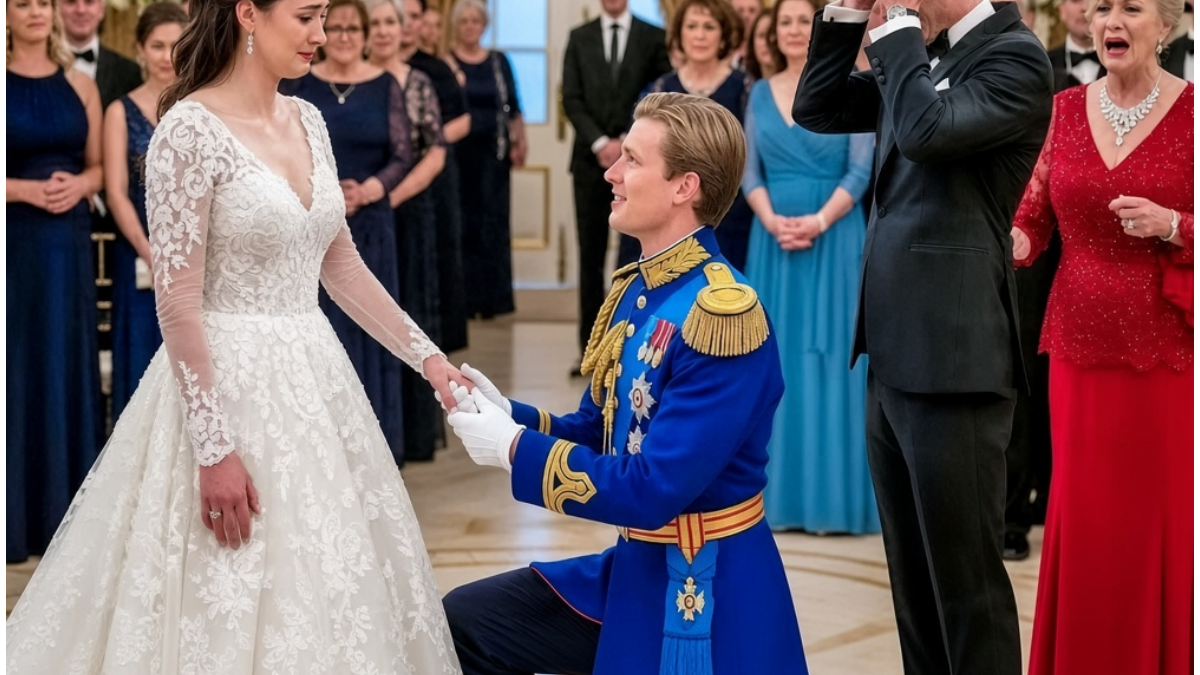
Champagne glasses clinked, and polite laughter echoed through the opulent ballroom of the Waldorf-Astoria. My new mother-in-law, Beatrice, had just leaned into the microphone, her voice dripping with venom, as she publicly thanked my parents for scraping together what pennies they had to attend.
Humiliation burned my cheeks. I thought my wedding day was ruined, a brutal reminder of my working-class roots.
That was until the heavy mahogany doors blew open, and a real-life prince dropped to one knee before my torn lace gown.
Growing up in the deep blue-collar heart of South Philadelphia, my world was built on the scent of motor oil and the sound of sizzling grills.
My father, Thomas Carmichael, was a senior mechanic for a regional airline, a man whose hands were permanently calloused and stained with grease, no matter how hard he scrubbed them with pumice soap.
My mother, Martha, managed a chaotic public high school cafeteria. We didn’t have a summer house in the Hamptons, or a ski chalet in Aspen.
We had a modest three-bedroom row house with a leaky roof and a porch where we spent our summer evenings drinking iced tea out of mason jars.
But, we had love. We had fierce, unwavering loyalty, and my parents sacrificed every spare dime they ever earned to send me to a private prep school, and eventually to Yale University on a partial scholarship.
Yale was a culture shock that nearly broke me during my freshman year. I was a girl who bought her clothes at thrift stores and worked weekend shifts at a local diner to pay for my textbooks, suddenly surrounded by the heirs to American dynasties.
It was there, during a bitterly cold November evening in the university library, that I met Harrison Kensington.
Harrison was the golden boy of the campus, tall, striking with effortlessly messy blond hair, and the kind of casual confidence that only comes from knowing your family name is etched into hospital wings and university libraries across the Eastern Seaboard.
The Kensingtons were real estate royalty in New York City, billionaires who viewed the world from the penthouse suites of their glass and steel towers.
Yet, when Harrison approached me over a stack of macroeconomics textbooks, he didn’t seem like the arrogant trust fund kids I had actively avoided.
He brought me a lukewarm coffee, cracked a terrible joke about supply and demand, and looked at me with eyes that seemed genuinely interested in who I was, not what my net worth happened to be.
For 3 years, we were inseparable. Harrison was my escape from the crushing pressure of my studies, and I was his anchor to reality.
He loved taking me to dive bars, where the floors were sticky with spilled beer.
He claimed to despise the suffocating expectations of his family’s empire. He promised me that we were different, that he was going to forge his own path.
I fell in love with that version of Harrison. I fell in love with the boy who ate dollar slice pizza on the sidewalk and talked about moving to a farm in Vermont.
The illusion began to crack the night he introduced me to his mother, Beatrice Kensington.
The dinner took place at the family’s Park Avenue penthouse, a sprawling multi-million dollar duplex that looked more like a museum than a home.
Original Picasso paintings hung on the walls, and the dining table was a massive slab of imported Italian marble.
Beatrice was a terrifyingly elegant woman. She wore vintage Chanel and possessed a smile that never quite reached her icy blue eyes.
Her husband, Reginald Kensington, barely looked up from his iPad when we arrived, offering only a brief grunt of acknowledgement.
“Carmichael,” Beatrice purred over the appetizer course, which consisted of seared scallops that looked too small to actually eat.
Are you related to the Boston Carmichaels, the shipping magnates? No, ma’am, I replied politely, keeping my back perfectly straight, just as my mother had taught me.
My father is an aircraft mechanic in Philadelphia. My mother works in the public school system.
The silence that followed was suffocating. The only sound was the faint clinking of solid silver forks against bone china.
Beatrice exchanged a fleeting microscopic glance with Reginald before turning her razor-sharp gaze back to me.
How quaint, she murmured, her tone implying she had just discovered a cockroach on her plate.
It must be fascinating living a life so unburdened by legacy. Tell me, Amelia, do your parents plan to continue working those types of jobs into their twilight years, or is there some sort of pension plan for manual labor?
Harrison coughed into his napkin, but said nothing. That was the first red flag fluttering violently in the wind, but I was too blinded by love to heed its warning.
I defended my parents gracefully, speaking of their hard work and dedication, but I could tell Beatrice had already made up her mind.
I was an interloper, a gold digger from the sluMs. Despite his mother’s blatant disapproval, Harrison proposed a year after graduation.
He got down on one knee in Central Park, presenting me with an engagement ring that featured a diamond so large it felt heavy on my finger.
He swore that we would handle his family together, that nothing mattered but us. I believed him.
Almost immediately, the wedding planning was hijacked. Beatrice swept in like a hurricane of tulle and passive aggression.
My dream of a small, intimate ceremony in a botanical garden was laughed out of the room.
The Kensingtons required a grand spectacle to appease their board members and socialite friends. The venue was booked at the Waldorf Astoria.
The guest list swelled to over 500 people, including city mayors, state senators, and business moguls.
I was handed a thick, 100-page prenuptial agreement by the Kensington family lawyers, drafted with language so predatory, it practically promised to leave me destitute if I ever sneezed in the wrong direction.
I signed it without reading past the third page. I didn’t care about their money.
I only wanted Harrison. But as the months dragged on, Harrison became increasingly distant. He was slowly being absorbed into his father’s company, trading his casual flannels for bespoke Tom Ford suits.
Whenever I complained about his mother’s overbearing demands, like how she insisted my family’s addresses were too unseemly to receive the custom-engraved invitations, directly he would sigh and rub his temples.
“Just let her have this, Amelia. It’s easier than fighting her. You just have to play the game.”
I didn’t know the rules of their game, and I was losing miserably. Sunlight poured through the massive crystal chandeliers of the Waldorf Astoria’s grand ballroom, casting prismatic rainbows across the sea of white orchids imported from Colombia.
It was my wedding day, a day that was supposed to be the happiest of my life.
But as I stood in the luxurious bridal suite, staring at my reflection, I felt nothing but a hollow sense of dread.
The dress I was wearing was not the dress I had chosen. Months earlier, my mother had withdrawn $2,000 from her meager savings to buy me a simple, elegant A-line gown from a boutique in Philly.
We had cried together in the fitting room. It was our special moment. But 2 weeks before the wedding, Beatrice had the gown picked up by her personal tailor, under the guise of steaming it.
When it returned, it was unrecognizable. The tailor had completely altered the bodice, adding heavy, ostentatious diamond beadwork and a suffocating high collar that Beatrice claimed was necessary to elevate the garment to our family’s standards.
It felt like wearing a bedazzled suit of armor. I looked like a Kensington prop.
“You look beautiful, sweetie.” My mother whispered, coming up behind me and resting her hands on my rigid shoulders.
She was wearing a lovely, understated navy blue dress she had bought from a department store, but next to the Kensington women dripping in Harry Winston diamonds, she looked terribly out of place.
>> [groaning] >> “I look like a stranger.” I replied, my voice cracking. My father entered the room looking uncomfortable in a rented tuxedo that was slightly too broad in the shoulders.
He smiled warmly, his eyes crinkling at the corners. “You look like my little girl.
And today you’re marrying the man you love. Nothing else matters.” I clung to those words as I walked down the aisle.
The ceremony was a blur of Latin chants, a string quartet playing Mozart, and hundreds of eyes staring at me.
I tried to focus only on Harrison, who looked dashing at the altar. When we exchanged vows, a flicker of the old Harrison returned, and for a fleeting moment, I felt safe.
Then, the reception began, and the true nightmare unfolded. The moment we entered the ballroom as husband and wife, the stark division of class was impossible to ignore.
The seating chart, which Beatrice had fiercely guarded until the day of the event, was a master class in social cruelty.
The room was organized hierarchically. At the front, nearest the head table, were the elite.
I recognized prominent public figures. Anderson Cooper was chatting by the ice sculpture, and a former state governor was laughing boisterously near the caviar station.
Harrison’s fraternity brothers and his sister’s Ivy League friends dominated the prime real estate of the dance floor, and my family my aunts, uncles, cousins, and parents had been relegated to the absolute farthest corner of the room.
They were seated behind a massive, towering floral arrangement that completely obstructed their view of the head table placed adjacent to the swinging metal doors of the catering kitchen.
Every time a waiter rushed out with a tray of roasted pheasant, the loud clattering drowned out the string quartet from my family’s tables.
It was a deliberate, calculated insult. I leaned over to Harrison during the first course.
Harrison, look where your mother seated my parents. They’re practically in the hallway. He briefly glanced toward the back of the room, his jaw tightening.
Amelia, please. The front tables had to go to the company’s major stakeholders. My parents need to keep up appearances.
Your family is fine, they have plenty of food. Let’s just enjoy the night. I swallowed the lump in my throat, sipping my champagne to keep from crying.
The dinner dragged on an endless parade of rich food I had no appetite for.
Then came the speeches. The best man, a hedge fund manager named Preston, made a raunchy, inside joke-filled toast that alienated half the room.
My father had been explicitly told by Beatrice that there was no time in the schedule for the father of the bride to speak, breaking a deeply cherished tradition.
Instead, Beatrice Kensington took the stage. She tapped a silver spoon against her crystal flute, and the sprawling room fell completely silent.
She stepped up to the microphone, her posture impeccably straight. A patronizing smile stretched across her flawless face.
“Family friends, distinguished guests,” Beatrice began, her voice echoing smoothly through the ballroom’s sound system.
“Today is a momentous occasion for the Kensington family. When Harrison first brought Amelia home, I [clears throat] must admit I was surprised.”
A low ripple of knowing chuckles swept through the front tables. I felt my stomach drop to the floor.
“We are a family built on legacy, on tradition, on wealth that has been carefully managed for generations.
And Amelia, well, Amelia comes from a very different world.” Beatrice paused, letting her eyes drift toward the back of the room where my parents sat in the shadows of the kitchen doors.
“I want to take a moment to acknowledge Amelia’s parents, Thomas and Martha. We It is truly remarkable that they were able to make it here today.
We know it must have been incredibly difficult to scrape together what pennies they had to attend such an event.”
My heart stopped. The air left my lungs. “We at Kensington Global have always believed heavily in philanthropy.”
Beatrice continued, her tone dripping with false sweetness. “We believe in the American dream, and what better testament to that dream than this wedding?
We are thrilled to welcome a girl with absolutely nothing into our fold. It is our greatest charity yet to uplift someone from such humble, gritty beginnings and give her a chance to live a real life among people of substance.
And let us raise a glass to charity, to duty, and to our new daughter-in-law.
To charity.” A few voices echoed from the crowd, followed by polite, pitying applause. I sat frozen, the blood rushing to my ears.
It was a public execution. She hadn’t just insulted me, she had humiliated my parents in front of 500 powerful people.
She had painted them as pathetic paupers and me as a charity case, a rescue dog brought into their pristine mansion.
Silence roared in my ears, drowning out the clinking of crystal and the soft jazz that the band had resumed playing.
I slowly turned my head to look toward the back of the room. Through a gap in the towering floral centerpieces, I could see my parents.
My father, the strongest man I had ever known, was sitting perfectly rigid, his knuckles turning white as he gripped the edges of the white linen tablecloth.
My mother was staring down at her lap, her shoulders shaking slightly as she desperately tried to hold back tears of deep, agonizing shame.
A white-hot fury ignited in my chest, burning away the nerves and the fear that had plagued me for the past year.
I turned to the man I just married, the man who had promised to stand by me, to protect me from the very people currently applauding my humiliation.
Uh Harrison was sipping his champagne, a faint, uncomfortable flush on his cheeks. He wasn’t looking at me.
“Are you going to say something?” I whispered, my voice trembling with rage. “Harrison, your mother just called my family a charity case in front of the entire room.”
He finally looked at me, his eyes pleading but not for my forgiveness, for my compliance.
He reached out and squeezed my hand tightly under the table. “Amelia, drop it. She’s just trying to spin the narrative for her high society friends.
She didn’t mean it maliciously. If you make [clears throat] a scene now, you’ll embarrass both of us in front of the board of directors.
Just smile, please.” Spin the narrative. Embarrass us. Just smile. In that agonizing fraction of a second, the rose-colored glasses didn’t just fall off.
They shattered into a million jagged pieces. I looked at Harrison Kensington and realized I didn’t know him at all.
The boy who ate dollar pizza in New Haven was dead. The man sitting beside me was a coward, a perfect replica of his father, completely tethered to the golden strings his mother pulled.
I yanked my hand out of his grasp. Without a word, I pushed my heavy suffocating chair back.
The screech of the wooden legs against the polished floor drew a few stares, but I didn’t care.
I stood up grabbing the heavy jewel-encrusted skirt of my ruined wedding dress and marched away from the head table.
“Amelia.” Harrison hissed under his breath. “Sit down.” I ignored him, my vision blurring with unshed tears as I practically ran toward the hallway leading to the bridal suite.
I needed to breathe. I needed a moment away from the hundreds of judging eyes.
I burst through the doors of the opulent bathroom attached to the suite, locking myself in the furthest stall.
I pressed my face into my hands, gasping for air. The heavy bodice of the dress crushing my ribs.
A few moments later, the heavy oak door of the bathroom swung open. High heels clicked loudly against the marble floor.
It was Harrison’s younger sister Victoria and one of her bridesmaid friends, a wealthy socialite named Chloe.
“Did you see her face?” Victoria’s cruel laughter echoed off the tiled walls. They didn’t know I was in the stall.
“God, Beatrice was brutal, but she wasn’t wrong.” Chloe replied turning on the gold-plated faucet.
“Her parents look like they’re going to start stealing the silverware to pawn later. Did you see her father’s tuxedo?
The lapels were literally shiny from wear. It looks like she rented it from a discount costume shop.
I know it’s humiliating.” Victoria scoffed. “Harrison is an idiot for actually going through with this.
Give it a year, he’ll pay her off and send her back to the sluMs. It’s exactly like mother said, she’s just a stray cat he felt sorry for.”
I stopped breathing. The tears instantly dried up, replaced by an absolute freezing calm. They thought I was broken.
They thought I would quietly accept my place at the bottom of their gilded hierarchy, grateful for the crumbs they threw me.
I pushed the stall door open. It hit the partition with a loud, violent bang.
Victoria and Chloe jumped, spinning around. The color instantly drained from Victoria’s perfectly contoured face.
“Amelia, we we didn’t know you were in here.” I walked slowly toward the sinks, staring at them through the massive mirror.
I didn’t yell. I didn’t cry. I simply reached up and unclasped the heavy, suffocating pearl choker Beatrice had forced me to wear.
I let it drop onto the marble counter with a heavy clack. “You’re right about one thing, Victoria.”
I said, my voice dead and utterly devoid of emotion. >> [clears throat] >> “Your brother is an idiot.”
I turned my back on their shocked faces and walked out of the bathroom. Every step I took back down the carpeted hallway toward the grand ballroom solidified my decision.
I was not going to spend the rest of my life apologizing for where I came from.
I was not going to subject my future children to the toxic, venomous elitism of the Kensington family.
The marriage was over before the ink on the marriage license had even dried. I was going to march straight to the back of the room, grab my parents by their hands, and walk out of the Waldorf Astoria with our heads held high.
I reached the massive mahogany doors of the ballroom. I took a deep breath, steeling myself for the stares and the whispers.
I pushed the doors open and stepped back into the blinding light of the chandeliers.
But as I entered, I realized something was wrong. The jazz band had completely stopped playing.
The low, buzzing murmur of 500 guests had been replaced by a stunned, heavy silence.
People had abandoned their expensive meals and were standing up from their chairs, their necks craned toward the main entrance at the opposite end of the hall.
Through the grand double doors of the main entrance, a squad of severe-looking men in dark suits with earpieces had forcefully pushed past the hotel security.
They spread out quickly, securing the perimeter of the room with terrifying efficiency. The Kensington’s private security guard stepped forward to intervene, but the lead agent simply flashed a badge that made them freeze and immediately back away.
Harrison stood up from the head table, looking completely bewildered. Beatrice was clutching her chest, her mouth slightly open.
Then, the crowd parted like the Red Sea. Walking through the center of the ballroom, ignoring the mayors, the senators, and the billionaires, was a man flanked by two members of the royal guard in full ceremonial dress.
He was tall, impeccably dressed in a tailored midnight blue suit with sharp features, and an aura of absolute, undeniable authority.
Whispers violently erupted across the room like a shockwave. Is that It can’t be. That’s Prince Leopold.
It was Crown Prince Leopold of the House of Windsor-Glucksburg, a prominent member of European royalty, whose face frequently graced the covers of international news, magazines, and diplomatic journals.
He was one of the wealthiest and most influential men on the continent. He didn’t glance at the head table.
He didn’t look at Beatrice or Harrison. His piercing gaze was fixed entirely on me as I stood frozen near the hallway entrance.
Prince Leopold walked the length of the ballroom, his polished shoes echoing in the deathly quiet room.
Uh When he finally reached me, he stopped. The room collectively held its breath. He looked down at my tear-stained face, then at the heavy, altered wedding dress.
A flash of genuine sorrow crossed his aristocratic features. Without breaking eye contact, the Crown Prince of Europe, a man who world leaders bowed to, took my hand in his.
Slowly, deliberately, in front of 500 of New York’s most elite snobs, Prince Leopold dropped gracefully to one knee.
“I am entirely too late, aren’t I, Amelia?” He said softly, his deep, accented voice carrying perfectly in the silent room.
“I told you I would find you when the time was right.” A collective gasp swept through the Waldorf Astoria Grand Ballroom, a sound so uniform it felt rehearsed.
Somewhere near the caviar station, a crystal champagne flute slipped from a guest’s hand and shattered against the polished hardwood floor, the sharp noise snapping the room out of its paralysis.
Prince Leopold of the House of Windsor-Glucksburg was kneeling for me. I stared down at him, my mind spinning violently as the past collided with the present.
Three years. It had been exactly three years since I had last seen those striking storm-gray eyes.
Before Harrison, before the suffocating world of Kensington Global, there was Geneva. During my junior year at Yale, I had secured a highly competitive, though completely unpaid, internship at the World Economic Forum in Switzerland.
To afford a tiny, unheated flat on the outskirts of the city, I worked nights as an administrative assistant at the summit’s headquarters.
It was there, during a tense, closed-door session on international energy policies, that I met Leo.
He hadn’t introduced himself as a prince. He was dressed in a simple, slightly rumpled suit, hiding from his security detail in the archives room where I was frantically organizing translation transcripts.
I had assumed he was just another overworked junior diplomat. We bonded over burnt break room coffee and our mutual exhaustion.
For 3 weeks we stole moments together. We walked along the frigid shores of Lake Geneva at midnight talking about the crushing weight of expectations.
I told him about my parents’ calloused hands and my desperate need to make their sacrifices mean something.
He told me about a family legacy that felt more like a prison sentence, a destiny mapped out for him since birth.
I fell for him deeply and entirely. But on our final night, reality crashed down.
The international press discovered his location. The junior diplomat was the crown prince hiding from the overwhelming grief of his father’s sudden terminal illness.
He was pulled away by a swarm of royal guards before we could even say a proper goodbye.
A week later, a heavy wax-sealed letter arrived at my tiny flat. “My duty calls me to the throne, Amelia.
I must stabilize my family’s house, but I give you my word, when the storm passes, I will find you.
Wait for me. Leopold.” I had waited. I waited for two agonizing years, scouring international news, watching him get crowned, watching him travel the world alongside foreign dignitaries.
But no letters followed. No secret visits. I convinced myself that our time in Geneva was just a fleeting escape for a grieving royal, a fairy tale I had stupidly mistaken for reality.
Heartbroken and needing an anchor, I eventually allowed Harrison Kensington into my life. And now, [clears throat] Leopold was here kneeling on the hem of the gaudy bedazzled dress Beatrice Kensington had forced upon me.
Leopold. I breathed the name tasting familiar and foreign all at once. You’re You’re here.
I promised you I would return when the time was right, he said softly, standing up to his full intimidating height.
He reached out his thumb, gently wiping away a tear that had escaped down my cheek.
It took longer than I anticipated to untangle the bureaucratic nightmares of my court. But I never stopped looking for you.
When my intelligence office finally located you, I was told you were marrying today. I flew straight from London.
I hoped I wasn’t too late. Before I could formulate a response, the frantic clicking of high heels shattered our private bubble.
Beatrice Kensington was practically sprinting across the ballroom, shoving past a bewildered state senator to reach us.
Her face was a terrifying mask of desperate social climbing and pure panic. Uh Harrison was trailing behind her, looking as though he might physically be ill.
“Your Your Royal Highness,” Beatrice stammered, dropping into a deep, clumsy curtsy that nearly caused her to lose her balance.
“We are We are profoundly honored. Had we known Kensington Global was hosting royalty, we would have prepared the royal suite.
I am Beatrice Kensington, and this is my son Harrison, the groom.” She reached out, grabbing my arm with a painful, bruising grip, trying to pull me closer to her.
And this is our new daughter-in-law, Amelia. As I mentioned in my speech, we just took her in.
She is a dear, sweet charity case of ours. Prince Leopold’s expression instantly turned to stone.
The warmth in his eyes vanished, replaced by an icy, aristocratic fury that made the air in the room drop 10°.
He looked at Beatrice’s hand clutching my arm. “Remove your hand from her,” Leopold commanded.
His voice wasn’t loud, but it carried an authority that commanded absolute obedience. Beatrice gasped, snatching her hand back as if she had been burned.
Leopold stepped smoothly between me and the Kensingtons. I arrived 20 minutes ago, Mrs. Kensington.
I stood in the corridor. I had the profound displeasure of listening to your speech.
He looked her up and down with terrifying disdain. You speak of legacy. You speak of class.
Yet you lack the fundamental decency of a common street vendor. You do not know the value of the woman standing before you.
Your Highness, please, there has been a misunderstanding. Harrison pleaded, stepping forward. Amelia is my wife.
We just took our vows. Leopold turned his piercing gaze to Harrison. A vow is a promise to protect, Mr. Kensington.
A man who sits idly by drinking champagne while his own mother publicly humiliates his bride and her family does not understand the meaning of the word.
You are a coward dressed in expensive silk. Harrison’s face flushed a deep mottled red, but he physically recoiled, unable to meet the prince’s unyielding stare.
The silence in the grand ballroom was absolute. 500 of New York’s most powerful elite stood paralyzed watching the systematic dismantling of the Kensington dynasty by a man whose bloodline predated the founding of their country.
Amelia, Leopold said, turning his back on Harrison and Beatrice completely. He extended his hand toward me.
The choice is entirely yours. If this is the life you want, if this man is who you truly choose, I will turn around, walk out those doors, and never disrupt your peace again.
But if you are settling for a gilded cage because you thought I had forgotten you, let me take you away from here.
I looked at his outstretched hand. I looked at the man who had flown across an ocean the moment he realized he might lose me.
Then I looked past him to the head table. I saw the empty chairs where Harrison’s billionaire investors sat.
About I saw Victoria and Chloe, the bridesmaids who had laughed at my parents standing near the bar with their jaws hanging open.
Finally, I looked toward the back of the room. >> [clears throat] >> My father was standing by the swinging kitchen doors, his arm wrapped protectively around my mother.
They weren’t looking at the prince or the billionaires. They were looking at me, their eyes filled with nothing but unconditional love and support.
The decision didn’t even require a second thought. I reached down and grabbed the massive, obscenely heavy diamond ring Harrison had placed on my finger just hours ago.
It felt foreign. It had always felt foreign. With a swift, fluid motion, I slid it off.
I turned to Harrison. He looked pathetic, stripped of the bravado his wealth usually afforded him.
I dropped the ring into his empty champagne glass. It sank to the bottom with a quiet clink.
“I’m not playing your game anymore, Harrison.” I said, my voice steady and loud enough for the front rows to hear.
“The marriage is over. Have your lawyers annul it in the morning. I’m sure Beatrice has a discreet contact for that.”
Beatrice let out a high-pitched, strangled noise. “You can’t do this. The press is outside.
The scandal will ruin our stock prices, you ungrateful little” Silence. Leopold didn’t shout, but the singular word cracked like a whip.
One of the royal guards, a mountain of a man in a dark suit, immediately took a step toward Beatrice, causing her to instantly snap her mouth shut and shrink back behind her husband, Reginald, who was sweating profusely.
I placed my hand in Leopold’s. His grip was warm, firm, and incredibly safe. “Come.”
He said softly. “Let us fetch your family.” With the Crown Prince of Europe at my side, I walked away from the head table.
The crowd parted for us, pulling their chairs back and shuffling out of the way as if we were parting the sea.
We walked the entire length of the ballroom, passing the stunned faces of politicians and celebrities straight to the shadowed corner by the catering kitchen.
My parents looked bewildered. My father instinctively stood taller as the prince approached. Mr. and Mrs. Carmichael, Leopold said, offering a deep, respectful bow that sent a fresh wave of shocked whispers rippling through the ballroom.
It is the greatest honor of my life to finally meet you. Amelia has told me of your strength and your sacrifices.
You raised a woman of unparalleled grace. My mother put her hand over her heart, tears spilling over her eyelashes.
It’s a pleasure, Your Highness. Please, call me Leo. He smiled gently. He signaled to his guards.
My men will assist you with your belongings. My private motorcade is waiting outside. I have prepared a suite for you at the Plaza, far away from this circus.
My father looked at me, a silent question in his eyes. I nodded. He broke into a wide, triumphant grin, clapping his hand onto my shoulder.
Let’s go home, sweetheart. Surrounded by the royal guard, my parents, Leopold, and I began our procession out of the Waldorf Astoria.
The humiliation that had crushed me an hour ago was entirely gone, replaced by a radiant, soaring sense of freedom.
I was leaving behind a family of venomous snakes and stepping into a world where I was actually valued.
Just as we reached the massive mahogany double doors of the ballroom, a desperate shout echoed from behind us.
Amelia, wait. I paused and looked over my shoulder. Harrison had broken away from his mother and was running down the center aisle, his face a mask of panic.
He realized exactly what he was losing, not just a wife, but his public dignity.
“Amelia, please, we can fix this.” He yelled, reaching his hand out. Two of Leopold’s guards seamlessly stepped into the aisle, forming an impenetrable human wall of tailored suits and lethal training.
Harrison slammed to a halt, raising his hands in surrender as the guards stared him down.
Leopold looked over his shoulder, his expression devoid of pity. “She is no longer your concern, Mr. Kensington.
Return to your mother.” With those final words, we pushed through the grand doors. The heavy mahogany slammed shut behind us, cutting off the frantic buzzing of the ballroom.
We walked through the lobby out into the cool, crisp New York evening air, where a line of black SUVs and a sleek armored Rolls-Royce waited under the city lights.
The Kensington era was over. The real story was just beginning. The transition from the suffocating, hostile atmosphere of the Waldorf Astoria to the serene, palatial luxury of the Plaza Hotel felt like crossing an ocean in the span of a single breath.
Prince Leopold’s private motorcade had glided through the neon-lit streets of Manhattan like a fleet of shadows, the flashing lights of our police escort clearing a path through the chaotic city traffic.
Inside the armored Rolls-Royce, the silence was comfortable, a stark contrast to the venomous buzzing we had left behind.
My mother sat with her hand clasped tightly in my father’s, her eyes wide as she took in the plush leather and polished walnut accents of the vehicle.
I sat next to Leopold, my hand resting in his. The warmth of his palm was the only thing keeping me anchored to reality.
“You are safe now, Amelia.” Leopold whispered, his thumb tracing a comforting circle on the back of my hand.
“The Kensingtons can no longer touch you. I have already instructed my legal counsel to oversee the annulment paperwork.
It will be finalized by sunrise completely bypassing their predatory prenuptial agreements. Thank you, Leo.
I murmured leaning my head against his shoulder. The heavy jewel-encrusted bodice of my wedding dress felt like a relic from a past life, a costume I couldn’t wait to shed.
I just I can’t believe Harrison let it happen. I can’t believe I almost tied my life to that family.
My father leaned forward from the facing seat, his face serious, but his eyes filled with immense pride.
You didn’t bow to them, Amelia. That’s what matters. You stood up for this family and you walked out with your dignity.
The rest of this this is just details. When we arrived at the plaza, we were bypassed around the public lobby entirely escorted through a private service elevator straight to the royal suite.
The suite was breathtaking, a sprawling expanse of gold leaf crystal chandeliers, and floor-to-ceiling windows overlooking a darkened Central Park.
Waiting for us on the dining table was a massive spread of gourmet food, hot teas, and fine wines.
Leopold’s security detail, led by a stern, towering man named Christopher Vance, moved efficiently around the perimeter, drawing the heavy velvet curtains and securing the private entrance.
“Mr. and Mrs. Carmichael,” Leopold said turning to my parents with a warm, respectful smile.
“Please make yourselves at home. My staff has arranged for a selection of clothing to be delivered to your adjoining rooMs. Tomorrow my private jet will be at your disposal to take you back to Philadelphia or wherever you wish to go.
For the night, reSt.” My mother walked over to Leopold, unexpectedly wrapping her arms around the prince in a warm, maternal hug.
Leopold froze for a fraction of a second, clearly unaccustomed to such informal displays of affection, before softening and hugging her back.
“Thank you for saving my daughter.” She whispered, her voice thick with emotion. Once my parents had retired to their quarters, I retreated to the master bedroom to finally rid myself of the Kensington wedding dress.
With the help of a quiet, polite royal maid named Clara, the heavy bedazzled garment was unzipped and removed.
Stepping out of that dress felt like breaking out of a prison cell. I changed into a simple, comfortable silk robe provided by the hotel, washing the heavy makeup and the remnants of tears from my face.
When I emerged into the main living area, Leopold was standing by the window, a glass of scotch in his hand, staring out at the city skyline.
He had discarded his suit jacket and loosened his tie, looking more like the Leo I had fallen in love with in Geneva.
“You look like yourself again.” He said softly, turning to face me. “I feel like myself again.”
I replied, walking over to join him at the window. “Leo, how did you find me?
How did you know where I was?” He sighed, setting his glass down on a marble side table.
“When I left Geneva, my father’s condition had degenerated rapidly. The crown was thrust upon me before I was ready.
The court was in absolute chaos, fractured by political factions trying to take advantage of a young, untested king.
For 2 years, I fought a silent war against my own parliament to secure my position.
Every letter I wrote to you was intercepted by my own intelligence ministers, who deemed a relationship with an American citizen a diplomatic liability.”
My breath hitched. “They intercepted your letters?” “Yes.” Leopold said, his eyes flashing with residual anger.
“I only discovered the truth 3 months ago after I thoroughly purged the corrupt elements of my cabinet.
The moment I gained full control of my intelligence agency, I I ordered a global search for you.
That was when I discovered Christopher Vance, my lead investigator, had tracked your name to a wedding registry in New York City.
The date was today. The groom was Harrison Kensington. He took both of my hands in his, looking down at me with desperate sincerity.
I knew I had to risk the scandal. I flew through a transatlantic storm, breaking every diplomatic protocol, praying I wouldn’t be too late to stop you from making a terrible mistake.
When I walked into that ballroom and heard that vile woman speaking about you, I wanted to dismantle their entire empire with a single phone call.
You did enough. I smiled, a genuine, radiant laugh escaping my lips for the first time in months.
You brought the Kensingtons to their knees without firing a shot. We are not done yet, Amelia.
Leopold smiled back, a dangerous, aristocratic glint appearing in his eyes. The Kensingtons think they rule New York.
They are about to learn that the world is much larger than Manhattan. By 8:00 a.m. the following morning, the international financial markets opened, and the Kensington dynasty awoke to an absolute, unmitigated catastrophe.
The scandal at the Waldorf Astoria had leaked. Despite Beatrice’s desperate attempts to bribe the catering staff, the musicians, and the hotel management, someone in the room had recorded the entire exchange on a smartphone.
By midnight, a grainy video of Crown Prince Leopold kneeling before a torn lace bride, followed by his systematic verbal execution of Beatrice and Harrison, had gone viral across social media.
The headlines across the global news networks were merciless. Royal Rejection. Crown Prince Leopold Halts Billionaire Wedding.
Brought to the Tune. Kensington Global in Freefall After Mother of the Groom’s Charity Speech Sparks Royal Fury.
The prince and the mechanic’s daughter inside the gilded public disgrace. I sat at the marble breakfast bar in the Plaza suite scrolling through the news on a tablet while sipping black coffee.
My father was sitting next to me eating a plate of eggs. Benedict a look of immense satisfaction plastered across his face.
Look at this Amelia. My father chuckled pointing at a financial ticker on the television screen.
Kensington Global stock is down 12% in pre-market trading. Investors are pulling out of their upcoming luxury development projects in London and Frankfurt.
Leopold entered the room fully dressed in another impeccably tailored suit followed closely by his legal adviser a sharp featured British gentleman named Julian Vance.
Good morning Amelia Thomas. Leopold greeted us smoothly. He looked at Julian nodding. Give us the update Julian.
Julian stepped forward opening a thick leather portfolio. As of 20 minutes ago the annulment has been legally finalized and recorded in the state of New York.
Miss Carmichael is officially legally single. Furthermore Prince Leopold’s European sovereign wealth fund has officially severed all ties with Kensington Global’s international banking partners.
We have effectively blacklisted their commercial real estate sector across the entire European continent. What does that mean for them?
I asked leaning forward. It means bankruptcy within the fiscal year unless they find a miracle.
Julian replied with a cold professional smile. Their entire business model relies on European investments.
Without your royal highness’s blessing those banks won’t touch a Kensington project with a 10-foot pole.
Before Julian could close his folder a frantic buzzing echoed from the suite’s intercom system.
Christopher Vance stepped out of the foyer looking deeply amused. Your royal highness Miss Carmichael, Christopher said bowing slightly.
We have a situation at the main hotel entrance. Reginald and Harrison Kensington are downstairs practically begging the hotel security for an audience.
They claim it is a matter of life and death for their company. Leopold looked at me raising an eyebrow.
It is your choice, Amelia. We can have them removed by the police or we can let them crawl.
I felt a cold surge of empowerment course through my veins. The girl who had quietly endured Beatrice’s insults for a year was officially dead.
Let them up, Leo. I want to look them in the eye. 10 minutes later, the double doors of the royal suite opened and Harrison and his father, Reginald Kensington, were escorted in by two heavily armed royal guards.
They looked unrecognizable. The arrogant, untouchable billionaires of Park Avenue looked haggard, terrified, and utterly defeated.
Harrison’s hair was a disheveled mess. His expensive suit wrinkled as if he had slept in it.
Reginald, usually a cold and stoic man, was visibly trembling clutching a leather briefcase to his chest like a shield.
Beatrice was notably absent. Amelia, please, Harrison erupted the moment he saw me taking a frantic step forward before a guard placed a heavy gloved hand on his chest stopping him dead.
You have to stop this. The board is meeting in two hours to force my father and me out of our own company.
Our stock is tanking. The banks are freezing our assets. Mr. Kensington, Leopold interjected his voice dropping into a dangerous icy register.
You are speaking to a woman who is under the direct protection of a sovereign crown.
Lower your voice and lower your eyes. Reginald Kensington immediately stepped in front of his son dropping his briefcase onto the floor and sinking into a deep desperate bow before Leopold.
Your royal highness, we beg for your clemency. My wife, Beatrice, she is an arrogant, foolish woman.
She has been sedated by her doctors. She did not know what she was doing.
We are prepared to issue a full, worldwide public apology to Amelia and her family.
We will pay any amount of damages. He then turned to my father, his eyes pleading.
But, Mr. Carmichael, please, from one father to another. I built this company from nothing.
Don’t let my family be ruined because of my wife’s big mouth. Speak to your daughter.
My father slowly set his coffee cup down. He stood up, walking over to Reginald.
Despite wearing a simple, borrowed polo shirt, my father looked infinitely more powerful than the billionaire kneeling before him.
When we sat at that back table by the kitchen, Reginald, my father, set his voice low and vibrating with a fierce, quiet intensity.
You didn’t look at me once. You let your wife treat my daughter like dirt.
You thought your money made you a god, and you thought my calloused hands made me a ghoSt. You didn’t care about my family then.
Why should I care about yours now? Reginald choked back a sob, unable to answer.
Harrison looked past his father, his eyes locking onto mine. Amelia, we loved each other.
Three years we were together. You know I’m not like them. I was just caught under my mother’s thumb.
Please tell the prince to lift the sanctions for old times’ sake. I walked over to Harrison, stopping just inches away from the guard holding him back.
I looked at the man I’d once thought I would spend the rest of my life with.
I felt no anger. I felt no hatred. I only felt a deep, profound sense of pity.
You had 3 years to stand up to your mother, Harrison. I said softly, my voice cutting through the room like a razor.
You had 3 years to prove that you love me more than your trust fund.
But, when she stood at that microphone and dragged my parents through the mud, you told me to smile and play the game.
I took a deep breath, looking over at Leopold, who watched me with a look of absolute admiration.
The game is over, Harrison, I concluded. And you loSt. I turned my back on them, walking back to Leopold’s side.
Leopold looked at Christopher Vance. Remove them from my presence and ensure their names are permanently barred from any establishment associated with our house.
Yes, your royal highness, Christopher replied. The guards grabbed Harrison and Reginald by their arms, dragging them out of the suite as Harrison continued to yell my name, his desperate cries echoing down the hallway until the heavy doors slammed shut, silencing the Kensingtons once and for all.
Weeks dissolved into months, and the glittering toxic skyline of Manhattan was replaced by the serene, sweeping vistas of the Swiss Alps and the historic grandeur of Leopold’s royal estate.
My transition from a blue-collar daughter of a Philadelphia mechanic to the future crown princess of a European monarchy was nothing short of cinematic.
But, unlike the suffocating gilded cage that Beatrice Kensington had tried to lock me inside, Leopold’s world was built on mutual respect and genuine partnership.
He didn’t want a silent prop to wear heavy diamonds and smile at board members.
He wanted a partner. During my first few months in Europe, I refused to simply sit idle in the palatial gardens.
I had a degree in macroeconomic policy from Yale, and I intended to use it.
Leopold appointed me as a senior advisor to his sovereign wealth fund’s philanthropic division. Instead of hosting meaningless high society luncheons, I spent my days drafting educational reform grants and restructuring the crown’s investments in sustainable energy across developing nations.
I was working harder than I ever had in my life and I had never been happier.
My parents flew over frequently. Leopold insisted on sending his private jet to Philadelphia every major holiday.
My father who had spent his entire life repairing jet engines spent hours in the royal hangers talking shop with Leopold’s chief aviation mechanics.
They adored him. My mother armed with her decades of experience managing massive public school cafeterias actually helped the royal estates head chef reorganize his supply chain to eliminate food waste.
They weren’t treated as charity cases. They were treated as valued respected members of our extended family.
However, the transition was not entirely without its friction. The European aristocracy is an ancient deeply entrenched machine and there were still those who viewed my working class American background as a stain on the royal bloodline.
The true test of my new life arrived during the annual winter solstice gala, a highly exclusive diplomatic summit hosted at the royal palace in Geneva.
The guest list included prime ministers, tech billionaires, and the oldest aristocratic families in Europe.
I was wearing a stunning custom designed emerald green gown by Carolina Herrera, elegant, understated, and utterly comfortable.
I stood beside Leopold in the grand receiving line greeting dignitaries in fluent French, a skill I had fiercely polished over the past six months.
Later in the evening as Leopold was pulled away by the French ambassador to discuss trade tariffs, I found myself cornered near the grand fireplace by Lady Genevieve of House Artois, a notoriously snobbish distant cousin of Leopold’s who had vehemently opposed our engagement.
She was flanked by two equally haughty baronesses. “Amelia darling.” Lady Genevieve purred, her tone dripping with the exact same condescending venom I had once heard from Beatrice Kensington.
“We were just discussing the recent restructuring of the Royal Philanthropic Fund. It’s terribly aggressive.
Tell me, where did you learn to manage such vast sums of generational wealth? Surely not from your father’s little repair shop in Pennsylvania.”
The two baronesses tittered behind their champagne flutes. A few nearby diplomats paused their conversation subtly, turning their heads to watch the exchange.
They were waiting to see if the American commoner would crack under the pressure. I didn’t flinch.
I didn’t drop my gaze. I took a slow, deliberate sip of my sparkling water, smiling warmly.
“Actually, Genevieve, my father’s little repair shop is a multimillion-dollar regional airline hub.” I replied, my voice carrying clearly over the crackling fire.
“And observing the logistical efficiency of blue-collar labor taught me more about resource management than any country club ever could.
That is precisely why I reallocated 30% of the fund’s stagnant capital into vocational training prograMs. In fact, if you review the quarterly reports, you’ll see that aggressive restructuring has already yielded a 12% higher return on investment than the traditional trusts managed by your family’s estate last year.”
Lady Genevieve’s smug smile instantly vanished, replaced by a rigid mask of shock. The baronesses stopped laughing.
“Generational wealth is only impressive if you actually know how to grow it, Genevieve,” I added softly, delivering the final fatal blow.
“Otherwise, you’re just spending money someone else earned.” A low, appreciative chuckle echoed from behind me.
I turned to see the Swedish Minister of Finance, a notoriously strict and brilliant economist, raising his glass to me in a silent toaSt. Lady Genevieve turned a spectacular shade of crimson, mumbled a hasty excuse about needing to find her husband, and practically fled across the ballroom.
I felt a warm hand slip around my waiSt. Leopold had returned, his storm gray eyes practically glowing with pride.
“Remind me never to debate fiscal policy with you in public, my love.” “She started it.”
I whispered, leaning into his embrace. “And you finished it.” He replied, kissing my forehead.
“You were born to wear this crown, Amelia. Not because of your blood, but because of your fire.”
Exactly 1 year to the day after I walked out of the Waldorf Astoria, the final nail was driven into the Kensington family’s metaphorical coffin.
Without the backing of the European sovereign wealth funds, Kensington Global had spiraled into an unstoppable financial free fall.
Their aggressive, over-leveraged real estate acquisitions in London and Paris defaulted. Panic spread among their domestic investors, leading to a catastrophic sell-off of their stock.
Within 8 months, the board of directors had ousted Reginald and Harrison in a brutal corporate coup, stripping them of their executive titles and their severance packages due to gross negligence clauses.
But the ultimate poetic justice was not their corporate ruin. It was their social exile.
High society is notoriously fickle. The moment the Kensingtons lost their wealth and their power, their friends abandoned them.
Beatrice’s exclusive country club memberships were suddenly revoked pending review. The charity galas she used to dominate no longer sent her invitations.
Their debts became so insurmountable that their personal assets were seized by the federal bankruptcy courts.
On a crisp Tuesday morning in November, I sat in the private study of our London residence watching but it live stream of a high stakes luxury real estate auction taking place in Manhattan.
The property on the auction block was a sprawling multi-million dollar Park Avenue duplex penthouse, the former home of Beatrice Reginald and Harrison Kensington.
The auction was being managed by celebrity real estate broker Ryan Serhant, >> [clears throat] >> whose presence guaranteed that the humiliating sale would be covered by every major luxury publication in the city.
The bidding started aggressively wealthy developers fighting over the prime real estate. I picked up the secure telephone line connected directly to my legal proxy sitting in the auction house in New York.
“Arthur,” I said calmly. “End it.” “With pleasure, Your Highness,” Arthur replied. On the screen, Ryan Serhant pointed to the back of the room.
“I have a new bid. $45 million from the gentleman in the back. $45 million.
Do I hear 46 going once, going twice? Sold to the proxy for Her Royal Highness Crown Princess Amelia.”
The room on the screen erupted into shocked murmurs. I hung up the phone, a deep profound sense of closure washing over me.
I didn’t buy the penthouse to live in it. I bought it to gut it.
A month later, construction crews tore down the original Picasso mounts and shattered the imported Italian marble dining table.
We transformed the Kensington family’s precious elite sanctuary into the global headquarters for the Carmichael Foundation, a charity I founded in my parents’ honor dedicated entirely to providing full ride university scholarships to the children of mechanics, cafeteria workers, and blue-collar laborers in inner-city Philadelphia.
I made sure the massive bronze plaque bearing the foundation’s name was bolted directly onto the building’s exterior, right next to the front doors.
Beatrice Kensington would have to walk past the name, Carmichael, every time she visited her former neighborhood.
I later heard through the societal grapevine that Beatrice had suffered a complete nervous breakdown upon seeing it and had relocated to a tiny rented condo in Boca Raton, Florida, entirely cut off from the New York elite she once ruled.
Harrison, completely broke and blacklisted from the corporate finance world, was last seen working as an entry-level shift manager at a mid-tier rental car agency in New Jersey.
Two weeks after the opening of the foundation, Leopold and I were married. There were no stuffy, judging billionaires.
There was no cruel seating chart. The wedding took place in the ancient, breathtaking cathedral of Leopold’s capital city, bathed in the golden light of stained glass windows.
I wore a gown of my own, choosing a masterpiece of simple, flowing silk with a delicate lace veil that trailed behind me for miles.
When the heavy wooden doors of the cathedral opened, the choir didn’t sing a somber Latin chant.
They sang a soaring, joyous symphony. I walked down the aisle on the arm of my father, who was wearing a perfectly tailored bespoke tuxedo that Leopold had gifted him.
He looked like a king in his own right. In the very front row, occupying the prime velvet-lined seats of honor, sat my mother, her sisters, and my cousins from South Philly.
They were weeping openly, smiling so wide their faces hurt completely, unashamed and utterly beautiful.
Yay. When my father handed me over to Leopold at the altar, the prince didn’t look out at the crowd of diplomats or the television cameras broadcasting the royal wedding to millions around the globe.
He only looked at me. “You look exactly like the girl I met in Geneva,” He whispered taking both of my hands in his.
“I am exactly that girl.” I smiled tears of pure joy pricking my eyes. “And I always will be.”
We exchanged our vows not as a transaction of wealth, but as a promise of unyielding partnership.
When he kissed me, the entire cathedral erupted into deafening triumphant applause. I had walked into my first wedding as a victim, a charity case meant to be crushed under the heel of arrogance.
I walked out of my second wedding as a princess, a woman who had defended her family’s honor, shattered a toxic dynasty, and built an empire of her own based on love, respect, and the unbreakable strength of a calloused hand.
What an incredible journey of resilience and ultimate revenge. Amelia proved that true class isn’t about the money in your bank account, but the strength of your character.








