“My Father Said You Needed a Housekeeper…” She Whispered — The Duke Said, “What I Need Is a Bride”
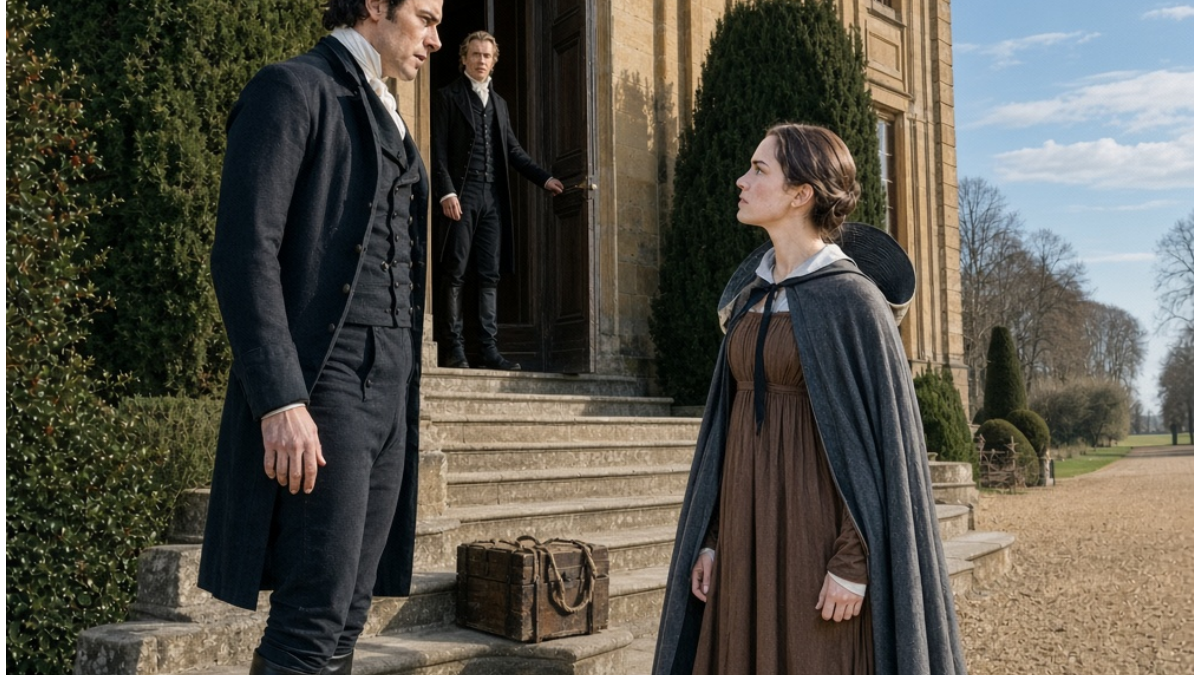
The man heard her all the way to the end, which she had not expected.
Then he told her that the place did not exist. There has been no housekeeper at Hollyburn since the summer of 15, he said.
There is no such post. There is nothing here for you at all. Caroline Witchaw stood in the middle of the great hall with her box at her feet and the cold of the flag stones coming up through her boots.
She had walked the last mile from the lodge. The carrier from Ingelby put nobody down inside a gentleman’s gates, and so she had come up the whole length of the avenue of lime trees on foot in January, with her hands aching around the rope handle.
She had rehearsed the words the whole way from Ingleby. They had seemed reasonable for the first hour.
“My father said you needed a housekeeper,” she said. She did not mean to whisper it.
The hall took the sound of her and gave back something thinner than she had put into it, and the thing she heard leave her own mouth was not a sentence, but the ghost of one.
The man looked at her for a moment. He was very tall, in a coat that had been good three winters ago, with ink on the side of his right hand, and black hair that wanted cutting.
Behind him, a door stood open on a room with a fire in it and a table covered in paper.
She had taken him for the agent. She had been about to call him sir and ask for the housekeeper’s room and the keys.
What I need, he said, is a bride. He said it the way a man reads out a bill of charges.
There was no invitation in it and no cruelty in it either. And that was somehow worse because it meant he was not speaking to her at all.
He was finishing an argument he had been having with somebody else all morning. Then he seemed to hear himself.
Something moved behind his eyes, which were a deep blue, dark as the good end of a slate.
Forgive me, he said. That was not said to you. No, your grace. You know who I am then.
I did not until you said that. 1 second, 2 seconds, 3. Somewhere above them, a shutter knocked in a room nobody was using.
How old are you? 2 and 20. And your father sent you out on an 11mi road in January.
On the strength of a thing he heard in a public house. My father does not go into public houses, Caroline said.
He is a dealer in horses. He is in and out of every yard between here and Lincoln.
He hears a great deal, and he is usually right. Not this time. No, your grace.
Apparently not. She bent and picked up the box. Standing with it at her feet had begun to look like waiting, and waiting had begun to look like begging.
She got it up against her hip and held it there. He gave me a letter for you, she said.
The Duke of Lindenhal put out his hand. She had to shift the box to get at her pocket.
The paper came out warm and a little bent, sealed with a wafer. It was addressed in the round school master’s hand her father had bought from a curate at three shillings a quarter long ago when he could not yet write his own name.
He broke it standing up. She had read a great deal in her life on the faces of men holding paper.
In the yard at Ingelby it was usually a bill and the face went through the same three weathers every time.
This was not that. He read it in the time it took her to count to eight.
He read it again. Then he folded it once along the crease that was already there and looked at her over the top of it in a way that made the back of her neck go cold.
What is your name? Caroline Witchaw. Witshaw, he said. Just the one word. He put it down between them.
The way a man puts down a coin he suspects is bad and turns it over and looks at the other side.
Yes. Elias Witchaw’s daughter of Ingelby. Yes, your grace. And he told you nothing else.
He told me the great house wanted a housekeeper and that I could keep a house.
He told me to say I was steady. She heard her voice go flat the way it did when she was frightened which people generally took for calm.
I have kept my father’s house for 8 years. I have kept his books for five.
I am steady. The Duke did not answer that. He turned his head slightly and said in an ordinary voice as though the man were standing beside him.
Dalammore. The butler came out of the shadow at the end of the hall so quickly that he must have been standing in it the whole time.
He was a spare old man with a face like a closed drawer. Your grace.
Miss Witchaw will want tea and a fire. Put her in the blue room at the end of the west passage.
There was the smallest hesitation, no longer than a breath. Caroline caught it and understood it exactly because she had lived her whole life on the wrong side of that kind of pause.
The blue room was not where you put a servant, nor was it where you put a guest, or Dalamore would not have paused at all.
Very good, your grace. And Dalmore, nothing is to be said in the servants hall about the letter.
There has been no letter your grace. The Duke went back into the room with the fire and the paper and the door closed and Caroline was left standing in the middle of a hall she could have got her father’s whole house into twice over.
She looked up because there was nothing else to do. Hollyburn had been built to be looked up in.
The hall ran the full height of the house with a gallery round three sides and a stone stair going up in one long flight.
There were nine windows. Four of them had been shuttered from the inside, and the shutters had not been opened for so long that the light coming through the cracks had bleached four pale stripes into the boards below them.
The chimney piece was carved with a lime tree and a motto underneath in letters worn shallow.
We grow where we are put. Caroline stood and read it twice. Then Dalmore came back for the box, and she would not give it to him, and they went up the great stair together in a silence that was not unfriendly.
On the first landing, the long window was gray with dirt on the inside. Not the outside.
Glass goes gray on the inside from smoke and breath and time, which meant that nobody had opened that window in years.
Her hands began very quietly to want work. Mr. Dalmore, she said, “How many are you in the house?”
“10, miss. Nine if you do not count the woman who comes up from the village on washing days.
And in 15 the old man’s step did not change. 38 he said miss. The blue room had a bed with hangings that had been blue once.
A chair, a table, and a window facing east across a park with 200 sheep on it.
The fire the maid built was of green wood, and it smoked. Caroline knelt and took it apart and built it again.
She said nothing to the girl about it. The girl watched her with her mouth slightly open.
What is your name? Nancy. Miss. Nancy. Is there a housekeeper’s room in this house?
Yes, Miss Past the still room. It’s locked. Who has the keys? Mr. Dalamore has some.
Mr. Titheridge has some. Nancy considered. There’s a lot of keys, miss, and nobody’s had a proper hunt for them since Mrs. A.
Thorp went. When the girl had gone, Caroline sat down on the edge of the bed in her coat.
The room was the size of the whole ground floor at Ingelby. She did the sum she had been refusing to do since the avenue of lime trees.
It came out the same as it had at the lodge gate. 11 mile of road, a carrier’s cart on a Thursday, and no cart back until Monday, four shillings and 7 p in her pocket.
A father who had put her on that cart at 7 in the morning, with her box already corded, and who had stood in the road watching until the turn, which he had never once done in her life before.
He had known there was no housekeeper’s place. She was almost sure of it, and the certainty did not arrive as a shock.
It settled into a shape it had been trying to make all day. It was the way a horse goes short for half a mile, and then puts its foot down wrong, and shows you the stone.
Caroline did not cry. She unpacked instead. Two gowns, one gray, one brown. A shift stockings, her mother’s shawl, a prayer book with her mother’s name in it.
Her father’s old daybook from the year he was still carting, taken because it had her mother’s writing in the back, and never once mentioned to him.
And at the bottom, wrapped in a piece of huckerback towel, a plain iron snafle bit with a straight bar mouth, worn bright as a shilling on the sides, where 30 years of hands had touched it.
She hung it on the bedpost because it was the only thing she owned that had ever been of any use to anybody, and she wanted to see it from the bed.
To understand why she did not simply sit down and weep in that blue room, it is necessary to go back some years to a yard behind a bow-fronted house on the Ingelby road.
Elias Witshaw had begun as a wager’s boy at 9 years old, walking at the head of four horses he was too small to bridle without a bucket to stand on.
By 30 he had a contract of his own. By 40, he had a yard, 11 loose boxes, a paddock of four acres, and a name that men in three counties used when they wanted a sound horse in a hurry.
He never learned to write well. He signed with a full stop after his name, as though daring anyone to add anything to it.
Caroline’s mother had been a saddler’s daughter from Winteringham. A small, quick, unbutful woman with a laugh you could hear across a market.
She died in the spring of 1811 of a fever that took 30 people in the town in a fortnight.
Caroline was 14. She came downstairs the morning after the funeral and found the house full of men wanting their breakfasts.
And she cooked it because there was nobody else and she went on cooking it for 8 years.
That is how it happens in such houses. Nobody decides. The work simply comes and stands where the woman used to stand and looks at you.
There had been 3 years of schooling before that at a small establishment at Winteringham kept by two sisters.
She had learned there to write a fair hand, to cipher, to read French she could not speak, and to sit still.
Her father had been proud of the bills. He paid them in gold, in front of people, in the yard.
In the autumn after her mother died, he told her the money was wanted elsewhere for a season, and the season had never ended.
So, her education went on in the yard instead. She learned that a horse tells you the truth about itself in the first 10 steps it takes on hard ground, and that a man selling one will walk it on grass if he can.
She learned to feel a leg cold and warm, and to know a splint from a strained tendon under her palm.
She learned that a horse, which will not stand for chewing, is nearly always a horse that was hurt once.
Time spent on such an animal, is not kindness. It is arithmetic. An hour now, or a lifetime of two men, and a twitch.
Her grandfather’s snaffle came to her the year she was 16. It was a plain thing, straight barred and thinner than anything else in the harness room.
Her father gave it to her in the middle of the yard. A mare had been fought with for a fortnight in a curb.
Caroline had put the plain bit in her mouth instead, and the mayor had gone quiet, and four men had watched.
That’s yours then, he said, and went into his dinner. He never said the other half of it.
He did not need to. In 8 years, it was the only thing he ever gave her that had not first been a bill she had settled for him, because there was the other side of Elias Witshaw, and Caroline had lived on that side, too.
He was a man who had risen, and the rising had cost him something he had never named, and what it had cost him made him grip.
He would not have her ride the good horses where the town could see. He would not have her at the yard when gentlemen came.
Twice he had refused a decent offer for her hand without telling her it had been made both times from men in the trade because in his mind she was to go up not across.
And so she had stood at 2 and 20 exactly nowhere too well spoken for the kitchen too near the dung heap for the drawing room.
A girl who could break a four-year-old to harness and could not in the whole county be asked to dance.
Then came the last week of November, and the thing changed in him. She was to remember it afterwards in small pieces, because that is how it presents itself at the time.
A man came to the yard on a wet Tuesday and asked for him, and they went into the counting house, and her father closed the door, which he never did.
The man was not a customer. He wore a black coat and had a memorandum book, and he asked on his way out whether Mr. Witshaw had kept any of his old carting papers from the Netherwood work.
She heard her father say, “20 years ago, man, I’ve not kept last year’s.” She heard the pleasantness in his voice.
She had heard him use it on buyers, and only on buyers. After that, he did not sleep.
She would come down at 5 and find the counting house candle already burned to a stub, and her father sitting in front of the fire with his boots on, doing nothing.
Twice he rode to Skellbrook and came back the same day, which was 40 mi of road for a man of 60 with a bad hip.
Once she found him in the loft over the harness room, going through the old chest where the yard papers were kept.
He shouted down at her from the top of the ladder in a voice she had not heard since her mother died.
On the 10th of January, he told her she was going to Hollyburn. [clears throat] He put it as a piece of good fortune.
The great house wanted a housekeeper. The family was reduced, and the young duke had been 3 years in possession with no woman to run anything.
A steady girl who could keep accounts and hold her tongue might make a place there for life.
£50 a year, he said, and he had said twice in the same words both times as though he had learned it.
You’ll be under the Duke’s own eye, and that’s a thing money can’t buy. Caroline had asked one question.
She had asked who had spoken for her. Her father had looked into the fire and said that folk knew him.
She thought about that answer for a long time on the Thursday cart. She thought about it again in the blue room at Hollyburn, sitting in her coat with the snaffle hanging on the bedpost.
It was a house so large that its noises took a moment to arrive. She did not weep.
There was no profit in it, and she had a more useful trouble. Four shillings and seven p and no way home before Monday.
At 5 in the morning, she got up, dressed by the fire, and went down the back stairs to find out where she was.
A house tells you everything before breakfast. Caroline went through the offices at Hollyburn in the gray light with a candle in her hand and read it the way she read a horse in the first 10 steps.
The kitchen was clean and far too small an operation for the range in it.
In the still room there were 52 jars dated none newer than 1815. The linen press held sheets folded so long ago that the folds had gone yellow and would tear at the crease the first time they were used.
In the housemaid’s closet, the brushes had been put away wet once and had stayed wet and had rotted at the wood.
None of it was idleness. That was the thing she understood at once, and it made her chest tighten with something like grief.
Nine people were doing the work of 30, and were doing it in the order in which it shouted.
Nobody had told them what came first. In a house that size, that is not a failing of servants.
It is the absence of a mistress or of a housekeeper standing in for one, and it had been absent for 4 years.
At the end of the passage, past the stillroom, there was a door with a brass plate on it, worn nearly smooth, and it was locked.
She was standing in front of it with the candle up, when a voice behind her said, “The keys are in the estate office, and Mr. Titherage does not give them out.
The Duke of Lynen Hall was in the passage in his shirt sleeves with his coat over his arm at 20 minutes to 6:00 in the morning in boots that had been out of doors already.
Caroline curtsied. Your grace, you are up early. So are you, your grace. I do not sleep much.
He said it without self-pity as a fact about a stranger. Then he looked at the door and at the candle and at her.
What have you found? You have wet brushes rotting in a closet and sheets that will tear when you unfold them [clears throat] and a still room that stopped in 1815.
She heard herself and stopped. I beg your pardon. Go on. Your people are not idle.
They are unorganized which is a different thing and is not their fault. Nine cannot do it in the order it is shouted at them.
It has to be written down. She lifted her chin very slightly. It would take a year to bring it right.
It would take a fortnight to stop it getting worse. The Duke was quiet for a moment.
Somewhere behind them a door opened and closed and the cold went along the passage and made the candle bow.
I told you yesterday there was no post. He said that was true. I am telling you now that I will make one and I want you to understand exactly what I am doing when I say it.
I have my own reasons, Miss Witchaw, and they are not to do with linen.
I supposed you had your grace. You suppose correctly? He put on his coat. Stay until Lady Day, put my house in order, and take £50 a year and the keys and every hour of the day that is not spent on it.
At Lady Day, you may go with a character in my own hand, and I will send you wherever in England you wish to go.
Caroline stood in the cold passage with the candle in her hand. She considered the offer.
She considered the man and the four shillings and 7 p in her pocket. May I ask what was in my father’s letter?
No, he said. Then I will ask something else. If I take your keys, do I keep this house or do I keep it as far as Mr. Titheridge permits?
The corner of his mouth moved. It was not a smile. It was the ghost that goes before one, and it was gone before it arrived.
For years, you have asked me for a longer story. So, I wrote one, three complete novels.
One family, 26 years, one promise. The Duke’s Promise Trilogy by Gary Peton. And because so many of you listen instead of reading, the complete audio books come included.
More than 24 hours in the same voice you are listening to right now. You can get it exclusively at timelesslobooks.com.
And if you’re watching on your TV, just point your phone camera at the code.
You will also find the link at the top of the description and in the pinned comment.
Now, settle back in. Our story is waiting. The estate office at Hollyburn stood apart from the house across the stable in a low building with a bell on the roof that had not been rung since the war.
Mr. Titheridge received her at 10:00 with a civility so complete that it took her 10 minutes to understand she was being refused.
He was a man of about 40 in a good black coat with a fair, tired, pleasant face and reading glasses pushed up on his head.
Behind him stood the estate on shelves, rentals, surveys, the tithe book, 40 years of correspondence in bundles tied with tape.
His desk was old and much too large for him, and he sat at it slightly to one side, as a man sits in a chair that belonged to somebody else.
His grace has spoken to me, Miss Witchaw. Of course, only the keys are a great responsibility, and there has been no inventory taken since Mrs. Aorp left us, and until an inventory is taken, I should be answerable for anything that could not be found.
He smiled. You see my difficulty? I do. Then let us take one. I beg your pardon.
An inventory. You and I, or your cler and I, room by room, beginning with the plate and the linen.
She sat down without being asked, which she had learned from horse buyers. It will take 4 days.
At the end of it, you will be answerable for nothing, and I shall be answerable for all of it in writing over my own name.
I would rather have it that way. Mr. Titheridge did not answer at once. His hand had gone to a bundle on the desk and had stopped there.
“Which sure?” He said. “That is a name we have had in this office before.”
My father carted for the estate, sir, before I was born. Yes. The word came out with nothing attached to it.
Yes, I believe he did. He gave her the keys before noon. >> [clears throat] >> She went away with them heavy on a ring at her waist.
She did not see him sit for a long while afterwards without once opening the bundle under his hand.
The inventory took 5 days, not four. It also did what she had privately intended, which was to take her into every room in the house with a candle and a slate, including the rooms nobody had entered since the old Duke died.
She found the plate complete and black. She found seven pairs of curtains eaten to lace by moth in a locked bedroom.
In the state dining room there was a bird’s nest in the chimney and on the sideboard a decanter with an inch of something in it that had gone to varnish.
She wrote it all down. That was the part that mattered. By the following Wednesday, there were four sheets of fool’s cap pinned to the wall of the housekeeper’s room, and the room itself was open, aired, whitewashed, with a fire in it.
The whole small world of the offices had begun to come to that door instead of shouting up the passage.
The four sheets were headed in her fair school room hand, daily, weekly, quarterly. What is to be let alone until there are more of us?
That last sheet was the longest, and it was the one the servants read. Mrs. Toppin, the cook, had come to Hollyburn as a scullery maid in 1789, and had privately expected to be interfered with.
She read the fourth sheet twice. Then she came and stood in the doorway of the housekeeper’s room with her arms folded.
You’ve put the stateaterooms on that one. Yes. His Grace’s father had them done through every Friday.
His Grace’s father had 38 servants. Caroline said, “We are nine. If we do the stateaterooms every Friday, the sheets do not get turned and the meat does not get seen to.
In July, you will be doing three people’s work with a bad hip, and nobody will have said thank you.
The stateaterooms will wait. They have waited four years. They are very good at it.
There’ll be the ball, said Mrs. Toppin. If ever there’s a ball again, then we shall have six weeks warning.
I shall write it all out. And we shall borrow eight women from the village and do it properly.
Not in a panic, in an order. Written out, said Mrs. Toppin. Written out. The cook went away without saying anything else.
Caroline understood it. Nobody in that house had been told what came first since Mrs. Othorp went.
And being told is a kind of gift that people need a day or two to open.
The shutters came next. She did them herself in the first week of February, one room a morning.
The hinges were seized, and the pins had rusted into the boxing, and it wanted a woman with time, and a little oil.
On the fourth morning she got the four shuttered windows of the great hall open one after another.
The winter light came in and lay down on the floor in four long blocks over the pale bleached stripes on the boards.
She was standing looking at it when she realized the Duke was on the gallery above her with his hand on the rail watching the light come in.
Neither of them said anything about it. He went on to the Munament room. But that evening when Dalamore brought the candles, he asked her a question in front of him.
Could the rest of the shutters be got open by Lady Day? She said they could be got open by the end of the month.
Do it, he said. Lady Stolome sent for her on the 12th of February. The Duke’s aunt had come to Hollyburn in the year her brother died on the strict understanding that she was staying a fortnight and she had been there 3 years.
She was 68, upright as a fire iron with a face like goodweathered leather and a black cap she never altered.
She had buried a husband, two sons, and every friend she made before she was 50.
So, you are the horse dealer’s daughter? She said, “I am, my lady. [clears throat] Sit down.
Do not sit forward on the chair. If you sit forward, people know they may send you out of the room, and they will.”
Caroline sat back. Better now. My nephew has put a girl of two and 20, over 10 servants, and a house of 90 rooMs. The county will say he has taken a fancy to you.
By Easter they will have said it out loud. Lady Studholm’s eyes were very clear and very cold and not unkind.
Does that frighten you? It does not frighten me, my lady. It is inconvenient. Why inconvenient?
Because it is not true, and untrue things take up as much room as true ones, and I have a great deal to do.
There was a pause of exactly the wrong length, and then Lady Studholm laughed. It was a short, ugly, delighted bark of a laugh, and it appeared to surprise her as much as it did Caroline.
Sit there, she said. Ring that bell. We will have tea, and you will tell me what state the linen is in, and you will not spare me.
That was the beginning of it. Twice a week after that, Caroline went up to the south rooms at 4:00.
The old woman had the whole household out of her in 20 minutes and gave back in exchange the thing Caroline had no other way of getting 40 years of who was who in that county, which families had married which and which of them had been to law with the estate.
She never spoke of the old duke without the words, “My brother,” and a small pause afterwards, into which a great deal went.
On the last day of February, the frost broke, and Caroline went across to the stables for the first time.
She had kept away from them on purpose. She had told herself it was because a housekeeper has no business in a stable yard, which was true.
She had told herself she did not want to be seen to be her father’s daughter, which was also true.
The real reason was that she could not go in there without her hands wanting it.
She went because of a smell. She had been at the linen line in the drying ground when the wind came round.
What came with it was the Swedish reek of a pus left on too long.
She was through the arch and into the yard before she had decided to be.
There were four men in the yard and a young dark bay horse in the middle of them.
He was up on his toes, ears flat, a rope on him, and a sack over his eyes.
At the wall stood a Smith’s boy with the shoeing tools, wearing the face of a man watching a bull.
The horsekeeper had hold of the rope. He was a small, bandandy, weathered old man in a shepherd’s coat, and his hands were shaking, which she saw at once was not fear.
“Get him against the wall,” somebody said. “Get his hind up and hold it.” “You’ll not hold it,” Caroline said.
Every head in the yard turned. She had spoken before she had thought in the voice she used in her father’s yard which carried.
The old man took his time about answering. “And who are you, Mom?” “I am the housekeeper,” she said.
“And if you put that leg up, he will go over on you because he is not fighting you.
He is standing off his near for and he has been doing it since he came in.
Take the sack off his head. He is worse blind. Nobody in the yard spoke.
Then the old man quite slowly reached up and pulled the sack away. The young horse stood there blowing with his eyes rolling white.
He put his near forward and rested the toe. That’s it, the old man said.
That is it. That is what I have been saying for three days. His name was Garbett.
He had been in that yard since he was 9 years old, which by his own account was the year 1760.
He had been head horsekeeper for 31 years. He had never in his life been listened to by anybody in a gown.
Caroline had the boot off the foot in 20 minutes. She did not do it by magic, and there was nothing in it that any patient man could not have done.
She had them take the rope off entirely and shut the yard gates instead. She stood at the horse’s shoulder with her hand flat on him, and did nothing at all for 4 minutes, which is a very long time in a yard with four men watching.
Then she picked up the good foot first, the one nobody wanted, and put it down and picked it up again until the animal understood that the thing asked for was small.
When she finally got the sore foot up, the smell of it came out into the cold air and made the smith’s boy swear.
There was a stone bruise gone bad under the shoe and a nail driven too near the white line and the heel was hot as a kettle.
She had it out and the foot in a bran pus inside the half hour with garbet on his knees beside her handing her things before she asked.
Three days, he kept saying. Three days I’ve said it and they’d have had that leg up in a twitch and him over backwards on the cobbles.
And then they’d have said he was vicious. Who said he was vicious? The Duke’s own man in London when he sent him down wrote it on the paper.
Vicious to shoe. The old man wiped his hands down his coat. He’s not vicious.
He’s fouryear-old and he’s been shaw by a fool. Caroline stood up with her hands filthy to the wrist and her apron ruined and turned round and the Duke of Lindenhal was leaning in the archway of the yard with his arms folded.
She had no idea how long he had been there. He did not say anything to her at all.
He looked at the horse and at the pus and at the old man on his knees and at the housekeeper of Hollyburn with bran up her sleeves.
Then he pushed himself off the wall and walked away across the yard and at the arch he stopped.
“Miss Witchaw, your grace. How did you know what was wrong with him?” “He told me your grace.”
Caroline said he had been telling everybody for 3 days. The cordres came to Hollyburn on the 4th of March and the house had a day’s notice of it.
Caroline had the great drawing room open aired and warm by 2:00 with the covers off and the great swept.
The fire had been lit at 9, so that the walls themselves would have lost their chill by the time anybody sat down against them.
She had done it without being asked. She had learned by then that Hollyburn was a house where nobody asked, and that a thing done at 9 in the morning was the only way to be ready at 4.
Sir Andrew Cordray was a large fid hearty man of 60. He had sat as a magistrate for 30 years and had never been contradicted in that county by anybody who owned less land than he did.
His daughter was four and 20. Fair and handsome in a still sort of way.
She had the particular flat calm that Caroline recognized at once. It is the look of a horse that has stopped expecting the pressure to come off.
Miss Lydia Cordre had been intended for the Duke of Lindenhal since she was 17.
Everybody in three parishes knew it, including Miss Cordray, and possibly excluding the Duke. Caroline saw very little of the visit.
She saw the tray go in and come out, and she saw Lady Studholm’s face on the stairs afterwards, which was worth more than an hour at the keyhole.
But she was crossing the end of the hall at 5 with a lamp, and the library door stood open.
Sir Andrew’s [clears throat] voice came out of it at the volume of a man who has never once had to think about who is in the passage.
And you may take it from me. The netherwood business is dead, buried, and grasped over.
Your father settled it. My father sat on that award with him. There is not a man alive who wants it opened.
And if you open it, Lindenhal, you will find you have opened it alone. Caroline stopped walking.
The tenants of those farms, said the Duke’s voice, paid a rate for 11 years.
They paid it and they got their drains. The ground is dry. Go and look at it.
A chair creaked. You were 14 years old. Whatever you think you have found in that book, you have found it in your father’s own hand, and no good will come of a son reading his father’s hand in that spirit.
Let it lie. Mary, take your seat. Give the county a ball again and let it lie.
Caroline went on down the passage with her lamp and did not hear the answer, and went and stood in her own room for some time in the dark.
Netherwood. She had heard that name once before in her father’s counting house. Out of the mouth of a man in a black coat with a memorandum book.
The Duke sent for her three evenings later. It was 9:00. The munament room was the coldest in that house, stone floored and north facing, lined to the ceiling with the deed boxes of 200 years.
He had four candles on the table and a brazier that did nothing. And he sat in his coat with his hands around a cup that had gone cold an hour before.
“You cast up the household books yourself,” he said. “Dallore tells me you do it in your head and then prove it on paper afterwards.”
“It is quicker, your grace.” Can you read a carriage account? I have kept one for eight years.
He pushed a great flat volume across the table and opened it at a place marked with a strip of paper.
It was bound in vellum gone the color of a bad tooth, and the title on the spine had been written by somebody with time to spare.
The Netherwood improvement, account of the rate and the works, 1799 to 1810. You will not have heard of it, he said.
I heard Sir Andrew Cordray shouting about it in your library on the 4th of March, said Caroline.
I was in the hall with a lamp. I am sorry. I did not stop to listen, and I heard it anyway.
The Duke looked up at her, and there it was again at the corner of his mouth, the ghost that goes before a smile.
“Sit down,” he said. So [snorts] she sat down at the table in the coldest room in Hollyburn and he told her what the book was.
In 1799 an award had been made for the draining and improvement of 1,200 acres of low ground in the parish of Netherwood.
It lay on the estate’s eastern side where the river s comes out of the hills and spreads itself over the flat every march.
Under the award, the 41 tenants of that ground were to pay a rate, three shillings in the pound of their rent every year for 11 years.
The money was to buy stone, quick lime, timber, and cartridge. The works were to be superintended by the late Duke’s steward, Mr. Titheridge the Elder, and audited by the commissioners, of whom Sir Andrew Cordre’s father had been one.
They paid it. The Duke said every one of them every year out of farms of 60 acres.
It came to 4,100 and some odd shillings. The works were done. The ground is dry as Sir Andrew is fond of telling me.
And this account balances to the penny. Then what is wrong with it? That he said is what I have been sitting in this room for 3 years.
Failing to say, he turned the book round again and put his finger on the middle of a page.
There the carriage lime from the kils at Skellbrook to the Netherwood bank entered by the load at 4 and 8 p the load from 1800 to 186.
It is the largest article in the whole account and nearly a third of the money.
Every load of it is vouched by a way bill signed with a carrier’s mark.
The carrier was paid on the vouchers and the vouchers are in that box. He nodded at the end of the table.
It is perfect. It is the most perfect part of the account. That is the only thing I have against it.
Caroline pulled the candle near her and read. She read a long time in silence, her finger going down the column, her lips not moving.
The Duke sat back and [clears throat] let her. He had the sense, which is rarer in men than it ought to be, to say nothing at all while somebody else is working.
At the eighth page, she stopped. Your grace. Yes. How far is it from Skelebrook Kilmss to the Netherwood bank?
7 mile by the turnpike, 6 and a half by the drove road, which is not meddled.
And what did the estate keep in the way of wagon horses in the year 182?
He got up and went to a shelf. He came back with a smaller book, turned it, and read out 11 11 wagon horses, three carts, two wagons.
Then this page is a lie, Caroline said. The words went out into the cold room and stood there.
“Say that again,” the Duke said quietly. “A four-horse wagon on a bad road with lime in it does seven mile out and seven mile home.
It loads, it unloads, and there is no more of the day left. That is one load.
In the height of summer, with the days at their longest, a very good team on a good road will make two, and the horses will pay for it in a week.
She turned the book so that he could see. This page says that on the 14th of May, 182, 23 loads of lime were carried from Skellbrook to the Netherwood bank.
23 loads in one day would take a dozen wagons and 48 horses. You had two wagons and 11 horses.
The Duke did not move. Go on, he said. It is not one day. Look at the 17th of June.
19 loads. The 2nd of August 21. The 9th of September 24. Her finger went down the page and stopped.
And here on the 28th of October, there are 14 loads carried on a Sunday.
On a Sunday. A carrier’s team does not go out on a Sunday in a parish where the Duke of the county sits under the pullpit, said Caroline.
Not in 182. Somebody wrote these figures at a desk, and he wrote too many of them because he did not know what a horse can do in a day.
There was a silence in the munament room that went on for a long time.
3 years, said the Duke of Lynen Hall at last. 3 years I have known that account is false.
I could not say why. I could see the total, and I could not put my hand on the place where it goes wrong, because I have never in my life carried anything anywhere.
He put both hands flat on the table. I have had a man of business from London on it for 8 months.
He wrote me 19 sheets on the propriety of the vouchers. He never once asked how far it was to Skellbrook.
He would not. He’s not a carrier. No. The Duke turned the book back, closed it slowly, and rested his hand on the cover.
Miss Witchaw, [snorts] I’m going to tell you something, and I would rather you heard it from me sitting down.
The vouchers in that box are signed with a mark. The contract for the carriage of the Netherwood lime from the kils from Lady Day 1800 to Miklmus 186 was held by a wagon master out of Ingelby.
The cold of the stone floor had got into her feet an hour ago. She noticed it now.
My father, she said, your father. She sat very still and let it come. It did not come as a surprise, which was the worst of it.
It came the way a thing comes when some part of you has already had it for a fortnight and has been keeping it in the passage, waiting for you to be at leisure.
The yard at Ingelby, 11 loose boxes, the paddock of 4 acres, the three years of schooling paid in gold.
In front of people, a man who had begun at 9 years old, walking at the head of horses he was too small to bridal, and who had risen, and whose rising had cost him something he had never named.
£4,100 out of farms of 60 acres. How much of it did he take? She asked.
I do not know. The vouchers were paid in full to the carrier. What became of the money after that is not written anywhere, and the two men who could tell me are dead.
He paused. Miss Witshaw, he was not the author of it. A Carter does not make an award or keep the improvement book or order himself before commissioners.
He was the hand. Somebody else was the head. Your father, said Caroline. The Duke of Lindenhal looked at her across four candles, and for the first time since she had come to that house, she saw the whole of what was under the coldness.
“Yes,” he said. My father. He got up then and walked to the end of the room and stood with his back to her in front of a wall of black tin boxes with the names of dead men painted on them.
An arithmetic argument is not proof, he said. Sir Andrew told me so in November, and he is right.
I can stand up at the audit and say that no team could have carried those loads.
Every man in the room will answer that carters are liars, that books are copied wrong, that it was 20 years ago.
What I want and what does not exist is a second record, something written down at the time by somebody with no interest in the matter, a book kept in another hand that says where those horses actually were on the 14th of May, 182.
Caroline sat looking at the four candles for a moment. It exists, she said. He turned round.
Every stable in England keeps a daybook, she said. Ours at Ingleby goes back to the year I was born.
It says which horse went out, with whom, and where, too. It says what he was fed, when he was shodd, when he was lame.
It is the dullst book in the world, and nobody has ever told a lie in one, because there is nothing in it worth lying about.
And you think? I do not think anything your grace. I know that your horsekeeper came into that yard in 1760 and has been head of it since 1788, and that he is the sort of man who writes things down.
She stood up. I know he keeps his books in the corn bin in the loft over the harness room because I saw them there in February and I did not ask because it was not my business.
The Duke of Lynen Hall stood at the far end of the Munament room with his hand on a deed box and said nothing for so long that one of the candles began to gutter.
How many? He said at last. I did not count. 30 odd. They are tied in fives with pack thread, and there is a dead wasps nest on the top of them.
He came back to the table and sat down and put his hands over his face and held them there.
It lasted perhaps 4 seconds. When he took them down again, his face was exactly as it had been, except that it was not, and Caroline looked at the book instead of at him, which she understood afterwards had been a kind of courtesy.
“There is a thing you should know about my father,” he said. “You need not tell me your grace.”
No, but you have put your hand into this now, and you may as well be told what your hand is in.
[clears throat] He turned the vellum book on its face. In 1798, he stood sury for a navigation company, the SA navigation.
Nine gentlemen of the county went in on a scheme to make the river carry coal from Skellbrook to the sea.
It failed on the third cutting, and the other eight walked away because six of them had put in nothing but their names.
My father had put in his bond. He was liable for £12,000. He had 4,000 and the alternative was to sell the low ground and turn off 41 families who had been on it since the restoration.
So he made them pay it. Caroline said he made them pay it and he drained their ground with what was left and he told himself he had saved them.
And I imagine he believed it by the end. He was not a monster. He was a proud man who could not say the word bankrupt out loud.
He told it plainly and excused none of it. He died in this room. There is a box up there with my name on it in his hand and I did not open it for 3 years.
Why? Because I was 14 when it began and 8 and 20 when he died.
And in all that time he never once told me. So I knew before I opened it.
He looked up. There is no courage in that, Miss Witchaw. I want you to understand that you are not sitting with a brave man.
I am a man who left a box on a shelf for 3 years and called it grief.
The candle guttered again and went out and neither of them moved to light another.
Your grace, she said. What was in my father’s letter? She had not meant to ask it that night.
It came out of her in the dark room in a perfectly level voice, and afterwards she thought that she had asked precisely because it was dark.
The Duke did not pretend not to understand her. “I will fetch it,” he said.
He was gone 4 minutes. When he came back, he lit a fresh candle from the last one alive.
He put the paper down in front of her and stood away from the table while she read it.
That too she understood afterwards to have been a kind of courtesy. It was six lines long.
Your grace. I send you my daughter Caroline who can keep a house and read a book and knows a horse better than most men in this county.
She is a good girl and knows nothing of any old business. Your grace will remember the netherwood carriage and that there were two hands to it and only one of them mine.
I am content to be quiet if quiet is wanted. She is under your roof and I am content.
E Witshaw. Caroline read it three times. The hall clock struck 10 somewhere a long way off and the sound came into the munament room after it had finished.
The way everything in that house arrived a moment late. He is threatening you, she said.
Yes, with my name on it in the same six lines. Her hands were quite steady on the table.
And you took me in. Yes. Why? The Duke of Lynen Hall did not look away, and she never afterwards forgave him for the plainness of what he said, or entirely stopped being grateful for it.
Because a man who sends his daughter into my house as a pledge will come back for her, he said.
I wanted him to come. I did not know you. You were a way of reaching him.
Caroline stood up. She folded her hands in front of her because they had begun to want something to hold.
“Thank you for telling me the truth, your grace,” she said in the flat voice that people took for calm.
“I would rather have it than the other thing.” “Miss Witshaw, I will have the shutters in the west rooms open by Friday.”
She walked out of the munament room along the stone passage out through the door into the drying ground.
She stood in the march dark with the wind coming off 1,200 acres of drained land.
She let her eyes run over once where nobody could see it. Two men had used her in 6 weeks.
One of them had bred her. She went in and slept 4 hours and was up at 5 as usual.
On the 10th of March, Caroline Witshaw went up the ladder into the loft over the harness room with a lantern, a broom, and old garbet behind her, saying that she would spoil her gown.
The cornb stood under the eaves where the roof came down. Inside it wrapped in a piece of rick sheet tied in fives with pack thread were 34 day books of the Hollyburn stable running from the spring of 1788 to the previous Miklmas.
They’re nothing, said Garbbert. They’re only what the horses did. Bring them down. They took them into the harness room and Garbbert lit the stove and for 3 hours the head horsekeeper of Hollyburn read out loud to the housekeeper while she wrote.
He read badly and slowly with his finger on the line in the voice of a man who had learned his letters at 40 from a Methodist.
He had kept the books himself since 1788. Baymare Damson off forshod new to Engleby Fair with Tetllo back at 9ine.
Four wagon horses at grass ground too wet to cart the brown geling coughing kept in.
The whole team laid up strangles in the yard. Nothing out there, Caroline said. Say that one again.
14th of May 182. Garbbert held the page nearer the lamp. Six horses to Ingleby fair with the master and Mr. Renard.
Two at plow on the home farm. Three at grass in the long piece. This being the week the new grass was took.
Nothing to Scalebrook. There’s nothing gone to Scalebrook that day, Mom, for there’s nothing left in the yard to go with.
Caroline wrote it out in her fair hand on a half sheet, and then she wrote the entry from the improvement book underneath it, and sat looking at the two lines together.
The 14th of May, 1802, in the Netherwood improvement book. 23 loads of lime carried from Skellbrook Kils to the Netherwood bank at four shillings and 8 p the load £5 7 shillings and 4 P.
The 14th of May 1802 in the stable day book every horse on the place accounted for and not one of them on the Skelbrook road.
Mr. Garbbert, she said. How many other people know these books are in that bin?
The old man scratched under his hat. Mr. Titheridge knows. His father knew. The old Duke knew.
He’d have me up to the house twice a year and go through them for the shoeing bill, for he was near about the shoeing.
He looked at her sideways. Am I in trouble, ma’am? No, said Caroline. But I want you to do something, and I want you to do it without asking me why.
Keep the books in your own cottage from tonight, not in the loft, under your own bed, in the sheet, and tell nobody they have moved.
She worked on the abstract for a fortnight. It came to nine sheets in the end.
Down one side, every entry in the carriage account for the six years of the contract with the date and the number of loads.
Down the other, what the stable day book said the horses of Hollyburn were doing that day.
She did not comment. She simply set the two records beside one another and let them speak, which she had learned from watching men who knew horses stand quiet and let a bad one walk.
£812 loads were charged that could not have been carried. At 4 and8 pence a load, it came to £189 shillings and 4 p.
That was only the impossible ones. The doubtful ones came to twice as much again.
Her father’s second letter reached Hollyburn on the 26th of March, the day after Lady Day.
She had stayed past Lady Day. Nobody had discussed it. On the morning of the 25th, she had simply gone on with the quarter’s linen.
At noon, the Duke had put a paper into her hand. It was a memorandum of her wages for the next 12 months in his own writing.
She had put it in her pocket and gone on counting sheets. That was the whole of the conversation.
The letter came up from the village in the ordinary way, and Nancy brought it to the housekeeper’s room.
Caroline, you have been there long enough now to have the run of it. In the loft over the harness room or wherever the old man keeps them are the stable books of that place.
Burn them. Not one or two the lot and do it where the smoke will not be asked about.
Then write to me and I will send Renard with the gig on the Friday and you shall come home and there is an end of it.
You are a good girl and you have never asked me for anything. Do this for me.
E Witshaw. She sat with it in her lap for some time. She thought of the yard at Ingelby and the 4 acres and a bill paid in gold in front of people.
She thought of a small, quick, unbutful woman, dead in 1811, who had never known where any of it came from.
She thought of 41 farms of 60 acres, paying three shillings in the pound for 11 for quick lime that never once went up the Scalebrook Road.
Then she got out her pen and answered it, and the whole of her answer was four lines.
Father, I will not burn them. [clears throat] They are not yours or mine. I have written out what is in them and what is in the improvement book side by side and I shall put it into the hands of the people who paid.
If you will come to Hollyburn before midsummer and say your own part in it with your own mouth, I will stand next to you while you do it.
If you will not come, I will say your name myself, your daughter Caroline. She read it over once.
Sealed it and sent it down to the village before she could improve it. Nine days later, the daybooks were gone.
Garbbert came to the housekeeper’s door at 7:00 in the morning with his hat in both hands and his face the color of tallow.
He had gone to feed at 5, and there had been a man in his cottage, not a thief.
Mr. to Titheridge with a cart, a written order, and two men from the estate, taking away certain books belonging to his grace, which had been improperly removed from the estate premises.
He’s put a paper on me, Mom. The old man said, “A paper? Me?” The paper was on the table in the estate office an hour later, and Caroline read it standing up.
It was a notice to quit the cottage at Mikkelmus for the removal of the said books and the loss to the estate of certain articles of stable stores.
Under it lay a second paper unfinished. It was the draft of an information to be laid before Sir Andrew Cordre in his capacity as a magistrate.
It touched the disappearance from the Hollyburn account of a quantity of quick lime in the years 1800 to 1806.
The quick lime, it said, was believed to have been sold off the road by the carriers.
Caroline put it down very gently because her hands wanted to do something else. You are going to hang it on the men who carted, she said.
On my father and on a horsekeeper of 8 and 60 who cannot read a bill of parcels without his finger on it and who has no place to go at Miklmas.
Mr. Titheridge sat behind his father’s desk slightly to one side of it and did not look up.
It is the simplest explanation, he said. It is the cheapest one, Miss Witchaw. He kept his eyes on the desk and his hands were not steady.
You have been in this county 13 weeks. And you have been in that chair how long?
19 years. He took the glasses off his head and put them on the desk.
My father sat here for 26 before me. He taught me the work at this desk with his own hand.
In the spring of 1817, I opened the improvement book to answer a question about a drain.
I sat here until it was dark. Then I locked the room and went home and ate my dinner.
I have five children, Miss Witshaw. The eldest is at Ingelby Grammar School. So you knew?
I knew that the loads were wrong. Yes, he said it quite steadily, and then his face emptied, and what was left was very tired.
For two years I have known that my father’s hand is on every page of the worst thing done in this parish in my lifetime.
He did it because the Duke of Lindenhal told him to. He would have been turned off without a character if he had refused.
I do not know which of those three things I am supposed to hate him for.
The bell that had not been rung since the war sat on the roof above them.
Outside somebody was drawing water. Mr. Titheridge. Caroline said, “Where are the books?” In the strong room sealed.
His grace will have them out by noon and you know it. Yes. Then why?
Mr. Tyridge looked at the wall of shelves at 40 years of correspondence tied in tape and answered the question underneath the question which is a thing frightened men sometimes do when they are asked kindly because if it is the carriers it is a theft.
He said a theft is one bad man 20 [clears throat] years ago and it is over by August.
If it is not the carriers, then it is the late Duke, the commissioners, my father, the whole award.
Then it is not over at all. Then everything I have written in 19 years in this office is under it.
He put his hand flat on the desk. I am 9 and 30 years old.
This is all I know how to do. Caroline stood in the middle of the estate office and let the silence go on.
Take the seal off the books, she said. Do it yourself this morning before his grace asks you for them.
Then write out your own account of what you found in 1817 and put your name at the bottom and I will see that it is read out with the rest and not after it.
That will finish me. It will not. She said, “You will find that the only thing which finishes a man in a county like this is being the last one to speak.”
The books came back to Garbbert’s cottage that afternoon in Mr. Tither’s own cart, and he walked at the horse’s head the whole way.
The village noticed it and talked about it for a year. In May, two things happened that decided the shape of the summer.
The first was that Mr. Titheridge drove over to Skellbrook in his own gig on his own time and came back with the sale books of the lime kils.
The kils had sold the estate 390 loads of quick lime in 6 years. The improvement book had charged the tenants for,240 set beside the stable day books.
It was no longer an opinion about horses. It was two independent records and a subtraction a child could do.
The second was that the Duke of Lindenhal announced a ball at Hollyburn for Midsummer, the first in that house since 1815.
The county understood it perfectly. A ball meant an announcement, and an announcement meant Miss Cordray.
Caroline had the whole of it written out by the 20th of May in an order, with eight women hired from the village, and the stateaterooms taken in hand at last.
The Duke asked her to marry him on the 2nd of June in the stable yard at 5 in the morning.
It was not done well. He had been out since 4. Caroline had her hand on the bay fouryear-old’s shoulder when the Duke said her name and then said the rest of it in about 20 words without one of them being arranged.
I have no talent for this. He finished. I am asking you to marry me.
Not at Miklmus. Now, and let the county say what it likes. The yard was full of the smell of wet stone and the sound of a horse eating.
No, Caroline said. He took it standing, which she respected. “Will you tell me why?
Because at midsummer you are going to tell that county what your father did and give back £4,000 you cannot spare.
Every man in the room will be hunting for a reason to say it need not be believed.
She turned round. If your housekeeper is your betrothed, they have their reason. She got up in a loft and found a book.
She has an interest. She’s marrying the estate. Every word of the abstract goes down with it, and Mr. Ruddock’s rent stays where it is.
I do not care what they say. You may not. I do. She said it plainly, the way she would state a price.
And there is my father. He has not answered me. If I stand beside you as your promised wife, I cannot say his name in that room.
It would look as if I were buying my way out of it. I can only say it if I am nobody.
The Duke looked at her for a long moment across the wet cobbles. And after he said, “When it is done, and [clears throat] the money is paid, and the county has had its year of talking.”
“May I ask you again?” Caroline discovered that her hands had made a knot of themselves in her apron.
You may ask me again, she said, when there is nothing in it for either of us but the thing itself.
Midsummer at Hollyburn was the hottest day of that year. They opened every window on the South Front.
240 people came up an avenue where four men had been cutting grass since Tuesday.
The hall that had stood in half dark for four years had 40 candles in it, and every shutter folded back into its box.
Caroline counted them in from the foot of the stairs in her gray gown with the keys at her waist.
At 11:00, the Duke of Lynen Hall stopped the music. He did it simply. He went up three steps of the great stair and stood on the turn where everybody could see him.
The fiddles ran down and stopped. 240 people turned round, looked up, and arranged their faces for an engagement.
I am obliged to you all for coming, he said. I have something to lay before you, and it is not what you have come for.
In 1799, an award was made for the improvement of the low ground at Netherwood.
41 tenants of this estate paid a rate under it for 11 years. They paid £4,16.
The works themselves cost £1,360. He did not raise his voice at all. That was what made it terrible.
The difference was taken by my father to answer a bond he had given to the son navigation.
It was got by charging the carriage of Quicklime that was never carried. The way bills were signed by a carrier out of Engleby.
The improvement book was kept by my steward. The account was passed by the commissioners.
Somebody at the back said, “Sir,” in a warning voice, “It was Sir Andrew Cordray, and he was coming forward.”
“Linden Hall, this is not the place. There is no other place, Sir Andrew. I have tried them for 3 years.
You cannot prove one word of it.” “No,” said the Duke. “I cannot. I have never in my life carried anything anywhere.”
He looked down into the hall, found the gray gown at the foot of the stairs, and spoke in the same even voice.
“Miss Witchaw, bring up the abstract if you please and read it.” Afterwards, people who had been there disagreed about nearly everything except this.
The housekeeper of Hollyburn walked up three steps of the great stair with nine sheets of paper and read for 20 minutes steadily and did not once look up.
She read the 14th of May 1802. 23 loads charged, six horses at Ingleby Fair, two at Plow, three at Grass, nothing on the Scalebrook Road.
She read the 28th of October and the 14 loads carried on a Sunday. She read the summer of 1804 when the whole team lay in the yard with strangles for 19 days and 91 loads were charged in that time.
She read the kiln books. 390 loads sold, 1240 charged. Then she put the sheets down and said the last of it without them.
The way bills were signed with the mark of Elias Witshaw, wagon master of Ingelby.
He took something over 900 in 6 years for loads that were never on the road.
He bought a yard with it. 11 loose boxes, 4 acres, and 3 years of schooling for his daughter.
1 second, 2 seconds, 3. I am his daughter. He would not come tonight. I asked him twice.
So I have said his name myself because it belongs here with the other two and because the men who carted for him are not going to carry it for him.
Nobody in that hall moved. It was Mr. Titheridge who broke it. He came out of the crowd near the door with a paper in his hand, the color of a man going into water in November.
My father kept that book, he said. I have written it down. I found it in 1817, and I said nothing for 2 years, and I will put my name to that before the commissioners or anywhere else that will have me.
Sir Andrew Cordre stood in the middle of his own county, his hands opening and closing.
He was not a wicked man. That was what Caroline saw from three steps up, and it made her feel ill rather than triumphant.
He was a large, frightened man of 60, whose father’s name was on that audit, and who had come out that night to see his daughter engaged to a duke.
He understood 4 seconds before anybody else in the room that none of it was going to happen.
“My father was an honest man,” he said. “Your father passed an account he did not read,” said the Duke.
“That is not the same thing.” And it is not the worst thing here. I am asking that nobody be prosecuted.
There is nobody left to prosecute. Both the men who planned it are dead and one of them was mine.
He came down two steps. The rate is to be given back. £2,740 of principal with interest at five in the 100 from the year each payment was made.
It comes to £4,962. It will be paid to the 41 farms by abatement of rent over four years beginning at Miklmus and by the sale of the house in town.
Mr. Titheridge has the schedule. Any man who thinks his farm wrongly stated may come to the estate office, and I will hear him myself.”
There was a silence and then a movement at the back of the hall. It was not applause.
It was 30 or 40 men in the plainest coats in that room, the tenants of the low ground, who had stood all evening at the end by the door.
One at a time, they began to take their hats off. Miss Lydia Cordray found Caroline an hour later in the passage outside the still room with her gloves in her hand.
You have cost me a duke, Miss Witchaw, she said. I am sorry for it.
Do not be. She glanced back towards the noise of the hall. I have been engaged to that man in my father’s mind since I was 17.
He has never once said an unkind word to me, and I have never once been in a room with him without wishing to be somewhere else.”
She put out her hand, which no lady in that county had yet done to the housekeeper of Hollyburn.
[clears throat] “Whatever else you did tonight, you have got me out of a room.”
The first abatement was paid at Miklmus and the 41 receipts came back into the estate office signed or marked over 10 days.
On the last of those days the Duke of Lynen Hall found his housekeeper in the great hall doing nothing at all which he had never once seen.
She was standing under the chimney piece, looking at the lime tree carved in the stone and the motto worn shallow underneath it.
There is nothing in it for either of us now, he said. But the thing itself, Caroline turned round.
No, she said, there is not. Then I am asking you again, [clears throat] and I have practiced it, and it has not improved.
The light came in through nine unshuttered windows and lay all over the floor. And there were no pale stripes left on the boards because a year of sun had taken them out.
“Hadrien,” she said. It was the first time. He heard it and something went through him that he did not trouble to hide and he took her hand there in front of the motto and the empty hall.
They were married at Hollyburn Church in April. Old Garbett walked her up it at 8 and 60 in a coat bought for him by the tenants of the low ground, weeping without the smallest embarrassment the whole way.
Mr. Titheridge is the agent still. Lady Studholm stayed her fortnight out and 12 more years of fortnights after it and taught the new duchess how to sit back in a chair so that nobody sends her out of the room.
Elias Witshaw sold the yard at Ingelby in the spring of 1820. He sent £412 to the estate office in a canvas bag by a carrier with one line in a curit’s round hand.
This is what is left of it. He did not come to the wedding. He never came to Hollyburn at all.
Caroline wrote to him twice a year for the rest of his life. And he answered once, three lines about a mare, and asked after nothing that was the cost, and she carried it, and she did not pretend it was not there.
In the autumn of 1822, a girl came up the avenue of lime trees on foot from the lodge with a box, having walked the last of it, because the carrier put nobody down inside a gentleman’s gates.
There was a bell now, and it was answered. But the Duchess of Lynen Hall was crossing the hall with a lamp, and so she opened her own front door.
On the step stood a girl of about 17 holding the rope handle with both hands rehearsing.
“If you please, Mom.” They said in the village that the house wanted a dairy made.
“The house does want a dairy made,” said Caroline. “Come in out of that wind.
Put the box down. You have carried it far enough. Thank you for listening to the story all the way to the end.








