MILLIONAIRE CEO SAW A POOR GIRL SHIVERING IN THE RAIN—WHAT THE CEO DID NEXT CHANGED HER LIFE FOREVER
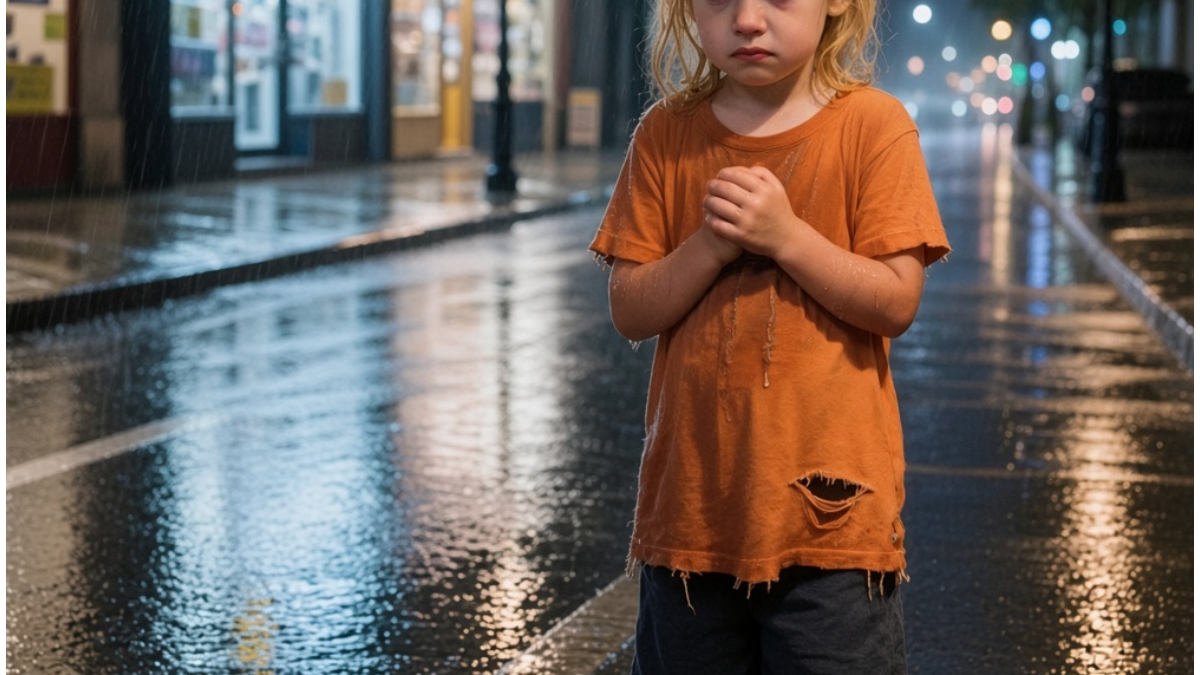
A millionaire CEO saw a poor girl shivering in the rain. What the CEO did next changed her life forever.
The storm had swallowed the city whole. From the backseat of his silent car, Gavin Whitmore watched as waves of rain blurred Seattle’s skyline into a smudged watercolor.
The windshield wipers struggled to keep up. Their rhythmic swipes losing a battle they weren’t built to win.
Take the long way. Gavin had told his driver earlier, his voice low and detached.
No explanation given. None needed. It was October 17th. He didn’t put that date on calendars.
Didn’t speak it aloud. But every year when the air grew sharper and the trees let go of their leaves, his body remembered.
It was the night he lost his sister. And the night silence moved into his life for good.
He stared at the streaks on the window. The city lights bleeding into the glass.
“Even the sky can’t hold it together tonight.” He thought, folding his arms across his cheSt. The words came from somewhere uninvited.
Brushing the edges of something he’d buried years ago. The weather mirrored the war inside him.
Perfect control on the outside. Unrelenting turmoil underneath. The car crept along Madison Street when a flicker of movement caught his eye.
Gavin sat forward. “Stop.” He said, sharper than he meant. The driver braked at the curb.
There, beneath the bus stop awning, sat a child. She was small, probably six or seven, curled into herself under a threadbare blanket that clung to her like wet paper.
Her bare feet were pressed to the concrete, red and raw. Rain poured down around her, misting her face, soaking her tangled blonde hair.
Her arms were wrapped tightly around her knees. She was shivering, but her back was straight.
Still. Gavin stared. Unable to process what he was seeing. A child. Alone. At night.
In a storm like this. He reached for the door handle. His driver turned. “Mr. Whitmore, should I “No, stay here.”
Gavin stepped into the downpour. Rain instantly drenching his tailored wool coat. He moved slowly, umbrella in hand, keeping his voice steady as he approached.
“Hey there.” He said, just loud enough to be heard. “Are you okay?” The girl didn’t respond.
She flinched, barely perceptible, and pulled the blanket tighter around her thin frame. Her eyes met his, wide, dark, terrified, and it nearly stopped him in his tracks.
That look. Like the world had already taught her how cruel it could be. “I’m not here to hurt you.”
He said, kneeling carefully on the edge of the sidewalk, not too close. “My name’s Gavin.
I just want to help. Do you have someone I can call? Your mom or dad?”
At the word mom, her lip quivered. Her chin dropped to her knees. “I can’t.”
She said. Her voice was hoarse, barely audible. “Mommy said don’t go with strangers.” “She’s right.”
Gavin said gently. “That’s smart of her, but it’s cold. And it’s late. And you’re all alone.”
The girl’s eyes flicked to his umbrella. Then to the car idling at the curb.
She said nothing. Only the storm answered. Gavin stayed crouched, his knees aching against the wet pavement.
“Can you tell me your name?” She hesitated. Then, “Lena.” “Lena.” He repeated softly. “Okay, Lena.
I won’t make you do anything you don’t want to. But can you tell me where your mom is?”
Her fingers tightened around the blanket. Her throat moved as she swallowed. Then, in a voice so small it might have disappeared in the rain, “She’s in the hospital.”
Gavin’s brows pulled together. “What hospital?” “I don’t know the name. It’s big with white walls.
I was there earlier, but I had to leave.” He frowned. “Why?” Lena’s eyes, already heavy with exhaustion, brimmed with something far older than her years.
“She’s in the ICU and visiting hours ended. And they don’t let me stay. So I waited outside.
But I got cold.” She said it plainly, without self-pity. But Gavin felt a knot twist in his cheSt. “You don’t have anywhere else to go?”
She shook her head. “Mommy was all we had.” His breath caught. Gavin looked at her, really looked.
The soaked pajamas clinging to her legs. The way her small body shook against the cold.
The defiance in her posture fighting the tremble in her voice. A child trying so hard to stay brave.
Too young to be alone. Too proud to ask for help. He opened his mouth.
Closed it again. Then slowly, he reached into his coat pocket, pulled out a small business card.
The only thing he had with his name, and placed it carefully on the edge of the bench.
“This is my card.” He said. “I’m not asking you to trust me. But I live 10 minutes from here.
We can call the hospital. We can get you dry and warm. Then tomorrow, we can go back and find your mom.
Together.” Lena stared at the card like it was written in a language she couldn’t read.
“I have hot chocolate.” Gavin added quietly. A beat. Then, her voice cracked. “She’s all alone in there.”
Lena whispered. “And I’m all alone out here.” Gavin stood, extending his umbrella over her.
“Then let’s not be alone anymore.” Lena didn’t move. But her eyes, still wide with fear, began to shift.
Hesitating. Calculating. Then slowly, she stood. Her blanket slipped from her shoulders, hitting the sidewalk with a heavy slap.
Gavin reached for it, then paused. Lena stooped first, scooping it up and wrapping it tightly around her again.
Her bare feet slapped against the pavement as she walked. One small step at a time, toward the car.
Gavin opened the door. She climbed in without a word. As Gavin closed the door behind her, the storm roared above them.
Inside the car, Lena’s voice was soft and clear. “She’s in the ICU. I don’t have anywhere else to go.”
Gavin looked out at the floodlit streets, rain streaking down the glass, and made a vow he never expected to make again.
“I’m not walking away.” The elevator doors slid open with a soft chime. Revealing Gavin Whitmore’s penthouse.
A sleek expanse of glass, stone, and silence. Floor-to-ceiling windows overlooked the misty skyline of Seattle.
While recessed lights glowed softly across the perfectly polished marble floors. Not a pillow out of place.
Not a speck of dust on the minimalist black shelves. The kind of place that made people whisper.
Even when no one was around. Lena didn’t move. She stood just inside the doorway.
A small bundle of soaked flannel and bare feet. Her eyes darting over the grand living room like she just stepped into a museum she wasn’t supposed to be in.
Gavin closed the door behind her, setting his umbrella in the stand by the wall.
The rain outside was still fierce. Battering the glass like it was trying to get in.
“Make yourself at home.” He said. Immediately realizing how hollow those words sounded. This wasn’t a home.
It was a fortress built from control. Lena took a tentative step onto the marble floor.
Her blanket left a trail of water behind her. Each of her tiny footprints bloomed and evaporated in slow motion under the soft light.
Gavin noticed. He didn’t care. But something about the image struck him. For the first time in years, someone else’s presence had left a mark in his space.
And he didn’t want to wipe it away. “Would you like something warm to drink?”
He asked. “Hot chocolate, maybe?” She nodded silently. Still clutching the blanket like armor. Gavin motioned toward the kitchen.
She followed, slow and cautious. Like a bird too smart to trust an open palm.
Her eyes swept over the granite countertops. The silent appliances. The untouched bar stools. She didn’t sit until he gently pulled out a chair for her.
“I’ll find something dry for you to wear.” He said. Already walking toward the hallway closet.
“Be right back.” When he returned, he handed her a fresh white T-shirt, one of his own, far too big, and a pair of drawstring lounge pants.
She looked at them without reaching. He hesitated. You can use the guest bathroom down the hall.
He said softly. Towels are on the shelf. No rush. Lena stood, blanket still draped over her, and padded away in silence.
When he heard the soft click of the bathroom door closing, Gavin exhaled. He leaned against the kitchen counter and stared out at the city beyond the glass.
Rain streamed down the windows like veins. Everything about tonight, the detour, the girl, the hospital, felt like walking into a story he wasn’t meant to be part of.
And yet, here he was. The smell of Lena’s wet blanket still lingered in the air, and with it came something he hadn’t expected.
A memory. Him, age seven, soaked to the bone, locked outside in a thunderstorm by a stepfather who’d passed out drunk on the couch, shivering, crying quietly, so no one would hear.
The front porch had smelled like mildew and wet wood, and even though the lights were on inside, nobody came.
Gavin shook the memory away. He hadn’t thought about that night in decades. When Lena reappeared, wearing the oversized T-shirt and pants with the legs bunched around her ankles, she looked even smaller.
Her hair was wet, combed back with her fingers. She held the bundle of wet clothes against her chest like a shield.
He took them gently and placed them in the laundry room. I’ll get those dried for you.
Back in the kitchen, he slid a steaming mug across the counter. The marshmallows had already started to melt into swirls.
She took it with both hands and blew softly on the surface. Thank you. She whispered.
He nodded. You’re welcome. She sipped quietly. The silence between them was thick, but not heavy.
Just uncertain. What’s your favorite color? He asked, surprising even himself. She looked up. Purple.
She answered softly. Then quickly added, Mommy likes green. He smiled. Good choices. They fell into quiet again.
Gavin leaned against the counter, arms crossed, watching her drink. Her hands were still trembling slightly.
He didn’t know if it was from the cold or something deeper. Is it okay if I stay here tonight?
She asked suddenly, voice barely above a whisper. He straightened. Of course. You’ll be safe here.
Her shoulders sagged just slightly in relief. I don’t usually She paused, staring into her mug.
Mommy says we shouldn’t bother people. She always says we’ll be fine. Gavin looked at her.
You’re not bothering me, Lena. She didn’t answer, but her lips tightened as if she wanted to believe it.
After she finished her cocoa, he showed her the guest room. Another perfectly curated space with a sleek gray bed, untouched linens, and too many pillows.
She stood in the doorway, holding onto the doorframe like she was afraid to enter.
Would you like to leave the door open? He asked. She nodded. He turned down the bed and placed a folded blanket at the end.
I’ll be in the room down the hall. You just have to call out if you need anything.
Lena climbed into the bed carefully, tucking the blanket under her chin. Her eyes flicked to the window, where rain tapped softly against the glass.
Gavin stood awkwardly in the doorway, unsure if he should stay or go. Will you come back in the morning?
She asked, her voice so small it felt like it might vanish into the sheets.
He paused. No one had asked him that in years. Not a friend, not a partner, not even his assistant, and definitely not a child with rain in her hair and fear in her voice.
He took a step closer and crouched beside the bed. I’ll be here. He said, voice low, steady.
I promise. Her eyes searched his face. For what? He wasn’t sure. Truth, reassurance, maybe something he didn’t even know how to give.
She nodded and turned her face into the pillow. He stood there a moment longer, listening to her slow breathing.
Then he quietly stepped out, pulling the door until it was just slightly ajar. Back in his room, Gavin sat on the edge of his bed, fully clothed, staring at the floor.
This night was never supposed to happen. He was supposed to drink a glass of scotch, reread an old article, and forget.
But instead, there was a six-year-old girl sleeping down the hall who had nowhere else to go.
And for the first time in a very long time, Gavin Whitmore didn’t feel alone in his apartment.
He felt responsible, and strangely relieved. Not because he had answers, but because somehow, for reasons he couldn’t name yet, he wanted to be there when morning came.
Gavin Whitmore wasn’t the type of man to cancel meetings. Certainly not board meetings scheduled weeks in advance with stakeholders dialing in from across three time zones.
But that morning, as the mist rolled over the Seattle skyline and the girl down the hall waited quietly in borrowed clothes, he typed a short message to his assistant.
Postpone everything today. Personal emergency. Seconds later, his phone buzzed. Melanie. You never cancel. What’s going on?
He stared at the blinking screen before replying with two simple words. Gavin. This matters.
There was no follow-up. By the time they pulled into the Mercy General parking lot, the fog had thinned, replaced by a dim morning light that made the building look even grayer than usual.
The faded lettering on the concrete facade looked tired, like it had long ago accepted its place in the forgotten corners of the city’s health care system.
Inside, the hospital smelled of rubbing alcohol, recirculated air, and something faintly metallic like fatigue you could breathe in.
Gavin glanced down at Lena, walking just half a step behind him. She hadn’t spoken during the ride, her shoulders drawn tight, eyes fixed ahead.
But now, as they stepped into the lobby, he noticed the way she straightened her back like a soldier returning to the battlefield.
The woman at the front desk looked up from her computer. Her eyes flicked from Gavin’s expensive wool coat to the little girl beside him.
We’re here to see Maggie Parker. Gavin said. I see you. The receptionist hesitated. Family only during morning rounds.
She’s her daughter. Gavin interrupted, his voice calm but firm. The woman looked again, this time more carefully, and recognition flickered in her eyes.
Oh. You’re the little one from last night. She said to Lena, who nodded silently.
I see you. Room 204. Take the blue elevator, second floor. She glanced again at Gavin, curiosity obvious, but said nothing else.
They walked in silence down the hallway, past worn posters about flu shots and peeling paint near the vending machines.
Gavin had funded private clinics, toured elite medical startups, and once gave a keynote at a global health care summit.
But nothing about this place spoke of innovation. It whispered survival. The ICU was quiet, humming with machines and muted footsteps.
Lena led the way, familiar with the path. When they reached room 204, she paused at the doorway like she needed a moment to breathe.
Gavin stood beside her. Inside, the room was dimly lit by a single window streaked with condensation.
Maggie Parker lay still, sunken into crisp hospital sheets. Her skin was pale, almost translucent.
A heart monitor beeped in the background. Tubes ran from her arMs. An oxygen line fed gently into her nose.
The machine beside the bed hissed with every assisted breath. Lena stepped forward slowly. Her shoes made no sound on the linoleum.
She approached the bed and climbed up on the small plastic stool beside it. Without hesitation, she reached out and touched her mother’s hair, brushing it softly back from her forehead.
Then she leaned down and pressed a tiny kiss to the back of her hand.
She hasn’t smiled in weeks. She he voice so low it barely crossed the space between them.
“I think she forgot how.” Gavin swallowed hard. The sight of her small, fragile, steady next to her mother’s unmoving form felt like watching a storm try to keep a candle from going out.
She shouldn’t have had to carry this. Not alone. >> [clears throat] >> Not ever.
A nurse entered, clipboard in hand. She was in her 60s with sharp eyes and a gentle manner.
“Oh,” she said, taken aback when she saw Lena. “You’re back.” Lena didn’t move. Just held her mother’s hand tighter.
The nurse turned to Gavin. “Are you the guardian?” “No,” Gavin said simply. “Just here to help.”
She studied him, clearly trying to place him. Something about his tailored coat, the quiet authority in his stance.
She flipped through the chart. “Your mother’s condition is critical,” she said to Lena gently, then glanced at Gavin.
“Severe endocarditis. The infection has reached her heart. She needs more than antibiotics. We’ve done what we can.”
“Meaning?” Gavin asked, his tone clipped. “She needs surgical intervention, faSt. But we’re a public facility.
No insurance, no next of kin with means on file.” She lowered her voice. “Honestly, Mr. Whitmore.
The nurse paused mid-sentence. As in Whitmore Innovations?” Gavin nodded once. Her mouth opened, closed again.
“Well, if there’s anything you can do.” “There is,” he said, already pulling out his phone.
“Have her file sent to University Medical. I’ll arrange for a private room and cardio consult today.
You’ll need to I’ll cover everything,” he said, already dialing. “Just keep her stable until the transfer’s ready.”
The nurse looked stunned. Then, almost imperceptibly, she smiled. “Yes, sir.” She left and Gavin turned back toward the bed.
Lena was still seated on the stool, silent. She didn’t ask questions. She just kept holding her mother’s hand.
Gavin walked to the small counter beside the bed, where a stack of paperwork lay untouched.
Amid the clutter was a faded photograph of Maggie and Lena, taken long before the tubes and machines, standing in front of a park fountain, both smiling.
He pulled a pen from his coat pocket and flipped over one of his business cards.
On the blank side, he scribbled a short message. “You’re not alone. She isn’t, either.”
Then, gently, he set the card beside the photo. Lena looked up at him, eyes searching.
“I’m not here as a CEO,” he said quietly. “I’m here as someone who’s staying.”
She didn’t say anything, but the way her lips pressed together said enough. In that moment, Gavin felt something shift, not in her, but in him.
For the first time in years, he wasn’t fixing something for the sake of control.
He wasn’t managing a crisis to preserve image or stability. He was just showing up.
And it mattered. The hum of fluorescent lights followed Gavin as he stepped out of room 204 and into the corridor, the heavy door clicking softly behind him.
The air in the ICU hallway was cooler than the rest of the hospital. Not by much, but enough to raise goosebumps.
He pulled his phone from his coat pocket with a sense of urgency he hadn’t felt in years.
Not the kind driven by deadlines or business strategy. This was personal, unfiltered. It felt like clarity in motion.
“Dr. Malcolm Sanders, University Medical,” he told his assistant the second she picked up. “I need him on the line, now.”
“Mr. Whitmore, you’re not scheduled with “This isn’t for me,” he said, his tone sharp but measured.
“It’s about a patient in critical condition. Name’s Maggie Parker. I’m requesting an emergency transfer under my private foundation.”
Melanie hesitated for only a second. “Understood. I’ll make the call.” Less than 10 minutes later, Gavin was on the phone with Dr. Sanders himself, detailing Maggie’s condition, authorizing paperwork, and requesting a pediatric liaison to ensure Lena wouldn’t be left out of the process.
As he spoke, his voice was clipped, but underneath the efficiency, something deeper ran, compassion.
He wasn’t negotiating. He was insisting, not for leverage or recognition, but because a 6-year-old girl needed her mother, and he wasn’t going to sit back and let red tape make that impossible.
By the time he ended the call, arrangements were already underway. Maggie would be transferred by private ambulance within 2 hours.
A cardiac team had been assigned. All expenses, transport, treatment, recovery, covered. When he returned to the room, Lena hadn’t moved.
She still sat by her mother’s side, legs dangling off the stool, one small hand resting lightly on Maggie’s wriSt. Her eyes looked tired but calm, as if some piece of her had expected Gavin to disappear while she wasn’t looking.
He didn’t say anything at firSt. He simply pulled over the chair from the corner and sat beside her.
“I talked to some very smart people,” he said finally. “They’re getting a room ready for your mom at a better hospital.
There’s a team waiting there. They’re going to help her get stronger.” Lena turned her head slowly to look at him.
“Really?” “Really.” Her shoulders slumped, and for the first time since he’d met her, Gavin saw something close to relief in her expression.
But it came with a strange sadness, too. Like she wasn’t sure it was okay to feel hopeful yet.
“Is it far?” She asked. “Not too far,” he said. “They’ll let you ride in the ambulance with her if you want.”
She nodded, but then went quiet again. Her fingers gently traced the edge of her mother’s hospital sheet, and Gavin sat back in his chair, watching the small, steady movements.
The girl didn’t cry. She didn’t ask for anything more. She just stayed. After a while, a nurse entered to check vitals.
Gavin stepped aside, but Lena never let go of her mom’s hand. When the nurse was done and the room fell silent again, Gavin looked over and saw Lena digging through her small backpack.
She pulled out a folded piece of paper and a worn crayon. “I made this last night,” she murmured, opening it slowly.
“But I didn’t know where to put you.” Gavin leaned in. The drawing was simple.
Three stick figures under a rainbow, a woman with long brown hair, a girl with pigtails, and a taller figure with a black scribble for hair and a big smile.
“Me, Mom, and Gav.” He stared at it longer than he meant to. “She never had time to teach me how to spell your full name,” Lena said shyly, misreading his silence.
“I can change it.” “No,” Gavin said, his voice softer than she’d ever heard it.
“It’s perfect.” She folded the paper again and handed it to him. He held it gently, like something fragile and irreplaceable.
“Lena,” he started, then paused. He hadn’t meant to say anything more, but something about the drawing, the innocence, the inclusion, stirred something in him.
He looked at her, at her small face and quiet strength, and found words he hadn’t planned to say.
“If you stay, maybe Mom will, too.” She whispered, repeating the phrase from the night before, but this time with a hint of hope behind it.
Just a thread, but it was there. He looked down at her hand resting on her mother’s, so small, so steady.
His throat tightened. “I’m not going anywhere,” he said, the words coming out before he could think to weigh them.
“Not today. Not tomorrow.” She didn’t respond, but a moment later, she leaned sideways, not quite touching him, but just enough to let her head rest lightly against his arm.
It felt like a trust fall, one he hadn’t realized he’d been waiting for. The next hour passed quietly.
Lena eventually dozed off, her head still resting against him. Gavin didn’t move, not even when his phone buzzed in his pocket, not even when a nurse peeked in to check again.
He just sat there, eyes fixed on the heart monitor’s steady rhythm, feeling the warmth of Lena’s trust against his side, and the slow, unfamiliar sensation of purpose settling into his cheSt. When the ambulance crew arrived, Gavin helped gather Lena’s things and walked with her to the elevator.
She held her backpack tightly in one hand, and in the other, still folded, was the drawing.
At the ambulance bay, as the stretcher was loaded and the paramedics double-checked Maggie’s monitors, Gavin crouched in front of Lena.
“You ride with her,” he said. “I’ll meet you both there.” She hesitated. “Promise?” She asked.
He looked her in the eyes. “Promise.” As the doors closed behind her, Gavin stood motionless, the cold air biting through his coat.
The ambulance pulled away, lights blinking in the pale gray morning, disappearing into the miSt. He reached into his pocket and pulled out the drawing again.
The crayon colors were faint, but bright enough to cut through the gray. “Gav,” it said.
He folded it carefully and tucked it into his breast pocket, close to his heart.
This wasn’t just kindness anymore. This was something else. He made a promise. And for the first time in his life, that meant more than anything on his calendar.
By the time Gavin arrived at University Medical, a fine drizzle had returned to the sky, coating the windshield of his town car in delicate sheets.
The city shimmered under it, softened like a watercolor painting. But inside Gavin Whitmore, everything felt sharp, focused, raw, and unlike anything he could remember.
He stepped into the hospital lobby with the quiet force of a man used to commanding rooms, but here, in this moment, he wasn’t Gavin Whitmore, the CEO.
He was the man who made a promise to a 6-year-old girl and meant every word of it.
The receptionist glanced up, clearly familiar with his name by now. “Room 412,” she said before he even asked.
“Pediatrics is setting up a play-space next door for the child. They’ve both just arrived.”
He nodded his thanks and took the elevator up. On the fourth floor, he found the same sterile smell of antiseptic, the quiet beeping of machines, and the low murmur of nurses in motion.
But the room he entered felt different. Lena sat in a cushioned chair by the window, legs tucked under her, a small juice box in her hand.
She looked up the moment he stepped in, her expression unreadable for a second, then relaxed, a quiet, familiar recognition.
“You came,” she said, not surprised, just reassured. “I said I would,” Gavin replied, setting down a brown paper bag he’d stopped to pick up from a bakery near the hospital.
“Apple muffins and cocoa, and one of those yogurt things with the cartoon bear you mentioned yesterday.”
The ghost of a smile curved her lips. “Thanks.” Maggie lay in the hospital bed, her face still pale, but more at peace.
A new IV line ran from her arm, and her oxygen mask had been swapped for nasal tubing.
She looked a little less lost in the tangle of wires and machines. A nurse stepped in moments later, a clipboard in hand and a ponytail bobbing behind her.
She smiled warmly at Gavin, a shift from the usual stiff professionalism he encountered. “She’s responding well,” the nurse said.
“Her vitals are stabilizing. No infection spread in the last 12 hours. It’s early, but we’re hopeful.”
Lena sat up straighter at the word hopeful. Gavin nodded. “Thank you. Keep me updated.
Any expenses, any gaps in coverage, they’re on me.” The nurse smiled again, not the forced smile of gratitude, but something more real.
“We’ve already seen the paperwork. Your foundation moved faSt. You’re not just donating, are you?”
Gavin glanced at Lena before answering. “No, I’m just showing up.” Later that day, he found himself standing beside Lena in the hospital garden.
It was modest, a few benches, some early-blooming hydrangeas, and a small koi pond that looked like it had seen better years.
Lena walked slowly, eyes scanning everything with quiet intereSt. She paused beside the pond. “Mom used to bring me to places like this,” she said, “when she had time.”
“She will again,” Gavin said gently. Lena turned, brushing a strand of hair behind her ear.
“She used to draw a lot. Flowers, birds, but she stopped.” Gavin studied her expression, how carefully she kept her face still, the way her shoulders squared just slightly.
>> [bell] >> She carried her fear the same way she carried her backpack, always with her, but never letting it show too much.
“I know what it’s like,” he said, surprising himself, “to have someone disappear from your world, and how you hold your breath, pretending you’re fine, so no one sees it cracking inside.”
Lena’s eyes flicked to his. “Who disappeared for you?” “My sister,” he said, “a long time ago, on a night like that one.”
He didn’t elaborate, and she didn’t ask, but something shifted in the quiet between them.
Not pity, understanding. Back inside, the nurses had moved Maggie’s bed closer to the window.
She remained unconscious, but her breathing had evened out. Lena pulled up her chair again, digging something from her backpack.
She began to draw. Gavin watched her, the way her hand moved slowly, the intensity in her gaze.
She didn’t look like a child trying to pass time. She looked like someone remembering something important.
When she was done, she held the drawing up silently. Three windows, one labeled me, one mom, the third, you.
A simple square with curtains and crayon flowers. But to Gavin, it might as well have been stained glass.
He looked at it longer than he intended. “Can I put it on the wall?”
She asked. “Anywhere you want.” He helped her tape it beside Maggie’s monitor, right above the heart rate display.
When he stepped back, he caught a nurse smiling at them from the doorway. “She sleeps better when you’re here,” she said to him, half teasing.
“I don’t do much,” Gavin replied. “You’re here,” the nurse said. “That’s everything.” That evening, as hospital staff made their rounds and fluorescent lights dimmed in the hallway, Gavin stepped into the family lounge to take a call.
Melanie was on the line. “Just letting you know I cleared tomorrow’s schedule as well,” she said.
“And?” “The staff’s asking if you’re okay.” “I’m fine,” Gavin said, glancing through the glass door at Lena asleep beside her mother’s bed.
“Better than I’ve been in a long time.” There was a pause. “You’re different.” “I’m just remembering what matters.”
Later, before leaving for the night, he returned to Lena’s side. She had fallen asleep again, one hand loosely curled around her mother’s fingers.
Gavin quietly pulled the blanket up around her shoulders. He wasn’t a parent. He hadn’t read parenting books.
But something about that gesture, covering a sleeping child in a too-cold room, felt instinctive.
As he turned to leave, his gaze caught the drawing again. The three windows, the blooming crayon garden.
>> [clears throat] >> “Home,” he whispered to himself. It wasn’t marble floors or a private elevator.
It wasn’t a penthouse view. It was this. Two hands held together in the dark.
A little girl finally sleeping without fear. A promise made, and for once, kept. The sixth morning dawned with reluctant light, filtering dimly through the misted hospital windows.
Gavin arrived just after 6:00, coffee in one hand, a small paper bag of muffins in the other.
He no longer hesitated before entering room 412. He knew which nurses worked the early shifts, which vending machine in the lobby still carried Lena’s favorite juice, and exactly how the sunrise touched the corner of Maggie Parker’s bed.
Lena was already awake, curled in the same chair beside her mother’s bed, legs folded, eyes alert.
She gave him small, sleepy smile when he walked in. “You came early today.” She said, voice soft.
“I figured you’d be hungry.” Gavin replied, setting the bag on the side table. “And I brought the blueberry ones this time.”
Lena sat up straighter, her tone teasing now. “Finally, took you long enough.” He smiled.
Maggie still lay motionless, but her breathing had changed. Steadier, deeper. The oxygen machine had been turned down the day before, and the heart monitor now traced a calm, rhythmic line.
Hope lived in the quiet now, not loudly, but enough to shift the air. “She moved her hand yesterday.”
Lena whispered, almost afraid to say it too loudly. “Just a little. I saw it.”
Gavin pulled up the chair beside her. “That’s a good sign.” “She’s trying, I think.”
Lena said. “She just needs to know someone’s waiting.” “You’ve been waiting.” He said. “And I think she knows.”
They sat together, watching the subtle rise and fall of Maggie’s cheSt. The nurse came in with the morning meds, checking vitals and logging updates with a slight nod toward Gavin, no longer surprised by his presence.
At one point, Lena pulled out a new drawing. She didn’t explain it, just started sketching quietly.
Gavin glanced over and saw it was a tree with a thick trunk and wide branches, three figures under it, shaded in red, yellow, and green.
Before he could ask, a sharp beep from the monitor made them both sit up straighter.
The heart rate was still steady, but Maggie’s eyelids had fluttered. Lena stood, her chair scraping back slightly.
“Mom?” Gavin stood, too, not breathing. Maggie stirred, just slightly at first, her head turning a fraction on the pillow.
Then, with great effort, her eyes opened, unfocused and blinking against the light. The room froze.
Lena’s voice broke like a whisper cracking in the middle. “Mommy?” “It’s me. I’m here.”
Maggie blinked again. Her lips moved, no sound at first, then a scratchy whisper. “Lena.”
Gavin felt the weight of it in his chest, a single name carrying the whole world inside it.
Lena burst into tears, not loudly, but in that quiet, broken way children cry when they’ve been holding in too much for too long.
She climbed onto the edge of the bed, careful not to disturb the wires, and laid her head gently against her mother’s shoulder.
Maggie’s hand moved slowly, fingers brushing weakly through her daughter’s hair. The nurse came rushing in, eyes wide.
She didn’t speak, just checked the machines and nodded quickly, a small smile breaking across her face.
“She’s waking up. I need to get the doctor.” She said, and darted out. Lena looked over her shoulder at Gavin, her face streaked with tears, her voice cracking.
“She said my name.” “I heard her.” Gavin said. And this time he didn’t try to stop the emotion from rising in his throat.
“She’s still yours.” The moment stretched, raw and sacred, until a soft rasp drew their attention back to the bed.
Maggie’s eyes, still glassy, found Gavin’s face. She stared at him for a long beat, confused at firSt. Then her voice, no louder than wind against a windowpane, asked, “Who are you?”
Gavin stepped forward slowly. “I’m Gavin.” He said. “Your daughter found me, or maybe I found her.”
Maggie blinked slowly. “Why did you help us?” Gavin held her gaze, and for once, no carefully curated words came to his tongue.
No speeches, no statements, only truth. “Because she asked me to stay.” He said. A tear slid down Maggie’s temple, and she closed her eyes briefly before opening them again.
Her breathing was uneven but stronger now. Her grip on Lena more certain. She searched his face and, as if trying to see what kind of man said a thing like that, and meant it.
“You’re different.” She whispered. “I can tell.” Gavin nodded, lips pressed tightly. “I wasn’t once.”
He admitted quietly. “But maybe I’m learning.” Lena curled beside her mother, her hand never leaving Maggie’s.
She had stopped crying, but the way she watched Gavin now, with a kind of wonder, made something shift again inside him.
It wasn’t awe, it was safety, trust, something harder to earn than any business deal.
The doctor came in shortly after, followed by a nurse and another specialiSt. The room filled with soft instructions, vitals, checklists, murmurs of stabilization and next steps.
But Gavin stayed in the corner, unobtrusive, present, watching. And when the bustle died down and the others cleared out, hope and concern was where Maggie turned her head again toward him.
“I I don’t have anyone else.” She said, voice gravelly. “I don’t even know how to thank you.”
“You don’t have to.” Gavin replied. “Just focus on getting better. Lena’s been holding everything together.”
“She’s like her father.” Maggie whispered. “Strong when she shouldn’t have to be.” Gavin glanced at Lena, now fast asleep beside her mom’s side, hand still resting on Maggie’s stomach.
“And now she doesn’t have to be.” Maggie reached out slowly, her hand thin, veins visible beneath the skin, and rested it on Gavin’s.
“Don’t let her be alone again.” She said. He didn’t promise out loud this time.
He just nodded, his hand steady beneath hers. And this time, it wasn’t a vow spoken.
It was a vow lived. The next few days passed in a rhythm unfamiliar to Gavin Whitmore, but one he came to adopt without resistance.
Each morning, he arrived at University Medical before his assistant could even check in. His tailored suits began to give way to rolled-up sleeves and soft sweaters, and his briefcase, once packed with contracts and quarterly projections, now held sketchbooks, storybooks, and spare juice boxes.
Lena had started drawing again. She filled pages with stars, houses, and windows, always windows.
Three squares in a row, sometimes a fourth. Each marked with names, Mom, me, Gav.
Sometimes just us. Gavin taped each new page onto the walls of the guest suite she’d temporarily claimed at his smaller home in Magnolia, a quieter neighborhood overlooking Elliott Bay.
It wasn’t his penthouse downtown, but Lena had smiled when she saw the backyard. That was all the approval he needed.
Maggie, still regaining strength, remained at the hospital. Her recovery was slow but promising. The doctors spoke with optimism, but gently.
Rehab would take weeks, possibly months. The infection had done damage, but her will was strong.
She would walk again. She would sew again. But not today. Not next week, which is what brought Gavin into a sunlit office on the fifth floor of the hospital, sitting across from a man named Mr. Daniels, a calm-spoken representative from the Department of Children and Family Services.
He wore a burgundy tie and wire-framed glasses, and had the kind of stillness that made people feel like they were being studied, but not judged.
“I understand you’ve been caring for Lena Parker.” Mr. Daniels said, glancing down at the file.
“You arranged her mother’s transfer, covered medical expenses, provided lodging, and you’re not a relative?”
“No.” Gavin said simply. “Just someone she trusted.” Mr. Daniels looked up from the paperwork.
“And you’d like to apply for a temporary guardianship?” “I would.” The man studied him for a long moment.
“Can I ask why?” Gavin took a breath. “Because she looks for me in a room full of strangers.
Because she draws my name next to hers in pictures of home. Because when her mother woke up, the first thing she did was place her hand over mine and whisper, ‘Don’t let her be alone again.'” But all Gavin said was, “Because it feels right.”
Mr. Daniels didn’t press him. Instead, he nodded slowly and handed over a stack of forMs. Later that day, Gavin brought Lena back to the new house.
Not the penthouse with its cold, modern furniture, but the one with slightly creaky floors and a small bedroom that used to store forgotten art supplies.
Now, it was hers. She stood in the middle of the room, eyes wide. “Can I make it mine?”
She asked. “It already is,” Gavin replied. By evening, she’d taped glow-in-the-dark stars to the ceiling and covered one wall with crayon drawings.
Gavin helped her set up a desk beneath the window. When he plugged in a small nightlight shaped like a moon, Lena’s face lit up like it had caught the real thing.
They sat on the back porch after dinner. Lena in pajama pants and one of Gavin’s oversized t-shirts she refused to give back.
The sky was streaked with violet, the air cool and fresh. “Will she be okay?”
She asked suddenly. Her legs swinging gently from the edge of the chair. “Your mom’s stronger than she looks,” Gavin said.
“And she’s got people watching over her now. Like how I’m watching over you.” Lena was quiet for a while.
Then she said, “I think she’ll like this house.” Gavin looked at her. “You think she’d want to live here?”
She nodded. “You have the best juice.” He chuckled. “I’ll take that as a compliment.”
She yawned and leaned her head against his shoulder. “Do you think we’ll always stay together?”
The question wasn’t dramatic. It wasn’t fearful. It was small, simple, but it hit Gavin like a hammer to the cheSt. He wrapped an arm around her and pulled her closer.
“Yes,” he said, “as long as you’ll have me.” She didn’t respond, just tucked her fingers into the side of his sweater and closed her eyes.
That night, after carrying her to bed and adjusting the blankets just right, Gavin lingered in the doorway.
The room glowed faintly from the stars on the ceiling. A drawing sat on the desk.
Three windows again, but this time one of them had curtains fluttering in the wind.
The label read, “Ours.” He turned off the hallway light and stood in the quiet, letting the soft hush of the house settle over him.
He had always lived alone, by choice, by habit, by fear. But now there were two mugs in the dish rack, a tiny toothbrush next to his, crayons on the kitchen counter, footsteps in the hallway at night, laughter he hadn’t expected, tears he’d held without question.
The silence hadn’t disappeared. It had just changed shape. Summer had just begun to stir in Seattle, the kind of early summer that still flirted with spring chill, but carried a promise of warmth in the air.
In the quiet residential neighborhood where Gavin’s second home stood, the garden was starting to bloom with the small green shoots Lena had helped him plant in old pots by the front porch.
She watered them daily, always barefoot, always humming. It had been 5 weeks since Maggie Parker had first opened her eyes in the ICU.
She now moved slowly, still needed help with stairs, and sometimes fell asleep mid-conversation. But she was healing, visibly, stubbornly, and with gratitude etched into every line of her tired but smiling face.
Gavin visited the hospital daily. He brought crossword books, homemade soup, and updates from Lena.
Usually scribbled messages with crayon hearts, stick figures, and sometimes jokes only a 6-year-old would find funny.
Maggie read every one of them like they were sacred. It was during one of those visits that Maggie surprised him.
“You’re doing more than just helping,” she said, eyes on the drawing pinned to her hospital wall, the one with three windows and flowers in every box.
“You’re building something.” Gavin shifted in his chair. “I’m just trying to make things a little easier.”
“No,” she said, looking at him now. “You’re making things possible.” He didn’t know how to respond to that.
He rarely did when people reached into the quietest corners of his life and named what he himself hadn’t dared to.
That afternoon, he stopped by the bakery Lena loved and bought a dozen cinnamon rolls.
She squealed when she saw the box, then ran to grab her newest drawing. “Don’t peek yet,” she warned, running to the kitchen table and carefully spreading out the folded paper.
“Okay. Now.” Gavin walked over, and what he saw made him stop completely. It was another house.
Her houses were always the same shape, boxy, square, slightly crooked, but this one had something new.
Four windows, not three. In each window, a name. Mom. Me. Gav. And the last one, us.
He stared at it, throat tightening. The curtains on each window were drawn back. A yellow sun beamed above the roof, and vines crawled up the walls, blooming in bright colors.
There were two stick figures in the yard, one tall, one small, both smiling, both holding hands.
“I wanted to make a window that belongs to all of us,” Lena said quietly.
“So we know we’re together, even when we’re in different rooMs.” Gavin knelt beside her and took a slow breath.
“You did more than that,” he said. She looked at him, puzzled. “You gave us a place to be,” he continued.
“Together. Real.” She didn’t say anything, just smiled. The kind of smile kids give when they know they’ve made something beautiful, something that matters.
The next weekend, Maggie was discharged from the hospital. The day she stepped into Gavin’s home, still leaning on a cane, her hand trembled as she took in the space.
The hand-drawn pictures, the rainbow magnet letters on the fridge, the welcome sign Lena had made with glitter glue and printer paper.
She looked at Gavin, tears in her eyes. “I don’t know what to say.” “You don’t have to say anything,” he said.
“You’re home.” They didn’t move in, not officially, not at first, but days turned into weeks.
Maggie stayed in the guest room downstairs while her strength returned. Gavin adjusted his schedule without thought.
He declined invitations, canceled board retreats, and found himself reviewing investment decks in the backyard while Lena painted rocks beside him.
One morning, as Maggie poured coffee slowly, carefully, she laughed softly at Gavin’s attempt to fold a fitted sheet in the laundry room.
“Give it up,” she teased. “That thing wasn’t made to be tamed.” He chuckled, defeated.
“That makes two of us, then.” They shared more laughs after that. Little ones, big ones, quiet ones over dinner.
The kind that feel like sunlight after months of rain. It wasn’t dramatic. It wasn’t a romance.
It was something deeper, a slow stitching of moments into truSt. One evening, as they all sat on the floor building a puzzle, Lena determined to finish the sky before bedtime.
Gavin looked around and realized the silence he had once lived in was gone. Not buried, not ignored, transformed.
Maggie’s voice broke the quiet. “She told me about the four windows,” she said, eyes on her daughter.
“She said we each have one, but there’s also one we share.” Gavin smiled, the image of the drawing clear in his mind.
“She said it’s the us window,” Maggie continued, “because that’s the one where the light never goes out.”
Lena looked up. “I said that?” “You did,” Gavin said gently. “And it’s true.” Later that night, as the house quieted and the stars blinked faintly above the bay, Gavin stood in the hallway outside Lena’s room.
Her door was ajar. Inside, her new nightlight, a tiny projector shaped like a moon, cast constellations across the ceiling.
She slept curled beneath the blanket, clutching her stuffed rabbit, her breathing soft and even.
He turned, stepping into the living room. Maggie sat on the couch, flipping through a photo album Gavin had pulled from storage, one of the few personal things he’d kept.
Old family pictures, childhood birthdays, one worn photo of his sister at the lake. “She was beautiful,” Maggie said quietly, pausing on the picture.
She was everything. Gavin replied. They sat in silence for a while. Then Maggie looked at him.
You saved her, Gavin. You saved my daughter. He shook his head. No. He said softly.
She saved me firSt. The house held stillness then. Not the kind Gavin had once lived in, empty and echoing.
This was the stillness of contentment. Of belonging. And through the window behind them, the moonlight streamed across four panes of glass.
Each one touched by the lives inside. Gavin, Lena, and Maggie’s story is a beautiful reminder of a simple yet profound truth.
Kindness, compassion, and genuine human connection can melt away any coldness, guiding us back to the warmth of belonging.
We all find ourselves a little lost sometimes. But opening our hearts shows us that love is always there.
Even in our loneliest moments. If this resonated with you, please share your thoughts in the comments below.
Your wisdom and experiences truly matter. And if you enjoyed this, please like, share, and subscribe so we can continue bringing more heartwarming tales like this one to our community.
Thank you for being here. Thank you for watching, and we’ll see you in the next story.








