MILLIONAIRE CEO FOUND LITTLE GIRL WITH BABY WALKING ALONE ON HIGHWAY AT 3AM—WHEN HE ASK WHERE MOM
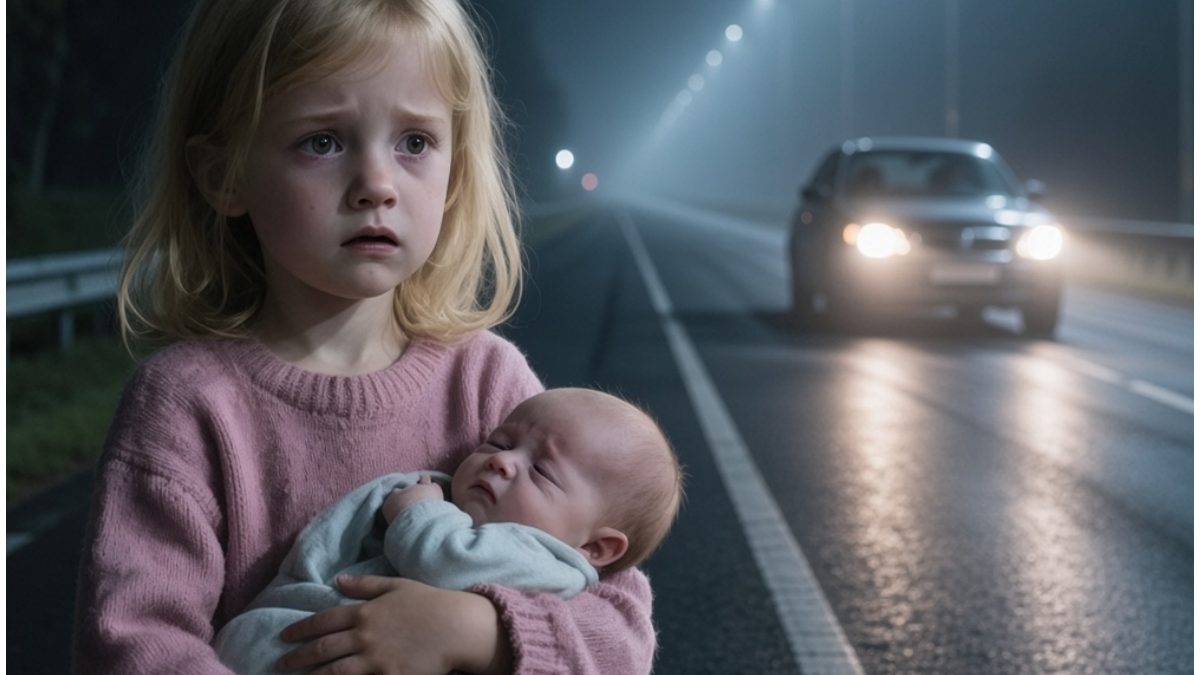
At 3:00 a.m. on a snow-lined highway, a lonely man’s headlights cut through the silence and revealed something no one should ever see.
A little girl in a torn pink coat, no shoes, clutching a baby in her arms, walking alone.
He rolled down his window and asked gently, “Where’s your mom?” She blinked, trembling, and what she said next made him freeze in shock.
The cupcake was still perfectly intact. A small swirl of blue frosting sat atop it, slightly smudged from the drive, but otherwise untouched, like it had been placed there for someone else.
It sat on the leather passenger seat of Miles Grant’s black Range Rover, a single candle still stuck in the center.
30 minutes earlier, his assistant had dropped it off with a chipper, “Happy birthday, sir.”
Before promptly retreating from his silence. Now, as the car glided down a snow-lined highway at 3:04 a.m., the cupcake glowed under the dashboard light, unclaimed, unblown.
Miles didn’t want to go home. The mansion perched on the icy ridge above the Hudson River waited in hollow silence.
Every room there was a reminder of who wasn’t. It had been 5 years since Grace died.
Five birthdays without her laugh, without her tiny hands clapping over candles, without her favorite song sung off-key.
The Range Rover hummed quietly, gliding through the dark like a capsule trying to outrun memory.
Then he saw them. Two shapes in the road ahead, small, moving strangely. His foot hit the brake before his mind even caught up.
The Range Rover shuddered as it slowed. Headlights pierced the snow haze. It wasn’t deer or a dog.
His gut told him even before the shadows sharpened. One was a child, the other a baby.
He threw the gear into park, heart pounding, and stepped out into the wind. The cold slapped him across the face, but it wasn’t the weather that made him freeze.
It was the little girl’s coat, torn at the sleeves, pink with faded white hearts.
God. Grace had one just like it. The memory hit like a sucker punch to the chest, staggering.
The girl couldn’t have been older than six. She stood in the center of the road, arms wrapped tightly around a baby boy bundled in a threadbare blanket.
Her dark hair clung to her cheeks. Her boots were mismatched, and her cheeks were raw from the cold.
But she didn’t cry. She just stared up at him with wide, steady eyes. Miles swallowed, taking a cautious step closer.
“Are you Are you all right?” The girl didn’t flinch. Her voice, when it came, was clear and small.
“Mommy said to walk until I find the lights.” She said softly. “Then she went to sleep.”
Miles blinked, snowflakes caught in his lashes. He looked down, and that’s when he saw it.
Her hands trembling from the cold, in one she clutched the blanket wrapped around the baby.
In the other, a crumpled piece of paper drawn in crayons, a house, four walls, a red door, and a single stick figure standing alone in a bright yellow window.
She held it up to him without a word, and Miles Grant, billionaire CEO, master of mergers, owner of half the skyline, felt something inside him crack.
He knelt slowly in the snow, hands open. “What’s your name, sweetheart?” “Lila.” She whispered.
“And him?” “This is Ollie.” She said. “He’s my baby brother.” Miles looked over his shoulder.
Not a car in sight. Just snow and darkness stretching for miles. “Can I help you?”
He asked, voice softer than he thought he had in him. Lila nodded once. “Mommy said someone would.”
She took a slow, shivering step toward him, then another, and carefully handed him the drawing.
The wind tugged at it as he took it, careful not to tear the thin paper.
The stick figure in the window looked too small, too sad. He rose to his feet, tucking the picture inside his coat, and reached down.
“Come on.” He said gently. “Let’s get you both warm.” She didn’t hesitate. She just adjusted the baby in her arms and placed her tiny hand in his.
As they walked toward the Range Rover, her bare fingers curled around his own, cold and trusting.
And for the first time in years, Miles Grant forgot about the cupcake still melting beside him.
He only thought of how small her hand felt, and how much like Grace’s it had been.
The inside of the Range Rover had never known this kind of stillness. Not the executive kind, but the fragile kind.
Miles turned the heat up to full blast, but it did little to undo what the cold had already taken from the children.
Lila sat beside him, stiff and quiet. Her pink coat clinging to her arms like a paper wrapping, and Ollie, no more than 18 months old, was curled in her lap, unmoving.
His skin was clammy and pale. The baby’s lips had a bluish tint, and even with the heater blasting, his tiny body shook in waves.
Miles unfastened his navy overcoat, the lining still warm from his body, and reached across to drape it over them both.
His hands trembled. Not from the cold, but from something older, deeper. The last time he’d tried to tuck in a child was the day before Grace got sick.
The way his fingers hovered now, cautious and unsteady, made him feel suddenly incompetent, unfit to even help them warm up.
Still, he gently wrapped the heavy wool around their shivering forms until Lila disappeared beneath it entirely, a tuft of her dark hair peeking out.
“You okay?” He asked softly. “I think Ollie’s asleep.” She whispered, though her eyes never moved from the dashboard.
Her voice was flat, practiced. Miles watched her through the corner of his eye, trying not to overwhelm her with attention.
She sat straight-backed, arms protectively looped around her brother, her own shoulders twitching occasionally from the chill.
Miles reached for the center console and turned the seat warmers up to the highest setting.
“This car’s bigger than our old room.” She said suddenly. He looked over. “It is?”
She nodded. “Our room was behind the gas station. Mommy said it was just until her friend called back, but the friend never called back.”
Outside, snow lashed sideways across the windshield. The headlights made long cones of light across the otherwise black highway.
Miles leaned forward and punched a new destination into the GPS, the nearest emergency hospital.
But then Lila moved. Her small, dirt-streaked finger reached up to the window, where the frost had crept across the glass again.
She wiped away a foggy circle and began to draw in it. A jagged line, a boxy shape, a pointed roof, a sun with long yellow rays.
Well, he assumed it was yellow. It had to be. She tilted her head and said, “Do you live in a castle, mister?”
Miles didn’t answer right away. He stared at the shape she had drawn, the way she added tiny stick windows and a large door with round knobs.
Her hand left trails in the condensation, but she didn’t seem to care about the smudges.
The gesture was innocent, bold, and completely untouched by fear. He swallowed hard. “Something like that.”
“You don’t talk like the people at the shelter.” She added. “Your voice sounds like the radio, and you don’t smell like wet socks.”
He let out a quiet breath, half laugh, half ache, and kept his eyes on the road.
“Thanks, I guess.” Ollie stirred beneath the coat and let out a soft whimper. Lila rocked him slightly, hushing him like a second nature response.
She was 6 years old, maybe, and she moved like someone who had already learned what it meant to be a mother.
“What’s your mommy’s name?” He asked gently. “Rachel.” She said. “Rachel Monroe. She works She used to work at a place with mirrors and teeth.”
Then, after a moment, “A dentiSt.” Miles nodded. “And she told you to walk toward the lights?”
Lila nodded once. “She said someone would help me. That someone would see us. He pressed his lips together, jaw clenching.
If he had been 5 minutes later, 10, it didn’t bear thinking about. When they arrived at the old rest stop off Route 9, it was a half-dead shell of what used to be.
One flickering light buzzed above the concrete overhang. A closed vending machine reflected the SUV’s headlights, warped with froSt. “Wait here,” he said.
But Layla’s hand clutched his jacket. “Is she still there?” She asked. “I didn’t mean to leave her.
She was breathing when I left.” His breath caught. “She told me not to wait.
She said, ‘Walk. You’re brave. Just go.’ So I went, but only cuz Ollie was crying.”
“You did the right thing,” Miles said, his voice rougher than he expected. “You saved your brother.”
He left the heater on, the lock set, and jogged into the cold. The women’s restroom door was ajar.
He pushed it open with a slow, steady hand, not knowing what he feared more, finding a lifeless body, or the haunting echo of a child’s voice that had done what most adults couldn’t, kept moving in the face of despair.
She was there. Rachel Monroe lay slumped on the dirty tiled floor, her back against the stall wall.
An empty bottle of pills was near her outstretched hand. Her lips were pale, her eyes half-lidded.
The rising and falling of her chest was shallow, but there. “Jesus,” Miles breathed, crouching down.
He dialed 911, speaking fast, giving them the coordinates, the highway exit. Then, gently, he reached down and supported her head, careful not to jostle her neck.
His navy suit soaked up cold from the tile as he knelt beside her. She looked too young, too thin.
He hadn’t expected that. When the paramedics arrived minutes later, the world was all flashing red and blue lights again.
They loaded her up. Someone asked if he was family. “No,” he said. “But, uh, she’s not alone.”
He returned to the SUV. Layla was still awake. Ollie slept soundly, curled beneath the wool.
“Is she okay?” Layla asked, voice tiny. “She’s going to the hospital,” he said. “They’re going to help her.”
Layla was quiet. Then, “Are they going to take us away again?” Miles hesitated. “Not if I have anything to say about it.”
She looked at him, really looked, and for a second something behind her eyes softened.
A flicker of truSt. And as the paramedics pulled away and the snow started falling harder around them, Miles realized something he hadn’t expected.
He didn’t want to let them go. Not yet. Maybe not ever. The hospital smelled like bleach and old fears.
Even before the doors slid open, Miles felt his throat tighten the way it always did in medical buildings.
Five years hadn’t dulled it. Five years hadn’t changed the way fluorescent lights seemed too bright, too sterile, too similar to the hallway where he’d watched the life drain out of Grace’s small body.
Now, as he stepped into St. Helena Medical Center with Layla by his side and baby Ollie cradled in his arms, that old memory pressed against him like a bruise someone kept touching.
Layla walked beside him silently, her thin fingers gripping the hem of his coat like it was a lifeline.
She didn’t look around. She didn’t flinch at the gurneys or the echoing announcements. She just stared straight ahead, small chin lifted, eyes dark and alert, too alert for a child.
A nurse approached quickly. “Sir, the paramedics radioed ahead. The woman was brought to trauma bay three.
Are you her “No,” Miles interrupted gently. “I’m I found the children.” The nurse nodded, softening when she noticed the baby.
“We’ll get you into a warm room. He needs to be checked for hypothermia.” As they were led into a pediatric exam room, Miles noticed the way Layla’s shoulders curled inward.
It wasn’t fear of hospitals. It was the fear of being separated, abandoned, again. “It’s okay,” he murmured, lowering himself to kneel beside her.
“They’re just going to make sure Ollie is safe.” She lifted her chin stubbornly. “I want to stay with him.”
“You can,” he promised. Two nurses examined Ollie while Layla stood at the foot of the bed like a guardian, eyes tracking every movement.
The boy cried once, just once, and she immediately reached up to stroke his hair, whispering something small and soothing.
Her voice was steady, but her fingers trembled. Miles realized then what kind of child she was, one who had learned to be brave because she’d never been given permission to be small.
After Ollie was stabilized, wrapped in warm blankets, and connected to a little oxygen tube, a social worker entered the room with a clipboard pressed tight to her cheSt. Karen Doyle, late 40s, sharp eyes softened by experience.
“Mr. Grant, I’m with Child Protective Services. I need to ask the children a few questions.”
Layla immediately slid behind Miles’s leg. Karen offered a gentle smile. “Hi there, sweetheart. You must be Layla.”
Layla buried her face in Miles’s coat. Karen blinked, surprised. “She trusts you.” Miles cleared his throat, unsure how to respond.
“I just found them on Highway 9. They They were walking alone.” Karen’s expression dimmed.
“We’ve received multiple alerts over the past month about families sleeping near that rest stop.
Economic displacement cases have tripled this winter. Their mother, Rachel Monroe, was evicted 6 weeks ago.”
Layla peeked out. “Mommy said we were just between places.” The words shattered something inside Miles.
He had been in boardrooms discussing revenue forecasts while a 6-year-old and her toddler brother slept behind a gas station wall.
Karen crouched down. “Layla, sweetie, does your mommy talk to people when she’s sad?” Layla shook her head.
“No, she gets quiet, like him.” She pointed to Miles. “But Mommy cries when she thinks we’re asleep.”
Karen took a quiet breath. “I see.” A doctor stepped into the doorway calling Karen away.
“We need CPS approval for temporary guardianship placement.” Miles felt Layla stiffen beside him. “Placement?”
Layla whispered. “Is that the shelter again?” Miles’s jaw tightened. “Hold on,” he said to Karen, following her out into the hallway.
“You’re not taking them to one of those emergency facilities.” “That’s procedure,” Karen replied. “Until their mother regains consciousness and we assess her mental state, they need They need stability,” he cut in.
“Heat, food, someone they recognize.” Karen studied him carefully. “Where would you take them, Mr. Grant?”
“My home.” She blinked, unprepared for the answer. “Your mansion? Sir, this is not as simple as offering a ride.
You’re a stranger.” “Not to them.” He glanced back at the room, at the little girl clutching the drawing she had made.
“Not anymore.” Karen hesitated. Her training told her to refuse. Her instinct told her to reconsider.
Finally, she said, “We’ll evaluate the possibility. No promises.” But when they returned to the room, something unexpected happened.
Layla was sitting on the exam table swinging her legs. In her lap was a fresh sheet of paper the nurse had given her.
She had drawn again. A big square house, four stick figures, a tall man, a small girl, a baby, and a woman with long hair.
But high in the corner, in the window of the castle, stood a single figure, drawn apart from the others.
The window was colored gray where the others were yellow. Layla held it up to Miles.
“This is our home,” she said softly. Then she pointed to the separated figure. “That man, is he sad, too?”
The breath left his lungs. He didn’t ask which man she meant. He didn’t need to.
His driver, who had arrived with fresh coats and blankets, cleared his throat. “Sir, given the weather, maybe it’s best if the children stay somewhere stable tonight.
Karen watched him closely. Mr. Grant, if you’re serious about temporary placement, I can authorize a supervised release, but you will be held responsible for their welfare until the hearing.
Miles nodded. I understand. Lila climbed down from the table and walked toward him. She didn’t ask permission.
She just slipped her tiny hand inside his. He felt it. Small, cold, trusting. As he led them out of the hospital and into the hush of falling snow, he realized this wasn’t a moment he could walk away from.
Something had shifted permanently between the crayon drawing, the trembling hand, and the way she looked at him like he might be the first safe thing she’d seen in days.
They reached the parking lot. The Range Rover waited under a street lamp, golden light reflecting on its black surface.
As they approached, Lila squeezed his hand gently. Not to get his attention, but to say she wasn’t afraid anymore.
And for the first time in 5 years, neither was he. The mansion felt foreign the moment Miles unlocked the door.
Not because anything had changed. If anything, it was because everything was the same. The quiet thump of his polished shoes on the marble floors, the echo of his breath in the foyer, the cold stillness of untouched furniture.
All of it had always been there. But tonight, the silence didn’t feel empty. It felt expectant.
He stood in the doorway as Lila and Ollie stepped inside. Lila hesitated. She looked up at the chandelier, at the gleaming banister, at the oil painting above the fireplace.
Her expression didn’t shift. She wasn’t dazzled. She was measuring it, trying to decide if this place could ever feel like anything but temporary.
“Can we take our shoes off?” She asked. Miles blinked. “Yes, of course.” She did, one boot then the other.
Her socks were mismatched and thin, damp from melted snow. Ollie whimpered in her arMs. “This way.”
Miles said quietly, leading them through the house to the living room. A fire had already been lit.
His housekeeper must have come by earlier. The flames flickered inside the stone hearth, casting warm golden light across the dark hardwood.
Lila moved closer to it without needing instruction, settling down on the thick rug and unwrapping Ollie from his bundle.
Miles hovered for a moment before ducking into the kitchen. He didn’t cook, never had, but he found a container of mashed potatoes in the fridge, probably left behind from his assistant’s last desperate attempt to stock the place.
He warmed them up and returned with two small bowls and a silver spoon. He handed one to Lila.
“Here. It’s not much, but” Before he could finish, she was feeding Ollie in small, practiced motions, blowing on each bite firSt. The baby, though groggy, opened his mouth eagerly and let out a satisfied grunt.
Miles lowered himself onto the sofa, not sitting, perching. After a few minutes, Lila looked up at him.
“Do rich people always eat like this?” He almost smiled. “Not usually.” She nodded thoughtful, then pointed at the large armchair near the fire.
“That’s the king chair.” Miles tilted his head. “Oh, yeah?” “Yeah.” She said seriously. “It’s big and no one else sits in it.
That’s how you know it’s the king chair.” Miles stared at the chair. He hadn’t sat in it since Grace died.
She used to crawl into it with him on Sunday mornings, curled against his side, demanding he read stories she already knew by heart.
“Do you want to pick a book?” He asked suddenly. Lila blinked. “Now?” “Sure. We can make a fire night story.”
Her expression shifted, not quite a smile, but softer around the edges. She stood, brushed off her leggings, and wandered to the built-in bookshelf that lined the opposite wall.
Her fingers ran over the spines until she pulled out a worn hardback. Goodnight Moon.
“This one.” She said. Miles swallowed. “Okay.” He took the book and sat in the king chair.
Lila hesitated only briefly before climbing into the seat beside him, the way Grace used to, folding herself into a small space.
Ollie, fed and drowsy, was wrapped in a blanket at her side. Miles opened the cover.
His voice was steady at first, but as he read the familiar lines, the quiet rhythms of good nights and room descriptions, his throat began to tighten.
It had been years since he’d read aloud like this. He hadn’t realized how much he missed the sound of a child’s breathing syncing with his own, the way little hands rested against your chest, like they trusted your voice more than the words.
When he turned the last page, Lila looked up at him and said, “You sound like a dad when you read.”
His breath caught. She didn’t mean it to hurt. There was no manipulation, no awareness of the weight of the sentence.
She just said it, a fact, as casually as she would have said the fire was warm.
Miles didn’t answer. He turned his head toward the flames, blinking hard. The wall inside him, once high and impenetrable, had cracked the night he found her.
But now, it’s shattered. Her words had slid through a hidden seam and exploded everything he’d been holding back.
He stood abruptly. “Excuse me, just a moment.” She watched him leave without a word.
He made it to the hallway and leaned against the wall, pressing the heel of his hand to his cheSt. He hadn’t cried in 5 years.
He didn’t even know if he could anymore. But tonight, his shoulders shook in the silence.
Breath shallow and ragged as the memories poured in. Grace’s laugh, her sticky hands, her favorite yellow dress, the hospital, the beeping that never stopped, the cold stillness of her hand when he finally let go.
“You sound like a dad when you read.” He wiped his eyes before returning to the living room.
Lila was already curled against a throw pillow, Ollie asleep against her shoulder. She looked up sleepily.
“Is it okay if we sleep here?” She asked. Miles nodded. “Of course.” He brought down a folded blanket and draped it over both of them, careful not to disturb Ollie’s breathing.
Then he stood there for a long while, watching the way the firelight touched her hair, the curve of her cheek, the protective arc of her arm around her brother.
He had rooms, wings, guest quarters, but they’d chosen the floor near the fire. And maybe that was the first time the house had felt warm in years.
Later that night, after he was sure they were asleep, he walked to the other side of the mansion, to a door he hadn’t opened in half a decade.
Grace’s room. He hesitated only once, then pushed it open. The air was still, faintly sweet with forgotten perfume.
The bed untouched, the books untouched. A soft plush dinosaur sat on the windowsill, dust dulling its once bright eyes.
Miles stepped inside, crossing the threshold of memory, and lowered himself onto the edge of the bed.
He didn’t speak, didn’t move. He just sat there in the quiet, listening to the sound of two children breathing in the distance.
And for the first time in years, he didn’t feel alone. The next morning, the sun filtered through frost-laced windows, turning the marble floors of the mansion into a quiet mosaic of gold and white.
Miles stood in the kitchen in a crisp white shirt, sleeves rolled halfway up, stirring hot cocoa with far more focus than the task required.
He wasn’t a man who cooked or poured or stirred, at least not until a 6-year-old girl with tangled hair and brave eyes curled up in front of his fireplace.
He watched the cocoa swirl and thought about how the mansion used to echo with only footsteps and silence.
Now it carried the soft sounds of Ollie babbling from the living room and Lila humming something faint under her breath, some melody no one had taught her, Probably made up.
But honest and light. He brought two mugs to the den. One smaller, filled only halfway.
Lila looked up from the rug where she was building something with a scattered pile of colored pencils and coasters.
Ollie was beside her, contentedly chewing on a blanket corner. “You hungry?” Miles asked. “We already had toaSt.”
“That fancy bread in your kitchen?” “It’s sweet.” She accepted the mug like it was sacred.
“Brioche,” he said, sitting across from her. “Bless you.” She replied seriously. He laughed quietly.
She sipped the cocoa like it was a magic potion. “Want to see what I made?”
She asked after a few minutes, reaching for a folded piece of paper from the coffee table.
“It’s our house.” She held it up. It was a drawing, childlike and wobbly, but detailed.
A yellow sun beamed from the corner, and under it was a square house with four people out front.
Herself, Ollie, Miles, and Rachel. But something in his chest tightened when he saw the figure she’d drawn as him, tall, wearing a suit, and smiling with red cheeks.
“You gave me red cheeks?” He asked, tilting his head. “You laugh more now.” She said with a shrug.
“When people laugh, their face gets red.” He stared at the drawing longer than he should have.
“Can I keep this?” She looked surprised. “Sure.” “I have a lot more.” He stood and walked to his study, leaving her with Ollie.
The drawing in his hand trembled slightly. Inside the study, he paused before an old file cabinet, reached for the bottom drawer, a drawer he hadn’t touched in 5 years, and pulled it open.
Among the files and photos, tucked in the back, was one of Grace’s last drawings.
He lifted it out gently. The paper was yellowed at the edges, the crayon lines faded but unmistakable.
A house, a sun, four people, except one of them was smaller, a baby Grace had insisted would be her little brother someday.
He placed the two drawings side by side on the desk. Both had yellow suns, but Grace’s was more chaotic, bright lines bursting in every direction.
Lila’s was neater, focused, but the spirit was identical. His throat tightened. He leaned against the edge of the desk and let himself breathe slowly through it.
Outside, he heard a laugh, a real one. He moved to the window and saw her, Lila, lying in the snow, arms and legs flapping back and forth, her giggles echoing off the cold stone walls of the estate.
She was making a snow angel, her hair fanned out on the white surface. He couldn’t explain what happened next.
Maybe it was impulse. Maybe it was memory. Maybe it was the sheer absurdity of everything that had led to this moment.
But before he knew it, he was outside, in his dress pants, in his white shirt, in the snow.
“Come on, mister!” She called. He didn’t hesitate. He laid down beside her, cold rushing through the fabric of his shirt, and started to move his arMs. Lila shrieked with joy.
“You’re going to ruin your fancy clothes!” “I’ve got more,” he said, staring up at the sky.
She giggled, turning her head toward him. “Yours looks like a giant angel, like a protector angel.”
He looked at her, startled by the wording. “Maybe I’m not the angel,” he said softly.
“Maybe you are.” They lay in silence for a moment, side by side in the snow, their arms outstretched.
The sky above was a pale blue, thin sunlight slipping through like forgiveness. Later that afternoon, while Ollie napped upstairs in one of the guest rooms Miles had reluctantly converted into a nursery, Lila wandered into the room he hadn’t expected her to find.
Grace’s room. He’d left it open, on purpose. She didn’t touch anything, just stood in the center and looked around.
The pale blue walls, the white bookshelf, the stuffed animals lined in a row like sleepy soldiers.
“Was this your daughter’s room?” She asked gently. He stepped into the doorway. “Yes.” “What was her name?”
“Grace.” She turned, her face unreadable. “Do you miss her?” “Every day.” Lila didn’t offer sympathy.
She didn’t need to. She simply walked over to one of the books on the shelf and pulled it down.
“Where the Wild Things Are.” “Can I read it to you?” She asked. Miles smiled just a little.
“Yeah.” “I’d like that.” They sat on the floor together, Lila holding the book open on her lap, sounding out the words slowly.
He listened, not correcting, just letting her voice fill the space. When she finished, she closed the book and looked up at him.
“Do you think your Grace and my mommy would have been friends?” Miles felt something swell in his cheSt. Grief and hope tangled so tightly they were indistinguishable.
“I think Grace would have liked you a lot,” he said. “She had a good eye for kind people.”
That night, after Lila and Ollie had gone to sleep again near the fireplace, Miles returned to his study and carefully placed the two drawings, Grace’s and Lila’s, into a new frame, side by side.
Two yellow suns, two moments in time, two girls who had changed him. He hung the frame above the mantel where the silence had once lived.
Then the phone rang. It was the hospital. Rachel Monroe was awake, and she was asking for her children.
The hospital walls seemed closer this time, narrower, more judgmental. Miles hadn’t planned to come alone, but something told him this moment wasn’t meant to be witnessed by social workers or lawyers.
It had to be face-to-face, real, human. Room 418 was at the end of a quiet wing, its door half open, pale morning light leaking across the linoleum.
A soft beeping pulsed from inside, slow and steady like a mechanical heartbeat. Miles paused at the threshold, exhaling into his fist before he knocked gently and stepped inside.
Rachel Monroe sat upright in bed, an oxygen tube looped beneath her nose. Her face was gaunt but alert, her brown hair pulled back into a low ponytail.
She looked small beneath the hospital blanket, like someone recently returned from a storm they weren’t supposed to survive.
Her eyes flicked up when he entered, and immediately narrowed. “You,” she said. Her voice was dry, cracked from dehydration and grief.
“I know you.” Miles stepped forward, his navy coat still dusted with faint snow from the walk in.
“We’ve never met, but I found your children.” Rachel’s breath hitched. “Where are they?” “They’re safe at my home for now.”
Her back stiffened. “Your home?” “What the hell does that mean?” “You took them?” “No,” Miles said softly, resisting the urge to step closer.
“I stayed with them until someone could.” She looked at him, jaw clenched. “So what, you’re some savior?”
“You just happened to be out at 3:00 in the morning and decided to collect broken families?”
“No,” he said again. “I was just a man on a dark road who saw a little girl carrying her baby brother and stopped.”
“That’s it.” Rachel’s face folded, pain, fear, and shame mixing into a single expression that made her seem impossibly young.
“They’re really okay?” She asked, eyes shimmering. Miles nodded. “Lila’s strong. She kept Ollie warm.
She kept walking.” Rachel covered her face with her hands. “She shouldn’t have had to.”
“No,” he agreed. “She shouldn’t.” A long silence settled between them, the kind that follows wreckage, the kind that knows there’s no perfect way to rebuild.
When she finally lowered her hands, her expression had changed, vulnerable, defensive. “You’re rich,” she said.
“You could give them anything. You probably already have. Toys, warm beds, real food. I don’t have any of that.
I don’t even have a home. What if they want to stay with you?” “They don’t want a mansion,” Miles said.
“They want their mother.” She didn’t believe him. He saw it in the way her eyes slid away.
He reached into his coat pocket and pulled out the photo, creased and worn from the years he’d kept it hidden.
He held it out. Rachel stared at it. A little girl with pigtails and a bright yellow dress grinned back at her, standing in a patch of sunflowers.
A woman, her mother, maybe, stood behind her, half out of frame. But the girl was what mattered.
Her joy frozen in time. “This is Grace,” he said. “My daughter.” Rachel’s lips parted, but no sound came out.
“She died 5 years ago. Respiratory failure, sudden, no warning. I went to work that morning and came home to silence.”
He took a breath, his voice tightening. “I’ve lived in a house that hasn’t heard a child’s laughter in half a decade.
I know what silence does to a person.” Rachel’s eyes were glassy now, her breathing shallow.
“I don’t want to take your children, Rachel. I want you to get well. I want them to come home to you, because they need you.
Lila doesn’t want a savior. She wants her mom.” Rachel pressed the heel of her hand to her forehead, like she could push back the tears.
“I thought I was doing the right thing. I thought if I died, they’d be rescued.
I didn’t think they’d make it alone.” “But you didn’t leave them,” Miles said. “You told Lila to walk toward the lights.
You told her someone would help. That’s not giving up. That’s a kind of hope most people never find.”
She stared at him, stunned. For a long moment, she just looked at the photo.
“Grace was beautiful,” she whispered. “She was,” Miles replied. “So is Lila. So is Ollie.”
There was a knock on the door, and Karen Doyle peeked in. “Sorry to interrupt,” she said.
“Rachel, I have some paperwork for you to sign, and we need to talk about the custody hearing.”
Rachel’s eyes widened. “Hearing?” Karen nodded gently. “The state will schedule one. We have to review your condition, your housing status, stability, everything.”
“I don’t have anything,” Rachel said, voice cracking. “I don’t have a job. I don’t have a place.
They’re going to take them from me, aren’t they?” Miles stepped forward. “No, not if we fight.”
Rachel looked up. “We?” “I’ll help you,” he said. “You don’t have to do this alone.”
Karen looked between them, clearly surprised. Rachel shook her head. “Why would you do that for me?”
Miles didn’t hesitate. “Because you did what you could to protect your children, even when you were drowning.
And because no one fought for me when I lost mine.” She stared at him, broken open, unsure whether to believe.
He reached into his pocket again, this time pulling out a folded sheet of paper, Lila’s drawing, the yellow sun, the house, the four figures.
“I promised her you’d come back,” he said. “Help me keep that promise.” Rachel finally nodded, once, barely more than a breath.
Later, as Miles walked back through the hospital’s corridors, he passed Karen again in the waiting area.
“You really mean to help her?” She asked. “I do.” “Even if it’s messy? Even if the court fights it?”
Miles paused. “I’m not doing this because it’s clean. I’m doing it because someone has to.”
Karen nodded, thoughtful. “Oh,” she added. “We contacted the children’s father this morning. Trevor Monroe.
No response yet, but we’ll keep trying.” Miles’s jaw clenched. “Keep me updated.” When he stepped back into the winter air, he drew a slow breath and looked toward the clouds.
A storm was coming. Legal, emotional, bureaucratic. But Rachel was awake, and for the first time, so was he.
Six weeks after the night on Highway 9, Rachel stepped into something she hadn’t had in a long time.
A place that was hers, even if the lease technically sat in the nonprofit’s name.
The apartment was modest, an old two-bedroom on the second floor of a brownstone, tucked between a laundromat and a corner deli.
But it was clean, warm, and safe. Rachel stood in the middle of the living room with a mixture of awe and disbelief etched into her face.
The windows let in soft morning light, and although the paint on the walls was chipped, it was the kind of place where new beginnings felt possible.
Miles stood beside her, a cardboard box of kitchen basics in his arMs. Lila and Ollie were already exploring, their laughter echoing down the hallway like music in an old cathedral.
The moment felt fragile, suspended, like it might vanish if anyone breathed too loudly. “This place is more than I expected,” Rachel said, setting her bag down near the couch.
“I don’t know how to thank you.” “You don’t need to,” Miles said, placing the box on the counter.
“The nonprofit handled most of it. I just made a few calls.” Rachel smiled faintly.
“You’re very good at making calls, Mr. Grant.” He smirked. “Decent at folding baby clothes, too, now.
Want proof?” She raised an eyebrow. “I’d love to see that.” A half hour later, they stood in the second bedroom, now freshly emptied and designated for Lila and Ollie.
The walls were blank, beige, and unremarkable. A small twin mattress sat in one corner, and a crib stood by the window, already assembled.
Lila walked in, holding a small box of crayons and a look of fierce determination.
“Can we paint the walls yellow?” She asked, looking between them. Rachel blinked. “Yellow?” “Like the sun,” Lila said.
“Like the drawings.” Miles crouched beside her. “Well, painting might take a little time, but what if we started with posters, or maybe some temporary paint?”
Lila tilted her head. “Will it come off? If we mess it up?” “Probably not,” Miles admitted.
“Then let’s mess it up,” Lila said without hesitation, a grin creeping across her face.
Two hours later, the three of them, Miles, Rachel, and Lila, were covered in streaks of pastel yellow.
The cheap rollers had left uneven swaths across the walls, and Ollie had managed to get a perfect palm print right above the light switch.
Rachel sat back on her heels, laughing. “You’ve got a stripe of yellow across your cheek,” she said, pointing at Miles.
He wiped at it, but missed completely. “Better?” “Nope. Worse.” She giggled. He looked down at himself, his once-white shirt now splattered with color, his slacks wrinkled, one sock missing.
Rachel shook her head, grinning. “Billionaire CEO can buy a helicopter, but can’t keep paint off his nose.”
“It’s a good look for me,” he said. Lila stood proudly in front of the wall, arms crossed.
“This is going to be my sunshine wall.” “Shh, it’s beautiful,” Rachel whispered. Later that afternoon, as Ollie napped in the crib and Lila sat on the living room floor coloring, Rachel handed Miles a small, folded bundle, his sport coat, freshly washed.
“I found the receipt in the pocket,” she said, eyes soft. “That coat probably costs more than this entire apartment.”
He took it, but didn’t answer right away. “I don’t care about the coat.” “I know,” she said.
Then, after a moment, “But you should know, I care about what you’ve done for us.”
Miles nodded. “You’re doing the work now. I’m just showing up.” Rachel hesitated. “That means more than you think.”
A knock interrupted them. Miles opened the door to find a man in his late 30s, tall, clean-cut, clearly uncomfortable in his own skin.
“Mr. Grant?” The man asked. “I’m Trevor. Trevor Monroe.” Rachel froze. Trevor looked past Miles and saw her.
“Hi, Rachel.” “What are you doing here?” She asked, her voice tight. “I got the call.
About the custody hearing. About Lila and Ollie. I I came to see if I could help.”
Rachel’s arms folded defensively. “After all this time?” “I know,” he said quickly. “I messed up.
I walked away when I shouldn’t have. But I’m here now. And I don’t want to fight.
I just want what’s best for them. Miles studied him for a moment. Would you be willing to sign away parental rights?
Trevor blinked, stunned. I What? I’m not trying to be cruel, Miles continued, voice calm.
But if this goes to court, the state will look at everything. And your absence, it won’t work in your favor.
Trevor shifted uncomfortably. I want to do something right. Even if it’s small. Even if it’s just not making things harder.
Rachel looked at him, unreadable. Then slowly, after a long silence, she nodded. Then do that, she said.
Don’t make it harder. Trevor’s shoulders sagged. Okay. I’ll do whatever you need. He left without asking to see the kids.
Just a quiet goodbye. And a glance that lingered on Layla’s drawings pinned to the hallway wall.
The next day, the hearing notice arrived. Rachel would have to stand before a judge and prove she was stable, capable, safe.
Miles stood by the window of his home office, holding the letter in his hand, watching the snow melt off the garden path below.
The fire crackled behind him. He would testify. He would speak for her. For Layla.
For Ollie. For Grace. He would walk into that courtroom and help make sure they stayed together.
Because some families aren’t broken. They’re just waiting to be rebuilt. Four weeks later, on a pale winter morning, Rachel stood in a small downtown courtroom with her palms slick with nerves.
The judge’s wooden bench looming larger than it really was. A soft winter light filtered in through the frosted windows, illuminating the faces of everyone in the room.
Behind her sat Karen Doyle, her case worker. And next to her, Miles. He was calm, composed, wearing his usual navy suit and white shirt, freshly pressed.
But there was a softness to his expression today. No mask. No corporate detachment. Just quiet gravity.
Rachel clenched her hands, taking a deep breath. She hadn’t slept much the night before.
Layla had curled into her side in their tiny apartment bed, whispering, “You got this, Mommy.”
Before dozing off. Those words repeated in her mind now like a heartbeat. The judge, a woman in her early 60s with clear eyes and a reputation for pragmatism, adjusted her glasses and looked down at the folder before her.
Miss Monroe, this hearing will determine whether conditional custody of your children may be reinstated with the intention of full reunification.
You’ve completed rehabilitation and therapy, and your housing situation has stabilized. Today we’ll hear testimony from your case worker and from a witness you’ve requested, Mr. Miles Grant.
Miles stood, buttoned his jacket, and approached the stand. The room quieted. He took the oath, then sat down.
His voice steady when he began. My name is Miles Grant. I’m the CEO of Grant Technologies.
But I’m not here as a businessman. I’m here as a witness to what love looks like when it’s put through fire and survives.
He looked directly at the judge. On a winter night, I found Rachel’s daughter walking alone on a highway, carrying her baby brother.
I stopped. Not because I’m noble, but because I saw something that cracked me open.
I lost my own daughter, Grace, 5 years ago. Her birthday was the night I found Layla.
The judge’s eyebrows lifted. Miles continued, his voice tightening just slightly. I’ve spent years building companies, closing deals, buying houses I never filled.
But nothing nothing humbled me more than watching a 6-year-old girl draw warmth out of the cold.
She said her mother told her to walk toward the lights, and she did. That little girl had every reason to give up, but she didn’t.
And that strength, she didn’t invent it. She learned it. He paused. The silence was heavy.
She learned it from the woman sitting behind me. Rachel Monroe isn’t a bad mother.
She made mistakes. Yes. But she taught her daughter to find the light in the dark.
And in doing so, she led me out of my own darkness. The courtroom didn’t move.
The judge leaned back in her chair, fingers steepled beneath her chin. Thank you, Mr. Grant.
That was compelling. Rachel wiped her eyes, breath shallow. Karen was called next. She reviewed the details.
Rachel’s steady attendance in therapy. Her parenting classes. The safe apartment. The signed release of Trevor Monroe’s rights.
And her recent job offer at a nearby daycare center. All indicators show significant progress, your honor.
Karen said. And I believe the children are safest and most emotionally secure with their mother.
After a brief deliberation, the judge [clears throat] returned with her ruling. This court believes in second chances, she said.
And it also believes in proof. Miss Monroe, I am granting conditional reunification, effective immediately.
Full legal custody will be reviewed after a 6-month check-in. Continue your current course, and I see no reason why this family won’t remain together permanently.
Rachel gasped. Her knees nearly buckled. Karen squeezed her hand. Miles smiled gently. Outside the courthouse, the cold was sharp, but the sun had broken through the clouds.
Layla ran into Rachel’s arms the moment she appeared on the courthouse steps. “Are we going home now, Mommy?”
She asked. Rachel crouched, kissing her cheeks. “Yes, baby, we are.” Miles stood off to the side, watching, hands in his coat pockets.
Rachel approached him slowly. “I don’t know how to thank you.” She said quietly. He looked at her.
Then at Layla, who had already begun chasing pigeons down the sidewalk with Ollie bundled in her arMs. “You already did.”
He said. “You gave me back something I thought I’d buried forever.” That evening, the apartment bloomed with color and noise.
Balloons danced in the corner, and a simple cake sat on the table with six flickering candles.
It was Layla’s birthday. Rachel lit the candles and gestured. “Make a wish, baby.” Layla closed her eyes tight, hands clasped.
Then she blew them out in one big breath. “Did you wish for something good?”
Rachel asked. Layla grinned. “I wished for something we already have.” Everyone laughed softly. Ollie clapped.
Miles stepped back toward the window. The sky outside was a golden hue. The last light of the day casting long shadows.
He stared at the flame of a single spare candle still burning beside the cake.
Quietly to himself, he murmured, “Happy birthday, Grace.” He didn’t expect anyone to hear. But Layla was there, beside him.
She reached up, arms wide. “Pick me up.” She said. He lifted her gently, her small arms circling his neck.
“You found us.” She whispered into his ear. Miles swallowed hard. “No, sweetheart.” He whispered back.
“You found me.” He turned toward the window. The golden light streamed through, catching the edge of Layla’s hair as she leaned into him.
He lifted her higher, toward the light. And for the first time in years, Miles Grant felt the warmth of a future that wasn’t built on wealth or silence or regret.
It was built on a little girl’s courage and a second chance at family. If this story touched your heart, even just a little, we invite you to stay with us.
Because here at Restoring Tales, every story reminds us that love, kindness, and second chances still exiSt. There are more tales waiting.
Of resilience. Of hope. And of quiet heroes among us.








