“Marry Me,” Richest Cowboy Told a Poor Shopkeeper—Then Her Worthless Land Changed Everything
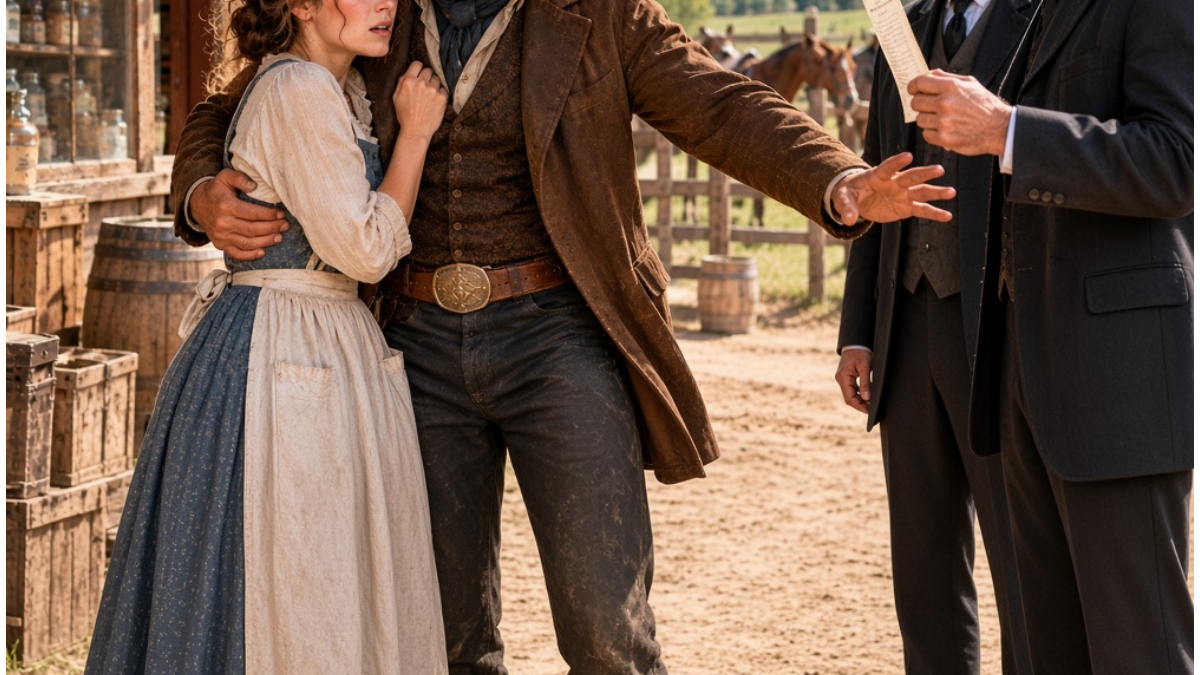
Two men in city suits appeared outside Ellsworth Merkantile on a Tuesday morning carrying measuring chains and a clipboard.
And they didn’t ask Cora Ellsworth’s permission before they started walking her rear property line like they already owned it.
She watched them from behind the front window with her hands pressed flat against the glass.
She knew exactly what they were doing. She knew who had sent them and she knew the notice folded in her apron pocket said she had 3 days.
3 days an Alton Cruz hired men were already dividing her father’s land with their eyes.
Then the bell above the door rang and the wealthiest cattle rancher in Montana territory walked into her store and asked her to marry him.
The notice had arrived on Monday. Cora read it three times before she allowed herself to accept that the numbers were real, $52.80 due to Alton Crews lending office by Friday at close of business, or the building and the lot beneath it would be transferred to satisfy the outstanding debt and all accumulated fees.
She folded it and put it in her apron pocket and went back to sweeping the front porch because sweeping was something she could control and the number in her pocket was not.
That was Monday. By Tuesday morning, the men with the measuring chains had arrived. She watched them from the front window for 7 minutes before she turned back to the shelf she’d been working and started stacking tins of coffee.
Because standing at the window wasn’t going to change what they were doing, and her hands needed to be doing something.
The tins made a small hollow sound each time she set one down. She counted them.
14 tins, $112 a tin at normal price. 70 if she moved them quick, which she would have to do because quick money was the only kind that had any use right now.
$52.80. 14 tins at 70 was $9.80. She needed 43 more. The bell above the door rang.
Ka didn’t turn immediately. She set down the 14th tin, stepped off the stool, and smoothed the front of her apron before she turned.
She had learned in the 11 months since her father died to compose herself before she faced the door.
The store needed her to look like a person in charge of things, so she always paused one beat, let her face settle, and then looked.
It was not anyone she expected. Thaddius Westbrook stood just inside the door with his hat held in both hands in front of him, which was the first thing she noticed because men like Thaad Westbrook did not generally hold their own hats.
They set them on whatever surface was closest and moved on to what they’d come for.
He held his Miss Ellsworth. His voice was lower than she remembered from his last visit 3 weeks prior when he’d come in for rope and lamp oil.
Mr. Westbrook. She moved behind the counter. What can I get for you today? He didn’t answer the question, which was its own kind of answer.
He looked at her in that particular quiet way of his, the way that felt less like study and more like patience.
And she recognized that whatever he had come in here to say, he’d been considering it for longer than this morning.
If you’re here about the store, she said, “I’m not interested in marry me.” She stopped.
The words landed with no decoration, no approach, no softening phrase before them. Two words said plainly from a man standing in the middle of her father’s store on a Tuesday morning while two hired men measured her rear lot outside.
Kora looked at him for a long moment. Then she reached into her apron pocket, unfolded the notice, and laid it flat on the counter between them.
“If this is what you’re buying,” she said. “The answer is no.” Thad looked at the notice.
Then he looked at her. I didn’t offer to pay it. That stopped her entirely.
She looked from the notice to his face, searching for the angle in it, the setup, the thing he expected her to miss.
She found nothing. He was serious in a way that had no performance attached to it.
Outside, through the front window, she could see one of Crew’s men crouching near the rear corner of the building with the measuring chain pulled tight.
The other one was writing on a clipboard. “Then why now?” She asked. Right now with that going on out there.
Dad turned his hat once in his hands, a slow rotation, because in 3 days you’ll know whether I want your store, he met her eyes, and I need you to know before then that I don’t.
He set his hat on the counter, not the careless placement of a man who expected someone to admire it, but slowly, like a man making the small choice to stay and waited.
Cora looked at the hat. She looked at him. Then she picked up her pencil and went back to the column of numbers she had been working since 5 that morning.
I need to think, she said, “And I need to get to $43.” Thad said nothing.
He picked up his hat and left. The bell above the door rang once, and then the store was quiet.
She did not watch him go. She was still working the numbers at 9 when a man knocked on the open doorframe and announced in a rehearsed voice that he was there on behalf of Alton Crews office to begin the transfer documentation process.
Cora looked up from the ledger. The deadline is Friday. Yes, ma’am. He had a folder under one arm and the particular posture of a man who delivered bad news often enough that it had stopped registering.
We like to get the paperwork organized before the deadline. Saves everyone confusion later. “The deadline is Friday,” Cora said again.
“Today is Tuesday. I have three days left by the terms of the written notice.”
“Yes, but show me the authorization.” He hesitated. It was a brief hesitation, half a second, but she caught it.
He opened the folder and removed a single document and placed it on the counter without meeting her eyes.
Kora read it the way her father had taught her to read any document, once for meaning, once for numbers, once for what it left out.
On the second pass, she found it. The debt instrument number on the authorization did not match the number on the original notice.
She set both papers on the counter side by side and read both numbers a third time.
These don’t match, she said. The man took the authorization back and looked at it.
Nothing changed in his face. It’s likely a clerical error. If it’s a clerical error, Kora said, then this document references a debt instrument that doesn’t exist in the record, which means it has no legal standing as written, which means you are not authorized to conduct any documentation process on or around this property until the error is corrected and reissued.
She held his gaze. He was older than her and bigger than her, and she was aware of both facts and chose to let them be irrelevant.
I’ll need to contact the office about this. You do that, she said. And while you’re doing it, you tell those two men outside to put that measuring chain away.
They have no authorization to be on my property today. He left. The measuring chain stayed where they were.
Cora took a slow breath, pulled a fresh page from the ledger, and wrote the two instrument numbers side by side with the date beside each.
Three digits transposed. She looked at the transposition for a moment. It might be careless copying from one clerk to another.
It might be something else. Either way, it needed to be in front of Owen Pritchard before noon.
She locked the store. Dad was already at the livery when she got there, horse saddled.
She didn’t ask how he’d heard. In a town the size of Willow Creek, a man who owned 41 employees and a thousand acres generally knew things.
“I’m going to the county records office,” she said. “I know. I didn’t invite you.”
“No, he had his reigns in one hand, but my horse covers the distance in 4 hours.
Yours takes six. It was an efficient argument and she resented its efficiency. You stay outside when I’m with Pritchard.
You don’t speak on my behalf. You don’t clarify anything. You don’t correct anything. Agreed.
And you don’t tell me what to do or how to ask for it. I wouldn’t know better than you what to ask for, he said.
And he said it without irony, which was the strangest part. She got on her horse, they rode.
Two hours passed in relative quiet. Thaad, she was learning, had no compulsion to fill silence.
Most men talked when they were nervous or trying to seem useful or simply because silence made them feel uncertain.
Thaad rode and watched the landscape and occasionally said something factual about the road condition or the weather and otherwise let the morning be what it was.
She didn’t know what to make of a man like that yet. Owen Pritchard found the original debt instrument in 11 minutes.
He was a fidious recordkeeper and proud of it, which under ordinary circumstances Kora found tedious and under present circumstances she found deeply reassuring.
He read the registered instrument number. He read the number from the authorization. He took off his glasses, set them on the desk, and rubbed the bridge of his nose.
“This is wrong,” he said. “I know the instrument on this authorization,” he pointed. This doesn’t correspond to anything registered to your property or your late father’s account.
Now, it may simply be a transcription error, a mistake when the office recopied or Kora said.
Pritchard looked at her. He was a careful man. He measured words. Or he said, “It was written incorrectly on purpose, which would mean the authorization references a debt that doesn’t exist in the county record, which means it has no legal standing as written.”
He nodded slowly. Which means seizure can’t proceed under this document. How long to get a corrected version issued?
If I flag the discrepancy today, 2 days minimum to process a reissuance. Possibly three.
3 days was Friday. She did the arithmetic in her head three times in 4 seconds to make sure she had it right.
Flag it today. She said as soon as we leave. Thad was outside on the boardwalk when she came out, arms crossed, watching the street.
He hadn’t gone in. He’d stood in the sun for 40 minutes and waited. Discrepancy in the document, she said.
Pritchard is flagging it. It freezes seizure until a corrected version is issued. Thaad nodded.
Good. The men outside my store didn’t move when I told them to. No, he said.
I expect they didn’t. But they’d move if you said something to them. He looked at her carefully.
Probably, he said. Yes. I don’t want that. The edge in her voice was sharper than she intended, and she didn’t walk it back.
They need to respond to the law, not to you standing nearby, making the situation feel different.
He was quiet a moment. The situation feels different because of money, not because of me.
For them, it’s the same thing. He looked away from her across the street at nothing in particular.
He didn’t argue the point. That surprised her. On the ride back, she led. By midafternoon, Pritchard’s notification had reached Crew’s office.
The two men folded their chains and left without speaking to Kora or making eye contact.
She noted that, too. Thaad stopped at the merkantile briefly before heading north to his range.
“He had business there,” he said, and wouldn’t be back until Wednesday. He didn’t offer anything.
Didn’t suggest anything, just said it and left. When the door closed, the store felt larger.
Cora sat with her ledger. She had $17 in the cash box, 14 coffee tins she could move at.7, a dry goods order from the Harlo ranch that was 3 days overdue on pickup.
Outstanding accounts from seven customers, four of whom she hadn’t successfully reached in the past month.
Advanced orders were possible if she could secure them. She wrote the optimistic version of all of it.
If every account paid, if every tin sold, if Harlo collected and two new orders came in, $34, maybe 35.
She stared at the number. She started writing the realistic version. Wednesday began badly. The Harlo ranch sent their youngest son to collect the existing dry goods order.
He was 17, stood too straight in the way boys did when delivering news they hadn’t chosen and informed Kora that due to a new purchasing arrangement, his family was moving their monthly business to a regional freight wholesaler starting next month.
He was sorry about it. He looked like he genuinely was. Cora thanked him, took his payment for the pickup, and kept her face professional and still until he was out the door.
Then she sat down. Without Harlo’s future business, the long-term numbers shifted. She could still make Friday.
But the month after Friday was beginning to look thin. At 9:43, the bell rang.
Jediah Ross walked in. He was 63 years old, had ranched the South Valley for three decades, and carried an account at Ellsworth Merkantile that was 7 months behind.
He always had a reason. She had stopped asking for them. “He set $42 on the counter.”
O you 3150 he said flatly. Cora looked at the money. Jed found some cash I forgot I had.
He said it in the particular flat tone of a man conveying something that was not entirely false but also wasn’t what it appeared to be.
She counted it. 3150 was what he owed. The extra 10 and a half he brought went beyond the debt into a prepayment for a winter order he hadn’t yet placed and hadn’t mentioned until she pointed at the overage.
I haven’t taken a winter order from you. She said no. He looked at the window.
Figured I’d just leave the cash. Two more came that morning. Margaret Prior, who managed the Harlo kitchen and kept a separate personal account for her own household goods $9 and change.
Tom Abernathy’s hired man paying $650 in a rears for fencing wire from 2 months ago.
By noon, Cora had $54 in the cash box. She sat with that for three full minutes.
Then she thought carefully about what had changed between Monday and Wednesday, and there was only one honest answer to that question.
She found him at the livery checking a rear shoe on one of his horses.
He heard her coming and didn’t turn. How many ranches? She asked. Three. And you told them to pay their accounts.
I reminded them they had accounts. He straightened up. Those aren’t the same thing. They came in because of you.
They came in because they owed you money and someone reminded them of that. I didn’t give them anything, Kora.
Those were real debts, real accounts your father extended to real people. I asked grown men to honor their word.
I know that. She crossed her arMs. But they came in because Thaddius Westbrook reminded them.
Not because Kora Ellsworth kept their accounts through two bad winters and never charged them late fees she had every right to charge.
He was quiet. “Does the reason matter?” He asked. “If the store stays open?” “Yes,” she didn’t waver.
The reason is the whole point. Do you understand that? He worked it over. She could see him actually doing it.
Not performing consideration, but genuinely wrestling with something. After a moment, he said, “I understand it well enough to know I don’t understand it completely,” which is probably the most honest I can be today.
She looked at him. Then she turned to go. “Kora,” he said it quietly. “What does this store mean to you?”
“I don’t mean that the way it might sound. I mean, what is it to you?”
She stood with her back to him. My father built Ellsworth Merkantile from $40 in a secondhand scale when he was 23 years old.
She said he ran it for 31 years. He never shorted a customer, never falsified a ledger, never charged more in a hard year than a fair year because he said hard years were when the price of a man’s character showed up.
She paused. He died at his own counter doing the accounts. What do you think it means to me?
She walked. He was on the front steps when she came downstairs the next morning.
She found him there before she’d even gotten the lamp lit properly, sitting on the second step with his hat on his knee, and she stood in the doorway for a moment looking at him.
I want to answer what you ask me, he said. If you’ll let me. She opened the store.
She left the door open, which he took as agreement to follow. He stood across the counter while she moved through her morning opening cash box, check, lamp, wicks, ledger, key to the store room.
He waited without filling the space around the waiting. She noticed this about him, the way you noticed small, true things about people who turned out to matter.
He could hold silence without making it into something you had to manage. My father owned 40 m of river frontage.
He said, “When I was 19, he sold the homestead claim north of our landfair price.
Clean deal to a family named Curts. They built on it. Raised children there, good neighbors.
He stopped. When my father died, my older brother decided 40 mi of river wasn’t enough.
The Curts family had a rough season, needed cash. My brother offered just enough that they couldn’t say no and called it a fair transaction.
Cora kept her hands on the ledger, but had stopped writing. He wasn’t a cruel man.
Thaad said he was just certain that being able to buy something was the same as having the right to own it.
That if the price cleared and the papers were signed, that settled it. And you disagreed.
I disagreed enough to leave. I bought my own land. I’ll acknowledge I started from better means than moSt. I’m not pretending otherwise.
But I built Westbrook Range without touching a scent of my father’s estate because I needed to know it was mine in the way that matters.
He turned his hat once. I’m telling you this because you asked why a man in my position would spend any thought on one building.
You said you didn’t want to watch powerful men decide what they could afford to own.
I said I didn’t want to become one of them. He corrected. There’s a distance between the two.
She looked at him across the counter. That’s a noble reason, she said. It’s a true reason.
Noble and true can both be real, she said carefully. They’re not the same as having nothing to gain.
He accepted that without flinching. No, he said they’re not. She went back to the numbers.
I have $54 as of last night. I need the accounts to hold through Friday.
All right. And I need you to stop visiting ranches on my behalf. Agreed. If you have legitimate business at those ranches, conduct it and don’t mention my name.
That I can do, he said. He bought two months of coffee, three coils of eight gauge wire, and a gallon of lamp oil.
He paid full price and thanked her and left. No lingering, no pointed look at the door.
Cora put the money in the cash box. She noticed her hands were steady. She wasn’t entirely sure what to do with that.
Thursday evening, at close of business, $45.70. She needed 52.80. 80. $7.10 short. She sat in the near dark behind the counter with the single lamp she’d left burning and worked the numbers one more time.
They didn’t change. She had moved everything that would move quickly and called in every account that could be reached and accepted two advanced orders against future delivery.
She wasn’t entirely sure she could afford to fill. 710. She could ask for a week’s extension.
Crew would refuse, but the asking would be on record. She could try to sell the storoom shelving.
It was hers outright, not part of the building’s deed. Maybe $4 if she found the right buyer faSt. The knock came at the back door.
She knew before she reached it. Thaad stood outside in the dark, holding his hat, coat on against the cold, looking like a man who had argued with himself about being here and loSt. “I heard you’re $7 short,” he said.
“Martha Quinn, she worries. I’m going to have a conversation with Martha.” Cora said, “Let me give you the $7.”
She looked at him. The cold was making her face tight. “I know you want to.
It’s not It’s money from your pocket to mine without a commercial transaction to justify it.”
She held his gaze. “What would you call it?” He rubbed the back of his neck.
“Pride. I’d call it pride. Yours?” That landed differently than she expected, and it irritated her that it did.
Rich men call poor people’s limits pride, she said. “You know why? Because you’ve never needed them.
You don’t know the cost of building them and keeping them intact when every circumstance says they should bend.
Her voice was even. I’m not saying that’s what you meant. I’m saying that’s what it looks like from where I’m standing.
He looked genuinely stung. Not offended, stung. There was a difference. I’m trying to understand that, he said.
I know you are. She paused. Try harder. She closed the door. She sat back down at the counter.
She did not move the lamp. She sat in the warm circle of it and thought about $7.10 and about a man who couldn’t find the right way to help and couldn’t stop trying and about the specific loneliness of needing help and not being able to take it from the person offering.
She didn’t sleep much. At 3:00 in the morning, she got up and lit a candle and opened the two Winonas back ledger because she was cross-referencing the Harllo order numbers and needed something to do with her hands.
She found what she was looking for. She also found three pages further in an entry in her father’s careful handwriting.
Westbrook range canceled winter order wirefied supplement salted goods prepaid in full refund balance due 9.25.
She read it twice. She checked the year. She went to her current ledger and checked against it.
The balance had never been claimed, never applied to a new order, never mentioned. $9.25 legally belonging to Thaddius Westbrook.
She sat with the candle burning and looked at the entry for a long time.
Then she blew out the candle and lay back down. She was at his gate at 6:00 in the morning.
He answered himself, “Coffee in hand in workclo, looking less surprised than carefully composed.” “There’s a credit balance in my father’s ledger,” she said without preamble.
“February 2 winters back. Cancelled order prepaid.” 9:25. “It belongs to you.” He looked at her.
Something in his face did not move. I know about that credit. He said she felt something cold shift in her cheSt. You know, your father mentioned it when it happened.
I told him to let it ride against a future order. He died. He did.
You never came to collect it. No, you never applied it to a new order in 11 months.
No. Why? He drank from the cup. Steam came off it in the cold morning air.
Because it felt like something your father would have wanted kept available in case. She heard what he meant.
She also heard what that meant about the decisions he’d made without asking her. I need it applied to an order, she said.
I need 100 ft of 8 gauge wire. I’ve been meaning to order it. 8 gauge is 14 cents a foot.
$14 for 100 ft. 925 applied from credit. Balance of 475 in cash today. She calculated it in her head before he finished saying it.
That brings me to 5350. Past the deadline, he said. Past it. A moment passed between them that wasn’t comfortable and wasn’t entirely uncomfortable either.
You kept that credit for two years, she said. He didn’t answer, which was its own answer.
She turned and mounted her horse. Foreman picks up the order. Not you. I don’t need anyone getting the wrong impression about where the money came from.
Understood, she wrote. She walked into Alton Cruz office at 10 9 on Friday morning with $52.80 in exact change coins and small bills.
Every cent counted and verified twice and set it on his desk without speaking. Crew was perhaps 60, brought it across the shoulders, with the specific patience of a man who had learned that waiting was its own kind of leverage.
He counted the money with unhurried hands. He wrote the receipt in careful cursive. He signed his name.
He slid the receipt across the desk. Cora took it. She should have left then.
She had the receipt. She had six steps to the door. Miss Ellsworth crew folded his hands on the desk.
Have you ever wondered why I’m interested in a general supply store on the less prosperous end of Main Street.
She stopped, not because the question scared her, because of the way he asked it pleasantly, unhurried, with no disappointment in his voice about the money she’d just set on his desk.
A man who had lost a battle would sound different from this. He didn’t sound like he’d lost anything.
Unremarkable little stores have families in them, she said. That’s true. He smiled, but it’s not an answer to my question.
She looked at him. He was looking past her, not at her face, not at the receipt, but at some point behind her and to the left in the direction of her building’s rear lot and the undeveloped strip of land that backed up against it.
“Have a good morning, Mr. Crew,” she said. She walked out. On the boardwalk, the September sun was already warm.
The receipt was in her hand. The debt was paid. She had 50 cents left in the bottom of her coin purse in her father’s store and the only independent economic position she had ever managed to hold on to.
She stood there and breathed. She should have felt finished. She felt instead like a woman who had just won the first hand of a card game and couldn’t see what the other player was holding.
Crew had not been angry when she set that money on his desk. He had not been defeated.
He had smiled pleasantly, unhurriedly like a man recalculating, not surrendering. She looked back through the glass.
He was already writing letters. It looked like correspondence going somewhere. Multiple pages. Ka turned and walked back toward Main Street.
She had won the $52.80. She had held the store for another month, and Alton Crew had sat across from her with his hands folded and asked why she thought he wanted it, as if the answer were somewhere she hadn’t thought to look yet.
The receipt was in her hand, the brass key was in her pocket. She walked home, and somewhere behind her property, in the undeveloped strip of land she had never once thought about, because it had never once seemed to matter, Alton Cruz correspondence was already moving.
The receipt stayed in her apron pocket for the rest of Friday. She took took it out once in the evening and read it again just to make sure the numbers hadn’t changed, then folded it back and went to bed earlier than she had in a week.
She slept badly anyway, not from worry, which was at least familiar, but from something she couldn’t name yet, a sense that the ground she was standing on had shifted slightly, and she hadn’t seen it happen.
She woke up Saturday knowing exactly what the problem was. She’d paid $52.80. 80. The store was still hers.
Alton Crew had signed the receipt with a fountain pen and a pleasant expression and asked her a question she hadn’t been able to answer on her way out the door.
And now, with the crisis technically resolved, and the ledger technically clear, she had to look at what she’d built one month of account settled, two advanced orders she’d need to fill, and $17 left in the cash box, and decide whether any of it added up to a business.
The honest answer was barely. She’d survived October. What she didn’t have was a reliable plan for November or December or the winter months when the roads got bad and the ranches ran lean and credit purchases went up and cash purchases went down.
In a store, her size could very quickly slide into the same position she’d just climbed out of.
She sat at her father’s desk with a fresh ledger page and wrote two columns.
The left column was what she needed every month to operate at minimum. Supplies, oil, the small monthly payment on the building’s insurance bond, what she owed herself for wages, the miscellaneous items that always added up to something painful at the end.
The right column was what she’d actually averaged over the past 6 months. The gap between them was not enormous.
That was almost worse. Enormous gaps required dramatic solutions. Small gaps required discipline and consistency and the particular grinding endurance of someone who had to get everything right every time.
While the other side only needed to get lucky once. She stared at the two columns for a long time.
Then she drew a third. Long-term purchasing agreements guaranteed orders at stable prices monthtomonth in exchange for reliable supply through hard seasons.
The ranches that had kept her alive this month had done so through a combination of overdue debts and Jedodiah Ross’ unexpected conscience.
Neither was a foundation. What she needed was something structured, something that made Ellsworth Merkantile the obvious choice before any alternative could present itself.
The idea wasn’t complicated. The execution would be. She spent the first week after the crisis doing something she’d never had time to do properly.
In the 11 months since her father died, she visited not to collect debts, though several were owed, not to prospect, though that was part of it.
She rode out to four ranches in the southern valley over the course of three days and sat in four different kitchens and drank coffee she hadn’t asked for and listened to four different versions of the same conversation about what the hard months looked like and what a reliable supplier would actually need to provide to earn their steady business.
What she heard was consistent enough to be useful. The ranches didn’t need the cheapest prices.
They needed to know inventory was actually snowing and the snow came in and the freight routes closed and the wholesale suppliers in Great Falls started prioritizing their bigger accounts.
They needed to know that if they placed an order in October for January delivery, the order would arrive.
They needed to trust the arithmetic on their invoices without checking it every time. Kora wrote it all down.
On the fourth ranch, she laid her proposal out plainly. Monthly purchase commitment, stable pricing that she’d hold through January, priority inventory allocation during high demand periods.
In exchange, she asked for a signed letter of intent, not a binding contract, because she didn’t have a lawyer, and neither did most of them, but a written acknowledgement of the arrangement that both parties could reference.
The fourth ranch said yes before she’d finished explaining. She rode home with the letter in her saddle bag and sat with it on the counter that evening and thought about what it would mean if she could get four more like it before winter.
Thaad came in on Tuesday morning for horseshoe nails and a new draw bucket. He didn’t ask about the week.
She didn’t offer. He paid and left without lingering, which she appreciated, and then came back 40 minutes later and set a torn harness strap on the counter.
Don’t have the right beeswax thread to fix this myself. You carry it. Second shelf, east wall, middle section, blue tin.
He went and found it. He brought it to the counter, paid, and was almost at the door when he stopped.
I noticed your storeroom door isn’t closing properly. Hinge is lifting. It’s going to pull free if it keeps being used like that.
I know, a pause. Would you want me to look at it? I’m not bad with hinges.
She didn’t answer immediately. He waited. When you have time, she said finally. I’ll let you know.
He nodded and left. It was a small exchange. She thought about it intermittently for the rest of the day, which irritated her, and then thought about why it irritated her, which was more honest, because he had asked.
He’d noticed something that needed doing, and instead of simply doing it or simply ignoring it, he’d offered and then waited for her answer.
Men like Thaad Westbrook were not generally in the habit of asking permission to be useful.
She didn’t know what to do with that, except to notice it. Thursday, he was in again, this time for coffee and a spool of wire.
She had a pot on the small stove behind the counter. She kept it going through the morning because the cold settling in, and she couldn’t afford to heat the store room properly, and the front room stayed warmer with something on the heat.
She poured a cup without thinking about it and set it on the counter beside his purchase.
He looked at the cup. On the house,” she said, and then felt immediately that she’d said a strange thing and moved on to the invoice before he could comment on it.
He didn’t comment on it. He drank it and didn’t make a face about the strength, which he appreciated because she made it strong, and half her customers thought it was an accident.
“I had a conversation with Jetty Dia Ross yesterday,” Thaad said. Kora marked the invoice about.
He wanted to know what my supply arrangement with you looked like, whether I’d gotten a better rate.
Dad set the cup down. I told him you charged me the same as everyone else.
That’s the truth. I told him that’s why it was worth signing. He reached for the spool of wire.
He’s thinking about it. She looked up from the invoice. If Jed Ross signs a supply agreement with me, it won’t be because you told him to.
I told him a fact. Whether he does anything with it is his own business.
She looked at him for a moment. He was telling the truth, which was its own problem because the truth didn’t solve the distinction she needed maintained.
Jedi Gia Ross deciding to sign because Thaad Westbrook’s ranch already signed was not the same as Jedi Gia Ross deciding to sign because the arrangement made sense for his operation.
I’m going to talk to him myself, she said. Good. And I’m going to need four smaller agreements in place before I finalize yours in writing.
I can’t have the first name on my contract list be Westbrook Range. People will draw the wrong conclusion.
He thought about this. The order of the signatures affects the perception of the business.
The order of the signatures is the perception of the business. If Thaad Westbrook signs first, every subsequent signature looks like it belongs to someone following his lead.
I need it to look like what it is. Independent ranches making independent decisions about their own supply chains.
And then I sign and then you sign. He looked at her with that particular expression that she was learning meant he was reassessing something he’d already decided.
All right, he said you’re not bothered. Should I be? Most men would be having to wait to put their name on something.
Thaad turned the wire spool once in his hands. Most men would want the recognition.
I’d rather have the supply arrangement mean what you want it to mean. He put money on the counter.
Call me when you’re ready. He left. She looked at the empty coffee cup for a moment and then put it away.
She got the storeroom hinge situation sorted out on a Friday afternoon when there were no customers and the light was good.
She found Thaad at the livery, told him the hinge was lifting badly on the left side and she’d appreciate it if he looked at it before the door came free.
He came with a small kit. She didn’t ask where he’d gotten it and was done in 25 minutes.
He tested the door three times, adjusted, tested again. You should have told me sooner, he said.
I wasn’t sure I wanted you doing. You put the tools away without pursuing them.
He was learning, she thought. The difference between things worth pressing and things worth leaving.
She poured him coffee without, thinking about it again, which she noted with some private exasperation, and they stood in the back room while it was quiet outside and didn’t talk about the the store or the business or Alton Crews pleasantly worded question.
“How long were you married?” She asked. She hadn’t planned to ask it. It arrived from somewhere she hadn’t been monitoring.
He didn’t seem surprised. 11 years. Margaret died 4 years ago last February. I’m sorry.
So am I. He drank. Long illness. It moved slowly, which sounds like a mercy and isn’t always.
You have time to prepare and you do the preparing. And at the end of it, you find out that preparing is mostly a lie till you tell yourself.
Did you know when you married her that she was sick? She wasn’t then. She got sick 3 years into it.
He looked at the wall. By that point, we were She was just herself, you know.
She was Margaret. The illness was something else that was also happening. Kora didn’t say anything because there wasn’t anything worth saying.
I spent money, he said. A lot of it. Every doctor I could find, every treatment that showed any promise anywhere in the country.
We went to Denver. We went to St. Louis. I found a specialist in Boston and paid to bring him west because the travel was getting hard for her.
He paused. None of it was wasted. I want to be fair about that. None of it was foolish or hopeless.
I just I kept believing that if I found the right amount to spend, it would fix the thing that couldn’t be fixed that way.
Kora set down her cup. That’s not a lesson about money. That’s a lesson about wanting very badly for something to be different than it is.
Thad looked at her. Maybe so. He was quiet for a moment. But it changed the way I think about what money actually does.
When I have it and what I can do with it.” She nodded slowly. She understood that he was telling her something real about himself and not performing it, not trying to seem humble or build her sympathy or establish credentials for good behavior.
He was just telling her it struck her as difficult, which made it land differently than if it had come easily.
She would have liked you. He said, “You don’t know that she had no patience for people who accepted bad logic just because the person delivering it was confident.
You remind me of that. Cora almost smiled. That’s either a compliment or a complaint.
Both, probably. She picked up her cup. Outside, someone’s horse was making noise in the direction of the friers.
The afternoon was getting longer now and cooler, and the storoom door swung clean on its hinge.
“Why did you propose when you did?” She said. “Not quite a question. And don’t tell me what you told me at the time.
I want the real answer. It was quiet for a beat that felt honeSt. I’d been thinking about courting you for a few months, he said.
I didn’t act on it because I didn’t know how to start something like that when you had enough to manage without someone adding complications.
He turned the cup in his hands. When I heard about Crews notice, and I heard about it before you did, which I should tell you plainly.
I panicked. She looked at him. How long before me? Day and a half. Maybe 2 days.
I heard it from Owen Pritchard, who mentioned it without thinking. He met her eyes.
I should have told you. That’s a fair criticism and I’ll take it. I’m not finished.
She wasn’t, but she filed that away. You panicked. I worried that if I waited until after the crisis, any proposal would look like something I’d offered to a desperate woman or to a woman who might feel obligated to say yes, cuz I’d helped her through something difficult.
I thought the only moment where the offer could be genuinely separate from the debt was before the debt was resolved.
He stopped. I miscalculated. She looked at him. That is genuinely the first foolish thing I’ve seen you do,” she said.
Something in him relaxed by about half an inch. It was pretty foolish, significantly. She picked up her pencil from the counter, turned it once.
You asked too early, said the wrong thing in the wrong moment, didn’t explain yourself properly, and then left when I needed you to.
Yes. And you told yourself it was strategic. I told myself it was considerate. He winced slightly, which was worse, probably.
Yes, she said. They stood in the quiet of the storeroom with its new hinge and its smell of dry wood and old cloth.
And she didn’t say anything for a while, and neither did he. And it wasn’t uncomfortable the way she might have expected.
You can court me properly, she said, if you want to, when I’m not deciding whether to trust you, which hasn’t been settled yet.
I understand. I mean that. I’m not being modest or difficult. The question is actually open.
I know, he said. That’s why it matters. She had four supply agreements signed by the following Wednesday.
The Patterson Homestead, the Levit brothers operation, the widow Clara Marsh, who ran 40 head of cattle and didn’t like being underestimated, and a new sheep operation in the Northwest Valley that was small enough that people still underestimated it and smart enough to know a stable supply arrangement when they saw one.
Four agreements, four legitimate decisions made independently, four letters of intent in her file box.
Thursday morning, she sent word to Thaad through his foreman that she was ready to finalize the Westbrook range arrangement if he wanted to come in and sign.
He came in at 10:00. She had the terms on the counter, monthly order commitment, pricing schedule, delivery calendar.
She’d written it herself using a standard commercial form she’d found in her father’s files and adapted.
She’d had Martha Quinn read it because Martha had outlived two businesses of her own and knew the difference between a contract that protected both parties and one that was just words arranged to look like it did.
Thaad read it. He didn’t rush. He read the terms of delivery twice, which she noticed.
The January provision, he said, “If I can’t fill an order due to supply disruption beyond my control, I’m obligated to notify you 10 days in advance.
And if I can’t receive a delivery due to weather or road closure, you hold the order and I hold the price.
We rescheduled to the next available window. He nodded. That’s fair. He looked up. It’s also good contract writing.
Your father me using his template. Something in his face shifted. Not dramatically, just a small movement of quiet respect.
He took the pen she offered and signed. She signed below him. Two names on a legitimate commercial document.
Business between two parties on equal legal footing. She filed it. Four others signed this week, she said.
I know. Clara Marsh told me she seemed pleased. She negotiated harder than any of the ranchers.
She usually does. Kora poured coffee, two cups this time without deliberation, and set one across the counter from the other.
They stood across from each other and drank, and it felt, she thought, like the beginning of something that had an actual shape to it.
I need to ask you something, she said about crew. He set down his cup before he let me leave Friday.
She said he asked me if I’d ever wondered why he wanted my store. And he asked it the way a man asks a question when he already knows the answer and is curious whether you do.
What did you say? I didn’t answer him, but I’ve been thinking about it since.
Dad’s hands were very still on the counter. The rear lot, she said. The strip that runs behind the building.
It’s been sitting empty since before my father bought the property. It has no use.
It’s not large enough to build on properly. It backs up against the land nobody’s developed because there’s no particular reason to develop it.
She paused. Crew has enough capital to build a freight warehouse on actual prime main street property.
He doesn’t need a cramped rear lot behind a supply store. So why does my specific address matter to him?
Thaad looked at the counter. Thaad. I had a conversation with Owen Pritchard about 6 weeks ago.
He said his voice was level and careful. He mentioned that the county commissioners had been corresponding with a freight company about a potential stage and supply route through the valley.
The northern route has gotten expensive. The grade is bad on the east pass and there’s been interest in a lower route, one that would run through Willow Creek rather than around it.
Cora went still. He mentioned it in passing. It wasn’t confirmed. The correspondence was preliminary.
Thad met her eyes, but I started thinking about which properties would sit on that route or have rear access to it if it came through.
And he paused one beat. Yours was one of them. The room was very quiet.
Cora looked at him. She felt the information traveling through her in layers, each one arriving with its own particular weight.
The rear lot that backed up against the empty strip, the freight access. The reason crew wanted $52 worth of leverage over a building that any sensible evaluation would call unremarkable.
When did you know this? She asked. I suspected it. 6 weeks ago. I didn’t have documentation.
I still don’t. You suspected it before you came into my store and proposed to me.
He held her gaze. He didn’t flinch away from it. Yes. And you didn’t tell me.
No. Why? He took a slow breath. Because it was speculation. Because I didn’t want you making decisions based on rumor I couldn’t subsistate.
Because he stopped. He started again. Because I told myself I was protecting you from information that wasn’t solid enough to act on.
And because I was afraid that if I told you, you’d think I proposed to you because of the land’s potential value.
The last sentence sat in the air between them like something combustible. Cora said nothing.
There were eight or nine things she could have said, and she went through them in approximately 2 seconds.
Rejected most of them for being either too controlled or not controlled enough and settled on the one that was simply true.
That’s a decision you made about what I was ready to hear, she said. I know that now.
You decided what information I could handle without asking me. The steadiness in her own voice surprised her.
You told yourself it was protection, but there’s another name for it. I know what the other name is, he said it quietly.
Good, she said. Then you understand why I need to think. He looked like he wanted to say more.
He didn’t. The bell above the door rang when he left. She was still at the counter an hour later when it rang again.
Not that this time. Owen Pritchard in his town coat, carrying a rolled survey map and looking mildly but distinctly alarmed in the way of a man whose professional caution had just collided with something larger than routine.
“Miss Ellsworth,” he said, “I wonder if I might have a few minutes of your time.”
She gestured to the counter. He laid the map flat and used her ink bottle and salt shaker to hold down the corners.
“I’ve been conducting my standard review of county surveys for the end of quarter record audit,” he said.
He traced a line on the map with his finger. This survey was filed 6 weeks ago by a freight and transport company registered in Kansas City.
They are assessing a proposed southern route for a combined stage and freight line. The route would pass through Willow Creek.
She looked at the map. His finger was resting on a line that ran through the lower valley, east to west, directly behind the block her building sat on.
“The route isn’t approved,” Pritchard said carefully. “It’s a proposal. There’s a recommendation pending from the county commission, but I’ve been reviewing property transfer filings from the past 4 months, and I found he reached into his coat and produced a separate sheet.
Several parcels that changed hands at below market rates in the weeks following this survey’s filing date.
She looked at the transfer dates. These are all properties with rear access to the proposed route, she said.
Or adjoining access. Yes, someone knew about the survey before it was public. Pritchard removed his glasses, held them, put them back on.
I can only say that the timing of these purchases relative to the survey filing date is notable.
She straightened up. She didn’t look at the rear wall of her store, but she was aware of it.
Crews name is on any of these transfers. Several of them under a property holding company, Crew and Valley Land Associates.
He said it the way a man said the name of a thing he had verified three times before writing down.
He holds six parcels now that would have direct or indirect freight access if this route is approved.
Six parcels. And he had tried to acquire hers not because it was a good store, not because the building had value on its own, because the rear lot, the useless bare empty strip of land she had walked past 1100 times without thinking about it directly adjacent to what might become one of the most commercially significant access points in the county.
She thought about Thaad telling her he’d suspected this 6 weeks ago. She thought about the marriage proposal 4 days before the deadline.
She thought about the gap between a man protecting a woman from uncertain information and a man deciding what a woman needed to know about her own situation.
She thought about those things in the time it took her to fold the survey map and hand it back to Pritchard.
Can you make me a copy of the transfer records? She asked officially through the county office.
I can provide certified copies of any public record. He paused. Miss Ellsworth, the rear access lot.
It’s registered to your father’s estate, which means it transferred to you. I know that you might want to speak with someone about formally documenting its boundaries.
He said it with the delicacy of a man who handled information for a living and knew its weight.
Before someone else finds a reason to survey them again, she thanked him. He left.
She stood behind her father’s counter in her father’s store, above what might soon be some of the most commercially valuable land in Willow Creek, with $17.50 50 cents in the cash box, five supply agreements filed, and the fresh, cold understanding that the month she’d just survived had been nothing more complicated than a first move, and that the man who’d proposed marriage while refusing to rescue her had also in the same breath, withheld something she’d needed to know.
She pulled out a fresh ledger page. She didn’t write his name. She didn’t write Crew’s name.
She didn’t write anything that wasn’t a number or a date or a fact she could verify herself.
She wrote what she knew. She wrote what she could prove. She wrote what questions those facts produced and what evidence she would need to answer them.
And by the time she was done, the lamp behind her needed trimming and the street outside was dark.
And she had three pages of careful handwriting and a very clear picture of the shape of the problem.
The debt was paid. The store was hers. Alton crew had six parcels of freight access land and a losing hand on the seventh.
And Thaad Westbrook had sat across from her in her own store room while she told him she wasn’t sure whether to trust him yet.
And the whole time he had been holding a piece of information that was hers to have.
She closed the ledger. She put on her coat. She checked the lock on the door.
The good lock, the one her father had installed the year she was born. The heavy brass one that took both hands to open from the outside and stood for a moment with her hand on it.
Behind the store, the empty lot waited in the dark. She hadn’t looked at it in a year.
Tomorrow she would walk the whole perimeter before she opened. She would know exactly what she owned.
She walked the rear lot before sunrise. She’d told herself she would, and she was a person who did what she told herself she would do.
So she pulled on her coat in the dark and went around the side of the building with a lantern and walked the full perimeter of the full perimeter of the strip of land she had never once thought about in 11 months of running the store above it.
It wasn’t much to look at, 40 ft wide, running the full length of the building’s rear face and then extending another 30 ft east before hitting the boundary of the undeveloped parcel next door.
Scrub grass, packed dirt, a rusted iron poSt. She couldn’t identify the purpose of the remains of a small outbuilding that had burned down before her father bought bought the property and been cleared away to its foundation stones.
She stood in the middle of it with her lantern and looked eaSt. The undeveloped land ran along the back of the block for another 200 ft before hitting the road that led south out of town.
If a freight route came through and needed rear access to main street businesses, it would run right along that edge.
The survey line Pritchard had shown her would put a freight passage directly adjacent to what she was standing on.
She’d walked past this ground every day for 11 months. She’d used the rear door to take deliveries, had walked to the outhouse, had dragged a broken shelf out here to chop up for firewood last February.
She’d never once thought of it as valuable. She held the lantern up and looked at the foundation stones of the old outbuilding.
Her father had bought this property in 1,861. He had built from a $40 grub stake and a secondhand scale and 25 years of careful decisions.
He had never falsified a ledger. He had never shorted a customer. He had also apparently bought a piece of land in one piece of land in 1,886 that was sitting on top of a freight access route that wouldn’t become relevant until 1,886.
And he had never known it was there. Some luck was just geography and timing.
That didn’t make it less real. She went back inside before anyone else was up.
Thad didn’t come in for 3 days. She noticed the absence the same way you noticed a sound that had stopped.
Not immediately, but in the quiet after. When the ear kept listening for something that wasn’t coming, she had no standing to be bothered by it.
She had told him she needed to think. He was giving her that. It was the correct response.
It was still harder than she’d expected. She filled the time with work because that was what she always did and because the work genuinely needed filling.
The supply agreements were signed, but supply agreements only meant something if the supply was actually there.
She spent 3 days reorganizing her inventory system, establishing the order schedule for each ranch’s commitment, mapping out which goods she’d need to carry in greater volume to honor the winter allocations.
She wrote letters to two wholesale suppliers in Great Falls about adjusted order volumes and pricing for extended contracts.
She got one response that was encouraging and one that wasn’t and adjusted her calculations accordingly.
She also in the margins of evenings and early mornings kept working the question Pritchard had handed her.
The certified copies arrived from the county office on Wednesday. The transfer records, the property filings, the dates.
She spread them across the back table. She used for invoicing and compared them against the survey date one more time.
The survey had been filed with the county on August 14th. Crews first property purchase, a narrow parcel two buildings east on the same rear access line had transferred on July 29th, 2 weeks before the survey was filed.
She read the dates three more times. A man could argue coincidence. A man could argue that speculators sometimes bought access land on intuition, that it was simply smart investing, that crew had looked at the geography and made an educated guess.
That argument was available. But she had six purchases now, all clustered in that same July window, all on or adjacent to the proposed route.
Six separate acquisitions in 17 days, all before the survey made any of them publicly identifiable as route adjacent.
That wasn’t intuition. That was information. She wrote the dates in a column and stared at them.
Someone had told Alton crew what that survey would contain before it was filed. Thursday morning, she was behind the counter when the bell rang and Thaad walked in, not with anything in hand.
No purchase to justify the visit, just himself hateld, which was the same posture as that first Tuesday, which she registered without commenting on.
I owe you an apology, he said. Not the kind where I explain why I did what I did.
I already did that and it wasn’t good enough. No, she said it wasn’t. I decided what information you were ready to have about your own store and your own land.
I rationalized it. He held her gaze. I’m not going to tell you again that I meant well.
Men who mean well make bad choices every day. She looked at him for a moment.
I’m not angry, she said. That’s what I’ve been working out. I’m not angry, which surprised me.
I’m She stopped and found the real word. Cautious. I’m cautious about you, which is different.
I understand the difference. I’m not sure you do. Anger is a reaction. Caution is a posture I maintain until I have a reason to change it.
She picked up her pencil. I’m not telling you to go away. I’m telling you where I am.
He stayed. He bought coffee. The whole remaining stock of her arbuckles, 12 lb, which was a legitimate purchase because the winter would use it.
And he helped her carry the heavy supply crates from the back when she was reorganizing the east shelves because she had asked him to, and because his help with lifting was a practical matter that had nothing to do with truSt. They worked for an hour without talking much.
She handed things. He moved things. He didn’t offer suggestions about where anything should go.
When she said that box goes on the second shelf from the top left side.
He put it on the second shelf from the top left side. It was not a romantic morning.
It was just two people in a supply store doing the physical business of keeping it running.
And something in that particular mundane competence settled a thing inside her that the conversation alone wouldn’t have.
Before he left, he stood in the doorway. I have something I need to tell you, he said.
I’ve been deciding when to tell it and then I keep deciding wrong and I’ve decided the pattern is going to keep repeating until I stop deciding and just say it.
She put down the bolt of canvas she’d been measuring. Then say it. I think crew has someone inside the county commissioner’s office or someone with access to the survey commission’s correspondence.
His purchase dates are too early for coincidence and he’s not the kind of man who moves on speculation that size.
Thad stopped. I’ve been thinking about it for 5 weeks. I didn’t say it because I had no proof and because it’s minus because you were deciding what I was ready to hear a beat.
Yes, she looked at him flatly. Thad, I know you understand that if I find this pattern one more time, the question stops being whether I can trust you and starts being whether you actually respect my ability to think.
That landed. She could see it land. He took it without deflecting. I do respect your ability to think, he said, more than I’ve respected most anyone’s in a long time.
The problem isn’t what I think of your ability. The problem is an old habit of mind handling things quietly, working out the shape of something before I involve another person.
It served me well when I was building the ranch alone. It’s failing me badly with you.
She picked up the canvas again. The purchase dates are too early, she said. I already found that.
He went still. July 29th was Crew’s first acquisition. The survey was filed August 14th.
She kept measuring. Six purchases in 17 days, all before public record. I got the certified transfer copies from Pritchard on Wednesday.
You found that yourself. I’m capable of reading dates. Thad. He was quiet for a long moment.
Then do you know who inside the commission might have access to that correspondence? Not yet.
She folded the canvas. But I know who would know who has access to that correspondence.
She looked at him. Owen Pritchard, he said. Owen Pritchard, she agreed. They looked at each other across the counter with the same information in the same moment, and she felt for the first time the particular clarity of being actually aligned with someone rather than simply adjacent to them rather.
It was a good feeling. She didn’t trust it fully. That was the thing about Thaad Westbrook.
He kept doing things that made her want to trust him. And then the moment before she did, she’d find another layer of what he’d held back and the whole process would reset.
She wasn’t sure if that was a failure of his character or a function of her own history, and she was honest enough with herself to not answer that question prematurely.
I’ll go see Pritchard this afternoon, she said. Do you want company? No. She put the canvas on the shelf, but if I find something, I’ll tell you before I act on it.
He nodded. That’s different from what I’ve given you, he said. Yes, she said it is.
Pritchard received her in his back office, which was where he received anyone discussing things that weren’t entirely routine.
He had a pot of tea going, which she accepted, and the careful manner of a man who had been waiting for someone to come through his door and ask the question he’d been sitting with.
The Survey Commission correspondence, she said, “Who sees it before it’s filed?” He wrapped both hands around his cup.
The commission members, three of them, their corresponding secretary, the county attorney when matters require legal review.
He paused, and anyone those individuals might share documentation with informally, which is not permitted under the commission’s charter, but is difficult to prevent in practice.
Do any of those individuals have business relationships with Alton crew? Pritchard set down his cup.
He was precise in the way of a man whose whole career was built on precision and he chose his next sentence with that precision intact.
Commissioner Aldred Hoy has conducted two personal loans through Crews lending office in the past 3 years.
Those are public record filed with the county. He paused again. I can tell you what is in the public record.
I cannot tell you what conversations may have occurred outside of it. Is Commissioner Ho the correspondent who would have seen the freight route survey earliest?
He chairs the transportation subcommittee. A pause that said everything. He would have received preliminary correspondence before the formal filing.
Kora looked at the wall behind him. The survey dates rearranged themselves in her mind like columns in a ledger that had just been corrected.
Commissioner Hoy had a personal loan with crew. Hoit chaired the transportation subcommittee. The subcommittee received the freight route correspondence before public filing.
Crew began purchasing root adjacent parcels 2 weeks before that filing. She thought about the sellers, the six families and individuals who had sold those parcels to Cruz Holding Company at below market rates.
She thought about whether any of them had known what they were sitting on, the sellers, she said the ones who transferred to Crew and Valley Land Associates in July.
Were any of them aware of the route proposal? The route was not public record in July.
That’s not what I asked. Pritchard looked at her steadily. “No,” he said. “Based on the public record, none of the selling parties had access to the survey information at the time of sale.
They sold without knowing what they owned. They took whatever crew offered because it was land they’d held unused for years, and there was no apparent reason to hold it, and Alton crew had walked in with a number and a smile, and they had taken it.”
She set down her tea. “Thank you, Mr. Pritchard,” she said. Miss Ellsworth, he stopped her at the door.
He said the rest of the wall, which was how careful men said things they needed said but didn’t want to have said.
The commission is scheduled to issue a formal recommendation on the route approval in approximately 6 weeks.
That is public knowledge. The recommendation once issued will clarify the roots legal status and cause a significant reassessment of affected property values.
He didn’t look at her. 6 weeks is not a great deal of time to conduct a thorough review of historical property records, but it is some.
She understood him exactly. She thanked him and left. November came in gray and cold, and the work kept coming with it.
She filled two of her early supply order commitments. The Patterson Homestead order went out on the 8th, the Levit delivery on the 14th, and both arrived on schedule, which mattered more than it sounded because in Willow Creek, the specific failure of arriving on schedule was the kind of failure people remembered for seasons.
She couldn’t afford the reputation of a store that promised November and delivered December. Thaad came in regularly and bought regularly and said nothing about the freight route investigation and nothing about the question of trust between them, which was either patience or the strategic behavior of a man waiting for better timing.
She didn’t know which, and she’d stopped trying to decide in advance. What she did notice slowly was what he didn’t do.
He didn’t position himself near conversations she was having with customers. When she was discussing terms with Jedodia Ross, who had finally come in to discuss the supply agreement and was negotiating with the unhurried stubbornness of a man who had been ranching for three decades and trusted no one’s arithmetic but his thaad came in for rope, registered that the conversation was in progress, selected his rope from the east wall, left exact payment on the counter, and walked out without interrupting, without even standing near enough to suggest he was paying attention.
Jed noticed not approvingly exactly. Jed Ross was not a man who approved of things as a reflex, but he registered it and it visibly affected his posture.
He signed the agreement at the end of October. She didn’t tell Thaad that, but she thought about it.
The counter got repaired at the beginning of November. She’d been using a piece of board wedged under the left leg to keep it level since AuguSt. The original support had warped in the wet summer, and she hadn’t had time or spare cash to get it properly fixed.
It had been on her liSt. The list was long. The counter had stayed wedged.
One morning she came downstairs and the counter was level and the wedge was gone and there was no note, but the repair was clean work, well-matched wood done by someone who knew what they were doing.
She found Thaad at the livery that afternoon. The counter, she said. I noticed it was listing.
You came in before I opened the lock straight forward from the outside. If you have the right tool.
I left a note with your morning milk delivery explaining I’d come in to fix it.
Didn’t want you to wonder. She looked at him. You left a note with the milkman?
Yes. She considered this for a moment. The difference between a man who fixed the thing without explanation and a man who fixed the thing and left a note with the milkman so she wouldn’t be startled by the change in her own store.
Next time ask me first, she said not sharply, plainly. All right. Even if I’ll say yes, ask firSt. Understood.
She turned to go. She stopped. The work is good, she said. Thank you. She didn’t look back.
She heard nothing behind her, which was its own kind of answer. It was Martha Quinn who said it plainly.
As Martha was prone to saying things over her monthly flower and baking goods purchase at the end of November.
That man is courting you, Martha said, watching Kora write up the invoice. He said he wanted to.
He’s not asking you to dinner or bringing you flowers or any of the regular nonsense.
Martha set her coin purse on the counter. He’s fixing your counter and buying rope he probably doesn’t need and leaving before you have to make conversation.
That is the most careful courtship I’ve seen in 40 years. And I want you to notice it before you rationalize it into something else.
I notice things, Martha. You notice facts. You’re very good at facts. Martha looked at her in the particular direct way of a woman who had earned her directness over decades.
Facts aren’t everything. They’re most things. They’re most things, Martha agreed, until they’re not. Kora gave her the change.
Martha picked it up without looking at it, which was how she always accepted change.
She trusted Kora’s arithmetic completely, which was in its own way the most uncomplicated expression of faith Kora received from anyone.
She picked up her package. He asked me about you, Martha said at the door.
3 months ago. Before any of this, Kora looked up. He came in for tea.
I run a boarding house. We sell tea. And he asked me very carefully what you were like, not what the store was like, not how the business was doing.
She settled her package against her hip. What you were like, whether you were the sort of person who managed well under difficulty or poorly, Kora was very still.
What did you tell him? I told him to ask you himself. Martha pulled the door open.
But I thought you might like to know the question he was asking when nobody was watching.
The bell rang and she was gone. Ka stood behind the counter for a moment.
Then she picked up her pencil and went back to the invoice. December arrived and with it two things she had been expecting in different ways.
The first was a letter from one of her Great Falls wholesalers confirming adjusted winter pricing on core inventory categories.
Salt goods, coffee, lamp oil, basic dry goods. It wasn’t as good as she’d hoped, and it was better than she’d feared, which was the language of most commercial arrangements, and she had gotten comfortable with it.
The second was crew. He walked in on a Thursday afternoon like a man who had decided the gap in their interactions had been long enough to forget the shape of the previous one.
He was wearing a good coat and carrying his hat rather than wearing it, which was the social com performance of a man who wanted to seem unthreatening.
Miss Ellsworth. He looked at the shelves, the inventory, the general signs of a store that was doing more business than it had been doing in September.
“The place looks well stocked. It’s well-managed,” she said. He smiled at the small correction.
“I imagine you’ve heard about the freight route. Everyone’s heard about the freight route. The commission’s formal recommendation had been public for 2 weeks.
The route was going to be approved. The valley knew it. It’s quite good news for Willow Creek.”
He moved along the counter, examining things without touching them. The rear properties on this block are going to become commercially significant.
Real warehouse access, freight loading capacity, he stopped. The kind of value that’s hard to predict before it arrives and very clear once it does.
The rear lot is mine, she said. It transferred with the building. Of course, he turned pleasantly.
I only mention it because I imagine you’ll be receiving development approaches shortly from several directions.
It might be useful to have a sense of what kind of offers represent fair value.
I have a sense of what represents fair value. You’re a capable woman. I’ve always said so.
He set his hat on the counter, which was presumptuous, and she looked at the hat and then at him until he picked it up again.
I wonder though whether you’re fully aware that the Ellsworth property’s rear lot isn’t entirely straightforward in terms of boundary documentation.
Your father’s original deed described the lot’s eastern boundary by reference to a post, a physical marker rather, than by survey coordinate.
The rusted iron post she’d seen in the dark the morning she’d walked the perimeter.
She kept her face level. Physical markers are common in deeds from that period. She said they are.
They’re also problematic when the marker in question can’t be reliably located or when its placement is disputed.
If someone were to file a competing boundary interpretation, not that I would suggest anyone should, the resolution could be protracted.
He looked at her with the pleasant patience of a man explaining something to someone he believed was nearly ready to understand it.
I’d hate to see a simple title question, cloud, what should be straightforward value for you?
There it was. She looked at him. I appreciate your concern, she said. He smiled.
He knew she didn’t. If you’re ever interested in discussing the lot’s future in a way that makes everyone’s situation cleaner, he said, “My office is available.”
He left. She waited until the sound of his footsteps faded from the boardwalk. Then she pulled out the paper she’d been accumulating since Pritchard’s visit and wrote one more item on it.
Boundary marker dispute. She wrote the date beside it. Then she wrote, “Verify post location.
Commission Independent Survey. File formal boundary documentation before route approval. She had six weeks when the route announcement was made.
She had two weeks left now. She closed the paper. She needed to talk to Thaad, not because she wanted him to solve anything, because he had told her he suspected Hoit and had substantiated nothing, and because she had found the purchase dates and had substantiated something, and because two separate people working the same problem, sometimes found different pieces of it, and she was pragmatic enough to use what was available to her, even when the source of it was complicated.
She found him at the end of Main Street, heading toward the livery in the early dark.
She called his name and he turned. I need to talk to you about what I’ve found, she said.
And I need you to tell me everything you know. Not what you think I’m ready for.
Everything. He stood in the street and looked at her in the cold air. All right, he said.
Not here, she turned. Come in. They sat across from each other at the back invoice table, and she laid out what she had.
The purchase dates, the survey date, the timing relative to Hoit’s subcommittee chairmanship, cruise holding company, the six below market sales.
She laid it out the way her father had taught her to present accounts, fact, date, source, implication in that order, and she watched Thad’s face as she went through it.
He didn’t interrupt. He looked at each piece as she put it on the table.
When she was done, he was quiet for a moment. The boundary marker, he said.
Crew mentioned it today suggested the eastern boundary documentation is ambiguous is it my father’s deed uses a physical post as the reference the post is there whether its placement is documentable to an independent survey standard is a different question she looked at him he’s found a door he thinks might be open I need to close it before he tests it nodded slowly then he reached into his coat and produced a folded letter she looked at the letter and then at him this came to me in October, he said, from a survey firm in Great Falls.
A colleague of mine used them to establish his eastern range boundary last year. He unfolded it.
I engaged them and formally paid for a preliminary consultation to assess what an independent survey of your rear lot’s boundary would require.
The post is visible in their assessment based on the land description in the deed.
They said it’s substantial enough to serve as a reliable marker. She looked at the letter.
October, she said. Yes. You had this since October. He didn’t look away from her.
I was waiting for the right moment to Thad. She said it quietly, which was worse than if she’d raised her voice.
Stop. Do you hear yourself? He stopped. She looked at the letter. It was a good letter.
It was useful. It was exactly what she needed, and it had been in his coat pocket for 6 weeks while she’d been working the problem from the other direction.
I’m not doing it to control you, he said. I know that’s what it looks like.
I don’t know how to make it look like what it is. What is it?
He was quiet for a long moment, a genuine quiet, not an evasive one. I am afraid, he said, of handing you a problem I made bigger by helping.
Margaret needed care and I provided care and the care wasn’t what she needed. And I’ve been careful ever since about the difference between helping and he stopped.
I overcorrect. I wait when I should speak. I evaluate when I should truSt. I know that he put the letter on the table.
It’s still wrong and I’m still doing it. And I don’t have a better answer than that.
Kora looked at the letter. She thought about what Martha had said. He asked what you were like three months ago.
What you were like. She thought about a man who came in for rope he didn’t need and left before the conversation got long.
Who fixed a counterh and left a note with the milkman who had been afraid that offering help when she was desperate would look like leverage.
She thought about those things and she also thought about 6 weeks of a letter sitting in a coat pocket while she worked a problem he’d partially solved.
I need the letter. She said it’s yours. She picked it up. She read it.
The survey firm’s preliminary assessment was clear. The post as described in the original deed is consistent with standard boundary markers of the period and would likely withstand formal surveying review.
She read it twice. I’m engaging them formally. She said, “This week, I want the survey done before the route approval finalizes.
I’ll cover the cost if you I’ll cover the cost,” she said. “I have accounts that are performing and I need this to be my own documentation, but I want their contact information and I want you to introduce the inquiry.”
He nodded. He said nothing about the compromise of it, that she was using his introduction, but paying herself, that she was accepting the connection while preserving the autonomy.
He just nodded as if it were the obvious, sensible thing to do, and he was glad she’d said it.
She looked at him across the table. I want you to understand something, she said.
I believe you when you tell me about Margaret. I believe the habit you’re describing.
I believe it’s real and that it costs you. She paused. But every time you hold something back from me and then I find out, even when what you held back was well-intentioned, I have to ask the same question all over again.
I know the question is whether the information you’re managing is only ever about protecting me or whether some part of it is about protecting yourself from the result of telling me.
She said it as a fact, not an accusation. I don’t know the answer. I’m not saying I know.
I’m saying that’s the question that comes up. He sat with that. He sat with it the way an honest person sat with a hard thing.
Not immediately defending against it, but actually holding it. That’s fair. He said, “I’m not interested in fair.
I’m interested in what’s true.” He looked at the table, then at her. Some of it, he said, is probably about protecting myself from having you look at me the way you’re looking at me right now.
He met her eyes. That’s more honest than I meant to be. She held his gaze for a moment.
Then she picked up his letter and her notes and stacked them together. I’m going to write to the survey firm tonight, she said.
You can show yourself out. He stood. He took his hat from the chair. At the door, he stopped, which she’d anticipated.
Kora, she was already writing. I want to keep trying to get this right, he said.
I know I keep getting it wrong. But I want to keep trying. She wrote another line.
I know you do, she said. She didn’t look up. I’ll tell you when that’s enough.
The bell rang. The store was quiet, she kept writing. Outside, the winter dark had come down hard over Willow Creek, and somewhere in the county records, six property transfers sat in their folders with July dates and August implications, and a freight route was moving toward approval.
And a rusted iron post stood at the eastern edge of her father’s land, waiting for someone to come and measure it properly.
She had the letter, she had the dates, she had the shape of what crew had done.
What she didn’t have yet was the thread that would make it matter. Not just for her building and her lot, but for the six families who had sold at below market prices to a man who had known what they didn’t know.
The ones who had signed their names to documents and walked away thinking they’d made reasonable decisions.
She thought about what her father used to say about the ledger. Every transaction must leave a truthful record.
Not a flattering one, not a comfortable one. Truthful. She pulled a fresh page. She started writing what she could prove.
The survey firm’s man arrived from Great Falls on a Wednesday in the first week of December, 2 days after she’d written, which was faster than she’d expected, and which meant either her letter had been persuasive, or the firm was having a slow month.
She didn’t ask which. She met him at the rear lot at 7:00 in the morning before the store opened, walked him the perimeter herself, showed him the iron post and the outbuilding foundation stones and the deed language her father had written in 1,861, and stood back and let him work.
He was thorough and methodical, and didn’t make conversation while he was measuring, which she respected.
He finished in 2 hours, made notes, took the deed documentation she’d prepared, and told her the formal written assessment would be ready within a fortnight.
She thanked him, and opened the store. She did not tell Thaad the man had come and gone, not because she was punishing him, because it was her lot and her survey and her timing, and she was practicing the specific discipline of making her own decisions without narrating them to someone who had a habit of trying to participate in them too early.
That was December’s first week. By the second week, she had a different problem. Jedadiah Ross came in on a Monday looking like a man who had rehearsed what he was going to say and then decided at the last moment to say something else.
He bought flour and tobacco, accepted his receipt, stood at the counter a beat longer than necessary, got a letter from a freight wholesaler out of Mile City, regional supplier, looking to expand into the valley before the route gets approved, offering supply arrangements at better pricing than what we agreed.
Cora set down her pencil. How much better? 8% on salt goods, 12 on feed supplements, steady on lamp oil.
He looked at the counter. I’m not saying I’m taking it. I’m saying I got the letter 8 to 12%.
She calculated what that would cost her per month if she tried to match it across all five accounts.
The number was not survivable at current volume. Did the letter specify minimum order quantities?
She asked. Jed blinked. What regional wholesalers offering below market entry pricing on new territory almost always have minimum order requirements.
What size order is required to receive the advertised rate? He hadn’t looked at that part of the letter.
She could see it in the pause. I’d like to see the full terms when you have time, she said.
Not to argue against them. Just so you’re comparing the same thing. He was quiet a moment.
The Levit boys got the same letter. She kept her face level. I imagine so.
He picked up his receipt and left. He didn’t say he wasn’t taking the other offer.
He also didn’t say he was. She sat down. She thought about what an 8% pricing undercut meant to a wholesaler already operating in their territory.
It meant short-term loss for long-term market capture, which meant the wholesaler had financing behind it, which meant someone was funding the undercut intentionally, which meant this was not a regional supplier expanding opportunistically, but a sponsored attack on her specific agreements disguised as ordinary competition.
She thought about who would be motivated to sponsor that attack. She thought about Alton Crew sitting across from her in his office with his hands folded and his pleasant expression and his question about why she’d ever assumed he wanted her unremarkable little store.
She pulled out a piece of paper. She wrote the name of the freight wholesaler from the letter Jed had mentioned.
Miles City, he’d said, and said it on the pile with everything else. She visited every ranch on her agreement list personally that week, not to argue pricing, not to beg.
She wrote out in December cold two ranches a day and sat across from five different families and asked them one question.
What did the full terms of the offer they’d received actually specify? On the second ranch, she got to see the letter itself.
Minimum order, 40 units per category, monthly, non-negotiable. The Levit brothers ran 48 head of cattle and a small sheep operation.
Their monthly supply needs averaged out to 17 units across relevant categories. The wholesaler’s minimum was more than twice what they would ever realistically order.
She explained this quietly without drama using their own numbers. The Levit brothers looked at the letter for a while.
How come nobody said anything about minimums when they sent it? The older one asked.
Because the letter was designed to look attractive before you read it closely, she said.
Which isn’t illegal. It’s just how that kind of offer works. She left with their agreement intact.
By Thursday, she had confirmed all five. Two had been genuinely tempted. Three had been skeptical but uncertain.
All five stayed. She rode home Thursday evening in the last of the light, tired in a way that went below the bones, and let herself feel for about 4 minutes the particular exhaustion of having to be smarter and more prepared and more persistent than the other side every single time just to stay even.
Then she put her horse up and went inside. The piece in the Willow Creek Courier ran on Friday.
It was not an article about Kora. It was a general interest piece about the economic impact of the coming freight route, the properties that stood to appreciate the business’s position to grow.
Standard community, the kind of piece that ran when there was news to ride and nothing more specific to hangart, except that near the end in a paragraph about Ellsworth Merkantile’s recent supply agreements was a sentence she read three times.
The store’s recent commercial expansion, observers note, may reflect the establishment’s proximity to the influential Westbrook range operation, whose owner, Thaddius Westbrook, is understood to have taken a personal interest in the merkantile’s continued success.
She folded the paper. She said it on the counter. She stood there for a moment and felt the specific cold weight of it.
The sentence that contained no accusation, no falsehood she could directly dispute. Nothing printable that would look like anything other than reasonable speculation.
Just the suggestion hanging in public where anyone could read it. That Ellsworth Merkantile was doing well because a wealthy man had decided it should.
That Kora’s supply agreements weren’t about her competence and her carefully structured terms and her cold December rides to five separate ranches, that they were about who was standing behind her.
She knew what crew had done. He hadn’t called the paper himself that would have been too direct, too traceable.
He’d said something to someone in the right conversation in the right room, in the particular off-hand way of a man who wanted a thing said without saying it, and now it was said.
She picked up the paper and went to find Martha Quinn. Martha read the paragraph.
She said nothing for a long moment. Then she folded the paper and set it down the way you set something down when you wanted to make clear that it deserved less of your attention than it was currently receiving.
This is true. Martha said, “Yes, and you want to do what about it?” “I want to prove it isn’t true.”
Kora said, “You can’t prove a suggestion isn’t true.” Martha said, “That’s why suggestions are useful.
If this were an accusation, you could dispute it. It’s not. It’s a She waved a hand.
It’s a smell. You can’t argue with a smell. Cora sat down. Then what do I do?
You go on being what you’ve been. You let the work answer it. Martha poured tea without being asked.
And you don’t ask that man to fight it for you because that will make the suggestion look like the truth.
Cora was quiet. Has anyone said anything to you directly? Martha asked. Not yet. They will.
Martha set a cup in front of her. Small town. They’ll say it to your face eventually, some of them, because some people need to say uncomfortable things out loud to process them.
When they do, you have one answer. What’s the answer? Martha looked at her steadily.
The truth. That you restructured your supply agreements before Westbrook Range signed one, that you secured four contracts before his, and that his is on the same terms as everyone else’s.
She paused. Can you prove all of that? I have the signed dates on file.
Then you have the answer. She picked up her tea. The question is whether you’re willing to say it plainly when the moment comes or whether you’re going to let your pride make it complicated.
Kora looked at the folded paper on the table. It’s not pride, she said. It’s that having to explain yourself is already a concession.
It means they got to set the question. Yes, Martha said. That’s true. And sometimes that’s how it goes.
She wasn’t unkind about it. She was simply accurate. Crew is older and richer and he’s been doing this longer than you’ve been alive.
He’s going to set some questions that you can’t avoid answering. The only thing you control is what your answer is.
Cora drank her tea. He hasn’t given up on the lot. She said, “No, he wouldn’t.”
Martha set her cup down. A man like Crew decides to want something, and he wants it in a particular way.
Not not just to have it, but to have gotten it by being the one who outthought everyone else.
The money almost isn’t the point. The point is the satisfaction of the maneuver. She’d seen that in his face.
The pleasant expression when she’d set the $52 on his desk, not defeat recalculation. He wants me to feel like I need saving.
Cora said he wants you to take a deal that makes it look like you decided that yourself.
Martha said there’s a difference. One he can dismiss as a poor woman’s feelings. The other he can frame as a reasonable business transaction.
Kora stood up. Thank you, she said. Don’t thank me, Martha said. And don’t let that man convince you that needing help and needing to be rescued are the same thing.
They’re not, and they never were. Ka walked home in the cold with the paper under her arm and her breath making small clouds, and she thought about the difference between needing help and needing to be rescued, and she was still thinking about it when she got back to the store and found Thaad waiting on the front step.
He had a copy of the paper. Of course, he did. She unlocked the door and they went in and she didn’t say anything for a moment, just hung up her coat and moved behind the counter.
And he stood on the other side of it with the paper in one hand and his hat in the other.
And she could see that he was working very carefully at keeping his expression still.
I’ll talk to the editor, he said. No, this is my name being used to.
No, she said it the same way she’d said it the first time. Not loudly, not harshly, flatly.
You talked to the editor and you’ve proved the paragraph. You’ve confirmed that Thaad Westbrook is involved in the affairs of this store, that what is written about it is your business, that she stopped.
Do you understand what I’m telling you? He set the paper down. His jaw tightened very slightly and then released.
Yes, your involvement makes it worse. The only person who can answer this is me.
I know that. He pulled out the chair from the back table without asking. She registered dad that he hadn’t asked and then registered that it was just a chair and she was deciding whether to be bothered by chairs now and sat down.
Then tell me what I can do. I need the truth from you. She came around the counter and sat across from him.
Everything you know about the freight route cruise acquisition history and Commissioner Ho. Not what you’ve decided is substantiated.
Everything. He looked at her. All right. He said. He produced his coat pockets contents onto the table in a way that told her he’d carried these papers for a while, perhaps intending exactly this conversation and not knowing how to start it.
Letters folded and refolded along worn creases. A county map with pencil notations. Two pages of his own handwriting dense functional the notes of a man who thought by writing but didn’t think of himself as a writer.
She picked up the first letter. It was from a business associate of his in my city.
Dated October. A casual letter news from the north, cattle prices, a story about a land deal that had gone sideways for someone they both knew.
Buried in the third paragraph was a sentence about the southern freight route being a certainty now that the commission vote was a formality that a man named crew out of Willow Creek had been buying up access land since summer and making out very well.
October. His associate had known in October what the route status was. Where did your associate get his information?
She asked. He didn’t say. He said it like it was common knowledge among a certain set of men.
What set? Men with enough money and the right acquaintances to hear things before their public.
He said it without defending it. I know how that sounds. It sounds like there’s a circle of men who share commercial information before it’s available to everyone else and they all benefit from it and the people outside the circle don’t know they’re being operated around.
She looked at him, which is what it is. Yes. She put down the letter and picked up his handwritten pages.
He had organized his notes by date. She read through them slowly. He had been working this problem since October, cross-referencing crews acquisition records against what he could find in public filings, tracking the purchase timeline against the route timeline, noting the gap.
At the bottom of the second page in cramped writing that suggested he’d added it late.
Commissioner Hoy personal loan through crew lending terms unclear balance unknown. Correspondence re freight route accessed by subcommittee chair prior to public filing.
Subcommittee chair Ho. She tapped the line. This you put together yourself. She said most of it.
Pritchard told me about the loan when I asked him directly in November. She picked up the county map.
He had marked the route in pencil and then marked each of crews acquisition sites with a small X.
Six sites clustered along the proposed route’s western approach into town and along the rear access line of the main street block.
She looked at the map for a long time. Then she saw it. She went still thad.
She set the map on the table between them and put her finger on the far eastern ex the parcel two buildings down from hers that crew had purchased firSt. When did crew buy this one?
July 29th. It was the first and this one. She moved her finger two X’s weSt. August 4th and this one.
August 9th. She traced the progression east to weSt. July 29th, August 4th, August 9th, 14th, 18th, 21St. He bought them in reverse order, she said.
Thaad looked at the map. The route runs east to weSt. She said the eastern parcels are where the freight line enters town.
The western ones are where it connects to Main Street and the commercial district. The most valuable access point where you can build loading infrastructure and warehouse directly adjacent to existing commerce is the western end.
She put her finger on the last X, the one next to hers. He bought the eastern ones first in July and worked his way toward the most valuable parcel, mine.
Dad was very still. He was building up to it. He said he bought the approach first, cheap, early, quiet.
Then he worked toward the anchor. She looked at him and the anchor wasn’t my store.
The anchor was the rear access to this block. The only parcel he couldn’t acquire quietly because it came with a building and a business and a family name on the deed.
Thaad looked at the map. He needed you to sell or surrender voluntarily, he said, or through foreclosure.
Clean transfer, which is why he wanted the debt instrument to read as a standard commercial debt collection, not a land acquisition.
She sat back. He bought the approach to the most valuable access point before he made his first move on the thing itself.
And he did it in a specific sequence, east to west, cheap to expensive, quiet to complicated.
She picked up a pencil and wrote the purchase dates in the order she’d just traced them.
Then she wrote the survey filing date at the top of the column. The survey was filed August 14th.
She said his fourth purchase. He had three of the six sites before the survey was even public record.
He was buying from the outside in, she said. Even the sequence tells you he had a complete picture from the beginning.
You don’t buy the approach parcels first and work inward unless you already know where inward ends.
The room was very quiet. Thad looked at the column of dates, then at the map, then at her.
You found that from the order, he said. It was in the papers you brought.
She put the pencil down. You just hadn’t looked at the sequence. He sat with that.
She thought he might say something defensive or explain that he’d seen the dates and simply hadn’t noticed the spatial pattern or offer some justification for the gap in his own analysis.
He said none of that. You’re right, he said. I didn’t. She looked at the map again.
The sellers, the ones who sold in July and early August, they sold before the survey was filed.
Some of them sold before most of Crews own acquisitions, which means they had no information about a freight route and no particular reason to hold the land.
She paused. But if we can show that Crew came to each of them with a purchase offer within days of Commissioner Hoy accessing the subcommittee correspondence, it doesn’t prove he told them about the route.
No, but it shows a pattern. Seven acquisitions across a three-week period, all within days of the survey material being in Hoit’s hands, all at below market prices.
She looked up. What a jury or a county commissioner’s review board would make of that pattern isn’t something I can control.
But I can put the pattern in front of them. Dad was quiet for a long moment.
What do you want to do with it? He asked. She considered the question carefully.
It was the right question asked at the right moment. In the right tone, genuinely asking, not directing.
She noticed that. I haven’t decided yet, she said. But I want the full picture before I decide anything.
That’s fair. There’s something else. She folded her hands on the table. The article crew didn’t call the paper himself.
He said something to someone who said something to someone. That’s how those things move.
Yes, he’s working two fronts simultaneously. The freight access angle through the lot and the public perception angle through the paper.
He wants to create the impression that Ellsworth Merkantile is financially dependent on Westbrook Range before the approval makes my lot too valuable to acquire through a simple debt maneuver.
She thought about it. If people believe I’m already attached to your money, it’s a short step to believing I’d sell the rear lot to you and use the proceeds to secure the store’s future, which would get the lot into a transaction where crew might be able to acquire it from you more cleanly than from me.
Thaad stared at her. That’s he stopped. Complicated and possibly wrong, she said. But it fits the behavior.
He’d try to acquire it from me once it left your name. He might believe you’d be more willing to sell than I am.
You have a ranch. You don’t need freight access infrastructure. A clean offer at the right price might be attractive.
I wouldn’t sell it. He doesn’t know that. She picked up the map. And I don’t need him to know it.
I need him to stop having any plausible route to what he wants, which means the slot stays in my name with documented boundaries, and I make it publicly clear that my business decisions are mine.
Dad sat back in his chair. He looked tired, not physically, but in the particular way of a person who had been carrying something for a while and had just been invited for the first time to set it on a table where someone else could see the whole shape of it.
What do you need from me? He said. She looked at him. Nothing right now, she said.
I need to think about what the right move is. I’ll tell you when I’ve decided.
All right. She started to put the papers back in order. He stood. Kora. He said it from the other side of the table still with both hands at his sides.
She looked up. I should have laid all of this out in October. He said, not because you needed me to, because you had a right to it, and I kept managing when I should have been trusting.
He paused. I’m not asking you to respond to that. I just want to have said it plainly once without an explanation attached.
She looked at him for a moment. I heard you, she said. He January. The formal survey assessment arrived on the 6th.
The post was confirmed as a reliable boundary marker consistent with the deed description. The eastern boundary of the rear lot was documented to surveyable standard.
The full assessment was certified and registered with the county. She read it twice, put it in her file box behind the cash ledger, and went back to the stock order she’d been working.
One problem at a time. She’d gotten three nights of sleep out of five since the article ran.
The other two she’d spent at the invoice table working through what she knew, what she could prove, and what she would do with it.
The question wasn’t only legal or commercial. It was moral in a specific way that she kept bumping up against and not knowing exactly how to handle.
She had enough to damage crew. That much was clear. The purchase sequence, the survey dates, the Hoy connection, the below market seller transactions arrayed together with the certified transfer records from Pritchard’s office.
They told a story that would be difficult to explain away. Not proof of a crime necessarily, but commercially devastating.
The kind of exposure that made banks nervous and business partners careful and county officials suddenly interested in their own liability.
She could write a letter to the county commission. She could publish her own account in the courier.
She could bring the information to the other affected sellers and let them make their own decisions about what to do with it.
She could also destroy him, not just commercially, personally. She had enough that people would draw their own conclusions, and those conclusions, once drawn in a community like Willow Creek, would follow him as long as he operated in the territory.
She thought about the men from his office measuring her rear lot that Tuesday morning without asking permission.
She thought about the forged instrument number and the advanced seizure authorization. She thought about the courier article, the wholesaler letters, the slow application of pressure from every direction simultaneously.
She thought about whether she wanted to destroy him. Honest answer sometimes. More honest answer.
She wanted her store and her lot and her contracts intact. And she wanted the other sellers to have accurate information about what they’d sold and what it was worth.
And she wanted Alton Crew to stop having any realistic avenue to acquire property in this block.
She did not particularly need to see him ruined. She sat with that for several days.
It felt counterintuitive. She had every justification. And the part of her that had read that newspaper article and felt her work erased still wanted something satisfying.
But wanting satisfaction and wanting justice were different things, and she was careful not to confuse them.
What she wanted was for the thing to be over cleanly with her standing on her own ground.
She thought about her father writing in his ledger. Every transaction must leave a truthful record.
Not a punishing record, not a flattering one. Truthful, she decided. She found three of the six sellers herself.
The other three she reached through Pritchard, who passed along her message carefully and without elaboration.
She didn’t tell them what to do. She told them what she had found. The survey date, the purchase date, the freight route’s commercial implications, the approximate current value of what they had sold.
She showed them the documents where she had them. She left the certified copies she could legally share.
What they did with that information was their business. Two of them wrote to the county commission directly.
One wrote to a lawyer in Miles City. The others she didn’t hear from. She didn’t need to hear from them.
She had put the truth in front of people and let them decide. Crew came into the store on a Thursday in the second week of January.
No pleasantries this time. He set his hat on the counter and she let it stay there because she wasn’t in the mood for the small battle over it.
I understand you’ve been speaking with certain former property sellers. He said, “I shared public records with individuals who had a reasonable interest in them.”
She said, “You’re stirring up trouble that doesn’t benefit anyone. That depends on who you mean by anyone.”
He looked at her. Something had shifted in his expression from previous visits. The pleasantness was thinner, more effortful.
He was a man who’d been calculating for months and found his calculations running short.
Miss Ellsworth. He leaned slightly on the counter. You have a nice little operation here.
Growing smart agreements. The lot is going to be worth something. You could leverage that cleanly expand the store.
Take on a partner or a loan against the property’s new value and have a legitimate, comfortable business on one of the most commercially active blocks in the valley.
He paused. Or you could spend the next year entangled in disputes that cost you time and energy and legal expense you don’t have over information that might look compelling to you but is substantially more complicated in a formal review context.
She looked at him. What you’re describing, she said, is called a threat. I’m describing options.
You’re describing what happens to me if I don’t stop and what might be available to me if I do.
She kept her hands flat on the counter. That’s what a threat is. He was quiet for a moment.
He was recalibrating. She could see it. The boundary documentation I submitted to the county last week confirms the lot’s eastern boundary.
She said, “The survey is certified and registered, so that avenue is closed.” She watched his face.
The supply agreements with five area ranches are in writing and performing. So that avenue is also closed.
She paused. And the sellers you acquired from in July and August now have access to accurate information about what they sold and what it was worth.
What they do with that is between them and their own judgment. Crew picked up his hat from the counter.
You’re young, he said, not unkindly. That was somehow worse. You’ve managed something impressive with this store.
I mean that without condescension. But you’re making this a personal conflict when it doesn’t need to be.
You tried to foreclose my father’s store, she said. You used a miswritten instrument number to accelerate the seizure before the deadline.
You underwrote a pricing attack on my supply agreements. You put a suggestion in the local paper designed to make my business look like it depends on another man’s money.
She held his gaze. Which part of that wasn’t personal? He held the hat in both hands.
What is it you want? He asked plainly. My property documented and secured, my contracts intact, the sellers you acquired from to have the information they should have had in July, and you to stop finding creative ways to apply pressure to people who can’t absorb it as easily as you can.
She paused. That’s all I want. I’m not interested in ruining you. I’m not going to the paper with what I have.
I’m not writing letters to the commission beyond what’s required to document my own boundary.
I want my store and the ground it stands on, and I want to be left alone to run it.
Crew looked at her for a long time. She couldn’t tell exactly what he saw.
She hoped he saw a woman who meant what she said. She also hoped he had enough experience with people to to know the difference between someone bluffing and someone who’d made a decision.
He put on his hat. The county commercial meeting is next month. He said the commission will be reviewing a number of matters related to the route approval and its commercial implications.
I imagine your agreements will be on the agenda. They’re registered documents. They can certainly be reviewed.
I intend to raise questions about their validity, he said. Not about you personally. About the terms of the agreements and whether they constitute appropriate commercial practice.
She’d expected this. You’re welcome to raise whatever questions you’d like, she said. I’ll be there with my records.
He left. She stood behind the counter in the quiet of the store and let herself feel for just a moment the cold physical fear of what she’d just said and what the next month would require of her.
Then she let it pass through without holding it. She had the survey. She had the agreements.
She had the dates. She had what she knew. She pulled out a fresh piece of paper.
She wrote the date at the top. She wrote county commercial meeting prepared documentation packet.
Five agreements. Certified survey. Property deed, transfer records, purchase sequence analysis, boundary filing confirmation. She wrote, “Talk to Thaad.”
She looked at that last line for a moment, then she didn’t cross it out.
She’d been thinking about Martha’s question, “What are facts until they’re not?” And she kept arriving at the same place, which was that she had been holding herself at a particular distance from Thaad, not because the distance was doing her any good, but because she hadn’t yet decided what she would do if she closed it.
That was different from protecting herself. That was just avoiding a decision she was ready to make.
She was ready to make it. She folded the paper. She’d go see him in the morning.
Tonight, she had work to do. And this particular work was hers to finish firSt. She picked up her pencil.
She opened the ledger. Every transaction must leave a truthful Rickard. She started writing. She went to Thaad the next morning, not to ask for anything.
Not to report what crew had said or to lay out the plan she’d been building in her head since the previous night.
She went because she’d written his name on that paper and meant it. And the discipline of honoring what she meant was one of the things she’d inherited from her father along with the store and the ledger and the brass key.
He was at the corral when she arrived at Westbrook Range, working a young horse through a lead exercise with the particular patience of a man who understood that pressure and timing were different from force.
He saw her come through the gate and handed the lead to his foreman without comment.
They stood at the fence. Crew came in yesterday. She said he’s going to challenge the supply agreements at the county commercial meeting.
He called it a question of commercial validity. He’s going to try to make the agreements look irregular coerced or improperly structured or financially dependent on your involvement.
Thaad watched the horse moving in the corral. What do you need? I need you to sit down at that meeting and let me answer.
She looked at him directly. Whatever he says about the agreements, about the store, about your name being connected to it.
I need you to not respond, not correct him, not defend me. He turned from the corral and looked at her.
I know how that sounds. She said, “It sounds like you’ve thought it through.” He said, “If you respond to him, you confirm that you have authority over how this business presents itself.
If you stay quiet, he loses the premise.” She kept her voice steady. He’s expecting you to fight.
A man like Thaad Westbrook, sitting still while someone challenges his interests, that will confuse him, and confused men make mistakes.
He was quiet for a moment. And if he says something you can’t let stand, tell me afterward.
I’ll decide what to do with it. He turned that over. She could see him genuinely working through the discipline it would require, the specific effort of a man who was accustomed to having resources and the standing to deploy them.
Being asked to hold both completely still in public. It wasn’t a small thing she was asking.
She knew that. All right, he said. She looked at him. You’re not going to argue.
You explained your reasoning. It’s good reasoning. He met her eyes. You’ve thought more carefully about this than I have.
And that’s not false modesty. I believe it. A pause. What else? Nothing else right now.
She glanced toward the house. I’m going back to the store. I have a documentation packet to build before the meeting.
He nodded. She turned to go. Cora. She stopped. When this is finished, he said, I’d like to have a conversation that isn’t about crew or the store or what either of us needs to be careful about.
She looked at him over her shoulder. When it’s finished, she said. She rode back to town.
She spent 10 days building the packet. Pritchard helped her without being asked to. He appeared at the store on a Tuesday morning with a cup of coffee he hadn’t gotten anywhere nearby and a folder of certified copies organized in a particular order that she recognized after a moment as the sequence of events rather than the sequence of filing dates the story not the bureaucracy.
The commission will receive submissions through the end of the month, he said, setting the folder on the counter.
A formal objection to a registered commercial agreement requires documented grounds, not suspicion, not reputation, documented grounds.
She looked at the folder. Do you think he has them? Pritchard considered this with the care he gave everything.
I think he will present what he has as though it constitutes grounds and rely on the commission’s unfamiliarity with the specific terms to create uncertainty.
He paused. The best answer to uncertainty is clarity. She opened the folder. The documents were arranged in precise order.
The five supply agreements with their signing dates, the inventory schedules attached to each, the pricing structures, the delivery calendars.
Then her own commercial history account records going back to her father’s original filings demonstrating that Ellsworth Merkantile had been operating as an independent commercial entity since 1,861.
Then the survey certification, then the property deed. At the back in Pritchard’s careful hand, was a document she hadn’t asked for, a timeline of the Westbrook range agreement relative to the other four, showing clearly that it was the fifth contract signed on terms identical to the others at a date several weeks after the initial four.
She looked up at him. You prepared this, she said. It seemed useful. He looked at the window.
The commission responds well to chronology. They are as a group better at following a sequence of events than evaluating abstract claiMs. She looked at the timeline again.
Thank you, Mr. Pritchard. He picked up his coffee. I’ve been the county clerk for 19 years, he said.
I’ve watched a number of commercial disputes move through this commission. In my experience, the party with the cleaner records generally prevails.
He paused again. Yours are very clean. He left. She read through every document in the folder twice, made three small additions in her own hand, and filed it in the box behind the ledger.
The county commercial meeting was held on the 3rd Thursday of January in the main hall of the county building, which smelled of wood smoke and damp coats and the specific anxious energy of a room full of people who had financial stakes in the agenda.
She arrived early. She took a seat at the main table reserved for presenting parties, set her documentation folder in front of her, and waited.
The room filled gradually ranchers, merchants, a few lawyers from out of town, the commission members in their chairs at the front.
Owen Pritchard was in his clerking position at the side table, his own records stacked and organized with the same precision as always.
Thad came in with Jeda Dia Ross and the Levit brothers and Clara Marsh and sat four rows back.
He took the aisle seat. He set his hat on his knee. He looked at her once briefly and then looked at the front of the room.
She looked at the front of the room. Crew sat at the other end of the main table with a lawyer she didn’t recognize and a folder of his own.
He was dressed well and carried himself with the ease of a man who had been in rooms like this many times and found them comfortable.
He glanced at her folder and then at her and nodded pleasantly. She didn’t return it.
The commission chair opened the meeting, ran through the procedural items, and reached the commercial agreements review in the agenda’s second section.
He summarized the existing submitted agreements and noted that a formal objection had been filed by Alton Crews office regarding the validity of five supply contracts registered to Ellsworth Merkantile.
He invited Crew to present his objection. Crew stood. He was good at this. She had known he would be, and she had prepared for it anyway, because knowing a man was good at something, and being ready for it were different preparations.
He spoke clearly and unhurriedly, building his argument in layers. The agreements in question had been entered into under conditions of financial distress.
The store’s primary large contract signatory, Westbrook Range, had a documented personal relationship with the proprietor that raised questions about armslength commercial integrity.
The pricing structures, while not inherently unusual, should be reviewed against regional market standards. He was not alleging fraud.
He was asking the commission to review whether the agreements met the standard for binding commercial contracts under territorial law.
He sat down. The commission chair looked at Kora. Miss Ellsworth, your response. She stood.
She opened the folder. She started with the dates. The first supply agreement was signed by the Patterson Homestead on October 4th, she said.
The second by the Levit brothers on October 7th. The third by Clara Marsh on October 9th.
The fourth by the Holman Sheep operation on October 11th. She paused. The Westbrook Range Agreement was signed on October 14th after the other four were already in place on terms identical to the preceding four.
She held up Pritchard’s timeline. This document prepared by the county clerk’s office from the original filing dates confirms that sequence.
She set the timeline on the commission table. Mister Crew’s objection suggests that the Westbrook Range relationship compromises the agreement’s commercial integrity.
She said the timeline shows that Westbrook Range was the fifth party to sign, not the firSt. The agreements existed before his name appeared on one.
They were negotiated independently with four separate ranch operations over a period of 8 days.
The terms did not change when the fifth signatory entered. She moved to the pricing documentation.
She walked through each agreement’s terms against the regional supply data she’d sourced from two independent wholesalers published price schedules.
Not her prices against theirs, but her prices against the same categories in Mile City and Great Falls Markets.
She didn’t claim to be cheaper. She demonstrated that she was within 5% across all categories with additional terms guaranteed winter availability, flexible minimum quantities, emergency inventory access that the regional competitors did not offer.
Small ranch operations in this valley need supply arrangements that account for winter road conditions and variable order volumes.
She said the regional wholesalers that submitted competing offers in November. She looked directly at crew required minimum order quantities that exceeded the monthly needs of three of the five operations that hold my agreements.
I have those minimum quantity terms here for the commission’s review if they would like to see them.
The commission chair nodded. She placed the documents on the table. She laid out the commercial history.
Ellsworth Merkantile’s unbroken operating record since 1,861. Her father’s original commercial filings. The payment records for the past 11 months under her management.
She put the certified property survey on the table. She put the deed on the table.
She put the boundary documentation on the table. She was not making accusations. She was building a picture of a store that was exactly what it appeared to be, an independently operated commercial entity with clean records, sound agreements, and documented property.
When she finished, the room was very quiet. The commission chair looked at the table full of documents for a moment.
Then he looked at Crew. Crews lawyer leaned in and said something quietly. Crew listened, then straightened.
Miss Ellsworth has presented her own documentation. Crew said, “I would ask the commission to consider Mr. Crew.
She said it before she’d decided to, and she didn’t walk it back. You asked me once you’d be interested in an unremarkable little store on the less prosperous end of Main Street.”
She looked at him. I’d like to ask you the same question in front of this commission.
Specifically, I’d like to ask why a financier who described my store as unremarkable in September was sufficiently concerned about its commercial agreements in January to file a formal objection with the county.
Crew said nothing. If the store and its agreements are as marginal as your objection implies, she said, then they represent no threat to any competing commercial intereSt. There would be no rational basis for the time and expense of a formal challenge.
She paused, which suggests that either the agreements are more commercially significant than your objection implies, or that your concern is not primarily about these agreements at all.
She looked at the commission. I have no further formal submission, she said. I’m available for any questions the commission has.
She sat down in the four rows back. She did not look at that. She kept her eyes on the front of the room where the commission chair was looking through the documents she’d placed on the table with the expression of a man who was beginning to understand that this meeting was about something larger than five supply contracts.
After a moment, Commissioner Vance, the eldest of the three, a former territorial judge who had returned to county practice, for reasons nobody fully understood, spoke for the first time.
Mr. crew. He said, “Your objection identifies the Westbrook Range relationship as a specific concern.
Are you alleging that that agreement was entered under coercion or undue influence?” Crews lawyer leaned in again.
Crew listened. “I am suggesting it warrants review,” Crew said. “What evidence do you have that the terms of the Westbrook Range Agreement differ materially from the other four agreements?”
A pause. I don’t have specific evidence of that at this time. Has any party to these agreements filed a complaint with this commission?
No. Have any of the signing ranches indicated dissatisfaction with the terms? Crews lawyer made a small, quiet adjustment in his posture.
Not to my knowledge, Crew said. Commissioner Vance looked at the documents on the table.
He looked at Pritchard’s timeline. Then he looked at the room. Jetty Dia Ross, who had not been on the agenda, who had no formal standing in the proceedings, and who had ranched the South Valley for 30 years, and maintained strong views about when a man’s silence constituted insufficient participation, said, “From the fourth row, in the flat, deliberate voice of someone who had decided to stop being quiet.
The terms are fair. I investigated them myself before I signed my own agreement last month, and I’ll tell anyone in this room the same thing.”
The commission chair looked at Jed. Jed looked back at the commission chair with the specific expression of a man who did not particularly care what the proper protocol was.
Clara Marsh beside him said more quietly but clearly. The agreements are sound commercial arrangements.
I reviewed them with counsel before I signed. Crew turned toward the rows of seating.
He found Thaad. Thad was sitting with his hat on his knee and his back straight and his face expressionless as he had been since he sat down.
Westbrook Crew said it directly manto man across the hall. Are you going to let her do this?
The room went very still. Thaad looked at Crew. He said she never needed my permission.
Five words. Ka heard them land in the quiet and felt something release in her chest that she hadn’t realized she’d been holding.
Not because she hadn’t known it was true. She’d known it. But there was a difference between believing something true and having it said plainly out loud in a room full of people by the man whose wealth everyone in this county associated with power and whose silence everyone would have interpreted as sanction.
He hadn’t corrected Crew. He hadn’t defended her. He hadn’t stood up. He’d simply said what was true.
The commission chair called for a brief recess. Crews formal objection was dismissed 3 days later.
The commission’s written determination was four paragraphs. The agreements were properly formed. The terms were commercially standard.
The signing sequence demonstrated independent negotiation. And no party had presented evidence of coercion or irregularity sufficient to warrant further review.
The determination was filed in the county record. Pritchard sent her a copy with a note that said only certified copy attached for your files.
Oh, Pritchard. She put it in the file box behind the ledger behind the survey and the deed in the original debt receipt from crews office.
She didn’t tell anyone. Two of the former sellers crew had acquired from in July filed for independent land assessments with the county commission within a week of the meeting.
A third hired a Miles City lawyer. She didn’t know what would come of any of it.
That was their business and their decision, and she had no standing in it beyond having been the person who put the dates in front of them.
Crew did not come back into the store. She noticed that in the specific way you noticed the absence of something that had been generating noise.
It was Martha who told her in early February that crew had quietly withdrawn from two of his pending Willow Creek lending transactions and transferred the management of a third to a partner in Helena.
She hadn’t asked anyone to do that. She hadn’t published anything. She’d simply put a chronology in front of a county commission and answered questions about her own business so clearly and let the room draw its own conclusions.
Martha relayed this information over her monthly flower purchase and then said nothing more about it and moved on to asking whether Kora had gotten the east shelving situation resolved because the shelving had been looking crowded for two months and something was going to fall.
Kora told her the shelving was on her liSt. Martha told her the list was too long.
Kora said she was aware. Thaad came in on a Wednesday in the third week of February.
He was not on a delivery, not carrying anything, not appearing to need rope or coffee or lamp oil or any of the other things he had purchased with patient regularity over the past 5 months.
He was carrying nothing except his hat, which he held in both hands. He stood across the counter.
I’d like to have that conversation, he said. She finished writing the number she was writing in the invoice column.
She capped the pen. I know you would, she said. Is now all right? She looked at the ledger, the store, the afternoon light coming through the front window.
She looked at him. 5 minutes, she said. She came around the counter. They stood in the middle of the store, which was empty of customers at this hour, and carrying the particular quiet of a place that was nevertheless clearly occupied.
The smell of coffee and dry goods and lamp oil and wood. The sound of the street muffled by the walls her father had built.
The worn boards that she knew by the sound of each one. The meeting, she said.
What you said to crew? I meant it. I know you meant it. That’s not what I want to ask.
She looked at him when he asked that question. Are you going to let her do this?
What was your first instinct? He was quiet for a moment. An honest quiet to stand up.
He said to say something about how the objection was bad faith and I knew it and the commission should know it but you didn’t because you asked me not to and because you were right.
He turned his hat once and because he stopped. He started again because watching you dismantle his argument with nothing but your own records and your own thinking was one of the clearest things I’ve seen in a long time.
And I was not going to interrupt it. She looked at him. You said something once, she said about watching powerful men confuse being able to buy something with having the right to own it.
I remember I’ve been thinking about that. She folded her hands in front of her.
I think there’s a version of that which applies to people, too. Not buying them, but deciding what they need, what they can handle, what information they’re ready for.
She watched his face. I think you’ve been trying to stop doing that. Trying, he said.
With varying success. With improving success. She said he was still. I am still cautious about you.
She said, “I want to be honest about that. It hasn’t disappeared and I don’t think it should disappear.
I think it should just get smaller as you give me reasons for it to be smaller.”
She paused. You’ve been giving me reasons. He said nothing. He was very careful with the silence.
I’d like to continue the conversation, she said. The one that isn’t about crew or the store or what either of us needs to be careful about.
Something changed in his face. Not dramatically. A small settling like a man who had been holding a particular posture for months and had just been told he could stand normally.
“When you’re ready,” he said. “I just said I was.” He looked at her now.
He said, “The store closes at 6:00,” she said. “Come back at 6:00.” He put on his hat.
At the door, he stopped. She expected it. This habit of his, the one last thing.
Cora, he said, “Thank you for letting me keep trying.” She picked up her pen.
6:00, she said. The bell rang. She went back to the invoice. Outside, February light was lying flat and pale across Main Street, and somewhere in the county record, Ellsworth Merkantile’s five supply agreements were filed and certified and clear, and the rusted iron post stood at the eastern edge of her lot with its boundary documented to surveying standard.
And Alton Crews objection was dismissed in four paragraphs that would stay in the public record as long as anyone cared to look.
She wrote the last number in the column. She totaled it. The total was right.
She closed the ledger. The loan was approved in September under her name against the rear lot’s documented value.
She signed the papers herself in Pritchard’s office with no one else present. The warehouse edition broke ground the following week.
Thaad came to see it on the first day of framing. He stood at the rear of the building and looked at the skeleton of it going up against the afternoon sky and said nothing for a while.
She stood beside him. It’s going to be substantial, he said. That’s the point. He turned to her.
He was not holding his hat. He’d set it on a fence post nearby, which meant he planned to stay.
Marry me, he said. She looked at him. What’s the price this time? She asked.
None. And what do you get? He thought about it, not performing thought actually doing it in the honest way she’d learned to recognize.
If I’m fortunate, he said, “A place beside you.” She looked at the framing going up at the rear lot that was no longer empty at the iron post standing at the eastern boundary with the county’s surveying mark on it.
She looked at him. “Yes,” she said. They married that autumn. The store remained legally hers.
Three years later, Ellsworth Merkantiles ranches along the full length of the new freight route, and Kora found the original $52 notice while reorganizing her father’s files.
She didn’t frame it. She set it beside his first ledger where Thaad eventually found it and didn’t ask what it meant because by then he already knew.








