Mafia Boss’s Daughter Spotted a Bullet Scar—The Waitress Fell Silent as Truth Emerged
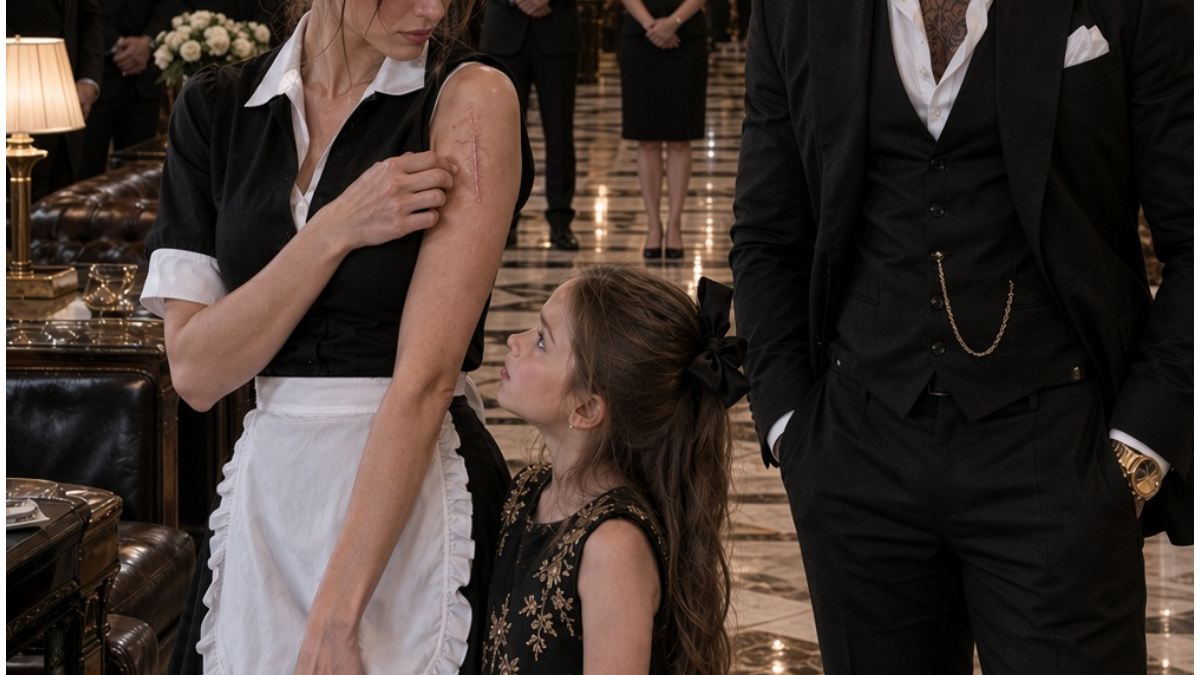
The morning fog rolled through the streets of Brooklyn like a gray blanket, muffling the sounds of the awakening city.
Sarah Mitchell stood behind the counter of Eddie’s Diner, a small establishment tucked between a laundromat and a corner store on a quiet street in Sunset Park.
The neon sign outside flickered intermittently, casting pink and blue reflections on the wet pavement from last night’s rain.
It was 6:47 a.m. and the familiar rhythm of her morning routine had already begun.
The coffee maker gurgled and hissed, filling the air with the rich aroma of fresh brew.
Sarah moved with practiced efficiency, wiping down the counter for the third time that morning, arranging the sugar packets in perfect rows, checking that the salt and pepper shakers were full.
Everything had to be just right. Everything had to be controlled. She was 28 years old, though the permanent exhaustion in her eyes made her look older.
Her dark hair was pulled back in a tight ponytail, not a strand out of place.
She wore the standard uniform, a pale blue dress with a white apron, comfortable shoes that had seen better days.
On her left arm, just below the elbow, a small circular scar marked her skin.
She always wore long sleeves when possible, but in the summer heat or when rolling up her sleeves to work, it became visible.
Most customers never noticed. Those who did usually assumed it was a burn mark or an old accident.
Sarah preferred it that way, anonymous, unremarkable. Forgotten. The bell above the door chimed and Mr. Peterson shuffled in right on schedule.
He was 72, a retired postal worker who had been coming to Eddie’s for breakfast every morning for the past 15 years.
Morning, Mr. P. Sarah called out, already reaching for the coffee pot. “Usual spot. Where else would I sit?”
He grumbled good-naturedly, settling into the third booth on the right, the one with the window view of the street.
“You know me too well, Sarah.” She poured his coffee, black, no sugar, and placed it in front of him with a small smile.
Scrambled eggs, wheat toast, no butter. “You’re a mind reader,” he said, wrapping his weathered hands around the warm mug.
“How’s that night class going? Still studying accounting?” Sarah’s smile faltered for just a fraction of a second.
Taking a break this semester, picking up extra shifts instead. It wasn’t entirely a lie.
She had enrolled in community college classes twice in the 3 years she’d been in New York.
Both times she dropped out within weeks. Sitting in a classroom, giving her real name, or rather the name on her current identification, filling out paperwork, being visible.
It all made her skin crawl with anxiety. Mr. Peterson nodded sympathetically. Money’s tight everywhere.
But you’re a smart girl. You’ll figure it out. Smart enough to stay alive this long, Sarah thought, but didn’t say it aloud.
Instead, she just smiled and headed back to the kitchen to put in his order.
The morning rush. Such as it was, began around 7:30. Eddie’s wasn’t a trendy brunch spot or a hip cafe with artisal pastries.
It was a workingclass diner that served simple food to simple people. Construction workers stopped by for coffee and egg sandwiches.
Nurses finishing night shifts at the nearby hospital grabbed breakfast before heading home. Local residents came in for the affordable daily specials.
Sarah knew most of them by name, knew their orders, knew small details about their lives.
Mrs. Chen’s daughter was applying to colleges. James, the UPS driver, was training for a marathon.
Young Tommy Rodriguez had just gotten his first job at the grocery store. These small connections were safe, surface level friendships that required nothing deeper than a smile and a few kind words.
Sarah had learned to be friendly without being close, warm without being vulnerable. She’d perfected the art of seeming open while remaining completely closed.
By 9:00, the breakfast rush had slowed to a trickle. Sarah was refilling the cream dispensers when the bell above the door chimed again.
She glanced up automatically, her polite greeting already forming on her lips, but the words died there.
Three black SUVs had pulled up outside. Through the diner’s large front windows, Sarah could see them clearly.
Expensive vehicles with tinted windows, pristine despite the wet streets. They looked out of place in this neighborhood where most people drove 10-year-old sedans or took the subway.
Two men stepped out of the first vehicle. They wore dark suits crisp and tailored with that particular alertness that Sarah recognized immediately.
Their eyes scanned the street, the diner, the surroundings with professional efficiency, security, professional protection.
Sarah’s hand tightened on the cream dispenser. Her heart began to beat faster, that old familiar spike of adrenaline flooding her system.
“Stay calm,” she told herself. “You’re being paranoid. This is New York. Lots of people have security.”
But people with that level of security didn’t usually stop at Eddie’s diner. One of the men opened the rear door of the middle SUV, and a small figure emerged.
A little girl, no more than 5 years old, stepped onto the sidewalk. She wore a navy blue coat with velvet trim, shiny black shoes, and her dark hair was styled in two perfect braids tied with silk ribbons.
She looked like she’d stepped out of a department store catalog. The child said something to one of the security men, pointing at the diner.
He nodded and spoke into a small radio device. After a brief exchange, he opened the door to Eddie’s, holding it while the little girl walked in with the confidence of someone much older.
Sarah forced herself to breathe normally. She set down the cream dispenser and wiped her hands on her apron.
“Edddy,” the owner and cook, poked his head out from the kitchen. “We got company?”
He asked, eyeing the expensive vehicles outside with curiosity rather than concern. Looks like it,” Sarah replied, her voice steadier than she felt.
The little girl approached the counter, climbing onto one of the red vinyl stools with some difficulty.
Her feet didn’t touch the floor swinging freely. One of the security men followed her inside, taking a position near the door where he could watch both the child and the street.
The other remained outside by the vehicles. Sarah approached the counter, pulling out her order pad and pen, summoning her waitress smile.
Up close, the girl was beautiful. Dark eyes, olive skin, features that suggested Mediterranean heritage.
There was something striking about her, a kind of poise unusual in someone so young.
“Good morning,” Sarah said gently. “What can I get for you today?” The little girl studied the simple laminated menu on the counter with serious concentration, her small finger tracing the options.
“Do you have hot chocolate?” She asked. Her voice was clear, her English perfect, but carrying the faintest accent.
We do, Sarah confirmed with whipped cream. The girl’s face lit up. Yes, please. And she glanced back at the security man who gave her a small nod.
Can I have pancakes with strawberries if you have them? I think we can manage that, Sarah said, writing down the order.
She found herself genuinely smiling. Despite everything, the security, the expensive cars, the alarm bells ringing in her head, the child’s innocent enthusiasm was disarming.
As Sarah turned to prepare the hot chocolate, she felt the little girl watching her.
When she glanced back, the child was swinging her legs and looking around the diner with open curiosity, taking in the vintage Coca-Cola signs, the checkerboard floor, the old jukebox in the corner that hadn’t worked in years.
I like it here, the girl announced. It’s cozy, not like the fancy restaurants Papa takes me to.
Sarah’s hands moved automatically, pouring milk into a small pot to heat, spooning cocoa powder into a mug.
What’s your name? She asked, keeping her tone light and friendly. Isabella, the girl replied.
But everyone calls me Bella. What’s your name? Sarah. That’s pretty, Bella said matterofactly. How long have you worked here, Sarah?
About 3 years, Sarah answered, which was true. She’d arrived in New York with almost nothing, desperate for work that didn’t require extensive background checks or references.
Eddie had hired her on the spot when his previous waitress quit without notice. He’d asked few questions, paid cash under the table for the first few months, and generally left her alone.
It was exactly what she’d needed. The hot chocolate was ready. Sarah topped it with a generous swirl of whipped cream and a sprinkle of cocoa powder, then placed it in front of Bella.
The little girl’s eyes widened with delight. It’s beautiful, she exclaimed, then carefully picked up the mug with both hands and took a small sip.
M, it’s perfect. Thank you, Sarah. You’re welcome, sweetheart. Pancakes will be ready in a few minutes.
Sarah moved to put in the order with Eddie, but she could feel the security man’s eyes on her.
He was doing his job, she told herself, watching over the child. It wasn’t about her.
There was no reason for anyone to be looking for her here in this neighborhood, in this life she’d so carefully constructed.
While Eddie prepared the pancakes, Sarah busied herself with other tasks. Mr. Peterson needed a coffee refill.
A couple in the corner booth wanted their check. She moved through her routine, but part of her awareness never left the little girl at the counter.
Bella was humming softly to herself, swinging her legs, occasionally taking delicate sips of her hot chocolate.
She seemed completely at ease, as if stopping at random diners with armed security was perfectly normal.
Maybe for her it was. When the pancakes were ready, Sarah brought them over. A stack of three, perfectly golden, with fresh strawberries arranged on top and maple syrup on the side.
Bella’s face broke into a wide smile. “These look amazing,” she said, picking up her fork.
“Will you eat with me, Sarah? I don’t like eating alone.” Sarah hesitated. I’m working, honey, but I can stay and chat while you eat if you’d like.
Yes, please, Bella said, cutting into her pancakes with the careful concentration of a child still mastering the skill.
Sarah leaned against the counter, maintaining her professional demeanor, but genuinely curious about this unusual child.
So, what brings you to this neighborhood today? Bella shrugged, chewing thoughtfully before answering. Papa had a meeting nearby.
I wanted to come with him instead of staying home with my tutor. He said I could pick where to have breakfaSt. And I saw your sign from the car.
The pink and blue lights looked pretty. “Well, I’m glad you stopped in,” Sarah said, and meant it.
Despite her initial anxiety, there was something refreshing about Bella’s straightforward, innocent presence. They chatted while Bella ate.
The girl talked about her home, though she was vague about location. Sarah noticed she’d been taught not to share too many details with strangers.
She mentioned her father, often clearly adoring him. She talked about her tutors, her piano lessons, the books she was reading.
She was obviously intelligent, articulate beyond her years, yet still had that unfiltered honesty that young children possess.
Sarah found herself relaxing slightly, drawn into the simple pleasure of conversation with someone who saw her as nothing more than a friendly waitress.
Then it happened. Sarah reached across the counter to refill Bella’s water glass, and her sleeve rode up slightly, exposing her forearm and the small circular scar just below her elbow.
It was only visible for a moment, but Bella’s sharp eyes caught it. The little girl’s gaze fixed on the mark.
Her fork paused halfway to her mouth. Then, with the innocent directness of a child, she spoke.
“That mark on your arm,” Bella said, pointing with her fork. “My father has one, too.
Right here.” She touched her own arm in approximately the same location. He told me it’s from a long time ago, from before I was born.
The water glass trembled in Sarah’s hand. For a moment, the diner seemed to contract around her, the sounds becoming muffled, her vision narrowing.
That old familiar fear flooded through her system, ice cold and paralyzing. A scar, a matching scar.
Sarah’s mind raced, cataloging possibilities. Implications. Coincidence? Unlikely. A test, a message? Had she been found?
Had someone sent this child as a way to communicate that they knew who she was?
She became aware that she’d been silent too long. Bella was watching her with innocent curiosity.
Not understanding why her simple observation had caused such a reaction. The security man by the door had straightened slightly, his attention sharpening.
Sarah forced herself to breathe, to smile, to respond. “Oh, this.” She glanced at her arm as if noticing the scar for the first time.
Old accident. Nothing interesting. Her voice sounded strained, even to her own ears. Bella accepted this explanation with a small nod, returning her attention to her pancakes, but Sarah’s hands were shaking as she sat down the water pitcher.
She turned away, pretending to need something from under the counter, using the moment to compose herself.
When she straightened up, she saw the security man watching her more carefully. Now his expression was neutral, professional, but there was assessment in his eyes.
He’d noticed her reaction. Sarah’s training buried under 3 years of ordinary life kicked back in.
Don’t run. Don’t act suspicious. Maintain normaly. She’d spooked herself, that was all. A little girl had made an innocent comment.
It meant nothing, but her instincts honed through experiences she tried hard not to remember, screamed otherwise.
Bella finished her pancakes and her hot chocolate, chattering away about various topics, oblivious to Sarah’s inner turmoil.
When she was done, the security man approached the counter. “The check, please,” he said.
His voice was deep, professional, with a slight accent Sarah couldn’t quite place. Sarah’s hands were steadier now as she wrote up the bill.
The man pulled out a money clip, not a wallet, and peeled off several bills, more than enough to cover the meal and leave a generous tip.
Keep the change, he said. Thank you, Sarah replied automatically. Bella climbed down from her stool, smoothing her coat.
Thank you for breakfast, Sarah. You’re very nice. I hope we can come back. You’re welcome anytime, Sarah said, her smile more genuine now.
Whatever else was happening, the child herself was innocent. The security man held the door and Bella walked out, waving goodbye through the window.
Sarah watched as they returned to the middle SUV. The vehicles pulled away smoothly, disappearing into the morning traffic.
The diner seemed very quiet after they left. Eddie poked his head out of the kitchen.
“Well, that was different. Kids seem sweet, though. Good tipper, too.” “Yeah,” Sarah said distantly, staring at the spot where the SUVs had been parked.
The rest of the morning shift passed in a blur. Sarah went through the motions, taking orders, serving food, cleaning tables, but her mind was elsewhere.
She kept replaying the moment over and over. The little girl’s words, the observation about the scar, the way the security man had looked at her afterward.
It could mean nothing. It probably meant nothing. But in Sarah’s experience, coincidences were dangerous.
By 2:00, her shift was over. Eddie’s daughter, Maria, came in to take over the afternoon.
Sarah hung up her apron, grabbed her jacket from the back room, and headed out into the cool autumn air.
She walked six blocks before allowing herself to check if she was being followed. It was an old habit, one she’d tried to break, but never quite could.
She paused at a corner store, pretending to look at newspapers while using the windows reflection to scan the street behind her.
Nothing obvious. She took the subway to Queens, where she rented a small studio apartment above a Korean grocery store.
The rent was cheap. The landlord asked no questions, and there were three different exits from the building, something Sarah had prioritized when looking for a place to live.
Inside her apartment, she locked the door, engaged the deadbolt, and slid the chain into place.
Then, she stood in the middle of her small living space, finally allowing herself to feel the full weight of her anxiety.
The apartment was sparse. A futon that served as both couch and bed, a small table with one chair, a kitchenet barely big enough to turn around in.
But most tellingly, there was almost nothing personal. No photographs, no mmentotos, no decorations that might reveal anything about who she was or where she’d come from.
The apartment of someone ready to disappear at a moment’s notice. Sarah walked to the bathroom and stood in front of the small mirror above the sink.
She pushed up her sleeve, exposing the scar on her left arm. It was about the size of a dime, slightly raised, the skin discolored and puckered.
She’d had it for 4 years now. Four years since the night that had changed everything, that had sent her running across the country with a new name and terror in her heart.
She touched the scar gently, remembering. Then she forced herself to stop. You’re being paranoid.
She told herself firmly. A little girl made an innocent comment. Her father has a scar.
Lots of people have scars. It doesn’t mean anything. But the fear remained coiled tight in her cheSt. Sarah changed out of her work clothes into jeans and a sweater.
She made herself a cup of tea and sat at her small table trying to read a book she’d checked out from the library.
But the words blurred on the page. Her mind kept drifting back to Eddie’s diner to a little girl with dark braids and innocent eyes to three black SUVs that looked out of place in Sunset Park.
As the afternoon faded into evening, Sarah made a decision. Tomorrow she would go to work as usual.
She would continue her routine, but she would also be more careful, more vigilant. She would watch for any signs that her carefully constructed anonymity had been compromised.
And if she saw those black SUVs again if that little girl returned, Sarah didn’t let herself finish the thought.
Instead, she pulled out the small go bag she kept in her closet, always packed, always ready.
She checked its contents for the first time in months. Cash carefully saved over 3 years, a change of clothes, basic toiletries, a bus schedule, and a small envelope containing three different forms of identification, each with her photograph, but different names, just in case.
As darkness fell over Queens, Sarah sat by her window, watching the street below. The neon signs of the Korean grocery store cast a soft glow on the wet pavement.
People hurried past, heading home from work, wrapped in coats against the autumn chill. Normal people living normal lives with normal concerns.
Sarah envied them. She touched her scar one more time, a gesture that had become almost unconscious over the years.
A permanent reminder of the life she’d fled, the person she’d been, the choices that had led her to this small apartment, this borrowed name, this carefully maintained invisibility.
Tomorrow she would return to Eddie’s diner. She would smile at Mr. Peterson and pour his coffee.
She would make small talk with the regulars and serve eggs and pancakes with professional efficiency.
And she would wait to see if a little girl with dark braids and knowing eyes would return, bringing with her the past Sarah had tried so hard to outrun.
The night deepened. The city hummed with its endless activity. And Sarah Mitchell, if that was even her real name, sat in the darkness of her apartment, alert and afraid, watching for shadows that might or might not be there.
Sleep did not come easily that night. Sarah lay on her futon, staring at the ceiling of her studio apartment as the headlights of passing cars swept across the walls like search lights.
The sounds of queens at night filtered through her window, distant sirens, the rumble of the subway beneath the street, the occasional shout of someone stumbling home from a late shift or a neighborhood bar.
She’d lived in this apartment for 2 and 1/2 years, and she knew every sound, every rhythm of this place.
The elderly couple upstairs who went to bed at exactly 9:00. The Korean grocery store owner who left at 10:30, locking up the shop below.
The teenager next door who played video games until 2:00 in the morning. The muffled sounds of explosions and music bleeding through the thin walls.
These sounds had become familiar, almost comforting in their predictability. But tonight, they felt different.
Tonight, every noise made her tense. Every creek of the building settling made her hand instinctively reach for the go bag beside her bed.
At 3:00 in the morning, she finally gave up on sleep. She made coffee and sat at her small table, watching the street below through a gap in the curtains.
The rational part of her mind tried to impose order on her thoughts. A child had noticed a scar.
That was all. Children noticed things. They commented on them without filter or guile. It meant nothing.
But the other part of her mind, the part that had kept her alive, the part trained to see patterns and assess threats, whispered different possibilities.
What if the little girl’s father wasn’t just anyone? What if he was someone from that world?
The world Sarah had left behind. What if the matching scar wasn’t coincidence, but recognition?
What if sending the child had been intentional? A message that said, “We know where you are.”
Sarah rubbed her eyes, exhausted, but wired. She was doing it again, spiraling into paranoia, seeing conspiracies in innocent events.
This was why she couldn’t hold down a normal job. Why she couldn’t finish college courses, why she couldn’t maintain relationships deeper than surface level pleasantries.
The fear never fully left her. By 5:30, she showered and dressed for her shift.
The face that looked back at her from the bathroom mirror was pale, dark circles under her eyes.
She applied a little makeup, not too much, never enough to draw attention, and pulled her hair back into its usual ponytail.
Then she covered the scar on her arm with concealer before rolling down her sleeves, a habit she’d developed over the years.
The subway ride to Brooklyn was quiet at this early hour. Sarah sat with her back to the wall, watching the other passengers with practiced discretion, a nurse in scrubs, her eyes closed in exhaustion.
A construction worker with paintstained hands reading a newspaper, a young mother with a sleeping toddler in her lap, all normal, all innocent.
She arrived at Eddie’s diner at 6:15, 15 minutes before her shift officially started. “Die was already there, prepping the kitchen, the smell of bacon and coffee filling the air.
“You look tired,” he commented when she came in through the back door. “You okay?
Didn’t sleep well?” Sarah admitted. It was close enough to the truth. Eddie grunted sympathetically.
There’s fresh coffee. Help yourself before the morning rush. Sarah poured herself a cup and began her opening routine, checking supplies, setting up the counter, arranging the condiments.
The familiar tasks helped calm her nerves. This was her life now. Simple, predictable, safe.
She just needed to remember that. Mr. Peterson arrived at 6:47 as always. Then Mrs. Chen at 7:15, James the UPS driver at 7:30.
The morning unfolded in its usual pattern, and Sarah began to relax. Perhaps yesterday had been an anomaly.
Perhaps those black SUVs would never return. She was refilling the coffee station at 9:20 when she heard it.
The distinctive sound of expensive engines pulling up outside. Her heart stopped. Slowly, she turned toward the window.
Three black SUVs, identical to the ones from yesterday, were parked at the curb. Sarah’s hand tightened on the coffee pot.
Every instinct screamed at her to run, to disappear through the back door, to become someone else in some other city.
But she forced herself to stay still, to breathe, to maintain the facade. The same security man from yesterday emerged from the lead vehicle.
And then Isabella stepped out wearing a different coat today, burgundy with gold buttons, but the same confident bearing.
She looked up at the diner sign and smiled, then said something to her guard before walking toward the entrance.
Eddie leaned out from the kitchen. Your little friend is back,” he said with amusement.
“Must have really liked those pancakes.” Sarah managed a smile that felt like it might crack her face.
“Looks like it,” the bell chimed. Isabella entered, followed by her security detail. But this time, there were two guards who came inside, the same man from yesterday, plus a second one.
They positioned themselves strategically, one near the door, one with a clear view of the entire diner.
Sarah,” Bella called out, her face lighting up as she climbed onto the same stool she’d occupied yesterday.
“I told Papa I wanted to come back. You make the best hot chocolate.” “Well, I’m glad you enjoyed it,” Sarah said, her voice steadier than she felt.
She pulled out her order pad. “Same thing as yesterday.” “Yes, please. And can I have extra strawberries today?”
“Of course, sweetheart.” As Sarah prepared the hot chocolate, she was acutely aware of the two security men watching her.
Their observation felt more deliberate today, more assessing. Or perhaps she was simply more paranoid.
When she placed the hot chocolate in front of Bella, the little girl wrapped her hands around the warm mug and sighed contentedly.
“This place is so much nicer than the big restaurants,” she said. “They’re always too cold and too quiet.
Here, it feels like like people actually live here.” Sarah couldn’t help but smile genuinely at that.
I think that’s the nicest compliment this diner’s ever received. It’s true, Bella insisted. Papa’s assistant always makes reservations at fancy places with white tablecloths and waiters who look scared all the time.
But I like it here better. Is it okay if I come back sometimes? You’re welcome anytime, Sarah said, and meant it.
Despite everything, despite her fear and suspicion, there was something genuinely sweet about this child.
The pancakes arrived perfectly golden with extra strawberries as requested. Bella ate with delicate precision, occasionally swinging her legs and humming.
Between bites, she chatted about various topics. A book her tutor had given her, a piano recital she was preparing for, the weather turning colder.
“Do you have children, Sarah?” Bella asked suddenly, looking up with those dark, intelligent eyes.
The question caught Sarah offguard. “No, I don’t. Do you want children someday?” Sarah hesitated.
It was a normal question, innocent in its asking, but it touched on futures she’d long ago stopped allowing herself to imagine.
Maybe someday, she said carefully, when life settles down a bit, Bella nodded as if this made perfect sense.
My mama died when I was a baby, she said matterof factly, without the heavy emotion such a statement might carry.
I don’t really remember her. It’s just been Papa and me and our staff, of course.
And Uncle Marco. He’s not really my uncle, but I call him that. He’s Papa’s best friend.
I’m sorry about your mother, Sarah said softly. Bella shrugged. Papa says she was very beautiful and very kind.
He keeps her pictures in his office. Sometimes I see him looking at them when he thinks I’m not watching.
She took a sip of hot chocolate. Do you have family, Sarah? Another loaded question.
Not nearby, Sarah answered, which was true in every sense that mattered. Her family, whoever they were, wherever they were, existed in a life she’d left behind.
“The woman she’d been before, had family.” “Sarah Mitchell did not.” “That must be lonely,” Bella said with unexpected insight for someone so young.
“Sometimes,” Sarah admitted. “But I have friends here, regular customers who I’ve gotten to know.
It’s different, but it’s nice.” Over the next 45 minutes, as Bella ate her breakfast, an unexpected rapport developed between them.
The little girl was remarkably easy to talk to, intelligent, curious, but also possessing an emotional awareness beyond her years.
She’d clearly spent most of her time around adults and had learned to navigate those interactions with unusual skill.
Sarah found herself relaxing slightly, drawn into genuine conversation. They discussed books. Bella was reading chapter books already, far advanced for her age.
They talked about the neighborhood with Bella asking questions about the people who lived here.
Genuinely interested in the lives of ordinary people she rarely encountered. They even laughed together when Bella tried to use the old jukebox in the corner, fascinated by the mechanical selections, even though it hadn’t worked in years.
The security guards maintained their vigilant positions, but they seemed to relax slightly as well, perhaps recognizing that their charge was in no danger in this humble diner.
It was when Bella had nearly finished her pancakes that the conversation took a turn.
Sarah, the little girl said, her tone becoming more serious. Can I ask you something?
Of course. Yesterday, when I mentioned your scar, you seemed upset. Did I say something wrong?
Sarah’s breath caught. She’d hoped the child wouldn’t remember. Wouldn’t have noticed her reaction. But of course, she had.
Bella was observant, intuitive. No, honey. You didn’t say anything wrong. Sarah assured her quickly.
I was just surprised. That’s all. Because of the matching mark. Bella persisted. Papa’s scar is from a long time ago.
He doesn’t like to talk about it much. He says it’s from when he was young and made different choices.
Is yours like that, too? Sarah felt the weight of the security guard’s attention sharpen.
This was dangerous territory. But lying to this child, who had been nothing but kind and honest with her felt wrong.
Yes, Sarah said finally. It’s from a long time ago, from a different part of my life.
Bella nodded slowly, seeming to understand that some topics carried weight that shouldn’t be pressed.
Papa says everyone has things in their past they wish they could change. He says what matters is who we choose to be now.
The simple wisdom of it delivered in a child’s voice struck Sarah unexpectedly. She felt something in her chest tighten.
Not fear this time, but something closer to grief for the person she’d been, the life she’d loSt. “Your father sounds like a wise man,” Sarah said quietly.
He is. Bella agreed with certainty. He’s the best papa in the whole world. Even when he has to work a lot and I don’t get to see him as much as I want, he’s teaching me important things like loyalty and honor and taking care of the people who depend on you.
There was something in the way she said it. A particular emphasis on certain words that made Sarah’s instincts prickle again.
Taking care of people who depend on you. In certain contexts, in certain worlds, those words carried specific meanings.
Before Sarah could dwell on it, Bella glanced at the clock on the wall. Oh, I need to go soon.
Papa will be done with his meeting. She looked at Sarah with sudden seriousness. Can I ask you one more thing?
Sure, sweetheart. Are you happy here? At this diner in this neighborhood? Is this where you want to be?
It was such an unexpected question, so direct and yet so profound. Sarah found herself answering honestly.
I’m safe here, and sometimes safe is enough. Bella tilted her head. Considering this, Papa says that too.
Sometimes that safe is important, but he also says that just surviving isn’t the same as living.
She hopped down from her stool, smoothing her coat. I hope someday you get to do more than just be safe, Sarah.
You’re too nice to just be surviving. The words hit Sarah like a physical thing.
This 5-year-old child had somehow seen through her carefully constructed walls, had identified the truth Sarah barely admitted to herself.
One of the security guards approached the counter. “It was a different man from yesterday, taller with gray at his temples.
“Time to go, Miss Isabella,” he said gently but firmly. “Okay, Uncle Marco,” Bella said, confirming this was the man she’d mentioned earlier.
She turned back to Sarah. “Can I hug you goodbye?” Sarah hesitated only a moment before nodding.
Bella wrapped her small arms around Sarah’s waist, and Sarah found herself returning the embrace.
Careful, but genuine. When was the last time she’d hugged anyone? She couldn’t remember. Thank you for breakfast, Bella said.
I’ll come back again if Papa allows it. I’d like that, Sarah said, surprising herself by meaning it.
As Bella headed toward the door, the man called Marco approached the counter to pay.
He pulled out the same type of money clip as yesterday. But before paying, he looked at Sarah directly.
“She likes you,” he said, his voice low, carrying a slight Italian accent. Isabella doesn’t usually connect with people so quickly.
She’s a special child, Sarah replied carefully. She is, Marco agreed. His eyes, sharp assessing, studied Sarah’s face.
You’re good with her. Patient, kind. He paused meaningfully. Not everyone knows how to talk to children who’ve grown up in unusual circumstances.
The statement hung in the air between them, loaded with implications. Sarah felt her pulse quicken, but kept her expression neutral.
I just treat her like any other kid. That’s exactly what she needs, Marco said.
He placed several bills on the counter again, more than enough to cover the meal.
We’ll be in the neighborhood for a few more days. I suspect she’ll want to return.
It wasn’t quite a question, but it required an answer. Sarah nodded. She’s welcome here.
Marco’s expression shifted almost imperceptibly. A slight softening, a hint of approval. Good. He tapped the counter once, then turned and followed Isabella out of the diner.
Sarah watched through the window as they climbed into the middle SUV. Just before the door closed, Bella waved enthusiastically.
Sarah raised her hand in response, offering a small smile. The vehicles pulled away, disappearing into the Brooklyn traffic.
Eddie emerged from the kitchen, wiping his hands on his apron. That kid’s really taken a shine to you.
And that guy, the older one, he left another big tip. He shook his head in beusement.
Maybe we should put you in charge of customer relations. Sarah managed a weak laugh.
I think I’ll stick to just waiting tables. The rest of her shift passed in a haze.
She went through the motions automatically, taking orders, serving food, cleaning tables. But her mind was elsewhere, replaying every word of her conversation with Bella, analyzing every glance from the security guards, particularly Marco.
His words echoed in her thoughts. Children who’ve grown up in unusual circumstances. What exactly did that mean?
And more importantly, what had he been trying to communicate by saying it? When her shift ended at 2:00, Sarah walked the six blocks to the subway with heightened awareness.
She couldn’t shake the feeling that she was being watched. Though every time she checked, she saw nothing suspicious.
On the subway back to Queens, she sat in her usual position. Back to the wall, eyes scanning the car.
A man in a business suit reading his phone. Two teenage girls laughing over something on a shared screen.
An elderly woman with shopping bags, all normal, all innocent. But Sarah’s training whispered otherwise.
The man in the business suit had gotten on at the same stop as her.
The teenage girls had glanced in her direction three times. Were they following her, or was she seeing threats where none existed?
By the time she reached her apartment, her nerves were afraid. She locked the door, engaged all three locks, and stood in the middle of her small space, trying to calm her racing heart.
She was being irrational, paranoid. A little girl liked her. That was all. The security guard had been making polite conversation.
There was no conspiracy, no threat, no hidden agenda. But even as she told herself this, Sarah found herself going to her closet and checking her go bag again, making sure everything was still there, still ready, just in case.
The next morning, Wednesday, she almost called in sick. The temptation to hide in her apartment to avoid the diner and any possibility of seeing those black SUVs again was overwhelming.
But calling in sick would be a break in her routine, a deviation that might draw attention.
And besides, Eddie depended on her. The regular customers expected her, so she went to work.
Mr. Peterson arrived at 6:47, Mrs. Chen at 7:15, James at 7:30. The morning unfolded normally.
9:00 came and went. No black SUVs appeared. Sarah felt herself relaxing. Perhaps yesterday had been the last visit.
Perhaps Bella’s father’s business in the neighborhood was concluded. Perhaps everything would return to normal.
But at 9:35, she heard those familiar engines outside. This time, when Bella entered the diner, she ran straight to Sarah with the unself-conscious enthusiasm of a child who’d found a friend.
Sarah, I convinced Papa to let me come back. He says, “If I finish all my lessons this morning, I can have breakfast here every day this week.”
Sarah’s heart sank and soared simultaneously. The thought of seeing this sweet child daily was genuinely pleasant, but it also meant continued exposure, continued risk, continued questions she couldn’t answer.
“Well, I’m happy to see you,” Sarah said. And it was true, despite her complicated feelings.
“Your usual?” “Yes, please.” Over the next 3 days, a pattern developed. Each morning around 9:30, the black SUVs would arrive.
Bella would bound in full of energy and stories about her lessons, her piano practice, the books she was reading.
She’d eat her pancakes and strawberries, drink her hot chocolate, and chat with Sarah about everything and nothing.
And with each visit, the little girl shared more about her life. Small details that individually meant little, but together they painted a picture that made Sarah increasingly uneasy.
Bella mentioned that her father had important meetings with business associates, that Uncle Marco had been with her father since the old days, that they lived in a large house with lots of security because her father was very important and needs to be careful.
She talked about learning Italian from her tutors, about traveling to Sicily to visit her grandparents.
She casually mentioned that her father taught her never to talk to strangers about where they lived or what her father did for work.
None of it was explicit. A 5-year-old didn’t understand the implications of what she was sharing.
But Sarah understood. The pieces fit together in a picture she recognized all too well.
The expensive cars, the professional security, the careful vagueness about her father’s occupation, the emphasis on loyalty, honor, and taking care of people who depend on you, the Italian heritage, the home in an undisclosed location with heavy security.
Bella’s father wasn’t just wealthy. He was connected and not in the legitimate business sense.
By Friday morning, when the black SUVs arrived for the fifth consecutive day, Sarah had made a decision.
This couldn’t continue. Whatever innocent pleasure she derived from Bella’s company wasn’t worth the risk.
She needed to find a way to discourage these visits, to gently push back, to create distance before things became more complicated.
But when Bella climbed onto her usual stool, there was something different in her expression.
She seemed quieter, more subdued. Everything okay, sweetheart? Sarah asked, concerned despite herself. Bella nodded.
But there was hesitation in the gesture. Can I tell you a secret? Sarah’s instincts screamed warning, but she found herself nodding.
Of course. Bella leaned closer, lowering her voice. Papa knows I’ve been coming here. And he asked Uncle Marco about you.
About the nice lady at the diner who’s kind to me. Sarah’s blood ran cold.
Did he? She kept her voice carefully neutral. Mhm. And Uncle Marco told him that you seem like a good person, that you’re quiet and keep to yourself and work hard.
Papa said, she paused, seeming to search for the exact words. Papa said people who work hard and keep to themselves usually have their reasons.
He said, “It’s important to respect that.” The message was clear. Bella’s father knew about her, had inquired about her, and was, for now, at least choosing to leave her alone.
But the unspoken implication was equally clear. He was aware. He was watching and he could choose differently at any time.
That’s thoughtful of him, Sarah managed. Papa wanted me to ask you something. Bella continued, her voice still quiet.
He wants to know if you’d like to meet him. He says anyone who’s this kind to his daughter deserves his thanks.
There it was. The invitation or perhaps the summons. Sarah’s mind raced through possibilities. Refuse and risk offending someone who clearly had power in reach.
Accept and step directly into a world she’d spent three years trying to escape. That’s very kind, Sarah said slowly.
But I don’t think he said you might be nervous. Bella interrupted gently. He wanted me to tell you that it would just be coffee in a public place wherever you’re comfortable and that you’re not obligated to say yes.
The little girl looked up at Sarah with those dark knowing eyes. But I think he really does just want to say thank you.
You’ve made me very happy this week. And Papa notices things like that. Sarah felt trapped, cornered by kindness and courtesy in a situation spiraling beyond her control.
But she also recognized that this was a carefully orchestrated moment. Bella’s father, whoever he was, had sent his message through the most innocent, most disarming messenger possible, his 5-year-old daughter.
“Can I think about it?” Sarah asked. Bella nodded. “Of course,” Papa said. “There’s no rush.
He’ll be in the city for another week.” She smiled then, some of her usual brightness returning.
“Can I still have my pancakes while you think?” Despite everything, Sarah found herself smiling back.
“Extra strawberries always.” As Sarah prepared Bella’s breakfast, her hands moved automatically while her mind churned.
She was standing at a crossroads. One path led to continued anonymity, possibly at the cost of making an enemy of someone powerful.
The other path led into unknown territory, toward a man whose very existence represented the world she’d fled.
But there was a third option. She realized she could run again. She could disappear before this situation developed further.
It was what she’d done before. It was what she was good at. She glanced at Bella, who was humming softly to herself, swinging her legs, radiating innocent joy.
The little girl had brought light into Sarah’s carefully dimmed existence. For 5 days, she’d reminded Sarah what it felt like to connect with someone, to care about someone beyond surface level interaction.
And her father, this mysterious powerful figure, had sent a message of respect, not a threat, not a demand, an invitation, with the explicit acknowledgement that Sarah could refuse.
When Bella finished her breakfast, she hopped down from her stool. Will you tell me your answer tomorrow?”
She asked hopefully. “I’m supposed to have my piano recital tomorrow afternoon, but Papa said if you say yes, he’d like to meet for coffee in the morning before we have to leave tomorrow.”
The timeline was clear. This was Bella’s last visit one way or another. I’ll have an answer for you tomorrow, Sarah promised.
Bella hugged her goodbye, as had become their ritual. I hope you say yes, she whispered.
Papa’s scary sometimes to other people, but he’s actually very nice. And I think you two would understand each other.
What an odd thing for a child to say, Sarah thought. But then Bella was an odd child, wise beyond her years, shaped by a life most children never experienced.
After the SUVs left, Sarah finished her shift in a days. She walked to the subway, rode home to Queens, climbed the stairs to her studio apartment, locked all three locks, and stood in the middle of her small space, finally allowing herself to feel the full weight of her situation.
She could run, pack her go bag, use one of her alternate identities, be on a bus to somewhere new before dawn.
It was the safe choice, the smart choice. But as she looked around her sparse apartment, the futon, the small table, the nearly empty walls, she realized something had shifted inside her.
3 years of hiding, 3 years of surface level existence, 3 years of just surviving.
Bella’s words echoed in her mind. Just surviving isn’t the same as living. Sarah pulled out the small mirror from her bathroom and looked at herself.
Really looked at the exhaustion in her eyes, at the lines of stress on her face, at the woman who’d spent so long being invisible that she’d almost forgotten who she’d been before.
She rolled up her sleeve, exposing the scar on her arm, the mark that connected her to a past she’d tried to erase.
The mark that apparently matched one carried by a powerful man whose daughter had somehow seen through all of Sarah’s defenses to the person underneath.
That night, Sarah didn’t sleep at all. She sat by her window, watching the street below, thinking about choices and consequences about the past and the future, about survival and living.
By the time dawn broke over Queens, painting the sky in shades of pink and gold, she had made her decision.
Saturday morning arrived with unusual clarity. The autumn sky over Brooklyn was a brilliant blue, scrubbed clean by overnight rain.
Sarah stood outside Eddie’s diner at 6:30 a.m., a full hour before her shift was scheduled to begin, she’d been awake all night.
And rather than sit alone in her apartment with her spiraling thoughts, she decided to come here to the one place that had felt like stability for the past 3 years, Eddie was surprised to see her so early.
“You’re here before the coffeey’s even ready,” he said, unlocking the front door. “Everything okay?”
Just couldn’t sleep,” Sarah replied, which was becoming her standard answer. “You’ve been saying that a lot this week,” Eddie observed, flipping on the lights.
The fluorescent bulbs flickered to life, casting their familiar glow over the checkerboard floor and vinyl booths.
“Does it have anything to do with your little friend and her entourage?” Sarah hesitated.
Eddie had always been good to her, asking few questions, respecting her privacy, but he was also observant in his own way.
“Maybe,” she admitted. Eddie nodded slowly, moving behind the counter to start the coffee maker.
Look, Sarah, I don’t know what your story is, and I’ve never asked because I figure everyone’s entitled to their privacy.
But I’ve been running this diner for 32 years, and I’ve seen a lot of people come through those doors.
Some running from something, some running towards something, most just trying to get by. He paused, measuring coffee grounds with practiced precision.
Those folks who’ve been coming in this week, the expensive cars, the security guys, they’re not our usual crowd.
And that little girl seems sweet, but people like that don’t usually take such an interest in waitresses at neighborhood diners unless there’s a reason.
Sarah felt her throat tighten. I know. So, here’s what I want to say, Eddie continued, his tone gentle but firm.
Whatever you decide to do, wherever you decide to go, you’ve got a place here as long as you want it.
No questions asked. But if you need to leave suddenly, I’ll understand that, too. Just be careful, okay?
You’re a good person, Sarah. You deserve good things. The kindness in his words, the unexpected offer of unconditional support nearly undid her.
Sarah blinked back tears she hadn’t realized were threatening. “Thank you, Eddie. That means more than you know.”
He waved off her gratitude with characteristic gruffness. “Yeah, yeah. Now, make yourself useful and set up the counter while I get the grill going.”
They worked in comfortable silence, preparing for the day. The familiar routine helped settle Sarah’s nerves.
By the time Mr. Peterson arrived at 6:47, she had almost convinced herself that she could handle whatever came next.
The morning passed with agonizing slowness. Each time, the bell above the door chimed. Sarah’s heart jumped, but it was always a regular customer, Mrs. Chen, James, the UPS driver, the construction workers who came in for coffee and egg sandwiches.
9:00 came and went. Then 9:15, 9:30. At 9:42, Sarah heard the now familiar sound of expensive engines pulling up outside.
Through the window, she watched the three black SUVs arranged themselves at the curb with military precision.
Her hands trembled slightly as she sat down the coffee pot she’d been holding. The security guards emerged first, as always.
Then Bella stepped out, wearing a beautiful white dress with a navy blue cardigan. She looked like she was dressed for something special, probably her piano recital later that afternoon.
But this time, someone else emerged from the middle vehicle. He was tall, perhaps 6 ft, with dark hair graying at the temples.
He wore an impeccably tailored charcoal suit that probably cost more than Sarah made in 3 months.
Even from a distance, there was something commanding about his presence. The way he carried himself, the way the security guards deferred to him, the way he surveyed the street with eyes that missed nothing.
And on his left arm, just visible below the cuff of his shirt as he adjusted it.
Sarah could see a small circular scar, her breath caught in her throat. Bella took her father’s hand, pointing excitedly at the diner.
He nodded, said something to Marco, then allowed his daughter to lead him toward the entrance.
Sarah forced herself to breathe, to stand up straight, to prepare for whatever was about to happen.
Eddie had noticed the new arrival, and had stepped out from the kitchen, his protective instincts clearly activated.
The bell chimed. Bella entered first, her face glowing with excitement. Sarah, Papa came. He wanted to meet you.
The man followed his daughter inside, and Sarah got her first clear look at him.
He was younger than she’d expected, mid-40s perhaps, with strong angular features and dark eyes that were both intelligent and guarded.
There were lines around those eyes, marks of stress and responsibility, but also something else.
Sadness maybe, or loneliness. He looked, Sarah realized with a start, like someone who understood exactly what it meant to carry the weight of a complicated paSt. “Good morning,” he said, his voice deep and carrying a slight accent.
Italian, as she’d suspected. I hope we’re not intruding. Isabella has spoken of little else but this diner all week.
He offered a slight smile. I’m Aleandro Vital, but please call me Alex. Sarah found her voice.
Sarah Mitchell. It’s nice to meet you. Aleandro’s eyes met hers. And in that moment, Sarah felt as though he could see straight through her carefully constructed facade, not in a threatening way, but with a recognition that was almost startling in its directness.
“This was a man who understood secrets, who carried his own. The pleasure is mine,” he said formally.
“My daughter tells me you’ve been very kind to her this week. In my experience, genuine kindness is rare enough to be noteworthy.”
Bella was already climbing onto her usual stool. Can Papa sit next to me? And can you make him coffee?
He drinks it black, no sugar, just like Mr. Peterson. The mundane request broke some of the tension.
Sarah managed a small smile. Of course. Would you like breakfast as well, Mr. Vitali?
Alex, please, he corrected gently. And just coffee for now. Thank you. As Sarah prepared the coffee, she was acutely aware of Alessandro studying the diner with genuine intereSt. His gaze took in the vintage Coca-Cola signs, the old jukebox, the worn but clean vinyl booths.
When she placed the coffee in front of him, his fingers brushed hers briefly as he took the cup, and she saw him notice.
Really notice, the scar on her arm where her sleeve had ridden up slightly. His expression didn’t change, but something flickered in his eyes.
“Recognition, confirmation.” “Isabella,” he said quietly, not looking away from Sarah. Why don’t you tell Sarah about your piano recital this afternoon while I speak with Eddie for a moment?
It was smoothly done, creating space for a private conversation without alarming the child. Bella launched enthusiastically into a description of the pieces she’d be performing while Alessandro stood and approached Eddie at the far end of the counter.
Sarah couldn’t hear their conversation, but she could observe it. Allesandro spoke quietly, respectfully. Eddie’s body language was defensive at first, protective, but gradually relaxed.
Allesandro pulled out his wallet, a simple leather one, she noticed, not the money clips his security carried, and placed some bills on the counter, not ostentatiously, but clearly enough to cover whatever he was requesting.
After a few minutes, Aleandro returned to his seat. Eddie caught Sarah’s eye and gave her a small nod.
Permission, maybe, or reassurance. I’ve asked Eddie to close the diner for 30 minutes, Aleandro said quietly.
I’d like to speak with you privately if you’re willing. I’ve compensated him for the lost business and he’s agreed.
But Sarah, he paused, making sure she was looking at him. You are under no obligation to stay.
If you wish to leave right now, you may do so. I give you my word that there will be no consequences, no repercussions.
You have my daughter to thank for that. She would never forgive me if I frightened away her new friend.
Bella, oblivious to the undercurrents, was still chattering about her piano recital, her words tumbling over each other in excitement.
Sarah looked at this man, this stranger, who somehow wasn’t a stranger at all. She could leave.
He’d given her an explicit out, but she’d already made her decision during the long, sleepless night.
Running had kept her alive, but it hadn’t given her a life. “I’ll stay,” she said quietly.
Aleandro nodded something like approval or perhaps relief crossing his features. He turned to his daughter.
Bella, my sweet uncle Marco is going to take you to the car for a little while.
I need to speak with Sarah about grown-up things. Boring things? Bella asked, making a face.
Very boring, Allesandro agreed with a smile. But if you’re patient, perhaps we can stop for gelato on the way to your recital.
That was all the incentive Bella needed. She hugged Sarah quickly. Don’t let papa scare you.
He’s actually very nice. And skipped out to where Marco was waiting by the door.
Eddie hung a closed sign in the window and retreated to the kitchen, giving them privacy while remaining close enough if needed.
The other security guards had positioned themselves outside. Through the window, Sarah could see Marco entertaining Bella, pointing out things on the street to keep her distracted.
And then it was just Sarah and Aleandro Vitali sitting across from each other in an empty Brooklyn diner on a Saturday morning, both carrying scars that matched.
Aleandro took a sip of his coffee, then set the cup down carefully. When he spoke, his voice was quiet but clear.
I’m going to be direct with you, Sarah, because I suspect you appreciate directness. When Isabella mentioned your scar, I became curious.
When she continued to request returning here day after day, I became more curious, so I asked Marco to make some inquiries.
Sarah’s hands tightened in her lap beneath the counter. What he found was interesting, Alessandro continued.
Sarah Mitchell appeared in New York 3 years ago. Before that, there’s very little trace of her existence.
The social security number is legitimate, but recently activated, no significant credit history, no family connections that can be verified.
No past employment that checks out under scrutiny. He paused. You’re very good at being invisible.
Most people wouldn’t notice. But I’m not most people. Sarah’s mouth was dry. Are you going to turn me in?
Turn you into whom? Allessandro asked, his tone almost gentle. I don’t know what you’re running from, Sarah.
And unless you choose to tell me, I won’t ask. What I do know is this.
You’ve shown kindness and patience to my daughter. You’ve treated her like a normal child, not like the heir to complicated circumstances.
That tells me something about your character,” he shifted slightly and his sleeve rode up, fully revealing his own scar.
“We both carry marks from our pasts,” he said quietly. “We both understand what it means to be someone other than who we once were.
This gives us something in common, a certain understanding of the price of survival.” Sarah found herself speaking before she could stop herself.
“How did you get yours?” A mistake I made when I was 22, Alessandro replied without hesitation.
I was young, arrogant, and thought I understood how the world worked. I learned otherwise.
The scar is a reminder to be more careful, more thoughtful. He looked at her directly.
How did you get yours? It was a fair exchange. He’d shown his cards. Now he was asking for hers.
Sarah took a shaky breath. A consequence of trusting the wrong person. Four years ago.
It taught me to be very careful about who I let close.” Aleandro nodded slowly, as if this confirmed something he’d suspected.
“And yet, you’ve let Isabella close despite your careful nature, despite what I suspect are very good reasons to maintain distance from people like us.
You’ve allowed a 5-year-old girl to breach your defenses. She’s hard to resist,” Sarah said with a slight smile.
“She’s remarkable. You should be very proud.” Something shifted in Aleandro’s expression, a softening, a glimpse of the father beneath the careful exterior.
I am. She’s the best thing in my life, the only purely good thing, if I’m being honeSt. He paused, seeming to choose his next words carefully.
Which is why I need to ask you for something, and I want you to know that you can refuse, and there will be no negative consequences.
I mean that sincerely, Sarah’s pulse quickened. What do you need? Context firSt. Aleandro said, “My life is complicated.
I have responsibilities, obligations, business arrangements that require my constant attention.” Isabella’s mother died when she was 6 months old.
Since then, it’s been just the two of us with help from Marco and our household staff.
But Isabella needs more than security guards and tutors. She needs normaly. She needs connection with people who see her as a child, not as what she represents.
He took another sip of coffee, gathering his thoughts. This week, coming here interacting with you, I’ve seen her happier than she’s been in months.
You give her something I can’t provide, something our world doesn’t often allow. A sense of normaly, of simple, uncomplicated kindness.
Sarah began to see where this was going. You want me to spend time with her.
I want to hire you, Aleandro clarified. Not as staff, not as an employee in the traditional sense, but as a friend, someone who can take her to normal places, do normal things, museums, parks, the library, places where she can be just a little girl, not Alessandro Vitali’s daughter.
He met her eyes. I would compensate you well, very well. And I would ask nothing of you beyond spending time with Isabella in public places, helping her experience a childhood that’s as normal as possible given our circumstances.
Sarah’s mind reeled. You want to pay me to be friends with your daughter. I want to pay you for your time.
Allesandre corrected. The friendship that already exists, I think. Isabella talks about you constantly. She asked if you could come to her piano recital today.
She wants to show you the books she’s reading. She asked if you might teach her to make hot chocolate the way you do.
He smiled slightly. I’m offering you employment that would allow you to leave the diner to have financial security while doing something I suspect you might actually enjoy.
It was tempting, dangerously tempting. Financial security. A job that didn’t leave her exhausted and smelling like fried food.
The chance to spend time with a child she’d genuinely grown fond of. But what’s the catch?
Sarah asked quietly. Aleandro’s expression turned serious. The catch is that my world is not safe.
I can provide security. The best security money can buy, but I can’t guarantee absolute safety.
There are people who would use Isabella to get to me if they could. By extension, anyone close to her becomes a potential target.
So, you’re asking me to put myself at risk? Sarah said, “I’m being honest about the reality.”
Aleandro replied, “Though I should note. You’re already at risk simply by existing, aren’t you?
Whatever you’re hiding from, whoever you’re running from, that danger hasn’t disappeared just because you changed your name and moved to Brooklyn.
He wasn’t wrong. Sarah had never been truly safe, just temporarily hidden. I need time to think about it,” she said.
“Of course.” Aleandro agreed immediately. “Take all the time you need. I’ll be in the city until next Saturday.
If you decide you’re interested, call this number.” He pulled a business card from his wallet and placed it on the counter.
It was simple, elegant, just a phone number, no name or title. If you decide you’re not interested, I’ll respect that decision.
Isabella will be disappointed, but she’ll understand. He stood leaving money on the counter for his coffee.
Thank you for your time, Sarah, and thank you for being kind to my daughter.
In my experience, genuine kindness is one of the rarest commodities in this world. As he turned to leave, Sarah found herself speaking.
Mr. Vital, Alex, can I ask you something? He turned back, waiting. Why me? You could hire anyone.
Professional tutors, child specialists, people with actual qualifications. Why a waitress, you know, is hiding something?
Aleandro was quiet for a moment considering his answer. When he spoke, his voice was soft but firm.
Because people with qualifications come with questions, expectations, judgments. They see Isabella as a project, a responsibility.
You see her as a person and because he paused, seeming to debate how much to reveal.
Because sometimes the people who understand pain are the ones best equipped to provide comfort.
Your scars, both visible and invisible. They don’t make you less qualified to care for my daughter.
They make you more so. He held her gaze for another moment, then nodded once and walked out of the diner.
Through the window, Sarah watched him lift Isabella into his arMs. The little girl wrapped her arms around her father’s neck, and even from a distance, Sarah could see the tenderness in the gesture, the love between them unmistakable and real.
Eddie emerged from the kitchen after the SUVs had pulled away. “You okay?” He asked.
“I don’t know,” Sarah admitted honestly. “What did he want to offer me a job?”
Eddie raised his eyebrows. Doing what? “Spending time with his daughter? Being her friend, I guess.
And and I have a week to decide.” Eddie poured himself a cup of coffee and leaned against the counter.
For what it’s worth, that little girl clearly adores you and her father. Whatever else he might be, he loves her.
You can see it. That kind of love, it’s genuine. Doesn’t erase whatever else he’s involved in, but it’s real.
I know, Sarah said quietly. Question is, Eddie continued, “What do you want? Not what’s safe, not what’s smart.
What do you actually want?” Sarah looked down at the business card still sitting on the counter.
A simple phone number that represented a door to a world she’d spent years avoiding, but it also represented possibility connection.
The chance to be more than just invisible. I want to stop running, she whispered.
I want to live, not just survive. Then maybe you have your answer, Eddie said gently.
The rest of the day passed in a blur. Sarah finished her shift on autopilot, her mind churning with possibilities and consequences.
When she finally returned to her apartment that evening, she sat at her small table with Aleandro’s business card in front of her.
She thought about Bella, her brightness, her intelligence, her need for normaly in a life that was anything but normal.
She thought about Aleandro, a man who clearly loved his daughter enough to reach out to a stranger, to offer trust when he had every reason to be suspicious.
And she thought about herself, about 3 years of hiding, of minimum wage work, of surface level existence, about the woman she’d been before, the life she’d lost, the person she’d tried to become.
That night, Sarah didn’t pack her go bag. She didn’t research bus schedules or count her emergency cash.
Instead, she sat by her window and watched the city lights, thinking about choices and chances, about the past and the future.
By midnight, she still hadn’t made her decision. But for the first time in 3 years, she was genuinely considering a future that extended beyond just tomorrow.
The business card sat on her table, a small rectangle of possibility, waiting for her to be brave enough or desperate enough to use it.
Sunday morning arrived gray and drizzly. Sarah woke early, the business card still on her table where she’d left it.
She made coffee and sat in her usual spot by the window, watching the rain streak down the glass.
Her phone, a basic prepaid model she’d bought with cash, sat next to the business card.
All she had to do was dial those numbers, accept the offer, step through the door into a new life.
But before she could make that decision, she needed to know more. She needed to understand exactly what she’d be stepping into.
Sarah opened her laptop, purchased secondhand, always used with a VPN, and began to search Allesandro Vital.
She’d been deliberately avoiding this all week, not wanting to know, preferring ignorance to uncomfortable truths.
Now she needed the truth. What she found was both more and less than she’d expected.
Aleandro Vitali appeared in society pages occasionally, charity gallas, fundraisers, cultural events, always impeccably dressed, usually with Isabella by his side.
The captions identified him as a prominent businessman and philanthropiSt. There were mentions of real estate holdings, import export businesses, construction companies, all legitimate on the surface, but Sarah knew how to read between the lines.
The pattern of his businesses, the locations the associates mentioned in passing, it all pointed to something larger, something less visible, the kind of empire that operated in gray areas that wielded influence through connection rather than visibility.
She found mentions of his late wife Gabriella Vital Nay Romano, a society beauty who died of complications from pneumonia when Isabella was an infant.
The tragedy had been covered extensively in certain circles. But there were gaps in the coverage, oddities in the timeline, and the Romano name itself carried weight in certain contexts, particularly in Italian-American communities in New York and New Jersey.
Sarah sat back, processing what she’d learned. Aleandro Vitali was exactly what she’d suspected, a man with significant power, with connections to a world that operated by its own rules.
Not simply a businessman, but someone embedded in structures that predated modern law, that functioned on loyalty and tradition, and carefully maintained relationships.
And he wanted her, a woman running from her own past, to spend time with his daughter.
It should have been an easy decision. Stay away, maintain her distance, keep hiding. But as Sarah looked at the search results, she saw something else.
Photos of Aleandro with Isabella. The way he looked at her, the way he positioned himself, always between her and cameras, the careful selection of events he brought her to.
Always age appropriate, always supervised. A man who loved his daughter enough to reach out to a stranger.
Who valued his child’s happiness enough to take a calculated risk, who understood that money couldn’t buy everything, and that sometimes the most valuable things, kindness, normaly, genuine care, came from unexpected places.
Sarah closed her laptop. She picked up her phone and the business card. For a long moment, she just sat there, phone in one hand, card in the other, balanced between two possible futures.
Then, before she could overthink it further, before she could talk herself out of it, she dialed the number.
It rang twice before a familiar voice answered. “This is Alisandro.” Sarah took a breath.
“It’s Sarah Mitchell. I’ve thought about your offer.” There was a pause during which she could hear nothing but her own heartbeat.
Then, and I have conditions, Sarah said, her voice steadier than she felt. I would expect nothing less, Aleandro replied.
She could hear the slight smile in his voice. Would you like to discuss them in person?
Yes, there’s a cafe in Manhattan, neutral territory, public. I can meet you there tomorrow morning if you’re available.
Sarah had tomorrow off from the diner. She’d requested it weeks ago, a rare day to herself.
Now it seemed preient. What time? 10:00. I’ll text you the address. All right. Another pause.
Then Aleandro spoke again, his voice carrying genuine warmth. Sarah, thank you for calling. Whatever you decide, I appreciate your willingness to consider this.
After they hung up, Sarah sat motionless for several minutes. She just committed to a meeting, to a conversation that would determine the next chapter of her life.
The rain continued to fall outside her window. The city went about its business, and Sarah Mitchell, whoever she really was, whatever she’d left behind, prepared to step out of the shadows and into the light, however uncertain that light might be.
The business card went into her wallet. The phone stayed charged and within reach. And for the first time in 3 years, Sarah allowed herself to hope.
Not for safety, not for invisibility, but for something more, something real, something that might finally feel like living instead of just surviving.
Tomorrow would bring answers. Tomorrow would bring Alessandro Vitali and a conversation that would change everything.
Tonight she simply sat with her decision, accepting the fear and the hope in equal measure, waiting for the rain to stop and the morning to come.
Chapter 4. Imperfect Beginnings. The cafe in Manhattan was exactly as Aleandro had described, elegant but unpretentious, with tall windows overlooking a treelined street.
Sarah arrived 15 minutes early, her nerves making punctuality impossible. She ordered tea she didn’t drink and sat at a corner table watching the door.
Aleandro arrived precisely at 10:00 alone except for Marco, who remained outside. He wore a simple navy sweater and slacks, looking more approachable than he had in his tailored suit.
He smiled when he saw her, a genuine expression that reached his eyes. “Thank you for coming,” he said, sitting across from her.
“I wasn’t certain you would.” “I almost didn’t,” Sarah admitted. They ordered coffee and then Sarah laid out her conditions.
She would spend time with Isabella three afternoons a week. Museums, parks, libraries, normal activities.
All meetings would be in public places. She would be compensated fairly, but not extravagantly, and most importantly, she maintained the right to walk away at any time, no questions asked.
Aleandro listened carefully, nodding at each point. These are reasonable terMs. I accept them all.
He paused. I have one condition of my own, if you’ll permit it, Sarah tensed.
What is it? Honesty, he said simply, not about your paSt. That’s yours to share or not share as you choose, but about Isabella.
If something concerns you, if you feel unsafe, if anything changes, I need you to tell me.
My daughter’s well-being is my priority above all else. That’s fair, Sarah agreed. They shook hands across the table, sealing an agreement that was far more than a simple employment arrangement.
It was a tentative bridge between two people who understood loss, who carried their own scars, who were both trying to protect what mattered moSt. Over the next 3 months, a routine developed.
Sarah would meet Isabella and Marco at predetermined locations. They’d visit the Natural History Museum, where Bella marveled at the dinosaurs.
They’d walk through Central Park feeding ducks and collecting colorful autumn leaves. They’d spend hours at the public library, Bella reading aloud while Sarah listened with genuine intereSt. The little girl blossomed under this attention.
Her laughter became more frequent, her curiosity more uninhibited. She began to share her thoughts more freely, to ask questions about the world beyond her privileged but isolated existence, and Sarah gradually began to heal.
The constant fear that had defined her life for 3 years slowly loosened its grip.
She still maintained her precautions, still kept her go bag ready, but the desperate urgency to run faded.
In its place grew something unexpected. Connection, purpose, joy. Alisandro remained respectful and distant, communicating primarily through Marco, but occasionally he would appear at the end of their outings, arriving to collect his daughter.
Sarah noticed how Bella would run to him, chattering excitedly about their adventures. She saw the way his face transformed when he looked at his daughter.
All the careful guardedness falling away, replaced by pure, uncomplicated love. One December afternoon, as the first snow began to fall, Bella asked Sarah a question that had clearly been building for weeks.
Will you come to our house for Christmas dinner? Papa said, “I could invite you if you wanted to come, just as our friend, not for work.”
Sarah hesitated. Entering Aleandro’s home felt like crossing a significant boundary, but Bella’s hopeful expression, the genuine desire for connection made refusal impossible.
“I’d be honored,” Sarah said softly. Christmas dinner was held in Aleandro’s townhouse in the Upper East Side.
Elegant but surprisingly warm, filled with family photographs and Isabella’s artwork. The gathering was small.
Aleandro, Bella, Marco, and his wife, and Sarah. The evening was surprisingly normal. Good food, easy conversation, laughter.
As Sarah helped clear the table, Aleandro appeared beside her in the kitchen. Thank you, he said quietly, for coming tonight.
For everything you’ve done for Isabella these past months. She’s easy to care about, Sarah replied truthfully.
Aleandro nodded, a slight smile playing at his lips. She asked me last week if you might consider being her family.
Not in any official capacity, just in the way that matters. He met Sarah’s eyes.
I told her that family isn’t always about blood. Sometimes it’s about choice. Sarah felt tears prick her eyes.
For 3 years, she’d been alone, disconnected, surviving, but not living. Now standing in this warm kitchen with snow falling outside and the sound of Bella’s laughter drifting from the other room.
She felt something she’d thought lost forever. She felt like she belonged. “I’d like that,” she whispered.
“To be chosen family.” Aleandro’s smile widened. Genuine and unguarded. Then, “Welcome home, Sarah.” Outside, the snow continued to fall, blanketing the city in white.
Inside, in the warm glow of Christmas light, Sarah Mitchell, whoever she had been, whoever she was becoming, finally stopped running.
Not because she’d found safety, but because she’d found something more valuable. She’d found people worth staying for.
The future remained uncertain. The past still carried its shadows. But in that moment, surrounded by the imperfect, complicated, beautiful reality of chosen family, Sarah finally understood what it meant to live rather than merely survive.
And it was enough. 6 months later, Sarah sat in the same Brooklyn diner where it had all begun, but this time as a customer rather than a waitress.
Bella sat beside her working on homework while Sarah sipped coffee. Eddie approached with a knowing smile.
Look at you two regular fixtures now. Some places are worth coming back to, Sarah said, glancing at the counter where she’d spent three years hiding in plain sight.
Bella looked up from her math probleMs. Sarah says this is where our story started, where she learned it was okay to stop being invisible.
Wise woman, Eddie said, winking at Sarah before returning to the kitchen. Sarah looked at her arm, at the scar she no longer bothered to hide.
It was still there, a permanent reminder of her paSt. But now it felt different.
Not a mark of shame, but a symbol of survival, of strength, of the journey that had led her here, to this diner, to this child, to this imperfect, beautiful, complicated life.
And finally, after years of running, Sarah was home.








