King Charles HALTS Palace Dinner When Camilla Attempts To Sit Next To Louis For The First Time
The Movement of a Single Chair
The private dining room at Buckingham Palace was a space steeped in the heavy, quiet weight of history. For generations, its damask-lined walls and chandelier-lit ceilings had witnessed the subtle shifts of royal power—strained marriages endured in polished silence, bitter dynastic rivalries masked by impeccable manners, and secrets guarded with absolute discipline. On this damp autumn evening, however, the atmosphere was meant to be one of reconciliation. A small, private family dinner had been convened by King Charles III, designed explicitly to project internal unity after months of public speculation and private tension.
The long mahogany table was set with silver cutlery and crystal glassware that caught the warm glow of candle flame. Prince William sat rigid near the center, flanked by ten-year-old Prince George and eight-year-old Princess Princess Charlotte. Across from them, Princess Anne observed the room with her characteristic, sharp vigilance. Beside William, five-year-old Prince Louis sat on a plush velvet chair, his small hands carefully smoothing his linen napkin. His mother, Catherine, Princess of Wales, had just stepped away from her place beside him to confer quietly with a senior household aide near the tall double doors.
Her departure left the high-backed chair beside young Louis briefly unoccupied.
In that fleeting window, Queen Camilla acted. Moving with a quiet, practiced elegance, she stepped toward the empty seat. She caught the eye of a livery-clad footman standing near the sideboard and gave a subtle, decisive nod. The footman, visibly nervous, reached down and picked up the small, calligraphed place card bearing Catherine’s name, intending to shift it further down the table. Camilla reached out her hand, her fingers hovering over the carved wooden back of Catherine’s chair, fully intending to sit beside the youngest Wales child for the first time at a private family gathering.
She believed the gesture would appear natural—a warm, grandmotherly inclination to sit near a spirited boy. But in the delicate architecture of royal dining, no seat was ever chosen casually. Seating reflected rank, precedence, personal trust, and the strictly guarded boundaries of individual families. That particular seat belonged beside Louis’s mother.
Before Camilla’s weight could settle against the cushions, a sharp, authoritative sound shattered the room’s polite murmur.
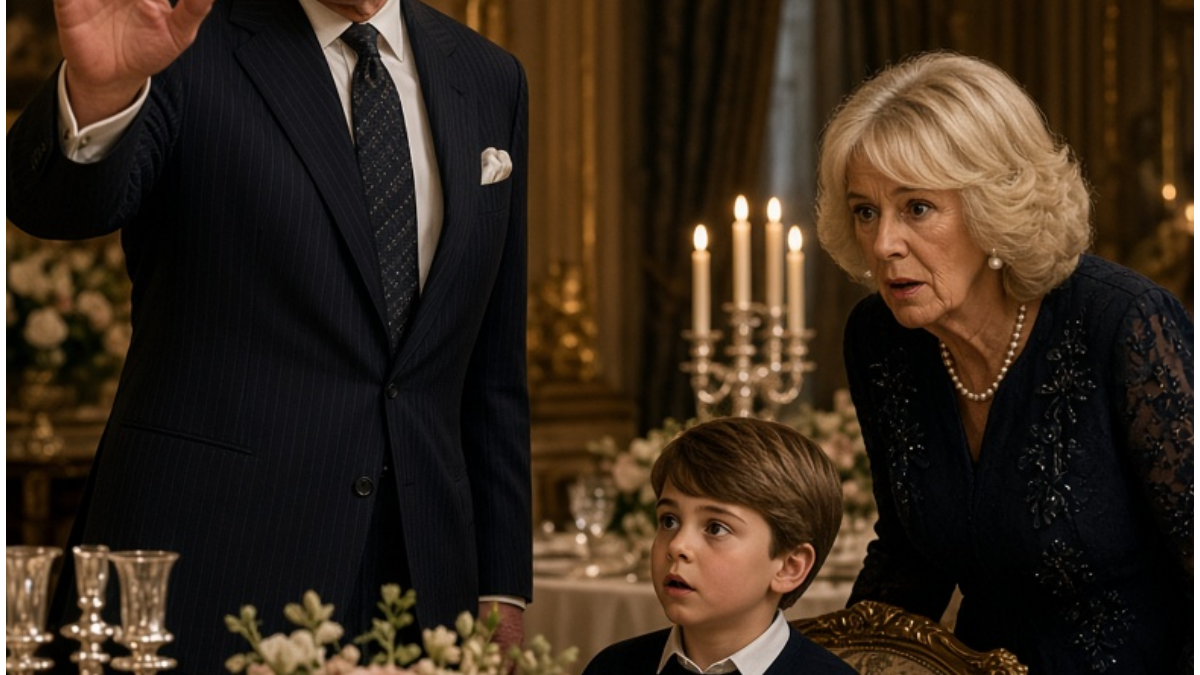
King Charles brought his open palm down flat against the mahogany table. The crystal glasses rang out in a sudden, brittle chorus. The King raised his right hand high, his face tight with an uncharacteristic, unyielding gravity.
“That is not your place,” Charles said, his voice echoing off the high ceiling with absolute, freezing clarity.
The footman froze mid-stride, the place card trembling between his white-gloved fingers. Camilla stopped, her hand remaining glued to the top of the chair back, her eyes snapping toward her husband.
“Nothing moves until the seating is restored,” the King commanded, his voice trembling not with loud anger, but with an absolute, immovable authority.
The monarch gave no long explanation to the household staff present, but the sheer force of his intervention stunned the entire room. Charles had not been caught off guard by his wife’s movement. He had been watching her. He had been waiting.
Little Louis looked up from his napkin, his eyes darting from his grandfather at the head of the table to the Queen Consort standing frozen beside him. Confusion tightened the young boy’s face. Prince William stiffened in his chair, his jaw setting hard. He knew instantly that this was no innocent attempt at affection. Camilla had deliberately targeted one specific seat, beside one specific child whose proximity carried immense symbolic weight within the House of Windsor.
At that moment, Catherine returned to the table. She stopped dead beside the heavy oak doors, the breath catching in her throat. She saw her young son clutching his napkin in wide-eyed confusion, King Charles holding the room in silence with his raised hand, and Camilla standing squarely behind the chair that belonged to her.
No one met the Princess’s eyes. The heavy, suffocating silence told Catherine everything she needed to know: a line had been crossed, a boundary breached, and an unwritten rule of the house tested in full view of the family.
Princess Anne leaned across the table toward William, her sharp eyes scanning the place settings. She pointed a gloved finger toward the far end of the board. Camilla’s original place card—the marker assigned to her beside the King—was nowhere to be seen. It had been quietly removed before the first course was even served.
“Look,” Anne whispered to William, her tone grim. “This wasn’t a sudden thought. It was arranged before we entered the room.”
William’s gaze shifted away from the trembling servants and fixed directly upon Camilla. A cold, dark realization took root in his mind. Just days earlier, the Queen Consort had submitted a private proposal regarding young Louis, a request whose true intention King Charles had refused to share with the rest of the family.
Now, as the footman hurriedly replaced Catherine’s card and backed away, the fundamental question hung over the quiet room: why had sitting beside one five-year-old prince become important enough for Camilla to risk an open, humiliating confrontation with the King?
The Child as a Symbol
Prince Louis had no understanding of the complex court politics surrounding his life. He held no formal office, carried no ambition, and knew nothing of the subtle calculations hidden behind the polite smiles of the adults around him. Yet, in the strange, high-stakes world of the monarchy, the youngest child of the Wales family had suddenly been thrust into the center of a silent tug-of-war.
To King Charles, Louis was a deeply cherished grandson, a source of bright, unscripted joy amidst the heavy burdens of the Crown. To William and Catherine, he was a vibrant, vulnerable boy whose emotional boundaries and childhood innocence had to be protected at all costs. But to Camilla and her strategic advisors, that empty chair beside Louis represented an opportunity—a visual connection she had never truly managed to secure.
Catherine moved with quiet, decisive purpose. She crossed the floor, ignoring the eyes turned toward her, and knelt beside Louis’s chair. She smoothed her son’s hair and asked softly whether any of the household staff had spoken to him before dinner about where he was supposed to sit.
Louis leaned in and whispered that a servant had mentioned earlier that he might have a “new dinner companion” beside him tonight.
A quiet, cold anger hardened on Catherine’s face as she stood up. Louis was spirited, expressive, and naturally affectionate—the most spontaneous of her three children. But that very innocence made him uniquely vulnerable. In the royal ecosystem, a trusting, spontaneous child could easily be turned into a public relations symbol before he ever understood what was happening.
Camilla felt the coldness radiating across the table. Though she held the supreme title of Queen Consort, she was acutely aware of an invisible, unyielding wall. Her marriage to Charles had placed her at the apex of the institution, but it had not automatically granted her a grandmother’s place in the hearts of George, Charlotte, and Louis.
“I only wanted to sit beside him and speak with him,” Camilla said, her voice strained as she attempted to maintain her composure. “I thought it would be lovely for Louis to feel included in the adult conversation.”
William did not let the explanation pass. “Affection, Camilla,” the Prince said, his voice low and laced with steel, “cannot be engineered by moving a place card without his parents’ knowledge.”
The warning was sharp, direct, and impossible to mistake.
King Charles looked from his wife to his son, his face lined with profound conflict. The King appeared torn between defending his Queen and shielding his grandson—a hesitation that disturbed Catherine far more than open anger would have. Charles’s immediate intervention proved he had anticipated Camilla’s maneuver, yet he had chosen not to disclose the private discussions that had taken place prior to dinner.
Catherine turned her steady gaze toward the King. “Did you know about this arrangement, Charles?” she asked quietly.
The monarch did not answer. His gaze drifted down toward the empty space where Camilla’s place card ought to have been. His silence was an admission. Someone within the palace machinery had crossed a clear family line, and Charles was now forced to confront a breach he could no longer defend.
The Portrait Protocol
The confrontation at the dinner table was not an isolated incident. Its roots stretched back several days to a quiet meeting held in a private drawing room at Clarence House—a meeting where no voices were raised, but where a single proposal had fundamentally altered the temperature of the royal household.
A official palace photographer had been summoned. Three gilded chairs had been arranged against a silk-draped backdrop for what was meant to be a routine planning session for upcoming promotional imagery. It was during this session that Camilla had put forward a suggestion that Prince William would later describe as the exact moment family affection was traded for institutional strategy.
Camilla had carefully examined the proposed photographic proofs and suggested a specific composition. She proposed sitting directly beside Prince Louis, with King Charles standing behind them, creating what her communications team called a “warm, natural image of generational continuity across the reign”.
To the palace communications officers, the concept seemed brilliant. The monarchy had faced lingering public questions regarding family cohesion, and a single, tender photograph featuring the Queen Consort naturally interacting with the popular young prince would project unity and familial warmth across the nation.
When William was presented with the portrait folder, he had read the strategic notes in silence. Then, with a slow, deliberate movement, he closed the binder with both hands.
“Louis,” William had said, his voice dropping into a quiet, absolute register, “will not be used as a public relations tool to resolve uncertainty surrounding Camilla’s standing.”
He had slid the folder back across the table, turning a polite media discussion into an unyielding refusal.
Deeply hurt by the rejection, Camilla had carried her grievance directly to the King. She argued that she was constantly asked to demonstrate loyalty, warmth, and grandmaternal devotion to the nation, yet was systematically denied any natural opportunity to be seen with the children in public or private settings. She insisted she sought genuine closeness, not institutional control.
Charles had listened with deep empathy for his wife, yet he had firmly refused to overrule William or pressure Catherine. He understood that forcing the Wales family into staged intimacy would destroy whatever fragile trust remained.
Undeterred by the King’s stance, Camilla had later approached a senior household official to ask whether a private family dinner might afford a quieter, less formal environment to sit beside Louis—away from cameras and official protocol. The official had warned her in no uncertain terms that altering the pre-approved seating plan without Catherine’s explicit consent would be seen as a direct provocation, particularly in light of William’s earlier refusal.
On the morning of the dinner, King Charles had discovered a revised table diagram resting on his desk. The diagram had shifted Camilla beside Louis and moved Catherine two seats down. Furious, the King had taken his fountain pen, circled the altered seats in thick red ink, written a firm command restoring the original seating, and sent the paper back to the household office.
Yet, as Princess Anne later discovered through a confidential staff account, that red-inked diagram had not been destroyed. Someone within the household staff, acting under secret instructions, had carried the rejected plan into the dining room and ordered the footmen to execute it anyway—openly defying the King’s written command.
Thus, when Charles raised his hand to halt the dinner, he was not merely correcting a seating error. He was witnessing an explicit act of internal insubordination, a quiet coup within his own household designed to force a family dynamic that had already been rejected.
Dismissing the Court
For several agonizing seconds, no one in the state dining room moved. Camilla remained standing behind Catherine’s chair, her hand resting heavily on the carved wood. King Charles kept his hand flat against the table, his breathing heavy and measured.
Catherine approached the table slowly, her eyes fixing first on her son, then on the chair, and finally on the Queen Consort.
“Why has my place been altered?” Catherine asked, her voice calm, clear, and unyielding.
A footman stepped forward, stammering an attempt to explain, but Charles cut him off instantly with a sharp gesture. The King would not permit a junior staff member to take the blame for a decision orchestrated far above his pay grade.
“The original seating arrangement was formally approved by me,” Charles declared, looking around the table. “It will be respected without exception.”
Camilla did not release her grip on the chair. She met her husband’s gaze, hearing the cold condemnation behind his words. The King had publicly affirmed that she had acted against his express command. What she had hoped to frame as an innocent, motherly gesture was now exposed as a deliberate breach of authority.
“It is only a seating arrangement for a single family dinner, Charles,” Camilla said, her voice tight with suppressed emotion. She argued that young Louis should not grow up feeling there were invisible, rigid barriers separating members of his own family. She claimed she wanted warmth and open conversation, not conflict.
William rose halfway from his seat, his tall frame looming over the table. “Louis did not build those barriers, Camilla,” the Prince said coldly. “And he will not be used to break them down.”
Camilla turned her anger on the heir to the throne. She accused William of viewing every gesture of kindness she made toward the children as a sinister intrusion, of harboring deep-seated suspicion that poisoned every family gathering.
William did not flinch. “The issue is not your desire to be close to Louis,” he answered, his voice steady and sharp. “The issue is your decision to displace his mother without asking either of his parents.”
Without a word, King Charles reached inside his formal jacket and pulled out a folded piece of paper. It was the original seating diagram, marked with his sharp red ink and explicit handwritten command. He unfolded it and laid it flat in the center of the table, directly beneath the chandelier light.
Camilla stared down at the red ink. Her defiance collapsed into shock as she realized the evidence of her office’s secret maneuver was exposed before William, Catherine, and Princess Anne.
“Who handed this plan to the dining staff after I rejected it?” Charles asked, his voice deathly quiet.
No staff member dared to speak. Camilla’s eyes flicked briefly toward a senior aide standing near the wall, a subtle look that confirmed to everyone present that the order had come directly from her private quarters.
Charles made his decision. He raised his head and looked at the footmen and equerries lining the room.
“Clear the room,” the King commanded. “All staff, out. Close the doors.”
The servants bowed hastily and backed out of the room, the heavy oak doors closing with a firm, resounding thud. The state dining room was sealed. The formality of royal service fell away, leaving the sovereign, his wife, his sister, his son, and his daughter-in-law alone to confront the raw, unvarnished truth.
The Sovereign’s Verdict
Inside the sealed room, the silence was suffocating. King Charles stood at the head of the long table, a monarch caught in the most agonizing dilemma of his reign. For decades, Charles had tried to balance his deep love for Camilla with his duty to his family and the Crown. Now, those two worlds had collided violently.
If he backed Camilla, he would send a message to William and Catherine that their parental authority was subordinate to palace politics. If he condemned her, he would subject his wife to a humiliating public rebuke in front of the stepson who had resisted her presence for decades.
Princess Anne broke the deadlock. She walked to the side of the table and looked directly at Camilla.
“Rank,” Anne said, her voice crisp and uncompromising, “may dictate who leads a state procession or sits at the head of a banquet, but rank cannot command personal affection. You cannot force intimacy through a seating chart.”
The Princess Royal’s words cut through the remaining pretense. Royal authority could command courtiers and organize ceremonies, but it had no power over the human heart.
Charles turned to his wife. His expression softened with a deep, sorrowful understanding. He spoke gently, acknowledging the profound isolation Camilla often felt, her longing for total acceptance within the family, and the pain of always feeling somewhat on the outside of Charles’s bond with his grandchildren.
“I understand why you wanted this, Camilla,” Charles said, his voice quiet and heavy. “You long for warmth and inclusion. But warmth cannot be demanded through palace maneuvers, altered photographs, or displaced chairs. It must be earned through patience and respect for boundaries.”
Camilla looked at her husband, her eyes filled with tears of anger and humiliation. Slowly, she removed her hand from the back of Catherine’s chair.
“Will I always be treated as an outsider where William’s children are concerned?” she asked, her voice trembling.
Charles looked down at the table, unable to give her the easy comfort she sought. His silence was a devastating answer. He could give her the crown, the title, and the palace, but he could not rewrite history or command his son’s trust.
Then, Charles issued his final verdict.
“Effective immediately,” the King declared, “every future engagement, photograph, seating arrangement, or private interaction involving George, Charlotte, and Louis must receive explicit, prior written approval from William and Catherine. No member of the Queen’s household will ever alter a family schedule or seating plan again.”
He also announced an immediate internal review to identify and discipline the household official who had bypassed his red-inked command.
Camilla stood in complete silence, absorbing the judgment. Her attempt to secure a position beside young Louis had backfired entirely, resulting in a formal, institutional restriction that codified her separation from the children’s official lives.
The Quiet Departure
Queen Camilla did not scream or make a scene. Instead, she performed a gesture of such cold, absolute composure that it chilled the room far more than an outburst ever could.
She took her linen napkin from her place, folded it into a neat square, and set it beside her untouched plate. She stepped away from the chair she had tried to claim and looked around the table.
“I will not remain for dinner,” Camilla said, her voice remarkably steady despite the strain in her eyes. “Louis should be permitted to enjoy his meal without the adults turning his presence into a battleground.”
She turned toward the door, but before she could take three steps, a small voice called out from the center of the table.
“Are you leaving because of me?” Louis asked, his big eyes wide with innocent concern.
The question stopped Camilla in her tracks. She froze, her shoulders softening. For a brief moment, the grand title, the court politics, and the bitter rivalries vanished. She looked at the five-year-old boy who had no idea he was the epicenter of a palace crisis.
Camilla walked back toward the table, keeping a respectful distance, and crouched down so she was at eye level with Louis.
“No, my darling,” Camilla said softly, her tone entirely genuine. “You have done nothing wrong at all. Sometimes grownups have silly disagreements about adult things that have nothing to do with you. You eat your dinner and enjoy your evening.”
Louis looked at her, nodded slowly, and offered a small, shy smile.
Catherine, standing nearby, felt her anger give way to a profound, complex sympathy. In that single, unscripted moment, Camilla had shown the very warmth she had tried so desperately to stage.
“Thank you, Camilla,” Catherine said softly, her voice carrying a quiet, genuine respect. “Thank you for reassuring him.”
Camilla met Catherine’s eyes for a brief second. No long speeches were made, and no deep wounds were instantly healed, but an understanding passed between them. Catherine would never compromise on protecting her children’s boundaries, and Camilla finally understood that those boundaries were born of a mother’s fierce love, not mere spite.
Camilla stood up, nodded politely to the King, and walked out of the state dining room, closing the door quietly behind her.
She walked down the long corridor to her private sitting room, where her senior private secretary was waiting nervously. When the official attempted to apologize, explaining that he had executed the seating change believing it would please her, Camilla stopped him with a single raised hand.
“Your actions today,” Camilla told him coldly, “have inflicted damage that cannot be undone. Your resignation will be on my desk tomorrow morning.”
Truth Across the Mahogany
Back in the state dining room, the heavy oak doors remained closed. King Charles dismissed the rest of the family, asking Prince William to remain behind.
Father and son sat opposite each other across the long, polished table. The candles had burned down, casting long shadows against the damask walls. Between them lay the red-inked diagram—a stark reminder of how close the institution had come to fracturing over a single meal.
“I only wanted peace, William,” Charles said quietly, his voice filled with a profound, weary sadness. “I hoped that with time, with shared moments and family dinners, a natural closeness would grow between Camilla and your children. I wanted my family to feel whole.”
William looked at his father, his eyes softening slightly. “I know what you wanted, Father,” William replied gently. “But you cannot force peace through court management. You cannot use my children as a bridge to heal wounds that were created thirty years ago.”
He leaned across the table. “Louis, George, and Charlotte are not public relations assets to be arranged for photographs or seating charts to prove to the world that we are happy. They are children. They deserve to know that their home is safe, that their mother is respected, and that their boundaries are absolute.”
Charles listened to his son, tears welling in his eyes. He recognized the truth in William’s words—a truth he had been too afraid to face. In his desperate desire to protect his wife and create the appearance of a united family, he had allowed his staff to cross lines that should never have been touched.
“I saw Louis’s face when the dinner stopped,” Charles admitted softly, his voice cracking. “He was frightened. That was the moment I realized we had failed. When a child becomes frightened at his own family table, the institution has lost its way.”
“You stopped it, Father,” William said, reaching across the mahogany to place his hand over his father’s hand. “You raised your hand, and you stopped it. That mattered.”
For the first time in years, father and son spoke without advisors, without speechwriters, and without the heavy filter of palace public relations. They spoke as a father and a son who both loved their children, both carried immense burdens, and both recognized that the future of the monarchy depended not on manufactured perfection, but on raw, unvarnished honesty.
They reached a firm, lasting agreement. There would be no more staged photographs, no more manipulated seating charts, and no more forced family narratives. Any future interaction between Camilla and the Wales children would happen naturally, privately, and strictly on Catherine and William’s terms.
The Empty Chair Transformed
By the following morning, news of the interrupted dinner had inevitably leaked to the press. Though no cameras had been present, rumors of the King halting a family meal spread rapidly through London broadsheets and media outlets. Headlines speculated wildly about internal feuds, seating disputes, and generational divides.
Palace communications issued a single, brief statement:
“His Majesty the King hosted a private family dinner at Buckingham Palace. Internal arrangements were adjusted to ensure the comfort of all family members. The household regards private family meals as strictly confidential.”
While the press debated the symbolic meaning of the “empty chair,” the reality inside the palace was quietly transforming.
Three days after the incident, a small, unannounced gathering took place at Windsor Castle. There were no footmen, no seating diagrams, no cameras, and no formal protocol.
In a sunlit sitting room overlooking the gardens, Catherine sat on a comfortable sofa, drinking tea. Prince Louis was playing on the carpet nearby, building a tower out of wooden blocks.
The door opened, and Queen Camilla walked in alone. She wore a simple day dress, no jewelry, and carried no folder or notes. She looked at Catherine, a look of quiet, humble hesitation on her face.
Catherine looked at her for a moment, then offered a small, warm nod toward an armchair near the fireplace.
“Sit down, Camilla,” Catherine said softly. “Would you like some tea?”
Camilla smiled faintly and sat in the armchair—a chair that was entirely separate, unforced, and unassigned.
Louis looked up from his wooden blocks, recognized her, and held up a red block. “Look how tall it is,” the boy said cheerfully.
Camilla leaned forward, smiling gently. “It’s very tall, Louis. Be careful it doesn’t tumble down.”
King Charles stood near the doorway, watching the quiet scene from the shadow of the hall. He did not step into the room, nor did he call for a photographer.
He saw that the empty chair had finally been filled—not through authority, not through place cards, and not through royal protocol, but through the quiet, patient grace of a family learning to heal on its own terms.








