It Hurts… Let’s Try Again Tonight,” the Virgin Bride Whispered — and the Apache’s Patience Shifte
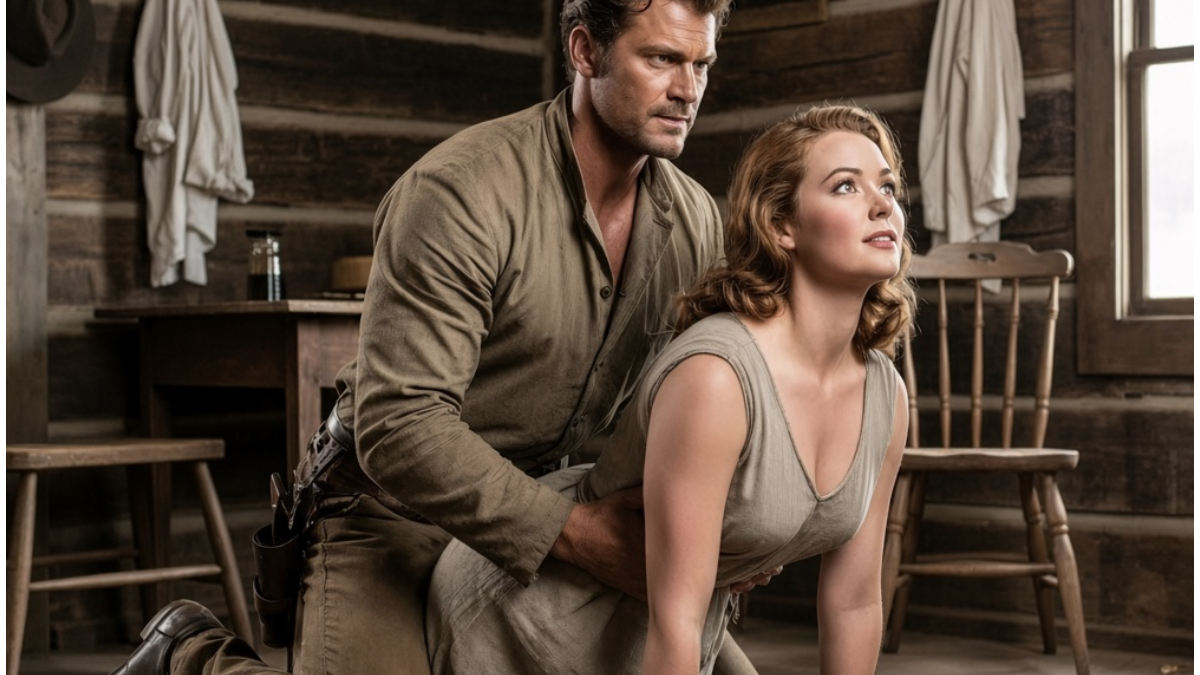
The wagon wheels groaned against the hardpan earth, a sound like a bone snapping slowly under weight.
Clara Alden sat on the buckboard seat, her spine pressed against the unyielding wood, watching the New Mexico territory stretch out before them.
It was a landscape of deceptive beauty. The mesa in the distance were painted in bands of violet and rusted iron, rising like altars to gods that had long since abandoned mercy.
But here on the valley floor, the reality was grit. The wind did not blow.
It scoured. It carried a fine alkaline dust that coated the back of her throat and turned the hem of her calico dress a permanent ghostly gray.
Reverend Thomas Alden pulled on the rains, bringing the exhausted mules to a halt near the edge of a dry riverbed.
He wiped his forehead with a handkerchief that had ceased to be white 3 days ago.
We are here, Clara,” he said, his voice thin in the vast silence. “The Lord has led us to water.”
Clara looked down at the riverbed. It was a scar of cracked mud, littered with smooth stones and tangled driftwood, bleached white by the sun.
There was no water, only the memory of it, and a few patches of stubborn grayish dampness where the shade of a twisted cottonwood touched the bank.
It is dry. Father,” Clara said. Her voice was flat. She had learned over the 3 months of travel from Ohio that hope was a calorie she could not afford to burn.
“It is merely resting,” her father insisted. Climbing down with a stiffness that betrayed his 50 years, “The season’s turn.
The rains will come. This is the land Ephraim Crow promised us.” He called it a paradise for a man of faith.
Clara looked at the shack that stood 50 yards away. It was a lean-to- of rough huneed pine and adobe, the roof sagging like a weary shoulder.
Thorn brush clawed at the foundation. A hawk circled overhead, screaming once, a sharp sound that vanished instantly into the heat.
This was no paradise. It was a place where things came to dry out and die.
But her father was already on his knees, hands clasped, thanking providence. Clara remained on the seat, her eyes scanning the horizon.
She felt a prickle on the back of her neck, the sensation of being watched by the land itself.
She did not pray. She reached under the seat and checked the position of the heavy iron skillet, the only weapon she knew how to wield.
In the weeks that followed, the brutal truth of their existence began to peel away the reverend’s optimism like sunburned skin.
The soil was hostile, rejecting the seeds with a stony indifference, but the land was not the heaviest burden.
The burden was the shadow of Ephraim Cra. Craell was a rancher who owned the valley, not by deed, but by the weight of his cattle and the number of men who rode for him.
He was a man of heavy silence and sudden jovial noise, built like a wall of granite.
He had advanced Clara’s father the money for the wagon, the [clears throat] supplies, and the journey.
A sum that seemed abstract in Ohio, but terrifyingly concrete here in the duSt. Every Tuesday they drove the wagon 3 hours to the trading post at Seven Creeks to buy what the earth refused to yield.
The post was the heart of the territory, a dark timbered building smelling of cured tobacco, sweat, and raw whiskey.
It was here that Clara learned the language of the frontier. It was not a language of words, but of glances.
She stood by the sacks of flower, making herself small. While the men leaned against the counter, they spoke of the Apache with a casual, terrifying hatred.
They called them wolves, snakes, vermin. They told stories of raids that grew bloodier with every retelling.
Laughing when someone suggested that the only good Indian was one swinging from a rope.
Clara saw the way the other women looked at her. The few that were there, they were hard women, skin-like leather, eyes suspicious of her clean hands and her father’s collar.
They knew the Aldens were in debt. They knew they were soft. It was on a blistering afternoon in late August that Clara first saw him.
The trading post fell silent as the door swung open. [clears throat] A heavy silence, thick with resentment.
Two U’s cavalry soldiers walked in, dusty and loud, demanding whiskey. Trailing behind them, moving [clears throat] with a silence that made the floorboard seem to hold their breath, was an Apache.
He stopped just inside the door. He wore a mixture of worlds, high moccasins that reached his knees, canvas trousers, and a faded calico shirt.
A red headband held back black hair that fell to his shoulders. He did not look at the men who stared at him with hands hovering near pistol grips.
He looked at nothing, his dark eyes fixed on a point in the middle distance.
“That is the scout,” a woman whispered near Clara, pulling her shawl tighter. “Taza works for the soldiers.”
“Trader is what he is,” another woman hissed. “Selling his own kind to the blue coats and a murderer like the rest of them.”
Clara could not look away. The man Taza stood with a stillness she had never seen in a human being.
It was not the stillness of reSt. It was the stillness of a coiled spring.
[clears throat] His face was a mask of discipline, sharp boned and copper skinned, revealing absolutely nothing of what he felt.
The soldiers treated him like a pack mule, barking in order for him to wait outside.
He turned to go, and for one second his eyes swept across the room. They landed on Clara.
There was no lust in them, no curiosity, only a cold recognition of her presence, as if he were cataloging her as part of the environment.
Sack of flower, barrel of nails, white woman in a gray dress. Then he was gone, slipping out into the blinding light.
Clara let out a breath she didn’t realize she had been holding. That evening, Ephraim Cra rode out to their shack.
He did not come alone. Two of his riders waited by the dry riverbed, smoking cigarettes, their rifles resting easily across their saddles.
Crowell sat at their small pine table, filling the room with his bulk. He drank the coffee Clara poured, his eyes following her hands.
“Reverend,” Cra said, his voice rumbling in his cheSt. “We have a problem of arithmetic.”
Clara stood by the stove, her hands gripping her apron. Her father sat opposite Cra looking shrunken.
The crops have been slow. Ephraim, her father stammered. The rain. The rain is God’s business.
Crowell interrupted pleasantly. The debt is mine. You owe me $400, Thomas, plus intereSt. And looking at this patch of dirt, I do not see $400.
I need time, her father pleaded. Time is money, Crowell said. He set his cup down.
However, I am a man who values community. I have a solution. Clara felt the air leave the room.
The territory is dangerous. Crowell continued, turning his gaze fully onto Clara. A man of God and his daughter.
Out here alone. It keeps me awake at night. There are Apache bands moving out of the black range.
Victoria is restless. You need protection. You need a connection to the land that goes deeper than a deed.
What are you proposing? Her father asked. Marriage, Crowell said. For Clara. Clara dropped the dish rag.
It slapped wetly against the floor. Marriage? Her father asked, blinking. To whom? To a man I have selected?
Crowell said, leaning back. A man who can keep you safe. A man who needs a place in this world just as much as you do.
You give the girl to him, and I will defer the debt for 2 years.
I will consider the family secured. Who is he? Clara asked. Her voice was trembling, but she forced the words out.
Cra smiled, but the smile did not reach his eyes. A capable man, my dear, a man who knows these hills better than the coyotes.
He did not say the name. After Crowell left, the argument lasted until dawn. Her father paced the small floor, ringing his hands, framing the horror as a test of faith.
It is a sacrifice. Clara, he said, his eyes wet with tears that made Clara sick to her stomach.
Like Jeepa’s daughter, we are unprotected. If Cra turns us out, we starve. Or worse, this man Crowell says he is strong.
He says it is the only way to ensure our safety from the savages. It is selling me, Clara said, sitting at the table, staring at the grain of the wood.
You are selling me to pay for your bad decisions. It is redemption, her father shouted, then lowered his voice, looking at the door as if God were eavesdropping.
It is our duty to survive. Clara looked at him and saw the truth. He was terrified.
He was a soft man in a hard world, and he would feed her to the wolves to buy another day of life.
The realization broke something in her chest, snapping the tether of childhood adoration. She was alone.
2 days later, the hysteria broke. A rider came galloping into the trading post while Clara and her father were collecting mail.
The horse was lthered, its sides heaving. Dead, the man screamed. The Miller brothers butchered in the canyon.
The post erupted. Men grabbed rifles. Women gathered children. The story flew from mouth to mouth, growing more grotesque with every second.
They had been scalped. They had been burned. It was the Apache. It was a war party.
Clara stood frozen near the door. She saw Crowell in the center of the room, his face grave, commanding the men to form a militia.
But as he turned, she caught a glimpse of his expression. It was satisfied. He walked straight to Reverend Alden.
You see, Thomas, Crowell said, his voice carrying over the panic. The violence is here.
The time for waiting is over. The wedding happens tomorrow, or I cannot guarantee the safety of this post, let alone your shack.
Who is he? Clara demanded, stepping between her father and the rancher. If I am to be the price of your safety, tell me the name.
Cra looked down at her. A flicker of amusement in his eyes. Taza, he said.
The rooms seemed to tilt. The scout, the Apache. He is civilized, Crowell said with a shrug.
He speaks English. He works for the army. And having him in the family, well, it sends a message to his kin, doesn’t it?
It buys us insurance. And it buys him a reason to stay loyal. A silence rippled through the people nearby, a white woman and an Indian.
It was unheard of. It was an abomination, but Crowell’s gaze dared anyone to object.
He was orchestrating a master stroke, binding the best tracker in the territory to his control, using a white woman as the chain.
Clara felt the blood drain from her face. She remembered the cold black eyes of the man in the doorway.
She remembered the way the soldiers spoke to him. She was to be given to a man who was hated by everyone in the room, a man who lived between worlds, belonging to neither.
She looked at her father, he looked away. I will be ready, Clara whispered. Because she had no choice.
Because the alternative was her father’s ruin and her own abandonment in a land that ate the weak.
10 mi away in a canvas tent at the edge of the military encampment. Taza stood before Lieutenant Groten.
The lieutenant was polishing his spectacles. I do not like it either. Taza, he said it is messy, but Cra has influence in Santa Fe.
He says the settlers are on the verge of a riot after the Miller killings.
He says a union between you and a settler family will calm the waters, show integration.
I do not want a wife, Taza said. His voice was low, rasping like gravel.
It is not about what you want, the lieutenant sighed, holding the spectacles up to the light.
It is about the rations for the Warm Springs Band. Your uncle’s people are starving.
Taza, the beef delivery is late again. Crowell controls the beef contracts. Taza went still.
His hand rested on the hilt of the knife at his belt. A reflex he checked instantly.
He says, “If you agree to this arrangement, the beef will be delivered on Friday.
Full weight if you refuse.” Well, crow can be difficult, and I cannot protect your kin if the locals decide to hunt them down in retaliation for the millers.”
Taza looked through the open flap of the tent. He saw the heat shimmering off the parade ground.
He saw the way the soldiers looked at him. Necessary, but despised. He thought of his uncle’s face, gaunt with hunger.
“I will do it,” Taza said. The wedding took place at the Alden homestead at noon under [clears throat] a sun that hammered the earth flat.
It was stripped of all joy. There were no flowers, only the dry rattle of sagebrush in the wind.
A dozen settlers stood in a semicircle, their arms crossed, eyes full of judgment and morbid curiosity.
They looked at Clara as if she were already dead, or worse, tainted. Clara wore her mother’s dress, taken in at the waiSt. The lace yellowed with age.
She stood in the dust, her hands shaking so badly she had to clasp them together to keep from dropping the Bible she held.
Taza stood 3 ft away from her. He had washed, his hair damp and sllicked back.
He wore a clean white shirt that seemed too bright against his dark skin and a stiff black coat that restricted his movement.
He did not look at her. He stared straight ahead at the shimmering horizon, his face a mask of stone.
The justice of the peace. A man Cra had brought from town. Hurried through the words.
He did not ask for objections. He did not offer a sermon on love. Do you, Clara Alden, take this man?
Clara looked at Taza. Up close, he smelled of sage smoke and lie soap. There was a scar running from his jaw down his neck, vanishing into the collar.
He was terrifyingly real, a stranger. A savage she had been raised to fear. Now standing as her husband.
“I do,” she whispered. The words tasted like ash. Taza’s response was a low rumble, barely audible.
“I do.” There was no kiss. The justice declared them man and wife, and the silence that followed was heavy enough to crush a lung.
Ephraim Crowell stepped forward, clapping Taza on the shoulder with a force that was meant to dominate.
“Done,” Cra said. You have your land, Taza. The strip near the canyon spring. Take her there.
Keep the peace. Cra’s eyes met Clara’s. There was a warning in them. [clears throat] You are the payment.
Be good currency. Her father hugged her briefly, his body trembling. He smelled of fear.
“God, go with you, Clara,” he mumbled, then pulled away quickly, unable to meet her gaze.
Clara climbed onto the buckboard of the small wagon Crow had provided. Taza took the reinss.
He did not help her up. He snapped the rains and the mules lurched forward.
They drove away from the only home she had known in this territory, leaving the settlers staring after them, a cloud of dust rising to obscure the view.
They rode in silence for 2 hours. The terrain grew rougher, the flat scrub giving way to rising rock formations and deep shadowed aoyos.
Taza did not speak. He did not look at her. He drove with an efficiency that was almost mechanical.
Clara sat with her hands in her lap, her knuckles white. Her mind was a chaotic storm of the stories she had heard.
Stories of captivity, of brutality. Every time the wagon jolted, her heart hammered against her ribs.
They arrived at the canyon spring as the sun began to bleed into the western mountains.
The dwelling was small, an adobe structure built into the side of the cliff, protected by an overhang.
It was old, likely built by the ancient ones or earlier settlers, and patched with fresh mud and timber.
Taza stopped the wagon. [clears throat] “Get down,” he said. It was the first time he had spoken to her directly since the ceremony.
His English was clear, accented, but precise. Clara climbed down, her legs unsteady. She waited.
Taza unhitched the mules, leading them to a small corral near the spring. He moved with a fluidity that fascinated and terrified her.
He was efficient. He ignored her completely until the animals were cared for. Then he turned and walked to the door of the adobe.
He opened it and waited. Clara walked past him, the [clears throat] hem of her wedding dress dragging in the dirt.
She stepped into the dark interior. It was cool inside, smelling of earth and dried herbs.
There was a fireplace, a small table, and in the corner, a bed frame roped with rawhide covered with blankets.
One bed. Night fell quickly in the canyon. Taza lit a kerosene lamp, the yellow light throwing long, dancing shadows against the mud walls.
He took off his coat and hung it on a peg. He turned to look at her.
Clara stood by the table, shivering, though it was not cold. The terror she had been holding back all day began to curdle into a strange, desperate panic.
She was married. This was her husband. She knew what happened between husbands and wives.
She had heard the whispers, the crude jokes. She looked at him. He was watching her with that same unreadable expression.
He was waiting. Clara’s mind raced. If she fought, he would kill her. If she ran, the desert would kill her.
Cra had said he would protect them. This was the bargain. She had to fulfill her part.
Her hands moved to the buttons of her bodice. Her fingers were clumsy, slipping on the small pearl discs.
She undid the top button, [clears throat] then the second. She pushed the dress off her shoulders, letting it fall to her waist, revealing the white cotton shift underneath.
She kept her eyes squeezed shut, waiting for the violence, waiting to be taken. She heard his footsteps, the crunch of boots on the dirt floor.
She flinched. He stopped in front of her. She could feel the heat radiating from his body.
“Stop,” he said. Clara opened her eyes. He was standing arms length away. He was not reaching for her.
His hands were at his sides, clenched into fists. You do not have to do this, he said.
His voice was tight, strained. Clara stared at him, confused. But we are married. It is the way.
She was trembling violently now. The adrenaline was mixing with a strange, confusing heat, a desire born of sheer survival instinct, a desperate need to get it over with, to bind him to her so he wouldn’t cast her out.
She took a step toward him. She [clears throat] reached out and touched his cheSt. His shirt was rough, but the muscle beneath it was hard as iron.
He flinched at her touch, his breath hitching. “Please,” she whispered. Her voice broke. “It hurts.
The waiting. It hurts. Let’s try again tonight. It was a plea, not for pleasure, but for resolution, for the end of the fear of the unknown.
Make me yours so I am safe.” Taza stared down at her. His eyes were black pools in the dim light.
For a moment, she saw something flash behind the mask, a raw, burning anger, and beneath it, a profound exhaustion.
He looked at her hand on his chest, then up to her face. He saw the terror in her eyes.
He saw the way she was offering herself like a sacrificial lamb. He reached up and took her wriSt. His grip was firm, calloused, but not cruel.
He pulled her hand away from his cheSt. “No,” he said. He stepped back, putting distance between them.
The rejection hit Clara like a physical blow. She felt a flush of shame burn up her neck.
“Was she not even good enough for this?” “Go to the bed,” he said. “Sleep?
Where will you sleep?” She asked, pulling her dress back up, clutching the fabric to her cheSt. Taza turned away, picking up a blanket from a pile in the corner.
“Outside,” he said. I will watch the door. He blew out the lamp, plunging the room into darkness.
Clara heard the door open and close. She was alone. [clears throat] She stood in the dark for a long time, her heart pounding.
Slowly, she moved to the bed and lay down, curling into a tight ball. She listened to the wind outside.
She thought of his hand on her wriSt. He could have taken her. He had the right by law and by force.
But he hadn’t. She lay awake, staring into the blackness. She realized with a sudden sharp clarity that his patience was not weakness.
It was a wall he had built, a discipline. He was holding back a flood.
Outside, leaning against the adobe wall. Taza looked up at the stars. His hand shook slightly, the tremor of a man holding an immense weight.
He breathed in the cold night air, forcing his pulse to slow. He would not be the monster they expected him to be.
He would not be afra. He would wait even if the waiting burned him alive.
The canyon did not welcome Clara. It merely tolerated her. Life at the spring was a reduction of the world to its sharpest elements.
Rock, sky, water, and the silence that bound them together. The cabin, tucked under the brow of the sandstone cliff, was cool in the mornings and baking hot by mid-afternoon.
It was a stark existence, stripped of the hymns and needle point that had defined her days in Ohio, and even of the anxious performative domesticity of her father’s house.
Here, survival was the only religion. Clara learned quickly that the desert had a rhythm, and to ignore it was to die.
Taza did not teach her with lectures. He taught by doing, expecting her to watch and replicate.
When he hauled water from the spring, he showed her how to cover the bucket with a wet cloth to keep the evaporation low.
When he gathered wood, he showed her which scrub burned slow and hot, and which flared up and vanished in seconds.
She learned to read the ground. The soil here was jealous. It fought the roots of the small garden she tried to coax into life.
She spent hours on her knees, her hands stained red with clay, pulling weeds that were more thorn than leaf.
She learned that the sudden silence of the cicas meant something was moving in the brush, a coyote, a snake, or a man.
She learned that the yaka route could be pounded into soap, and that the dutura flower with its beautiful white trumpet was a poison that could stop a heart.
But the most difficult terrain to navigate was the man she lived with. Taza was a ghost in his own house.
He moved with a quiet economy, never wasting a step or a word. In the mornings, he was gone before the sun cleared the canyon rim, riding out to guide the patrols from the fort.
In the evenings, he returned, smelling of horse sweat and dust, his face a mask of fatigue.
He slept outside on a bed roll near the corral, claiming the night air was better, but Clara knew it was avoidance.
She also knew he did not sleep well. Through the thin walls of the cabin, she sometimes heard him in the deep hours of the night.
He would cry out sharp guttural sounds in a language she did not know, and then there would be the sound of him pacing, boots crunching on the gravel, checking the skyline.
He checks the ridgeel lines. Clara thought one evening, watching him from the darkened window.
He looks for enemies that aren’t there. Or perhaps they were there. The pressure on him was a physical weight.
Clara saw it when he returned from the fort. The soldiers demanded more of him.
Longer patrols deeper into the badlands, treating him like a hunting dog that needed to be worked hard to earn its keep.
When they went to the trading post for supplies, the dynamic was even worse. The isolation was absolute.
On the second Tuesday of September, Clara walked into the post alone while Taza tended the horses.
Two women she recognized from her father’s congregation were examining bolts of calico. “Good morning, Mrs. Gable,” Clara said, forcing a smile.
The woman turned. Her eyes rad over Clara’s faded dress and her sun darkened face.
She did not smile back. She turned to her companion. [clears throat] “It is a shame.”
“Miss,” Gable said loudly. “Some fruit spoils so quickly when it is left out in the sun.
Stolen goods are never worth buying back,” the other woman replied. They moved away, leaving Claraara standing in the aisle, the air in her lungs turning to glass.
She was not just a pariah. She was a cautionary tale to the settlers. She was spoiled meat tainted by her proximity to an Apache.
To the soldiers, she was a curiosity. To the Apache kin she had seen only from a distance, watching from the ridges.
She was an intruder. Clara walked out of the post, her head high, but her hands trembling.
When she climbed onto the wagon, Taza looked at her. He saw the stiffness in her jaw.
The sheen of tears she refused to shed. “They did not speak to you,” he stated.
“It was not a question. They spoke,” Clara said, looking straight ahead. “Just not to me.”
Taza clicked his tongue, and the mules moved forward. He did not offer comfort. His silence was his armor, and he expected her to forge her own.
The weather turned in October. The heat did not break. It shattered. The sky turned a bruised, sickly yellow, and the wind began to pick up, carrying a grit that stung the skin.
Taza had gone to the fort early. Clara, restless and feeling the walls of the cabin closing in like a prison, decided to look for sage near the canyon mouth.
She needed the scent of it to drive out the smell of smoke and stale air.
She walked further than she intended. The land was deceptive. The distances played tricks on the eye.
A ridge that looked close was miles away. She found a patch of good sage and began to cut it, the rhythmic work soothing her mind.
She did not notice the change in the light until the shadow fell over her.
Not a cloud, but a wall. She looked up to the weSt. The mountains had vanished.
In their place was a towering curtain of brown dust reaching from the earth to the heavens, roing like a living thing.
It was moving faSt. Clara dropped the sage. She turned toward the canyon, but the landmarks were already blurring.
The wind hit her a moment later, not as a breeze, but as a physical shove.
It screamed, a high-pitched shriek that drowned out her own gasp. She ran, but the world had dissolved.
The dust was everywhere in her eyes, her nose, her mouth. It choked the light, turning high noon into a copper colored twilight.
She stumbled, falling to her knees on the sharp stones. She scrambled up, panic rising in her chest like bile.
Which way was the cabin? The wind seemed to come from all directions at once.
She pushed forward, head down, wrapping her shawl around her face. She walked for what felt like hours.
Her throat was raw. Her eyes burned. The logic of the landscape was gone. She was in a void.
She stopped, crouching near a boulder to escape the worst of the lashing sand. She was going to die here.
She would be buried in this dust, just another dry bone in a dry land.
The thought was terrifying, but strangely clear. Then a shape emerged from the brown haze.
It was a horse, and on it a demon. Taza rode out of the storm, his scarf wrapped around his face, his eyes slits of black fury.
He saw her and spurred the horse. He pulled up alongside her, the animal dancing nervously in the wind.
Taza slid from the saddle before the horse had fully stopped. He grabbed Clara by the shoulders, his grip hard enough to bruise.
He shook her once violently. “You foolish woman!” He roared over the wind. His voice was not the flat, controlled tone she knew.
It was ragged. “You do not leave the canyon when the sky turns yellow. You do not walk blindly.
Clara stared at him, too stunned to speak. He was terrified. He didn’t wait for an answer.
He lifted her, swinging her up onto the saddle as if she weighed nothing. He swung up behind her, wrapping one arm around her waist, pulling her back against his cheSt. He turned the horse, navigating a world she could not see.
Guided by an instinct that lived in his blood, they rode back in the shelter of his body, the wind tearing at them.
But Clara felt a strange sudden calm. He had come for her. Inside the cabin, the silence was deafening after the roar of the storm.
Taza slammed the door and bolted it. The air inside was still, though dust hung in the shafts of light coming through the cracks.
Clara stood in the center of the room, shivering uncontrollably. She was covered in gray dust, her hair matted, her face stre with tears she hadn’t realized she was crying.
Taza stood by the door, unwinding his scarf. He was breathing hard. He looked at her and the anger was still there, pulsing in his jaw.
I I wanted Sage, Clara whispered. Sage, Taza repeated incredulous. You risked your life for a weed.
I didn’t know. You must know. Taza snapped. He walked to the water bucket, dipped a ladle, and drank.
Water spilling down his chin. He turned back to her. This land does not care about your intentions.
Clara, it kills the ignorant. If I had not cut the sign of your tracks before the wind took them.
He stopped. He looked at his hands, which were shaking. Clara watched him. She realized then that his anger was not hatred.
It was the reaction of a man who had seen too many people die and could not bear to watch another one.
She walked over to him. She took the ladle from his hand. She dipped it into the bucket and held it out to him again.
I am sorry, she said. Taza looked at the ladle, then at her. The fire in his eyes banked down, leaving only the exhaustion.
He took a sip. Then he took the ladle and held it to her lips.
“Drink,” he said softly. “The dust dries the blood.” She drank. The water was cool and tasted of tin and earth.
He reached out and brushed a lock of dusty hair from her forehead. His hand lingered for a second, rough skin against her temple.
It was the first time he had touched her without practical necessity since the wedding.
“Why did you come back?” Clara asked. You could have let the storm take me.
You would be free. Taza stiffened. He set the ladle down. Free? He asked bitterly.
To be what? A man who let his wife die? You didn’t want a wife?
No, Taza said. I did not. He walked to the table and sat down heavily.
Clara followed, sitting opposite him. The storm howled outside, isolating them in the small room.
I know why you married me, Clara said. To save your uncle’s people, to get the beef rations.
Crael owns us both. Taza looked up, surprised by her bluntness. “Yes, and I know why I married you,” she continued, her voice gaining strength.
“Because my father is a coward who traded my virtue for his safety.” Taza looked at her for a long time.
“Virtue?” He said, testing the word. “The white man’s word for property.” Clara let out a short, dry laugh.
Yes, that is exactly what it is. It was never mine, Taza. It was a currency he guarded until he could spend it.
I have been afraid my whole life. Afraid of sin, [clears throat] afraid of savages, afraid of men.
And now, she looked at her hands. Now I’m here, and I do not know what I want.
I only know what I fear. And today, today I fear dying alone in the sand more than I fear you.
Ta was silent. The confession hung in the air, raw and honeSt. I had a wife, Taza said.
The words were so quiet Clara almost missed them. She froze. Before the reservation, Taza said, looking at the grain of the wood table and a son.
They died at the river. The soldiers came at dawn. I was hunting. When I came back, he did not finish the sentence.
He didn’t have to. Clara saw the horror in the set of his mouth. I became a scout afterwards.
He said, “Not because I love the blue coats, but because I saw that war would destroy us all.
If I guide them, I can steer them away from the families. I can talk to the chiefs.
I can save who is left.” He looked at Clara. My patience, as you call it, “It is not gentle.
It is a discipline. I [clears throat] have watched men shoot down women and children.
And I have stood silent because if I killed that one soldier, the army would wipe out my entire clan.
I swallow the fire every day so that others do not burn. Clara felt a tear slide down her dusty cheek.
She reached across the table and covered his hand with hers. He did not pull away.
His skin was warm. You are not a monster, Taza, she whispered. You are the only man I have met out here who is real.
The storm raged for another hour, but the cabin felt different. The air was charged, not with fear, but with a sudden intense awareness.
Night fell. The wind died down to a low moan. Taza lit the lamp. He looked at Clara.
She was still covered in dust, her eyes bright in her dirty face. He looked at her not as a burden or a political pawn, but as a woman who had walked into the desert and survived.
Clara stood up. She felt the shift in him. It was a steadiness, a gravity that pulled at her.
She walked to the wash basin and poured water into the bowl. She began to wash her face, the cool water stripping away the grit.
She dried herself and looked at him. He was watching her. There was a heat in his gaze now, a slow burn that made her breath catch.
It was not the predatory look of the men at the poSt. It was a question.
[clears throat] Clara walked to the bed. She sat on the edge. She looked at Taza.
“The bed is big enough,” she said. Her voice was steady. Taza stood up. He walked toward her, stopping a few feet away.
“You are sure?” He asked. Clara nodded. “I am tired of being afraid. Taza, and I am tired of being alone,” he stepped closer.
He reached out and touched her face, his thumb tracing the line of her jaw.
It was a tentative gesture, asking permission. Clara leaned into his touch. She closed her eyes.
Taza blew out the lamp. In the darkness, the intimacy was a negotiation. It was not the hurried, brutal act she had been warned about.
It was slow. It was Taza’s hands, rough and careful, learning the shape of her.
It was Clara trembling not with terror but with a sudden overwhelming vulnerability guiding him.
“May I?” He whispered, his voice rough against her ear. “Yes,” she breathed. It was a clumsy, honest colliding of two lonely people.
There were pauses, hesitations where he stopped, waiting for her to relax, waiting for her to pull him closer.
He did not conquer her. He met her. And when the act was done, when they lay tangled in the blankets, the silence that followed was not empty.
It was full of the sound of their breathing, a shared rhythm in the dark.
For the next few weeks, the landscape seemed to change. The mesa looked less like prison walls and more like a fortress.
The cold nights were no longer a trial, but a reason to be close. They built a routine.
Taza would cut wood and Clara would stack it. She would cook and he would eat with a visible appreciation that made her flush with pride.
They spoke more small things. The horse favors the left leg. The beans need more water.
The sky promises froSt. It was a language of survival, but beneath it ran a current of new affection.
[clears throat] Clara found herself watching him when he worked, admiring the line of his back.
The competence of his hands. Taza would catch her looking and the corner of his mouth would lift.
A ghost of a smile that he saved only for her. He began to sleep inside every night.
He was still vigilant, the knife always within reach, but the nightmares seemed to recede, held at bay by the warmth of her body against his.
But the world outside the canyon did not reSt. November brought a bitter chill and a visit from the devil.
Claraara was scrubbing clothes in the tin tub outside the cabin when she heard the horses.
She stood up wiping her soapy hands on her apron. Taza was by the corral, shoeing the mule.
He froze, hammer in hand, his eyes fixing on the trail. Four riders emerged from the scrub.
They wore dusters and wide-brimmed hats. They were Crows men. The leader was a man named Skinner, a thin, weasel-faced individual with a wad of tobacco permanently tucked in his cheek.
They rode right up to the cabin, ignoring the fence line. Skinner looked down at Clara, a learing grin spreading across his face.
“Well, now,” he drawled. “Look at this domestic bliss.” “What do you want?” Taza asked.
He had not moved from the corral, but his body was coiled. Just inspecting the property, Skinner said, spitting a stream of brown juice onto Clara’s clean laundry.
Mister Cra likes to keep an eye on his investments. Make sure the livestock is healthy.
He looked at Clara, his eyes dropping to her cheSt. You look healthy enough, darling.
Filling out nicely. Clara felt a surge of nausea. She stepped back. Taza dropped the hammer.
It hit the ground with a heavy thud. Leave her be. Skinner. Skinner laughed. Or what?
Taza, you going to pull a knife on a white man? You know what the law says about that.
You touch a hair on my head and they’ll hang you from the nearest cottonwood.
And then who’s going to watch the little lady? The other men chuckled. One of them.
A heavy set man on a horse. Lean forward. Must be hard work. Skinner said to Taza.
Taming a white woman. Or maybe she’s taming you. Maybe you’re turning into a house cat, Taza.
Taza stood perfectly still. His face was a mask, but Clara saw his hands. They were clenched so tight the knuckles were white.
He was vibrating with the need for violence. He could kill these men. Clara knew it.
He could pull that knife and ends Skinner before the man could draw his pistol.
But he didn’t because if he did, he died. And if he died, Clara was left to them, and his uncle’s people starved.
Skinner saw the hesitation. He took it for weakness. That’s what I thought. Skinner sneered.
Good dog. He turned his horse, deliberately kicking dirt onto the drying clothes. Tell Cra we’ll be by for the payment next month.
Skinner called out. And Mrs. Apache. You try to smile more. You’re prettier when you smile.
They rode off, hooting and laughing, disappearing into the brush. Taza stood by the corral for a long time.
He did not look at Clara. He looked at the dust where Skinner had been.
Clara walked over to him. She saw the humiliation burning in him. It was a poison.
To [clears throat] a warrior, to a man of his skill, standing down before a man like Skinner was a death of the spirit.
She reached out and took his hand. He tried to pull away. Shame radiating from him, but she held on.
“Thank you,” she said fiercely. Taza looked at her. His eyes were wild, tormented. “For what?
For letting him insult you? For being a coward? For staying alive,” Clara said. “For choosing me over your pride?”
She squeezed his hand, her fingernails digging into his palm. “That was the hardest thing I have ever seen a man do,” she said.
Taza let out a long, shuddering breath. He leaned his forehead against hers. “They will come back,” he whispered.
I know, Clara said, and we will be ready. But as she held him, she looked at the horizon where the riders had vanished.
The peace of the last few weeks was gone. The canyon was no longer a fortress.
It was a trap, and they both knew that patience eventually would run out. The winter did not bring snow to the high desert.
It brought a cold that was dry and brittle, snapping the sagebrush stems like glass.
But the true frost settled not on the land but over the chaotic administration of the San Carlos agency.
A new Indian agent had arrived in the territory. His name was Silas Meeks, a man with a face like soft dough and eyes that were constantly shifting as if looking for a ledger to balance in his favor.
He sat behind his desk at the agency office, wiping his hands on a stained handkerchief, explaining to a room full of hungry men why the promised beef rations had not arrived.
“It is a supply chain issue,” Meek said, his voice oily and bureaucratic. “The contractors in the east, the weather, the government is doing its beSt. You must be patient.”
Taza stood in the back of the room, leaning against the rough huneed wall. He knew Meeks was lying.
He had seen the cattle herds moving north two nights ago, driven by men who rode for Ephraim Crowell.
The government beef paid for by treaties and promises was being diverted to private markets while the Apache families in the Warm Springs camp boiled leather to make soup.
Taza said nothing. He watched Meeks. He watched the way the agents eyes flickered toward the back door where Cra’s foreman was waiting.
It was a game of starvation, [clears throat] a slow tightening of the noose designed to provoke a reaction.
Clara felt the tightening in a different way. She stood at the counter of the trading post, her basket empty, the shelves were bare, or priced so high that the coins in her pocket were useless.
But the scarcity of flower was not the hardest thing to bear. It was the voices.
The trading post was crowded. Women from the settlement gathered near the fabric bolts, their backs turned to Clara, but their voices pitched perfectly to carry.
It is a judgment, one woman said. Her name was Mrs. Gable, the wife of the blacksmith.
You cannot mix blood and expect the Lord to bless the harveSt. She chose her bed, another woman replied.
A sharp-faced matron in a bonnet. Now she wonders why it is cold. They say she has gone native, living in the dirt.
I heard she eats raw meat now,” a third whispered, followed by a ripple of cruel, tittering laughter.
Clara gripped the handle of her basket. Her knuckles were white. She wanted to turn and scream at them.
She wanted to tell them that Taza washed his hands more often than their husbands did, that he spoke three languages while they barely mastered one, that he treated her with a terrified, careful reverence they would never understand.
But she said nothing. She had learned that words were fuel to their fire. She purchased a small bag of salt, the only thing she could afford, and walked out.
As she passed Mrs. Gable, the woman pulled her skirts back as if Clara were carrying a contagion.
You deserve whatever happens. Girl, Mrs. Gable hissed, her eyes hard and bright with the sanctioned cruelty of the righteous.
You brought this darkness on yourself. Clara walked out into the blinding sunlight, her heart hammering against her ribs like a trapped bird.
It was not the hatred of the men that frightened her. Men used fists and guns, threats that were visible.
This was a communal venom, a social death that erased her humanity long before any bullet could strike.
She climbed onto the wagon where Taza waited. He looked at her face, reading the tension in the set of her jaw.
They were talking. He said, “Drive.” Claraara said, “Please just drive.” The crisis broke 3 days later.
Lieutenant Graten rode out to their cabin at dawn. He looked tired, his uniform dusty, his face drawn.
He did not dismount. I have orders. Taza, Graten said, his horse shifting uneasily. Taza stepped out of the cabin, wiping his hands on a rag.
He had been cleaning his rifle. What orders? Colonel Shater wants a patrol to sweep the Dragoon Mountains.
There are reports of a raiding party operating out of the Box Canyon. You are to guide us.
Taza went still. There is no raiding party in Box Canyon. Lieutenant, that is where my cousin’s family is wintering.
There are old men, women, and children. They are starving because Meeks has stolen their rations.
They are not raiding. They are dying. Grten looked away, staring at the horizon. The reports are signed by Agent Meeks.
He claims he has evidence of stolen livestock found near there. I have to go, Taza, and I need you to track.
If I take you there, Taza said, his voice low and dangerous, and your soldiers get nervous.
It will be a massacre. If you do not take us, Graten said, turning his gaze back to Taza.
The colonel will send the volunteers crowsmen and they won’t bring handcuffs. Taza, they will bring torches.
If you come, you can interpret. You can keep it calm. You can save them.
Taza looked at the ground. It was a trap. A perfect impossible trap. We ride in 1 hour, Grten said.
He turned his horse and galloped back toward the fort. Clara had been standing in the doorway.
She stepped out into the morning light. She saw the look on Taza’s face, a look of trapped desperation she had not seen since the wedding.
“You cannot go,” she said. Taza turned to her. His eyes were wild. “If I do not go, they die.
If you go, you betray them,” Clara shouted. Her fear for him exploded into anger.
“You lead the wolves to the sheep, Taza. And when the shooting starts, when a soldier panics, you will be caught in the middle.
They will kill you or your kin will kill you for bringing the blue coats to their door.
I have no choice. Taza roared back. The sound echoed off the canyon walls, startling the mules.
He paced back and forth, his hands clenching and unclenching. Meeks is doing this, he said, his voice trembling with rage.
He cuts the rations to make them hungry. He invents a raid to give the army an excuse to clear the land.
He wants the water rights in that canyon. Then let us leave,” Clara pleaded. She ran to him, grabbing [clears throat] his arm.
“Taza, look at me. Let us pack the wagon. We can go to Mexico. We can go anywhere and leave them?”
Taza asked. He looked down at her, his eyes searching hers. “Leave my mother’s sister.
Leave the children?” He pulled his arm away gently. “I have to go, Clara. Then I’m coming with you,” she said.
“No, I am not asking.” Taza. Claraara’s voice was steady now, the shout replaced by a cold resolve.
If you are going to walk into a slaughter, I will not sit here and wait for a widow’s veil.
I am coming. I have [clears throat] medicine. I have bandages. If they are starving, I can help.
You will be in danger. I am already in danger. She said, “Every time I walk into town, I am in danger.
At least this danger has a purpose.” Taza stared at her. He saw the stubborn set of her chin, the same stubbornness that had made her walk into the dust storm.
He nodded once, sharp and quick. “Get the blankets,” he said. The journey to the draon mountains took two days.
Taza rode ahead with the soldiers, while Clara drove the buckboard wagon at the rear of the column, loaded with what little supplies they had, sacks of cornmeal, strips of dried venison, and her box of herbal remedies.
The camp was hidden in a fold of the granite cliffs, a place of stark defensive beauty.
When the soldiers arrived, the tension was immediate. The Apache men stood with rifles in their hands, outnumbered, but ready to die.
The women gathered the children behind them. Taza rode into the middle of the standoff.
He spoke in his tongue, his voice carrying over the wind. He spoke fast, his hands moving, gesturing to the lieutenant, pointing to the empty cooking fires.
Clara watched from the wagon. She saw the way the Apache kin looked at him.
There was no warmth. There was suspicion. They saw the army coat he wore. They saw the soldiers behind him.
[clears throat] They called him compromised. Finally, the rifles were lowered, though not put away.
The search began. The soldiers tore through the wikiups looking for the stolen livestock Meeks had reported.
They found nothing. No cattle, no branded horses, only gaunt dogs and children with bellies distended from hunger.
Clara climbed down from the wagon. She carried a sack of cornmeal. She walked toward a group of women near a fire pit.
They went silent as she approached. Their eyes were hard. Assessing the white woman in the calico dress, they looked at her hands, soft compared to theirs.
They looked at her boots. Clara felt the weight of their judgment. It was different from the women at the poSt. This was not cruelty born of arrogance.
It was hostility born of grief. These women had buried sons and husbands killed by men who looked like Clara’s father.
“I brought food,” Clara said. She held out the sack. The oldest woman, her face a map of deep wrinkles, looked at the sack, then at Clara.
She did not move. It is not from the agency, Clara said quickly. It is from from my garden.
From our home, Taza appeared at her side. He spoke a few words to the woman.
The woman listened, her eyes never leaving Clara’s face. Finally, she gave a microscopic nod.
A younger woman stepped forward and took the sack. It was not a welcome. It was a transaction, but it was a start.
For the next 3 hours, while the soldiers finished their fruitless search, Clara worked. She did not preach.
She did not try to offer comfort in English. She saw a child with an infected cut on his leg and knelt down.
She cleaned the wound with boiled water and applied a pus of malow and honey she had prepared.
The mother watched like a hawk, ready to strike if Clara hurt the boy. But when Clara finished and wrapped the leg in clean cloth, the mother’s shoulders relaxed a fraction of an inch.
By the time the lieutenant ordered the withdrawal, the sun was setting. The evidence was non-existent.
Grten looked ashamed. I am sorry, Taza, Grten muttered. It was a wild goose chase.
Meeks lied. Taza did not answer him. He was looking at his kin. He had bought them another day of life, but the trust was fractured.
He walked back to the wagon where Clara was packing her box. “You did good,” he said quietly.
Clara looked at her hands. “They were dirty and trembling. They hate us, Taza. Both sides hate us.”
Taza climbed onto the seat and took the reinss. “Yes,” he said. That is why we only have each other.
The winter dragged into a dry, punishing spring. The rains failed completely. The creek near their cabin, usually a reliable trickle, turned to duSt. The garden Clara had fought so hard to cultivate withered.
The green shoots turning brown and paper thin. Survival became a math problem. How many beans for dinner?
How much water for the mules? How long until the flower ran out? Clara’s body began to change.
The softness of her youth evaporated, replaced by the hard, wiry strength of the frontier.
Her cheekbones became prominent, her hands calloused. She was constantly hungry, a dull lake that lived in the pit of her stomach.
The hunger made tempers raw. In the small cabin, the air was often thick with unspoken frustration.
One evening, Taza knocked a cup of coffee off the table, a precious waste of liquid.
He swore a sharp explosion of sound. Clara flinched. “You are careless,” she snapped, the hunger speaking for her.
“Carless!” Taza spun on her. “I walked 10 miles today to find a spring that wasn’t poisoned with alkali.
I am keeping us alive. And I am starving,” Clara shouted back. She grabbed the empty flower sack and threw it on the table.
“Look, it is empty. Taza, your patience does not fill it.” They stared at each other, chest heaving.
Then the anger broke, leaving only fear. Taza crossed the room in two strides and pulled her into his arMs. He buried his face in her neck.
“I am sorry,” he groaned. “I am sorry.” Clara held him, her fingers tangling in his hair.
Their intimacy changed. It was no longer just a discovery of pleasure. It became a desperate refuge.
In the dark, under the piles of blankets, they clung to each other with a frantic energy.
It was a way to prove they were still alive, still human. But even in the dark, the world intruded.
Sometimes after they made love, Taza would pull away, lying stiffly on his back. Clara knew what he was thinking.
He was thinking that he was using her, that her father had sold her to him, and that by touching her, he was confirming the transaction.
And Clara battled her own demons. Sometimes when he touched her, she felt the ghost of the women’s whispers.
She lay with a savage. She would hate herself for the thought, then hate them for planting it, then hold Taza tighter to drown it out.
In April, Ephraim Crow decided that the slow death of the Alden Taza Alliance was taking too long.
He needed a spark. He began to hold court at the saloon attached to the trading poSt. He bought rounds of drinks for the unemployed minors and drifting cowboys who congregated there.
It is a tragedy, Crow would say, swirling his whiskey. A Christian girl held captive in her own home.
She’s married to him. Ephraim, someone would point out. Is she? Crow would counter, lowering his voice.
Or is she too terrified to leave? I hear stories. I hear he keeps her locked up.
I hear he threatens to kill her father if she tries to run. It ain’t a marriage, boys.
It’s a hostage situation. And that buck, he walks around like he owns the place, like he owns her.
The seeds were planted in fertile soil. The men were bored, broke, and looking for someone to blame for the drought and their own failures.
Taza was the perfect target. The rumors reached Clara quickly. When she went to the post to trade a quilt she had sewn for cornmeal, the atmosphere had shifted from coldness to aggression.
Men leared at her, not with lust, but with a savior complex. “You need help, miss?”
A man asked, blocking her path to the door. You just say the word, we can get you out of there.
Clara looked at him. He smelled of stale beer. I am fine, she said. Move.
He’s got you scared, don’t he? The man said, grinning. Don’t worry. We’re going to fix it.
Clara pushed past him, her heart racing. She realized Crow’s game. He was trying to provoke a rescue that would end in Taza’s murder.
She walked to the center of the room. She turned to face them. The room went quiet.
Listen to me, she said. Her voice shook, but she forced it to be loud.
I am not a hostage. I am his wife. Ephraim Crowell arranged the marriage to cover his own debts.
If you want to be angry at someone, be angry at the man who sells women to settle his accounts.
She pointed a finger at the man who had stopped her. Taza treats me with more honor than any man in this room has ever shown.
If you come to our land, you are not coming to rescue me. You are coming to murder an innocent man.
And I will not let it happen. She turned and walked out. The silence she left behind was stunned, but it was not convinced.
Crowl sitting in the corner, merely smiled. She had just confirmed she was brainwashed. The violence came two nights later.
It was not a direct attack on the cabin. Crow was too smart for that.
He wanted the law on his side. Instead, a group of vigilantes found a small supply cache that Taza’s uncle had hidden in a cave near the foothills.
Dried meat, winter blankets, seeds for the spring. They burned it. From the cabin, Clara and Taza saw the smoke rising against the twilight sky.
It was a black pillar of ruin. Taza grabbed his rifle. “Stay here,” he ordered.
“Taza, no!” Clara cried. “I have to see,” he said. If they are hunting my kin.
He rode out. Clara waited. She sat in the dark with a shotgun across her lap, watching the road.
The hours stretched like torture. She imagined him dead in a ditch. She imagined him arrested.
He returned well past midnight. He burst through the door, bringing the smell of smoke and copper with him.
He was breathing hard. His shirt was soaked in blood. Clara dropped the shotgun and ran to him.
Taza, you’re hurt. She tried to examine him, her hands searching for the wound. It is not mine.
Taza gasped. He pushed her hands away, staggering toward the water basin. It is not my blood.
He began to scrub his hands, the water turning pink. He was shaking violently. Who?
Clara asked, terrified. Who is it? A boy? Taza choked out. One of the herders.
He was He was trying to save the blankets, the vigilantes. They were shooting blindly into the smoke.
I got there. I tried to pull him out. He stopped. He gripped the edge of the basin so hard the wood creaked.
He died in my arMs. Clara, he was 12 years old. And the men who shot him, they were laughing.
They were drunk. They set fire to the food and shot a child. And they rode away laughing.
Taza’s knees gave way. He slid down the wall to the floor. The great stone mask he wore.
The patience he had cultivated for years finally shattered. He buried his face in his bloody hands and wept.
It was a terrible ragged sound. The sound of a man who had held the world up for too long and had finally been crushed by it.
Clara fell to her knees beside him. She did not tell him it would be all right.
It wasn’t all right. She did not quote scripture. She wrapped her arms around him.
She pulled his bloody head against her cheSt. She rocked him. I see you. She whispered into his hair.
I see you, Taza. I am here. She held him while he shook apart. She realized then that love in the West was not about romance.
It wasn’t about sunsets or poetry. It was about witnessing. It was about looking at the horror with someone and saying, “I will not look away.
I will not leave you in this dark.” They stayed on the floor until the candles burned down.
When the gray light of dawn touched the window, Taza stopped shaking. He pulled away from her.
His face was ravaged, his eyes red, but the hysteria was gone. In its place was something cold and hard as iron.
He stood up. He walked to the corner where he kept his tracking gear. They will blame the Apache for the fire.
He said his voice was flat. Meeks will write a report saying the boy was a raider.
Cra will say it was self-defense. Yes, Clara said standing up. That is what they will do.
Taza turned to her. I cannot survive this by being patient. Clara, if I do nothing, they will kill us all one by one.
Then we do something, Clara said. She walked to the table. We stopped playing by their rules.
We don’t fight them with guns. Taza, we fight them with their own paper. Taza looked at her.
What do you mean? Meeks is a bureaucrat. Claraara said, “He keeps records. If he is stealing the beef, he has a ledger.
If he is forging reports, he has drafts. He is arrogant. He thinks no one checks.
You want to steal the agents books? Taza asked. I want to take them to the territorial judge in Msilia.
Clara said, “Judge Harlon, my father spoke of him once. He hates Cra. He hates corruption.
If we bring him proof, absolute proof, it is a suicide mission. [clears throat] Taza said to break into the agency to travel 200 m through open country with Crow’s men hunting us.
We are dead anyway if we stay here. Clara said they burned the food. Taza, they shot a child.
Next time it will be the cabin. Next time it will be you. She walked over to him and took his hand.
The dried blood was still on his skin. [clears throat] I choose the road, she said.
I choose the fight. Taza looked at her. He saw the transformation complete. The preacher’s daughter was gone.
The settler’s wife was gone. Standing before him was a partner. We go tonight. Taza said, “We go tonight.”
Clara agreed. She turned to pack the remaining food. Taza began to clean his rifle.
The silence in the cabin was no longer oppressive. It was the silence of a held breath before the plunge.
The patience was over. The reckoning had begun. The moonlight turned the badlands into a graveyard of silver bones.
They moved by night. Taza leading the mules through the labyrinth of the black range, avoiding the main trails where the dust would betray them.
It was a brutal country of vertical rock and scree that slid underfoot like ball bearings.
Clara rode the lead mule, her body aching in places she didn’t know she possessed.
The cold was a physical weight. At this altitude, the desert didn’t just drop in temperature.
It became hostile. Her breath plumemed in the air, vanishing instantly in the wind that scoured the basin.
They had been running for 5 days. Taza stopped the animal with a touch to its neck.
He stood still, listening. He was a shadow among shadows, his silhouette merging with a twisted juniper.
We walk from here, he said. The shale is too loose. The animals will slide.
Clara climbed down, her boots hitting the frozen ground with a sharp crack. She did not complain.
The time for complaints had passed somewhere back near the ruins of the burnt supply cache.
They led the mules down a ravine that seemed to drop into the center of the earth.
At the bottom, a thin ribbon of ice rimmed water promised life. This was the country where the map ended and survival began.
In the days that followed, Clara learned that the West was not divided simply into white and Indian or civilized and savage.
It was a fractured mosaic of outcasts. They found shelter on the third night in the Jakal of a Mexican widow named Senora Vega, hidden deep in a box canyon.
She was a woman made of wire and dried apple skin, smoking a corn husk cigarette while she gutted a rabbit.
She did not ask their names. She saw Taza’s face and Clara’s pale windburned skin.
And she knew exactly what they were. Hunted. The law. Senora Vega spat into the fire.
The law is a fence. Miha. It keeps the cattle in and the wolves out.
But out here we are all wolves. Or we are meat. She traded them dried chilies and ammunition for a silver button from Taza’s coat.
She touched Clara’s face with a rough hand. You have the look. She said. What look?
Clara asked. The look of a woman who has realized that nobody is coming to save her.
Two days later, crossing a high pass, they stumbled upon a camp tucked into a fissure in the rock.
A man leveled a carbine at them before they could speak. He was black, wearing the tattered remains of a cavalry uniform with the yellow stripe ripped from the trousers.
“Hold,” the man said. His voice was steady. Taza raised his hand slowly. “We are passing through.
We have no quarrel with you. The man lowered the gun a fraction. He looked at Taza, then at Clara.
He saw the way they stood close to each other. A defensive unit. He laughed.
A low, dry sound. A buffalo soldier without a regiment and an Apache with a white wife.
The man said, “We are a parade of dead men walking. His name was Elijah.
He had deserted 3 months ago. Tired of clearing land for men who wouldn’t let him drink in their saloons.
He shared his fire, a small smokeless flame built in a pit and a piece of hard tack.
They are sweeping the lower valley. Elijah told them. Crows riders. I saw them yesterday.
They have a tracker. Not Apache. A white man who tracks like a hound. Why tell us?
Taza asked. Elijah poked the fire. Because the enemy of my enemy is just another poor devil trying to breathe.
You watch the ridges. Scout. They are looking for smoke. The encounter stripped away Clara’s old world view.
She had been raised to believe in a hierarchy. God, government, father. But here, in the freezing dark, the only hierarchy was who had water and who had a gun.
The widow, the deserter, the mission nurse they met later, who bandaged Taza’s arm without a word of preaching.
They were the debris of the frontier. Washed up against the rocks, surviving by their own code.
They pushed on. The destination was the agency outpost at Fort Bayard. Not to surrender, but to steal.
Taza knew that Silas Meeks kept a duplicate ledger there, one he didn’t show the inspectors from Washington.
They left the mules in a ravine and moved on foot toward the outpoSt. The hunger was a constant, gnawing companion.
They had not eaten a full meal in 4 days. Taza gave Clara the larger portion of the dried meat.
She tried to refuse, but he forced it into her hand. Eat, he commanded. If you fall, I have to carry you.
If I carry you, we both die. It was harsh love, but it was love.
They reached the perimeter of the agency at dusk. It was a sprawling collection of adobe buildings and corral.
Taza moved like smoke, guiding Clara through the shadows of the supply wagons. They found a spot behind the commissary, pressing themselves into the dust between a rain barrel and the wall.
Voices drifted through the thin wood, taking too long. Ephraim, I cannot keep cooking the books forever.
It was Meeks. Clara felt Taza stiffen beside her. You will cook them until I say they are done.
Silus, that was Crowell’s voice, heavy, confident. The girl is the key. When we catch her, the Apache will do something stupid.
Then we hang him. Then the land is clear and the beef contract is yours for another 5 years.
I don’t like it. Meeks whed. The inspector is due in May. Let him come.
By May, there won’t be any Indians left to count. Clara’s hand found Tazas in the dark.
His grip was bone crushing. They were hearing the architecture of their own destruction. Later, they watched a young clerk, a boy no older than 18 with ink stained fingers, leave the office.
He looked nervous, checking over his shoulder. He went to the stables, pulling a flask from his boot.
Taza moved. He was on the boy before Clara could blink. A hand over his mouth, dragging him into the shadows.
“Don’t kill him,” Clara hissed, stepping into the light. The boy’s eyes went wide. He saw the Apache scout and the missing white woman.
He started to shake. “Samuel, isn’t it?” Clara said. She remembered him from the few times she had visited the office with her father.
The boy nodded against Taza’s hand. Taza slowly released him, keeping the knife visible, but lowered.
“You handle the books, Samuel.” Clara said, “You know what Meeks is doing.” “I I can’t.”
Samuel stammered. “They’ll kill me. They are going to kill everyone.” “Samuel,” Taza said. His voice was a low rumble.
“They are starving children to start a war. Is that why you came west? To help butchers.
Samuel looked at the ground. He was crying. No, I wanted I just wanted a job.
Get us the page, Clara said. The one with the real beef counts and come with us.
We are going to Judge Harland in Msilia. You testify and you can start over.
Samuel looked at the commissary door. Then at them I can get it tonight. Meet me at the old kiln ruins at dawn.
I can’t leave now. They’ll notice. He ran back inside. Taza and Clara retreated into the brush.
The weight was agonizing. They huddled together under a rocky overhang, the cold seeping into their bones.
Do you trust him? Taza asked. I trust his fear. Clara said, “He is terrified of God.”
“Taza, I saw it in his eyes.” Taza pulled her closer, wrapping his coat around both of them.
His body was a furnace in the face of the encroaching death. Their desire flared up, sudden and fierce.
It wasn’t about pleasure. It was a frantic need to affirm life. Taza kissed her, his mouth tasting of salt and desperation.
Clara clung to him, her hands tangled in his long hair. “If we die,” she whispered against his neck.
“We do not die.” Taza swore. “Not yet.” Dawn broke gray and cheerless. They made their way to the kiln ruins, a crumbling stone chimney near the river.
Samuel was not there. They waited. The sun climbed higher. Taza checked the wind. Something is wrong, he said.
They moved toward the riverbank. They found him a 100 yards downstream. Samuel was hanging from a cottonwood branch.
His hands were bound behind his back. A piece of paper was pinned to his shirt.
Clara gasped, covering her mouth to stifle a scream. Taza grabbed her, pulling her down into the reads.
He read the paper from a distance. “Thief! Cra found him!” Taza said flatly. Clara stared at the swaying body.
The boy who had wanted a job, the witness who was going to save them.
“Dead [clears throat] justice,” Clara whispered, her voice breaking. “Where is the justice?” “It is in the ground,” Taza said.
“With him,” he crawled forward low in the grass. He checked the boy’s pockets, risking exposure.
He came back minutes later, his face grim, empty. But look, he held up a crumpled piece of paper he had found clenched in the boy’s stiff fiSt. It was not the full ledger.
It was a single page, torn hastily, a list of dates and weights, and a note in Meeks’s handwriting.
Diverted to EC, payment received. It is not a testimony, Taza said. But it is a start.
They pulled back, moving faSt. The killing meant Cra was close. They scrambled up the ridge, lungs burning.
Suddenly, a shot rang out. Dust kicked up inches from Clara’s boot. “Run!” Taza shouted.
They sprinted through the rocks. More shots echoed. The crack thump of high-powered rifles. Cra’s men were on the high ground.
They were being funneled toward a deadend canyon. “Up!” Taza pointed to a narrow chimney in the rock face.
They climbed, fingers tearing on the stone. Bullets chipped the rock face around them. They hauled themselves onto a narrow ledge, hidden from below, but trapped.
The only way out was a precarious traverse across a sheer face exposed to the valley floor.
Taza looked at Clara. He looked at the traverse. Then he looked at a deer trail leading down the other side, away from the shooters, but back toward the main road.
“Clara,” he said. He grabbed her shoulders. Go down that trail. It leads to the stage road.
You can flag a coach. What? Clara stared at him. They want me, Taza said intense and faSt. If I cross the face, I draw their fire.
You can slip away. You can take the paper to the judge. No, Clara, you are white.
If they catch you alone, they might spare you. If they catch us together, we are both dead.
Go. He tried to push her toward the trail. Clara planted her feet. She grabbed his veSt. I am not your property to be saved.
She hissed, her eyes blazing. I am your wife. We go together or we drop together.
I am done running away from the things I love. Taza stopped. He saw the fire in her.
It was the same fire that had burned in the eyes of the warriors he had admired as a boy.
She was not choosing martyrdom. She was refusing to be owned by fear. He nodded.
Then we climb. They crossed the face together. Taza moved first, shielding her body with his own whenever the angle allowed.
Bullets whine pasted like angry hornets. One grazed Taza’s thigh, tearing the canvas pants, but he didn’t falter.
They crested the ridge and collapsed into the safety of the treeine on the other side.
They lay there for a long time, gasping for air, their hands locked together. The pursuit had been checked by the terrain.
They had bought a lead. 2 days later, exhausted and limping, they reached the mission of San Miguel.
It was a sanctuary of Adobe and Bells, resting in a valley that seemed untouched by the war outside.
They needed water. They needed to rest Taza’s leg. They entered the courtyard. A nun was sweeping the stones.
She looked up, startled, but gestured to the fountain. As Clara drank, a figure stepped out of the chapel’s shadows.
Clara froze. It was her father. Reverend Alden looked like a man hollowed out by termites.
His coat was dusty, his face gray and sagging. He held a Bible as if it were a shield.
“Clara,” he whispered. He took a step forward. “Oh, God. Clara, you are alive.” Clara wiped her mouth.
She stood up slowly. She did not go to him. Taza stood beside her, his hand resting on his knife, his eyes scanning the courtyard for a trap.
“Cra told me you were dead,” her father said, weeping. “Or worse, he brought me here.”
He said, “He said if I prayed, you might come back.” “He is here,” Taza asked sharply.
“He is coming. The reverend said he is meeting the soldiers here. Claraara, please come with me,” he reached out his hands.
“I can fix this,” the father pleaded. I spoke to Ephraim. He says if you come home, if you say you were taken against your will, he will forgive the debt.
He will let Taza go. We can go back to Ohio. Clara, we can pretend this never happened.
Clara looked at the man who had raised her. She saw the terror in him, the pathetic, overwhelming need to be safe at any coSt. “Pretend,” Clara asked.
Her voice was quiet, but it carried across the courtyard. Pretend I wasn’t sold. Pretend I didn’t freeze in the mountains.
Pretend I didn’t see a boy hanged for telling the truth. It was for your protection, her father cried.
I did what a father must do. No, Clara said. You did what a coward does.
You sold me to buy yourself peace. You call it faith, father. But it is just fear dressed up in Sunday clothes.
She took a step closer. Taza watched her. He saw the girl he had married vanish completely, replaced by a woman of terrifying strength.
I am not coming back, Clara said. I do not need your forgiveness, and I do not need your permission to exiSt. Clara, go inside.
Father, pray for yourself. You are the one who needs it. She turned her back on him.
Taza looked at the reverend one last time. There was no triumph in Taza’s eyes, only a cold pity.
Then he turned to Clara. He touched her arm. There was a new weight in his touch.
It was not just protection anymore. It was reverence. He had spent his life practicing patience, holding back his strength to survive.
But seeing her stand against her own blood, seeing her choose the hard truth over the easy lie.
Something in him shifted. He would no longer just survive. He would fight. We have to move, Taza said.
If Crow is meeting soldiers here, we have very little time. Where? Clara asked. Measilia.
Taza said. The courthouse. It is a trap. Clara said they will be waiting for us on the road.
Yes, Taza said. He checked the load in his rifle. But it is the only place where the truth can be spoken loud enough to matter.
They walked out of the mission gate, leaving the reverend weeping in the duSt. They walked toward the main road, toward the town, toward the lions.
They had a single page of numbers, a dead witness and each other. And for the first time, Taza walked not as a scout guiding others, but as a husband walking beside his wife.
Mesilia was not a town built for secrets. It was built for commerce and judgment.
The plaza was a square of hard-packed earth surrounded by adobe buildings with flat roofs and deep portals.
Dominated by the twin towered basilica of San Albino. It was a place where civilizations collided.
American law, Mexican tradition, and the raw violence of the territory, all overseen by men in frock coats who believed that ink was thicker than blood.
Clara and Taza rode into town at midm morning. They [clears throat] had abandoned the mules miles back, trading the last of their gear for two tired horses from a sheep herder.
They looked like specters. Clara’s dress was torn at the hem and stained with the red dust of the high country.
Taza wore his exhaustion like a second skin. His eyes sunken, his right leg stiff from the grazing wound he had sustained in the mountains.
They did not hide. Hiding had been for the badlands. Here, visibility was their only shield.
The atmosphere in the plaza shifted as they passed. Conversations died. Men tipping their hats to ladies froze mid gesture.
The silence rippled outward from them like a wake. It was not the hostile hot silence of the trading poSt. This was colder.
It was the silence of respectable society closing its ranks. Taza kept his head high, staring straight ahead.
His hand resting near the pommel of his saddle but away from his rifle. He knew the rules here.
If he looked at a white woman, it was an insult. If he touched his weapon, it was a threat.
If he existed too loudly, it was a crime. Clara felt the weight of the eyes on her.
She saw the shopkeepers standing in their doorways, men who sold flower and nails, men who considered themselves pillars of the community.
They looked at her with a mixture of pity and revulsion. To them, she was a tragedy, the white woman who had fallen.
They dismounted in front of the territorial courthouse, a squad adobe building that smelled of old paper and stale tobacco.
“Stay here,” Clara said to Taza. “I will not leave you,” Taza rumbled. “You cannot go in there, Taza.
If you walk into that office, they will arrest you for vagrancy or worse, before I can open my mouth.”
“Stand by the horses, be seen, but do not give them a reason.” Taza hesitated, then nodded.
He took the reigns of her horse. I will be here. Clara smoothed her dress, brushed the dust from her sleeves as best she could, and walked up the steps.
Inside, the air was cool and dim. A clerk sat behind the high desk, scratching at a ledger with a steel nibed pen.
He looked up as Clara approached. He was a young man with pomadated hair and a weak chin.
“I need to see Judge Harlon,” Clara said. The clerk blinked. He looked her up and down, taking in the travelworn clothes, the sunburned face, the desperation.
The judge is busy. “Madam, it is urgent. I have evidence of corruption at the San Carlos Agency.
I have evidence of murder.” The clerk sighed, putting his pen down. He leaned back, a smirk playing on his lips.
Agency business is federal, ma’am. And murder, that’s a matter for the sheriff. And the sheriff is currently unavailable.
Please, Clara said, leaning on the desk. Her voice was tight. I am Clara Alden.
[clears throat] My husband is Taza the scout. We are being hunted by Ephraim Crow’s men.
The clerk’s expression changed. The smirk vanished, replaced by a mask of polite bureaucratic stonewalling.
Ah, Mrs. Alden, we have heard about you. He stood up, brushing lint from his veSt. I’m afraid the judge is not hearing petitions today.
Especially not domestic disputes. This is not a domestic dispute. Clara snapped. It is theft of government property.
The clerk leaned forward, his voice dropped to a whisper. Mrs. Alden, let me give you some advice.
Go home, Mister. Cra is a respected man. He has friends in this building. Friends who do not like to see dirty laundry aired in the plaza.
If you have a grievance, write a letter. We will file it. File it? Clara laughed.
A harsh jagged sound. You mean burn it? She turned and marched toward the inner door.
The clerk scrambled around the desk. You can’t go in there. Clara threw the door open.
The office beyond was wood panled and smelled of whiskey. Judge Harlland sat behind a massive oak desk, a law book opened before him.
He was a lion of a man with a shock of white hair and a face carved from granite, but sitting in the leather chair opposite him was Ephraim Crowell.
Crael held a crystal tumbler of amber liquid. He looked up as Clara burst in.
He didn’t look angry. He looked benevolent. He looked like a father waiting for a weward child.
Clara, Crowell said, setting his glass down. Thank God. We were just discussing how to find you.
Clara stood in the doorway, her chest heaving. She looked at the judge. Judge Haron, I’m here to report a crime.
Harlon looked at her over his spectacles. He looked tired. He looked at Cra, then back at Clara.
Come in, Mrs. Alden, the judge said heavily. Close the door. Clara stepped in but left the door wide open.
I want witnesses, she said. Crowell stood up. He walked toward her, his hands open, palms up.
Clara, you are confused. The heat, the stress. It has been too much for you.
Your father’s worried sick. He says Taza dragged you into the mountains. He says you are suffering from exhaustion.
You are a liar, Clara said. Her voice was steady, cutting through the room. You hired men to burn the food.
You hired men to kill the witness. Samuel. Crowell shook his head sadly. See paranoia.
Samuel committed suicide. My dear, the boy was troubled. A thief. We found the evidence on him.
You planted it. Clara shouted. Crowell stopped a few feet from her. His eyes were hard, but his voice remained soft.
Soothing. Clara, look at yourself. You are in rags. You are living with a savage who has turned your mind against your own people.
I am here to help you. I can take you back. We can enul this mistake.
Taza can go back to his people and you can go to a sanitarium for a few weeks.
ReSt. Recover. He reached for her arm. Do not touch me. Clara hissed. She stepped back.
I have the ledger page. Ephraim. I have the numbers. Cra froze. For a split second, the mask slipped.
A flash of pure murderous calculation crossed his face. Then it was gone. A [clears throat] ledger page.
Craled. Scribbles on scrap paper. No court will accept that against the word of the Indian agent and a man of my standing.
Judge Harlland cleared his throat. Mister Cra is right. Mrs. Alden, without a witness, documentation is just paper.
Clara looked at the judge. She saw the defeat in his eyes. He wasn’t corrupt perhaps, but he was practical.
He knew who paid for the courthouse roof. He knew who controlled the cattle vote.
Then I will find a court that listens. Clara said. She turned and walked out.
Cra called after her. Clara, don’t make a scene. Taza is outside, isn’t he? If you walk out there, you put him in danger.
The sheriff is coming. Clara didn’t stop. She walked through the clerk’s office and out onto the steps.
The plaza had changed. A crowd had gathered. It was Sunday, or close enough to it, and people were milling about after mass, but now they were focused on the courthouse.
Taza stood by the horses. He was surrounded. Four deputies, men with badges pinned to dusty vests, stood in a semicircle around him.
Their hands were on their holsters. Behind them, a group of towns people watched. Men in suits, women in lace shaws, cowboys leaning on fence posts.
The sheriff, a man named Barton with a belly that strained his buttons and eyes like flint, was speaking to Taza.
Vagrancy statute. Boy, you got no business in town unless you’re on army business. And I don’t see no lieutenant.
I am waiting for my wife, Taza said. His voice was calm, but Clara could see the tension in his neck.
He was a wire pulled to the breaking point. “Your wife?” Barton laughed. “You mean the white girl you stole?”
“I did not steal her. That ain’t what her daddy says. That ain’t what Mr. Crow says.”
Clara ran down the steps. “Sheriff,” she shouted. The crowd turned. Clara stood on the bottom step, elevated slightly above them.
She [clears throat] looked at the faces. She saw curiosity, judgment, and fear. “Leave him alone,” Clara said.
“He has broken no law.” Sheriff Barton turned to her, tipping his hat with exaggerated politeness.
“Mrs. Alden, we’re just checking his papers. Seems he’s off the reservation without a pass.
That makes him a fugitive. He is a use army scout,” Clara cried. Was Barton corrected.
Agent Meek sent a telegram this morning. Says Taza here was relieved of duty for aiding renegades.
Says he’s wanted for questioning regarding the burning of that supply cash. The lie was so bold, so complete, it took Clara’s breath away.
They had inverted the truth perfectly. The victims were the criminals. Crowell stepped out onto the porch behind Clara.
He stood tall, the benevolent patriarch. It’s all right, folks. Cra’s voice boomed across the plaza.
Mrs. Alden is safe now. We’ve got her. The Indian. Well, the law will handle him.
The crowd murmured, heads nodded. It was a simple story. A story they understood. The savage had gone wild.
The white man had restored order. Taza looked at Clara. He saw Crow behind her.
He saw the deputy’s thumbs hooked over their hammers. He knew exactly what was happening.
They were goating him. They wanted him to reach for his rifle. They wanted to kill him right here in front of the church and call it justice.
Taza’s hands twitched. The humiliation was a physical acid to stand here and be called a criminal by the men who starved his family.
His blood screamed for war. Clara saw the shift in his stance. She saw the darkness rising in him.
“No!” She screamed. She didn’t run to Taza. She ran into the center of the empty space between him and the crowd.
She turned to face the people. “Listen to me,” she yelled. Her voice cracked, then found its strength.
It rang off the adobe walls. “This man is not a criminal. The criminal is standing on that porch,” she pointed at Cra.
The crowd gasped. “A woman accusing a man like Ephraim Crow.” “In public, “He is lying to you,” Clara shouted.
She pulled the crumpled ledger page from her bodice and held it up, shaking it in the air.
This is the proof. Silus Meeks and Ephram Crowell have been stealing the beef rations meant for the San Carlos agency.
They starve the families so the men will raid and then they use the raids to get army contracts to sell the beef back to the government at triple the price.
She turned in a circle, meeting the eyes of the town’s people. You wonder why the wars never end?
She asked them. You wonder why your sons die in the hills. Because men like him make money from the blood.
Crowlel’s face darkened. He stepped down from the porch. Sheriff, arrest her. She is hysterical.
But the crowd didn’t move. They were listening. The story had a ring of truth to it.
Everyone knew Cra had gotten rich too faSt. Everyone knew the beef was always terrible.
Sheriff Barton hesitated. He looked at Crowell, then at the restless crowd. Then Silus Meeks pushed his way through the onlookers.
He was sweating, his face [clears throat] pale. He held a sheath of papers. She lies.
Meek squealled. He waved his papers. I have the official reports here. That man, Taza, he coerced the boy, Samuel.
He killed him to cover his tracks. Meeks pointed a shaking finger at Taza. Arrest him.
Meeks screamed. He is a murderer. The deputies took a step forward. Taza’s hand closed on his knife handle.
It was instinct. Gun. Someone shouted. The tension snapped. A deputy drew his pistol. Hold your fire.
The command came from the street. A squad of soldiers, dusty and travelworn, rode into the plaza.
At their head was Lieutenant Graten. The soldiers fanned out, their carbines unholstered but pointed at the sky.
They formed a wall between the deputies and Taza. Lieutenant Grten dismounted. He walked into the center of the circle.
He looked at Sheriff Barton. Then at Cra, we will take custody of the prisoner.
Sheriff Grten said. Barton spat. This is civil matter. Lieutenant, it is a military matter, Graten said sharply.
Taza is a scout under my command. If he is to be charged, it will be by a military tribunal.
Cra walked down the steps, his face composed again, though his eyes were cold. Lieutenant, you are interfering with justice.
This man is dangerous. I know exactly what this man is. Mr. Crowell, Graten said.
He turned to Taza. Taza, give me the knife. Taza looked at the lieutenant. He looked at Clara.
Slowly, deliberately, he pulled the knife from its sheath and handed it. Handle first to Graten.
See, Meeks shouted. He surrenders. He is guilty. Suddenly, a voice spoke from the edge of the plaza.
It was not loud, but it cut through the noise like a razor. He is not the one who buried the bodies.
The crowd parted. An old man walked forward. He was a patchy, small, and withered, wearing a blanket over his shoulders and a battered felt hat.
He walked with a stick, but his back was straight. It was Taza’s uncle, Nana.
Behind him were three other Apache men, unarmed, holding white flags of truce. They had walked into the town, into the lion’s den, unprotected.
Nana stopped a few feet from Agent Meeks. He looked at the doe-faced man with eyes that had seen a century of sun and blood.
“You say there was a raid, Nana said in broken English.” “You say we stole the cattle,” Meek stammered.
“The reports, the witnesses. We have the hides,” Nana said. He gestured to one of the men behind him, who threw a bundle onto the ground.
It unrolled. It was a cowhide. Burned into the flank was the brand of Ephraim Crowell.
We found these in the canyon, Nana said. Where the agent said the stolen cattle were, but they are not government cattle.
They are Cra’s cattle. You moved your own herd to hide the theft. And you blamed us.
Nana looked at the crowd. My grandson died in the fire, you said. He said he was 12.
We buried him. We did not raid. We mourned. The silence in the plaza was absolute.
The physical evidence, the brand was damning. It connected Crow directly to the location of the alleged Apache stockpile.
Crowell’s face went purple. This is a trick. They stole my cattle and branded them.
Clara stepped forward again. She stood next to Nana. She stood next to Taza. Two communities stood together in the duSt. The white woman, the Apache scout, the elder.
Look at them. Clara shouted to the town. Look at the men who are telling you the truth.
And look at the man who is getting rich. She pointed at Crowell again. I was his pawn.
He tried to buy me to silence my father’s debt. He tried to buy Taza to silence the tribe.
He thinks everyone has a price, but we are not for sale. She looked at Taza.
We are not for sale. The crowd began to shout. The sentiment turned. Men who had been ready to lynch Taza were now looking at Meeks with disguSt. Someone threw a clot of dirt.
It hit Meeks on the shoulder. Sheriff Crowell roared. Clear this plaza. But Sheriff Barton didn’t move.
He saw the soldiers. He saw the angry town’s people. He saw the wind changing.
He took a step back. I reckon the army has jurisdiction. Mr. Crowell, Barton mumbled.
Grten turned to Meeks. Silus Meeks, you are under arrest for fraud and misappropriation of government property.
Two soldiers grabbed Meeks. The agent began to weep, babbling excuses, pointing at Cra, “He made me do it.
It was his idea.” Cra stood alone in the center of the plaza. The illusion of his benevolence had evaporated.
He looked at Clara with a hatred so pure it felt like heat. “You think this is over?”
Cra hissed, low enough that only she and Taza could hear. “You think a few words in the dirt change anything?
I own the land, girl. I own the water. You own nothing, Taza said. Crowell sneered.
He turned on his heel and walked toward the hotel. No one stopped him. The sheriff looked away.
The judge had vanished from the window. Meeks was being dragged away. A sacrificial lamb.
But Crow, the money, the power, walked free. Clara watched him go. She felt a bitter taste in her mouth.
They didn’t win, she whispered. Not really. Taza stood beside her. He took her hand.
Openly in front of the soldiers, in front of the town, in front of his uncle.
We are alive, Taza said. That is the victory. The crowd began to disperse. The spectacle over, they muttered and shook their heads, already rewriting the story in their minds.
A scandal, yes, but Cra was too big to fall. He would pay a fine.
He would wait. Nana walked up to Taza. He looked at Clara. For the first time, the old man’s eyes were not hostile.
He looked at her not as a white woman, but as a person who had stood on the line.
He nodded to her. It was a small gesture, barely a tilt of the head, but it was enough.
Then he looked at Taza. You cannot stay here. Nephew Cra will send men in the dark.
The law will not hold him. I know, Taza said. Graten stepped up. He looked uncomfortable.
Taza, I can’t keep you on the payroll. The investigation, it’s going to be messy.
Washington will want a scapegoat. It’s better if you disappear for a while. Taza looked at the uniform he had worn for 3 years, the uniform that was supposed to make him a man in their eyes.
He slowly unbuttoned the blue coat. He took it off and folded it over his saddle.
I am done guiding you, Lieutenant. Taza said, “You must find your own way.” Grten nodded sadly.
“Good luck, Taza.” They left Missilia an hour later. They did not go back to the cabin.
The cabin was a trap now, a known point on a map owned by their enemy.
They left the garden Clara had planted. They left the bed they had shared. They left the only home they had tried to build.
They rode south toward the border toward the blue haze of the mountains that marked the edge of the territory.
They camped that night in a dry wash miles from the nearest light. They built a small fire, shielding it with rocks.
Clara sat by the flames, wrapping her arms around her knees. She felt hollowed out.
The adrenaline of the confrontation had faded, leaving a deep, aching grief. “We lost everything,” she said softly.
The land, the house, my father. Taza put wood on the fire. He looked at her across the flames.
The fire light danced on his face, softening the sharp angles. “We did not lose,” he said.
He moved around the fire and sat beside her. He put his arm around her shoulders.
She leaned into him. “The only solid thing in a shifting world, we told the truth,” Taza said.
In front of men with guns, we stood. But Cra is free, Clara said bitterly.
He is free to be what he is. Taza said, a man who eats gold and starves.
But we He took her face in his hands. His thumbs brushed away the dirt on her cheeks.
We are free to be us. Clara looked at him. She saw the scars on his face, the history in his eyes.
She saw the husband who had climbed a mountain wall to save her. She realized then that the West would not give them peace.
The land didn’t care. The law didn’t care. But they had carved a space for themselves, not in the soil, but in the air between them.
“Where do we go?” She asked. Taza looked south toward the stars hanging low over Mexico.
“We keep moving,” he said. He kissed her. “It was a promise. The road would be hard.
The winter would be cold. Crow would send men, but they would face it standing.
Clara closed her eyes and rested her head on his shoulder. The wind blew through the messet, a lonely sound.
But for the first time in her life, she was not afraid of the dark.
She was the fire in it. The wind that howled through the Oregon mountains was not merely cold.
It was a razor honed on miles of frozen stone. It stripped the warmth from the air and the hope from the heart.
Taza and Clara moved through this gray desolation like ghosts. Their horses heads bowed against the gale.
They were 3 days south of Messia, pushing toward the border. The law was behind them.
Confused and slow, but Ephraim Crowell was not. Cra had abandoned the pretense of legality.
He had gathered six men, hard cases, from the mining camps, men who killed for pay and asked no questions.
And he was hunting. Clara rode with her scarf wrapped tight around her face, only her eyes visible.
They were different eyes than the ones that had looked out from the buckboard wagon months ago.
These eyes were constantly scanning the ridge lines. She carried a Winchester carbine across her saddle, and her hands, though numb with cold, rested easily on the stock.
She was no longer cargo. She was a flanker. Taza rode ahead, reading the ground.
The trail was difficult. A tangle of scre and frozen mud. Every hour he stopped, dismounted, and put his ear to the earth or check the flight of the ravens.
They are close, Taza said, swinging back into the saddle. He did not whisper. The wind tore the words away too fast for whispers.
“How close?” Clara asked. “2 hours. They have fresh mounts.” “We do not,” he looked at her.
He saw the fatigue etched into her face. The way her shoulders slumped when she thought he wasn’t looking.
We have to cross the Rio Grand at the Scorpion Ford. Taza said, “If we make the other side, the terrain breaks.
We can lose them in the lava flows. And if we don’t,” Taza looked back the way they had come, then we fight.
They push the horses hard, sliding down steep ravines where the shale chattered under iron shoes.
The sun began to dip, painting the sky in violent shades of bruised purple and blood orange.
They reached the fort at twilight. The river was low, a sluggish brown snake between banks of tamarisque and willow.
But as they splashed into the icy water, a rifle shot cracked the air. Water erupted in a geyser inches from Clara’s leg.
“Go!” Taza shouted, slapping the rump of her horse. They scrambled up the far bank, mud flying.
Bullets winded past them, cutting through the willow branches. They spurred their horses into the cover of a dense mquite thicket, then bailed off, slapping the animals to send them running south as decoys.
Taza and Clara dropped into a shallow depression behind a fallen cottonwood. Taza leveled his rifle.
Clara checked the load in hers. Her hands were shaking, but she forced them to steady.
“They are crossing,” Taza said. Through the brush they saw the shapes of riders splashing into the river.
The silhouettes were dark against the fading light. There were six of them. Cra was in the lead, unmistakable in his heavy bare fur coat.
But then a seventh rider appeared on the far bank. He did not ride with the others.
He came from the north galloping a lthered black mare. He was shouting, waving his hat.
Stop. The rider screamed, “Aphraim! Stop this, Clara gasped. It was her father. Reverend Dalton rode his horse straight into the water, putting himself between Cra’s men and the thicket where Clara hid.
Go back, Thomas. Cra roared, pulling his horse up. Get out of the way. No.
The reverend’s voice was thin, breaking with terror and a desperate, belated courage. “You lied to me, Ephrame.
You said you would bring her home. You are hunting them like animals. I am cleaning up a mess.”
Cra shouted. Move, you old fool. I will not. The reverend kicked his horse, splashing sideways to block the ford.
Clara, run. I was wrong. Run, child. Cra raised his pistol. He didn’t hesitate. He didn’t pause to consider the years of dinners they had shared, or the prayers the reverend had offered for his soul.
To Crow. Thomas Alden was just another obstacle, a ledger entry that had become a liability.
Cra fired. The shot hit the reverend in the cheSt. The impact knocked him backward over the candle of his saddle.
He hit the water with a heavy splash. The current caught him, turning the black coat slowly in the brown water.
“Father!” Clara screamed. She started to rise. Taza grabbed her, pulling her down hard. “No, he killed him.”
Clara sobbed, struggling against Taza’s grip. Her grief was a sudden white hot explosion. He killed him.
Taza held her, his arm like an iron band. If you stand, you die. If you die, his death means nothing.
He looked at her, his eyes fierce. Make it mean something. Clara, fight. Clara went still.
She looked at the river where her father’s horse was scrambling up the bank. Empty.
She looked at Crowell, who was calmly reloading his pistol, signaling his men to advance.
The last tether to her old life had just been severed. The man who had sold her had died trying to buy her back.
It was a tragic, messy redemption. But it was done. Clara wiped her eyes with the back of her glove.
She picked up her rifle. She cycled the lever. Take the left flank. She said her voice was ice.
I have the center. Taza looked at her. He saw the transformation complete. She was not broken.
She [clears throat] was forged. He nodded. Taza moved like a shadow, slipping through the messet to the left.
Clara rested her rifle on the cottonwood log. She took a breath, held it, and aimed.
She did not aim for the men. She aimed for the ground in front of Crowell’s horse.
She fired. The bullet struck a rock, sending a spray of stone fragments into the face of Crowell’s mount.
The horse reared, screaming, nearly unseating the rancher. “Ambush!” One of the hired guns shouted.
Taza opened fire from the flank. He shot with terrifying precision, not to kill, but to disable.
He shot the rifle out of one man’s hands. He shot the head off another.
The hired men panicked. They were bullies, not soldiers. They were used to shooting running targets, not fighting an invisible enemy in a dense thicket who shot back with military discipline.
“Pull back!” One of them yelled. “We’re sitting ducks.” Two of the riders turned their horses and scrambled back across the river.
They weren’t paid enough to die in the mud. Cra fought to control his horse.
“Cowards!” He screamed. “Get back here!” But the momentum had shifted. Clara fired again, hitting [clears throat] the saddle horn of the man next to Crowell.
The man yelped and spurred his horse away. Only Crowell remained. He sat in the middle of the ford, water swirling around his boots, his face twisted in a mask of fury.
Come out. Crow bellowed at the brush. Come out and face me, you savage. Taza stepped out from the mite.
He stood in the open, 10 yards from the water’s edge. He held his rifle loosely in one hand, barrel pointing down.
I am here, Ephraim. Cra swung his pistol toward Taza. Clara stood up from behind the log.
She leveled her rifle at Crowell’s cheSt. Drop it, she said. Crow froze. He looked at Clara.
Then Ataza, he saw the rifle aimed at his heart. He saw the utter lack of fear in their eyes.
You won’t shoot. Cra sneered. You’re a church girl, and you you’re just a dog that needs a master.
Taza walked toward the water. He walked calmly. His boot sinking into the mud. “I am not a dog,” Taza said.
“And I am not the monster you tell people I am. If I were, you would already be dead.”
Cra’s hand tightened on the pistol grip. “Don’t do it, Ephraim.” Taza said, “Crael fired.”
The bullet tore through the sleeve of Taza’s coat, grazing his arm. Taza didn’t flinch.
He didn’t return fire. He lunged. He covered the distance in three strides, splashing into the shallow water.
He grabbed Crow’s wrist, twisting it with a bonebreaking force. The pistol fell into the river.
Cra lashed out with his other hand, striking Taza in the face. Taza took the blow.
He reached up, grabbed Cra by the heavy lapels of his bare fur coat, and hauled him out of the saddle.
Crowell hit the water hard. He scrambled up, sputtering, reaching for a knife at his belt.
Taza kicked the knife away. He grabbed Cra by the throat and slammed him backward against the muddy bank.
Do it. Crowell choked, his face purple. Kill me. Prove you’re a killer. Then the army will hunt you down forever.
Taza held him there. His hand was a vice around Cra’s neck. The rage that had been building for months.
The anger at the insults, the starvation, the dead boy, the burning hatred surged in Taza’s blood.
It would be so easy. A squeeze, a snap, silence. Clara watched. She lowered her rifle.
She did not scream for him to stop. She let him choose. Taza looked down at the man who had tormented them.
He saw the fear in Crowell’s eyes. He saw the pathetic small soul hidden behind the money and the bluster.
Taza loosened his grip. “No,” Taza said. He stepped back, leaving Cra gasping in the mud.
“I will not be your excuse,” Taza said. “I will not give your friends a reason to kill my kin.
You live, Aphrame. You [clears throat] live knowing that an Apache had your life in his hands and gave it back to you.”
Crael coughed, dragging himself up on his elbows. “You think this saves you? I will send more men.
I will burn every acre.” “Look,” Clara said. She pointed to the road on the far bank.
A stage coach had stopped. The driver was standing on the box, a shotgun in his hand.
Two passengers, men in suits, were leaning out the window, and behind the coach, a patrol of four cavalry soldiers, attracted by the gunfire, had rained in.
They [clears throat] had seen it all. They had seen the reverend shot. They had seen Cra firSt. They had seen the Apache spare the white man’s life.
Cra looked over his shoulder. He saw the witnesses. He saw the soldiers watching him with cold suspicion.
The narrative he had carefully constructed. The savage Indian, the helpless girl had just been dismantled in the open light of day.
He wasn’t a hero protecting the frontier. He was a murderer in a riverbed. Crowell slumped back into the mud.
He was finished, not dead, but stripped. The law might not hang him. Money could still buy lawyers, but his power was broken.
He could no longer hide. Taza turned his back on him. He walked up the bank to Clara.
He looked at his arm where the blood was staining the sleeve. “It is a scratch,” he said.
Clara reached out and touched his face. There was a new bruise forming where Crow had struck him.
You didn’t kill him,” she whispered. “No,” Taza said. He looked at her, his eyes clear and dark.
I killed the lie. They walked to where their horses were waiting. They did not look back at the river where the soldiers were now riding down to arrest Crowell and retrieve the body of the reverend.
They did not wait for thanks or apologies. They mounted up. “Where now?” Clara asked.
Taza pointed south. The mountains rose in jagged purple teeth against the dying light. Beyond them lay Mexico.
Beyond that, a world that didn’t know their names. They rode. The night came down hard, cold and vaSt. The stars appeared.
Sharp points of ice in a black sky. They rode close together, their stirrups touching.
They had no land. They had no money. They carried the grief of a father dead in the water and a witness hanged in a cottonwood.
They carried scars that would ache when the rain came. But as they crested the final ridge and looked out over the immense, indifferent basin of the Chihuahua Desert, Clara reached out and took Taza’s hand, he squeezed it.
They were not safe. The West did not promise safety. It promised only wind and stone and the relentless passage of time.
But [clears throat] in that vast emptiness, they had found the only thing that could withstand it.
They moved forward. Two small shapes against the dark. Choosing the road, choosing the risk, choosing each other.








