“I’m Sorry… This Is the Only Dress I Have,” She Whispered—What the CEO Did Next Silenced the Room
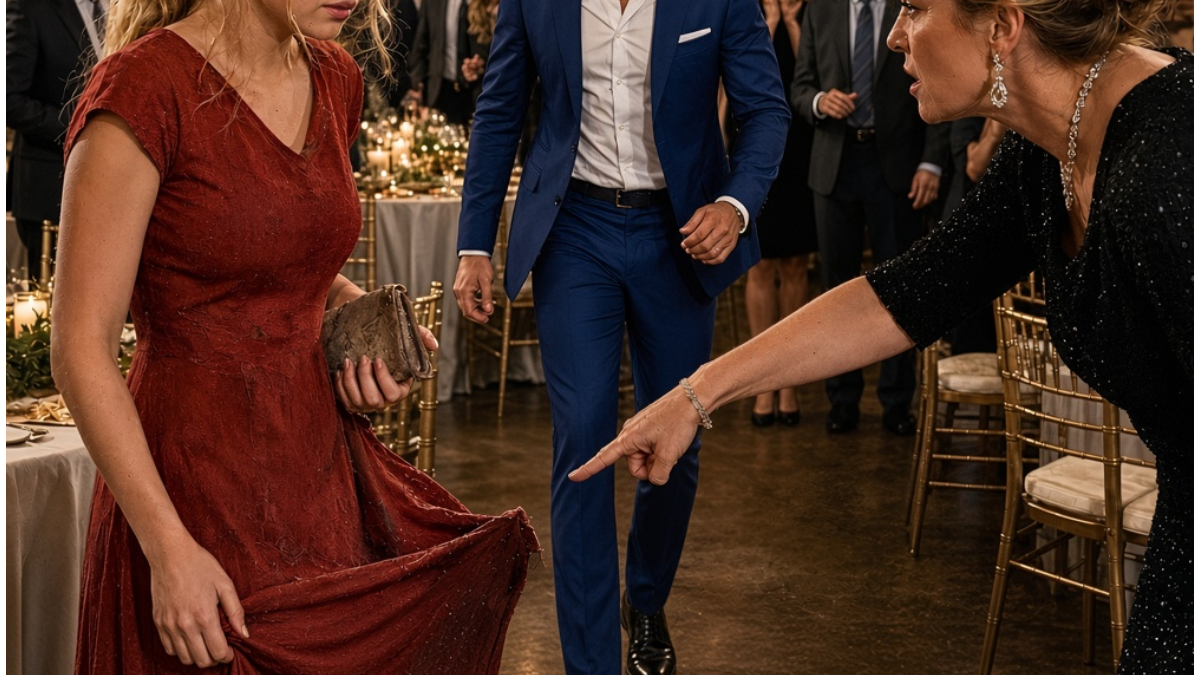
I’m sorry. This is the only dress I have,” she whispered as laughter rippled around the table.
Then the CEO Rose slowly set down his glass and what he did next silenced the entire room.
The parking lot outside the old textile mill smelled like cold rain and diesel from the catering trucks.
Hannah Prescuit sat behind the wheel of her car with the engine off, forehead resting against her hands, watching string lights blink gold and white across brick walls three stories tall.
She did not want to go inside. The mill had been converted into an event space 2 years earlier.
And every December, Hawthorne Development rented the whole building for its year-end gala. Employees joke that it was not required, except everyone knew it really was.
Hannah understood it better than moSt. She was a junior accounting assistant, 28 years old, 11 months into rebuilding a life that had come apart when her father died and left behind medical bills nobody had budgeted for.
In her head, she ran the numbers again, the way she always did before. Anything that cost money, she did not have her mother’s arthritis medication, the electric bill, already a week late, the mortgage, which could not be late.
Not ever, not again. Address did not fit anywhere on that liSt. She looked down at the one she was wearing anyway.
Red, a few years old, pressed carefully that afternoon on the ironing board in her mother’s kitchen.
At the hem, a seam had given out the winter before, and Hannah had repaired it herself with thread that was close, but not quite the right shade of red.
From 3 ft away, no one would notice. She told herself that twice before opening the car door.
Inside, the mill glowed with candle light and pine garland. Long tables were arranged by department, name cards set at each seat.
Hannah checked in at the registration table, thanked the young woman, handing out lanyards, and made her way toward the accounting section, offering small talk and quiet congratulations along the way.
She did not want pity. She did not want anyone asking questions. She simply wanted to get through the evening and go home.
She almost made it. Reaching for her place card, she dropped it and bent to pick it up from beneath the table.
When she straightened, Paige Winslow was watching her, arms folded, eyes fixed on the hem of Hannah’s dress.
Paige was a senior manager known companywide for immaculate presentation and exacting standards. She smiled, the way people smile when they believe they are being generous.
You know, Paige said loud enough for the table to hear. These events really are about understanding the room.
Presentation matters more than people think. A manager two seats down laughed and joked about calling in an emergency.
A ripple of uncomfortable laughter followed him around the table. Hannah felt her face go hot and her hands go cold at the same time.
The room seemed to tilt slightly. The conversation around her muffled as though she were hearing it underwater.
She reached down and smoothed the fabric at her hem, fingers pressing hard against the uneven stitching.
“I only meant it as advice,” Paige continued, not backing down. “Appearance says a great deal about readiness, especially for anyone hoping to move up.”
“There was no graceful way out.” Hannah felt the weight of every eye at the table.
I am sorry,” she said quietly, voice trembling despite her effort to steady it. “This is the only dress I have.”
The table went silent. Across the room near the head table reserved for executives, Nathan Hawthorne sat down his glass.
He was 36, chief operating officer of Hawthorne Development, and every instinct in him said to stay seated.
Let department managers handle department matters. Keep the evening moving. That instinct held for exactly one moment.
Then he watched Hannah smooth the hem of her dress one more time before reaching for her coat.
A small private gesture meant for no one. It struck something old in him. His mother Carol at their kitchen table late at night, needle in hand, mending the same church dress two winters running because there was no money for another one.
He had not thought of that table in years. He thought of it now, and something in his chest tightened until it hurt.
Staying silent, he understood, would make him no different from every person at that table who had laughed.
As Hannah turned toward the exit, [snorts] gathering what was left of her composure, Nathan pushed back his chair and rose to his feet.
He started walking directly toward her. Nathan did not raise his voice. He did not point a finger at Paige Winslow or turn the moment into a performance.
He stopped a few feet from the table, hands loosely at his sides, and asked a simple question in a tone so even it seemed to quiet the room on its own.
Can someone explain to me when the cost of an employese’s dress became a measure of her value to this company?
No one answered. Employees who considered Nathan Hawthorne composed to the point of distance now watched him with something closer to disbelief.
He was not known for personal remarks. He was known for staying professional, for keeping his distance, for letting department matters stay in department hands.
He did not stay distant. Now, “My mother raised me alone,” he said, looking at no one and everyone at once.
There were years she mended the same dress twice a season because buying a new one was not an option.
There is no shame in that. None. The only shame belongs to anyone who uses a person’s hardship to question her worth.
He turned to Hannah. Her eyes were fixed on the floor, her jaw tight, her hands still pressed against the fabric at her hem.
You owe no one an apology, he said quietly. Then he looked at Paige. I think you owe one.
Paige’s face flushed deep red. She offered a stiff apology, mumbled more than spoken, and Nathan did not linger on it.
He thanked her, gave a short nod to the table, and stepped back, unwilling to stretch her embarrassment any longer than necessary.
Hannah felt the tightness in her chest ease only slightly. The cruelty had stopped, and she was grateful for that.
But a new discomfort settled in its place, heavier than the firSt. Hundreds of co-workers now knew details about her life.
She had spent months trying to keep private. Nathan had solved one problem and created another, and he did not appear to notice the difference.
When she turned to leave, he stepped toward her again. “Would you stay for the next dance?”
Hannah went still, her spine straightened, her eyes losing their earlier softness. She took a step back, putting distance between them before she spoke.
“Thank you for stepping in, Mr. Hawthorne,” she said, her voice steady, despite the tremor still running beneath it.
“But I do not want any special treatment at work on Monday morning.” Nathan absorbed the words without flinching.
“I cannot undo what happened tonight,” he said. “But you should not be the one who leaves early because someone else behaved poorly.
Your standing at this company will not change because of this. You have my word.
Hannah studied him for a long moment, searching for the practice sincerity she expected from executives.
She did not find it. What she found instead was something closer to exhaustion, as though the evening had cost him something, too.
She agreed to one dance, only one. They did not speak of hardship or humiliation while they moved slowly across the floor.
Instead, Hannah mentioned almost as an aside that she had reviewed portions of a redevelopment project earlier that month and found the cost projections strangely optimistic, as if certain expenses had been left out entirely.
Nathan’s expression sharpened with interest rather than concern. It was a small comment delivered without ambition behind it, and it caught him off guard more than anything else that evening.
Later that night, Hannah sat at her mother’s kitchen table, describing the party in the fewest words possible.
She told Joyce Prescott only that the evening had been uncomfortable, leaving Nathan out of the story entirely.
She did not want her mother hoping that a wealthy executive might solve the problems that had defined their lives for the past year.
Hope like that was dangerous. It never held up under the weight of a mortgage payment.
Across town, Nathan lay awake far longer than usual. Two images kept returning to him.
The first was Hannah’s sharp, unprompted observation about numbers no one else at Hawthorne Development had questioned.
The second was the way she had squared her shoulders and drawn a boundary he had not expected.
Refusing comfort, dressed as favor. Monday morning before his first meeting, Nathan closed his office door and pulled the file for the redevelopment project Hannah had mentioned.
He read through the projections twice. Her instinct had been correct. The numbers did not add up, and no one above her had noticed.
Hannah arrived at work Monday morning expecting whispers, and she got them. Some co-workers offered careful sympathy, glancing at her with soft, uncertain smiles.
Others were less kind, murmuring that a dance with the chief operating officer was a calculated move rather than an accident.
She said nothing to any of them. She sat at her desk, opened the vendor accounts for a suburban housing development, and buried herself in the work.
By midafternoon, she had found something worth reporting. Duplicate change order charges filed under two separate expense codes.
The kind of quiet error that could balloon into a significant overrun if no one caught it in time.
It was not fraud. It was carelessness. The sort that happened when a company grew faster than its internal systems could track.
She documented it carefully and sent it up through her supervisor. Nathan heard about the discovery within the hour.
His first instinct was to walk down and thank her personally. He caught himself before leaving his office.
Hannah had asked for exactly one thing on Friday night, no special treatment, and he intended to honor it.
Instead, he made certain her supervisor recorded the finding through the standard performance channels, the same process used for any employee.
It was a small decision, but it told Hannah something important when she found out.
He had listened. Not everyone received the news that way. Two desks over, Derek Mson looked up from his monitor when Hannah’s supervisor mentioned the finding, then looked back down without a word.
He had applied for the same review track twice, and been told to wait his turn.
By 5:00, he was still typing with the same hard rhythm, each key sounding a little too sharp in the quiet accounting bay.
That evening, the story shifted away from the office and toward the life Hannah worked so hard to keep private.
Her mother, Joyce Prescott, spent three days a week at a small flower shop across town, arranging bouquets despite the arthritis that had stiffened her hands more each year.
Hannah covered most of the mortgage now, along with the electric bill and the growing pile of medical debt left behind after her father’s death.
The smell of joint ointment lingered faintly in their small living room every evening. Rain dripped steadily into a plastic bucket positioned beneath a stubborn leak on the back porch, a repair they could not yet afford.
Her car groaned every morning before it agreed to start, and some mornings it did not agree at all.
The red dress had come from Joyce, a graduation gift purchased during a year when money was tighter than usual.
Hannah kept mending it rather than replacing it the same way she mended everything else in her life.
A new dress would always lose to a mortgage payment. It was not a difficult choice.
It had simply never been a choice at all. On Wednesday evening, a sudden downpour caught Hannah leaving the office at the same time as Nathan.
Her car refused to turn over, the engine clicking uselessly beneath the hood while rain soaked through her coat.
Nathan offered a ride. She declined twice, insisting she would wait for roadside assistance. When the service reported a 2-hour delay and she remembered her mother was waiting on a prescription refill from the pharmacy, she accepted.
Inside his car, warm and quiet against the storm outside, Nathan asked carefully if the past year had been a difficult stretch for her family.
Hannah looked out the window at the rain streaking sideways across the glass. “Hardship usually is not one grand disaster, Mr. Hawthorne,” she said.
>> [snorts] >> It is years of quietly deciding which basic obligation gets paid first this month.
The words settled into him with more weight than he expected. He had spent so long describing his own childhood in tidy motivational language, a story about resilience with all the difficult parts smoothed over that he had nearly forgotten what the actual weight of it had felt like day after day with no end date in sight.
That night, he called his mother. The conversation stayed polite and brief, the way their calls had for years.
After he hung up, an uncomfortable truth settled over him. Since his success, he had replaced presents with money, wiring funds for repairs and medical bills while missing dinner after dinner.
Carol had never asked him for either. She had only ever wanted him there. Nathan sat with that thought long after the call ended, turning over what he now understood.
He had spent years measuring generosity in dollars. He was only beginning to understand what it cost the people he loved when that was the only currency he offered them.
3 weeks after the gala, Hannah was recommended for a temporary financial review assignment, a direct result of the change order discrepancy she had uncovered.
She expected to feel some measure of pride. Instead, a familiar unease crept in the moment she overheard two co-workers speculating that the company’s second in command had personally arranged the opportunity for her.
Paige Winslow did not raise the subject openly. She did not need to. During preparations for an investor presentation the following week, Paige quietly removed Hannah from the pitch team, explaining to the group that the assignment required individuals with established executive presence.
Hannah recognized the phrase immediately. It was the same coded language from the gala dressed now in professional terms instead of personal ones.
She did not go to Nathan. Instead, she submitted a formal request to her supervisor asking for the written criteria used to select members of the presentation team.
No such criteria existed. Everyone in the room understood that even if no one said it aloud.
Nathan learned about the change during a leadership briefing 2 days later, and the reaction he felt surprised him with its intensity.
The analyst who had uncovered a cost overrun capable of damaging an entire project had been quietly removed from the team meant to present the company’s strengths to investors.
He left the briefing already composing what he intended to say to Paige. Hannah intercepted him before he reached her office.
She asked to speak privately and he followed her into an empty conference room, the door closing behind them with a soft click that felt louder than it should have.
“I know what you are about to do,” she said before he could speak. “Please do not.”
Nathan stopped caught off guard. “She removed you because of unwritten standards nobody can define.
That is not fair to you.” “It is not,” Hannah agreed. But if you walk in there and overrule her decision, every person in this building will believe I only succeeded because the chief operating officer took a liking to me.
Every time you use your power to protect me, you prove their suspicion right instead of wrong.
Nathan studied her for a long moment. He wanted to argue that silence was its own kind of harm, that standing by while she absorbed an unfair decision was not neutral either.
He said as much. There is a difference, Hannah replied, her voice steady, between building a fair process and forcing the outcome you want.
One protects people after you are gone. The other only protects them while you are watching.
The words landed harder than she likely intended. Nathan had built much of his professional identity on decisiveness, on solving problems quickly and cleanly through the authority available to him.
It had always felt like strength. Standing in that conference room, he [snorts] understood for the first time how easily that same instinct could become its own kind of unfairness.
Simply pointed in a gentler direction. He did not overrule Paige. Instead, he ordered management to establish clear documented criteria for future presentation assignments effective immediately.
The current team, however, remained unchanged. Hannah was not restored to the pitch. It was an uncomfortable outcome, and he knew it.
Doing the right thing for the long term meant allowing an immediate injustice to stand uncorrected.
He hated that. He did it anyway because Hannah had asked him to trust the harder path instead of the easier one.
That Sunday, Nathan drove out to see his mother, leaving his phone locked inside the car before walking up to her front door.
Carol noticed the empty space where his hand usually rested, though she said nothing about it.
She simply handed him a screwdriver and asked for help with a portrail that had been squeaking for months.
They worked side by side in comfortable silence, the kind that did not require filling.
Nathan began to understand something he had missed for years. Repair was not a single conversation or a generous check.
It was showing up again and again in small and ordinary ways until trust had reason to grow back.
Back at the office the following week, Hannah found her opinion of Nathan quietly shifting.
It was not because he had rescued her. He had not. It was because, told plainly that his way of helping was part of the problem.
He had listened and changed course without defending his pride. Late one evening, reviewing years of archived personnel files for her audit, Hannah paused over a folder from four years earlier, then another, and another.
The same vague language appeared again and again across dozens of records, buried in evaluations for employees who had left the company or stalled in place for reasons no one had ever clearly explained.
Executive presence, fit concerns, client readiness. Hannah sat back slowly, the weight of what she was looking at settling over her.
Whatever this pattern was, it had not started with her. What began as a single audit expanded over the following two weeks into something far larger than Hannah had expected.
Her temporary assignment gave her access to promotion and retention records across several divisions. And once she started looking, the pattern was impossible to unsee across department after department.
High-erforming employees from support roles receive the same vague language when passed over for advancement.
Lacks polish. Fit concerns needs client readiness. None of these phrases appeared anywhere in official company policy.
Meanwhile, employees who could afford country club memberships, tailored wardrobes, and appearances at networking events climbed the ladder with noticeably less friction.
Hannah did not believe Paige Winslow had built this system deliberately. That would have been simpler in its own way to understand.
Paige was not a villain plotting behind closed doors. She was something more ordinary and more difficult to confront, an enthusiastic enforcer of a culture that had existed long before she arrived, one that quietly equated visible wealth with ambition and readiness.
Hannah compiled her findings carefully and submitted the report through formal channels rather than bringing it to Nathan directly.
She wanted the numbers to speak for themselves without the appearance of favoritism attached to how they reached him.
When the report landed on his desk, Nathan’s first reaction was defensive. A firm managing developments worth tens of millions of dollars needed a certain standard of executive polish when facing clients and investors, he told himself.
The thought did not sit easily. He read the report again. His mother’s voice returned to him, quiet and unwelcome.
He thought of every dinner he had missed, every problem he had solved with a transfer of funds instead of his presence.
He began to see the report differently. He had not built this particular culture himself.
Much of it predated his role as chief operating officer, inherited from years under his father’s leadership, but for two years he had walked past it without questioning it, benefiting from a company he had assumed was fair simply because it had been fair to him.
Worse, he remembered approving an executive development budget the previous year, one that reimbursed senior staff for country club dues and private networking events while offering nothing comparable for employees just starting out.
He had not thought twice about it at the time. He thought about little else now.
Sensing that the investigation threatened her influence within the company, Paige confronted Hannah privately in an empty office late one afternoon.
Her voice was controlled, but the edge beneath it was unmistakable. “You have turned one uncomfortable evening into a personal crusade against people who have worked here for years,” Paige said.
“Is that really what this is about?” Hannah met her eyes without flinching. “I did not ask to be humiliated at the galla, Miss Winslow.
And I did not invent these numbers. The data speaks for itself. I only wrote down what was already there.
Paige had no response to that. She left the office without another word, her heels striking the tile floor with more force than necessary.
When Nathan learned of the confrontation, his instinct was to remove Paige from her position immediately.
He resisted it. Firing her quickly would have felt satisfying, and [snorts] it would have solved nothing underneath the surface.
Instead, he called a meeting with senior leadership and announced a full restructuring of promotion evaluation standards across the company effective.
At the start of the following quarter, he went further. He ordered an audit of significant promotion decisions made over the past several years, including a number made during his father’s tenure running the company.
Several longtime executives loyal to the culture Richard Hawthorne had overseen for decades would not welcome that kind of scrutiny.
Nathan understood the coSt. He chose to move forward anyway because the alternative was allowing an unfair system to continue simply because confronting it was inconvenient.
Late one evening, as the audit findings were nearing completion, Nathan received a message from the office of the board of directors requesting an urgent private meeting the following morning.
He read it twice before setting down his phone, an uneasy feeling settling low in his cheSt. Something had reached the board, something he had not yet seen coming.
The complaint offered no proof of anything improper. It did not need to. It pointed to the dance at the gala, the sudden audit assignment, and Nathan’s visible involvement in reforming the company culture, and let perception do the rest of the work.
Because Nathan stood as chief operating officer and heir to the company his father had founded, and Hannah remained a junior employee several levels below him, perception alone was enough to threaten everything she had built.
Word of the complaint moved through the office faster than any formal announcement could have.
By midm morning, Hannah stood in the breakroom, jaw clenched, staring at the coffee machine without really seeing it, fighting to keep her composure in front of co-workers, pretending not to watch her.
It was not the gossip that broke something loose in her cheSt. It was the possibility that a year of documented, careful, honest work might be dismissed in a single sentence, reduced to favoritism because a man in power had once stood up for her at a party.
Quiet inquiries later suggested the complaint likely originated with Derek Mson, a financial analyst who had applied for a place on the internal audit team months earlier and had been passed over in favor of Hannah’s assignment.
No proof tied him to it directly, and the complaint remained officially anonymous, but the shape of it made sense to anyone who looked closely.
This was not retaliation for a dance. It was resentment, wearing the costume of an ethics concern.
Nathan’s first instinct was to issue a public statement defending Hannah’s character in record. Hannah refused before he had finished explaining the idea.
If you defend me publicly, she said, you will only prove their point, everyone will remember that the chief operating officer personally intervened for me twice.
Now that is not protection. That is the story they already believe. At home that evening, Hannah admitted to her mother that she had considered resigning altogether simply to make the discomfort stop.
Joyce sat down the dish towel in her hands and looked at her daughter carefully.
You did not spend a year earning that position just to hand it back because someone made you uncomfortable, Joyce said.
[snorts] And do not build your future around a man’s company, no matter how kind he has been.
Build it on your own two feet. Let him meet you there if he is worth meeting.
Nathan offered another solution the following day. A transfer to a separate division where the complaint could not follow her.
Hannah declined that as well. A lateral move would look exactly like special treatment, and it would cost her the work she had fought to build from nothing.
Frustrated, unable to find a solution she would accept, Nathan finally asked what she wanted him to do instead.
You are still trying to make the discomfort disappear using your authority, Hannah said, her voice quiet but unwavering, instead of enduring the process alongside me.
The words settled into him slowly, the way the truest ones always did. He understood finally.
What she needed from him was not another rescue. It was restraint. Nathan called the small board committee that handled ethics reviews.
The one group inside Hawthorne Development. He could not direct. By then, they were already moving to take the complaint out of his hands.
He did not push back. By the end of the week, Hannah’s work reports went through a different chain of command, completely outside Nathan’s authority.
The distance that followed was harder than either of them expected. They passed each other in hallways without a word, without even the courtesy of eye contact, both aware that anything else might be misread.
It achd in a way Nathan had not anticipated, a quiet, persistent absence where something had only just begun to grow.
That same week, an unexpected crisis at the office caused him to miss dinner with his mother.
Rather than send flowers or an apology by phone, he drove to her house early the next morning and knocked on her door before the sun had fully risen.
Carol let him in without much surprise, listening as he apologized in person. She did not offer easy forgiveness.
One visit does not undo a habit, Nathan, she said gently, pouring him a cup of coffee anyway.
Trust is built in the mornings you keep showing up. Not the one time you remember to.
Driving back into the city, Nathan turned her words over carefully, understanding that the same truth applied to Hannah.
Trust could not be restored by a single gesture, however well-intentioned. It required consistency. Proven over time without an audience and without credit.
Several weeks later, after interviews, file reviews, and more closed door meetings than anyone in accounting wanted to count, word came through official channels.
The board’s independent review had cleared Hannah of any wrongdoing entirely. The committee had started with one anonymous complaint.
What slowed them down was Hannah’s earlier audit packet sitting in the file like a door someone had forgotten to close.
But attached to that clearance was a second document far longer than anyone had expected, examining the broader promotion culture at Hawthorne Development.
Nathan opened it that evening alone in his office and by the second page understood that what the board had uncovered went far deeper than anything he had imagined.
The board’s report cleared Hannah entirely, stating plainly that her advancement had been earned through documented performance and nothing else.
That finding took up a single paragraph. The rest of the report, running many pages longer, examined something far larger than one employees career.
It documented years of inconsistent promotion practices across Hawthorne development, citing vague language such as fit and executive presence as informal tools that had quietly gatekept advancement long before Nathan had ever taken his position as chief operating officer.
The pattern predated him. It had simply continued unexamined under his watch. Paige Winslow’s record featured prominently, showing a documented history of excluding qualified junior employees from opportunities based on appearance rather than performance.
She did not lose her job. Instead, she was removed from all promotion panels, issued a formal letter of reprimand, and required to complete extensive retraining on fair evaluation standards.
When she approached Hannah afterward, her apology was stiff, delivered with visible discomfort rather than warmth.
Hannah accepted it without pretending the relationship between them had been repaired. “Thank you,” she said simply, and left it there.
Some things healed slowly, if at all, and she no longer felt the need to rush what was not yet true.
Nathan called a full leadership meeting the following week. He did not mention Hannah by name, nor the gala, nor any single incident.
Instead, he announced sweeping changes. Promotion standards would be rebuilt around clear written requirements, the kind every employee could read before applying.
Professional development funds once reserved informally for senior staff would now be made available to every entry-level employee, ending the unspoken expectation that advancement required money most people did not have.
Standing before executives who had worked at the company for decades, some of them loyal to the culture his father had overseen for years, Nathan took personal responsibility.
He admitted without softening it that he had allowed himself to believe Hawthorne Development rewarded hard work fairly because the company had always rewarded him.
Several longtime executives grew visibly cold toward him in the weeks that followed. He accepted the cost without retreating from the decision.
That weekend, Nathan drove out to see his father. Richard Hawthorne had improved steadily since his stroke two years earlier, though he remained resistant to relinquishing oversight of the company he had built from nothing.
Nathan found him in the study, a stack of quarterly reports open on the desk in front of him, reading glasses perched low on his nose.
Nathan sat across from him and for the first time spoke plainly. He told his father that the culture Richard had built had rewarded polish over substance for years, and that fixing it mattered more to him than protecting his father’s legacy exactly as it stood.
Richard was quiet for a long moment, his hands folded over the reports. “I built this company to give my family something solid,” he finally said.
“I did not always notice who got left out of that. If you can fix what I could not see, then fix it.”
It was not an apology, not exactly, but it was close enough, and Nathan carried it home with him like something fragile.
Hannah completed her audit assignment with glowing evaluations from supervisors, entirely outside Nathan’s chain of command, and was offered a permanent position on the company’s independent financial controls team, fully removed from his authority.
For months afterward, Nathan made no romantic gesture toward her at all. Instead, he focused on consistency in quieter places, driving Carol to her medical appointments, repairing the porch rail properly once and for all, staying present through ordinary Sundays that asked nothing of him but his time.
One Sunday, Carol sent him home with a container of chicken soup for Joyce, saying, “No woman who worked with flowers three days a week should have to cook with aching hands if a neighbor had a spare pot.”
Nathan delivered it awkwardly, standing on the Prescott’s porch like a man unsure whether soup counted as interference.
Joyce took the container, lifted the lid, and said, “Tell your mother she seasons like she means it.”
Only once Hannah’s career stood entirely on its own did Nathan finally ask her to dinner.
Making clear that her answer, whatever it was, would carry no consequence at work. She did not say yes right away, she asked for time to think, unwilling to let mutual respect erase the complicated history between them so quickly.
A few days later, she sent a short message instead, suggesting coffee in place of dinner.
Something smaller, something that asked less of both of them. They began slowly after that, meeting outside of work hours, away from the company that had first pulled them together and nearly broken what was growing between them.
Nearly a year after the gala that started it all, an invitation arrived in Hannah’s inbox for the next year-end celebration to be held once again inside the old textile mill in Charlotte.
She read it twice, then walked to her closet and reached without hesitation for the red dress still hanging near the back.
The old textile mill glowed again with string lights and pine garland exactly as it had one year earlier.
This time, Hannah Prescott walked through the doors without hesitating at the threshold. She no longer drifted toward the back of the accounting table, hoping to disappear into the crowd.
She crossed the room with quiet confidence, greeting colleagues by name, carrying with her a year of documented work that belonged entirely to her.
She had earned her place among the independent financial controls team through performance no one could attribute to anyone but herself, and it showed in the way she held her shoulders now.
She wore the same red dress. The altered seam at the hem remained visible to anyone who looked closely enough to notice, the thread still not quite matching the fabric around it.
Joyce had offered weeks earlier to help her shop for something new. Hannah could afford it now easily.
She chose the old dress anyway on purpose. It no longer represented the hardship of that first winter.
It marked something else entirely. The night she had refused to let another person’s wealth decide her worth, Paige Winslow was present, composed, and professional, offering a polite greeting as their paths crossed near the refreshment table.
Nothing more, nothing less. Some relationships healed into warmth, others simply healed into peace, and Hannah had made room for both to be enough.
Hawthorne development had changed, though not all at once and not without friction. Nathan still caught himself reaching for control before remembering to step back and delegate instead.
Hannah still occasionally worried about being pulled too far into his world, losing the shape of her own life along the way.
The difference now was that they said these things aloud to each other instead of carrying them silently and hoping the other would guess.
Across the room near a quiet corner table, Joyce Prescott sat with Carol Hawthorne. Two cups of coffee between them.
Their conversation easy and unhurried. Their friendship had grown slowly over the past year, built on ordinary Sunday lunches rather than any occasion tied to their children.
Two women who had spent decades sacrificing quietly for the people they loved, finding in each other a kind of understanding neither had expected to need this late in life.
Near the edge of the room, Richard Hawthorne stood beside a pillar, watching the evening unfold.
It was his first appearance at the gala in two years. He said little, offering only a brief nod when Nathan caught his eye, but the nod carried more weight than words might have.
Nathan found Hannah near the dance floor as the band began a slower song. His eyes dropped briefly to the hem of her dress, the small repaired seam catching the light for only a moment before disappearing again into the fabric’s folds.
I thought about buying something new, Hannah said before he could ask. But this dress reminds me that my mother and I knew how to hold on to what mattered even when everything else was hard.
Nathan looked at her for a long moment. That dress made me remember where I came from, he said.
But watching you step forward this year taught me something more important. Noticing someone’s pain is easy.
Showing up for them again and again is what actually gives it meaning. He held out his hand.
Would you dance with me? Hannah smiled, a small playful warmth crossing her face. Just so you know, Mr. Hawthorne, I might wear this dress again next year.
What you wear next year, Nathan said, smiling back, is entirely your choice. She placed her hand in his without hesitation, and they moved together onto the floor as the room filled with soft light and quiet music.
The small, careful seam at her hem moved gently beneath the glow of the gala lights, visible now instead of hidden, no longer something to guard or apologize for.
It had never needed to be flawless. It only needed to be worthy of love exactly as it was.
And that brings our story to a close.








