“I’m Practicing Your Angry Face,” the Maid’s Little Girl Told the Duke—Then He Froze
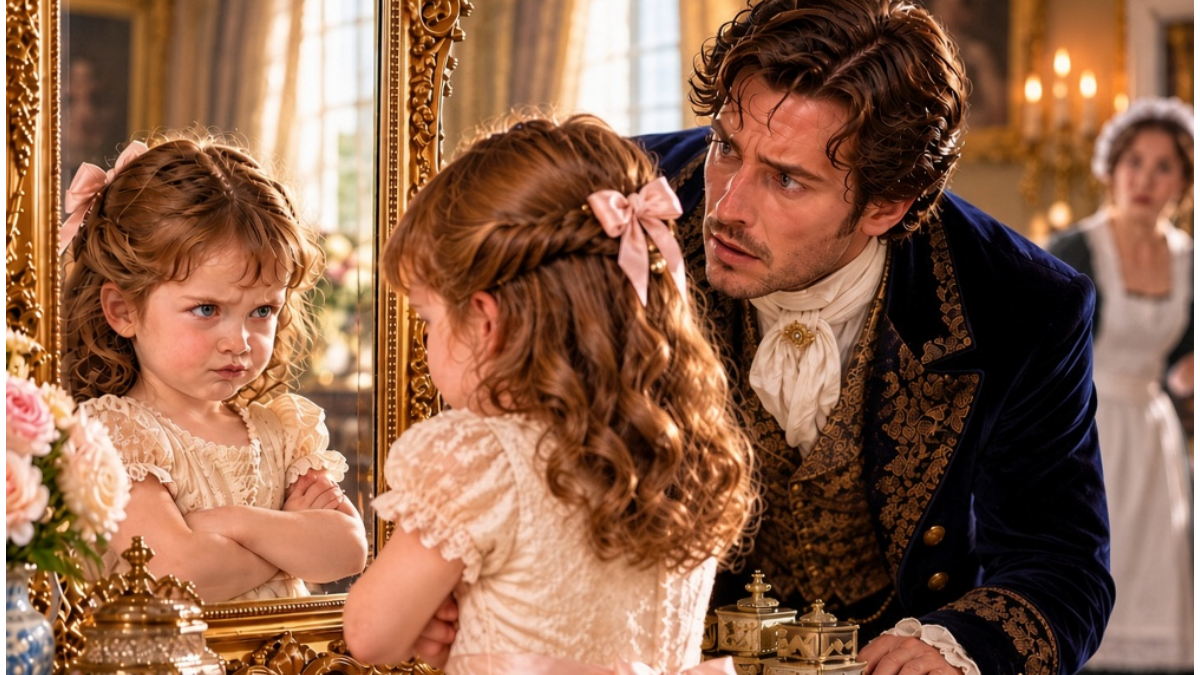
I’m practicing your angry face, your grace. The four-year-old girl sat before the tall brass frame mirror in the Duke of Blackthornne’s private dressing room.
Her little arms folded across her chest and her brow pulled into the sternest frown she could manage.
Behind her, Gabriel Ashkam, 8th Duke of Blackthornne, stopped so suddenly that the leather folder in his hand slipped against his palm.
For one impossible second, he was not looking at a child. He was looking at Elena.
Elena Hartwell had made that exact face whenever Gabriel returned from an estate meeting, carrying more anger than sense.
She would fold her arms, narrow her eyes, and imitate him until he either laughed or left the room before she could see him trying not to.
Four years had passed since he had last seen her. 4 years since she had stood at the foot of Blackthornne Hall’s great staircase in a gray wool coat and begged him for 5 minutes.
4 years since pride had made him refuse. And now a little girl with a crooked braid was wearing Elena’s expression as if it had been taught to her in the cradle.
Hurried footsteps struck the corridor outside. The door opened. Claraara Bennett appeared on the threshold, breathless, her white apron dusted with flower from the bake house.
The color drained from her face the moment she saw Rosie on the stool and the Duke standing behind her.
Your grace forgive her, please. I turned away for one moment in the linen room.
Rosie knows she is not permitted in this wing. Mama, Rosie said cheerfully, still watching herself in the mirror.
I almost have it. Rosie, come here at once. Claraara across the carpet and reached for her daughter’s wriSt. Miss Bennett.
Gabriel never needed to raise his voice. Eight years as Duke had taught every tenant, servant, solicitor, guest, and rival, that a quiet sentence from him carried farther than a shout.
But the tone he used now was different. “Do not punish her,” Claraara froze. “Your grace, you heard me.”
Rosie looked from one adult to the other, understood nothing, and smiled because her mother’s grip had loosened.
Claraara lifted her from the stool, murmured an apology, and guided her toward the door.
Just before disappearing into the corridor, Rosie looked back. She raised one small hand. “Goodbye,” angry face.
Gabriel did not move until the door closed. By noon, he had convinced himself that the resemblance meant nothing.
By evening, he had stopped believing himself. Blackthornne Hall stood in the English countryside like a declaration made in stone.
The central house had been built two centuries earlier with gray walls, tall windows, a chapel to the north, an eastern lake, and enough rooms for a family three times the size of the one that actually lived there.
Gabriel occupied the western apartments. His mother, Victoria, Daaja, Duchess of Blackthornne, occupied the southern wing.
The servants’s quarters stretched behind the kitchens and old service corridors connected to the main house by narrow staircases.
Few guests ever noticed. The next morning, Gabriel summoned Nicholas Hail, his steward and closest confidant.
Nicholas had served beside Gabriel in the cavalry before an injury ended his commission. He now managed Blackthornne’s estates, shipping investments, tenant disputes, and the thousand quiet problems that came with an old title attached to new debts.
I want the household register, Gabriel said. Nicholas looked up from a stack of rent accounts.
Which one? Servants residing on the estate. Any with children under seven? Nicholas did not ask why.
An hour later, a single page lay on Gabriel’s desk. Claraara Bennett, housemmaid, 29 years of age.
Roselyn Bennett, daughter, four years of age. Two rooms in the Eastern Service Wing. Gabriel read the entry three times.
That night, he opened the top drawer of his desk, looking for ceiling wax, and found instead a small wooden hair clip.
He had not touched it in 4 years. Elena had bought it from a market stall near Coven Garden, or rather she had admired it, and Gabriel had bought it before she could object to the price.
Pale wood, one small silver pin, no jewels. She had laughed at him for making something so simple feel like a royal purchase.
He turned it between his fingers. Elellanena Hartwell had been the daughter of a book seller and the granddaughter of a schoolmaster.
She had not been born for Blackthornne Hall. Victoria had said that often enough. Elena had not cared.
She had come to the hall first as companion to an elderly aunt of Gabriel’s, and she had possessed the dangerous habit of speaking to him as if he were merely a man.
She had once found him furious over a failed wool contract, and asked whether he intended to solve it, or glare at the paper until it apologized.
She had grown tomatoes in clay pots on a London window sill because she insisted the afternoon light there was better than in the garden.
She disliked candles in daylight. False light is worse than darkness, she had once said.
When he asked what she meant, she blew out the candle and kissed him instead of answering.
Gabriel set the hair clip down. Four years earlier, a confidential ledger from Blackthornne’s shipping interests had been copied and delivered to the Marlo company.
A rival merchant house backed by men who had spent years trying to break Blackthornne’s hold on two important docks.
The loss had been enormous. Contracts vanished. Credit tightened. Tenants suffered when estate repairs were delayed.
Then his mother had brought him proof, a copied letter in Elena’s hand. A witness who claimed to have seen her meeting a Marlo agent.
An impression of her private seal on a folded account, a page from the household register showing that she had requested access to Gabriel’s study.
He had looked at the evidence and believed the worst before he had allowed the woman he loved to speak.
2 days later, Elena had come to Blackthornne Hall in the gray wool coat with the torn cuff.
Gabriel, give me 5 minutes. He had stood at the foot of the great staircase without looking directly at her.
There is nothing you can say in 5 minutes that changes what I have seen.
There is something you have not seen. Then send it through Mr. Fairfax. Her face had changed, not into anger, into something quieter.
Then you will regret this for the rest of your life. She had walked away.
Gabriel had let her. He had spent four years believing she had fled out of shame.
He did not know she had died. Not yet. During the week after Ros’s visit to the dressing room, the child appeared at the edges of his life with the persistence of weather.
On Monday, Nicholas carried a folded sheet of paper into the library. This was left outside the pantry with precise instructions.
Gabriel unfolded it. A blue horse with five legs stood beneath a yellow sun that occupied nearly half the page.
Whose instructions? The child. Rosie. She said it must go on your desk, not the side table.
Gabriel placed the drawing beneath the brass paper weight beside his ink stand. On Tuesday, his tea tray arrived with a small ginger biscuit shaped like a stag.
One antler had broken off. A small scrap of paper sat beside it. Two enormous letters had been written in Ros’s hand.
4G. Beneath them in a kitchen maid’s neater script was the message Rosie had apparently dictated with great seriousness.
The stag is heard. Eat his head first so he does not know. Gabriel read the sentence twice.
Then against all reason, he did exactly as instructed. On Wednesday, he found Rosie standing in the portrait gallery before the painting of his grandfather, the sixth Duke.
She had her hands clasped behind her back. This man is very angry, your grace.
He often was. Rosie studied the portrait. You do it better. She wandered away before he could answer.
On Thursday, she stopped him outside the library. Your grace. Yes. Why does nobody comb your hair?
He stared at her. She waited. When it became clear that no answer was coming, she nodded solemnly as though one had been provided.
All right. Then she continued down the corridor carrying a cloth rabbit by one ear.
On Friday he did not see her. On Saturday he did not see her. He disliked both days.
By Sunday afternoon he had begun lying to himself again. He told himself he was walking to the eastern lake because he had always walked there on Sundays.
Rosie was already sitting on the stone bench. Her arms were folded. Her chin was set.
She was staring over the water with his exact expression of disapproval. Gabriel stopped 20 paces away.
Nicholas approached from behind with a bundle of correspondence. He followed Gabriel’s gaze. After a long silence, he said, “You are waiting for her to notice you.”
Gabriel looked at him. Nicholas wisely turned his attention to the lake. “I said nothing, your grace.”
Rosie remained on the bench another minute before turning. Her face brightened. Your grace, I am practicing being silent, too.
Gabriel walked to order before deciding to. From an upstairs window, Victoria Ashkam saw the entire exchange.
The Daaja Duchess had spent 62 years treating emotion like an unruly servant. Useful in private, unacceptable in public, and dangerous when allowed to choose its own direction.
She noticed the child. She noticed Gabriel’s face. Most importantly, she noticed the way he stopped being the juke for several seconds at a time whenever Rosie spoke to him.
That evening, Victoria asked a question over dinner. Miss Bennett has been in service here how long?
Gabriel cut into the venison. 2 years. And the child? Four. Victoria raised her wine glass.
Four. Nothing in her expression changed. That was precisely what disturbed him. 3 days later, the family solicitor, Mr. Elias Fairfax, received a private note from the Dowager Duchess.
He was to investigate Claraara Bennett and a woman named Elena Hartwell. No office clerk was to record the requeSt. No household account was to show the expense.
Within the week he returned, Victoria met him inside the Old Stone Chapel. What did you find?
Fairfax removed his gloves. Claraara Bennett and Elellanena Hartwell were cousins through their mothers. Not close in childhood, but in correspondence as adults.
Victoria’s fingers tightened once around the edge of the pew. Elena Hartwell died nearly 4 years ago.
The chapel seemed to become smaller. When 3 days after giving birth prematurely, a physician in Hertfordshire signed the record.
The child survived. Victoria did not speak. Fairfax continued, “The parish register names the mother as Elena Hartwell.
The father is not recorded.” 6 weeks after the birth, the infant was placed in Claraara Bennett’s care.
Claraara later entered service under her own name. The child was christened Rosalind. Victoria looked toward the stained glass window.
Rosalind. Yes. Did Elena leave papers? Unknown. And did Claraara know the father? I found no proof.
Victoria dismissed him. She remained in the chapel alone for 20 minutes. Four years earlier, she had known Elena was pregnant.
She had known before Gabriel did, and she had acted. She had believed the matter ended.
Apparently, the past had returned wearing a crooked braid. The changes began quietly. Claraara’s rooms were moved from the eastern service wing to a colder corridor near the laundry.
Her meal shift changed so that Rosie would no longer be in the servants’s dining room when Gabriel passed through.
The child was encouraged to attend a village school beyond the estate gates. When Claraara declined, Victoria smiled.
2 days later, an envelope appeared on Claraara’s table. Inside was a bank draft large enough to purchase a modest cottage along with an annuity for Ros’s education.
Three days to consider, no explanation, only the letter V. Claraara sat on the edge of her narrow bed for a long time with the paper in her hands.
Rosie watched from beneath a blanket. Mama. Yes, love. Why does the grand lady not like me?
Claraara’s throat closed. She does not know you. She knows my name. Claraara crossed the room and held her daughter.
Some lies protected children. Others only delayed the moment they would be hurt. The following morning, Claraara carried a basket of mended linen through the West Passage and found Gabriel standing near the servant’s stare.
He had no business there at that hour, and the fact that he was pretending otherwise almost made her smile.
Miss Bennett, your grace. Is Rosie well? She is four. Her definition of well changes every 6 minutes.
The corner of his mouth almost moved. Claraara shifted the basket against her hip. Was there something else?
Gabriel hesitated. Jukes were not supposed to hesitate in front of housemmaids. Claraara knew that.
Judging from the irritation in his expression, so did he. She reminds me of someone, he said at laSt. Claraara’s hands tightened around the basket.
I know. His eyes sharpened. You know whom? I know that every time you look at her, you seem to be seeing someone who is not standing there.
Gabriel went very still. Claraara should have lowered her gaze. She did not. Rosie is not a memory your grace.
No. Then do not make her carry one. For several seconds, the corridor held only the faint clatter of pans from the kitchen below.
Gabriel looked toward the narrow window at the end of the passage. You speak freely for someone in my service.
You asked whether she was well. I did not ask for a lecture. No, your grace, and yet I received one.
Yes, your grace. He looked back at her. There was no mockery in Claraara’s face.
No challenge for the sake of challenge. Only the exhausted courage of a woman who had spent four years protecting a child more fiercely than she protected herself.
Gabriel had known noble, wimblew woman who could fill a ballroom with conversation and say nothing honest in 3 hours.
Claraara Bennett had managed the opposite in three sentences. Does she know? He asked. Know what?
That I watch for her. Claraara’s expression softened despite herself. Children know when they are wanted.
The words landed harder than she intended. Gabriel’s face changed. Claraara wished she could take them back, not because they were cruel, but because they had found a wound she had not known was there.
She dipped her head. Forgive me. No. She looked up. Do not apologize for telling me the truth.
He stepped aside so she could pass. Claraara walked on with the linen basket, aware of his gaze until the corridor turned.
Gabriel remained beside the servant’s stare for a long time. Gabriel returned from London the following afternoon and noticed immediately that Rosie had disappeared from the paths he had grown accustomed to finding her on.
The gallery was empty. The kitchen corner was empty. The bench by the lake was empty.
He found Clara folding towels in the servant’s sitting room. She rose quickly. Your grace sit.
She obeyed. Who moved your rooms? Claraara lowered her eyes. The Daager Duchess when 10 days ago.
And Rosy’s meals. Claraara did not answer. Gabriel understood. He left without another word and walked directly to the chapel.
His mother was arranging white liies beside the altar. “You are early,” Victoria said. “Are you protecting me from a housemaid?”
She adjusted one stem. No. Then what are you doing? She turned. I am protecting you from a child.
Gabriel went still. The silence lasted perhaps 1 second. It was enough. He looked at his mother in a way he had not looked at her since his father’s funeral.
Good evening. Then he walked out. That night, Gabriel opened the wall safe behind his father’s portrait.
Inside lay the evidence he had refused to examine properly 4 years earlier. The old accusation against Elena.
He carried the entire case to his desk. He began again from the beginning. The first inconsistency appeared before midnight.
A household register claimed Elellanena had entered Gabriel’s study at 8:45. On the evening one section of the shipping ledger disappeared.
Gabriel remembered that evening. He had been at Elena’s father’s bookshop in London until nearly midnight.
Elena had been there, too, so had six customers, a printer, Gabriel’s uncle, and a delivery boy who broke a lamp and caused enough chaos that Gabriel still remembered the exact time.
The register entry had to be false. The second inconsistency involved a witness statement. A hired coachman claimed he had seen Elena meet a Marlo representative outside an inn near Holen.
He described the woman as short, narrow shouldered, wearing a gray coat. The coat could have been Elena’s.
The woman could not. Elena had been tall enough to look Victoria directly in the eyes.
Gabriel found a Taylor’s measurement among the old bills. The witness description was wrong by nearly 4 in.
The third inconsistency was the letter. He placed the copied page beside three genuine notes Elellanena had written him.
At at first the hand appeared perfect. Then he saw it. Elena crossed the final stroke of the letter T from right to left.
The accusation letter crossed it left to right. Always every time someone had copied her hand without understanding its habits.
Gabriel sat back. His chest felt hollow. He opened another packet. A wax impression said to have come from Elena’s private seal.
But Elena’s original seal, an oval piece engraved with a tiny sprig of rosemary, had been repaired two months before the betrayal.
A hairline crack ran through the repaired version. The wax impression in the evidence showed no crack.
It had been made from an older impression. Gabriel did not turn another page. He already knew.
The woman he had loved had told the truth. He had simply preferred evidence because evidence did not require him to truSt. At dawn, Rosie entered the library without knocking.
She wore a pale green dress. One stocking had begun to fall and her braid leaned to one side.
She carried another drawing. You look terrible, your grace. Gabriel almost laughed. Thank you. You are welcome.
She climbed into the chair opposite him and placed the picture on top of the forge letter.
Three people stood in front of a large crooked house. A woman in yellow, a small girl with red hair ribbons, a tall man in black.
Why am I in the middle? Gabriel asked. Rosie looked surprised by the question. Because you live there.
I do. No, in the picture. Gabriel looked down. What if I were not there?
Rosie considered that then it would not be the good house. Something inside him broke open quietly.
He looked at the little girl. She had Elellanena’s way of thinking in straight lines no adult could follow.
Rosie. Yes, your Grace. Do you have a father? She shook her head. Mama says he went away before I came.
Do you ever ask about him sometimes? What do you imagine? Rosie shrugged. That he is probably tall because I cannot reach shelves.
Gabriel laughed. It escaped before he could stop it. Rosy’s eyes widened. You did it.
Did what? You laughed. I did not. You did. Do it again. I cannot. She leaned across the desk as if studying a rare animal.
A streak of green chalk marked her cheek. Gabriel reached out and wiped it away with his thumb.
Rosie did not flinch. That frightened him more than if she had. It felt natural.
Too natural. That afternoon, Claraara came to collect Rosie from the library and stopped when she saw the old papers spread across Gabriel’s desk.
Rosie had fallen asleep in the window seat with the cloth rabbit under her chin.
Claraara lowered her voice. You should not let her sleep there. She will wake with a stiff neck and blame the furniture.
Gabriel looked at the child. She blames furniture. Only when it cannot defend itself, he rose and crossed to the window seat.
For one awkward moment, he stood over Rosie as though uncertain how a sleeping child was meant to be moved.
Claraara watched him. You may pick her up, your grace. I know how to pick up a child.
Of course, he looked at her. You do not believe me. I believe you have probably held fewer children than you have signed land deeds.
That is not a useful comparison. It is an accurate one. Very carefully, Gabriel slid one arm beneath Rosy’s knees and the other behind her shoulders.
Rosie stirred, frowned against his coat, then settled with her cheek against his cheSt. Gabriel stopped breathing.
Claraara saw it. The Duke of Blackthornne, who had faced cavalry fire without lowering his head, looked terrified by the trust of a sleeping four-year-old.
Claraara stepped closer and adjusted Rosy’s skirt over her legs. Do not hold her so stiffly.
I am not stiff. You are carrying her like a valuable painting. She is more valuable than any painting in this house.
The sentence escaped before he could contain it. Their eyes met. Claraara’s expression changed firSt. Gabriel looked away.
On the desk behind him lay the copied letters, the false register entry, and the cracked seal evidence.
Clara noticed them. You opened Elena’s case. Yes. And she was innocent. Claraara closed her eyes for half a second.
When she opened them again, there was no triumph in her face, only sorrow. She told me you would discover that one day.
Gabriel’s arms tightened around Rosie. She said that once. What else did she say? Claraara considered the question.
That discovering the truth and becoming worthy of it were not the same thing. Gabriel absorbed the blow without flinching.
She was right. Yes. Again, no cruelty, no satisfaction. That was what unsettled him. Claraara reached for Rosie.
Gabriel did not release her immediately. Let me carry her to the servant’s wing. Yes.
Claraara studied him, then nodded. They walked together through the quieter corridors. Gabriel carried a Rosie.
Claraara carried the rabbit. At the turn near the eastern stairs, Gabriel said, “Miss Bennett, your grace, if the truth is worse than I expect, will you still tell it to me?”
Claraara looked at the sleeping child between them. “If it belongs to Rosie, yes.” Gabriel nodded once.
For the first time, he understood that Claraara’s loyalty was not to him, nor to his mother, nor to Blackthornne.
It was to the child. Strangely, that made him trust her more. Two mornings later, Gabriel left Blackthornne before sunrise for a meeting with merchants in London.
Victoria watched his carriage disappear beyond the gates. At 10, she ordered another carriage prepared.
Then she summoned Claraara. There is work to be done at the old hunting lodge.
Linens, silver, and guest rooMs. You will come with me. Claraara’s stomach tightened. May Rosie remain here.
No, bring her. The carriage left the main road after the second village. Claraara knew then that something was wrong.
The old hunting lodge was not reached by the road Victoria had ordered the driver to take.
The usual route followed the river. This road cut through a stand of bare beach trees and avoided the cottages altogether.
Rosie sat beside Claraara counting crows through the window. Seven, she announced. Six, Claraara said automatically.
That one was hiding. Across from them, Victoria did not look up. Claraara folded her hands over Rosies.
Your grace. Will the caretaker be expecting us? Everything necessary has been arranged. That was not an answer.
Claraara looked through the rear window. Blackthornne’s towers had disappeared behind the hills. For the first time, she wondered whether she had made a mistake by not telling anyone where they were going.
Then she remembered Gabriel had left before dawn. Even if she had told him, he would not have been there to hear it.
The hunting lodge stood 12 mi from Blackthornne Hall on a wooded rise above a river.
It had once belonged to Gabriel’s grandfather and was now rarely used. When they arrived, no servants were waiting.
No linens had been taken out. No guest rooms were prepared. Victoria locked the front door behind them.
Claraara turned. Your grace. There is no gathering. Rosie pressed both hands against the glass of a low window, watching birds in the grass.
Victoria placed three papers on the dining table. The parish record of Rosy’s christening. Elena Hartwell’s death record.
Fairfax’s written report. I know who the child is. Claraara’s hands became cold. You have had 3 days to accept my offer.
I will not sell my daughter. I did not ask you to sell her. You asked me to disappear.
I asked you to give her a life beyond scandal. Claraara stepped toward Rosie. Victoria’s voice sharpened.
Who is Ros’s mother? Claraara said nothing. Elena Hartwell. Rosie turned at the unfamiliar name.
Mama. Claraara gathered her into her arMs. Victoria watched the child closely. For the first time, with no hallway distance and no adult body between them, she saw the truth.
The shape of the eyes was Elena’s. The color was Gabriel’s. Victoria had spent 4 years convincing herself memory could be buried.
Memory was now looking back at her. “Tell me the truth,” she said. Claraara held Rosie tighter.
“She is my daughter, not by blood. She’s my daughter in every way that matters.
Victoria’s expression hardened. If you refuse to speak, I can have the child taken to another household until the matter is settled.
Claraara stared at her. Rosie did not understand the words. She understood the threat. Two tears rolled silently down her face.
“Mama,” she whispered. “I am scared.” That ended the argument. Claraara kissed the child’s hair.
Rosie is not my biological daughter. Victoria’s shoulders eased by half an inch. Her mother was Elena Hartwell.
The room became very still. Continue. Claraara shut her eyes. Elena came to me in November.
It was raining. She was wearing the gray coat with a torn cuff. She was already several months with child.
Victoria said nothing. She said she needed a place no one would look. She would not tell me the father’s name, only that he was powerful and that he believed she had betrayed him.
Rosie listened against Claraara’s cheSt. Elena said she had tried to explain. She said he would not give her 5 minutes.
Victoria looked away. Several weeks later, a letter arrived. What letter? A letter bearing the father’s name.
It said he wanted nothing to do with her or the child. Victoria’s face did not change.
Claraara continued. After that, Elellanena stopped believing he would come. She worked from my rooMs. She rarely went outside.
She kept one small box beneath the bed. She told me that if anything happened to her, I was to keep it for Rosie.
Where is that box? At Blackthornne. Victoria’s eyes sharpened. What else? She went into labor too early.
The physician said she was weak from the beginning. She lived 3 days after Rosie was born.
Rosie pressed her face into Claraara’s neck. On the second day, Elena made me promise to raise Rosie as my own until she was old enough to choose what she wanted to know.
Victoria’s voice became almost inaudible. Did she name the father before she died? No. A key turned in the outer door.
Victoria looked toward the hall. Footsteps crossed the floor. The dining room door opened. Gabriel stood there.
Rain darkened the shoulders of his coat. Nicholas was behind him. Gabriel’s eyes moved first to Claraara, then to Rosie, then to the papers on the table.
No one spoke. He had returned from London early. When he discovered Claraara and Rosie were gone, the stablemaster had told Nicholas which carriage Victoria had taken.
They followed the wheel tracks and the tollkeeper’s memory to the hunting lodge. Gabriel had stood outside the dining room long enough to hear one sentence.
Elena made me promise to raise Rosie as my own. He looked at Rosie. 4 years old.
Elellanena had disappeared 4 years ago. His mind tried to reject the arithmetic. It failed.
Claraara, he said quietly. She rose. Your grace. We are going home. Victoria stepped forward.
Gabriel, no. One word, that was all. The return to Blackthornne passed in silence. Rosie fell asleep against Claraara before they reached the estate.
Gabriel sat opposite them in the carriage and watched one small hand remain tangled in Claraara’s sleeve.
At the hall, he moved Claraara and Rosie into two rooms in the eastern family wing, far from Victoria’s apartments.
He told Nicholas that no one entered without his permission. Then he went downstairs. 3 hours later, Nicholas brought him a small wooden box.
Miss Bennett says Elena left this with her. Gabriel waited until the door closed. Inside lay a silver chain, a brown notebook, and an envelope with his name.
The letter inside was a copy. The message was short. I have made my decision.
The child child, if there is one, changes nothing. Do not write again. Gabriel Ashkam.
The signature was almost perfect. AlmoSt. He had signed his name tens of thousands of times.
The final upward hook on the A was missing. He opened Elena’s notebook. The last page stopped halfway down.
Tomorrow, 4:00, Blackthornne Front Hall. If he will not give me 5 minutes, I will not return.
He must know about the baby. Gabriel closed his eyes. The gray coat, the torn cuff.
5 minutes he had watched the mother of his child walk away, carrying the truth beneath her heart.
At 7 the next morning, he summoned Mr. Wickliffe, the elderly secretary who had managed household correspondence before retirement.
The old man entered looking as if he had already guessed the question. Four years ago, letters came here from Elena Hartwell.
Wikliff’s face changed. How many? Seven. Your grace. Gabriel’s hand tightened on the desk. How many reach me?
None. Why? The old secretary swallowed. The Daaja Duchess instructed me that every letter from Miss Hartwell was to be delivered first to her.
Did you open them? No. Did my mother? I believe so. Did you know one concerned a child?
No, your grace. Gabriel dismissed him gently. Then he walked to the chapel. Victoria was there.
She did not turn when he entered. You found the box, she said. Seven letters.
She placed a white lily into the vase. Yes. The seventh told you Ellena was pregnant.
Yes. And she asked to see me. Yes. Why? Victoria faced him at laSt. Because if you had known, you would have gone after her.
Gabriel’s voice remained low. Explain. You are prepared to marry beneath your rank. You are prepared to abandon negotiations with the Earl of Westbury.
You are prepared to place every alliance your father built beneath the feet of one woman.
Elena did not steal the ledger. No. The word struck harder than any denial. Gabriel did not move.
Who did? Victoria folded her hands. Thomas Rook, your father’s cousin’s son. He had gambling debts.
He sold copies of shipping accounts to Marlo agents. And you knew I learned the truth after the loss.
You protected him. I removed him. He is in Malta overseeing a minor trading account where he can do no further harm.
He has been watched since the day he left. Gabriel stared at her. Then why Elena?
Because the estate needed the scandal contained. So you invented another traitor. Victoria’s eyes flashed.
I created an explanation that preserved the house. How? She breathed once. An old wax impression from Elena’s seal.
A copied hand. A false page inserted into the register. A paid coachman. Mr. Vale forged the letters.
Gabriel felt physically cold. You built the entire case. Yes. And the letter telling Elena I rejected my own child.
Victoria did not answer. That was you. I instructed it. Gabriel turned away then back.
You let her die believing I knew. Victoria’s jaw tightened. I did not know she would die.
But you knew she was alone. Silence. You took a woman I loved, a daughter I never met, and four years of my life because you decided love was a weakness.
I decided duty was greater than desire. No, mother, you decided my life belonged to the family name more than it belonged to me.
The name is why you have everything you possess. Gabriel looked around the little chapel.
Stone walls, silver cross, white liies, the architecture of generations. I would trade every acre for the chance to answer one of those letters.
Victoria’s expression broke for the first time, only slightly. Gabriel saw it. It did not change what came next.
That evening, he called a formal household council in the great dining room. Nicholas stood near the door.
Mr. Fairfax sat with his papers. Wikliffe sat halfway down the table. Claraara occupied a chair near Gabriel, uneasy in a room where she had spent years serving rather than sitting.
Victoria took her customary place at the far end. Gabriel opened a folder. I will read this once.
No one moved. From this evening, the Daager Duchess holds no authority over household appointments, correspondence, finances, estate staff, or any person residing at Blackthornne Hall without my written approval.
Victoria’s eyes hardened. Gabriel, he continued. Mr. Fairfax, all legal correspondence comes directly to me.
Mr. Wikliffe, any letter addressed to this family will be recorded before delivery. Nicholas, the Daager Duchess, retains every comfort appropriate to her rank, but she does not give orders concerning Claraara Bennett or Rosalyn Bennett.
He looked at his mother. You will not approach the child without Claraara’s consent and mine.
Victoria pushed back her chair. You are dismantling everything this family built. Gabriel met her gaze.
No, I am ending the lie that kept it standing. She left. The door closed quietly behind her.
Gabriel turned to Claraara. Miss Bennett. Yes, your grace. My mother built the lie, but I chose to believe it.
I chose documents over Elena’s word because believing paper was easier than trusting someone who could hurt me.
That was my failure. Claraara studied him for a long moment. Thank you for saying that.
I will not take Rosie from you. Her expression changed. I did not ask. I know.
I am telling you before fear has the chance to ask for you. Clara’s eyes filled, but she did not look away.
There is something else, Gabriel said. I want to establish the truth of Rosy’s birth, not through possession, through record.
Over the following two weeks, Mr. Fairfax gathered every surviving piece of evidence. The parish register recorded Ros’s birth.
The physician’s journal placed Elena in Claraara’s home during the final months of pregnancy. A midwife remembered Elena carrying a silver chain with the Ashkcom crest hidden beneath her gown.
Elena’s notebook contained dates that matched Gabriel’s visits to London. One sealed page written months before her death named him directly.
Gabriel did not need more. Still, he asked Lara to read everything before any record was amended.
She did when the family solicitor finally entered Rosalyn Elena Ashkam into a private family register as Gabriel’s acknowledged daughter.
Gabriel held the pen for a long time before signing. The entry could not rewrite the laws of inheritance.
It could not turn the circumstances of Rosy’s birth into a lawful marriage that had never taken place.
Nor could it settle the future of the dukedom. But Gabriel could acknowledge her publicly as his child, provide for her under his will and settlements, and make it impossible for anyone in his household to call her nameless again.
For him that was not enough. It was simply the first honest thing he could still do.
Later that morning, he found Clara in the small library. “I want you to hear four promises,” he said.
She sat opposite him. “One, you are Ros’s mother. Four years of love do not become less important because of blood.”
Claraara lowered her eyes. Two, I will learn to be her father at the pace she chooses.
I will not ask her to call me anything. Claraara nodded. Three, I will never use my name, title, or blood to separate her from you.
Her eyes lifted. And four, if you ever choose to leave Blackthornne, I will not stop you.
I will only ask to remain close enough to be useful when Rosie wants me.
Claraara took a slow breath. You have thought about this every hour since the hunting lodge.
Elena would have wanted you to know her. I hope she would have forgiven me.
Claraara was silent. Then the library door opened. Rosie stood there with muddy boots and a purple stone in her palm.
Your grace. Gabriel turned. I found treasure. So I see. You keep it. She placed the stone in his hand.
Why me? Because you have drawers. Claraara laughed. Gabriel closed his fingers around the stone.
Rosie wandered away again. Claraara watched her go. She is calling you closer. I know.
Do not make her regret it. I won’t. Blackthornne Hall slowly changed. Not in any grand way.
In small ways. Yet one thing did not change. Rosie still called him your grace.
The first week after the family register was amended, Gabriel pretended not to notice. The second week he noticed every time.
Your grace the blue cup. Your grace. Nicholas says ducks cannot read. Your grace the library moth is back.
Never father. Never papa. Never daddy. Claraara noticed his disappointment but refused to rescue him from it.
One evening after Rosie had gone to bed, Gabriel stopped Claraara outside the nursery. Does she understand that you are her father?
Yes, she understands enough. Then why? Claraara lifted one eyebrow. Gabriel stopped. You promise not to ask her to call you anything.
I am not asking. You are asking me why she has not. That is different.
It is the same question wearing a better coat. He exhaled through his nose. Claraara softened.
She has had one truth for four years. I am her mother. Her father is gone.
Then in a handful of weeks, she learns Elena gave birth to her. You are her father.
And half the adults in the house have been lying for reasons she cannot understand.
I did not lie to her. No, but you’re standing in the ruins left by people who did.
Gabriel looked toward the nursery door. What should I do? Be there tomorrow? And after that?
Be there the day after tomorrow. That is your advice. It is the only advice children truSt. Gabriel looked at her for a moment.
Then he nodded, so he stayed. He did not ask for a title. He built one day at a time.
Breakfast moved to the sun room because Rosie liked the low windows and could climb into the chairs without help.
Gabriel learned she would not eat bread crusts. He learned that an egg touching potatoes was, in Rosy’s opinion, an irreversible tragedy.
He learned she hated warm milk unless the cup was blue. He learned she believed every insect had an occupation.
A beetle under a leaf became a magistrate. A moth in the library was a duchess.
A spider near the chapel was a priest because, according to Rosie, he is always waiting quietly for someone to confess.
Gabriel nearly choked on his tea when she said it. Their walks began after breakfaSt. Rosie walked one step ahead with her hands clasped behind her back exactly as Gabriel did.
Sometimes she asked questions. Why are you a juke? My father was a juke. Why?
His father was a juke. Why? Gabriel considered several centuries of British periage. At some point, a king made a mistake.
Rosie accepted this immediately. At night, he began reading to her. The first evening, he read a dragon story as if presenting a bill to Parliament.
Rosie interrupted on page three. Your dragon is wrong. How can a dragon be wrong?
He is not angry enough. Gabriel tried again. She shook her head. More angry. By the end of the month, he could perform the dragon, the frightened knight, the greedy king, and a witch whose voice Nicholas described as deeply alarming.
The house learned the sound of Rosie laughing in rooms that had been quiet for years.
Claraara told Gabriel more about Elellanena, not all at once, never like testimony. One evening she told him Elena had been sick every morning for 3 months, but still insisted on walking to the market because she wanted apples from a particular stall.
Another evening she told him Elena had written down three names for the baby. Rosalind, Margaret, Anne.
She always returned to Rosalind, Claraara said. Why? She said it sounded like someone who would survive.
Gabriel looked toward the fire. She was right. Weeks passed. The wound Elena left in both of them changed shape.
Claraara stopped speaking of her as a tragedy and began speaking of her as a person again.
Elena hated overcooked carrots. Elellanena cheated at cards. Elena snored when exhausted, but denied it when awake.
Elena once spent an entire afternoon teaching Claraara how to mend a sleeve and then admitted she did not know how to mend one either.
Gabriel laughed at stories he had never known. Grief became less like a locked room, more like a chair left empty at a family table.
Victoria remained at Blackthornne for 11 weeks after the confrontation. Then one morning, a carriage stood before the southern entrance.
No announcement had been made. She left for the family’s smaller house in Bath. Gabriel watched from a window window but did not go downstairs.
3 days later he received a letter. He read it once. She did not apologize.
Victoria Ashkam did not understand apology as a form of language. But she wrote that she had mistaken control for protection and preservation for love.
She wrote that she did not expect forgiveness. She wrote one line about Rosie. The child has your eyes but not your fear.
Gabriel placed the letter in the drawer beside Elellanena’s wooden hair clip. He did not answer.
Not then. By early spring, Blackthornne Hall had begun to feel less like a monument to people who had failed one another.
Rosie filled it too thoroughly. One afternoon, she fell while running beside the kitchen garden and scraped both palms on the gravel.
Gabriel heard her cry from the terrace. He reached her before anyone else. Rosie sat in the path, shocked more than injured, staring at the thin red lines across her hands.
Gabriel dropped to one knee. Let me see. She held out both palMs. Claraara came running from the herb garden, but slowed when she saw them.
Gabriel cleaned the scrapes himself with water from the gardener’s jug. Rosie sniffed fiercely and refused to cry again.
“Does it hurt?” He asked. No, that means yes, I am brave. You can be brave and hurt at the same time.
Rosie considered this. Then she leaned forward and rested her forehead against his shoulder. Gabriel closed his eyes.
She stayed there only a few seconds before sitting back. Your grace? Yes. Will you still be here when I am big?
His throat tightened. If you want me. What if I am very big? Then I will have to become very old.
Rosie nodded, satisfied by the mathematics. Claraara watched from several paces away. Gabriel looked up at her.
Neither spoke, but Claraara knew the question had changed. Rosie was no longer deciding whether Gabriel was her father.
She was deciding where the father stayed. One morning, several days later, Gabriel entered the old dressing room and stopped.
The brass frame mirror stood where it had always stood. Rosie sat on the low stool.
Her arms were folded. Her brow was furrowed. Gabriel leaned against the door frame. Practicing again.
She did not turn at once. No. No. She relaxed her face and looked at him through the mirror.
I do not need to practice anymore. Why not? She turned around. Because it is my father’s face.
Gabriel stopped breathing. Rosie slid off the stool. For months, she had called him your grace in public.
Gabriel, when Claraara encouraged her, an angry face whenever she wanted to make Nicholas laugh.
Now she held out both hands. Daddy. Gabriel did not move for 3 seconds. Then he crossed the carpet, lifted her, and held her against his cheSt. Her arms went around his neck.
“I waited a long time,” she whispered. Gabriel shut his eyes. So did I. Claraara stood in the corridor unseen.
She covered her mouth with one hand and let herself cry. The first time Gabriel took Claraara’s hand, neither of them called it love.
Before that moment, there had been weeks of smaller things neither of them named. Gabriel began asking Claraara to sit in on tenant aid meetings because she knew which families were too proud to request coal and which children arrived at the kitchen door pretending not to be hungry.
At the first meeting, Mr. Harkort, one of the estate agents, frowned when Clarara took the empty chair beside the fire.
Your grace, household staff do not ordinarily participate in rent discussions. Gabriel did not look up from the ledger.
Then perhaps that explains why we have been discussing numbers instead of people. Claraara said nothing until Harkort presented the case of a widow from Mil Lane who had fallen 6 weeks behind on rent.
Eviction would free the cottage before winter. Harkort said. Claraara spoke quietly. Her eldest boy works in the Northfield.
Harkort glanced at her. I am aware. Then you are also aware he broke his wrist during harvest and has not been paid full wages since.
The agent stiffened. Gabriel looked up. Is that correct? After an uncomfortable pause, Harkort admitted it was.
Gabriel closed the ledger. The rent is suspended until the boy returns to work. Send cold today.
When the meeting ended, Claraara gathered her notes. You enjoyed that? Gabriel said, watching Mr. Hardcourt discover that poor people have names.
Yeah, a little. Gabriel smiled. It was one of the first times Claraara saw the smile before Rosie caused it.
The discovery unsettled her more than she expected. After that, conversations happened without Rosie between them.
About tenants, books, Elena, Gabriel’s habit of working too late, Claraara’s habit of pretending she was not tired.
Sometimes they disagreed often. Once over the repair of three cottages, Claraara accused him of solving every problem with money.
What else would you suggest? Being present when the roof is leaking. I am a duke, not a carpenter.
No, but people notice when the duke stands in the rain with them. The next morning, Gabriel rode to the cottages.
It rained. He returned soaked through and furious. Claraara handed him a towel. You look ridiculous.
Your grace. The roof is repaired. So it is. Do not smile. I am not.
You are. Perhaps that was when the distance between them began to fail. Or perhaps it had begun much earlier in a corridor with a basket of linen and a warning not to make a child carry someone else’s grief.
Neither knew. They sat beside the eastern lake after Rosie had gone inside with Nicholas to inspect a nest of duck eggs.
Claraara asked the question she had carried for weeks. “Do you ever feel guilty for being happy here?”
“Gabriel knew what she meant.” “Elena,” Claraara nodded. He looked across the water. “Every day, so do I.”
He turned toward her. “But I think she would be angry with us for wasting another life in order to mourn hers.”
Claraara smiled through tears. “That sounds like her. I am beginning to know. He placed his hand beside hers on the stone bench.
Not over it, beside it. Claraara looked down. Then she moved her fingers the final inch.
10 months after Rosie first entered the dressing room, Gabriel asked Claraara to marry him.
Not because Rosie needed a duchess, not because the household wanted an ending. Not because grief had made him confuse one woman with another.
He waited until he was certain Claraara knew that they were in the library. Rosie was asleep upstairs.
Rain tapped softly against the windows. Gabriel closed his book. I have known you for nearly 3 years, he said.
And for most of that time, I did not know you at all. Claraara looked up.
I have spent 10 months correcting that mistake. A smile touched her mouth. And I would like the remaining years She did not answer immediately.
Gabriel continued, “I am not asking you because of Rosie. I am asking because you argue with me when I deserve it.
Because you refuse to be impressed by my title. Because you remember which tenants need coal before I remember, because you laugh quietly when you think no one hears you, and because every room becomes more honest when you enter it.”
Claraara’s eyes filled. You practice that for 3 days. It shows. Gabriel almost smiled. Is that a yes?
Claraara reached across the table. It is. The wedding took place two months later in the eastern garden.
There were 20 guests. Nicholas stood with his hands folded behind his back and claimed there was dust in his eye.
Mr. Fairfax signed the register. Old Wickliffe cried openly. Rosie wore a white dress with a pale rose sash and spent most of the ceremony trying to convince a ladybird to remain on her finger.
Victoria did not attend, but that morning a small parcel arrived from Bath. Inside was a single white rose and a card addressed to Rosie.
No explanation, only three words for my granddaughter. Claraara looked at Gabriel. What will you do?
He studied the card. Then he placed the rose beside a frame portrait of Elena on the memory table.
Nothing today. It was not forgiveness, but it was no longer hatred. The portrait showed Elena at 28 laughing with her head turned away from the painter who had tried unsuccessfully to make her sit still.
Beside the portrait sat her wooden hair clip, and beside that, a small clay pot containing a tomato vine Rosie had insisted on growing indoors.
She said, “This window has better light.” Rosie explained. Gabriel stared at the plant. Claraara laughed.
What? Nothing. But it was not nothing. Somewhere perhaps, Elena was still winning arguments. That evening, after the guest left, Gabriel, Claraara, and Rosie walked to the lake.
Rosie ran ahead, gathering stones. Claraara leaned against Gabriel’s shoulder. I cannot recover those years, he said.
No, I cannot give Elena back what I took from her. No, he looked at Claraara.
But I can be present for what remains. She took his hand. That is the only repayment time accepts.
Rosie shouted from the water’s edge. Daddy, mama, look. They turned. She held up a stone shaped vaguely like a heart.
Gabriel laughed. This time, no one had to ask him to do it again. Years later, servants would still tell the story of how the coldest duke in three counties changed because a little girl entered a forbidden dressing room and practiced his angry face in a mirror.
But the truth was simpler. Rosie did not change him simply by being fearless. She changed him by demanding without ever knowing she was doing it that he become the kind of man who stayed long enough to hear an answer.
She returned a question he had once refused an answer. What happens when someone you love asks for 5 minutes?
Gabriel had once chosen pride. He spent the rest of his life choosing differently. And every time Rosie folded her arms and frowned at him across the breakfast table, he remembered a woman in a gray wool coat, a torn cuff, and a door he had closed too soon.
Some mistakes cannot be erased. Some apologies arrive too late. But remorse when it is real can become something more useful than pain.
It can become presence. One day, one promise, one open door at a time.








