“I’ll Work Until I Can Leave,” She Said — The Lonely Cowboy Gave Her A Reason To Stay
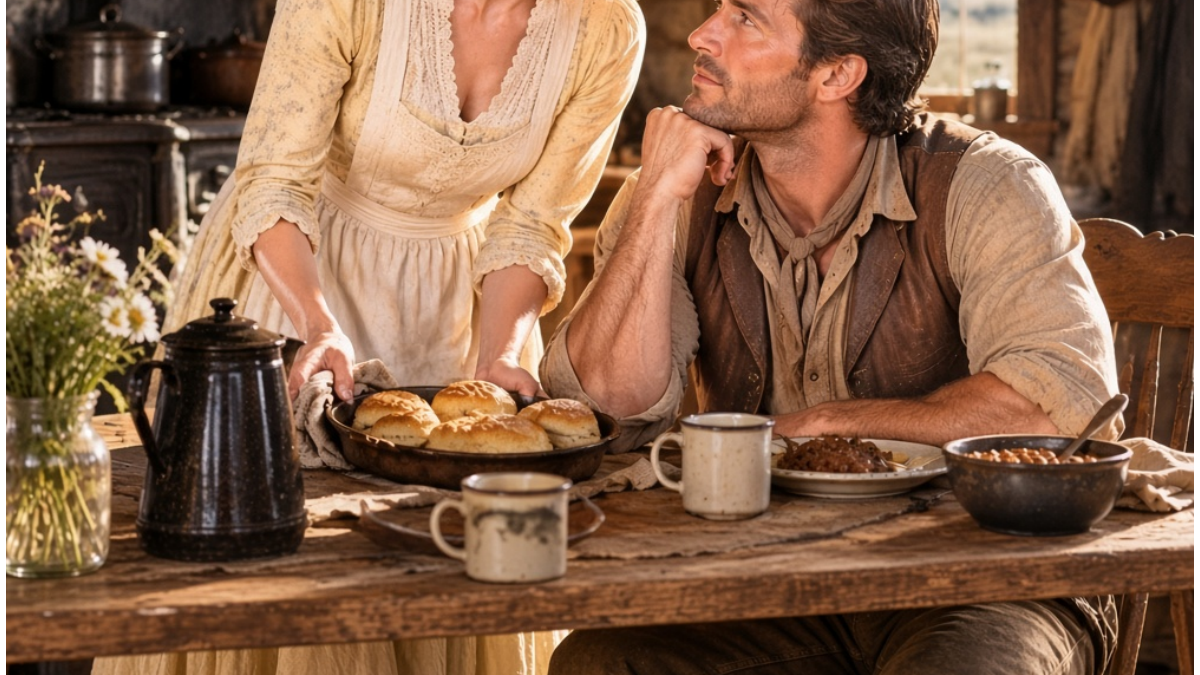
I’ll work until I can leave. She told him the first morning standing in his kitchen like she was already halfway out the door.
Cole Danner didn’t argue. He’d heard women make promises before. He’d watched one keep every single one of them right up until the day he buried her.
He didn’t need another woman in his house. He needed someone to cook, clean, and stay out of his way.
What he got was Norah Voss, and she was about to turn every quiet careful wall he’d built into something he no longer recognized.
The letter arrived on a Tuesday, which was the same day Cole Danner fired his third housekeeper in 4 months.
He didn’t feel good about it. He never did. But Mrs. Pollson had rearranged the shelf above the fireplace, moved the photograph of his late wife, Margaret, 3 in to the left, and when he’d walked in and seen it sitting there at the wrong angle, something inside him had gone very still and very cold.
He hadn’t raised his voice. He’d simply told Mrs. Pollson that her services were no longer needed, handed her the week’s wages, and stood on the porch until her wagon disappeared down the road toward Clary Falls.
Then he’d gone back inside, moved the photograph exactly 3 in to the right, and stood there looking at it for longer than he intended.
The letter was sitting on the kitchen table when he came back in from the evening feeding.
His ranch hand, Bo Greer, had left it propped against the sugar jar Bo’s way of making sure Cole actually saw things instead of letting them pile up under the mail he never opened.
Bo was 22 years old and had more sense than most men Cole had known twice his age.
Cole picked up the envelope. The handwriting was careful, precise, not the looping decorative script some women used, trying to make everything look like an invitation.
This was plain lettering. Each word set down like it meant to stay there. He read it standing at the table still in his coat.
Dear Mr. Danner, my name is Noravos. I am responding to the notice posted at the Clary Falls General Store regarding the housekeeper position at Danner Ranch.
I am 31 years of age, widowed 2 years past, and in good health. I have experience managing a household, cooking for working men, preserving food for winter, and maintaining accounts.
I do not require much. I require only the opportunity to work honestly and to be treated as such.
I can arrive by week’s end if the position remains open. Respectfully, Norah Voss Cole set the letter down.
He read it again. Most of the women who’d responded to that notice had sent letters full of what they hoped the position would be warm descriptions of their love of cooking, their gentle natures, their eagerness to create a pleasant home.
One woman had included a pressed flower between the pages. Cole had stared at that flower for a full minute, unsure whether to feel touched or irritated and had ultimately felt neither.
He’d felt tired. Noras’s letter had no pressed flowers, no soft language, no promises about pleasantness.
She’d listed what she could do and what she needed. That was all he wrote back that same night.
Two sentences. The position is open. Come Thursday. She came on Thursday. Cole had told himself he wasn’t going to stand at the window watching for the wagon.
He stood at the window for 40 minutes watching for the wagon. It was Bo who finally said something, passing through the front room with a saddle over one arm and not even glancing toward Cole.
Stage from Clary Falls gets in around two. I know when the stage gets in.
Just saying. Cole moved away from the window. The wagon that brought Norah Voss up the road from the main gate was driven by old Hap Gentry who ran the livery in town and charged too much for the privilege.
Cole watched from the porch which was different from watching from the window. He told himself though he couldn’t have explained exactly how.
The woman who climbed down from that wagon was not what he’d expected, though he couldn’t have said what he’d expected either.
She was slight but not fragile. She moved carefully. The way a person moves when they’ve learned that the world doesn’t always hold still for you.
She had dark hair pinned back under a gray traveling hat, and she was wearing a coat that had been mended at both elbows done neatly, but it was visible if you knew where to look.
She had one trunk and one bag. She didn’t ask for help with either. She paid Hap gentry from a small purse and Cole noticed she counted the coins twice before she handed them over.
Hap tipped his hat and drove back down the road without ceremony. And then Norah Voss turned and looked at the house.
She didn’t look at Cole firSt. She looked at the house. He watched her take it in the wide porch, the two chimneys, the windows that needed washing, the garden along the south wall that had gone to dry sticks and dead growth.
She looked at all of it with the same careful, precise attention he’d recognized in her letter.
Not impressed, not disappointed, simply taking inventory. Then she looked at him, Mr. Danner, Miss Voss.
He came down the porch steps. Mrs. Voss. Fine. She picked up her bag. Shall I see the kitchen first, or would you prefer to go over the expectations?
He blinked. Every other woman who’d come to this porch had waited for him to lead the conversation.
This one was already managing it. Kitchen, he said. She nodded and walked up the steps ahead of him.
The kitchen was not in good condition, and Cole knew it. He’d known it for months.
There was a particular kind of shame in watching someone see the state of your home for the first time.
And he felt it now standing in the doorway while Norah Voss moved through the kitchen with her coat still on, opening the pantry, checking the stove, lifting the lid on the water barrel.
She didn’t say anything for a long time. Then she turned around. The stove needs a new gasket on the left firebox door.
The seal is broken. You’re losing heat every time you cook, which means you’re burning through more wood than you should be.
She looked at the pantry. Your flower has weevils. Not badly, but they’re there. That needs to be dealt with before I do anything else.
Or everything I bake will be compromised. She looked at the ceiling above the dry sink.
There’s a water stain up there. Is that an active leak or an old one?
Old Cole said. Fixed it last spring. Good. She set her bag down by the table.
I’ll need a list of what you want done in what order. Or if you’d prefer, I’ll make the list and you can tell me what to change.
You make the liSt. She nodded. The room I was told about the one off the back hallway.
I’ll show you. The room had been used for storage for the better part of 2 years.
Cole had cleared it out the night before, dragged three crates of old fencing equipment into the barn.
And swept the floor twice. He was not going to tell her that. She stepped inside, set her trunk down, and looked at the single window that faced the east pasture.
“This is fine,” she said. “There’s a hook on the back of the door for “It’s fine, Mr. Danner.
Thank you.” He left her to settle in. He stood in the hallway for a moment after, aware of the sound of her moving around on the other side of the door.
The quiet efficient sounds of a woman making a temporary space into something workable. And then he walked back to the kitchen and stood there not quite sure what to do with himself.
Bo appeared in the back doorway, boots muddy, grinning slightly. Well, go finish the fence line, Cole said.
Bo went still grinning. Dinner that first night was cornbread, salt pork, and a pot of beans that Norah had somehow made taste like something other than obligation.
Cole ate at the head of the table. Bo and the two other hands a quiet older man named Wick Slade and a younger one named Dex, who talked enough for everyone sat along the sides.
Norah served and then stood near the stove, and Cole noticed halfway through the meal that there was no plate set for her.
You haven’t eaten, he said. I’ll eat when the meal’s done. Sit down and eat.
She looked at him, not with surprise, exactly more like she was reccalibrating something. There’s no need to Mrs. Voss.
He pulled out the chair to his left. The one that had sat empty for 2 years.
Sit down. The table went quiet. Dex stopped talking, which was the first time Cole had seen that happen without physical intervention.
Bo looked at his plate. Wick kept eating with the focused attention of a man who had learned to stay out of things.
Noravos came to the table. She sat down. She put her napkin in her lap with the same careful precision she did everything else.
And then she reached for the cornbread. And Dex immediately started talking again about something that had happened with one of the horses.
And the meal continued. Cole didn’t look at the empty chair to his right. He’d been careful not to look at that chair for a long time.
The rules came the next morning. Cole found her already in the kitchen when he came down.
The stove lit. Coffee on. The sound of something being beaten in a bowl. He stopped in the doorway.
Outside it was still dark. The clock on the mantle in the sitting room read a4 5.
You’re up early, he said. I’m always up early. He came in and poured coffee.
She was making biscuits. He watched her work for a moment, the quick, sure movements, no wasted motion.
And then he set his mug down. There are things in this house that don’t get moved.
He said she kept working. All right. The photograph on the sitting room shelf, the chest at the end of the upstairs hall, the garden along the south wall.
It stays as it is. He paused. Those aren’t negotiable. She stopped. Then she turned around, hands dusted with flour, and looked at him steadily.
I understand, she said. I won’t touch them. Good. She turned back to her biscuits.
He picked up his coffee, Mr. Danner. He stopped. I’m not here to change what you’ve built, Norah said.
Still facing the counter. I’m here to work. That’s all. He looked at the back of her head.
The careful way her hair was pinned the mended elbows of her work dress. I know, he said, and he walked out to the barn.
She was He discovered over the following two weeks exceptional at her job. Not in any showy way.
Nothing she did announced itself. She simply worked steadily, quietly from before first light until well after dark, and the house responded to it the way dry ground responds to rain.
Not all at once. Gradually starting from the inside the kitchen firSt. The weevils in the flower were dealt with the second day she bought new flour in town.
Rode the wagon herself. Didn’t ask Cole’s permission or his assistance. She reorganized the pantry in a way that made sense to someone who was actually cooking from it rather than just storing things in it.
The stove was repaired. She had sent B to Clary Falls for the gasket and had the firebox sealed herself by the time Bo got back, which Bo reported with an expression of deep personal admiration.
The sitting room was dusted and cleaned without anything being moved. Cole checked. Every item was exactly where it had been.
The photograph of Margaret at the exact angle where he’d left it. The dead garden along the south wall remained untouched.
But something happened in the third week that Cole hadn’t anticipated. He came in from a long day of checking the winter fence lines cold.
Tired in a temper about a section of wire that had gone down in the north corner and let two steers into the neighboring property and he walked into the kitchen and stopped.
The table was set properly set two plates, two cups. The good lamp lit in the center.
The smell of something slowcooked filled the entire room. Through the window above the dry sink.
The last of the daylight was fading over the east pasture. Bo and the hands ate in the bunk house most nights.
Cole had gotten used to eating alone. Norah was at the stove. She turned when she heard him come in.
Bo said you’d be late. I kept it warm. You didn’t have to do that.
She set a bowl on the table. Then a plate of biscuits. I know, she said.
She went back to the stove. Cole stood there for a moment, coat still on, looking at the set table.
Then he hung his coat on the hook by the door, and sat down. He ate.
She brought her own bowl to the table and sat across from him and ate, too.
They didn’t talk much, the wind had come up outside. Pressing against the window glass, and the lamp on the table threw a warm circle across both their plates.
At some point, Norah said the north fence is at the wire or the posts wire.
Posts are solid. Wick said he thought the ground in that corner runs soft in the freeze.
He’s right. I need to repack those post holes before the ground goes hard. She nodded.
She broke a biscuit and didn’t say anything else. Cole realized somewhere around the bottom of his bowl that this was the longest he’d sat at this table without watching the clock since Margaret died.
He didn’t say that. He finished his meal and thanked her and went to his office to look at the fence repair numbers.
But he sat at the table a little longer than he needed to before he got up.
It was Bo who told him about Clary Falls. Cole had sent Bo and Nora into town together for supplies.
Bo for the hardware, Norah for the dry goods. They’d taken the ranch wagon. Cole had stayed home because there were accounts that needed doing, and he’d told himself that was the reason, and not that going into Clary Falls meant walking past the church where he’d married Margaret and the doctor’s house where she’d died, and the cemetery plot on the hill where she’d been buried.
All of which were things he’d been avoiding for going on 2 years. Bo came back quieter than usual.
Cole noticed. Cole always noticed things about people who worked for him. Even when he pretended not to.
He waited until after dinner until Norah was in her room and Dex had taken himself off to the bunk house telling some story Wick was clearly not listening to.
Then he poured two cups of coffee and set one in front of Bo. Tell me.
Bo wrapped both hands around his cup. Hattie Greer was at the dry goods. Her sister was with her and Mrs. Old from the milliners’s cole waited.
They were talking to her. Bo looked at his coffee about what kind of woman comes to work at a ranch alone.
About what a widow woman really means when she says she’s looking for work. Bose’s jaw tightened.
They said it loud enough for most of the store to hear. Cole was very still.
What did Mrs. Voss do? She finished her order, checked everything off her liSt. Paid asked for help loading the wagon.
Bo looked up. She didn’t say a word to any of them, just went about her business like they weren’t there.
He paused, but her hands were shaking when she loaded the flower sacks. She thought I didn’t see.
Cole picked up his coffee cup. Set it down without drinking. She didn’t tell me, he said.
Not a question. No. Bo was quiet for a moment. She didn’t tell me either.
I’m telling you because he stopped. Because what? Because somebody should know, Bo said simply.
Cole sat with that for a moment. Then he stood up, took both coffee cups to the dry sink, rinsed them, and set them upside down on the cloth.
Next time she goes to town, he said, “I’ll go with her.” Bo looked at him.
Cole walked out of the kitchen. He didn’t tell Norah any of that. He didn’t know how to bring it up without making her feel like she was being managed or pied.
And he’d learned enough about Norah Voss in 3 weeks to know that she would not thank him for either.
But the following week when she mentioned she needed to go back to Clary Falls for thread and a replacement pot lid, he said simply that he had business at the feed store and they might as well go together.
She looked at him. You were in town two weeks ago. She said, “I forgot something.”
The look she gave him said she did not entirely believe that. But she didn’t argue.
They went to town together on a cold Friday morning. Cole on horseback and Norah in the wagon, and he tethered his horse outside the feed store, collected absolutely nothing of importance, and then walked down the street and into the dry goods store.
At the same moment, Norah was settling in at the counter. Hattie Greer was there.
Her sister was there. Mrs. Al was near the bolts of cloth. The room changed the second Cole Danner walked in.
It always did. He’d owned the largest ranch in the county for 6 years. He knew how his name moved through rooMs. He walked to the counter and stood next to Nora.
He didn’t say anything about the women. He didn’t look at them. He talked to the man behind the counter about nothing in particular about the wire shipment that was supposed to have come in before first snow and hadn’t.
And he stood next to Norah while she finished her order and he loaded the heavier parcels into the wagon when it came time.
Hattie Greer tried once, passing near the door to sweet a smile. Mr. Danner didn’t expect to see you in town today.
I’m full of surprises, Cole said and held the door for Norah to walk through firSt. Outside walking to the wagon, Norah’s pace was exactly what it always was.
Unhurried even. You didn’t have forgotten business at the feed store, she said. No. She climbed up to the wagon seat.
She was quiet for a moment. Gathering the rains, he stood beside the wheel, not looking at her.
Thank you, she said. It was the first time she’d said those words to him like she meant something specific by them.
Not polite thanks, real thanks, the kind that cost something. He tipped his hat and went to untether his horse, and neither of them mentioned it again.
The night it all shifted, the night Cole Danner understood that something was happening that he didn’t have a name for yet was a Thursday in the fourth week of November.
He’d woken at 3:00 in the morning. He did that sometimes. Those years after Margaret, his body had never fully learned to stay asleep without someone else in the house, generating the small sounds of another life of breath.
A shift in the bedding, the creek of someone turning over in the room down the hall.
He lay awake for a while. Then he heard something from the direction of the kitchen.
He got up. The lamp in the kitchen was lit low. Norah was at the table in her robe and a heavy shawl.
A cup of something warm cuped in both hands. Looking at a piece of paper on the table in front of her.
She didn’t hear him come in or she chose not to react to it, which was possible with Nora.
He stopped in the doorway. She was reading a letter. He could tell from the way she held herself something careful and slightly braced.
The way you hold yourself when you’re reading something you need to read but aren’t sure you want to.
He should have gone back to his room. He’d learned over four weeks that Norah Voss guarded her private life the way he guarded his not aggressively.
Just firmly with a quiet consistency that made it clear those doors opened from the inside only.
But he didn’t go back. “Can’t sleep,” he said quietly. She looked up. There was no startle in it.
She was a woman who’d learned not to startle at men’s voices in the dark, which told its own story.
No, she said. He came into the kitchen. He went to the stove, checked the embers, put on enough wood for a small fire, and put the kettle on without asking.
Then he pulled out the chair across the table and sat down. She folded the letter once and set it at the edge of the table.
He didn’t ask about it for a while. Neither of them said anything, and the art that built itself back up in the stove, and the kettle began its low complaint.
And outside the wind moved across the open ground with the particular sound it made in late November.
Not violent, just enormous, like something alive that had been out there long before either of them and would be out there long after.
My husband’s family is contesting the sale of our house. Norah said she wasn’t looking at him.
She was looking at her hands around her cup. The house was mine. His name was on the deed because it had to be.
That’s how it works. But I paid for half of it before we married. From my mother’s money.
They know that. They’ve always known it. She stopped. The letter is from their solicitor.
They’re saying I abandoned the property when I left. Cole looked at her. I left because they made it clear I wasn’t welcome in it.
She said, “The week after Thomas died, his brother changed the locks. Her voice was very even.
I had to go back with the county clerk to get my own things out of my own house.
Cole was quiet for a long moment. Do you have a solicitor? I can’t afford one.
I know one in Helena. Decent man. He helped me with a land dispute 2 years ago.
Cole watched her. I could write to him. She looked up. Something moved through her expression.
Not gratitude. Exactly. Not yet. More like suspicion of gratitude which he recognized because he felt it himself sometimes.
Why? She said it was a fair question direct the way she was direct about everything.
Because what they did to you was wrong, he said. And because I can help and there’s no reason not to.
She held his gaze for a moment. Then she looked back down at her cup.
I’ll think about it, she said. He nodded. The kettle began to steam and he got up and poured two cups and brought them back to the table and they sat there on either side of the kitchen lamp.
The wind outside the fire in the stove, the letter folded at the edge of the table between them and they didn’t see anything else.
But they sat there for a long time. And when Cole finally went back to his room, he lay down and looked at the ceiling and was aware of something he hadn’t felt in 2 years.
Not happiness. Not quite yet, but the specific absence of emptiness that had been sitting in his chest so long he’d almost mistaken it for who he was.
He didn’t sleep for a while. He didn’t mind. The next morning, she came down and made breakfast like nothing had changed.
He poured his own coffee and said good morning and went out to check on the horses.
At the door, he stopped Mrs. Voss. She turned from the stove. I’ll write that letter to Helena today, he said.
You don’t have to decide anything yet, but having the costs nothing. She looked at him for a moment.
Then she turned back to the stove. All right, she said. Thank you. He went out into the cold, and the sun was just coming up over the east pasture.
And somewhere in the barn, one of the horses knocked against its stall, the ordinary sounds of a morning, and cold Danner walked out into it, feeling for the first time in a very long time, like those sounds were something other than an absence, like they were the beginning of something he didn’t have words for yet.
But he was starting to look for them. The letter Cole sent to Helena came back inside two weeks.
He’d written it the morning after he and Norah sat up in the kitchen, a careful, precise letter, the kind he’d learned to write from his father, who had believed that a man’s word on paper was the same as his word in person and should be treated accordingly.
He’d laid out the facts as Norah had told them to him. The house, the deed, her mother’s money, the brother who’ changed the locks.
He hadn’t embellished. He hadn’t asked for favors. He’d simply told his solicitor in Helena, a man named George Aldis, what had happened and asked what could be done.
Aldis wrote back on a Thursday. Cole read the letter in his office with the door closed.
Then he went to find Nora. She was in the root cellar taking inventory of the winter stores, counting jars, checking lids, making notes in the small book she kept tucked in her apron pocket.
He heard her before he saw her, the quiet movement of jars being shifted and set back down.
Mrs. Voss, she appeared at the cellar door, her breath fogging in the cold air coming up from below.
Mr. Aldis wrote back, Cole said. He held out the letter. She looked at it for a moment before she took it.
She read it standing there in the cellar doorway, the cold rising around her ankles, and he watched her face the way he’d learned to watch it, not for what it showed, but for what moved behind it.
When she finished, she lowered the letter and was quiet. He thinks I have a case, she said.
He does. The contribution to the purchase price is documentable if you have your mother’s estate records.
Do you? I have a copy. I kept it. She paused. I kept everything. Thomas always said I was too careful about paper.
He was wrong. Cole said. Send Aldis what you have. He’ll take it from there.
She folded the letter along its original creases. She handed it back to him. I can’t pay him until the matter is settled.
She said he’ll want to know that upfront. He already knows. I told him. Cole tucked the letter into his coat pocket.
He’ll work on contingency. It’s not unusual in property disputes. She was looking at him steadily.
The way she looked at things, she was trying to understand fully before she responded to them.
You arranged that, she said. It seemed practical, Cole. It was the first time she’d used his given name.
It came out quietly like something that had been there for a while and had simply found its moment.
She caught herself. Mr. enter. You didn’t have to do any of this. I know, he said.
I wanted to. She held that for a moment. Then she turned and went back down into the root cellar and Cole stood at the top of the steps for a second before heading back toward the barn.
But he noticed as he turned away that she was moving differently down there the tight economical movements of a woman who had been braces herself against something for a long time had shifted.
Just slightly into something a little less defended. He didn’t say anything about it. He went and looked at the horses.
December came in hard. The first real snow arrived on a Sunday. And by Monday, the north pasture was drifted 3 ft deep against the fence line.
Cole had spent two weeks repairing. He was out at first light with Wick and Dex and Bow, cutting trail to the water trough, breaking ice, keeping the cattle pushed toward the south shelter.
The work was punishing in the cold fingers going numb inside gloves. Breath coming in hard clouds, the horses blowing and protesting at every step.
Norah kept the stove running all day. Cole came in at noon to find hot coffee.
Biscuits kept warm in a covered pan and a pot of something on the back of the stove that had been going since morning.
He stood in the kitchen doorway in his snowcrusted coat and looked at all of it.
“Eat,” Norah said without looking up from the bread she was needing. “You’ve got 40 minutes before that north drift refreezes.”
He ate standing up. Bo came in behind him and ate standing up, too. And Dex said something about the cold that nobody responded to.
And Wick came in last and sat down at the table without a word and ate with the grim efficiency of a man who has done hard winter work his entire life and knows it isn’t done yet.
Cole was back outside in 35 minutes. That became the rhythm of the weak brutal days in the cold and something warm waiting when he came in.
It wasn’t a small thing. He’d spent two Montana winters coming back to a cold kitchen and cold food and the quiet that had weight to to it.
The kind of quiet that presses down. He hadn’t realized how much he’d missed the simple fact of a lit stove and food kept warm until it was there again.
He didn’t tell Norah that, but on the fourth day when he came in from the worst afternoon, yet a section of the south fence had buckled under the snow load, and three steers had gotten out, and he’d spent 2 hours in driving sleet getting them back.
He hung up his coat and his hat and she set a cup of coffee on the table in front of the chair he always used.
He sat down. She sat across from him with her own cup and her account book and continued what she’d been working on.
And he wrapped both hands around the mug and let the warmth run up his arms and didn’t say anything for a long time.
The south fence buckled. He finally said, “Wick told me.” He said, “You got the steers back eventually.”
He drank his coffee. “It’s going to be a long winter.” “Yes,” she made a note in her book.
“The preserves will laSt. The flour and salt pork to careful. I’ve been rationing the sugar since last week.”
He looked up. “You’ve been rationing only slightly. No one’s noticed.” She turned a page.
“You have enough to get through February comfortably and into March with care. If the snow breaks early, you’ll be fine.
He stared at her. When did you calculate all that? I do it every week.
She looked up slightly puzzled by his surprise. Don’t you? He did not. He’d been running on hope and stubbornness and whatever.
Mrs. Pollson had ordered before she left, which had apparently not included any systematic accounting of what was actually in the cellar.
I didn’t know you were doing that, he said. I assumed you knew. She looked at her book, then back at him.
I can show you the figures if you’d like. Please, he said, because he would have been a fool not to.
She slid the book across the table, and he read through her careful columns every item in the cellar.
Every bag and jar and croc measured against her estimate of daily use. It was meticulous.
It was also he realized the kind of thinking that kept ranches from going hungry in hard winters and the kind of thinking that he in two years of living alone and not paying proper attention had entirely failed to do.
This is good work. He said it’s just numbers. No, he said it’s thinking ahead.
That’s different. She looked at him for a moment. Something shifted in her expression. Not quite pride, but the expression of someone receiving recognition they decided not to need and then found unexpectedly that they did need a little after all.
She took the book back and returned to her notes. Cole finished his coffee and listened to the wind outside and didn’t watch the clock once.
It was Dex who caused the trouble, which surprised exactly no one. Dex was a good and strong, willing, not afraid of hard work, but he had a young man’s certainty about how the world worked and a young man’s complete inability to keep that certainty to himself.
Cole had accepted this as a reasonable trade-off since Dex also had an uncanny ability to calm nervous horses and could fix a broken wagon wheel in 30 minutes flat.
But Dex had opinions about women and he had the particular failing of men who’ve spent most of their lives around other men, which was that he forgot sometimes that women could hear him.
Cole came into the barn on a Wednesday afternoon to find Dex talking to Bo at the far end of the stalls.
He stopped outside the door when he heard his own name. “All I’m saying is it’s not normal,” Dex was saying.
A woman living in the house eating at the table with the boss. My uncle would have never.
Your uncle isn’t cold. Danner, Bo said flatly. I’m just saying what people in town are going to say.
People in town say plenty. That doesn’t make it worth listening to. Mrs. Greer was asking me about it when I was in Clary Falls last week.
Weather stopped talking. Cole stepped into the barn. Dex went pale. Bo did not move, but his expression made clear he had already been trying to prevent this conversation.
Cole walked the length of the barn until he was standing in front of Dex.
He looked at the younger man for a long moment. Mrs. Voss is an employee of this ranch.
He said, “She does her work with more capability and more dignity than most people I’ve ever hired.
She eats at my table because I invited her to and she lives in this house because the position requires it.
He kept his voice even. The next time someone in town asks you questions about the arrangements at Danner Ranch, you tell them that’s my business and none of theirs.
And the next time you have opinions about how I run my household, you keep them in your own head.
Are we clear? Dex’s jaw was tight. Yes, sir. Good. Cole turned and walked back toward the barn door.
He stopped without turning around. You’re a solid hand. Dex, don’t make me think less of you.
He went back to the house. He didn’t tell Norah about that either. But that evening at dinner when Dex came in and sat down and kept his eyes on his plate with the specific shame of a young man who has been properly corrected, Cole noticed Nora glance at the younger man, then at Cole, then back at her food.
She was too perceptive not to have noticed something. After dinner, when the hands had gone and Cole was banking the fire in the sitting room, she appeared in the doorway.
Whatever you said to him, she said. Thank you. He looked up. I don’t know what you mean.
The look she gave him was not the look of a woman who was fooled.
All right, he said. She turned to go Norah. She stopped. He realized he’d used her given name for the first time.
He didn’t take it back. People are going to talk regardless, he said. What happens in this house is not their concern.
I’m clear on that. Even if they aren’t. She stood in the doorway for a moment.
Her hand on the frame. I’ve spent two years worrying about what people say, she said quietly.
I’m tired of it. Then stop, he said. You work hard. You’re honeSt. That’s all that matters here.
She looked at him for a long time. Then she nodded once and went down the hall to her room.
Cole stayed by the fire for a while after that, not thinking about anything in particular.
Christmas came on a Thursday. Cole had not celebrated Christmas in two years. He’d let the day pass both times like any other day, gone out to the animals in the morning, done the necessary work, come back in eaten alone, gone to bed, he’d told himself it was practical.
He’d told himself that grief didn’t follow a calendar. He’d woken both mornings with the particular weight of a day that was supposed to be different and wasn’t.
He didn’t know what Norah had planned. He hadn’t asked. He came down on Christmas morning to the smell of something he hadn’t smelled in two years.
Cinnamon, and something sweet, and underneath it all the particular richness of a kitchen that has been busy since before dawn.
She’d made a proper breakfast, eggs, and salt pork and biscuits, and on a plate at the center of the table, something that it took him a moment to identify.
Gingerbread. He stood in the kitchen door and looked at the plate. My mother used to make it every Christmas.
Norah said behind him, she was pouring coffee. I know it’s not. I wasn’t sure if you’d want.
Margaret used to make it too, he said. Silence. He came to the table and sat down.
He pulled the plate toward him and broke off a piece and ate it. And it tasted like every Christmas he’d ever had when Christmas had still felt like something worth having.
Norah set a cup of coffee in front of him and sat across from him with her own breakfast and didn’t say anything, which was exactly right.
Bo and the others had gone to their families or their chosen celebrations. The house was quiet.
The snow had stopped the day before, and the world outside was very still and very white.
They ate. They drank their coffee. At some point, without planning it, Cole told her about the Christmas, Margaret had burned the entire batch of gingerbread and refused to admit it and served the charred pieces anyway with complete composure.
Insisting they were supposed to be that dark, and how he’d eaten them without a word, because he loved her, and they’d both known perfectly well that she’d burned them.
Norah laughed. It was the first time he’d heard her laugh fully, not the quiet controlled sound.
She allowed herself sometimes, but something real and unguarded that changed the entire room. “What did they taste like?”
She said. “Cole,” he said. “Pure coal.” She laughed again, and he found himself smiling in a way that felt strange on his face.
Like a muscle he’d forgotten he had. They sat at that table for a long time.
The letter about the house came from Aldis in the last week of December. Cole was in the barn when Norah found him.
He turned at the sound of her step and saw her standing just inside the barn door with the letter open in her hand.
Her face was doing the careful, controlled thing it did when something had hit her hard and she was deciding whether to let it show.
Alda says they’ve agreed to a settlement. She said the brother is willing to release the claim in exchange for a sum less than half what the house was worth.
She stopped. Aldis says it’s a good result given the circumstances. Is it enough? Cole asked the settlement.
She was quiet for a moment. It would be if I can match the sum he’s asking by spring.
She lowered the letter. Which I can’t. Cole looked at her, the wages I’m paying you, he began.
Won’t be enough by spring. I know. Her voice was steady, but her hands weren’t entirely.
I knew it might come to this. I knew when I took this position that it would take time.
She folded the letter. I’ll write to Aldis and ask for an extension or Cole said carefully.
I advance you the remainder against your wages. She went very still. That’s not she started.
It’s a business arrangement. He said, “You have a valid claim. Aldis has confirmed it.
I advance the sum. You repay it from your wages over time. It’s no different from how I pay for fence wire before the cattle money comes in.
She was looking at him with an expression that was harder to read than usual, complicated by something.
Not just gratitude this time, but something beneath it that he couldn’t name. “Why do you keep doing this?”
She said. It was the same question she’d asked him months ago in the kitchen about Aldis.
And he’d said then, “Because it’s wrong.” And because I can. He thought about saying that again.
It was true as far as it went, but standing in the cold barn with haydust in the air and one of the horses watching over its stall door and Norah Voss looking at him with that expression.
He found he didn’t want to give her the practical answer. Because you came to this ranch with one trunk and one bag and a letter that asked for nothing except the chance to work, he said.
And you’ve worked harder than anyone I’ve hired in 10 years. And you’ve asked for nothing beyond your wages, and somewhere along the line, that stopped being something I could watch as a simple business matter.
The barn was very quiet.” Norah looked at him for a long time. Then she looked down at the letter in her hands.
“All right,” she said. Her voice was careful, but not cold. “I’ll accept the advance, and I’ll repay every cent.”
“I know you will,” Cole said. She turned and walked back toward the house. He stood in the barn and watched her go and did not examine too closely the thing sitting in his chest that had nothing to do with fence wire or cattle money or business arrangements of any kind.
He went back to work, but he thought about the sound of her her laughing at his burned gingerbread story for the rest of the afternoon.
And when he came in for supper that evening, and she set his plate in front of him, and their hands came close for a moment at the edge of the table, neither of them moved away quite as quickly as they might have done a month ago.
He noticed that he suspected she did, too. Neither of them said a word about it.
But the kitchen felt smaller than it used to. In the way that spaces feel smaller when they’ve become important, not crowded, just occupied in a way they weren’t before.
And Cole Danner sat at his table and drank his coffee and understood with the quiet certainty of a man who has spent a long time alone and knows exactly what its absence feels like.
That something had changed in this house, and that he was no longer entirely sure he wanted it to go back.
January came in quieter than December had gone out. The hard cold settled over the ranch like something permanent, the kind of cold that doesn’t threaten.
It simply is, and the only reasonable response is to work within it and stop expecting it to apologize.
Cole had lived through 14 Montana winters, and he knew the rhythm of them. The brutal first weeks, then the long gray middle, then the false thaw in February that tricked you into hope, and then the real thaw in March that actually meant something.
He’d stopped dreading the long gray middle 2 years ago, roughly around the time there stopped being anyone to dread it with.
Now he found himself on the fourth morning of January, sitting at the kitchen table at 6:00 in the morning with coffee and the ranch ledgers and Nora.
Across from him with her own coffee and her account book and not dreading it at all.
They’d fallen into a habit without discussing it. He came down early. She was already up.
Coffee was made. They sat on opposite sides of the table and worked through whatever needed working through the books.
The supply lists, the questions that came up in the running of a ranch, and neither of them said much that wasn’t necessary.
But the silence between them had stopped being empty and become something else. Something that had weight in a good way, the way a well-built wall has weight.
Bo had noticed. Cole could tell by the way Bo carefully didn’t notice, which was its own kind of noticing.
Wixlade, who noticed everything and said nothing, had started bringing in extra firewood in the evenings without being asked.
Stacking it neat by the kitchen door. Cole suspected this was Wick’s version of approval.
Dex had kept his opinions to himself since December, which Cole appreciated more than he would ever say.
The trouble with the Voss family arrived on a Wednesday. Cole was in his office going over the winter cattle count when he heard the wagon come up the road.
He didn’t think much of its supplies were due from Clary Falls. And Hap Gentry drove that wagon once a week through the winter with reasonable predictability.
“But then Bo appeared in the office doorway with an expression Cole had not seen on him before.”
“There’s a man at the door,” Bo said, asking for Mrs. Voss. Cole set down his pen.
“What kind of man?” “The kind who came a long way.” Bo paused. “He says his name is Edmund Voss.”
Cole was very still for a moment. Then he stood up. Edund Voss was Thomas Voss’s younger brother, the one who had changed the locks.
Cole had never seen him, but the description that formed in his mind from Norah’s careful, even voiced account was precise enough.
He walked to the front door. The man standing on his porch was around 40, well-dressed in a way that looked deliberate rather than natural.
With the particular look of a man who has decided in advance how a conversation is going to go and expects the world to cooperate.
He looked at Cole with something between surprise and irritation. I’m looking for Norah Voss.
This is my ranch. Cole said, “Who are you, Edmund Voss? I’m her late husband’s brother.”
Family matter. He said it the way people say things they consider settled. If you’ll tell her I’m here, I’ll tell her you’re here when I know what you want.
Edmund Voss recalibrated. He looked at Cole with the expression of a man reassessing the difficulty of a conversation he’d assumed would be easy.
The property settlement, he said. There are details that need to be discussed directly. Her solicitor in Helena handles those discussions.
Her solicitor, he stopped. She has a solicitor. She does. Something shifted behind Edmund Voss’s eyes.
He’d come expecting Cole understood. A woman alone and without resources. He’d come expecting Norah to be exactly where he imagined her, isolated, dependent, without anyone standing alongside her.
He had not expected to be standing on a porch in front of Cole Danner.
“I’ve come a long way,” Edmund said. His tone had shifted less certainty in it now.
“More careful you have,” Cole said. “And you’ve had a wasted trip. Any discussion about the settlement goes through Alsus in Helena.
I’ll give you his address if you don’t have it. Edmund looked at him for a long moment.
Then he looked past Cole into the house and Cole shifted slightly, just enough to make clear that looking past him was as far as that was going to go.
This is a family matter, Edmund said again quieter this time. It’s a legal matter, Cole said.
And it’s being handled legally. Good day, Mr. Voss. He closed the door. He stood in the hall for a moment.
Through the window beside the door, he watched Edmund Voss stand on the porch for a count of 10, then turn and walk back to his wagon with the stiff-backed posture of a man who has lost a negotiation he didn’t expect to.
Cole waited until the wagon was down the road and out of sight. Then he went to find Nora.
She was in the kitchen. And from the way she was standing very still, both hands flat on the workt, he understood that she’d heard the voices at the door.
“Edmund Voss,” she said. “Not a question. He’s gone.” She let out a slow breath.
Her hands were still flat on the table. “He came to frighten me,” she said.
“That’s what he does. He came in person because he thought if he could get me alone.”
She stopped. “What did you say to him? That the matter goes through Aldis and that it was a wasted trip.
She was quiet for a moment. When she looked up, something in her expression had settled, not relief.
Exactly. But the expression of a person who has been carrying something heavy and has just had someone put a hand under the weight.
He’ll write to Aldis now, she said. He’ll try to complicate the settlement. Let him, Cole said.
Aldis is better at complicated than Edmund Voss is. She looked at him steadily. You don’t know that.
I know Aldis. He pulled out a chair and sat down. Sit down, Nora. She sat.
Tell me what he has that you’re afraid of, Cole said. Not what Aldis knows, what you haven’t told anyone.
Because you’re afraid of something specific, and I’d rather know it than not. She was quiet for a long time.
Outside the kitchen window, the snow lay flat and white across the south pasture, and the dead garden stood in it like a sketch of itself.
When Thomas died, she said finally, there were debts. Not large ones, but debts. I didn’t know about all of them.
His brother knew. She looked at her hands. Edmund paid two of them after Thomas died.
He told me he did it out of family feeling. He told me there was no obligation.
She paused. He has receipts with his name on them. He’s been saying to anyone who listen that Norah Voss abandoned a house that was purchased partly with Voss family money and he has the receipts to prove it.
Cole looked at her. Were the debts against the house? No, they were personal debts.
Trade accounts. She shook her head. But he’s framing them as contributions to the property.
And if he can make that case, then his claim on the house becomes stronger.
Cole was quiet for a moment. Does Aldis know about the receipts? I told him in my last letter.
What did he say? He said it complicates things. She met Cole’s eyes. It means the sum Edmund is asking in settlement is likely to go up.
Cole looked at the table. Then he looked at her. How much more? I don’t know yet.
Her voice was steady. But it had cost her something to say all of it.
He could tell. Noravos did not easily give up the geography of her own difficulties.
He didn’t say anything immediately. He thought about Margaret, who had kept things from him, too, not out of deception, but out of a fierce private need to solve her own problems, and how he’d learned too slowly that letting someone help wasn’t the same as losing the fight.
Write to Aldis tonight,” he said. “Tell him what Edmund came here for and that the approach through the ranch has been closed off.
It’ll tell Aldis something about how Edmund operates.” He stood up. “And don’t make any decisions about the settlement until Aldis has seen the receipts and told us what they actually mean.”
She looked up at him. “Us,” she said quietly. He stopped. He hadn’t meant to say it that way.
“Or maybe he had. He wasn’t entirely sure anymore where the line was between helping because it was right and helping because Noravos had become something to him that he hadn’t planned for and wasn’t sure what to do with.
The ranch has an interest in a settled employee, he said. The corner of her mouth moved, not quite a smile, but close.
“Of course,” she said. He went back to his office. He sat at his desk and looked at the cattle count without seeing it for a good 10 minutes.
February arrived with the false thaw. Cole had predicted three days of soft air and dripping eaves that made the horses restless and Deck start talking about spring planting as if winter were already done.
Cole knew better. He’d seen it every year. He said nothing and spent the three warm days repairing the barn roof on the east side, which had been losing shingles since November and would not survive another storm in its current state.
Norah came out on the second afternoon with coffee. She stood below the ladder and looked up at him for a moment, shielding her eyes.
“You should have someone up there with you,” she called. “Bo’s fixing the south gate.”
“Wick isn’t Wick’s 63 years old.” “I’m not,” she said. He looked down at her.
“You’re not what?” ” 63.” She held up the coffee. “Come down and drink this before it’s cold.”
He came down. He took the coffee and they stood in the thin February warmth that wasn’t real warmth but felt good anyway after months of serious cold.
The letter from Aldis came this morning. Norah said he looked at her. Edmund has increased the settlement some.
But Aldis has found something. She paused and he could see she was working to keep the emotion out of her voice.
Not entirely succeeding. The debts Edmund paid two of the trade accounts. They were debts Thomas had before we married before I was involved at all.
She looked at him directly. Alda says Edmund almost certainly knew that when he paid them which means he didn’t pay them out of family feeling.
He paid them to build a claim. Cole said yes. She looked down at her coffee.
Aldis says, “If Edmund pursues this in court, the receipts will hurt him more than they hurt me because the dates predate our marriage by four years.”
She stopped. “He’s been threatening me with something that was never a real threat.” Cole was quiet for a moment.
“He counted on you not knowing that,” he said. “He counted on me not being able to find out.”
She lifted her eyes. “He came to the ranch because he was already losing. He came here to make me settle for less out of fear before I understood what I actually held.
Something moved through Cole’s expression, not anger. Exactly. But the particular coldness that settles in a man who has seen someone he respects be deliberately underestimated.
What does Aldis recommend? He says, “Hold. Don’t settle. Let Edmund push it to a hearing if he wants.”
She looked steadier than she had in months. Edmund won’t push it to a hearing because if it goes to a hearing, “The dates on those receipts come out and so does everything else.”
“You’re sure?” Aldis is sure, she paused. “I’m learning to trust Aldis.” Cole nodded. He finished his coffee and handed the cup back.
“Then hold,” he said simply. She looked at him for a moment. The thin February sun was behind her and she looked he noticed and then did not examine the noticing like a woman who had remembered something about herself that difficult years had temporarily obscured.
I keep waiting, she said quietly. For the thing that doesn’t work out. I know, he said.
Does it get easier waiting and not expecting the worst? He looked at the barn roof, the new shingles pale against the weathered gray.
Some,” he said. “Takes time.” She nodded. She picked up the empty cups and went back to the house.
And he climbed the ladder and got back to the shingles. And the false thaw held for one more day before the cold returned as he’d known it would, but it didn’t feel as long this time.
The night Norah came to his office was a Saturday in the last week of February.
Cole had been working on the spring cattle plan, which animals to sell. Which to keep for breeding what he could reasonably expect the market to do in Helena by June.
He was good at this work. He’d grown up watching his father do it. Had inherited the ranch at 24 and learned the rest by doing it wrong twice and right the third time.
He heard her footstep in the hall and looked up. She was in the doorway in her good dress, not her work dress, but the dark green one she wore to church on the Sundays she went into Clary Falls.
Her hair was down. He’d never seen her with her hair down. It changed her face, made it softer in a way she’d been careful.
He understood now to keep managed. He set down his pen. She came in and sat in the chair across from his desk, the one he kept there for ranch business, and she folded her hands in her lap and looked at him.
“I need to tell you something,” she said. He waited. “The position in this house,” she paused.
“I told you when I arrived that I intended to work until I could leave.”
“I meant that. I meant it every day for the first two months.” He was very still.
“And now,” he said. She looked at her hands. Now, I don’t know when I started meaning something different by it.
I don’t know if it was the kitchen or the table or Christmas or the barn.
I don’t know the exact day she looked up, but I’m not working toward leaving anymore.
Cole, and I think you should know that because it changes the it changes what this is, what I am to this house.
The fire in the small office great had burned low. Somewhere in the barn, one of the horses moved.
Cole stood up from behind his desk. He came around it and sat in the other chair beside her.
Not behind his desk. Beside her. And he looked at her directly. When did I stop thinking of you as an employee?
He said, “I don’t know that either. I’ve been trying to figure out when it happened and I can’t find the moment.”
It wasn’t one thing. It was everything in sequence. He looked at her hands. The letter, the weevils, the way you ate dinner with us that first night like you were deciding something.
He paused. The gingerbread. She made a small sound that might have been a laugh.
Cole. Her voice was careful. I don’t want you to do anything because you feel I’m not.
He said, I know the difference. I’ve spent two years doing things out of duty and grief and stubbornness.
This is none of those things. He stopped. I don’t know what it is exactly.
I’m not going to tell you I do, but it’s not obligation. She looked at him for a long moment.
My house, she said. The settlement, it will resolve, he said. And when it does, that money is yours.
I’ll not have you feel you owe me anything for it. I don’t feel I owe you, she said quietly.
That’s not what I’m saying. Then what are you saying? She was quiet for a moment.
Outside the office window, the February night was clear and very cold, and the stars over the north pasture were sharp enough to count.
I’m saying I arrived here with one trunk and one bag, she said. And I was certain about exactly one thing, which was that this was temporary.
That I was going to work hard and leave and build something of my own somewhere else.
She looked at the low fire. I’m less certain now. Cole looked at her. He wanted to say something that was entirely true and not at all careless.
Because Norah Voss was not a woman you said careless things to. She had sharp enough ears to hear the difference between what a man said and what he meant, and enough experience with men who had said one thing and meant another to be rightfully cautious.
Stay, he said. Not because I need a housekeeper. Not because of the advance or the solicitor or any of it.
He held her gaze. Stay because this house is better with you in it. Because I am better with you in it.
He paused. That’s all I have. I won’t dress it up. The fire popped once in the great.
Norah looked at him for a long time. Then she said, “I’ll think about it.”
And she got up and went back down the hall to her room. Cole sat in his office alone for a while after that.
Looking at the cattle plan he’d stopped caring about and the low fire and the window full of cold stars.
She’d said she would think about it, which was not no. He knew Norah well enough by now to know that she did not say things she didn’t mean.
If she said she would think about it, she would think about it carefully completely the way she did everything.
He turned the lamp down and went to bed. He did not sleep for a long time, but for the first time in longer than he could name.
The ceiling he stared at didn’t feel like the ceiling of a house he was simply occupying until something ended.
It felt like the ceiling of a place where something was only just beginning. She thought about it for 3 days.
Cole knew because he counted. Not obviously, not the way a man counts down to something he’s afraid won’t arrive, but with a quiet awareness of someone who has learned to pay attention to the rhythms of another person without meaning to.
He knew when she woke by the sounds from the kitchen. He knew when she’d had a difficult night by the set of her shoulders at breakfaSt. He knew those three days that she was thinking hard about something because she was slightly more precise than usual in everything she did the measuring, the accounting, the way she answered questions as if some part of her mind was occupied elsewhere and the rest of her was compensating.
She didn’t avoid him. That was the thing he held on to. She sat across from him at breakfast and dinner.
She brought coffee when he was working late in the office. She came to him with a question about the spring supply order on the second day, as naturally as if nothing significant had passed between them in that office on Saturday night.
He answered the question about the supply order. They talked about flour and salt and whether the seed catalog from Helena was worth trusting.
And then she went back to the kitchen and he went back to the ledgers and neither of them mentioned the other conversation.
On the third day, which was a Tuesday, he came in from the morning feeding and she was at the stove.
And she turned when she heard him come in and said, “Pamble.” “Yes,” he stopped.
“Yes,” she said again. “Clearly, steadily, I’ll stay, not as a housekeeper.” He stood in the doorway with his coat still on and looked at her for a long moment.
“All right,” he said. “That’s all you have to say.” I said everything I had to say on Saturday, he said.
The rest is up to you. Something moved through her face. Relief, he thought, or its close relative.
The expression of a person who has made a decision they were afraid of and found that the ground held.
She turned back to the stove. Breakfast will be ready in 10 minutes, she said.
“I’ll wash up,” he said. He walked down the hall and stood at the basin and looked at his own reflection for a moment and then washed his hands and came back and sat at the table.
And breakfast was as it always was, exactly what it needed to be. March came in wet and brown.
The way Montana March usually did the snow retreating into the low places. The pastures emerging in stages, the mud something that had to be managed and respected and accepted as a permanent condition of the season.
Cole had spent enough springs on this land to know its moods. He’d learned early on that the first warm day was not permission, that the ground beneath those first warm days was still frozen 6 in down and would betray you if you pushed it.
He’d made that mistake at 25 with a tractor’s worth of spring planting done too early and lost to a late froSt. He didn’t make mistakes twice.
Norah, he discovered, felt the same way about spring. She came to him on a morning in the second week of March with something in her hand, a folded piece of paper, which turned out to be a rough sketch of the South Garden.
The dead one, the one he’d told her not to touch. He looked at the sketch.
He looked at her. I’ve been thinking about it since November, she said. I haven’t touched it.
I told you I wouldn’t, and I didn’t. She held the paper steadily. But it’s been dead for 2 years, Cole.
The roots are gone. There’s nothing left of what it was. She met his eyes.
I’m not asking to replace it. I’m asking to plant something new. In the same ground, if you’re willing, he looked at the sketch.
She’d drawn it carefully. The dimensions of the garden bed, the placement of what she wanted to put in it.
Practical plants. He noticed not ornamental ones, kitchen herbs along the near edge. And then further back, what looked like flowering things, she’d labeled them in her precise script.
Larks Coline, wild sage. He’d bought Margaret wild sage seeds the first spring they were married.
She’d planted them in that garden. He hadn’t known Norah knew that. How did you know about the sage?
He asked quietly. I didn’t, she said. I chose it because it grows well in the soil.
I looked at the composition when the snow pulled back. She paused. If it’s the wrong choice, no.
He folded the sketch along her creases and handed it back. Plant what you planned.
All of it. She took the paper. She looked at him for a moment, and he could see she understood that something had just moved between them.
Not just permission for a garden, but something larger and less nameable. “Thank you,” she said.
“The ground won’t be ready for another 3 weeks,” he said. Don’t push it. I know how to read ground, she said.
And there was something in her voice that was almost humor. The dry kind, she allowed herself sometimes.
He went back to the barn. But he stood for a moment at the barn door and looked at the south garden, the dead sticks and cold earth, and thought about wild sage growing there again, and found the thought did not hurt the way he’d expected it to.
It hurt a little, but a little was different from unbearable, and he was beginning to understand the difference.
The letter from Aldis arrived on a Friday in the middle of March. Cole was in the north pasture checking the fence lines when Bo wrote out to find him, [clears throat] which meant it was something that couldn’t wait.
Bo handed him the envelope without a word, which meant it was something Bo had read the outside of and made a judgment about.
Cole opened it. Aldis had written three pages, which was more than Aldis usually wrote, which meant there was more to say than usual.
He read it standing in the north pasture with the horses moving behind him and the mud soft under his boots.
And by the time he reached the end of the third page, he stood still for a long moment with the letter in his hands.
Edmund Voss had withdrawn. Not a partial withdrawal, not a reduced settlement demand, a complete withdrawal all claims against the property, all assertions regarding the trade account receipts, everything.
Aldis wrote that Edmund’s solicitor had contacted him directly on a Tuesday evening, and that by Wednesday morning, the paperwork was drawn up.
Aldis wrote that in his considerable experience, withdrawals of this speed and completeness indicated that Edmund Voss had received counsel from someone that his position was far weaker than he’d believed and that proceeding to a hearing would cost him more than retreating.
Aldis wrote at the bottom of the third page in the driest language possible, “Mrs. Voss is therefore the sole and uncontested owner of the property in question, which she may sell, lease, or dispose of as she sees fit.
I will file the final documentation with the county clerk’s office next week. My congratulations to her on a matter well and rightly resolved.”
Cole stood in the north pasture for another minute. Then he folded the letter into his coat pocket and rode back to the house.
Norah was in the root cellar. When he got back doing the spring inventory, counting what had survived the winter and what needed replacing, he went to the cellar door and looked down the steps.
“Come up,” he said. She appeared at the top of the steps. And one look at his face told her something had happened.
Her expression went careful and still, the way it did when she was preparing for news she hadn’t decided yet how to receive.
He handed her the letter. She read it there on the seller steps, one hand on the doorframe, the afternoon light falling across the pages.
He watched her read it, watched the careful, controlled stillness of her face as her eyes moved down the page and then the second page and then the third.
When she finished, she lowered the letter to her side. She didn’t cry. He hadn’t expected her to.
Norah Voss was not a woman who cried easily, and she had spent a long time making sure difficult things did not break her in front of other people, but her hand, the one not holding the letter, pressed flat against the door frame.
And she closed her eyes for a moment, just a moment, and the breath she let out was long and slow and carried two years of weight in it.
“It’s over,” she said. “It’s over,” Cole said. She opened her eyes. She looked at the letter in her hand for a moment, then at him.
The house, she said. I don’t know what to do with it. You don’t have to decide today.
No. She looked past him at the south garden where the dead sticks were just beginning to show the bare earth around them where the snow had fully retreated.
I don’t think I want it, she said quietly. I thought I did. I thought getting it back would feel like getting something back.
Something of my life,” she paused. “But I don’t think that life is what I want to go back to.”
Cole looked at her. “What do you want?” He said. She looked at him directly.
“I’m standing in it,” she said. He held her gaze for a long moment. Then he took one step forward and she took one step down from the cellar steps and they were standing close enough that he could see the particular color her eyes went in afternoon light.
He took her hand. Both of them looked at their joined hands for a moment.
Like two careful people, confirming that something real had just happened. Sell the house, he said.
Use the money for whatever you want. Build something of your own here if you want your own thing.
Or don’t, but stay. I already told you I was staying, she said. I know, he said.
I wanted to say it again. She looked at him and for the first time since November, he saw her face without any of the guarding the careful management she’d maintained since the day she stepped off Hap Gentry’s wagon with her one trunk and one bag.
Just her, just the face underneath all the practicality and the precision and the walls she’d built to survive the years between Thomas dying and standing here.
She was, he thought, the most herself he’d ever seen her. He raised her hand and pressed it briefly to his lips.
The old-fashioned gesture. The kind his father had made. The kind that meant something different than a modern man might think it meant.
It meant I see you. I’m not going anywhere. She understood. He knew she did.
She pulled her hand back gently, not away, but back. And turned to look at the garden.
Three more weeks, she said. Before the ground is ready at leaSt. He said, “I’m going to put in more than what I drew.”
She said, “I’ve been thinking about it. The sketch was conservative, I noticed.” She glanced at him.
You looked at it that carefully. “I look at everything you do that carefully,” he said.
“You’ve known that for a while.” She turned back to the garden and the corner of her mouth moved in the way it did when she was trying not to smile and not entirely winning.
Go finish the fence line, she said. Yes, ma’am. He said he went found out on a Saturday.
Not because Cole told him Cole had said nothing to anyone. And Norah was Nora, which meant she’d said less than nothing, but because Bo was 22 and observant and had been watching two people fail to be casual about each other for going on 4 months.
And eventually, observant 22year-olds draw conclusions. He came to Cole in the barn on a Saturday afternoon and said, “Simply, you’re going to ask her to marry you.”
Cole looked up from the harness he was mending. He looked at Bo for a long moment.
Eventually, he said. Bo nodded. He leaned against the stallgate. “Good,” he said. “You have opinions on the matter?”
“I have one opinion,” Bo said. “Which is that you’ve been eating cold food and living in a cold house for 2 years?
And since she’s been here, the food is hot and the house doesn’t feel like a place where something sad happened.
He paused. That’s all. Cole went back to the harness. Does Wick know? He asked.
Wick knew before I did. Of course he did. Dex doesn’t know, Bo said. But Dex will figure it out eventually.
And be surprised. Because Dex is always the last to understand anything that doesn’t involve horses.
Cole almost smiled. Get back to work. Yes, sir. Bo pushed off the stallgate. For what it’s worth, she’s good for this place.
She’s good for you. He paused at the barn door. Margaret would have liked her, I think.
Cole was very still. Bo left. Cole sat with that for a long time. Not because it hurt it did a little, the way true things sometimes hurt, but because it was the most precisely right thing anyone had said to him in 2 years.
And it had come from the 22-year-old ranch hand. And that was both unexpected and completely characteristic of Bo Greer.
He finished the harness. He hung it up. He stood in the barn for a moment in the particular quiet of a late March afternoon.
The horses settled in their stalls, the light going soft and gold through the gaps in the boards, and he thought about Margaret and about Nora, and about the way grief and love are not.
As it turns out, opposites. They’re just different seasons of the same country. You don’t forget the winter because spring comes.
You don’t love the spring less because you remember the winter. You just learn if you’re lucky to know which season you’re in.
He walked back to the house. The kitchen light was on. Through the window, he could see Nora moving at the stove and the lamp on the table and the two cups already set out for after dinner.
Which had become a habit between them as naturally as everything else. He stood on the porch for a moment before going in.
The evening was cold and clear, the kind of clear that only happened in Montana in March when the weather had decided to be honest for a night.
He’d been planning to wait to let spring come fully, let the ground settle, let things between them grow at the rate they’d been growing, unhurried, unforced, the way everything worthwhile grows.
But standing on that porch with the kitchen light warm in the window, and the sound of her moving around in there, the way she’d been moving around in his house for 5 months, Cole Danner understood something he should probably have understood weeks ago.
He wasn’t waiting because it was the right time. He was waiting because he was afraid.
And Norah Voss had come to this ranch afraid of things too. And she had not let fear make the decision.
She had made it herself on her own terMs. And she had said yes with the steady clarity of someone who had learned the hard way that the life you want doesn’t arrive on its own.
You have to choose it. He opened the kitchen door. She looked up from the stove.
“Supper’s nearly done,” she said. “It can wait a few minutes,” he said. She set the spoon down and turned fully to face him.
Reading his expression the way she always read him directly completely without performance, he came to the center of the kitchen and stood in front of her.
“I know, I said eventually,” he said. She was very still. “I don’t want to wait for eventually,” he said.
I’ve been waiting for things to settle and the right moment and the right words and I think I’ve been making it more complicated than it needs to be.
He looked at her steadily. Marry me, Nora, not because of the house or the advance or any arrangement between us.
Because I want to wake up in this house with you in it for the rest of my life.
And I want you to know that clearly and not have it be a thing we’re moving toward without saying.
The kitchen was quiet outside somewhere in the dark beyond the window. The first spring frogs had started the earliest ones.
The ones that came out before it was quiet time, braving the cold because something in them said the season was changing.
Norah looked at him for a long moment. She picked up his hand from his side.
She held it in both of hers the way he’d held hers at the seller steps.
And she looked at it for a moment. The way she looked at things, she wanted to understand completely.
Then she looked up at him. “Ask me again in the garden,” she said quietly.
“When it’s planted, when things are growing,” she pressed his hand between hers. “Not because I need time, because I want to say yes in a place that’s alive.”
Cole looked at her. “Three weeks. 3 weeks until the ground was ready. He could wait 3 weeks.”
All right, he said. She released his hand. She picked up her spoon and turned back to the stove, and he stood in the kitchen for a moment, aware of the frogs outside and the lamp on the table, and the two cups set out and the warmth that had nothing to do with the stove.
Then he sat down at his table and waited for supper. And the kitchen held them both in its light, and 3 weeks felt like nothing at all.
Three weeks passed the way March passes in Montana. Not gently, not all at once, but in stages.
The way something that has been frozen for a long time gives itself back to the world slowly, as if making sure the world is ready for it.
The ground in the south garden thawed from the top down. Norah checked it every morning.
Cole watched her do this from the kitchen window, watched her crouch down, and press two fingers into the soil, the way a person checks bread dough.
Feeling for something specific that only patience and experience could tell you was there. She did it without ceremony.
She did it the way she did everything. As a practical matter that happened to require tenderness on the 18th day, she came inside and said simply, “Tomorrow.”
Cole nodded. He’d been thinking about what he was going to say. He’d tried a few times to put the words in order to find the right sequence for them.
The ones that were true without being too large for an ordinary morning in a south-facing garden in Montana.
He’d given up on finding the perfect words around the 12th day. He’d decided the honest ones were better than the perfect ones, and that Norah would prefer that anyway.
He was right about most things when it came to Norah. He’d learned that much.
The morning of the 19th day was a Thursday. Cool and clear, the kind of April morning that smells like new earth and creek water and the particular green of things deciding to begin.
Norah was in the garden by 7. She’d brought her tools out before breakfast the hand fork, the trowel, the wooden box of seeds she’d been keeping on the kitchen window sill for 2 weeks, sorted and labeled in her careful script.
She’d changed into her work dress and her heavy apron and had her hair braided back.
And she moved through the garden with the same focused quiet she brought to everything.
Cole came out at half 7 with two cups of coffee. She looked up when she heard him, he handed her a cup.
She took it without breaking her rhythm, crouching back down to turn the first bed of soil with the hand fork, working it loose from the bottom so it breathed, he stood beside the garden and watched her work and drank his coffee and waited.
She planted the kitchen herbs along the near edge first time. Sage the flat leafed parsley she’d ordered from the Helena catalog.
Her hands in the soil were sure and quick. She made each hole to exactly the right depth before she placed the seed or the seedling in it.
She didn’t rush. She didn’t do anything carelessly. He waited until she reached the sage.
She was crouched over the far edge of the bed, pressing the first of the wild sage seedlings into the ground.
When he crouched down beside her, she didn’t look up, but she stilled just slightly, the way she went still when something important was about to happen, and she was making room for it.
“Nora,” he said. She pressed the soil gently around the seedling. She sat back on her heels and looked at him.
He didn’t have a ring. He hadn’t been able to get to Clary Falls without her noticing, and sending B seemed wrong for something like this.
He’d thought about it and decided that the ring could come later from wherever she wanted it to come from, and that what mattered right now was the question and the place and the truth of the thing.
He looked at her directly. “You ask me to ask you here,” he said. “So I’m asking,” he paused.
“Marry me, Nora. Let this be the place you’re from. Going forward. Let this garden be yours and this house be yours and let me be whatever you’ll have me be.
He stopped. I’m not going to make you promises I can’t keep. I’m going to tell you the truth, which is that I am better at this life with you in it than I have ever been without you.
And I don’t think that’s something that will change. She looked at him for a long moment.
The sage seedling sat between them in its fresh turned earth. Yes, she said just the one word clearly completely.
With all of Norah’s characteristic absence of unnecessary flourish, which was its own kind of eloquence, he took her hand, the dirtcovered one, the one that had just pressed the sage into the ground and held it.
She looked at their hands. She looked at him. And for the second time since November, he saw her face without any of the careful management she kept between herself and the world.
Just Nora. Just the real one, the one underneath everything she’d had to become in order to survive the years between losing her old life and finding this one.
I need to finish planting, she said. I know, he said. You can help if you want.
He picked up the tel. They planted the rest of the garden together the coline along the back edge, the larkxper in the far corner, the wild sage in a line beside the kitchen herbs where the morning light would hit at firSt. Cole was not a gardener.
He had never gardened in his life. But Norah showed him the depth and the spaces without making him feel like he didn’t know what he was doing, which was the particular gift she had with all difficult things.
And by the time they were done, the bed was planted and the soil was dark and even and the whole garden had the particular smell of things that have just been given a chance.
They stood up together. It’ll take time, she said, looking at the bed. I know, he said.
She looked at him. I’m not afraid of time, she said. Neither am I, he said.
Not anymore. The night before the wedding, Cole did not sleep well. He hadn’t expected to.
He lay in the dark in the room he’d slept in for 10 years, through the years of building the ranch, through the years of Margaret, through the two years of being alone in it, and he looked at the ceiling and thought about the morning.
He wasn’t afraid. That was the thing he kept coming back to. Every version of this kind of night he’d imagined the night before something large and permanent, he’d assumed it would come with fear.
He’d felt fear the night before his first cattle drive. He’d felt something close to it the night before he signed the deed to the north pasture.
He’d spent the night before he proposed to Margaret lying awake in cold sweat, certain he’d say the wrong thing, and she’d look at him in the way that meant she’d miscalculated him entirely.
But this was different. He lay there in the dark and listened to the house around him, the settling sounds, the wind off the north pasture, the occasional shift of a horse in the barn, and underneath all of it, faint, but there the sound of Norah moving in her room down the hall.
A drawer opening, the soft step across the floorboard he knew creaked near the window.
The sound of someone who couldn’t sleep either, moving quietly so as not to wake the house.
He got up. He went down the hall and stopped outside her door. He didn’t knock.
He simply stood there for a moment, aware that she was awake on the other side of it.
Then her voice came through the door. Very quiet. Go to sleep, Cole. He almost laughed.
I was going to say the same to you, he said. A pause. Then I’m trying.
So am I. Another pause longer this time. Are you afraid? She said through the door.
He thought about it honestly. The way she would want him to. “No,” he said.
“I’m not afraid at all. That’s what’s keeping me awake.” He heard her breath, the soft, slightly amused exhale that was her version of a laugh when she wasn’t going to allow herself a full one.
“Go to bed,” she said. “It’ll be morning soon enough.” “Yes, ma’am,” he said. He went back to his room.
He lay down. He looked at the ceiling for another hour, not afraid, not anxious, just full of something that didn’t have a name yet, something that sat in his chest quietly and would not be hurried.
And eventually, sometime before dawn, he slept. They married in May in the Clary Falls Church on a Saturday morning, when the cottonwood along the creek road was in full leaf, and the air smelled like everything that had been cold and gray, deciding all at once to be otherwise.
Norah wore her green dress, the good one, the one she’d worn to his office on the night she told him she was staying.
She’d let out the hem and added a collar of white cotton she’d sewn herself.
And she’d done her hair the way she rarely did it, pinned up with a few pieces left loose around her face.
She did not look like a woman playing a role she’d had been assigned. She looked like a woman who had made a decision deliberately and completely and was walking toward it without apology.
Cole wore his best coat, the dark one, pressed with the watch his father had left him in the breast pocket.
Because his father had worn it on the day he married Cole’s mother, and it seemed right to have it there.
Bo stood up with Cole. He’d pressed his own coat the night before and Cole had heard him through the wall asking Wick if the collar looked right and Wick’s voice responding in the patient.
Particular way Wick responded to most things. When Norah came through the church door, Cole turned the way a man turns when he already knows what he’s going to see and sees it anyway and finds it surprises him.
She walked without hurrying. She held a small bunch of wild coline she’d cut from the garden that morning blue and white.
Still damp at the stems, she hadn’t told him she was going to do that.
He looked at the flowers and then at her face and understood that she’d chosen them deliberately, that the garden had been part of this day from the moment she’d pressed the first seedling into the ground in April.
Bo standing beside Cole said nothing, but Cole felt him stand a little straighter. Wick sat in the second pew and kept his hat on his knee and looked at the front of the church with the expression of a man who had seen a great deal in 63 years and had arrived at the conclusion that some things were simply right.
Deck sat beside Wick and cried quietly from the moment Norah came down the aisle and would deny it for the rest of his life and everyone would allow him that.
Hattie Greer was there because Clary Falls was small enough that social events were attended by everyone who could get there.
And Hadtie sat near the back with her sister and her milliner friend Mrs. old and they were quiet in a way they hadn’t been in the dry goods store in November.
And whether that came from genuine feeling or something more like correction, the result was the same.
The reverend was a practical man named Goss who had married and buried people in this county for 20 years and understood that ceremonies mattered most when they were honeSt. He kept the words simple.
He kept them real. When he asked Cole whether he took this woman, Cole said yes without hesitation, the way he’d said most true things in his life without decoration.
When he asked Norah, she stood very still for a moment. Not because she was uncertain.
Cole knew that. He could see it in her face. She was doing what she’d told him she would do in the garden.
She was feeling the weight of each word before she said it. Making sure it was real before she let it count.
Then she said yes. And she meant every part of it. Bo exhaled beside Cole, which made Cole realize Bo had been holding his breath.
After standing outside the church in the May morning, people came to shake Cole’s hand and say the things people say.
And Norah stood beside him and received the words of women who had not always been kind to her with the same even.
Careful grace she brought to everything, not coldly, but not more warmly than was true.
She was Nora. She wasn’t going to perform gratitude she didn’t feel and she wasn’t going to hold grudges against people who had simply done what small town people do, which is talk.
But when Hatty Greer approached a little stiffly, a little pink about the ears and said something quiet and not entirely comfortable about wishing them well, Norah looked at her directly and said, “Thank you, Mrs. Greer.
I hope you’ll come and see the South Garden sometime. I’ve just put in wild sage.
Hatty Greer blinked. Then she said she’d like that and she probably meant it. And that was enough.
Bo appeared at Cole’s elbow afterward and stood there for a moment without saying anything, which was unusual for Bo, who generally had something to offer.
Cole looked at him. “Go ahead,” Cole said. Bo looked at his boots. Then he looked at Cole with the particular expression of a 22-year-old man who has been trying to find the right words for something several months and has finally decided on them.
When I came to work here 3 years ago, Bo said, “This place was the best ranch in the county, best land, best cattle, best managed.”
He paused, but it wasn’t a home. He looked back at Cole. It is now I wanted to say that.
Cole looked at him for a long moment. Thank you, Bo,” he said. Bo nodded.
He straightened his pressed coat and went to help load the wagon. And Cole stood in the May morning outside the Clary Falls Church and understood that some things a man cannot see about his own life until someone else names them plainly.
They drove back to the ranch in the afternoon. Just the two of them in the wagon and the road from Clary Falls to Danner Ranch was the same road Nora had come in on the previous November in Hap Gentry’s wagon with her one trunk and one bag.
She looked at it as they turned onto it from the main road. Cole watched her look.
“What are you thinking?” He said. “I’m thinking about the first time I came down this road,” she said.
“I was counting things. The chimneys, the fence posts, how long the road from the gate to the house was.
She paused. I was measuring the size of what I’d have to manage. And now she looked at him.
Now I’m looking at it because it’s mine, she said. That’s a different thing entirely.
He reached across and took her hand on the wagon seat and didn’t let go until they reached the house.
What happened over the following months was not dramatic. It was not the kind of change that announces itself.
It was the kind that accumulates in small true things the way a river cuts a canyon, not in one flood, but in 10,000 ordinary days of water doing what water does.
Norah sold the house in June. She wrote to Aldis with the decision, and Aldis handled the sale, and by midsummer, the money sat in a bank account in her name in Helena, which was more money than she’d had access to in 2 years, and which she was careful with.
The way. She was careful with everything. But she didn’t spend it on herself. She spent it on the ranch.
Not large things, not grandly, not with any fanfare. She came to Cole in July with a set of figures she’d put together over several weeks.
And she laid them out on the desk in his office the way she’d done with the winter supply accounts.
And she showed him what she’d found. The cattle operation was solid. The land was good, but the eastern water accessed the creek that fed the north and east pastures ran through a narrow strip of land they didn’t own.
And the man who did own it, a rancher named Bir, who’d been in the county as long as coal, was old, and his sons were in Nebraska and had no interest in Montana.
If Bir sells, Norah said, “You lose reliable water for 200 head. If you own that strip, I’ve been watching that strip for 3 years,” Cole said.
Then buy it. She turned the paper toward him. Burch will sell. I talked to his daughter at the church social in June.
She said the boys have been after him to liquidate and move to Nebraska since last winter.
She put her finger on the figure at the bottom of the page. That’s what I think it’ll take.
Half from the ranch accounts. Half from me. He looked at the figure. He looked at her.
That’s most of what you got from the house. He said, “I know, nor it’s my ranch, too.”
She said simply, “Without drama, I’d like to invest in it.” He looked at her for a long time.
He thought about the woman who had arrived with one trunk and one bag, who had counted the coins twice when she paid half gentry, who had rationed the sugar in December without telling him because she didn’t want him to worry.
That woman had learned somewhere in the months between November and now to trust a future to put money into ground she intended to stand on for the rest of her life.
That was not a small thing. He knew exactly how much it had cost her to get there.
All right, he said the deal with Birch was done by AuguSt. Wick Slade gave notice in September.
He came to Cole on a quiet Tuesday morning and stood in the barn doorway with his hat in his hands and told Cole that his sister in Oregon had been widowed and needed someone to come and his sister had always been good to him and he thought he’d better go.
Cole shook his hand for a long time. Wick was not a man who showed much, but he stood there in the barn doorway and held Cole’s hand and looked at him steadily.
And Cole understood that everything Wick wanted to say was in the way he was standing there.
“You were here when it was hard,” Cole said. “I won’t forget that. You kept a good place,” Wick said.
“It’s better now.” He paused. “She’s good for it.” “I know,” Cole said. Wick went to find Norah before he left.
Cole didn’t follow. But he saw them afterward through the kitchen window. Wick with his hat in his hands on the kitchen porch.
Norah with a small cloth wrapped package that she pressed into his hands and Wick looking at it and then at her and Norah saying something Cole couldn’t hear and Wick nodding several times slowly.
Later Cole asked what she’d given him. Gingerbread, she said for the road. Cole looked at the table.
He told me something. Norah said she had her back to Cole. Setting things on the stove.
He said he knew the first week I was here that I wasn’t going to leave.
She paused. He said it was the way I checked the pantry that first day.
He said, “A woman who goes through a pantry like she’s planning to cook from it for a long time isn’t a woman who’s planning to leave.”
Cole thought about Wick about 63 years of watching people and saying very little about the extra firewood stacked by the kitchen door all winter without a word.
About the way Wick had sat in the second pew at the church and kept his hat on his knee and looked at the front of the room like a man confirming something he’d known for a long time.
“He was right,” Cole said. “He usually was,” Norah said. She was quiet for a moment.
“I’m going to miss him. So will I.” Cole said more than I thought. She turned from the stove and looked at him, not with any particular expression, just looked at him the way she sometimes did now, directly and without any of the old guarding.
The way you look at something that belongs in your life. Do you want to go after him?
She said, “Say a proper goodbye before he’s down the road.” Cole was already reaching for his coat.
October came and the south garden went to its winter sleep. Norah cut the last of the sage the week before the first frost bundled it and hung it in the kitchen to dry.
The way her mother had done, the way women in this part of the world had done for as long as they’d been making homes in hard places.
The coline had bloomed in June and July blue and white, and the lark spur in August, and the kitchen herbs had fed the household from June straight through.
And the whole garden had done what Norah had said it would do when the ground was ready.
It had grown. Cole had looked at it every day since April. Not always consciously, but he’d found himself most evenings standing for a moment at the kitchen window or on the porch and looking at the south garden.
And the thing he felt when he did was not grief. It was not grief mixed with something else.
It was something clean. He thought about what Bo had said in the barn in March that Margaret would have liked her.
He’d been thinking about it quietly on and off since. He didn’t know if it was true.
He couldn’t know. But he knew that the sage growing in that garden was the same kind Margaret had planted.
And that Norah had chosen it without knowing that, and that both of those things were true at once without one diminishing the other.
That was something he hadn’t known was possible before this year. He was learning that there were several things like that, things he hadn’t known were possible.
That turned out to be on an evening in late October. Norah was at the kitchen table with her accounts and Cole was in the chair across from her reading the Helena paper, and the stove was going, and the lamp was lit, and the house was the particular warm it was on cool October evenings when you have wood enough and no reason to be anywhere else.
Norah set down her pen. He looked up. She was looking at the account book, but not at any particular entry.
She was looking at the page, the way people look at things when they’re not really seeing them.
What is it?” He said. She looked up. Her expression was doing the careful managing thing at sometimes still did the old reflex.
The one she’d spent 2 years building and hadn’t entirely let go of. He waited.
“I need to tell you something,” she said. He set down the paper. She held his gaze for a moment.
Then she placed one hand flat on the account book and said, “I went to see Dr. Marsh in Clary Falls on Wednesday.
He went very still. I’m well, she said quickly, reading his face. I’m perfectly well, she paused.
Cole, we’re going to have a child. The kitchen was very quiet. The fire in the stove made its small sounds outside.
The last of the October wind moved through the cottonwood by the creek road. The lamp threw its steady circle across the table between them.
Cole looked at her. He looked at her for a long time. Norah watched him with an expression that had both courage and uncertainty in it.
The expression of a woman who has said a true and enormous thing and is waiting to see what shape it takes in the room.
He stood up. He came around the table and crouched down beside her chair. Eye level the way you come to something that deserves your full attention.
He took both her hands in his. She let him. Her hands were warm and slightly inkstained from the accounts and very very real.
“Are you all right?” He said. “Yes,” her voice was steady. “I’ve been, I suspected, for a few weeks.
I wanted to be sure before I said anything.” “That’s like you,” he said. Something moved through her face.
“Yes,” he said. He pressed her hands. “Yes, whatever you were going to ask.” “Yes.”
She looked at him for a moment. Then she did something he’d seen her do twice before and never tired of.
She let herself be seen completely. Without the managing, without the wall, just Nora, just this, her eyes filled.
Not with sadness, with the particular kind of feeling that doesn’t have a simple name.
The feeling of something you’d stopped allowing yourself to hope for arriving without warning, quiet as a seed finding ground.
She didn’t cry, but her eyes were bright and her hands pressed his heart. I didn’t know, she said quietly.
When I came down that road with one trunk and one bag, I didn’t know any of this was here, he looked at her.
Neither did I, he said. I didn’t know what I was waiting for. She leaned her forehead against his briefly just a moment.
Just that much. And he put one hand against her hair and stayed very still.
Because some moments ask you not to move just to be in them completely. And this was one of those.
Then she straightened. She looked at the account book. She picked up her pen. The east pasture water access needs to go in the capital accounts.
She said, “I’ve been meaning to record it properly.” He looked at her. He stood up now.
He said the accounts don’t care that it’s October. She said, and there was something in her voice that he recognized as happiness, her version of it.
The dry and particular and unshowy kind. He sat back down. He picked up his paper.
He didn’t read a word of it. He sat across from his wife in the kitchen they’d learned to share in the house that had been cold for 2 years and was not cold anymore and listened to the scratch of her pen and the pop of the fire and the wind outside doing what Montana wind does in October which is remind you that the world is large and that inside is a thing worth having.
The lamp burned steady between them, and Cole Danner, who had spent two years certain that the best part of his life was behind him, sat in the warm and the light, and understood not dramatically, not all at once, but with the quiet completeness of a man who has finally looked up from his grief long enough to see where he is, that he had been wrong about that.
He had been wrong about that. From the moment a woman with one trunk and one bag and a letter that asked for nothing but a fair chance had stood on his porch and looked at his house before she looked at him.
She’d been measuring it. She’d been deciding if it was worth saving. And she had decided as she decided everything completely.
And without hesitation and with the full weight of herself behind the choice.








