“If I Were Younger, I’d Ask You to Dance,” the Duke Teased — “Who Said No?” She Replied
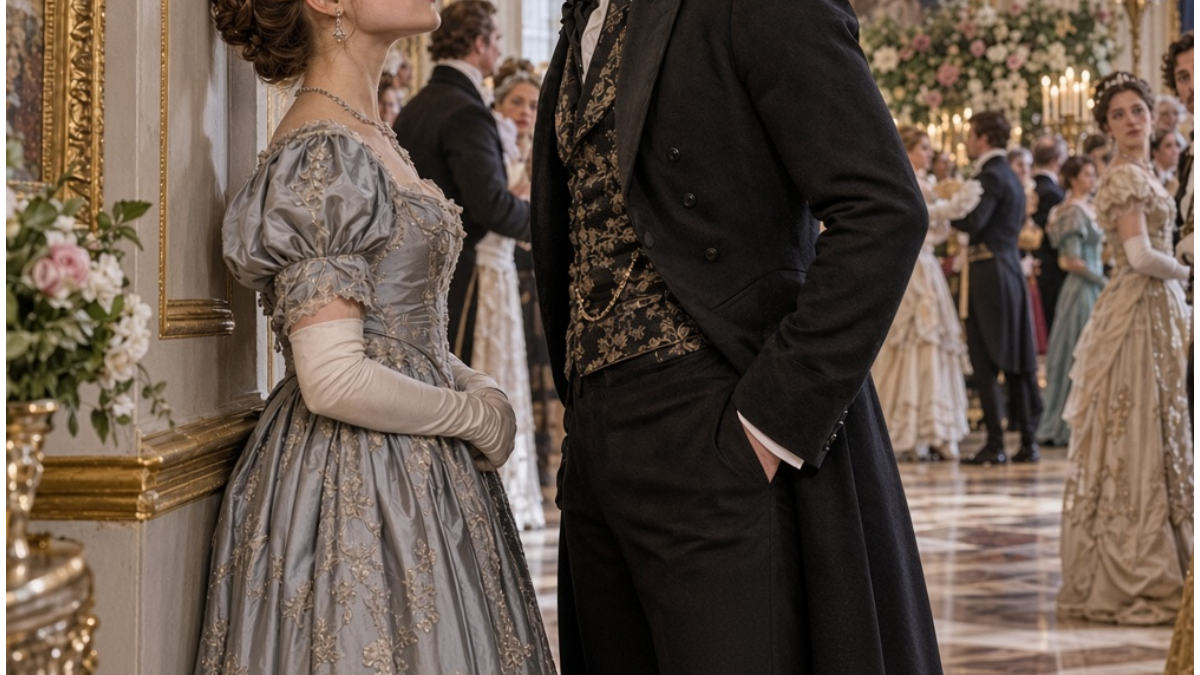
The ballrooms of Mayfair are built on a foundation of well-dressed lies. You smile at men you despise, drink champagne that tastes like brass, and pretend you don’t notice when your youth quietly slips out the back door.
But every so often, amidst the suffocating silk and forced laughter, a moment of reckless, terrifying honesty breaks through.
A careless tease, a daring reply, and suddenly the rigid rules of polite society burned to the ground.
This is one of those moments. The heat in the Earl of Rockford’s ballroom was a physical weight.
It pressed against the guests, heavy with the scent of wilting gardinas, hot floor wax, and the undeniable tang of anxious perspiration, masked by expensive French perfumes.
Hundreds of wax candles burned furiously in the chandeliers overhead, dripping occasional beads of hot wax onto the polished oak floor, or in one unfortunate instance earlier in the evening, onto the bare shoulder of a shrieking debutant.
Cyibble Trent stood in the shadows of a massive, aggressively green potted fern, pressing her shoulders against the cool plaster of the wall.
She was 38. In the brutal mathematics of London society, this made her a ghoSt. She was not wealthy enough to be an eccentric, nor poor enough to be an object of pity.
She was simply there, the unmarried aunt, the reliable chaperon, a piece of gray furniture in a room desperate for bright colors.
Tonight she was tasked with guarding the interests of her niece, Jane. Currently, Jane was being steered through the steps of a country dance by a young baron who possessed a terrifyingly loud laugh and the chin of a wet trout.
Sibil watched them with a detached, cynical affection. Jane would marry him probably. He was harmless, and his estate in Kent was free of debt.
It was a transaction. Everything in this room was a transaction. Cibil shifted her weight, wincing as the stiff leather of her right slipper dug into her heel.
Her corset was laced just a fraction too tight, restricting her breath to shallow sips of the stale air, she reached up, adjusting a tortoise shell comb in her dark hair, finding the quiet misery of the corner far preferable to the exhausting theater of the dance floor.
If Lord Hembry continues to laugh with his mouth open, he is going to swallow a moth.
The voice was low, rough around the edges, and spoke right next to her left ear.
Cybil did not jump. She merely turned her head. Arthur Pendleton, the Duke of Westford, stood beside her.
He was 51 years old, though the deep lines carving brackets around his mouth made him look a hardened 55.
He was a man who looked like he had been left out in the weather too long.
His dark hair was heavily salted with gray, receding slightly at the temples, and he wore his evening clothes with the begrudging air of a man who would rather be in hunting leathers.
“I believe it is a fly, your grace,” Cibil replied, her tone perfectly flat, her eyes returning to the dance floor.
“Moths have the good sense to seek out the light. He is strictly surrounded by dimness.”
Arthur let out a sound that was half snort, half cough. It was the closest he ever came to a laugh.
He leaned back against the wall beside her, mirroring her posture. They were not friends exactly.
They were fellow prisoners. Over the past five seasons, they had found themselves occupying the same drafty corridors, the same secluded libraries, and the same terrace corners at dozens of these excruciating events.
He was a widowerower of 10 years. He had no need for a new wife, having secured two healthy heirs in his youth, and he possessed an active disdain for the matchmaking mothers who still occasionally tried to throw their 18-year-old daughters in his path.
“Why do we do this, Miss Trent?” Arthur asked. He pulled a silver pocket watch from his waist coat, checked the time with a scowl, and shoved it back.
I could be in my study. I have a fire. I have a very expensive bottle of scotch.
Instead, I am standing in a room that smells like a wet dog rolled in lavender, watching the youth of England step on each other’s toes.
“You do it because your sister threatened to withhold her presence at your Christmas hunt if you did not show your face tonight,” Cibil said, calmly, stating the gossip she had overheard in the cloak room.
I do it because if I do not watch Jane, she will allow that baron to talk her into a stroll in the gardens, and the night air ruins her curls.
We are both slaves to duty. Your grace, Arthur rubbed a hand over his jaw.
The friction of his calluses against the closely shaved stubble made a quiet scratching sound.
Duty is a terrible task, master. It has robbed me of my evening and given me a headache.
Perhaps you should try smiling. I am told it completely changes the disposition. I smiled in 1814, Arthur said dead pan.
I found it entirely overrated. Cibil allowed a small genuine smile to curve her lips.
It felt strange on her face, a muscle she rarely used in this company. She turned to look at him fully.
Up close, he looked exhausted. There was a dullness in his dark eyes, a heavy resignation that she recognized because she saw it in the mirror every morning.
They were two people entirely stripped of the illusions that propelled the dancers spinning before them.
They knew the romance was a lie. The marriages were contracts, and the glittering jewels were just rocks dug out of the dirt.
“You look tired, Westford,” she said. It was a breach of etiquette to speak so directly, to drop his title so casually, but the potted fern offered a temporary amnesty from the rules.
“I am tired, Sibil,” he answered. The use of her Christian name a quiet reciprocation.
He shifted his weight and she noticed the slight suppressed flinch his left knee. He had taken a musk ball to the leg in Spain decades ago, a fact she only knew because he had once cursed violently and rubbed it during a particularly vicious rainstorm at a garden party three years prior.
“The chairs in the card room are padded,” she offered softly. If I go to the card room, Lady Jersey will corner me and demand a subscription for some orphanage.
He sighed, crossing his arms over his broad cheSt. I am perfectly content to stand here and rot with you.
A charming proposition. I accept. They lapsed into a comfortable silence. Around them, the music ground to a halt.
The red-faced dancers applauded weakly, fanning themselves, desperate for lemonade and cold air. The floor cleared, leaving a massive, empty expanse of polished wood in the center of the room.
It looked like a stage waiting for a tragedy. The orchestra in the gallery began to tune their instruments for the next set.
The discordant pluck of violin strings and the low, mournful groan of the cello cut through the rising chatter of the room.
Arthur reached up and tugged at his crevat, loosening the crisp white linen by a fraction of an inch.
“Do you ever miss it?” He asked suddenly. Sibil kept her eyes on the musicians.
“Miss what? Sweating in public being young?” He didn’t look at her. He watched a young couple, no older than 20, laughing near the punch bowl.
The boy touched the girl’s wriSt. It was a fleeting electric contact. Arthur’s jaw tightened.
Believing that the next dance might actually change the course of your life. Believing in the sheer unadulterated nonsense of it all, Cibil swallowed.
The cynicism she wore like armor suddenly felt very heavy and entirely useless. I do not miss the anxiety of it, she said truthfully.
I don’t miss the terror of waiting to be asked or the humiliation of being overlooked, but she hesitated.
She rarely gave away pieces of herself. I do miss the music. I used to love the music.
When you are young, you hear the music and your body simply wants to answer it.
Now I hear the music and all I can think about is how badly my feet hurt.
Arthur gave a low hum of agreement. My knee protests if I so much as look at a polished floor.
Last time I attempted a waltz, I spent the following two days walking like a crippled crab.
The orchestra leader tapped his baton against his music stand. A hush fell over the room.
The first notes bled into the air, a waltz. It was a sweeping, melancholic melody, far slower and more intimate than the lively country dances that preceded it.
It was a dance designed for lovers, or at least for people who desperately wanted to be.
The couples began to file onto the floor, men bowing, women curtsying, a sea of colored silk and black broadcloth forming neat, rotating circles.
Arthur watched them for a long moment. He shifted his stance, turning slightly so he was facing Cibil directly.
The proximity between them was a violation of at least three societal rules, but the shadows of the alcove kept them hidden.
He was tall enough that she had to tilt her head back to look at him.
He smelled of starch, sandalwood, and something distinctly male, a clean, sharp scent that cut through the cloying perfume of the room.
He looked down at her, really looked at her. He took in the severe line of her dark hair, the few silver threads catching the candle light.
He looked at the stark intelligence in her gray eyes, the stubborn set of her jaw.
He looked at her not as a fixture of the ballroom, but as a woman breathing the same stifling air he was.
A self-deprecating lopsided smile touched the corner of his mouth. It wasn’t his usual mocking smirk.
It was incredibly soft, tinged with a regret that felt entirely too intimate. If I were younger, I’d ask you to dance,” he teased, his voice dropping in volume so that the words were meant for her and her alone.
It was a throwaway line. It was a compliment dressed up as a joke designed to be brushed off with a polite laugh and a witty deflection.
It was the kind of safe, protective banter they had traded for half a decade.
Cibil looked at his mouth. She looked at the faint scar cutting through his left eyebrow.
She felt the heavy suffocating weight of the room, the years stretching out ahead of her, a long gray hallway of chaperoning nieces and sitting in shadows until she simply faded away entirely.
She was tired of the shadows. She was tired of being safe. She met his gaze squarely.
Her heart gave a sudden violent kick against her ribs, but her voice remained perfectly, terrifyingly steady.
“Who said no?” She replied. Arthur froze. The teasing smile vanished from his face, replaced by a look of sheer, unadulterated shock.
He stared at her, searching her eyes for the punchline, for the smirk that would tell him she was mocking him.
But Zibble did not blink. She stood her ground, her chin raised, holding his gaze with a quiet, fierce defiance.
The silence between them stretched thick and heavy, drowning out the swelling music of the walts.
Arthur’s throat worked as he swallowed. He looked at the dance floor, a swirling vortex of youth and gossip.
He looked back at Cibil. She saw the exact moment the Duke of Westford, pragmatic, cynical, and deeply tired, decided to throw caution into the fireplace.
“You are serious,” he murmured. “I rarely joke about my feet, your grace.” Arthur took a slow, deliberate breath.
The stiffness in his shoulders vanished. The heavy resignation that usually clung to him evaporated, replaced by a sudden, sharp intensity.
He stepped backward out of the shadows of the fern and into the harsh bright light of the ballroom.
He didn’t offer a polite peruncter bow. He simply extended his large gloved hand toward her.
“Then, Miss Trent,” he said, his voice stripped of all its usual armor. “Would you do me the immense honor of walking into the fire with me?”
Zibel’s pulse was roaring in her ears. She lifted her hand and placed it in his, his fingers closed around hers, warm and solid and surprisingly strong.
There was no hesitation as Arthur led her out onto the polished wood. The reaction was immediate.
A ripple of whispers tore through the crowd, radiating outward from them like a stone dropped in a still pond.
Heads turned, fans paused mid- flutter. The sight of the reclusive, notorious Duke of Westford leading the spinster aunt of the Colgate family onto the floor for a waltz was a scandal of microscopic yet seismic proportions.
Arthur ignored them entirely. He stepped into her space, placing his right hand firmly on her waiSt. The heat of his palm bled through the thin silk of her gown, grounding her.
Sibil placed her hand on his broad shoulder, feeling the solid muscle beneath the wool coat.
“Ignore them,” he whispered, stepping into the music. “I already am,” she whispered back. And as he pulled her into the turn, his bad knee holding steady, the cynical walls they had built around themselves shattered into a thousand glittering pieces on the ballroom floor.
A waltz is an aggressive piece of machinery. It demands a synchronicity that cannot be faked, forcing two bodies to share a single center of gravity.
For Cibil, dancing had always been a mathematical exercise, counting beats, calculating distance, anticipating the heavy-footed blunders of nervous young men.
Arthur did not count. He simply moved. He was not a graceful dancer. There was a rigid military precision to his steps, an economy of movement dictated by the lingering ache in his left knee, but what he lacked in fluidity, he compensated for with absolute unyielding authority.
He steered her through the crowded floor with the sheer physical presence of a warship cutting through a fleet of dingies.
“You are stepping on the beat,” Cibil noted, her voice breathless. The heat of his hand on her waist was entirely distracting.
It was a massive warm pressure anchoring her to the polished floor. “I am stepping where my leg allows me to step, Miss Trent,” Arthur replied, his focus fixed entirely on her face.
“If the orchestra cannot keep up with my limp, that is their failing.” “A short, sharp laugh escaped her.”
She snapped her mouth shut immediately, horrified. Spinsters did not laugh during a waltz. Spinsters did not waltz at all.
Around them, the ballroom was a blur of horrified fascination. Cibil caught glimpses of it as Arthur spun her.
Lady Agatha, a woman whose face usually resembled a bulldog chewing a wasp, had gone completely pale, her feathered fan frozen against her chin.
Lord Croft, a man who had famously ignored Cibil for a decade, spilled a generous measure of clarret down the front of his yellow waist coat as they swept paSt. They were a spectacle, a middle-aged, unremarkable chaperone and the most notoriously reclusive duke in England, holding each other in the center of Mayfair.
“They are staring,” Cibil said. She tried to maintain the flat, detached tone she had spent 20 years perfecting.
She failed. A tremor betrayed her. Let them stare. Arthur’s grip on her waist tightened just a fraction.
It was not a romantic gesture. It was a physical reinforcement. They have spent 30 years staring at children fumbling in the dark.
It is about time they saw two adults who actually know how to stand on their own feet.
I am fairly certain my right heel is bleeding and my knee is currently screaming in Spanish.
Arthur’s mouth twitched. The harsh lines around his eyes softened, crinkling in a way that made him look remarkably, startlingly human.
But I find I do not care. Do you? Cibil looked at him. She looked past the title, past the wealth, past the gray hair and the intimidating scowl.
She saw a man who was just as exhausted by the charade as she was.
She felt the tight, suffocating corset of her social standing begin to loosen, breath by breath.
“No,” she said softly. “I do not care at all.” The music swelled, the cellos digging deep into the minor chords.
Arthur pulled her slightly closer. The distance between them shrank to a scandalous margin. She could feel the heat radiating through his broadcloth coat.
She could smell the sharp tang of peppermint on his breath and the underlying scent of clean linen.
You are a remarkably stubborn woman, Cibil, he murmured. It is my only defense mechanism.
I cannot rely on a vast fortune or a title to terrify people into leaving me alone.
You terrify them because you see right through them. You sit in that corner and you mentally dissect every lie they tell themselves.
It makes them profoundly uncomfortable. He steered them smoothly around a colliding couple, his left leg taking the brunt of the turn with a barely perceptible hitch.
It makes me entirely fascinated. Sibil’s breath caught in her throat. Compliments in this world were currency traded for favors or used to grease the wheels of a transaction.
But Arthur wanted nothing from her. He had nothing to gain by dragging her onto the floor.
You are speaking nonsense, Westford. I have never been more articulate. He looked down at her, his dark eyes stripping away the last of her practiced indifference.
I spent the last 5 years watching you watch the room. I thought we were the same.
Two ghosts haunting a house that belongs to the living. We are ghosts. Speak for yourself.
Arthur’s voice dropped, vibrating in the narrow space between them. I feel entirely alive right now.
The final chords of the waltz struck. The music did not fade. It ended with a sharp decisive crescendo.
They stopped moving for a single suspended second. Neither of them pulled away. Arthur’s hand remained flat against the small of her back.
Zibil’s fingers stayed curled into the wool of his shoulder. The heat between them felt entirely untethered from the cold, calculating world around them.
Then the reality of the room crashed back in. The silence was deafening. It wasn’t the polite, expectant hush of a dance ending.
It was a dense, suffocating quiet born of absolute shock. No one applauded. No one moved toward the refreshment tables.
Hundreds of eyes were pinned to the center of the floor. Arthur slowly dropped his hand.
He stepped back, putting the socially acceptable distance between them. He did not bow. Instead, he offered her his arm, his expression instantly hardening back into the granite mask of the Duke of Westford.
Cibil looked at his offered arm. Her fingers were trembling. She had walked into the fire just as he had asked.
Now she had to figure out how to survive the burn. She placed her hand on his sleeve.
They did not walk toward the edges of the room where Jane and the chinless baron were standing in slackjawed horror.
They did not retreat to the shadowy corners reserved for chaperones. Arthur led her straight through the center of the crowd.
The sea of silk and broadcloth parted for them. It was not a gesture of respect, but of self-preservation.
Arthur’s expression promised violence to anyone who dared speak a word, and Cibil kept her chin elevated at a rigid, defensive angle.
Her heart hammered against her ribs like a trapped bird. He steered her out of the ballroom, down a long, dimly lit corridor adorned with heavy tapestries, and finally pushed open a set of French doors.
The night air hit them like a bucket of cold water. It was a small stone terrace overlooking the earl’s manicured gardens.
The scent of damp earth and crushed gravel replaced the stifling odor of hot wax and perfume.
Sibil immediately dropped her hand from his arm and walked to the stone ballastrade. She gripped the cold masonry with both hands, dragging oxygen into her lungs.
“Well,” Arthur said, his voice was rough. He leaned against the stone wall beside the doors, pulling a silver flask from his inner pocket.
We have undoubtedly ruined your niece’s marital prospects. I apologize. Jane’s diary is 12,000. She could dance naked on the supper tables, and He would still marry her.
Cibil squeezed her eyes shut, fighting the sudden sharp sting of tears. It was adrenaline, she told herself.
Just the violent crash following an unexpected thrill. She heard the unscrewing of a metal cap.
Drink, he offered. She opened her eyes and turned. He was holding the silver flask out to her.
Zibil stared at it. Spinsters didn’t drink from men’s flasks on dark terraces. Then again, spinsters didn’t waltz with dukes.
The rules had already been shattered. She might as well sweep up the glass. She took the flask, wiped the rim carefully with her thumb, and took a long sip.
The whiskey burned a fiery path down her throat, hitting her stomach with a heavy, spreading warmth.
She coughed, handing it back. “Good God, do you clean your boots with that?” “Only on Sundays,” Arthur replied.
He took a pull from the flask himself, leaning his head back against the stone.
He looked exhausted again, but the dullness in his eyes was gone. He looked like a man who had just survived a bar brawl and found he enjoyed the bloody knuckles.
“Why did you do that?” Cibil asked. The whiskey had stripped away her remaining politeness.
“Why did you ask me to dance? I told you I was tired of standing by the fern.
Do not lie to me, Arthur. The use of his Christian name spoken with such sharp authority made him pause.
He lowered the flask. The mockery vanished from his face, leaving behind something raw and uncomfortable.
“Because I looked at you,” he said, his voice dropping to a quiet rasp. And I realized that if I spent one more night watching you pretend you are dead, I was going to lose my mind.
Cibil flinched. The words hit her with physical force. I am not pretending. I am merely accepting my reality.
I am 38 years old, unmarried, and entirely unremarkable. You are the most remarkable woman in that miserable room, and you know it.
Arthur pushed off the wall. He closed the distance between them in two long strides.
He didn’t touch her, but his proximity was a heavy, inescapable weight. You hide behind your sarcasm and your terrible gowns because it is easier than admitting you still want something from this life.
I want peace, she snapped, her voice breaking. I want to be left alone to read my books and ignore the fact that the world decided I was useless.
15 years ago. Liar. He said it softly. It wasn’t an insult. It was a devastating observation.
Arthur reached out. He didn’t grab her arm or her waiSt. He reached up and gently touched the side of her face.
His thumb, rough with calluses from the reinss of a horse, brushed against her cheekbone.
Sibil froze. The touch was so painfully gentle, so entirely at odds with the harshness of the man that it shattered her remaining defenses.
“A single tear betrayed her, slipping down her cheek to wet his thumb. “You don’t want peace,” Sibil, Arthur whispered, staring down into her eyes.
“You want a fire? You want someone to look at you and see the woman, not the furniture.
You want to be terrified and thrilled and ruined? She couldn’t breathe. She couldn’t look away from him.
“And what do you want?” She asked, her voice a fragile thread in the dark.
Arthur’s jaw tightened, the shadows of the terrace carved deep, lonely lines into his face.
“I want to remember what it feels like to burn,” he said. He didn’t wait for permission.
He didn’t ask. He leaned down and pressed his mouth to hers. It was not a polite, tentative kiss.
It was desperate. It was years of forced isolation, cynical observation, and quiet fury boiling over into a single point of contact.
His mouth was hard and tasted of expensive whiskey and bitter reality. Zibble gasped against his lips, her hands flying up to grip the lapels of his coat.
She didn’t push him away. She pulled him closer. She kissed him back with a fierce answering anger.
It was a kiss of defiance, a violent rejection of every rule that had told them they were too old, too tired, and too late to feel anything at all.
The kiss ended not with a soft romantic sigh, but with a harsh intake of breath.
Cibil pulled back first, her chest heaving, the cold night air suddenly rushing in to fill the space between them.
She stumbled a half step backward, her right heel striking the unforgiving stone of the terrace.
She didn’t fall. Arthur’s hand shot out, gripping her elbow with bruising force to steady her.
They stood there in the dark, two people who had just thrown a lit match into a powder keg, watching the embers burn.
Cibil pressed the back of her gloved hand to her mouth. Her lips felt swollen, bruised by the sudden violence of the encounter.
She tasted blood, a tiny metallic tang where her teeth had caught her lower lip.
She looked up at Arthur. He did not look smug. He did not look triumphant.
He looked like a man who had just stepped off a ledge and realized he did not know how to fly.
“We need to go inside,” Arthur said. His voice was a low, grally rasp. He dropped his hand from her elbow and stepped back, his chest rising and falling heavily.
We need to collect your niece and leave before the Earl’s wife decides to send a footman out here to investigate the delay.
Yes, Sibil managed. Her voice sounded thin, stripped of its usual cynical armor. Yes, of course, she turned toward the French doors.
Her legs felt hollow, as if the marrow had been scooped out and replaced with cold lead.
She paused, her hand hovering over the brass handle. If she opened this door, she was stepping back into the firing line.
The kiss on the terrace was a private madness. The waltz was a public execution, Arthur stepped up behind her.
He did not touch her, but his presence was a solid wall at her back.
“Keep your chin up, Miss Trent,” he ordered softly. Do not give them the satisfaction of a retreat.
You are a conqueror returning to camp. Act like it. Cibil took a sharp breath, squared her shoulders, and pushed the door open.
The heat of the corridor slammed into them, dragging the oppressive noise of the ballroom with it.
They did not speak as they navigated the labyrinth of heavy tapestries and guilt-framed mirrors.
As they approached the main archway of the ballroom, the music was playing again. A lively country reel, but the atmosphere was distinctly sour.
Eyes darted toward them instantly. Fans snapped open. Whispers hissed through the room like steam escaping a cracked pipe.
Sibil scanned the crowd, her gray eyes narrowing, slipping back into the familiar role of the chaperone.
She spotted Jane near the refreshment tables. The girl looked utterly terrified, clutching a half empty glass of warm lemonade as if it were a shield.
Beside her, Lord Hembbury was shifting his weight from foot to foot, looking entirely out of his depth.
Zibil marched straight toward them, Arthur trailing a half pace behind her like a heavily armed shadow.
“Jane,” Cibil said briskly, reaching the girl, “get your wrap. We are leaving.” Jane’s wide blue eyes darted from Cibil to the towering figure of the Duke, then back to Cibil.
Aunt Sibil, “What? What has happened?” “Everyone is saying. Everyone is entirely correct, and it is none of their business,” Cibil interrupted.
She turned to the chinless baron. “Lord Hembry, I trust you will excuse us. The air in here has become exceedingly foul.”
He blinked, his mouth opening and closing in a remarkable imitation of a dying fish.
He managed a jerky bow, stepping backward so quickly he nearly upended a tray of sandwiches.
Arthur did not wait for further pleasantries. He took Jane by the elbow, a light, guiding touch completely different from the heavy grip he had used on Cibil, and steered the trembling girl toward the exit.
Cibil flanked them. They moved through the vestibule, claiming their cloaks from a stunned footman, and stepped out into the damp, freezing fog of the London street.
“My carriage is first in the queue,” Arthur stated, raising a hand. “A massive black coach bearing the crest of Westford rolled forward over the cobblestones.
The horses exhaled great plumes of white steam.” “Get in.” That is not necessary. Your grace, Cibil said stiffly.
We can hire a hackne. Do not be an idiot, Cibil, Arthur snapped, the exhaustion returning to his voice.
Half the ton will be watching from the windows to see if you leave in tears.
You will leave in my carriage, and you will look as though you intended to do so all along.
A footman pulled the heavy door open and dropped the steps. Cibil did not argue further.
She gathered her skirts and climbed inside, pulling Jane up after her. Arthur followed, shutting the door with a sharp, decisive click that echoed in the quiet street.
The interior of the carriage smelled of old leather, boot polish, and the faint, lingering scent of cigar smoke.
It was pitch black, the only illumination coming from the passing street lamps that flashed briefly through the glass windows.
Jane sat huddled in the corner, pressing herself against the velvet squabs, terrified into absolute silence.
Cibil sat stiffly beside her, staring straight ahead at the invisible opposite wall. Arthur sat across from them, his long legs stretched out, his bad knee knocking gently against the hem of Sibil’s gown with the sway of the carriage.
The ride was agonizingly silent. The iron rimmed wheels clattered violently over the uneven cobblestones, a harsh, rhythmic banging that did nothing to drown out the deafening quiet inside the cabin.
Every time the carriage hit a rut, Arthur’s knee bumped Zibil’s leg. Every time it happened, her skin burned where the whiskey soaked kiss had left its mark.
She had ruined herself. The realization settled in her stomach like a cold, wet stone.
It was a cynical absolute truth. Tomorrow she would not be the invisible reliable aunt.
She would be the desperate spinster who had thrown herself at a duke, lost her mind on the dance floor, and vanished into the night with him.
Her reputation was dead. Jane’s prospects were severely damaged. And yet, as the carriage swung around a sharp corner, and Arthur’s boot braced against the floorboard, Cibil found she could not summon a single ounce of regret.
The morning light filtering through the cheap muslin curtains of the Colgate townhouse was entirely unforgiving.
It illuminated the dust moes dancing in the air and highlighted the frayed edges of the drawing room rug.
It was barely 9:00, but the war had already begun. Cibil sat in a rigid, highbacked chair, staring into a porcelain teacup.
The tea was tepid and tasted vaguely of copper. Across from her, Margaret, her elder sister, and Jane’s mother, was pacing the short length of the room with the frantic energy of a cornered badger.
“Ruin!” Margaret hissed, waving a crumpled piece of parchment in the air. Utter unmmitigated ruin.
Three notes before breakfaSt. Cible. Three. Lady Kalper sent her maid over with a basket of lemons, claiming it was for Jane’s nerves.
But the note practically begged for the scandalous details. Lemons? Sibil? It is an insult.
Lemons are quite expensive, Margaret. You should make a tart, Cibil said flatly. She took a sip of the terrible tea and set the cup down.
Her head pounded. She had not slept. She had spent the entire night staring at the ceiling, feeling the phantom pressure of Arthur’s mouth on hers, fighting the dangerous, absurd urge to smile.
Do not mock me. Margaret stopped pacing. Her face flushed a blotchy red. What were you thinking?
A waltz with Westford? A man who hasn’t danced since Waterloo and who treats society like an unpleasant odor and then to disappear into the gardens with him to ride home in his carriage.
I was saving the expense of a hackne. You have destroyed Jane’s chances. He will never call now.
The taint of scandal. If Hembrey is frightened away because her aunt danced a waltz, he’s too weak to breed decent hunting dogs, let alone run an estate.
Sibil snapped, her patience suddenly snapping. She stood up, her dark morning dress rustling aggressively.
Stop pacing, Margaret. You are giving me a headache. I will bear the brunt of the gossip.
I will return to the country. I will fade into the background. It is what I am good at.
Margaret opened her mouth to issue another reprimand, but the heavy iron knocker on the front door slammed three times.
The sound reverberated through the small house like cannon fire. Both women froze. It was not the polite, hesitant wrap of a morning caller leaving a card.
It was a demand. A moment later, their single overworked maid appeared in the doorway, her cap slightly a skew, looking terrified.
“Mom,” she squeaked, looking at Margaret, but pointing a trembling finger toward the hall. “His grace, the Duke of Westford.”
Margaret gasped, clutching the lemonbearing note to her chest as if to protect her heart.
Arthur did not wait to be announced. He simply walked past the maid, ducking slightly to avoid hitting his head on the low door frame of the drawing room.
The small, shabby room seemed to shrink the moment he entered. He looked massive, dark, and distinctly out of place against the faded floral wallpaper.
He looked terrible. He wore the same clothes from the night before, though his crevat was gone and his shirt collar was open, revealing a strong tanned throat.
His jaw was dark with a heavy shadow of stubble, and the lines around his eyes were carved deep with exhaustion.
He ignored Margaret entirely, his dark eyes locked onto Sibil. “You look terrible,” Cibil said.
It was the only thing she could think to say to stop her hands from shaking.
Arthur’s mouth twitched into a grim line. I have spent the last 7 hours sitting in my study, drinking scotch, and waiting for the sun to come up so I could come here without being accused of breaking and entering.
Margaret let out a strangled noise somewhere between a cough and a sob. Your grace, she stammered, attempting a jerky curtsy.
This is highly irregular. The hour, the propriety. Leave us, Mrs. Cololgot, Arthur said. He did not raise his voice.
He did not look at her. He simply issued a command with the weary authority of a man used to being obeyed instantly.
Margaret bristled, maternal panic, waring with deeply ingrained social difference. I will not. This is my house, and my sister is unmarried.
I cannot allow her to be sequestered with a man who has already compromised her reputation.
Arthur finally turned his head to look at Margaret. His stare was flat, cold, and utterly terrifying.
I am not asking, madam. I am telling you to leave the room. If you do not, I will purchase the mortgage to this house by noon and evict you.
Now get out. Margaret turned chalk white. She looked at Cibil, looked back at the Duke, dropped the crumpled note on the floor, and fled the room, shutting the door firmly behind her.
The silence rushed back in heavy and thick. Arthur looked at the closed door, rubbed the back of his neck, and let out a long, ragged sigh.
I apologize for threatening your sister. It was a bluff. I do not even know who holds the mortgage.
Thomas Reynolds holds the mortgage. And he is entirely immune to bullying. So, it is a good thing she left,” Cibil replied, her heart hammering against her ribs.
She crossed her arms tightly over her cheSt. “Why are you here, Arthur?” He closed the distance between them, stopping a mere foot away.
He smelled of stale tobacco, scotch, and cold morning air. He reached into his coat pocket and pulled out a heavy folded piece of parchment.
I am here,” he said, his voice dropping into the rough, quiet register that made her stomach flip.
“Because I have spent 51 years doing exactly what is expected of me.” “And last night, for the first time in a decade, I didn’t.”
He held the parchment out to her. It was sealed with a blob of messy red wax, lacking a formal crest, as if it had been pressed with a thumb in a hurry.
What is this? Cibil asked, not taking it. It is a special license, Arthur said bluntly.
Procured from the archbishop 2 hours ago at great expense, and a significant amount of yelling.
Cibil stared at the paper. The cynical walls she had relied on for 20 years cracked straight down the middle.
You are insane. Probably Arthur did not lower his hand. But I am also tired.
I am tired of empty rooms and polite lies and pretending that I am waiting to die.
I want the fire, Cibil. And I want it with you. Sibil did not touch the parchment.
She looked at the heavy red wax pressed flat and uneven against the thick paper.
And then she looked at Arthur’s face. He was not smiling. The manic energy that had clearly propelled him through the dawn hours had evaporated, leaving behind a stark, terrified exhaustion.
“Put that away,” she said. Her voice was terrifyingly calm, the tone she used when Jane was on the verge of a hysterical fit over a torn hem.
Arthur did not move his hand. It is valid, Cibil. The ink is barely dry, but it is legal.
I do not care if it was signed by the king himself. Put it away before I throw it into the fireplace.
She turned her back on him, walking to the small, unlit hearth. She gripped the wooden mantle with both hands.
Her knuckles were white. The cheap wood dug into her palms, grounding her. She heard the rustle of paper as he lowered his arm.
You think this is pity? He stated. It wasn’t a question. I think it is a reactionary measure born of guilt, whiskey, and a ridiculous masculine urge to fix a problem you created.
Sibil stared at the cold ashes in the great. You kissed me. It was foolish.
It was reckless. But I am not a ruined maiden in a penny dreadful Westford.
I do not require a rescue. I am not rescuing you. The floorboards creaked as he stepped closer.
He stopped just behind her, not touching her, but his proximity was a heavy, inescapable gravity.
I am rescuing myself, Cibil let out a harsh, bitter laugh. Oh, the tragic Duke trapped in his vast wealth and endless privilege.
How exactly does marrying a penniless 38-year-old spinster save you? Because you do not care about the wealth.
His voice was low, devoid of any theatricality. It was just the ugly, unvarnished truth.
You do not care about the title. If I dropped dead tomorrow, half the ton would attend my funeral just to see who inherited the silver.
My own sister would complain about the inconvenience of wearing black. But you? He paused.
Sibil closed her eyes. You would probably just complain that the eulogy was too long.
He finished quietly. Sibil turned around. He was inches away. The sheer physical size of him in the small room was overwhelming, but it wasn’t intimidating.
It was just Arthur. Stripped of the ballroom lighting, he looked every day of his 51 years.
There were deep grooves of sorrow around his mouth and a quiet desperation in his dark eyes that mirrored the hollow ache she had carried for two decades.
“Arthur,” she said, her voice dropping the cynical edge, leaving only a fragile honesty. “We do not know each other.
We know exactly who we are,” he countered instantly. “We spent 5 years standing in corners, stripping away the polite fictions of everyone else in the room.
We have seen each other at our most bored, our most bitter, our most exhausted.
I know you hate the scent of lavender. I know you favor your right foot when your shoes are too tight.
I know you only drink tea to have something to hold. So people will not ask you to dance.
Cibil stared at him, her breath catching in her throat. She had thought she was invisible.
She had spent a lifetime perfecting the art of fading into the wallpaper. And this man had spent half a decade quietly mapping every corner of her existence.
“And I know you,” she whispered almost involuntarily. “I know your leg aches when the weather turns cold.
I know you despise small talk so much you pretend to be deaf in your left ear just to avoid it.
I know you haven’t truly smiled since your first wife died.” Arthur flinched. The mention of his past was a physical blow, but he did not look away.
He took it. She has been gone for 10 years, Cibil. I loved her. But I have spent a decade living as a monument to a ghoSt. I am tired of being stoned.
He reached out and gently took her right hand, pulling it away from her side.
His thumb brushed over the calluses on her fingers, the inevitable marks of needle work and writing.
I am offering you a transaction, he said softly, deliberately throwing her own cynical worldview back at her.
I give you my name, my house, and the absolute freedom to never attend another wretched ball for the rest of your life.
And in return, you give me,” he swallowed hard. “You give me a reason to wake up in the morning that doesn’t involve managing an estate or counting my regrets.”
Cibil looked down at their joined hands. His skin was warm and rup. The contrast between his dark sleeve and her pale, trembling hand was stark.
It was madness. It was social suicide on a grand scale. Margaret would likely faint.
Jane would be bewildered, and polite society would cannibalize them in the morning papers. But as she looked at Arthur’s hand, she felt a profound, terrifying surge of relief.
The gray hallway of her future had suddenly shattered, revealing a terrifying, brilliant unknown. “I have conditions,” she said.
Her voice shook, but she forced her chin up, meeting his gaze squarely. Arthur’s shoulders dropped a fraction of an inch.
A faint real smile touched the corners of his mouth. “Name them. I will not manage your social calendar.
I will not host dinner parties for people I despise. And if you ever attempt to dictate what books I am allowed to read, I will stab you with a letter opener.
Agreed, he said without hesitation. And my conditions. Cibil raised an eyebrow. You have conditions.
Only one. He stepped into her space, his free hand coming up to cup her jaw.
His touch was warm, heavy, and completely possessive. When you argue with me, and I know you will constantly, you do it to my face.
No hiding in the corners, Cibil. No retreating into the shadows. She let out a shaky breath, the heat of his hand bleeding into her skin.
I can agree to that. Arthur did not kiss her. He simply rested his forehead against hers, letting his eyes slip shut.
The tension drained out of his massive frame in a long, shuddering breath. Get your cloak, Miss Trent, before your sister summons the local magistrate.
The interior of St. Jude’s was freezing. It was a small, dusty parish church on the edges of Mayfair, entirely unsuited for the marriage of a duke.
The air smelled of damp stone, old beeswax, and the sharp scent of the nervous sweat currently dripping from the curit’s brow.
The curate, a painfully thin young man who had been dragged from his breakfast by a furious, heavily bribed Arthur, was rushing through the liturgy as if he feared the building might collapse.
Cibil stood at the altar in the same dark gray morning dress she had worn to face Margaret.
She had not bothered to change. There was no lace, no veil, no bouquet of white roses.
Beside her, Arthur stood tall and rigid, his hands clasped behind his back, his jaw set like granite.
Behind them, the congregation consisted entirely of Margaret, who was currently weeping violently into a handkerchief, and a bewildered footman Arthur had drafted off the street to act as a second witness.
Jane had been left at home, deemed too fragile for the morning’s abrupt chaos. Do you, Arthur Pendleton, take this woman?
The ancient, heavy words echoed off the cold stone walls. Zible listened to them with a strange, detached clarity.
This was not a romance novel. There was no swelling music, no soft lighting to blur the harsh realities of their ages or the absolute absurdity of their actions.
It was just two tired people standing in a freezing room making a desperate wager against loneliness.
I do, Arthur said. His voice was a low rumble that vibrated in the quiet church.
There was no hesitation. The curate turned to her. Do you, Sibil Trent? Take this man.
Cibil looked at the altar. She thought of the Coligate townhouse. She thought of the years stretching ahead of her, the endless knitting, the quiet, polite irrelevance.
She turned her head and looked at Arthur. He was already looking at her. He didn’t offer a reassuring smile.
He just offered a steady, unflinching presence. “I do,” she said. Her voice rang out remarkably clear, devoid of any tremor.
Arthur produced a ring. It was not a delicate, glittering diamond bought for the occasion.
It was a thick, heavy band of old gold. He took her bare left hand.
His fingers were warm, steadying her slight tremble. He slid the cold metal over her knuckle.
It was slightly too big, resting heavily against her skin. I pronounce you man and wife.
The curate squeaked, slamming the prayer book shut as if concluding a dangerous incantation. There was no kiss.
Arthur simply placed Cibil’s hand on his arm. He turned to the weeping Margaret, nodded curtly, and steered his new wife down the short aisle and out into the biting London wind.
The carriage ride to Westford House was a stark contrast to the terrified silence of the night before.
The silence was different. It was the heavy, settling reality of permanence. Cibil looked out the window as the massive iron gates of Westford House loomed into view.
It was not a house. It was a fortress. The stone facade was imposing, cold, and meticulously maintained.
Panic, sharp, and metallic, flared in the back of her throat. What had she done?
She was a spinster aunt from a minor family. Suddenly thrust into the center of a sprawling aristocratic machine.
The carriage halted. The footman dropped the steps. Arthur descended first and offered his hand.
Cibil took it, stepping onto the pristine gravel. She looked up at the towering columns of the entrance.
“It is very large,” she managed to say. It is a mausoleum, Arthur corrected bluntly.
He didn’t let go of her hand. But it has excellent fireplaces and a library that takes up the entire west wing.
He led her up the steps. The massive double doors swung open before they reached them, revealing a cavernous entrance hall lined with white marble and an army of impeccably dressed servants.
A formidable looking butler stepped forward, his face a mask of professional neutrality. Welcome home, your grace.
The butler ined. Arthur did not break his stride. Thank you, Harrison. This is the Duchess.
Have my things moved to the adjoining suite in the east wing, and tell the cook we require a substantial breakfast in the small dining room.
Something hot. No lemons. Harrison did not blink. Immediately, your grace. Arthur pulled Zibel past the staring staff, steering her away from the grand, sweeping staircase and down a narrower woodpanled corridor.
He walked with a heavy limp now, the adrenaline of the morning finally failing to mask the pain in his knee.
He pushed open a heavy oak door and led her inside. It was his study.
Unlike the pristine, intimidating halls of the rest of the house, this room was a glorious, chaotic mess.
Books were stacked precariously on every available surface. Maps and unrolled architectural plans blanketed a massive mahogany desk.
The air smelled strongly of leather, wood smoke, and dogs. A large graying deer hound lifted its head from a rug near the roaring fire, thumped its tail once against the floorboards, and went back to sleep.
Arthur let go of her hand. He walked directly to a side table, unstopped a crystal decanter, and poured two generous measures of amber liquid into heavy glasses.
He turned back, walked over to her, and handed her a glass. Sibil took it, wrapping her cold fingers around the cut crystal.
Arthur stepped back, heavily lowering himself into a worn leather wingback chair by the fire.
He let out a long, audible groan as his bad leg stretched out toward the heat.
He didn’t try to hide his exhaustion or his pain. He simply sat there, a battered, aging man in a messy room.
He raised his glass toward her. The cynicism that had defined their relationship for 5 years was entirely gone, replaced by a raw, terrifying vulnerability.
“To the fire,” Sibil, he said quietly. Cibil looked at him. The panic in her chest finally dissolved, replaced by a deep anchoring warmth.
She walked over to the second wing back chair opposite his and sat down. She raised her glass, the heavy gold ring glinting in the fire light.
To the fire, Arthur. She took a sip of the scotch. It burned, but this time she didn’t cough.
Polite society digested the scandal of their marriage with the grim efficiency of a vulture picking a carcass clean.
For 3 weeks, Westford House was besieged by calling cards left by people hoping to catch a glimpse of the disaster.
Arthur instructed Harrison to burn them in the drawing room great. Cibil used the ashes to fertilize the indoor potted palMs. They did not attend a single ball.
They did not host a single dinner. By the time the season ended, and the carriages rolled back to the country estates, the ton had collectively decided the Duke and his spinster duchess were simply too boring to gossip about anymore.
It was the greatest victory of Sibil’s life. Four months later, the rain was lashing against the massive arched windows of the library at Arthur’s Yorkshire estate.
The room was a cavern of ancient paper, dark oak, and smelled faintly of pipe tobacco.
Sibil sat in a leather armchair by the fire, her feet tucked under a heavy tartan blanket.
She was attempting to read a dry treatise on agricultural reform, mostly because Arthur had abandoned it on the side table with a disgusted noise 3 days prior.
The heavy oak door creaked open. Arthur walked in. He was soaking wet. A heavy riding cloak hung from his broad shoulders, dripping a steady stream of cold rainwater onto the priceless Persian rug.
His boots were caked in thick, dark mud. Cibil did not look up from her book.
“You are ruining a carpet that is likely older than the current monarchy. The carpet is hideous,” Arthur replied.
He unclasped the cloak and tossed it carelessly over a wooden chair. “My greatgrandfather bought it because he had terrible taste and too much money.
A little Yorkshire mud will improve the pattern.” He walked toward the fire, his limp pronounced in the damp cold.
He dropped heavily into the chair opposite hers, mirroring the exact position they had taken on their wedding day in his London study.
The gray deer hound, asleep on the hearth rug, cracked one eye open, sighed heavily, and rested its chin on Arthur’s muddy boot.
“You should take those boots off before Harrison sees them and suffers a stroke,” Cibil noted, finally closing the book and setting it on her lap.
“Harrison is in London. We are safe from his judgment. Arthur leaned his head back against the leather, closing his eyes.
The harsh lines of his face were still there. 51 years of living could not be erased by a few months of peace.
But the bitter, hollow tension that used to grip his jaw was gone. He just looked like a tired man who had been riding in the rain.
Cibil watched him in the flickering firelight. They had not experienced a sudden miraculous transformation into stareyed youths.
They still argued. Last Tuesday they had engaged in a shouting match over the proper way to prune the rose garden, which ended with Arthur storming off to the stables and Cibil stress eating half a jar of marmalade.
They did not speak in poetry. They spoke in practicalities, shared silences, and blunt observations.
But in the quiet spaces between the arguments, something entirely unexpected had taken root. It was a fierce, grounded intimacy.
It was the heavy weight of his arm pulling her against his chest in the dark.
It was the way he instinctively reached for her hand under the table when a visiting tenant droned on for too long.
It was the absolute unshakable certainty that she never had to hide in a corner again.
“How is your knee?” She asked softly. Arthur opened one eye. “It feels as though someone is driving a rusted nail into the joint with a hammer.
I will ring for hot water and linament in a minute.” He shifted in the chair, leaning forward and resting his elbows on his knees.
He looked at her, really looked at her. She was wearing a simple, unadorned wool dress in a deep shade of navy.
Her hair was pulled back loosely, a few stray silver threads catching the light of the flames.
There was no corseted stiffness, no defensive posture. “You look comfortable, Duchess,” he murmured. “I am,” she answered truthfully.
Though your dog is currently emitting a smell that I can only describe as wet sheep.
Arthur chuckled. The sound was low, rough, and genuine. He reached across the small space, separating their chairs, and took her hand.
His fingers were still cold from the rain, but his grip was solid. He rubbed his thumb over the heavy gold band on her ring finger.
“Do you miss it?” He asked, his voice dropping into the quiet, rough register that always made her pulse skip a beat.
The ballroom, the music, the terror of the potted ferns. Zibble looked at his hand holding hers.
She felt the heat of the fire radiating against her legs, the steady rhythm of the rain against the glass, and the solid, unyielding presence of the man sitting across from her.
Not for a single second, she said. Arthur smiled. It wasn’t a smirk or a polite deflection.
It was a slow, devastatingly warm smile that reached his dark eyes. He brought her knuckles to his mouth and pressed a lingering kiss against her skin.
“Good,” he whispered against her hand. “Because I am never putting on a crevat again.”
Sibil laughed, the sound bright and clear in the heavy room. She squeezed his hand, anchoring herself entirely in the present.
The waltz was over. The performance was finished. The polite lies of Mayfair were hundreds of miles away, completely irrelevant to the reality they had built.
They had stepped out of the shadows, walked into the fire, and found that against all odds they preferred the heat.
The ballroom doors have closed, but Arthur and Sibil’s story proves that the most breathtaking romance doesn’t belong to the young, the perfect, or the polite.
It belongs to the brave. To those willing to shatter the rules, embrace the messiness of real life, and demand the fire they deserve.








