“I will give you my lands if you give me a son,” the lonely widow said to the Mountain Man.
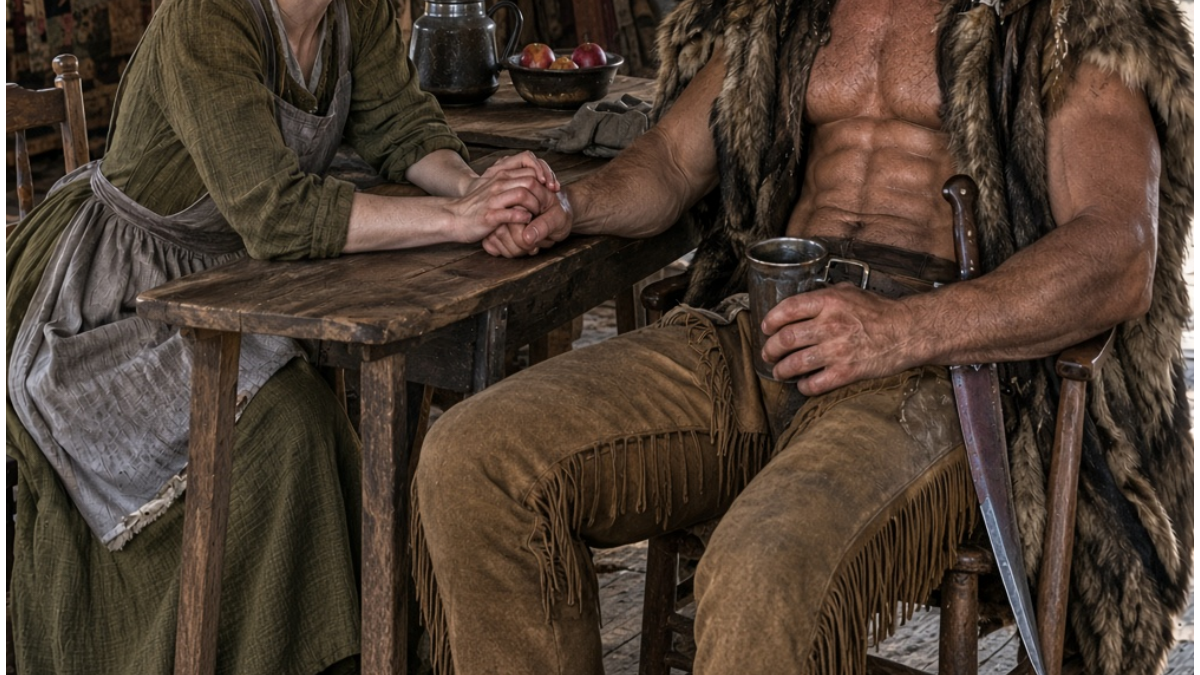
I will give you my lands if you give me a son. The words didn’t tremble.
They hung in the cold cabin air, heavier than the woods smoke, sharper than the Wyoming wind rattling the window panes.
Gideon paused, his calloused thumb resting on the rim of his tin coffee cup. He was a man who knew the high country, who knew starvation and grizzly teeth.
But this desperate, holloweyed widow was proposing a bargain more dangerous than any winter storm.
Frost hardened on the window panes of the Hayes ranch, long before November had any right to bring winter.
Gideon Cole stood in the yard holding the lead rope of a mule half dead from the mountain crossing.
His breath plumemed in the gray, bitter air. He didn’t want to be here. He belonged up on the ridges where the air was thin and the company consisted of pines and predatory cats.
But a rock slide had taken his winter cash along with his packor, and a man without supplies in the Wyoming high country was just a frozen corpse waiting for a spring thor.
He tied the mule to a rotting hitching poSt. The barn roof sagged, threatening to cave under the weight of the coming snow.
The corral was empty. No horses, no cattle, just wind kicking up frozen dirt that felt like ground glass against his scarred cheeks.
He knocked on the heavy oak door. His knuckles were cracked, bleeding sluggishly from the cold.
Footsteps sounded inside. Slow, measured, the door opened an inch, revealing the cold iron barrel of a Winchester repeater.
Behind it stood a woman. Claraara Hayes. She didn’t look like a rancher’s wife. Not anymore.
She looked like the land itself, scraped bare, hardened, and unforgiving. Her hair, a faded orburn, was pulled back in a severe knot that pulled the skin tight across her high cheekbones.
Her dress was heavy wool, stained at the hem with ash and lie. “State your business,” she said.
Her voice was like dry leaves scraping over stone. “Got caught out,” Gideon rasped. His throat was raw from days of breathing ice.
“Lost my stores in a slide. Need a corner in your barn for the night?
Maybe two. I can pay in prime beaver pelts,” Claraara studied him. Her pale blue eyes dropped to his boots, wrapped in canvas rags.
Then up to the heavy grease stained barehide coat and finally to his face. He was overgrown, bearded, scarred across the bridge of his nose with eyes the color of flint.
A mountain man, a stray dog looking for a porch. She lowered the rifle, unccocking the hammer with a dull click.
Barnes missing half its shingles. You’d freeze before midnight. Tie your animal in the first stall.
Come inside. Gideon didn’t argue. Pride was a luxury for men with full bellies. He stabled the mule, tossed it a handful of moldy oats he found in a busted barrel, and carried his rifle and his pack into the house.
The cabin was large, built for a growing family, but it felt hollow. A fire popped in the stone hearth, fighting a losing battle against the drafts, whistling through the chinking.
Gideon stood by the door, dripping melting snow onto the floorboards. He felt too large for the room, too wild.
He smelled of sweat, wet fur, and pine sap. Claraara didn’t seem to notice. She pointed to a chair at the heavy kitchen table.
Sit. She poured coffee from an iron pot hanging over the fire. It was black as pitch and smelled burned.
Gideon took the tin cup, wrapping his numb hands around the metal, letting the heat sear his palMs. Claraara sat across from him.
She didn’t have the cup. She just watched him drink. For 10 minutes, the only sounds were the ticking of a grandfather clock in the corner, the crackle of the logs, and the wind outside trying to tear the roof off.
Gideon drank the bitter coffee, feeling it thaw his cheSt. He looked around. No men’s boots by the door, no coats on the pegs, just a pervasive, crushing absence.
“Where’s your man?” Gideon asked quietly. “It was blunt, but men out here didn’t mince words.
Buried out back,” Claraara said. She didn’t blink. Fever took him in September. Took the hired hands with him.
Just me now. Gideon nodded slowly. He set the cup down. Rough country for a woman alone.
Rough country for anyone. She counted, her gaze flicking to his ragged state. Gideon offered a slight self-deprecating grunt.
Fair enough. He reached into his coat, pulling out a heavy rolled bundle of firMs. He pushed them across the table for the coffee and the floor space tonight.
I’ll be gone at first light. Claraara didn’t look at the furs. She kept her eyes fixed on his face.
She studied the lines around his eyes, the breadth of his shoulders beneath the heavy coat.
It was an invasive, calculating look. It made Gideon shift uncomfortably in his chair. He was used to being ignored or feared, not measured.
You don’t have to leave at first light, Claraara said. Gideon frowned. Mom, I’m not a ranch hand.
I don’t know cattle, and I don’t mend fences. I hunt. I trap. I survive.
That’s it. I don’t need a ranch hand, Claraara replied. Her voice dropped, losing its harsh edge, replaced by something far more desperate, far more dangerous.
She leaned forward, resting her forearms on the table. Her hands were raw, knuckles swollen from labor.
I need something else. Gideon stayed perfectly still. His instincts, honed by years of avoiding traps, flared.
What do you need? Claraara looked at him. Her pale eyes stripping away everything but the raw truth between them.
She didn’t flush. She didn’t look away. “I will give you my lands if you give me a son,” the lonely widow said to the mountain man.
Silence settled over the kitchen. “It wasn’t the quiet of an empty room. It was the heavy, suffocating stillness that follows a gunshot.”
Gideon slowly pulled his hands away from the tin cup. The coffee rippled. He stared at the woman across the table, trying to find the madness in her eyes.
Grief did strange things to people out here. It made men walk into blizzards in their long johns.
It made women drown their own infants. But Claraara Hayes didn’t look mad. She looked entirely terrifyingly lucid.
You’re out of your mind, lady. Gideon said softly. He started to push his chair back, the wooden legs scraping harshly against the floorboards.
Sit down, Claraara commanded. It wasn’t a requeSt. It was the crack of a whip.
Gideon froze halfway out of his seat. He was a man who killed grizzlies with a knife.
Yet the sheer authority in this widow’s voice anchored him. He slowly lowered himself back into the chair, his jaw tight.
I ain’t a stud horse, Mrs. Hayes, and I sure as hell ain’t looking to play house.
Claraara didn’t flinch at his tone. I don’t want you to play house, Mr. Cole.
I don’t want a husband. I don’t want a companion. I want an heir. She stood up, walking to the hearth.
She grabbed an iron poker and jabbed at the logs, sending a shower of sparks up the chimney.
This land, she said her back to him, is 500 acres of prime grazing territory, backed up against a river that doesn’t freeze solid in the winter.
My husband and I broke this ground. We bled into it. He died for it.
She turned around, the fire light casting long, harsh shadows across her face. The bank in Cheyenne holds the note.
But worse than the bank is Thomas Rusk. He owns the spread bordering mine to the south.
Rusk wants my water. He’s been trying to buy me out for pennies since the dirt on my husband’s grave was fresh.
Last week he stopped offering. Gideon narrowed his eyes. He threatened you. Rusk doesn’t threaten.
He acts. Claraara said, leaning the poker against the stone. He bribed the county judge, found a loophole in the Homestead Act and territorial law.
A widow without issue, without a child to inherit, can have her claim contested if she fails to show productivity.
Rusk is petitioning the territory to absorb my land into his. By spring, a marshall will ride out here and evict me.
Gideon crossed his arms over his cheSt. So sell to him. Take the money and go eaSt. Ain’t nothing out here but dirt and misery anyway.
Claraara let out a bitter humorous laugh. Go east and do what? Wash clothes for rich men in Boston.
Sew lace until I go blind. No, this is my dirt. This is my misery.
I am not leaving. She walked back to the table and sat down, leaning in close.
Gideon could smell lie soap and the faint coppery scent of dried blood on her hands.
If I am with child, Claraara said, her voice dropping to a fierce whisper. The law protects the unborn heir.
The land stays in truSt. Rusk can’t touch it. The judge can’t touch it. It remains mine until the child comes of age.
Gideon stared at her. The sheer cold calculus of it appalled him, and yet beneath his cynicism, a flicker of dark respect ignited.
She was a survivor. Like a cornered wolf, she was willing to chew off her own leg to get out of the trap.
“Why me?” Gideon asked, his voice rough. “Go to town. Find a drunk. Find a lonely cowboy.
Why a half frozen drifter who just knocked on your door?” Because you’re a drifter, Claraara said bluntly.
A cowboy would want to stay. A townsman would want to control me, claim the land for himself through marriage.
You, she looked him up and down. You look at these walls like they’re a cage.
You belong up in the timber. You don’t want this ranch. You don’t want me.
Then why offer me the land? Because I won’t outlive this place,” Claraara said. A sudden brutal honesty breaking through her hardened exterior.
I’ll raise the child. I’ll run the ranch. But when I die, the deed goes to the boy.
If you are his father, your name will be on the trust as his guardian.
When he comes of age, the land is his. But if I fall before then, it goes to you.
Not Rusk, not the bank. You.” She reached across the table, her calloused fingers hovering just inches from his scarred hand.
You lost your winter stores. You have nothing. I am offering you shelter, warmth, food for the winter.
In exchange, you share my bed until I am certain I carry a child. Come spring Thor, you walk away.
If you never come back, fine. If I die, you own 500 acres of the best land in Wyoming.
Are you a gambling man, Mr. Cole? Gideon looked at her hand. He thought of the wind howling outside.
He thought of the mountain passes choked with 20 ft of snow. He thought of freezing to death under a pine tree, his bones picked clean by coyotes.
He looked up into Claraara’s eyes. They were cold, terrified, and utterly resolute. “I don’t gamble,” Gideon said slowly, uncrossing his arMs. “I survive.”
He reached out and covered her small, rough hand with his massive scarred one. The contrast was stark, a physical seal on a desperate contract.
“Spring Thor,” Gideon said. Claraara nodded, her jaw tight. She didn’t pull her hand away, though he felt a slight tremor run through her fingers.
“Spring Thor!” She stood up abruptly, breaking the contact. She walked to a wooden cupboard, pulled out a woolen blanket, and threw it onto the rag rug in front of the hearth.
“You sleep by the fire tonight,” she said, not looking at him as she walked toward the back room.
“I need to wash tomorrow. Tomorrow we begin. The bedroom door clicked shut, leaving Gideon alone with the crackling fire and the ticking clock.
He stared at the closed door, the reality of the bargain settling heavily into his bones.
He had sold furs, he had sold horses, and he had sold his gun. Now, for a warm fire and a plate of beans, he had sold his blood.
He kicked his boots off, the leather stiff and unyielding, and lay down on the hard floorboards, watching the fire light dance against the ceiling.
The wind screamed outside, trying to get in, but inside another kind of storm was just brewing.
Dawn crept over the jagged teeth of the big horns, painting the snow choked valley in shades of bruised purple and flat gray.
Gideon woke before the sun, his internal clock set by years of tending trap lines.
He lay on the rag rug, staring at the raw beams of the ceiling. The fire had died to glowing embers, and the chill in the cabin was absolute.
He didn’t linger. Rising in a fluid motion, he pulled his boots on, ignoring the stiffness in the frozen leather.
He stepped outside. The cold hit him like a physical blow. Stealing the breath from his lungs.
Chores needed doing. A deal was a deal. He spent the next three hours fighting the elements.
He cleared the snow from the barn doors using a rusted shovel he found leaning against the siding.
He patched the worst of the holes in the roof with scrap wood and frozen canvas.
His fingers turning white, then a dangerous burning red. He chopped a mountain of firewood from a fallen lodgepole pine out back, the heavy thack of the axe echoing across the empty acreage.
By the time he returned to the cabin, his heavy coat was dusted with sawdust and snow.
He smelled of pine pitch and honest sweat. Claraara stood by the stove. She wore the same heavy stained dress, her hair pulled back just as tight.
A pan of salt pork and dried beans sizzled over the flames. She didn’t look at him as he entered, just nodded toward a tin basin on a wash stand.
“Water’s warm,” she said. Gideon stripped off his coat and rolled up his flannel sleeves.
He washed the dirt and pine sap from his hands and face. The warm water was a luxury that felt foreign against his skin.
He dried off with a rough towel and sat at the table. They ate in silence.
It wasn’t a companionable quiet. It was heavy, loaded with the weight of the coming night.
Gideon chewed the tough pork, watching her over the rim of his coffee cup. She ate methodically, mechanically, like a woman fueling a machine rather than enjoying a meal.
You fixed the barn, she noted, scraping her plate. Draft was bad for the mule.
Bad for your milk cow, too, assuming she ain’t completely dried up. She gives a little, Claraara said.
Enough, the day dragged on. The sun offered a pale, watery light that did nothing to warm the earth, then sank back behind the peaks by late afternoon.
The wind picked up, howling down the chimney, rattling the iron pots. Evening fell hard.
Claraara washed the dishes. Gideon sat by the fire, sharpening his hunting knife on a wet stone.
The metallic sh filled the room. He was delaying. He knew it. She knew it.
Finally, Claraara dried her hands on her apron. She walked to the grandfather clock and wound it.
The heavy clicks sounding like gunshots in the quiet room. I’m going to turn down the bed, she said.
Her voice was flat. Devoid of any tremble. Gideon stopped the wet stone. He didn’t look up.
All right. She walked into the back room. The door remained open. Gideon sat by the fire for a long time, staring into the flames.
He was 38 years old. He had paid for women in Cheyenne and Laram, transactional encounters born of loneliness and rot gut whiskey.
But this was different. This was a purchase of flesh for the sake of survival, negotiated over bitter coffee and a dead man’s grave.
He stood up, leaving his knife on the table. He walked into the bedroom. It was freezing.
The only heat came from a single oil lamp on a bedside table. Claraara sat on the edge of the mattress.
She had taken off the heavy wool dress. She wore a plain white cotton shift mended at the collar.
She was shivering, though whether from the cold or something else, Gideon couldn’t tell. He closed the door behind him.
The click of the latch was deafening. Gideon stopped at the foot of the bed.
He looked at her, really looked at her. Without the severe dress, she looked smaller, fragile, but her jaw was set.
“You don’t have to look like you’re facing a firing squad,” Gideon said softly. Claraara looked up, her pale eyes catching the lamplight.
“I’m not afraid of you, Mr. Cole. Could have fooled me.” Gideon unbuckled his gun belt, wrapping the leather around the holster, and set it on a wooden cheSt. He pulled his flannel shirt over his head.
The cold bit into his bare skin. His torso was a map of violence. A jagged white scar ripped across his ribs from a grizzly’s claws.
A puckered bullet wound sat high on his left shoulder. He saw Claraara’s eyes track the damage.
“You’ve been broken,” she whispered. “Mended,” Gideon corrected, stepping out of his trousers. Mostly. He pulled the heavy quilt back and climbed into the bed.
The sheets were like ice. Claraara lay down beside him, stiff as a board, staring straight up at the ceiling.
She kept her arms pinned to her sides. Gideon propped himself up on one elbow.
He didn’t touch her yet. He let the silence stretch, letting the reality of his presence settle over her.
Your husband? Gideon rasped, the words feeling foreign in his throat. Was he a good man?
Claraara blinked, surprised by the question. He was a hard worker. He didn’t drink. He didn’t strike me.
That ain’t what I asked. She turned her head slightly, looking at his shadowed face.
He loved this land more than he loved me. I was a necessity. Like the plow, like the barn.
Gideon nodded slowly. He understood that kind of brutal pragmatism. He reached out, his calloused fingers lightly touching her jaw.
She flinched, a sharp intake of breath hissing through her teeth. Gideon didn’t pull back, but he didn’t press.
He kept his hand there, a warm, heavy weight against her freezing skin. I ain’t a plow, Claraara, he said, using her given name for the first time.
And I ain’t going to treat you like dirt, he leaned down. There was no romance in it, no sudden spark of undeniable passion.
It was a joining of two desperate, hollowedout people. But as he moved over her, Gideon was careful.
He felt the rigid tension in her muscles, the way she held her breath, expecting pain, expecting the rough taking of a man who owned her.
Instead, he moved with a slow, deliberate patience. His hands, rough enough to snap a wolf’s neck, mapped the line of her hips with agonizing gentleness.
Claraara squeezed her eyes shut, a single tear escaping, cutting a hot path down her cold cheek.
It wasn’t a tear of sorrow, but the sudden shocking crack of a dam breaking.
She reached up, her fingers gripping his scarred shoulders, holding on to him like he was the only solid thing in a collapsing world.
Outside, the Wyoming wind screamed against the glass. Inside, in the dark, they fought their own desperate battle against the cold.
Weeks bled into a gruelling rhythm. December hit the valley with the force of an iron mallet.
The snow piled up past the lower windows of the cabin, turning the world outside into a blinding white prison.
Gideon and Claraara moved around each other in a quiet, functional dance. The initial awkwardness of their nights slowly morphed into a silent, desperate routine.
They didn’t speak of love. They didn’t speak of the future beyond the spring Thor.
By day, Gideon kept the property alive. He hunted elk in the deep timber, dragging the carcasses miles through waistdeep drifts to keep their lauard full.
By night, he kept her warm. She began to change. The severe hollowedout look in Claraara’s eyes softened just a fraction.
She started leaving an extra biscuit on his plate. He started making sure the wood box next to the stove was filled before she woke.
It It wasn’t affection. It was a mutual recognition of survival. Then came the second week of January, and the world intruded.
Gideon was in the barn filing the hooves of the mule. The cold was bitter, seeping through his boots.
He heard the muffled thud of hooves cutting through the snow before he saw them.
He dropped the rasp. He stepped to the crack in the barn door and peered out into the glaring white yard.
Three riders were pushing their horses through the drifts toward the cabin. They wore heavy canvas dusters over wool coats, their hats pulled low against the glare.
The man in the lead sat a massive ran geling. He was thick in the chest with a dense black beard frosted with ice.
Gideon recognized the type. Cattle enforcers hired guns. He didn’t run to the house. He moved quietly back into the shadows of the barn, picking up his Winchester from where it leaned against a stall.
He checked the action, sliding a heavy 440 cartridge into the chamber. Inside the cabin, the front door opened.
Claraara stepped out onto the porch, clutching a heavy shawl around her shoulders. She didn’t hold her rifle.
A mistake. The riders halted in the yard, their horses blowing steam like locomotives. The big man in the lead leaned on his saddle horn, looking down at Claraara.
“Morning, Mrs. Hayes!” The man shouted, his voice a booming baritone that carried over the wind.
Mighty cold day to be standing on the porch without a fire going. “My fire is fine, Mr. Boyd,” Claraara said, her voice tight, but carrying clearly.
“What do you want? You’re trespassing.” Boyd laughed. A harsh bark. “Trpassing? Now that’s a fluid term, ain’t it.
Boss sent us to check on you. Make sure you hadn’t froze solid. Mr. Rusk is a neighborly man.
Tell Thomas Rusk I don’t need his charity. Claraara shot back. And I don’t need his dogs tearing up my yard.
Get off my land. Boyd’s smile vanished. He spat a stream of dark tobacco juice into the pristine snow.
Your land, right? Listen to me, Widow. Rusk has the papers filed in Cheyenne. Judge is stamping them next month.
Come spring, this acorage is ours. Rusk just sent us to tell you that if you pack up and head to the railhead now, he’ll give you $50 for your trouble.
If you make us drag you out in May, you get nothing.” Claraara gripped the portrail, her knuckles white.
“I’m not leaving. I have a claim. The law. The law is a piece of paper signed by men who drink Rusk’s whiskey.”
Boyd interrupted. He swung his leg over the saddle, dropping heavily into the snow. The two men behind him unbuttoned their dusters, resting their hands near their holsters.
I think maybe you need some help packing, Mrs. Hayes. Let’s go inside and take inventory.
Boyd took a step toward the porch. The heavy barn door slammed open, the iron hinges shrieking in the cold.
Boyd stopped, spinning around. Gideon stepped out of the shadows. He didn’t hurry. He walked with the heavy rolling gate of a predator, the Winchester resting casually in his right hand, the barrel angled toward the snow.
He wore his barehide coat open, revealing the massive Bowie knife strapped to his thigh.
He stopped 10 paces from Boyd. The wind whipped his overgrown hair around his scarred face, inventories closed.
Gideon rasped. Boyd stared at him, his eyes narrowing. He looked at Gideon’s rags, the scars, the sheer imposing size of him.
“Who the hell are you?” “I’m the reason you’re going to get back on that horse and ride south,” Gideon said.
His voice wasn’t raised, but it cut through the wind like a razor. One of the men on horseback sneered.
“Just a drifter, boyed. Squatter! Shoot him, and let’s get inside to the fire.” The rider made a move, pulling his revolver half out of its leather.
Gideon didn’t flinch. He didn’t even bring the Winchester to his shoulder. He simply whipped the barrel up and fired from the hip.
The crack of the rifle was deafening. The bullet took the rider’s hat clean off his head, parting his hair with burning velocity.
The man shrieked, dropping his half-drawn gun into the snow, grabbing his head in terror.
His horse reared, panicking, nearly throwing him into a drift. Gideon racked the lever, chambering another round with a sharp metallic clack.
The barrel settled directly on Boyd’s cheSt. “Next one takes the lungs,” Gideon stated, his eyes dead and flat.
Boyd stood frozen. “He was a bully, you used to intimidating dirt farmers and widows.
He wasn’t used to men who shot first and didn’t blink. He looked at the smoking barrel of the Winchester, then up at Gideon’s face.
He saw no hesitation there. Just the casual promise of murder. “Easy,” Boyd said, holding his hands out, palms forward.
He took a slow step back toward his own. “No need to get bloody.” “Then get off her dirt,” Gideon said.
Boyd grabbed his saddle horn and pulled himself up. He glared at Claraara on the porch, then back down at Gideon.
You made a mistake, mountain man. Rusk don’t like being told no. He’s got 20 men on payroll.
Bring all 20, Gideon said. I’ll dig a bigger hole. Boyd yanked his res, turning his horse brutally.
The three men spurred their mounts, kicking up sprays of snow as they galloped back toward the southern ridge, looking over their shoulders until they crested the hill.
Silence rushed back into the yard, heavier than before. Gideon slowly lowered the rifle. He unccocked the hammer and turned toward the porch.
Claraara was shaking. Not from the cold, she stared at Gideon as if seeing him for the first time.
The quiet man who fixed her barn and shared her bed had vanished. In his place stood a killer, fully realized and lethally calm.
She didn’t thank him. She just pulled her shawl tighter. They’ll be back, she whispered, her voice trembling.
Gideon looked out at the southern ridge, his jaw tight. I know. February brought no relief, only a sharper, more desperate kind of cold.
Ice coated the inside of the cabin windows, thick as a man’s thumb. Gideon spent his days turning the homestead into a makeshift fortress.
He dismantled the interior doors of the empty bedrooms, using the heavy oak planks to board up the lower half of the windows.
He left only narrow horizontal slits just wide enough for the barrel of a Winchester.
He chopped double the firewood, stacking it waist high against the inside walls. It served two purposes.
Insulation against the bitter drafts and a barricade against lead. Claraara watched him work. She didn’t ask him to stop.
She didn’t tell him he was wasting his time. She understood the language of violence just as well as he did, even if she had never spoken it herself.
Out here, a man who didn’t prepare for the worst usually ended up buried under it.
Their nights changed. The harsh transactional urgency of those first weeks faded, replaced by something slower, something that felt dangerously like intimacy.
One night, the wind dropped, leaving a silence so absolute it made the ears ring.
Gideon sat by the hearth, meticulously oiling the action of his cult revolver. Claraara sat across from him in a rocking chair, darning a hole in one of his thick wool socks.
The fire light played across her face, softening the sharp angles of her jaw. She paused, the needle resting against the gray wool.
She pressed a hand flat against her stomach. It was a subtle movement, but Gideon caught it.
His hands stopped moving. The rag in his grip grew still against the blueed steel of the cylinder.
“You sick?” Gideon asked. His voice was low, careful not to shatter the quiet. Claraara didn’t look up.
She kept her eyes fixed on the fire. “No.” Not sick, Gideon set the revolver down on the rag rug.
He leaned forward, resting his elbows on his knees. He didn’t push. He just waited.
It was a hunter’s patience. “Mornings are hard,” Claraara finally said, her voice barely above a whisper.
“I lost my breakfast yesterday, and the day before. The coffee tastes like ash.” Gideon stared at her.
The implication hung between them, heavier than the iron pots above the flames. The bargain.
The contract drawn up in desperation and sealed in the freezing dark. It was done.
He slowly sat back, the leather of his suspenders creaking. He didn’t know what to feel.
He was a man who belonged to the high timber, a man who owned nothing but the scars on his back and the rifle in his hands.
Now he had tethered himself to this frozen patch of earth. He had planted a seed in a dying garden.
“You sure?” He asked. Claraara finally raised her eyes to meet his. The fear was back, sharp and vivid.
I am late by a month. My breasts ache, and I can’t stand the smell of the salt pork.
Yes, I am sure. Gideon nodded slowly. He picked up his revolver and began wiping it down again.
His movements were methodical, mechanical. Then the law is on your side. Rusk can’t touch the deed.
The judge will have to honor the trust before the air. The judge, Claraara said bitterly.
You think Rusk cares about a judge’s stamp now? He sent Boyd to threaten me.
He knows I’m not leaving. If he finds out I carry a child, if he finds out the land is permanently out of his reach, she didn’t finish the thought.
She didn’t need to. Rusk wouldn’t wait for a legal battle. He would simply erase the problem.
A tragic fire, a stray bullet from a supposed drifter, a widow mourning her husband driven to madness and the end of a rope.
The territory was vast and the graves were deep. He won’t find out, Gideon said flatly.
Spring is coming, Gideon. The snow will melt. The passes will clear. Claraara gripped the arms of the rocking chair.
She looked at him, searching his scarred, impassive face. The contract is fulfilled.
You gave me what I asked for. You survived the winter. When the mud dries, you are free to go.
She said the words, but they lacked conviction. They sounded like a death sentence she was pronouncing upon herself.
Gideon didn’t answer immediately. He checked the cylinder of the colt, ensuring it spun freely, then slotted it back into his holster.
He looked around the cabin. He looked at the reinforced windows, the stacked wood, the woman sitting in the rocking chair carrying his unborn child.
“I told you I ain’t a stud horse,” Gideon said quietly. He stood up, towering over the small hearth.
“I don’t walk away from my own blood. Contract or no contract. Rusk wants this land.
He’s going to have to bleed for every inch of it. And I got a lot of blood to spend.”
Claraara closed her eyes, a shuddering breath escaping her lips. It wasn’t relief. It was terror.
Because now it wasn’t just her life on the line. It was his. And the child’s.
The trap had closed around all of them. March broke the back of the winter.
The temperature crept upward, turning the pristine, deadly white drifts into a gray, sloughing mess.
The roof of the cabin wept constantly, water dripping from the eaves to bore holes in the snow pack below.
The earth emerged, not green and triumphant, but brown, dead, and stinking of rot. Mud became their new enemy.
It sucked at Gideon’s boots when he walked to the barn. It stained the hems of Claraara’s dresses.
The river, frozen solid for months, began to crack and groan like a dying giant, the sound echoing across the valley floor.
With the Thor came the realization that isolation was over. Gideon stopped hunting in the deep timber.
He stayed close to the cabin. He slept in his clothes, the Winchester resting against the headboard, the colt under his pillow.
He felt the shift in the air. The electric heavy anticipation that preceded a strike.
Rusk didn’t wait for the ground to dry completely. It happened on a Tuesday. The sky was the color of bruised iron, threatening sleep.
Gideon was in the yard using a pry bar to fix a busted wagon wheel he had dragged from the collapsed lean to.
He needed a vehicle ready if they had to run. Claraara was inside boiling water for laundry.
A sharp, distinct crack echoed off the southern ridge. Gideon didn’t look up. He didn’t pause to identify the sound.
Survival instinct, hammered into him by years of ambushes, took over. He dropped the heavy iron pry bar and threw himself sideways into the freezing mud behind the wagon chassis.
A split second later, a chunk of the wagon’s wooden side panel exploded, showering Gideon with sharp splinters.
The heavy thud of a sharps buffalo rifle followed, rumbling through the damp air. “Sniper!”
Claraara! Gideon roared, his voice tearing from his throat. “Get down! Stay away from the windows!”
He scrambled on his belly through the muck, sliding under the heavy oak axle of the wagon.
He drew the colt from his hip, though it was useless at this range. The ridge was 300 yd away, hidden by a scraggly line of lodgepole pines.
Another shot rang out. This one hit the dirt 2 ft from Gideon’s head, kicking up a spray of wet earth that stung his eyes.
They had him pinned. He needed his Winchester. It was leaning against the porch rail 30 yard away.
30 yards of open, muddy ground. He chanced to look toward the cabin. The heavy door was shut.
The narrow slits he had cut into the window boards remained dark. Claraara was smart.
She was staying low. Listen to me, mountain man. A voice drifted down from the treeine.
It was faint, distorted by the wind. But Gideon recognized the booming cadence. Boyd. Boss says time’s up.
The judge signed the paper yesterday. You’re trespassing on Rusk land. Gideon didn’t answer. He studied the terrain.
The wagon offered decent cover from the ridge, but it left his flanks exposed. If Boyd had men circling down through the dry creek bed to the east, Gideon was a dead man.
He slowly rolled onto his back, pulling his knees up, boots digging into the mud.
He checked the cylinder of the colt. Five rounds. We don’t want to hurt the widow, Boyd shouted.
Tell her to come out with her hands empty. We’ll put her on a horse to Cheyenne.
You You just stay right there. Gideon bared his teeth in a savage, mirthless grin.
They wanted him dead, and they wanted Claraara gone. He heard the distinct snapping of dry brush.
Not from the ridge, from the east, the creek bed. They were flanking him. Gideon holstered the cult and pulled the massive Bowie knife from its sheath on his thigh.
He waited, his breathing shallow, his heart hammering a slow, steady rhythm against his ribs.
He let the mud soak into his coat, blending him into the earth. A figure crept up from the lip of the creek bed, keeping low.
A young cowboy, face pale, clutching a double-barreled shotgun. He was looking toward the porch, assuming Gideon was still pinned behind the wagon.
Gideon didn’t hesitate. He launched himself from the mud like a coiled spring. He crossed the 5 yards in two massive strides.
The cowboy turned, his eyes widening in sheer panic, bringing the shotgun up. Gideon’s left hand struck the twin barrels, sweeping them violently upward as the gun discharged.
A deafening roar shattered the air. A cloud of buckshot tearing through the damp branches of a nearby pine.
Before the cowboy could pull the second trigger, Gideon drove his right hand forward. The heavy steel of the Bowie knife sank deep into the man’s shoulder, biting through wool and canvas and burying itself in bone.
The cowboy screamed, dropping the shotgun. Gideon ripped the knife free, spun the man around, and hurled him back down into the muddy ditch.
Gunfire erupted from the ridge, three rifles opening up at once. Bullets chewed the dirt around Gideon’s boots as he dove for the porch.
He hit the wooden steps hard, scrambling up on hands and knees, grabbing the Winchester and throwing his shoulder against the heavy oak door.
He tumbled inside, kicking the door shut and sliding the iron deadbolt home with a resounding clack.
The cabin was dark, smelling of wood smoke and terror. Claraara crouched behind the cast iron stove, her hands clamped over her ears, her eyes wide and terrified.
Gideon got to his feet, mud dripping from his clothes, his knife hand slick with blood.
He moved to the nearest window slit, leveling the Winchester, his face a mask of cold, focused rage.
The siege had begun. Bullets tore through the upper windows, shattering the remaining glass and burying themselves in the log walls with a sickening thud.
The cabin filled with the acrid stench of burning powder and pulverized pine. Gideon stood at the narrow slit, his cheek pressed against the rough wood, tracking movement on the ridge.
He fired. The Winchester bucked against his shoulder. A man in a canvas duster tumbled from behind a stump, clutching his leg.
“Load!” Gideon grunted, tossing a spent revolver backward without looking. Claraara caught the hot metal.
She didn’t scream. The trembling had stopped, replaced by a cold, desperate pragmatism. She sat on the floorboards, wiping the mud from the cylinder, sliding fresh 45 caliber rounds into the chambers with stained steady fingers.
“Three left on the ridge,” Gideon said, levering another shell into the chamber. “Plus Boyd and whoever else is crawling through the creek.”
Another volley of rifle fire hammered the front door. The heavy oak splintered, but the iron deadbolt held.
They can’t get in, Claraara said, her voice tight, handing him the loaded revolver. They don’t need to, Gideon replied, taking the gun.
They just need to keep us pinned until dark. Once the sun drops, they’ll bring torches.
Burn us out. Claraara looked at the stacked firewood, then down at her stomach. She placed a protective hand tung over the rough wool of her apron.
We aren’t burning. No, Gideon agreed. We ain’t. He stepped back from the window. He looked at the back door.
It led to the root cellar and the rear corral. The mud out there was knee deep, a lethal trap for anyone trying to run, but perfect for a man who knew how to hunt in the muck.
“Barade the front,” Gideon ordered, pulling his heavy bear hide coat tighter. When I go out the back, slide the bolt home.
Don’t open it for anyone but me. Claraara stood up. She grabbed his arm. Her grip was startlingly strong.
You’re one man, Gideon. You walk out there, they will cut you to pieces. I fought worse odds for a lot less, he rasped, looking down at her hand, then up to her pale, fierce eyes.
This land is yours. That child is mine. I ain’t letting Rusk’s dogs take either.
He didn’t wait for a response. He turned, unbolted the rear door, and slipped out into the gray afternoon.
The cold air bit his lungs. He dropped to his stomach instantly, crawling through the freezing sludge of the pig pen.
The mud masked his scent, his heat, his noise. He moved like a shadow, circling wide toward the east, putting the barn between himself and the ridge.
Gunfire still pounded the front of the cabin. Boyd was trying to draw their attention, wasting lead on thick logs.
Gideon reached the edge of the treeine. He rose to a crouch, the Winchester ready.
He spotted two men working their way down the creek bed, trying to flank the rear of the cabin.
He didn’t give them a warning. He dropped the first man with a shot to the cheSt. The second man spun, firing his rifle wildly into the trees.
Gideon levered his weapon, put a bullet through the man’s shoulder, and watched him scramble backward, screaming, abandoning his rifle in the dirt.
Silence dropped over the ridge. The men at the front realized they were being hunted.
“He’s outside!” A voice yelled. Gideon moved. Staying still meant death. He sprinted through the dense brush, circling behind the ridge.
He found their horses tied to a dead fall. He drew his hunting knife and slashed the lead ropes, slapping the rumps of the animals.
They bolted down the canyon, taking the men’s escape route with them. He crested the ridge from the rear.
Two men were left, Boyd and a wiry shooter with a sharps rifle. The wiry man turned just as Gideon leveled his Winchester.
Gideon fired, taking the man in the shoulder, sending him spinning into the mud. Boyd roared, drawing his heavy cult peacemaker.
He fired twice. One bullet clipped the collar of Gideon’s coat, the second tore through the meaty part of his left thigh.
Gideon grunted, his leg buckling. He dropped to one knee, the Winchester slipping from his grasp.
Boyd laughed, a harsh, ragged sound. He cocked the hammer of his revolver, walking slowly toward Gideon.
Mountain man, you put up a hell of a fight for a piece of paper.
Ain’t about paper. Gideon growled, his hand dropping to his boot. Boyd raised the pistol.
Sure it is. And now it’s mine. Gideon didn’t try to stand. He simply whipped his arm up, throwing the heavy Bowie knife with a brutal snap flick of his wriSt. The massive blade tumbled end over end and buried itself hilt deep in Boyd’s cheSt. The big man froze.
His eyes bulged. The colt slipped from his fingers, discharging harmlessly into the mud. He looked down at the stag horn handle protruding from his ribs, let out a wet, gurgling breath, and collapsed forward into the dirt.
The remaining wounded man took one look at Boyd, scrambled to his feet, and hobbled down the hill, screaming for a horse that wasn’t there.
Gideon sat in the mud, pressing his hand against the burning hole in his leg.
Blood leaked through his fingers, staining the gray snow melt a bright, vivid crimson. He breathed heavily, the adrenaline fading, leaving behind a cold, crushing exhaustion.
He tore a strip of canvas from his shirt, tying it tight around his thigh.
Using a discarded rifle as a crutch, he hauled himself up and began the long, agonizing limp back to the cabin.
The firing had stopped. The valley was silent again, save for the dripping of the melting snow.
He reached the back porch. He knocked twice hard. The bolt slid back. The door flew open.
Claraara stood there. She dropped her rifle when she saw the blood soaking his trousers.
She didn’t hesitate. She grabbed his arm, pulling his heavy frame inside, wrapping his arm around her shoulders to bear his weight.
She kicked the door shut. “You’re bleeding,” she said, her voice shaking as she lowered him into the chair by the hearth.
“I’m breathing,” Gideon countered, gritting his teeth as she grabbed the medical kit. She knelt beside him, her hands moving quickly, expertly.
She didn’t flinch at the blood. She cleaned the wound, packed it, and bound it tight.
When she finished, she sat back on her heels, looking up at his pale, scarred face.
“They’re gone,” Gideon said quietly. “Bo is dead. The rest ran. Rosk won’t send more.
Not without an army.” Claraara looked at his hands, stained with mud and violence. She reached out, covering his rough fingers with her own.
“Spring Thth Thor is here,” she whispered. Gideon looked toward the window. The ice was gone.
The sun was breaking through the gray clouds, casting a harsh true light across the bruised earth.
The bargain was complete. He had survived. The child was safe. He was free to go.
He looked back at Claraara, at the fierce, unyielding strength in her eyes, at the home they had bled to protect.
“I ain’t going anywhere,” Gideon said. Claraara squeezed his hand for the first time since Winterfell.
She smiled. “Thank you for riding along on this brutal, muddy journey through the unforgiving Wyoming territory.








