“I Took It Off… Please, She Cried — The Rancher Froze In Shock… And Then Made His Desperate Move
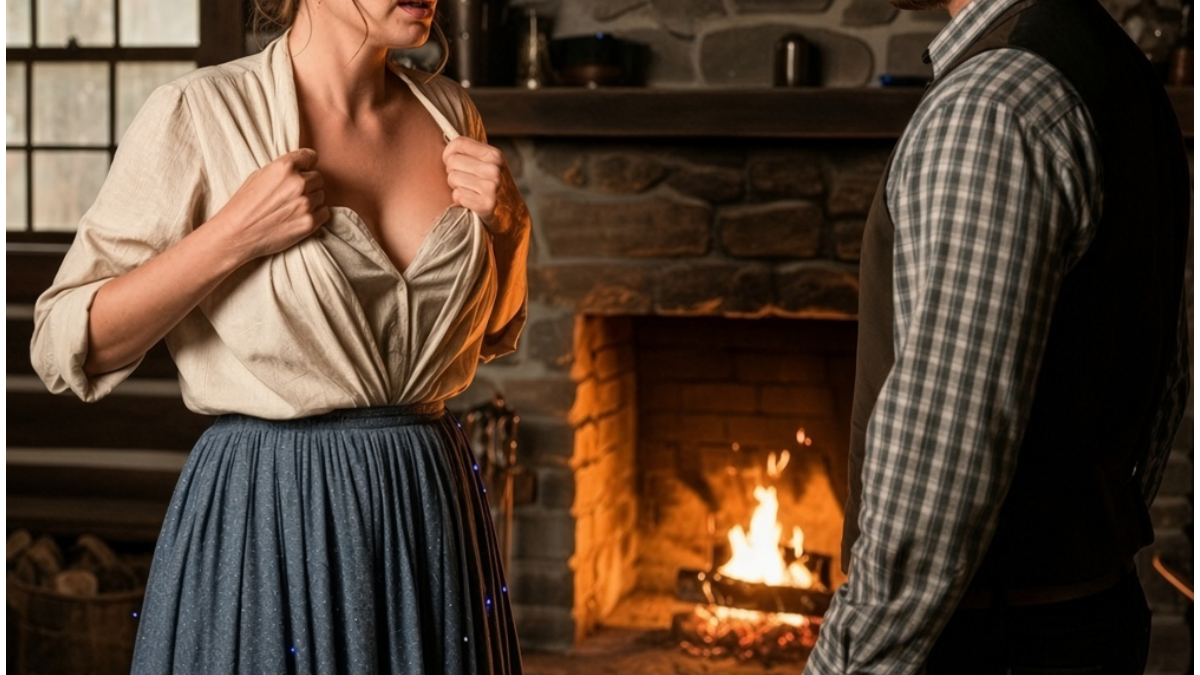
The woman’s trembling fingers fumbled with something at her wrist as flames consumed the wagon behind her.
Blood soaked her torn blue dress. When she finally tore it free, a leather band concealing a Pinkerton tattoo, she looked up at the bearded stranger with desperate eyes.
“I took it off.” “Please,” she cried, her voice breaking. Daniel McGrath froze, rifle still raised, staring at the mark that changed everything.
The wolf he’d been hunting suddenly seemed like the least dangerous thing in these hills.
The Arizona territory had a way of making men into ghosts. Daniel McGra had learned that truth the hard way, carved into his bones by 15 years of wind, dust, and memories that wouldn’t stay buried.
His ranch, broken wheel, he called it, though the name felt more like a prophecy than a choice, sat nestled in a valley where the red rocks rose up like broken teeth against an endless sky.
It was beautiful in the way that dangerous things often are, vast, unforgiving, and utterly indifferent to human suffering.
On this particular October morning, the air tasted like copper and coming rain. Daniel stood on his porch, coffee growing cold in his tin cup, studying the horizon with eyes that had seen too much.
The war had ended more than a decade ago, but it hadn’t ended in him.
It lived there still, and the tremor of his left hand when thunder rolled, in the way he couldn’t sleep without a loaded Winchester within arms reach, in the dreams that came like clockwork every time he closed his eyes.
He was 42 years old and felt ancient. Boss,” the voice shattered his revery. Miguel Torres, his only ranch hand, came running from the northern pasture hat in hand, face flushed with exertion and alarm.
The young man had been with him for 3 years, long enough to know that Daniel preferred silence to small talk, work to words.
For Miguel to run like this meant trouble. “What is it?” Daniel set down his cup, already moving toward the corral, where his horse waited.
“The calves,” said Danielle. Three more dead. Same as before. Throats torn, barely eaten. That wolf, he is getting bolder.
Miguel’s accent thickened when he was agitated. His words tumbling over each other. This time he killed close to the barn.
Very close. Daniel felt something cold settle in his cheSt. The wolf had been plaguing him for 2 weeks now, a massive gray beast that seemed to kill for sport rather than hunger.
He’d tracked it twice, lost the trail both times in the rocky highlands where the terrain turned treacherous.
But if it was coming closer to the buildings, to where men slept. Saddle thunder, Daniel said, referring to his black geling.
Full provisions. I’m not coming back until that devil is dead. Miguel nodded, relief evident on his young face.
You want me to come with you? No. Someone needs to stay with the herd.
Keep them close to the barn. If that wolf comes back, Daniel didn’t finish the sentence.
They both knew what needed to be done. 30 minutes later, Daniel rode north, following the trail of death that led away from his land and into the wilderness beyond.
The tracks were clear in the soft earth near the creek, paw prints the size of a man’s palm, the gate of something that moved with predatory confidence.
He tracked for hours, watching the sun climb, and then begin its slow descent, the shadows growing long across the red earth.
The land here was older than memory, shaped by forces that made human concerns seem trivial.
Juniper and pinion trees clung to rocky slopes. Ravens circled overhead, their calls like rusty hinges.
Daniel moved with the practiced ease of a man who’d spent half his life in wild places, reading the land like other men read newspapers.
It was near sunset when he smelled the smoke. At first, he thought it might be a campfire.
Travelers were rare but not unknown in this country. But as he crested arise, the wind brought him the truth.
Burning canvas, scorched wood, and underneath it all something worse. Something that made his stomach clench with recognition.
Death. Recent death. A lot of it. Daniel urged thunder forward, breaking into a caner as the source came into view.
A wagon train. Or what was left of one. Three Konosoga wagons arranged in a rough circle.
All of them burning, bodies scattered across the ground like broken dolls, their positions telling the story of a massacre.
His military training kicked in automatically, reading the scene even as horror tried to shut down his thoughts.
At least 15 dead. Men, women, God, even children. The attack had been swift, brutal, efficient.
Arrows protruded from some bodies, but Daniel’s experienced eye caught the wrong details. The fletching was inconsistent.
The shot placement too random for experienced warriors. The scalpings were crude, theatrical. This wasn’t a native raid.
This was made to look like one. Outlaws had to be. There were gangs that specialized in this particular brand of evil.
Hitting wagon trains, taking valuables, killing witnesses, and leaving evidence that would point blame at the Apache or Navajo.
It stirred up trouble, kept the army busy, and let the real killers operate in the chaos.
Daniel dismounted, rifle ready, senses on high alert. The attack was recent, the blood was still bright red, the fires not yet burned down to coals.
The raiders might still be close. He moved through the carnage methodically, checking each body for signs of life, even though he knew it was feudal.
A merchant family by the look of their goods. A pair of prospectors. A preacher clutching a Bible to his chest, his other hand reaching towards something he’d never grasp again.
That’s when Daniel heard it. A sound so faint he almost missed it beneath the crackle of flames and the whisper of wind through sage.
A moan pained female. He spun, searching for the source. There, partially hidden behind the third wagon, a figure in a torn blue dress.
She was moving, one arm reaching out, the other clutched to her side. Daniel ran to her, dropping to his knees, rifle set aside.
Easy now, he said, his voice rough from disuse. I’ve got you. She was young, mid-ents maybe, with dark hair matted with blood and dirt.
Her dress had been fine once. Now, now it was ripped and stained. A bullet had grazed her left side.
The wound still bleeding, but not fatal if treated quickly. But it was her face that caught him.
Even through the blood and pain, there was something there. Recognition? No, that was impossible.
Her eyes fluttered open, focusing on him with difficulty. Her lips moved, forming words he had to lean close to hear.
“Finally,” she whispered, her voice barely more than a breath. “I found you.” The words hit Daniel like a physical blow.
He stared at her, confusion waring with instinct. She didn’t know him, couldn’t know him.
He was nobody, just a rancher trying to keep his ghosts at bay. “Ma’am, I don’t,” he started.
But she was speaking again, urgent now, despite her weakness. Daniel McGra. Captain Daniel McGra, Union Army, 7th Cavalry.
I found you. His blood turned to ice. Nobody called him captain anymore. That man had died at a place called Broken Creek 15 years ago, buried under the weight of what he’d done.
How did she know? But there was no time for questions. She was losing blood, her skin growing pale and clammy.
Shock was setting in. He could interrogate her later. First, he had to keep her alive.
“Hold on,” he told her, already moving into action. He tore strips from his own shirt, pressing them against her wound.
She gasped, fingers clutching at his arm. “They were waiting,” she managed, her words coming in painful bursts.
“Said they knew, knew someone would come looking, said to leave a message. Who said?
Who did this?” But her eyes were rolling back, consciousness slipping away. Daniel worked faster, binding the wound as best he could.
He needed to get her back to the ranch, get that bullet wound properly cleaned and stitched.
She was slight, couldn’t weigh more than 120 lb, but every pound would matter on the ride back.
He was lifting her into his arms when he noticed it. On her right wrist, partially concealed by a leather band that had come loose in the attack, there was a mark, a tattoo.
He’d seen enough of them to recognize the symbol immediately. An eye inside a circle.
Pinkerton. She was a Pinkerton agent. The revelation should have made him drop her right there.
Ride away and leave her to whatever fate had brought her to this godforsaken place.
The Pinkertons meant trouble of the worst kind. They didn’t send agents after small-time criminals or lost cattle.
They went after big game assassins, traders, men who’ done things that governments wanted to stay buried.
But even as these thoughts raced through his mind, his hands were already securing her on Thunder’s saddle, his body moving with the ingrained morality that the war hadn’t quite managed to kill.
She was hurt. She needed help. The rest could wait. The ride back to Broken Wheel was the longest of Daniel’s life.
The woman, he still didn’t know her name, drifted in and out of consciousness, sometimes muttering words he couldn’t make out.
Other times going silent and still in a way that made him check repeatedly to make sure she was still breathing.
The sun set, the moon rose, and the desert transformed into a landscape of silver and shadow.
He kept expecting to hear hoof beatats behind them, riders coming to finish what they’d started.
But the night remained quiet, except for the wind and the distant cry of coyotes.
Whatever gang had hit that wagon train, they were long gone, probably already counting their take and laughing about the fools they’d killed.
It was past midnight when the lights of his ranch finally came into view. Miguel must have seen them coming because he came running from the bunk house, lamplight spilling out behind him.
“Madra deios, what happened?” “Wagon train massacre about 20 mi north,” Daniel said, his voice mechanical with exhaustion.
“She’s the only survivor. Get the medical kit, heat water, and for God’s sake, don’t ask questions.”
To Miguel’s credit, he simply nodded and ran to obey. Daniel carried the woman into his house, the first time a woman had crossed that threshold in more years than he cared to count.
He laid her on his own bed, the rough blanket suddenly seeming inadequate for her torn finery.
Her eyes opened as he sat her down, more alert than before. The fever was starting, her skin burned under his touch, but there was clarity in her gaze that hadn’t been there earlier.
You saved me, she said, and there was surprise in her voice. Even knowing what I am.
The tattoo. You saw it. Hard to miss, Daniel replied, already working to cut away the bloody fabric around her wound.
Well talk after I make sure you don’t die on me. Seems wasteful to save you twice just to have you expire from infection.
A ghost of a smile touched her lips. Practical. I like that. Miguel arrived with the medical supplies, his eyes carefully averted from the woman’s state of undress.
Daniel had seen enough field hospitals to know what needed to be done. The bullet had passed through cleanly, but the wound needed cleaning, stitching, bandaging.
She’d lost blood, but not enough to be fatal. She was strong. Her survival this long proved that.
As he worked, she watched him with an intensity that made him uncomfortable. It was the look of someone cataloging details, filing away information for later use.
A professional look, a hunter’s look. What’s your name? He asked, partly to distract her from the pain, partly because he needed to call her something other than the Pinkerton woman in his head.
Clara, she said, then gasped as he cleaned the wound with whiskey. Clara Adair. Well, Clara Adair, you want to tell me why a Pinkerton agent knows my name, my rank?
Why you were looking for me? Later, she breathed, her face going pale again. When I’m not not, she didn’t finish.
The pain or the fever or both dragged her back under. Daniel finished his work in silence, stitching with the same steady hands he’d once used to patch up soldiers under fire.
When it was done, he covered her with a clean blanket and stepped back, wiping sweat from his brow.
“She will live,” Miguel asked from the doorway. “If infection doesn’t take her, yes. Keep the fire going, change the bandages every few hours.
If the fever gets worse, wake me.” And then, boss, then what? Daniel looked at the woman sleeping in his bed.
This Clara Adair, who’d come looking for a man who was supposed to be dead, who’d found him anyway, who carried the mark of the Pinkertons and secrets he could only begin to guess at.
“Then he said slowly, we find out why the past won’t stay buried.” The next two days passed in a blur of fever and delirium.
Clara thrashed in the bed, crying out in languages Daniel didn’t know, names he didn’t recognize.
He and Miguel took turns watching her, keeping her warm, forcing water between her lips when she was conscious enough to swallow.
On the third morning, the fever broke. Daniel was dozing in a chair beside the bed when he heard her stir.
His eyes snapped open, hand instinctively going to the pistol at his hip. Old habits die hard.
But she wasn’t reaching for a weapon. She was sitting up slowly, testing her body’s limits, one hand pressed to her bandaged side.
Easy, he said. You tear those stitches and my work was for nothing. She looked at him, really looked at him, and Daniel felt exposed in a way he hadn’t in years.
Her eyes were sharp, intelligent, the eyes of someone who made a living reading people.
3 days? She asked. You’ve been counting the sunlight. Smart. I had good teachers. She accepted the water he offered, drinking deeply before continuing.
Thank you for saving me, for not leaving me to die. Even Even after you saw, she gestured to her wriSt. The tattoo?
Daniel finished. Yeah, we should probably talk about that. We should, she shifted, trying to get comfortable.
But first, I need to tell you something. The wagon train was massacred by outlaws pretending to be natives.
I figured that out. Surprise flickered across her face. You’re observant. I’m a soldier. Was a soldier.
He corrected himself, though the distinction felt thin. What I don’t understand is what a Pinkerton was doing on a civilian wagon train.
And why, when you were bleeding out in the middle of nowhere, you acted like you knew me.
Clara was quiet for a long moment, her fingers absently tracing the bandage at her side.
When she spoke, her voice was careful, measured. I was traveling undercover. The wagon train was convenient, anonymous.
But yes, I was looking for you. I’ve been looking for you for 6 months, Captain McGra.
It’s just Daniel now. And why? Because someone wants you found. Someone important. She met his eyes.
A senator from Washington. He’s willing to pay a great deal of money for your location, your cooperation.
Daniel felt the old paranoia rising, the sensation that had kept him alive through years of war and the troubled peace that followed.
Which senator does it matter? They all want the same thing eventually. Someone to do their dirty work.
Someone expendable enough that if it goes wrong, they can deny everything. She shifted again, wincing.
But this one, he says he needs you specifically. Says there’s a traitor, someone from your past, and you’re the only one who can stop him.
Stop him. How? By killing him, I imagine. That’s usually what stop means in my line of work.
The bluntness of it was almost refreshing. Daniel stood, pacing to the window. Outside, the ranch was waking up.
Miguel was feeding the horses, going through the morning routine. Normal, safe. Everything this woman was threatening to destroy.
I don’t kill for senators, he said finally. I don’t kill for anyone anymore. Not even for justice.
He turned to look at her. Justice. In my experience, Miss Adair, justice is just a word powerful men use when they want violence done on their behalf.
The war taught me that much. What if I told you the man they want dead is responsible for atrocities?
What if I told you he betrayed his own men, got them killed, and profited from it?
Daniel’s jaw tightened. I’d say that describes half the officers I ever served with. This one you knew personally.
Clara’s voice went soft, almost gentle. His name is Wesley Blackwood. Major Wesley Blackwood, formerly of the Union Army, currently residing somewhere in these territories under an assumed name, running a very profitable operation, selling information to the highest bidder.
The name hit Daniel like a fist to the gut. Wesley Blackwood. God, he hadn’t heard that name in 15 years.
Hadn’t wanted to. The memories came rushing back. A smoothtalking officer with political connections, always angling for advancement, always two steps ahead of consequences, and always, always getting men killed.
You know him, Clara observed, watching his reaction. I can see it in your face.
I knew him long time ago. We served together briefly. Daniel forced his voice to stay level.
If he’s out here, it’s no concern of mine. Even if he’s the one who sent those men to kill me, to kill everyone on that wagon train?
The question hung in the air between them. Daniel turned it over in his mind, examining it from every angle.
You think Blackwood was behind the massacre. I don’t think, Captain, I know. She gestured weakly toward her saddle bags, which Miguel had salvaged from thunder.
There’s a journal in there. Third pocket. Read it. Daniel retrieved the journal, a leatherbound book wellworn, filled with tight handwriting.
He flipped through the pages, finding maps, names, dates, evidence meticulously gathered, and there on a page marked with a ribbon, a name, Wesley Blackwood, along with a list of crimes that made Daniel’s blood run cold.
He’s been raiding wagon trains for 2 years, Clare explained. Always makes it look like native attacks.
Sells the goods through a network of fences, pockets the money. But that’s not why the senator wants him dead.
It’s what else he’s selling. Military intelligence, troop movements, patrol schedules. He’s getting soldiers killed, Daniel, just like he did during the war.
Daniel’s hands trembled as he held the journal. Just like he did during the war.
The words echoed in his mind, connecting to memories he’d tried so hard to bury.
Broken Creek, the name of the place where Captain Daniel McGra had died, even if his body kept walking around afterward.
It had been a routine scouting mission. Intelligence had come down from Major Blackwood’s office, a Confederate supply depot, lightly guarded, perfect for a quick raid.
Daniel had led his company in at dawn, expecting minimal resistance. Instead, they’d ridden into hell.
It wasn’t a supply depot. It was a Cherokee village, peaceful, neutral, flying white flags.
But in the chaos, in the darkness, with orders ringing in his ears and adrenaline pumping through his veins, Daniel’s men had opened fire.
By the time he realized the mistake, by the time he’d screamed for ceasefire, 23 people were dead.
Women, children, elders who’d never held a weapon in their lives. The army had called it a regrettable error.
Blamed faulty intelligence. But Daniel knew better. He’d seen the calculation in Blackwood’s eyes afterward, the satisfaction.
The Cherokee had been sitting on land that certain railroad interests wanted with them dead with it looking like a military necessity.
Those interests could move in. Blackwood had gotten accommodation. Daniel had gotten nightmares that never ended.
You know what he did, don’t you? Clare’s voice brought him back to the present.
At Broken Creek. You know he fed you false intelligence. How do you Daniel’s voice cracked?
He cleared his throat, tried again. How do you know about Broken Creek? For the first time, Clara’s professional mask slipped.
He saw pain there, old and deep, a wound that had never properly healed. Because, she said softly, my family was in that village.
My mother was Cherokee. My father was a teacher there. I was 7 years old visiting my aunt in Taloqua when it happened.
They died because of Blackwood’s lies. Because of She stopped, but Daniel could finish the sentence.
“Because of me. Because I led the charge. Because I gave the orders.” “You came to kill me,” he said.
“And it wasn’t a question.” Clara nodded slowly. “That was the plan. Yes. Spend six months tracking you down, gain your trust, and then justice or revenge.
Sometimes it’s hard to tell the difference. So, why am I still breathing?” She laughed, a bitter sound.
“Because when I finally found your file, really dug into it, I learned something the senator’s people had conveniently left out.
You weren’t just at Broken Creek. You were set up. Blackwood fed you false intel deliberately, knowing exactly what would happen.
You were a tool, Captain McGra, just like I was trying to make you a tool now.
The revelation should have brought relief, but it didn’t. Absolution from the woman whose family he’d helped destroy felt hollow, meaningless.
The dead were still dead. His hands were still bloody. “What changed your mind?” He asked.
“About killing me?” I talked to your men, the ones who survived. They all told the same story.
How you’d screamed for ceasefire the moment you realized what was happening. How you’d broken down afterward.
How you tried to resign your commission, how Blackwood had blocked it, threatened you with court marshal for desertion if you didn’t finish your term.
She met his eyes. You’re not the monster I thought you were, Daniel McGra. You’re just a man who was in the wrong place at the wrong time, used by someone who actually is a monster.
And now you want me to help you kill him. No. Clara shook her head.
Now I want us to kill him together. You for the men he got killed, the lives he destroyed, me for my family, and maybe, just maybe, we can stop him before he does it again.”
Daniel walked back to the window, staring out at the land he’d tried to lose himself in.
15 years of running, of hiding, of pretending the past could stay buried if he just worked hard enough, drank enough, isolated himself enough.
But the past never stayed buried. It always found you eventually. “If I say no,” he asked.
Then I heal up. Thank you for your kindness. And ride out of your life forever.
You’ll never see me again. She paused. But Blackwood will keep killing. And every death from here on out, every widow, every orphan, you’ll know you could have stopped it.
It was manipulation, pure and simple. But that didn’t make it untrue. Daniel closed his eyes, feeling the weight of years pressing down on him.
He tried peace, tried isolation, tried forgetting. None of it had worked. Maybe the only way out was through.
Maybe the only way to lay his ghost to rest was to face the man who’d created them.
“Where is he?” Daniel asked, his voice rough. “I don’t know exactly, but I know how to find him.
He has a network, people who move his stolen goods. We find one, we can follow the chain up to him.
We’ll need supplies, horses, and information more than what’s in that journal.” I have contacts.
The Pinkerton agency has resources. No. Daniel’s voice was flat. Final. We do this. We do it alone.
I won’t have your agency or your senator or anyone else calling the shots. This is between us and Blackwood.
Understood? Clara studied him for a long moment, then nodded. Understood. When do we start?
When you can ride without tearing your stitches. Could be a week, could be two.
He moved toward the door, then paused. And Miss Adair, that tattoo on your wrist, you might want to keep it covered.
Where we’re going, a Pinkerton agent is about as welcome as a rattlesnake in a sleeping bag.
He left her there, walking out into the harsh Arizona sunlight. Miguel was waiting, questions written all over his face, but Daniel just shook his head.
Not yet. He needed time to think, to plan, to prepare for what was coming.
The wolf he’d been hunting seemed like a distant concern now. A bigger predator had emerged from the shadows, one that wore a human face and carried the weight of Daniel’s past in its jaws.
Wesley Blackwood. The name tasted like poison and promise all at once. One week later, Clara was well enough to stand, to walk, to hold a pistol without her hand shaking.
Daniel spent the time gathering supplies, checking weapons, and trying to ignore the growing certainty that he was making a terrible mistake.
On the eighth night, as they sat by the fire, planning their route, a rider appeared on the horizon.
Daniel was on his feet instantly, rifle in hand, but Clara touched his arm. Wait, I know this horse.
The writer came closer, resolving into a broad-shouldered man in his 50s, dressed like a successful rancher, but sitting his saddle with military precision.
He dismounted slowly, hands visible, no threat in his posture. “Evening, Mcgra,” he said, his voice carrying the hint of the south.
“Been a long time.” Daniel felt recognition slam into him like a hammer. Colonel Carson, what the hell are you doing here?
Not Colonel anymore. These days I’m just Thomas Carson, rancher and occasional marshall when the territory needs one.
The older man’s eyes flicked to Clara. And I’m here because I heard you might be planning something foolish, son.
Something that could get you killed. How did you? Daniel started. But Clara was already standing, her face a mask of barely controlled fury.
You told him, she demanded. After everything, after all that talk about keeping this quiet, you told a federal marshall.
I didn’t tell anyone, Daniel shot back. I don’t even know how he found me.
Carson chuckled, a sound like grinding stone. Found you the same way the lady did, asking questions, following trails.
Difference is I’ve known about you hiding out here for 3 years now. Just never had a reason to disturb your peace.
He settled onto a log near the fire, uninvited but unbothered. Until now. You need to leave, Clara said, her hand drifting toward her gun.
This doesn’t concern you. See, that’s where you’re wrong, Miss Pinkerton. It concerns me greatly when two people I know, one I served with, one I’ve been investigating, decide to go hunting the most dangerous man in three territories.
Carson accepted the coffee Daniel grudgingly poured for him. You’re going after Blackwood, and you’re going to fail unless you let me help.
The fire crackled in the silence that followed. Daniel exchanged a look with Clara, seeing his own frustration reflected there.
But he also saw something else. Calculation. She was considering it. Why would you help us?
Daniel asked finally. Because Blackwood’s been operating in my jurisdiction for 2 years, making me look like a fool.
Because he’s got protection somewhere high up. High enough that every time I get close, my warrants disappear and my witnesses end up dead.
Carson’s weathered face grew hard. And because I owe you, Daniel, for Broken Creek, for not saying anything when you could have dragged me down with you.
You knew. The words came out strangled. All this time, you knew Blackwood set me up.
Suspected. Couldn’t prove it, but I’ve been gathering evidence. Same as your Pinkerton friend here.
Between the three of us, we might actually have enough to bring him down. Legalike.
With a trial and everything. No trial, Clara said, her voice ice. He dies. That’s not negotiable.
Carson sighed. The sound of a man who’d had this argument before. I understand the desire, miss.
Truly. But if we just kill him, his network survives. His protectors survive. They’ll find another Blackwood within a year and this whole cycle starts again.
We need to expose the whole operation. Burn it down from the roots up. Daniel found himself nodding despite his earlier certainty.
Carson was right. Revenge was easy, but justice was harder, better, more likely to actually change something.
But Clara was shaking her head. I didn’t come all this way. Didn’t survive a massacre.
Didn’t spend 6 months tracking this man just to hand him over to lawyers and judges who’ll probably let him buy his way out anyway.
Then we make sure they can’t, Carson replied calmly. We build a case so airtight, so public that no amount of money or influence can save him.
We make him an example. Or we could just shoot him and be done with it.
And if you do, you become what he is, a killer, a criminal. Is that what your family would have wanted, Miss Adair?
Is that the justice they deserve? The question hit its mark. Clara flinched, her hand dropping from her gun.
For a moment, she looked young, vulnerable, a woman carrying a weight too heavy for anyone to bear alone.
“I don’t know,” she whispered. “I don’t know what they’d want anymore. I was seven.
I barely remember their faces.” Daniel felt something crack inside his cheSt. He’d been so focused on his own guilt, his own pain, that he’d forgotten.
She’d been a child. She’d lost everything. And for 15 years, she’d carried that loss.
Let it shape her, define her, until revenge became the only thing keeping her alive.
He knew that feeling, knew it all too well. “Then we do both,” he heard himself say.
“We build the case. We expose the network. We give the law every chance to work.”
He looked at Carson, then at Clara. But if it fails, if he slips away again, if justice won’t be done, then we do what needs doing.
It wasn’t a perfect solution. It satisfied no one completely, but it was enough to keep them together, enough to move forward with a plan that had at least a chance of working.
Carson stood, draining his coffee. Blackwood’s been careful, but he’s got a weakness. He can’t resist a big score.
There’s a shipment coming through Silver Creek in 10 days. Gold ore from the Northern Mines heading to the railroad.
He’ll hit it. I’d bet my badge on it. Then we’ll be waiting, Daniel said.
Not we, you and the lady. I need to stay visible. Keep up appearances. If Blackwood thinks I’m involved, he’ll scatter to the wind.
Carson moved toward his horse, then paused. One more thing, you should know. He’s not alone anymore.
Got himself a new partner, someone with connections back eaSt. Rumors say it’s someone from the war, someone you both might know.
The news settled over them like a shroud. Another ghost from the paSt. Another complication in a situation already too complex.
Who? Clara asked. But Carson was already mounting up. Don’t know yet, but I’ll find out.
Meet me in Silver Creek in 9 days. The old mission on the south end of town.
Come alone, and for God’s sake, watch your backs. Blackwood’s got eyes everywhere. He rode off into the darkness, leaving Daniel and Clara alone with the fire and the weight of what they just agreed to.
“Can we trust him?” Clara asked after a long silence. Carson. He’s a hard man, but an honest one.
If he says he’ll help, he’ll help. Daniel prodded the fire with a stick, watching sparks rise into the night sky.
The question is whether we can trust ourselves. Once this starts, there’s no going back.
We’ll be committed all the way to whatever end this brings. Clara was quiet, her fingers absently tracing the scar on her wrist where the Pinkerton tattoo marked her skin.
Finally, she spoke, her voice barely above a whisper. When I found that wagon train, when I saw all those people dead, I thought it was the end of everything.
My mission, my life, my purpose. But then you came. You saved me. And I realized something.
Maybe the end of one thing is just the beginning of another. She looked at him across the fire, and in her eyes, Daniel saw a reflection of his own broken pieces, his own desperate hope for something like redemption.
Maybe this is our beginning, she continued. Not built on revenge or guilt, but on I don’t know, something better, something that might actually heal instead of just hurting.
Daniel wanted to believe her. God, how he wanted to believe that healing was possible, that the weight of Broken Creek could ever be lifted, that two broken people could somehow make each other whole, but he’d lived too long, seen too much to trust in easy redemptions.
Maybe, he said finally. Or maybe we’re just two ghosts trying to feel alive again, and this is the only way we know how.
Clara smiled, sad and understanding. Then let’s be ghosts together. At least until we find out which one of us is right.
They sat in silence after that, watching the fire burn down to embers, each lost in their own thoughts.
Tomorrow they would begin planning in earneSt. Tomorrow they would start down a road that could only end in blood or justice or both.
But tonight they were just two people warming themselves against the desert cold, finding something like comfort in shared pain and the fragile, dangerous hope of vengeance that might also be salvation.
The stars wheeled overhead, ancient and indifferent. The desert held its breath, and somewhere out there in the darkness, Wesley Blackwood went about his business, unaware that his past was coming for him, riding hard with guns loaded and accounts to settle.
The hunt had begun. The nine days before, Silver Creek passed like a fever dream, each hour thick with preparation and unspoken tension.
Daniel threw himself into the work of getting ready, teaching Clara everything he knew about tracking, about reading signs in the wilderness, about staying alive when men with guns wanted you dead.
She was a quick study, her Pinkerton training evident in the way she absorbed information, cataloged details, anticipated problems before they arose.
But there were moments, quiet moments, when she thought he wasn’t watching. When Daniel saw the mask slip, saw the girl she’d been, the woman she was trying not to become.
She’d wake from nightmares, gasping, her hand reaching for the gun she kept under her pillow.
She’d stare at a reflection in the water barrel, touching her face like she was trying to remember who she used to be.
“You don’t have to do this,” Daniel told her on the seventh night as they cleaned their weapons by lamplight.
Carson and I, we can handle Blackwood. You could walk away. Start fresh somewhere. Leave all this behind.
Clara’s hand stilled on the rifle she was oiling. When she looked up, her eyes were hard as flint.
And go where exactly? Do what? I’ve spent 15 years preparing for this. Revenge is the only thing I know how to do anymore.
That’s not true, isn’t it? She set down the rifle with exaggerated care. I joined the Pinkertons when I was 17.
Lied about my age, about my background, about everything. You know what my first assignment was?
Infiltrating a labor organization, getting close to the leaders, gathering evidence for the railroad companies to use against them.
I was good at it. So good they gave me more work, harder work. I’ve been a dozen different people, Daniel, worn a hundred different faces.
But underneath it all, there’s just this angry, broken thing that wants someone to pay for what happened to my family.
The rawness in her voice cut through Daniel’s defenses. He moved closer, sitting across from her at the small table.
You’re not broken. You’re hurt. There’s a difference. Is there? Because from where I’m sitting, it feels the same.
Daniel thought about that, about all the ways he’d tried to convince himself he wasn’t destroyed by what happened at Broken Creek.
The drinking he’d given up. The isolation he’d embraced, the numbness he’d cultivated like a garden trying to grow something, anything that didn’t hurt.
“Maybe we’re both wrong,” he said finally. “Maybe broken and hurt are the same thing, and we’ve just been calling it different names to make ourselves feel better.”
Clara laughed, a sound without humor. “That’s bleak. It’s honeSt.” She studied him across the table, lamplight casting shadows that made her look older.
Wearrier. You ever think about what comes after? If we actually pull this off, if Blackwood pays for what he’s done, what then?
I try not to think that far ahead. Liar. You’re always thinking ahead. I’ve watched you these past days.
You plan everything. Where to ride, when to rest, how many bullets to carry. You’re a strategist, Captain McGra.
So, what’s your strategy for the day after we get our revenge? The question hung between them like smoke.
Daniel didn’t have an answer. Not one that made sense anyway. The truth was he’d lived so long with Broken Creek as his defining moment that he couldn’t imagine a life beyond it.
Couldn’t picture himself as anything other than the man who’d led that charge, who’d killed those innocents, who’d spent 15 years trying to atone for something that could never be atoned for.
“I don’t know,” he admitted. “Maybe there isn’t a day after. Maybe this is all we get.
One chance to balance the scales before it all comes crashing down.” Clara reached across the table, her hand covering his.
It was the first time she’d initiated contact, the first time either of them had acknowledged the strange connection growing between them.
Part shared trauma, part desperate hope, part something neither was ready to name. Then we better make it count, she said.
The next morning they rode out before dawn, leaving Miguel with instructions to manage the ranch and to tell anyone who came asking that Daniel had gone north to check on some property.
It was a thin cover, but it would have to do. The ride to Silver Creek took two days of hard travel through country that grew progressively rougher and more lawless.
They passed abandoned homesteads, their windows dark and empty like hollow eyes. They saw buzzards circling over things they didn’t investigate too closely.
Twice they spotted riders in the distance and took cover until the strangers passed. This is Blackwood’s territory, Clara observed as they made camp the first night in a shallow canyon that offered some protection from prying eyes.
You can feel it, the fear, the emptiness. People know something bad operates out here, even if they don’t know what.
Daniel nodded, building a small fire that he’d extinguish before full dark. During the war, there were places like this.
Towns where the fighting had been so brutal that even after the armies moved on, you could feel death in the air.
Like the violence had soaked into the ground, poisoned everything. You think that’s what Blackwood’s doing?
Poisoning the land? I think he’s poisoning everything he touches. Always has. Clara was quiet for a moment, then asked the question Daniel had been dreading.
What was he like before all this during the war? What kind of man was Wesley Blackwood?
Daniel poked at the fire, watching sparks rise and die. Charming. That’s the word everyone used.
He could talk his way into or out of anything. Made you feel like you were the most important person in the world when he was talking to you.
Like your opinion mattered, like you were part of something bigger than yourself. Sounds like a politician.
He was in a way always angling for the next promotion, the next commenation. But the thing about Blackwood was you wanted to help him.
Even when you knew better, even when some instinct told you he was using you, you wanted to believe in him.
He had this way of making betrayal feel like loyalty. Clare pulled her knees up to her chest, wrapping her arms around them.
Did you believe in him before Broken Creek? Yes, Daniel said, and the admission felt like pulling out a tooth.
Painful but necessary. God help me, I did. When he gave me those orders, when he said that Cherokee Village was a Confederate supply depot, I didn’t question it.
Didn’t even occur to me to question it because Blackwood had never steered me wrong before.
Or so I thought. But he had steered you wrong. I mean, oh, constantly. I just didn’t see it.
None of us did. Men died on his orders. Missions went south. Intelligence was always just slightly off.
But he had explanations for everything, and they were always believable. War’s chaos, he’d say.
Can’t account for every variable, and we’d nod along because we wanted to believe that someone somewhere knew what they were doing.
The fire crackled between them. In the distance, a coyote howled lonely and wild. My father used to say that evil doesn’t announce itself, Clara said softly.
It comes dressed in fine words and good intentions. Comes offering solutions and promising safety.
By the time you realize what it really is, it’s already got its claws in you.
Your father sounds like a wise man. He was. He and my mother both. They saw the world clearly without illusions.
That’s probably why they didn’t survive it. The world doesn’t like cleareyed people. Doesn’t like those who refuse to be fooled.
Daniel wanted to tell her she was wrong. That good people survived all the time.
That wisdom was rewarded and truth prevailed. But he’d seen too much to lie that smoothly.
So instead, he said, “They gave you something, though. Clear eyes of your own. That’s worth more than survival sometimes.”
Clara smiled, sad and small. Is it? Because most days I think I’d trade every cleareyed moment for just one more hour with them.
One more chance to be the girl who didn’t know what cruelty looked like, who believed the world was fundamentally good.
You can’t go back. I know, doesn’t stop me wanting to. They let the fire die after that, sitting in darkness under stars so bright they seemed close enough to touch, Daniel took first watch, his rifle across his knees, his thoughts a tangle of past and present.
Clara slept fitfully nearby, occasionally crying out in whatever dreams haunted her. When he woke her for her shift, their hands touched in the exchange of the rifle.
Neither pulled away immediately. Daniel,” she said, his name strange in her mouth, intimate. “When this is over, don’t,” he interrupted gently.
“Don’t plan for after. Not yet. Let’s just get through tomorrow firSt.” She nodded, understanding in her eyes.
They both knew the odds, knew that going up against a man like Blackwood, with his resources and his ruthlessness, was likely a death sentence.
Planning for a future that might not exist was worse than foolish. It was cruel.
Silver Creek announced itself with the smell before the site. A mining town, all sulfur and sweat and desperation.
They rode in at dusk on the ninth day, dust covered and trail weary. Just two more drifters in a place that attracted the desperate and the damned.
The town clung to this hillside like a drunk to a bar rail. All rammshackle buildings and narrow streets that turned to mud when it rained.
The main drag was lined with saloons and gambling halls. Their windows glowing yellow in the gathering dark.
Music leaked from doorways, piano badly played, and the rough laughter of men spending money they couldn’t afford to lose.
“Cheerful place,” Clara muttered as they guided their horses toward the livery stable. “It’s a mining town.
They’re all like this. Burn bright and fast, then disappear when the ore runs out.”
Daniel dismounted, helping Clara, though she didn’t need the assistance. Old habits from a different world.
When men did such things without thinking, they stabled their horses and headed for the old mission Carson had mentioned, keeping to the shadows, avoiding the main street where lamplight made targets of the unwary.
The mission sat at the south end of town, a crumbling adobe structure that had once been white, but was now the color of dried blood in the fading light.
Carson was waiting inside along with someone Daniel hadn’t expected to see. “Jesus Christ,” Daniel breathed, stopping dead in the doorway.
The man sitting next to Carson looked up, his weathered face breaking into a grin that was missing two teeth.
That’s the second time someone’s mistaken me for the savior today. Must be this holy place.
Sergeant Walsh. Daniel moved forward slowly as if approaching a ghoSt. They told me you died, Shiloh.
They said took a cannonball to the cheSt. Took it to the leg. Actually lost the limb but kept breathing.
Patrick Walsh stood, leaning heavily on a crutch, his left leg ending just below the knee.
Been harder to kill than advertised, Captain. Harder than most, anyway. The reunion was brief, but genuine.
Walsh had been Daniel’s sergeant during the war. A hard-bitten Irishman who’d kept the men alive through a dozen battles and as many stupidities from command.
Seeing him alive, seeing him whole enough to fight despite the missing leg, filled Daniel with an emotion he couldn’t quite name.
Clara cleared her throat. Not to interrupt old home week, but we have a mission to plan.
Carson nodded, gesturing them closer to where he’d spread a map across an old altar.
Walsh has been working with me for 6 months now. Turns out losing a leg doesn’t stop a man from being useful.
Just makes him angry enough to want payback against those who caused it. Blackwood got your leg?
Daniel asked. Walsh’s grin disappeared indirectly. I was guarding a payroll wagon after the war trying to make honest money.
Blackwood’s gang hit us, made it look like road agents. Took the money, killed three guards.
I survived, but the leg went septic. Doctors took it rather than let the poison spread.
He tapped his crutch against the stone floor. Bar been looking for that bastard ever since.
Then you’re in good company, Clare said. We’re all here for payback. Carson cleared his throat, commanding attention without raising his voice.
Before we talk revenge, let’s talk facts. The gold shipment comes through tomorrow at noon.
16 guards, all experienced. The plan is to transfer the ore from wagons to a fortified coach.
Here, he pointed to a spot on the map at the old way station. From there, it goes straight to the railroad depot.
16 guards, Daniel mused. That’s heavy protection. It’s 2 million in gold ore. They’re not taking chances.
Carson’s finger traced a route on the map. But here’s the thing. Blackwood’s not stupid enough to hit the shipment directly.
Too much firepower, too public. He’ll wait until it’s on the move between the way station and the depot.
There’s a canyon here, narrow with high walls on both sides. Perfect ambush spot. Clara leaned over the map, her hair falling forward to hide her face.
You’re sure he’ll hit it there? Sure as I can be about anything with Blackwood.
He’s used that canyon twice before for smaller jobs. Knows the terrain, knows the timing.
It’s his pattern. Patterns can be traps, Daniel said. What if he knows we know?
What if he’s expecting us? Then we spring his trap before he springs ours. Carson’s smile was cold.
I’ve got 20 deputies ready to ride at first light. We’ll be waiting in that canyon, concealed on both sides.
When Blackwood makes his move, we close the net. It was a good plan. Solid.
But Daniel had learned during the war that good plans rarely survive contact with the enemy, especially when that enemy was Wesley Blackwood.
There’s something else, Walsh said, his tone shifting to something darker. Carson mentioned Blackwood might have a new partner.
I think I know who. The room went silent. Daniel felt Clare tense beside him.
Who? She asked, though her voice suggested she already dreaded the answer. Walsh pulled a crumpled, wanted poster from his coat, smoothing it on the altar.
The face staring back at them was older, harder, but unmistakable. Lieutenant Grace Ashford, Walsh said, used to run intelligence for the Union, worked directly under Blackwood.
She was there at Broken Creek, part of the team that provided the false intel.
Daniel’s vision blurred at the edges. Grace Ashford, he remembered her. Brilliant, ruthless, always three steps ahead of everyone else.
She’d been Blackwood’s protege, some said his lover. If she was involved now, the situation had just become exponentially more dangerous.
She’s wanted for treason, Clara read from the poster. Selling military secrets to foreign powers.
There’s a $5,000 reward. There was, Carson corrected. That warrant disappeared last month. Someone with serious pull got it quashed, but the crimes are real.
Grace Ashford has been selling information to the highest bidder for 15 years. She’s the one with the eastern connections I mentioned.
And if she’s partnered with Blackwood, then this isn’t just about wagon trains and gold ore, Daniel finished.
This is bigger, much bigger. Walsh nodded grimly. There are rumors, and I stress rumors, that Blackwood and Asheford are planning something.
Something that involves the military, the railroad companies, maybe even the territorial government. The gold tomorrow might just be funding for whatever they’re really after.
Clara’s hands clenched into fists. So, we stop them tomorrow, cut off their funding, expose their plans, end this before it gets worse.
If we can, Carson said, but you need to understand Grace Ashford is not Wesley Blackwood.
Blackwood’s dangerous because he’s cruel and ambitious. Ashford’s dangerous because she’s smarter than everyone else in the room and she knows it.
If she’s involved, she’s already anticipated us, already planned for every contingency. Then we better be unpredictable,” Daniel said.
They spent the next 2 hours going over the plan, refining details, assigning positions. Daniel and Clara would be on the north ridge of the canyon, providing cover and watching for any surprises.
Walsh, despite his missing leg, was deadly with a rifle and would take the South Ridge.
Carson and his deputies would be concealed in the rocks at the canyon mouth, ready to close the trap when Blackwood’s gang entered.
It was near midnight when they finally broke, each heading to find what rest they could before the violence to come.
Daniel and Clara secured a room at a boarding house that didn’t ask questions. A narrow space with one bed and walls so thin they could hear the couple next door arguing about money.
You take the bed, Daniel said, dropping his saddle bags in the corner. I’ll sleep on the floor.
Don’t be ridiculous. The bed’s big enough for two adults who can control themselves. Clara sat on the edge of the mattress, pulling off her boots.
Besides, we both need proper reSt. Tomorrow’s going to be hell. She was right, of course.
Daniel stripped down to his undershirt and trousers, acutely aware of her presence as she did the same, removing her outer layers until she was in just her shmese and petticoat.
It should have been awkward, intimate, but instead it felt strangely natural. Two soldiers preparing for battle, nothing more.
They lay on opposite sides of the bed, a careful distance between them, both staring at the ceiling.
Daniel. Clare’s voice was soft in the darkness. Yeah, if tomorrow goes wrong, if Blackwood wins, if we don’t make it, I want you to know something.
She paused, gathering courage or words or both. These past days with you, they’ve been the first time in 15 years I felt like a person instead of just a weapon.
The first time I’ve remembered what it was like to be Clara instead of just agent a dare.
So, thank you for that. Daniel turned his head to look at her profile in the moonlight streaming through the window.
You don’t have to thank me for seeing what was already there. Maybe not, but I’m going to anyway.
She turned to face him, and he saw tears on her cheeks, silver tracks in the pale light.
I’ve done terrible things, Daniel, in the name of justice, in the name of the Pinkertons, in the name of vengeance.
I’ve lied and manipulated and destroyed lives. If tomorrow is the end, maybe that’s what I deserve.
No one deserves to die, Daniel said, though the words felt hollow given where they’d been, what they’d done.
You don’t believe that. I can hear it in your voice. You think you deserve it, too.
Deserve to pay for Broken Creek. That’s why you’re doing this, isn’t it? Not for justice or to stop Blackwood, but because you’re hoping for a bullet with your name on it.
Hoping for an end to the guilt. The accuracy of her assessment took his breath away.
He wanted to deny it, to claim noble motivations and righteous purpose. But they’d already stripped away too many lies to start building new ones now.
Maybe, he admitted. Maybe I am hoping for that. But if I’m going to die, I want it to mean something.
Want it to balance the scales, even if just a little. Clara reached across the space between them, her hand finding his in the darkness.
Her fingers were cold, trembling slightly. Then let’s make a pact, she said. If we survive tomorrow, if somehow against all odds we make it through, we try.
Try to be more than our worst moments. Try to build something instead of just destroying.
Can you promise me that? Daniel wanted to promise. Wanted it more than he’d wanted anything in years.
But promises were fragile things, easily broken, and he’d broken enough already. I can promise to try, he said finally.
That’s all I’ve got left to give. Then it’s enough. She didn’t let go of his hand.
They fell asleep like that. Two broken people holding on to each other in the darkness, hoping that maybe, just maybe, they could hold on long enough to see the dawn.
When morning came, it came too fast and too bright. Daniel woke to find Clara already up, dressed, checking her weapons with methodical precision.
Her eyes were red rimmed, suggesting she’d slept as poorly as he had, but her hands were steady.
“Coffeey’s getting cold,” she said without looking at him. “Carson sent word.” “The gold shipment left the way station 10 minutes ago.
We need to be in position within the hour.” The ride to the canyon was tense and silent.
They met Carson and Walsh at a pre-arranged spot, exchanged final confirmations, then split up to take their positions.
Daniel and Clara climbed the north ridge, finding a cluster of rocks that provided cover and a clear view of the canyon floor below.
“How many do you think he’ll bring?” Clara whispered, settling in beside him with her rifle.
“Blackwood?” “At least 20 men, maybe more. He doesn’t take chances on big scores.” Daniel scanned the canyon through his spy glass, marking potential ambush points.
The question is whether Ashford will be with him. Does it matter? It might. Blackwood’s predictable in his way.
Aggressive, confident, prone to showing off. But Ashford thinks 10 moves ahead. If she’s here, she’s already spotted something we’ve missed.
As if summoned by her name, movement caught Daniel’s eye on the far ridge. A flash of sunlight on a metal.
There and gone. He swung the spy glass around, searching. What is it? Clara asked, reading his tension.
Not sure. Might be nothing. Might be. The shot came from nowhere and everywhere at once, the crack of a rifle echoing off canyon walls.
Daniel saw Carson drop, clutching his shoulder, his deputies scattering for cover. It was a trap.
They’d walked right into Blackwood’s trap. Go, go, go. Daniel shoved Clara toward better cover as bullets began raining down from three different directions.
Blackwood’s men had been waiting for them, positioned where they couldn’t see. The whole thing had been staged.
The gold shipment, the timing, all of it designed to draw them out and eliminate them.
Clara returned fire, her shots precise and measured even as chaos erupted around them. Daniel joined her, picking targets, making each bullet count.
On the opposite ridge, he saw Walsh doing the same. The old sergeant’s missing leg no impediment to his deadly accuracy.
But they were outnumbered, outflanked, and running out of time. “We need to move!” Clara shouted over the gunfire.
They’ve got us pinned. Daniel was about to agree when he saw him. Wesley Blackwood riding calmly into the canyon on a white horse as if bullets and death were mere inconveniences.
He was older, his hair silver at the temples. But the smile was the same, that charming, terrible smile that promised everything and delivered only ruin.
And beside him, on a black mare, rode Grace Ashford. The sight of them together, alive and triumphant while good men died around them, filled Daniel with a rage so pure it was almost cleansing.
This was it. This was the moment 15 years had been building toward. He stood, drawing a bead on Blackwood’s chest, his finger tightening on the trigger.
Daniel, no. Clara grabbed his arm. It’s what they want. They’re trying to draw you out.
She was right. She was absolutely right. But in that moment, Daniel didn’t care. All he could see was Blackwood’s smile.
All he could hear was the screams from Broken Creek. All he could feel was the weight of every life he’d failed to save.
He pulled the trigger. The bullet flew true. But at the last second, Blackwood’s horse reared, spooked by something.
The shot that should have ended it all instead struck the animal, sending it crashing down.
Blackwood rolled clear, his smile never faltering, and then he was up and running. Grace Ashford providing covering fire as they retreated deeper into the canyon.
Damn it. Daniel chambered another round, but they were gone, swallowed by the maze of rocks and shadows.
Carson was shouting orders, his deputies regrouping despite their losses. Walsh continued to pick off Blackwood’s men with ruthless efficiency.
The tide was turning, but slowly, so slowly. And then Clara was pulling at Daniel’s arm, her voice urgent.
Look, the gold coach. Daniel turned to see the armored coach barreling into the canyon, guards hanging from the sides, guns blazing.
They’d been meant to be victims, but now they were reinforcements, adding their firepower to the chaos.
The battle became a mastrom. Daniel lost track of time, of everything except the rhythm of loading and firing, moving and shooting.
Beside him, Clara fought with a ferocity that was almost frightening. Every shot an act of vengeance 15 years in the making.
When the smoke finally cleared, when the last of Blackwood’s men had fled or fallen, Daniel found himself standing amid the carnage, ears ringing, hands shaking.
They’d won in a sense, driven off the attack, protected the gold, survived against the odds.
But Blackwood and Ashford were gone. Carson limped over, his shoulder roughly bandaged, his face grim.
They had it planned from the start. Used us to eliminate their own men, the ones they didn’t trust, the ones who knew too much.
We did their dirty work for them. “Where did they go?” Daniel demanded. “Does it matter?
They could be anywhere by now. Mexico, California, hell, back east, where they have protection,” Carson spat blood.
“We failed.” Daniel wanted to rage, to scream, to deny it. But Carson was right.
They’d been played like fiddles, dancing to Blackwood’s tune, even when they thought they were writing their own music.
Clara stood apart from them, staring at the blood soaked ground, her rifle dangling from one hand.
When she finally spoke, her voice was hollow, defeated. All those years, she said. All that planning, all that hate, and we didn’t even touch them.
Didn’t even get close. Daniel went to her, not knowing what to say, knowing there were no words that could make this right.
He’d failed her. Failed Walsh and Carson. Failed the memory of everyone who died at Broken Creek.
Failed himself. But as he reached her side, as his hand touched her shoulder, she turned to him with eyes that weren’t defeated at all.
They were burning, fierce, alive with something that might have been madness or might have been clarity.
“They made a mistake,” she said softly. “What?” “They let us live. They were so busy being clever, so sure they’d won that they let us walk away.
Her smile was sharp enough to cut. “That’s going to be the last mistake Wesley Blackwood ever makes.”
Carson was shaking his head. “It’s over. We can’t. It’s not over until they’re dead,” Clara interrupted.
“You can walk away if you want, Marshall. Take your deputies. Lick your wounds. File your reports.
But I’m going after them. With or without help, with or without a plan, I’m going to find Wesley Blackwood and Grace Ashford, and I’m going to make them pay for every life they’ve destroyed.
Walsh laughed, a sound like breaking glass. Well, hell, count me in. Got nothing better to do.
And dying in pursuit of justice beats dying in bed. They all looked at Daniel.
The decision was his, really. He was the one Blackwood had used most cruy, the one with the deepest scars.
If he walked away, they’d understand. If he kept going, they’d follow. Daniel thought about the promise he’d made to Clara the night before, about trying to be more than his worst moments, about building instead of destroying.
He thought about 15 years of running, of hiding, of pretending the past could stay buried.
And then he thought about Blackwood’s smile. “We’ll need supplies,” Daniel said. “Horses, ammunition, provisions for at least 2 weeks.
And we’ll need information. Someone must know where they’re headed, what they’re planning. Carson sighed, the sound of a man accepting the inevitable.
I might know someone. Silver Creek has a telegraph operator who handles coded messages for certain unsavory clients.
If Blackwood and Ashford sent word ahead, arranged for transportation or resources, it would go through her.
“Then that’s where we start,” Clara said. They rode back to Silver Creek as the sun set, painting the sky the color of old blood.
The town seemed different now, darker, more menacing. Or perhaps it was just that Daniel saw it clearly for the first time, a place where the veneer of civilization was paper thin, where violence and greed ruled beneath polite facades.
The telegraph office was a small building near the edge of town, run by a woman named Sarah Whitmore.
Carson vouched for her reliability, or at least her willingness to share information if the price was right.
She was waiting for them when they arrived. A severe woman in her 50s with iron gray hair and eyes that missed nothing.
Marshall, she greeted Carson. I heard about the canyon. Word is, your little ambush didn’t go as planned.
Word travels faSt. It does when people pay me to send it. She looked at Daniel and Clara with undisguised curiosity.
These the ones Blackwood was asking about the soldier and the Pinkerton. Daniel felt his blood run cold.
He knew we were here. Knew you were coming. More like sent a message 3 days ago asking me to watch for a man matching your description and a woman with a Pinkerton tattoo.
Offered good money for confirmation and better money if I’d arrange an accident. But you didn’t, Clare said.
Sarah’s smile was thin. I like money, but I like staying alive more. Blackwood has a habit of eliminating loose ends, and I didn’t fancy being one.
Besides, she pulled a slip of paper from her desk. The marshall and I have an understanding.
I give him information. He forgets certain irregularities in my business practices. What did he say?
Daniel demanded. Where are they going? Didn’t say directly, but there was another message sent yesterday to someone in Santa Fe here.
She handed them the paper. I made a copy. The message was brief coded, but Carson seemed to understand it.
His face went pale as he read. “What?” Walsh pressed. “What does it say?” “They’re not running,” Carson said slowly.
“They’re advancing, moving to the next phase of whatever they’ve been planning.” He looked at Daniel.
You remember Fort Marcy, the old Spanish fort in Santa Fe? Sure. The army uses it as a depot now.
Supplies, weapons, payroll, and as of 2 days ago, it’s holding something else. Something Blackwood couldn’t resist, even if he wanted to.
Carson’s jaw tightened. A shipment of new repeating rifles, 500 of them, headed for the Apache campaigns.
If Blackwood gets his hands on those weapons, sells them to whoever he’s working with, it would be a massacre, Walsh finished.
With those rifles, any well-armed group could hold off an army, could start a war, could could burn the whole territory down, Clara said softly.
Daniel felt the pieces clicking together, the full scope of Blackwood’s ambition finally becoming clear.
The wagon trains, the gold, even today’s battle. It had all been preparation. Building resources, eliminating threats, positioning for one massive score that would set him and Ashford up for life while leaving chaos in their wake.
When? Daniel asked. The message said midnight 2 days from now. They’re planning to hit Fort Marcy during a shift change when security is lighteSt. Sarah Whitmore pulled out another paper.
And there’s more. A passenger manifest for tomorrow’s stage to Santa Fe. Look at the names.
Daniel scanned the list, his eyes stopping on one entry, his breath caught. Judge Harold Morrison, he read aloud.
The territorial judge who’s been investigating corruption in the military contracts. Blackwood’s been paying him off for months, Carson explained.
But Morrison grew a conscience, threatened to expose everything. So Blackwood’s going to kill him, make it look like a road agent attack, and remove the last obstacle to his plan.
We can’t be in two places at once, Walsh said. Can’t protect the judge and stop the fort raid.
Clare’s expression was grim. Then we split up. Marshall, you and your deputies protect Judge Morrison.
Make sure he gets to Santa Fe alive. The rest of us will go after Blackwood and Ashford at Fort Marcy.
Three against however many men they can muster. Carson shook his head. That’s suicide. Maybe, Daniel said.
But it’s also the right thing to do. If those weapons get out, if Blackwood succeeds, the body count will make Broken Creek look like a skirmish.
The weight of the decision settled over them. They were tired, wounded, running on determination and spite.
The odds were impossibly against them, but backing down now, letting Blackwood win was unthinkable.
Carson clasped Daniel’s shoulder. You’re sure about this? No, but I’m doing it anyway. Then God be with you.
You’re going to need him. Carson turned to leave, then paused. Daniel, whatever happens at Fort Marcy, make it count.
Make it mean something. I will. After Carson left with his deputies to arrange protection for the judge, Daniel, Clara, and Walsh sat in the telegraph office planning their approach.
Sarah Whitmore surprisingly offered to help. I might know a way into the fort, she said.
A tunnel built during the old days when the Spanish ran things. It’s supposed to be sealed, but I know a man who claims he used it last year to sneak in and steal supplies.
For the right price, he might show you. It was a slim hope, but it was all they had.
They spent the rest of the night gathering what they needed, saying goodbyes to people they might never see again.
Daniel wrote a letter to Miguel, instructions for the ranch, and a testament of sorts just in case.
Clara visited the church, though she claimed she didn’t pray anymore. Walsh sharpened his knife, the ritual of preparation, his own form of meditation.
As dawn broke on what might be their last day, the three of them stood in the street outside the telegraph office, ready to ride.
“We’re really doing this,” Walsh said. “Not quite a question.” “Seems that way,” Daniel replied.
Clara checked her pistols one final time, her movements automatic practiced. When she looked up, Daniel saw no fear in her eyes, only determination and something that might have been peace.
Whatever happens, she said, “At least we’re choosing our own end. That’s more than most people get.”
“More than those folks at Broken Creek got,” Daniel agreed. “Or my family.” “Or my leg,” Walsh added.
And somehow, impossibly, they all laughed. They rode out as the sun climbed higher. Three ghosts chasing ghosts, racing toward a reckoning 15 years in the making.
The road to Santa Fe stretched before them, and somewhere at its end, Wesley Blackwood waited.
The hunt was far from over. It had only just begun. The road to Santa Fe twisted through high desert country, where the earth itself seemed to remember violence.
Ancient pblo crumbled on distant messes, their stones holding secrets older than the nation that now claimed this land.
Daniel rode in silence, his thoughts a dark current beneath the surface calm, while beside him Clara studied the horizon with eyes that never quite stopped searching for threats.
Walsh brought up the rear, his missing leg no hindrance to his horsemanship, the crutch strapped to his saddle like a weapon waiting to be drawn.
They pushed hard, stopping only to rest the horses and refill cantens at scattered springs.
Time was their enemy now, as much as Blackwood. Every hour that passed brought them closer to midnight, two days hence, when 500 repeating rifles would either stay locked in Fort Marcy’s arsenal or disappear into the hands of men who’d used them to paint the territory red.
“Tell me about Fort Marcy,” Clara said on the second morning, breaking hours of silence.
They’d made camp in a shallow aoyo, hidden from the road, and were forcing down hardtac and jerky that tasted like salted leather.
Daniel chewed slowly, remembering it’s Spanish built from the 1700s. Thick adobe walls positioned on high ground overlooking Santa Fe.
The army took it over after the war, converted it to a supply depot. There’s a main gate on the east side, a smaller service entrance on the north, guard towers at each corner, usually two men per tower.
Inside, there’s a parade ground, barracks, officer’s quarters, and the arsenal where they’d keep those rifles.
Security? Walsh asked. Standard rotation. 20 soldiers on duty at any given time, plus another 30 who can be roused from the barracks if needed.
But Blackwood said midnight during a shift change. That’s when you’ve got men leaving, men arriving, confusion in the ranks.
Could cut the effective force in half for maybe 15 minutes. Clara traced patterns in the dust with a stick, thinking, “So, we have 15 minutes to get in, sabotage the raid, and either capture or kill Blackwood and Ashford before reinforcements arrive, and we’re all hanged as traitors.”
“That about covers it,” Daniel said. “Those are terrible odds.” “They’re the only odds we’ve got.”
Walsh pulled out a flask, took a long drink, then passed it around. The whiskey burned going down, cheap and harsh, but it cut through the dust in Daniel’s throat.
“I’ve been thinking,” the old sergeant said, “About that tunnel,” Sarah mentioned. “If it’s real, if we can find it and it’s not collapsed, we could bypass the gates entirely.
Get right into the heart of the fort without raising an alarm.” “That’s a lot of ifs,” Clara pointed out.
“Hole plans built on ifs. May as well pile them high.” Walsh took the flask back.
Cirked it. But there’s something else we need to consider. Even if we stop the rifle theft, even if we kill Blackwood, what about Ashford?
She’s the brains of this operation. Without her, Blackwood’s just another ambitious thug. But she’s got connections, resources, protection all the way back eaSt. We eliminate Blackwood, but leave her alive.
She’ll just find another partner and start over. The truth of it settled over them like ash.
Daniel had been so focused on Blackwood, on the man who’d orchestrated Broken Creek, that he’d almost forgotten Grace Ashford was equally culpable.
More so, perhaps, given her intelligence and reach. Then we kill them both, Clara said simply.
No trials, no due process, no chance for their bought judges and corrupt senators to set them free.
We end this permanently. Daniel wanted to object, to argue for law and order and the civilized approach, but the words died in his throat.
They’d tried civilization, tried working within the system. It had gotten them ambushed in a canyon and nearly killed.
Sometimes the only answer to monsters was to become monstrous yourself. Agreed, he said, and hated how easy the word came.
They reached Santa Fe near dusk, the adobe city sprawling in the valley below like a sleeping beaSt. The setting sun turned the buildings gold and crimson, beautiful and ominous in equal measure.
Fort Marcy sat on the heights to the north, its walls dark against the sky, flags hanging limp in the still air.
Sarah Whitmore’s contact, a nervous little man named Rodriguez, who claimed to have mapped every tunnel and passage in the old city, met them at a cantina on the outskirts.
He kept glancing at the door like he expected soldiers or outlaws or both to come crashing through at any moment.
You want to know about the tunnel? See? Rodriguez spoke in rapid Spanish accented English, his fingers drumming constantly on the scarred table.
Is very dangerous, very old, could collapse, could flood, could be full of snakes, or worse, worse than snakes?
Walsh asked skeptically. Ghosts, Seenor. The Spanish, they buried things in those tunnels. Things they didn’t want found.
Things that should stay buried. Rodriguez crossed himself. But you pay well, so I tell you.
The entrance, she is in the old cemetery beneath a crypt marked with the Franciscan cross.
You go down, follow the passage north, maybe 200 m, brings you up inside the fort, in the old chapel that they use now for storage.
The chapel,” Daniel repeated, trying to recall the fort’s layout. “That’s on the western side of the parade ground near the arsenal.
See, see, very convenient if you want to steal things. Very bad if you want to live long.”
Rodriguez’s smile was sickly. This tunnel, I use it once, once only. The darkness down there, Senor, it is not natural.
It swallows light, swallows sound. You go in, maybe you don’t come out. Clara slid a small pouch of coins across the table.
We’ll take our chances. Rodriguez pocketed the money, then leaned forward conspiratorally. One more thing, Senorita.
I hear things in this city. Whispers. There is a woman very dangerous, very smart.
She arrived 2 days ago with many men. She goes to Fort Marcy, talks with the commonant, leaves him looking very pale.
This woman, I think she is who you hunt. What did she look like, Wes?
Daniel asked, though he already knew. Tall, strong like a man, but beautiful. Dark hair, eyes that see everything.
She wears fine clothes, but carries guns like a bandida. Rodriguez shuddered. I see her pass in the street, and I think this is death walking.
This is someone who kills and sleeps well. After Grace Ashford, it had to be.
The description fit, and so did the timing. She’d come ahead to set the stage to corrupt or coersse the fort’s commandant to ensure everything was in place for midnight’s raid.
Did she have anyone with her? Clara pressed. A man, silver hair, charming. No man, I see.
Only her hired guns. Maybe 12, 15 of them. They watched the fort, watched the roads, very careful, very professional.
Rodriguez stood, eager to be gone. The cemetery. It is north of here, 10 minutes walk.
The crypt you want. It has a broken angel on top. You will know it when you see.
He scuttled away, leaving them with directions and dread. Daniel looked at his companions, seeing his own grim determination reflected in their faces.
The point of no return had arrived. After this, there would be no going back, no claiming they’d acted in self-defense or under official sanction.
They would be criminals, vigilantes, murderers in the eyes of the law. Last chance to walk away, Daniel said.
Giving them the out even though he knew neither would take it. Walsh snorted. And miss all the fun?
Not likely. Clara’s response was to check her revolvers. The metallic click of the cylinders spinning.
Answer enough. When do we move? Full dark. Give us cover to reach the cemetery and get into the tunnel.
We’ll need light once we’re down there. Lanterns but shuddered tight until we’re clear of the entrance.
Daniel ran through the plan again in his mind, looking for flaws, finding dozens but no alternatives.
Once inside the fort, we locate Ashford firSt. She’s the priority. Blackwood will come for the rifles, but Ashford’s already here, already working.
We take her out of play. The whole operation collapses. And if Blackwood arrives while we’re still hunting Ashford, Walsh asked.
Then we adapt. We improvise. We survive. Daniel stood, stretching muscles stiff from days in the saddle.
Get some rest, both of you. It’s going to be a long night. They found a boarding house that rented rooms by the hour, and didn’t ask questions.
The kind of place where wanted men and desperate women conducted business best left unexamined.
Daniel couldn’t sleep, so he sat by the window, watching Fort Marcy in the distance, its walls illuminated by torches would bring.
Neither of them knew that death was coming for them. Carried by three ghosts with nothing left to lose.
Clara knocked softly and entered without waiting for permission. She changed into dark clothing, practical for the work ahead, her hair tied back in a severe braid.
Can’t sleep either. Keep thinking about what comes after. Daniel admitted. If we somehow survive this, if we actually pull it off, what then?
We’ll be wanted for murder, for attacking a military installation. We’ll spend the rest of our lives running.
Would that be so different from what we’ve been doing? Clara joined him at the window.
You’ve been running for 15 years. I’ve been running my whole life, just in different directions.
Maybe it’s time to stop running towards something or away from something and just run together.
The suggestion hung between them. Part, part fantasy. Daniel wanted to believe it could be that simple.
That two broken people could find some kind of peace in shared flight. But he’d learned the hard way that the past always caught up, that debts always came due, that blood called for blood until the account was finally balanced.
“You deserve better than a life on the run with me,” he said. Clara laughed, bitter and sharp.
“Deserve, Daniel. I’m a Pinkerton agent who’s about to betray everything her agency stands for.
I’ve lied, stolen, manipulated, and killed in the name of justice. What I deserve is probably a hangman’s noose and an unmarked grave.
What I want is something different entirely. What do you want? She was quiet for a long moment, her reflection ghostly in the window glass.
When she spoke, her voice was barely above a whisper. I want to wake up one morning and not hate myself.
I want to look in the mirror and see a woman instead of a weapon.
I want. Her voice broke. I want my family back. But since I can’t have that, I want to stop punishing myself for surviving when they didn’t.
Daniel turned from the window to face her fully. In the dim lamplight, he could see the scars she carried, not just the physical ones, but the deeper wounds that no doctor could treat.
She was like him, hollowed out by loss, driven by guilt, searching for absolution in all the wrong places.
Clara shank,” he said, and found he had no words adequate to what he was feeling.
She stepped closer, her hand reaching up to touch his face, her fingers tracing the line of his jaw.
“We’re probably going to die tonight. You know that, right? The odds of us surviving what we’re about to do are almost non-existent.
I know. Then let’s not waste what time we have left on regrets and self-rrimation.
Let’s just be just for a few hours. Just until it’s time to go.” Daniel knew he should refuse, should maintain some professional distance, should protect what was left of his battered heart.
But he was tired of should, tired of duty, tired of denying himself even small moments of connection because he decided he didn’t deserve them.
He pulled her close, and she came willingly, her body fitting against his like they’d been designed for this moment.
They didn’t speak again, didn’t need to. Everything that mattered passed between them in the silence, in the way her hands gripped his shirt, in the way his fingers tangled in her hair, in the desperate, defiant act of choosing life even in the shadow of death.
Later, as they lay tangled in cheap sheets, Clara traced the scars on Daniel’s chest, souvenirs from a dozen battles, a dozen near deaths.
Do you ever think about what you would have been if the war hadn’t happened?
If Blackwood hadn’t destroyed everything? Sometimes I wanted to be a teacher, believe it or not.
History wanted to help people understand the past so they wouldn’t repeat it. The irony of it made him laugh without humor.
Instead, I became history’s worst lesson. You’re not I am. I’m proof that good intentions aren’t enough.
That following orders isn’t an excuse. That some mistakes can never be forgiven. He stared at the ceiling, seeing Broken Creeks burning lodges reflected in water stained plaster.
But maybe that’s the point. Maybe some of us are meant to be warnings, not heroes.
Clara propped herself up on one elbow, looking down at him. Then what am I?
What’s my purpose in all this? You’re the one who gets to choose. Your story isn’t finished yet.
Neither is yours. Mine finished 15 years ago. Everything since has just been epilogue. She kissed him, then fierce and desperate, as if she could will him back to life through sheer force of wanting.
Then let’s write a better ending together. When midnight came, they rose and dressed in silence, the temporary shelter of their intimacy, giving way to the grim business ahead.
Walsh was waiting outside, his face carefully neutral, saying nothing about where they’d been or what they’d done.
Some things didn’t need acknowledging. The cemetery sprawled on Santa Fe’s northern edge. A city of the dead presided over by weathered crosses and weeping stone angels.
They moved through it like shadows, keeping to the paths where moonlight didn’t reach, avoiding the main gates where someone might see and question their presence.
The crypt Rodriguez had described stood near the back, isolated from the others, its broken angel listing sideways as if bowing under the weight of centuries.
Franciscan symbols decorated the entrance, crosses and skulls, and Latin phrases worn almost smooth by wind and time.
“Cheerful place,” Walsh muttered, eyeing the inscription over the door. “Here lies what once was a mortal.
What that means in English, I’d rather not know.” Daniel tested the iron gate barring the entrance.
It was locked, but the metal was old, weakened by ruSt. A few minutes work with a pry bar from Walsh’s pack, and it swung open with a shriek that set their nerves jangling.
“So much for stealth,” Clara observed. Inside the crypt was exactly what one would expect.
Stone sarcophagy, dusty offerings left by grieving relatives long dead themselves. And in the back corner, partially hidden by a fallen memorial plaque, a hole in the floor leading down into blackness.
Daniel lit a shuttered lantern, adjusting it to cast the minimum light necessary. The passage below was narrow, barely wide enough for a man to walk without turning sideways.
Stone steps led down into the earth, slick with moisture, and something that might have been moss or might have been something worse.
“Rod wasn’t lying about the snakes,” Walsh said, pointing to a skin shed near the entrance, long and pale in the lamplight.
“Just snakes I can handle,” Clara replied. It’s the ghosts I’m worried about. They descended single file.
Daniel first with the lantern, Clara behind him, Walsh bringing up the rear despite the awkwardness of navigating stairs with one leg.
The temperature dropped as they went deeper, the air growing thick and stale, tasting of earth and decay and secrets buried long ago.
The tunnel at the bottom was exactly as Rodriguez had described, narrow, low ceiling, stretching north into darkness that seemed to devour their lamplight.
The walls were rough cut stone, older than the American presence, older than the Spanish conquest, perhaps.
Ancient peoples had dug these passages for reasons lost to time, and later occupiers had simply repurposed what already existed.
They walked in silence, each footstep echoing strangely, as if the tunnel went on forever in all directions.
Daniel kept his hand on his pistol, knowing it would do no good against collapsed ceilings or bad air, but needing the comfort of it anyway.
Behind him, he could hear Clara’s steady breathing and Walsh’s uneven gate, the tap of the crutch, a counterpoint to their footfalls.
“How far?” Clara whispered after what felt like hours, but was probably only minutes. Rodriguez said 200 m.
We’ve come maybe half that. The tunnel curved slightly, following some contour of the underground landscape, invisible to them.
Water trickled somewhere nearby, and Daniel hoped it was just groundwater and not evidence that the passage was flooding.
Getting trapped down here, drowning in darkness while Blackwood robbed the fort above. That would be a fitting end to his story, he supposed meaningless and forgotten.
Then Walsh grabbed his shoulder. Urgent. Listen. They froze. At first, Daniel heard nothing but their own breathing and the distant water.
Then it came. Voices muffled by stone and distance, but unmistakably human. They were getting close.
The tunnel ended in a vertical shaft with iron rungs set into the wall leading upward to a wooden trap door barely visible in the lamplight.
Daniel shuttered the lantern completely, plunging them into absolute darkness, and climbed carefully, testing each rung before trusting it with his weight.
At the top, he pressed his ear to the trap door, listening. The voices were clearer now.
Two men, guards by the sound of them, complaining about the late shift and the cold and the tedium of watching supplies that no one would ever steal.
I’m telling you, Martinez, something’s going on tonight, one was saying. Officers have been jumpy all day.
Extra patrols. The commonant locked in his office with that woman. What woman? The one who arrived yesterday.
Tall, dressed like she owns the place. Heard she’s some kind of government inspector, but government inspectors don’t usually travel with 15 armed men.
Grace Ashford. She was still here, still in the fort. The information was both encouraging and terrifying.
If they could find her before Blackwood arrived, they might prevent the raid entirely. But confronting her with her guards nearby would be suicide.
The voices faded as the guards moved away, continuing their rounds. Daniel waited another minute, then carefully lifted the trapoor a crack, peering out.
They’d emerged in what had once been a chapel, just as Rodriguez promised. Now it was a storage room, crates and barrels stacked against walls where saints images had once hung.
A single lantern provided dim illumination. No guards visible, but he could hear footsteps outside.
Regular patrols passing by. He pushed the trap door open and climbed out, helping Clara up, then Walsh with his crutch.
They stood in the shadows, orienting themselves, matching the reality of the fort to the maps in Daniel’s memory.
The arsenals across the parade ground, he whispered. But we need to find Ashford firSt. Those guards, said the commonant’s office, that would be in the main building, east side.
Clara checked her weapons, her face set in grim determination. Split up or stay together?
Together. We’re outnumbered enough without dividing our force. They moved through the fort like ghosts, using every shadow, every moment between patrols, every blind spot in the guard’s routine.
Daniel’s military training served them well. He could predict the century’s movements, identify the gaps in their coverage, lead his companions through the maze of buildings without detection.
The commandanton’s office was on the second floor of the main building. Light visible through the windows despite the late hour.
Daniel led them up an external staircase, keeping low, barely breathing. At the top, a door stood slightly a jar, voices drifting out.
Ridiculous demands, a man was saying, his voice ready with stress. You can’t expect me to simply hand over military property without proper authorization.
I expect you to do exactly what you’ve been paid to do. Grace Ashford’s voice was ice, beautiful, and deadly.
We had an agreement, Commandant. I upheld my end. The money’s been deposited in your account.
Your debts are cleared. Your mistress in Albuquerque will continue to receive her generous allowance.
All you have to do is ensure the arsenal is accessible at midnight, and the guards are looking the other way.
But if anyone finds out, no one will find out. The rifles will be reported stolen by unknown asalants, probably Apaches, given recent tensions.
You’ll mount a vigorous but ultimately unsuccessful pursuit. In a month, you’ll request a transfer to somewhere more civilized, somewhere your considerable new wealth can be properly enjoyed.
It’s a perfect plan. Unless something goes wrong, nothing will go wrong. Blackwood is many things, but incompetent isn’t one of them.
He’ll arrive precisely at midnight, take exactly what we need, and disappear before your men even realize they should be alarmed.
By the time anyone raises an actual alert, we’ll be miles away.” Daniel exchanged glances with Clara and Walsh.
They’d heard enough. Ashford was alone with the commonant, separated from her guards. This was their chance, perhaps their only chance.
He signaled 3 2 1, and they burst through the door. The commandant, a portly man in his 50s, yelped and dove behind his desk, but Grace Ashford didn’t even flinch.
She turned slowly, a slight smile playing on her lips, as if she’d been expecting them all along.
“Captain McGra,” she said pleasantly. “And the vengeful Miss Aadare, unless I’m mistaken. Plus, Sergeant Walsh, my goodness, I’d heard you were dead.
How delightful to be proven wrong.” Daniel kept his pistol trained on her heart. Put your hands where I can see them slowly.
Or what? You’ll shoot an unarmed woman? Ashford raised her hands with exaggerated slowness, but her eyes were laughing.
Come now, Captain. We both know you don’t have the stomach for murder. That’s always been your weakness.
Too much conscience, too much morality. It’s what made you so easy to manipulate. Shut up, Clara snapped, moving to cover the door while Walsh kept watch on the window.
Where’s Blackwood? Wesley? Oh, he’ll be along shortly. Right on schedule as always. Ashford settled into a chair as if this were a social call.
You really should have stayed hidden, McGra. Should have kept your head down and your demons buried.
But no, you had to play hero. Had to seek redemption for Broken Creek. How’s that working out for you?
Daniel’s finger tightened on the trigger. Every instinct screamed at him to just shoot, to end this now, to silence that mocking voice forever.
But Clara’s earlier words echoed in his mind. If they became what they fought against, if they lost what little humanity they had left, then Blackwood and Ashford won regardless of who survived.
“We’re taking you in,” he said, though he had no idea where in would be.
Carson was miles away protecting Judge Morrison. The fort’s commandant was compromised. The territorial government was corrupt, but saying the words felt important.
Felt like drawing a line between justice and revenge. Ashford laughed, genuinely amused. Taking me in?
To whom exactly? Every judge, every marshall, every official with any authority has either been bought or blackmailed.
There is no inn anymore, Captain. There’s only power, and those of us smart enough to take it.
She’s stalling, Walsh said urgently. Keeping us talking until her guards arrive or Blackwood shows up.
He was right. Daniel could hear it now. Footsteps below, multiple sets, moving with purpose toward the stairs.
Ashford’s guards alerted somehow. Maybe the commonant had a hidden signal. Or maybe someone had spotted them entering the building.
Last mistake, Clara said, stepping forward, her gun aimed at Ashford’s head. You let us get close.
But Ashford’s smile only widened. Did I? Or did I let you think you were close while springing my own trap?
Tell me, Miss Adair, did you really believe I wouldn’t prepare for this possibility? That I wouldn’t account for desperate people doing desperate things.
The first guard hit the door just as Clara fired. The bullet caught Ashford in the shoulder, spinning her around, but not before she’d triggered something.
A device hidden in her sleeve, Daniel realized too late. An alarm bell began clanging throughout the fort, piercing and relentless.
“Go, go, go!” Daniel shouted, shooting the guard who’d crashed through the door. Walsh took out another from the window, but more were coming.
A flood of armed men responding to the alarm. They ran, Clara practically dragging the wounded commandant as a hostage and human shield.
Daniel and Walsh providing covering fire as they fought their way back toward the old chapel and the tunnel.
The parade ground was chaos now. Soldiers emerging from barracks, officers shouting confused orders, guards firing at shadows and each other in the darkness.
A bullet whed past Daniel’s ear, another shattered stone near his feet. They weren’t going to make it.
There were too many guards, too much distance to cover, too much open ground between them and safety.
Then, impossibly, the main gate exploded. The blast was enormous, turning the heavy wooden gates into splinters and twisted metal, throwing guards aside like dolls.
Through the smoke and fire rode Wesley Blackwood with 20 men, guns blazing, using the chaos to mask their entrance, just as Ashford had promised they would.
The arsenal. Someone was shouting. They’re hitting the arsenal. In the confusion, Daniel saw their chance.
While soldiers rushed toward the gate while officers tried to organize a defense against Blackwood’s assault, he led Clara and Walsh in the opposite direction toward the chapel, toward the tunnel, toward escape.
They made it halfway across the parade ground when Grace Ashford emerged from the common building, clutching her wounded shoulder, but still moving with deadly purpose.
She’d rallied her personal guards, and now they were a wedge of violence cutting through the chaos, coming straight for Daniel and his companions.
“Leave me,” Walsh said suddenly. “I’ll hold them off. You two get clear.” “The hell you will,” Daniel shot back.
“I’m dead weight anyway. Missing leg, remember?” “But I can buy you time. Let me do this, Captain.
Let me go out like a soldier instead of dying in some flop house bed.”
Walsh’s eyes were bright with something that wasn’t quite tears. Make it mean something. That’s all I ask.
Before Daniel could argue, Walsh turned and opened fire on Ashford’s guards, his rifle cracking with methodical precision.
Three men down before they even registered the threat. Four. Five. Go. Walsh roared. That’s an order, Captain.
Daniel hesitated one fatal second, torn between loyalty and necessity. Then Clara was pulling him away toward the chapel.
Toward survival. Behind them, Walsh’s rifle continued its deadly song. Each shot buying them precious seconds.
The last Daniel saw of his old sergeant, the man was standing on one leg, using his crutch for balance, firing into a wall of enemies without fear or hesitation.
Then they were in the chapel, dropping through the trap door, pulling it shut above them just as bullets began punching through the wood.
The tunnel seemed even darker than before, more oppressive, as if the weight of Fort Marcy was pressing down on them.
They ran through absolute blackness, hands on the walls for guidance, stumbling over uneven ground, lungs burning with exertion and grief.
Walsh was dead. Had to be. No one survived what he just attempted. He’d sacrificed himself so they could live.
Could continue the hunt. Could maybe, just maybe, finish what they’d started. The price kept climbing.
The body count kept rising. And still, Blackwood and Ashford walked free. They burst from the cemetery crypt into night air that tasted like freedom and failure.
Behind them, muffled by stone and earth, they could hear the sounds of battle, gunfire, explosions, men screaming and dying.
Blackwood’s raid was in full swing, and without them there to stop it. Those rifles would be stolen, sold, used to murder innocents.
We failed, Clara said, voicing what Daniel was thinking. We failed Walsh. Failed everyone. Daniel wanted to agree to sink into despair and recrimination.
But something hardened in him. A core of determination that 15 years of guilt hadn’t quite managed to erode.
Not yet, he said. Blackwood got into the fort, but he still has to get out.
Still has to transport 500 rifles out of Santa Fe without being seen. We know his methods, his patterns.
We can still stop this. How? It’s just the two of us now, and we’re wanted fugitives.
Every soldier in that fort will be hunting us. Then we don’t fight soldiers. We go after Blackwood directly.
Daniel’s mind was racing. Pieces falling into place. He’s not keeping those rifles. Too dangerous.
Too conspicuous. He’s selling them probably tonight. Probably to buyers who are already in place waiting for delivery.
We find the buyers. We find Blackwood. Clara wiped blood. Walsh’s blood splattered on her during their escape from her face.
And Ashford, she’ll be with the buyers, too. This is her operation as much as Blackwoods.
She won’t trust anyone else to handle the handoff. They moved through Santa Fe’s streets like ghosts haunting their own funeral.
Behind them, Fort Marcy burned. Not literally, but the damage to its reputation, its security, its very purpose was a fire that would consume careers and destroy lives.
Ahead, somewhere in the darkness, two devils plotted and schemed and counted their blood money.
Daniel thought of Walsh, standing one-legged against impossible odds. Thought of Carson, probably dead, protecting a judge who might not have been worth protecting.
Thought of Clara who’d lost her family, her innocence, her very identity to the lie of justice.
And he thought of Broken Creek, always Broken Creek, the ghost he carried demanding payment, demanding balance, demanding an end to the cycle of violence that had started that terrible dawn 15 years ago.
“Where would you hold the exchange?” Clara asked, pulling him from his thoughts. “If you were selling stolen rifles to dangerous buyers, where in Santa Fe would you do it?”
Daniel considered the question, trying to think like Blackwood, to see the world through eyes unclouded by conscience or fear.
Somewhere public enough that violence is constrained by witnesses, but private enough that the law won’t stumble across it by accident.
Somewhere with multiple exits in case things go wrong. Somewhere the old church, Clare interrupted, excited.
San Miguel Chapel at the south edge of town. It’s been abandoned for years, but it’s still standing.
High walls, only a few entrances, perfect sight lines, and it’s on the road to Mexico.
Easy access for a quick escape if needed. She was right. Daniel knew the place, one of the oldest structures in Santa Fe, predating even the Spanish colonial period.
Its thick adobe walls had weathered centuries of conflict. Its isolation made it perfect for exactly the kind of transaction Blackwood was planning.
“That’s it,” he said. “That’s where they’ll be.” They approached San Miguel Chapel with the caution of soldiers entering enemy territory, which was essentially what they were doing.
The building rose from the darkness like a monument to stubbornness, its walls scarred by bullets from a dozen different wars.
Its bell tower empty and silent. Lights flickered inside, visible through narrow windows. Voices carried on the night air, low, cautious, negotiating.
The exchange was already underway. Daniel and Clara split up, circling the building, counting guards, identifying approaches.
There were at least 10 men outside, professional by their bearing, alert but not alarmed.
They expected trouble to come from the fort, from pursuing soldiers, not from two battered survivors with nothing left to lose.
Inside, through a gap in the adobe, where a wall had crumbled, Daniel could see the gathering.
Blackwood stood at the center, silver hair gleaming in lamplight, gesturing expansively as he made his pitch.
Grace Ashford was beside him, her wounded shoulder bandaged, but her posture suggesting the injury was minor, inconsequential, and arrayed before them were the buyers, hard men in expensive clothes, representatives of various interests, both criminal and governmental, each eager to arm themselves with the latest in killing technology.
The rifles were stacked in the middle of the chapel, crate after crate of them.
Enough firepower to start a war or end one. Daniel felt Clara slide up beside him, her breath warm against his ear.
I count 15 inside, 10 outside, 25-2. I faced worse odds. When I’m lying to make us feel better, is it working?
Despite everything, Daniel smiled. Not even a little. Good. Honesty is important. She checked her weapons.
Two revolvers, a knife, and a daringer hidden in her boot. So, how do we play this?
Quiet until we can’t be, or loud from the start. Before Daniel could answer, a commotion at the chapel’s entrance stole his attention.
More riders arriving, but these weren’t buyers. They were soldiers. Federal soldiers by their uniforms, not the territorial garrison from Fort Marcy.
And leading them was a face Daniel recognized from wanted posters and reports. Colonel Raymond Voss, the commander of the federal forces in New Mexico territory.
A man who was supposed to be in Washington testifying before Congress about military readiness and frontier security.
A man who, judging by the warmth of Blackwood’s greeting, was very much a part of this conspiracy.
Christ, Daniel breathed. It goes all the way to the top. Clara had gone rigid beside him.
Boss, I investigated him two years ago for the Pinkertons. Found evidence of corruption, embezzlement, conspiracy to commit murder.
The case was buried before I could finish it. My superior told me Voss had friends in high places who were untouchable.
Looks like those friends are getting their rifles tonight. They watched as Voss dismounted, as he clasped hands with Blackwood like old friends reuniting, as he inspected the rifles with the proprietary heir of a man who’d paid for them with other people’s lives.
Grace Ashford brought him papers, manifests perhaps, or certificates of authenticity, or simply receipts for blood money changing hands.
“We can’t let him leave,” Clara said flatly. If Voss gets those rifles, if he distributes them to his people, they’ll use them to solidify power.
They’ll control the territory, control the trade routes, control everything. And anyone who stands in their way, natives, settlers, honest lawmen, they’ll all be slaughtered.
Daniel knew she was right, but he also knew the math. 25 armed men, most of them experienced killers versus two exhausted vigilantes with limited ammunition and no backup.
Even if they somehow survived the initial confrontation, even if they managed to kill Blackwood and Ashford, Voss would escape, would regroup, would use his authority to hunt them down and paint them as the criminals, unless they change the game entirely.
I have an idea, Daniel said slowly. But you’re going to hate it. Try me.
We don’t fight them. We make them fight each other. Clara turned to look at him, understanding dawning in her eyes.
The rifles. We destroy the rifles. Not destroy, sabotage. Make them unstable, dangerous. When Voss’s men try to use them, they’ll explode, malfunction, kill the shooters instead of the targets.
And in the chaos, in the accusations and recriminations, we take out Blackwood and Ashford while their allies are busy dying.
It was ruthless. It was cold-blooded. It was exactly the kind of thing Grace Ashford herself would plan, using enemies greed against them, turning their victory into catastrophe.
Clara was silent for a long moment, then she nodded. Walsh would approve. He always said the best way to beat a superior force was to make them beat themselves.
She paused. But we don’t have time to sabotage all those rifles. The exchange is happening now.
We don’t need to sabotage the rifles. We need to sabotage one demonstration shot. Make it look like Blackwood sold them faulty weapons.
The rest will take care of itself. They moved with desperate purpose, circling to where the rifle crates were stacked outside the chapel, awaiting transport.
The guards were focused inward, watching the negotiations, assuming any threat would come from the direction of the fort.
It was sloppy, arrogant, and exactly what Daniel had hoped for. He selected a crate that looked like it had been open for inspection.
Its lid loose. Inside, the rifles gleamed with oil and promise. Daniel pulled one free, working quickly in the darkness, loosening the firing pin, weakening the chamber, creating a weapon that would function once, maybe before exploding in its user’s face.
“They’ll test fire before accepting delivery,” Clara whispered, keeping watch. “That’s standard practice for this kind of deal.
I’m counting on it. When that rifle blows up in Voss’s face or whoever they choose to test it, Blackwood’s reputation is destroyed, the buyers will think they’ve been cheated.
Guns will come out. And in the chaos, we end this, Clara finished. Daniel returned the sabotaged rifle to its crate.
Then they retreated to a position where they could watch and wait. Minutes crawled by like hours.
Inside the chapel, the negotiation seemed to be concluding. Hands were being shaken, money changing hands, or at least promises being made.
Then Voss did exactly what Daniel had predicted. He selected a rifle at random, checked its action, loaded around, and walked to the chapel’s entrance to test fire it at the empty night.
The rifle came up, Voss aimed at nothing in particular, and pulled the trigger. The explosion was spectacular.
The chamber ruptured, the barrel split, and fragments of metal turned into shrapnel that tore through Voss’s hands and face.
He went down screaming, blood pouring from a dozen wounds, his career and his conspiracy dying with him in that single catastrophic moment.
For a heartbeat, everyone froze in shock. Then accusations started flying, voices raised in anger and fear, hands reaching for weapons.
You sold us faulty rifles. This was a setup. Blackwood, you bastard. You’ll pay for this.
Blackwood was protesting, his charm failing for perhaps the first time in his life, his smooth words drowned out by rage and paranoia.
Ashford was trying to restore order, but the damage was done. Trust, that fragile thing that held criminal conspiracies together, had shattered as completely as the rifle.
The first shot rang out. Who fired it? Daniel couldn’t tell, but it was answered by a dozen more.
The buyers and their guards, Blackwoods men, even the federal soldiers who’d come with Voss.
Everyone started shooting, the chapel transforming into an abbittoire. Now, Daniel said, and they moved.
They entered through a side door, staying low, using the chaos as cover. Bodies were already hitting the floor.
Blackwood was behind an overturned altar, returning fire, his face twisted with fury. Ashford was gone, vanished into the shadows.
Already planning her escape. Daniel’s first shot took down one of Blackwood’s lieutenants. His second wounded a buyer who’d been reaching for more weapons.
Beside him, Clara was methodical, her revolvers speaking with cold precision, each bullet finding a target.
Then Blackwood saw them, and his expression transformed from rage to something like joy. McGra, so you survived.
Of course you did. You’re like a cockroach, impossible to kill. He was laughing. Actually laughing even as bullets flew around him.
“Come to finish what you started at Broken Creek. Come to finally grow a spine and face me like a man.”
“I came to end you,” Daniel called back, advancing through the carnage. “For Broken Creek, for every person you’ve killed or ruined.
For Walsh, for justice.” “Justice?” Blackwood’s laugh was manic. There’s no such thing. There’s only power, and those strong enough to take it.
You’re weak, McGra. Always have been. That’s why you failed at Broken Creek. Why you failed in the canyon?
Why you’ll fail now? He rose from cover, firing wildly, forcing Daniel to dive behind a pew.
The wood splintered under the assault, fragments cutting Daniel’s face. Where’s Ashford? Clara shouted over the gunfire.
Gone! Someone groaned. One of the wounded buyers clutching a belly wound. Ran out the back the second things went bad.
That’s what she does. Abandons everyone when the plan falls apart. But she hadn’t abandoned Blackwood.
Even now, even with everything collapsing around him, Blackwood kept fighting with the confidence of someone who believed rescue was coming.
He had an escape plan. He always had an escape plan, the back door. The same way Ashford had fled.
It was a trap. Had to be. But it was also their only chance to catch both of them before they scattered to the winds.
“Cover me,” Daniel told Clara. Then he was moving, sprinting through smoke and death, vaultting over bodies, sliding through blood that made the floor treacherous.
A bullet tugged at his coat. Another shattered a window beside his head, but he kept moving, kept pushing forward, driven by 15 years of guilt and grief and the desperate need to make it all mean something.
The back door stood open, night air rushing in. Daniel burst through it into darkness, expecting ambush, expecting death.
Instead, he found Grace Ashford with a gun to Clara’s head. She’d been waiting, had grabbed Clara the moment she’d followed Daniel through the door.
Now, she stood there, cold and controlled, using the woman Daniel had come to care for as a shield.
“Drop the gun, Captain,” Ashford ordered. “Or I paint the walls with her brains.” Daniel froze, his pistol halfway raised.
Let her go. Your fight’s with me. My fight is with anyone stupid enough to get in my way.
You, her, Blackwood, you’re all just obstacles to be removed. Ashford’s smile was terrible. But I’m a practical woman.
I know when to cut losses. So, here’s my offer. You let me walk away and Clara lives.
You try to stop me and she dies. Simple mathematics. Don’t listen to her, Clara said, her voice surprisingly steady despite the gun pressed to her skull.
She’ll kill me anyway. Kill us both. It’s what she does. True enough, Ashford agreed.
But this way, you at least have hope. False hope, admittedly, but hope nonetheless. What do you say, McGra?
Want to make another mistake? Want to fail someone else you care about? The words were designed to wound, and they succeeded.
Daniel saw a broken creek in Ashford’s eyes. Saw all his failures reflected back at him.
But he also saw something else. Saw Clara’s eyes fierce and unafraid. Saw her hand moving almost imperceptibly toward the daringer in her boot.
She was going to make a play. Going to sacrifice herself so Daniel could have a shot.
No, he said, and he wasn’t sure if he was speaking to Ashford or Clara or his own demons.
No more sacrifices. No more deaths. He lowered his gun. Ashford’s smile widened in triumph and Clara struck.
Her hand came up with the daringer, twisting in Ashford’s grip, firing point blank into the woman’s side.
Ashford screamed her own gun going off wildly, the bullet meant for Clara’s head going high and wide.
Daniel didn’t hesitate. He raised his pistol and fired three times, each shot finding Ashford’s center mass.
She staggered backward, surprise and fury waring on her face. And then she fell, her blood dark on the ancient stones.
Clara collapsed, and for one horrible moment, Daniel thought she’d been hit. But she was just exhausted, the adrenaline finally giving way, her body shutting down after days of violence and fear.
He pulled her up, held her while she shook, and together they watched Grace Ashford die.
“One down,” Clara whispered. Behind them in the chapel, the gunfire had slowed, was stopping.
When Daniel risked a look back inside, he saw why. Bodies everywhere, the buyers, the guards, Blackwood’s men.
They’d slaughtered each other. Greed and paranoia doing what Daniel and Clara could never have managed alone.
And in the center of it all, slumped against the altar, bleeding from a dozen wounds, sat Wesley Blackwood.
He looked up as they entered, and incredibly, impossibly, he was still smiling. Well played, McGra.
Well played indeed. Turned us against each other. Destroyed years of planning. Killed Ashford. You’ve become quite the strategiSt. Daniel said nothing.
Just walk closer. His gun never wavering. Aren’t you going to gloat? Blackwood asked. Lecture me about justice, about Broken Creek, about all my sins.
That’s what heroes do, isn’t it? I’m not a hero, Daniel said quietly. And this isn’t justice.
It’s just an ending. Fair enough. Blackwood coughed, blood bubbling on his lips. For what it’s worth, Broken Creek wasn’t personal.
It was just business. The Cherokee were in the way. The railroad needed the land.
I needed the promotion. You were simply the tool I used. No hard feelings. The casualness of it, the sheer benality of such evil took Daniel’s breath away.
Blackwood had destroyed lives, murdered innocents, started a chain of violence that had consumed 15 years.
And to him, it was just business, just another transaction. I should have known, Daniel said.
Should have questioned the orders. Should have seen through you. That’s my crime, my sin.
But yours, yours is being a monster and not even caring enough to recognize it.
Blackwood’s smile faded. We’re all monsters, McGra. Some of us are just honest about it.
No, Clara said, stepping forward. Some of you are just monsters. The rest of us are trying, failing, trying again.
That’s the difference. She raised her gun, aiming at Blackwood’s heart. Daniel should have stopped her.
Should have argued for due process, for law, for civilization. But he was tired. So tired.
And some things, some people were beyond redemption. For my family, Clara said, for Broken Creek, for every life you destroyed because you could.
She fired once, and Wesley Blackwood died with his eyes open, staring at nothing. His last expression one of vague surprise that the world had finally held him accountable.
The silence after was profound. Daniel and Clara stood in a chapel full of corpses, the architects of their own vengeance, the executioners of men who probably deserved it.
Outside they could hear bells ringing, alarms from Fort Marcy probably, or maybe the church bells of Santa Fe calling the faithful to witness what had happened here.
“We need to go,” Daniel said, before the authorities arrive. “And go where? We’re murderers now, fugitives.
Everything Ashford said about being wanted, that’s our reality.” Daniel took her hand. Then we run together, like you said.
We run and we keep running until we find someplace far enough away that the past can’t follow.
The past always follows. Then we run faster. It wasn’t much of a plan. It wasn’t much of a future, but it was all they had.
And somehow, miraculously, it was enough. They left San Miguel Chapel as the first soldiers arrived, slipping into shadows, becoming ghosts again.
Behind them, Santa Fe erupted in chaos. Questions about the massacre, about the stolen rifles, about the dead colonel and the conspiracy that had reached into the highest levels of power.
Let others sort it out. Let historians and lawyers and judges assign blame and parse responsibility.
Daniel and Clara had done what they came to do, had paid the price in blood and grief and the last shreds of their innocence.
Now, finally, they could rest, or try to. Anyway, the hunt was over. They rode through the night like souls fleeing predition, pushing their horses to the edge of endurance, stopping only when the animals would go no further.
Santa Fe disappeared behind them, swallowed by distance and darkness, its bells and shouting fading to memory.
But the weight of what they’d done rode with them, heavy as iron, settling into their bones with every mile.
Daniel kept expecting pursuit, kept listening for the thunder of hooves, the crack of rifles, the voices of law men calling for surrender.
But the night remained empty except for wind and the cry of distant coyotes, as if even the wilderness wanted nothing to do with them.
They made camp in a box canyon 20 mi south of Santa Fe, a place where the rocks formed natural walls, and a single entrance could be easily watched.
Clare attended the horses while Daniel built a fire so small it barely qualified as flame.
Just enough heat to brew coffee and ward off the high desert cold. “We should keep moving,” Clara said, settling onto the ground across from him, her face hagggered in the firelight.
“Every hour we stay in the territory is an hour they could find us. The horses need reSt. So do we.”
Daniel poured coffee into tin cups, the bitter smell cutting through the night air. “We’re no good to anyone dead from exhaustion.”
Clara accepted the coffee but didn’t drink. Just wrapped her hands around the cup for warmth.
Walsh is dead. Carson might be dead. We killed at least a dozen men tonight, maybe more.
We assassinated a federal colonel and destroyed a military conspiracy. And we’re sitting here drinking coffee like it’s just another night.
What else should we be doing? I don’t know. Feeling something? Anything? Her voice cracked.
I just killed a woman in cold blood, Daniel. I looked Grace Ashford in the eyes and I shot her and I don’t feel guilty.
I don’t feel triumphant. I don’t feel anything at all. What does that make me?
Daniel set down his cup, moved around the fire to sit beside her. It makes you human.
Makes you someone who’s been through more than any person should have to endure. The feelings will come, Clara.
Give them time. Will they? Or have I finally become what the Pinkertons trained me to be, a weapon with no conscience, no remorse, or said just the ability to kill and move on to the next target.
You’re not a weapon. You’re a woman who’s been hurt and who hurt back. There’s a difference.
Clara looked at him, and in her eyes he saw the same emptiness he’d carried since Broken Creek.
The hollow place where innocence used to live, now filled with ghosts and regrets, and the knowledge that some lines once crossed could never be uncrossed.
Is there? Because from where I’m sitting, it all feels the same. We killed them.
They killed others. Those others killed someone else. It’s just violence beetting violence all the way back to the beginning of time.
When does it stop, Daniel? When does the debt finally get paid? He had no answer for her.
Had been asking himself the same question for 15 years without finding anything resembling peace.
The scales never balanced. Not really. Every death just added weight to both sides until the whole structure collapsed under its own terrible math.
I don’t know, he admitted. Maybe it doesn’t stop. Maybe we just learn to live with it, to carry it without letting it destroy what’s left of who we are.
And if there’s nothing left, if we’ve already been destroyed and we’re just too stubborn to lie down.
Daniel pulled her close and she came willingly, her head resting against his shoulder, her body shaking with exhaustion or grief or both.
Then we rebuild. Start over. Find some way to be more than what we’ve done.
They sat like that until the fire died to embers and the stars wheeled overhead in their ancient dance.
Eventually Clara slept, curled against him, her breathing deep and troubled. Daniel stayed awake, keeping watch, his rifle across his knees, waiting for pursuit that never came.
Dawn broke cold and clear, painting the canyon walls amber and rose. Clare a woke with a start, reaching for her gun before she remembered where she was.
Daniel had coffee ready, had even managed to fry some salt pork over the rekindled fire.
“Any sign of them?” She asked, accepting the food. “Nothing. Either they’re not coming or they’re better at tracking than I give them credit for.
Or they don’t care. Maybe we weren’t the story they wanted to tell. Clara chewed mechanically, the food clearly tasteless to her.
Think about it. A federal colonel dies in a shootout over stolen military rifles. The conspiracy goes all the way to the top.
They’ll want to bury this, not investigate it. Admitting that Voss was corrupt means admitting the whole system is rotten.
Easier to blame it on outlaws and move on. She was probably right. Daniel had seen it during the war.
Inconvenient truths buried under official narratives, massacres reframed as necessary actions, crimes swept away because acknowledging them would be too costly.
Broken Creek had been whitewashed within a week, turned into a tragic error rather than a deliberate atrocity.
“So we might actually get away with it,” he said slowly. “Get away with what?
Justice, revenge? Murder. Clara shook her head. We killed them, Daniel. Whatever word we use, whatever justification we claim, at the end of the day, we’re killers.
That doesn’t go away just because the law chooses to look the other way. Before Daniel could respond, the sound of hooves echoed off the canyon walls.
Both of them were on their feet instantly, weapons drawn, taking positions behind rocks that offered cover.
Daniel’s heart hammered against his ribs. Here it was, finally, the reckoning they’d been expecting.
But only one rider appeared at the canyon mouth, and when Daniel recognized the silhouette, relief and worry wared in his cheSt. Marshall Thomas Carson sat his horse like a man who’d aged a decade in the past 3 days.
His shoulder was still bandaged from the canyon ambush, and fresh blood had seeped through, suggesting he’d been pushing himself too hard.
But he was alive, and the grim smile on his weathered face suggested he brought news.
“Lower your weapons,” he called out. “If I wanted you dead, I’d have brought a regiment.”
Daniel and Clara exchanged glances, then reluctantly holstered their guns. Carson dismounted with a pained grunt, leading his horse into the camp.
“Judge Morrison,” Daniel asked. “Safe in Santa Fe, testifying before a territorial board as we speak.
He’ll bring down half the corrupt officials between here and Washington before he’s done. Carson accepted the coffee Daniel offered, drinking deeply.
But you two, Christ, you couldn’t have made a bigger mess if you’d tried. We stopped Blackwood, Clara said defensively.
You started a war. That chapel massacre, 17 dead, including a federal colonel. The conspiracy Voss was part of is unraveling, yes, but it’s taking careers and reputations down with it.
The territorial governor might resign. The army’s in chaos, and you two are at the center of it all.
“Are you here to arrest us?” Daniel asked quietly. Carson was silent for a long moment, staring into his coffee cup as if it held answers.
“I should be. By every law I’ve sworn to uphold, I should clap you both in irons and drag you back to face a judge.”
“But but but Walsh is dead. Died buying you time, taking on impossible odds so you could finish what we started.
And before he went down, he sent me a message through one of my deputies who survived the fort raid.
Said if anything happened to him, I was to make sure you two got clear.
Said you’d done what needed doing and that the law could go hang if it couldn’t see that.
Clara’s eyes glistened. He said that? His exact words were more colorful, but that was the giSt. Carson set down his cup.
So, here’s what’s going to happen. Officially, the Santa Fe massacre was a gang war.
Blackwood’s outfit fighting with competitors over the stolen rifles. Grace Ashford and Wesley Blackwood died in the crossfire.
Colonel Voss was investigating the theft when he was killed. Tragic, but neat. The stolen rifles have been recovered, most of them.
Anyway, the conspiracy is being exposed through proper channels, and two drifters who happen to be in the wrong place at the wrong time have left the territory, never to be heard from again.
“You’re letting us go,” Daniel said, hardly believing it. “I’m following the last wishes of a good man and a good soldier.
Walsh earned that much, at leaSt.” Carson’s expression hardened. “But understand this. You’re done, both of you.
No more vigilante justice. No more hunting down the wicked. You disappear, you stay disappeared, and you never give me reason to regret this decision.
Are we clear, Crystal? Clara said, “Where will you go?” Daniel looked at Clara, saw the same question in her eyes.
Where did ghosts go when they were finished haunting? Where did killers retire when the killing was done?
West, he said finally. California, maybe. Or north to Oregon. Somewhere we can start fresh.
Be nobody. Fade into the background. Good. Do that. Be nobody. Be boring. Live long, tedious lives.
And try not to think too hard about what brought you here. Carson pulled a small pouch from his coat, tossed it to Daniel.
That’s from Walsh’s effects. He wanted you to have it. Daniel opened the pouch, found Walsh’s war medals inside.
Commenations for bravery, for service, for sacrifices made in the name of a country that had used him up and discarded him.
The weight of them was far heavier than the metal alone could account for. There’s something else, Carson continued.
The Cherokee, the ones from Broken Creek who survived, who scattered after the massacre. Some of them have been found, have been telling their story to anyone who will listen.
Judge Morrison is using their testimony as part of his investigation. The truth about what happened is coming out, Daniel.
Not the official version, not the whitewashed lie, but the real story. Blackwood’s role, the railroad conspiracy, all of it.
Daniel felt something crack inside his cheSt. Some long-held tension finally releasing. 15 years he’d carried Broken Creek as his private shame.
His unforgivable sin. And now the truth was emerging. The real villains being named. The dead finally getting their story told.
“That doesn’t absolve me,” he said quietly. “I still led the charge. Still gave the orders.”
No, it doesn’t absolve you, but it does clarify. You were a weapon aimed by someone else’s hand.
That doesn’t erase your role, but it does change the context. Carson stood, preparing to leave.
What you do with that information is up to you. You can keep carrying the full weight of Broken Creek, or you can adjust the load to reflect reality.
Either way, it’s your burden to bear. He mounted his horse, then paused. One more thing.
There’s a woman, Cherokee, name of Sarah Swimmer. She’s one of the Broken Creek survivors.
She asked about you. Wanted to know if the captain who tried to stop the massacre was still alive.
I told her I didn’t know, but if I found out, I’d pass along a message.
Daniel’s throat tightened. What message? She said forgiveness isn’t hers to give. That the dead hold their own counsel.
But she also said anyone who carries that much guilt for that long is punishing themselves worse than any court ever could.
She said she said it was time to put down the stones that carrying them won’t rebuild what was broken.
The words hit Daniel like a benediction and a blow all at once. He wanted to protest to argue that he didn’t deserve such grace, that his crimes were beyond forgiveness.
But Carson was already riding away, raising one hand in farewell without looking back. Clara moved to Daniel’s side as they watched the marshall disappear from the canyon.
Put down the stones, she repeated softly. You think we can do that? I don’t know.
Been carrying them so long, I’m not sure who I’d be without their weight. Maybe that’s something we find out together.
Maybe that’s what comes next. Learning who we are when we’re not defined by what we’ve done or what was done to us.
It was a beautiful thought, fragile as morning froSt. Daniel wanted to believe it, wanted to imagine a future where he and Clara could be something other than broken people clinging to each other in the wreckage.
But belief, he’d learned was a luxury purchased with pain and doubt. We should move, he said instead.
Carson gave us a head start, but that doesn’t mean we’re safe. Not yet. They broke camp quickly, efficiently, the routine of survival overriding everything else.
But as they rode west, following the sun toward horizons neither had seen before, Daniel found himself thinking about Sarah Swimmer’s message, about putting down stones, about the possibility, however remote, of something like peace.
The landscape changed as they traveled, the high desert giving way to broken badlands painted in shades of rust and ochre.
They avoided towns, bought supplies from isolated ranches where folks were too busy surviving to ask questions.
Twice they saw posies in the distance. Groups of armed men searching for something or someone.
But whether they were hunting Daniel and Clara or chasing other prey, they never found out.
3 weeks into their flight, they reached a settlement so small it barely qualified as a town.
Half a dozen buildings clustered around a creek, a place called Redemption, though the name felt like mockery given what they’d left behind.
The proprietor of the general store, a wized woman who introduced herself as Mrs. Chen, asked no questions when they bought provisions, just counted their coins and provided goods with business-like efficiency.
You folks look like you’ve had a hard road, she observed, wrapping their purchases. Running from something or toward something?
Both? Clare answered before Daniel could stop her. Maybe neither. We’re still deciding. Mrs. Chen’s smile was knowing.
This is a good place for that kind of deciding. We get a lot of folk here who need to figure out who they are versus who they were.
Towns named redemption for a reason. Everyone here is looking for a second chance. Do they find it?
Daniel asked. Some do, some don’t. Depends on whether they can forgive themselves. Mostly. The world’s willing to forget if you are.
She handed over the wrapped goods. There’s a cabin about 2 mi north up where the Creek Forks.
Been empty for a year since old Sam died. You want a place to rest, to think?
It’s yours for $20 a month. No questions, no trouble, just peace and quiet, and whatever you make of it.
Daniel and Clara exchanged glances. They’d planned to keep moving, to put as much distance between themselves and New Mexico as possible, but the exhaustion of weeks on the run was taking its toll, and the idea of a place to stop, even temporarily, was almost unbearably appealing.
“We’ll take it,” Clara said. “One month to start, see how it goes.” The cabin was everything Mrs. Chen had promised and nothing more.
Rough huneed logs, a stone fireplace, windows that had seen better days, and a roof that probably leaked when it rained.
But it was isolated, defensible, and theirs. For the first time in longer than Daniel could remember, he had something that felt almost like a home.
They spent the first week making the place liveable, patching the roof, cleaning years of neglect, building furniture from salvaged wood.
The work was hard, physical, mindless in the best way. It let Daniel’s thoughts quiet.
Let the constant vigilance ease just slightly. Clara seemed to feel it, too. The gradual unwinding of tension that had kept them wound tight for so long.
“This is strange,” she said one evening as they sat on the porch watching the sun set over the creek.
Being still, not running, not hunting, not looking over our shoulder every second. “It’s almost uncomfortable.”
“Almost?” Daniel asked with a slight smile. Okay. Very uncomfortable. I keep expecting someone to ride up with guns drawn.
Keep thinking this is all a trap. A moment of peace before everything goes to hell again.
She paused. But it’s also nice. Frightening how nice it is. Daniel understood completely. Peace.
When you’d lived so long with violence felt wrong somehow, like a coat that didn’t fit, hanging awkwardly on shoulders, used to carrying weapons and guilt.
Carson said we should live boring lives, he reminded her. Maybe this is what boring looks like.
If this is boring, I could get used to it. But boring was harder than either of them anticipated.
The fourth week brought the first real test when a man rode up to the cabin, dustcovered and trailweary, asking for water for his horse.
Daniel’s hand went instinctively to his gun. Clara positioned herself by the window with a clear line of fire.
The stranger noticed their alertness and raised his hand slowly. Easy friends, just a traveler needing help, nothing more.
Name’s Cooper heading to California to find work. Daniel relaxed fractionally, but didn’t move his hand from his weapon.
Water’s in the creek. Help yourself. Cooper watered his horse, studying them with the careful attention of someone who’d seen trouble before.
You folks wouldn’t happen to know about the situation down south, would you? In New Mexico?
Every muscle in Daniel’s body tensed. What situation? Big scandal. Corruption in the territorial government.
Military officers involved in theft and murder. They say a whole conspiracy got brought down.
Dozens arrested. Some kind of shootout in Santa Fe that left bodies everywhere. Cooper shook his head.
Heard they’re still looking for some of the people involved. Vigilantes, they’re calling them. Killed a colonel and a bunch of others.
Claire’s face had gone pale, but her voice remained steady. Sounds like justice found some people who deserved it.
Maybe. Or maybe it was just more violence. Hard to tell the difference sometimes. Cooper remounted his horse.
Anyway, they say these vigilantes headed west disappeared completely. Probably in California by now if they’re smart territories offering a reward, but between you and me, I don’t think anyone’s looking too hard.
Sometimes the law is happy to let sleeping dogs lie, especially when those dogs bit the right people.”
He tipped his hat and rode off, leaving Daniel and Clara standing in tense silence.
When he was out of sight, Clara let out a breath she’d been holding. So, we’re wanted officially, apparently.
But Cooper’s right. If they wanted to find us badly enough, they would have by now.
We’re a loose end. They’ve decided not to tie up. For now, that could change.
Everything can change. Doesn’t mean we stop living. Clara looked at him, really looked at him, and something in her expression shifted.
Listen to you talking about living. The man who spent 15 years dead and everything but body.
When did you start believing in futures again? The question stopped Daniel cold. When had he started believing?
He’d been so focused on surviving, on running, on simply getting through each day that he hadn’t noticed hope sneaking back in.
But Clara was right. Somewhere between Santa Fe and this cabin, between killing Blackwood and building furniture, he’d started to imagine a tomorrow that wasn’t just repetition of yesterday’s pain.
“I think it was you,” he said honestly. You made me remember that broken doesn’t mean finished.
That guilt doesn’t have to be destiny. I didn’t do anything except drag you into my revenge.
You showed me what it looks like when someone fights back against the things that hurt them.
Not with surrender or self-destruction, but with defiance, with determination to survive, and maybe, if we’re lucky, to actually live.
He took her hands in his. You gave me something to fight for beyond just atonement.
You gave me a reason to want tomorrow. Clara’s eyes filled with tears, and she didn’t try to stop them.
I don’t know how to do this, Daniel. How to be happy, how to let go, how to be anything other than angry and driven.
The Pinkertons trained me to be a weapon, and I’ve been one for so long, I don’t remember being anything else.
Then we’ll learn together. Make it up as we go. There’s no guide book for this.
No manual on how to rebuild yourself after everything’s been torn down. What if we fail?
What if we can’t outrun what we’ve done? Then we fail. But at least we’ll fail trying, and that’s more than we had before.
She kissed him, then, desperate and searching, trying to find in him some answer to questions she couldn’t quite articulate.
Daniel kissed her back, tasting salt from her tears, feeling the tremor in her body that spoke of fear and hope in equal measure.
When they finally broke apart, Clara rested her forehead against his. One month, she said.
Mrs. Chen said we paid for one month. Let’s make it a good one. Let’s pretend we’re normal people with normal lives and see if we can make ourselves believe it.
And after the month, we’ll decide then if we should stay, if we should run, if we should burn this whole thing down and start over somewhere else.
But for now, for these 30 days, let’s just be. It was as close to a plan as they had, fragile and incomplete.
But it was theirs, chosen freely rather than forced upon them by circumstance or trauma.
That had to count for something. The month passed in a rhythm of work and rest, of learning each other beyond the crisis that had brought them together.
Daniel taught Clara to fish in the creek, to read the weather in the clouds, to find peace in simple tasks done well.
Clara taught Daniel to laugh again, to find humor in small absurdities, to remember that joy wasn’t a betrayal of the dead.
They talked sometimes about Broken Creek and Clara’s family, about the Pinkertons and the war, about Blackwood and Ashford and all the ghosts they’d left behind.
But mostly they lived in the present, in the immediate reality of wood that needed chopping, meals that needed cooking, a garden that needed tending.
Mrs. Chen visited occasionally, bringing supplies and news from the wider world. The scandal in New Mexico was dying down, she reported.
Most of the corrupt officials had been arrested or resigned. Judge Morrison had become something of a hero.
The man who’d stood up to corruption at personal risk, and the vigilantes, barely mentioned anymore, reduced to footnotes in a larger story about institutional reform.
“You’re free,” Mrs. Chen said during her last visit, though she never explicitly acknowledged that she knew who they were.
Whatever you were running from, it stopped chasing. The question now is what you run toward.
The month ended and they paid for another. Then another redemption, the town too small to warrant much attention.
Became home by default and then by choice. Daniel took work at a nearby ranch.
Good, honest labor that left his body tired and his mind quiet. Clara helped Mrs. Chen at the store.
Her Pinkerton skills surprisingly useful for managing inventory and spotting thieves. They built a life piece by piece, hour by hour.
It wasn’t the life either had imagined, but it was real, and it was theirs.
The nightmares came less frequently. The guilt began to feel like a scar rather than an open wound.
Still there, still tender, but no longer bleeding. 6 months after arriving in Redemption, Daniel was working on expanding the cabin when a rider approached.
His first instinct was still to reach for his gun, but he resisted, recognizing that old habits would die hard if they died at all.
The writer was a young Cherokee man, maybe 20, with intelligent eyes and a careful demeanor.
He dismounted respectfully, keeping his hands visible. “Are you Daniel McGrath?” He asked in English, touched with a slight accent.
Daniel’s blood ran cold. After six months of peace, the past had found him. Anyway, who’s asking?
My name is Jesse Swimmer. My aunt Sarah Swimmer sent me. She said if I ever traveled this way, I should look for a man named McGra, a soldier from the war, said she had something she wanted to give him.
Sarah Swimmer, the Broken Creek survivor who’d sent the message through Carson. Daniel’s throat tightened.
What is it? Jesse reached into his saddle bag, pulled out a small bundle wrapped in cloth.
My aunt said, “You should have this.” Said it belonged to the old world, the one that was destroyed, but maybe it could help build a new one.
Daniel unwrapped the bundle with trembling hands. Inside was a Cherokee necklace, beautifully crafted, the kind worn during ceremonies and important occasions.
Attached to it was a note in careful English script. Captain McGra, the note read.
I do not forgive you. That is not mine to give. But I release you from the debt you believe you owe.
The debt are at peace. It is the living who must learn to be. Wear this and remember not what was lost, but what might yet be built.
Sarah Swimmer. Daniel stared at the necklace. This gift from a woman who had every reason to hate him.
Who had lost family to his actions, yet chose grace over vengeance. It was more than he deserved, more than he could comprehend.
She said one more thing, Jesse continued. She said, “The stones are heavy, but they make poor foundations.
Better to set them down and build with something that can actually support life.” Clara had emerged from the cabin, drawn by voices.
She stood beside Daniel now, reading the note over his shoulder, understanding in her eyes.
“Will you tell your aunt thank you?” Daniel managed, his voice rough. “Tell her. Tell her I’ll try.
That’s all I can promise, but I’ll try. Jesse nodded, mounted his horse. Before riding away, he turned back.
My aunt also said that forgiveness is a gift we give ourselves, not something we earn from others.
She said, “You’ve punished yourself long enough. Time to let it go.” He left them there.
Daniel holding the necklace, Clara holding Daniel. The afternoon sun painted everything gold. And for the first time in 15 years, Daniel felt something that might have been the beginning of peace.
“Put it on,” Clara said softly. Daniel hesitated, the necklace heavy with meaning, with history, with the weight of everything it represented.
Then, with Clara’s help, he fastened it around his neck. The bead settled against his chest, over his heart, a reminder, and a promise all at once.
“How does it feel?” Clara asked. “Strange! Lighter than I expected. Like maybe carrying it is easier than carrying the guilt.
That’s kind of the point, I think. Clara stepped back, studying him. You look different.
Not transformed, not absolved, just different. Like you’re finally inhabiting your own skin instead of wearing it like a punishment.
Daniel touched the necklace, feeling the smooth beads, the careful craftsmanship. Sarah Swimmer had poured something into this gift beyond mere forgiveness.
She’d offered him a path forward, a way to honor the past without being destroyed by it.
I don’t deserve this, he said. Probably not. But maybe that’s not the point. Maybe the point is accepting grace when it’s offered, even if we don’t think we’ve earned it.
They stood together in the fading light, two people who’d found each other in the darkest of circumstances, and had somehow, against all odds, built something worth protecting.
The past would always be there. Daniel knew Broken Creek would never truly leave him, but perhaps Sarah Swimmer was right.
Perhaps he could learn to carry it differently. To let it inform without defining, to remember without being consumed.
“What now?” Clara asked, the question she always came back to. Daniel looked at the cabin they’d repaired, the garden they’d planted, the life they were building from the scraps of who they used to be.
Now we keep going, keep trying, keep building something that’s ours together. Together. It wasn’t a happy ending.
Too much blood had been spilled. Too many lives lost for anything that simple. But it was an ending nonetheless.
One chosen rather than imposed. One that left room for possibility. Daniel and Clara had started as weapons, as instruments of vengeance and justice and the blurred space between.
They’d killed, destroyed, torn down a conspiracy that reached into the highest levels of power.
And in the ashes of that destruction, they’d found each other. Found a reason to believe that broken people could heal.
That the guilty could find something like redemption. That tomorrow didn’t have to be a repetition of yesterday’s pain.
The sun set over redemption, painting the sky in shades of amber and crimson, the colors of endings and beginnings.
Daniel wore his Cherokee necklace, a physical reminder of grace given and debts released. Clara stood beside him, no longer just a Pinkerton agent or a vengeful daughter, but a woman learning to be whole.
Somewhere in some afterlife neither could fully believe in, Walsh was laughing at them. Broken Creek’s dead were at reSt. Blackwood and Ashford were gone.
Their evil ended, if not fully erased. The scales would never truly balance. Some debts were too great for that.
But perhaps they didn’t need to. Perhaps the point was simply to stop adding weight, to start building something new from the rubble of what was destroyed.
“I love you,” Daniel said, the words coming easier than he expected. “I don’t know if I’m supposed to, if I’ve earned the right, but I do.”
Clara smiled, and it transformed her face, made her look young again, hopeful. “I love you, too, you.
And maybe that’s the point. Not whether we deserve it, but that we choose it anyway.
Choose each other. Choose hope. Choose life. Even after everything that’s tried to kill it in us.
They walk back to the cabin together as nightfell. Carrying their past, but no longer crushed by its weight.
Tomorrow would bring its own challenges, its own ghosts, its own reckonings. But they would face them together.
Two survivors learning to do more than just survive. The hunt was over. The war was over.
What came next was up to them. And for the first time in longer than either could remember, that felt like enough.
Winter came to redemption like a blessing. Quiet and clean, covering the land in snow that made everything look new.
Daniel stood on the cabin porch, watching the first real storm of the season. Coffee steaming in his hands, the Cherokee necklace warm against his chest beneath his shirt.
6 months had passed since Jesse Swimmer’s visit. 6 months of learning what peace felt like when you stopped fighting against it.
Clara emerged from inside, wrapped in a blanket, her hair loose around her shoulders. She’d changed in the time they’d been here.
The hard edges had softened. The constant vigilance had eased into something more like careful awareness.
She looked younger somehow, or perhaps just more alive. “Mrs. Chen sent word,” she said, settling beside him.
There’s a family coming through. Refugees from the Indian Wars down south. Apache, she thinks, or maybe Navajo.
They need shelter for a few days. Food, supplies. She’s asking if we can help.
Daniel felt the old tension return, the instinctive weariness of strangers, of complications, of anything that might disturb the fragile piece they’d built.
But he also heard Sarah Swimmer’s words echoing in his mind about building instead of destroying about what might yet be created from ashes.
“Tell her yes,” he said. “We’ll help.” The family arrived 2 days later, materializing from the snow-like ghosts, a woman, her mother, and three children ranging from maybe 5 to 12 years old.
They were exhausted, half frozen, carrying everything they owned in bundles that looked pathetically small against the vast white landscape.
The woman’s name was Morning Rain, and she spoke English with the careful precision of someone for whom it was a hard-learned second language.
Her mother, Whitebird, spoke only their native tongue, watching Daniel and Clara, with eyes that had seen too much and trusted too little.
The soldiers came. Morning Rain explained that first night. Her children asleep by the fire wrapped in every blanket Daniel and Clara owned.
Said we had to leave, that our land was needed for settlement. We had three days.
3 days to abandon homes our families had lived in for generations. I’m sorry, Daniel said, and meant it with a depth that surprised him.
Once he’d been one of those soldiers following orders, displacing people, destroying lives in the name of progress and manifest destiny.
The shame of it settled over him like the snow outside. Cold, heavy, undeniable. Morning rain studied him, and he had the uncomfortable feeling she saw straight through to his paSt. “You were a soldier,” she said.
“It wasn’t a question. A long time ago, different war, different life, but the same pain, the same destruction.
Her gaze shifted to Clara. And you? What are you running from? Clara didn’t flinch from the directness.
Myself mostly. Everything I was, everything I did, this place, this man. They’re helping me remember how to be human instead of just a weapon.
Whitebird spoke then her voice a river of words. Daniel couldn’t understand. Morning Rain translated, “My mother says she can see the ghosts you both carry.
Says they’re heavy, but you’re learning to walk despite the weight. She says this is good that the dead should be honored but not allowed to crush the living.”
Daniel touched the necklace beneath his shirt, thinking of Sarah Swimmer, of Broken Creek, of all the ways the past tried to define the present.
Your mother’s wise. She survived much. Wisdom is what remains when everything else is stripped away.
They stayed for 3 days, the family gradually relaxing, the children’s laughter beginning to fill the cabin.
Daniel taught the oldest boy, whose English name was Thomas, to fish through the ice on the frozen creek.
Clara helped morning rain men close and plan their route west, where relatives waited in California, where they hoped to find sanctuary.
On the final night, Whitebird beckoned Daniel outside. Through Morning Rain’s translation, she told him a story about a warrior who’d committed terrible crimes, who’ destroyed a village and killed innocents.
The warrior had spent years trying to atone, had given everything to help those he’d harmed, but the guilt never left him.
Then one day, Whitebird said through her daughter’s voice, an old woman from the destroyed village found him.
She was the last survivor, the keeper of stories. The warrior expected her to curse him, to demand his death.
Instead, she gave him seeds from the village’s sacred garden and told him to plant them, to grow something instead of just dying slowly from guilt.
Daniel felt Clara’s hand slip into his. As they stood in the cold listening, the warrior asked what would happen if the seeds didn’t grow, if he failed even at this, White Bird continued.
The old woman said failure was part of growing, that even seeds that died fed the soil for those that came after.
She said his job wasn’t to succeed or to be forgiven. His job was simply to try, to plant something, to choose life over death.
Whitebird fell silent, her eyes reflecting starlight and something that might have been understanding or might have been challenged.
Morning Rain spoke without being asked to translate. My mother says you’re that warrior that you’ve been trying to die from guilt instead of live with purpose.
She says the woman you love is trying to show you the difference, but you have to choose it for yourself.
The words hit Daniel like a physical blow, stripping away every defense, every rationalization, every way he’d convinced himself that mere survival was enough.
He’d been living in redemption, yes, but he hadn’t really been living, just existing in a slightly more comfortable form of the same purgatory he’d inhabited for 15 years.
“What are the seeds?” He asked quietly. “What am I supposed to plant?” Whitebird smiled, her weathered face transforming with it.
She spoke again, and Morning Rain’s translation was gentle. Whatever you have to give, whatever grows from the ashes of who you were.
My mother says the soil here is good, fed by tears and blood and hard truth.
She says you’ll know what to plant when you’re ready to see it. They left the next morning, the family heading west with full bellies and warm clothes and enough supplies to see them through to California.
Daniel and Clara stood watching them disappear into the white landscape. And Daniel felt something shift inside him, some fundamental reorientation of purpose.
I’ve been selfish, he said, more to himself than Clara, building this life, finding peace, learning to be happy.
I’ve been focused entirely inward on my own healing, my own survival. That’s not selfish.
That’s necessary. You can’t help anyone if you’re broken yourself. But I’m not broken anymore.
Not completely. Thanks to you, to this place, to people like Sarah Swimmer and Whitebird, I’m healing.
And now I need to figure out what comes after healing. What I do with whatever years I have left.
Clara was quiet for a moment, then said, “Whitebird told me something, too, while you were teaching Thomas to fish.
She said, “I was a weapon that had learned to put itself down, but now I needed to learn what else I could be.”
She said, “Weapons only know how to destroy, but people can create.” She asked me what I wanted to create with the rest of my life.
What did you tell her? That I didn’t know, but that I wanted to find out.
Clara turned to face him fully. I think we’re being given a second chance, Daniel.
Not to erase what we’ve done. That’s impossible. But to add something else to the ledger, to build something that might balance even just a little against all the destruction.
Daniel looked at the cabin they’d made into a home. At the town of redemption spread out below, at the vast western territory that held so many people like Morning Rain’s family, displaced, desperate, needing help.
An idea began forming, fragile as a new chute pushing through snow. “What if we stayed?”
He said slowly. “Not just hid here, not just survived, but actually built something. Something for people like morning rain, like the refugees and the lost and the ones running from things they can’t outrun.
A place where they could rest, regroup, find help. Clara’s eyes widened with understanding. A sanctuary, a way station for those who need it.
The cabin’s too small, but there’s land. We could build, expand, create something real. Use whatever skills we have.
My military training, your investigative work, our contacts, our experience. To help people, the laws forgotten or the systems failed.
That’s a big undertaking, expensive, time-consuming. It would mean committing to this place, to this life permanently.
I know, and maybe it’s foolish. Maybe it’s trying to buy redemption we can’t afford.
But Whitebird’s right. We need to plant something. This could be it. Clara was silent, and Daniel watched emotions play across her face.
Hope, fear, doubt, determination. Finally, she smiled, and it was the smile of someone who’d found purpose after wandering lost for too long.
Then, let’s plant it. Let’s build something that matters. They spent the winter planning, drawing up designs, calculating costs.
Mrs. Chen proved invaluable, connecting them with people who’d help, finding suppliers who’d extend credit, spreading word of what they were attempting.
The town of redemption itself rallied. A place built on second chances understood the value of offering them to others.
Spring came and with it the beginning of construction. They started with a barn that could house travelers, then expanded to include a larger building that could serve as dormatory, kitchen, and gathering space.
Daniel worked alongside hired laborers, his body remembering the rhythms of hard physical work, his mind quieting in the simple satisfaction of building instead of destroying.
Clara took on the administrative work, keeping records, managing supplies, reaching out to church groups and charitable organizations that might support their cause.
Her Pinkerton training, once used for infiltration and deception, now served to navigate bureaucracy and cut through red tape.
By summer, they had something real. Not finished, not perfect, but functional. A place where travelers could find food and shelter, where families fleeing violence could reSt. where people needing a fresh start could catch their breath before moving on.
They called it broken wheel station after Daniel’s old ranch, but with a different meaning.
Now, a wheel wasn’t broken because it stopped turning. It was broken when it couldn’t be repaired.
Their wheel was being repaired spoke by spoke, turn by turn, the first real test came in July when a wagon train arrived, burned out and desperate.
They’d been attacked by bandits, lost half their party, and the survivors were traumatized, broke, and considering turning back east rather than continuing weSt. Daniel and Clara took them in, 14 people, including children, and helped them rebuild.
Not just their wagons and supplies, but their courage. Daniel worked with the men, teaching them defensive strategies, how to read the land, how to protect themselves without becoming paranoid.
Clara worked with his women, helping them process trauma, teaching them skills they’d need in the territories ahead.
One of the survivors, a woman named Elizabeth, who’d lost her husband in the attack, sought out Clara one evening.
“Why are you doing this?” She asked. “Mrs. Chen told me you and Daniel could have stayed hidden, lived quiet lives.
Why take on this burden, these strangers problems?” Clara considered the question, thinking about all the answers she could give about guilt, about redemption, about trying to balance scales that would never truly balance.
But what she said was simpler and more honeSt. Because we can. Because we know what it’s like to be broken and desperate.
And because someone once showed us that broken doesn’t mean finished, she paused. Also because the alternative is to keep running, keep hiding, keep pretending the past doesn’t matter.
This way, at least we’re running towards something instead of just away.” Elizabeth nodded slowly.
“I understand that more than you might think.” She hesitated, then said, “There’s something you should know about the men who attacked us.
They were wearing federal uniforms, or what looked like federal uniforms, but they weren’t soldiers.
They were too disorganized, too cruel. I think they were bandits dressed up trying to stir up trouble between settlers and the army.
Clara felt ice form in her stomach. It was the same tactic Blackwood had used.
The same deception that had led to so many deaths. Did you report it? To who?
The nearest fort is commanded by officers who might be part of it. For all we know, the territorial government is still cleaning house after that scandal last year.
Who do we trust? It was a question Clara had asked herself a thousand times.
Who did you trust when the systems meant to protect you were compromised? When corruption ran so deep that justice itself became suspect?
She found Daniel later working on the roof of the new dormatory. She told him what Elizabeth had said, watched his face darken with familiar anger and frustration.
“It’s starting again,” he said quietly. “Or maybe it never stopped. We cut off one head, but the beast keeps growing new ones.
So what do we do? We can’t go back to hunting outlaws. Not after everything we’ve built here.
Daniel climbed down from the roof, wiping sweat from his brow. No, we can’t. But we can do what we’re doing.
Help the victims, provide sanctuary, and maybe pass information to people who can act on it.
Carson’s still a marshal. There are honest law men out there. We feed them intelligence.
Let them handle it officially. And if that’s not enough, if people keep getting hurt while the law moves at a crawl, then we find other ways to help.
We’re building a station for refugees, Clara. We’re creating a network of safe places. That’s power, too, just a different kind.
Information flows through places like this. We hear things, see patterns. We can be a resource without being vigilantes.
It made sense. A way to fight back without falling into old patterns, without becoming again the weapons they’d worked so hard to put down.
But Clara could see the tension in Daniel’s shoulders. The way his hand unconsciously went to where his gun would be if he were wearing it.
The warrior in him wasn’t dead, just sleeping. And part of him wanted to ride out and bring swift justice to those who prayed on the innocent.
“We’re not those people anymore,” she reminded him gently. “We chose something different.” “I know, doesn’t make it easier.
Nothing about this is easy. That’s how we know it’s worth doing.” They sent word to Carson about what Elizabeth had reported, detailed descriptions of the fake soldiers and their tactics.
Two weeks later, a deputy arrived with news. Carson had investigated, found a gang operating out of old Fort Sumner, arrested 12 men for robbery and murder.








