I Need A Loving Mother For My Sons And You Need Shelter The Rich Duke Proposed To The Poor Teacher
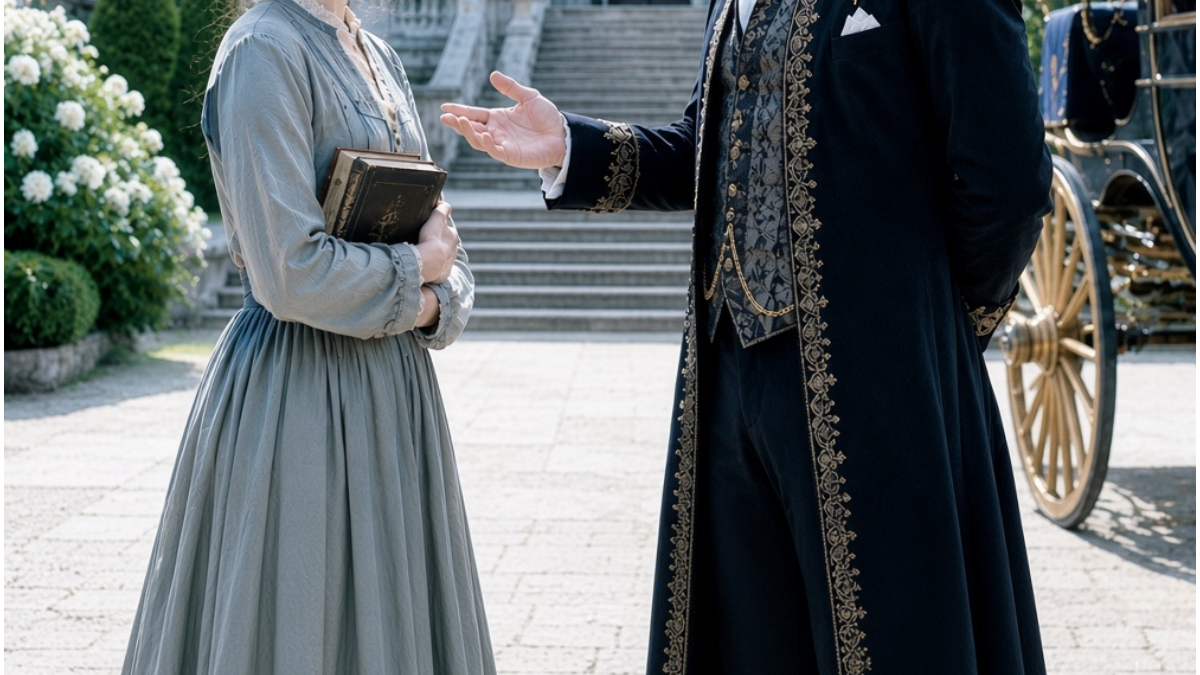
It wasn’t a proposal of love. It was a transaction drafted over cold tea and a dying fire.
He sat across from her, a duke with too much wealth and two boys he couldn’t control.
She sat shivering in a damp wool coat, a teacher with three pennies to her name.
“I need a mother for my sons,” he said, his voice flat. “And you need a roof.”
She didn’t blush. She just asked. Do I get my own fire? Emily’s right boot had a hole in the soul.
It wasn’t a new hole, but the relentless November reign of Yorkshire had turned it from a minor inconvenience into a slow, freezing torture.
With every step she took up the seemingly endless gravel drive of Highfield Manor, icy mud seeped into her wool stocking.
She was 26 years old. She had no family, no references, and exactly four shillings tied in a handkerchief deep in her pocket.
Two hours ago she had been the primary instructor of geography and French at Mrs. Gable’s school for young ladies.
Then she had caught the head mistress’s nephew rifling through the meager school funds. She had slapped his hand.
He had cried assault. Emily was given 10 minutes to pack her single trunk and thrown out into the storm.
There was no justice in poverty. Emily had learned that lesson at 16. She did not cry.
Crying burned energy and she was already hungry. Instead, she had walked to the local tavern, paid a penny for a lukewarm cup of cider, and read a discarded newspaper left on a sticky table.
Wanted a governness of strict moral character and unyielding constitution for two boys. Apply in person to the Duke of Rothford, Highfield Manor.
Unyielding constitution that usually meant the children were feral. Emily didn’t care if they bit.
She just needed a dry bed. The manor loomed out of the gray mist like a fortress of dark stone and sheer glass.
It was offensively large. Emily dragged her soden skirts up the wide marble steps and struck the heavy brass knocker.
A butler opened the door. His eyes, cold and practiced, swept over her dripping bonnet, her frayed cuffs, and the puddle forming around her boots.
Deliveries are at the rear, he said, beginning to shut the heavy oak door. Emily planted her muddy, ruined boot squarely in the door jamb.
The butler paused, affronted by the sheer audacity of the scuffed leather against his pristine threshold.
“I am not a delivery,” Emily said, keeping her voice entirely level. “I am here for the advertisement.”
The governor’s position. His graces not receiving callers, a crash echoed from somewhere deep within the cavernous house.
It sounded like porcelain, expensive porcelain. Following the crash came a high, thin scream, and then the heavy thud of running footsteps.
The butler closed his eyes, a muscle feathered in his jaw. Let her in, Hastings.
The voice came from the shadows of the grand hall. A man stepped forward. He did not look like a duke.
He looked like a man who had not slept in three days. He wore no crevat.
His collar was unbuttoned, and his dark hair looked as though he had been running his hands through it for hours.
He was tall, broadshouldered, and gripped a glass of amber liquid in his right hand.
William, the Duke of Rothford, stared at the dripping woman on his threshold. His eyes were a startling pale gray, surrounded by bruised, exhausted skin.
You’re here for the boys? He asked. I am. Emily stepped inside. She She did not apologize for the mud.
You look like a drowned rat. And you look like a man who just lost a Ming vase,” Emily replied.
Hastings the butler gasped quietly. William just blinked. Then a slow, humilous bark of laughter scraped from his throat.
“Savers, actually,” William said. He drained the glass. “Come into my study. Don’t worry about the floors.
Everything in this house is already ruined.” Emily followed him. The house was enormous, drafty, and echoing with an empty, hollow sort of wealth.
Gold frames held grim-faced ancestors. Silk wallpapers looked faded in the dim light. It smelled of beeswax, stale wood smoke, and neglect.
The study was warmer. A massive fire blazed in the hearth. Emily fought the immediate animal urge to walk straight to the flames and press her hands against the iron grate.
Instead, she stood perfectly still in the center of the Persian rug. William sat behind a massive mahogany desk, slouching back into the leather chair.
He studied her. She stared back. She noted the fine cut of his coat, the heavy gold signate ring on his finger, and the sheer overwhelming exhaustion radiating from him.
I have had six governances in 8 months, William said bluntly. The last one left this morning in a hired carriage, weeping uncontrollably.
My sons are not sweet. They are not mischievous. They are a terror. Edward is nine and angry.
James is six and does not speak. He merely destroys. Do you have experience with difficult children, Miss Hayes?
Emily Hayes. She kept her chin up. And yes, I have taught the spoiled daughters of minor nobility for 5 years.
I assure you, your grace, I have faced down tantrums that would curdle milk. Your sons do not frighten me.
Everything frightens a sane woman about my sons, William muttered. He rubbed his temples. Where are your references?
I have none. I was dismissed from my previous post this afternoon for slapping a thief who happened to be related to my employer.
Emily watched his face. If he was going to throw her out, she wanted to know now.
Before her coat started to dry, William stopped rubbing his temples. He looked up at her, really looking this time.
He saw the frayed edges of her sleeves. He saw the slight tremble in her hands that she was trying desperately to hide.
He saw the sheer unadulterated desperation masked by a wall of icy pride. “You’re penniless,” he stated.
“I am highly motivated,” she corrected. Upstairs, another crash sounded. This time it was followed by a woman’s frantic voice.
Shouting, “Lord Edward, put that fire poker down this instant.” William didn’t flinch. He just stared at the ceiling.
“I need a governness, Miss Hayes,” he said quietly. “A governness can quit. A governness can run away.
I need something far more permanent,” Emily frowned. The water from her bonnet dripped onto the bridge of her nose, but she didn’t wipe it away.
I am not looking for a position as a maid, your grace. I am a teacher,” William stood.
He walked over to a heavy crystal decanter on a side table and poured himself another measure of liquor.
He offered the glass toward her. She shook her head. He drank it himself. “My late wife died four years ago,” William said.
He didn’t say it with the breathless reverence of a grieving widowerower. He said it like a man stating a fact of a court record.
Since then, my aunt, the daage account of Marus, has taken it upon herself to rescue my children.
She petitions the courts. She sends inspectors. She claims my household is unfit, my mind is unspooled by grief, and my sons are degenerating into wild animals.
He turned to face Emily, leaning his hip against the edge of the desk. If she succeeds, she will take my sons to London.
She will beat the spirit out of Edward, and she will likely institutionalize James. I will not allow it.
Emily Remained silent. She was listening, calculating. What does this have to do with me requiring a job?
Because my aunt’s primary argument is that a house without a mother is no place for the heirs of a dukedom.
She demands I remarry. She parades society debutants through my drawing room. Women who care only for the title and the tiaras.
Women who look at my boys with thinly veiled disguSt. William walked slowly toward her.
He was tall, casting a long shadow in the fire light. “I need a wife,” he said.
The silence in the room was absolute, broken only by the crackle of the logs.
Emily felt the absurdity of the moment hit her like a physical blow. She let out a short, dry breath.
“You are mad. I am entirely pragmatic,” William counted. “You need a home. You need food, a fire, and security.
You have no family to object, no romantic illusions to be crushed, and a spine stiff enough to deal with a thief.
I need a woman who will bear my name, manage my household, and act as a mother to my boys, so the courts will leave me in peace.
You don’t know me. I could be an axe murderer, are you? No. Then you are already an improvement over Lady Genevieve, whom my aunt brought by yesterday,” William said dryly.
Emily pulled off her wet gloves, finger by agonizing finger. Her hands were red and raw.
“You want to buy a mother for your children? You want a human shield against your relatives?”
“Precisely,” William moved back to his desk and pulled out a sheet of thick cream colored paper.
He picked up a quill. Let us be clear, Miss Hayes. I have no interest in romance.
I have no interest in a marital bed. We would sleep in separate wings. You would have an allowance of £2,000 a year, yours to do with as you please.
You would have absolute authority over the boy’s education and the running of the house.
In return, you will not leave. You will not quit when Edward screams or James breaks the china.
You will stay and you will make them respectable. Emily stared at the fire. £2,000 a year.
It was a sum so large she couldn’t properly visualize it. It meant never washing a floor on her hands and knees again.
It meant never smiling at a cruel matron just to secure a crust of bread.
It meant thick wool blankets, heavy velvet curtains, and meat every day of the week.
But it also meant being chained to this drafty tomb, legally bound to a cold, exhausted man, and two children who sounded like demons.
She thought of the hole in her boot. She thought of the freezing wind outside.
“They are your children,” Emily said quietly. Do you not love them? William’s hand, holding the quill, stopped.
His knuckles turned white. For a fraction of a second, the aristocratic mask slipped, and Emily saw a well of terror and inadequacy, so deep it made her own stomach pitch.
I don’t know how, he whispered. The admission cost him dearly. His voice grew hard again.
They look at me and they see a failure. I look at them and see everything I cannot fix.
I am providing for them the only way I know how. By buying them someone who won’t break.
Emily looked at this powerful broken man. She didn’t feel pity. Pity was useless. She felt a profound sense of recognition.
They were both entirely out of options. “I want it in writing,” Emily said. William looked up startled.
“The autonomy,” she clarified, stepping closer to the desk. “I will not be countermanded by you in front of the children.
If I set a rule, you uphold it. If I fire a servant, they stay fired.
And I want £50 advance to me tonight so I can send someone to town to buy me clothing that does not smell of wet dog.”
A slow, genuine smile, small but undeniable, touched the corners of William’s mouth. It changed his his face entirely, shaving years off his exhausted features.
“Deal,” he said. He dipped the quill in the inkwell and began to write. Emily stood by the fire, the heat finally seeping into her frozen skin.
She was going to be a duchess. It was the most ridiculous, cynical thing she had ever done, and she didn’t regret it for a second.
They were married 3 days later by special license in the estate’s private chapel. Emily wore a deep green velvet dress purchased with the Duke’s advance that fit her perfectly and felt like armor.
William wore black. The vicer spoke the vows quickly, nervously eyeing the door as if expecting it to be kicked open.
There were no flowers. There was no kiss. William simply nodded to her, signed the registry, and went to his study to meet with his estate manager.
Emily was a wife, a duchess. She felt exactly the same, only vastly warmer. That afternoon, she requested the boys be brought to the small parlor.
She sat in a straightbacked chair, her hands folded in her lap, waiting. The heavy doors opened.
Hastings ushered two boys into the room. Edward, the 9-year-old, was a miniature version of his father, though lacking any of William’s restraint.
His dark hair was messy, his jaw set in a jutting line of pure defiance.
His clothes were rumpled, the knees of his trousers stained with grass. Behind him, clinging to the heavy oak doorframe, was James.
The six-year-old was pale, painfully thin with huge, terrified gray eyes. He stared at the carpet, refusing to look up.
“Well,” Edward demanded, crossing his arMs. He didn’t bow. He didn’t offer a greeting. He looked at Emily like she was a stain on the upholstery.
Are you the new governness? You won’t laSt. The last one cried when I put a toad in her work basket.
I have a snake for you. Emily did not blink. I am not the governor, said Edward.
Then what are you? I am your stepmother. Edward froze. The defiance cracked for a second, replaced by sheer shock, before hardening into something much uglier.
No, you aren’t. My father wouldn’t marry you. You look plain. I am plain, Emily agreed easily.
I am also practically minded. Your father and I have an agreement. I manage this house and I manage you.
The days of terrorizing the staff are over. Edward sneered. He walked over to a delicate side table that held a porcelain shepherdus.
It was the only fragile thing left in the room. He looked Emily dead in the eye, raised his hand, and deliberately pushed the figurine off the edge.
It shattered against the hearthstone with a sharp crack. James flinched violently, covering his ears and pressing himself against the wall.
Edward stood tall, waiting for the screaming. Waiting for the red face, the tears, the frantic scolding that every other woman had given him.
He was ready for the fight. Emily didn’t move. She looked calmly at the broken pieces, then back at Edward.
“Hastings,” she called out. The butler, who had been hovering nervously in the hall, stepped in.
“Yes, your grace. Lord Edward has had an accident with the porcelain. Please fetch a dustpan and brush.”
At once your grace. No, Emily corrected smoothly. Do not sweep it up yourself. Give the tools to Edward.
He made the mess. He will clean it. Edward’s mouth dropped open. I will not.
I am a lord. You are a boy who dropped a doll on the floor.
Emily said, her voice dropping to a low, quiet register that cut through the room like a blade.
Lords clean up their own messes. If they do not, they do not eat dinner.
It is a very simple mathematical equation, Edward. Effort equals reward. My father will fire you, Edward shouted, his cheeks flushing red.
He cannot. We are married. Legally, I am stuck here until one of us dies, and I assure you, my constitution is excellent.
Emily leaned forward, resting her elbows on her knees, bringing herself closer to his eye level.
You can scream, you can throw things, you can hate me, but you will clean up the porcelain, or you will go to bed hungry.
Edward stared at her.” She didn’t look angry. She just looked incredibly bored by his tantrum.
It was maddening. He looked at the shattered ceramic, then at Hastings, who stood holding a small broom and pan, looking deeply uncomfortable.
With a furious cry of frustration, Edward snatched the broom from the butler. He dropped to his knees and began sweeping the shards violently, muttering dark, violent curses under his breath.
Emily ignored him. She turned her attention to the corner of the room. James was still pressed against the wall, his hands over his ears, his breathing shallow and rapid.
Emily did not walk toward him. She knew better than to corner a frightened animal.
Instead, she stood up slowly, walked over to a silver tray on the sideboard, and picked up a small sugar dusted biscuit.
She walked halfway across the room, stopped, and placed the biscuit on the edge of a low foot stool.
Then she walked back to her chair and sat down, picking up a book left on the side table.
She didn’t say a word to James. She didn’t demand he speak. She simply offered an olive branch and gave him the space to take it.
10 minutes passed. The room was silent except for the scrape of Edward’s broom and the ticking clock.
Slowly, agonizingly, James lowered his hands. He crept away from the wall. He kept his eyes fixed on Emily, but she was reading.
Turning a page without looking at him. James reached the foottool. His small pale hand darted out.
He snatched the biscuit and retreated back to the safety of the heavy velvet curtains.
Chewing quietly in the dark. From the doorway, hidden in the shadows of the hall, William watched.
He had come down expecting screaming. He had expected to find his new wife in tears, demanding an anulment.
Instead, he found his eldest son cleaning a floor, his youngest son eating quietly, and Emily Hayes turning the page of a book, ruling his chaotic household without raising her voice.
William leaned back against the wall, letting out a long, slow breath. For the first time in four years.
As the crushing weight in his chest felt a fraction lighter, November bled into a bitterly cold December.
Highfield Manor did not warm with the season. It merely froze in place. Frost climbed the tall mullion windows, thick and opaque, sealing the house away from the moors.
Inside a quiet, relentless war was being waged. Edward didn’t surrender. He possessed a vicious stamina for rebellion that Emily, had she not been the target, might have admired.
He replaced her chalk with sticks of white wax, so they slid uselessly across the slate.
He hid her boots. He filled her inkwell with vinegar. Emily never raised her voice.
When the chalk didn’t write, she conducted the history lesson entirely orally, pacing the floor and demanding he recite the lineage of the plantaginets until his throat was dry.
When her boots vanished, she walked the freezing stone corridors in her stocking feet without a single complaint, forcing him to watch her discomfort until his own guilt made him anonymously return them to her door.
When she poured vinegar onto her paper, she calmly blotted it, looked him in the eye, and assigned him an essay on the chemical properties of acetic acid.
She was a stone wall. Edward was throwing himself against her over and over, and only bruising his own shoulders.
James, conversely, remained a ghoSt. He haunted the edges of the rooms, watching his brother’s futile war with wide, silent eyes.
Emily continued her strategy of passive inclusion. She left an extra teacup on the table.
She left a book of botanical illustrations open on the rug near the window where he liked to hide.
She never asked him to look at it. She never demanded he speak. But every evening the book was open to a different page.
William observed it all from a distance. They shared dinner together. A bizarre pantomime of a marriage played out across 20 feet of polished mahogany.
Hastings would serve the soup. The footman would retreat to the edges of the room.
The silence would stretch, thick and heavy, punctuated only by the clinking of silver against porcelain.
“He put a dead frog in your sewing basket today,” William said one evening, cutting into his roast mutton.
He didn’t look up. He did, Emily replied. She took a sip of her wine.
A rather large bullfrog. I was impressed he managed to catch it in this froSt. Did you scream?
I dissected it. William’s knife paused against his plate. He finally looked down the length of the table.
Emily’s expression was perfectly placid. She was wearing a dark blue wool dress, her dark hair pinned back severely, looking every inch the strict governness, and nothing like a duchess.
“You dissected it,” William repeated flatly. “I had requested a set of anatomical diagrams from your library yesterday, but a practical demonstration is always superior.”
I laid it out on the workt, handed Edward a scalpel, and had him identify the respiratory organs.
He turned quite green. Emily carefully cut a piece of potato. He excused himself before we reached the intestines.
I do not believe he will be putting amphibians in my belongings again. A sharp, sudden sound escaped William.
It took Emily a second to realize it was a laugh. A rusted, unused sound that surprised him as much as it did her.
He covered his mouth with his napkin, his shoulders shaking slightly. Emily watched him. When he laughed, the heavy lines of exhaustion around his eyes softened.
For a fleeting moment, she saw the man he must have been before his wife died, before the grief and the panic had hollowed him out.
He was handsome, dangerously so. He caught her looking. The amusement faded, replaced by a guarded caution.
He cleared his throat. You are a formidable woman, Emily. It was the first time he had used her Christian name.
It hung in the air between them, intimate and entirely out of place in the cavernous dining room.
I am a pragmatic one, William, she counted smoothly, using his name in return. If they were to be partners in this strange enterprise, she would not cower behind titles.
Edward is entirely motivated by a desire for control. He acts out because it guarantees a predictable reaction.
He causes chaos. The adults panic. He feels powerful. I simply refuse to give him the reaction he expects.
William set his fork down. The levity was gone, replaced by the familiar heavy fatigue.
And James, Emily’s gaze softened. James has no desire for control. He has a desire for safety.
The world was loud and unpredictable, and it hurt him. So, he retreated inward. He will come out when he trusts that the ground will not collapse beneath his feet.
You cannot pull him out. You can only leave the door open. William stared at his half empty glass of wine.
I tried to pull him out, he confessed, his voice dropping to a low murmur.
After Caroline died, I was terrified. I yelled. I forced him to sit at the table.
I demanded he speak. I think I broke him further. It was a staggering admission.
Dukes did not confess failure. Men like William did not bear their throats. Emily did not offer him platitudes.
She didn’t tell him he was a good father or that it wasn’t his fault.
That would be a lie. And they both knew it. Instead, she offered him the only thing that mattered.
A path forward. “You panicked,” Emily said evenly. “It is a human response to a terrifying situation.
You cannot undo the last four years. But you can stop pulling him now. You can sit in the quiet with him.
William looked at her. Really looked at her. She wasn’t wearing jewels. She wasn’t smiling.
A coetish smile. She was sitting in his drafty dining room, eating his tepid mutton, analyzing his traumatized children with the cool, steady precision of a general mapping a battlefield.
£2,000 a year, William said quietly. Was entirely too cheap. The fragile equilibrium they had established shattered on a Tuesday.
Emily was in the library with Edward, forcing him to conjugate Latin verbs, when the heavy oak doors of the manor flew open with a bang that echoed all the way up the grand staircase.
Following the bang came a voice shrill enough to curdle blood. Where is he? Where is my nephew?
I demand to see him this instant. Emily set down her book. Edward froze, his eyes widening in genuine terror.
Grand aunt Augusta, Edward whispered. Emily had never seen the boy look afraid. Angry, yes, vengeful, frequently, but this was visceral physical fear.
He shrank back into his chair, pulling his knees to his cheSt. Stay here, Emily commanded.
She stood smoothing the skirts of her charcoal gray morning dress. She walked out to the grand hall.
Standing amidst a pile of leather trunks was the Daaja Countess of Marus. She was a small woman, brittle and sharp as broken glass, wrapped in layers of expensive black silk and heavy mink.
She was currently proddding Hastings the butler in the chest with a silver tipped walking stick.
I hear he has lost his mind entirely. Married a woman off the street. Where is this impostor?
Augusta barked. I am right here, Lady Augusta, Emily said quietly from the top of the stairs.
The daagger’s head snapped up, her dark eyes buried in a web of wrinkles swept over Emily with absolute unapologetic disguSt. She took in Emily’s plain dress, her lack of jewelry, the simple braid in her hair.
Good God, Augusta sneered. You look like a parlorade. William has truly gone mad. Emily descended the stairs slowly, her hand trailing lightly on the banister.
She reached the bottom and stopped a polite distance away. She did not curtsy. She was legally a duchess.
She outranked the old bat. His grace is currently reviewing tenant leases with his steward, Emily said, her voice perfectly level.
May I offer you tea after your journey, or will you be turning around immediately?
Augusta let out a sharp hiss of breath, you insolent little tart. Do you know who I am?
You are William’s aunt, and you are standing in my hallway, dripping snow onto my rug.
Emily gestured to the parlor. Hastings, please bring a tea service to the green room.
Her ladyship is cold. Before Augusta could mount another verbal assault, Emily turned and walked into the parlor.
Augusta, furious but possessing the ingrained reflexes of polite society, followed her. The daager didn’t sit.
She paced the length of the room, her cane striking the floorboards. I know what you are.
A penniless opportunist who saw a broken wealthy man and dug her claws in. I have petitioned the House of Lords.
I have spoken to the magistrates. This marriage is a farce and I will have it anulled.
I am taking those boys to London where they can be properly civilized. You are taking no one, Emily said, taking a seat by the fire and adjusting her cuffs.
They are feral beasts. Edward is a violent thug and James is an imbecile. They need discipline.
They need a heavy hand, not some jumped up school teacher playing at nobility. The door to the parlor creaked open.
Edward stood in the doorway. He looked pale, his fists clenched at his sides. He had heard everything.
Augusta stopped pacing. She glared at the boy. Look at you. Dirt under your fingernails, hair like a street urchin.
Stand up straight, boy, when I look at you.” Edward flinched, taking a step backward.
The defiance he showed Emily was entirely gone, crushed under the weight of the old woman’s cruelty.
Emily felt a sudden, fierce spike of absolute rage. It tasted like copper in her mouth.
She stood up. She did not rush. She walked deliberately across the room and positioned herself directly between Edward and the Daajer countess.
She blocked the old woman’s line of sight completely. “You will not speak to my son in that tone,” Emily said.
Her voice wasn’t loud, but it possessed a dense, heavy gravity that made the air in the room feel suddenly thin.
Augusta laughed, a harsh, grating sound. Your son. You have been here a month. You are nothing to him.
I am the Duchess of Rothford. I am the mistress of this house. And I am telling you that if you insult these children again, I will have Hastings throw your trunks into the snow and you can walk back to London.
You wouldn’t dare. Try me, Emily whispered. She stepped closer. She was taller than Augusta, and she used every inch of her height, staring down into the woman’s furious eyes with the cold, dead gaze of a woman who had survived entirely on her own ruthlessness.
I have starved, Lady Augusta. I have frozen. I have fought grown men for wages owed to me.
Your titles and your pearls do not frighten me. You are a bitter, cruel old woman who wants to control these boys because you have nothing else to manage.
You will not touch them. Silence stretched tight as a wire. Behind Emily, a small hand reached out and gripped the fabric of her skirt.
Edward. He was hiding behind her, using her as a shield. Emily didn’t look down, but she shifted her stance slightly, widening her posture to cover him completely.
Is there a problem here? William stood in the doorway. He looked from his aunt’s red, furious face to Emily’s rigid back to the small hand gripping her skirt.
“William!” Augusta shrieked, finding her target. “This this creature is threatening to throw me out.
Have you lost your senses?” Annel this travesty immediately and let me take the boys.
She is clearly unhinged.” William walked into the room. He didn’t look exhausted today. He looked dangerous.
He walked past his aunt, entirely ignoring her, and stopped beside Emily. He looked down at Edward, then up at his wife.
He reached out and placed his hand on the small of Emily’s back. It was a firm, heavy, entirely unyielding pressure, a public demolition of unity.
“My wife,” William said, his voice deadly quiet. “Speaks for this house. If she says you are leaving, Augusta, then I suggest you tell your driver not to unhitch the horses.”
Augusta gaped at him, the color drained from her face. She looked at the three of them.
The Duke, the penniles teacher, and the broken boy standing together in a solid, impenetrable line.
“You will regret this,” she spat, turning on her heel. “You will ruin them, William.
Just like you ruined Carolyn.” She swept out of the room. A minute later, the front door slammed shut.
The silence in the parlor was deafening. William’s hand fell away from Emily’s back. Edward let go of her skirt and took a quick step backward, swiping furiously at his eyes, embarrassed by his own display of weakness.
He looked at Emily. He didn’t say thank you. He didn’t hug her. But the sneer was gone.
The open hostility had vanished, replaced by a confused, weary respect. She interrupted my Latin,” Edward muttered, looking at the floor.
“Then we had best get back to it,” Emily replied smoothly, acting as if her heart wasn’t hammering against her ribs.
“The verbs will not conjugate themselves.” Edward nodded once, sharply, and ran back toward the library.
Emily let out a long, shaky breath, her knees suddenly feeling weak. She turned to find William watching her.
His pale gray eyes were stripped of their usual distance. They were burning with an intensity she had never seen before.
He called her a creature, William said softly. “I have been called worse by better people.”
William took a step closer to her. He didn’t touch her, but the proximity felt electric.
“Thank you.” Emily looked up at him. She saw the relief, the gratitude, and something deeper, something far more complicated taking root in the space between them.
“They are my responsibility, William,” she said softly. “I protect what is mine. The storm hit 3 days before Christmas.
It was a vicious howling gale that tore across the Yorkshire moors, rattling the window panes of Highfield Manor and plunging the massive stone house into freezing darkness.
Emily lay awake in her bed in the east wing, wrapped in three wool blankets, listening to the wind shriek down the chimneys.
It sounded like a dying animal. She wasn’t asleep when the screaming started. It was a thin, ragged sound that pierced through the roar of the storm.
It came from the floor above the nursery. Emily was out of bed before she had a conscious thought.
She didn’t bother with a robe or slippers. She grabbed the single brass candlestick from her nightstand and ran barefoot into the freezing stone corridor.
Her linen night gown whipped around her ankles as she took the stairs two at a time.
She threw open the door to the nursery. The room was pitch black. A branch from the old oak tree outside was scraping violently against the glass, casting monstrous, shifting shadows across the walls in the dim moonlight.
In the corner of the room, jammed into the narrow space between the heavy oak wardrobe and the wall, was James.
He was curled into a tight ball, his hands clamped over his ears, screaming. It wasn’t a tantrum.
It was the raw, unadulterated sound of sheer terror. He was trapped in a memory, completely detached from reality.
Edward was sitting up in his own bed across the room, watching his brother with helpless, wide eyes.
Emily set the candle down on a dresser. She approached the corner slowly. She didn’t reach out to grab James.
She knew if she touched him now while he was lost in the panic, he would only fight her.
She sank to the floor, her bare knees hitting the icy floorboards. “James,” she said.
Her voice was low, rhythmic, projecting a calm she did not feel. “James, it is Emily.
You are in your room. It is just the wind.” He didn’t hear her. He kept screaming.
His small body trembling so violently his teeth chattered. Footsteps pounded down the hall. William appeared in the doorway, wearing loose trousers and an unbuttoned shirt, his chest heaving.
He looked wildly around the room, his eyes landing on his youngest son. The old panic flared in his face.
He took a step forward, his hands reaching out. Emily threw her arm back, palm open, stopping him.
Don’t, her gesture commanded. William froze. Emily turned back to the boy. The screaming wasn’t stopping.
He was hyperventilating, choking on his own breath. She had to ground him. She didn’t try to pull him out of the corner.
Instead, she slid herself into the narrow space with him. She squeezed between the heavy wardrobe and the plaster wall, boxing herself in.
She crossed her legs, leaning her back against the wardrobe, right next to him. She didn’t look at him.
She looked straight ahead at the far wall, and then slowly she began to hum.
It wasn’t a lullabi. It was an old sailor’s shanty she had heard in a tavern in Plymouth when she was a child.
It had a deep, steady, rhythmic baseline. It wasn’t sweet. It was heavy and grounded, a sound that demanded attention.
She kept humming. She placed her open hand flat on the floorboards between them, palm up, an invitation.
Nothing more. The wind howled, shaking the glass. Emily kept humming, letting the vibration of the sound fill the small, dark space.
5 minutes passed. The screaming turned into ragged gasps. James lowered his head, pressing his face into his knees.
He was exhausted, his body entirely spent. Emily didn’t stop. She maintained the rhythm, steady, unbreaking.
Slowly, James uncurled one arm. He reached out in the dark. His small, freezing fingers brushed against the palm of her hand.
Emily didn’t flinch. She didn’t try to hold his hand. She simply let him find the contact he needed.
He gripped her fingers tightly. He shifted his weight, leaning his small, shaking shoulder against her side.
Emily stopped humming. She rested her head against the wood of the wardrobe. “You are safe,” she whispered into the dark.
James let out a long, shuddering sigh. He didn’t speak. He had not spoken in 4 years, but he didn’t pull away.
He stayed pressed against her, anchoring himself to her steady presence while the storm raged outside.
From the doorway, William watched, the breath caught in his throat, tight and painful. He had tried to fix his son with doctors, with discipline, with desperation.
He had tried to buy a mother to do the job for him, but watching Emily sitting on the freezing floor, shivering in her thin night gown, her hand patiently offering a lifeline in the dark, William realized the terrifying truth.
This was not a transaction anymore. When James finally fell into an exhausted sleep, Emily gently extricated herself from the corner.
She lifted the boy, surprisingly heavy in his slumber, and carried him to his bed.
She pulled the thick quilts up to his chin. She walked over to Edward’s bed and smoothed his blanket, offering the older boy a reassuring nod.
Edward nodded back, rolling over and closing his eyes. Emily picked up the candlestick and walked out into the hall.
William was leaning against the stone wall, waiting for her. He looked completely wrecked. Emily stood before him.
The adrenaline was fading, leaving her violently cold. She wrapped her arms around her chest, her teeth beginning to chatter.
William looked at her bare feet, her shivering frame. Without a word, he stripped off his heavy wool shirt.
He stepped forward and draped it over her shoulders. The fabric was rough, smelling of cedar and the warm, clean scent of his skin.
The heat of it was instantaneous. Emily looked up at him. They were standing inches apart in the dark, silent corridor.
“You are freezing,” he murmured, his voice rough. “It is December in Yorkshire,” she replied, pulling the collar of his shirt tighter around her neck.
It is expected. William reached out. It was a hesitant movement, entirely unlike his usual decisive authority.
He brushed a stray lock of dark hair away from her face, his knuckles grazing her cold cheek.
The touch sent a sudden sharp shock down her spine. “I thought I was buying a shield,” William said, his eyes tracing the lines of her face in the flickering candle light.
A warden for my house? You did, Emily said, though her voice lacked its usual iron certainty.
It sounded breathless. No. William stepped closer, closing the final inch of distance between them, the heat radiating from his chest cut through the chill of the hallway.
A warden guards the doors. You sat in the dark with him. You fought my aunt for Edward.
You are bleeding for a family that is not yours. We made a bargain, William.
She tried to sound pragmatic. She tried to cling to the cynical reality that had kept her alive for 26 years.
To hell with the bargain. His hand moved from her cheek to cup the back of her neck.
His thumb stroked the pulse point beneath her jaw. I don’t want a warden anymore, Emily.
I want my wife. He didn’t ask for permission, but he didn’t rush her. He waited a fraction of a second, offering her the space to step away.
Emily didn’t step away. She leaned into the warmth of his hand. William lowered his head and kissed her.
It wasn’t a gentle, romantic kiss. It was desperate. It was the clash of two people who had been surviving alone for far too long, finally finding somewhere to lay their burdens down.
Emily kissed him back, dropping the candle. It hit the stone floor, extinguishing instantly, plunging them into absolute darkness.
She didn’t care. She buried her hands in his hair, anchoring herself against his chest as the storm howled outside, realizing with a sudden, terrifying clarity that the ice around her own heart had finally cracked.
The morning after the storm, Highfield Manor was blindingly bright. The gale had blown away the heavy clouds, leaving a crisp, pale winter sun reflecting off the snow drifts.
Emily stood by the window in her bed chamber. She was entirely dressed in her practical gray wool, her hair pinned back in its severe style.
But draped across the foot of her bed, smelling sharply of cedar and smoke, was William’s linen shirt.
She had not slept. She had lain awake, staring at the canopy, her lips still burning from the desperate, crushing weight of his kiss.
She had survived her entire adult life by calculating risks. Kissing the Duke of Rothford was not a risk.
It was a surrender. She did not know how to surrender. A knock sounded at her door.
“Enter,” Emily said, her voice steady. Hastings opened the heavy oak door. He did not look at the shirt on the bed.
He looked firmly at the wall just left of Emily’s head. His grace requests your presence in the breakfast room.
Your grace.” Emily nodded. She smoothed her skirts and walked down the grand staircase. The breakfast room was warmer than usual.
The fire was blazing, and the long mahogany table had been abandoned. Instead, a small circular table had been pulled near the hearth.
William was already seated. He wore a dark blue coat, his creat tied with crisp precision.
He looked rested. He looked commanding. He looked up the moment she walked in, his pale gray eyes tracking her every movement.
“Emily,” he said. He stood. He did not pull out her chair. He wasn’t a man for empty chivalry.
But he waited until she sat before taking his own seat. “William.” She reached for the silver teapot.
Her hand, usually so steady, betrayed a minuscule tremor. She gripped the handle tighter, he noticed.
He noticed everything about her now. We need to discuss the contract, William said abruptly.
He didn’t bother with small talk about the weather, Emily poured the tea carefully. Which clause?
The allowance or the living arrangements? Laws that stated we would exist as strangers in a boarding house,” he replied smoothly.
He reached across the small table and took the teapot from her hands, setting it down.
He didn’t let go of her hand. His fingers were warm, his calluses rough against her knuckles.
I broke our agreement last night. Emily looked at his hand covering hers. She could pull away.
She could reestablish the boundary. But she thought of the dark hallway, the howl of the wind, and the absolute safety she had felt pressed against his cheSt. “You did?”
Emily agreed softly. She finally looked up, meeting his gaze squarely. “Are you apologizing?” “No.”
William’s thumb brushed the back of her hand. “I am telling you that I have no intention of returning to the opposite end of this house.
I don’t want a business arrangement, Emily. I want my wife in every sense. He he laid it bare.
No poetry, no flowery demolitions of sudden, overwhelming passion. Just a blunt, undeniable statement of fact.
It was the most romantic thing she had ever heard. Emily took a breath. I have never been a wife.
I only know how to be a teacher. Teach me then,” William said quietly. “Teach me how to live in this house without suffocating.”
A loud clatter from the doorway shattered the moment. Edward stood there, his hair entirely unccombed, holding a thick slice of bread and jam.
He stared at his father’s hand, resting over Emily’s, his eyes darted between their faces.
Emily smoothly withdrew her hand, picking up her teacup. Good morning, Edward. You are late.
The jam goes on the plate, not the carpet. Edward blinked, looking down at a small red dollop that had missed his bread.
He quickly wiped it up with his shoe, then looked back at them. The defiance was entirely gone.
In its place was a sharp, calculating curiosity. “Are you are you fighting?” Edward asked suspiciously.
No, William said, leaning back in his chair. He looked at his eldest son, rarely looked at him without the usual filter of grief and frustration.
We are negotiating. Behind Edward, a small figure slipped into the room. James walked silently to the table.
He didn’t look at his father. He walked straight to Emily, pulled out the chair directly next to hers, and sat down.
He reached out and tugged lightly on her gray wool sleeve. Emily looked down. She didn’t speak.
She just picked up a plain biscuit from the tray and placed it on his plate.
James took it. Then, very deliberately, he picked up a second biscuit and pushed it across the table toward his father.
William froze. He stared at the dry, crumbly biscuit resting near his teacup as if it were a brick of solid gold.
He slowly raised his eyes to Emily. His throat worked silently. Emily offered him a small, rare smile.
“Eat it, William,” [clears throat] she murmured. “It’s a peace offering.” William picked up the biscuit.
His hand was shaking. He took a bite, chewing the dry dough as if it were a feaSt. Spring arrived in Yorkshire, not with a gentle thaw, but with a sudden, violent burst of green.
The mud dried. The moors turned a vivid, bruising purple with heather, and the local aristocracy, bored after a long winter, emerged to pass judgment.
Lord and Lady Harrington hosted a lawn party in late May. It was ostensibly to celebrate the blooming of their legendary rose gardens.
But everyone in the county knew its true purpose, to inspect the Duke of Rothford’s bizarre lowborn bride.
Emily stood in front of the fulllength mirror in her bed chamber. She was not wearing gray.
William had sent to London for a dress maker, entirely bypassing her protests. She wore a gown of deep, rich sapphire silk.
It had no ruffles, no excessive lace, and no ridiculous bows. It was stark, elegant, and cut to fit her like a second skin.
William stepped into the room behind her. He wore a charcoal coat and a silver crevat.
He walked up behind her, his eyes meeting hers in the mirror. He reached into his pocket and pulled out a long, heavy velvet box.
No, Emily said immediately. I will not wear the family diamonds. They will think I married you for the vault.
They will think what they wish, William replied, opening the box. Inside lay a staggering necklace of sapphires and diamonds.
But they will know exactly who you belong to. He didn’t wait for her permission.
He stepped closer, sweeping her hair over her shoulder. The cold metal settled against her collarbone.
His fingers brushed the nape of her neck as he fastened the clasp, sending a sharp shiver down her spine.
He pressed a warm, firm kiss to her bare shoulder. “You look like a duchess,” he murmured against her skin.
“I look like a teacher wearing stolen property,” Emily counted, though she leaned back against his cheSt. “Let them try to take it back.”
When they arrived at the Harrington estate, the silence that fell over the terrace was absolute.
Dozens of aristocrats holding crystal glasses of champagne stopped talking simultaneously. Emily did not flinch.
She placed her hand on William’s forearm, feeling the rigid, coiled tension in his muscles, and walked down the stone steps.
Edward and James followed closely behind. Edward wore a scaled down version of his father’s coat, his chin jutting out aggressively.
James held the hem of Edward’s jacket, his eyes glued to the ground, but he was walking under the open sky among strangers.
A massive victory. Lady Harrington, a woman who looked as though she had been sucking on lemons, approached them with a brittle smile.
Your grace,” she said, nodding to William before turning her calculating gaze to Emily and the new duchess.
“We were so surprised to hear of the hasty nuptials. We understand you were previously employed in the educational sector.”
The word employed was pronounced as though it were a disease. Emily offered a smile so perfectly polite it was practically a weapon.
I was indeed, Lady Harrington. I taught geography and history. A vital pursuit, considering how few people seem to know where their boundaries lie.
A nearby lord snorted into his champagne. Lady Harrington’s smile tightened. How quaint, she replied.
Though one wonders how such a background prepares one for the immense duties of running a ducal household, or managing children of complicated temperaments.
She cast a pointed look at James, who shrank behind Edward’s leg. William’s jaw clenched.
He opened his mouth, the wroth of a protective father and husband, ready to scorch the lawn.
But Emily placed a gentle, restraining hand on his arm. She didn’t need him to fight her battles.
She was entirely equipped. “I have found,” Emily said, her voice carrying clearly across the quiet terrace.
That managing a ducal estate is remarkably similar to managing a classroom of unruly students.
Both require a strict adherence to a budget, a refusal to tolerate temper tantrums, and the swift dismissal of anyone who speaks out of turn.
She held Lady Harrington’s gaze without blinking. The older woman flushed a dull, ugly red.
Mother, the voice rang out sharp and clear. Everyone turned. Edward had stepped away from his father.
He stood tall, his hands clasped behind his back, imitating William’s aristocratic posture perfectly. He looked directly at Emily.
Mother James wishes to see the horses. May we may we go to the stables?
The entire terrace held its breath. The boy had called her mother. Not a title, not a governness.
It was a public, undeniable claim. Emily felt a sudden, fierce burn behind her eyes, but she maintained her absolute composure.
She looked at Edward, seeing the fierce loyalty blazing in his 9-year-old face. “You may, Edward,” Emily said smoothly, “but do not let him feed them the rich sugar cubes.
Stick to apples, and do not scuff your boots.” “Yes, mother.” Edward took James’s hand and led him confidently toward the stables, completely ignoring the staring crowd.
William turned to Lady Harrington. His pale gray eyes were cold enough to freeze water.
As you can see, Lady Harrington, my wife’s background has prepared her flawlessly. Now, if you will excuse us, I believe the champagne is getting warm.
He placed his hand on the small of Emily’s back and guided her past the stunned hostess.
As they walked toward the far end of the garden, away from the prying eyes, William let out a low, rough breath.
He stopped under the shade of a massive weeping willow, shielding them from the crowd.
He looked at her, his eyes blazing with a mixture of awe and fierce pride.
“You are,” he said quietly, “the most terrifying woman I have ever met. You married an unyielding constitution, William.
You should not be surprised when I refuse to yield. William laughed. It was a deep, chest rumbling sound of pure joy.
He pulled her against him, heedless of the silk dress, or the heavy sapphires, or the aristocratic audience watching from afar.
He kissed her deeply, a claiming that sent a wave of heat straight to her toes.
Summer settled over Highfield Manor, baking the heavy stone walls in golden heat. The damp chill that had defined the house for years was entirely gone, replaced by the smell of beeswax, fresh lavender, and the constant echoing thud of running feet.
Emily sat on a stone bench in the rear gardens. She was not wearing silk today.
She wore a simple muslin dress, the sleeves rolled up past her elbows, a smudge of dark potting soil across her left cheek.
She was aggressively repotting a fern. A few yards away, Edward was whittling a stick with a pocketk knife, a massive show of trust on Emily’s part, earned after two months of uninterrupted good behavior.
James was sitting on the grass near her feet, meticulously lining up small, smooth river stones in a perfect geometric pattern.
William walked out of the French doors. He had discarded his coat and crevat, his shirt sleeves rolled up, his dark hair falling loosely across his forehead.
He didn’t look like a duke. He looked like a man who finally owned his own life.
He walked over to the bench and sat down beside Emily, entirely unconcerned about the dirt on her hands.
“The steward says the Eastern Tenant farms are showing a 30% increase in yield this quarter,” William said, stretching his long legs out in front of him.
“Because I told you to repair their drainage ditches in March,” Emily replied, tamping the soil down around the fern.
“A dry field yields more wheat. It is basic agricultural science. You are never going to let me forget that I was running this estate into the ground before you arrived, are you?
Never. Emily agreed easily. She wiped her forehead with the back of her wrist, smearing the dirt further.
William reached out. With his thumb, he gently rubbed the smudge of dirt from her cheek.
His touch was slow, deliberate, and unbearably tender. Augusta sent a letter, William said quietly, his tone shifting.
Emily’s hands stilled on the terra cotta pot. And she has dropped her petition to the courts.
She heard about the Harrington party. She realizes there is no in the armor. You have fortified this family entirely.
Emily looked out at the boys. Edward was showing James how to hold the whittleled stick like a sword.
James was watching intently, his small face relaxed, the permanent pinch of terror gone from his eyes.
“They fortified themselves,” Emily said softly. “They just needed a safe place to stand. William turned fully on the bench to face her.
He took both of her dirty, soilcovered hands in his large, clean ones.” “Our contract,” William said, his voice dropping to a low, rough tambber.
The one we drafted in my study. It stated that you would stay to protect the boys, that you would not run.
I haven’t run, Emily pointed out, her heart beginning to beat a rapid, heavy rhythm against her ribs.
I know. William looked down at her hands, tracing the lines of her knuckles, but the terms are no longer sufficient.
I don’t want you to stay for the boys. I don’t want you to stay because it is a pragmatic arrangement.
He looked up, his pale gray eyes stripping away every defense, every cynical wall he had ever built.
I love you, Emily. The words hung in the warm summer air. They weren’t a plea.
They were an absolute truth. Grounded in the mud and the screaming matches and the quiet moments in the dark.
I am a ruined, difficult man, William continued, his grip on her hands tightening. But you haven’t dragged me back into the light.
I love your spine of steel. I love your brilliant, calculating mind. I love that you did not pity me.
You demanded I be better. I need you not as a mother for my sons, not as a warden for my house.
I need you because I cannot breathe properly when you are not in the room.”
Emily stared at him. The cynical, penniless teacher who had walked up the driveway with a hole in her boot was entirely gone.
“She was a woman anchored. She was a woman cherished. Tears, sudden and hot, pricricked her eyes.
She did not not fight them. Crying was no longer a waste of energy. It was a release.
“You are a terrible negotiator, William,” Emily whispered, a watery smile breaking across her face.
“You have already given me everything. You have no leverage left. I don’t want leverage.
I want your heart. You have had it,” she said, leaning forward until her forehead rested against his.
Since the night you gave me your shirt in the freezing hallway, you have had it completely.”
William let out a ragged breath, closing the distance and kissing her. It was a slow, deep kiss, tasting of sunshine and absolute certainty.
“Look.” The voice was small. It was rusty, unused, and barely louder than the rustle of the leaves in the wind.
William and Emily broke apart instantly. They turned their heads. James was standing up. He had dropped his stones.
He was pointing toward the edge of the garden where a vibrant yellow butterfly had landed on a blooming lilac bush.
He turned his head and looked directly at William. His large gray eyes were clear.
“Look, Papa,” James said. It was two words, a command, and a name. Four years of silence broken not by a scream of terror, but by a demand to witness something beautiful.
William couldn’t speak. He covered his mouth with his hand, tears spilling hot and fast down his cheeks.
He fell to his knees on the grass. James didn’t flinch. He walked over to his father and wrapped his small arms around William’s neck, burying his face in his shoulder.
William wrapped his arms around the boy, holding him tight, shaking with silent, crushing relief.
Edward dropped his stick and ran over, throwing his arms around them both, creating a chaotic, tangled knot of a family on the lawn.
Emily stayed on the bench. She watched the three of them, the broken Duke and his wild, beautiful boys, healing each other in the summer sun.
She felt a profound, heavy warmth settled deep in her bones. She had needed a roof.
She had found a home. The contract was drafted in desperation, but their love was built on stone.








