“I Just Need a Housekeeper…” — He Said, Unaware His Four Children Needed Her More
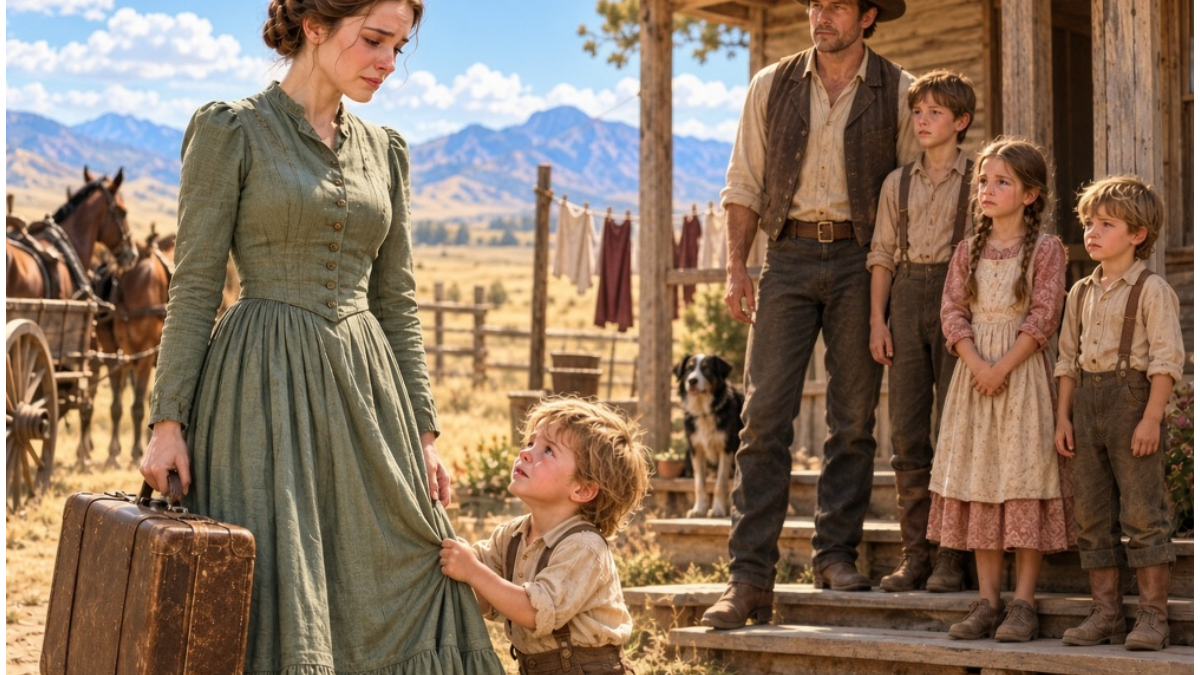
Silas Crowder didn’t knock. He never knocked. Men like him didn’t knock on doors they already considered their own.
He walked straight into the Dry Creek General Store on a Tuesday morning, dropped a folded document onto the counter where three ranchers were drinking coffee, and said it loud enough for everyone to hear.
Mercer’s got until Friday. After that, I’m taking the children. Not the land, not the horses, not the overdue loan he’d been dangling over Gideon Mercer’s head for 11 months.
The children, nobody moved. Old Hank Puet set his coffee mug down so carefully it didn’t make a sound.
The two men beside him looked at the floor because everyone in Dry Creek knew what Silas Crowder was really saying.
He wasn’t worried about four motherless children sleeping under a leaking roof. He didn’t care whether they had enough to eat or whether the youngest one had barely spoken in 17 months.
He wanted Ironwood Ranch’s eastern valley, the one with the permanent spring. And he had finally found the lever sharp enough to pry it loose.
Use the children to break the father. Take the land from a man who has nothing left to lose but them.
The advertisement was not elegant. It had been folded and unfolded so many times that the creases had turned soft and fuzzy at the edges, like the paper itself was tired of being read.
Rosalie Wyn had found it tacked to a post outside the post office in Santa Fe, wedged between a notice about a missing mule and a church supper announcement that was 3 weeks old.
Seeking experienced housekeeper, Ironwood Ranch, Dry Creek, New Mexico territory. Steadywork, fair wages. Inquire G.
Mercer, fair wages. Those two words had done the work. Rosalie had $37 and a ticket that would take her as far as the coach stop outside Dry Creek.
And after that, she would be on her own two feet in the middle of the high desert in the worst summer anyone could remember.
She wasn’t running from anything dramatic. There was no villain in her past, no broken engagement, no tragedy worth dramatizing over supper.
She had simply run out of options in a city that kept offering her the same ones.
She had worked as a seamstress’s assistant until the seamstress’s nephew came back from back east and needed the position.
She had cooked in a boarding house until the boarding house closed. She had done laundry, mended harness leather, helped at a bakery at 4 in the morning for 3 months until the baker’s wife decided she didn’t like the way the men talked to Rosalie, which wasn’t Rosaly’s fault, but also wasn’t the baker’s wife’s problem to sort out fairly.
25 years old, not fragile, not naive, not asking for sympathy, just out of road.
So she read fair wages and she folded that advertisement into her coat pocket and she told herself it was a practical decision made by a practical woman.
And that was the story she kept to the whole 17-hour coach ride through dust and heat and a roaded so rough it rattled her back teeth.
She arrived in Dry Creek on a Thursday morning in July when the temperature was already climbing past anything reasonable and the main street looked like it had given up trying to impress anyone years ago.
Two saloons, a general store, a frier, a building that might have been a bank or might have been a jail house hard to tell from the outside.
A few horses hitched to rails, heads hanging low in the heat. A man was waiting beside a wagon.
She knew it was him before he said anything, partly because there was no one else waiting, and partly because he had the look of a man who hadn’t slept properly in a very long time.
Not the dramatic sleeplessness of grief, not the hollowedout kind she’d seen on widows in morning clothes.
This was something more practical and more exhausting. The sleeplessness of a man who kept waking up because there was always something else that needed doing.
He was tall, broad across the shoulders, with hands that were calloused in ways that spoke of real work rather than performance.
His hat had a sweat stained band and a small tear along the brim that someone had sewn back together badly, probably himself.
He was 33, she would learn later, though he looked 38. Miss Wyn, his voice was lower than she expected.
Not unfriendly. Careful. That’s me. She kept her suitcase in her own hand when he reached for it.
Old habit, Mr. Mercer. Yes, ma’am. They stood there for a moment, each taking a measure of the other the way practical people do when they’re about to spend significant time in each other’s company.
You said steady work, she said. It is. And fair wages. They are. And housekeeping.
Something crossed his face then. Not guilt exactly. More like a man who has mentally rehearsed an explanation many times.
And still hasn’t gotten comfortable with it. Yes, he said, among other things. She should have asked right then what other things meant.
Later, she would think about that moment and wonder what would have been different if she had pressed him there on the main street of Dry Creek, with the horses drooping in the heat and the whole empty afternoon stretching out ahead of them.
But she didn’t ask. She put her suitcase in the back of the wagon and climbed up onto the bench and they rode out of town in silence.
Ironwood Ranch was 8 miles east of Dry Creek, which felt like 80 in July.
The land itself was beautiful in a way that had nothing to do with prettiness.
It was the kind of beautiful that required you to look at it seriously, to sit with it for a moment before it gave anything back.
Red rock formations rising out of the flat, sparse juniper standing at angles like they were leaning away from something.
Heat shimmering off Khich flats. And then as they crested a low rise, a valley green and unexpected with a line of cottonwoods marking water somewhere below.
That’s your eastern pasture? She asked before she even knew why she was asking. He looked at her sideways.
How’d you know it was mine? Because you slowed the horse down when we came over that rise like a man showing something off even when he doesn’t mean to.
He looked at the valley for a moment. Yeah, that’s mine. The house came into view shortly after.
Rosalie had lived in worse. She had also lived in better. What she noticed first wasn’t the condition of it.
The porch that needed planks, the chimney with the crumbling mortar, the kitchen garden that had clearly been started by some someone who knew what they were doing and then abandoned by someone who didn’t.
What she noticed first was the quiet, not peaceful quiet, braced quiet. The kind of quiet that happens when people inside a building know someone is arriving and aren’t sure yet what to make of it.
Gideon set the brake on the wagon and climbed down and stood there with his hands in his back pockets, which she was beginning to understand was what he did when he was about to say something he’d been putting off.
Miss Winn, he started the front door opened. A boy came out firSt. 11, maybe 12, with his father’s jaw already starting to show, and eyes that were too old for his face.
He looked at Rosalie the way a sententury looks at a stranger. Not hostile exactly, but not welcoming either.
Evaluating, deciding. Behind him, a girl with dark braids, younger, nine maybe. She was holding a kitchen towel in both hands, twisting it slowly.
Behind her, a smaller boy, seven, she guessed who had a smear of something on his cheek and was already starting to grin like he’d decided she was probably all right.
And then nothing. An empty doorway until a small hand appeared on the doorframe. And then a boy 5 years old, she would learn his name was Milo, though she didn’t know it yet, stepped far enough out to look at her without fully committing to being seen.
Rosalie stopped walking. She turned to look at Gideon Mercer, and she did not raise her voice because that wasn’t her way, but she spoke slowly enough that there would be no confusion about what she was saying.
How many? He didn’t look away from her. At least four. The advertisement said housekeeper.
It did. Not housekeeper. And she stopped. Chose her words. Not housekeeper and everything else.
No, he said. It didn’t say that. Then what exactly did you think was going to happen when I arrived?
Gideon Mercer’s jaw tightened. And for a moment, she thought he was going to say something defensive.
Something about how it was hard to explain in an advertisement. Something about how he’d been hoping she’d see the situation and understand the kinds of things people say when they’ve done something they know isn’t entirely defensible.
Instead, he said, “I thought I’d deal with it when you got here.” Which was, she had to admit, at least honeSt. She looked at the four children standing on the porch.
The oldest boy had crossed his arMs. The girl had stopped twisting the towel. The grinning one had tilted his head sideways like a curious dog, and the small one was still half hidden in the doorframe, watching her with dark eyes that were completely unreadable.
Rosalie picked up her suitcase. She walked toward the porch, not toward the front door toward the steps, where she set her bag down and looked at the oldest boy directly because he was clearly the one who decided he was in charge of something.
“What’s your name?” She said. He didn’t answer right away, proving a point. Called her, he finally said like he was conceding territory.
Called her. She nodded. I’m Rosalie. I’m not sure yet whether I’m staying. That’s honeSt. But I’m not leaving this minute either, so if you have any objections, you might as well say them now while we’re all standing here.
He looked at her for a long moment. Then he looked past her at his father, who clearly had no help to offer.
The last one left after 2 days, Calder said. I’m not the last one, Rosalie said.
I’m this one. She looked back at the door at the small boy still hiding in the shadow of the frame.
What’s his name? She asked quietly. Milo, the girl with braid said. Her voice was soft and careful, like she’d learned to take up as little space as possible.
He doesn’t really He mostly doesn’t talk to people he doesn’t know. Rosalie nodded. She didn’t try to coax him.
She didn’t crouch down and smile at him like a woman trying to win over a nervous animal.
She just looked at him steadily for a moment, the way you’d look at a door that was mostly closed, acknowledging that it was there, not demanding it open.
And then she turned back to Gideon. I need to see the house, she said.
And then I’m going to tell you what I think. He nodded like a man bracing for a verdict.
The house was not catastrophic. That surprised her, and she gave him credit for it privately.
There was real effort visible in most rooms, floors swept, dishes stacked, beds made after a fashion.
The kitchen was the worst of it. Not dirty exactly, but chaotic, like a place where five people had been improvising every meal for a long time, and nobody could quite remember where things were supposed to go anymore.
The pantry had gaps in it that told their own story. There was a pot on the stove with something in it that had been there long enough to question.
She checked the back bedroom, the children’s room. Three beds the smallest boy presumably shared with the girl, she guessed.
Drawings on the wall, some of them recent, some of them faded. A shelf with a line of small stones, each one placed with the kind of deliberateness that meant something.
She closed the door gently and went back to the front room where Gideon was standing near the window with his arms crossed, watching the cattle dog trot back and forth in the yard.
She put those stones there, Calder said from behind her. She hadn’t heard him follow.
Nell did. She collected them with our mother. Rosalie didn’t say anything for a moment.
And Milo, she said, when did he stop talking? He talks, Calder said defensive. He talks to us.
He just He doesn’t. He stopped. Started again. After Ma died, he used to talk to anyone.
Now he just doesn’t. 17 months. She did the arithmetic without asking. Gideon’s wife had been dead 17 months, and this boy had spent 17 months talking to no one outside the four walls of this ranch.
She walked back to the front room. Gideon turned from the window. Well, he said, she should have said she was leaving.
Every practical consideration pointed in that direction. The advertisement had misrepresented the position. She had not agreed to care for four children.
She had come here for a housekeeping job, not to walk into the middle of someone else’s grief and be expected to hold it together.
All of that was true. She opened her mouth, and the front door opened, and Milo came through it, barefoot, holding something she recognized immediately, a wooden spoon, cracked down the center, the handle wrapped clumsily with a piece of rawhide lacing to hold it together.
Something someone had tried to save after it had broken. He walked straight to Rosalie.
He looked up at her with those unreadable dark eyes, and he said in a voice that was barely above a whisper, “Are you leaving too?”
The room went completely still. Gideon made a sound, barely audible, not words, just the sound of a man who has been holding something together for a very long time, and was watching it reach the edge.
Calder stood very still in the doorway. Nell had appeared from somewhere and was standing beside her brother, the kitchen towel still in her hands.
Toby, the seven-year-old, had found his way to the top step and was sitting there with his knees pulled up, pretending he wasn’t listening.
Rosalie looked at Milo. She did not make promises she didn’t know if she could keep.
She was not built that way. She understood in a deep and very practical part of herself that the worst thing she could do to this child was tell him she was staying if there was any chance she wasn’t.
So she did not say yes. She said not today. And then she looked at Gideon Mercer and she said something that would define the next 7 days and everything that came after them.
I’ll stay a week. 7 days. At the end of 7 days I decide whether this is worth staying for.
She paused. And Mr. Mercer, if you ever withhold something that important from someone you’re asking for help again, they will leave and they will be right to do it.
Are we clear? He looked at her for a long moment. Yes, ma’am, he said quietly.
Good. She picked up her suitcase. Now, someone show me where I’m sleeping. And then someone explain to me what happened to that pot on the stove.
Because whatever is in it should probably be buried. Toby laughed. Just a quick sound quickly swallowed, but it happened.
And Milo, standing in the middle of the room, still holding his mother’s broken spoon, looked at Rosalie Wyn and did not look away.
She set her suitcase down at the end of the hallway, and the week began.
The pot on the stove turned out to contain what had once been a beef stew, and had since become something closer to mortar.
Rosalie didn’t say anything about it. She simply lifted it off the heat, carried it out the back door, and set it on the ground near the fence poSt. The cattle dog came over, sniffed it, and walked away.
That told her everything she needed to know about how long it had been sitting there.
She went back inside and stood in the middle of the kitchen for a moment, just looking, not at the mess exactly, at the logic of it, or the lack of logic.
The flour was stored next to the soap. The cast iron skillet was on a high shelf that would require a tall person to reach it safely, which meant someone short had been attempting it regularly, which probably explained the chip on the corner of the workt.
There were three different cutting knives, and none of them were sharp. The kindling box was empty, which meant whoever built the morning fire had been walking to the wood pile every single day instead of filling the box the night before.
Small inefficiencies, dozens of them, the kind that didn’t seem like much individually, but added up over 17 months to a household that was exhausting everyone inside it without anyone quite understanding why.
Gideon appeared in the doorway. I can explain the kitchen, he started. You don’t need to, she said.
She was already moving the flower. I can read a kitchen. This one tells me you’ve been doing everything alone for a long time and you got into survival habits instead of good ones.
She paused. That’s not a criticism. It’s an observation. He leaned against the doorframe. There’s a difference.
There is. A criticism is meant to make you feel bad. An observation is meant to change something.
He was quiet for a moment. Then the last woman who came, she lasted two days.
Said the children were too much. You mentioned someone left. Rosalie said, “You didn’t say she said that.
I didn’t think it mattered.” Everything matters when you’re trying to understand a situation. She moved the soap to the side of the shelf.
“Were the children difficult with her?” He hesitated. That hesitation was its own answer. “Calder told her to leave,” he finally said on the second morning.
She’d made some comment about how a proper household didn’t look like this. Calder told her this was his mother’s house and she wasn’t his mother and she could go back to wherever she came from.
Rosalie stopped what she was doing. And you? She said, “What did you do when he said that?”
Gideon looked at the floor. I sent him to his room. But but I didn’t disagree with him.
He said it like a man confessing something. She had no business saying that about the house.
About Clara’s house. Clara. That was the first time she heard the name. He hadn’t used it before, hadn’t offered it.
She noted it quietly and didn’t push. All right, she said. Then we have something to work with.
What does that mean? It means the children aren’t the problem. They’re protective of something they love.
That’s not a problem to fix. It’s something to work with. She found the skillet on the high shelf and brought it down carefully.
The problem is this house has been running on grief and stubbornness for a year and a half.
Those are powerful fuels, Mr. Mercer, but they burn dirty and they burn out. He looked at her for a moment like he wasn’t sure whether to be offended or relieved.
He settled on something in between, which was probably appropriate. Supper at 6, she said.
Yes, ma’am. Then you’ve got 4 hours to fix that porch plank before someone puts their foot through it.
The third one from the left is about to go. He opened his mouth. I noticed it when I walked up, she said before he could ask.
Go on, he went. She stood alone in the kitchen for a moment after he left, listening to the house settle around her.
Somewhere in the back, she could hear the murmur of children’s voices. Toby explaining something at length to someone who wasn’t responding, which meant either Milo or nobody.
From outside, the sound of the cattle dog barking once and then going quiet. She exhaled slowly.
7 days. She had promised 7 days. She got to work. She had the kitchen reorganized within two hours, which was not magic.
It was just logic applied to a space that had been ignored too long. She found dried beans in a tin that was still good.
She found cornmeal. She found lard and salt and a string of dried childs hanging from a nail near the back window that someone Clara she suspected had put up herself.
Because they were hung too carefully to have been an accident, she made a simple supper, beans cooked down with the childs, cornbread baked in the skillet, sliced salt pork fried crisp on the side.
Nothing impressive, not meant to be. Just food that was hot and ready at 6:00.
The children came to the table in a specific order that she clocked without commenting on.
Calder first, sitting at the far end, keeping the whole table in view, the way eldest children in difficult households always did.
Nell next to him, sliding in quietly. Toby across from Nell, immediately reaching for the cornbread, immediately getting his hand swatted by Calder without either of them looking up.
And then Milo last standing in the doorway until Nell turned and said his name softly and then coming to the table and sitting in the chair closest to the wall.
Gideon came in from outside, washed his hands at the basin, and sat at the head of the table.
The chair at the other end was empty. Everyone noticed. Nobody said anything. Rosalie served from the stove.
She didn’t sit at that chair. She pulled a stool to the side of the table between Toby and the wall and ate from there.
It wasn’t strategic exactly. It just seemed right. She wasn’t Clara. She wasn’t the head of anything.
She was a woman sitting on a stool eating beans, and that was all. Toby ate with enthusiasm that suggested he hadn’t had a hot meal he truly liked in a while.
Nell ate carefully, like she was concentrating on doing it correctly. Calder ate methodically, already watching his father across the table with the focused attention of a boy who had appointed himself to notice things before they became probleMs. Milo ate three bites of cornbread and then sat very still looking at his bowl.
Don’t like the beans? Rosalie said, not pointed. Just asking. He shook his head. What kind of beans do you like?
He looked up like the question surprised him. The white ones, Nell said quietly for him.
Ma used to make them with a ham bone. I’ll look for white beans tomorrow, Rosalie said.
I didn’t have time to take a proper inventory today. Milo looked back at his bowl, but he ate two more bites of the cornbread.
It wasn’t a triumph. It was a small thing, but she noted it. After supper, Calder cleared the table without being asked.
Nell washed the dishes, also without being asked, in the practiced way of a child who had been doing it for long enough that that it was automatic.
Toby dried or attempted to dry, which mostly meant he moved water from the dishes to the dish towel and then onto his shirt.
Milo sat on the floor near the hearth with a small stone in his hand, not quite playing with it, just holding it.
Gideon watched all of this from the doorway to the front room, and Rosalie, carrying the dish basin out to empty it, caught the expression on his face for just a moment before he could arrange it into something more neutral.
It was grief, straightforward and uncomplicated grief, the kind that comes not from sadness exactly, but from recognition from watching something ordinary and beautiful, and realizing too sharply what has been missing.
She didn’t say anything. She went out, emptied the basin, came back inside, and said good night to each of the children by name.
Good night, Calder. Good night, Nell. Good night, Toby. She paused at the hearth. Good night, Milo.
He didn’t say good night back, but he looked at her. It was a start.
The second day was harder because the second day was when the work revealed itself in its full dimensions.
She rose before dawn, which was her habit, and spent the first quiet hour making a proper liSt. Not of cleaning tasks, she had handled the worst of those yesterday, but of structural problems, the kind that didn’t get fixed with a mop.
The porch plank that Gideon had indeed replaced, she noticed, but the two boards beside it were also soft, and he’d apparently not checked those.
The chimney mortar, she could see from outside. A window latch in the children’s room that didn’t catch properly, which in winter would mean cold air pouring in all night.
The kitchen garden, which had the bones of something someone had designed well and planted with intention, but which had been so thoroughly neglected in the past year, that it was now more weed than vegetable.
She also noted things that weren’t her business, but that she was noting anyway. Calder’s hands.
He had the hands of a man who’d been doing heavy fence work, calluses along his palm in a pattern she recognized from watching grown men in her father’s fields.
An 11-year-old should not have those hands. He should have scabbed knuckles from climbing fences and scraped palms from sliding down barn posts, not the thick-skinned working calluses of someone who’d been stretching wire for months.
Nell’s eyes in the morning red. Not badly, she was good at hiding it, but read Toby’s jokes.
The boy ran on jokes the way some engines ran on Cole continuously, almost compulsively, like stopping would mean confronting something he’d rather not look at directly.
He had told her four jokes before breakfast, three of which were nonsensical in ways that suggested he’d made them up himself, and one of which was actually somewhat funny.
She wasn’t a woman who laughed easily, but she’d smiled at that one. Toby had noticed and looked so quietly pleased that it was almost painful.
On the second morning, she made the mistake, or maybe it was deliberate. She wasn’t sure even afterward, of asking Calder what his usual chores were.
He listed them. She made him list them twice because the first time she thought she must have misheard.
Morning, water the horses, check the south fence line, carry feed to the cattle on the lower pasture, split kindling for the day, check the hen boxes.
Afternoon, help his father with whatever needed doing, which could mean fence repair or moving cattle or patching the equipment barn roof or any number of other things.
Evening, make sure Toby and Milo were washed before supper. Bring in wood for the night.
Check the horses again. He was 11 years old. Who decided this was your job?
She asked. Called her jaw set. Nobody decided. It just is. Your father asked you to do all of this.
Pause. Busy. Called her. She kept her voice level. Did your father ask you to do this or did you take it on yourself?
A long pause. Both, he said finally. Some of both. She nodded. All right. Starting today, the south fence line is your father’s job.
The cattle on the lower pasture are your father’s job. What’s left is yours. He stiffened.
I can handle. I know you can handle it, she said. That’s not the point.
The point is you shouldn’t have to. She looked at him directly. Your father is trying to keep this ranch alive.
Called her. He needs your help. But he doesn’t need you to disappear into it.
You understand the difference? He didn’t answer. But that afternoon she watched from the kitchen window as Gideon rode out to the lower pasture without Calder beside him.
And she watched Calder stand at the fence for a long moment, watching his father go, and then turn and walk toward the barn, not to do fence work, to where Toby was tending the horses.
She turned back to the kitchen. The third day, Nell found her in the kitchen before dawn.
Rosalie had been up for half an hour working through the rest of the pantry inventory when she heard the soft sound of bare feet on the the floorboards and turned to find Nell standing in the doorway in her night gown.
Dark braids loose holding something against her cheSt. A notebook old the cover worn soft with handling.
My mother’s recipes are in here, Nell said. Her voice was very careful. She wrote them herself.
I can’t make some of them because I don’t know how to do the parts that aren’t written down.
She didn’t write the parts she thought she already knew. Rosalie looked at the notebook.
She didn’t reach for it. She waited. Nell took one step into the kitchen, then another.
She set the notebook on the workt, not handing it to Rosalie exactly setting it there, so so Rosalie could look without it being a gift.
Rosalie opened it slowly. The handwriting was clear and deliberate on some pages, rushed and looping on others, like the woman had written some things in a hurry and others when she had time to think.
Recipes for things Rosalie recognized and things she didn’t. Notes in the margins, not enough salt last time, and Calder won’t eat this.
And on the biscuit page, Milo always wants the burned ones. That last note she noticed was underlined twice.
Which recipe do you want to learn? Rosalie said. Nell pointed to a page without hesitating, like she’d already known what she was going to say.
It was a recipe for apple cake. Not complicated, but the margin note said, “Must cook slow or the middle won’t set.”
And there was no further clarification about what slow meant or how to know when the middle had set.
“We’ll need apples,” Rosalie said. “There’s a tree out back.” Calder said, “They’re close.” “All right.”
She looked at the girl. “Go get dressed. We’ll start after breakfaSt. Nell left so quickly and quietly that she barely made a sound on the stairs.
Rosalie stood in the kitchen for a moment with her hand on the notebook. She was careful not to think too hard about what this meant, about what a 9-year-old girl carrying her dead mother’s recipe book into a stranger’s kitchen at 5 in the morning meant.
What it said about how long she’d been waiting for someone to show her how to finish what her mother had started.
She closed the notebook. She got out the flower. It was on the fourth day that Silas Crowder’s name first entered the house, and it came in the way bad things often, did not with a dramatic announcement, but with a small, ordinary moment that turned out to have a sharp edge.
Gideon had come in from the lower pasture for midday dinner, looking like a man who’d swallowed some something unpleasant and hadn’t decided yet whether to spit it out.
He sat at the table. He ate. He answered Toby’s questions in the shorter than usual way that meant his attention was somewhere else.
Rosalie didn’t ask. After the children cleared the table, Calder lingered. He sat back down across from his father with the specific deliberateness of a boy who had decided to act like a man in this particular moment whether anyone wanted him to or not.
Was it Crowder again? Calder said. Gideon’s jaw tightened. That’s not for you to I heard you and Roy talking last week.
Calder said about the loan. The table went quiet. Rosalie was at the workt with her back to them.
She didn’t turn around. She kept working. The loan is being handled. Gideon said Roy said Crowder already talked to two of the neighboring ranchers.
Said he told them you were stopped. Started again. Said he’s been telling people things.
What kind of things? Rosalie said. Both of them looked at her. She turned around from the work table.
What kind of things is Crowder telling people? She said again to Gideon. A long pause.
Gideon looked at his son and then at Rosalie, and he had the expression of a man who was tired of managing what information went where.
That this is not a proper household, he said finally. That a man living alone, a widowerower with four children and an overdue loan, is not capable of providing what the children need.
That there are relatives of Clara’s who would take them. The room was completely still.
He’s trying to use the children, Rosalie said. Not a question. He wants the eastern valley.
Gideon said he’s known about the spring for 2 years. I didn’t understand why he cared so much until last summer when the drought hit and the three ranches south of me were desperate for water access.
He set his hands flat on the table. He doesn’t just want my land. He wants to control who has water in this valley.
And taking the children would force your hand. If the county got involved, if there was any official question raised about the household I’d have to deal with that instead of the loan, the loan would come due before I could sort it out.
He’d have grounds to move on the property. Gideon’s voice stayed even, but there was something beneath it, a tightly controlled fury.
He’s not a stupid man. No, Rosalie agreed. He’s not. She turned back to the workt.
I’ll need to look at your ranch records, she said. This week while I’m here, if you’ll let me.
Why? Because men like Crowder make their moves on paper firSt. And because if I’m going to help you, I need to understand what you’re actually dealing with.
She paused. Will you let me look at them? Another silence. Longer. Yes, Gideon said.
Calder was looking at her with an expression she hadn’t seen on him before. It wasn’t the watchful, evaluating look he’d given her on the porch the first day.
It was something more complicated, like he was revising a conclusion he’d already reached. She didn’t acknowledge it.
She just kept working. That evening, after the children were in bed, she sat with Gideon’s ranch records at the kitchen table for 2 hours.
They were a disaster, but a specific kind of disaster, the kind made by a man who understood cattle and horses and land, but did not understand paperwork, and who had been trying to manage both for 17 months, while also being a father and a rancher, and a carpenter, and a cook, and everything else the household required.
There were livestock ledgers going back 8 years. Some of them were meticulous. She could see that Clara had kept them in the early years.
The handwriting neat and consistent, the column straight. Then, starting about four years ago, the handwriting changed messier, more hurried, like whoever was doing it was always doing it as an afterthought.
Then, about 2 years ago, there were months where nothing had been recorded at all.
And then she found something. It was in the loan ledger, the specific account Crowder held against the ranch.
Three payments recorded by Gideon marked off in his own handwriting with the dates and amounts.
But when she cross-referenced against the corresponding entries in Crowder’s formal notice of default, which Gideon had apparently just left in the ledger without properly reading it, the amounts didn’t match.
Two of those payments had been recorded by Crowder as partial payments, not full. The discrepancy wasn’t enormous, but it was there, clear and documented, and it had apparently been sitting in this ledger for 8 months.
While Gideon had been too overwhelmed to notice, she sat very still for a moment.
Then she got up, found a clean sheet of paper, and began making notes. She worked until midnight.
When she finally went to her room, she paused in the hallway outside the children’s door.
It was quiet inside, all four of them asleep. She stood there for longer than she meant to.
On the fifth day, something happened that she hadn’t expected and that she would think about for a long time afterward.
She had given Toby a specific responsibility. The chickens in the morning, the horses water in the afternoon, not big jobs, not man’s work, just enough to give him something to be responsible for that was actually his rather than everyone else’s spillover.
He had taken it with more seriousness than she’d anticipated. The chickens were a revelation.
He turned out to have a genuine gift for animals, not the gentle, quiet kind that Milo had, where he simply sat near them, and they seemed to accept him, but the loud, enthusiastic, let me show you what I found kind that made the chickens seem personally invested in whatever Toby was doing.
She’d watched from the window as he refilled their water and had what appeared to be a significant conversation with with the largest hen about the location of the feed.
But on the fifth afternoon, she went out to check on him and found him sitting on the fence rail with his back to the hen house, not not moving, not talking, staring at the ground.
She climbed the fence and sat beside him. Didn’t say anything for a moment. I told Milo Ma wasn’t coming back, Toby said finally without her asking.
Right after she died, P wasn’t. He couldn’t say it. Calder was crying. Mel was inside.
And Milo kept asking when she was coming home. He swung his feet against the fence rail.
A short, restless motion. So I told him. I said she wasn’t. I said she went somewhere and she wasn’t coming back.
Rosalie waited. He didn’t say anything. Toby said he just went inside and sat under the table for the rest of the day.
He stopped swinging his feet. Sometimes I think that’s why he stopped talking to people because I was the one who told him.
And maybe he thinks if he’d asked someone else, they would have said something different.
Toby, she kept her voice steady. He stopped talking because he lost his mother. That’s why.
You don’t know that. I know that grief doesn’t work like that. It’s not caused by one conversation.
She looked at the side of his face, which was being very carefully of arranged to look like he wasn’t about to cry.
You did the right thing. He needed to know. And you were the one brave enough to tell him.
That’s not something to carry like a wound. He didn’t say anything. You’re a good brother, she said.
All four of you take care of each other. That’s not common. He wiped his nose with his sleeve very faSt. Like if he did it fast enough, it wouldn’t count as crying.
Does it get better? He said, “When someone dies, does it actually get better, or do people just say that?”
She thought about lying, the comfortable lie, the one adults always reached for. “It changes,” she said.
“Better isn’t quite the right word. It changes into something you can carry instead of something that carries you.”
She paused. “But it takes time, and it’s not straight. It goes sideways sometimes and backwards sometimes before it goes forward.”
He nodded like he was filing it. “Your chickens are going to escape if that latch isn’t set properly,” she said.
After a moment, he looked at the hen house. “Sighed climbed down from the fence, Miss Rosaly.”
He paused without turning around. “Yes, I’m glad P hired you a beat, even if he didn’t say about the kids.”
She watched him walk to the hen house. “Me, too,” she said quietly, though he was already out of earshot.
On the sixth day, Milo followed her to the well. He didn’t ask if he could.
He didn’t say anything at all. He was simply there when she turned around, standing 3 ft behind her, watching.
She handed him the empty bucket. He took it. They walked back to the house together, and he carried one side of the full bucket while she carried the other, which was not necessary given the bucket’s weight, but which was clearly what he wanted.
At the kitchen door, he set his side of the bucket down and looked up at her.
“Do you know how to make the white beans?” He asked. His voice was slightly from under use.
The voice of a child who’d been choosing silence for a long time. “I do,” she said.
“Do you want them tomorrow?” He nodded. “I’ll need a ham bone,” she said. “Do you think your father has one?”
He considered this with great seriousness. Then he turned and walked purposefully toward the barn, which was where Gideon kept the saltcured meats in the coolest corner during summer.
She watched him go, small and bare armed in the afternoon heat, moving like a boy who had a mission.
He came back 8 minutes later with a ham bone wrapped in brown paper, which he handed to her with both hands.
She took it the same way with both hands, matching his seriousness. “Thank you,” she said.
He went back inside. She stood holding the ham bone for a moment, looking at the door he disappeared through.
Then Gideon’s voice came from behind her, quiet and rough. That’s the first time he’s asked for something on his own since.
He stopped. She turned. He was standing near the equipment shed, watching the door Milo had gone through.
I know, she said. They looked at each other. There was a quality to that silence that was different from the silences that had come before it.
Not the careful silence of two strangers trying to manage the space between them. Something with more weight in it, more honesty, rosily, he said.
It was the first time he’d used her first name. Don’t, she said. Not unkindly, not yet.
He let it go. But that evening after supper, after the children were in bed, he came to the kitchen table where she was still working through the ranch records and set a mug of coffee beside her without asking if she wanted one.
It was slightly too strong, and he’d forgotten she’d mentioned 2 days ago that she didn’t take sugar, which he’d now added anyway.
She drank it without commenting on either the strength or the sugar. He sat across from her.
The loan records,” she said. After a while, “I need to show you something.” She spread out the two documents side by side, walked him through the discrepancy, watched his face as he followed her finger across the columns of numbers.
His expression went through several things in quick succession. Confusion first, then the first cold edge of understanding, then a very still, very contained fury that was nothing like the hot kind.
This was the kind that goes quiet and doesn’t waste anything. He falsified the payments, Gideon said.
Misrepresented is the word that’ll hold up better, she said. But yes, why didn’t I?
He stopped. Because you’ve been trying to do everything alone, she said. Because you had four children and a dying ranch and a grief that would have broken most men, and the paperwork was the thing that could wait until tomorrow.
And tomorrow was always worse than today. She kept her voice matterof fact, not soft, not hard, just honeSt. It’s in the records, Gideon.
It’s documented. That matters. He was quiet for a long moment. What do we do with it?
He said, “We don’t do anything yet. We wait until we understand the full picture.
She’s straightened the papers.” “But we have something now that we didn’t have before.” He looked at her.
She looked back at him. “Why are you doing this?” He said, not accusatory, genuinely asking.
You came for a housekeeping job. You stayed seven days out of whatever it was.
Pity or stubbornness? It wasn’t pity, she said evenly. Then what? She thought about that for a moment.
About Milo and the ham bone. About Nell and the recipe notebook. About Toby sitting on the fence rail carrying something too heavy for a 7-year-old.
About Calder watching his father leave for the lower pasture and choosing to walk toward his brothers instead.
Because this family is worth staying for,” she said. “And I said I’d decide by the end of the week.”
She gathered the records into a neat pile. “It’s the end of the week.” He waited.
“I’m staying,” she said. The kitchen was quiet. Outside, the night had gone fully dark, and somewhere across the flat, the coyotes were starting their usual conversation with the dark.
The cattle dog answered once from the porch and went silent. Gideon Mercer looked at the woman across his kitchen t table.
This practical, cleareyed, sometimes infuriating woman who had arrived with a battered suitcase and $37 and had somehow in 7 days found every cracked place in his household and quietly begun filling them in.
And he didn’t say what he was thinking. He was not ready to say what he was thinking.
But he picked up both coffee mugs and brought them to the basin. And when he said good night, his voice was different than it had been every other night.
She noticed. She didn’t say anything about it. She went to her room and sat on the edge of her bed and looked at the battered suitcase propped against the wall.
She had not unpacked it. She reached over, unlatched it, and took out her winter coat and hung it on the hook behind the door.
One thing, she hung up one thing. It was enough for now because Ironwood Ranch had just given her the first solid ground she’d stood on in years, and she was not going to treat that lightly.
She was going to treat it the way Nell treated her mother’s recipe notebook carefully with both hands, like something that mattered.
What she didn’t know yet, what none of them knew, was that 3 days later a violent storm would tear through the canyon above Blackstone Wash, and everything they had quietly, painstakingly begun to build together, would be tested in the most brutal way possible.
But tonight the house was quiet. The children were sleeping, the records were on the table, the coffee was too strong, and Rosaly Wind had hung up her coat.
The storm didn’t announce itself the way storms usually did. There was no slow build through the afternoon.
No purple bruising on the horizon that gave a man time to move his animals and check his roof and button things down before the weather arrived.
It came out of the northwest in the early evening like something that had been waiting for the right moment.
And by the time the first real crack of thunder rolled down through the canyon above Blackstone Wash, the sky had already gone the color of an old bruise, and the wind had picked picked up enough to make the cottonwoods along the eastern fence line sound like they were tearing apart.
Rosalie was in the kitchen when it hit. She had been writing up her notes on the ranch records, a clean copy, organized and clear, the kind that would hold up if someone with authority looked at them, and the first gust came through the gap under the back door, hard enough to scatter three of her pages across the floor.
She grabbed them, waited them with the coffee mug, and went to the window. What she saw made her set the mug down and go find Gideon.
He was already outside. He was standing at the fence line between the house and the main corral, looking northwest, and the expression on his face was the one she’d learned in the past week to read as his version of controlled alarm jaw set.
One hand on the fence post, the specific stillness of a man doing rapid arithmetic in his head.
How bad? She said, coming up beside him. Bad enough. He didn’t look at her.
He was watching the sky. The wash runs high after heavy rain up in those canyons.
If that storm’s dropping water up there, we’ll know it down here within the hour.
The horses. He turned and looked at the main corral then, and she saw at the thing he’d already been calculating.
The breeding horses were in the large corral, 28 of them, and even from here she could see they were moving differently than they had been an hour ago.
Not panicked yet, but aware. The way animals get aware before people do, like they can feel something in the ground or the air that hasn’t reached human understanding yet.
The corral fence on the northwest side, she said. Third post from the gate. He looked at her.
It’s been soft for at least a week, she said. I noticed it when I was walking the fence line with Calder on Wednesday.
He said he was going to tell you. He didn’t tell me. Gideon said something crossed his face, not anger at Calder.
She understood, but at himself for not checking. He probably forgot. He’s 11. She kept her voice even.
What do you need? Get the children inside and keep them there. He was already moving toward the barn.
I’m going to shore up that post and try to get the horses into the smaller corrals before mines.
The lightning hit somewhere up in the canyon. Not close, maybe half a mile, but it was close enough that the light of it bleached everything white for a full second.
And the crack that followed it was the kind of sound that gets into an animal’s chest and doesn’t leave.
The horses reacted immediately. 28 animals, all of them feeling the pressure of the storm and the electrical charge in the air and whatever deep instinct lives in horses that remembers being prey.
And they hit all of that simultaneously. And the corral became chaos. They weren’t running yet.
They were bunching, pu, shifting, pushing against each other in that specific way that precedes a full panic by about 30 seconds if you know what you’re watching for.
Gideon broke into a run toward the corral. Rosalie turned and ran for the house.
The children were already at the front window. All four of them in the specific configuration that told her they’d been watching for a while.
Called her in front, hands on the windowsill, Nell behind him, one hand on his shoulder, Toby on his toes to see over, and Milo pressed against Nell’s side with his face tilted up toward the window.
Inside, Rosalie said, all of you away from the window. The horses, Calder started. Your father’s with the horses inside now.
Calder didn’t move immediately. He looked out the window toward the corral, and she could see on his face that the thing she’d seen before, the impulse to be useful, to be a man about it, to go out there and help instead of staying safe inside like a child.
It was the same impulse that had put working callouses on his 11-year-old hands, and she understood it.
And and she was not going to let it take him out into that storm.
Called her. She put her hand on his shoulder. I need you in here. If something happens with the little ones, I need someone I can count on.
That’s you. It was the right thing to say. She’d learned that about him. In a week, he didn’t respond to commands.
He responded to responsibility. Give him something to be responsible for, and he would stay.
He stepped back from the window. Good. She looked at all four of them. Nell, can you light the two lamps in the back room?
Toby, I need you to fill the big pot with water from the pump and set it near the hearth.
Milo. She looked at the smallest boy who was watching her with those dark eyes that had gone very wide.
Milo, I need you to stay with your sister. He nodded. Small and serious. She left them to it and went back to the window.
What she saw outside had changed. The northwest corner of the main corral had given way.
Not all at once. The post had leaned and then the fence rail above it had swung outward and that was enough.
When a gap appears in a corral fence during a storm, horses don’t hesitate. They go through it like water through a break in a dam.
And that was exactly what happened. The first three horses hit the gap and then the others followed in a streaming terrified mass and within 45 seconds of the post going, the corral was empty.
28 horses were loose in the dark with a storm rolling in from the canyon.
She could see Gideon’s shape at the far end of the corral, already swinging up onto his saddle horse, which he’d he’d tied to the fence post when he’d come out to work.
He didn’t stop to think about it. He just rode after them into the dark into the building wind in the direction of Blackstone Wash, the direction of a flash flood that might or might not already be tearing down from the canyons above.
Rosalie stood at the window and watched him go. She stood there for exactly as long as it took her to understand what she was feeling, which was not helplessness.
She didn’t tend toward helplessness, but a very specific fear that had a name and a face.
And that name was Gideon Mercer, riding alone into a flood canyon after 28 panicked horses in a desert storm.
Then she went to the barn. She was saddling the strongest Mayor Gideon’s best, a long-legged gray he called Duster, who had the kind of steady temperament that didn’t unravel in bad weather when she heard footsteps behind her and turned to find Calder.
He was wearing his boots and his jacket, and he had his father’s spare rope coiled over his shoulder.
No, she said I can ride. He said, you know I can ride. I know you can ride.
No, he’s out there alone. I’m going, she said. You’re staying. He set his jaw.
For a moment, he looked so much like his father that it startled her. The same angle, the same controlled stubbornness, the same look of a person who had made a decision and wasn’t being moved off it.
Called her, she said, and she stopped pulling the cinch tight and looked at him directly.
If I don’t come back in 2 hours, you take your brothers and sister to the Puet place.
You know the road, he swallowed. Yes. You don’t wait for us. 2 hours you take them and you go.
She held his eyes. Can you do that? A long pause. Yes, he said. His voice had gone very quiet.
Good. She took the rope from his shoulder. Now go back inside. He went. She watched him go, and she could see from the set of his shoulders that it cost him something to walk back to that house, leaving her there with the horse, choosing to be responsible instead of brave.
It cost him, and he did it anyway, and she thought that was one of the bravest things she’d ever seen an 11-year-old do.
She finished saddling Duster, checked the rope, checked the knots, and rode out into the storm.
The wind was serious now. It wasn’t the playful kind of desert wind that moved things round and then settled down.
It was the kind that had weight to it, that pushed against her chest and made the mayor’s mane whip sideways and flat.
The lightning had moved closer. She could see it intermittently above the canyon walls to the northweSt. Quick, cold light that showed her the landscape in snapshots.
Scrub rock, the dark line of the cottonwoods along the wash’s edge already moving hard.
She followed the hoof prints. 28 horses leave a mark even on hard ground, and the ground wasn’t hard tonight.
It had started to soften under the first rain, and the tracks were clear enough when the lightning flashed to show her direction.
They were heading northwest toward the wash. Of course, they were horses in a panic.
Don’t reason about flood danger. They run from what frightened them, and what had frightened them was behind them.
She had ridden since she was 7 years old. Her father’s farm in Missouri had not been a prosperous operation, but it had been a horse operation, and she had grown up doing things with horses that her mother had considered reckless, and her father had considered education.
She knew how to read a herd. She knew the difference between a herd that was still running blind and a herd that was starting to tire and look for something to follow.
She knew the role of a lead animal, and she knew that if you could reach the lead animal, you could sometimes turn the whole mass of them.
She pushed Duster hard through the dark. She found the first three horses half a mile from the wash.
They had stopped at a scrub oak thicket, three younger animals who had lost the momentum of the panic, and were now standing with their heads down, breathing hard, unsure what to do next.
She moved past them at a careful angle, not fast enough to startle them back into running, and they fell in behind Duster without much argument.
Horses in uncertain territory will often attach themselves to a confident animal, and Duster was calm enough to serve the purpose.
The next group was harder. Seven horses moving parallel to the wash rather than toward it, which meant they’d already smelled the water and were uncertain about it.
She worked them for 10 minutes in the dark and the rain that had now started in earnest, cutting them off, turning them, using Duster’s body as a barrier.
She lost two of them back into the dark and didn’t try to recover them.
Not yet. Not now. The priority was the wash. The priority was Gideon. She heard his horse before she saw it.
Or rather she heard a horse moving in a direction that didn’t make sense back toward her from the direction of the wash, moving at a trot that was slightly wrong in its rhythm.
A horse carrying itself differently than it should. She pulled Duster to a stop and waited for the lightning.
It came. It showed her Gideon sorrel gelding coming through the scrub, and there was no rider.
Oh, something dropped in her cheSt. Not panic. She didn’t do panic, but something cold and certain settled in her stomach, and she turned duster toward the wash and rode hard.
She smelled the flood before she heard it. That was the thing about flash floods in desert canyons that people who hadn’t grown up near them didn’t understand.
They didn’t sound like water at first, not from a distance. They sounded like something else, like a low continuous roar that could be wind or could be the Earth itself deciding to move.
And before you heard it, if the wind was right, you smelled it. The cold mineral smell of canyon water carrying desert soil down from high country.
The smell of something ancient and indifferent coming faSt. She heard him before she saw him.
Hear his voice, lower than usual, strained from somewhere to her left. She pulled duster in that direction, moving carefully now, because the ground near the wash edge was uncertain what looked solid could be soft.
And soft ground near a flood was a different problem than hard ground in a storm.
The lightning flashed again, and she saw him. He was on the ground, one leg pinned beneath the trunk of a fallen cottonwood, that the rushing water or the wind she couldn’t tell, which had brought down across the washbank.
His horse had thrown him when the tree came down. She guessed, or the tree had come down on the horse, and the horse had shied sideways, and he’d gone off, and the tree had landed across his leg in the same motion.
It didn’t matter which. What mattered was the tree was large, and he couldn’t shift it, and the sound from the canyon above was getting louder and closer at a rate that was not leaving them much time.
She jumped down from Duster and went to him. “How bad?” She said the same question she’d asked him an hour ago at the fence line.
It seemed to be the only question that mattered tonight. Legs not broken, he said, which was how she knew his leg might be broken.
Men said it’s not broken the same way. They said, I’m fine as a statement of intent rather than fact.
I can’t get the angle to shift it. Every time I push from this side, it rolls back.
She looked at the tree, looked at him, looked at the rope in her hands.
The wash was maybe 40 ft away. In the dark, it looked like a dark line, but she could hear it now clearly.
Not the low roar from a distance, but the specific sound of water moving fast over rock, carrying debris, coming down from the canyons above in a volume that would reach this bank within minutes.
I need to tie this to Duster, she said. And I need you to push from your side at the same time she pulls.
Can you push? Yes. Your hands free? Yes. She moved faSt. She tied the rope to Duster’s saddle the way her father had shown her.
Not the elegant knot, not the sophisticated rigging, but the fast knot, the one that held under lateral load, because it was tied through two points rather than one.
She walked the rope to the fallen trunk and got it under and around in the one spot where the tree was narrow enough that the rope could bite rather than slip.
She checked the angle, adjusted. When I say,” she said to Gideon, she went back to Duster’s head.
The mayor was breathing fast but steady. The sound of the water had reached her, too, and she could feel it in the slight trembling of the horse’s neck, but she hadn’t broken.
Good horse, Gideon had good animals, now Rosalie said. She walked Duster forward. Not fast, fast would break the rope or rip the knot or roll the tree the wrong way.
Steady pressure, walking forward, asking the horse to lean into the load and hold it.
Behind her, she could hear Gideon pushing, the grunt of a man using everything he had.
The tree moved a fraction. Then it stopped. The rope had gone tight as wire, and Duster was throwing her weight into the load, and it wasn’t enough.
The angle was wrong. She’d gotten the rope too far toward the root end, and the leverage was working against her.
She stopped Duster. The mayor was trembling now, not from fear, but from effort. The roar from the canyon was louder.
She looked at the situation, at the tree, at the rope, at Gideon’s position on the ground, at the dark line of the wash 40 ft away.
And then she looked at the horses. The three younger ones she’d collected earlier were standing 50 ft away, having followed Duster in the way of tired horses, looking for a leader.
And beyond them, moving in from the dark, uncertain, their herd instinct pulling them toward Duster’s presence, were more of the herd.
67, she couldn’t count in the dark, coming in. And among them, unmistakable, even in the dark, the lead mayor, a big chestnut, 15 years old, the animal the whole herd deferred to.
Rosalie had noticed her on the second day at Ironwood and had spent 20 minutes just watching how the other horses positioned themselves around her.
She made a decision. She untied Duster from the rope and handed the rope end to Gideon.
Hold this as tight as you can and don’t let it go slack. She went to the lead mayor.
The mayor was uncertain. The water smell was wrong. The night was wrong. Everything was wrong.
But she hadn’t bolted again. She was standing with her head slightly raised, reading the situation.
Rosalie approached from the side, not from the front, moving with the measured confidence that horses read as trustworthy.
She got a hand on the mayor’s neck, felt the trembling there, talked low and steady, without words, just sound, just the steady human sound that said, “I am not frightened even when she was.”
She didn’t try to lead the mayor away from the wash. She moved her past it parallel to it, then angling away from it, walking her slowly with a hand on her neck and the rope from Duster strung between them and the tree, using the Chennuts momentum and the rope as a combined lever at a new angle.
It was improvised. It was ugly. It shouldn’t have worked. The tree shifted. It rolled 6 in.
“Push,” she said. Gideon pushed. The tree rolled another four inches, and Gideon’s leg came free, and he made a sound that she didn’t want to examine too carefully.
Not quite a yell, not quite a groan. The compressed sound of pain released too faSt. And then he was on his hands and knees, and then on his feet, unsteady, grabbing the nearest thing, which was a low cottonwood branch, and she was already letting the mayor go and moving to his side.
She got under his arm. He was heavier than he looked, and his right leg wasn’t working right, and she was not tall, but she was not small either.
And she got him to dust her, and got him into the saddle with the specific, graceless urgency of a situation that didn’t allow for dignity.
The wash crested its bank behind them as she swung up behind him. She felt it before she saw it.
The ground changed, the air changed, the pressure of something enormous moving fast, and she pushed her heels into Duster’s sides, and the mayor didn’t need encouragement.
They rode hard. Behind them, Blackstone Wash became a wall of dark water and sound that ate the bank where Gideon had been pinned, ate the fallen cottonwood, ate 40 ft of ground in each direction.
Rosalie didn’t look back. Looking back was how you lost your nerve, and she needed her nerve.
The lead mayor was running beside them. She didn’t know exactly why. Instinct probably heard reflex and the others were moving too.
Pulled by whatever deep current runs between horses in a crisis. 20 or more of them running in the dark away from the water.
She ran them for a/4 mile. When she finally pulled Duster back to a walk, she could feel Gideon’s weight against her differently than before.
Heavier, less controlled, the weight of a man who had been operating on adrenaline and was now reaching the end of it.
“You still with me?” She said. “Still with you.” His voice was rough. Legs bad.
“I know. We’ll deal with it at the house.” The horses, most of them are behind us.
We’ll count them in daylight. He was quiet for a moment. The rain had slowed, not stopped, and the lightning was moving east, and the worst of the sound from the canyon was behind them and below.
“Rosily,” he said, the same way he’d said it in the yard when she’d told him not yet.
“Don’t,” she said. “I’m going to anyway,” he said. “I almost didn’t get out of there, but you did.
Because of you.” She didn’t say anything for a moment. The horse moved under them both, steady and tired.
The ranch lights were visible now in the distance, pale and warm through the rain.
Because of duster mostly, she said, “Good horse.” He made a sound that might have been a laugh.
You are the most difficult woman. I’ve been told. It wasn’t a criticism. I know.
They rode in silence for a while. Jen felt him shift not falling, just resettling, and she tightened her arm across him without commenting on it, and they kept moving.
The porch light was burning when they came into the yard, yud. All four children were on the porch.
She had told Calder 2 hours. It had not been 2 hours, but she understood.
She understood completely why none of them had gone inside to wait. Calder saw his father in the saddle and his whole body went rigid with something that wasn’t quite relief yet.
The kind of moment where your mind knows the person is there before your body is willing to believe it.
Then he came down the porch steps fast, not running, something more controlled than running the walk of a boy, trying very hard to be steady.
Nell made a sound from the porch, small and quickly swallowed. Toby was already at the fence gate, and Milo Milo had pushed past all of them and was standing at the edge of the yard in his bare feet in the wet dirt.
And when Duster came through the gate, he moved toward them and reached up toward his father and then stopped.
As if the actual presence of Gideon had overwhelmed the plan he’d had for this moment.
Rosalie got down first, helped Gideon down, he put his weight on the left leg carefully, keeping the right one light, and she got under his arm again and walked him toward the porch.
Milo came with them. He didn’t grab Gideon. He grabbed Rosalie’s free hand. She felt his small fingers close around hers, and she didn’t make anything of it, didn’t stop, didn’t draw attention to it, just let his hand be in hers, and kept walking.
At the porch steps, Gideon stopped and looked back at the yard, at the dark shapes of the horses moving in the corral, the ones that had followed them home, the ones the hands would count and sort in the morning.
His face in the porch light was mud streaked and tired and something else that she didn’t have a name for.
Then he looked down at Milo, and Milo looked up at both of them, at his father and at Rosalie, standing side by side, muddy and rain soaked and present, and he said it in that small horse voice that had been choosing its words carefully for 17 months.
She came back with you. Nobody said anything. Calder, standing two steps up on the porch, heard it.
She saw something shift in him, in his jaw, in his shoulders, in the set of a face that had been working very hard all evening to be older than it was.
Something released. He didn’t say anything either, but he reached down and took his father’s other arm and together Rosalie on one side, called her on the other.
Milo still holding her hand, Nell holding the door. Toby already inside putting water on to boil because Toby she was realizing dealt with crisis by finding a useful thing to do.
They got Gideon Mercer into his own house. The leg wasn’t broken. She spent 40 minutes with it by lamplight, pressing and bending and watching his face for the things he wouldn’t say out loud.
And her conclusion was deep bruising, possibly a cracked bone along the outer side. Nothing that required a doctor if he stayed off it and didn’t do anything foolish in the next 2 weeks.
She said exactly that. Two weeks, he said. Two weeks. The rancher and I will manage the mornings.
She said Roy can take the lower pasture. You will sit down and look at the records I’ve been putting together, and you will make a list of every person in this valley who might have reason to care that Silus Crowder controls the Eastern Spring.
She handed him the strip of cloth she’d been using to wrap the leg. “Hold this.”
He held it. “You organized my records,” he said. “I told you I was going to.
You found something. I found several things.” She tied the bandage and sat back. When you’re not in pain, you’re going to be angry about what I found.
I’d rather you be functional firSt. He looked at her for a long moment. She was mud stre and her hair had come entirely loose from its pins and there was a tear in the right shoulder seam of her dress from where she ducked under the cottonwood branch.
She looked like a woman who had been in a flood. She looked, he thought, like someone who had made a deliberate choice to be in that flood and would make the same choice again.
Rosalie, he said, “Gideon.” She said his name back to him in the same tone, which wasn’t mocking.
Was something else, a kind of acknowledgement. Thank you, he said. Just that simple and direct without any decoration.
She nodded. Get some sleep. She went out to the front room to check on the children.
Nell and Toby were asleep on the settle. Toby’s head on Nell’s shoulder, both of them deeply and completely out the way children go when they’ve been running on fear for hours, and finally let it go.
She put the spare blanket over them without waking either one. Calder was awake. He was sitting in the chair by the window with his arms crossed, watching the yard.
The mud on his boots told her he’d gone out. At some point, not far, she thought ju just far enough to check on the horses that had come back to do something useful while he waited.
He looked at her when she came in. You should sleep, she said, in a minute.
He looked back at the window. All the ones that came back are in the south corral.
I counted 17. That’s good. We had 28. We’ll find the others in the morning.
They’ll have stopped somewhere. He nodded. Then without looking at her, you went after him.
Yes. You could have just You could have waited. I could have. He was quiet for a moment.
Why didn’t you? She thought about how to answer that honestly. Not with something soft or reassuring, with what was actually true.
Because waiting felt wrong, she said, and things that feel wrong usually are. He looked at her then.
Milo said you came back with him. Calder said. I did. He doesn’t say things like that.
He doesn’t. He stopped. His voice had gone slightly rough and he was handling it by looking back at the window.
He doesn’t trust people. Not since Ma. I know, she said. He’s beginning to. Calder looked at his boots, at the mud on them, at his hands.
Those two old, too calloused hands of a boy who had been filling an impossible space for 17 months.
“Miss Rosaly,” he said. “Yes, I’m glad you stayed.” “He said it quickly, like if he said it fast enough, it wouldn’t cost him anything.
Past the seven days. I’m glad.” She looked at him, this serious, careful, exhausted boy who had been trying so hard and so long to be enough for everyone around him.
“Me, too,” she said. “Now go to sleep,” Calder. He uncrossed his arMs. “Yes, ma’am,” he said.
And something in his voice when he said it, “Not the clipped compliance of earlier in the week, but something easier, more natural.
The way a child talks to an adult, they’ve decided they can actually truSt.” Told her that something had genuinely shifted tonight.
Not everything, not all at once. That wasn’t how trust worked, and she wasn’t going to pretend otherwise, but something.
She went to her own room. She sat on the edge of her bed. Her hands were still faintly trembling, not from fear, she’d decided, but from the specific aftermath of adrenaline, the body processing what the mind had already filed away.
She looked at her hands for a moment, then at the coat hanging on the hook behind the door.
Her coat hanging there since the sixth night. She looked at the suitcase, still not fully unpacked, still there.
But she had stopped looking at it the way she used to as an option, as the path back to something, as the shape of a different decision.
It had just become a bag, a bag in the corner of her room in a house where she lived.
She didn’t unpack anything else tonight. She didn’t need to. Outside, the storm was still moving east, and the rain had gone to a light, steady sound on the roof, the kind of rain that was done being violent and was just rain now.
The cattle dog had come up onto the porch, and she could hear the quiet scratch of it settling against the door.
Somewhere in the south corral, 17 horses were standing in the dark. And in the morning, she knew Silus Crowder would hear about the storm, and he would hear about the damaged corral and the lost horses and Gideon’s injury.
And he would see in all of it exactly what she knew. He would see an opportunity.
A man weakened, a household vulnerable. She knew it was coming. She sat with that knowledge for a moment.
The way you sit with something you can’t stop but can prepare for. Then she lay down fully dressed on top of the covers.
And she slept. She was right about Crowder. He heard about the storm before the sun was fully up.
She didn’t know how Dry Creek had its own nervous system, the way small towns always did.
Some invisible web of morning conversations at the general store and early riders on the road and men who made it their business to know other men’s trouble before those men knew it themselves.
By the time Rosalie had made breakfast and gotten Gideon settled at the kitchen table, with his leg elevated on a feed sack, and the organized ranch record spread in front of him, Roy Delard had already ridden in from the south pasture with news that Crowder’s man had been asking questions at the frier’s shop since before dawn.
Roy was Gideon’s only full-time ranch hand, a quiet man in his 50s with a weathered face that rarely showed much, but which was showing something now as he stood in the kitchen doorway with his hat in his hands.
Hector says Crowder’s man was asking about the horses,” Roy said. “How many got out?
Whether any were lost in the wash.” Gideon looked at Rosalie. She was at the stove and she didn’t look back at him, but she’d heard it, and she was already thinking, “What else?”
Gideon said. Roy turned his hat brim through his fingers. He was asking about the household, whether there had been any trouble during the storm, whether the children were all right.
The kitchen went quiet enough that the fire in the stove was audible. He’s building a picture, Rosalie said, to the stove, to no one in particular.
Storm damage, horses lost, rancher injured, children unsupervised during a flood event. He’s going to take that picture to the county and put a frame around it.
He can’t do anything without grounds, Gideon said. But his voice had the particular flatness of a man who wasn’t sure he believed what he was saying.
He already has a version of the grounds, she said. He’s had them for months.
He’s been building toward this the rumors about the household, the pressure on the loan.
And now the storm gives him the emergency he needed. Something dramatic he can point to.
She turned from the stove. He’s going to move faSt. Men like him always move fast after something like this before the other side has time to organize.
Roy looked at her with the expression she’d noticed from him before the slightly startled look of a man who had been expecting a housekeeper and kept encountering something else.
So what do we do? Gideon said we do it first, she said. We don’t wait for him to come to us.
She set a plate of food in front of Gideon and another in front of Roy and poured coffee for both of them.
And then she sat down at the table with the organized records and the clean copy of her notes.
And she walked Gideon through it properly, the way she hadn’t been able to the night.
She had first shown him the discrepancy because they’d both been too raw from the flood to do it methodically.
She showed him the original loan ledger entries, his own handwriting, recording payments made, dates and amounts.
She showed him Crowder’s formal default notice, the document Gideon had received 8 months ago and apparently put in the ledger without fully reading because he’d been in the middle of cattlework and had intended to look at it properly later and then never had.
She showed him the specific payments where Crowder’s recorded figures didn’t match Gideon’s own records.
Gideon was quiet for a long time. Roy leaned over and looked at the two documents side by side.
His expression changed. “That’s not a clerical error,” Roy said. “No,” Rosalie said. “It’s not.”
Gideon’s hand was flat on the table. She could see the tension in it, the controlled anger she’d seen before.
“The quiet kind that didn’t waste anything.” “How much?” He said. His voice was very level.
The discrepancy across the two payments comes to $63, she said. That doesn’t sound like a large number until you consider that the outstanding balance Crowder is claiming the amount that that supposedly justifies the default notice is less than $200.
Roy sat back in his chair. So, the real amount owed is either significantly less than what Crowder has been representing or possibly already settled depending on how the original loan terms were written.
She looked at Gideon. Do you have the original loan document? He got up, moved carefully on the bad leg, and went to the back room where he kept a tin box that turned out to contain 8 years of documents in approximately the same level of organization as a bird’s neSt. after a windstorm.
She spent 40 minutes going through it while he sat back down and drank his coffee and didn’t say anything, which she appreciated because the concentration required didn’t leave room for conversation.
She found it under a cattle insurance certificate from 1,883. She read it twice, then she set it on the table and smoothed it flat with her palm.
The loan was written with a specific payment schedule. She said each payment was to be applied first to the principal and then to the intereSt. Crowder has been applying them in reverse interest first, principal second.
She looked at Gideon. It’s not the way the document reads and it has the effect of making the remaining balance appear larger than it actually is because the principle has been reduced less than it should have been.
The kitchen was very still. That’s fraud, Roy said quietly, like a man who understood what a word like that meant in a town like Dry Creek in 1,887.
It’s a mislication of a contractual payment schedule, Rosalie said, which a judge would have opinions about.
She paused. But we’re not going to a judge. Not yet. Not as the first move.
Then what’s the first move? Gideon said. She had been thinking about this since 3:00 in the morning when she’d woken from a light sleep with the outline of it already forming.
The eastern valley, she said, the spring. You told me several ranches south of here relied on that water during the drought last summer.
Three of them. The Bower Place, the Ketridge operation, and Old Harland Puit spread. And if Crowder controls Ironwood, if he acquires the Eastern Valley, what happens to their water access?
Gideon looked at her. He charges them for it. Or he denies them. He’s been buying up parcels for 3 years.
He already controls the two wells on the north road. If he gets the spring, he controls water in this valley, she said.
And in a drought year, water is the ranch. She watched him follow the logic to where she’d already taken it.
They don’t know, he said slowly. The neighboring ranchers, they don’t know that’s what he’s building toward.
They know he’s been acquiring land, Roy said. But nobody’s put it together as a pattern.
Not out loud. Then someone needs to put it together for them, Rosalie said. Out loud.
Before Crowder moves on the household claim, she straightened the papers into a neat stack.
The Bower place how far? 6 mi south, Gideon said. Ketridge 8 miles. But Ketridge and Bower are friendly.
If you reach one, the other hears within a day. Puit’s closer. Roy said, “Old Hank Puit, 4 mi eaSt.” And Hank Puit talks to everybody.
Rosalie nodded slowly. “I know the name,” she stood up. “Gideon,” she said. “You’re going to stay off that leg and you’re going to write down every conversation you’ve had with Crowder about this loan in the past year.
Every meeting, every message, every time he sent someone to speak on his behalf, dates if you can remember them, approximate if you can’t, the substance of what was said.
She looked at him steadily. Can you do that? Yes, Roy. She turned to the ranchand.
Can you drive a wagon? He gave her a look that said the question didn’t deserve an answer.
I need to go to Dry Creek, she said. I need to go to the land registry office, and I need to do it today.
I can drive you, Roy said. He stood up, put his hat back on. But Crowder will hear about it.
Good, she said. Let him. She was in the wagon with Roy within the hour.
The road to Dry Creek was rougher than usual. From the storm there was debris across it in two places, and the low crossing near the Ketridge Road had standing water that Roy navigated carefully, his expression steady, not saying much.
She had noticed he was a man who said things in proportion to their necessity, which she respected.
“How long have you worked for Gideon?” She asked when they were clear of the worst of it.
“7 years,” Roy said. “Came on the season after he bought the Eastern Valley from the Carver family.”
“Stayed?” “You were here when Clara was alive.” “Yes, ma’am.” She waited a moment. “What was she like?”
Roy drove for a bit before answering. “Stady,” he said finally. Queer than you, but the same kind of steady.
He glanced at her sideways. She used to do what you’re doing before she got sick.
Keep track of what was happening with the neighbors, with the finances. Gideon is good with land and animals, numbers and people.
That was Clara’s side of it. And when she died, that side of it just stopped.
He did what he could, Roy said, and there was a mild note in his voice that told her this was as close as he would come to defending Gideon against an implied criticism.
I know he did, she said. I’m not saying otherwise. They were quiet again. Miss Win, Roy said after a while.
Rosaly, Rosalie, he said it like he was trying it on. What are you expecting to find at the land registry?
I want to see every parcel Crowder has acquired in this valley over the past 3 years.
I want the dates of acquisition and the prices recorded. And I want to see whether any of those acquisitions happened shortly after a foreclosure or a default.
She looked out at the road ahead. Men like Crowder are careful, but they’re not always careful about records because records are boring and boring things are where people stop paying attention.
Roy nodded slowly. And if you find what you’re looking for, then I have something more than a discrepancy in a loan ledger.
She said, “I have a pattern. And a pattern is a story anyone can understand.
The land registry office in Dry Creek was in the back of the county building, which was also where the sheriff’s office was, which was also where the justice of the peace held court on alternating Thursdays, which told you something about the scale of civic infrastructure in a town of 400 people.
The clerk was a young man named Aubrey, who looked at Rosalie with the specific expression of a clerk who has never had a woman come in and ask to see property acquisition records and who was not sure whether he was allowed to say no.
She helped him understand that he was not. She spent 2 hours at the records table with Roy sitting beside her.
And what she found was largely what she’d expected to find, arranged in the dry language of official documents in ways that required patients to decode, but were very clear once decoded.
Crowder had acquired 11 parcels in the valley over 3 years. Seven of them had been purchased from ranchers who had defaulted on loans.
Three of those loans held by Crowder himself, two by a bank in Santa Fe that Crowder appeared to have a relationship with, the details of which were suggestive without being explicit.
The prices recorded for those parcels were uniformly low, not insultingly low, just consistently lower than the parcels’s assessed values, which was the signature of a buyer who knew how to time an acquisition to when the seller was desperate.
Two of the parcels directly bordered the land that would have needed water access from the eastern valley during the drought.
She copied what she needed onto paper, working quickly and cleanly and thanked Aubrey, who seemed relieved that she was leaving.
On the way back to Ironwood, she asked Roy to stop at the Puet place.
Hank Puit was 71 years old, thick through the chest, with a white beard that needed attention and eyes that did not.
He came out of his house when the wagon pulled up and looked at Rosalie and said, “You’re the Mercer girl.”
“I’m the Mercer housekeeper.” She said, “Rosalie when heard about you,” he said. “Heard about last night, too, Gideon.”
“All right, he will be.” “I need 20 minutes of your time, Mister Puit.” He looked at her for a long moment.
Then he looked at Roy. “She always like this?” He asked Roy. “Yes, sir,” Roy said.
Puette waved his hand toward the porch. Come on then. She gave him the short version which took 14 minutes.
She showed him the records from the land registry. She showed him the copy of the loan discrepancy.
She explained without embellishment what she believed Crowder was building toward and what it would mean for water access in the valley when a drought year came around again.
Puette was quiet for the entire 14 minutes. When she finished, he sat with his hands on his knees and looked at the middle distance for a while.
He’s been at this longer than any of us knew,” he said finally. “Yes, and he’s going after Gideon’s household, the children.
That’s the pressure point,” she said. “He knows Gideon will fight him on the land indefinitely.
But if there’s a county inquiry into the welfare of four motherless children in a flood damaged ranch with an injured father, he’s betting Gideon folds.
Puette said he’s betting Gideon has no choice but to fold. The old man looked at her directly.
Do you have everything written up? Clean copies? Yes, sir. Can you have them at the general store by Thursday morning?
Yes. He stood up. Then I’ll make sure the right people are there to see them.
He looked at Roy again. Tell Gideon Puet says he should have married smarter the first time.
Royy’s expression didn’t change. Clara Mercer was a fine woman, mister. Puette. She was, Puet said without missing a beat.
I meant he should have gotten the record straight sooner. He looked at Rosalie. You come back Thursday.
She came back Thursday. The two days between were not idle. Gideon worked at the kitchen table with his leg elevated, writing his account of every transaction and conversation with Crowder in the past 18 months.
His handwriting was not elegant, but it was legible, and the account itself was thorough in ways that surprised her.
He remembered dates better than most people did, and he had a rancher’s instinct for significant details, the kinds of details that seemed minor and turned out to matter.
She read each page as he finished it and made notes in the margin and asked questions that made him go back and add things he’d forgotten.
And by the end of the second day, they had a document that was not a legal brief, but was the kind of clear firstirhand account that made legal briefs possible.
Calder managed the morning work with a seriousness that no longer surprised her. He’d stopped trying to be a man about it and started being effective about it, which was different and better.
And she noticed the difference without saying anything because saying anything would have made it self-conscious and right now it was working.
Nell made the apple cake on her own. On the second evening, Rosalie watched from the workt without intervening, only answering direct questions.
How do I know the middle is set? And Rosalie said, “Press it gently in the center, and if it pushes back, it’s done.”
And Nell pressed it gently in the center and it pushed back and she took it out of the oven herself with the heavy cloth and set it on the rack and stood back and looked at it with an expression that was simultaneously proud and overwhelmed.
Ma would have wanted more cinnamon, Nell said finally. Then add more cinnamon next time, Rosalie said.
Nell looked at her. You think she would have liked you? The question landed in a way Rosalie hadn’t anticipated.
She sat down what she was doing and thought about it honestly, which was the only way she knew how to answer a question.
Asked with that much sincerity. I think she would have had opinions about me. Rosalie said, I’m not easy to be around.
I have a lot of opinions about how things should be done, and I don’t always keep them to myself.
Nell looked at the cake. She was like that, too. She said she always had opinions.
Then maybe she would have understood me. Rosalie said, even if we didn’t always agree.
Nell nodded slowly like she was filing this away somewhere important. Toby ate three slices of the cake and said it was the best thing in the world and then asked if there was more.
Milo ate one slice very carefully, like he was paying attention to it. And then he looked at Nell and said, “It tastes right.”
Nell’s eyes went bright. She looked down at her plate very faSt. Nobody said anything for a moment.
Gideon reached over and put his hand briefly on Nell’s head, not elaborate, just present, and she leaned into it for a second before straightening up and reaching for her fork.
Rosalie was looking at the table, and she noticed in the way she’d been noticing things all week, cataloging them quietly that everyone was doing this.
They were reaching for each other in small ways. Toby nudging Milo, called her passing things before being asked.
It was the slow, tentative behavior of people who had been guarding themselves and were beginning very carefully to stop.
She didn’t name it. Naming it would have made it fragile. On Thursday morning, she drove to Dry Creek with Roy.
The general store had eight men in it when she arrived. She hadn’t expected eight.
She’d expected Puette and possibly one or two others. But Puet had done what Puet apparently did, which was talk to the right people.
And the right people had talked to others, and eight ranchers from the valley were standing in the Dry Creek General Store on a Thursday morning because something needed to be said that hadn’t been said yet.
She had seen men in groups respond to a woman presenting information in two ways.
The first way was dismissive, the polite-edged kind that let them feel respectful while not actually listening.
The second way required that the woman in question not give them the opportunity to choose the first way.
She didn’t give them the opportunity. She put the records on the counter and started talking.
She was not dramatic about it. She didn’t ask for their sympathy or appeal to their sense of neighborliness because men in a room together were often better reached through their practical interests than through their feelings, especially at 8:00 in the morning.
She told them what she’d found in the land registry. She showed them the dates and the patterns.
She explained clearly, specifically using the actual names of their ranches, which of them would have needed the eastern valley spring in the previous drought year, and which of them would need it in the next one if the summer went dry again, which it would because this was the high desert, and the summer always went dry eventually.
She showed them the loan discrepancy. She showed them the copy of the original loan document and the payment mislication.
She let them look at it. Let them ask questions. Answered the questions directly without elaborating beyond what was asked.
And then she said, “Silus Crowder is not collecting on a loan. He is acquiring a water supply.
Ironwood Ranch’s eastern valley is the last piece of that supply he doesn’t control. When he has it, he will set terms for water access in this valley, and every rancher in this room will negotiate with him every dry summer, for as long as any of you intend to run cattle here.”
The store was very quiet. Old Puet was standing at the far end of the counter, watching, not saying anything.
He’d said what he needed to say to get these men here. Now he was letting her do the reSt. A man she didn’t know, broad and weathered with a bower look about him.
She guessed it was Carl Bower from the south parcel said you’re the Mercer housekeeper.
Yes, she said. This is Mercer’s fight. It’s Mercer’s fight right now. She said next drought year it’s yours.
She looked at him directly. I’m not asking you to fight for Gideon Mercer. I’m asking you to look at what’s in front of you and decide whether you want someone else controlling your water access for the next 30 years.
Bower looked at the records, then at the man beside him. Another rancher she didn’t know spoke.
Does the loan discrepancy a lawyer would need to look at that? Yes, she said.
I know a document that establishes the original payment terms and records that contradict those terMs. What a lawyer does with it is the lawyer’s business.
What I’m showing you is the evidence. What does Mercer want from us? A third man said older.
She didn’t know him. He wants the loan refinanced. She said, “Through creditors who don’t have an interest in the land.
If the valley’s ranchers back the refinancing, Crowder’s leverage over Ironwood disappears.” She paused. “The amount at stake is not large.
I have it calculated.” She slid the page across the counter. The real outstanding balance adjusted for the misapplied payments.
The room looked at the number. There was a silence that had a different quality than the earlier silences.
A thinking silence. Bower picked up the loan document. Read it. Set it down. Picked up the registry records.
Read those. Set them down. Crowder’s been playing a long game, he said. Not to anyone in particular.
A very long game, Rosalie said. Bower looked at the man beside him. Something passed between them.
The kind of quick private communication that men who’ve worked near each other for years develop.
What about the household claim? Puette said from the far end of the counter, speaking for the first time, he’s been telling people this is about the children.
He’s been telling people whatever gives him leverage. Rosalie said the household claim requires a county representative to act on it.
A county representative acts when there’s a credible complaint from a credible source. If the valley’s ranchers are publicly standing with Gideon Mercer, if the claim looks like what it is, which is a tactic rather than a genuine concern, it becomes considerably harder to find a county official willing to put his name on it.
She looked around the room. I’m not saying Gideon Mercer’s household is without difficulties, she said.
It has been through a hard year and a half, but four children are fed and clothed and in school and being taken care of by people who love them.
That’s not a household that needs county intervention. That’s a household that needs its neighbors to say so out loud.
The room was quiet for another moment. Then Puit said, “I’ll put in for a third of the refinancing.”
Bower looked at the ceiling briefly. I’ll put in a third. The man beside Bower said, “The rest between us and looked around at the other men in the room.”
And nobody objected. She drove back to Ironwood with Roy in a silence that felt different from the mornings.
The road was better in this direction. They were heading east with the sun behind them, and the land looked less hostile.
In an afternoon light, the red rock formations casting long shadows across the flat. “You do that often?”
Roy said after about a mile. Do what? Walk into a room full of men and take it over.
She thought about it. When I need to, she said. Roy nodded like that was a satisfactory answer.
When she got back to Ironwood, she found Gideon on the porch. He’d gotten himself into the chair there, bad legs stretched out, and he was watching the eastern valley in the afternoon light, the way he’d slowed the horse to watch it on the day she arrived.
Like a man who loved a piece of land beyond its practical value, beyond what it could do for him.
He looked at her when she came up the porch steps. She told him what had happened, gave him the short version, because that was the version that mattered.
Puette and Bower and the others, the refinancing, the agreement to stand publicly with him against the household claim.
He listened without interrupting. His face went through several things. She watched carefully because Gideon Mercer’s face was not an expressive instrument, and the things that showed on it were therefore significant.
When she finished, he was quiet for a long moment. “You did all of that,” he said.
Roy drove, she said. He almost smiled. “Not quite, Rosaly. I know. I don’t have words for.
You don’t need words,” she said. She meant it practically. There would be time for other things later.
When Crowder had been dealt with and the loan was clear and the children were not at risk of being sent somewhere.
Right now, words felt premature, like celebrating before the last hand was played. She started to go inside.
“He’s going to push back,” Gideon said behind her. “When Crowder finds out, and he’ll find out by tomorrow, he’s going to push harder.”
She stopped at the door, turned. “I know,” she said. He’ll come to the ranch probably with county officials with whatever authority he can scrape together.
Yes. She looked at him steadily. And when he does, we’ll be ready. She paused.
Get some sleep tonight. Leg is going to be worse tomorrow before it’s better. She went inside.
She found Milo at the kitchen table alone with three small stones arranged in a line in front of him.
He was studying them with the serious concentration he brought to most things. When she came in, he looked up.
Are the people going to take us away? He said. She stopped. She had not known he understood that much about what was happening.
Children understood more than the adults around them assumed, and she should not have been surprised, but she was slightly, and she took a breath before she answered.
She sat down across from him. She looked at the three stones, then at him.
No, she said. They are not. He looked at her. How do you know? Because I went to town today and talked to the men who can stop that from happening, she said.
And they’re going to stop it. He picked up one of the stones. Turned it over in his fingers.
What if they don’t? Then I’ll go talk to more people, she said. Until I find enough.
He thought about this with the long seriousness he brought to everything. You’re very stubborn, he said.
She blinked. Then something in her chest moved quick and warm. Yes, she said. I am.
He set the stone back in its line precisely in exactly the position it had been before.
P says stubborn isn’t always bad, Milo said. He says stubborn is how things get done when everything else fails.
Your father, she said carefully, is a smart man. Milo nodded as if this confirmed something he’d suspected.
Then he gathered his three stones, held them in his closed fist for a moment, and held them out to her.
She opened her hand. He put them in it. All three. She looked at the three small stones in her palm, then at him.
These are mine, she said. I’ve been finding them since you got here, he said.
I’ve been saving them for you. She sat with that for a moment. Three stones, smooth and different colors, small enough to fit in a closed fiSt. chosen, she understood, with the same deliberateness that Nell placed her mother’s stones on the shelf.
This was how Milo expressed what he couldn’t say or wouldn’t say or hadn’t said yet.
She closed her fingers around them. “Thank you,” she said, the same way she’d said it over the ham bone.
“Seriously,” with both hands, metaphorically. He slid off the chair and patted out of the kitchen in his bare feet, and she heard him go upstairs.
And then she heard his voice already talking to Toby, actually talking, more than she’d heard from him in any single stretch since she had arrived telling his brother some something about the horses.
She sat at the kitchen table with three small stones in her closed hand. Tomorrow, Crowder was coming.
She knew it, and Gideon knew it, and probably Roy knew it. And if she was honest, the children probably knew it too, in the wordless way.
Children absorbed the tension of adults. But tonight the house was quiet in a different way than it had been quiet 2 weeks ago.
Not the braced quiet of the first day, the held breath quiet of people waiting for one more bad thing.
This was something else, something that had weight to it and warmth and the particular solidity of a household where people had decided, each in their own way, that they were not leaving.
She opened her hand and looked at the three stones one more time. Then she put them in her pocket and stood up and started on supper.
Crowder came on a Friday. He didn’t come alone, which she had expected, and he came earlier than she’d anticipated, which she had not.
The sun had barely cleared the eastern ridge when Roy appeared at the kitchen door with the look of a man who had something to say that he’d rather not.
“Wagon on the road,” he said. “Two riders beside it, and a man in the wagon wearing a town coat.”
Gideon was already at the table with his coffee, legs still wrapped, and he set the mug down with a deliberateness that said he’d been waiting for this since Thursday evening.
“How far?” Rosalie said. “20 minutes,” Roy said. “Maybe less.” She looked at Gideon. He looked at her.
The children, he said. I’ll handle the children, she said. You get dressed properly. Not the workc clothes.
The clean shirt that’s hanging in the back room. He opened his mouth. Gideon. She kept her voice level.
Crowder is coming here with a county man to look at this household and decide whether it’s a fit place for four children.
The first thing that county man is going to see is you. What you look like when he arrives matters.
She paused. Clean shirt. Shave if you can manage it. You have 20 minutes. He closed his mouth and got up.
She went upstairs. The children were already awake. She could hear them. And she suspected they’d been awake for a while.
In the specific way children are awake when they know something is happening and are pretending not to know.
She knocked on the door and opened it, and all four of them were dressed, which told her everything about how much they’d understood from the previous day’s tension.
Calder was standing near the window. He’d seen the wagon, too. “Is it Crowder?” He said.
“Yes.” He said his jaw. She recognized the expression, “The one that meant he was about to decide to do something.”
“Called her,” she said before he could. “I need you to listen to me very carefully.”
He looked at her. Whatever happens this morning, whatever Crowder says, whatever that county man says, I need you to be exactly what you are, not older, not harder, not angrier than you feel.
She looked at all four of them. I need this to look like what it is, which is four children who are taken care of and loved and doing fine.
Can you do that? Nell was braiding her own hair with quick practiced fingers watching Rosalie in the mirror.
Toby was sitting on his bed with his hands in his lap, unusually still. Milo was beside Nell, already dressed, already watching.
What if he says things that aren’t true? Calder said. He will say things that aren’t true, Rosalie said.
And you will not respond to them. I will respond to them. That is my job this morning.
Your job is to be a child, she held his gaze. Yours specifically, called her.
Your job is to be 11 years old. Just that, nothing more. He looked at her for a long moment.
The window, the road beyond it. Yes, ma’am, he said quietly. Good. She straightened. Come downstairs when I call you.
Not before. She went back to the kitchen, put the kettle on, and stood at the front window and watched the wagon come up the road.
Crowder was not what she’d imagined, which was her own fault for building a picture in her head from secondhand description.
She’d expected something more obviously menacing, the wide shoulders and hard jaw of a man who’d built his position through physical intimidation.
Instead, he was lean and angular, well-dressed in the way of a man who understood that appearance was a form of argument with a narrow face and light colored eyes that moved quickly over everything they looked at.
He was maybe 50, maybe a few years either side. He had the careful, unhurried manner of a man who had won enough situations to have stopped being impatient about it.
The man beside him on the wagon bench was younger 30s, wearing the coat Roy had mentioned, carrying a leather satchel.
County representative. She’d expected him, too, just not quite this official looking. The two riders stayed back near the gate.
Crowder stepped down from the wagon with the ease of a man visiting somewhere he considered his business.
He looked at the house, at the repaired porch boards, at the kitchen garden, which she’d been working on for 2 weeks, and which no longer looked abandoned.
His eyes moved over it all quickly, cataloging the way she cataloged things, taking inventory.
Then he looked at Rosalie standing on the porch, and something shifted slightly in his expression.
Not surprise exactly, a recalculation. He had known she was here. He’d been hearing about her from whatever source he had in Dry Creek, but knowing a thing and seeing it were different, and what he was seeing now was a woman who had come out to meet him on the porch rather than waiting inside, which was not the posture of a household caught unprepared.
Mr. Crowder, she said, not a greeting exactly, an acknowledgement. Miss Wyn. He said her name the way people said names they’d acquired through intelligence rather than introduction with a slight precision, making clear he’d done his homework.
Is Mr. Mercer available? He is, she said. So am I. The county man had climbed down and was looking at his satchel and then at the house with the expression of a man who had expected worse and wasn’t sure yet whether that was good or bad for his paperwork.
This is Mr. Gerald Fitch. Crowder said, “He’s here representing the county in a welfare matter regarding.”
I know why he’s here, Rosalie said. She looked at Fitch directly. Would you like to come inside, Mr. Fitch?
I have coffee on. Fitch looked at Crowder, then at her. Yes, thank you, he said, and she thought she heard in his voice the specific tone of a man who had not entirely wanted to be here, and was relieved that the first 30 seconds had not gone badly.
Crowder followed without being invited, which she’d also expected. Gideon was in the front room.
He’d managed the clean shirt and a shave, and he was standing, not sitting, which would have shown the bad leg, with his hand resting on the back of the chair in a way that looked casual and was not.
He looked, she thought, like what he was, a rancher in his own house, receiving an unwanted visit with more dignity than it deserved.
Silas,” he said. Gideon Crowder looked around the front room with those quick cataloging eyes.
Clean, orderly, the small things on the mantle, Nell’s stones, a drawing Toby had made that she’d straightened and propped up rather than left face down visible without being arranged to impress.
“I understand you had some trouble in the storm.” “Some,” Gideon said. “The horses, we recovered most of them.”
His voice was even. “We’ll find the reSt.” Crowder nodded slowly like a man taking notes.
“I heard you were injured.” “I’m standing,” Gideon said. Fitch had come in behind them and was looking around in the way of a man whose job required him to notice things.
She watched him without being obvious about it. His eyes went to the floor clean, the windows clear, the general state of the room, not perfect, not the polished domestic showcase of a household trying to perform respectability, but genuinely lived in and genuinely cared for.
She had not staged anything this morning. She just kept doing what she’d been doing for 2 weeks.
“Mr. Fitch,” she said, “why don’t you sit down? I’ll get the coffee and then if you have questions, I’m happy to answer them.”
She went to the kitchen. She could hear the voices from the front room crowder starting something about the county’s concerns.
Gideon’s level response, Fitch’s carefully neutral interjections. She poured three cups of coffee, put them on the tray with the last of Nell’s apple cake, and carried it back.
She set the tray on the table. Crowder looked at the cake with those quick eyes, and she saw him register it.
The fact that there was cake, that the house smelled of recent baking, that this was not the home of a man barely surviving.
She sat down. Mr. Fitch, she said, “What specifically does the county need to see today?”
Fitch opened his satchel and produced a document which he set on the table and smoothed with his palm.
The concern that’s been raised relates to the welfare of four minor children residing in this household.
Specifically, whether the household provides adequate u concern, Gideon said. That’s the source of the complaint is I know the source, Gideon said.
He looked at Crowder. I’d like it stated for the record. Fitch looked uncomfortable. Crowder’s expression didn’t change.
The concern was raised by a private citizen withstanding to raise it, Crowder said smoothly.
The identity of the complainant is not the relevant matter. The welfare of the children is.
Then let’s talk about the children, Rosalie said. She looked at Fitch. What do you need to know?
Fitch had a liSt. It was a reasonable list questions about sleeping arrangements, about food, about schooling, about the children’s general health and daily routine.
She answered each one factually and completely without elaboration designed to impress and without the defensive brevity that would have seemed like hiding something.
When he asked about schooling, she noted that Calder had been missing some school due to the household situation and that she had been working with Gideon to correct that, which was true.
When he asked about the storm, she said the children had been inside with her during the worst of it and that Calder had been specifically responsible for his younger siblings while she assisted their father, which was also true.
She told the truth, just the truth in order completely. That was the whole strategy.
Crowder sat through the first 15 minutes of it without speaking. She could feel him measuring things, the responses, Fitch’s reactions, the room, looking for the opening.
He was patient, which made him genuinely dangerous. And she did not underestimate that. Miss Wyn, he said when Fitch paused to write something.
You came to Ironwood Ranch when exactly. 3 weeks ago, she said on a housekeeping advertisement.
Yes. So, you’ve been here 3 weeks. That’s what I said. And in 3 weeks you’ve developed a significant role in this household.
His voice was very pleasant. Involved yourself in the ranch’s financial affairs apparently in dealings with the county in the management of the children.
He tilted his head slightly. That’s quite a lot of involvement for 3 weeks of housekeeping.
He was good. She gave him that. The question was designed to make everything she’d done sound either overreaching or suspicious.
Either a woman inappropriately inserting herself into a man’s affairs or worse, a woman with her own agenda.
It was the kind of question that didn’t need to be answered with a direct accusation because the implication was already there hanging in the air.
Fitch had stopped writing and was listening. “You’re right,” she said. “It is a lot.”
Crowder blinked. He’d expected defense. When I arrived, this household was being run by one man doing the work of five people while managing his grief, his children’s grief, a failing ranch, and a deliberately obscured debt, she said.
There was a lot to do. I did it. She looked at Fitch rather than Crowder.
The relevant question isn’t why I got involved. The relevant question is whether these children are being cared for, and they are.
By a woman who’s been here 3 weeks, Crowder said, by their father who has been here 11 years, she said, and by me for the past three weeks, and by a ranchand who has been on this property for 7 years, and who knows these children by name, and now, as of this week, by neighbors who have indicated they intend to support this household through its current difficulties.
She paused. Would you like me to name them? Something moved in Crowder’s light-colored eyes.
That won’t be necessary, he said. Bower, she said anyway. Ketridge, Hank Puet, four others from the valley.
I can get you the full list if it would help your records. Mister Fitch.
Fitch was writing again. Crowder’s pleasant manner had acquired a slight tension around the edges.
Not visible to someone who wasn’t watching for it. She was watching for it. The financial difficulties on this ranch are significant, Crowder said, shifting slightly.
The loan in default, the storm damage, the lost stock. A household under that kind of financial pressure is a household under stress.
The county has a responsibility. The loan is not in default, Gideon said. Crowder looked at him.
I have a default notice. You have a notice you issued based on figures that don’t match the original loan document, Gideon said.
His voice had the same flat, controlled quality she’d heard in the kitchen the night she showed him the records.
The payment discrepancy has been documented. The original payment terms have been documented. The refinancing arrangement with neighboring creditors has been initiated.
He looked at Crowder directly. The loan is not in default. Fitch’s pen had stopped moving.
That’s a that’s a matter for legal review, Crowder said, and for the first time she heard something different under the pleasant tone.
Not alarm yet, but awareness that the ground had shifted. It is, Rosalie said, and we’ve prepared documentation for exactly that review.
She reached to the side table where she’d placed the folder before they arrived and set it on the table.
Copies of the original loan agreement, the payment ledger in Mister Mercer’s hand, the formal default notice, and a comparison of the payment figures with the discrepancies noted and dated.
She looked at Fitch. I’ve prepared a copy for the county record as well. If the county finds itself in a position of having to assess the financial stability of this household, Fitch took the copy.
He looked at it. He looked at Crowder. Crowder was looking at the documents with an expression that had gone very still.
Additionally, Rosalie said, and she kept her voice even, because this was the part that mattered most, and she was not going to let any emotion into it.
I’ve prepared a summary of the land acquisition records from the county registry. Specifically the parcels Mister Crowder has acquired in this valley over the past 3 years with dates and the circumstances of acquisition.
She set that document on the table as well. I thought Mr. Fitch might find it useful context for understanding the nature of the complaint against this household.
The room was completely still. Fitch picked up the second document. Crowder said that’s irrelevant to the welfare matter.
It documents a pattern of acquiring distressed ranch properties in this valley through a combination of financial pressure and in at least one case a complaint to county authorities regarding household stability.
Rosalie said the Hennessy parcel 1,885. You may recall it Mr. Fitch. There was a welfare concern raised regarding the Hennessy children that resulted in county involvement that resulted in a foreclosure proceeding.
Mr. Crowder acquired that parcel 6 weeks after the foreclosure. She looked at Fitch. The comparison isn’t perfect, but it’s there.
Fitch was reading. Crowder stood up. This is not the appropriate venue for you chose this venue.
Gideon said, “You brought the county to my house. You raised concerns about my children.”
His voice had not risen. It was still flat and controlled, but there was something underneath it now that Rosalie recognized from the flood night the contained fury of a man who had run out of patience with being careful.
You sit in my front room and talk about my household as though you care about my children.
And we all know what you actually care about. Gideon, Rosalie said quietly, not stopping him, just steadying him.
He heard her. He took a breath. He sat down. Crowder remained standing. He looked at the documents on the table.
At Fitch, who was still reading, at Rosalie, who was watching him with the calm expression she’d been holding since he arrived.
The refinancing, he said finally. His voice had lost its pleasantness, and hadn’t found anything to replace it yet.
“You said it’s been initiated.” “Yes,” she said. “Through Bower and Puit and others,” she said.
“Yes.” He looked at the table for a moment. She watched him calculate the way he’d been calculating since he arrived, taking inventory of every variable.
Only now, the inventory wasn’t coming out the way he’d planned for, and she could see him understanding that the neighboring ranchers backing Gideon meant the loan pressure evaporated.
The documented discrepancy meant his default notice was challengeable. The land acquisition pattern meant that any county proceeding he tried to push forward would now exist in a context that made his motives transparent.
And the fact that Fitch was sitting across from him reading that context right now in this room meant there was no version of this morning where Crowder walked out ahead.
He had played a long game. She just made the long game visible. I think Fitch said carefully, setting the documents down, that the county’s concerns regarding this household can be considered addressed.
At this time, he looked at Gideon. Mr. Mercer, if you’re amendable, we’d ask that you provide a brief update to the county office within the next 30 days regarding the loan resolution and the children’s schooling situation.
Just for the record, of course, Gideon said, Fitch put his documents back in the satchel.
He had the specific, careful manner of a man who had just understood that he’d nearly had his name put on something he didn’t want his name on, and who was relieved that he’d understood it in time.
“Crower picked up his hat from the side table. He looked at Rosalie one more time, those quick lighted eyes doing their final inventory.
“You’ve been busy, Miss Win,” he said. Still pleasant. “JuSt. I had 3 weeks,” she said.
He put his hat on and walked to the door. At the threshold, he stopped, not turning around.
The Eastern Valley, he said. The spring belongs to Ironwood Ranch, he said, as it always has.
He walked out. Fitch followed with a brief nod to both of them that said more than he probably intended.
The sound of the wagon, the riders, the creek, and movement of departure. Rosalie stayed in the front room until she couldn’t hear them anymore.
Then she sat down. Gideon was watching her from across the table. Is it over?
He said she thought about that honestly. The household claim is over. The land acquisition attempt is over or close enough that he won’t recover it.
The loan, she exhaled. The loan will take time to formally resolve. But with the documentation and the refinancing behind you, he has no leverage on it.
So yes, he said. Yes, she said mostly. Yes. He looked at the table, at the folder of documents, at his own hands.
Clara would have done this, he said. Not to Rosalie specifically. More to the air.
She was she kept everything. Every record, every receipt, every conversation written down. I let it go after she died because I couldn’t.
He stopped. Started again. I couldn’t sit at the table with her notebooks. Rosalie didn’t say anything for a moment.
You’ll need to start again, she said finally. The records, keeping them current. She paused.
I can show you a system that’s simpler than what Clara used if you want.
One you can maintain on your own, he looked at her. Or you could maintain it yourself, she said, and there was something different in her voice now that she was aware of and couldn’t fully account for depending on how things go.
He heard it. She could tell by the way he was looking at her. Rosalie, he said.
The children should come down, she said, standing. They’ve been upstairs waiting for half an hour.
In a minute, he said. She stopped. I’m not good at this, he said, saying things I mean.
Clara always said I showed things better than I said them. And she was right.
And I am aware that is not necessarily that doesn’t always work with. He stopped, looked at his hands.
I’m making a mess of this. You are, she agreed. But she sat back down.
He looked at her directly. I don’t want you to stay as a housekeeper. I know, she said.
I want He stopped again. I don’t have the right to want anything. You came here for a job.
You’ve done about 10 times what that job required. And I’ve given you grief and a flood in Silus Crowder.
And I’m sitting here with a leg that doesn’t work properly and a ranch that’s been held together with good intentions.
And Gideon, she said. Yes, I know what you’re trying to say. Do you? Yes.
She held his gaze, and I’m not I’m not going to make this easier for you by saying it firSt. You’re going to have to finish the sentence.
He looked at her for a long moment. And then something happened in his face that she hadn’t seen before in 3 weeks of watching him.
Not the controlled expression, not the flat fury, not the grief barely managed. Something that was just him unguarded, tired of guarding.
Stay, he said. Not for the household. Stay because I love you. Because this family.
He gestured at the ceiling at the floor above where four children had been sitting in terrified silence for half an hour.
These children love you because Ironwood Ranch is different than it was 3 weeks ago.
And most of that is you and I don’t want to find out what it goes back to if you leave.
The room was quiet. From upstairs, a floorboard creaked, then went silent. Someone was listening very hard.
I came here with $37 in a suitcase, she said. I know I was not looking for She paused.
I came for a job. I know that, too. She looked at her hands at the three small stones still in her pocket.
She could feel the shape of them. She thought about Milo saving them since the first day.
She thought about Nell and the recipe notebook, and it tastes right. She thought about Toby on the fence rail carrying something too heavy.
She thought about Calder walking back to the house, choosing responsibility over bravery. She thought about riding into a flood and not once questioning whether she should.
That was the thing she kept returning to. She had ridden into that flood, not because someone asked her to, and not because it was in a job description, and not even because she’d made promises.
She had ridden into it because the alternative sitting in that house while Gideon Mercer drowned in a canyon had been unthinkable.
The unthinkable had arrived fully formed without deliberation, which told her something about what had happened to her in 3 weeks that she hadn’t been ready to name.
“I’m not easy to live with,” she said. “I have opinions about how things should be done, and I expressed them.
I’ve noticed,” he said, and there was something in his voice that was almost warm.
“I won’t stop. It’s not I’m not going to become a different person. I’m not asking you to.”
She looked at him. “Yes,” she said. He went very still. “Yes,” she said again, more clearly, like she was making sure it landed.
“I’ll stay, not as the housekeeper. Above them, the floorboard creaked again. Then another one.
Then small footsteps, more than one set, moving to the top of the stairs. Gideon looked at the ceiling.
His jaw was working on something he wasn’t saying. She stood up. I’m going to call the children down now, she said.
Because they’ve been up there long enough, and Toby is probably about to spontaneously combust from restraint.
He made a sound that was genuinely fully a laugh, real and unguarded, and slightly surprised at itself, like a man who’d forgotten he could do that.
She went to the bottom of the stairs. “You can come down,” she said. The sound of four children attempting to come down the stairs in a dignified manner, and failing was one of the better things she’d heard in recent memory.
Calder made it three steps before Toby pushed past him, and Toby made it two more before tripping over his own feet and catching the rail.
And Nell came behind both of them with Milo’s hand in hers. And then they were all at the bottom of the stairs, looking at her and at Gideon, who had stood up from the table and was leaning against the door frame with his weight on the good leg.
“Is it done?” Calder said. He looked older than 11 again briefly, then remembered he wasn’t supposed to.
“It’s done,” his father said. Toby let out a breath so large it seemed improbable that it had fit inside him.
“I thought they were going to take us,” he said. “And it came out without the joke wrapped around it, which was how she knew how frightened he’d actually been.”
“No one is taking anyone,” Gideon said. Milo had come to stand beside Rosalie. She felt him before she saw him just the presence of him.
The particular way he positioned himself that she’d learned over 3 weeks meant he was looking for something solid.
She put her hand on his shoulder. He leaned against her side just slightly. Just enough.
She let him. Calder was looking at both of them at his father at Rosalie in that way of his where she could see the calculation happening.
He had not missed the change in the room. He was 11, not simple, and he had spent a year and a half reading every room he walked into for signs of what was coming next.
“Miss Rosaly,” he said slowly, “cal her. “Are you staying?” He said it straight and clean the way he said things when he decided to ask something directly instead of figuring it out around the edges.
She looked at him. “Yes,” he looked at his father. Gideon nodded. Calder nodded back, a small serious nod.
Manto man except that he was 11 and his father’s eyes were doing something complicated.
Then Calder looked at Rosalie again and the serious expression broke slightly at the edges like a door opening a crack.
Okay, he said just that. But she understood what was in it. The days that followed were not perfect.
Nothing about Ironwood Ranch was perfect, and she would not have known what to do with perfect if it had arrived.
Gideon’s leg healed slower than either of them wanted, and he was not a patient man about it, which led to at least two arguments about what constituted staying off.
A leg, neither of which she backed down from. The horses that had gone missing in the flood, five of them, were found over the following week in varying conditions.
Two of them injured enough to require significant care. The formal loan resolution took 6 weeks and two trips to a lawyer in Santa Fe and a great deal of paperwork.
And during those six weeks, Crowder made one more attempt to create difficulty through a third party that went nowhere because Hank Puit heard about it before it could gain any momentum and shut it down in the direct and uncomplicated way that Hank Puit shut most things down.
Crowder himself did not come back to Ironwood. He stayed in Dry Creek running his operations and she suspected he would always be there in the background the way a bad debt stays in the background technically resolved but never quite gone.
Men like him didn’t disappear. They recalculated and waited. She accepted that and she did not let it make her careless.
The loan was cleared in October, documented and complete. The eastern valley unambiguously Ironwoods. Gideon framed the final settlement paper and she told him that was excessive and he put it up anyway.
Calder went back to school full-time in September. She drove him the first day, which he objected to and then didn’t.
And when she picked him up in the afternoon, he had the look of a boy who had remembered that he was allowed to ha have a life outside the ranch.
He didn’t say anything about it directly. He just sat beside her on the wagon bench on the way home and talked for the entire four miles about nothing important, which was the most 11-year-old thing she’d seen him do.
Nell took over the kitchen notebook, not as of memorial as a working document. She added her own notes in the margins, which Rosalie noticed were written in exactly the same places Clara’s were, as though she’d studied the format.
One afternoon, Rosalie watched her add a note to the biscuit page. Milo still wants the burned ones.
Underneath her mother’s underlined observation and Nell’s careful handwriting, two lines, two hands, the same true thing, she didn’t say anything about it to Nell.
It wasn’t something that needed saying. Toby became what she’d suspected he’d become completely serious about horses in a way that had nothing to do with horses being interesting and everything to do with horses being the thing he was genuinely good at.
By November, he was the one who noticed first when one of the mayors was favoring her left front leg, and he was right.
And Gideon looked at his seven-year-old son with an expression she’d seen before, on the faces of people who realized they’d underestimated something.
Milo talked, not all at once, and not to everyone, and not without the careful selectivity of a child who had learned that words had weight and should be used accordingly.
But he talked. He told stories at the supper table that went on considerably longer than necessary and required frequent interruptions from Calder about the point.
He asked Rosalie questions about Missouri and horses and what she’d done before I ironwood, and she answered them honestly, including the boring parts, which he seemed to appreciate.
He brought her stones regularly, not in the saved up meaningful way of the first ones, but in the casual way of someone who had decided this was just a thing they did, the way you brought someone a cup of coffee because they’d want one.
She had a small collection of them on the window sill above the kitchen sink.
She and Gideon married in November on a Saturday in the front room of Ironwood Ranch.
No ceremony beyond what was necessary a justice of the peace. Two witnesses who were Roy and Hank Puit and four children standing in their best clothes in a row beside the fireplace.
Toby’s collar was crooked. Nell had fixed it twice and given up. Milo was holding one of his stones in his closed fiSt. She noticed, though she didn’t know which one.
Calder stood at the end of the row with his hands at his sides and his face doing the complicated work of a boy who felt more than he knew how to manage but was determined to manage it.
She wore a dress that wasn’t new but was the best one she owned, the blue one that Clara’s recipe book had no opinion about, and Gideon had looked at twice without saying anything, which was how she knew he liked it.
She did not have flowers. She had not asked for flowers and would have felt ridiculous with them when it was done and Puet had shaken Gideon’s hand and Roy had shaken her hand in the formal way of a man extending professional respect to a woman he now considered his equal rather than his employer’s employee.
Toby said, “So now you’re our mother?” With the directness of someone who’d been sitting on the question for weeks, the room went quiet.
She looked at Toby, then at Milo and Nell and Calder in turn. No, she said.
Your mother was Clara Mercer, and she was here before me, and she’ll be part of this house long after most things change.
That’s not something I would try to replace, and you shouldn’t want me to. Toby’s face did something complicated.
But I am your family now, she said, “If you want to be mine.” Milo put the stone he’d been holding into her hand.
He’d been carrying it since, before the ceremony, she realized he’d planned this. She closed her fingers around it.
I want to,” he said in the horse, careful voice that was just his voice.
Not the voice of a child who’d been frightened into silence, but the voice of a ch child who’ chosen his words and was saying them.
“Me, too,” Nell said quietly. “Toby said obviously in a tone that suggested the question had been answered weeks ago, and everyone was just catching up.”
Calder didn’t say anything for a moment. He stood at the end of the row with his hands at his sides, and he looked at her the same evaluating look he’d given her on the porch.
The first day, the sentry look, the two old eyes of a boy who had been watching for exits, and then he let out a breath, and it was like watching something put down that had been carried too long.
He crossed the room and put his arms around her. She hadn’t expected it. He was not a demonstrative child, had not been in 3 months of watching him.
She put her hand on the back of his head and held on. And she understood without him saying a word that this was not a simple hug.
This was an 11-year-old boy surrendering something he’d been holding since his mother died. The terrible vigilance, the the self-appointed guard duty, the weight of trying to be enough.
He stepped back after a moment faster than he’d stepped in and looked at the floor.
And she let him have the dignity of that. All right, she said because somebody had to say something.
Puit, are you staying for supper or not? Woman, I drove four miles. Puit said, I’m staying for supper.
Then someone needs to help me with the kitchen, she said. Nell was already moving.
That evening, after supper, after Puit had gone, and Roy had taken his leave with a nod that meant more than a nod, and the children had been put to bed Milo last, who had talked for 20 minutes past when he should have been asleep.
Rosalie stood on the porch in the November dark. The air had gone cold properly now.
The desert cold that was different from Missouri cold drier with a clarity to it, and the stars were out in the way they were out in the high desert, which was completely and without apology.
She stood there with her hands around a cooling cup of coffee and looked at the eastern valley, just visible in the dark as a deeper shadow against the sky.
She heard Gideon come out behind her. His leg had healed to the point where you wouldn’t notice the slight favoring of it unless you knew to look and she had stopped looking.
He stood beside her and said nothing for a moment. Cold, he said finally. It’s November, she said.
Yes. They stood together in the dark, looking at the valley, the same valley he’d slowed the horse to show her on the first day the thing he’d loved beyond its practical value.
The land that had nearly been the price of everything. I’ve been thinking, he said, about the lead mayor, Duster.
He paused. The breeding program. You know horses better than anyone I’ve worked with, better than me, probably in specific ways.
He said it like it cost him something, which she appreciated because it meant it was true.
I’ve been thinking about what ironwood could be if we built it that direction. Quality stock.
Selective breeding. There are ranches south of here that would pay well for the right animals.
She looked out at the valley. That’s a 5-year project minimum, she said. I know.
Probably 10 before it’s what it could be. I know that, too. She thought about $37 and a battered suitcase and a folded advertisement with soft creases.
She thought about a woman who’d run out of road and taken the first solid-looking thing she could find.
She thought about how the things she’d been looking for and the things she’d found were not the same thing at all and how that was the best possible version of how it could have gone.
We’d need to be selective about which animals we start with, she said. Yes. And the records would need to be kept properly from the beginning.
Bloodlines, health histories, sale records. I assumed you’d handle the records, he said. You assumed correctly, she said.
They stood there a little longer. The coffee was cold. She drank it anyway. Rosily, he said, “Yes.”
“Are you happy?” She thought about that. Not the automatic version of the answer, not the immediate yes that people offered to questions like this before they’d actually checked.
She thought about it the way she thought about everything practically and honestly, taking inventory of what was actually there.
The children upstairs, the kitchen that smelled of the supper they’d made together, the records folder on the table, organized and current, three stones on the windowsill, a coat on a hook, a suitcase that hadn’t been opened in 8 weeks.
I’m building something, she said. Something that will be here after I am. She paused.
That’s the closest I know how to get. He was quiet for a moment. Then he put his arm around her and she led him, which was its own answer.
In the spring, she established the breeding program around the lead mayor and duster both.
She kept meticulous records from the first day. Within 3 years, Ironwood stock had a reputation south through the territory that brought buyers from places Rosalie had never been and didn’t need to go.
Calder went back to school and discovered with the surprise of someone who’d been too busy surviving to find out that he was good at mathematics.
He mentioned it once casually and she made a note of it and said nothing and 3 weeks later there was a secondhand arithmetic text on the table beside his dinner plate.
He didn’t thank her. He just started reading it which was the right response. Nell learned everything in the notebook and then began writing things that weren’t in it.
She developed opinions about cinnamon that she expressed with an authority that Clara would have recognized.
Toby became the person the horses trusted when they were frightened. This turned out to be a practical and valuable skill.
And also, Rosalie thought, not an accident. Some people learned gentleness because they needed it.
Some learned it because they had been gentle all along, and life hadn’t gotten around to showing them yet.
Milo grew into a boy who talked too much, according to Calder, a moderate amount, according to Nell, and exactly the right amount according to himself.
He had a gift for telling stories that required everyone to listen, and he used it at every supper table, whether the story was finished or not.
He stopped counting the stones. There were too many. The battered suitcase lived above the bedroom wardrobe.
She had not packed it again. She did not think about it often. Sometimes she passed the wardrobe and registered it there the way you register the familiar shapes in a room you know completely without looking just knowing.
One afternoon the following autumn Milo appeared in the bedroom doorway while she was changing linens.
Why do you keep that? He said looking at the suitcase. She stopped and looked at it too.
Because it’s mine, she said. He considered this but you don’t use it. Not everything you keep needs to be used.
She said. She looked at the suitcase a moment longer at the softedged wear on the corners, the repaired latch, the marks of a life that had been carried from place to place, looking for somewhere to put itself down.
Some things you keep because they’re part of the story of how you got here.
Milo thought about this with his characteristic long seriousness. “And where did you get here from?”
He said. She pulled the clean sheet over the bed. From looking,” she said, “for a long time.”
“Did you find it?” He said. “What you were looking for?” She looked at the room around her at the coat on the hook and the stones on the windowsill and the sound of Calder doing his mathematics at the kitchen table downstairs and Nell telling Toby he was wrong about something and Toby explaining at length why he wasn’t.
“Something better,” she said. “I found something better than what I was looking for.” He nodded slowly, like a boy who was filing this away for a story he’d tell later, which he probably was.
“Good,” he said, and went back downstairs. She smoothed the sheet flat with both hands.
Outside the eastern valley held the afternoon light the way it always did, in autumn, warm and unhurried, the cottonwoods turning along the wash, the horses moving slow through the far pasture, the same valley she’d watched from a wagon seat.
On the first day, the one Gideon had slowed to show her without meaning to, still his, still theirs, she went downstairs to start supper.
The kitchen was loud. It was always loud now, and she had stopped noticing when that had changed, which meant it had changed long enough ago to have become ordinary.
Ordinary was not a small thing. Ordinary was everything. When you’d spent years without it, she put the kettle on.
She got to work.








