“I Have Nothing Left…” Pregnant Widow Took Two Orphans for $1—Until a Cowboy Saved Them
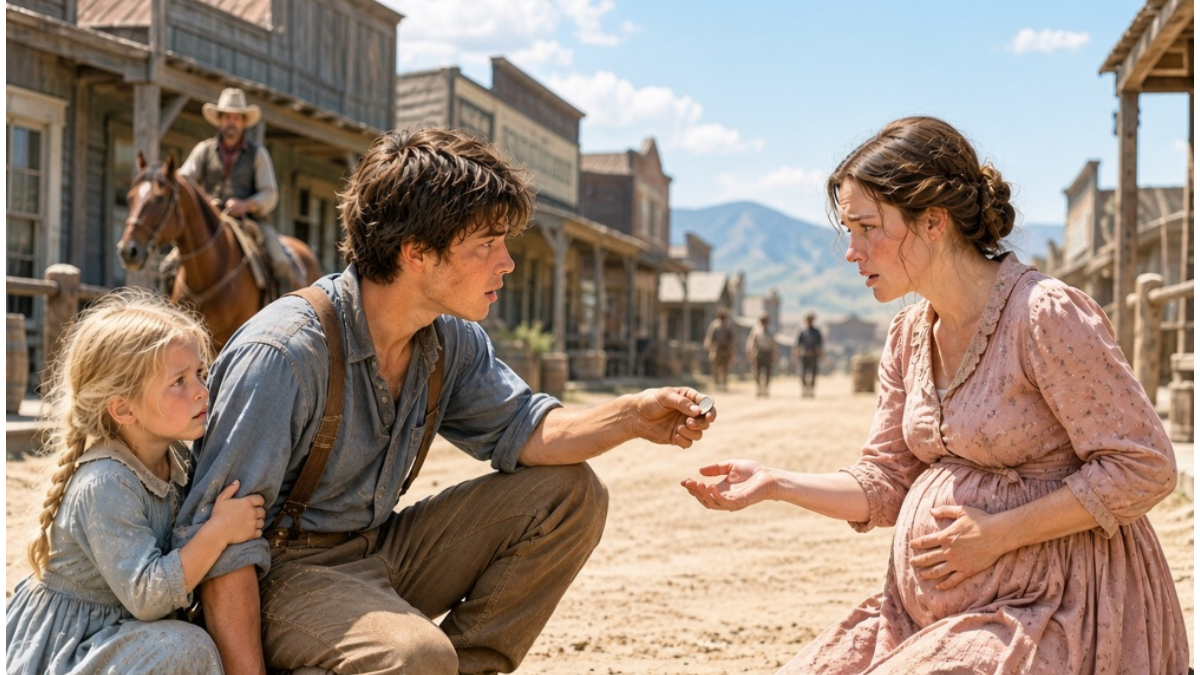
He shoved open the door of the Mercer Ranch house like he owned it because in his mind he already did.
He walked straight to the kitchen table where Abigail sat, 7 months swollen with child, her fingers wrapped around a coffee cup gone cold, and he dropped a folded paper in front of her without a word.
Then he pulled out the chair across from her, sat down uninvited, and smiled the way a man smiled when he knows the other person has no cards left to play.
Everett’s been dead four months. Puit said, “I’ve been patient.” Abigail didn’t touch the paper.
That document says you owe me $940. He tapped the table once with one finger.
I want this land, Mrs. Mercer. I want it before spring. And if you can’t pay, I’ll take it legal, and I’ll take it fast, and you’ll be out in the mud with whatever fits in a sack.
He stood, buttoned his coat, and looked around the kitchen. The way a buyer looks at furniture he’s already decided to keep.
You’ve got until February. He left the door open behind him. Cold air poured in across the floor.
Abigail sat there for a long time. She didn’t cry. She looked at the dollar coin sitting on the windowsill.
The last one she had, and she thought about what a woman does when everything she was supposed to depend on turns out to have been a lie.
Abigail Mercer had not planned on any of this.
She had not planned on marrying Everett Mercer at 31, though she’d done it willingly enough.
She had not planned on moving from Ohio to a Montana cattle ranch that turned out to be held together by stubbornness and borrowed money.
She had not planned on getting pregnant at 33 or on Everett dying of a burst appendix in September before the first snow, or on discovering 3 weeks after the funeral when she finally sat down with his papers that her husband had been carrying debts he’d never once mentioned to her.
$940, plus two smaller accounts she hadn’t known existed, plus a lean on the south pasture she couldn’t trace to any bank she’d ever heard of.
She had not planned on being alone in Montana in November, 7 months pregnant with 31 cattle, a leaking barn roof, $14 and one silver dollar, and a dead man’s secret stacked up on the kitchen table.
But that was where she was. The town of Harland Creek was not unkind to her exactly.
The women brought food in the first weeks. Reverend Oaks offered prayers. The hardware store owner Dell Ferris extended her a small credit for nails and rope.
But there was a particular way people looked at her when she came into town.
A soft, pitying look that made her stomach tighten. And she understood what was behind it.
They were waiting for her to fail. Not because they wished her harm, because they couldn’t see how she wouldn’t.
She was a woman, visibly pregnant with a ranch she didn’t know how to run, debt she couldn’t pay, and no family within 800 m.
That math didn’t add up to survival. Everyone in Harland Creek could see it. Abigail could see it, too.
That was the part that kept her awake at 3 in the morning, lying in the cold, dark of the bedroom she’d shared with Everett, listening to the wind come down off the mountains and rattle the window glass.
He would lie there and work through the numbers and again, and every time she got to the same place without help, without income, without someone who could actually work the land beside her, she would lose the ranch before spring.
She lay there one night in late November thinking about her options. And she realized she had already eliminated most of them.
Couldn’t sell, not at winter prices, not with the lean on the south pasture, not without understanding what Everett had actually signed.
She couldn’t hire a hand because she couldn’t pay wages. She couldn’t borrow more money because no bank in the territory would lend to a woman alone, pregnant, already in debt.
She stared at the ceiling and thought, “What do I have that I can actually use?”
What she had was a house with two empty rooms, a root seller with enough food to last a hard winter if she was careful.
Barn that was cold but solid enough, and land good land, she’d always thought that whatever else Everett had bungled that could grow something if someone worked it right.
She needed was labor, and she had nothing to pay labor with except the thing she just described, shelter, food, and land.
She thought about that for a long time. Then she thought about the orphan station she’d passed twice on the road into Harland Creek, converted Methodist Hall with a painted sign out front and a row of narrow windows.
She’d never looked at it too closely. She had no particular reason to. She was looking at it now in her mind in the dark.
By morning, she had a plan. It was not a good plan. It was the only plan she had left.
The Harland Creek Orphan Station was run by a woman named Mrs. Hajj, who had the manner of someone who had long ago, Mo, decided that hope was a luxury she couldn’t afford on behalf of other people.
She was not cruel. She was efficient. And efficiency in that place meant not pretending things were better than they were.
Abigail arrived on a Tuesday in early December, the wagon seat hard under her, the cold biting through her coat in a way that made her back ache constantly now.
She tied the horse at the post and stood in front of the door for a moment, aware of how she looked heavy with child, alone, wearing a coat with a mended tear at the left elbow, and then she pushed the thought aside and went in.
Mrs. Hodgej received her in the small front office behind a desk covered in folders and intake papers.
She looked at Abigail the way she probably looked at everyone who came through that door, assessing not unkind, already bracing for disappointment.
You’re looking to take a child, Mrs. Hodgej said. Possibly, Abigail said that got a reaction.
Not much of one, but something shifted in the woman’s expression. Most families want one, Mrs. Hodgej said.
Young, easyplaced girl who can help with housework or a boy young enough to train up.
Not too old, not she paused. Complicated. I’m not looking for easy, Abigail said. I’m looking for someone who can work.
And I’m looking for someone they won’t leave behind. Mrs. Hodgej studied her. What does that mean?
It means if there are children here who come as a pair and people keep taking one and leaving the other.
I want those ones. There was a silence. Mrs. Hodgej folded her hands on the desk.
There are two, she said finally. A brother and sister. Rowan Pike, 16. His sister Lahie, nine.
She said the names, the way you say the names of things you’ve tried to place and failed.
Rowan has been here 8 months. Lahi came with him. We’ve had four inquiries about Rowan.
Every one of them wanted him alone. She paused. He refused each time. He would not leave without his sister.
“What happened to their parents?” Abigail asked. “Father’s gone. Mother died of fever two years ago.”
Mrs. Hajj opened a folder without looking down at it. They were placed firSt. Was a family in Billings.
The husband decided the boy was too willful. Sent them both back. She set the folder down.
“Rowan, he’s not easy. He has opinions. He doesn’t take to being dismissed.” 16-year-old boys rarely do.
Abigail said he got into a fight with the last man who tried to separate them.
Bloodied the man’s nose. Mrs. Hajj looked at her steadily. I’m telling you this because I’d rather you know it now.
Abigail nodded. Can I meet them? Rowan Pike was taller than she’d expected. He came into the room ahead of his sister.
The way someone walks into a space they expect to be hostile. Shoulders squared, jaw set, dark eyes moving to Abigail and staying there.
He was lean in the way boys are lean when they’ve grown fast without enough food all height and angle, not much softness.
There was a scar along his left jaw she didn’t ask about. Lahi came in behind him and stayed close to his shoulder.
She was small, small for nine, with a braid that had come mostly undone and gray eyes that took in everything without giving much back.
She held one of Rowan’s coat sleeves loosely in her fingers, not clutching it, just touching it the way you keep one hand near a wall in the dark.
Abigail sat down. She did not offer pleasantries. I have a cattle ranch 12 mi out of Harland Creek, she said.
My husband died in September. I’m going to have a baby in about 8 weeks.
The ranch is in debt and it is in bad shape and I cannot run it alone.
She let that sit for a moment. I need help. Real help. The kind that means getting up before dawn and working until there’s no light left.
Rowan said nothing. I’m not offering you a comfortable situation. Abigail continued. Will be hard.
The house is cold. The work is harder. But there’s food, there’s shelter, and there are two rooms, one for each of you, that are yours.
She looked at Rowan directly. I’m not going to take one of you and leave the other.
It’s not what I’m here for. Something moved across Rowan’s face. It was there and gone so fast she almost missed it.
A loosening just briefly before the wall came back up. “What do you know about cattle?”
He asked. “Not as much as I need to,” she said. “My husband handled most of it.”
“Then how do you know I know more?” “I don’t,” Abigail said. “But Mrs. Hodge told me you’ve been asking to work instead of sitting in lessons and that you fixed the station’s water pump last month without being asked.
Tells me something. Rowan looked at her for a long moment. Then he looked at Lahi.
Lahie was watching Abigail with those still gray eyes. She hadn’t said a word, but she gave the smallest nod barely a motion, more like a thought that made it to the surface.
For just a second, Rowan looked back at Abigail. If it doesn’t work, he said carefully.
You send us both back. Not just her, both of us. Agreed, Abigails said. And you don’t separate us for any reason.
Agreed. And if I think you’re wrong about something on the ranch, I say so.
Abigail almost smiled. I’d expect nothing less. They left the next morning. Mrs. Hodgej packed their things, such as they were, in two flower sacks.
Rowan had a coat that was too short at the wrists and a pair of boots that had been resold at least twice.
Lahi had a secondhand dress, an extra pair of stockings, and a small tin box she didn’t explain and nobody asked about.
The ride back to the ranch took 2 hours. It was cold and gray, and the road was half frozen mud that the wagon wheels cut into badly.
Nobody talked much. Lahi sat in the wagon bed with her back against the sideboard.
Rowan sat on the bench beside Abigail and watched the land go by. About an hour out, he said, “How much debt?”
Abigail considered whether to tell him the truth. Told him the truth. He didn’t say anything for a while.
Then do you have the papers? All of it in writing? Yes, I’d like to look at them.
She glanced at him sidelong. You can read contracts. I can read, he said. The tone wasn’t defensive.
It was just flat, and it told her that he’d been underestimated on exactly this point before, more than once, and he was tired of it.
“All right,” she said. “Tonight, if you want,” he nodded once, and went back to watching the road, the ranch came into view around a long curve.
The main house first, then the barn and the smaller outbuildings behind it. It was not beautiful.
The fence along the near pasture leaned badly in two places. The house needed paint it wasn’t going to get.
The barn roof had a dark stain along the eastern side. That meant water and not old water either.
Rowan looked at it all without expression. Lahi from the wagon bed said her first words of the entire journey.
The fence is going to fall before spring. Abigail looked back at her. You’re right.
Lahi nodded seriously and said nothing else. First week was not easy. Nothing about any of it was easy.
Rowan went out to the barn the first morning before Abigail had water on for breakfast and came back with a list breakfast and came back with a list in his head not written of everything that was wrong in order of how fast it would kill them if left alone.
The fence was bad as Lahi had noted, but fixable. The water trough had a crack that was going to split through in the next hard freeze.
Two of the cattle had a cough he didn’t like the sound of. He reported all of this to Abigail at the breakfast table, standing, not sitting, as if he hadn’t yet decided whether to stay.
She listened to everything. Then she said, “What do you need to fix the trough?”
He told her. She wrote it down. “I’ll go into town Thursday,” she said. “Anything else before then?”
He looked at her for a moment. Then he sat down at the table. It was not friendship.
It was not truSt. Not yet. It was something more like two people who had looked at a problem and agreed without saying so that the problem was bigger than either of them and they were going to have to work it together.
Lahi, meanwhile, had quietly taken over the kitchen. This was not a dramatic thing. She didn’t announce it.
She simply began washing the dishes that had piled up, sweeping the floor, reorganizing the root cellar in a way that made it immediately obvious.
She’d found three things going soft that needed to be used firSt. She cooked supper for the second night without being asked and didn’t make a fuss about it.
Just set the food on the table and sat down. Food was good. Simple but good.
Where did you learn to cook? Abigail asked. I watched, Lahi said. At the station and she didn’t say before what.
Abigail didn’t ask. The days settled into a rough pattern. Rowan worked from first light until the dark made it impossible and sometimes passed that by lantern.
He did not complain about the cold. He did not complain about anything. But Abigail began to notice the particular way he moved when he was exhausted.
A tightness around his eyes, a tendency to talk less, which was saying something since he didn’t talk much to begin with.
She started leaving coffee on the stove for when he came in. He started drinking it without acknowledging it, which she took as thank you.
On the ninth day, he came in from the barn and sat down at the kitchen table and opened the tin box where she kept Everett’s papers.
She hadn’t asked him to. He’d asked once to look at them. She’d said yes, and he’d apparently decided tonight was the night.
She sat across from him and watched him read. He read the way smart people read things they’re determined to understand slowly going back marking things with his thumbnail.
He got to the third document and stopped. This one, he said, turned it around and pushed it across the table to her.
The name on this lean, Elias Pike. The name hit the air between them and sat there.
Abigail looked at the paper. She had looked at it before. She had thought it was a business associate she hadn’t heard of.
She looked at Rowan. His face had gone very still. “That’s my brother’s name,” he said.
His voice was even. “Careful. We had an older brother. He left when I was nine.”
Lahi was two. He looked down at the paper, then back up at her. Elias Pike.
He would be 32 now. Abigail felt something drop in her cheSt. She looked at the signature.
She thought about Everett’s face, the things he’d said, and hadn’t said the the parts of his past she’d never been able to fully reach.
She said very carefully. Everett’s full name was Everett Elias Mercer. Kitchen was very quiet.
“He changed it,” Rowan said. “Not a question.” “I didn’t know,” Abigail said. “I swear to you, I did not know.”
Rowan looked at the paper for a long time. His jaw was tight. She could see the muscles working in it.
Lahi can’t know, he said. Not yet. He stood up. He was very controlled about it.
Not violent, not explosive, just standing up and stepping back from the table as if he needed more room to think.
She was too. She doesn’t remember him anyway. She doesn’t. It would just He stopped, pressed the back of his hand to his mouth for a moment.
Rowan, Abigail said. I’m fine, he said. He wasn’t, but the way he said it told her not to push it, he left the kitchen.
She heard him go out the back door into the cold. She sat at the table alone with Everett’s papers spread in front of her, and she understood for the first time that she had not fully known the man she married, and that his choices, his disappearances, his silences had rippled out further than she’d imagined, further than the debts, further than the lies.
He had left two children behind. He had built a whole life on top of that leaving.
And he had died without ever saying a word. She looked at the dollar coin on the windowsill, the last one she had.
She thought, “Well, that’s not nothing. What Rowan just found out, and he’s still here.
He didn’t walk out the door and keep walking. That’s not nothing either.” She folded the papers back into the tin, turned down the lantern, and went to bed.
There was work in the morning. There was always work in the morning, and whatever the night held for Rowan Pike out there in the cold, she couldn’t carry it for him.
She could only make sure the coffee was on when he came back in, and she would make sure of that much.
He came back in before dawn. Abigail heard the door, heard him move through the kitchen, heard the particular creek of the third floorboard near the stove.
She didn’t get up. She lay in the dark and listened to him pour coffee from the pot she’d left on low heat.
And she thought he came back. Whatever the cold and the dark had done to him out there, he’d come back and poured himself coffee, and that was going to have to be enough for now.
By the time she was dressed and in the kitchen, he was already gone to the barn.
She didn’t bring up Elias Pike at breakfaSt. She didn’t bring it up that day or the next.
Rowan didn’t either. It sat between them like something buried under fresh snow invisible on the surface, but you could feel the shape of it if you walked too close.
Lahi noticed something had shifted. She was 9 years old and small, and people consistently underestimated her because of both those things.
But she noticed she started watching Rowan more carefully in the evenings. The way she watched him when she was trying to figure out how bad something was without asking directly.
She didn’t ask. She just stayed closer than usual, handed him things before he reached for them, made sure his coffee was hot.
Rowan let her. The cold deepened through December in a way that felt personal. Temperatures that had been merely brutal became genuinely dangerous, and the wind off the mountains had a particular quality to it.
Not just cold, but punishing like it had a point to make. Rowan came in one night with the first two fingers of his right hand white at the tips.
And Abigail made him sit at the table and pressed a warm cloth against them without asking permission, and he let her do that, too, staring at the wall while the feeling came back in a way that was obviously painful, and he made no sound about it.
“You need better gloves,” she said. “I know that,” he said. There’s a pair of Everetts in the chest in in the hall.
Fit you. He looked at her. She kept her eyes on his hand on the cloth.
All right, he said finally. He wore them the next day. She noticed but didn’t say anything.
The ranch’s money situation was not improving. It was not getting immediately worse either, which Abigail had started to think of as a kind of victory.
She had made a list of every debt, every creditor, every dollar owed, and to whom, and she went over it most evenings at the kitchen table.
She had 31 cattle, which was something. A good spring calf crop could mean real money.
But to get there, she needed to make it through winter with the herd intact, and the herd needed feed, and feed cost money she didn’t have in the quantities she needed.
She was going over the numbers for what felt like the 40th time when Rowan came and sat across from her.
“You’re reading it wrong,” he said. She looked up. He reached across and turned the ledger slightly, not taking it from her, just angling it.
“You’re counting the south pasture feed separately from the barntock, but if you rotate them during a thaw, you can stretch the hay another 3 weeks, maybe four,” he pointed to a line.
And this entry here, this is double listed. You’ve counted the October supply twice. Abigail looked at the entry.
It was right. Where did you learn to read a ledger? She asked. I worked for a grain merchant for 7 months.
When I was 14, he said before we went to the station. He wasn’t a good man, but he kept good books.
He sat back. Can go through all of it if you want. Find what’s real and what’s not.
That would take most of a night. I know. She pushed the ledger across to him.
He worked through it by lamplight while she mended a tear in the quilt she needed finished before the baby came.
Neither of them talked much. The wind pressed against the walls of the house. At some point, Lahi appeared in the doorway in her night gown, assessed the situation, went and got her blanket, and curled up in the armchair near the stove without a word.
She was asleep in 10 minutes. Rowan looked at her and something in his face went quiet and and soft for just a moment, the way it did sometimes when he thought no one was watching.
He went back to the ledger. By midnight he had a corrected accounting and three pages of notes in handwriting that was small and precise and nothing like what Abigail would have expected from a boy who’d been called difficult and sent back to the orphan station.
Put it in front of her. The real number is $870, he said, not 940.
Puit rounded up and called it a fee. There’s no documentation for that extras $70, he pointed to the note.
The lean on the south pasture. It’s written against the land, not the mortgage. That’s different.
It means it can be negotiated separately from what you owe the bank. Abigail stared at the paper.
How do you know that? I read the contract, he said twice. The wording matters.
She looked at him for a long moment. He looked back at her, not with pride exactly, but with a kind of tired, matter-of-act shurnness, the look of someone who knew what they knew and was past the point of needing to be believed about it.
All right, she said. Then we start there. Gerald Puit came back in the second week of December.
He didn’t knock this time either. Abigail was in the kitchen. Rowan was somewhere outside.
She could hear him at the wood pile. Lahi was at the table doing the figure’s practice.
Abigail had started giving her in the mornings small addition problems written on a slate.
Puit came through the door, saw Abigail, saw Lah, and barely registered Lahi at all.
I heard you took in some orphans, he said. He made the word sound like a mistake.
I did, Abigail said. That’s not going to fix your problem. I’m aware of what fixes and doesn’t fix my problem, mister.
Screw it. What do you want? He sat down without being asked. He had a way of occupying space as if he’d already bought it.
I want to be reasonable, he said. I want to give you an option before I have to take legal steps.
You’ve given me an option, she said. February. I’m revising that. He set a new paper on the table.
January 1St. I’ve had another buyer approach me about this land. If you can’t pay what you owe by New Year’s, I’m moving forward with him.
Abigail looked at the paper. She did not pick it up. The amount you’ve listed is incorrect, she said.
You charge $70 as a fee with no documentation. The legal amount is 870. Puit stared at her.
I’ve reviewed the contract, she said. The wording is specific. I’d be happy to go over it with you if you’d like to bring your copy.
He didn’t say anything for a moment. Then you didn’t read that yourself. It doesn’t matter who read it, she said.
The wording is what it is. He looked at Lahi. Lahi was looking at her slate.
She had stopped writing, but she was staring at the slate with intense focus. The kind of focus that meant she was listening to every word.
Puit looked back at Abigail. January 1st, he said, 870 or the land. He left.
This time he shut the door, which somehow felt worse. Lahy put down her chalk.
She looked at Abigail. He’s lying about the buyer, she said. Abigail looked at her.
What makes you say that? He didn’t have any papers about a buyer. Ly said he just had that one paper.
If someone was buying land, there’d be more papers. Abigail thought about that. You’re probably right, she said.
Lahy picked up her chalk again. You should tell Rowan, she said. He’ll want to know.
Rowan took the news about Puit’s visit the way he took most things that made him angry quietly with a stillness that was somehow more unsettling than shouting.
He stood in the kitchen doorway with his coat still on, ice on his boot laces, and listened to Abigail give him the details.
He didn’t interrupt. When she finished, he looked at the wall for a moment. He moved the date up because you pushed back on the amount, he said.
He didn’t expect you to know. No, Abigail said. He didn’t, so he’s rattled. Rowan pulled off his coat and hung it.
Rattled men make mistakes. He sat down. What assets does this ranch have that aren’t currently listed against the debt?
Abigail told him about the timber rights. She’d almost forgotten about them herself. It was something Everett had mentioned once, vaguely.
Early in their marriage, a stand of timber on the north ridge that came with the original land purchase, the rights to which had never been sold or leveraged.
She’d found the documentation in the tin with Everett’s papers and had set it aside without knowing what to do with it.
Rowan read the document twice. He set it down. This is worth something, he said.
Not a fortune. But to a lumber operation or a mill, yes, real money. I don’t know anyone in the lumber business.
Arlland Briggs does, Rowan said. The man who runs the feed store east of town.
He mentioned a mill contract when I was in there last week. He knows people.
Abigail looked at him. You talked to Briggs about contracts? I talked to everyone. Rowan said without apology.
That’s how you find out what’s actually happening. She didn’t know what to do with that.
She filed it away. All right, she says. I’ll go see Briggs. I’ll come with you.
You don’t need to. I know I don’t need to, he said not rudely, just stating it.
But I know what Briggs said and you don’t and I can fill in what you don’t know to ask.
She thought about arguing. She decided it was a waste of time she didn’t have.
Thursday, she said, “We’ll go Thursday.” The trip to Harland Creek on Thursday was the first time Abigail had taken Rowan into town.
And she understood within 10 minutes of arriving that it was going to be a thing people noticed.
And commented on. The first person they passed on the main street was Margaret Hail, wife of the bank manager, who looked at Rowan.
The way you look at something you’re not sure is safe to get close to.
She said good morning to Abigail and nothing at all to Rowan. Rowan noticed. His jaw set slightly and he kept walking.
Dell Ferris at the hardware store was more direct about it. He was a decent man.
Abigail genuinely thought that, but when he saw Rowan, he said, “That one of the station kids.”
In a voice that wasn’t cruel, but was very certain about the category it was placing Rowan in.
“That’s Rowan Pike,” Abigail said. “He works my ranch.” “16,” Ferris said, looking at Rowan with the skeptical squint of a man who doubted that assessment.
“Old enough,” Rowan said. His voice was flat and even. Ferris looked between them. Then he said, “What do you need?”
And they moved on to business. And Rowan answered half the questions because he knew what she needed for the water trough.
And she didn’t. And by the time they left, Abigail could see that Ferris had revised something in his thinking, even if he hadn’t said so.
Arlland Briggs was a different kind of man. He was large and slowm moving, and talked around things before he got to them.
But when Rowan brought up the timber rights directly without preamble, without softening it, Briggs stopped and talking around things and listened.
“You’ve got standing timber on the north ridge,” he said to Abigail. According to the deed, “Yes, and the rights are clear.”
“No lean?” “None that appears in the documentation.” Briggs stroked his jaw. He looked at Rowan.
“Who told you about the mill contract?” “You did,” Rowan said. You told Hennessy’s boy when you were settling the feed account last Tuesday.
I was standing next to the stacks. Briggs stared at him for a moment. Then he made a sound that was almost a laugh.
Boy doesn’t miss much, he said to Abigail. No, she said he doesn’t. It took another 40 minutes of conversation.
Briggs was constitutionally incapable of moving faSt. But by the time they left, they had the name of the mill agent who operated out of Billings and a rough sense of what standing timber on a north ridge in that county was worth per acre of rights.
The number was not transformative, but it was real and it was hers and didn’t know about it and that mattered.
In the wagon on the way home, Rowan said Briggs is going to tell someone.
I know, Abigail said. So, we need to move on the mill agent before Puit finds out.
There’s another asset to chase. I know that, too. He nodded. He looked out at the road.
After a while, he said, “People in town don’t like me being here. Some of them,” she said.
“Not all. MoSt.” She didn’t argue with him. He was right, and he knew he was right.
And feeding him false comfort would have been an insult. “Does it change what you’re doing?”
She asked. He thought about it. Genuinely thought about it for a moment which she’d come to recognize as one of his actual qualities.
He didn’t just say things. He considered them. No, he said. Then we keep going, she said.
The trouble with the sick cattle presented itself on a Monday morning 2 weeks before Christmas when Rowan came in from the early check and told Abigail that three of the herd had the kind of cough that didn’t get better on its own.
He’d seen it before, he said, in the grain merchant stock. Bavine shipping fever maybe, or something adjacent to it.
If it spread, they could lose a third of the herd before February. The veterinarian in Harland Creek was a man named Colton who charged more than Abigail had, and she told Rowan that.
Rowan went back out to the barn. An hour later, he came back in and said, “I’ve isolated the three.
They’re in the far stall with fresh bedding and I’ve separated their water. If we doze them with the pine tar compound in the supply cabinet, I checked and keep them warm and isolated for 2 weeks.
Most cases like this clear. Seen it. You’ve seen boine respiratory disease clear with pine tar and ruSt. Abigail said.
Warmth. He said the cold is what gets into them. She looked at him. He looked back at her.
If it doesn’t work, she said, we lose those three. If we call Colton and pay his fee, we might save those three and lose the money we need for February.
He said, I’m not telling you what to do. I’m telling you what I know.
Hated that he was right. She hated even more that she was in a position where a 16-year-old boy’s judgment was her best available option.
“Do it,” she said. “He did it.” It was not a smooth two weeks. Two of the three sick cattle got worse before they got better.
And there was a night when Rowan slept in the barn rather than leave them, and Lahi brought him food wrapped in a cloth and came back without making any comment about it.
By the first of the new year, all three were eating normally, and the cough was gone.
Abigail updated the ledger. She wrote, “Avoided vet billard intact 31.” Then she sat back and thought about what it meant that a boy who’d been called too difficult to place had just saved a third of her breeding stock.
She thought about the profit share arrangement she’d been turning over in her mind for 2 weeks and she decided she was done turning it over.
She brought it up after supper on a Thursday when Lahi had gone to do her evening reading and she and Rowan were at the table with the ledger between them.
I want to change our arrangement, she said. He looked up. You’re not here as a charity case, she said.
You never were, but I want to make it official. I want to put you on as a working partner in this ranch’s operation, not wages.
I can’t pay wages yet, but when the spring calf crop sells it, you get 15% of the net profit.
Dared at her. 15% isn’t much, she said. I know that, but it’s real and it’s documented.
And if this ranch grows, it grows for you, too, not just for me. Why?
He said, “Because it’s fair,” she said. “And because you’ve earned it, and because I’m not Everett.”
The name landed between them and sat there the way it always did when it came up, which was rarely and always heavily.”
Rowan looked down at the table. He pressed his thumb against the edge of the ledger.
He did that sometimes when he was working through something. This small contained gesture like he was grounding himself in something solid.
Lahi too, he said. Lahie keeps this household running. Abigail said she’s 9 years old and she manages the root seller better than I do and she notices things the rest of us miss.
Yes, Lah too, 5%. He was quiet for a long moment. That’s 20% off the top before you pay your debts, he said.
I know the math, she said. I’m not arguing against it, he said. I just want you to know I know what it costs you.
Then we agree, she said. He put out his hand across the table, still rough from the winter work, still lean, still scarred at the knuckle from something she’d never asked about.
She shook it. It was not a dramatic moment. The lamp was smoking slightly and the wind was doing its usual thing against the north wall.
And somewhere outside a cow was making the low sound they made when they were restless but not alarmed.
It was just two people in a cold kitchen shaking hands on something they both understood mattered.
That was enough. The letter from the Billings Mill agent arrived on a Wednesday, and it was better than Abigail had let herself hope.
The agent, a man named Whitfield, was interested in the timber rights. Not at the top of the range, Briggs had suggested, but solidly in the middle of it enough to cover 3 months of debt service and give her room to approach the bank about restructuring the main mortgage.
Whitfield wanted to send a man out to assess the timber stand in the spring, which meant nothing was settled yet, but settled enough to work with.
She read the letter to Rowan at breakfaSt. Lahi listened from her end of the table.
Puit doesn’t know about Whitfield. Rowan said. Not yet. We should talk to the bank before Puit does.
He said the bank knows the ranch has an asset. Puit hasn’t accounted for it.
Changes the picture for the mortgage. Bank manager is Margaret Hail’s husband. Abigail said, “I know he doesn’t like you because you didn’t fail fast enough.”
He said it without particular emotion. But he likes money and this is a legitimate offer from a legitimate mill agent in Billings.
Use that. Lahi looked up from her porridge. You should bring the letter, she said.
The actual letter. So he can see it’s real. That’s right, Rowan said, looking at his sister with something that was close to warmth.
Bring the original. Abigail folded the letter carefully and put it in the tin with Everett’s papers next to the timber rights document next to the corrected debt accounting next to everything else they’d been building one careful piece at a time.
Thought a month ago I had a single silver dollar and no plan. Now I have documents.
Now I have numbers that are mine and not someone else’s version of mine. That was not nothing.
That was in fact considerable. She didn’t let herself feel too much of it. There was still January 1st, still Gerald Puit, still a baby coming in a matter of weeks and a body that was beginning to make clear in in unmistakable ways that it had reached the end of what it could do easily.
She’d been waking at night with a low pulling ache across her back that didn’t go away with position changes or the extra blanket she’d added to the bed.
She hadn’t mentioned it to Rowan or Lahi. She’d been telling herself it was the cold and the stress and the months of harder work than a woman 8 months along had any business doing.
She’d been telling herself that for 2 weeks. The evening after the letter arrived, she was at the stove when the ache moved shifted and sharpened in a way that was different from what it had been.
Low and specific in a way that stopped her mid motion. She stood still for a moment with her hand on the stove rail.
Then it eased. She breathed out. Lahi was watching her from the doorway. “I’m fine,” Abigail said.
Lahie said nothing. She came into the kitchen and began setting the table, and she set the table slowly, and she didn’t look at Abigail.
But Abigail had been around Lahi long enough to know that not looking was its own kind of looking.
“Lahee,” she said. “Yes, if something happened, if I needed help in the night, you know to wake Rowan.”
Lahie put down the fork she was holding. She turned and looked at Abigail directly, those gray eyes, steady and serious, and containing something that was much older than nine.
“I know,” she said. “Good,” Abigail said. “That’s good.” She went back to the stove.
The ache had settled back to its lower register, the familiar dull pull, and she told herself again that it was fine, that she had weeks still, that the doctor in Harland Creek knew her situation and had said January, late January at the earlieSt. She told herself all of that and went on making supper, and outside the wind had shifted direction, coming now from the northwest instead of the west, which meant something, though she couldn’t have said precisely what.
Gerald Puit appeared at the bank on the same morning Abigail did. She hadn’t expected that.
She’d gone in on the first Thursday after the new year, letter in hand, with Rowan beside her, and found Puit already in the lobby talking to the bank manager, Warren Hale, in a voice low enough that she couldn’t catch the words.
When Puit saw her, he stopped talking. When he saw Rowan, his expression shifted into something she didn’t like.
Mrs. Mercer. Warren Hail said he was a thin, careful man with the manner of someone who had spent decades making small amounts of money feel important.
I was just speaking with Mr. Puit about your account. Then you can speak with me directly,” Abigail said.
She walked to Hail’s office and went in without waiting to be asked, and after a beat, Hail followed, and after another beat, Rowan followed, and Puit came last and stopped in the doorway.
He’s not a party to this, Puit said, nodding at Rowan. He works my ranch, Abigail said.
He’s a party to everything that affects it. Puit’s mouth thinned. He came in. Abigail put the timber rights document on Hail’s desk.
Then she put Whitfield’s letter beside it. Then she put Rowan’s corrected accounting beside that, the one that showed the real debt figure versus Puit’s inflated one.
Hail looked at the papers. He picked up Whitfield’s letter and read it. Puit was watching Hail’s face.
She could see him calculating. The mill assessment happens in spring, Abigail said to Hail.
The offer proceeds, and Whitfield’s letter suggests strong intereSt. The Timberwrights income covers February and March debt service and opens the door to a mortgage restructure.
The ranch is viable, Mr. Hail. The numbers show it. The numbers show a lot of things, Puit said from his chair.
They show a woman who can’t make her payments and his shopping paper around to buy time.
They show a ranch with a documented asset Mr. Puit neglected to mention in his lean paperwork, Rowan said.
Puit looked at him [snorts] hard. Nobody asked you, Puit said. I’m answering anyway, Rowan said.
Hail set the letter down. He looked at Abigail, then at the papers, then at a spot somewhere between them that probably represented his own private calculation of risk and obligation and what happened to men who backed the wrong party in a land dispute.
I’d need to verify the mill interest, he said. Whitfield’s address is on the letterhead.
Abigail said, write to him today if you like. Puit stood up. This is a delay tactic.
This is a business conversation, she said, which is more than you offered me when you walked into my house and told me to be out by spring.
The room was quiet. Hail looked at his desk. Puit looked at Abigail with the specific look of a man who had expected something to be easy and was re-calibrating.
February, Hail said finally, not looking at either of them. I’ll verify the mill contact and we’ll revisit the restructure in February.
Mrs. Mercer, I’ll need a full asset accounting by the 15th. I’ll have it to you by the 12th, she said.
She gathered her papers. Dude nodded once to Hail, walked pastuit without looking at him, and went out through the lobby with Rowan behind her.
On the boardwalk outside, she stopped walking and stood in the cold for a moment.
Her hand pressed flat against the wall of the building, not because she needed support, but because she needed one second to feel something.
Solid before she moved again. Rowan stood beside her. He didn’t say anything. The baby moved, a long, slow roll that she felt all the way up her side and then a kick that was sharper than the ones she’d been getting.
Sharp enough to pull a short breath out of her. Rowan noticed her breath. He looked at her.
“I’m fine,” she said. “You keep saying that,” he said. “I keep meaning it,” she said.
He didn’t argue. He walked with her to the wagon and waited while she climbed up, which she let him do because climbing into a wagon at 8 and 1/2 months was not something she was doing with any grace, and there was no point pretending otherwise.
They rode back toward the ranch in the thin winter light, and Abigail thought about February and the mill agent and the 15 head of cattle that needed to make it through to spring and the accounting she needed to have ready by the 12th.
She thought about Lahie’s gray eyes in the kitchen doorway the night before, steady and knowing.
She thought about the ache that had moved differently last evening and hadn’t quite gone back to the way it was.
She looked at the sky. The clouds coming from the northwest were low and gray white and moving faSt. The particular color and speed she’d come to associate with serious weather.
Rowan, she said. I see it. He said he was already looking at the same sky.
How long do you think? He studied it. Two days, he said. Maybe less. She nodded and clicked the horse forward.
Two days. She had two days to get the wood in, check the cattle, get the food stores ready, and make sure everything that needed to be inside was inside because whatever was coming from the northwest was coming hard, and she could feel it in the air the same way she could feel the change in the ache along her backlo and certain and close.
The ranch came into view around the bend, and the smoke from the chimney was pulling sideways in the wind, and inside she knew Lahi would be at the table with her slate, doing her fi figures, keeping the fire, noticing things.
They had work to do. There was always work to do. She clicked the horse to a faster pace and leaned forward slightly into the cold wind and behind the high ridge to the northweSt. The sky was the color of old iron.
It was moving and it was close. Storm came in faster than Rowan had predicted, not by much.
He’d said 2 days, and it arrived in 36 hours, but in weather like that, 6 hours is the difference between prepared and destroyed.
He’d spent the day after the bank meeting moving with a focused urgency that Abigail recognized now as his particular mode of serious work.
No wasted motion, no commentary, just the next thing and then the next thing after that.
He got the wood in first, stacking it against the north wall of the house where it would be sheltered.
Then he checked the cattle and moved the three that had been sick to the interior stall the warmest position in the barn.
He reinforced the barn door latch with a length of chain because the existing latch was something he’d been meaning to to address for 2 weeks, and this was the last moment he’d have to do it.
Lahi worked alongside him without being asked, carrying what she could carry, holding things while he nailed them, running back to the house to bring out the extra blankets he asked for to bank around the water trough.
She was not strong enough to do most of what needed doing, but she understood what was needed, and she moved efficiently, and she didn’t get in the way, which at 9 years old in a gathering blizzard that was more than most people managed.
Abigail did what she could. Her body had stopped being something she could negotiate with.
The ache in her back had settled into a constant presence that she’d simply incorporated into her daily accounting.
One more thing on the list that had to be managed and not dwelt upon.
She brought food to the barn twice, made sure the water barrel inside was full, checked the supply cabinet inventory, and wrote down what was there.
Pine tar compound, clean rags, a coil of rope, three lanterns, a tin of matches sealed against moisture, a medical guide Everett had bought in his first year and never opened.
She stood in front of that medical guide for a moment. It was thick, clothbound, the pages dense with small print and occasional hand-drawn diagraMs. She’d looked at it once in October, when she was still hoping the baby would stay put until the right time and the right circumstances.
She put it back on the shelf and went back to the house. The snow started that evening.
Light at first, the small fine flakes that didn’t feel serious until you realized they’d been falling for 3 hours and the ground had gone completely white.
By the time they ate supper, the wind had come up and the light snow had become the kind of snow that moved sideways and found every gap in the window frames and built against the door in a way that made opening it feel like an argument.
Rowan ate faSt. He went back to the barn for a final check and came back in stamping snow off his boots with snow still in his hair and he reported that the cattle were settled.
The water was holding. The chain on the barn door was good. The temperature is dropping faSt. He said if it keeps going the way it’s going by morning we’ll want to keep the interior doors open to let the stove heat move through the house.
I know Abigail said the baby he started. I’m aware of the timing, she said.
Not sharp, just direct. He nodded. He sat by the stove and dried his hands.
Lahi was already in bed. They’d sent her early because she’d been awake since before dawn, and she’d worked hard, and there was nothing more she could usefully do.
Abigail sat at the table with her hands folded and listened to the storm build outside and thought about Warren Hail’s office and the letter from Whitfield and the accounting she needed to have ready by the 12th.
And then she thought about the medical guide on the shelf in the barn and she made herself the stop thinking about it.
Get some sleep, Rowan said. In a while you’re doing that thing where you sit there and think about all of it until you’re too tired to sleep, he said.
She looked at him. Lahi does it too, he said. It runs in. He stopped.
The sentence had been going somewhere neither of them wanted it to go. Good night, Rowan, she said.
Good night, he said. She woke at 2:00 in the morning to a sound she couldn’t immediately place.
A deep sustained pressure against the north wall of the house. Something between a groan and a howl that wasn’t wind exactly, but was the house itself responding to wind.
The whole structure flexing slightly under the force of it. She lay still for a moment, listening.
The bedroom was very cold despite the extra blanket. She could hear the stove in the main room, the tick and settle of it working hard, and she could hear the storm outside in a way that was not like the storm she’d known in Ohio.
This was not weather. This was a sustained assault. She shifted to get up and the pain hit her low and hard and completely different from anything she’d felt before.
She knew in the precise moment it happened what it was. Not the ache, not the pressure, a contraction, real and purposeful and unmistakable, tightening across her middle and down her back with a grip that took her breath and held it for 30 seconds before it let go.
She lay still, counted. 8 minutes later, it happened again. She got up slowly and went to the door of the bedroom and opened it.
The main room was warmer. The stove was going well. Rowan and had banked it before he went to bed, which she’d noticed and hadn’t commented on.
She stood in the doorway in her night gown with the cold floor under her bare feet and waited to see if the third contraction would follow the pattern.
It did. 7 minutes this time. She went to Rowan’s door and knocked once. He was awake before she finished knocking.
She heard him sit up. I need you, she said through the door. A short silence.
How far apart? He said she’d told him in a practical conversation 2 weeks ago what to watch for.
She’d told him because she was a practical woman and she lived 12 m from town and she was going to have a baby in winter.
And pretending that circumstances wouldn’t arise was the kind of luxury she couldn’t afford. 7 minutes, she said.
It was 8:00 and now it’s 7. She heard him get up. He opened the door in his clothes.
He’d slept in them, which told her that he’d been more worried about this than he’d let on.
His face was the particular face he made when something serious was happening, and he was deciding how to handle it.
Still focused, the kind of focus that pushed everything except the immediate problem to the outside edge.
No road, he said. There’s no road, she said. You know that. He did know that the road to Harland Creek had been impassible since midnight at the lateSt. Buried under drifts that would be chest high on a horse by morning.
Even if he could get a horse out of the barn, which he probably couldn’t.
Not in this 12 m in a blizzard at 2:00 in the morning was a death sentence, not a rescue.
All right, he said. He said it the way he said most things once without drama.
I need to get the medical guide from the barn. I was thinking the same thing.
I’ll go now while there’s still time before it gets worse. He pulled on his coat and his boots and wrapped the scarf around his head and face in a way that left only his eyes clear.
Wake Lahie, tell her to put water on to boil a lot of water. And get back in bed.
I’m not going to just Abigail, he said. He almost never used her name. Get back in bed.
I’ll be 10 minutes. She went and woke Lahi. Lahie sat up and Abigail told her what was happening.
And Lahie looked at her with those gray eyes and did not cry and did not panic.
She said, “How bad is it?” In the careful voice of someone who wanted a real answer and not a managed one.
“It’s early,” Abigail said. “6 weeks, maybe 5 and a half. It’s happening.” “Yes.” Lahie pushed back her blanket and stood up.
She was in her night gown and her feet were bare and she was 9 years old and she looked in that moment like someone who had decided what the next hours required and was already beginning to arrange herself around that requirement.
I’ll get the water, she said. Go back to bed. I’ll bring things to you.
Abigail went back to bed. Rowan came back in 9 minutes. He brought the medical guide and snow all through the kitchen that Lahi tracked through twice getting to the stove before either of them noticed.
He sat at the table near the bedroom door and opened the book and read with the focus speed of someone who had taught himself to extract what mattered from a text quickly and hold it.
He turned pages, stopped, read again. Okay, he said. He wasn’t talking to anyone specific.
Then louder. Okay, I’m going to need He read the list from the book, calling it through the door to Abigail, who was lying in bed, working through contractions that were now 6 minutes apart, and getting their teeth into her in a way that required her complete attention to manage.
Lahi got the things. She moved between the kitchen and the bedroom with a purposeful quiet, setting what was needed on the nightstand, on the end of the bed, on the chair near the window.
She’d heated water and brought it in a basin. She’d found the clean rags from the supply list Abigail had made weeks ago and stored in the chest at the foot of the bed, which told Abigail that Lahi had known about that chest and its contents for some time without saying anything.
Rowan came to the bedroom doorway. He held the medical guide in one hand, and his face had the concentrated blankness of someone running a controlled internal argument.
Tell me what to do, he said. I’ll do exactly what you tell me, and what I don’t know, I’ll get from the book.
You have to stay with me. You have to tell me when something is different from what you expected.
He looked at him across the room, a 16-year-old boy in his workclo, snow still damp on the shoulders of his coat, holding an obstetrics guide he’d had 30 minutes to read in a farmhouse buried under a blizzard in the middle of the Montana night.
I know, she said. I’ll tell you. Good. He came in. He pulled the chair to the side of the bed and sat down and opened the book to the page he’d marked with his thumb.
The contractions are close enough that this is real and it’s going forward. The book says 6 weeks early is survivable if the birth goes normally.
If, she said, if he agreed. He didn’t soften it. She’d expected he wouldn’t. So, [clears throat] we need it to go normally, which means you do what your body tells you, and I do what you tell me.
And Lahi keeps the water hot and the room as warm as she can. He looked at her.
Can you do that? A contraction hit. She rode it. That was the only word for it.
You rode them or they took you under. And when it passed, she breathed out and said, “Yes.”
The next 3 hours were the hardest of Abigail Mercer’s life. Not because of the pain, though the pain was extraordinary.
It was the kind of pain that has its own weather system. It comes and recedes and lets you think it’s finished and then comes back larger.
It’s gathered and you lose track of time inside it. Lose track of everything except the next wave and whether you can get your breath before it.
She’d had been told what it would be like. She hadn’t been told what it would be like alone in a blizzard six weeks early with the wind tearing at the house and a teenage boy reading obstetrics by lamplight beside her bed.
Rowan did not flinch. She had braced herself for him to flinch for the moment when the reality of the situation would be too much and he’d go to pieces in some way she’d then have to manage on top of everything else.
He didn’t. He was steady in the way she’d come to associate with him at his beSt. Not calm exactly, because his jaw was set and his hands weren’t entirely still, but functional.
He read from the book and asked clear questions and listened to her answers and did what she told him with careful hands and no wasted motion.
Once around 4 in the morning, a gust hit the house so hard that the lamp in the bedroom swayed on its hook and one of the window panes cracked.
Not broke, just cracked. Thin spiderweb fissure in the corner, and the cold poured through it in a thin stream.
Rowan stopped what he was doing. Got up, pressed a strip of cloth against the crack with his palm for a moment, then went back to the chair.
“That’ll hold,” he said. “You don’t know that,” she said. “No,” he said. “But I’m acting like it will.”
She almost laughed. She couldn’t laugh because a contraction took her at exactly that moment and laughter was no longer a physical possibility.
But something in her chest did something adjacent to it. A kind of desperate mo involuntary recognition of the absurdity and the terror and the realness of being alive in this room in this storm with this particular boy next to her.
Lahi came in and out. She kept the water hot. She put another log on the stove without being asked.
She stood in the doorways, checking her face containing everything she was not saying. And when Abigail caught her eye, she gave a small nod that meant, “I’m here.”
And Lah’s face steadied and she went back to the kitchen. Quarter 4, Rowan said, “It’s time.”
He said it quietly. He’d been reading the signs the way the book described them.
And he’d been watching Abigail, and he understood, even without experience, even only from the text and from what she’d told him, that they had arrived at the place there was no coming back from.
“I know,” she said. “Tell me what you need me to do,” she told him.
He did it. His hands were steadier than she expected. He’d put the lamp on the nightstand at the right angle, and he kept the book open on the chair beside him, glancing at it, and then back, cross referencing what he saw against what the text described.
He talked to her in a low, even voice, not soothing sounds, not meaningless comfort, but actual information, what he was seeing, what it matched in the book, what came next.
It was the most useful thing he could have done. It kept her anchored, gave her something to track besides the pain.
She pushed. The storm pressed against the house. The lamp made shadows on the ceiling that moved with every gust that flexed the walls.
Lahi appeared in the doorway, and Rowan said without turning, “Stay back.” And Lahi stayed back.
But she didn’t leave the doorway. Abigail bore down with everything she had left, which was not much, and then more than she thought she had, which was the thing about extremity.
You found it in places you didn’t know you had it, in the body’s deep reserves, in something that didn’t have a name, but that kept moving you forward when your mind was entirely done.
And then Rowan’s voice changed. Not dramatically. It dropped very focused. He said almost and then stopped talking entirely.
The next 30 seconds were the longest Abigail had ever experienced. She heard him. She heard his breathing close and concentrated.
She heard the storm. She heard her own pulse which was everywhere at once. And then she heard nothing from the baby.
Silence. The specific silence that is not neutral. The silence that lands in a room and changes everything in it immediately before anyone has spoken or moved or acknowledged it.
Rowan was still and she could see from the corner of her vision that he had the baby and that something in his posture had shifted to a different kind of urgency, controlled and faSt. “Rowan,” she said.
Her voice came out smaller than she intended. He didn’t answer. He was doing something with his hands, something she couldn’t fully see.
And then he said, “So very low. Come on.” The word came out different than anything else he’d said all night.
All the control was still there, but underneath it was something raw. A 19-word book and a 16-year-old boy and a winter that didn’t care.
And he said it again, barely audible. Come on. Lahi made a sound in the doorway.
A small involuntary sound. Quickly stopped. Silence held for another moment, and then the baby cried.
It was not a strong cry. It was thin and ready and wavering. A cry of something that had arrived too early and wasn’t sure of its welcome, but it was a cry.
It was sound. It was the specific sound that rearranges the air in a room and rearranges every person in it simultaneously.
Rowan let out a breath. It was the only sound he made. Turned and his face for just that one moment before the walls came back was completely open.
Was nothing controlled about it. He looked stunned and frightened and profoundly relieved all at once.
The face of someone who had just understood in full what the stakes had actually been.
He put the baby on Abigail’s chest wrapped in the cloth Lahie had heated near the stove.
Abigail put her hand over the tiny back. The baby was small, smaller than she’d been prepared for, even knowing it was early.
She could feel each vertebrae under her palm. The fast, shallow breathing, the warmth of it against her skin.
Breathing, Rowan said. He was reading the book again. She could see him from the corner of her eye.
Reading fast, finding the section on early birth. Breathing and she’s crying. That’s the book says that’s the most important thing in the firSt. He stopped.
Read. She needs to stay warm. Against you is the best place. He looked up.
You need to keep her against you. Your warmth. I know, Abigail said. Her voice came out strange.
She didn’t try to correct it. Lahi had come into the room. She was standing near the foot of the bed, her arms wrapped around herself, and she was looking at the small wrapped shape on Abigail’s chest with an expression that had never appeared on her face in all the weeks she’d been at the ranch.
Something unguarded and undefended. Something that came from the part of her that was still underneath everything.
9 years old. “Is she all right?” Lahi asked. “I don’t know yet,” Abigail said.
She’s here. Dawn came gray and buried. The storm had not finished. If anything, it had thickened overnight, and the world outside the windows was a wall of moving white that erased the barn and the fence and everything beyond 5 ft of the house.
Temperature had dropped to a point where the water in the basin near the window had a thin skin of ice on it by morning.
Inside, s they kept the stove at full burn. Rowan had brought in the last of the indoor wood stack during the night, and he calculated out loud that they had enough to keep the house at a survivable temperature for another 40 hours, maybe 50 if they were careful about which rooms they heated.
He’d moved the kitchen table against the wall to clear space near the stove and brought Abigail’s mattress out from the bedroom on his own, dragging it through the doorway sideways because it was the only way it would fit.
She’d protested once. He’d said, “The bedroom is the coldest room in the house, and you have a baby who weighs approximately nothing and has no reserves.”
And then continued moving the mattress. So the protest had been largely symbolic. She was on the mattress near the stove with the baby against her, both of them wrapped in every blanket in the house.
The baby had stopped crying an hour after birth and had settled into the clothes, intensive sleep of newborns, which the medical guide confirmed was normal, and which Rowan confirmed three times against the relevant passage before he seemed willing to believe it.
He looked terrible. She noticed it when the light got good enough to see him clearly.
The particular hollow eyed, jaw-tight look of someone who had been running on sheer will for hours and hadn’t yet found the moment to stop.
There was dried blood on the back of his right hand from something he hadn’t mentioned, and he was favoring his left knee slightly, which she hadn’t seen before.
“Sit down,” she said. “I need to, Rowan. Sit down.” He sat. Picked up the medical guide automatically.
The way you pick up something you’ve been holding for for so long, it’s become an extension of your hand.
And then he seemed to realize he didn’t need to read it anymore and set it on the floor beside him.
Lahi brought him coffee. She put it in his hands and closed his fingers around it and he looked at her and something moved between them that Abigail couldn’t fully see.
A current of old understanding in the book. The particular language of two people who’d survived things together that they’d never fully described to anyone else.
“So small,” Lahi said, looking at the baby. “She’ll grow,” Rowan said. “What’s her name?”
“Abigail had thought about names for months. She’d had a liSt. She’d lost the list somewhere and had thought of it sometimes at night, and then the night had gotten very specific very quickly, and the list hadn’t mattered anymore.
“Grace,” she said. She hadn’t decided it until she said it, but it was right.
She knew it the moment it came out. Her name is Grace. Lahi sat cross-legged on the floor near the mattress and looked at Grace with the focused attention she gave to things she was memorizing.
Rowan drank his coffee and looked at the stove. After a while, he said she needs to see a doctor when the road clears.
I know, and you do, too. I know that also. The storm will break in.
He looked at the window. The white was absolute. Hard to say. Maybe too. We’re all right for now, Abigail said.
He looked at her. He looked at Grace. He looked at Lahi on the floor, who had started very softly, barely audibly, humming something low and formless.
Not a song exactly, just sound, the kind of sound you make to fill a space that needs filling.
He didn’t say anything. The storm kept them sealed inside for two full days. It was not comfortable.
The house was too warm in the room near the stove and too cold everywhere else, and there was a sness to the hours that made them strange and long.
They slept in shifts. Rowan insisted on it, and Abigail was too exhausted to argue and ate whatever Lahy cooked, which was less than they’d usually have because she was being careful with the stores, and they all knew it, and nobody commented.
On the second day, Rowan sat beside Abigail’s mattress and said without preamble, “I need to tell you something I should have told you before.”
She looked at him. “I knew when we came here that I was going to work this place as hard as I could,” he said.
He was looking at his hands. “Not because of the deal, not because of the 15%.”
He paused. “Because I needed somewhere that wasn’t somewhere that was going to stay, that wasn’t going to send us back.”
He looked up. I’ve been calculating this whole time. How to be useful enough that you’d keep us.
How to make myself indispensable so you didn’t have a reason to stop. I’m telling you because it wasn’t it wasn’t entirely honeSt. I wasn’t just helping because it was right.
I was helping because I was afraid. Dove settled. Grace slept on Abigail’s chest, making the small sound she made me.
Intermittent punctuation. You think that makes it less? Abigail said, “Doesn’t it?” “No,” she said.
“It makes it human.” She looked at him. “You think I didn’t do the same calculation?
I walked into that orphan station because I was desperate. I wasn’t looking to build a family.
I was looking for a way to survive. That was the whole truth of it.
He was quiet. And here we are,” she said, in the middle of a blizzard with a baby that shouldn’t be here yet, but is.
And we got through it. Whatever the reason, we each started. We got through it.
He looked at Grace. His expression did the thing it did sometimes, that brief, unguarded opening.
“She looks like she might make it,” he said. “She’s going to make it,” Abigail said with a certainty she hadn’t entirely earned yet, but was going to claim anyway because someone in this room needed to say it like it was true.
“She’s a Mercer. She’s hard-headed. And she showed up 6 weeks early just to prove she didn’t need anyone’s schedule.
Lahi, from the chair by the window, she’s going to be trouble. Absolutely, Abigail said.
Rowan made a sound. It might have been a laugh. It was the closest thing to one she’d heard from him in the entire time she’d known him.
And it was small and quickly gone, but it had been there. The morning of the third day, Rowan opened the front door, and the storm was over.
Not over in the sense of pleasant, the temperature was still punishing, and the snow was deep enough in places to swallow.
A horse to the barrel, but the sky had cleared to a hard, brilliant blue, and the wind had died, and the silence after 2 days of howling was so complete it was almost startling.
He stood in the doorway for a long moment, looking at the ranch. The barn was standing.
He could see the roof line, the shape of it under the snow, solid. The fence along the near pasture was half buried, but the posts were up.
The wood pile against the north wall was covered but accessible. He went out. The snow came to his thighs and the drifts and his knees where it was packed, and he waited through it to the barn, and got the door open against the drift, built up in front of it, and went in.
Cattle were alive, all 31 of them, cold, unhappy, vocal about both things, but alive.
He stood in the barn aisle with his hands on his knees and breathed in the smell of warm animal and hay, and let him himself feel just for a moment the full weight of what the last three days had been before he put it back in its place.
He fed them, broke the ice on the water trough. It had done exactly what he’d expected and cracked through completely, which meant repair work before it could be used, but that was manageable.
He counted the feed and calculated how long it would hold, and wrote the number in his head.
He came back to the house and stood in the kitchen and pulled off his coat.
Lahi was at the table eating. Grace was awake on the mattress near the stove, her small face scrunched against the light from the window.
Abigail’s was sitting up, which was an improvement from yesterday. And she was looking at him with a question.
She hadn’t asked yet. “Cattle are all right,” he said. Water trough cracked. “Feed holds another week if we ration the supplemental,” she breathed out.
“I need to get to town,” he said. “Today, if I can get a horse through, you need a doctor to look at Grace.”
“And at you, I know. I’ll take the big ran. He’ll manage it.” He looked at Lah.
You’ll stay with her? Lahi nodded. Not as a question. I’ll be back before dark, he said.
If I’m not, he looked at Abigail. You’ll be back before dark, she said. He held her gaze for a moment.
Then he nodded once and went back out. It took him 4 hours to get to town and back, the ran lunging through the drifts in the low places, and picking carefully along the ridge sections where the wind had scoured the road down to hard pack.
He brought the doctor, a younger man named Aldridge, who’d replaced the previous doctor in the fall, and who Abigail had met once, and found competent and not particularly impressed with himself, which she’d taken as a good sign.
Aldridge examined Grace with steady, careful hands, and told Abigail what she already knew. Early, small, needed warmth and feeding and watching, and added what she hadn’t known, which was that the baby’s lungs sounded clearer than he’d expected for the gestational age, and that whoever had managed the the delivery had done so in a way that had prevented the two most common complications of early birth.
He looked at Rowan when he said that. Rowan was across the room. He said nothing.
“How did you know the shoulder positioning?” Aldridge asked him. The book described it. Rowan said, “I read the section three times.”
Aldridge looked at the medical guide on the floor, clothbound and creased at the spine from the knight’s use.
He picked it up and looked at the marked sections. “How old are you?” He said.
“16,” Rowan said. Aldridge set the book down. He looked at Abigail. “You were lucky,” he said in a number of specific ways.
“I know,” she said. After the doctor left, Rowan sat back down by the stove.
He looked at Grace, who was sleeping again with the thorowness of newborns, her tiny chest rising and falling with a steadiness that was, Abigail had decided, the most reassuring sight she had ever seen.
Lotty sat beside him. After a while, she leaned her head against his arm, the way she did sometimes when they were sitting close, and she was tired.
He didn’t shift away. He let her stay there. His arm came up just slightly in the smallest accommodation, so she fit better against his side.
He looked at Grace. He looked at Abigail. He looked at the wall where the lamp was burning low, and the shadows from the flame moved and shifted.
Outside the sky had gone to the colors of late afternoon pink and amber, and the deep cold blew at the edges that came before dark, and the ranch sat under its covering of snow in in the long silence after the storm, battered and intact.
The smoke from the chimney rising straight up in the still air because the wind was finally gone.
Trough needed repair. The fence in two places was down under the snow weight and would need work when it thawed.
The accounting for the bank was due in 6 days, and she hadn’t finished it.
Grace needed watching every hour. The debt hadn’t changed. Puit hadn’t changed. The mathematics of the ranch’s survival hadn’t shifted because of the storm.
All of that was true, and none of it was what Abigail was thinking about.
She was thinking about the 30 seconds of silence after Grace arrived. About the sound of a 16-year-old boy’s voice saying, “Come on,” into the dark, into the cold, into the small, unresponsive weight he was holding, and meaning it with everything he had.
About the fact that he’d stayed, about the fact that both of them had this boy who’d been sent back once already, and had every reason to calculate his exit, and [clears throat] this small, greyeyed girl who’d learned to make herself useful and quiet and easy to overlook.
Were still here. She looked at Rowan’s profile in the lamplight at Lahi pressed against his arm, grace on her chest, breathing her small, steady breaths.
She thought, “I didn’t plan any of this. Not the ranch, not the debt, not the orphan station, not the storm, not the night that had just passed.
None of it was what she’d imagined. But there was a thing she’d heard once from her mother.
A plain woman who’d said plain things without ornamentation. Sometimes the life you get is better than the one you planned.
But only if you’re paying attention. She pulled Grace slightly closer. The baby made a small sound.
Not a cry, just a sound. Settled. Abigail was paying attention. The accounting was done by the 11th.
Rowan finished it. Abigail had started it from the mattress near the stove, working in the hours when Grace slept, which were many but unpredictable, writing figures in the ledger, with grace against her shoulder, in the particular sideways posture she’d developed for doing things one-handed.
She got through the cattle valuation and the timber rights documentation and stopped when the numbers blurred because she hadn’t slept in two two consecutive hours is in 4 days and her body was presenting her with a very clear accounting of its own.
Rowan took the ledger without asking and finished it at the kitchen table that night.
He brought it back to her in the morning with three pages of neat figures and a summary on a separate sheet that laid out the ranch’s assets, liabilities, and projected income in a format clean enough that Warren Hail would have no excuse not to understand it.
She looked at it for a long time. “You formatted this like a bank document,” she said.
“I’ve been looking at bank documents for 2 months,” he said. “I know what they want to see.”
“This is good, Rowan.” He shrugged one shoulder, not dismissive, just the gesture of someone who didn’t know how to receive a compliment without deflecting it slightly.
She delivered the accounting to Hail on the 12th, 4 days after the road cleared enough to get a wagon through.
She went alone because Grace was too young for the cold and Rowan was needed on the ranch, and Lahi was managing both the house and the baby with a competent efficiency that continued to astonish Abigail.
Every time she thought too closely about it. Hail received her in his office with a caution that she had come to recognize as as his version of respect.
He was careful with her now in a way he hadn’t been before the blizzard, before the timber letter, before she’d corrected Puit’s numbers in front of him.
He took the accounting and looked through it with the slow deliberateness of a man who would never admit he was but whose eyes moved differently when he encountered something organized the mill assessment.
He said you’re still expecting this in spring. Whitfield confirmed it in a second letter last week.
She said his man will come in April and if the assessment comes in at the middle range you’ve projected here.
He ran his finger down the column. You’re looking at roughly 4 months of debt service covered by the timber income alone.
Poke. Correct. He set the papers down. He looked at her over his desk with the expression of a man making a decision he hadn’t expected to make.
I’ll propose a restructure to the board. He said 6-month extension on the mortgage conditional on the timber assessment.
Proceeding as expected. He paused. And on you maintaining the herd through spring. The herd is intact, she said, 31 head healthy.
Through that storm. He said it like he was testing the fact. Through that storm, she said.
He nodded slowly. The way bankers nod when they’re recalculating and don’t want you to see them do it.
I’ll be in contact within the week, he said. She thanked him and left. She she sat in the wagon outside the bank for a moment before she picked up the res because she’d learned not to let herself feel things in offices or on main streets where people could see.
She let herself feel it here in the cold alone in the wagon. A loosening in her chest that wasn’t victory but was something adjacent to it.
Not safety. She knew better than to call it that yet, but ground. Solid ground under her feet for the first time since September.
Then she picked up the reinss and drove home. Gerald Puit was not finished. She had known that, of course.
Puit was not the kind of man who revised his plans because circumstances changed. He revised his tactics.
The circumstances he simply decided hadn’t changed. He appeared at the ranch on a Thursday morning in late January.
And this time he brought someone with him, a younger man named Cas Caswell, who carried a leather satchel and had the careful self-important manner of someone paid to find things wrong with other people’s documents.
They came in the wagon and parked it near the gate instead of driving up to the house, which was a signal Abigail read immediately as deliberate.
She saw them from the window. She called to Rowan in the barn. Came in and looked out the window.
Caswell, he said, “He’s an assessor. Puit uses him to challenge property documentation.” She looked at him.
How do you know who Caswell is? Briggs told me. Puit used him on the Hennessy property last year, found a discrepancy in the fence line survey, and used it to challenge the land boundary.
He watched the two men standing at the gate. He’s going to try to challenge the South Pasture lean documentation.
Say it’s improperly recorded. It’s correctly recorded, she said. I checked it against the county records.
I know, but if Caswell can get a hearing called, it delays everything. Delays the restructure, delays the mill assessment, delays everything, she said.
Yes. She watched Puit say something to Caswell. Caswell opened his satchel and took out a paper.
Go get the fence survey,” she said. “The original one from the tin and the deed copy.”
Rowan went. She took off her apron, put on her coat, and went outside. Puit looked up when she came through the gate.
He had the particular expression he wore when he thought he had leverage, a settled, almost boards certainty that made her want to put her hand through it.
“Mrs. Mercer,” he said, “this is my associate, Mr. Caswell. He’s going to need access to your south pasture boundary markers.
For what purpose? She said verification of the lean documentation. Caswell said he had a precise, slightly nasal voice.
There’s a question about whether the survey used to establish the lean coordinates corresponds correctly to the current boundary markers.
Is there? She said, we’ve identified a potential discrepancy in the county recording. Caswell said.
He held up the paper. The lean as recorded references a survey marker designated lot 7, north quadrant.
Our review of the county records suggests that marker may have been redesated in 1,883 following the territorial reservey.
He said it smoothly with the confidence of a man who had made this particular speech before and watched people become uncertain under it.
Abigail looked at the paper. She did not take it. Behind her, she heard Rowan come through the gate.
He stopped beside her and held out the documents without a word. The original fence survey and the deed copy.
She took them. She opened the deed copy to the relevant section. She found the marker designation lot 7, north quadrant, she read, as surveyed by the Montana Territorial Survey Office, August 1,879.
She looked up at Caswell. The 1,883 reservey redesated the secondary markers. Primary lot designations were unchanged.
She held the deed copy out to him. It’s on page four of the reservey report, which is in the county records.
She reviewed. Caswell took the document. He looked at page four. His face didn’t change, but something behind it did.
You’ll want to verify the boundary markers directly, Puit said. His voice had flattened slightly.
You’re welcome to walk the south fence line, Abigail said. The markers are where they’re recorded.
I’ll save you the walk and tell you what you’ll find. Four iron stakes properly placed matching the 1,879 survey coordinates and a fence line that corresponds to every document in the county record.
She looked at Puit directly. If you want to spend the afternoon in the cold convincing yourself of something I’m telling you for free, that’s your business.
But I’d suggest your associates time is worth more than that. Puit looked at her.
He looked at Rowan. Then he looked at the ranch, the house, the barn, the smoke from the chimney, the neat arrangement of things that should have fallen apart by now and hadn’t.
You’re going to lose this place, he said. Not with heat. Just as a statement.
The way you state something you consider obvious. Remains to be seen, she said. Is there anything else?
He had nothing else. He got back in his wagon. Caswell got in beside him.
They drove away and Abigail watched them go and didn’t move until they were around the bend.
Then she turned and went back inside. She sat at the kitchen table and put the documents down and pressed her palms flat on the surface.
Rowan came in behind her. He sat across from her. He’s going to try something else, Rowan said.
I know, but not the survey angle. That’s done. Yes. She looked at the documents.
He expected us not to know. He’s been expecting that from the beginning. She looked up at Rowan.
We need to stop letting that be a surprise to him. We need him to know that every angle he tries, we’ve already read the documentation.
How? I’m going to write him a letter, she said formal, referencing the survey, the lean, the original contract, and the corrected debt figure.
And I’m going to copy Warren Hail on it. Rowan was quiet for a moment.
That’s not just defensive, he said. No, she said. It’s not. He nodded slowly. Do you want me to draft it?
She considered that. Well do it together, she said. February arrived with cold that was less murderous than January, but still serious, and the ranch found its rhythm.
Grace was 3 weeks old, and had passed through the terrifying fragility of her first days into something sturdier.
Still small, still demanding the vigilance of the very early, but eating and sleeping, and occasionally opening her eyes to look at the world, with the unfocused, ancient attention of newborns, who have not yet decided what to make of it.
Dr. Aldridge came out twice, and reported what Abigail needed to hear. The lungs were developing normally.
The weight was coming up. The early birth had not taken the toll he’d feared.
Lahi had appointed herself Grace’s primary caretaker in all the hours when Abigail couldn’t manage it alone.
And she did this without fanfare and without asking permission, simply assuming the role with the same quiet efficiency she applied to everything.
She learned to read Grace’s sounds, the different textures of the hunger cry versus the discomfort cry versus the sound that meant nothing specific except that the world was large and strange and close contact with another person was required.
She communicated this information to Abigail in brief matterof fact reports. She does this thing right before she’s really hungry, Lotty said one morning, demonstrating a sound that was halfway between a cough and a complaint.
If you catch it, then she settles faster. Abigail looked at her. How long did it take you to figure that out?
3 days? Lahie said, as if 3 days of careful observation of an infant’s vocal patterns was ordinary, which for Lahar was.
You’re remarkable, Abigail said. Lahi looked briefly uncomfortable with this in the way she got uncomfortable with direct praise, a slight stillness, a small internal reorganization, and then said, “The water’s hot if you want tea.”
And left the room. Rowan, watching from the doorway, said, “She doesn’t know what to do when people notice her.”
“I’m working on that,” Abigail said. “So am I,” he said, “for 9 years. Let me know how you do.”
The letter to Puit went out the first week of February. Hail received his copy the same day.
Whatever conversation happened between them after that, Abigail wasn’t privy, too. But Puit did not come back to the ranch for 3 weeks, which was the longest absence since he’d first shown up at her door in December.
In that 3 weeks, the ranch worked. Rowan had started talking to neighboring ranchers. Not about anything dramatic.
He was too careful for drama, but in the ordinary commerce of men who share fences and water access, and the particular mutual dependence of isolation, he’d fixed a section of the Gity fence that bordered the Mercer South pasture, a section that had been down since the storm, and was technically the Gered’s responsibility.
He fixed it without asking and without making a point of it. And two days later, Thomas Gity appeared at the barn with a side of venison and a slightly sheepish manner that told Rowan his fence.
Situation was worse than he’d wanted to admit. Talked for 2 hours. Gity had a breeding bull he couldn’t fully afford to maintain, and Rowan had 31 cattle that needed access to better bloodlines if the spring calf crop was going to be worth what Abigail’s financial projections required.
By the time Gity left, there was an informal arrangement in place. Not signed, not formal yet, but understood.
Rowan told Abigail about it at supper. She put down her fork. You negotiated a breeding arrangement with Thomas Gity.
He was going to sell the bull anyway, Rowan said. This way, he keeps it and gets 10% of our calf crop value attributable to his bloodlines.
Costs us less than buying access and it costs him nothing. Lahi was eating and not looking at either of them.
But she had the listening posture she got when she was tracking something she found interesting.
Thomas Gity has been ranching since before I was born. Abigail said carefully. He’s never partnered with anyone.
He hasn’t had his fence fixed by a neighbor for free. Before either, Rowan said.
He said it without particular pride. It was just the logic of it. Abigail looked at him for a long moment.
I need you to understand something, she said. You are 16 years old and you just arranged a cattle partnership with a man who’s been in this valley for 20 years and has never dealt in good faith with anyone I’ve heard of.
He dealt in good faith with me, Rowan said. I know. She picked up her fork again.
What I’m talking about. He didn’t respond, but she saw something flicker across his face.
Not pride, not satisfaction exactly, more like the quiet acknowledgement of someone who has been doubted for long enough that being believed is still even now slightly surprising.
The guarantee arrangement was the firSt. It was not the laSt. Word moved through the valley the way word always moved through the feed store, through the post office, through the particular network of observation that operates in small, isolated communities where everyone knows what everyone else is doing because there is genuinely nothing else to watch.
What people began to observe in the weeks after the blizzard was that the Mercer ranch had not only survived the worst winter storm in four years, but had done so without losing a single head of cattle.
That a 16-year-old boy from the orphan station had managed the situation in a way that the region’s actual ranchers, many of whom had lost stock and infrastructure in the same storm, found difficult to entirely dismiss.
Dell Ferris mentioned it in the hardware store. The way Ferris mentioned things obliquely as if he’d only just thought of it.
Heard the Mercer boy got those cattle through clean, he said to whoever was neareSt. and whoever was nearest carried it forward, and within a week it had traveled far enough that a rancher named Macaulay, who had a spread 12 mi north, and a reputation for being more practical than friendly, appeared at the Mercer Gate on a Thursday afternoon and asked to speak with Rowan directly.
He didn’t ask to speak with Abigail. He asked for Rowan. She told Rowan and watched his face very carefully.
He had the still focused expression he got when something was either very good or potentially trouble and he hadn’t determined which yet.
He went out and met Macaulay at the gate and they talked for 20 minutes while Abigail watched from the window.
Not because she was worried about the conversation, but because she was trying to read it from a distance.
The way you read the weather posture gesture, the particular lean of two men talking about something they’re they’re both interested in.
Macaulay left. Rowan came inside. He wants to discuss a joint sale in the fall.
Rowan said, “Phool our cattle with his for the Billings market. Bigger lot gets a better price per head.”
Abigail sat down. Macaulay has never done a joint sale with anyone. He said that Rowan agreed.
He also said his foreman quit in January and he’s running short-handed. He looked at her with the steady measuring look.
That meant he was giving her information and waiting to seize what she did with it.
You’d want me to help with the drive. 3 weeks since late September. There it was.
The thing beneath the thing. He wants to hire you, she said. Contract work through the drive.
It would pay. He named a figure that was more than Abigail had expected. More she suspected than Macaulay paid his regular hands.
She looked at her hands on the table. She thought about the debt. She thought about September which was a long way from February and the spring calf crop which hadn’t happened yet and the timber assessment which was still theoretical and the restructure which was conditional and all the ways between here and fall that the ground could shift under them.
She thought about Rowan at the gate talking to a man 20 years, his senior, about a contract that man had never offered a stranger before.
“We’ll talk about it when September gets closer,” she said. “That’s fair,” he said. It was not entirely fair, and she suspected he knew it.
He’d earned the right to more than we’ll see. But he accepted it without argument.
Told her he understood the position she was in. The way he understood most things about the ranch’s situation completely without needing it explained twice.
March came in cold and left warm, which was backward from what it usually did, but the land didn’t wait for consistency.
The snow pulled back from the south-facing slopes first, then from the lower pastures, leaving the ground dark and wet and smelling like the particular mineral richness of soil that has been compressed under months of ice and is now remembering itself.
Rowan went out every morning and walked the fence lines. Abigail had started this habit herself in Everett’s first year before she understood enough about ranching to know exactly what she was looking for.
And she’d kept it because it gave her a picture of the land that she couldn’t get any other way.
Not not from the ledger, not from the window, not from what anyone told her.
You had to walk it. Rowan had added to the habit the practice of writing things down.
Kept a small notebook. She’d given him one from the supply box, a plain thing with cardboard covers, and he wrote in it every morning after the fence walk.
What he observed, what needed attention, what could wait. She’d asked to see it once, and he’d given it to her without hesitation, which told her it wasn’t private, just practical.
The handwriting was small and even, and the observations were tur and useful. South pasture fence needed work in two places.
She knew that the North Ridge access, the timber stand that Whitfield’s agent would walk, and April had a section of access trail that the snowmelt had turned into a channel.
And if it wasn’t redirected before the assessment, it would make the stand look less accessible than it was, which would affect the offer.
Rowan redirected it. 3 days of work with a spade, and some channeling stones from the creek bed, Lahi carrying water and occasionally handing him things.
He didn’t mention he was doing it. Abigail found out when she walked the north ridge herself and saw the new drainage channel, clean and functional, angled correctly, so that the runoff moved away from the trail instead of down it.
She stood there for a moment looking at it. She thought about what it cost to do work that nobody asked for and that nobody might notice except the person it helped.
She thought about Rowan at 9 years old, the age Lahie was now watching an older brother pack whatever he had and leave.
She thought about what that does to a person’s accounting of what they can expect from the people around them.
She went back to the to the house and that evening she put the corrected ledger on the table in front of him.
I updated the asset column, she said. I added a line for labor improvements. He looked at the entry she’d written sigh.
North Ridge Trail drainage labor value beside a figure that was modest but real. You don’t have to do that, he said.
I know I don’t have to, she said. Belongs there. Work is worth what it saves.
She sat down across from him. Everything you do on this ranch is going in the ledger.
Every repair, every negotiation, every hour. Because when this place is profitable, and it will be profitable, I want there to be a record of exactly how it got there.
He looked at the entry for a long moment. Lah’s drainage carrying, he said. Is that in there?
She had not put it in. She picked up the pen and added it under his entry.
He watched her write. Something in his posture settled. Not dramatically, not in a way that announced itself, just a small almost architectural settling, as if some internal structure that had been braced against pressure had recognized that the pressure for now was gone.
The Witfield assessment happened on a Thursday in the second week of April. The agent was a compact, weathered man named Daring, who had the look of someone who spent most of his professional life outdoors and was comfortable with silence.
He walked the North Ridge for 3 hours with a compass and a surveyor’s tape and a notebook.
And when he came down, he was still writing things and didn’t speak for another 10 minutes.
Abigail stood near the house. Rowan stood beside her. Lahi was on the porch with Grace, who was 2 months old now and had graduated from the bundled against th stage to the can tolerate a spring morning on the porch stage.
Provided Lahi kept the blanket positioned correctly. Daring came to them and put his notebook in his coat.
Dan is healthy, he said. Good density on the mature timber, younger growth coming up well underneath.
Access is better than I expected. You’ve got drainage on the trail that keeps it workable after snow melt.
He looked at Abigail. Mr. Whitfield authorized me to offer within a specific range. I’m going to come in at the upper third of that range.
He named the figure. It was more than Abigail had put in the conservative projection.
Less than the optimistic one, exactly where the careful realistic number had sat for 2 months.
She said, “I’ll want it in writing before I sign.” Of course, Dearing said, “I’ll have documents to you by end of the week.”
He left. She watched him ride out and then turned back to the house. Rowan was doing the math in his head.
She could see it, that particular stillness when he was calculating, his eyes slightly unfocused, the small movement of his lips.
That covers February and March debt service, he said, and most of April. And the restructure Hail is proposing puts us through the summer on the mortgage, she said.
Calf crop sells at current prices, which it will, he said. Gity’s bull has been.
The calves are going to be better than last year’s. Thomas said so himself. He said so to you last week.
He came by to look at them. She looked at him. Thomas Gity has not come voluntarily to this property in my memory.
He’s been three times since February, Rowan said, without apparent significance. She shook her head once, not in disagreement, just in the kind of mild bewilderment that had become her default response to watching Rowan operate in the world.
She had stopped being surprised by it. She had not stopped noticing it. April became May and May became June.
And the ranch found the pace that ranches find in the working months. A fullness of days, labor that began before light and ended in it.
The particular exhaustion that is different from winter exhaustion because it has direction. It produces things.
It leaves evidence of itself in calves and fence posts and hay bales and the slow accumulating visible progress of a place being properly worked.
Grace grew. This was the central fact of the household, the fixed point around which everything else moved.
She grew with the unremarkable determination of babies who have decided to stay, putting on weight and length, and gradually resolving from the indistinct fragility of her first weeks into a specific person with specific preferences.
She liked being propped up to see things, disliked being laid flat when she was awake, had developed a clear and strongly held opinion about the pattern of Lahie’s voice versus other voices, which she expressed by going immediately calmer when Lahi spoke.
Lahi took this seriously and spoke to her constantly, a running low commentary on whatever was happening, delivered in the matterof fact tone she used for everything.
The bread is going to take another hour. The cat is looking at you. Rowan fixed the gate latch this morning.
It used to stick. Grace tracked Lah’s voice across the room before she could track anything else.
Rowan observed this dynamic with an expression. As Abigail was still learning to read something between tenderness and an old complicated ache.
The look of someone watching a small good thing and carrying simultaneously the memory of a time before small good things were available.
One evening in June late, when Grace was asleep, and Lahi had gone to bed, and the house was quiet, Rowan was at the table with the ledger, and Abigail was mending by the lamp, and he said without looking up, “I’ve been thinking about Elias.”
She kept mending. She waited. Not about being angry, he said. He turned a page about what kind of man leaves.
He paused. I’ve been trying to figure out if there was a version of it where I could understand it, where I could see how someone gets there.
Did you get anywhere? No, he said. He said it simply without drama. I can’t find the version where it makes sense.
Even if he was, even if he had reasons. Lahi was two. He was quiet for a moment.
She’s been carrying something. She doesn’t even know she’s carrying a shape where someone was supposed to be.
I know, Abigail said. I’m not going to tell her. He said that he was Everett, that he was here, that you were married to him.
He looked up. Not because I want to hide it from her, because she’s nine and she’s just started to He stopped.
Started again. She laughed last week. A real one. I don’t know if you noticed at something Grace did.
She just laughed like it was. He stopped again. I noticed, Abigail said. She hasn’t done that in a long time.
He said. I don’t want to put the weight of Elias back on her when she’s just starting to put it down.
Abigail set her mending on her knee. She looked at him across the room. You’ve been carrying that decision alone for 4 months, she said.
Someone had to. Yes, she said. And you did. And it was the right call.
She picked the mending back up. When she’s older, when she’s ready, we we tell her together.
All of it. But you’re right. Not now. He nodded. He went back to the ledger.
She went back to the mending. The lamp made its light between them. The warm unsteady gold of oil burning, and outside the June night was warm and full of the sounds of the working season insects, and the cattle settled for the night, and somewhere distant a coyote that had been making the same announcement every evening for a week.
Gerald Puit made his final attempt in July. It was not what she’d expected. She’d been bracing for another legal angle about the assessor, another challenge to the documentation, another attempt to find a gap in the recording.
What he sent instead was a letter, formal and cold, offering to purchase the ranch outright at a figure that was insultingly below its actual value.
Insult was the point. He knew she knew the ranch was worth more. He was offering her a face-saving exit dressed up as a transaction.
The kind of offer you make when you’ve exhausted your other angles and want to see if exhaustion has done your work for you.
Rowan read the letter. He set it down. He’s done. He said, “Think so? This is what men do when they’re out of moves and won’t admit it?”
He said, “They make an offer. If you take it, they win. If you don’t, they tell themselves they were being generous and you were being foolish.”
And then they go find something easier. She looked at the letter. How do I answer it?
Two sentences, he said. Thank him for the offer. Decline. She wrote two sentences. She mailed it that afternoon.
Puit did not write back. He did not come to the ranch again. She heard through Ferris 6 weeks later that he was pursuing a property near the Yellow Stone, which was very far away and involved other people’s problems and not hers.
She did not celebrate. She went home and fed Grace and checked the ledger and went to bed.
The summer moved with the particular speed of seasons that are full of work. Half crop came in and it was good better than good.
Better than she’d let herself project in the cons the conservative estimates she showed hail.
Ged’s influence had done exactly what Rowan had calculated. Calves were heavier. The confirmation was better.
And when Rowan brought Thomas Gity out to look at them in August, the old rancher walked the pasture fence with his hands in his pockets and didn’t say much, which Rowan had told Abigail was Ged’s aversion of enthusiastic.
The town’s relationship with the Mercer ranch was changing. Not all at once. Nothing in a small community changes all at once, but in the gradual observable way that opinion shifts when events contradict the story people have been telling.
The story had been that Abigail Mercer was a woman who’d been left a failing situation and was going to lose it.
And the orphan kids were a desperate measure that wasn’t going to change anything. Story was harder to tell now.
Dell Ferris stopped calling Rowan the station boy. He started calling him by his name.
Abigail noticed it and didn’t say anything because pointing it out would have made it so strange, and it wasn’t strange.
It was just correct. Margaret Hail, whose opinion had always been conducted entirely through silence, and careful looking, stopped looking at Abigail with the particular sideways assessment of a woman watching a social experiment she expected to fail.
She began instead to look at her the way she looked at the other women in Harland Creek directly conversationally as an equal in the ongoing project of managing the lives around them.
The first time Margaret Hail stopped her on the main street and asked with genuine interest how Grace was doing.
Abigail told her honestly that Grace was doing very well and that Lahie was largely responsible for that and that she believed Lahi Pike was going to be someone this valley would know about someday.
Margaret Hail looked at her and then said, “You’ve built something real out there.” Abigail thought about the knights on the floor near the stove.
Neil see the ledger with its corrected figures. The 31 cattle threw the blizzard. The tiny weight of grace against her chest in the dark.
“We have,” she said. “Not I we.” Hail sent the restructure confirmation in AuguSt. It arrived on a Tuesday, a single page with the bank’s formal letterhead, and it said what she’d spent 6 months working toward.
The mortgage was restructured, the terms extended, the monthly obligation reduced to a number the ranch’s income could actually cover.
It acknowledged the timber rights income as a demonstrable asset, used the phrase viable ongoing operation in the second paragraph.
She read it at the kitchen table. Lahi was on the floor with Grace, who had recently discovered that her own hands were an object of endless fascination and was regarding them with the concentration of a philosopher.
Rowan was outside. She went to the door and called him, came in. She handed him the letter.
He read it. He handed it back. She waited for him to say something. He didn’t immediately.
He pulled out his chair and sat down and looked at the table. “Does this feel like what you thought it would feel like?”
She asked. He thought about it, which she’d come to appreciate as one of his most consistent qualities.
“No,” he says. Note, “I thought it would feel bigger, like something finished.” “It’s not finished,” she said.
“There’s still the fall sale. Still the second debt. Still, I know, he said. That’s what I mean.
It doesn’t feel finished because it isn’t. He looked at her. But it feels different from February.
Yes, she said. Does. Lahi looked up from the floor. Can I see? Abigail handed her the letter.
Lahi read it with the careful thoroughess she brought to every text, moving her lips slightly on the harder words.
She reached the phrase viable ongoing operation and read it twice. She handed it back and looked at Grace.
“That means we’re staying,” she said. “Not a question.” “That’s what it means,” Abigail said.
Lahi nodded once with the particular gravity of someone who had needed to hear a thing confirmed before they could entirely believe it.
Then she looked back at Grace and said quietly to the baby rather than anyone else in the room.
“We’re staying.” Grace looked up at the sound of her voice, as she always did, as she always would, and her face did the thing it did when she heard Lahi, a brightening, specific, and immediate, like a lamp finding its wick.
Abigail watched this and felt something in her chest that didn’t have a clean name.
It was not the relief of the letter, which was practical and real and important.
It was something else. Something that lived below the level of debts and documentation and the hard arithmetic of survival.
She thought about the silver dollar on the windowsill. She’d spent it in January on a small bolt of cloth for Grace’s first clothes, the softest thing she could find at Ferris’s store.
She hadn’t mourned it. It had been the right thing to spend it on. She thought about Mrs. hodge behind her desk at the orphan station, and the flower sacks with everything Rowan and Lahy owned inside them, and the 2-hour wagon ride in the cold when nobody talked much.
She thought about a man named Elias Pike, who had left two children, and then built a new name and a new life on top of that leaving, and how the weight of what he’d abandoned had traveled forward through years and across miles and had landed.
Finally, here in this kitchen, in this letter, in the face of a 9-year-old girl telling a baby that they were staying, she did not forgive Everett Mercer.
She had stopped working on that. Some things you don’t forgive. You just put down slowly over time pieces, and you stop letting them be the reason for everything you do next.
She picked up the restructure letter and put it in the tin with the other documents.
The tin that held the timber rights and the corrected accounting and the two letters from Whitfield and the survey markers and the 31 cattle herd count and everything they had built out of what had looked in November like nothing outside the August light was coming through the window at the angle it came in summer evenings warm and nearly horizontal lying across the floor in long strips the sounds of the ranch in its working season came in through the open door the cattle and the birds and the particular dry summer smell of grass and dust and the distant creek.
Rowan said, “I should check on the north fence before dark. Go ahead,” she said.
He got up. He stopped in the doorway and looked back at the room at Lahi and Grace on the floor, at Abigail with the tin, at the evening light that was doing what it did.
He looked at it all for just a moment, no longer than a breath. Then he went out to do the work because there was always work and that was all right.
That was exactly all right because it was their work now. Every fence post and calf and ledger entry and difficult conversation with a difficult man all of it was theirs and that made it different from everything that had come before it.
The fall catals happened on a Thursday in late September under a sky that couldn’t decide between clouds and sun and compromised by doing both in alternating 15-minute intervals, which was the kind of weather that made Abigail feel the world was operating with an honesty she appreciated.
Rowan had left 3 weeks earlier with Macaulay’s drive. The morning he left was ordinary in most of its details.
He ate breakfast, checked his saddle bag, put on his coat. Grace was in the chair near the stove, making the sounds she made now.
She was 8 months old, and had opinions about everything, and voiced them constantly in a language that was entirely her own.
Lahi was doing her morning figures at the table, the slate covered in the careful columns she’d developed a genuine facility for over the winter.
Rowan picked up his bag and stood in the kitchen doorway for a moment. 3 weeks, he said.
I know, Abigail said. The north fence needs checking after the first hard froSt. The latch on the barn rowan.
He stopped. I know the ranch, she said. Go, he looked at Lahi. She looked up from her slate, studied him for a moment, and said, don’t let Macau shortchange the count.
I won’t, he said. He looked at Grace, who was looking back at him with the focused attention she gave to faces she recognized.
She made a sound that was possibly his name and possibly not. She’d been working on something that sounded like it for 2 weeks and he put his hand briefly on top of her head very gently and then he went out.
Abigail watched from the window until he was around the bend. Then she turned back to the kitchen and poured herself coffee and thought, “He’s going to be fine.
He has been fine through worse than a cattle drive. He knows what he’s worth now.”
That changes how a person moves through the world. It did not stop the days from feeling slightly different with him gone.
She didn’t expect it would. The joint sale with Macaulay produced a number that Abigail had to read twice.
It was not a fortune. She wanted to be clear with herself about that. It was not the kind of money that erases everything at once.
And she was constitutionally suspicious of thinking in those terms because that kind of thinking was how people ended up making bad decisions based on one good season.
But the pulled lot had sold at a premium that neither of them would have gotten individually.
And when she carried the arithmetic through to her portion of the proceeds, she was looking at more than she’d made in any previous year on the ranch in Everett’s time included.
She took the figure to the kitchen table. She opened the ledger. She went through the debt column the way she always did methodically, worst first, and she calculated.
The smaller debt, the one she’d owed to the territorial land credit office since Everett’s first year, was gone completely.
She wrote it off in the ledger with a line through it, and then sat and looked at that line for a moment.
Then she made a substantial payment against the bank mortgage. Not enough to eliminate it.
The remaining balance was still real and still significant, but enough to move it into a different category of problem.
A manageable problem, a problem with visible edges. She wrote to Hail that afternoon. He wrote back within the week in the formal Tony’s when he was pleased about something, but wasn’t going to say so directly, confirming receipt of the payment and noting that the account was in good standing and the restructure terms were being met ahead of schedule.
Ahead of schedule, she underlined it in his letter and put it in the tin.
Rowan came back on a Wednesday. Came through the door looking like three weeks of hard outdoor work trail worn.
Weathered past what the summer sun had done to him. The kind of tired that lives in the body’s deep places and doesn’t shift with one night’s sleep.
Put his bags back down and stood in the kitchen and took in the room with the quiet assessment he always gave things.
After an absence, checking that everything was where it was supposed to be. Grace saw him from the floor where Lahi had set her with a wooden spoon to entertain herself.
She looked at him. He looked at her. “She’s bigger,” he said. “Babies do that,” Lahie said from the stove.
He sat down at the table. He looked at Abigail. “How did the sale go?”
He said. Told him the number. He was quiet for a moment. “That’s better than projected.
The small debt gone.” He put his hands flat on the table. He looked at them.
She had learned to read the geography of his face well enough by now to know that the particular stillness he was holding was not blankness, but the opposite.
It was a fullness contained the expression of someone feeling more than they had the habit of showing.
Good, he said. Just that. Then he reached into his coat and pulled out a folded envelope and set it on the table between them.
That’s from the drive, he said. Macaulay paid fair. Better than fair, actually. He pushed it toward her.
I wanted to go to the mortgage. She looked at the envelope. She didn’t touch it immediately.
Rowan, that’s [clears throat] your money. I know what it is, he said. And I know what I want to do with it.
You earned that on your own time. Away from this ranch, separate from the partnership.
Abigail. He said her name the way he only said it when he was done negotiating.
The mortgage is the last wall. If we knock it down faster, everything changes. The ranch is free and clear sooner.
And then the income from the calf crop and the timber rights is ours, not the banks.
He looked at her steadily. I know what I want. Let me do it. She picked up the envelope.
She didn’t open it. She knew roughly what Macaulay paid his contract hands, and she’d done the arithmetic already in the part of her mind that was always doing arithmetic.
It was not a small amount. She thought about a 16-year-old boy who had arrived with his belongings in a flower sack, who had bargained the terms of his own arrival to make sure his sister came with him, who had read a medical textbook by lamplight in a blizzard, and delivered a baby and said, “Come on to a silent room.”
She thought about what it means when someone puts everything they have toward a thing that isn’t technically required of them.
What that says about what they believe the thing is worth. All right, she said, I’ll add it to the payment.
She wrote to Hail again that Friday. November arrived. A year had passed since she’d first walked into the orphan station with her plan that was not a good plan, but was the only one she had.
She did not mark the anniversary in any formal way. There was no occasion for ceremony.
The ranch didn’t stop for it. The cattle needed feeding. The fence near the creek had a weak section that Rowan was dealing with.
Grace had a tooth coming in and had communicated her position on this development loudly and without ambiguity for 3 days.
But she thought about it. She thought about it on a Thursday afternoon when the light was the particular amber of late autumn and she was standing at the kitchen window watching Rowan work the near fence line with the efficiency of someone who had been doing this long enough.
The body knew what the hands needed before the mine got there. Lahi came and stood beside her.
She did this sometimes appeared and stood close without specific purpose. The way she’d always stayed near Rowan in the early days, just maintaining contact with something reliable.
What are you thinking about? Lahi asked. A year ago, Abigail said. Lahie considered this.
We had nothing, she said. Not sadly, just as a fact. I had one silver dollar, Abigail said.
I spent it on the cloth for Grace’s first clothes. I know. I was there when you bought it.
Lahi watched Rowan nail a post back into its footing with three efficient blows. We have more than that now.
Yes, Abigail said. We do. Lahie was quiet for a moment. Then are you going to tell me someday about Everett?
The thing you and Rowan haven’t told me. Abigail turned and looked at her. Lahi was looking out the window, not at Abigail.
Profile was composed and still in the way it was when she was saying something she’d been preparing to say for a while.
You’ve known, Abigail said. Not a question. Not the details, Lahi said. But I know there’s something I’ve known for months, she paused.
I’m not asking you to tell me now. I’m asking if you will someday. Yes, Abigail said.
When you’re older and when the time is right. I promise you that. Lahi nodded once, the same nod she’d given in the bedroom doorway during the blizzard.
The nod that meant, “I hear you and I’m trusting you with this.” She went back to the stove.
Abigail turned back to the window. Rowan had finished the post and was moving down the fence line.
He stopped, looked at something she couldn’t see, crouched down to examine it. “Dude moved on.”
She thought about what she wanted to say to someone if she could say it.
Not to a person in the story, but to the person watching it. The one who had lived their own version of this or or something close to it.
The one who had woken up one morning and found themselves in a situation they hadn’t chosen.
Holding a weight they hadn’t agreed to carry, looking for something solid to stand on.
Here is what she had learned. Not in the abstract, in the specific practical daily way that real learning happens, which is less like revelation and more like callous.
You develop it slowly and it protects you and it lets you grip things you couldn’t have held before.
What she had learned was this. The people who save you are rarely the ones you expected.
They come in flower sacks with mended coats and a 16-year history of being underestimated.
They are 9 years old and they count things and they hum to babies and they put their heads against your arm at the end of hard days.
They arrive when you are desperate and they stay when they don’t have to. And the staying is everything.
It is the whole argument for trying again when you’ve already used up what felt like your last attempt.
She had learned that loyalty is not a feeling. It is a repeated action chosen again every morning in the cold, and it builds something over time that sentiment alone never could.
She had learned that the people who want you to fail, the puits of the world, the men with their legal papers and their settled certainty that exhaustion will do their work for them.
They are counting on you to believe their version of your situation. The moment you stop believing it, they start losing ground they didn’t know was unstated.
She had learned that families are not exclusively the thing you’re born into. They are sometimes the thing you negotiate awkwardly across a table in an orphan station with two children who have every reason not to trust you and choose to anyway.
That choice made in fear made in calculation made in the absence of better options can become over time as real as anything that came by blood.
The bank statement came in December. Hail had sent it with a brief handwritten note at the bottom two lines, very unlike him, which told her what the two lines contained before she read them.
The mortgage balance had crossed below the threshold that changed the loan’s legal classification. In plain language, the debt was no longer in the category that allowed a creditor to initiate expedited land seizure.
The ranch was protected in a way it had not been protected for Everett’s entire ownership of it.
She read it. She put it down. She picked up Grace, who was on the floor, and expressing the view that the floor was not where she wished to be.
Grace grabbed a fistful of her hair, which she did now with a focus that suggested, she considered it a reasonable toll for being held.
“Ow,” Abigail said. Grace looked at her with the expression of a person who does not recognize this as a compelling argument.
Lahi looked up from her slate. “What did it say?” “We’re going to be all right,” Abigail said.
Lahi looked at her for a moment. Then she went back to her slate, though Abigail could see from the slight change in her posture, the small, almost imperceptible loosening that the words had landed and done what they needed to do.
Rowan read it that evening. He stood at the table with the letter in both hands and read it twice, which was what he did with things that mattered.
Set it down. He didn’t say anything for long enough that she expected he wasn’t going to.
Then he said Everett had this land for 6 years and never got it out of that category.
No, she said he didn’t. One year, Rowan said he wasn’t saying it to her.
Exactly. More to the room to the fact itself turning it over. 12 months. It wasn’t one person.
She said it was all of us. He looked at her. He almost said something.
She could see the shape of it gathering in him. Whatever it was, gratitude or acknowledgement or the particular thing you feel when you have worked very hard for a long time toward a thing you weren’t sure was possible.
And it turns out it was. He didn’t find the words, but he didn’t need to.
She had been living alongside him for a year, and she could read what was in his face well enough.
He said, “You did good, Rowan.” He said, “We did.” She let that stand because it was the truer version.
Later that night, after Grace was asleep and Lahie was in bed, and the house had settled into its evening quiet, Abigail sat at the kitchen table with the ledger open in front of her and a cup of tea going cold beside it.
She looked at the columns. The debt that was gone crossed through. The debt that remained, smaller now than it had ever been in her custody.
Cattle count 34 because the cap crop had grown the herd. Timber income documented and reliable.
The labor record Rowan had helped her build entry by entry since February. She thought about the silver dollar, about what it means to start with almost nothing and refused to let that be the whole story.
People talk about survival as if it is the point, as if getting through is the end of the sentence.
She had learned it was only the beginning of one. What came after surviving was the harder and more interesting question.
What do you build? And with whom this is and what do you decide it means?
She had built something she hadn’t planned. A working ranch with a real future. Family that nobody would have assembled on purpose that had been assembled instead by necessity and stubbornness and the particular grace of showing up for each other in the moments that required it.
They were not perfect. Rowan was still guarded in ways that would probably take years to fully open, if they ever did.
Lahie still flinched slightly when adults were unpredictable, still kept one part of herself in reserve.
The way a person does when they’ve learned that reserves exist to be needed. Abigail stills woke some nights at 3:00 in the morning and lay in the dark, running through the numbers, checking and re-checking a security she was still learning to believe in.
Grace, at 8 months, was already certain. She had arrived early and unconvinced of anyone’s schedule but her own, and she had grown into someone who looked at the world with a direct, uncomplicated expectation of welcome.
She had inherited this from no one in particular. She had simply decided it was the appropriate posture, and she maintained it with the sovereign confidence of someone who had never been told otherwise.
Abigail thought, “Maybe that’s the thing you try to protect. Not the perfect conditions. Those don’t existed.
They never existed. The possibility that the next person who comes into the world through your door might be allowed to believe, at least for a while, that being here is enough, that they don’t have to earn the right to stay.”
Rowan and Lahie had spent years earning that right in place after place that didn’t recognize the payment.
She had spent a year watching what happens when you stop requiring it. When you simply say, “This is your home.
That’s the whole of it. Now, let’s get to work.” The land was still there.
The debts were falling. The animals were alive, and the fences were holding, and the stove was burning low and steady against the December cold.
Closed the ledger. She had come to this kitchen table 11 months ago, with Everett’s papers spread out in front of her and a man’s footprints still on her floor from the visit he hadn’t knocked for.
She had come to it with $1 and a dead man’s debts, and the particular hollow quiet of a house, where everything that was supposed to hold it up had turned out to be borrowed.
He sat at the same table now, and the quiet was different. It was the quiet of a house where people were sleeping because they were tired from working and would wake up in the morning because there was more to do and would do it because it was theirs.
She turned down the lamp. She went to check on Grace. The nightly ritual, the hand near the small warm back, the chest rising and falling.
And then she went to bed. Outside the December stars were out in the way they get at altitude and cold.
Extravagant and indifferent is brilliant. The ranch sat under them, battered in the ways that working land always is, solid in the ways that matter.
Nobody was waiting to be sent away. That was enough. That was in fact








