His Hounds Growled at the Bride His Mother Chose—They Lay at the Feet of the One He Loved
The morning fog had not yet lifted from the gardens of Ashworth Manor when Miss Vivienne Marchmont received the letter that would change her life.
She sat at the small writing desk in her aunt’s parlor, a cup of tea growing cold at her elbow, the smell of woodsmoke and old paper filling the room.
Rain tapped against the tall windows, a single log hissed in the grate. She turned the letter over in her hands and studied the heavy black seal pressed into the red wax.
The seal showed a stag beneath a crown. She had seen that mark only once before on a carriage that had passed through the village when she was a child.
Her aunt entered the room with quick small steps. Lady Petra Witam was a thin woman with sharp eyes and a habit of folding her hands together as if she were praying, though she prayed for very little.
She smelled of lavender water and something sour underneath, a scent Viven had never learned to name.
Her aunt sat across from her and folded those hands. Now you will read it, Lady Petra said.
Her voice was flat. And you will not weep. Weeping is for girls who have choices.
Vivienne broke the seal. The paper was thick and cream colored. She smelled fresh ink and something like leather.
She read the words slowly. Her hands were steady. When she reached the end, she set the letter down on the desk and looked at the fire.
I am to be married, she said. You are to be married, her aunt said to the Duke of Ravenh Halt.
Viven did not move. Outside a crow called from the wet garden. The clock on the mantle ticked.
She could feel the cold stone of the floor through the thin soles of her slippers.
She had been told last year that her father’s debts had left the family without a shilling.
She had been told 6 months ago that a marriage would be arranged. She had not been told to whom.
She had not been asked when, she said. 3 weeks. Where? His estate, Ravenholt Hall.
In Yorkshire. Have I met him? You have not. Viven picked up her teacup. The tea was cold.
She drank it anyway. The bitter taste stayed on her tongue. Very well, she said.
Her aunt watched her for a long moment. Then Lady Petra rose and left the room.
Her footsteps faded down the hall. Viven sat alone. She did not weep. She had not wept in 3 years, not since her father had died, and she did not plan to begin today.
She looked at the fire and she made a list in her head. A list of things she would need, a list of things she would leave behind, a list of things she would carry with her that no one could take away.
At the same hour, 140 mi to the north, the Duke of Ravenholt stood in the great hall of his estate, and stared at the letter in his own hand.
His name was Alistister Thorne. He was 32 years old. He had inherited the dukedom 11 years ago, when he was still too young to know what a dukedom cost a man.
He had inherited three failing farms, a mother who believed the world owed her a title she did not have, and a house so large that half of it was closed off to save the cost of fires.
He read the letter again. It was from his solicitor in London. It confirmed what he already knew.
The marriage was arranged. The bride was Miss Vivienne Marchmont, 22 years old, of good family, but no fortune.
She would arrive in 3 weeks. The settlement was signed. There would be no changing it.
He crumpled the letter in his fiSt. Then he smoothed it out again on the long oak table.
He was not a man who wasted paper. Behind him, three great gray hounds lay by the fire.
They lifted their heads at the sound of his footsteps, but did not rise. The largest of them, a beast named Corvis with a black muzzle and one torn ear, watched him with steady yellow eyes.
The other two, Ren and Thistle, thumped their tails once against the stone floor and settled again.
The hounds were the only creatures in the house who did not fear him. They were also the only creatures he loved without effort.
Behind the hounds, near the tall window, sat his mother. The Daaja Duchess of Ravenhold was 60 years old and looked 40.
She had pale hair the color of winter grass and pale eyes that missed nothing.
She held a piece of embroidery in her lap, but had not made a stitch in an hour.
She smelled of rose water and iron. “You have read it,” she said. “It was not a question.
I have and and it is done. You do not seem pleased.” He turned from the table.
The hall was cold. The tall windows let in a gray light that made the stone walls look like the walls of a church.
His boots made a hollow sound on the floor. He walked to the fire and stood with his back to her.
I am not required to be pleased, mother. I am required to marry. You have arranged the marriage.
There is nothing more to say. There is a great deal more to say. She is a nobody.
She is a Marchmont. She is a poor Marchmont. There is a difference. His mother set the embroidery aside.
I chose her because she will be grateful. A grateful wife is a quiet wife.
A quiet wife does not interfere in the management of a house. Do you understand me, Alistister?
He did not turn around. I understand you. She is not to be given the run of things.
She is not to be consulted. She will bear you a child and she will be seen at the proper events and she will be silent.
That is the arrangement I have made. Do you agree? He watched the flames. He watched the way the log broke and sent up a small storm of sparks.
He thought about the fact that he had not been consulted either. He thought about the fact that his mother had chosen this woman without ever meeting her, without asking his opinion, without care for anything except the shape of the life she wanted for her son.
He thought about the hounds sleeping behind him, warm and honest, and how they were the only creatures in the house who had ever chosen him back.
I agree, he said. He did not agree. But he had learned long ago that arguing with his mother was like arguing with the sea.
She wore you down, not by force, but by time. Three weeks passed. Viven packed her small trunk.
She took two dresses, three books, a wooden comb her mother had left her, and a small pouch of dried lavender.
She left behind her father’s watch because her aunt had already sold it, and did not know that Viven knew.
She did not say goodbye to anyone she would miss, because there was no one she would miss.
She had lived in her aunt’s house for 3 years and had made herself so small that no one had noticed her enough to grow fond of her.
The journey north took 4 days. The roads were bad. The inns were worse. She slept in her cloak.
She ate what was put in front of her. She did not complain. On the fourth day, the carriage turned off the main road and up a long drive lined with dark trees, and she saw Raven Halt Hall for the first time.
It was enormous. It rose out of the hills like something that had grown there instead of being built.
The stone was gray and old and stre with rain. Half the windows on the west wing were shuttered.
Ivy climbed the walls. Crows sat on the roof. The air smelled of wet stone and cold earth and something else, something she could not name at first, and then realized was the sea, though the sea was miles away.
The wind must carry it up the valley. The carriage stopped. A footman opened the door.
Viven stepped down. Her legs shook after so many days of sitting. The gravel crunched under her thin shoes.
She smelled horses and rain. She looked up at the great stone doors. They opened.
A tall woman stood in the doorway. She wore a gray silk dress and a small string of pearls.
Her hair was pale as winter grass. Her eyes were pale, too, and they moved over Viven slowly from the top of her plain bonnet to the bottom of her plain shoes, and did not find anything worth softening for.
“You are late,” the woman said. “The roads were bad, madam. The roads are always bad.
One accounts for it.” The woman turned. “Come.” Vivien followed her into the house. The hall was as cold as the outside.
Her breath came out in small white clouds. The stone floor bit through the soles of her shoes and made her toes ache.
She smelled beeswax and woods and dust that had not been disturbed in a long time.
“Somewhere in the house, a clock struck four. Somewhere else a dog barked once and went quiet.
“I am the Daajer Duchess of Ravenhol,” the woman said as they walked. “You will call me your grace.
My son will meet you at supper. You will find your room prepared. You will not wander.
This house is large and much of it is closed. You will keep to the east wing until I tell you otherwise.
Do you understand? Yes, your grace. You will be married the day after tomorrow. The ceremony will be small.
There will be no guests. My son does not care for guests. Do you have questions?
Viven had many questions. She asked none of them. Know your grace. Good. I dislike questions.
The daager handed her over to a housekeeper, a small round woman named Mrs. Bramble, who smelled of bread and rosemary, and who did not smile, but was not cruel.
Mrs. Bramble led Viven up two flights of stone stairs, and down a long corridor to a small room with a narrow bed, a wash stand, a chair, and one window that looked out over a wet garden.
A fire had been laid in the great but not lit. Viven set down her trunk.
She lit the fire herself, striking the flint with hands that had grown steady over the years of doing small things for herself.
Supper is at 7, Miss Mrs. Bramble said. The dining room is on the ground floor at the end of the long gallery.
Do not turn left at the top of the stairs. That is the west wing.
Why must I not go there? Mrs. Bramble looked at her for a moment. Something moved behind the older woman’s eyes and then was hidden because her grace does not wish it miss.
That is reason enough. Then she was gone. Vivienne stood alone in the small cold room.
She unpacked her trunk. She laid out her second best dress for supper. She washed her face in cold water from the picture.
She combed her hair with her mother’s wooden comb. She sat on the edge of the bed and she looked at the fire and she made another list in her head.
At 7 she went down. The long gallery was hung with dark portraits of thorn men and thorn women.
All of them pale and unsmiling. All of them looking out with the same cold eyes as the Daajager Duchess.
The candles gutted in a draft. Her shoes clicked on the stone. She smelled roasted meat and something sharp like vinegar.
She entered the dining room. It was long and narrow. A great table ran down the middle.
Only three places were set, all at one end. The daager sat at the head.
A man Vivienne had never seen sat at the daagger’s right. He rose when she entered.
He was tall. That was the first thing, taller than she had expected. He was not what she would have called handsome.
His face was too severe for that. But he took up the space around him without seeming to try.
His shoulders were broad. His hair was dark and cut short. His eyes were a strange gray like the color of the sky before a storm.
He wore black. He did not smile. He did not need to. He simply looked at her and the room felt smaller.
“Miss Marchmont,” he said. His voice was low and quiet. “Your grace.” He held out a hand toward the chair on his other side.
“She sat.” He sat. The daager did not look at either of them. A servant brought soup.
It was hot. Vivienne had not realized how hungry she was. They ate in silence for a long time.
Vivienne kept her eyes on her plate. She could feel the Duke looking at her sometimes, not staring, just looking, the way a man looks at a horse he has just bought and has not yet decided whether he trusts.
The daager ate with small precise motions and did not speak. Finally, the Duke spoke.
You had a long journey. Yes, your grace. Was it difficult? The roads were bad.
But I am here. You are here. He set down his spoon. The ceremony will be small.
I hope that does not disappoint you. It does not your grace. You had no wish for a grand wedding.
I had no wish for a wedding at all, your grace. But since one is required, I would rather it be small than a lie made large.
The daagger’s head came up, her pale eyes fixed on Viven. Vivienne did not look away, but she did not look at her either.
She looked at her soup. The Duke was very still. Then slowly he picked up his spoon again.
“That is fair,” he said. The daager set down her own spoon with a small hard click.
“The girl is tired. She should retire. Not until she has finished her soup. Mother Alistair, she has come a long way.
Let her eat. The daager said nothing more. Vivienne finished her soup. She finished the plate that followed.
She finished the small piece of cake at the end. She was still hungry, but she did not ask for more.
When she rose to leave, the Duke rose, too. Good night, Miss Marchman. Good night, your grace.
She went up to her cold room. She lay in the narrow bed. She listened to the house settle around her, the small sounds of old wood and old stone.
She smelled the last of the wood smoke from the dying fire. She did not sleep for a long time.
2 days later they were married. The chapel was inside the house in the east wing, a small stone room with a high narrow window and a plain wooden altar.
There were six people present. The Duke, Viven the Daager, a vicar who smelled of gin and old wool, Mrs. Bramble, the housekeeper, and a thin, sharp-faced woman Viven had not met yet, whom the Daager introduced as Lady Cresa Thorne, the Duke’s cousin.
Lady Cresa was perhaps 25. Her hair was the color of copper, and her eyes were the color of new leaves.
She was very beautiful in a way that made Vivienne feel small. She smiled at Vivienne when they were introduced, but the smile did not reach her eyes.
“How charming,” Lady Cresa said. Her voice was light and sweet. “I have been so looking forward to meeting you.
Alistair has said so little about you. He has said little to me either,” Vivienne said.
“I suspect he has said the correct amount.” Lady Cressed’s smile stayed in place. But something behind her eyes went hard for a single flicker before it hid again.
Viven felt the Duke look at her. She did not look back. The ceremony was short.
The vicar spoke the old words. The Duke placed a heavy gold ring on her finger.
His hand was warm, hers was cold. He looked at her for a long moment when he took her hand, and she looked back, and neither of them said anything with their eyes because there was nothing yet to say.
“You may kiss the bride,” the vicar said. The Duke bent his head. He kissed her once briefly on the corner of her mouth.
She smelled rain on his coat and wood smoke in his hair and something underneath that she could not name.
Something like leather and paper and cold clean water. He stepped back. It was done.
The daaga did not embrace her. Lady Cresa embraced her with arms that felt like sticks.
Mrs. Bramble looked at her with something almost like sadness. The vicar left. That was the wedding.
That night, Vivienne went to her own room. The Duke went to his. Neither of them spoke of it.
She had not expected otherwise. She unpinned her hair. She combed it out. She sat by the fire in her night dress and she looked at the heavy gold ring on her finger and she thought, “So this is my life now.”
She slept without dreaming. In the morning she woke early. She dressed herself. She went down the great stone stairs.
She did not know where she was going. She turned right at the bottom away from the west wing and walked down a long corridor she had not seen before.
It ended in a door that stood half open. She could hear voices inside. She stopped.
Cannot possibly like her. It was Lady Cressed’s voice, light and sweet. She is like a small brown mouse.
Alistair. She has no conversation. She has no beauty. She has no fortune. What did your mother imagine you would do with her?
What my mother imagines is not my concern, nor should it be. You are the Duke.
You could set her aside quietly. There are ways. A marriage in name only. You would not be the first man to keep his wife in one house and his happiness in another.
There was a silence. Viven stood very still. She did not breathe. Cresa. Yes. Do not say that again.
I only meant I know what you meant. Do not say it again. Lady Cresa laughed.
It was a small silver laugh. As you wish your grace, but you know I am right.
Even the hounds will not go near her. Corvvis growled at her at supper last night.
Did you not see? A dog knows things a man does not. If your own hound will not come to her hand, what does that tell you?
Viven stepped back from the door. She turned. She walked away as quietly as she could.
Back down the corridor, back up the stairs, back to her small, cold room. She sat on the edge of her bed.
She did not weep. She counted the tiles on the ceiling. She counted them twice.
Then she went down to breakfaSt. She had not, in fact, met the hounds. She had heard them at night, the click of their nails on stone, the low sound of their breathing.
But she had not seen them because she had kept to the east wing as the daager had told her.
She had not been to supper in the great hall where the hounds lay. Lady Cressa had lied.
The Duke was at breakfaSt. He looked up when she entered. Good morning. Good morning your grace.
Alistister. My name is Alistister. If you can bring yourself to use it. Good morning Alistair.
He almost smiled. It did not quite happen but it almost did. He gestured to the chair beside him.
She sat. A servant brought her tea. She wrapped her hands around the cup. She smelled bergamot and toast and faintly dogs.
I have not shown you the house, he said. No. Would you care to see it today?
I would. After breakfast, then they ate in silence. It was not an uncomfortable silence.
It was the silence of two people who had not yet decided what to make of each other.
When they finished, he rose. She rose. He offered his arm. She took it. His arm was warm through his coat.
She felt very small next to him. He showed her the great hall. He showed her the library, which was enormous and dusty and smelled of old paper and leather and lamp oil, and which made her stop and stare because she had never seen so many books in her life.
He showed her the picture gallery. He showed her the music room with its silent pianoforte covered in a white sheet.
Then he stopped at the top of the great stairs. There is more, he said.
But my mother has told you not to enter the west wing. She has. Do you wish to see it?
She looked at him. His gray eyes were steady on her face. She understood that he was offering her something small.
A choice. A permission she had not been given by anyone else. Yes, she said.
He led her to the left. The west wing was closed and cold. Sheets covered the furniture.
Dust hung in the air. But at the end of a long corridor was a door, and behind the door was a room where a fire burned bright, and the sheets had been removed, and the windows were opened to let in the pale morning light.
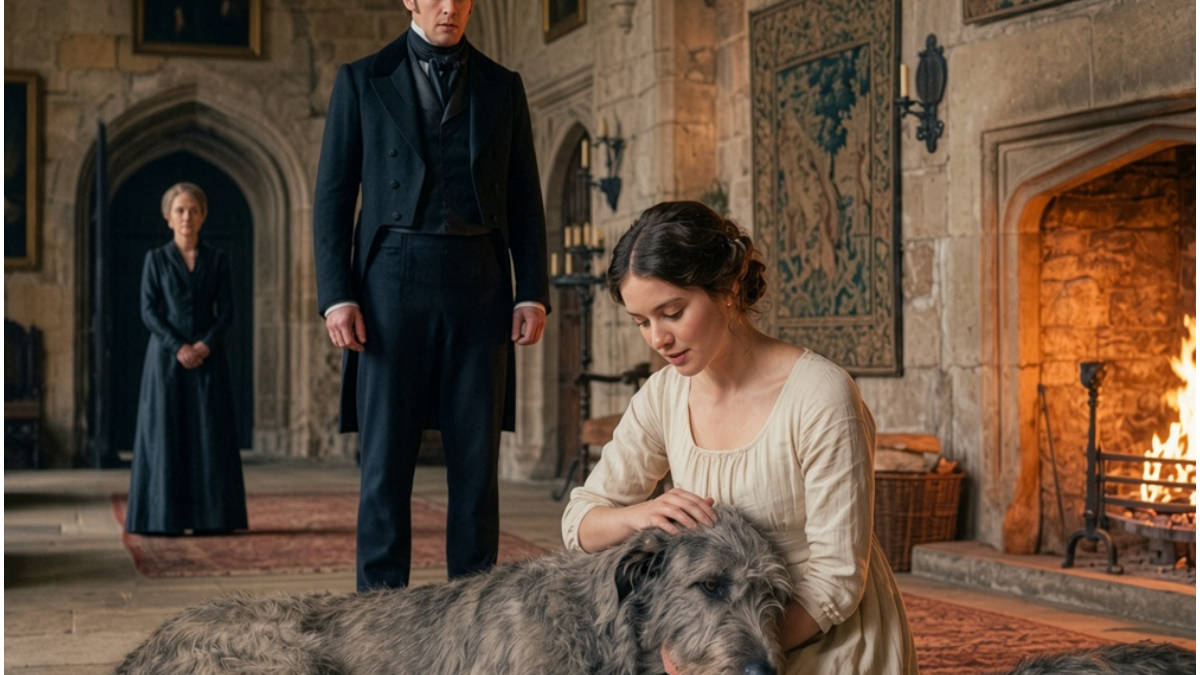
Three great grey hounds lay by the fire. They lifted their heads when the door opened.
The largest one, the one with the black muzzle and the toier, rose firSt. He was enormous.
His shoulders were as high as Vivienne’s waiSt. He walked toward her slowly. His yellow eyes were fixed on her face.
Vivienne did not move. She had been told he had growled at her. She did not believe it, but she also did not know.
She stood very still. She let him come. He stopped in front of her. He lowered his great head.
He sniffed her hand. His breath was warm on her wriSt. His nose was wet.
She smelled dog and hay and the faint clean scent of the soap the servants used to bathe him.
Then he lay down at her feet. He did not lie beside her feet. He lay across them.
His great warm body pressed against her ankles. His head rested on her shoes. He sighed.
It was the sigh of a creature who had been waiting a long time for someone and had finally found them.
The other two hounds rose. They came to her. They pushed their heads against her hands.
They lay down against her legs. She could not have moved if she had wanted to.
The Duke stood in the doorway. He did not speak. Vivienne looked up at him.
His face had gone very still. His gray eyes had gone very dark. She could not read what was in them.
They have never done that, he said finally. No, they do not go to anyone, not even to my mother.
They tolerate her. They do not go to her. Perhaps they were tired of waiting.
Perhaps he crossed the room slowly. He crouched down beside her. He put his hand on Corvis’s great head.
The hound did not move. The hound stayed at Viven’s feet. They were my father’s hounds, the Duke said.
He raised them from pups. He died four years ago. Since he died, they have not gone to anyone, not to me.
They lie by my fire, but they do not come to my hand. I feed them.
I speak to them. They tolerate me. That is all. Viven looked down at Corvvis.
The great yellow eyes were half closed. She reached down and touched the torn ear.
The hound sighed again. “I am sorry about your father,” she said. The Duke was quiet for a long moment.
He was still crouched beside her. She could smell the wood smoke in his hair.
Thank you, he said. They stayed there a while. Vivienne did not know how long.
The fire crackled. The hounds breathed. The morning light came in through the tall windows.
She felt the warm weight of the great dog across her feet and the smaller warmth of the other two against her legs.
And for the first time in 3 years, she felt as though she were somewhere she was allowed to be.
That night at supper, the Duke asked her to sit at his right hand. The daager was already seated at his left.
Lady Cresa had arrived unannounced for supper again and sat two seats down. The three hounds lay by the great fire in the hall.
Corvvis rose when Viven entered. He crossed the room. He lay down at her feet under the table before she had even sat.
The daager saw. Her pale eyes went cold. “The Hound is confused,” she said. “He does not know his place.”
He knows his place, mother,” the Duke said quietly. Lady Cresa laughed her small silver laugh.
How sweet. The little bride has charmed the beasts. Perhaps that is the only thing she will manage to charm at Ravenholt.
Cresa. The Duke’s voice was low. I only geSt. Alistister, do not. She smiled at him.
She smiled at Viven. Her green eyes were bright and hard. The supper went on.
Viven ate. She did not speak much. She felt the great warm body of the hound across her feet, and she thought, “I am not alone anymore.
Even if he never loves me, I am not alone.” The days settled into a pattern.
Viven rose early. She ate breakfast with the Duke, sometimes in silence, sometimes with small, careful conversation about the weather or the estate or a book from the library.
She spent the mornings in the library reading or with Mrs. Bramble learning the house.
She had asked on the third day if she might help with the management of the household.
Mrs. Bramble had looked surprised. Her grace runs the house, miss, that is to say, the daagger.
She has always run it. I see. But if she wished to be relieved of some of the burden, perhaps I might.
She does not wish to be relieved, miss, I see. She did not press, but she began to notice things.
She noticed that the accounts were behind. She noticed that the tenants had not been visited in over a year.
She noticed that the west wing was not truly abandoned. That Mrs. Bramble slipped off with a covered basket every third day and came back without it.
She noticed that when she asked about the basket, Mrs. Bramble’s mouth went thin, and she said, “Only, her grace has her ways, Miss.”
Viven did not ask again. She simply noticed and she waited. The hounds followed her everywhere.
Corvvis especially, he walked at her heel when she went through the halls. He lay at her feet when she read in the library.
He slept outside her bedroom door at night. She had not asked him to. He had simply decided.
The Duke saw. He did not speak of it often, but she caught him watching.
Sometimes she would look up from her book to find him standing in the doorway of the library, silent, his gray eyes on her and the great hound at her feet, his face unreadable.
One afternoon, 10 days after the wedding, she was walking in the garden with all three hounds when she came upon a small boy sitting on a stone bench and crying.
He was perhaps 8 years old. He was thin. His clothes were patched but clean.
He held a small wooden horse in one hand and the horse’s leg was broken.
Viven sat beside him. Corvvis lay at her feet. The other two hounds lay in the wet grass.
Whose boy are you? She asked. Tan Cory ma’am. My ma’am works in the kitchens sometimes.
What is your name? Peter. And what has happened to your horse, Peter? He held up the broken toy.
His face was stre with tears and dirt. It fell from the wall. I was climbing.
Ma’am says I mustn’t climb the wall. I climbed anyway. I see. And who made the horse?
D did. Before he went, Vivienne understood. She took the horse gently. She looked at the broken leg.
It was a clean break. It could be mended. May I take this, Peter? I know someone in the house who is very good at mending small wooden things.
I will bring it back to you in 3 days. Truly, truly, he looked at her.
He wiped his nose on his sleeve. He nodded. Then he ran off across the wet grass toward the kitchens.
Viven carried the little horse back to the house. She did not know anyone in the house who mended small wooden things, but she remembered that her father had once mended a chair leg for her, and she thought she could remember how.
She spent that evening in her room with a small pot of glue she had begged from Mrs. bramble and a candle and the little wooden horse.
She glued the leg. She held it. She waited. She glued it again. By midnight, the horse stood on all four legs.
3 days later, she gave it back to Peter in the garden. He held it as if it were made of gold.
He did not thank her. He simply looked at her, and his eyes were very large.
And then he ran off. She thought that was the end of it. It was not.
That evening, Mrs. Bramble came to her room with a small cloth wrapped bundle. Inside was a piece of gingerbread, still warm.
From the boy’s mother, “Miss, she said to tell you that no one in this house has ever spoken kindly to her boy before, not once, and that she will not forget it.”
Viven held the gingerbread. She smelled ginger and honey and butter. Thank you, Mrs. Bramble.
Miss Mrs. Bramble hesitated at the door. There is something you should know. The Duke saw.
Saw what? You with the boy in the garden and with the horse afterward. He was at the library window.
I was there too, dusting. He watched the whole thing. He did not say a word.
Viven looked at the fire. Why do you tell me this, Mrs. Bramble? The housekeeper folded her hands in front of her apron.
Because I have known his grace since he was a boy of 9 years old, miss, and I have not seen his face look like that in a very long time.
That is all. Then she was gone. Viven ate the gingerbread. It was very good.
The next week, Lady Cresa came to stay. She did not announce herself. She simply arrived with three trunks and a maid, and installed herself in a room in the east wing, three doors down from Viven’s own room.
She was very charming. She was charming at breakfaSt. She was charming at supper. She was charming in the drawing room in the evenings where she played the piano forte and sang in a light silver voice.
She was charming to the Duke. She touched his arm when she laughed. She leaned close to whisper things that made him look tired.
She called him Alistister. He did not correct her. She was less charming to Viven.
She was polite. She was always polite. But her politeness was a small, sharp thing that drew blood in places no one else could see.
What a lovely dress, Vivien. Is it new? No. Oh, I thought perhaps you had had one made.
Never mind. It suits you. How clever of you to have learned so much about the house so quickly.
Of course, one must learn quickly when one comes from your circumstances. Do sit here by the fire.
You look so cold. I forget that you are not used to grand houses. They can be quite drafty.
Vivienne did not respond to any of it. She smiled politely. She thanked Lady Cresa for her kindness.
She sat where she was told to sit. She noticed that Corvvis never went near Lady Cresa.
When Lady Cresa entered the room, the great hound stiffened. He did not growl. He simply watched, his yellow eyes steady, his body between Vivienne and Lady Cresa.
No matter where in the room the two women stood. 10 days after Lady Cresa arrived, there was a dinner party.
The daager arranged it. She invited 15 neighbors from the county. She had not consulted Viven about the menu, the seating, the guest list, or the flowers.
Viven had not expected to be consulted. She dressed in her best dress, which was 3 years old and mended at one seam, and she went down to the drawing room to meet the guests.
They were kind, most of them. A country vicar and his wife, a gentleman farmer and his two grown daughters, a retired admiral with a red nose, an elderly couple who had known the Duke’s father.
Viven spoke with them all in small, careful conversations, and they were pleasant to her, and she began to think the evening would be bearable.
Then, at supper, Lady Cresa rose to make a toaSt. “I should like to say a few words,” she said.
Her voice was light and clear. The room quieted. She held up her glass. She smiled.
To our dear new duchess, who has come to us from such a modest home, and who is doing so bravely to learn her new place.
It is not easy, I know, to be given a life one was not raised to.
My cousin is generous to have taken her in. There was a small, awful silence.
The Duke set down his fork. Cresa, yes, my dear, sit down. But I have not finished my toaSt. You have finished.
I only wish to say you have finished. Lady Cresa’s smile stayed in place. But her hand shook as she setat down her glass.
The room was very quiet. Viven looked at her plate. She could feel every eye in the room on her.
She could feel Corvis’ warm body against her feet under the table. She could feel her own breath, small and steady, in and out.
She looked up. She looked at Lady Cresa. She smiled. It was a small smile.
It was polite. “How kind of you, cousin,” she said. Her voice was clear. It carried.
“It is true that I was not raised to grandeur. My father was a country gentleman.
He kept horses and read books and taught me to do the same. He was generous and he was honeSt. And when he died, he left me nothing but his name and the memory of his kindness.
I have been told by many people that these are small things. I have never believed them.
I have found in this house a husband who is patient and hounds who are loyal and a housekeeper who is wise and a small boy in the garden who did not know that a stranger could be kind.
If this is what it means to be given a life I was not raised to, then I am grateful for it.
I hope in time to deserve it. That is my toast to this house and to those in it who have made me welcome.
She raised her glass. She drank. There was a beat of silence. Then the retired admiral began to clap.
Then the vicar. Then his wife. Then one by one everyone at the table except for the daager and Lady Cresa.
The Duke did not clap. He was watching Viven. His face was very still. His gray eyes were very dark.
Lady Cressa sat down. Her copper hair caught the candle light. Her green eyes were bright and hard.
She did not speak again for the rest of the meal. When the guests had gone and Vivienne had gone up to her room, she sat on the edge of her bed, and she began at last to shake, not from tears, from something older.
She had held herself so still for so long that her body did not know what to do with the release.
She pressed her hands against her knees. She breathed. Corvvis lay across her feet. The other two hounds lay on the rug.
She was not alone. There was a soft knock at the door. Come in. The Duke came in.
He closed the door behind him. He stood for a moment just inside the room.
He looked at her and at the hounds and at the small fire. Then he crossed the room and sat in the chair by the fire.
You did not have to answer her, he said. I know. I would have made her stop.
I know, but you answered her anyway. Yes. Why? Viven thought for a moment. She looked at her hands.
Because if I did not, she would say the same things again next week and next month and next year.
And I would spend my life waiting for her to stop. I would rather answer her once and be done with it.
He was quiet for a long moment. The fire hissed. Outside, an owl called. You spoke of a small boy in the garden, he said.
Peter Cy, I saw. I know. How did you know? Mrs. Bramble told me. Ah, he almost smiled.
Mrs. Bramble tells you a great many things. I think she is kind to me.
She is not kind to many people. She has been in this house 40 years.
She served my grandfather and my father and now me. She does not give her fondness lightly.
I am grateful for it. He looked at the fire. He looked at his hands.
He was a large man in a small chair. He looked for the first time tired Viven.
It was the first time he had used her name. Just her name. Not Miss Marchment.
Not Duchess. Just Viven. She felt it in her cheSt. Yes, I did not choose this marriage.
I want you to know that. I know I did not choose it either, but I did not fight it when I could have, nor did I, and I did not welcome you as I should have.
You did not, but you did not turn me away either. That is more than some men would have done.”
He looked at her then. His gray eyes were steady on her face. She held his gaze.
Neither of them looked away. The moment stretched. The fire hissed. Corvvis sighed against her feet.
“May I tell you something?” He said finally. “Yes, my mother did not choose you because she believed you would be grateful and quiet.
She chose you because she believed you would be nothing at all. She believed she could keep this house and keep me, and that you would fade into a corner of it, and no one would ever notice you were here.
I know. You knew. I have known since the third day. It was not difficult to see.
And you stayed. I had nowhere else to go, Alistister. He nodded slowly. He looked at the fire again.
That is honeSt. I try to be. Yes, I have noticed. He rose. He walked to the door.
He stopped with his hand on the latch. He did not turn around. The hounds have chosen you, he said.
I have never seen them choose anyone. Not since my father died. I have thought about that a great deal in the last few weeks.
And and I have decided that they are wiser than I am. He opened the door.
He stepped through. He closed it behind him. Viven sat very still. Corvvis put his great head in her lap.
She stroked his ear. She did not weep, but she did at last smile. The next morning she came down to breakfast to find that Lady Cresa had gone.
Her trunks had been packed and loaded in the dark. Her carriage had left before dawn.
She had left no note. No one had said goodbye. The daager sat at the breakfast table with her pale eyes fixed on the empty chair where Lady Cresida had sat.
She did not speak. She rose after a moment and left the room without eating.
The Duke was there. He watched his mother go. He did not seem surprised. “She sent Cresa away,” he said quietly.
“Your mother did?” “Yes, last night after I came to your room. I heard her voice through the walls.
She told Cresa to be gone by dawn.” “Why?” He looked at Viven over the rim of his coffee cup.
“Because she saw what you did at supper. And she is not a fool. She saw that the room chose you.
She saw that I did too. She will not put a weapon in your hand a second time.
I do not want a weapon. I know that is what makes you dangerous to her.
Viven sat down. A servant brought her tea. She wrapped her hands around it. Alistister.
Yes. What will your mother do now? He was quiet for a long moment. I do not know.
I have never seen her lose before. I do not know what she looks like when she loses.
They found out 3 days later. Viven came down in the morning to find the Duke standing in the great hall with a letter in his hand.
His face was gray. Corvvis stood at his side, ears back, tail low. The other two hounds paced behind them.
What has happened? My mother is gone. Gone to London this morning before dawn. She has taken the account books.
She has taken the seals. She has taken the letter of credit, but she cannot.
She can. Legally, she cannot. But she has taken them anyway. And by the time we could get them back through the law, she will have used them.
She means to ruin us. She means to spend the estate into the ground rather than see me happy in it with you.
Viven stood very still. She thought. How much can she do in a fortnight? Enough.
Not everything, but enough. Then we must move before a fortnight is out. He looked at her.
We? Yes, we. She sat down at the long oak table. She held out her hand for the letter.
He gave it to her. She read it. She read it again. She looked up.
I have been in this house 6 weeks, Alistister. I have not been idle. I have read the accounts Mrs. Bramble showed me.
I have spoken with the tenants who came to the door. I have learned the estate.
I did not tell you because I did not know if you would want me to know.
But I know it now. I can help you. How? I know where the money is.
I know which of the tenants owe rent and which are honest and which are cheating.
I know which of the farms is losing money that could be saved. I know which of the servants can be trusted and which cannot.
I have made a liSt. Give me a fortnight and a horse and a clerk and I will save you enough to cover whatever she can spend.
He stared at her. You made a list? Yes. In secret? Yes. Why? Because I did not know if you would ever ask, but I thought if you did, I should be ready.
He set the letter down on the table. He looked at her for a long time.
Then he did something she had not seen him do before. He laughed. It was a short low.
It was not a happy sound, but it was not a bitter one either. It was the sound of a man who had been carrying a great weight alone for a long time and had suddenly realized he was not alone.
“Show me the list,” he said. She showed him the liSt. He read it. He read it twice.
He asked her questions. She answered them. They sat at the great oak table for 4 hours.
Corvvis lay under it. Mrs. Bramble brought them tea and bread and cheese. They did not stop.
By the time the sun set, they had a plan. Over the next fortnight, they carried it out.
Viven rode out with the Duke to visit the tenants. She spoke with the women.
He spoke with the men. They found the honest ones and struck new fair agreements.
They found the cheating ones and let them know the game was over. They sold two of the horses in the stables that no one had ridden in 3 years.
They closed three of the rooms in the West Wing that had been kept heated for no reason.
They wrote to the solicitor in London and had the letter of credit stopped before the dowager could use it all.
They wrote to three old friends of the Duke’s father quietly and asked for help and got it.
By the end of the fortnight, the estate was safe. Not rich, but safe. And it was safe because two people had chosen at last to run it together.
On the last evening of the fortnight, Viven came into the library to find the Duke sitting by the fire with a book he was not reading.
Corvvis was at his feet. The other two hounds lay by the hearth. The room smelled of leather and lamp oil and woodsmoke.
Outside, snow had begun to fall. She sat in the chair across from him. She said nothing.
He looked up. Vivienne, yes, I owe you something. You owe me nothing. I owe you an honest answer to a question you have not asked.
What question? He set down the book. He leaned forward. His gray eyes were on her face.
The fire made small shadows on his cheek. You have not asked me whether I chose you or whether my mother chose you.
You have not asked me whether the hounds chose you or whether they were only lonely.
You have not asked me whether I am fond of you or whether I am simply grateful.
You have not asked any of these things. But I know you have wondered. She did not answer.
She waited. My mother chose you because she thought you were nothing. The hounds chose you because they knew you were not.
And I He stopped. He looked at his hands. I did not choose you at all.
I was given you. I did not want to be given anything. I have been given many things in my life that I did not want.
I had learned to close my hands around them and not to feel them. I know, but I felt you.
He looked up from the first night when you said you would rather have a small wedding than a lie made large.
I felt you then. I did not know what to do with the feeling. I have not known what to do with it since, so I did nothing.
I watched you. I watched the hounds go to you. I watched you go to the boy in the garden.
I watched you at supper when Cresa tried to break you. And I watched you not break.
I have been watching you for 6 weeks, Vivien. I have been watching you and I have been trying to decide whether it is safe to want you.
And I have decided that it is not safe. And I have decided that I do not care.
Viven sat very still. Her hands were cold. Her chest was warm. Alistister. Yes. When you say you want me.
What do you mean? He looked at her. He was quiet for a long time.
Corvvis shifted at his feet. The fire hissed. The snow fell against the window in soft small sounds.
I mean that this house is not a home without you in it. I mean that I look for you when I come into a room.
I mean that when Cresa spoke to you at supper, I wanted to break something.
And I have not wanted to break something in 11 years. I mean that I have watched you sit in this library with a book on your lap and a hound at your feet and I have thought that is my wife and I have not known before what that word could mean.
I mean that I love you. I did not choose to. I do. She did not move.
She looked at him. She looked at his hands, which were large and scarred and folded on his knees.
She looked at his face, which was tired and honest and no longer closed. She looked at the fire.
“I did not choose to love you either,” she said quietly. “But I do.” The silence stretched.
The fire cracked. Corvvis lifted his great head and looked from one of them to the other, and then set his head down again and sighed.
The Duke rose. He crossed the small space between them. He knelt in front of her chair.
He took both of her hands in his. His hands were warm. Hers were cold.
He held them. Viven. Yes. Will you have me? Not because you were given to me.
Not because my mother arranged it. Not because there is nowhere else to go. Will you have me because you choose to?
Yes. Say it. I choose you. I choose this. I choose Raven Halt and the hounds and Mrs. Bramble and the boy in the garden and the tenants who need their fences mended.
I choose all of it and I choose you. He bent his head. He rested his forehead against her hands.
She felt him breathe. She felt the warmth of his breath on her fingers. She felt Corvvis rise slowly and press his great warm body against both of them.
The way a dog does when he has decided that his people are his and no one is going to take them from him.
She did not weep. She was, she realized, done with not weeping. She wept a little.
He did not seem to mind. The daager came back a month later. She had spent what she could.
She had come to see the ruin she believed she had made. She found instead a warm house.
She found tenants who spoke well of the Duke and his wife. She found the accounts in order.
She found her son at the head of the table with the great hound at his feet and his wife at his right hand.
And the wife was laughing at something the housekeeper had said, and the son was smiling.
And the son had not smiled in that dining room in more than a decade.
The daager sat at the far end of the table. She ate in silence. She said nothing for 3 days.
On the fourth day, she asked Vivienne quietly if there was any place in the house she might have as her own, a small room where she might sit.
Vivien gave her the sunny room in the east wing that looked over the rose garden.
The daager accepted it. She did not thank Vivenen, but she did not fight her either, and in time, in small ways, over years, she came to know that her son’s wife had given her more than she had ever given her son.
Lady Cressa did not return. The little boy Peter Cory grew up on the estate.
Viven saw to his schooling. When he was 15, he went into the stables and made himself indispensable.
When he was 20, he trained a young hound of his own from Corvvis’s last litter.
He named the pup Marchmont after her. She pretended not to be moved. She was moved.
The three great hounds grew old. Corvvis lived to be 15, which is a long life for a great greyhound.
He died in the library one winter evening, with his head on Viven’s foot and the Duke’s hand on his back.
They buried him under the oak by the west wall. They planted a rose there.
It bloomed white every summer. By that time there were children, two of them, a boy who had his father’s gray eyes and his mother’s stubborn mouth.
A girl who had her mother’s dark hair and her father’s rare quiet laugh. The children grew up in a house where the hounds were welcome at the table, and the tenants were welcome at the door, and the boy from the garden had become the head of the stables, and the housekeeper knew every child by name.
One evening, when the children were grown and gone to their own lives, and the Duke and Vivien sat by the fire in the library, and the snow fell outside, and the last hound of Corvis’s line lay at their feet.
The Duke set down his book. He looked at her. His hair had gone gray.
His hands were still large. Viven. Yes. Do you remember what I said to you the night the snow first fell?
The night I knelt in front of your chair. I remember every word. So do I.
He was quiet a moment. I have thought about it every day since. So have I.
I did not choose you at the beginning. No, but I have chosen you every day since, and that, I think, is the only choice that ever mattered.
She reached across the small space between their chairs. She took his hand. His hand was warm.
Hers was warm, too. Now, after so many years by his fire. The hounds knew, she said.
The hounds knew. Outside the tall windows, the snow came down. Inside, the fire hissed.
Somewhere in the house, a housekeeper’s granddaughter laughed. Somewhere else, a young hound thumped his tail against a stone floor, and in the library, an old duke sat beside an old duchess, and neither of them let go of the other’s hand, and neither of them needed to say anything more.








