Her Family Called Her Ugly Every Day-Then the Kingdom’s Richest Noble Refused Every Lady Except Her
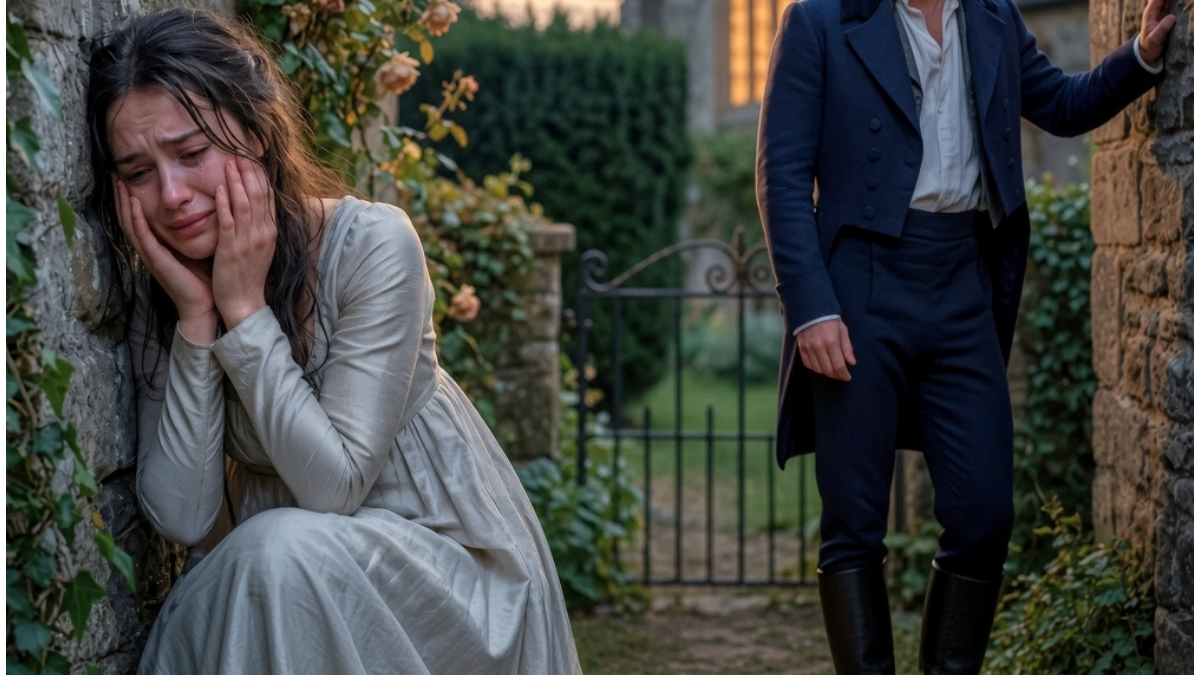
Lord Rowan Fenwick, Marquess of Thornfield, had refused 11 proposals of marriage in as many months, and no one in London could agree on why.
He was seven and 30, unmarried, richer than any three dukes in the kingdom combined, and possessed of a face that had launched a thousand mothers into fits of ambitious scheming.
He had danced with Earl’s daughters and turned away from them at the end of the set without a word of encouragement.
He had sat beside the loveliest heiress in three counties at a dinner in his own honor and spoken to her, by the Countess’s own furious account, of nothing but crop rotation for the whole of the first course.
Society had decided, collectively and with great relish, that the Marquess of Thornfield was either impossibly proud, secretly heartbroken, or simply incapable of wanting anything the way ordinary men wanted things.
None of them were entirely right. None of them were entirely wrong, either. He stood now at the edge of a drawing room in Grosvenor Square, a glass of sherry he had no intention of finishing in one hand, and watched a scene unfold that he had not been meant to see.
“Stand up straight, Margaret. For heaven’s sake, you slouch like a scullery maid.” Lady Pharaoh’s voice carried from the next room, thin and sharp through a door left carelessly ajar.
“And do try, for once in your life, not to speak unless spoken to. You know how you sound when you speak.”
“Yes, Mama.” “I don’t know what your father and I did to deserve a daughter with a face like that and no sense to compensate for it.
Your sisters managed to be tolerable. You cannot even manage tolerable.” There was a pause and the small, cruel rustle of silk, and something in the precision of the cruelty, the way it was delivered without heat, like an instruction rather than a temper, struck Rowan as strange even before he understood why.
“Well, come along. Try to stand behind Julia where the light is worse. There’s a good girl.
Rowan did not move. He had come to the Farrow house that evening for the most ordinary of reasons, an invitation from Lord Farrow regarding a shared interest in canal shares, nothing more.
And he had not intended to overhear anything at all, but he stood now with his glass forgotten in his hand, and something in his chest had gone very still and very cold.
The particular stillness of a man recognizing in another person’s cruelty the shape of an old wound of his own.
He knew the girl they spoke of. Everyone did, in the vague, dismissive way society knows a family’s least remarkable daughter, Miss Margaret Farrow, three and twenty, the middle of five sisters, spoken of only ever in comparison to the ones on either side of her, never unkindly by strangers, because strangers rarely troubled to speak of her at all.
He had exchanged perhaps a dozen words with her over as many years in the ordinary passing way of two people whose families moved in the same circles without ever quite intersecting.
He remembered, oddly, that she had a way of looking directly at whoever addressed her without the practiced flutter other young women affected, as though she found the pretense of shyness more tiresome than useful.
He remembered something else, too, though he had not let himself think of it in a long while.
A night three years past, a garden, a girl in an ill-fitting gown who had said something to him so unexpectedly honest that he had thought of it, uninvited, at odd hours ever since, without ever once connecting the memory to a name.
The door opened fully. Margaret Farrow came through it first in a gown the color of old moss that did nothing for her.
Her chin lifted in the particular careful way of a woman who has trained herself not to flinch in front of witnesses.
Her eyes found his before her mother’s did, and for one unguarded instant he saw something pass across her face that he recognized entirely too well.
Not surprise that he was there, but a swift private calculation of exactly how much he had heard.
She did not look away first this time. He did. Lord Thornfield. Lady Farrow’s voice transformed itself instantly, all warmth and delighted surprise, as though the previous minute had never occurred.
What an unexpected pleasure. You must forgive us. We did not know you had arrived.
Margaret, do greet the Marquis properly. My lord. Margaret’s curtsy was correct, contained, betraying nothing.
He looked at her for a moment longer than propriety strictly allowed, and found himself, for the first time in 11 refused proposals and as many wasted months, entirely uncertain of what he meant to say next.
He recovered himself before the silence could stretch into something noticeable, though he suspected, from the flicker of amusement that crossed Margaret’s face before she smoothed it away, that she had noticed regardless.
Miss Farrow. He said, and bowed over her hand with rather more formality than the occasion strictly required.
I confess I arrived earlier than your excellent invitation specified, and have been standing about your hallway feeling a great fool for it.
Then we are evenly matched, my lord. Margaret said, for I have spent the better part of the last quarter hour being told precisely how to stand, and feel a greater fool than you could possibly manage on your own account.
Lady Farrow’s laugh came a half second too late and a full octave too bright.
The laugh of a woman papering over a crack she prayed no one else had seen.
Margaret does love her little jokes. Come, my lord. Lord Farrow is through in the study, quite eager to discuss the canal shares with you, and I am sure Margaret has household matters to attend to.
The emphasis on household matters was not subtle. It was not meant to be. But Rowan did not move toward the study.
He found, standing there with Margaret’s dry, unhurried honesty still hanging in the air between them, that he had no particular interest in canal shares at all, and a very sudden, very inconvenient interest in the woman he had, until roughly 4 minutes ago, thought of only as the unremarkable middle Farrow daughter.
“Actually,” he said, “I wonder whether Miss Farrow might show me the garden firSt. I understand your husband has had some success with roses this year, and I have a fondness for them.”
It was not strictly true. He had never once in his life expressed a fondness for roses, but it had the desired effect.
Lady Farrow’s face performed a rapid and unconvincing series of adjustments, landing somewhere between confusion and the dawning, greedy hope of a woman who has just glimpsed an opportunity she does not fully understand, but intends to seize regardless.
“Of course, my lord. Margaret, do show his lordship the roses.” The warning beneath the words was audible only to the two people meant to hear it.
“Behave. Do not embarrass us. Do not, whatever else you do, say anything true.” The garden, when they reached it, was small and neat and utterly unremarkable.
The kind of garden a family maintains because a garden is expected, rather than because anyone in the house takes joy in it.
Margaret walked a pace ahead of him along the gravel path, her spine very straight, her hands folded before her, and for a long moment neither of them spoke at all.
“You did not come for the roses,” she said at last, without turning. “No.” You heard my mother.
Yes. She stopped walking and turned to face him fully. And in the fading light of the garden, he saw, for the first time in years of vague acquaintance, what her face actually looked like when it was not arranged for public consumption.
Tired. And guarded. And underneath the guard, something raw enough that he understood at once why she kept it so carefully hidden.
Then [clears throat] I would ask you, my lord, as a kindness, not to mention it to anyone.
Not out of any particular shame on my own account. I have long since made my peace with what my mother thinks of me.
But my father’s business depends a great deal on the good opinion of men like yourself.
And I would rather not be the reason that good opinion curdles. Your mother’s opinion of you, Rowan said slowly, is not one I intend to share.
But I do not think I could unhear it if I tried, Miss Farrow. And I find I do not particularly wish to.
Something shifted in her face. Not softening, not yet, but a kind of wary recalculation.
Why? She said, did you truly ask me to show you the garden? He looked at her for a long moment.
The question he had been turning over since the drawing room finally working its way to the surface.
Three years ago, at a house party at Lady Ravensworth’s, I walked out into a garden very like this one, rather later than was proper, because I could not tolerate one more minute of a ballroom full of young women reciting the same three compliments about my estate.
I found a woman sitting alone on a stone bench in a gown that did not fit her properly, crying in the particular furious way of someone who is angrier than she is sad.
I did not know her name. She would not give it. But she said something to me that night I have not been able to put down since, however many times I have tried.
Margaret had gone very still. “She told me,” Rowan continued, watching her face with an intensity he made no effort to disguise, “that she was tired of being loved conditionally, that her family’s affection for her rose and fell with how well she performed the parts assigned to her, and that she had begun to suspect the affection had never been real to begin with, only ever a transaction she kept failing to pay in full.”
“I asked her name. She said it did not matter, that I would forget her by morning regardless, and that this, too, she had made her peace with.”
He took a step closer. “I have sat through 11 proposals this past year, from 11 perfectly amiable young women, and turned away from every one of them, because not a single one said a single true thing to me the whole evening, and I found I could no longer bear the alternative.”
Margaret’s hand rose, without her seeming to notice it, to press against her collarbone, the same gesture, he realized with a jolt, that the girl in the garden had made 3 years ago, just before she finally told him her grief.
“That was you,” he said. It was not a question. “I did not think you would remember,” she said quietly.
“I had assumed the whole conversation had simply dissolved into the fog of an evening you could not properly recall.”
“I have remembered every word of it for 3 years, Margaret, though I confess I never once connected the girl in that garden to the woman I have exchanged perhaps a dozen words with at balls since, because you have never, in my presence, said anything half so honest again.”
“No,” she agreed, and something bitter moved across her face. “I have not. It is considerably easier to survive a household like mine, my lord, if one learns to say almost nothing at all.”
He called on the Pharaoh house three more times that fortnight, each visit under some manufactured pretext that fooled no one, least of all Lady Farrow, whose warmth toward Margaret grew in direct and unsubtle proportion to her dawning understanding of where his interest lay.
Within the week, she began referring to Margaret in company as “my clever girl,” a phrase so foreign to anything Rowan had heard pass her lips in that drawing room that he nearly laughed aloud the first time he heard it.
Margaret’s own face, hearing it, took on an expression of such controlled disbelief that he understood at once she had never once, in three and 20 years, heard herself described that way before witnesses, which told him, more clearly than anything else could, that whatever had shaped her mother’s cruelty, it was not the ordinary carelessness of an unhappy household.
It was deliberate. It had a purpose he had not yet been permitted to see.
He learned that purpose on his fourth visit, waiting alone in the small morning room while a footman went to announce him, when he overheard a second conversation he was not meant to hear, and this one would not let him rest afterward at all.
Cannot possibly refuse him now. Do you understand me, Julia, whatever foolish scruples you imagine you’re entitled to.
If Thornfield offers for Margaret, this family is saved. Your father’s debts vanish. Frederick’s commission is purchased outright instead of scraped together on credit we cannot service.
You may finally have the season you deserve instead of the season your father’s creditors permit us.
Lady Farrow’s voice, stripped of its performed warmth, was flat and hard and entirely without pretense.
So, you will smile at him when he calls, and you will say nothing, nothing, Julia, about what happened at Ravensworth’s.
That business has been buried three years, and it will stay buried, or every one of us goes down with it.
There was a silence, and then a younger woman’s voice, thin and unhappy. It isn’t right, Mama.”
“She took the whole of it for me, and you have made her pay for it every day since.
And now you mean to sell her to a marquis to clear Papa’s debts, and call it a kindness.”
“I mean,” Lady Pharaoh said, “to see this family survive. And if that requires your sister to marry very well indeed, I fail to see the tragedy in it, given what she did that night.”
Rowan stood in the morning room with his heart beating very hard, and understood, in the space of that single exchange, that everything he had believed about the Pharaoh household, the careless daughter, the family’s casual cruelty, had been built on a foundation he had not yet been permitted to see, and that the cruelty he had overheard on his very first visit had never been careless at all.
He said nothing of it that day. He sat through a stilted half hour of tea with Lady Pharaoh performing delight, and Margaret performing composure, and found her alone briefly in the hallway as he took his leave.
“What happened at Ravensworth’s?” He said, low and urgent, “beyond the conversation you and I had in the garden.
I heard your mother and your sister, Margaret. I do not ask to embarrass you.
I ask because I begin to think I do not understand the woman I have been calling on for a month, and I find that unbearable.”
Something in Margaret’s face went very white, then unexpectedly tired, as though the effort of maintaining her composure had simply run out.
“You were not meant to hear that.” “I heard it regardless. Tell me the truth, whatever it is.
I would rather have it from you than piece it together from what your mother let slip when she thinks herself unwatched.”
She looked at him a long moment, and he watched her decide something. “Not here,” she said finally.
“Come to the garden tomorrow before my mother wakes. I will tell you all of it, and then you may do with the knowledge whatever you think right.
Though I ask you to consider what the truth will cost my sister, who did not ask for any of this, and has carried a great deal of quiet guilt over it these three years, whatever her mother’s methods of managing that guilt.
He came the next morning before the household had properly woken, the garden gray and cold and hung with mist, and found her already waiting on the same stone bench.
Julia was 17 at Ravensworth, Margaret said, without preamble, staring at her own folded hands.
Young and rather badly in love with a man who had no honorable intentions toward her whatsoever.
A lieutenant, handsome and penniless, exactly the sort of man a girl of 17 falls disastrously in love with at her first proper house party.
He persuaded her to meet him in the garden that night, late, alone, and he was not a gentleman about it, though I do not think even now Julia fully understands how close a thing it was, or what precisely he intended before I found them.
You found them? I could not sleep. I went walking, as I often did at that party, and came upon my own sister with her gown disordered and a man’s hands where no man’s hands ought to have been, and I did what any sister would do.
I created a scene loud enough to bring half the house running, and when they arrived, I told them it was I who had slipped out to meet him, because Julia’s ruin at 17, with no prospects secured and a temperament too delicate to survive the scandal, would have destroyed her entirely.
And mine, I reasoned, had rather less distance to fall. And your mother let you take it.
My mother saw in it a solution to a problem she had been dreading for years.
Five daughters and a husband whose debts grew faster than his income, and among the five, one whose marriage prospects were already the family’s smallest concern.
If a The had to attach itself to someone, better it attached to the daughter least likely to marry well regardless.
She began that very season telling me I was plain and dull and difficult to love.
Not because it was true, my lord, but because it was useful. A daughter who believes herself worthless does not argue when she is asked to disappear into the background so her sisters might shine.
And does not ask why a scandal that was never truly hers still follows her into every ballroom in whispers she is never permitted to answer.
Rowan sat beside her on the stone bench, his hands shaking with a fury he had not felt in years.
Not at Margaret, never at Margaret, but at a family that had taken a girl’s single act of genuine sacrifice and turned it patiently into a weapon against her for 3 years running.
And now, he said slowly, working it through even as he spoke it. Your mother means to use me the same way.
A marquis’s proposal silences any last whisper of the old scandal permanently and clears your father’s debts besides.
You are not being punished any longer, Margaret. You are being sold. Only the currency has changed.
Yes, she said quietly. I understood that the moment my mother began calling me clever in company.
I am not fool enough to mistake affection for arithmetic, my lord. Whatever else I have been fool enough to believe about myself these 3 years.
Then why did you agree to see me at all? You could have refused every visit.
You could have told your mother the truth of Ravensworth’s yourself and let the scandal fall where it should have fallen from the start.
Margaret was quiet a long moment. The mist curling gray around the hem of her gown.
Because for one evening, 3 years ago, a stranger in a garden listened to me say something true and did not flinch from it.
And did not forget me by morning as I told him he would. I have spent three years being told I am difficult to love.
I did not want to refuse the one person who had ever given me reason to doubt that, simply because my mother had found a way to profit from his intereSt. That is not fairness to you.
It is only honesty, since you asked for it. And since you have earned rather more of it than my own family has ever troubled to offer me.
He did not propose that morning. He told himself, walking back through the mist, that it would have been unconscionable.
That a proposal offered in the same conversation as her family’s scheme would only confirm, in Margaret’s mind, that he too was simply another party transacting in her worth.
He spent the following week in a state he did not care to examine too closely, until his cousin Pemberton, who possessed an uncanny talent for appearing precisely when Rowan least wished to be interrogated, finally forced the matter into the open over a hand of cards neither of them was troubling to play properly.
“You have the look of a man rehearsing a speech he has not yet had the courage to deliver.”
Pemberton observed. “I have known you seven years, Rowan, and I have never once seen you dither.
What precisely is complicating it? The mother, the daughter, or your own pride, which I notice you have not troubled to examine?
If I offer for her,” Rowan said, “I cannot be certain whether I am rescuing her from a family that has ground her down for its own convenience, or whether I am simply the next transaction in a long line of them, dressed up in finer feeling because I prefer to think well of myself.”
“Then don’t ask her as a marquis,” Pemberton said. “Ask her as the man in the garden.
Let her choose the man, not the fortune attached to him. I suspect it is the only proposal she would ever actually truSt.” He wrote to her plainly, delivered by a groom he trusted directly into her own hand, asking her to walk with him the following morning in Hyde Park.
Not the fashionable hour, but the quiet one just after dawn, when the park belonged to servants and early risers, and no one who mattered to Lady Farro’s calculations would be present to see them.
She came, wearing not one of the fine new gowns her mother had suddenly begun ordering since his interest became apparent, but a plain gray walking dress she had plainly chosen herself.
“I did not bring a ring,” he said before she could speak. “I do not intend to offer you one today.
I have concluded that if I ask you to marry me while your mother stands somewhere behind us doing arithmetic about your father’s debts, I will never fully trust my own motives, and I suspect you will never fully trust mine, either.
So, I am not here to propose. I am here to walk beside a woman in a park at an hour when nothing either of us says can be mistaken for strategy, and to ask her whether she has ever, in three years of watching me across ballrooms, wondered whether the stranger from the garden at Ravensworth’s ever thought of her again.”
“Every day,” Margaret said, her voice, for the first time since he had known her, not careful at all, “I told myself each time that wondering was a foolishness I could not afford, given everything else my family required of me.”
“Then let me tell you plainly that I have wondered the same, and that I did not refuse 11 perfectly amiable young women this past year because I am proud or heartbroken or incapable of wanting things the way society insists I ought to.
I refused them because none of them was you, and I did not yet know it, and some stubborn part of me refused to settle for less than the truth I’d been given in a garden three years ago, even before I understood what I was refusing to settle for.”
They walked a long while in silence before Margaret spoke again. “My mother will not release me easily.
She has built her entire strategy for this family’s survival on a match between us.
And she will not surrender it simply because you have decided to be honorable about the manner of the asking.
“I know it,” Rowan said. “I intend to deal with your mother directly and separately from whatever passes between us.
Your father’s debts, if they must be cleared, will be cleared as a matter between myself and his solicitor with no condition attached regarding your hand because I will not have you married to me under a cloud of obligation, wondering for the rest of your life whether I chose you or simply chose to purchase your family’s silence about a scandal that was never yours to begin with.”
Margaret stopped walking and looked at him with an expression he had not yet seen on her face.
Something unguarded. Something that had, for the first time in 3 years, stopped calculating the cost of what it revealed.
“You would clear my father’s debts with no condition at all, even if I refused you?
Even then?” “You told me once that you had made your peace with never being loved except conditionally.
I cannot offer you anything less than the opposite of that. Whatever it costs me, or I am no better than the family that taught you to expect it.”
The confrontation with Lady Featherdale came 3 days later. Summoned by a note whose tone told Rowan before he even arrived precisely what had gone wrong from her perspective.
That word had reached her of his unchaperoned visit to Margaret in the park. Entirely outside the negotiated theater she had spent a month constructing.
He found her in the same drawing room where he had first overheard her cruelty and found Margaret standing near the window, chin lifted in that same trained defiance.
Though he saw now, watching more closely, something new beneath it. Not fear, but a woman waiting to see whether the last month had changed anything at all.
“My lord,” Lady Pharaoh said, her civility straining over real fury, “I understand you have made my daughter some manner of promise regarding her father’s debts that does not depend upon any formal engagement between you.
I confess I do not understand your intentions, and I would very much like them clarified.
As would her father.” “My intentions are these, Lady Pharaoh, stated plainly, so there is no further confusion.
I intend to clear Lord Pharaoh’s debts as a private courtesy between gentlemen, with no condition attached regarding your daughter’s hand, because I have learned rather more about the manner in which this family has treated her these 3 years than I believe you intended me to learn.
And I find I cannot let her marriage, should it occur, be mistaken by anyone, herself least of all, for a transaction rather than a choice.”
Lady Pharaoh went very still. “I do not know what you imagine you have learned.”
“I have learned that your daughter, Julia, was very nearly ruined at Lady Ravensworth’s 3 years ago by a man with no honor whatsoever, and that Margaret took the whole of that scandal upon herself to protect her sister, and that you, having discovered a convenient scapegoat already installed within your own household, chose to reinforce her sacrifice daily for 3 years by telling her she was plain and dull and unlovable, not because it was true, but because a daughter who believes herself worthless is easier to deploy for a family’s convenience than a daughter who knows her own worth.”
The color drained entirely from Lady Pharaoh’s face. At the window, Margaret had gone very still, her eyes fixed on her mother.
“Julia does not know that you know,” Lady Pharaoh said finally, her voice gone thin.
“Does she?” “She does not, and I have no intention of exposing her, whatever else this conversation requires.
The girl who fell for a dishonorable man’s flattery at 17 has suffered enough guilt these 3 years without public scandal added to it.
But I will not stand by and watch you continue to punish Margaret for a kindness she showed her sister, simply because that punishment has proven useful to your household’s finances.
That ends today, whatever else does or does not happen between myself and your daughter.
Lady Farro sat down very slowly, the fight going out of her all at once.
I told myself every single time that I was protecting the rest of them, she said, not quite looking at either of them.
That one daughter’s unhappiness was a fair price for four daughter’s security. I did not let myself think too closely about what it cost her to be the one daughter because thinking closely about it would have required me to admit what kind of mother that made me.
And I did not have the courage for that admission, my lord, whatever else you think me guilty of.
Margaret at the window spoke at last, her voice quiet but entirely steady. You might have simply told me you were grateful, Mama.
Once in 3 years, it would have cost you nothing and it would have meant everything.
Lady Farro looked up at her daughter and something crossed her face that might, in a kinder household, have become an apology.
She said nothing. Rowan understood watching the silence stretch between mother and daughter that whatever justice existed for Margaret in that room would have to be built by Margaret herself going forward rather than granted by a mother who had spent too long finding her usefulness more valuable than her happiness.
He did not propose to her that day, either. He waited until the debts were cleared and the solicitor’s business entirely concluded so that no thread of obligation could tangle itself into whatever answer she gave and asked her finally on a morning in early summer in the same quiet hour at Hyde Park where he had first told her the truth about the garden at Ravensworth’s, no ring yet in his pocket, no audience, only the two of them and the early light coming pale gold through the plane trees.
“I have thought a great deal about what your mother taught you to believe about yourself,” he said.
“And I cannot undo three years of it with a single morning’s conversation, however much I wish I could.
So, I will not tell you that you are beautiful, though I think you are, in a way considerably more interesting than the 11 young women I refused.
I will not tell you that you are clever, though you are, more so than anyone I have met in a decade of tedious London seasons.
I will tell you only this, that I have known you in total for a garden conversation 3 years ago and a single honest month since.
And in that small handful of hours I have learned more of your true character than I learned in 7 years of drawing rooms with women my family considered suitable.
I do not ask you to marry me because I pity what was done to you.
I ask because I have not, since that first night in the garden, wanted anything so plainly as I want to spend the rest of my life listening to you say true things without fear of what they might cost you.”
Margaret was quiet a long moment, the light moving gently through the leaves above them.
“I told you once that I had made my peace with being loved conditionally, if I was loved at all.
I find I do not wish to make my peace with that any longer.” She looked at him fully without flinching.
“Yes, I will marry you. Not because it clears my father’s debts, which you have already cleared regardless, and not because it silences a scandal that was never mine to carry in the first place.
I will marry you because you are the first person in 3 years who asked to know me rather than to use me.
And I find I have been waiting without quite admitting it to myself for exactly that question.
He took her hand and turned it over gently and pressed his thumb very lightly against the tension gathered there.
3 years of a woman holding herself carefully together and felt it for the first time since he had known her begin very slowly to ease.
They married that autumn quietly at Thornfield’s own estate rather than in London with Julia standing beside her sister in tears she made no effort to hide and with Lady Farrow present but subdued watching her daughter marry a marquis for reasons that had at last nothing whatsoever to do with her own arithmetic.
Margaret wore a gown the color of deep amber chosen entirely by herself and when Rowan’s mother who had heard the whole story by then in careful pieces and wept openly at more than one part of it told her afterward with real wonder that she looked nothing at all like the plain dull girl London had always described.
Margaret only smiled small and slow and said that she had never been plain or dull to begin with only unseen and that Rowan whatever his other failings had simply been the first to look properly.








