He Won a Worthless Bride at Poker Then Her Secret Shook the Whole Territory
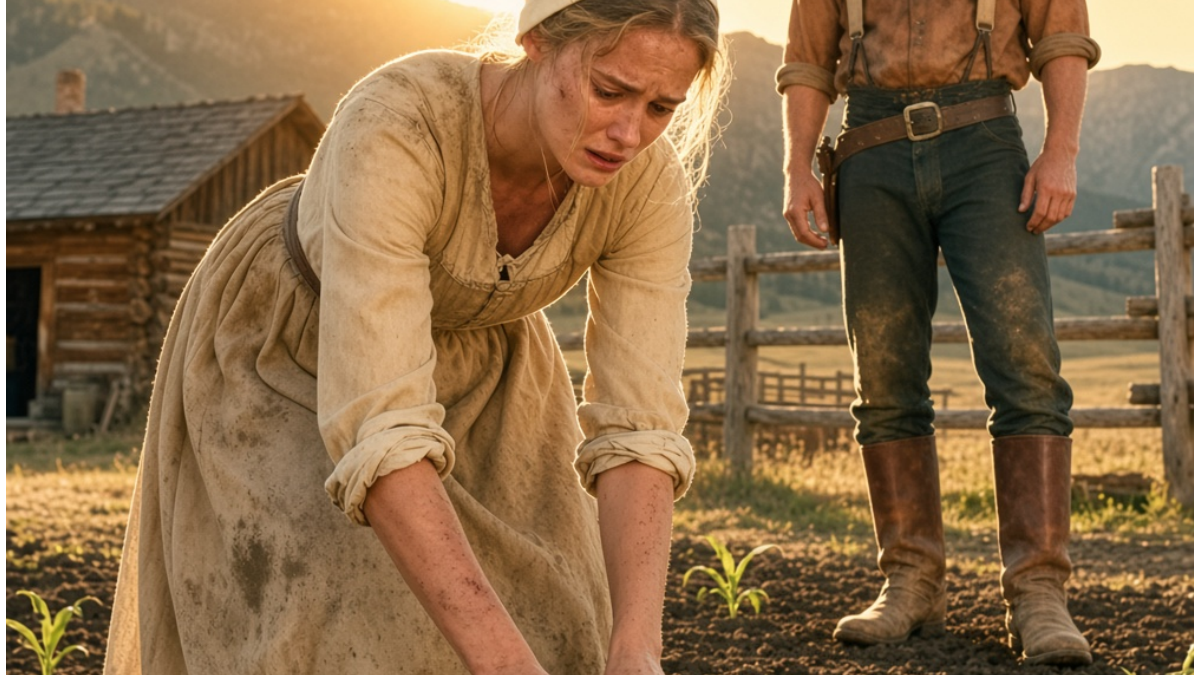
The drifter slammed his cards down and laughed like a man already counting his winnings.
“All in,” he spat, jerking his chin toward the silent woman chained to his wagon outside.
“She’s worth more than any coin on this table.” The whole saloon went quiet. Caleb Mercer, 45 and half dead from grief, looked at the woman through the cracked window.
Bare feet bleeding in the snow, eyes like something already buried. And laid down his final hand.
If this story moves you, please hit that like button and drop the name of your city in the comments so I can see how far this tale travels tonight.
Now, let me take you back to that brutal Montana winter where one game of cards changed everything.
The wind off the Bitterroot had teeth that January. And Caleb Mercer felt every one of them as he kicked his way through the drift piled against his cabin door.
The hinges complained the way old men complain about cold mornings. Low and constant and meaning nothing.
Inside, the stove was dead. He had let it die two days ago and had not bothered to start it again.
There seemed no point in warming a room that nobody but him would sit in.
He stood there a long moment with the door open behind him, snow blowing across his boots and onto the warped pine floor, and he stared at the empty corner where the cradle used to be.
He had burned the cradle three winters back. He had burned it on a night exactly like this one when the loneliness had crawled up the inside of his ribs and started chewing.
He had not been able to look at it after Sarah died. After the baby died.
After both of them died in the same hour with him standing at the foot of the bed holding a tin cup of water that nobody needed anymore.
Caleb shut the door. He spat into the cold ashes of the stove and watched the spit freeze before it hit bottom.
“Light the damn fire, old man,” he muttered to himself. His voice sounded like a stranger’s.
He had not spoken aloud in maybe 4 days. He got the kindling going eventually.
He sat in front of the stove with his elbows on his knees and watched the small orange tongue of flame climb up the bark of a piece of split Aspen.
And for a few minutes, he did not think about anything at all. That was the closest thing to peace he ever got these days.
The space between thoughts. The cabin smelled like wet wool and old sweat and the sour iron tang of a man who had given up on himself in the smallest ways firSt. Caleb knew it.
He just did not care enough to do anything about it. He had eaten beans out of the same dented tin pot for 9 days running.
He had not shaved since the first snow. His beard had gone mostly gray now, salt and pepper turning steadily to bone, and there were patches under his eyes that looked bruised even when he had slept, which was not often.
The homestead outside was dying. Had been dying for years. The soil up here in the high country was thin and full of rock, and the seasons were short, and what little grew did so out of pure stubbornness rather than any real welcome from the earth.
Caleb had planted barley 3 years running and harvested barely enough to feed himself through winter.
The chickens were gone. He had eaten the last hen in November. The mule was old and probably would not see spring.
Some nights he listened to her cough in the lean-to, and he thought about putting her down just to spare her, and then he thought about how lonely the place would be without even that wet rattling sound, and he left her alone.
He sat by the fire until his face was hot and the back of his neck was still cold, and then he got up and pulled on his coat.
The coat was thick wool, mended in a dozen places with thread he had spun himself out of nothing in particular.
He buttoned it slow. He found the small leather pouch with his coin in it, $11.40, all the money in the world he had to his name, and he weighed it in his palm.
“Damn fool,” he said to nobody, but he was going to town anyway. He had told himself he needed flour.
He had told himself he needed lamp oil. The truth, which he did not say out loud even when there was no one to hear him, was that he needed to be around people, even bad people, even drunk people, even mean people.
He needed to hear a voice that was not his own bouncing off the inside of his own skull.
The ride down out of the foothills took him most of 3 hours in the snow.
The mule kept her head low and plotted along like she knew the way better than he did, which she probably did.
By the time the lights of Hollow Pine came up out of the dark, a smear of yellow lamp glow against the blue black of the mountains, Caleb’s hands had gone numb inside his gloves.
Hollow Pine was not a town so much as a complaint that had agreed to stand still.
There were maybe 20 buildings along its single muddy street, half of them empty, the rest leaning at angles that suggested they would not be standing in 5 years.
There was a livery. There was a general store run by a sour Norwegian named Olafson, who watered his molasses.
There was a sheriff’s office that the sheriff visited approximately twice a month. And there was the Iron Horse Shoe Saloon, which was where everybody who mattered in Hollow Pine eventually ended up, and where everybody who did not matter ended up anyway.
Caleb hitched the mule and went inside. The smell hit him firSt. Tobacco smoke thick enough to slice, wet wool, whiskey, vomit somewhere under the boards, a coal stove in the corner blazing too hot, a piano in the back that nobody was playing because the man who used to play it had frozen to death in a ditch outside of town last March.
There were maybe 20 men inside and three women, and none of the women looked like they wanted to be there.
Caleb made his way to the bar. He knew most of the faces. None of them knew him well enough to say hello, which suited him fine.
“Whiskey,” he said. The barkeep, a thin man with a scar that pulled the left corner of his mouth permanently downward, slid a glass across.
Cold one out there, Mercer. Yep. Mule still alive? For now. Huh, that’s all any of us can say.
And Caleb drank. The whiskey was bad. It tasted like it had been cut with kerosene and regret.
But it burned him from throat to belly, and that was what he had paid for.
He drank a second one slower. He watched the room. The poker game was at the back table under a lamp that swung gently every time somebody opened the door.
Four men. Caleb recognized two of them. Bart Hennessy, who ran the livery and cheated at everything including breakfaSt. A young hand named Wesley something, who worked one of the cattle outfits west of town and always looked like he was about to cry.
The third man Caleb did not know. A heavy-set fellow in a banker’s coat with sweat stains under the arMs. The fourth man was the drifter.
Caleb did not know his name. He had never seen him before. But you could tell what the man was from across the room.
He had that look. The look of somebody who had been moving for a long time without anywhere to go.
And who had stopped caring about which direction he pointed himself in. He was maybe 35, lean as a hungry wolf, with a face that had been handsome once and was now mostly just sharp.
He wore two pistols on his belt, which was one more than any honest man needed.
His hat sat low. His eyes moved constantly even when his head did not. And behind him, sitting on the floor against the wall with her wrists bound in front of her by a length of dirty rope, was a woman.
Caleb saw her and his glass stopped halfway to his mouth. She was filthy.
That was the first thing. Her hair was matted and dark with grease and dirt.
And her dress, what was left of it, had been some pale color once, maybe blue, maybe gray.
But it was now the color of a thing that had been dragged through every kind of weather.
Her feet were bare. Her feet were bare in January in Montana on a wooden floor in a saloon and nobody in the room seemed to find this remarkable.
She did not look up. She did not look at anybody. She was looking at her own hands the way somebody looks at hands they are not entirely sure belong to them anymore.
Jesus, Mary, and the rest of them, Caleb said under his breath. And then he caught himself.
Because he had stopped saying things like that years ago and he did not know why it had come out now.
He turned to the barkeep. Who’s the woman? The barkeep glanced over and shrugged. Drifter brought her in 2 hours back says she’s his.
Won’t say where from. She got a name? He calls her Vi. Don’t seem to answer to it much.
She eaten anything? The barkeep looked at him strangely. Mercer, what do you care? Caleb did not answer that.
He was not sure he had an answer. He turned back to watch the game.
The drifter was losing. Caleb could see it in the way he was sitting. Too straight, too still.
The way men sit when they have already lost more than they brought to the table and are pretending otherwise.
There was a small pile of coin in front of the banker and a much smaller pile in front of Bart Hennessy and almost nothing in front of the drifter.
Wesley had folded an hour ago and was just drinking now. A hand went down.
The drifter cursed loud enough to make the women across the room flinch. He shoved his chair back and stood and looked around the saloon like he had been personally insulted by the architecture.
Anybody else got the stomach for one more? He announced. His voice was loud and slick and angry.
One more hand. Winner takes the pot. I’ll throw in everything I got. The banker laughed.
You ain’t got nothing left friend. I got her, the drifter said. He jerked his thumb back at the woman on the floor.
She did not move. She did not look up. The room got quiet. It got quiet in pieces.
First the table closest to him. Then the next. Then the bar. The piano was not playing but if it had been, it would have stopped.
Caleb heard the coal pop in the stove. He heard his own pulse in his ears.
“I’m saying she’s collateral.” The drifter went on, smiling now, enjoying the attention. “I’m saying she’s worth more than any pile of coin you got there, Hennessy.
I paid good money for her down in Cheyenne, and she’s mine to wager. One more hand, winner walks out with her.”
Bart Hennessy looked at the woman. He looked at the drifter. Then he laughed, a short, ugly bark, and threw his cards down.
“Hell, mister, I got a wife already, and she’s enough trouble. Count me out.” The banker shook his head, gathering his money.
“I’ll be heading along.” The drifter scanned the room. “Anybody? Anybody at all? You’re telling me there ain’t one man here with the sand for one more hand?”
Nobody answered. The woman did not move. Caleb watched her. He watched her hands, the way they were folded so still in her lap, and he thought, and this was the part he could not explain later, not to himself, not to anyone.
He thought that she was not even hoping anymore. She was not waiting to see what would happen.
She had stopped waiting. She had stopped a long time ago. Something in him moved.
It was not a hot thing. It was not anger exactly, or pity exactly. It was a slow, cold thing that started somewhere under his breastbone and worked its way outward, and it felt almost familiar, and after a second he placed it.
It was the feeling he had not had in eight years. It was the feeling of giving a damn.
“I’ll play.” Caleb said. He did not even remember deciding to speak. The words came out, and then he was standing there with the whole saloon looking at him, and the drifter was looking at him, too, and the drifter was smiling now in a way that did not touch his eyes.
“Well, well.” The drifter said. “The mountain comes to town.” “You heard me.” “How much you got, old timer?”
“Eight dollars.” “Eight dollars?” The drifter laughed. “Against my woman. You hear that, boys? Eight dollars.”
“You’re the one set the price.” Caleb said. The drifter’s smile slipped a quarter of an inch.
He looked at Caleb a little harder. “Sit down, then. One hand. Five card draw.”
Caleb sat. He did not look at the woman. He could not look at her because if he looked at her, he was afraid he would do something even more foolish than what he was already doing.
And he had a feeling he was going to need every scrap of foolishness he could find before this hand was over.
The barkeep brought a fresh deck. The drifter shuffled. Caleb watched his hands carefully. The drifter shuffled the way a man shuffles who has shuffled for a living, which was not encouraging.
“Cut.” The drifter said. Caleb cut. The drifter dealt. Five cards apiece sliding across the warped pine table.
Caleb did not pick his up right away. He sat with his hands flat on either side of them, and he made himself breathe.
The whole saloon was watching now. He could feel them at his back. He picked up the cards.
Two queens, a jack of clubs, a seven, a four. He kept his face still.
He had played enough cards in his younger days, before Sarah, before any of it, to know that a face was a man’s first weapon at this table.
He looked at the drifter the way he would look at a fence poSt. “Cards?”
The drifter said. “Three.” Caleb laid down the jack, the seven, and the four. The drifter dealt him three new ones, one at a time, the way you do when you want a man to feel each card land.
Caleb picked them up. Another queen, a six, and the third queen. Four queens. Caleb did not move a muscle in his face.
He set the cards down carefully against his belly, and he did not even let his eyes change.
Inside his chest, his heart was beating like he had been running, but on the outside he was a man at a fence poSt. “Dealer takes two.”
The drifter said. He dealt himself two. He looked at them. Caleb watched his face.
The drifter was good. He was very good. He did not give anything away. But there was a small thing at the corner of his mouth, a tightening no bigger than the width of a hair, and Caleb saw it and almost smiled and did not.
“Eight dollars in.” The drifter said. He pushed the rest of his coin out. “And her?”
“And her.” Caleb agreed. He pushed his coin out, too. “Call.” Caleb laid down his cards.
Four queens face up, neat as a row of soldiers. The drifter stared at them for a long time, long enough that the saloon, which had been quiet, became something past quiet, became a held breath.
The drifter’s hand, the one holding his own cards, very slowly closed into a fiSt. He laid them down anyway.
“Two pair.” Aces and eight eights. Somebody at the bar whistled long and low. “Well, I’ll be a goddamn uh Bart Hennessy started and then thought better of it.
The drifter sat very still. His eyes had gone flat. Caleb watched him and thought, here it comes.
Here’s where he reaches for one of those pistols. And Caleb was already shifting his weight, already cold all the way through with the kind of cold that has nothing to do with weather.
But the drifter did not reach. The drifter stood up slow. He stared down at Caleb across the table and he said, in a voice gone low and tight, “Take her then.
She ain’t worth a damn anyway. Won’t speak, won’t work, won’t eat half the time.
Maybe you’ll get something out of her I couldn’t.” He spat on the floor and turned and walked out of the saloon.
The door banged shut behind him hard enough to rattle the bottles behind the bar.
For a long second, nobody spoke. Then Bart Hennessy started laughing and the banker started laughing and pretty soon the whole saloon was laughing at Caleb, at the drifter, at the woman, at the whole ridiculous business.
And Caleb sat very still in his chair and listened to it and felt something tighten in his jaw.
“Well, Mercer,” Hennessy hooted, “you done bought yourself a wife. Hope she cooks.” “Hope she don’t bite,” somebody else called.
“Hope she don’t run.” “Hope she don’t talk.” “Huh.” Caleb did not answer them. He stood up.
He gathered the coin off the table and put it in his pouch. Then he walked across the saloon, slow and steady, to the woman on the floor.
She still did not look up. He crouched down in front of her. He set his hat on the floor beside him.
His knees popped doing it. 45 years old in this kind of cold, his knees had opinions, and he heard himself breathe out through his teeth.
“Ma’am,” he said. She did not move. “Ma’am, my name is Caleb Mercer. I live up the mountain about 3 hours north of here.
I just won you in a hand of cards, which I want you to know is the most foolish thing I have done in 8 years, and I’m only halfway through it.”
A muscle twitched at the corner of her jaw. He saw it. He waited. “I’m going to untie your hands,” he said, “and then I’m going to ask you if you want to come with me up the mountain to my place.
It’s just me. It’s just a cabin. It ain’t much, but it’s warm, and there’s food, and nobody’s going to put a rope on you there.
If you don’t want to come, I’m not going to make you. I just won you so he couldn’t have you.
You understand?” Her eyes came up. It was the first time he had seen them.
They were gray. They were the color of the sky right before a hard rain, that pale gray that has green underneath it.
And they were not dead. That was the thing that surprised him. He had thought, from across the room, that there was nothing in them.
But up close, he could see he had been wrong. There was something in them, something hard and small and far back, like a coal under ash.
She looked at him a long moment. Then she nodded once. Just one nod. Caleb let out a breath he had not known he was holding.
He pulled out his pocketknife and he sawed at the rope around her wrists. The rope was tight.
It had been tight a long time. When it came off, there were dark red rings on her skin, and the skin underneath was cracked.
“Christ,” he said softly, and then he caught himself again. “Pardon?” He took off his coat.
“I’m going to put this on you,” he said. “It’s going to be too big.
That’s all right. You’re going to need it for the ride.” She did not say anything.
She did not say yes, and she did not say no. But when he held the coat open, she stood up slow as an old woman, though she could not have been more than 25, and she let him put it around her shoulders.
The coat hung to her shins. The sleeves swallowed her hands. He picked up his hat.
He looked at the saloon. Every eye was on him. Hennessey was still grinning. “Boys,” Caleb said, “I will see you around.”
“Hope she don’t murder you in your sleep, Mercer.” “I expect that’s between me and her,” Caleb said.
He walked her out. He walked her out slow, with one hand under her elbow, because she walked like somebody who did not trust the floor to stay where it was.
The cold hit them at the door, and she sucked in a breath and held it.
“Got a mule outside,” he said. “Old girl, slow. You can sit, and I’ll walk if you’d rather.”
She shook her head, the first answer she had given him. “All right,” he said.
“We’ll share her, then.” He boosted her up. She weighed almost nothing. He could feel her ribs through the coat, even through his own glove.
He swung up behind her and clucked the mule into motion, and they started up the muddy street of Hollow Pine toward the long dark climb home.
She did not speak the whole way up the mountain. She did not speak when he stopped the mule once at a turn to let the old girl breathe and pointed up at a notch in the trees and said, “That’s the place.
Just past there.” She did not speak when they came down into the little hollow where the cabin sat, dark and small and crooked against the snow, with one window glowing faintly orange from the fire he had left burning.
She did not speak when he helped her down off the mule. She did not speak when he opened the door for her and stepped aside.
She walked in. She stopped in the middle of the room. She looked at the empty corner where the cradle used to be and he did not know how she knew, but she looked right at it like she could feel the shape of the missing thing in the air and her shoulders rose and fell once, deeply.
Caleb closed the door behind them. He stomped the snow off his boots. He went to the stove and stirred the embers and laid on fresh wood.
“There’s stew,” he said. “It ain’t good, but there’s some.” He ladled some out into a tin bowl.
He set it on the table. He set a spoon next to it. He pulled out the one chair and turned it toward her.
“Eat,” he said, “or don’t. I’m going to sit over here and not look at you.”
He sat on the floor in the corner, his back against the wall, and he made a show of looking at the fire.
After a long moment, he heard her move. He heard the chair scrape. He heard the spoon hit the bowl, tentative at first, then less tentative.
He heard her eat. He did not look at her. He stared at the fire and he listened to her eat and after a while he realized his eyes were wet and he wiped them with the back of his hand because there was nobody to see and that was the first crying he had done since the second winter after Sarah.
When she was finished, he heard her set the spoon down. “Thank you,” she said.
It was the first thing she had said. Her voice was hoarse. It was the voice of somebody who had not used a voice in a while, but it was a real voice.
It was a clear, plain, intelligent voice, and there was something underneath it that did not belong to the dirt on her face or the rope marks on her wrists.
Caleb did not turn around. He kept his eyes on the fire. “You’re welcome, ma’am.”
He said. “My name is Vivian.” She said. “Vivian Hale.” “Pleased to know it.” There was a long silence.
The fire crackled. Outside the wind worked itself against the cabin and went off again to bother some other place.
“Mr. Mercer.” She said. “Caleb’s fine.” “Caleb.” She paused. “Tomorrow morning, when it’s light, may I see your land?”
He turned then. He looked at her across the room. She was sitting at his table in his coat with her hair still matted and her face still streaked with dirt and the bowl empty in front of her and she was looking at him steady.
Not afraid. Not grateful, exactly. Just steady. “It’s all rock and frozen mud, ma’am. There ain’t nothing to see.”
“I’d like to see it anyway.” He looked at her another second. He had a strange feeling, like a small wind had blown through the cabin, though no door had opened.
“All right.” He said slowly. “All right.” “In the morning. You can see it in the morning.”
She nodded. She folded her hands in her lap, the hands with the rope marks on the wrists, and she said very quietly, “Thank you for not laughing.”
Caleb did not know what to say to that. So, he did not say anything.
He got up. He fetched a blanket from the chest at the foot of his own narrow bed and another and he laid them by the fire and made a pallet there for himself.
“You take the bed.” He said. “I’ll be over here. The door bars from the inside.
You bar it if you want. I won’t be insulted.” She watched him a long moment.
“I don’t think I need to bar it.” She said. “Bar it anyway.” He said.
“Tonight you bar it.” She did. He heard the wooden bar slide home, soft. He lay down on the pallet by the fire and pulled the blanket up to his chin and he stared at the rafters of his cabin and listened to the breathing of another human being in the same room for the first time in 8 years.
He listened until her breathing evened out and slowed and went deep. And somewhere in the small hours he finally slept, too.
He did not know it yet. He could not have known it lying there on the cold pine floor with the wind worrying at the eaves, but the woman sleeping in his bed was going to walk out of that cabin at first light and look at his frozen, useless, rocky scrap of mountain ground the way a doctor looks at a sick patient who is not as dead as everybody thinks.
And what she was carrying in her head, what nobody in Hollow Pine, nobody in the territory, nobody who had laughed at him tonight had any idea she carried was going to change every life in those mountains before the year was out.
But that was tomorrow’s trouble. Tonight, in the small, crooked cabin on the side of the mountain, two strangers slept under the same roof for the first time.
And the fire burned down low and the snow went on falling and the wind went on with its long, old argument with the trees.
And somewhere down in Hollow Pine, the men were still laughing about Caleb Mercer and the woman he had won.
And they did not know yet that they had laughed at the wrong thing. They did not know yet at all.
She was already gone when he woke up. That was the first thing Caleb noticed.
Not the cold, not the gray light pushing through the frost on the window, but the empty bed with the blanket folded neat across the foot of it.
Folded. Not thrown back in a panic, not dragged off the mattress, but folded the way somebody folds a blanket when they have been taught that you leave things better than you found them.
He sat up on his pallet and looked at it and felt a lurch in his chest that he was not proud of.
He was on his feet and reaching for his coat before he had fully decided to move.
She was outside. He found her in the field, if you could call it a field, which in Caleb’s darker moments he could not.
The long flat strip of rock-studded ground behind the cabin where he had tried and failed to grow anything worth harvesting for 3 years running.
She was crouched down at the far end of it close to the tree line with her fingers in the frozen dirt.
She was still wearing his coat. Her bare feet, he had completely forgotten her feet, were wrapped in strips of cloth he did not recognize, which meant she had torn something up from somewhere and wrapped them herself before going out.
Her hair was still a mess. Her face was still dirty. But she was crouched in that field at first light with her fingers in his frozen ground and she was studying it the way a person studies a thing they are seriously thinking about.
Caleb stood at the edge of the field with his coffee. He had grabbed the pot off the stove on his way out, pouring himself a cup mostly so he would have something to do with his hands.
And he watched her. She moved slowly from one spot to the next, digging her fingers in and rubbing the soil between them and then smelling it.
Actually smelling it. She would bring her fingers to her nose and close her eyes for a second and then open them and move 6 ft to the left and do it again.
“You’ll freeze out here without boots.” He called. She looked up. She did not look startled, which meant she had known he was there.
“I know.” She said. “I won’t be much longer.” He walked out to her. He stopped a few feet away and looked at what she was doing.
At the small holes in the ground where she had dug her fingers. At the dark soil she had turned up.
He looked at his field, which he had not looked at with any real attention in a long time.
And he tried to see what she was seeing. He saw rock. He saw hard-packed earth.
He saw the brown stubble of last year’s failed barley crop still poking out of the snow in gray clumps.
He saw a waste. “What do you see?” He asked. She sat back on her heels and wiped her hands on her dress.
Potential, she said. I see rock and disappointment. You have clay here, she said, pressing her palm flat against the ground.
Heavy clay, yes, but it holds water. That’s not nothing. The drainage is wrong. Water pools here in the center and the roots drown.
The rock isn’t as deep as it looks. Some of it. She paused. The soil is acidic, very acidic.
That’s why your barley failed. Nothing you planted was suited to this ground. Caleb looked at her.
How do you know about my barley? I saw the stalks still standing. She pointed at the far corner.
Barley doesn’t like acidic ground. Neither does most of what you’ve probably tried to grow.
I tried turnips, too, he said. Year before laSt. Also wrong. Wheat? Wrong. He stared at her.
What would be right? She looked at the field another moment, and then she stood up and turned to look at the tree line, and then she looked back at him.
Buckwheat, she said. Buckwheat thrives in acidic soil. And rye? Certain rye varieties that have been developed specifically for high-altitude poor soils, and there are a few other things.
She stopped. Mr. Mercer, Caleb. I should tell you something. All right. She wrapped the coat tighter around herself.
She was looking at him carefully, like she was deciding how much to say and which order to say it in.
My father was a botanist, she said. His name was Edmund Hale. He spent 30 years developing agricultural methods for marginal lands, lands like this one, lands that everyone else had written off.
He worked out of the university in Philadelphia originally, but the last 12 years of his life he spent traveling west, testing everything he’d studied against real frontier conditions.
She paused. He died 14 months ago, outside of Laramie. It was a fever and it was faSt. I was with him.
“I’m sorry.” Caleb said. “After he died, I had his notes, his journals. Four of them packed in a case.
Everything he’d ever developed. Formulas, seed varieties, soil treatments, planning schedules designed for short seasons and high altitudes.”
She stopped again. Her jaw tightened. The man who took me the drifter he found me 6 weeks after my father died.
I was trying to get to Denver. There was a man there who had worked with my father.
A man I thought might help me find a way to publish his work. She looked down at her wrapped feet.
The drifter took me outside of Casper. He took me and he took the case.
What? The journals. Caleb said. He didn’t know what they were. He thought the case had valuables in it.
When he opened it and found books, he was so angry, he She stopped. She took a breath.
He kept me. He sold the case in the next town. Caleb stood very still.
He was holding his coffee cup and he had forgotten it was there. Do you know who he sold it to?
A bookseller in Rawlins. I heard him say the name. Then we’ll write to the bookseller in Rawlins.
She looked at him. Something moved in those gray eyes. Something small and startled.
Like an animal hearing an unexpected sound. “It’s not your problem.” She said. “I didn’t say it was my problem.”
Caleb said. “I said we’d write to him.” She looked at him another moment.
The wind came off the mountain and pushed her hair across her face and she did not move to fix it.
Then she looked back at his field. “What I have in my head is nearly everything.”
She said. “The formulas, the primary methods. I watched him work for years. I can’t reproduce the exact text, but I can reproduce enough to help.”
She knelt down again and grabbed a handful of his dirt and turned it over in her palm.
“If you’ll let me try.” “Ma’am,” Caleb said, “I cannot grow anything on this ground.
It has been eating my savings and my time and whatever hope I had left for 3 years.
If you think you can make something grow here, I am the last man on this mountain who is going to tell you no.”
She looked up at him and for the first time since he had found her on the floor of the saloon, he saw something in her face that was not quite a smile but was in the same neighborhood.
“I’ll need supplies,” she said. “I’ll need limestone, probably 200 lb to start, and seeds, specific ones.
I’ll write you a liSt.” “All right. It won’t look like anything for the first month.”
“I’m used to things not looking like anything. I mean it will look worse before it looks better.
You’ll need to trust the process even when it seems like I’ve made everything worse.”
“Vivian,” he said. It was the first time he had used her name and it came out a little clumsy.
“I’m a man who is going broke slow and miserable. Faster broke with a chance is still better.”
She stood up. She held the dirt in her closed fist, just held it, and she looked out across the ugly frozen field, and Caleb looked at it, too, and for just a second he tried to see it the way she was seeing it.
He could not quite manage it, but he tried. “Thank you,” she said, “for last night, for all of it.”
“I’d do it again,” he said, and meant it. She nodded once. She started walking back toward the cabin.
Her wrapped feet left small prints in the snow, evenly spaced, unhurried. Caleb stood there another minute in the cold, looking at his ground, and then he followed her in.
Getting Vivian boots was the first order of business, and it turned out to be a problem.
Caleb had nothing in the cabin that fit her. His own boots were enormous on her, comical in a way that neither of them mentioned.
So, 2 days later he rode back down to Hollow Pine, alone, and bought her a pair of women’s boots from Olafson’s store.
Olafson asked no questions. He looked at the boots and he looked at Caleb and he looked at the coin and he kept his mouth shut, which Caleb appreciated.
He also bought what limestone he could transport on one mule and a list of seed varieties that Vivian had written out in a handwriting so clean and careful it looked like something from a printed page.
Olafson did not have half of them. Caleb sent two separate letters, one to a seed merchant in Bozeman, one to a supply company in Helena and waited.
The seeds arrived in pieces over the following two weeks. Each time a delivery came in, Vivian would open the wrapped packages at the kitchen table and check each one with a deliberateness that reminded Caleb of a surgeon laying out instruments.
She would hold them up to the light. She would crack a few between her fingers and smell them.
Some she approved of. Some she set aside with a small shake of her head.
“These are old.” She said of one batch. “The germination rate will be poor.” “How poor?”
“We’ll plant twice as many. Space them closer. Compensate.” She had a system for everything.
Caleb watched her work and began to understand gradually that what she carried in her head was not just information but a complete way of thinking.
She did not approach the land the way most frontier farmers approached it, as an enemy to be beaten into submission.
She approached it like a conversation. She looked at what the land was doing and she asked why before she decided what to do about it.
The limestone went into the ground first, worked in by hand because they had no good machine for it.
Caleb did the heavy work, hauling, breaking, tilling with the iron plow that the old mule pulled crooked because of her bad hip.
Vivian walked behind him telling him where to stop, where to turn, where to go deeper.
He did what she told him. He had agreed to trust her and he had meant it and he kept meaning it even on the days when the work seemed insane.
She was not gentle about it, which he respected. She did not say things like I think perhaps or you might consider.
She said, “Stop there. Go left. Deeper. Stop.” She was precise. There was no apology in it.
“Your father teach you to talk like that?” He asked one morning, not unpleasantly. “Like what?”
“Direct.” She was quiet for a second. “He used to say that vague instructions are just someone being too afraid to be wrong.
If you’re specific and you’re wrong, at least you know what to fix.” “Smart man.”
“He was.” A pause. “He was also stubborn and sometimes wrong and very difficult to argue with.
He was a real man, not a saint.” “Most good people aren’t saints.” She looked at him from under the brim of the old hat he had found for her.
“Were you a saint?” “Lord, no.” Caleb said. “I was a drinker for about 4 years.
Not a mean one, just a sad one. Worst kind, maybe.” She kept looking at him.
He had not meant to say that. It had just come out. “What stopped you?”
She asked. “Running out of money helped.” He said. “The land helped more. You can’t really stay drunk when there’s work.
It don’t allow it.” She nodded and they went back to working. By the middle of the second month, something happened that Caleb had not seen on that piece of ground in 3 years of trying.
Things came up. Small things, ragged things, pushing through the cold crust of the earth with the kind of stubborn determination that looked less like plants and more like somebody refusing to take no for an answer.
Buckwheat seedlings, thin as threads. Rye shoots, pale green and trembling. He saw them first on a Tuesday morning and he stood over them in the cold for a long time without going to get her because he wanted to look at them alone firSt. Then he went and got her.
She was inside making notes in a small book she had asked him to buy her, a simple ledger from Olafson’s.
And when he appeared in the doorway, she looked up and saw his face, and she was already reaching for her coat before he said a word.
They stood over the seedlings together. Caleb said nothing. Vivian crouched down and examined them with the same care she had given the frozen ground that first morning, and then she said very quietly, “The lime worked faster than I expected.
The soil temperature is better than I thought it would be at this elevation.” “Does that mean Yes,” she said, “it’s working.”
Caleb looked down at those small pale seedlings, and he felt something happen in his chest that he did not have a word for.
Not joy, exactly. Not relief. Something older than either of those. Something that had to do with the simple fact of things growing in ground he had given up on, which was maybe not so different from himself.
He cleared his throat. “I’m going to see if old Hennessy’s got any extra fencing stock I can buy.
We’re going to need to expand the plot come spring.” “Yes,” Vivian said, “we will.”
The word we sat in the air between them for a second. Neither of them mentioned it.
Word travels fast in a country where there is not much else to talk about.
By the time the buckwheat was ankle high, the story of Caleb Mercer’s impossible field had leaked out of the mountains and into town the way water leaks through anything it finds a crack in.
At first it was just Bart Hennessy who had ridden up on some pretext about a borrowed tool and stood at the edge of the field with his hat in his hands, looking at it like it had personally offended him.
“That ain’t possible,” Hennessy said. “That ground’s been dead since before you bought it.” “Apparently it wasn’t dead,” Caleb said, “just not understood.”
Hennessy looked at Vivian, who was on the far side of the field stringing cordage between stakes.
He looked at Caleb. He looked at the field again. “What’s she doing to it?”
He said. “Working,” Caleb said. “What kind of” “The kind that works,” Caleb said. “Was there something you needed, Bart?”
Hennessy left, but he came back 10 days later with two other men, both of them farmers from the lower valley who had been struggling the same as everyone else.
And this time Caleb let Vivian decide whether she wanted to talk to them. She talked to them.
She stood in the field and she answered their questions and she asked them questions in return about their soil, their elevation, their drainage, their water sources.
And she listened to their answers with her arms crossed and her head slightly tilted, the way she always looked when she was fitting new information into some larger map she was building in her head.
She gave each of them specific advice, different advice, because their land was different. “You, the red clay,” she said to one of them, a thin Norwegian named Eric Brandt, “you don’t need lime.
You need gypsum. Your clay is not acid, it’s compacted. Gypsum breaks the particles apart.
Your drainage improves, your roots can reach, everything changes.” “Where do I get gypsum?” Eric said.
“Hardware Supply in Helena carries it. Not cheap, but you won’t need much. Maybe 80 lb for the acreage you described.”
“How long before I see something?” “One season. Maybe less if your spring is wet.”
Eric looked at her a long time. He was a skeptical man. You could see it in his face, the way he held everything at arms length until it proved itself.
“My wife’s been saying we need to sell and go back east,” he said. “Three years and nothing’s grown.
She says this land hates us.” “Your land doesn’t hate you,” Vivian said. “It just needs something different than what you’ve been giving it.”
Eric looked at Caleb. Caleb shrugged. “She fixed mine.” Eric took off his hat and scratched his head and put it back on.
“80 lb of gypsum,” he said, as if committing it to memory. “All right.” People kept coming, not many at first, then more.
By By time the buckwheat went flower, a low white bloom, nothing dramatic, but alive, undeniably alive where nothing had lived before.
Vivian had talked to 11 different farming families from across the territory. She kept notes on every one of them.
She developed a kind of rough classification system, soil type, elevation, water access, and she started drafting what looked to Caleb like the beginning of something much larger than a ledger.
“Are you writing a book?” He asked one evening, watching her. “A guide,” she said.
“A practical guide for frontier soils, organized by region, by soil type, by elevation range.
If I could get it printed.” She stopped. “My father’s journals were the foundation for all of this.
If we can get them back from the bookseller, and if we can find someone to print.”
She stopped again. “One thing at a time,” Caleb said. “Yes,” she said, but she was still writing.
There were people in Hollow Pine and in the Wider Valley who did not like what was happening.
Some of them were merely the kind of people who do not like any change, which is common enough, but some of them had specific reasons, and the most specific reasons belonged to a man named Silas Granger.
Caleb had not had much direct contact with Silas Granger. He knew who he was.
Everyone knew who Silas Granger was. He owned the largest cattle ranch in the territory, a spread east of Hollow Pine that covered more acreage than some small counties.
He owned two of the water rights that the valley farms depended on. He had an interest in the livery, a stake in the general store, and a very comfortable arrangement with the territorial assessor’s office that nobody talked about openly, but everyone understood.
Silas Granger had built his power on one simple principle. Frontier families who were desperate stayed desperate.
Desperate men sold their land cheap. Desperate men borrowed at bad rates. Desperate men voted the way they were told and kept their mouths shut.
Vivian Hale was making farmers less desperate, one piece of practical knowledge at a time, and Silas Granger had noticed.
His first move was indirect, the way powerful men’s first moves usually are. A woman in town, the wife of the hardware merchant, a woman named Clara Fowler who had opinions she was not shy about, started saying things.
Not lying, exactly. Just asking questions in that particular way that is harder to fight than a lie because there is no clean answer to it.
She would say to whoever was standing next to her at the dry goods counter, “I just wonder, where exactly did this Hale woman come from?
And how did she end up with Mercer? If you think about it, it ain’t what you’d call a normal arrangement.”
And then someone else would add, “I heard the drifter had papers on her, some kind of papers.”
And then, “If that’s true, don’t that mean she ain’t exactly free?” Caleb heard this kind of talk before Vivian did, and he did not tell her about it right away because he did not know what to do about it yet.
He sat on it for 3 days, which was 3 days too long. He was in the barn mending the broken rigging on the plow harness when Vivian appeared in the doorway.
She stood there with her arms crossed and her chin up, and he could tell by the angle of her jaw that she already knew.
“You heard,” he said. “Mrs. Brandt told me, Eric’s wife. She thought I should know before someone else told me in a less kind way.”
Caleb set down the harness. He rubbed the back of his neck. “Clara Fowler is somebody’s mouthpiece,” he said.
“She didn’t come up with this herself.” “I know.” Vivian came further into the barn.
She sat down on a hay bale, she was careful about her dress, always, old habits from a former life, and she looked at her hands.
“I know whose mouthpiece she is, too. People have been mentioning Silas Granger to me since I gave Eric Brandt advice about his soil.
Did you know Granger had already approached Eric about buying his land for almost nothing?
I didn’t know that specifically. He’s approached four other families in the past year. All of them struggling, all of them suddenly not struggling quite as much because of what I’ve told them.
She looked up at Caleb. And now there are questions about who I am and where I came from and whether I’m legally She stopped.
Her jaw tightened. “You are legally free.” Caleb said. “I won you from a man who had no legal right to hold you in the first place.”
“Can you prove that?” He opened his mouth and then closed it. “Can you prove,” she said carefully, “that the drifter had no prior claim?”
“Do you know for certain there are no papers? He mentioned papers or someone in town did.
If Granger gets hold of the right territorial official and produces something, even something forged, and brings a legal challenge, he can’t just Caleb.”
She said it quietly. “You know what money can do to law out here?” He did know.
He knew it the way everyone in the territory knew it, which was in his stomach, not his head.
He looked at her for a long moment. She looked back at him, level and clear, not afraid exactly, but serious in the particular way of someone who has been through enough to know when a situation is about to get much worse.
“What do you want to do?” He said. “I don’t know yet.” She said honestly, “but I think we need to know what we’re actually dealing with before we decide.”
Outside the buckwheat was in full flower across his field, white and low, covering the ground he had written off 3 years ago.
The same families who had hidden their faces from him on the street in Hollow Pine were riding up his mountain road now to ask Vivian questions about their soil.
He had a mule that was still alive and a barn that needed work and a woman sitting in his hay who was the most capable person he had ever met and who was also, he was becoming very painfully aware, in more danger than either of them had said out loud yet.
Silas Granger had not made a direct move. Not yet. But the talk in town was getting louder.
The direct move, when it finally came, did not look like a threat. That was the thing about Silas Granger.
He had spent enough years in the territory to know that the most dangerous thing a man could do was look dangerous too early.
He came on a Tuesday, which was a plain kind of day, cold and overcast, with a sky the color of old pewter sitting low on the mountain.
Caleb was splitting wood behind the cabin when he heard horses on the road. Two of them.
He set the axe down and came around the corner and saw Silas Granger dismounting at his fence line with the kind of ease that men have when they have been on horseback their whole lives and never thought much about it.
Granger was maybe 50, broad through the shoulders, with a face that had been weathered into something hard and not unhandsome.
He dressed well for a ranch man, good wool coat, clean boots, a hat that had not been beaten into submission by years of weather.
He had the look of someone who had made money young enough to forget what it had cost him.
The man behind him was younger, thin, carrying a leather satchel, some kind of clerk or attorney.
“Mercer,” Granger said pleasantly. “Granger,” Caleb said. “Nice morning.” “It’s overcaSt.” Granger smiled. The smile did not move far up his face.
“Mind if we step inside? I’ve got some business I’d like to discuss with you.
Won’t take long.” Caleb looked at the satchel on the clerk’s arm. He looked back at Granger.
“I mind some,” he said, “but I’ll hear you out.” He did not invite them in.
He stood at the fence, and he waited. And after a small pause, just long enough to signal that this was not quite what Granger had planned, Granger came forward and rested one hand on the top rail and looked at the fields.
The fields were something to look at now. The buckwheat had been harvested and turned back into the soil as Vivian had instructed.
And what had come up after it was a cover crop of winter rye that ran green across ground that had been brown dirt and rock for as long as any neighboring farmer could remember.
It was not beautiful, exactly. It was too practical to be beautiful, too deliberate. But it was alive, unmistakably alive.
And it sat in those mountains like a rebuke to everything everyone had said about what could be grown up here.
She’s done remarkable work, Granger said. She has. Smart woman. I hear she’s been helping the valley families as well.
She’s been talking to people who ask her. Granger turned from the field and looked at Caleb directly.
I’d like to make her a fair offer. Employ her at my ranch. Her own quarters, a salary, full resources.
What she’s been giving away for free, she could be compensated properly for. I run 11 farms on my spread.
She could help all of them. You could ride up here and ask her yourself, Caleb said.
She’s a grown woman. I’m asking you. I heard that part. Caleb kept his voice even.
And I’m telling you she’s not mine to speak for. Something shifted in Granger’s face.
Not anger. He was too controlled for anger, at least the visible kind. Just a small recalibration.
I see. He reached back and nodded at the clerk who opened the satchel. The other thing I wanted to discuss is a matter that’s come to my attention.
A legal matter. He took the papers the clerk held out and offered them across the fence.
These are documents that were filed in Cheyenne approximately 16 months ago. They describe the sale of a woman matching the description of the one currently living on your property.
Caleb did not take the papers. He looked at them in Granger’s hand. The man named in those documents, Granger continued, his voice carrying the mild patience of someone explaining something to someone slow, had prior claim to her before you ever sat down at that poker table.
Which means under territorial property laws as it currently stands, your winnings that night were not legally yours to win.
She was not his to wager. “She was not anybody’s to wager.” Caleb said. “Be that as it may, the law is those documents are forged.”
Caleb said. The word landed flat and certain in the cold morning air. Granger looked at him for a beat.
“That’s a serious accusation.” “It’s a serious situation.” Granger lowered the papers. He looked at Caleb with something that might have been genuine appraisal.
The look of a man who has miscalculated slightly and is adjusting. “A territorial hearing has been requested.”
He said, “by interested parties. It will take place in 2 weeks in Hollow Pine.
The magistrate will review the documentation and determine the legal status of the woman on your property.”
He tucked the papers back. “I’d suggest you speak with someone who knows the law for your own sake.”
“I’ll do that.” Caleb said. “And Granger, next time you want to come onto my land, you might try asking firSt.” Granger put on his hat.
He looked at the rye field one more time and whatever he was thinking he kept behind his face.
“2 weeks, Mercer.” He said. And he got on his horse and rode down the mountain and the clerk followed and Caleb stood at the fence until they were gone and then he stood there a little longer feeling the cold work through his coat thinking about the word property and what it meant and how long it had been legal to apply it to a person in this territory and what it would take to fight it.
He went inside. Vivian was at the table. She had heard. He could tell by the angle she was sitting, too still, like someone who has been listening very hard and is now sitting with what they heard.
“How much of that did you catch?” He asked. “Enough.” He sat down across from her.
He put both hands flat on the table. “Tell me everything you know about those documents.
Everything you know about where he could have gotten them. She was quiet a moment.
The drifter’s name was Cole Tarver. I heard someone use it once. He was not a man who kept careful records.
He was not a man who kept records at all. He could barely write. She looked at her hands.
But Granger has money. And money can buy documents that look official. It can buy witnesses.
It can buy a magistrate in some territories. She looked up. What are we going to do?
Caleb looked at her across the table and he felt the weight of the next sentence before he said it.
It sat in him heavy and strange because he knew it needed saying and he also knew it was going to change things between them in ways he could not predict.
I think we should get married, he said. The silence afterward was the loudest silence he had experienced in years.
Vivian looked at him steadily. She did not flinch. She did not laugh. She did not immediately say no.
She just looked at him measuring. You’re saying that because of the hearing, she said.
I’m saying it because it’s the best legal protection available to you right now. A wife has standing in this territory that a that whatever you currently are on paper does not.
If you are legally my wife, the question of prior ownership becomes considerably more complicated for anyone trying to make that argument.
He paused. And I’m saying it because He stopped. Because He looked at his hands on the table.
They were rough hands. The hands of a man who had been fighting this mountain for years and they were sitting there between them like something he did not know what to do with.
Because I should have said it before the hearing was called, he said. Not because of the hearing.
I should have I should have been thinking about your situation properly before it came to a legal threat.
I wasn’t. I was thinking about seeds and rye and the damn field and I wasn’t thinking clearly about how exposed you were.
He finally looked at her. That is my failure and I’m owning it. Vivian was quiet for a long time.
Long enough that the stove popped twice, and the wind moved against the south wall of the cabin.
“I don’t want a marriage that’s a legal strategy,” she said carefully. “I know.” “And I don’t want you marrying me out of guilt.”
“I know that, too.” “Then what do you want?” He met her eyes. “I want you to be safe.
That is the first thing, and it is a real thing, and I will not pretend it is not part of this, but it is not all of it.”
He stopped. He was not a man who had spent years getting better at saying things like this, and he was very aware of every word.
“What it is all of it?” “I don’t know how to say that in a way that doesn’t sound like I’m trying to make you feel obligated.”
Vivian looked at him for a long time. “I’m not fragile,” she said. “You can say it.”
“I don’t want you to leave,” he said. “That’s what it is, and I was going to keep not saying it until the problem took care of itself somehow, which is what I do with everything I’m afraid of.
But there’s no time for that now.” The silence was different this time, smaller. He watched her face, and he could see her working through something, the way she worked through everything, carefully, methodically, not rushing to a conclusion.
“I’m not a romantic young woman,” she said finally. “I am 26 years old, and I have seen enough to know that most of what people call love is just desperation wearing a better coat.
I’m not I’m not interested in that version.” She folded her hands on the table, the hands with the old rope marks still faintly visible.
“But you are the first person in a long time who has spoken to me like I was a person, like what I think matters, and I would be lying if I said that didn’t” She stopped.
“I’m not saying no,” she said. “I’m saying I need a day.” “Take two,” Caleb said.
She took one. The next morning, she came in from the field early, and she stood in the the of the cabin and said, “Yes.”
Just the one word. And then, “But I need you to understand that I am agreeing to a marriage, not to a rescue.
I am not in need of rescuing. I am in need of a legal defense.”
“I understand the distinction,” Caleb said. “Good,” she said. “Then let’s go find a justice of the peace before Granger has time to complicate things further.”
They rode down to Hollow Pine the following morning. Caleb had washed his good shirt the night before and hung it by the stove to dry.
Vivian had done something to her hair that made it look like she had always meant it to look that way, which he did not comment on because he was certain commenting on it would be the wrong thing to do.
The justice of the peace in Hollow Pine was a man named Augustus Pratt, who had the office above the telegraph station and who had performed exactly seven marriages in his time in the territory.
A fact he mentioned twice in the 20 minutes it took to complete the proceedings.
Two witnesses were required. Caleb asked Eric Brant, who happened to be in town for supplies, and who agreed with the quiet seriousness of a man who understood exactly what was at stake.
The second witness was Mrs. Brant, who cried, which surprised everyone, including Mrs. Brant. The ceremony took eight minutes.
There was no music and no flowers, and the room smelled like telegraph ink and old pipe smoke.
Caleb said the words when he was supposed to say the words. Vivian said them, too, clearly and without hesitation.
And when Augustus Pratt said, “You may,” and then seemed to reconsider his phrasing and settled on, “You are now married under the laws of this territory.”
Vivian held out her hand to Caleb and he shook it. He shook her hand like a business agreement.
Eric Brant made a small sound that was not quite a laugh. “Sorry,” Caleb said.
“Don’t be,” Vivian said. And she almost smiled. The almost smile had been happening more frequently lately, and he had started keeping a rough count in the back of his mind, which he was not going to tell anyone.
The day of the territorial hearing arrived the way bad things tend to arrive did.
Too soon and with bad weather. It had been snowing since before dawn, a hard sideways snow that cut visibility to 50 ft and turned the road into Hollow Pine into something the mule navigated more by memory than sight.
Caleb and Vivian rode down together, both of them quiet with the kind of quiet that is not comfortable but is not hostile, either.
It is the quiet of two people who have run out of reassurances and are just staying close.
The hearing was held in the largest room in Hollow Pine, which was the back room of the Iron Horseshoe Saloon, cleared of its usual furniture and fitted out with three rows of benches and a table at the front where the magistrate would sit.
It was not a courtroom. The territory did not have a proper courthouse within 60 mi.
But it had a magistrate, a man named Horace Clem, who rode circuit twice yearly and whose fees were paid by whoever could afford to pay them, which was relevant information.
The room was full. Caleb had not expected that. He had thought maybe a dozen people would show up, mostly the curious, but there were close to 40 packed into those benches and standing along the walls, and he recognized most of them.
Valley farmers, Hollow Pine merchants, ranch hands from the surrounding spreads. He recognized the Brants in the second row and two other farming families Vivian had helped.
He also recognized four men he knew to be on Granger’s payroll, sitting in a deliberate cluster near the front.
Silas Granger himself sat at the front table beside a man Caleb did not know, a lawyer from somewhere clearly, with a city suit and the kind of organized calm that comes from being paid a great deal to be calm.
Magistrate Horace Clem was a small dry man with reading glasses and a cough that interrupted him regularly.
He called the room to order three times before it got quiet. “This is a hearing,” Clem said, “to determine the legal status of the woman known as Vivian Hale, currently residing at the property of Caleb Mercer, Section 14 North Range.
The petitioner, Mr. Silas Granger, has presented documents claiming prior legal interest in the aforementioned woman predating Mr. Mercer’s acquisition at a poker game held at this establishment on the 14th of January paSt.” He coughed.
“Both parties will present their positions. I will review the documentation. I will make a determination.
This is not a jury proceeding.” He was smooth and thorough, and he presented the forged documents with the confidence of a man who has done this before.
The papers described a sale. A woman matching Vivian’s description sold from a man named Harlan Webb to Cole Tarver with a prior claim notation that predated the poker game.
The paperwork was convincing, Caleb had to admit that. Someone had spent real money making it look like something it was not.
“The documents clearly establish,” the lawyer said, “that any transaction involving the subject at the Iron Horseshoe Saloon on January 14th was made in error, as the subject was not legally in Mr. Tarver’s possession to wager.
The prior claim holder is Mr. Granger, who acquired Mr. Webb’s interest last fall.” Caleb watched the magistrate.
Clem was looking at the documents with an expression he could not read. Then Clem looked up at Vivian.
“Ma’am, you may speak.” Vivian stood. She had worn her good dress, the one she had mended three times in the months she had been at the cabin.
Her hair was pinned up. Her hands, he noticed, were completely still at her sides.
“My name is Vivian Hale,” she said. Her voice was clear, carrying to the back of the room without strain.
“I am the daughter of Dr. Edmund Hale, who held a chair in applied botany at the University of Philadelphia for 18 years.
I have letters, or I had letters before they were taken from me that would establish this beyond any question.
She looked at the documents on the table. Those papers are forgeries. Granger’s lawyer started to stand.
The magistrate waved him down. I was not sold, Vivian continued. I was kidnapped. I was traveling alone after my father’s death trying to reach Denver when a man named Cole Tarver and another man whose name I never knew took me outside Casper, Wyoming territory in the late fall of last year.
I was held against my will for approximately two months before I was brought to this town.
She looked at the room. Not at Granger. At the room. At the farmers and the merchants and the ranch hands.
I was not property that changed hands through legal sale. I was a person who was taken.
There’s a difference between those two things and I am asking this proceeding to recognize it.
The room was quiet. Then Granger himself stood. The lawyer tried to stop him with a hand on his arm and he shook it off.
Your documentation that you were this botanist’s daughter, Granger said. Where is it? You just admitted you don’t have it.
What you have is a story. What you have, Vivian said and her voice did not waver, is a forgery.
The name Harlan Webb appears in your documents as the original seller. But Harlan Webb died in Cheyenne three years ago.
I know this because my father treated him briefly in the summer before he died for a respiratory condition and I was present.
A dead man cannot sell a living woman. A murmur ran through the room. Granger’s face did not change but his jaw moved.
That is an unverifiable claim, his lawyer said quickly. It is verifiable, Vivian said. The county death records in Cheyenne will show Harlan Webb’s death.
A letter to the Cheyenne county office would confirm it within two weeks. This hearing is today, the lawyer said.
Then continue the hearing in two weeks, Vivian said. Unless someone is in a hurry to reach a conclusion before the truth can arrive.
The murmur in the room got louder. Magistrate Klem coughed. He looked at his documents.
He looked at Vivian. He looked at Granger’s lawyer, and then at Granger himself, and he opened his mouth to say something.
The door of the saloon banged open. The cold came in first, and then the man.
He was tall and wore a federal badge on his coat that caught the lamplight as he walked.
A US Marshal star, and beside it, on his belt, a holster that was unbuttoned and ready.
He was followed by two deputies who posted themselves on either side of the door without being told to.
My name is Marshal Devon Brace. The man said loudly into the sudden silence. I have warrants for the arrest of Silas Granger to be held for federal investigation into land fraud, forgery of territorial documents, and illegal seizure of agricultural properties in Beaverhead and Jefferson counties.
He looked at Granger. I also have documentation pertaining to this hearing that I believe the magistrate will find relevant.
The room erupted. It wasn’t a clean eruption. It was the kind of thing that happens when 40 people all try to speak at once in a room that was not well ventilated to begin with.
Granger’s lawyer was on his feet. Two of Granger’s hired men were on their feet.
The magistrate was banging on the table with his fist, which nobody was paying attention to.
Eric Brandt was saying something loud in Norwegian that was probably not a compliment to anyone.
Silas Granger did not move. He sat very still at the front table and Caleb watched him.
And what Caleb saw in his face was not the look of a man being falsely accused.
It was something more specific than that. It was the look of a man calculating, running numbers behind his eyes, counting exits, counting options, finding fewer of them than he needed.
And then Granger’s hand moved. It moved to his coat. Inside his coat. And Caleb was already on his feet, already moving, because he had been watching that stillness, and he had known it the way you know certain things in your body before your mind catches up.
The shot was loud in the enclosed space, loud enough to shock the room momentarily still again.
And the bullet was aimed at Vivian, who was still standing 3 ft to Caleb’s left.
Caleb felt it hit him in the left shoulder like a closed fist, like something heavy swung hard, and then the burning came.
And then the floor came up at an angle he was not expecting. And then he was down on one knee with his hand against the bench, and the whole room was in motion around him.
He heard Vivian’s voice. She was saying his name, which she had never done at full volume before, and she was down beside him with both hands on his shoulder, one pressing hard against the place that was burning, and she was saying his name in a voice that did not have any of its usual steadiness in it.
I’m all right, he said. He was not all right entirely, but he was conscious, which was the relevant point.
You’re shot, she said. I noticed. Stop talking. I’m trying to Stop talking. Behind them, he heard the marshal’s deputies movement, shouting, the sound of a scuffle that ended quickly.
He heard Granger’s voice, high and furious, saying something about rights and property and the law.
And then he heard the sound of iron on wrists, which was the sound of handcuffs.
And then that voice went lower, and then it stopped. Caleb sat on the floor of the Iron Horseshoe Saloon with his back against a bench, and Vivian’s hands pressed against his shoulder and blood going through her fingers.
And he looked up at the lamp swinging overhead from the draft the open door had let in, and he thought, not for the first time in his life, that he had put himself in a genuinely bad situation.
But she was safe. She was right here, unhurt, her gray eyes looking at him from about 6 in away with an intensity that could have stripped paint.
I’m all right, he said again. I told you to stop talking, she said. But her voice had broken somewhere in the middle of it, just slightly, just enough.
Vivian, he said. What? You’re going to be fine. She made a sound that was not quite a laugh and not quite a sob.
That is not what someone on the floor bleeding says to the person helping them.
I’m saying it anyway, he said. Around them the room was coming back to itself, piece by piece, people finding their voices and their feet, the marshal issuing orders, the magistrate coughing, Eric Brandt kneeling down on Caleb’s other side with his big Norwegian hands and his face gone pale.
Outside, the snow had stopped. They got Caleb up off the floor of the saloon and onto a table that someone had cleared in about 15 seconds flat, which was fast work for a roomful of people who had just witnessed a shooting.
Eric Brandt had his jacket off and wadded against the wound before the marshal had finished getting Granger in irons, pressing hard the way somebody does when they know what they are doing, and it turned out Eric Brandt had been a field surgeon’s assistant during a war in a country he did not talk about, which explained the steadiness in his hands.
The doctor in Hollow Pine was a man named Aldous Fitch, who was 63 years old and whose hands shook slightly in cold weather, but not when it mattered.
He arrived in under 10 minutes, coat thrown over his nightshirt, and he took one look at the wound and said through and through in the flat tone of a man who has said it many times before and means it as good news.
Good. The bullet went clean, he told Vivian, who was standing at the head of the table holding Caleb’s hand in both of hers, a fact that Caleb was aware of and did not intend to mention.
He’ll need rest and no infection. The shoulder will heal. He’ll have about 70% of the movement back, maybe more if he does what he’s told.
“I’ll do what I’m told.” Caleb said. “You absolutely will not.” Fitch said pleasantly. “But we’ll try.”
Vivian did not smile. She was still in the place she had gone to during the shooting, that pale, contained place.
And she had not fully come back from it yet. Her hands on his were steady.
Her face was not. The saloon had mostly emptied out. The marshal’s people had taken Granger and his lawyer and two of his hired men out into the cold, and the rest of the crowd had followed in pieces, the way crowds always follow spectacle.
First, the ones who want to see what happens next. Then the ones who suddenly have somewhere to be.
Augustus Pratt, the justice of the peace, was in the corner talking to Marshall Brace in a low voice.
Magistrate Clem was at the front table looking at the documents Brace had brought in, and his expression was the expression of a man reading something that is confirming things he had already suspected, but had not want to confirm.
Eric Brandt stayed. His wife stayed. A handful of others stayed, farmers mostly, people who had ridden down from the mountain valleys in the snow for this hearing and had not entirely figured out what they had witnessed.
They stood around the edges of the room with their hats in their hands, which was the frontier version of not knowing what to do with yourself.
When Fitch finished and Caleb was propped up against the wall with his shoulder bandaged and his arm in a sling that he already disliked, Marshall Brace came over and crouched down to eye level.
Brace was maybe 40, with a weathered face and eyes that had the particular quality of having seen enough to stop being surprised by things.
“How you feeling?” He said. “Like I’ve been shot.” Caleb said. “That’s accurate.” Brace glanced at Vivian, then back.
“Mrs. Mercer, I’ll need a full statement from you when he’s stable. About Tarver, about your kidnapping, about the timeline, all of it.”
“I’ll give you whatever you need.” Vivian said. “Good.” Brace stood. He looked around the room.
I want you to know this investigation didn’t start today. Granger’s been on our radar since spring.
Land fraud in two counties. He’s been filing forged deeds on homesteads whose owners either died or disappeared under circumstances we’re looking at very carefully.
The forgery you exposed today, Mrs. Mercer, the Webb death records, that’s one piece of a much larger pattern.
He paused. Your testimony is going to matter. Both of yours. You’ll have it, Caleb said.
Brace nodded. He straightened his badge out of habit and walked back to Clem’s table.
Caleb looked at the ceiling. It was the same ceiling the saloon always had. Water-stained pine planks with a gap near the south wall where the wind got in on bad nights.
He’d looked at that ceiling before, on worse nights than this one, and never thought much of it.
Right now it looked fine. Everything looked fine. In the specific way things look fine when you have recently been uncertain whether you were going to keep looking at anything.
Stop doing that, Vivian said. Doing what? Cataloging the ceiling like you’re memorizing it.
I wasn’t. You were. She was still holding his hand. She had not let go since the table.
She seemed to have stopped noticing she was doing it, which was the most interesting part.
You scared me, she said. Quiet. Just for him. I know. I’m sorry. You threw yourself in front of a bullet.
He was aiming at you. That’s not She stopped. She looked at their hands and then she let go of his carefully and folded her own in her lap.
That is not something you needed to do. Vivian. I’m serious. I don’t need I know you don’t need rescuing, he said.
We established that. This wasn’t rescuing. This was He stopped because he did not have the right word and he was too tired to find one.
I didn’t think about it.” He said honestly. “It was just what happened.” She looked at him for a moment, then she nodded once and did not say anything else about it.
The ride back up the mountain took twice as long as usual because Caleb could not properly manage the reins one-handed and the mule had opinions about this and also because every rut in the road sent a jolt through his shoulder that made his vision go white at the edges for a second.
Vivian drove in the end. She had never driven the mule before. She was competent within about 4 minutes, which surprised him and did not surprise him.
“You need to tell her what you want.” He said from the passenger position, which he occupied with bad grace.
“She doesn’t assume.” “Most good workers don’t.” Vivian said. “Are you comparing my mule to a skilled laborer?”
“I’m saying she responds well to clear instructions and consistent signals. Same as anyone.” The mule, as if confirming this, navigated a difficult curve in the road with calm efficiency.
Caleb almost smiled. His shoulder was on fire and he almost smiled. The recovery was not easy and he was not good at it.
He had known he would not be good at it. He was a man who did not sit still well even under ideal conditions, but the specific texture of being bad at it was worse than he had anticipated.
He could not work the field. He could not split wood. He could not lift anything significant.
He could do small things with his right hand and he did all of them obsessively to the point where Vivian finally sat across from him one evening and said, “Caleb, you have mended that harness three times.
It does not need mending a fourth time.” “There’s a section near the” “There is not a section.
I checked.” He put the harness down. He looked at his hands. “I don’t like being useless.”
“You’re not useless.” “I’m not useful.” “That’s not the same thing.” She went back to her notes.
After a moment she said without looking up, “Eric Brandt has been by twice this week.
He and his son have been covering your firewood. Caleb looked at the stack wood by the door.
He had noticed it was accumulating faster than he was producing it and had been assuming he was miscounting.
I didn’t ask him to do that, he said. I know you didn’t. She wrote something.
He also brought venison last Tuesday. I made a stew with it. You ate two bowls and didn’t ask where it came from.
The stew was good. It was. She turned the page. His wife has been sending bread.
Two other families have been by. I haven’t told you because you were resting and I didn’t want you to feel obligated.
The Halverson family from the lower valley and that young couple, the Reeds, who just filed their homestead claim east of town.
Caleb stared at her. All of them just came up the mountain? They came to see how you were doing.
She finally looked up. Caleb, these are people who did not trust you six months ago.
People who laughed at you in that saloon. He sat with that for a second.
People change when they have reason to, Vivian said, not soft about it, just matter-of-fact.
You gave them reason. You gave them reason, he said. She shook her head slightly.
We did. It matters that it was both of us. A woman alone giving farming advice on the frontier, they might have listened or they might not have.
But you trusted me first in front of all of them and that mattered. Don’t discount that.
He looked at her across the table. She had already gone back to her notes, her pen moving in that precise steady way she had and the lamp was low and the fire was going well and the cabin smelled like venison stew and paper and wood smoke and he thought this thought that he did not say out loud, which was that he could not remember the last time the cabin had smelled like anything other than loneliness and burnt beans.
Three weeks after the shooting, Marshall Brace came back to the cabin. He brought paperwork and a man from the territorial land office and an hour’s worth of information that Caleb and Vivian sat and listened to at the kitchen table.
Granger’s fraud had been wider than even Brace had initially described at the hearing. Seven homesteads confirmed stolen, four more under investigation.
Two previous land clerks who had facilitated his filings had been removed from their positions.
The forged documents used in the Vivian hearing had been traced back to a printer in Helena who shop Granger had used before.
The same printer had produced three other sets of false deeds over the past four years.
“The man who sold you, Mrs. Mercer,” Brace said, “Cole Tarver. He’s in custody in Casper.
Kidnapping charges. He tried to do the same thing to another woman eight months later and that woman’s brother came after him with considerably less patience than Mr. Mercer showed.”
“What will happen to him?” Vivian said. “He’ll serve time. How much depends on the judge, but he’s not getting out anytime soon.”
She nodded. She had her hands folded on the table. The rope mark scars faded now to thin silver lines on her wrists, barely visible unless you were looking for them.
“And Granger?” Caleb said. “Federal prosecution. Land fraud alone will put him away for years.
The shooting?” Brace looked at Caleb’s shoulder, still in a partial sling. “Attempted murder of a witness in a federal proceeding.
That’s not something a territorial judge handles. That goes up.” He paused. “He’s done.” Caleb breathed out slowly.
“There’s one more thing,” Brace said. He looked at the land office man who pushed a folder across the table.
Four of the families whose land was stolen, they’ve been able to begin reclaim proceedings because of the documentation produced at the hearing.
Your testimony, Mrs. Mercer, was the piece that cracked it open. The web death record thing, that was what broke Granger’s lawyer’s credibility with the magistrate and once that broke, everything else unraveled faSt. He paused.
Those families want you to know that. Vivian looked at the folder. She did not open it.
She looked at it for a moment, and then she looked at the window, at the snow outside, and Caleb watched her face.
He could see her working through something, the way she always worked through things. “Where are those families now?”
She asked. “Still on their land,” Brace said. “Or back on it in two cases.
Waiting on the legal process to finish.” “Are they able to plant this spring?” Brace blinked.
“I I don’t know.” “I’d like to find out,” Vivian said. The land office man cleared his throat.
“Mrs. Mercer, I also wanted to mention the bookseller in Rawlins. We sent an inquiry as part of the fraud investigation, since Tarver was connected to Granger’s operation in Casper.
The bookseller does have a case of journals that match your description. He’s been holding them since he bought them.
He didn’t know what they were, but he didn’t sell them either, because he couldn’t find a buyer for agricultural notebooks.”
He pushed another piece of paper across. “He’s willing to return them upon confirmation of ownership.
We can facilitate that.” Vivian stared at the paper. Then she put her hand over her mouth briefly, and pressed it there for a second, and then she took it away and looked at the window again.
“My father’s journals,” she said quietly. “Yes, ma’am.” “They’re intact?” “According to the bookseller, four notebooks, leather case.
He kept them in a dry cabinet. He says they appear undamaged.” She nodded. She nodded again.
She was pressing her lips together and looking at the window, and Caleb was looking at her, and he thought about Edmund Hale, a man he had never met, a man who had spent 30 years watching things grow in ground everyone else had given up on, and what it would mean to his daughter to get those notebooks back.
“Thank you,” she said. Her voice was even. Everything about her was composed, but her jaw was tight in the way it got when she was working very hard to stay composed, and he knew the difference now between that and actual composure.
After Brace and the land office man left, Caleb and Vivian sat at the table for a while without talking.
The fire crackled. The mule coughed in the lean-to. She was still alive, stubbornly, improbably, against all veterinary expectations, and then was quiet.
“You all right?” Caleb said. “Yes,” she said. And then, “No. I don’t know.” She looked at the table.
“I have been thinking about what I would feel like when this was over, and I have been thinking about it wrong.
I thought it would feel like putting something down, but it doesn’t.” She paused. “It feels like the first day of something, which is not entirely comfortable.”
“First days usually aren’t,” he said. She looked at him. “You would know. We both would.”
She got up and went to the window and stood there looking out at the field.
It was the end of February, still cold, still mostly snow, but you could see at the edges where the ground was starting to let go of the froSt. Small things, the way the snow pulled back from the dark soil in thin strips along the south-facing slope, the way the color of the ground was changing, turning from that winter gray to something that had brown in it, warm brown, alive brown.
“I want to expand the plot this spring,” she said. “I’ve been thinking about the lower field, the one you’ve been using for nothing.
The slope is better than I thought. If we terrace the first 20 ft, we can control the drainage and put in a much larger rye bed.”
“All right,” he said. “I also want to go to those families whose land Granger stole.
I want to see their soil conditions before planting season.” “I’ll ride with you.” “Your shoulder is healing.
I’ll ride with you.” She turned from the window. She looked at him with an expression he had gotten better at reading over the months.
That look that was several things at once, assessment and something warmer underneath it, like a fire banked low but there.
“You don’t have to come.” She said. “I know. I can manage on my own.”
“I know you can.” He met her eyes. “I want to come. There’s a difference.”
She held his gaze for a moment and then she turned back to the window and he thought he heard the almost smile in her voice when she said, “All right, but don’t make me wait on you.”
The visits to the reclaimed families took most of a week spread across two separate trips.
The first trip was just Caleb and Vivian riding out to the three closest properties.
The second trip, Eric Brandt came along and his son and one of the other valley farmers named Gustafson who had his own opinions about soil and a tendency to talk over Vivian in a way that she shut down twice with a patience that was only barely patience.
What they found on those properties was the same story told in different accents. Good land, genuinely good land in some cases, better than Caleb’s mountain ground, that had been farmed badly or not at all, drained of whatever fragile fertility it had started with, left exhausted.
In one case, a family named Morse, they found a field that had been deliberately salted.
“Actually salted.” Vivian confirmed, crouching in the dirt with her face gone cold and certain.
“Granger’s people.” Someone suggested. “To make the land worthless before he took it. To make sure the family would sell.”
Vivian stood up from that field and brushed her hands on her skirt and looked at the Morse couple, a young man of about 25 and his wife who was holding a baby and trying not to look as tired as she was and she said, “This will take two seasons to remediate.
I won’t lie to you about that, but it can be done. It has been done before.”
She looked at the field. “You did not break this land. It was broken for you.
The young woman with the baby said, “Can you teach us?” “Yes,” Vivian said, “I can teach you.”
It was on the ride back from the second trip when the sun was going low over the mountains and the light was the color it gets in late winter when it starts remembering it used to be warm, that Caleb said the thing he had been thinking about for a while.
“The guide you’ve been writing,” he said, “the practical guide for frontier soils.” “What about it?”
“How close to finished is it?” She thought about it. “The framework is mostly there.
Once I have my father’s notebooks back, I can verify the formulas and add the sections on seed varieties he developed.
3 months, maybe. 4 if the spring planting takes more time than I’m planning for.”
“I wrote to the printer in Bozeman,” Caleb said. She turned to look at him, not committing to anything, he said quickly.
I just asked about costs for a print run of I don’t know. I guess 200 copies, maybe more.
He wrote back last week. I didn’t tell you because I wanted to figure out if it was even possible firSt. He reached into his coat pocket and held out the letter.
“It’s possible. We’d have to manage the costs over two seasons, but it’s possible.” She took the letter.
She read it in the saddle, which she was now perfectly capable of doing, another of those small competencies she had acquired so quietly he sometimes did not notice until they were already established.
He watched her read it. “200 copies,” she said. “To start. If it works the way I think it might, there’d be more.”
“You think it will work?” “I think that everywhere we’ve ridden this week, I saw people who needed what you know, and I think what you know shouldn’t die with us up on that mountain.”
He paused. “Your father spent 30 years. You’ve been carrying it. You should put it somewhere it lasts.”
She folded the letter. She held it against her chest for a moment, looking at the road ahead.
“We’d need to find a way to distribute it,” she said. “The seed merchants in Bozeman and Helena.
The land office might help.” Brace said the federal office has been trying to improve agricultural outcomes in the territory.
“Maybe they’d be interested in Vivian,” he said. “What?” “That’s a yes, then.” She looked at him.
The light caught her face sideways, all that complicated gray-green of her eyes, and she said, “Yes.”
“That’s a yes.” And then after a beat, “Don’t look so pleased with yourself.” “I’m not pleased,” he said.
“You have the face you make when you’re pleased.” “I didn’t know I had a face.”
“You have several faces. I’ve been cataloging them.” He laughed. It came out a little rough, a little surprised, the laugh of a man who had not laughed easily for years and was still getting back into the habit of it.
But it was real. The mule plotted on up the mountain road toward the cabin, and the last of the winter light went gold and then pink and then blue behind the peaks.
And somewhere under the snow, the ground was making its slow preparations, the way ground always does when the worst is past and the season is finally beginning to turn.
The spring came in pieces, the way it always does in the high country, a thaw that lasted 3 days, then a hard freeze that locked everything back up, then another thaw that held a little longer, then a week of cold rain that turned the mountain roads into something between mud and regret.
Caleb’s shoulder healed the same way. Not in a clean line from bad to better, but in fits and starts.
Some mornings waking with almost full movement, and others where the whole left side of him felt like it was packed in wet cement.
He did not complain about this because he was not a man who complained about physical things, which Vivian said was not a virtue, but just a different kind of stubbornness.
And he said she might be right, and she said she was definitely right. By the time the ground was soft enough to work, his arm was back to about 80% which Fitch had called optimistic and which Caleb had decided to take as a minimum rather than a ceiling.
The first morning he picked up the plow handle with both hands and felt only a manageable ache instead of the whiteout pain of February.
He stood there a moment in the cold spring mud and breathed through his nose and felt something settle in him that had been unsettled for a long time.
Vivian was already in the field. She was always already in the field. She had laid out the new planting plan over the winter months in meticulous detail.
The lower terrace she had described on the ride back from the Morse property, the expanded rye bed, a section she had designated for an experimental planting of a buckwheat variety she had cross-referenced with her father’s notebooks three times before committing to.
Edmond Halley’s journals had arrived in early March carried up the mountain by a postal rider who had no idea what he was transporting.
Vivian had opened the leather case at the kitchen table and she had sat there a long time with her hands on the notebooks before she opened any of them.
And Caleb had found something else to do in another part of the cabin. When he came back she had two of the notebooks open in front of her and her pen moving.
She did not look up. Her face was the face of someone reading a letter from someone they have missed for a very long time.
He made coffee and left a cup by her elbow and did not say anything and she did not say anything and that was exactly right.
The notebooks had changed the guide considerably. Vivian had been working from memory before which was good memory.
Better than good. It was the kind of memory that comes from years of paying close attention to things that mattered.
But the notebooks filled in gaps she had not known were gaps until she saw them filled.
There were formulas her father had refined in his last two years of field work that she had not been present for.
There were soil classifications specific to the northern mountain territories that he had developed alone.
There were notes in the margins of the third notebook, written in pencil in her father’s cramped hand, that were clearly intended for her.
Not addressed to her, but in a voice that was teaching rather than recording. The voice of a man who knew someone was going to read this after him.
She showed Caleb one of those margin notes one evening without explaining it. It said, “The mistake most make is believing poor ground is a judgment.
It is not. It is only a condition. Conditions change.” He read it twice. He handed it back.
“He sounds like someone worth knowing.” Caleb said. “He was difficult and brilliant, and sometimes he forgot to eat for 2 days because he was thinking.”
She said. “He was worth knowing.” The guide came together through April. Vivian wrote mornings before the fieldwork, and sometimes late at night when Caleb was already asleep.
And what emerged from those sessions was something that read nothing like the agricultural pamphlets the territorial land offices distributed.
Those dry official things written by men who had studied land from a distance. This was written from the ground up, literally.
It was organized by the conditions a frontier farmer actually encountered. Poor drainage, acidic soil, high-altitude growing seasons too short for most standard crops, rocky ground, clay-heavy ground, sandy ground that could not hold moisture.
For each condition it gave a diagnosis and a treatment and a realistic timeline, and it was honest about failure in a way official documents almost never were.
It said things like, “This method will not work on every property. If you have tried it correctly and see no change after one full season, write to the address at the back of this guide and describe your soil conditions in as much detail as possible.”
The address at the back was the Mercer Homestead, Section 14, North Range, Hollow Pine, Montana Territory.
“You’re making yourself available to every struggling farmer in the territory.” Caleb said, reading that part.
“I know. That’s to be a lot of letters. I know that, too. We’ll need a bigger table.
She looked at him over the top of the notebook she was holding. The almost smile had graduated sometime in March to an actual smile, one she deployed selectively but no longer hid when it came.
We’ll need a bigger table, she agreed. The printer in Bozeman, a man named Theodore Marsh, who turned out to be more enthusiastic about the project than either of them had expected, came up to the homestead in late April to meet Vivian and look at the manuscript.
He arrived on a Wednesday and stayed until Friday. And by the time he left, he had agreed to a first print run of 300 copies and had written two letters of his own, one to the Federal Land Office in Helena, and one to an agricultural society in St. Paul that he said had been looking for exactly this kind of practical frontier-specific material.
He’s going to make money off it, Caleb said after Marsh left. Yes, Vivian said.
So will we. That was part of the agreement. You negotiated with him. Of course I did.
She did not look up from the manuscript page she was correcting. Did you think I wouldn’t?
He had not thought she wouldn’t. He had just not been present for it because he had been in the field during most of the two-day conversation and coming in for meals to find Vivian and Marsh in deep technical discussion about print quality and distribution networks.
And Vivian had looked completely at home in that conversation in a way that reminded him, not for the first time, that she had grown up in a world of educated men and had learned to hold her own in rooms like that before she was 20.
What were the terms? He asked. She told him. They were fair terms, better than fair, structured in a way that gave the Mercers a share of each subsequent printing.
Marsh had agreed to every point she raised, which Caleb suspected had something to do with the fact that Vivian presented her positions with the same precision she brought to everything.
She did not ask for things as if she expected to be refused, and she did not explain herself more than necessary, and these two qualities combined had a way of making negotiation feel less like a debate and more like the setting of an obvious fact.
You should have been a lawyer, he said. My father said that, too, she said.
He also said the law wouldn’t have me, which at the time was probably true.
Things change, Caleb said. She looked at him. They do, she said. The planting that spring was the biggest they had attempted.
The lower terrace took two full weeks to establish properly, working with Eric Brandt’s son, a large, quiet young man named Peter, who had his father’s steadiness and a back like a draft horse, and a borrowed team from the Halvorson farm.
The new rye bed went in over 3 days of long work that left Caleb’s shoulder aching badly enough that he sat by the fire each night with his arm elevated and a folded cloth over the joint, which was Vivian’s prescription, and which he followed without argument.
Because by that point in their marriage, he had learned which arguments were worth having and which were not.
Other fields were going in across the territory that spring, too. Not because people were following Vivian’s guide.
It was not printed yet, but because the word that had started spreading the previous fall had kept spreading all winter, person-to-person, the way genuinely useful information travels in country where people depend on each other to survive.
Families who had talked to Vivian at the cabin had talked to their neighbors. Neighbors had tried the things she had suggested.
Some of it had worked and some of it had not, because Vivian had always been clear that the specifics mattered, and that advice given without seeing the actual soil was approximate at beSt. But enough of it had worked well enough that by spring of that year, four valley farms were planting different crops than they had ever planted, with soil preparations they had never tried, on land they had previously been planning to abandon.
The Morse family’s salted field was the hardest case. Vivian had told them two seasons and she had meant it and the first spring showed why.
The remediation was working but slowly and the young Morse couple planted a fraction of what they had hoped for and harvested less than that.
But they did not leave. They stayed and Vivian rode out to see them twice during the growing season and she adjusted the treatment after looking at the progress and she told them what she told everyone she worked with.
Slow change is still change. Do not confuse patience with failure. That summer Caleb’s rye came in better than anything he had grown since he came to the territory 15 years ago.
He stood at the edge of the field in July with the rye at chest height.
Chest height on ground where nothing had grown past his knees for 3 years. And he did not say anything for a while.
He just stood there. Vivian came to stand beside him. She was 6 months along by then moving with the slight deliberateness of a woman whose center of gravity was doing something new and she stood there with her arms crossed and looked at the rye and then at him.
“Well,” she said. “Yeah,” he said. They stood there another minute. A hawk turned in slow circles over the far end of the field.
The mountains were the particular blue of high summer. That deep cold blue that does not look real until you have lived under it long enough to know it is.
My father would have wanted to see this,” she said. “I think he did,” Caleb said.
“Through you.” She was quiet a moment. “That’s a sentimental thing to say.” “I’m allowed occasional sentiment.”
“You are,” she agreed. And she leaned against his arm carefully because of the shoulder and he put his arm around her carefully because of the shoulder and they stood there in the July light in front of a field of rye on a mountain that everyone had said could not grow anything.
And the hawk went on turning overhead and neither of them said anything else for a while because there was nothing else that needed saying.
The guide was printed in September. 300 copies bound in plain brown cloth with the title stamped in black on the cover.
Working Ground, a practical guide to frontier soils of the northern mountain territories by Vivian Hale Mercer, based on the agricultural research of Dr. Edmund Hale.
Marsh sent 20 copies up to the homestead by post rider, and Vivian opened one at the kitchen table and held it the way you hold something you have been working toward for a long time, carefully, like it might change if you press too hard.
She opened it to the dedication page. Caleb had not seen the dedication. She had written it alone, late, and had not shown him.
It said, “For Edmund Hale, who believed that no ground is beyond help, and for C, who proved it.”
He read it standing over her shoulder. He cleared his throat. He went to get more coffee.
When he came back, she was already reading the first chapter and marking corrections in pencil because that was who she was.
40 copies went to the federal land office in Helena, who distributed them to territorial surveyors and land agents across three counties.
30 copies went through Marsh to the agricultural society in St. Paul, who sent back a letter within 6 weeks requesting another 50, and asking whether Mrs. Mercer would be willing to correspond with their research committee.
She wrote back a five-page letter that was dense with information and questions of her own, and that apparently caused a considerable stir in St. Paul because the response took 3 weeks and was signed by four people.
The remaining copies sold through Marsh’s shop and through two other booksellers in the territory within the first 2 months.
By October, Marsh had commissioned a second printing. He wrote to Vivian with the news and with a royalty payment that was larger than their first planting season’s entire harvest, and Vivian showed Caleb the letter and the bank draft and said, “Well.”
In a tone that was attempting to be neutral and not entirely succeeding. “Your father’s work.”
Caleb said. “Our work.” She said. “Don’t do that thing.” “What thing?” “The thing where you minimize your part.”
“I grew rye.” “You gave me a field.” “You gave me time. You gave me” She stopped.
She looked at the bank draft. “You gave me the place where I could do this.”
“That is not nothing, Caleb.” “That is not a small thing.” He did not argue.
He had learned over the months that there were certain things Vivian said that were not invitations to debate, but were simply the truth being placed in front of him, and that the right response was to receive them, not to deflect.
“All right.” He said. “You’re welcome.” “Thank you.” She said. And she folded the letter and she started talking about what they should do with the money, which turned into a conversation about the barn.
The barn had needed work since before she arrived. And then about the spring planting, and Caleb let it become that conversation because he was good at those conversations now.
And because the money conversation had ended the right way. Silas Granger’s trial took place in Helena in late October before a federal judge named Hargrove who had a reputation for not being purchasable, which was the primary reason the federal prosecution had requested his court.
Caleb and Vivian rode to Helena for 3 days of testimony. It was the first time Vivian had been in a proper courtroom, and the first time Caleb had been to Helena in 4 years, and neither of them was entirely comfortable in the city.
But they were there, and they testified, and Vivian’s testimony in particular, clear, detailed, impossible to rattle, occupied most of a full day, and reduced Granger’s defense attorney to a visible frustration that the gallery of observers followed with intereSt. Granger himself sat at the defense table looking like a man who had been slowly understanding for months that the floor he had built his life on was not as solid as it had appeared and that the understanding had not made him smaller but had made him harder, calcified around a grievance that was going to be the thing that defined his remaining years.
He was convicted on nine counts. Land fraud, forgery, conspiracy, and the attempted murder charge from the hearing.
Judge Hargrove sentenced him to 15 years in a federal penitentiary, which was not the maximum possible but was, the marshal told Caleb in the corridor outside, more than he had expected.
Caleb stood in the corridor after the verdict with his hat in his hands. He was thinking about something he could not quite get straight.
About what it meant that a man like Granger had existed and had done what he had done and about whether the verdict was justice or just the law catching up and whether those two things were the same.
He had never been sure they were the same. He was still not sure. Vivian came out of the courtroom.
She stood beside him. “It’s over.” She said. “Most of it.” He said. She looked at him.
“What’s still unfinished for you?” He thought about it. The families he hurt. The two that lost their land and couldn’t get it back through the reclaim process.
The verdict doesn’t fix that. “No.” She said. “It doesn’t.” “That bothers me.” “It should bother you.”
She said simply. “It would bother me too if I didn’t feel like we were doing something about it.”
“The guide.” “The guide.” “The letters.” “The visits this spring.” She looked down the corridor at the cold October light coming through the courthouse doors.
“We can’t fix what Granger broke, but we can help people build on what’s left.
That’s different from fixing it, but it’s not nothing.” She paused. “My father used to say that the people who spend all their time mourning the topsoil that’s already gone tend to miss the subsoil that’s still there.”
“Did he say that a lot?” “Too often. It became annoying by my teenage years.
I now understand it was because it was true. Caleb almost smiled. They walked out into the October street together and the Rocky Mountains stood white-capped behind Helena’s rooftops and the cold was coming early this year and they had a long ride back to the homestead and a barn that needed finishing before the first real snow and a field that would need turning over before it froze and somewhere on that list of practical things Caleb found what he usually found there which was the quiet that came from knowing what the next thing was.
The baby came in December. It came the way mountain winters come, not when you are fully ready, not on the schedule you had reasoned out, but with its own logic and its own timing, which turned out to be a Tuesday night in a snowstorm when the nearest doctor was snowbound in Hollow Pine and Mrs. Brandt was the one who rode up the mountain through the dark with a lantern and no complaints about any of it.
Caleb paced the outer room for 3 hours. He had done this before once and it had ended in silence.
He paced and he did not let himself go back to that night because he was a different man now and this was a different time and different did not mean safe but it meant possible in a way that nothing had meant possible for a very long time.
He put wood on the fire every 20 minutes whether it needed it or not and he drank three cups of coffee that he did not taste and he listened to the storm work at the eaves.
At some point after midnight Mrs. Brandt opened the bedroom door and looked at him with a face that told him the right things before she said a word and he breathed out eight years of held air in about 1 second.
“She’s well.” Mrs. Brandt said. “They’re both well. Come.” He went. The baby was small and very loud and appeared to have opinions about her situation already, which was, when he thought about it, not surprising.
Vivian was exhausted in the specific way of a person who has done something enormous and is still in the immediate aftermath of it And she looked at Caleb when he came in with a look that had everything in it and was also too tired to organize everything into a coherent expression, so it just sat there on her face, all of it at once.
He sat on the edge of the bed. She put the baby into his arms without asking, which was also not surprising because she always knew what she was doing.
He held the baby. She was very new and very small and she smelled like something he did not have a word for.
And she looked up at the lamp with the unfocused gaze of someone encountering light for the first time.
And Caleb held her and looked at her and felt something happen in his chest that was not like anything else he had ever felt.
Not grief and not its opposite. Something that was its own category. Something that took up space differently than the other things.
“She needs a name,” Vivian said. Her voice was rough with tiredness. “I know.” “I’ve been thinking about Eleanor,” she said.
“For your mother, if I don’t know if that means something to you. You’ve mentioned her twice.”
He had mentioned his mother twice and Vivian had filed it away. Of course she had.
“Eleanor,” he said. He tried it in his mouth. It fit. “Or something else,” Vivian said quickly.
“I don’t want to “Eleanor’s right,” he said. “Eleanor’s right.” Vivian settled back against the pillow.
Mrs. Brant, with the efficiency of a woman who had done this many times, was doing the quiet work of the room and the fire was going well and the storm outside was doing whatever it was doing and the baby, Eleanor, made a small sound and grabbed at the air with one tiny curled hand.
Caleb sat with her. He sat there a long time. He was aware, the way you are aware of certain things in the body before the mind catches up, that something had closed tonight that had been open for eight years.
Not the grief. The grief did not close. It just changed shape, became something that could coexist with other things instead of crowding them out.
But the specific loneliness of that cabin, the kind that had bone and weight to it, the kind he had been carrying so long he had stopped noticing it the way you stop noticing a sound that is always there.
That had closed. He looked at Vivian. She had fallen asleep. Her face in sleep was younger than her face awake, which was true of most people, but was especially striking in a woman who carried so much alertness in her waking expression.
She looked like someone who had finally put down something heavy, at least for the night.
He sat by the fire with Eleanor until she slept, too. And then he laid her down carefully, more carefully than he had ever done anything, and he went to the window.
The storm had moved off. The sky had cleared the way mountain skies sometimes clear in the night, going from total whiteout to hard blazing stars with nothing in between.
The snow lay deep and still across the fields, and where the rye had grown that summer, the ground was tucked under its white cover, the way the ground gets when it is resting after a season of real work.
The lower terrace that he and Petter Brandt had built was a clean horizontal line across the slope, holding its shape.
He stood there a while. He was 46 years old, and his shoulder had a piece of bullet scar tissue in it that would ache every winter for the rest of his life.
And his hands were the hands of a man who had been losing a long argument with hard ground for 15 years, and had only recently started winning.
And he was standing in his own cabin on a December night, looking at his own fields with a sleeping wife and a sleeping baby behind him.
And he thought about the night he had walked into the Iron Horseshoe Saloon with $11.40, and the specific low-grade desperation of a man who has been alone too long, and sat down at a poker table he had no business sitting down at.
He thought about what he had thought when he looked through that cracked window at the woman on the floor with the rope on her wrists, and the bare feet in January, and tried to remember exactly what had moved in him when he made the decision he had made.
He still could not fully explain it. He had told people when people asked, and people did ask, more since the trial, with something like wonder in the question, that he had just seen somebody who needed safety.
That it was simple, but that was not quite all of it, and he knew it was not quite all of it.
The fuller truth was that he had looked at her and seen something he recognized.
He had seen someone who had been broken down by things that had nothing to do with who they were, and who was still there anyway, still present inside the wreckage of what had been done to them.
He had recognized that from the inside. And he had thought, not in words exactly, but in the wordless way of things you understand before you can articulate them, that a person like that deserved to be somewhere safe.
Deserved to be somewhere they could put down the weight long enough to remember who they were without it.
He had not known, sitting at that table with four queens in his hand, that the woman against the wall was going to transform his dying ground, and change the fate of farming families across three territories, and publish her father’s life’s work, and become someone he could not imagine the world without.
He had not been making a calculation. He had just been doing the one small decent thing that was in front of him to do.
That was the part nobody fully understood when they told the story, and the part he thought about moSt. Not the dramatic pieces, not the poker hand, not the bullet, not the trial, but the simple fact that the whole of it had started with one person deciding to give a damn when it would have been easy not to.
When every other man in that room had made the easier choice, which was to look away and order another whiskey, and let the world be what it was going to be.
He had not been a hero that night. He had been a lonely, half-broke, not entirely sober mountain man in a bad coat, who had made one impulsive decision because something in him was not quite dead yet.
That was the truth of it. The rest had grown from that. The way Vivian said things grew.
Not from ideal conditions, but from the fact that the seed was there and somebody finally stopped walking on it.
The territory was different now. Not completely, not in all the ways that needed changing because one good harvest and one court verdict does not remake a world.
But different in the specific ways that matter at the ground level, in the places where people actually live.
Families who had been one bad season from giving up were staying. Land that had been declared worthless was producing food.
Farmers who had been isolated by their own struggling were starting to talk to each other about their soil, which turned into talking about their water rights, which turned into talking about their representatives in the territorial legislature, which was the kind of thing that starts small and become something nobody can stop.
Vivian’s guide was in its third printing by the time Eleanor was born. The letters to the address at the back had been coming since October, from as far as the Dakotas, and Vivian answered every one of them.
She answered them in the mornings before the field work, at the kitchen table with her coffee and her pen, in that precise handwriting that looked like a printed page.
Each letter got a specific answer based on what the writer described about their land.
Because she had her father’s belief that vague advice was just someone being afraid to be wrong, and she had never been that kind of afraid.
The bigger table that Caleb had mentioned half joking in April, he had built it by November.
It filled one side of the kitchen and had a proper surface for laying out papers, and a second chair, and a shelf above it for the father’s journals and the growing file of correspondence.
He had built it out of timber from the property, cut and shaped over 2 weeks in the barn during the evenings.
And it was not a beautiful piece of furniture. It was a solid piece of furniture, built to last, square on its legs, and it held everything they put on it without complaint.
Vivian had looked at it when he brought it in and run her hands across the surface in a way that reminded him, oddly, of the way she ran her hands across soil, feeling for what was there.
“It’s good,” she had said. “It’s not fine work,” he had said. “It’s honest work,” she said.
“Same thing on the frontier.” On the night Eleanor was born, with the storm moved off and the stars back and the fields white under their December blanket, Caleb stood at the window of the cabin that had once smelled like loneliness and cold ash, and he thought that if he could say anything to the man he had been a year ago, the man pacing the barn lot because he had given up on the fire, the man eating beans from the same dented pot for 9 days, the man who had not spoken aloud for 4 days and had not noticed, he would say this, “The ground is not a judgment.
Whatever is broken in your life, however long it has been broken, however many people have told you it cannot grow anything, it is not a judgment.
It is a condition. Conditions change.” He had not saved Vivian Hale. That was the part the story always got wrong when people told it, and people were starting to tell it across a wide piece of the territory.
They framed it as rescue, and he understood why, because rescue was a shape that stories like to take, but it was wrong.
What he had done was give her a place to stand. What she had done after that she had done herself, out of everything she was, her father’s daughter, her own years of hard learning, her refusal to let what had been done to her become the final word on who she was.
She had not needed rescuing. She had needed land and time and someone who would look at her and see a person worth seeing, and she had turned that into enough food to keep a territory fed.
He had gotten back at least as much as he gave, and probably more, and he was man enough to know it.
A sound came from the bed. Not Eleanor, not a cry, just Vivian shifting and settling deeper into sleep with the small sound that people make when they are, for the moment, genuinely at reSt. He turned from the window.
The fire was burning well. The baby was sleeping. The fields outside were sleeping, too, under their snow, storing up what they would need for spring.
He went to the chair by the fire and he sat down in it and leaned his head back and closed his eyes.
Outside, the Montana sky was doing what it always did, big and cold and indifferent to everything small that happened underneath it, the way skies always are.
It did not care about Caleb Mercer or Vivian Hale or the rye that had grown on a mountain everyone said could not grow rye or the baby named Eleanor who had arrived in a snowstorm and was already, even on her first night, very clearly going to have opinions about everything.
But underneath that sky, in the places where the ground had been worked with patience and real understanding, things were growing that had not grown before and that, in the end, was the whole of it.
Not fate, not luck, not the hand of anything larger than a man sitting down at a table and deciding to stay in the game one more round.
Just two imperfect people who had each been broken in different ways finding, on a cold Montana mountain, that the ground between them was better than either of them had any right to expect.
And choosing, every difficult ordinary morning after that, to work it.








