He Came to Ask About the Rumor That She Was Leaving – She Said Only If You Give Me a Reason to Stay
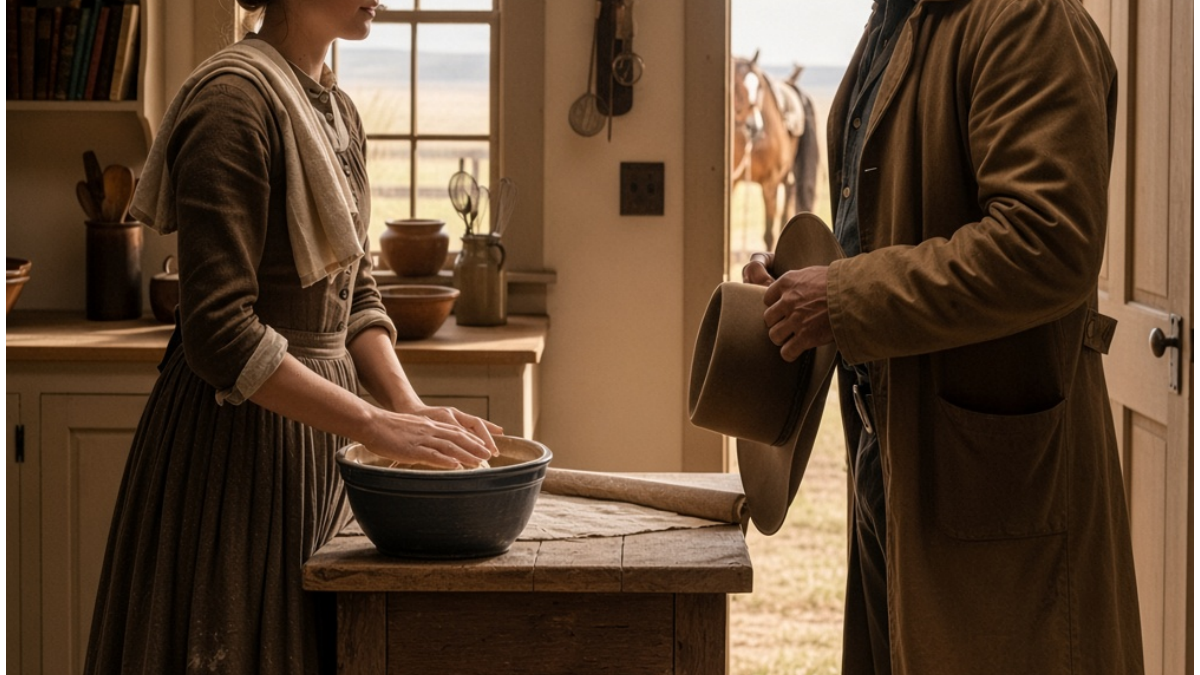
The rumor reached Raymond Lockhart on a Tuesday morning, carried into the feed store by old Pete Dawson like a spark tossed into dry grass.
And before the hour was out, Raymond had saddled his horse and ridden the three miles to Keller farm without once stopping to think about what he intended to say when he got there.
It was the spring of 1878 in Harland County, Texas, a stretch of red dust and stubborn cedar, and sky so wide it made a man feel both free and terrified all at once.
The town of Merritt’s Crossing sat along a shallow bend in the Sabine River like an afterthought.
Its main street, a collection of weathered storefronts and sun-bleached boardwalks, its people the kind who had come west looking for something they still hadn’t entirely found.
Raymond had been born here, or near enough. His family’s cattle operation sat 12 miles north of town, and he had grown up knowing every creek crossing and every dust trail between the hills and the river.
He knew this land the way a man knows his own name. What he didn’t know, not nearly as well as he should have, was Henrietta Keller.
He told himself that wasn’t true, of course. He knew she had come to Merritt’s Crossing 6 years ago with her father, Wilhelm Keller, a German immigrant who had purchased 80 acres of river bottom land and built a house that was too square and too precise to look quite natural among the organic, sun-warped structures of the other homesteads.
He knew that Wilhelm Keller had died two winters past, a swift and cruel death from a fever that had taken him in 4 days, leaving Henrietta alone on those 80 acres with a milk cow, a garden, a small flock of chickens, and a reputation for being the finest seamstress in three counties.
He knew she had amber-brown hair that she wore in a braid down her back when she was working and pinned at the nape of her neck when she came into town.
He knew she had a way of looking at a person with those clear gray eyes that made you feel she was reading something written inside your chest that you hadn’t intended anyone to find.
He knew she was 26 years old, that she sang to herself while she worked in her garden, and that she had, on exactly three occasions over the past 2 years, allowed him to walk her from the Sunday service at the First Methodist Church back to the edge of her property, where she always thanked him politely and went on alone.
He knew all of that, and he had been very careful with all of that in the way that a man is careful with something he is afraid of ruining.
And now Pete Dawson had stood in the feed store and said, casual as weather, that he’d heard Henrietta Keller was fixing to sell her father’s land and head back east, maybe to St. Louis, where she had a cousin or an aunt or some sort of relation, and that old Garrett Hinds over at the bank had already had preliminary words with her about the price.
Raymond had felt something fall out of the bottom of his stomach. He rode hard enough that his roan gelding, Copper, was blowing steam by the time the Keller farmstead came into view.
He made himself slow down at the gate, made himself breathe, made himself look at the place properly before he went charging in like a fool.
The house was white painted neat, the kind of neat that spoke of someone who cared about order even when order was difficult to maintain.
The kitchen garden along the south wall was already showing new growth, green shoots pushing up through dark earth in careful rows.
The fence posts along the yard were sound, no lean to them. The barn was small but tight.
There was smoke coming from the chimney, which meant she was home, probably cooking or boiling laundry.
He tied copper to the fence post at the gate, pulled his hat off and ran a hand through his dark hair, put the hat back on and walked up the path to the door.
He knocked. He waited. He heard her voice from inside saying she would be there in a moment and that voice, low and clear with the faint trace of an accent that had come from her German-speaking father and never entirely left her, did something complicated to his breathing.
She opened the door with flour on her hands and a dish towel over one shoulder and she looked at him with those gray eyes and said, “Raymond Lockhart, this is a surprise.”
“Good morning, Miss Keller,” he said and then stood there holding his hat and feeling every bit of the careful speech he had been constructing on the ride over simply dissolve.
She waited. She was patient that way, which he both appreciated and found slightly unnerving.
“I heard something in town,” he said finally. Her expression didn’t change much, but something shifted very slightly around her eyes.
“Did you?” She said. It wasn’t a question. “About you leaving, about the land.” She looked at him for a moment longer, then stepped back from the door.
“Come in,” she said. “I was making bread. I’m not going to stop making bread just because you’ve ridden over here on account of town gossip.”
He came inside, hat in hand, into the kitchen that smelled of yeast and wood smoke and the faint clean scent of lye soap.
The kitchen was like the yard, orderly, everything in its place, but warmed by use, by the lived-in evidence of a person who knew how to make a place home.
There were dried herbs hanging from the ceiling beam. There was a blue pottery bowl on the table that he was fairly certain had come from Germany, brought across an ocean and then across half a continent.
There was a bookshelf in the corner with more books on it than most houses in Merritt’s Crossing contained, and several of them had foreign titles on the spines.
Henrietta went back to the table and began working the bread dough with competent, unhurried hands.
“Is it true?” He asked. She pressed her palms into the dough. “It might be,” she said.
Something about the casualness of those words made him want to argue with her, which he recognized was not entirely rational.
She owed him no account of her plans. She had made him no promises. And yet “Why?”
He said. She looked up at him then, and there was something in her eyes that was not quite sad and not quite resigned, but somewhere in between.
Something he recognized as the expression of a person who has thought about a thing so long they have arrived somewhere past the sharp edges of it.
“Cuz I have been here 6 years,” she said. “And in 6 years I have watched my father work himself to pieces on this land, and then leave it before it ever gave him back what he put in.
And I have been sewing other people’s clothes and mending other people’s curtains and taking in laundry to keep the taxes paid, and I have been doing it alone, and I am” She stopped.
She pressed the heels of her hands into the dough again, hard, with more force than was strictly necessary.
“I am tired,” she said. “My cousin Ruth is in St. Louis. She has written to me three times this year already.
She has a house and a life, and she says there is work for a seamstress in the city that pays twice what I can make here.”
“Then it is true,” Raymond said. “I said it might be,” she said. “I haven’t decided.”
He turned his hat over in his hands. He looked at her the way the morning light came through the window and caught the loose strands of hair that had escaped her braid and lit them copper at the edges.
He looked at her strong, flour-dusted hands working the bread. He looked at the blue pottery bowl from Germany, the books with their foreign spines, the dried herbs, the garden outside the window just beginning to green up with spring.
“What would make you stay?” He asked. She was quiet for a moment. She shaped the dough into a ball and set it in the bowl to rise, then wiped her hands on the dish towel and turned to face him fully.
There was something measuring in her gaze, something careful and entirely honest, and it made him feel the way he had felt the three times he had walked her home from Sunday service, simultaneously hoping she would say more than politeness required and terrified that she might.
“A reason,” she said. “A reason,” he repeated. “Yes.” She folded her arMs. “Give me a reason to stay, Raymond Lockhart, and I will stay.
But I will not stay out of inertia, and I will not stay out of sentiment for a place that has taken more from me than it has given, and I will not stay because of what other people in this town might think about a woman who decides to go east and make a different kind of life.”
Her chin was up a little. Her eyes were direct and clear. “So, if you have ridden 3 miles to talk me out of leaving, then talk.”
He stood there in her kitchen with the bread rising and the fire in the stove ticking softly, and the morning light lying in bright panels across the floor.
And he thought about every carefully unsaid thing he had stored up over 2 years of three walks home from church and polite good mornings on the boardwalk, and watching her from across the aisle during Sunday services and thinking every single time that he should say something, he should do something.
He was a grown man of 28 years old with a working cattle operation and perfectly functional vocal cords, and yet “I have been a fool,” he said.
She blinked. That was not, apparently, what she had been expecting. “I have been a fool for 2 years,” he said, “of walking you home from church and not saying a single useful thing, and I am aware of that.
And I don’t have a pretty speech ready because I have apparently used up all my preparation time being foolish, but I am here now, and I am asking.”
He took a breath. “What kind of reason?” Something changed in her expression. Something softened just slightly, like the first given ice when the temperature shifts.
“The honest kind,” she said. He nodded. He put his hat on the table. He sat down in the chair she hadn’t specifically offered him, but that he thought she wouldn’t mind him taking, and he said, “All right.
Honest, then.” She sat across from him and waited. Raymond Lockhart was not, by nature, a man who talked around things.
He was direct with his ranch hands, direct with buyers at the cattle market, direct with his older brother Ellis, who tried to borrow money he wouldn’t pay back, direct with the bank when he needed to negotiate terMs. Directness had served him well in every area of his life except the one that apparently mattered most, where for 2 years he had been circling something he never landed on, and he thought that was probably because it was the one area where being wrong would cost him something he couldn’t easily calculate.
But she was going to leave. She was going to take herself and her blue pottery bowl and her German books and her gray eyes to St. Louis and live in her cousin Ruth’s house and sew city dresses for city women.
And Raymond Lockhart would live the rest of his life in Harlan County, Texas, knowing he had stood in her kitchen with every chance he had ever needed and not said the thing.
“I have been in love with you,” he said, “since the winter after your father died, when I found you on the road to town carrying a bolt of cloth in the rain because your wagon wheel had split.
And I drove you the rest of the way in. And you sat next to me the whole way and talked about your father’s plans for the back 40 acres.
The ones he never got to plant. And the way you talked about it, the grief in it, but also the love.
The real deep love for a man who had dreamed his whole life of a piece of land.
I thought there is not another person in this county or maybe in the whole of Texas who loves the way this woman loves.
And I have been carrying that around for better than a year and a half and behaving as though it were some kind of secret I was keeping from myself.
And I am sorry for it, and I’m telling you now. Henrietta Keller was very still.
Outside, a mockingbird was doing its complicated best in the cedar tree near the fence.
Copper stamped one foot at the gate. The bread in the bowl was beginning its slow, quiet rise.
“That is an honest reason,” she said at laSt. Her voice was careful, the way a person is careful with something fragile.
“Yes,” he said, “it is.” “And it is your reason,” she said. “You want me to stay for you.”
“I want you to stay for yourself,” he said. “I want you to want to stay.
I’m not going to ask you to stay for me and then fail to give you anything worth staying for.
I know the difference.” He leaned forward, elbows on her table, and he looked at her with everything he had been not saying for 18 months right there on the surface of his face where she could see it.
“But yes, I’m also asking because if you go to St. Louis, the whole of this county becomes a considerably worse place for me to live in.
And I thought you should know that.” She uncrossed her arMs. She put her hands flat on the table, and she looked at them.
And then she looked at him, and she said, “How much of a worse place?”
“Enough that I rode here without a plan,” he said, “which I think you can tell.”
The corner of her mouth moved. It was barely anything, just the smallest beginning of a smile, and it undid something in his chest with a quiet, final feeling click.
“I can tell,” she said. She got up and went to the stove and poured two cups of coffee from the pot that was sitting there.
And she brought them back and set one in front of him with the ease of someone who had decided something, though he wasn’t sure yet what she had decided.
“My father,” she said, sitting down again and wrapping her hands around her cup, “used to say that this land required a particular kind of stubbornness to love.
He said you had to choose it every day, not just once. He said the people who left were not failures.
They were simply honest about the fact that they had not chosen to love it.”
She looked at the window, at the kitchen garden outside beginning its green reclamation of the brown earth.
“I think he was right about that. And I’ve been trying to figure out for the past several months whether I have chosen this land or whether I have simply been too tired and too brokenhearted to move.”
“And,” Raymond said. “And,” she said slowly, “I think the two things are not always separate.
I think sometimes you choose a place because you are too tired to imagine leaving it, and that is still choosing.”
Looked back at him. “But I have also been trying to figure out whether I was choosing this place because of this place or because of something I thought might be possible in this place that I was not sure was actually possible.”
He was fairly certain he understood what she meant. “Is it possible?” He asked. “You have ridden 3 miles to ask me that question,” she said, “and I have been waiting approximately 2 years for you to ask it.
So, yes, Raymond, I think it is possible.” He let out a slow breath. “I was a fool,” he said again.
“You were cautious,” she said. “There is a difference, though the practical result is the same.”
She took a sip of her coffee. “I would have stayed,” she added more quietly.
“If I had known, I would have stayed a year ago.” “I know,” he said.
“I’m sorry.” She shook her head slightly. “Don’t apologize. Just don’t make me wait another 2 years.”
“No,” he said. “I won’t.” They drank their coffee together in the warm kitchen, and outside the mockingbird kept singing, and the bread kept rising, and the spring morning continued its steady generous progress toward noon.
In the days that followed, Raymond Lockhart did not waste any more time on caution.
He came back to Keller farm on Thursday, this time with a purpose more concrete.
He brought two extra fence posts and the proper tools to repair the section of her paddock fence that had been leaning since January, and he worked on it in the afternoon while she finished sewing a commission piece for Clara Hines, the banker’s wife, who wanted a new Sunday dress in green wool.
He didn’t make a production of the fence work. He just did it, and when he was done, she came out with a cold glass of buttermilk, and they sat on the porch steps in the late afternoon light and talked.
What they talked about surprised him, actually. He had expected the conversation to be about them, about what he had said and what she had said, about the question of the future.
But instead she asked him about cattle, about the spring roundup that was coming up and whether he expected the prices to hold.
And he told her about the market and the buyers and the trouble he’d been having with a section of his north pasture where a spring had gone dry.
She told him about the letter from cousin Ruth, which she had already half decided not to answer in the way Ruth was expecting.
“You haven’t written back yet?” He asked. “I wrote back to say I was considering my options,” she said.
“I thought that was honeSt.” “It is,” he said. “Have your options clarified.” She looked at him sideways, gray eyes catching the last good light.
“They’re clarifying,” she said. He laughed, and it was the kind of laugh that felt like relief, like something releasing.
She smiled at him over her buttermilk glass, and for a moment they were simply two people sitting on porch steps in the late afternoon in Texas in the spring of 1878.
And it felt to Raymond Lockhart like something he had been trying to get to for a very long time.
He came back on Saturday, too. And by the second week, he was coming every other day.
And Merit’s Crossing, which noticed everything and commented on most of it, took note. In the feed store, in the dry goods emporium, in the barber shop, in the post office, people talked.
Some of it was kind. Vera Sampson, who had known Raymond’s mother and had a soft spot for anything that looked like a happy ending, said it was about time.
Some of it was less kind. There were people in town who regarded Henrietta Keller with the particular suspicion that some communities reserve for the self-sufficient, the educated, and the foreign, and who were not entirely sure a German woman with no family in the county was the right kind of match for one of the established Lockhart boys.
Never mind that the Lockharts had come from Ohio 20 years ago, and were themselves not exactly old Texas stock.
Raymond heard the talk and paid it the attention it deserved, which was none. Henrietta heard it, too, and reacted the same way, which told him something important about her.
What gave him more pause was his older brother, Ellis, who rode down from the main Lockhart house on a Thursday afternoon when Raymond happened to be at Keller Farm repairing her barn door hinges, and who stood at the paddock fence with his thumbs in his belt and his head tilted in the particular way he had when he was preparing to offer an opinion nobody had solicited.
Ellis was 32, broader through the shoulder than Raymond, with their father’s way of making even casual conversation sound like a negotiation.
He had married a girl from Beaumont County 3 years ago, a match that had been approved by everyone in the family and that produced a quiet, somewhat gray-looking household.
He was not, in Raymond’s estimation, a reliable authority on what made for a good life with a woman.
“Heard you’ve been spending a considerable amount of time out here,” Ellis said. “I have,” Raymond said, not stopping work on the hinge.
“Folks are talking.” “Folks always are,” Raymond said. “The Keller girl’s a fine enough woman,” Ellis said, which from him was a fairly substantial concession.
“But she’s got no land of her own worth keeping, nothing in the bank and she’s not from here.”
Raymond set down his tools and looked at his brother. “She has 80 acres of good river bottom land,” he said.
“She has a craft that earns her steady income. She has more books in her kitchen than you and I have in the whole of the Lockhart house and being from elsewhere has not historically been a disqualification in this country or we would both be in trouble.”
Ellis was quiet for a moment. He picked at a splinter in the fence poSt. “You’re serious about her,” he said.
“I am,” Raymond said. “Does she know that?” “She does,” Raymond said. “I told her.”
Ellis looked across the yard to where Henrietta was visible through the kitchen window, moving with her characteristic efficiency between the stove and the table.
He watched her for a moment with an expression that was more thoughtful than Raymond had expected.
“All right,” he said finally. “Just making sure you thought it through.” “I have,” Raymond said.
Ellis nodded, mounted his horse, and rode back up the hill, and that was that.
The more complicated conversation was the one Raymond had with himself, which had been going on for some time and centered on the question of what exactly he was asking Henrietta to stay for, and whether what he was offering was worth the sacrifice of the life she might build in St. Louis.
He thought about this seriously, the way he thought about business decisions or land investments, not with sentiment obscuring the practical reality, but head-on.
She would be giving up proximity to family. She would be giving up the comforts of a city.
She would be staying on the frontier, which in 1878 in Harland County, Texas, still meant hard seasons and uncertain harvests, and the ongoing friction of a society trying to sort itself out after the dislocations of war and reconstruction, all of which had left their marks on the county in ways that were visible if you knew how to look.
He had enough honesty about himself to know that he was asking her to choose a hard life.
The Lockhart cattle operation was successful, not wealthy, there was a difference, and while Raymond was a capable man, capable did not mean easy.
The land was beautiful and the work was meaningful, and he loved it with the whole of himself, but he knew love for a place was not transferable, not something you could hand another person and have them feel the same thing simply because you did.
So, he kept showing up. He repaired the fence and the barn door hinges and the loose board on the porch.
He learned what she needed and he provided it without being asked, because he thought that the best argument he could make for himself was not a speech, but a pattern of action, a demonstration of what kind of man he intended to be.
And alongside the practical work, he talked to her. He asked her things and listened to the answers, and told her things she hadn’t asked because she had said she wanted the honest kind of reason, and he intended to give her the whole honest picture.
He told her about his parents, both gone now, his father from a horse accident 7 years ago, his mother from a cancer 2 years after that.
He told her about Ellis and the complications of running a shared family operation, where the older brother believed seniority conferred authority, even in decisions that weren’t his to make.
He told her about the drought of 1874 and how it had nearly broken them, about the recovery and what it had taken, about the way the land could turn against you without warning, and what it required to stay through that.
He told her about the long winters of his early years here, when his mother used to read aloud by the fire because books were cheaper than candles, and they could all share the light at once, and how that habit had left him with a genuine love of reading that the other ranch hands found faintly amusing.
She listened to all of it. And she told him things in return about Germany, which she had left when she was three and which existed in her only as inherited memory.
Stories her father had told her about the village they’d come from and the reasons for leaving it, the political troubles and the poverty, and the decision to risk everything on the promise of American land.
She told him about her childhood as a settler’s daughter, always slightly outside the established social hierarchies because they had arrived after the founding families and with an accent and a name that required explanation.
She told him about teaching herself to sew properly from a book her father had ordered from Houston, about the years of work it had taken to build a reputation that generated actual income, about the pride she took in it, and the exhaustion, and the loneliness of running a one-person household on a one-person income in a world that had been primarily designed with the assumption of a spouse.
“Is that a pointed observation?” He asked one evening on the porch, the stars beginning to show in the darkening sky.
“It is not pointed,” she said. “It is just accurate.” “It is also pointed,” he said.
She tilted her head. “Perhaps slightly.” He reached over and took her hand, which was the first time he had done that, a deliberate and unhurried gesture, and she let him take it and turned her palm up slightly so their fingers could find a natural arrangement.
And they sat like that in the evening dark without speaking for a while, and Raymond thought he had never in his life felt so entirely certain of anything.
May came to Harlan County in a rush of bluebonnets and red clover, the pastures going overnight from brown to green in the way that the Texas spring sometimes managed, sudden and almost theatrical.
The river ran clear and quick with snowmelt from further north, and the cattle came into good condition fast, and the roundup Raymond and his hands ran in the second week of May went cleanly and brought better results than the previous year.
He rode back from the pastures on the last day of roundup in the long late light of a May evening with dust in his hair and satisfaction in his chest, and the very clear intention of going to Keller farm the following morning and asking Henrietta Keller a question that required considerably more preparation than the way he’d ridden over three months ago to ask about the rumor.
He stopped in town first the next morning at the dry goods store that also served Merritt’s Crossing as its de facto jeweler in the sense that old Mr. Beaumont kept a small display case of rings and brooches that had come in various ways and were available for purchase.
Raymond looked at what was in the case for approximately four minutes, picked out a silver ring with a small oval garnet because he remembered that Henrietta had once said in passing that she liked garnets better than diamonds because they were the color of something real rather than the color of nothing and paid what Mr. Beaumont asked without haggling which was so unusual that Mr. Beaumont looked at him with some concern.
“You all right, Raymond?” Mr. Beaumont said. “Never better,” Raymond said and meant it. He rode to Keller Farm with the ring in his coat pocket which was the most terrifying three miles he had ridden since the time he’d had to retrieve a steer from a flooded creek in a lightning storm.
The difference was that the steer had been less important. Henrietta was in the garden when he arrived, on her knees in the dirt with her gardening gloves on, thinning the carrot seedlings with the focused attention she gave to every task she undertook.
She looked up when she heard Copper at the gate and her expression shifted into the particular warmth she reserved for him now, the one that was not the polite smile she gave to townspeople but something more open, more genuine, more freely given.
“You look like a man who slept poorly and woke up with too much on his mind,” she said sitting back on her heels and pulling off a glove.
“I slept fine,” he said. “I woke up with a specific thing on my mind, not too much of a thing.
She cocked her head slightly, reading something in his face. She got to her feet and brushed the dirt from her skirt.
She was wearing her working dress, a simple brown wool with the sleeves rolled to the elbow, and she had a smear of dirt on one cheekbone.
And Raymond thought she was the most beautiful person he had ever seen in his life, and that this was not a thought that was going to become less true over time.
He had decided in the planning of this not to be circuitous. He had been circuitous for 2 years, and it had nearly cost him everything.
So, he walked to her through the garden gate and took both her hands and said what he had come to say.
“I want to marry you,” he said. “I want to marry you, and I want you to have this land and the Lockhart land, and whatever you want to build with them.
And I want to be the person you sit with in the evening, and talk to in the morning, and argue with when we disagree.
And I’m going to be honest with you that it will not always be easy, and that some seasons will be harder than others, and that I am imperfect and will make mistakes, and I will tell you when I have made them.
I love you, Henrietta. I have loved you since a rainy afternoon in the winter of 1876, and I intend to go on doing it.
Will you stay? Will you be my wife?” He took the ring from his pocket and held it out, and the May morning light caught the garnet and turned it deep red and warm, the color of something real.
Henrietta Keller looked at the ring, and then at his face, and then at the ring again, and her gray eyes were very bright.
She breathed out slowly. She looked at the garden around them, the careful rows of new growth, the white-painted house her father had built to be square and precise, the cedar trees along the fence, the wide Texas sky above it all.
Then she took the ring and slipped it onto her finger and said, “Yes.” He pulled her into his arms there in the garden among the carrot seedlings, and she put her hands on his chest and her face against his shoulder, and he held her with the solid, real, certain grip of a man who has been given something he knows the value of and intends never to be careless with.
“I should write to Ruth,” she said from against his shoulder. “You should,” he agreed.
“She will be disappointed.” “Probably.” She tilted her head back to look at him, and the smear of dirt was still on her cheekbone, and her eyes were bright and a little wet, and she was smiling in a way he hadn’t seen before, unguarded and full.
“I am not disappointed,” she said. “No,” he said. “No.” She turned her left hand slightly to look at the ring in the sunlight.
“A garnet,” she said. “You said you liked them.” She looked at him. “You remembered that.”
“I remember most things you say,” he said. She looked at him for a long moment with those reading eyes that saw things written inside people, and whatever she was reading in him, she seemed satisfied with what she found.
“That is going to be very useful,” she said, “and occasionally unnerving.” He laughed. She laughed.
Around them, the spring morning went on being extraordinary in the common, generous, entirely non-dramatic way that ordinary good days in good places are.
The preparations for the wedding took 6 weeks, which in Merritt’s Crossing in 1878 was considered prompt but not indecent.
Henrietta made her own dress. Of course, she did a cream-colored cotton with intricate eyelet work on the bodice and cuffs that took her 2 weeks of evening work by lamplight to complete.
And that, when she put it on, made Vera Sampson say it was the finest work she’d ever seen in the county, and she’d seen a good deal of work.
Raymond wore his good black coat and a white shirt Henrietta had made him 2 weeks before the ceremony as an early wedding gift, pressing and fitting the collar with such precision that he told her she had missed her calling as a tailor, and she told him sewing was not a calling.
It was a trade, and there was a difference. The First Methodist Church in Merritt’s Crossing had a congregation of about 60 regular members, and most of them came to the wedding on the second Saturday of June 1878.
Vera Sampson cried. Old Mr. Beaumont smiled proprietarily at the ring he had sold. Pete Dawson, whose gossip had set the whole thing in motion, sat in the third pew with an expression of tremendous self-satisfaction that Raymond felt was probably somewhat warranted.
Ellis sat in the front with his quiet wife and watched his younger brother take his vows with an expression that was not quite warm, but was at least not cold.
And when it was over, he shook Raymond’s hand and said something civil to Henrietta that she received with perfect composure and a gracious smile that Raymond privately thought was a better response than Ellis deserved.
The Reverend Miller, who was a dry, thin man with good instincts about when to be brief, kept the ceremony clean and direct.
When he asked if Raymond took this woman, Raymond said he did without a moment’s pause.
When he asked if Henrietta took this man, she turned and looked at Raymond first, a brief, clear, decided look that contained the whole history of everything she had chosen, and then she turned back to the Reverend and said she did.
When the Reverend told him he could kiss his bride, Raymond took her face gently in both hands and kissed her with a care and a complete sincerity that made Vera Sampson cry harder, and made Pete Dawson nudge the man next to him with the elbow of a person who was mentally composing the version of this story he intended to tell for the rest of his life.
They held the reception in the churchyard, which was the tradition. Long [snorts] tables set out with food contributed by the congregation cold roast pork and green beans and cornbread and three different pies and a wedding cake that the women of the church had collaborated on and that was somewhat lopsided but perfectly good.
There was lemonade and there was at the far end of the table a discreet jug of something stronger that the men visited occasionally in a way that maintained collective plausible deniability.
Raymond kept close to Henrietta throughout the afternoon not anxiously but with the simple pleasure of a man who is exactly where he wants to be.
He watched her navigate the social landscape of Merritt’s Crossing with the skill she had developed in six years as a careful outsider warm with the people who had been kind to her.
Gracious with those who hadn’t. Deflecting the nosier questions about whether she intended to keep sewing now that she was a Lockhart.
Or whether she had heard from any of her German relations or what she thought about the talk of a new railroad spur coming through the county.
He answered those questions himself when he could keeping them easy keeping them short. She appreciated this.
He could tell by the occasional slight loosening of her shoulders when he stepped in the way she’d glance at him with a look that had gratitude in it and something warmer than gratitude.
Late in the afternoon when the crowd had thinned and the remaining guests were in small clusters talking he found her sitting alone at the edge of the churchyard wall looking out at the main street of Merritt’s Crossing in the long gold light of late afternoon.
He sat down beside her. How are you?” He asked. “Good,” she said. She looked at her hands in her lap, at the garnet ring, and now the plain gold band beside it.
“I am very good, Raymond.” “No regrets,” he said. She turned and looked at him, and her gray eyes were level and utterly honeSt. “None,” she said.
“Not one.” He took her hand. “Cousin Ruth will find someone else to feel sorry for,” he said.
She made a small, amused sound. “Ruth does not feel sorry for people,” she said.
“She worries about them, which is different. She will stop worrying when she sees that I am all right.”
“Are you going to invite her to visit?” Henrietta thought about that. “Eventually,” she said, “when we have a proper guest room.”
They moved into the Lockhart house together, which was the larger of the two properties.
A solid two-story structure that Raymond’s father had built 20 years ago, and that had been gradually improved over time until it was a genuinely comfortable house.
If a somewhat spare one in the way of houses that had been inhabited primarily by men.
Henrietta addressed the spareness with characteristic efficiency. Not with sentiment or fuss, but with practical additions.
Curtains at the windows, a woven rug on the parlor floor. The blue pottery bowl from her father’s house installed on the kitchen shelf where it could be seen every day.
She kept the Keller farmhouse, too, renting it to a young couple. The Garcias, Miguel Garcia and his wife Pilar, who had come up from South Texas looking for land, and had found renting more manageable than buying for the moment.
Pilar Garcia was pregnant with their first child, and Henrietta set the terms of the rental with a generosity that Raymond thought was not entirely surprising given who she was, arranging a reduced rate for the first year that allowed them to get properly established.
“You could have gotten more from them,” Raymond observed, not as a criticism but with genuine curiosity about her thinking.
“Yes,” she said. “But they needed a fair start, and I have a fair start, and those things are not coincidental.”
She folded the rental agreement and set it in the tin box where she kept important documents.
“Besides,” she added, “Pillar knows embroidery work I don’t know, and she has agreed to teach me in exchange.”
He stared at her. “You negotiated embroidery lessons into a rental agreement.” “I negotiated a service exchange into a rent reduction,” she said.
“It is a sound business arrangement.” “You are remarkable,” he said. She looked up at him with those gray eyes bright with something that might have been amusement and might have been the very beginnings of a thing she did not yet have a word for.
“I know,” she said simply. The summer of 1878 moved at the pace of a good life, not fast, not slow, but with the solid, purposeful rhythm of people who are busy with things that matter.
Raymond ran the cattle operation with his foreman, a steady Texan named Holt Brannigan, who had been with the Lockharts for 6 years, and who received Henrietta’s presence in the household with the quiet acceptance of a practical man who could see that his employer was measurably less distracted and considerably more decisive than he had been 6 months ago, which Holt found professionally convenient.
Henrietta kept her seamstress trade going, which Raymond had told her he supported without conditions, and which turned out to be important not only for the income but for the continuity her clients were her connections to the town, her means of staying current and involved, and Raymond understood that her work was part of who she was in the same way that the cattle and the land were part of who he was.
They fell into each other’s company the way people do when they have been waiting for something without admitting it, which is to say completely and with a relief that expressed itself as ease.
They cooked together when there was time, or she cooked and he sat in the kitchen and talked at her, and she told him when he was being underfoot, and he got out of the way.
They read in the evenings by lamplight, each with their own book, occasionally reading passages to one another when something seemed worth sharing.
They argued about things, about the Rodriguez brothers who ran the neighboring property, and with whom Raymond had an ongoing dispute about a shared water access, about whether the back bedroom needed a new roof now or could wait until fall, about the right way to handle Ellis’s increasing tendency to treat the combined family operation as something he had unilateral authority over, which Raymond found annoying and Henrietta found both annoying and strategically addressable.
“You need to have a direct conversation with him,” she said one August evening, when Raymond came home from a meeting with Ellis in a state of compressed frustration.
“I have had direct conversations with Ellis,” Raymond said, “at various points over the past 15 years.”
“You have had direct arguments with him,” she said. “That is different. I mean a conversation in which you lay out exactly what the boundaries are and what the consequences are if he continues to cross them.”
“He won’t listen.” “He doesn’t have to listen,” she said. “You have to say it.
Once it is said, clearly and calmly, with witnesses if necessary, then whatever happens next is his choice and not your problem.”
Raymond looked at her. “You have a very clear mind,” he said. “I have had to be practical,” she said.
“I did not always have the luxury of hoping things would resolve themselves.” She passed him his supper.
“Talk to your brother, Raymond. He will not respect the boundary you are unwilling to state.”
He talked to his brother the following week, in the presence of Holt Branigan, who served as the functional witness without having been explicitly asked, simply by virtue of being the foreman of the operation, and therefore present at any discussion that pertained to it.
Raymond said what needed to be said with the directness his wife had recommended, without anger, without drama, without the kind of heat that would have made Ellis feel attacked rather than informed.
Ellis was quiet for a long time afterward. He didn’t like it, but he heard it, and in the months that followed the intrusions became less frequent and then largely stopped, which Raymond reported to Henrietta that evening with a certain satisfaction.
“You were right,” he said. “I usually am,” she said, and the way she said it was perfectly deadpan, and he found it one of the funniest things he had heard in a year.
In the fall of 1878, Henrietta realized she was pregnant. She told him on a Thursday morning in October when the air had gone cool and sharp, and the cedar trees along the fence had gone deep and dusty green against the pale morning sky.
She told him matter-of-factly because that was how she told things, sitting across the kitchen table with both hands around her coffee cup, and she watched his face with those reading eyes as she said the words.
He sat very still for a moment. He had thought about this, had thought about children in an abstract, someday way, but the practical reality of it arrived with a concreteness that was different from the thought.
“Are you all right?” She said. “You look as though you might fall out of your chair.”
“I’m not to fall out of my chair,” he said. “You might,” she said. “I am” he stopped.
He looked at her. “Are you all right?” “I am perfectly well,” she said. “I am 8 weeks along or thereabouts, I believe.
I’m a little tired in the mornings and not much interested in eggs, but otherwise I am fine.”
She tilted her head. “How are you?” “I am.” He made a sound that was not quite a laugh and not quite a word.
“I am very happy,” he said, “and very aware that I do not know the first thing about being a father.”
“Most men who become fathers are in that situation,” she said mildly. “They manage by paying attention and trying not to be foolish.”
“That is your comprehensive advice on the matter?” “For now,” she said. “I’ll have more specific guidance as the occasion requires.”
He came around the table and knelt next to her chair, which was not a position he had adopted many times in his life, being a man who generally expressed things standing up.
He took both her hands, as he had done in the garden in May, and he looked at her with the full sincerity that she had come to know him by, the sincerity that was one of the things she had decided in the reading of him was the most reliable thing about him.
“I love you,” he said. “And I am going to be the best father I can manage, and when I am inadequate you will tell me, and I will adjuSt.”
“That is a reasonable plan,” she said. And then she leaned forward and put her forehead against his, and they stayed like that for a moment, quiet in the October morning, while the world reorganized itself around this new and important fact.
The news traveled, as news did in Merit’s Crossing, with a speed that suggested it had been greeted with satisfaction by everyone who heard it.
Vera Sampson appeared at the door 2 days later with a jar of preserved peaches and a pattern for an infant gown.
Pilar Garcia, who had delivered her own son in September and was in the particular state of benevolent authority that new mothers achieve, arrived with practical advice about what to prepare and a list of things she had found indispensable that Henrietta transcribed into her household account book with characteristic thoroughness.
Ellis came by with his wife Margaret, who said the appropriate things warmly and then went quiet in the way she usually did after the first few minutes.
Ellis himself shook Raymond’s hand and said, “Good news.” And that was the most expansive he was going to be.
But Raymond had learned not to measure his brother against a standard Ellis was never going to meet.
And so he took it for what it was. December brought the first hard freeze to Harlan County and with it the particular kind of interior life that cold weather imposes on frontier households.
The long evenings, the fire in the parlor, the accumulated small comforts of a well-run house.
Henrietta was 5 months along and adapting to the changes in her body with the pragmatic competence with which she adapted to most things.
Though she was reading a great deal more than usual and he suspected this was partly a way of managing the uncomfortable combination of limitation and anticipation that the final months of a pregnancy involved.
He read to her some evenings, which had started as a gesture and become a habit they both liked.
He would sit in the armchair near the fire and she would sit on the settee with her sewing or her knitting and he would read aloud from whichever book she put in his hands.
And the quality of his reading, which had started somewhat flat-footed and gradually improved as he got used to the exercise, became one of the domestic arts he was quietly proud of.
On a particularly cold December evening, he was reading to her from a novel she’d ordered from a bookshop in Austin, and she stopped him in the middle of a passage about a character making a decision to leave a place she had always known and said, “Do you remember what you asked me the first morning?”
“Which thing?” He said, knowing which thing. “You asked me what would make me stay.”
She was looking at the fire, not at him. “And I said a reason.” “You did.”
“I was making it harder than it needed to be,” she said. “I think I knew the reason already.
I think I had known it for some time. But I needed to hear you say it because I did not trust myself to be right about a person without evidence.”
“That seems sensible,” he said. “It is sensible,” she said. “But it also means I spent a year and a half being lonely when I didn’t have to be.”
“So did I,” he said. She looked at him then across the fire-lit room, and her expression was the one he had come to think of as the deep one, the one that was not performance or politeness, but the pure, undecorated truth of her.
“We were both foolish,” she said. “We were,” he said. “But we are not being foolish now,” she said.
“No,” he said. “We are absolutely not being foolish now.” She smiled at the fire.
“Read the next page,” she said. He did. The winter deepened, and the county settled into its cold season routines, and the pregnancy moved forward without significant difficulty, for which Raymond was grateful in the specific way of a person who has been told enough stories about things going wrong to understand what could be feared.
Henrietta was practical about it, as she was practical about everything. She ate well. She walked daily when the weather permitted.
She had arranged for Mrs. Callaway, the midwife who served the county, to come when the time came, and she had told Raymond with great specificity what she expected of him and what she did not expect of him.
What she expected was that he would be present, that he would do what he was told, that he would not be in the way of Mrs. Calloway’s work, and that he would not pace.
She had seen men pace outside rooms during childbirths, and she found it profoundly unhelpful and intended to be spared the sight of it.
“I will not pace,” he said. “You will try not to,” she said, “which is different, and I accept it.”
He did, in fact, pace. Not inside the house, but outside in the cold March night, walking the length of the porch and back while inside the house Mrs. Calloway worked and Pillar Garcia, who had been sent for at Henrietta’s request, assisted and kept company.
He was not supposed to know the details of what was happening inside, which was the customary arrangement, and he respected it in the sense that he stayed outside.
Though what he was actually doing was mapping the porch boards with his footsteps and having a lengthy internal conversation with himself about how he was not going to be the kind of man who fell to pieces in a crisis.
At 2:00 in the morning of the 15th of March 1879, Mrs. Calloway opened the door and said, “Come in now.”
He came in. Henrietta was in their bed, pale and tired in the way that was not frightening, but was a specific and serious kind of exhaustion, and she was holding a bundle, and she looked up when he came through the door and said, “Come and see your son.”
His son was red-faced and squinting and had, as far as Raymond could tell, an opinion about being in the world that was still being formed, and was dark-haired and had Henrietta’s slightly squared-off chin, and was the most alarming and wonderful thing Raymond Lockhart had ever seen in his life.
“Hello,” he said, very softly, to the baby. The baby continued to have his opinion about things in general.
“He is loud,” Henrietta said with exhausted amusement. “He has been loud about it from the beginning.
I think he is going to be opinionated.” “Good,” Raymond said without thinking, and then, “Is that good?”
“It is a trait I value,” she said gravely. He sat on the edge of the bed, and she tilted the baby toward him, and he took him carefully with the extreme care of someone who has been given something with no instruction manual, and understands fully the weight of that.
The baby looked up at him with the unfocused gaze of the newly arrived, and Raymond looked down at him.
And something happened in his chest that did not have a name, but that he thought he would spend the rest of his life trying to be worthy of.
They named him Wilhelm for her father, and called him Will in the daily way.
And from his first weeks, he was a baby with strong preferences and a remarkable volume of voice for his size, which amused Holt Brannigan enormously, and which Pillar Garcia said with authority was a sign of a healthy temperament.
Will Lockhart grew in the way that healthy children grow on good land with good care, steadily and with purpose.
And his father watched him with the continuous astonishment of a man for whom parenthood revealed itself to be both harder and more extraordinary than any accounting had prepared him for.
Spring of 1879 arrived in the familiar rush of green, and Harlan County went about the business of another year with the same relentless optimism that the land seemed to require of the people who lived on it.
The Lockhart cattle operation had a good spring, prices up, herd in excellent shape, Holt Brannigan at his most competent.
A new water arrangement with the Rodriguez brothers negotiated with a smoothness that owed something to Henrietta’s general principle about stating things clearly, which Raymond had been applying in professional contexts with pleasing results.
Henrietta, 4 months after Will’s birth, was back at her work, sewing commissions in the hours that Will slept, which were regular and long enough to be useful.
She had taken on two new clients from a neighboring county, a consequence of her reputation having extended beyond Merit’s Crossing, and she was beginning to think about whether there was a way to run a slightly more structured sewing business rather than simply taking commissions on requeSt. She talked to Raymond about this on a May evening on the porch, Will asleep inside, the spring air smelling of cedar and new grass.
“A shop,” he said. “Not necessarily a shop,” she said. “A better organized approach. A waiting list, a rate schedule, perhaps a few patterns I sell as well as make.
There is a woman in Austin who has done something like this, and I have been corresponding with her.”
“You have been corresponding with a woman in Austin about business methods,” he said. “Her name is Mrs. Adela Vasquez, and she is extremely capable,” Henrietta said.
“She has been running her own dressmaking business for 8 years. I wrote to her in January.”
“Of course you did,” he said. He was smiling. “What has she told you?” “Several useful things,” Henrietta said, and pulled out the most recent letter from her apron pocket, which she had clearly been waiting to discuss.
And Raymond leaned over to read it with her in the porch light while the evening settled in around them.
Adela Vasquez’s letters, which Raymond came to know well over the following months, were models of practical intelligence and dry humor.
She had come from a Tejana family whose claim on Texas went back two centuries, and she ran her business from a shop in Austin with a clear-eyed awareness of both the opportunities and the obstacles that a Mexican-American businesswoman faced in 1879 Texas, where the social architecture was shifting under the pressure of various forces that were not always kind to people who had been there the longeSt. Her letters to Henrietta were frank about these realities in a way that Raymond found both sobering and instructive, and he and Henrietta talked about them in the evenings with the attention they gave to things that were worth understanding.
It was through Adela Vasquez’s letters that Henrietta first heard about the situation of the Rodriguez brothers’ cousin, a young man named Felipe Rodriguez, who had been attempting to register a land claim on a piece of ground his family had farmed for 30 years, and was encountering the specific kind of obstruction that the county land office was capable of generating when the claimant was not Anglo and the land was worth something.
Raymond heard this from Henrietta, who had heard it from Pilar Garcia, who was a second cousin of the Rodriguez family, and he did not immediately know what to do about it, but he knew that he knew Garrett Hinds at the bank, and he knew the county land assessor, and he knew the judge who had come to his wedding and eaten three slices of lopsided wedding cake, and he thought that knowing the right people carried an obligation to use that knowing for something beyond personal convenience.
He got involved carefully and without making a spectacle of himself, using the currency of his relationships in the county to push through the channels that Felipe Rodriguez had been finding blocked.
Henrietta helped him draft the necessary letters, which were more effectively precise than what he would have produced on his own.
It took four months and three meetings that Raymond came home from frustrated. And then on a Thursday in August, a letter arrived from the county land office confirming the registration.
And that evening Pilar Garcia came to the door to thank them. And she and Henrietta embraced in the doorway.
And Raymond stood slightly to the side with Will on his hip and thought about the Mexico border and the decades of Rodriguez family history in this soil.
And thought about the blue pottery bowl from Germany on his kitchen shelf. And thought that the things that made a place worth living in were generally the same things that required the most effort to protect.
Summer moved through its long blazing passage. And Will Lockhart grew into a toddler with opinions and a laugh that could be heard from the barn.
He was an early walker, which was both gratifying and exhausting. And Henrietta handled his high-speed explorations with the same combination of attention and equanimity that characterized all her practical engagements with the world.
Raymond came home from the range in the evenings to find the two of them in the yard or the garden.
Henrietta working while Will investigated the dirt and the chickens and the fence posts with the methodical curiosity of a child who had inherited, Raymond thought, two strong and particular minds and was in the process of integrating them into his own.
He told her this one evening and she said, “He is going to be a great deal of trouble.”
“Almost certainly,” Raymond agreed. “I mean that in the best possible way,” she said. “So do I,” he said.
There was a second pregnancy, announced in the late spring of 1880, received with the combination of joy and practical planning that had characterized the firSt. Raymond had gotten better at not pacing, or more accurately, he had accepted that he was going to pace and had developed a system in which the pacing was contained to the area of the porch that could not be seen through the parlor window, which Henrietta said was a reasonable compromise.
Their daughter arrived in November of 1880, dark-haired like her mother, with Raymond’s particular shade of brown eyes.
And they named her Clara, not for the banker’s wife, but for the German word that meant bright and clear.
Clara Lockhart arrived in the world with a different temperament from her brother, calm, watchful, with a gaze that even at weeks old seemed to be taking organized notes.
“She is studying us,” Raymond said, looking at his daughter. “Sensible,” Henrietta said. “We are the most important variables in her environment at the moment.”
“You are the most terrifyingly rational person I have ever known,” he said with complete admiration.
“And yet you love me,” she said. “Precisely because of it,” he said. She looked at him with the same direct honesty she had looked at him with on the morning in the kitchen 3 years ago now, when he had come to ask about a rumor and she had said what she needed and he had heard her and everything had followed from that.
She looked at him with the reading eyes that knew him by now in the comprehensive way of a person who has attended carefully to another person through seasons and difficulties and ordinary days.
And what she read in him was what had always been there, the full and honest thing undiminished by time.
“Give me a reason to stay,” she said quietly, not asking it but remembering it.
“I gave you one,” he said. “You gave me several,” she said. “You gave me a reason every day.”
“I intend to keep doing that,” he said. She reached out and took his hand, the left one where his own wedding band sat next to the calluses from rope and work.
And she held it the way she had held it on the porch steps the first evening, with their fingers finding a natural arrangement.
“Good,” she said. Will Lockhart, now 2 years old, appeared in the doorway of the bedroom with the purposeful expression of a small person who had been left unsupervised for slightly too long and had opinions about this.
“There is your son,” Henrietta said. “He has the look of someone who has done something,” Raymond said.
“He always has the look of someone who has done something,” she said. Raymond extracted his hand from hers gently and went to intercept his son, who was in fact in possession of a small and confused-looking toad that had been removed from its natural environment and transported indoors, which Raymond took with one hand while taking Will with the other arm and saying with complete authority, “We are putting the toad back.”
“No,” said Will. “Yes,” said Raymond. “No,” said Will more firmly. From the bedroom, Henrietta’s voice carried with distinct amusement.
“He gets the stubbornness from you.” “He most certainly does not,” Raymond called back. “Discuss it with me when you’ve taken the toad outside,” she said.
He took the toad outside. He had this conversation many more times in many more configurations.
As the years went by, negotiations with small, determined people who had been given exactly the genetic combination that produced an abundance of will and intelligence and stubbornness, which was exhausting and wonderful in equal measure.
Merits Crossing grew in the early 1880s. The railroad spur that had been discussed came through in 1882, connecting the county to the larger commerce of the state in ways that changed the rhythms of the cattle business and brought new people and new goods and new complications.
Raymond adapted. He had always been good at adapting in the way that people who pay attention rather than assuming are good at adapting.
And the Lockhart operation shifted its model in ways that kept it sound through changes that broke some of the neighboring operations that were less flexible.
Henrietta’s sewing business evolved, too. The organized approach he had developed with Adela Vasquez’s guidance becoming by 1882 a genuine small enterprise with a waiting list and a price structure and two younger women she was training in the specific techniques she had refined over a decade of practice.
Adela Vasquez came to visit in 1883, which was the fulfillment of a plan that had been in the works for 2 years, delayed by the practical complications of life and distance and the difficulty of two busy women finding a window of time simultaneously.
She arrived on the afternoon train from Austin with two bags and the brisk efficiency of a person who is perpetually moving and has made peace with it.
A small woman in her mid-30s with dark eyes that processed everything quickly and a laugh that arrived without warning and was entirely genuine.
Raymond liked her immediately. This was not a foregone conclusion. He had imagined her as formidable and correct, which she was, and had not adequately imagined the warmth that ran underneath those qualities.
The warmth that explained why Henrietta had been corresponding with her for 4 years with what was clearly considerable affection.
Adela Vasquez noticed everything about the household and the operation and said most of what she noticed aloud in a way that was not unkind, but was also not padded with unnecessary softness, and Raymond found this refreshing.
She stayed for a week, and she and Henrietta talked at a rate and depth that Raymond found slightly daunting and entirely admirable.
Two practical women with serious minds comparing notes on subjects that ranged from business practice to fabric sources to the specific difficulties of operating commercial enterprises in a social environment that was not uniformly pleased to see women doing so.
He contributed to some of these conversations and stayed usefully out of others. And in the evenings, the three of them sat on the porch and talked more generally about the state of things in Texas and the country.
And he learned things from Adela Vasquez’s perspective on the state of things that he had not known before.
On the last evening of her visit, when Henrietta had gone in to put the children to bed, Will was four now, Clara two, and the bedtime proceedings were extended and complex.
Raymond and Adela sat on the porch in the late summer dark, and Adela said, “She is the most capable person I correspond with.”
“I told her that in my second letter, and she wrote back to say she was aware of it, which made me laugh for approximately 10 minutes.”
“She told me the same thing once,” Raymond said, “in almost the same terMs. She is also,” Adela said, “very happy.
She said it with the precision of someone who is distinguishing it from adjacent states.
Not content, not adjusted, happy.” “Yes,” Raymond said. “You should know that,” Adela said. “In case you are ever uncertain about whether what you have built here is what she would have chosen if she had known what she was choosing.
She would have chosen it. She has chosen it every day.” He thought about that for a moment.
He thought about the morning in the kitchen, Henrietta’s flour-dusted hands, the bread rising in the bowl, her direct gray eyes and her direct words, “Give me a reason to stay, and I will stay.”
He thought about all the mornings since, all the evenings, all the arguments and the laughter and the hard work and the children and the land changing through the seasons and the cattle and the decisions and the constant negotiation of two strong-minded people building a shared life with intention and without pretending it was easy.
“I know,” he said, “and she should know the same of me.” “I suspect she does,” Adela said.
“She is very good at reading people.” “The best I’ve encountered,” Raymond said. Adela Vasquez laughed her sudden, genuine laugh.
“Tell her I said so. It will annoy her.” “Why?” “Because she will say reading people is not a skill, it is just paying attention, and attention is the minimum requirement of being a decent human being, and she does not want to be praised for meeting the minimum requirement.”
Raymond stared at her. “She did not say that to me in those words.” “She will,” Adela said.
“Give her time.” She left the following morning on the early train, and Henrietta stood on the platform and watched the train go with an expression of affection and productive sadness, and Raymond stood beside her and said nothing until the train was out of sight.
Then she turned away from the tracks and said, “She told you something last night on the porch.”
“She told me you’re happy,” he said. Henrietta considered this. “She is a reliable narrator,” she said.
“She also predicted,” Raymond said, “that you would tell me attention is not a skill, it is the minimum requirement of being a decent human being.”
Henrietta was quiet for a full 3 seconds. Then, “That is slightly unsettling.” “I thought so, too,” he said.
She took his arm as they walked back toward the street where Copper and her mare, a steady gray named Else, were tied at the rail.
Will was sitting on the boardwalk outside the station with his knees drawn up in a philosophical expression, which meant he was either thinking very hard or had done something he had not yet disclosed.
“Will,” Henrietta said. “I didn’t do anything,” said Will. “I didn’t ask,” she said. “You were going to,” said Will.
Raymond said very quietly, “He gets that from you.” She turned to look at him with those clear reading eyes, and then she smiled.
The unguarded full smile that she had first given him in the kitchen garden on the morning he had asked her to marry him.
The one she did not use for public consumption. The one that was entirely for him.
“Perhaps,” she said. The years settled into themselves the way good years do. Each one distinct and each one continuous with the ones before and after.
Marked by the seasons and by the milestones that accumulate in a life that is lived with intention.
Will Lockhart started school in Merit’s Crossing in the fall of 1883 and came home the first day with a great deal of energy.
And the firm opinion that reading was already something he knew how to do. Which was not strictly accurate, but was not entirely wrong either.
And Henrietta told him with her characteristic honesty that there was a meaningful difference between recognizing letters and reading.
And that he would find the distinction interesting rather than discouraging if he approached it correctly.
And Will, who was his mother’s son, took this as a challenge and was reading competently before the first school year was out.
Clara started school two years later. And where Will’s experience of it was combative and energetic, Clara’s was quiet and thorough.
And she came home with notes she had apparently been keeping about things that interested her, which at age five included the mechanics of how the water pump worked, the classification of local birds, and the reasons that some plants grew in clay soil and others did not.
Raymond looked at these notes one evening with the feeling he had increasingly often, a kind of astonished gratitude that shaded into something close to awe, and said to Henrietta, “Where did she come from?”
“From us,” Henrietta said simply. “The best of us, hopefully.” “Assuredly the best of you,” he said.
“You are the one who reads to them every night,” she said, “and talks to them about the land as though they are people with intelligence capable of processing real information, and takes them to watch the cattle work and explains what is happening and why.
You are not incidental to who they are becoming, Raymond.” He looked at her. Outside the evening was doing what evenings in Harlan County did best in October, the sky going from blue to orange to something deep and personal that defied naming, and the cedar trees dark against it, and the cattle moving in slow clusters toward the water.
“I want to be a good father,” he said. It was something he had thought many times, but he had not said it exactly like this before with this particular quality of earnestness.
“You are a good father,” she said. “Not a perfect one, there is no such thing, but a good one.
The children know you love them. They know you respect them. Those are not small things.”
He nodded. He looked at the evening outside the window for a moment longer, then he turned back to her.
“And a good husband.” She set down the mending she had been working on, her needle still in her fingers, and she looked at him with the full attention that was one of her greatest gifts and most constant offerings.
She looked at him the way she had looked at him in the kitchen on that Tuesday morning in the spring of 1878 reading him, seeing him, being honest with herself about what she saw.
“The best I could have imagined,” she said. “Better than I imagined because I had not imagined this specifically.
I had imagined someone who would let me be what I am and value what I value.
I had not imagined someone who would be genuinely curious about those things.” She tilted her head.
“You are curious about me, Raymond, still, after everything. That is not a thing I take for granted.”
He crossed the room and sat beside her close, with the ease of two people who have been sharing physical space for years and have arrived at the comfortable knowledge of each other’s presence.
She leaned her head against his shoulder. “I cannot imagine not being curious about you,” he said.
“Good,” she said. “Don’t stop.” They sat like that until the children came in from the yard demanding supper, and the evening began its domestic transformation into noise and lamplight and food and arguments, and the managed beautiful chaos of a household that was fully, completely, deliberately alive.
In the summer of 1885, there was a third child, another boy, arrived in June, named August for the German month in which Wilhelm Keller had left his home country 30 years before.
August Lockhart was different from both his siblings in the way that third children sometimes are possessed of a serenity that seemed improbable given the environment.
A calm that held even in the presence of Will’s noise and Clara’s intense organizational projects.
He watched the world with what Raymond privately called the old look, the look of a person who has been here before, which was not something Raymond would have said aloud because it would have sounded peculiar, but that he thought of every time he picked August up, and those calm dark eyes settled on him with what felt like recognition.
Henrietta said August took after her father. Raymond had seen the photograph of Wilhelm Keller that sat on the shelf beside the blue pottery bowl, a formal studio portrait from the early days of the farm, a square-built man with a steady face and eyes that appeared to be looking at something further than the camera.
He thought Henrietta might be right. Will was six now, Clara four, and they received their brother with sharply contrasting responses.
Will with excited ownership, immediately establishing himself as the authority on the subject of August Lockhart, and Clara with careful, methodical interest, as though she were conducting a study.
Raymond watched both of them with the brother he had made with this woman in this house, on this land, and felt the full weight and warmth of everything that had followed from a single Tuesday morning, and a truth he had finally said aloud.
The summer of 1885 was otherwise busy with the cattle business, a good year following two difficult ones, and with the continued growth of Merritt’s Crossing, which now had a proper newspaper and a second church and a school that was larger than the original one-room building, and that had acquired a full-time teacher, a Mr. Parks from Ohio, who was young and earnest, and who Will Lockhart was testing thoroughly.
Raymond had been elected to the town council the previous year, which had surprised him, and which Henrietta had not been surprised by at all.
He took the responsibility seriously, in the way he took all obligations seriously, and Henrietta sometimes came to the meetings in the evenings and sat in the back row and listened, which he was aware of, and which he found it simultaneously grounding and slightly nerve-racking.
Not because he was afraid of her judgment, but because her judgment was so reliable that he trusted it more than most other sources.
“You need to push back on Caldwell’s water ordinance,” she said, walking home from a council meeting in September.
The night air cool and full of cedar. August on Raymond’s hip because Pilar Garcia, who sometimes watched the children for evening meetings, had said he was unsettled and better with his father.
“I know,” Raymond said. “It disproportionately affects the farms on the south side of the creek,” she said, “which are primarily operated by families who don’t have the council representation that would give them a voice in this directly.”
“I know,” he said. “I was planning to bring it up at the next meeting.”
“Bring it up at this one,” she said. “Caldwell wants to move quickly. If you wait for next meeting, it will already have been circulated for signatures.”
He looked at her, walking beside him with the crisp-edged clarity that she brought to everything.
August on his hip had the old look on his face, watching the dark street with apparent intereSt. “You would be better at this than I am,” he said.
She was quiet for a moment. “Possibly,” she said. “But I am not on the council, and you are, and that is the present arrangement, and I prefer to work with present arrangements rather than lamenting alternative ones.”
“You could run,” he said. She looked at him sharply. “Women don’t serve on town councils in Texas.”
“Not currently,” he said. She held his gaze for a moment. He watched something move through her expression, the brief glimpse of a want she had learned not to voice, followed by the pragmatic acceptance that characterized her navigation of the world’s various limitations, followed by something else that was not quite defiance and not quite hope, but somewhere between them.
“No,” she said finally, “but I can tell you what to say.” “You always do,” he said.
“And you always listen,” she said. “I always do,” he said. She took his free arm as they walked, and August leaned his calm, dark-eyed face against Raymond’s shoulder, and the night in Harlan County was wide and full of stars.
Raymond pushed back on Caldwell’s water ordinance at that meeting. He made the argument Henrietta had outlined with the addition of his own direct knowledge of the South Creek operations from his years of contact with the neighboring farms, and the ordinance was tabled for reconsideration.
And when it came back the following month, it had been amended in ways that were more equitable.
And Miguel Garcia came to the Lockhart house to shake Raymond’s hand and Pilar brought a pan of sweet cornbread and told Henrietta in rapid Spanish, which Henrietta had been learning in the slow, determined way she learned everything, that she was a good woman to have in a county.
Henrietta, in careful Spanish, said that Pilar was the same. By the late 1880s, Merritt’s Crossing was properly established, no longer quite the frontier town it had been when Wilhelm Keller had arrived with his 80 acres and his square house.
The railroad had changed it. Commerce had changed it. The slow accretion of permanence that comes when a generation is born in a place rather than arriving at it had changed it.
It was still a western Texas town, still red dust and cedar and vast sky, still a place where the land exacted its terms from the people who tried to work it, still a place where the social arrangements were under constant negotiation.
But it had a library contributed by a group of townswomen who had organized the collection with a commitment to including books in Spanish and German as well as English, because two of the women on the organizing committee had thought this was important and had said so with the clarity that made things happen.
Henrietta had been one of those two women, as Raymond could have predicted. The other had been Pilar Garcia.
Raymond stood in the small library building on the day of its opening in the fall of 1888 and looked at the shelves with their organized collection and thought about the shelf in the Keller farmhouse kitchen, the German books and the blue pottery bowl, the dried herbs, the evidence of a woman who had carried everything she could from everything she’d come from across an ocean and a continent and two hard years of widowed solitude and had still found things worth building in a place that had not always been kind to her.
He thought about the garden outside that kitchen window, the careful rows of new growth in the spring of 1878, and the woman kneeling in her working dress among the carrot seedlings in May, and the garnet ring catching the morning light.
He found her across the room talking to the librarian, a young woman named Miss Oakes who had come from San Antonio and who found the county slightly alarming and slightly wonderful in approximately equal measure.
Henrietta was telling her something about the organization of the German language section, gesturing with the specific precise gesture she used when she was being thorough, and Miss Oakes was writing things down with the expression of someone who has realized she is being given information by a person who knows considerably more than she does and is trying to absorb all of it.
His wife, still with the amber brown hair, some silver in it now at 36, still worn in the braid down her back when she was working.
Still with the gray eyes that read people. Still with the straight bearing and the capable hands and the way of being precisely, entirely present in whatever she was doing, which he thought was one of the rarest qualities a person could have, and which she possessed so naturally that she probably did not know it was rare.
She looked up and saw him watching her and raised an eyebrow, not displeasure, just inquiry.
He shook his head slightly. Just looking, the gesture said. Her expression did the thing it did when she was being private with him in a public space, something small and entirely between them, a warmth that wasn’t for the room.
He smiled at her. Will, who was nine and had been standing near the shelves with the expression of someone doing preliminary reconnaissance, appeared at Raymond’s elbow.
“Can I take out three books?” He said. “You can take out two,” Raymond said.
“You still have the unfinished one from last week.” “I finished it,” Will said. “When?”
“This morning,” Will said, “while Clara was being annoying at breakfaSt.” “What was Clara doing?”
“Categorizing the silverware,” Will said with the tone of someone who has been through this before.
Raymond looked across the room to where his daughter, six years old, was in fact standing near the small table of donated items and appeared to be quietly sorting something into groups with absolute concentration.
Next to him, Will waited with patient expectation. On the other side of the room, Henrietta was still talking to Miss Oakes, and now Pillar Garcia had joined them, and all three women were looking at the German section with the focused collaborative energy of people who were going to reorganize something and were already deciding how.
“Two books,” Raymond said to Will. “And then you come back and help me collect your brother, who has been quiet long enough that I am concerned.”
August at 3:00 was quiet in the general way, and therefore his silences required interpretation.
Will, who had developed a working theory of August the way older siblings develop theories about younger ones, nodded with the authority of someone who understood the system.
“He’s probably by the window,” Will said. “He likes windows.” He was in fact by the window, standing on the low bench beneath it, looking out at the main street of Merit’s Crossing with the old-look eyes, watching the horses and the people and the dust with serene curiosity.
Raymond lifted him off the bench, and August said, without turning from the window, “Horses.”
“Yes,” Raymond said. “There are horses.” “Three,” August said. Raymond looked. There were in fact three horses at the rail outside.
“Good counting,” he said. “Four,” August amended as a fourth came around the corner. “Even better,” Raymond said.
He carried his youngest son across the room to where his wife was, and Henrietta, without interrupting her conversation, reached out and ran a hand briefly over August’s dark head in the automatic tender gesture that was one of the thousand small ways she moved through her days here.
And Raymond stood beside her and listened to the women talk about books and organization and what a library could be for a town that was still figuring out what it wanted to be.
And outside, the October light was gold on the Merit’s Crossing Main Street, and somewhere down the road Will was choosing his two books with the focused gravity of a person for whom this mattered.
And the Texas sky was doing its enormous best above it all. This was the life, not the idealized version, not the simplified one, the real one, with the difficulties and the exhaustion and the seasons of hardship and the arguments and the constant work of two strong-minded people deciding every day to be present to each other and to the things they had built together.
The real one with all the ordinary extraordinariness of it. The bread rising in the bowl and the garnet catching the light in the porch in the evening and the children growing into themselves and the land keeping its hard gorgeous terMs. Raymond Lockhart thought about the morning he had ridden to Keller farm in a panic, hand in hand, without a plan because a man in a feed store had said a woman was leaving.
He thought about her standing in the kitchen doorway with flour on her hands looking at him with those reading eyes.
He thought about what she had said, clear and direct and entirely honest, the way she was, “Give me the reason to stay.”
And he thought about everything that had followed from his finally, imperfectly, honestly doing that.
In the spring of 1891 when the bluebonnets came back in their annual extravagant flooding of the pastures and the cedar trees threw their pollen on the wind in golden clouds Henrietta turned 39 and Raymond turned 41 and they rode out together on a Sunday afternoon while the children were with Pilar Garcia’s family an arrangement that had been in place long enough to be a settled institution.
Good for both sets of children and good for the adults who needed an occasional afternoon of something other than management.
They rode the old Keller land, which was still rented to the Garcias, and the pastures looked good and the new house Miguel had built to replace the original square structure sat solid and well-kept in the afternoon light.
And from the rise they could see the Lockhart range spread out to the north, the cattle moving slow and deliberate in the green May grass, and the river in the middle distance reflecting the spring sky.
Henrietta stopped her mare at the top of the rise and looked out at all of it for a long time.
Raymond stopped beside her and looked, too, and then looked at her looking and thought that this view had been here the whole time, unchanged in its essentials, and that what made it different was the person beside him, the permanent presence of her in it, the way the landscape rearranged itself around the fact of her.
“I have been thinking,” she said, “about Cousin Ruth.” He waited. “She wrote last month,” Henrietta said.
“She is well. She has moved to a larger house. Her daughter has married a lawyer.”
She paused. “She said she is glad I am happy.” “Is she sincere?” He asked.
“Ruth is always sincere,” Henrietta said. “She is sometimes wrong about what is best for people, but she is always sincere about believing it.”
“That is a generous assessment,” he said. “She is my family,” Henrietta said simply. “Generous is what I owe her.”
She looked out at the river, the pastures, the spring sky. “She also said she has not understood from my letters why I chose to stay.
Do your letters not explain it?” “They explain it practically,” she said. “The land, the work, the children.”
“But she cannot quite understand why those things were enough when I could have had a version of those things in St. Louis without the uh She made a small gesture that encompassed, without quite articulating, all the hardness.
The droughts and the hard seasons and the isolation and the ongoing friction of frontier life.”
“What do you tell her?” He said. “I tell her,” Henrietta said slowly, “that she is asking the wrong question.
She asks why this was enough, but it is not enough, it is more than enough.
That is the thing she cannot understand from a distance.” She turned and looked at him, direct as always, with the full weight of 39 years of paying attention to the truth.
I tell her that I was given a reason, a good reason. The right reason.
And I stayed for it. And the reason has kept being true every day since.
And there is not a version of the life I might have had in scent.
Louis that competes with that. He held her gaze. The May wind came through the cedar along the rise and smelled of everything that was right about this place.
“I am the reason,” he said. “You are the reason,” she said. “You and the children and the land and the work and the people and everything that follows from choosing a thing fully.
But yes, you are the reason.” He reached across the space between their horses and took her hand, the left one.
The hand with the garnet ring and the gold band and the calluses from years of sewing and gardening and the physical work of a real life.
He held it the way he had held it the first time, on the evening they had first sat together on the porch in the darkness.
And she let him hold it the way she had let him the first time, turning her palm up slightly so their fingers could find their arrangement.
“I am glad,” he said, “that Pete Dawson cannot keep a secret.” She laughed, the free unguarded laugh she had that not everyone in Merritt’s Crossing had heard because it was not the public-facing version.
“I am also glad,” she said. They sat on the rise above the Keller land and the Lockhart range in the May afternoon, married 13 years, four children between them.
Because there had been a fourth, a girl born in the spring of 1889 who had been named Liesl, after a character in one of the German novels on the shelf, who was now two and completely in charge of every room she entered.
And the general opinion of which she had the most opinions of anyone in a household that had never been short of them.
Four children and the working cattle operation and the sewing business that had become a genuine modest enterprise and the library and the town council and the Rodriguez land claim and all the days and evenings and arguments and laughter and seasons that had accumulated into the solid warm irreducible reality of a life.
The bluebonnets were everywhere on the hillside. Blue as sky, dense and unquestioning in their annual proof that beauty was not conditional on ease.
That this particular piece of the world would put out everything it had regardless of what the season before had cost it.
Henrietta looked at them with the expression she kept for things that had earned her love honestly, not sentiment.
Not soft focus. But the direct open regard of a person who knew what she was looking at and had to look at it without flinching.
Raymond Lockhart, born in this country, committed to it with the entirety of himself. Holding the hand of the woman who had chosen it freely, looked at the same flowers and thought that the best thing he had ever done in his life was ride 3 miles on a panic Tuesday morning without a plan and tell the truth in a warm kitchen that smelled of bread.
And she had said, “Give me a reason to stay.” And he had. And she had stayed.
And the whole of everything good that he had, the children growing into their particular remarkable selves, the land that held him in its difficult beautiful terms, the evenings on the porch and the mornings at the kitchen table and the books read aloud by lamplight and the arguments resolved with honesty and the slow comprehensive knowledge of another person that was the deepest intimacy he had ever experienced, all of it, every last particular of it.
Had grown from that one true thing said in the right moment to the right person.
She squeezed his hand. He squeezed back. Below them, the river ran clear and quick.
And the cattle moved through the green spring grass. And the wide Texas sky held everything without effort as it always had.
And as it would continue to do season after season, year after year for as long as the land and the people who had chosen it endured.
It was enough. It was more than enough. It was in every possible and lasting sense everything.








