Everyone Ignored Her Daughter—Until an Ex-SEAL Single Dad Said, “I’ll Help Her.”
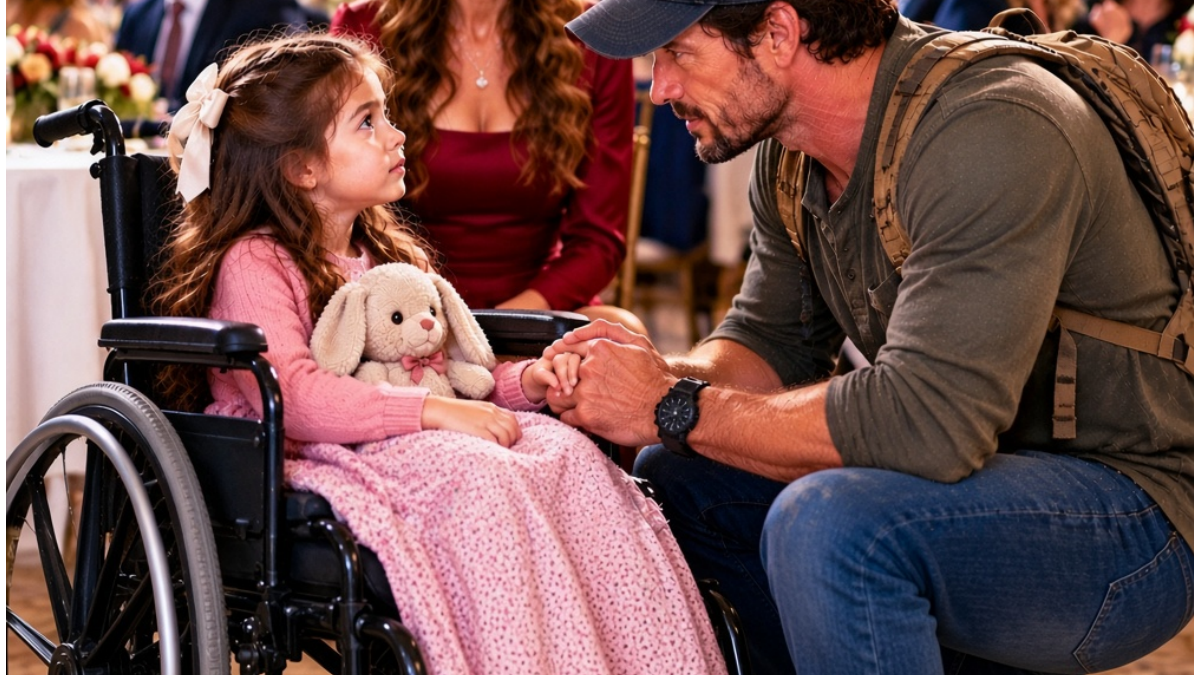
There were 400 people at that wedding. 400 people eating laughing, clinking glasses, dancing in expensive shoes on a marble floor that probably cost more than most people’s cars.
400 people who had walked right past a little girl sitting alone in a wheelchair at the edge of the room.
And not one of them had stopped. Not one. But one man noticed, a quiet man nobody had paid attention to all evening.
A man who had spent years learning how to see what others missed. And when he walked over and knelt down beside that little girl and asked her the one question nobody had thought to ask, everything changed.
The Hartwell estate sat on 11 acres of private land in Carmel by the Sea, and on the evening of the Whitmore wedding, every one of those acres had been manicured, lit, and staffed within an inch of its life.
String lights ran from the olive trees down to the stone terrace. A quartet played something tasteful near the fountain.
Weight staff in white jackets moved through the crowd with the kind of quiet efficiency that money buys, appearing at your elbow just when your glass was getting low and vanishing before you could properly register they’d been there.
Logan Pierce stood near the far end of the terrace with a glass of sparkling water he hadn’t touched.
Watching the crowd the way he always watched crowds, not suspiciously, not obsessively, but the way a man watches water moving, looking for the thing that doesn’t fit.
He was 37 years old and he looked like someone who had spent most of those years outdoors doing physical work, which was accurate, though not in the way most of the people at this wedding would have guessed.
He was broad across the shoulders with a jaw that needed a shave and hands that were calloused in specific places.
He wore the same dark suit he’d bought three years ago for a funeral, and it still fit, though the left sleeve had a faint crease from where he’d folded it in the closet wrong.
He hadn’t noticed until he’d gotten out of the car, and by then it was too late to do anything about it.
His daughter, Ruby, stood next to him, 9 years old, and already bored, pulling at the ribbon in her hair with the focused determination of someone trying to solve a puzzle.
Stop pulling that, Logan said without looking at her. It’s itchy. It’s a ribbon, Ruby.
Itchy ribbons are a violation of my rights. He looked down at her then, and something in his expression softened just slightly.
Where did you learn that phrase? School. You’re going to a different school.” Ruby grinned at him with all the cheerful confidence of a child who knew she had already won that particular argument by existing and went back to pulling at the ribbon.
Logan led her. He turned back to the terrace. He didn’t know most of the people here.
He’d been invited as a plus one technically through his neighbor Dale Whitmore, whose youngest son was the groom.
Logan had driven Dale to a dozen medical appointments over the past year when Dale’s knee was bad, fixed the drainage problem in Dale’s backyard, and helped him clear the dead oak that fell across his fence after the December storMs. Dale had insisted.
Logan had been raised not to refuse old men who insiSt. So here he was, the Whitmore wedding, 400 guests, open bar, a string quartet, and somewhere in the middle of all that light and noise and celebration.
His eyes stopped moving there, near the north end of the terrace, past the third tier of cocktail tables, and just beyond the range of the main string lights, someone had placed a round table slightly off to the side, tucked into a gap between two tall potted hedges.
It was a deliberate placement, the kind that someone had probably told themselves was practical.
Out of the way, easier for staff access, room for equipment. At the table sat a little girl.
She was maybe 7 or 8 years old, with dark hair pulled into two braids that were starting to come loose, wearing a pale blue dress that had clearly been chosen carefully by an adult who cared about her.
She was sitting in a wheelchair, a good one. Logan noticed the kind with adjustable armrests and a custom cushion.
The kind that probably cost as much as his truck. She had a small plate of food in front of her that had barely been touched.
And she was holding a small mechanical toy in her lap. Articulated metal bird, the kind you could find in a hobby shop, though this one looked like it had been significantly modified by someone who actually knew what they were doing.
She was alone. Completely alone. Not in the way that a child is alone. When her parents step away for a moment when you can feel the tether still connecting them and know someone will return in 30 seconds.
This was a different kind of alone. This was the kind where the child had stopped looking toward the crowd expecting anything and had turned inward instead, occupying herself with the toy in her lap with a quiet focus that said clearly that she had been sitting there for a while and had made her peace with it.
Logan watched her for a moment, then he watched the crowd around her. He watched a woman in a red dress walk past the girl’s table without slowing down.
He watched two men in suits stand 8 ft away, laughing, never once glancing in the girl’s direction.
He watched a server materialize near the table, pick up an empty glass, and walk away without asking whether the girl needed anything.
He watched a couple lean in close to each other in conversation, completely oblivious to the child sitting 10 ft behind them.
400 people. Not one of them saw her. Logan put his glass down on the nearest surface.
“Ruby,” he said. “Come with me.” Ruby looked up immediately interested. “Where are we going?”
“To say hello to someone.” They crossed the terrace together. Logan, keeping his pace unhurried, hands loose at his sides.
He didn’t make a show of it. He didn’t walk quickly, like someone who’d spotted a problem that needed fixing.
He just walked over, the way you walk toward any person at any gathering. And when he got close enough, he crouched down so that he was at eye level with the girl in the wheelchair.
And he said, “Simply and without drama, “Why are you sitting alone?” The girl looked up from her toy.
She had dark eyes, serious and watchful, in the way that children’s eyes get when they’ve spent a lot of time around adults who are careful about what they say.
She looked at Logan the way you look at someone who’s just done something unexpected, not frightened, not hostile, just genuinely taken by surprise.
She didn’t answer right away. I’m Logan, he said. This is my daughter, Ruby. We’re not particularly important guests.
We’re mostly here because an old man wouldn’t take no for an answer. Something shifted in the girl’s expression.
Not quite a smile yet, but the muscles around her eyes changed. I’m Maya, she said.
Her voice was careful and a little formal, like she’d been told to use her company manners so many times it had become automatic.
Maya, Logan said. That’s a good name. Can I ask is there someone here with you tonight?
My mother. A brief pause. She’s talking to people. Ah. Logan sat back on his heels.
He didn’t push it further. He just settled into the silence the way he settled into most silences without filling them, without performing discomfort, just waiting.
Ruby leaned forward and looked at the toy in Ma’s lap. What is that? Mia looked down at the mechanical bird like she was deciding whether to answer.
Then something in her expression shifted. The formal manners dropped back an inch, and underneath them was a child who was extremely proud of a thing she’d made.
“It’s a sterling cycle bird,” she said. “Originally, it was a display piece. The wings were supposed to move when you held it over heat, but the mechanism was wrong.
The pivot was too far forward, so the wings hit each other. I fixed the pivot point and added a counterwe here.”
She touched a small copper disc attached to the bird’s tail, so now it works without heat.
Just touch the tail and the wings move. She touched the copper disc. The wings moved in a slow, smooth arc.
Ruby’s eyes went wide. You fixed it yourself. I made the counterwe from a coin.
A penny. You have to file it down to the right size or the weight is off.
That’s >> Ruby looked at her father. >> Dad. She filed a coin. I see that.
Logan said he was still watching Maya’s face, though. And what he was seeing was something that had nothing to do with the toy.
It was the way she was sitting, or more precisely, the way she wasn’t sitting.
Her posture had the rigid quality of constraint rather than stillness. Her hands, when they weren’t holding the toy, rested on the armrests of the wheelchair in a specific way.
And Logan noticed because he noticed things that the wheelchair’s control joystick had a small physical lock on it, a toggle that sat in the off position, and the position of Maya’s fingers suggested she was very aware of it.
She could not move the chair on her own, not because she didn’t know how her hands were perfectly dextrous, as the filed coin had just demonstrated, but because someone had locked the control, and she was sitting with the knowledge of that lock.
The way a person sits with any limitation that’s been imposed long enough to feel like furniture.
Logan looked away before she could notice him looking. “Ruby,” he says. You want to show Maya that thing you figured out with the napkin?
Ruby had been doing origami with cocktail napkins all evening poorly and enthusiastically. And she immediately seized the nearest napkin and began demonstrating something that was in theory a crane and in practice a lumpy quadrilateral.
Maya watched and then without entirely meaning to, she said, “The fold on the left needs to be diagonal, not parallel.”
Ruby stopped. “What if the fold is parallel to the edge? It won’t hold. It needs to be at a 45° angle.”
Maya looked up. “Can I try?” Ruby handed over the napkin without hesitation. Maya’s fingers moved differently now.
They moved the way hands move when someone is thinking in three dimensions when the object in their hands is already solved in their mind and the physical manipulation is just catching up.
The napkin became something recognizably bird-shaped in about 40 seconds. How did Ruby stared? I’ve been trying that for an hour.
Spatial geometry, Maya said with the casual confidence of a child who has been told her intelligence is unusual enough times that she’s stopped being surprised by other people’s reactions to it.
Then she caught herself and added a little more quietly. I read a lot. What do you read?
Logan asked. Engineering mostly. Some physics. Mom buys me books. She’s good at that. A small complicated pause.
She buys me a lot of things. There was something in that pause that Logan understood without needing it explained.
He was about to say something when he felt the shift in the air around him that he’d learned long ago in circumstances very different from a California wedding to associate with the arrival of someone in authority who has just registered that something is happening that they did not authorize.
He turned Elena Caldwell was 30 years old and she moved through crowds the way water moves through a gap in a wall, not forcefully but inevitably finding the path of least resistance and taking it with total assurance.
She was wearing something dark and structured that suggested a stylist had been involved, and her hair was up in a way that probably had a name Logan didn’t know.
She was objectively a stunning woman, though what Logan noticed first was not her appearance, but her eyes, which were fixed on him with the particular combination of alarm and controlled fury that he recognized as a parent who has seen a stranger near their child.
He stood up before she reached them. He did it deliberately, smoothly, making himself visible and unthreatening at the same time an old skill, one he’d needed in different contexts and which still applied.
“Mrs. Caldwell,” he said before she could speak. He’d heard the name from Dale earlier in the evening.
Elena Caldwell, enormous tech company, enormous wealth, enormous presence in the business sections of any publication that covered serious money.
My name is Logan Pierce. I’m a guest of the Whites. My daughter Ruby and your daughter Maya were comparing notes on mechanical birds.
Elena’s eyes swept from Logan to Ruby to Maya in about a second and a half.
Her jaw was set. Maya, she said, and her voice was controlled and warm in the practiced way of someone who has learned to control and warm their voice around an audience.
Are you all right? I’m fine, Mom. Maya’s voice had gone formal again. I’d like you to come with Marcus now.
She gestured without looking and a large man in a dark jacket materialized from somewhere to the left one of the security people Logan had clocked when they arrived.
The Thomasson’s want to say hello. Mom Maya. Logan watched Mia’s face close down. It happened faSt. The way a door closes one moment there, one moment not.
The animation that had been there while she talked about counterweights and spatial geometry just went away.
And in its place came the polite, careful face of a child who had been navigating adult authority for long enough that she’d gotten very good at it.
Something moved in Logan’s chest that wasn’t quite anger. It was more particular than anger, he said quietly.
She wasn’t asking to be rescued. Elena turned to look at him. Maya, Logan said.
He wasn’t looking at Elena. He was looking at Maya. You were just waiting to be included, right?
Beat of silence. Maya looked at Logan. Then she looked at her mother. Then she did something that seemed from the outside like a small thing but was Logan suspected enormous from the inside.
She reached over and took Ruby’s hand. Just took it. Wrapped her fingers around Rubies with the careful deliberateness of someone making a choice.
I don’t want to go talk to the Tomisons, Ma said. Her voice was steady.
I want to stay here. Nobody said anything for a moment. Elena Caldwell looked at her daughter’s hand holding a stranger’s child’s hand and something moved through her face.
Something complicated that happened too fast to read like weather. Marcus, the security man, stood in professional patience, waiting.
Ruby, oblivious to approximately 90% of what was happening emotionally, said, “Do you want to try to make a better crane?
I think mine have a fundamental problem.” Maya, still holding Ruby’s hand, looked up at her mother.
And Elena Caldwell, billionaire, CEO, woman who had built a company worth more than many countries GDP, stood very still in the middle of her associates wedding and did not, for the first time in longer than she could clearly remember, know what the correct next move was because she had spent 2 years making decisions for Maya.
Medical decisions, security decisions, social decisions, scheduling decisions, an infrastructure of decisions built from love and fear in proportions that Elena had never quite examined separately.
Because examining them separately would require admitting that some of what she called protection was something else.
And now Maya had made a decision by herself in public, and it was the decision to stay.
Elena looked at Logan Pierce one more time. He was watching her with an expression that was not unkind, but was also completely without the social softness that most people applied when they were in the presence of serious money.
He wasn’t intimidated by her. He wasn’t performing discomfort. He was just there, patient and still, the way certain men are still.
The kind of stillness that isn’t absence, but presence, the kind you notice because it’s unusual.
Fine, Elena said after a moment. Her voice was careful. 30 minutes, she walked away.
Marcus followed. Ruby immediately pulled Maya toward a low cocktail table, talking rapidly about origami theory as though the last 3 minutes had contained nothing more interesting than a brief conversational pause.
Maya followed, propelling her wheelchair forward, and Logan noticed with a start that the control lock was no longer in the off position.
He hadn’t seen Elena touch it. He hadn’t seen anyone touch it. But sometime in the last 30 seconds, someone had unlocked it.
He looked toward where Elena had gone. She’d paused at the edge of the terrace, 15 ft away, her back to him.
Her shoulders were set, the way shoulders are set when a person is working very hard at composure.
Logan picked up his sparkling water from where he’d left it. He drank it. It had gone warm.
He stood at the edge of the terrace, watching the two girls bend over a cocktail napkin.
Mia’s quick fingers making short work of the folds. Ruby crowding in close to watch, and he thought about what Mia had said with that small, complicated pause.
She buys me a lot of things. The string quartet started a new piece. Somewhere across the terrace, someone laughed at a joke.
And in the gap between two tall potted hedges, in the space where a little girl had been sitting invisible for most of the evening, there was now the sound of two children arguing cheerfully about whether a napkin crane counted as engineering.
Logan finished his water and set down the glass. He was going to need to get Ruby to bed eventually.
She had school Monday, but not yet. The 30 minutes Elena had allowed stretched into 90, and Logan was reasonably certain she knew it.
He could see her from across the terrace for most of that time, moving through conversations the way someone moves through a job.
Efficient and gracious and completely present in the performance of it, shaking hands, and accepting congratulations on whatever the most recent Caldwell Technologies achievement was, laughing at the right moments, touching arms, making the people she spoke with feel briefly and brilliantly seen.
She was good at it, better than good. She’d clearly been doing it long enough that the effort had become invisible, which was the real accomplishment.
But Logan noticed that she repositioned herself twice over the course of the evening, so that Maya was always somewhere in her line of sight, not close enough to be hovering, just oriented, the way a compass needle orients.
He noticed that about her. He noticed it the way he’d noticed the unlocked wheelchair control, and he filed it in the same mental space.
Information that didn’t change anything immediately, but that told him something accurate about who Elena Caldwell actually was.
When you looked past the performance, the two girls had long since abandoned origami. Ruby had found a piece of string somewhere Logan had no idea where.
Ruby always found string, and she and Maya were doing some kind of cat’s cradle variation that Maya was clearly inventing in real time, talking rapidly about geometry while Ruby tried to keep up and mostly failed.
Maya had positioned her wheelchair at a slightly diagonal angle to the table, which Logan understood was intentional.
It gave her better reach with her right hand, which was dominant, while keeping the foot rest from catching on the table leg.
She’d figured that out within the first 5 minutes of being at the table. She hadn’t mentioned it.
She’d just adjusted. “Your daughter is very patient,” a voice said to his left. Logan looked over.
A man in his 60s was standing nearby, holding a glass of wine with the practiced ease of someone who’d been at a lot of events like this one.
He had white hair and the kind of tan that came [clears throat] from outdoor living rather than a booth.
And he was watching the two girls with an expression that was readable as genuine.
“Ruby,” Logan said. “She’s not patient. She’s just interested.” Same thing sometimes. The man nodded toward Mia.
Maya Caldwell hasn’t spent 30 unscheduled minutes at a social event since her accident. I’ve known Elena for 4 years.
That child has been managed like a package at every function they’ve attended. He paused.
Not unkindly. You understand Elena is not unkind. But Logan said. The man looked at him sidelong.
Who are you exactly? Logan Pierce. I came with Dale Whitmore, Dale’s friend. The man seemed to recalibrate something.
I’m Richard Forsythe. I sit on the Caldwell Technologies board. He said it without particular weight, just information.
I watched you walk over to that table earlier. Most people find reasons not to.
Most people find it easier to not see a problem than to walk toward one.
Foresight looked at him steadily for a moment. What problem did you see? Logan watched Maya demonstrate something to Ruby, holding the string in a specific configuration, explaining [clears throat] the geometry of it, her hands moving with that focused precision he’d already come to associate with her.
A kid eating alone at a wedding full of adults who were all very busy being comfortable.
Foresight was quiet for a moment. Then he said, “Elena won’t thank you for it.
I’m not looking for thanks.” “No,” Foresight said, studying him. “I don’t suppose you are.”
He finished his wine and set down the glass. “Good luck, Mr. Pierce. Elena Caldwell is a formidable woman.
I noticed. Most people say it like it’s a compliment. It is a compliment, Logan said simply and meant it.
Foresight made a sound that might have been a laugh and moved away into the crowd.
Logan glanced toward Elena’s position. She’d moved again, closer to the terrace steps, talking to a couple he didn’t recognize, but her angle had adjusted again.
Maya, still in her sighteline. He looked back at the girls. Ruby had gotten the string hopelessly tangled around her left thumb and was holding it up with the expression of someone who had created a problem and was now philosophically examining it.
Maya was laughing, really laughing. Not the careful social version Logan had seen at the beginning of the evening, but the involuntary kind that happens when something is genuinely funny and the body just responds.
It changed her face completely. Made her look less like a child performing patience and more like what she was 8 years old at a wedding making a new friend.
Logan felt something in his chest that wasn’t sentiment but was close to it. He let himself feel it for a second.
Then he set it aside and went over to help Ruby with the string situation because it [clears throat] looked like it was getting worse.
By the time Marcus reappeared at the edge of the terrace with the quiet efficiency of a man whose job was ending conversations, Mia had taught Ruby three different string configurations, and Ruby had demonstrated two of them incorrectly in ways that Mia found both baffling and hilarious.
The girls looked up at Marcus with the identical expression of people who have been interrupted mid-sentence.
“Miss Mia,” Marcus said. Mrs. Caldwell is ready to leave. Mia’s face did the thing again.
The [clears throat] animation retreating, the formal manners coming forward like a trained response. She looked at her hands, which were still holding the string, and then at Ruby.
You can keep it, Ruby said immediately. I was just making it worse anyway. Maya looked at the string for a moment.
If you cross the middle fingers first instead of the index, the center diamond stays stable longer.
I’ll practice, Ruby said with absolute sincerity. Logan watched Maya tuck the string carefully between her leg and the wheelchair cushion.
Then she looked up at him. Thank you, she said. She said it directly with the formality she defaulted to, but there was something underneath it that was genuine in the way a child’s sincerity is genuine when it hasn’t been coached.
Don’t thank me, Logan said. Ruby did all the work. Ruby made all the mistakes, Mia said.
It’s not the same thing. Logan smiled. He couldn’t help it. Fair point. Marcus wheeled Mia away.
Logan noticed he was doing the steering, not Maya, despite the fact that the control lock was still disengaged, and Logan watched them go.
Ruby pressed in against his side and took his hand, which he only did when she was tired.
And he put his arm around her shoulder. “Dad,” Ruby said. “Yeah, Maya is the smartest person I’ve met.”
Except maybe you, but she’s smarter in different ways. “Different how?” Ruby thought about it.
She knows how things work, like the inside of things, the mechanism. Logan looked in the direction Marcus and Maya had gone.
“Yeah,” he said. “She does.” He was quiet for a moment. “She’s also lonely,” Ruby said with the uncomplicated directness of a 9-year-old who had not yet learned to dress that kind of observation in social fabric.
The kind where you’ve gotten used to it, and it doesn’t hurt the regular way anymore, just the background way.
Logan looked down at his daughter. Sometimes she said things that surprised him, not because they were beyond her years, but because they were exactly her years, and her years were sharper than most adults gave them credit for.
“Yeah,” he said. “I noticed that, too.” Ruby leaned against him. “Can Can we see her again?”
Logan thought about Elena Caldwell’s face when she’d looked at him. The controlled fury, the swift calculation, the complicated something that had moved through her expression when Mia took Ruby’s hand.
“I don’t know,” he said honestly. Ruby was quiet for a moment. She unlocked Maya’s chair, she said.
Logan looked at her. You saw that? When she was walking away, she reached back without looking and flipped the toggle on the armreSt. Ruby shrugged in the small shouldered way she had.
I don’t think she knew she did it. Or maybe she did. I couldn’t tell.
Logan filed that away, too. He really needed to stop letting Ruby teach him things at weddings.
He found out the next morning. He was in the middle of his Saturday routine coffee, the crossword he never finished.
30 minutes of the kind of exercise that didn’t require going to a gym when his phone buzzed with an unknown number.
He let it go to voicemail. The voicemail notification came 4 seconds later. And when he played it, he heard a voice that was immediately recognizable.
Not not because he’d spent significant time with it, but because it was the kind of voice that registered, controlled, precise, and currently performing a kind of careful casualness that was not its natural register.
Mr. Pierce, this is Elena Caldwell. I got your number from Dale Whitmore, who I understand is your neighbor.
I want to be upfront about that cuz I don’t love calling someone without their expectation of it.
Maya has asked about Ruby twice this morning, which is a brief pause. The pause head texture, something being decided, unusual.
She doesn’t typically ask about children she meets at events. She doesn’t typically ask about events at all once they’re over.
I’m not sure what to do with that information except to act on it, which I’m doing.
If you and Ruby would be willing to come to lunch today, we have room and the kitchen is good and I would like another pause.
Shorter. Maya would like to see Ruby again. Please call me back at this number.
Thank you. The voicemail ended. Logan stood in his kitchen and played it back once.
He noted the self-correction I would like. Maya would like the way she’d caught herself and covered it and what that meant about what was actually true.
He called back. She answered on the first ring, which meant she’d been holding the phone.
“Elena Caldwell, Logan Pierce,” he said. “We’ll come for lunch.” A beat of silence. “All right,” she said, as though she’d been bracing for negotiation, and the lack of it had momentarily disrupted her footing.
“12:00. I’ll text you the address.” “I already know the address,” Logan said. Dale has mentioned the estate.
“Oh, a pause.” “12:00, then 12:00.” He hung up. Ruby appeared in the kitchen doorway in her pajamas.
Holding a piece of string. Who was that? Maya’s mother. We’re having lunch with them.
Ruby looked at the string in her hand. I have been practicing. I can see that.
The center diamond collapsed four times. We’ll leave at 11:30, Logan said, and went back to his crossword.
The Caldwell it was in Pebble Beach, 7 mi from the Hartwell property where the wedding had been, and it was the kind kind of place that had been designed by someone with both serious money and serious taste, which was a rarer combination than the money alone implied.
The house was large without being ostentatious about it. White stone and glass built into the hillside so that it stepped down toward a lower garden, surrounded by native planting that had been chosen to look uncontrived.
It almost worked. You could still tell the difference between a garden that had grown and a garden that had been curated to resemble something that grew.
But the effort was genuine, which counted for something. The gate opened before Logan had finished rolling down the window to find the intercom, which meant someone had been watching for his truck.
He parked in a broad stone motor court and helped Ruby out of the passenger side.
She was capable of opening a car door herself, but had recently developed a theory that trucks required assistance.
A theory Logan suspected was purely social, and they walked toward the front entrance. Marcus was waiting at the door.
Up close in daylight, he was younger than he’d seemed at the wedding, maybe mid30s, with a careful stillness about him that Logan recognized as trained.
His eyes moved to Logan’s hands first, then his face, then Ruby, then back to Logan’s face.
It was a professional assessment done quickly and without obvious performance. Logan let him do it.
Mr. Pierce, Marcus said. Miss Ruby. Marcus. Logan said. A slight flicker in Marcus’s expression just a degree of recalibration.
The subtle shift of someone who’s been accurately addressed. He stepped back to let them in.
The interior of the house was Logan processed it quickly. The way he always processed unfamiliar spaces, not decoratively, but structurally.
Entry hall, sight lines, secondary exits, staff movement on the left, a corridor leading to what was probably a kitchen.
Three visible cameras. A door to the right that was closed and had a different quality of hardware than the other’s reinforced frame magnetic seal.
The security room probably or a room with sensitive contents. He noticed all of this in the time it took him to step through the door and then he let it go and became again [clears throat] simply a man arriving for lunch with his daughter.
Ruby noticed the house the way Ruby noticed everything loudly and with specific observations. The ceiling is very high, she said.
Do you have to use a special ladder for the lights? Marcus, who had not been expecting this, paused.
There’s a Yes, a special ladder. Dad has a normal ladder. He fixed the gutter with it.
It’s not this tall, though, Ruby Logan said. I’m just saying the ladder would be different, Ruby said reasonably.
They were led through the entry hall and out through a set of glass doors into a lower garden that had been set up for lunch, a table under a wide umbrella, proper chairs with cushions, a low table to one side that someone had stocked with craft supplies.
Maya was already there, positioned near the low table, and she was in a different wheelchair than the one from the wedding.
This one was lighter, more compact with different control placement, and she was navigating it herself, moving it in precise short arcs to arrange things on the table the way she wanted them.
She looked up when she heard Ruby’s voice. Something happened in her face, not the formal manners, not the careful performance, the actual thing, the real response, recognition, and relief.
And something that in an adult you would have called gladness, but in a child that age is closer to the feeling of picking up something you thought you’d put down somewhere and loSt. “You practiced,” Mia said, looking at Ruby.
Ruby held up her hands. The string was laced through her fingers in a configuration that was technically the correct starting point for one of the things Mia had taught her, though her index fingers were positioned slightly wrong.
“Inex fingers,” Mia said, rotating her chair. I know, Ruby said, adjusting. The center diamond collapsed.
It always collapses if the tension’s off in the second loop. Come here, I’ll show you.
Ruby went, dropping to sit cross-legged on the garden stones next to Maya’s chair, holding out her hands, and within approximately 45 seconds of arriving at the Caldwell estate.
Logan’s daughter had been absorbed back into the project, as though the previous 16 hours had been a minor interruption.
Logan stood and watched this and then he became aware that Elena had come through the glass doors behind him and was standing a few feet away.
He turned. She looked different in daylight on her own property in clothes that weren’t chosen for a public event.
She was wearing dark pants and a lightweight sweater and her hair was down and she looked younger, not significantly younger, but the kind of younger that happens when the performance layer comes off and what’s underneath is just a person.
She was holding a coffee mug in both hands, which Logan read as something she’d carried out of the kitchen without thinking, a reflex of comfort rather than a prop.
She looked at the two girls. She looked at them for a moment without saying anything.
[snorts] Then she said, “Maya ate breakfast at the table this morning.” Logan waited. She usually eats in her room, Elena said.
She says the kitchen table is hard to navigate to from her bedroom, and it’s easier to eat where she already is.
A pause. I had the kitchen table reconfigured 6 months ago so she could navigate to it easily.
She hasn’t used it since. Another pause. This morning she ate there and asked me twice when you were arriving.
She stopped. Logan didn’t say anything right away. He was looking at the girls. Ruby had sorted out the index finger issue and Maya was now adding a second loop explaining something about tension distribution.
She’s been asking since last night. Elena said it came out flatter than she’d probably intended.
The way factual statements come out flat when they’re carrying emotional weight the speaker hasn’t decided how to handle.
I don’t know what you did. I didn’t do anything. Logan said Ruby did something.
She talked to Maya like a person who was interesting. Kids are better at that than adults generally.
Elena looked at him. You walked across a terrace full of guests at my friend’s wedding to talk to a child that nobody else was paying attention to.
It bothered me that nobody was paying attention to her. It should have bothered other people too, Elena said.
There was an edge under it, not at Logan, but at something [clears throat] adjacent to him.
At the situation, maybe, or at herself, probably. Logan said. He left it there. She looked at the girls again.
Maya was guiding Ruby’s hands through the configuration. Patient in the way that people are patient with things they understand completely.
She hasn’t had a friend, Elena said quietly. Not since the accident. There was a girl from her old school who visited twice in the first month and then the visits stopped and Maya stopped expecting them.
How long ago was the accident? 2 years. She said it the way you say a number that is also a wait.
She was six. She was she was running at her birthday party. She loved running.
She would just run for the pleasure of it. Nowhere particular. Just she stopped, took a breath.
The patio was wet. She didn’t see it. She hit the side of the pool surround and the impact.
She stopped again. Her hands tighten slightly on the coffee mug. The spinal cord injury is incomplete, which means there’s partial function and some sensation.
And the doctors say the long-term picture is uncertain in the direction of possible improvement.
But she is 8 years old and she is in a wheelchair and she was running at her birthday party.
She said the last sentence, the way someone says something they have said to themselves many times in the middle of the night in the particular dark that is specific to parenthood and loss.
Logan was quiet for a moment. Then he said, “What does she want to do?”
Elena looked at him. “Maya,” he said. “What does she want?” Not, “What does she need?
I’m sure there are experts for that. What does she actually want?” Elena opened her mouth and then closed it again.
The pause lasted long enough to be its own answer. I Elena started. She want She likes her projects, the mechanical things.
I get her books and parts. And does she know that? Logan said not unkindly.
Does she know that what she wants matters? Or has she figured out that the adults in her life make the decisions, so she’d better want the things she’s provided?
Elena’s jaw tightened. That’s a significant judgment to make about a family you’ve known for less than 24 hours.
You’re right, Logan said. I apologize for how I said it. I meant the question sincerely, not as an accusation.
A beat of silence, Elena looked at her coffee mug. I don’t know, she said finally.
The words came out with difficulty. The way words come out. When the honest version requires more vulnerability than the practiced version, I don’t know what she wants.
I know what she needs. I’ve become very good at knowing what she needs. The right equipment, the right therapists, the right specialists, the right security arrangements.
The locked wheelchair, Logan said. Elena looked at him sharply. She was aware of the lock the whole evening, Logan said.
Not distressed by it. She’d accommodated it, but she was aware of it. The silence this time had a different quality.
The lock is a security protocol. Elena said if someone were to take her, she couldn’t be she couldn’t be made to move before.
She can’t be grabbed and made to flee. Logan said she can’t move to safety independently either.
Elena’s face did something complicated and controlled. The threat assessment is real. Logan said, “I’m not questioning whether you have legitimate security concerns.
I’m sure you do. But there’s a difference between a protocol that protects a child and a protocol that teaches a child that her movement is subject to other people’s permission.
And [clears throat] what would you know about? She stopped. Something shifted in her eyes.
A recalculation fast and visible. She was looking at him differently now with a kind of look that meant she was re-evaluating a category.
Dale said you were in construction. She said maintenance. I do maintenance work. Logan said.
That’s accurate. But before that, Logan looked at the girls. Ruby had gotten the configuration right this time and was holding it up with the triumph of someone who has conquered a problem through sheer persistence rather than understanding, which was its own kind of valid.
Before that, he said, I was in the Navy for 12 years, SEAL teams for seven of those.
The silence was immediate and particular. Elena was very still. That’s why you she started and then stopped reorganizing.
The way you moved across the terrace, the way you assessed Marcus. She said it without accusation, just putting pieces into place.
You walked into my house this morning and I watched you process the entry layout in about 3 seconds.
Old habit, Logan said. I’m not assessing threat. It’s just how I see spaces. What made you leave?
She said the Navy. This was the part of the conversation that Logan usually ended.
Not rudely, just efficiently. A redirect, a subject change, something that indicated clearly that the territory was marked.
He’d done it at neighborhood barbecues and school pickups and on two dates in the past 3 years that had both stalled at exactly this moment.
He looked at Maya demonstrating something to Ruby, the careful, precise movement of her hands, and he thought about what he’d said on the terrace the night before.
I lost people, he said. An operation went wrong. Three teammates didn’t come back. He said it flat and factual.
The way he’d learned to say it when he had to say it with the feelings set somewhere separate from the words.
After that, I had Ruby to think about. She was two. Her mother wasn’t in the picture.
So, I made a choice. He paused. I’ve made peace with the choice, but it wasn’t clean.
Elena was quiet. What I learned from 12 years in that work, Logan said, wasn’t tactics or weapons or any of the things people assume when they find out.
The most important thing I learned, he paused, finding the actual words for something he’d never quite articulated to another adult, was how to protect someone without taking away their ability to stand on their own.
He said it simply without drama. It wasn’t a lesson or a speech. It was just something he believed to be true, that he’d arrived at through specific experience, and that’s seemed relevant to what they were both looking at.
Elena turned back to her daughter. Maya had stopped the lesson momentarily and was looking at something on the low table, a mechanical component of some kind that she’d apparently brought with her, a small gear assembly.
She picked it up and turned it in her hands, examining it from different angles with the absorbed focus of someone who is thinking past what they’re looking at already somewhere further in the problem.
She designed a modification for her first wheelchair, Elena said quietly. 2 months after the accident, she was 6 years old and she drew it in crayon on a piece of notebook paper and explained to the technician why the stock footrest placement created unnecessary friction on left-hand turns.
A pause. The technician adjusted it. She was right. I know, Logan said. I could see it when she moved the chair.
Elena looked at him. The friction compensation, he said. She angles the approach differently for left turns.
It’s become automatic. Elena stared at him for a long moment. You notice that? I noticed things in the first 5 minutes, maybe three.
She made a sound that was not quite a laugh, but had some of the same quality, something involuntary, a response rather than a performance.
Then she looked back at her daughter, and the sound faded. She’s going to be a remarkable engineer, Logan said.
She already is, Elena said quietly. Tell her that. Elena turned to look at him.
Tell her, in those words, not through books you buy or equipment you arrange. Tell her directly that you see it.
He paused. Kids need the words. Not because the actions aren’t real, just also the words.
Elena looked at him for a long time. The kind of look that was doing something, processing, adjusting, deciding.
Then Marcus appeared at the glass doors. Mrs. Caldwell. Lunch is ready. Elena turned toward the house.
Then she stopped. She walked toward Maya’s chair directly without the careful performance quality she’d had at the wedding.
Just a woman walking toward her daughter. She crouched down beside the chair at eye level, the way Logan had done the night before, and she put her hand over Ma’s where it rested on the gear assembly.
Maya looked up. “You are going to be a remarkable engineer,” Elena said directly in exactly those words.
Maya blinked. She looked at her mother for a moment with an expression that was very still and very young.
And that said clearly that she had been waiting for something and was only now understanding what it was.
“I know,” Maya said softly. And then she added, “With the characteristic precision that seemed to be simply how she was built, the gear ratio needs adjusting.
The tolerance is off by about half a millimeter.” Elena made the sound again, that involuntary, unperformed thing.
“Show me later,” she said after lunch. “Okay,” Mia said. Elena stood. She looked at Logan over the top of Maya’s head, and her expression was complicated in ways that Logan didn’t try to read completely.
There was something in it that was gratitude and something that was resistance to the gratitude and something that was the particular discomfort of a person who has realized that someone has seen something true about them and is still deciding how to feel about that.
Lunch, she said. Lunch, Logan agreed. Ruby appeared beside him and took his hand. She had a string configuration displayed proudly across her fingers that Logan now had enough context to recognize as technically correct.
I got it, she announced. You got it, Logan said. The tension was in the second loop the whole time.
That tends to be where things go wrong, Logan said. The second loop. Ruby considered this philosophical extension of the origami lesson as they followed Elena and Maya toward the house.
And Logan watched the light moving through the garden, and the way Mia’s chair made precise small movements as she navigated the garden path, and the way Elena’s hands stayed close, not touching, not controlling, just close as they went inside.
It was not a smooth beginning. It was not a perfect afternoon. The lunch itself involved a moment where Ruby knocked over her water glass and Elena’s kitchen assistant appeared with such rapid efficiency that Ruby apologized three times with increasing sincerity.
And a moment where Logan asked a question about the house’s drainage, and Elena misread it as criticism, and they had a brief, slightly tense exchange before she understood he was genuinely curious.
There was a moment where Maya went quiet for 10 full minutes and neither Logan nor Ruby could tell whether something was or whether she simply needed the quiet and it turned out to be the latter and the knowing it was the latter only came after some uncertain minutes of not knowing.
But Mia ate at the table. She laughed twice the real kind. And at the end of the afternoon [clears throat] when Logan and Ruby were leaving and Marcus was bringing the car around, Mia reached into the pocket of her wheelchair and held something out to Logan.
It was a copper disc filed down to a precise size. Not the one from the bird, a different one freshly made.
Counterweight, she said. In case you find something that needs balancing, Logan took it. He turned it in his fingers.
It was smooth and exact and had the weight of something made with care. I’ll keep it, he said.
The tolerance has to be right, Mia said. Or it doesn’t work. I know, Logan said.
That’s true of most things. Mia looked at him for a moment. Yeah, she said.
It is. Logan put the copper disc in his pocket. He carried it home. The copper disc sat on Logan’s workbench for three days before he moved it.
He wasn’t sure why he didn’t put it somewhere more permanent right away. He told himself it was because he wasn’t sure where permanent was.
His house had the organized clutter of a man who lived alone with a 9-year-old and did maintenance work for a living, which meant there were useful things everywhere and decorative things almost nowhere.
But the honest reason, if he was being honest, was that he liked seeing it there when he came in from jobs.
The weight and precision of it. The fact that a child had made it. Ruby had taped the string configuration to her bedroom wall, the completed one from the lunch.
She’d drawn a diagram around it in colored pencil arrows indicating the tension points, annotations in her increasingly legible handwriting.
Logan had stood in her doorway looking at it for a moment on Monday morning and thought that if he were a different kind of man, the kind who said things like, “I am a lucky person.”
He might have said it then. He was not that kind of man. But he thought the thought which was close enough.
The calls with Alina started on Tuesday. Not calls exactly she didn’t call. She texted which he noticed was her preferred mode of communication when the subject matter was something she was still deciding how to approach.
The texts were brief and specific the way her voicemail had been. Factual information delivered in precise language with the emotional content present but not stated directly.
Maya has been working on the gear assembly since Sunday. She says she told you about the tolerance issue.
Then 3 hours later, the wheelchair technician is coming Thursday. She wants to explain the modification to him herself.
This hasn’t happened before. Then the following morning, a text that was shorter than the others and had taken Logan suspected longer to write.
She slept with the string configuration under her pillow. I didn’t know until I went in to check on her.
Logan read that last one twice. He typed back. Ruby drew a diagram of it.
Tension point annotations. A pause of several minutes. Then they should compare notes. Saturday, he typed.
If that works. The reply came in 40 seconds. Saturday works. He put his phone in his pocket and went back to the drainage pipe he’d been assessing against someone’s crawl space and he did not think too carefully about the fact that he’d smiled at his phone because the crawl space was dark and uncomfortable and smiling at your phone in a crawl space was not behavior he intended to examine closely.
Saturday came and then another Saturday and then the Saturdays became a pattern without anyone deciding they would be a pattern.
Elena didn’t suggest it formally and Logan didn’t propose it. It simply kept being the case that the week accumulated towards Saturday.
And Saturday meant driving to Pebble Beach with Ruby, who by the third visit had a standing assignment from Maya to bring whatever mechanical problem she’d encountered during the week so they could solve it together.
The mechanical problems were real. Ruby had started finding them a bicycle gear that skipped, a kitchen drawer that wasn’t tracking straight, a clock that was running 90 seconds faSt. She brought them in a canvas bag with a seriousness that Logan found genuinely moving.
And Maya took each one with the focused intensity of someone who has been given meaningful work.
Logan and Elena watched this from the garden table, mostly with coffee between them and the specific awkwardness of two private people who are getting to know each other in front of an audience of their children and who have not decided what they are doing or whether they are doing it intentionally.
Elena talked about Caldwell Technologies. The way people talk about something they built from the inside out with the kind of specific knowledge that isn’t pride exactly, but is the awareness of the things, actual structure, its real weight, not its public face.
She’d started the company at 22 with a software patent she’d developed in her second year of college and a co-founder who’ bought her out 18 months later for less than the patent was worth because she’d been 22 and hadn’t known better.
She had started over, built differently the second time. The co-founder’s company was now a minor subsidiary of hers, which she mentioned only once and without particular satisfaction, just as a fact.
Logan listened. He was good at listening. It was one of the things the military had trained him in that he’d found most applicable to ordinary life.
The ability to take in information without interrupting it, to let someone finish the thought they were actually having rather than the one you expected.
He told her about his work in pieces, the way he told anyone about it truthfully but selectively.
Not hiding the shape of things, but not delivering it all at once either. The 12 years in the Navy, the SEAL teams, the operation in Eastern Europe, the one that hadn’t come back clean.
He didn’t describe the specifics, and she didn’t push for them, and he appreciated that about her, the sense she had of where the edges of things were, when to press and when to leave space.
“Do you miss it?” She asked. One Saturday and he could tell from the way she asked that she’d been holding the question for more than one visit.
Sometimes he said the work itself, the precision of it, the way everything mattered and everyone knew it mattered.
He paused. I don’t miss what it cost Ruby partly, but also he thought about it.
You see things in that work. What people do to other people when they think nobody’s watching.
What institutions decide is acceptable. I got tired of carrying that. He turned his coffee cup.
Ruby was a reason to stop, but she was also a permission. I was ready to be done.
Elena was quiet for a moment. I’ve never been ready to be done with anything, she said.
I don’t know how to do that. That’s not a flaw. Sometimes it is, she said simply.
Sometimes running at full capacity for long enough is just a different way of running away from something.
He looked at her. She was watching Maya across the garden who was explaining something to Ruby with a stick drawing in the dirt, a diagram of some kind, gesture pointing at the bicycle gear that was the current project.
She was three when I started the second company, Elena said. Maya, she doesn’t remember a time when my phone wasn’t part of my body.
When I wasn’t, she stopped. I told myself it was for her, that I was building it for her.
The security, the foundation, a pause. She doesn’t remember a time when I sat beside her at breakfaSt. She told me that last week.
Logan kept looking at her. You sat beside her this morning. I know. Elena looked down at her coffee.
She looked at me like I’d done something unusual, like I was a visitor behaving unexpectedly.
She said it with precision without self-pity, but underneath the precision was something raw and unresolved that hadn’t found its way to being said yet.
8 years old. My daughter is 8 years old and she looked at me like I was a guest in her morning.
Logan didn’t say anything. He let the truth of it be what it was. After a moment, Elena straightened slightly.
The physical version of a person pulling something back into order. I’m working on it, she said.
I know you are, he said. She looked at him quickly, looked away. How do you do that?
Do what? Say something without making it more than it is. She paused. Most people either minimize it or make it into a lesson.
It’s just true, Logan said. You’re working on it. That’s all I said. She made the sound again, the involuntary one, the not quite law.
He’d come to recognize it as the version of her that wasn’t performing anything. And he found he looked for it now in conversations, that small unguarded moment.
He was still thinking about that. He was still thinking when he walked through the lower section of the Caldwell House on his way back from the bathroom and noticed something that he should have noticed the first time.
He stopped in the corridor between the east garden entrance and the kitchen and stood for a moment looking at what he was seeing.
The hallway was wide wide enough for a wheelchair, which was the point, but the door frame at the end where the corridor turned left toward Mia’s wing had been modified.
Someone had removed the original frame and replaced it with a wider one. Good work, properly done, flush with the wall.
But the replacement frame was aligned 3 in higher than the original, which meant the threshold strip had also shifted.
And the strip itself, the rubber transition piece between the hallway hardwood and the tiled corridor had a seam in it that wasn’t flush.
A ridge, small, maybe 4 mm. 4 mm at the edge of a wheelchair wheel at speed was enough to cause a stumble or a sudden stop.
Not dangerous probably, but startling. And repeated day after day it would become something that shaped behavior, a slight unconscious reduction of speed on approach, a learned weariness.
He crouched and looked at it more closely. There was wear on the left side of the threshold strip that was inconsistent with normal traffic.
The kind of wear that comes from a wheel catching repeatedly in the same spot, slight, but there he stood up.
He walked back to the garden and picked up his coffee. He didn’t say anything about it immediately.
Instead, he spent the next 20 minutes asking Elena in a way that he kept conversational about the renovation work that had been done to the house after Maya’s accident.
She told him about it directly, the widened doorways, the ramp additions, the bathroom modifications, the custom flooring transitions.
She’d hired a firm called Lendler Accessibility. She said they’d come highly recommended. They’d done the entire project in 6 weeks.
Who recommended them? Logan asked. My chief of staff at the time,” Elena said. “Warren Aldrich.”
He handled the contractor coordination. Logan nodded and asked something else, something unrelated, and the conversation moved on, but he turned the name over in his mind.
“Warren Aldrich, chief of staff.” “Past tense,” she’d said at the time, which meant Aldrich no longer held the position.
He didn’t push it further that day. He took Ruby home at 4:00 and on the drive back she fell asleep in the passenger seat with her head against the window which she did sometimes when the day had been genuinely full in the way that good days are full and Logan drove with one hand on the wheel and thought about a 4mm ridge and what it said about who had been making decisions inside Elena Caldwell’s house.
He needed to see more of the house before he said anything. He didn’t want to be wrong.
He especially didn’t want to be wrong in a direction that made Elena feel that her daughter’s safety had been compromised such as by someone she’d trusted.
Not until he was sure enough to be useful about it. Being wrong in that territory with a mother like Elena Caldwell, precise, controlled, used to having information weaponized by people with competing interests would close the door on the conversation entirely.
So he waited. He found his opening two Saturdays later when Elena mentioned that the East Wing bathroom’s accessible shower was draining slowly.
He offered to look at it. She hesitated the brief hesitation of someone who is used to hiring specialized services for everything and is recalibrating whether this particular offer constitutes charity or practicality and then said yes.
It was a drain clog. Simple. He cleared it in 12 minutes and nobody needed to pretend that required particular expertise.
But clearing the drain required moving through the east wing, which meant he could look at the other modifications, the ramps, the door hardware, the transition strips throughout Maya’s section of the house.
He was methodical and unhurried about it, the way he was methodical and unhurried about most things that required care.
He examined each modification with the same eyes he’d used in the hallway, looking for the pattern beneath the detail.
And the pattern was there. It wasn’t sabotage. That would have been a simpler thing to understand and to act on.
It was subtle than sabotage. It was the pattern of work that had been done competently enough to pass inspection, but incorrectly enough in specific and particular ways to create friction.
The threshold ridges were the most obvious. There were four of them, all small, all in locations that were primary routes between Mia’s room and the communal spaces of the house.
The ramp in the east garden had a cross slope of about 3° more than accessibility standards permitted, enough to require extra effort on approach and create a slight drift on descent.
The door hardware in Maya’s wing had a trigger force about 40% higher than what was standard for one-handed operation.
Each thing individually could be a mistake, an oversight, a contractor cutting a corner. Together, they form something with a shape.
The shape was a child whose home makes movement slightly harder than it needs to be in ways that are invisible to anyone who isn’t looking for them.
In ways that accumulate over time into a learned preference for staying in familiar spaces, for not going too far, for not moving too independently.
Logan stood in the east wing corridor for a moment and felt something that wasn’t anger yet, but was moving in that direction.
He redirected it the way he’d learned to redirect that particular feeling, acknowledged it, located its source, filed it away to be useful later rather than right now.
He went back to the garden. Elena was sitting with Maya and Ruby, who had temporarily abandoned the mechanical projects in favor of a disagreement about the rules of a card game that Logan didn’t recognize and suspected Maya had invented.
Elena had her phone in her hand. She always had her phone in her hand or near it, but she wasn’t looking at it.
She was watching the card game with an expression that was purely unguarded. The face of a woman watching her child argue with cheerful intensity about the rules of something invented 5 minutes ago and caring very much about being right.
Logan said he waited until the card game had resolved Maya won on the basis of a rule she’d introduced in the final round that Ruby disputed vigorously and then conceded before he said quietly to Elena, “I need to talk to you about the renovation work.”
Elena looked at him. He said it carefully and without drama. He told her what he’d found.
The threshold strips, the ramp cross slope, the door hardware. He explained each item in terms she could verify, measurements, standards, the specific locations.
He told her what the pattern looked like collectively and what it would mean over time for a child navigating those spaces.
He did not tell her what he thought it meant about intent. Not yet. That was a leap she would need to make herself, and she needed to make it from the facts rather than from his interpretation because her trust in the interpretation depended on her having arrived at it independently.
Elena was very still while he talked. When he finished, she was quiet for approximately 10 seconds.
He counted them the way he counted things when he was calibrating someone’s response. “You saw all of this today,” she said.
“I started seeing it 3 weeks ago,” he said in the hallway near Maya’s wing.
I wanted to see the rest of the house before I said anything. She looked at him.
Why didn’t you say something right away? Because I might have been wrong. And now I’m not wrong, he said.
But I want you to look at it yourself before you decide what it means.
Another silence. What do you think it means? I think it means someone made decisions about how your daughter would move through her own house that were not made in your daughter’s intereSt. He paused.
Who coordinated the renovation work? Warren Aldrich, she said. Flat. The way you say something when the name has just changed from a fact into a problem.
You said he was your chief of staff at the time. He was. He left the company 14 months ago.
Or she stopped. Her jaw tightened. I was told he left. He negotiated a departure package.
I wasn’t directly involved in the negotiation. She looked at her phone. Not to use it just to have it in her hand.
The reflex of someone who is suddenly recalculating a very large number of things and needs to feel that the tools for action are within reach.
He handled everything for the first year after Maya’s accident. All the logistics, the house, the medical coordination, the security protocols, including the wheelchair protocols, Logan said.
Elena’s eyes came up faSt. The lock configuration, Logan said the restriction on independent movement.
Is that written into a formal security protocol document or was it an arrangement that came through Aldrich?
Elena’s hand tightened on the phone. He drafted the household security framework. She said her voice had changed.
It was still controlled, but the control was working harder now. I reviewed it. I approved it.
But the specifics of the implementation, the physical protocols, he worked those out with the security team and the contractors.
Does he still have a relationship with your security team? She looked at him with an expression that was not quite fear.
Elena Caldwell was not. He thought a person who fear reached easily, but was something adjacent to it.
The specific expression of someone who is seeing a problem whose edges they cannot yet locate.
His departure included a non-compete and a confidentiality agreement. He shouldn’t have. She stopped. I need to talk to my current chief of staff.
Yes, Logan said. And I need to look at those thresholds. I can show you where they are.
She stood up. She looked at Maya, who was currently explaining to Ruby the logical basis for the rule she’d introduced in the final card game round with the earnest specificity of someone for whom the logic matters as much as the winning.
Elena watched her daughter for a moment. She navigates those transitions every day, she said quietly.
Yes, she’s compensated for them. The way she moves through the east wing, I thought it was just her preferred pace.
She’s adjusted. Logan said she does that. She compensates without being asked and without making it a problem.
It’s one of the things she does. Elena looked at him. That shouldn’t be necessary in her own home.
No, Logan said. It shouldn’t. She set her jaw. Show me. They walked through the east wing together, Elena and Logan.
While Maya and Ruby remained in the garden, generating increasingly elaborate card game rules. Logan showed her each threshold, each ramp, each piece of door hardware.
He showed her the wear patterns. He showed her the cross slope on the garden ramp using a small level he’d taken from his truck.
He always carried a level. He was a maintenance contractor and levels were relevant to approximately 40% of the problems he encountered.
He placed it on the ramp surface and let Elena see the reading. She looked at it for a long time.
Then she straightened and said in a voice that was very quiet and very even.
I need to call Nathan. Nathan was her current chief of staff. Logan gathered. She stepped away and made the call from the end of the corridor, her back to him, her voice too low to hear clearly.
And Logan looked at the ramp and thought about a man who had spent 14 months inside Elena Caldwell’s household logistics and had left with a negotiated departure package and apparently with arrangements in the house that nobody had examined closely.
He thought about why. He thought about what leverage over a billionaire’s household security framework might be worth to the right buyer and what information about a child’s movements and vulnerabilities might serve in a negotiation about a company’s future.
He didn’t have proof. He had a pattern of modifications and a name and a timeline.
That was enough to be concerned. It wasn’t enough to be certain. He waited. Elena came back from her call with a different quality of stillness than she usually carried.
The controlled kind, the kind that meant the information had been received and was being managed, not panicked over.
Nathan is pulling Aldrich’s departure documentation tonight, she said, and the full security framework he drafted.
I’m having the household modifications independently inspected this week. Good, Logan said. I want to know.
She started then chose a different direction. How did you know to what to look for?
I’ve assessed buildings in difficult environments, he said. You develop an eye for modifications that look functional and aren’t for the gap between what something appears to do and what it actually does.
Overseas sometimes she looked at him in the afternoon light in the corridor. She looked less composed than she usually did not undone, but stripped of one layer of the careful performance so that what was underneath was closer to the surface.
She looked, Logan thought, like someone who was holding a great deal and was doing it alone, and who had been doing it alone for long enough that she’d stopped noticing the weight of it, except in moments like this one.
“Why are you doing this?” She said. He thought about the honest answer. “Not the deflection Ruby enjoys Mia’s company.
I was in the neighborhood. Any of the dozen things that would be technically accurate and emotionally evasive,” the actual answer.
“Because Ma matters,” he said. And you matter and somebody in your house spent 14 months making her world smaller and calling it protection and that should be corrected.
Elena looked at him for a long time. I don’t know how to do this.
She said it came out more simply than she’d probably intended. Not the admission of incompetence, but the admission of being at the edge of her known territory.
This. She gestured, a small gesture that encompassed the corridor and the modifications and the two girls in the garden and Logan standing here having this conversation with her.
I know how to build a company. I know how to identify a threat and respond to it.
I know how to manage a crisis. A pause. I don’t know how. She stopped.
Ask for help, he said. She looked at him. You’re not asking wrong, he said.
You’re just not used to it. I haven’t had She stopped again. After Maya’s accident, the people who offered help wanted something from it.
The board wanted reassurance. The press wanted access. My family wanted I don’t know what they wanted, but it wasn’t helpful.
A pause. Dale says, “You’re the most reliable person he’s encountered in 20 years of knowing people in the Mterrey area.”
Dale exaggerates. Dale is 81 and has no reason to be generous with his compliments.
Logan thought about this. He’s 78, but fair point. Something loosened slightly in Elena’s expression.
Not much, but enough. Logan, yes. I’m going to fix the thresholds. I know. And the ramp and the door hardware.
I know. And then I’m going to find out what Warren Aldrich was doing in my house and what he intended to do with it.
I’ll help with the thresholds, Logan said. The other thing is yours. She nodded. A brief silence.
Will you stay for dinner? It was the first time she’d asked that way. Not as logistics, not as an extension of a scheduled thing, but directly.
A question with a clear answer expected and the willingness to receive either. “Yes,” Logan said.
They walked back to the garden. Maya looked up when they appeared through the glass doors, and whatever she read in her mother’s face made her go momentarily still with the alertness of a child who is very good at reading adults.
“Is something wrong?” “No,” Elena said. She sat down beside Mia’s chair, directly beside it, close without the customary inch of careful distance she usually maintained.
She put her hand over Mia’s on the armreSt. I’m going to fix some things in the house this week.
Make it easier to get around. Maya looked at her mother’s hand on hers. The threshold in the east corridor.
Elena blinked. You knew it catches. Maya said simply. I adjusted my approach. She paused.
I thought it was just how old door frames settle. It’s not, Elena said. It should have been correct to begin with.
I’m sorry it wasn’t. Maya considered this in the way she considered most things thoroughly without rush from multiple angles.
“Okay,” she said finally. “Okay,” Elena said. She didn’t move her hand. Ruby, who had been sitting across the table watching this exchange with the sharp attentiveness she brought to anything that resembled an important moment, said, “Can we still do dinner?
Because I’m working on a new rule for the card game that I think is actually fair this time.”
“It’s still not fair,” Mia said immediately. I haven’t even explained it yet. Based on the previous rules, the probability of fairness is low.
That’s Ruby turned to Logan. Dad, she’s using probability against me. She’s using it accurately, Logan said, sitting down.
Ma looked at Ruby with the expression she had when she was about to concede something against her better engineering judgment.
Explain the rule, she said. I’ll assess it. Ruby explained the rule. It was not fair.
But the argument about it lasted through dinner and into the evening, and nobody sat alone, and the light in the Caldwell garden stayed warm longer than expected, and the copper disc on Logan’s workbench at home, had been doing its job all along without anyone needing to say so.
That night, after Logan and Ruby had gone and Marcus had locked up, Elena sat at the kitchen table, the one Maya had come back to that morning and opened her laptop and started pulling the threads of Warren Aldrich’s departure documentation herself, rather than waiting for Nathan.
She worked for 3 hours. What she found in those 3 hours was enough to make her hand go still on the keyboard at approximately 11:15 at night in the quiet of her own house, looking at a pattern that was larger than modified door frames.
It was a pattern that had been building for 14 months, and it had a purpose she was only beginning to see the shape of.
What Elena found in the documentation that night took her 3 hours to see clearly and approximately 30 seconds to understand completely.
Warren Aldrich had not simply left Caldwell Technologies. He had left with things, not physical things, nothing that would show up in an inventory or trigger a security audit.
What he had taken was more useful and harder to prove relationships. In the 14 months he had spent coordinating Elena’s household logistics, her daughter’s medical management, and the private security framework around the Caldwell estate, Aldrich had built a parallel network of contacts contractors, medical records administrators, security personnel that existed entirely outside Elena’s visibility.
People who had been hired through his recommendations paid through subsidiary accounts he’d managed and who remained after his departure in positions inside Elena’s household and company infrastructure.
He had not burned the bridge when he left. He had left people on it.
The pattern Elena traced through the documentation that night was not complete. There were gaps, redirected billing entries, contractor names that appeared once and were replaced by initials she didn’t recognize.
But the shape of it was clear enough. Aldrich had spent 14 months quietly building leverage, not the obvious kind, the kind that acrru slowly in the background in the spaces where a busy CEO doesn’t look because she trusts the person who manages them.
The household modifications Logan had identified were part of it. Elena understood that now with a clarity that made her jaw ache from clenching.
The inaccessible thresholds, the ramp cross slope, the door hardware, they hadn’t been random contractor errors.
They had been architectural arguments. A home that made Mia’s independent movement harder was a home that kept Mia more dependent on the security framework Aldrich controlled.
A child who needed more assistance was a child who required more personnel. More personnel meant more positions Aldrich could fill with his people.
More people meant more access. More access meant more information. Information about Elena’s schedule, her health, her daughter’s medical status, her private communications.
The kind of information that in the wrong hands was worth a great deal more than a departure package.
Elena sat at the kitchen table until past 2 in the morning, and when she finally closed the laptop, her coffee had gone cold and the kitchen was very quiet, and she understood that she had been living inside a structure that someone else had been designing around her, and that she had not seen it because she had been looking at it from the inside.
She also understood that she could not dismantle it alone, not quickly, not safely. She called Nathan at 7:00 the next morning.
She called her corporate attorney at 7:30. She called her head of security, the current one, a woman named Pria Shankar, whom she’d hired 8 months ago to replace the Aldrich era team, and had a conversation that lasted 40 minutes and covered the specific names of four people currently employed in household security positions, whose hiring she could now trace directly to Aldrich’s network.
She did not call Logan. She wanted to. She noted the wanting and set it to one side because the wanting had a specific quality, not the practical impulse to consult someone with relevant experience, but the more complicated impulse to tell someone what was happening so that the weight of it could be shared.
That was a different thing. That was personal. And Elena was not prepared to need something personal from Logan Pierce.
Not yet. Not in the middle of dismantling a 14-month infiltration of her household by a man she’d trusted with her daughter’s safety.
She called him on Tuesday. I know what it was, she said when he answered.
No preamble. He didn’t seem to require it. Tell me, he said. She told him.
She kept it factual, the way she’d described it to Nathan and to her attorney, hitting the key points without editorializing.
He listened without interrupting, which was one of the things she’d come to depend on more than she’d intended to.
When she finished, he said, “The four personnel still on household staff. Priya is managing the transition.
Two have already been moved to non-access roles pending investigation. The other two are being documented.
She paused. I haven’t told Maya. No, he said. Don’t yet. No. I’m not going to make her world smaller again over this.
She said it with a firmness that was also a commitment to herself. She realized as much as to the phone call.
Whatever Aldrich intended, Mia’s life does not contract around it. Good. Logan said. I need the thresholds fixed.
She said all of them. The ramp, the door hardware. This week before the charity event.
I’ll come Thursday, he said. I’ll need four or five hours. I’ll make sure you have access to everything.
A pause. Then, Elena, yes, you did the right thing by pulling those records yourself.
Some people would have handed it to the attorney and not looked. She was quiet for a moment.
I needed to see the shape of it, she said. I needed to understand what I’d been living in.
I know, he said. That’s the right instinct. She let that land. Thursday, she said.
Thank you. She hung up and stood for a moment in her office, looking at the Mterrey coastline through the window and allowed herself exactly the amount of feeling the situation warranted before she went back to work.
The charity event was on Saturday. The Coastal Children’s Foundation gala, an annual event that Elena co-hosted with two other regional philanthropists, held at the Meridian Arts Center in Carmel.
It was, in the normal course of things, the kind of event Elena attended in CEO mode.
Structured, purposeful, the social performance calibrated to the fundraising goals. She gave a brief speech.
She worked the room. She wrote a check that made other people’s checks feel like they needed to be larger.
And she went home. This year was different. This year, Mia was attending. It had been Mia’s idea, or rather, it had been the result of Elena asking Mia what she wanted, actually asking her with the intention of acting on the answer rather than managing it, and Maya saying in the careful, deliberate way she had with things she cared about, that she would like to see what her mother did at these events.
She’d [snorts] said she wanted to understand what the money was for. She’d said she’d read about the foundation’s pro children’s mobility assistance fund specifically, and she thought the gear ratio on the grant distribution model was inefficient, which had made Elena laugh for the first time in 3 days.
Logan was coming. Ruby was coming. It was a Saturday, and the Saturdays had long since stopped being anything they needed to justify.
He arrived Thursday morning with a truck bed full of materials, the right threshold strips, door hardware in the appropriate force specification, and a recalibrated plan for the ramp cross slope that would require pouring a thin leveling compound rather than replacing the ramp structure.
He brought Ruby, who had a school professional development day and no child care, and Ruby spent the morning following Maya around the East Wing while Logan worked, providing opinions on each modification that were detailed, mostly incorrect, and entirely sincere.
Maya corrected her on four separate points. Ruby accepted each correction with good grace, and then went right back to having opinions.
Logan worked steadily and without commentary, and by early afternoon, the east wing thresholds were level.
The door hardware had been replaced with appropriate specification components, and the ramp was setting its leveling compound with a cross slope of 0.8°, which was within accessibility standards and would dry by evening.
He was packing up his materials in the corridor when Elena came and stood in the doorway of Maya’s room, the last threshold he’d addressed, the one with the most wear, and put her foot over it back and forth, testing the smooth transition.
“It doesn’t catch,” she said. “No,” Logan said. She looked at the threshold for a moment.
Then she looked at Logan. How much do I owe you? Nothing, he said. Logan, nothing, he said again.
Not as charity. Not as performance. Just as a statement of what was true, this was not a job.
This was a different thing. And putting a number on it would make it into the wrong thing.
Elena looked at him. She had the look she had when she was deciding how much resistance to offer to something, and this time she offered none.
All right, she said. All right. Maya appeared in the doorway beside Elena, navigated through the corrected threshold with a slight look of concentration that shifted visibly into something that was its absence.
The small release of not having to compensate. She went over it again faster. It’s different, she said.
It should have been that way from the beginning, Elena said. Maya looked at the threshold again.
Then she looked at Logan. You fixed all of them? All of them? He said.
Maya nodded with the considered gravity she brought to facts that deserved consideration. “Thank you,” she said.
“You’re welcome,” he said. She went back to her room. Logan could hear her already talking to Ruby about something the card game rules probably, or a new mechanical problem.
Their conversations had the quality of something that had found its rhythm, the back and forth of two people who had established how they thought together.
Elena walked with Logan to the motorc court while Ruby got her bag from Maya’s room.
Saturday. Logan said, “Do you want me to come early or come at 6:00?” She said, “The event starts at 7:30.
There’s a pre-reception. Maya wants to see the setup. She’ll want to assess the room layout.”
“I know. I’ve arranged for us to arrive before the main guest arrival.” Elena paused.
“Priya will be there with a small team. Not the full arrangement. I don’t want Maya to feel like a military operation.
But enough. Pria’s good.” Logan said. “You’ve spoken to her.” She introduced herself Thursday last week when I was in the driveway.
She wanted to know who I was and why I kept coming. Elena looked at him.
What did you tell her? That I was fixing your drainage and your daughter and I’d started coming to lunch.
He paused. She seemed to find that adequate. Elena was quiet for a moment. Did she assess you thoroughly and she didn’t tell me the result?
Logan said, but she let me back in the driveway, so I assume it was acceptable.
The almost law. He had not gotten tired of it. Ruby appeared from the front door with her bag and her piece of string and a mechanical component that Logan recognized as one of the bicycle gear pieces which she had apparently borrowed.
Maya says I can have this to practice on, Ruby announced. Practice what? Logan said.
Understanding mechanisms, Ruby said seriously. Maya says you can’t fix what you don’t understand. >> Maya is right about that.
>> Logan said. He loaded his materials into the truck and they drove home in the late afternoon light and the copper disc was still on his workbench when he got there and he left it where it was.
Saturday arrived with the particular quality that charity event Saturdays had when you were hosting them a kind of low-level logistical tension in the background of everything like a sound just below hearing.
Elena was up at 5:30 on calls with the event coordinator by 6, reviewing the security layout with Priya at 6:45 and attempting to eat something at 7:15 while reviewing the donor briefing notes for the seventh time.
Maya came to breakfast at 7. She was wearing the blue dress, not the same one from the Whitmore wedding, but the same color, a deliberate choice that Elena noticed and did not comment on.
Her hair was in braids again, these ones tighter and more deliberate, and she had her mechanical bird in her lap, which Elena had learned meant she was in a situation that required her to have something familiar to hold.
“You look good,” Elena said. “The braids are slightly asymmetrical,” Maya said, touching the left one.
“The tension is different on the right side.” “I know. I was nervous when I did them.
I’ll fix it after breakfaSt.” Mia looked at her. “You were nervous? Braiding while thinking about logistics is harder than braiding with full attention, Elena said.
Maya considered this. I didn’t know you got nervous. Everyone gets nervous. You don’t seem nervous.
Usually. Usually, I’m very good at not seeming like things, Elena said. She put a plate in front of Maya eggs, toast, the specific proportion of each that Maya preferred, which Elena had memorized over the past several weeks of shared breakfasts.
Today is an important evening and you’re coming with me and I want it to go well for you.
That makes me nervous. Maya looked at her plate then at her mother. I want to see the mobility assistance fund presentation.
She said [clears throat] the one that shows how the grants are allocated. I’ve asked them to have the materials available for you and the room layout.
We’re arriving early. You can assess the space. Maya picked up her fork. Okay, she said.
She ate a bite of eggs. Mom, yes. I’m nervous, too. Elena looked at her daughter across the breakfast table.
Maya was looking at her plate with the careful attention she brought to things she was saying for the first time, feeling out their weight.
I know, Elena said. It’s okay to be nervous. It means something matters. Maya thought about this for a moment.
Does it go away? The nervousness? Not exactly, but you get better at carrying it.
Like a counterweight, Mia said. Elena paused. Then yes, exactly like a counterwe. Maya nodded, satisfied with the engineering metaphor, and went back to her eggs.
They arrived at the Meridian Art Center at 6:15. Logan pulled in behind Elena’s car in the parking structure he drove himself, and Ruby.
Elena had offered to send a car, and he declined politely, and they came through the service entrance together, which Priya had arranged.
The main hall was still being set tables covered in white cloth, centerpieces being placed.
The audio system being tested in the corner with the particular feedback shriek that audio systems always produced at least once before an event.
Maya immediately began evaluating the space. She did it the way Logan evaluated spaces. He noticed systematically from entry to exit, assessing sight lines and traffic flow and width of passages.
She turned her chair in a slow arc near the entrance and then moved toward the central area where the guest tables were arranged.
The gap between tables 6 and 7 is narrower than the others, she said to no one in particular.
Traffic flow will be congested there, Logan said, falling in beside her. If I need to move through the room, I should go between 8 and 9.
More clearance. Also closer to the exit corridor, Logan said. Mia glanced at him. You checked the exit corridor.
Habit. Me too, Mia said. Elena, walking a few steps behind, watched this exchange with an expression that was many things at once.
Relief, recognition, something that was close to gratitude, but more specific than that. The specific feeling of watching your child be genuinely met by someone.
Ruby had discovered the dessert table, which was being loaded by catering staff and was engaged in a respectful negotiation about whether pre-event sampling was permitted.
She appeared to be winning. The guest began arriving at 7:30, and the room transformed the way.
Rooms transform when they fill the acoustics changed. The light seemed to shift. The whole space took on the particular pressure of people in formal clothes performing goodwill.
Elena moved into her hosting role with the fluency Logan had observed at the Whitmore wedding, and he watched her work, shaking hands, drawing people into conversation, steering donors toward each other with the practiced instinct of someone who understood how money moved in rooms like this one.
Maya stayed near the side of the room, initially watching, not with the invisible quality she’d had at the wedding, the deliberate placement away from people, the ignored dinner plate, the wheelchair locked in a corner.
She was present. She was watching with active attention. The way she watched mechanisms, looking for the pattern, the gear ratio, how the parts connected.
Ruby stationed herself beside Maya with the loyal persistence of someone who has decided that this is her position and she is staying in it.
Logan circulated enough to be useful to Elena when she needed a familiar face to anchor a conversation and enough to stay aware of the room.
Priya’s team were at various positions visible enough to be professional, inconspicuous enough not to create the atmosphere of a security operation.
At approximately 8:40, Logan was near the east side of the room. In conversation with Richard Foresight, who had appeared with his wife, expressing no surprise at seeing Logan there, which suggested he’d been paying attention when his phone buzzed.
He checked it. A text from Ruby. Maya went to look at the art display in the back corridor.
I tried to follow, but someone said the corridor was staff only. She said she’d be right back.
That was 7 minutes ago. Logan excused himself from Foresight mids sentence, which was rude, and he was already moving toward the back of the room before he’d put his phone away.
He found Priya at the east corridor entrance 30 seconds later. She’d gotten Ruby’s message simultaneously through the earpiece.
Ruby had told a passing staff member there was a security concern, and the staff member had found Priya, which was exactly the correct escalation and exactly what a 9-year-old who’d been paying attention for the past several weeks would know to do.
Service corridor, Priya said, tight and quiet. Access door at the end of the east hall.
It should be locked. The event protocol has it secured. Is it locked? Logan said.
Priya’s expression gave him the answer. He moved past the public corridor entrance and down the east hall and Priya fell in beside him.
The corridor was staff use lower ceilings, industrial flooring, the back of house quality that event venues always had once you got past the presentation layer.
At the far end was a door heavy fire door, the kind with a magnetic hold open mechanism, and the mechanism had failed.
The door was shut but not fully latched, wedged slightly a jar by the magnetic plate that had come loose from the wall bracket on the right side.
Not fully open, not fully closed. Enough for a curious 8-year-old who’d been looking for an art display to push through.
Not enough for her to push back from the other side, because the door’s closer mechanism created pressure against it from the far side, and the chair’s footrest would have jammed against the threshold strip at the base.
Logan put his shoulder against the door and pushed. It opened. Maya was on the other side.
She was in the center of a short utility corridor, 10 ft of it, with a maintenance closet on the left and what appeared to be an unlocked fire exit at the far end that she’d apparently been evaluating as an alternative route.
She was very still, which was not the stillness of calm, but the stillness of someone who has assessed their situation and is managing it.
Her hands were on the wheelchair controls. Her face was composed in the deliberate way of a child is choosing not to be frightened.
When the door opened, her breath came out in a short, quick release that was involuntary.
There you are, Logan said. The door closed behind me, Maya said. Her voice was steady.
The magnetic bracket failed. I could see it from this side. The plate was at the wrong angle.
I know, Logan said. The installation was off. I couldn’t push it open because my foot reSt. I know, he said again.
He crouched down to her level the way he always did. >> Are you hurt?
>> No. She paused. I’m annoyed. The art displays was apparently in the next corridor, not this one.
I read the venue map wrong. That happens. I don’t usually read maps wrong. You were in a new space with a lot of variables, he said.
Happens to everyone. Maya looked at him steadily. You’re not making a big deal of it, should I?
Everyone else would. A pause. They would call for staff and there would be she gestured a small comprehensive gesture that covered the concept of institutional response, the fuss, the concern, the people converging with the well-meaning helplessness that often surrounded her in situations like this things.
Things, Logan agreed. Do you need things? No, she said. I needed the door open.
Doors open, he said. She moved her chair forward through the doorway. Priya stepped aside to let her through, gave Logan a look that communicated several things concisely, and turned back toward the main hall.
Maya rolled three feet into the east corridor, and then stopped. She turned the chair back toward Logan, who was still crouching near the door.
She looked at him for a moment. I was counting, she said. While I was waiting.
Counting what? He said the time since the door closed and whether the magnetic failure was consistent with the documented specs for that type of mechanism or whether it was outside normal failure range.
She paused. It was outside normal failure range. The bracket separation was more complete than thermal expansion or standard wear would explain.
Logan stood up slowly. He looked at the door, then at the bracket on the wall, the magnetic plate that had separated from the mount.
He looked at it more carefully. The separation was clean, too clean for a wear failure.
The bracket hadn’t pulled away from the mount gradually the way a failing fastener pulls away incrementally with the material deformation that long-term stress produces.
The separation was at the mount point and the mount point had four screws and two of those screws were present and two were absent.
And the holes where the absent screws had been showed no thread wear, which meant the screws had come out recently and quickly rather than slowly over time.
Good catch, Logan said quietly. Maya looked at the bracket. Someone removed the screws. Yes, before the event.
Looks like she was quiet for a moment so that the door wouldn’t hold open or wouldn’t stay reliably latched, Logan said.
Either way, someone wanted this door to behave unpredictably tonight. Maya looked at him with the eyes [clears throat] she had when she was processing something large and holding it with the steadiness she’d developed from two years of holding large things.
“Is this about mom’s company?” She said. Logan looked at her, 8 years old, filed a coin down to a precise weight.
Read the failure mode of a magnetic door bracket from the inside of a locked corridor.
Probably, he said. Yes, Warren Aldrich, she said. Logan kept his expression still. What do you know about Warren Aldrich?
I heard mom on the phone, Ma said without apology. Last week, she was talking to Nathan.
She said Aldrich’s name and she said 14 months. And then she said a word I’m not supposed to say.
A pause. I didn’t ask her about it because she’d explain when she was ready.
Yeah, Logan said. She would. Is she safe? Yes, he said immediately and without hedging because that was the only answer that was accurate.
Elena had Priya. She had her security team. She had the information she’d spent 3 days assembling and she was in a well-lit room full of witnesses.
She’s safe right now. Okay, Maya said. She said it the way she said things when she’d received a fact and filed it accurately.
Then she said, “Can we go back? I want to see the mobility grant presentation before it ends.
Yes, Logan said. They went back. The main hall was still full, still lit, the audio system cooperating, the donors circulating.
Elena was at the center of a group near the podium. And when Logan appeared from the east corridor with Maya beside him, Elena’s eyes found them immediately the particular parental radar that locates a child in a crowded room before the brain has consciously processed the scan.
She held Logan’s gaze for half a second. He gave her a small nod. She looked at Maya.
Maya gave her a look that was its own communication. I’m fine. We’ll talk. And then navigated toward the mobility grant display table on the far side of the room.
Elena excused herself from the group. She reached Logan in eight steps. What happened? She said, quiet, controlled.
Two words with a great deal of weight behind them. The door to the east service corridor failed.
Logan said the magnetic hold open bracket. Maya went through looking for the art display.
The door closed behind her and she couldn’t push it open from the chair because of the footrest clearance.
Is she She’s fine. She counted the time and assessed the mechanism failure. She figured out it wasn’t a natural failure before I did.
Elena’s jaw tightened the bracket. Two screws removed. Clean removal. Recently done. Someone with venue access before the event.
Elena closed her eyes for 1 second. 1 second only. A deliberate pause. The way a person presses pause on something to stop it from becoming something they can’t take back.
Then she opened them. Priya, she knows she’s already on it. Elena looked across the room to where Maya had reached the grant presentation table and was reading the materials with the focused intentness she brought to anything with numbers in it.
Ruby appeared from somewhere and slid in beside her, and Maya immediately began explaining something, one finger tracing a figure on the printed chart.
He was here, Elena said. Not a question or someone acting for him. Venue access on the setup side isn’t hard to arrange if you have the right contact.
His people, Elena said the same tone she’d used when she said 14 months in their first phone call about the documentation.
The specific flatness of something being confirmed rather than discovered. Probably Logan said Elena waited until she looked at him.
This ends here. The documentation you have, the personnel changes now. This. That’s enough for your attorney to move on.
Tonight, when you get home, you call him and you give him everything. I know, she said.
You don’t investigate this yourself any further. She looked at him with the expression she had when she was considering whether to accept a directive or reframe it as a suggestion.
You’re not telling me what to do. No, he said. I’m telling you what the situation calls for.
You can decide whether to agree. A beat. I agree, she said. Good. She looked at Maya again.
Maya had moved to a different section of the display and was now asking the foundation’s program director, a question Logan could see the director looking slightly startled.
The expression of someone being asked something more precise than they expected from the child in front of them.
She figured out the bracket? Elena said, “Yes, she told you it was outside normal failure range.”
Before I’d looked at it, Elena was quiet for a moment. In the middle of the gala, in her carefully chosen clothes, with the full evening still carrying on around them, she looked at her daughter at the grant display table, and she made a decision that Logan could see happening, not as drama, but as the quiet internal shift of someone who has been moving toward a conclusion and has reached it.
She walked across the room. She walked directly to where Mia was standing at the table, and she came up beside her, right beside her, close, and she put her hand on Mia’s shoulder.
Mia looked up. What did you find? Elena said. Maya turned the chart toward her mother.
The PREG grant dispersement cycle is quarterly, but the mobility equipment vendors operate on monthly cycles.
So there’s a float period where approved recipients are waiting for funding while the equipment sits unavailable.
If you move to monthly dispersements on the mobility fund, specifically mines, the vendors could fulfill faster.
Elena said following the kids would get their equipment faster. Maya said average weight reduction of about 60 days based on these numbers.
Elena looked at the chart then at the program director who was looking at Maya with an expression that had moved past startled into something that was actively impressed.
Is she right? Elena said. She’s yes, the director said. That’s actually been a gap we’ve struggled to articulate to the board.
I’ll articulate it to the board. Elena said. Maya, do you want to come to the board presentation?
Maya looked at her mother. It was the same look she’d had at the breakfast table that morning.
Careful a little still registering something that felt new. Yes, she said. Then you’ll come, Elena said simply.
She left her hand on Mia’s shoulder. The evening continued. Logan stood near the back of the room and watched it continue.
The donors circulating, the presentations running, Priya’s team moving through their quiet patterns. Richard Foresight appeared beside him again at some point and stood in companionable silence for a moment before saying, “You moved fast earlier.”
“Habit,” Logan said. “The Pierce family keeps having that habit,” Foresight said, looking toward Ruby, who had rejoined Maya and was now also reading the Grant chart with a furrowed concentration that suggested she was trying very hard to understand it, even though the numbers were above her grade level.
“Ruby’s working on it,” Logan said. “I can see that.” Foresight paused. Aldrich’s behind what happened tonight.
Logan looked at him. I’ve known it was Aldrich since Elena’s third call to her attorney.
Foresight said with the calm of a man who sits on corporate boards and has seen this kind of thing before.
He’s been in communication with two of our institutional investors. Trying to build a case that Elena is incapable of running the company due to the circumstances of her personal life.
He said it with careful precision, the phrase chosen to convey the specific ugliness without stating it directly.
He had documentation. He claimed to have medical records, private household information, the kind of material that suggests long-term access.
Past tense, Logan said, as of this week, yes. Whatever he thought he had has been substantially undermined by Elena’s legal team moving firSt. Foresight glanced at him.
Someone gave her enough to move firSt. Logan said nothing. The thresholds,” Foresight said. After a moment, “The ramp, someone who knew what to look for.”
Logan looked at Maya across the room, still at the grant display, now apparently suggesting an alternative to the program director who was writing something down.
Elena was beside her, and they were both looking at the same document, and the angle of their heads was the same, that particular focus tilt of people who were thinking in the same direction.
She would have found it herself, Logan said. Eventually, probably foresight said, but eventually isn’t tonight.
The gala wound down at 10:00. The donors filed out. The catering crew began breaking down tables.
Priya’s team did their closing sweep of the venue, including the East Service corridor, where the bracket had been photographed and documented and would be handed to Elena’s attorney in the morning.
Logan found Elena near the main entrance, talking to the last remaining guests. He waited until they’d gone, and then she turned, and they were standing in the emptying hall, the two of them, while Ruby and Maya lingered near the dessert table, conducting a final assessment of what remained.
“Your attorney,” Logan said. “I’ll call him from the car,” she said. “Good,” she looked at him.
Her face in the lower light of the room winding down was less composed than it had been all evening, not because she’d lost control of it, but because she’d stopped needing to perform it, and what was underneath was simply tired and real.
And still holding more than it should have to hold alone. I owe you, she started.
You don’t, he said. You keep saying that. It keeps being true. She looked at him for a long moment.
Then she said, I’m going to have to testify probably when the legal process moves forward against someone I trusted with my daughter’s life for 14 months.
Someone I welcomed into my house. Yes, Logan said. You probably will. I’m not. She stopped.
The fatigue in her face shifted into something more specific. I’m not frightened of it.
I’m angry. The anger is right there all the time now, and I’m having to manage it very carefully so it doesn’t go sideways.
The anger is right, Logan said. Someone used your daughter as a mechanism. That earns anger.
Yes, she said. Channel it into the testimony, he said. Precise and factual. That’s how it does the most damage to the right target.
Elena looked at him. And under the tiredness and the controlled anger was something else.
Something she’d been carrying since the first Saturday lunch probably or before that since the wedding terrace since he’d said she wasn’t asking to be rescued.
She was asking to be included and something in her had shifted and not entirely shifted back.
Logan, she said yes. She looked at Ruby and Maya who had found one remaining piece of chocolate cake that Ruby was dividing with surgical precision under Maya’s quality control supervision.
I haven’t been good at She stopped. Started again. I’ve been running at full capacity for so long that I forgot what it felt like to have someone just She stopped again.
The words kept coming out wrong, not false, but incomplete. And she was a person who didn’t like to speak until she had the complete version.
Take your time, he said. I trust you, she said finally. Direct and without adornment, the way she said things when she’d arrived at the actual truth of them.
I don’t trust people easily, and I trust you, and I’m not entirely sure what to do with that.
Logan was quiet for a moment. Nothing urgent, he said. Doesn’t require immediate action, a pause.
Then the sound, the involuntary one, the real one. You have very low pressure delivery for a man with your background.
The seals taught me urgency has a time and a place, he said. And this isn’t it.
She looked at him, and something in her expression that had been careful for a long time settled fractionally into a different register.
Saturday, she said. Next Saturday. Saturday, he said. Ruby appeared beside him with a piece of chocolate cake on a napkin, which she presented to him with the formality of a delivery and said, “Maya says we should eat something before the drive for blood sugar.”
“Maya is medically correct,” Logan said. “I told hers you’d say that.” Ruby said, already turning back toward Mia.
Elena watched them the quick exchange. Ruby returning to Mia’s side. The two of them immediately resuming something.
And in her face was the expression that Logan had seen for the first time at the wedding.
When Maya had taken Ruby’s hand and refused to leave, the complicated, unprepared expression of someone watching their child choose something for herself, but different now, less afraid.
She was still watching when Logan’s hand found hers in the space between them quiet, unhurried, not making anything of it, just present.
She didn’t pull away. The hall was mostly empty. The lights were being dimmed at the far end.
Somewhere in the parking structure, Marcus was bringing the car around, and the night outside the glass doors was the particular dark blue of coastal California in October, clear enough to see the edges of things.
The legal process moved the way legal processes move when the evidence is solid and the attorney is good, and the person being protected has the resources to do it correctly, not fast, not dramatically, but with the grinding forward momentum of something that has found its proper channel and will not be redirected.
Elena’s attorney filed the initial complaint against Warren Aldrich in the third week of October.
The complaint covered four counts. Unauthorized retention of proprietary company information, breach of his confidentiality agreement, conspiracy to commit corporate fraud through the two institutional investors Foresight had identified, and the count that Elena had added last after 3 days of deliberation.
After sitting with it alone in her kitchen at midnight and deciding that it was the right thing, regardless of how difficult it was to prove unauthorized collection and attempted use of private medical information pertaining to a minor.
That last count was the one that mattered most to her, not strategically, personally. Aldrich’s attorney responded with the predictable architecture of a man who had planned for this, the denial, the counter allegations, the suggestion that Elena’s judgment was compromised by her personal circumstances, the insinuation that a CEO who had allowed her household to be so thoroughly penetrated had demonstrated incompetence rather than victimization.
It was designed to make her defensive, to make her personal. Elena did not become defensive, she became precise.
Logan watched her prepare for the deposition over the course of two weeks, not in the room.
He wasn’t [clears throat] there for the actual preparation sessions with her legal team, but in the way she was on Saturdays, the particular quality of her focus, the careful economy of her words.
She’d always been controlled. Now she was something more specific than controlled. She was the version of herself that had built a company twice that had signed away a patent at 22 for less than it was worth and then taken that loss and constructed something that made the loss irrelevant.
She was the version that understood in her bones that the most powerful thing you can do in a room full of people trying to rattle you is to refuse to be rattled.
She testified for 6 hours over two days. She told Logan about it afterward on a Saturday afternoon in the garden with the late October light doing what California light does in October going amber and long and slightly valid like a season taking its time saying goodbye.
She told him factually the way she told him most things, hitting the structure of it without editorializing.
He expected me to be angry, she said. His attorney kept trying to provoke it, bringing up Maya, the accident, the household modifications.
She paused. I think he believed that if he could make me angry on the record, I’d become imprecise, that the emotion would contaminate the testimony.
“Did it work?” Logan asked, though he already knew the answer. I described the door bracket in the East Service corridor of the Meridian Arts Center, Elena said.
I described the thread condition of the two empty screw holes. I described my daughter’s assessment of the failure mode from the interior of the corridor where she was trapped.
She looked at her coffee. I was not angry. I was accurate. There is a difference and it matters.
Yes, Logan said it does. I learned that from watching you, she said. She said it simply without making a performance of it.
The way you’re steady. Not because nothing affects you. I know things affect you. But because you’ve decided that the affecting and the acting are two separate events, and you don’t let the first one contaminate the second.
Logan was quiet for a moment. He didn’t deflect it. He’d learned in the months of Saturday afternoons and shared dinners, and the slow accumulation of real acquaintance that Elena meant what she said with a directness that deserved to be received directly rather than deflected.
It took a long time to learn that, he said. I wasn’t always steady. The operation, she said, not pushing it, just acknowledging that she knew the territory existed.
Yeah, he said. After it took a while, Ruby helped. The work helped. He paused.
Having something that needed to be built helped. Elena looked across the garden. Maya and Ruby were at the low table.
Maya had a new project, the assembly assist of a small wind measurement device she’d designed from a kit she’d significantly modified.
And Ruby was serving as what she’d titled her assembly assistant, which in practice meant handing things over in the correct order and asking questions that Maya answered with increasing detail.
She presented to the board last week. Elena said the dispersement cycle, the mobility fund monthly dispersement proposal.
She had slides. Elena’s expression had the involuntary warmth it always had when she talked about Maya’s recent activities not performed, just there, the natural result of watching someone become more fully themselves.
She made the slides herself on my laptop without asking for help except for one question about formatting.
She stood up in front of 11 board members and walked them through the arithmetic.
She corrected Gerald Marsh. That’s our CFO on his question about the float calculation. Politely and completely accurately.
What did Marsh do? Logan asked. He wrote it down, Elena said. He said, and I’m quoting directly.
She’s right. Let’s move forward. Logan smiled. How did Maya take that? She said, thank you.
And move to the next slide, Elena said, like it was expected. Which she paused, which maybe it should have been from the beginning, that her ideas would be received as ideas rather than as the ideas of a child in a wheelchair.
“She’s getting there,” Logan said. “We’re getting there,” Elena said. The distinction was quiet but deliberate.
“I’m getting there, too. I’m learning that my job isn’t to pave the path clear of everything.
My job is to be close enough that when something is genuinely hard, she isn’t handling it alone.”
She said it without drama. The way she’d arrived at most of the things she’d said to him over these months, not as a revelation, but as a conclusion, something thought through and landed on solidly.
But Logan knew what that particular conclusion had cost, because he’d watched her arrive at it in pieces over weeks of small moments, the morning she’d sat beside Mia at breakfast, and Mia had looked at her like a visitor behaving unexpectedly.
The Saturday lunch where she’d crouched to Mia’s eye level and said the words directly.
The charity gala where she’d stayed beside her daughter through the crowd rather than sending Marcus to manage the logistics.
The cost of changing the way you’ve been doing something for years is not dramatic.
It doesn’t announce itself. It’s the slow work of choosing differently day after day in the specific moments where where the old habit would have been easier.
You’ve done the work, Logan said. That counts. She looked at him. So have you, she said with Ruby.
But she gestured, a small gesture that encompassed the garden and the house and the months of Saturdays.
This he didn’t say anything. He didn’t need to. Aldrich’s legal challenge collapsed by mid- November.
It collapsed not spectacularly but thoroughly the way things collapse when the foundation is bad and the weight of examination is applied honestly.
The two institutional investors he’d been cultivating withdrew their interest within a week of the deposition transcripts being shared with Caldwell Technologies legal team.
One of them called Elena directly to express what he described as concern about misinformation he’d received, which Elena accepted without comment and which her attorney noted for the record.
The four household security personnel connected to Aldrich’s network had already been fully transitioned out by Priya, replaced with people whose hiring had been conducted under the new protocols.
Priya had implemented background verification that went three levels deeper than the previous standard and that Aldrich would have had no access to shape.
He settled. The settlement terms were under NDA, which meant Logan didn’t hear the specifics.
What Elena told him was two sentences. It’s done. He [clears throat] will not be in a position to do this again.
He heard in those two sentences the thing she wasn’t saying, which was that she had pushed for accountability rather than just resolution, that the settlement included restrictions and oversight mechanisms rather than just a check and a handshake, that she had not traded her daughter’s dignity for convenience.
He heard it because he knew her well enough by then to read the architecture of what she chose not to say.
“Good,” he said. “Yes,” she said. And then because she was Elena and she processed large things by moving immediately to the next thing that required attention, Maya’s school program starts in January.
The Asheford program adaptive learning engineering track. She was accepted last week. She mentioned it.
Logan said she mentioned it to you before she told me. Elena said not as an accusation, just as an observation with something ry underneath it.
She was excited and I was there. Logan said she told you at dinner. She told me at dinner.
Elena confirmed and then explained the entire engineering curriculum to me for 45 minutes. Did you understand it?
About 60% of it, Elena said, which is more than I expected. You’re getting smarter, Logan said.
She made the sound, the involuntary one. He had not gotten tired of it and did not expect to.
The community festival had been Maya’s idea. She’d proposed it in the second week of November with the same matter-of-fact precision she brought to the board presentation, a specific date, a specific venue, the open green space at the Carmel Community Center, a specific purpose, an inclusive outdoor festival for children, adaptive sports, accessible craft stations, a demonstration space for kids who built or modified things.
She’d written a one-page proposal. She’d included a budget estimate. She’d noted that she and Ruby were available to co-organize if adult logistics support was provided.
Ruby had added at the bottom of the proposal in her handwriting, which was becoming more legible, but was not yet entirely there.
Co-organizer R. Pierce, I am good at most things. Logan had read the proposal at the kitchen table on a Saturday morning.
Elena had handed it to him without comment, watching his face, and he’d read it twice, and then looked up and said, “What do you need from me?”
Probably the tables. Maya had said from the other end of the table without looking up from the gear assembly she was working on and the canopy setup.
Mom can do the permits. Mom can do the permits. Elena had said dryly and reached for her phone.
The festival was on the first Saturday of December. It was not a perfect event.
Events that are organized by a 9 and a 10-year-old, even with adult logistical support, are not perfect.
There were three canopies instead of four because one order came in the wrong size.
The adaptive sports area ran 20 minutes late because the equipment delivery was delayed and Ruby had to improvise a preliminary activity that involved string, which was not in the program, but which Maya certified as having legitimate engineering education value.
The sound system at the demonstration stage was too loud for the first hour and then after adjustment too quiet for the second.
None of it mattered. What mattered was what Logan saw when he stood at the edge of the green space at 10:30 in the morning with a cup of coffee that was getting cold.
He was always letting his coffee get cold and looked at the field. There were children everywhere, not crowded in the adult way.
The way people pack into events and stopped seeing each other spread across the green at the craft tables at the sports area clustered [snorts] around the demonstration stage where a teenager was explaining how he’d modified his wheelchairs wheel alignment for better performance on rough ground.
Families at the edges watching volunteers at the stations facilitating. The noise of it was the specific noise of children doing things they’re genuinely interested in, which has a a different quality than the noise of children being organized into activities.
It’s louder in some places and quieter in others. Irregular, responsive to what’s actually happening rather than to a scheduled program.
Maya was at the center of it, not symbolically at the center, literally. She’d positioned herself near the craft table junction point, which was the natural traffic hub of the green space where people passed between activities.
She had a project on the table in front of her an open case clock mechanism.
She was explaining to two children who’d stopped to look and she was talking with her hands in the way she talked about things she understood deeply.
The words coming out with the easy confidence of someone who has discovered that their knowledge is interesting to other people and has stopped being surprised by that.
She looked up when a new child approached the table and said without any of the careful formality that had been her default the first night he’d met her.
Have you seen how a clock actually works? Come here. I’ll show you. The child came.
They always came. Logan had noticed when Ma said that there was something in the way she issued invitations direct and without condescension, assuming interest rather than soliciting it that children responded to as though it was simply what they’d been waiting to be asked.
Ruby appeared at Logan’s elbow. She was wearing a volunteer lanyard around her neck that she’d made herself out of paper and string, which was not official, but which she wore with the authority of someone who has earned it through actual work.
She had a clipboard. The clipboard appeared to contain a handdrawn map of the event space with annotations.
The sports area is running well now, she reported. The parallel bars activity has a line.
The craft table 3 is low on supplies, but M. Ortega found more in the van.
She looked at the map. The demonstration stage is good. The teenager, Marcus, no, Matteo, he’s really good.
Three kids asked him questions. You’re keeping notes, Logan said. Someone has to, Ruby said.
Seriously. Maya is handling the technical explanations and someone needs to manage the logistics. She paused.
I’m better at logistics than engineering. Maya told me that’s a complimentary skill set. Maya is right again, Logan said.
Ruby looked at her clipboard with a satisfaction that was entirely genuine. Then she looked up at him with the directness she’d had since she was small.
The quality of looking at something and naming it without performance. Dad, are you happy?
He looked at her. She was looking up at him with the straightforward seriousness that her questions sometimes had.
The ones that came from having been paying close attention to something and wanting to confirm what she’d observed.
Yes, he said. He said it without hesitation because it was true and because she’d asked directly and deserved a direct answer.
Ruby nodded as though this confirmed something. “Good,” she said. “Me, too.” And then she walked away toward the craft table situation with her clipboard, and Logan watched her go, and the field was full of children and noise, and the specific light of the December morning on the California coast, bright and cool, and very clear.
He felt Elena beside him. Before she spoke, he’d become calibrated to her presence over the months in the way that proximity calibrates you to people who matter.
The specific weight of someone in the space adjacent to you. She came and stood beside him with her own coffee, which was, he noticed, also going cold.
They looked at the field together for a moment. Maya was up at 5:30 this morning, Elena said.
So were you, he said. I was up because she was up. She was making a list of things she needed to explain to the other children about the clock mechanism.
A pause. She’d been awake since 4:30, she said, thinking about it. Good thinking, Logan said.
She came to my room to tell me about it, Elena said. At 5:30, she knocked on my door and came in and sat beside my bed and talked for 20 minutes about gear ratios and how most people don’t understand that the escapement is actually the most interesting part.
She paused. I understood about 40%. You’re improving, Logan said. I asked questions, Elena said.
The right ones, I think. She explained things twice when I didn’t follow. She didn’t seem impatient.
Another pause. And the warmth in it was the particular warmth of something recovered rather than something new.
We used to do that when she was very small before the accident. She’d come to my room early and we’d talk about whatever she was thinking about.
I’d forgotten it. Her voice didn’t break on that. It stayed even. But the weight in it was real.
She remembered. I think she came at 5:30 on purpose because she remembered. Logan was quiet.
I’m not going to be a perfect mother, Elena said. Not as self-criticism as fact.
I work too much. I run too hard. There will be weeks when the company takes more than it should and I make the wrong call about where my attention goes.
I know that about myself. I’m not I’m not going to pretend I’ve been fundamentally rebuilt.
Nobody asked you to be, Logan said. No, she said, but I wanted to say it so it’s on record.
She looked at Maya across the field. What I can do is be present in the mornings.
Ask questions I actually listen to the answers of. Sit beside her at breakfaSt. Go to the board meetings she wants to attend.
Let her let her determine her own pace through her own world. She paused. I spent 2 years deciding what protection looked like.
I’m learning that she gets to have a vote in that. She has a loud vote.
Logan said the loudeSt. Elena agreed. She has opinions about everything, including the clock escapement.
Including the clock escapement. They stood in the comfortable quiet of people who have gotten past the stage of needing to fill silence with each other and watched the field and the December light moved through the day the way it does in places close to the ocean, bright and shifting, never quite settling.
Logan thought about what he’d learned in 12 years of military service, and what he’d unlearned in the 8 years since, and what he was still in the process of figuring out.
He thought about the word protection and how long it had taken him to understand that the word had two different versions that looked the same from the outside.
One version stood between a person in the world and took the hits so they didn’t have to.
The other version stood beside a person and held the space so they could take the hits and find out what they were made of.
The first version felt like love. The second version was harder and less visible and mattered more.
He’d been the first version for a long time, he thought, with Ruby, trying to smooth everything, absorb everything, keep the hard things from reaching her.
It had taken the better part of 3 years of of raising her alone to understand that Ruby didn’t need him to absorb the world.
She needed him present enough to help her make sense of it after she’d encountered it.
He was still learning that he didn’t expect to finish learning it. Logan, Elena said, yes.
She turned to look at him directly, and her expression had the quality it had when she decided something, and was going to say it precisely rather than approximately.
He’d learned to recognize that quality, the fractional lift in her chin, the particular stillness that preceded a statement she’d prepared.
“I don’t want to keep doing the Saturdays as if there’s something we haven’t named,” she said.
He looked at her. “What would you name them?” “I’d name them,” she stopped, reconsidered, started again.
“I want more than Saturdays. I want the thing that Saturdays have been practicing to be.
I want you in the mornings. I want your truck in the driveway and your terrible cold coffee and your complete inability to stop noticing the structural issues in any building you enter.
She paused. I want Maya to have someone who talks to her like a person.
I want Ruby to have whatever Maya is to her. I want She stopped. I’m not good at this, she said, saying this kind of thing.
You’re doing fine, Logan said. I’m saying it wrong. You’re saying it true, he said.
That’s better than right. She looked at him and the careful professional distance she’d maintained for months, not cold, never cold, but managed.
The specific distance of a woman who had learned that most people in her orbit wanted something from her, and that the most efficient protection was to keep the orbit defined.
That distance moved, not disappeared, just moved became something she was choosing rather than something she needed.
Yes, Logan said. She blinked. I didn’t finish the question. I know, he said. The answer is yes.
She looked at him for a moment. Then you’re insufferable. Probably, he said. I’ve been told.
She turned back to the field and he turned back to the field and her shoulder was against his arm and neither of them moved away from it.
Across the green. Maya had accumulated four children around her clock demonstration, and she was explaining something about the relationship between the mainspring tension and the oscillation frequency.
And her hands were moving with the precise animated clarity of someone who has finally found the audience they’ve been looking for.
Not an audience of adults who manage her or oversee her or adjust their approach to her, but an audience of children who are interested in what she’s saying because it’s interesting.
Full stop. One of the children, a girl of about six, wearing a bright yellow coat and using a walker, leaned in close to look at the clock mechanism and said something.
Maya’s answer made the girl laugh. Mia laughed, too. Then she moved the mechanism closer to the girl’s side of the table and said something that involved pointing at a specific gear, and the girl reached out and touched it, and the small, careful delight on the girl’s face was exactly what it was.
Ruby materialized at the edge of the table with a piece of string. Of course, she had a piece of string.
Ruby always had a piece of string. She held it out to the girl in the yellow coat, who took it with the seriousness of someone accepting an important object, and Ruby began showing her the starting configuration of the simplest pattern, the one Maya had taught her at the Whitmore wedding.
In the gap between two potted hedges, when everything had been beginning without any of them knowing it was beginning, Logan watched his daughter teach the configuration to a child she’d met 40 seconds ago.
He watched Maya explain the escapement to three other children who were all leaning in because the mechanism was genuinely interesting and because nobody had told them they shouldn’t be interested.
He thought about a wedding terrace where 400 people had walked past a little girl sitting alone and about the fact that noticing her had cost him nothing.
A glass of sparkling water put down a walk across a terrace. One question. He thought about how often the thing that changes everything is the size of a decision to simply stop walking paSt. He’d spent a long time believing that the life he’d built for Ruby, the quiet one, the contracted down one, the one that stayed small, so nothing inside it could be lost, was protecting her.
That keeping things simple, was the same as keeping things safe. He understood now that it wasn’t.
That safety and smallness are not synonyMs. that a life without room for the unexpected is not a protected life.
It’s just a narrow one. He’d been letting it be narrow. Not out of fear, exactly, though fear was part of it.
More out of the particular exhaustion that comes from having lost things you couldn’t afford to lose and having rebuilt yourself around the loss.
You stop moving into open spaces because open spaces are where you lost things before.
You develop a preference for walls. What he hadn’t expected was that the thing that broke his preference for walls would be a child in a wheelchair with a mechanically modified bird and her mother who reached back without looking and unlocked the wheelchair control while pretending she was just walking away.
He hadn’t expected it to be the Saturdays, the cold coffee, the string configurations, the 4mm threshold ridge and what it told him precisely and without dramatics about what had been done to people he cared about and what needed to be corrected.
He hadn’t expected to care about people again in the way that makes the word care feel insufficient.
The way that means your mourning has a different quality if you know you’ll see them today than if you know you won’t.
The way that means their problems land in you like your own probleMs. Not because you’ve decided to take them on, but because the taking on happened before you made any decisions about it.
He hadn’t been looking for any of it. That was probably the point. Elena’s hand found his and he held it and neither of them said anything because neither of them needed to.
The festival ran until 3:00. In the final hour, Maya organized the children at her table into a demonstration, a chain of small mechanisms, each one connected to the next, so that moving one part set a sequence in motion through all of them.
She had designed it in the morning while Elena slept. And she thought, and she assembled it now with the help of seven children who ranged in age from 5 to 12, and whose contribution was frequently incorrect and always enthusiastic, and who Maya directed with the patience of someone who understands that the process of learning a mechanism is part of the mechanism.
When it worked, when the last piece connected and the whole chain moved together, gears turning, levers responding, each part doing what it was designed to do because the parts adjacent to it were doing theirs.
The children around the table made a sound that was not quite cheering and not quite surprise, but something in between.
The instinctive sound of a thing working the way it was supposed to work. Maya looked at it running and said to no one in particular.
The tolerance was exactly right. Ruby said it’s like us. Maya looked at her. The chain.
Ruby said it only works if all the parts are doing their job. If one part is locked or stuck, the whole thing stops.
Mia considered this for a moment. Then she said, “You’ve been thinking about mechanisMs.” “I’ve had a good teacher,” Ruby said.
Maya looked at the chain running, at the children watching it, at the girl in the yellow coat, who was still holding her string and watching with wide openen attention.
Then she looked across the field to where her mother stood beside Logan, shoulderto-shoulder, and something in her face settled into a particular expression.
Not happiness exactly, though happiness was part of it. More like recognition, the expression of someone who has been waiting to see a specific configuration and has just seen it fall into place.
She turned back to the table. Okay, she said to the assembled children. Now, who wants to make their own?
Seven hands went up. Ruby opened her clipboard and started taking names. The afternoon light was doing what December light does at 3:00 on the California coast, going sideways and gold, making the ordinary look like it’s been carefully lit for something.
The canopies threw long shadows across the green. The families were starting to pack up, children resisting the leaving with varying degrees of success, and the sound of the festival was moving from its fullest pitch toward the quieter note of ending.
Logan and Elena walked across the green to where Ruby and Maya were facilitating the small mechanism projects.
And they did it the way they’d been doing most things lately, side by side, without fanfare, in the ordinary rhythm of people who have decided to move in the same direction.
Dad, Ruby said without looking up from her clipboard. Maya needs more copper components. We used all of hers.
I have some in the truck, Logan said. He always had hardware in the truck.
That was not a coincidence and was not going to change. He went to get them.
Elena sat down at the table beside Maya, directly beside her, close the way she’d sat beside her at the charity gala.
The way she sat beside her at breakfast, and she looked at the small mechanism the girl in the yellow coat was assembling with Mia’s guidance.
What’s the most important part? Elena asked. Mia looked at her mother. Of the mechanism?
Of the mechanism? Elena said. Maya thought about it with the seriousness the question deserved.
The escapement, she said finally. The part that controls the release. Everything depends on the timing of the release.
If it’s off, the whole thing runs wrong. Elena looked at the mechanism. And if it’s right, if it’s right, Mia said, everything finds its pace.
Elena nodded. She reached over and adjusted a small component on the girl in the yellow coats project, a minor correction, the kind that required knowing what you’re looking at.
Maya glanced at it and said, “That’s right.” Which was her version of high praise.
And Elena accepted it with the same directness Maya offered it. Logan came back with the copper components.
Ruby seized them with the efficiency of someone who has been managing logistics all day and has one more task in the queue.
Maya distributed them to the children. The mechanisms ran. 6 weeks later, on a Tuesday morning in January, Logan was in the kitchen of his own house, not the Caldwell estate, his house, the one with the organized clutter and the truck in the driveway and the crossword he never finished.
And Ruby was eating breakfast and complaining about her backpack zipper, which had developed a fault that she claimed was intentional.
And Logan maintained was the natural result of being overpacked. His phone showed a text from Elena Maya forgot her lunch.
I’m driving it to the school. I will be late to the 9:00 call. Tell Nathan.
He called Nathan. Nathan, who had been Elena’s chief of staff for 2 years and had therefore encountered Logan with increasing frequency over the past several months, said the lunch situation.
Maya forgot it, Logan said. Elena texted me simultaneously, Nathan said. She also texted Maya, who I believe texted you.
Logan checked his phone. Maya had texted forgot lunch. Mom is bringing mechanism project presentation is today.
I’m not nervous. He texted back. You shouldn’t be. The tolerance is exactly right. A pause then.
Yes, it is. He put his phone down. Ruby looked up from her backpack zipper negotiation.
Is Maya nervous about her presentation? She says she isn’t. She is a little, Ruby said with certainty.
She gets very precise when she’s nervous. More than normal. That’s not a bad response to nerves, Logan said.
No, Ruby agreed. It’s useful. She finally conquered the zipper. Dad. Yeah. Are we going to the Caldwell house tonight?
Maya said her mom is making something. Elena is attempting something, Logan said carefully. Whether it qualifies as making is a question of standards, Ruby grinned.
Is she getting better? She has not burned anything in 2 weeks. That’s progress, Ruby said with the diplomatic generosity of a child who has eaten Elena’s cooking in its various stages of development and has chosen loyalty over accuracy.
It is progress, Logan said. He drove Ruby to school and then he drove to the job site, a drainage situation in Pacific Grove.
That was his second visit and that was finally being cooperative. And he worked through the morning in the specific physical satisfaction of work that has a clear problem and a correct solution.
And he thought briefly and without dwelling on it about the Witmore wedding and a glass of sparkling water going warm and a walk across a terrace that had cost him nothing and changed everything.
He thought about what it means to see a person really see them. Not their circumstances, not their category, not the story you construct around them before they’ve said a word, and to simply cross the distance.
He thought that most of the significant things in his life had come from that, from being willing to cross the distance when it would have been just as easy to keep walking, to not speak, to stay comfortable.
He thought that comfort was not the worst thing, but it was not the point either, and he’d spent a few years confusing the two.
He finished the drainage job at 11:47. He put his tools in the truck. He took the copper disc off his dashboard he’d moved it there from the workbench 3 months ago, which he’d never acknowledged as the deliberate thing it was, and turned it in his fingers for a moment.
Filed down to a precise size, made by a child who understood that the tolerance had to be right or it didn’t work.
He put it back on the dashboard. He drove toward Pebble Beach. Not because he’d been asked, not because there was a specific reason, because in the way that certain things gradually become true without announcement, Elena’s house had started to be where he went in the direction of in the same way that his own house was not identical, not fused, but adjacent to his life in the specific way that the lives of people you love become adjacent to yours.
You move toward them not because you’ve decided to perform love, but because the moving toward has become natural, the way water moves toward low ground, not by decision, but by the simple fact of what it is.
Maya’s presentation would be done by noon. She would want to talk about it. He drove toward Pebble Beach in the December light.
That was actually January light now, which was different in specific ways that you had to live close to the coast to fully distinguish.
And the road curved toward the water. And somewhere in the foot Ashford program building, Maya Caldwell was telling 11-year-olds about the relationship between escapement timing and mechanism accuracy.
And somewhere in a school in Carmel, Ruby Pierce was explaining string configuration geometry to someone who had never held a piece of string.
And somewhere on her way back from the school parking lot, Elena Caldwell was picking up her 9:00 call 18 minutes late and managing the Nathan and the board situation with the specific composed efficiency that meant she would be fine and everyone on the call probably knew it.
And Logan Pierce drove toward Pebble Beach with a copper disc on his dashboard and a cold coffee in the cup holder.
And he thought about what it meant to let something be wide instead of narrow.
To let the walls of a life have some open space in them. To stop carrying everything alone, not because the carrying was impossible, but because there were people now who would carry with you not perfectly, not without friction or misunderstanding or the ordinary difficulty of four people trying to become something without a template, but honestly with the specific honesty of people who have chosen each other with full knowledge of what they are, what they carry, and what it costs.
Not a perfect family. Something better. A family that keeps choosing every morning in the small ordinary moments where most of life actually lives.
A daughter who comes to her mother’s room at 5:30 to talk about gear ratios.
A 9-year-old who keeps a clipboard and tells the truth about her observations. A woman who learned to sit beside someone instead of standing in front of them.
A man who crossed a terrace because it bothered him that a child was sitting alone and who had not since that evening found reason to regret it.
And Maya. Maya, who had been placed at the edge of a room in a locked wheelchair with a mechanical bird in her lap, invisible in a crowd of 400 people, waiting not to be rescued, but to be included.
Maya, who had understood the mechanism of her own situation with the decision she brought to everything, who had known what was wrong and had simply needed someone to cross the distance and ask.
Maya, who was at this moment telling a room full of children about the most important part of any mechanism, the part that controls the release.
The part that when it’s right lets everything find its pace. She was right about that, Logan thought, turning onto the coastal road with the ocean appearing at the edge of the hillside, blue and clear and very wide.
She was right about most








