“Don’t Get in That SUV, Sir—Your Car Ends in Six,” the Maid’s Little Girl Said
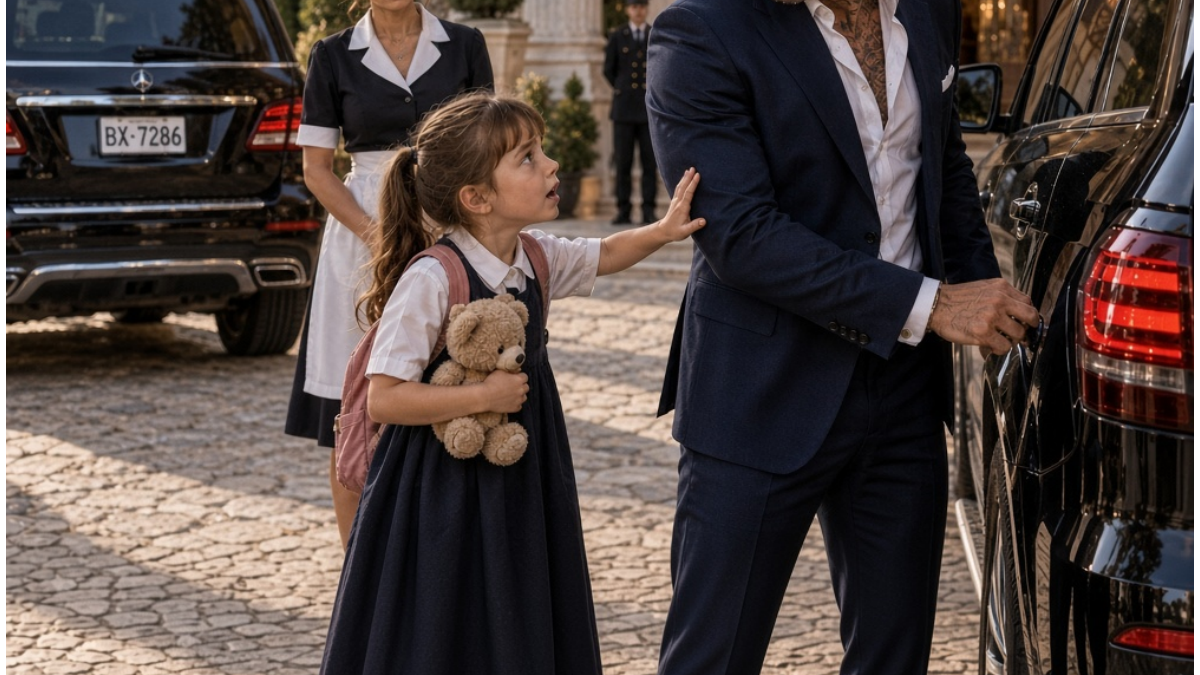
Don’t get in, Mr. Melli. That isn’t your plate. Dante ML’s hand stopped on the open door of the black SUV.
For a few seconds, the entire motor court seemed to hold still around him. The engine idled with the smooth, expensive hum of a vehicle, maintained by men whose job was to make sure Dante never had to think about engines.
Two guards stood beneath the limestone archway leading toward the east gate. A third waited beside the fountain with an earpiece tucked behind one ear.
Gabriel Knox, Dante’s security chief, held the rear door open with one gloved hand and looked toward the source of the voice.
10-year-old Lily Torres stood halfway between the service entrance and the edge of the circular drive.
One sneaker untied, a purple backpack hanging from a single shoulder. Her mother, Elena, had been carrying folded linens through the side corridor when Lily apparently slipped away from her.
Dante looked down at the girl, then at the hand she had wrapped around the cuff of his dark overcoat.
Lily realized what she had done and released him immediately. Fear flashed across her face, but she did not step back.
“What did you say?” Dante asked. Lily pointed at the rear of the SUV. “Your plate ends in two.
That one ends in seven.” Gabriel glanced at Dante rather than at the vehicle. “Sir, the primary car was pulled during the morning inspection.
Electrical warning. This is the reserve.” His tone was calm, almost bored. The tone of a man who had spent nearly a decade turning potential disasters into inconveniences before Dante ever had to hear about them.
Dante checked his watch. He was already late for a meeting that six people believed was about restructuring, and only two knew was about ending something much larger.
Gabriel knew only that the meeting mattered. That was enough to explain the slight edge beneath his composure.
“We need to move,” Gabriel said. “Route is clean.” Elena hurried out from the service passage, her face losing color the instant she saw her daughter standing beside Dante Morelli.
Lily. The girl looked at her mother but did not retract the warning. Elena reached her, placed both hands on her shoulders, and gently pulled her toward the edge of the drive.
Mr. Morelli, I am so sorry. She knows better than to come into the motorc court when vehicles are moving.
Mom, that’s not his car. Lily, it isn’t. Elena lowered her voice. Enough. Dante had seen men twice Lily’s size.
Forget their own names when he looked at them for too long. Lily looked nervous, but not confused.
There was a difference. He turned toward the SUV at last. Black armored body, tinted rear glass, dark wheels.
Same model he had used for years. From where he stood, there was nothing obviously wrong with it.
Gabriel lifted the tablet tucked under his arm and tapped the screen. Reserve vehicle was cleared at the gate and assigned to principal movement at 7:43.
Driver credentials confirmed. Vehicle credentials confirmed. I checked it myself. Dante took the tablet. A green bar stretched across the top of the screen.
Authorized principal vehicle. Beneath it, the plate ended in seven. The system agreed with Gabriel.
Lily did not. Dante handed the tablet back. She says, “Mine ends in two.” Gabriel’s eyes finally moved toward the rear bumper.
Your regular vehicle does. So, she’s right about your regular plate. Yes. Not about this car being unauthorized.
It was the kind of distinction Gabriel was good at making. Precise, clean, difficult to argue with because it was technically correct.
Dante looked toward Lily. How do you know the plate? Elena answered for her. She waits near the service entrance sometimes when my shift starts early.
She watches the cars. I’ve told her not to bother anyone. Lily frowned. I don’t bother them.
Sweetheart, I just look. Gabriel closed the rear door halfway, leaving enough space for Dante to enter.
Sir, the electrical fault was discovered before dawn. Operation substituted the reserve. There is nothing unusual here.
Dante put one hand on the top of the door, but did not get inside.
In his world, hesitation could kill you. So could unnecessary suspicion. Men who saw treachery in every delayed call eventually created the betrayal they feared.
Gabriel had protected him through raids, funerals, family weddings, federal subpoenas, labor disputes, and one winter night when a gunman waited outside a restaurant in New York with a pistol taped beneath a newspaper.
Dante trusted him because Gabriel had earned it over years, not because a green word appeared on a screen.
Still, the little girl kept staring at the SUV as if the machine itself had made a spelling mistake.
Dante asked, “Anything besides the plate?” Elena’s grip tightened on Lily’s shoulders. Mister Mrl. She doesn’t need to.
I’m asking her. Lily swallowed. Your other car has a white scratch by the back wheel.
Gabriel’s expression did not change. Dante’s did, though only slightly. What scratch? Lily pointed toward the passenger side rear quarter panel down low near the tire.
It looks like chalk. Dante remembered it. Two winters earlier, leaving a private dinner during heavy snow.
The SUV had scraped a stone pillar beside an underground garage ramp. The damage had been repaired, but a narrow white mark remained along the lower trim where the paint never matched perfectly.
Dante had stopped seeing it months ago. Lily had not. She walked two steps toward the vehicle before Elena caught her arm.
Don’t. Lily stopped and pointed from where she stood. This one doesn’t have it. Gabriel exhaled softly through his nose.
Because this is the reserve vehicle. He was right again. The missing scratch did not contradict his story.
It supported it. Dante looked at Gabriel, then at the SUV. Where is mine? Garage, bay 3.
Take me there. Gabriel hesitated for barely a heartbeat. Sir, we are approaching the point where the delay becomes a security concern.
Then we’ll walk quickly. They cross the property without ceremony. Dante led. Gabriel stayed half a step behind and to his right.
Elena remained near the service entrance with Lily, but Dante could feel the girl watching them until the hedge blocked the view.
The estate garage sat behind the west wing, a low stone structure designed to disappear into the landscaping.
It held six vehicles, a maintenance bay, a wash station, and a small operations office with more cameras than windows.
The garage supervisor. Frank Santo looked startled when Dante entered unannounced. Mr. Morelli, Bay 3.
Frank’s eyes flicked toward Gabriel. Sir, open it. Frank pressed a wall switch. The steel divider rolled upward with a mechanical rattle.
Dante’s regular SUV sat beneath the overhead lights, plate ending in two. A small white scar marked the lower panel beside the rear passenger wheel, exactly where Lily said it would be.
For a moment, the scene seemed to settle the question completely. Gabriel had been telling the truth.
The real SUV was in the garage. The replacement outside was different because it was supposed to be different.
Dante walked closer but did not touch the vehicle. What failed? Frank moved toward the front workstation.
Electrical alert. According to the ticket. According to the ticket. I haven’t personally inspected it yet.
Gabriel folded his arMs. The morning diagnostic triggered the hold. Frank’s team would handle the physical inspection after principal departure.
Dante looked at the windshield. A blue residential access permit with a silver emblem sat in the lower corner.
Something else Lily had probably seen every morning without knowing what it meant. When was it brought in?
Before the departure window, Gabriel said. Dante looked at Frank. I asked him. Frank’s face tightened.
A little while ago. How long is a little while? I’d have to check the bail log.
Gabriel said, “Dante, if you want the entire maintenance chronology, we can have it sent while you’re on the road.”
Dante turned his head. Gabriel almost never used his first name in front of staff.
In private, yes. In the motor court or operation spaces, almost never. It was not evidence of anything.
It was simply unusual enough for Dante to notice because Lily had already put him in the uncomfortable position of noticing ordinary things.
“Open the log,” he said. Frank entered a code on the terminal. A service record appeared.
“Vehicle hold electrical system warning. Bay 3.” The timestamp showed the issue had been opened more than 50 minutes earlier.
Dante read it twice. “Who opened the ticket?” Frank leaned toward the screen. Maintenance credential.
Luis Mercer. Where’s Mercer? Frank looked puzzled. Not here, Gabriel answered without needing to check.
He requested personal leave yesterday. Dante kept looking at the screen. Then why is his credential on a ticket from this morning?
Gabriel stepped beside him. Could be shared. Workstation access. Someone may have entered the inspection under the last active profile.
It happens. Frank started to speak then thought better of it. Dante noticed. What? Frank shook his head.
Nothing, sir. You were about to say something only that maintenance is supposed to sign out between shifts now.
New rule after the insurance audit. Gabriel said to doesn’t mean they always do. Again, reasonable again possible.
Dante was beginning to dislike how many reasonable things were accumulating around a problem that should have required only one.
Show me the diagnostic. Frank clicked through the ticket. It isn’t attached yet. Who physically moved the SUV into this bay?
Frank opened another window. No name appeared. The bay entry should have logged the driver badge.
He refreshed the screen. Still blank, Gabriel’s jaw shifted slightly. System synchronization could be delayed.
Dante gave him a flat look. That makes two systems slow this morning. Gabriel did not answer.
Dante walked around the SUV. No obvious damage, no open hood, no equipment connected. Nothing about the vehicle looked like a machine that had been hurriedly pulled out of service because of an electrical failure.
When he reached the front, he stopped. The hood radiated faint warmth into the cool garage air.
He lowered his hand until his palm hovered above the metal without touching it. Warm, not sunwarm.
The garage had been closed since before dawn. He looked beneath the vehicle. A faint bead of condensation clung near the exhaust.
Dante straightened. Frank. Sir, how long has it been sitting here? Frank swallowed. I don’t know.
Guess not 50 minutes. Gabriel stepped forward. Engine heat can linger. Dante looked at him.
Not that long in this weather. Gabriel’s face remained controlled. Then perhaps one of the mechanics moved it after the ticket opened.
Which mechanic? Well find out. You told me it was pulled before dawn. I told you the fault was discovered before dawn.
Dante let the distinction hang there. Gabriel’s gaze held his. Neither man raised his voice.
They did not need to. Frank quietly moved away from the terminal as if physical distance might keep him outside whatever was forming between them.
Dante returned to the screen. Camera footage. Frank looked toward Gabriel again. Dante noticed that too.
Why do you keep looking at him when I ask you a question? Frank froze.
Habit, sir. Security controls the garage cameras. Gabriel said, “I can pull them. Do it.”
Gabriel went to the adjacent security console and entered his credentials. Four camera feeds appeared.
Garage entrance, interior aisle, maintenance floor, and west service lane. He opened the archive and scrolled backward.
The feed jumped through the early morning. At one point, the screen turned black. Gabriel stopped.
There. There. What? Scheduled reboot. Dante looked at the timestamp. The cameras had gone offline for 11 minutes.
Scheduled by who? Operations maintenance. Your department. Security operations. Yes. Today. The reboot schedule was probably created days ago.
Probably. Gabriel glanced at him. I don’t personally schedule server maintenance. Dante nodded slowly. That was true.
A man who ran protection for an organization spanning several states should not personally schedule camera restarts in a garage.
Yet the outage fell across exactly the period in which Dante’s SUV appeared to have been moved.
He looked through the glass wall toward bay 3. The plate ending in two sat beneath fluorescent light.
Outside, beyond two buildings and a row of cypress trees, another black SUV waited with a plate ending in seven.
Somewhere between them was an explanation. It might still be boring. Dante hoped it was boring.
Bring up the reserve registry, he said. Gabriel opened another database. Five vehicles appeared under Morelli residential security.
Three sedans, one armored SUV, and one utility van. Dante scanned the plates. None ended in seven.
Gabriel typed the full number from the vehicle outside. No result. Frank shifted uneasily. Could be an outside vendor.
Gabriel said it before Dante could ask. If the primary vehicle went down unexpectedly and the residential reserve was committed elsewhere, dispatch could have sourced one.
Dante turned toward him. Was the residential reserve committed elsewhere? Gabriel’s mouth opened, then closed.
He checked the screen. It appears the armored reserve was sent for brake service. So, two vehicles had maintenance problems on the same morning.
That happens. And the replacement came from a vendor not listed here. Emergency procurement may not populate this registry immediately.
That happens, too. Gabriel’s stare hardened, not with panic, but irritation. Yes. Dante looked at him for several seconds.
Gabriel had stood beside him at graves. He had slept outside hospital rooMs. He had taken a bullet fragment through the shoulder during a warehouse shooting that never made the papers.
Dante knew what suspicion could do to men who had earned trust. He also knew what unquestioned trust had done to men who were now dead.
“Keep the outside vehicle where it is,” he said. “Nobody drives it. Nobody touches it.
Nobody deletes a log. Mirror every record from this morning to an independent system.” Gabriel’s expression changed for the first time.
Not fear. Something closer to offense. You think I need to be told not to delete logs?
I think everybody needs to be told the same thing, including me, especially people with access.
Gabriel stared at him, then gave a single restrained nod. Understood. When Dante stepped out of the garage, Elena was waiting near the service corridor.
Lily stood behind her with both backpack straps on now, hands gripping them as though someone had instructed her not to touch anything.
Elena looked as if she had been preparing an apology the entire time. Mr. Mr. I want you to know she won’t interfere again.
Dante stopped. Interfere? Elena hesitated. Security sent a notice. Principal movement interference. They said it has to be documented.
Lily looked down at her shoes. I’m sorry, Mom. Elena immediately touched her shoulder. No, baby.
I’m not angry. But Dante heard the fear beneath the reassurance. The car had been wrong for perhaps 15 minutes, and already somebody had begun creating paperwork about the child who noticed it.
He looked toward Gabriel, who had just stepped from the garage behind him. “Who ordered the notice?”
Gabriel answered evenly. “Standard procedure.” A dependent entered an active movement area. “We document it so it doesn’t happen again.”
Dante looked at Lily. She had not accused anyone. She had not screamed. She had not claimed there was a bomb or a gunman or some impossible conspiracy.
She had said one number was wrong. “Suspend the notice,” Dante said. Gabriels eyes narrowed slightly.
Until the vehicle review is complete? Until I say otherwise. Elena exhaled without meaning to.
Dante heard it. So did Lily. He turned back toward the girl. You did the right thing by telling me what you noticed.
Lily glanced at her mother before answering. Okay. And now you’re done. She blinked. Done.
You don’t look for anything else. You don’t watch the guards. You don’t try to remember more.
You don’t prove anybody wrong. You go with your mother. Lily considered this with the seriousness children sometimes gave instructions adults expected them to misunderstand.
Then she nodded. Okay. Dante started toward the main house, but Gabriel called after him.
The meeting? Dante stopped without turning around. Move it. They’ll ask why. Tell them I had a transportation problem.
For the first time all morning, Gabriel had no immediate reply. 10 minutes later, an independent technician arrived from a forensic firm Dante’s attorney had used during a federal investigation years earlier.
He was instructed to examine the unfamiliar SUV without starting it, resetting it or connecting it to any Melli controlled network.
Dante watched through the garage office glass while the technician attached a reader beneath the dashboard.
Gabriel stood across the room with his arms folded. Nobody spoke until the technician carried a sealed device inside and connected it to an isolated laptop.
Navigation data first, Dante said. The technician opened the most recent route file. A destination appeared on the screen.
Dante read it once, then again, Gabriel stepped closer. What is that? Dante knew exactly what it was.
An abandoned freight depot on the river, shuddered for nearly a decade, surrounded by warehouses controlled through businesses tied to the Bolasco crew.
Morelli men did not go there by accident. Morelli cars certainly did not preloaded as a destination, Gabriel said.
Could be an old route left in the system. The technician shook his head. Route was created this morning.
Dante looked at the time stamp. It had been entered before the SUV reached his gate.
He felt something inside him become very still. The wrong plate no longer mattered by itself.
The false service ticket no longer mattered by itself. Even the warm engine in Bay 3 could still have an explanation.
But someone had arranged a car that did not exist in Dante’s registry, brought it onto his property during a camera outage, created paperwork suggesting his real vehicle was already disabled, and programmed the replacement to drive toward territory where one wrong turn could start a war.
Dante looked through the window toward the distant motor court, though the SUV was hidden from view behind the West Wing.
“Gabriel,” he said quietly. Whoever sent that car here knew where I was supposed to be before I did.
Gabriel said nothing. Dante turned back to the screen and they knew my real car had to disappear first.
The destination sat on the isolated laptop like an accusation no one in the room was ready to make a loud.
Bolasco territory was not a place a driver reached because he missed a turn. The freight property was buried behind a corridor of dead warehouses, chainlink lots, and trucking yards along the river several miles away from the route Dante should have taken that morning.
Years earlier, two Morelli soldiers had been found in a burned sedan less than half a mile from the same district.
No formal truce had ever been signed between the families. Only an understanding built from exhaustion and money.
Bolasco people stayed out of Morelli businesses. Melli people stayed away from the river. Gabriel stared at the address and finally unfolded his arMs. If somebody wanted to make this look like Bolasco, this would be the obvious place.
Dante turned toward him. You got there quickly. Gabriel’s expression hardened. Because I’ve spent 10 years thinking about how someone might come after you.
Then think about this one. Dante pointed at the screen. The car arrives under an authorization that doesn’t belong to our fleet.
My real vehicle gets pulled under a service ticket nobody here admits creating. The cameras go dark at the right time.
The replacement already has a destination loaded in enemy territory. That still doesn’t tell us what was supposed to happen there.
No. Dante looked through the glass toward bay 3. So, we find out everything that happened before the car reached my gate.
He instructed the technician to preserve the navigation image and extract no more data until council arrived.
He ordered Frank to lock the garage records and make copies of every morning maintenance ticket before anyone could amend them.
Gabriel started issuing directions to his own people, but Dante stopped him. Your team keeps operating normally.
Nothing gets erased. Nothing gets corrected. Nothing gets cleaned up. If a time stamp is wrong, it stays wrong.
Gabriel’s eyes stayed on him. You’re treating my department as compromised. I’m treating every department as capable of being compromised.
There’s a difference. Not today. The driver of the false SUV was still being held in a small interview room beside the gate office.
His name, according to the license he had presented, was Aaron Pike. He was 43, broad through the shoulders, dressed in a dark suit tailored just poorly enough to look like a uniform rather than his own clothing.
He had entered the estate without resistance, surrendered his phone when asked, and spent the delay complaining only once, quietly that his dispatcher would charge him for lost time.
Nothing about him resembled the kind of man Dante expected to volunteer for an assassination.
That did not mean much. Men rarely looked like the thing they were being paid to do.
Dante watched the interview through one-way glass while an attorney asked Pike where he had collected the SUV.
Pike named a private vehicle staging lot near the airport. Who hired him? A transportation company called Northstar Executive Transit who gave him the Melia State address.
Dispatch, who loaded the river destination? Pike shook his head. It was already in the navigation when he took possession.
Had he been instructed to drive there? His route message said he would receive final confirmation after the passenger entered.
“So, you didn’t know where you were taking me?” Dante asked after stepping into the room.
Pike looked at him for the first time and seemed to recognize that the question carried more weight than the lawyers.
I knew the screen had an address, sir. I didn’t know if that was the actual stop, and you didn’t think it was strange that you were picking me up.
I didn’t know I was picking you up until I got here. That answer drew a glance from Gabriel, who had entered behind Dante, Pike continued.
The job listed a private principal, highsecurity residential transfer. We do those, or I thought Northstar did.
Dante sat across from him. How long have you worked for them? Pike hesitated. This was my first job.
The room went quiet. You were hired for one morning, Dante asked. Contract shift. They contacted me yesterday through a driver placement board.
Who interviewed you? Nobody. Background form, license upload, video verification. Then a dispatcher called. Male or female?
Male. Name? He said Martin. Dante looked at Gabriel. Gabriel’s face remained unreadable. “Did Martin tell you anything about the passenger?”
Dante asked. Pike thought for a moment. Only that I shouldn’t initiate conversation. “Shouldn’t deviate from the navigation unless security told me.
And if anybody at the residence questioned the vehicle, I was supposed to stay in the car and let the estate team handle it.”
Gabriel shifted slightly. Dante heard the sentence differently. Whoever arranged the vehicle had expected there might be questions.
More importantly, they had expected Mr. Security to answer them. Northstar Executive Transit existed. That was the first problem.
It had a registered office, tax identification, commercial insurance, and a website filled with photographs of black luxury vehicles photographed in front of hotels, airports, and glass office towers.
The second problem was that almost none of it survived scrutiny. The registered office was a mailbox suite.
The phone number routed through an internet service. The photographs on the website came from manufacturers and stock libraries.
State records showed the company had been formed 7 months earlier, yet bank activity remained almost non-existent until the previous 6 weeks.
Dante’s outside council joined by encrypted call, while a financial investigator began tracing the payment for the SUV.
The vehicle itself belonged to a legitimate armored transportation firm that rented to corporate security providers.
Northstar had leased it under a short-term commercial agreement. The plate ending in seven was genuine.
The vehicle identification number was genuine. Nothing about the SUV had been stolen or altered.
Someone had used legitimate pieces to construct an illegitimate story. That matters, the investigator said over speaker phone.
If the car had false plates or a stolen identity, any traffic stop could expose it.
Whoever arranged this wanted it to survive routine verification. Dante looked at Gabriel like the verification at my gate.
Gabriel did not flinch. My system showed an approved movement. A movement somebody put into your system, which is what we’re trying to identify.”
Dante nodded. He had no interest in turning suspicion into theater. “If Gabriel was innocent, the truth would have to protect him from Dante’s anger just as much as it protected Dante from whoever had arranged the vehicle.
The authorization trail was cleaner than Dante expected, which made it worse. At 7:38 that morning, an outside vehicle request had been entered through a security administration account.
5 minutes later, the plate ending in seven was assigned to Dante’s departure. The account belonged to a junior coordinator named Russell Dayne.
Russell was standing in the control room when they called him. He looked sick before anyone asked the first question.
I didn’t enter that vehicle. Gabriel stared at him. Your credentials did. I know what it says.
Russell swallowed. I wasn’t logged in at 7:38. I was doing perimeter checks. The gate tracking system confirmed his badge was used near the south fence at 7:36 and again at 7:41.
Walking from there to the control room, entering the authorization and returning within 5 minutes was possible only if Russell had sprinted across the property and somehow passed three cameras without appearing on any of them.
Who has administrative override on his account? Dante asked. Gabriel answered my deputy me and central security administration.
Can an override make an action appear under Russell’s name? Gabriel took a moment before answering.
Under certain legacy functions, yes. Would whoever used it know that? Anyone familiar with the system architecture.
Dante looked around the room. Half the men there had spent years becoming familiar with exactly that.
He ordered Russell’s account frozen, but told council to document that the action was protective, not disciplinary.
The distinction mattered. Someone had already tried to build a story around Lily being the problem.
Dante was not going to repeat the same mistake with the first employee whose name appeared on a screen.
By early afternoon, the service ticket on Dante’s real SUV had become harder to explain.
The supposed electrical warning had no supporting diagnostic code. Modern vehicle systems recorded faults automatically.
There should have been a time, module, and error history attached to the hold. There was nothing.
The ticket existed before the evidence that should have created it. Frank’s mechanics inspected the SUV under observation and found no electrical malfunction.
Battery output was normal, charging system normal, control modules normal. Nothing justified removing it from service.
More troubling was a small detail from the garage access log. Dante’s SUV had left its usual overnight position shortly after 7:20 and entered bay 3 at 7:52.
The false SUV had arrived at the estate at 7:46. For six minutes, both vehicles had been present and operational.
The replacement had not been summoned because the original broke down. The original had been moved only after the replacement was already inside the property.
Dante stood over the timeline while Gabriel read it beside him. That’s backwards, Dante said.
Gabriel’s voice was lower now. Yes, the substitute existed before the problem. It appears that way.
No, it is that way. Dante tapped the timestamps. Someone did not react to my car failing.
Someone made my car fail on paper because another car was already waiting. Gabriel said nothing.
The financial investigator called 20 minutes later with the first clean break in the procurement trail.
Northstar had paid for the armored SUV using funds transferred from a consulting company named Calder Strategic Services.
Calder had several legitimate clients and enough real business to avoid looking like a shell at first glance.
One of those clients had done occasional risk work for Melli owned construction companies. Dante knew the name but not the people behind it.
Council pulled the corporate filings. Calder’s ownership passed through two holding entities then disappeared behind a trust in Delaware.
Can we get through it? Dante asked. Eventually, Council said, “But there’s something easier.” The investigator shared the original rental invoice.
The lease for the SUV ending in 7 had not been created that morning. It had not been created the night before.
Northstar reserved the vehicle 3 days earlier, requesting that exact model, armored configuration, and morning delivery window.
The room fell silent. Gabriel leaned toward the screen as if proximity might change the date.
Dante thought of every explanation offered since Lily touched his sleeve. Emergency procurement, sudden electrical fault, reserve substitution, database delay.
All of them depended on the same assumption. Something unexpected had happened that morning, and security had improvised.
The invoice destroyed that assumption. 3 days before anyone claimed Dante’s SUV had an electrical problem, somebody had already paid to put its replacement at his door.
Dante looked at Gabriel, but this time he did not ask for an explanation. There was only one question worth asking now.
Who knew 3 days ago that my car was going to be unavailable this morning?
By mid-afternoon, Dante had stopped treating the problem as a bad vehicle substitution and started treating it as a question of preparation.
The difference mattered. Mistakes happened under pressure. People mistyped plate numbers, forgot to sign out of terminals, missed maintenance steps, trusted the wrong screen.
But a vehicle reserved 3 days in advance did not belong to the same category as a morning error.
Someone had expected Dante’s regular SUV to become unavailable before the ticket that removed it from service even existed.
Council wanted to keep pulling corporate records. The financial investigator wanted another hour with Calder Strategic Services.
Gabriel wanted every security employee with access to the movement system interviewed before sunset. Dante agreed to none of it immediately.
Instead, he asked where Elena and Lily were. Gabriel’s expression changed by a fraction. Guest sitting room near the west service hall.
Why are they still here? You told me to suspend the incident notice, not release staff.
I’m releasing them now. Gabriel shifted his weight. If the girl saw something relevant, we should get a formal statement before memories start changing.
Dante turned toward him. She already gave one, not a documented one. She told me the plate was wrong.
She described the scratch. Both were true. That doesn’t mean she didn’t notice something else.
And it doesn’t mean I’m turning a 10-year-old into an investigative asset. Gabriel held his stare.
I’m talking about preserving information. So am I. Dante lowered his voice. If there is somebody inside this property who planned 3 days ahead, then the safest thing for that child is to stop being useful to us.
Gabriel said nothing. Dante walked away before the conversation could become an argument. The sitting room was small, warm, and deliberately ordinary, furnished for staff families who sometimes had to wait through long shifts.
Lily sat on the edge of a blue sofa with her purple backpack beside her.
Elena stood when Dante entered, her hands immediately folded at her waist. That gesture bothered him now because he had seen it too many times since morning.
It was not politeness alone. It was preparation. Mr. Morelli, if this is about what happened outside, I want to say again that Lily understands she should never have stepped into the drive.
That’s not why I’m here. Elena glanced at Lily. Then is something wrong with the car?
Dante considered how much to say. Too little and Elena might think he was punishing them for nothing.
Too much and he would be handing a frightened woman information that could place her in danger.
The car wasn’t supposed to be there, he said. Elena’s face changed. Lily’s did not.
She looked more relieved than surprised. I knew it. Her mother touched her arm. Lily, she did know it, Dante said.
Elena looked at him, he continued. That does not mean I want her helping with anything else.
I need that understood. Lily frowned. I’m not helping. Good. I just saw it. Even better.
He pulled a chair several feet away and sat instead of standing over her. Tell me why you remembered the car.
Lily looked at her mother first. Elena gave the smallest nod. Because it comes by the kitchen every morning.
My car usually sometimes another one, but yours most days. And you watch it? Not on purpose.
She thought about that. I mean, kind of on purpose. There’s not much else happening when mom starts early.
Elena almost apologized again but stopped herself. Dante asked, “What do you notice?” Lily shrugged.
“The plate, the scratch, Mr. Bell, my driver.” He always parks crooked. Dante raised an eyebrow.
“Crooked?” Lily nodded with complete seriousness. “Not bad crooked, just a little.” She pointed toward an imaginary line on the carpet.
“There’s a cracked square in the driveway by the service turn. He goes around it, so the back of the car always points a little toward the kitchen.
The other car was straight. Dante pictured the approach. He had passed that section of drive thousands of times and could not remember a cracked square of stone.
Why does he avoid it? Maybe because it bumps. Did he tell you that? No, he doesn’t really talk to me.
He waves. She lifted one hand and moved it twice from side to side. Like that, Elena said.
She waves at every driver who comes past. Lily looked offended. Not every driver. Most of them.
The delivery man with the bread never waves. Maybe because he’s carrying bread. Lily considered this, then looked at Dante.
Rich people are weird about cars. Dante almost smiled. How so? You have enough money to buy any color, and everybody here keeps buying black.
Elena closed her eyes for a second. Dante let out a quiet breath that was closer to a laugh than anything he had done all day.
Lily seemed encouraged. It’s like somebody told all the cars they’re going to a funeral.
That’s enough, Elena said, though the tension in her voice had eased. Dante nodded. She has a point.
Then his expression became serious again. Did you see the other SUV arrive this morning?
Lily nodded. Before yours usually comes out. Dante leaned forward slightly. How much before? I don’t know.
Were you eating? Waiting for your mother? Watching something? I was doing math, Elena said.
She finishes homework here sometimes before school. Lily pointed toward the service corridor. I was at the table by the vending machines.
The black car came through and I thought it was yours until I saw the number.
Did anybody meet it? Lily’s eyes shifted upward as she tried to remember. Dante stopped her before she could force it.
If you don’t know, say you don’t know. I don’t know. Good. I think someone was by the gate, but I don’t know who.
Then we leave it there. Lily nodded. Okay. Dante stood. That’s all I’m asking you.
Nothing else. No watching people. No trying to remember faces. No checking vehicles for me.
You saw something once. You spoke once. And now the adults do the rest. Lily looked genuinely puzzled.
But what if I see something else? You tell your mother. Your mother tells the lawyer I’m assigning to you.
You do not go looking for it. Elena stared at him. Lawyer for both of you.
Until this is finished. Her anxiety returned immediately. We haven’t done anything. That’s why you get one.
He let that settle before continuing. You’re both leaving the estate for a few days.
Paid. A place will be arranged that is not managed by my security department. Elena glanced toward the closed door, understanding the implication before Lily did.
You think someone here could come after her? I think someone here may have planned a great deal before this morning.
I’m not guessing beyond that. Elena sat slowly. Lily looked from her mother to Dante.
“Because I said the number.” Dante answered carefully. “Because somebody may not like being noticed.”
Lily touched the zipper on her backpack. “Did I make things worse?” “No, you made them visible.”
Dante left them with outside counsel rather than a Morelli guard and returned to the library where the investigation had shifted from vehicles to ownership.
Calder Strategic Services had been operating for nearly four years, long enough to survive a casual background check and legitimate enough to issue real invoices.
Its records showed consulting fees from construction companies, waste management firms, and transportation businesses. Most of those clients appeared unconnected to Dante.
A few were not. The financial investigator displayed a network of entities across the library screen, lines connecting corporations, trusts, service contracts, and old payments.
Dante disliked diagrams like that. They made human decisions look cleaner than they were. Here, the investigator said, highlighting one branch.
Calder received recurring payments from Armmitage Development for Risk Consulting. Armmitage has worked on Melli backed real estate projects.
Dante looked at the name. Who hired Calder? Not you directly. Procurement records show the relationship came through an outside operations recommendation.
Whose? The investigator opened an archived approval chain. The recommendation had been forwarded by an executive assistant working for Julian Morelli.
Dante did not react. Gabriel did. That means nothing by itself. Agreed. The investigator said Calder was a legitimate vendor.
Julian’s office could have referred them for ordinary work. Dante appreciated the answer. He wanted facts that survived resistance, not facts that pleased him.
Keep going. The ownership trail behind Calder passed through two holding companies and a trust administered by a law office that had represented dozens of unrelated clients.
The investigator could not yet prove who ultimately controlled it. What he could prove was that Calder funded Northstar’s account 2 days before Northstar paid the Armored Transportation Company.
Dante looked at the date. So money moved first. Yes. Then the car was reserved.
Yes. Then 3 days later, my vehicle developed a problem on paper. Correct. Gabriel paced once toward the window and back.
If someone wanted to frame Julian using a vendor his office had touched would be an easy start.
Dante looked at him. You think he’s being framed? I think you told me not to accuse people without proof.
Dante held his gaze for a moment, then nodded. Fair. Gabriel stopped pacing. Calder could connect to half the city if it’s been around long enough.
We need to know who ordered the actual vehicle, not who once recommended a company that paid another company.
Then find that person. Gabriel started toward the door. Dante stopped him. Not through your internal team.
Gabriel turned slowly. You don’t want my people working it. I don’t want the person who arranged this learning what we know.
You’re assuming the leak is in security. The fake car entered through security. So did every legitimate car on the property.
And the fake maintenance ticket appeared inside systems your department can reach. Gabriel’s voice cooled.
So can maintenance. Then we treat both as compromised until we know better. Gabriel stared at him and for the first time Dante saw something beneath the professional calm that might have been anger.
It might also have been insult. After 10 years, the two could look almost identical.
You know what happens when you stop trusting everybody at once, Gabriel said. Yes, you start making decisions alone.
I’ve made worse ones. Gabriel gave a humorless half smile. That’s what worries me. Then he left.
The investigator spent the next several hours tracing the reservation without alerting Northstar. The armored transportation company had preserved the original booking request, payment receipt, and configuration details.
Whoever placed the order had specified an SUV visually compatible with Dante’s regular vehicle. Dark exterior, rear privacy glass, armored cabin, no external company branding.
The request also required a driver who would follow preloaded routing and accept on-site direction from the client security personnel.
None of that was illegal. Executive transport firms processed similar requests every day. The timing made it poisonous.
At 6:00 in the evening, the investigator found the detail that changed the question again.
The booking was created 3 days before the scheduled trip, but the initial inquiry had been opened almost a week earlier.
Someone had been planning the replacement even longer than they thought. Dante stared at the record, then asked for the morning entry logs from the service wing.
While the investigator worked, council returned from arranging Elena and Lily’s temporary relocation. They’re gone, she said.
Elena asked whether she should resign. Dante looked up. Why? She thinks this will follow her.
Tell her it won’t. That may take more than telling. Dante understood. Systems remembered accusations more efficiently than apologies.
He told council to preserve the suspended incident notice, lock it from modification, and attach written non-retaliation instructions to Elena’s personnel file.
Then the investigator cleared his throat. There’s another piece on the screen was the original Northstar reservation form.
Most fields were generic. Pickup type, vehicle specification, security classification, billing code. One field near the bottom listed requested arrival time.
Another listed a delivery note entered when the booking was created. Hold outside east service excess until principal vehicle is moved to bay 3.
Dante read it once and felt the room become smaller. Three days earlier, whoever placed that order did not merely know his SUV would be unavailable.
They knew where it would be placed. Bay 3, the exact bay it occupied that morning.
That knowledge did not belong to Northstar. It did not belong to a random driver.
It belonged to someone who knew the estate’s internal procedures before those procedures had supposedly become necessary.
The investigator opened the metadata attached to the booking. There’s more. The reservation wasn’t anonymous.
Dante looked at him. Name? Not yet. The customer field is a corporate alias, but the contact number used when the inquiry was opened has appeared before.
Where the investigator rotated the screen, the number had been listed on several older invoices involving Morelli companies, always as an operational contact rather than an executive.
Dante recognized the office prefix, Julian’s floor. The investigator raised a hand before Dante could speak.
That does not prove Julian personally made the call. Assistants, consultants, vendors, anyone with access to that office could have used it.
Dante kept his eyes on the number. I know. For the first time all day, knowing less than he wanted was useful.
Suspicion tempted men to confront. Uncertainty forced them to think. Dante leaned back and looked again at the reservation date.
The bay instruction and the operational contact tied to his cousin’s office. The false SUV had not appeared because his real one failed.
His real one had been made to fail because the false SUV was already part of a plan.
Somewhere inside that plan was a person who knew his property, his procedures, and his morning schedule well enough to predict where a vehicle would be parked days before anyone officially decided to move it.
And now, for the first time, the trail was pointing towards someone who did not merely work for Dante Morelli.
It was pointing toward his family. Dante did not call Julian that evening. That was the first decision he made after the Northstar reservation pointed toward his cousin’s office, and it was harder than it should have been.
For more than 30 years, Julian Morelli had been the person Dante called when something inside the family stopped making sense.
When a captain lied about missing money, Julian found the lie beneath the lie. When a union dispute threatened one of their construction companies, Julian knew which grievance was real and which had been manufactured for leverage.
When Dante’s first marriage collapsed, Julian was the only man in the organization who knew before the lawyers did.
Their relationship had survived violence, prison sentences, funerals, marriages, children, federal investigations, and enough money to ruin friendships that had begun with far less.
That history was precisely why Dante refused to confront him on a phone call triggered by a contact number and a vendor trail.
He needed to understand what this morning had actually been designed to interrupt. The meeting he had missed was not another argument over territory or revenue.
It was supposed to be the beginning of an ending. For 6 months, Dante had been quietly separating the legitimate Morelli businesses from the operations that had built the family’s real power.
Waste contracts, construction firms, trucking companies, and commercial properties could survive scrutiny if they were cleaned correctly.
Bookmaking, protection schemes, stolen freight, coercive lending, and the crews that enforced them could not.
Dante had spent half his adult life believing that leaving was something only weak men talked about before stronger men buried them.
Age had changed the mathematics. So had his daughter, Sophia, who now ran the legal real estate division and wanted nothing to do with the machinery beneath it.
Dante had begun to understand that there was no meaningful inheritance in handing a child an empire she would have to spend the rest of her life defending from the government, competitors, and the men inside it.
The meeting that morning had been scheduled with six senior captains, two attorneys, and Julian.
Dante intended to announce that three of the family’s most profitable criminal operations would close within 90 days.
Debts would be settled. Certain partnerships would be bought out. Men who wanted to leave would be given a path out.
Men who refused would discover that the old protections attached to Dante’s name were ending with him.
The legitimate companies would be reorganized under structures Julian could advise but not control alone.
Dante had expected fury. He had expected accusations that he had become soft, old, or frightened.
What he had not expected was an SUV waiting to take him toward a place where his absence could be interpreted before anyone discovered his body.
His attorney, Maraos, laid the internal governance papers across the library table. There is one part we need to revisit, she said.
Dante already knew which one. Years earlier, after a stroke temporarily incapacitated a senior member of another family, and left his organization paralyzed for days, Julian had pushed Dante to formalize emergency authority.
If Dante was confirmed dead, missing under circumstances suggesting incapacity, or unable to communicate during an immediate threat, Julian would become acting head until the senior council could assemble.
The arrangement had seemed sensible because someone needed authority to prevent panic. Dante had approved it precisely because Julian was the one person everyone would follow without fighting over succession.
Mara tapped the relevant clause. If something happened to you today and credible evidence pointed toward Bolasco involvement.
Julian could invoke emergency control before the council met. Dante looked at her. How fast?
Immediately in practical terms, the written confirmation could follow. And the captains. Most would accept it, especially if they believed a rival crew had attacked you.”
Gabriel stood near the fireplace, silent for several seconds. “That doesn’t make Julian responsible for the vehicle.”
Dante turned toward him. “No, it tells us why the vehicle’s destination matters.” Gabriel nodded reluctantly.
Dante looked down at the document again. Whoever designed the plan had not chosen an abandoned freight property at random.
Basco territory supplied a ready-made explanation. If Dante vanished on the way to a private meeting, there would be questions.
If his vehicle, phone, or body later surfaced in territory associated with a rival family, those questions would already have answers waiting for them.
The Melli captains would not begin with an internal investigation. They would begin with retaliation.
Julian would inherit command during a crisis, and crisis had always been the easiest environment in which to make temporary power permanent.
Mara opened another file. There’s something else you need to see. It was a draft agenda Dante had approved two nights earlier for the meeting he never reached.
The first items were deliberately ordinary legal restructuring, transportation contracts, cash exposure, property transfers. The final item was marked only as leadership continuity.
Dante had intended to tell the captains that Julian’s emergency authority would be narrowed as part of the transition.
Nobody outside Mara and Dante knew the wording of that change, but Julian knew a restructuring of authority was coming because Dante had told him enough to prepare.
If the meeting happens, Mara said, his emergency position changes. If I never reach the meeting, it doesn’t.
Correct. Gabriel looked at the agenda. That gives him a motive to delay you, not kill you.
Dante leaned back. If someone wanted only a delay, they could flatten a tire. Gabriel met his eyes.
We still don’t know what was supposed to happen at the freight property. No, but somebody picked a location where the story writes itself.
Dante rose and walked toward the window. The grounds outside were dark now. The motorc court illuminated in pale circles by security lamps.
The false SUV remained parked under observation. Its existence seemed more disturbing after nightfall because it looked so ordinary.
That was the trick of it. No stolen plate, no mask driver, no obvious weapon sitting beneath a seat.
A legitimate armored vehicle rented through legitimate businesses. Entering through a legitimate gate because legitimate software said it belonged there.
Dante had spent decades protecting himself against enemies who needed to break his defenses. Whoever arranged this had understood that breaking them was unnecessary if they could persuade the defenses to cooperate.
He turned toward Gabriel. Walk me through the Basco response if I disappear there. Gabriel frowned.
You want a hypothetical? I want what you would do. Gabriel took a moment. If your last confirmed route ended in Bolasco territory, I’d lock down the estate, restrict family movement, contact our people near the river, and verify whether Bolasco crews were active in the area.
If there was evidence of an attack, I’d prepare for retaliation, but recommend waiting until we knew who ordered it.
Would the captains wait? Gabriel’s silence answered. Dante continued, “Who would they look to?” “Julian, would you?”
Gabriel’s jaw tightened. Under the succession agreement. Yes. Dante looked at Mara. So, whoever planned this knew two things.
They knew where to send me, and they knew what everyone here would do afterward, Gabriel said.
That still leaves an outside frame. Bolasco could know the succession structure. Not the details.
They could know enough. Could they know my SUV would be moved to bay 3?
Gabriel did not answer. Dante returned to the table. This is why I don’t care yet whether the trail points to Julian.
I care how much inside knowledge the plan required. Mara began listing it without drama.
Dante’s departure window, the model and appearance of his usual SUV, the estate’s vehicle substitution procedures, garage bay assignment, security authorization architecture, the private meeting schedule, Basco territory, and the emergency succession arrangement.
Dante listened until the list became its own form of evidence. Not proof against a person, proof against coincidence.
Shortly after 9 that night, the independent technician recovered the first useful fragment from the estate’s gate system.
The audio archive had been stored separately from the video network and therefore survived the scheduled camera reboot.
Most of it was worthless. Guard acknowledgements, vehicle IDs, routine instructions, the hiss of radios and the metallic scrape of the outer gate.
At 7:45 that morning, 2 minutes before the false SUV was admitted, a guard named Peter Cole had used the intercom to contact the driver.
His voice came through first. State company and authorization. Pike answered. Northstar executive principal transfer.
Cole asked for the internal contact. There was a pause. Then Pike said, “I have Julian Mr. Nobody in the library moved.”
The technician replayed it. “I have Julian Mlli.” Gabriel immediately stepped toward the table. “That could mean the name on his dispatch sheet.”
“I know,” Dante said. Mara asked the technician whether the driver had provided anything else.
The recording continued. Cole said, “Mr. Morelli, personally, Pike replied, that’s the authorization name I was given.”
Security said you’d have it on your side. Then came several seconds of typing from the gate office, followed by Cole saying, “Hold.”
Less than a minute later, the system cleared the vehicle. Dante asked for Cole to be brought in, but not through Gabriel.
Mara called him directly and had an independent guard escort him to the library. Peter Cole arrived pale and confused, still wearing his security uniform.
Dante did not threaten him. Tell me what you remember about that car. Cole looked at Gabriel before catching himself and facing Dante again.
It came up on the list, sir. Plate matched the authorization. Before or after the driver said Julian’s name?
Cole thought carefully. I think before, but the outside vendor field wasn’t complete. That’s why I asked.
Did Julian call you? No, sir. Did anybody? After I put the driver on hold, control room radioed that the vehicle was expected and to process it.
Whose voice? Cole’s face tightened. I don’t know, Gabriel said. Our control room has four people on morning rotation.
Dante ignored him. Male or female? Male. Did you recognize it? Cole shook his head too quickly, then stopped.
Dante waited. Cole’s eyes dropped toward the carpet. It might have been Mr. Knox’s deputy.
I can’t swear to that. Gabriel did not react. Dante told Mara to preserve the statement exactly as given, including Cole’s uncertainty.
He would not manufacture certainty simply because uncertainty frustrated him. After Cole left, the technician isolated the drivers words again.
Julian Mr. Dante listened without looking at anyone. He remembered Julian at 17, skinny and furious, standing beside him outside a hospital after their uncle had been shot.
He remembered Julian at 29 pulling Dante behind a parked car as bullets broke a restaurant window.
He remembered the blood on Julian’s sleeve that night, not his own, and Julian laughing afterward because Dante had somehow kept hold of a bottle of wine through the entire shooting.
He remembered trusting him before either of them had enough money for trust to be profitable.
A name on a dispatch sheet could be planted. A phone number could be borrowed.
A vendor relationship could be manipulated. Dante knew all of that. And still hearing the name changed something because the conspiracy was no longer orbiting Julian from a distance.
Someone had wanted the driver arriving at Dante’s home to believe Julian stood behind the assignment.
Either Julian had arranged it or someone had gone to extraordinary lengths to make him look guilty.
Both possibilities were dangerous. Mara asked quietly, “Do you want me to contact him?” Dante shook his head.
“No.” Gabriel looked at him. “If he’s innocent, every hour we don’t warn him leaves him exposed.”
Dante met his gaze. And if he isn’t, Gabriel said nothing. Dante looked once more at the succession agreement.
Then every hour we don’t warn him leaves him comfortable. He closed the file. By morning, he intended to know whether Julian’s name had been placed on that vehicle as camouflage or command.
Until then, his cousin would hear nothing. Somewhere in the city, Julian Morelli still believed Dante’s meeting had been cancelled because of a transportation problem.
Dante intended to let him keep believing it. Dante slept less than 2 hours. By 6:00 the next morning, he was back in the library with coffee he never touched and a legal pad filled with names he had known for most of his adult life.
Julian sat near the center. Dante had written it once, then drawn no circle around it, no underline, no mark that would let anger pretend to be evidence.
Outside the windows, the estate was waking in its usual order. Kitchen lights first, then grounds crews, then guards changing posts along the perimeter.
The ordinary rhythm irritated him because nothing in the place looked compromised. That was what made betrayal inside a trusted system so dangerous.
There was no broken gate to repair, no stranger climbing a wall, no alarm screaming from a control panel.
There were only familiar people walking familiar halls while a rented SUV sat under guard because somebody familiar had known enough to place it there.
Mara arrived with the financial investigator shortly after sunrise. Gabriel had been told the internal review would continue, but not where the newest records had led.
Dante wanted to see what the evidence looked like without Gabriel standing beside it and supplying explanations before anyone else could think.
Mara placed a folder in front of him. We got through Calder. Dante opened it.
Calder Strategic Services had not been directly owned by Julian. That would have been too easy.
The Delaware Trust ultimately benefited a retired accountant named Steven Maher, who had no criminal record and no obvious personal relationship with anyone in the Melli organization.
But Mar’s consulting income told a different story. Over the previous 3 years, he had received regular payments from legal businesses associated with Julian’s office, including a logistics advisory company Julian used for negotiations Dante rarely reviewed.
None of those payments was illegal. None proved Julian had controlled Calder. They did prove the connection was more substantial than one old vendor recommendation.
How close? Dante asked. Close enough that Julian’s people could reach Calder without attracting attention, the investigator said.
Not close enough to say Julian ordered anything. Dante nodded. Keep the second half of that sentence attached to the first.
The investigator understood. There’s also an issue with the freight property. Mara slid another document across the table.
The Basco connection may not be what it looks like. Dante looked up. For years, the abandoned depot had been treated as Belasco ground because companies tied to their associates had leased warehouses in the surrounding blocks.
That reputation mattered more than formal ownership. But the investigator had traced the parcel itself and found that it had changed hands 6 weeks earlier.
The buyer was a holding company registered through a law firm in New Jersey. Bolasco?
Dante asked. No direct link. Indirect? We thought so at first. Mara paused. Then we checked when the link appeared.
A trucking subcontractor associated with Bolasco had signed a short storage agreement with the new owner 4 weeks earlier.
The agreement was small, unnecessary, and unusually favorable to the subcontractor. It was exactly the kind of transaction an investigator might discover and interpret as proof the property remained tied to Bolasco interests.
The problem was that before those four weeks, no Bolasco connected entity had done business there in almost 2 years.
Someone had refreshed the association recently. Dante stared at the dates, so the place wasn’t chosen because it was Bolasco.
Maybe not. Somebody made it look Bolasco again. That is one possibility. Who owns the holding company?
The investigator turned to page. We’re still working through it, but the acquisition money came from a commercial lender that has financed several projects for companies.
Calder advised. Dante leaned back. A false vehicle, a false service failure, and now possibly a false rival connection.
Whoever designed the plan had not simply prepared an event. They had prepared the investigation that would follow it.
They had planted the answer before anyone could ask the question. If I disappeared there, Dante said, my people would find the Basco contract.
Mara nodded. Eventually. Not eventually. Quickly. Especially if someone pointed them in the right direction.
The investigator said nothing. Dante closed the folder. A rival family had always been the perfect enemy because nobody in the Melli organization would need much persuasion.
Old blood did most of the work. The planner had understood that history could function like a weapon without firing a shot.
Julian arrived at the estate at 8:15 because Dante finally called him and asked for breakfast.
Nothing in Dante’s tone suggested interrogation. Julian came through the library doors wearing a dark blue overcoat and carrying two paper bags from the bakery they had used since they were young enough to argue over who got the last canoli.
You sounded miserable, Julian said. So I brought food you’ll ignore while pretending coffee counts as breakfast.
Dante looked at the bags. You still go there yourself? They don’t trust delivery apps with spoglot.
I respect that. He placed the bags on the table and studied Dante more closely.
You look terrible. Thank you. That was concern. You’ve always had a strange way of showing it.
You’ve always required specialized techniques. For a few seconds, Dante felt the old rhythm between them and hated how easily it returned.
Julian poured coffee without asking and took the chair across from him, the same chair he had occupied during arguments about money, funerals, marriages, and wars that nearly became wars.
Dante remembered them at 19, sleeping in a back room above a social club because neither could afford an apartment without roommates.
He remembered Julian sewing a cut on Dante’s shoulder with hands that shook only after the bleeding stopped.
He remembered the night outside a Newark restaurant when gunfire shattered the front glass. Dante had been exposed for less than two seconds.
Julian had grabbed the back of his coat and pulled him behind a parked sedan so hard both men hit the pavement.
One bullet struck the car where Dante’s chest had been. Another tore through Julian’s upper arm.
Years later, Dante still remember Julian laughing in the emergency room because Dante had somehow kept hold of a bottle of Bo during the shooting.
You saved my life and the first thing you say is, “I picked a bad vintage.”
Dante had told him. Julian had answered. I saved you so you’d have time to improve.
That memory had survived longer than the scar. It was one reason Dante had signed emergency authority over to him without hesitation.
Trust was easier when you could point to the day it had been paid for in blood.
Julian opened one of the bags. So, what actually happened yesterday? Dante let the question sit long enough to measure the way it had been asked.
Not too casual, not too eager. Exactly as Julian would ask if he knew nothing and exactly as he might ask if he knew everything.
Vehicle problem. That’s what Gabriel said. Did you talk to Gabriel? Julian looked mildly surprised.
Of course, your meeting disappeared. Half the captain started calling me and nobody knew whether you were sick, arrested, or angry.
I asked security if you were alive. What did he tell you? Electrical issue with your SUV.
Replacement confusion. Lawyers overreacting because lawyers need hobbies. Dante almost smiled. Sounds like Gabriel. Mostly sounds like Mara.
Julian took a pastry and broke it in half. Are we rescheduling the meeting? Not yet.
Julian’s expression changed slightly. Why not? I’m reconsidering the roll out. The businesses everything. Julian placed the pastry down.
You’ve been reconsidering everything for 6 months. Maybe I should reconsider longer. Maybe. Julian’s tone remained calm, but the word carried weight.
Or maybe you should decide whether you’re restructuring or apologizing for being who you are.
Dante looked at him. You think that’s what this is? I think you built something ugly enough to survive and profitable enough to protect half the people who now pretend they always hated it.
You want out? I understand. You want Sophia clean? I understand that, too. But shutting things down faster than the structure can absorb it doesn’t make the past disappear.
It just creates openings. For who? Everyone who’s been waiting 30 years for us to become sentimental.
Dante held his gaze. There it was. Not an admission, not even hostility, but the argument Julian had been making in pieces for months.
Stability before conscience. Survival before reform. Dante had once believed the same thing with less hesitation.
If I narrow your emergency authority, he asked, does that create an opening? Julian’s eyes sharpened.
Is that what you were planning yesterday? Answer the question. Julian leaned back. It could.
If something happens to you and six captains start negotiating succession before anyone knows whether the Bolascos are moving.
Yes, that creates an opening. You object to losing the authority. I object to removing a structure because you suddenly dislike what it says about your life.
That’s not the same thing. It is when everyone else has to live with the consequences.
Dante studied him. There was anger now, but it was familiar anger. Julian had argued with him like this over Crews contracts and territory.
Nothing about it proved murder. That was the cruelty of knowing someone well. Almost every suspicious behavior already had an innocent explanation because history supplied one.
Dante changed direction. Northstar Executive Transit. Ever heard of it? Julian’s eyes did not widen.
He did not look away. No. Called her strategic services. Yes. Risk consultants. My office used them on some development work.
When on and off for years who introduced them? Julian shrugged. Maybe Steven Maher. Maybe one of the real estate people.
Why? Dante watched him closely. The replacement SUV came through Northstar. Northstar was funded by Calder.
Julian stopped moving for the first time since he entered the room. It lasted less than a second.
And you think that points to me? I think it points to Calder. Don’t do that.
Julian’s voice hardened. You didn’t invite me here for pastry in a vendor audit. If you think I arranged the car, say it.
Dante said nothing. Julian stood. I have spent most of my life protecting you from men who smile before they lie.
And now you’re sitting there testing whether I blink at company names. Sit down. No, Julian.
If you have proof, use it. If you have suspicion, investigate it. But don’t insult both of us by pretending this is breakfast.
Dante rose as well. For an instant, they stood across the same table like men, much younger and much poorer.
Julian pointed toward the windows. You know what your problem is? You think leaving makes you different from the rest of us?
Like the last 30 years become something that happened around you instead of because of you.
This isn’t about repentance. Then what is it? Control. Dante’s voice stayed quiet. I’m trying to make sure what survives me doesn’t require another generation to become us.
Julian stared at him. The anger in his face changed into something more complicated. You think Sophia gets to inherit clean money because you close three businesses and hand the dirty men to history?
I think she gets a chance not to spend her life looking over her shoulder.
We gave her that chance. No, we gave her guards. Neither man spoke. Dante almost wanted Julian to explode, to say something careless, to make suspicion easy.
Instead, Julian took his coat from the chair. “When you decide whether I’m your cousin or a suspect, let me know,” Dante answered.
“You can be both.” Julian looked at him for several seconds, and something passed through his expression that Dante could not name.
“Pain would have been easier. Rage would have been easier.” “That’s the first honest thing you’ve said this morning,” Julian replied, then walked out.
Mara entered through the side door less than a minute later. She had listened from the adjoining office through an authorized feed Dante had approved.
He gave you nothing. Dante remained standing. He gave me what he believes. That can matter.
Not enough. The investigator followed her in carrying a new financial report. We found Gabriel’s problem.
Dante turned. Over the previous 18 months, three security vendors under Gabriel’s budget had inflated equipment, transport, and emergency staffing invoices by small amounts that rarely triggered review individually.
Together, the excess exceeded seven figures. Payments flowed into subcontractors, then through consulting accounts, two of which intersected with Calder.
Does Gabriel own them? Dante asked. Not directly, but one account paid a company controlled by his brother-in-law.
How much? Enough to matter. Ma added, “And your planned outside audit after the transition would almost certainly have found it.”
Dante looked toward the door Julian had just used. Julian had motive to preserve authority and prevent Dante’s withdrawal from destabilizing the organization.
Gabriel had motive to delay an audit that could expose theft. One man controlled the internal succession response.
The other controlled the routes, vehicles, cameras, and clearances required to make Dante disappear. Their interests fit together almost too perfectly.
Do they communicate outside official channels? Dante asked. The investigator shook his head. We can’t prove it yet.
Routine calls exist between their offices. Nothing unusual for their roles. Mara said, “If Julian ordered the vehicle and Gabriel prepared the estate, they may have been careful enough not to leave a useful message.”
Dante looked at the false Basco trail again. Or one of them is framing the other.
Possible. Or someone is framing both. Also possible. Dante rubbed a hand over his face.
Every path still allowed an innocent explanation until the paths were laid together. He had spent years solving problems by confronting the man most likely responsible and watching what happened next.
That instinct would not work here. Julian already knew Dante was suspicious. Gabriel knew his department was under review.
If either man was involved, both would begin cleaning their behavior the moment they understood the shape of the investigation.
Dante looked at Mara. We stop asking what they did yesterday. What do we ask?
What they do with something that doesn’t exist yet? The investigator understood first. Controlled information.
Dante nodded. He walked to the long table and placed two blank movement sheets side by side.
Tomorrow morning, Julian gets one route. Gabriel gets another. Neither route is real. Nobody else gets both.
Mara looked at him. And if information crosses, then we stop arguing about old records.
Dante picked up a pen. We give each man a different lie and see which one the other starts preparing for.
The two movement sheets were almost identical. That was the point. Same departure time, same vehicle class, same number of escorts, same notation that Dante would travel without the usual secondary car.
The only meaningful difference was destination. Julian’s sheet placed Dante at a private riverside property owned through one of the legitimate Morelli companies.
Gabriel’s sheet placed him at a medical office in the North End under the pretext of a specialist consultation.
Neither trip would happen. Mara created both documents offline, printed them separately, and sealed the originals in different folders, so there would be no shared digital record for anyone to discover accidentally.
Dante handed Julian’s version to him in person late that afternoon. Tomorrow, 8:40, new location.
Julian read the address, then looked up. You’re actually holding the meeting after all? Not the full meeting, smaller conversation.
Who knows? You Mara, two captains. The last part was false. Julian folded the sheet once and slipped it inside his coat.
And Gabriel, Dante shook his head. Hell get movement details later. Julian watched him carefully.
You’re still testing me. Dante did not answer. Julian gave a tired smile. At least try not to make it insulting.
Then don’t give me a reason to. Julian’s expression cooled, but he left without another word.
20 minutes later, Dante met Gabriel in the control room. Gabriel received the second sheet and read the medical office address.
Change of plans. I need an appointment before the council conversation. Why wasn’t this put through my team earlier?
Because I decided 10 minutes ago. Gabriel studied the page. Who else knows? My doctor, Mara, and you.
Another lie. Gabriel nodded. I’ll build the route. Dante took one step toward the door, then stopped.
No shared calendar, no staff brief until morning. Understood. Dante looked at him. If you need to coordinate vehicles, do it yourself.
Gabriel’s eyes narrowed slightly. You want the circle small. Very. Gabriel folded the sheet and placed it beneath his tablet.
Then it stays small. Dante walked out knowing one of the hardest things about testing trust was that innocent men obeyed tests just as convincingly as guilty ones.
Mara had arranged the monitoring from an office outside the estate network. The investigator tracked vendor requests, temporary personnel bookings, traffic control inquiries, and private security subcontracting tied to entities already connected with Gabriel or Julian.
They were not intercepting private conversations or manufacturing danger. They were simply watching whether information that should remain isolated began producing action somewhere else.
For the first hour, nothing happened. Julian made two ordinary business calls. Gabriel reviewed the morning motor court schedule and reassigned one guard after a family emergency.
Dante sat in the library with the blinds half open and felt the old instinct to act pressing against his ribs.
Waiting had never been his preferred method. When he was younger, uncertainty usually ended with a door kicked open.
A man dragged into a room and questions asked until somebody provided the answer. That approach had created a reputation for decisiveness.
It had also created enemies who learned to lie before he arrived. Age had taught him that evidence gathered before confrontation was more valuable than truth demanded under fear.
Still, patience felt unnatural. He looked at the green authorization screenshot from the false SUV, preserved among the case files.
A little more than a day earlier. He had almost surrendered his judgment because a screen told him someone else had already checked.
That realization remained more disturbing than the vehicle itself. There are moments when a story like this makes you think about the small routines you trust without looking twice.
And if one of those came to mind just now, hold on to it. Dante had learned the same lesson in a harsher way.
Familiarity was not evidence, and confidence was not verification. At 3:12 in the afternoon, the first movement appeared.
A security subcontractor called Meridian Response received a request for two plane closed personnel. The following morning, Meridian had worked with Gabriel’s department before.
That alone meant nothing. The request specified an 8:30 arrival, vehicle staging nearby, and standby support for a principal movement.
The location was the Riverside District, Julian’s location. Dante read the address twice before setting the printout down.
Mara did not celebrate. Could be coincidence. Is Meridian regularly used there? No. Who requested them?
The request came through a vendor portal tied to one of Gabriel’s security accounts. Dante looked at her.
His personal credential? No department level authorization. Then it could be anyone under him. Correct.
Dante appreciated the answer even though he disliked it. One piece of transferred information did not prove who transferred it.
He called Gabriel and asked an ordinary question about perimeter staffing. Gabriel answered without hesitation and mentioned nothing about Meridian.
Dante did not raise the Riverside property. He wanted to see whether the request developed.
15 minutes later, Meridian received an amendment directing its personnel to stage on the east side of the river property rather than the main access road.
That level of specificity made coincidence harder. The Riverside sheet Dante had given Julian included a handmarked note describing the east service entrance because Dante had wanted the bait to contain one detail no generic booking could produce.
Gabriel had never seen it. Mara set the two papers beside each other. Julian’s sheet.
East service excess vendor amendment east side staging. Dante stared at the words until the implication stopped feeling theoretical.
Information given only to Julian had reached a security channel controlled by Gabriel. He still refused to confront either man.
I want the other direction checked, he said. Mara understood whether anything from Gabriel reaches Julian.
Exactly. The investigator began monitoring legal and commercial activity around the North End medical address.
For nearly two hours, there was nothing. Dante almost began to wonder whether the first leak reflected only Julian sending a message to Gabriel for routine coordination.
That explanation would still mean Julian ignored Dante’s instruction, but it would not prove conspiracy.
Then shortly after 5, an associate from Julian’s office contacted a property manager two blocks from the medical building and requested temporary access to an underground parking level for the following morning.
The stated reason was executive overflow parking. The request included an arrival window beginning 10 minutes before Dante’s supposed appointment.
Mara looked at him. That address came only from Gabriel’s sheet. Dante nodded once. Now information had crossed both directions.
Julian’s false destination had generated Gabriel linked security staging. Gabriel’s false destination had generated activity from Julian’s office.
The men were communicating beyond the channels they had admitted and they were using that information to prepare around Dante’s movements.
It was not yet proof they had arranged the original SUV, but the wall between them was gone.
Dante walked to the window. How fast did it happen? Julian’s information reached Gabriel’s side in under 3 hours.
Gabriel’s reached Julian’s side in about four. Normal departments could coordinate that way. Yes. Without telling me.
Also, yes. So, we still need motive tied to action. Mara closed one folder and opened another.
We may have it. The deeper audit of Gabriel’s security budget had uncovered a pattern that had initially looked like ordinary overbilling, emergency personnel, armored transportation, surveillance equipment, specialized drivers, secure storage.
Every category was legitimate for a man protecting someone like Dante. The inflated amounts were small enough to avoid scrutiny when separated across hundreds of invoices.
Together, they formed a private stream of money. Several subcontractors ultimately paid a company controlled by Gabriel’s brother-in-law.
But the more important finding was what happened whenever internal accountants questioned those vendors. Julian’s office had intervened three times over 18 months.
Once a payment review had been delayed because Julian classified a vendor as operationally sensitive.
Another time, an audit request had been narrowed on the grounds that disclosure could expose principal security procedures.
A third review disappeared into an executive restructuring and was never reopened. Gabriel had been stealing or at minimum benefiting from invoices that should never have survived serious examination.
Julian had repeatedly placed his authority between those invoices and the people asking questions. Dante read the documents in silence.
Did Julian know the money reached Gabriel’s family? We can’t prove that,” the investigator said.
“But he knew the vendors were being protected from ordinary review,” Mara added. “And your plan transition would have ended that protection.”
Dante looked at the external audit proposal he had intended to approve after the council meeting.
Every security vendor would have been reviewed independently. Gabriel’s scheme would have surfaced. So, Gabriel loses money and possibly his freedom if I complete the transition.
Potentially Julian loses emergency authority and control over the old structure. Yes, each one can protect something the other needs.
The investigator nodded. That’s what the records suggest. Near 6:30, the independent team received a call from the armored transport company that owned the false SUV.
There had been a dispute over the final payment. Northstar Executive Transit had promised a completion fee after the morning assignment, but because the trip never occurred, Northstar refused to pay the balance.
The transport company had retained the dispatcher communications in case it needed to pursue collection.
Most were textbased. One was a voicemail left the evening before the pickup. The company sent a copy under preservation request.
Mara played it once without warning Dante what she expected. A man’s voice filled the library.
Calm familiar. Vehicle has to be on site before 7:45. Do not let the driver improvise.
He follows the loaded route after principal pickup and waits for security confirmation if there’s any delay at the residence.
If the regular vehicle is still visible, hold outside until it’s moved. Do not call the house directly.
The message lasted less than 20 seconds, no name was spoken, no threat, no mention of Bolasco, nothing a prosecutor could treat as a confession by itself.
Dante did not need the investigator to identify the voice. He had heard it angry, drunk, grieving, laughing, exhausted, and once whispering through blood as the two of them crouched behind a car while gunfire broke glass over their heads.
Julian, Mara stopped the recording. Well need formal voice comparison. Dante remained still. Do it.
There’s no guarantee the analysis will be conclusive. Do it anyway. She nodded. The investigator asked whether Dante wanted Julian detained.
Dante shook his head. Not yet. You have his voice giving operational instructions for the vehicle.
I have his voice discussing a vehicle. He can say he believed it was legitimate.
And the route leak, he can say he coordinated with Gabriel because that’s what he always does.
Mara watched Dante carefully. You’re giving him every defense. I’m finding out whether any defense can survive all of it at once.
He played the voicemail again. The line that stayed with him was not about the route.
It was the instruction to wait until the regular vehicle had been moved. Julian had known the replacement was not reacting to a breakdown.
He had known Dante’s SUV needed to disappear first. That linked him directly to the manufactured sequence.
Gabriel’s role remained one step less explicit. But Dante no longer believed the two stories could be separated.
Julian had the reason to preserve the organization Dante meant to dismantle. Gabriel had the access to manipulate transportation and the financial reason to prevent an audit.
Julian had protected Gabriel’s vendors. Gabriel’s system had prepared around information only Julian received. Julians office had prepared around information only Gabriel received.
Their interests were not merely aligned. They had become dependent on each other. Dante looked at the two false movement sheets lying side by side.
Cancel both routes, he said. Mara asked. And tomorrow? Dante picked up the preserved incident notice bearing Lily’s name.
Tomorrow we stop giving them lies. He looked toward the dark motor court beyond the window.
Tomorrow we start putting the truth in one place. The truth did not arrive as one perfect piece of evidence.
It arrived as a sequence that became dangerous only when nobody was allowed to separate the parts.
By 7 the next morning, Mara had converted the library into a temporary evidence room.
Nothing there depended on Morelli servers. The Northstar reservation, the fake maintenance ticket, the 11-minute camera outage, the false vehicle authorization, the preloaded freight address, the Calder payment trail, the refreshed Basco connection, the controlled route test, Gabriel’s vendor invoices, and Julian’s voicemail were stored on independent systems and printed in duplicate.
Dante stood at the end of the table reading the chronology from left to right.
He had spent most of his life believing that truth was something a powerful man could force into the room if he applied enough pressure.
Now he was looking at a different kind of truth. One built slowly enough that pressure would only damage it.
Mara pointed to the first gap. We can show Julian knew the substitute vehicle had to be on site before your regular SUV was moved.
His voicemail establishes that. Dante nodded. Can he explain it? Yes. He can say Gabriel told him there was a maintenance issue and asked him to coordinate transportation.
Can Gabriel explain the fake ticket? He can say someone inside maintenance used compromised credentials.
The camera outage scheduled in advance. Suspicious timing, not proof. The destination. Julian can say he didn’t know what route was loaded.
Baso connection planted through intermediaries. We still cannot prove who ordered the storage agreement. The controlled leaks.
Strong evidence. They were sharing restricted movement information, but their jobs gave them a legitimate reason to coordinate security.
Dante looked at her, so every piece still has somewhere to hide. Individually. She tapped the full chronology, not together.
That was the difference he needed. A defense did not have to explain one anomaly.
It had to explain why every anomaly benefited the same two men, moved through systems they controlled, and appeared at exactly the moment Dante planned to remove both their protections.
He turned to the investigator. What about Northstar’s dispatcher? Still no direct identity. The company’s administrative account was created through a remote service.
We traced the payment infrastructure, but not the person who typed the original booking. So Julian’s voice gets us near the vehicle, not necessarily to the entire plan.
Correct. Dante appreciated the answer. He wanted no shortcuts left for himself. If he was going to destroy a relationship that had lasted most of his life, he would do it with evidence strong enough to survive the part of him that still wanted Julian innocent.
The remaining problem was Gabriel. Julian’s voice tied him directly to the vehicle operation. But Gabriel’s connection still depended heavily on system access, financial motive, and the controlled leak.
Dante needed something closer to action. The investigator found it in a part of the security system nobody had thought important the day before.
Temporary route clearing requests sent to city traffic contractors. When high-risk principles moved through certain districts, Gabriel’s department occasionally paid outside traffic specialists to monitor construction closures, stalled vehicles, and road restrictions in real time.
Most requests were legitimate. One request from the morning of the false SUV was not.
It had been submitted before dawn for the corridor leading from Dante’s estate toward the river freight district.
The request did not name Dante, Bolasco territory, or the abandoned property. It simply asked for live traffic status and immediate notification if police activity blocked three specific streets.
Authorization came through one of Gabriel’s emergency vendor codes. Could a subordinate use that code?
Dante asked. Yes, the investigator said, but we found the approval device. He brought up the authentication log.
The request had required a second factor because of the emergency billing category. The confirmation was sent to a security token registered to Gabriel’s company phone.
Gabriel could claim someone else physically had the device, but phone location data showed it inside Gabriel’s residence when the approval was confirmed.
Dante looked at the timestamp, 5:18 in the morning, more than 2 hours before the false SUV entered the estate.
He was awake early, Mara said. That isn’t criminal. No, Dante replied, but he was monitoring the route to a destination he later told me might be an old navigation entry.
The investigator nodded. That contradiction is stronger. Dante remembered Gabriel standing beside the forensic laptop, calmly suggesting the freight address could have remained in the system from a previous assignment.
At that moment, Gabriel already had reason to know the corridor mattered enough to monitor before sunrise.
He had not merely offered an innocent explanation. He had offered one that depended on Dante never discovering what Gabriel himself had authorized hours earlier.
Another preserved record closed the gap further. At 7:21 that morning, someone used a garage service credential to unlock Dante’s regular SUV.
At 7:23, the same person drove it from its overnight position toward Bay 3. The driver had been hidden during the camera outage, but the vehicle’s internal seat profile had automatically changed when the ignition started.
Dante’s regular driver, Mr. Bell, used profile 1. Mechanics usually used a generic service setting.
That morning, the system loaded profile 4, a custom seat and mirror position created months earlier during a security exercise.
Only one named person had saved that profile. Gabriel Knox. Can that profile activate accidentally?
Dante asked. The technician shook his head. It loads when the associated driver credential or saved key preference is detected.
Someone could intentionally select it, but there would be no reason unless they were familiar with it.
Dante stared at the record. It was not a camera image of Gabriel behind the wheel.
It was better than speculation and worse than certainty. The kind of evidence that demanded context.
Gabriel could say someone used his spare key. He could say profile 4 had been selected manually.
He could invent 10 explanations. Dante no longer needed to prevent that. He needed to let him make them in sequence until the explanations began contradicting one another.
Mara seemed to understand his thinking. You’re not planning to lead with this. No, you’re going to let him commit to the maintenance story first.
Exactly. If Gabriel claimed he knew nothing about the SUV being moved, Dante would show the seat profile.
If he admitted moving it because of the reported fault, Dante would show that the fault ticket had no diagnostic event and had been created before physical inspection.
If he claimed routine security procedure, Dante would show the route monitoring request leading toward the river.
Each answer would narrow the next one. The evidence would not merely accuse him. It would control the available lies.
Then Mara placed the incident notice concerning Lily beside the other records. Dante frowned. Why is that in the main sequence?
Because we found who initiated it. The notice had looked like ordinary security administration, exactly as Gabriel described, but the original workflow showed a manual instruction entered from Gabriel’s tablet at 8:07, only minutes after Lily stopped Dante.
The wording was concise, document dependent interference, parent counseling, assess, review if repeated. Gabriel had not delegated it later after the situation settled.
He had created the frame almost immediately while the false SUV still stood at the motorc court and before anyone had verified whether the child was right.
Dante read the line again. He didn’t document an unauthorized vehicle first. No, Mara said the vehicle anomaly wasn’t formally opened until you ordered the garage check, but he documented her immediately.
Dante felt something colder than anger. The act itself was small compared with arranging a false SUV, but it revealed the instinct beneath the larger plan.
Gabriel had understood that if the departure failed, someone needed to become the reason it failed.
Lily was convenient because she had no authority, no security credentials, no ability to challenge the record being built around her.
Could this have been the fallback? Dante asked. Mara considered it. Possibly. If you had decided the car was legitimate after a quick check, the incident note would discourage another interruption.
If the vehicle substitution later drew questions, security could say movement had been disrupted by a staff dependent, creating confusion around the timeline.
The investigator added, “There’s more. A separate draft was created at 8:12. It blamed a junior transport coordinator for failing to synchronize the reserve entry.”
“Russell?” Dante asked. “No, another employee, Daniel Price. Temporary contract worker. His assignment ended this week.
Dante looked at the draft. It had never been submitted because the investigation widened too quickly.
The language was already prepared. Vendor substitution entered without proper verification. Administrative lapse. No malicious intent identified.
A complete explanation for the false SUV was waiting before anyone had finished examining it.
They had somebody ready to carry the mistake, Dante said. Mara nodded. If the operation failed without exposing the larger structure, Price could have been blamed for procurement and Lily could have been blamed for disrupting the movement.
The event becomes incompetence instead of conspiracy. That changed the shape of the plot more than any single financial record.
The plan had not depended on perfect execution. It had been designed to survive failure.
If Dante entered the SUV, the vehicle took him toward a location engineered to implicate Bolasco.
If he refused but accepted the substitution as a security error, a temporary worker could absorb the blame.
If Lily’s warning became inconvenient, an incident record already described her as the disruption. Each branch led away from Julian and Gabriel.
The conspiracy did not simply prepare an action. It prepared explanations for different outcomes. Dante looked around the table and understood why the plan had almost worked.
Every individual involved would have seen only one piece. A gate guard saw an authorized vehicle.
A mechanic saw a service hold. A driver saw a dispatch order. An accountant saw a vendor invoice.
A child saw a wrong plate. No one person was supposed to have enough of the story to recognize the whole thing.
The only mistake the planners had made was assuming nobody with authority would stop long enough to put the pieces beside one another.
By late morning, Dante had what he wanted. Not absolute proof of every conversation. Not a confession recorded in advance, but a structure strong enough that Julian and Gabriel would have to contradict records or each other to escape it.
He rejected Mara’s suggestion that the confrontation happened privately, not in the library. Why? Because everything started at the motor court.
She studied him. You want the staff there. Only the people whose access matters. This isn’t theater.
Dante picked up Lily’s incident notice, but the system decided she was the problem before it decided the car was wrong.
I want the correction to happen in the same place. Two vehicles would be positioned side by side.
Dante’s real SUV with the plate ending in two and the white scar beside the rear wheel and the false SUV with the plate ending in seven.
Gabriel would be told there was a mandatory security standown caused by compromised fleet procedures.
Julian would be asked to attend because emergency authority and succession protocols were being reviewed.
Neither would be told what evidence had been recovered overnight. Mara asked whether armed personnel should surround the court.
Dante shook his head. Enough to keep everyone safe, not enough to make them feel cornered before they speak.
And if Julian refuses to come, he won’t. How do you know? Dante looked toward the window.
Because guilty or innocent, he still believes he can explain himself to me. He set the chronology aside and kept only the first document in front of him, the photograph of the two license plates.
He would not begin with money, voicemail, or route monitoring. He would begin where Lily had begun, with one number that should not have been there.
Then he would move forward one piece at a time and let two men who had spent years mastering explanations discover what happened when every explanation had to survive the next one.
By 8 the next morning, the motor court looked almost exactly as it had when Lily stopped Dante from stepping into the wrong SUV.
Except now the difference between the two vehicles had been arranged, so nobody could ignore it.
Dante’s real SUV sat closest to the stone steps, plate ending in two. The faint white scar still visible near the rear passenger wheel.
Beside it stood the rented vehicle. Same color, same armored profile, plate ending in seven, clean where the other one was marked.
Gabriel arrived first. He came down the east corridor in a dark coat, glanced once at the vehicles and then at the cluster of attorneys and independent investigators near the security booth.
If the scene surprised him, he did not show it. Julian arrived 6 minutes later.
He wore no overcoat despite the cold and walked toward Dante with the irritated calm of a man who had been summoned early and intended to make someone explain why.
Neither man was armed. Their access badges had been temporarily limited before they entered the property, though they had not yet been told that.
Mara stood beside a portable display connected only to the independent evidence archive. Three security supervisors waited near the booth, far enough away not to crowd the confrontation.
Dante had ordered Elena and Lily kept off the motor cord entirely. Lily had already done enough.
He would not turn her into a witness for the satisfaction of men who had once expected nobody to listen to her.
Julian stopped several feet away. What is this? Dante looked at the two SUVs. A review.
Gabriel folded his hands in front of him. Of what we already discussed? Of what you explained?
Dante’s voice was quiet. There’s a difference. He nodded to Mara and the first image appeared on the display.
Two photographs taken from the rear of the vehicles. One plate ending in two, one ending in seven.
Dante looked at Gabriel. When Lily stopped me, what did you tell me? Gabriel did not hesitate.
Your primary vehicle had been pulled for an electrical fault. The other vehicle was an emergency substitute, and that substitute was authorized.
According to the system, yes. Mara changed the screen. The maintenance ticket appeared. Electrical system warning bay 3 credential assigned to a mechanic who had been on leave.
Gabriel said, “We already established the credential may have been reused.” Dante nodded. We did.
The diagnostic report came next. No electrical fault, no stored warning, no automated event corresponding to the service hold.
Julian looked at Gabriel, but said nothing. Gabriel’s expression tightened. “A technician could have observed an intermittent condition that didn’t store,” Dante said.
“Then somebody observed it before anybody inspected the vehicle.” Mara displayed the timestamps. The maintenance ticket had been created before the SUV entered bay 3.
The room stayed silent except for the faint hum of the false vehicles battery tender connected nearby.
Gabriel said then the ticket was entered early. By whom? I don’t know. Who moved the SUV maintenance?
Mara changed the screen again. The internal vehicle record showed the driver profile that loaded when the real SUV was moved.
Profal four. Gabrielle knocks. Gabrielle stared at it. Don’t you let him? You said maintenance moved it.
Gabriel’s answer came more slowly. I drove that vehicle during a security exercise months ago.
The profile could have been selected by someone else. Could have. Or a spare key with my preference loaded could have been used.
Also possible. Dante did not argue. He looked at Julian. This is what the last two days have been like.
Everything is possible. Julian’s jaw tightened. Then why are we here? Because possible explanations start getting expensive when you need a different one for every piece.
Mara brought up the camera outage next. 11 minutes of darkness across the garage system scheduled in advance through security operations.
Gabriel said, “Routine maintenance.” Dante nodded. Then the outside vehicle authorization. The fake SUV appeared in the system at 7:38 under a junior coordinator’s credentials while that coordinator’s badge was recorded on the opposite side of the property.
Gabriel said, “Compromised account.” Then the gate audio. Pike’s voice played through the speakers. I have Julian Morelli.
Julian’s face changed for the first time. Not fear, anger. That proves somebody used my name.
Dante looked at him. That was my first thought, too. Then perhaps keep thinking. I did.
The Northstar reservation appeared. The vehicle had been booked 3 days before Dante’s supposed electrical failure.
Julian looked at the date. Gabriels eyes shifted toward him. Dante said an emergency replacement ordered before the emergency.
Gabriel answered. Someone planned the substitution. We know that. Yes. Mara displayed the booking note.
Hold outside east service access until principal vehicle is moved to bay 3. Julian stopped breathing for a fraction of a second.
Dante noticed because he had known him long enough to notice things nobody else would.
3 days before the service ticket. Dante said, “The person ordering that car already knew mine would be moved to bay 3.”
Julian’s voice hardened. “And you think I knew that?” Dante did not answer. Instead, Mara played the voicemail.
Julian’s recorded voice filled the motor court. “Vehicle has to be on site before 7:45.
Do not let the driver improvise. He follows the loaded route after principal pickup and waits for security confirmation if there’s any delay at the residence.
If the regular vehicle is still visible, hold outside until it’s moved. Do not call the house directly.
The recording ended. Nobody spoke. Julian looked directly at Dante. You recorded me? The transportation company did.
That call was for a vehicle Gabriel told me was being arranged. Gabriel turned toward him.
I never told you to arrange that car. Julian’s head snapped in his direction. Careful.
Gabriel’s composure thinned. You contacted me about a substitute after you said there might be a vehicle issue.
There was a vehicle issue because you created one. Dante watched them without interrupting. Julian realized the mistake first and looked back at him.
This is exactly why I said suspicion makes men stupid. We coordinate movement constantly. I handle transportation because security asked for support.
Dante nodded. Then let’s talk about where that transportation was going. The freight address appeared.
Julian glanced at it. I never selected that location. The route was loaded before the SUV reached my gate by Northstar.
Northstar was funded through Calder. Calder has dozens of clients, including companies tied to your office.
Julian exhaled sharply. We’ve already covered that. We have. Mara changed the screen to the Bolasco related storage agreement.
The property’s connection to Bolasco interests was refreshed 4 weeks before the vehicle was sent there.
Julian said nothing. Dante continued, “Someone didn’t just choose a place associated with Bolasco. Someone created a recent business link so that when my people investigated, they would find exactly what they expected.”
Julian looked at the document for a long moment. “You think I plan to start a war?
I think whoever planned this wanted my death explained before anybody could ask the right question.”
Julian’s face hardened. And because I would take emergency control, you’ve decided I’m the beneficiary.
You are? That isn’t proof. No, it’s motive. Gabriel stepped forward slightly. If you’re going to accuse him, accuse him.
If you’re going to accuse me, do the same. But this parade of records doesn’t change what they are.
Dante looked at him. Good. Gabriel frowned. Good. That’s exactly the problem. Each record can be explained.
He nodded to Mara. The controlled movement sheets appeared side by side. Julian’s false route to the Riverside property.
Gabriel’s false route to the medical office. Dante said, “These were created after we knew the original vehicle operation was compromised.
Julian, you received the Riverside address. Gabriel, you received the medical office.” Neither of you received the other.
Julian stared at the screen. Gabriel did not move. Mara displayed the Meridian response request.
Personnel staging near the Riverside property. East Side access authorized through a Gabriel controlled vendor portal.
Dante looked at Gabriel. You prepared security around a location I never gave you. Gabriel answered immediately.
Julian could have called me. We coordinate. Dante turned to Julian. Did you? Julian hesitated.
I may have asked whether security was aware of the change. You may have. I don’t remember the exact conversation.
Dante nodded. Mara brought up the second record. Julian’s office requesting temporary underground parking two blocks from the medical office 10 minutes before Dante’s supposed arrival.
Julian looked at Gabriel. Gabriel looked back. Dante said and Julian’s people prepared around a location I gave only to you.
Gabriel’s voice dropped. Then information moved both ways. Exactly. Which happens. It does. Dante stepped closer to the display.
Now add the vendor payments. Gabriel’s face changed. Julians did too, though more subtly. The inflated security invoices appeared, then the accounts leading toward Gabriel’s brother-in-law.
Mara displayed the three prior audit interventions issued through Julian’s office. Dante spoke slowly. Gabriel had security vendors that could not survive a real audit.
Julian repeatedly protected those vendors from review. My transition would expose the payments. My transition would also narrow Julian’s emergency authority and dismantle the operations he wanted preserved.
Julian’s voice sharpened. You think I protected invoices because Gabriel was paying me? I didn’t say that.
Then what are you saying? That he needed you to keep his money hidden and you needed him to control my movement.
Gabriel turned toward Julian. Don’t. Julian looked at him. Don’t what? Start making this worse.
You already made it worse when you moved his car. Gabriel’s head snapped toward him.
Silence fell so quickly that even Julian seemed to hear what he had just said.
Dante did not move. You knew Gabriel moved it. Julian’s face went still. I knew security was handling the vehicle.
That is not what you said. Your twisting language. Gabriel stepped toward Julian. You told me the replacement had to be in place before the morning meeting.
Julian rounded on him because you told me Dante’s car had to be unavailable. I told you I could make it unavailable.
Mara did not speak. She did not need to. The two men had begun doing what the documents alone could not.
Choosing versions of the story that required the other man to be responsible. Dante let them continue until Gabriel realized it and stopped.
Julian saw it a second later. The motor court went silent again. Dante looked at Gabriel first.
You approved live traffic monitoring toward the freight district at 5:18 that morning. The authentication record appeared.
Gabriel said nothing. Hours later, when we found that destination in the navigation system, you suggested it might be an old route left behind by a previous assignment.
Gabriel’s jaw tightened. I was trying to keep you from jumping to conclusions. You already knew the route mattered before sunrise.
I knew a route was being monitored because you approved it. Gabriel looked toward Julian.
He said the location had been cleared. Julian’s voice rose. You picked the location. No, you did.
You told me Basco would make the response automatic. The words landed harder than shouting.
Julian stopped. Dante stared at him. Gabriel’s face drained of color. Julian’s anger turned cold.
“You want to do this?” He asked. Gabriel. “Fine, tell him why. Tell him what happens if he closes everything down and walks away while the rest of us deal with it.”
Gabriel said nothing. Julian turned to Dante. “You want your confession? Here’s the part you won’t understand because you’ve spent 6 months pretending this is about protecting your daughter.
You built a structure where hundreds of people survive because everyone believes your word means something.”
Then you decided you were tired of carrying it. You call that transition. I call it abandonment.
Dante’s face remained unreadable. Julian continued. You close those operations. The crews don’t disappear. They fragment.
The Bascos move. The younger captains start choosing sides. Every agreement held together by fear of your name becomes negotiable.
You think the violence ends because you decide to become respectable. So you plan to kill me.
I plan to stop you from destroying what you built. By taking my place, by preventing collapse at a freight yard made to look like Bilasco territory.
Julian’s mouth tightened. People needed an enemy they already understood. Gabriel looked away. Dante understood then that Julian was no longer trying to deny the architecture.
He was defending its necessity. That was worse. Julian took one step closer. You think I wanted this?
You think after everything we survived, I wanted to sit in a room and plan how to remove you?
I spent 30 years keeping you alive. Dante’s voice stayed low until keeping me alive became inconvenient.
Julian’s face twisted with something closer to grief than rage. Until you became willing to destroy the thing all that survival was for.
Dante looked at the man who had once pulled him behind a car while bullets struck steel where his body had been.
You never understood what it was for. Julian laughed once without humor. No, you changed the answer.
Dante did not deny it. Mara stepped forward with the final authorization revocations ready. But Dante raised a hand.
Not yet. He looked at Gabriel. The incident notice on Lily. Gabriel closed his eyes for half a second.
Standard containment. Containment of what? A disruption. The car was wrong. We didn’t know that yet.
Dante’s voice sharpened for the first time. You knew enough to monitor the river route before dawn.
Gabriel said nothing. You documented a child as the problem before you documented the vehicle.
I needed a reason for the delay. If the substitution failed. There it was, small, almost accidental, and more revealing than anything else he had said.
Dante looked at Julian and Daniel Price. Julian did not answer. Gabriel did. Fall back.
Mara’s expression hardened. Dante continued. If the car operation failed, the temporary worker takes the procurement mistake.
Lily takes the disruption. Bolasco takes whatever happens to me. Gabriel looked at the ground.
That was the structure. Julian said quietly. There had to be a structure. Dante stared at him for several seconds.
That is what you always believed. Julian met his eyes. It’s what kept us alive.
No. Dante looked at the two SUVs. It kept us from noticing when survival became the excuse for everything.
Mara revoked Gabriel’s credentials first. His badge stopped functioning before he reached for it. Julian’s emergency authority was suspended next.
Neither man resisted. Gabriel removed his access card and placed it on the portable table.
Julian kept his badge in his hand for several seconds before setting it beside Gabriel’s.
Dante did not order anyone to strike them, restrain them for humiliation, or force them to kneel.
Independent security personnel stepped closer, only when Mara instructed them to escort both men away from operational areas.
Gabriel went first. Julian remained. He looked at Dante across the space between the two SUVs.
If that girl hadn’t noticed the plate, he said you’d have gotten in. Dante said nothing.
Julian looked toward the real vehicle, then the false one. You trusted the system because it was yours.
You trusted Gabriel because he protected you. You trusted me because I saved your life.
Dante’s face did not change. Julian’s voice lowered. If she hadn’t seen one wrong number, would you ever have looked at us twice?
For the first time since the confrontation began, Dante had no answer. For several seconds after Julian asked the question, nobody moved.
Dante could have answered with something cruel. He could have told Julian that trust had ended the moment the evidence began.
He could have made the scene cleaner by pretending he had always been suspicious, always been one step ahead, always understood what the people around him were capable of.
Instead, he looked at the two black SUVs and let the truth remain uncomfortable. “No,” he said at last.
Julian’s eyes narrowed. Dante continued. I probably wouldn’t have looked twice. The answer seemed to disturb Julian more than an accusation would have.
Gabriel kept his gaze lowered. Mara stood near the evidence table without interrupting. Dante looked at the real vehicle plate ending in two, then at the false one beside it.
That’s the part you don’t get to use as an excuse. He said, “You were right about one thing.
I trusted the system because it was mine. I trusted Gabriel because he protected me.
I trusted you because you earned it years ago.” None of that gave either of you the right to decide when my life stopped belonging to me.
Julian’s expression hardened again. You decided for everybody else first. No, I decided what I would stop paying for, what I would stop protecting, and what I would stop pretending was necessary.
Same result. Not the same thing. Julian stepped closer until the independent guards shifted their weight.
Dante raised one hand and they stopped. Julian looked exhausted now, older than he had the day before.
“You think law and paperwork are going to protect you when this gets out?” He asked.
“You think the Basos care that you’re restructuring?” Dante shook his head. “I think violence has been our answer so long that you started believing every other answer was weakness.”
“Sometimes it is. Sometimes,” Dante looked toward Gabriel. “And sometimes it’s just useful to men who need nobody asking where the money went.”
Gabriel flinched. Julian glanced at him with open contempt. Whatever alliance had existed between them was already collapsing under daylight.
Dante felt no satisfaction. Betrayal looked smaller once it was exposed. Less like some grand act of evil and more like two men protecting money, power, fear, and old ideas until murder began to feel reasonable.
Mara stepped beside Dante. We need your instruction. Everyone knew what she meant. For most of Dante’s life, a betrayal like this would have been handled before lunch and buried before dinner.
The old structure had rules that existed precisely because law could not be trusted or because men like Dante preferred systems where they were judge, witness, and consequence.
Julian knew those rules. Gabriel knew them. Both men had likely expected them even while planning around Dante’s death.
Dante looked at the security supervisors gathered near the booth. Some had worked under Gabriel for years.
A few would have followed an order without asking where either man went afterward. That possibility made his next words matter more than the evidence.
Nobody touches them. Julian stared at him. Gabriel looked up. Dante turned to Mara. Revoke all operational authority permanently.
Freeze every company account connected to the security vendors. Calder Northstar and the property structures we identified.
Preserve the original systems, not copies alone. Separate anyone who had access to those systems from the evidence review.
Mara nodded. And the criminal evidence. Dante looked at Julian. Everything tied to the vehicle, the false route, the planned attribution, the financial fraud, and the attempt to remove me goes through counsel to the appropriate investigators.
One of the older security supervisors looked surprised enough that Dante noticed. Julian laughed under his breath.
There it is. What? Dante asked. The transformation. Dante Morelli discovers procedure. No. Dante’s voice remained level.
Dante Morelli discovers that if I solve this the old way, I prove your argument for you.
Julian’s smile disappeared. You wanted a world where fear decides succession, where one death justifies another, and whoever controls the explanation controls the organization.
I’m not giving you that ending. You think turning evidence over makes you clean? Nothing makes me clean.
The words landed quietly. That isn’t why I’m doing it. Dante looked around the motor court.
I’m doing it because what happens next cannot depend on whether I’m angrier than the next man.
Mara signaled the independent guards. Gabriel surrendered without resistance. Julian stayed still until Dante said, “Go.”
Then he handed over the last credential in his pocket and walked toward the west corridor without looking back.
Dante watched until both men disappeared inside. He did not call the captains together immediately.
That surprised Mara more than anything else. Dante canled the morning council meeting, then had written notices delivered to the senior leadership, stating only that Julian and Gabriel had been removed pending legal review, and that all retaliatory action against Bolasco interests was prohibited without direct authorization.
He included the last part twice. The planted connection to the river property had been designed to create momentum.
Momentum was useful because men acting quickly rarely stopped to ask who had pointed them in the first direction.
Dante ordered every Bolasco related claim independently checked before anyone repeated it as fact. By noon, the result was already changing the atmosphere.
The supposed enemy link was weaker than rumor had made it seem. The storage agreement was recent, artificial, and commercially pointless.
Without Dante’s disappearance to give it emotional weight, it looked exactly like what it was.
Bait prepared for people who already wanted to believe the worst. Several captains objected to the freezes.
One called the investigation humiliating. Another warned that weakness would invite challenges. Dante listened to all of them and changed none of the orders.
He closed the three criminal operations he had intended to close before the false SUV ever arrived, but he slowed the timetable enough to prevent crews from scattering overnight.
Legitimate businesses were moved under independent financial controls. Vendor payments required dual review. Emergency succession authority no longer belonged to one person.
No single security chief could authorize a vehicle substitution, alter route data, and supervise the records later used to explain that decision.
Dante understood that procedures did not make betrayal impossible. They made betrayal harder to hide inside familiarity.
The hardest conversation happened that afternoon in a quiet office near the service entrance. Elena sat across from Dante with Mara beside her and a clean personnel file on the desk.
Lily was not present. Dante had asked that she stay with the attorney’s assistant in the adjoining room because he had no intention of making a child listen to adults debate whether telling the truth had endangered her mother’s livelihood.
Elena looked tired, but the fear in her posture was different now, less immediate, more cautious.
Dante placed the incident notice Gabriel had created in front of her. This is void.
Elena looked at the page but did not touch it. Does it stay in my file?
A record stays showing that it was voided and that no disciplinary action can be taken from it.
Mara slid a second document forward. There is also a non-retaliation order attached to your employment record.
It applies to you and Lily. Elena read the first paragraph slowly. Dante waited. When she finished, she said, “I almost told her she was wrong.”
Dante looked at her about the car. Before I even looked at it, her fingers tightened together.
I saw her standing near you and all I could think was that she had crossed a line.
I was afraid she embarrassed me. Afraid security would write something. Afraid I’d lose this job.
She glanced toward the wall separating them from Lily. She kept saying the number was wrong and I kept trying to make her quiet.
Dante said nothing for a moment. Elena continued. That’s the part I keep thinking about, not the car.
I believed the adults before I checked what she saw. So did I. Elena looked surprised.
Dante nodded toward the voided notice. Gabriel knew exactly what kind of place this was.
He knew a document with the right words could make you doubt your daughter faster than you would doubt security.
You built the place, Elena said quietly. Mara looked at Dante, but he did not react.
Elena seemed to regret the words almost immediately. I’m sorry. Don’t apologize. He leaned back.
You’re right. The answer did not absolve him. That was why it mattered. I built a house where people learned the safest response was not to be difficult.
Gabriel used that. Julian counted on it, and I benefited from it long before either of them did.
Elena looked down at the papers. What happens now? You decide whether you want to come back.
If you do, your position stays the same unless you ask for something different. If you leave, you receive full severance and a reference that says exactly what happened here.
You were not disciplined and your daughter’s intervention prevented a serious security failure. Elena studied him.
No reward. Dante almost smiled. Would that make this easier? Maybe for some people. Lily shouldn’t have to become useful to powerful men because she noticed a number.
Elena’s expression softened. She’d probably ask for a dog anyway. That would become a larger negotiation than this one.
For the first time since the morning of the false SUV, Elena laughed. Dante did make one permanent change before the week ended.
It was not named after Lily and he refused every suggestion that it should be.
The new rule applied to employees, contractors, drivers, household staff, family members, and dependent. Anyone who noticed a credible safety inconsistency could request a temporary stop without disciplinary consequence for making the request in good faith.
The warning did not have to be correct. It had to be checked before the person raising it could be treated as the problem.
Vehicle substitutions required independent confirmation from two systems controlled by different departments. Incident reports involving the person who raised a concern could not be opened until the underlying safety issue had been reviewed.
Dante knew rules could be ignored. He knew men could find new ways around them.
But he also knew culture was often nothing more mysterious than the behavior people expected to be punished or rewarded.
He had spent years teaching everyone around him that hesitation was dangerous. Now he wanted them to understand that sometimes the dangerous thing was refusing to hesitate.
Several mornings later, the motor court returned to something close to normal, not the old normal.
Gabriel was gone. Julian’s office remained sealed pending review. Some familiar faces had resigned. Others spoke more carefully around Dante, unsure whether the organization they understood was disappearing beneath them.
Elena had chosen to return. Lily was waiting near the service entrance before school, purple backpack resting against one leg while she worked through a page of math problems on a clipboard.
Dante came down the steps wearing the same dark overcoat he had worn the morning she stopped him.
His SUV waited near the fountain. Different security personnel, different approval process, same plate ending in two.
He walked toward the rear door. Nobody said anything. The driver reached for the handle.
Dante stopped before he did. He looked at the windshield first, then at the driver, then he walked behind the SUV far enough to see the plate clearly.
Two, his eyes moved to the faint white scratch near the rear wheel. Still there, from across the motorcord, Lily had noticed him checking.
She did not run over. She did not point. She did not tell him he was right.
Dante looked toward her. Lily gave him a small wave and returned to her math.
That was all. He opened the door himself and paused with one hand on the roof.
For most of his life, Dante Morelli had believed trust meant reaching the point where you no longer needed to check.
Now he understood that trust worth keeping could survive being checked. He got into the SUV, the gate opened, the vehicle rolled forward, and this time nobody had to stop him because he had finally learned to look before he moved.
The most unsettling part of betrayal is rarely that the danger came from someone familiar.
It is that familiarity was what made the danger possible. Trust is not simply an emotion.
Over time, it becomes an operating system. It tells us which explanations deserve patience, which inconsistencies can be ignored and which people no longer need to prove themselves every time they enter the room.
That efficiency is necessary. It is also exploitable. Dante’s vulnerability did not begin with carelessness.
It began with accumulated evidence from the past. Gabriel had protected him repeatedly. Julian had stood beside him through years when loyalty carried physical consequences.
Those experiences created a rational basis for trust. The problem was not that Dante believed in them without reason.
The problem was that old evidence continued receiving more weight than new evidence long after the conditions surrounding those relationships had changed.
Human beings are remarkably good at updating their opinions about strangers and remarkably slow at updating their opinions about people who have become part of their identity.
Once someone occupies the category of brother, protector, partner, or loyal lieutenant, contradictory information has to cross a much higher threshold before the mind accepts it.
A suspicious act by a stranger is evidence. The same act by someone trusted becomes an exception requiring explanation.
That is why betrayal often advances through explanations rather than deception alone. The betrayer does not need every suspicious detail to disappear.
He needs each detail to remain explainable. A strange authorization can be a system error.
An unusual route can be an old entry. A compromised credential can be careless procedure.
A missing record can be delayed synchronization. None of those explanations must be certain. They [clears throat] only need to be plausible enough to postpone judgment.
This kind of manipulation depends on what psychologists sometimes describe more broadly as motivated reasoning.
People do not evaluate every possibility with equal emotional distance. They are naturally drawn toward interpretations that preserve stability.
Accepting that a long-rusted person may be dangerous does more than change an opinion about that individual.
It threatens memories, relationships, past decisions, and even the judgment of the person who trusted them.
For Dante, suspecting Julian would not mean discovering one bad decision. It would force a re-examination of decades.
Every favor, every private conversation, every moment of shared danger would suddenly require a second interpretation.
That psychological cost helps explain why people sometimes accept increasingly complicated innocent explanations. The alternative is not merely believing that someone lied today.
It is wondering whether part of your own history has been misunderstood. The same mechanism applies to professional trust.
Gabriel’s calm had once been reassuring because calm under pressure is valuable in security work.
Over time, the behavior and the meaning became fused. Gabriel remained calm. Therefore, Gabriel remained reliable.
But traits do not carry permanent moral meanings. Confidence can indicate competence or it can conceal preparation.
Familiarity can signal safety or it can simply mean someone has learned exactly what behavior makes others feel safe.
This is one reason experienced manipulators often do not behave like the villains people imagine.
Sudden cruelty attracts attention. Erratic behavior creates witnesses. Open hostility warns the target to become cautious.
A person operating from inside a trusted relationship has a better tool. Normaly the safest disguise is often not a false personality but the continued performance of a personality everyone already believes they understand.
Trust also changes what people notice. Once the mind decides a person is safe, attention shifts away from monitoring that person and toward other threats.
That is efficient. Nobody can function while treating every friend, colleague, spouse, employee or relative as a potential enemy.
But the result is a blind spot. The person inside the trusted circle can operate with freedoms that would look suspicious immediately if exercised by an outsider.
That is what makes ordinary details so important. The danger is often detected not through dramatic evidence but through something that fails to match routine.
A different tone, an unfamiliar instruction, a change schedule, a wrong number. These details matter because betrayal frequently requires the trusted person to alter the normal pattern without making the alteration large enough to trigger alarm.
The threat hides inside the distance between familiar and almost familiar. Children sometimes notice those differences precisely because they do not understand which details adults have been trained to dismiss.
They may not know which person holds authority, which explanation sounds professional or which relationship is supposed to be unquestionable.
Their attention can remain attached to repetition itself. This does not make children uniquely reliable witnesses.
It does illustrate how expertise and hierarchy can sometimes filter observations before those observations receive a fair evaluation.
Adults constantly rank information according to the status of the speaker. A security chief explaining a vehicle carries institutional authority.
A household worker’s daughter noticing a plate does not. Normally, that hierarchy makes sense. Expertise deserves weight.
The danger begins when authority becomes a substitute for verification. Once status determines which facts are allowed to matter.
A trusted insider does not need to control reality. He only needs to control whose interpretation is accepted first.
There is another layer to weaponize trust. The betrayer often understands the targets moral habits as well as his practical ones.
Someone close to you knows what accusations you are reluctant to make. They know which relationships you consider sacred, which suspicions embarrass you, and which actions would make you feel disloyal.
That knowledge allows them to hide not only behind affection but behind the targets desire to be fair.
Fairness can become a delay mechanism. A person thinks, “I should not accuse him without proof.”
That instinct is healthy. But when every new piece of evidence is answered with another plausible explanation, fairness can quietly transform into indefinite postponement.
The solution is not paranoia. It is separating accusation from verification. You do not need to condemn someone in order to check whether what they told you is true.
That distinction may be the most important one in the entire situation. Trust and verification are often treated as opposites, as though checking a person’s claim automatically insults the relationship.
In reality, durable trust should be able to survive reasonable scrutiny. If a relationship can exist only when one person is never questioned, what looks like trust may actually be dependency, hierarchy, fear, or a carefully maintained imbalance of information.
Betrayers benefit enormously when questioning itself has been defined as disloyal. Families can develop this pattern.
So can corporations, political organizations, religious communities, criminal groups, and ordinary workplaces. The language varies, but the structure is similar.
Good people do not ask that. Loyal people do not check. Team players do not escalate concerns.
Once those beliefs become cultural rules, anyone attempting deception already knows how resistance will be discouraged.
This is also why systems matter even in deeply personal betrayals. A relationship may begin between two people, but power often becomes embedded in procedures around them.
Access privileges, reporting structures, financial approvals, scheduling systems, and informal chains of command can preserve yesterday’s trust long after today’s circumstances have changed.
When one person accumulates enough unchecked authority, betrayal no longer requires constant lying. The system continues extending trust automatically.
There is no procedure capable of eliminating this risk entirely. People determined to deceive will search for weaknesses and relationships cannot be reduced to audits.
The goal is not to turn intimacy into surveillance. It is to recognize that trust becomes safer when important decisions do not depend entirely on one person’s reputation.
Independent confirmation protects the innocent trusted person as much as it protects the potential victim.
The emotional difficulty comes afterward. Discovering betrayal does not erase the genuine parts of the relationship that existed before it.
Someone may once have saved your life and later decide your life has become inconvenient.
A person can be loyal for years before crossing a line. That ambiguity is harder to accept than the idea that the betrayer was secretly evil from the beginning.
Human beings prefer cleaner stories than human behavior usually provides. That preference can itself become dangerous.
If we believe harmful people must always reveal themselves through obvious cruelty, then anyone with a long record of kindness receives an almost unlimited presumption of safety.
But character is not a permanent certificate. People make choices under changing pressures. Money, resentment, fear, ideology, humiliation, and threatened status can alter what someone becomes willing to justify without erasing everything they once genuinely felt.
The frightening question, then is not simply how well we know the people closest to us.
It is whether we allow new evidence to matter when it conflicts with what we already know.
Familiarity gives us context, but it can also become inertia. A history of trust should influence judgment.
It should not end judgment. Perhaps that is why betrayal by a familiar person feels more destabilizing than danger from a stranger.
A stranger threatens the body, the property, or the immediate situation. Betrayal threatens the map we use to decide where danger is located.
It makes safe rooms feel uncertain. It turns memories into evidence exhibits. It forces us to reconsider the very instincts that once helped us navigate the world.
There is no comforting method for preventing that completely. Trust will always involve vulnerability because vulnerability is part of what makes trust meaningful.
The alternative would be permanent suspicion which is its own form of damage. The more realistic safeguard is modest.
Allow trust to remain human rather than sacred. Believe people when they have earned belief, but leave enough room for facts to change the conclusion.
Because sometimes the most dangerous person is not the one standing outside the gate. It is the person who has passed through it so many times that nobody looks up anymore.








