“Don’t Drink That Glass of Wine, Sir!” — The Maid’s Toddler Warned the Mafia Boss…
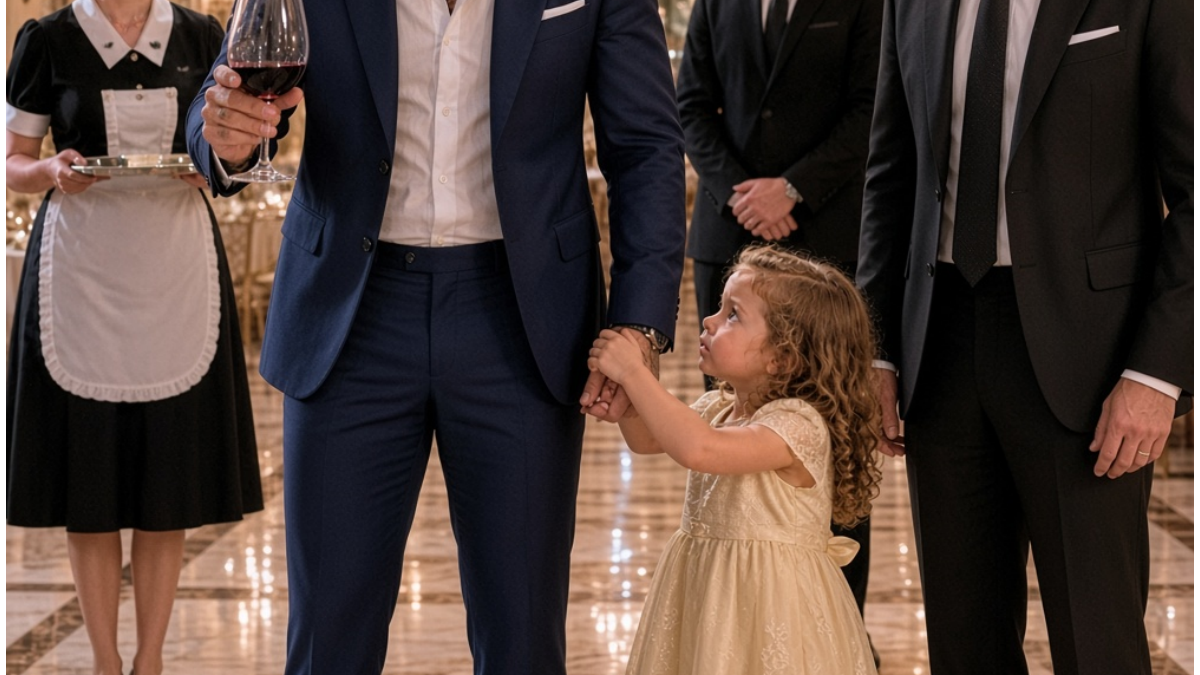
Don’t drink that glass of wine, sir. The unexpected warning rang out just as Dominic Moretti, the 38-year-old most powerful mafia boss in New York, was about to raise the glass of wine to his lips.
That evening, the grand hall of the Moretti estate glowed beneath magnificent crystal chandeliers. Dominic sat at the head of a long banquet table, surrounded by senior members of the family, trusted associates, and men who had served the Morettes faithfully for many years.
Standing quietly behind him was Marco Bellini, his loyal right-hand man, who had remained at Dominic’s side through some of the most dangerous moments of his life.
Across the table sat Allesandro Moretti, Dominic’s younger brother, smiling and raising his glass with men who had watched the two brothers grow up.
Everything seemed perfectly normal until Dominic rose to make a toaSt. The conversations faded, and dozens of glasses were lifted as Dominic reached for the wine in front of him.
But before he could take a sip, a little girl suddenly left her seat and hurried toward him.
It was Lily Carter, the young daughter of Sophia Carter. A longtime maid at the Moretti estate, Lily reached Dominic and gently tugged at his sleeve.
The gesture immediately caught Marco’s attention while curious eyes turned toward the child, but Lily seemed unaware of everyone around her.
Her gaze remained fixed on the glass in Dominic’s hand. Then she looked up at him, her small face unusually serious.
“Don’t drink the wine, sir.” Dominic froze, and as silence slowly swallowed the room, no one realized that the warning of a little girl was about to expose a betrayal from the last person Dominic ever expected.
Dominic set the glass down on the white linen without a sound. He pushed his chair back only enough to turn, then bent at the knee and lowered himself until his eyes were level with hers.
He did not smile. He did not scold. When he spoke, his voice was so quiet that the man three seats down could not have caught a word.
Why not, little one? Lily held up her right hand. She pinched her thumb and forefinger together in the air, leaving only a small space between them, the shape of something no bigger than a thimble.
“A little bottle,” she whispered. “Like this,” she told him. While the pretty lady in the blue dress had been singing, and all the grown-ups had been looking at her and clapping quietly, a man had reached inside his jacket.
He had taken out the little bottle. He had leaned across the table over the flowers.
He had poured something into Dominic’s glass, only a very little, only a few drops.
And then he had put the bottle back inside his jacket, and no one had seen him except her, because everyone was looking the other way.
Dominic did not blink. Where was he sitting? Lily turned her head. She did not hesitate.
Her small arm rose and her finger pointed straight across the walnut table, past the low crystal bowl of white roses, past the silver candalabra, to the man in the dove gray suit who sat directly opposite.
There, she said that uncle. She lowered her voice a little as though sharing something she had worked hard to remember.
I know because he has a ring like yours. Alisandre was still smiling. The wine glass rested easy in his right hand, tilted a little, catching light on its rim.
To any of the 30 guests watching, he looked like a man mildly amused by a child’s game.
But behind Dominic’s chair, Marco Bellini’s eyes were fixed on Aleandro’s other hand, the one resting on the linen beside a small silver fruit knife.
That hand was closed around the knife handle, closed too tightly. The knuckles had gone the color of bone.
A few of the guests turned to one another with soft, indulgent looks. The coniglier on Dominic’s left lifted his napkin to his mouth as though to hide a small, polite smile.
Someone at the far end of the table whispered something and got a low chuckle in return.
Children, what could you do? Dominic did not move. His eyes did not leave his brother’s face.
Then he looked back at Lily. Show me again, he said. How he held the little bottle.
Was it like this? He pinched his own thumb and forefinger together the way she had, holding the invisible shape between them.
She nodded, certain, no hesitation. She reached out and touched the tip of his thumb with the tip of hers, as though correcting the size by a hair, and then nodded again.
Just like that, she said. Dominic held that shape for a moment longer. His fingers pinched in the air between them.
The family ring on his little finger dark as old blood in the candle light.
His mouth did not move. His breathing did not change. Then from the far end of the great hall, over the thin voice of the violin, came the sound of hurried footsteps on marble.
A woman running in soft shoes. Sophia had seen her daughter at Dominic Moretti’s elbow.
She reached them in six long strides. The empty Barolo bottle still in one hand, her face the color of the linen.
She set the bottle down on the edge of a service tray without looking to see if it would balance.
And then she was on her knees on the marble beside her daughter, one arm around Lily’s shoulders, pulling the child back and behind her own body in a single instinctive motion.
Mr. Moretti, sir, I am so sorry. Her voice cracked on the second syllable. She caught it, swallowed, tried again.
Her head was already bowed. She never She has never come into the main hall before.
Not once in four years, please. The sitter fell this afternoon. Broke her ankle on the back stairs.
I had no one. I would never. I would never bring her to a room like this, sir.
Not on a night like this. Not for anything. And she has never spoken to a gueSt. She has never The words spilled out faster than she could shape them.
She was apologizing for the interruption, for Lily’s voice, for herself, for not having thought quickly enough that afternoon to find another arrangement, for every second the guests at the long walnut table were looking at her instead of at Dominic’s toaSt. She promised to take the child back to the staff wing at once.
She promised it would not happen again. She promised she would accept whatever he decided dismissal, forfeited wages, an order to leave the estate before mourning, and she said all of it with her forehead, almost touching the marble, and her hand shaking so badly on the sleeve of Lily’s dress that the small pearl button at the wrist rattled against its thread.
Dominic did not answer. He lifted one hand. That was all. A palm turned outward, held between them in the air.
It did not touch her. It did not need to. Sophia stopped midward as if the hand had closed around her throat.
And she stayed exactly as she was kneeling, bent, one arm still curled around her daughter, and she did not draw another breath until he spoke.
Sophia, his voice was level. There was no heat in it. There was no cold in it either.
It was the voice a man used when he had already made a decision and was only waiting for the rest of the room to catch up.
You don’t need to apologize again. I want to hear the rest of what your daughter has to say.
She lifted her eyes. She opened her mouth. Something rose in her proteSt. Argument, the reflex of a mother who has spent every hour of every day for three years placing her own body between her child and the world, and it died on her tongue the moment she met his gaze.
She closed her mouth. She nodded once. She did not stand up. She did not let go of Lily, but she did not pull her away either.
Around the long table, the guests had begun to murmur. Napkins lowered, heads inclined to neighbors.
A few of them, without quite meaning to, let their eyes drift across the flowers and the candles to the man in the dove gray suit, not with suspicion, only with the curiosity of people who have never before seen a three-year-old accuse a Moretti in his own house, and who now wanted to see what Alessandro would do with it.
Aleandro rose from his chair. The wine glass was still in his hand, and he laughed louder than anyone had expected.
The laugh came from deep in his cheSt. warm, rich, the laugh of a man who had heard something charming at his own family’s table, and wanted the room to share it with him.
It rolled out over the candles and the roses and the long white linen, and every head that had been leaning toward a neighbor’s ear straightened up to see where the sound was coming from.
Aleandro pushed his chair back with the ease of a host, not a suspect. He came around the long side of the walnut table without hurry.
Wine glass still in his right hand, the burgundy sliding gently against the crystal with each step.
He passed behind two consigary, brushed a hand along the shoulder of the family lawyer in easy affection, and arrived at Dominic’s chair.
His free hand settled on his brother’s shoulder in the old way, the way he had touched him a thousand times at a thousand family dinners.
“Gentlemen,” he said, and his voice carried the way voices carry when a man has been raised at tables like this one.
“Forgive me.” My niece has been watching too many cartoons. A few guests smiled. One of the old kappa regimes gave a soft indulgent shake of the head.
Three years old, Alisandra went on warm as a fire on a cold evening. 3 years old and already she’s picked out the villain in the room.
That’s excellent instinct, sweetheart. You should be writing scripts for the pictures. He turned then to the whole length of the table, gesturing lightly with the glass.
His ring caught the light. A Moretti ring worn on the same finger as his brothers, given to him by their father on the day he turned 21.
You all know me. You’ve known me since I was a boy at this table.
I am my brother’s only living blood. We stood together at our father’s grave 15 years next spring.
15. There is no man alive on this earth who has less reason in his heart to harm Dominic Moretti than I do.
None. He said it the way certain men say certain things with a cadence that pulled the room along with him that made heads nod before the mind had time to weigh the words.
Two of the conigliary nodded. The family lawyer folded his napkin with a small grave understanding smile.
Alessandro turned toward Sophia. He softened his face into something that was almost tenderness. And you please, please stand up.
I am not angry with you. You are a mother doing your best on a hard night.
Children misspeak. It happens in every house. I’ll speak to our lawyer myself before the evening is over.
No notation on your file. No consequence. No word of this leaves this room. You have my word on it.
Sophia bowed her head lower. She did not answer. She could not have made her voice work if she had tried.
A few guests chuckled gently now, the tension in the room releasing like a held breath.
The violin drifted back into hearing. But Dominic did not laugh. He was still looking at Lily.
The child had not moved. She had not lowered her eyes. She had only tightened her small arms around the brown bear pressed to her cheSt. When Alessandro turned back to smile at her, the practiced, patient smile of an uncle amused by Anie’s game, she looked up at him without flinching.
She met his eyes the way a grown person meets a grown person’s. And her voice, when it came, was pitched low enough that only Dominic and Marco heard it.
The little bottle is still in your pocket. The wine in Aleandro’s glass tilted, only a degree, only enough that had Marco not been watching every muscle in that hand.
No one in the room would ever have known. Dominic did not answer his brother.
He reached instead toward the small silver pocket watch resting on the linen beside his plate, his father’s watch.
Chain looped once through a button hole in his waist coat. His thumb found the case.
He pressed the catch. The lid sprang open with a soft, familiar click. No louder than the tap of a fingernail on Crystal.
Behind his chair, Marco Bellini did not move his head. He did not need to.
10 years of standing at that shoulder had taught him what that sound meant and what came after it.
The muscles along his jaw tightened once and settled. Dominic rose. He turned to the table with the smile of a host who has heard a small pleasantry and now wishes to return the room to its rhythm.
My friends, please forgive us. My brother and I are going to step out for 2 minutes.
One small family matter. Quickly settled. Enjoy the second course. Vincenzo has outdone himself with the ve and I would take it personally if any of you left before finishing it.
Soft laughter. A cappa regime lifted his glass in salute. The violin swelled a shade louder as if on Q.
Dominic slid one arm along Alessandro’s shoulders, the same easy weight Aleandro had put on him a minute before, giving back now in kind, and steered him gently toward the arched doorway that led to the smaller study.
It looked, to every guest at the long table, like exactly what he had said it was, two brothers briefly out of the room, to smooth over a bit of childish embarrassment.
Allesandro could not refuse, not in front of 30 men. He laughed once, short, set his wine glass down on the linen beside his own plate, and let his brother’s arm carry him toward the door.
The moment they were three steps from the table, Marco moved, he came forward the way he came forward a hundred times an evening, carrying nothing.
Apologizing for nothing. Simply the boss’s shadow drifting into the boss’s vacated space to check a napkin, to top up a glass, to adjust the angle of a chair, he leaned in over the concier at Dominic’s left, murmured something about the vintage, poured a splash of bo from a fresh bottle on the service tray.
The conciglier nodded and did not look up. In the same motion, Marco’s other hand closed around the stem of Dominic’s untouched wine glass.
He lifted it. He replaced it with an identical crystal glass from the service tray clean.
Empty except for a swallow of new pore he added on the way down. It took less than 3 seconds.
No head at the long table turned. Every eye that mattered was on the doorway where the brothers had just passed through.
The poisoned glass went onto the tray beside him. He turned, moved without hurry along the sideboard, and slid the tray into the hands of a young server standing at the service door, the son of one of Dominic’s father’s men, quietly trained for exactly this kind of moment.
The boy did not speak. He did not glance at the glass. He simply carried the tray through the service door and was gone in 20 seconds.
In the smaller study, Dominic guided Aleandro to a deep leather armchair, poured him a fresh whiskey, and began gently to speak about the New Jersey port.
Aleandro accepted the glass, uncrossed his shoulders, and began to believe the child had been forgotten.
In the auxiliary kitchen, Marco set the tray on stainless steel, and Dr. Franco Vitali opened the black leather case at his side.
Franco Vitali had stood in this kitchen, or one very much like it. At every large gathering the Moretti family had held for the last 20 years.
It was a rule set down by Dominic’s father in a different decade. A doctor in the building, always discreet as furniture.
Black bag never more than three paces from a servant’s corridor. Franco was in his 60s now.
Silver at the temples. Gold rimmed reading glasses on a chain around his neck. Hands that did not shake.
He did not ask what the glass was or whose it was or why the boss’s shadow had come to him with a tray at 10 minutes past 9 on a Saturday night.
He simply set the leather case on the stainless steel counter, snapped the two brass latches, and lifted the lid.
Inside, in fitted foam, lay a small array of vials, dropper pipets, and paper test strips folded like tiny fans.
He selected the strip he wanted without looking at any of the others. He drew four drops from Dominic’s glass with a slim glass pipet.
He touched the drops to the center of the paper. The strip changed. Once, then again, then a third time.
Marco stood at the far side of the counter, palms flat on the cold steel, and said nothing.
The wall clock ticked. A refrigerator across the room hummed on some low, unhealthy note it had been making for a week.
Jazz drifted in through the open service door. From the great hall, the string quartet had given way to a piano trio somewhere between the courses.
A server in a white jacket walked past the kitchen door. Trey balanced and did not glance in.
Marco was going back through the last two hours in his head. One detail at a time.
The way a man goes back through a hallway looking for the loose floorboard. Aleandro had arrived 30 minutes earlier than usual.
He had walked straight through the front hall and into the private coat room himself, waving off the young man at the reception with a smile.
Matteo Richi had stood in the east corridor for a long minute while the other guests were queuing to enter the great hall, not talking to anyone, not looking at anyone, just standing there.
Small things, things Marco had noticed at the time and filed away and given no weight to because Matteo Reachi had been standing in Moretti corridors for 30 years and had earned the right to stand in one for a minute more.
Franco lifted his head. He closed the case. He looked at Marco over the tops of his reading glasses.
When he spoke, his voice was low enough that a passing server would not have caught a word.
Heavy metal base, slow acting symptoms in 3 to four hours, the presentation would be a sudden stroke or a coronary.
The body reads it as natural. This is not something you buy at a chemiSt. There are three suppliers in the northeast that carry this compound.
Marco, all three of them are inside networks this family already knows the shape of.
He took a small notepad from his inside pocket, wrote three lines in a doctor’s spidery hand, tore the sheet off, and pressed it into Marco’s palm.
No photograph, no email, nothing that would live on a server anywhere. Marco lifted the internal phone off the wall.
He dialed the family’s encrypted line, waited for the second click that meant the connection was clean, and spoke four words, one at a time, so that nothing could be misheard.
The child was right. In the study, Dominic’s thumb closed a little tighter around the case of his father’s watch inside his jacket pocket.
The smile on his face did not shift by a millimeter as he turned back to Aleandro and raised his whiskey in salute to his brother.
He held the whiskey at his lip long enough to seem to drink. He set it back down.
You’ve been patient with me on New Jersey, Dominic said. Easy. As though the last 5 minutes of the evening had never happened, longer than I would have been in your place.
Sit. Talk to me. Aleandro sat. He crossed one leg over the other and let the whiskey rest on his knee.
Dominic went on the container terminals. The union contracts coming up for renewal in the spring.
The two shipping lines that had begun to look for a friendlier port. And then, quietly, almost as an aside, perhaps the time had come to give Alessandro a real seat at that table.
Not a courtesy chair, a voice in the room where the decisions were made. Something moved behind Aleandro’s face.
He kept it small. He had trained himself for years to keep such things small.
He nodded slowly, as though weighing an idea that had never occurred to him, and murmured that he would be honored to be more useful.
Inside himself, he was already at the door of his own house. The three-year-old had been laughed off.
His brother was talking about promotion, about the port, about the very thing he had been circling for 6 months.
Three more hours. Three more hours, and it would be someone else’s phone call in the middle of the night about Dominic Morettto’s heart.
And Aleandro Moretti would answer it wearing the face of a grieving brother. He did not know that on the other side of the leather chair, inside his brother’s head, a very different arithmetic was being done.
A man could not poison Dominic Moretti inside this house alone, not this house. 10 guards on rotation, three separate security perimeters, 20 cameras between the front gate and the great hall.
A doctor in every large gathering for 20 years. Aleandro on his own could not have moved a bottle of poison through that filter.
Could not have known where Dominic would sit tonight. Could not have counted on which glass would be his.
Someone inside, someone senior had cleared the way. Someone with a network had sourced the compound.
Someone with rank had made sure no question was asked at the door. Dominic set the number at three, perhaps five.
At least one caper regime, likely one under boss, possibly the family lawyer. He would know before sunrise.
He rose, smiled, and set a hand on Aleandro’s shoulder in warm return. “Come! They will think we’ve been in here plotting a coup.”
The word passed between them lightly.” Alesandro laughed. They walked back into the great hall together.
Dominic paused at the head of the walnut table, lifted a fresh glass, a clean glass, poured in the room by a server neither brother had ever spoken to, and raised it to the assembled company.
10 years. 10 years of his father’s house in his hands and every man at the table on his feet.
Aleandro raised his glass with them. Aleandro drank. Dominic sat. He returned to the port.
He asked the family lawyer about the hunting season opening in Vermont. He asked a capore regime how the boy was finding his first semester at Forom.
Beneath the linen, out of sight of 30 pairs of eyes, Aleandro’s left hand tapped three times against the leg of the table.
Behind his brother’s chair, Marco Bellini gave a nod so faint it could have been the drift of a candle.
Over the next 30 minutes, quietly, under the cover of a routine that had lived in the household protocol for 2 years.
Every door in the Moretti estate was locked, and the phones of eight senior men at that table began to feed through the family’s own tower.
Marco moved through the estate the way a good head waiter moves through a full dining room, visible only when he wanted to be seen, invisible in the seconds that mattered.
He gave the first order at the door to the pantry. In a voice pitched no louder than an instruction about the wine.
Two teams of four, back door, main garage, three garden gates. All of it under the standing protocol posted two years ago for evenings with VIP guests post 9 security sweep.
Doors sealed until the last car leaves. Nobody would think twice. The guards on duty had seen the memo taped to the inside of their locker doors for two winters running.
He stepped into the small operations office off the west corridor, closed the door behind him, and picked up the internal line.
Tommy Ricardo answered on the second ring from the loft above the carriage house, where the family kept its own low tower, its own logging equipment, its own listening room lined in acoustic foam.
Marco gave him eight names. Salvatore Deuca, Vincent Pagano, Rocco Amato, Carmina Bruno, Anthony Falco, a financial coniglier who had been at the table for six years, a second coniglier who had married into the family in the ’90s, and Matteo Reichi.
Every call, every text, every ping to a tower within 20 m, beginning now, nothing to be saved anywhere but the loft.
If a phone tried to reach a network outside the family’s tower, Tommy was to route it, log it, and let it think it had reached what it was trying to reach.
Marco set the receiver back in its cradle. Then he gave the third order, quieter than the first two.
Three men he trusted the way a man trusts his own hands. He gave them positions in the great hall, one near the arch to the east corridor, one at the sideboard closest to Alessandro’s chair, one working as a server with a silver coffee pot.
Not obvious, not close enough for a guest to notice. Close enough that if Allesandre rose and took two steps in a wrong direction, there would be a body between him and the door within 3 seconds.
In the great hall, Dominic played his part. He rose when the pianist finished a piece and led the small applause.
He walked the length of the table, bent to greet a Caperime’s wife by her first name, asked after a conciglier’s daughter, admired the family lawyer’s new tie clip.
He drank slowly from a clean glass. He knew he was performing for one man in the room and one man only.
At the second toast of the evening to old friends to long years he lifted his glass and as he rose he allowed his hand to falter for a fraction of a second.
Nothing anyone would have named a small hesitation. The [clears throat] kind of thing a man’s body did when he had stood too quickly after too long a sit across the table.
Aleandrore’s eyes flicked up, registered it, filed it. The corner of Aleandrore’s mouth lifted a hair.
Behind Dominic’s chair, Marco read both movements and remembered them. Two floors below, in the servants’s restroom by the laundry.
Sophia sat on a wooden bench with Lily on her lap. She was rocking gently, more for herself than for the child.
She had already begun composing the words she would use in the morning when she was told to pack her things.
A soft knock came at the door. It was not the sound she had been dreading.
It was quieter than that. Marco Bellini stood in the corridor with a specific question for Lily.
Marco stepped into the servant’s restroom and closed the door behind him with the flat of his palm, so that even the latch made no sound.
Sophia was already on her feet. She set Lily on the bench beside her and started forward half a step, then stopped as her knees threatened to buckle.
Her hands went out in front of her, low, empty, in the posture of a woman ready to be told to leave a house at 10:00 at night.
“Mr. Bellini, please.” Marco raised his hand. He did not raise his voice with it.
Sophia, sit down, please. His voice was not the voice he used with the men at the sideboards or with the driver at the north gate.
It was gentler, lower, the kind of voice a man reserves for a horse he does not want to spook.
She sat slowly. She did not let go of Lily’s small hand. Marco went down onto one knee on the tiled floor.
He did not touch the child. He reached instead into the crook of his arm and produced the brown stuffed bear he had lifted from the little upholstered chair against the wall of the great hall when no one had been watching.
He set Bruno gently on Lily’s lap. There he is. I thought he might be lonely without you.
Lily’s small hands closed around the bear. She pressed her cheek against its worn crown.
Marco did not begin with the question. He began with the bear. How old is Bruno?
He looks like a very serious gentleman. He’s four, Lily said. Mommy had him when I was born.
And does he have a brother? A sister? He had a rabbit, she said, considering.
But the rabbit got lost at the park. Ah, that’s sad. But he still has you, she nodded solemn.
Marco let the small quiet settle around them. Then, without any change in his face, without any change in the pitch of his voice, he asked the question he had come for.
Sweetheart. Before the uncle by the flowers took out his little bottle, “Did you see him do anything else?
Did anyone talk to him just before?” Lily thought. Her thumb went into her mouth.
Came out again. She looked at the middle button of Marco’s black jacket while she remembered.
“Yes,” she said. Another uncle came very fast, like counting to 10. Then he was gone.
And what did that other uncle do? He gave him something in his hand like this.
She cuped her own small palm and closed her fingers around the empty air. I couldn’t see what, but it was little, about like my finger.
Marco kept his face still. And that other uncle, what did he look like? She frowned, working carefully.
Gray hair, she said. Here. She patted her own temples. A red tie and a big ring.
On this finger, she pointed to her own middle finger with a bird on it.
A bird with sharp feathers on its head. An eagle. The cold went up Marco’s spine cleanly from the base to the collar, gray hair at the temples, red silk tie, an eagle-headed ring on the middle finger of the right hand.
There was one such ring in the state of New York, and it had been given by Dominic Moretti’s father 30 years ago to Matteo Reichi on the day he was raised to Capar regime.
Marco stood up. He thanked Lily. He reached into his inside pocket and produced a small red strawberry candy in a twist of cellophane and pressed it into her hand.
He turned to Sophia. “You are not being dismissed,” he said quietly. “You are being protected.
Lock this door behind me. Do not open it for anyone but me. There will be a man in the corridor all night.”
Sophia did not understand. She nodded anyway and drew Lily and Bruno tight against her cheSt. Marco was already turning toward the door when Lily’s voice reached him one more time, small and careful.
“Mister,” the man in the red tie was scared. His hands were shaking. In the dim corridor outside, Marco stood still for one full breath.
The strip of paper with Matteo Reichi’s name folded tight against his palm and knew that the hardest part of the night was only beginning.
The cigar room lay at the far end of the lower corridor. Two doors passed the billiard room, a place of dark oak paneling and low green lamps.
Matteo Reichi sat in a wing chair with a cohiba between his fingers and a snifter of grapa balanced on the arm.
Two guests sat opposite him, a real estate man from Fort Lauderdale, a lawyer from Bokeh and Matteo was explaining with the patience of a man who had been rich for a long time why the Miami waterfront was still undervalued in the right zip codes.
Marco slipped in through the door and made no sound, crossing the rug. He bent at Matteo’s shoulder.
Low, as though passing a discreet message about the wine celler. His voice did not rise above the rustle of the cigar smoke.
Uncle Dominic would like a private word, something on the books that shouldn’t be spoken of in company.
Matteo looked up. He smiled. The smile he had smiled at a thousand family evenings warm.
Slightly amused. The smile of a man who had been trusted for decades and had earned the truSt. Of course, of course, he set the cigar carefully on the crystal ashtray, gave his two guests a small apologetic bow.
Forgive me, gentlemen. My nephew calls, he rose. He followed Marco out of the cigar room without a backward glance.
He was not suspicious. He had walked this corridor at Marco’s shoulder a hundred times over 20 years on nights when Dominic wanted an opinion he did not want offered in front of the wrong ears.
It was routine. It was familiar. It was safe. Marco led him past the wine celler door, past the small pantry and up the short flight of steps to Dominic’s private study.
He opened the door for the older man and stood aside. Matteo stepped inside. The door closed behind him.
There was no Dominic in the room, only Marco and two other men. Standing quietly at the far corners, Enzo Traversy at the window.
Paulo Rena beside the reading chair. Both of them had begun in this house under Dominic’s father.
Both of them had faces Matteo knew from 30 years of Sunday dinners. Neither of them was smiling now.
The two other doors, the one to the corridor, the one to the small back stair, had been shut and locked from outside during the walk over.
Matteo stopped. For a moment, his face went through three small changes in quick succession, the puzzlement of a man expecting his hoSt. Then the flicker of a man beginning to understand, and finally the flat, cold settling of a man who has already understood everything and is calculating what remains to be said.
He turned back to Marco. His voice tried for one more second to hold the warmth it had carried into the room.
Marco, what is this? We’ve known each other 20 years. Whatever the trouble is, you can say it to my face.
Marco did not answer with words. He crossed to the small marble side table beside Dominic’s chair.
He sat down three things on it in order without haste. First, a small black phone.
Screen up. An audio waveform paused on the display. Lily’s voice recorded in the servant’s restroom.
The sound not playing, only the shape of it waiting. Second, a folded slip of note paper in a doctor’s spidery hand.
Heavy metal base, slow acting. Three suppliers. Third, a single black and white printout from an interior camera.
Time stamp along the bottom edge. 7:15 in the east corridor, 45 minutes before the first guest had entered the great hall.
Two men in the frame, Aleandro Moretti, half turned, one hand in the inside pocket of his jacket.
Matteo Reachi closer, an eagle-headed ring catching the corridor light, a small object cuped in his palm.
Mateo went white. He tried once more to smile. The muscles obeyed the order, but the smile would not form.
His knees gave out under him at the same moment, and he sat down in the visitor’s chair without being invited, because his legs had simply decided the matter without him.
Marco pulled the other chair around, and sat down facing him. He drew the wristwatch off his own left hand, laid it flat on the marble between them, and flipped open the small hinged cover on the back so that the movement was exposed.
He did not need the time. He wanted Matteo to hear the ticking. He spoke very slowly in the tone of a man reading a sentence.
Mateo, every second that passes on this watch, your family’s chances of surviving this night grow a little smaller.
Mateo Reichi looked at the ticking watch. He did not look at Marco. He had stood at the shoulder of Dominic’s father the night the man was shot down in the courtyard of a church in Benenhurst 15 years ago.
He had carried Dominic, 13 years old, in a black suit two sizes too large through the crowd at the funeral, one hand on the boy’s neck the whole way because the boy would not have taken another step without it.
He had put a pistol into that boy’s hand for the first time at a shooting range in New Jersey and taught him how to breathe out before he pulled the trigger.
He began to speak. He did not cry yet. His voice came out level, almost tired.
The voice of a man reading a quarterly report to a room that had already stopped listening.
6 months ago, he said. Alisandro had come to him only to complain. In the beginning, Dominic did not respect him.
Dominic treated him like a courtesy chair at the table. Dominic did not consult him on real decisions.
Matteo had listened. He had listened the way an old uncle listens, agreeing where it was polite to agree, saying nothing where nothing needed saying.
The meetings became weekly, always at the same small trateria in Bay Ridge. On a Tuesday at a corner table Alessandro had chosen because Dominic never ate that side of the harbor.
Aleandro grew more specific each week. The port, the men who were being promoted around him, the names being spoken of as under boss when Dominic finally chose one.
Two months in, Aleandro made the offer. If Matteo stood with him on the day Dominic’s heart failed, Matteo would be raised to under boss of the whole family.
He would be given the New Jersey port, the piece with the widest margins, the piece currently in the hands of another man.
He would end his career the way he had once thought he would begin it.
Marco slid a sheet of paper across the marble and set a pen beside it.
Matteo’s hand shook so badly that the first name came out crooked. He wrote them one under the other.
Salvatore Duca under boss freight. Vincent Pagano under boss shipping. Roco Amato Capo Queens. Carmine Bruno Capo Queens.
Anthony Falco family council real estate laundering. He set the pen down. He did not lift his hand from the page.
The plan, he said, was simple enough. The compound in the wine at the anniversary dinner, the death to present as a stroke.
3 or 4 hours later in Dominic’s own bed. In the morning, Alessandro would claim succession as the only surviving brother, clean, legal, the family lawyer already prepared.
The five men on the paper would rise in public support before noon. The rest of the family would be given no time to gather, no time to consult, no time to refuse.
It would be finished before the funeral. The compound itself, Matteo had procured a contact in Philadelphia, a chemist who had done small, quiet work for the family in the ’90s, and had not been called on in 15 years.
Matteo had kept the small glass bottle inside a Marbor pack in his inside jacket pocket for 6 days.
He had passed it to Aleandro 45 minutes before the guests were seated in the east corridor when the cameras were on the schedule he had helped design.
He began to cry now quietly. The tears were coming down through the gray stubble on his cheeks before he had noticed them.
He said he had loved Dominic since the boy was a boy. He said he had carried him through his father’s funeral.
He said he had taught him what honor in the family meant. And everything he had taught the boy about honor had been true.
But something in him had gone soft with age, greed, envy, the fear of dying without a bigger chair, and it had eaten the rest of him from the inside out.
He asked Marco to say on his behalf that he was sorry to Dominic, to Dominic’s father, buried in Calvary these 15 years.
Marco folded the list of names once. He stood up. He did not answer the apology.
He nodded to Enzo and Paulo. The two men moved to the older Capar regime’s sides, one at each elbow, and lifted him gently to his feet, and turned him toward the door that led down to the wine celler, where family law had been carried out in this house for three generations.
At the door, Matteo turned back. He looked at Marco one last time and asked for one thing.
“Don’t let my wife know.” Marco gave him the smallest possible nod. The door to the wine celler closed behind him.
Two floors up in the great hall. Aleandro Moretti glanced along the length of the walnut table and realized that Matteo Reachi’s chair had been empty for 45 minutes.
Aleandro slid his phone out of his inside pocket, held it just below the edge of the linen and thumbmed a single word to Matteo where nothing came back.
He waited a full minute, listening to a story a Keo regime’s wife was telling about her granddaughter’s ballet recital.
Laughing at the right pause, he sent it again. He sent it a third time.
The screen sat gray under his thumb. He lifted his eyes and let them travel the room without turning his head.
The east archway. Two men he did not recognize by name were standing there now.
Not new hires he knew every new hire, but men he had only ever seen in the north wing near the gun room on nights when there were no guests.
They were not eating. They were not drinking. Their hands hung loose and empty at their sides.
The double doors that led out to the rose garden were closed. Those doors were never closed during a party.
The night was warm. The doors should have been open onto the terrace, the chair behind Dominic, empty.
For 40 minutes, he had not seen Marco Bellini for 40 minutes. Aleandro’s mouth went dry under the smile.
He turned the phone flat against his thigh, pretending to reach for a napkin and thumbed a call to Roco Amato.
The bars at the top of the screen did not move. The call did not go through.
He killed it, tried Vincent Pagano. Nothing, not a stutter, not a ring. The screen simply held the number in a small silent circle and gave him back nothing.
He understood in the space between two breaths, the house’s own tower had been switched to closed circuit.
There was one password that opened it back up to the outside world, and that password lived in the safe behind Dominic’s desk.
Nothing his men could send or receive from inside this estate would leave the estate.
Nothing coming in would reach them. Two more seconds. He ran the arithmetic behind the smile.
The plan was already burned. Matteo was already gone. The wine had either not worked or Dominic had never drunk it.
In either case, Dominic knew. In either case, there was nothing left to preserve. Waiting three more hours for a heart that was not going to stop was suicide.
There was no more script to follow. There was only the room and the men in it.
And the window before the room closed around him. He set his whiskey down. He rose from his chair, still smiling, still the beloved younger brother, and lifted the glass again as though he had thought of one more thing to say.
He came around the end of the walnut table and moved along its length toward Dominic.
Two of the guests looked up and smiled indulgently, expecting a private toaSt. He bent at his brother’s ear.
He did not whisper. Under the edge of the linen, out of sight, his left hand tapped three times against the leg of the table.
At the same instant, in four different corners of the estate, four different men stood up.
Salvatore Duca murmured something to his wife and started for the corridor. Vincent Pagano rose from the bar and set his tumbler down without finishing it.
Roco Amato and Carmine Bruno from opposite ends of the great hall began to move toward the same door.
Anthony Falco, the family lawyer, folded his napkin twice and drifted with practiced ease in the direction of Dominic’s study toward the safe.
Dominic did not rise from his chair. He did not turn his head. He allowed his brother to remain bent at his ear, and he answered him back in a voice pitched only for the two of them.
Little brother, I have been waiting for you to make a mistake for six months.
Tonight, you finally did. The smile on Aleandro’s face froze. Three seconds later, the first gunshot cracked up from the basement dry, short, decisive, and the great hall came apart.
A woman screamed at the far end of the table. Two men went to the floor with their arms over their heads.
A third bolted for the arched doorway that led to the front hall, put both palms flat against it, and found it would not move.
The violin cut off between two notes. The pianist, three rooms away, was already off his bench and under the piano.
A crystal glass tipped on the linen and rolled. It fell off the edge of the table and burst on the marble in a small silver rain.
Marco had put his people in place long before the first hand reached for a gun.
12 of them chosen out of the estate staff of 40. Standing since the second toast in positions no one at the table would have named a threat.
The corridor to the arms room, the head of the basement stair, the east archway, the service door of the great hall.
Roco Amato reached the top of the basement stair a full second ahead of the man behind him.
His hand was already under his jacket. It never came back out with anything in it.
The report was short, one dry crack in the stone throat of the stair, and the sound that followed was not a scream.
It was the softer sound of a body meeting a wine rack and a wine rack meeting the floor.
Two bottles of Barolo broke inside their straw wrappings. Carmine Bruno was faSt. He got as far as the mouth of the east corridor before two men stepped out of the arched shadow on either side of him.
They did not shoot him. They did not need to. They had his wrists behind his back inside 3 seconds and his mouth muffled inside four and he was gone through the service door before any guest at the walnut table had turned to see.
Salvatore Duca and Vincent Pagano moved together from opposite ends of the great hall, their hands going for their pieces in the same instant.
Neither of them cleared the holster. Two reports almost overlapping close and flat under the high ceiling.
The tumbler in Pagano’s left hand jumped out of his fingers and shattered on the walnut.
Both men went down heavily on the marble, chairs overturning around them, the smell of gunpowder rising sharp over the roses.
At the far end of the west corridor, Anthony Falco had his hand on the door of Dominic’s study when two of Marco’s men took him on either side.
He never touched the safe. His forehead met the rug before his brain had caught up with the fact that he had been intercepted two floors below the great hall.
Sophia heard the first shot through the door of the servants’s restroom and moved without thinking.
She was already off the bench, already dragging the small upholstered chair aside, already pulling Lily down onto the tile with her.
She got them both under the wooden table in the corner and pulled her own body across the child’s like a shield.
The guard Marco had posted in the corridor threw the deadbolt from inside the door and put his back against it.
Lily did not cry. She only pressed her face into her mother’s shoulder and tightened her arms around Bruno and whispered, “So small,” Sophia almost missed it.
“The bad man is angry now, Mommy.” Sophia did not answer. She only kissed the crown of her daughter’s head and held her.
In the great hall, Dominic rose from his chair. He did not draw his pistol.
He did not raise his voice. He lifted his left hand and drew the family ring slowly from his little finger, the ring his father had put on his hand a chapel at Calvary.
And he laid it down on the folded white napkin beside his plate. Every senior man in that room understood this was no longer a party.
This was a hearing under family law. He walked the length of the walnut table.
Two of Marco’s men already had Alessandro down on the marble at the head of the room, knees on the floor, arms twisted behind him, a hand clamped on the back of his neck.
Dominic stopped in front of his brother. He did not draw a weapon. He looked down at him for one long second, and when he spoke, his voice was so quiet only Alessandro heard it.
Everything Papa built, and you would burn it for a chair at the head of the table.
Aleandro’s answer was not a word. It was a small wet sound and a splash of spit on the toe of Dominic’s shoe.
The earpiece behind Dominic’s collar clicked once. Marco’s voice came through, level and short. Four down.
Lawyer secured. Two runners breaking for the auxiliary garage. Aleandro had prepared a second door.
Adora Mateo Richi had never been told about. Two men, Frankie Delfino and Nikico Baron, not soldiers of the family in the formal sense, not on any payroll Marco had ever audited.
Aleandro’s own boys he had grown up sailing with off Rockaway. Boys he had put on retainer 3 years ago out of his Bronx nightclub receipts.
Their names had never crossed Matteo’s list because Matteo had never known the names. A black SUV, plates already switched, sat in the auxiliary garage in the northwest corner of the estate.
The small brick out building where the groundskeeper stored the mowers. Marco had not swept that garage with tonight’s rotation.
It carried nothing of value on any night of the year. The first shot from the basement was still echoing across the marble when Frankie set a shoulder to the service door on the west side of the estate and popped the latch.
He and Nico came in through the mudroom faSt. Low, both pieces already out. They met one of Marco’s men in the short corridor by the linen closet.
Three reports close together. The man went down. Frankie caught one in the meat of his left shoulder and did not slow.
Two floors above in the great hall, Dominic bent to the two men who had Aleandro on the marble.
His voice was low and specific. Rocco still breathing on the basement stair. Pull one of yours.
I want him alive long enough to name what Mateo didn’t. One of the two men let go of Alisandros right arm and turned toward the arch that led down.
30 seconds. Allesandro did not need more than 15. He drove his heel down on the instep of the man still holding him, jerked his shoulder hard against the wrong angle of the grip, and was on his feet before the second man had shifted his weight.
He shouldered a chair aside, fainted right, and broke for the west archway. Marco was already on the main stair coming up from the basement.
He was 20 seconds late. In the west corridor, Allesandro met Frankie and Nico coming the other way.
No words. Nikico closed the corridor door behind them. The three of them began to run toward the mudroom.
At the end of the west corridor, Aleandro slowed. He did not slow because he had lost his nerve.
He slowed because a single thought had reached him and stopped him with the weight of a hand on the cheSt. The child.
If the child had not spoken, if the child had not tugged a sleeve. If the child had stayed on her upholstered chair by the wall with her stuffed bear and her polished shoe view of the room, he would already have won.
Six months of work, five men bought, a father’s chair, everything. A three-year-old. He turned his head to Frankie.
The servants’s restroom downstairs. On the way to the garage, Frankie hesitated for the first time.
Nico did not. Nico was already moving. They went down the service stair three steps at a time.
The guard Marco had posted at the corridor was already down at the top of the stair, dropped by Frankie’s second round.
The bolt on the restroom door held for less than a full kick. Sophia came out from under the table.
She stood up between the two men and her daughter with both arms flung wide.
Her hair had come loose. She was screaming into their faces. Not words at first, only sound.
A mother’s raw refusal. Then a single sentence. Over and over. Don’t you touch her.
Don’t you touch her. There was no shot. There did not need to be one.
There was only the sound of Bruno hitting the tile and skidding under the bench.
The muffled break and Sophia’s shout as a hand closed over her mouth. The scrape of a small shoe being dragged off a foot.
A second smaller sound. A child’s dropped slipper skittering across the floor and coming to rest against the leg of the table.
The soft click of the auxiliary garage door as a key turned in it from inside.
When Marco reached the servant’s restroom, the door was hanging on one hinge. Bruno lay face down on the tile in the middle of the floor.
A tiny slipper lay under the bench. The auxiliary garage door stood open onto the dark.
The engine of a black SUV howled once against the gravel of the service drive, and the sound of it going through the side gate hung a long moment in the night air.
Aleandro Moretti had left the estate, and he had taken Sophia and Lily Carter with him.
Dominic stood in the middle of the servants’s restroom. He did not look at the broken hinge.
He did not look at the small slipper under the bench. He crossed the tile in three slow steps, went down onto one knee beside the wooden table, and picked up the brown stuffed bear with both hands.
He held it the way a man holds something that has stopped being a toy.
He did not speak for 30 seconds. Marco stood a pace behind him. Marco did not feel the silence.
He had known Dominic Moretti for 10 years, and he had learned by the second year that when the boss did not speak, no one else should.
Dominic rose. When he turned, his face carried nothing a photograph would have caught. Not anger, not fear, something older than both, and colder than either.
He spoke very low, very slowly. Find them. Every man we have, every favor this house has ever collected.
New York and the four states around it. I want that woman and her daughter back in this house before sunrise.
Marco nodded once. He had opened the switches the instant he heard the SUV clear the side gate.
Every police captain in the five burrows who owed the family a favor had already been rung and given the plate.
HCR 4471 false. But a false plate a working cop could still put on a hot sheet in 90 seconds.
Toll cameras on the George Washington and both tunnels were being watched by a man with a phone in each hand.
Teterborough, Republic, Farmingdale, three private airfields, all covered. The Canadian border was hours away, but ours could be closed, too.
Dominic turned and walked out of the restroom without another word. He did not stop at the great hall.
He did not stop at the study. He went down the narrow service stair to the wine celler, and the two men at the door stepped aside for him without asking anything.
There were no witnesses. There would be no description of what happened in the wine celler.
There was only the muffled closing of the door. And then some minutes later, the sound of it opening again and Dominic’s steps coming back up the stone stair and the look on his face when he passed the two men on his way to the corridor.
He walked from there to the small pantry where Anthony Falco had been placed. He stayed less than a minute.
He walked from there to the linen room off the west corridor where Carmine Bruno lay bound on the floor.
He stayed shorter than that. Family law did not require a hearing when the accused had confessed with his own hands on a doornob.
It did not require negotiation when the evidence was a bottle in a printout and a list in the confessor’s own writing.
It did not extend second chances. Dominic did not offer any. Four traders were dead before the second hour of the raid was out.
Two more, Frankie Delfino and Nikico Baron, were still on the road with the man who had ordered it all.
Dominic returned to his study. He set the brown bear on the corner of the desk.
Beside it, in the small silver dish, where he emptied his pockets each night, lay the Moretti ring he had drawn from his little finger in the great hall.
He sat down in his chair. He looked at the two things, the ring, three generations old, worn thin at the shoulders by his grandfather’s hand and his father’s hand, and now his own, the whole weight of the house pressed into a circle of gold, no wider than a bottle cap.
The bear, four years old, one ear worn to threads, a small brown creature that had cost $7 at a drugstore and had saved everything the ring represented.
He looked at them for 20 minutes and did not say a word. When he stood up, he slid the ring back onto his little finger.
He picked up the bear with both hands. He tucked it carefully inside the breast pocket of his jacket over his heart.
Marco’s phone buzzed once against the desk. The name on the screen was a contact at the Red Hook waterfront.
A man who had watched a certain stretch of Van Brunt Street for the family for 11 years.
A black SUV had just turned off Van Brunt into a dead-end alley beside an abandoned warehouse the Moretti family had used.
10 years ago as a transfer point for untaxed cigarettes. Marco held the phone out.
Dominic read the two lines on the screen without moving anything but his eyes. He knew the warehouse.
His father had used it from 91 to 98, one of eight staging points along the Brooklyn waterfront.
Back when the family still ran untacked cigarettes up from Virginia through the container yards at Red Hook when the margins on tobacco collapsed and the risks did not.
The family moved on. The warehouse was left to rust behind a chainlink fence at the end of a dead-end alley off Van Brunt Street, three blocks from the water, but the paperwork on that building had never been surrendered.
Matteo Reichi had run the tobacco business in those years. The lease sat still inside the file cabinet of a shell company Mateo had personally opened in ’92.
And when Marco pulled up the shell company’s activity on the family’s internal ledger, the ledger every senior man could touch, but few remembered to check the last 3 months of transactions came up on the screen in white against black.
The account had been reactivated in late spring. Electricity, water, and refuge service had been paid on the warehouse for 90 consecutive days.
Reactivated by Aleandro Moretti. Approved on the counter sign by Matteo Reichi 3 months ago, the exact week Matteo had begun taking his Tuesday dinners at that small treateria in Bay Ridge.
Dominic folded his jacket over the back of a chair. He turned to Marco. His voice was low and even, and for the first time since the beginning of the night, he said something he had never said aloud in 10 years at the head of the house.
Marco, in all my years, I have never owed a man his life. My father taught me a Moretti does not carry debts.
He pays them. Tonight, I owe a three-year-old child my life. If that little girl dies in a warehouse in Red Hook, because she opened her mouth to save me, I will never wear this ring again with a clean hand.”
Marco only nodded. He did not need to be told any of it. He had understood the shape of the debt the moment he had seen Dominic go down onto one knee and lift a stuffed bear off a tile floor.
He turned to the phone in his hand and began to make calls. Not the 12 men on shift at the estate.
12 different men. 12 names Marco had kept in the back of his head for a decade against a night he had prayed would never come.
Men who owed the family the kind of debt that could only be paid in one currency.
Men who kept a bag packed in a hall closet. Men who would answer a phone at 3:00 in the morning without asking a single question.
He called Franco Vital next. The doctor’s voice when he picked up was already awake.
The queen’s facility. Marco said two patients adult female small child O negative on standby.
Surgical team through morning. It will be ready, Franco said. He did not ask for whom.
Three cars running dark, 15 minutes to leave the estate. Marco gave the times to each driver in one sentence a piece.
Dominic did not put the tuxedo back on. He changed in the small dressing room off his study a black jacket over a black roll neck, black trousers, low rubber sold shoes he had not worn in 5 years.
From a drawer at the bottom of his father’s desk, he took out the Beretta 92 his father had carried for the last 12 years of his life.
He checked the magazine. He checked the chamber. He seated the magazine and set the safety.
Before he walked out of the study, he stopped at the door and pressed one hand flat against the breast pocket of the jacket where the small brown bear had been folded carefully in against the lining.
Outside, the fog off the sound had come up unusually thick for the season. The three cars rolled through it without headlights, past the north gate and onto the parkway going south and turned toward the Brooklyn Queens Expressway and Red Hook.
At the far end of that fog, 3 mi from the water in a soundproofed basement room beneath a warehouse the Moretti family had walked away from 10 years ago.
Aleandro Moretti raised a glass of whiskey toward Sophia Carter, bound at the wrists and ankles to a wooden chair and smiled and drank.
The three cars pulled off Van Brunt Street and eased into the shadow of a stack of shipping containers 300 meters short of the alley.
Engines died one after another. Nobody slammed a door. 4:15 in the morning. The fog had come in off the sound while they drove and settled thick over the harbor.
So thick that a man could not make out the shoulders of the man 5 m ahead of him.
The air was raw with brine and diesel. Somewhere out on the water, a container ship blew its horn once, and the sound came back off the warehouse walls like something soft being torn.
Marco opened a hard plastic case in the back of the lead car and lifted out the thermal drone, a compact quad rotor the family had bought two winters ago from a former Ranger who now sold to select clients out of a shed in Yoners.
He powered it up in his palm. The four small rotors hissed. He walked it up over the fence line and out toward the warehouse roof.
The screen on his handset resolved into gray and white and the small blooming reds of body heat.
Six warm figures on the main floor standing spaced along the walls. Perimeter guards, four of them at compass points, two roaming, two more warm figures pressed close in the northwest basement.
One seated, one standing over him, Aleandro and a guard. Two smaller signatures in the southeast basement sitting close together.
Not moving. Not moving at all. Sophia, Lily. Marco brought the drone down. He unfolded the hand-drawn floor plan on the hood of the car.
A plan drawn from memory by an old family man who had loaded cigarettes in that warehouse for six winters in the9s.
He set his finger on the paper and spoke low. Three prongs. South door, four men.
Marco leading. North door, four men. Cutting the roaming guards off from the alley. East service door, Dominic, three men.
Closest access to the southeast basement. No one under any circumstance was to fire down the basement stair until Dominic had eyes on the room.
If a round went the wrong way in that stone corridor, the cost of the wrong way was two lives, and the two lives were not negotiable.
Dominic checked the Beretta once more. He set the safety off. He nodded to Marco.
Then he drew Marco a pace apart from the other men into the shadow of the container and spoke very quietly against the fog.
If I don’t come out of that building, you take them out of New York.
Not to a safe house we own somewhere I don’t know about somewhere I can’t visit.
New names, new papers, whatever it costs. The estate, the family, the account someone else can run them.
Any of the Kappa regimes we still trust can wear the ring. But that woman and that little girl live.
That is the last order I am giving you as your boss. Marco held his eyes for one long second.
He did not answer with words. He only nodded. The teams moved out into the fog.
Rubber souls on wet concrete. No radios, hand signals only. Marco’s prong took the two outer guards on the south side of the alley without a sound louder than a light snap of a stun baton against a jaw.
Two bodies eased down onto the wet concrete without dropping a rifle. At the north door, one of Aleandro’s men heard something a footfall, a boot, brushing gravel, a heartbeat that was not one of his own, and fired three quick rounds into the fog.
The reports cracked the night open. Inside the warehouse, six men fell into a formation they had rehearsed.
Boxes shifted. Steel drums thudded onto their sides to make cover. Marco engaged four of them across the main floor.
There was no cinematic exchange to describe. There was only the flat spit of pistols in a warehouse with a metal ceiling, the whip of rounds through old plywood crates, the low ringing of a 50-gallon steel drum knocked sideways, the softer sound of a man going down onto damp concrete and not getting up again.
Dominic broke off from the main advance. He took his three men and moved along the east wall, past a row of empty pallets toward the small utility door that led down to the basement stair on the east side.
One of Aleandro’s men was at the head of that stair. Two of Dominic’s men took him.
The third, a young enforcer named Enzo, caught a round through the outside of his right thigh, but stayed on his feet.
Dominic went down the stone stair into the basement. Beretta up. At the far end of a dim corridor, the door to the soundproof room came into view.
A heavy steel door painted gray, secured on the outside by a thick iron bolt slotted through a welded loop.
And behind that door were the two people he had promised himself he would bring back out alive.
Dominic put two rounds through the iron bolt at close range. The bolt sheared. The heavy door swung inward on its own weight.
Inside the small stone room, Sophia was on her side on the damp concrete. Her wrists were bound behind her with plastic ties.
She had turned her whole body toward the wall and dragged Lily in against the brick with her shoulders.
And she had wrapped herself over the child the way a mother’s body knows how to fold without being taught, knees drawn up, one arm across the little back, her own spine bared to the door.
Lily was not crying. She had not cried once. She lifted her chin from her mother’s chest when Dominic stepped through the doorway.
Her cheek was smudged with dust, and one small bruise was rising along her jaw, where a hand had pressed too hard.
Her eyes were clear. “You came, sir.” Dominic went down on one knee. He drew a small folding knife from his belt, cut the plastic behind Sophia’s wrists in one draw, and helped her up onto her hip.
He reached inside the breast of his jacket and took out the small brown bear.
He set it in Lily’s arMs. She clamped both hands around Bruno and pressed her face into his crown.
He got Sophia standing with one arm under her shoulders and lifted Lily with the other.
He carried them into the corridor. Marco’s voice cracked through his earpiece. Four down on the main floor.
Two runners breaking eaSt. Same door you’re heading for. And Aleandro off the drone screen.
40 seconds ago. Unknown corridor. Dominic did not slow. He turned to Enzo, bleeding down the outside of his right thigh, but keeping pace and passed Lily gently into his arMs. Run her ahead.
Do not stop for anything. I’ve got the mother. Enzo took the child against his chest without a word and started forward.
They reached the east service door. The fog outside had gone milk thick. The tail lights of the lead SUV bloomed red 30 m up the alley, 20 m between them and the car.
From behind a stack of steel containers on the left, a shape stepped out into the alley.
Allesandro, one arm hanging useless at his side, a torn sleeve knotted rough around the bicep to slow the bleed.
The other hand held a pistol. Frankie and Nico were somewhere behind him in the warehouse.
Not coming out. He did not raise the pistol toward the man carrying Lily. He raised it toward Dominic.
His eyes had gone flat the way a man’s eyes go when he has stopped calculating and started only feeling.
His voice when it came was cracked from the throat up. You took everything, brother.
Even her love in the end. His finger closed on the trigger. Sophia saw him firSt. She was pressed against Dominic’s right side, half a step ahead of his line of sight.
And the fraction of a second she had over him was enough. She did not think.
She did not shout. She did not have time to be afraid. She threw the whole weight of her body backward into Dominic’s chest and drove him a full step behind her.
And the round that had been meant for him went through her high on the left side, close to the shoulder, 7 cm wide of the heart.
She went down onto the wet concrete. The red silk scarf she had worn across that shoulder all evening was suddenly darker than red and slick.
And the color of it had stopped being a color and started being something else.
Dominic caught her on the way down and lowered her. Marco came around the far end of the container stack at a run.
He put two rounds toward Aleandro in one clean draw. Allesandro staggered, one round taking him through the outside of the left leg and pitched backward into the wet gravel and stayed there down breathing hard, not dead from the direction of the SUV.
One small voice rose into the fog for the first time that entire night, Lily screamed.
It was the raw, broken scream of a three-year-old who had just seen her mother go down under the tail lights of a car in an alley she did not know.
Dominic pressed the flat of his hand hard against the wound in Sophia’s shoulder. He spoke into his earpiece.
“Lo,” without looking up, “Franco! Now!” The family’s private ambulance had been idling on Van Brunt for the last 20 minutes, three blocks, 3 minutes, Sophia opened her eyes.
Her lips moved. “You came for us.” Dominic bent close to her face. For the first time that night, the cold he had carried since Lily’s small hand had touched his sleeve went out of his voice.
“Stay with me, Sophia. Don’t you dare leave your daughter.” The ambulance came around the corner with its lights off and its engine low.
Two men lifted Sophia onto the gurnie inside 40 seconds. Enzo climbed in with Lily still against his chest, the child’s small fingers locked in her mother’s hair.
Marco dragged Alisandro up out of the puddle behind the container. His wrists were bound with the same plastic ties A Allesandre’s men had used on Sophia 4 hours before.
Dominic turned his head one last time and looked at his brother. They brought him back inside the warehouse.
The main floor was empty of everyone but the three of them, and one of Marco’s men standing at the south door with a rifle across his forearm.
The steel drums lay where they had been shoved for cover. A wine of leaked hydraulic fluid pulled under an old forklift in the corner.
The overhead lights were out. Two portable lamps had been set on empty pallets to throw a hard white pool of light across the concrete, and Aleandro Moretti had been placed on his knees in the middle of it.
The bleeding in his left leg had been slowed with a belt cinched high on the thigh by one of Marco’s men.
Not out of mercy, Dominic had wanted him conscious, fully conscious, present in his own skin for the conversation that came next.
Alisandro lifted his head. There was no fear in his face. There had never been much fear in his face, only the thing that had been sitting under his smile for 20 years, and had never had the light on it before.
A hatred so patient, so well-fed, so carefully arranged that it had needed all this time to work itself into a plan.
He began to speak. Once he began, he could not stop. Their father had loved Dominic more.
From the day Dominic was born, 7 years before Aleandro, Dominic had been taught everything about the family.
Aleandro had been taught how to stand behind Dominic and applaud. When their father was shot down in the courtyard in Bensonhurst, he had left the whole house to a 13-year-old not to be split, not to be shared, not even to leave a small piece to a six-year-old boy, so that boy might one day build something on his own name.
In the 15 years since, every major decision had been Dominic’s. Every promotion to Capar regime had been Dominic’s.
Every favor traded with the five families had been Dominic’s to trade. Alessandro had needed to ask one dollar at a time for the Bronx nightclubs Dominic had let him have the way a man tosses coins to a beggar at the door.
He was not a lesser Moretti. He was a Moretti in full. Same blood, same name, same grave standing waiting for him at Calvary, and he had deserved more than a chair at the side of the table.
Dominic let him talk. When Allesandro stopped, not because he had run out of things to say, but because he had run out of breath to say them with, Dominic answered him in the strangely level voice a man uses to close a ledger.
Their father had loved both his sons the same, but their father had not left the house to Dominic on account of age.
He had left it to Dominic because he had watched both his boys for 13 years, and he had seen what only a father sees.
Dominic had never asked his father for anything for himself. As a boy, he had asked for things for the family, for the men who worked in the house, for the widows of the soldiers who had died at their father’s side, for the school, for the cap regime’s grandson, for the funeral of a bookkeeper’s wife.
Alisandro had asked for things for Alisandro. More allowance, more freedom, more attention, a bigger room, a better car, a larger cut of the take.
Those were the two boys their father had watched. That was the difference their father had seen.
That was the difference Dominic had seen tonight when a Moretti had been willing to poison another Moretti for a chair at the head of a table.
Dominic drew the family ring off his little finger. He crouched down slowly in front of his brother.
He held the ring between his thumb and forefinger and lowered it toward Alisandro’s own little finger.
He stopped a centimeter short of contact. He held it there for two full seconds, long enough for Aleandro’s eyes to fix on it.
Long enough for the light in the ring’s small worn band to reflect once in the dark of his brother’s pupils.
Long enough for the taste of 20 years of wanting it to rise up in Aleandro’s mouth.
Then Dominic drew the ring back. He seated it again on his own little finger.
He spoke very softly. You will never wear this, Alisandro. Not in this life, not in death, Papa knew.
I know. He stood up. He turned his back. He walked out of the warehouse toward the south door.
The door closed behind him. Some 30 seconds later, two short reports carried out over the water in the fog.
Marco Bellini executing family law the way Dominic’s father had taught him. A flock of gulls lifted from the pilings along the pier and wheeled once through the paling sky.
When Marco walked out of the south door, he was carrying a folded square of red silk in one hand.
He had lifted it from the puddle in the alley and squared it carefully into fourths.
Dominic was already sitting in the back of the car, head against the window, eyes closed, not tired, not in pain, only counting the seconds between the alley and the hospital in Queens, where Sophia Carter was under the knife.
The private facility sat in a small brick building in an industrial block of Long Island City.
Its front sign registered to a medical services company that had held the lease for 11 years and had never once advertised for a patient.
Franco Vital spent 4 hours and 10 minutes inside the operating room. The round had passed through soft tissue near the left shoulder.
It had missed the heart by 7 cm. It had not entered the lung. Blood loss had been heavy, but blood loss was a thing you could replace.
If you had the right people in the room and the right units on the shelf, and Franco had both.
Sophia was moved into recovery at a quart 9 in the morning. She did not wake for 32 hours.
Dominic sat by the bed for every one of them. He did not sleep. He did not leave the chair for anything except to stand at the small window for a minute now and then and let the blood go back into his legs.
Marco brought him coffee and paper cups. He ate one sandwich in the whole of that time, a turkey sandwich.
Marco sat on the tray beside him on the second night, wordless, and did not remove until Dominic had picked it up.
For the first 6 hours, Lily sat on his lap. She would not go to Marco.
She would not go to Franco’s nurse. She would not go to the young woman from the front desk who had brought a fresh set of clothes for a small girl who no longer had a bag.
She would only sit on Dominic’s knee, her head against the front of his shirt.
Bruno pressed hard between them. She fell asleep somewhere in the middle of the sixth hour.
One small hand around Bruno’s neck. The other hand closed around the little finger of Dominic’s left hand, the same finger that carried the ring.
He did not move for the next two hours. His knees went numb. He sat still anyway so that the child could sleep.
When Sophia opened her eyes, the first thing she saw was Dominic Moretti holding a plastic hospital cup of raspberry juice with a bent straw.
Not crystal, not wine, not the long stem of a poured baro under chandeliers in a room she would probably never enter again.
Only a plastic cup and a bent straw. He brought the straw to her lips.
She took two swallows. Her throat worked once around the second one. Her eyes went slowly around the room until they found Lily asleep on the reclining chair beside the bed, hair tangled.
One shoe kicked off onto the floor, Bruno rising and falling on her small cheSt. Her eyes came back to Dominic.
Her voice, when it came, was hardly a voice at all. Is she safe? He nodded once.
Two tears slid quietly from the outer corners of Sophia’s eyes and ran down her temples into the pillow.
She did not sob. She did not have the breath for it. Only those two tears and the small movement of her mouth, trying to say thank you and not managing it.
Dominic set the cup down on the tray. He spoke to her then in a voice he had not used with any human being in the 10 years he had run his father’s house.
He told her that she had saved his life, that her daughter had saved his life, that from this morning forward, until the last day of his own, she and Lily were under the direct protection of the Moretti family, not out of pity, not out of the ordinary duty a house owed to a servant of four years, because he did not forget.
He was specific, the way a man is specific, when he does not want gratitude to be mistaken for a general promise, a small house, deed in her name, in a quiet block in Forest Hills.
Every year of Lily’s schooling paid in advance from pre kindergarten through the last semester of whatever university the girl chose.
Full medical coverage for both of them for life, a monthly allowance large enough that Sophia would never again need to pour another man’s wine unless she wished to.
Sophia did not answer. She reached out with the hand that would still move and closed her fingers around his.
Lily woke then, blinking slowly at her mother’s voice. She sat up on the reclining chair, and when she understood what her small eyes were seeing, she climbed down onto the floor and up onto the bed with the great care of a three-year-old who already knows her mother has been hurt.
She curled herself against Sophia’s uninjured side. She did not squeeze. She only laid her head on her mother’s ribs and closed her eyes again and held on.
Dominic stood up from the chair. He gave the two of them the room. Before he stepped through the door, he set two things down on the tray by the bed.
The first was a square of red silk laundered clean, folded into fourths, faint with hospital soap, Sophia’s scarf.
On top of it lay two envelopes. Inside each envelope, one airline ticket to Sicily, dated for the summer when Sophia would be well enough to travel.
One for the mother, one for the child, so that Lily, when she was old enough to remember, would have seen the country of the family that had put its arm around her.
He stopped in the doorway. He looked back once at the plastic cup on the tray.
Not crystal, not wine, not poison, not the glass at the head of the walnut table two nights ago.
Only a hospital cup with a bent straw. He smiled for the first time in 48 hours.
Sometimes the smallest voice in a room full of powerful men speaks the only truth that matters.
Sometimes courage does not wear a suit or carry a gun or stand taller than the dinner table.
Sometimes courage is 3 years old, holds a stuffed bear, and simply refuses to stay silent when everyone else is looking the other way.








