“Do You Have a Turkey Nobody Wants?” the Little Girl Whispered — The Mafia Boss Turned and Froze
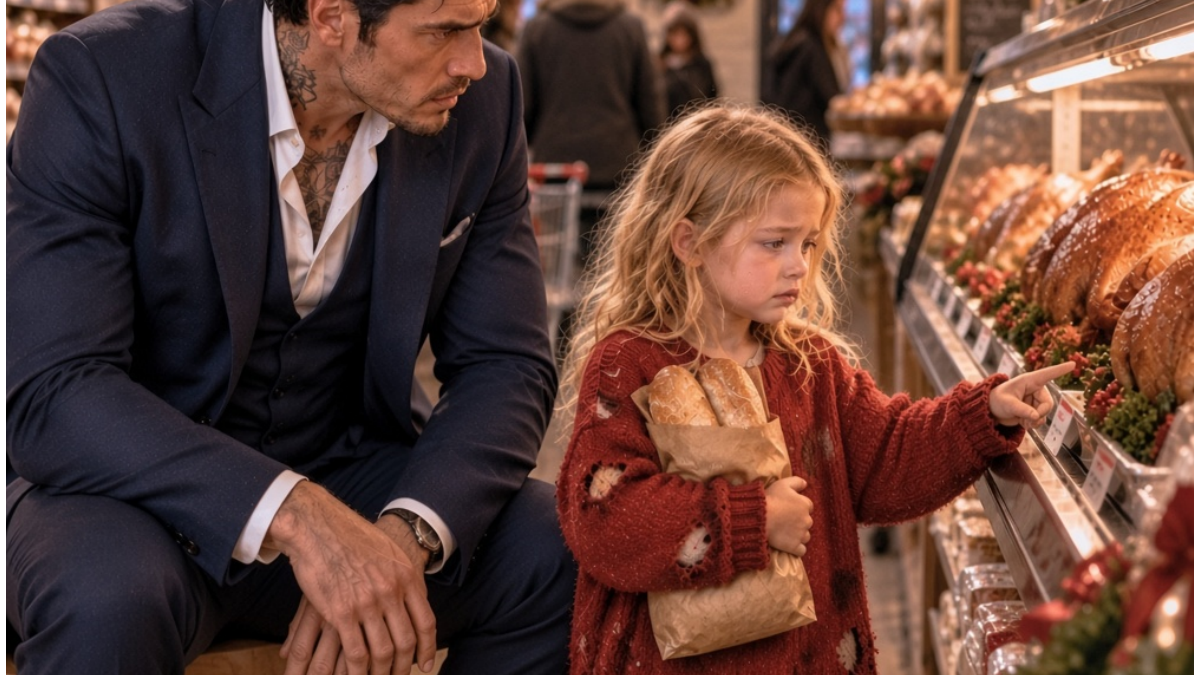
Excuse me, sir. Do you have any turkey nobody wants? Her voice was small, but it did not tremble.
It moved through the fluorescent hum of Bellamy’s corner grocery the way a candle moves through a dark room, quiet and steady, refusing to go out.
The clerk behind the register looked down at her over the edge of his newspaper.
She stood on tiptoe to be seen properly, one mitten hand resting on the counter, the other clutching a small canvas coin purse that had been stitched and restitched at the corners by someone who could not afford to replace it.
Her sweater was two sizes too big and pilledled at the elbows, the kind of gray wool that had passed through more than one child before her.
Her boots were wet at the toes from the slush outside. A single red ribbon had been tied carefully in her hair, the way a mother ties a ribbon when she wants her daughter to feel dressed up on a night that will not otherwise feel special.
On the counter she set out her money, three crumpled dollar bills, a handful of coins she had counted twice on the walk over, and once more at the door before finding the courage to come inside.
She lined the coins up in a small, careful row, tallest to shorteSt. The way a child arranges things, she has been taught to respect.
She was not begging. She was budgeting for a Thanksgiving her mother would not get out of bed for.
I have $487, she said. I know that isn’t a lot, but I thought maybe there was one you couldn’t sell.
One nobody wanted. It doesn’t have to be a big one. [clears throat] My mom can’t chew hard things anymore, so a small one would be okay.
The clerk sighed the tired sigh of a man who had already been on his feet since 5:00 in the morning.
Sweetheart, our turkeys start at $22. Even the smallest one. I could pay a little now and a little next week.
That’s not how it works, honey. He said it kindly. It was still a no.
The little girl nodded the way people nod when disappointment has already worn a groove into them.
She gathered her coins back into her canvas purse, one at a time, taking care not to drop any, because dropped coins on a busy floor were coins you did not always get back.
She tucked the purse into the inside pocket of her sweater close to her ribs, where a thief would have to fight her for it.
“Thank you anyway, sir,” she said. “Happy Thanksgiving,” she turned toward the door. At the far end of the store, in the narrow aisle between the wine rack and the cold case, a man in a long charcoal coat stood with a bottle of bo halfway to his basket.
He had not moved in several seconds. The wine hung in his hand, forgotten. He was tall, broad through the shoulders, 37 years old, with the kind of stillness that people learn only after they have survived something they were not meant to survive.
His name was Lorenzo Duca and in the small mountain town of Maple Ridge on the night before Thanksgiving, he was supposed to be nothing more than a stranger buying a bottle of wine.
Then the child at the register had spoken her mother’s name to the clerk on the way out.
Tell Elena I said happy Thanksgiving. Okay, Elena. Lorenzo’s hand did not tremble. It simply stopped.
A man who had spent six years believing his family had died in a fire had just heard, spoken casually into the fluorescent air of a small town grocery.
A name he had buried with his own hands. Before this story goes any further, tell us where you’re listening from tonight.
And if a stranger has ever changed the course of your life with a single small kindness, leave a candle in the comments.
Someone out there needs to see it burning. Lorenzo set the bottle of Barolo back on the shelf without looking at it.
He crossed the store in six long strides. The soft slap of his leather shoes almost silent on the scuffed lenolium.
The little girl was already at the front mat, tugging her wool hat down over her ears with the seriousness of a child preparing for a long walk in cold weather she had learned not to complain about.
“Wait,” he said. His voice was low, quiet, the way a man speaks when he does not want to startle a bird.
“Please,” she turned up close. Her eyes stopped him a second time. He could not yet name why.
“I’d like to buy you a turkey,” he said. The biggest one they have and whatever else you came in for.
Her small brow furrowed under the wool hat. That’s very kind, sir. But my mom says we don’t take things from people we don’t know.
Your mom is right. He crouched. He did not kneel down to her the way adults sometimes do when they want a child to feel small in a different way.
He crouched with his elbows on his knees, hat off, palms open until his face was level with hers.
The winter light through the storefront window caught the silver already threading his temples at 37.
So, let’s fix that part, he said. My name is Lorenzo. I grew up in a big house in a town called Maple Hollow, 3 hours south of here.
I’m in Maple Ridge tonight because I don’t like being alone on holidays, and this town has good bakeries.
Now, you tell me yours, and we won’t be strangers anymore, she studied him a long moment.
Children can smell performance the way animals smell rain. She did not smell any on him.
Sophie, she said. Sophie Carter. Sophie Carter. He repeated the name gently, the way a man handles something breakable.
And who’s the Elena you said goodbye to? My mom, Elena Carter, not Maretti. Lorenzo felt something inside his chest slip half an inch to the left.
The way a picture on a wall slips after a small earthquake nobody else has felt yet.
Is she sick, Sophie? Sophie nodded. One small nod. All the answers she was willing to give a man she had known for 90 seconds.
She hurt her back a long time ago. Some days she can walk. Some days she can’t.
Today is a can’t day. Then because she was 6 years old and honesty still lived closer to her mouth than caution did, she added.
Mom says I’m not supposed to say the name Duca to strangers. But you’re not really a stranger anymore, right?
You told me yours. The store went very quiet inside Lorenzo’s head. Outside, a delivery truck rumbled past on the wet street.
The fluorescent light above the register flickered once. Somewhere behind him, a freezer clicked on.
He heard none of it. No, he said after a beat that was one heartbeat too long.
Not a stranger anymore, he straightened. He walked to the register without another word. Laid $300 on the counter and told the clerk to fill two paper sacks with everything a small family might need for a real Thanksgiving dinner and to include the largest turkey in the case.
The clerk, sensing something in the man’s stillness that he did not want to test, did not argue.
Lorenzo carried the bags out himself. He set them on the sidewalk where Sophie could reach the handles.
“Can you get these home, Sophie?” “Yes, sir. It’s only four blocks. Then go straight there.
Don’t stop for anything.” She nodded, thanked him twice, and started down the sidewalk with the bags balanced against her small cheSt. The way a person carries something too precious to trust to only one hand.
Lorenzo watched her until she turned the corner. Then he walked to his car, an unmarked black sedan parked half a block down, and followed her at a distance no child would ever notice.
The way a man follows something he is afraid will vanish if he blinks. She led him to a narrow gray house at 47 Cedar Lane.
A single lamp burned in the front window. The paint on the porch railing had peeled back to bare wood in the shape of small hands.
Sophie disappeared inside. A moment later, a woman came to the window to help her with the bags.
Salt and pepper hair pulled back at the nape, one hand on a wooden cane, a face Lorenzo had last seen in a photograph inside a sealed personnel file 6 years ago, next to a date of death he had signed off on himself.
Elena Marquetti was alive. Lorenzo drove the 3 hours back to Maple Hollow with the radio off.
The mountain road unspooled in front of the headlights in long black curves, the snow at the shoulders turning silver where the beams touched it.
He did not remember passing the town limits. He did not remember paying the toll.
At some point, his hands had begun to grip the wheel the way a drowning man grips a rope.
And he had not noticed when. The Duca estate sat behind a rot iron gate at the end of a private drive lined with old Cyprus.
The gate opened for him without a word. It always did. Inside, the house was warm and enormous and quiet.
The chandelier in the front hall threw soft gold light across marble the color of cream.
A recording of Puchini played somewhere in a distant room, the way it always played in the evenings, because his mother had loved opera, and he had never had the heart to turn it off after she was gone.
A single housekeeper crossed the far end of the hall, nodded to him, and disappeared without asking a question.
That was the rhythm of this house. Nobody in it asked what could not be answered.
He walked past his study, past the dining room he never used, and into the library.
He did not turn on the lights. He went to the sideboard by the window and poured two fingers of grapa into a heavy crystal glass and did not drink it.
He set it on the desk and stood at the window looking out at the black shapes of the cypress in the snow and let the memory come the way he always let hard things come straight on without flinching.
Six years ago, a hotel suite in Milan, 3:00 in the morning local time, his phone had rung on the bedside table, and he had answered it in Italian without opening his eyes, because in his family, a phone that rang at 3:00 in the morning was never a wrong number.
It had been Vincent, he remembered the exact cadence of his uncle’s voice. Steady, grieving in the measured, controlled way of a man who had already begun the work of composing himself for the funeral.
Lorenzo, my son, something has happened at the estate. There has been a fire. It is bad.
You must come home. He remembered the smell that had greeted him at the gate 2 days later.
Wet char and something sweeter under it that he had refused to name. He remembered the coroner’s office, the three coffins on the polished floor, all of them closed, all of them sealed at the recommendation of the medical examiner, a soft-spoken man named Jeppe Falco, who had shaken Lorenzo’s hand and said in a tone that discouraged questions that some things were kinder not to look at.
Isabella Bella Duca, his older sister, 31 years old, the only person alive who had ever called him by his childhood nickname.
Sophia, her daughter, two years old, curly dark hair. Bella’s eyes. She had been buried in a coffin the length of a shoe box.
Elena Marchetti, the young housekeeper Bella had hired after the child was born because Bella had refused a nanny with a badge and preferred a woman who could rock a fever down at 3:00 in the morning without needing to be told how.
Three coffins, one family folded down to nothing. He remembered the weight of the first shovel of dirt on the smallest of the three lids.
He remembered the sound. Lorenzo turned from the window. He picked up the crystal glass, walked it across the library, and set it down untouched on the sideboard again.
Then he took his phone from his coat pocket and dialed a number he had not dialed at this hour in almost a year.
Marco Bianke answered on the second ring. Alert the way a good soldier is always alert, whatever the hour.
Boss, Marco, I need you at the house tonight, not tomorrow. A pause. Then without questions, 1 hour.
And Marco, boss, when you come, bring the fire file, the original, the paper copy from the safe under the gun room.
Not the scanned version in the server, and nobody hears you’re pulling it. Not the security team, not the housekeepers.
He waited a beat and made himself say the reSt. Not my uncle. Especially not my uncle.
Do you understand me? The silence on the other end lasted 3 seconds. Marco had been at Lorenzo’s side for 11 years.
He knew what the fire file was. He knew who Vincent Russo was inside this family.
He knew what it meant that both of those sentences had just been placed inside the same order.
I understand you, boss, Marco said quietly. 1 hour the line went dead. Lorenzo stood alone in the dark library with the opera playing faintly two rooms away.
And for the first time in 6 years, he let himself say a name out loud that he had made himself stop saying because saying it had been the only way to keep breathing.
Bella, he said to no one. What did they do to you? Marco arrived in 54 minutes.
He came in through the side door off the kitchen the way he had always come in during the years when Lorenzo’s father was still alive.
Quietly without ceremony, his overcoat still dusted with snow at the shoulders and a plain manila envelope tucked under his left arm.
He was a compact man in his 40s, gray, beginning at the temples, with the flat, unreadable face of someone who had learned early that a face was a thing other men read.
He set the envelope on the library desk without a word, and stepped back, hands folded in front of him.
Lorenzo turned on a single green-shaded banker’s lamp. He opened the file. It was thicker than he remembered.
6 years ago, he had refused to read most of it. Vincent had told him gently that a brother should not have to look at those photographs.
And Lorenzo, 24 hours out from three closed coffins, had let his uncle carry that mercy for him.
He had signed where he was asked to sign. He had trusted the ink to hold the shape of the truth.
Now he turned page after page slowly, the way a man reopens a wound to see whether it has been stitched or only covered.
The identification section came firSt. Elena Marchetti, age 24, at time of death, identified by means of one item recovered near the remains.
A silver oval locket engraved on the reverse with the initials E M chain melted, face intact.
That was all. No dental records, no fingerprints, no photographs of the body. A young woman had been buried under her own name on the evidence of a single piece of jewelry any woman in the world could have been wearing.
Lorenzo turned the page. Isabella Duca, age 31. Sophia Duca, age 2 years, 4 months, both listed under the same notation in the same clipped clinical hand, remains too severely compromised by thermal damage for visual or biometric identification.
Recommend sealed interment. Family notified and concurring. Concurring. He remembered signing that word. He set the file down and pressed the heels of his hands against his eyes for a long moment.
And when he took them away, the room was still there and the file was still there and none of it had gone back to being what he had believed it was 3 hours ago.
He picked up the phone again. Marco, two names for me now, anywhere they are.
Boss, Dr. Jeppi Falco, the medical examiner. Where is he tonight? Marco already had his own phone out.
He worked in silence for a full minute, tapping and scrolling, the tiny screen throwing pale light across his jaw.
Then he looked up. Dr. Falco died 2 years after the fire. Boss, boating accident off the coast at Portoino.
Alone on the boat. No witnesses. Ruled misadventure. Lorenzo did not move. The second name, Chief Aldo Berton, Ridgefield Township.
He signed the incident report. Marco worked another minute. Chief Berton retired 8 months after the fire.
Early pension. Bought a villa on the Amalfi CoaSt. His wife told a neighbor last year that the money came from a family inheritance nobody in the county had ever heard him mention before.
The library was very still. Somewhere down the hall, the opera had ended and had not started over.
The house held its breath around the two of them the way a house holds its breath when a truth long buried begins to shift in its grave.
Lorenzo looked down at the file on the desk. He was beginning for the first time to see the shape of what he was looking at.
Not one lie, not one paidoff doctor. A curtain, patient and careful, sewn stitch by stitch by a hand that had known exactly what it was hiding, and exactly how long it needed the fabric to hold.
Six years. It had held for 6 years. One question sat in the middle of his chest like a stone he could not yet lift.
Who benefited from Bella’s death? He did not say it out loud. Saying it out loud in this house tonight would be the same as answering it, and he was not ready to answer it yet.
“Marco,” he said, closing the file. Go home, sleep 3 hours, then come back.” Marco nodded once.
He did not ask what came after the 3 hours. He already knew. Lorenzo did not sleep.
He stood at the library window until the sky above the cypress went from black to slate to a pale, bruised blue.
And when the housekeeper came through with the coffee tray at 6, he took the cup from her without meeting her eyes and told her to set two places on the terrace instead of one.
She paused. “Sir, my uncle is coming for breakfaSt. He hasn’t called, sir. He will.
The phone rang 11 minutes later. Vincent Russo’s voice on the other end was warm in the way certain fires are warm.
The kind that draw a cold traveler close before he thinks to ask what is burning.
Lorenzo, forgive an old man for the hour. I was passing near your road this morning and thought perhaps you would take pity on me and share a pot of coffee before the day swallows us both.
The terrace is set already. Uncle, come. The line went quiet a half beat longer than it should have.
You always did see me coming, son. Vincent’s car pulled up the drive at 7:20.
He stepped out into the frost the way he stepped into every room he had ever entered.
Unhurried, silver hair combed straight back from a forehead that had never in Lorenzo’s memory carried a visible line of worry.
He was 55 now. He wore a charcoal coat with a burgundy scarf and a pair of soft leather gloves.
And he opened his arms when he saw Lorenzo, the way he had opened them at the top of the school steps, the day Lorenzo’s grandfather had died, and there had been no one else left to explain the world to a boy of 11.
Lorenzo let himself beheld. Vincent smelled the way he had always smelled, bergamont cologne, a trace of pipe tobacco, something under both of them that Lorenzo, for the first time in 26 years, could not quite name.
They sat on the terrace under the heat lamps. The housekeeper brought fresh coffee, warm cornetti, a small silver dish of honey.
Vincent broke a pastry with his fingers the way he always did, slow and precise, and looked up at his nephew.
You look pale, son. Lorenzo kept his hand steady around his cup. I didn’t sleep.
Business. An old file. A shipping matter from the Naples cousins. It came back across my desk yesterday, and I could not put it down until I understood it.
The lie was clean. He had rehearsed it in the dark at 4 in the morning for exactly this moment.
Vincent smiled. He nodded slowly, the way an uncle nods at a nephew he is proud of, and then his gaze did a thing Lorenzo had never noticed it do before, or perhaps had noticed a thousand times and mistaken for affection.
It stayed on Lorenzo’s face one beat longer than a warm gaze stays. One small extra breath of attention, the gaze of a man measuring, not the gaze of a man loving.
Lorenzo felt the extra beat land in his chest like a coin dropped into cold water.
He smiled back. “You worry too much, Uncle. I worry the correct amount,” Vincent said, “for a man who has only one nephew left in the world.
They finished the pot. They spoke of the vineyard in Tuscanyany, of a christening in the spring, of the weather in Sicily.”
Vincent asked in passing whether Lorenzo would be alone for Thanksgiving. Lorenzo said he would eat at the house with the staff the way his father used to.
Vincent nodded, satisfied, and rose. At the top of the drive, he turned back. Son, whatever the file is, if it wearies you, hand it to me.
That is what old uncles are for. I’ll remember, uncle. The car pulled away. Lorenzo stood on the drive until the tail lights vanished between the Cyprus.
Then he walked back inside, past the terrace, past the library, to the phone on the sideboard in his father’s old study, where the walls were thick and the line was clean.
He dialed Marco. Boss. Every account my uncle has ever touched. Every offshore, every shell, every cousin’s business he ever laid a hand on seven years back.
Off the books. I want it all on my desk by Friday. A pause. Are we still keeping this quiet from him, boss?
Lorenzo looked out the study window at the empty drive, especially from him. Thanksgiving morning came gray and low over the mountains.
Lorenzo left the estate at 8, driving himself. No security car behind him. The black sedan carrying two insulated hampers on the back seat instead of the usual leather briefcase.
His personal cook, a widow from Bolognia named Anna, who had fed the Duca house for 22 years and never once asked a question about whom she was feeding, had risen at 4 in the morning to prepare them.
Roast chestnut stuffing, a soft ve broth for someone whose back would not let her sit long at a table, fresh bread wrapped in linen so it would still be warm at the end of a 3-hour drive.
A small tin of the almond biscuits his sister Bella had once loved as a girl.
He had not told Anna why. She had not asked. She had simply pressed the tin into his hands at the kitchen door and said in the plain Bolognese of her childhood, “Portala, a chain habiso, take it to whoever needs it.”
He reached Maple Ridge a little after 11. The town looked different in daylight. The slush of the night before had frozen into a thin gray crust over the sidewalks.
A few houses had already put out small handpainted signs on their porches. The kind that said grateful in crooked cursive.
The kind that made a man like Lorenzo look away because he did not yet know what he was allowed to be grateful for.
47seater lane looked smaller in the morning light than it had at night. The paint on the porch railing was worse than he had let himself see.
One of the front shutters hung by a single hinge. A ceramic pot on the top step held the frozen skeleton of a geranium that someone had tried and failed to keep alive through the first hard frost of November.
He carried the hampers up the walk and set them on the porch. He hesitated with his hand raised to knock.
In his life he had walked into rooms full of armed men without hesitation. He had signed away fortunes with the same steady hand he was raising now, and it had never trembled once.
It was trembling now. He knocked. Small footsteps came running from inside. The door opened as far as the chain would allow, and one dark-lashed brown eye appeared at the gap, blinked once, and lit up in recognition.
“It’s the grocery man,” Sophie called back over her shoulder into the house. “Then to him,” in the grave polite voice she reserved for adults she had decided were worth her manners.
“Good morning, sir.” “Good morning, Sophie.” She closed the door, unhooked the chain, and opened it again the whole way.
She was wearing the same gray sweater as the night before, over pajama pants printed with small yellow ducks.
Her feet were in mismatched socks. Her hair had not yet been brushed. She looked at the two hampers on the porch, then up at him, and her small brow furrowed the way it had furrowed at the register.
Mom said we couldn’t take things from strangers. “I remember, but you’re not a stranger anymore, right?
You told me your name.” “That’s right.” She thought about it for one more careful second.
Then she stepped back and opened the door wider. Mom says a good person shouldn’t be left standing outside in the cold.
Come in, please. [clears throat] I’ll get her. He stepped into the small front room.
It was warmer than he had expected. A kerosene heater ticked in the corner. A crocheted blanket lay folded over the arm of a worn brown couch, a framed drawing and crayon, of a woman and a little girl holding hands under a lopsided sun, hung above the couch in a place of honor a wealthier home would have given to art.
He heard the cane before he saw her. The soft rhythmic tap of wood on old lenolum coming down the short hallway from the back room.
One step, a pause, another step. The careful guarded gate of a woman whose body had learned not to trust itself.
Then Elena Marchetti rounded the corner into the front room and saw him. The cane clattered to the floor.
Her hand went to the doorframe for balance and then an instant later to her daughter’s shoulder.
She pulled Sophie behind her body with a strength Lorenzo would not have believed her back was still capable of.
Her face had gone the color of ash. “Get out,” she said. Her voice was very low and very steady and shaking underneath in a way only he could hear.
“Get out of my house. Get out now.” Sophie looked up at her mother. For the first time in her small life, she was seeing Elena afraid.
Really afraid. Not tired, afraid. Not sick, afraid. Not the quiet worry that had lived behind her mother’s eyes on grocery days.
This was something else. This was the fear of a woman who had spent six years walking softly past a door she had prayed would never open and had just heard the hinges give.
Lorenzo did not move. He set the hampers down slowly on the floor, straightened and lifted his empty hands to shoulder height.
Elena, he said quietly. I am not here to hurt you. I did not know.
Three people stood frozen in the small warm doorway of 47 Cedar Lane. And outside, the first real snow of the season began to fall.
For a long moment, none of them breathed. Then Sophie, still tucked behind her mother’s hip, tugged at Elena’s sweater with the small, stubborn fingers of a child who could feel the room shaking around her and did not understand why.
Mom, he’s the one who bought us the turkey. He’s nice, Mom. Elena did not look away from Lorenzo.
Her hand tightened on her daughter’s shoulder. Sophie, she said. Her voice was calm now in the way an icedover river is calm on top.
Go to your room. Take Mr. Rabbit. Close the door. Put your headphones on and listen to the music tape until I come get you.
But mom Sophie, one word. That was all it took. The child had heard that voice exactly three times in her life.
And each time it had meant something she was not old enough to be told.
She went, her small socked feet padded down the hall. A door clicked shut. Silence.
Elena bent slowly, one hand still braced on the door frame, and picked up her cane from the floor.
Kitchen,” she said. “Not out here. She can hear through the walls.” She led him down the narrow hallway without turning her back to him.
She was not a large woman, and the cane made her slower than she wanted to be.
But Lorenzo understood in the set of her shoulders that if he moved wrongly, if he so much as reached for his coat pocket, this woman would find something in the kitchen drawer and use it on him without an instant of hesitation.
He kept his hands where she could see them. The kitchen was small and clean and smelled faintly of the cinnamon she had put on Sophie’s oatmeal that morning.
A single yellow curtain hung over the window above the sink. On the fridge, held up by a magnet shaped like a strawberry, was another crayon drawing of a woman and a little girl.
Elena set her back against the counter. She did not sit. Neither did he. You are not to go near that child, she said.
Elena, you are not to come back to this house. You are not to send men to this house.
You are not to send lawyers or gifts or letters or your uncle’s condolences or one more grocery bag.
Do you understand me, Lorenzo Duca? If I see one shadow that does not belong on that porch tonight, I take her and I disappear again, and this time nobody in your family will find so much as her sock.
He nodded once slowly. I understand, then go. He did not. He stood on the far side of the small kitchen with his empty hands still open at his sides and looked at the woman he had spent six years believing he had helped bury and asked the only question that mattered.
Elena who set that fire. She did not answer. He waited. The kerosene heater in the front room ticked.
The wall clock over the stove moved one small brass second forward. Silence, he understood then was its own kind of answer.
The kind [clears throat] a woman gave when the truth had a name and speaking it aloud in the wrong room could still 6 years later get her child killed by nightfall.
Something inside his chest cracked open along a seam he had not known was there.
Elena, he said, and this time his voice was not steady. Was it my uncle?
She closed her eyes. Elena Marchetti had not wept, not once in 6 years. She had not wept when she carried a 2-year-old out through a service corridor filling with smoke.
She had not wept at the state line in the back of a stranger’s truck with the child asleep on her cheSt. She had not wept the first time Sophie at three had looked up at her and called her mama and meant it.
She had held all of it, all of it, for 6 years, because tears were a language grief spoke, and grief was a language that carried in the night.
She wept now, not loudly. She was too practiced at silence for that. Her shoulders shook once and then again, and the tears slid down her face in a way that suggested they had been standing behind her eyes for 6 years, waiting for a door to open.
“I have carried this alone since the night your sister died,” she whispered. “I couldn’t be sure who I could tell without getting the child killed.
I still don’t know, Lorenzo. I still don’t know who in your house is his and who is yours.
I only knew that the second I came out of hiding, someone would come for her.
And I would rather have died in that fire with Bella than let that happen.
Lorenzo stood very still in the small, warm kitchen at 47 Cedar Lane, and for the first time in six years, allowed himself to understand that he had buried an empty coffin.
She wiped her face once with the sleeve of her cardigan, straightened her back against the counter, and began to speak.
She spoke the way people speak when they have rehearsed a story only in the dark alone for six winters.
Flat uninflicted as if the flatness were the only thing keeping the shape of it from breaking her in half in front of him.
Your sister found it 2 years before the fire. She said the Naples ports. He was moving Duca cargo under a shell company registered to a cousin nobody remembered.
Skimming a percentage off every container that came through. Small at first, then not small.
Lorenzo said nothing. She was giving him a gift he had not earned. He was not about to interrupt it.
Bella did not go to you with it right away. You were still consolidating the Milan side.
She said you had enough weight on your shoulders. She wanted to be sure. So she watched quietly.
For 2 years she built a folder in a locked drawer in the nursery of all things because she said nobody looks in a room full of stuffed rabbits.
He closed his eyes for a moment. He could see the drawer. He could see the rabbits.
The night of the fire, Elena said I was putting Sophia down at 8. The child had an ear infection.
She would only sleep on her mother’s shoulder. Bella carried her into the library so I could steep some chamomile.
That is when Vincent came in. You heard them. The library door was cracked. I heard everything.
He waited. Bella told him she knew. She named the shell company. She named the cousin.
She named the amount to the nearest 100,000. She was calm about it. Lorenzo. Bella was so calm.
She told him she was going to bring it to you in the morning. She said you would decide what to do with him because in your family that was your right, not hers.
And she said, and I remember the exact words. Vincenzo, whatever he decides, you will accept it.
You have taken from this house long enough. What did he say? He begged her.
Lorenzo opened his eyes. He begged her not to tell you. He said he had made mistakes.
He said he was old and afraid and that he had never been given his father’s name and had spent his life watching your father’s children walk into the rooms he had built for them.
He said if she gave him one week he would put every dollar back. He cried, “Lorenzo, your uncle cried in that library.
I heard it through the door.” And Bella Bella said no. The kitchen was very quiet.
The wall clock ticked. She said, “You will go upstairs, Vincenzo. You will go upstairs and you will sleep.
And in the morning we will speak to my brother together and you will tell him yourself because that is the last piece of dignity I can leave you.”
Then she walked past him with Sophia asleep on her shoulder and she brought the baby to me.
She kissed her forehead. She said, “Elena, put her in the crib in my room tonight.
I want her close.” Those were the last words she ever said to me. Elena’s hands began to shake.
She gripped the edge of the counter to steal them. I woke at 3:00 in the morning to the smell of smoke coming under my door.
I ran down the east corridor to the nursery. Bella was already there. She had heard the smoke before me.
She had gotten to Sophia. She was trying to open the door back into the corridor to bring her out, and the door would not open.
Someone had wedged a chair under the outside handle. I could hear her from the other side, calling to me, calm, still so calm, telling me to run the service stairs to the garden gate and to wait for her there with the baby.
You took Sophia. I took Sophia through the service door on the far wall of the nursery.
He had not thought of that door. It was for laundry. It was for me.
Nobody had ever taken a child through it before. She swallowed. I heard Bella stop calling before I reached the bottom of the stairs.
I heard the ceiling in that wing give way while I was crossing the garden.
Lorenzo braced one hand on the doorframe. There was a man at the gate, old friend of your fathers, from before your father took the seat.
Your father had left instructions with him years ago in case of a night like that one.
He did not ask me questions. He drove us across the state line before sunrise.
He gave me a name in a town and enough money to disappear inside them.
Elena Marchetti had died in a fire. Elena Carter got off a bus in Maple Ridge with a 2-year-old on her hip and a story about a dead husband.
She looked down at her own hands. I did not know who in your house was clean.
I could not risk one wrong letter. I raised her as mine. Lorenzo. I fed her.
I taught her to read. I sat up with her fevers. Sometimes I wish I had been her mother for real.
Sometimes, “God, forgive me.” I let myself pretend I was. Lorenzo did not answer her.
He could not. There was no answer a man could give to a woman who had raised his sister’s child inside a lie for 6 years because the alternative had been a second small coffin.
He looked at Elena Marchetti, standing against the counter with her cane hooked over her hip and her sleeve wet at the wrist from her own tears.
And he understood with a clarity that felt almost physical that this woman had done what he himself had failed to do.
She had stood between Bella’s daughter and the fire. He had signed the paperwork that said the fire had won.
He picked up the two hampers from where he had set them by the door.
He carried them to the small kitchen counter and set them down carefully so as not to knock her cane loose.
“There is food for a week in these,” he said. His voice was rough at the edges, but level.
“Ana made it.” Anna was my mother’s cook before she was mine. She has never asked me a question in 22 years, and she did not ask me one this morning, either.
It is safe. You have my word on my father’s grave that it is safe.
You do not have to eat it, but please do not throw it out where Sophie can see.
Elena did not move. Lock the door behind me, he said. Do not open it for anyone.
Not the mailman, not a neighbor, not a man in a uniform, not a woman with a clipboard, nobody.
If anyone knocks who does not knock the way I am about to knock, you take her and you go out that same service door you used 6 years ago.
Do you understand me? Yes. He walked to the front door. He stopped with his hand on the knob and did not turn around because he did not trust his face just then.
Elena, thank you for my sister’s daughter. There will never be a debt in this world large enough.
I know that. I am going to try to pay it anyway. He knocked once softly on the inside of the door so she would know the sound.
Then he stepped out onto the porch and pulled it closed behind him. He heard the chain slide, then the deadbolt, then a second lock.
He had not noticed on the way in. He walked down the walk to his car with his coat unbuttoned in the falling snow and did not feel the cold.
He got in. He closed the door. He did not start the engine. He sat in the dark of the driver’s seat with both hands on the wheel.
And only then, in the small private box of the car, where no one in the world could see him, did his hands begin to shake.
Not the surface tremor of nerves. A deep structural shaking, the way a building shakes when something in its foundation has finally given way.
He gripped the wheel until his knuckles went white, and he kept gripping it until the shaking passed into something colder and quieter and more useful.
He did not weep. He had wept once for his sister 6 years ago in a room he did not let himself remember.
He would not weep for her a second time. He would do something else now.
He took the phone from his coat pocket. Marco, boss, I want everything my uncle has ever owned.
Not the accounts I already asked for. Everything. Every phone he has ever carried. Every hotel he has ever slept in.
Every priest he has ever confessed to. Every man he has broken bread with in the last 7 years.
I want the name of the barber who cut his hair the week of the fire.
I want to know what he ate for breakfast the morning of that fire. If he took an aspirin, I want the pharmacy.
Understood. And I want a protection detail on 47 Cedar Lane, effective inside 2 hours.
Nobody from our house. Nobody he has ever met. Outside contractors, out of state, paid in cash through the Trenton account, and vetted twice.
Any man on that street tonight who has ever shaken my uncle’s hand does not go on that street tonight.
Are we clear? A long pause on the line. Boss. Marco’s voice was very careful.
Are you telling me you mean to kill your uncle? Lorenzo looked through the windshield at the small gray house with the peeling porch railing and the single lit window at the back where a six-year-old girl was.
Right now, listening to a music tape through her headphones because her mother had told her to.
First, he said quietly. I let him find out the child is alive. Then I decide.
Inside the small back bedroom at 47 Cedar Lane, Sophie had done exactly what she had been told to do.
She had put on her music tape. She had sat on the rug at the foot of her bed with Mr. Rabbit pulled tight against her cheSt. She had counted the yellow ducks on her pajama pants twice and the roses on her wallpaper once, and she had not opened the door until the sound of the front lock sliding home told her the man was gone.
Even then, she waited. She waited until she heard her mother’s cane in the hallway.
The soft, uneven rhythm that had been the sound of safety for as long as Sophie had memories.
Only then did she push open the door. Elena was sitting on the edge of the bed.
Her face was still damp. She had not tried to wipe it clean. She lifted her arms without a word, and Sophie went into them the way small children go into the arms of the one adult in the world they trust, without reservation, all at once, with the whole weight of her small body.
Mr. Rabbit came too. He had a missing button eye and a patched ear, and had been washed so many times that his grrey felt had softened to the color of duSt. He had been sitting in the crib of a 2-year-old the night a house burned down, and he had come out of that house on a housekeeper’s shoulder, and he had been in every bed Sophie had slept in since.
For a long minute, Elena simply held her. Then, very quietly, Sophie asked the question, “Mom, why were you crying?”
Elena rested her chin on the top of the child’s head and looked at the small yellow curtain over the window.
She had rehearsed this conversation in the dark at 3:00 in the morning for 6 years.
Every version she had ever practiced had begun with a lie. She could not find the lie today.
It had gone somewhere she could not reach. Sophie, she said, there is something I need to tell you.
It is a hard thing, but you are brave enough to hear it. Are you ready to be brave for me right now?
Sophie nodded against her collarbone. A long time ago, Elena said, before you were old enough to remember, you had another mother.
Her name was Isabella. She was very kind. She had brown eyes like yours, and she laughed the way you laugh when you don’t mean to.
She was the sister of the man who came to the door today. His name is Lorenzo, and he loved her more than anything in the world.
Sophie went very still against her cheSt. There was a fire, Elena said. A bad fire.
Your first mother did not come out of it. I did, and I carried you out with me, and I have loved you everyday since, exactly the way she would have wanted me to.
The child was quiet a long time. So my real name is Sophia. Both names are real, my love.
Sophia was who your first mother named you. Sophie is who you became when you and I ran away together to keep you safe.
Sophia was loved. Sophie survived. You are both. Sophie thought about this. Six-year-old thoughts move at their own speed.
Elena did not rush her. And that man, Sophie said finally into Elena’s sweater. The one from the store.
He’s my uncle. He is. Is he a good man? Elena closed her eyes. I believe he wants to be.
Sophie sat with that. Then she tilted her face up and looked at Elena with the direct, unblinking seriousness only very small children manage.
The kind of look that will not accept a soft answer to a real question.
Mom, do I still get to have both moms even if she isn’t here? Elena’s throat closed.
You always did, baby, she whispered. You always will. Sophie tucked her head back against her mother’s shoulder.
And Mr. a rabbit between them, and outside the small yellow curtain the first snow of Thanksgiving morning went on falling over Maple Ridge without a sound, 20 mi east of the Duca estate, on a hill above the Payic Reservoir.
The Russo house stood inside its own quiet grove of black walnut trees. Vincent had built it the year Lorenzo turned 16.
A gift, he had said at the time, to the boy who had lost his father too young, a place his nephew could always come to for holidays, for advice for the council of a man who had already walked the road he was about to walk.
Lorenzo had spent every Christmas of his adolescence in the small library on the second floor of that house, sitting across a chessboard from a silver-haired uncle who let him win exactly often enough to keep him coming back.
At 2:00 in the afternoon on Thanksgiving Day, Vincent Russo was in that same library.
Alone, he wore a charcoal cardigan and no shoes. A small fire moved in the great on a low table by his armchair sat a glass of amaro, half-finish, and a black leather notebook that had traveled with him for 40 years and had never been touched by another human hand.
A recording of Mozart low, played from a speaker hidden behind the books. The phone in his cardigan pocket vibrated once.
He did not hurry to answer it. He never hurried. He set his Amaro down first, marked his place in the book on his lap with a slip of red ribbon, and only then drew the phone from his pocket and looked at the screen, an unlisted number.
He had been expecting it since dawn. Yes, the voice on the other end was young, quick, and afraid to be talking at all.
Vincent knew the tone. He cultivated it in the men he owned. A soldier who was not a little afraid was a soldier who would eventually forget why he was useful.
He went out alone yesterday evening, sir. No detail. Personal car. Came back near midnight.
Went out again this morning at 8. Same car. Same. No detail. Cook loaded two hampers into the back seat before he left.
Came back an hour ago. Ate nothing. Locked himself in the study. Vincent’s expression did not change.
Where did he go? Both times, sir. Maple Ridge. Small town in the mountains. 3 hours north.
Same address twice. 47 Cedar Lane. Vincent went very still. Say the number again. 47, sir.
Cedar Lane, Maple Ridge. He was quiet for a beat. Anything else? Marco Bianke pulled a file from the vault the night before laSt. The paper copy of the fire report from the estate.
He took it to the boss personally. The boss has not slept since. “Thank you,” Vincent said in the mild voice of a man being handed a weather forecaSt. “You will hear from me.”
He ended the call. He did not move for a long moment. He sat in the armchair with the phone resting on the leather book on his lap and stared into the small fire and did not blink.
Then slowly he rose. He walked to the tall window that overlooked the walnut grove and the reservoir beyond it, gray and flat under a gray sky.
He drew back one side of the drape with a single finger and stood there framed against the pale light the way he had stood at that same window every Sunday morning of the last 30 years.
Only this time his other hand moved almost of its own accord to his cuff.
He turned the small gold cuff link at his right wrist between his thumb and forefinger.
He had worn a matched pair of them for 41 years. His father had given them to him on his 14th birthday, the day he was told he would never inherit the Duca name because his mother had married the wrong brother.
He had warned them to every christristening, to every funeral, to every business dinner, and to one particular night in a corridor east of a burning nursery 6 years ago when he had lost the left one somewhere in the dark and had never allowed himself in 6 years to ask where.
He turned the surviving cuff link once, twice, three times. Then he lifted the phone again and dialed a number he almost never used.
Rocco, he said quietly when it was answered. There is a woman at 47 Cedar Lane in Maple Ridge.
I want to know who she was before she moved into that house. 6 years back, at least quietly.
No one in the family hears your voice on this. If I find out one of my nephews men so much as sees you park, I will bury you myself.
Do you understand me? Yes, Godfather. Good boy. He ended the call, and he stood at the window a long time, turning the one gold cuff link at his wriSt. By 4:00 in the afternoon, the snow had thickened into something soft and steady, and Lorenzo had made three phone calls that changed the shape of the night.
The first was to Elena. He knocked twice, softly, then once more, exactly as he had promised he would.
And when she cracked the door with the chain still on, he said only, “Pack for three nights.
Warm clothes.” Her rabbit, nothing that has your handwriting on it. I have somewhere safer than this.
The second was to a small brown shingled cottage on the northshore of Lake Sarna, a place his mother had gone to grieve in the year after his father died and he had never sold.
The woman who kept it for him was named Rosa Iovine. She had been his mother’s dearest friend for 40 years, a widow of a fisherman entirely outside the family’s world.
She had never once in her life met Vincent Russo. She said only, “Bring them, Lorenzo.
The bed in the yellow room is aired. There is soup on the stove already.”
The third was to Anna. Everything you cooked this morning. Pack it again. Send Pierro.
He drives to the lake, not to Cedar Lane. He hands the boxes to Rosa at the kitchen door, and he does not go inside.
Tell Pierro to check his mirrors twice on every mile of the drive. At 6, they left Maple Ridge in a plain gray SUV Marco had rented that morning under the name of a landscaping company that did not exiSt. Sophie sat in the back with Mr. a rabbit on her lap and her nose pressed against the cold glass, watching the snow slant past the street lamps.
Elena sat beside her with the cane across her knees. Lorenzo drove. He watched the mirrors the way Piro had been told to watch his.
They reached the lakehouse at 9. Rosa met them at the door with a kerosene lamp in one hand and Anna’s warm bread in the other.
She kissed Elena on both cheeks without asking who Elena was. Took one long look at Sophie and said in the plain Neapolitan of her girlhood.
Chokida Duca what Duca eyes and then she caught herself and turned to fuss with the bread as if she had said nothing.
Elena looked at Lorenzo across the small hall. He shook his head very slightly. Rosa had recognized nothing.
Rosa had recognized everything. Rosa would say no more. They sat down to eat at 10:00.
The dining room was small and wood panled and smelled of pine sap and butter.
A single tall candle burned in the center of the table. The turkey Anna had roasted that morning, had been kept warm in its own juices, and Pierro had carried it in still in the earthnware dish, and Rosa had set it down between them with the ceremony of a woman who had waited a long time to lay food in front of a child again.
Sophie’s eyes went wide. I have never, she said, in a whisper of pure six-year-old awe, seen a turkey this big in my whole life.
Elena laughed. It was a small sound, barely a breath, but it was the first laugh that had come out of her in Lorenzo’s presence, and possibly the first that had come out of her in years, and it changed her whole face for one instant into the face of the young woman he remembered from the kitchen at the estate before the world went wrong.
It was the smile of a woman who had, without meaning to, set one small corner of a six-year weight down on the floor beside her chair.
Rosa served. Sophie ate like a child who had learned early to eat quickly in case the plate went away.
Nobody at the table hurried her. Nobody corrected her manners. Lorenzo watched his sister’s daughter across the candle and did not trust himself to lift his own fork for a long moment because Bella had eaten with exactly that small tilt of the head, exactly that furrow of concentration.
And the eyes were unmistakable. He had seen those eyes across a thousand dinners of his childhood.
He had watched them close for the last time in a photograph taped inside a coroner’s file.
After Sophie had been carried up to the yellow room and tucked in with Mr. Rabbit and a nightlight shaped like a moon, Elena came back down and stood in the dining room doorway.
Rosa had gone to her own bed. The candle had burned to half. Lorenzo, yes, he will find us.
He always finds people. It is what he is. He found me once when I was 20 and lost in a train station in Rome, and he had not even been looking.
He will find this house. Lorenzo folded his napkin, set it beside his plate, and looked up at her across the small, quiet room.
This time, he said, I am going to be waiting for him. Lorenzo drove back to the estate before dawn.
He wanted to be in his own kitchen, in his own study, in the clothes his household staff expected to see him in before the sun rose on the first full day after Thanksgiving.
A man who has just decided to hunt his own uncle cannot afford to look like a man who has been away all night.
He shaved. He put on a fresh charcoal shirt. He walked into the breakfast room at 7 with a folder of quarterly figures under his arm, exactly the way he did on any ordinary Friday morning, and told the housekeeper he would take his coffee at the terrace table alone.
The car pulled up the drive at 8:40. He heard it before the housekeeper came to announce it.
He had been listening for it. Vincent stepped out of the passenger side unhurried in a camel coat and dove gray gloves and paused for a moment at the top of the drive with his face turned up to the winter sky.
He inhaled once deeply the way a man performs contentment for a witness he cannot see.
Then he came up the steps. Son, uncle, you are becoming a regular gueSt. An old man’s privilege.
May I sit? Ana has already set for two. They settled at the terrace table under the heat lamps.
Vincent poured his own coffee, added a single sugar with the slow deliberateness that had always been his private ceremony, and stirred it three times counterclockwise.
The weather, he said, has been a mercy this week. My knees expected worse from November.
You told me once that a mild autumn was always the sign of a hard January.
Did I? Then I am contradicting myself in my old age. Forgive me, he sipped.
He set the cup down. He looked out over the frost white lawn as if he had come here for nothing more than the view.
For a full minute, he said nothing at all. Lorenzo did not feel the silence.
He had learned that trick from the man across the table from him 30 years ago in the library of a house on a hill above the Payic reservoir.
Son, Vincent said at last, and the warmth in his voice had softened into something that pretended to be worry.
There is a foolish rumor traveling in the family this morning. I would not repeat it to you except that I would rather you hear it from me than from a stranger at a wedding.
A rumor. They are saying you have taken an interest in a woman in a small mountain town, Maple Ridge.
I am told, some address on a Cedar Street, a widow with a child. People are asking me, Lorenzo.
They are asking whether the boss is being blackmailed, whether a woman has surfaced with a story, an impersonator perhaps, a grifter with a clever angle on a lonely man.
Lorenzo lifted his cup. He kept his voice absolutely level. Since when? He said, “Does my uncle concern himself with who I visit?”
Vincent smiled. The warm, patient smile of a man who had been waiting to be asked exactly that question.
“Because you are the only family I have left in this world, son.” The sentence hung over the small table in the cold morning air.
“The only family I have left in this world.” Lorenzo tasted the sentence the way a man tastes wine he suspects has been cked.
On the surface, it was the same sentence Vincent had said to him at his father’s graveside.
At his sister’s funeral, on the terrace of a hotel in Polarmo the summer he turned 19.
Underneath it this morning, it had gone sour. It was a sentence whose meaning depended entirely on which family the speaker had helped remove.
He set his cup down without letting it clatter against the saucer. Then you can put the rumor to rest, uncle.
There is no woman. There is a supplier’s widow in Maple Ridge whose husband did quiet work for us for 11 years.
He died of a heart attack in AuguSt. I owed the man a personal call and a proper Thanksgiving basket for the wife and the child.
That is all. If someone in the family is passing this around as something else, tell me his name and I will speak to him myself.
Vincent looked at him, looked at him the way he had looked at him across the chessboard when Lorenzo was 15 and had just tried a move that was not entirely truthful.
Then he smiled and reached across the table and laid one gloved hand briefly over his nephew’s wriSt. Good boy, he said gently.
I will put it to reSt. He rose. He kissed Lorenzo once on the top of the head, the way he had done when Lorenzo was small, and he left the terrace with his coffee unfinished behind him.
Lorenzo did not move until the car had cleared the gate. Then he took the phone from his pocket.
Marco, boss, he knows. He does not know that I know he knows. Move them tonight, not the lake, somewhere he has never heard of.
And bring me Rosa Mendoza’s last address by dinner. At 2:17 in the morning, 47 Cedar Lane was quiet.
The kerosene heater in the front room ticked on its low setting. The kitchen light had been left on above the stove, the way a mother leaves a light on when a child is afraid of the dark.
A folded newspaper sat on the small table by the door, open to yesterday’s grocery flyer.
Sophie’s small green boots stood by the mat. Elena’s cane leaned against the wall beside them.
None of it was true. The boots had been chosen from a bag of donated clothes at the church three towns over.
The cane had been bought that afternoon at a pharmacy in a different county. The paper had been folded to that page by a large man in a black jacket, sitting in the dark on the couch behind it, motionless, breathing the slow, shallow breath of a soldier who had been waiting 6 hours to be moved againSt. There were four of Marco’s outside men in the house.
Two more sat in a plumbing van across the street. Elena and Sophie had been 300 m away since sunset under Marco’s own driver in a farmhouse on the far side of the mountains that Vincent Russo had not, so far as any of them could confirm, ever known existed.
At 219, a shadow slid past the front hedge. Then a second, then a third.
They came around the north side of the house, the side where a cracked latch on a laundry window had been left unrepaired that afternoon, in exactly the way an experienced burglar would notice, and an ordinary widow would not.
The first man went through it in silence. He landed on the lenolium of a small back utility room without a sound.
The second followed. The third stayed outside with a length of black nylon rope and a folded canvas bag large enough for a six-year-old.
The two men inside moved down the short hallway toward the child’s room. They had the training of soldiers who had done this kind of thing before in other houses for other men.
They did not speak. Their pistols were fitted with suppressors. Their boots had been wrapped in cloth.
The door to Sophie’s bedroom was pushed open the way a professional pushes a door open.
With the flat of one gloved hand, weapon leveled at chest height for an adult, ready to lower it for a child.
The bed was empty. The man in front understood exactly one heartbeat before it was too late.
The overhead light came on. Marco Bianke stood in the far corner of the small pink bedroom with a shotgun trained on the two men in the doorway, and the soft, steady expression of a man who had been standing in that corner for 2 hours and 40 minutes, and had used the time to make his peace with what came next.
Two more of his men stood behind the door. A third had already dropped from the porch roof onto the shoulders of the third man outside, and the sound of the man outside hitting the frozen grass with all the air driven out of his lungs was the only noise the operation ever made.
Guns on the floor, Marco said quietly. Hands on the wall. Slow. The first man made the professional’s mistake.
He tried to raise his pistol. Marco did not shoot him. He shot the doorframe an inch from the man’s ear, and the man went to his knees on the pink rug with his hands over his head before the second echo had died.
They took two of them alive. The third had broken his ankle in the fall from the roof and would not be walking anywhere for a long time either.
By 4 in the morning, Marco was in the back room of a garage he owned outside Trenton, and one of the two live intruders had been persuaded without a mark on his face that the boss he had signed with 3 days earlier was not going to be paying his medical bills.
He gave up a name almost sadly, the way a man gives up a name he has already known would be given up.
Rocco Roco Salvi. He fronted the money. 50 for the woman, 20 for the child, 20 more if we came out clean.
Marco called Lorenzo at 4:11. Lorenzo was already awake in the dark of his father’s old study, waiting for exactly this call.
Roco Salvi, Marco said, “Vincent’s man. He hired them yesterday afternoon, 2 hours after your uncle left your terrace.”
Lorenzo looked out the study window at the empty drive. He now had, sitting in a garage in Trenton, three living witnesses to a present-day attempted kidnapping and murder of a child.
It was in the language of any court his family recognized evidence enough to have Roco Salvi killed inside a day and Vincent Russo asked serious questions inside a week.
It was not, however, evidence of a fire 6 years ago. For that, he would need something else.
Marco, where does Rosa Mendoza live now? A village called Valdra, up in the pass, 2 hours by Mountain Road.
If the snow lets you, good, Lorenzo said. I drive at dawn. The name had come from Elena 2 days earlier in the kitchen at 47 Cedar Lane.
After she had wept, and before Lorenzo had walked out to his car, she had lifted her head from her hands very suddenly.
There was another woman in the house that night, she had said, “Rosa Mendoza.” She kept the linens on the east wing.
She was near 60 then. She retired the month after the fire. She went home to a mountain village she used to talk about when she braided my hair on Sunday afternoons.
She never wrote to anyone. She was a woman who knew how to close a door behind herself.
Rosa, Elena had whispered. Rosa saw something that night. I don’t know what, but I know the look of a woman who has seen too much and gone home to bury it in a mountain.
Now, at 7:00 in the morning on the day after the raid on Cedar Lane, Lorenzo drove that mountain road alone.
He had left the estate before first light in an old dark green pickup. Marco kept under a canvas tarp behind the garage for jobs the family cars were too visible for.
He wore a plain wool coat over a plain wool sweater. No driver, no security car behind him.
He had [clears throat] told Marco when Marco tried to argue that the woman he was going to see would only speak to a man who had come alone on his own two feet without an escort at the door.
He had said if she sees three cars pull up her lane, she goes back inside her house and she is dead to me.
And so is Bella. Vald Dumbra sat at the end of a switchback road above a frozen river.
Rosa Mendoza’s house was the last one on the lane. Whitewashed stone, a steep tile roof heavy with old snow, a chimney threading a thin blue line of woodm smoke into a colder sky, a tabby cat sat on the front step.
Unbothered by the truck, Lorenzo walked up the path with his hands empty at his sides, he knocked.
The door opened onto a small woman with white hair pulled back under a black kurchchief, a wool shaw around her shoulders, and eyes that had once been fierce and were now only cautious.
She was 72 years old. She had opened the door on the first knock the way people open doors in villages where knocks are rare and always mean something.
She looked at him. She looked at him for a long moment and her face did what the faces of old servants do when they see a man’s father in a man’s jaw and cannot pretend they did not.
Signed Duca. Rosa, you have driven a long way for someone who was not invited.
I have. May I come in? She hesitated. Then she stepped back. The kitchen smelled of wood smoke and stewed onions and the faint sweetness of a loaf cooling on a board.
She did not offer him coffee. She sat down across from him at a small pine table, hands folded and waited.
Rosa, I need to ask you about the night of the fire. Her hands went into her lap.
I do not speak of that night. Sign, I know. I made a promise to myself when I came home to this village.
I would not speak of that house again. I have kept that promise for 6 years.
I would like to keep it until I die. I know that, too. He reached inside his coat.
He drew out one small folded photograph and set it on the pine table between them and turned it so that it faced her.
It was a picture Elena had given him the day before he drove out. A snapshot from a school photograph day the previous September.
A little girl in a slightly crooked collar with a red ribbon in her dark hair, smiling with two of her front teeth missing in front of a blue paper background.
Rosa looked at the picture. She did not move for a long time. Then her lips began to shake.
“Sophia,” she whispered. She did not look up. “This is Bella’s Sophia. She is alive, Rosa.
She is 6 years old. Elena Marchetti carried her out through the service door in the nursery, and she has raised her under another name in a small town in the mountains for 6 years.
My uncle believes she is dead. Two nights ago, my uncle sent three men to take her out of the only house she has ever known.
We stopped them. He will send more. Rosa, I need you to help me stop him.”
The old woman lifted the photograph in both hands. Her hands shook so badly that the paper trembled.
She began to weep very quietly without covering her face. I told God, she said, if I lived long enough to see the day someone came to this door and told me that child had lived, I would give up what I have carried.
I did not think that day would come, Senor. I did not think I would live long enough.
She rose. She crossed to the small hutch by the fire and lifted down a battered tin.
It had once held English tea. She had scrubbed the tea leaves out of it in the summer of the fire, and she had not opened it in 6 years.
She brought it back to the table and set it in front of him with the tremor of her hands.
She opened the lid. Inside, wrapped in a scrap of yellowed linen, lay a single small object, gold, round, the size of a large P, a raised design of a knot on the face, and on the reverse, four tiny initials engraved in the metal.
V R I found it in the east corridor. Rosa said. Her voice was very steady now, in the way voices go steady when they have finally been permitted to speak.
On the stone floor, 3 m from the nursery door. 6 minutes before the smoke came up the stairs, I saw him come out of that corridor.
Signore, I stepped back into the linen closet because I did not want him to see me.
He did not know I was there. He walked past me and he went down the back stairs and he went out to his car and he drove away.
And then the smoke came. She pushed the tin across the table. Take it, Signore.
I want to die with a clean conscience. Take it and use it. And let an old woman finally sleep.
Lorenzo drove down out of the mountains with the tin box on the passenger seat beside him and did not look at it once for 140 km.
He did not need to. He could feel it there, small and cold and heavier than it should have been.
The weight of six buried years condensed into a single gold knot the size of a pee.
A man does not glance at a thing like that. A man drives. By dusk, he was back at the estate.
By 9, he had made four phone calls. The first was to the eight surviving members of the Duca family council.
In the polite, unhurried voice of a boss consolidating the calendar. Uncles, I am calling a winter strategy meeting at the estate.
Thursday morning, 11. We will discuss the Naples ports, the new distribution corridor through Trieste, and the succession structure of the northern cousins.
Bring your own council. Bring nothing else. Lunch will be served. Every man he called said yes without a question.
A winter strategy meeting was an old and dull tradition. Nobody in the family had ever suspected a winter strategy meeting of anything more sinister than a slow afternoon and too much ve.
The second call was to Vincent. He made it laSt. He made it warm. Uncle, I have taken your counsel from Thanksgiving to heart.
I am tired. I have been carrying files that should have been shared long ago.
Thursday I am pulling the council together for the winter strategy and I would like you at my right hand the way my father would have wanted.
Will you come, son? Vincent said in the pleased voice of a man being handed his own chair.
Of course I will come. The third call was to Marco. Everything by Wednesday night.
The seven-year forensic on his accounts. Every wire, every shell, every cousin’s name he laundered through bound in a black folder.
My father’s crest on the cover. I want it on the sideboard in the council room before he walks in.
I want him to see it as he sits down and I want him not to know what it is.
Boss Rosa in the small drawing room off the east side with tea, a fire, and one of your own men at the door.
She is to speak only when I call her in, not a second before. Boss and the cufflink in a velvet box on the table under my hand.
Nobody sees it until I open the lid. The fourth call was to a prieSt. Father Ambroio was 78 years old.
He had been the parish priest of a hillside village called San Colano for 41 years.
And long before that, he had been the closest friend of Lorenzo’s father from a boyhood the two of them had shared in a Sicilian fishing village neither of them had ever afterwards agreed to describe.
He had baptized Lorenzo. He had buried Lorenzo’s father. He had buried three closed coffins six years ago and had held Lorenzo by both shoulders on the church steps aft fathers and said in the plain old country tone of a man giving an order, “Son, do not become like your uncle over this.
Grieve and let it teach you tenderness.” Lorenzo had failed that instruction for 6 years.
He was, he thought as he dialed, about to try to earn it back. Father Lorenzo, I need a walled room, a locked door, and a man of God I would trust with my own throat.
I have a woman and a child who have been hunted for 6 years without knowing they were being hunted, and now they know.
Father Ambrojo was silent for a long moment. Bring them tonight, he said. The convent behind the church has 14 empty cells.
The gate is oak, the lock is iron, and the sisters have been keeping secrets since before your grandfather was born.
Thank you, Father. Do not thank me. Bring them. At 11 that night, Elena and Sophie were moved a second time, a quiet transfer under a cold, clear moon into a convent courtyard, where a very old priest with a face like a walnut met them at the gate and led them without a word, to a small, warm room with two narrow beds and a single crucifix on the wall.
Sophie fell asleep between the sheets within minutes, Mr. Rabbit under one arm. Elena sat by the small barred window a long time before she followed her.
20 mi east of the Duca estate, in a library above the Payic reservoir, Vincent Russo could not sleep.
He had accepted the invitation to Thursday’s meeting three hours earlier, in a voice that had not, he was certain, betrayed him.
He had eaten his supper. He had drunk a glass of amaro. He had sat down with his black leather notebook and had not been able to open it.
Something was wrong. He could not name what. Vincent Russo had spent a long life training himself to notice the small wrongness of a room before anyone else did.
And tonight the wrongness was inside the invitation itself. His nephew had never in his life used the phrase, “My right hand.”
His nephew’s voice on the phone had been too warm by half a degree. He rose from his armchair.
He walked to the window. He turned the surviving gold cuff link at his wrist once, twice, three times.
Then he lifted his phone and dialed. Rocco Godfather have six men ready for Thursday morning.
Armed, sober, cars fueled, on the road within 30 minutes of my call. No more.
If you do not hear from me by noon, you assume the call is not coming, and you act on the last standing order I gave you about the woman and the child.”
He ended the call. He stood at the window a long time, turning the one gold cuff link at his wrist, and outside the walnut grove, the first true winter wind of the season began to move through the black branches.
The council room at the Duca estate had been built by Lorenzo’s grandfather for exactly this kind of morning.
A long walnut table, black with age, ran the length of it, eight highback chairs on each side, a ninth at the head.
The wall behind the head chair carried the family crest carved into oak the year the old man had come off the boat.
The tall windows looked out onto the frozen garden. Two logs burned in the great stone fireplace at the far end.
On the sideboard beneath the crest, a black leather folder had been laid out, cover blank, edges squared with the precision of a soldier who had learned to set a table under a captain who counted spoons.
At 11:00 exactly, the members of the council entered. Eight men, uncles and cousins of the wider blood.
The youngest was 51. The oldest was Donzere Marchetti, 92, the last man alive who had known Lorenzo’s grandfather as a boy in Sicily.
Brought each year to these meetings in a wheelchair pushed by his own grandson, said to be half deaf and entirely awake.
Vincent walked in ninth in a dark suit and a burgundy tie, the surviving cufflink catching the light at his right wriSt. He took the chair at Lorenzo’s right hand as invited.
He did not glance at the black folder on the sideboard. Lorenzo remained standing. Uncles, cousins, thank you for coming on short notice.
Before we speak of Trieste or of Naples, there is a family matter I owe this table.
It concerns the fire 6 years ago at this estate. The room went still in the particular way old men’s rooms go still.
Vincent’s expression did not change. He folded his hands on the walnut in front of him.
Lorenzo lifted the black folder from the sideboard. He laid it unopened in the center of the table.
Every man at this table was told 6 years ago that my sister and my niece died in an accidental fire and that the housekeeper who died with them was collateral.
I signed papers to that effect. I buried three coffins on that belief. He opened the folder.
He turned it. He slid it page by page down the length of the table to Don Cesar Marchetti at the far end.
What you are looking at is 7 years of my uncle’s private accounts. Not the ones he reports to this table, the ones he does not.
Naples ports, cousin shells, three offshore trusts in Malta. A little over 11 million taken from this family.
Between the year my father died and the year my sister did. A soft murmur passed along the table.
Don Shaes Marchetti at 92 lifted the top page in one liver spotted hand. He read.
He turned it. He read the second. And then slowly, without looking up, the old man began to nod.
Three nods, small, certain. The nods of a man who had suspected a thing for 20 years and had never been given a page he could put his finger on.
Vincent said in a voice of gentle bewilderment, “Son, what is this?” Lorenzo did not answer him yet.
He raised one hand toward the door of the small drawing room off the east wall.
Marco opened it. Rosa Mendoza stepped into the council room in her black kurchchief and her wool shaw and her cracked leather shoes.
She did not look at Vincent. She looked at Lorenzo. Lorenzo nodded once. She began to speak in the plain Neapolitan of her girlhood and she told the table exactly what she had told Lorenzo at her Pine Kitchen table 3 days earlier.
The east corridor. 6 minutes before the smoke, a silver-haired man walking out of that corridor and passed her linen closet without seeing her.
The back stairs, the car, the room did not move. Lorenzo lifted a small black velvet box from beneath the head of the table.
He set it on the walnut in front of him. He opened it. Inside, on white satin lay one small gold cufflink, round a raised knot on the face, four tiny letters on the reverse.
V R Vincent Russo for one single unguarded instant glanced down at his own right wriSt. Every man at the table saw him do it.
Then his face changed. He rose. He rose the way a man rises when a strategy has moved beneath his feet.
And he is choosing in one heartbeat a different one. This is a performance, he said.
His voice was warm still, warm and injured and confused. And to a man who had not been watching his wrist a moment before, it would have been perfectly convincing.
This is a mummer’s play. This woman is a servant who has been bought. Any old locksmith could stamp two letters into a scrap of gold.
And the girl in the mountain town is a common impersonator using the pain of this family to extort a lonely nephew of mine who has never learned to close his heart properly.
Lorenzo, son, listen to me. Listen to me, uncle. Lorenzo said quietly. The child has Bella’s eyes.
You will not look at her because you know it. You have not been able to look at me for two days for the same reason.
Vincent stopped. The silence that followed lasted only a second, but it was the silence of the room going over to the other side of the table, and every man there, including Vincent, heard it happen.
Then, three chairs down on the left, a cousin named Enzo Russo. Vincent’s own second line nephew, moved his hand under his jacket.
Marco was already moving. The pistol did not clear the jacket. Marco’s forearm struck Enzo’s wrist against the edge of the table.
The weapon skidded across the walnut, and two more of Marco’s men were through the side door before the second echo of the blow had died.
Chairs went back. Old men rose. Voices rose in three languages at once. In the confusion of 6 seconds, Vincent Russo did the only thing left for a man of his intelligence to do.
He was gone through the servants’s door behind the sideboard, down the narrow stone stairs into the wine celler before Lorenzo had finished crossing the room.
Vincent came up out of the cellar into the kitchen garden through the old delivery door his brother had used 40 years earlier before the estate had a proper drive.
Two of his own men had been waiting for him on the far side of the service wall since a quarter 10.
They had not come inside. A driver he trusted more than any man alive had the engine idling in an unmarked sedan at the edge of the cypress lane.
Vincent did not look back at the house. He climbed into the passenger seat and said one word to the driver.
Son Colombano. The driver did not ask how his boss had known. Vincent had known because he owned a soft young man in Marco Biankey’s team who had three hours earlier in a locked stall in a service station on the Triest Highway told a very quiet voice on a burner phone the location of a certain convent behind a certain hillside church.
The soft young man had not lived long enough to hear the meeting begin. His body would be found 2 weeks later in a canal near Bolognia, but he had bought Vincent Russo a 15-minute head start, and 15 minutes on a mountain road was a great deal of time.
The car climbed, 28 km of switchbacks in dry snow. The driver did not speak.
Vincent turned the surviving gold cuff link at his right wrist for the last time, and slid a small nickel-plated pistol from his coat pocket into his palm.
At 2:00 in the afternoon on the day of the winter strategy meeting, the convent of San Colano stood white and quiet against the pale sky.
Inside its walls, Sophie was in the courtyard feeding stale bread to a pair of pigeons.
Elena had knelt down in the small stone chapel a few minutes earlier, cane across her knees, and had begun the only prayer she still remembered by heart from her mother’s kitchen 30 years ago.
Father Ambroio was in the sacry sorting linens. A single elderly nun sat at the front gate with a knitting basket in her lap.
And under the yarn, a small revolver Father Ambroio had never officially seen her carry.
The gate bell rang once. The nun looked up. A silver-haired man in a dark coat stood in the archway with a warm familiar smile on his face, and one gloved hand raised in a small, friendly wave.
She had never seen him before. She smiled back the way old nuns smile at strangers, and rose to unbolt the small iron door.
She was on the ground before she understood she had been struck. Vincent stepped over her without pausing and crossed the courtyard toward the chapel with the pistol held low against the fold of his coat.
Sophie, 30 ft away in the far arcade with her small hands full of breadcrusts, saw a man she did not know come through the gate.
She did what she had been told to do a hundred times over 6 years by a mother who had trained her to disappear at the first sight of a stranger inside a wall.
She dropped the bread. She turned. She ran for the chapel door. Elena heard the small feet on the stone.
She was on her knees at the second pew when Sophie came through the doorway in a rush of cold air, and she was already turning when Vincent stepped in behind her.
He closed the chapel door. He raised the pistol. “You should have stayed dead, Elena,” he said.
The words fell across the small nave in the mild, reasonable tone of a man closing a ledger.
“Elena did not scream. She did not beg. She had rehearsed this moment for 6 years in every configuration she could imagine, and the woman who rose from the kneeler had already rehearsed the answer.
She reached back with one hand without turning her eyes from him, caught Sophie by the shoulder, and shoved her heart into the shadow behind the plaster statue of St. Rita.
“Stay there,” she said. “Do not come out. Do not speak.” Sophie went to her knees behind the statue.
She did not cry. She looked up between the folds of plaster robes, and she saw the silver-haired man from across the small chapel, and she remembered her mother’s voice from a hundred bedtime stories that had never sounded like bedtime stories.
There is a bad man in the world, my love. If you ever see him, do not run.
Do not beg. Stand still. Look at him so he knows he did not scare you.
Sophie stood up. She stepped out from behind the statue. She was 6 years old and she was shaking so hard that the red ribbon in her hair trembled and she looked straight across the small chapel at Vincent Russo and she said the sentence her mother had taught her to say to any bad man who ever came to her door.
You are a bad man. My mommy told me you were a bad man. Vincent Russo for the first time in 6 years met the eyes of his sister’s daughter.
The pistol wavered half an inch in his hand. The main door of the chapel slammed open.
Lorenzo came through it with his coat open and his own weapon drawn. Vincent, in one clean, practiced movement, turned and brought the pistol up toward his nephew’s cheSt. A single shot rang out from the small bell loft over the chapel doors.
Marco Bianke had been up there since 11:20 in the morning. Vincent’s right shoulder rocked backward.
The nickel-plated pistol clattered onto the stone floor and skidded under the second pew. Vincent went to one knee, hand at his shoulder, breath coming fast now, silver hair falling forward across his forehead for the first time in living memory.
Lorenzo crossed the nave in five strides. He did not shoot. He picked his uncle up from the flagstones by the collar of his coat with one hand, held him there, steady at eye level, and did not say a word.
Vincent Russo was brought down from the mountain that same night in the back of the plain gray SUV, hands bound in front of him with a length of soft leather cord, his shoulder cleaned and bandaged by a family doctor who did not ask questions and would not remember by morning that he had been called.
He was not taken to a hospital. He was taken to the council room at the Duca estate.
The eight men who had risen from that walnut table at noon returned to it at 11 at night in the same chairs, in the same order, in fresh shirts.
The black folder was still on the sideboard. The velvet box with the single gold cuff link was still open on the walnut in front of Lorenzo’s chair.
Rosa Mendoza had been taken back to her mountain village at dusk by Father Ambroio himself with a promise she would never again be asked to speak.
There was no defense council. There was no lawyer of any kind in the room.
There was at the head of the table Don Chesar Marchetti at 92 years old, wheeled up from the end to preside the way his own grandfather had once presided in a stone cellar in Sicily before there was a republic in Italy, in this house, in this world.
That old man in that chair was every court a Russo would ever face. The trial lasted 41 minutes.
The financial pages were read aloud in Donasari’s cracked voice, one by one, and each page acknowledged by the council with a single nod of the head.
Rose’s statement was read from a transcript. The cuff link was passed from hand to hand around the walnut, and each man held it for one moment before setting it down.
Marco produced the confession Roco Salvi had signed at 4 that afternoon in the Trenton garage.
It was read aloud. Vincent did not speak. He had not spoken since Lorenzo had lifted him off the flagstones of the chapel.
At 11:41, Don Chzer Marchetti lifted his liver spotted hand from the walnut. “Vincenzo Russo,” the old man said.
His voice did not rise by the blood of this table and by the memory of Isabella Duca and her daughter.
You are stripped of your name in this family of every property, business, and account that has flowed to you through the Duca vein and of the surname Russo in so far as this table can withdraw it from you.
From this hour forward, you are known only by the name your mother gave you at the font.
And no man at this table, and no son of any man at this table, will speak that name aloud.
You are given to reflection. He lowered his hand. Every man at the walnut nodded once in unison.
Reflection in the old language of this family was a word with only one meaning, and everyone in the room understood it.
Vincent Russo was taken out through the side door under the quiet escort of two of Marco’s men, and he was not seen again in any city the Duca family had ever done business in.
The room stood. The room bowed to Don Chesar Marchetti. Donzar Marqueti bowed to Lorenzo.
By dawn the next morning, Lorenzo was in his father’s old study with a fresh pot of coffee, a fresh sheet of paper, and Marco standing at the door.
He signed three documents that day. The first established in the state’s own registry, a charitable foundation named the Isabella Duca Fund.
It stated mission was the education, medical care, and safe housing of the children of any employee, past or present, of a Duca owned business, and of any woman who had ever kept a Duca house.
Its first named beneficiary was a retired linen keeper by the name of Rosa Mendoza of Vald Dombra who would receive a small monthly pension for the rest of her life and would never be asked to explain it.
The second document was addressed to a discrete family lawyer in Milan. It formally acknowledged on the basis of testimony from Elena Marchetti and Father Ambrogio and a private DNA comparison conducted the previous morning that the child known publicly as Sophie Carter was Sophia Duca, only daughter of the late Isabella Duca and legal heir of the Duca name.
At the bottom of that same document, Lorenzo added in his own hand a small addition his lawyer had not been asked to draft.
The child shall bear on all future records of this family and of the state the name Sophia Duca Carter in living recognition of the woman who carried her out of the fire and raised her.
The third document was the shorteSt. It was a personal note in Italian to Elena Marchetti.
It read only, “You do not have to accept anything I have written today. You gave me back my sister’s daughter.
Nothing on any page of any court ever changes what you already are to her.”
L. He sealed it and gave it to Marco to deliver by hand. 3 weeks after the meeting at the Walnut Table, the first true winter settled over Maple Ridge.
Snow came down over the little mountain town for 2 days without stopping. It softened the edges of every porch railing.
It buried the frozen skeleton of the geranium on the top step of 47 Cedar Lane.
It turned the roof of a small brown shingled shop on the corner of Elm and Second into something out of a picture book.
And above the door of that shop hung a new handpainted sign. In careful blue lettering that read Elena’s fresh flowers, small bouquets, Sunday wreaths.
Elena Marchetti Carter had opened the shop 9 days earlier. She had signed the lease herself in her own name at the small realy office across the square.
She had chosen the paint. She had hung the sign. She did not know and would not be told for a long time that the shop’s lease was held by a shell company whose sole silent investor was a man 3 hours south of her who wanted her to have a place of her own that she believed she had built with her own two hands.
She had asked for no charity. He had refused to insult her with any. Instead, he had done what old country money quietly does for the people it owes.
And he had made certain the rent stayed low and the flower supplier stayed generous.
And he had let a proud woman stand on her own feet at last on ground he had softened for her without her knowing.
Elena walked with her cane still, some days more than others, but she stood behind her own counter now in her own apron, and she smiled at every stranger who came through the little copper bell above her door.
Sophie had started at Maple Ridge Elementary the second Monday after Thanksgiving. She had been afraid of it.
She had never been to a real school before. On the first morning, she had held Elena’s hand at the school gate for a long time.
And Elena had knelt down slowly on her good knee and told her in a voice only the two of them could hear, “You are a girl who has already been braver than most grown people.
A classroom is nothing. Go.” By the end of that first week, Sophie had a friend.
Her name was Molly. She lived two streets over. She wore mismatched socks on purpose.
She thought Mr. Rabbit was the best stuffed animal she had ever seen in her life.
She invited Sophie home for hot cocoa on a Thursday. And Sophie came back to the flower shop that evening with her cheeks pink and her eyes shining and said in a voice of pure astonishment, “Mom, I have a friend.”
On a Saturday morning in the middle of December, Sophie put on her coat, her new red mittens, and her small green boots.
And she asked her mother if she could walk to the corner grocery on her own.
Elena looked at her a long moment. She said, “Yes,” Sophie carried. In the inside pocket of her sweater, where a thief would have to fight her for it, a small canvas coin purse.
Inside it were three folded dollar bills and a careful tallied stack of coins. She had earned them over the past 2 weeks by sweeping the floor of the flower shop after school, and by carrying stems from the delivery van to the counter for her mother’s slower hands.
She walked into Bellamy’s corner grocery with the copper bell over the door ringing softly above her.
She went straight to the small refrigerated case at the back where a single last miniature pumpkin pie sat on a paper doily.
She lifted it with both hands. She carried it to the register. The clerk looked down at her over the edge of his newspaper.
She was the same little girl. She was not at all the same little girl.
He recognized her at once. She set the pie on the counter. She set her canvas purse beside it.
She counted out the bills and the coins in a small, careful row, tallest to shortest, and looked up at him with the direct, polite seriousness of a customer who had come to pay for a thing she had already earned.
“One pumpkin pie. Please, sir, for my mom,” the clerk swallowed once. He rang it up.
He put it in a paper bag. Then, without asking, he reached into the fruit bowl beside the register, chose the roundest red apple in the pile, and slipped it into the bag beside the pie.
On the house, sweetheart,” he said quietly. “You’ve earned this one twice over.” Sophie thanked him twice and walked out through the copper bell into the falling snow.
Outside, two people were waiting for her. Elena stood on the sidewalk in a warm wool coat and a red scarf, leaning gently on her cane, cheeks bright from the cold.
Behind her, at the curb, Lorenzo Duca stood beside a plain dark car with his hands in his coat pockets and no driver anywhere in sight.
In his own town at last as a private uncle instead of a boss. Sophie held the paper bag against her chest the way a person carries something too precious to trust to only one hand.
She looked up at Lorenzo. “Uncle Lorenzo,” she said. “Do you remember the day I asked for a turkey nobody wanted?”
Lorenzo crouched down in the snow. He crouched the way he had crouched in the warm fluorescent light of that same store 3 weeks earlier, elbows on his knees, hat off, face level with hers.
“I will never forget that question, Sophia.” The three of them walked home together through the softly falling snow.
Nobody was in a hurry. The paper bag with the pie and the apple passed carefully back and forth between small red mittens and larger bare hands all the way down Cedar Lane to a small gray house with a freshly painted porch railing and a single warm lamp burning in the front window.
And somewhere behind them, above the mountain town, the truth of what a six-year-old girl had asked out loud in a corner grocery on the night before Thanksgiving went on doing its quiet work in the world.
Because the truth does not die with the people who try to bury it. It only sleeps patiently in the corners of ordinary rooms, waiting for a small child to walk in on the right night and ask the right question of the right stranger.
Every family has a door somewhere in its past that the people inside have agreed not to open.
Sometimes what is behind that door is only a small kindness that was never repaid.
Sometimes it is a person who is still waiting quietly for someone brave enough to knock.
Sophie’s story is not only about a mafia boss and a missing niece. It is about the way one honest question asked by the smallest voice in the room can lift a curtain that a powerful man spent 6 years sewing shut.
It is about the mothers who carry other people’s children out of the fire and never ask for a metal.
It is about the moment a wealthy stranger chooses to stop looking away and stays and keeps staying long after the story stops being new.








