“Can You Keep Him?” the Maid’s Toddler Asked—Then the Mafia Boss Looked Down and Froze
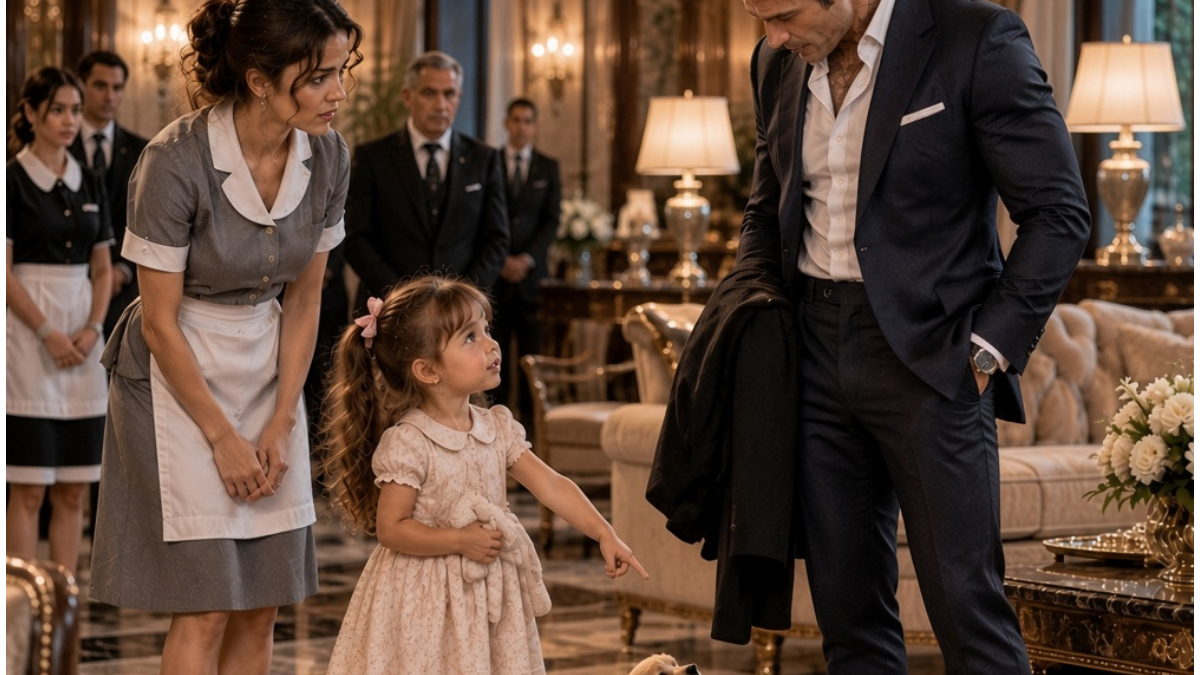
Mia MarQueti stood in the middle of Lorenzo Duca’s private garden with a starving puppy tucked against her chest and no understanding at all that grown men had died for entering this place without permission.
She was 3 years old. Her dark curls were coming loose from a faded blue ribbon, and one of her socks had slipped halfway down her ankle during whatever journey had carried her through the forbidden wing of the estate.
Lorenzo watched her from a stone bench beneath the fig tree. One hand resting on a closed folder, the other beside a cup of coffee that had gone cold.
Nobody interrupted him here. His guards knew it. His staff knew it. Men who controlled banks, ports, judges, and guns knew it.
Apparently, Mia did not. She shifted the trembling bundle in her arms and looked directly at him.
Can you keep him? Lorenzo’s gaze moved from the child to the dog. The puppy was little more than ribs wrapped in dirty golden fur.
No. Mia absorbed the answer without crying. She looked down at the puppy, then back at Lorenzo.
Why? Because I don’t keep dogs. He doesn’t have anybody. Lorenzo’s expression did not change.
Someone at the gate can find a home for him. Mia’s small arms tightened. They already said no.
That explained the dust on her shoes and the scratch along one knee. She had apparently conducted negotiations across half the estate before arriving at the one door no one else dared open.
Lorenzo reached for the folder again, signaling that the conversation had ended. Mia remained where she was.
“He’s alone, too,” she whispered. Lorenzo looked up. Mia studied his face with the calm, unbearable concentration only a child could manage without realizing it was dangerous.
“Like you, for one suspended second, nothing in the garden moved.” Lorenzo had been threatened by men with armies behind them.
He had been lied to by politicians, betrayed by business partners, shot at twice, and poisoned once badly enough to spend a week in a private clinic under another name.
None of them had managed what this little girl had just done with six quiet words.
She had placed a hand on the one part of him everyone else had learned to walk around.
Before he could answer, Mia crouched and lowered the puppy onto the stone between his shoes.
“Try,” she said. The puppy stood unsteadily, looked at Lorenzo, and took two uncertain steps forward.
Lorenzo expected it to retreat. Instead, the animal climbed across the polished leather of his left shoe, turned once, folded itself into a warm golden curve, and closed its eyes.
Mia’s face brightened with solemn certainty. He picked you. Lorenzo looked down. One tiny paw rested across the edge of his shoe.
He could feel the animals body trembling through the leather. He should have called a guard.
He should have ordered the dog taken to a shelter, and the child returned to her mother.
Instead, after a silence far too long to be reasonable, he said, “One night.” Mia nodded as if they had reached exactly the agreement she expected, neither of them noticed the old collar buried beneath the puppy’s dirty fur.
Neither saw the tarnished brass buckle turned toward the sunlight. On its underside, almost erased by years of wear, two small letters had been cut into the metal and crossed by the shape of an arrow.
Lorenzo had seen that mark before. The last time he had been 23 years old, kneeling in rain beside a wrecked car while his father bled onto the road.
6 hours earlier, Lorenzo had awakened before the alarm in a bedroom large enough to make loneliness feel architectural.
The curtains were still closed. The city beyond the estate walls had not yet turned gray with morning.
He lay for several seconds without moving, staring at the ceiling while the house waited around him.
15 years earlier, he had inherited the Duca organization, the Northern Estate, three legitimate companies, several illegitimate ones, and enough enemies to make sleep a calculated risk.
He had also inherited silence. On the left side of the bed, the sheets were smooth.
They were always smooth. By 7, he was dressed and downstairs. His lawyer was waiting in the study with a stack of documents and the expression of a man who had spent most of his career bringing unpleasant facts to dangerous people.
There were transfers to authorize, a dispute involving a shipping company, and a problem in Naples that required no more than a sentence from Lorenzo to become someone else’s problem.
He signed where necessary, listened where necessary, and spoke only when words changed an outcome.
As the lawyer gathered the final papers, he hesitated. Your birthday is next week. Lorenzo continued reading.
I’m aware. Your mother used to arrange dinner. Lorenzo turned a page. My mother is dead.
The old man’s face tightened almost invisibly. Yes, then there is nothing to arrange. The lawyer bowed his head and left.
Lorenzo remained at the desk until the sound of the closing door disappeared into the house.
Through the windows, morning light stretched across the marble floor. Servants moved in distant corridors.
Guards changed posts. A gardener started a machine somewhere beyond the eastern wall. The estate contained more than 40 people before breakfaSt. Yet Lorenzo could cross three floors without anyone speaking to him unless he spoke firSt. He had designed it that way.
At least that was what he told himself. In the servant kitchen two floors below, Elena Marquetti was cutting pears while Mia ate half an apple at the long wooden table.
The room smelled of bread, coffee, and warm butter. It was one of the few places inside the estate where people occasionally forgot to lower their voices.
Elena did not. She had worked for the Duca household for nearly four years, long enough to know which hallways belonged to the family, which doors remained locked, and which questions were more dangerous than answers.
The salary kept Mia clothed, fed, and near a good doctor. The small room they shared in the West Wing was clean and secure.
Elena had built a life out of carefully not seeing what surrounded them. That morning, however, her attention kept drifting toward the service door.
“Mia,” the little girl looked up. You stay near the kitchen today. No main corridor, no front courtyard, and absolutely no garden behind the dark wooden door.
Mia nodded. Elena knew that nod. It meant her daughter had heard every word and understood perhaps half of them.
Say it back. Stay here. And Mia considered, no dark door. Good. Elena turned back to the counter.
At that exact moment, through the cracked window above the sink, a faint sound slipped inside.
It was so weak that Elena missed it beneath the running water. Mia did not.
She stopped chewing. The sound came again, thin and uneven, like something too tired to cry properly.
Mia slid down from her chair and crossed the kitchen. Elena was rinsing a knife.
The radio murmured behind her. Mia looked once toward her mother, then pushed the service door just wide enough to pass through.
Outside, the morning air was cold. Mia followed the sound past the herb beds, along the garage wall, and toward a narrow side entrance used by deliveries.
A camera was mounted above the gate. Its black glass eye should have been pointed toward the road.
Instead, it was turned several degrees toward the blank stone wall, recording nothing but ivy.
Mia never looked up. She saw the puppy beneath a hedge where dry leaves had collected against the iron fence.
He lifted his head when she approached, though the effort seemed to cost him. His fur was matted, his paws muddy, his body so thin that each breath moved his sides visibly.
Mia crouched. Hi. The puppy blinked. She held out two fingers. He smelled them, then gave them one faint lick.
That was enough. Mia took off her cardigan, wrapped him carefully, and lifted him against her cheSt. Only then did she notice the collar.
Old leather, much too large, tightened with an extra hole someone had punched by hand.
The buckle was dark with age. She rubbed it once with her thumb and exposed a flash of brass, but whatever had been engraved there meant nothing to her.
What mattered was that the puppy was cold. She carried him back toward the house, fully intending to show Elena.
Then she remembered the rule about animals. She remembered her mother’s worried face, and with the peculiar logic of a child who had already decided what was right, she concluded that the problem was not the puppy.
The problem was simply finding an adult willing to say yes. The gardener refused gently.
A driver told her he could not keep an animal in his apartment. Rosa from the linen room gave the puppy a piece of bread but said no before Mia had finished asking.
At the main gate, one of the guards reached for his radio. Mia backed away immediately.
She did not know what he intended to do, only that the movement looked too much like the beginning of losing the dog.
She turned and walked deeper into the house. Her arms were aching now, but the puppy had stopped shaking.
He had tucked his nose beneath her chin and gone to sleep. She passed rooms she had never seen, climbed a short staircase, and entered a long gallery lined with portraits of dead ducas, who watched her advance with painted suspicion.
At the far end stood the dark wooden door Elena had specifically mentioned. It was open by several inches.
Mia stopped. She remembered her promise. Then the puppy shifted against her chest and released a tired little breath.
Mia looked through the gap. Beyond it was a quiet garden and a man sitting alone beneath a fig tree.
She knew his face. Everyone in the house knew his face. She had seen him pass through corridors while adults lowered their eyes.
She had heard servants call him Senor Duca. But Mia had no idea what fear was supposed to accompany the name.
She saw only one person she had not asked yet. She pushed the door open and stepped inside.
By the time Elena discovered the empty chair in the kitchen, Mia was already standing in front of Lorenzo.
By the time Elena reached the private garden, breathless and pale, the puppy was asleep across Lorenzo’s shoe, and Lorenzo had already said the words that would begin dismantling 15 years of carefully maintained distance.
One night, Elena stopped beneath the archway. “Mia,” her daughter turned. Elena’s gaze traveled from the child to the dog, then to the man on the bench.
“Senor Duca, I’m sorry.” She was told not to. Lorenzo lifted one hand. Elena fell silent.
He bent forward and slid his palm beneath the sleeping puppy. The animal barely stirred as Lorenzo raised it against the front of his coat.
Something in Elena’s face changed. Lorenzo noticed but could not identify it. Fear certainly. But beneath the fear was something else, an instinctive calculation.
Her eyes moved toward the route Mia must have taken, then toward the estate walls.
Where did she find him? Lorenzo asked. Elena looked at Mia. Near the delivery gate,” the little girl answered.
Lorenzo’s gaze sharpened. The delivery gate remained locked between scheduled arrivals. Every vehicle was logged.
Every foot of the approach was covered by surveillance. A stray puppy should not have reached the inner hedge at all.
Elena seemed to arrive at the same conclusion. Lorenzo looked down at the animal sleeping in his arMs. Under the dirty fur at its neck, the old collar shifted.
For an instant, something metallic caught the afternoon light. He did not see the engraving.
Not yet. Call the veterinarian, he said. Have her come tomorrow morning. Elena stared at him.
The puppy is staying. Mia answered before Lorenzo could for one night. Lorenzo looked at the child.
Mia looked back with the serene confidence of someone who already knew that adults often needed time to understand decisions they had technically made themselves.
Lorenzo carried the puppy toward the house. Behind him. Elena remained in the garden for several seconds longer, staring toward the high walls and the invisible cameras beyond them.
She knew the estate too well to believe an abandoned animal had simply wandered inside.
Someone had brought that puppy to the Duca gate. Someone had known exactly where to leave him.
And somewhere beneath the fur around his neck, a message had arrived with him. That first night, Lorenzo discovered that a three-month-old puppy could ignore an order with a level of confidence usually reserved for diplomats and men with private armies.
Rosa had found an old wool blanket and folded it beside the bed in Lorenzo’s room, far enough from the fireplace to be safe and close enough to the warmth that even a half-st starved animal should have preferred it to the marble floor.
Lorenzo set the puppy down on the blanket, pointed once, and said, “Stay.” The puppy looked at him.
Lorenzo walked to the bathroom, washed his hands, changed into a dark shirt, and returned to find the blanket empty.
The puppy was curled on top of Lorenzo’s left shoe. Lorenzo moved him back. Two minutes later, the puppy returned to the shoe.
Lorenzo moved him again. On the third attempt, the animal did not even pretend to consider the blanket.
He walked around it, climbed onto the polished leather, and lowered his head with a tired sigh.
Lorenzo stood over him in silence. It was absurd. Men who had refused Lorenzo once usually reconsidered before being asked a second time.
This creature had refused him three times before dinner, and was now sleeping as if negotiations were over.
Lorenzo should have been irritated. Instead, he found himself lowering the lamp so the light would not fall directly across the puppy’s face.
He lay down, closed his eyes, and remained awake. The house sounded different. He knew every ordinary noise inside it.
The pipes contracting behind the walls, the distant elevator settling between floors, the low shift of guards changing posts outside.
Now another sound had been added, a small uneven breath near the bed. Every few seconds came a faint catch in it, as if the puppy had not yet learned that no one was going to take the warmth away.
Lorenzo told himself he was listening because an animal that weak might stop breathing. Somewhere after midnight, he stopped believing that explanation.
He had simply grown accustomed to hearing something alive beside him. When he woke again before dawn, the first thing he did was look toward the shoe.
At a little after 5, Rosa nearly dropped a bowl when Lorenzo walked into the servant kitchen wearing shirt sleeves.
She had worked in the estate long enough to understand that the master knew the kitchen existed in roughly the same way kings new stables existed.
He did not visit it. Seenor. Lorenzo stopped at the long counter. Chicken. Rosa stared.
Chicken. Boiled. No salt. Small pieces. Her eyes flicked toward the doorway as if expecting an explanation to enter behind him.
None did. And water. Not cold. Rose’s expression changed by less than a fraction, but Lorenzo saw it.
For the guest?” She asked. He looked at her. Rosa lowered her eyes immediately, though the corners of her mouth had already betrayed her.
“Yes,” Lorenzo said. “For the gueSt.” By the time Mia appeared 20 minutes later, still in her night clothes and dragging Elena behind her by one hand.
The puppy was eating from a shallow ceramic dish near Lorenzo’s feet. Mia stopped so suddenly, Elena nearly walked into her.
He stayed. Lorenzo glanced at the animal. Apparently, Mia hurried forward and dropped to her knees.
The puppy lifted his head, tailtapping once against the floor. “See,” she said. “He knows me.
He knows chicken.” Mia considered this and decided it was not worth arguing. Elena remained near the doorway.
Her face was composed, but Lorenzo noticed how closely she watched the dog, the bowl, and him.
“The veterinarian will be here at 8,” he said. Elena nodded. “Thank you, Senor.” Mia looked up.
Does he have a name now? No, you have to name him. Why? Mia frowned at the question as though he had asked why rain fell downward.
Because he lives here. Lorenzo almost corrected her. One night was not living somewhere. One night was an arrangement, a delay, a temporary exception.
Then the puppy finished eating, walked directly past the blanket Rosa had placed near the stove, and sat on Lorenzo’s shoe.
Mia smiled. Elena looked away, perhaps to hide one of her own. Lorenzo said nothing.
The veterinarian arrived exactly at 8, carrying a leather case, and the calm expression of a woman who had treated expensive horses, nervous aristocrats, and probably enough dangerous men to recognized that the animals were often easier.
She examined the puppy in a small sitting room off the kitchen, while Mia stood on a chair so she could see the table.
Lorenzo remained near the window. Elena stayed beside her daughter. The puppy was underweight and mildly dehydrated, but there were no broken bones, no infection, and no sign of disease.
He is fortunate, the veterinarian said. Another few days outdoors in this weather might have been different.
Mia placed both hands protectively on the edge of the table. He was cold. I imagine he was.
The veterinarian ran her fingers beneath the old collar. This needs to come off. It is rubbing the skin.
Lorenzo’s attention sharpened. Keep it. She looked toward him. The collar? Yes, of course. She unfassened it and slipped it into a clean paper sleeve without examining the buckle closely.
Then she gave instructions about food, vaccinations, sleep, and the fact that a puppy of this age would chew whatever it could reach.
Lorenzo listened with the concentration he normally reserved for financial reports. Mia listened only until the veterinarian asked, “And what is his name?”
Mia turned immediately toward Lorenzo. Elena did too. Lorenzo looked at the puppy who was attempting to bite the end of the stethoscope.
He had not considered a name. Names implied intention. They were what you gave things expected to remain.
Leo, he said. The word arrived before he decided on it. Mia’s eyes widened. I wanted to help pick.
Lorenzo looked at her. You can choose his nickname. Mia thought for several seconds. Leo.
Elena pressed her lips together. The veterinarian looked down at her notes to conceal a smile.
Lorenzo inclined his head. Then we agree. Mia leaned close to the puppy. Leo Dooka.
Lorenzo’s gaze moved toward her. Duca, he lives here. Again, that impossible certainty. Before he could object, Leo sneezed directly onto the veterinarian’s sleeve and settled the matter by falling asleep.
One night became two because the veterinarian said moving him immediately would be stressful. Two became four because Mia insisted he needed to finish the food already opened for him.
By the end of the week, a small bed had appeared beside Lorenzo’s desk. A second water bowl had appeared in the private garden, and one of the guards had learned to open the side door without being asked whenever Leo approached it.
No one discussed how these things had happened. They simply accumulated. Lorenzo began walking the estate perimeter at sunrise because Leo woke before 6 and considered closed bedroom doors a personal insult.
The first morning, Lorenzo attempted his usual pace. Leo stopped after perhaps 30 steps to investigate a wet leaf with such concentration that Lorenzo was forced to wait.
The second morning, Leo became interested in the same stone for nearly a minute. By the third, Lorenzo had unconsciously shortened his stride.
Men who saw them from a distance developed sudden reasons to study hedges, radios, shoes, or the sky.
In the study, Leo slept beside Lorenzo’s chair during meetings. The first time a shipping broker from Genoa noticed him, the man lost his place halfway through a sentence.
Lorenzo did not look up. Continued. The broker continued. Leo rolled onto his back, all four paws in the air.
The broker lost his place again. Lorenzo finally raised his eyes. If the dog can follow this meeting, I assume you can.
The man turned red and finished the report without another mistake. Mia visited Leo every afternoon.
And because Leo had established the private garden as his preferred kingdom, Mia gradually established herself there as well.
Lorenzo did not remember granting permission. Somehow permission had become unnecessary before he realized it was gone.
One Thursday, Mia arrived carrying a folded sheet of paper and a handful of crayons.
I made this. She climbed onto the bench beside him and opened the page. The drawing contained a yellow dog, a green tree, a black rectangle that appeared to represent the house, and a very tall man with long arMs. That is you.
Lorenzo studied it. I see. And that is Leo. He is larger than I am.
Mia looked at the page. I like him more. Lorenzo glanced at her. She had already returned to coloring.
A moment later, he noticed something else. Why do I not have a mouth? Mia paused.
I don’t know what your smile looks like. The answer landed without ceremony. She had not intended to wound him.
That made it worse. Lorenzo looked at the faceless figure again. Mia selected a red crayon and began coloring Leo’s collar.
Do people get lonely if there are lots of people in the house, but nobody talks to them?
She asked. Lorenzo’s eyes lifted slowly. Mia was still looking at the drawing. Why do you ask?
Because Mama says being alone and being lonely are different. Your mother is usually correct.
So, are you? He could have answered no. It would have been easy. He had been lying to himself with greater sophistication for 15 years.
Instead, he watched Leo chase his own tail across the grass and said, “I don’t know.”
Mia nodded as if that were sufficient. “Okay.” She did not ask again. Late that afternoon, after Mia had gone back to the servant wing, the veterinarian telephoned the study.
Her tone was different from the morning of the examination. “Senior Duca, I cleaned the old collar before returning it.
There is something on the buckle I think you should see. Lorenzo told her to bring it.
40 minutes later, she placed the paper sleeve on his desk and left without asking questions.
Lorenzo unfolded it beneath the lamp. The collar looked even older when clean. The leather was cracked nearly through near one hole.
He turned the buckle over. On the underside, where dirt and oxidation had hidden it, two tiny letters were engraved into the brass, R and D.
The stem of the R curved through the D, and a narrow arrow crossed both letters diagonally.
Lorenzo stopped breathing. He knew the mark. Roco Denilov had stamped it into everything he considered his.
Holsters, belts, training leads, kennel records, the collars of the dogs he raised for the Duca family.
Rocco had been the man who placed a German Shepherd puppy named Bruno into Lorenzo’s arms when Lorenzo was nine.
Rocco had served Lorenzo’s father for two decades. Rocco had disappeared on the night Lorenzo’s parents were murdered.
For 15 years, one question had followed his name like a shadow. Had Roco died trying to protect them, or had he sold the route that killed them?
Lorenzo turned the buckle beneath the lamp again, hoping the mark might become something else at another angle.
It did not. He pressed the intercom. Send Elena Marchetti and her daughter to the study.
When they arrived, Mia was holding Leo. Lorenzo placed the collar on the desk between them.
Where did you find him? Mia pointed vaguely toward the eastern side of the estate.
By the little gate. Outside the gate. She shook her head. Inside, under the bushes.
Lorenzo looked at Elena. Her face had already changed. He turned toward the man standing near the study door.
Matteo Richi had overseen estate security for 15 years. He had been there the night Lorenzo’s parents died.
He had dragged Lorenzo from the wreckage with his own hands. Mateo, Lorenzo said, who entered through the delivery gate that morning?
Matteo answered without hesitation. No one. Lorenzo’s gaze remained on him. You are certain completely.
The logs are clean. Mia hugged Leo closer. The puppy raised his head at the sound of Matteo’s voice, then tucked it back beneath her chin.
Lorenzo looked down at the engraved buckle. If nobody had entered, the puppy could not have been there.
Yet, he had been, and around his neck was the signature of a man who had vanished 15 years ago.
For the first time in 15 years, Lorenzo opened the cabinet behind the false panel in his bedroom fireplace.
The mechanism resisted at firSt. Dust had settled into the brass track, and when the panel finally shifted aside, it released the stale smell of old paper, leather, and something colder that memory supplied on its own.
Inside were the files from the worst night of his life, sealed after the last formal investigation collapsed into rumor and accusation.
Lorenzo carried them to the desk and opened the first folder beneath a single lamp.
He had not looked at the photographs in almost a decade. The road was narrower than he remembered.
Rainwater glistened under emergency lights. One black sedan rested on its side against a barrier.
Its windows burst outward. Another had stopped crooked across the intersection. On the pavement between them lay Bruno, the German Shepherd Roco Danalov had given Lorenzo when he was nine.
Even in the photograph, Lorenzo could remember the weight of that dog’s head against his knee.
The smell of wet fur, the way Bruno used to wait outside his bedroom every morning and pretend not to be waiting.
On the night of the ambush, Bruno had launched himself through an open rear door before the second gunman could reach Lorenzo.
The dog took three bullets. Lorenzo took one. His father and mother never left the road alive.
Rocco disappeared before dawn. That was the fact around which every other fact had hardened.
Some men said Rocco had been killed and his body removed. Others said he fled because he had sold the route.
Lorenzo, 23, bleeding, furious, and newly responsible for a criminal empire he did not want, had chosen the explanation that required the least uncertainty.
Betrayal. It was easier to hate a missing man than to admit the truth could not be found.
Now Rocco’s mark had returned on the neck of a puppy placed inside Lorenzo’s walls.
Rocco had been part of the Duca household before Lorenzo could remember him clearly. He was not family, though in childhood he had often felt more permanent than relatives.
He trained the security dogs, inspected gates, tested locks, and carried a black notebook in which he wrote everything by hand because he trusted paper more than machines.
His personal mark was simple. The letters R and D crossed by an arrow. He stamped it into his own belts, the dog’s leather collars, tool cases, training leads, anything he expected to keep for years.
Lorenzo remembered asking him once why he marked everything. Rocco had been cleaning Bruno’s paws after a storm because good things disappear.
He had said a mark helps them find their way back. At 9, Lorenzo had accepted that answer without understanding it.
At 38, he sat alone under the lamp and felt those words return with an entirely different weight.
He opened another folder. The official reconstruction of the ambush listed the route from the opera house.
The emergency deviation ordered at the last minute because a demonstration had blocked the main avenue and the four people who had known the change before the convoy moved.
Lorenzo’s father, Lorenzo’s mother, Rocco Denalov, Matteo Reichi, two dead, one vanished, one still walking the estate every day.
Lorenzo stared at Matteo’s name until the letters lost shape. He closed the file, then he opened it again.
Matteo had been the deputy security chief then, younger by 15 years, but already trusted enough to ride in the second car.
He had pulled Lorenzo from the wreckage while gunfire still echoed between the buildings. Lorenzo could still see him through broken glass, shouting his name, one sleeve soaked dark with blood.
Matteo had arranged the funerals when Lorenzo could barely remain upright. He had stood beside him during the first meeting with the captains after his father’s death.
He had slept in a chair outside Lorenzo’s hospital room for two nights because there were rumors of a second attempt when men questioned whether a wounded 23-year-old could hold the Duca organization together.
Matteo had been the first to say in the room that anyone who wanted to test Lorenzo could start by testing him.
Loyalty accumulated over 15 years did not evaporate because a name appeared on an old piece of paper.
Lorenzo understood that. He also understood that loyalty was exactly what betrayal borrowed in order to survive unnoticed.
Still, he would not accuse a man on intuition. Old grief or a dog collar.
He returned the files to the cabinet shortly before dawn and locked the panel. When he left his bedroom, he met Matteo in the corridor.
Matteo smiled in the easy familiar way he had smiled for years. You’re awake early.
Lorenzo adjusted one cuff. I didn’t sleep. Anything wrong? Not yet. Mateo studied him for a fraction of a second, then nodded and moved on.
Lorenzo watched him go and hated himself a little for watching. Life around Leo continued with insulting normality.
The puppy gained weight, learned the kitchen schedule faster than most new staff, and developed a personal theory that everything Lorenzo owned had been purchased for chewing.
The theory reached its most expensive expression on a Tuesday morning when Lorenzo discovered Leo beneath the desk with one of his handmade Italian shoes between his paws.
Half the heel was wet. The edge of the leather carried a perfect row of tiny tooth marks.
Lorenzo stared down in silence. Mia, sitting on the rug nearby with crayons, looked from the shoe to Leo and then to Lorenzo.
He likes that one. That shoe cost more than some people’s cars. Mia considered the information and nodded.
Leo likes expensive things because he lives here now. Lorenzo looked at her. Mia returned to her drawing as if the matter had been settled by economic principle.
Leo bit the shoe again. Lorenzo took it away, placed a wooden chew toy in front of him, and watched Leo reject it with visible disappointment.
From the doorway, Elena made a sound suspiciously close to a laugh and disguised it as a cough.
Lorenzo turned toward her. She lowered her eyes. “Excuse me, Senor.” He looked back at the ruined shoe.
“Apparently, I have become unreasonable.” Mia shook her head. “No, Leo has.” For half a second, Lorenzo almost smiled.
Mia saw the movement and immediately pointed at his face. That was nearly one. The moment vanished, but not completely.
That afternoon, Lorenzo went to the security room and asked for the recordings from the morning Leo had appeared.
He did not mention Rocco. He did not mention Matteo. He said only that an animal had entered the property and he wanted to know how.
The technician pulled up the delivery gate cameras. At first, the footage seemed ordinary. Empty road, wet hedge, a delivery truck passing two streets away.
The image timestamp advanced normally until 6:14 in the morning. Then Lorenzo noticed a bird.
It crossed the top right corner of the screen. 4 minutes later, the same bird crossed the same corner in exactly the same arc.
Lorenzo leaned closer back. The technician rewound. The bird appeared again. Same wing position, same shadow on the wall, same motion.
It was not live footage. It was a loop only 4 minutes long, cleanly inserted and removed without triggering an error notification.
Who can do that? Lorenzo asked. The technician swallowed. Anyone with administrator level access? Senor or someone with one of the old maintenance codes.
Old codes were retired. They should have been. Lorenzo did not look at him. Should have been is not an answer.
The technician’s face tightened. Then someone kept one active. Lorenzo asked for every exterior camera within 500 yd.
Most showed nothing useful, but a municipal traffic camera on a road beyond the estate caught the rear quarter of an old white van moving slowly past at approximately 616.
The image was poor. Mud covered most of the license plate. A faded logo ran along the side panel, nearly erased by age.
A green silhouette of a dog over a red line of text. Lorenzo froze the frame.
He knew the shape before he knew why. Somewhere in his childhood, he had seen crates with that same logo stacked behind Rocco’s kennels, feed bags, training equipment, deliveries twice a month.
By evening, Lorenzo had a name, Balandi Veterinary Supply. The company had once served kennels across northern Italy.
It had closed nearly 8 years earlier after the founder died. Lorenzo sent no request through the estate system.
Instead, he used a private handset kept for circumstances in which discretion mattered more than speed.
He called a retired attorney named Victoriao Salvi, one of the few men from his father’s generation who owed the Duca family nothing except an old favor and disliked Matteo enough to avoid social visits.
Lorenzo gave him the company name and the partial image of the van. Find out where it went after the business closed.
Vtorio did not ask why. Anything else? Do not call the estate. A pause. Understood.
Lorenzo ended the call and sat for a long time with the frozen image on his laptop.
The puppy had not wandered through a hole in a fence. Someone had driven him there.
Someone had known the camera system well enough to erase 4 minutes and restore the feed before anyone noticed.
Someone had used a vehicle connected to a supplier Rocco Danalov had once trusted. The old caller was no coincidence.
It was a message. Lorenzo could not yet tell whether it was a warning, an accusation, or bait.
Near midnight, he went downstairs for water and found Leo asleep outside Mia and Elena’s room.
The puppy had apparently followed the child upstairs and refused to leave. Lorenzo crouched and touched two fingers to the soft fur between his ears.
Leo opened one eye, recognized him, and closed it again. “You are causing an unreasonable amount of trouble,” Lorenzo murmured.
The door opened behind him. Elena stood there in a robe, her hair loose around her shoulders.
“For a moment, neither spoke. Then she looked down at Leo. He waits for her when she sleeps.”
Lorenzo straightened. “He waits for everyone.” Elena’s gaze lifted to his. No, not everyone. The sentence stayed with him after he carried Leo back toward his room.
At 2 in the morning, Vtorio called, “I found the van.” Lorenzo stopped in the dark hallway.
“Where?” The company sold three vehicles when it closed. Two were scrapped. The third went to a kennel outside Pavia.
Name? Papers shifted on the other end. Sanraco Working Dogs. Lorenzo’s hand tightened around the phone.
Vtorio continued, unaware of what the name had already done. Ownership changed twice. Current registration is under a woman named Sophia Danolov.
Lorenzo said nothing. Lorenzo. Repeat the surname. Danalov. The hallway seemed to narrow around him.
Rocco had never spoken of a daughter. No file in the Duca archive mentioned one.
Yet somewhere outside Pavia. A kennel connected to Rocco’s old supplier had owned the van seen near the estate the morning Leo appeared.
Lorenzo looked toward the sleeping house. The question he had lived with for 15 years shifted shape.
It was no longer whether Roco Denilov had betrayed his family. It was whether Roco had spent all those years trying to stay hidden from someone inside it.
Lorenzo did not go to Pavilla the next morning. 15 years earlier, he might have.
At 23, anger had convinced him that speed and courage were the same thing. At 38, he knew better.
He sent Vtorio instead, not as a representative of the Duca family, but as an old lawyer looking into a property transfer connected to an estate matter.
Vtorio drove south before sunrise, visited the municipal office first, then the kennel, then a hospice outside the city, whose name appeared on a recent medical filing under Sophia Danolov’s address.
He called Lorenzo shortly afternoon. You need to hear this sitting down. Lorenzo remained standing beside the study window.
Leo was asleep beneath the desk. Mia was in the garden with Elena drawing circles in chalk on the flag stones.
Go on. Vtorio exhaled slowly. Roco Danalov is dead. Lorenzo’s hand tightened around the phone.
The words should have felt familiar. For 15 years, Rocco had existed in the category of the possibly dead.
A man without a grave whose absence had slowly become indistinguishable from death. Yet hearing it confirmed made the room feel suddenly smaller.
When? 3 weeks ago. Heart failure. The hospice records are clear. Lorenzo looked down at Leo.
3 weeks. Yes. And the puppy arrived here 8 days ago. I noticed that too.
Lorenzo turned from the window. Then Roco did not bring him. No. Who did? Vtorio paused.
That is where it becomes interesting. San Roco working dogs sat behind a low stone wall beyond a stretch of farmland outside Pavia.
Vtorio had found the kennel partly closed with only six adult dogs remaining and most of the training field overgrown.
The property belonged to Sophia Danalov, 41 years old, unmarried, registered as a veterinary assistant and canine trainer.
Roco’s daughter, she had lived with him under a different surname for nearly 14 years before legally restoring Danalov only after his death.
Lorenzo listened without interrupting. Did you speak to her? Not yet. She is not there.
Where is she? Gone. 2 days after the funeral, she left the property with luggage and has not returned.
A neighbor says she mentioned staying with friends near Turin. Lorenzo’s jaw tightened. Convenient, perhaps.
But I found something else before assuming the worSt. Victoriao had obtained a copy of the probate inventory.
Roco had left almost nothing of value. A small savings account, the kennel equipment, several boxes of records, and a sealed veterary transfer document dated 4 days before his death.
The document described a male puppy, golden coat, approximately 11 weeks old, descended from one of the kennel’s older working lines.
Temporary name B, recipient field, blank. Attached to it was a handwritten instruction. Vtorio unfolded the photocopy near the receiver and read it slowly.
If I cannot walk through the gate myself, send one who still can. Lorenzo closed his eyes.
He could hear Rocco’s voice in the sentence, even after 15 years. Not sentimental, not explanatory, a command disguised as a proverb.
Anything else? Lorenzo asked. One more page. Different ink added recently. It names someone called Carlo Bellini.
Who is he? 70 three. Former Kennelhand worked for Rocco for years. Lives 20 minutes from the estate road.
Lorenzo turned toward the desk. Find him, Vtorio hesitated. I already did. Carlo Bellini had expected someone eventually.
That more than anything else made Lorenzo sit down. The old man lived in a narrow house behind an auto repair shop.
And when Vtorio mentioned Rocco’s name, Bellini had not denied anything. He admitted driving the old Bondi van to the Duca estate the morning Leo appeared.
He admitted placing the puppy inside the delivery gate beneath the hedge. He admitted using an obsolete maintenance code to turn one camera away and loop another for 4 minutes.
How did he know the code? Lorenzo asked. Roco gave it to him years ago.
That code should have died with the old system. Bellini said the same thing. Lorenzo leaned forward.
Vtorio continued. Bellini had tested the code from a portable terminal two nights before making the delivery.
He expected it to fail. Instead, the system accepted it immediately. Rocco’s instructions had included several legacy access codes, but only one worked.
“Which one?” Lorenzo asked. The administrator bypass for the Eastern Security Network. Lorenzo knew the code category.
There had once been three people authorized to preserve legacy access during the transition to the new system.
One died 5 years ago. The second was Lorenzo. The third was Mateo. He ended the call and sat in silence while Leo slept at his feet.
It would have been easy to let the conclusion arrive fully formed. Matteo had maintained the code.
Mateo had known the route 15 years earlier. Matteo was still inside the house, but suspicion was not proof, and Lorenzo had spent too much of his life watching men die because another man had mistaken a pattern for certainty.
He picked up the private handset again. Vtorio. Yes, I want the complete access history for that code.
Every authentication attempt preserved anywhere in the old system, even archived backups, and I want Sophia found before anyone connected to this estate knows she exists.
That may take time. Take what you need,” Lorenzo disconnected, then called the head of technical security and ordered a full review of dormant credentials.
He gave no reason. He also instructed them not to revoke anything yet. If someone had preserved an old door, Lorenzo wanted to know who still intended to walk through it.
That afternoon, he took Leo into the private garden and found Mia lying on her stomach beneath the fig tree with colored pencils spread around her like fallen sticks.
Elena sat on the bench sewing a loose button back onto one of Mia’s sweaters.
Lorenzo stopped a few feet away. Elena looked up. Seenor. He glanced at the sweater.
You do that yourself? She followed his eyes. It is a button. There are people in this house paid to repair clothing.
There are people in this house paid to do many things I can do with my own hands.
Mia looked up from the grass. Mama says if you can fix something, you should not throw it away.
Lorenzo looked at Elena again. Something about the sentence irritated him because it arrived at the wrong time.
Elena noticed. Was that the wrong lesson? No. He looked toward Leo, just badly timed.
She did not ask what he meant. That was one of the things Lorenzo had begun to respect about her.
She knew when silence was not submission, but mercy. Mia returned to her drawing. Leo trotted toward her, stole a green pencil, and ran.
Mia jumped up and chased him around the bench. Elena laughed despite herself. Lorenzo watched the two of them circle the tree, and for a brief moment, the estate beyond the garden disappeared.
Then a thought cut through it. Rocco had chosen a puppy because a puppy could pass through suspicion.
Guards searched cars, men, bags, crates, letters. Nobody interrogated a starving animal in a hedge.
Rocco had built his final message around the one thing Matteo or whoever controlled the cameras would dismiss as harmless.
Vtorio called again that evening. He had found Sophia, not in Turin, in a small rented apartment outside Novara under her mother’s maiden name.
She agreed to speak only after Vtorio used a phrase Rocco had left for exactly this circumstance.
Tell Lorenzo that Bruno never barked at the rain. Lorenzo went still. Nobody outside the old household could have known that.
Bruno had been terrified of thunder as a puppy, but would sit perfectly calm in heavy rain, staring through the glass.
Rocco used to joke that the dog respected weather only when it made noise. Put her on.
Victoria warned him she had refused direct calls. Then tell me what she said. Sophia confirmed the puppy had been born at San Roco.
His mother belonged to one of Rocco’s last working lines. Rocco selected him because he was unusually calm with strangers and because his coloring was distinctive enough that no one could confuse him with another dog.
The old collar had been placed around his neck deliberately. Rocco had spent months preparing the transfer, but he had not told Sophia everything.
“Why not?” Lorenzo asked. “Because he was afraid,” Vtorio said. “Of whom.” He never gave her a name.
That answer bothered Lorenzo more than a name would have. According to Sophia, Roco had lived the last 15 years under the belief that the Duca estate was compromised at the highest level.
He avoided telephones, avoided letters, and refused every suggestion that he contact Lorenzo directly. Twice, Sophia had accused him of cowardice.
Rocco had answered that cowardice kept one man alive long enough to deliver the truth.
He never claimed innocence to her because he said innocence was useless without evidence. Instead, he collected fragments, receipts, old access records, copies of correspondence, names, dates.
He hid them in different places and told Sophia that if he died before finishing, she was to follow the instructions in the sealed envelope and nothing more.
“Did she know what was on the collar?” Lorenzo asked, “Only that it mattered. Did she know why the puppy had to come here?”
She said Rocco told her the dog was not carrying the proof. He was carrying the first question.
Lorenzo looked toward the cabinet where the old files were hidden. The first question, not who killed his parents, not whether Roco betrayed them, something earlier.
Who inside the estate could still open doors that should have been closed years ago.
The access report arrived just before midnight. Lorenzo printed it himself from an isolated terminal.
The legacy administrator bypass had been used 11 times in the last 6 years. 10 were automated maintenance events performed by old hardware during power failures.
The 11th was manual. 3 months earlier, 217 in the morning. Origin, Eastern Security Office, credential confirmation, local administrator override.
Lorenzo read the line twice. Matteo’s office occupied the Eastern Security block. That still did not prove Matteo had entered the code.
Another authorized technician might have used his terminal. Lorenzo pulled the personnel roster for that night.
Two guards on duty. One technician, Matteo. The technician had been called away for a server failure in the West Wing between 2 and 3.
The guards remained outside. Matteo’s badge entered the office at 211 and exited at 2:23.
Lorenzo sat back. 11 minutes. Enough time to test a forgotten code. Enough time to discover it still worked or enough time to preserve it deliberately.
He folded the report and placed it inside his jacket. The next morning, Lorenzo did something he had never done before.
He went to Matteo’s office unannounced. Matteo looked up from his desk and smiled. This is a surprise.
Lorenzo remained near the door. I was walking through security, apparently. Matteo gestured toward a chair.
Coffee? No. Lorenzo let his gaze travel casually across the room. Old monitors, locked cabinets, a framed photograph from 15 years earlier, showing Matteo beside Lorenzo’s father during a training exercise.
On the wall hung a brass key ring from the old estate system, obsolete, but preserved like a trophy.
Lorenzo looked at it half a second too long. Matteo noticed. Memories, he said. Hard to throw away.
Lorenzo met his eyes. Some things should be. Matteo’s smile thinned slightly. And some things should not.
Neither man moved. The silence between them had changed. There was no accusation in it yet, but the old ease was gone.
That afternoon, Victoriao sent the final document from Rocco’s probate file. It was a page torn from a handwritten notebook.
Most of it contained dates and initials Lorenzo did not recognize. At the bottom, beneath a line drawn twice.
Rocco had written a single sentence. The man who keeps the old doors open is the man who fears what is behind the new ones.
Underneath was a date from 3 months earlier. The exact date Matteo’s badge had entered the Eastern Security office at 2:1 in the morning.
Lorenzo read the line until the paper blurred slightly. Rocco had been watching. Somehow from outside the estate, he had known the code had been tested.
He had known enough to set the puppy plan in motion. Lorenzo looked across the study at Leo, who was trying unsuccessfully to pull a cushion larger than himself off the sofa.
15 years of silence had not ended with a confession, a body, or a gunshot.
It had ended with a starving puppy under a hedge, and an old man’s refusal to let the truth die with him.
And now Lorenzo understood one thing with absolute certainty. Rocco had not sent Leo to tell him who the traitor was.
He had sent Leo to make Lorenzo look at the one man he had never been willing to question.
By the following afternoon, Lorenzo had convinced himself of only one thing. Suspicion was not evidence.
He had spent too many years surrounded by men who treated instinct as permission, and he refused to become one of them now simply because Roco’s final message pointed toward a name he did not want to see.
So, he did what he had always done when emotion threatened to contaminate judgment. He watched.
He said nothing to Matteo. He changed no schedules. He revoked no access. He walked Leo at the same hour, held meetings in the same rooms, and allowed the estate to believe that the old collar had become exactly what everyone else assumed it was, a curious object attached to a stray dog.
3 days passed without incident. On the fourth, Lorenzo sat in the private garden with a newspaper open across one knee, while Mia rolled a red rubber ball across the grass.
Leo chased it with the enthusiasm of a creature who had not yet learned that dignity was supposed to matter.
He missed the ball, collided with a flower pot, recovered instantly, and attacked a fallen leaf instead.
Mia laughed so hard she fell backward onto the lawn. Lorenzo looked over the edge of the newspaper.
He had read the same paragraph six times. From the gravel path behind the hedge came footsteps, measured and familiar.
Matteo appeared at the turn in the path, wearing his usual dark coat, one hand near the radio at his belt.
He saw Lorenzo and dipped his head. Afternoon. Lorenzo answered in the same tone he had used for 15 years.
Mateo. Nothing in Matteo’s expression changed. He kept walking. Leo did. The puppy had been halfway through pouncing on the red ball when his entire body locked.
His ears flattened. His tail dropped hard against his legs. He backed away from the path, then moved behind Mia, pressing against her calves so tightly that she nearly lost her balance.
He did not bark. He did not growl. He watched Matteo with the whites of his eyes showing until the man disappeared beyond the greenhouse.
Mia crouched immediately. Leo. She put both hands on his shoulders. The puppy trembled beneath her palMs. He’s scared.
Lorenzo lowered the newspaper. Of what? Mia pointed toward the empty path. Him. Lorenzo looked at Leo for several seconds, then at the corner where Matteo had vanished.
A week earlier, that reaction might have felt like revelation. Now, it felt like something more dangerous, temptation.
It would have been easy to treat the animals fear as proof because it fit the story Lorenzo had begun to suspect.
He refused. Dogs remembered smells, voices, places, pain. They did not deliver verdicts. That evening, he called Vtorio and asked him to contact Sophia again with one question only.
Had Matteoi ever been at the kennel? The answer came less than an hour later.
Twice. Both visits had occurred during the final 3 months of Rocco’s life. Matteo had arrived without notice, asked to see Rocco privately, and been refused both times.
On the second visit, there had been an argument near the training yard. Sophia could not hear the words, but she remembered the dog’s reacting to Matteo’s voice.
Leo had been in a nearby pen with the rest of the litter. He had been only weeks old, but old enough to hear, smell, and associate.
Lorenzo ended the call and stared at the wall. Leo’s fear was not evidence, but now it belonged to a chain.
Elena confronted him the next night. She did not announce herself through a guard and did not wait for the usual formal permission.
She knocked once on the study door, stepped inside when Lorenzo answered and closed it behind her.
He looked up from a stack of financial records. Is Mia all right? She is asleep.
Elena remained near the door. Then what is it? She took a breath. I need you to listen before you answer.
Lorenzo set down his pen. Elena’s hands were folded in front of her, but not from difference this time.
She was holding herself still. Mia thinks this garden is the safest place in the world because you are in it.
She thinks if Leo is with you, nothing bad can happen. She thinks every man in a dark coat is one of your friends because they work in your house.
Lorenzo said nothing. Elena continued, “She does not understand what is happening, but she feels it.
You have been different this week. The guards have been different. Doors are being checked twice.
Men stop talking when she walks past yesterday. She asked me if someone was angry with Leo.
Lorenzo’s expression tightened. No one is going to touch the dog. That is not what she was asking.
The words were quiet, but they landed cleanly. Elena stepped closer to the desk. You care about her.
I know that now. I was not sure before, but I know it, and that frightens me more than if you did not.
Lorenzo leaned back slightly. Explain. Because caring about someone makes you believe that wanting to protect them and being able to protect them are the same thing.
He looked at her. Elena’s voice softened, but not her meaning. They are not. For a long moment, the only sound in the study was the clock near the bookcase.
Lorenzo’s eyes moved toward the closed door as if he could see through it to the rooms beyond.
Tamia asleep two floors away. Do you want me to send her away from me?
He asked. Elena’s face changed immediately. No. Then what do you want? I want you to understand what you are asking her to truSt. I have asked her for nothing.
Exactly. Elenas eyes held his. She gave it to you anyway. Lorenzo looked down at the papers in front of him.
Elena continued more quietly now. Loving her is not the same as making her safe.
He had no answer because every answer available to him sounded like arrogance. He could increase guards, change routes, close gates, replace staff.
He could turn the estate into a fortress inside a fortress. None of that would make Elena’s sentence untrue.
Matteo had worked beside him for 15 years. If Matteo was what Roco believed he was, then danger had not broken through Lorenzo’s walls.
Lorenzo had built the danger into them and called it loyalty. The study door opened before Elena could leave.
Mia entered carrying a sheet of paper nearly as large as her chest with Leo trotting behind her.
Elena closed her eyes briefly. You are supposed to be asleep. I was. Then I remembered.
Mia crossed directly to Lorenzo and pushed the drawing onto his desk. I fixed you.
Lorenzo looked down. It was another picture of the garden. Leo was yellow. Mia was purple for reasons known only to her.
Elena had been given very long black hair and what appeared to be three arMs. Lorenzo stood beside the tree.
This time he had a mouth. It was a straight horizontal line. He looked at Mia.
That is an improvement. Yes. I still do not appear happy. Mia considered. You are happier than before.
Elena turned away, hiding a smile. Lorenzo studied the drawing again. Something inside him eased despite every reason it should not have.
Mia climbed onto the chair opposite his desk and watched him with expectation. Do I keep this one too?
He asked. Yes. Then I am running out of desk. Move the boring papers. Lorenzo glanced at the financial reports.
An excellent management strategy. Mia nodded, satisfied. Leo dropped onto the rug beside her chair and rested his chin on one paw.
For several minutes, the room contained nothing dangerous at all. No old codes, no betrayals, no dead men reaching back through 15 years.
Only a child, a dog, and a drawing with a slightly less empty face. There are moments in a life that look too small to matter until years later when you realize they changed the direction of everything.
If you have ever seen one small act of kindness, do that to someone. Share this story with a person who would understand why.
Then Mia yawned so widely her eyes watered. Elena lifted her from the chair. As they left, Mia called back.
Do not move the picture. Lorenzo looked at the drawing beside Rocco’s collar. I won’t.
When the door closed, the room became cold again. Lorenzo pulled the next set of records toward him.
Vtorio had spent the previous two days tracing Matteo’s finances through layers of holding companies, dormant partnerships, and accounts designed to look too ordinary to deserve attention.
At first, the pattern seemed familiar. Unexplained deposits appearing at regular intervals, amounts small enough individually to avoid alarms, but large enough over time to become significant.
Lorenzo expected the money to lead toward the Salvator family or another rival organization. It did not.
The transfers came from a private trust administered through Lugano. The trust had existed for almost 20 years.
Beneficiary records were sealed, but Vtorio had obtained the original registration through an old corporate archive.
Lorenzo read the name twice. Paulo Reichi. He knew Matteo had once had a younger brother.
He remembered a funeral vaguely. He remembered his father attending without Lorenzo and returning home in a mood so severe that no one spoke through dinner.
Paulo had died years before the ambush during an operation in southern Italy. Lorenzo searched the old personnel database.
The official note was three sentences long. Paulo Reichi, field operative, deceased during unauthorized deviation from operational orders.
Internal liability review closed. Lorenzo stared at the phrase unauthorized deviation. Something about it felt familiar.
He returned to the cabinet behind the fireplace and opened a box of documents from his father’s tenure that had never been digitized.
Near the bottom lay a disciplinary file stamped with Matteo’s name. The binding had been cut.
One page was missing. On the remaining cover sheet was a title written in his father’s hand, the death of Paulo Richi.
Lorenzo read the surviving pages slowly. Witness statements contradicted the official summary. Paulo had not abandoned his orders.
He had followed them exactly. The operation had gone wrong anyway. Two men died. A political contact had been exposed.
Someone higher in the organization had needed the failure to belong to a dead subordinate instead of to the person who had given the command.
Lorenzo reached the final surviving page. It ended in the middle of a sentence. The next sheet had been torn out carefully enough to leave only a narrow strip along the binding.
He ran his thumb over the edge. Suddenly, Matteo’s 15 years beside him looked different.
Perhaps the betrayal had not begun with ambition. Perhaps it had begun with a grave, a lie written into an official file, and a brother who had learned that the Duca family could demand loyalty while rewriting the dead.
That did not make Matteo innocent. If anything, it made him more dangerous. Hatred built slowly had patience.
Lorenzo closed the folder and looked toward the door through which Mia had just disappeared.
Somewhere in the house, Matteoi was still walking his rounds. And Lorenzo now understood that before he could know why Mateo betrayed his father, he had to learn what his father had done firSt. Lorenzo spent the next 48 hours reconstructing a death that had been buried beneath a sentence.
Paulo Richi had been 26 when he was sent south with five other men to retrieve financial records from a broker who had begun selling information to a prosecutor.
The official Duca account said Paulo abandoned the planned route, entered the building too early, compromised the operation, and died because he ignored orders.
It was clean, simple, and almost entirely false. Victoria located two surviving men from the team, both long retired from the organization and living under names Lorenzo did not recognize.
One refused to speak. The other agreed only after Victoriao promised his location would never reach the estate.
His account matched the fragments in the old file. Paulo had not improvised. He had followed Lorenzo’s father’s instructions exactly.
The problem was that the broker was not alone. A government intermediary was inside the building, a man whose relationship with the Duca organization could not become public without collapsing an alliance worth millions and exposing several protected officials.
Paulo was ordered to continue anyway. The operation failed. Paulo and another man were killed.
The intermediary survived. Within 3 days, the internal report had been rewritten so that Paulo’s supposed disobedience became the reason everything went wrong.
Lorenzo read the testimony twice, then a third time. His father’s signature appeared beneath the final authorization.
There was no ambiguity. Paulo had been sacrificed once in the field and a second time on paper.
Vtorio found the missing page in a private archive belonging to an accountant who had handled compensation for Duca families decades earlier.
The page had not been destroyed. Someone had removed it and hidden it. At the top was a handwritten note from Lorenzo’s father ordering that Matteo be paid privately and that Paulo’s official record remain unchanged.
Beneath it was another line. Richi must understand that family stability comes before personal grief.
Lorenzo stared at the sentence until anger gave way to something heavier. He had spent 15 years asking what Matteo had done to his family.
Now he was forced to ask what his family had done to Matteo firSt. Mateo had been 30 when Paulo died.
Until then, every surviving record described him as fiercely loyal to the Ducas. He had grown up around their men, trained under Roco, and entered security before he was old enough to imagine another profession.
Paulo’s death changed the pattern. Not immediately. That was what made the history unsettling. Matteo did not resign.
He did not threaten anyone. He attended his brother’s funeral, accepted the official condolences, returned to work, and continued rising through the organization.
Over the next several years, Lorenzo’s father gave him greater authority, perhaps out of guilt.
Perhaps because Matteo was genuinely exceptional at his job. There had even been discussions about making him chief of internal operations, a role that would have placed him above several older captains.
Then, Lorenzo reached his early 20s and began taking a more active role in the family.
The position disappeared from discussion. One surviving letter from Lorenzo’s father to a senior adviser made the reason plain.
Matteo is useful, but the future belongs to blood. Lorenzo put the letter down and leaned back in his chair.
There it was. Not a single betrayal, but a sequence of injuries Matteo had apparently collected without showing anyone where he kept them.
His brother followed orders and died. The family blamed the dead man to protect itself.
Matteo was compensated in secret, as if money could purchase silence. Then after years of service, he discovered there was a ceiling no loyalty could break because he had the wrong surname.
None of that excused what came next. Lorenzo refused to romanticize resentment into destiny. Thousands of people were wronged without arranging ambushes.
A wound could explain a choice without making the choice inevitable. Matteo had still chosen each step.
He had accepted the first discreet contact from a Salvatory intermediary. He had answered a second.
He had passed small pieces of information before passing anything lethal. He had learned that betrayal, like loyalty, became easier through repetition.
By the time Lorenzo’s parents changed their route after the opera, Matteo no longer needed to become a traitor.
He had been practicing for years. Roco had noticed. Vtorio found the proof in a bundle of photocopied kennel records Sophia had discovered after her father’s death.
Rocco recorded more than dogs in those notebooks. Beside feeding schedules and training notes were short observations about guards, vehicles, unusual visitors, and security changes.
6 days before the ambush, he wrote that Matteo had met a man near a service garage who had no legitimate reason to be on Duca property.
3 days later, Roco wrote another line. Confronted M. He says, “I am seeing ghosts because I am old.
I know what fear smells like.” The final entry before the attack was even shorter.
Tell the old man tomorrow. He never got the chance. Lorenzo remembered walking into his father’s study that week and hearing voices stop.
Rocco stood near the desk. Matteo stood by the window. Both men looked furious. Lorenzo’s father told him it was an internal discipline matter and sent him away.
For 15 years, Lorenzo had remembered the scene as evidence against Rocco. Now it reversed itself.
After the ambush, Rocco had survived long enough to realize what Matteo would do next.
With Lorenzo’s parents dead and Lorenzo wounded, Matteo temporarily controlled access to the estate, the surviving security reports, and the initial internal investigation, Roco understood that returning openly would mean placing himself inside a system Mateo could manipulate.
So, he ran. In the first months, according to Sophia, fear governed him more than strategy.
That mattered to Lorenzo. Roco had not been a flawless guardian operating from some noble master plan.
He had been a frightened man who survived, hated himself for surviving, and then spent years trying to build enough proof to return without being silenced.
Matteo used that absence against him. A missing man was easy to accuse. A missing man could not answer.
The most painful realization came from the original medical timeline. Matteo had dragged Lorenzo out of the wreckage and saved his life.
That part was true. For years, Lorenzo had treated it as the unbreakable center of their relationship.
Whatever else happened, Matteo had gone into smoke and gunfire for him. Vtorio’s reconstruction made that act darker without making it false.
The Salvatory gunman had been instructed to eliminate Lorenzo’s parents, but leave uncertainty around Lorenzo if possible.
At 23, Lorenzo was inexperienced, wounded, and politically useful. A surviving heir would focus attention on the external enemy and make the attack look like a conventional family war.
If every dooka in the car died, suspicion would immediately fall inward because only insiders had known the route.
Matteo had not pulled Lorenzo from the wreckage despite the conspiracy. Lorenzo’s survival had helped protect it.
Whether Matteo had also felt genuine affection in that moment was impossible to know, and Lorenzo refused to invent an answer simply because one version hurt less.
Human beings were capable of contradiction. Matteo might have betrayed the family and still been unable to watch Lorenzo burn.
He might have saved Lorenzo because the plan required it. He might have done both.
The only thing Lorenzo could prove was what happened afterward. Matteo stood beside him at the funeral, helped him hunt for Rocco and watched him spend 15 years blaming the wrong man.
Two floors above the study, Elena folded three of Mia’s dresses into a small canvas bag and hated herself for doing it quietly.
She added socks, medicine, Mia’s birth certificate, enough cash for several days, and the stuffed rabbit that had appeared on her daughter’s pillow without explanation weeks earlier.
She was not leaving that night. She had nowhere prepared to go, and she knew running without a plan could be more dangerous than staying, but her conversation with Lorenzo had forced her to admit something she had been avoiding.
She had begun trusting him because Mia trusted him. That was not the same as trusting the world surrounding him.
When Mia appeared in the doorway, rubbing sleep from one eye, Elena pushed the bag beneath the bed with her foot.
Mia saw it anyway. Are we going somewhere? Elena crossed the room and smoothed the child’s hair.
Not today. Tomorrow? I don’t know. Mia looked toward the hallway. Does Uncle Lorenzo know?
Elena hesitated. No. Mia considered this with surprising seriousness. He will be sad. Elena felt the sentence in the center of her cheSt. Maybe Leo, too.
Probably. Mia climbed into bed. Elena tucked the blanket around her and sat beside her until her breathing slowed.
Only then did she pull the canvas bag back out and place it where she could reach it quickly down.
After the first secret payments from the Duca organization ended, new deposits began appearing from companies tied indirectly to Salvatory interests.
Matteo had continued using the same structure because its origin gave him a believable explanation if anyone discovered it.
Vtorio paired the transfers with archived telephone metadata before several compromised Duca operations over the previous decade.
A prepaid handset had connected to a tower covering the estate, then contacted numbers later associated with Salvator intermediaries.
The strongest piece was more recent. A photograph taken in Zurich 3 months earlier showed Mateo seated across from Luca Salvatore, the younger son of the family Lorenzo’s father had fought for most of his life.
On its own, a meeting could be explained. Combined with the accounts, the calls, the old access code, Rocco’s notes, and the history of the route, explanation became very difficult.
Lorenzo spread everything across the desk and looked at the pattern as a whole. The mystery had changed again.
He no longer needed to know whether Matteo had betrayed them. He needed to know what Matteo was doing now.
He called three men from outside Matteo’s direct chain of command. Men whose histories Vtorio had independently checked.
Each received only part of the instruction. Matteo was to be watched, not confronted. Every room he entered, every vehicle he approached, every call he placed from estate systems was to be logged.
No one was to change his access. No one was to signal that anything had been discovered.
Lorenzo wanted the traitor to believe the house was still asleep. When the final man left the study, Lorenzo remained alone with Leo curled beside his shoe.
He looked toward the window and saw Elena crossing the distant courtyard with Mia’s hand in hers.
For an instant, he thought of calling her in, telling her everything, sending both of them away before mourning.
Then he stopped. If Matteo was already preparing to move, a sudden departure might tell him Lorenzo knew.
Elena had been right. Loving someone was not the same as making them safe. Lorenzo was beginning to understand the cruer half of that truth.
Sometimes protecting someone meant allowing them to remain unaware for a few hours longer. While danger still believed it had the advantage, he reached down and rested his hand on Leo’s back.
The puppy opened one eye. “Tomorrow,” Lorenzo said quietly, though he did not know whether he was speaking to the dog, to Rocco, or to himself.
“We see what he does.” Before dawn, the eastern side of the estate looked almost blue beneath the last darkness.
Lorenzo had not slept. At 5:48, he stood inside the small monitoring room behind the study with a cup of coffee cooling untouched beside his hand while six security feeds moved across the wall in front of him.
Matteo appeared on the third screen at 556. He left his quarters wearing a dark coat and carrying a black leather bag Lorenzo had never seen before.
He did not take the main corridor. He crossed the rear courtyard, passed the green houses, and followed the narrow flagstone path toward the old eastern warehouses, a part of the estate used mostly for storage since operations had moved west 3 years earlier.
Lorenzo touched the earpiece at his collar. Do not approach him. One of the men watching from the courtyard answered quietly.
Understood, Matteo reached the warehouse door, paused, and looked once over each shoulder. Then he entered.
6 seconds later, every camera covering the eastern block went black. Not snow, not static, black.
The system log flashed a maintenance message across the bottom of the screens. Lorenzo stared at it.
Legacy administrator override. The old door Rocco had warned him about was open again. Keep the perimeter, Lorenzo said.
Nobody goes inside until I. His private phone rang. He looked at the number and felt something in his body change before he answered.
West Wing Elena. Yes. Her voice came too quickly. Seenor is Mia with you. Lorenzo turned away from the screens.
No, she is not in her bed. I went downstairs for water. I was gone perhaps 3 minutes.
Leo is gone, too. I have checked the kitchen, the garden, the corridor. She is not here.
The coffee cup slipped from Lorenzo’s fingers and struck the desk without breaking. Stay in your room.
I cannot stay in my room. Elena. His own voice frightened him because of how calm it sounded.
Lock the door. I am sending two men to you now. Find her. I will.
He ended the call and turned to the room. Lock the estate, every gate, every vehicle.
No one leaves. Search the west wing first, then the grounds, but nobody enters the eastern warehouse without my order.
The men moved. Lorenzo was halfway through the door when he realized his pistol was still on the monitoring desk.
He stopped, turned back, and picked it up. His hand was shaking. He stared at it for one second, almost unable to recognize it as his own.
15 years earlier, he had crawled through broken glass while gunfire struck metal around him, and his hands had been steady.
Now, a three-year-old girl was missing, and his fingers would not obey him. He closed them around the grip until they did.
He crossed the house at a run. The long portrait gallery flashed past him. The same corridor Mia had once wandered through carrying a starving puppy and looking for someone who would say yes.
At the courtyard, Elena had ignored his order. She stood barefoot on the wet stone in a cardigan thrown over her nightclo.
Two guards trying unsuccessfully to persuade her back inside. When she saw Lorenzo, she moved toward him.
The garden is empty. Go back to the study. No, Elena, do not tell me to sit in a room while my child is missing.
He stopped in front of her. Everything in him wanted to promise something impossible. Instead, he asked, “When did you last see her?”
Elena swallowed hard. She woke when Leo scratched at the door. I told her to stay in bed.
I went downstairs. When I came back, the door was open. Did she have shoes?
Elena’s eyes widened as she understood the question. “No, only her blue dress, Lorenzo.” From somewhere beyond the greenhouse came one short bark.
Every person in the courtyard went still. Lorenzo knew that bark. Leo. Elena heard it too.
She turned toward the eastern path. Lorenzo caught her arm before she could move. No, she is there.
Maybe. And Matteo is there. Her face emptied. He had never told her the name, but she understood immediately what the name meant.
“Take her to my study,” Lorenzo told the guards. Elena pulled against his hand. “Do not let them take me away from her.”
He lowered his voice. If I have to look for Mia and protect you at the same time, I will be slower.
The words hurt her. He saw that they also worked. Elena stopped resisting. Lorenzo let go.
I will bring her back. This time, Elena did not ask whether he could promise it.
She only nodded once because there was nothing else either of them could do. The eastern warehouse door stood slightly open.
Lorenzo approached alone while three trusted men spread out behind the neighboring buildings where they could cover exits without being seen.
He pushed the door with two fingers and entered. The interior smelled of cold concrete, old timber, machine oil, and duSt. Pale morning light came through high windows in thin gray bars.
Crates rose in uneven rows. The black leather bag Matteo had carried was nowhere visible.
Lorenzo moved slowly, pistol low, listening, “Mia.” For several seconds, there was no answer. Then, from behind a stack near the far wall, a small voice said, “Uncle Lorenzo.”
He crossed the floor faster than caution allowed and rounded the crates. Mia was sitting on the concrete with her bare feet tucked beneath her.
Leo stood beside her, tail low but wagging at the sight of Lorenzo. The black leather bag lay open between them.
Mia looked frightened but unheard. Lorenzo holstered the pistol before kneeling. His hands went to her shoulders, her face, her arms, checking without thinking.
Are you hurt? She shook her head. Why are you here? Leo ran away. Her lower lip trembled now that he was close enough for fear to become permissible.
I followed him. He came in here and kept scratching the bag. Lorenzo looked down.
A folded piece of gray wool protruded from the opening. Leo pressed his nose against it.
Lorenzo recognized the texture immediately. Kennel blanket, old, worn, carrying some scent that meant nothing to a human being and everything to the dog.
Matteo had taken material from Rocco’s property along with whatever else was inside the bag.
Leo had not discovered evidence by instinct or miracle. He had followed a smell from the only place he had known before Mia found him.
Lorenzo pulled the bag closer. Inside were notebooks, photographs, a small cassette recorder sealed in plastic, copies of bank records, and one yellowed sheet folded in half.
He opened it once and saw his father’s handwriting. The missing page from Paulo Reichi’s disciplinary file.
Rocco had gathered everything. Matteo had found it. We are leaving, Lorenzo said. He lifted Mia into one arm.
She wrapped herself around his neck immediately. Leo pressed against his leg. Lorenzo reached for the bag with his free hand.
A voice behind him said, “Put it down.” Matteo stood at the end of the aisle with a pistol leveled at Lorenzo’s cheSt. He looked older than he had the day before.
Not physically older, tired in some deeper way, as if keeping one face in place for 15 years had finally exhausted the muscles beneath it.
Lorenzo shifted me a slightly behind his shoulder. Where were you? Making sure the rear door was still available.
Matteo’s eyes moved toward the bag. It is not. No. Then this ends differently than I planned, Mia tightened her arms around Lorenzo’s neck.
Leo made a low sound and moved closer to her legs. Matteo glanced at the dog.
That animal has caused more trouble than Rocco ever managed while alive. Lorenzo’s voice stayed level.
Rocco knew you would come for the evidence. Rocco knew many things too late. He knew enough.
Matteo gave a faint humorless smile. Enough to spend 15 years hiding in a kennel while you turned his name into another word for traitor.
Lorenzo felt the sentence land exactly where Mateo intended it to. He did not defend himself.
Yes, Matteo seemed almost disappointed. That is all. He was innocent. I was wrong. Your father would never have said those words.
I am not my father. For the first time, anger moved openly across Mateo’s face.
No, you had the luxury of becoming something else because men like Paulo died preserving your family’s choices.
Mia’s breathing was fast against Lorenzo’s shoulder. He could feel every one of them. Paulo was betrayed, Lorenzo said.
By my father. Matteo’s pistol did not move, but his eyes did. Do not use my brother to make yourself sound merciful.
I am not asking for mercy. You should be. Why? Because you sold the route.
Silence settled across the warehouse. Matteo’s expression hardened. Your father wrote my brother into disgrace so that men in government could keep shaking his hand.
Then he paid me in secret and expected gratitude. Years later, he told me I had served well, but there would always be a dooka above me because blood mattered more than loyalty.
Do you know what that teaches a man? Lorenzo looked at him. That he has been wronged.
That loyalty is a story powerful families tell other people. And from that you decided my mother deserved to die.
Matteo’s jaw tightened. Your mother was not the target I wanted, but you gave them the route.
Yes. The word came without hesitation. Mia made a small sound against Lorenzo’s neck. Matteo heard it.
His eyes flicked toward her. Lorenzo saw the shift and moved one step so his body blocked more of her.
“You saved me from the car,” Lorenzo said. “Was that part of it, too?” Mateo’s expression became unreadable.
You needed to live for the story. A surviving son gave everyone an enemy to hate.
The Salvatoreis attacked. Rocco betrayed you. Mateo pulled you from the wreck, clean enough that no one looked at the man standing closeSt. Lorenzo felt 15 years rearranged themselves in a single breath.
Did you ever care whether I lived? Matteo looked at him for a long time.
That is the question you should have learned never to ask men like us. Lorenzo understood the answer was complicated and therefore useless.
A faint movement flashed in a broken piece of glass, leaning against a crate to Lorenzo’s right.
One of his men was near the side entrance, waiting for an angle. Matteo had not seen him.
Lorenzo had he could draw and fire before Matteo turned. At that distance, he would probably hit for one violent second.
Everything inside him narrowed to the man who had sold his parents’ route, framed Rocco, stood at the funeral, guarded his bed, accepted his trust, and spent 15 years walking through Lorenzo’s home as if none of it belonged to the dead.
His hand began to move toward the pistol beneath his coat. Then he saw something else in the glass.
Mia’s reflection, her face above his shoulder, her eyes fixed on him. Not Matteo, him.
She was watching what Uncle Lorenzo would do. Lorenzo’s hand stopped. Matteo noticed. There, he said quietly.
That is what she did to you. Lorenzo said nothing. Matteo’s mouth curved without warmth.
Once you would already have killed me once, she was not behind me. Exactly. Matteo lowered his voice.
You think she saved you? She only gave the world somewhere to hurt you. Lorenzo looked at him across the aisle.
Maybe. Matteo’s eyes narrowed. Maybe. But it also gave me a reason not to become you.
Matteo’s face changed. Lorenzo took one slow step sideways, forcing Matteo to adjust his aim.
Another movement appeared in the glass. Second guard, left side, Lorenzo continued speaking. You had 15 years to decide what my father did to Paulo meant you were entitled to do.
Do not lecture me. I am not. I am telling you the only difference that matters now.
He chose what he did. You chose what you did. I get to choose what I do next.
Matteo’s gaze flickered toward the side door a fraction too late. Lorenzo dropped behind the crate with Mia against his chest as two guards entered from opposite angles.
Weapon down. Matteo spun. Found a second gun aimed from the rear aisle, then a third from the entrance.
For one stretch second, nobody breathed. Matteo could have fired. Lorenzo saw him calculate it.
One shot, perhaps two, then death. Instead, Matteo looked past the guns toward Lorenzo and Mia.
Something exhausted entered his face. He lowered the pistol and let it fall onto the concrete.
The guards moved in. Lorenzo did not watch them take Matteo. He remained crouched until the man was gone, one arm around Mia and the other around Leo, who had pushed himself beneath her knees.
Only then did Lorenzo stand. Mia’s small hands clung to his coat. “Why did he know how to get inside our house?”
She asked. Lorenzo looked toward the open warehouse door, beyond it, to the roofs and gardens of the estate, catching the first true light of morning, our house.
Two words that would once have meant stone, land, bloodline, ownership. Now they meant a child asking why danger had been allowed through the door.
Lorenzo had no answer simple enough for her, and no lie he was willing to give.
He lifted her higher against him and carried her toward the light. Matteo was removed from the eastern warehouse before Mia was allowed to see him again.
Lorenzo made sure of that. By the time he carried her across the courtyard, the estate had changed shape around them.
Men stood at doors that had never needed guards before. Radios whispered from every corridor.
Vehicles were being searched before anyone touched an ignition. Matteo’s office had been sealed, his access suspended, his phones taken apart on a metal table in the security room.
None of it interested Mia. She had both arms around Lorenzo’s neck, and Leo pressed between them.
And every few steps, she asked the same question in a smaller voice. Where is mama?
Lorenzo answered the same way each time. Waiting for you. Elena was in the study when he entered.
She had refused to sit. The instant she saw Mia, whatever strength had kept her upright disappeared.
She crossed the room so quickly she nearly stumbled, took her daughter from Lorenzo’s arms, and held her with such force that Mia protested she could not breathe.
Elena loosened her grip only enough to look at Mia’s face, hands, knees, feet, checking for injuries one by one.
I am okay,” Mia whispered. Leo found a bag. Elena closed her eyes and pressed her forehead to her daughter’s hair.
Lorenzo stood a few feet away with blood drying along one knuckle where he had scraped it against a crate.
He had imagined this moment during the run to the warehouse. In every version, relief was supposed to arrive.
It did not. Mia was alive. Mateo was under guard. The evidence existed. The threat had been identified.
Yet, Elena’s face told him the morning had not ended when the gun hit the floor.
For the next several hours, the estate became a machine designed to eliminate uncertainty. Lorenzo ordered every security credential reissued.
All legacy access was destroyed. The Eastern network was physically disconnected and rebuilt from isolated hardware.
Every member of staff with administrator privileges was interviewed by people who did not report to Matteo.
Mateo’s financial records, private communications, and travel history were transferred to an external legal team.
Rocco’s notebooks and Tay went into a secure archive accessible only to Lorenzo and Vtorio until duplicates could be made.
Three senior guards were removed from duty because Matteo had promoted them personally, and Lorenzo no longer trusted the chain by which trust itself had been assigned.
None of them were accused. That distinction mattered to him now. Suspicion would no longer become guilt simply because it was convenient.
By evening, the estate was more secure than it had ever been. Lorenzo knew every new measure, every changed lock, every reassigned guard.
He could explain the layered protocols in exact detail. What he could not do was make Elena look reassured.
She stayed with Mia for most of the day. The child slept twice, woke crying once, then spent an hour on the floor with Leo, arranging wooden blocks into a wall and knocking them down again.
Lorenzo watched from the doorway without entering. Elena sat beside Mia, but her attention remained elsewhere.
He recognized calculation when he saw it. He had made decisions with that same stillness before violence, before negotiations, before cutting a man loose from the organization.
Elena was deciding something. Late in the afternoon, she stood and asked Rosa to remain with Mia.
Then she walked past Lorenzo into the corridor. We need to speak. He followed her to the small sitting room beside the library.
Elena closed the door. She did not ask permission to sit and did not wait for him to offer it.
I am leaving with Mia tomorrow. Lorenzo had spent the entire day anticipating danger from outside the walls.
The sentence found a place no guard was covering. No. Elena’s eyes hardened. That was not a requeSt. He heard himself before he could stop himself.
The old reflex. Authority as answer. Control before thought. He looked away for one second, then back at her.
You are right. Elena’s expression shifted, but she said nothing. Lorenzo forced himself to continue.
I should not have said that. No. Where will you go? Somewhere else. Elena, you do not need the address.
That hurt more than he expected. I would never come after you without reason. You came into a warehouse this morning carrying a gun because the man who ran security in this house for 15 years was waiting inside with one.
Her voice did not rise. Reason changes very quickly here. Lorenzo stepped away from the door and stood near the window.
Outside, two guards crossed the courtyard in opposite directions. Part of the new pattern he had ordered less than 3 hours earlier.
Matteo is finished. I know the system is being rebuilt. I know no one will ever have that access again.
Elena looked at him for a long moment. That is not the point. He knew the words were coming before she said them.
Perhaps because she had already said a version of them in his study days earlier, and he had understood intellectually without understanding at all.
Mia was barefoot in a warehouse with an armed man. She was there because a dog ran through an unlocked door.
Not because I was careless. Not because you did not have enough guards. Not because the camera system was old.
She was there because this house contains dangers I cannot see until they are already standing in front of my child.
Lorenzo’s jaw tightened. I can reduce them. Yes, I can separate every part of my business from the residential wing.
Yes, I can move personnel, change protocols, close the eastern buildings permanently. Yes. Her agreement frustrated him more than argument would have.
Then what are you saying? Elena’s face softened with exhaustion. I am saying you can do everything right tomorrow and I can still be afraid of the day after.
He had negotiated with men who demanded impossible things because they expected him to refuse.
Elena demanded nothing. That left him with nowhere to attack the problem. Do you think I would let anything happen to her?
No. Do you think I would let anything happen to you? Elena’s eyes flickered. No.
Then why? Because that is exactly what terrifies me. He went still. You care enough to run into a warehouse alone.
You care enough to reorganize an entire estate before dinner, but caring does not make you all powerful.
Lorenzo. She had never used his first name to his face before. The absence of title stripped the room of something.
You cannot promise me that there will never be another Matteo. You cannot promise me there will never be another old enemy, another secret, another debt inherited from someone who died before Mia was born.
And I cannot raise her by telling myself that because you love her, the world around you has become ordinary.
Lorenzo looked through the glass at the courtyard. He wanted to tell Elena that the estate could become ordinary.
He wanted to say he could force it to. The lie formed beautifully. He did not speak it.
When? He asked. Elena exhaled. Tomorrow morning. Does Mia know? Not yet. And Leo? That question almost broke her composure.
She looked toward the door. Leo stays with you. Lorenzo said nothing. He is yours.
Mia will not see it that way. Neither will Leo. Then take him. Elena shook her head.
No. Why? Because he belongs here now. A strange answer. Considering everything she had just said.
She saw the confusion on his face. I am not trying to erase what happened between the three of you because I am afraid.
Mia loves him. You love him. Lorenzo almost objected to the word. Elena did not allow it.
You do, and he is the first thing in years that made you change your life without anyone ordering you to.
She looked down for a moment. Taking him would be cruel. Lorenzo could think of nothing to say.
Elena moved toward the door. I will finish packing tonight. Do you need money? She stopped.
He regretted the question immediately. Elena turned around slowly. Do not do that. I meant I know what you meant.
Her voice remained gentle, which made the correction worse. Do not make leaving easier with money because you do not know how else to help.
Lorenzo felt the old instinct again. Solve, provide, arrange, command. Elena had named it before he could disguise it as kindness.
He nodded once. “All right,” she opened the door. “Thank you.” Mia did not take the news well.
She cried first because she thought Lorenzo had asked them to leave, then because Elena explained he had not, then because she could not understand why they had to go if no one wanted them gone.
Adult logic failed completely against the simplicity of her questions. Is Uncle Lorenzo bad? No.
Is the house bad? Elena hesitated. No. Then why? There was no answer small enough.
Lorenzo remained in the garden because Elena had asked for time to speak with her alone.
He sat on the stone bench beneath the fig tree while Leo lay across both of his shoes.
Bigger now, but still convinced that polished leather was more comfortable than every bed purchased for him.
At sunset, Mia appeared through the open garden door. Her eyes were swollen. Elena stood several steps behind her.
Mia walked straight to Lorenzo and climbed onto the bench without asking. For a while, she said nothing.
Then she leaned against his arm. Mama says, “We are going away.” Lorenzo looked at Elena once, then down at Mia.
Yes. Did I do something? No. Did Leo? Definitely. Mia pulled back, horrified. Lorenzo waited one beat.
He destroyed another shoe this morning. She stared at him, realized he was joking, and hit his sleeve with one tiny hand.
Not funny. A little. No. Her mouth trembled again. Lorenzo’s brief attempt at lightness disappeared.
You did nothing wrong. Then tell Mama we can stay. He looked toward Elena. She did not rescue him.
Your mother gets to decide what keeps you safe, but you keep me safe. Lorenzo swallowed.
I try. Mia looked down at Leo. You did today. Today is not every day.
The words tasted like Elena’s because they were Elena’s truth, finally becoming his. The next morning, there was no convoy, no ceremony.
Elena carried one suitcase. Mia carried the stuffed rabbit under one arm and hugged Leo with the other until the dog began licking her face and she had to laugh through tears.
Rosa cried openly near the service steps. Two guards suddenly found the gravel fascinating. Lorenzo stood beside the car Elena had arranged herself.
He had offered nothing further after the night before. No driver, no apartment, no protection detail.
He had told her only that if she needed anything, one call would be answered, and even that had felt dangerously close to asking her to depend on him.
Mia knelt in front of Leo. You stay with Uncle Lorenzo. Leo wagged his tail.
You have to make him smile because I am not here. Lorenzo looked away. Mia stood, ran to him, and wrapped both arms around his legs.
He crouched and held her. Will I see you again? She asked into his coat.
He could have promised. Promises came easily when children needed comfort. Instead, he looked over her shoulder at Elena.
If your mother says yes, Mia pulled back. Do you want to? The question was almost unbearable in its simplicity.
“Yes, a lot. A lot.” She nodded, satisfied enough to survive the answer, and went to her mother.
Lorenzo watched the car disappear through the gates. No one spoke to him. By noon, the estate was operating normally again.
Meetings resumed. Security reports arrived. Matteo had been transferred to a location outside the property while the evidence against him was secured.
Vtorio called twice. Lorenzo answered both calls, gave clear instructions, and signed documents. At 5, Rosa sent dinner to the study.
He did not touch it. At 7, Leo went to the private garden door and waited.
At 7:15, he was still there. Lorenzo opened it. The dog ran outside, crossed the lawn, and stopped beside the stone bench where Mia usually sat.
He looked toward the house, waited, looked again. Lorenzo sat down. Leo eventually climbed onto his shoe and lowered his head.
The garden had been silent before Mia came. Lorenzo had once believed silence was simply the absence of disturbance.
Now it had weight. That night, he listened to Rocco’s cassette. The recording began with several seconds of breathing and the click of a machine being adjusted.
Rocco’s voice was older than Lorenzo remembered, roughened by age, but unmistakable. He did not begin with innocence.
He began with failure. If you are hearing this, Lorenzo, then I waited too long.
Lorenzo sat alone at the desk. Leo slept near his feet. Rocco said he had run after the ambush because he was afraid and anyone who told the story differently was trying to make him braver in death than he had been alive.
In the first months, he hid because Matteo controlled the investigation and because every attempt to contact the estate passed through people Rocco no longer trusted.
Later, fear became caution and caution became years. He collected evidence slowly, always believing the next piece would finally be enough.
By the time he understood that certainty would never come, too much time had passed.
I let you believe a lie because I wanted to return with proof instead of a story.
That was pride wearing the clothes of patience. Lorenzo closed his eyes. Rocco’s voice continued.
He explained the collar, the codes, Sophia, the plan for the puppy. Then near the end, there was a long pause.
You will think I sent the dog because he could enter unnoticed. That is true, but it is not the only reason.
I remembered Bruno. I remembered what happened to you after he died. Your father taught you that a man survives by needing nothing.
He was wrong. A man who needs nothing can be controlled by fear of needing something.
Do not make loneliness into proof that you are safe. The tape clicked off. Lorenzo remained in the dark study for several minutes.
On the desk beside the recorder lay Mia’s first drawing. The tall black figure beneath the tree still had no mouth.
He picked it up, then looked at the second drawing beside it, the one with the straight line where a smile might eventually belong.
Rocco had spent 15 years trying to bring truth back into this house. Mia had done something harder without knowing it.
She had made Lorenzo understand what the truth was for. Not revenge, not correction, not even justice, choice.
He looked down at Leo. Come on. The puppy lifted his head. Lorenzo stood, took his coat from the chair, and left the study.
10 minutes later, for the first time anyone at the estate could remember, Lorenzo Duca drove through the main gates alone, without a guard, without a second vehicle, and without knowing whether the person he was going to see would let him through her door.
Lorenzo found Elena’s forwarding address through payroll records she had chosen to leave behind. Not through surveillance, not through the men who could have located her in an hour, and not through any favor that would turn her departure into another problem to be solved by force.
The distinction mattered to him now. The apartment was on the second floor of a narrow building outside Milan, above a bakery that had already closed for the evening.
Lorenzo parked alone across the street and sat for several seconds with both hands on the steering wheel.
Leo stood on the passenger seat, looking through the windshield with impatient interest, as if the journey had an obvious purpose, and the human beside him was the only creature slow enough not to understand it.
Lorenzo had faced men who wanted him dead with less hesitation than he felt before that ordinary front door.
He got out, clipped the leash to Leo’s collar, and crossed the street. When he reached the second floor landing, he heard a child laughing behind one of the doors.
The sound stopped him. Then came Elena’s voice, soft, followed by Mia answering something too quickly for him to understand.
Lorenzo lifted his hand to knock. The door opened before his knuckles touched the wood.
Mia stood on the other side in socks, holding a spoon. For one full second, she stared at him as if he had appeared from a story she had been telling herself.
Then her eyes dropped to Leo. Leo. She took one step forward and stopped. Lorenzo saw it immediately.
A week earlier, she would have launched herself into the hallway without thinking. Now she turned her head and looked back toward the kitchen.
Mama. Elena appeared behind her. She froze when she saw Lorenzo. Nobody spoke. Mia looked from one adult to the other, waiting.
Elena’s eyes stayed on Lorenzo for several seconds, measuring not whether he had the power to enter, but whether he understood that the decision belonged to her.
Then she gave one small nod. Mia ran. Leo nearly pulled the leash from Lorenzo’s hand.
The two of them met in the middle of the hallway with enough enthusiasm to knock Mia onto the rug, and for the first time that night, Lorenzo breathed normally.
Mia wrapped both arms around Leo’s neck while the puppy licked her face with no concern for dignity.
You brought him. Lorenzo looked at Elena. He insisted. Mia got to her feet and hugged Lorenzo around the waist before he could prepare for it.
You came too. He crouched. I did. Are you taking us home? The question struck harder than anything Elena could have said.
Lorenzo looked at her over Mia’s head. I came to talk to your mother. Mia considered this.
Can I listen? Elena almost smiled despite herself. No. Why? Because adults make conversations longer when children are there.
Mia looked at Lorenzo. That is true. Lorenzo nodded. Very true. Elena pointed toward the small living room.
You can stay there with Leo. Mia took the leash from Lorenzo and marched away with the authority of someone whose responsibilities had just increased significantly.
Only after she disappeared around the corner did Elena step back from the doorway. You can come in.
The apartment was clean, modest, and warmer than the estate ever felt. A child’s coat hung from a hook near the kitchen.
Two cups sat beside the sink. Mia’s stuffed rabbit was on the sofa. Lorenzo noticed all of it because none of it had been arranged by staff or selected from a catalog or placed according to a household system older than he was.
Elena stood near the small table with her arms folded. How did you find us?
The forwarding address you left for payroll? Nothing else. Nothing else. She studied him, then nodded once.
Good. Lorenzo remained standing. You were right. Elena’s expression changed slightly. About what? About almost everything I did not want you to be right about.
He did not rush to fill the silence. I cannot make the world around me ordinary just because I want Mia inside it.
I cannot promise there will never be another man like Matteo. Another debt from before either of us knew it existed.
Another mistake I have not found yet. I can reduce the risk. I can change the structure.
I can choose what I am willing to keep near the house. But I cannot ask you to treat any of that as certainty.
Elena looked down at the table. Why are you here, Lorenzo? There was no anger in the question.
That made it harder. He could have said Mia missed Leo. He could have said the estate was safer now.
He could have listed every measure taken since they left. All of those things were true.
None answered what she asked. Because I miss her, Elena’s eyes lifted. Lorenzo continued before caution returned.
And because I miss you. She did not move. That is not the same as saying you should come back.
He looked toward the living room where Mia was whispering something to Leo. I spent most of my life believing that needing people gave them power over you.
Mateo believed the same thing. Rocco warned me about it too late. Or maybe exactly in time.
I do not know. What I know is that the house was safe before Mia walked into my garden.
It was controlled. It was quiet. Every door had a guard and every room had a purpose.
He paused. It was not a home. Elena’s face softened but remained guarded. And you think we made it one?
Yes. That is a dangerous thing to put on a child. Lorenzo shook his head.
I am not asking Mia to save me. Then what are you asking? He looked at her directly.
For the chance to build something that does not depend on her doing anything except being 3 years old.
Elena was quiet for a long time. Lorenzo told her what had changed, but he did not present the changes as gifts.
Criminal operations were being separated from the residential estate entirely. Meetings connected to Duca business would move to offices in the city.
No armed personnel would enter the family wing unless an active threat existed. Residential staff would report through a separate structure with independent hiring and background checks.
The eastern warehouses were being emptied and demolished. Mia’s name would never appear in organizational records, travel plans, or public Duca events.
Elena would have her own account, her own transportation, and the legal right to leave with Mia whenever she chose without asking permission or giving notice.
I do not want an account from you, Elena said. It is not payment. It will feel like payment.
Lorenzo accepted that without argument, then do not take it. Keep your own salary. Keep your own bank.
I will not touch either. She looked at him more closely. And if I say no now, then I leave.
And tomorrow I do not come back unless you invite me. And Mia, his voice lowered.
I would like to see her, but only if you decide that is good for her.
Elena exhaled slowly. You practiced that answer. No, that is worse. A faint, tired smile appeared at the edge of her mouth and vanished.
Lorenzo almost smiled, too. Then Elena asked the question he had known was coming. Why do you want us there?
I told you. No, you told me what the house became. I am asking why you need us in it.
Lorenzo looked toward the doorway. Mia’s voice drifted from the living room, explaining to Leo that the apartment had rules and that he was not allowed to eat the sofa.
Leo, based on the scratching sound that followed, seemed unwilling to accept the legal framework.
Lorenzo looked back at Elena. Because I do, two words. No explanation, no strategy, no justification.
He saw the moment she understood that it was the most difficult answer he could have given.
Elena sat down. Lorenzo remained standing until she pointed to the chair opposite her. If we come back, she said, “It is not because you asked once and I was moved by it.
I understand. Mia is not part of your public life ever.” Agreed. No men with guns in the garden.
Agreed. If I tell you something is unsafe, you listen before you decide I am overreacting.
Agreed. If I want to leave for a day, a month, or permanently, I leave.
Lorenzo nodded. Yes. Elena looked at him. Do not answer too faSt. I already had several days to learn that lesson this time.
Her smile lasted longer. And no lying to Mia because you think the truth is too complicated.
Lorenzo hesitated. Age appropriate truth. Fine, then agreed. Elena leaned back. I am not promising forever.
Neither am I. She raised an eyebrow. Lorenzo corrected himself. I am promising not to demand forever as the price of today.
From the living room came a crash followed by Mia shouting, “It was Leo.” Lorenzo closed his eyes briefly.
Elena laughed before she could stop herself. A second later, Lorenzo did too. They did not return that night.
Elena needed time, and Lorenzo left without trying to change her mind. 3 weeks later, Mia walked through the private garden door, holding Leo’s leash in one hand and a biscuit in the other.
Elena came behind her carrying nothing but a book, no suitcase, no emergency bag. Not because leaving had become impossible, but because for the first time returning had been her decision.
The garden looked almost the same as before. The fig tree, the stone bench, the grass where Leo had once attacked a red ball.
One thing had changed. The dark wooden door remained open. Lorenzo had ordered the latch removed.
Not for security, not as symbolism anyone else was expected to notice. He simply no longer wanted that door to close by itself.
Leo ran across the lawn and returned with a leaf in his mouth as if he had retrieved treasure from another continent.
Mia sat beside Lorenzo on the bench and broke her biscuit in half. She handed him one piece.
You still like these? I never said I like them. You ate them. That is not the same thing.
She looked at him with disappointment. Lorenzo took a bite. Fine. I like them. Mia smiled and swung her feet above the grass.
Elena settled into a chair near the open doorway, close enough to be part of the garden rather than someone watching it from a window.
Leo dropped his leaf and climbed across Lorenzo’s shoes. Around his neck was a new leather collar.
The old brass buckle with Rocco’s mark was no longer attached to it. Lorenzo had placed it in a small box beside Bruno’s tag, and the cassette Rocco left behind.
It had finished being evidence. Now it was memory. Mia leaned against Lorenzo’s arm. For several minutes, nobody spoke.
It was not the silence that had filled the estate before she came. That silence had been absence.
This one held breathing, pages turning, Leo chewing something he almost certainly should not have, and the faint sound of Elena trying not to laugh at him.
Mia looked up. Uncle Lorenzo. Yes. Are you still lonely when everybody is quiet? Lorenzo turned toward her.
He remembered the first time she had asked a version of that question when he had not known the answer.
He looked across the garden at Elena. She met his eyes and did not look away.
Leo shifted his head onto Lorenzo’s shoe. The open door behind them moved slightly in the breeze.
Lorenzo smiled. Not almoSt. Not for half a second. Mia’s face lit up with triumph before he even spoke.
“No,” he said. “Not anymore.” She looked down at Leo. “Because he lives here.” Lorenzo scratched behind the puppy’s ears, he helped.
Mia waited. Lorenzo looked back at the doorway, then at her, and because you opened the door, Mia frowned.
I did not open it. You walked through it. It was already open. Lorenzo went still.
Then he looked toward the dark wooden door, standing exactly as it had on the day everything changed.
Open just enough for someone small and fearless to believe she was allowed through. Mia returned to her biscuit, completely unaware that she had once again said the one thing no adult in the house could have found the courage to say.
Lorenzo leaned back against the stone bench. Elena turned another page. Leo sighed at his feet.
The door stayed open. The most unsettling part of this story is not that betrayal came from an enemy.
Enemies are simple. They announced the need for caution. The real danger came from someone who had been present for years.
Someone whose usefulness, loyalty, and familiarity had become woven into the structure of daily life.
Trust did not merely fail here. It became camouflage. The closer Matteo stood to Lorenzo, the less likely Lorenzo was to examine him with the suspicion reserved for everyone else.
That is one of the oldest weaknesses in human judgment. We do not evaluate familiar people from scratch every morning.
We build mental files on them, then update those files only when something dramatic forces us to.
Once a person has been categorized as loyal, dependable, protective, or safe. New information tends to be interpreted through that existing story, contradictions become exceptions.
Unease becomes paranoia. Suspicious details are explained away because the alternative would require rewriting years of memory.
Matteo’s greatest protection was not secrecy in the conventional sense. It was history. He had been present during grief, crisis, funerals, reconstruction, and the difficult years after violence.
Those moments carry enormous psychological weight. When someone stands beside us at the worst point in our life, our minds naturally connect that person with survival.
Gratitude becomes evidence. Shared pain becomes proof of character. And once that emotional association is established, questioning it can feel almost like betraying our own paSt. This is why trust can be weaponized without constant manipulation.
A person does not need to lie every hour if earlier actions have already earned enough credibility to make later lies believable.
Reputation begins doing the work for them. Others fill gaps in their favor. They interpret silence generously.
They assume mistakes are accidental because deliberate betrayal does not fit the identity they have assigned to that person.
The trusted individual receives something far more valuable than access. They receive the benefit of interpretation.
There is also a darker psychological mechanism at work when someone has once protected us.
The human mind struggles to hold two conflicting versions of the same person at the same time.
A man can save a life and still betray a family. A person can show genuine affection and still make devastating choices.
We often resist that contradiction because we prefer moral categories that remain stable. Protector or destroyer, loyal or treacherous, friend or enemy.
Real people are rarely so cleanly divided. That discomfort can delay recognition for years. If accepting new evidence requires admitting that an important memory has been misunderstood, denial becomes emotionally attractive.
Lorenzo was not simply being asked to consider whether a trusted man had lied. He was being asked to reinterpret the meaning of some of the most painful moments of his life.
That is far harder than discovering a stranger’s deception. The threat was not only to his safety.
It was to the story he had used to survive. This is why betrayal by trusted people often produces a different wound than betrayal by outsiders.
The damage extends backward. Past conversations change meaning. Acts of kindness become questionable. Reassuring memories lose their stability.
The betrayed person begins asking not only what happened, but also what else was false.
That second question is more corrosive because it has no natural boundary. Once trust collapses, memory itself can begin to feel unreliable.
Yet, the story also makes an important distinction between explanation and excuse. Matteo’s resentment did not emerge from nothing.
There were real injuries behind it. Grief, humiliation, injustice, and a family system willing to protect itself at the expense of another man’s reputation.
Those facts matter because they explain how bitterness could grow. But explanation does not erase choice.
Pain can influence a person’s decisions without making those decisions inevitable. Many wounded people never choose betrayal.
That distinction matters whenever we examine someone who crosses moral lines gradually. People rarely wake one morning transformed into the worst version of themselves.
More often they justify a small compromise than another. Resentment becomes permission. Permission becomes habit.
Eventually the person begins interpreting each new boundary as something already crossed in principle. By the time the consequences become enormous, the internal argument may have been rehearsed for years.
The final act is shocking to everyone except the person who has been preparing themselves to accept it.
The people around them usually see only fragments. They see professionalism, routine, reliability, familiar habits.
They do not see the private narrative that has been growing underneath. This is one reason darkness in familiar people is difficult to recognize.
We imagine danger should leak outward in visible ways. We expect cruelty to look cruel.
We expect resentment to announce itself. But adults who function inside institutions often become very skilled at separating what they feel from what they perform.
Matteo’s ordinary behavior therefore mattered as much as his secret actions. Normaly protected him. The same daily routines that reassured everyone also made scrutiny less likely.
Familiar footsteps in a corridor are less alarming than unfamiliar ones. A known voice on the radio creates less tension than an unknown caller.
The human nervous system is designed to save energy by treating repeated patterns as safe.
Someone who understands that can hide inside the pattern itself. The story contrasts that adult form of trust with the simpler trust of a child.
Mia does not calculate loyalty through history, status, or hierarchy. She responds to presence. She notices who stays, who listens, who protects, and who feels safe in the moment.
That kind of trust can appear naive, but it also exposes something adults sometimes lose.
Familiarity is not the same as safety. Adults often confuse duration with proof. Children, before social structures fully teach them otherwise, can be more attentive to behavior.
Leo functions in a similar way. An animal has no interest in rank, reputation, or institutional memory.
It reacts to associations, tone, scent, posture, and prior experience. That does not make an animals reaction evidence of guilt.
And the story wisely does not treat it that way. What it does is interrupt the adult narrative.
It creates a question where certainty had previously existed. Sometimes that is the first necessary step in recognizing a threat hidden behind familiarity.
Elena represents another form of intelligence that the powerful often underestimate. She does not have Lorenzo’s access to files, money, or surveillance systeMs. What she has is an awareness of vulnerability.
She sees that trust is dangerous precisely because it creates places where defenses are lowered.
Her concern is not that Lorenzo intends harm. It is that intention cannot control every consequence.
That distinction becomes central to understanding how trust can expose people even inside relationships built on genuine care.
This is also why healthy trust requires boundaries rather than the absence of them. Trust is often romanticized as complete openness, but total access can become dangerous when accountability disappears.
A reliable relationship does not demand blindness. It allows questions. It tolerates verification. It does not interpret caution as disloyalty.
In the story, the safest relationships are not the ones where people promise absolute protection.
They are the ones where people acknowledge limits and accept that trust must coexist with choice.
Lorenzo’s transformation, therefore, is not simply learning to trust again. That would be too easy and perhaps too dangerous.
He must learn to trust differently. Earlier he treated loyalty as something proven through history and reinforced through hierarchy.
Later he begins to understand trust as something that can remain meaningful without becoming absolute.
Elena can stay and still retain the right to leave. Mia can love him without becoming responsible for healing him.
Affection does not have to erase autonomy. That is a more mature response to betrayal than trying to eliminate vulnerability entirely.
After deep deception, the temptation is to become unreachable. If trust caused pain, then needing no one can feel like safety.
But complete isolation carries its own distortion. It prevents betrayal by preventing intimacy. It protects the person from being wounded while also protecting them from being known.
The result may look secure from the outside while becoming emotionally empty from within. The harder lesson is that trust always contains risk.
No system can remove that completely. Background checks, locks, evidence, and experience can reduce uncertainty.
But human beings remain capable of change, concealment, contradiction, and disappointment. The answer is not permanent suspicion.
It is a form of trust that stays awake, one that watches behavior, respects boundaries, allows doubt, and does not confuse love with infallibility.
Trust should create connection without requiring surrender of judgment. That may be the deepest reason the betrayal in this story feels personal, even to listeners far removed from its world.
Most people will never live behind guarded gates or inherit violent family conflicts. But almost everyone understands the frightening possibility of misreading someone close.
The fear is ordinary. What if the person I rely on is not who I think they are?
What if familiarity has made me less observant rather than more secure? There is no perfect answer to that fear.
Suspicion cannot guarantee safety. And constant suspicion can destroy the very relationships it claims to protect.
What remains is attention, not paranoia, but attention to patterns. Attention to whether someone accepts accountability.
Attention to how they behave when power shifts. When resentment grows, when they are denied something they believe they deserve.
Character is rarely revealed by one dramatic moment alone. More often, it appears in the choices surrounding smaller disappointments.
And perhaps that is where this story finally lands. Trust was used as a weapon because it had become unquestioned.
But trust itself was not the enemy. The same capacity that left Lorenzo vulnerable also allowed him to become something other than the man grief had made him.
The answer was never to stop trusting. It was to stop treating trust as blindness.
The door could remain open without pretending that every person who walked through it had earned the right to








