“Can You Cook” the Cowboy Asked the Rejected Bride—Her Answer Changed His Life
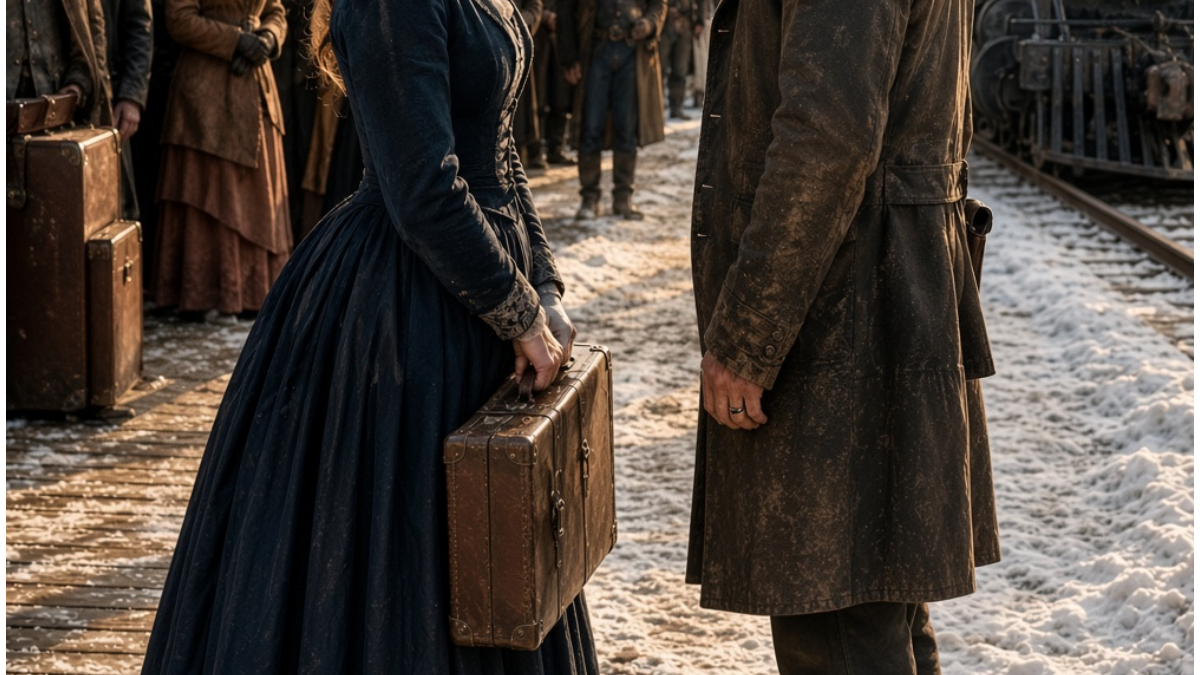
She crossed half a country to marry a stranger. He took one look at her and walked away.
On a frozen train platform in front of an entire town, Willa Heart was handed back like something that didn’t fit.
No apology, no shame, just a man turning his back while strangers watched and whispered and laughed behind their gloves.
She had nothing left. No ticket home. No family waiting. No plan. But she didn’t fall.
The train arrived 17 minutes late into Black Hollow, which meant that Willa Heart had 17 extra minutes sitting in a rattling passenger car with her one good suitcase on her lap, her fingers laced too tight across the worn leather handle, and her heart doing something she couldn’t quite name.
It wasn’t excitement anymore. It had started as excitement back in Ohio, back when she’d first read the letter with its careful handwriting and its careful promises.
But somewhere around the Missouri border, the excitement had curdled into something closer to awareness.
The kind that settles in the stomach before a storm hits, when the air changes and the birds go quiet, and every instinct in your body starts asking questions your mind isn’t ready to answer.
She pressed her forehead against the glass. The landscape outside was nothing like she’d imagined.
She’d expected something grand, the way the letter described it. Rolling hills and open sky and land that stretched out like a promise.
What she got instead was flat, pale earth dusted with frost, leafless trees standing like old men who’d forgotten why they were there, and a sky so gray it looked like the world had simply run out of color somewhere west of Kansas.
A few scattered buildings appeared on the horizon. Raw wood, unpainted, the kind of construction that said, “We arrived here and built as fast as we could and haven’t had time to make it pretty yet.
That was Black Hollow. It wasn’t the worst place she’d ever seen, but it was the loneliest looking.
She sat up straight and told herself to stop it. Told herself that first impressions were just fear wearing a disguise.
She was 26 years old. She had agreed to this. She had chosen this, or as close to chosen as a woman with limited options and a dead father’s debts could choose anything.
The man waiting on that platform had sent three letters over 6 months. He’d described his ranch.
He’d described his ambitions. He’d written in the last letter, “I believe we are well suited, Miss Heart.
I look forward to building something together. Building something together.” She’d read that sentence probably 40 times.
She smoothed her dress with both hands. It was her second best dress, the dark blue one with the small buttons at the wriSt. Her best one had a tear at the hem she hadn’t been able to mend properly, and she hadn’t wanted to arrive looking like she’d come apart at the edges, even if that was, more or less, the truth.
The train lurched and slowed. The conductor moved through the car. Black Hollow, end of the line, folks.
Well, the platform was more crowded than she expected for a town that looked like it barely existed.
People had gathered, not in the way people gather for something joyful, like a wedding or a fair, but in that particular frontier town way where anything unusual becomes spectator sport by default, because when there isn’t much else happening, a mail-order bride arriving on the afternoon train is approximately the most interesting thing all week.
She could feel their attention as she stepped down from the train car. Women in heavy coats with their arms folded.
A cluster of men near the feed store doorway. A few older boys who’d stopped whatever they were doing to watch.
She kept her chin up, carried her suitcase with both hands. He was easy to spot.
Harlan Greer was broader than she’d imagined from his letters, with a thick dark beard and the kind of face that looked like it had been weathered into permanent suspicion.
He stood apart from the rest of the crowd, watching her walk toward him, and there was something in his expression that she tried to read from a distance and couldn’t quite get a handle on.
She smiled anyway, offered her hand. “Mr. Greer, I’m Willa Heart. It’s a pleasure to meet you finally, in person.”
He didn’t take her hand. He looked at her. Really looked. The kind of slow, assessing look that moved from her face down to her dress and back up again.
The kind that made her feel like livestock being evaluated for purchase. And then he tilted his head slightly, and something shifted in his expression.
Not quite disguSt. Something worse. Disappointment with a mean edge to it. “You’re thinner than I expected,” he said.
She kept a smile in place through sheer force of will. “I’m sorry?” “The photograph you sent.”
He pulled it from his breast pocket and held it up briefly, like evidence. “You look different.”
“That photograph was taken 2 years ago.” “You look different,” he said again, louder this time.
Flatter. Final. The crowd had gone very quiet. She could feel it. That collective held breath that happens right before something bad tips over into something irreversible.
“Mr. Greer,” she said carefully, keeping her voice low. “Perhaps we could speak privately.” “I don’t need to speak privately.”
He folded the photograph and put it back in his pocket. “I paid for a woman fit for ranch work and for for the kind of arrangement we discussed.
You don’t look like what I paid for.” The words landed like a slap without the sound.
She heard something. She wasn’t sure if it was a gasp from the crowd or just wind cutting across the platform.
And for a moment, the entire world seemed to narrow down to the space between her and this man who was looking at her like she was a wrong order he intended to send back.
“I made a long journey,” she said. Her voice was steady. She was very proud of it for being steady.
“I gave up everything in Ohio to come here based on your letters, Mr. Greer.
I would ask you to consider” “I’ll have your ticket back to wherever you came from arranged by tomorrow morning.”
He picked up her case, said the small one he’d apparently been holding for her separate from the one she was carrying, and set it down at her feet with a thud that echoed.
“There’s a boardinghouse on Elm Street. One night, maybe two. After that, you’re on your own.”
He turned and walked away. No hesitation, no second look, just the back of a man’s coat moving through the crowd, which parted for him and then sealed itself shut again and left Willa Hart standing on the platform in her second best dress in the middle of Black Hollow at the end of the line, holding a suitcase in each hand and feeling the weight of every whisper that was She didn’t move for a long moment.
She just stood there because she had learned a long time ago that there is something important about not running, not because running is weak, but because the moment you run, people remember you running.
They remember your back. They remember the retreat. And she refused, absolutely refused, to be remembered retreating.
So, she set both suitcases down at her feet. She looked at the gray sky and she breathed.
“That was ugly.” The voice came from her left. Not loud, not performing for the crowd, just a direct statement offered to the air between them like a plain fact.
She turned. The man leaning against the far post of the platform roof was not someone she’d noticed before.
He was average height, maybe an inch or two over, with the kind of build that came from actual work rather than vanity.
Broad through the shoulders, slightly worn at the cuffs, a jacket that had seen several winters.
His face was angled, jaw-heavy with a few days of dark stubble, eyes that were a kind of quiet brown, watchful without being aggressive.
He was holding a length of rope he’d apparently been coiling, and he’d stopped coiling it sometime in the last 2 minutes.
It was, she agreed. You have a place to stay? He mentioned a boarding house.
Mrs. Alcott’s. The man made a sound that wasn’t quite a laugh. She’ll charge you twice what she tells you up front and complain about your shoes on her floors.
You’d know about it by Tuesday. Willa looked at him. Do you usually offer lodging critiques to women you’ve just met?
No. He went back to coiling the rope. I’m Rowan Mercer. I have a cabin 2 miles outside town, east side.
It’s not much, but it’s not Mrs. Alcott’s, either. He paused. I’ve got two kids, eight and five.
It’s It’s nothing improper, just a spare room until you figure out what you’re doing next.
She studied him for a moment. In her experience, men who offered things without apparent motive either had a hidden one or were simply the rarest kind, the decent kind that women like her had been taught not to trust because they’d been burned by pretenders too many times.
Why? She asked. He thought about it. She appreciated that he thought about it instead of just answering smoothly.
“Because what just happened wasn’t right,” he said finally. “And because I remember what it felt like when my wife died and I was standing in this town with two kids and nobody knew what to do with their eyes.”
He tied off the rope. “I figured somebody should do something. It might as well be me.”
It wasn’t romantic. It wasn’t even particularly warm. It was just honeSt. Plain and honest, like the man himself.
She looked at her two suitcases. She looked at the crowd, which was still watching.
“2 miles east,” she said. “Road forks after the mill. Go left.” She picked up her bags.
Thank you, Mr. Mercer. It’s just Rowan, he said, already heading off the platform. Nobody out here stands on formality for long.
She almost turned back twice on the walk. Not because of fear, or not only because of fear, but because the cold had gotten into her shoulders and the suitcase handles were cutting into her palms, and she kept thinking, “What exactly am I doing, following a stranger to a cabin outside of town I arrived in 40 minutes ago?”
The rational part of her brain, the part that had once kept her father’s household accounts and negotiated down butcher’s prices and managed everything that needed managing while her father slowly stopped being able to manage anything at all, that part was writing a list of every way this could be a serious mistake.
But there was no list for staying in Black Hollow with no money and nowhere to go, either.
So she kept walking. The cabin appeared around a bend in the frost-hardened road exactly when he’d said it would.
It was A cabin was perhaps the most honest description available. Low-roofed, two windows facing the road with small squares of glass that had gone wavy at the edges, a porch that sagged on one corner where the support post had shifted, firewood stacked high on the right side.
Whoever did the stacking did it methodically, at leaSt. And a door painted red that had weathered to a kind of dull brick color, the paint cracking in long vertical strips.
It was cold-looking from the outside. She knocked on the door anyway. A boy answered.
Eight years old, she’d been told. He looked like it, all angles and weariness and the particular defensive energy of a child who had decided sometime ago that he would be the one to answer the door, because the alternative was being the one who wasn’t ready.
Dark hair, his father’s coloring, with eyes that measured her like she was math he was trying to do in his head.
“You’re the woman from the train,” he said. “I am. I’m Willa Heart. Eli Mercer.
He didn’t step aside. Is it all right if I come in? It’s cold. He thought about it longer than most people would have.
Then he stepped aside, but only barely, so she had to angle her suitcase through the door sideways.
The inside of the cabin was warmer than the outside, which was the best thing she could say about it immediately.
A fire was going in the stone hearth, a good fire, someone had built it well.
And the smell was wood smoke and pine and something else, something faint and cold, like a room that had forgotten what it smelled like when someone cooked real food in it regularly.
A small figure detached itself from the far corner, 5 years old, his daughter, Clara.
She had hair that came loose from its braid in multiple places, and she was holding a rag doll with one arm missing, and she was looking at Willa with the largest, most solemn eyes Willa had seen on a child in some time.
She didn’t say anything. She just looked. Hello. Willa said softly. Clara took three deliberate steps forward and stopped.
Kept looking. Your doll has a missing arm, Willa said. I know. Clara said very seriously.
Papa said he’d fix it. He keeps forgetting. I’m good with needlework. If we can find the arm, I might be able to help.
Clara considered this with the gravity of a judge weighing testimony. Then she tucked the one-armed doll under her chin and went to the corner where she’d apparently set everything she owned and began digging through a small wooden box.
Rowan came in through the back door 20 minutes later, smelling of cold and sawdust, and stopped in the doorway between the back room and the main room, looking at the scene.
Willa Heart seated at his kitchen table with Clara on the chair beside her, both of them bent over a rag doll, Willa threading a needle with the easy expertise of long practice, while Clara held the separated arm in place and narrated very specific instructions about how the arm needed to be attached so that it didn’t look wrong.
Eli was at the other end of the table, ostensibly doing something with a length of rope, actually watching.
Rowan didn’t say anything. He just moved to the fire and added a log quietly and didn’t interrupt.
That first night was awkward in the way first nights in unfamiliar houses always are.
The wrong silences, the careful negotiations about which chair belonged to whom, the awareness of another person in the spaces between rooMs. Rowan had cleared out the small room off the back hallway.
It had a rope bed with a mattress that had seen better decades and a chest of drawers where one of the drawer pulls had been replaced with a bent nail.
He’d put a quilt on the bed. It was handmade, clearly old, worn thin at the edges, but still holding its color, blues and creams in a pattern that looked like it took someone a long time.
She ran her hand across it before she slept. She didn’t sleep well. She rarely did in strange places.
She lay in the dark and listened to the sounds of the cabin. The fire settling, the wind working at the eaves, the small shift of floorboards that old buildings make at night for no reason except that they’re old and they remember things in their wood.
And she thought about what she’d left and what she’d lost and what exactly she was supposed to do next.
No ticket money. She had spent what she had on the journey here. She had $6 and some coins in her bag.
That was everything. She was not a woman who cried easily. She had cried at her father’s funeral and at the [clears throat] burning of the small house afterward when his creditors came to settle the debts and twice on the train coming here.
Once in the dark and once in the bathroom where she could lock the door.
That was it. That was the full inventory of her crying since her father’s death.
She didn’t cry now. She stared at the ceiling which had a watermark near one corner shaped vaguely like a misshapen hand and she made a liSt. She was good at making lists.
It was how she’d survived the last 2 years. She would make a list of what she could do and then she would do the things on the list and she would not think further than that because thinking further than the list led to the kind of despair that had nowhere to go.
Immediate, earn my keep. Don’t be a burden. Don’t be helpless. Next, find work in town or a way to earn enough for a ticket somewhere.
Where? Figure that out when there’s money to figure it with. The children. They’re not your responsibility, but the girl’s braid needs redoing and that boy is doing his own laundry and doing it badly.
Rowan Mercer. Don’t complicate this. He was kind. Kindness is not a contract. She folded her hands on her chest in the dark and told herself to sleep.
Eventually, she did. She went into town 3 days after arriving. She needed thread and a few things that were basic and obvious and she couldn’t stay in the cabin forever.
She’d told herself that on day one and she [clears throat] meant it. She wasn’t the hiding kind, no matter how much Black Hollow’s reception at the train platform had made her want to be.
The general store was run by a man named Aldous Prior, who was exactly what the name suggested, thin and dry and measuring with spectacles that sat slightly crooked on his nose and the manner of a man who had accumulated a great deal of information about this town over many years and filed it all away with extreme precision.
He was polite to her. Formally polite, which was its own kind of message. Two women were in the store when she arrived.
She didn’t know their names yet. She learned them later. Martha Halley and Dora Crane, the former married to the blacksmith, the latter to a man who owned a significant portion of the land east of the river.
They were both well-dressed by Black Hollow standards and they were talking to each other in the particular lowered voice way of women who want to be overheard just enough.
Moved right into the Mercer cabin. 3 days now. Well, what else was she going to do?
Man didn’t want her. The question is why Rowan would take her in. After everything he’s been through, men are easily She’s got nowhere to go.
That’s the point. She needs a situation and he needs His children don’t need a strange woman.
Willa moved along the shelves methodically, reading labels she didn’t need to read, and let the words go past her.
She had learned this particular skill early in the years after her mother died and before her father drank himself into uselessness.
The ability to be in a room where people were talking about her and not give them the satisfaction of knowing she could hear.
It was a kind of armor she’d built piece by piece, and it wasn’t comfortable to wear, but it fit well enough.
She bought her thread and a small bag of flour and paid for them with exact change.
Aldus Prior wrapped everything in brown paper without making eye contact. “Thank you,” she said.
“Ma’am,” he said. She walked out. Outside, she stopped on the boardwalk and looked at the street.
Black Hollow in daylight was slightly more alive than it had appeared on the day she arrived.
A wagon was moving down the main road, loaded with something covered in canvas. A group of men stood near the smithy.
A dog lay stretched in a bar of thin winter sunlight at the edge of the road, unconcerned with everything.
She pulled her coat tighter and walked back toward the road eaSt. She had a list to get to.
The porch step was dangerous. She’d noticed it on the second morning. The third board from the bottom had split clear through on the left side, which meant that anyone who stepped on it while carrying something heavy enough to shift their weight was going to pitch sideways and potentially off the porch entirely.
She’d watched Eli come close to it twice, both times catching himself with the automatic balance of a child who had probably already fallen once.
She found tools in the shed behind the cabin. She’d grown up watching her father work with his hands In the years before he stopped working, and she knew enough, not everything, not the fine carpentry that Rowan clearly understood at a level that came from years of practice, but enough to identify a problem and address it with basic materials.
She pulled the split board. She found a replacement plank, cut short and rough at one end, but serviceable, in the scrap pile near the shed.
She fitted it and nailed it in before the sun had fully come up. She was sweeping wood chips off the porch when she heard the back door.
Rowan stopped at the corner of the cabin. He looked at the step. He looked at her.
He looked at the step again. “You fixed the porch step,” he said. “It was going to break someone’s ankle.”
“I was going to get to it.” “I know,” she said. “I was up early.”
He stood there for a moment longer than necessary, and she could see him deciding something.
Deciding, she thought, whether to be bothered by it or not. Men who were proud of their work sometimes took it as a criticism when someone else fixed something firSt. She’d learned that from her father, too.
But Rowan just nodded. “Thank you,” he said. Then he went around back to start on whatever the morning had for him.
She swept the rest of the chips off the porch. That afternoon, she found a bag of beans that had been sitting untouched in the back of the pantry long enough to develop personality, but not long enough to be useless.
She sorted them, picked out the bad ones, set the rest to soak, added onion and the rind from a piece of cured pork she found in the cold box, and by the time the lights started going, she had a soup that smelled like something.
Eli came in from outside smelling like cold air and suspicion. He went straight to the pot, which she’d half expected.
Kids always check the pot. “What is it?” He asked. “Bean soup.” “Mama used to make bean soup.”
The statement landed in the kitchen like a stone dropped in still water. He hadn’t said it to be cruel.
She could tell the difference between a child trying to hurt and a child simply stating something true that they hadn’t fully thought about before it came out of their mouth.
But he watched her face after he said it with that specific watchfulness that children deploy when they’ve said something complicated and they want to see the damage.
She stirred the soup and didn’t look up. “Then I hope it’s close,” she said.
“But if it’s not, tell me what she did differently and I’ll try to get it right next time.”
Eli stared at her. He hadn’t expected that, she could tell. He sat down at the table without being asked.
“She put in dried peppers,” he said finally after a long pause. “Just a little.
Not enough to be spicy. Just enough for the taste.” “I’ll remember that.” He didn’t say anything else, but he stayed at the table, which was something.
Clara came in dragging a stick she’d found outside and demanded to know if the soup was done and could she have the spoon to stir it?
And Willa handed her the spoon and Eli watched his little sister stir very seriously.
And the kitchen was not warm, exactly, but warmer than it had been. The town had, predictably, decided several things about Willa Heart, none of which required her input.
The most popular version went approximately like this. She was a woman with a bad history who’d been rejected for a reason and she’d attached herself to a vulnerable widower because she had nowhere else to go and needed someone to support her.
Rowan Mercer was a good man who’d had a hard time and didn’t know what he was walking into.
The children were the real victiMs. The second version, slightly less popular but with a dedicated following, went like this.
She was clever rather than desperate, had probably made herself up to look less attractive in person so that she could claim mistreatment and find a better situation.
And Rowan Mercer, who was decent but not always practical, had walked straight into it.
Both of these versions made their way back to Willa via Clara, who was five and had no concept of information being inappropriate to relay, and via the particular way that people in small towns go slightly quieter when the subject of the conversation walks through the door.
She was at the general store for the second time when she overheard it most directly.
A woman named Josephine Aldridge, she she’d learned names by now was talking to someone near the bolts of fabric.
Josephine Aldridge was the wife of a rancher, the kind of woman who wore her social position the way she wore her good brooch, visible, intentional, never far from her collar.
A woman that’s been passed over once doesn’t just stop at the first door that opens, Josephine was saying.
She calculates. That’s what I’m saying. Rowan Mercer has two children and a piece of land and a decent reputation and she arrived with nothing and now she’s in his house.
She fixed his porch, said the woman she was talking to. Oh, she fixed his porch, Josephine repeated with the specific inflection that turns a statement into a dismissal.
Willa set down the spool of thread she’d been looking at and picked up a different one.
Her jaw was tight. She made it loosen. She was not going to engage. She was not going to turn around and explain herself to a woman who had already written the story and simply needed Willa to play the assigned role.
That was a trap she’d seen before. The moment you defend yourself is the moment you confirm you have something to defend.
She brought her items to the counter. Aldous Prior wrapped them up. She paid exact change and said thank you and walked out.
On the boardwalk she exhaled once, sharply, and then started walking. She was a hundred feet down the road when she heard quick footsteps behind her.
She turned. It was a different woman, someone she hadn’t seen before, maybe 40 with a round, honest face and the look of someone who’d never learned to be cautious with her expressions.
She was slightly out of breath. I’m Ruth Hale, the woman said. “My husband runs the mill.
I’ve got no business saying any of this to you, but I’m going to anyway because Josephine Aldridge talks like that about everyone who isn’t inside her circle, and I’ve watched it run off three decent women from this town.”
She stopped. “You don’t look like what she says you are.” Willa looked at her.
“You don’t know me.” “No,” Ruth Hale agreed easily. “But I knew Eleanor Mercer, Rowan’s wife, and I know his kids, and I know that cabin has been sad for 2 years, and I heard Clara Mercer sing a little song in the churchyard last Sunday that I haven’t heard her sing since before her mama died.”
She pressed her lips together. “That’s all. Just thought you should know there are people paying attention to the whole picture.”
She turned around and walked back to the store. Willa watched her go. She stood on the road for a moment with the wind pressing at her back and the cold settling around her ankles and thought about Ruth Hale and her round, honest face, and the way she’d come out of that store just to say that.
Then she turned east and walked back toward the cabin, and the list in her head added one item: find a way to deserve that.
She had not grown up around children. She was an only child herself, and her experience with small people was limited to the few years she’d spent teaching sums and letters to neighborhood children in Ohio, which had taught her that children were capable and interesting and frequently exhausting in ways that had nothing to do with bad behavior and everything to do with sheer relentless presence.
Clara was relentless. Clara was also, Willa quickly discovered, a child who had decided to love her immediately and completely and with zero reservations, with the particular wholehearted, ungarded love that 5-year-olds deploy when they’ve decided, and no force on earth was going to change it.
She followed Willa around the cabin. She narrated everything she was doing. She asked questions at a rate that would have been medically concerning in an adult.
She wanted Willa to braid her hair every morning and to read to her at night and to look at the things she found interesting outside, which were mostly rocks and once a very dead bird that Clara treated with great solemnity.
Eli was different. Eli was 8 years old and had become somewhere in the 2 years since his mother died, the kind of child who’d taken on the shape of a smaller adult.
He did his chores without being asked. He kept his things in order. He didn’t cry as far as she ever saw and when Clara cried, he went to her before either adult did and stood very straight and said, “It’s okay, Clara.”
In a voice that was trying so hard to mean it. He watched everything and said little and had an air about him.
Not hostility, exactly, more like a careful distance he’d established as a matter of survival.
The kind that says, “I will get attached to you again only when I’m sure you’ll stay.”
She didn’t push it with him. That was her one rule with Eli. She would not push.
She would be consistent and reliable and she would not ask him to feel anything and she would wait for him to come to her on his own timeline, if he ever did.
“You’re doing it on purpose.” He said one morning. She was making biscuits. He was at the table with a piece of wood he’d been carving at.
Just shapes, nothing particular, the kind of thing a boy does with a knife and a block of pine when he’s thinking.
“Doing what on purpose?” She asked. “Not trying to get me to like you.” She turned and looked at him.
He was still looking at his carving. “I’m not going to pretend I don’t want you to like me.”
She said carefully. “But I’m not willing to trick you into it, either. So, I figured I’d just be here and do what needs doing and let you make up your own mind.”
He was quiet for a moment, then, “Mama said that liking someone and trusting someone aren’t the same thing.”
“Your mama was right.” Willa said. He looked up at her then, just briefly, then back at his carving.
“The biscuits are burning.” He said. She turned back to the oven and pulled them out.
Not burned, barely. The bottoms just a shade darker than ideal. And set them on the counter and thought, “That boy is going to be just fine.”
And then thought, “Don’t get attached. This is temporary. You are temporary here.” But the biscuits were warm and the fire was going.
And somewhere from the back of the cabin came the sound of Clara singing to her one-armed doll.
And the list in Willa Heart’s head got a little harder to read. She hadn’t spent much time thinking about Rowan Mercer, which was a choice she’d made deliberately and enforced with some effort.
He was present, but not intrusive. He came in from work in the evening smelling like sawdust and cold air and sometimes horse.
He ate what was on the table, sick. She’d been cooking because it seemed the most useful thing she could do and because it turned out the man had been feeding his children something close to functional but deeply uninspired.
Without comment, except occasionally when something was good, he’d pause a moment with his fork and look at his plate with a kind of mild surprise, like he’d forgotten food could be more than fuel.
He was a carpenter, she understood now. The real kind. The kind who was called for building and repairing.
He had a workshop behind the cabin full of organized tools. And she’d seen, without being invited to see, the inside of it once when the door was open.
Sawdust on everything. Projects in different stages arranged on workbenches. A smell of cut wood that was actually not unpleasant.
And the general air of someone who knew exactly what they were doing in there.
He was quiet by nature. Not sullen quiet. Not the silence of a man with something to hide or something to punish.
Just the silence of someone who had spent a long time being the only adult in his house and had gotten used to letting noise happen rather than making it.
She caught him watching her sometimes. Not in a way that alarmed her. Just in the way you watch something that’s different from what you’re used to.
The way you watch a new pattern in something familiar to try to understand what it’s doing.
She caught herself watching him, too, sometimes, mostly when he was working with the kids.
The way he crouched down to Clara’s level when she was showing him something, fully present, not the half attention that adults usually gave small children’s discoveries.
The way he ruffled Eli’s hair sometimes, and then his hand would rest on the boy’s head a half second longer than the ruffle required, and Eli would stiffen slightly and then not stiffen, and it was it was the most private thing she’d seen, that half second, that tiny signal between a father and a son who were both trying very hard not to need each other too visibly.
One evening, after the kids were in bed, she was mending something at the table and he was reading by the fire.
He kept a small collection of books on the shelf beside the window, spines cracked from use.
And it was the most ordinary silence in the world, the kind that falls between people who are used to the same space.
She thought, I could live in a silence like this. She thought immediately after, “Stop that.”
“How much longer do you need?” She asked. He looked up. “Sorry?” “Before I should move on.
I’m not I don’t want to overstay. I’ve been here 2 weeks.” He was quiet for a moment, looking at her.
“Clara cried when I suggested you might need to move to town eventually,” he said.
“Clara cries when her soup is too hot,” Willa said. “That’s not a useful metric.”
Something moved across his face that might have been a smile. Might have been. It was brief and she wasn’t certain.
“She doesn’t cry easily,” he said. Actually, he looked at the book in his hands without reading it.
“Stay until spring. That gives you time to figure things out, and the winter’s bad here.
You don’t want to be in town this time of year with Mrs. Alcott and no income.”
“I’ll pay for the room,” she said. “Once I find work, you’re cooking, and you patched the fence last Thursday, and you re-chalked the window frames.
I saw it. You’re not here for free. He sounded slightly irritated by the implication, which she found unexpectedly reassuring.
Just stay till spring. She looked at her mending. All right, she said, till spring.
He went back to his book. She went back to her mending. Outside the wind was building to something serious, pressing against the cabin walls with the low-grade insistence of a winter that was only getting started.
Inside, the fire burned steady. The temperature dropped to something savage on the last Sunday of November.
She knew because she woke at 3:00 in the morning to the sound of Clara crying.
Not loud, not the sudden sharp cry of a nightmare, but the thin persistent crying of a child who’d woken cold and frightened and didn’t know how to get back to warmth.
She was out of her bed and in the hall before she was fully awake, the floor like ice under her feet, pulling the door to Clara’s small room open.
The fire in the main room had burned low. Clara was sitting up in her bed with both quilts pulled around her, but still shaking, her eyes wide.
The one-armed doll, now re-armed, neatly stitched, pressed against her cheSt. Hey, Willa said softly.
Hey, I’ve got you. She crossed to the bed and gathered the child up, quilts and doll and all, and felt how cold the small body was even through all that wool.
It got cold, Clara said, teeth chattering faintly. It got so cold. I know, I’m going to fix the fire.
Here. She got Clara arranged on the bed with all the quilts piled around her, tucked in tight, then went to the main room and built the fire back up properly, the way she’d watched Rowan do it, specific arrangement of log and kindling, space for air, patience.
It caught well. She felt the heat beginning to expand before she stood up. She went back to Clara’s room.
Clara was already half asleep again, tucked into her quilts, but her small hand reached out and found Willa’s wrist in the dark and held on.
“Stay.” Clara said. It wasn’t a question. Willa sat on the edge of the bed.
She didn’t lie down. She sat upright and let Clara hold her wrist, and she stayed until the fire had fully taken and the room had started warming, and the child’s grip had gone loose with sleep.
Then she sat a while longer because there was something about this small room with its low ceiling and the sound of a sleeping child and the warmth coming in from the other room, something about it that she wasn’t ready to leave.
She looked at Clara’s face, at the smooth unworried face of a sleeping 5-year-old. She thought about her own mother, who had died when she was 12, and how she had done this exactly.
It’s sat on the edge of Willa’s bed when Willa was sick with fever, held her wrist, stayed.
She hadn’t thought about that in years. She hadn’t let herself. She sat very still in the dark, and for the first time since the train platform, the tight controlled thing she’d been carrying in her chest, the thing that was not quite grief and not quite anger, but was something that had no name yet, loosened, just slightly, just enough.
She was still sitting on the edge of Clara’s bed when first light started finding its way through the warped glass of the small window.
She stood up, smoothed her dress, pushed her hair back from her face. The day was starting, and there were things on the list, and she was going to be fine.
She walked to the kitchen and began making coffee. And in the doorway of his room, Rowan Mercer stood in the early gray light and watched her at the stove for a moment.
The set of her shoulders, the way she moved in his kitchen like it was slowly becoming familiar.
And then he went to add wood to the fire because the morning was cold and it was his job to keep things burning.
December came to Black Hollow the way bad news comes, quietly at first, then all at once.
The first real snow fell on a Tuesday, and by Wednesday morning, the road east of the mill had disappeared under 8 in of white that looked clean and soft from the window and was in practice brutal.
Rowan left before dawn each day that week taking jobs wherever the cold hadn’t shut work down entirely.
A barn repair 2 mi north, window frames for the new building going up near the post road.
He came back after dark most nights with his hands stiff and his jaw set in the particular way of a man who’d spent the day working in the cold and was running the numbers in his head and not liking what to do.
Willa watched all of this without commenting. She understood the arithmetic of a household that was always one bad season away from something difficult.
She’d grown up inside that arithmetic. Her father had been a proud man with inconsistent income and the kind of optimism that looked like confidence until the moment it didn’t.
And she had learned early how to read the financial weather of a house from the set of the adult’s shoulders.
The way they paused before answering questions about money. The specific silence that fell when bills arrived.
Rowan’s silence was that kind. She started keeping a closer account of the pantry, not dramatically.
She didn’t sit him down and present a ledger, which would have embarrassed him and served nothing.
She just started being more careful. Stretched the beans further. Used the ham bone twice before it gave up the last of its flavor.
Made bread every other day instead of every day because bread every other day still meant bread and bread every day meant flour gone faster than it should be.
She found in the back of the cold shed a row of preserves she suspected had been put up by Eleanor Mercer the summer before she died.
Peaches, some kind of berry, green beans in brine, and she used them sparingly one jar at a time as if there were more where they came from, which there weren’t.
Clara noticed nothing. Clara was five and the world was mostly fine as long as someone braided her hair and read to her after supper.
Eli noticed everything. “There’s more bread today.” He said one morning looking at the two smaller loaves cooling on the counter.
“I made a different size.” Willa said. He looked at her with those eyes that had seen too much for 8 years.
“We’re running low on things?” “We’re being careful.” She said. Which was true and also a kinder word for the same thing.
“That’s different from running low.” He thought about that. Then he went outside without being asked and came back an hour later with two rabbits he’d caught in the traps he’d apparently been maintaining without telling anyone.
Traps he’d set himself, she realized, because he’d also figured out the arithmetic and had decided to do something about it in the way available to an 8-year-old boy.
She cleaned the rabbits. She didn’t make a fuss about it. “Thank you, Eli.” She said.
“Mama taught me.” He said. Flat. Informational. Not a challenge this time, she thought, just a fact he needed her to know.
“She taught you well.” Willa said. He went back inside. She stood at the sink and thought that this child was going to break her heart one way or another and she wasn’t sure she had the right to let him.
That evening she made rabbit stew with the preserves and some of the root vegetables from the cold box and when Rowan came in from the dark and sat down at the table and tasted it, he set his spoon down after the first bite and looked at the bowl for a moment.
“This is good.” He said. Like it surprised him. “Eli caught the rabbits.” She said.
Rowan looked at his son. Eli shrugged with the aggressive unconcern of a boy trying not to want praise too much.
“Good work.” Rowan said. “It’s just traps.” Eli said. “Still good work.” Eli picked up his spoon and stared at his stew and the tips of his ears went slightly red, which was the closest he came to showing pleasure, Willa had learned.
She looked down at her own bowl and said nothing. The fire snapped. Outside snow shifted off the roof in a soft avalanche, hit the porch rail, and the cabin was quiet in the way it sometimes was now.
Not the empty quiet of before, but the full quiet of people who didn’t need to fill every space with noise.
It was a small thing, but small things had a way of accumulating. She noticed she had started calling it the cabin in her own head rather than his cabin.
She noticed, and she told herself to stop, and she kept doing it anyway. The weeks moved the way winter weeks do in a place like Black Hollow, slow in the middle and fast at the edges, so that you’d look up from something you’d been doing and realize 3 days had passed without your full attention.
She fell into the rhythm of the place gradually and then completely. The early mornings with the fire and the coffee, the bread, the particular morning noise of Clara waking up, which always began with talking.
Clara did not ease into consciousness. She arrived in it fully, already narrating. And then Eli, quieter, the creak of his door and his footsteps that were heavier than they should be for a boy his size, as if he were already practicing walking like someone with more weight to carry.
She repaired things when they needed repairing. She wasn’t doing it for credit, she was doing it because a broken drawer pull and a cracked window seal and a door that didn’t close properly against the cold were problems that made a house harder to live in, and she was living in it, and it made sense to fix them.
But she was also aware, in an honest part of herself, that fixing things was the way she knew how to say, “I am contributing.
I am not a burden. I am worth the space I take up.” She’d always said it with her hands rather than her mouth.
Old habit, the kind that came from years of needing to prove something to people who weren’t going to take her word for it.
Rowan saw it. She knew he saw it because he stopped making the small apologetic comments he’d been making in the first week, the “You don’t have to do that, and I was going to get to it.
And started instead just noting things. Fixed hinge on the back door. Good. Not effusive, just present, acknowledged.
Which, for a man who used words the way he did, carefully, sparingly, like he was aware of their weight, was as close to warm as he generally got.
She appreciated it more than she would have appreciated compliments. Ruth Hale came by one Thursday afternoon with a crock of something wrapped in a cloth, and the particular energy of a woman who’d been meaning to do this for a while, and had finally stopped talking herself out of it.
She was the same woman from the road, the mill owner’s wife with the round, honest face, and she came in and sat at the table and didn’t treat the situation as complicated, which Willa found to be the most relief she’d felt in weeks.
“I brought pickled beets,” Ruth said, setting the crock on the table. “My husband won’t eat them.
I make them anyway, out of spite.” “That’s a good reason,” Willa said, and put on water for coffee.
Clara immediately inserted herself into the visit and demanded to tell Ruth about the doll’s arm, and Ruth listened to the full account with the seriousness it deserved, and Eli appeared in the doorway, assessed Ruth, apparently decided she was acceptable, and retreated back to whatever he’d been doing.
The afternoon went the way afternoons did when a decent person came into a space, easier, warmer, like a window opened somewhere and the air changed.
“The Aldred woman’s been talking,” Ruth said when the kids were in the other room.
“I know,” Willa said. “She’s saying you pushed yourself on Rowan because he’s easy pickings.
Grief makes men soft, she said. That was the word she used, soft.” “She’s entitled to her theory.”
Ruth turned the coffee cup in her hands. “It doesn’t bother you?” Willa thought about it honestly.
“It bothers me,” she said. “I’m not going to pretend it doesn’t, but there’s a difference between something bothering you and something being worth your time.
She looked at the table. I can’t make Josephine Aldridge believe whatever she’s decided not to believe, but I can get up in the morning and do the thing in front of me, and people who are paying attention to the whole picture she used Ruth’s own phrase, and Ruth’s mouth curved slightly, “will see what they see.”
“You’re tougher than you look,” Ruth said. “I look tough enough,” Willa said. Ruth laughed.
It was a real laugh, the kind that came up before anyone thought to manage it, and the sound of it in the kitchen was good.
Willa thought, I could use a friend in this town. It wasn’t a romantic thought or a desperate one, just practical.
A woman who laughed easily and came by with pickled beets out of spite was precisely the kind of ally that mattered in a place like Black Hollow.
The afternoon started being something she looked forward to, which was new. She had not looked forward to afternoons in a long time.
Rowan noticed Ruth Hale’s visits the same way he noticed most things, quietly, without comment, just a slight adjustment in his own ease.
He seemed to trust Ruth’s judgment the way you trust a person who’s been around long enough to earn it, and on the evenings after Ruth had been by, he was slightly less careful in his silences.
Once he told her something mildly funny about a job he’d done that day, a wall he’d been asked to build straight that turned out to be going up against a foundation that wasn’t, so the wall that looked wrong was actually the correct one, and she laughed, and he looked briefly startled by the sound of her laughing, and then looked at the fire, and they were both quiet again, but it was a different quiet than before.
December edged toward its middle, and then one night, Eli did something she hadn’t expected.
She’d stayed up later than usual trying to finish mending a pair of Rowan’s work trousers.
The knee had gone through, and she had a patch that would hold, and she was at the table under the lamp when she heard the creak of his door.
She expected him to go for water and come back, the way kids did at night.
But he came into the main room and stopped and stood there in the firelight in his sleep clothes looking like what he actually was, which was a small boy who couldn’t sleep.
“You should be in bed.” She said quietly so she didn’t wake Clara. “I know.”
He said. He sat down anyway. On the other side of the table, not next to her, a boy’s careful negotiation of proximity.
He pulled his knees up on the chair and wrapped his arms around them. “I dream about her sometimes.”
He said not looking at her, looking at the fire. She didn’t pretend she didn’t know who he meant.
“That makes sense. It’s not They’re not bad dreaMs. It’s just her being regular, just doing regular things.”
He was quiet. “And then I wake up and I know and it’s like” He stopped.
“Like losing her again?” Willa said. He nodded. One sharp dip of his head, like he hadn’t been sure she’d understand it.
“I used to dream about my mother like that.” She said. She went back to her mending because she had learned that Eli talked more easily when no one was looking directly at him.
“She died when I was 12. And for a long time after I’d dream about her in the kitchen or hanging washing or just being there.
And then I’d wake up.” He was quiet for a while. The fire shifted. Outside the wind was moving through the pine trees at the edge of the property with a low constant sound.
“Does it stop?” He asked. She considered giving him the comfortable answer. She decided against it.
He was the kind of kid who knew when he was being given the comfortable answer and it would cost her something with him.
“It changes.” She said. “The dreams come less often. And eventually when you wake up from them the feeling isn’t only bad.
Sometimes it’s like” She tried to find the right word. “Like she visited and that part’s okay.”
He thought about that for a long time. Okay, he said finally. The way kids say okay when they’re absorbing something they’re not done with yet.
He uncurled himself from the chair. He stood up. He hesitated. She could feel it without looking.
And then he did something he hadn’t done before. He walked around the table and stood beside her for a moment, close enough that she could feel the small warmth of him, and he looked at the mending in her hands.
“Those are my dad’s,” he said. “Yes. The knees have been like that since October,” he said.
“He keeps meaning to” “I know,” she said. “I’ve got it.” He stood there another moment, then he went back to his room, and she heard his door close, and she sat very still at the table with the mending in her hands and the firelight unsteady across everything, and she told herself firmly and without sentiment that this was still temporary, that spring was still the plan.
But her hands had gone still over the work, and the fire was burning low, and outside the snow kept falling on Black Hollow in its patient, indifferent way, covering everything equally, the good and the bad and the uncertain, until the whole world looked the same.
She picked up her needle. She finished the mending, and she sat at the table a little while longer than she needed to in the quiet of a house where people were sleeping, feeling for the first time in a long time that the dark outside was something to be held at bay rather than something waiting to confirm what she already feared.
It was not comfort, exactly. It was something more provisional than comfort, something that didn’t have a clean name, but it was there.
And it was real. And she was, without quite meaning to be, grateful for it.
The morning it happened, Willa had been awake since before the light. That was not unusual anymore.
She had settled into the cabin’s rhythms the way water settles into the shape of whatever holds it.
Not without resistance, not without its own pressure, but eventually, inevitably, finding its level. She woke early because the fire needed feeding and because the hour before the children woke was the only hour that belonged entirely to her.
And she had learned to value it the way you value anything that comes in limited supply.
She was heating water for oats when she heard Rowan’s door. He came out already dressed, which meant he had work somewhere.
He dressed differently on days with nowhere to go, slower, more deliberate, the shirt not quite fully tucked.
Today he was ready. He moved to the coffee without speaking, which she had come to understand was not rudeness, but just the way he was before the first cup settled in.
She had stopped trying to fill that silence weeks ago, and the stopping had been, apparently, the right thing because he’d grown incrementally easier in her presence since then.
Small increments. The kind you only noticed if you were paying attention over time. “Garrett’s barn,” he said when the coffee was halfway gone.
“The north wall shifted in the freeze. Might be 2 days of work.” “I’ll keep something warm for supper.”
He nodded, looked at his cup, then “There’s a loose nail on the top step of the back porch, third from the left.
It’ll catch someone’s boot.” “I’ll fix it this morning.” He nodded again, and that was the conversation, and he went out into the cold gray morning with his coat and his tools and his particular kind of self-sufficiency, and the cabin settled back into its pre-dawn quiet.
She was pulling on her second boot, preparing to go out and find the nail on the back porch before she forgot, when she heard Clara’s door.
Not the usual arrival. Clara’s mornings typically began with talking before the door even fully opened, but this one was quiet, which meant the child was still half in sleep, moving on instinct rather than intention.
The hallway was dim. Clara came out of her room with her hair a full catastrophe of escaped braid and her doll tucked under her arm and her eyes at about 70% open wearing her wool stockings that had twisted during the night so that the heel was halfway up her calf.
She took four steps into the hallway, hit the ridge in the floorboard that Willa had been meaning to mention to Rowan.
The one where the wood had lifted slightly at the seam, not dangerous exactly, just uneven enough to catch a small foot.
And her arms went out and she pitched sideways with the particular slow motion inevitability of a child losing their balance before they’re fully awake.
Willa was already moving. She caught Clara before the girl had fully gone down. Not a dramatic rescue, nothing graceful about it, more of a controlled interruption of a fall.
Both of them ending up at an awkward angle against the hallway wall. Willa’s knee on the floor and Clara’s elbow banging into the wood paneling hard enough to matter.
The doll hit the floor and skidded. Clara’s face crumpled. There’s the one second delay between impact and the understanding that it hurt, and then the cry came.
Not the sharp kind of real injury, but the full-bodied kind of shock and cold and imperfect waking.
The kind that needed to be held more than it needed to be fixed. Willa pulled her in.
She held the child against her chest, Clara’s arms going up and around her neck with the automatic grip of a small person who has found an anchor.
And she felt Clara shaking with the effort of crying. The full body involvement of a child’s grief, even small grief.
She pressed her cheek against the wild hair and murmured something low and meaningless. The kind of sound that isn’t words exactly, but that carries all the information words are trying to convey.
The crying peaked and began to ease. And in the space between one ragged breath and the next, in the particular loose-limbed way that children move from distress toward relief, Clara turned her face into Willa’s shoulder and said one word.
Not loudly. Not deliberately. Just the word that existed at the bottom of everything. The word a body reaches for when it needs comfort badly enough to stop choosing carefully.
Mama? The hallway went still. It was the kind of still that has weight to it.
The kind that is not the absence of sound, but the presence of something so large it displaces sound entirely.
Willa stopped breathing for a moment. She didn’t mean to. It just happened the way certain things happen in the body before the mind has caught up with what the body understands.
She heard the creak of Eli’s door. She didn’t look up. She kept her arms around Clara who had already begun to settle.
The word already passed, released into the air of the hallway without the child knowing what she’d said.
The comfort already working the way comfort works when you’re five and someone is holding you.
Clara’s grip loosened slightly. Her breathing slowed. She made the small tired sound of a child who might fall back asleep right here if allowed to.
Willa looked up. Eli was standing in his doorway. He’d heard it. She could see it in his face.
The stillness of him. The particular way his jaw had set. The eyes that were working through something complex and faSt. He was eight years old and he had just heard his little sister call someone else by the word that belonged to a person who was dead.
And she watched him process that in real time. Watched the thing move across his features.
Something that started close to pain and moved slowly towards something she couldn’t name. Not acceptance.
Not yet. Something before acceptance. Something more honest than that. He looked at Willa. She looked back at him.
She didn’t say anything because there was nothing to say. Nothing that would be right.
Nothing that would not cost more than it gave. She just held his gaze and let him look.
And she did not try to make her face do anything in particular. She was just her face with whatever was on it.
He looked at his sister, small and half asleep in Willa’s arMs. Then he went back into his room.
The door didn’t close all the way behind him, which she thought was its own kind of answer.
She stayed on the hallway floor for another minute. Claire’s weight was settling heavier, the child genuinely drifting back towards sleep.
Willa shifted her carefully, got upright, carried her back to her room, and laid her down.
She pulled the quilts up. She picked the one-armed, the now two-armed, doll off the floor and tucked it beside the child.
She stood in the doorway of Claire’s room for a moment. Then she went to the kitchen and stood at the counter and looked out the window at the snow-covered yard and the gray sky beyond it, and the dark line of pines at the edge of the property, and she breathed in and out, slow and deliberate, the way she’d taught herself to breathe when things became too large for the chest that was supposed to contain them.
She was not Claire’s mother. She was not anyone’s mother. She was a woman who had arrived here 6 weeks ago with two suitcases and a broken plan, and she was to stay until spring, and she had to remember that.
But the word was still in the hallway. She could not unhear it. Nobody in this house could unhear it, and whatever it had changed, and it had changed something, she could feel the changed shape of the air.
They were all going to have to live in the after of it now. She found the nail on the back porch and fixed it.
She made the oats. She did the things on the liSt. Eli came to breakfast without being called and sat in his usual chair and ate without speaking.
She didn’t speak either. When he finished, he picked up his bowl and carried it to the sink, which he didn’t always remember to do, and then he stood at the sink for a moment with his back to her.
She doesn’t remember her, really, he said. Clara. She was three when Mama died. She doesn’t It’s not like she knows the difference.
Willa kept her hands around her coffee cup. I know, she said. It didn’t mean He stopped, started again.
She’s little. She just needed Eli. She waited until he turned around. You don’t have to explain it to me.
He looked at her, the careful measuring look. Then he nodded once, picked up his coat, and went outside.
She watched him go through the window, the small figure crossing the yard toward the tree line where he kept his traps.
And she thought, that boy just gave me something. I need to make sure I’m worth it.
Rowan came home that evening later than expected, cold in a way that meant the barn work had gone longer than planned.
He was short with fatigue, not unpleasant, just economical, the way tired people are when they’re managing themselves carefully.
He ate. He asked after the kids. Clara, fully recovered from the morning, gave him a comprehensive account of the day that included a bird she’d seen from the window, the correct way to fold a piece of paper into a boat, which Willa had showed her, and the information that she had eaten all her oats, including the parts that tasted like the pot.
Rowan listened to all of this with the gravity it deserved. That’s a lot for one day, he said.
It was a good day, Clara said with authority. He looked up from his daughter to Willa, a quick look, the kind that asked something without asking it directly.
She gave him a small nod. Later. He looked back at his food. After Clara was in bed and Eli’s light had gone out, and the cabin had settled into its night-time version of itself, she told him.
She stood at the sink and she told it plainly, the way it had happened.
The floorboard, the fall, the catching, the word. She kept her voice even. She was not going to make it into more than it was, but she was also not going to pretend it hadn’t happened because it had happened in his house with his children, and he had the right to know.
He was at the table when she started. By the time she finished, he had his hands flat on the table top, looking at them.
Not upset, she thought, just absorbing it. She said it, he said. Not a question.
She didn’t know she’d said it. She was half asleep. Still. He was quiet for a moment.
The fire, the wind. Eli? He heard it. He was He handled it better than I would have probably at his age.
Rowan looked at the window, at his reflection in the dark glass, which was a ghostly approximation of his actual face.
The angles all there, but the detail loSt. She was three, he said. Eleanor. When she died.
Clara was three. I didn’t know how to He stopped. You don’t have to. I know, he said.
Which was what she’d said to Eli that morning, and the echo of it was not lost on either of them.
I know I don’t. I just He pulled a breath in through his nose and let it out slow.
I’ve been trying to make sure she knows about Eleanor, about who her mama was.
But three years old, you know, there’s only so much He shook his head. She knows she’s loved, Willa said.
Whatever else, she knows that. He looked at her then. A direct look, the kind he didn’t give easily.
Because of you, he said. The last six weeks. That’s A lot of that is because of you.
She looked at the sink. I’m just doing what needs doing. I know that’s what you say.
There was something in his voice, not not argument, not quite. More like precision. I know what you say.
I’m telling you what I see. It’s more than that, Willa. She didn’t answer right away.
She heard her name in his voice, the first time he’d used it like that, with that particular weight.
And it landed somewhere in her chest in a way she wasn’t prepared for and didn’t entirely know what to do with.
The floorboard in the hallway needs to be fixed,” she said finally. A beat. “I’ll do it tomorrow,” he said.
“Before someone else trips on it.” “Yes, and the window frame in Eli’s room has a draft.
I stuffed wool in it for now, but it needs to be properly resealed.” “I’ll look at it.”
“And there’s Willa.” His voice was quiet. “I know.” She stopped. The fire burned. The house breathed around them the way houses do late at night, small sounds, settling sounds, the sounds of a structure that has stood through enough winters to have opinions about this one.
“I’m not Clara’s mother,” she said. Not defensive, just true. “I need to make sure we’re both clear on that.”
“We’re clear,” he said. “That’s not what I was Oh.” He paused, recalibrated. “I’m not trying to make this into something it isn’t.”
“Good.” “But it isn’t nothing, either.” She turned the water cup in her hands. Outside she could hear snow beginning again.
The particular hush of it starting, the way the wind changed when new snow was falling.
“No,” she said after a moment. “It isn’t nothing.” That was as far as either of them was willing to go that night, which was the right distance.
She was clear-eyed enough to know that a single honest moment between two cautious people was not a foundation.
It was just a moment, and moments needed time around them before they meant anything durable.
She went to bed. She lay in the dark and listened to the snow and thought about the word Clara had said and about Eli’s face in the doorway and about Rowan’s hands flat on the table and about the look Ruth Hale had given her the last time she’d come by, something knowing and careful and kind all at once.
She thought about her liSt. The list that had gotten her through the last 6 weeks, the list that had been her structure when everything else was provisional.
“Stay until spring.” That was the item. That was what she’d agreed to. But spring was 3 months away.
And in 3 months a 5-year-old could say a word that changed the temperature of a house.
And an 8-year-old could stand in a doorway and make a decision about truSt. And a quiet man could say it isn’t nothing in a voice that meant more than the words technically required.
And all of that could happen before the snow melted. And the list would need to account for it.
She didn’t rewrite the list that night. But she lay awake for a long time with it open in her mind like a ledger waiting for new entries.
2 weeks after the morning in the hallway, a writer came through Black Hollow from the eaSt. She didn’t see him herself.
She heard about it from Ruth, who came by the following Thursday with the pickled beets that had become their standing arrangement.
And with the kind of careful expression that meant the news she carried was the kind that needed to be delivered in person.
“A man came through asking about you.” Ruth said. She set the beets on the table and sat down without taking her coat off, which was a sign of how serious she was.
“Stayed at the Carrigan place overnight. Asked Tom Carrigan if there was a woman named Willa Heart living in this valley.”
Willa’s hand stopped moving over the bread she’d been shaping. “Who was it?” “Tom said he didn’t give a name, but Tom said he was a big man, dark beard.
Came in from the east road.” Ruth looked at her. “He said the man had a manner about him.
The kind that made you careful with your answers.” Willa stood at the table for a moment.
She had not thought about Harlan Greer in weeks. She had made a deliberate project of not thinking about him, putting him in the category of things that had happened and could not be undone and were therefore not useful to dwell on, which was the category that held most of the painful things in her life.
She had not expected him to follow. Men who rejected things with that kind of public finality did not usually pursue them after.
Their pride wouldn’t allow it. But she had known, somewhere underneath the deliberate not thinking, that pride was a complicated thing.
That it moved in multiple directions. That a man who had humiliated her publicly could, once he learned she had landed on her feet, feel that differently than she’d anticipated.
“He left?” She said. “By morning,” Tom said. “But” Ruth pressed her lips together. “Tom said he asked which direction Mercer’s place was in.”
The bread dough sat under her hands and she looked at it and she thought, “He’s coming back.”
She didn’t know when. But the man who had thrown her life like a stone into still water was not finished making ripples.
She could feel it the way you feel weather before it arrives in the quality of the air and some low-grade awareness the body registers before the mind catches up.
She shaped the loaves. She put them in to bake. “Don’t tell Rowan tonight,” she said.
Ruth looked at her. “Willa” “I need to think firSt.” She turned to the fire.
“I need to think about how much trouble I’ve already brought to this house before I add more to it.”
Ruth was quiet for a moment. “That’s not how it works,” she said. “That’s not how a house like this works.”
“Let me think,” Willa said. “Please.” Ruth left at dusk. The bread came out right.
The kids ate supper and Eli talked more than usual. He’d been talking more these days in small increments, building something with words the way his father built things with wood.
And Clara informed everyone that she had decided her doll’s name was Matilda and expected the name to be used correctly from now on.
And Rowan came home and ate and sat by the fire and read his book.
And the cabin was warm and ordinary and full of small sounds that meant people were living in it.
And Willa sat at the table and mended and kept the thing Ruth had brought her folded small and quiet in the back of her mind because the evening didn’t need it yet, but she knew the way she’d always known when the weather was changing that it was coming.
That the peace they’d built in this place, stitch by careful stitch over 6 weeks of cold and honesty and small accumulating moments, was about to be tested by the thing she’d carried in from the train platform and hadn’t yet fully set down.
She just didn’t know how hard it was going to be to hold her ground when it arrived.
She told Rowan the next morning she had decided, somewhere between midnight and the gray pre-dawn hour when the decision made itself, that keeping it from him was the wrong call.
Not because she needed him to handle it. She had been handling things without help for long enough to know she was capable of it, but because this was his house and his children were in it and he deserved to know what was possibly coming toward them.
Keeping it from him to protect him was the kind of thing that felt considerate in the moment and revealed itself as condescending later.
She waited until the kids were outside. Clara was building something architectural in the snow that required intense focus and Eli had gone to check his traps.
The cabin was quiet. She sat down across from him at the table, which was not how she usually talked to him.
Usually these conversations happened sideways, standing at the counter or both of them looking at something other than each other.
And he seemed to understand from the sitting down that this was not a passing thing.
He set his coffee cup down. She told him about the writer, about what Ruth had said, about Tom Carrigan and the questions and the direction Harlan Greer had been given.
Rowan listened without interrupting. His face did not change much. It rarely did. But she could see the thing moving through him the way wind moves through a field, visible in its effect if not in itself.
His jaw tightened by a degree. His hands around the coffee cup went still. “When was this?”
He said when she finished. “Three days ago. He came through and left. But Ruth said he asked which way”
“I heard you.” Not sharp, just tight. He looked at the table. You should have told me when Ruth brought it.
“I know.” She said. “I wanted to think firSt.” About what? She looked at him.
“About how much trouble I’ve already brought here. About whether this was mine to manage without pulling you further into it.”
He was quiet for a moment. Then he looked up from the table. “Do you know what Greer is after?”
“His pride.” She said. “I don’t think it’s about me. Not really. I think he sent me back in front of half this town and then found out I landed somewhere.
Somewhere that looked from the outside like I’d done better than he had. And that doesn’t sit right with a man like him.”
She kept her voice flat and factual because that was the only way she could talk about Harlan Greer without the cold anger underneath it becoming audible.
“He brought contract papers. At least that’s what Ruth said Tom said. He came here with paperwork.”
What kind of paperwork? “The kind a man waves when he wants to make something look legal that isn’t.”
Rowan said nothing for a long moment. Outside Clara shrieked something delighted at her snow construction and Eli’s voice answered, low, indistinct, the specific tone he used when he was talking to his sister and thought no one was listening.
“He’s not going to find anything legitimate to stand on.” Willa said. “I know that.
No marriage was completed. There’s no legal claim. But men like Greer don’t need a legal claim to cause damage.
They just need a public stage.” “He had that on the train platform.” Rowan said.
“And apparently it wasn’t enough.” Rowan pushed back from the table and stood. He went to the window and looked out at the yard.
At Clara and whatever she was constructing. At the tree line. At the low white sky that meant more snow before nightfall.
He stood there with his hands at his sides which was how he stood when he was thinking rather than deciding.
When he’d decided something his hands moved. She had learned this about him. “All right,” he said.
“All right, what?” He turned around. “We don’t run from it. Whatever he comes in here with, we don’t run from it.”
He looked at her directly. “This is your home. He doesn’t get to come in here and change that.”
She heard what he’d said. “Your home.” She did not address it directly. That word sat between them like something fragile.
But she held it somewhere and nodded. “I’m not planning to run,” she said. “I know,” he said.
“I’m telling you that you don’t have to, either. That’s different from a plan.” She looked at the table, then at him.
“Rowan, whatever happens, I need you to let me face it. You can be there, but let me face it.
I’m not going to be stood behind by a man while another man argues about me like I’m property.
I’ve done enough of that.” He looked at her for a moment, then “Fair.” She nodded.
“Fair,” he said again, and went to get his coat. Harlan Greer rode into Black Hollow on a Friday morning 10 days later.
Willow was in town. That was not planned, or not planned by her, anyway. But she had come in with Ruth to pick up supplies, and they were outside the general store when the horse came down the main road, and she recognized the rider before she should have been able to at that distance, in that light.
Something about the way a person sits on a horse does not change. Some arrangement of weight and attitude that is as individual as face, once you know it.
She knew it. “That’s him,” she said. Ruth looked. Ruth had met Harlan Greer exactly never, but she had the particular capability of a woman who paid attention.
She looked at the rider and looked at Willow’s face and said, “Yes, I can see that.”
She didn’t reach for Willow’s arm. She didn’t make a fuss. She just stood there, squarely, the way she did everything.
Present and grounded and not going anywhere. Greer pulled up in the middle of the road.
He was looking for her. She could see the way his eyes moved, scanning, calculating, the practiced look of a man arriving somewhere with purpose.
He found her quickly, which she’d known he would. Black Hollow’s main road was not large and she was the only stranger on it.
His face did something when he found her. Something that she recognized as satisfaction crossed with resentment.
The look of a man who has been imagining a confrontation and is pleased to find the object of it within reach.
He dismounted. “Miss Hart,” he said, loud enough to carry. She recognized the volume as a choice.
People were stopping. Not all at once. The way it happened was gradual. The way attention gathers in a small town around anything that disrupts the ordinary movement of a morning.
A man pausing at the smithy door. Two women on the opposite boardwalk slowing. Oldest Prior appearing at the window of the store with his crooked spectacles.
“Mr. Greer,” she said, same volume. She was not going to be quiet while he performed.
He walked toward her and stopped at a distance that was slightly too close, the way men like him positioned themselves.
Close enough to be physically imposing, far enough to claim they weren’t. He reached into his coat and produced a folded document, which he held up without opening it.
“I have papers here,” he said, “contract of conveyance. I paid your passage from Ohio.
I paid for your travel and your arrangements, and the law in this territory says that constitutes a financial claim that doesn’t disappear just because a situation gets complicated.”
“A situation got complicated,” she said. “Is that what you’re calling it?” “You came here under contract.”
“There was no signed contract,” she said. “There were letters.” “And you terminated those letters on the train platform in front of everyone currently pretending they aren’t listening to this conversation.
You gave me back your case. You told me to find lodging and left. That’s not a claim, Mr. Greer.
That’s an abandonment. Something moved across his face. Not embarrassment. Men like him had done something to the part that felt embarrassment, so it couldn’t work properly anymore.
What moved across his face was anger at being answered back cleanly, which was different.
“You’re living with a man you’re not married to.” He said. He raised his voice slightly on it.
Deliberate. She saw the strategy. If he couldn’t win on legal ground, he would shift to social ground.
And this town had already spent 2 months deciding things about her without her input.
He knew about the whispers, or he’d guessed, or he simply knew how towns worked.
“Whatever arrangement you’ve built for yourself here, it’s built on someone else’s goodwill, and it’ll fall the minute that goodwill runs out.”
“I’m offering you something real.” “You’re offering me nothing.” She said. “You made that clear in November.”
“I changed my mind.” “You changed your circumstances.” She said. “That’s different.” His jaw tightened.
Around them the street had gone substantially quieter. Not silent, the town never went fully silent, but quieter.
The ambient noise dropped to a lower register as more people found reasons to be near this part of the road.
“I want what’s owed to me.” He said. He unfolded the papers. “I have a figure here.”
“The cost of your transit, your board, your What is going on here?” The voice came from behind her and to the left.
She had not heard Rowan arrive. She didn’t know if he’d seen them from across the street, or if someone had found him.
He sometimes worked near town on Fridays. But he was there now, and his voice was not loud.
That was the first thing she noticed. He was not performing. He was simply present, and his presence had the particular quality of something that does not need to raise its voice to be felt.
She turned. He was looking at Greer, not at her, at Greer. Measuring him the way a carpenter measured a problem, without drama, with precision.
“This is between me and the woman.” Greer said. “No.” Rowan said. “It isn’t.” He moved to stand beside her, not in front of her, she noticed.
Beside. He had heard what she’d told him, and he was honoring it, which cost him something, she could tell.
Every instinct the man had was probably pulling him forward, and he was holding himself exactly even with her instead.
“You’re Mercer.” Greer said, looking him over, doing his own measuring. “I am.” “You know what this woman is, Mercer?
You know she came here as a mail-order? I know everything about how she arrived here.”
Rowan said. “I was on the platform.” A beat. “Then you know she came here under arrangement with me.”
Greer said. He was recalibrating. She could see it, the way he shifted his weight and shifted his angle of attack.
“And you know that taking her in is” “I know that you publicly rejected her in front of this town and told her to find her own way.”
Rowan said. His voice stayed level, flat, almoSt. The flatness was doing more work than volume would have.
“And I know that you’re standing here two months later waving papers at her because somewhere between then and now your pride got the better of your judgment.”
Greer’s face reddened. “I have a legal” “Let me see the papers.” Greer hesitated, then he held them out.
Rowan took them. He read them, actually read them, standing in the middle of the road without hurrying, which Willis suspected was its own kind of message.
Greer stood there while he was read around, which was clearly not how he’d imagined this going.
Rowan handed the papers back. “That’s a bill of freight.” He said, “not a contract.
You paid for passage on a train. That makes you a purchaser of a train ticket, not a holder of a claim on a person.”
He looked at Greer. But I’ll tell you what, you want the money back, I’ll give you the money.
Greer blinked. What? Whatever the ticket cost, whatever you spent to bring her here. His voice was the same, just flat.
I’ll pay it today, right now. A silence fell on the street that had a different quality than the one before.
The watching silence had shifted into something else, a held breath kind that meant people were no longer just spectating, but actually listening, waiting.
You’re going to pay me, Greer said slowly. For her. I’m going to pay you, Rowan said, because money is the only language you came here speaking, and I want it done.
I want you paid, and finished, and gone. That’s all this is. He turned and walked to the bank.
He walked in. The door closed behind him. She could see through the window the shape of him at the counter, talking to the man behind the glass, brief and direct.
Greer stood in the road with his papers. Willa stood beside where Rowan had been standing.
She looked at Harlan Greer, really looked at him, for the first time since November.
He was the same man, big, dark-bearded, built for the impression he’d spent his life making, and he looked, she thought, like a man who had arrived somewhere expecting to feel large and instead found himself feeling the opposite, which was not a size he was comfortable with.
You should go, she said. The man’s paying for you, Greer said. The edge in his voice was looking for a target.
You understand that? Like property. He’s paying a debt to close a door, she said.
The only one who ever treated me like property was you. He opened his mouth.
On a train platform, she said, before he could use it. In front of everyone.
You looked at me like a wrong order, and you sent me back. You made your decision, Mr. Greer, I made mine.
Now Rowan’s making his. You don’t have a play left here. The bank door opened.
Rowan came out. He was carrying something, an envelope she thought, sealed. He walked back across the street and he handed it to Greer without ceremony.
No particular expression on his face, just direct. “That covers it.” He said. “Every cent of what you spent.”
“Count it if you want.” Greer took the envelope. He looked at it. He looked at Rowan.
He looked at Willa. He looked at the street, at the people on it, at Aldous Prior in his window, and the women on the far boardwalk, and the men near the smithy who had stopped pretending to do other things.
He had come to Black Hollow to reclaim something. She understood that now more clearly than before.
Not her, specifically, but the feeling of winning. The feeling of being the one who dictated terMs. He’d lost that feeling on the platform in November and he’d ridden back here to get it, and instead he was standing in the middle of a road in the cold with an envelope of someone else’s money and a street full of people who had just watched him lose again.
She almost felt something for him. AlmoSt. “She was never worth this much trouble.” He said.
It was the last shot available to him and they both knew it. The cruelest version of retreat, trying to take something with him on the way out.
Rowan said nothing. Willa said nothing. She let the silence answer him. Sometimes the silence was the strongest response available and she had learned, over a long life of needing to choose her battles, that the moment you stop needing to answer someone is the moment you have genuinely won.
Greer put the envelope in his coat. He looked at her one more time. A long look.
The look of a man trying to decide what he felt and finding nothing he wanted to claim.
And then he mounted his horse and he turned it and he rode back down the main road of Black Hollow the same way he’d come and he did not look back.
And she stood in the cold and watched him get smaller and smaller until he was just a shape at the end of the road and then nothing at all.
The street exhaled. She heard it. Actual physical exhale from multiple people at once. The release of a held breath in collective.
And then the ambient noise of a winter morning in a small town began to return.
The ordinary sounds, the creak of a wagon and someone calling to someone else from a doorway and a dog starting up somewhere for reasons of its own.
Ruth appeared at her shoulder. Ruth who had stood at the edge of all of it, not interfering, just present the way Ruth was always present.
Solid and honest and exactly where she’d said she’d be. “Well,” Ruth said. “Yes,” Willa said.
They stood there for a moment. Rowan had turned away from the direction Greer had ridden.
He was looking at Willa now with the look she’d come to associate with him after he’d done something he wasn’t going to apologize for but wanted to make sure it landed right.
“I know what you’re going to say,” he said. “Do you?” “That you could have handled it.”
“I could have.” “I know.” He looked at the road. “I know you could have.
But I wanted to.” He said it plainly without ornamentation, which was the only way he said things.
“I wanted it to be done for you, not instead of you.” She looked at him.
This man who had taken her in without being asked and fixed floorboards and read his book by the fire and ruined all her careful provisional plans with his quiet and his steadiness and the particular way he’d stood beside her instead of in front of her when every instinct was probably telling him to do the other thing.
“That money,” she said, “that was years of savings.” “Yes.” “Rowan, I’ll make more,” he said.
Not dismissive, just factual. The pragmatic confidence of a man who has always found a way to make more, who has rebuilt things from less before, and knows his own capacity.
She looked at him. The cold was real. The day was gray. Her feet were cold inside her boots.
And none of this was what she’d planned when she’d gotten on a train in Ohio 3 months ago.
None of it was what anyone had planned. “Thank you,” she said. It wasn’t enough.
It was all she had in the moment, the word too small for the weight of what had just been done, but she said it anyway because the alternative was saying nothing, and she was not willing to give him nothing.
He looked at her for a moment. Then he nodded once, the way he nodded when a thing had been said and heard and didn’t need repeating.
Ruth cleared her throat with the transparent subtlety of a woman who was giving people space while making it clear she was still there.
“There’s flour to pick up,” Willa said. “There’s always flour to pick up,” Ruth said.
They walked back toward the store, and Rowan went in the other direction, back toward whatever job was waiting for him.
And the town moved on around them the way towns move on, absorbing the remarkable back into the ordinary with the particular efficiency of places that have seen enough remarkable things to know that life keeps going regardless.
But something had shifted in Black Hollow. She could feel it even in that short walk to the store, in the way Aldous Prior held the door and said Miss Heart with something different in his voice than before, in the way the women who had been on the far boardwalk found reasons to cross to this side, in the small recalibrations of a community that has just watched something and is in the process of deciding what it means.
She knew what they’d seen. A man who had publicly rejected her had come back to press an old wound, and she had stood in the middle of their main road and answered him without flinching, and a decent man had stood beside her, said not for her, but beside her, and paid the price for it without complaint.
She knew what that looked like from the outside. She knew that towns read those stories and filed them, and that the filing changed things.
And she thought, standing inside Prior’s store while Aldous wrote up the order with his slightly crooked spectacles and slightly more careful courtesy than before, she thought about what Rowan had said on the platform back in November, when she hadn’t known anything about him yet.
“Somebody should do something. It might as well be me.” She had thought at the time that it was the most ordinary kind of decency, the unpretentious, unremarkable kind that showed up when it was needed and didn’t ask for credit.
She still thought that, but she also understood now what it had cost him, then and today both.
And she understood that the kind of decency that cost something and keeps showing up anyway was not ordinary at all.
Not even close. The days after Harlan Greer rode out of Black Hollow were quieter than Willa expected.
She had anticipated some kind of aftermath, the particular social turbulence of a small town processing a dramatic public event, the recalibration of opinions, perhaps an acceleration of the whispers that had followed her since November.
What she got instead was something more complicated and more interesting than turbulence. What she got was a gradual collective shift in the way Black Hollow held her.
Not an embrace, nothing that dramatic, but a loosening of the particular tension that had existed since the train platform, like a fist slowly opening.
Aldous Prior had started greeting her by name when she came into the store, not Miss Hart with the formal distance he’d maintained for months, but Willa, said quickly, almost as if he hadn’t decided to say it until it was already out, which she suspected was exactly what had happened.
The women who had stopped their conversations when she entered rooms still stopped, but there was less performance in the stopping now, less deliberate distance.
Even Martha Halley, the blacksmith’s wife who had been one of the more reliable sources of the whispering, had nodded at her from across the road with the specific nod of a woman who has reassessed something and isn’t ready to say so, but is willing to indicate it.
Josephine Aldridge remained unreconciled. But Josephine Aldridge, Willa had come to understand, was the kind of person who required an enemy the way some houses required a draft, something to keep the internal system moving.
She did not take it personally. She simply noted it and moved on, the way you note weather that isn’t going to change and adjust your coat accordingly.
The thing she hadn’t expected was what the confrontation with Greer did to the cabin.
Not immediately. Immediately everything went back to the ordinary rhythms of a January household with two children and too much winter ahead of it.
But something had been said on that road, not just with words, and the cabin seemed to know it.
There was a different quality to the evenings now. The silences had changed texture. Still quiet, still careful, but not cautious in the same way they’d been before.
The caution had been two people managing a temporary arrangement. This was something else. She didn’t have the right word for it yet, and she wasn’t going to reach for one prematurely because she had learned that naming things too soon was its own kind of damage.
But she noticed that Rowan had started coming home earlier. Not dramatically earlier. 20 minutes, sometimes 30.
But she knew his schedule well enough now to register the difference. And she noticed.
And she did not ask about it because some things were better observed than interrogated.
He would come in and the kids would pull him into whatever the evening was doing, and he would sit at the table while she finished supper, and they would talk about the small things that days were made of, and she would feel the 20 minutes like a presence in the room.
Intentional, chosen, quiet, as everything else he chose. One evening in late January she burned the biscuits.
Not badly. Not inedible. Just the bottoms gone darker than ideal, which she caught because she smelled it, but not in time to fully prevent it.
She set them on the counter and looked at them with the specific displeasure of a person who takes competent seriously and has just failed at something routine.
“They’re fine.” Rowan said from behind her. “They’re burned. The bottoms are. The rest is fine.”
He reached past her and took one and bit into it without ceremony. Chewed. “It’s fine, Willa.”
“I was thinking about something else. Everyone burns biscuits when they’re thinking about something else.”
He was still close. Had not stepped back after reaching for the biscuit, which she registered the way you register a slight change in temperature.
Something the body processes before the mind gets to it. “What were you thinking about?”
She turned. He was nearer than usual. Not alarmingly near. Just the distance that happens in a small kitchen when two people stop navigating around each other with quite the same deliberateness they used to.
She looked at his face. The angles of it in the kitchen light. The lines at the corners of his eyes that she had cataloged over four months without meaning to.
“Spring.” She said. He looked at her. “Spring.” “I told you I’d stay until spring.
Spring’s in six weeks.” The kitchen was very quiet. From the main room came the sound of Clara explaining something to her doll.
An involved explanation heavy with narrative. The doll apparently in need of significant guidance about something.
“I know what you said.” Rowan said. “I have to figure out what comes next.
I’ve been I’ve been putting it off. I’ve been here and the days have been She stopped.
Reorganized. “I have to think about it. I don’t have money for a ticket to anywhere real and the work in town isn’t enough to build on.
And I can’t stay here indefinitely under the arrangement we’ve had because it’s not She pressed her lips together.
“It’s not fair to you to keep using your space without Willa.” “Let me finish.”
“No.” He said. Not unkind. Just direct. The way he was always direct when he decided something.
Because I’ve been having this conversation in my own head for 2 months, and I’d rather have it out loud with you than keep having it alone.”
He put the half-eaten biscuit on the counter. “I don’t want you to go. I haven’t wanted you to go since December, and I’ve been waiting for the right moment to say it, and I’ve decided there isn’t a right moment, and I’m just going to say it.”
She looked at him. “I want you to stay,” he said. “Not because the kids need someone, although they do.
They’ve needed someone, and you’ve been that someone, and it has mattered more than I know how to tell you.
Not because the cabin runs better with you in it, although it does by a considerable amount.
I want you to stay because He stopped. He was not a man who ran out of words often, and when he did it was because he was being honest, she’d learned.
The words ran out at the edge of what he could manage without the sentence becoming something other than true.
“Because I come home earlier,” he said finally. “Every day. I come home earlier because you’re here, and I’d like to keep doing that.”
She stood very still. She had known, in the way that you know things you’re actively trying not to know, that this was the direction the current had been running for some time.
She’d known it the night he said, “It isn’t nothing.” She’d known it when he stood beside her on that road and held himself exactly even with her against every instinct that told him to step forward.
She had known, and she had not examined it, because examining it required admitting things she wasn’t sure she was ready to admit.
Things about wanting, about trusting, about whether a person who had been failed as thoroughly as she had been in November had the right to let herself want something again.
The honest answer was that she did not know if she had the right. She only knew that she wanted it anyway.
And that wanting it anyway, after everything, felt less like weakness than it used to.
“There are things you you know about me,” she said. “There are things you don’t know about me, he said.
I’m serious. I’m not She looked at the burned biscuits. Easy. I’m not easy to know, and I’m not easy to live with, and I have a temper when I’m tired, and I keep my own accounts, and I don’t ask for help easily, and I will always fix the porch step before you get to it because waiting for things to get done makes me anxious, and I know that’s I’ve lived with you for 4 months, he said.
There was something in his voice now that was not quite a smile, but was adjacent to one.
I know about the porch step. Rowan, I know, he said. I know you’re not easy.
I’m not easy, either. I’m quiet in the ways that make people think I’m not paying attention when I’m paying more attention than most people can tolerate.
I work too long, and I forget to say things I should say, and I’m not He paused.
I’m not finished grieving Eleanor. I want to be honest about that. There are days it still comes up, and I don’t have anywhere to put it, and I’m not going to pretend that’s resolved because it’s not.
She appreciated that more than any reassurance would have given her. The honesty of it.
The refusal to wrap it up neatly. I know, she said. So, neither of us is easy, he said, but we’ve been doing this for 4 months anyway, and the cabin is He looked at the doorway toward the sound of Clara’s ongoing narration.
The cabin is different than it was. You know it is. I know it is, she said quietly.
Stay, he said, not as a gueSt. As my wife, if you’re willing. And if you need more time to decide, take the time.
But I’d like you to know that’s what I’m asking. She looked at him for a long moment.
She thought about the train platform, about the cold and the whispers and the two suitcases and the particular devastation of a plan that was supposed to save you collapsing before you’d even properly arrived.
She thought about what it had taken to walk east down that road toward a cabin she’d never seen following a man she’d known for 10 minutes, because the alternative was standing on a platform with nowhere to go, and she refused to stand still and break.
She thought about burned biscuits and rabbit stew and a 5-year-old who called her name in the dark.
She thought about a boy who had told her his mother put dried peppers in the soup, just enough for the taste, not enough to be spicy.
And the weight of that, the trust required to say it. She thought about the word in the hallway.
She thought about 20 minutes. “Ask me again,” she said. “Say it plain.” He looked at her.
“Will you marry me, Willa Heart?” Not a performance, not ornate, just the question, direct as everything he did, landing in the kitchen with the smell of slightly burned biscuits and wood smoke and the sound of a 5-year-old talking to a doll about something that mattered enormously to her.
“Yes,” she said. He reached up and touched her face, his hand rough from work, warm from the kitchen, and held it there a moment.
Just a moment. Then he dropped his hand and she felt the absence of it and looked at the counter.
“The biscuits are going to be cold,” she said. “They were never going to be the point,” he said.
From the other room, Clara shouted, “Is supper done? Matilda is very hungry, and also I am very hungry.”
Rowan called back, “Two minutes, Clara.” “You always say two minutes.” “Two minutes,” he said again, immovably, and looked at Willa.
And something passed between them that was not quite a smile from either of them, but that was close enough to function as one.
She carried the biscuits to the table. He called the kids in. Eli arrived with his hands still slightly cold from outside.
He’d been in the workshop. She’d noticed he’d been spending more time in there lately.
The particular way boys gravitated toward their father’s spaces when something important was being sorted.
And Clara arrived at a run and sat down and immediately began telling her doll what was on the table.
They ate supper. It was ordinary and it was not ordinary at all. And Willa Heart sat at the table in the cabin that was not her cabin and looked at the three people around it and felt something she had not felt in so long she had almost forgotten it had a name.
She felt tentatively and without fanfare safe. Not in the way of someone who has locked the doors.
In the way of someone who has finally stopped watching them. The wedding was not a large affair.
Neither of them wanted large. Rowan because he was Rowan and large things with many watching eyes were not how he moved through the world.
And Willa because she had already had one very public event in Black Hollow involving her marital situation and she had no interest in repeating the experience in a different key.
They went to the Justice of the Peace on the second Saturday of February with Ruth Hale and her husband as witnesses and Clara in her best dress which she’d been told about the night before and had responded to with a gravity suggesting she understood the importance and had immediately begun planning her outfit.
And Eli in the good shirt he’d ironed himself. Badly. The collar not quite lying flat which Willa had noticed and left alone because some things mattered more than flat collars.
The Justice of the Peace was a man named Dwight Callum. Older with the efficient warmth of someone who had performed this particular ceremony enough times to know which parts mattered and which parts were just paperwork.
He said the words. Rowan said yes. Willa said yes. Ruth made a sound at the back of her throat that she immediately suppressed.
Clara held Matilda up so the doll could see. Eli stood very straight and said nothing.
But when it was over and Dwight Callum shook Rowan’s hand and nodded to Willa, Eli looked at his boots for a moment and then looked at her and said quietly, “Okay.”
Just that. Just okay. Which from Eli Mercer was a complete sentence and a thorough endorsement and she knew it and she nodded back.
And that was enough. Ruth embraced her outside the justice of the peace’s office with the full, unguarded warmth of a woman who didn’t do things by halves.
“I knew,” Ruth said into her hair, “from the road that day I came out of the store.
I knew.” “You didn’t know,” Willa said. “I strongly suspected,” Ruth amended. “Which is the same thing for me.”
Her husband, a large, quiet man named George Hale, who had said approximately 11 words in Willa’s presence over 4 months and seemed entirely comfortable with this average, shook Rowan’s hand and said, “Good.”
Then he walked to his horse. That was his contribution to the occasion, and it seemed to be exactly what he intended.
They went home. The cabin looked the same from the road, the sagging porch corner that Rowan had not yet gotten to, the wood pile stacked high on the right, the red-gone brick paint on the door.
Everything the same. And then Clara ran ahead and opened the door, and the smell of it came out to meet them.
Wood smoke and pine, and the particular interior smell that a house develops when people live in it hard and consistently, the accumulated smell of meals and winters and children and work.
And it was, Willa thought, the best smell she had encountered in some time. She stepped inside.
She hung her coat on the hook that had been her hook for months now without any ceremony about it, because it was her hook, and she had been hanging her coat there since December, and some things did not require formal acknowledgement to be true.
They had simply been true for a while and were now additionally official, which changed the paperwork and not the fact.
That night, after the kids were in bed, Clara talked longer than usual about the day, conducting a full debrief for Matilda’s benefit, and Eli read by his lamp for half an hour before the light went out.
Rowan and Willa sat by the fire, not across from each other, side by side, the way the chairs had drifted over months until they’d arrived at this arrangement without either of them directing it.
“You’re quiet,” he said. “I’m thinking.” “About what?” She looked at the fire. “About how strange it is that I came here to marry a man who looked at me like I was a wrong order, and now I’m married to a man who” She stopped.
“Chose.” “Who comes home early.” He was quiet for a moment. “Greer did you a favor,” he said.
“I know,” she said. “I’m not going to tell him that.” Something moved across his face that was unambiguously a smile this time.
She’d gotten better at catching them. “No,” he said. “Probably don’t.” The fire burned. Outside, the February dark was full and cold, the kind of cold that made the cabin’s warmth feel earned.
She could hear the wind in the pines. “Rowan,” she said. “Mhm.” “I need to tell you something I haven’t said.”
She looked at the fire. “When I came here and when I agreed to come west, to the arrangement with Greer, it wasn’t entirely about hope.
I want you to know that. I had debts, my father’s debts, from after he died.
There were creditors, the house was gone. I came here because I was running out of options, and I needed a way out of a situation that was only going to get worse.”
She paused. “I didn’t come here full of hope and romance. I came here because it was the available door, and I was desperate enough to walk through it.
I think you should know that.” He was quiet for a moment. “Why do you think I should know that?”
He asked. “Because I want you to know who you married. The real version.” He looked at the fire.
“The woman I married fixed my porch step before I woke up, and taught my son that liking someone and trusting someone aren’t the same thing, and sat on my daughter’s bed in the dark until she fell back asleep.”
He paused. “I don’t care what got you on the train. I care about what you did when you got off it.”
She had nothing to say to that, which was unusual. She looked at the fire.
He reached over and took her hand. Not dramatically, just picked it up off the arm of the chair and held it in his, the same rough warmth of his palm she’d felt that afternoon in the kitchen.
He didn’t say anything else. He didn’t need to. They sat by the fire until it burned low.
February gave way to March with all the reluctance that February manages in that part of the country, grudging, incremental, two warm days followed by a cold snap that made everyone who’d been optimistic feel foolish.
But the light was changing. Even when the temperature didn’t believe it yet, the light knew.
The days got longer by their daily small amount, and she noticed it the way you notice something you’ve been watching for, suddenly and then all at once, the afternoon going just a few minutes further before dark.
She started seeds indoors in early March. Not many. She didn’t have a greenhouse, just the south-facing window in the kitchen where the light was beSt. But enough to begin.
Tomatoes, peppers, some herbs, and a row of flowers that she added at the end without letting herself overthink it because they weren’t practical and she was planting them anyway.
Clara immediately took possession of the seed tray as an object of intense scientific interest and had to be gently redirected from watering it every 20 minutes.
Eli watched the whole operation with the careful attention he gave everything, and on the third day came to stand beside her while she was checking the soil.
“What are those going to be?” He asked, pointing to the flower seeds. “Zinnias, mostly.
Some black-eyed Susans.” “They’re not food.” “No,” she agreed. He thought about this. “Papa plants things that are useful.”
“Your papa is very practical,” she said. “I’m practical about most things, but I think a yard should have something in it that’s just for looking at.
That doesn’t have to earn its place. Eli looked at the seed tray. She could see him deciding whether that was a reasonable philosophy or a waste of resources.
“Okay,” he said eventually, his all-purpose verdict. “When they bloom,” she said, “you can decide if they were worth it.”
He went back to whatever he’d been doing, but she noticed over the following weeks that he checked the seedlings without being asked.
Not often, just sometimes passing through the kitchen, a quick look at the tray. She didn’t comment on it.
She just kept watering them. Rowan started on the porch in the second week of March.
Not the step, that had been fixed in November. Her fix, which had held through the whole winter.
The corner. The sagging corner with the shifted post that had been the cabin’s most visible flaw since she’d arrived.
She came out one morning and found him there with his tools laid out in his particular organized way, and the old post already pulled.
The corner of the porch suspended by a temporary support while he worked. She brought him coffee and stood on the step and watched him work for a moment.
He was good at this. She had known it abstractly, that he was a carpenter, but watching him actually work with wood was something else.
There was a quality to the way he moved around the problem, measured it, made decisions, that was the same quality he brought to everything else.
Unhurried, precise, without waste. “It’s going to take 2 days,” he said, not looking up.
“The corner?” “And the rail on the right. It’s soft. I should have replaced it last fall.”
“You were busy last fall,” she said. She meant, “You were managing everything alone.” He heard it that way.
“I had help by November,” he said. “Barely.” “Enough,” he said. She went back inside.
She made bread. She checked the seeds. She did the things on the list, which had changed so fundamentally from its original version that it was barely recognizable as the same liSt. No longer the list of a woman calculating survival, but the list of a woman managing a life that was hers with all the texture and inconvenience and accumulated daily nest that being fully inside a life entailed.
It was harder than surviving in some ways. Surviving had been clean. One clear purpose.
This was messier and louder and more complicated and considerably better. The porch took 3 days, not two, because Rowan found something additional wrong with the substructure on the second day and addressed it without complaint, but also without speed, because he did not do things halfway.
When it was done, it was done properly. The corner square and solid, the rail replaced.
The whole thing releveled so the porch sat even for the first time in what appeared to have been several years.
Clara inspected it. She walked the length of it and stomped on the corner and pronounced it good.
“Can we paint it?” She asked. “Paint costs money.” Rowan said. “We could get red paint.”
Clara said, “Like the door used to be.” “The door is red.” Eli said. “It’s almost red.”
Clara said, “It’s more like a sad red.” Willa and Rowan looked at each other over Clara’s head.
He had the expression of a man who could see where this was going and had already, somewhere in his processing, accepted it.
“I’ll look into paint.” He said. “Red.” Clara said firmly. “Red.” He agreed. They painted the door and the porch rail in early April.
It took an afternoon and Clara was allowed to help with a small brush on the lower part of the rail, which she did with the intense focus of an artist who takes color seriously, and Eli helped without being asked, which was the best kind of help.
Rowan handled the door and the upper rail. Willa did the trim on the window frames while she was at it, which had not been part of the plan, but made sense once she started.
When they stepped back at the end of the afternoon, the front of the cabin looked different.
Not entirely different. It was still the same low-roofed structure it had always been. Still weathered, still showing its years.
But the red was alive in a way the old version hadn’t been. The color was real.
It said, “People live here, and they made a choice about the color, which means they intend to stay.”
Clara said, “Better.” Eli said nothing, but he looked at it for a long time with his hands in his pockets.
Rowan stood beside Willow on the new porch and looked at it. “It’s a good red,” he said.
“It is,” she said. He put his arm around her shoulders. Not dramatic, just present, the way he was present at everything.
Fully, without performance. His weight leaning slightly toward her, the way a thing leans toward what it’s oriented to.
She leaned back, and they stood there on the new porch in the April afternoon and looked at the red door that used to be sad and wasn’t anymore.
And the yard that would have zinnias in it by June, and the road that ran east toward Black Hollow, where people now said her name like it belonged in their mouths.
And neither of them said anything for a long time, because some things were better held than spoken.
And they were both people who understood the difference. Spring arrived fully in the last week of April.
The kind of arrival that couldn’t be argued with. Warm enough to leave the door open during the day.
The yard turning green so fast you could almost watch it. Birds in the pines at dawn that Clara cataloged with authority she had not technically earned but deployed convincingly.
The seedlings went into the ground in the first week of May. Transplanted carefully into a bed she dug along the fence line.
The practical things on one side, the zinnias and black-eyed Susans on the other. Planted in no particular order because she decided she wanted them to come up a little wild.
Eli helped her plant. He didn’t ask to, as he just appeared with a small spade while she was working and started digging holes at the appropriate intervals, having apparently measured the spacing against the instructions she’d written on the paper she kept by the seed tray.
“You measured,” she said. “The paper said 8 in,” he said. “It did. Is 8 in exactly right or approximately right?”
“For zinnias, approximately.” He nodded and kept digging. They worked together in the afternoon quiet, the sun warm on the back of her neck, the soil dark and workable after the spring rain.
She thought about Ohio, about the small house before the creditors, about her father in the years when he was still mostly present, about the way he’d kept a garden despite everything, tomatoes and beans and one rose bush that never bloomed to anyone’s satisfaction, but that he maintained anyway with the stubbornness of a man who had decided that something was worth keeping regardless of its yield.
She understood that now better than she had then. “Willa,” Eli said. She looked up.
He was holding his spade and looking at the bed, not at her. “When these come up,” he said, “the flowers, will you show me which ones are which?”
She looked at him. Eight years old with his mother’s eyes and his father’s jaw and the particular self-possession of a child who had decided to be careful about what he let matter to him and who had been letting things matter to him more and more since December.
“Yes,” she said, “I’ll show you which ones are which.” He nodded and went back to digging.
She went back to planting. And she thought, this is it. Not a grand thought, not cinematic, just a plain recognition.
This was what she had come west looking for without knowing she was looking for it.
Not rescue. She had never needed rescue, had refused it on a train platform in November with everything she owned in two suitcases.
Not the kind of love that was supposed to look a certain way in order to count, just this.
A boy learning the names of flowers he doesn’t know he’ll love yet. A man who comes home early.
A A little girl who sings again. A door that is the right red. The specific, unspectacular, irreplaceable texture of a life that is actually being lived.
There was a day in June when the zinnias bloomed. Not all at once. They came up in their own order as she’d known they would.
The first one’s orange and then red and then a pink that was almost too bright to believe.
And they came up crooked in places, listing slightly where the soil was uneven. Absolutely nothing like the neat row she might have planted if she’d been more careful about the spacing.
They were good that way. They were better for being a little crooked. Clara saw them first and announced it to the entire household at a volume appropriate to the discovery of something remarkable, which it was.
Rowan looked at them from the porch. He said nothing, which was what he said when he approved of something he hadn’t expected to approve of.
Eli walked the length of the fence line and came back. “The red ones,” he said, “are called what?”
“Scarlet zinnias,” she said. “And those,” pointing to the yellow-orange ones, “marigold zinnias.” “AlmoSt.” “Almost?”
“Close enough.” He looked at them. “They’re not bad,” he said. High praise. She built a life out of moments like that.
She had thought once that she understood what it meant to build something. She had rebuilt her father’s household after her mother died, had managed and maintained and organized through everything that followed.
But that had been construction against collapse. Necessary, important, but reactive. What she was building now was different.
This was construction into something rather than away from it. Forward-facing, chosen. It was harder in some ways than she’d expected.
She and Rowan disagreed sometimes, genuinely disagreed, about money, about decisions involving the land, about the pace at which things should happen.
He was slower than she was about almost everything except carpentry. And she was faster than he was about almost everything except knowing when to wait.
And those differences created friction that was sometimes productive and occasionally not and always had to be worked through rather than around.
They were not people who could live on avoidance. They had both done enough of that in their respective pasts.
There was a night in July when they had a genuine argument about the savings, about what Rowan was going to do about the ranch land he’d always meant to acquire east of the property, about whether now was the right time given where the finances stood after February.
She thought it was too cautious. He thought she didn’t understand the variables involved. They were both partially right, which made it harder.
She went to bed without resolving it, which she hated, and lay in the dark and thought about whether she’d been wrong, and decided she had been partly wrong, and that was approximately as much ground as she was willing to give that night.
And in the morning she came to the kitchen and he was already there making coffee, which he almost never did because she was almost always up firSt. And he handed her a cup when she came in and said, “I looked at the numbers again last night.
You’re right that waiting another year makes some of it harder.” She wrapped her hands around the cup.
“And you’re right that the full east parcel might be too much right now.” He nodded.
“We could look at the partial, the Miller section.” “Yes,” she said. “We could look at the Miller section.”
He drank his coffee. “You went to bed mad,” he said. “I went to bed frustrated,” she said.
“There’s a difference.” He considered this. “Is there?” “Yes,” she said. “Mad means I think you’re wrong.
Frustrated means I think we’re not getting anywhere. Those are different probleMs.” He thought about it.
“Fair,” he said. Which was what he said when he agreed with something he hadn’t thought of himself and didn’t feel the need to pretend he had.
They bought the Miller section in September. Not the whole East parcel, the Miller section.
3 acres with a fence that needed work and a stream that didn’t. And the beginning of what Rowan had been quietly building towards since before Eleanor died.
She stood at the fence line with him the afternoon they finalized it, the September light going golden long across the dry grass.
The stream running low but running. The mountains visible to the west in the way they were only visible on clear days.
He put his hand on his fence post, just rested it there. She looked at his face, at the thing that moved across it, which was not easy happiness but was something more complex and more real.
The satisfaction of a man who has worked a long time toward something and has arrived at the first real evidence that it’s going to happen.
“It’s a start.” He said. “It’s a good start.” She said. He looked at the land.
She looked at him looking at the land, and she thought about November. About a train platform and two suitcases and a gray sky and the most humiliating moment of her life up to that point.
And she thought about how the worst thing that had ever happened to her had also been, in the way that these things sometimes work out, if you refuse to stop moving, the thing that brought her here.
She did not feel grateful to Harlan Greer. She did not intend to feel grateful to Harlan Greer, but she felt something about the strange, circuitous, painful route that had ended with her standing at a fence line in September with a man who kept his hands on things as if checking they were real.
She felt like the route, as terrible as it had been, had known where it was going even when she hadn’t.
Black Hollow spoke her name differently now. She noticed it in the way a town’s relationship with you changes without announcement.
Not a ceremony, not a moment where someone says you belong here now, just the gradual accumulation of ordinary transactions and small acknowledgements that add up over time to something like acceptance.
Aldous Prior asked her opinion one afternoon about a spice order he wasn’t sure about as if she were someone whose opinion about inventory mattered, which she supposed she was now.
Martha Halley had stopped to talk to her one morning in October. Really talk about the winter preparations and the price of wool, a conversation of no particular significance that was significant entirely because of its plainness because it was the kind of conversation people have with people who simply belong to the same place.
Even Josephine Aldridge, whom she encountered outside the dry goods store on a cold October afternoon, had said her name.
Not warmly. Not with any of the deliberate thaw that indicated a change of opinion.
But without the particular edge she’d maintained for nearly a year. Just the name, flat and informational.
Willa. As if she’d decided to stop spending energy on the opinion she’d formed and had found she couldn’t maintain it with the same conviction she’d started with.
Willa had said Josephine back. Exactly the same. Flat, informational, the name and nothing more.
And they had gone their separate ways. And that was that. And it was enough.
It was a November afternoon, almost exactly 1 year from the day she’d stepped off the train, when Ruth came by and they sat at the kitchen table drinking coffee.
And Ruth looked around the cabin and said, “It’s different.” “It’s the same cabin.” Willa said.
“It’s not.” Ruth said. She had her direct, round-faced way of stating obvious things without apology.
“Last year this place felt like somewhere someone had stopped. Now it feels like somewhere someone lives.”
Willa looked around the kitchen at the herbs hanging to dry near the window, at the hook where her coat lived next to Rowan’s, next to the two small hooks that were Eli’s and Clara’s, at the shelf where Rowan kept his books, which had expanded from six to nine with the three she’d contributed.
At the table that had seen rabbit stew and burned biscuits and a February morning where two cautious people said yes to each other and a July argument and a hundred ordinary suppers and an 8-year-old saying she put dried peppers in it just enough for the taste.
Yes, she said. I suppose it does. Clara came in from outside with something in her hand, a smooth stone she’d found by the fence line and held it up for inspection.
It’s for my collection, she said. It’s a good one, Ruth said. I know, Clara said.
She put it on the windowsill and went back out. Eli appeared in the doorway a moment later coming in from the workshop where he’d been spending afternoons learning things from his father that required no instruction because they were simply transmitted, the way Rowan held a tool, the way he approached a problem, the economy of movement that was the mark of someone who had done a thing long enough to do it without waste.
He was getting taller, Eli, growing into his own angles. He had started this fall leaving small wooden objects around the cabin.
Nothing significant, just shapes, the kind of thing a boy makes when he’s practicing, the way he’d practiced carving with his knife in the early days.
A small block he’d smoothed on all sides, a rough bird shape that he’d left on the windowsill beside Clara’s stones and had not claimed ownership of when Clara immediately assigned it a name.
He looked at Ruth. He nodded. She nodded back. He went through to the back.
That boy, Ruth said quietly watching the doorway. I know, Willa said. He’s going to be something.
He already is, Willa said. Ruth smiled at her coffee cup. You sound like his mother.
Willa was quiet for a moment, not the defensive quiet of someone who needed to correct the statement, just the quiet of someone sitting with something true.
I’m not Eleanor, she said. I’m not going to be Eleanor.” She was his mother and she was here before me and I’m not trying to take that from anyone.
She looked at her own cup. “But I’m here now and I’ve been here and I think” She stopped, started again.
“I think family isn’t always the shape it’s supposed to be. Sometimes it’s the shape that forms when people keep choosing each other past the point where they have to.”
Ruth was quiet. Outside Clara was singing one of the songs she’d apparently recovered from some earlier part of her life.
The kind that come back to children when the right conditions are in place. It was not a song Willa knew.
It was probably a song Eleanor had sung to her. Something planted in the three years before she’d been old enough to keep memories properly.
Something that had been waiting in some root system part of her for the right season to come back up.
It came through the open kitchen door on the November air, thin and bright and completely unconcerned with being heard.
Rowan came around the side of the cabin from the direction of the workshop, heard it and stopped.
He stood at the corner of the cabin and listened. He didn’t move for a moment.
She watched him through the window. The stillness of him, the particular way his head tilted.
And she saw the thing that moved across his face, which was not simple or clean, which was grief and gratitude pressed so close together they could not be separated, which was what love actually looked like in a person who had earned it the hard way.
He stood there for a moment. Then he came inside. He came into the kitchen and he said hello to Ruth and poured coffee and sat at the table and the song continued outside.
And the afternoon light came through the kitchen window and lay across the table and the herbs and the books on the shelf and the two coats on the hooks that were side by side.
Willa looked at all of it, all of uh She thought about what she’d told Ruth.
The shape that forms when people keep choosing each other past the point where they have to.
She had come to Black Hollow with nowhere to go and nothing to rely on but the specific stubbornness of a woman who had learned that surviving was not the same as stopping.
She had come looking for one thing and found that she’d needed something else entirely.
Something she hadn’t known to ask for. She had not been saved. She had not been rescued.
She had simply kept moving, kept showing up, kept choosing. And the choosing had accumulated the way all choosing does into something that had a shape and a weight and a name.
It was not a perfect life. She did not want a perfect life. Perfection was a story that required all the interesting parts to be left out.
This had the interesting parts. The burned biscuits and the July argument and Eli’s careful silences and Clara’s relentless noise and the fence that still needed work on the east side and the years ahead that would have their own complications because years always did.
But it was hers. All of it. The hard parts and the good parts and the parts that were still being figured out was hers, chosen and worked for and built with her own hands in a cabin at the end of an east road outside a town that had once watched her standing on a platform with nowhere to go and had since learned her name.
She had arrived in Black Hollow carrying only a suitcase and the particular stubbornness of a woman who refused to stay down.
She had built everything else from there. And on that November afternoon with the coffee going cold and a child singing outside and a man at the table who came home early because she was there, Willa Hard looked at what she’d built and found that it was imperfect, complicated, real, and entirely enough.
More than enough. It was home.








