An Abandoned Mail-Order Bride Built a Shelter With Broken Boards — A Cowboy Watched, Then Rode Over
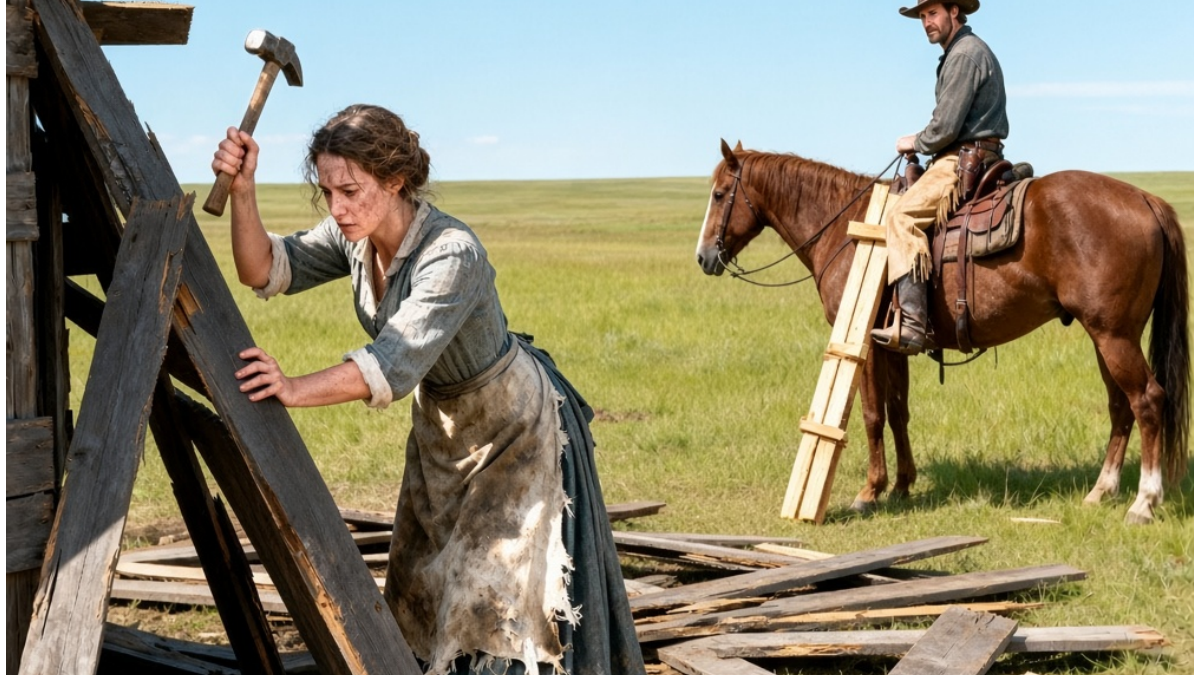
A woman named Eleanor Price and how she came to build something lasting from pure nothing in the Texas prairie of 1882.
You might wonder why an old storyteller like me thinks her tale matters after all these years.
Well, sometimes the truest stories are about folks who didn’t set out to be remarkable.
They just refused to quit when quitting would have been the sensible thing to do.
Eleanor arrived in Texas with everything she owned in one carpet bag and a promise that turned to duSt. What she did next with those bleeding hands and that Winchester rifle tells us something about the kind of grit our grandmothers had, the kind we sometimes forget existed.
This isn’t a tale of grand adventure, but of small choices that add up to a life.
The way most of our lives really are when you think about it proper. Eleanor’s palms split open on the rusted nail, and she watched the blood mix with Texas dirt as she dragged another broken board across the prairie grass.
The letter in her pocket, the one that had brought her 1500 miles from Illinois, didn’t matter anymore.
Hadn’t mattered since the stage driver whipped his horses rather than meet her eyes, leaving her standing on that platform with seven words burning through cheap paper.
Found myself a local girl. Don’t come, Marcus. $347 sewn into her corset lining. That’s what she had left of her life’s savings.
The boarding house on Main Street wanted050 cents a night. Mrs. Olsen had made that clear, looking Eleanor up and down like she was calculating the risk of taking in an abandoned bride.
Eleanor had paid for three nights. After that, well, the good Lord would have to provide, as her mother used to say.
The abandoned Hullbrook homestead sprawled before her like something out of those cautionary tales her grandmother told.
Roof caved in from last winter’s weight. Three walls still standing stubborn against the wind.
Nobody had claimed it in two years, not since the fever took the whole family.
The lumber scattered across two acres was there for the taking, and Eleanor meant to take it.
She’d already pried loose six serviceable boards using a whale bone stay from her corset, the kind of thing that would have made her mother faint dead away.
But mother was buried in Springfield soil, and propriety didn’t keep the rain off your head.
The nail went deeper into her thumb this time. She wrapped it quick with a strip torn from her petticoat, the white cotton blooming red right away.
No time for fussing. The cross beam needed to go up before dark, or the whole frame would collapse come the first real wind.
That beam’s going to fall on you. Eleanor didn’t flinch, though her hand found the Winchester propped against the cottonwood tree.
She’d heard the horse 10 minutes back, had kept the rifle visible, but not threatening.
Texas had already taught her that much in one afternoon. “Then I’ll build another,” she said, not looking up from her work.
The man dismounted, slow and careful, the way folks do when they mean no harm.
Eleanor caught him in the corner of her eye, tall, weathered like good leather, with a wagon load of straight pine lumber that looked fresh cut from the mill.
“Got some proper pine here,” he said, lifting one board like it weighed nothing. “That greenwood you’re using won’t last the week.”
“Week’s all I need.” “No, ma’am, I don’t reckon it is.” He set the pine plank against his wagon, pulled out another corner bracing’s wrong, too.
Wind will take it sideways. First good storm. Now Eleanor did look at him. Really looked.
Weathered face, but not old. Maybe 35 to her 31. Hands scarred from honest work.
Not fighting. Eyes the color of creek water after rain. Looking at her shelter like it was a problem that needed solving, not a woman who needed saving.
“Show me,” she said. He moved to the corner she’d started. No flourish about it, set the brace at an angle, showed how the force would distribute proper.
Eleanor watched close, then mirrored his movement on the opposite corner. He nodded once, handed her a real hammer without comment.
The weight of it felt right. Solid. She adjusted her grip once, drove the nail in two strikes clean.
They worked without much talking as the sun bled orange across the prairie. H cutting boards to length, her following his lead on the frame construction.
When she saw what she was doing, he stopped explaining. When she had a better idea, like angling the roof boards steeper for rain runoff, he adjusted without any prideful fuss.
The frame stood solid as the last light faded. “Not pretty, but it would hold.”
“Caleb Turner,” he said, loading his tools back in the wagon, but leaving half behind, including the good hammer.
Ranch is 6 milesi north, just past the big cottonwood stand. Eleanor Price. I’ll be back tomorrow, Mrs. Price, with more lumber.
I don’t take charity, Mr. Turner. Not offering any. Just figure if you’re going to build something, might as well build it, right?
He climbed onto the wagon seat. There’s jerky in that canvas bag and some Arbuckles coffee.
The real stuff, not chory. Then he was gone. Wagon wheels cutting ruts through the buffalo grass.
Leaving Eleanor with a frame that would stand the night and tools that promised tomorrow meant something.
She settled against the big cottonwood as the stars came out. That Winchester across her knees like her daddy taught her.
The shelter wasn’t much, wouldn’t keep rain out yet, wouldn’t hold heat, but it was hers.
Built with her own hands, her own blood, her own choosing. The letter in her pocket didn’t matter anymore.
Marcus Holloway and his local girl didn’t matter. Even the $347 didn’t matter as much as it had this morning.
What mattered was the frame standing solid against the Texas wind and the strange certainty that tomorrow Caleb Turner would return with more lumber.
Not because she needed saving, but because good frames deserved good roofs, and he’d seen her drive those nails true.
Eleanor unwrapped her palm, studied the cut in the moonlight. It would scar certain as sunrise.
Good. Some things ought to leave marks. Remind you of the price of building something real.
Caleb Turner counted 17 mistakes in her construction before the sun cleared the ridge.
Counted them automatic, same way he counted cattle at dawn. Cross beams set wrong, support posts too shallow, boards that would warp come first rain.
The woman kept working below it all, unaware that green wood beam was already boowing, fixing to crack right where she stood.
Two of his heers had wandered down toward the creek bottom yesterday evening. That’s what brought him out this way, checking the seep where stock sometimes got themselves stuck in the mud.
Found the heers easy enough. Hazed them back toward the herd. Should have headed home right then.
Would have except for the sound carrying across the morning air. Wood striking wood. Wrong rhythm.
Amateur’s pace. The old Hullbrook place, nobody’s business for two years running. Not since the fever took all five of them in one terrible week.
Their lumber had weathered gray. Some of it still good if you knew what to look for.
The woman didn’t know. She was pulling the worst pieces, the ones that would split come first hard freeze.
Caleb shifted in his saddle, watching her re-brace the same board three times. First attempt, the angle was off by half.
Second, she overcorrected. Third time. Third time, she got it right. Stepped back to check it.
Gave a little nod like she’d solved something important. His mayor stamped, eager to move on.
The ranch meant an hour’s ride back. Another hour to load proper lumber. Hour back here.
3 hours she’d be working under that death trap of a crossbeam. The green wood was already showing a crack, visible even from 50 yards off.
She stopped sudden hand going to the small of her back. Stretched careful the way his mother used to after too many hours over the wash tub.
Then she unwrapped that palm. He could see the white bandage even from here spotted dark with dried blood.
Looked at it close. Rewrapped it tighter. Went right back to work. The Winchester propped against the cottonwood caught morning light.
Model 1873 from the look of it. Clean, oiled, positioned for quick reach, but not threatening.
She knew that much at leaSt. Caleb turned his mare north. Decision made. The woman would last 3 hours.
The crossbeam might not. The pine boards he’d cut last week for the new corral could wait.
A corral could be delayed. A crushed skull couldn’t be undone. The rifle shifted against the tree.
She was watching him leave now. Hand not quite reaching for it, but ready. Smart.
Foolish about lumber, smart about strangers. 3 hours. Maybe less if that south wind picked up like it usually did by noon.
The wagon wheels ground steady through the buffalo grass. That particular rhythm that meant somebody coming with purpose, not just passing by.
Eleanor kept her stance wide, the hammer loose in her grip, watching Caleb Turner park his load of straight pine 20 ft from her failed construction.
He climbed down deliberately, walked to her crossbeam, ran one works scarred hand along the warped wood.
This will kill you by noon. Not a question, just fact. Plain as stating the sky was blue.
Then I’ll die with walls around me. He looked at her direct, then first time really seeing her.
His eyes held no pity, no softness, just the kind of calculation a man does when figuring bored feet or cattle weight.
You always this stubborn about being wrong? You always this free with other folks business?
The corner of his mouth twitched, not quite a smile. He walked back to his wagon, pulled out a 16 ft pine board, smooth as butter, carried it like it weighed nothing, set it down gentle, went back for another.
Eleanor watched him unload six boards before she spoke. “What’s your price?” “No price.” He selected a claw hammer from his toolbox, hefted it, set it on the pile.
Just don’t fancy riding back tomorrow to bury you. The cross beam groaned above them like a living thing in pain.
They both looked up, watched it bow another inch toward breaking. Move, he said, quiet but firm.
She moved. He positioned himself under the beam, shoulders taking the weight, lifted it clear of the supports.
The cords in his neck stood out like rope. Pull the supports out quick now.
Eleanor grabbed the left support, yanked it free. The right one stuck in the dirt.
She planted her boot against the frame, pulled harder. It came loose sudden, sent her stumbling back three steps.
Caleb lowered the beam controlled. Let it fall away from the structure. Could have killed us both, she said, brushing dirt from her skirt.
Could have, didn’t. He was already measuring the gap with his arms spread wide. Now watch close.
He showed her the corner bracing without fancy words. Set the angle just so. Let her see how the weight would transfer down instead of sideways.
Eleanor studied it like she’d studied her father’s accounting books, looking for the logic, the pattern.
Then she mirrored his work on the opposite corner, getting it right first try. He handed her the better hammer, balanced proper, handle worn smooth from years of honest use.
The weight of it felt natural in her hand. The nail went in clean. Two strikes buried flush.
You’ve done this before, he said. Not quite a question. Watched my father build our barn once.
She positioned the next board, checking the angle. 20 years ago. Good memory. Necessary memory.
They found a rhythm without discussing it. Heed cut to length. She’d position. She’d hold steady, heed nail.
When she saw a better angle for the roof slope, steeper to shed rain better, she just pointed.
He adjusted without comment or fuss. When he showed her how to overlap the boards for wind resistance, she nodded once and modified her spacing to match.
The sun climbed harsh and direct. Sweat ran down Eleanor’s spine, soaked through her dress between her shoulder blades.
Her split palm throbbed with each hammer strike, fresh blood seeping through the bandage. Caleb’s blue shirt went dark with sweat.
Neither of them stopped. “Water,” he said finally, walking to his wagon. Eleanor followed. He pulled out a ceramic jug, took a long drink, handed it to her without wiping the mouth.
She drank deep, alkaline taste, minerals, but clean creek water, but from a good spot.
When she lowered the jug, he was looking at her bandaged hand. Needs changing. Later, he pulled a clean bandana from his pocket, held it out.
Now she unwrapped the petticoat strip, now stiff with dried blood. The split ran deep across her palm, edges angry red, but not infected.
Yet Caleb poured water over it, neither gentle nor rough, just thorough. She wrapped it with his bandana, went straight back to work.
By the time the sun hit directly overhead, they had the frame squared true. He showed her the 345 method for checking corners.
Measure 3 ft one way, 4t the other, 5t across the diagonal. Mathematical certainty. The structure stood straight.
No lean, no bow. Hungry. He pulled a cloth bundle from the wagon. What I am is grateful.
Eleanor pulled out her own small bundle from the canvas bag. Dried apples from Illinois.
They sat in the wagon’s shade, passing salt pork and apples between them. The meat was tough, salty, perfect against the sweet dried fruit.
Neither talked. Wind moved through the grass with a sound like whispers. A red tail hawk circled high, riding the heat.
“Why here?” He asked finally. “Let her said to come.” She didn’t elaborate. Didn’t need to.
Marcus Holloway. She looked at him sharp. Small county, he said. Heard he was expecting a bride.
Heard he changed his mind. Heard right. Could do better than this. He gestured at the shelter.
Mrs. Olsen’s got rooms for 50 cents a night. I’ve got enough for three more nights.
Could work for it. Doing what exactly? The edge in her voice could have cut leather.
What work does this town offer an abandoned woman without references? He didn’t answer. Didn’t need to.
They both knew what kind of work waited for desperate women in frontier towns. They went back to the frame canvas for the temporary roof.
He showed her how to stretch it tight, how to angle it so rain would run off instead of pooling.
The sun dropped lower, painting everything gold and shadow. Caleb Turner, he said again, more formal this time, loading his tools.
Elellanar Price. He left half the tools beside the shelter. Good tools, the hammer, a saw, a square, a tin of 10 penny nails.
Ranch is six miles north. If you need, he stopped, started over. Tomorrow I’ll bring more lumber.
I don’t take charity, Mr. Turner. Not offering any. Just figure if you’re going to build something, might as well build it to laSt. He climbed onto the wagon seat, gathered the res.
Besides, you work steady. Not many folks do. The wagon rolled away, cutting fresh tracks through the grass.
Eleanor tested each corner post, checked the canvas tension, arranged the tools he’d left in a neat row.
The frame stood solid in the dying light. Not pretty, not complete, but square and true, and hers.
She settled back against the cottonwood, that Winchester across her knees, studying what they’d built.
No, what she’d built with guidance. Tomorrow he’d return. Not because she was helpless, but because the work wasn’t finished.
Her bandaged hand pulsed with her heartbeat. She flexed it, felt the split pull, but hold like the frame around her.
Wounded but functional, standing despite the damage. 6 miles north, a ranch that probably needed workers.
The thought formed clear and sudden. What if she asked for work instead of charity?
Steam rose from the coffee pot, balanced on three flat stones over Eleanor’s morning fire.
Real Arbuckles coffee, not chory, she’d rationed herself to half what she’d normally brew, making it laSt. Through the heat shimmer rising off the prairie, Caleb Turner’s wagon appeared earlier than yesterday, loaded heavier, too.
She counted two wooden crates, a toolbox, something wrapped in burlap that might be window frames.
He climbed down carrying a basket covered with blue checkered cloth, set it on the flat rock she’d been using as a table, pulled back the cloth without ceremony, biscuits, still warm enough to steam in the cool morning air, and a jar of sorghum molasses.
Figured you hadn’t eaten proper. He poured coffee from his own pot into two tin cups.
Real coffee, strong enough to float a horseshoe nail. Eleanor took the cup, let the heat soak through her rewrapped palMs. The bandage was fresh.
She’d changed it at first light, pleased to see the split closing clean. What’s this about, Mr. Turner?
BreakfaSt. He bit into a biscuit, chewed slow and thoughtful and business. She waited. Men like Caleb Turner didn’t bring breakfast without reason.
Good reason or bad remained to be seen. Lost my cook two years back. Fever took her along with half the county that summer.
He dipped his biscuit in the coffee. Old bachelor habit. Been making do since. Cowboys don’t complain much, but they don’t stay long either.
Hard to keep good hands when the food’s burnt and the books are worse. Eleanor sipped her coffee, watching him over the rim.
The morning sun caught the gray threading through his brown hair, the deep lines around his eyes that came from squinting into distance.
Ranch house has quarters. Separate entrance, lock on the door from inside. He set his cup down, looked at her direct.
$20 monthly plus found. Need someone who can cook for eight men, keep books, manage supplies.
Maybe work the garden if there’s time. Why me? You work steady. You learn quick.
You don’t need explaining twice. He gestured at her shelter. And you’re sleeping under canvas with a Winchester for company.
Seems you could use the work. Eleanor stood, walked to her shelter, reached into the canvas bag she’d been using for storage.
Her mother’s ledger, leatherbound and worn, the one thing besides the rifle she’d never sell.
She carried it back, set it between them on the rock, opened it to pages covered in neat columns, dates, items, costs, running tallies, kept books for the Miller family in Springfield, eight in the household, two hired men.
She turned pages, let him see the careful organization, managed purchasing, accounts payable, inventory, tracked seasonal costs against yield.
Her fingers stopped at the final entry until Mrs. Miller died and Mr. Miller remarried.
New wife had her own ideas about staffing. Caleb studied the columns, his finger tracing down the monthly tallies, stopped at the bottom suMs. You reduced their costs by near 30%.
28% while improving the quality of meals. She closed the ledger. What really happened to your cook?
The truth this time. Told you the truth. Sarah Moss, 63 years old, worked for my father before me.
Died in her sleep. Natural as dying comes. He stood, walked to his wagon, pulled out a smaller ledger.
These are my books, or what passes for them. Eleanor opened it. Chaos. Numbers scratched out, written over.
No clear system. Some pages water stained, others torn. But underneath the mess, she could see the bones of a working ranch.
Profitable if managed proper. She ran her finger down a column, turned back two pages, found what she was looking for.
You’re losing money on every cattle sale. Middleman’s taking 15% when it should be eight, maybe 10 at moSt. Suspected as much.
Can’t prove it without proper records. I can prove it. Give me a week with these books.
I’ll show you where every pennyy’s going. She closed the ledger, handed it back. But I have conditions.
State them. Sunday half days. Use of a horse when needed for errands. No personal services beyond cooking and books.
I’m not washing clothes or mending shirts. And if any of your men get notions about what a woman alone might offer, you back me clear and public.
Done. No hesitation. No haggling. I haven’t said yes. No, but your negotiating terms means you’re thinking yes.
He pulled a brass key from his vest pocket, set it on the rock between them.
Quarters are ready now. Bed, dresser, wash stand, stove for heat come winter. You can look before you decide.
Eleanor picked up the key. Heavy for its size, brass worn smooth from handling. When would you need me to start?
Now, if you’re willing, load your things, ride back with me, or tomorrow. Your choice.
She looked at her shelter, canvas and pine, blood and effort. Three nights she’d slept here, that Winchester across her knees, watching stars through gaps in the canvas.
Safe enough for now, but winter would come. Always did. Your men, they’ll respect the arrangement.
They will, or they’ll find other work. No bluster in it, just fact. I don’t keep men who can’t follow simple rules.
Eleanor watched him load tools into his wagon. Movements efficient and purposeful. The kind of man who said what he meant meant what he said.
No flowers in his words, no honey on his tongue. I’ll need to see the kitchen, the quarters.
Meet the men. Fair enough. They loaded her few possessions into the wagon bed, the carpet bag with two dresses and undergarments, the Winchester and box of cartridges, her father’s coat, the salvaged supplies from the Hullbrook place, her mother’s ledger.
Not much to show for 31 years of living, but it was hers. The wagon seat put them close but not touching.
She could smell lie soap on his clothes, leather oil from the rains, coffee on his breath.
His hands on the leather were steady, scarred across the knuckles from old brakes. Working hands, honest hands.
Why’d you really come back? She asked as they rolled through the grass yesterday with the lumber.
Told you didn’t want to bury you. That’s not all of it. The wagon rolled on, wheels creaking, steady rhythm.
A jack rabbit burst from the grass, bounded away in zigzag panic. Caleb adjusted the rains, said nothing for so long she thought he wouldn’t answer.
My mother was a mail order bride from Ohio. Man who sent for her died of snake bite two days before she arrived.
He kept his eyes on the horizon. She had $17 and a trunk of books.
My father found her trying to hire on at the hotel, offered her work instead.
They married 4 years later. That why you helped me? No. He looked at her sideways, then quick glance.
Helped you because you were doing it wrong and I can’t abide bad construction. Eleanor found herself almost smiling.
AlmoSt. The quarters. They really have a lock. Best money could buy. Ordered from Dallas.
The ranch appeared over a low rise. Main house, twotory, painted white some years back.
Paint now worn to gray wood in places. Barn solid and huge. Bunk house. Smoke rising from the chimney.
Various outuildings. Smokehouse, tool shed, what might be a chicken coupe. Everything squared proper, built to laSt. Three cowboys stood by the corral, watching the wagon approach.
Another appeared from the barn, all of them looking at her, measuring what her presence meant.
“Second thoughts?” Caleb asked. Eleanor straightened her spine, lifted her chin the way her mother had taught her.
No, but I want 25 monthly, not 20. He pulled up the wagon, considered 22, 23, and first month in advance.
The corner of his mouth twitched again. Done. The cowboys were walking over now, curious, but trying not to show it.
Eleanor could see the questions in their faces, the doubt, maybe hope for better meals.
She’d faced worse. The miller’s hired men had taken three weeks to accept her authority in the kitchen.
These couldn’t be harder. Caleb came around, offered his hand to help her down from the wagon.
Brief contact, his calloused palm against her bandaged one. She stood on Texas soil again, but different soil.
Soil that came with walls and a roof and a locked door. Boys, Caleb said to the gathering men.
This is Mrs. Price. She’ll be cooking and keeping books. She starts today. Mrs. Price, not Eleanor.
Not the abandoned woman. Mrs. Price with position and authority. The oldest of the cowboys, Mexican from his features, stepped forward.
Seenora, welcome. I am Miguel Santos, foreman. His English carried an accent but came clear.
The men are very happy about the cooking. The kitchen, Mr. Santos. Where is it?
This way, Senora. But before she could follow, she heard it. Hoof beatats on the road coming fast from town direction.
Single rider. Everyone turned to look. The rider came through the gate without slowing, pulled up hard near the wagon.
Young man, maybe 25, dust covered, face flushed with drink despite the early hour. “Caleb,” he said, words slightly slurred.
“Heard you picked up Marcus Holloway’s leftovers.” The temperature seemed to drop 10°. Eleanor felt every man go still, waiting.
“Jack.” Caleb’s voice came flat and cold. You’re drunk and you’re leaving. Jack Randall swayed in his saddle, caught himself on the horn.
Former foreman, Eleanor realized, the one whose chaos filled those ledger books. Just wanted to see the woman who thinks she can waltz in here take over Sarah’s kitchen.
His bloodshot eyes found Elanor. Heard all about you in town. The abandoned bride, the charity case.
Eleanor stepped forward before anyone could stop her. Mr. Randall, is it? I’ve seen your bookkeeping.
Interesting arithmetic you practice. Jack’s face went red, then white. You don’t know nothing. I know 28 and 15 make 43, not 35.
I know November’s cattle count was off by six head. I know enough. Caleb moved between them.
Jack, right out. Don’t come back. Jack wheeled his horse, nearly fell, caught himself. This ain’t over, Caleb.
Not by half. He looked at Eleanor again. Watch yourself, woman. Accidents happen on ranches.
He spurred his horse too hard, galloped through the gate. The men stood quiet, watching dust settle.
Miguel spoke firSt. Senora, perhaps we should show you the kitchen now. Eleanor followed him, legs steadier than her stomach.
The other cowboys dispersed, but she felt them watching. Testing already started, and she hadn’t even seen the stove yet.
The kitchen door stood open. Smoke inside, not thick, but persistent. On the stove, a pot of beans turned to carbon.
The rest of the kitchen, dirty but organized, good bones beneath the neglect. Eleanor turned to find all eight men crowded in the doorway, Caleb among them.
Dinner’s at 6 sharp, she said. Any man late goes hungry. Kitchens closed to everyone but me unless invited.
Questions? What’s for dinner? The youngest cowboy barely whiskered, eager as a puppy. Eleanor surveyed the smokehouse through the window, calculated what she’d glimpsed in passing.
Beef stew if I can salvage these beans. Biscuits if the oven draws proper. Preserved peaches if I find any.
Coffee that doesn’t taste like mud. The boy grinned wide. The others relaxed by degrees.
Out of my kitchen, Eleanor said, not harsh, but firm. All of you work to do.
They scattered. All but Caleb. Jack’s dangerous when he’s drinking, he said quiet. And he’s always drinking now.
The books show he’s been stealing steady for months. I know. Can’t prove it legal, but I know.
Caleb moved toward the door, stopped the shotgun behind that door. It’s loaded. You know how to use it?
Yes. Good. He left without another word. Eleanor stood alone in the kitchen. Her kitchen now.
Smoke still lingered from the burnt beans. She opened windows, started the water pump, filled a pot for soaking the salvageable beans, found the supplies, took inventory.
Flour, salt, lard, coffee, preserved goods on shelves, dated in careful hand. Sarah Moss’s writing, 2 years old, but probably still good.
She rolled up her sleeves, split in her palm, pulling tight, but holding. The stove needed cleaning first, then the table, the counters, the floor.
Make it hers through work, through competence, through feeding eight hungry men better than they’d been fed in 2 years.
By 4:00, the kitchen smelled right. Beef browning, onions softening, beans salvaged and simmering. The biscuit dough came together under her hands.
Familiar rhythm from years of practice. She found Sarah’s notes tucked behind flour canisters, oven temperatures, cooking times, which cowboys didn’t eat pork, who needed extra portions.
Tommy, the young one, appeared at the door. Ma’am, Mr. Turner said to ask if you need woodsplit.
Tell Mr. Turner the wood box is full. What I need is men to stay out from underfoot.
Tommy grinned. Yes, ma’am. Sure smells good, ma’am. He scampered off. Elellanar shaped biscuits with a water glass.
No proper cutter, but it worked. Into the oven, temperature checked with her hand like her grandmother taught her.
This oven ran hot. Sarah’s notes were right about that. 5:30. Elellanar set the table in the main room.
Eight places matched plates from a set that had once been 12. Good silver, tarnished, but solid.
She polished each fork with her apron, set them straight and proper. The door opened.
Caleb entered, stopped short at the sight of the formal table setting. We usually eat in the kitchen.
Not anymore. Men work hard. They deserve to eat civilized. He studied the table. Then her.
Dust covered him head to toe. Fresh scratch across his jaw. I need to wash.
Pumps out back. Dinner’s at 6. He left. Eleanor returned to her kitchen, pulled biscuits from the oven, perfect golden, risen high, set them in a basket covered with clean cloth.
The stew was ready, thick and rich. Preserved peaches found and arranged in a glass bowl.
Coffee strong and clear. 555. Boots on the porch. Multiple sets, shuffling and murmuring. “Wash first,” Elellanor called out, grumbling, but they went.
She heard the pump working, men jostling for position. Through the window, she saw Caleb standing back, letting his men go firSt. When they finished, he washed thoroughly, water streaming down his forearMs. 6:00 exactly.
They filed in cleaner than she’d yet seen them. Hair sllicked back with water, hands scrubbed pink.
Tommy had changed his shirt. They stood behind chairs uncertain. “Sit,” Elellanar said. They sat.
She brought the stew pot, ladled generous portions, set the basket of biscuits center table, the preserved peaches at the far end, poured coffee black and strong.
Nobody moved. Eat, she said. Miguel took the first bite, his eyes closed. M deals.
That broke the dam. Hands reached for biscuits. Spoons scraped bowls. Tommy grabbed three biscuits before Eleanor raised an eyebrow at him.
He put one back, grinned sheepish. These biscuits, said James, the quiet one. They’re like, he stopped, searching for words.
Like Sarah used to make, Caleb said soft. First words he’d spoken since sitting. Better, James said, then looked stricken.
No disrespect to Sarah. None taken, Elellanor said. Sarah left good notes. I just followed them.
The meal continued with the quiet intensity of hungry men eating well. When bowls emptied, Eleanor brought the pot for seconds.
Every bowl extended toward her. After they’d finished, Tommy started to rise. I’ll clear the You’ll do nothing.
Eleanor collected plates. This is my domain. You have yours. Yes, ma’am. But he smiled when he said it.
The men filed out, murmuring, “Thanks.” Caleb lingered. “The books,” he said. “You started looking at them.”
I looked and Eleanor dried her hands on her apron, chose her words carefully. “Someone’s been stealing from you, Mr. Turner.
Small amounts, steady drain. About $40 monthly for the past 6 months at leaSt.” His jaw tightened.
Jack, that would be my guess. But there’s more. She moved to the counter where she’d left the ledger.
These entries here from last month. Different hand, different pattern. Someone else is skimming now.
Who? Can’t tell yet. Need to cross check with store records, bank deposits. Give me 3 days.
You are certain about the theft. Numbers don’t lie, Mr. Turner. People do, but numbers don’t.
He stared at the ledger, knuckles white where he gripped the counter. I trusted him.
8 years Jack worked here. Trust and verification aren’t enemies. They’re partners. He looked at her then.
Really looked. You planning to verify me too? Already started. Almost smiled at that. Almost find who’s stealing now, then we deal with it.
He left her alone in the kitchen. Eleanor washed dishes, thinking about Jack Randall. Drunk, angry, humiliated, danger combination in a man who knew the ranch, knew the routines, held a grudge.
Through the window, she saw movement near the smokehouse. Shadow, where shouldn’t be shadow? She moved quiet to the back door, eased it open.
The shotgun stood in its place behind the front door, too far to reach quick.
The shadow moved again, not trying to hide now. Miguel Santos stepped into the moonlight, something in his hand, a ledger smaller than the ranch books.
He saw her watching, raised his hand peaceful like. Senora, forgive me. I was checking supplies in this smokehouse, making my own count.
Why? Because someone is stealing, like you said, and when things go missing, they blame the Mexican firSt. He showed her the ledger.
I keep my own records. Protection. Eleanor studied his face in the moonlight. Honest worry there.
Maybe fear. Show me. They stood in the doorway. Miguel’s ledger opened between them. His numbers matched what she’d found in the ranch books up until 6 weeks ago.
Then the discrepancy started. You see it too, she said. See, but I don’t know who.
Only that it’s not me. I believe you. He looked surprised. Why? Because a thief wouldn’t keep records that could hang him.
She handed back his ledger. Keep tracking. Compare with mine in 3 days. See, Senora and gracias for believing.
He disappeared into the night. Eleanor locked the kitchen door, checked the windows. The shotgun stood ready.
Tomorrow she’d go to town, check those store records, find out who was stealing now, deal with that problem.
But tonight, through her window, she saw a rider on the horizon, just sitting there, watching the ranch.
Too far to identify, but she knew Jack Randall, waiting for what. Saturday morning came gray and humid, promising rain by afternoon.
Eleanor dressed careful in her better dress, the blue one she’d worn to arrive in Texas, hair pinned tight and proper, appearance respectable as she could manage.
The buck board waited outside, Caleb, checking the harness one last time. “Sure you don’t want me to come along?”
His hands moved over the leather, testing connections. “I’m sure.” Eleanor climbed up unassisted, took the rains firm.
Town folk talk more freely to women alone, especially about men’s business. Jack might be in town.
Jack’s always in town on Saturdays, drinking at Murphy’s saloon by noon. She adjusted her grip on the leather.
I’ll be back by 3. The road to town cut straight through grassland, ruts deep from years of wagon traffic.
Eleanor kept the horse steady, mind working through what she needed. Store records, purchase orders, delivery confirmations.
The thief had left a trail. They always did. Town appeared gradual like cemetery first with its wooden crosses and occasional stone marker.
Then the church with its paint peeling in long strips. Then the scatter of buildings that made up Main Street.
Saturday busy with ranch families in for supplies. Eleanor tied the buckboard secure outside Morrison’s merkantile.
The bell above the door announced her entrance. Conversations stopped cold. Five women near the fabric counter turned as one body to examine her.
Mrs. Henderson stood at their center, banker’s wife, sharfaced and sharper tonged from what Eleanor had heard.
Why, if it isn’t Mr. Turners knew help. That pause before help stretched long enough to mean something else entirely.
Eleanor walked to the counter back straight. Mr. Morrison, I need to review the Turner Ranch account records.
Morrison, thick through the middle and nervous in the eyes, glanced at the women. That’s Mr. Turner’s private business, which he’s asked me to manage.
Eleanor kept her voice level but carrying. Unless there’s a problem with his credit. No, no problem.
Morrison pulled out a thick ledger, set it heavy on the counter. No problem at all.
Eleanor opened it, ran her finger down the columns there. Purchases that didn’t match the ranch records.
Tobacco, whiskey, ammunition charged to Turner’s account, but never delivered to the ranch. She memorized dates, amounts, patterns.
Interesting reading. Mrs. Henderson had moved closer, her group following like ducklings. Educational. Eleanor didn’t look up.
Must be quite educational working so closely with Mr. Turner. The woman’s voice dripped honey over poison.
All alone out there, just the two of you. Now Elanor did look up, met her eyes direct.
Eight ranch hands, Mr. Santos as foreman, and a lock on my door. Hardly alone, Mrs. Henderson.
Still, people will talk. People always talk when they have nothing better to occupy their time.
A younger woman at the edge of the group, blonde, pretty in a faded way, touched Mrs. Henderson’s arm, gentlelike.
Perhaps we should. You’re the one Marcus Holloway was expecting. Mrs. Henderson’s voice went sharp as broken glass.
The mail order bride. The store went silent as a held breath. Even Morrison stopped pretending to arrange goods on the shelf.
I’m the woman with a job and wages, Eleanor said even which is more than Marcus Holloway can offer anyone from what I hear.
Someone coughed. The blonde woman’s face flushed red as sunset. Eleanor understood sudden. This was the local girl Marcus had chosen instead.
Mr. Morrison, I need copies of these pages. Eleanor indicated 6 months of records. Mr. Turner will pay for your time.
I can’t just The door opened. Caleb entered hat in hand, filling the space with his presence.
Ladies, he nodded to the group, then focused on Morrison. My bookkeeper needs those records today.
Yes, sir. Mr. Turner, right away. Morrison scrambled for paper and pencil. Caleb moved to Eleanor’s side.
Not touching, not close enough to imply anything improper, but present. Solid. Find what you needed?
Most of it. He looked over her shoulder at the ledger, his jaw tightened at certain entries.
Morrison, these tobacco purchases. Who picked them up? I’d have to check the delivery log.
Check it. Morrison pulled another ledger from beneath the counter, fingers fumbling the pages. Here, those were picked up by by Jack Randall.
Signed for right here, two weeks after I let him go. Caleb’s voice stayed level, but Eleanor saw his hands clench.
He’s been charging to my account as a former employee. He said you’d approved it for his final wages.
I paid him in full the day he left. Caleb closed the ledger with controlled force.
From now on, nothing charges to my account without Mrs. Price’s written approval. Clear? Yes, sir.
Very clear. Mrs. Henderson sniffed loud enough for the whole store to hear. How modern.
A woman handling money matters. A competent person handling money matters. Caleb corrected. The woman part just happens to be true.
He turned to Eleanor. What else do you need? Bank records. Deposit slips for the last 6 months.
Henderson’s bank. Caleb looked at Mrs. Henderson. Your husband available? Her mouth pursed like she’d bitten into a green pimmen.
He’s always available for the Turner account. Good. Caleb gestured to the door. Mrs. Price.
Eleanor proceeded him out, felt the eyes following like heat on her back. On the boardwalk, she stopped.
You didn’t need to come. Yes, I did. He walked beside her toward the bank, matching her pace.
Jack at Murphy’s has been since 10 this morning. Drunk and getting drunker running his mouth about you.
What’s he saying? Nothing worth repeating, but the men heard and they’re not happy about it.
They reached the bank corner. Miguel wanted to come to town, deal with it himself.
Why would Miguel care what Jack says about me? Because you believed him about the records.
The stealing. First person in authority who’s taken his word over suspicion. The bank door stood open.
Mr. Henderson waited inside thin as his wife was sharp. Nervous smile pasted on his face.
Mr. Turner. Mrs. Price heard you were coming. Your wife’s efficient. Caleb said dry. That she is.
Henderson pulled out papers already prepared. What exactly do you need? Eleanor examined the deposit records.
More discrepancies. Deposits recorded in ranch books but never made. Money skimmed between ranch and bank.
These three deposits from last month. Do you have the slips? Henderson checked. No record of them.
Never made. That’s $90 total. Eleanor calculated quick. In one month. Caleb’s knuckles went white where he gripped the counter.
Who had access to make deposits? You, of course, Jack when he was foreman and Henderson stopped.
And and whoever you gave permission to, like Miguel Santos, he made one two weeks ago.
Eleanor felt Caleb go still beside her. She pulled out her notebook, checked dates. That deposit was made in full.
$20 exactly. I have the slip. Yes, but the missing deposits were on different dates when Miguel was working the north pasture 40 m from town.
She showed Henderson her notes. He couldn’t have been in both places. Henderson studied the dates, nodded slow.
You’re right. My apologies. They left the bank with copies of everything. On the street, Eleanor noticed people watching from doorways and windows.
The abandoned mail orderer bride and the rancher together in town. By evening, stories would spread like spilled water.
“I need fabric,” Eleanor said. Kitchen curtains are rotted through. “Get what you need.” Back in Morrison’s, the women had scattered, but their perfume lingered.
Eleanor selected practical calico, blue and white check, nothing fancy. Added thread, needles, enough for kitchen curtains and maybe her quarters if remnants allowed.
At the counter, Morrison totaled careful, watching Caleb. That’s Put it on account with Mrs. Price’s approval.
Eleanor signed the ledger clear and firm. As Morrison wrapped the fabric, the blonde woman from earlier approached hesitant-like.
Mrs. Price. Eleanor turned. Up close, the woman looked tired, worn thin at the edges.
I’m Amy Holloway, Marcus’s wife. Her voice came soft, apologetic. I wanted to say what he did wasn’t right.
Writing to you, making promises. I told him to write explain proper but but he didn’t.
Elanor kept her voice neutral. No, he said. Amy stopped, started again. He said, “Let her figure it out herself.”
And I did. Amy twisted her wedding ring. Cheap brass already showing through the gold paint.
We’re not doing well. The ranch, I mean. Marcus isn’t much for work. Turns out Elanor said nothing.
What was there to say? I just wanted you to know you’re better off with Mr. Turner.
I mean, he’s a good man. Folks respect him. I work for Mr. Turner. Nothing more.
Amy’s eyes went to Eleanor’s left hand, bearer of rings. Of course, I didn’t mean She backed away.
I should go. Marcus is waiting. Through the window, Eleanor saw Marcus Holloway lounging against a post, watching the saloon across the street with thirsty eyes.
His clothes showed wear. Cuffs frayed, boots down at heel. Whatever he’d chosen, it hadn’t brought prosperity.
Caleb loaded the supplies in the buckboard. Ready? One more stop. Eleanor climbed up to the seat.
Morrison mentioned Jack’s sign for those goods. I want to see his signature. Compare it to the ranch books.
Why? Because someone else is stealing now. Has been for 2 weeks. And I want to know if they’re copying Jack’s methods or creating their own.
They stopped back at Morrison’s. Eleanor compared signatures while Caleb watched. Jack’s scrawl on the store receipt.
Similar writing in the ranch books, but not exact. Someone trying to copy his hand, but failing in small ways.
It’s not the same person, she said quiet. You’re certain. Look at the way the R curves in Turner.
Jack curves it left. This person curves it right. She closed the ledgers. Someone’s imitating him using his methods.
They drove out of town in silence. At the ranch road turnoff, Caleb spoke. You know who it is.
I suspect. Need one more piece of proof. Who? Elellanor watched the ranch come into view.
Let me confirm firSt. Tomorrow after church. Eleanor, please. First time he’d used her given name.
Trust my method. He pulled up at the kitchen door. Tommy ran out to take the buck board.
Eleanor climbed down, started for the kitchen, stopped. “Mr. Turner, does James have family? A wife?
Children?” Caleb frowned. Wife died 3 years back. Daughter lives in Austin. Why? Just wondering.
Inside the kitchen, Eleanor unwrapped the fabric. Mind working. James. Quiet. James, who’d complimented her biscuits, who’d been in town when deposits went missing, who had access to the books when Caleb was away.
Through the window, she saw him walking from the barn. He stopped, looked at the kitchen, saw her watching.
His shoulders slumped like a man carrying stones. He knew she knew. The question was, what would he do about it?
Thunder rolled across the prairie like distant cannon fire. Still miles off, but coming steady.
Eleanor checked Sarah’s old barometer on the kitchen wall, dropping fast, the needle swinging toward storm.
The air through the windows tasted metallic, charged the way it did before the bad ones hit.
Through the glass, she watched Caleb and the men working to secure everything loose. James moved among them, quiet as always, avoiding her window.
He’d been avoiding her since yesterday, since that moment their eyes met, and understanding passed between them.
The kitchen door opened. Caleb entered, already soaked from the first fat raindrops. Storm’s going to be a big one.
Need to secure the garden. Anything that might blow. Eleanor was already moving, grabbing the old canvas tarp from the pantry.
The tomatoes are just setting fruit. We lose them now. That’s 6 weeks growing wasted.
Then we don’t lose them. They went out together into the building wind. The garden stretched behind the kitchen.
3 months of Sarah’s leftover plants, plus Eleanor’s new additions. Tomatoes, beans on poles, squash spreading wide, herbs in neat rows.
The wind picked up sharp, sent Eleanor’s skirt whipping against her legs. “Glass closes in the shed,” she called over the rising noise.
“Tommy appeared with them, arms full. Not enough for everything, never enough.” Eleanor made quick decisions.
Tomatoes first, early fruit meant fresh food weeks before anything else. She settled glass domes over the strongest plants, weighted them with stones.
Her hands slipped on the wet rocks, that old split in her palm aching with the pressure changes.
“The bean poles won’t hold,” Caleb shouted. The wind tried to steal his words. Eleanor saw it, the poles already leaning hard left.
“We need to stake them deeper.” “Tommy, get the sledge.” They worked the opposite sides of the bean row.
Eleanor holding poles straight while Caleb drove stakes. Tommy wrapping twine to secure the vines.
The rain came harder, soaking through Eleanor’s dress in seconds. Cold despite the summer season.
Lightning flashed white. Thunder immediate behind it. Close. Too close. The squash. Eleanor started. Leave them.
Not worth it. Caleb grabbed her arm as she reached for more closes inside now.
But Eleanor pulled free, grabbed the last piece of burlap. That one squash plant, the biggest, already showing fruit set.
She threw the burlap over it, weighted the corners with whatever came to hand. Rocks, broken bricks, an old horseshoe.
A glass clo lifted despite the stones, crashed against the fence, shattered. The tomato plant beneath bent nearly horizontal.
Eleanor dropped to her knees in the mud, pushed the plant upright, mounded wet earth around its base with both hands.
Glass shards bit into her palms through the mud. Blood mixed with rain, washed pink, washed away.
“Elanor.” Caleb’s voice urgent now. She packed more earth, building the mound higher, giving the plant backbone to stand against the wind.
Her palms burned, but she kept packing, shaping, willing that plant to hold. Strong hands under her arms, lifting.
Caleb, half carried, half dragged her to the kitchen door. They tumbled inside together, door slamming behind them hard enough to rattle every dish on the shelves.
Water streamed from her hair, her clothes. Blood seeped from both palms, now dozens of small cuts from the glass.
She grabbed a kitchen towel, pressed it between her hands. The door burst open again.
Miguel, Tommy, three others crowding in, all soaked through. “Everyone accounted for.” Caleb did a quick count.
“James is securing the barn doors,” Miguel said. Wouldn’t leave the horses. Thunder shook the house.
Hail started. White stones bouncing off the windows like gravel thrown by an angry hand.
One window cracked. Spiderweb pattern spreading from the impact point. “That’ll hold or it won’t,” Caleb said, moving Eleanor away from the glass.
“Nothing we can do now.” She pulled away, went to the stove. “Coffee? Everyone needs coffee.
Your hands can hold a coffee pot.” She filled it one-handed, set it on the stove that was still hot from dinner preparations.
Tommy cups. Miguel, that bottle of whiskey in the high cupboard. Sarah’s medicinal stores. They organized themselves without discussion.
Cowboys knew storm behavior. How to wait it out. Tommy found cards in a drawer.
Someone pulled chairs around the table. Normal storm routine, except for Eleanor’s blood dripping steady on the floor.
Sit, Caleb ordered. Let me see. Eleanor sat. He took her hands, gentle but firm, unwrapped the towel.
Glass slivers caught the lamplight like tiny stars. Some pieces deep, others just surface scratches.
Blood welled from a dozen places. This needs proper tending. He pulled his chair close.
Too close for propriety, but propriety had drowned in the storm. Niguel the sewing basket.
Tommy, clean water. Caleb worked with the same careful attention he’d shown, teaching her to frame corners.
Each sliver found and pulled with Eleanor’s own sewing needle. Water poured over the cuts, not gentle, but thorough.
She didn’t flinch, didn’t pull away, just watched his face as he worked. That scrape on his jaw from days ago had healed to a thin line.
New lines around his eyes. Concentration lines. Why? He asked quietly just for her. Why risk this for tomatoes?
Because once something starts producing, you protect it. Otherwise, what was the point of planting?
His hands stilled on hers. He looked up, met her eyes. Something passed between them, unnamed, but real as the storm.
The door crashed open. James stumbled in. Wind shoving him from behind. He fought the door closed, turned.
His clothes were torn. Blood on his face from a flying branch. Barn secure, he gasped.
But another crack of thunder. The damaged window gave way, burst inward. Glass and rain and wind invaded the kitchen.
Everyone moved at once. Miguel grabbing a tablecloth to cover the opening. Tommy pushing the table away from the window.
Caleb shielding Eleanor with his body. They fought the tablecloth into place, nailed it with whatever came to hand.
The wind tried to tear it away, but it held, bellying in and out like something breathing.
James stood apart, watching Eleanor. Their eyes met again. His mouth opened like he wanted to speak, closed again.
He turned away, but not before she saw it. Desperation deep as a well. The storm peaked, roared, passed over, still raining, but the violence was moving on.
The kitchen felt smaller with all of them in it. Warmer. Eleanor’s hands throbbed in rhythm with her heartbeat, wrapped now in clean cloth torn from her spare petticoat.
Tomorrow we’ll see what survived. Miguel said philosophical ranch life was always tomorrow. Always what survived and what didn’t.
Eleanor stood went to the window. Through the gap beside the tablecloth she could see the garden or what was left.
Bean poles down despite their work. Squash plants stripped bare. But there one tomato plant still standing under its broken cloch.
The one she’d mounted earth around, still bent, but standing. “Your plants made it?” Tommy asked, hopeful.
“Some, maybe morning will tell.” She turned from the window, found James watching her again.
He stood, moved toward the door. I need to check something in the barn. In this weather, Miguel frowned.
Wait till morning. Can’t wait. James grabbed his soaked hat, pushed out into the rain.
Through the window, Eleanor watched him go, but not toward the barn, toward the bunk house, toward his quarters.
She understood. Sudden, clear as lightning. He wasn’t going to check something. He was going to run.
Mr. Turner, she said quiet. You might want to check the cash box. Caleb looked at her sharp.
Why? Because James won’t be here come morning, and desperate men do desperate things. They all turned to look at the door James had gone through.
The rain still pounded, but softer now. The storm was passing, but something else was building.
Caleb stood, went to the study, came back with his face dark as the sky.
$20 missing, all the cash I had on hand. He’s got family trouble, Elellanor said.
Daughter in Austin needs help, would be my guess. Been stealing small amounts, trying to imitate Jack’s methods.
You knew? Caleb’s voice came flat. Suspected now I know. Why didn’t you? A horse winnied outside.
Through the window they saw James mounting in the rain, saddle bags full, riding hard toward the road.
“Should we follow?” Miguel asked. Eleanor watched the figure disappear into the storm. No, let him go.
$20 and whatever he stolen won’t break the ranch. But catching him, bringing him back.
That breaks something else. He stole from us, Tommy said, young voice hot with indignation.
He did, and now he’s got to live with it. Eleanor moved to the stove, poured coffee with her bandaged hands.
Sometimes that’s punishment enough. Caleb said nothing, just watched the empty road where James had vanished.
His jaw worked like he was chewing on words he wouldn’t say. The storm was definitely passing now, just regular rain.
Through the damaged window, Eleanor could see stars beginning to show between clouds. Tomorrow would dawn clear, show all the damage plain.
The garden, the roof, the windows, all needing repair. But tonight they were inside, warm together.
The ranch had survived worse storMs. Would survive this. Mr. Turner, Eleanor said, there’s something else.
He turned to her. When James took that money, he left something behind. She pulled out a ledger from behind the flower tin, his own records.
Every penny he took documented. Caleb opened it, read, his face changed, softened. He wrote loan beside each amount, intended to pay it back.
Men tell themselves all kinds of stories to make wrong seem right. Elellanor rewrapped her hands tighter.
Question is, what do we do about it? Before Caleb could answer, hoof beatats sounded outside.
Multiple horses coming faSt. Not James. He’d gone the other direction. Everyone moved to the windows.
Through the rain, four riders appeared. They stopped at the gate, seemed to be discussing something, then turned toward the house.
One rider in front weaving in his saddle. Jack Randall, drunk enough to be brave in a storm.
And he’d brought friends. Eleanor moved to the shotgun behind the door, lifted it carefully with her bandaged hands.
The weight felt wrong with the cloth wrapping, but she could manage if needed. Through the cracked window, she watched the riders dismount, sloppy, drunk.
Jack stumbling, catching himself on his horse’s neck. “Stay inside,” Caleb said quiet. “All of you.”
He went out alone, no weapon visible. Eleanor moved the shotgun to the window, barrel resting on the sill.
Miguel stood at the other window with his old Colt Navy. Tommy had found a rifle somewhere.
They waited. Evening, Jack. Caleb’s voice carried clearer through the rain. Bit late for visiting.
Came to collect what’s mine. Jack swayed, pointed at the house. 8 years I worked this place.
8 years. And you give my share to some woman. You forfeited your share when you stole from me.
Prove it. Jack laughed ugly. Can’t can you? But I got proof of something else.
He pulled papers from inside his coat. Waved them overhead. Partnership papers filed yesterday at the courthouse.
You, that woman, and the Mexican. My job. My position given away. Eleanor’s stomach dropped cold.
The papers weren’t public until Monday. How did he Henderson? She said aloud. The banker told him.
Caleb heard her through the window, his shoulders tightened. Those papers are legal, Jack. You’ve got no claim here.
Legal? Jack spat tobacco juice. You know what else is legal? Accidents. Ranch accidents happen all the time.
Barnfires. Poisoned wells, cattle scattered to hell and gone. One of Jack’s companions shifted nervous.
Jack, we came to talk, not threaten. Shut up, Carol. Jack took a step forward, unsteady.
I’m talking to my former partner here. Ain’t that right, Caleb? We were partners building this place.
You are my foreman. Paid wages for work done. That’s all. That all? Jack’s voice went high, wounded.
Sarah treated me like family, fed me at her table, and when she died, what did I get?
Nothing. Not even a mention in her will. Eleanor understood then this wasn’t about money.
Not really. It was about belonging, about being counted as family, and coming up short.
Sarah left her savings to her sister in Ohio. Caleb said steady. You know that I know I kept this place running for 2 years after she died.
Me, not you. You were grieving. Useless. I held it together. Jack’s voice cracked. Then you wake up one day.
Decide I’m stealing. Throw me out like trash. You were stealing, taking what I’d earned.
Jack pulled out a flask, drank deep. But now you got your new woman, your new books, everything neat and tidy.
Elellanor had heard enough. She set down the shotgun, walked out the door before anyone could stop her.
The rain hit cold, soaked through her bandages immediately. Mr. Randall. Jack turned, saw her, smiled mean.
The abandoned bride herself. Come to defend your new kingdom. Come to make you an offer.
That stopped him. His companions looked confused. Caleb started to speak, but Eleanor raised her hand slightly.
Trust me. What kind of offer? Jack asked, suspicious. You say you’re owed 8 years of building this place.
Fine, let’s talk numbers. Eleanor pulled out the small ledger she’d grabbed from inside. 8 years as foreman.
Standard wages plus room and board. That’s approximately $9,600 you were paid. Fair and square.
That’s not You stole 600. We have proof. Morrison’s records. Bank records. Your own signatures.
She opened the ledger, Rain spotting the pages. But there’s something else. Jack waited, swaying.
Three months ago, you sold cattle on the side. 15 head to a buyer from Fort Worth.
Thought you were clever, marking them as dead from disease in the ranch books. Eleanor showed him the page.
But you forgot dead cattle still leave bones. Bones that get counted and burned. Miguel counts everything.
There are no bones, Jack. His face went white under the dirt and stubble. 15 head at $30 each.
That’s $450 plus the 600 from petty theft. You owe this ranch $1,50. You can’t prove I can and will.
Sheriff Thompson’s cousin bought those cattle. Has a bill of sale with your signature. Eleanor closed the ledger.
Here’s my offer. Leave tonight. Never come back. We write off the debt as severance pay you think you’re owed.
And if I don’t, Sheriff arrives Monday morning with a warrant. Texas takes cattle theft serious.
That’s 5 to 10 years minimum. Jack’s companions backed toward their horses. Carol spoke up nervous.
Jack, we should go. This ain’t worth prison. Shut up. Jack pulled his pistol, waved it wild.
Nobody’s going anywhere until Miguel’s voice came from behind Elanor. Drop it, amigo. Jack turned.
Niguel stood in the doorway, that old Colt Navy steady in his hand. Tommy beside him with the rifle, the other ranch hands spreading out from the bunk house, all armed.
“You’re outnumbered, Jack,” Caleb said quiet. “Drunk and outnumbered.” “Put the gun away.” Jack’s hand shook.
The pistol wavered between Eleanor and Caleb. Rain ran off the barrel, off his hat, made everything slick and dangerous.
This ain’t over. But he holstered the gun, clumsy with drink and rage. You think you’re safe?
You think she’ll stay? Women like her don’t stay. They take what they can get and move on.
No, Eleanor said clear. That’s what you did, Jack. I’m building something. He mounted his horse on the third try.
His companions were already backing away, eager to be gone. Jack looked down at them all, gathered there in the rain.
“I’ll be seeing you,” he said to Eleanor specifically. “Real soon.” They rode off into the darkness.
Eleanor stood in the rain, bandages soaked through, hands throbbing. Caleb moved beside her. The sheriff’s cousin bought cattle three months ago.
Not from Jack, from the Henderson’s ranch. She turned to face him. But Jack doesn’t know that.
Niguel laughed, sudden, surprised. You lied. I negotiated with facts he couldn’t verify tonight. They went inside, Eleanor’s legs shaking now that danger had passed.
She sank into a kitchen chair. Tommy brought towels. Miguel poured whiskey straight. No coffee to soften it.
He’ll figure it out, Caleb said. When he soers up, he’ll know you played him.
By then, he’ll be halfway to San Antonio if he’s smart. Eleanor unwrapped her soaked bandages.
The cuts had opened again, blood seeping. He’s not coming back. How can you be sure?
Because I know men like Jack, they need to believe they’re victims, not villains. I gave him a story he can tell himself.
Forced out by a lying woman, betrayed by ungrateful friends. He’ll ride away feeling righteous instead of criminal.
Caleb rewrapped her hands with fresh cloth. Gentle but thorough. You took a hell of a risk walking out there.
Calculated risk. Jack’s a coward when sober, dangerous when drunk, but only to those he sees as weak.
She flexed her fingers, testing the rapping. I needed him to see me as an equal threat.
“They books,” Miguel said sudden. “The numbers you quoted, were any of them real?” Eleanor smiled, tired.
“All of them? Except the sheriff’s cousin. Jack did steal those cattle. Did sell them to Fort Worth.
I found the evidence this morning. Then why not have him arrested? Because a man in prison can’t pay back debts.
A man run out of town can’t cause more trouble. She stood moved to the stove.
And because this ranch doesn’t need the scandal, bad for business. Caleb studied her. You’re protecting my reputation.
>> I’m protecting my investment. $2347, remember? That’s everything I have in this world, Mr. Turner.
I intend to see it grow. The rain had stopped complete now. Through the broken window, stars showed clear.
Tomorrow would dawn bright, show all the storm damage plain, but also show what survived.
Eleanor. Caleb’s voice came strange, formal. There’s something else we need to discuss. She turned.
He stood there, all the men behind him, like something rehearsed. The partnership papers. When I filed them yesterday, I did something else.
He pulled out a different paper from his vest pocket. I had Henderson draw this up.
Eleanor took it, read by lamplight, her name at the top. Legal language she had to read twice to understand.
This makes me a full partner. Equal shares. Not equal. 40%. Miguel has 10. I keep 50.
Caleb’s jaw worked. But if something happens to me, illness, accident, whatever, you and Miguel inherit equal.
The kitchen went silent. Even the wind outside seemed to pause. Why? Eleanor’s voice came out whisper soft.
Because you saved this ranch with your books, your courage, your bleeding hands protecting tomato plants.
He gestured at the men behind him. Ask them. They voted unanimous. Tommy stepped forward, young face serious.
You gave us back our home, Mrs. Price. Meals like Sarah used to make. Pride in the place again.
Miguel nodded. You believed me when no one else would. Treated me as a man, not just a Mexican hand.
The others murmured agreement. These tough men, these cowboys who’d seen her arrive with nothing, now standing behind her, literal and figurative.
Eleanor looked at the paper again. 40% of a working ranch. From abandoned woman to landowner in one storm soaked night.
I don’t know what to say. Say yes, Caleb said quiet. Stay. Build something lasting.
Through the window, Eleanor could see her makeshift shelter by the creek, just visible in the starlight.
Still standing despite everything. First thing she’d built with Caleb Turner. Now this papers making her part owner of everything else they’d built.
“Yes,” she said. Tommy whooped. Miguel smiled wide. The others started talking all at once about plans, expansions, the future.
But Eleanor saw something else through that window. Movements near the gate. A single rider sitting still watching.
Not Jack. Wrong shape, wrong posture. James, come back to face whatever Justice waited. Or come back for something else entirely.
She touched Caleb’s arm, pointed, his face darkened. I’ll handle this. No. Eleanor picked up the shotgun again.
We handle it together. That’s what partners do. They moved toward the door. Behind them, the men fell silent, watching.
James had dismounted, stood at the gate with his hands visible, empty, waiting. But for what?
James stood at the gate with rain dripping off his hatbrim, hands empty at his sides.
The $20 he’d stolen bulged obvious in his shirt pocket. Eleanor lowered the shotgun, but kept it ready.
Caleb stopped 10 ft from the gate. Come to return what you took? Caleb’s voice carried no heat, just tired disappointment.
Come to explain and pay back all of it. James pulled out the 20, then a leather pouch from his saddle bag.
$130 total. Everything I took over two months, plus the 20 from tonight. Eleanor moved closer, studied his face in the starlight.
Red eyes, hollow cheeks, hands trembling, but not from drink, from shame. Your daughter, she said.
Austin, she’s in trouble. James’ composure cracked. Consumption. Doc says she needs the sanitarium in El Paso.
Dry air, proper care. Costs 50 a month. His voice broke completely. She’s all I got left in this world.
Caleb took the money, counted it. This is $10 extra. Interest for the theft, for the betrayal.
James removed his hat, held it against his cheSt. I kept telling myself it was borrowing, that I’d pay it back when she got better.
But stealing stealing, no matter what stories we tell ourselves. Yes, Elanar said, “It is.”
Miguel and the others had gathered on the porch, watching. The night had gone quiet after the storm, just dripping water and distant thunder moving away.
“I’ll pack my things,” James said. “Be gone within the hour.” “No.” Caleb’s single word stopped him.
“You’ll stay. Work off the debt proper.” James looked up confused. After what I did?
After what you did and made right. Caleb pocketed the money. Your daughter needs that sanitarium.
You need wages. Ranch needs workers who own their mistakes. But I stole, lied, ran.
Eleanor stepped forward, then came back. That’s the part that matters. James stood there like a man afraid to believe in grace.
Water dripped from the porch roof, counting seconds. Finally, he spoke. The others, they’ll never trust me.
Trust is earned back same as it’s lost, Niguel said from the porch. Day by day, work by work.
Tommy nodded. The other hands murmured agreement. Not forgiveness exactly, but willingness to see what came next.
There’s conditions. Caleb said, “Books stay with Mrs. Price only. You account for every penny spent, every mile traveled.
And your daughter, she writes monthly. Tells us how she’s doing. We’re investing in her recovery now, too.”
James’s legs seemed to give out. He leaned against the gate poSt. Why? Why would you?
Because good men make bad choices when desperate. Eleanor thought of her own desperation. That platform in Texas, Marcus’ letter in her pocket.
And because this ranch is built on second chances, mine, Miguel’s, now yours. They went back inside, James, to the bunk house, the others scattered to dry clothes and reSt. Eleanor and Caleb stood alone in the damaged kitchen.
Glass still littered the floor. The window gaped behind its makeshift cloth covering. Tomorrow’s work waiting everywhere she looked.
You knew he’d come back, Caleb said. Hoped. Men who keep records of their thefts aren’t lost complete.
They still have conscience enough to measure the wrong. She started sweeping glass into a pile, careful of her bandaged hands.
Your mother, the mail order bride from Ohio. What about her? Did she ever regret staying taking that job with your father?
Caleb found another broom started on the far corner. Asked her once when I was maybe 15.
She said regrets was a luxury for people with better choices. She had a choice between starving proud or living practical.
She chose living. And the marriage four years later, she said love grew slow but sturdy like oak trees.
Not pretty at first, but strong enough to weather storMs. He stopped sweeping, looked at her direct.
Why are you asking? Eleanor set down her broom, walked to the document still lying on the table, the partnership papers, her name in legal black ink, because I need to tell you something.
She pulled out her mother’s ledger, opened to the back page, hidden there, pressed flat, a photograph, herself, 5 years younger, standing beside a tall man in a good suit.
My husband, Thomas Price, died three years ago of typhoid. She set the photograph on the table.
I wasn’t a maiden when I answered Marcus’s advertisement. I was a widow. Caleb studied the photograph.
Why hide it? Because men want fresh starts, not used goods. Because widows are bad luck or easy marks, depending on who’s asking.
She closed the ledger because I wanted to choose who knew my past and when.
And now now I’m part owner of this ranch. My past matters because it shaped what I know, how I work, why I came here.
She touched the photograph gently. Thomas was a good man. Taught me bookkeeping. Treated me fair.
When he died, his brother inherited everything. Law said a wife had no claim without children.
So you came weSt. So I came west, looking for another chance at something permanent.
She met his eyes steady. Found it. Just not how I expected. Caleb picked up the photograph, handed it back carefully.
We all got histories. Things we carry. Doesn’t change what we’re building now. Through the broken window, dawn was starting pink on the horizon.
The storm had washed everything clean, left puddles reflecting sky. In a few hours, church bells would ring.
The community would gather, share storm stories, count damages and blessings. There’s something else, Caleb said.
He went to the cabinet, pulled out a small wooden box. Sarah left this, said to give it to the woman who made the kitchen home again.
Eleanor opened it. Inside a simple gold ring, not a wedding band, a signate ring with SM engraved.
Sarah Moss. She wore it 50 years. Caleb said her mothers before that. Kitchen queens, she called them.
Women who fed families, held houses together through trouble. Eleanor slipped it on her right hand.
It fit like it had been waiting. I’m not Sarah. No, you’re Eleanor Price. That’s enough.
More than enough. The kitchen door opened. Tommy peered in. Sorry to interrupt, but there’s a wagon coming.
Looks like the Hendersons. Sure enough, through the window they could see the banker’s fancy buggy approaching.
Mrs. Henderson held a parasol despite the early hour. Mr. Henderson drove, looking uncomfortable. On a Sunday morning, Eleanor checked the clock.
Before church, they met the Hendersons in the yard. Mrs. Henderson stayed in the buggy, mouthped.
Mr. Henderson climbs down, handed Caleb an envelope from Judge Morton, arrived late last night by special courier.
Caleb opened it read, his face changing, handed it to Eleanor. Marcus Holloway and Amy Holloway versus Eleanor Price, breach of contract.
Seeking damages for expenses incurred bringing a forementioned Eleanor Price to Texas under false pretenses.
He’s suing me. Eleanor almost laughed. For what damages? Says here the stage ticket cost him $40.
Room and board promised another 20. Emotional distress. Henderson coughed. $100. Emotional distress. Now Eleanor did laugh.
He wrote me seven letters, made promises, then married another woman before I arrived. Judge wants all parties Monday morning.
Nine sharp. Henderson shifted uncomfortable. There’s more. Jack Randall’s been talking. Says you threatened him.
Made false accusations. Might bring charges. Let him. Eleanor said. I have books proving every penny he stole.
Mrs. Henderson finally spoke from the buggy. You’ve certainly stirred things up, Mrs. Price. Or is it, Miss?
There seems to be some confusion about your marital status. Eleanor felt Caleb tense beside her.
She touched his arm light calming. It’s Mrs. Price, widow of Thomas Price of Springfield, Illinois, died 3 years past of typhoid.
She stood straighter. Any other questions about my history you’d like answered publicike? Mrs. Henderson’s mouth opened, closed, opened again.
Well, I never. No, Eleanor agreed. You never did. Never worked today. Never built anything with your own hands.
Never chose to stay somewhere difficult when running would have been easier. She stepped closer to the buggy.
So perhaps you should stick to gossiping about things you understand. Henderson climbed back in his buggy quick.
Monday morning, 9:00. Don’t be late. They watched the buggy retreat. The sun was full up now, showing all the storm damage clear, the garden half destroyed, roof missing shingles, that broken window like a gap tooth, but also showing what survived.
The tomato plants still standing. The bean poles that held the house itself solid on its foundation.
Monday’s troubles can wait, Caleb said. Today we’ve got church, then repairs. No, Eleanor said.
Today we’ve got something else firSt. She walked to the rise behind the house where you could see from miles.
The shelter by the creek visible in the distance. Her first construction still standing. The ranch spread out below, damaged but not destroyed.
Caleb followed, stood beside her. What are we doing? Deciding? Eleanor turned to face him.
I’ve got partnership papers saying I own 40% of this ranch. You’ve got a judge wanting to hear Marcus Holloway’s lies tomorrow.
Storm damage needing weeks of repair. A foreman who stole but came back. A cook who’s really a widow.
And Jack Randall somewhere out there, probably drunk and getting angrier. That’s a lot of troubles.
That’s a lot of materials. Eleanor pulled Sarah’s ring off, looked at it in the morning light, put it back on.
Question is, what are we building with them? Caleb was quiet for a long moment.
Then he pulled something from his pocket. Another ring. This one plain gold, worn thin.
My mother’s wedding band. Been carrying it 3 months since the day I found you building with broken boards.
He held it out. Seems like we should stop building separate and start building together.
Eleanor looked at the ring at him at the ranch spread below. That’s a proposal.
That’s a practical suggestion. We’re already partners in business, already working side by side, already trusting each other with everything that matters.
And what about the rest? The part that’s not practical. He moved closer. Close enough she could smell soap and leather and coffee.
The rest grows slow but sturdy. Like oak trees, strong enough to weather storMs. Eleanor took the ring.
Simple, honest, real, like everything else they’d built. The judge, Marcus, the town gossip. Won’t matter if we’re married.
Can’t sue a woman whose husband is standing right there. Can’t gossip about propriety when there’s wedding papers filed.
He paused. But that’s not why I’m asking. Then why? Because you took broken boards and made shelter.
Took a failing ranch and made it profitable. Took suspicious men and made them family.
His hand found hers, careful of the bandages. Because you’re the right materials for building something permanent.
Eleanor slipped the ring on. It sat next to Sarah’s ring like they’d always been meant to share that finger.
Well then, Mr. Turner. Looks like we’ve got a wedding to plan today. Why wait?
Storm’s passed. Preachers available. And we’ve got eight witnesses. Nine if James stays. From below, Miguel called out, “Senor, Senora, breakfast is ready.”
They walked back down together. In the kitchen, Miguel had managed biscuits, not as good as Eleanor’s, but decent.
Coffee strong enough to float horseshoes. The men gathered around the table, Sunday clothes for church.
Boys, Caleb said, “Change of plans. We’re getting married this morning. You’re all witnesses.” Tommy dropped his biscuit.
Miguel smiled wide. The others started talking all at once. “But what about Marcus’ lawsuit?”
Tommy asked. Eleanor held up her left hand, both rings catching light. “What lawsuit? Can’t sue a married woman without her husband’s consent.
And Mr. Turner doesn’t consent, but Jack is gone, and if he comes back, he’ll find us stronger than before.
James spoke from the doorway. I’d be honored to stand witness if you’ll have me.
Every family needs someone who knows the cost of staying, Eleanor said. You’re welcome. The sun climbed higher.
Church bells would ring soon, but first breakfast, then a wedding, then rebuilding what the storm had damaged.
All with the right materials, the right partner, the right choice to stay and build.
Eleanor looked around the table. These men who’d become family. This kitchen that had become home.
This life built from nothing but determination and broken boards and the choice to keep building.
Eat up, she said. We’ve got a full day ahead. And they did, fuller than she could have imagined that day on the platform with Marcus’ letter crumpling in her pocket.
Sometimes the best structures were built from whatever materials came to hand. Sometimes they were built to laSt. Let me tell you something true about the story of Eleanor Price.
It wasn’t really about the Texas prairie or the broken boards or even the storm that nearly took everything.
It was about the moment we choose to stop running and start building. Every person reading this who’s ever started over with nothing but determination knows that feeling.
Eleanor’s bleeding hands pressing glass cut earth around a tomato plant speaks to anyone who’s protected something fragile because it mattered more than the pain.
We follow her from that abandoned platform to the kitchen table surrounded by chosen family because we recognize ourselves in that journey.
The weight of Sarah’s ring and Margaret Turner’s wedding band on her finger reminds us that sometimes we inherit more than objects.
We inherit the courage of those who built before us. This story matters because it tells us what we already know but need to hear.
Permanence isn’t about what you’re given. It’s about what you choose to build with whatever materials come to hand.
This work is inspired by classic western frontier stories created solely for entertainment purposes. This story does not condone, encourage, or promote any form of violence or harmful behavior.
All characters and events are products of the author’s imagination, and any resemblance to real people or events is purely coincidental.








