After 5 Days Without Food, Her Child Was Dying—Then a Cowboy Whispered, “Come With Me”
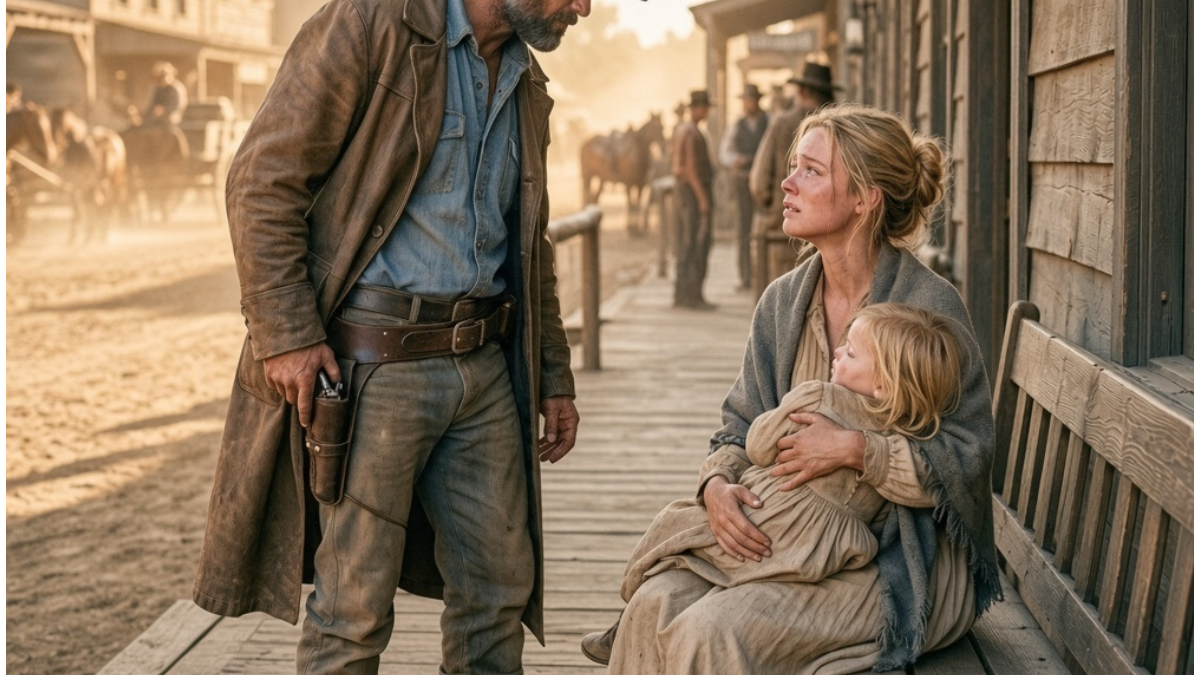
I didn’t say a word when he did it. Gideon Mercer just walked up to the boarding house steps, looked Naomi straight in the eye, [clears throat] her baby girl burning with fever in her arms, and smiled slow, satisfied, like a man watching something he’d broken finally stay broken.
You can’t even feed her, he said. Look at her. Look at what you’ve done to my brother’s child.
Lily’s head lulled against Naomi’s shoulder. 5 days. 5 days since that the child had eaten a real meal.
And this man, this blood relative, stood there in his clean coat and polished boots and felt nothing but victory.
The winter Naomi Mercer turned 23.
She learned something that no one warns you about when you’re young and still believe the world has a bottom that will hold you.
She learned that rock bottom has a basement. It had been 14 months since she buried Thomas.
14 months of watching people who’d called themselves friends slowly, politely, permanently disappear from her life like smoke through a cracked window.
She hadn’t chased them. She’d been too tired to chase anything by then. Too tired from working the laundry line at Mrs. Calvert’s boarding house until her knuckles split.
Too tired from waking at 3:00 in the morning to check if Lily’s breathing had gone shallow again.
Too tired from doing the arithmetic in her head every single night, moving nickels from column to column like some kind of prayer she’d already stopped believing in.
Harwick was a mountain town, small enough that everyone knew your business, and mean enough that they felt entitled to it.
When Thomas died, fever took him in 6 days, which was the kind of brutal efficiency that Frontier illness specialized in.
The people of Harwick had come to the funeral with casserles and condolences. They’d held Naomi’s hand and called her brave.
They’d cooed at baby Lily in her flower sack blanket and said, “What a beautiful child she was.
What a shame. What a terrible thing.” That sympathy lasted almost 4 months. After that, the casserole stopped and then came something worse than nothing.
Rumor. The kind of rumor that starts small and specific. Did you hear she pawn Thomas’s watch and then grows teeth and legs until it’s walking around town without her permission, wearing her face, making decisions she never made.
By the time Winter proper settled on Harwick, the story that had grown around Naomi Mercer was that she was reckless, that she was proud, that she had driven Thomas to work himself sick by spending too freely, that the baby was thin because Naomi was careless, that whatever bad luck followed her was somehow, in ways people couldn’t quite articulate, but felt very strongly, her own fault.
She’d heard every version. She’d heard them through walls, through the careful pauses and conversations that stopped when she walked into a room.
She’d even heard one directly. Cora Hatch at the dry goods counter whispering to May Sutton without bothering to lower her voice enough.
Some women just just aren’t cut out for hardship. Naomi had taken her flower and walked out without responding.
Responding cost energy she didn’t have. The real problem, the problem underneath every other problem, was the work.
She’d lost the laundry position when Mrs. Calvert’s nephew came back from Cheyenne needing a job.
She’d lost the brief bookkeeping work at the feed store when Mr. Dawson’s wife heard the rumor about the pond watch and told her husband he couldn’t trust a woman who’d sell her dead husband’s belongings.
She’d tried the hotel, the mill office, the seamstress shop on Fletcher Street, each place the same polite regret.
A few of them couldn’t quite hide the relief when she left. By the morning of the fifth day, the fifth day since Lily had eaten more than a few spoonfuls of thin broth and half a cracker, Naomi had exactly three pennies, a fever hot child, and a specific quiet, terrifying kind of clarity.
She was out of moves. She stood on the frozen boardwalk outside the general store and did not cry.
She decided somewhere around day three that crying was a luxury she couldn’t afford the same way she couldn’t afford condensed milk.
Lily was pressed against her shoulder, wrapped in both their coats, her small body radiating heat that had nothing to do with warmth and everything to do with sickness.
The child wasn’t screaming. That was the part that scared Naomi moSt. Lily had been a loud baby, demanding and opinionated about everything from the temperature of her oatmeal to the specific way her hair ribbon sat.
But for 2 days now, she’d been quiet, compliant. She tucked her head under Naomi’s chin and just breathed.
Too compliant, too quiet. Children got quiet when they were losing the argument with their own bodies.
Inside that general store was a tin of condensed milk. Naomi knew the exact shelf it sat on.
She’d priced it three times in the past week, watching the number stay fixed at 11 cents, while her own resources drained away.
She had spoken to Mr. Puit about an extension of credit, standing straight back at his counter and explaining the situation with as much dignity as she could manufacture.
He’d looked at her the way people in Harwick had learned to look at her.
Not unkind exactly, but careful, measured. The look of a man calculating risk and finding her on the wrong side of the ledger.
I’m sorry, Mrs. Mercer. I truly am. But I can’t carry accounts for everyone who’s had a difficult season.
She hadn’t pointed out that she wasn’t everyone. She wasn’t asking for charity. She was asking for 11 cents with the promise of repayment that she would have honored if it killed her.
She hadn’t said any of that. She just nodded and left. That had been yesterday.
Now she stood on the boardwalk with Lily’s fever pressing against her neck and three pennies in her coat pocket and tried to think of one single option she hadn’t yet exhausted.
She came up empty. The wind came down off the mountain the way it always did in December, not dramatically, not in gusts, just a steady, indifferent pressure that got inside your clothing and sat there.
Lily stirred against her and made a small sound. Something between a word and a sigh.
And Naomi pressed her lips to the top of her daughter’s head and didn’t say anything because there was nothing to say.
She was still standing there when she heard the boots. Not the town kind of boots, the quick, purposeful click of a man moving between appointments.
These were slower, deliberate, the sound of someone who had learned long ago that hurrying rarely changed outcomes.
She didn’t look up until the footsteps stopped. The man standing a few feet away from her was somewhere in his mid-30s, though the mountain weather had done its usual work of making that estimate imprecise.
He wasn’t tall exactly, medium everything, medium height, medium build, a face that had spent years outdoors, and had the weathered texture to prove it.
He wore a coat that had seen real use, and a hat that wasn’t new.
His eyes were the specific gray of winter sky right before snow commits to falling.
He wasn’t looking at her face. He was looking at Lily. Naomi’s spine went rigid.
She knew that look from the past several weeks had cataloged every variation of it.
The prying kind, the pitting kind, the kind that preceded an opinion she hadn’t asked for.
She was already formulating the polite, firm response that would end the conversation before it started.
But the man didn’t say anything at firSt. He just looked at Lily the way you look at something that concerns you without it being any of your business, which is a very specific look.
And then he looked up at Naomi. How long? He said, two words. No preamble, no pleasantries, no introduction.
Just how long? Asked the way a doctor asks it. Flat and direct. Not because he doesn’t care, but because what he cares about is the answer.
Naomi stared at him. I beg your pardon. The fever. How long has she had it?
She tightened her hold on Lily automatically, some animal part of her going weary. “That isn’t your concern, sir.”
“No,” he agreed. He didn’t sound offended. He looked back at Lily for another moment, and then he looked at Naomi’s hands, at the three pennies she’d been rotating between her fingers without realizing it.
“You’ve been inside yet today?” “Yes.” “He turned you down?” The directness of it landed like a flat stone dropped on a table.
You seem to know quite a bit about my situation for someone I’ve never met.
Small town, he said. Not unkindly, just as a fact. Then you know what people are saying about me, she said.
And she held his gaze when she said it because she’d found that was the fastest way to find out what a person was actually made of.
Whether they flinched, whether they looked away, whether they suddenly discovered something interesting to look at over her shoulder.
He didn’t flinch. He didn’t look away. He looked at her the way she’d just looked at him, steady and without a lot of ceremony.
And then he said, “I know what they’re saying. I don’t generally put a lot of stock in what Harwick says about people who’ve had a hard run.”
She didn’t know what to do with that. She wasn’t sure she trusted it. People had said kind things to her before and meant nothing by them.
She needs the milk, he said, not pointing at the store, just saying it the way you state a fact about weather.
The condensed milk, the 11 cent tin. Naomi felt her jaw tighten. [clears throat] I am aware of what she needs.
Yes, I imagine you are. He reached into his coat pocket. She thought she knew what was coming and already had her refusal assembled, but what he pulled out wasn’t money.
It was a folded piece of paper, a receipt from the looks of it. He glanced at it, put it back.
Then he reached into a different pocket and pulled out a coin. A quarter. He held it out to her.
No, she said immediately. He didn’t react to the refusal the way men usually did, with impatience, with that particular male hurt that was really just wounded ego dressed up as generosity.
He just let his hand stay where it was, steady, the quarter sitting in his open palm.
It’s not charity, he said. It’s an advance on what? Work. She studied him. The wind moved between them and Lily stirred again and Naomi felt the weight of her daughter’s fever like a debt coming due.
What kind of work? Honest kind, he said. I’ve got a ranch about 6 milesi up the north pass.
Pine Creek. It’s been running without a woman’s hand on it for about 4 years now, and the house is embarrassing, and the garden’s gone, and there’s more to do than I can get to between the cattle work.
He paused. I’m not asking for anything unusual. Cooking, cleaning, keeping the place running. There’s a room with a stove better than what you have here.
He said it without looking at whatever she had here. He didn’t need to look.
How do you know what I have here? She asked. You’re standing on a frozen boardwalk in December with a sick baby and three pennies, he said.
I don’t need to know the details. Naomi looked at the quarter in his hand.
She looked at Lily. She thought about the condensed milk on the shelf 11 cents away.
She thought about Mrs. Calvert’s boarding house room. The one she was two weeks behind on.
The one she could feel getting narrower every morning, closing in the way hopeless situations do.
Not all at once, but by degrees. A little less room every day until there’s no room left at all.
I don’t know you, she said. Silus Boon, he said. That’s a name. I don’t know you.
No. He agreed again. You don’t. He kept his hand where it was. You can ask about me.
Talk to Ed Marsh at the livery. He’s known me 10 years. Or Vera Cole at the post office.
She’ll give you an honest report. She’s never liked me much. The corner of his mouth moved just barely in a way that might have been meant as reassurance.
I’m not a good man in the way preachers mean it, but I’m not a dangerous one either.
Naomi took the quarter. She wasn’t sure she decided to. It felt more like her hand made the decision without consulting the rest of her.
Just reached out and closed around that coin the way a drowning person closes around a piece of wood.
Not because they’ve thought it through, because there’s nothing else. She went inside and bought the condensed milk and four other things with the change.
When she came back out, Silus Boon was still there, standing next to a wagon she hadn’t noticed before, hitched to a bay horse who looked like he’d been places and come back steady.
He took the package from her so she’d have both arms for Lily. He didn’t ask if he could.
He just did it. That was the first thing she noticed about him, that he did useful things without making a production of them.
She climbed up into the wagon seat before she could talk herself out of it, and Lily immediately settled heavier against her, the way children do when they sense that the crisis level has dropped even slightly.
Silas climbed up on the other side, gathered the reinss, and clucked to the horse.
They were out of Harwick and moving up the mountain road before anyone on the boardwalk thought to wonder where Naomi Mercer was going.
She sat next to a man she didn’t know and watched the town she’d been trying to survive get smaller behind her.
And she felt not safe. It was too early for safe, but something adjacent to it.
Something like the first real breath after being underwater. She didn’t thank him. Not yet.
It seemed too small a thing for what had just happened. And also she wasn’t sure yet that she’d made the right decision.
And she’d never been the kind of woman who offered gratitude she didn’t mean just to fill silence.
He didn’t seem to need it anyway. He drove the way he walked, deliberate, unhurried, eyes on the road, giving nothing away.
After about a mile of quiet, Lily lifted her head from Naomi’s shoulder. Her eyes were still glassy with fever, but they were open.
And she looked at Silas with the particular frank assessment that only very small children and very old people manage without embarrassment.
You have a big hat, Lily said. Silas glanced down at her. I do. It has a hole in it.
He reached up and touched the brim without looking at it. Snow got it, he said.
Lily thought about this. My papa had a hat. He didn’t have holes. That right, Silas said.
Not a question, just acknowledgement. He got dead, Lily said. Naomi’s throat tightened. She started to say something.
The automatic parental redirect. The sweetheart. That’s not But Silas spoke firSt. I know, he said quietly.
He said it the way you say something you’ve thought about before the moment arrived.
I’m sorry about your papa. Lily considered him for another moment. Then she put her head back on Naomi’s shoulder and closed her eyes.
Naomi stared at the road. She didn’t trust this man. She didn’t not trust him.
She was somewhere in the suspension between the two, holding her sick daughter and her last three pennies, minus 11 cents, so one penny actually, plus change, riding up a mountain toward a stranger’s ranch with no plan except the one she’d improvised in the last 8 minutes.
She was terrified. But terror, she’d discovered over the past 14 months, was not the same thing as wrong.
The road curved north, and the mountain swallowed them up, and behind them, Harwick went on being small and cold and certain about people it hadn’t bothered to understand.
Up ahead, somewhere past the treeine, there was a ranch called Pine Creek. Naomi didn’t know yet what she’d find there.
She didn’t know if she’d be able to work hard enough. Didn’t know if the room with the stove was what he said it was.
Didn’t know if she’d made the best decision of her life or the worst one.
She knew one thing. Lily’s hand found her coat lapel and gripped it in her sleep.
The small fingers curling tight the way they always did when the child finally felt something that might possibly be safe.
Naomi put her hand over her daughters and held on. That was enough for right now today in this wagon going up this road.
It was enough. What she didn’t know, couldn’t know, sitting in that wagon with the cold air coming off the pine trees and her daughter finally sleeping, was that a man back in Harwick had already seen her leave, a man in a clean coat and polished boots, who had his own opinions about where Lily Mercer belonged, and who that child’s life was going to be decided by, and what Naomi had or hadn’t done to deserve to be her mother.
Gideon Mercer was Thomas’s older brother, and he had been watching Naomi fail for 14 months with the focused attention of someone waiting for the right moment.
He thought she’d just given it to him. He walked back inside the hotel where he was staying, sat down at the desk by the window, and started writing a letter to an attorney in Casper.
Pine Creek Ranch was not what Naomi had imagined during the 6 mi of Mountain Road.
She hadn’t imagined much, truthfully. She’d been too busy keeping Lily warm and running quiet calculations in her head.
How long the condensed milk would last, what exactly honest work meant to a man she’d known for 40 minutes, whether she’d made the kind of mistake you couldn’t walk back from.
But some part of her had constructed a picture anyway, the way minds do when they’re trying to prepare for something uncertain.
And the picture had been of something orderly, functional, a working ranch run by a man who seemed, at least in the ways that mattered immediately, to have his practical life under control.
What she found was a house that had given up on itself in stages. The porch railing was missing two posts, and leaned to the left like a man who’d had one too many, and was deciding whether to commit to falling.
The kitchen garden. She could see the outline of it, the ghost of what it had been, the raised beds gone to frozen weed and old vine, sat to the east of the house like an apology.
One of the barn doors was held shut with rope instead of a latch. There was a wood pile at least, and it was substantial.
That was the first genuinely encouraging thing she’d seen since they turned off the main road.
Silas pulled the wagon to a stop in front of the house and climbed down without ceremony.
He came around and reached up for Lily, and Naomi handed the sleeping child down before she had time to think about whether she wanted a near stranger holding her daughter.
He took Lily the way you hold a child when you’ve held children before. Not awkward about it, supporting the head, keeping her against his chest, and that was the second thing Naomi noticed about him.
She climbed down herself. “Kitchen’s warm,” he said. “Stove’s been going since morning.” It was.
That was the first thing she felt when she pushed open the front door. Heat.
Real heat. The kind that had been sitting in a room for hours and gotten comfortable.
The kitchen was large and it was a disaster. Not dirty exactly, but the kind of disorder that happens when one person lives alone in too much space and stops seeing what it looks like because there’s no one to see it with.
Tack hanging on the back of a chair. A stack of receipts on the table that had been there long enough to curl at the corners.
A cast iron pan on the stove with old grease in it that had been wiped out but not properly cleaned.
A distinction that anyone who actually cooked would catch immediately. Naomi caught it. She also caught the smell of the space.
Woodm smoke, leather, coffee, the specific lonely smell of a house where one person eats all their meals standing at the stove.
She knew that smell. She’d been producing it herself for the past year. Silas set Lily down on the seti near the kitchen stove and stood back.
Lily didn’t wake up. She pulled her knees to her chest and pressed her cheek against the cushion and breathed in the way children breathe when they finally let their bodies stop fighting and just reSt. Rooms down the hall, Silas said.
Second door. The stove in there is smaller, but it draws well. I’ll get it started.
He paused. There are blankets in the cheSt. Clean ones. He said clean ones like he’d thought about it beforehand, like he’d wanted to make sure she knew.
Thank you, Naomi said. It came out more clipped than she meant it. She was still recalibrating, still running the equation of stranger plus kindness plus isolated ranch against everything she knew about how kindness sometimes arrived ahead of its price tag.
He didn’t seem to take it personally. He went down the hall and she heard him at the stove and she turned back to Lily and pressed the back of her hand to the child’s forehead.
Still hot, less frantic than it had been, but the fever was still there, still working.
She unwrapped the condensed milk from the paper bag, found a clean pot hanging on a nail by the stove.
At least pots were organized, she noted. There was a man who used his kitchen, even if he didn’t maintain it, and she made Lily’s milk the way she always did, with a little water so it wasn’t too rich, warm, but not scalding.
She did it automatically. Her hands finding the familiar rhythm while her mind kept doing what it had been doing for the past 2 hours.
Scanning, assessing, looking for the thing that was wrong with this situation. The catch she hadn’t found yet.
She couldn’t find it. That bothered her almost as much as if she had. Lily woke up enough to drink the milk.
Not much. Uh, three long swallows and she was done. But she drank it and then looked at Naomi with her glassy eyes and said, “Where are we?
Somewhere safe, Naomi said, and only realized after she’d said it that she’d meant it.
The first week at Pine Creek was the hardest thing Naomi had done since the week Thomas died.
And she dug his grave herself because there was no one else. She was not a ranchwoman.
She’d grown up in a town, the daughter of a school teacher father, and a practical mother who’d kept a clean house and a kitchen garden, but had never been further than 8 miles from a general store in her life.
Naomi could cook and she could clean and she could stretch a dollar past the point where it started to beg for mercy.
But the specific labor of a working ranch, the rhythms of it, the sheer physical scale of what needed doing and when, was something she had to learn from the beginning, and she had to learn it while Lily was still sick, and while her own body was running on months of not enough sleep and not enough food.
She got up before Silas. She decided that the first morning, not because anyone told her to, but because she needed to establish for her own sake as much as anything, that she was earning what she was being given.
She found the kitchen in the same chaos she’d left it the night before, and she started with the stove and worked outward, and by the time Silas came in at 5:30, she had coffee ready and eggs from the four hens he kept in a box pen off the barn.
He stopped in the kitchen doorway and looked at the room and then at her.
You didn’t have to do this today, he said. I know, she said. Sit down.
He sat. He drank the coffee and ate the eggs and read a month old newspaper he’d apparently been working through a page at a time and didn’t say much.
That suited Naomi fine. She wasn’t in the mood for conversation either. She was in the mood for work, for the specific relief of having something concrete to do after months of closed doors and shrinking options.
What she discovered about herself in those first days was that she was angrier than she’d known.
Not at Silas. Not even really at Harwick, not in a focused way, just angry in general.
At the situation, at the length of it, at the sustained relentlessness of trying to keep one small child alive while the world arranged itself into obstacles.
The anger came out in her hands. She scrubbed things that hadn’t been scrubbed in years.
She dragged the kitchen table outside in 20° weather and beat the grime out of a rug that had been quietly suffocating under its own dirt.
She found the kitchen garden’s bare beds and decided they were her project even though it was winter and nothing would grow for months.
Because planning it out, measuring it, sketching it in her mind, making a list of what she’d put where, gave her something to work toward that wasn’t just survival.
Lily’s fever broke on the fourth day. Naomi was sitting on the edge of the narrow bed in their room, watching the child sleep when she felt the change.
Put her hand to Lily’s forehead and felt it, the heat finally conceding, the skin cool and damp instead of dry and burning.
She sat there for a long time with her hand on her daughter’s head and didn’t move.
She didn’t cry. She wasn’t sure what she did. Something released in her chest that had been clenched for so long, she’d forgotten what it felt like to not have it clenched.
She heard the back door open and close. Silas coming in from the evening barn check.
And she got up and went to the kitchen and told him matterofactly, “The fever’s gone.”
He was at the stove. He turned and looked at her. His expression didn’t change much, but something in his eyes did.
A brief shift, like weather moving through. “Good, good,” he said. “Yes,” she agreed. That was the entirety of it.
But it was enough. The problem was Naomi’s pride, and she knew it was a problem, and she couldn’t stop it anyway.
She didn’t know how to exist on someone else’s land, in someone else’s house, under someone else’s roof without a specific anxiety that she was costing more than she was worth.
She’d feel it when she helped herself to flower from the bin, when she burned a piece of bread, when she misjudged the amount of wood she’d need for a cold night and had to knock on Silus’s bedroom door to ask where he kept the extra.
She’d feel this spike of shame quick and sharp, and she’d have to push through it to get to the practical necessity on the other side.
Silas noticed. Of course, he did. He was a man who noticed things without making a fuss about noticing them.
He noticed the way she’d apologized for small mistakes before she’d even established they were mistakes.
The way she’d work past the point of sense, coming in from chores after dark when the light had been gone for an hour.
One evening, he came out to the barn to find her restacking firewood she’d already stacked correctly the first time.
He stood in the doorway for a moment. “That stack’s fine,” he said. “It was leaning,” she said without stopping.
“It was straight.” She stopped, put the piece of wood in her hand down on the pile, turned and looked at him with the specific expression of a woman who is too tired to argue and too proud to agree, and land somewhere in the middle in silence.
He leaned against the door frame. “You know what? You’ve done since you got here.
Not enough, apparently, or I wouldn’t feel like I needed to. You fixed the kitchen.
You got the egg production up because you figured out the hens were stressed by where I had the pen.
You started mapping the garden even though we’re 3 months from planting. You kept your girl alive through the worst of the fever without asking me for anything except hot water and a clean rag.
He paused. You’ve been here 10 days. She didn’t know what to do with that.
I’m not looking for a compliment, she said. I know. I’m not giving you one.
I’m telling you to stop restacking things that aren’t broken. He pushed off the door frame.
Come in. It’s cold. She came in. That was more or less the rhythm they found.
Not warmth, not friendship. Exactly. Not yet, but something functional and real. Two people who had both been through losses that had fundamentally reorganized them as human beings, working alongside each other with a kind of careful respect.
They ate dinner together out of necessity and talked about practical things, the state of the fencing on the north pasture, what Lily had eaten, whether the barrel in the root cellar had enough to get through February.
They didn’t talk about Thomas. They didn’t talk about Silas’s wife, Margaret, whose name Naomi found carved in the headboard of the bed in the room she didn’t sleep in.
They didn’t talk about grief the way people always wanted you to talk about it, frontally, articulately, as a subject.
They just worked alongside each other with the weight of it present in the room the way furniture is present.
You know it’s there. You work around it. You don’t constantly announce it. Lily recovered like children do faster than made any sense.
The body’s astonishing resilience doing what adults bodies had forgotten how to do. By the end of the second week, she was trailing Silas around the barn in the mornings with the specific intensity of a four-year-old who had decided that this person was interesting and that she was going to get to the bottom of why.
Silas bore this with something that wasn’t quite patience and wasn’t quite discomfort. He’d hand her things to hold, a clean rag, a piece of harness he didn’t need, so she’d have something to do with her hands, and she’d stand there holding them seriously, like she was helping, which she more or less thought she was.
You got horses? She asked him one morning, looking at the single bay. One, he said.
How come only one? That’s enough for what I need. She thought about this. My papa had a horse.
Brown one. What happened to it? Had to sell it, Naomi said from the barn door, not looking up from the harness she was mending.
How come? A silence. Because we needed the money more than we needed the horse, Naomi said.
Lily absorbed this with the gravity of a child receiving an important truth about the world.
She looked at the bay horse. “We need money now.” “We’re working on it,” Naomi said.
Silas glanced at her sideways over the horse’s back. She didn’t look at him, but the corner of his mouth moved.
The letter arrived on a Thursday in February. Naomi didn’t know it was coming. Why would she?
She’d been at Pine Creek for six weeks and was in the middle of wrestling a bread dough that was fighting her because she’d let the kitchen get too cold that morning, and her hands were covered in flour, and Lily was at the table drawing on the back of an old receipt with a piece of charcoal, and Silas had written into town for supplies.
He came back mid-afternoon. She heard the wagon and went to the door and was about to call to him about whether he’d been able to find the particular seed catalog she’d asked about, and then she saw his face and didn’t.
He came inside. He put the supplies on the table and reached into his coat and set an envelope in front of her.
It had been opened. She looked up at him. “It was addressed to you,” he said.
“Hair of this address. Someone in town must have told someone where you were.” He paused.
“I opened it because I thought it might be important.” “You opened my mail.” “I thought it might be important,” he said again quietly.
Not apologizing exactly, but not bulldozing past it either. Just saying it the way it was.
She pulled the letter out of the envelope. She read it twice. The first time her eyes moved over the words without landing on them, the way vision does when the mind isn’t ready for what it’s looking at.
The second time she made herself slow down and take each sentence separately. It was from a law office in Casper, an attorney named Holloway representing Gideon Mercer, who was formerly asserting that Naomi Mercer had demonstrated a pattern of negligence and instability in her care of Lily Mercer, the biological niece of his client.
It cited her loss of employment in Harwick. It cited her debt to several local businesses.
It cited, “And this was the part that made something cold move through her, her departure from Harwick, in the company of an unrelated male party to an unknown residence, leaving behind unpaid obligations.”
It concluded by informing her that Gideon Mercer would be seeking legal custody of Lily through the Wyoming territorial court system and that she would be notified of the hearing date in due course.
Naomi put the letter on the table. She put both her flowercovered hands flat on the table next to it.
She looked at it. Lily looked up from her drawing. “Mama, keep drawing, baby,” Naomi said.
Her voice came out absolutely steady, which she was aware of in an abstract way.
The way you’re aware of weather outside when you’re concentrating on something indoors. Silas hadn’t sat down.
He was was standing on the other side of the table watching her. “You knew about him,” she said.
Not a question. She was thinking out loud. I knew Thomas had a brother. I didn’t know the man.
He came to Harwick after Thomas died. He wanted to take Lily. Then she looked up.
I told him no. I told him she was mine and she was staying with me and if he had a problem with that, he could take it to the Lord and the Lord could tell him the same thing I was saying.
She paused. He left. I thought he’d She stopped. I thought he’d given up. Men like that don’t give up, Silas said.
They wait. She looked at the letter again. Pattern of negligence, instability, unpaid obligations. Every survival decision she’d made over 14 months, stripped of its context and held up to the light from the wrong angle, looked like something else entirely.
She could see it. She could see exactly what a court would see if they only had that view of it.
“He’s not wrong about the debts,” she said. “He’s wrong about what they mean,” Silas said.
“A court won’t know the difference.” She heard her own voice go flat and knew it was happening.
The shutdown, the thing she did when panic had to be converted into something functional or it would take her under.
A court will see a widow who couldn’t hold a job, who couldn’t pay her bills, who packed up and left town with a man she didn’t know, and they’re going to put that next to a man in a clean coat who lives in a real house and has money.
And she stopped again, put her hand over her mouth briefly, took it away. Lily is mine.
Yes, Silas said. Simple. No argument, no qualifier. She is mine and I kept her alive.
I kept her alive when there was nothing. I kept her alive on three pennies in stubbornness.
And I Her voice cracked on the last word, and she pressed her lips together and did not let the rest of it happen.
Not here. Not with her daughter 2 feet away. Lily had stopped drawing. She was watching Naomi with the solemn radar precise attention of a child who has learned to read the temperature of the room the way other children read picture books.
“Mama’s all right,” Naomi said and looked at Lily directly so the child could see her face and read it honestly.
“Mama’s figuring something out.” Lily looked at her for another moment, then looked at Silas.
Some wordless thing passed between the four-year-old and the rancher. The kind of communication children attempt with adults when they’re not sure if the adult they love most is going to be okay and they’re trying to recruit backup.
Silas pulled out the chair across from Naomi and sat down. Tell me about Gideon, he said.
So she did. She told him the whole thing. Not the summarized version, not the version edited for dignity, but all of it.
Thomas’s family. The way they’d always looked at her like she was something their boy had tracked in from outside.
Gideon, specifically the oldest, the one who’d always thought Thomas had married beneath himself, even though Thomas had never once made her feel that way.
The visit after the funeral, the things he’d said, the specific cold transaction of it.
Lily is a Mercer. She’ll be raised as a Mercer. You don’t have the resources to give her what she deserves, the way she’d shown him the door, the way he’d gone through it with that particular patience of a man who isn’t leaving, just relocating, and then the months in Harwick.
She told him about those, too. All of it. The jobs, the rumors, the pennies, the condensed milk.
She told him about standing on that boardwalk, and she watched Silas’s face as she said it.
And his expression didn’t shift into pity the way she hated, didn’t shift into judgment the way she feared.
He just listened. I was good at listening the way some people are good at carpentry, practically without ornamentation, as something you do because it needs doing.
When she finished, there was quiet in the kitchen, except for Lily, who had gone back to her drawing with the focus of someone who has decided the adults have things under control.
“He’s building a case,” Naomi said. “He’s been building it for months. Every person in Harwick he could talk to, every debt he could find, he’s been collecting it.”
She looked at the letter, and I handed him the biggest piece of it myself, running off to a stranger’s ranch, unmarried woman, unrelated man.
She laughed, short and humorless. I handed it to him. “You kept your daughter alive,” Silas said.
“That’s not what the court document is going to say.” Silas was quiet for a moment.
He looked at the table. He had a specific way of going quiet that she’d come to recognize.
It wasn’t empty. It was the opposite. It was the silence of a man who was actually thinking rather than waiting for his turn to talk.
She’d met very few people in her life who had that quality. “There’s a way to address it,” he said.
She looked at him. Not a perfect way. Not even a comfortable way. He met her eyes.
But there’s a way. She waited. He said it plainly without dressing it up or softening it.
The same way he said everything. If you were my wife legally on paper. It changes the picture.
Stable home, married woman, ranch. It takes away half of what he’s building his case on.
Naomi stared at him. I’m not talking about something it isn’t, he said quickly. And she heard something in his voice.
Then, not awkwardness, but something careful, like a man walking on ice he wasn’t sure would hold.
I’m talking about a practical arrangement, legal protection for Lily. That’s the start and the end of what I mean by it.
The kitchen was very quiet. You’re proposing marriage to protect someone else’s child, she said.
I’m proposing a legal solution to a legal problem, he said. If you want to call it something else, you can.
She looked at him for a long time. She looked at the lines in his face and the way he held his coffee cup and the fact that he had opened a letter addressed to her because he thought it might be important.
And that was either a violation of her privacy or the act of a man who’d already started to think of her situation as something that involved him.
And she wasn’t sure which or whether both could be true. She looked at Lily, who had drawn what appeared to be a horse with six legs, and was examining it with deep personal satisfaction.
She thought about Gideon Mercer in his clean coat. She thought about the attorney in Casper and the courthouse and the word negligence printed in professional ink next to her name, next to her daughter’s name.
She thought about three pennies and a frozen boardwalk and a man who’d held a quarter in his open palm and waited.
I’ll think about it, she said. It wasn’t yes, it wasn’t no. It was the only honest answer she had, and Silas Boon accepted it the way he accepted most things, without requiring it to be more than it was.
He picked up his coffee cup and finished it, and the kitchen went back to its regular sounds.
Lily humming to her six-legged horse, the stove ticking, the wind picking up outside against the window glass.
But the letter sat on the table between them like a third presence in the room, and somewhere down in Casper, an attorney was sealing an envelope with a court date inside it, and Gideon Mercer was reading it over his shoulder with the expression of a man who had finally been waiting long enough.
Naomi thought about it for 3 days. She didn’t tell Silas she was thinking about it.
He didn’t ask. That was one of the things she was still getting used to about him.
The way he didn’t push. Most men she’d known in her life had a particular impatience with uncertainty, a need to resolve things quickly and move on, as if ambiguity were a personal affront.
Silas seemed genuinely unbothered by the open question sitting between them. He went about his work.
She went about hers. And the proposal hung in the air of Pine Creek Ranch like woodsm smoke.
Present, detectable, something you’d adjusted to breathing without making a decision about it. On the first day, she told herself she was gathering information.
She went back through the letter from the Casper attorney with the specific attention she’d once applied to the feed store’s account books, reading every sentence for what it actually said versus what it implied.
What it said was alarming enough. What it implied was worse. Holloway, the attorney, was careful with his language in the way that suggested he was very good at his job.
He didn’t accuse. He observed. He didn’t claim Naomi was a bad mother. He simply noted a pattern of circumstances that raised questions about the child’s ongoing welfare.
Every phrase had a trapoor in it. Every sentence was written to sound reasonable while meaning something devastating.
On the second day, she thought about Thomas. This was not something she did often, not in the way people expected her to, sitting with it, tending it.
She’d found that grief for her worked better when she kept it peripheral in her side vision, something she could be aware of without looking directly at.
When she looked directly at it, she stopped being able to function, and she had a child who needed her to function.
So, but the proposal had made Thomas unavoidable because what she was considering was by any plain description replacing him on [clears throat] paper, taking his name off a legal document and putting another man’s name there instead, not in her heart, not anywhere that mattered to her privately, but on paper, which was where Gideon Mercer was trying to fight her.
She sat with that for most of the second day, and discovered, somewhat to her own surprise, that what she felt was not guilt.
It was something more complicated, a kind of sadness that had already been there, already settled, that this new thing was just landing on top of.
Thomas was gone. He’d been gone for 16 months. She had loved him genuinely, and his absence had broken something in her that hadn’t finished healing and might never finish.
But he was gone, and Lily was here. And Lily was four years old and feverish, and someone was trying to take her.
Thomas, she thought, would have hated Gideon trying to take his daughter. He’d have had something very specific to say about it.
He’d always had something specific to say about his oldest brother. On the third day, she stopped thinking and started deciding.
She found Silas in the barn not long after the noon hour, mending the harness she’d been meaning to get back to herself.
He looked up when she came in. “Yes,” she said. He set the harness down.
All right, I need you to understand what I’m saying yes to,” she said because she’d rehearsed this part at leaSt. I’m saying yes to a legal arrangement for Lily’s protection.
I’m not saying yes to, she paused, hunting for words that were accurate and not unkind, to anything that hasn’t been established between us.
We don’t know each other well enough for anything beyond what you described. I know, he said.
You said it was practical. I’m holding you to that word. I meant it when I said it,” he said.
She studied him for a moment. He was looking at her directly, the way he always did, without the slight evasiveness she’d noticed in men who said things they didn’t fully mean.
“There’s one more thing,” she said. “All right. If this goes wrong, if the court doesn’t accept it, or if Gideon finds a way to use it against me to say I manufactured a marriage to deceive the court, I need you to be honest about the nature of it.
I won’t ask you to lie for me. Something moved across his face that she couldn’t quite read.
I wouldn’t lie for you, he said. Not because I don’t want to help you, because I don’t think it would help you.
Then we understand each other. We do, he said. There was a pause. The barn horse shifted in his stall and blew air through his nose, which was approximately the amount of ceremony the moment deserved.
I’ll go see Judge Alderman, Silus said. He’s a fair man. The circuit court comes through Garnet Fork first week of every month.
He can file the paperwork. When? Next week. She nodded once. She started to turn back toward the house.
Naomi, he said. She stopped. I know what this costs you, he said, not elaborating on it, not softening it, just saying it plainly the way he said everything.
She stood there for a moment with her back to him. Don’t make me cry in the barn, she said.
I’ll never forgive you. She heard him make the sound that might, under different circumstances, have been a laugh.
She went back to the house. They were married on a Tuesday morning in Garnet Fork in Judge Alderman’s office, which smelled like pipe tobacco and old paper, and had a water stain on the ceiling that had been there long enough to develop character.
The judge was a compact, white-haired man who asked them the required questions in the required order, and didn’t editorialize or linger.
Lily sat on a wooden chair against the wall wearing the best of her two dresses and holding a dried flower she’d found somewhere on the property and decided was important.
She watched the proceedings with the focused attention she brought to everything she found interesting.
When it was done, when the papers were signed and the judge had put his seal on them, Lily slid off the chair and walked up to Silas and tugged on his coat.
“Are you my papa now?” She asked. The room went very still in the way rooms do when a small child says the thing that all the adults have been carefully not saying.
Silas crouched down to her level. He looked at her for a moment. I’m your He stopped, started again.
I’m the man who’s going to take care of you, he said. Whatever you want to call that.
Lily considered this with enormous seriousness. My friend Billy Kesler’s papa fixes his shoes when they break.
She said, “Can you fix shoes?” I can try, Silas said. Okay, she said apparently satisfied and went back to her flower.
Naomi looked at the water stain on the ceiling. She took one long breath. She looked back down.
“Thank you, judge,” she said. “Good luck to you both,” alderman said, and his eyes moved to Naomi’s face when he said it in a way that suggested he understood, at least partially, what luck was going to need to cover.
The ride back to Pine Creek was quiet. Lily fell asleep against Naomi’s side before they were out of town.
The sky was the heavy gray of late February, undecided about whether it was going to snow.
Silas drove. Naomi looked at the road. “Gideon’s going to find out fast,” she said.
“Probably.” “He’s going to say we did it to manipulate the court.” “He’s going to say that regardless,” Silas said.
“The question is what the judge believes.” “What will the judge believe?” He thought about that for a moment.
I think a judge who talks to Lily for 5 minutes is going to believe she belongs with you, he said.
That’s my honest assessment. Your honest assessment is not a legal strategy. No, he agreed.
We need Holloway to know we’re not going to roll over. I know a man in Casper, Walter Greer, does land law mostly, but he’s sharp and he’s not afraid of a fight.
I’ll send him a letter this week. Naomi looked at him. I can’t pay a lawyer.
I can, he said. She opened her mouth. Don’t, he said, not unkindly. We can sort out the money end later.
Right now, the priority is making sure Gideon doesn’t get any more runway than he already has.
She closed her mouth. Not because she was satisfied with the answer. She wasn’t. She hated owing anything to anyone.
It was a deep bone thing in her that even the current desperation couldn’t fully override.
But because he was right about the priority and arguing with someone who was right about the priority when you had limited energy was wasteful.
All right, she said the letter from Holloway with the court date arrived 11 days later, March 28th, 5 weeks.
Casper, Wyoming Territorial Court, in front of a judge named Roland Apprentice, who Walter Greer’s return letter described as experienced, unscentimental, and notably skeptical of what he called theatrical presentations, which Greer thought worked in their favor since Gideon’s whole approach was essentially theatrical.
5 weeks. Naomi read the court date and then did what she did with every piece of bad news she’d received in the past year and a half.
She folded it up, put it on the high shelf in the kitchen where she kept the documents and went back to work.
Because work was the only thing she had full control over, and control, even the small domestic kind, was what kept the fear from swallowing her whole.
The work that February became something different than it had been in January. In January, she’d been driven by the need to prove herself to herself, to Silus, to whatever version of the world she imagined was watching and judging.
Now there was a harder, more specific thing underneath it. She was building a record.
She was building evidence of a life. Every meal, every mended garment, every row she mapped for the spring garden was also an argument.
It was the argument she planned to make in that Casper courtroom. Look at what I built.
Look at what she has now. Look at what she would lose if you take her from me.
She started keeping a ledger. Silas had given her access to the ranch accounts from the beginning.
She’d been managing the household spending and he hadn’t questioned her on it. But now she started keeping a separate record.
Every expense for Lily noted and categorized. Every meal documented in the margin with a small check.
She kept track of Lily’s weight, which Silas’s neighbor Ruth Halverson, who’d done midwife work for 20 years, helped her measure when she came by in early March.
Lily had gained 4 lb since December. Her color was good. She was loud again, which Naomi had once complained about and now considered the best medical indicator available.
Ruth sat at the kitchen table after the visit and accepted coffee and looked at Naomi over the rim of the cup.
You’re going to court? She said, not a question. Yes, Gideon Mercer. Naomi looked at her.
You know him? I know of him. His family had property east of here years back.
Sold it. She set the cup down. He’s the kind of man who wants things because they should belong to him, not because he wants the responsibility of them.
She paused. Does that help you? It helps me understand him, Naomi said. Whether it helps me in court is a different question.
Ruth nodded slowly. Would it help to have someone speak for you? Witness your character, account management, the state of the child.
Walter Greer says character witnesses help if they’re credible. I’ve attended 312 births in this county, Ruth said.
If that doesn’t establish credibility, I don’t know what does. Naomi felt something loosen in her chest just slightly.
I’d be grateful, she said, and she meant the word this time fully, without reservation.
What she hadn’t planned for was Gideon coming to Garnet Fork himself. She didn’t know he was in town until Silas came back from the feed store on a Wednesday afternoon with a particular set to his jaw that she’d learned meant something had happened that he was deciding how to handle.
He was there, Silas said, setting the supplies on the table. Who? Gideon at the feed store talking to Caleb Marsh.
Caleb Marsh, who owned the feed store and talked to everyone who came through and would have been delighted to share opinions about the strange widow woman who’d been staying at Boon’s ranch before anyone knew there was a married woman out there.
What was he saying? Naomi said. I didn’t hear all of it. Caleb looked embarrassed when I walked in, which tells you what direction the conversation was going.
Silas set his hat on the hook. Gideon left. He looked at me when he went past the window.
Looked at you how? Silas thought about it. Like a man who’s decided he’s already won and is just waiting for the paperwork.
The specific coldness that moved through Naomi at that description was different from the fear she’d been managing since the first letter.
That had been fear of the process, the court, the judge, the arguments, the words on paper.
This was something older and more animal. This was the fear of a man with resources and patience, who had decided that something of yours was going to be his, and had the particular confidence of someone who had never in his life been seriously denied anything he’d put his mind to taking.
“Did you talk to him?” She asked briefly. “What did he say?” Silas was quiet for a moment.
She waited. “He said he hoped I understood what I’d gotten myself into.” Silas said, “Marrying a woman with this kind of history.”
He said the word history the way someone else might say disease. He said it wasn’t too late for me to, and this is the word he used, extricate myself from the situation, and that if the court found against Naomi, he’d make sure there were no hard feelings about my involvement.
The room was very quiet. He offered you a way out, Naomi said. He tried to.
She was watching Silas’s face. What did you say? I told him his assessment of the situation wasn’t accurate, Silas said.
And I paid for my feed and left. Naomi stood with her hand on the table.
She was aware of the pressure of her own palm against the wood, the specific grounded sensation of something solid under her.
He’s going to make it harder now, she said. He came here specifically to look for things to use.
He’s going to talk to everyone in town. He already has been, Silus said. How do you know?
Because Ruth Halverson told me on Sunday that Ed Blanchard’s wife had come to her asking questions about whether Lily was healthy when she arrived here, and Ed’s wife doesn’t have opinions about children she’s never met, unless someone has been in her ear.
He looked at her steadily. He’s been working this longer than we thought. He was collecting testimony before he got here.
Naomi pulled out the chair and sat down. She didn’t do it dramatically. Her legs just required it.
She put her elbows on the table and pressed her fingers together and looked at the grain of the wood and thought he’d been collecting testimony from people in Harwick probably.
The debts, the jobs, the rumors, people who would tell a version of events that was technically accurate and entirely wrong.
She could see the architecture of it clearly now, the way you see a building structure when the walls come down.
He had the financial picture. He had the neighbors. He had the optics of an unmarried woman who’d run off with a rancher and then married him on emergency notice right after receiving a custody letter.
He had months of preparation and a professional attorney and the specific advantage of being male and landed and settled in a way the court system had been built to recognize.
What she had was the truth. The truth that she’d kept her daughter alive on nothing.
The truth that Lily was healthy and gaining weight and slept soundly and laughed at things and trailed Silas around the barn and had drawn her six-legged horse in chalk on the backst step last week.
The truth that every debt she had in Harwick had been the result of trying to survive, not carelessness.
The truth that she had worked every single day since Thomas died, and had never once put herself before her daughter, not once.
Not even in the smallest ways that women sometimes do, just to keep themselves from disappearing.
The truth, she knew, was not always enough, but it was what she had, and she decided she wasn’t going to dress it up.
Walter Greer arrived at Pine Creek on a Thursday, 3 weeks before the hearing. He was younger than Naomi had expected from his letters, mid30s, slight, with quick, dark eyes that moved over a room the way a carpenter’s eyes move, assessing joints and angles.
He sat at the kitchen table with a stack of paper and a pen, and a manner that was efficient without being cold.
Tell me everything, he said. Start with Harwick. I want names, dates, amounts. Don’t editorialize.
Just tell me what happened in the order it happened. So she told him the same story she’d told Silas that February night, and again in slightly different form to Ruth Halverson, and again in slightly different form in her own head every night when she was trying to sleep.
But this time it was different because Greer was writing it down. And the act of watching her words become ink on paper changed the way they felt.
They became evidence. They became something that existed outside of her that could be examined, tested, stood up against Gideon’s version.
Greer asked questions she hadn’t anticipated. What precisely was she told when she was let go from the laundry work?
Had she seen any of the debts in writing? Any correspondence from the creditors? Who specifically had spoken against her in Harwick?
And was there anyone who had spoken for her? Was the decision to leave town made before or after she encountered Silus Boon?
Before she told him she’d already decided she was out of options. He’d been incidental to the timing.
He wrote that down and underlined it. When they were done 2 hours later, with the light going amber in the kitchen windows, and Lily asleep in the other room, and Silas sitting at the far end of the table, having said almost nothing, but having listened to all of it, Greer set his pen down and looked at her.
I want to be straightforward with you, he said. Please, she said, Holloway is good.
He’s going to attack the marriage firSt. He’ll argue it was a calculated move to influence the court, and he’s not wrong that it looks that way from the outside.
We need to get ahead of that. How? By not hiding from it, Greer said.
If we try to make the marriage look like something romantic and natural and longdeveloping, Holloway will tear that apart in 10 minutes.
But if we present it as exactly what it was, a practical decision made to protect a child by two adults who were already functioning as a household, that’s actually a stronger position because it’s honest and juries and judges notice honesty.
Judge Apprentice, Silas said from the end of the table. Greer glanced at him. You know him?
Not personally. He handled a land dispute between my neighbor Halverson and a mining company 3 years ago.
Found for Halverson. On what grounds? Halverson had better documentation. Silas said apprentice is thorough.
He reads what he’s given. Greer looked at Silas for a moment with a reassessment in his eyes.
Good to know. He turned back to Naomi. Your character witnesses are strong. Ruth Halverson is exactly the kind of testimony that carries weight.
The financial record you’ve been keeping is excellent. I want you to continue it up to the day before the hearing.
I’ll need the ledger. He paused. I also want Lily’s weight records. Everything Ruth noted, the feeding record you’ve been keeping in the kitchen.
Naomi looked at him. You want the soup records? I want everything, Greer said simply.
Gideon is going to argue that your care has been inadequate. I want to put 14 pages of a 4-year-old’s meals on that judge’s desk and let him draw his own conclusion.
She almost smiled. She stopped it because it felt too early for smiling, like celebrating before the last hand was played.
But almoSt. There’s one more thing,” Greer said. He looked at both of them. “How is Lily with strangers?”
Naomi and Silas glanced at each other. The brief involuntary look of two people who have more information on a subject than they need to choose between.
“She talks,” Naomi said. “A lot to anyone who will listen.” “What does she talk about?”
Naomi thought about the six-legged horse, about the morning. Lily had explained to Silas at length why the barn cat clearly had opinions and deserved to be consulted on important matters about the afternoon.
She’d told Ruth Halverson completely unprompted that Pine Creek was the best place she’d ever lived because it smelled like outside.
Everything Naomi said whatever she’s thinking. Greer wrote something down. Good, he said. That’s very good.
He capped his pen. Judge Apprentice may want to speak with her separately. It’s not guaranteed, but it happens in custody cases.
If he does, and I think he will, don’t coach her. Don’t tell her what to say.
She wouldn’t listen anyway, Naomi said. Good. Don’t try. He gathered his papers. The truth is your best argument, Mrs. Boon.
He said the new name, and she felt the slight jolt of it, the specific dissonance of hearing herself referred to by a name she was still learning to respond to.
Every honest answer you give is harder to dismantle than any crafted one. Holloway has a version of your story.
You have the actual story that should matter to a careful judge. An apprentice is a careful judge.
After he left, the kitchen felt both emptier and more focused. Like a room after a window had been opened, colder but clearer.
Silas started banking the stove for the night. Naomi sat at the table with the letter from Holloway, the one she’d been keeping on the high shelf, now lying flat in front of her.
She’d read it so many times she could recite it. She read it one more time anyway.
Pattern of circumstances. Questions about ongoing welfare, acting in the best interest of the child.
She thought about Gideon in his clean coat on that frozen boardwalk, watching her with Lily burning with fever in her arMs. And she thought about what his face had looked like.
Not cruel, exactly. That was the thing she kept coming back to. He hadn’t looked cruel.
He’d looked certain, like a man who had assessed the situation and arrived at an answer and considered the matter settled.
That certainty was what frightened her more than anything else. Not his money, not his attorney, not his witnesses.
The certainty, the way he looked at her daughter and saw something that should belong to him rather than someone who was already home.
“Silas,” she said. He turned from the stove. If this goes wrong, she stopped, made herself start again.
If apprentice finds against us, if Gideon gets what he’s asking for, she looked at her hands on the table.
I need you to know that I’ll fight it to the next court and the one after that.
I won’t stop. He looked at her for a long moment. I know, he said.
I’m not saying that to reassure myself. I mean it practically. I’ll work every day of it, whatever it costs.
I know, he said again. She looked at him. You don’t have to stay in this, she said.
It’s more than what you agreed to in January. He turned back to the stove.
He adjusted the damper, checked the grate, did the small, methodical things that kept a fire going through a cold night.
He didn’t answer right away, and she’d learned by now that this wasn’t avoidance. It was him finding the precise thing to say rather than the first thing.
“I know what I agreed to,” he said finally. I know what’s happened since. He closed the stove door.
He didn’t turn around. Go to sleep, Naomi. We’ve got 5 weeks and we need to be sharp.
She sat there another moment. Then she picked up the letter, folded it, and put it back on the shelf where she kept the things that had weight.
She went to check on Lily, who was sprawled in the middle of the bed with her arm around the ragd doll.
Ruth Halverson had brought on her last visit, and her mouth slightly open and her color good.
Her color remarkably, stubbornly, beautifully good. Naomi stood in the doorway of that room and looked at her daughter, and the fear was still there.
It was going to be there until this was over. But underneath it was something harder and quieter.
The kind of thing that doesn’t announce itself, the kind that has always been there in mothers, in women who have been told they’ve run out of road and have kept walking anyway.
She told the truth her whole life. She was going to walk into that courtroom and tell it one more time.
And she was going to make it enough. They arrived in Casper the evening before the hearing.
Silas had arranged a room at a boarding house on Delansancy Street, two rooms technically, which Naomi had noted without comment.
The town was bigger than Harwick by a significant margin, busy with the particular noise of a place that had commerce running through it, wagons and voices, and the smell of coal smoke from the railyard mixing with the cold March air.
Lily pressed her face against the wagon side and watched it all with the focused appetite of a child who had been living 6 miles up a mountain pass since December and found civilization startling and magnificent.
There’s so many people, she said. There are, Naomi agreed. Do they all live here?
Most of them, Lily considered this. Our ranch is better, she said decisively and sat back.
Naomi didn’t say anything. She put her arm around her daughter and looked at the street and tried to keep her breathing even.
Walter Greer met them at the boarding house at 7 that evening. He spread his papers on the small table in Naomi’s room and went through the next day’s structure the way a man reviews a map before difficult terrain methodically without false reassurance.
Holloway would present firSt. He would call his witnesses, establish his narrative, attempt to characterize the marriage as manufactured and Naomi’s history as disqualifying.
Then Greer would respond. Naomi would testify. Silas would testify. Ruth Halverson had come down from Garnet Fork on her own horse and was staying with a cousin on the east side of town.
She would testify third. “How long will it take?” Naomi asked. “One day, if Apprentice keeps things moving, possibly into the next morning.”
Greer looked at her. “How are you holding up?” “I’m fine,” she said. He looked at her the way lawyers look at clients who say they’re fine before major hearings.
When Holloway questions you, and he will, apprentice allows cross-examination, he’s going to try to make you angry.
He’s going to characterize your choices in language that feels unfair, and it’s going to feel unfair because it will be.
Your job is to stay steady, not cold. Apprentice doesn’t like people who seem like they don’t feel anything, but steady.
I know he’s going to bring up the debt specifically. He assigns statements from two creditors in Harwick.
I know about the debts. When he brings them up, I want you to answer this way.
Tell the judge what the debt was for and what the circumstance was. Not an apology, an explanation.
There’s a difference. I understand the difference, she said with slightly more edge than she intended.
Greer didn’t react to the edge. Good, he said, and made a note. One more thing.
If apprentice asked to speak with Lily, don’t coach her, Naomi said. You told me.
I’m telling you again because it’s the hardest part. He looked at her steadily. You’re going to want to.
Every instinct you have is going to say, give her the words. Make sure she says the right things.
Don’t. Whatever Lily says in that room on her own is worth 10 times what she’d say if a judge could tell she’d been prepared.
After Greer left, Naomi sat on the edge of the bed with Lily already asleep beside her, the child’s arm thrown out at the particular abandoned angle of deeply unconscious small people, and she looked at the wall and thought about tomorrow.
She had not told Lily what the hearing was about. She’d said they were going to a town for a few days, which was true.
Lily had asked if there would be candy, and Naomi had said possibly, which had satisfied her.
The child had no idea that tomorrow her life was being decided by people she’d never met based on arguments about who deserved to keep her and who didn’t.
Naomi intended to maintain that gap in understanding for as long as she possibly could.
She lay down next to her daughter and did not sleep for a very long time.
The courtroom was smaller than she’d imagined. She didn’t know what she’d imagined. So something grander perhaps something whose scale matched the weight of what was happening inside it.
What she got was a room with wooden benches, a judge’s bench that was slightly elevated, two tables facing it, and windows that let in the flat gray light of a March morning that had not yet decided what kind of day it was going to be.
Gideon Mercer was already seated at the plaintiff’s table when they came in. She hadn’t seen him since Harwick.
He looked the same, clean coat, contained posture, the specific groomed quality of a man who equated appearance with credibility.
He looked at her when she walked in, and his expression didn’t change. That was the thing about Gideon that she had always found more unsettling than anger.
He didn’t get angry. He just recalculated. He looked at Silas. He looked at Lily, who was holding Naomi’s hand and looking around the room with open curiosity.
Something shifted in his face. Then, not softness, but a kind of reassessment. The slight adjustment of a man who has been dealing with an abstraction and is now confronted with the concrete version of it.
Lily noticed him looking and looked back with the frank directness of someone with no social anxiety.
“Hi,” she said. Gideon said nothing. Naomi moved Lily to the bench behind the defense table and told her to sit with Ruth Halverson, who had come in just behind them and settled next to Lily with the ease of a woman accustomed to managing children in formal situations.
Judge Roland Apprentice entered at 59. He was older than Naomi had expected, late60s, with a face that had the settled quality of someone who had stopped being surprised by people a long time ago.
He moved to his bench without ceremony, arranged his papers, looked at both tables with eyes that did not warm or cool to either of them, and said, “We’ll begin.”
Holloway opened. He was good. Naomi had expected him to be good from his letters and he was in the specific way of lawyers who understand that a court is also a theater and that the story told first creates the frame through which everything else is seen.
He laid out his client’s concern with the manner of a man presenting obvious facts to a reasonable audience.
A child whose father had died. A mother who had struggled demonstrably to meet even basic needs.
A concerned uncle with the resources and the family connection to provide a better life.
He said, struggled demonstrabably the way doctors say presents with symptoMs. Clinical, almost compassionate, scrubbed clean of the cruelty underneath it.
Then he called his first witness, a man named Garland Puit, the general store owner from Harwick.
Puit was nervous in the way of people unaccustomed to formal settings. He sat in the witness chair with his hat in his hands and answered Holloway’s questions in a voice that was careful and apologetic and managed to say damaging things in the tone of someone offering condolences.
Yes, Mrs. Mercer, he still called her Mercer, had outstanding debt at his store. Yes, he had declined to extend further credit.
Yes, he had been aware that the child appeared underweight on several occasions. Yes, she had left town without settling the balance.
Greer cross-examined briefly. Had Puit seen Mrs. Mercer mistreat her child? No. Had he seen her neglect the child?
Well, no, not exactly neglect. Had he personally witnessed any behavior that he would characterize as dangerous to the child’s welfare?
Puit turned his hat twice in his hands. No, he said, “Not personally.” The second witness was a woman Naomi recognized with a drop of her stomach, Kora Hatch.
The woman who had said loud enough to be heard that some women just aren’t cut out for hardship.
Cora Hatch sat in the witness chair like she’d been waiting for exactly this opportunity for 2 years.
She testified with the specific confidence of a person who has convinced themselves that their opinion is the same thing as a fact.
Mrs. Mercer had been unstable, erratic. She had been seen arguing in the street when Holloway asked with whom chorus had various people, which was not a name.
She had been behind on her rent. She had been and here Cora found the word she’d been building toward unsuitable.
Greer rose. Mrs. Hatch, how many times did you visit the Mercer home? Cora blinked.
I We didn’t socialize. So, the answer is zero. I saw her in town. How many times did you see Lily Mercer appear ill or injured in your presence?
The child was clearly underfed. How many times, Mrs. Hatch? A pause. I couldn’t say exactly.
Could you say approximately? Cora’s mouth tightened. Once or twice, I noticed she looked thin.
Did you bring food? Did you offer assistance? Did you do anything about your concern for this child’s welfare other than discuss it with your neighbors?
The silence that followed was the loudest thing that had happened in the room so far.
I it wasn’t my place to thank you, Greer said. No further questions. Naomi sat at the table and kept her face still.
Under the table, her hands were pressed flat on her thighs, hard enough that she could feel the seam of her skirt through her palMs. Steady.
She’d promised herself steady. Then Holloway called his third witness, and Naomi felt Silus go very still beside her.
The man who sat down in the witness chair was someone neither of them had seen before.
He was middle-aged, thin, with the kind of face that rearranged itself to whatever the moment required.
“His name,” he said when Holloway asked, was Douglas Fell. He had been a neighbor of the Mercer family in their previous home before Harwick, when Thomas Mercer was alive.
Naomi did not remember a Douglas fell. She searched her memory of those years and came up with nothing.
Not a face, not a name, not a context. She leaned toward Greer and said very low, “I don’t know him.”
Greer didn’t look at her. “I know. I’ll deal with it.” Bel testified that he had observed on multiple occasions Naomi Mercer engaged in behavior he characterized as temperamental arguments with her husband, incidents where she had been, in his word, hysterical.
A word he used with the particular ease of a man who has been told it’s useful and hasn’t thought about what it means.
He testified that Thomas had confided in him about concerns regarding Naomi’s stability. Greer objected to the hearsay and apprentice sustained it, striking the last part, but the word hysterical had already been said and could not be unsaid.
Naomi felt it settle on the room like duSt. Greer cross-examined with a focused efficiency that she was learning to recognize as his version of anger.
Not louder, just more precise. Mr. Fel, where exactly did you live in relation to the Mercer property?
Bel gave an address. And how far is that from where the Mercers lived? A pause.
A few streets. Closer to 8 blocks. Isn’t that right? I have the town map here if you’d like to reference it.
Fell adjusted in his chair. Something like that. And you characterized yourself as a neighbor.
You said you observed Mrs. Mercer on multiple occasions in 8 months of living eight blocks away.
Greer set the map down. Mr. Fell, how do you know Gideon Mercer? Another pause.
Longer this time. We’ve had some business dealings. What kind of business? Land. Property. You’ve sold land to Gideon Mercer.
He’s purchased. Yes. How recently? Fel looked at Holloway. Holloway did not look back. Last fall, Fel said.
Last fall, Greer repeated. He let that sit for a moment. No further questions. Apprentice was looking at Fel with the expression of a man who has been careful with his assessments and has arrived at one.
He didn’t say anything. He wrote something. Holloway, to his credit, did not look rattled.
He called one more witness, a bookkeeper from Harwick, who testified accurately about the amounts Naomi owed to various businesses and then rested.
The amount was real. Naomi knew it. $43 and some cents distributed across four creditors.
It was a real number. It represented real debt. In any other framing, it was also the accounting record of a woman who had kept buying food and fuel for her child for 16 months past the point where she could strictly afford it, which was either negligence or devotion depending entirely on which direction you were looking from.
Greer made that argument explicitly when he opened and he made it without sentimentality, just the math, just the timeline, just the simple sequence of what Naomi had spent money on and what she’d gone without so that Lily could have it.
Then he called Naomi to the stand. She had not been in a courtroom before.
The chair was harder than it looked. The room felt smaller from up there. She could see Gideon’s face more clearly and Lily on the bench behind the table and Ruth Halverson’s hand resting lightly on Lily’s shoulder.
She could see Silas at the table and he was looking at her with the specific quality of attention that wasn’t encouragement exactly, wasn’t reassurance, was just presence, just there, steady, watching.
Greer walked her through it. He was good at this, too, asking questions that let her speak in her own voice rather than in the compressed, defensive voice people use when they feel accused.
He asked about Thomas briefly, respectfully, just enough to establish that she had been married, that it had been real, that his death had been a specific kind of catastrophic.
He asked about the decision to stay in Harwick after Thomas died. She explained about money [clears throat] and proximity and the hope, which in retrospect she could see had been misplaced, the community would hold.
He asked about the debts. The flower debt at Puitz was from October, she said.
Lily had a chest cold and I was paying the pharmacist for a syrup the doctor had recommended.
I couldn’t cover both that month. I chose the medicine. She looked at directly when she said it.
Not defiantly, just directly. The fuel debt was from November, the same month I lost the bookkeeping work at Dawson’s feed store.
I fell behind on one payment. Mrs. Dawson didn’t like me and told her husband so, and he let me go.
After that, I couldn’t catch back up. And the decision to leave Harwick with Mr. Boon Greer said, “Can you tell the court what circumstances led to that?”
She told it straight. The five days, the fever, the three pennies. Standing on the boardwalk, having exhausted every option she could identify.
A man she didn’t know who noticed a sick child and offered honest work and held a quarter in his open hand and waited.
“I didn’t know him,” she said. I knew I didn’t know him, but Lily’s fever had been going for 5 days, and I had 11 cents worth of milk and nothing else.
And I am her mother. And my job, my only job, the job I have not stopped doing for a single day since she was born, is to keep her alive and get her to the next day.
That is what I did. The courtroom was quiet. Apprentice hadn’t written anything during her testimony.
He was looking at her with the settled expression she was coming to understand as his listening face.
Not warm, not cold, but genuinely attending. She held his gaze because looking away felt like flinching, and she was not going to flinch.
Then Holloway rose. He was very composed. She had to give him that. He came at her calmly, with the manner of a man who holds no personal hostility, who was simply performing his function.
“Mrs. Boon,” he said, and the name still landed slightly sideways. You’ve described the decision to leave Harwick as necessary, but you’d been in Harwick for over a year at that point.
In that time, did you seek assistance from any county welfare organization? There wasn’t one.
Did you contact the territorial government’s office regarding Mr. Holloway? She said it before she could stop herself, and she heard Greer exhale beside her, but she kept going.
I want to make sure I understand the question. Are you asking whether I contacted a territorial government office from a mountain town with no telegraph and no stage line that ran in winter while keeping a 4-year-old alive on what I could earn by hand.
Holloway’s composure didn’t crack, but something in it shifted. I’m asking what resources you explored.
Everyone that existed, she said, everyone. He moved to the marriage. As Greer had predicted, he came at it directly.
The timing, the circumstances, the speed of it. He built the implication carefully, each question a brick until the structure was visible, even though he never stated it outright.
She had married to manipulate this proceeding. You received the custody letter in February, Holloway said.
You were married 3 weeks later. Yes, that seems like a significant coincidence. It isn’t a coincidence, she said.
He looked at her. He hadn’t expected her to say it that clearly. The letter made the practical arrangement more urgent, she said.
Mr. Boon and I had been functioning as a household for 6 weeks by that point.
He offered a practical solution to a legal problem. We took it. I’m not going to pretend the timing was unrelated to the letter because it was.
But the life underneath the paperwork was already real. She paused. You can examine our pantry records, the household ledger, the testimony of our neighbor.
The marriage made legal what was already functionally true. Holloway tried two more angles and found them both solid.
He sat down. Silas testified after her. He was the version of himself she’d come to know.
Plain, direct, unhurried. He answered questions without elaboration and without the defensiveness that made testimony sound rehearsed.
When Holloway asked him to explain why he’d offered work to a woman he didn’t know, he said because the child was sick and the mother was out of options and I had room.
When Holloway asked if he had been aware of Naomi’s financial difficulties before offering employment, he said yes.
That’s what made the offer relevant. When Holloway pushed on the marriage, Silas said, “I knew what I was doing.
I’m not an impulsive man.” That was all he said about it. The simplicity of it sat in the room like ballaSt. Ruth Halverson took the stand and was everything Greer had hoped.
Composed, authoritative, and precise in her language about Lily’s weight, color, effect, and development. She described the child’s condition when she first examined her in January and contrasted it with what she’d observed since.
She said, “Without being asked to characterize anything, in my professional experience, that child is thriving.”
Then, Judge Apprentice sat down his pen and looked at both tables and said he was going to take a recess.
He was gone for 45 minutes. In those 45 minutes, Naomi sat at the table and did not speak.
Greer sorted his papers. Silas sat beside her. She was aware of his arm against hers, the specific solidity of someone occupying space next to her without making it into something it wasn’t, and she was more grateful for that particular quality of his than she had a words for.
She did not look at Gideon’s table. She looked at Lily, who had fallen asleep on the bench against Ruth’s arm, her head tipped sideways, her mouth slightly open, the very picture of a child who found legal proceedings adequately boring.
Naomi felt something move through her that wasn’t calm and wasn’t peace, but was adjacent to both.
The specific state of a person who has done everything they can do and is waiting for the world to respond.
When apprentice returned, he did not sit down. He said, “I spoke with the child.”
Naomi’s hands tightened in her lap. I’m going to read one portion of what she said because I think it’s relevant to the record.
He looked at the paper in his hand. I asked her to tell me about where she lives.
She said, “And I’m reading directly. We have a horse with one hole in his hat and chickens and there’s a garden, but you can’t eat it yet because it’s cold.
Mama says it’ll be ready in summer.” Silas fixed my shoes when they broke. He didn’t know how, but he tried and mama helped and they worked after.
Apprentice set the paper down. I asked her if she was happy there. She said yes.
I asked her if she felt safe. She said yes. I asked her if she missed anything about before.
She thought about it for a while and then she said I missed having enough food, but I don’t miss it now.
The room was silent. Naomi pressed her hands together under the table and held them there.
I also reviewed the full household ledger and Mrs. Halverson’s clinical notes. Apprentice said he looked at Gideon Mercer directly for the first time since the hearing began.
Mr. Mercer, I want to address you directly. The court takes seriously the responsibility of any family member who raises a welfare concern.
However, the evidence before this court does not support the characterization of negligence that your petition advances.
What the evidence shows is a woman who maintained her child’s life under conditions that would have defeated most people, who accepted help when she needed it, and who has built a stable home in the time since,” he paused.
“It also shows testimony from a business associate of yours that I found considerably less credible than your attorney appeared to anticipate.
I’ve noted that in my record.” Gideon’s face across the room was very still. The petition is dismissed, apprentice said with prejudice, which means it cannot be refiled on the same grounds.
The child remains with her mother. He looked at Holloway. Council, I’d encourage you to be selective in the quality of witnesses you choose for future proceedings.
He gathered his papers and left the bench. For a moment, the room stayed exactly as it was, everyone in their places, as if the ruling needed a moment to become real.
Then Lily woke up, startled awake by the sound of chairs moving, and looked around the room with the disoriented focus of someone trying to remember where they were.
She found Naomi’s face. “Are we done?” She asked. Naomi crossed the space between the tables in three steps and picked her daughter up and held her against her chest and didn’t say anything for a moment.
She felt Lily’s arms go around her neck in the automatic way, the body’s memory of where it belonged.
We’re done,” she said into her daughter’s hair. She heard Greer exhale. She heard Ruth Halverson say something quiet and positive.
She heard chairs and papers and the specific sound of a room transitioning back to ordinary.
She did not hear Gideon leave. She didn’t look for him. She didn’t need to.
When she finally turned, Silas was standing a few feet away with his hat in his hands, his expression its usual composed self.
And yet there was something in the set of his face that was different from the morning.
Something that had released some tension she hadn’t known was there until it was gone.
She looked at him. Thank you, she said, and this time she meant it in full.
Not the clipped, careful thank you of a woman rationing her gratitude, the full weight of it.
He nodded once. He didn’t make a speech about it. He just put his hat back on.
We should eat, he said. Lily’s going to want to see if there’s candy. Naomi laughed.
It came out slightly broken at the edges, the way laughter does when it’s following something large, but it was real.
She shifted Lily on her hip. She is, she agreed. And the three of them walked out of the courtroom and into the gray March afternoon, where the sky had finally made up its mind and was doing nothing dramatic, just light and cold and the ordinary air of a day that had turned out to matter enormously and would now, like all days, simply move on into the next one.
They found candy. Lily located a confectionary shop two blocks from the courthouse with the instinct of a child who has been promised something sweet and has converted that promise into a kind of sonar.
She stood in front of the glass case with her nose nearly touching it and pointed at three different things before settling with enormous gravity on a paper twist of whound drops which she then carried back to the wagon with both hands as though transporting something of significant value.
Naomi led her. She walked beside her daughter on the Casper boardwalk in the gray afternoon light and felt the specific strangeness of a person whose body hasn’t yet caught up to the fact that the danger has passed.
Her shoulders were still up around her ears. Her jaw was still set. The machinery of bracing for impact takes longer to power down than it does to start, and she’d been running it for months, really running it in one form or another, since the morning Thomas’s fever went past the point of turning.
Silas walked on Lily’s other side and said nothing, which was what she needed from him.
They ate dinner at a chop house near the railyard, the three of them at a corner table.
Lily working methodically through her whorehound drops between bites of beef stew and providing a running commentary on everything she found interesting about the restaurant, which was considerable.
The other diners, the size of the glasses, the fact that a man at the bar was wearing a hat indoors, which she considered a topic worth revisiting several times.
Naomi ate and listened and felt the machinery begin slowly to wind down. It was over.
She kept having to remind herself of that, not because she’d forgotten, but because her mind kept reaching for the threat, the way a tongue finds a sore tooth, some habit of vigilance she’d built so thoroughly into herself that it didn’t know how to stop.
She’d been managing crisis for so long that the absence of it felt less like relief and more like a room where the furniture had been moved in the dark, the same space, but she had to relearn where everything was.
After Silas put Lily to bed in the boarding house room while Naomi sat in the small chair by the window of her own room and looked at the street below.
She could hear Lily’s voice through the wall, a question, then Silas’s lower response, then another question.
Because Lily operated on the principle that an answered question was simply the foundation for the next one.
She couldn’t hear the words, just the rhythm of it, the back and forth of a small child being settled for sleep by someone who had learned her particular rhythMs. She sat with that for a long time.
When she heard the knock at her door, she said, “Come in.” And Silas came in and stood near the door with his hat in his hands, the way he’d stood in the courtroom after apprentice ruled.
“She’s asleep,” he said. Already. The candy helped. He glanced at the chair she was sitting in.
“How are you?” “Not a performance of the question, an actual inquiry. She’d learned to tell the difference.”
“I don’t know yet,” she said honestly. “I think I need a few days before I know.”
He nodded. He looked at the window at the street below. “We can stay another day if you need it.
No reason to rush back.” “No,” she said. “I want to go home.” She heard the word as she said it and sat with it for a moment.
Home. She’d been using it for months without examining it. The way you use a tool without thinking about what it is, just reaching for it because it’s what fits.
I want to go back to the ranch, she said. Same thing, he said. She looked at him.
He was looking at the street, not at her. His profile in the lamplight with the weathered plainness she’d long since stopped registering as anything other than simply his face.
Silas, she said. He looked at her. I need to ask you something, and I need you to answer it the same way you answer everything without managing it.
He waited. What are we doing? She said. The question sat between them. She watched him take it in, turn it over, do what he always did before he spoke.
Make sure the words were going to be the right ones. I don’t know exactly, he said, but I know it’s not nothing.
She looked at him for a long moment. That’s a careful answer. It’s an honest one, he said.
I haven’t been I haven’t let myself get ahead of what’s actually happening between us because you’ve had enough to carry without me adding something to it.
He paused. But if you’re asking me what I want, if we get past all of this and there’s room to figure out what it is we’re building, I’d like to find out.
Naomi looked at her hands in her lap. The knuckles were still rougher than they’d been before Thomas died.
They were probably going to stay that way. She’d made her peace with it somewhere between the laundry work and the fence mending.
I’m not the same person I was before, she said. Before Thomas, before Harwick. I’m harder than I was in places I don’t always like.
I know, he said. That doesn’t concern you. No. Why not? He thought about it.
Because the hardness came from somewhere real and because it didn’t make you mean. He shifted slightly, still near the door, still holding his hat.
There are plenty of people who go through what you went through and come out of it looking for someone to blame.
You didn’t do that. She thought about Cora Hatch’s face in this witness chair and was not entirely sure that was true, but she understood what he meant.
All right, she said. Not yes. Not a declaration, just all right. The same word she’d been using with him since the beginning.
The word that meant I’m still here. I’m still in this. Let’s see what comes next.
He nodded once. He put his hat back on. Get some sleep, he said. She almost smiled.
You always say that. You never listen,” he said and went back through the door.
She sat in the chair for another hour, watching the Casper Street go quiet as the night deepened, and she thought about what came next in a way she hadn’t let herself think about it in over a year.
Not as emergency management, not as survival arithmetic, but as actual future, seasons, plans, the garden she’d been sketching in her head since January that she’d now actually get to plant.
For the first time in a very long time, she thought about summer. They drove back to Pine Creek the next morning.
The mountain road was still cold, but something in the light had changed from what it had been in December when she’d first made this drive.
The angle of it, the way it came through the pines with more intention than it had in winter.
Lily sat between them on the wagon seat and ate the remaining whound drops and pointed out things she found notable along the road which included a hawk, a peculiar rock formation, and what she believed was a wolf, but was almost certainly a large dog.
It was a wolf, Lily said. Could have been, Silas said. It was. It looked at me.
Animals look at things. It looked at me specifically, Lily said with the certainty of someone whose interpretation of events is not available for revision.
Naomi watched the road and said nothing, and felt something in her chest that she would not have been able to name precisely.
Not happiness exactly, not yet, but the raw material of it, something that had been compressed into pure function for so long that it had almost forgotten it had other uses.
When they turned off the main road and the ranch came into sight, the house, the barn, the wood pile, the dormant garden with its mapped out beds waiting under the last of the snow.
Lily sat up straight. Home, she announced. Naomi put her arm around her daughter. Yes, she said.
The spring came the way springs do in the mountains, grudgingly in stages. One warm day followed by a week of cold that felt personal and then another warm day and then one morning you look out and something has shifted in the air and you know it’s not going back.
Naomi planted the garden in April starting with the things that could handle a late frost and working toward the things that couldn’t.
She’d spent the winter planning it with the focused precision of someone who had learned to treat hope as a practical activity rather than an emotional one.
She built the rose wider than she had originally sketched. She planned for more than their household needed.
That was deliberate. Silas noticed after the second week of planting. He stood at the edge of the kitchen garden one evening, watching her mark the last of the bean rows and said, “That’s a lot of beans.”
“Yes,” she said. “We’re not going to eat that many beans.” “No,” she agreed. He looked at the scope of it, the squash mounds, the potato beds, the herbs along the south-facing fence.
You’re planning to sell trade mostly. Ruth Halverson’s been putting up with bad turnips from that Garnet Fork store for 3 years.
The Beckman family 4 miles east lost most of their kitchen stores in the barnfire last November.
Old Ed Marsh at the livery in town told me last month his wife can’t manage the garden anymore since her hand started giving her trouble.
She pressed the last marker into the ground and stood up. There are a lot of people in these mountains who are getting by on not quite enough.
I’ve been one of them. I know what that’s like. He was quiet for a moment.
Then you’re building something. She looked at the garden, at the careful rows, the marked beds, the amount of work that still stood between now and harveSt. She thought about what she’d had in December.
Three pennies, a sick child, a frozen boardwalk. She thought about what she’d had before that.
When Thomas was alive and the worst thing she was managing was a leaky roof and a drafty bedroom, she thought about how completely none of it had prepared her for what came and how the thing that had actually gotten her through had not been resources or planning or luck, but just the simple stubborn refusal to stop making the next decision and the one after that and the one after that.
I think so, she said. The summer was the hardest working season Naomi had experienced in her life, and she had not had soft seasons.
The garden required everything, not just the planting, but the tending, the constant vigilance against frost and drought, and the specific mountain insects that had opinions about her squash.
She was up before dawn most mornings, and Lily, who had developed a proprietary relationship with the bean rose she’d decided were hers, was frequently up with her.
This had not been planned. Naomi had not set out to make a farmer of her four, now five as of July, five year old.
But Lily had followed her into the garden one morning and shown no interest in leaving and had asked what things were and why she was doing this to them.
And Naomi had explained, and Lily had listened with the total attention she gave to things that interested her.
By midJune, she could identify 12 plants by sight and had working theories about most of them that were about 60% accurate, which Naomi considered a respectable rate.
Silas watched this development with the expression he wore when something surprised him in a way he found acceptable, a slight narrowing of the eyes, something that almost reached a smile without completing the journey.
“She’s going to run this place,” he said one evening. “I know,” Naomi said. I’m trying to decide if that’s terrifying or appropriate.
Both, he said. Yes, she agreed. In July, Naomi drove the first load of surplus vegetables to Garnet Fork herself.
She’d packed the wagon the night before with the careful efficiency she brought to everything and had been at the livery by 7:00 in the morning to pick up the second horse Silas had purchased in April.
A practical decision he’d presented without ceremony, noting that one horse was not sufficient for a working household, which was true, and was also not entirely the only reason he’d bought it.
She sold nearly everything by noon. Not everything. She brought home eight heads of cabbage she hadn’t been able to move in and a crate of zucchini that she immediately began converting into something edible before it got any more out of hand.
But the rest, the beans, the turnips, the potatoes, the onions, the herbs Ruth had asked for specifically, moved quickly and at fair prices.
Fair meaning what things were actually worth, not what she could be talked down to.
She came home with $14 and some cents in her pocket. She sat down at the kitchen table and counted it out and then sat there looking at it.
$14. It was not a fortune. It was not going to change the fundamental nature of their situation.
But it was real money earned from real work she had done with her own hands from ground.
She had planned and planted and tended and harvested herself. And there was a specific quality to that kind of money that other kinds didn’t have.
It felt different in her hand, more present somehow. Silas came in from the barn at supper time and found her still at the table.
How’d it go? He said. She pushed the money toward him. This is for the household account, she said.
Against what I owe you from the attorney’s fees. He looked at the money. He looked at her.
You don’t need to do it that way. I know I don’t need to, she said.
I want to. There’s a difference. He sat down across from her. He didn’t pick up the money.
Naomi, don’t. Don’t. She said. I wasn’t going to say anything you’d argue with, he said.
She looked at him. Then what were you going to say? He was quiet for a moment.
I was going to say I’m glad you stayed. He said that first week when you could have decided I wasn’t worth the risk and gone somewhere else.
He looked at the table. I didn’t know what I was doing when I offered you the work.
I just knew the child needed milk and you’d run out of road. But afterward he stopped.
I’m glad you stayed, that’s all.” Naomi looked at him across the table. The kitchen was in the state it usually was by supper time, a little disordered, the smell of whatever she’d been cooking, Lily’s muddy boots left by the door because she always forgot.
The stove ticking, the evening coming down outside the window. She thought about the first time she’d sat in this kitchen in December with Lily asleep on the sati and Silas moving down the hall to start the stove in the room he’d said had clean blankets.
She’d been looking for the catch then, the thing that was wrong with the situation.
She’d found instead a man who did useful things without making a production of them, who was honest in the specific way of people who have decided that honesty is simply more efficient than the alternative, who had walked into a terrible situation and put a quarter in his open hand and waited without requiring anything of her except to make her own decision.
Nobody had let her make her own decision in a very long time. “I’m glad I stayed, too,” she said.
She left the money on the table between them. He left it there until after dinner and then put it in the household ledger himself, which was as close as either of them got to making an accounting matter into something it wasn’t.
The fall brought the harvest in full, and with it a task that Naomi had not anticipated taking as long or being as satisfying as it turned out to be, preserving.
She put up more food in September than she had in her entire life previous, more than their household could reasonably eat, enough to fill the root cellar and the high shelves in the kitchen, and still have surplus.
She distributed the surplus across four neighboring households before the first hard frost, driving the wagon herself each time, Lily often in the seat beside her.
It was on one of these drives out to the Beckman family, the ones who’d lost their stores in the barnfire, that Lily said something that Naomi carried forward with her for years.
They were coming back down on the mountain road, empty wagon, the afternoon light going orange through the pine trees.
Lily had been quiet for most of the drive, which was unusual and generally indicated that something significant was being processed.
“Mama,” she said. M when we were in the town before when we didn’t have food, she said it the way children say difficult things directly without softening because they haven’t yet learned that some things are supposed to be approached sideways.
Were we going to die? Naomi was quiet for a moment. She thought about whether to answer this honestly and then thought about who she was talking to and answered honestly.
I don’t know, she said. I was scared we might be in trouble. Lily absorbed this.
But then we weren’t. Then we weren’t. Because of Silas. Because of a lot of things, Naomi said, “Because of Silas.
Because of you being strong even when you were sick. Because of me not giving up,” she looked at her daughter.
“Because sometimes things work out when you don’t stop trying.” Lily looked at the road ahead.
“The Beckman’s don’t have much,” she said. “No, not right now. We should keep giving them things.”
We will, Naomi said. Even next year. Even next year. Lily nodded with the satisfaction of a problem correctly solved.
She picked up the dried seed pod she’d been carrying since the Beckman farm. She’d found it by their fence and asked Mrs. Beckman what it was, and Mrs. Beckman had given it to her, and examined it with the focused attention she brought to everything she found worth keeping.
“I think we should plant this,” she said. “What is it?” Mrs. Beckman said it’s morning glory.
She said it doesn’t have food in it, but it’s pretty. Naomi looked at the seed pod.
Where would you put it? Lily thought about it seriously. On the fence by the barn.
So, when you’re working in the garden, you can see something pretty. Naomi looked at the road.
She felt something moved through her that didn’t have a precise name, something that lived in the territory between grief and gratitude, between what had been lost and what had been built in the space that loss left behind.
Thomas would have loved this. She knew that with a certainty she didn’t often let herself touch.
He would have loved this particular version of his daughter, 5 years old and already deciding that the world should have more pretty things in it, that usefulness and beauty weren’t mutually exclusive, that a fence by a barn was better with morning glory on it.
He wasn’t here. That was still true. It would always be true. But his daughter was here, healthy and loud and opinionated and full of seeds she’d collected because she thought someone should plant them.
And that was that was something. That was not nothing. We’ll plant it in the spring, Naomi said.
The winter that followed was different from the one before. It was still cold and still isolating and still long in the way mountain winters are long, pressing down on the weeks with a weight that makes spring feel theoretical.
But it was different because the root cellar was full and the stove worked and the house had been properly weatherproofed in October when Silas had spent two weekends addressing every place where cold got in.
It was different because there were three people in the house instead of a man who’d been alone for 4 years moving around a space that had gotten too large for him.
Naomi noticed this most at dinner. It was a small thing to notice, but it was real.
The table, which in the earliest months had been a place of quiet practicality, had become something else by February.
Conversation. Not the performed kind, not the polite strangers kind, but the kind that goes where it goes without needing a destination.
Lily telling stories about the barn cat’s behavior that were 70% imagination and 30% accurate observation.
Silas and Naomi disagreeing mildly about when to start the seeds for the spring garden.
He said March. She said February they were both going to be partly right. Questions about the Halverson family, about the Beckman’s, about what Ed Marsh’s wife’s hands were like these days, and whether there was anything useful that could be sent.
These conversations would not have seemed significant to anyone watching from outside. They were just people talking at a table.
But Naomi, who had eaten most of her meals alone for a year and a half while rationing everything, including words, knew exactly what they were.
They were what a life made of more than survival looked like. Small and unremarkable and absolutely real.
Silas proposed in February. Not the practical proposal. He’d done that already. The legal one, the arrangement, the decision made under pressure with a specific purpose.
This was different and they both knew it was different and he did not try to make it into anything other than what it was.
He did it in the kitchen, which was where most things happened at Pine Creek because the kitchen was the center of the house the way kitchens always are.
And he did it without preamble, which was consistent with his character. And he did it badly, which was also consistent in the sense that he started two different sentences and abandoned both of them before finding the third one that said what he actually meant.
I know this isn’t He stopped. I know we started this as something practical and I’m not trying to pretend it was something else from the beginning.
He stopped again. She waited. What I’m trying to say is that it became something else for me.
I don’t know if it has for you, and if it hasn’t, I’d rather know that than he put his coffee cup down.
I’m making a mess of this. You are, she agreed. Keep going. He looked at her with an expression she’d seen before, but only in fragments.
The version of him that existed underneath the practical exterior that had been put there by four years of a man living alone with whatever he’d lost and whatever he’d decided not to want anymore.
“I’d like this to be real,” he said, “not arrangement, the thing it became.” Naomi looked at him across the kitchen table.
The morning light was coming through the east window. Lily was still asleep. Outside, the February cold was doing what February does, which is everything it can, and the kitchen was warm.
She thought about Thomas and the way she always thought about Thomas now, not with the acute pain of the first year, but with the gentler ache of someone who has been loved and lost and has not pretended otherwise.
She thought about what he would have said about this man, about this kitchen, about what his daughter had become in this place.
She thought she knew. She didn’t say it out loud. “It’s real,” she said. “It’s been real for a while.”
He was quiet for a moment. How long? She thought about it. Probably around the time you told Lily you’d try to fix her shoes, even though you didn’t know how.
Something moved across his face. Not the almost smile. Something more than that. That was in March.
I know when it was. He nodded slowly. He picked up his coffee cup and looked at it and then looked at her and said, “I’m not easy to live with.”
“I noticed,” she said. “I don’t say things when I should. I work too much.
I’m not. He paused. I’m not Thomas. She held his gaze. I know who you are, she said.
That was all either of them needed on the subject. Lily, who appeared in the kitchen doorway approximately 30 seconds later with her hair in the state that sleep left it and her feet in mismatched socks, looked at both of them with the assessment of a child who has excellent instincts about the atmosphere of rooMs. Why are you both being weird?
She said. We’re not being weird. Naomi said. You’re being weird, Lily said confidently. She went to the stove and held her hands near it.
Is there coffee? You’re five, Silas said. Is there oatmeal? There will be, Naomi said and got up.
That was February. By April, when the morning glory seeds went into the soil along the fence by the barn, Lily’s hands in the dirt, Naomi beside her, Silas standing back watching with his [clears throat] coffee and his almost smile.
Pine Creek Ranch was a different place than it had been in December, a year and a half earlier.
Not unrecognizably different. You could still see what it had been in what it was now.
The same bones, the same land, the same long views down to the valley, but tended, inhabited in the full sense of the word, not just occupied.
The porch railing had been fixed in October. The barn door had a proper latch.
The kitchen garden had tripled in size and had a name, which was Lily’s doing.
She called it the project in a tone that communicated both ownership and serious responsibility.
Ruth Halverson came for dinner in May and sat at the kitchen table and looked around the room with the eyes of someone who has seen many houses in many states and knows what she’s looking at.
You’ve done well here, she said. Naomi put down the dish she was drying. We have, she said, including the word deliberately.
Ruth looked at her. The older woman had a quality that Naomi had come to value enormously.
She said what she saw without softening it, but also without sharpening it, which was a rarer skill than it sounded.
“You know what you did,” Ruth said. “I kept moving,” Naomi said. “You did more than that.
You built something on the way.” Ruth accepted the cup of coffee Silas sat in front of her.
A lot of people survive and leave it at that. They make it to the other side and close the door behind them.
You kept it open. She nodded toward the window, toward whatever was beyond it. The neighbor families, the distributions, the morning glory seeds going in along the fence.
That means something. Naomi looked at the window. She thought about the $43 in debt she’d left in Harwick.
She’d paid all of it back, beginning in August with the first real market money, finishing in January when the winter selling of preserved goods had given her enough to close the last account.
She’d sent each payment by mail with a note that said simply settlement of account and boon.
No additional commentary, no request for acknowledgement. She hadn’t heard from Gideon Mercer since the courtroom.
She didn’t expect to. Some men, when the thing they wanted turned out to be genuinely beyond their reach, simply moved on to wanting something else.
She thought Gideon was probably that kind. She did not spend time being angry about it.
Anger was expensive and she had better uses for the money. What she spent time on instead was the life in front of her, the garden, the neighbors, the small economies of a household that was finally, actually stable.
Not crisis stable, not holding its breath stable, but genuinely ordinarily stable in the way that lets you plan for next year and the year after.
Lily turned six in July and requested a cake with as many candles as possible, which Naomi interpreted as six, and Lily considered an underperformance.
She stood at the table in the kitchen and blew them all out in one breath and looked up with flower on her nose from being too close to the cake and said, “I get a wish.”
“That’s how it works,” Silas agreed. “But I don’t know what to wish for,” Lily said, which was the most honest thing a six-year-old had said in some time.
Then you have a good life, Naomi said. She said it simply without performance because it was simply true.
A child who reaches a birthday and can’t identify what’s missing is a child who is not missing anything.
Lily thought about it for another moment. I’ll wish for more chickens, she decided. That’s practical, Silas said.
We need more chickens, Lily said. She’s right. Naomi said they got two more chickens in AuguSt. The morning glory bloomed for the first time in September, late, which was the mountains way of doing things, but it bloomed.
Purple blue flowers on the fence by the barn, opening in the morning and closing by afternoon, exactly as Mrs. Beckman had described them.
Naomi saw them first from the garden, coming up early to check on the late squash, the light just arriving over the ridge line, the flowers fully open in it.
She stood there for a long moment. She thought about the boardwalk in Harwick. She thought about three pennies.
She thought about the weight of Lily’s fever against her shoulder and the specific desperation of a woman who has run out of road and is still somehow standing on it.
She thought about a man who held a quarter in his open hand and didn’t require her to ask.
She thought about everything that had been asked of her in the space between that boardwalk and this fence, and how none of it had been fair, and how she’d done it anyway.
Not because she was exceptional, but because the alternative was her daughter, and there was no version of her that chose the alternative.
People would say later, the neighbors, the people in Garnet Fork who came to know Pine Creek Ranch as a place that was dependable, that had something worth coming to.
People would say that Naomi Boon was a remarkable woman. They meant it as a compliment and she received it as one.
But she knew what it actually was. It was what happened when you didn’t stop.
When you took the next step and the one after and the one after that.
On days when you had three pennies and on days when you had $14 and on all the ordinary days in between.
It wasn’t remarkable.








