Abandoned Mail-Order Bride—Until a Cowboy’s Children Begged Her to Be Their Mommy
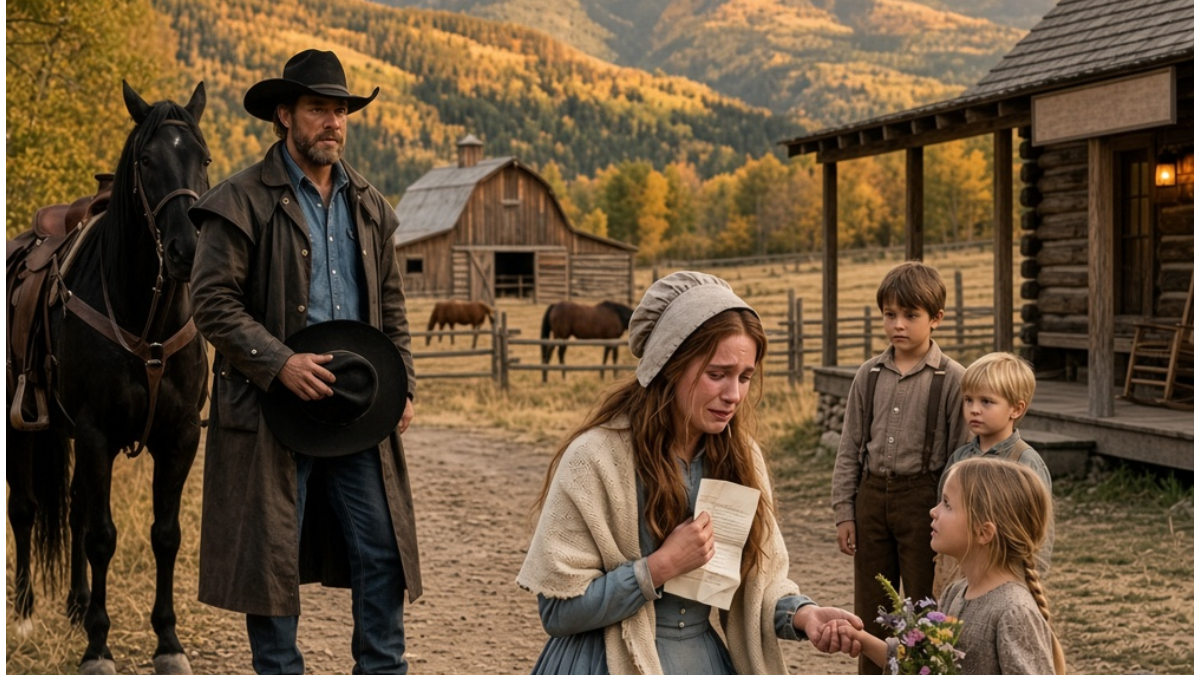
She came as a bride. She arrived as a ghoSt. And by morning, she would become something far more dangerous, a mother.
In the winter of 1887, Rebecca Moore was abandoned on a frozen platform in the Dakota Territory, left to die by a man who never intended to come.
But before the cold could claim her, two ragged children emerged from the snow with an offer that would change everything.
You need a home, and we need a mommy. What followed was not a rescue. It was a reckoning.
The train screamed as it pulled away, its black smoke clawing at the white sky like something desperate to escape.
Rebecca Moore stood alone on the platform, her carpet bag heavy in her gloved hand, her breath coming out in sharp clouds that disappeared too quickly into the cold.
The Dakota territory stretched before her, endless, merciless, silent, except for the wind that bit through her wool coat like it had teeth.
She had been traveling for 6 days. 6 days of rattling tracks and stale bread, and the weight of every mile, putting distance between her and the life she’d left behind in Philadelphia.
6 days of rehearsing what she would say when she met him. Henry Cartwright, the man who had written her three letters, polite, practical, promising a home and a future if she would only come west and marry him.
She had come. He had not. Rebecca turned slowly, scanning the empty platform. There was a station house, small and weathered, its windows dark, a few crates stacked near the edge, a water tower looming against the gray sky, but no people, no carriages, no man with kind eyes and a nervous smile, the way she had imagined Henry Cartwright a 100 times on the long journey.
Nothing. The cold pressed in. She could feel it seeping through her skirts, through the layers of pett coats and flannel, finding the skin beneath.
Her fingers were already numb inside her gloves. The sun was low, a pale disc behind the clouds, and she knew without asking that nightfall was close.
She walked toward the station house, her boots slipping on the ice slick boards. The door was unlocked.
Inside, it was darker and somehow colder, as if the building itself had given up on warmth.
There was a stove in the corner, unlit, a bench against the wall, a window that looked out onto nothing.
Rebecca set down her carpet bag and stood in the center of the room listening.
Somewhere in the distance, a dog barked. The wind rattled the glass deed, but there were no footsteps, no voices.
No one coming to explain why she had been left here. She thought of the letters.
Henry’s handwriting had been neat, careful. I am a man of modest means, but honest work.
I seek a wife who values integrity over luxury. If you are such a woman, I would be honored to make you my partner in this life.
She had believed him. She had sold everything she owned. She had said goodbye to the only friend she had left in Philadelphia, a widow who had warned her not to go.
You don’t know this man. You don’t know what you’re walking into. But Rebecca had gone anyway because staying meant slow starvation in a city that had no use for a woman with no family and no prospects.
Going west meant risk, but it also meant possibility. Now standing in the empty station house, she understood what her friend had been trying to tell her.
Possibility was another word for gamble, and she had loSt. Rebecca sat down on the bench and pulled her coat tighter.
She would wait until dark. Then she would what? Walk into town? Sleep here? There had to be a town.
Trains didn’t stop in the middle of nowhere for no reason. There had to be people.
She just had to find them. But even as she told herself this, she felt the edges of panic beginning to curl in her cheSt. What if there was no town?
What if Henry Cartwright had never existed? What if she had crossed half a continent to die alone in a place where no one even knew her name?
She closed her eyes and pressed her gloved hands together, trying to slow her breathing.
She had survived worse. She had buried her parents. She had worked herself sick in a textile mill.
She had gone days without eating. She could survive this. She had to. The door opened.
Rebecca’s eyes snapped open. For a moment, her heart leapt. Henry. But the figure in the doorway was too small, too thin.
A child, a girl, maybe 9 or 10, wearing a coat that was too big and patched in a dozen places.
Her face was pale and sharp with cold. Her dark hair tangled beneath a threadbear scarf.
Behind her, a smaller child, a boy, younger, maybe six, peered around her shoulder with wide, watchful eyes.
The girl looked at Rebecca without surprise, as if she had been expecting her. “You’re the lady from the train,” the girl said.
Rebecca stood slowly. “Yes, I’m My name is Rebecca Moore. I’m supposed to meet someone here.
A man named Henry Cartwright. Do you know him?” The girl’s expression didn’t change. Never heard of him.
Rebecca felt something cold settle in her stomach. “Are you sure?” He said he lived near the station.
He said, “There’s no Henry Cartrite around here,” the girl said flatly. “Maybe he gave you the wrong station.
Maybe he changed his mind. Doesn’t matter now.” Rebecca stared at her. “Doesn’t matter. You’re here,” the girl said.
“And you’re alone and it’s getting dark.” She tilted her head, studying Rebecca the way a hawk studies a field.
You need a place to stay. I Yes. I was going to find a hotel.
Is there a town nearby? 3 miles, the girl said, but there’s no hotel, just a boarding house, and Mrs. Brennan doesn’t take women traveling alone.
She thinks you’re trouble. Rebecca blinked. She doesn’t even know me. Doesn’t matter. The girl said again.
She stepped fully into the station house and the little boy followed, his small hand gripping the back of her coat.
You came here to marry a man who didn’t show up. That makes you trouble.
People here don’t like trouble. Rebecca felt her face flush with anger and humiliation. I didn’t ask to be abandoned.
Didn’t say you did. The girl crossed her arMs. But that’s how it is. You can try walking to town if you want.
Maybe someone will take pity on you. Maybe not. Or she paused and for the first time something shifted in her expression, something sharp and calculating.
Or you can come with us. Rebecca stared at her. Come with you where? Our house,” the girl said simply.
“It’s not far. You can stay the night. Get warm. Figure out what to do in the morning.”
Rebecca glanced at the little boy. He was watching her with huge, solemn eyes. His coat was as patched as his sisters, and his boots were tied together with twine.
“Where are your parents?” Rebecca asked carefully. “Our paws at the house,” the girl said.
“Our ma’s dead.” The words were delivered without emotion, as if she’d said them so many times they’d lost their weight.
Rebecca hesitated. Every instinct she had told her not to follow strange children into the dark.
But every instinct she had also told her she would freeze to death if she stayed here alone.
“Why are you helping me?” She asked. The girl looked at her for a long moment.
Then she said very quietly. “Because you need a home, and we need a mommy.”
The words hung in the cold air between them. Rebecca felt something twist in her chest, something half grief, half recognition.
She looked at the little boy again, at the way he clung to his sister, at the hunger in his eyes that had nothing to do with food.
“What’s your name?” Rebecca asked softly. “Annie,” the girl said. “This is my brother Samuel.”
“How old are you?” “10.” “Samuel’s six.” Rebecca crouched down so she was eye level with Samuel.
He didn’t move, didn’t smile, just watched her with that same unblinking stare. Samuel,” she said gently.
“Do you want me to come with you?” He nodded once, very small. Rebecca looked up at Annie.
“And your father? Does he know you’re here?” “He knows we were coming to the station,” Annie said.
“He doesn’t know we were coming for you,” she paused. “But he won’t turn you away.
He’s not like that.” Rebecca stood. She thought of the three miles to town, the cold, the boarding house that wouldn’t take her.
The night that was falling like a curtain. All right, she said quietly. I’ll come.
Annie’s expression didn’t change, but Rebecca saw something flicker in her eyes. Relief, maybe, or victory.
Get your bag, Annie said. And stay close. It’s easy to get lost in the dark.
They walked in silence. The snow was deep and uneven, and Rebecca struggled to keep up.
Annie moved with the confidence of someone who knew every rise and hollow, every buried stone.
Samuel stayed close to his sister, his small legs working hard to match her pace.
The wind grew sharper. The sky darkened from gray to black. Rebecca’s face burned with cold, and her feet were numb inside her boots.
She kept her eyes on Annie’s back, focusing on the patched coat, the thin shoulders, the determination in every step.
After what felt like an hour, but was probably less, Annie stopped. There, she said, pointing.
Rebecca looked up. Through the swirling snow, she could make out the shape of a house, low, rough built, surrounded by dark shapes that might have been trees or outbuildings.
A single light burned in one window, weak and flickering. That’s home, Annie said. They walked the last h 100red yards in silence.
As they approached, Rebecca could see more details. The uneven logs, the patched roof, the narrow porch stacked with firewood.
Smoke rose from the chimney, thin and gray. Annie climbed the porch steps and opened the door without knocking.
[clears throat] “Pa,” she called, “we brought someone.” Rebecca stepped inside, and the warmth hit her like a wall.
The house was small. One room with a loft above, a stove in the corner throwing heat, a table, a few chairs, shelves lined with jars and tools.
Everything was worn but clean, functional without being welcoming. A man stood by the stove, a ladle in his hand.
He was tall, broad-shouldered, his face shadowed by a beard that needed trimming. His clothes were workstained, his sleeves rolled to the elbows.
He looked at Annie, then at Samuel, then at Rebecca. His eyes were blue and very calm.
“Who’s this?” He asked. “Rebecca Moore,” Annie said quickly. “She came on the train. The man she was supposed to meet didn’t show up.
She has nowhere to go.” The man’s gaze settled on Rebecca. She felt the weight of it, steady, assessing, giving nothing away.
“That true?” He asked her. Rebecca lifted her chin. “Yes.” He was quiet for a moment, still watching her.
Then he sat down the ladle. “Name’s Jonah Hail,” he said. “These are my children.
Annie you’ve met.” “That’s Samuel.” “There’s another Eliza. She’s asleep in the loft.” Rebecca nodded.
“Mr. Hail, I apologize for the intrusion. Your daughter said I could stay the night.
I’ll leave in the morning.” Jonah looked at Annie. “You offered her a place to stay.”
Yes, Annie said, her voice steady. Without asking me. You would have said yes, Annie said.
Jonah’s mouth twitched. Not quite a smile, but close. He looked back at Rebecca. You have money?
A little, Rebecca said carefully. Work skills? I can cook, sew, clean. I worked in a textile mill for three years.
Jonah nodded slowly. All right, you can stay the night. We’ll figure out the rest in the morning.
He gestured to the table. Sit down. I’ll get you some stew. Rebecca hesitated, then moved toward the table.
Her legs felt shaky now that she was warm. She sat down carefully, her hands folded in her lap.
Annie and Samuel sat on either side of her. Samuel was still watching her, his expression unreadable.
Jonah brought over a bowl of stew and set it in front of her. The smell made her stomach clench.
She hadn’t eaten since morning. “Thank you,” she said quietly. Jonah nodded and returned to the stove.
Rebecca picked up the spoon. The stew was simple. Potatoes, onions, some kind of meat, but it was hot and thick and real.
She ate slowly, trying not to seem desperate, even though she was. Annie watched her the whole time.
“Where are you from?” Annie asked. “Philadelphia. Why’d you leave?” Rebecca paused, the spoon halfway to her mouth.
I had no reason to stay, Annie considered this. And the man you were supposed to meet, Henry Cartwright.
I answered an advertisement, Rebecca said carefully. He was looking for a wife. We exchanged letters.
He seemed um kind, honeSt. But he didn’t come, Annie said. No. Why not? I don’t know.
Annie leaned back in her chair, her arms crossed. Maybe he died. Maybe he changed his mind.
Maybe he was lying the whole time. Annie, Jonah said quietly from the stove. Annie didn’t look at him.
I’m just saying what’s true? Rebecca set down her spoon. You’re right. Any of those things could be true.
I won’t know unless I find him. You going to look for him? Annie asked.
I don’t know, Rebecca said honestly. I don’t know what I’m going to do. Annie studied her for a long moment.
Then she said, “You should stay here.” Rebecca blinked. “What?” “You should stay here,” Annie said again.
“E, we need help. P works all day. Eliza’s too little to do much. Samuel tries, but he’s six.
I do what I can, but it’s not enough. If you stayed, you could help.
You could cook and mend things and teach Eliza to read.” Rebecca stared at her, then looked at Jonah.
He was still at the stove, his back to them, but she could see the tension in his shoulders.
“Mr. Hail,” she said carefully. “I don’t think it’s not my idea,” Jonah said without turning around.
“But Annie’s not wrong. This house could use an extra pair of hands.” “I couldn’t impose.”
“You wouldn’t be imposing,” Jonah said. He turned to face her, his expression unreadable. “You’d be working.
I’d give you room and board. When spring comes, if you want to leave, you leave.
If you want to stay, we’ll figure out an arrangement. Rebecca felt something shift in her cheSt. Surprise, maybe.
Or the faint stirring of hope. “Why would you do this?” She asked. Jonah looked at his children, then back at Rebecca.
“Because they’re right,” he said quietly. “You need a home, and we need help.” Rebecca slept in the loft with the children.
Eliza, the youngest, was four years old with tangled blonde curls and a thumb perpetually in her mouth.
She woke when Rebecca climbed the ladder, but didn’t cry, just watched her with wide, curious eyes before falling back asleep.
Annie and Samuel shared one narrow bed. Eliza had another. Jonah had given Rebecca a pile of quilts and told her to make a pallet on the floor.
She lay awake for a long time, staring at the dark beams above her head, listening to the wind outside and the children’s soft breathing.
This was not the life she had imagined when she left Philadelphia. She had imagined a husband, a partner, someone who would stand beside her and build something together.
She had imagined safety, maybe even affection. Instead, she had found a house full of strangers held together by necessity.
But as she lay there in the dark, listening to Samuel’s gentle snoring and the creek of the house settling, she thought about Annie’s words.
You need a home, and we need a mommy. It wasn’t love. It wasn’t even kindness.
Not really. It was something raarer than that. Something more honeSt. It was survival. And maybe, Rebecca thought asleep finally pulled her under.
Maybe that was enough. She woke to the sound of Jonah’s boots on the floor below.
The loft was still dark, but she could see pale light seeping through the cracks in the shutters.
Dawn, we’re close to it. She sat up carefully, trying not to wake the children and climbed down the ladder.
Jonah was at the stove stirring a pot. He glanced at her but didn’t speak.
“Good morning,” Rebecca said quietly. He nodded. She looked around the small room, unsure what to do.
Can I help? You know how to make coffee? Jonah asked. Yes. He gestured to a battered pot near the stove.
Beans are in the jar on the shelf. Grinders next to it. Rebecca moved carefully, aware of his presence, even though he didn’t watch her.
She found the beans, ground them, set the pot to boil. The routine was soothing, something familiar in a place that was entirely strange.
“How long have you been alone?” She asked after a moment. Jonah was quiet. Then a year my wife died in childbirth.
The baby didn’t make it either. Rebecca’s hand stilled. I’m sorry. He didn’t respond. She poured the coffee when it was ready and set a cup near him.
He nodded his thanks but didn’t drink it. I need to check the livestock, he said.
When the children wake up, there’s porridge in the pot. Make sure Eliza eats. She’ll say she’s not hungry, but she is.
All right. He pulled on his coat and walked to the door. Then he paused, his hand on the latch.
“Miss Moore,” he said without turning around. “Annie’s a good girl, but she’s 10 years old.
She shouldn’t be making decisions about who stays in this house.” Rebecca stiffened. “I understand.
If you want me to leave, I don’t,” Jonah said. He opened the door, letting in a blast of cold air.
“But I need you to understand something. This isn’t charity. If you stay, you work.
You pull your weight and you don’t make promises to those children you can’t keep.
Rebecca met his eyes. I wouldn’t. He held her gaze for a moment longer. Then he nodded and walked out into the snow.
The days fell into rhythm. Rebecca woke before dawn and started the fire. She made coffee for Jonah and porridge for the children.
She washed dishes and swept floors and mended clothes by the light of the window.
She learned where everything was kept, the flower, the salt, the needles and thread. She learned the shape of the house, the way the wind found the cracks, the places where the floor creaked.
She learned the children. Annie was fierce and stubborn and carried the weight of the household like it was hers alone.
She didn’t ask for help, didn’t complain, didn’t cry. She just did what needed to be done with a grim determination that made Rebecca’s heart ache.
Samuel was quiet and watchful, always hovering at the edge of things. He obeyed without question, but rarely spoke.
Rebecca caught him staring at her sometimes, his expression unreadable, as if he was trying to figure out whether she was real.
Eliza was the easieSt. She clung to Rebecca from the first day, following her around the house, chattering in a high, breathless voice about everything and nothing.
She asked endless questions. Why is snow white? Where do birds go in winter? Can you braid my hair?
And Rebecca answered them all with a patience that surprised her. Jonah was the hardest to read.
He worked from sun up to sun down, checking traps, splitting wood, repairing the roof where the snow had damaged it.
He spoke only when necessary, his words spare and functional. He didn’t smile. He didn’t ask Rebecca about her life before the train station, but he noticed things.
When she burned her hand on the stove, he brought her sav without being asked.
When her boots started to come apart, he left a pair of his wife’s old ones by the door, worn, but sturdy, the leather still good.
When she stayed up late mending his coat by candle light, he didn’t thank her.
But the next morning, there was a cup of coffee waiting for her, still hot, small things, practical things, but they mattered.
2 weeks after Rebecca arrived, a woman came to the house. Rebecca was outside hanging laundry when she heard the crunch of boots in the snow.
She turned and saw a figure approaching, a woman, maybe 50, dressed in black with a severe face and sharp eyes.
“You’re the new one,” the woman said without preamble. Rebecca lowered the shirt she’d been hanging.
“I’m Rebecca Moore.” “I know who you are,” the woman stopped a few feet away, her arms crossed.
“I’m Mrs. Brennan. I run the boarding house in town.” Rebecca nodded carefully. Annie mentioned you.
Did she? Mrs. Brennan’s gaze swept over Rebecca, taking in her borrowed boots, her patched dress, her wind chapped hands.
What exactly are you doing here, Miss Moore? Helping, Rebecca said evenly. Helping, Mrs. Brennan’s mouth twisted.
Is that what they’re calling it now? Rebecca felt heat rise in her face. I’m not sure what you’re implying.
I’m not implying anything. I’m stating facts. Mrs. Brennan stepped closer. You’re a woman living alone with a man under his roof.
No husband, no chaperone, no protection. Do you know what people are saying? I don’t care what people are saying, Rebecca said, her voice sharper than she intended.
You should. Mrs. Brennan’s eyes narrowed. This is a small community, Miss Moore. Reputation matters, and right now you’re destroying yours.
And Jonah Hails along with it. Rebecca gripped the wet shirt in her hands. I’m doing nothing wrong.
Mr. Hail offered me work. I’m earning my keep. That’s all. That’s all. Mrs. Brennan’s laugh was cold.
You really are naive. Let me explain something to you. A woman in your position has two choices.
Marry or leave. Anything else is scandal. And scandal has a way of spreading. It’ll touch those children.
It’ll touch Jonah’s work. It’ll make life harder for everyone. Rebecca’s chest tightened. Then what do you suggest I do?
Leave, Mrs. Brennan said flatly. Go back to wherever you came from or find a husband, a real one this time.
But don’t stay here pretending this arrangement is respectable. And if I don’t leave, Mrs. Brennan’s expression hardened.
Then you’ll regret it. She turned and walked away, her black skirts trailing in the snow.
Rebecca stood frozen, the wet shirt still clutched in her hands, her heart pounding. Behind her, the door opened.
“Don’t listen to her,” Annie said quietly. Rebecca turned. Annie was standing in the doorway, her arms crossed, her face set in that familiar, stubborn expression.
“How much did you hear?” Rebecca asked. “Enough,” [snorts] Annie stepped onto the porch. Mrs. Brennan thinks she runs this place.
She thinks everyone should do what she says. But she’s wrong. “Annie, you’re not doing anything wrong,” Annie said fiercely.
“You’re helping us. You’re making things better, and if people don’t like it, that’s their problem.”
Rebecca felt something warm unfurl in her cheSt. She walked over and crouched down so she was eye level with Annie.
“Thank you,” she said softly. “But Mrs. Brennan is right about one thing. People talk, and talk can hurt you and your family.”
“I don’t care,” Annie said. “You should.” Rebecca reached out and tucked a strand of hair behind Annie’s ear.
I don’t want to make things harder for you. Annie’s jaw set. Then don’t leave.
Rebecca held her gaze. Annie, promise me, Annie said, her voice suddenly small. Promise you won’t leave.
Rebecca’s throat tightened. She thought about Mrs. Brennan’s words. She thought about the scandal that might follow her if she stayed.
She thought about the risks she was taking, not just with her own reputation, but with this fragile household she’d stumbled into.
But then she thought about Eliza’s laugh, Samuel’s rare smiles, the way the house felt less cold when she was in it.
“I promise,” she said quietly. “I won’t leave unless you want me to.” Annie nodded once, satisfied.
Then she turned and went back inside. Rebecca stood slowly, looking out at the white expanse of snow, the dark line of trees in the distance.
She had made a promise. Now she had to figure out how to keep it.
The scandal grew like ice on a window. Slowly at first, then all at once.
It started with sideways glances when Rebecca walked to town with Annie to buy flour.
Then whispers that stopped when she entered the general store. By the third week, the shopkeeper’s wife wouldn’t speak to her directly, addressing all her questions to Annie instead, as if Rebecca had become invisible.
Rebecca felt the weight of it, but she kept her head high and her face calm.
She had survived worse than judgment. She could survive this, too. But the children felt it differently.
One afternoon, Samuel came home from playing near the creek with a split lip and tear stained cheeks.
He wouldn’t say what happened, just shook his head when Rebecca tried to clean the wound.
“Samuel,” she said gently, holding his chin so she could see his face. “Who did this?”
He pulled away from her, his small jaw set in a way that reminded her painfully of Annie.
“Samuel, please.” “Tommy Brennan,” Annie said from the doorway. Her voice was flat. Matter of fact, he’s Mrs. Brennan’s grandson.
He said things about Rebecca. Samuel hit him. Tommy hit back. Rebecca’s stomach clenched. She looked at Samuel at the defiance and hurt waring in his young face and felt something fierce rise in her cheSt. What kind of things?”
She asked quietly. Annie shrugged, but Rebecca could see the tension in her shoulders. The kind of things people say about women who live in men’s houses without being married.
Rebecca closed her eyes briefly. When she opened them, Samuel was watching her with an expression that made her heart break.
“I’m sorry,” she whispered. “I’m so sorry.” Samuel didn’t answer. He just turned and climbed the ladder to the loft, disappearing into the shadows.
That night when Jonah came in from checking the traps, Rebecca was waiting at the table.
The children were asleep upstairs. The house was quiet except for the pop and hiss of the fire.
“We need to talk,” she said. Jonah set down his rifle and looked at her.
His face was tired, lined with cold and work. “About what? About what people are saying.
About what happened to Samuel today?” Jonah was quiet for a moment. Then he pulled off his coat and sat down across from her.
“I heard,” he said. “Then you know it’s my fault.” “It’s not your fault that people are small-minded.”
“It’s my fault I’m here,” Rebecca said, her voice tight. “It’s my fault your children are being hurt because of me.
I should leave. I should have left weeks ago.” Jonah studied her across the table.
His eyes were steady, unreadable in the firelight. “Is that what you want?” He asked.
It doesn’t matter what I want. It does to me. Rebecca stared at him. It was the most personal thing he’d said to her since she arrived.
I don’t understand, she said quietly. Why are you letting me stay? Why are you risking your reputation, your children’s safety for someone you barely know?
Jonah leaned back in his chair. For a long moment, he was silent, his gaze fixed on something beyond her shoulder.
“My wife died a year ago,” he said finally. Before that, she was sick for months.
The pregnancy was hard on her. The labor was worse. When it was over, I had three children and no idea how to take care of them.
He paused. Annie stepped up. She became the mother. She was 9 years old. And she became the mother.
Rebecca’s throat tightened. I watched her grow old overnight, Jonah continued, his voice low. I watched her stop being a child.
And I couldn’t stop it because I needed her. The house needed her. Samuel and Eliza needed her.
He looked at Rebecca directly. Then you came and for the first time in a year, I saw Annie act like a 10-year-old girl.
I saw her laugh. I saw her let someone else carry the weight. Rebecca felt tears prick her eyes.
Jonah, you asked why I’m letting you stay, he said. That’s why. Because my children need you.
And maybe, he hesitated. Maybe I need you, too. The words hung in the air between them, raw and unguarded.
Rebecca wiped at her eyes with the back of her hand. The town won’t accept this.
Mrs. Brennan will make sure of it. Then we’ll deal with the town, Jonah said simply.
How? He stood and moved to the stove, pouring himself coffee from the pot that was always warm.
The same way we deal with everything else. One day at a time. Rebecca watched him.
This quiet man who spoke in practical terms, but offered something that felt dangerously close to hope.
“I made Annie a promise,” she said. “I told her I wouldn’t leave unless she wanted me to.”
Jonah nodded slowly. “Then you’d better keep it. She doesn’t forgive broken promises.” “I know,” Rebecca said.
“That’s what scares me.” The winter deepened. The snow piled higher against the walls of the house, and the wind howled through the long nights like something alive and angry.
Rebecca learned to navigate the frozen mornings, the routine that kept them all tethered to survival.
She woke before dawn and coaxed the fire back to life. She made coffee strong enough to wake the dead and porridge thick enough to stick to ribs.
She mended clothes by candle light and taught Eliza her letters using a worn primer she found on a shelf.
The children responded to her in different ways. Eliza was open, affectionate, climbing into Rebecca’s lap whenever she sat down, chattering endlessly about her dreams and her doll and the chickens in the yard.
She called Rebecca Becca because she couldn’t quite manage the full name, and Rebecca found she didn’t mind.
Samuel remained watchful, cautious. He didn’t pull away when Rebecca touched his shoulder, didn’t refuse when she offered him an extra biscuit, but he didn’t seek her out either.
He was waiting, she realized, waiting to see if she would stay. Waiting to see if she would become another loss in his short, hard life.
Annie was the most complicated. She had handed Rebecca the weight she’d been carrying, but she hadn’t let go of it entirely.
She still woke early, still checked on Samuel and Eliza, still watched Jonah with worried eyes when he came in too tired to eat.
She was a child learning to trust that someone else could keep her family safe.
Rebecca understood. She had been that child once, a long time ago. One evening, as Rebecca sat by the fire stitching a tear in Jonah’s shirt, Annie appeared at her elbow with a battered book in her hands.
“Will you read to us?” She asked. Rebecca looked up surprised. “Of course.” “What’s the book?”
“It was Ma,” Annie said quietly. “It’s stories, fairy tales, and things.” Rebecca took the book carefully, feeling the weight of it.
Not just the physical weight, but the weight of memory, of loss, of a woman she would never meet, but whose absence shaped every corner of this house.
“I’d be honored,” she said softly. Annie called Samuel and Eliza, and they gathered near the fire.
Samuel sat on the floor, his knees pulled up to his cheSt. Eliza curled against Rebecca’s side.
Annie sat in the chair opposite, her hands folded in her lap, her expression careful.
Rebecca opened the book and began to read. The stories were old, familiar tales of brave knights and clever girls, of dragons defeated and curses broken.
Rebecca’s voice rose and fell with the rhythm of the words, and the children listened with the kind of attention that comes from hunger.
When she finished the first story, Eliza begged for another, then another. By the time Rebecca closed the book, Eliza was half asleep against her side, and even Samuel’s expression had softened.
“Time for bed,” Rebecca said gently. Eliza groaned, but didn’t argue. Samuel stood and headed for the ladder without a word, but Annie stayed in her chair, watching Rebecca with an unreadable expression.
“Ma used to read to us,” Annie said after a moment. “Every night before bed,” Rebecca nodded.
“It’s a good tradition.” “Will you keep doing it?” Annie asked, “Reading to us?” Rebecca met her eyes.
“As long as you want me to.” Annie was quiet for a moment. Then she stood and walked to the ladder, pausing at the bottom.
“Thank you,” she said without turning around. Then she climbed up into the darkness. Rebecca sat alone by the fire, the book still warm in her lap, and felt something shift inside her, something fragile and frightening and real.
She was no longer just surviving here. She was beginning to belong. The town did not forgive easily.
By late January, the whispers had hardened into something uglier. Rebecca heard the word Jezebel hissed behind her back at the general store.
She saw mothers pull their children away when Eliza tried to play near the church steps.
The preacher’s wife cross the street rather than walk past her, but the crulest blow came from an unexpected direction.
One morning, Rebecca found a letter nailed to the door of the house. The handwriting was crude, the words blunt.
Leave before we make you. She tore it down before the children could see it, her hands shaking with anger and fear.
She burned it in the stove and said nothing. But that night, as she lay in the loft, listening to the children breathe, she heard voices outside, men’s voices.
She climbed down the ladder as quietly as she could. Jonah was already at the window, his rifle in his hands, his face hard.
How many? She whispered. Three, maybe four, he said without looking at her. They’re drunk or close to it.
Rebecca’s heart pounded. What do they want? Same thing men like that always want to feel powerful.
One of the voices outside rose louder, slurred and ugly. Hail, send the out. We just want to talk.
Laughter followed, mean and sharp. Jonah’s jaw tightened. He moved toward the door, but Rebecca stepped in front of him.
Don’t, she said quickly. That’s what they want. They want you to come out so they can start something.
I’m not letting them terrorize my children. Then let me talk to them. Jonah stared at her.
Absolutely not. They’re here because of me, Rebecca said, her voice low and fierce. Let me handle it.
Rebecca, please. Above them, they heard a small sound. Samuel had come to the edge of the loft, his face pale in the shadows.
Jonah looked at his son, then back at Rebecca. His expression was torn between fury and helplessness.
“Stay behind me,” he said finally. “And if anything happens, you run back inside.” “Understand?”
Rebecca nodded. Jonah opened the door. The cold hit them like a fiSt. Four men stood in the yard, their faces ruddy with cold and drink.
Rebecca recognized one of them, Tommy Brennan’s father, the same man who had watched her with hostile eyes at the general store.
Hail, Brennan said, his voice thick. We’re here to talk sense into you. Talks free, Jonah said evenly.
Say your peace and go. We don’t like what’s happening here, Brennan said. You bringing in some city woman, letting her live under your roof like she’s your wife.
She’s my employee,” Jonah interrupted. “And what happens in my house is my business. It becomes our business when it affects the town,” another man said.
Rebecca didn’t recognize him. “When our kids have to see your kids and wonder what kind of house they’re coming from.”
“My children are being raised with decency and hard work,” Jonah said, his voice hard, which is more than I can say for some.
Brennan’s face flushed. You watch your mouth hail. Or what? Jonah raised the rifle slightly, not aiming, just reminding them it was there.
You’ll do what exactly? Threaten my family in the middle of the night like cowards.
We’re not cowards, Brennan snarled. We’re concerned citizens, and we’re telling you that woman needs to go one way or another.
Well, Rebecca felt ice slide down her spine, but she stepped forward, moving past Jonah before he could stop her.
“I’ll make you a deal,” she said, her voice steady despite the fear hammering in her cheSt. The men stared at her.
“Rebecca,” Jonah started. She ignored him, keeping her eyes on Brennan. “You want me gone?
I understand that. But I’m not leaving because you show up drunk in the middle of the night making threats.”
“Then why would you leave?” Brennan asked with a sneer. I’ll leave when I’m ready, Rebecca said, and not a moment before.
Until then, you stay away from this house. You stay away from these children. And if I hear that anyone, anyone has harmed Samuel or Annie or Eliza because of me, I will make it my life’s work to make sure everyone in this territory knows what kind of men you are.
The kind who terrorize children and widowers in the dark. Brennan’s sneer faltered. “You threatening us?”
“I’m promising you,” Rebecca said quietly. “Stay away from this family or I will make you regret it.”
“For a moment,” no one moved. The wind howled. The men shifted, uncertain. Then Brennan spat in the snow.
“You’re not worth the trouble,” he muttered. He turned to the others. “Come on, let’s go.”
They left, stumbling through the snow, their voices fading into the dark. Rebecca stood frozen on the porch, her whole body shaking now that the danger had passed.
Jonah lowered the rifle slowly. He looked at her with an expression she couldn’t quite read.
“You’re either very brave or very foolish,” he said finally. “Probably both,” Rebecca whispered. He almost smiled.
Then he put a hand on her shoulder. Brief, solid, real. “Come inside,” he said gently.
“Before you freeze.” They went back into the house. Samuel was still at the edge of the loft watching.
“It’s all right,” Rebecca called up to him. “They’re gone.” Samuel didn’t move. Rebecca climbed the ladder and sat beside him in the dark.
“Are they going to hurt us?” He asked in a very small voice. “No,” Rebecca said firmly.
“I won’t let them.” “How can you stop them?” Rebecca was quiet for a moment, thinking.
Then she said, “Do you know what makes people cruel, Samuel?” He shook his head.
Fear, she said. They’re afraid that the world is changing in ways they don’t understand.
And when people are afraid, they lash out. But fear only has power if you let it.
She touched his hair gently. I’m not afraid of them. And neither should you be.
Samuel leaned against her just slightly. It was the first time he’d sought comfort from her.
I’m glad you’re here, he whispered. Rebecca’s throat tightened. She put her arm around his thin shoulders.
Me, too, she said softly. Me, too. The days grew longer as February crept in, though the cold showed no signs of releasing its grip.
Rebecca fell deeper into the rhythms of the household, learning things she hadn’t known she needed to know.
How to keep the butter from freezing, how to stretch a chicken to feed five people for 3 days, how to tell when Jonah’s silences meant worry, and when they simply meant exhaustion.
She learned to read the land, too. The way the sky looked before a storm, the quality of the wind that meant the temperature would drop dangerously.
She learned which paths were safe to walk and which would lead to snow drifts that could swallow a person whole.
And slowly, carefully, she learned the shape of grief that lived in this house. It was in the way Annie set the table for six before catching herself in removing the extra plate.
It was in the way Samuel sometimes called out ma when he heard himself, then went quiet with confusion and loss.
It was in the way Eliza asked questions about her mother that no one wanted to answer.
What was her favorite color? Did she like to sing? Did she love me? Jonah carried his grief differently.
He never spoke of his wife directly, never lingered on memories. But Rebecca saw it in the way he avoided certain corners of the house, certain objects, a shawl hanging on a peg, a pair of worn slippers near the door.
One evening, Rebecca found herself standing in front of those slippers, staring at them. They were small, practical, the leather cracked and soft with use.
They had belonged to a woman who had walked this floor, raised these children, loved this man, a woman whose absence was a presence in every room.
Rebecca bent down and picked them up carefully. They were lighter than she expected. “Those were hers,” Annie said behind her.
Rebecca turned. Annie was watching from the doorway, her expression guarded. “I know,” Rebecca said quietly.
“I was just I don’t know what I was doing.” Annie crossed the room and took the slippers from Rebecca’s hands.
She held them for a moment, running her thumb over the worn leather. P can’t throw them away, Annie said.
He’s tried three times, but he always takes them out of the fire before they burn.
Rebecca’s heart achd. He loved her very much. He still does, Annie said. She looked up at Rebecca, her eyes sharp.
You know you’re not replacing her, right? You could never replace her. Rebecca nodded. I know.
I wouldn’t try. Good. Annie set the slippers back by the door, positioning them exactly where they’d been.
“But you can still be here. You can still be something, just not her.” “What do you want me to be?”
Rebecca asked gently. Annie considered this for a long moment. Then she said, “I want you to be someone who stays.”
It was the simplest and most complicated answer she could have given. “I’m trying,” Rebecca said.
I know, Annie said, then softer. Thank you. The storms came in waves through February, each one more vicious than the laSt. Rebecca learned to read the signs, the particular quality of light before the sky opened, the way the animals grew restless.
She learned to prepare, to make sure the wood was stacked near the door, the water drawn before it could freeze solid, the children dressed in layers that would keep them warm even if the fire died.
But she also learned that preparation could only go so far. The blizzard hit on a Tuesday, sudden and savage.
One moment the sky was gray and sullen, the next it was white with snow so thick Rebecca couldn’t see the barn from the house.
“Jonah came in from checking the animals covered in ice, his face grim. We need to stay inside,” he said, stamping snow from his boots.
“No one goes out for any reason. Understand?” The children nodded. Even Eliza seemed to sense the danger, staying close to Rebecca’s side.
They spent the day huddled near the stove, playing quiet games and telling stories. Rebecca read from the book of fairy tales until her voice went horsearo.
Annie helped her make bread. Samuel carved small animals from scraps of wood while Eliza watched in fascination.
But as the day wore into night, the temperature dropped. Even with the fire roaring, Rebecca could see her breath in the far corners of the room.
We need more wood, Jonah said quietly to Rebecca as the children prepared for bed.
I’ll help you bring it in. No, I’ll go alone. It’s faster. Jonah. Rebecca. He looked at her steadily.
If something happens to me, you’ll need to take care of them. That’s more important than fetching wood.
She wanted to argue, but she knew he was right. So she nodded and watched him pull on his heaviest coat, wrap his face against the cold, and step out into the howling white.
He was gone for what felt like hours, but was probably only minutes. When he came back, he was carrying an armload of wood and moving stiffly.
“Are you all right?” Rebecca asked as he stacked the wood near the stove. “Fine,” he said shortly.
But she could see the way he favored his left side, the tightness around his mouth that meant pain.
Later, after the children were asleep, she confronted him. “You’re hurt. It’s nothing. Show me.”
Jonah sighed, but pulled up his shirt. Rebecca saw the bruise spreading across his ribs, dark purple and angry.
“What happened?” Slipped on the ice, hit the side of the barn. Rebecca pressed her fingers gently against the bruise, feeling for breaks.
Jonah winced, but didn’t pull away. “I don’t think anything’s broken,” she said finally. But you need to rest it.
Can’t reSt. Too much work. Then let me do more. Jonah looked at her in the firelight.
You’re already doing everything. Not everything, Rebecca said. Let me help you, Jonah. Please. He was quiet for a long moment.
Then he nodded just once. It was the closest thing to vulnerability she’d seen from him.
The next morning, Rebecca took over the outdoor chores. Jonah protested, but she was firm.
She bundled herself in every warm thing she could find and went out into the bitter cold to feed the animals, check the traps, split wood.
Her hands blistered. Her muscles screamed. The cold burned her lungs with every breath. But she didn’t stop because this was what staying meant.
This was what it meant to be part of something larger than herself. When she came back inside hours later, exhausted and shaking with cold, Jonah was waiting with hot coffee and a blanket.
He wrapped it around her shoulders without a word. His hands gentle. “Thank you,” he said quietly.
Rebecca looked up at him. His face was tired, lined with pain and work and something that might have been gratitude.
“We take care of each other,” she said. “That’s how this works.” He nodded slowly.
Then he did something unexpected. He smiled. Just a small one, barely there, but real.
And Rebecca felt something warm unfurl in her cheSt. something dangerous and hopeful and absolutely terrifying.
She was falling in love with this broken household, with these wounded children, with this quiet man who had never promised her anything, but still gave her everything.
And she knew with absolute certainty that there was no going back now. She had made her choice.
She would stay. The warmth between them grew in the quiet spaces in gestures too small for words.
Jonah’s hand steadying her elbow when she slipped on ice. Rebecca’s fingers smoothing the collar of his shirt before he went out into the cold.
The way their eyes met across the table during meals, holding for just a moment longer than necessary before one of them looked away.
The children noticed. “Are you going to marry P?” Eliza asked one morning while Rebecca braided her hair.
Rebecca’s hands stilled. “What makes you ask that?” Annie says you might. She says that’s what happens when a lady lives with a man who’s not her husband.
Rebecca glanced at Annie, who was kneading bread at the table with studied concentration, her ears clearly attuned to every word.
“Your paw and I haven’t discussed marriage,” Rebecca said carefully, resuming the braid. “I’m here to help, that’s all.”
“But do you want to marry him?” Eliza persisted. Rebecca tied off the braid with a ribbon.
“That’s not a question for little girls to worry about.” “I’m not worried,” Eliza said, turning to look up at Rebecca with serious eyes.
I think you should marry him. Then you’d be our real mother. Then you couldn’t leave.
The words landed like stones in still water, sending ripples through everything Rebecca thought she understood about her place here.
Eliza, Annie said sharply from the table. Leave her alone. But Eliza wasn’t finished. Don’t you want to stay forever?
Rebecca cuped the child’s face gently. I want to stay as long as you’ll have me.
Marriage or no marriage? Promise? I promise. Eliza threw her arms around Rebecca’s neck, squeezing tight.
Over the child’s shoulder, Rebecca met Annie’s eyes. The older girl was watching with an expression that was equal parts hope and fear, as if she wanted desperately to believe, but knew better than to truSt. Rebecca understood.
She felt the same way. By early March, the worst of winter should have been behind them, but the Dakota territory had other plans.
The cold lingered like a guest who’d overstayed their welcome, and the snow showed no signs of retreat.
Jonah grew quieter as the weeks dragged on, his worry manifesting in the way he checked and rechecked supplies, counted and recounted the food stores.
“We’re running low,” he admitted to Rebecca one evening after the children were asleep. “Flower, especially, and the chickens have stopped laying.
How long can we stretch what we have?” “Seeks, maybe four, if we’re careful. He rubbed his face tiredly.
I need to go to town, get supplies before the next storm hits. I’ll come with you, Jonah shook his head.
You need to stay with the children. Annie can watch them for a few hours.
Rebecca, you need someone to help carry supplies, she said firmly. And you’re still favoring those ribs.
Don’t think I haven’t noticed. Jonah looked at her for a long moment. Then he sighed.
All right, but we go early and come back faSt. I don’t like leaving them alone.
They set out at dawn 2 days later, the wagon creaking through snowpacked ruts. The cold was savage, biting through every layer of clothing.
Rebecca kept her face wrapped in a scarf, her hands buried in a motheaten muff that had belonged to Jonah’s wife.
The town was quiet when they arrived, smoke rising from chimneys and thin gray columns.
A few people moved along the main street, bundled and hurried. Rebecca felt their stairs as Jonah helped her down from the wagon, felt the weight of judgment and speculation.
She kept her head high and followed him into the general store. The shopkeeper’s wife was behind the counter, and her expression soured the moment she saw Rebecca.
“Mr. Hail,” she said coldly, not acknowledging Rebecca at all. “What can I get you?”
Jonah rattled off his liSt. Flour, sugar, coffee, salt. The woman gathered the items with mechanical efficiency, her mouth pressed in a thin line of disapproval.
When Jonah reached for his wallet, the woman named a price that made Rebecca’s eyes widen.
It was nearly double what these supplies should coSt. “That’s highway robbery,” Rebecca said before she could stop herself.
The woman’s eyes snapped to her. “Prices have gone up, supply and demand.” “Prices haven’t gone up for anyone else,” Rebecca said evenly.
I can see the board behind you. The woman’s face flushed. If you don’t like my prices, you can shop elsewhere.
There is nowhere else, Rebecca said. And you know it, Rebecca, Jonah said quietly, a warning in his voice.
But Rebecca was done being silent, done shrinking under the weight of other people’s cruelty.
You’re punishing him because of me, because you don’t approve of me being in his house.
So, you’re going to price gouge a widowerower with three children to make your point.
Uh, I don’t have to explain my business practices to you, the woman snapped. No, you don’t, Rebecca agreed.
But everyone in this town will know exactly what you did. They’ll know that when Jonah Hail’s children went hungry, it was because you decided your moral judgment was worth more than their lives.
The woman’s face went white, then red. For a moment, Rebecca thought she might refuse to sell them anything at all, but then someone behind them spoke up.
“I’ll pay the difference.” Rebecca turned. An older man stood near the door, weathered and grizzled, his eyes sharp beneath heavy brows.
She didn’t recognize him. “Mr. Garrett,” the shopkeeper’s wife said, flustered. “There’s no need.” “There’s every need,” Garrett said.
He walked forward and placed coins on the counter. “Charge them the fair price. I’ll cover what you’re trying to steal.”
The woman looked like she’d swallowed something bitter, but she swept the coins into her hand and began calculating again, this time with the correct prices.
Jonah started to protest, but Garrett waved him off. “Consider it alone. You can pay me back in the spring.”
“Why would you do this?” Rebecca asked quietly. Garrett looked at her with eyes that had seen too much and forgiven too little.
Because I knew Jonah’s wife, Sarah, was a good woman, and she’d be ashamed to see how this town has treated the woman helping raise her children.”
He nodded to Jonah. “Get your supplies and go home. Storm’s coming.” They loaded the wagon quickly, neither of them speaking.
But as Jonah helped Rebecca back onto the seat, she felt his hand squeeze hers briefly.
Gratitude and something more. They were halfway home when the sky began to darken. It happened fast, the way it always did out here.
One moment the clouds were distant and gray. The next they were pressing down like a ceiling about to collapse.
The wind picked up sharp and vicious, carrying snow that felt like needles against exposed skin.
“We need to move,” Jonah said, snapping the rains. “The horses picked up their pace, but the storm was faster.
Within minutes, visibility dropped to almost nothing. Rebecca could barely see the hor’s heads in front of them, let alone the road.”
“Jonah, I know. Hold on. The wagon lurched through drifts that grew deeper with every passing moment.
Rebecca gripped the seat, her heart pounding as the world disappeared into white chaos. She couldn’t tell if they were still on the road or if they’d veered off into open country where they could wander until the cold claimed them.
Then through the howling wind she heard it, a small, thin sound that didn’t belong.
“Stop,” she said suddenly. “What?” “Stop the wagon,” Jonah pulled hard on the rains. The horses stamped and snorted, their breath steaming in the frigid air.
“What is it?” Jonah demanded. Rebecca climbed down before he could stop her, her boots sinking into snow up to her knees.
The sound came again, clearer now, a child’s cry, weak and desperate. “Someone’s out here,” she called back to Jonah.
“Rebecca, get back in the wagon.” But she was already moving, following the sound through the blinding white.
Her hands were numb. Her face burned with cold, but the crying pulled her forward like a rope around her cheSt. And then she saw him.
Samuel. He was huddled against a fallen log, his coat inadequate, his face blue with cold.
His toy horse, the carved wooden one Jonah had made him, lay in the snow beside him.
Samuel. Rebecca fell to her knees beside him, pulling him into her arMs. He was frighteningly cold, his whole body shaking violently.
“What are you doing out here? Where’s Annie?” “Came to find you,” Samuel stuttered through chattering teeth.
Annie said not to, but I was scared. Took Sultan to look for you. He ran away.
Rebecca’s heart clenched. Sultan was their old geling, gentle but skittish. If he’d thrown Samuel and run off, the boy would have been stranded with no way home.
How long have you been out here? Don’t know. Long time. Jonah appeared through the snow, his face stricken.
When he saw Samuel, something broke in his expression. “We need to get him warm,” Rebecca said urgently.
“Now.” Jonah didn’t argue. He scooped Samuel up and they fought their way back to the wagon.
Rebecca climbed up first and Jonah handed her the boy. She wrapped him in every blanket they had, pulling him tight against her body, trying to share her warmth.
“We can’t make it home in this,” Jonah said, his voice tight. “We’ll have to find shelter.”
“Where?” “Old Miller Place, about a/4 mile weSt. It’s abandoned, but the walls are still standing.”
He turned the wagon, trusting instinct and memory more than sight. Rebecca held Samuel close, talking to him constantly, refusing to let him slip into sleep.
Stay with me, Samuel. Keep your eyes open. Tell me about your toy horse. Tell me about Sultan.
Stay with me. The boy mumbled responses, his words slurring. Rebecca’s fear sharpened into terror.
She’d seen hypothermia before in Philadelphia. Workers who’d fallen into the river in winter. She knew what happened when the body got too cold.
The Miller place materialized out of the storm like a ghoSt. A small cabin, roof partially collapsed, but three walls intact and a door that still hung on its hinges.
Jonah pulled the wagon close and jumped down. Get him inside. I’ll deal with the horses.
Rebecca carried Samuel into the cabin, kicking the door open with her foot. The interior was dark and bitterly cold, but at least it blocked the wind.
She set Samuel down as gently as she could and began stripping off his wet clothes with shaking hands.
His skin was white, almost waxy. His lips were blue. His shivering had slowed, which Rebecca knew was a terrible sign.
She pulled off her own coat and wrapped it around him, then lay down beside him, pulling him against her, trying to warm him with her body.
“Don’t you dare leave us,” she whispered fiercely into his hair. “Don’t you dare, Samuel Hail.
Your father needs you. Your sisters need you. I need you. Jonah came in carrying an armload of wood he must have salvaged from the wagon.
His hands were bleeding from where he’d torn boards apart with his bare fingers, but his face was set in grim determination.
He built a fire in the old hearth with practiced efficiency. The wood was damp and reluctant, but eventually it caught, throwing weak but precious warmth into the frozen space.
“How is he?” Jonah asked, crouching beside them. Cold. Too cold. Rebecca’s voice cracked. Jonah, I don’t know if he’ll be all right, Jonah said firmly.
But Rebecca could see the fear in his eyes. The way his hands trembled as he touched his son’s face.
He has to be. They worked together through the long afternoon, feeding the fire, taking turns holding Samuel, rubbing his limbs to restore circulation.
Slowly, painfully slowly, color began to return to the boy’s face. His shivering increased again, which Rebecca knew was a good sign.
His eyes opened, confused and frightened. “Ph,” he whispered. Jonah’s face crumpled with relief. He gathered Samuel into his arms, holding him so tightly, Rebecca thought he might never let go.
“I’m here,” Jonah said, his voice rough. “You’re safe. I’ve got you.” Samuel clung to his father, and for the first time since Rebecca had known him, he cried.
Great heaving sobs that shook his small frame. All the fear and loss and loneliness he’d been holding came pouring out in the safety of his father’s arMs. Rebecca turned away to give them privacy, but Jonah reached out and caught her hand.
“This is because of you,” he said quietly. “You heard him. You found him. You saved his life.”
Rebecca shook her head, unable to speak past the tightness in her throat. “I mean it,” Jonah said.
His eyes were wet, his face raw with emotion. “You saved my son.” Rebecca squeezed his hand, then pulled away to tend the fire, but she felt the weight of what had happened settling into her bones.
She had walked into a blizzard for this child. She had risked her own life without hesitation.
Not because it was her job, not because she owed them anything, but because Samuel was hers.
They were all hers. And she would walk through any storm to keep them safe.
The blizzard raged outside for hours. Inside the broken cabin, the three of them huddled near the fire, sharing warmth and silence.
Samuel drifted in and out of sleep, always reaching out to make sure his father and Rebecca were still there.
As darkness fell, Jonah spoke quietly. Annie must be terrified. She’s strong. Rebecca said she’ll take care of Eliza.
She shouldn’t have to. She’s 10 years old. I know. Rebecca stared into the fire.
But she will because that’s who she is. Jonah was quiet for a long moment.
Then he said, “When Sarah died, I didn’t think I’d survive it. The grief was, I couldn’t breathe under the weight of it.
And then I looked at my children and realized I didn’t have the luxury of grief.
They needed me. So I pushed it down and kept moving. Rebecca listened, not interrupting.
But pushing it down isn’t the same as healing, Jonah continued. And I was so focused on just surviving that I didn’t see what it was doing to them.
Annie growing old too faSt. Samuel going silent. Eliza asking questions I couldn’t answer. He looked at Rebecca.
And then you came. And suddenly there was someone else carrying the weight. Someone else making sure they were fed and warm and loved.
Jonah, let me finish, he said gently. I know this isn’t what you signed up for.
I know you came here expecting something different. But you stayed anyway. You stayed when the town turned against you.
You stayed when it would have been easier to leave. And today you walked into a storm to save my son.
His voice broke slightly. How do I thank you for that? Rebecca felt tears slip down her cheeks.
You don’t need to thank me. I didn’t do it for gratitude. Why did you do it?
She looked at him across the fire light at this man who had given her shelter when she had nowhere else to go.
Who had trusted her with his children, who had defended her when the world called her names she didn’t deserve.
“Because I love them,” she said simply. “I love all of you.” The words hung in the air between them, too honest to take back.
Jonah stared at her, his expression unreadable. Then he set Samuel down carefully, making sure the boy was wrapped in blankets, and moved closer to Rebecca.
Say that again, he said quietly. I love them, Rebecca whispered. I love your children.
I love this broken household. I love, she stopped, unable to finish. Say it, Jonah said, his hand coming up to cup her face.
His palm was rough, calloused from work, but his touch was infinitely gentle. “I love you,” Rebecca breathed.
“Heaven, help me.” “I love you.” Jonah closed his eyes briefly, as if absorbing a blow.
When he opened them again, they were bright with unshed tears. “I love my wife,” he said.
“I loved her with everything I had. And when she died, I thought that was it.
I thought I’d never feel that way again.” Rebecca’s heart cracked. “I know I’m not trying to replace her, but you’re not her,” Jonah continued, his thumb brushing away her tears.
“You’re different. Fierce where she was gentle, stubborn where she was patient. You fight for what you love instead of surrendering to it.”
He leaned his forehead against hers. And somehow, without meaning to, I fell in love with you anyway.
Rebecca couldn’t breathe. “Jonah, I’m not good with words,” he said. I’m not romantic. I can’t promise you an easy life or comfort or anything except hard work and harsh winters.
But I can promise you this. If you stay, I will spend every day making sure you never regret it.
I will defend you against anyone who speaks ill of you. I will stand beside you through whatever comes, and I will love you with everything I have left to give.”
Rebecca’s hands came up to grip his shirt, anchoring herself to him. “That’s all I’ve ever wanted.”
He kissed her then, soft and careful, as if she might break. But Rebecca kissed him back with everything she’d been holding inside, all the loneliness and fear and desperate hope that had brought her to this moment.
When they finally pulled apart, Samuel was watching them with sleepy, satisfied eyes. “Does this mean you’re staying?”
He asked. Rebecca laughed through her tears. “Yes, I’m staying forever.” She looked at Jonah at the promise in his eyes, then back at Samuel forever.
Samuel smiled, really smiled for the first time since she’d known him, and closed his eyes again, finally at peace.
The storm raged through the night, but inside the broken cabin, they were warm. When dawn came, the world was white and silent, transformed by snow into something almost beautiful.
They made their way home slowly. Samuel bundled between them in the wagon, too precious to risk.
Annie and Eliza burst out of the house when they heard the wagon, their faces stre with tears and relief.
Annie threw herself at Samuel, then at Rebecca, then at her father, scolding and crying and holding on tight all at once.
“Don’t ever do that again,” she said fiercely to Samuel. “Don’t ever scare me like that.
I won’t,” Samuel promised, his voice small but steady. “I’m sorry.” Eliza climbed into Rebecca’s arms and wouldn’t let go, even when they went inside.
Rebecca carried her to the fire and sat down, feeling the weight of the child settle against her like a benediction.
This was home. Not the building, not the place, but these people who had claimed her as their own.
Jonah met her eyes across the room, and in that look was everything they’d said and everything they hadn’t.
Promises and possibilities, and the fierce determination to protect what they’d built. The storm had tested them and they had survived together.
The days after the storm carried a different quality, as if the near loss of Samuel had shifted something fundamental in the household.
The children moved closer to Rebecca, their touches more frequent, their trust more complete. Eliza refused to sleep unless Rebecca tucked her in.
Samuel sought her out with questions he’d never asked before. Small things, curious things. The questions of a child who decided it was safe to be a child again.
Annie was the most changed. She still woke early and helped with chores, but there was a lightness in her now, as if someone had lifted a weight she’d been carrying too long.
She laughed more. She played with her siblings instead of just watching over them. And sometimes, when she thought no one was looking, Rebecca caught her staring with an expression that was equal parts gratitude and wonder.
But the change in the household didn’t go unnoticed by the town. 3 days after they returned from the storm, a wagon appeared in the yard.
Rebecca was outside splitting kindling when she saw it. A fine carriage, too fine for these parts, pulled by matching horses that gleamed with good feed and regular grooming.
The man who stepped down wore a coat that cost more than most families earned in a year.
His face was smooth and wellfed, his eyes sharp with the kind of intelligence that came from always getting what he wanted.
Rebecca set down the axe carefully and wiped her hands on her apron. “Can I help you?”
She called. The man’s gaze swept over her, assessing, dismissing, calculating. “I’m here to see Jonah Hail.
He’s checking traps. Should be back within the hour.” “Then I’ll wait.” The man started toward the house without invitation.
Rebecca moved to block his path. I didn’t catch your name. He stopped, his eyebrows rising slightly at her audacity.
Lawrence Ashford. I own the land office in town in half the property in this county.
He looked at her more carefully now. You must be the woman everyone’s talking about.
I’m Rebecca Moore, she said evenly. And if you want to wait for Mr. Hail, you’ll wait out here.
Ashford’s mouth curved in something that wasn’t quite a smile. Protective of your employer? Are you protective of his children?
Rebecca corrected. They don’t need strangers walking into their home uninvited. How admirable. Ashford’s tone made the word sound like an insult.
Very well. I’ll wait in my carriage, but tell Hail the moment he returns that Lawrence Ashford is here on business.
Important business. He climbed back into his carriage, and Rebecca returned to her work, though she kept one eye on the vehicle.
Something about the man set her teeth on edge. The casual arrogance, the way he’d looked at her like she was something to be managed or removed.
When Jonah appeared 20 minutes later, Rebecca met him at the edge of the yard.
There’s a man here to see you, she said quietly. Lawrence Ashford says he owns the land office.
Jonah’s expression went carefully blank. What does he want? Didn’t say, but I don’t like him.
Neither do I. Jonah handed her his rifle. Keep this close and keep the children inside.
Rebecca’s stomach clenched. Jonah, what’s going on? I don’t know yet, he said, but Ashford doesn’t make social calls.
He walked to the carriage and Ashford stepped down again, his smile urbane and utterly false.
Hail, he said, extending a hand that Jonah didn’t take. Good to see you. I hope I’m not interrupting.
What do you want, Ashford? Straight to business. I appreciate that. Ashford pulled out a leather folder from his carriage.
I’m here about your land claim. There seems to be some confusion about the boundaries.
Jonah’s jaw tightened. There’s no confusion. My boundaries are registered with the land office. Yes.
Well, that’s the problem. Ashford opened the folder, pulling out papers covered in official looking stamps.
It appears there was an error in the original filing. A rather significant error actually.
According to these corrected documents, your western boundary is approximately 200 yd east of where you think it is.
That’s a lie, Jonah said flatly. I assure you these documents are entirely legal. Ashford’s voice remained pleasant, but his eyes were cold.
The corrected boundary has been filed and registered, which means I’m afraid that your barn and approximately half your fields are now technically on land that belongs to He paused for effect.
Me? Rebecca’s hands tightened on the rifle. She saw the trap now, saw the careful malice in it.
You’re trying to steal his land, she said. Ashford looked at her with mild surprise, as if he’d forgotten she was there.
I’m correcting a filing error, Miss Moore. Entirely legal, I assure you. When was this error corrected?
Jonah asked, his voice dangerously quiet. Last month. The paperwork was filed while you were occupied with other matters.
While they were fighting to survive winter, while Samuel was lost in the storm, while they were too busy staying alive to notice what was happening in the land office.
You can’t do this, Rebecca said. I already have, Ashford replied smoothly. But I’m not an unreasonable man, Hail.
I’m willing to sell you the disputed land at fair market value, of course. How much?
Jonah asked. Ashford named a figure that made Rebecca’s breath catch. It was more money than they could earn in 5 years.
Maybe 10. I don’t have that kind of money, Jonah said. Then I’m afraid we have a problem.
Ashford tucked the papers back into his folder. You see, I’ve already sold that land to someone else.
They’ll be taking possession in 30 days, which means you’ll need to remove your barn and anything else on the disputed property by then.
The barn is the only shelter for the animals, Rebecca said, her voice rising. Without it, they’ll die.
The children need those animals to survive. Then I suggest you find alternative arrangements, Ashford said.
He looked at Jonah. Of course, there is one other option. What’s that? Leave. Ashford said it simply, as if he were suggesting they take a different road to town.
I’m prepared to buy your entire claim, house, remaining land, everything, for a generous price.
Enough to relocate somewhere more suitable. This is my home, Jonah said. It was your home, Ashford corrected.
Now it’s a legal complication. And legal complications tend to get messy. Hail. Court battles, sheriff involvement, public scrutiny.
His gaze slid to Rebecca. And I understand you already have enough scandal attached to your name.
Adding a land dispute won’t help your situation. Rebecca saw it then. The full picture of what was happening.
This wasn’t just about land or money. This was about driving them out. About punishing Jonah for defying the town’s judgment.
About making an example of what happened when you refused to play by their rules.
You’re doing this because of me,” she said quietly. Ashford shrugged. “I’m doing this because it’s good business.”
“If there happened to be social benefits as well, that’s simply fortunate timing.” Jonah took a step forward, and Rebecca saw his hands curl into fists.
But before he could speak, the door of the house opened. Annie stood on the porch, Samuel and Eliza behind her.
They’d been watching from the window. P,” Annie called, her voice uncertain. Jonah’s face transformed, the anger draining away, replaced by something harder and more controlled.
He turned back to Ashford. “Get off my land,” he said quietly. “Your land,” Ashford’s eyebrows rose.
“I think we’ve established that’s debatable.” “Get off my land,” Jonah repeated. “I’ll remove you myself.”
Ashford studied him for a moment, then smiled. 30 days, Hail. Then the sheriff comes and if you’re still here, if that barn is still standing on my property, I’ll have you arrested for trespassing and destruction of property.
Your children will be placed with families who can properly care for them. And your housekeeper, he glanced at Rebecca.
Well, I imagine she’ll find somewhere else to spread her particular brand of charity. He climbed back into his carriage and drove away, leaving silence in his wake.
Rebecca stood frozen, the rifle heavy in her hands. She felt like she’d been struck, the casual cruelty of Ashford’s words hitting harder than any physical blow.
Jonah walked to her slowly. His face was pale, his eyes dark with fury and fear.
“We’ll fight this,” Rebecca said before he could speak. “There has to be a way.
We’ll get a lawyer. We’ll challenge the documents.” “With what money?” Jonah asked tiredly. Lawyers cost more than I earn in a year, and Asheford owns half the county.
Who’s going to stand against him? Then we’ll go to the territorial governor. Will, Rebecca?
Jonah’s hand on her arm stopped her. It’s over. No. She pulled away from him, her voice fierce.
No, it’s not over. We didn’t survive that storm. We didn’t save Samuel. We didn’t build this life just to let some greedy man with false papers take it all away.
What choice do we have? We fight, Rebecca said. We stand our ground. We make them prove every word of those documents.
We make them drag us out of here if that’s what it takes. But we don’t just surrender.
Jonah stared at her. Something shifting in his expression. You really mean that? Of course I mean it.
This is our home, our family. I’m not letting anyone take that away. Behind them, Annie descended the porch steps.
Her face was set in that familiar, stubborn expression, the one that said she’d already made up her mind.
“Rebecca’s right,” Annie said. “We have to fight. Annie, this isn’t Ma wouldn’t have run,” Annie interrupted, her voice shaking, but determined.
“Ma would have stood her ground. She would have fought for us.” Jonah’s face crumpled slightly at the mention of his wife.
Then he looked at his daughter. Really looked at her. And Rebecca saw the moment something hardened in him.
A decision being made, a line being drawn. All right, he said quietly. We fight.
The next morning, Rebecca rode into town alone. Jonah had wanted to come, but she’d convinced him to stay with the children.
What she needed to do required a certain kind of courage that had nothing to do with physical strength.
She went first to the land office, a small building on the main street that smelled of dust and old paper.
“A clerk looked up when she entered, his expression immediately suspicious.” “I need to see the recent filings for the Hail property,” Rebecca said.
“Those are public record,” the clerk said slowly. “But you need proper identification, and Rebecca set a coin on the counter, one of the few she had left.”
I have money and I have questions starting with when exactly Lawrence Ashford filed his boundary correction.
The clerk pocketed the coin and pulled out a ledger. 6 weeks ago, February 15th.
And who approved the correction? The land office administrator. That would be, he paused, his expression going carefully neutral.
That would be Mr. Ashford. Rebecca felt cold settle in her stomach. Ashford approved his own claim.
It’s legal. He owns the office. He has the authority, but there’s no oversight. No one who reviews his decisions.
The clerk shifted uncomfortably. Not unless someone files a formal challenge, and that requires a lawyer and a fee.
How much? He named a sum that made Rebecca’s hope wither. More money than they could possibly raise, especially now.
She thanked the clerk and left, her mind racing. There had to be another way.
Some leverage she could find. Some weakness in Ashford’s plan. Her next stop was the boarding house.
Mrs. Brennan answered the door, her face hardening when she saw who it was. What do you want to talk?
Rebecca said. Please, just 5 minutes. Mrs. Brennan looked like she wanted to refuse, but something in Rebecca’s face must have moved her because she stepped aside.
5 minutes. Not a second more. They sat in the boarding house parlor, stiff and formal.
Two women who represented everything the other despised. “I know you don’t approve of me,” Rebecca began.
“I know you think I’m destroying Jonah’s reputation, corrupting his children, bringing shame to the community, and I can’t change your mind about that.
But I’m asking you to help anyway.” Mrs. Brennan’s eyebrows rose. “Help you after everything?
Not me. The children, Annie, Samuel, Eliza. Rebecca leaned forward. Lawrence Ashford is trying to steal Jonah’s land.
He’s using false documents in his position at the land office to claim property that doesn’t belong to him.
And he’s doing it because he knows Jonah can’t fight back. If we lose that land, we lose the barn.
Without the barn, the animals die. Without the animals, the children starve. “That’s hardly my concern,” Mrs. Brennan said coldly.
Isn’t it? Rebecca challenged. You claim to care about morality, about proper behavior, about protecting this community, but you’ll stand by and watch children suffer because you don’t approve of the woman helping to raise them.
Jonah could remarry properly. Mrs. Brennan said he could find a respectable woman, make an honest arrangement.
Then none of this would be necessary. And in the meantime, while he’s courting and negotiating and doing everything the proper way, what happens to his children?
Who feeds them? Who teaches them? Who keeps them safe? Rebecca’s voice shook with emotion.
I’m doing that. Me, the woman you despise. I’m the one making sure they survive.
Mrs. Brennan was quiet for a long moment. What exactly are you asking me to do?
Talk to people, Rebecca said. Tell them what Ashford is doing. Make them see that this isn’t about morality or propriety.
It’s about power and greed. Some of them must have had dealings with Ashford. Some of them must know he’s corrupt.
If enough people speak up, if enough people demand an investigation, no one will speak up, Mrs. Brennan interrupted.
Ashford owns too much. He has too much power. People are afraid of him. Then they’re cowards, Rebecca said flatly.
And so are you if you won’t even try. Mrs. Brennan’s face flushed with anger.
How dare you? How dare I what? Tell the truth. You wanted me gone from the moment I arrived.
You judged me without knowing me, condemned me without cause, and now you have the chance to actually help someone, to do something truly moral, and you’re refusing because it would mean admitting you were wrong about me.
“I’m not wrong about you,” Mrs. Brennan said, but her voice lacked conviction. Maybe not, Rebecca said quietly.
Maybe I am everything you think I am. Improper, scandalous, a woman who doesn’t know her place.
But I’m also the only thing standing between those children and complete ruin. And if you can’t see past your judgment to help them, then you’re not the righteous woman you claim to be.
You’re just cruel. She stood and walked to the door. Mrs. Brennan didn’t try to stop her, but as Rebecca stepped outside, the older woman spoke.
Wait. Rebecca turned. Mrs. Brennan’s face was tight, conflicted. If I help you, if I talk to people, it doesn’t mean I approve of your situation.
I know. And when this is over, I still expect proper arrangements to be made.
I understand. Mrs. Brennan nodded stiffly. I’ll see what I can do, but I’m making no promises.
It was more than Rebecca had hoped for. Thank you. She left before Mrs. Brennan could change her mind.
Over the next week, something unexpected happened. People began appearing at the house. Not many, but enough to matter.
Mr. Garrett came with his two sons, offering to help reinforce the barn against any attempt to tear it down.
The school teacher stopped by with books for the children and a quiet word of support.
Even the shopkeeper’s wife, the same woman who’ tried to overcharge them, came with a basket of supplies and a muttered apology.
My husband doesn’t know I’m here,” she said, not meeting Rebecca’s eyes. “And I still think you’re living in sin.
But Ashford tried the same thing with us last year. Claimed our storoom was on his land.
We couldn’t fight him. We had to pay.” She set the basket down. “So if you’re going to fight, then well, someone should.”
Rebecca felt something warm unfold in her cheSt. “Thank you.” The woman left quickly, as if staying too long might taint her by association, but her visit mattered.
They all mattered. Not everyone came to help, of course. Some people sent messages through intermediaries, making it clear they sided with Ashford, that Rebecca and Jonah were getting what they deserved.
The preacher announced from his pulpit that moral corruption brought earthly consequences. Though he didn’t name names, he didn’t need to.
Everyone knew who he meant. But for every person who condemned them, there was someone else who quietly offered support.
And slowly, painfully, Rebecca began to understand something important. The town wasn’t a monolith. It was made of individuals, each with their own fears and loyalties and capacity for courage.
Some would stand with them, some wouldn’t, and some were still deciding. The confrontation came on a cold morning 2 weeks before Ashford’s deadline.
Rebecca was in the barn feeding the horses when she heard voices outside. Loud, aggressive male.
She set down the feed bucket and moved to the door. Four men stood in the yard, Ashford at their center.
Beside him was a man wearing a badge. The sheriff, Rebecca realized with a sinking feeling.
Jonah was already outside facing them down. His rifle leaned against the porch within easy reach, and Rebecca could see the tension in every line of his body.
I told you 30 days, Ashford was saying as Rebecca approached. But I’ve decided to be generous.
I’m giving you one more chance to settle this reasonably. Your definition of reasonable seems to involve me giving up my land, Jonas said coldly.
I’m offering you fair compensation. You’re offering me a fraction of what this place is worth, and we both know it.
Ashford’s pleasant expression slipped slightly. Very well. Then let’s discuss this with absolute clarity. This barn, he gestured behind him, stands on my land.
I’m ordering you to remove it within 72 hours or I’ll have the sheriff arrest you for trespassing and destruction of property.
That barn was built 10 years ago, Rebecca said, stepping forward. Long before your convenient boundary correction.
How can it be on your land? The law doesn’t care when it was built, Ashford replied.
Only where it stands. And it stands on property I now own. Property you stole, Rebecca said.
Careful, Miss Moore. Slander is also a crime. The sheriff stepped forward, his hand resting on his gun.
Hail, I don’t want trouble. But if Mr. Ashford says the barn is on his land and he has the documents to prove it, then legally legally this is robbery, Jonah interrupted.
And you know it, Harris, you’ve known me for 8 years. You know I filed my claim properly.
You know Ashford is lying. The sheriff’s face reened. What I know doesn’t matter. The law um the law is whatever Ashford says it is because he owns the land office.
Rebecca said fiercely. But that doesn’t make it right. [clears throat] That doesn’t make it juSt. Justice is subjective.
Ashford said mildly. The law is absolute and the law says this barn needs to come down.
He looked at Jonah. 72 hours. Pale. After that, we do this the hard way.
And what does the hard way look like? A new voice called. Everyone turned. Mrs. Brennan stood at the edge of the yard, and behind her were at least 20 towns people, men, women, even a few older children.
Mr. Garrett was there, the school teacher, the shopkeeper’s wife, people Rebecca had never spoken to, people she didn’t even recognize.
Mrs. Brennan walked forward, her spine straight, her expression severe. What does the hard way look like, Mr. Ashford?
Dragging a widowerower and his children off their land. Destroying property that stood for a decade?
Orphaning three children because you want to expand your holdings? Ashford’s smooth expression cracked. This is a legal matter, Mrs. Brennan.
It doesn’t concern you. It concerns all of us, Mrs. Brennan said, because if you can do this to the Hales, you can do it to any of us.
How many properties have you corrected over the years? How many families have you driven out?
I’ve broken no laws. You’ve corrupted them, Mr. Garrett interrupted. And we’re done pretending we don’t see it.
Ashford looked at the crowd at the determination in their faces, and something shifted in his expression, calculation, anger, and perhaps a touch of fear.
“This isn’t over,” he said quietly. Yes, Rebecca said, stepping forward to stand beside Jonah.
It is. She reached out and took Jonah’s hand, lacing their fingers together in full view of everyone.
The gesture was deliberate, defiant, a public claiming of everything they’d built together. “This is my home,” she said clearly.
“These are my children, and this man is mine. You can question my morality. You can whisper about my reputation.
You can call me every name you want. But you will not take my family.
You will not destroy what we’ve built, and if you try, you’ll have to go through every single one of us.”
The crowd behind Mrs. Brennan murmured agreement. Ashford’s jaw tightened. He looked at the sheriff.
“Are you going to enforce the law or not?” The sheriff looked at the crowd, at the Hail family, at his own feet.
Then he said quietly, “Not today.” “What? Not today?” The sheriff repeated more firmly. I think this matter needs further investigation, questions about the original filing, about the approval process.
Might take weeks, might take months. He looked at Ashford directly. And until those questions are answered, I’m not removing anyone from any land.
Ashford’s face went white with rage. You’ll regret this, all of you. Maybe, Mrs. Brennan said, “But we’ll regret standing by and doing nothing more.”
Ashford and his men left. The silence they left behind heavy with victory and relief, and the knowledge that this was only a reprieve, not a resolution.
But as Rebecca stood with Jonah’s hand in hers, surrounded by people who had chosen to stand with them despite their own fears, she felt something fierce and unbreakable settle in her cheSt. They had faced the worst the town could throw at them, and they were still standing together.
The crowd dispersed slowly, people offering quiet words of encouragement before heading back to their own lives and concerns.
But the weight of what had happened lingered in the air like smoke after a fire, visible, tangible, impossible to ignore.
Mrs. Brennan was the last to leave. She stood with Rebecca at the edge of the yard, her expression as severe as ever, but something in her eyes had softened.
“Don’t mistake this for approval,” she said quietly. I still think your situation is improper.
I know, Rebecca said. But Mrs. Brennan paused, seeming to struggle with the words. But perhaps there are different kinds of impropriy, and perhaps some are more forgivable than others.
She looked toward the house where the children watched from the window. Those children need you.
That much is clear. They need a lot of things, Rebecca said. Stability, safety, a future that doesn’t involve watching their father lose everything.
Then you’d better make sure they get it. Mrs. Brennan’s voice hardened slightly. Because mark my words, Miss Moore, Ashford won’t forget this.
Men like him don’t forgive public humiliation. He’ll come back, and next time he’ll be prepared.
So will we, Rebecca said. Mrs. Brennan studied her for a long moment. Then she nodded just once and walked away.
Jonah came to stand beside Rebecca, his shoulder brushing hers. They watched Mrs. Brennan’s retreating figure in silence.
“I never thought I’d see the day,” Jonah said quietly. “Martha Brennan standing up for us.”
“She didn’t stand up for us,” Rebecca corrected. “She stood up against Ashford. There’s a difference.”
“Maybe, but she still stood.” Jonah turned to look at her, his eyes searching. What you did today, taking my hand in front of everyone, claiming us publicly.
You know what that means, don’t you? It means the town will talk even more than they already do.
It means there’s no going back, Jonah said. No pretending you’re just hired help. No maintaining a respectable distance.
You declared yourself part of this family in front of witnesses. Rebecca met his gaze steadily.
I know exactly what I did. And you’re not afraid? Terrified, Rebecca admitted, but I’m more afraid of losing you, of losing them.
She looked toward the house where Annie had opened the door, ready to call them in.
I’ve spent my whole life being careful, Jonah. Being proper, following every rule society laid out for women like me.
And where did it get me? Abandoned on a frozen platform with nothing but a carpet bag and broken promises.
She turned back to him. You and these children gave me something I’d never had before.
A reason to stop being careful. A reason to fight. Jonah’s hand came up to cup her face, his thumb brushing her cheekbone.
You’re the bravest person I’ve ever met. Or the most foolish. Maybe both. He smiled, that rare, genuine smile that transformed his entire face.
But I’m grateful for it either way. Annie’s voice carried across the yard. P. Rebecca.
Eliza says she’s hungry enough to eat a whole chicken by herself. Jonah laughed, a sound Rebecca had heard so rarely it still surprised her.
“Come on,” he said, taking her hand. “Let’s go feed our ravenous daughter before she starts gnawing on the furniture.”
“Our daughter.” The words settled into Rebecca’s heart like a key finding its lock. That evening, after the children were in bed and the house had grown quiet, Jonah sat Rebecca down at the table with a seriousness that made her nervous.
“We need to talk,” he said. Rebecca’s stomach clenched. About what? About us? About what happens next?
He reached across the table and took both her hands in his. Ashford will come back.
Mrs. Brennan was right about that. And when he does, he’ll use every weapon he has, including your presence here.
They’ll call you my mistress. They’ll call the children bastards. They’ll twist everything we’ve built into something ugly.
I know, Rebecca said quietly. I’ve been preparing for it. Have you been preparing for marriage?
Rebecca’s breath caught. What? Marry me, Jonah said simply. Not because it’s proper or expected.
Not because the town demands it, but because I love you. Because you’ve become as essential to me as breathing.
Because I can’t imagine facing another day, another storm, another battle without you beside me.
His grip on her hands tightened. Marry me, Rebecca Moore. Make this official. Make us a family in every way that matters.
Rebecca felt tears prick her eyes. Jonah, I know I’m not offering you much, he continued quickly, as if afraid she’d say no.
The life will still be hard. The winters will still be brutal. We’ll still have to fight for every inch of ground we hold.
But I’m offering you my name, my protection, and every bit of love I have left to give.
And if that’s enough, it’s everything, Rebecca whispered. It’s more than enough. Jonah’s face transformed with relief and joy.
Is that a yes? Yes. Rebecca laughed through her tears. Yes, I’ll marry you. I’ll marry you tomorrow if you want.
Today, if we could find someone to perform the ceremony. Tomorrow might be pushing it, Jonah said, his own eyes suspiciously bright.
But soon, as soon as we can arrange it. He stood and pulled her up into his arms, holding her so tightly she could barely breathe.
“I love you,” he murmured into her hair. “I love you so much it terrifies me.”
“I love you, too,” Rebecca said, her arms wrapping around his waiSt. “And I’m not going anywhere.
Not ever.” They stood like that for a long time, holding each other in the firelight, making promises without words.
From the loft above, there was a small sound, quickly muffled. Rebecca looked up and saw three small faces peering down at them through the darkness.
“Were you three listening?” Jonah called up. Guilty silence. Then Eliza’s small voice. “Are you and Rebecca getting married?”
Jonah looked at Rebecca and they both smiled. “Yes,” he called back. “We are.” The loft exploded with noise.
Squeals from Eliza, a whoop from Samuel, and Annie’s voice cutting through it all. It’s about time.
Jonah laughed and shook his head. “Get to sleep, all of you. We’ll talk about this in the morning.”
“Can I be a flower girl?” Eliza called down. “Can I carry the rings?” Samuel added.
“Can we have cake?” Eliza again. “Sleep,” Jonah said firmly, but his voice was full of warmth.
Now the children subsided into giggles and whispers. Rebecca leaned against Jonah, feeling the solid warmth of him, the rightness of this moment.
They’re happy, she said softly. They’ve been trying to marry us off since the day you arrived, Jonah replied.
Annie especially. She’s been dropping hints for weeks. She’s subtle as a hammer. She’s 10 years old and determined.
It’s a dangerous combination. Rebecca smiled, but then something occurred to her. Something that dimmed her joy slightly.
Jonah, what about what about your wife, Sarah? Won’t people think that I’m replacing her?
Jonah finished quietly. Some will, but the truth is more complicated than that. He guided Rebecca back to the table, and they sat down again, this time side by side.
I loved Sarah. I’ll always love her. She gave me three beautiful children and 10 good years.
But she’s gone and I have to keep living. The children have to keep living and you.
He turned to face her fully. You’re not a replacement. You’re something entirely your own.
Sarah was gentle where you’re fierce. Patient where you’re stubborn. She surrendered to life. You fight it tooth and nail.
You’re different people and I love you differently, but no less. Rebecca felt the knot in her chest loosen.
Thank you for saying that. It’s the truth. Jonah brushed a strand of hair from her face, and anyone who can’t understand that can take their judgment elsewhere.
The wedding was arranged for two weeks later, giving them time to file the proper paperwork and gather the few people whose presence mattered.
The ceremony would be simple in the house with the children present, witnessed by Mr. Garrett and a handful of others who’d stood with them against Asheford.
Mrs. Brennan, to everyone’s surprise, offered to help with preparations. She appeared at the house 3 days before the wedding with fabric and needles.
“I’m not making you a fancy gown,” she said bluntly to Rebecca. “But you should have something better than a patched work dress for your wedding day.”
Rebecca looked at the fabric, simple but good quality, a soft blue that reminded her of spring sky.
“Mrs. Brennan, I can’t accept. You can and you will,” Mrs. Brennan interrupted. Consider it a wedding gift.
And perhaps, she paused, her severe expression softening just slightly. Perhaps an apology. I’ve been harder on you than you deserved.
Not because you did anything truly wrong, but because you challenged what I thought I knew about how things should be.
She met Rebecca’s eyes. You’ve proven me wrong, and I’m woman enough to admit it.
Rebecca felt tears threaten again. She’d been crying more in the past month than she had in years.
Thank you, she whispered. That means more than you know. Well, Mrs. Brennan cleared her throat, clearly uncomfortable with emotion.
Let’s not get modelllin about it. We have a dress to make and only 3 days to do it.
They worked together through the afternoons. Rebecca, Mrs. Brennan, and Annie, who proved to have a surprisingly good eye for stitching.
The dress took shape slowly, each seam a small act of creation. Each stitch a promise of the future being built.
Eliza and Samuel helped in their own ways, gathering wild flowers from the patches where snow had melted, practicing their roles in the ceremony, asking endless questions about what would happen and what they should wear and whether there would really be cake.
We’ll have cake, Rebecca promised. Even if I have to bake it myself at midnight the night before.
I’ll help, Annie offered. I’m good at cakes. You’re good at everything, Rebecca said, pulling the girl close.
I don’t know what we’d do without you. Annie leaned into the embrace, allowing herself to be held in a way she rarely did anymore.
I’m glad you’re marrying P, she said quietly. I’m glad you’re going to be our real mother.
I was already your real mother, Rebecca said. This just makes it official. The days passed in a blur of preparation and anticipation.
But beneath the happiness, tension simmerred. Ashford hadn’t made another move, but his silence felt ominous rather than reassuring.
He was planning something. They all knew it. The answer came 2 days before the wedding.
The sheriff appeared at the door, his face grim and apologetic. Behind him were two men Rebecca didn’t recognize, hard-faced and official looking.
“Hail,” the sheriff said heavily. “I need you to come with me.” Jonah stepped outside, Rebecca close behind him.
What’s this about? Lawrence Ashford has filed charges. He’s claiming you made threats against his life.
Says he has witnesses who heard you promised to kill him if he came back to your property.
That’s a lie, Rebecca said immediately. Jonah never threatened him. I’m just delivering the warrant, ma’am.
The judge will sort out what’s true and what isn’t. The sheriff looked at Jonah.
I’m sorry, Hail, but I have to take you in. For how long? Jonah asked, his voice carefully controlled.
Until the hearing. Probably three, four days. Four days. Their wedding was in two days.
And without Jonah here, without his protection, the children would be vulnerable. Rebecca would be vulnerable.
This was Ashford’s real move. Not attacking the land, but removing Jonah from the equation entirely.
This is revenge, Rebecca said. Because we stood against him. Because people sided with us.
Maybe so, the sheriff said. But my hands are tied. The charges have been filed.
I have to enforce the law. Then I’m coming with him, Rebecca said. Rebecca, no.
Ah, Jonah started. I’m coming, she repeated firmly. She turned to Annie, who stood on the porch with wide, frightened eyes.
Annie, you’re in charge. Take care of Samuel and Eliza. Don’t let anyone into the house except Mr. Garrett or Mrs. Brennan.
Understand? Annie nodded, her face pale but determined. I’ll be back soon, Rebecca promised. We both will.
But as they rode toward town in the sheriff’s wagon, Jonah handcuffed like a common criminal.
Rebecca wasn’t sure she believed her own words. The jail was small, cold, and smelled of unwashed bodies and despair.
They put Jonah in a cell with two other men, one drunk, one sullen, and violent looking.
Rebecca was allowed to stay for only a few minutes. Listen to me,” Jonah said urgently, gripping the bars between them.
“If I’m not out by the wedding day, you need to postpone it.” “No,” Rebecca said.
“Rebecca, no,” she repeated. “We’re getting married in 2 days with or without you in that cell.
I’m not giving Ashford the satisfaction of stopping us. You can’t marry me if I’m in jail,” Jonah pointed out.
“Then I’ll get you out.” Rebecca’s voice was hard with determination. I didn’t fight this hard to lose now.
She left before he could argue further, her mind already racing through possibilities. Ashford had power.
Yes, he had money and influence, but he also had enemies. People he’d wronged over the years.
People who’d been waiting for someone brave enough or foolish enough to challenge him. She just had to find them.
Her first stop was Mr. Garrett’s house. She found him in his barn mending tac and laid out the situation quickly.
Ashford’s trying to remove Jonah from the picture, she said. If Jonah’s in jail, he can’t defend the property, can’t protect the children, can’t stop whatever Ashford tries next.
And he can’t marry you, Garrett added shrewdly. Which means your position in that household remains legally questionable, which gives Ashford more ammunition.
Exactly, Rebecca took a breath. You said you knew about Ashford’s dealings, that he’d tried similar things with others.
I need names. I need people who will testify about what he’s done. Garrett was quiet for a long moment.
Then he said, “That’s dangerous, Miss Moore. People who cross Ashford tend to regret it.”
“I’m already crossing him,” Rebecca said. “And I’m not done yet.” Garrett studied her face, then nodded slowly.
“All right, I’ll give you names, but you need to move faSt. The hearing is in 3 days, and if you can’t build a case by then, I will, Rebecca interrupted.
I have to. She spent the next day and a half writing from farm to farm, house to house, gathering stories.
A widow whose land Ashford had claimed after her husband died. A shopkeeper he had driven out of business through predatory contracts.
A farmer whose water rights had mysteriously disappeared from public record only to reappear in Asheford’s name.
Each story was a piece of a larger pattern. Years of corruption and manipulation, all executed with just enough legal cover to seem legitimate.
But taken together, they painted a picture of systematic abuse of power. The night before the hearing, Rebecca compiled everything she’d learned into a document.
Names, dates, specific claiMs. It wasn’t much. It might not be enough, but it was all she had.
Mrs. Brennan found her working by candle light, papers spread across the table. “You should sleep,” the older woman said.
“I can’t, not until this is done.” Mrs. Brennan sat down across from her. “What you’re attempting is ambitious and dangerous.”
“I know, Ashford won’t forgive this. Even if you win, he’ll find ways to retaliate.”
“Let him try,” Rebecca said grimly. I’m tired of being afraid of powerful men who think they can destroy people’s lives without consequence.
Mrs. Brennan was quiet for a moment. Then she reached into her bag and pulled out a folder.
Then you’ll need this. Rebecca opened it and found herself looking at financial records. Ashford’s financial records.
Discrepancies, unexplained transfers, evidence of bribery and fraud. Where did you get this? Rebecca breathed.
I have my sources, Mrs. Brennan said primly. And before you ask, yes, these are real.
And yes, they’ll stand up in court if properly presented. She stood. I told you I didn’t approve of your situation, Miss Moore.
And I don’t, but I approve of corruption and bullying even less. So use those records.
Finish what you started. And then, her voice softened slightly, and then marry that man, and give those children the mother they deserve.
Rebecca looked up at her with tears in her eyes. “Thank you for everything.” Mrs. Brennan nodded curtly and left.
Rebecca worked through the night, organizing evidence, preparing arguments, stealing herself for what was coming.
The hearing was held in the town’s small courthouse, a building that also served as a meeting hall, an occasional social venue.
By the time Rebecca arrived, it was already packed. Word had spread, and it seemed like half the county had come to watch.
Ashford sat at the front with his lawyer, looking confident and composed. When Rebecca entered, his eyes tracked her movement, cold and calculating.
Jonah was brought in wearing shackles, his face drawn with exhaustion and worry. When he saw Rebecca, relief and fear wored in his expression.
The judge, an elderly man named Morrison, called the hearing to order. Mr. Ashford, you’ve accused Jonah Hail of threatening your life.
Present your evidence. Ashford’s lawyer stood and called two witnesses, men who claimed they’d heard Jonah make threats.
Their testimony was smooth, practiced, almost certainly rehearsed. They described in vivid detail how Jonah had promised to kill Ashford if he returned to the property.
It was all lies, but they told those lies well. When they finished, Judge Morrison looked at Jonah.
Mr. Hail, how do you respond to these accusations? Jonah stood. They’re lying, your honor.
I never threatened Mr. Ashford’s life. I told him to leave my property, yes, but I made no threats of violence.
That’s your word against theirs, the judge said. Do you have any witnesses who can corroborate your version of events?
I can, Rebecca said, standing. I was there. I heard everything that was said. Mr. Hail made no threats.
And you are? Judge Morrison asked. Rebecca Moore. I work for Mr. Hail. I live in his household and care for his children.
A murmur ran through the courtroom. Ashford’s lawyer smiled. “Miss Moore,” the lawyer said smoothly, “you live under Mr. Hail’s roof.
You depend on him for shelter and income, and you expect us to believe your testimony is unbiased.”
“I expect you to believe I’m telling the truth,” Rebecca said evenly. “The truth, as you see it,” the lawyer countered.
But perhaps your judgment is clouded by your personal relationship with the accused. The implication was clear.
Several people in the courtroom shifted uncomfortably. Rebecca felt anger rise in her chest, but she kept her voice calm.
My relationship with Mr. Hail has nothing to do with whether he made threats. He didn’t.
I was there. I heard what was said. And if you’re going to question my credibility because I live in his home, then you should also question the credibility of witnesses who work for Mr. Ashford and depend on him for their livelihoods.
That’s different. The lawyer started. How? Rebecca challenged. How is it different? Because your witnesses are men.
Because they don’t live in the same house as their employer. The principle is the same.
Bias exists in both cases. But I’m telling the truth, and they’re lying. The question is whether this court cares more about appearance or reality.
Judge Morrison’s eyebrows rose. Miss Moore, you’re remarkably articulate for someone who claims to be simple household help.
I never claimed to be simple, your honor. Just honeSt. A few people in the courtroom laughed quietly.
Judge Morrison’s mouth twitched almost a smile. Very well, he said. I’ll take your testimony into account, but without additional evidence.
I have additional evidence, Rebecca interrupted. Evidence that Mr. Ashford’s charges against Mr. Hail are part of a larger pattern of using the legal system to attack his enemies and expand his holdings.
She approached the bench and handed Judge Morrison the folder Mrs. Brennan had given her along with her own compiled testimonies.
“What’s this?” Ashford’s lawyer demanded. Financial records showing years of fraud, Rebecca said clearly. Testimony from multiple county residents describing similar tactics, false charges, manipulated land records, intimidation.
Mr. Ashford has been using his position at the land office and his financial resources to systematically destroy anyone who opposes him.
Ashford stood abruptly. This is a hearing about specific charges, not a witch hunt. Sit down, Mr. Ashford, Judge Morrison said sharply.
He was paging through the documents, his expression growing darker. These are serious allegations. They’re fabrications, Ashford said.
Desperate attempts to deflect from the real issue. The real issue, Rebecca said, her voice ringing through the courthouse.
Is that you’ve been corrupting this county for years, and no one had the courage to stop you?
Until now? The room erupted in whispers. Judge Morrison banged his gavvel. Order. I’ll have order.
He looked at Ashford. Mr. Ashford, these documents require investigation. This hearing is suspended pending a full inquiry into these matters.
Mr. Hail, you’re released on your own recgnissance. Your honor, Ashford’s lawyer protested. The charges against Mr. Hail are dismissed, Judge Morrison continued.
And Mr. Ashford, consider yourself notified that your authority at the land office is suspended until this investigation is complete.
If even half of what’s in these documents is true, you’ll be facing criminal charges of your own.
Ashford’s face went white with rage. He stared at Rebecca with pure hatred. “You’ll regret this,” he said quietly.
“All of you.” “No,” Rebecca said. “We won’t because we finally did the right thing.”
The sheriff removed Jonah’s shackles. He crossed the room in three strides and pulled Rebecca into his arms, holding her so tightly she could barely breathe.
You did it, he murmured. You actually did it. We did it, Rebecca corrected. All of us.
Everyone who stood up and said enough. People crowded around them. Mr. Garrett clapping Jonah on the back.
Mrs. Brennan nodding with grim satisfaction. Farmers and shopkeepers and towns people who’d lived under Ashford’s shadow for too long.
They’d won. Not just the hearing, but something larger. They’d proven that courage could stand against corruption, that ordinary people, when they stood together, could challenge even the most powerful adversaries.
The wedding took place the next morning as planned. Rebecca wore the blue dress Mrs. Brennan had helped make, her hair braided with the wild flowers the children had gathered.
Jonah stood beside her in his best shirt, freshly shaved, his eyes bright with joy and relief.
The house was packed with witnesses, everyone who’d stood with them, everyone who’d believed in them.
Annie held Eliza’s hand, both girls wearing their Sunday dresses. Samuel stood beside his father, serious and proud, ready to hand over the simple gold band Jonah had traded for two weeks ago.
The ceremony was simple. No grand speeches, no elaborate rituals, just two people promising to stand by each other, to weather whatever storms came, to build a life together from the wreckage of what they’d both loSt. When the preacher asked if anyone objected, Mrs. Brennan’s voice rang out.
I should object on principle. The room went silent. Then she smiled. Actually smiled. But I won’t because these two have proven they’re stronger together than any of us are apart, and that’s worth more than propriety.
Laughter rippled through the room, warm and genuine. “You may kiss your bride,” the preacher said.
Jonah cuped Rebecca’s face in his hands and kissed her softly, sweetly, with all the tenderness and promise of new beginnings.
The room erupted in applause and cheers. When they pulled apart, Rebecca looked up at him and saw her own joy reflected in his eyes.
Hello, Mrs. Hail,” he said softly. “Hello, Mr. Hail,” she replied, loving the sound of it.
“Her new name, her new life, her new family.” The children rushed forward, wrapping themselves around both of them.
Eliza was crying happy tears. Samuel was grinning so wide his face looked like it might split.
And Annie Annie looked at Rebecca with an expression of such pure love and gratitude that Rebecca felt her heart expand to hold it all.
You stayed, Annie whispered just for her. You really stayed. I told you I would, Rebecca said, pulling the girl close.
And I always keep my promises. The celebration lasted through the afternoon and into the evening.
There was cake, three layers, slightly lopsided but delicious, baked by Rebecca and Annie. In the small hours of the morning, there was music.
Someone’s fiddle playing old songs that got feet tapping and hands clapping. There was laughter and dancing and the kind of joy that comes from surviving something terrible together.
As the sun set and the guests began to drift home, Jonah and Rebecca stood on the porch watching the sky turn gold and pink and purple.
The children were inside, their excited voices carrying through the open door as they recounted the day’s events to each other.
“Do you think Ashford will really face charges?” Rebecca asked. I think he’ll face investigation, Jonah said.
Whether that leads to charges depends on how brave the judge is. But either way, his power is broken.
People aren’t afraid of him anymore. Because of today? Because of you. Jonah turned to face her.
You stood up firSt. You showed everyone else it was possible. Rebecca shook her head.
I was just protecting my family. Exactly. Jonah said. He took her hands. You came here with nothing.
A stranger in a strange place. And you built this us, this family, this home through sheer force of will and courage.
You saved Samuel’s life. You faced down a corrupt tyrant. You gave my children their mother back.
His voice thickened with emotion. You gave me my life back. You gave me mine, Rebecca countered.
I was nothing before I found you. No purpose, no future, just surviving dayto-day. But here, she looked at the house, at the children’s silhouettes in the lamplight.
Here, I’m everything. Mother, wife, fighter, protector, everything I was meant to be. So, we saved each other, Jonah said.
We did, Rebecca agreed. And we’ll keep saving each other every day for the rest of our lives.
He kissed her again, deeper this time, with the promise of the night ahead and all the nights to come.
When they finally broke apart, Rebecca rested her head against his chest, listening to the steady beat of his heart.
Spring was coming. She could feel it in the air, the slight warming, the snow beginning to melt, the promise of green things pushing up through frozen ground.
With spring would come planting, building, growth. They would expand the barn, repair the roof where winter had damaged it.
They would teach the children their letters and numbers and the thousand practical skills needed to survive in this harsh place.
And they would do it together. Not as employer and employee, not as man and woman living in scandal, but as husband and wife, as partners, as family.
The door opened behind them and Annie appeared. Eliza sleepy in her arMs. Eliza wants you to tuck her in, Annie said.
She says only her mama can do it right. Her mama? Rebecca felt those words settle into her bones, warm and permanent.
“I’ll be right there,” she said. Annie disappeared back inside. Rebecca turned to Jonah one more time.
“Ready?” He asked. “For what?” “For everything. Tomorrow and all the tomorrows after that. For the work and the worry and the joy and the struggle.
For being a mother to three children who will test you every single day. For being my wife in a place where life is hard and winters are long and nothing comes easy.
Rebecca smiled. I was ready the moment those children found me on that platform. I just didn’t know it yet.
Good, Jonah said. Because I’m never letting you go. Good, Rebecca echoed. Because I’m never leaving.
They went inside together, closing the door against the cold. Inside the house was warm, filled with the children’s voices and the smell of coffee and cake and home.
Eliza reached for Rebecca with small, insistent hands, and Rebecca gathered her close, breathing in the scent of little girl and soap and love.
This was what she’d been searching for all her life without knowing it. Not luxury or ease or social acceptance.
Just this belonging, being needed, being loved, having a place in the world that was entirely, irrevocably hers.
She’d arrived as a stranger left behind in the snow, abandoned by a man who’d never intended to keep his promises, and she’d become the heart of a family that would never let her go.
As Rebecca settled Eliza into bed and listened to Samuel’s prayers and kissed Annie’s forehead and returned to the man who was now her husband, she thought about that frozen platform where this had all begun.
She thought about the desperate woman who’d stepped off that train with nothing but hope and a carpet bag full of broken dreaMs. That woman was gone.
In her place was Rebecca Hail, wife, mother, fighter, survivor. A woman who’d walked through blizzards and faced down corruption and built a life with her own two hands.
A woman who’d learned that family wasn’t about blood or papers or social approval. It was about choosing each other every day through every storm without hesitation or regret.
She’d needed a home. They’d needed a mother. And somehow, miraculously, they’d found exactly what they needed in each other.
Outside, snow began to fall again. Soft, gentle, nothing like the vicious storms of deep winter.
Spring snow, Jonah called it. The last gasp of cold before warmth returned. Rebecca stood at the window, Jonah’s arms around her waist, and watched the flakes drift down in the lamplight.
Behind them, the children slept peacefully. The fire burned warm. The house stood solid against the night.
They had weathered the worSt. They had faced their demons and won. And now they had earned the right to simply be.
A family imperfect and unconventional, but bound together by something stronger than any storm could break.
Love, choice, the fierce determination to stay. Rebecca smiled and leaned back against her husband, feeling the steady strength of him, the certainty of this life they’d built.
She was home. Finally, completely irrevocably home.








