A Wealthy Cowboy Found a Poor Woman in His Line Shack—Then She Refused His Greatest Gift
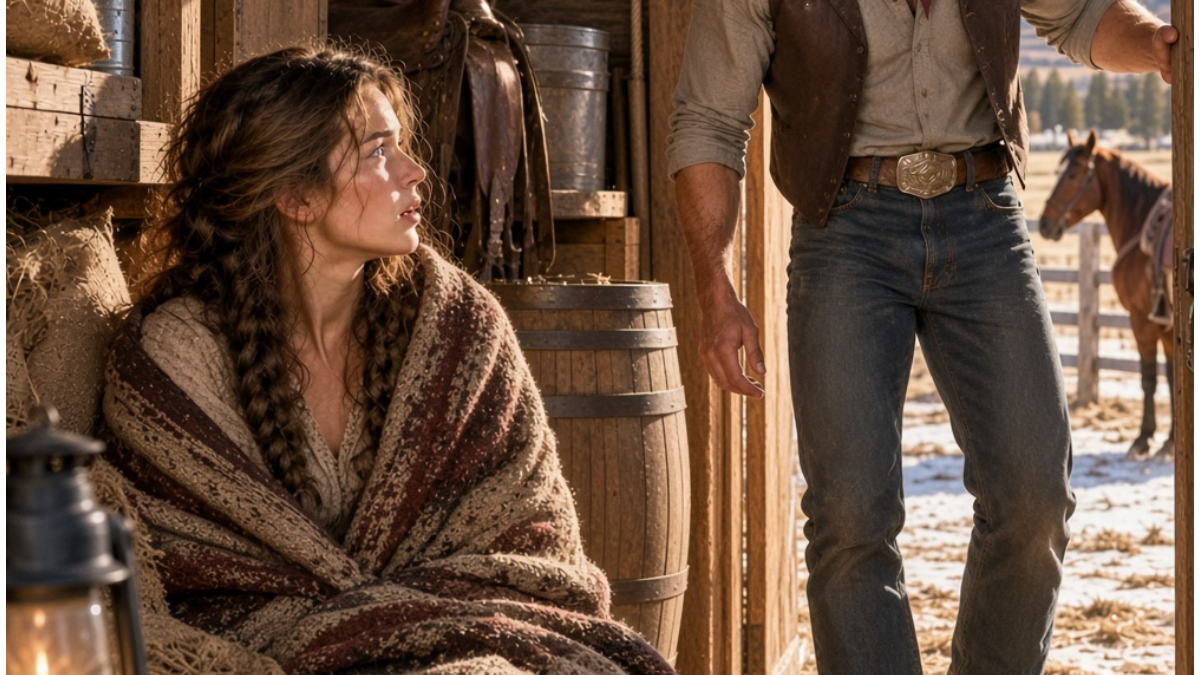
August Callaway did not raise his voice. That was the thing Mave would remember later, lying awake in her thinwalled cabin while the wind came off the ridge, and found every gap in the boards she had not yet ch.
He did not shout. He did not threaten. He simply placed a folded piece of paper on the table between them, smoothed one edge with the flat of his thumb, and said, “Name your price.”
Mave looked at the paper. She did not touch it. “I don’t have one,” she said.
August Callaway tilted his head the way a man does when he has misheard something and cannot quite believe it.
He was 61 years old, wide through the chest, with the weathered hands of someone who had done real work before he had other men to do it for him.
His suit was clean but not showy. He wore no rings. She had been told he started with nothing and chose to believe it because it explained the particular quality of his patience, the kind that had outlasted a great many obstacles and expected to outlast her.
“Miss Holloway,” he said, “I am offering you three times the assessed value of land that has no reliable water, no standing structures worth keeping, and 40 acres of grass that burns off every AuguSt.” you would walk away with enough to start somewhere decent, somewhere that would not try to kill you before spring.
I know what you’re offering, Mave said. I said, “No.” The silence lasted about 4 seconds.
Then August Callaway picked up the paper, folded it back exactly along its original crease, and tucked it into his coat pocket.
He looked at her the way a man looks at a fence post that has been driven into rock instead of soil, not with anger, with the particular kind of cold assessment that precedes choosing a different tool.
We’ll speak again, he said. He walked out of her cabin without closing the door, and the October air came through it like a warning.
If you’ve ever watched someone try to take the one thing that was finally yours, you already understand why Mave Holloway didn’t move for a full minute after he left.
She stood in the middle of her unfinished cabin on 40 acres of difficult Wyoming ground, and she did not cry, and she did not run to the door to call something after him.
She just stood there looking at the table where his paper had been. And she thought about her father, about the way he used to say that a man who owns nothing is always one landlord’s mood away from nowhere.
She had been nowhere before. She was not going back. It had started 4 months earlier in October, which was already cold in that part of Wyoming.
Mave had been walking west for 11 days when the weather changed. She had $43, a bed roll, a sewing kit that had belonged to her mother, a folded land deed with her name on it, and boots that had been resold once and were beginning to separate at the left toe.
She had a map, such as it was a handdrawn thing given to her by a county clerk in Rollins, who seemed doubtful about her chances, and had marked the property boundaries in pencil lightly, as if he expected to erase them later.
The rain came in sideways. Not the soft autumn rain that smells like earth and makes people nostalgic.
The hard cold kind that comes off the mountains already half committed to becoming sleet, that soaks through canvas in 20 minutes and turns dirt roads into something that pulls at your boots with every step.
Mave had been watching the sky darken for 2 hours and had calculated incorrectly that she could reach the next town before it hit.
She was wrong by about 6 mi. She found the line shack by accident. She had turned off the road to get into the trees for some windbreak and climbed a low ridge.
And there it was on the other side, a small log structure, tight built with a stove pipe and a stack of firewood under the overhang and a door with a simple bar latch that was not locked.
She stood in front of it for a moment. Everything she had ever been taught about property, about taking things that did not belong to her, lived in that hesitation.
Her [clears throat] father had been a careful man about other people’s things, precise about the line between borrowing and stealing, and she had absorbed that carefulness until it was structural, until it lived in her bones the same way her posture did.
But the rain was now definitively sleep. She went in. The shack was empty and clean.
Someone had left it in good order. A cord of split wood, a small iron stove, a can of coffee beans, some flour, a tin of lard, three matches in a small bottle, a narrow bunk along one wall with a wool blanket folded on it.
She identified immediately that someone maintained this place regularly and would likely return. And so she moved through it with the deliberateness of someone who intended to leave no mark except the one she could account for.
She built the smallest possible fire. She ate sparingly from her own supplies and not from the shack’s provisions.
She took out a stub of pencil and a scrap of paper from her kit and wrote down carefully the value of the wood she burned.
Then she opened her coin purse and counted out 12 cents, which was what the wood was worth, and placed the coins on the table beside the stove.
She was asleep when Grant Callaway opened the door the following morning. He was not expecting anyone.
He had ridden out to check the southern fence line after the storm, and stopping at the line shack was a habit from years of working this range.
Check the structure, check the supplies, leave things ready for whoever might need them next.
He pushed the door open and saw the figure on the bunk and took one full step back.
Then he looked again because the figure was small and still and had a woman’s shape under the blanket.
And that was not among the possibilities he had arranged for this morning. Hey,” he said loudly, because he was still standing half outside, and the wind was not quiet.
The figure moved. Mave came awake the way she had learned to come awake after 18 months of sleeping in railroad boarding houses, all at once, oriented, already calculating.
She sat up, saw the man in the doorway, and was on her feet with her back against the wall before she had consciously decided to stand.
“This your property?” She said. It was not the question he had expected. “Yes,” he said.
I owe you for the wood, she said. Coins are on the table. I used two pieces, and the fire’s been cold since midnight.
I didn’t touch your supplies. Grant Callaway stepped fully into the shack and let the door swing mostly shut behind him.
He was 33, tall without being dramatic about it, wearing a coat that had seen real weather.
He looked at the stove, at the neat arrangement of her bed roll on the bunk, at the table where where the coin sat in a small stack, and then back at her.
You left money for firewood, he said in the tone of someone confirming something improbable.
I used it, Mave said. That’s what you do. Most people would just use it.
Then most people aren’t me. He looked at her for a moment, not the way men in town sometimes looked at women traveling alone, like they were either a problem or an opportunity, more like he was trying to locate the logic in something that surprised him, and hadn’t decided yet whether it was admirable or peculiar.
“Where are you headed?” He asked. West, I have land. She said it the way people say things they have practiced saying because they need to hear it enough times to make it feel real.
What land? She told him the parcel number and the general location. Something shifted in his face.
Not much, but she was good at reading faces. You know it, she said. I know the area, he said.
Then you know it’s my land, she said. My father bought it 5 years ago.
I have the deed. She said this without taking it out because showing the deed to a stranger before she had any sense of him seemed unwise.
Grant pulled the door fully closed. The shack was warmer than outside, not warm enough to be comfortable, and the light came in gray through the one small window.
Do you have somewhere to be by nightfall? He asked. My land’s a day’s walk in good weather.
He looked out the window at the not good weather. It won’t be good weather.
I’ve noticed. He sat down on the stool near the stove, not in a proprietary way, more in the way of a man who is thinking and finds it easier to think sitting down.
Mave did not sit. She stood near the door with her bed roll under one arm, already calculating whether she could make the walk, even in bad conditions.
What do you do? He asked. Cook, she said. So, keep accounts. I can mend canvas and leather.
Grant was quiet for a moment. Callaway Ranch is about four miles eaSt. We’ve got a crew of 14 men through winter and a cook who left 3 weeks ago without notice.
Mave looked at him. I’m offering you a job, he said. Cook andress for the crew.
Room and board wages. He named an amount. It was fair, not generous, not insulting.
Until when, she asked. Until spring, when the pass is clear. Then you go wherever you’re going.
My land, she said. Your land, he agreed. She was quiet for a long moment.
Outside saw the sleet was coming down steadily and she could hear it against the roof and she was calculating the distance to her property, the state of her boots, the temperature, the condition of the trail, and the odds of arriving before something went permanently wrong.
She was also calculating the wages he had named against the cost of the supplies she would need to start on 40 acres of nothing in the spring.
I need it in writing, she said. Wages, duties, and the right to leave when I choose.
Grant blinked once. “You want a contract? I want an agreement,” she said. “We don’t have to call it a contract.”
He looked at her for another 3 seconds. Then the corner of his mouth moved in a way that wasn’t quite a smile, but was something adjacent to it.
“I’ve got paperback at the ranch,” she said. “The ride to Callaway Ranch took 40 minutes.”
“Grant offered her his horse and walked,” she argued. He pointed at her left boot, which had by now fully separated at the toe, so that it flapped slightly with each step.
She looked at it for a moment, then accepted the horse without saying anything further about it.
This was the first thing she would remember. Later, when she was trying to work out who he was, he had offered the horse before she asked, and he had not made a speech about it.
The ranch was large. She had known it would be large. The name Callaway meant something in that county.
She had gathered that much in Rollins, but the scale of it became real as they came over the last rise, and she saw the main house, the bunk house, the barn, the outuildings, the corral, the winter hay stacked under long roofed shelters.
It was not a mansion. It was a working operation, and it looked like one practical, maintained, built to last rather than to impress.
Three men were visible in the yard as they came in. They looked at Mave on Grant’s horse with the unreadable assessment of men who had learned not to react visibly to whatever the boss brought home.
Grant wrote out the agreement at the kitchen table. He was not a particularly fluent writer, he wrote, the way someone does who learned late and practiced until it was serviceable rather than elegant.
Mave read it carefully, crossed out one line about duties being defined at the employer’s discretion, replaced it with a list of specific tasks, and handed it back.
He read her revision. You’ve done this before, he said. My father kept accounts, she said.
He taught me that vague agreements favor the person with more power. Something moved across his face then, not offense she had been ready for offense.
More like the expression of someone who has just heard something true, stated more plainly than they were accustomed to hearing it.
He signed the agreement. She signed it. They each kept a copy. Kitchen’s through there, he said.
Crew eats at 6. The first week was the kind of difficult that doesn’t make good stories because it isn’t dramatic.
It was just hard. The kitchen was a reasonable size and not badly equipped, but it had been running on whatever whoever was available, decided to throw together for 3 weeks, and the state of it reflected this.
Mave spent the first two days getting it into order. She categorized supplies, identified what was low, wrote out a liSt. She burned one batch of biscuits badly enough that she had to throw them and start over.
She cut her hand on a can lid and bled on the dish towel she was using, which annoyed her.
She could not rope a horse. She had learned this her first morning when Grant’s hand, Eddie Sloan, had left one tied at the fence post in the yard after she mentioned she needed to get to the supply room across the far end of the yard, and her path was blocked by mud.
He had said cheerfully, “Just take him around.” And she had looked at the horse, and the horse had looked at her, and both of them were unconvinced.
She had walked through the mud. Eddie Sloan was 19 and had the [clears throat] particular confidence of young men who have been competent at physical tasks since boyhood and have therefore concluded that competence comes naturally to everyone who tries.
He was not malicious. He just did not understand initially that Mave’s skills existed in categories entirely separate from his and that this did not make her skills lesser.
“You figure that out?” He said two mornings later, nodding at the horse situation. “I found a path around, she said.
I could teach you, he said. Maybe later, she said. She was carrying a pot of oatmeal and did not have time for the particular patience required to learn something new from someone who found it too easy to explain.
Well, he laughed, not meanly, more the laugh of someone who finds the whole situation faintly absurd.
But he held the door open for the pot, which she noted. Grant worked. This surprised her more than it should have, but she had formed an image of what a wealthy rancher looked like based on the two or three she had encountered in rail towns men who arrived in buck boards, talked to other men, made decisions, and left.
Men who wore their authority in the fact that they were never carrying anything. Grant Callaway rode fence on cold mornings.
She saw him come in muddy at noon, 3 days running, and the mud was not decorative.
He broke ice on the water troughs when the temperature dropped. He ate with the hands on the hard days at the long table in the bunk house, and he ate what they ate.
She noticed because she was cooking it. “How long has he owned this place?” She asked Rebecca on her fourth day.
Rebecca Callaway was 29 and had the quality of someone who had spent years watching people carefully, and had decided that the most efficient response to most things was a very slight, almost invisible reaction that gave nothing away until she chose to give it.
She was shelling dried beans at the kitchen table when Mave asked the question. He doesn’t own it, Rebecca said.
Our father does. Grant runs it. Mave absorbed this. And where is your father? Cheyenne mostly.
He has interests there. He’ll be here in January. She paused. He comes every January.
There was something in the way she said it. Not dread exactly, but the kind of careful neutrality that can sometimes mean the same thing.
Is that a problem? May have asked. Rebecca picked up another handful of beans. That depends on what you’re doing by January, she said, which was not an answer to the question, but was somehow more useful.
At the end of her first month, Grant paid Mave her wages in an envelope.
Cash exactly the amount agreed. She thanked him and put the envelope in her coat pocket.
He had probably expected her to open it, then to count it, maybe to look relieved.
She had counted it already in her head. She had kept track of each week.
She knew what it should add to, and when she opened the envelope later in her room, it was exact.
The following morning she rode into town with one of the hands on the supply run and spent most of it at the lumber yard.
She ordered boards. She arranged for them to be delivered in two loads, one now and one in 3 weeks, when the trail was firmer.
She paid for both loads, in full in advance, which cost her almost everything the month had earned her.
The hand who had taken her a quiet man named Cass, who said very little and did not ask questions, drove the first load back with her because the boards were too heavy for the buck board alone.
She thanked him at the property line because she wanted to haul them the last half mile herself.
He gave her a look, then shrugged and helped her transfer the boards to the smaller sled she had borrowed from the storage barn.
She got them there herself. It took three trips and most of the afternoon. That evening, Grant rode out to check the fence line on the south range.
He came up over the low ridge above her property and pulled up his horse.
Mave Holloway, in the last hour of cold gray daylight, was driving fence posts into the ground with a mall.
She had completed about 40 ft of line, moving east from a corner she had marked with a stake.
The posts were not perfectly spaced, but they were square. She was not working quickly.
She was working as if she intended to finish. Grant sat on his horse and watched her for a minute.
She did not look up. He did not announce himself. He turned the horse and rode back the way he came.
What he thought during that ride, he kept to himself for several more weeks. But that night at dinner, when Eddie Sloan said something dismissive about the woman and her 40 acres of nothing, Grant said, “Eat your supper.”
In a tone that ended the conversation, and Eddie Sloan ate his supper. The trouble with learning to ask instead of just helping was that Grant had to recognize first that he had never learned to ask.
He discovered this in the third week of November when he sent two of his hands out to Mave’s property with a load of seasoned timber from the ranch’s own supply, good timber, straight grained, better than what she had bought in town.
He sent them without telling her, because it seemed obvious that better materials would be welcome, and he did not think of it as anything except efficiency.
The hands came back with the timber. Mave had sent it back politely, they said.
She had thanked them and helped them reload every board. Grant stared at the timber in his yard.
Then he rode out to her property. She was working on the cabin framing when he got there, fitting a cross piece.
She looked up when he rode in, assessed his expression, and set down her hammer.
“It was good timber,” he said. “I know it was good timber,” she said. “I didn’t ask for it.
It seemed like something you needed. Most things I need are things I didn’t ask you for, she said.
That’s not the same as asking you for them. He sat on his horse for a moment, looking at the partially framed cabin.
It was going up slowly. Everything she was using was what she had bought herself, which was less than optimal, and she clearly knew it.
“What if I’d asked?” He said. She looked at him. If I’d said, “Mave, do you want some timber from the ranch supply?
What would you have said?” I would have asked what you wanted for it, she said.
“Nothing.” Then I probably would have said no. She took a breath. Not the kind of breath people take before they say something they don’t mean.
The kind that someone takes before saying something they have thought about for a long time and are finally willing to say out loud.
Because accepting a large gift from a man who employs me on land he could take any number of positions about changes what I owe him.
Even if he never intends to collect, Grant was quiet for a moment. I hadn’t thought about it that way, he said.
I know, she said. Most people who have a lot of things don’t have to.
He rode back to the ranch and thought about it for 4 days. Then he rode out again and said, “Is there anything you need that you could actually use some help with?”
And she said, “The door frame is giving me trouble.” And he got off his horse and helped her with the door frame.
He asked first after that. Sometimes she said yes. Sometimes she said no. The difference he discovered was not arbitrary.
It depended on what the help would cost her in ways that had nothing to do with money.
He began to understand slowly that her independence was not stubbornness. It was architecture. It was the thing holding up everything else.
And starting to see that was the beginning of everything that came after, though he did not know it yet, and she was not about to tell him.
The question of whether Grant Callaway was a generous man or simply a man who had never been told no was one that Mave turned over in her mind during the long evenings of November when the wind found the gaps in the bunk house wall and the temperature dropped fast enough that you could watch your breath in the kitchen, even with the stove running.
She had no clean answer. Both things seemed true at the same time, which was more complicated than she preferred.
What she knew for certain was this. The timber incident had changed something. Not dramatically.
Nothing between them shifted dramatically. That was not how either of them operated. But after that afternoon at the doorframe, Grant Callaway stopped arriving at her property with things.
He started arriving with questions, small ones at first, whether she had enough split wood for the week, whether the corner post she had set was giving her trouble, whether she wanted company on the supply run Thursday.
Sometimes she said yes and sometimes she said no. And he took both answers with the same steadiness which she respected more than she let on.
He taught her to ride in December. Not formally, there was no lesson, with a designated time and a patient explanation.
It happened the way most things between them happened, which was sideways. She had mentioned once that crossing her property on foot in deep snow was going to become impractical before spring, and he had said, without making a production of it, “Come out tomorrow morning before the cruise up.”
And the following morning he had a calm mare named Petra saddled in the yard at first light.
Petra was a good horse, patient in the way that horses sometimes are when they have been handled gently for a long time, and have concluded that most humans are tolerable if slow.
Maven was not a quick learner on horseback. She gripped too hard with her knees and braced against the movement instead of going with it.
And the first morning she managed to walk around the corral without embarrassing herself and considered that sufficient progress.
Grant said very little during these sessions. He corrected her grip once, showed her how to sit through the transition to a trot without jamming her spine, and otherwise stayed back and let her figure out what the horse was telling her.
This was, she thought, probably the most useful teaching method he could have used for someone like her.
Someone who would stop trying if she felt watched. How do you know what I need?
She asked him one morning after a lesson that had gone better than expected. He thought about it.
I don’t, he said. I just noticed what makes you stop. She did not say anything to that, but she thought about it for the rest of the day.
In town, the social mathematics were different and considerably less comfortable. Mave went to town once a week on the supply run.
Sometimes with Cass, sometimes with Eddie, occasionally alone once she was confident enough with Petra to manage the road.
The town of Birch Creek had approximately 300 permanent residents, two dry good stores, a bank, a church, a feed supply, small hotel, and the particular social architecture of isolated communities where everyone knows the categories and places people in them quickly.
Mave’s category was immediately apparent to everyone. Poor woman traveling alone working for wages at Callaway Ranch.
The refinements within that category that she owned land that she had negotiating experience that she kept accounts were not visible from the outside and so most people did not look for them.
At the dry goods store, the owner extended Grant’s account without comment and required cash from Mave without explaining why.
Even when she was buying supplies for the ranch, she paid in cash without argument.
She was not going to make a scene in a store where she needed to return next week.
At the post office, where she went to check whether any mail had come for her from the county land office, the postmaster as asked her twice whether she was certain the letter would be addressed to her name and not to an employer.
My name is Mave Holloway, she said both times with the patience of someone who has explained their own name before to people who found it improbable.
At the community supper the second week of December, a regular event held in the meeting hall to mark the beginning of the real cold she arrived with Rebecca, who had invited her and was asked within 10 minutes by a woman named Mrs. Alderton whether she found the domestic work at Callaway Ranch demanding.
I’m not domestic staff, Mave said. I cook for the crew and keep the supply accounts.
Mrs. Alderton made a small sound that suggested this distinction was not meaningful to her.
Rebecca, standing 3 ft away, said, “Mave keeps better books than our last three accountants combined, which was a kindness Mave had not expected, and did not entirely know what to do with.”
Grant had arrived late to the supper and was across the hall talking to a group of ranchers when the exchange with Mrs. Alderton happened.
He had not heard it. Later, when they were walking back to the wagon, he said, “How was it?”
Meaning the supper generally. And she says, “Fine.” Which was technically accurate, if incomplete. He looked at her.
What did she say? He asked. Because apparently the look on her face was readable.
Nothing worth repeating. Alderton. I handled it. Mave said. Rebecca helped. He stopped walking. I could talk to.
No, she said and kept walking. Thank you. But no. He caught up to her in two steps.
Why won’t you let me? Because then it’s you who handled it, she said. Not me.
She stopped and turned to look at him properly. I know it seems like the same outcome.
It’s not. Grant stood there in the cold street looking at her with an expression she was beginning to recognize.
Not frustrated exactly, more like a man encountering a type of logic he hadn’t grown up with and was having to learn from scratch.
“All right,” he said finally. “All right,” she said, and they walked back to the wagon without discussing it further.
But he did not try to handle it himself. That, she thought, was the beginning of him understanding something.
Jonah Price came to her property on a Tuesday in mid December on foot with his hat in his hands.
He was a broad, quiet man of 38 with a widow’s grief that had settled into him so deeply it had become structural.
He ran a small operation 2 mi north of Mave’s property and had been trying to make it viable for 4 years on borderline water access.
He had three kids and a hired man and about 40 head of cattle that were not doing especially well.
He had heard about her from someone at the feed store, that she owned the hollowway parcel, that she was trying to make a go of it.
He sat on the overturned crate she used as a step outside her cabin door, and explained about the irrigation ditch.
The plan had been developing for 2 years among five small homesteaders, including Jonah, who had identified a spring-fed tributary running from the hills to the north, and had surveyed a root rough survey, done themselves.
Nobody could afford a professional that would carry water down to the lower plots through a dug channel.
The route, as they had laid it out, crossed one corner of Mave’s property, about 60 ft of her east edge.
If you won’t allow it, the route adds 3/4 of a mile and two creek crossings.
Jonah said, “We probably can’t do it. Not with what we’ve got.” Mave looked at the rough map he had brought.
She looked at the 60 ft of her east edge that the channel would cross.
She looked at what the water would mean for her own property if the ditch reached this far.
What do I get? She said. Jonah blinked. I don’t mean that unkindly, she said.
But you’re asking me to give up 60 ft of usable edge, deal with the disruption of digging, and accept whatever drainage happens when the channel runs.
That has a coSt. What’s the exchange? Jonah turned his hat over in his hands.
I hadn’t exactly the channel would bring water to your property, too. I know that, she said.
That’s partial. What else? He thought about it seriously, which she appreciated. Some men would have gotten offended at being asked.
He didn’t. 4 days of crew labor on your cabin before winter’s out, he said.
Me and two others. We can do more than I came here to offer. Mave looked at the map again.
The water access would transform what she could do with her property. 4 days of experienced labor would advance her cabin by a month.
The 60 ft of easement was real cost, but not ruinous. Put it in writing, she said.
Same as before. Duties on both sides. Terms for what happens if the ditch fails or runs dry.
Jonah looked at her. I’m not trying to be difficult, she said. No, he said slowly.
No, I can see that, he almost smiled. I’ll bring paper next time. He came back Thursday with paper.
They worked out the agreement over an hour at her kitchen table. It was a reasonable agreement.
She signed it. He signed it. He shook her hand when he left, which was something he had not done when he arrived.
She told Grant about it that evening at dinner, not because she needed to, but because the irrigation route was relevant to the ranch’s range, and she thought he should know.
Grant went very still when she described the route. She noticed the east corridor, he said.
That’s what the map showed. Why? He looked at his plate for a moment, then he looked up.
There might be another way to run the line, he said. That goes around. Avoid your property and the ranch boundary both.
Jonah said the alternate adds 3/4 of a mile and two creek crossings. Maybe Grant said worth looking at again.
He’s been planning this for 2 years. Mave said he did the survey himself. Surveys made without a professional can miss things.
She watched him. Grant was cutting his meat with the focused attention of someone who does not want to be read.
He was good at presenting an uncomplicated surface, but she had spent two months cooking for 14 men, and had learned to read the small signals the particular quality of a silence.
The way a hand moved or didn’t move, and something in the way he was sitting told her that his interest in the irrigation route was not neutral.
Grant, she said. He looked up. Is there something about that route that matters to the ranch?
A pause. Short, but there. I just think it’s worth making sure the engineering is sound before you commit to an easement on your property.
That’s reasonable, she said. But that’s not what you said. You said there might be another route.
It’s the same thing. It’s not exactly the same thing. He put down his knife.
I’m not sure what you’re looking for me to say. I’m not looking for you to say anything, she said.
I’m asking whether the Callaway ranch has an interest in that corridor. The silence lasted long enough that she had her answer before he said anything.
I don’t know, he said. I’d have to look at some things. Mave sat with that.
All right, she said. When you know, tell me. She picked up her fork and finished her dinner, and the conversation moved on to the ranch’s cattle count and the condition of the south fence.
And Grant was perfectly conversational and perfectly normal, and she could not tell from looking at him whether he was troubled or simply tired.
But that night, in her room, she lay awake for a while. She had begun to trust Grant Callaway in the small ways that daily work makes possible.
Not completely. She was not a person who trusted completely. That was not who she was and probably would not be.
And she accepted this about herself the same way she accepted the left boot. But enough to stop bracing every time he came near her property.
Enough to share a meal without calculating everything she said. The conversation at dinner put a small cold crack in something.
Not a break, just a crack. She hoped it was nothing. She was not sure yet that it was nothing.
December hardened into January, and with it came the cold that Wyoming saves for visitors, the kind that doesn’t just find your coat, it finds the reasons you chose that coat and disputes them.
Mave’s cabin was functional by now. Not comfortable in any conventional sense, but structurally sound, with a stove that drew properly, and a floor she had laid herself over the course of three weekends, with lumber cut on site.
She slept there on the nights when she did not need to be at the ranch at dawn, which were becoming more frequent as she extended the scope of the homestead work.
She had also quietly and without announcing it to anyone, begun taking in mending work from neighboring homestead families.
It had started with Jonah Price’s eldest, a boy of 12, who arrived one afternoon with a coat whose lining had completely separated and a look of such determined stoicism about it that she took the coat without being asked and gave it back the following Tuesday with the lining reattached and two new buttons because the originals were cracked.
She charged him nothing because she had not set a rate and it seemed wrong to invent one on the spot.
But the second time a woman from the homestead south of Jonas came with a dress she could not afford to replace and a rip in the bodice seam that was serious.
Mave set a fair rate and the woman paid it without complaint. Word traveled the way it did in isolated communities by proximity and necessity.
By January, she had a small and irregular but consistent stream of mending coming to the cabin on Tuesdays and Fridays.
The income was modest, but it was hers earned from her own skill, paid to her directly, and not through any arrangement that involved the Callaway name.
She put it toward glass for the window. She had been using oiled paper, which worked but was ugly.
Real glass was expensive, but transformed the cabin from something provisional into something that believed in itself.
Grant helped her set it. He had asked. She had said yes, partly because window glass was heavier and more fragile than anything she had set before, and she did not want to lose it to a dropped corner, and partly because he had asked without preamble or performance, and that still meant something to her.
They worked on it on a Saturday, a cold, bright day, with the sky the particular blue that comes when there is no moisture left in the air.
He held the frame steady while she applied the glazing compound she had prepared. And they did not talk much because the work required attention.
But when the glass was in and they stepped back and the cabin window reflected the pale winter light properly for the first time, he looked at it for a moment and said, “That’s good work,” meaning the cabin as a whole, not just the glass.
She knew he meant the whole cabin because he was not looking at the window when he said it.
He was looking at the door frame, which she had done herself. It’s getting there, she said.
It’s already there, he said. She did not argue because she thought he might be right.
Eddie Sloan had become, in the slow accumulation of small incidents, something she had not expected him to become.
It had started badly. His first comment about her homestead made at the dinner table in early November, careless rather than cruel, had established a dynamic that she had anticipated would be ongoing.
Young men who found things easy to do physically tended to have a particular blindness about other kinds of work, and she had met enough of them to have cataloged the pattern.
But Eddie was not, it turned out, only one thing. He was the one who noticed one February morning that the trail to her property had been blocked by a fallen tree overnight.
And before she had any idea there was a problem, he had taken a saw and cleared it on his way to check the south fence.
He left the cut timber stacked at the edge of her property because she would want the wood.
He had not told her. She found out from Cass. Why didn’t he say anything?
She asked. Cass shrugged. “Said you didn’t need to know about problems once they were solved.”
She thought about that. The next time she saw Eddie, she thanked him for the wood.
He went slightly red. “Wasn’t a problem,” he said. “Was useful,” she said. “I’m telling you it was useful.”
He nodded, looking at some middle distance. You’re better than you let on,” she said.
“Don’t tell anyone,” he said, which made her laugh, which seemed to surprise both of them.
After that, things between her and Eddie Sloan shifted into a different register. He did not stop being 19 or occasionally obtuse, but she stopped waiting for him to revert to his first impression of her, and he stopped looking at her land like it was something being done wrong.
In the third week of January, August Callaway arrived. Mave knew he was coming the day before because Rebecca mentioned it at dinner with the careful neutrality she used for things that required care.
“Fathers arriving Tuesday,” she said, and addressed herself to her plate. Grant said nothing, which was itself a kind of comment.
August Callaway arrived on Tuesday afternoon in a hired carriage from the rail station, which surprised me.
She had expected a man of his history to ride. But he had been in Cheyenne for business, and the rail was faster, and August Callaway was, she would learn, fundamentally practical about everything.
He was not what she had built in her imagination. She had expected the visible authority of wealth, the bearing of a man who had become become accustomed to entering rooms that rearranged themselves around him.
August Callaway had that bearing, but it came from somewhere different than she had anticipated.
It came from someone who had once had nothing and had spent 40 years ensuring that particular condition did not recur.
He shook her hand when Grant introduced them. Firm once, released immediately. Miss Holloway, he said.
Grant tells me you keep our supply accounts. I do, she said. And you own land near the South Range.
I do, she said, and watched his face. He had a good face for not reacting.
Better than his sons. Good land, he asked with exactly the right tone of casual intereSt. Getting there, she said, which was what she had said to Grant about the cabin, but her reasons for saying it to August Callaway were different.
He moved on to speaking with Grant about the cattle count, and she was not included in the conversation, which was not unusual for the time and place, and did not particularly bother her.
What she noted was more subtle, the way Grant stood when his father was in the room, slightly differently, not smaller exactly, more like a man who had spent a long time knowing where the edges were.
She understood that posture. She had worn it herself for years in other people’s houses.
3 days after his arrival, August came to the ranch kitchen while she was alone working on the accounts.
He sat down across from her without being invited, which she noted. He placed the folded paper on the table between them and smoothed one edge with the flat of his thumb.
“Name your price,” he said. “She looked at the paper.” She did not touch it.
“I don’t have one,” she said. He explained his offer. Three times the assessed value, enough to start somewhere decent.
All delivered in the reasonable tone of a man who believes that all resistance is merely price negotiation conducted by other means.
“Mr. Callaway, she said when he had finished, I’ve been offered better situations than mine four times in my life and turned them all down.
Not because I didn’t understand the math, because the math was never the point. He looked at her for a long moment.
What is the point? He said, and the question was genuine. She could tell, because genuine curiosity from powerful men looks different from rhetorical curiosity, it lands differently, sits differently.
The point, she said, is that those 40 acres are mine, not because someone allowed it, because my father paid for them, and I walked to them in bad weather, and I’ve been building on them since October with my own wages and my own hands.
There isn’t a number that trades for that. August studied her. You’re not afraid of me, he said.
Not accusatory. More like someone checking a fact. I don’t know you well enough to be afraid of you, she said.
I know what you’re trying to do with my land. It’s enough for now. He stood, picked up the paper, folded it back exactly along its original crease.
“We’ll speak again,” he said. He walked out without closing the door. Mave sat for a moment in the draft.
Then she got up and closed it herself and went back to the accounts and wrote down the current total of her savings in the margin of the page, not because she needed to, but because looking at a number that was entirely hers, studied her in the particular way that money only can when you have spent enough time without it.
She did not tell Grant about the conversation that day. She told him that evening.
Matter of factly, over the dinner she had made, his father had come to her kitchen and offered to buy her land.
Grant’s fork stopped moving. “What did you say?” He asked very carefully. “I said no.”
He looked at her. Something was working behind his eyes that she could not read completely.
“He’ll come back,” Grant said. “I know,” she said. “He doesn’t stop at the first answer.”
Neither do I,” she said, and picked up her fork. And the thing working behind Grant’s eyes settled into something that looked, if she was reading it right, like the beginning of an emotion he had not fully named yet.
August came back four times, not to the kitchen. He was too precise a man to repeat a failed approach.
The second time he sent a lawyer from Cheyenne with a formal offer letter on heavy cream paper, the kind that was meant to communicate permanence.
Mave read it at the table in her cabin, folded it along its own crease, and handed it back.
The lawyer looked at her the way lawyers look at people who are making their job harder than it needs to be, and left without a word.
The third time August spoke to her in the yard after dinner when Grant was still inside.
He was pleasant about it, almost collegial. He talked about the difficulty of the land, the harshness of Wyoming winters on a solo operation, the practical limits of what 40 acres without reliable water could produce.
He was not wrong about any of it. He presented the facts of her situation with the calm authority of a man who has watched other people’s situations for 40 years and knows how they typically end.
I’m not disputing any of that, Mayave told him. I just don’t want your money.
What do you want? He asked. And the question had a different quality this time than it had in the kitchen.
Less curious, more like a man running a calculation. The same thing you wanted at 20, she said to own something nobody can take.
Something moved across August Callaway’s face. It was there and gone in under a second, but she caught it the involuntary flinch of recognition.
He had not expected her to know that about him. He recovered immediately, but the moment had already happened, and they both knew it.
He did not come back a fourth time himself. He sent word through Grant instead, which was how she knew the situation had changed.
Grant came to her cabin on a Thursday evening in late January and sat down at her table with the expression of a man carrying something he has been carrying long enough that he is tired of holding it alone.
He’s gone back to Cheyenne, Grant said. For how long? Few weeks, maybe. He’s got business.
He was quiet for a moment. He’s not going to stop, Mave. I know that he’s been talking to people at the county land office about the water rights documentation on your parcel, whether the deed conveys access claims or just surface rights.
Mave set down the mending she had been working on. And and I don’t know yet what he found, but he wouldn’t be looking if he thought the first three offers were going to work eventually.
She looked at him. You’re telling me he’s moved past buying. I’m telling you I don’t know what he’s moved to, Grants said.
But I thought you should know he was looking. She sat with that for a moment.
The fire in the stove made its small sounds. Outside the wind was doing what Wyoming wind does in January.
Which is remind you of its permanent presence. Why are you telling me? She asked because I said I would when I knew something.
He met her eyes. I know something. She nodded once. It was not a small thing what he had just done.
And she understood that even if she was not going to say it. Thank you, she said.
He left 20 minutes later. >> And she sat in her cabin for a long time after, thinking not about August or the land office, but about the expression on Grant’s face when he said, “Because I said I would.”
He had said it like a man who had decided something and was only now finding out what that decision coSt. February brought Jonah Price back to her door, and this time he was not alone.
There were four of them. Jonah, a woman named Clara Hess, who ran 50 acres 2 mi east, a quiet older man named Walt, who had been on his claim for 8 years and had the particular stubbornness of someone who has already outlasted two droughts, and a younger man, maybe 30, whose name was Tom Ardan, who had bought a parcel the previous spring, and was still running on optimism and insufficient capital.
They sat in her cabin, which was not large enough for five people comfortably, and laid out what they had learned.
A survey had been run, not their survey, a professional survey recently filed with the county that traced a water corridor from the northern tributary through the east range.
The survey identified the most practical route for a large-scale irrigation ditch. The most practical route passed through Mave’s east corner.
It also happened to be the same route the Callaway Ranch had been quietly purchasing options on, parcel by parcel, for the past year and a half.
Jonah put the county filing numbers on the table. Walt put three names of neighboring land owners who had sold options to a Cheyenne land company whose principal investor when you followed the paperwork back far enough was August Callaway.
He’s buying the corridor. Clara said she was direct. Clara the kind of woman who has run an operation alone long enough to have no patience left for anything but the point, not the water rights directly, the land around the water.
And once he controls the land on both sides of the tributary through that section, whoever digs a ditch anywhere near it is digging through Callaway property.
Except mine, Mave said. Except yours, Jonah said. Your 40 acres are the gap. The one parcel on the east corridor he doesn’t control.
Mave looked at the table, at the filing numbers, at the names of the neighbors who had sold.
“Did they know?” She asked. “The ones who sold the options?” Jonah hesitated. Probably not what they were buying into.
Separately, each parcel doesn’t look like anything. It’s only when you put them together on the map that you see the pattern.
She looked at the map Jonah had brought. He had drawn it himself, updating the original survey sketch with the parcels August had optioned.
The gap was clear. Her 40 acres sat at the narrowest point of the corridor like a single missing piece in a fitted floor.
He offered me three times market value, she said. He would have made 10 times that controlling the water route, Clara said.
No one said anything for a moment. What do we do? Tom Ardan asked. He was looking at Mave when he said it, which she noticed.
We file the irrigation petition, she said. The one we already agreed to. We file it before he can establish a counter claim on the water rights.
And we document what he’s done, the options, the survey, all of it, and we bring it to the county water board.
That’s a hearing, Jonah said. Public? Yes, she said. August Callaway has lawyers. I know.
Tom looked around the cabin. Us and records, Mave said. Records he probably thought nobody would think to pull.
She looked at each of them. Jonah with his quiet grief in his three kids.
Clara with her practical eyes and her 50 acres. Walt, who had been on his land for 8 years.
Tom, who was still young enough to believe things could work out. I’m not doing this as anyone’s symbol, she said.
I want to be clear about that. I’ll testify for my own property and my own easement agreement, not as the woman standing up to the Callaways.
Just as the owner of record on a parcel that a larger op operation has been trying to acquire through methods that weren’t disclosed to the people around it, Jonah nodded.
That’s enough, he said. That’s more than enough. She told Grant that night. She did not ask his permission.
She told him what she had learned and what she intended to do, and she watched his face while she did it.
He was still for a long time after she finished. You knew, she said, not accusing, asking.
I didn’t know the full scope, he said carefully. I knew he was looking at the corridor.
I didn’t know he had options on the neighboring parcels. Did you know what the corridor was for?
Silence. Grant. He mentioned expanding winter grazing access. Grant said he’s been talking about the east range for 2 years.
I didn’t put it together with the water until he stopped. Until I told you about the irrigation petition, she said.
He didn’t answer, which was its own answer. That’s why you said there might be another route, she said.
Not because you thought the engineering was wrong. Because you had already heard your father talk about that corridor.
I didn’t know what he intended specifically, but you knew enough to hesitate, she said.
And you didn’t tell me what you were hesitating about. Grant stood up from the table and moved to the window.
He stood with his back to her for a moment, and she let him stand there because she was not going to fill the silence for him.
“I didn’t want to put you in the middle of something that might have come to nothing,” he said finally.
“That wasn’t your choice to make for me,” she said. He turned around. “I know, two words, but the quality of them was different from the careful deflections of the past few weeks.
He looked for the first time since she had known him, like a man who had mishandled something and knew it without needing to be told at length.
“What are you going to do?” She asked. “I don’t know yet,” he said. “He’s your father.”
“I know who he is.” “And the ranch?” I said, “I don’t know yet.” He said it with an edge, not at her, at the situation, and she let it land and did not answer it.
After a moment, his shoulders came down slightly. “I need to talk to him,” he said.
“Before the filing?” “Yes,” she nodded. The filing goes in Friday regardless, she said. I want you to know that.
I know. He said, “I wouldn’t ask you to wait.” She believed him. She was not sure she should given the past few weeks, but she believed him.
Rebecca found her on Wednesday. Mave was at the ranch working on the weekly accounts when Rebecca came into the kitchen, closed the door, and put a stack of folded papers on the table without preamble.
“I found these in father’s correspondence box,” Rebecca said. “The one he keeps in the study.
I wasn’t looking for them specifically. I was looking for the deed on the northeast pasture because we have a grazing dispute with the Orin brothers and I needed the boundary description.
She sat down. I read them, Rebecca said. I think you need to. Mave opened the first paper.
It was a letter from a survey company dated 14 months earlier. The letter described the completed survey of the east water corridor and noted in professional language that the spring-fed tributary from the north hills could supply adequate water for both the proposed community irrigation channel and the existing Callaway grazing operations without material conflict provided channel was routed through the east parcels as proposed.
She read it again. Then she looked up at Rebecca. He had this 14 months ago.
Mave said yes. This says the community ditch wouldn’t hurt Callaway cattle. Yes, Rebecca said.
It says that quite plainly. Mave set the letter down and picked up the second paper.
It was an internal note in August’s handwriting, brief and without date, addressed to the Cheyenne lawyer.
It said, “Do not file. Begin acquisition.” She put it down. The fire in the stove made its small sounds.
Rebecca sat across from her and said nothing because there was nothing to add. He knew the ditch wouldn’t harm his operation.
Mave said he had professional documentation saying so. And he chose to suppress it and start buying land instead.
Yes, Rebecca said, because controlling the water route gives him something the ditch doesn’t take away, but the filing still prevents him from having power, Rebecca said simply.
Not water, power over who gets water. May have sat with that for a moment.
Does Grant know about these letters? She asked. I don’t think so, Rebecca said. I don’t know for certain, but the way he’s been the past 2 weeks, the way he looks when father’s name comes up, I don’t think he knows.
Are you going to tell him? Rebecca looked at the papers. I already did, she said an hour ago, she paused.
I thought you should both know before the filing Friday. Grant drove out to her cabin that same evening.
She had expected him to be angry. The kind of anger that comes from betrayal, from learning that someone you have defended has been less than honest with you.
She had seen that kind of anger before and knew how it moved through a person hot at first, then cold, then settling into something harder.
He was not angry. He was something more complicated than angry. He sat at her table and put his hands flat on the surface and looked at them for a long moment before he said anything.
He had the survey, Grant said. Yes, he knew the ditch wouldn’t hurt us. According to the letter, he’s been telling me for two years that the east corridor is essential for Callaway grazing expansion.
That [clears throat] if the small operators get water rights through that section, we lose access we can’t recover.
Grant looked up. He believed it himself. I think I think he told himself there was a real conflict.
But there’s a letter saying there wasn’t. And he he stopped. He chose not to file it.
Mave said. Yes. She waited. He’s my father, Grant said. Not as his defense. More like a man locating himself in a situation.
He built everything we have. He started with a hired hands wages and 30 years of work, and he made the ranch into what it is.
I know why land matters to him the way it does. I know what it cost him to get here.
I know, Mave said. I understood that about him before I understood anything else. But knowing why someone does a thing doesn’t make the thing right.
No, she said it doesn’t. Grant was quiet for a long moment. If I testify to what’s in those letters at the county water hearing, he said he’ll remove me from the ranch.
He’s told me as much, not about this specifically, but I know him well enough to know where the line is.
He would give Rebecca operational control, and I would he exhald. I would be starting over on the acreage I personally hold, which is not nothing, but it is not this.
Mave listened. I’m not telling you this so you’ll tell me what to do, he said.
I know, she said. I’m telling you because I want you to understand what it actually costs, not in the abstract.
I want you to know the number. She looked at him. I understand the number, she said.
He nodded once, then he said, “Do you think he’s a bad man?” The question was real.
She could tell. She thought about it seriously because he deserved a serious answer. “I think he’s a man who got so afraid of being powerless again that he confused power over others with safety,” she said.
I think those things probably look the same from inside them for a long time.
And I think by the time they start looking different, you’ve already done the things you can’t take back.
Grant looked at her for a long time. I have to talk to him before the hearing, he said.
I know. I don’t know yet what I’m going to say. Neither do I. She said about my testimony.
I know the facts I’m going to present. I don’t know yet how to She stopped.
I keep thinking about what he said in the kitchen. That first time he asked me what I wanted and I told him the same thing he wanted at 20 and he flinched.
I saw that. Grant said when you told me that flinch. He remembers what it felt like.
She said to have nothing to need someone else to decide whether you stayed or went.
He remembers it and he still did this. Grant was quiet. That’s what makes it hard.
She said it would be easier if he just forgotten. If he was only a man who’d had things so long he couldn’t imagine not having them.
But he remembers he just decided his fear was more important than other people’s. She picked up her mending again.
Not because she needed to sew right now because her hands did better with something in them when she was saying difficult things.
I’m going to the hearing Friday regardless. She said what you do is yours. I know.
He left just after dark and she sat in her cabin in the quiet and the fire light and thought about the look on his face when he’d said, “I want you to understand what it actually costs.”
He had said it like a man who is not asking to be rescued from a decision.
Like a man who has already made the decision and wants a witness to what it cost before he carries it out.
She thought that was probably the bravest thing she had seen him do. Grant drove to Cheyenne on Thursday.
He had not told her he was going. She found out from Rebecca who mentioned it at breakfast in the way Rebecca mentioned most things without emotion stating facts.
He took the early train. Rebecca said, “Did he say why?” “He told me he needed to speak to father in person before tomorrow.”
Rebecca poured her coffee. I think that’s probably accurate. Mave ate her breakfaSt. She did not ask what she wanted to ask, which was whether Rebecca thought he would come back before the hearing, and whether if he didn’t, the letters Rebecca had found would still be available as evidence.
Rebecca put down her coffee cup. The letters are already at the county office, she said, which answered both questions.
Mave looked at her. I made copies, Rebecca said, 3 days ago, before I showed them to either of you.
I filed one set with the county clerk Tuesday morning as supporting material for the water petition.
She paused. I hope that was the right thing. That was the right thing, Mave said.
Rebecca nodded, picked up her cup again. Father is going to be furious, she said in a tone of someone who has made peace with an outcome.
With Grant or with you. With Grant first, Rebecca said, with me eventually. She was quiet for a moment.
I’ve spent most of my life trying to stay outside the line of his anger.
I thought if I was practical enough and quiet enough, I could manage the ranch alongside him without ever having to choose a side.
She looked at her coffee. It turns out sides are not always avoidable. Mave thought about that.
He’s not going to lose the ranch. May said AuguSt. Whatever happens tomorrow, Callaway Ranch is still going to be what it is.
I know, Rebecca said. That’s what he can’t see. He thinks any concession is the beginning of losing everything.
He’s been thinking that for 40 years. He built a very large operation on top of that fear, and he has mistaken the size of the operation for evidence that the fear was correct.
Mave had not heard Rebecca say that many consecutive sentences about her father before. She filed it away.
He loves Grant, Rebecca said. I want to be clear about that. Everything he’s built has been for his children in his own telling of it.
But love and control looks so similar from the inside of them. He hasn’t always been able to tell the difference.
Grant came back on the last train Thursday night. Mave did not know this until Friday morning when she came down to the kitchen before dawn and found him already at the table with a cup of coffee that had gone cold.
He looked like a man who had not slept. She did not ask how it went.
She built the fire up and put water on and started the biscuits for the crews breakfaSt. And after a few minutes, he said, “He gave me the choice straight out.
She waited. Stay out of it or lose the succession. She put the biscuit tin in the oven.
What did you say? I told him I needed to see the letter and he didn’t deny it, Grant said.
He said he had commissioned the survey to gather all relevant information. He said the letter’s conclusions were preliminary and not sufficient to override his own analysis of the long-term water situation.
He said [clears throat] that a man who built what he built over 40 years has a right to trust his own judgment against a hired surveyor’s single assessment.
He believed that? Mave asked. Or was he just saying it? Grant thought about it honestly.
Both, he said. He’s had a long time to build the story that explains his decisions.
Some of it he believes now because he said it enough times. He drank the cold coffee anyway.
But when I asked him whether the neighboring homesteaders deserve to know a professional survey existed that supported their petition, he got quiet.
And quiet with my father means he knows something doesn’t hold. What happens now? She asked.
I go to the hearing, Grant said. She turned to look at him. I’m going to testify, he said.
About the letter, about what he told me the East Corridor was for and what the survey actually says.
He met her eyes. He’ll do what he said he’d do. I know him. Grant don’t, he said, not harshly.
Don’t tell me it might not happen or that he might come around. I know him better than that.
He set down the cup. I’m not looking for a way out of it. I’m looking at it straight.
The biscuits were doing their work in the oven. The crew would be in for breakfast in 40 minutes.
I’m sorry, she said, and she meant it not about what he was going to do, but about the cost of it, about the fact that doing the right thing was going to feel like this.
Don’t be, he said. I made choices, too. All this fall, I made small choices that added up to something I’m not proud of.
I knew enough to be uncomfortable, and I chose the comfortable version of what I knew.
He stood up from the table. Today I’m going to choose different. She looked at him for a moment.
This man who had offered her lumber she hadn’t asked for and then learned to ask, who had helped her set a window and taught her to ride and had for the past 3 weeks been carrying something he should have told her sooner.
“This man with his father’s eyes and his own conscience and more to lose to today than most people she had met.”
“The filing includes your testimony?” She asked. “Rebecca’s already arranged it?” He said. “Then I’ll see you at the hearing,” she said.
He nodded once, picked up his hat from the hook by the door. “Mave,” he said.
She looked up. “He seemed to consider something for a moment, then let it go.”
“Make sure those biscuits don’t burn,” he said, which was not what he had been going to say.
And they both knew it, but it was what came out instead. “I never burn the biscuits anymore,” she said.
“He almost smiled, and then he was gone.” And she stood in the kitchen in the early dark and listened to the sound of his boots on the porch steps fading out into the cold February morning.
And she thought that whatever came next at that hearing, this was the part she would remember longest, a man choosing to stand in the right place before anyone could see whether it would cost him what he thought it would.
The county water board met in the Birch Creek meeting hall on the first Friday of February, and by 8:00 in the morning, there was not an empty seat in the building.
This was not typical. Water hearings in that county were usually attended by the directly affected parties, one or two lawyers, a clerk, and whoever had nothing better to do on a cold Friday.
They were procedural events. They generated paperwork. They did not, as a rule, draw a crowd.
But word had moved through the valley the way word moves in places where everyone knows everyone’s business.
And most people have an opinion about the Callaways, not through newspapers or formal announcement, just through the specific velocity of information that matters to people.
By 7:30, ranchers and homesteaders and merchants and their wives had filled the wooden chairs in the standing room along the walls, and the three members of the county water board sat at the long table at the front of the room, looking somewhat more alert than they had planned to be at this hour.
Mave arrived with Jonah and Clara and Walt and Tom Ardan. They sat together on the left side of the room.
She had worn her good dress, which was not particularly good by any objective measure, but was clean and pressed and declared that she understood what kind of occasion this was.
August Callaway’s lawyer arrived 2 minutes later. His name was Fenton, and he was from Cheyenne, and he had the quality of expensive legal representation everywhere, and at all times the unhurried confidence of a man who charges by the hour, and therefore does not rush.
He set his leather case on the table designated for the opposing party, arranged his papers, and did not look at Mave or any of the homesteaders.
August himself came in last, just before the board called the session to order. He was dressed as he always was, clean, practical, nothing showy.
He took a seat behind Fenton without looking at the room. His eyes found Grant once briefly and then moved away.
Grant was sitting on the homesteaders’s side, not beside Mave. He had not presumed that.
He sat two rows back on the aisle, and when August gaze passed over him, Grant held it without flinching and without hostility, and August looked away firSt. That exchange lasted about 3 seconds.
Half the room saw it and understood it immediately. The other half figured it out within the next 10 minutes.
The board ran the hearing the way county boards run hearings everywhere with a procedural formality that is slightly too large for the room and the occasion.
Administered by men who are doing their honest best with limited tools. The board chairman was a man named Huitt, 60-ish, a former land surveyor himself, who had the advantage of actually understanding the technical material and the disadvantage of knowing most of the people in the room personally.
He opened the session, stated the petition number, described the matter under consideration, and invited Fenton to present the Callaway position firSt. Fenton was good.
May have listened carefully and acknowledged this to herself. He presented the Callaway water use history, the size of the operation, the number of cattle dependent on adequate water access through the east corridor, and the professional risk assessment that suggested a community irrigation ditch of the proposed scale could create unpredictable drainage effects on the springfed tributary.
He cited two comparable cases from other counties. He introduced a counter survey commissioned 3 weeks prior that questioned some of the engineering assumptions in the Homesteaders’s original filing.
He was not entirely wrong about everything. Mave had known he wouldn’t be. The Homesteaders survey was amateur work.
The engineering assumptions were optimistic in places. She had gone into this hearing knowing that the other side had legitimate technical points and that sentiment alone would not be sufficient.
When Jonah presented the homesteaders’s case, he was steady and clear. He had prepared well.
He laid out the water needs of the five properties, the projected usage, the labor commitment, the route.
He was not a lawyer, and it showed in small ways he repeated himself once, went slightly out of order in his documentation, but he knew the material, and he believed what he was saying, and that has its own kind of weight in a room.
Then Mave testified. She had thought carefully about what she was going to say and what she was not going to say.
She presented her property records, the easement agreement with Jonah, the water access projections for her acreage.
She described the current condition of her claim and what reliable irrigation would mean for its viability.
She was factual. She was specific. She gave numbers where she had them and said she didn’t know where she didn’t.
Fenton cross-examined her on the water usage projections. Miss Holloway, he said, you’ve been on this property since October, approximately 4 months.
On what basis do you project these water usage figures? County agricultural records, she said.
For comparable acreage and similar terrain going back 20 years. I can cite the specific documents if the board wants them.
Fenton paused. He had not expected her to have specific documents. That won’t be necessary at this time, he said, which meant he wanted time to check what she had cited before committing to anything.
I’d like the board to have them, Mave said, and handed her file to Chairman Huitt, who accepted it with the expression of a man who is quietly pleased that someone did their homework.
Fenton moved on. He questioned her on whether she had received any inducement from Callaway Ranch interests in connection with this petition.
She looked at him steadily. I was offered three times the market value of my property by August Callaway personally and through his legal representative on four separate occasions between January and February of this year.
I declined each time. If that’s the kind of inducement you mean, the answer is no.
Several things happened at once. A murmur moved through the room. August’s jaw tightened and Chairman Huitt wrote something down.
Fenton decided to sit down. Then Grant was called. He walked to the front of the room and stood rather than sitting because the witness chair was angled poorly and he preferred to look at the board directly.
Chairman Hwitt allowed it. Grant stated his name, his role at Callaway Ranch, his relationship to August Callaway, and his familiarity with the Eastwater corridor.
Mr. Callaway, Chairman Huitt said, you’ve submitted a written statement to this board in support of the petitioner’s filing.
Is that correct? Yes. And you are the operational manager of Callaway Ranch, the primary party opposing this petition.
I was, Grant said, as of yesterday morning, my father has assumed direct operational control.
Huitt looked at him. I see. And you are here today of your own will.
Yes. Then please proceed. Grant described the survey. He described the date it was commissioned, the company that performed it, and its conclusion that the proposed community irrigation route could operate without material reduction of water available to Callaway grazing operations.
He described the letter from the survey company in which this conclusion was stated in professional language.
He told the board that this survey had been in his father’s possession for 14 months prior to the current petition being filed.
He did not editorialize. He did not say his father had acted wrongly. He stated what had happened and what had been documented and let the room understand the reSt. He said that he had spoken with his father the previous day and his father had not disputed the existence or the date of the survey.
The room was very quiet. August Callaway looked at the wall above the board’s table during all of this.
His face did not change. He had the discipline of a man who has controlled his visible reactions for 40 years.
But his hands resting on his knees had gone still in a particular way the stillness of effort not of ease.
Fenton cross-examined briefly. He suggested the survey’s conclusions were preliminary, that Grant had misinterpreted the scope of its findings, that a single document did not override a comprehensive water management strategy.
Grant answered each point without heat. He had Rebecca’s copies. He quoted the language directly.
When Fenton suggested the survey’s professional conclusions were merely one data point among many, Grant said, “That’s an argument about how much weight to give documented evidence, the board can make that judgment.”
I just wanted them to have the evidence to judge. Huitt thanked him and Grant returned to his seat.
He did not look at August on the way back. August did not look at him.
The board recessed for 40 minutes. Mave stood outside in the cold with Jonah and Clara and said very little because there was nothing useful to say before the decision came.
Eddie Sloan appeared beside her at some point during the recess, apparently having ridden in from the ranch during the morning session.
He stood next to her without explaining why he was there, which was sufficient explanation.
“You doing all right?” He asked. “Ask me in 40 minutes,” she said. Fair enough, he said, and stood there with her in the cold and didn’t say anything else, which was exactly the right thing.
When the board reconvened, Huitt read the decision. The petition was approved. The community irrigation ditch would proceed through the proposed route, including the easement crossing Mave’s east corner.
The board noted the suppressed survey in its written findings as a material consideration, and recommended a review of the Callaway land option acquisitions by the county assessor’s office.
Fenton was already making notes for the appeal he would file. But they all knew what an appeal would cost against a documented record and a public finding, and they all knew August Callaway was a practical man at the core of everything.
Clara Hess made a sound beside Mave that was not quite crying and not quite laughing.
Jonah shook Mave’s hand and then pulled her into a brief awkward embrace that surprised both of them.
Mave said, “Don’t thank me yet. We still have to build the thing.” They had 3 weeks before the late thaw made construction impossible.
In Wyoming in February, 3 weeks is not a comfortable margin for a digging project, and everyone who had been on that land long enough knew it.
The homesteaders started the following Monday. Jonah and Tom and two hired men began at the north end, where the tributary ran strongest, breaking ground with picks and spades, and one rented mechanical augur that worked adequately on its good days, and like a stubborn mule on its bad ones.
Mave worked her section. Walt Puit brought his crew for the stretch across her east corner.
Four men who knew how to move Earth efficiently, and they made reasonable progress through the first week.
The channel was not elegant. It was rough cut and uneven in places and had to be redirected twice when they hit unexpected rock shelf, but it moved.
The problem arrived on the eighth day. The temperature had been dropping steadily at night and rising during the day, which is the particular weather pattern that accumulates snow melt in the higher elevations and releases it all at once when the conditions shift.
Mave had been watching the sky for 3 days with the feeling that experienced people get about weather before they can articulate why.
On the morning of the eighth day, she was at her cabin before dawn when she heard it not a dramatic sound, not a roar, just a change in the quality of the tributary’s sound from a/4 mile north.
She ran. The snow melt was coming down faster than expected, and it had found the unfinished cut in the channel at the north section, the section still open, not yet lined with the stonework that would direct the flow, and it was pushing through in a way that was going to undermine the whole first week’s work and possibly flood the lower section where the cut ran closest to her cabin foundation.
Jonah was already there when she arrived. Tom was right behind her. The three of them looked at what was happening and ran the same mental calculation simultaneously.
We need more hands. Jonah said more than we have. Sandbags, Mave said. Temporary diversion at the north entry while we reinforce the cut.
How long will it take to get Walt’s crew? Hour, maybe more. Tom go. But Tom was already running.
Mave and Jonah worked. They were not enough. She knew they were not enough. The math of two people against moving water was obvious, but stopping was not a choice they made.
So they kept moving, filling what they had with available material, packing the edges of the weakest section with what loose stone was accessible.
The sound of horses came from the south. She looked up. Grant was coming across her property at a pace that meant he had not been walking when he heard behind him.
She could see riders, four, five, six of them, Callaway ranch hands, coming through the break in her south fence line that she had not yet reinforced.
She had one second to feel something complicated about that before the first rider was there and she was she was pointing at the north section and Grant was already off his horse and taking the direction without stopping to ask whose idea this was.
East bank first, she called. If the east bank goes, we lose the whole cut.
Grant redirected two of his men to the east bank. He took the third with him to the upstream point.
Eddie Sloan materialized from somewhere, took one look at the situation, and started moving stone without being asked.
They worked for 2 hours. It was not graceful work. People slipped. Mave went down on one knee in 6 in of cold runoff and came up muddy to the hip and kept working.
Grant’s hired man, Cass, took a stone edge to his palm and wrapped it in his own handkerchief and kept working.
The terra diversion held through the worst of the surge and then the flow began to slow as the immediate snow melt passed through the upper section and the tributary dropped back toward its ordinary level.
When it was clear the channel would hold, everyone stopped moving at roughly the same time.
The way people do when collective effort ends gradually, unevenly, finding themselves standing in the mess of what they have been doing and not quite knowing what to do with their hands.
Mave looked at the reinforced cut. It was rough. Parts of it would need to be redone in better conditions, but it had held.
Grant was standing 10 ft from her, covered in the same mud she was, breathing harder than she had ever seen him breathe.
He looked at the channel, then at her. You all right? He said, “Yes,” she said.
“Your men?” Cass cut his hand. “Nothing serious.” She looked at the riders. Six Callaway men now standing around in various states of mud and exertion, clearly uncertain about the social geography of the situation they worked for.
August Callaway. They had just spent 2 hours saving a ditch. August Callaway had tried to stop and nobody had told them how to feel about that.
Thank you, she said to them directly each face. I mean that. Eddie Sloan shrugged in the way he had of accepting things that moved him without showing it.
Wasn’t going to watch it wash out, he said, which she thought was as honest a reason as any.
August arrived an hour later. He came alone on horseback and stopped at the edge of her property.
He sat there for a moment, looking at the finished work at the channel, at his own men standing beside homesteaders who had been until recently on the opposing side of a county legal proceeding.
He had the authority to call his men back. Everyone there knew it. He sat on his horse.
Grant walked over to him. Mave did not follow because this was not her conversation, and she understood that.
She watched from where she stood as father and son spoke. She could not hear what they said.
The conversation was short. Not the shortness of a conversation cut off, but the shortness of two people who know each other well enough that they don’t need many words for large things.
August looked at the channel once more. Then he looked at his son. Then he turned his horse and rode back the way he came.
His men stayed. That afternoon, when most people had gone, and the immediate crisis had resolved into the regular difficulty of an ongoing construction project, Grant found Mave at her cabin.
She was changing her boots. The left one had finally given up on her in the mud, and she was assessing the damage when he knocked at the open door.
“Come in,” she said. He came in and sat on the stool and was quiet for a moment in the way he was quiet when he was deciding something.
He didn’t call them back, Mave said. No. Did he say why? He said he wasn’t going to make his men look foolish in front of the valley.
Grant paused, which is his version of saying he wasn’t going to make himself look worse than he already looked.
That’s something, she said. It’s a small something. Small somethings add up, she said. From your father, I think that’s what you’re going to get for a while.
Grant nodded slowly. He told me this morning that Rebecca will manage operations going forward, that he’ll have the paperwork drawn up by the end of the month.
He looked at his hands. So, that part happened the way I said it would.
Mave set down the ruined boot, and the acorage you hold personally, it’s mine. He couldn’t touch it without a legal proceeding he doesn’t want to have right now.
He exhaled. I’m not starting from nothing. I want to be clear about that. I’m starting from less than I expected to have, but it’s not nothing.
I know, she said. I have about 200 acres of my own. Some of it’s decent grazing land.
I’ve been thinking about a smaller cattle operation manageable for one man with two good hands.
He paused. Maybe three if the right people were interested. She looked at him. I’m not proposing anything,” Hea said quickly.
“I’m just” He stopped. “Start it again. I’m telling you what my situation is. Honestly, the way you asked me to.
I appreciate that,” she said, “and she meant it.” They sat in the small cabin in the late afternoon light.
Both of them tired in the bone deep way of physical work carried past the point of comfort.
And outside the window, the completed section of ditch ran quiet and steady, doing exactly what it was supposed to do.
I went to the land office before I came out here. Grant said. She waited.
He reached into his coat and put a folded paper on the table. I had them draw up a transfer, my personal acreage that borders your east line.
It’s better land than yours. More grass, better drainage. You could expand your homestead operation significantly.
I had them make it a clean title. Your name only, no conditions attached. May have looked at the paper.
She did not touch it. Something moved across her face, not anger, not the quick flash of refusal she had used with August, something slower, something that had been there for a while, and was only now coming fully to the surface.
She read his signature from where the paper lay. Then she picked it up and read it once through and put it back down.
Grant, she said, I know what you’re going to say. Let me say it, she said.
He closed his mouth. What you did yesterday was the right thing, she said. What you did today on that ditch was the right thing.
I’m not going to argue about either of those. She looked at the paper, but that she stopped, found the word she wanted.
You stood in that hearing room and you gave up your inheritance because you understood that controlling things through money isn’t the same as being right.
And then you came out here with a deed that would give you back the thing you just lost by putting it in my name.
It’s not the same thing, Grant said. I’m not buying anything. I’m giving you land, she said.
You’re giving me land to make my situation easier, to remove the difficulty I’m dealing with.
She looked at him. Grant, I have dealt with my own difficulty every day since October.
I have dealt with it the whole time you’ve known me, and you have watched me deal with it, and you have respected that.
And then you come back from the hardest day of your life. And the first thing you do is try to fix my problem with property.
Silence. I’m not saying you did it to control me, she said. I know you didn’t.
You did it because you love me. And this is still how your mind works when someone you love has a problem.
You find the resource and you deploy it. She paused. But I need you to understand that my 40 acres are my 40 acres.
Not because they’re good land. Not because there’s the most practical choice. Because they are mine.
The difficulty of them is mine. The work of them is mine. And a gift large enough to change that changes something I’m not willing to have changed.
Grant looked at the paper on the table. Then he picked it up and folded it and put it back in his coat.
He did not say anything for a moment. I still don’t entirely understand it, he said finally.
I want to be honest about that. I’m trying to some part of me keeps looking at what I have and looking at what you have and wanting to just I know, she said.
It’s not a bad impulse, he said almost to himself. No, she said it’s not.
It’s a generous impulse. The problem is that generosity from someone with more always has weight to it, whether it’s meant to or not.
He sat with that. What do you want from me? He asked, not helplessly. Like a man asking a real question because he wants the real answer.
She thought about it seriously. Ask me what I need, she said. Not what I’m missing, what I actually need.
And wait for the answer. And if the answer is nothing right now, accept that.
He nodded slowly. And stop trying to finish story for me, she said. I know how you want it to end.
It’s a good ending, but it [clears throat] has to be mine. The late light through the new glass window lay across the floor between them.
Grant looked at it. All right, he said. All right, she said. Neither of them moved for a moment.
Outside the ditch ran quiet in the cold, carrying water toward people who needed it across land that belonged to the woman sitting in this cabin through ground that had been disputed and was no longer, at least for now, by anyone with the standing to dispute it further.
Go home, Mave said. Sleep. You look terrible. You look worse, he said. I went face first into the bank on the east cut.
I saw, he said, you could have mentioned it earlier. You were busy,” he said, and stood up, and the corner of his mouth moved in the way it did, and she thought that whatever came next between them.
This was still the face she had been finding reasons to look at since November, and that was not a small thing.
He left, and she sat in her cabin, and she did not take out her savings ledger, or her mending, or any of the practical things she usually reached for.
She just sat in the quiet in the cabin she had built herself and let the day settle around her like something she had earned.
The ditch reached Jonah Price’s property on a Tuesday in late March, and the water that came through it was cold and clear and not particularly dramatic to look at just water moving through a cut in the earth doing what water does when you give it a direction.
Jonah stood at the end of the channel with his oldest boy and watched it come in, and he did not say anything for a long time.
His boy who was 12 had the practical sensibility of a child who had grown up watching his father work against the odds of this land said is that enough Jonah said it’s enough to start which was May thought the right answer for most things.
She had come to see the water reach his property because she had been part of building what carried it there and she believed in finishing what you started.
She stood with Clara Hess and Walt at the edge of Jonah’s South Field and they watched the channel fill to its working level and nobody made a speech about it because none of them were the kind of people who made speeches about things they had actually done.
They [clears throat] just stood there in the cold March air and the water ran and that was sufficient.
Tom Ardan showed up 20 minutes late because his horse had thrown a shoe on the road.
And when he arrived and saw the water already moving, he looked genuinely stricken at having missed the moment.
Clara told him to stop being dramatic. It was a ditch. And he said, “It wasn’t just a ditch.”
And she said, “Fine. It wasn’t just a ditch.” And they all stood there a little longer before the cold pushed them back toward their respective properties and their respective work.
Mave’s walk home took her past the north section of the channel, the part that had nearly failed in the thaw surge 3 weeks earlier.
It had been releaned and reinforced in the two weeks since Walt’s crew had done the work, solid and unrushed, and the channel wall there was now better than the original cut.
She stopped and looked at it for a moment. There was something she believed about useful things, that they should show the work in them, not the suffering.
She had no patience for the idea that difficulty was enobbling just because it was difficult.
But the evidence of hands and decisions and the specific intelligence that comes from knowing what you are doing and why the channel showed that you could look at it and understand that people who cared about the outcome had built it.
She walked on. Spring came to the valley the way Wyoming spring always does, not gently.
Not all at once, but in argument. Three warm days followed by a hard freeze.
A week of mud that made the roads into something closer to suggestion than infrastructure.
Then suddenly, without announcing itself, a morning where the light was different, and the ground smelled like it was waking up, and even the cattle seemed to know something had shifted.
Mave’s garden went in the second week of April. She had been planning it since January on paper first what would grow in this soil, in this exposure, with the water now available from the ditch access.
She had talked to Walt Puit, who had been farming this elevation for 8 years and had strong opinions about what worked and what people hoped would work and what the difference was.
She had read the county agricultural extension materials the clerk in Rollins had given her, the ones that had seemed theoretical in October and were now practical.
She planted potatoes first, then carrots, then the kitchen herbs along the south wall of the cabin where they would get the most light.
She planted six rows of corn that Walt told her were probably two rows too many for her first season and she planted them anyway because she had done the soil calculations herself and she thought she was right and she wanted to find out.
The chickens arrived in early April 8 of them purchased from a woman 2 mi east of Clara’s property who was reducing her flock.
Mave built the coupe herself over 4 days, and it was not her best construction work, being slightly uneven, and with one door that stuck in wet weather, but it was sound, and the chickens appeared to have no strong objections to it.
She named none of them. She was not sentimental about chickens. They were productive animals, and she respected that about them, and she kept the coupe clean and their water fresh, and they produced eggs that she sold to three families, and kept the remainder of for her own table.
The income from the eggs combined with the mending work that continued to come steadily on Tuesdays and Fridays meant that by May she had rebuilt her savings to a level that felt for the first time since she had arrived in Wyoming like a buffer rather than a survival number.
She wrote that number down in her ledger on a Saturday evening in May and looked at it for a while and thought about her father.
He had talked about this number, not this exact number, but a number like it as though it were a kind of breathing room, as though once you had it, you could stop holding your breath against the next landlord’s decision or the next employer’s mood.
She had not understood entirely what he meant when she was young, because when you are young and living inside somebody else’s financial precariousness, you don’t yet know that there is another way to live.
She understood it now. She closed the ledger and set it on the shelf she had built above the table, and she sat in her cabin in the May evening light, and breathed without holding any of it.
Rebecca Callaway came to her in April with a proposition. She rode out herself alone on a morning when the ground was dry enough to make the road tolerable.
She tied her horse at the post Mave had set and came inside and sat down and declined the offer of coffee, which Mave noted Rebecca only declined coffee when she had something to say that she wanted to say the without the social softening of a shared cup.
I want to hire you, Rebecca said. For what? Mave said the ranch accounts properly.
Not the supply tracking you’ve been doing the full operation. Rebecca folded her hands on the table.
Father handed me operational control and a set of books that have not been kept with any real rigor in about 6 years.
Our supply accounts you maintained were the best organized section of the entire financial record.
I need someone who can reconstruct what’s been done badly and put a proper system in place going forward.
Mave looked at her. I’m not a professional accountant. I know. I also know what you can do with numbers because I have watched you do it.
And I cannot afford a professional accountant from Cheyenne on top of everything else I am currently managing.
Rebecca paused. I’m offering fair wages. You would work at the ranch 2 days a week.
You keep your property and your other work. The arrangement ends whenever either of us wants it to.
Put it in writing, Mave said. Rebecca almost smiled. I already have, she said, and produced a paper from her coat.
Mave read it carefully. It was a good agreement. Clear on duties, clear on payment, clear on termination.
Rebecca had written it herself. She could tell it had the directness of Rebecca’s speech.
One change, Mave said. She picked up her pencil and added a line about access to historical records going back 5 years.
I can’t reconstruct what was done without seeing what was done. Rebecca looked at the addition.
That’s reasonable, she said, and initialed it. They both signed. Mave kept her copy. They shook hands.
How is the ranch? Mave asked, meaning how was the transition? Meaning, how was everything that had happened since February settling into daily life?
Rebecca thought about how to answer. It’s a large operation that has never been managed by anyone other than my father, she said.
The men are some of them are adapting and some of them are waiting to see whether I’m temporary.
She paused. Eddie Sloan told two of the older hands last week that anyone who gave me difficulty would answer to him personally.
I don’t know whether to be grateful or annoyed. Both, Mave said. Yes, Rebecca said.
That seems right. She saw August Callaway once in April from a distance. He had come back to the ranch for a week.
Rebecca had mentioned it without particular emphasis. The way she mentioned most things about her father now as facts to be noted and managed rather than events to brace for.
Mave had seen him riding the east fence line one afternoon when she was coming back from the ranch with her account work, and he had seen her.
They were perhaps a hundred yards apart. He stopped his horse. She stopped Petra. They looked at each other across the distance for a moment.
Then August nodded once, a small gesture, not warm and not hostile. The nod of a man acknowledging a fact he has accepted, and rode on.
She rode on. She thought about what Grant had told her from their conversation in Cheyenne, that August had not denied the survey, had not apologized, had not done any of the things that would have made the story cleaner or easier.
He had simply stopped. Stopped pushing on the land. Stopped issuing instructions about the water corridor.
Stopped sending lawyers. He had not become a different man. She did not expect him to.
A man who had spent 40 years building his philosophy of the world out of a genuine terror of powerlessness does not dismantle that philosophy because a county waterboard ruled against him.
He carries [clears throat] it forward. He just in this specific case on this specific ground stopped.
She thought about what she had told Grant the night before the hearing. That August remembered what it felt like to have nothing and had still done what he did.
She still believed that was true. She also believed now that remembering something and learning from it were entirely different operations and that most people did far more of the former than the latter.
She did not forgive August Callaway in any formal sense. She was not sure forgiveness was the right category for what she felt about him.
What she felt was more like comprehension. She understood the shape of what he was.
And understanding something does not require approving of it. Grant had been building. She saw the evidence of it in the weeks after hearing the gradual activity on the 200 acres he personally held.
The northwest parcel that bordered neither her property nor the main Callaway range. He had hired two men in March, a third in April.
He was running a small cattle operation, starting with 50 head, and with the clear intention of growing it at a rate the land could support, rather than the rate an ambitious man might want to push.
He came to her property most Sundays, not every Sunday. Some Sundays he was dealing with whatever a small cattle operation in its first season produces in the way of problems, which is considerable, but most of them.
He came and helped with whatever needed two people and she gave him lunch and they sat on the overturned crates outside the cabin when the weather permitted and about their respective operations and the valley and whatever else came up.
They were not yet whatever came next. They were still finding the shape of it.
She thought this was probably right that some things needed to develop at the pace they developed.
That rushing toward an ending was its own kind of not trusting the thing you were building.
He did not bring her gifts. He asked what she needed. Sometimes she had an answer and sometimes she didn’t.
When she had an answer, sometimes it was something he could provide and sometimes it wasn’t.
And he had learned genuinely learned, not just performed the learning to take both with the same steadiness.
One Sunday in May, he came with a question instead of help. She was working on the fence line, the east section, the part that ran along the boundary of the easement.
She had finished the north and west sides over the winter and spring, working section by section, post by post, and the east side was the last major run.
She heard him ride in and kept working because she’s in the middle of a section, and stopping midpost was annoying.
He unsaddled his horse, let her graze on the long rope, and came over and picked up the other end of the wire stretcher without asking.
They worked in silence for 20 minutes, which was comfortable silence, the kind that exists between people who have spent enough time together to not need to fill it.
“Can I ask you something, Sing?” He said, “When they reached the end of a section and stopped to reSt.”
“You’re going to regardless,” she said. “Probably,” he said. “I’ve been thinking about what you said in February about me trying to finish your story for you.
I remember saying it.” She said, “I’ve been thinking about whether there’s a version of of what I want to ask you.
That doesn’t do that. He was looking at the fence line, not at her, and I keep coming back to whether the version exists or whether asking is always going to look like assuming.”
She sat down the stretcher. “What are you asking?” He turned to look at her.
He was sunburned from 3 months of outdoor work, and he had lost the slightly pressed quality he’d had in the fall.
He looked more like himself, she thought, like a man who had found the version of his life that fit the actual shape of him.
I’m asking whether you want to build something together, he said. Not I’m not talking about you moving into the ranch house or anything that changes what you’ve built here.
I’m talking about whether there’s a future that includes both of us in it, running our own pieces of this valley, and choosing to be in each other’s lives on purpose.
She looked at him for a long moment. That’s a careful way of proposing something, she said.
I know, he said. I’m trying to get it right. You want to marry me, she said.
Yes, he said, but I want to do it in a way that doesn’t ask you to trade what you are for what marrying me would make you.
She sat down on the fence post she had not yet driven. It held her weight barely.
She thought about her father, who had died in a quarry accident on someone else’s land, who had bought 40 Wyoming acres he never lived to stand on, >> who had spent his whole life trying to give her a floor that nobody could >> pull out from under her.
She thought about the line shack in October and the 12 cents on the table and the boots with the separating soul and the deed she had carried inside her coat for 11 days of cold walking.
She thought about Grant Callaway learning to ask instead of just providing, about the way he had stood in that hearing room and said what needed saying without performance, without making it about himself, about the fold of that untouched deed going back into his coat pocket, and what it had cost him to put it there.
She thought about what she was now. Owner of 40 acres, keeper of accounts, mender of canvas and leather and the occasional friendship.
Woman who had driven fence posts into Wyoming ground through a whole winter and would drive them through more winters yet.
Woman who had never needed rescuing, which meant that choosing someone was an act of preference rather than necessity, which was the only kind of choosing she had ever been able to truSt. I want to keep my property in my name, she said.
That’s not negotiable. I know, he said. I wouldn’t ask. And I want an agreement in writing about how we manage shared decisions, not because I don’t trust you.
Because trust is easier to maintain when expectations are clear. He almost smiled. I know a woman who feels that way about agreements.
She sounds sensible, Mave said. She is, he said. Occasionally to the point of inconvenience.
She looked at him. Yes, she said. He blinked. Yes, you’ll marry me. Or yes, she’s occasionally inconvenient.
Yes, I’ll marry me, she said. I mean, yes, you know what I mean. I do, he said.
And the smile that had been waiting came through completely, and it was not a polished smile or a handsome smile in any conventional sense, just the genuine expression of a man who has gotten the answer he wanted and is not trying to hide it.
He did not reach for her immediately. He stood there in the May sun with the fence line running behind him and let the moment be what it was.
She appreciated that. Then she picked up the fence stretcher and handed him his end.
We’ve got 30 more feet, she said. Right, he thy says, and took it. They married in June, small.
The ceremony was performed by the county justice of the peace in the Birch Creek meeting hall, the same room where the waterboard had heard the petition 4 months earlier, which may found appropriate in a way she did not explain to everyone, but which felt right to her.
The room looked different with June light through the windows and without the weight of a contested hearing filling it.
Present Rebecca, who had organized the practical elements with her characteristic efficiency and an emotional restraint, and had cried briefly and precisely during the vows in a way that she recovered from immediately.
Jonah Price and his three children, Clara Hess, Walt Puit, who had cleaned up significantly and looked unfamiliar for it.
Eddie Sloan, who had polished his boots and was wearing a collar that was visibly uncomfortable and had shaken Grant’s hand for a long time without saying anything, which was more than sufficient.
Tom Ardan, who was not yet a close friend, but was becoming one. Cass, who came and stood at the back and left directly after, which was exactly what Cass would do.
August Callaway was not there. He had been told. Rebecca had told him with the directness that had become her default mode since assuming operational control of the ranch.
He had said he would think about it. He had not come. Mave had not expected him to come.
She had not prepared for it. It was the right absence, and she felt nothing about it except a mild awareness that the absence was correct.
What she felt instead, standing in that room with the June light and the small collection of people who had ended up meaning something in the span of one Wyoming winter, was a particular variety of arrival.
Not the arrival at a destination she did not think of marriage as a destination any more than she had thought of October as a starting point, more like the arrival at a clearing, a place with sufficient room to see what was around you.
Grant put a plain ring on her finger, his mother’s, as he had said he would.
It was slightly too large, and she would have it to size later, but she wore it as it was, and the loose fit did not bother her.
She had no ring for him. She had thought about this and decided it was not the right gesture for who they were to each other.
The exchange of jewelry implied a symmetry that their situation did not have, and she preferred honesty to symmetry.
Instead, she gave him before the ceremony a written record she had kept since November every conversation they had had about her property and her work and the things she needed and the things she didn’t annotated in her precise hand with what she had been thinking and what she had not said at the time.
It was 41 pages. He read it that night and did not sleep much and came to her the following morning looking like a man who had been given something he did not know how to hold the size of.
There’s a note in November, he said about the timber. I know, she said. You wrote that you thought I might be educable.
You were, she said. He sat with that for a moment. That’s about the most romantic thing anyone’s ever said to me.
Don’t push it, she said. The fence was finished in July. All four sides of Mave’s 40 acres, running true to the property lines she had documented with the county, the posts driven at proper spacing, the wire stretched to the correct tension.
It had taken 9 months. There had been sections redone twice. The northeast corner was not perfectly square because of a buried rock shelf she had not anticipated and had worked around.
She walked the perimeter on the day she drove the last post, not for any ceremonial reason, just because she wanted to know what it felt like to walk the boundary of something that belonged entirely to her.
It felt like the number in the ledger, like breathing without holding it. Grant came that afternoon and helped her hang the final section of wire on the east side the side that ran alongside the easement where the irrigation ditch moved water to Jonah’s property and Claras and Walts and Tom’s.
They worked through the afternoon and when they reached the boundary between her property and the 200 acres that were his, they had a fence post already set on each side and were ready to run the last connecting wire.
Grant lifted the wire into position. Mave stopped him. He looked at her. She stood there for a moment, looking at the boundary between what was hers and what was his at the fence line.
She had spent nine months building at the gate they had discussed but not yet installed.
At the ground that had been the site of everything this winter had been about.
She thought about what her father had wanted when he bought this land. Not wealth, not power, not the right to tell other people where they could go.
Just the irreducible fact of a place that was his where no landlord’s mood could decide whether the family stayed or went.
The most basic version of freedom there is and the hardest to explain to people who have always had it.
She had that now. She also had this man on the other side of the boundary who had learned imperfectly and not always gracefully but genuinely that loving someone does not mean managing them.
Who had stood in a public room and chosen honesty over inheritance, and had not asked her to be grateful for it, who had put a deed back in his pocket when she tore the other one, and had come back the following Sunday with a question instead of a solution.
She went to the supply shed and came back with the gate hardware she had ordered from town 3 weeks earlier.
Grant looked at it. I thought you hadn’t decided on the gate placement, he said.
I decided, she said. They built it together over the next hour. It was not a fancy gate, two rails and a simple latch, hung level on hinges she had chosen for durability rather than appearance.
When they were done, she tested the swing in both directions, and it moved cleanly, which she noted without calling it perfect, because it would need adjustment in winter when the posts shifted.
Grant stood on his side of the fence. She stood on hers. She looked at the gate.
She thought about all the fences she had repaired in her life that belonged to other people, the landlords, the railroad, the boarding house, all the boundaries she had maintained without ever having the right to decide where they ran.
She reached out and opened the gate from her side. Grant walked through. He stopped in front of her and she looked at him and neither of them said anything for a moment because the moment did not need anything said in it.
Then she closed the gate behind him and latched it. And they walked back toward the cabin together across the ground that was hers in the July afternoon with the corn coming up in six rows and the chickens audible from the coupe and the ditch running steady at the east edge.
The fence stood behind them. Not a wall, not a prison, not a claim of ownership over another person’s life, just a boundary that she had built herself with a gate that opened from the inside.
Some people spend their whole lives learning that there is a difference between the two.
Between the fence that keeps people out and the gate that lets the right ones in, on your own terms, on a day you choose.
Mave Holloway had learned it at 25 on 40 difficult acres in Wyoming in the hardest winter she had lived through among people she had not yet known how to trust and then slowly, imperfectly learned to.
That is not a small thing. It is, in fact, the whole thing. The summer moved the way summers do.
When you finally have enough of not enough of everything, not wealth, not ease, but enough of the thing that matters, which is the sense that the ground under your feet is not going to be taken away.
Mave’s corn came in tall. Walt had been wrong about the two extra rows, or she had been right about the soil.
And either way, six rows of corn in August, Wyoming was a thing she stood in front of on a Monday morning and and looked at for a full 5 minutes before she could make herself go back to work.
She had never grown anything before. The fact of seeds going into ground that was hers and becoming food that was hers felt like a different kind of mathematics than any she had learned.
She wrote the yield down in the ledger. Then she sat and looked at the number for a while.
Then she wrote underneath it in smaller letters. P would have liked this. And closed the book.
She did not usually write things like that. She was not given to sentiment in her recordkeeping, but some numbers need a note.
Grant’s cattle operation had its first real test in August when a 3-day fever moved through the herd and he lost four head before he identified what was happening and got the affected animals separated.
It was not catastrophic. 50 – 4 is still 46 and 46 healthy cattle in August is a workable situation.
But it was the kind of loss that reminds a person that no amount of good planning makes livestock entirely predictable.
He came to her cabin that evening looking like a man who has been awake since 4 in the morning and is not sure yet whether to be relieved or still worried.
She fed him not as a gesture just because he needed to eat and she had food and that was the arrangement between people who were building something together which was that the practical things got handled practically.
He sat at her table and ate and told her what had happened. And she listened and asked two questions, both specific, about the water source in the affected pasture and whether he had checked for contamination upstream.
He had not thought of the upstream question yet. He set down his fork and looked at her.
That could be it, he said. It could be nothing, she said. But check it.
He checked it the following morning. It was not the main cause, but it was a contributing factor.
A dead animal in the creek 200 yd upstream that had been there long enough to affect the water quality.
He had it removed and the situation resolved. The remaining 46 heads stayed healthy. He told her this on Sunday.
“Thank you,” he said. “You would have found it,” she said. Eventually, he said, probably after losing a few more.
“That’s what two sets of eyes are for,” she said, and handed him the coffee she had poured while he was talking.
And he took it and they sat on the outside crates in the August morning sun and watched a hawk working the thermals above her north field which had nothing to do with cattle or irrigation or water rights and was simply a hawk doing what hawks do.
She thought that this was what she had been trying to build toward without knowing the name for it.
Not rescue and not dependence and not two people managing each other’s probleMs. Just this two people sitting in the same morning each intact.
Each with their own concerns and their own capabilities and their own ground to stand on.
Looking at the same hawk, August Callaway came in September, not with a lawyer, not with a paper, just on his horse in the early morning, riding alone to the boundary of Mave’s property and stopping there.
She was working the near field when she saw him. She straightened up and looked at him across the fence line, and he looked back, and after a moment he lifted his hat, a small gesture, old-fashioned, genuine, and she nodded.
He did not get off his horse. He did not ask to come in. He sat there for a moment longer, and then said, “From where he was, the ditch held through the summer runoff.”
“Yes,” she said. “Better than I expected it would,” he said. She walked toward the fence, “Not all the way, partway.”
“Your east cattle haven’t had water probleMs.” No, he said survey was right. There was a long pause.
The survey was right 14 months ago, she said. Not cruelty, just facts stated plainly between two people who could handle plain facts.
August Callaway looked at his horse’s ears. I know, he said. And then after a moment, I built 40 years of decisions on a belief that control was the same as security.
Hard to see past a belief you’ve tested that many times. I know something about that, she said.
He looked at her. My version was independence, she said. I had tested it as many times as you’d tested yours.
I almost made it into a wall. She was not sure why she said that to him.
Maybe because it was true and he deserved the truth. Maybe because she had learned that August Callaway was a man who could handle plain things, even when plain things cost him.
He nodded once. Not agreement exactly. More like the acknowledgement of a person who has heard something real and is deciding what to do with it.
Grant is doing well, he said finally. He is, she said. The Northwest operation, he paused.
It’s sound thinking what he’s doing there, starting small, building to what the land will carry.
It’s how he works, she said. When someone lets him. Another pause. Longer this time.
I’d like to ride the fence line with him sometime, August said. If he’s willing.
You’ll have to ask him, Mave said. I know, he said. He looked at her property at the cornstubble in the harvested field, at the cabin with its glass window, at the fence line running true and level in both directions.
Something moved in his face that she could not entirely name, but it was not dismissal, and it was not contempt.
It was something closer to reckoning. “You built that fence yourself,” he said. “Most of it,” she said.
Grant helped with the gate. August looked at the gate. “Which side does it open from?”
He asked. “Mine,” she said. He put his hat back on. He sat for a moment longer.
Then he turned his horse and rode back the way he came, and he did not look back, and she watched him go, and thought that this was probably the most honest conversation they had ever had, and it had taken less than 5 minutes.
She went back to her field. Grant rode out 2 days later, and she told him about his father’s visit.
He went still the way he did when something surprised him. He asked to ride the fence line with you, she said.
What did you say? I said he’d have to ask you. Grant was quiet for a moment.
Do you think he will? I don’t know, she said. I think he’s trying to find a version of this that he can live with.
What that version looks like for him, I can’t say. He won’t apologize, Grant said, not bitterly.
Just as a fact about his father that he had made peace with. No, Mave agreed.
But he might show up. Grant considered this. For him, that might be the same thing.
It might, she said. He came the following Saturday. August rode to the northwest pasture at 7 in the morning, and Grant was already there, and they rode the fence line together for two hours without anyone observing and without anyone reporting on what was said.
Grant came to Mave’s cabin that afternoon, looking like a man who has put something down that he had been carrying a long time.
“How was it?” She asked. “He told me the northwest pasture has better drainage than the eastern sections,” Grant said.
“And that I should think about the winter water source before the ground freezes.” That’s it.
That’s most of it. He paused. He also told me he thought I was managing the fever situation correctly when he heard about it.
He said I should have checked the upstream water earlier. Mave looked at him. You talked to him before Sunday, she said.
Rebecca mentioned it to him. Grant said he asked her about it. She told him what happened.
He was quiet for a moment. He went to the trouble of finding out how I handled it and then he told me I handled it right.
Mostly she understood what that meant from August Callaway. She understood that from a man who did [clears throat] not apologize and did not concede and had built 40 years of certainty around a particular way of seeing the world, telling his son, “You handled it right was a significant sentence, not forgiveness, not eraser of what had happened, but a man at 61 trying to do a small thing correctly.
It’s a start,” she said. It’s his version of a start, Grant said, which is smaller than most people’s.
Small somethings add up, she said, which was what she had said to Jonah Price in March, watching water reach his property for the first time.
Grant looked at her. You keep saying that, he said. Because it keeps being true, she said.
Rebecca Callaway turned 30 in October, and Mave organized a small gathering for it at the ranch.
She did not ask permission. She spoke to Eddie Sloan, who spoke to Cass, who spoke to the other hands, and she spoke to Jonah and Clara.
And she baked two cakes using the eggs from her own chickens and the flour she had bought with her own wages.
And she set it all up in the ranch kitchen on a Saturday afternoon without making any announcement about it.
Rebecca came into the kitchen at 4:00, expecting to work on the accounts they had been reviewing, and found instead a room with people in it, and a table with food on it, and a general atmosphere of occasion.
She stood in the doorway for a moment. “Mave,” she said. “You needed a birthday,” Mave said.
“Sit down.” Rebecca sat down. She looked at the room at Grant, at the hands who had cleaned up for the occasion, at Jonah and his children, at Clara, who had brought a jar of her own preserved fruit as a gift, at the cake with its uneven frosting because Mave was not a baker by training and did not pretend to be.
Rebecca looked at the cake for a moment and then she laughed a genuine laugh, the kind that comes out before for a person decides whether to let it.
And she let it and it made everyone in the room relax in the way that laughter in the right moment always does.
How old are you? Eddie Sloan asked from the back of the room. 30? Rebecca said.
First 30 or second 30, he said. First, she said, “And you are skating very close to insubordination.”
“Worth it?” He said. And she laughed again shorter this time. And Grant shook his head, but was also smiling.
Mave cut the cake with the knife she had brought from her cabin, the good one with the bone handle that had been her mother’s, and she gave Rebecca the first piece, and Rebecca ate it without commenting on the frosting, which was either courtesy or genuine hunger, and Mave appreciated either.
Later, when the others had dispersed, and it was just the two of them in the kitchen cleaning up, Rebecca said, “You didn’t have to do this.”
“I wanted to,” Mave said. “Why?” Mave thought about it. Because you’re the one who filed those letters with the county clerk, she said before you told either of us.
Because you copied them 3 days early and filed them so that whatever happened with me and Grant, the evidence was already in the record.
She handed Rebecca the dish towel. You took a risk for something you thought was right.
That seemed worth a cake. Rebecca dried the pan she was holding. The frosting is uneven, she said.
I know, Mayave said. It’s very good cake regardless. I know that too, Mave said.
Rebecca looked at the empty plates on the table. Father never celebrated my birthday, she said.
He wasn’t a man who noticed those kinds of days. Grant did when we were children.
He would get me something small. He stopped when he got older. She paused. This was the first one in a long time with anyone in the room.
Mave did not say anything. Some things do not need a response. She just kept washing the dishes and Rebecca dried them.
And outside the October wind was doing its early season work, and inside the kitchen was warm from the afternoon’s cooking.
October deepened into the second Wyoming Winter Mave had seen, and it came with less dread than the first one, not with ease.
Winter at that elevation does not come with ease. The firewood needed to be sufficient, and the animals needed to be managed, and the cabin had drafts in two new places she had not yet found, and chinking them took three separate cold afternoons.
But the dread was gone, and she had not noticed it leave until it was already absent.
She thought about this while she was re-chinking the North Wall on a Wednesday on her knees with cold fingers and a bucket of mortar she had mixed herself.
And she thought that maybe that was how most fundamental changes happened. Not in the dramatic moments, not in county hearing rooms or flood surges or conversations about deeds, but in the ordinary accumulation of survived things that eventually there were enough of them that the fear of the next one simply ran out of room.
She was not unafraid of winter. She was just no longer afraid of herself in winter.
That was the whole difference. And it was an enormous difference. Grant proposed the fence arrangement in November.
Not marriage that had already happened, a different kind of arrangement, practical and characteristic of both of them.
He had been thinking, he said, about the long-term boundary management between her 40 acres and his Northwest 200, and whether there was a sensible way to share the work of maintenance without the arrangement implying any claim on either property.
He had written it out. Three paragraphs clear with the specific sections of fence assigned to each party and a note about shared gates and a clause about what happened if either party wanted to change the arrangement.
She read it at the table in her cabin while he waited. This is very thorough, she said.
I’ve had a good example, he said. She looked up of how to write an agreement, he said carefully, with the expression of someone who knows they are on thin ice and has decided to keep walking anyway.
She put the paper down. That is the least romantic thing you have ever said to me.
I have said a lot of unromantic things to you. He said it comes from being around someone who values precision.
You’re saying this is my fault. She said I’m saying you’re an influence. He said she signed the agreement and handed it back.
He signed it and kept his copy and she kept hers. And they were sitting at her table in November with signed papers between them and outside the first light snow of the season was coming down and neither of them was in any particular hurry to go anywhere.
My father asked about you, Grant said. When we rode the fence last week, “What did he ask?”
“Whether you were planning to expand the homestead operation?” “What did you say?” “I said I didn’t know that you had your own plans and I didn’t manage them.”
She nodded. He said Grant paused. He said that was probably a better arrangement than most men managed.
She looked at him. That’s a significant sentence from your father, she said. I know, he said.
I almost fell off my horse. She laughed. It surprised her slightly, the full laugh.
The kind that was not managed or considered. Grant looked at her with the expression she had come to know as his genuine face, the one that appeared when he stopped trying to present anything.
“You should do that more often,” he said. “Laugh like that. You should say funnier things,” she said.
I nearly fell off a horse, he said. That’s objectively funny. It would have been funnier if you had, she said, and he shook his head, but was laughing, too.
And the snow came down outside the window of the cabin she had built herself, and the fire in the stove she had installed herself, was doing what a good fire does, and her ledger sat on the shelf above the table with numbers in it that were hers.
And the deed to 40 Wyoming acres was in the locked box under the bed with both their names on the marriage record and only her name on the property document exactly as it should be.
There is a particular kind of woman the world does not quite know what to do with.
Not the woman who is strong in the way stories prefer the woman whose strength is decorative, who is capable in charming ways that do not inconvenience anyone, who accepts help gracefully and is grateful in the right proportions.
That woman is easy. The world has a great deal of room for her. The woman the world struggles with is the one who knows exactly what she needs and will not accept a different thing instead, even when the different thing is larger and shinier and offered with genuine goodwill.
The woman who keeps her own accounts not because she distrusts everyone, but because she has learned that dependence is only comfortable until it isn’t.
The woman who will accept a hand with a window frame and send back a load of unsolicited timber.
Not because she is ungrateful, but because she understands the difference. Mave Holloway understood that difference at 25.
In a Wyoming winter on 40 acres her dead father had bought and she had walked to in bad weather and built on with her own wages in her own hands and the slow, imperfect cooperation of people she had learned to truSt. She did not end the story wealthy.
She ended it with enough which is a different and more durable condition. She ended it known, not famous, not celebrated, not thanked in any formal public sense.
Known by the people around her in the way that matters Jonah Price, who sent her the first bag of flour from the first harvest, his improved water supply made possible without a note because none was needed.
Clara Hess, who came on a Tuesday in December with mending and stayed for two hours and left having said almost nothing and communicated everything.
Eddie Sloan, who had stopped being dismissive somewhere in November, and started being quietly, consistently useful, which was the best version of himself and the one he would grow into over the next several years.
She ended it beside a man who had learned over the course of one winter and one spring and one summer that the most important thing he could do for someone he loved was not to remove their difficulty but to respect their right to face it.
That is not a lesson that comes easily to generous people. It cost Grant Callaway his inheritance and his father’s approval and a season of learning who he was without the weight of the Callaway name defining him.
He built something smaller than he had expected to inherit. He built it with his own hands, with two hired men, and eventually three, on ground that was unambiguously his.
And he found, somewhat to his own surprise, that smaller and unambiguous suited him better than large and conditional.
He rode the fence line with his father twice more before winter closed the passes.
They did not resolve 40 years of a particular fathering in two rides. No one resolves 40 years in two rides.
But August Callaway, at 61, with his carefully kept control, and his 40 years of acquired land, and his particular brand of love that sometimes looked too much like management, was beginning the slow work of learning that his son had become a man with his own way of seeing things, and that this was not a failure of upbringing.
It was, in fact, the point of upbringing. He did not say this, but he showed up.
And for August Callaway, showing up was the most honest thing he had. In December, on a cold, clear day, when the ground was frozen solid, and the air had the quality of something that had been very thoroughly cleaned, Mave walked her fence line, all four sides, the full perimeter of 40 Wyoming acres in order, starting at the southwest corner, where she had driven the first post in October of the previous year, and ending there again.
She walked it the way you walk something that is yours, not to check it, not to maintain it, just to know it.
The posts stood at their proper intervals. The wire ran level. The northeast corner, which had required working around a buried rock shelf, was not perfectly square, and she had made peace with that.
The gate on the east side swung cleanly on its hinges. She stood at it for a moment, looking through it at Grant’s northwest pasture, where his cattle were visible in the middle distance, small and dark against the frozen ground.
She thought about where she had been 14 months ago. A woman with 12 cents and a separating boot soul, and a deed she was afraid to show anyone, walking west in the sleep toward something she owned, but had not yet learned to inhabit.
She thought about her father. She thought he would have liked this fence, not for the accomplishment of it, though he would have been proud of that, too.
He would have liked the fact of it, that it existed, that it was hers, that it ran true, and did not belong to anyone’s displeasure or anyone’s landlord calculation.
She thought he would have liked the gate. She reached and opened it from her side because she could, because the latch was on her side, and that was how she had built it.
She left it standing open for a moment. Then she closed it again and latched it and walked back toward the cabin.
Behind her, the fence line ran in both directions, a boundary she had built herself across the full perimeter of the life she had chosen.
Not because anyone had told her she deserved it, not because someone with more had decided to allow it, but because she had walked to it in bad weather and built it post by post, and the ground under it was hers.
The gate opened from the inside. That was the whole of it. That was enough.








