A Rich Rancher Married a Penniless Bride—Then Her Hidden Skill Changed His Wool Empire
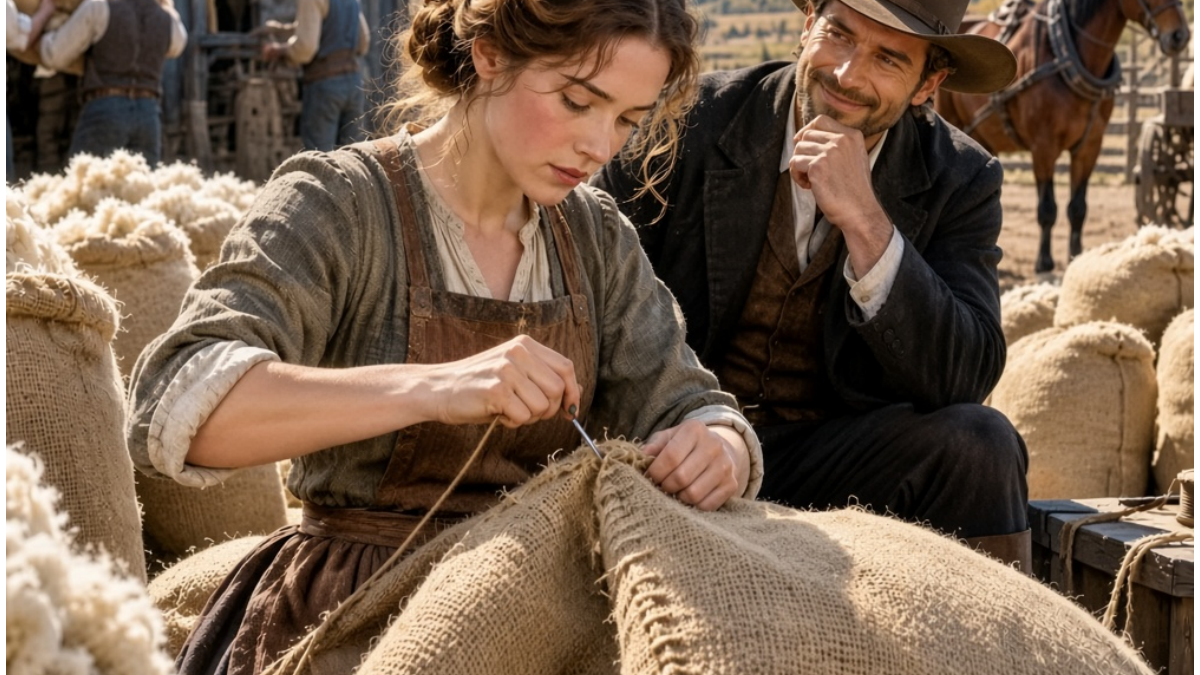
Thaddius Crow did not wait for Mara to fail. He made sure she would. On a gray Tuesday morning in November, while Emmett Calder’s woolyard was still quiet, and the loading hands had not yet finished their coffee, Crow’s man slipped into the storage area and switched a sack.
Not just any sack, the one Mara had already rejected, the one she had marked with her own charcoal X and written off in her ledger as too weak to truSt. Benton Shaw lifted her approval tag from a sound sack, tied it to the ruined one, and tucked the good one behind a stack of tarps where no one would look for a week.
He did it in under 4 minutes. He did not sweat. He had been paid enough not to.
That torn sack would travel 200 m loaded with another man’s wool, and when it burst open on the weighing floor, and Caleb Drummond looked down at the tag, still tied to the wreckage, Crow would be standing close enough to say exactly four words.
The train pulled into Dry Willow on the second Thursday of October 1,889, running 20 minutes late because of a broken coupling outside of Rollins that had held the whole line up since dawn.
By the time it slowed to a stop, the platform was empty except for two men sharing a cigarette near the depot wall and EMTT Calder, who stood alone with his hat in his hands and no particular expression on his face.
He was not nervous. EMTT Calder did not do nervous. He was careful the way a man gets careful after years of watching other people’s bad decisions compound into catastrophes that were entirely avoidable.
He was 41 years old, had been running his own operation since he was 26, and had not once in that time bought something he could not afford to lose.
The train ticket and the boarding house arrangement had cost him $60 total. He could absorb $60.
What he could not absorb, or so he told himself, was sentiment. Sentiment was what made a man offer more than a situation required.
He had written a letter to a woman in Missouri. She had written back. They had exchanged four letters total, which was enough for him to know she was not dramatic, not easily offended, and not expecting anything he had not explicitly offered, which was a job, a real one with wages.
And if it worked into something more than that, then fine. If it didn’t, she was free to leave.
He put his hat back on when the passenger cars began to empty. He was looking for someone who matched the description she’d sent.
Medium height, brown hair, traveling alone. What he was not looking for, and what stopped him midscan, was a woman stepping down from the second car who had a worn travel bag slung over one shoulder and was dragging a wooden chest behind her with both hands because it was too long to carry comfortably and too heavy to lift without a second person.
She was not asking for help. She had the chest balanced on the edge of the step, and she was working it down angle by angle, letting the corner catch on each step so it didn’t just drop.
The travel bag kept swinging into her side. She didn’t adjust it. She was focused on the cheSt. EMTT watched her get it to the platform without anyone’s assistance.
Then she straightened up, pushed her hair off her forehead with the back of her hand, and looked around the platform with a particular expression of someone who has arrived somewhere new and is cataloging it without judgment.
Her coat was too thin. He noticed that immediately. The elbows were worn nearly through on the right side, and the bottom hem had been turned up and restitched, which meant at some point the original hem had frayed past saving.
The boots were patched at the toe of the left one. The dress beneath the coat was clean but faded to the color of old wood.
She had counted every coin to get here. That was obvious. He crossed the platform toward her.
Miss Fenwick. She turned. Her eyes were a clear gray brown, and they looked at him directly without the flicker of self-consciousness some women had when they first met a man they knew had money.
Mr. Calder. You have more luggage. This is everything. He looked at the cheSt. It was scarred along the top, and one corner had been repaired with a strip of flat iron nailed down with square cut ts.
“Whatever was inside it,” she had carried it a long way. “I’ll get someone to load that.
I can manage it.” “I know you can,” he said. “But I have a wagon and a man sitting idle, so let me use them.”
She considered this for a moment, then nodded once and stepped aside. He did not try to make conversation on the walk to the wagon.
Neither did she. He had expected that to feel awkward, and it didn’t. She was looking at the town, taking inventory the same way she’d taken inventory of the platform quietly without commentary.
Dry Willow was not much to take inventory of. A main street with a hardware store, a feed merchant, a bank, a saloon that also served meals, a post office attached to the general merkantile, and a row of frame houses that got progressively smaller the further you walked from the rail depot.
EMTT owned the largest house on the east edge of town and a ranch 7 mi out that was worth more than everything else on this street combined.
He told her none of this. She hadn’t asked. He told her where she was staying and why.
I put you in Mrs. Howlet’s boarding house. It’s clean. She doesn’t allow drinking in the rooms, which shouldn’t concern you, and she sets a good table.
You have a room for as long as you need it. He paused. No one paid for your ticket expecting something back.
That’s not how this works. You see my operation. You decide whether it suits you.
If it doesn’t, I’ll buy you a ticket home. She looked at him then with something that was not quite gratitude and not quite surprise, but lived between them.
I don’t have a home to go back to, she said. But I appreciate the offer.
He nodded. Tomorrow morning, I’ll take you to the woolyard. All right. Where’s something you don’t mind getting dirty?
She glanced down at her coat and her patched boots and back up at him.
I think I can manage that,” she said. It was the first time she almost smiled.
He dropped her at the boarding house and left before Mrs. Howlet could ask him any questions he didn’t want to answer.
The woolyard sat a/4 mile from the main ranch house, which meant it got the smell in summer, but not the noise.
EMTT’s operation ran sheep alongside cattle, which was unusual enough in that part of Wyoming to draw comment from men who thought you had to choose one or the other.
He had not chosen. He had looked at the land, looked at the market, and decided that wool and beef were not competing ideas.
They were complimentary ones. That decision had made him comfortable. The stubbornness to keep both going, despite years of people telling him to simplify, had made him wealthy.
The yard itself was not beautiful. It was functional the way working things are functional.
Every structure placed where it needed to be, not where it looked beSt. The sheds were long and low with wide doors to move loaded wagons in and out.
The pens were split by use. The loading platform ran along the south side of the main shed, where the grade made it easier to roll barrels and drag sacks without breaking someone’s back.
When EMTT brought Mara through the gate the next morning, three hands were already loading a wagon with bailed wool.
Two more were stitching a canvas cover down over a second load, working slowly because the cover kept bunching wrong.
Mara watched them for 30 seconds. The grommet’s placed wrong on the left side, she said quietly.
Not to EMTT. Just said it. He looked at her. What? She pointed at the canvas.
The corner grommet. It’s too close to the edge. When they cinch it down, the pole spreads instead of holds.
It’s going to bunch every time. EMTT squinted at the canvas. Then at her, “You know canvas rigging?
My father worked the docks in Saint Joseph. Freight tarps, riverboat canvas sail repair.” She paused.
He didn’t have sons. He walked her through the shed. She asked questions, but not too many the kind of questions that told him.
She was orienting herself, not filling silence. How many sacks went out in a single shipment, how far the furthest buyer was, whether the sacks were purchased from the buyer or owned by the rancher.
She absorbed the answers without writing anything down. Near the loading platform, there was a wool sack lying on its side, not packed, just abandoned.
It had a long tear along one side seam that had split badly enough that burlap fibers were spled open like a torn rope.
Mara stopped walking. “Who does your sack repair?” “Whoever’s slowest,” he said. “It’s not a skilled job.”
She looked at him. “It’s not a skilled job when you do it badly,” she said.
“When you do it right, it’s the difference between a sack that holds and one that bursts on the scale.”
She crouched down and looked at the tear without touching it. Then she looked up at him.
“May I?” He gestured permission. She went to the wooden chest she had insisted on bringing in the wagon bed.
She unlatched it without ceremony and lifted the lid. Inside, arranged with the kind of order that comes from long habit, were tools, heavy curved needles of several sizes racked along one side.
Spools of thick thread waxed by the look of them and dark with it. A small all, a leather thing she pulled out and slipped over her right hand that he recognized after a moment as a sailmaker’s palm.
The kind used to drive large needles through heavy canvas without destroying your hand. The leather was old, dark with years of use.
The metal boss in the center was worn smooth. She carried the palm to the torn sack, sat herself down on an overturned crate, pulled the sack across her knee, and threaded one of the large curved needles with a length of wax thread without looking at her hands.
Then she started stitching. The two hands working on the canvas cover had stopped. They were watching her.
EMTT noticed but didn’t say anything. Her needle went through the heavy burlap with a sound that was not quite a punch but close to it.
She was using her knee to brace the fabric taut. The sailmaker’s palm to drive the needle and her left hand to guide the seam closed with attention that was clearly practiced.
Not the kind of practiced that comes from doing something a h 100 times, but the kind that comes from doing it thousands.
She was faSt. Not hurrying fast, but efficient fast, which is different. Every movement connected to the next one without waste.
EMTT crossed his arms and watched. She stitched 8 in of seam in the time it would have taken his best hand to thread the needle and wonder where to start.
Then she stopped and looked up at him. You thought I meant curtains, she said.
He had the grace not to deny it. Something along those lines. I can sew curtains.
She pulled the seam tight. It closed with a sound like a small crack the thread under tension finding its final position.
Curtains just don’t have to survive a 100 lb of wool. One of the hands near the wagon let out a breath that was nearly a laugh and covered it with a cough.
EMTT heard it. He chose not to react to it. He stood there watching her finish the scene, and for the first time since he’d put that advertisement in the Missouri paper, he wondered if he had been catastrophically underestimating what he was getting into.
He gave her a table in the wool barn that afternoon, not charity. He made that plain when he said it, and she made it plain by not thanking him in the way that implied she needed his generosity.
The table was a plank on two saw horses positioned under a south-facing window where the light was reasonable.
He told the hands that Miss Fenwick he used that name deliberately because she was not his wife yet and he was not going to presume would be doing repair work in the barn and that any rancher who brought a sack needing attention should see her, not him.
The hands took this in. A couple of them exchanged looks. He did not address the looks.
Payment goes to her direct, he said. Not through me. That was the part that surprised them, he could tell.
A wealthy man giving up the margin on a service offered out of his own yard was not what they expected.
Mara heard this standing 6 feet away and said nothing. She was already looking at the sack, turning it over to check the other seaMs. The first rancher who brought her work came in 2 days later, a gruff man named Aldis Pratt, who had been running sheep in the valley for 20 years and had opinions about everything.
He dropped two sacks on her table without introduction and said he’d heard she did repairs.
She examined both sacks thoroughly. She took her time with it, pressing the fabric, running her thumb along the seams, holding sections up to the window light.
She set one aside and put her hand flat on the other. This one I can fix.
The seam split, but the fabric sound. Pratt nodded. And the other? The other one’s not going to hold.
The burlap around the main seam has weakened. Even if I restitch it, the fabric next to the stitch will pull loose under load.
You’d have the same problem three miles down the road. Pratt stared at her. Men in the wool business were not accustomed to being told their materials were beyond saving.
It was usually easier for a repair person to take the money, do the work, and let the problem resurface where it couldn’t be traced back to them.
“You sure? Hold it up to the window,” she said. She showed him how. The light came through the weakened sections in irregular patches.
Not holes, not yet, but thin spots where the fiber count had dropped and the weave had gone loose.
You can see the degradation. Another 100 pounds of pressure in that area tears, not the seam.
Pratt studied the fabric for a long moment. Then he lowered it. What am I supposed to do with it?
Sell it as scrap canvas or use it to cover something that doesn’t need to hold weight.
It’s not a wool sack anymore. Pratt paid her for the repair on the first sack, which she completed in front of him, and he left the second one for scrap.
He told two other ranchers about it before the week was out, not with great enthusiasm, but with the particular kind of flat acknowledgement that was in that country, and among that kind of man, practically a recommendation.
She cannot be talked into bad work. That was the summary. Three words that in a business built on honest weight and reliable sachs were worth considerably more than flattery.
EMTT watched this from a deliberate distance. He was not hovering. He was not checking on her.
He was running his ranch, which happened to be adjacent to the wool barn, and he was not going to pretend he wasn’t paying attention when he clearly was.
He told himself this was sensible observation of a new element in his operation. He believed this for approximately 10 days before he admitted to himself that he was interested in Mara Fenwick in a way that had nothing to do with how well she stitched burlap.
She challenged him on the third Friday. He had mentioned that a canvas cover she had reinforced the week before should be replaced rather than used again, not because her work was faulty, but because the base material was too old.
He said this in passing, the way he said most things, as a statement of fact rather than a recommendation.
She turned from her table and looked at him. I checked that canvas before I put a stitch in it.
She said, “The weight is still within tolerance. I used a heavier thread grade on the grommet eyes specifically because of the age.
The age is what I’m talking about. Heavy thread won’t fix old canvas.” “No,” she said.
“But old canvas isn’t automatically compromised canvas. You need to check the actual condition, not assume from the age.”
He felt the familiar pull to say he had been doing this longer than she had been in Wyoming, and that he knew canvas age from experience.
He did not say this. Instead, he walked to the canvas, examined it the way she had taught him to examine it without saying she was teaching him anything, and found that she was right.
The the material was sound. “You’re right,” he said. She looked at him the way people look at someone who has just said something they didn’t expect.
“Thank you for checking,” she said. Two weeks later, she was wrong about something a sack she believed was repairable that he was certain would fail in mountain terrain.
He explained the specific route it would travel. The temperature shifts that stressed loaded canvas, the style of loading the buyer used.
She listened without interrupting, went back to the sack, rechecked what he had described, and marked it for replacement.
She did not pretend she’d known all along. She did not offer an excuse. “You were right,” she said.
I hadn’t thought through the route conditions. He nodded. You couldn’t have known. You haven’t been on that road.
I could ask next time. Yes, he said. You could. That was the conversation where something shifted between them, though neither of them mentioned it.
They had disagreed twice and been wrong once each, and neither had used the wrongness as a weapon against the other, which in EMTT’s experience was rarer than it had any right to be.
He stopped thinking of her as someone he was observing. He started thinking of her as someone whose judgment he wanted to consult.
They married on a Wednesday in November, 6 weeks after she’d stepped off the train.
The ceremony was at the county clerk’s office in the presence of two witnesses and a clerk who got through through it in 7 minutes.
Mara wore the least faded of her two dresses and carried nothing. EMTT wore a clean shirt and his good hat and stood straight.
There was no event after. They drove back to the ranch in the wagon, and Emmett carried her wooden chest inside himself, which she watched, but did not comment on.
The house was large for two people. It had been large for one. EMTT’s mother had died 3 years prior, and since then the rooms had gradually emptied of the small evidences of habitation, the dread flowers that eventually crumbled, the decorative cloth worn to threads on a chair arm, the smell of cooking that requires someone who cooks for pleasure and not just for fuel.
Mara walked through it once slowly without commenting. Then she put her repair ledger on the kitchen table beside EMTT’s ranch ledger.
Her account, his account, side by side. He looked at the two books on the table and understood without her saying it that this was the arrangement she was proposing.
Her money was hers. His was his. The ranch would benefit from what she built, but she was building it for herself, not for him.
He was permitted to be glad of the benefit. He was not permitted to mistake it for dependence.
Fine, he said. She nodded once. The windows were still bare. They had been bare since his mother died, and they stayed bare now.
He had half expected her to get to it. Curtains. Seemed like the kind of thing a woman newly moved into a house would consider immediate, but she did not.
Days passed. Then weeks he glanced at the window sometimes. He did not ask twice.
Thaddius Crow noticed the ledger that Mara kept long before he said anything about it.
He heard about it, which was not the same thing. He heard about it from Aldis Pratt, who mentioned it as a point of minor interest over a drink at the saloon.
He heard about it from a buyer out of Laram, who noted that EMTT Calder’s shipment quality had improved and asked if he’d changed his loading operation.
He heard about it from his own hired hand, who came back from a trip to Emtt’s yard and mentioned without particular emphasis that Emmett’s wife had turned down two sacks that week that Crow’s buyers would have accepted.
Crow ran wool buying in the Central Valley and had been trying to erode Emmett’s market position for years.
Not through any single dramatic move. Crow was too smart for that, but through the slow accumulation of advantages, undercutting prices, positioning buyers closer to ranchers who dealt with EMTT, letting it be known quietly that EMTT’s operation was inflexible, that dealing with him required more patience than the market rewarded.
This had worked to a limited degree. He had not broken EMTT, but he had slowed him.
What he had not anticipated was a penniless woman with a salemaker’s chest turning ranchers into repeat customers specifically because they trusted her judgment on materials.
The problem was not that Mara was successful. The problem was that her success was making EMTT harder to compete with.
He turned the situation over in his mind for 2 weeks before he arrived at the point that could be attacked.
Not EMTT’s land, not his cattle, not his prices. A reputation built on honesty. And if you wanted to destroy a reputation built on honesty, you did not attack the person directly.
You waited for the moment that honesty could be made to look like exactly its opposite.
He sent for Benton Shaw on a gray November morning and explained the situation calmly.
The way a man explains a business proposition, which was exactly how Crow thought of it.
Benton Shaw was a temporary hand who’d worked three different yards in the valley and had no particular loyalty to any of them.
He was not a bad man in any spectacular way. He was simply a man who needed money more than he needed to feel good about what he did to get it.
Crow described exactly what he wanted. The rejected sack, the approval tag, the switched placement, the good sack hidden where it wouldn’t surface until after the ruined one had already done its damage.
How much? Benton asked. Crow told him. Benton thought about it for less time than Crow expected.
All right, he said. Crow walked home in the cold air and felt not satisfactions exactly, but the particular calm of a man who has set something in motion and trusts the motion to carry.
He had not yet decided what he would say when the sack burSt. He would know it when the moment came.
He always did. That was the thing about building a reputation for honesty. You only had to be in the room when it shattered once.
Benton Shaw did not linger after the deed was done. That was the thing about men who did quiet damage.
They moved through it cleanly and then disappeared in into ordinary routine so thoroughly that even people who had been watching them could not have said with certainty that anything had changed.
He was back at his station near the loading gate within 5 minutes. His hands in his coat pockets, his face carrying nothing.
The rejected sack sat in the shipment line with Mara’s approval tag knotted to its neck the way all approved sacks were knotted.
Neat, correct looking, impossible to distinguish at a glance from anything that belonged there. The good sack was behind the tarps in the storage loft, where no one went, unless they were looking for something specific.
No one was looking for anything specific. The wagon rolled out the next morning before first light.
Mara was at her table by the time it left, working on a feed bag that belonged to a farmer named Gideon Marsh, who ran a small operation 2 mi east of town, and could not afford to replace anything he might be able to fix.
She had given him a reduced rate without announcing it as charity, which was the only way he would have accepted it.
She knew this because she had grown up around men whose pride was the last thing they owned, and she had learned early that the kindest thing you could do for that kind of pride was not to name what you were doing.
The morning was cold enough that her breath showed. The barn held warmth better than the open yard, but not as well as the house, and she had stopped going back to the house between tusks, because the walk cost time and time right now was money.
She had $31 saved. She knew the number without counting because she had been tracking it the way you track something that has been scarce for so long that losing count of it feels like a kind of disrespect.
$31 was not enough to feel safe. She was not sure what number would feel safe.
She suspected the number kept moving the way it does when you have spent years with nothing.
You reach the place you thought be solid ground and find it shifts a little further away.
She was aware of this tendency in herself and tried not to indulge it. She was also aware that being aware of a tendency does not make it stop.
EMTT came into the barn around midm morning with two cups of coffee, which he did approximately three times a week without announcing a pattern.
He set one cup on the corner of her table without asking if she wanted it and drank from his own while looking at the feed bag she was working on.
Marshes, he said he brought it yesterday afternoon. You could have told him it wasn’t worth the repair time.
It’s worth his time, she said. He doesn’t have a spare. EMTT said nothing to this.
He drank his coffee. He was not a man who needed to fill every silence, which was one of the things she had decided she genuinely appreciated about him.
She had spent too much of her life around people who talked into silences because they were afraid of what the silence might mean.
Cold this morning, he said finally. I noticed there’s a brazier in the back of the shed.
I can have someone move it closer to your table. She glanced toward the back of the shed and then back at her work.
That would help. Yes. He finished his coffee and left. 20 minutes later, one of the hands came in and moved the braier.
Mara did not make a point of it. Neither did EMTT when he passed by again later.
That was the texture of most things between them practical without ceremony, without the performance of gratitude that implied a debt being kept track of.
She had spent years in the company of gratitude that was really accounting. This was different and she knew it and she was in a way she had not quite expected relieved by it.
The first real trouble came on a Thursday that began ordinarily. Aldis Pratt came in with a sack that had failed along a bottom seam, not a dramatic tear, just spreading failure that had probably been building since the sack was first packed.
He set it on her table and watched her examine it with the expressionless patience of a man who has been watching crafts people work for 20 years and has learned to keep his commentary until he knows whether they know what they’re they’re doing.
She found the problem in under a minute. Seam wasn’t doubled on the original stitch.
She said single thread on the bottom panel. It held as long as the load was balanced, but once it shifted.
She pressed the corner and showed him how the stress had distributed unevenly. Should have been a cross stitch here.
Is it fixable? Yes, but I want to check the other seams before I say it’ll hold on a full load.
She turned the sack, pressing along each seam in sequence. The side seams are fine.
Top panel’s fine. It’s only the bottom that was underststitched. Whoever made it cut a corner.
People do that when they’re paid by the piece and not by how long the piece lasts, she said.
Pratt made a sound that was not quite a laugh. I’ll tell the supplier that.
Tell him I said it. People argue with ranchers. They don’t usually want to argue with the person who has to fix the result.
She repaired the sack while he waited. He did not make conversation, and neither did she, which apparently suited them both.
When she finished, she ran her thumb along the new seam and then handed it back without ceremony.
Should hold now, she said. If it doesn’t, bring it back and I’ll look at what failed.
He turned it over in his hands. You stand behind your work. I said, should, she said.
I don’t guarantee other people’s material. I guarantee my stitch. He left more satisfied than he’d arrived, which had become the general pattern of interactions at her table.
The ranchers who came back were not coming back because she always told them what they wanted to hear.
Several of them had initially resented being told a sack was beyond repair, but not one of them had come back to say she’d been wrong about a rejected piece.
She had been right each time, which meant the resentment had converted quietly and without anyone saying so into a form of respect.
Word passed between operations the way word passes in a small valley, not through announcements, but through the accumulation of small mentions.
A rancher talking to a neighbor, both of them complaining about material costs, one of them saying he’d saved himself the trouble of three burst sacks since he started having his repair check checked at Calder’s yard.
The neighbor asking questions. The answer being essentially, “There’s a woman there who won’t lie to you about whether the work is worth doing.”
Two ranchers who had previously bought materials through Crow’s supply contacts began bringing their repair work to Mara instead.
They did not make a point of shifting away from Crow. They simply went where the better service was.
That was the whole of it from their perspective. From Crow’s perspective, it was something else entirely.
He heard about it on a Friday from a buyer who meant who mentioned the shift in passing.
The way you mention something you assume the other person already knows. Crow did not already know.
He absorbed the information while his face remained calm because Crow was practiced at keeping his face calm.
He sat with it over the weekend. By Monday, the plan he had already set in motion felt less like caution and more like necessity.
EMTT noticed the change in Crow before he understood what it meant. He saw Crow at the feed merchant on a Tuesday morning in late November, and Crow had greeted him with more warmth than usual, the specific warmth of a man who has a reason to want you relaxed.
EMTT had shaken his hand and had a brief conversation about winter feed prices, and gone home with a feeling he could not immediately name.
He mentioned it to Mara at supper. Crow was friendly today. She looked up from her plate.
Crow is never friendly. That’s what I mean. She set down her fork. What did he say?
Nothing particular. Asked about the cattle operation. Asked how the wool yield was looking. Standard conversation.
Did he ask about me? EMTT thought about it. He asked how the new arrangement was working out.
I said it was working well. What did his face do when you said that?
He looked at her across the table. It was the kind of question that made him aware again that she noticed things he did not think to track.
He tried to remember Crow’s face when he’d said the arrangement was working well. He smiled.
Emtt said a real smile or the other kind. EMTT picked up his fork. The other kind.
Mara nodded slowly and did not say anything further, which meant she was thinking something she hadn’t resolved yet.
He’d learned not to push at those silences. She’d say it when she’d worked it out.
She did not say anything about it that night. But the next morning, she went to her ledger before she went to the barn and read back through the last 3 weeks of entries.
The way a person reads something when they’re looking for a specific thread. EMTT found her there when he came down.
Something wrong? I don’t know yet, she said. I’m checking. He did not ask what she was checking.
He poured his own coffee and left her to it. The incident with the Drummond sack happened on the first Friday of December.
Caleb Drummond ran sheep in the Hill Country 40 mi northeast of Dry Willow. He did not come to EMTT’s yard in person.
He sent his shipments through a transport agent named Russell Good, who ran a cart service out of the valley and collected and delivered wool sacks from six different operations on a rotating schedule.
Good was reliable in the way a man is reliable when he has been doing the same route for 12 years and has never lost cargo he could account for.
The Drummond shipment arrived at the territorial weighing station on a Friday morning, packed tight and properly tagged, which was what good delivered and what the station expected.
The weight station ran on a precise schedule. Sacks were unloaded, weighed, recorded, and restacked for the buyer’s collection.
The drum sack was the third one through the scale. The weighing station operator, a methodical man named Herbert Lacy, placed it on the platform and turned to note the previous weight in his book.
He heard it before he saw it. The sound was specific, not a pop, but a sustained tearing.
The way heavy fabric fails when the structure underneath it gives all at once across a length that had been holding against more than it could sustain.
The sacks split along the lower side panel and the seam ran a full 18 in before the wool inside push the edges apart.
Packed wool does not fall out in a loose tumble. It holds its compressed shape for a moment and then slowly heavily forces its way through the gap like something alive.
Wool landed on the station floor. Lacy looked at it. Then he picked up the sack to assess the failure.
The approval tag was knotted at the neck in the standard way. He turned it over and read the mark on it.
Mara called her. Fenwick heavy stitch. He set the sack down and went to the door of the station and looked out at the yard where Caleb Drummond’s transport agent was waiting with a second cart.
Crow happened to be at the weighing station that morning. He had business there or said he had business there a delivery of his own that had been expected for 2 days and was apparently still delayed.
He was standing near the doorway when Lacy came out. Crow looked at the sack on the floor.
Then at the tag, then at Lacy. What happened? He said, though his voice carried no particular surprise.
Scene failure, Lacy said. Side panel. Whose tags is that? Lacy looked at it again.
Calder’s yard. His wife’s mark. Crow looked at the ruined sack on the floor and the spread of wool and the open seam that was visible even from the door.
He let the silence sit for exactly the right amount of time. “If her name’s on it,” he said, and left the sentence there.
“He did not finish it. He did not need to. Three other men were within earshot, and every one of them understood what the unfinished sentence meant.
“If her name is on it, then whose judgment do you blame when it fails?”
Word reached EMTT’s yard by midday. It came first from Russell Good, who rode back from the station with the news, because he understood that a burst sack at the weighing station with a repair mark on it was the kind of thing you told the operation immediately, not in a week.
He was not an unkind man. He told EMTT directly, and without embellishment, the drum and sack failed at the station.
The split was in the side panel, and Mara’s tag was on it. EMTT found Mara at her table.
She was working on a canvas patch for a wagon cover, her needle moving at its usual steady pace.
She looked up when he came in and saw something in his face that made her put the work down.
He told her what Good had told him. She sat very still for a moment.
Then she said, “Which sack?” Drummonds. The one that went out last week with Good’s cart.
Describe it. Side panel failure. Long split. She was quiet. Then the one with the square patch on the lower left.
I don’t know the details yet. I do,” she said. She said it with a flatness that was not anger and not fear, but something that was working very hard not to become either.
She stood and went to her ledger. She turned back three pages and ran her finger down a column of entries and stopped.
“I rejected that sack,” she said. “Mar, I rejected it and I wrote it down.”
She turned the ledger so he could see. The entry was clear. Drummond square patch lower left reject surrounding burlap weakened.
Not safe. Her handwriting small and consistent. The date. I marked it with charcoal. I put an X on it.
I did not put my tag on it. EMTT looked at the ledger, then at her.
Did you approve that sack? He asked. He asked it directly, the way he asked everything, not with suspicion, but not without it either.
Because he was a man who wanted the plain fact before he decided what he believed.
She met his eyes without hesitation. No, she said. He held her gaze for a long moment.
Then he turned and walked to the barn door. “Get your coat,” he said. “Where are we going?”
To stop the loading. She followed him into the yard and watched him cross to the main shed where three wagons were being staged for the afternoon run.
He did not raise his voice. He did not make a speech. He walked to the lead wagon and told the driver to hold.
Then he went to the next and said the same. His foreman, a stocky man named Webb Garner, came over with the expression of a man who had learned that EMTT’s quiet was usually more serious than other men shouting.
“We’re holding all shipments,” Emmett said. Garner stared at him. “All of them. Everything in the yard.”
“EMTT, we’ve got three buyers expecting.” “I know what we’ve got.” His voice did not change.
“We hold until we understand what happened with the Drummond sack. Every wagon.” Garner looked at the three wagons.
He looked at EMTT. He looked briefly at Mara, who was standing near the barn door with her coat on and her arms crossed and her face giving nothing away.
That’s going to cost us, Garner said. Then it costs us, EMTT said. We find the truth firSt. Garner stood there for a beat, then turned and started walking the wagons down.
They went to the storage area firSt. Mara walked through it slowly, looking at the sack positions the way she had looked at the torn sack on her first morning, with the attention of someone who was not just seeing, but reading.
She moved along the rows, noting which sacks had been staged and which were waiting, checking the tag configurations against what she remembered of the week’s intake.
“How many went out on goods cart?” She asked. “Four,” Emmett said, checking the transport log.
“Four Drummond sacks.” She looked at the log. Then she looked at the remaining inventory in the shed.
How many Drummond sacks came in? EMTT checked the intake record. Four. Four came in and four went out, she said.
The count’s the same, right? So where’s the rejected sack? He understood immediately what she was saying.
If she had rejected a sack and it had gone out in the shipment, the count should be off.
Either a sack was missing from inventory or there was an extra that hadn’t been accounted for.
But the count was clean. Four in, four out. Which meant one sack had been exchanged for another.
The rejected sack went into the shipment. A different sack came out of the shipment line.
“Someone switched them,” Emmett said. “Someone switched them,” she said. She turned and looked slowly around the shed.
Her eye moved to the back wall, to the stacked tarps in the corner where the loft storage was accessible.
“If someone pulled a good sack out of line,” she said, they’d need somewhere to put it that wasn’t obvious.
They’d need a place that looked like the sack belonged there. She walked to the tarps.
She started moving them. The third tarp covered two folded canvas sheets, and behind them, a wool sack that had no reason to be in a tarp storage corner.
She pulled it into the light. It was sound, unmarked, no charcoal x, no damage to the seaMs. It was a perfectly good sack that had been pulled from wherever it belonged, and tucked here, while the compromised one took its place in the line.
EMTT looked at it for a long time. Then he looked at Mara. She had not moved.
She was staring at the sack with an expression he had not seen on her before.
Not satisfaction, not vindication. Something colder and quieter than either. The expression of a person who has been through enough to know that finding the proof is the first step, not the last one, and that the steps between proof and resolution are where things can still go wrong.
Someone in this yard did this. She said, “Yes, someone who had access to my tags and knew which sack I’d rejected.”
“The tags aren’t locked up,” Emmett said. “Anyone in the yard could have gotten to them.”
“That narrows it to everyone who works here, and everyone who came through in the past 3 weeks,” he nodded.
She set the recovered sack down carefully, the way you set something down when it’s evidence of something worse than you’d hoped.
“What do you want to do?” She said. “I want to find who did it.”
“I know you do,” she said. “I want that, too. But if we move on it wrong, we lose the thing we need moSt. He looked at her.
What’s that? The person who paid for it, she said. Not just the one who did it.
She said it quietly. She said most things without emphasis or drama. But it landed in the cold air of the storage shed with the weight of someone who has learned the hard way that punishing the hand without reaching the arm that moved.
It means nothing changes. EMTT looked at the good sack sitting in the light where it never should have been and understood that she was right.
“What do you propose?” He said. “Tonight?” She said. “Let me think through it tonight.”
He nodded. They covered the sack back up and left it where they’d found it.
They walked back through the yard together, not speaking. The hands were still standing the wagons down under Garner’s flat direction.
Two of them glanced toward Mara as she passed. She did not look at them.
She was already somewhere else in her head, working through something. Her face the face of a woman assembling a structure, a structure she could not afford to build wrong.
By the time they reached the house, the temperature had dropped another 5° and the sky had gone the color of pewtor in the west, which meant snow before morning.
EMTT built a fire while Mara sat at the kitchen table with her ledger open and a second piece of paper beside it, where she was writing column entries with her head bent low.
He watched her for a moment from across the room. He had not said anything since the storage shed and he was not going to say anything now.
She was thinking and she needed the space and he understood that. But there was something he needed to say that was separate from the thinking.
He decided he should say it before another hour went by went by. I should have locked the tags up, he said.
She looked up. I didn’t think of it, he said. You were the only one using them.
It didn’t occur to me that access to them was a risk. She looked at him for a moment without speaking.
Neither did I, she said. It should have been a consideration. Maybe, she said. But you don’t build a yard on the assumption that your own hands are working against you.
You’d build nothing. Still, EMTT, she said it with a particular flatness that was not unkind.
We can spend the night on what we didn’t do, or we can spend it on what we do now.
He sat down across from her. Tell me what you’re thinking, he said. She turned the paper toward him.
On it, she had written the names of the hands who had been in the yard on the days surrounding the Drummond shipment, with columns next to each name indicating their location and task during each relevant window of time.
Not every column was filled. Several had question marks. She had done this from memory, and the memory was better than he’d expected.
“I can’t narrow it from this alone,” she said. “I need the delivery log for the 3 days before the cart left.
I need to know who signed the sachs out. Garner keeps that. Can you get it tonight?
Yes. She looked at the incomplete columns. There’s one more thing, she said. What? Whoever did this was paid, she said.
Which means whoever paid them is watching to see what we do next. If we go straight at the man who moved the sack, we lose the man above him.
He’ll disappear before we have anything. EMTT was quiet, so we have to make them think we’re moving slowly, she said.
We announce that we’re going to review all the shipping records tomorrow morning, that we haven’t found anything yet.
We make it sound like we’re building towards something without a clear target. And in the meantime, she picked up the red wax thread from the corner of her tool cheSt. She held it up between them.
In the meantime, she said, I marked the records room. He looked at the thread.
Anyone who goes in there tonight to remove something that implicates them, she said, will move through whatever I set.
And I’ll know exactly what they touched. He looked at her across the table in the firelight.
She had come to Dry Willow with nothing but that chest and a worn coat and a practiced eye for what was sound and what was ready to fail.
He was beginning to understand that she had also brought something else. The patience of a woman who had been underestimated her entire life and had learned precisely because of that underestimation how to wait longer than the people who came after her.
“All right,” he said. She nodded once, the way she nodded when something was settled.
Then she picked up her pen and went back to the columns and the question marks and the slow, careful work of building a case that would hold.
Outside the first snow of December began to fall. The snows that had started falling the night before did not stop until well past midnight, and by the time it did, the yard was quiet under 3 in of white that made everything look cleaner than it was.
Mara did not sleep well. She lay in the dark, listening to the windwork at the window frames, and ran through the column entries in her mind.
The way she ran her thumb along a seam, not looking for what was there, but for what was missing.
The gaps in the record bothered her more than the evidence did. Evidence you could work with.
Gaps meant someone had been careful, and careful people were harder to corner than reckless ones.
She got up before 4 and went downstairs without lighting a lamp. She stood at the kitchen table in the dark with her hand flat on the closed ledger for a moment, not opening it, just standing there.
Then she went to her tool chest and took out three lengths of red wax thread, each about 8 in long.
She cut them clean with her small knife. She looked at them in her palm.
They were thin enough to be invisible if you weren’t looking for them, stiff enough from the wax to hold position without drooping.
She had used the same thread to mark a position on a canvas repair once to check whether a section had shifted overnight under tension.
She had never thought to use it for this. She dressed quietly and went to the records room.
The records room was a narrow space off the back of the main shed where EMTT kept the shipping logs, the intake tallies, the transport receipts, and the hand ledgers in a lock box that was not, she had noticed actually locked most of the time.
It had a single window that faced the yard and a shelf along the south wall where the current season records were stacked in order.
She went to the delivery log firSt. She set a thread across the spine of the log at the page that showed the Drummond shipment week, pressing one end lightly between the pages and laying the other against the shelf so that any disturbance of the book would move it.
Then she set a second thread across the corner of the intake tally that matched the same period, balanced so that lifting the tally would drop it.
The third thread she placed against the inside edge of the door itself, running from the frame to a small nail she pressed into the wood with her thumbnail not driven in, just resting so that the door opening more than a few inches would disturb it.
She stood back and looked at her work. In daylight, it would be visible to anyone who was looking.
In darkness, entering quickly and quietly, looking for specific pages, a man’s hands going directly to what he wanted to remove, he would not see it.
She went back to the house and sat at the kitchen table until the light began to come up gray through the east window.
EMTT found her there when he came down at 5:30. He looked at her face and did not ask if she’d slept.
“It’s done,” she said. He poured coffee for both of them and sat down. “Garner’s going to ask about the wagons this morning,” he said.
“I know. What do you want me to tell him? Tell him the record’s review is taking longer than expected.
That we haven’t found a clear answer yet. Say it in front of the hands.
Say it like you’re frustrated but not alarmed. She wrapped both hands around her coffee cup.
Someone in that yard already knows what happened. Whoever it is, they need to believe we’re still looking rather than close.
What if they decide to run? Then we don’t get the one above them. But I don’t think they run yet.
Running looks like guilt before anything’s been said about guilt. And as long as the yard’s not moving, they can’t be sure whether we’ve found the sack in the loft or not.
EMTT drank his coffee. You think about this kind of thing, he said. Not as an accusation.
More like a man revising a category. He thought he understood. I grew up around the docks, she said.
Men who cheated cargo weight, men who shortcounted freight, men who swapped bills of lighting when it served them.
She looked at the window. My father taught me how rope holds and canvas fails and thread carries tension.
He also taught me what a man looks like when he’s done something and is waiting to find out if anyone noticed.
What does he look like? Like he’s working harder than the job requires, she said.
Like every ordinary thing he does is a performance. EMTT set his cup down. I’ll talk to Garner.
The morning moved with the specific slowness of a day that is waiting for something to happen.
Garner took the news about the continued delay with the flat displeasure of a man who had made commitments on the operation’s behalf and now had to unmake them.
He did not argue. He knew EMTT well enough to know that arguing at this stage was a waste of the energy he’d need later.
He went through the yard telling drivers to stand down and reassigning hands to maintenance tasks that had been deferred through the busy shipping season.
Mara stayed at her table and worked. She had two feed bags and a piece of reinforced canvas waiting, and she worked through them at her usual pace, which looked unhurried from a distance, but covered ground with an efficiency that had begun over the past weeks to seem almost mechanical.
Several of the hands glanced over at her during the morning. She did not look up.
She gave them nothing to read. There was one man she was watching without appearing to watch.
Benton Shaw. She had put him on the list the night before and crossed several other names off based on location records.
Shaw had been near the storage area on both relevant days. He was temporary labor, which meant he had no particular stake in the operation’s long-term health and no established loyalty to anyone in the yard.
He was also, she had noticed in the weeks since he’d arrived, a man who worked carefully around her, not rudely, but with a deliberateness that kept a consistent distance.
Never at her table, never among the small group of hands who had warmed to her gradually over the weeks.
He was cordial when he had to be, and invisible when he could manage it.
Men who were invisible on purpose were either very private, or they were managing something.
She had not said Benton Shaw’s name to EMTT yet. She wanted the thread to confirm it firSt. The morning passed.
Around 11:00, Webb Garner came to her table with two wool sacks that needed patching before they could go back into the rotation.
He was not warm about it. Garner was not warm about anything, but he was direct, and she appreciated directness.
These the worst of the maintenance backlog, she asked. Third and fourth worSt. The first two are past fixing.
She looked at the sacks. Did you check the others in the same stack? Not yet.
Do that before you put any of them back in rotation. If these two degraded, the ones around them may be compromised, too.
He looked at her with the expression of a man calculating whether this was advice worth taking.
He had done this calculation before. He always arrived at the same place, though he never said so directly.
I’ll check them, he said, and left. EMTT came to the barn door around noon and caught her eye.
She held his gaze for 2 seconds. He nodded slightly and moved on. Nothing yet.
That was the signal. The records room had not been disturbed. She went back to the sacks.
The waiting was the worst of it. She had told EMTT she needed to think through it last night, and that was true.
But she had not told him that the thinking was also the part that cost her the moSt. Because while she worked through the plan and the columns and the columns and the thread markers, another part of her mind was running a calculation she had not asked it to run.
$31. Her name on a tag attached to a ruined sack. The weighing station. Crow standing near the door.
If her name is on it. She understood precisely what was at stake, and she did not allow herself to look at it directly for more than a moment at a time, the way you don’t look directly at something bright, unless you want to lose your ability to see clearly afterward.
She had come to dry Willow with almost nothing. She had built something here, not fast and not dramatically, one repaired sack at a time, one rejected piece at a time, one honest conversation with one rancher at a time.
It was $31 of savings and a ledger with her name on it and a table in a barn that was hers because she had made it hers.
If people believed she had approved a sack that wasn’t safe, she lost more than contracts.
She lost the thing she had never had anywhere else. The reputation of a woman whose word meant something.
She punched her needle through the burlap with more force than necessary and made herself slow down.
Her father had told her once when she was maybe 12 years old and furious about something a Doc Foreman had said to him.
You don’t stitch angry. Angry thread pulls wrong and you won’t see it until the loads already moving.
She had not understood it as a lesson about anything beyond canvas repair. She understood it now.
She kept her pace steady. She kept her face still. She watched Benton Shaw when he moved through her sighteline with the corner of her attention and no more.
The afternoon shift change came at 2:00. It was during the overlap the few minutes when the incoming hands were pulling on their coats and gloves and the outgoing hands were putting theirs away that Benton Shaw excused himself from the group and walked toward the back of the main shed, not toward the privy, not toward the water barrel, toward the records room.
Mara saw it from her position at the table. She was facing the right direction, which was not an accident.
She did not move. She counted one. Two, she kept her needle moving. She counted in her head and did not look directly at the back of the shed.
She had told EMTT this morning, “If someone goes to that room, don’t move on them immediately.
Let them finish what they came to do because what they do in there is the evidence, not just the going.”
She counted to 90 before he came back out. He walked back toward the main group with his hands in his coat pockets and his pace regular, and his face doing the work she had described to Emmett.
That morning, the performance of ordinary. Every step slightly too composed, every movement slightly too unrushed.
She set down her needle. She went to the barn door and caught EMTT’s eye across the yard.
She gave him the signal they had agreed on one hand touching the door frame and then dropping.
A deliberate gesture that wouldn’t look like a signal if you didn’t know what to look for.
EMTT was talking to Garner near the east gate. He finished the sentence he was in the middle of, then walked toward the main shed.
Casual, normal paced. Mara went to the records room. She opened the door slowly and looked at the threshold thread.
It was on the floor. She crouched and checked the delivery log. The thread across the spine was gone.
The book had been moved. She opened it to the drum and shipment week. She found the page, or rather, she found where the page had been.
One sheet had been torn out. Cleanly close to the spine, done carefully, not in panic, but torn nonetheless.
The stub was still there, a sliver of paper along the binding that showed the ghost of the bottom line of the missing entry.
She looked at it for a moment. Then she looked at the intake tally. The thread on the corner was displaced.
The tally had been moved and replaced, but not quite in the same position. The corner was a centimeter off from the dust line.
She opened it to the same date range. The page was intact. He had not taken the intake tally.
He had taken only the delivery log page, the one that showed which hands had signed out which sacks for loading, which meant the page had his name on it.
She went back to the main shed and found EMTT coming in from the yard side.
Garner was with him. She looked at EMTT and then at Garner and understood she needed to say this quickly.
He took a page from the delivery log, she said. The sheet that covered the Drummond shipment loading.
He tore it out. Garner’s face tightened. Who did Shaw? She said. Benton Shaw. Garner looked at EMTT.
EMTT looked at Mara. He’s still in the yard. Garner said. Yes, she said. Don’t go to him yet.
He has the page on him. If you go at him now, he panics. He destroys it.
He swallows it or burns it or she stopped. We need him to try to leave with it because then you catch him with it in his possession and there’s no explaining it away.
Garner was looking at her with an expression she had seen before, not on him, but on other men in other circumstances.
The expression of a person whose assessment of someone is revising itself faster than is comfortable.
How long? EMTT said. End of shift, she said. He’ll want to be off the property before dark.
He won’t want to sleep here tonight. EMTT looked at Garner. Garner said, I’ll put Holloway on the east gate.
Normal. He’s always on the east gate. Yes, Mara said. Tell Holloway when the time comes.
She went back to her table. She picked up her needle. She did not look at Benton Shaw.
The end of shift was at 4:30. At 4:15, Mara packed her tools into the chest with careful hands.
She closed the lid and latched it. She folded her workcloth and set it on the corner of the table.
She did everything in the unhurried order she always did it because routine was its own kind of signal, and she did not want to send the wrong one.
At 4:20, Benton Shaw began moving toward the east gate. He had his coat on and his hat and his pack, which was ordinary most of the temporary hands boarded in town, and carried their things daily.
He was nodding to someone near the pens, keeping his movement social, nothing abrupt. He had done this well enough that if you hadn’t been watching him all day, you would not have seen anything.
Garner was at the east gate. Holloway was beside him. Shaw reached the gate and said, “Good evening the way you say it to people you’ve worked beside for two weeks and expect to work beside again tomorrow.”
Garner said good evening back. Then he said, “Hold a moment, Benton.” Shaw stopped. “We’re doing a record check tonight,” Garner said.
EMTT wants all hands who were on loading duty for the Drummond shipment to come to the shed for a few minutes before they go.
Shaw said, “I wasn’t on loading that week.” “Your name’s in the log,” Garner said.
Then the logs wrong. The logs pretty clear on it. Why don’t you come check with us?
Shaw stood at the gate and for a moment, five full seconds that felt longer than they were, he said nothing.
He was calculating. You could see it without seeing his face, the slight shift of weight, the stillness of the hands that had been gesturing a moment ago.
I don’t have time for it tonight, he said. It won’t take long, Garner said, not unkindly.
Shaw looked at the gate. Holloway was between him and the road in the way that people are when they are being placed without appearing to be placed.
EMTT came out of the main shed and walked across the yard. He did not hurry.
He stopped 10 ft from Shaw and looked at him with the particular directness. That was simply how EMTT looked at things he needed to understand clearly.
Benton, he said, “Come inside. I told Garner. I heard what you told him.” EMTT’s voice had not changed.
It never changed much. Come inside anyway. Shaw looked from EMTT to Garner to Holloway.
He was a man running the arithmetic of his options in real time, and the arithmetic was not good, and he knew it.
And you could see the moment he knew it, the slight drop in the shoulders, the breath that came out longer than the one before it.
He came inside. They did it in the main shed, not the records room, because [clears throat] the main shed had more light and more space, and no one could claim afterward that they’d cornered a man in a dark closet.
Mara was there. She had not been asked to be there and had not asked permission.
She was there because it was her name on the tag and she had earned the right to be in the room.
EMTT said it plainly. The missing page from the delivery log, the thread, the sack in the loft behind the tarps, the charcoal rejection mark on the drum sack, the entry in her ledger, the fact that the count was clean, which meant an exchange.
Shaw stood listening with his arms at his sides. When EMTT finished, Shaw said, “I want to know what you think you can prove.”
“I think I can prove,” Emmett said, “that you went into my records room this afternoon and removed a page from my delivery log, and I think when we search your coat, we find that page.”
Shaw said nothing. “I’m not going to threaten you,” Emmett said. “I’m going to ask you to put what you took on that table, and then I’m going to ask you some questions.
What you choose to do after that is your business.” Shaw stood very still. Then he reached into his inside coat pocket and put the folded page on the table.
Garner made a sound that was not quite a word. Mara looked at the page and then at Shaw and waited.
EMTT said, “Who paid you to switch the sack?” Shaw said, “Nobody paid me to do anything.”
Benton. EMTT [clears throat] said the name the way he said most things without heat, but with a weight behind it that made you feel the full measure of what was being asked.
A good sack is behind three tarps in my storage loft. A rejected sack with my wife’s tag on it burst at the weighing station.
You just took the only record that put you near the loading that day. You can keep telling me nobody paid you, but you’re going to need a better explanation than that for where that sack went.
Shaw looked at the folded page on the table. He looked at Mara. She looked back at him without expression.
I got a family, he said. It came out rougher than he probably intended. Not an excuse, just a fact being offered to the room.
I know, Emmett said. That’s why I’m not sending for the sheriff yet. Shaw’s jaw moved.
Who paid you? EMTT said again. The silence went on long enough that Garner shifted his weight, and Holloway looked at the floor, and Mara kept her eyes on Shaw’s face and waited.
“Crow!” Shaw said. The word dropped into the shed and sat there. “Thatius Crow,” Emmett said.
“Yes, what exactly did he ask you to do?” Shaw told them. He told them in the flat disconnected way of a man who has made a decision and is moving through the consequences of it without looking too closely.
He told them about the meeting, the description of which sacked to switch, the tag, the hiding place for the good sack, the specific instruction to do it close to the loading so there would be no time for a recheck.
He told them how much he’d been paid. Mara listened to the number and felt something move through her that was not anger and not satisfaction but a complicated compound of both.
That was what her name was worth to Crow. That was the cost he had put on dismantling what she had built.
She filed the number away and let it settle. What did he tell you about why, she said.
Shaw looked at her. It was the first time he had looked at her directly since coming into the shed.
He said you were costing him business. Shaw said. Said you were making Calder too strong in the valley and it needed to be addressed.
Addressed? She repeated. That’s the word he used. She nodded once. EMTT looked at Garner and then at Shaw.
You’re going to stay in Dry Willow, he said. You’re not going to contact Crow.
You’re not going to leave town before I say you can. And when the time comes, you’re going to say what you just said in front of the people who need to hear it.
Shaw asked what would happen to him. EMTT said, “That depends on what you do between now and then.”
Shaw looked at the floor. He did not look like a villain. He looked like a man who had done a bad thing for a comprehensible reason and was living in the gap between those two facts, which was exactly what he was.
He left the shed under Holloway’s quiet accompaniment with the understanding that Holloway would be watching.
Garner looked at EMTT, then at Mara, then back at EMTT. So it was Crow, he said.
“Yes,” Emmett said, “What do you want to do with that?” EMTT looked at Mara.
She had been thinking about it since the moment Shaw said the name. She had been thinking about it in the particular way.
She thought about things from every angle, looking for the seam, looking for the weak point, looking for what would hold and what would not.
We don’t go to him, she said. Mara EMTT began. Not yet, she said. If we confront Crow privately, he denies it.
Shaw’s word against his. And Shaw is a temporary laborer who took money for it and has every reason to shift the blame.
Crow has money and standing in this valley. He has been here 20 years. We have been married 8 weeks.
No one in the room disputed this. We need to do it where he can’t manage it, she said.
Where the people whose trust he’s trying to steal are watching. EMTT looked at her.
You want to do this publicly. I want to do this in front of the ranchers.
She said the ones who bring their wool to this yard. The ones whose business Crow has been trying to take.
We need them in the room when it comes apart. That’s a risk, Garner said.
Public accusation without a legal proceeding. I’m not accusing anyone, she said. I’m showing them a rejected sack, a ledger entry, a hidden wool sack, and an unchanged count, a tornout page.
She looked at Garner steadily, and a man who will tell them who paid him to do it.
That’s not an accusation. That’s a demonstration. Garner looked at EMTT. EMTT looked at the table where the folded page was still sitting.
He picked it up. He unfolded it and looked at Shaw’s name in the loading column signed in his own handwriting on the Drummond shipment day.
All right, he said. We do it your way. Mara looked at the page in his hand.
We need 2 days, she said. I need to talk to Drummond directly. He deserves to hear this from us before he hears it any other way.
I’ll write out to him tomorrow, EMTT said. She nodded. Then she went to the table and picked up the folded page and smoothed it flat and set it on top of her ledger, evidence in order, each piece in its place.
Outside the sun was going down behind the western ridge line, and the snow from the night before was going gray at the edges where the afternoon foot traffic had worn through it, leaving the yard marked with irregular evidence of a day’s work done under pressure and not yet finished.
She looked at the bare window at the end of the shed. She had still not sewn those curtains.
She had not forgotten. She simply had not been ready. She was not ready yet.
But she was closer than she had been the night she arrived, and she understood the difference between those two positions better than she understood almost anything else about herself.
She picked up her ledger and her tool chest, and walked back through the cold toward the house.
EMTT left for Drummond’s operation before first light. He did not ask Mara whether she wanted to come.
He had thought about it the night before, lying awake while the wind moved at the eaves, and decided that the conversation with Caleb Drummond was one that needed to happen manto man first before anything else.
Not because Mara couldn’t handle it. He had stopped thinking in those terms approximately 3 weeks after she arrived, but because Drummond was the injured party in this situation, and he deserved to hear the explanation from the man whose yard had been used to wrong him delivered directly and without the complexity of a gathering.
It was a 40-m ride in December cold, and EMTT made it in just under 4 hours, which told you something about how he felt about the delay.
Drummond’s place was a working operation with none of the pretention that sometimes attached itself to successful ranching.
The house was functional. The pens were wellkept. The equipment was maintained out of necessity rather than pride.
Drummond himself was 63 years old and had the specific physical quality of a man who has done the same hard work for 40 years and whose body has reorganized itself around that work until the two are indistinguishable.
He came out of the barn when he heard the horse and looked at EMTT without welcome or hostility.
Just the level assessment of a man deciding what was in front of him. Calder, he said.
Drummond. EMTT got down from the horse. I need to talk to you. I figured that was coming.
Drummond looked at the horse at EMTT at the sky, which was doing nothing threatening, but which was the kind of gray that bore watching.
Come inside. They sat at Drummond’s kitchen table with coffee that had been on the stove long enough to develop opinions of its own, and EMTT told him everything.
He told it in order without embellishment and without minimizing the parts that reflected badly on his yard security, the rejected sack, Mara’s charcoal mark, the exchange, the hidden replacement, the unchanged count, the thread markers, Shaw in the records room, the torn out page, what Shaw had said about Crow when the arithmetic ran out on him.
Drummond listened to all of it without interrupting. When EMTT finished, Drummond turned his cup in his hands and looked at the table.
“Your wife figured most of that out,” he said. “It was not a question. She figured all of it out,” Emmett said.
I followed her lead. Drummond nodded slowly. “The sack she rejected. She put it in the ledger.
Day it came in, entries clear, and the X under the tag, still there when she pulled it apart at the station report.”
Drummond drank his coffee. He was a man who processed things at his own pace and did not perform urgency he didn’t feel, which EMTT respected.
Crow’s been after my contracts for 3 years, Drummond said finally. I know. He made me an offer last spring.
Better price per pound than you were running at the time. Why didn’t you take it?
Drummond looked at him. Because the price was better than the math supported, which means he was buying the contract, not the wool.
He said his cup down. A man who buys your contract at a loss is planning to make it back some other way.
I didn’t like what that other way might look like. EMTT nodded. He had heard variations of this reasoning from two other ranchers in the valley and had suspected Drummond’s thinking ran similar.
What do you want from me? Drummond said. I want you in the room when we lay it out.
EMTT said you’re the injured party. Your wool spilled. Your shipment was used. If you’re willing to stand up and say what you saw at the station, what Crow said, how he positioned himself that matters.
You’re asking me to stand up against a man with more money than most of the valley combined.
Yes. Drummond considered this with the same unhurrieded patience he’d applied to everything else. Will it hold?
He said, when you lay it out the sack, the ledger, the page, will it hold up to his lawyers picking at it?
It’ll hold up to ranchers who know the difference between a sound sack and a compromised one.
EMTT said it’ll hold up to men who know what a charcoal rejection mark means.
Crow’s strength in this valley isn’t legal. It’s truSt. Take that, and the lawyers don’t matter.
Drummond sat with it for another long moment. All right, he said. Tell me when and where.
EMTT rode back with the cold at his back and arrived at the yard in the early afternoon to find Mara at her table and three ranchers waiting with repair work, which meant the yard’s suspension of shipping had not, as he had half feared, caused the kind of rumor spiral that chased business away.
He had underestimated the durability of what she had built. He told her Drummond was in.
She nodded and kept stitching. The meeting was set for Saturday. Mara spent the two days between Thursday and Saturday doing something that surprised EMTT, which was that she did almost nothing related to the confrontation itself.
She repaired Sachs. She checked the maintenance backlog that Garner had flagged. She went through the storage area methodically with a lamp on Friday evening and did a full condition check on every sack in the current rotation, marking three for replacement and leaving notes on two others that were borderline.
She was building the record forward, not just defending the record she had. EMTT understood this on Friday night when he came out to the barn and found her still working at 7:00.
You don’t have to do this tonight, he said. I know, she said. I want it done before Saturday.
Why? She looked up from the sack. Because after Saturday, whatever happens, people are going to look at this yard differently.
Either they see it as a place where the judgment was sound and someone tried to destroy it or she stopped or what or they see it as a place where the judgment should be questioned.
She returned to the sack. I want the record clean before they look. Not because the current record has problems because I want there to be no daylight.
He watched her work for a moment. Mara, he said it’s going to go our way on Saturday.
She kept her needle moving. You don’t know that. I believe it. Believing it and knowing it are different things, she said.
I’ve believed things before that didn’t hold. She pulled the seam tight, so I checked the sacks.
He left her to it. He went back to the house and sat at the kitchen table where her ledger and his ranch books were side by side the way they had been since the week she moved in, and he looked at the two separate accounts, and thought about the woman in the barn, who checked every seam, regardless of whether she was about to prove she never should have been doubted.
He had thought he was bringing home a poor bride. He was still working out what he had actually brought home.
Saturday arrived overcast and cold enough that breath showed all morning. EMTT had sent word to six ranchers, Aldis Pratt, Caleb Drummond, two men who had been buying materials through Crow’s supply contacts before they started coming to Mara’s table.
A man named Harlon Fitch who ran the largest independent wool operation in the North Valley and whose opinion carried weight with everyone else in the room by default.
And a sixth man, Ever Ogle, who had no particular stake in the situation, but who was known throughout the valley as a man whose assessment of events was trusted precisely because he had no financial stake in how they came out.
He had not invited Crow. Mara had been specific about this. You did not warn the man.
You let him hear about it afterward from the people whose trust he had tried to steal.
The six men arrived between 9 and 9:30. Garner had set up the main shed with a long table and enough chairs, which in a wool barn involved two actual chairs, a bench pulled in from the tack room, and several overturned crates with boards across them, which was the kind of seating arrangement that says, “We are here for a serious purpose and not a comfortable one.”
Mara had the evidence laid out on the table before they arrived. The torn sack.
The charcoal X clearly visible beneath where the approval tag had been attached. The approval tag itself set beside but not on the sack.
Her ledger opened to the rejection entry. The replacement sack retrieved from behind the tarps and placed at the end of the table.
The delivery log with its torn out stub still in the binding. The recovered page smoothed flat beside it.
The intake tally. She stood to the left of the table when the men came in.
EMTT stood to her right. Garner stood near the door. The men came in and looked at the table and did not say much.
Drummond caught Mara’s eye and gave her a small nod. Pratt looked at the sack and crossed his arMs. Harlon Fitch took in the whole table with the methodical scan of a man who is building a picture and making sure he has all the pieces before he starts drawing conclusions.
Everett Ogle sat down on one of the boards across the crates and put his hands on his knees and waited.
EMTT spoke firSt. He did not give a speech. He gave the sequence of events in that the order they had occurred the same way he’d told Drummond clear without embellishment, including the parts where his own yard security had failed.
He had thought about whether to soften the access problem and had decided against it.
These men had operations of their own. They understood that a yard that handled volume could not lock down every cabinet, and they would understand faster if he acknowledged the gap than if he tried to paper over it.
When he finished, he stepped back. Mara moved to the sack. She lifted it by the end opposite the damage so the failure point faced the room and she showed them the charcoal X.
This was my rejection mark, she said. I put it on this sack 11 days ago.
The fabric around the lower seam had degraded past safe repair. I noted it in the ledger the same day.
She opened the ledger and turned it so the room could see the entry. She read it aloud.
Drummond square patch lower left. Surrounding burlap weakened rejection. Not safe for standard load. She set the sack down and moved to the intake tally.
Four sacks came in from Drummond’s operation that week. Four sacks went out on goods cart.
She showed them the two records side by side. The count matches, which means if a compromised sack went out, a sound one came out of the shipment line.
She picked up the replacement sack. This sack was found in the storage loft behind three tarps.
It has no damage, no mark, no reason to be where we found it. She set it beside the damaged one.
She picked up the delivery log and the tornout page. This page was removed from this log by a temporary hand named Benton Shaw on Thursday afternoon.
He removed it because his name appears on it as the man who signed out the Drummond shipment for loading.
She laid the page flat beside the log so the torn stub lined up with the edge.
The fit was visible from across the table. Mr. Shaw has told us in the presence of myself, my husband, and our foreman that he made the exchange.
He told us who paid him to do it. The room was quiet. Harlon Fitch said, “Who?”
“Thaddius Crow,” Emmett said. The name went into the room, and the room received it differently than Mara had expected.
She had expected surprise, or the performance of surprise. What she got instead was something closer to the sound of a confirmation, not shock, but recognition.
The particular quality of a fact that several people have been half expecting for some time and are only now hearing said aloud.
Pratt uncrossed his arms and put his hands in his coat pockets and looked at the floor.
Fitch looked at the table at the two sacks at the ledger. Drummond said he was standing at the station door when the sack failed.
Said four words. Didn’t have to say more. What four words? Ogle asked. If her name’s on it, Drummond said.
Ogle looked at Mara. And your name was on it because someone put it there.
Yes, she said. Ogle sat with that for a moment. Where’s Shaw now? In town, Garner said from the door.
He’s been staying at the hotel since Thursday. He knows he doesn’t leave until this is resolved.
Is he willing to say it to more than the three of you? Fitch asked.
EMTT looked at Garner. Garner went to the shed door and opened it and said something to Holloway, who was outside.
40 seconds later, Benton Shaw came through the door. He looked worse than he had Thursday.
Two days of sitting in a hotel room, knowing what was coming, had taken something out of him that showed in the set of his shoulders, and the way he moved into the room like a man entering a space, he had no right to occupy, and knew it.
He stood at the end of the table and looked at the men sitting and standing around it, and did not look at Mara.
Fitch said, “You switched the sacks?” “Yes,” Shaw said. Crow paid you. “Yes.” What exactly did he tell you to do?
Shaw told them. He told it the same way he had told it in the shed on Thursday flat.
Disconnected. One fact following another. The meeting with Crow. The description of the sack to look for.
The charcoal mark to look for on the rejected one. How to find one of Mara’s tags.
Where to put the good sack so it wouldn’t surface quickly. How to time it close to the loading.
When he finished, the room was quiet again. Pratt said without particular heat. He told you to look for a charcoal mark.
Which means he knew the sacks were being marked for rejection. Shaw said yes. He’d been paying attention to how the yard worked, Pratt said.
Not to Shaw. To the room long enough to know what to look for, EMTT said.
Pratt made a sound that wasn’t quite a word. Ogle looked at Shaw. What happened to the money he paid you?
Shaw looked at the floor. Spent some. Rest is at the hotel. Put it towards wool loss.
Ogle said. He said it like it was obvious, like it was the only logical continuation of the sentence, like a man tidying up a workbench by putting each tool back in its place.
Shaw did not argue with this. Fitch stood up. He was a large man, Fitch, not heavy, but solidly made, the kind of size that comes from work rather than appetite.
He stood at the table and looked at the laidout evidence for a moment, and then he looked at Mara.
Tell me something, he said. When you rejected that sack, did you have any thought that someone might use it against you?
No, she said. You just rejected it because it wasn’t safe. I rejected it because it wasn’t safe, she said.
That’s the only reason I reject anything. He looked at her for a long moment with the same methodical assessment he had brought to the table of evidence.
She met it without adjusting her expression. “All right,” he said. He turned to the room.
“I think we all know what we’re doing when we leave here.” He did not say what that was.
He did not need to. Drummond was the first to address Mara directly after Shaw was taken back out.
He came to her side of the table and stood in front of the ruined sack and looked at it for a moment.
“What did you lose in the wool?” She asked. “Call it $40.” “Between the wool on the floor and the reweighing costs and the delay.”
“I’m sorry,” she said. “You didn’t put the sack there,” he said. “It was my yard,” she said.
The tag came from my yard. He looked at her. He was not a sentimental man and he did not have the face of one.
But there was something in the way he stood at the table that was not accusation and not absolution but something in between the honest position of a man who has been wronged and is deciding how to hold the person.
Who did not wrong him but whose house it came from. My contract stay with EMTT’s yard.
He said that’s what I’ll tell anyone who asks. She nodded. Thank you. Don’t thank me.
He said you did the work. I’m just saying I saw it. He left. Pratt came next, which surprised her because Pratt was not a man who usually went out of his way for things he considered obvious.
He stopped at her table. He said, “I’ve got three sacks that have been sitting in my barn for 2 weeks because I couldn’t decide if they were worth hauling over here.”
She looked at him. “Bring them. They’re going to be a problem. Bring them anyway.
I’ll tell you what can be done.” He nodded once and walked out. Fitch stopped on his way out and shook Emmett’s hand and said something to him that Mara was too far away to hear.
Emmett listened and nodded. Fitch glanced at Mara once before he left. Not an acknowledgement exactly, but the particular look of a man who has filed something under a category that is going to affect future decisions.
Ogle was the last to go. He stopped at the door and turned back into the shed and looked at the table where the evidence was still laid out.
“Leave all of that exactly as it is,” he said. EMTT looked at him. Why?
Because Crow is going to hear about this meeting by tonight, Ogle said. And he’s going to want to know what was shown.
And the people who tell him are going to describe what they saw on that table.
He paused. Let the description be accurate. EMTT said, “You’re thinking about his backers. I’m thinking about the two men in Laram who have been financing his buying operation for 3 years and who did not put that money in so he could bribe temporary labor to sabotage a woman’s repair business.
Ogle’s voice was dry but not without a certain satisfaction in it. When those men hear what was on that table today, they are going to have a conversation with Crow that none of us need to be part of.
He left. Garner closed the shed door behind him and stood in the quiet with EMTT and Mara.
The table was still laid out. The two sacks, the ledger, the log and the torn page, the tag.
What do we do with Shaw? Garner said. Let him go, Mara said. Garner looked at her.
He switched those sacks. He did, she said. He also put that page back on the table and told six ranchers who paid him.
She looked at the torn out log page sitting flat beside the stub. He’s got a family.
He made a bad choice. Holding him here isn’t going to change what happened, and it’s not going to help us.
You’re not angry at him, Garner said. It was not a question exactly. [clears throat] I’m angry at what he did, she said.
Not especially at him. >> Garner looked at her with a particular expression he had been giving her more frequently >> over the past weeks.
>> The expression of a man rec-calibrating a measurement he thought was already settled. >> He was not a demonstrative man.
He simply recalibrated and moved on, which was its own kind of respect. “All right,” he said.
“I’ll tell Holloway.” He went out. EMTT and Mara stood alone in the shed with the evidence on the table between them.
She reached over and closed her ledger. Then she straightened the recovered log page against the book.
She picked up the approval tag and looked at it for a moment, her handwriting on the small square of heavy paper, her mark tied to something that had been used against her.
She put it in her coat pocket. “Why are you keeping that?” EMTT said. “Because it’s mine,” she said.
“He used it. I want it back.” He had no argument with that. They stood there a moment longer.
Ogle’s right about the backers. EMTT said Crow built his operation on other people’s capital.
If if they pull he loses the buying contracts, she said he can’t sustain the volume without the financing.
It won’t be immediate. EMTT said it’ll take time. I know. She looked at the ruined sack on the table.
Time is fine. I’m not going anywhere. She said it simply the way she said most things.
But it’s settled in the cold air of the shed with a weight that was larger than the words, and EMTT heard it that way, and was still for a moment.
No, he said, neither am I. The news from Crow’s direction came in pieces over the following week.
It did not arrive as announcement or confrontation. It arrived the way things arrived in a small valley through the accumulation of small facts mentioned in passing by people who had other things to talk about, and were including this only because it was relevant.
Harlon Fitch mentioned to a buyer from Laram that there had been some developments regarding Crow’s methods.
The buyer from Laram mentioned it to one of Crow’s financial backers. The backer sent a letter.
A second backer came in person. Crow did not appear at EMTT’s yard. He appeared briefly in town at the bank and the Merkantile on two separate Tuesdays, and each time Mara heard about it, secondhand through the particular efficiency by which small town information moved.
He looked by these accounts like a man who had discovered that the floor under a room he thought was solid had been built on something that wasn’t.
His buying partnership in the valley, the three-year arrangement that had been his primary tool for market position, dissolved formally in the second week of January.
The letter notifying him of the dissolution was by two separate accounts handd delivered by one of the Laram backers personally.
Mara heard about this on a Wednesday afternoon from Aldus Pratt, who mentioned it while collecting a repaired sack and did not make a particular event of it.
“Thought you’d want to know,” Pratt said. “Thank you,” she said. “Don’t thank me,” he said, which was almost exactly what Drummond had said, and which struck her as the particular flavor of acknowledgement that this valley’s men were capable of the kind that came without ceremony and landed clean.
He left. She picked up her needle. The barn was cold enough that she could see her breath, but the braier EMTT had moved closer to her table in October, was doing reasonable work, and she had learned to dress in layers in the way that people learn things when the environment doesn’t accommodate alternatives.
She had a new coat now bought with her own money in her own name from the merkantile on a Thursday afternoon, when she had added up the column in her savings account, and found the the number that had felt perpetually unreachable sitting there waiting for her.
It was a good coat, wool properly lined with buttons that sat flush and a collar that turned up against wind.
She had not made a point of the purchase, but she had worn it to the barn the following morning without the old one underneath it, and EMTT had looked at it once and then looked at her face and said nothing, which was exactly the right response.
The afternoon that changed the texture of things came on a Thursday in the third week of January.
She was working through a backed up pile of sacks, four of them, all from Fitch’s operation, which had begun sending work to her table since the Saturday meeting with a regularity that suggested a decision had been made that was not being announced when she heard footsteps she didn’t recognize.
She looked up. The man standing in the barn doorway was perhaps 70, built lean the way old working men get lean, with a face that had been in weather for so many decades that it had settled into something that no longer changed much.
He had two wool sacks slung over one shoulder and was looking at her table with the measuring expression of someone who has heard something and is deciding whether the reality matches the report.
You the one who does the repair work, he said. Yes, she said. They say you tell people when it’s not worth doing.
I do. He came to the table and set the two sacks down without ceremony.
He stepped back and crossed his arms and waited. She examined both sacks. She took her time with it more time than strictly necessary because the man had the look of someone who would not be impressed by speed, but would be impressed by thoroughess.
She pressed the seaMs. She held the fabric to the window. She checked the corners and the grommet points and the lower panels.
One sack was repairable. The other had the same kind of distributed fabric degradation she had explained to Pratt 6 weeks ago visible at the window.
Impossible to stitch around reliably. She set the repable one to her right and the compromised one in front of her.
This one I can fix, she said, touching the firSt. Good two seasons after repair if it’s loaded carefully.
And the other? She lifted the second one to the window and angled it the way she had shown Pratt and showed him the irregular light through the degraded panels.
The man leaned forward and looked. His face didn’t change much. It’s scrap canvas now, he said.
Not a question. Yes. He looked at her for a moment. Then he reached down and picked up the repable sack and set it back on her table.
Fix that one, he said. What do you charge? She told him. He nodded. And the other one?
You sure about it? I’m sure, she said. He picked up the compromised sack and held it in both hands and looked at it with the expression of a man who has carried something a long way and is accepting for the first time that the carrying is finished.
I’ve had this sack 15 years, he said. She did not say anything. Some things didn’t need a response.
All right, he said. He put it down. I’ll take it for scrap. He sat on the overturned crate near her table while she worked on the repair.
He did not make conversation. She did not make conversation. The needle moved, and the shed was quiet, and the cold sat at the edges of the braier’s warmth, and outside the yard sounds went on a horse, a cart.
Someone calling instructions across the yard in Garner’s flat voice. When she finished, she handed him the repaired sack.
He took it and looked at the seam. He ran his thumb along it the way a man does when he is actually checking and not performing a check.
“That’ll hold,” he said. “It’ll hold,” she said. He paid her. He picked up both sacks, the repaired one over one shoulder, the compromised one under his arm as scrap, and walked to the barn door.
Then he stopped. He did not turn all the way around. Just enough. My name’s Rupert Hail, he said.
I’ve got six more sacks at my place that need looking at. I’ll bring them next week, she said.
I’ll be here. He left. She looked at the empty table. Six sacks from Rupert Hail.
She didn’t know yet whether they would be repairable. She would find out when he brought them.
She picked up the next sack from Fitch’s pile. She found the seam that needed attention and threaded her needle and began.
The brazier put out its steady heat. The light through the south window was thin and pale the way January light is thin and pale, but it was enough for the work, and the work was what there was.
She did not think about Crow. She did not think about what the valley’s opinion of her would look like in a month or a year.
She thought about the seam under her needle, which was the seam she was responsible for right now.
And she made it hold the way she made everything hold with the attention of a person who understands that the only guarantee worth offering is the one you can stand behind when someone runs a thumb along the evidence.
Outside through the barn wall, she could hear the yard working again, all the wagons moving.
Rupert Hail came back the following Tuesday with six sacks as promised, loaded in his wagon bed under a piece of old canvas that had seen better decades.
He pulled up to the barn without announcement and began unloading them himself, one at a time, carrying each one to her table with the unhurried efficiency of a man who had been moving heavy things his whole life and had stopped thinking of it as effort.
Mara watched him bring the fourth one in and said, “You could have left them in the wagon.
I’d have come out. Wagons colder than the barn, he said, and went back for the fifth.
She examined all six in sequence, working, picked through them with the same methodical attention she had given his first two sacks the week before.
He sat on the overturned crate and watched without commentary. Three of the six were repable.
Two were borderline. She showed him why on both, holding the fabric to the window, pressing along the stress points, explaining what she saw in the plain language of someone describing a fact rather than building an argument.
The sixth was gone. Not dramatically, not with any single catastrophic failure, just the slow accumulated defeat of material that had been asked to do, more than it could sustain for longer than it should have been asked.
“Same as the last one,” Hail said, looking at the sixth sack. Similar,” she said.
“Different failure pattern. This one went at the weave rather than the seam area, but the results the same.”
He nodded. “How long have you been doing this?” He said. She looked up from the sixth sack.
Repair work. All of it. The reading of it, knowing what’s going to hold and what isn’t before it fails.
She thought about it honestly rather than giving him the quick answer. My father started teaching me when I was eight.
She said, “I didn’t understand what I was learning until I was about 15, and I didn’t know I was good at it until I was in my 20s, and I watched someone else do it wrong and understood exactly why it was wrong and what the right way was.”
Hail looked at the sacks on her table. “Your father still living?” “No,” she said.
“He died when I was 23 before he knew what you’d do with it.” She was quiet for a moment.
I think he knew enough. Hail did not offer the usual condolences, which she appreciated.
He simply sat with the information the way he sat with most things steadily without fuss.
I’ll take the three you can fix, he said. The borderline ones I want to think about.
That’s reasonable. The thinking I do, he said, is about whether the money on new sacks is better spent now or later.
It usually comes out the same place. It usually does, she said. But the two borderline ones, if you use them, use them on short halls.
Nothing over 20 m. Nothing in weather. He looked at her that specific. The stress on a loaded sack in cold wet conditions over a long haul is different from a dry short run.
She said those two might give you another season in good conditions. In bad ones they might not make it to the scale.
He was quiet for a moment. My last repair person, he said, told me every sack I brought him was fixable.
I know that type, she said. He was faster than you. He was billing by the sack.
She said, I’m billing by the repair. Hail looked at the table and then at her, and the expression on his face was not quite a smile, but had occupied the territory adjacent to one.
Fix the three, he said. I’ll take the borderline pair home and think on it.
She started on the first of the three. He sat on the crate and watched the needle move and did not say anything else for a long time, which was fine.
She had learned that the men who watched her work without talking were almost always the ones who came back.
February came in harder than January had gone out. The temperature dropped into ranges that made the morning walk from the house to the barn a negotiation with the body, and the work inside the barn required two brazerses instead of one, and still left the far corners cold enough that the breath showed until midday.
EMTT had insulated the barn better in the fall than his previous foreman had managed, which helped, but Wyoming in February was not interested in what you’d done to prepare for it.
The repair business did not slow down. If anything, the cold accelerated certain things. Sacks that had been marginal in the fall were failing outright now, their weakened fabric contracting and cracking in the cold in ways that removed whatever question remained about their serviceability.
Ranchers who had been debating whether to repair or replace made the decision faster when the evidence was sitting on the barn floor in two pieces.
Mara hired a woman named Clara Dent in the second week of February. Clara was 31, a widow with two children, and she had come to Dry Willow from Colorado 18 months earlier, and had been taking in laundry and mending work because that was what was available, and available was what she needed.
She came to the barn on a recommendation from Mrs. Howlet, who had mentioned to Emmett that there was a woman in town who was quick with a needle and needed something steadier than laundry money.
Mara talked to her for 20 minutes at the barn table. She asked about the mending work, what kinds, what materials, how long she’d been doing it, whether she could look at a piece of of fabric and tell you where it was about to fail before it did.
That last question caused Clara to go quiet for a moment before answering. I can sometimes, Clara said.
Not always. I know when thread is weak. I know when a hem’s been turned too many times.
I’m not sure I could do what you do with the heavy canvas. That takes time, Mara said.
It’s not a natural ability. It’s accumulated attention. Can it be learned? I learned it, Mara said.
Clare looked at the tools arranged on the table, the curved needles, the wax thread.
Sailmaker’s palm sitting in its usual place at the right corner of the chest lid.
That leather piece, she said. The one with the metal in it. Sailmaker’s palm. Mara said, “It drives the needle through heavy material without destroying your hand.
My father used one for 30 years. Can I try it?” Mara handed it to her.
Clara slipped it over her right hand and turned her hand over and looked at the metal boss, the way people looked at it when they first tried it with the specific uncertainty of an unfamiliar tool whose logic you haven’t yet understood.
What do I do with it? Put a needle in the notch above the boss, Mara said.
Hold it so the metal sits against your palm. When you push the needle through, the boss takes the force instead of your hand.
Clara tried it with a scrap piece of burlap that Mara set on the table.
The first push was tentative and the needle went in crooked. The accent was more direct and went through cleaner.
I see it, Clara said. It takes a few weeks before it feels natural, Mara said.
And a few months before you stopped thinking about it. Clara pulled the palm off and handed it back.
She looked at the table. What would you pay? She said, Mara told her. It was a fair number, not generous, because the business was not at the stage where generosity was structurally sound, and Clara would have been suspicious of generosity anyway, for the same reason Mara would have been.
It was fair, and it was regular, and it was hers. “All right,” Clara said.
She started the following Monday. EMTT watched the training process from his usual position, of deliberate peripheral attention.
He noticed that Mara taught differently than he expected. He had assumed she would demonstrate and then have Clara replicate, which was the efficient way to transfer a skill.
She did some of that, but more often she described what she was looking for before she showed Clara where to look for it, so that when the demonstration came, Clara was looking at the fabric with a prepared eye rather than an empty one.
He mentioned this to Mara one evening. You teach the thinking before the doing, he said.
She looked up from the log book she was updating. The doing is easy. If you know the thinking, the doing corrects itself.
Is that how your father taught you? She was quiet for a moment. Not at first, she said.
At first, he just showed me and expected me to follow. I’d missed things. He’d correct me.
I spent 2 years not understanding why I was wrong. She turned a page in the log book.
Then one day, he got impatient with something I missed for the third time and explained the whole principle behind it in about 5 minutes.
And I never missed that particular thing again. She looked at the page. I think he could have saved us both two years if he’d explained it firSt. So I explained firSt. EMTT thought about this.
He didn’t know it could be explained, he said. Probably not, she said. He’d learned it the same way he taught it.
Nobody had explained it to him either. It was just what you did until you knew it.
She went back to the log book. He watched her for a moment. That’s the difference, he said.
She looked up again. Between someone who’s skilled,” he said, “and someone who can build something bigger than themselves.”
She looked at him across the kitchen table. “I don’t know if I’m doing that,” she said.
“I’m teaching one woman what I know. That’s all it is right now. That’s all it ever is at the start,” he said.
She did not have an answer for that. She returned to the log book, but something in the set of her shoulders was different for the rest of the evening, and he did not point it out.
The sign went up on the first day of March. EMTT had offered his ranch name for it in December, which she had declined, and he had accepted this without argument, and had subsequently not raised it again.
What she had not told him was that she had been thinking about what the sign would say since the morning she’d realized the repair work was going to sustain itself.
She had written it in her ledger margin one night in January, crossed it out, written it again slightly differently, and then left it alone for 3 weeks.
When she came back to it, the words were the same as they had been, and she understood that meant they were right.
Fenwick Heavy Stitch and Canvas. She had gone to the carpenter herself on a Wednesday afternoon in February with the lettering written out on a piece of piece of paper and a clear description of the dimension she wanted and the wood type that would hold up to the barn environment.
The carpenter was a man named Doyle who did good work and charged honestly for it and did not ask her more questions than the job required, which she appreciated.
EMTT paid Doyle when the bill came, which she had not asked him to do, and had not forbidden him to do.
He paid it and said nothing about it, and she said nothing about it, which was the right arrangement.
The sign went up on a Saturday morning. Doyle came with it himself and mounted it above the barn door on the south-facing wall, where it would be visible from the gate.
He did a clean job. The letters were straight and the wood was sealed properly against the weather and the mounting hardware was heavy enough to stay put in wind.
Clare was already inside when the sign went up. She came to the barn door and looked at it.
That’s your name on it, she said. My father’s name, Mara said. And mine. Clara looked at it for another moment.
Fenwick, she said. Good name for a sign. It holds up, Mara said. She went back to her table.
Clara went back to hers. March moved through in the particular way of early spring in Wyoming, which was less a season than a negotiation.
Some days offering the suggestion of warmth and then withdrawing it, the snow retreating and returning, the mud under the retreating snow presenting its own set of challenges to anyone who needed to move loaded wagons across unpaved ground.
The wagon movement had resumed fully in January after the Saturday meeting. And and by February the yard was running at a pace that exceeded what it had been doing in October before the Drummond incident.
EMTT had not made a point of this. He noted it in his books and managed it practically and did not use it as a kind of proof of anything, which was the right way to hold information that might otherwise tempt a person toward declarations they would later have to sustain.
Mara’s separate account had grown to a number she still did not say aloud, which was a habit she understood was irrational and held on to anyway.
Clara’s wages were paid on Fridays from Mara’s account in coins counted out at the barn table into an envelope that Mara handed over without ceremony.
And Clara accepted the same way. The absence of ceremony was not indifference. They had discovered that they had a working relationship that functioned best when it was conducted in the practical register where both of them were most fluent.
This did not mean they did not talk. It meant that when they talked it was about things.
Clara had opinions. Strong ones held with the specific conviction of a woman who has had to be right about things because the cost of being wrong fell entirely on her and her children.
She was right about canvas failure points more often than not after 6 weeks of training.
She was wrong sometimes in a pattern that told Mara exactly what she needed to explain next, which was the most useful kind of wrong.
One afternoon in March, Clara held up a sack she’d examined and said, “This one’s borderline.
The fabric around the bottom grommet is thin, but the thread count in the main panels is still good.
Mara came to her table and looked at it. What would you do with it?
She said, “I’d repair the grommet reinforcement and put it back in rotation,” Clara said.
“Shorts?” “Why short halls specifically?” “Because the grommet area is the first failure point under longhaul load shifting,” Clara said.
“If the panels are good, but the grommet is weak, you don’t want the load moving around over 20 m of rough road.”
Mara looked at the sack, at the grommet area, at the panels. “Do the repair,” she said.
“Mark it for short halls in the log.” Clara nodded and picked up her needle.
Mara went back to her own table and worked. There was something in the moment that she did not name out loud because naming it would have made it into something that required acknowledgement, and she was not ready for that yet.
But it sat with her through the rest of the afternoon. The fact of another woman’s hands doing the work she had thought only she knew how to do and doing it correctly and knowing why her father had taught her.
She was teaching Clara. Clara might teach someone else. The salemaker’s palm was still in the chest at the right corner where it had always lived.
She had not offered it to Clara because Clara’s hands were a different size and besides you needed your own.
But Mara had thought about it once or twice about what it meant to carry a tool across four states in two decades and set it down in a barn in Wyoming and have it still be useful.
Her father had not planned for that. Neither had she. Things that are genuinely useful find their way to use.
That was not a lesson anyone had taught her. It was a thing she had arrived at on her own by watching what happened to Honest Work over time.
The curtain fabric had been sitting in the bottom of her wooden chest for 6 weeks.
She had bought it in January, not on impulse, but after a specific and deliberate decision that she had been building toward without quite acknowledging what she was building toward.
It was a good wool blend, tightly woven in a color that was between blue and gray, and would not show dirt quickly, and would hold its color through a Wyoming winter better than something lighter.
She had unrolled the bolt at the merkantile and held a section of it against her forearm and checked the weave the way she checked everything, pressing her thumb along the grain, holding it to the window.
The merchant had watched her do this and said, “For curtains?” “For curtains,” she said.
“Most women just feel if it’s soft,” he said. “Most women aren’t checking whether it’ll survive the next decade,” she said.
He didn’t have an answer for that. She bought three yards and took it home and put it in the cheSt. She had not touched it since, not because she forgot.
Not because she didn’t have time, though time was genuinely tight, because she had understood on some level that didn’t resolve itself into conscious thought until one cold evening in late February, that sewing those curtains meant something she hadn’t been ready to commit to when she arrived.
She had been in EMTT’s house. She had been in this marriage. She had been in this yard, at this table, building this name, but she had not decided to stay in all of it yet.
Not the way a person decides something they mean to honor for the rest of however long they’re given.
She had been waiting for the decision to arrive. It arrived on a Tuesday evening in the last week of March, and it arrived in the most ordinary possible way, which was that she came in from the barn cold and tired, and a little irritated about a consignment log that didn’t balance.
And EMTT was in the kitchen with two bowls of stew on the table and coffee already poured, and he looked up when she came in and said, “Bad afternoon.
The hail consignment log doesn’t add up,” she said. “I’ve gone through it three times.
Want me to look at it?” “No,” she said, sitting down. “I’ll find it.” They ate.
He told her about a fence repair that had taken longer than planned because the ground was still half frozen.
She told him about Clara’s assessment of the borderline sack, which he listened to with the same attention he brought to everything that involved the operation.
She’s learning fast, he said. She’s learning right, Mara said. That’s more important. He nodded.
They finished eating. The kitchen was warm. Outside the wind was doing what Wyoming wind did in March, which was everything at once pushing at the eaves, sending cold under the door, making the lamp flame lean.
The bare windows let some of the cold in at the edges they always had.
She looked at the windows. Then she got up and went to the wooden chest in the corner.
She lifted the lid and took out the folded length of curtain fabric. EMTT watched her from the table.
She sat down in the chair nearest the lamp and found her small scissors and the household needle she kept separate from the barn tools and began measuring a length against her arm.
The barn tools were for work. The household needle was for this. EMTT said I was beginning to think you’d forgotten those.
I didn’t forget, she said. She made the first cut. The fabric separated cleanly. Goodw weave.
She had known it would. I just didn’t want to sew them for a house I wasn’t sure was mine.
She said. He was quiet. She began hemming the first edge, the needle moving at the steady pace it always moved, not the fast industrial pace of the barn work, but the more deliberate pace of something that needed to be right in a different way than a wool sack needed to be right.
And now, he said, she did not look up from the hem. Now I chose it, she said.
The word chose hung between them for a moment and then settled into the kitchen.
The way things settle when they’re the right word for the right moment, and there’s nothing to add to them.
EMTT [clears throat] did not make a speech. He was not a man who made speeches.
He got up and poured himself more coffee and sat back down and looked at her working.
“How long will it take?” He said. “Two evenings,” she said. “Maybe three.” “I can take down the old hardware tomorrow if you tell me where you want the rod.”
“Above the frame by 3 in,” she said. “On both windows.” All right. He drank his coffee.
She hemmed the fabric. The wind moved at the house. The lamp burned steady. It was the most ordinary evening she had spent in years, and she was, she realized, without drama or announcement, content, not happy in the large declarative way that people described happiness when they were trying to make something sound bigger than it was.
Content in the way of a woman who has carried something heavy a long distance, and set it down in a place where it belongs.
She finished the curtains on the second evening. They were not fancy. They were not meant to be.
They were wellmade the way everything she made was wellm made the hem straight. The weight distributed correctly across the rod.
The fabric hanging with the particular composed authority of something that has been sewn by someone who understands tension.
EMTT [clears throat] put the hardware up Saturday morning, which was a detail that Mara appreciated without commenting on, that he had waited for her to have the curtains finished before he put up the hardware, rather than putting up the hardware and waiting for her to fill it, which would have changed the order of things in a way she couldn’t fully articulate, but would have felt.
They hung the curtains together on a Saturday afternoon that was cold but windless for once, which felt like the winter extending a courtesy.
Emmett held the rod while she settled the fabric and adjusted the hang. She had to tell him once to move the rod a/4 in to the left, and he moved it without argument.
The curtain on the west window hung slightly lower on the right side until she adjusted the rod mounting, which was not a perfect result, but was a correct one.
The correction was the right thing to do, and she did it. When they were both hung, she stood back and looked at them.
They were the right color. The blue gray moved a little in the draft from the windows edge.
A small slow movement like breathing. Well, EMTT said, “Yes,” she said. That was the whole conversation about the curtains.
The spring brought more work than either of them had projected. It brought it in the gradual accumulating way that a reputation builds not through any single event, but through the compounding of individual decisions by individual ranchers who had reason to trust the table and the hands and the name on the sign above the barn door.
Rupert Hail sent his granddaughter with a batch of sacks in April and stood in the yard himself while she carried them in, which was the most directly personal vote of confidence Mara had received, in which she marked in the ledger with a notation that was for no one’s benefit but her own.
Harlon Fitch signed a formal service arrangement in April, first of its kind, which meant Mara drew up a simple contract herself, looked at it for 2 days, showed it to EMTT, who read it and said it looked right to him, and then sent it to Fitch.
He signed it and sent it back with a note that said, “Fair terMs. I’ll bring the summer consignment first week of May.”
She filed the contract in the back of her ledger. Clara trained a second woman in May, a young woman named Dorsy, who had steady hands and the particular quality of focus silence that was Mara had come to believe the primary prerequisite for the work.
You could teach the technical skill. You could not teach the willingness to pay attention without distraction.
Either a person had it or they spent years not quite getting to the level where the work trusted them.
[clears throat] Dorsy had it. Mara watched Clara teach Dorsy the thinking before the doing and felt something she did not have a precise name for, which was the sensation of watching something you built extend itself beyond the reach of your own hands.
Her father had built something in her. She had not known that was what he was doing.
She was doing it now, and she knew exactly what it was, which meant the knowing changed the responsibility.
She was more careful with Clara and Dorsy than she had been with herself. You could be rough with your own learning because you were the only one who paid the cost of the mistakes.
When you were teaching someone else, the cost of the mistakes was shared and Mara had spent too much of her lifebearing costs that belong to other people to be casual about adding to anyone else’s load.
Crow did not leave the valley. This was the thing that some people seem to expect would happen that after the exposure, the dissolved partnership, the retreating backers, he would pack his house and take himself somewhere that didn’t know the story.
He did not. He stayed in his house on the eastern edge of the valley and ran what remained of his operation at a significantly reduced scale and conducted himself publicly with the kind of compressed dignity of a man who has lost something significant and has decided that the least bad option is to act as though the loss is manageable.
He did not approach EMTT. He did not approach Mara. She saw him once in town on a Wednesday in April.
She she was at the merkantile picking up thread and he came in for something she did not see what and they occupied the same space for approximately 2 minutes without speaking.
She did not avoid looking at him. She did not seek his eye either. She looked at him when it was natural to look in his direction and looked away when it wasn’t.
He looked older than he had in the fall, not devastated, not broken, just older in the way that men get old faster when the structure they’ve built their importance on shifts under them.
She did not feel triumphant about this. She was not sure what she felt. Something complicated and without a clean name, the way most honest reactions to other people’s diminishment tend to be for anyone who is is not enjoying the diminishment purely.
She had wanted him stopped. She had not especially wanted him destroyed. The distinction seemed important to her in a way that she did not try to explain to anyone because it would have required expla explaining things about herself that she was still in the middle of understanding.
She bought her thread and left. She did not mention seeing him to EMTT that evening.
Some things did not need to be carried home. The account balance in her name crossed a number in May that she had set in her mind years ago.
In the way that people who have been without money set numbers the number that means something has fundamentally changed that the ground under the footing is different now and will not revert.
She did not tell Emmett the number. She told him she had reached the threshold she had been working toward.
He said what does that mean for you? She thought about it. It means I stopped counting every morning.
She said he looked at her across the kitchen table. I didn’t know you were doing that.
He said, “Every morning since I arrived,” she said, “not always consciously, but it was always there, the running total.
And now, now I know it’s enough that I can stop checking.” She said, “It doesn’t mean I stop working or stop tracking.
It just means the anxiety underneath it is different.” Different how? She tried to find the right words for it.
Before, she said, “I was counting because I was afraid of what the number would be.
Now I’m tracking because I want to know where the operation is.” That’s a different thing to do with the same information.
He sat with that. Yes, he said it is. They had gotten better at these conversations over the month.
Not smoother. Smoother would have been the wrong direction because smooth implied the difficult edges had been worn away and the difficult edges were the parts where the real thinking happened in the sense that both of them had learned how to say what they meant without requiring the other person to already understand the context which took longer than smooth but arrived somewhere more honeSt. One evening in June, Mara came in from the barn to find her tool chest open.
She had not opened it before she left that morning. She was certain of this in the specific way.
She was certain of anything she had done by habit, not because she had consciously noted it, but because the deviation from normal would have registered.
She looked into the cheSt. Everything was in its place, the needles racked in order, the wax thread spools, the all, her small knife, and the sailmaker’s palm sitting in its usual position at the right corner, worn dark and familiar, and exactly where it always was.
EMTT came through the kitchen behind her. I opened it, he said. She turned. I wanted to look at the palm, he said.
She waited. You’ve had it a long time, he said. Since my father died, she said.
Before that, since I was old enough to help him. He looked at the cheSt. It’s the thing you guarded most on the train.
Yes. Not the needles, not the thread. The palm was his, she said. Everything else I could replace that I couldn’t.
He nodded slowly. When did you start using it as your main tool? He said.
She thought back. First time I did a real repair by myself, she said. I was 24.
A freight tarp for a man my father had worked with who asked me to do it as a favor after my father died because he didn’t trust anyone else with the canvas.
She looked at the palm. My hand was too small for it properly. I had to pad the inside with a folded cloth.
Does it fit now? Well enough, she said. My hands changed. He looked at her hands.
She looked at her hands. They were not the hands of a woman who had spent her life in careful circumstances.
They were working hands calloused at the right palm from the needle pressure, strong at the thumb from the guiding work, nicked in two places from the knife.
They were hands that had built something and showed it. I was thinking, Emmett said about the barn expansion.
She looked at him. What expansion? The south wall, he said. If we took it out 15 ft, there’s room for three more repair tables.
Good light from the south window and we could add a second window on the east side without much coSt. She was quiet.
That’s a significant build. She said it is. He said it would also accommodate the Fitch contract volume coming in May and the hail consignment schedule and whatever else comes in.
He paused. It would accommodate a third employee without everyone standing on each other. I’ve only had Dorsy 3 weeks, she said.
I know. I don’t know yet whether she’ll stay. I know that, too, he said.
I’m not saying do it this month. I’m saying think about whether the business has grown past the current space.
She looked at the south wall of the barn in her mind. She knew its dimensions without measuring.
She knew exactly what 15 ft more would change. It would need good flooring, she said.
Not dirt. The tools and materials need a clean floor. I know a man who lays plank floors, EMTT said.
Who pays? I do, he said. It’s my barn. It’s your barn, she agreed. But if I’m operating out of it, I want to say in the build specifications, “You’ll have it,” he said.
She looked at the chest at the palm sitting in its corner. “Let me think about it,” she said.
“Take your time,” he said. She closed the chest lid. She thought about it that evening and the next morning, and through most of a Thursday, on which she repaired six sacks and rejected two, and recorded everything in the ledger with her usual, precise handwriting.
She thought about it, not in the anxious way. She had thought about things in the first months, running the numbers against the fear of getting it wrong, but in the constructive way.
The way you think about a repair before you begin it, what will hold, what will fail, where the stress points are, what the result will look like after.
The business had grown past the space. That was simply true, she told EMTT on Thursday evening.
The floor needs to be level within a/4 in, she said. And the east window needs to face between southeast and due east for the right work light.
I’ll tell the builder, he said. And I want a proper shelf along the north wall for materials storage, not nails and a board.
Actual shelving with lip edges so the spools don’t roll. Done, he said. She nodded.
All right, then, she said. Summer came in full and warm, and the wool season ran its busiest stretch from June through August, which was the pattern every year, and which the expanded barn absorbed without the crowding that the previous season’s volume would have caused.
The third table was Clara’s domain. The fourth table, slightly smaller, was Dorsy’s. Mara worked at the first table she had ever been given, the one EMTT had set up for her on her third day, a plank on saw horses that had since been replaced with a proper workt with a solid base and a smooth top that held her tools without complaint.
She had never asked to move to a better table. The first table was hers.
The sign above the door had weathered through a Wyoming winter and was holding up well.
Doyle had sealed it properly. Fenwick heavy stitch and canvas. The letters were slightly uneven if you looked closely, which was the result of the carpenter doing good work in imperfect conditions, and Mara had decided she preferred this to machine perfect letters, because it looked like something a person had made, which it was.
She kept her account separate from EMTTs. She kept her ledger beside his books. The wooden chest sat against the wall below the west window of the kitchen, which was the window where the curtains moved most in the wind, because the latch on that window was slightly loose, and neither of them had gotten around to fixing it yet.
The chest was visible from the kitchen table where they ate and worked in the evenings.
She saw it every morning and every night. The sailmaker’s palm was inside it. Her father’s hands had worn that leather dark.
Her hands had worn it darker. The accumulation was invisible unless you looked for it.
But it was there in every stitch that had come out of that tool for 30 years in the repaired tarps and the freight canvas and the riverboat sails her father had done and the wool sacks and the feed bags and the wagon covers and the consignment sacks and the work she had done and the work Clara had done and the work Dorsy was learning to do.
None of it was visible. All of it had held. That was the thing about a stitch made right.
It disappeared into the thing it repaired. You only noticed it when it was wrong.
She had spent her life trying to make it right enough that no one would ever have reason to notice.
On the last evening of August, after the hands had gone, and Clara and Dorsy had gone home, and the yard was quiet, and EMTT was finishing something in the records room, Mara sat at her barn table in the long, late light, that late summer produced in Wyoming Golden and horizontal, and lasting longer than it had any right to.
The work for the day was done. She sat with her hands flat on the table and looked at the tools put away in the chest and the ledger closed and the empty tables and the sign above the door catching the last light.
She thought about the woman who had dragged a wooden chest off a train in October with patched boots and a coat worn through at the elbows.
She did not feel sorry for that woman. She had never been in the habit of feeling sorry for herself for long, which was partly temperament and partly the practical understanding that sorry didn’t repair anything.
She thought about what that woman had brought with her that had no cash value.
The accumulated attention of a child watching a father’s hands. The years of doing the work until it became second nature.
The stubbornness to refuse a repair she didn’t believe in. Even when it would have been easier and more profitable to f to take the money and let the sack fail somewhere else.
That was the inheritance. Not the money, not the palm, though the palm mattered. The refusal to say something was sound when she knew it wasn’t.
She had been tested on that. Specifically deliberately tested by a man who thought her name could be attached to something false and she would be unable to prove it wasn’t.
What he had not understood what she suspected he had never understood about her from the beginning was that the proof was always in the ledger because she had kept the ledger from the first day because she had never approved anything she didn’t believe which meant the rejection entries were honest and the approval entries were honest and together they constituted a record of a woman whose judgment had never wavered in the direction of convenience.
You built that over time, one entry at a time. And when someone came at you with a forge approval and a burst sack and four words designed to make a room full of men doubt you, the record said what it said.
She had not built the record to protect herself against attack. She had not been strategic about it.
She had just been honest every day about what she saw and what she knew and what she was willing to put her name on.
That habit had saved her. The habit, not the heroism. EMTT found her there at the table.
He came in through the barn door in the late light and looked at her sitting there with her hands flat on the table and the chest closed and the empty evening around her.
You’re still here, he said. I was thinking, she said. He came and stood near the table without sitting down.
About what, he said. About what I came here with, she said. And what I’ve got now.
He looked at the table, the closed chest, the ledger. Two different amounts, he said.
Yes, she said. He was quiet. “Are you satisfied?” He said. He asked it carefully.
The way he asked the questions, he actually wanted to know the answer to. She thought about it.
I don’t think satisfied is the right word, she said. “Satisfied sounds like done.” “And you’re not done.”
“I’m not done,” she said. “But I’m” She tried to find the word that was honeSt. “Settled,” she said finally.
“I’m settled,” he nodded. She looked at the sign above the door, her father’s name and hers.
She had carried it across four states in a wooden chest and set it down in a barn in Wyoming, and it was still good, still sound, still doing the work it was made for.
That was everything, she thought. You carried what was true about you until you found the ground that could hold it, and then you set it down, and you built.
The light was going. She closed her hands around the edge of the table. “Let’s go in,” she said.
They walked across the yard together in the last of the summer light, and behind them the sign above the barn door was still just visible in the dusk, and the curtains in the west window of the house moved in the evening air, and the wooden chest was waiting inside where she had left it, carrying what it had always carried, everything she owned that no one could








