A Poor Maid Hid Her Baby in the Mafia Boss’s Penthouse, Then He Risked His Life to Save Them
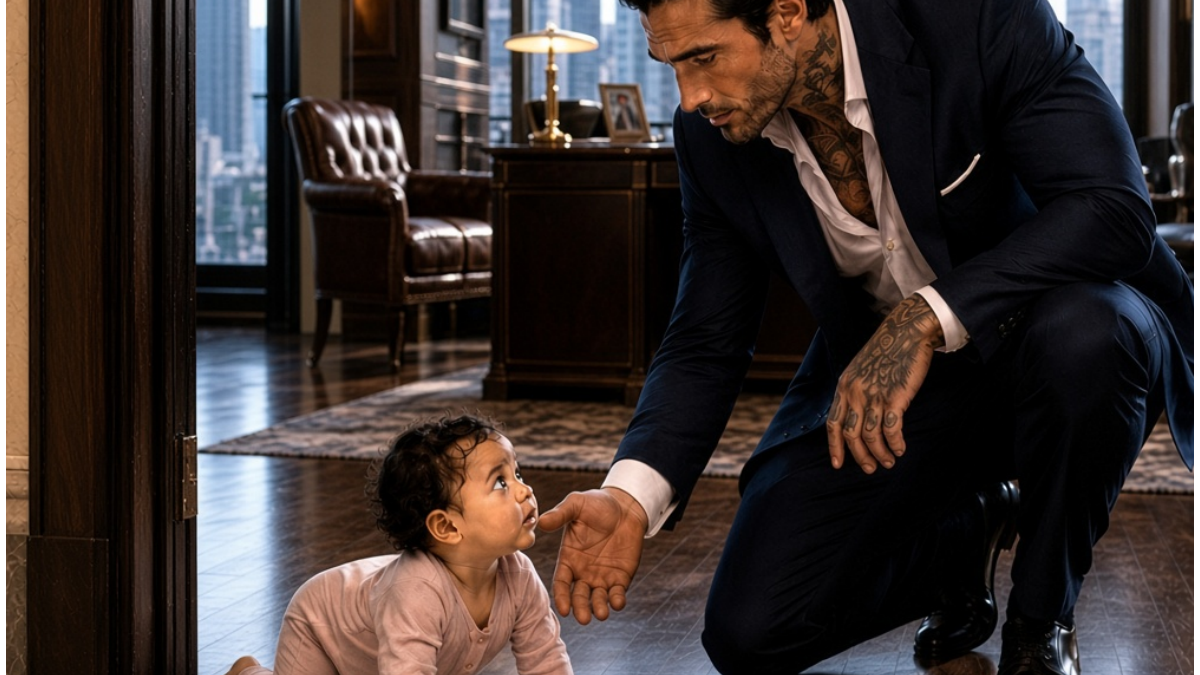
Aleandro Duca had given one instruction that morning and only one. No one was to come near his office while the video call with Zurich was live.
No cleaning, no deliveries, no footsteps. The housekeeper had been told twice. The doorman downstairs had been told once.
Even the maintenance man who serviced the private elevator had received a text at 6 or 0 in the morning saying that the 14th floor did not exist between 9 and 10.
In Aleandro’s world, an instruction was not a requeSt. It was law. He was 38 years old, and for 20 of those years, he had run the Duca Empire without a single man daring to raise his voice against him.
He owned the tallest penthouse on the upper east side, three shipping companies along the eastern seabboard, and a chain of restaurants used to launder money that no accountant in the country could untangle.
The call this morning was worth 40 million. It involved a Swiss real estate structure, three shell companies, and a bank in Zurich that had asked no questions since 1972.
The man on the other side of the screen was the kind of investor who counted the silences between sentences.
One cough, one shadow across the wall behind Aleandro, and the deal would evaporate like breath on glass.
He heard it at the 12th minute, a soft dragging sound, then silence, then again something or someone was moving in the marble hallway outside his office.
Aleandro did not turn his head. He kept his gaze fixed on the screen on the pale, unreadable face of the Zurich banker discussing quarterly liquidity.
But his jaw tightened by a single degree, and inside his chest, something began to warm the way a blade warms when it is held too close to a flame.
The sound came again, closer, rhythmic, deliberate. Everyone inside this penthouse knew that breaking a direct order from Aleandro Duca was something no sane human being ever did.
Someone had broken his order. Someone was going to answer for it the moment this call ended.
He finished the meeting with the self-control he had spent two decades sharpening. He nodded at the right pauses.
He confirmed the wiring schedule. He smiled the small cold smile that had closed a thousand deals.
Only when the screen went dark did he stand. The anger rose in his chest like heated steel.
He crossed to the door with the slow measured stride of a man who intended to fire someone before the minute was out.
He expected to find a cleaner with a broom, a delivery boy on the wrong floor, something small and disposable and easy to erase.
He opened the door. A baby girl was already halfway across the threshold into his office.
One tiny palm planted on the dark wood floor while her knees still rested on the polished marble outside.
She could not have been more than 8 months old. She wore a pink cotton onesie that had been washed too many times.
Her hair was dark and curling, and a single rebellious lock had fallen across her forehead.
She was propped on her small hands, her head tilted up, and she was looking directly at him with wide brown eyes that seemed to hold no fear at all.
Aleandro Duca, the man the underworld in two burrows, whispered about with lowered voices. The man who had signed execution orders with both his hands.
The man who had spent 38 years making sure nothing ever slipped past the wall inside his cheSt. Stood frozen in his own doorway before a creature who could not yet speak a single word.
For a long moment, neither of them moved. The baby did not cry. She did not look away.
She tilted her head to one side, studied him as if he were the most interesting object she had ever encountered.
And then she smiled. It was a small crooked smile that wrinkled her nose and revealed two tiny milk teeth just beginning to break through her lower gum.
Then she began to crawl toward him. It was not a coordinated crawl. It was a mixture of dragging her knees and pushing with her palms, uneven and clumsy.
But there was no mistaking her intent. She was coming for him. Aleandro took an instinctive step back.
He knew nothing about children. He had never held one in his life. He had never wanted to.
Children were chaos. They cried without warning. They needed things a man like him did not know how to give.
But she kept coming. When she reached his shoes, she sat back on the marble, tipped her head up, and lifted both arMs. The gesture was universal.
Pick me up. Aleandro stared at her. “Elena,” he called quietly down the hallway. His own voice sounded unfamiliar.
No answer came. The baby kept her arms raised, palms open, waiting with the simple confidence of someone who had not yet learned that the world could refuse her.
Something in that trust cracked a wall Alessandro Duca had spent 38 years building. He knelt on the cold marble, slid his hands beneath her arms, and lifted her with the awkward care of a man handling glass.
She settled against his chest as if that were exactly where she had meant to go.
One tiny fist closed around his silk tie. She weighed almost nothing. She was warm.
She smelled faintly of talcum powder and something sweeter he could not name. He stood in the middle of his marble hallway holding a baby.
And for the first time in 20 years, Aleandro Duca did not know what to do next.
Then he heard the sound of running footsteps at the far end of the corridor.
Elena Rossy came around the corner, her face white as paper, one hand pressed flat against her mouth to keep from crying out.
Elena Rossi ran the last few steps of the marble hallway and then stopped short as if hitting an invisible wall.
Her hands began to tremble at her sides. Her eyes were rimmed red. She had been crying somewhere before this in some corner of the penthouse where he could not see her.
When she saw the baby in his arms, a small broken sound escaped her throat before she could catch it.
I am so sorry, Mr. Duca. I’m so sorry. The words came out on top of each other, stumbling.
She pressed her palm harder against her mouth, then dropped it and pressed it against her chest instead, as if she could hold her own heart in place.
I only went to the bathroom. 2 minutes. Two minutes, I swear. When I came back, she was already gone from the mat, and I looked in the kitchen first and then the guest bathroom.
And then I heard your voice. She could not finish. She stared at his tie where a small fist still clung to the silk and her eyes flooded again.
And please, please, whatever you decide, just I will pack my things right now. I will not ask for anything.
I will not come back. If it is possible, please do not call anyone before I leave.
Please. Aleandro looked down at her. He had expected many things to rise in his chest in this moment.
Rage, cold, clean rage, the kind that made men in his organization apologize for sins they had not yet committed.
Contempt, the clean pleasure of dismissing someone for a violation this flagrant. He had fired men from his organization for far less than this.
But none of that came. What came was one word spoken very quietly. How long?
Elena’s head bowed until her chin nearly touched her collarbone. For a long moment, she did not answer, and he watched her shoulders shake in a way that had nothing to do with fear of him.
Three months, sir. Three months. Three months of a child living in his home without his knowledge.
Three months of a woman carrying two lives through his marble doorway at 7 Z every morning while he sipped his espresso and read the Wall Street Journal and never once looked up.
He asked the second question in the same quiet voice. Where the laundry room, sir?
She has a little cushion, some soft toys that do not make sound. I feed her before you wake.
I feed her again at noon. She sleeps most of the day. She almost never cries.
Only today I think another tooth is coming in. She was restless. And who knew?
Elena hesitated. He could see her weighing whether protecting the others would cost her more than she had already loSt. Please, Mr. Dooka.
They only stayed silent because they felt sorry for me. They are good people. It is not their fault.
Who, Elena? She swallowed. Mr. Rhondo, the doorman. Mrs. Lucia, who cleans the lobby, the delivery boy from the Italian market on Fridays.
That is all. Aleandro let the names settle in the quiet. An entire small conspiracy of pity had been operating inside his own building under his own name.
The men and women who greeted him every morning with professional courtesy, who held elevator doors and carried packages and wished him a good day, all of them had known something he had not, and none of them had told him anywhere else in his life.
That would have been a betrayal punishable in ways Elellanena did not want to imagine.
Standing here in his marble hallway with a warm sleeping child breathing softly against his collarbone.
He did not feel betrayed. He felt something stranger, something he could not yet name, a kind of embarrassment that he had been so blind.
And beneath that buried deeper an old cold ache that he had built a house so silent that a baby could live in it for 90 days undetected.
He asked the third question more slowly. Why did you not tell me Elena? She looked up at him exhausted and honeSt. Because you are not the kind of employer a person can tell that to sir.
She did not say it cruy. She said it the way a person reports the weather.
It was simply true. Aleandro looked at the sleeping baby against his shoulder, then at Elellena.
10 minutes earlier, he would have sworn on his father’s grave that his next decision was obvious.
Instead, he said, “I am not firing you.” Three words. He watched them rearrange Elena’s entire face.
Her mouth opened, then closed. She looked from him to the baby as though one of them might explain what she had heard.
I do not understand, sir. What did you say? I said, I am not firing you.
She still did not move. So he said it in the only language this house had ever taught her to truSt. Sit down, Elena, in the living room.
I am not going to speak to you in a hallway. She followed because she did not know what else to do.
At the archway, she hesitated as if sitting on furniture she had polished for 3 years were a greater violation than hiding a baby in the laundry room.
Finally, she perched on the edge of an armchair, back straight, hands folded in her lap.
Aleandro sat across from her, still holding Mia. “Tell me,” he said. Tell you what, sir.
About her father, about your family, about how a woman working in this building could not find $2,800 a month for a nursery.
Tell me all of it. When she finally accepted that it was not a trap at all, only something even more unfamiliar, she she began to speak in a low, steady voice, as if she had rehearsed these facts in her head many times, but had never before had a person to say them out loud to.
Mia’s father had walked out of the apartment on the same afternoon she had shown him the second pink line on a plastic stick.
He had said he was not ready to be a father, that he had plans, that a baby was not part of those plans.
He had not called since. She did not know what city he lived in now, and she preferred it that way.
Her own parents had died in a car accident on the interstate outside Utica when she was 19.
She had no brothers or sisters. There was an aunt somewhere in Naples she had not spoken to since childhood.
She had no family in New York. No one to leave the baby with. No one who would even notice if she disappeared from an apartment on a Tuesday night except perhaps the landlord who noticed rent.
The best nursery within a reasonable subway distance was called Sunny Days. She had visited it once, sat in the small, bright office, and looked at the number the director had gently slid across the desk to her.
$2,800 a month, more than her entire paycheck. She had smiled politely and walked back out onto the street and cried on the cross town bus.
Alisandro listened. He listened without interrupting, without offering the small murmurss of sympathy other men might have used to fill the spaces.
He simply listened, and as he did, an uncomfortable truth began to settle into his ribs like cold water.
He had known nothing about this woman, nothing at all. She had cleaned his kitchen for three years.
She had folded his shirts. She had scrubbed the marble of the hallway where her daughter had crawled tonight, and the only thing he could have told anyone about her before this evening was that she arrived at 7 05 every morning instead of 7.
As her contract stated, he had noticed the 5 minutes. He had never once thought to ask why.
Elena stopped speaking. She looked at him wearily, as if bracing. Why are you doing this, sir?
He did not have an answer for her. He honestly did not know. He was not a man given to charity, and he was not, by any honest measure of himself, a good man.
He had never wanted to be one. The world he had built for himself did not reward goodness, and it punished softness with a precision he had helped design.
But when he looked down at the small body sleeping against his shoulder, at the tiny fist still curled around the silk of his tie, in a grip a child that age should not have possessed, he understood one thing very clearly.
He could not not go back to being the man he had been 10 minutes ago.
That man had closed a door somewhere in this apartment tonight, and it would not open again.
He rose slowly, careful not to wake the baby, and crossed to his study for a moment while Elellanena waited.
He did not know why he needed to be alone for the length of a single breath, only that he did.
He opened the top drawer of his desk. Inside, beneath a stack of unopened envelopes, lay a small string of dark, worn olivewood rosary beads, his father’s.
He had not touched them since the funeral almost 20 years ago. His fingers brushed the smooth hood just for a moment.
Then he slid the drawer closed. When he returned to the living room, Elena was still sitting exactly as he had left her, hands folded, spine straight, terrified of moving even her feet.
Tomorrow, he said, something is going to change. I do not yet know what, but something has to be different in this house.
Do you understand me, Elellena? She did not understand. He could see it in her face, but she nodded anyway.
Outside the tall windows, the lights of Manhattan blinked on one apartment at a time.
The next morning, Alisandro did not go to the office. He canled two meetings and pushed a third to the following week.
Marco Bellini on the receiving end of the phone call did not ask why. That was one of the reasons Marco had lasted at Aleandro’s side for 15 years.
He simply said, “Understood.” And moved things on the calendar as if erasing them from stone.
At 7:05, the private elevator opened. Elena stepped out with two bags on her shoulder, the way she had for three years.
Aleandro was standing at the far end of the marble hallway, a cup of black coffee in his hand, and for the first time he looked at her the way a man looks at a room he thinks he knows, and suddenly does not.
She did not see him at firSt. She was too focused on being quiet. The large canvas tote he had noticed a thousand times contained her cleaning uniform, her gloves, a folded apron, and the small kit of polishes she used for the silverware.
He knew that bag. He had walked past it a thousand mornings without a second thought.
The second bag was smaller, softer, a pale blue canvas with a strap worn thin at the edges.
He had seen it at every morning of the last 3 months and had never once wondered what was inside it.
Diapers, a tin of formula, a folded muslin cloth, a pacifier on a small clip, the small ordinary supplies of a life he had never suspected was moving through his apartment.
She disappeared into the laundry room for exactly 4 minutes. When she came out, she was already in her apron, hair tied back, and the second bag was gone.
He watched her from behind his coffee for the rest of the morning. She did not sing.
She did not hum. She did not turn on the small kitchen radio that the previous housekeeper had used to fill the silences of the empty apartment.
She moved through his rooms the way a nurse moves through a sleeping ward, opening drawers without a click, setting cups down without a sound, closing doors as though her life depended on the hinges.
In 3 years, he had never noticed the shape of her silence because silence in this apartment had always simply been his own.
Now he understood it belonged to her as well. It had cost her more. He passed the laundry room door twice that morning without looking in.
On the second pass, he did. He had not stepped inside this room in 3 years.
It was larger than he remembered. Two industrial washers, a matching dryer, a wall of white shelves stacked with towels folded with a precision that would have satisfied a hotel manager.
Bottles of detergent lined up by height. The air smelled faintly of lavender and warm cotton.
In the far corner, tucked between the base of the shelving unit and the wall, was a thin foam mat.
Pillows had been placed around three of its sides so that a small body could not roll off.
On the mat lay Mia, asleep on her back, with her arms flung above her head like a starfish, her mouth slightly open, a small line of drool tracing the corner of her lip.
Elena appeared in the doorway behind him without a sound. She did not speak. She did not defend the room or the mat or herself.
She simply stood there and waited. Aleandro crouched down slowly, careful not to let his knees crack against the tile.
He reached out one finger and touched the tiny barefoot that had escaped from a light muslin blanket.
It was warm. The baby’s nose wrinkled in her sleep. She did not wake. “How old is she?”
He asked quietly, though he already knew. 8 months and two weeks, sir. He stayed crouched a moment longer, looking at the way she slept.
The complete unguarded surrender of a creature who did not yet know that the world was ever anything other than safe.
Then he stood up and turned away. He was almost through the door when he stopped.
“This cannot continue, Elena.” He heard the sharp inhale behind him. He heard her fingers close around the door frame as if to hold herself up.
He knew what she thought he had just said. He knew every meaning she was pouring into those four words in the space of a single breath.
He did not turn around because he did not want her to see his face when he finished the sentence.
She deserves more than a mat in a laundry room. He left before she could answer.
He worked from his study for the rest of the day. He signed documents without reading them properly.
He rescheduled a call with Naples for the fourth time twice without meaning to. He set down his pen and simply listened as if he might catch the soft sound of a baby breathing on the other side of a closed door.
At 6 that evening, Elena stopped in the doorway of the study to say she was leaving.
She had Mia against her shoulder now, dressed in a small yellow jacket with a hood shaped like a duck’s head.
Mia was awake. She She looked at Aleandro from under the yellow hood, blinked once, and then buried her face against her mother’s neck out of shyness.
“Good good night, sir.” “Good night, Elena.” They were gone. The private elevator hummed once and fell silent.
He listened to the apartment settle around him. He walked the length of the marble hallway.
He crossed the living room where Elellanena had sat the night before. On the edge of the armchair.
He passed the empty kitchen. He passed the laundry room door, now closed, and heard nothing behind it.
The silence was the same silence that had lived in this apartment for 3 years.
He had always called it peace. Tonight, it sounded like something else. He returned to his study, sat down at the desk, and picked up his phone.
Marco answered on the second ring. Marco, I need three names by tomorrow morning. The best licensed nurseries within a two-mile radius of this building.
Places with a waiting list I do not need to wait on. Places I would trust with a child.
There was the smallest pause on the other end of the line. Marco was a man who had learned in 15 years never to ask a question that had not been invited.
But this one was new territory, and he allowed himself the shortest breath. For whom, boss?
Aleandro looked at the closed door of his study and beyond it at the dark marble hallway for someone who deserves more than a mat in a laundry room.
Three days passed. Marco brought the three names the following morning printed on a single sheet of paper because he understood that Aleandro preferred paper he could burn.
Aleandro read the sheet once, circled the second name, and handed it back. By that afternoon, a woman named Rosa at Sunny Days had received a phone call from a man who spoke with formal courtesy, mentioned the name of a mutual acquaintance on the parish board, and asked whether one particular spot on her waiting list might be reconsidered.
By that evening, the spot was reconsidered. On the second day, deliveries began arriving through the service entrance.
The doormen carried up boxes without labels. Aleandro received each one at the door himself, which was itself so unusual that the men who had known him for a decade avoided his eyes on the way back to the elevator.
On the third day, Aleandro left the office at 400 in the afternoon. He had not left an office at 400 in the afternoon in perhaps 10 years.
The private elevator opened onto his marble hallway a little after 4:30. He stepped out expecting silence.
What he found instead was Elellena standing perfectly still at the doorway of the small room beside the kitchen.
The room he had kept locked for 3 years with her hand pressed against the door frame as though she needed it to keep her upright.
She did not hear him approach. She was looking into the room. Aleandro stopped a few feet behind her and looked as well.
The room was no longer empty. The bare parquet floor had been covered by a thick foam mat in soft muted colors patterned with small clouds.
Along one wall stood a portable crib in pale white wood. The netting turned back and ready.
Near the window, framed by afternoon light, sat a low rocking chair with a cream cushion.
A small basket of new picture books had been placed within easy reach of it.
In one corner stood a shelf of soft toys, a giraffe with long dangling legs, a rabbit in a knitted sweater, a family of ducks tied together with ribbon, a miniature wooden pushcart of blocks waited by the mat as if a child had just stepped away from it for a moment.
And in the very center of the crib, propped carefully upright against a folded blanket, sat a plush elephant.
He was pale gray. He was slightly smaller than the child he was waiting for.
His trunk curled upward in the classic gesture of good luck, and his ears were oversized and soft in the way that suggested he had been chosen carefully by someone who knew that 8-month-old fingers grip everything by the ears firSt. Aleandro had ordered the elephant himself.
It had been the only item on the list he did not delegate. Elena’s shoulders began to shake before her face did.
Mr. Duca, sir, I cannot I cannot accept this. She turned toward him at last, her hands still braced against the doorframe as if she might otherwise fall.
Tears slid down her cheeks in silence. Behind Elena’s legs, Mia had crawled up and caught the hem of her mother’s skirt in one small fist, staring wideeyed into the bright new room.
This is too much, Elena whispered. I cannot pay you back for this. I do not know how.
Elena, he said her name softly. This is not for you. This is for her.
He walked into the room and knelt beside the mat. There is a nursery 10 minutes from here called Sunny Days.
I have already spoken with the director. Mia has a place beginning Wednesday. The program has a scholarship for working mothers.
You will receive it and I will cover the reSt. He turned the plush elephant so it faced the doorway.
Beginning next month, your salary goes up 30%. You will not choose between rent and formula again.
If your rent rises, you tell me. This is not a discussion. I have made the decision.
Elena made a small broken sound in her throat. Why, sir? Why are you doing this?
He rose slowly and looked at her. He had prepared no speech. He was not a man who prepared speeches for a housekeeper.
So he told her the only honest sentence he had. Because I am able to.
She did not answer that. She only wiped her face with the back of her wrist the way she wiped counters.
Quick and businesslike, as if she treated her own tears as a small mess to be cleaned.
They might obey her. He reached down and gently unhooked Mia’s small fingers from her mother’s skirt.
May I? Elena nodded, unable to speak. He carried the baby into the room and set her carefully in the middle of the foam mat.
For a heartbeat, Mia sat very still, taking in the new colors, the new smells, the new soft weight beneath her palMs. Then her eyes fell on the plush elephant in the crib.
Her whole face lit up. She crawled across the mat without hesitation, hauled herself up against the low bars of the crib, and reached one determined hand between them.
She could not quite grab the elephant. She tried again. On the third try, one small fist closed around a floppy gray ear.
Alisandro reached in, lifted the elephant out, and placed it in her arMs. She hugged it against her chest with both hands.
And began to laugh, an open, uncomplicated laugh that showed both of her tiny milk teeth and filled the room with a sound it had been built to hold and had never yet held.
Aleandro stood very still. Something inside his chest cracked a little further along the same fault line the child had opened three nights ago in his hallway.
He did not know how much more it could give before something behind it broke free entirely.
Elena had come to stand in the doorway beside him. She was not crying anymore.
She was watching her daughter and the elephant and the man who had bought it.
And there was an expression on her face that Alisandro did not know how to read.
Mr. Duca, she said quietly. Then she hesitated. Aleandro, why are you being so good to us?
He looked at Mia. The baby was rocking the elephant against her cheek now, murmuring some small nonsense syllable that seemed to be its name.
He opened his mouth to answer. Nothing came out. He genuinely did not know. He had never in his life done a thing like this.
And he could not have explained to Elellena or to himself or to any of the men who worked for him why he was doing it now.
The only truth he had was that he did not want to stop. So he said nothing at all.
He simply stayed where he was, watching a child he barely knew fall in love with a gray plush elephant on a floor.
He had kept locked for 3 years, and he understood quietly, without ceremony, that some doors once opened.
Do not close again. Wednesday morning came in gray and mild, the kind of city morning that seemed to hold its breath between summer and fall.
Elena arrived at 7:05, as she always had, but this time she did not go straight to the laundry room.
She stood for a moment in the hallway, holding Mia against her hip in a small blue coat and matching hat, and looked around as if she had never quite seen this apartment before.
She was wearing her best blouse. Aleandro noticed it the moment she stepped out of the elevator.
It was white cotton ironed with painful precision, the collar buttoned to the top. He also noticed that it was older than anything hanging in his own closet.
There was a very faint stain near the second button that a person who cared could no longer wash out.
She had ironed the shirt around that stain the way she had ironed around everything difficult in her life.
She carried Mia to the low table in the entry hall and began to fasten the small buttons on the baby’s coat with hands that would not stop trembling.
On the morning of Mia’s first day at Sunny Days, Elena stood in the entry hall fastening the buttons of the baby’s blue coat with trembling fingers.
Alisandre walked out of his study with his car keys. I will drive you. She looked up sharply.
Aleandro, no. I can take the train. I do not want to take your time.
I have no meetings this morning. That was not true. He had cancelled too. Marco had accepted the change with the flat.
Understood. He used when he understood nothing. Come, it is faster. Downstairs, Ellena stopped beside Aleandro’s black sedan.
A charcoal gray child seat had been installed in the middle of the rear bench.
“Where did that come from?” “I installed it last night,” he said. He did not tell her it had taken 40 minutes and three viewings of the same patient instructional video or that Marco had discovered him crouched in the back seat at 11 at night and quietly backed out of the garage.
He did not tell her that Marco had come down to the garage at 11 at night looking for him.
Had seen him crouched in the back of the sedan tightening a strap and had simply set down the paperwork he had brought, turned around and walked back to the elevator without saying a single word.
Elena buckled Mia into the seat with careful disbelieving hands. Mia thought the whole affair was a wonderful game and grabbed at the buckle with both fists, laughing, Aleandro drove.
He drove more slowly than he had driven anywhere in a decade. He took the corners as if he were transporting something priceless and breakable, which in fact he was.
Elena sat in the passenger seat with her hands folded rigidly in her lap and stared out the window and did not speak because if she opened her mouth, she was going to cry.
Sunny days occupied the ground floor of a narrow limestone building on a quiet cross street.
The bright yellow sign above the door was hand painted, not printed. Through the window, one could see small tables and low shelves, and at this hour a semiircle of chairs and other children already gathering for the morning song.
Rosa met them at the door. She was perhaps 60 years old, small and round, with iron gray hair pinned up in a loose knot and reading glasses on a chain around her neck.
When she saw Mia in Elellanena’s arms, her face opened into a smile of the kind that could only be earned across many decades of children.
So this is our little Mia,” she said in the warm, slightly singong English of a woman whose first language had been the Italian of a village outside Polarmo.
“Bjouro Tormo, come and see what we have for you today.” She held out her hands.
Elena did not move. For a long quiet moment, Elena simply held her daughter tighter against her chest, and it was clear that this was the first morning in 8 months and 2 weeks that she had willingly considered handing this baby to a stranger.
Aleandro stood a step behind her. He did not know what to do with his hands.
He had held boardrooms of hostile men without moving a finger, and now his own hands were foreign objects hanging at his sides.
In the end, he lifted one of them and placed it very lightly on Ellena’s shoulder.
It was the first time he had touched her at all in 3 years without a barrier of professional distance between them.
She did not flinch. She closed her eyes for a heartbeat, drew in a breath that was more shutter than air, and then handed Mia gently over to Rosa.
Mia looked at the older woman, considered her seriously, reached out and grabbed the reading glasses on their chain and burst into a delighted giggle.
Rosa laughed. Elena made a sound halfway between a laugh and a sob. Rosa smiled.
She will be perfectly fine. Cara, come back at 4 and she will have painted something.
Elena glanced at Mia, who was already reaching for Rose’s glasses. Probably her face. On the drive back, Elena stayed quiet until the second traffic light on First Avenue.
Then she said, “Thank you, Alisandro. No, sir. No, Mr. Duca. No senor, only his name spoken in a voice that cracked halfway through it.
Aleandro kept his eyes on the road and smiled to himself for the next 35 blocks.
Three weeks passed, and Mia settled into sunny days with the stubborn cheerfulness that seemed to reorganize every room she entered.
Rosa reported that she was already the loudest laugher in the infant room, that she had painted her own face twice, and that she clapped whenever anyone sang, whether there was a song or not.
Aleandro changed his schedule without announcing that he had changed it. He began leaving the office at 5.
Marco noticed once, then twice, and by the fourth afternoon, he simply stopped scheduling anything important after 4:30.
No one asked why. Allesandro arrived home early enough to spend half an hour with Elena and Mia before they left for Queens, and those 30 minutes became the most valuable part of his day.
He learned that Mia preferred to be lifted slightly to the left, that she frowned with tiny dignity if he tilted her too far, and that she loved hearing him speak Italian.
He also began learning in secret. In the top drawer of his private desk, beside his father’s olivewood rosary, appeared an iPad with a copy of What to Expect, The First Year, and a folder labeled only M.
Inside were videos about bottles, burping, teething, sleep, and the strange catalog of cries an eight-month-old could produce.
One afternoon, Bruno Richi walked into the office with a security file and accidentally saw a browser page titled, “How to talk to an 8-month-old baby.”
Bruno placed the folder on the desk, looked at the floor, then the ceiling, then a point safely above Aleandro’s head.
The Chicago file, sir. Aleandro closed the browser. Thank you, Bruno. Bruno left without changing expression.
In the hallway, he crossed himself. The first warning passed unnoticed. On the Wednesday after Mia started at sunny days, a black BMW with tinted windows idled across from the nursery for almost 20 minutes.
A man behind the glass photographed Allesandro opening the passenger door for Elena, then wrote down the time and drove away.
No one approached them. No one made a threat. The car simply disappeared into Manhattan traffic, carrying the first proof that Aleandro Duca finally had something in his life worth taking.
She would finish her work, gather Mia from the nursery downstairs, where Rosa had begun to leave her when Aleandro came home early and linger in the kitchen for reasons neither of them named.
It was easier to change a diaper here than on the subway. Mia liked the light in the kitchen.
Certainly, it had nothing to do with the man reading the newspaper at the far counter.
One Thursday, she cooked. It was nothing elaborate. Spaghetti with tomato sauce, a little garlic, basil torn from the small plant she had brought in, a paper cup two weeks ago, and quietly placed on the window ledge above the sink.
She asked his permission before she opened the pantry, and he simply nodded without looking up from his paper as if she had asked permission to breathe.
20 minutes later, the whole apartment smelled of a home. Aleandro sat down at the marble table in the kitchen.
He had bought that table 3 years ago from a workshop in Kurara, imported at considerable expense, along with the chairs that matched it.
It could seat eight. He had never once eaten a meal at it. He had never once sat at it at all.
It had lived in his kitchen as a piece of very expensive sculpture, kept polished by the same woman who now set a plate of pasta in front of him without ceremony.
Mia sat in a new high chair between them, thumping a plastic spoon against the tray in a rhythm known only to herself, and occasionally shouting at the ceiling for reasons no one understood.
Elena leaned over once to wipe sauce from the baby’s cheek, and in doing so laughed.
Aleandro laughed, too. It was not a loud laugh. It was the kind of laugh a man learns to keep small when he has spent 20 years hiding what he feels.
But it was a laugh and it came out of him without permission. And when it did, Elena looked up at him quickly, her fork halfway to her mouth.
She realized in that moment that this was the first time in three years she had ever heard him laugh.
She did not say so. She only lowered her eyes back to her plate and smiled to herself and reached out to steady the spoon in Mia’s hand.
They finished the pasta slowly. Aleandro cleared his own plate to the sink, which caused Elellena to freeze in the middle of picking up hers and stare at him as though he had just committed a small crime.
He rinsed both plates. He said nothing about it. At a/4 to 7, Elena bundled Mia into her small coat and hat.
He walked them to the private elevator. Mia waved at him over Elena’s shoulder as the doors closed, a small open and closing wave with all four fingers at once, and then they were gone.
The apartment settled around him again, the dishes drained by the sink, the marble table still faintly warm where three people had sat.
The high chair pushed neatly against the wall. The silence returned. It was the same silence that had lived in this penthouse for three years.
He had always called it peace. Tonight, for the first time, he stood in the middle of his kitchen and understood that he did not want it back.
Friday, the city was warm and gray, the kind of low sky that pressed against the tall windows of the penthouse, without ever fully deciding to rain.
Aleandro left the office at 4:30, which was earlier than 5, which was already earlier than he had ever left in his life.
Marco Bellini watched him go from a doorway across the corridor, said nothing, and gently cancelled a call to Buenos Cyrus.
Aleandro opened the door of the penthouse at 5, 10, and heard the crying before he had taken off his coat.
It was not a small cry. It was the sustained high exhausted cry of a small human being who had already been at it a very long time and had every intention of continuing.
It filled the marble hallway. It bounced off the crystal chandelier. It made the apartment sound for one strange moment like a place where an actual life was being lived.
He walked quickly toward the living room. Elena was standing in the middle of the room, bouncing Mia gently against her shoulder, her face flushed and drawn.
Elena’s hair had come loose from its clip. Mia had been crying for nearly 2 hours from another tooth, and Elena looked close to exhaustion.
“I am sorry,” she said. “I tried the cold ring, the gel, the rocking. I sang.
I Alisandro cut in gently. How long has it been since you sat down? Elena blinked.
I do not know. Mia lifted her red, tearked face, saw Aleandro, and reached for him with both arMs. Even in pain, she knew where she wanted to go.
Aleandro crossed the room. May I? Elena nodded. He took Mia carefully. She burrowed against his neck.
One fist clutching his collar. Her crying did not stop at once, but it softened, and now that she was there, only the pain itself remained.
He began to walk. He walked her slowly along the length of the living room, past the tall windows, past the pale gray sofa, past the fireplace no one ever lit.
He walked her in a small steady arc, bouncing very slightly at each step, and after a moment, without deciding to, he began to sing.
It was in Italian. He had not known he still knew the words. It was a lullabi his mother had sung to him more than 30 years ago in a small kitchen in Brooklyn, at a table with a plastic tablecloth.
When he had scraped his knee or been frightened by thunder or simply refused to sleep, she had died before he turned 18.
He had not thought of that lullabi in all of his adult life. It came out of him now, low and rough and slightly offkey, the way a song comes out of a man who has never sung it aloud in front of another human being.
Mia listened. Somewhere in the second verse, her crying began to break apart. It came in shorter bursts.
It dissolved into hiccups. She lifted her head once, blinked at him with her wet eyes, and pressed her face back into his neck.
The small fist in his collar loosened by a single knuckle. He kept walking. He kept singing.
By the end of the third verse, the crying had stopped altogether. By the end of the fourth, her breathing had begun to slow, deepening into the long, even rhythm of a child who has finally accepted the surrender of sleep.
Her weight against his chest grew heavier, denser, until her entire small body seemed to melt into him as if she had been poured there.
He did not stop walking. He was afraid the moment he stood still, she would wake.
He walked for 15 minutes. There are moments in a man’s life when the border between who he has been and who he might yet become is drawn no thicker than the breath of a sleeping child.
Aleandro Duca stood at that border for 7 seconds, holding a creature who shared none of his blood, and understood without any argument left in him, that nothing, not the empire he had inherited, not the power he had built, not one single thing he had ever fought to take from another man, mattered more.
In that seven seconds, then not waking her, he turned finally toward the sofa. Elena had lowered herself onto the very edge of it.
She was watching him with an expression he had never seen on her face before, the expression of a woman who had forgotten for a moment to be afraid of the room she was sitting in.
She whispered, “Are you a magician?” He looked down at the small dark head tucked beneath his jaw.
He shook his head very slightly so as not to disturb her. “No,” he whispered back.
“I was only patient.” He crossed to the sofa and lowered himself onto it beside Elena.
Mia did not stir. Her small fist stayed closed on his collar. Her breath went on, warm and even against the hollow of his throat.
For a long moment, none of them moved. Outside the windows, the gray afternoon was beginning to soften into evening.
A single lamp burned in the corner. The apartment was quiet in a way it had never been quiet before.
Not the polished, empty quiet of the last 20 years, but a full breathing quiet.
It was the quiet of three people who had without meaning to come to rest in the same room.
Elellanena tucked a strand of hair behind her ear. Her hands, which had been shaking for 2 hours, had stopped shaking.
Neither of them spoke. They simply sat there in the low lamp light. A man on one end of the sofa and a woman on the other, and between them warm and asleep and utterly at peace.
Between them a small child breathed softly in sleep. If anyone had passed by, they would have looked twice.
For the first time in 20 years, the penthouse looked unmistakably like a place where a family lived.
They did not move from the sofa for a long time. When Aleandro finally spoke, his voice was low enough not to disturb the small, warm body against his cheSt. If you take her home now, she will wake in the taxi.
She will not sleep again tonight, Elena. Neither will you. Elena looked at him. She looked at Mia.
She looked at the dark windows and at her own hands in her lap. Stay.
He said, “There are three guest rooms in this apartment that have never held a person.
I have shirts and a robe you can borrow. Tomorrow is Saturday. There is no reason to move her.”
She hesitated. He watched her weigh a hundred things at once. Propriety, safety, the strange country she had already been walking through for 3 weeks.
And then he watched her decide. All right, she whispered. Thank you. They carried Mia together to the small room beside the kitchen.
Aleandro lowered her into the portable crib beside the gray plush elephant, which she found by touch even in her sleep, and pulled against her cheek without opening her eyes.
Elena tucked the muslin blanket around her, kissed her forehead, and stood a long moment looking down at her before she turned away.
She showered in the guest bath. He left a folded white cotton shirt on the bed for her, an old one he no longer wore.
When she came out, damp-haired and barefoot, wearing the shirt that reached the middle of her thighs.
Near midnight, after Mia was asleep in the small room beside the kitchen, Elena sat with Aleandro at the marble table over two cups of chamomile tea.
She asked him a question no one in his world ever asked. Why have you never had a family?
Aleandro turned his cup slowly on its saucer. He told her there had been a woman when he was 24, Valyria, who had wanted marriage, children, Sunday lunches, and a life ordinary enough to be peaceful.
He had told her to wait until he finished building his empire. She waited, then finally gave him a choice.
And you chose the Empire, Elena said. “I chose the Empire.” Valyria later married a literature teacher in Vermont and had three children.
Aleandro had once seen a photograph of her smiling with them, smiling with them. She looked happy in a way I would not have known how to make her, he admitted.
Then he told Elellena about his mother’s ring, still locked in a safe behind a painting in his office.
He had kept it for 20 years without knowing why. Elena listened without interrupting. When Allesandro asked about Mia’s father, she did not give him the man’s name.
She only described the day she showed him the pregnancy test, the sports bag he had already packed, and the apartment door closing behind him.
He had never called again. For a time, Elena had lived in her car and taken any cleaning work she could find.
“Aleandro’s hands tightened around his cup.” “A man who abandons his child does not deserve to be called a father,” he said.
“Mia will not be lesser because he left. Do not teach her to spend her life wanting a man who chose not to know her.”
Elena looked at him across the table for a long moment, her eyes wet but steady.
“Aleandro,” she said, and nothing more. Yet the way she spoke his name changed the room.
Outside, rain began to move against the windows. For the first time, both of them understood that the distance between employer and housekeeper had become something neither of them could honestly pretend was still intact.
The next morning, Alisandro woke before 7 and heard Elellena laughing in the kitchen. He followed the sound barefoot down the marble hallway.
Morning light poured across Elena in one of his old white shirts, her hair loose as she made eggs while Mia slapped both hands against the tray of her high chair and shouted at the ceiling.
Aleandro stopped in the doorway. He had negotiated fortunes and faced armed men without losing his balance.
Nothing had prepared him for the simple sight of a woman making breakfast for a child in a home that had never felt like one before.
He got up quietly, pulled on a dark cotton robe, and walked barefoot down the marble hallway.
He stopped in the doorway of the kitchen. Elena was standing at the stove with her back half turned to him.
She was wearing his white cotton shirt from the night before, sleeves rolled to her elbows, hair loose around her shoulders.
She was cracking eggs into a pan and humming a low, half-remembered Italian song under her breath.
And every so often, then she turned her head to make a small face at Mia, who was strapped into the new high chair beside the marble table.
Mia was slapping both hands flat against the tray in a private percussion concert of her own.
Every third slap, she made a joyous, wordless shout at the ceiling as if the ceiling were personally responsible for the noise.
When Elellanena leaned over and pressed her nose against her daughters, Mia squealled with laughter and grabbed a fistful of her mother’s hair.
The morning light poured through the window above the sink and set fire to the whole scene.
The white shirt, the loose hair, the tiny fists, the two dark heads bent together in the yellow warmth of it.
Aleandro stood in the doorway and did not move. He had faced men across tables in three countries.
He had signed documents that made and unmade fortunes. Nothing in his life had prepared him for the simple unarmed thing of standing in a doorway at 7 Aro in the morning and watching a woman make eggs for a child that was not his.
He walked into the kitchen. Mia saw him and let out a shriek of pure delight, throwing both arms into the air.
Without thinking, without deciding, Alisandro bent down and pressed a light kiss to the soft, dark hair on the top of her head.
He straightened up. He met Ela’s eyes across the marble counter, and only then did he understand what he had just done.
I He stopped. He set one hand on the back of the high chair as though he needed something to hold.
I am sorry, Elellena. I did not mean to. I should not have. It is all right.
Her voice was very quiet. She loves you. A small breath. And so do I.
He thought for a long, clean second that his heart had actually stopped inside his cheSt. He crossed the small distance between them slowly because his legs did not entirely believe what his ears had just heard.
He raised his hand and laid it very carefully against her cheek. Her skin was warm from the stove.
She did not move. Elena, he said her name. The way a man says something he has been carrying under his tongue for weeks without permission to release.
I think about you both all day in meetings, in the car, in the middle of sentences that have nothing to do with you.
I leave rooms full of important men because I want to be back here in time to see her before you take her home.
6 weeks ago, this apartment was a place I owned. Now, it is the only place I want to be.
I did not know that could happen to a man. I certainly did not know it could happen to me.
Elena’s eyes had begun to shine. She did not blink. I love Mia, he said.
I love her the way I would love a daughter of my own. And I love you, Elena.
I have never used those words to anyone in my life. I did not know I still had them.
A tear broke over her lower lashes and slid down into the corner of her mouth.
She caught it with the back of her wriSt. I am so frightened, Alisandro. Of what?
That this is a phase that in a month or 6 months you will wake up and remember who you are and I will not survive it a second time.
I do not think I could. He shook his head very slowly without looking away from her.
This is not is not a phase, Elena. This is the most permanent thing I have ever felt in my life.
I know because everything before you was temporary and I called it real. Alessandro said, “Everything since you has been real, and I was afraid to call it that.
I am not afraid anymore. I am not going to change my mind.” Elena stepped forward firSt. or perhaps he did.
Neither of them was ever certain. Afterward, they kissed across the corner of the marble table slowly and carefully, like two people who had known for weeks that this moment was coming and had both been frightened of it.
Mia slapped the tray of her high chair in delighted approval. They broke apart, smiling.
“The eggs,” Elena whispered. “They are burning. I know. Neither moved. Far below, a black BMW with tinted windows sat at the curb.
Behind the wheel, a man wrote down the time and watched the front entrance without blinking.
After their first kiss, Elena and Mia began staying more nights than they went home.
No formal decision was made. A small bag became a larger one. A few of Elena’s dresses appeared in Aleandro’s closet.
Mia gained a proper crib beside this master bedroom, and the gray elephant traveled from room to room under one small arm.
Aleandro did not become softer in business. If anything, Marco thought he became sharper. He had reasons to finish meetings now, reasons to come home, reasons to notice the street outside the car.
Bruno noticed those reasons, too. He quietly added cameras around sunny days and began checking every vehicle that appeared more than once on the block.
Then Marco asked Aleandro for a private meeting. You need to marry her. Aleandro looked up from his espresso.
Marco explained it without romance. Anyone watching had already learned what Elellena and Mia meant to him.
In their world, love outside the walls of family was leverage. Aleandro allowed himself the smallest smile.
You have never given me romantic advice before. This is security advice, boss. It is the only kind I am qualified to give.
Alisandro nodded. I will handle it. That night, after Elena put Mia to bed, Aleandro entered his private office and opened the steel safe behind his mother’s old seascape.
He moved past, currency, and a black notebook until he reached a small velvet box.
Inside lay his mother’s silver engagement ring, its diamond modest and clear. On the last day of her life, she had asked that it be given to him.
For whoever teaches you to love again, he had locked it away for 20 years.
This time, when he closed the safe, the ring did not go back inside. He placed the box in the top drawer of his desk beside his father’s rosary.
11 blocks north, another man studied photographs beneath a green banker’s lamp. Elena leaving sunny days with Mia.
Aleandro driving them. Aleandro’s hand resting briefly at Elena’s back. Vincent Romano paused over that last image and smiled.
The Duca boss, who had spent decades making himself impossible to threaten, had finally built a family before he had built walls around it.
He had put it in the safe the day of her funeral. He had not opened the box since.
He stood at his desk for a long time with the ring in the flat of his palm, weighing not the metal but the 20 years of silence attached to it.
Somewhere behind him down the hall, Elena laughed softly at something Mia had said in her sleep.
He closed the box. He did not put it back in the safe. He slid it into the top drawer of his desk instead, beside the olivewood rosary of his father, so that the two of them would rest side by side, waiting for whatever came next.
He did not know how little time was left. That same night, 11 blocks north, in a penthouse whose windows also faced the East River, another man sat at a leather desk under a green banker’s lamp.
In front of him lay a large black album, spiralbound, of the kind photographers used to store contact sheets.
He turned the pages one at a time, slowly without hurry. On each page were photographs, a dark-haired woman leaving a limestone nursery with a small child on her hip.
The same woman carrying grocery bags into the private garage of a building on the Upper East Side.
Aleandro Duca at the wheel of a black sedan. Driving that same woman and that same child through morning traffic on Third Avenue.
Aleandro Duca opening a car door for her. Aleandro Duca laying his hand without any hurry at all against her lower back as they walked into a building together.
The man at the desk paused at that last photograph. He studied it for a long, slow moment.
Then he began very quietly to laugh. Elellena saw the car for the first time on a Tuesday morning.
It was just before 9. She had pushed Mia the last block in the stroller, the baby sitting upright beneath a small red coat and gripping the gray elephant by one ear.
Elena stopped at the corner opposite sunny days to wait for the light. And that was when she noticed it.
A black BMW tinted windows parked directly across from the nursery in front of a hydrant it should not have been parked in front of.
She thought at first that she was imagining it. New York was full of black cars with tinted windows.
Half the men in the finance towers rode in them. She dismissed the thought before it fully formed, crossed the street with Mia, and delivered her to Rosa with the usual small kiss on the forehead.
The next morning, the car was there again. Same spot, same hydrant, same tinted windows.
Elena walked past it more slowly this time. She tried to look without appearing to look.
She could see nothing behind the glass, only her own reflection beside the stroller and Mia’s small red coat.
On the third morning, when she rounded the corner and saw the same car in exactly the same place for the third time, something small and cold moved down the length of her spine.
She waited until Mia was safely inside the classroom. Then she went and knocked on the door of Rose’s small office.
Rosa, may I speak to you? Rosa took one look at her face, closed the door, and sat her down in the small chair opposite her desk.
Elena told her quietly, without dramatics, three mornings, same car, same spot, same feeling in her stomach.
Rosa did not laugh at her. Rosa did not tell her she was tired or worried or imagining things.
Rosa reached across the desk, picked up her phone, and dialed a number that she had kept written on a card inside her top drawer since the day Allesandro Duca had first walked into this nursery.
Only in an emergency, he had said. Rosa had decided this was an emergency. Bruno Richi arrived in 40 minutes.
He did not come alone, but he came in a way that no one on the street would have identified as an arrival.
Two men walked the block on foot. A car circled once. Bruno himself entered through the side door of the nursery as if he were an insurance inspector.
Complete with a leather folder under one arm. He spoke to Rosa for less than a minute.
He spoke to Elellena for less than a minute after that. Do not go outside, Mrs. Rosie.
Do not stand near the window. If you have to walk to the bathroom, walk on the far side of the corridor.
He left through the same door. 5 minutes later, from a parked position half a block down, he took a photograph of the license plate of the black BMW through a small hole in a takeaway coffee cup lid.
He sent the photograph to Marco Bellini. Two hours later, the results came back. The car was registered to a Shell corporation.
The Shell Corporation was registered to a management company. The management company was registered to a law firm on Madison Avenue.
The law firm had for the past 15 years done work almost exclusively for one client, the Romano family.
Aleandro was in a meeting when Marco walked into his office without knocking and closed the door.
Marco did not need to say anything. Aleandro read his face, cleared the room in a single sentence, and gestured Marco to the desk.
Marco set his phone down on the leather blott with the photograph of the BMW’s plate on the screen beneath it in Marco’s clean handwriting on a small folded piece of paper.
Romano Allesandro looked at the paper for a long moment. He did not move. The Duca and Romano families had circled each other on the eastern seabboard for 15 years.
There had been no open war. There had also been no real peace. It was the kind of quiet that existed only because both sides had so far calculated the price of noise to be higher than the profit of it.
Vincent Romano, the head of the family, a man Alessandro had met exactly twice. Both times at funerals, had a long memory and a longer patience.
Aleandro folded the piece of paper slowly. He tucked it inside the breast pocket of his jacket.
Bring Elena to me now. Have someone else pick up Mia from the nursery at 4.
Not you, not Bruno. Someone from the second circle, someone whose face has never been photographed.
Marco nodded once and was already reaching for his phones before he had left the room.
Elena arrived 20 minutes later. Bruno walked her into the private office himself, one hand steady at her elbow, and then left without a word.
She stood in the doorway of Aleandro’s office as if she had forgotten how to enter a room.
He did not allow himself to panic. Panic was a luxury he could not afford in this hour.
In front of this woman, he crossed to her, took both of her hands in his own, and led her to the chair opposite his desk.
He did not sit behind the desk himself. He pulled a second chair around and sat directly beside her, so that when he spoke, it was not down at her from a position of authority, but across at her at the same height, the way one speaks to family.
Elena, listen to me. Her hands were already beginning to tremble inside his day. Neither of you goes anywhere alone.
Not to the nursery, not to the grocery, not to the sidewalk in front of the building.
Bruno will drive you both, or one of the men Bruno chooses, and one of them will always be within your line of sight, even when you cannot see them.
If you leave a room, someone from my team will know it before you close the door behind you.
This is not for one week. This is until I say otherwise, Aleandro. Her voice caught.
What does that mean? He did not answer directly. He tightened his grip on her hands.
It means I am going to keep you both safe. That is what it means.
That is all you need to know today. Please, please tell me. He looked at her for a long moment.
He could see the shape of every question she was afraid to ask sitting behind her eyes.
I will keep you safe, Elena. I promise you that. She did not cry. He was almost more frightened by that than he would have been by tears.
She simply nodded once and let her forehead rest for a heartbeat against his shoulder and did not lift it again for a long time.
That afternoon, across the East River, in a paneled office on the top floor of a building the city had almost forgotten was there, a man in a black overcoat set down a slim manila folder in front of his employer.
Inside the folder were 17 new photographs and one short handwritten sentence at the bottom of the top sheet.
The sentence read, “He finally has something to lose.” Vincent Romano read it twice slowly.
Then he smiled the way a man smiles at the end of a very long game of chess.
That evening, Marco Bellini called an internal meeting. There were six men in the room.
Marco Bruno, two capos who had been with the family since the days of Aleandro’s father, a quiet man called Enzo, who kept records no one else was allowed to touch.
And Aleandro himself at the head of a long dark table with a single low lamp burning above him and the rest of the room folded in shadow.
Marco spread out the papers. 15 years of collisions between the Duca and the Romano families lay on the polished wood in neat ordered piles.
Every dispute over a shipping route, every disputed contract on the docks, every stolen driver, every reassigned nightclub, every warehouse whose ownership had shifted quietly from one column to the other in the dead hours of a Sunday morning, a container hijacking off Red Hook in the third year.
A district attorney bought and then unbought in the fifth. Three men killed in the seventh who had all worked at different points in their lives for both families and for neither of them officially.
A funeral in the ninth year at which the two heads of the families had stood on opposite sides of a grave and had not even once looked at each other across it.
Aleandro read every page slowly. The head of the Romano family had spent almost a decade looking for a lever he could use against Aleandro Duca and for almost a decade there had been no lever to find.
Aleandro had no wife. He had no children. His mother mother was already dead. His father was already dead.
His only brother had disappeared into a monastery in Piedmont at the age of 22 and had not spoken to him in 15 years.
There was no soft place anywhere in Aleandro Duca’s visible world into which a knife could be inserted until now.
Marco did not have to say the name. Aleandro had already understood six weeks ago in the doorway of his own kitchen with his hand against Elena’s cheek that he had for the first time in his adult life made himself vulnerable.
He had simply not yet accepted what the vulnerability was going to cost him. Bruno spoke first in the flat voice he used when he was already halfway to executing what he was proposing.
Boss, I am doubling the detail on both of them. Effective tonight. Two men in the car, one man walking behind at all times, one man ahead.
Armored vehicle by tomorrow. I have already called Newark. They can have one ready by 600 0 in the morning.
The nursery gets two of my men on the block at all times until further notice.
One visible, one not. I want your consent to place a shooter in the building across the street.
You have it. Marco waited until Bruno had finished. Then he leaned forward and folded his hands on the table in the way he only did when he was about to say something Alessandro would not like.
Aleandro, send them to the Hamptons. Aleandro did not answer immediately. The house is ready.
The staff has been checked personally. The grounds are walled. There is a perimeter Bruno has already inspected twice this year.
Send them tonight. Elena, Mia, Rosa, if you want my cousin’s wife to help send all of them out of the city.
Keep them there until the Romano matter is closed. Marco, I know what you are about to say.
She has waited 3 years for a life that looks like a life. Mia has been at sunny days for six weeks.
She has just learned the names of the other children. If I move her now into a house she has never seen with people she does not know.
Boss. Marco’s voice was very quiet. You are counting in days now, not weeks. Aleandro looked at him across the table for a long moment.
Then he closed his eyes for the length of a single breath. When he opened them again, he nodded once.
Sunday morning. I will tell her tonight. We will drive out Sunday morning together. Bruno will arrange the convoy.
Sunday morning. Marco held his eyes another second, then nodded and began to gather the papers.
He did not say what he was thinking, which was that Sunday was 3 days away and that 3 days was longer than he would have preferred by exactly 3 days.
Aleandro left the meeting room at 11 that night. He did not go to his own bedroom.
He walked instead down the long marble hallway, past the study, past the kitchen, where a single low light still burned above the sink, and stopped at the doorway of the small, bright room he had prepared six weeks ago for a child he had not known was living in his laundry room.
Mia was asleep in her crib. She lay on her back with both arms flung above her head in the shape of a small starfish.
The gray plush elephant was tucked under one arm, one of its ears pressed against her cheek.
Her mouth was slightly open. Her hair had curled damply against her forehead. The rise and fall of her breathing was so small and so certain that Aleandro had to stand still for a long moment before he could remember how to breathe himself.
He crossed the carpet without sound. He knelt down beside the crib. He did not touch her.
“No one is going to touch you,” he whispered. “It was not a promise made to her.
It was a promise made to the universe on her behalf in the specific voice a man uses when he does not yet know how much of himself he will be willing to pay to make it true.
No one, Mia, do you hear me? Not one hand. Not one. He stayed there kneeling in the dim light for a long time.
Then, without quite deciding to, he reached into the inside pocket of his jacket. His fingers closed around a small string of dark worn olivewood beads.
He had not carried in his pocket since the morning of his father’s funeral almost 20 years ago.
He had taken them from the desk drawer that morning without telling himself why. He held the rosary in the flat of his palm above the sleeping child and did not pray because he did not remember how.
He only breathed and let the small warm weight of the beads sit in his hand as if his father were standing behind him in the room.
And after a long while, he tucked them back into his pocket and stood up.
Friday morning was ordinary. Bruno drove Elena and Mia to sunny days in the armored sedan that had arrived from Newark the previous afternoon.
Two men rode in a second car behind them, and a third car was already parked half a block from the nursery when they arrived.
Rosa met them at them at the door. Mia laughed at something Rosa said in Italian and disappeared into her classroom without looking back.
Elena kissed Bruno on the cheek and thanks and rode back to the penthouse in the armored sedan alone.
Nothing seemed wrong. None of them. Not Elellena, not Bruno, not Rosa, not Aleandro, standing at the tall windows of his office, watching the traffic on Third Avenue, knew that this was the last morning of their lives that would ever be quiet.
At 4 that Friday afternoon, Aleandro was in his office with Marco reviewing the final logistics for Sunday’s convoy to the Hamptons when his phone rang.
The screen said, “Sunny days,” he answered on the first ring. Rosa’s voice was thin and breaking.
Elena had signed Mia out as usual. They had reached the curb when a dark sedan with a blue emergency light pulled in behind Bruno’s armored car.
Two men stepped out wearing NYPD raid jackets and displayed badges, shouting that there had been an armed robbery on the next block.
And everyone needed to clear the sidewalk. For three fatal seconds, Bruno’s men hesitated rather than draw weapons on what appeared to be police in front of a nursery full of children.
A delivery van then swung across the street and boxed in the second security car.
One of the supposed officers struck Bruno from the blind side while the other pulled Elellena and Mia toward the sedan.
By the time Rosa ran back outside with Mia’s forgotten red coat, the sedan and the van were gone.
The stroller lay on its side near the curb. The gray elephant was in the street.
Bruno was unconscious against the steering wheel, blood along his hairline, but he was breathing.
One of the rear guards had a broken wrist, and the other was already on the phone trying to trace the false police plates.
Rosa kept saying she had only turned away for a moment. Aleandro did not curse.
He did not slam the phone down. He lowered it to the desk with such care that Marco was more frightened by the silence than he would have been by rage.
The Romano family had not beaten the security detail through force. They had bought uniforms, timing, and the instinct of decent men not to start a gunfight beside a nursery.
Vincent had planned for the hesitation. Aleandro understood that immediately, and the understanding made his anger colder.
He did not blink more or less than a man who was walking to buy a newspaper.
He got into the passenger seat of Marco’s sedan and closed the door quietly. Marco slid behind the wheel and pulled out into the traffic on Third Avenue without asking where.
They both already knew. There are kinds of anger inside a man that do not resemble anything the world has a name for.
This was not the hot anger that makes men shout, that breaks lamps, that empties itself into the air within an hour and leaves nothing behind but shame.
This is a colder thing, a silent thing, as deep as the ocean and just as patient.
It does not break objects because it will not spend a single ounce of what it holds until it can spend all of it at once on the exact person who caused it.
Aleandro Duca stood on the sidewalk in front of sunny days that afternoon in the low autumn light, looking down at a small gray plush elephant lying on the concrete, and understood without any word being spoken aloud that no one in the city of New York was going to sleep tonight.
Rosa was on the front steps of the nursery, folded almost in half. Two of the teachers were with her, holding her upright.
When she saw Aleandro coming, she tried to stand, and her legs would not hold her, and she reached for his hand with both of her own instead.
It is my fault. It is my fault. I let go of the door for 2 minutes.
2 minutes. I only went back for the little coat. Rosa, look at me. She lifted her wet face.
It is not your fault. Do you hear me? It is not your fault. Take care of the children inside.
That is your work today. Leave the rest to me.” She nodded, unable to speak.
He crossed the sidewalk to the curb. The stroller lay on its side, one wheel still slowly turning in the small wind off the avenue.
A single yellow leaf had blown into the seat half a block down. The sedan sat crooked against the curb with its driver’s door open, and two of Bruno’s men were easing Bruno himself sideways out of the front seat.
A dark line of blood ran from Bruno’s hairline into the collar of his shirt.
He was groaning, which was Aleandro understood. The most beautiful sound he had heard all afternoon.
Aleandro knelt on the concrete beside the stroller. The gray plush elephant lay a few feet away on its side in the street.
One soft ear folded beneath its head. Aleandro reached out and picked it up. It was slightly damp along one side where a car tire had passed through a puddle very near it.
He turned it over in his hands. Along the edge of the left ear, close to the seam, there was a small dark stain no bigger than a thumbnail.
A ring of drool, the mark Mia had left there the week she was cutting the second tooth.
When she had gnawed on that ear for 3 days without stopping, he closed his fingers around the elephant slowly.
He did not squeeze it. He simply held it exactly as it was in a grip that turned his knuckles white.
He stood up. Marco was beside him. Marco did not speak. They walked back to the sedan together, one on each side of a small gray elephant, and Aleandro slid into the passenger seat and set the elephant on the dashboard directly in front of him as if it were both a passenger and a promise.
Marco eased the car out into traffic. They drove for two blocks in silence. Then Aleandro spoke for the first time since Rose’s phone call.
His voice was flat and quiet and almost polite. The tone of a man ordering an espresso from a waiter he did not particularly like.
Marco, find Vincent Romano for me in the next 2 hours. Marco glanced sideways. And if not, then I will find him myself.
At exactly 10:08 in the evening, Aleandro’s phone rang. The screen said only unknown. He was standing at the head of the long table in the private meeting room on the top floor of the townhouse, three blocks from the penthouse.
Marco stood at his right. Bruno stood at his left, his forehead now bandaged in a neat white strip that ran under his hair, refusing every offer of a hospital, refusing every offer even of a chair.
Four of the most trusted capos of the Duca family stood around the table in the tense, motionless posture of men who had already understood that whatever happened tonight would define the rest of their careers.
Aleandro placed the phone in the center of the table and pressed speaker. The voice on the other end came into the room like cold air through an open window.
Aleandro. It was a smooth voice, older than Alessandro’s own by perhaps 10 years. There was a smile audible in it.
The small private smile of a man who has waited a very long time for a particular moment and is now enjoying it in slow motion.
Vincent, so you already knew. I knew this afternoon on a sidewalk. Say what you called to say, Vincent.
Do not waste my time with theater. The smile in the voice widened. So many years I have looked for the crack in you, my friend.
10 years at leaSt. I have paid men to look. I have paid other men to look at the men who were looking.
And in the end, do you know what your weakness turned out to be? Aleandro, a housekeeper and a baby, the most powerful boss on the eastern seabboard, undone by a housekeeper and a baby.
I would laugh, but it would be indelicate. Aleandro did not answer. Here is what happens now.
You have in your possession three specific properties. The container terminal at the foot of 23rd Street, the waterfront lot in Red Hook, the northern half of the yard in Long Island City.
Together, by our accountants estimate, they generate about $80 million a year for you. I would like all three signed over to my brother-in-law’s holding company quietly before the close of business tomorrow.
And in exchange, in exchange, Aleandro, your housekeeper, and your little baby come home to you in the same physical condition in which they left the nursery this afternoon.
Not one bruise more, not one hair less. You have my word and I have never gone back on my word.
As you know, you have 24 hours to think about it, Allesandro. 24 exactly. I would encourage you not to be creative with the count.
Aleandro let the silence hang for a moment. Around the table, no one moved. When he spoke, his voice was very quiet and very even and completely without heat.
Vincent, listen to me carefully. I am listening, my friend. Alisandra waited until Vincent finished laughing.
Then his voice became very quiet. If either of them of them has a single scratch when I find them, one bruise on Elena’s cheek, one red mark on Mia’s arm.
I will erase your name from all five burrows, Vincent. Not a cousin, not a nephew, not a grandson old enough to carry a rifle in revenge.
And I will start with everyone in the room with you now. Vincent laughed again, delighted rather than frightened.
24 hours, Alessandro. The line went dead. Aleandro turned to his men. Marco, boss. Every property Vincent Romano has touched in the five burrows, warehouses, restaurants, apartments, empty lots, anything held under another name.
I want the list in one hour. Marco nodded. I already have 11. Aleandro looked to his other side.
Bruno, boss, you should be in a hospital tomorrow. Then you lead the search teams tonight.
Split them across the 11 sites quietly. No sirens, no signatures. Approach from at least two angles.
If one of those sites is right, I want the sentries contained before Vincent knows we are there.
Do you understand? Yes, boss. Then go. The room emptied within minutes. When Marco finally closed the door behind him, Aleandro stood alone in the dim office.
He did not weep or curse. He simply breathed until the shaking he had refused to show his men passed out of his hands.
Then he opened the steel safe behind his desk. Beside passports and currency lay a matte black pistol he had not carried in 5 years.
He checked the magazine and set it on the desk. At 3:00 in the morning, Marco entered Aleandro’s office without knocking, holding a single sheet of paper.
Boss, I have it. Aleandro was already standing. Tell me. Marco laid the page on the desk.
An abandoned warehouse on the East River south of the Brooklyn Navyyard, two stories, boarded ground floor windows, officially derelictked since 2008 and buried under three Delaware holding companies.
The Shell Corporation was reactivated 11 days ago. Since then, four black cars have been seen entering at odd hours.
He paused. Yesterday, two vehicles from the direction of Sunny Days arrived at 4:15. A third joined them 15 minutes later.
All three left at 7. Whatever they delivered stayed inside. Bruno stood in the doorway, bandaged and pale, but upright.
It is a hold site, boss. Two men rotate outside. One stays on the roof.
Aleandro nodded. He would not call the police. Vincent Romano had spent 15 years buying favors inside the NYPD.
And after the false police uniforms used in the kidnapping, Aleandro trusted no precinct enough to risk a leak.
One wrong call could move Elena and Mia before the first cruiser reached the block.
He chose 12 men instead. Marco, Bruno, Enzo, two old Capos, and seven others whose loyalty had been paid for in years rather than money.
Bruno would command the outer perimeter. He argued once. Aleandro ended the argument in three sentences.
Alisandro rode beside Marco across the bridge with Mia’s gray elephant on the dashboard. One ear was folded beneath itself.
The fabric still marked where she had chewed it while teething. He thought of Mia waking in a strange room without the toy, without the lullabi she knew, without any way to understand why familiar faces had disappeared.
Then he thought of Elellena, of her hands possibly bound, of the cheek he had touched at breakfaSt. Marco glanced at him.
Boss, are you all right? Aleandro kept his eyes on the river. No, but I am not going to stop until they are safe.
They reached the warehouse shortly after 4. One second floor window showed a thin yellow light.
Bruno’s teams had already sealed the access road, the neighboring roof, and the riverside of the property.
Aleandro stepped from the sedan sedan and looked once at Marco. If I do not come back out, take Mia somewhere clean, not one of ours.
Somewhere she can grow up without this life. Marco swallowed. Yes, boss. Swear it on my father.
I swear. Aleandro drew the pistol he had not carried in 5 years and turned toward the building.
Two men held the neighboring roof. Three covered the access road. Another pair waited by the river in case anyone tried to run toward the water.
Bruno had identified two usable entry points, a rusted service door on the north wall and a fire ladder reaching a second floor hallway window.
Aleandro divided the inner team into three groups. Six would take the service door, four the ladder.
While he and Marco entered from the front, he drew the matte black pistol from his coat, pulled on thin leather gloves, and looked at Marco.
If I do not come back out, take Mia somewhere clean. Not one of ours.
Somewhere she can grow up without this life. Marco’s throat moved. Yes, boss. Swear it on my father.
I swear. Aleandro nodded and turned toward the warehouse. They entered from three directions at the same second.
The service door gave way. The upper team came through the hallway window. Aleandro and Marco breached the front.
The first shot came from the shadow of a forklift and missed. Marco’s answer did not.
The ground floor guards went down before either could reach a radio. Aleandro never stopped moving.
He crossed the concrete floor toward the stairs while his men cleared the blind corners around him.
Two more shots cracked upstairs, then silence. A thin line of yellow light showed beneath the last door on the right.
The door was steel and padlocked from the outside. Aleandro kicked the frame once, then again.
The hinges tore loose. The door fell inward, and the first thing he saw was Elellena tied to a wooden chair, wrists and ankles bound, silver tape across her mouth, a bruise darkening high on her cheek.
She had been crying. But when her eyes found his, they did not stay on him.
They flew to the far corner of the room. There was a dark bruise already purpling high on her left cheek where a hand had struck her.
She had been crying. He could see the tracks of it on both sides of her face.
But her eyes, when they found his, were not the eyes of a woman weeping for herself.
They were wild in a way he had never seen them, and they were not fixed on him.
They were fixed on the far corner of the room. He followed them. In the far corner on a folded blanket, sat the stroller Elena still used for longer trips with Mia.
Mia was in it. She was awake. She was clutching with both small fists at once, a folded gray sweater, Elena’s, the one she had been wearing over her uniform that afternoon.
Her small face was stre with tears. She was not screaming. She had gone past screaming an hour ago.
She was making a low, exhausted, hiccuping sob into the sweater. The sob of a baby who has been crying for someone who never came and has begun to believe that no one ever will.
Then she saw Aleandro in the doorway. Her sob stopped midbreath. He crossed the room in five long strides.
He knelt beside Elena’s chair. He drew the small folding knife from the inside pocket of his coat and cut through the zip ties one at a time.
Right wrist, left wrist, right ankle, left ankle. Aleandro reached Elena firSt. He cut the restraints from her wrists and ankles and peeled the tape from her mouth.
She gasped his name, then clutched the front of his shirt. “Mia first,” she whispered.
Please. He crossed crossed to the stroller and lifted the baby. The instant Mia felt his chest beneath her cheek.
Her exhausted sobbing stopped. One tiny fist closed in his coat at the same place it had once closed around his tie.
She let out a long shuddering breath and went quiet. Aleandro looked back at Elellena.
I have both of you now. A shoe scraped behind him. Vincent Romano stood in the broken doorway with a chrome revolver in his hand and a smile on his face.
“You came faster than I expected, Alisandro.” The barrel rose. “But you came only to die beside them.”
There was no time to calculate. Aleandro pulled Mia hard against his chest, turned his left shoulder toward the gun, and stepped in front of Elena.
Vincent fired. The shot struck Aleandro just below the collarbone. He staggered but did not release the baby.
His right hand came up with his own pistol. Before Vincent could fire again, Marco appeared in the corridor behind him.
Gunfire cracked through the concrete room. Vincent collapsed forward, his revolver skidding across the floor to the leg of Elena’s empty chair.
Aleandro dropped to one knee. Warm blood spread beneath his shirt. Elena was beside him immediately, hands hovering over the wound.
No, no, no. Aleandro forced his voice to remain calm. He held Mia out with his uninjured arm.
Take her. Elena gathered the baby against her cheSt. Get her out [clears throat] of this room.
Alisandro now. Marco and Bruno rushed in. Bruno pressed both hands over Aleandro’s shoulder while Marco cleared the doorway.
Around them, Duca men moved through the warehouse, securing the remaining rooMs. “I have him, boss,” Bruno said.
“Stay with me.” Aleandro heard Marco order the building cleared. No one argued. Within minutes, Elena and Mia were moving toward the waiting cars under guard while Bruno and another man helped Aleandro down the stairs.
An ambulance met them at the access road. The driver and paramedic were men the Duca family trusted.
Aleandro was placed on a gurnie before he fully understood that he had left the warehouse.
Elena climbed in beside him with Mia in her arMs. He reached for her hand and managed a weak smile.
I am sorry I cannot make dinner tonight. A laugh broke through Elena’s tears. She pressed her forehead to his.
Do not talk. And don’t you dare die on me. You promised. For most of his adult life, Alessandro had believed a man proved himself by what he could take and keep.
Territory, money, a name no one dared challenge. Now he lay bleeding because he had stepped between a bullet and two people he loved.
His hand moved toward the inside pocket of his coat and closed around his father’s olivewood rosary.
He thought of me as elephant. He thought of Elena. He thought of the ring waiting in his safe.
Then the lights above the stretcher blurred and darkness took him. Aleandro Duca lay in a private recovery room on the 14th floor of a hospital that had, for reasons never printed on any of its brochures, always found a way to make an entire wing available to the Duca family within an hour of a phone call.
Dr. Enrico Falconea, an old friend of Aleandro’s father from the days when men still made friends over long tables in Little Italy, had performed the surgery himself.
The bullet had passed through the top of the left lung. Blood loss had been serious.
There had been one long minute on the table just before dawn during which the monitor had done a thing and Enrico Falconea did not tell anyone about afterward.
Then the line had come back and stayed back and by the time the sun was fully up the surgeon had walked out into the corridor, sat down on a plastic chair beside Marco Bellini and said quietly, “He will live.”
Elena did not leave the room. She did not leave it once in 72 hours.
Marco brought her a change of clothes on the second morning, folded neatly inside a paper bag and Rosa’s number on a small card.
Rosa had already taken Mia to a suite in a quiet hotel three blocks from the hospital arranged by Marco himself where two of Bruno’s cleanest men stood outside the door in shifts around the clock.
Rosa sent photographs to Elellena’s phone twice a day. Mia eating applesauce. Mia laughing at a pigeon on the window sill.
Mia asleep on the hotel bed with the plush gray elephant tucked under one arm, its gray fur cleaner than it had been in weeks because Rosa had washed it by hand in the hotel sink.
Bruno, his own head still bandaged, stood outside the recovery room door for most of those 72 hours.
He did not ask to come in. His post was the corridor. No one who did not carry a badge Marco had personally approved that morning was permitted to cross into the wing.
A nurse who tried to enter on the second afternoon without her badge on the correct lanyard was politely firmly turned around by a man twice her size and returned 3 minutes later with the badge in the correct place.
On the second night, Elellena finally fell asleep in the chair beside the bed. She had not meant to.
She had been holding Aleandro’s hand for 11 hours straight, and she had stopped without noticing, being able to keep her eyes open.
She slid sideways in the chair, her forehead coming to rest against the edge of the bed, her hand never once losing its grip on his.
She was still holding it in the morning. When he opened his eyes for the first time, the light in the room was gray and gentle.
It came in through a slatted blind on the far wall in soft horizontal bars.
Awareness returned slowly. The ceiling, the quiet beeping of a monitor, then warmth around his right hand.
Aleandro turned his head. Elena was asleep beside the bed, hair tangled, shadows beneath her eyes, her cheek resting near his wriSt. She woke as if she felt him looking at her.
For one heartbeat, she did not understand. Then his name tore out of her. Alessandro.
She was on her feet without letting go of his hand, kissing his knuckles, his wrist, his forehead, both cheeks, crying so hard she could not stop.
He tried to speak. His voice came out as a dry scrape. Mia. Elena laughed and sobbed at the same time.
She is perfect. She is safe. She is at a hotel three blocks away with Rosa.
She has not been out of Rosa’s sight for a minute. She ate applesauce today.
She waved at a pigeon this morning. She is waiting for you to come home.
Aleandro closed his eyes and when he opened them again, they were wet. In his palm lay his father’s olivewood rosary.
A nurse had found it in the pocket of his ruined coat, and Elena had kept it for three days before placing it back in his hand while he slept.
He closed his weak fingers around the beads. “I spent 38 years believing I still had plenty of time,” he whispered.
Elena held her breath. “I am not spending one more day of it that way.
Elena lowered her forehead to his. Outside the window, dawn laid gold across the East River.
Three blocks away, Mia slept with one fist closed around the freshly washed ear of her gray elephant.
3 weeks later, Alessandro came home. His shoulder was still bandaged beneath his shirt, and he could not raise his left arm above his heart.
Marco walked him to the private elevator and did not let go until the doors began to close.
Welcome home, boss. When the elevator opened upstairs, Elena was already waiting at the penthouse door.
She was wearing a soft, dark blue dress he had never seen before, and her hair was down, and she had been crying already, and she was smiling.
He stepped over the threshold onto the marble. From somewhere behind Elena, in the direction of the kitchen, came a small, joyful shriek.
Then the unmistakable sound of small palms slapping the tray of a high chair, and a new sound Aleandro had never heard before.
A sound that had been learned painstakingly over three weeks in a hotel room while he was in a hospital bed.
A single small delighted word. Papa. Aleandro stopped where he was in the middle of the marble hallway.
He stood there for a long moment beneath the crystal chandelier on the exact patch of polished stone where months ago a baby he had never met had crawled toward him and lifted both her arms and asked without knowing what she was asking to be picked up.
And Aleandro Duca, the man the underworld of two burrows had spent 20 years learning not to look in the eye, began to cry.
He cried without covering his face. He cried without turning away. He cried the way a grown man cries when he has at long last been given permission to feel a thing he did not know he had spent his adult life refusing.
Elena crossed to him without a word. She slid one arm carefully around his uninjured side, tucked her face against his neck, and simply held him there in the middle of the hallway until he could breathe again.
Then she took his good hand, and led him toward the kitchen. The marble table had been set for three, not with any of the plain everyday things, with the good china that had lived in a cupboard for six years without ever being lifted down, with cloth napkins folded into small precise triangles with a low ceramic bowl of fresh flowers in the very center, white and cream, and one single stem of pale pink.
Three chairs, three places. And in the middle place, in the tall new high chair, Mia in a small yellow dress, her hair brushed into two tiny tufts.
Her plush gray elephant tucked into the crook of her arm, hammered her plastic spoon against the tray at the side of him, and laughed and shouted her new word again.
“Papa! Papa! Papa!” They ate together slowly. It was a simple meal. Elena had made it herself.
Roast chicken, potatoes with rosemary, bread torn from a warm loaf. Aleandro ate one-handed. Elena cut his food for him without being asked.
Mia banged her spoon between bites and offered Alessandro small dripping fistfuls of mashed potato, which he accepted every time on his tongue without flinching, as if she were feeding him a sacrament.
After dinner, Allesandro reached into the inner pocket of his jacket with his good hand and removed a small plumcoled velvet box.
Elena went still. He pushed his chair back, stood carefully, and lowered himself onto one knee on the kitchen floor despite the protest in his healing shoulder.
Elena Rosie, he began. She was already crying. For 38 years, I believed I had been put on this earth to rule an empire.
Three months ago, a very small person crawled into my office and taught me that I had been put here to love you both.
I do not only want to keep you safe, I have money and men for that, and I have already spent both.
I want you to be my family in a way no one can take from us.
Will you marry me? Elena was nodding before he finished. Yes. Yes, Allesandro. He opened the box, his mother’s silver ring rested on the satin cushion, the small diamond catching the late afternoon sun.
He slid it onto Elellanena’s finger with a hand that trembled only a little. From the high chair, Mia clapped her wet hands and shouted, “Papa!”
So loudly that both adults burst into laughter through their tears. Aleandro rose and lifted Mia with his good arm.
Elena stepped into his uninjured side, and the three of them stood together in the middle of the kitchen.
For the first time in the six years the penthouse had existed. It was not merely a place Alessandro owned.
It was a home. Aleandro Duca had spent 38 years becoming the man who built an empire.
He had power, money, and the respect of men who feared his name. What he had never built was a home.
That changed because an 8-month-old baby crawled across the threshold of an office she had been forbidden to approach, lifted both arms, and trusted him before he had done anything to deserve it.
Sometimes the thing that changes a life does not arrive like a miracle. Sometimes it arrives small enough to carry.
Perhaps that was the lesson Alessandro kept. Real strength is not having nothing to lose.
It is loving someone enough to protect them even after love gives the world a place to hurt you.
If this story stayed with you, tell us in the comments which moment touched you moSt. And if you would like more stories about loyalty, love, danger, and found family, like the video and subscribe.
Until next time, may the people you love always know how much they








