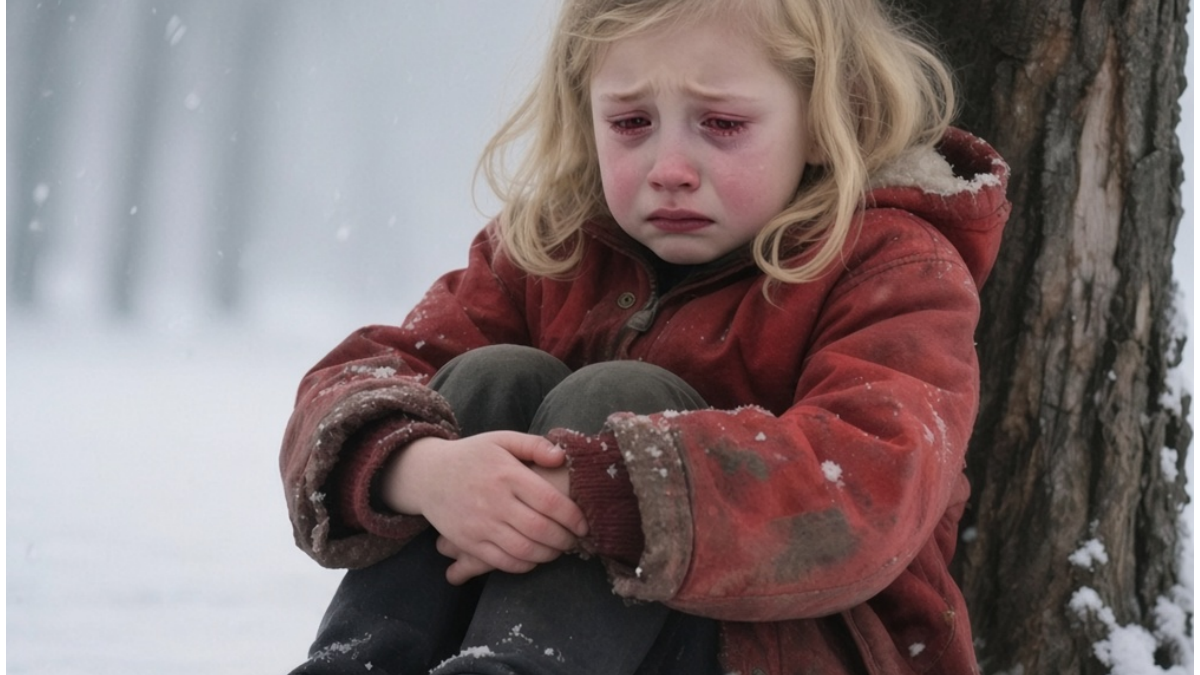
A poor little girl crying in the snow ‘My mother doesn’t want me anymore’ Until billionaire appe
Yeah, I buried my daughter with a check. No amount of money could cash. That was the day I learned grief does not negotiate.
Snow fell like ash over Greenwood Memorial Cemetery, soft and relentless coating the marble headstones in a white silence that swallowed even the sound of traffic from the highway a mile away.
Jonathan Hale stood 6’2 in a tailored black overcoat that cost more than most men’s monthly mortgage, yet the cold still found its way through the wool and into his bones.
52 years old, worth 3.8 billion dollars, and utterly powerless. The wind cut across the open hill at 15 mph, pressing snow against his polished shoes, dusting the bouquet of white lilies he held in gloved hands.
Lily had loved winter. She used to press her small palms against the window of their Manhattan penthouse counting snowflakes like they were secrets falling just for her.
Now the only counting Jonathan did was backwards 6 months, 12 days, 4 hours since the hospital monitor went silent.
He had funded children’s hospitals in three states, built libraries, paid for strangers surgeries, yet none of it bent fate even an inch.
Money moved markets. It did not move heaven. The cemetery lights flickered on as dusk settled at 28° Fahrenheit, and the world turned blue with evening.
Jonathan placed the lilies at the base of the stone engraved with Lily Ann Hale, beloved daughter, and for a moment his breath fogged the air like something alive trying to escape him.
He did not cry anymore. Tears implied release, and he had none left to give.
Behind him, his driver waited inside a black town car with the engine running warmth humming softly, but Jonathan remained still staring at the date carved in granite, realizing that the only thing colder than the winter night was the life waiting for him beyond these gates.
The driver stepped out and opened the rear door, but Jonathan did not move until the last cemetery worker locked the iron gates with a metallic click that echoed through the frozen air.
The sound felt final like a period at the end of a sentence he never agreed to write.
He walked toward the car slowly, snow crunching under each measured step, the rhythm steady and hollow.
Inside the leather seats were warm, the heater humming at 70° Fahrenheit, but warmth had become a foreign language to him.
As the car pulled onto the quiet road, streetlights blurred against the frosted window stretching into long golden streaks that dissolved into darkness.
6 months ago, Lily had been in the backseat swinging her boots, asking if the snow would follow them home.
Now the backseat was empty except for a small indentation in the leather where her car seat once rested.
Jonathan had ordered it removed the week after the funeral. He could not bear the outline of something that would never be used again.
His phone vibrated in his coat pocket, notifications from board members, foundation directors, market analysts waiting for his decisions.
He silenced it without looking. The world still wanted his signature, his approval, his money.
It did not care that he had nothing left to give. As the car turned onto Fifth Avenue passing storefronts dressed in winter lights and families bundled in scarves, laughter drifted faintly through the glass.
Jonathan stared straight ahead, jaw tight, eyes dry. He had built an empire by predicting risk and controlling outcomes, but grief had entered his life without warning, without negotiation, and without any clause for escape.
And tonight, for reasons he could not explain, he did not tell the driver to go home.
“Do not go home,” he said quietly, his voice steady but distant, as if giving instructions inside a boardroom instead of the backseat of a moving car.
The driver hesitated for half a second in the rearview mirror, then nodded and continued downtown without asking questions.
Snow thickened, falling in heavier sheets now, the flakes catching in the headlights and spinning like white sparks against the night.
Manhattan felt smaller in winter, the skyscrapers looming like silent guardians over streets glazed in ice and reflection.
Jonathan loosened his tie but did not remove it. He had not removed it since the funeral.
It felt like a tether to structure, to order, to the version of himself who still believed discipline could conquer anything.
The car passed the children’s hospital wing he had funded 5 years earlier, his name etched in bronze beside the entrance.
Hale Pediatric Center. The lights inside glowed warm against the storm, and for a brief moment he imagined Lily inside one of those windows, her small hand raised in a wave.
The illusion dissolved as quickly as it formed. He closed his eyes inhaling slowly, counting to four, then releasing the breath just as slowly the way his therapist had suggested.
It did not help. Nothing did. When the car stopped at a red light near Central Park, Jonathan opened his eyes and stared out at the snow-covered trees lining the dark expanse.
The park looked endless, quiet, untouched, a world suspended in white. He felt an unexpected pull in his chest, not sharp, not painful, but persistent.
As if something out there beyond the glass and steel and carefully managed distance of his life was waiting.
The light turned green. He did not tell the driver to move faster. He simply watched the park as they drove alongside it, unaware that this detour would change everything.
“Slow down,” Jonathan said suddenly, his eyes narrowing as something small and out of place caught his attention near the edge of the park.
The driver eased his foot off the accelerator, the car rolling gently along the snow-lined curb.
At first Jonathan thought it was a pile of discarded blankets beneath one of the bare oak trees half-buried under fresh snowfall.
But then the shape shifted. Slightly. Deliberately. His breath stilled. Through the glass beneath the glow of a flickering street lamp, he saw a small figure sitting at the base of the tree, knees drawn up to a thin chest, arms wrapped tightly around them as if trying to hold in whatever warmth remained.
Snow dusted the top of a pale blonde head and clung to the shoulders of a light pink coat that was far too thin for 27° weather.
For a moment he assumed a parent must be nearby, perhaps searching, perhaps unaware their child had wandered a few yards away.
He scanned the sidewalk, the benches, the path leading deeper into the park. No one.
No movement except the falling snow and the quiet tremble of that tiny frame. His mind moved quickly, automatically assessing distance.
15 yards from the curb. No visible adult within 50 yards. No stroller. No footprints leading away that had not already been softened by fresh snow.
A child. Alone. At night. In a storm. Jonathan felt something unfamiliar and sharp rise in his chest, not grief this time, but urgency.
He reached for the door handle before he could reconsider. The driver turned in alarm.
“Sir, it is freezing out here.” Jonathan did not answer. The cold air hit him instantly as he stepped onto the curb, snow crunching beneath polished leather shoes that were never meant for sidewalks like this.
The wind pressed against his coat as he moved closer each step, deliberate, cautious, as if approaching a fragile memory.
When he was within a few feet, he could hear it. Soft. Broken. The unmistakable sound of a child trying not to cry.
He stopped a few feet away, not wanting to startle her, the snow falling steadily between them like a fragile curtain.
Up close she looked even smaller than he first thought. Maybe 5 years old, her boots dusted white, laces loosely tied, one glove missing.
Her fingers were red from the cold, curled tightly into the sleeve of her coat.
She did not notice him at firSt. Her face buried against her knees, shoulders trembling with quiet sobs she was clearly trying to swallow.
Jonathan cleared his throat gently, careful to keep his voice low and even. “Hey there,” he said, forcing warmth into a tone that had not been used in months.
“Are you out here by yourself?” The little girl stiffened but did not run. Slowly she lifted her head.
Pale blue eyes met his wide and glossy under the streetlight. Snowflakes clung to her eyelashes melting into thin trails down her cheeks.
He felt his chest tighten. She looked like winter itself, fragile and almost translucent in the cold.
“I cannot find my mother.” She whispered, her voice thin and shaking. “She said she would come back, but I waited a long time.”
Jonathan glanced around again, scanning the dark park paths, the empty sidewalk stretching in both directions.
“How long is a long time, sweetheart?” He asked carefully. She shrugged, lips quivering. “The trees got darker.
The lights came on. I got cold.” The simplicity of her explanation hit him harder than any accusation could have.
He crouched slowly, lowering himself to her level despite the sting of icy ground seeping through his slacks.
“What is your name?” He asked. “Emily.” She answered after a pause, as if unsure whether it was safe to offer.
“I’m Jonathan.” He replied softly. “Do you know where you live, Emily?” She shook her head, hugging herself tighter.
“She said maybe she does not need me anymore.” The words landed between them heavier than the snow.
Jonathan felt the air leave his lungs as if the cold itself had spoken through her.
“She does not need me anymore.” No child invented a sentence like that without hearing it firSt. He kept his expression steady even as something deep and protective stirred beneath the grief he had been carrying for months.
Emily’s lower lip trembled and she blinked hard as if embarrassed by her own tears.
Snow gathered along the shoulders of her thin coat, already damp around the seaMs. At 27° Fahrenheit, a child her size would not stay warm for long.
Jonathan slipped off his leather gloves and gently placed them over her bare hands, wrapping her small fingers inside the lining.
They swallowed her hands completely. “These are just for a minute.” He said softly. “They are very warm.”
She hesitated then let him adjust them without pulling away. He removed his scarf next a thick cashmere charcoal gray and draped it carefully around her shoulders.
The fabric nearly covered her to the knees. From a distance, the driver stepped closer but remained silent sensing that something fragile was unfolding.
Emily looked up at Jonathan again, searching his face for something he could not quite name.
“Are you going to leave, too?” She asked quietly. The question struck him harder than the wind.
“No.” He answered immediately, the word firm before he had time to analyze it. “I am not going anywhere.”
He glanced toward the street. “We need to get you somewhere warm, Emily. We can call the police and help find your mother, all right?”
She flinched slightly at the word police then looked back down at the snow. “I waited a long time.”
She whispered. “I was good. I did not move.” Jonathan swallowed. He extended his hand palm up, careful and slow.
“You were very brave.” He said. “Let me help you now.” After a heartbeat that felt far longer than it should have, her tiny hand slid into his.
Her hand was impossibly small inside his cold even through the leather lining of his gloves, but she did not pull away.
Jonathan rose slowly guiding her to her feet, brushing snow from the top of her coat with gentle deliberate movements.
She swayed slightly and he steadied her without hesitation. The wind cut sharper now, pushing snow sideways across the path as if urging them to move.
The black town car idled at the curb headlights glowing warm against the white night.
Emily looked toward it uncertainly then back at him. “It is warm inside.” Jonathan said quietly.
“Just for a little while. We will call for help.” She nodded though her eyes remained wary, scanning his face as if measuring the truth of every word.
He opened the rear door himself, lowering his head so she would not feel rushed.
The blast of heated air met them immediately. For a second, she simply stood there feeling the warmth brush her cheeks, almost disbelieving.
Jonathan helped her climb in, lifting her gently so her boots would not slip against the icy curb.
He sat beside her instead of across, keeping a respectful distance, careful not to crowd her.
The driver closed the door and returned to his seat. As the car pulled away from the park, snow streaked across the windows in white lines and Emily’s shoulders slowly began to relax.
Jonathan removed his coat and draped it fully around her, tucking the edges beneath her arms the way he used to do for Lily.
The memory struck him without warning but he did not retreat from it. “Are you hungry?”
He asked softly. She hesitated then nodded once. “When was the last time you ate?”
She thought for a moment. “This morning.” “Cereal.” The simplicity of the answer made his jaw tighten.
He leaned forward slightly. “Daniel.” He said to the driver. “Find the nearest open diner and call the police dispatch.
Tell them we found a child alone near Central Park South.” Behind him, Emily’s small fingers gripped the edge of his sleeve not tightly, just enough to make sure he was still there.
The diner on Columbus Avenue glowed like a small lighthouse against the storm neon sign buzzing softly as snow piled along the curb.
Daniel pulled the car up front and Jonathan stepped out first, circling to help Emily down carefully.
The warmth inside wrapped around them the moment the door opened, carrying the scent of coffee and fresh pancakes.
A few late-night customers glanced up curious but quiet. Jonathan guided Emily to a booth near the window, sliding in beside her instead of across, instinctively shielding her from the draft each time the door opened.
He removed his coat fully and draped it around her shoulders again then gently peeled off the damp gloves he had given her.
Her fingers were still pink from the cold but no longer stiff. A waitress approached with a kind tired smile.
“Hot chocolate with extra marshmallows.” Jonathan said before Emily could answer “and a grilled cheese sandwich.
Make it two.” Emily’s eyes flickered up at him uncertain. “You do not have to eat it all.”
He added softly. “Just enough to feel warm.” She nodded. As they waited, Jonathan noticed how she kept scanning the door, flinching slightly each time the bell above it chimed.
“Are you afraid someone is coming?” He asked gently. She shook her head but did not look convinced.
“I was supposed to stay where she left me.” She said quietly. “She said if I moved, she would not find me.”
Jonathan felt the weight of those words settle heavily between them. “You stayed because you were trying to do the right thing.”
He replied carefully. “That does not mean you did anything wrong.” The hot chocolate arrived, steam rising in soft curls.
Emily wrapped both hands around the mug, eyes closing briefly as the warmth seeped into her skin.
Jonathan watched her take the first cautious sip, a small line of marshmallow clinging to her upper lip.
For the first time that night, she looked less like a child abandoned in a snowstorm and more like a little girl who deserved to feel safe.
His phone vibrated on the table. Police dispatch confirming they were on their way. The grilled cheese arrived golden and steaming, cut diagonally into two neat triangles and Emily stared at it for a second as if unsure whether she was allowed to touch it.
Jonathan nudged the plate slightly closer to her. “It is yours.” He said gently. She picked up one half with both hands, taking a small bite first cautious then another that was larger, hunger quietly overcoming hesitation.
Jonathan forced himself to eat as well though he barely tasted anything. His attention remained fixed on her every movement, the way she checked the door each time it opened, the way her shoulders tensed whenever a stranger laughed too loudly.
The bell above the entrance chimed again and this time two uniformed officers stepped inside brushing snow from their hats.
Conversations around the diner softened. Jonathan raised his hand calmly. “Over here.” Emily froze beside him, sandwich suspended midair.
“It is all right.” He whispered, keeping his voice steady. “They are here to help.”
The officers approached with measured expressions. One older with gray at his temples, the other younger eyes alert but kind.
“Sir, we received your call.” The older officer said. Jonathan nodded and kept his tone composed as he explained where he had found her, the exact location, the time, the weather conditions.
He spoke in details precise and factual the way he would present numbers in a board meeting.
Emily listened silently, fingers tightening slightly around his sleeve again. The younger officer crouched a little to meet her eye level.
“Hi there, sweetheart. What is your name?” Emily hesitated, glancing at Jonathan firSt. He gave her a small encouraging nod.
“Emily Carter.” She said softly. The officers exchanged a quick look. “Carter.” The older one pulled out a small notepad.
“We have not received a missing child report matching that name tonight.” The words hung in the air like the snow still falling outside.
Jonathan felt a quiet shift inside his chest, something heavier than concern. “You mean no one has called?”
He asked evenly. “Not yet, sir.” “It could take time.” The officer replied. “Sometimes parents do not realize immediately.”
Emily lowered her eyes to the table. “I waited where she told me,” she murmured.
The older officer straightened, thoughtful. “We will need to take her to the precinct for now while we run her name and check local reports.
Standard procedure.” Jonathan looked down at the small girl beside him, the marshmallow now melted into the bottom of her cup, her scarf still wrapped too big around her shoulders.
The idea of handing her over to a fluorescent waiting room filled with strangers tightened his jaw.
“How long will she be there?” He asked quietly. “Until we locate a guardian or until child services can evaluate the situation.”
The answer was procedural, impersonal. Outside, the storm continued to build snow, collecting thicker against the diner windows.
And for the first time that night, Jonathan felt the weight of a decision pressing directly against his heart.
Jonathan held the officer’s gaze a second longer than necessary, his voice calm but firm.
“I would like my attorney present before she is transferred anywhere unfamiliar,” he said quietly.
The older officer studied him more carefully now, recognition beginning to settle in. “Mr. Hale, correct?”
Jonathan gave a slight nod. “Yes. I am not trying to interfere with procedure. I simply want to ensure she does not spend the night alone in a facility if there are other lawful options.”
Emily looked up at him at the word alone. Her small fingers tightening again around his sleeve.
The younger officer shifted his weight. “Sir, unless you are a legal guardian or relative, temporary placement is standard until child services assesses the situation.”
Jonathan understood systeMs. He had built companies around them. He also understood influence, but he did not raise his voice or posture.
Instead, he turned slightly toward Emily. “I am not sending you anywhere without knowing where you are going,” he said softly.
“I promise.” She searched his face again, that quiet evaluation children make when they have learned not to trust easily.
The older officer exhaled. “Given the weather and the hour, we can escort all of you to the precinct and contact emergency child services from there.
It is about 10 minutes from here.” Jonathan considered the fluorescent lights, the hard plastic chairs, the institutional stillness.
He imagined Emily sitting small and silent under buzzing ceiling panels while strangers filled out paperwork.
He felt an ache he had sworn never to feel again. “If I agree to accompany her and remain present, will that be permitted?”
He asked. “Yes, sir, as long as you understand this does not establish custody.” “Understood.”
Emily’s voice interrupted barely above a whisper. “Am I in trouble?” The simplicity of it fractured something inside him.
“No,” he answered immediately, turning fully toward her. “You did nothing wrong. We are just making sure you are safe.”
The officers nodded in quiet agreement. Outside, the storm pressed harder against the diner windows, snow piling inches higher along the curb.
Daniel stepped in from the cold, approaching the booth. “The roads are getting slick, sir.
Another 2 in since we parked.” Jonathan glanced at the officers. “Let us go before it worsens.”
He stood slowly and helped Emily slide out of the booth, wrapping his coat more securely around her small frame.
As they stepped back into the night, the wind felt sharper than before, the city dimmer beneath the storm.
Jonathan guided her carefully toward the waiting car, unaware that the next hour would force him to confront a truth he had been avoiding since the day he lost his daughter.
The precinct lobby was brighter than the diner fluorescent lights reflecting off polished tile floors that smelled faintly of disinfectant and winter air.
Snow melted from boots near the entrance, forming small puddles that tracked across the room.
Jonathan kept his hand gently at the center of Emily’s back as they walked in, not pushing, just steadying.
She stayed close to his side, wrapped in his coat, eyes scanning every uniform and every raised voice.
The older officer spoke quietly to the desk sergeant, while the younger one pulled a chair near a side wall away from the main flow of people.
“You can sit here for now, sweetheart,” he said kindly. Jonathan sat beside her without hesitation.
“A social worker is on call tonight,” the older officer explained. “With the storm, it may take some time for her to arrive.
We are also checking nearby precincts for any late reports.” Jonathan nodded once. “How long before child services typically places a call to confirm custody status?”
He asked. “Usually within the hour if a parent reports,” the officer replied. “If not, emergency placement is arranged by morning.”
Emily’s fingers toyed with the edge of the oversized scarf, twisting the fabric repeatedly. Jonathan noticed the small habit, the silent anxiety beneath it.
He leaned slightly toward her. “Do you remember your address even a little bit?” He asked gently.
“A store near your house? A school? A color of the building?” She squeezed her eyes shut, thinking hard.
“There is a red mailbox,” she said finally. “And stairs that make noise.” That was all.
Jonathan swallowed. The details were fragile threads, barely enough to follow. A television mounted high in the corner played muted news footage about the worsening storm, meteorologists predicting up to 6 in overnight.
The room buzzed with routine activity, phones ringing, radios crackling, officers moving with practiced efficiency.
Yet in the middle of it, Emily seemed suspended in her own quiet fear. She leaned slightly into Jonathan’s arm, not fully, just enough to confirm he was still there.
He felt it like an electric current through his sleeve. He had spent months avoiding any reminder of small hands reaching for him.
Now one was resting against him again, tentative but real. The older officer returned with a folder in hand.
“No missing report under the name Carter so far. We are expanding the search to surrounding boroughs.”
Jonathan’s jaw tightened almost imperceptibly. Somewhere in this city, either someone was desperately looking for this child or no one was.
And that uncertainty began to weigh heavier than the storm outside. An hour passed, measured not by the clock on the wall, but by the way Emily’s small body grew heavier against his side.
The storm outside intensified, wind rattling the precinct windows as snow piled against parked patrol cars.
The television now reported nearly 5 in accumulated in parts of Manhattan with road closures beginning across several avenues.
Jonathan listened without really hearing, his attention anchored to the quiet rise and fall of Emily’s breathing.
She had fallen asleep sitting upright, her head resting carefully against his arm as if afraid to lean too much.
He adjusted his posture to support her fully, ignoring the stiffness settling into his shoulder.
A female social worker finally entered, coat dusted white, carrying a leather folder and an expression trained to remain neutral.
She introduced herself as Ms. Alvarez and knelt beside the chair so that when Emily stirred awake, she would not feel towered over.
“I just want to ask you a few gentle questions,” she said softly. Emily blinked, disoriented for a moment, then instinctively reached for Jonathan’s sleeve again.
He stayed still, offering quiet reassurance with a slight nod. Ms. Alvarez asked about school, about friends, about anything that might identify a neighborhood.
Emily’s answers remained small and uncertain. The red mailbox, the noisy stairs, a corner store that sold strawberry candy.
No last name for her mother. No phone number memorized. Ms. Alvarez stood slowly and stepped aside with the officers.
In low voices, they discussed protocol. “Given the weather, emergency placement tonight would likely be temporary housing outside the city until conditions improved.”
Jonathan heard the phrase temporary housing and felt a familiar resistance tighten inside him. He had seen too many reports, funded too many programs to ignore what that system sometimes looked like.
He rose and approached them calmly. “If no guardian reports by midnight, I would like to request emergency custodial sponsorship,” he said evenly.
Ms. Alvarez studied him carefully. “That is highly unusual. It requires background clearance, financial disclosure, and judicial review.”
“I understand,” he replied. “Begin it. I will provide whatever documentation is required.” The officers exchanged glances, aware of exactly who stood before them.
“This is not charity,” Ms. Alvarez said quietly. “It is responsibility.” Jonathan looked past her at Emily sitting small in a metal chair far too large for her eyes fighting sleep, yet refusing to close completely.
“I am aware,” he answered. The weight in his chest was no longer just grief.
It was choice. Midnight came and went with no report filed, no frantic parent calling precincts, no description matching a 5-year-old girl in a thin pink coat left near Central Park.
The The storm outside had grown into a full white curtain, 6 in of snow burying sidewalks and muting the city into something almost unreal.
Inside the precinct, the fluorescent lights felt harsher exposing every crease of fatigue on every adult face.
Emily’s head had dipped forward again fighting sleep as if rest itself were unsafe. Jonathan stood by the window for a long moment staring out at the swirling snow and for the first time since Lily’s funeral, he felt something other than emptiness.
He felt fear. Not of losing something. Of being given something. Ms. Alvarez returned with a stack of preliminary forMs. “Mr. Hale,” she said carefully.
“We have confirmed there are no active missing child reports matching her name or description in the five boroughs as of this hour.
Emergency foster placement is available tonight, but travel conditions are deteriorating.” She paused. “If you are serious about temporary custodial sponsorship, we can initiate an expedited review given your background record, but this will draw attention.
Your name carries weight. Media inquiries are inevitable.” Jonathan did not respond immediately. He had spent decades controlling narratives, managing public image, ensuring every headline aligned with strategy.
He imagined tomorrow’s news cycle. Billionaire takes custody of abandoned child. Speculation. Motives questioned. Grief dissected [clears throat] by strangers.
He imagined board members advising caution, lawyers suggesting distance. He imagined the easier path, the clean path, the path that required nothing from his already fractured heart.
Then he looked at Emily. She had slid down in the metal chair her feet not touching the floor scarf swallowing half her small frame.
She was trying not to cry again, eyes glossy but stubborn. “Are they sending me somewhere else?”
She asked quietly when she noticed the adults speaking in low tones. The question was simple.
It broke him open. Jonathan crossed the room and knelt in front of her lowering himself so their eyes were level.
“Emily,” he said voice steady but thick with something deeper than control. I need you to listen to me.
You are not being sent away tonight. I am staying. If they allow it, you will come somewhere warm with me until we figure everything out.”
She searched his face the way she had beneath the tree measuring truth against experience.
“You promise,” she whispered. He did not hesitate. “Yes.” The word felt heavier than any contract he had ever signed.
Behind him, Ms. Alvarez watched carefully. “Mr. Hale,” she said softly. “This is not about replacing what you loSt.” Jonathan did not turn around.
“I know,” he answered. “This is about refusing to lose someone else.” The paperwork began to move faster than anyone expected once Jonathan Hale’s full legal name was entered into the system.
Background clearances surfaced within minutes, financial disclosures verified by encrypted databases that confirmed what the city already knew.
He was solvent beyond question. He had no criminal record. He had funded more public initiatives than most elected officials.
Yet none of that answered the question lingering in the room. Why would a man who had everything risk reopening the deepest wound of his life for a child he met less than 3 hours ago?
Ms. Alvarez reviewed the emergency custodial sponsorship clause again explaining carefully that this arrangement would be temporary and subject to judicial confirmation within 72 hours.
Jonathan listened without interrupting. His posture was composed, but inside him something far less controlled was unfolding.
He had spent 6 months constructing walls around his grief, convincing himself that survival meant detachment.
Now those walls were cracking under the weight of a 5-year-old girl who refused to let go of his sleeve.
When the final preliminary form was placed before him, the room felt unnaturally quiet. “This acknowledges that you assume immediate responsibility for her safety, housing, medical needs, and legal cooperation during investigation,” Ms. Alvarez said.
“It also acknowledges that if a verified parent or guardian is located, custody decisions may change.”
Jonathan did not hesitate. He signed. The sound of pen against paper felt louder than it should have.
Emily watched him with wide eyes. “Does that mean I am going with you?” She asked softly.
He nodded once. “Yes. For tonight and for as long as they allow it.” She slid out of the metal chair and stepped closer not fully embracing him just pressing her small hand against the front of his coat as if confirming he was real.
The gesture struck deeper than any thank you could have. Outside the storm howled against the building wind gusting near 30 mph snow stacking against door frames and patrol cars.
Inside a different kind of storm settled in Jonathan’s cheSt. Not chaos. Not fear. Responsibility.
He realized with startling clarity that grief had made him feel powerless, but choice restored something else entirely.
When Ms. Alvarez handed him a temporary authorization document, she met his eyes. “This will not be simple,” she said quietly.
He looked down at Emily at the way exhaustion had softened her features now that certainty replaced confusion.
“I am not looking for simple,” he replied. “I am looking for right.” The authorization document felt heavier in Jonathan’s hand than any contract he had signed in his career.
Not because of its legal weight, but because of what it required of him emotionally.
When they stepped back out into the storm, Emily’s small hand slipped into his again without being asked.
Snow whipped across the precinct steps, wind cutting through the city at nearly 35 mph now patrol cars half buried along the curb.
Daniel rushed forward with an umbrella, but the wind turned it nearly inside out. Jonathan did not care about the cold.
He bent slightly so Emily could climb into the car without slipping lifting her carefully as if she were made of glass.
Once inside the heater blasted warm air against their faces fogging the windows almost instantly.
Emily looked around the back seat, eyes wide but calmer than before. “Is this your car?”
She asked quietly. “Yes,” he answered. “For tonight, it is ours.” The word slipped out before he analyzed it and when he realized what he had said, he did not take it back.
As the car pulled away from the precinct, the city felt transformed streets nearly empty, traffic lights blinking against thick snow that muted every sound.
Jonathan gave Daniel the address of his penthouse then hesitated. “No press notifications, no staff calls, no announcements.
Just security clearance at the garage.” Daniel nodded. In the back seat, Emily leaned her head gently against the door, eyelids heavy.
“You really are not going to leave,” she murmured half asleep. Jonathan turned toward her fully.
“I am not leaving,” he said. And this time the promise felt rooted in something stronger than impulse.
It felt deliberate. He watched as sleep finally claimed her small breaths, steady shoulders no longer tense.
For months he had avoided returning home because every room echoed with absence. Lily’s bedroom remained untouched, toys aligned exactly as they had been left.
Silence pressing in from every wall. Tonight he would walk back into that space with another child beside him.
The thought terrified him. It also steadied him. Grief had convinced him that loving again meant betrayal of what he had loSt. But as snow blanketed the city in white, he understood something different.
Love was not a replacement. It was expansion. And somewhere between a lonely park bench and a fluorescent waiting room, his heart had chosen to open again.
The private garage gates opened slowly as the car descended beneath the building tires crunching over packed snow before meeting smooth concrete.
Security recognized the vehicle immediately offering a discreet nod without questions. Jonathan stepped out first then turned and carefully lifted Emily into his arms when he realized she had fallen fully asleep.
She stirred only slightly. Her small fingers instinctively curling into the fabric of his suit jacket.
The elevator ride to the penthouse felt longer than usual. The mirrored walls reflecting a man he barely recognized.
For months he had ridden this elevator alone. Shoulders squared, expression closed. Returning to a home that felt more like a monument than a place to live.
Tonight, there was a child resting against his cheSt. Her breath warm through the thin fabric of his shirt.
Her presence undeniable. When the doors opened, the lights inside the penthouse illuminated automatically casting a soft golden glow across marble floors and wide glass windows overlooking a city buried under white.
The silence greeted him firSt. It always did. He carried Emily past the living room where Lily used to scatter crayons across the coffee table, past the piano that had not been touched since the day everything changed.
He paused outside the hallway that led to Lily’s bedroom. The door remained closed exactly as he had left it 6 months ago.
His chest tightened, but he did not turn away. Instead, he guided Emily into the guest room at the end of the hall, a space rarely used, neutral, and quiet.
He laid her gently on the bed and removed his oversized coat from around her shoulders, replacing it with a soft, cream-colored blanket.
She stirred and opened her eyes halfway. “Where are we?” She whispered. “You are somewhere safe.”
He answered softly. She looked around once more, taking in the tall windows and distant city lights, then focused back on him.
“Are you staying?” “I am right here.” He replied, pulling a chair beside the bed.
As she drifted back to sleep, Jonathan sat watching her steady breathing, listening to the faint hum of the city beyond the glass.
For the first time since Lily’s laughter had faded from these walls, the apartment no longer felt entirely hollow.
It felt uncertain, fragile, and unfamiliar. But it no longer felt empty. Morning arrived quietly, sunlight filtering through floor-to-ceiling windows and reflecting off the snow-covered rooftops below.
The storm had passed, leaving nearly 8 inches of white across the city, transforming Manhattan into something almost peaceful.
Jonathan had not slept. He remained seated in the chair beside the bed, jacket draped over the backrest, eyes fixed on the small rise and fall of Emily’s breathing.
When she finally stirred, confusion flickered across her face for half a second before memory returned.
She pushed herself up slowly, blanket pulling around her shoulders. “You are still here.” She said, almost surprised.
“I told you I would be.” Jonathan replied gently. He stood and walked to the window, pulling the curtain slightly so she could see outside.
“Snow makes everything look new.” He said. Emily slid out of bed and joined him, her small hand pressing against the glass.
“It looks like frosting.” She murmured. He felt something in his chest soften at the innocence of it.
A quiet knock sounded at the bedroom door. It was Maria, the housekeeper, who had worked for him for over a decade.
Her expression carried surprise, but also warmth. “I made breakfaSt.” she said softly. Emily glanced up at Jonathan as if asking permission without words.
“Breakfast sounds good.” He said. In the kitchen, sunlight reflected off marble countertops while fresh pancakes steamed on porcelain plates.
Emily sat carefully at the large dining table, feet dangling far above the floor. Jonathan noticed how she looked at everything with cautious curiosity, as if the room might disappear if she blinked too long.
His phone vibrated on the counter. A message from Ms. Alvarez. No guardian had come forward overnight.
Investigation continuing. Temporary custodial sponsorship in effect pending further review. Jonathan set the phone down slowly.
This was no longer a single-night decision. It was unfolding into something larger, more permanent.
Emily took a small bite of pancake and then looked up at him. “Do I have to go back outside today?”
She asked quietly. “No.” He answered. “Not today.” Relief crossed her face in a way that was almost painful to witness.
Jonathan realized then that safety was not a grand gesture. It was consistency. It was being there when morning came.
And as sunlight poured across the kitchen and melted the edges of snow on distant rooftops, he understood that the true test of his promise would not be in dramatic moments.
It would be in ordinary days like this one. By midday, the city had begun digging itself out from under the snow plows scraping along avenues and workers shoveling sidewalks in careful rhythMs. Inside the penthouse, the warmth felt steady and intentional, no longer a contrast to emptiness, but a shelter shared.
Jonathan spent the morning on a series of controlled phone calls, not to investors or media outlets, but to his legal team and to Ms. Alvarez.
He requested a full review of missing persons reports from neighboring counties and authorized a private investigator to assist law enforcement, not to circumvent the process, but to accelerate it.
If Emily had family searching for her, they would find her quickly. If they did not, he needed to understand why.
When he returned to the living room, he found Emily kneeling near the glass windows tracing shapes in the thin condensation with her finger.
She had drawn a small house with smoke rising from the chimney. “Is that where you lived?”
He asked gently. She shook her head. “That is where I want to live.” The answer was not dramatic.
It was simple. And it pierced him more deeply than anything else. He knelt beside her, noticing how the city skyline reflected faintly in her pale blue eyes.
“We can build something like that.” He said quietly. “Maybe not with a chimney, but something warm.”
She studied him carefully. “Even if my mother comes back?” She asked. He paused, choosing honesty over comfort.
“If your mother comes back and she is able to care for you safely, then that will be a conversation we have together.
But until we know, you are not alone.” Emily seemed to weigh those words, then nodded slowly.
In the afternoon, Ms. Alvarez arrived in person to conduct a home evaluation. She moved through the penthouse professionally, observing the guest room, the security system, the overall environment.
Her expression softened slightly as she watched Jonathan kneel to help Emily tie her shoelaces when they came loose.
“You understand this may lead to long-term guardianship proceedings.” She said quietly once they stepped aside.
Jonathan looked across the room at Emily, who was carefully arranging crayons Maria had found in a drawer.
“I understand.” He replied. Grief had once convinced him that his heart could not survive another attachment.
But standing there watching a child draw in sunlight instead of sitting beneath a frozen tree, he felt something entirely different.
Not fear of loss. Readiness for responsibility. And for the first time since winter began, he did not dread what tomorrow might bring.
Three days passed without a single verified claim of guardianship. No relative appeared. No credible leads surfaced beyond fragmented records that suggested instability and repeated moves.
The investigation quietly shifted from locating a searching parent to understanding why no one was searching at all.
Jonathan kept the updates private, shielding Emily from details she did not need to carry.
Instead, he focused on rhythMs. Breakfast at 8:00. Reading time at 10:00. Short walks in the building’s indoor garden while snow still lined the streets outside.
Consistency began to soften the tension in her shoulders. On the fourth morning, sunlight streamed across the living room rug where Emily sat cross-legged with a stack of picture books Maria had found in storage.
Jonathan watched from the dining table reviewing legal briefs that outlined the next step, petitioning the court for temporary guardianship pending long-term evaluation.
It was no longer an impulsive rescue. It was structure. Emily looked up suddenly. “Can I see the room down the hall?”
She asked carefully. The question froze him for a moment. He knew which room she meant.
He stood slowly and walked with her to the closed door he had avoided opening for months.
His hand rested on the handle longer than necessary before turning it. The room inside remained untouched, soft lavender walls, a small bed neatly made, shelves of storybooks and stuffed animals.
Dust motes floated in the sunlight like suspended memories. Emily stepped inside quietly, not touching anything at firSt. “It was your daughter’s.”
She said, not as a question. “Yes.” He answered. She walked to the window and looked out at the melting snow.
“It is pretty.” She whispered. Jonathan felt grief rise, but it no longer crushed him.
It coexisted with something new. When Emily turned back toward him, there was no fear in her eyes, only truSt. And trust, he realized, was a second chance.
The court hearing was scheduled quietly without press announcements or public spectacle. Jonathan sat at the long, polished table beside his attorney while Emily colored softly in a small waiting area just outside the courtroom doors, supervised by Ms. Alvarez.
The The reviewed the investigative findings with careful precision. No verified guardian had come forward.
Records indicated repeated housing instability and unresolved legal complications involving Emily’s mother. Temporary guardianship was granted pending a full custody evaluation.
The gavel’s sound was not dramatic. It was measured, deliberate, but to Jonathan, it echoed like the closing of one chapter and the careful opening of another.
When he stepped back into the hallway, Emily looked up immediately. Her eyes searched his face the same way they had beneath the tree that first night.
“Are we still going home together?” She asked quietly. “Yes,” he answered, kneeling in front of her.
“We are going home together.” She did not jump into his arMs. She simply smiled, small and real, then slipped her hand into his.
Outside the courthouse, the snow had begun to melt, revealing pavement beneath what had seemed endless white only days before.
The air felt different now, not as sharp, not as unforgiving. Jonathan realized that grief had once convinced him his life ended at a headstone carved in stone.
But standing there with a child who trusted him enough to walk forward without fear, he understood something else.
Loss did not have the final word. Choice did. And he had chosen not to turn away when it would have been easier.
As they stepped into the car together, sunlight reflected off wet streets, and for the first time in months, Jonathan did not feel like he was returning to an empty house.
He felt like he was returning to a beginning. Spring arrived quietly over Manhattan, >> [clears throat] >> melting the last traces of winter from rooftops and park benches.
Nearly 3 months had passed since the night snow covered everything in white, and the penthouse no longer felt like a preserved memory.
It felt lived in. Crayons rested in a glass jar on the coffee table. A small pair of sneakers sat by the door.
Laughter, light and unexpected, traveled down the hallway at least once a day. Jonathan stood at the cemetery again one mild afternoon, sunlight warming the stone that once felt unbearably cold.
Emily stood beside him, holding a small bouquet of daisies she had chosen herself. “This was Lily’s favorite place,” Jonathan had explained gently.
Emily knelt and placed the flowers carefully at the base of the headstone. She did not speak loudly.
She simply whispered, “I am taking good care of him.” Jonathan felt his throat tighten, but this time it was not from grief alone.
It was gratitude. He placed his hand lightly on Emily’s shoulder, steady and protective. The wind was soft, carrying the scent of new grass instead of froSt. For months he had believed that loving again would diminish what he had loSt. Instead, he discovered that love multiplies.
It stretches. It makes room. As they walked back toward the car, Emily slipped her hand into his without hesitation.
“Do you think she can see us?” She asked. “I think she would want us to keep walking forward,” he replied.
Emily nodded thoughtfully. Then she looked up at him with a small, certain smile. “Okay, Dad.”
The word landed gently, not forced, not rehearsed. Jonathan paused for half a breath, letting it settle into the spaces that once felt empty.
Then he squeezed her hand and kept walking, no longer alone, no longer defined by loss, but by the choice he made on a snowy night to stay.








