A Poor Little Girl Cleans Car Windows—Then a Billionaire Hears Her Name and Breaks Down…
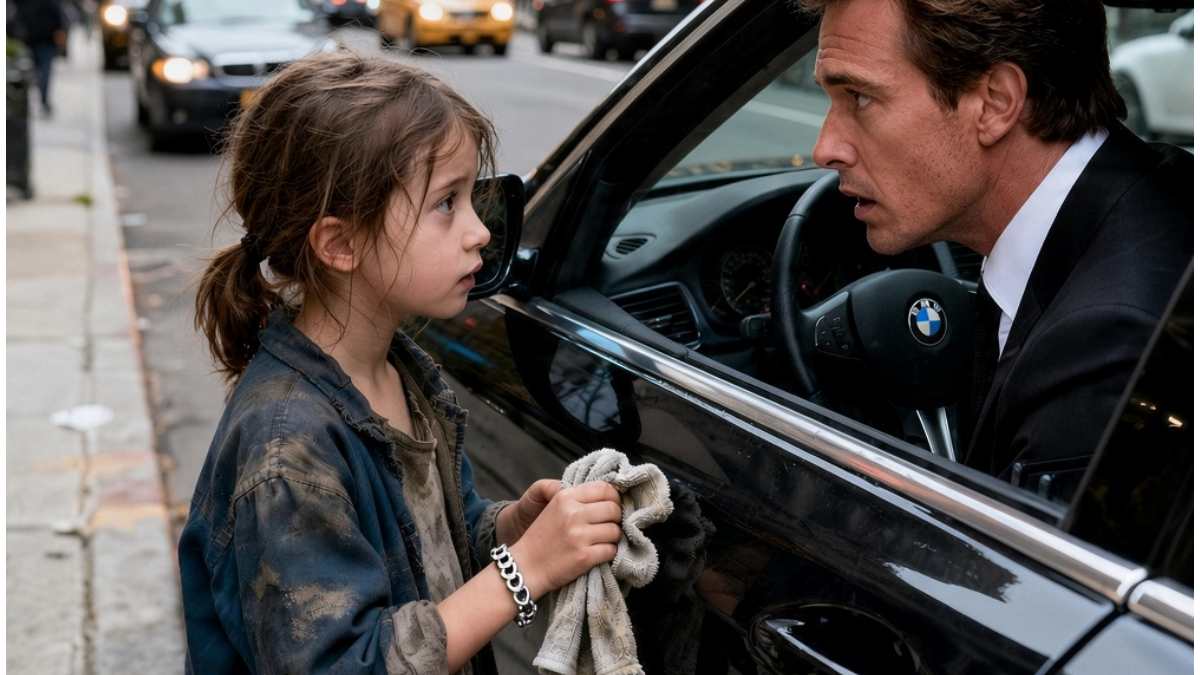
A 9-year-old homeless girl cleans car windshields at traffic lights to collect spare change and survive.
But when a young billionaire pulls up and notices on her wrist the very bracelet his late wife once wore, he freezes in shock.
It was a busy Thursday afternoon. Ethan Lancaster tapped his fingers on the steering wheel while waiting for the light to change.
His black BMW, pristine as always, stood in stark contrast to the worn streets of downtown.
At 45, Ethan had everything money could buy. Yet, his gray eyes reflected a void no professional success could fill.
It had been almost 2 years since Claraara’s passing. The accident took not just his wife, but also his ability to feel anything beyond a mechanical routine.
His life had turned into an endless chain of appointments, meetings, and lonely nights in a house far too large for just one man.
The traffic light was still red. Ethan straightened his tie and checked his watch. He was running late for an investor’s meeting.
That was when he noticed movement on his left. “A skinny little girl, no more than 9 years old, approached with a makeshift squeegee and a dirty rag.”
“I’ll clean your windshield for $5, mister,” [music] she asked in a childish but determined voice.
Ethan shook his head no, as he always did with anyone begging. The girl, however, had already started wiping the windshield.
He sighed, irritated by her persistence, and rolled down the window to tell her to stop.
I already said the words died in his throat. The instant he was about to scold her, his gaze caught something on her thin wrist, a silver bracelet with three small blue crystals.
It wasn’t just any piece of jewelry. It was identical to the one Claraara wore everyday, a custom piece he’d had made for their first wedding anniversary.
The world around him seemed to slow down. The noise of cars, the impatient honking, all faded into a distant hum.
Ethan’s heart pounded as a surge of memories overwhelmed him. “Where did you get that?”
He asked, his voice coming out louder and harsher than intended. [music] The girl stepped back, startled by his sudden change in tone, her large eyes filled with a distrust no child should ever bear, locked onto his, “That on your wrist!”
Ethan pointed, trying to steady his nerves. The bracelet. Where did it come from? The girl’s expression shifted between confusion and fear.
She clutched her wrist as though protecting a treasure. “It’s mine,” she said defensively, her voice small but firm.
“Without thinking, Ethan opened the car door. The light had turned green and horns blared behind him.
It didn’t matter. He had to know more about that impossible bracelet.” Wait,” he called.
“I’m not going to hurt you. I just want to talk.” But his abrupt movement had the opposite effect.
The girl, nimble with the reflexes of someone used to running, turned on her heels and darted between the cars.
Her small feet in battered, untied sneakers, moved with surprising speed. “Wait, please!” Ethan shouted, taking a few steps toward her.
It was no use. Within seconds, she vanished into the crowd on the other side of the avenue.
[music] Ethan stood there breathing heavily, aware of curious glances from pedestrians. The horns grew more insistent.
[music] Dazed, he got back into his car and drove on, operating on autopilot. The meeting that had seemed so important minutes ago suddenly felt meaningless.
All he could think about was that bracelet on a street child’s wrist miles away from where it was supposed to be.
Clara’s bracelet had been listed among her personal belongings. He was sure [music] of it.
Or was he? Ethan had never mustered the courage to go through her boxes. After the funeral, he’d paid someone to organize everything and store it in the guest room, which had remained closed ever since.
At the office, Ethan spent the day distracted. He asked his secretary to reschedule the meeting, claiming he felt unwell.
Sitting in his leather chair, he opened the bottom drawer of his desk and took out the only photo of Claraara he kept there.
The two [music] of them at the beach smiling with the bracelet visible on her wriSt. How could that girl possibly have something so similar?
Was it coincidence, a cheap knockoff? Or was [music] it actually possible that No. Ethan shook his head, trying to regain composure.
He was getting carried away by emotion. The most likely scenario was that it was just a piece of costume jewelry that happened to look alike.
Blue crystals weren’t exactly rare, but a stubborn voice inside him insisted it wasn’t just a coincidence.
The arrangement of the crystals, the exact design, that delicate shape, it was all too specific.
And something about that little girl, so young yet with such tired eyes, reminded him of Claraara.
Maybe her quiet determination, or the dignity she carried despite dire circumstances. That night, Ethan couldn’t sleep.
He tossed and turned, thinking about the girl, the bracelet, Claraara. How long had it been since he felt something this intense?
The restlessness bothered him, but at the same time, it made him feel alive, as though some long dormant part of him had been reactivated.
[music] The hours dragged on. He tried to convince himself he was overreacting to that random encounter.
But the image of the girl, fragile but proud, haunted his mind. How old might she be?
9, maybe 10. Where were her parents? Why was she working the streets instead of being in school?
The next morning, he canled all his appointments. He knew what he had to do.
He would return to that traffic light and wait as long as necessary. He had to find the girl again, discover the story behind that bracelet.
Maybe it was just a random trinket to her. Maybe he could buy it. As he got ready, Ethan realized that for the first time in 2 years, he had an immediate purpose, something beyond work, daily obligations, and the emptiness.
It felt as though Claraara, in some inexplicable way, had sent him a sign through that unknown child, and he couldn’t ignore it.
Ethan arrived home after a fruitless day at the office. His mind was stuck on the image of the girl at the traffic light and the bracelet she wore.
He tossed his briefcase onto the sofa and loosened his tie. The two-story house, impeccably decorated, echoed with the silence that had accompanied him since Claraara’s death.
He passed through the kitchen, grabbed a bottle of whiskey, and poured himself a generous glass.
The amber liquid burned his throat, but did nothing to quell his growing unease. His steps led him automatically to the second floor hallway, where one door had remained closed for almost 2 years.
The guest room. He paused with his hand on the doororknob. Inside that room were all of Claraara’s belongings.
He hadn’t been able to donate or discard boxes of memories he preferred to keep sealed, as though opening them would unleash the pain he was barely holding in.
“This is ridiculous,” he murmured to himself. “It’s probably not even the same bracelet.” “Even so,” he turned the doororknob.
Claraara’s scent still lingered faintly in the air. Perhaps it was just his imagination, but the floral perfume she used seemed to cling to every corner.
[music] Stacks of cardboard boxes lined the wall, each labeled clothes, books, albums, jewelry. Ethan approached the last one.
[music] It was smaller than the others, but felt as heavy as lead when he picked it up.
He sat on the floor and opened it carefully, as if diffusing a bomb. Inside, separated into small compartments, were Claraara’s pieces of jewelry.
Nothing flashy. She never liked showing off. A pair of earrings that had belonged to her grandmother, the pearl necklace she’d worn at their wedding, the engagement ring he’d spent months picking out, but the silver bracelet with three blue crystals wasn’t there.
Ethan sifted through every item, emptied the box onto the carpet, checked every fold in the lining.
Nothing. A strange feeling set in, part confusion, part a curiosity bordering on obsession. He got up and went to the box labeled albuMs. He needed proof.
The photos were arranged in chronological order. He flipped straight to the last few years.
Claraara smiling at a restaurant, Claraara reading on the porch, Claraara in their garden, and in almost every photo, there it was on her left wrist, the silver bracelet.
[music] In one particularly clear image taken during a picnic, the three blue crystals sparkled in the sunlight, identical to the one he’d seen on that girl’s wriSt. Ethan sat on the edge of the bed, photos scattered around him.
“How could that bracelet have ended up with a homeless child?” Claraara was extremely attached to it.
“My lucky charm,” she used to say. He kept flipping through the album and paused at a photo he didn’t recall seeing before.
[music] Claraara wearing a coat and scarf surrounded by a group of children. From the decorations in the background, it looked like some charity event.
Her smile lit up the entire frame. That was a side of Claraara he knew well but had forgotten in the past couple of years.
Her generosity, the way she always found time to help others, especially children in need.
I can’t stand how unfair things are, Ethan, she’d say. We have so much and they have so little.
A specific memory resurfaced during their last wedding anniversary when he suggested a trip to Paris.
Claraara hesitated. What if we use some of that money to help that shelter downtown?
Those kids need a bit of joy more than we do right now. Ethan eventually agreed as he always did when she smiled that way.
But he never got directly involved in her charitable activities. It was Claraara who visited the shelters, organized donations, and created social prograMs. He just signed the checks.
Now he wondered what other parts of Claraara’s life he’d overlooked. Who were those kids in the photo?
Could the girl at the traffic light be one of them? And the bracelet, had it been a gift from Clara, guilt pricked at him.
After Claraara’s death, he closed himself off in his grief, ignoring all the things she cared about moSt. Maybe this was a sign, a reminder of what truly mattered.
One by one, [music] Ethan returned Claraara’s possessions to their boxes, except for a few photos where the bracelet was clearly visible.
He took those to his office and spread them out on his desk, studying every detail.
Night came and still sleep eluded him. His mind buzzed with unanswered questions. How could he find that girl again?
What would he say to her? And what if she never returned to that same traffic light?
At dawn, Ethan was already up. He showered quickly and put on more casual clothes than usual, jeans and a simple shirt.
In the mirror, he noticed the dark circles under his eyes, but also a different spark in them.
There was a purpose there, absent for so long. He picked up the phone and called his assistant.
Cancel all my appointments for today, he said bluntly. But sir, the meeting with the Japanese investors, tell them I have a family emergency.
Apologize and reschedule. Family? The word felt strange on his lips. Since Claraara’s death, the concept of family had dissolved.
Now, for some inexplicable reason, that unknown child had reignited something within him. Before leaving, Ethan stopped by the bedroom and took a photo of Claraara wearing the bracelet.
He slipped it carefully into his wallet. He wasn’t entirely sure what he was looking for, but he knew he had to do it for Claraara, maybe even for himself.
He drove slowly to the city center. The traffic light where he’d met the girl [music] was in an area known for its stark contrasts.
Luxury shops just a few blocks away from struggling neighborhoods. Claraara always commented on how blatant the inequality was.
He parked a few blocks away and walked to the intersection. [music] He positioned himself in a cafe overlooking the crossing.
He ordered a coffee and prepared to wait as long as it took. While watching the traffic, Ethan reflected on how his life had changed in just 24 hours.
Yesterday, he was trapped in the same empty routine that had sustained him for 2 years.
Today, he was chasing ghosts, following invisible breadcrumbs that might lead nowhere. But for the first time since Claraara’s passing, he felt alive.
[music] The restlessness, the curiosity, even the confusion, they were infinitely better than the numbness he’d been living with.
If he found the girl, what would he say? How could he explain his interest in the bracelet without scaring her?
Ethan had no answers. He only knew he had to try. 3 hours went by.
Ethan ordered his fourth coffee and checked his watch for the 10th time. The traffic light was bustling.
Street vendors, windshield washers, beggars, but no sign of the girl. As the sun began to set, doubt crept in.
Maybe she only worked mornings. Maybe she’d been scared off by yesterday’s encounter and moved somewhere else.
Or worse, maybe he’d never see her again. Ethan was about to give up when he saw her.
She approached the intersection cautiously, carrying the same makeshift squeegee and a plastic bucket. Her watchful eyes scanned each car, each driver, gauging who might be receptive to her service.
Without hesitation, Ethan left money for his coffee on the table and hurried outside. He approached slowly, trying not to startle her.
The girl had her back to him dealing with a driver. When she turned and saw him, her eyes went wide with immediate recognition.
“Wait,” Ethan said, [music] raising his hands in a peaceful gesture. “I don’t want to scare you.
I just want to talk.” The girl took two steps back, gripping the squeegee like a weapon.
Her entire body was tense, ready to run at the first sign of danger. My name is Ethan,” he continued, keeping his distance.
“What’s yours?” She hesitated, glancing around as if looking for an escape route. “Layla,” she finally murmured, barely audible over the traffic noise.
“Lila,” Ethan repeated, smiling. “That’s a beautiful name.” The light turned green, and a new wave of cars surged forward.
Laya took the opportunity to back away, edging closer to the crosswalk. I just wanted to ask about your bracelet, Ethan said, raising his voice slightly so she could hear.
Laya stopped abruptly, her right hand instinctively covered her left wrist, where the bracelet gleamed under the late afternoon light.
Her expression shifted from distrust to something resembling fear. “Go away,” she said with surprising firmness for a 9-year-old.
“I’m not giving you the bracelet.” Ethan realized his mistake. Of course, she’d assume he wanted to take it.
I don’t want to take anything from you, he explained quickly. It’s just that it looks exactly like one my wife used to have.
Laya furrowed her brow, still wary. Look, you must be hungry. Ethan tried another tack.
How about we get something to eat? There’s a diner on the corner. Her gaze followed the direction he was pointing, and Ethan caught a flicker of interest in her eyes.
How many meals might she have missed that day? You can order whatever you want, he added, and I promise you can leave afterward.
I won’t follow you or anything like that. Laya remained rooted to the spot, clearly torn between hunger and distruSt. I’ll stay by the door, she finally bargained.
If I don’t like the conversation, I’m leaving. Ethan nodded, respecting her terms together, but keeping a cautious distance, they walked [music] to the diner.
He noticed how Laya walked, shoulders squared, eyes always scanning like a small creature constantly alert for predators.
Inside, she chose a table near the entrance as promised. A waitress came over, eyeing the unlikely duo, a well-dressed middle-aged man and a street girl in grimy clothes.
“What can I get you?” The waitress asked, not quite hiding her curiosity. “Order anything you want,” Ethan told Yla.
The girl looked at the menu with difficulty, her eyes moving slowly over the words.
A burger, she finally said, with fries and a chocolate milkshake. I’ll have the same, Ethan replied, though he wasn’t hungry.
And two waters, please. The silence between them was almost tangible as they waited. Ethan tried to break the ice.
Do you come to that traffic light often? Laya shrugged. Sometimes depends on the day.
Do you live nearby? She narrowed her eyes, suddenly more guarded. Why do you want to know?
Sorry. Ethan backpedled. I [music] don’t mean to pry. Like I said, I’m just curious about the bracelet.
Their food arrived, and Laya attacked the burger as if she hadn’t eaten in days.
Maybe she really hadn’t. Ethan waited for her to quell her initial hunger before continuing.
“That bracelet is important to you, isn’t it?” He asked softly, gesturing to it discreetly.
Laya paused her eating for a moment. Her slender fingers touched the blue crystals reverently, almost protectively.
“I won’t sell it,” she said firmly. “Not even if you offer me a lot of money.”
“I don’t want to buy it,” Ethan reassured her. “I just want to know how you got it.”
Laya took a sip of her milkshake, watching him over the rim with cautious eyes.
She seemed to be deciding whether or not to trust [music] him. It was a gift, she said at laSt. From who?
From a nice lady, Laya replied, her voice softening slightly at the memory. A few years ago.
[music] Ethan’s heart began to race. Could it be? What was she like? He asked.
Laya looked out the window as if [music] trying to pull the image from her memory.
Pretty short hair. She smiled a lot. She paused. She used to visit the shelter every week.
She’d bring us books and read to us. Ethan swallowed hard. The description fit Claraara perfectly.
He reached for the photo in his wallet, but decided not to show it yet.
He didn’t want to influence Laya’s recollections. “And she gave you the bracelet?” [music] he asked, his voice trembling slightly.
Laya nodded, grabbing a few more fries. “It was on [music] my birthday. She said it was special, that it would protect me.”
A rare smile lit up her face for an instant. [music] She said the crystals had magic powers.
Exactly the kind of story Claraara would invent for a child. Ethan felt a lump in his throat.
And did you believe [music] her? Of course, Laya replied with that unwavering certainty children have.
She never lied to us. When was the last time you saw her? Ethan asked, trying to sound casual.
Laya’s face shut down again. She stopped coming. One day they said she wasn’t coming back.
Laya shrugged, figning indifference. [music] Happens all the time. People show up and then disappear.
The resigned acceptance in her voice broke [music] Ethan’s heart. How many times had this child been let down.
Do you miss her? He asked gently. Lla didn’t answer right away. She finished her burger, wiped her mouth with a napkin, and looked Ethan square in the eye.
Why are you so interested in this story? Did you know her? Ethan hesitated. Part of him wanted to tell her everything, that the nice lady was his wife, that the bracelet was hers, that Claraara had probably given away one of her most cherished possessions.
But something held him back. Laya was already too wary, and he still didn’t have absolute proof it was Claraara, although all signs pointed that way.
Maybe, he finally answered. That’s why I wanted to talk to you. Laya slurped the last of her milkshake and stood up.
I have to go. It’s getting dark. “Wait,” Ethan said, taking a business card from his pocket.
“If you need anything, you can call me. That’s my number.” Laya took the card and studied it curiously.
“Ethan Lancaster,” she read slowly. “President.” “Of my company,” he explained. “But that’s my personal cell number.
You can call anytime.” Laya slipped the card into the torn pocket of her jeans.
Thanks for the food, she said already heading to the door. Lla, Ethan called one last time.
Can I see you again tomorrow? Maybe. The girl [music] studied him for a moment.
Maybe, she replied and disappeared into the gathering dusk. Ethan couldn’t sleep that night. Laya’s words replayed in his mind.
A nice lady, short hair, always smiling, brought us books. Every detail pointed to Claraara, but he needed confirmation.
The next [music] morning, Ethan went to his office earlier than usual. He had to investigate before the workday began.
He sat at his desk and opened his computer. If Claraara really visited a shelter regularly, there must be [music] records.
He first checked their joint bank statements. Claraara was always organized with finances. Maybe there were regular transfers to some institution.
After a few minutes, he found it monthly donations to something called Hope House. A sizable amount automatically paid every 15th of the month.
He’d never questioned these payments. He knew Claraara donated money, but he never cared about the details.
Now, that indifference bothered him deeply. A quick online search showed that Hope House was a shelter for atrisisk children located less than 20 minutes from downtown.
>> [music] >> The website featured photos of smiling kids, makeshift classrooms, and a small library.
In the acknowledgements section, Claraara’s name appeared among the principal donors. Ethan picked [music] up the phone.
Maya, please cancel my morning meetings. He told his assistant, “I have a personal matter to handle.”
Half an hour later, Ethan was parking in front of a modest two-story building. A discreet sign read, “Hope House, Shelter, and Educational Center.
[music] Children played in the small courtyard, supervised by a few adults. It was a world away from his luxurious downtown office.
He hesitated briefly before stepping out of the car. What would he say? How would he explain his sudden interest in a place he’d never visited, not even when his wife was alive?
At the reception desk, [music] a middle-aged woman greeted him with a tired but genuine smile.
“Good morning. How can I help you?” Good morning, Ethan replied, feeling strangely nervous. My name is Ethan Lancaster.
[music] I’d like to speak to whoever is in charge of the shelter. The receptionist’s smile faltered slightly at his name.
You’re Mrs. Claraara’s husband. Ethan felt a wave of emotion, so Claraara really was well known here.
Yes, [music] he confirmed. Did you know her? Everyone here knew Mrs. Claraara, she replied warmly.
She was wonderful. We’re so sorry for your loss. Ethan nodded, not trusting his voice.
I’ll call the director, the receptionist said. Sophia will want to speak with you. While he waited, [music] Ethan observed the surroundings.
The walls were decorated with children’s drawings. A bulletin board displayed photos of various activities, art classes, park outings, birthday celebrations.
His eyes searched instinctively for Claraara in those pictures, but didn’t see her. Mr. Lancaster.
[music] Ethan turned to see a woman in her 50s, her gray stre hair in a neat bun, exuding a natural authority.
I’m Sophia Martins, she introduced herself, extending her hand. I’m the director of Hope House.
It’s a pleasure to finally meet you, although I wish it were under better circumstances.
The pleasure is mine, Ethan responded, shaking her hand. And I’m sorry for never coming before.
Sophia gestured for him to follow. Let’s talk in my office. Sophia’s office was small but cozy, full of books and potted plants.
She indicated a chair for Ethan and took a seat behind a modest desk. Claraara spoke about you a lot, Sophia began watching him closely.
I’m afraid I can’t say the same. Ethan admitted regretfully. I knew she did volunteer work, but I never really got involved.
Sophia nodded, her expression free of judgment. Clara understood. She said, “Everyone contributes in their own way.
You with donations and her with her presence.” Ethan felt a stab of guilt. It was truer, but now it seemed like a weak excuse.
“Actually,” he said, cutting to the chase. “I’m here because I met a girl named Laya.
[music] She has a bracelet that used to belong to Claraara.” Sophia sat up straighter, her expression changing subtly.
“You found Laya? Where? How is she? [music] Her reaction confirmed what Ethan had suspected.
Lla was important here. She’s on the streets washing windshields at traffic lights, [music] he answered, watching Sophia’s face tighten in concern.
We feared this, Sophia [music] murmured. She ran away from the system about a year ago.
We tried to find her, but she sighed heavily. We have so many children in need and so few resources.
Did Clara know her well? Ethan asked. Sophia stood and went to a filing [music] cabinet.
After a few seconds of searching, she pulled out a folder. Laya arrived here at 6:00, she explained, flipping [music] through the documents.
Mother deceased, father unknown. Claraara started visiting her right after that. Sophia looked at Ethan with a sad smile.
They bonded almost instantly. She handed the folder to Ethan. Inside were reports, psychological evaluations, and a few photos.
His heart pounded at the sight of Claraara sitting on the floor surrounded by children reading a book.
Next to her, a younger, smiling Laya, a stark contrast to the weary girl he’d met at the traffic light.
Claraara came here every week, Sophia continued. She brought books, organized activities. But with Laya, it was different.
They had a deeper connection. The bracelet, Ethan murmured. Claraara gave it to her as a gift.
Sophia nodded. On Yla’s 9th birthday. It was the last time Claraara was here about a week before the accident.
She paused as though revisiting the memory. I’ve never seen Laya as happy as she was that day.
Ethan felt a knot in his throat. The bracelet Claraara cherished so deeply, given to a child she obviously loved.
What happened to Laya after Claraara died? She was devastated, [music] Sophia said sadly. She stopped talking for weeks, refused to join activities.
Claraara was the only person who truly connected with her. [music] Sophia sighed again. We tried everything, but Laya shut down completely.
Then one day, she just ran away, and you haven’t seen her since. A few times, from a distance, we knew she was on the streets, but every time we approached, she vanished.
Sophia looked Ethan in [music] the eye. Laya is afraid of getting attached. She’s lost too many people.
Ethan understood instantly. Claraara had been one more person who’d vanished. “What about the bracelet?”
He asked. “Did Claraara ever mention its significance?” Sophia smiled gently. Claraara told Yla it was magical, that it would protect her when Claraara couldn’t be there.
She paused. “In a way, maybe it did. You found her because of it, didn’t you?”
Ethan nodded, a chill running through him. It was almost as if Claraara had orchestrated everything.
“May I see more pictures?” He asked. “Of Clara and Laya together.” Sophia stood again and went to a bookshelf, taking down an album.
Clara put this together for Laya, she explained, handing the album to Ethan. She wanted Laya to have memories she could hold on to.
Ethan opened it with trembling hands. Each page revealed a part of Claraara’s life he’d never truly known.
[music] Claraara and Laya painting together, having a picnic, visiting a museum. In every photo, Claraara’s smile was radiant, brighter than he remembered seeing in their last years of marriage.
“Was she planning to adopt her?” He asked, the questions slipping out before he could stop it.
Sophia looked at him, surprised. “Clara never mentioned that to you.” Ethan felt as though the floor had opened beneath him.
No, he muttered, realizing and knew how much of Claraara’s life he’d ignored. She never said anything.
Sophia placed a gentle hand on his shoulder. Claraara was considering it. She was in preliminary talks with social workers.
Perhaps she was waiting for the right moment to discuss it with you, a moment that never came.
Ethan closed his eyes briefly, absorbing the magnitude of this revelation. Claraara had wanted a family, something he had always postponed, always too busy building an empire that now felt hollow and meaningless.
“I need to find Laya again,” he said, more to himself than to Sophia. “I need to help her.”
Sophia watched him with a mix of hope and caution. “Lila doesn’t trust easily,” she warned.
“Especially not men. You’ll need patience.” Ethan nodded, feeling a growing sense of resolve. “She deserves more than the streets,” he said.
Claraara would have done anything to protect her. “And you, Mr. Lancaster,” Sophia asked softly.
“What are you willing to do?” The question hung in the air like a challenge.
Ethan drove aimlessly through the city streets after leaving Hope House. The photo album Sophia had loaned him sat on the passenger seat, a record of a life he hadn’t known, a part of Clara he’d never really discovered.
He stopped at an overlook with a view of the city below. The sun [music] was setting, painting the sky in shades of orange.
Ethan picked up the album and flipped through it again, Claraara smiling, Laya playing. The two of them together [music] like mother and daughter.
Guilt consumed him. How could he have been so blind, so absent? Clara never complained about his constant business trips, his late nights at the office, his obsession with the company.
She’d always supported him, and while he built his [music] empire, she secretly dreamt of a family.
“Why didn’t you tell me?” He murmured at Claraara’s photo, [music] as if she might answer through the glossy paper.
“Maybe she had tried.” Ethan recalled subtle conversations about children, hints that their house was too big for just two people, signs he’d expertly ignored or steered back to safer topics.
“Mr. Lancaster.” Sophia’s voice on the phone jolted him back to the present. He had called her without even realizing it, not really sure what to say.
“I’m sorry to bother you again,” Ethan said. “But I need more information about Laya.
Where might she be living? Are there any places kids like her tend to stay?”
Sophia sighed on the other end. [music] “There are a few known spots,” she replied reluctantly.
“Abandoned buildings, underpasses, but it’s dangerous, Mr. Lancaster. Those areas aren’t safer, especially at night.
I understand, he said, feeling a knot of anxiety. Laya, just 9 years old, sleeping in places like that.
If you truly want to help her, Sophia continued. The best approach is to earn her trust firSt. Show her you won’t vanish like everyone else in her life.
Her words hit Ethan like a punch to the gut. That was exactly the problem.
Could he promise that? Was he ready for such a massive responsibility? “I’ll think about it,” he said finally.
“Thank you, Sophia.” After hanging up, Ethan stayed at the overlook, watching the city lights flicker on one by one.
A new fear took root in his cheSt. Not the familiar fear of loneliness he’d lived with since Claraara’s death, but the fear of failing someone who had already suffered too many abandonments.
He drove back to his empty house where the silence felt more oppressive than ever.
In the last few nights, he’d filled that void with thoughts of Laya and the bracelet.
Now armed with the full story, that silence weighed heavily with terrifying possibilities. What if he tried to help her and failed?
What if he raised her hopes only to disappoint her? Claraara would have been a wonderful mother, patient and loving.
He wasn’t sure he possessed those qualities. The next morning, Ethan called his lawyer. “I need information on adoption,” he said without preamble.
“Not to act immediately, just to understand the process.” “Of course,” the lawyer replied, unable to hide his surprise.
“Is there a specific case in mind?” “A 9-year-old girl, possibly homeless,” Ethan explained. “I’d like to know the steps if if I decide to go through with it.”
The conversation left Ethan even more anxious. The requirements, the psychological assessments, home visits. The process could take months, even years.
And there was a more immediate issue. Laya would have to return to the shelter system, at least temporarily.
Given that she had already run away once, forcing her back might be cruel. There’s another option, the lawyer said before hanging up.
You could request temporary guardianship while the adoption process is in progress, but you’d need to demonstrate a prior bond with the child.
A bond the word echoed in Ethan’s mind. What bond did he have with Laya beyond the fact that his late wife loved her?
Would that be enough? That afternoon, Ethan parked his car at a discrete distance from the traffic light where he had first met Laya.
He waited, watching. After nearly 2 hours, she appeared and carrying her bucket and squeegee.
This time, Ethan didn’t leave his car. He just observed as she worked, how she approached vehicles wearily, how she negotiated with drivers, how she braced herself against rude comments.
She was so small, so fragile, yet a fierce resilience shone through. Ethan pictured all the cold, [music] hunger, and danger she must face nightly.
Meanwhile, he slept in a king-sized bed in a house with five empty bedrooMs. For three consecutive days, Ethan repeated this routine.
He watched Laya from a distance, following her discreetly [music] to ensure she was safe, but never approaching.
He discovered she frequented a square where other street kids gathered. He saw her share a sandwich with a younger boy.
He noticed how she avoided certain adults and especially men. One day it rained heavily.
Ethan watched with a sinking heart as Laya sought shelter under an awning, shivering, hugging herself for warmth.
[music] He almost ran out to get her, but held back, not wanting to frighten her or force a closeness he wasn’t prepared for yet.
Instead, [music] he called Sophia. “She’s at the central square under the pharmacy awning,” he reported.
“She’s soaked.” “Can someone from Hope House [music] come get her?” “I’ll send someone,” Sophia promised.
“But you know she’ll probably run the moment she sees an adult approaching.” Sophia was right.
Ethan watched from afar as a social worker arrived at the square. The moment Laya spotted them, she vanished into the alleys, ignoring the driving rain.
That night, back in his silent home, Ethan sat before the photos of Claraara and Laya.
Everyday [music] he promised himself he would speak to her, offer real help, and everyday he lost his nerve, afraid he was not enough.
“What would you do, Claraara?” He asked her photo. “How would you handle this?” But he already knew the answer.
Claraara would never have hesitated. She would have opened her arms and her heart without worrying about the complications or emotional risks.
The next morning, [music] Ethan called his office. I’m taking leave, he told his stunned assistant.
A few weeks, maybe more. Richard can handle the ongoing projects. After hanging up, he felt a strange mixture of terror and relief.
For the first time in years, [music] he was prioritizing something other than work, something Claraara would have valued.
But he still wasn’t ready to approach Laya directly. First, he needed to understand her world better, [music] the struggles she faced.
Maybe then he could find a way to help her without spooking her or forcing her back into a system she’d fled.
[music] Ethan opened his laptop and started researching organizations helping homeless youth, stories of successful adoptions of older children, the trauma of abandonment, and how to handle it.
The screen glowed in his face as the night wore on. Next to the laptop, Claraara’s photo album lay open, showing her and Laya smiling, a constant reminder of what was at stake.
“Just a few more days,” he [music] muttered to himself. “I just need to be sure I’m doing the right thing.”
But a nagging voice in his mind asked, “Sure, for whom? For Laya or for himself?”
A week passed since Ethan began watching Laya from afar. What he witnessed disturbed him more each day.
The child’s routine was a relentless struggle to survive, something no child should endure. In the mornings, Laya worked the traffic light, cleaning windshields.
Her movements were quick and efficient, always keeping an eye out for danger. Some drivers treated her kindly, others with indifference, and some with outright hostility that made Ethan’s blood boil.
Once he saw a man yell at her and threatened to call the police. Laya simply moved on, her posture a silent dignity Ethan was beginning to recognize.
Around noon, she usually bought a sandwich at a nearby shop. Often, she split her meal with other street kids at the central square.
Even with so little, Laya seemed to feel responsible for those younger or weaker. Afternoons varied.
Sometimes she returned to the traffic light. Other times she wandered the commercial district, occasionally ducking into stores to warm up or avoid the rain until a security guard chased her out.
Once Ethan saw her pause at a bookstore window, staring in awe at the displayed titles for nearly 20 minutes before an employee shued her away.
But the nights worried him moSt. Laya rarely slept in the same spot two nights in a row under an overpass on a park bench in the back of an abandoned building.
Sometimes she huddled with a small group of older kids who offered some protection. Other nights she was alone, curled up against the cold.
Claraara’s bracelet a faint glimmer under the street lights. One night Ethan saw a man approach her.
The stranger tried to talk to her, offering something Ethan couldn’t make out from a distance.
Laya refused and tried to leave, but he grabbed her arm. Ethan was already out of his car when Laya bit the man’s hand and bolted into the darkness, disappearing through alleys Ethan dared not follow.
That night, he barely slept, imagining all the dangers a lone child faced on the streets.
The next morning brought a cold front. The temperature plummeted and a thin icy rain began to fall.
Ethan searched for Yla in her usual haunts, but found no trace of her. Worried, he expanded his search, driving slowly through nearby streets and scanning every alley and doorway.
The rain intensified throughout the day, turning into a downpour. Evening came, and there was still no sign of Laya.
Anxiety gnawed at him. Where could she be taking shelter from this storm? He found her almost by accident.
Driving past a deserted park, his headlights briefly illuminated a small figure curled up beneath a concrete bench.
Ethan breakd hard and jumped out, ignoring the rain drenching him. It was Laya, shaking violently, hugging herself in a futile attempt to keep warm.
Her clothes were soaked, her lips tinted a frightening blue. When Ethan knelt beside her, she barely managed to lift her eyes in recognition.
Laya,” he called, his voice tight with concern. “Are you okay?” The question was absurd.
She clearly wasn’t. When he touched her forehead, he felt the heat of fever clashing with the cold of her extremities.
“I’m taking you to a hospital,” he said, not waiting for permission. “You need help.”
Normally, Laya would have resisted or run away, but she was too weak. When Ethan scooped her into his arms, she weighed almost nothing, her small body trembling against his cheSt. “The bracelet,” she mumbled deliriously, touching her wriSt. “Don’t let anyone take it.
No one will take it,” Ethan promised, placing her gently in the back seat. He covered her with his coat and cranked the heater to full blaSt. The nearest hospital was 10 minutes away.
Ethan drove as fast as the storm would allow, glancing frequently in the rear view mirror to check if Laya was still conscious.
“Hang in there,” he said, mostly to himself. “We’re almost there.” In the ER, Laya was treated immediately.
[music] Pneumonia, the doctor said. “Dehydration, malnourishment, exhaustion. A medical portrait of weeks, maybe months, surviving on the streets.”
“Is she your daughter?” Asked a nurse while setting up her IV. Ethan hesitated. “No,” he finally replied.
“But I’m responsible for her.” The word felt odd on his lips, but surprisingly right.
“He was responsible,” he realized, not just because Claraara loved this girl, but because, having witnessed her struggles, he could no longer pretend not to care.
“We’ll keep her for observation,” the doctor explained. She needs antibiotics, fluids, and reSt. You can stay with her if you like.
Ethan nodded, unable to speak. While Laya slept under sedation, Ethan remained by her side, watching her small face now less pale.
He thought about all the nights she’d spent exposed to the elements, all the dangers she’d faced alone.
And he thought about Clara, who’d clearly seen something special in this child, something he was only just beginning to see.
In the morning, the doctor returned to examine Laya. “She’s responding well to treatment,” he reported.
“But this isn’t the first time she’s been ill from exposure, is it?” Ethan didn’t know, but could guess.
“Probably not,” he answered. [music] The doctor nodded sympathetically. “Homeless children have compromised immune systems,” he explained.
“Every winter is a battle for them. How long does she need to stay? At least 2 days, maybe more.”
The doctor hesitated, watching Ethan closely. May I ask what your relationship is with her?
For the records? Ethan took a deep breath. My wife knew her, he said. They had a special bond.
After my wife died, Laya ran away from the shelter. I’m trying to help her.
The doctors studied him as if judging his sincerity. I’ve worked in this ER for 15 years, Mr. Lancaster.
I see many kids like [music] Laya. Most have no one who cares about them,” he paused.
“This girl is lucky to have you.” “I’m not sure she is,” Ethan [music] admitted, glancing at Laya’s sleeping form.
“I don’t know if I can give her what she needs.” “And what do you think she needs?
Stability, safety, a home?” Ethan hesitated. “Love?” The doctor smiled gently. “It sounds like you already know exactly what she needs.
Knowing and being able to provide are two different things,” Ethan argued. “Perhaps.” The doctor moved toward the door, then paused.
[music] “In all my years, I’ve learned life sometimes puts people in our path for a reason.
If your wife had a connection with this child, maybe it’s no coincidence you found her.
Maybe it’s a chance to continue what she started.” The doctor’s words stayed with Ethan all day.
He left only briefly to buy new clothes for Laya. A warm pair of pajamas, socks, a change of clothes for when she was discharged.
He also picked up a children’s book, remembering how she’d stared at that bookstore window.
When he returned to the hospital, Laya was still asleep. Ethan opened the book and began reading softly, more to fill the silence than in hopes she could hear.
Once upon a time, there was a girl who lost her way in the foreSt. He read quietly.
Everyone said she should be afraid, but the girl had a magic talisman to protect her.
That’s not how the story starts. Laya’s weak voice startled him. Her eyes were open, watching him with a mixture of confusion and caution.
You’re awake, Ethan smiled, closing the book. “How do you feel?” “Where am I?” She asked, ignoring his question and trying to sit up.
“In the hospital,” he explained gently, helping her with the pillows. You were really sick.
I found you in the park, remember? Laya frowned and as if trying to piece together fuzzy memories.
The rain, she mumbled. It was so cold. Yes, it was. You’re better now, but you still need reSt. Her eyes widened when she noticed the IV in her arm.
I don’t like hospitals, she said suddenly more alert. I want to leave. You can’t leave yet, Ethan explained calmly.
You need to finish your treatment. Laya studied him for a long moment as if trying to decipher his motives.
Why did you help me? The question was direct, typical of Laya. Ethan mulled over several answers because it was the right thing to do because anyone would.
None felt honest enough. Because I care about you, he finally said, and because Clara cared.
At Clara’s name, Laya’s eyes softened slightly. You showed me her photo, she recalled. You were married to her.
Yes, Ethan confirmed. For 8 years, she passed away almost 2 years ago. I know, Laya murmured.
Sophia told us. Everyone at the shelter cried. She instinctively touched the bracelet. I thought she forgot about me.
But Sophia said she went to heaven. The simplicity of that explanation struck Ethan deeply.
While he dealt with his grief by isolating himself, Laya, a child, had to accept yet another loss in a life marked by abandonment.
“Clara would never forget you,” Ethan assured her. “She loved you very much.” A single tear slid down Laya’s cheek, but she wiped it away quickly, as if ashamed of showing weakness.
“What happens to me when I leave here?” She asked, her small voice steady. It was the question Ethan dreaded.
What would really happen to her? Returning her to the streets was unthinkable. Sending her back to a system she’d run from was equally cruel.
I was thinking, he began choosing his words carefully. Maybe you could stay at my house just until you’re fully recovered.
[music] Laya stared at him skeptically. Why? Because you need a safe as warm place, he answered honestly.
And because I think Claraara would want you to be cared for. Then they’ll send me back to the shelter afterward.
She asked, fear lacing her words. Ethan realized for the first time just how terrified she was of returning.
Not without talking to you first, he promised. I won’t make any decisions about your future without including you.
Laya considered his words, still wary. Can I leave whenever I want? She finally asked.
Her question broke Ethan’s heart. Even now, having barely escaped a severe case of pneumonia, her greatest concern was maintaining her freedom.
“Yes,” he answered, knowing full well he’d never willingly let her return to the streets.
“You can leave whenever you want, but I hope you’ll give me a chance to show you that you’ll be safe with me.”
Laya searched his face for signs of deceit. “Is your house big?” The unexpected question made Ethan smile.
“Quite big. It has five bedrooms and a backyard. Anyone else live there? No, just me.
Laya nodded pensively. Does it have books? The innocent inquiry warmed Ethan’s heart. Claraara had also loved books.
Plenty? He promised. Claraara had a whole library, [music] and we can buy more if you’d like.
After a few more seconds of thought, Laya nodded again, more decisively this time. Okay.
But only until I get better. If I don’t like it, I’m leaving. Deal, [music] Ethan agreed, struggling against the surge of emotion inside him.
Now, get some reSt. It’ll be another day or two before you can leave. Laya settled back against the pillows, her eyes already drooping from the medication.
“Are you staying here?” She asked, [music] her voice heavy with sleep. “I am,” Ethan promised.
“I’m not going anywhere.” As Laya drifted off, Ethan felt his resolve grow stronger. He didn’t know exactly how this temporary arrangement would work or what the future held.
He had no idea if he could be the father figure Laya needed, [music] but he knew that for the first time since Clara’s death, he was doing something that truly mattered.
He glanced at the bracelet on Laya’s wrist, glinting under the hospital lights. Perhaps the doctor was right.
Perhaps Claraara had left him a path to follow, an unfinished mission. And maybe, just maybe, by trying to save Laya, he was also saving himself.
3 days later, Laya was discharged. The doctor handed Ethan a list of recommendations and medications she’d need over the next few days, antibiotics to ensure the infection cleared fully, vitamins to strengthen her weakened immune system, rest, and good nutrition.
Take good care of her,” the doctor said, giving Ethan a meaningful look as they shook hands goodbye.
On the drive home, Laya was silent in the back seat, still weak, but [music] visibly curious about where they were going.
Her eyes darted to each turn, as if memorizing the route, maybe so she could find her way back to the city if she needed.
As they entered the upscale residential area where Ethan lived with its spacious houses and manicured lawns, Laya [music] leaned forward, almost pressing her nose to the window.
“Are people here rich?” She asked, breaking the silence for the first time since they’d left the hospital.
Ethan smiled at her via the rear view mirror. “Some are,” he admitted. Sthers work hard to afford houses like these.
“Are you rich?” The direct question [music] didn’t surprise him. Laya never beat around the bush.
“I’m financially comfortable,” he replied carefully. “But it wasn’t always that way. I started from nothing and built my company over time.”
Laya nodded, absorbing this information without comment. [music] When they arrived, Ethan realized he was nervous.
He hadn’t brought anyone to live here since Claraara’s death. Laya’s presence, small and fragile, highlighted just how empty the house had been.
“We’re here,” he announced, pulling into the garage. Let’s go in slowly. You still need to reSt. Laya let him help her out of the car, but refused to lean on him for support as though she had to prove her independence.
Ethan unlocked the front door and stepped aside, [music] letting her enter firSt. He watched her reaction.
Her eyes went wide as she took in the spacious living room with its elegant furniture, [music] the high ceiling, the staircase leading to the second floor.
For a moment, Ethan saw his home through her eyes. Imposing, maybe even intimidating for someone used to cramped, precarious spaces.
“It’s big,” Laya finally commented in a tone he couldn’t quite decipher. “Come on, I’ll show you your room,” [music] he said, gently guiding her upstairs.
“On the second floor, Ethan opened the door to one of the guest rooms, the sunniest one facing the backyard.
Over the past 2 days, while Laya was still in the hospital, he tried to make it more welcoming.
He’d bought brightly colored bedding, some cushions, and a lamp with star designs. He wasn’t sure what a 9-year-old girl might like, but he wanted it not to feel as sterile as the rest of the house.
“This is your room,” he said, suddenly unsure of his choices. “We can change anything you don’t like.”
Laya stepped in hesitantly, [music] as if it might be a trap. She touched the turquoise quilt with cautious fingers.
“All of this is for me,” she whispered. Yes, Ethan confirmed. And there’s a bathroom right there.
He pointed to an [music] adjoining door. It has a tub and everything. Laya moved over to the window, peering down at the backyard.
There are flowers, she observed, like the ones Claraara used to plant at the shelter.
The mention of Claraara’s name created a silent connection between them. Ethan felt the familiar pang of loss, but also a new gratitude that Laya had known and loved Claraara in a way he himself had not fully appreciated.
Claraara loved gardens, he said, joining Laya at the window. She used to say, “Flowers remind us how life is brief and precious.”
Laya nodded as if she perfectly understood the sentiment despite her young age. “F you must be tired,” Ethan continued.
[music] “Want to rest a bit before dinner?” “I’m not sleepy,” she insisted, though the dark circles under her eyes told a different story.
“Can I see the rest of the house?” Ethan smiled, appreciative of her curiosity. Sure.
He showed her the other bedrooms, his office, and finally Claraara’s library, a room [music] lined floor to ceiling with neatly arranged books.
The effect was immediate. Laya’s eyes lit up, and for the first time since he’d met her, Ethan saw genuine wonder on her face.
“Can I read any of them?” She asked, moving closer to the lower shelves, which held children’s and young adult books.
You can read them all, Ethan answered. Claraara would love knowing you’re using her library.
Laya picked out a book about a girl who discovers a secret garden. Ironically, one of Claraara’s favorites.
She hugged it to her chest as if it were a treasure. Let’s go downstairs, Ethan suggested.
[music] You must be hungry. In the kitchen, Ethan prepared a simple meal. Vegetable soup and a grilled cheese sandwich.
He set everything on the dining room table along with a glass of juice. Laya eyed [music] the food with an expression Ethan couldn’t immediately interpret.
It wasn’t exactly hunger, though she was obviously starving. It was something more complex, a mix of longing and skepticism.
“Don’t you like soup?” He asked, concerned. “I do,” Laya said. “I’m [music] just not used to eating like this.”
“Like what?” “At a table with real silverware.” She picked up the spoon, feeling its weight.
At the shelter, we ate on plastic trays. “On the streets,” she trailed off, and Ethan didn’t need her to finish the sentence.
“Well, here you’ll always eat on real plates,” he said, trying to sound casual. “Help yourself.
There’s more in the pot.” Laya began slowly, as if restraining herself. But soon her hunger overtook her.
She finished the plate eagerly and accepted a second helping of soup and another sandwich.
This is good, she remarked between bites. Did you make it? Yes, Ethan confirmed. I’m not a [music] great cook, but I can handle the basics.
Could Clara cook? Laya asked, catching him off guard with her directness. Ethan smiled at the memory.
She was terrible in the kitchen, he confessed. Once she almost burned down the house trying to bake me a birthday cake.
Laya laughed a short soft sound that surprised them both. She used to bring cupcakes to the shelter, [music] Laya recalled.
But I guess she bought those. Definitely, Ethan agreed, happy to share a small, warm memory.
After dinner, Ethan suggested Laya take a hot bath. He showed her how to adjust the water temperature and left her clean towels and the new pajamas he’d bought light blue with little stars matching the quilt on her bed.
While Laya washed, Ethan tidied the guest room, making sure everything was perfect. He placed a glass of water on the nightstand [music] along with the medications she needed and turned on the small lamp for a cozy glow.
When Laya [music] returned, she looked like a different child. Her dark hair was now clean, framing her still thin but less haggarded face.
Though the pajamas were slightly big, they gave her a normaly that clashed with the image of the street kid Ethan [music] had first encountered.
“Feel better?” He asked, gesturing to the neatly made bed. [music] Laya nodded, stepping forward cautiously.
She pressed down on the mattress as if testing its softness. “It’s soft,” she murmured almost to herself.
Very soft, Ethan agreed. How you might find it strange at firSt. I did when I moved out of my parents’ home and got my first real bed.
Laya gave [music] him a curious look. You were poor, too. The direct question caught him off guard, but he chose honesty.
[music] Yes. My family didn’t have much. I worked from a young age to help at home and pay for my education.
So, [music] how’d you get rich? Ethan smiled. By working very hard, studying, [music] and having some people who believed in me.
He paused. Like Claraara, she stood by me when I started my company, even though everyone else said I would fail.
Laya processed this quietly, then sat on the edge of the bed as though she still wasn’t sure she had permission to lie down.
How you have to take your meds before bed, Ethan reminded her, handing her the pills and a glass of water.
Laya took them obediently, then finally slid under the covers. She looked tiny in the queen-sized bed, like a small boat in a turquoise ocean.
“Want me to read for you a bit?” Ethan offered, noticing the book she’d chosen earlier, which lay on the nightstand.
To his surprise, Laya nodded. “Clara always read to us at the shelter,” she explained, as if justifying why she wanted it.
“Ethan picked up the book and settled into the armchair beside the bed. He started reading, his voice finding a natural rhythm in the familiar story.
After a few minutes, he noticed Laya’s [music] breathing had deepened. She was asleep, her face finally relaxed, free of the constant tension.
Closing the book quietly, Ethan allowed himself a moment to watch her. It was hard to believe she was the same child who had been cleaning windshields just a week ago, sleeping under overpasses and fleeing from strangers in the dark.
The following day settled into a surprisingly comfortable routine. Laya remained cautious but started adapting to this new reality.
Ethan worked from home, [music] arranging his schedule to be there whenever she needed him.
“On the third day, during breakfast, Laya finally opened up about her paSt. “My mom died when I was 5,” she said abruptly between spoonfuls of cereal.
“I don’t remember much about her.” Caught off guard by her sudden cander, Ethan simply nodded, silently encouraging her to continue.
I went to a shelter near where we used to live, Laya went on. Then they moved me to Hope House when I was six.
What about your dad? Ethan asked gently. Laya shrugged. Never met him. My mom said he left before I was born.
The simplicity with which she recounted such deep losses broke Ethan’s heart. For her, abandonment wasn’t tragic.
It was just a fact of life. At first, Hope House was okay, Laya continued.
But after the old director left, things changed. The new one didn’t like me. What do you mean?
She said I was trouble. That I asked too many questions. Laya stirred her cereal, avoiding Ethan’s gaze.
They’d punish me for anything. Sometimes they wouldn’t let me have dinner. A wave of anger rose in Ethan.
The thought of someone depriving this already needy child of a basic meal outraged him.
That’s when Clara started coming, Laya said, her tone shifting as she remembered. She always brought snacks when I was in trouble.
She said nobody deserved to go hungry no matter what they did. The revelation didn’t surprise Ethan.
It was exactly the sort of thing Claraara would do. “Did she ever talk about me?”
He asked, curious how Claraara described their home life. Laya nodded. She said you worked a lot to build something important.
She showed pictures of your house, the garden. Laya paused. She said one day she’d bring me to see the flowers for real, not just in pictures.
That unfulfilled promise hung between them like a ghoSt. I’m sorry she couldn’t, Ethan said, voice tight with emotion.
“It wasn’t your fault,” Laya answered with a wisdom beyond her ears. “Nobody knows when they’ll go.
The quiet that followed wasn’t uncomfortable. It was a moment of mutual understanding. Both knew the pain of loss.
The feeling of being left behind, the void Claraara had left in their lives. After she died, Laya went on, nothing was the same at the shelter.
Nobody read to us anymore. Nobody brought cupcakes or gave us birthday presents. Her hand instinctively touched the bracelet, so I decided it was better on the streets.
At least nobody put me in timeout or said I asked too many questions. Ethan looked at her, seeing not just a helpless child, but a survivor.
Someone who, like him, had built walls to protect a wounded heart. “You can ask as many questions as you want here,” he said at laSt. “And I promise you’ll never be denied dinner, no matter what.
Laya studied him with those eyes that seemed far older than 9 years.” “Why are you doing this?”
She asked, the question that had clearly troubled her from the start. “Why do you care about me?”
It was the question Ethan had been rehearsing answers for since meeting her at the traffic light.
Because of Claraara, because of guilt, because of loneliness, because we all need someone, he finally said, “I was lost after Claraara died.
Maybe I still am in some ways. And when I saw you, I realized maybe we could be a little less lost together.”
It wasn’t a perfect answer, nor entirely comprehensive, but it was as close to the truth as he could manage, that in the void Claraara left behind, each of them was looking for something to fill that space, not a replacement for her, but a way to honor the love she gave.
As the days went on, Laya and Ethan found a rhythm together. Mornings started with shared breakfaSt. Ethan discovered she liked pancakes with strawberries, and he made them whenever possible.
During the day, while he worked in his home office, Laya explored the library, devouring books with a hunger that underscored her intelligence.
There were still moments of mistruSt. Laya startled easily at loud noises. Sometimes Ethan found she’d hidden food in her pockets or under the mattress, a habit that died hard for someone who’d known scarcity.
When he gently assured her she could take anything from the kitchen anytime, she just nodded, but continued storing small stashes like a squirrel preparing for winter.
Ethan didn’t push. He understood that security wasn’t something Laya could build from words alone.
It would take time and consistency. One Saturday afternoon, while Ethan was making lunch, Laya asked if she could explore the house more thoroughly.
“Of course,” he replied, pleased at this display of curiosity. Go ahead. This is your home, too.
The statement slipped out before he could think. It was the first time either of them had verbalized the idea that the arrangement might be more permanent.
Laya said nothing, but Ethan noticed a different light in her eyes. As Laya headed upstairs, Ethan found himself imagining what it would be like if she stayed for good.
He’d have to enroll her in school, learn about parent teacher meetings, kids birthday parties.
The thought once would have terrified him. Now it seemed strangely appealing. He was so lost in these reflections that he didn’t notice how much time had passed.
After nearly half an hour, he realized Laya hadn’t returned. Concerned, he went upstairs to look for her.
He found her in the bedroom he’d shared with Claraara. The door, which was usually closed, stood a jar.
Laya was sitting on the bed holding a silver picture frame. Her small fingers were tracing the face in the photograph.
It was one of Ethan’s favorite photos. Claraara in the garden laughing with her face turned toward the sun exactly as Laya had described her.
“How you said she was your wife?” Laya said without looking up. “But you never said it was her.”
“There was no accusation in her voice, just a sad observation.” “Ethan felt a lump in his throat.”
“I thought you knew,” he replied softly, stepping into the room and sitting beside her.
When I showed you her picture at the diner, [music] it was small. Laya interrupted.
I couldn’t see her well, but this, she lifted the frame. It’s her, the kind lady from the shelter.
[music] The simplicity of her description, the kind lady, moved Ethan deeply. It was the perfect description of the woman he’d loved.
“Why didn’t you tell me?” Laya asked at last, finally meeting his gaze. “Why not say you were her husband?”
Ethan took a deep breath, realizing he owed her the truth. At first, I wasn’t sure if you were talking about the same person, [music] he explained.
Later, I think I was just scared. Scared of what? Of not being what you expected, Ethan admitted.
Clara was special. She knew how to care for people, how to make them feel loved.
I never had that gift. [music] Laya scrutinized his face as if looking for a lie.
She used to talk about you. Laya said eventually [music] said you were smart and hardworking, that you built a company from nothing.
That revelation surprised Ethan. She talked about me. Laya nodded. Sometimes she showed us your pictures.
She said one day. She hesitated. She said, “Maybe one day I could meet you.”
The words hit Ethan like a punch. Had Clara planned to introduce them? Had she already thought about bringing Laya into their lives before the accident?
I never knew, he confessed, his voice cracking. She didn’t mention it. [music] Maybe she was waiting for the right time, Laya suggested, showing a maturity that belied her 9 years.
Silence hung heavy between them, filled with possibilities that never materialized. Ethan pictured an alternate reality where Claraara was still alive and the three of them were a family.
The pain of that never-to-be future was almost physical. “What happens to me now?” Lla asked abruptly.
The question caught Ethan off guard. “What do you mean?” “Now that I’m better. You said I could stay until I got well.”
“It was true. That had been his initial offer. But circumstances had changed. At least his feelings had.
I’d like you to stay,” he said carefully. “Longer.” “If you want,” Laya set the frame back on the nightstand, avoiding his eyes.
Why? Because I like having you here, [music] he answered honestly. Because I think we’re good together.
Is it because of her? Laya asked, nodding at Claraara’s photo. Because that’s what she wanted.
The question was too perceptive to dodge. For the first time, Ethan confronted his motives headon.
At first, maybe, he admitted. Finding you, seeing her bracelet on your wrist, it felt like a sign, like Clara was guiding me to you.
He paused, choosing his words. But now it’s about you. Because I’ve gotten to know you, Laya.
Because I care about you. Laya absorbed his words in silence, her fingers playing absent-mindedly with the bracelet.
I don’t know how to be a dad, Ethan went on, feeling a need to be completely transparent.
I never planned to have kids. Or maybe I just kept postponing it. I think Claraara might have wanted them, and I was too caught up in work to notice.
Do you want to be my dad? Laya asked directly, her large eyes locked on his.
The question paralyzed him. Was that what he wanted to assume this enormous responsibility, [music] this lifetime commitment?
I He hesitated, and he saw something shift in Laya’s gaze, a door shutting, a wall going up.
It’s okay, she said quickly, standing up. You don’t have to answer, “Lila, wait.” But she was already leaving the room, shoulders rigid, steps swift.
“I’ll be in the library,” she muttered without looking back. For the rest of the day, Laya remained distant.
She answered questions with single words, avoided eye contact, and declined his offer to watch a movie.
Ethan felt he had broken something fragile they’d been building. His moment of hesitation had come across as rejection.
The next morning, Laya didn’t show up for breakfaSt. Ethan knocked gently on her door, but there was no answer.
[music] Worried, he opened it quietly. The room was empty. The bed was unmade, as if she’d left in a hurry.
The drawers were partially open, some clothes missing. On the nightstand, the book they had been reading together lay open to the last page they’d finished.
Ethan’s heart raced. He searched the rest of the house, calling her name with growing desperation.
No sign of her. Returning to the bedroom, he noticed something he’d missed. A piece of paper folded on the pillow.
In careful, childish handwriting, it said simply, “Thanks for everything. Don’t worry about me, Laya.”
Fear turned into panic. “Ethan grabbed his phone and called Sophia at Hope House.” “Lila’s gone,” he blurted as soon as she answered.
She ran away during the night. “Oh my god,” Sophia said, alarm clear in her voice.
Did she leave any clue where she might go? None. Ethan rad through his hair, trying to remain calm.
But I think I know why she ran. Yesterday she asked if I wanted to be her dad, and I hesitated.
Oh, Ethan, Sophia sighed. To Laya, hesitation means rejection. She probably thought you’d send her away soon, so she took off on her own terMs. I have to find her, he said, already grabbing his car keys.
She can’t have gone far. Think about the places that mean something to her, Sophia suggested.
Somewhere she feels safe or can find what she needs to survive. Ethan thanked her and hung up.
Places of significance. The shelter. Unlikely since she hated it. The park where he’d found her sick.
Maybe, but that was a long walk for a child alone. Then the answer came like a jolt.
The traffic light, the place where it all started, where she likely knew other kids and could earn quick cash.
Within minutes, Ethan was driving toward downtown. Morning rush hour clogged the roads, [music] heightening his anxiety.
What if something had already happened to her? What if someone found her? A lone child wandering the streets at night.
Finally, he reached the familiar intersection. His relief was immediate. There she was, that small figure with her makeshift squeegee approaching cars.
She wore the same clothes she’d arrived in weeks ago, as though trying to erase the time they’d spent together.
Ethan parked abruptly, ignoring the angry honks. He got out and walked toward her. Laya spotted him right away.
For a moment, it looked like she might run again, but something in his expression made her pause.
“Lila,” Ethan called, approaching cautiously. How did you find me?” She asked, clutching the squeegee like a shield.
“I thought of the places that mattered to you,” he replied simply. The traffic light turned green, but Ethan stayed put, oblivious to the cars swerving around him.
“Why did you run?” He asked, though he already knew the answer. “You don’t want me,” Laya said, her blunt honesty cutting him to the core.
“Not really. You’re just trying to do what Clara would have done.” That’s not true, he countered, taking another step closer.
At first, maybe, but now, he drew in a shaky breath. Now, I want you with me because you’ve become important to me because our house isn’t the same without you.
You hesitated, Laya accused, her chin trembling slightly. When I asked if you wanted to be my dad, “I did,” Ethan admitted.
“Not because I don’t want it, but because I’m afraid I’m not good enough. Afraid I’ll let you down.
That I won’t be the father you deserve.” Saying the words aloud felt like a release, a fear he’d carried not just since meeting Laya, but probably his whole life.
“Everyone leaves,” Laya said, her voice tiny against the roar of traffic. “My mom, Claraara, everyone who says they love me disappears.”
“I won’t,” Ethan promised, feeling the weight of that vow as he spoke it. “I won’t disappear, Laya.
I won’t abandon you. How can I believe that?” She asked. And there was real desperation in her voice, as though she wanted an answer that made sense.
“I don’t know,” he answered honestly. “People have let you down before, but I’m asking you to let me prove I’m different,” he held out his hand.
“Come home with me, please.” Laya looked at his outstretched hand, then at the bracelet on her wriSt. “Clara said it was magic,” she said softly, touching the blue crystals.
That it would protect me. And it did,” Ethan said. “That’s how I found you.”
Something in Yla’s expression softened, a small crack in her defenses. “Are you going to adopt me?”
She asked outright, fear and hope intermingling in her voice. “For real?” Ethan felt the enormity of the question, the life-changing responsibility behind it.
But for the first time, fear didn’t paralyze him. Yes, he said firmly. If that’s what you want, I’ll do whatever it takes to adopt you, to be a real family.
A car honked impatiently behind them. The world kept spinning, oblivious to the moment unfolding on that patch of asphalt.
Promise, Laya persisted, her gaze intense. I promise, Ethan said, never more certain of anything in his life.
Laya glanced at the squeegee in her hand. Then at the familiar street where she’d spent so much of her life, and finally back at Ethan.
Slowly, she let the squeegee drop to the ground. “Okay,” she agreed at laSt. When Ethan extended his hand again, Laya [music] took it, her small fingers curled around his, and together they walked back to the car, leaving behind the traffic light where, by some strange chance, or maybe Claraara’s design, their paths had crossed.
The drive back was quiet, but not tense. It was a peaceful silence, almost expectant.
Laya stared out the window, watching the city pass by, her reflection cast against the glass.
Ethan watched her in the rear view mirror occasionally, still hardly believing she’d agreed to come back.
When they pulled into the garage, Laya didn’t jump out of the car as she once would have.
Instead, she sat for a moment, fingers absent-mindedly touching Claraara’s bracelet. “What happens now?” She finally asked, her voice steady but soft.
Ethan switched off the engine and turned to face her. “Now,” he said carefully. “We start making this official, if that’s truly what you want.”
Laya nodded slowly, meeting his gaze with surprising intensity for a 9-year-old. “I do,” she said simply.
That night, after Laya fell asleep, drained by the day’s emotional roller coaster, Ethan sat in his office and began researching adoption laws again, requirements for single fathers, older child adoptions, navigating the system.
The more he [music] read, the more complicated it appeared. But for the first time in years, complexity didn’t intimidate him.
[music] Each potential obstacle was just another challenge to solve, and solving problems was his forte.
The next morning, he made the call he’d been putting off for weeks. “Martha,” he said to his lawyer as soon as she picked up, “I need your help with an adoption process.”
Martha Cain was renowned for her ironclad efficiency and absolute discretion, the lawyer of choice for high-powered executives like Ethan.
She specialized in corporate law, not family law, but she had contacts in every legal field.
“Adoption?” Martha echoed, unable to hide her surprise. Are you serious, Ethan? I’ve never been more serious, he replied.
2 days later, Martha arrived at Ethan’s house, accompanied by Bradley Winters, a family law specialist who focused primarily on adoptions.
He was a short man with gray hair and kind eyes behind thick framed glasses, the embodiment of a kindly grandfather.
“I won’t lie to you, Mr. Lancaster,” Bradley said after hearing the full story. “This process will be challenging.
We have multiple hurdles. What kind of hurdles? Ethan asked, sensing Laya tense beside him on the couch.
First, out you’re single and have no prior experience with children, Bradley explained evenly. Second, your demanding work schedule will be questioned.
Third, Laya ran away from the system, which complicates things legally. And fourth, there’s no biological link between you.
Ethan nodded, taking it all in. What are our chances? He asked. Bradley looked [music] at Laya, who watched quietly, then back at Ethan.
Honestly, under normal circumstances, I’d say we have an uphill battle. He paused. But there are positives.
The pre-existing bond through your late wife, the fact that Laya is already under your care and clearly thriving, the support of the Hope House director, which will be invaluable.
And of course, your financial means allow you to provide stability and opportunities most families can’t.
I’ll do whatever it takes, Ethan declared, if I need to reduce my hours, hire tutors, take parenting classes, anything.
Bradley smiled for the first time that day. That, he said, is exactly what the court wants to hear.
Over the following weeks, the house became a hub of frantic activity. Sophia brought documents from Hope House detailing Laya’s history.
Social workers visited to evaluate the home environment, inspecting everything from outlet covers to the contents of the fridge.
Psychologists interviewed Laya separately to determine if she genuinely wanted to be adopted or just sought temporary security.
One requirement was that Laya attend school regularly. With Sophia’s help, Ethan researched schools that could address her special needs, missed formal education, emotional trauma, reluctance to trust authority.
They found a small private school with a progressive approach where teachers understood trauma and could adapt lessons individually.
On her first day, Laya clutched Ethan’s hand so tightly he nearly lost feeling in his fingers.
What if they don’t like me? She whispered as they walked down a cheerful hallway.
It’s impossible not to like you, Ethan replied, but added gently. Remember, you don’t have to trust anyone right away.
It takes time. What if I can’t keep up? She persisted, fear evident in her eyes.
I haven’t really gone to school much since before Claraara. Ethan knelt to meet her eye to eye, ignoring the curious glances from other parents and children.
Laya, you’re the smartest person I know, he said sincerely. [music] And you know what?
It doesn’t matter if you need time to catch up. We’re in this together. I’ll help with homework.
I can hire tutors, whatever it takes. Laya nodded, slightly reassured, and proceeded to her first class.
When Ethan picked her up that afternoon, she wasn’t exactly smiling, but there was a new sparkle in her eyes.
“How was it?” [music] he asked casually as they drove home. Different,” Laya said after a pause.
“Mrs. Chen, the teacher, doesn’t yell like they did at the other shelter, and there’s a library in the classroom.”
For Laya, Ethan realized that was practically a glowing review. Another court requirement was therapy, both individual and joint sessions.
Laya, [music] initially resistant, gradually opened up to her therapist, a gentle woman named Elena, who used a patient, non-invasive approach.
“She’s making remarkable progress,” Elena told Ethan after a joint session. “Children are incredibly resilient, especially when they have a secure base.”
“Am I really a secure base?” Ethan asked, still unsure. [music] “I’m still learning how to be well, a dad.”
Elena smiled. A secure base doesn’t mean perfection, [music] Ethan. It means being consistent, reliable, present.
It means that when Laya looks at you, she knows you’ll be there, not just physically, but emotionally.
Meanwhile, in his own therapy sessions, Ethan worked through layers of unresolved grief for Claraara, along with his deeply rooted fears about his capacity to love and be loved.
You’ve been protecting your heart for a long time, observed his therapiSt. Doctor Reeves, a calm man wise beyond his 30-some years.
Letting Yla in means being vulnerable again. It’s scary, but it’s necessary. What if I fail her?
Ethan voiced his greatest fear. Claraara would have known exactly what to do. She had a natural [music] instinct for caring.
I’m good at making money and solving business problems, not raising a child. Doctor Reeves contemplated the question.
Do you think parents naturally know what to do? That they don’t make mistakes, have doubts, or lie awake worried [music] they’re ruining their kids’ lives.
He smiled kindly. Every parent fails sometimes, Ethan. The key isn’t perfection, but the willingness to try to learn to apologize if needed.
And on that front, you’re doing quite well. At home, new routines emerged. They ate dinner together every night.
No [music] exceptions, not even for major business meetings. They read together before bed, even on days they were both exhausted.
Sundays were spent at the park, where Laya was slowly overcoming her fear of open spaces and learning how to just be a normal kid.
There were setbacks, of course, nights when Laya woke up screaming from nightmares about dark streets and menacing strangers.
Days when she tested boundaries, broke rules [music] intentionally, almost as if expecting rejection to prove to herself that Ethan would eventually abandon her like everyone else.
Moments when Ethan felt [music] utterly incompetent for the enormous task he’d taken on. One rough night, after calming Laya from a particularly intense nightmare, Ethan found Sophia on the porch.
She’d come for dinner and decided to stay over, becoming a constant welcome presence in their lives.
How do you do this?” He asked wearily, sitting beside her. “How do you help so many kids for so long without breaking?”
Sophia smiled kindly, [music] handing him a cup of the tea she was drinking. “You don’t do it alone,” she said.
“You accept help when it’s offered. You acknowledge your limits. You celebrate small victories instead of dwelling on failures.”
She glanced through the glass door at Laya, who had fallen asleep on the couch after her nightmare.
And you remember that no matter how bad the day was, you made a difference to that child.
For Laya, you’re the adult who came back for her when she ran, who found her with a fever and didn’t leave.
Who promised to stay and has kept that promise so far. Ethan absorbed [music] her words, feeling a weight lift from his shoulders.
Thank you, he said simply. Anytime, Sophia replied. Remember, Ethan, Claraara saw something special in you, beyond the successful businessman.
She saw the man you’re becoming now. [music] 6 months after they started the process, the final hearing arrived.
Ethan, wearing [music] his best suit, tried to hide his nerves while Laya, in a blue dress chosen just for the occasion, fiddled with Claraara’s bracelet.
“Do you think she’d be happy?” Laya asked in a whisper, clearly referring to Claraara.
Ethan didn’t hesitate. Absolutely, he replied. Nothing would make her happier. Judge Menddees, a middle-aged woman with kind but sharp eyes, reviewed the case meticulously.
She read the therapist’s reports, the school evaluations, and the social worker assessments. She asked Ethan direct questions about his intentions and expectations.
Most importantly, she spoke privately with Laya. When they returned to the courtroom, the judge was smiling.
In all my years on this bench, she said, I rarely see a child speak so eloquently about her desire to be adopted.
Laya Lancaster told me, and I quote, he chose me when no one else wanted to see me, and I chose him when I thought I’d never trust anyone again.
Ethan felt tears burn in his eyes. Laya, beside him, squeezed his hand. Therefore, the judge went [music] on, it is with great pleasure that I approve this adoption.
Ethan Lancaster, [music] you are now officially the father of Laya Lancaster. The celebration was small but meaningful.
Sophia, Elellanena, Martha, Bradley, [music] and a few of Yla’s classmates gathered at their home for lunch.
There was a cake [music] that read Lancaster family in blue icing, the same shade as the crystals on the bracelet.
“How do you feel?” [music] Sophia asked Ethan as they watched Laya chat happily with a friend, a level of sociability unthinkable months ago.
Like I won the lottery without buying a ticket, he admitted and terrified and [music] grateful.
Hand somehow complete, Sophia smiled, giving his shoulder a supportive squeeze. That evening after the party, Ethan found Laya sitting on her bed, turning the bracelet over in her hands.
“What are you thinking?” He asked, sitting beside her. “Clara said it was magic,” Laya replied.
“It would protect me and bring me luck.” She looked at Ethan, her eyes shining.
[music] I think it worked. Ethan smiled, feeling the now familiar blend of pain [music] and gratitude as he thought of Claraara.
You know, he said, I’ve been thinking a lot about Claraara, [music] about you, about the work she did with kids in need.
At the shelter, Laya asked. Yes, [music] and elsewhere. Ethan took a moment to gather his thoughts.
I’ve spent so many years focused on my company, building, expanding, always thinking about the next quarter, the next profit.
That made you rich, Laya said pragmatically. Ethan chuckled. Yes, but money only matters if you do something worthwhile with it.
He gently touched the bracelet on her wriSt. I’m thinking of following Claraara’s example. Using some of the company’s resources to help kids like you, Laya’s eyes lit up.
Like a foundation. Exactly. The Claraara Lancaster Foundation to help kids in shelters, kids on the streets, kids who need a chance.
He smiled. “What do you think?” “I think she’d love it,” Laya said. And for the first time, she mentioned Claraara without sadness in her gaze.
“Can I help?” “I was counting on it,” Ethan replied. “No one understands those kids better than you.”
The following weeks were a whirlwind of planning. Ethan met with lawyers to structure the foundation, consultants to define core initiatives, accountants to handle the financial side.
Over dinner, he and Laya brainstormed ideas together, a new ritual replacing the silence that once dominated the house.
“How about art classes at the shelters?” Laya suggested one evening. Claraara always said, “Art helps express what we can’t say in words.”
Ethan smiled, jotting down the idea. “Excellent suggestion. We can hire art teachers to visit regularly.
And books, Laya added eagerly. Lots of books. Some shelters barely have any shelves, and the ones they do have old, torn books.
As they developed the project, [music] Ethan noticed a subtle shift in Laya. She stood taller, spoke with more confidence.
Her teachers at school reported tremendous progress both academically and socially. At home, her nightmares dwindled.
It’s like she found a purpose. Elena remarked in one therapy session. For a child who suffered so much, helping other kids is incredibly healing.
[music] And it’s healing for you, too, isn’t it? Ethan nodded, recognizing the truth in her words.
Building the foundation filled a [music] void he hadn’t known existed. A desire to give back, to do something meaningful beyond accumulating [music] wealth and status.
One year after the day he first saw her at the traffic light, Ethan officially launched [music] the Claraara Lancaster Foundation with an event in his backyard.
Representatives from shelters, schools, and child protection organizations attended. Sophia became the executive director, her experience at Hope House priceless to the mission.
During his opening speech, [music] Ethan’s throat tightened with emotion. Two years ago, I lost the person I loved most in this world,” he began, scanning familiar and new faces alike.
“For a long time, I thought my life ended with hers. I buried myself in work, in routine, in solitude.”
He paused, finding Yla in the front row, wearing her favorite dress and Claraara’s bracelet sparkling on her wriSt. Then, by some chance, I still can’t explain.
I met this extraordinary girl, he continued, smiling at Laya, who smiled [music] back. Or maybe she found me.
What matters is that together we learned how to transform our pain into something new and beautiful.
Ethan gestured to a covered structure in the center of the yard. The mission of the Claraara Lancaster Foundation is simple.
To ensure no child feels invisible, that each has not only basic needs met, [music] but also the chance to dream, create, and belong.
He signaled, and two employees removed the covering, [music] revealing a sculpture. Three stylized blue crystals reminiscent of the bracelet mounted on a marble base.
This will be our symbol, a reminder that small things can spark big changes, that unexpected connections can save lives.
Applause [music] broke out. Warm and genuine, but it was nothing compared to the hug Laya gave him after the speech.
“I’m proud of you, Dad,” she said, using the word that was still new and precious to them both.
The foundation’s first project was the complete renovation of Hope House, turning it into a more modern and welcoming space.
Upto-date classrooms, a bigger [music] library, an art studio, and a small garden where children could learn to grow vegetables.
Laya’s idea inspired by Claraara’s love of gardening. The second project was a scholarship program for kids in shelters.
Because education is the best way to break the cycle, Ethan explained to the foundation’s board.
Laya became the first honorary recipient. Though as her father, Ethan already insured her education.
The third more ambitious project was a youth center for homeless teens, offering not just a roof, but also schooling, therapy, and job training.
There, older kids who grew up under circumstances like Laya’s could find safety and opportunities.
At home, life found its own rhythm, comfortable, but never dull. Laya thrived in school, showing special talent in literature and science.
Her nightmares almost disappeared, though she sometimes checked that the door was unlocked, a lingering reflex from her street days.
Ethan rearranged his professional life, delegating more so he could be present in his daughter’s daily life, contrary to his earlier fears, the company didn’t suffer.
If anything, it flourished under his renewed perspective and sense of purpose. One spring evening over dinner, Laya made an announcement.
I want to write a book, she declared between bites of pasta. About kids like me, so people understand.
Ethan wasn’t entirely surprised. Laya’s passion for reading had evolved into a love for writing.
Her English teacher often praised her writing skills and unique perspective. I think that’s a wonderful idea, he said.
Maybe it could tie into the foundation’s work. Show the world what kids go through from someone who’s lived it.
Laya nodded enthusiastically. I’ll start tomorrow, she decided, and I want to dedicate it to Clara and to you.
To me, Ethan pretended to be surprised, although his heart warmed at her words. “Of course,” Laya replied as if it were obvious.
“You both saved me,” Claraara with the bracelet and you for finding me. Later that night, passing by Laya’s room to switch off the light, Ethan found her already asleep, notebook and pencil still in hand.
Gently, he removed them and pulled the blanket over her. Claraara’s bracelet gleamed on her wrist, reflecting the hallway light.
Later, in his own room, Ethan picked up the photo of Clara on his nightstand.
In the early months after her death, speaking to that photo was his only solace.
Then it became a habit he’d slowly let go as acute grief softened into a gentler longing.
Thank you, he said quietly to the smiling face behind the frame, for leading me to her.
For bringing us together when we were lost, for giving me a purpose I never imagined.
The next day, while helping Laya outline her writing project, Ethan came across a line she’d scribbled that perfectly captured their shared journey.
Sometimes we lose everything to find what really matters. Sometimes we have to get lost to find our way home.
It was Claraara who had paved that road for them through a bracelet adorned with three small blue crystals.
Was it magic, coincidence, [music] fate? In the end, it hardly mattered. What mattered was that a once invisible child now had a home, a family, and a future.
And a man who thought he’d lost everything found a purpose and a joy he never thought possible.
The bracelet that brought them together became more than just a piece of jewelry. It was a symbol of Claraara’s legacy, Laya’s resilience, and Ethan’s transformation.
A reminder that sometimes in the most unexpected moments, life offers a second chance. And that true healing doesn’t lie in forgetting the past, but in using it to build something new and meaningful.
As the city slept beyond the walls, the Lancaster home, once silent and empty, now contained dreams, plans, and promises.
A makeshift family rebuilt from the ashes of loss, strengthened by the transformative power of love.
And at the center of it all, glowing like a small constellation, three blue crystals that started it all.
Sometimes in the quiet spaces where sorrow and hope intersect. A single choice, a single act of kindness can change everything.
For Laya and Ethan, it was that fateful moment at a traffic light when a silver bracelet with three shimmering crystals bridged two broken souls and helped them find their way back to life.








