A POOR GIRL BUYS MEDICINE FOR HER SISTER FOR $5 BUT IS REFUSED – UNTIL A BILLIONAIRE APPEARS AND…
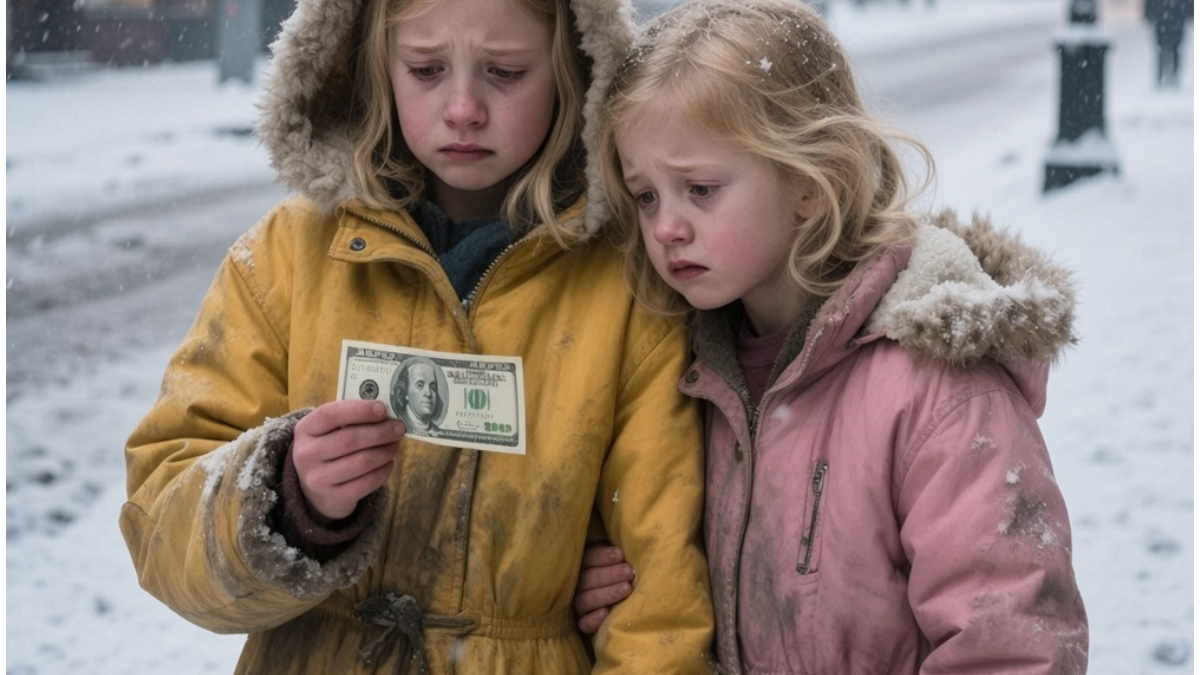
On a frozen winter afternoon, two twin girls clutch a single $5 bill hoping it’s enough to save each other.
When a quiet billionaire hears we don’t have a home, he follows them into the dark and discovers a choice that will test law, trust, and the meaning of safety forever.
Winter pressed down on Harbor Point like a held breath. Snow clung to the sidewalks in thin uneven sheets, gray at the edges where too many footsteps had passed without purpose.
Inside a small convenience store near the harbor, the heater hummed weakly fighting a losing battle.
At the counter stood Mila Hart, 9 years old, too thin for her coat. Her fingers curled tightly around a single wrinkled $5 bill.
It looked fragile, like it had already lived too many lives. She rose onto her toes trying to meet the counter’s height.
Um soup packets, please, she said carefully. Her voice was steady, but only because she forced it to be.
Behind her near the door, her twin sister Luna waited. Same face, same hair. But Luna held herself differently, arms wrapped around her body, eyes scanning the floor as if expecting it to disappear.
Cold had taught her to stay small. The cashier rang the items, a soft electronic beep, then a pause.
That’ll be 5.79, he said. Mila froze. She stared at the numbers on the screen, then at the bill in her hand.
A tiny shake passed through her fingers. She swallowed. Then just the soup, she said, pushing the cough drops back across the counter.
The store manager, Hal Briggs, stepped forward, his voice low, tight with discomfort rather than cruelty.
You girls can’t keep hanging around here without an adult. Mila nodded immediately. She didn’t argue.
Arguing made things worse. She took the bag, thin and light, and turned toward the door.
As they stepped back into the cold, Mila whispered the truth, not as a plea, just as a fact the world seemed to ignore.
We don’t have a home. A man standing near the shelves heard her, and for the first time that day, Gideon Voss stopped pretending he was just another customer.
The door closed behind the girls with a soft chime that felt louder than it should have.
Cold air rushed in sharp and immediate, biting through worn fabric like it had been waiting.
Mila didn’t look back. She knew better than that. Luna followed half a step behind her, clutching the thin plastic bag as if it might vanish if she loosened her grip.
Steam from her breath curled into the air, then disappeared. Inside the store, Hal Briggs exhaled and rubbed his forehead.
He told himself he had done the right thing. Rules were rules. Warnings were part of responsibility.
Still, the image of the $5 bill, creased, damp, clearly precious, refused to leave his mind.
Near the shelves, Gideon Voss stood very still. He had planned to grab coffee and leave.
His driver was waiting outside. His phone vibrated once in his coat pocket. Another meeting, another obligation.
But the sentence echoed again louder now that the door had closed. We don’t have a home.
Gideon moved before he finished thinking. He stepped outside, the wind cutting across his face, grounding him in the moment.
Ahead, the twins walked quickly, not running, not wandering. Purposeful. Trained. Children who had learned that hesitation invited questions, and questions invited trouble.
Gideon followed at a careful distance, slow enough not to scare them, close enough not to lose them.
He noticed details he couldn’t ignore, the way Mila kept glancing ahead, planning every turn.
The way Luna stayed slightly behind, trusting her sister to lead. They turned onto a quieter street, the lights fewer, the buildings older.
Snow crunched beneath their shoes, thin soles offering little protection. Gideon felt something unfamiliar settle in his cheSt. Not panic, not pity.
Responsibility. When the girls reached the corner and hesitated, Gideon made a choice. He slowed, then spoke not loudly, not suddenly.
Hey, he said gently. I’m not following you to scare you. Mila turned firSt. Her eyes were sharp, guarded.
Too guarded. Gideon raised his hands, slightly empty. I just want to make sure you’re okay.
Mila didn’t answer. She only tightened her grip on the bag and said quietly, We have to go.
And for the first time in years, Gideon Voss followed a path that had nothing to do with profit and everything to do with truth.
They led him toward the older part of Harbor Point, where buildings leaned closer together as if sharing secrets.
Posters from forgotten shows peeled from brick walls. An old theater sign flickered weakly, its letters half-lit spelling nothing complete.
Mila stopped near a narrow alley behind the theater. She turned slowly, placing herself in front of Luna without realizing she’d done it.
This is far enough, she said. Gideon respected the boundary. He stopped where the street light still touched his shoes.
Okay, he said calmly. I won’t come closer unless you say it’s okay. Silence stretched between them.
Snow drifted down, soft and unhurried, as if unaware of the tension below. Luna’s breathing grew uneven.
She looked past Gideon toward the dark opening of the alley, then back at Mila.
Her voice came out small. She’s worse today. Mila’s face changed instantly, fear flashing through the cracks of control.
She closed her eyes for half a second, then opened them again, steady. Gideon noticed the way her shoulders sagged just a little.
The weight she carried was too heavy for 9 years. There’s someone else with you.
Gideon said, not a question. Mila hesitated. The truth pressed against her chest, painful to hold in.
She’s She’s my sister, Mila said finally. She didn’t come to the store. Luna nodded, eyes shining.
She’s cold. That was all it took. Gideon stepped closer slowly, waiting for them to pull away.
They didn’t. The alley smelled of dust and old fabric. Behind a cracked service door, tucked out of the wind, lay a small figure wrapped in a thin blanket.
Another little girl. Same face. Same hair. Her skin was warm. Too warm. Gideon knelt beside her, careful, controlled.
He didn’t panic. Panic belonged to children. Adults stayed calm. We’re going to the hospital, he said, firm but gentle.
Mila’s eyes widened. Fear surged. They’ll take us, she whispered. Gideon looked directly at her.
No, he said. You stay together. I promise. For the first time that night, Mila didn’t step back.
She nodded. And in that dark alley behind a forgotten theater, winter finally lost its grip just a little.
The alley felt smaller once Gideon stepped inside it, as if the walls leaned inward to watch.
The old theater loomed behind them, its bricks soaked with decades of forgotten nights. Snow no longer fell here.
It only waited. Mila knelt beside her sister firSt. She always did. Her movements were careful, practiced, like someone who had learned that rushing made things worse.
She adjusted the thin blanket around Luna, smoothing it down, even though it barely covered her.
She was fine yesterday, Mila said, not looking up. Just tired. Gideon crouched a short distance away, keeping his voice low, his body open.
How long has she been coughing? Mila hesitated. Counting days felt dangerous. A few, she said finally.
Luna’s breathing was shallow, but steady. Her eyes fluttered open, unfocused, then settled weakly on Mila’s face.
She tried to smile and failed. It’s okay, Mila whispered, leaning closer. I got soup.
Gideon felt something tighten behind his ribs. Not fear. Fear could be managed. This was something heavier, something permanent if ignored.
He reached into his pocket and pulled out his phone, holding it where Mila could see.
I’m calling a hospital, he said. I’ll tell them exactly what’s happening. No surprises. Mila’s head snapped up.
They’ll call people, she said quickly. People who separate kids. They’ll call people whose job is to protect kids, Gideon answered calmly.
And I’ll stay. I won’t disappear. Silence pressed in again. The kind that demanded a choice.
Mila looked down at Luna, then back at Gideon. Her eyes were wet, but steady.
You swear we stay together. Gideon didn’t rush his answer. He knew promises mattered more when they were rare.
I swear I will not let anyone separate you tonight, he said. And if anyone tries, I will stand between you.
Mila searched his face like she was reading a map she didn’t truSt. Finally, she nodded once.
Gideon carefully lifted Luna slow and gentle giving Mila time to adjust the blanket. Luna stirred murmuring something incoherent her forehead warm against his coat.
Mila stayed close as they stepped back into the street light. The world beyond the alley looked different now too bright to open.
As they walked toward the waiting car Mila whispered almost to herself. Please don’t change your mind.
Gideon didn’t answer with words. He opened the car door and made space for both girls as if the night itself had decided to make room for them.
The inside of the car was warm in a way that felt unreal. Luna shivered once.
Then relaxed slightly as the heat reached her. Mila climbed in beside her immediately pulling Luna’s head into her lap like she had done a thousand times before.
Gideon started the engine and pulled away from the curb without hurry. Snow-lined streets slid past the windows familiar but distant like a city seen from behind glass for the first time.
Mila kept one hand on Luna’s hair the other gripping the edge of the seat.
She didn’t look around. She didn’t ask questions. She watched her sister breathe. Gideon spoke quietly keeping his eyes on the road.
What’s her full name? Luna Heart Mila answered. We’re twins. How old? Nine. Gideon nodded filing away each detail with care.
And yours Mila? He smiled slightly at that. Nice to meet you Mila. I’m Gideon.
She didn’t reply right away. Names meant power. She had learned that early. Eventually she murmured.
Okay. Luna stirred again her eyes half opening. Mila she whispered. I’m here Mila said instantly.
Gideon glanced in the rearview mirror. You’re doing great he said to Luna keeping his voice gentle.
We’re going somewhere warm. Luna frowned weekly. Is it far? No. Gideon said. Not far at all.
At a red light Gideon took off his coat and reached back carefully. Mila can you help me put this over her a bit more?
Mila nodded and adjusted the coat around Luna’s shoulders. She paused then whispered. Thank you.
The words surprised both of them. The hospital came into view bright solid real. Gideon felt relief flood him followed by something sharper responsibility settling in for the long term.
He parked near the entrance and turned to face Mila fully for the first time.
Listen to me he said. When we go inside people are going to ask questions.
That’s okay. You didn’t do anything wrong. Mila’s eyes flicked to the glowing doors. Will they make us leave?
No Gideon said firmly. They’ll help firSt. As he lifted Luna from the car Mila followed close her small hand brushing the edge of his sleeve not holding on just checking that he was still there.
For the first time that night Mila let herself believe that the road didn’t always lead back to the cold.
The hospital doors slid open with a quiet hiss releasing a wave of warmth and clean air.
The lights inside were bright not harsh just steady. Luna squinted and buried her face against Gideon’s coat.
It’s okay Mila whispered. Just lights. A nurse approached immediately her expression calm unhurried. What’s going on tonight?
Gideon spoke clearly without embellishment. This is Luna 9 years old. Fever and cough. She’s been exposed to cold conditions.
These are the children’s names. They don’t currently have stable housing. The nurse nodded already moving.
We’ll take care of her. Mila stiffened at the word take. Gideon noticed and stepped aside so Mila could stay close as Luna was placed gently onto a bed.
No rushing no alarms just purposeful motion. A doctor joined them Dr. Naomi Wren her voice low and reassuring.
She knelt to Luna’s level smiling softly. Hi Luna. I’m Naomi. I’m going to listen to your breathing okay?
Luna nodded weekly. Mila watched every movement every expression memorizing them like clues. Gideon stayed present but quiet letting the professionals lead.
After initial checks Dr. Wren straightened. She’s stable she said. We’ll run some tests and get her fluids.
You did the right thing bringing her in. Mila’s shoulders dropped a fraction the tension leaking out slowly.
She’ll be okay? Yes Dr. Wren said honestly. She will. A woman approached next holding a clipboard but wearing a gentle smile.
Hi I’m Elena Park. I work with families and kids here. Mila’s stomach twisted. She leaned closer to Luna.
Elena crouched to Mila’s eye level. My job is to make sure children are safe she said.
That includes staying together whenever possible. Mila searched her face. We didn’t do anything bad.
Elena shook her head. No you didn’t. Gideon met Elena’s gaze and nodded. I’ll cooperate fully he said.
I want everything done the right way. Elena smiled just slightly. That matters. As Luna was taken gently down the hall for treatment Mila stood frozen until Gideon spoke softly beside her.
You did everything right he said. Mila didn’t answer. She just watched the doors close clutching the empty soup bag like proof that she had tried.
And for the first time in a very long night she wasn’t alone while waiting.
The waiting room was too quiet for a place filled with worry. Machines hummed softly behind walls.
A television played with the sound off flashing images that meant nothing to anyone there.
Mila sat rigid in a plastic chair her feet not quite touching the floor. She hadn’t let go of the soup bag.
It lay folded neatly in her lap empty now but still important. Proof of effort.
Proof that she had tried. Gideon sat a short distance away not beside her not looming.
He understood that closeness had to be earned. Every few minutes Mila glanced toward the hallway where Luna had disappeared.
Her eyes asking questions her mouth refused to form. Elena Park returned quietly and took a seat across from Mila.
The doctor’s running tests she said. That takes a little time. Mila nodded. I know.
She paused. Can I Can I see her after? Yes. Elena said without hesitation. As soon as it’s okay.
That answer loosened something inside Mila. Just a fraction. The minutes dragged. Gideon checked his phone once then turned it face down.
Whatever was waiting for him out there investors deadlines meetings it could wait. This could not.
Eventually Dr. Wren appeared. Her expression was calm measured. Luna’s responding well she said. The fever’s coming down.
Mila stood so fast her chair scraped loudly against the floor. Can I see her now?
Dr. Wren smiled gently. Yes. Mila followed the doctor down the hallway Gideon and Elena hanging back to give her space.
When Mila reached the room she froze in the doorway. Luna lay in a clean hospital bed blankets tucked neatly around her.
An IV line ran to her arm not frightening just there. Her breathing was easier now deeper.
Luna opened her eyes and saw Mila. You stayed she whispered. Mila crossed the room in two steps and took her hand.
Always. Gideon watched from the hall something heavy and unfamiliar pressing against his cheSt. Not sadness.
Resolve. He realized then that this night would not end when the sun came up.
It would only change. Morning light crept through the hospital windows in pale streaks. Mila had not slept.
She sat curled in the chair beside Luna’s bed head resting lightly against the mattress afraid that if she slept something would go wrong.
Elena returned with two paper cups of hot chocolate and set one carefully near Mila.
You should drink something she said. Mila hesitated then wrapped both hands around the cup.
The warmth surprised her. Thank you. Elena took a breath. I’m going to ask you a few questions not to get you in trouble just to understand how to help.
Mila nodded slowly. How long have you and Luna been without a home? Mila stared at the floor.
Since before it got cold. Elena waited. Silence not pressure. Our mom got sick Mila said quietly.
Then she was gone. We stayed with people but it didn’t laSt. No details were forced no probing into pain.
Elena nodded. Writing only what mattered. Gideon listened from across the room his jaw tight.
He didn’t interrupt. This wasn’t his story to tell. Elena closed her folder. You did an incredible job taking care of your sister she said.
But you shouldn’t have had to do that alone. Mila blinked. I didn’t have a choice.
“That’s true.” Elena said gently. “But now you have help.” Later Gideon spoke with Elena privately.
“What happens next? We make a plan.” Elena said. “Temporary placement, medical follow-up, school, stability.”
Gideon nodded. “I want to support that legally, transparently.” Elena studied him for a moment.
“That’s the right answer.” When Gideon returned, Mila looked up at him. “Are they going to send us away?”
“No.” He said simply. “They’re figuring out how to keep you safe.” She studied his face searching for cracks.
Finding none, she asked the question she’d been holding all night. “Why are you still here?”
Gideon answered without rehearsing. “Because leaving would be the wrong thing to do.” Mila looked away swallowing hard.
For the first time in a long time, the future didn’t feel like a trap.
It felt uncertain, but not cruel. By afternoon, the hallway outside Luna’s room felt different, louder.
Footsteps passed more often. Voices carried farther. Gideon noticed firSt. A nurse leaned in and spoke quietly.
“There are reporters outside.” “Someone recognized you.” Mila’s stomach dropped. She didn’t need to hear the word reporters to know what it meant.
Strangers, questions, judgments. “They’re not coming in.” Elena said firmly. “The hospital will protect patient privacy.”
Still, the damage was done. Mila caught a glimpse of a TV screen down the hall.
Gideon’s face appeared beneath a scrolling headline. She turned pale. “They’re going to think we’re something bad.”
Gideon knelt in front of her lowering himself to her level. “Listen to me.” He said calmly.
“No one gets to tell your story without your permission.” “But they always do.” Mila whispered.
“Not this time.” He said. Outside voices rose, cameras clicked, speculation spread faster than facts ever could.
Elena coordinated with hospital security and legal staff. “Mr. Voss.” She said. “This will bring scrutiny.”
“People will question your motives.” Gideon didn’t hesitate. “Let them.” He said. “I’m not leaving.”
That night, Cara Blythe watched from behind a camera lens noting what wasn’t happening. No speeches, no staged photos, no smiling billionaire carrying a child for the cameras.
Just closed doors. Just silence. Inside, Luna slept peacefully. Mila sat beside her drawing quietly on a scrap of paper Gideon had brought.
She drew three figures under a street light, two small, one tall. When Gideon noticed, he didn’t comment.
Mila finally looked up. “If they say bad things about you, will you still come back?”
Gideon answered slowly choosing each word with care. “Yes.” Mila nodded once. Outside the world argued.
Inside, something fragile and important held steady. The hospital hallway no longer belonged only to doctors and nurses.
It belonged to whispers. Phones buzzed. Security guards spoke into radios. A quiet tension settled into the air, the kind that arrived before storms, not loud, but heavy.
Mila felt it immediately. She sat beside Luna’s bed pretending to read a children’s book someone had brought, but her eyes kept drifting to the doorway.
Every passing shadow felt like a question. “Why are there so many people outside?” Luna asked softly.
Mila forced a smile. “They’re just busy.” Gideon stood near the window speaking in a low voice to Elena.
“I won’t make a statement.” He said. “No interviews, no photos.” Elena nodded. “That’s good.”
“Silence can be protective.” “But silence can also look suspicious.” Gideon replied. “True.” Elena said calmly.
“But children come firSt. Public opinion comes laSt.” Across town, news sites refreshed their pages.
A billionaire spotted at local hospital with two homeless children. Good deed or something else?
Speculation multiplied. Motives were invented. Strangers debated lives they had never seen. Mila caught a glimpse of a headline on a nurse’s phone and felt her chest tighten.
“They’re talking about us.” She whispered. Gideon turned immediately and knelt in front of her.
“They don’t know you.” He said gently. “So what they say doesn’t define you.” “But it changes.”
Mila said. “It always does.” Gideon didn’t deny it. “Yes.” He said. “It makes things harder.”
“That’s why we do them the right way.” Elena stepped in. “Tomorrow we’ll discuss temporary placement options.
Somewhere warm, legal, safe.” Mila’s fingers curled into the blanket. “Together.” Yes, Elena said firmly.
“Together.” That night, Gideon stayed until visiting hours ended. When it was time to leave, Mila’s eyes followed him anxiously.
“You’ll come back?” She asked. Gideon didn’t offer reassurance lightly. “Tomorrow morning.” He said. “I promise.”
As he walked out past flashing cameras and shouted questions, Gideon kept his head down.
He didn’t raise a hand. He didn’t smile. Inside the hospital room, Mila sat very still counting her sister’s breaths, holding on to the quiet truth that mattered more than any headline.
Someone had come back when he said he would. Morning arrived with gray skies and restless energy.
Gideon returned exactly when he said he would, carrying nothing but coffee for himself and a small notebook.
Mila noticed immediately. “You came.” She said. “Yes.” Gideon replied simply. Elena joined them soon after, her tone professional but warm.
“We need to talk about next steps.” Mila straightened. Luna reached for her hand. “Elena.”
Gideon said. “I want to help, but I don’t want to cross lines.” “That’s good.”
Elena said. “Because there are lines.” She explained slowly, carefully, temporary housing evaluations, legal oversight.
“No shortcuts. No private deals. No decisions made in the dark.” “This isn’t about rescuing.”
Elena said. “It’s about stability.” Gideon listened without interruption. “Then I’ll follow the process.” He said.
“All of it.” Mila watched him closely. Adults often promised help until it became inconvenient.
This sounded inconvenient. Later, Gideon sat alone in the hospital cafe with Dr. Wren. “People will say I’m doing this for attention.”
He said. Dr. Wren didn’t sugarcoat it. “They already are.” “Will it hurt the girls?”
“It could.” She said honestly. “If you turn this into a spectacle.” Gideon nodded. “Then I won’t.”
When he returned to the room, Mila handed him the notebook. Inside, she had written one sentence in careful letters.
“We didn’t choose this.” Gideon felt his throat tighten. “You’re right.” He said quietly. Mila hesitated then asked.
“Are you going to get tired of us?” The question landed heavy shaped by too many goodbyes.
Gideon answered slowly. “I get tired of noise.” He said. “Not of doing what’s right.”
Mila considered that. Then she nodded, not fully convinced, but no longer hopeless. Outside, cameras still waited.
Inside, a fragile plan was forming built not on emotion, but on responsibility. By the third day, Luna was strong enough to sit up on her own.
Color returned to her cheeks. Her laugh, quiet and unsure, filled the hospital room for the first time.
Mila froze when she heard it. Then she laughed, too startled by the sound like it belonged to someone else.
Elena arrived with paperwork and news. “We’ve arranged a temporary placement.” She said. “A licensed family connected to the hospital network.
Warm home, close monitoring.” Mila’s smile faded. “Do we have to go today?” “Yes.” Elena said gently.
“But it’s not goodbye. It’s a step.” Gideon stood back letting Elena explain every detail.
Addresses, rules, visits, oversight. “And Mr. Voss?” Mila asked. Elena glanced at Gideon. “He can visit with approval.
He’s cooperating fully.” That mattered more than Mila wanted to admit. When it was time to leave, Mila packed carefully.
The notebook, the drawing, the empty soup bag now folded flat. Gideon noticed but said nothing.
At the exit, Luna looked up at him. “Are you still helping other kids, too?”
Gideon nodded. “I’m working on it.” Mila studied his face one last time. “People will say bad things.”
“They can.” Gideon said. “But I’ll still be here.” Outside, the air was cold but different now.
Cleaner, less sharp. As the car pulled away, Mila watched the hospital disappear from view.
Fear rose then steadied. For the first time in months, she wasn’t leaving because she had nowhere else to go.
She was going somewhere safe. The temporary house was warm in a way that felt unreal.
Not luxurious, just normal. Clean floors. A couch that didn’t smell like the street. A lamp that stayed on when you flipped the switch.
Mila stood in the doorway for a long moment scanning the room as if it might vanish if she believed in it too quickly.
Luna stepped inside firSt. Curious, careful, touching the edge of the sofa with two fingers.
It’s soft. She whispered, surprised. The foster caregiver greeted them gently, explaining rules, slowly leaving space for questions.
Nothing was rushed. Nothing was demanded. Still, Mila’s shoulders stayed tense. Safety had conditions now, and conditions could change.
That evening, Gideon received the call he knew was coming. Elena here, the voice said.
There’s concern about the girls, Gideon asked immediately. About you, Elena replied honestly. Some people believe your involvement might influence decisions unfairly.
Gideon closed his eyes briefly. So, what happens? We increase oversight, Elena said. More documentation, more distance, transparency.
Do it, Gideon said without hesitation. Whatever protects them. The next morning, an article appeared carefully worded, but sharp enough to cut.
It questioned motives, power, optics, whether kindness from wealth could ever be clean. Mila saw a fragment of it on a shared tablet at the house.
Her stomach tightened. They think he’s bad. The caregiver knelt beside her. People can be wrong, she said softly.
But when people are wrong, we pay for it, Mila replied. Later during a supervised visit, Mila finally said it aloud.
They’re saying you’re doing this for attention. Gideon didn’t flinch. Yes, he said. Some people are.
Are you? Gideon met her eyes. If I wanted attention, I’d be talking. I’m not.
Mila considered that. Silence had protected her more than words ever had. Will they make you leave?
She asked. Gideon answered carefully. They might limit how close I can be, but they won’t make me stop caring.
Mila nodded slowly, absorbing the truth beneath the fear. Help didn’t disappear just because it was questioned.
Sometimes it got stronger. The meeting room was small and plain, chosen on purpose. No glass walls, no cameras, just a table folders and quiet professionalism.
Elena sat across from Gideon with two other officials present. Not hostile, not friendly, neutral.
This isn’t an accusation, one of them said. It’s due process. Gideon welcomed it. Good.
They asked about intentions, boundaries, future plans. Gideon answered without defensiveness. He spoke about education, counseling, stability, and about stepping back when necessary.
I don’t need control, he said. I need them safe. Meanwhile, Mila and Luna met with a child advocate in another room.
Someone trained to listen without pushing. What scares you most right now? The advocate asked gently.
Mila didn’t answer immediately. Then, that if we say the wrong thing, everything goes away.
Luna squeezed her hand. Or that people get tired. The advocate nodded. It’s okay to be afraid of that.
During a supervised visit later that week, Gideon brought nothing but time. No gifts, no promises.
Mila noticed. You didn’t bring anything. Gideon smiled faintly. I brought myself. She studied him, then sat down across from him.
The system doesn’t trust you. That’s okay, Gideon said. The system isn’t supposed to trust easily.
Do you trust it? Mila asked. He thought about it. I trust it more than I trust improvising with children’s lives.
That answer stayed with her. That night, Mila wrote in her notebook again. Not about fear this time.
Maybe safe is real. Outside conversations continued. Opinions clashed, but inside the system slow, imperfect, necessary.
The truth was becoming harder to ignore. The girls were safer with structure than without it.
And Gideon was proving he understood that. Weeks passed. Not dramatic weeks, quiet ones. School enrollment forms, doctor follow-ups, therapy sessions that focused on trust, not trauma.
Luna gained strength. Mila learned to sleep through the night without waking at every sound.
Progress came softly, without announcement. The headlines faded, replaced by newer noise. One afternoon, Elena called Gideon with an update.
The concerns have eased, she said. Your cooperation made the difference. And the girls? Gideon asked.
They’re doing well, Elena said. That’s what matters. During the next visit, Mila looked different.
Not carefree, but lighter. She handed Gideon a folded piece of paper. It was a drawing three figures under a streetlight.
This time, the light was brighter. You stayed, Mila said quietly. Yes, Gideon replied. You didn’t fight the system, she added.
You listened to it. Gideon nodded. Because it’s bigger than me. Mila hesitated, then asked the question she’d been circling for weeks.
What happens when the rules change again? Gideon answered honestly. Then we adapt. Together. With help.
She accepted that. Not with relief, but with truSt. Later, as the visit ended, Luna hugged him quickly, then pulled back checking Mila’s face firSt. Mila nodded.
That small moment said everything. As Gideon walked away, Elena watched from a distance. She had seen many adults enter children’s lives loudly and leave just as loudly.
This one stayed quietly. And sometimes that was the most powerful thing of all. The courthouse did not look like the place where lives were changed.
It was ordinary stone steps, metal railings, glass doors that reflected a gray morning sky.
No crowds, no shouting, just quiet movement and paperwork. Mila noticed that firSt. This doesn’t feel scary, Luna whispered as they walked inside.
Mila nodded, though her hands were still cold. She had learned not to trust first impressions.
Still, the calm unsettled her in a hopeful way. They were led into a small hearing room, not a courtroom like in movies.
No jury, no raised voices, just a judge, a clerk, Elena, a child advocate, and Gideon seated at a respectful distance.
This is not a trial, the judge said gently looking at the girls. It’s a conversation about what keeps you safe.
Mila absorbed the words carefully. Conversation, not interrogation. The judge asked questions through the advocate, slowly giving Mila time to think.
Do you feel safe where you are now? Do you want to stay with your sister?
Mila glanced at Luna, then answered firmly, always. Luna squeezed her hand. When it was Gideon’s turn to speak, he didn’t stand to impress.
He spoke evenly, without drama. I’m not asking to bypass any process, he said. I’m asking to be evaluated by it, thoroughly.
The judge raised an eyebrow. You understand that means scrutiny. I welcome it, Gideon replied.
Children deserve adults who don’t rush. That sentence shifted something in the room. Elena presented documentation, visits, supervised boundaries, respected cooperation without resistance.
No special treatment requested, no pressure applied. The judge leaned back slightly. What do you want, Mila?
He asked softly. Mila’s chest tightened. Adults rarely asked her that. I want things to stop changing all the time, she said.
I want to know who’s coming back. The judge nodded. That’s reasonable. After a pause, he spoke the decision, not final, but significant.
Extended guardianship review, continued placement, a clear path forward with oversight. As they left the room, Mila didn’t smile.
She breathed. Outside, the air felt lighter. Gideon knelt to their level. You were brave in there, he said.
Mila shook her head. I was honeSt. That’s braver, Gideon replied. For the first time, Mila believed that honesty didn’t always cost her something.
Change didn’t arrive as fireworks. It arrived as schedules, school mornings, therapy afternoons, weekly check-ins.
Slowly, life took shape around predictability instead of survival. Gideon learned that helping meant doing less talking and more listening.
He learned which meetings required him and which ones required him to step away. One afternoon, he sat with Dr. Wren and Elena in a quiet hospital office.
No press, no announcements. There’s a gap, Dr. Wren said. Families who come in afraid to seek help because they can’t pay.
Elena added, and children who fall through cracks between systeMs. Gideon listened, writing nothing down at firSt. Then he said, If I help build something, it won’t carry my name on the front.
Elena studied him. Why? Because children shouldn’t feel sponsored, Gideon replied. They should feel protected.
They designed it carefully. Transparent funding, independent oversight, clear rules, no photos of children, no stories sold for attention.
The Harbor Light Fund began quietly covering emergency care, temporary housing coordination, school transport. Not dramatic rescues.
Just support where systems strained. Mila heard about it weeks later. You helped make that?
She asked, surprised. I helped listen, Gideon corrected. She considered that. Listening changes things. At school, Mila began raising her hand.
Luna made a friend. Small miracles that never make headlines. During a supervised visit one evening, Mila asked, What if people start talking again?
They might, Gideon said. But we’ll handle it the same way. How? By not letting noise decide what’s right.
Mila nodded slowly. She liked that answer. Later that night, she wrote in her notebook, Safe is quiet.
She didn’t know yet how rare that was, but she felt it. The final review didn’t feel final at all.
It felt steady. The judge spoke plainly. All reports indicate consistency, compliance, and positive outcomes.
We will proceed. Mila sat very still. Luna leaned into her side. Gideon didn’t celebrate.
He exhaled. Afterward, in a quiet room with Elena present, Gideon spoke directly to the girls.
Nothing changes overnight, he said. We keep following the rules. We keep asking questions. You keep having choices.
Mila looked at him, eyes bright but cautious. We’re not owned. No, Gideon said immediately.
You’re respected. That mattered. That evening, back at the house, Luna stood at the window watching streetlights come on.
It’s warm, she said, amazed. Every night. Mila joined her. She thought of the alley, the soup bag, the $5.
Gideon watched from the doorway, not interrupting. Finally, Mila turned. Can we stay? She asked, not desperate, not pleading, just asking.
Yes, Gideon said, voice steady. As long as it’s right for you. Mila nodded. She stepped forward, not rushing, and rested her head briefly against his side.
A small gesture. A big one. Outside, winter loosened its grip on Harbor Point. Inside, something stronger had taken its place.
Not rescue, not charity, family built slowly, protected carefully. And for the first time, the future didn’t feel like something to survive.
It felt like something to grow into. The first real spring rain in Harbor Point didn’t fall like a storm.
It fell like forgiveness, soft, steady, washing winter’s salt from the sidewalks, and turning the air into something that smelled almost new.
Mila noticed it from the kitchen window, where she stood with a clean mug of cocoa warming her hands.
She still flinched at loud knocks, still paused when someone raised their voice on TV, but the fear no longer lived in her bones the way it used to.
Now it visited, then left. Luna sat at the table doing homework, tongue peaking out in concentration.
The cough was gone. The fever days felt like a distant dream that sometimes returned in flashes, an alley, a broken sign, the sound of a man’s calm voice promising together.
Gideon Voss walked into the room without a phone in his hand, that Mila had learned was his version of saying, I’m here.
Elena texted, Gideon said, setting a folder on the counter. We have a follow-up review next week.
Routine. Mila’s fingers tightened around the mug. Routine still sounded like danger to her. She watched his face for signs of worry.
It’s a good thing, he added, noticing her reaction. It means people are still watching, in the right way.
Mila nodded, but her eyes dropped to the folder anyway. Then the doorbell rang. Not the soft chime of a normal visitor.
The bell was pressed twice, quick, impatient. Mila froze. Luna lifted her head, eyes wide, pencil hovering above paper.
Gideon didn’t move faSt. He moved calm. He checked the door camera first, always. Mila had seen him do it a hundred times.
Adult behavior. Predictable. Safe. On the screen were two people with rain-dark coats. One held a microphone.
Behind them, a second camera waited under an umbrella, like it had done this a thousand times before.
Gideon’s jaw tightened. It’s the media. Mila’s throat went dry. The old feeling surged. They’re going to take this away.
They’re going to make it ugly. They’re going to make it loud. Luna’s voice came out small.
Are we in trouble? No. Gideon said, instantly turning to them, kneeling so his eyes were level with theirs.
You’re not in trouble. And you won’t be seen. Mila blinked hard. But they’re here.
They’re outside, Gideon corrected. And they’re staying outside. He stood and spoke to the house manager briefly, then called Elena.
Not because he needed permission to be brave, but because brave without the law was just pride.
Elena answered quickly. Do not engage. Do not respond. I’ll notify the hospital’s legal team and the court liaison.
The girls’ privacy is protected. Gideon nodded, though she couldn’t see him. Understood. He ended the call and turned to Mila.
Here’s what happens next, he said. You and Luna go to the back room. The one with the bean bags.
You can put on headphones if you want. You can draw. You can breathe. No one is coming in here.
Mila stared at him. What if they lie? They might, Gideon admitted. But lies can’t enter this house.
Mila didn’t fully understand that, but she understood the steadiness in his voice. She took Luna’s hand and led her down the hall.
As they went, Luna whispered, Mila, do we have to run? Mila paused. Her instinct screamed, yes.
Run. Hide. Be smaller than the world. But she looked at Gideon’s back, straight, still, patient.
And something inside her changed shape. No, Mila whispered. We don’t run anymore. In the back room, the rain tapped the windows.
Mila sat with Luna, both of them listening to the muffled sound of adult voices in the entryway.
Not shouting. Not panic. Just Gideon speaking through the closed door, firm and polite. You cannot film on private property, he said.
And you cannot request access to minors. Please leave. A woman’s voice pressed back, smooth and practiced.
Mr. Voss, the public deserves to know. The public does not deserve children, Gideon replied.
Silence followed. Heavy. Satisfying. Mila felt tears rise without permission. Not sadness, something else. Relief so intense it hurt.
She covered her mouth and let herself breathe through it. Luna leaned into her shoulder.
He’s not scared, Luna whispered. Mila swallowed. He’s careful. A few minutes later, footsteps retreated.
The doorbell did not ring again. The rain kept falling like a gentle curtain, and the house returned to quiet.
Gideon came to the back room and sat on the floor at a respectful distance, hands resting on his knees.
They’re gone, he said. You’re safe. Mila stared at him. She [clears throat] wanted to say thank you, but the words were too small for what he had done.
So she asked the question that mattered moSt. You didn’t open the door. Gideon shook his head.
I won’t trade your privacy for anyone’s curiosity. Mila’s eyes shone. People are going to say you’re hiding something.
Gideon’s answer came soft, certain. Let them. I’m hiding you from harm. Mila looked down at her hands.
Then she spoke, voice trembling with a new kind of courage. When I was outside, I thought the world owned us.
Gideon didn’t interrupt. Mila lifted her chin. But it doesn’t, does it? No, Gideon said.
It never did. The rain eased. Somewhere in the house, a clock ticked steadily, proof that time could pass without punishment.
And for the first time, the cameras left, and nothing was taken. A week later, Harbor Point’s sky finally cleared.
Sunlight spilled across the town with a brightness that felt almost unfamiliar after so many months of gray.
The courthouse steps were dry this time, and Mila noticed that, too, how small details became markers of safety.
Elena met them at the entrance, clipboard in hand, smile gentle but focused. “Today is simple,” she said to the girls.
“It’s a review. You answer what you want to answer. If you don’t want to answer something, you say so.
That’s allowed.” Mila nodded, her fingers laced with Luna’s. Luna looked up at Gideon. “You’re coming in?”
“Yes,” Gideon said. “But I will sit where the judge tells me to sit.” That line made Mila breathe easier.
Gideon didn’t bend rules. He didn’t charm systeMs. He respected them until they worked. Inside the hearing room, the same quiet professionalism waited.
The judge greeted the girls with the calm expression of someone who had learned that children often fear adults in robes.
“Hello again,” the judge said. “How have you been?” Luna spoke first this time. Her voice was still soft, but it held something new confidence that her words would not be punished.
“I’m in school,” she said. “I like science.” The judge smiled. “Science is a good choice.”
Mila swallowed, then she spoke. “I sleep better,” she said simply. It was the biggest sentence she had.
The child advocate nodded, eyes warm. Elena presented the reports, continued medical stability, consistent school attendance, therapy progress, supervised and appropriate involvement from Gideon, and a clear long-term plan.
The Harbor Light Fund documentation was included as context, not as publicity, but as proof of structured support.
The judge turned to Gideon. “Mr. Voss, do you understand the responsibilities of long-term guardianship and the ongoing oversight?”
“Yes,” Gideon said. “And I welcome it.” “And you understand,” the judge continued, “that the children’s privacy must be protected.
No media exposure, no storytelling for reputation.” Gideon’s voice didn’t change. “Understood. Their lives are not content.”
Mila’s chest tightened at the phrase. “Their lives are not content.” It felt like armor.
After a pause that felt like the world holding its breath, the judge spoke. “Based on continued evidence of safety, stability, and appropriate support, we will move forward with the long-term plan as recommended under standard review protocols.”
It wasn’t a movie ending. No gavel slam. No dramatic tears. Just a door opening quietly, the way safe things often do.
Outside sunlight warmed the stone steps. Elena knelt in front of Mila and Luna. “You did great,” she said.
“You used your voices.” Luna smiled. Mila didn’t yet. She looked at Gideon searching for the familiar fear that joy would be punished.
Gideon met her eyes and spoke gently. “I’m proud of you,” he said. “But you don’t have to react any certain way.
You can take your time.” Mila blinked rapidly. “What happens now?” “Now,” Gideon said, “we go home.”
Mila froze on the word. Home. It still sounded like a trick. Gideon added careful with every syllable.
“Home means you have a room, a school, a doctor, and people who show up over and over.”
Luna tugged Mila’s sleeve. “Can we get pancakes?” Gideon’s mouth curved into the smallest smile.
“Yes.” They drove back through town with the windows catching sunlight. At a stoplight, Mila watched a mother walk her child across the street, holding hands without fear.
That used to feel like another species of life. Now it felt possible. At the house, Gideon took out a small wooden box and set it on the table.
“This isn’t a gift,” he said. “It’s a promise container.” Mila frowned slightly. Luna leaned forward, curious.
Inside the box were three index cards and a pen. Gideon wrote first slowly so the girls could see.
“You stay together. Adults follow the law. You never have to earn safety.” He slid the pen to Mila.
“If you want,” he said, “write a promise you want from me. Anytime.” Mila’s hand trembled as she took the pen.
She stared at the blank card, the way she used to stare at a $5 bill, counting value, fearing loss.
Then she wrote carefully, “Come back. Always.” She handed it to him without looking up.
Gideon didn’t smile for applause. He didn’t make it dramatic. He simply placed the card in the box and said, “Yes.”
Luna grabbed the pen next and wrote in big messy letters, “Pancakes on Sundays.” Mila let out a sound that surprised her, a laugh sudden and real.
Gideon stood and held out his hand, not demanding, offering. Mila hesitated only a second before placing her small hand in his.
Outside the world kept moving. Opinions rose and fell. Headlines came and went. But inside this house, the rules were different now.
Here, safety wasn’t a performance. It was practice every day. The house settled into evening the way a lake settles after wind, slowly without asking for permission.
Dishes dried on the rack. A lamp glowed in the corner. The clock ticked with a confidence Mila had learned to truSt. Luna fell asleep, first science book open on her chest, pencil still tucked behind her ear.
Mila covered her with a blanket and paused, listening to the even rhythm of her breathing.
No counting, no fear. Just sleep. Gideon stood in the doorway, careful not to interrupt.
“Pancakes on Sunday,” he said quietly. “I’m practicing.” Mila nodded. “Don’t burn them.” “I won’t,” he said.
“Probably.” They sat at the table together, not facing each other like an interview, but side by side.
The wooden box rested between them. Promises inside it didn’t glow or hum. They simply existed.
Mila traced the grain of the table with her finger. “When we were outside,” she said, choosing her words the way she used to choose food, “everything felt temporary.”
“And now?” Gideon asked. She thought about the sound of rain on the roof, about school tomorrow, about Luna’s laugh.
“Now it feels scheduled.” Gideon smiled. “That’s stability.” Mila nodded once. Then she said the last thing she needed to say to close the door on winter.
“If things get hard again,” “They will,” Gideon said gently. “You won’t disappear.” He didn’t promise forever with fireworks.
He promised tomorrow with certainty. “I’ll be here,” he said. “And if I can’t be, I’ll tell you.”
That mattered. Mila stood and turned off the lamp. The room dimmed into a softness that didn’t threaten.
As she headed down the hall, she stopped, then spoke four simple words, steady and safe.
“We are home now.” And for the first time, the night agreed.








