A Poor Girl Asked a Duke to Be Her Papa for One Hour—He Chose Her Forever
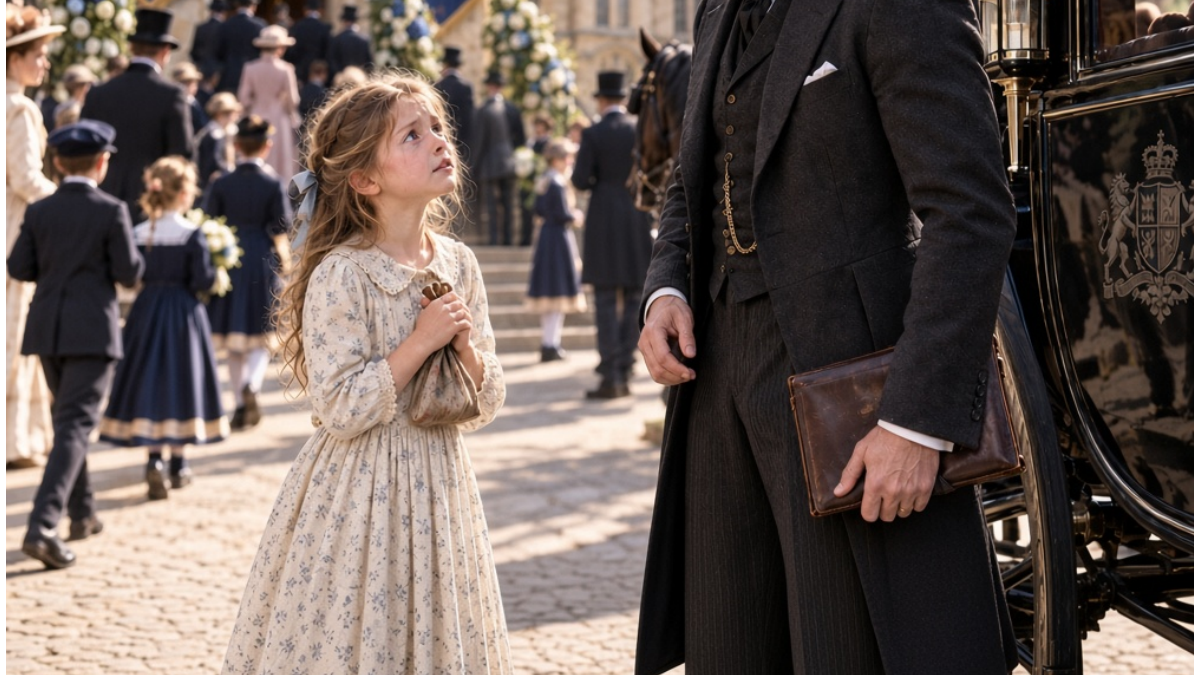
7-year-old Claraara Hail woke on Founders Day with one terror in her heart. Every child at St. Agnes Charity School would have someone waiting for them, while the chair reserved for her family would stand empty.
Before the morning was over, desperation would drive her to a black lacquered carriage in the schoolyard and to a distinguished stranger she had never seen before.
“Would you please pretend to be my papa just for an hour?” She would ask, unaware that the man before her was Adrien Wickliffe, Duke of Ravenshire.
That single request would change both their lives. It would draw a lonely child and an isolated Duke into a struggle over family, wardship, hidden parish records, an inheritance, and a secret powerful men had spent years trying to bury.
But that morning, Claraara knew none of this. She knew only that sunlight was filtering through the worn curtains of her tiny bedroom, touching the carefully ironed dress hanging from the wardrobe door.
Today was the Founders Day prize ceremony at St. Agnes Charity School in Aldwick, Yorkshire, and she was terrified of facing it alone.
But for 7-year-old Claraara, it brought a knot of dread so tight she could barely breathe.
“Clara, honey, are you awake?” Margaret’s frail voice called from the adjacent room, followed by a bout of coughing.
“Coming, Nana,” Claraara replied quickly, slipping into her everyday clothes before checking on the elderly woman who had raised her.
Margaret Hail lay propped against pillows on a narrow iron bed, her silver hair in a neat braid, despite her obvious exhaustion.
At 78, Margaret had raised Claraara since infancy. The story they had always given the parish was that the baby had been found abandoned.
A story Margaret insisted was necessary to keep Claraara from being taken away. “Today is your special day,” Margaret said with a smile, her weathered hand squeezing Claraara’s.
“I wish I could be there, sweetheart.” “It is all right, Nana,” Claraara assured her, though disappointment tightened her small cheSt. For weeks, she had fabricated elaborate stories for her classmates about her father, a gentleman of rank, forever away on estate business, but who promised to attend her school prize ceremony.
She had created this fiction not from a place of dishonesty, but from the desperate need to belong among peers with intact families.
After preparing Margaret’s medicine and a simple breakfast, Claraara dawned her best Sunday dress, a secondhand find.
Margaret had painstakingly altered it between increasingly frequent bouts of illness. The white dress with tiny blue flowers was the prettiest thing Claraara had ever owned.
“You look beautiful,” Margaret whispered, tears shimmering in her pale blue eyes. “Now remember what we practiced.
If anyone asks, I’ll say my papa is meeting me at school and you are resting at home because of your arthritis, Claraara recited.
The familiar lie tasted bitter, but she believed it necessary. The parish cart ride to St. Agnes Charity School was a blur of anxiety.
Upon arrival, Claraara’s stomach sank. The school courtyard had transformed into a festival of family celebration.
Mothers adjusted daughters hair ribbons while fathers hoisted toddler siblings onto shoulders. Grandparents distributed proud hugs and expensive gifts.
School mistresses directed families toward the assembly hall where rows of small wooden chairs awaited the pupils.
Claraara slipped through the crowd, nodding vaguely when asked where her family was. They are coming soon became her mantra.
Each repetition more hollow than the laSt. Her school mistress, Miss Elellanena Finch, approached with a concerned smile, “Clara, honey, we are about to line up.
Is your family here yet? My papa’s carriage has just arrived.” Claraara replied automatically, avoiding Miss Elellanena Finch’s sympathetic gaze.
The school mistress’s expressions suggested she suspected the truth. She had never met any family member during school family meetings, only received notes supposedly from Margaret explaining her absence.
As children assembled with their families for pre-eremony portraits, Claraara retreated to a bench near the carriage yard, watching fine coaches and family carriages discouge more happy families.
The empty chair reserved for her family in the front row of the assembly hall seemed to mock her from a distance.
Just 10 more minutes, then I will go sit down,” she whispered to herself, clutching the small purse Margaret had given her.
Another secondhand treasure containing a handkerchief embroidered with her initials. That is when she saw him, a tall man in an impeccably tailored charcoal frock coat exited a black lacquered carriage bearing a silver ducal crest, consulting his pocket watch with an air of quiet authority.
Something about his deliberate movements and the distinguished touches of silver at his temples made Claraara’s heart leap.
He looked exactly like the papa she had invented for her classmates. Successful, important, handsome.
Without fully realizing what she was doing, Claraara slid off the bench and approached him as he was about to return to his carriage after apparently dropping something off at the school master’s office.
Excuse me, sir. Her voice emerged smaller than intended. The man, Adrien Wikliffe, identified by the discrete silver crest on his leather document case, turned with mild surprise.
His eyes, a deep blue gray, assessed her with polite curiosity. Yes. Clarara’s courage nearly failed, but desperation propelled her forward.
She clasped her hands in a gesture of supplication, her words tumbling out in a whispered rush.
“Would you please pretend to be my papa just for an hour?” Her voice cracked slightly.
“It is my founders day ceremony, and I told everyone my papa would come, but I do not have one, and no one is going to be in my empty chair, and everyone will know I lied.”
Adrienne’s expression shifted from confusion to something unreadable. For a moment, something in his eyes softened as he looked at the small girl in her carefully pressed dress, but then a shadow passed over his face.
The emotional wall he had constructed over years of duty and isolation reasserted itself. “I am sorry.
I have an important meeting with my steward,” he murmured, his voice gentle but firm.
I hope your school prize ceremony goes well. Claraara’s face fell, the rejection stamping itself across her features with devastating clarity.
She nodded once, dignity somehow intact despite the crushing disappointment, and turned toward the assembly hall.
Adrienne watched her retreating figure, unsettled by the brave set of her shoulders and the careful tilt of her chin.
He stepped back into his carriage and gave the coachman the signal to leave, but the order died on his lips before the horses had taken more than a few steps.
Through the carriage window, he could see families streaming into the assembly hall, the joyful disorder of a celebration about to begin, and in stark contrast, Claraara making her way toward the entrance alone, her white dress bright against the crowd.
Adrienne’s hand tightened against the leather seat as memories he had long suppressed rose without warning.
Another child, another lost opportunity. Another moment when duty had been easier than a human connection.
5 years ago, he had been on the verge of taking an 8-year-old boy named Oliver into permanent wardship.
The process had seemed certain until a tragic incident involving the birth family derailed everything, leaving Adrien with a wound he had never fully acknowledged.
The memory of Oliver’s face superimposed itself on Claraara’s expression of disappointed acceptance. Adrien found himself calling his footman over and sending a hurried note, cancelling the meeting with his steward that had seemed so critical moments before.
An inexplicable urgency seized him as Claraara disappeared into the building. Before he could reason himself out of it, Adrien ordered the coachman to stop, stepped down from the carriage, and crossed the street toward a flower seller stall.
10 minutes later, he returned to the school grounds carrying a bright bouquet of daisies and late summer flowers along with a small paper parcel of sugared sweets.
The ceremony had just begun. He spotted Claraara immediately seated alone in the front row, her posture perfect, but her downcast eyes betraying her isolation amid the celebration.
Conversations hushed momentarily as Adrien, clearly not a regular school guardian, made his way confidently to the empty seat beside Claraara.
He could feel curious gazes following him, assessing his impeccably tailored frog coat and the flowers in his hand.
Claraara did not notice him until he was standing directly beside her chair. When Claraara finally looked up, disbelief widened her eyes, then gave way to a fragile hope so powerful that Adrien felt it like a blow.
I canceled my meeting with my steward. He said simply, offering her the flowers. I would not miss your founders’s day ceremony for anything.
The smile that bloomed across her face was like sunlight breaking through storm clouds, radiant, transforming, and painfully innocent.
As Adrien took his seat beside her, he noticed the whispers around them shifting from curiosity to approval.
Claraara sat straighter, her entire demeanor changing as she went from the girl without a family to the child with the important father who’d made time for her special day.
Neither of them could have anticipated how this moment of kindness, this simple act of pretending, would alter the course of both their lives irrevocably.
As the school musicians began a stately ceremonial march, neither Claraara nor Adrien realized they had just taken the first step on a journey that would challenge everything they thought they knew about family, belonging, and what it means to truly come home.
Throughout the ceremony, Claraara maintained a delicate balance between joyful disbelief and careful performance. She had rehearsed this moment countless times in her imagination what it would be like to have a parent watching proudly as she received her infant class diploma.
Now that it was actually happening, albeit through an improvised arrangement, she found herself playing her part with surprising ease.
That is my daughter, Adrien said to the mother seated beside him when Claraara’s name was called.
The words felt strange on his tongue. Not uncomfortable, just unfamiliar, like trying on a jacket he had never worn before, but that somehow fit perfectly.
When Claraara walked across the small stage to receive her certificate, Adrien applauded with genuine enthusiasm.
The smile she flashed in his direction contained such pure gratitude that it pierced something long dormant within him.
For a man who had built his life around meticulous planning and control, this unexpected emotional connection was both unsettling and oddly freeing.
After the ceremony, they sat briefly for a commemorative sketch together. Adrienne’s hand resting lightly on Claraara’s shoulder.
The school portraitist captured their smiles, preserving a moment that from the outside appeared to be simply another proud papa and daughter celebration.
Only they knew the truth of their hasty arrangement. “Thank you,” Claraara whispered as they moved toward the refreshment tables where cakes, fruit, and tea awaited the children and their families.
“Everyone believes you are really my papa. You are welcome.” Adrien replied, surprising himself with how naturally he had fallen into the role.
And you did very well up there. As they navigated the crowd, Adrien noticed how other families interacted with Claraara now offering congratulations, including her in conversations about summer holidays, inviting her to children’s gatherings, all things that seemed common place, but that Claraara received with barely concealed wonder.
He realized with a pang that this social acceptance was as valuable to her as his presence.
Miss Elellanena Finch approached them, extending her hand to Adrien. I am so pleased to finally meet Claraara’s father.
Miss Elellanena Finch said, her expression revealing both surprise and relief. She is such a bright child.
You must be very proud. Extremely, Adrien answered without hesitation. Finding that he meant it.
Despite having known Claraara for less than two hours, there was something remarkable about a child who had found the courage to approach a stranger with such a vulnerable requeSt. Would you mind taking me home?
It is not far. I usually take the parish card. The request was modest, yet Adrien understood its significance.
He nodded, recognizing that their improvised relationship was approaching its natural conclusion. Soon he would drop her off.
They would say goodbye, and this unusual interlude would become just another memory. Or so he thought.
The carriage ride to Claraara’s home revealed a poor quarter that stood in stark contrast to the affluent school parish, St. Agnes Charity School drew children from several parishes, including the poorer quarter where Claraara lived.
As the carriage entered its narrow streets, Adrien noticed sagging roofs, patched shutters, and walls darkened by years of damp.
His estate had funded repairs in neighboring parishes. Yet he realized with discomfort how often he had passed streets like these without truly seeing them.
“It is the blue house,” Clara said, pointing toward a small weathered cottage with a sagging porch and a patched roof.
Cheerful maragolds grew beside the cracked path. A brave splash of beauty amid scarcity. Adrienne’s carriage drew to a halt, and he expected a quick goodbye, but Clara surprised him.
“Would you like to meet my nana?” She asked. Her voice caught between hope and embarrassment.
“She has been ill. That is why she could not come today. But she made biscuits yesterday for my school prize ceremony.”
Something about the careful way Claraara described her home situation, the protective emissions, the emphasis on what they did have rather than what they lacked, touched Adrien deeply.
Before he could fully consider the implications, he found himself agreeing. “I would like that,” he said, following Claraara up the uneven steps.
The cottage was immaculately clean despite its poor condition. Damp stained one corner of the ceiling, and the furniture was mismatched and worn.
Yet everything had been arranged with obvious care. Small keepsakes from Claraara’s childhood decorated the walls, a birthday drawing, a pressed flower, and a little primer filled with careful handwriting.
The room spoke of a childhood rich in love, if not in money. Nana, I’m home.
Claraara recalled, leading Adrienne into a small bedroom where Margaret Hail rested against pillows beneath a crocheted blanket.
Margaret’s eyes widened at the sight of a stranger in an impeccably tailored frog coat.
“Clara, who is this?” She asked, curiosity and concern sharpening her frail voice. Claraara hesitated, then straightened her shoulders.
This is Adrien. He [clears throat] came to my founders’s day ceremony. Margaret’s gaze moved from Claraara to Adrien and settled on the ducal signate at his hand.
Understanding dawned. Your grace, she said carefully. That was very kind of you. Adrien Wickliffe, he replied, stepping forward and gently taking her fragile hand.
And your girl made quite an impression on me today. As Margaret invited him to sit, Adrien noticed the neatly arranged medicine vials beside her bed, the pallet of blankets in the corner where Claraara clearly slept when Margaret was unwell, and the carefully stacked school books.
Signs of hardship were everywhere, but so was evidence of devotion. Over simple biscuits and tea served in chipped cups, Margaret began to explain the story she had told for years.
She said that Claraara had been left as an infant at the church where Margaret once worked as a caretaker.
With no identifying papers and no family willing to claim her, fearful that parish authorities would separate them.
Margaret had taken the baby home and raised her as her own. “I could not bear the thought of her being passed from one institution to another,” she said, her voice weakening.
I had seen too many children moved from place to place, so I kept her with help from friends at the church.
I knew the arrangement was irregular, but I believed I was protecting her.” Adrien listened without interruption.
As Margaret continued, he learned that her health had been failing for months. A severe weakness of the heart had left her increasingly confined to bed, while physicians fees had consumed nearly everything she possessed.
The cottage inherited from Margaret’s parents was their only remaining asset, and even it needed repairs they could not afford.
Throughout the conversation, Claraara moved around the room with the competence of someone much older, refilling Margaret’s water, adjusting her pillows, and setting out her medicines.
Adrienne watched the careful way she measured Margaret’s strength and quietly ended a conversation whenever the older woman tired.
“Clara takes care of nearly everything now,” Margaret said with a mixture of pride and sorrow.
“She is my little miracle.” As evening approached, Adrien found himself reluctant to leave. “When Margaret finally dozed, Claraara led him into the tiny kitchen and climbed onto a stool to wash the teacups.
“I take care of the house,” she explained. Matter of factly, I fetch water from the neighbor when our pipes freeze, and I know which medicines Nana needs and when.
I can make soup and bread, and I am learning to sew so I can mend our clothes.
The casual recital of responsibilities no seven-year-old should have carried struck Adrien with force. He thought of Ravenshshire House, with its vast kitchens, silent guest rooms, and more servants than Claraara had probably ever seen gathered in one place.
He thought of his estates, his holdings, and the carefully ordered life he had built around duty while leaving no room for intimacy.
“Clara,” he said gently, kneeling until they were eye to eye. “Does anyone at school know how ill your nana is?”
Claraara shook her head at once. “We cannot tell.” Nana says they might take me away.
Her fingers tightened around the skirt of her best dress. Are you going to tell them?
Adrienne understood Margaret’s fear. Without recognized wardship, Claraara could indeed be placed under parish care.
His mind, accustomed to finding weak points in estate plans and legal agreements, saw how precarious their arrangement had become.
“I think I may be able to help,” he said carefully. “Would it be all right if I came back tomorrow?”
Claraara’s face brightened before she could hide it. “You do not have to. You already did what I asked today.”
“I want to,” Adrien said, surprised by the certainty in his own voice. “There are things your nana and I should discuss.”
Later on the journey back to Ravenshshire House, he found himself at a crossroads. Every practical instinct warned him of legal complications, disruption, scandal, and emotional risk.
Yet another part of him, long suppressed beneath title and duty, recognized the encounter as something he could not simply walk away from.
At Ravenshshire House, he rang for a servant and dictated an urgent note to his solicitor, Edmund Vale.
I need advice concerning an unusual wardship matter. It is complicated and it is important.
Come in the morning. When the messenger departed, Adrien looked again at the printed program from St. Agnes that he had carried home in his coat pocket.
Claraara Hail’s name appeared among the other pupils. One small line of ink proving that she existed in a world that otherwise seemed determined not to acknowledge her.
“Clara Wickliffe,” Adrien murmured, testing the name before he could stop himself. The thought startled him, yet something about it felt strangely right.
For the first time since the failed permanent guardianship years ago, Adrien allowed himself to imagine a different kind of future.
One that included a child’s laughter echoing through his quiet house, bedtime stories instead of late nights at the estate office, and the challenging, beautiful chaos of family.
The following morning, Adrienne arrived at Claraara and Margaret’s house with baskets of provisions and a determined spirit.
He had spent much of the night reading old wardship precedents with Edmund and examining his own motives with uncomfortable honesty.
Claraara opened the door in a faded wool skirt and an oversized cardigan, and her cautious expression transformed when she recognized him.
“You really came back?” “I said I would,” Adrien replied. He lifted the basket in his hand.
“And I brought breakfaSt.” In the small kitchen, Adrien unpacked fruit, warm rolls, honey, and milk while Claraara laid out their mismatched dishes.
She explained with the tact of a child accustomed to softening bad news that Margaret was having a difficult morning.
As they prepared a tray, Adrien gently asked who helped them, how often the physician came, and what worried Margaret moSt. The picture that emerged was both painful and humbling.
Mr. Crow next door helps sometimes,” Claraara said as she set Margaret’s medicines beside a glass of water.
“But lately, he has been asking questions about us. Nana says he is stirring up trouble.”
Adrienne stored the name away as they carried the tray into Margaret’s room. Margaret looked weaker than the day before, though her eyes brightened when she saw Adrien.
“You came back,” she said, echoing Claraara’s earlier surprise. I said I would, Adrien replied.
Once Claraara had settled the tray across Margaret’s lap, he took the chair beside the bed.
There is something important we should discuss. Adrien proposed that he pay for proper medical care, repair the cottage, and asked Chancery to recognize him as Claraara’s guardian with Margaret’s consent.
Margaret listened without interrupting. At last she asked, “Why would a Duke do all this for two strangers?”
Adrien hesitated, then chose honesty. 5 years ago, I nearly became guardian to an 8-year-old boy named Oliver.
Oliver had been quick with numbers, fascinated by illustrated books of ancient creatures, and devoted to village cricket.
Adrienne’s petition to take him permanently into his household was almost complete when a distant relative suddenly asserted an older family claim.
A bitter dispute followed and Chance replaced Oliver with kin in another county. Adrien never saw him again.
The loss had driven him deeper into work and duty. I told myself I had accepted it.
Adrienne said quietly. I had not. Yesterday, when Claraara asked me to pretend to be her father, it felt as though life had placed another choice in front of me.
Margaret studied him with a gaze sharpened by hardship. Good intentions are not enough to raise a child your grace.
I know, Adrienne said. That is why I am not asking to take Claraara from you.
I am asking whether we can protect her together. They discussed what legal wardship might mean while Claraara remained close to Margaret in every way that mattered.
When Claraara left to fetch medicine, Margaret caught Adrienne’s hand. There is something else. The physicians believe I may have only months.
Her eyes filled. Claraara does not know. I have spent every night wondering what will become of her, Margaret whispered.
Are you truly the answer to that fear? Or will you vanish when this becomes difficult?
Adrien felt the question strike deeper than any accusation. He thought of every time duty had allowed him to avoid grief, attachment, and risk.
“I will not disappear,” he promised. And the words felt like a vow. “I am not a perfect man, Margaret.
I have hidden inside duty for most of my adult life, and trust has never come easily to me.
But I will not abandon Claraara.” Something in his voice convinced her. Margaret nodded slowly.
“Then we have work to do. The parish has no sealed birth entry for her under the name we have used and no guardians registration they will recognize.
On paper, Claraara barely exists. Leave that to Edmund and me.” Adrienne said, “For now, we must see that you receive proper care.”
By that afternoon, he had arranged for an experienced parish nurse to visit Margaret daily and had summoned a respected physician from York.
A proper bed, medicines, and essential sick room supplies arrived with quiet efficiency. For the first time in years, the cottage held more than improvised remedies and hope.
While Claraara helped Margaret rest, Adrien inspected the cottage’s practical probleMs. a leaking roof, failing water pipes, unsafe chimneys, and rooms that would be bitterly cold in winter.
The repairs were too extensive to complete while Margaret remained there. Temporary lodging would be necessary, which only added urgency to Claraara’s uncertain legal position.
“I think I should remain here tonight,” Adrien said as evening fell. “There is too much to organize, and you both need help.”
Claraara’s face lit at the suggestion. You can sleep on the settle. I will find blankets.
That night, after she had finally fallen asleep beside Margaret’s bed, Adrienne sat at the kitchen table with a ledger and writing case open before him.
Edmund had already begun drafting petitions and searching old wardship precedents. Without a recognized birth entry or uncontested guardians papers, they would have to build Claraara’s legal history from witnesses and parish records while protecting Margaret from accusations of deliberate deception.
A knock interrupted Adrienne’s work. On the porch stood a middle-aged man with a weathered face and a suspicious stare.
“Silus Crowe,” he said curtly. “I live next door. Saw your carriage here all day.”
Crow’s gaze moved past Adrien toward the darkened cottage. “Margaret does not get visitors like you.”
“Adrien Wickliffe,” Adrien replied. “I am a friend of the family.” Crow’s eyebrows rose. “Family?
Margaret has no family except that girl, and no one has ever properly explained where the girl came from.”
The insinuation irritated Adrien more than he expected. Crow’s manner was not that of a concerned neighbor.
It was the manner of a man who believed information gave him ownership. Margaret needs rest, not gossip.
Crow’s expression hardened. I am only looking out for the neighborhood. Alderman Tobias Grange is a friend of mine.
He takes these matters seriously. The name was meant as a threat. Adrien refused to reward it.
Your concern is noted. Good night, Mr. Crow. After closing the door, he added Crow to the growing list of dangers surrounding Claraara.
If the man truly had influence with Alderman Graange and the parish board, his whispers could become more than gossip.
The next morning, Claraara woke to find Adrien already dressed and making breakfaSt. The domesticity of the scene, this sophisticated nobleman flipping honey cakes in their humble kitchen, made her pause in the doorway, afraid that speaking might break whatever spell had brought him into their lives.
“Good morning,” Adrien said, noticing her. “I hope you like honey cakes.” The simple normality of the moment brought tears to Claraara’s eyes.
She nodded, not trusting herself to speak. As they ate, Adrien outlined the day’s plan.
Edmund would begin gathering sworn declarations and parish evidence of Claraara’s identity. A master builder would inspect the cottage.
Most importantly, they would petition the court of Chancry to recognize Adrien as Claraara’s legal guardian with Margaret’s consent.
“What does legal guardian mean?” Claraara asked, carefully cutting her honeycake into neat squares. Adrien considered how best to explain it to a seven-year-old.
What it means I would be responsible for keeping you safe, seeing that you are educated and making decisions when the law requires an adult to speak for you.
Like a papa, she asked. Something like a papa, Adrien answered gently. But nothing would change what Margaret is to you.
She will always be your nana. Claraara absorbed this with grave seriousness. Would I live at your house sometimes?
Eventually, that is what we hope. Adrien said, “But there are several steps firSt.” A thought occurred to him.
“Clara, the school register says you are seven, yet you have only just completed the infant class.
Did you begin school late?” A shadow crossed her face. Nana tried to place me in the first standard last year, but the school said I needed papers we did not have, so they kept me with the infants.
The answer added another injustice to Claraara’s situation. Her missing records had not only endangered her home, they had already limited her education.
Adrien silently added the matter to the list he intended to correct. Margaret joined them for breakfast, moving slowly but with determination.
Adrien noticed how Claraara subtly adjusted everything for her grandmother’s comfort. Raising a pillow here, moving a cup closer there, all without drawing attention to Margaret’s limitations.
It was the choreography of long practice. A dance of care that no 7-year-old should have had to learn.
By midm morning, Edmund arrived with a clark. The solicitor’s measured demeanor softened visibly when introduced to Claraara, who shook his hand with grave politeness.
“We have quite a task ahead of us,” Edmund said after hearing the details. “Reconstructing a child’s recognized legal record after 7 years will be difficult, but not impossible.
We shall need sworn declarations from anyone who can attest to Clara’s existence. School mistresses, physicians, clergy, neighbors.
Not Mr. Crow, Claraara said firmly. Edmund glanced at Adrien, who gave him a look that clearly meant later.
Claraara slipped outside to water the maragolds while the men discussed strategy. Through the window, Adrien watched Claraara water each marold with patient care.
Her small figure framed by the failing porch. The sight struck him. A child creating beauty in a place where so much else was coming apart.
In that moment, his commitment hardened into something immovable. He had faced complex estate disputes before, but none had ever mattered like this.
We must move quickly, Adrien told Edmund. Margaret is getting weaker, and Crow is watching them.
Edmund nodded. Then understand what Chancery will ask firSt. Why you? Why would the Duke of Ravenhshire with no prior connection to this household suddenly seek wardship of a child?
Adrienne looked through the window at Claraara among the Maragolds. Because she asked, he said at laSt. Everyone else passed her by.
She looked at me and believed I might help. I want to become the man she believed I was.
As if she sensed their attention. Claraara glanced up and waved. Adrien waved back, feeling the weight of responsibility settling on his shoulders, not as a burden, but as a purpose he had not realized he had been searching for.
The bureaucratic labyrinth of creating a recognized legal record for Claraara proved even more complex than anticipated.
Each document required to establish her existence demanded another document to verify it. It was a circular problem and Edmund attacked it with methodical determination.
It is like trying to build a house without a foundation. Adrien observed during one of their meetings at Margaret’s kitchen table.
We are trying to make something legally solid on ground the records insist is empty.
Then we lay the foundation first, Edmund replied. Swarm parish testimony, an entry in the Shia register, and then correction of the school roles.
Three weeks later, they had assembled an impressive bundle of declarations. There was testimony from Reverend Hart, who had known Claraara since infancy, from a retired physician who had occasionally treated her without formal payment, and from Miss Elellanena Finch, who described Claraara’s attendance and progress at St. Agnes.
Piece by piece, they built a record strong enough to show that Claraara had not appeared from nowhere.
She had simply slipped through years of neglected paperwork. Meanwhile, Adrien divided his time between estate duties and the increasingly urgent task of securing Claraara and Margaret’s future.
He hired estate craftsmen to repair the cottage roof, chimneys, and waterworks, and temporarily moved Margaret and Claraara into a quiet coaching in nearby.
“It feels like a holiday,” Claraara whispered on their first evening there, astonished by the clean washand, hot water, and steady coal fire.
The modest rooms were hardly luxurious by Adrian’s standards, yet Claraara regarded them with wonder.
The contrast between what Claraara considered luxurious and the actual modesty of their accommodations reinforced Adrienne’s determination to create a more equitable future for her.
While material wealth was not everything, basic security and comfort should not be unattainable dreams for a child as bright and deserving as Claraara.
It was during their third week at the coaching inn that Margaret’s health took a dramatic turn for the worse.
Adrien received an urgent note at his estate office. A servant brought Adrienne a hurried note containing Claraara’s frightened words.
Nana cannot breathe properly. She says she is fine, but she is not. Her lips look wrong.
Adrien had the carriage prepared at once and ordered the coachman to spare neither horse nor road.
Margaret was admitted to St. Bartholomew’s Infirmary with a severe attack of her heart weakness and taken immediately to a private sick room.
In the anti- room, a parish guardian approached Adrien and Claraara with a leather folio in hand.
Are you family? The question stopped them both. Their wardship petition was still unresolved. Legally, Adrien had no recognized standing.
“He is my papa,” Claraara said firmly before he could answer, slipping her hand into his.
“And Margaret is my great aunt and guardian.” The certainty in her small voice silenced Adrien.
The parish guardian made a note and turned to practical questions of next of kin and responsibility for Margaret’s care.
Later, while Margaret slept beneath the physician’s watch. Adrien sat beside Clara on a hard wooden bench.
“You called me a papa,” he said quietly. Claraara stared at her shoes. “Was that wrong?
I know the papers are not finished.” It was not wrong, Adrien said, emotion rising before he could restrain it.
I would be honored to be your papar, Claraara. Not merely on paper. Her smile appeared slowly, then transformed her whole face.
Margaret’s illness made their legal position both more urgent and more exposed. The need to secure Claraara’s future was now undeniable.
But every physician, parish official, and chancery Clark who touched Margaret’s case also saw the irregularity of Claraara’s situation.
When Margaret was moved to a convolescent house to recover, gossip began spreading through Alderwick.
Silus Crow seized on it. Adrien overheard him telling one of the convolescent nurses, “A wealthy duke suddenly takes an interest in a little girl with no proper papers, and everyone is expected to think nothing of it.”
The insinuation made Adrienne’s blood boil, but Edmund urged restraint. “This is exactly the complication we anticipated.
Fight him in chancery, not in a corridor.” That advice became harder to follow when the gossip reached Claraara.
On her first day back at school, she found parents whispering and children repeating what they had heard at home.
Mary’s mother would not let her sit with me at the midday meal. Claraara reported that afternoon.
She told Mary, “You might be a bad man pretending to be kind.” Adrien had to master his expression before answering.
What do you think about that? Claraara considered the question with her characteristic seriousness. I think some grown-ups are make up stories when they do not understand things.
She finally answered like how I told everyone I had a papa who was coming to the school prize ceremony.
I made that up because I was scared of being different. Her insight, profound beyond her years, reminded Adrien why he had committed to this challenging path.
“You are very wise, Claraara Hail.” “Clara Wickliffe,” she corrected softly, testing the name they had once discussed for the day the wardship became permanent.
The hope in her voice strengthened Adrienne’s resolve. The following week brought a more serious development.
Margaret was stable, but still gravely ill when Mrs. Agnes Mercer, the parish guardian assigned to the matter, requested a formal meeting with Adrien.
Your grace, concerns have been raised about your relationship with Claraara Hail. Adrien had expected this.
You mean the rumors Silus Crow has been spreading? Mrs. Mercer did not answer directly.
My duty is to Claraara. The records show no recognized wardship, no uncontested birth entry, and no guardians order in your name.
Yet you have been acting as her parent with Margaret’s full consent, and while Edmund Vale prepares the petition, Adrien replied, placing the documents before her.
Mrs. Mercer reviewed them carefully. It is an unusual situation. Under ordinary circumstances, the parish guardians might assume temporary responsibility while the facts were investigated.
Adrien felt his chest tighten. And in this circumstance, “That depends on what chancer he does next,” she hesitated before continuing.
“Several gentlemen have written to the parish board, including Alderman Graange.” Crow’s threat had not been empty.
Adrien realized the neighbor had been systematically working to undermine them. Mrs. Mercer, I understand your obligation to investigate, but separating Claraara from both Margaret and me while Margaret lies ill would inflict exactly the harm these procedures are meant to prevent.
Mrs. Mercer’s official reserve softened. I do not disagree, your grace, but I must answer to the board.
If Mr. veil can secure an expedited chancery hearing within 10 days. I could recommend that Claraara remain in your care until the ruling.
It was only a small opening, but Adrienne seized it. He sent for Edmund at once.
That evening, Adrien took Claraara to the convolescent house where Margaret looked smaller than ever against the white pillows.
Her eyes brightened when they entered. “There is my family,” she said, reaching for them both.
The word family came so naturally that Adrienne felt its weight settle inside him. Only weeks earlier he had been a stranger in a carriage yard.
Now Margaret included him without hesitation in the one thing she valued moSt. While she and Claraara discussed school and the cottage repairs, a messenger delivered a sealed note from Edmund.
Hearing secured. Tuesday 9:00. Sir Henry Ashkam presiding. Relief came first, then anxiety. Sir Henry was known for patience, precision, and little tolerance for sentiment unsupported by evidence.
“Good news,” Margaret asked. “We have a hearing next Tuesday,” Adrien said, keeping his voice steady for Claraara’s sake.
Margaret nodded. “Then it is time to make matters official.” That night at the coaching in, Adrien helped Claraara with an arithmetic copy book.
As she worked, he marveled at how completely his life had changed in less than a month.
His ordered bachelor existence had become a life of school lessons, physicians, builders, legal petitions, and a child who now looked to him before making any important decision.
What happens if Sir Henry says no? Claraara asked, her pencil pausing over the page.
The question caught Adrien off guard. He had prepared arguments for the court, but not an answer for the child whose future depended upon them.
Sir Henry must decide what he believes is best for you, Adrienne said honestly. Edmund is very good at his work, and Margaret supports us completely.
Claraara put down her pencil. But what if they take me away? Mr. Crow told Mrs. Ames I might be sent into parish care.
Her daughter told me at school. The casual cruelty of adult gossip carried into a school room made Adrien furious, but he kept his voice calm.
Claraara, no matter what happens in court, I will not stop fighting for you. If there are obstacles, we will face them.
If there are delays, we will endure them, but I am not going anywhere. Claraara studied his face with the weary intensity of a child who had learned to search adults for signs of abandonment.
Whatever she found there reassured her. She nodded once and returned to her arithmetic. Later, after she had fallen asleep, Adrienne sat alone, reviewing the papers for Tuesday’s hearing.
Everything was technically in order, but their case remained unprecedented. They were asking Sir Henry to grant wardship to a man with no prior relationship to a child who legally did not exist based primarily on the wishes of an elderly woman with no documented legal connection to that same child.
It sounded impossible when framed that way. Adrien rubbed his temples, fighting fatigue. On the desk beside the legal papers lay Claraara’s drawing from earlier that evening.
A carefully rendered picture of three figures holding hands in front of a house. My family was written across the top in her precise handwriting.
The simple image crystallized what was at stake. This was not just about legal documents or bureaucratic processes.
It was about preserving the family Claraara had drawn. The family she had begun creating through one desperate act of courage in a school carriage yard.
A servant arrived with a sealed note from Edmund. Silus Crow intends to testify against you.
Adrien had expected resistance, but not Crow’s persistence. Simple neighborhood suspicion no longer explained it.
There had to be another reason the man cared so much about Claraara and Margaret.
Adrien made a note to have his estate investigator look deeper into Silus Crow’s background and his relationship with Margaret and Claraara.
There might be more to the neighbors opposition than mere suspicion of an outsider. As he finally prepared for bed, Adrien glanced at Claraara’s sleeping form, one hand tucked under her cheek, her breathing deep and trusting.
In just weeks, she had come to rely on him to believe in his promises.
The thought of failing her was unbearable. “We are going to be okay,” he whispered, though she could not hear him.
The words were as much to convince himself as anything else. Outside their coaching in window, Aldwick’s lights glimmered through a light rain, the city oblivious to the small drama unfolding within its boundaries.
To the three people at its center, however, it meant everything. At Tuesday’s preliminary hearing, Sir Henry had granted Adrienne temporary wardship while ordering a formal inquiry into the household and Adrienne’s character.
The next morning, Miss Sarah Winter arrived at Ravenshshire House at 9:00. Her plane hired carriage stopping before the great stone steps.
She was one of Chancrey’s most experienced household visitors and had been assigned to examine Claraara’s circumstances.
It was a partial victory that came with relentless scrutiny. Miss Winter was known for strict adherence to procedure and deep suspicion of arrangements built on good intentions rather than clear law.
Edmund had warned Adrien that her report could determine everything. “Good morning, your grace,” she said, offering a firm hand.
“I shall need to inspect the rooms Claraara uses and speak with her privately.” Adrien welcomed her with careful courtesy.
Whatever anxiety he felt antagonizing the woman charged with assessing Claraara’s welfare would serve no one.
Of course, Claraara is finishing breakfaSt. She is eager to show you her room. That was not entirely true.
Claraara had been unusually quiet all morning, moving her spoon through her porridge as though every turn might postpone the visitors questions.
Temporary wardship had allowed her to live at Ravenshshire House while Margaret recovered. But the transition had brought its own fears.
Miss Winter took notes as Adrien showed her the rooms Claraara used. The guest chamber had been transformed with Claraara’s help.
Pale blue green walls, a small writing desk, shelves of books, and a window seat overlooking the gardens.
Claraara chose the color. Adrienne explained, “We are still adding what makes it hers. The repairs to Margaret’s cottage are progressing, but Claraara will have a permanent room here, whatever the final ruling.”
Miss Winter’s expression revealed nothing as she inspected the desk, school books, clothing, and small personal treasures Claraara had begun arranging as her own.
“You have made considerable changes for a child,” she observed. “Your papers show no previous experience raising one.
I am learning, Adrienne said. Claraara is a very demanding school mistress. When they returned to the kitchen, Claraara had finished her breakfast and was carefully washing her dishes, a habit from her life with Margaret that she maintained despite Adrienne’s assurance that it was not necessary.
Hello, Claraara. Miss Winter greeted her, kneeling slightly to meet the child’s eye level. I am Miss Winter.
I would like to talk with you for a little while if that is okay.
Claraara dried her hands methodically on a kitchen towel, her gaze shifting between Miss Winter and Adrien.
Is this about whether I can stay? Claraara asked. The directness briefly disarmed Miss Winter.
It is about making certain you are safe and properly cared for. She gestured toward the stairs.
Would you show me your room and tell me what it has been like living here?
As Claraara led her upstairs, Adrien forced himself not to follow. He knew the private interview was necessary, but every instinct in him resisted leaving Claraara to answer questions about their fragile new family without him.
While he waited, Adrien reviewed Edmund’s papers for the next hearing. The inquiry into Silus Crowe had uncovered something significant.
Crowe had twice tried to buy Margaret’s cottage for far below its value. His association with Alderman Graange involved a scheme to clear several older cottages and expand nearby warehouses and coachards.
Suddenly, his interference looked less like moral concern and more like self-intereSt. Upstairs, Claraara sat cross-legged on her bed while Miss Winter asked me questions about safety, comfort, and the life she had left behind.
“Do you miss your nana?” Claraara answered without hesitation everyday. But we visit her, and Adrienne says that when she is stronger, she may live with us or return to her cottage after it is repaired.
I like having my own room. At Nana’s, I slept on a cot beside her so I could help if she needed medicine at night.
Miss Winter’s pen paused. You were responsible for her medicines. Claraara nodded. I knew the bottles, the colors, and the times.
Miss Winter listened carefully as Claraara explained that she had once memorized Margaret’s medicines by bottle color and time of day.
The woman’s pen slowed. “And how do you feel about the Duke becoming your guardian?
Claraara considered the question. He keeps his promises and he tells me the truth even when the truth is hard.
She smoothed the bedspread with one hand. Also, he makes very good honey cakes. Miss Winter smiled despite herself.
That may be important evidence. When they returned downstairs, Adrien closed the ledger in front of him at once and gave Claraara his full attention.
We had a good talk, Miss Winter said when they returned downstairs, revealing nothing of her assessment.
I shall also visit Claraara’s new school. I understand she has transferred to Ravenshire Parish School.
Adrienne nodded. It is nearer the house. Miss Elellanena Finch sent careful notes from St. Agnes, and head mistress Bell has tried to make the transition easy.
What Adrienne did not say was that Claraara had already encountered whispers about her unusual family.
Children could be merciless toward anything they did not understand. Despite the school’s efforts, Claraara’s midterm transfer and uncertain wardship had made her an object of curiosity.
After arranging the school visit, Miss Winter departed. Adrien turned to Claraara. How did it go?
Claraara shrugged. She asked a great many questions about Nana’s cottage and how we lived there.
Claraara looked up at Adrien. Did I say something wrong? Sometimes I forget which things we are supposed to keep private.
The question broke his heart. She had spent too much of her childhood deciding which truths were dangerous.
Adrienne knelt before her. You said nothing wrong. From now on, we tell the truth, Claraara.
The whole truth. No more deciding which secrets are safe. Relief crossed her face. Even about how we met, especially that Adrienne said, that is the best part of our story.
Later that afternoon, they visited Margaret at the convolescent house. Proper nursing and regular medicines had steadied her condition, though the physicians remained cautious.
“Miss Winter came today,” Claraara told Margaret later, arranging flowers by the bed. She asked many questions about living with Adrien.
Margaret glanced at him. And Claraara was honeSt. Adrienne said painfully so. I told her about the honey cakes.
Clara added. Margaret smiled. Then you gave her the most important evidence. While Claraara read aloud beside Margaret’s bed, Adrienne stepped into the corridor to open a sealed note from Edmund.
Sir Henry had called another hearing before the final wardship decision because new information had reached Chancery.
Adrienne’s stomach tightened. Edmund did not yet know what the information was. They will not say what the new information is, Edmund wrote.
But Crow met the county solicitor yesterday, and Alderman Graange was seen at Chancery this morning.
The meaning was clear. Their opponents were using every influence available to them. Adrien looked through the doorway at Claraara reading aloud to Margaret.
“What do we do?” He asked Edmund when they met shortly afterward. “For now, everything exactly by the rules,” Edmund replied.
“The household inquiry, the school visit, Margaret’s care. I shall prepare for any attack on your motives.”
Crow’s insinuations were also spreading beyond parish officials. Adrien had begun noticing curious looks in drawing rooms, whispers at parish meetings, and questions disguised as concern.
“Whatever it takes, Edmund. I made a promise.” After the messenger left, Adrien returned to Margaret’s room wearing a smile that fooled no one.
“Trouble?” Margaret asked when Claraara became absorbed in her book. Adrien gave a small nod.
“Nothing we cannot handle. This old woman has brought you nothing but complications, your grace, Margaret said quietly.
Adrien, he corrected, and you have brought me nothing except the chance to help a child who needed someone.
You gave Claraara 7 years of love under impossible circumstances. I’m only trying to continue what you began.
Margaret’s eyes filled. I have spent years telling Claraara I was getting better when I knew I was not.
I was so afraid of losing her that I never prepared her for what might happen.
Adrienne understood the guilt beneath the words. You made the best choices you could with what you had.
Margaret looked toward Claraara, who was turning a page of her book. She trusts you.
That does not come easily to her. I know, Adrienne said. I will not betray it.
The following week brought another teSt. Claraara had not fully settled at Ravenshshire Parish School and gossip from adults finally reached the dining hall.
A boy from one of the upper standards repeating gossip heard at home loudly asked Claraara why she had a pretend papa.
Everyone knows he is not really your father. He announced across the dining hall. My mother says the whole thing is strange.
Claraara answered with the calm honesty that had become her shield. He became my papa because I asked him to and he said yes when everyone else walked paSt. The dining hall fell silent but the hurt had already been done.
By afternoon the head mistress had summoned Adrien. Claraara is having difficulty with some of the other children.
Lydia Bell explained her wardship has become a subject of conversation among their families. Adrien kept his anger carefully leashed.
You mean Crow’s rumors have entered your school? Head mistress Bell looked uncomfortable. Mr. Crow has relatives and acquaintances among several families here.
His story has traveled farther than I would like. His story is that he is trying to undermine my wardship of Claraara for his own advantage, Adrien replied.
And now children are repeating his accusations to her. The head mistress’s concern appeared genuine.
Ravenshshire Parish School does not tolerate cruelty, she said. The boy involved has been disciplined.
That addresses the symptom, not the cause. Adrienne leaned forward. Claraara’s household is unusual, but it is lawful.
Chancry has granted temporary wardship while the final petition is heard. Head mistress Bell considered this.
A short written confirmation from Chancery might quiet the parents who are repeating rumors they do not understand.
The request was reasonable, though it meant one more legal task in an already crowded fight.
Adrien promised to speak with Edmund. That evening, while helping Claraara with a natural history lesson about woodland plants and animals, he gently raised the subject.
Head mistress Bell said there was trouble at the midday meal. Claraara’s hands stopped over the little wooden forest model they were arranging.
Thomas Pike said, “You are not my real papa. She carefully placed a tiny carved tree beside a painted fox.”
He said his mother told him, “We are pretending.” Adrien chose his answer slowly. Families begin in different ways, Claraara.
Some through birth, some through marriage, some through wardship. What makes a family real is the promise people keep after they choose one another.
So you are my real papa because you decided to be, not because of papers or because you had to be.
Exactly. Adrien confirmed something warm expanding in his chest at her understanding. The legal papers are important for practical reasons, but they do not create the relationship.
We do that ourselves every day through our choices. Claraara nodded, seemingly satisfied with this explanation.
Then she asked the question Adrien had been dreading. Is Miss Winter going to decide, “I cannot live with you?”
Claraara asked. The vulnerability in her voice made Adrien want to promise that everything would be fine.
Instead, he chose the honesty he had promised her. I do not know what her report will say, but I know what I will do.
No matter what Miss Winter or Sir Henry decides at the next hearing, I will be here.
If there are obstacles, we will face them together. Claraara absorbed this, then returned to the wooden foreSt. We should add more animals, she decided.
The woods need all the pieces to work. Adrienne smiled despite himself. Her ability to acknowledge frightening truths and still move towards hope was a quality he was beginning to learn from her.
Later that night, a sealed note arrived from Miss Winter. Your grace, please attend my chamber tomorrow at 9.
A serious development requires immediate discussion. Its brevity chilled him. Adrien sent for Edmund, who agreed to accompany him.
Do not assume the worst before we know the facts. The solicitor advised. It may be procedural, Edmund said when he arrived.
Do not frighten yourself before we know. But that night, after checking on Claraara, Adrien could not shake the sense that the life they had built was standing on shifting ground.
“We will be all right,” he whispered outside her door. Though he was no longer certain whether he was reassuring Claraara or himself.
But as he closed Claraara’s door, he wondered if this was one promise he might not be able to keep.
Miss Winter’s chamber was meticulously organized with case papers aligned precisely on her desk and letters of appointment displayed in perfectly straight frames on the wall.
Adrienne and Edmund sat across from her, the ticking of a mantle clock marking the uncomfortable silence as Miss Winter reviewed documents before addressing them.
“Thank you for coming on such short notice,” Miss Winter said at laSt. “There has been a significant development in Claraara’s case.”
“Adrien tensed.” “Had Crowe found a weakness in their petition? Had Sir Henry discovered a contradiction in the parish evidence?”
Miss Winter met his gaze. Margaret Hail has disappeared from the convolescent house. The word struck him like a physical blow.
When sometime before dawn, the night nurse saw her shortly after midnight. By morning, her bed was empty.
Miss Winter consulted her notes. She had been agitated after a visitor yesterday and repeatedly said she needed to put something right before it was too late.
Adrienne’s mind raced. Margaret could barely cross a room without tiring. She had not left alone.
Has anyone questioned Silus Crowe? Adrienne asked. Margaret said he had been coming to see her despite her objections.
Miss Winter remained unreadable. He admits visiting yesterday afternoon, but denies knowing where she went.
Edmund leaned forward. The timing is extremely suspicious. Our final wardship hearing is tomorrow and Margaret’s testimony is essential.
There is more, Miss Winter said, drawing out another paper. The sworn parish reconstruction submitted for Claraara has been formally challenged as fraudulent.
Crow, Adrien said flatly. It was not a question. Miss Winter neither confirmed nor denied it.
The challenge attacks Margaret’s original account of finding Claraara as an infant. If her story collapses and she is absent from the hearing, the foundation of the petition becomes dangerously uncertain.
The challenge was strategically dangerous. If Margaret’s credibility collapsed while she was absent, every reconstructed parish record could be questioned.
Edmund’s jaw tightened. This is not coincidence. Someone is trying to remove the witness and attack the evidence at the same time.
I shall answer the fraud challenge immediately, Edmund said, and Margaret’s disappearance must be treated as a matter of urgent concern.
In her condition, she may be in danger. Miss Winter closed her folder. The parish constable has been notified, and inquiries are underway.
Sir Henry has moved the hearing forward to 3:00 this afternoon. Adrien stared at her.
What about Claraara? Claraara is at school and expects tomorrow’s hearing to proceed as planned.
Adrienne said, “Miss Winter’s reserve softened. Then she must hear the truth from you before rumor reaches her.
If Sir Henry believes the new challenge has merit, he could place Claraara temporarily under parish supervision until the facts are settled.”
The possibility Adrien feared most was suddenly real. Adrien stood. I am going to her school.
She will not hear this from anyone else. Miss Winter nodded. That is wise. The hearing is at 3:00 and Sir Henry intends to speak with Claraara privately.
As Adrien rode toward Ravenshshire Parish School, his mind worked through every possibility. Margaret’s disappearance had to mean something.
She was physically frail, but mentally sharp. She would never risk leaving medical care without a reason strong enough to outweigh the danger.
Adrien dispatched riders to Margaret’s cottage, St. Michael’s Church, and every place she was known to visit.
He also sent a messenger back to the convolescent house to question the nurses who had seen her laSt. One attendant remembered that Margaret had been distressed after Crow’s visit and had asked about a metal box of old papers.
She kept saying she had to make something right before it was too late. The woman reported this detail struck Adrien as significant.
What papers could be important enough for Margaret to risk her health by leaving medical care?
What was she trying to make right? At Ravenshshire Parish School, Adrien signed Claraara out early, offering the school cler a vague explanation about a family matter.
When Claraara emerged from her school room, school satchel in hand, her expression immediately turned concerned.
“Is Nana okay?” She asked, her intuition zeroing in on the most likely reason for the disruption.
Adrienne led Claraara to the carriage before answering. “Clara,” Nana left the convolescent house before dawn.
“We do not know exactly where she is, but people are searching for her.” Claraara went pale, yet her voice remained steady.
She went to get the bog. Adrienne stared at her. “What bo?” “The metal box with my papers,” Claraara explained as if this should be obvious.
“She keeps it hidden under the floorboard in her room. She told me never to tell anyone about it, but I think you need to know now.”
Adrienne’s heart raced with sudden hope. Didn’t Anna tell you what is in the box?
Claraara nodded solemnly. My real papers from when she found me. She said they were too dangerous to show anyone because bad people might take me away, but that someday when I was older, they would protect me.
This revelation changed everything. If Margaret had documentation of Claraara’s origins, authentic documentation she had concealed out of fear, it could potentially address the challenges to their case.
Do you know where Nana might have gone? Adrien asked gently. Claraara thought carefully. Maybe the church.
Nana always said Reverend Hart was the only other person who knew the whole truth.
Or maybe she went back to our cottage for the box. Adrienne immediately sent new instructions to his riders and another message to Edmund.
Claraara sat opposite him in the carriage, her hands folded in her lap, looking far too solemn for seven.
When Adrien finished giving his instructions, he found Claraara watching him intently. “Are they going to take me away today?”
She asked directly. The question broke his heart with its matterof fact acceptance of potential abandonment.
“I do not know,” he answered honestly. “There is a hearing this afternoon where Sir Henry will decide what happens next.
But I promise you, Claraara, no matter what Sir Henry decides today, any separation would be temporary.
I will not stop fighting for us to be together. If they make me stay somewhere else, will I still be allowed to see Nana?
I will do everything in my power to make certain of it. Adrien said, “In truth, little felt certain.
Systems created to protect children could still cause harm when rigid rules collided with lives as unusual as Claraara’s.
They returned briefly to Ravenshshire House to prepare for the hearing. Adrienne asked the kitchen for Claraara’s favorite simple meal, warm bread, cheese, and apple slices, but neither of them ate much.
As they were about to leave, a servant entered carrying a message sealed with the mark of St. Michael’s Church.
Reverend Hart had sent word. Margaret had come to him before dawn, exhausted, asking for documents she had entrusted to him years earlier.
After collecting them, she had insisted on continuing to her cottage. Adrienne was already reaching for his gloves.
The message added that Reverend Hart had arranged for a parishioner to take Margaret home because she had refused medical help.
We are going to the cottage before court. Adrienne told Claraara, “If Nana is there, we will find her.”
Margaret had left the church roughly an hour earlier. Reverend Hart had disliked letting her go, but she had refused to remain.
Adrienne wasted no time and took Claraara straight to the cottage. The repairs to Margaret’s cottage had progressed enough that the roof was sound and several rooms were usable.
When Adrienne’s carriage turned into the lane, he saw a lamplight through the front window.
Despite the hour, someone was inside. “Stay close to me,” he told Claraara. The front door stood slightly a jar.
They entered to find Margaret at the kitchen table. A metal box opened before her and old papers spread across the worn wood.
Margaret looked up, exhausted, but relieved. “You found me.” “Good. There is not much time.”
Adrienne went straight to her side. Her face was pale. Her breathing labored. You need a physician.
She waved away the proteSt. First things first, Claraara, come here. Claraara approached, eyes wide.
Margaret took the child’s hand and looked at Adrien. I have not told you the truth about how Claraara came to me.
A chill moved through Adrien. Whatever it is, you can tell us after a physician sees you.
Margaret shook her head. No more delays. You need these papers before court. She touched the documents on the table.
I did not find Claraara abandoned at the church. She was brought to me. Adrienne sat down slowly.
Margaret drew one of the papers toward her. My niece Abigail was Claraara’s mother. She was young and involved with a married man of influence.
When she discovered she was with child, she came to me in terror. I hid the pregnancy as long as I could.
After Claraara was born, Abigail asked me to care for the baby while she decided what to do.
She signed proper papers and gave me Claraara’s sealed parish birth entry. Then she died in an accident before she could return.
Claraara listened without moving, absorbing the fact that the story of the church doorstep had never been true.
Adrienne looked from Margaret to the documents. So, you had legal proof all these years?
Margaret nodded, shame heavy in her face. Yes, but Abigail’s lover was married, wealthy, and connected.
I believed that if he learned of Claraara, he might seize her, deny her, or use his influence to bury the truth.
Silus Crowe, Adrien said, certainty settling like a stone. Crow is Claraara’s biological father. Margaret stared at him.
How did you know? His obsession with interfering, his attempts to buy your cottage, his determination to destroy our petition.
It makes sense now. Margaret nodded. Crow had discovered old letters from Abigail while helping with parish relief papers the previous year and had been pressuring her ever since.
First to sell the cottage, then to tell him everything about Claraara. I refused, Margaret said.
Claraara, silent until then, finally spoke. Is that why Mr. Crow always watches me? Because he is my real father.
Margaret squeezed her hand. He helped bring you into the world, Claraara. But that alone does not make a man your papa.
A father is someone who chooses day after day to love and protect his child.
Adrien has done that. Claraara seemed to breathe a little easier. Adrien forced his mind back to the hearing.
Margaret, these papers could save the petition. They prove your guardianship and Claraara’s identity. He checked his watch, but court begins soon and you need a physician.
Margaret pushed the papers toward him. Take them. I have also signed a full statement explaining everything and giving my consent to your wardship.
Reverend Hart witnessed it. Adrien gathered the documents. Then I am sending for an infirmary carriage, and this time you are not arguing with me.
While a servant ran for help, Claraara remained beside Margaret, holding her hand. The attendants arrived quickly and agreed that Margaret could be moved, but only with care.
As they lifted her onto the stretcher, she reached for Adrien. “The truth will help you now,” she whispered.
“I should have trusted you sooner.” Adrienne squeezed her hand. “You were trying to protect Claraara.
We will deal with the rest later.” Margaret was carried out towards some Bartholomew’s infirmary while Adrienne and Claraara prepared for chancery.
The papers in Adrienne’s document case represented both hope and danger, proof of Claraara’s identity, proof of Margaret’s lawful guardianship, and proof that Margaret had concealed the truth from the court.
“Will Sir Henry be angry with Nana?” Claraara asked as the carriage moved toward town.
“He may ask difficult questions,” Adrien said. But he will also see why she was afraid.
Claraara considered that like when I told everyone my papa was coming to founders day.
I was not trying to be bad. I was scared. Exactly. A messenger met the carriage near the court with a note from Edmund.
Crow had arrived with Alderman Graange and a solicitor. Miss Winter was already inside. As Adrienne’s carriage stopped before the chancery court, he turned to Claraara.
Whatever happens in there, remember two things. First, I love you and I will not stop fighting for you.
Second, none of these adult complications are your doing. Claraara reached for his hand. I know you always tell me.
Her face was solemn but steady. I am ready. Together, they climbed the court steps, the metal box and his documents in Adrienne’s hand.
Behind them, the infirmary carriage carrying Margaret had already turned towards St. Bartholomew. The site reminded Adrien how fragile their improvised family still was.
Edmund waited outside Sir Henry’s hearing chamber. Relief crossed his face when he saw them.
He opened the metal box, scanned the first pages, and looked up sharply. This changes everything.
Crow will not be expecting it. As if summoned by his name, Silus Crowe appeared at the end of the corridor with Alderman Graange and a formidable chancery solicitor.
His step faltered when he saw Claraara. “Is that him?” She whispered, pressing closer to Adrien.
“Is that the man Nana meant?” “Yes,” Adrien said. “But remember what she told you.
Blood is not the only thing that makes a family.” Claraara nodded, her grip on Adrienne’s hand tightening as they prepared to enter the hearing chamber where their future would be decided.
Sir Henry Ashkam commanded the hearing chamber with quiet authority, his silver hair neatly combed and his gaze sharp as he reviewed the last minute documents Edmund had submitted.
The emergency hearing had drawn unexpected attention. Several parish officers, chancery clerks, and legal observers had crowded into the room for what was rapidly becoming an extraordinary wardship dispute.
Adrienne sat beside Edmund, deliberately calm for Claraara’s sake. Claraara was taken to a nearby anti room with a court-appointed woman charged with protecting her interests and would speak privately with Sir Henry later.
Across the room, Crow whispered urgently with his solicitor. Alderman Graange sat a little apart, already looking as though he regretted being seen there.
Miss Winter occupied a neutral place near the Clark’s table. Her expression remained composed, though Adrien thought he detected the faintest satisfaction as Crow’s confidence began to fail.
Sir Henry Ashkam finally looked up from the papers. “These are highly unusual circumstances,” he said, his voice measured.
Newly discovered documents materially alter the facts on which this wardship petition has proceeded. His gaze settled on Crowe.
Mr. Crowe, the court now has evidence alleging that you are Claraara Hail’s biological father.
Do you wish to address that assertion? Crow shifted uncomfortably, conferring quickly with his solicitor before responding.
My lord, I recently became aware of the possibility, but I have had no opportunity to verify this claim through proper channels.
Sir Henry’s tone sharpened. Yet you have been actively opposing the Duke’s wardship petition without disclosing this potential relationship.
The court does not look favorably on parties withholding relevant information. Mr. Crowe Crow solicitor immediately intervened.
My lord, my client was operating on limited information. Crow’s solicitor argued that his client had only been concerned by the Duke’s sudden involvement with a child he had not previously known.
Sir Henry’s expression hardened. Those concerns apparently included spreading allegations about his grace to school staff, neighbors, and parish officials.
He looked to Miss Winter. She confirmed that her inquiry had found repeated attempts by Crowe to damage Adrienne’s reputation and standing.
Sir Henry turned next to Margaret’s witness statement. Miss Hail’s account clarifies much, though it also raises serious questions about what she told this court earlier.
Where is she? Edmund explained that Margaret had been taken to St. in Bartholomew’s Infirmary after leaving the convolescent house against medical advice in order to retrieve the papers now before the court.
Adrienne added that her condition was stable but serious and that the physician had ordered complete reSt. Sir Henry nodded.
Then we shall proceed with the evidence we have. These documents appear to establish that Margaret Hail became Claraara’s lawful guardian after the death of her niece Abigail Hail.
He lifted the sealed parish entry. The birth record leaves the father unnamed, while Margaret’s statement identifies Mr. Crowe.
Council Crow’s solicitor rose immediately. My lord, that omission itself creates doubt. If these papers are genuine, why is the father not named?
Because Abigail was afraid of him, a clear voice said from the rear of the chamber.
Every head turned. Reverend Samuel Hart stood in the doorway in his clerical collar. Forgive the interruption, my lord.
I believe I can explain. Sir Henry studied him for a moment, then ordered the cler to swear him in.
Samuel Hart, recctor of St. Michaels for 22 years, he said. I have known Margaret Hail throughout that time, and I was present when her niece Abigail came to her for help 8 years ago.
Under oath, he confirmed the original transfer of Claraara into Margaret’s care and described Abigail’s fear of Crow, a married and influential man who had threatened to ruin her reputation if their relationship became known.
Reverend Hart admitted that Margaret’s later concealment of the documents had been misguided, but he insisted her motive had always been Claraara’s safety.
As he spoke, Crow’s composure steadily deteriorated. The testimony stripped away the respectable image he had built as a prosperous local gentleman, political ally, and family man.
When Reverend Hart finished, Sir Henry turned to Crowe. Do you contest this testimony? Crow consulted his solicitor, then said defensively, “I did not know Abigail was carrying my child.
Had I known, matters would have been different. Sir Henry’s gaze sharpened. Different in what way, Mr. Crowe?
Crow did not answer at once. His solicitor intervened. My lord, whatever occurred years ago, if my client is Claraara’s father, he has a claim that cannot simply be ignored.
Adrien felt Claraara’s future tighten into that single legal sentence. Edmund Rose. No one asked the court to ignore a legitimate claim.
But Mr. Crowe would have to establish it through separate proceedings and credible evidence. More importantly, Chancriy has long considered the welfare of a minor before the convenience or pride of an adult who has never acknowledged, supported, or cared for that child.
As Edmund spoke, Adrien thought of Claraara waiting beyond the door. A child whose existence had been hidden, denied, reconstructed, and now contested by adults.
Whatever the biological connection, Edmund concluded, the question before this court is who has actually provided Claraara with safety, continuity, and care.
The evidence supports his grace, Sir Henry nodded thoughtfully. I believe it is time to hear from Claraara herself.
Miss Winter, would you please bring her in for our conversation? As Miss Winter left to retrieve Claraara, an uncomfortable silence fell over the hearing chamber.
Adrien met Crow’s gaze across the room, seeing for the first time not just an adversary, but a man confronting the consequences of choices made years ago.
There was anger in Crow’s face, but also something harder to name. Regret, humiliation, perhaps only the discomfort of seeing a buried secret exposed before witnesses.
Claraara entered holding Miss Winter’s hand. She wore the blue dress she and Adrien had chosen together, her hair neatly braided.
She looked frightened but not fragile. “Hello, Claraara,” Sir Henry said, his stern expression softening.
“I know this is an intimidating place.” Claraara nodded. Adrienne said, “You are the person who decides where I live.
That is part of my duty. I must decide what arrangement will best protect you.”
He glanced toward the others. I would like to speak with Claraara privately with Miss Winter present.
As the others filed out of the hearing chamber, Adrienne gave Claraara an encouraging smile.
She returned it with remarkable composure, though he noted how she deliberately avoided looking in Crow’s direction.
The waiting period seemed interminable. Adrienne paced the hallway while Edmund reviewed notes and sent messages.
Crow and his solicitor huddled in intense conversation at the far end of the corridor, occasionally glancing in Adrienne’s direction.
After what felt like hours, though it was probably less than the half an hour, Miss Winter called them back.
Claraara had returned to the anti- room. Sir Henry addressed the room. I have spoken with the child and considered the evidence before me.
The circumstances are highly unusual, but my duty is not. The evidence establishes three things.
First, Margaret Hail became Claraara’s lawful guardian after Abigail Hail’s death. Second, Margaret concealed Claraara’s history because she believed disclosure would place the child at risk.
Third, in a remarkably short time, the Duke of Ravenhshire has created a stable and nurturing home while preserving Claraara’s bond with Margaret.
Sir Henry looked directly at Crowe. If you wish to establish paternity and seek future contact, you may bring a separate petition.
But years of absence will not be erased merely because the truth has become inconveniently public.
Crow’s face darkened, but he remained silent. For the present, Sir Henry continued, I grant wardship of Clara Hale to Adrien Wikliffe, Duke of Ravenhshire for 2 years, subject to periodic visits by the appointed chancery representative.
Continued contact with Margaret Hail as her health permits and suitable pastoral counsel for Claraara.
Relief hit Adrien so powerfully that he had to grip the edge of the table.
2 years was not forever, but it was time. Time for Claraara to live without fear, for Margaret to recover, and for their family to deepen its roots.
Sir Henry added that Margaret’s earlier concealment would be reviewed separately. Good intentions do not place anyone above the law, but neither will this court pretend that motive and circumstance are irrelevant.
His gaze swept the chamber. Any further attempt to influence this proceeding through rumor, political pressure, or obstruction will be treated seriously.
Claraara Hail has endured enough uncertainty. He adjourned the hearing. Adrien immediately turned to Miss Winter.
Can I take her home? She nodded. Yes, your grace. I shall make my first household visit next week.
Otherwise, continue as you have. She hesitated, then added quietly. You have done well by her.
Adrien turned and found Crow behind him. This is not over, Crow said. That girl is my blood.
Adrien met his gaze without flinching. Claraara is her own person, not an extension of your blood or your pride.
If you truly care about her welfare, you will consider what she needs rather than what you want.”
Something flickered in Crow’s eyes, perhaps recognition of the truth in Adrienne’s words, or perhaps merely calculation of his next move.
Without responding, he turned and left. Alderman Grange falling into step beside him already distancing himself from the controversy with practiced political skill.
Claraara was waiting in the anti- room, her small legs swinging as she sat patiently on a bench.
When she saw Adrien, her expression was cautiously hopeful. “Can I go home with you?”
She asked. The question carrying the same fragile hope she had shown from the beginning.
Yes, Adrien confirmed, his heart full. We are going home together. The ride back to Ravenshshire House was quiet.
Both of them processing the day’s revelations and relief. Back at Ravenshshire House, the cook prepared Claraara’s favorite roast chicken, potatoes, and warm bread.
Claraara sat at the kitchen table while Adrien remained with her instead of retreating to the formal dining room.
“Is Mr. Crow very angry?” She asked. Adrien considered his answer. He is disappointed. He may one day ask to know you, but any such meeting would happen slowly and only if it were safe and good for you.
I do not hate him, Claraara said. I just do not know him. Adrienne nodded.
That is fair. Nana says feelings are like weather. They change and that is normal.
Claraara looked down at her hands. Right now I mostly feel happy that I get to stay with you.
Later that evening they visited Margaret at St. Bartholomew. Her condition had stabilized enough for a brief visit.
Margaret was awake but weak, propped against pillows beneath warm blankets. Her breathing shallow but steadier than before.
You did it, she whispered to Adrien. You kept your promise. We did it. He corrected gently.
Your courage made it possible. Claraara climbed carefully onto the edge of the bed and showed Margaret the signed wardship order.
Tears filled the older woman’s eyes. Adrienne thought of the distance between Claraara’s desperate request in a school carriage yard and this moment of hard one security.
2 years, Margaret murmured, tracing the term of the order. The first step, Adrienne said, when the time comes, Edmund will petition for permanent wardship if Claraara wants it.
Margaret looked at the child. And what do you want, my brave girl? Claraara considered the question with the seriousness she gave to everything that mattered.
I want us to be a real family, not pretend anymore. Adrienne’s voice softened. I think we already are.
The papers simply helped the rest of the world understand it. In the weeks that followed, their lives settled into a gentler rhythm.
Margaret improved enough to move to a country convolescent home near a Ravenshshire house. Repairs continued on Margaret’s cottage with plans to turn one room into a small charitable school room for poor children.
A fitting legacy for the place that had sheltered Claraara through her first seven years.
Silus Crowe kept a low profile after the hearing. The public exposure of his past weakened his influence with Alderman Graange and quieted much of the gossip.
Through his solicitor, Crowe occasionally requested news of Claraara, but made no immediate attempt to force contact.
Whether restraint came from legal advice, shame, or genuine reflection remained unclear. At Ravenshshire Parish School, Claraara gradually ceased to be the girl with the pretend papa and became simply Claraara again.
Her lessons improved with the stability of her new home. The regular conversations with Reverend Hart ordered as part of the wardship arrangement gave Claraara a safe place to ask difficult questions about Abigail, Crowe, Margaret, and Adrien.
One crisp autumn morning a year later, she returned to St. Agnes Charity School for a Founders Day address on courage.
Now eight, she stood before her former classmates with far greater confidence than the frightened child who had once waited alone beside the carriage yard.
Sometimes the scariest thing is telling someone you need them, she explained to the attentive children.
But that is also how you find out who your real friends are and sometimes your real family.
From the back of the assembly hall. Adrienne watched with pride as Claraara fielded questions with poise beyond her years.
When asked directly about their unusual family formation, she answered with simple honesty. I asked him to be my papa for one day.
Claraara told the children, “But he decided to be my papa for every day after that.”
The children accepted the explanation more easily than adults ever had. Afterward, Adrienne took Claraara home where Margaret, still frail but stubbornly present, waited with her nurse.
Against the physicians expectations, she remained an active part of Claraara’s daily life. A groundf flooror guest chamber at Ravenshshire House had been adapted for Margaret whenever she stayed.
That evening, Adrien found Claraara in her room studying the framed Founders Day certificate on her shelf.
I was thinking, she said, about how different everything would be if I had not asked you that day.
Adrienne sat beside her. I think about that, too. Claraara leaned against his shoulder. Affection now natural between them.
Do you think it was luck or do you think some things are meant to happen?
Adrien considered the question with the same care he gave her serious questions now. I think courage creates possibilities, he said at laSt. You were brave enough to ask for what you needed even when you were frightened.
That was not luck. That was strength. Claraara nodded. And you were brave enough to come back after you said no.
Adrienne smiled. Yes. Sometimes the right choice does not look practical until long after we have made it.
Later, after Claraara had fallen asleep, Adrien sat in his study, reviewing plans for Margaret’s cottage.
On the desk lay Sir Henry’s wardship order and Edmund’s first draft of a petition that could one day make the arrangement permanent.
Beside them rested a scrapbook Claraara had begun filling with keepsakes from their life together.
The first small portrait showed Adrien and Claraara after the Founders Day ceremony, both still uncertain of one another.
Later pages held sketches, pressed flowers, ribbons from riding lessons, court notices, and little momentos from summer picnics.
The newest portrait showed Adrien, Claraara, and Margaret together at Claraara’s 8th birthday gathering. Their expressions reflected not just happiness, but something deeper, the security of belonging that comes from chosen family rather than merely circumstantial connection.
Adrien closed the album gently, thinking about Claraara’s question regarding luck versus destiny. Perhaps the truth lays somewhere in between.
In the countless small choices that led two strangers to become family, in the courage to reach across isolation toward connection, in the willingness to see possibilities where others saw only obstacles, whatever forces had aligned to bring them together.
Adrien was certain of one thing. When Claraara had asked, “Can you pretend to be my papa?”
In that school carriage yard. Neither of them could have imagined how real that pretense would become or how completely it would transform both their lives.
As he turned out the lights and checked on Claraara one last time before retiring, Adrien remembered Margaret’s words from the infirmary.
You kept your promise.








