A LITTLE GIRL Secretly Warned the MAFIA BOSS About a Hidden RECORDER — Then Everything Changed
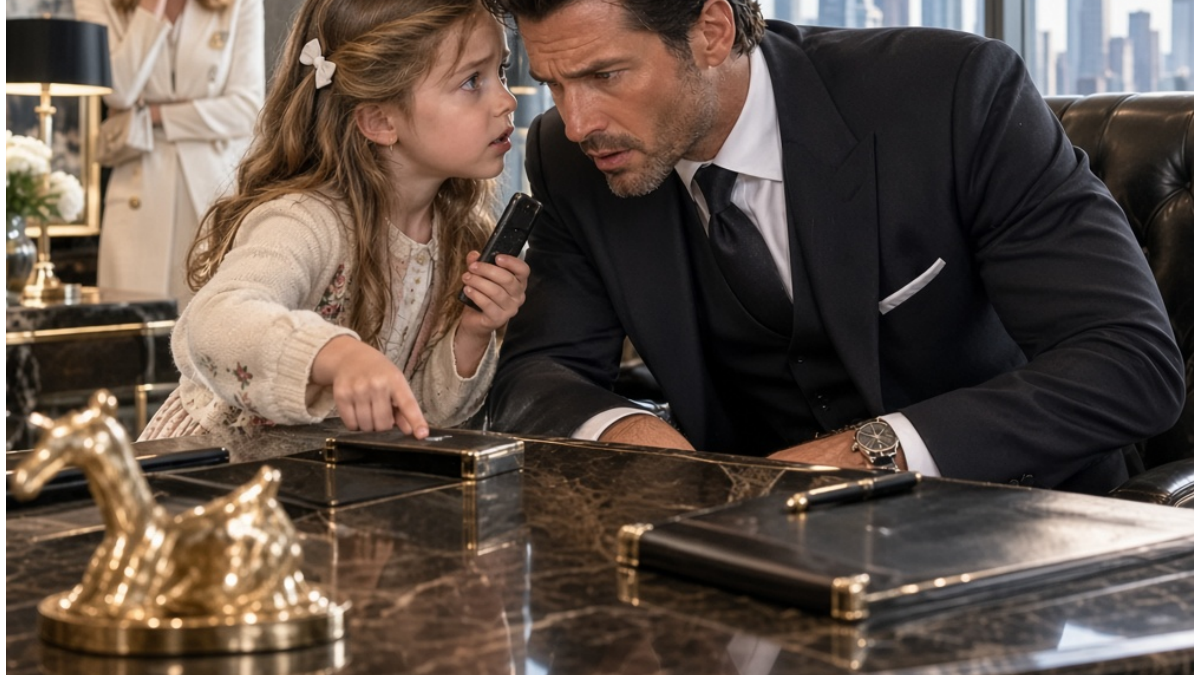
There’s a recorder in your office, sir. The little girl’s whisper barely carried across the room, but Leon Moretti heard every syllable.
His fingers, mid turn over a page of the quarterly financial report, froze against the paper.
The penthouse office at the top of the Moretti estate was silent, except for the faint hum of the lake wind pressing against the tall windows.
Leon slowly raised his eyes from the report. A small girl stood in front of his mahogany desk, no taller than the corner of it, clutching a blue crayon in one hand and the strap of a worn backpack in the other.
Sophie Carter, the housekeeper’s daughter, 7 years old, the kind of child who passed through the marble hallways of the estate like a small shadow, drawing pictures on the floor while men with guns walked past her without ever looking down.
Leon Moretti, boss of the Moretti family, the man whose name was whispered in every corner of Chicago, studied her for a long, careful second.
What did you say? His voice was low, controlled. There’s a recorder in your office, sir.
Sophie repeated the words, then glanced toward the halfopen door behind her. The way a child glances at a shadow she is afraid of.
Leon set the pen down. He had survived 20 years in this world by reading faces.
He had learned to tell the difference between a lie, a guess, and a truth too heavy for the speaker to carry.
The look in Sophie’s eyes was the third one. He rose from his chair, walked around the desk, and lowered himself to one knee in front of her.
Sophie, show me. She did not speak. Instead, she reached up, took two of his fingers in her small hand, and tugged him gently toward the desk.
With her other hand, she raised a single finger to her lips. Quiet. Leon bent down beneath the heavy oak desk.
For a moment he saw nothing, only polished wood, the grain of the underside, the soft shadow of the chair.
Then his eyes adjusted. There, a small black device, no bigger than a matchbox, taped neatly to the center of the underside of the desk, angled with surgical precision toward the leather chair where he had been sitting only minutes ago.
A tiny green light blinked once, twice, steady, recording. Leon did not move for several seconds.
He had heard men’s bones break in this room. He had signed papers that ended empires from this chair.
He had given orders that put bodies in the river behind the estate, and someone had been listening to every word.
His jaw tightened, his hand closed slowly into a fist against his thigh, then opened again, calm, measured.
The face he wore in front of his enemies returned, smooth as cold marble. He reached up, peeled the device from the wood with the patience of a man diffusing a bomb, and turned it over in his palm.
The green light blinked at him like a small mocking eye. Leon straightened up. He placed the recorder gently on the desk beside the financial report he would never finish reading tonight.
Then he looked down at Sophie. Sweetheart, he said quietly, kneeling again so his eyes were level with hers.
Did you see who put it there? Sophie glanced toward the hallway. She leaned close to his ear and she whispered a name.
The name of the one person in the world Leon Moretti had never thought to fear.
Miss Bella, Sophie whispered. Your fianceé. For three full seconds, Leyon did not breathe. The name hung in the air between them like smoke from a fired weapon.
Isabella Russo, the woman who would walk down the aisle of St. Michael’s Cathedral in 11 days, the woman whose engagement ring had cost him more than most men earned in a lifetime.
The woman who had kissed him good night in this very office only hours ago.
Leon’s face did not change. He had learned long ago that the dangerous thing was not feeling it was letting people see you feel.
Tell me what you saw, Sophie. His voice was soft from the beginning. The little girl shifted her weight from one foot to the other.
Yesterday after school, mama was cleaning the conference room downstairs. I came up here because I left my blue crayon under your chair.
She glanced at the desk. The door was open a little. I heard her voice, so I stopped.
And then she closed the door. She looked at all the corners, “Sir,” like she was checking if someone was watching.
Sophie’s small brow furrowed. Then she got down on her knees behind your desk. She had something in her purse, a little black thing.
She stuck it under the wood. Leon nodded once slowly and after she made a phone call.
I couldn’t hear all of it. I was scared, so I hid behind the curtain.
Sophie’s eyes lifted to his. I didn’t know what to do. I thought maybe I was wrong, but the green light.
Sir, I came back today to check. It was still blinking. Leon stood and walked behind his desk.
He woke the dark monitor and a soft blue glow filled the room. He typed a password no one else in the estate knew.
Not Marco, not even Dante. The security system that appeared on the screen was a private one.
A second layer of cameras Leyon had installed 3 years ago. Hidden inside the bookshelves, the lamps, the crown molding, cameras Isabella did not know existed.
He scrolled back to 3 12 p.m. the previous afternoon, the office door opened on the screen.
Isabella walked in. She moved with that unhurried elegance Leyon had once found beautiful. The way she always closed a door with her fingertips.
The way she paused at the center of a room as if she belonged in every space she entered.
She glanced at the corner, the ceiling, the window. Then she knelt exactly as Sophie had described, and her hand moved beneath the desk.
A moment later, she stood, smoothed her skirt, and lifted her phone to her ear.
Leon turned the speakers up. Isabella’s voice filled the office. Clear and warm as honey.
It’s done. The recorder is in. He’s in board calls until evening. He won’t notice a thing.
A pause. Yes. After the wedding, the entire Moretti empire is ours. Every account, every territory, every name on his books.
A soft laugh. The same laugh Leon had fallen asleep beside a hundred nights. He trusts me, darling.
He doesn’t even lock his office when I’m here. He never has. The recording ended.
Leyon sat without moving. His eyes did not leave the frozen image on the screen.
The woman in the cream colored coat. Standing behind his desk like she had already inherited it.
Sophie watched him in silence. A soft knock landed on the door. The handle turned before he could answer.
Isabella stepped inside, smiling that perfect smile, her engagement ring catching the lamplight. Darling, she said warmly.
I’ve been looking for you everywhere. Leon raised his eyes. For the first time in two years, he looked at Isabella Russo and did not see the woman he loved.
He saw the woman on the screen behind him. The woman who had knelt under his desk in a cream colored coat, the woman whose laugh had ended a recording with the words, “He doesn’t even lock his office when I’m here.”
In the half second before she crossed the room, Leon closed the security window with one smooth click of the mouse.
The monitor returned to its harmless screen saver. Sophie, sensing something only a child of seven can sense, slipped behind the heavy curtain near the bookshelf without a sound.
Darling, Isabella set her handbag on the side table and walked toward him. She leaned down and pressed her lips softly against his forehead.
You’ve been up here for hours. The kiss landed in the exact place she had laughed 2 minutes ago on the recording.
Leon let his mouth curve into a tired smile. Numbers don’t read themselves. She straightened and began to drift around the office the way she always did.
Her fingers brushed the spine of a leather-bound volume on the shelf. Trailed lightly across the back of the guest chair, skimmed the polished edge of his desk, the same edge, the same wood where her recorder had been taped only a day before.
She moved through the room like a woman taking inventory of furniture she would soon redecorate.
“You seem distant today, Leon.” She turned, head tilted, eyes soft with concern. “Is something wrong?
Just work?” He leaned back in his chair, the picture of a tired man with no enemies.
Detroit’s been a headache. The branches up there are fighting over roots again. The word Detroit landed just for an instant, less than a breath.
Isabella’s eyes flickered. A small calculation behind the warmth. The way a card player’s gaze sharpens when a useful card hits the table.
Then it was gone, replaced by the practiced softness of a fiance listening to her tired husband to be.
You shouldn’t have to carry that alone. She crossed the room, slid herself onto the arm of his chair, and then onto his lap, her hand resting against his chest, her engagement ring catching the lamplight again.
“After the wedding, everything will be easier,” she murmured. “You won’t have to fight every battle by yourself anymore, Leon.
No more late nights. No more carrying the whole family on your back,” her fingers traced the line of his jaw.
“Everything will be ours. Ours!” The words struck him like a hammer against bone. He felt it travel down his spine and settle somewhere cold beneath his ribs.
Hours, the same word she had used on the phone, the same intonation, the same false music.
Leon slid his arm around her waist and drew her closer, the way he had a hundred times before.
He pressed his lips to her temple and let his voice go quiet and warm.
I know, Amore. I trust you. She smiled against his shoulder, satisfied. A few minutes later, she stood, kissed him once more, and floated out of the office in a soft trail of perfume and silk.
The door clicked shut behind her. Leyon did not move for a long moment. His eyes dropped to the corner of the desk where her fingers had just rested.
The wood gleamed beneath the lamp, and on it, the faint, fading print of a hand that had already decided his death.
He understood now. The war had begun, and only one of them knew it. It was almost midnight when Lyon walked down the long hallway of the estate.
The house was quiet in the way only old houses know how to be quiet.
The faint creek of wood settling. The distant tick of a grandfather clock in the foyer.
The soft footsteps of a security guard somewhere two floors below. Most of the staff had gone home.
Isabella had left an hour earlier, her perfume still hanging faintly in the air she had passed through.
He stopped at the top of the curved marble staircase. At the bottom, in a small pool of yellow lamplight, Sophie Carter sat cross-legged on the floor.
Her backpack lay open beside her. A handful of crayons were scattered across the marble, and her small hands moved carefully across a sheet of paper balanced on her knees.
Leyon descended the stairs slowly without making a sound. He had spent his life learning how to enter a room without disturbing it.
Sophie did not look up until he was almost beside her. “You’re still awake,” he said softly.
“Mama is waiting for the last car,” Sophie said. “She has to finish the upstairs bathrooms before we go.”
Leon lowered himself onto the second to last step. His elbows resting on his knees.
He nodded toward the drawing. “What are you working on?” Sophie turned the paper toward him.
It was a house, a small, simple house with a sloped roof, a brown door, and three square windows colored bright yellow.
Three stick figures stood inside the largest window. A tall one, a medium one, a small one between them.
“That’s a beautiful house,” Leon said. “Who lives there?” “The family that never leaves,” Sophie answered.
Something inside Leon went still. He looked at the drawing for a long moment at the three figures pressed together inside the yellow window and then at the small girl who had drawn them.
Sophie, he said carefully. May I ask you something? She nodded. Why didn’t you tell your mother about the recorder?
Sophie picked up a green crayon and began very slowly to color a tree beside the house.
Because she would be scared, sir. Scared of what? Of losing her job. Her small voice did not waver.
Mama says when you don’t have a lot of money, you have to be careful around people who do.
She says rich people don’t always mean to hurt you, but sometimes they do anyway just by walking.
Leon was quiet for a moment. He had heard that lesson before. In other words, from his own mother a long time ago.
And why did you tell me? He asked. Why not the guards? Why not anyone else?
Sophie looked up at him. Because the office is yours, sir. She blinked once very seriously.
You should be more scared than me. Leon almost laughed. Instead, he reached into the inner pocket of his jacket and took out a small leather notebook he kept for his own private notes.
He tore the few used pages free, folded them into his pocket, and held the clean notebook out to her along with a sharpened pencil.
This is for you, he said. From now on, if you see anything strange in this house, anyone going where they shouldn’t, anyone whispering when they think they’re alone, I want you to write it down.
The time, the person, what they said. Can you do that? She took the notebook in both hands.
Like a detective. Like a detective. Sophie nodded once gravely. Leon watched her tuck the little leather book into her backpack with the same care she used for her crayons.
For the first time in many years, Leon Moretti trusted someone, and that someone was a 7-year-old girl with a blue pencil and a drawing of a house that would not leave.
Dante Russo arrived at the estate before the sun had cleared the lake. He was not a man who needed to be told twice when Leon’s call came at 5:00 in the morning.
Three words, “Come to me.” Dante was already pulling his coat on by the second ring.
By 6, he was standing in Leon’s private study, watching the security footage. Sophie’s small voice had unlocked the night before.
He did not speak while it played. He did not flinch when Isabella knelt under the desk.
He did not blink when her laugh filled the speakers. Dante Russo had been a soldier in Vietnam before he was a soldier for the Morettes, and very few things in the world made him blink anymore.
When the recording ended, he stood in silence for a long count of breaths. “Who’s behind her?”
He asked finally. “Leon,” standing at the window, did not turn. “That’s what I need you to find out.
Give me the number,” she called. Leon handed him a printed slip. Dante folded it once, slid it into the inside pocket of his jacket, and was gone before Leyon had finished his coffee.
For the next 24 hours, the estate moved as it always had. The chef prepared lunch.
The gardeners trimmed the hedges along the lake path. Marco Bellini came in at noon for a meeting about the docks, smiled, joked about the wedding, and left again.
Isabella called twice, once about the florist, once about the seating chart, and Leon answered both times with the patience of a man whose only concern in the world was whether the callillies would arrive on time.
The performance was flawless. Dante returned the following evening just after sundown. He came in through the service entrance as he always did when something was wrong and he did not take off his coat.
Sit down, Leon. Leon sat. Dante laid a thin folder on the desk between them and opened it with the care of a man unwrapping something dangerous.
The number bounces through four shell layers. He said, “Cayman Cyprus, a real estate trust in Toronto and then back into the United States.
The end of the line is a company called Neva Holdings. Registered out of a storefront on Brighton Beach Avenue.
Leon’s jaw tightened. He did not need to be told what Brighton Beach meant. Brighton Beach was where the Russians kept their bones.
Dante turned a photograph in the folder. A surveillance shot, grainy, taken from across a street.
A heavy set man in a long charcoal coat, mid-50s, eyes the color of cold metal, stepping out of a black sedan in front of a restaurant Leyon recognized by name alone.
Victor Dragunov. The name dropped into the room like a stone into still water. For 5 years, Victor Dragunov had been trying to bury his teeth into Chicago.
5 years of probing, of bribed inspectors, of small Russian crews testing the edges of Moretti territory and being sent home in pieces.
Leyon had broken every attempt. He had assumed Dragunov had finally learned. Now he understood.
Dragunov had only changed strategies. The Russian was famous for a single sentence, repeated in whispers across the East CoaSt. Don’t take the building.
Marry the owner. Leon sat down slowly in his chair and turned his face toward the window.
Beyond the glass, Lake Michigan stretched out in the failing light, gray and vast and indifferent.
This was no longer a story about a woman who did not love him. This was a war.
A soft knock landed on the doorframe. Sophie stood there in the hallway, her backpack on one shoulder, the little leather notebook clutched in both hands.
Mr. Leon, she said quietly. Today I saw a man with white hair come to talk to Mr. Marco.
Leon did not move for a long moment. The name Marco did not register the first time.
It refused to settle in his ears. Marco Bellini had stood at his father’s funeral.
Marco Bellini had taken a bullet in the shoulder for him in Cleveland 8 years ago.
Marco Bellini was the closest thing to a brother Leon Moretti had in this world.
Come in, Sophie. His voice was very quiet. Close the door behind you. She did.
The little brass latch clicked softly, and Dante stepped aside to let her pass. “Tell me about the man,” Leon said.
“Everything.” Sophie set the notebook on his desk and turned to a page already filled with her careful, careful printing.
“He was tall, taller than Mr. Marco, white hair, but not old hair straight, combed back, a long black coat, gray eyes.”
She paused, searching for the word. “Mean eyes, sir, like a fish.” Dante’s head turned sharply toward Leyon.
The description fit. It fit like a key in a lock. An Atali Vulov Dragunov’s senior lettant.
The man who handled the family’s most delicate American business. The man whose face Dante had been studying in photographs for the past week.
Leon looked down at the notebook. Sophie’s pencil marks were small and even. The letters of a child who had only recently learned to write neatly.
3:15 p.m. Back garden near the fountain talked in a strange language. Mr. Marco shook his hand two times.
One when the man came, one when the man left. Leyon turned the page. There was a small drawing beneath the entry.
Two stick figures. One with a triangle of white hair. The other shorter and rounder.
Between them, a rectangle, a briefcase. He looked up. Sophie, you did very well. Go and find your mother.
Stay near her tonight. She nodded and slipped back out into the hallway. The door clicked shut.
Leon turned the monitor toward Dante. Opened the secondary camera feed and scrolled back to 3:00.
There they were, Marco Bellini in a charcoal blazer, walking down the gravel path toward the marble fountain, and Atolli Vulov in the long black coat, waiting beside the hedge.
The two men shook hands. They spoke for 9 minutes, Leyon counted on the timestamp.
Then Vulkoff reached down beside his leg and lifted a leather attache case. He passed it to Marco.
Marco took it without hesitation, glanced once at the upper windows of the estate, and tucked the handle under his arm.
They shook hands again. Vulkov walked back toward the side gate. Marco walked back toward the house.
The case held casually, as if it were full of nothing more dangerous than papers.
Leon paused the footage and zoomed in. The case had a small brass clasp. Through the partial gap where Marco had not closed it fully, two things were visible.
The green edge of banded American currency and the white corner of a liSt. a list of names printed in a neat column.
Even at this resolution, Leon recognized the formatting. It was an internal directory, his internal directory.
Captains, soldiers, accountants, judges on the payroll. Marco was not just leaking secrets. He was selling the entire skeleton of the family.
Leon’s hand came down on the desk. The sound cracked through the office like a single gunshot.
The first sound of anger he had allowed himself in 3 days. Dante’s eyes did not leave him.
Tonight, Dante said quietly. Give me an hour. He won’t make it home. No. Leon’s voice came back down to its quiet steel.
He sat back in his chair, his palm flat against the wood where it had fallen.
Let him believe he’s winning. A man who believes he’s winning is the easiest man in the world to kill.
Dante studied him for a long moment, then gave a single nod. Leon turned his eyes back toward the window, toward the lake, and somewhere in the dark surface of the water, a plan began to take shape.
A plan with many moving pieces, a plan with three enemies who did not yet know they would be standing in the same room.
And at the center of it, a date already circled in red on every calendar in the estate.
The wedding. The next afternoon, Sophie sat in the big leather chair across from Leon’s desk.
Her feet did not reach the floor. They swung gently above the rug. One small sneaker untied as she balanced the leather notebook on her lap.
Late sunlight came through the tall windows and laid a warm stripe across the carpet between them.
The estate beyond the closed door went about its usual business. None of it touched this room.
Leon had asked her up here under the same quiet excuse as before that he needed her help with a children’s scholarship he was designing.
Rosa had nodded without question. The way she nodded at every kindness from a man whose money she could not afford to refuse.
Sophie looked at him with a small troubled wrinkle between her eyebrows. Mr. Leon, she said, “Can I ask you something?”
“Anything? Why don’t they see me?” Leon set his pen down. “In the garden, when Mr. Marco was with the white-haired man, they walked right past me.
I was sitting on the bench by the roses. The man even looked at the bench.
He didn’t see me.” She tilted her head. “Miss Bella does it, too. The guards do it, too.”
“Am I that small?” Leon was quiet for a moment, choosing his words the way he chose moves on a chessboard.
You’re not too small, Sophie. He said grown-ups are too busy. Most adults only see the things they’ve already decided are important.
A briefcase, a phone, another adult. They don’t expect important things to come in small packages.
So, they don’t look at small packages. Sophie thought about that. Mama says when people don’t see you, she said slowly.
You get to see who they really are. Leon looked at her for a long, long moment.
There were men in the world who had spent their entire lives building careers around that single sentence.
Spies, detectives, old priests in confession booths, and here it was spoken in a child’s voice, passed down a kitchen table from a woman who scrubbed his floors.
“Your mother,” he said quietly, “is a very wise woman.” Sophie nodded as if she had always known that.
“Sophie,” he leaned forward, resting his forearms on the desk. “May I ask about your mama?
About your father?” The little wrinkle came back between her eyebrows. Papa went away a long time ago.
Two birthdays ago. Mama said he was doing important work and he didn’t come home.
She paused. She doesn’t like to talk about it. Do you know what kind of work?
He was a policeman. Leon did not let his face change. But somewhere inside him, a memory shifted like a stone moving in deep water.
Two years ago, a Chicago detective, a young father who had been quietly building a case against the kind of business the Morettis did not put on paper, a car found at the edge of the lake, a funeral his family had attended quietly, out of respect, because the man had been honest, and Leon Moretti, for all his sins, had always respected honest men.
He had not known the detective had a daughter. He let the silence hold for a few seconds.
Then he closed the small file he had been pretending to read. Sophie, listen to me carefully.
She straightened in the chair. I need you to keep watching Isabella, especially when she uses her phone.
If she steps into a hallway, into a bathroom, into the garden, I want to know times, places, anything she says, even if it doesn’t make sense to you.
Yes, sir. And from now on in this house, you do not trust anyone except me and Dante.
Not the guards, not the housekeepers, not the men in suits who bring me papers.
Do you understand? Not even Mr. Marco. Especially not Mr. Marco. Sophie nodded very gravely.
She folded the little leather notebook closed, slid it carefully into her small backpack, and pulled both straps tight over her shoulders.
A 7-year-old girl had just become the most important spy inside the Moretti family. That evening, Leyon came down the staircase and stopped halfway.
The dining room was glowing. Two long white candles burned at the center of the table.
The good silver, the heavy hand engraved silver his grandmother had carried over from Polarmo, had been laid out on a cream linen runner, a bottle of Brunello, 20 years old and worth more than most of his guards earned in a month, stood already unccorked beside two crystal glasses.
The lights in the chandelier had been dimmed to half, and in the middle of it, in front of the stove, stood Isabella.
She was wearing the black dress, the one he had given her on her 30th birthday, the one she had once told him she would only wear for him.
Her hair was pinned up loosely. There was a small smudge of flower on her wriSt. She turned when she heard him on the stairs and gave him a slow, almost shy smile.
In 2 years, Isabella Russo had never cooked a meal in this house. She arranged.
She ordered. She hosted. She did not cook. Surprise, she said softly. Leon came the rest of the way down.
What’s all this? This? She crossed the room and slid her arms around his neck.
This is one night where nobody in the world wants anything from you. Sit, please.
He sat. He played the part. He took the wine she poured him and tasted it the way a man tastes wine in his own house with the easy, unhurrieded pleasure of someone who believes he is safe.
She had made bistca alapirentina and roasted vegetables. Simple, the way his mother used to make it.
She had remembered somehow that he hated cream sauces. She had remembered that he liked his bread torn, not cut.
She had remembered a thousand small things about him, and Leyon understood with cold clarity that every single one of them had been studied.
They ate slowly. They talked about Sicily. “I want a long honeymoon,” she said, swirling her wine.
“Two weeks, Tmina, then a villa near Sephilu. I want to see where your grandfather grew up.”
She smiled. “I want to be a Moretti in Sicily, not just in Chicago.” Leon smiled back.
“Then that’s what you’ll be.” She let a small silence settle, then reached across the table and laid her hand on his.
Leon, after the wedding, would you sign the ports over to me? Just the operating side, so I can take some of the weight off your shoulders.
You wouldn’t have to deal with the dock masters anymore. They’d come to me. The ports, the arteries through which every dollar of Moretti shipping flowed, the piece of the Empire Dragunov had been circling for 5 years.
Leon looked at her across the candles. “Of course,” he said. You’re going to be my wife.
She squeezed his hand. Her thumb moved softly over his knuckles. You trust me? For the first time since he had heard her laugh on the recording, Leyon looked directly into her eyes.
He did not flinch. He did not blink. He let his voice go warm and quiet the way it had a thousand other nights.
I trust you more than anyone in this world. She held his gaze for a long moment.
Then she smiled, satisfied, and lifted her wine. A little while later, she rose, pressed a kiss to the top of his head, and disappeared down the hallway toward the bathroom.
Leon stayed at the table. He looked at the glass in his hand at the dark wine catching the candle light.
He thought about the night two years ago at a hospital charity gala downtown when a woman in a wine red dress had laughed at his joke about Italian opera, and he had taken it as a sign.
He wondered for the first time whether anyone had paid her to laugh. Friday arrived gray and cold.
A late autumn fog had rolled in off Lake Michigan during the night, and by midm morning the estate stone walls were wet, and the long gravel drive looked like a road into a cloud.
Leon was at his desk going over a falsified shipping ledger Dante had prepared bait meant to find its way into Marco’s hands by sundown when he heard footsteps approached the office that did not belong to anyone with an appointment.
Two sets, Marco’s familiar tread, and something heavier behind him. Boots, not shoes. The door opened without a knock.
Boss Marco stepped in first and the smile on his face was the smile of a man trying very hard to act casual.
A business associate just dropped in. I thought you’d want to see him personally. The man behind Marco was the size of a freight door.
He was wide across the shoulders in the way only certain men from certain countries grew wide slabs of muscle thickened by cold winters and harder work.
A heavy black leather coat, a neck the color of brick, hair shaved to the skull, and eyes that did not move when they entered a room.
He stepped past Marco into the office and gave a small formal nod. Mr. Moretti, his voice was deep, with the heavy iron consonants of a man who had learned English late.
It is a pleasure. Leyon did not stand. He had known who the man was from the first second Marco had crossed the threshold.
Not Volov this time. Volov did not deliver messages himself. This was one of Dragunov’s couriers.
A face from a file Dante had laid in front of him 48 hours ago.
Mikail Sroken X Spetsznas, the Russians preferred messenger for matters that required a body in a room.
Mr. Dragunov, Siroken continued, sends his congratulations for your forthcoming marriage. He hopes the wedding may mark a new relationship between two great families.
Leon let a thin, cold smile reach his lips. I don’t recall having a relationship with any family but my own.
The Russians expression did not move. He reached into the inside pocket of his coat and produced a small lacquered wooden box, perhaps the length of a man’s forearm.
He set it carefully on Lyon’s desk, then stepped back and folded his hands in front of him.
A wedding gift. Lyon did not reach for it. Mr. Dragunov wished me to deliver it personally.
Sroken said he wanted you to understand that there are blades made for beauty and there are blades made for endings.
He felt you would appreciate the difference. Leyon held the man’s eyes for a long moment.
Then he lifted the lid. Inside, against red velvet, lay a dagger, old Russian, 18th century.
By the look of the etched grip and the dark silver fittings, the blade was perfectly polished, the edge so fine it caught the gray window light like a thread of mercury.
Leon closed the box. “Thank Mr. Dragunov for me,” he said, his voice perfectly even.
“Tell him I have always admired Russian craftsmanship. Such precise people.” Sorrokin inclined his head.
I will deliver your words exactly. He turned. Marco moved aside to let him pass.
Their shoulders almost brushed in the doorway. And for a fraction of a second, Marco’s eyes flicked sideways toward the Russian.
A small, anxious glance. The look of a man checking with a partner that he had played his part correctly.
Leon saw it. The door clicked shut. Marco stayed in the office, still wearing his casual smile.
Strange visit, huh? Who do you think sent him? Leon picked up the lacquered box and turned it slowly in his hands, studying the wood.
He did not look at Marco when he spoke. Marco, do you know who sent this gift?
Me. Marco gave a small, easy laugh. No idea. Never seen the man before. Leon set the box down.
Another lie. Filed beside all the others. Long after midnight, Leyon descended the narrow staircase beneath the wine celler.
Below the estate, hidden behind a false rack of dusty Barola bottles, was a room only four living men knew about.
Soundproof, no phones, no windows, no electronic signal that could pass either way through the walls.
His father had built it during the years of the federal hearings. Leon had not used it in 3 years.
Tonight, he had needed it. A long oak table ran the length of the room.
On it, Leyon had laid out everything. Surveillance photographs of Anatoli Vulov, the Shell Company paper trail.
Dante had pulled out of Brighton Beach. Bank records, phone logs, Sophie’s notebook open to her careful columns of times and names, a print out of the recording transcript, the lacquered box from Dragunov, closed in the center.
Dante arrived firSt. He took off his coat in silence and stood with his back to the wall, the way old soldiers stand, where no one can come up behind them.
The second man came a few minutes later in a long black cassic and a worn leather coat thrown over it.
Father Antonio Carbone had been baptizing, marrying, and burying Morettis for 30 years. He had heard confessions Leon’s father had never spoken aloud to another living soul.
He kept the family’s true secrets the way other priests kept their breviaries close, and without comment, he stepped into the room.
He looked once at the table. He crossed himself, “Leon.” His voice was soft. He picked up the photograph of Isabella under the desk and studied it for a long moment.
I baptized you in my arms, Filio. I anointed you with oil before you could speak.
I cannot picture this. I cannot picture this woman doing this thing. Sit down, father.
The priest sat. Dante stepped to the table. They began. It took an hour to put the pieces together, but the picture once assembled was clean and terrible.
Dragunov had been planning this for years, not months. Years. The charity gala two autumns ago, where Leon had first seen Isabella in the wine red dress Dante’s people had now traced the guest liSt. The seat next to Leon’s had been bought anonymously 3 weeks in advance and assigned to her by a coordinator on Dragunov’s payroll.
Their meeting had been arranged before either of them had set foot in the ballroom.
And Marco, Marco was the older wound. 18 months ago, his youngest son, Mateo, had been diagnosed with a heart defect that required a specialist in Houston and a sum of money beyond what any captain in the family could quietly absorb.
Dragunov had heard. Dragunov had reached out. The boy had received his surgery. The bill had been paid.
And somewhere in a Houston hotel room, Marco Bellini had signed his soul over to a man whose name he had never spoken aloud in this house.
Dante unrolled a map of Chicago across the table. He marked it in red. The docks, the trucking yard in Cicero, the two restaurants on Taylor Street that were not really restaurants, the accountant’s office on Lasal, the judge’s house in Lincoln Park, 16 red points in all.
Every artery of the Moretti family mapped out as if for an attacker. That’s the list inside the briefcase, Dante said quietly.
Every name on it works at one of those points. When do they hit? Father Antonio asked.
His old hands were folded on the edge of the table. Leon’s eyes moved to the small calendar pinned to the cellar wall.
A date eight days away was circled in his own hand. The wedding. The word settled over the table.
That’s the day they think I’ll be unguarded. The day my men are scattered across the city in their best suits.
The day my own consiglier will be standing closest to me. The day the woman in the dress will already have her hand on my arm.
The priest closed his eyes. He made the sign of the cross slowly, deliberately, three times.
St. Michael’s, he murmured. The cathedral where I was going to marry you to her.
It will become a battlefield. The next afternoon, Rosa Carter was dusting the long sideboard in the drawing room when she stopped and looked at her daughter.
Sophie was sitting on the rug by the fireplace the way she always did, legs folded under her, paper spread out, crayons fanned in a careful arc beside her right hand.
But she was not just drawing anymore. Beside the drawing lay the small leather notebook Rosa had never seen before.
Every few minutes, Sophie would set down her crayon, pick up a pencil, write something neat and short, and then return to her picture.
Rosa watched her in silence for almost a minute. She set the dusting cloth down on the sideboard and walked over slowly.
She lowered herself onto the rug beside her daughter, knees creaking, and gently tucked a loose strand of hair behind Sophie’s ear.
Sweetheart, she said softly in the voice she used only when no one else was in the room.
Is someone in this house frightening you? Sophie did not look up. She kept coloring a small window yellow.
No, Mama. Are you sure? I’m sure. Rose’s eyes moved to the notebook. She did not reach for it.
She had been raised to respect a child’s secrets the way she had been raised to respect a closed door.
Then what is the little book for? Mr. Leyon is teaching me to draw better.
Sophie answered without hesitation. The way a child answers when the answer has already been.
He says, “Good artists write down what they see so they remember it for the next picture.”
Rosa was quiet for a moment. She did not believe a single word her daughter had just said, but she also believed.
In the deeper place where mothers know things they cannot prove, that Sophie was not lying out of fear.
Whatever the truth was, Sophie was protecting her. “All right,” Rosa said gently. But Miha, if anything makes you afraid in this house, anyone, anything, you come to me.
Even if you think it will make me cry, you come to me. Sophie finally looked up.
Her small face was very serious. I will, mama. Rosa kissed the top of her head and stood up to pick up the dusting cloth again.
She did not see Isabella in the doorway. Isabella had been standing there for some time.
She came into the room now, walking softly on the rug, her wedding planner folder under one arm.
She gave Rosa the small, gracious smile she gave to all the staff. Then she stopped behind Sophie, looking down at the drawing.
“What a clever little girl you have, Rosa,” she said pleasantly. “Always paying attention, always noticing things,” Rosa’s hand tightened around the cloth.
“She’s only a child, Senora. She doesn’t notice much.” “Children notice everything,” Isabella replied, still smiling.
“They just don’t always know which things grown-ups don’t want to be noticed.” She lowered herself gracefully into a crouch beside Sophie.
The folder slid from under her arm onto the rug. The drawing was a church, tall with a steeple and stained glass windows colored in pieces of red and blue.
In front of the church stood a long line of stick figures, all of them in black.
The figures did not have faces. For exactly half a second, Isabella’s eyes narrowed. It was nothing a stranger would have caught.
A small tightening at the outer corners, a small adjustment at the bridge of her nose.
Then the smile was back. “Perfect. What a pretty church, sweetheart,” she said. “Is someone getting married?”
“I don’t know yet,” Sophie said softly. “I haven’t finished.” Isabella rose to her feet, retrieved her folder, and left the room as quietly as she had come in.
That night, when Leon came down the hallway, Sophie was waiting on the bottom step of the staircase.
She tugged his sleeve, leaned close to his ear, and whispered, “Miss Bella looked at me different today.
I think she’s starting to see me.” Leon did not sleep that night. He sat in the dark of his office for a long time, the way he used to sit during the worst negotiations of his life, when the only safe move was to think and not move.
Miss Bella looked at me different today. Six words from a seven-year-old, and Leon Moretti understood them better than any briefing Dante had ever given him.
Isabella had seen Sophie, not the child, the witness. And Isabella did not leave witnesses standing.
By dawn, Leon had made his decision. Whatever else happened in the coming days, whatever happened in the cathedral, whatever happened to the men around him, nothing was going to happen to that little girl.
He called Rosa to his office midm morning. She came in wiping her hands on her apron, her face pulled tight with that quiet, ancient worry working women carry into rooms with rich men.
He gestured for her to sit. She did, but only on the edge of the chair, the way a person sits when they expect to be told to leave again.
Rosa, he spoke gently. I’m closing the staff wing of the estate for renovations. 6 weeks, possibly longer.
The roof above the laundry has a problem we should have fixed 2 years ago.
A lie, but a believable one. I’m relocating you and Sophie to one of my apartments in Lincoln Park.
Furnished. Driver, groceries delivered. Same salary. No reduction in hours. I’d like you to work from there for now.
Rosa’s hands tightened on her apron. Senior Moretti. Her voice was small. Have I done something wrong?
No, Rosa. Has Sophie done something wrong? No. She looked down at her lap. She drew in a breath that shook a little on the way out.
Then why? Leyon was quiet for a moment. Because I want to make sure your daughter is safe.
Rosa lifted her eyes. She held his gaze for a long, long moment, longer than any housekeeper had ever held his gaze in this office.
And then she said very softly, “My husband was a policeman.” Senior Moretti Leon did not move.
He was killed two years ago. He was investigating a case that touched your family.
The newspaper said it was a robbery. But I know it wasn’t a robbery. Her voice did not rise.
It did not break. It only became more level. The way a voice becomes when it has carried something too heavy for too long.
I came to work in this house 6 months later because I needed money for my daughter.
I told myself I would never know who. I told myself it didn’t matter. She paused.
I still don’t know who. Leon did not admit. He did not deny. He sat very still in his chair.
And somewhere behind his eyes, 2 years worth of paperwork shifted into a new shape, a name he had heard at a meeting, a problem Marco had handled, a problem Marco had perhaps handled in a way Leyon had never been told.
The regret that rose in him was not the polished kind. It was the kind that comes from a place no one ever sees.
Rosa. His voice had gone quiet. I am going to keep your daughter safe. As if she were my own, Rosa studied him for a long second.
She did not see in that moment the boss of the Moretti family. She saw a man making a promise he intended to keep, and she understood the difference.
She nodded once slowly. “All right, Senor.” The car came for them that evening at 6, a black sedan.
Two of Dante’s most trusted men in the front. Their suitcases were already in the trunk.
Rosa walked to the door with her coat folded over her arm, the dignity she had carried into the estate intact, undamaged.
Sophie hung back. She turned to Lyon, who was standing in the foyer in the soft lamp light, and then, without warning, she ran the three steps between them and threw her thin arms around his waiSt. Leon stood frozen.
It had been many years since anyone had hugged him. He could not remember the last one.
“I’ll keep helping you,” Sophie said into his shirt. From far away. 5 days before the wedding, the chessboard was finally on the table.
Leon Moretti went to work the way a surgeon goes to work slowly, precisely, and without speaking more than necessary.
The estate kept its rhythMs. The kitchen prepared meals. The gardeners pruned the late roses.
Marco came and went through the front door with the easy step of a man who believed he had 8 days left to live as a free king.
It began with a folder. On Monday morning, Leon called Marco into the office and slid a sealed envelope across the desk.
I want you to handle this personally, he said. Not Dante, not the captains. You, Marco looked at the seal.
The Moretti crest pressed in wax. He nodded slowly. Of course, boss. After the wedding, Leon went on.
I’ll be transferring the Argentine accounts and the Cleveland roots through the Newport’s operation. I need you to know where the money will be physically held for the first 10 days of the transition.
Vault locations, bank codes, names of the couriers who carry the keys. He named four banks, three vaults, six couriers.
Every detail was a lie. Dante had built the false architecture over 36 hours. The banks existed.
The vaults existed. But what would be inside them during those 10 days would be paper and salt.
The real assets had already moved quietly into instruments Marco could not see. By Tuesday afternoon, a sealed call from Brighton Beach to a Chicago cell tower confirmed the bait had landed.
Marco had passed every piece of it to Vulkoff inside 48 hours, exactly as Lyon had predicted.
Dragunov was already planning his strikes against vaults that would on the day of the wedding hold nothing but humiliation.
While the false picture said in Dragunov’s mind, the true picture took shape in Lyon’s.
Dante quietly recalled 80% of the family’s most trusted soldiers back to Chicago. They came in pairs on commercial flights through three different airports carrying nothing that would draw attention.
They stayed in safe houses across the south and west sides. None of them set foot in the estate.
None of them were on any list Marco could read. Father Antonio handled the cathedral.
12 of the men he placed inside St. Michaels wore the gray uniforms of the diosis and ushers and the dark robes of the lay attendants.
Two more became florists. One became the elderly Sexton everyone would underestimate. Each of them had served either the Moretti family or Father Antonio’s parish for longer than Dragunov had been in America.
None of them would draw a weapon early. None of them would draw a weapon late.
The wedding musicians were the next move. The original quartet had been booked by Isabella’s planner strings and an organiSt. Leyon expected correctly that Dragunov’s people would already have replaced or compromised them.
So Leon replaced them firSt. The quartet that would arrive at St. Michael’s belonged to him.
Their instrument cases were specially built. Their hands had held more dangerous things than bows.
And then there was the bride. Leon called Dante into the office on Wednesday night.
He explained what he wanted. Dante listened without expression, then nodded and made one phone call.
By Thursday morning, a young woman flew in from a Moretti household in Boston. A cousin of a cousin, the same height as Isabella, the same dark hair, the same build down to the shoulders.
She would not stand at the altar. She would stand in a specific doorway at a specific moment, in a specific veil, and she would draw exactly the kind of attention Isabella’s enemies would expect Isabella to draw.
Every detail was calculated to the second. And every afternoon, Isabella came to the estate.
She came smiling. She came with samples of cake frosting and printed menus and her wedding planner’s tablet.
She talked about pionies and ribbon colors and the music for the recessional. She kissed Lyon’s cheek.
She laughed at his small jokes. She sat in his lap with her engagement ring catching the lamplight and asked him whether he was excited.
On Thursday evening, she paused at the door on her way out, turned and said, “Are you really ready, Amore?
Are you ready for our wedding day?” Leon stood and walked to her. He took her face gently in both hands.
He looked her directly in the eyes. The way a man looks at his beloved.
Our wedding day, he said quietly, is going to be the most important day of our lives.
She smiled, melted into his chest, and did not understand he had told her the truth.
From the apartment in Lincoln Park, Sophie did not stop watching. Every morning, Dante drove the long way through traffic to drop a sealed envelope at her kitchen table.
Small things harmless to look at. But Sophie understood the code. A photograph of Isabella’s car at the front gate.
A note about who had visited the estate. A scrap of a guest liSt. And every evening Dante came back to pick up her envelope in return, in which Sophie had written in her careful pencil anything she remembered from the day before that she had not yet told them.
The drawings of faces, the order of footsteps, the exact words. 3 days before the wedding, Sophie made her first requeSt. She called Leyon herself from the kitchen phone with Rosa in the next room.
Mr. Leyon, I need to come back to the house. Just one time. No, sweetheart.
Just one time. It isn’t safe, Sophie. The house isn’t safe anymore. There was a small pause on the other end of the line.
Then her voice came back low and very serious. Mr. Leon, I am the invisible person.
They don’t see me. The grown-ups in the garden, they didn’t see me when Mr. Marco was with the white-haired man and they won’t see me now.
But you need someone to listen to Miss Bellow when she makes her last phone call.
She makes it before something big. She made it before the recorder. She’ll make it before the wedding.
I can hear it. They won’t see me. Leon sat back in his chair. He had been told no by senators and federal judges.
He had been told no by his own father. None of them had ever shaken him the way this small voice did.
Dante goes with you, he said finally. He doesn’t leave the property line. You come in through the kitchen door.
You stay no longer than 30 minutes. And the cover is that your mother left a sweater she needs back.
Yes, sir. That afternoon, the black sedan rolled up the long drive of the Moretti estate.
Sophie climbed out in her school coat, her backpack on one shoulder, the leather notebook tucked deep inside it.
She walked through the kitchen entrance the way a child of the staff walks eyes down, polite, invisible.
Dante stayed by the gardener’s shed. Out of sight, his coat unbuttoned for easier access to the holster beneath.
Sophie did exactly what she had been told. She went to the staff quarters. She opened her mother’s old locker.
She took out a folded gray sweater. And then she did one extra thing. On her way back through the kitchen, she paused at the side window, the one with the view of the rose garden.
Isabella was outside. She was walking the gravel path between the hedges, phone pressed to her ear, her free hand moving in small, sharp gestures.
Sophie ducked low beneath the windowsill and listened through the half-cracked pain. She wrote in the notebook with her pencil shaking only a little.
The words came through clearly between the gusts of cold lake wind. The moment Lyon’s down, Vulov is the next problem.
Don’t trust Dragunov. He’s a piece on the board. Nothing more. After the ceremony, we move on his Brighton people the same week.
No, the Russians won’t see it coming because they think I work for them. I built this, not him, not Dragunov, me.
Chicago is mine, Sophie wrote until her hand cramped. She folded the notebook closed, slipped it back into her backpack, picked up her mother’s sweater, and walked out to the gardener’s shed exactly 27 minutes after she had arrived.
That night, in the safe apartment, Leon sat across from her in the small kitchen.
Sophie placed the open notebook in front of him. Her finger came down on one line, then on another.
Mr. Leyon, she said. Miss Bella said she’s going to kill you and Mr. Dragunov.
Leon did not speak for a long time. He sat at the small kitchen table in the safe apartment, the leather notebook open under his hand, and he read Sophie’s careful pencil lines twice, then a third time.
The lamp above them hummed faintly. From the next room came the soft sound of a kettle.
Rosa, sensing the air had changed, did not come in. Every assumption Leon Moretti had built over the last 10 days now had to be torn down and laid out again on a new floor.
He had pictured a two-headed enemy, Dragunov on one side, with his Russian crews, his careful patience, his half decade of preparation.
Isabella on the other, his fianceé, the wedge Dragunov had driven into his life. Marco was the leak.
The picture had been clean. The picture had made sense. The picture had been wrong.
Isabella was not Dragunov’s queen. Isabella was Isabella’s queen. She had been her own player from the very beginning.
Two years ago, at a charity gala in a downtown ballroom, she had walked up to Leon Moretti in a wine red dress and laughed at his joke about Italian opera, not because Victor Dragunov had paid her to, but because Victor Dragunov had paid her to, and she had taken his money, knowing she would also take Leon’s.
She had played the Russian for 2 years while she played the Italian. She had used Dragunov’s hatred of the Moretti family to build her own bridge into it.
She had used Lyon’s loneliness to build her own throne behind it. Dragunov thought on the morning of the wedding that he would inherit the Moretti Empire through her hand.
Marco thought on the morning of the wedding that he would be rewarded for his long loyalty to her.
Isabella thought on the morning of the wedding she would step over both of their bodies and walk out of St. Michael’s Cathedral.
The Queen of Chicago, Dante, standing against the kitchen counter finally broke the silence. So, in the church, we’re not facing two enemies.
We’re facing three. No. Leon’s voice was quiet. He turned the notebook so Dante could see the lines, too.
We’re not facing three. We’re letting three face each other. Dante’s eyes narrowed. He understood almost at once.
Leyon laid it out. The wedding was Isabella’s day to kill both Lyon and Dragunov in one stroke, using each man’s gunmen to destroy the other.
That meant she had her own shooters in the cathedral separate from Dragunovs, and that she had planned the choreography so that her men’s bullets would land on his men, and his men’s bullets would scatter into her decoys.
With Lyon caught in the middle of the crossfire, whoever survived the storm, she would inherit.
Leyon’s new plan was simpler than the old one. Father Antonio would watch from the altar.
The moment Dragunov’s shooters revealed themselves, and the moment Isabella’s shooters revealed themselves, he would give a single pre-arranged signal.
At that signal, Leyon would not be at the altar to be killed. He would already be moving toward the side Sacry, exactly 30 seconds ahead of the trigger.
Escorted out by the priest under cover of the choir’s processional. Without a target in the center of the nave, the two sets of killers would see only each other.
Dragunov’s men would assume Isabella’s men were Leyon’s defenders. Isabella’s men would assume Dragunov’s men had betrayed her early.
The cathedral would do the reSt. Two cats fighting over a fish, Sophie said from her chair.
Both men turned to her. She was sitting very straight, the kitchen lamp catching the small, serious face above the leather notebook.
She blinked once. My friend’s cat does it. Two cats fight over a fish, but the fish already swam away.
They keep fighting because they don’t know. Dante let out a slow, surprised breath. Leon looked at the little girl across the table at the daughter of a dead Chicago cop, at the child no one in the estate had ever bothered to see.
And for the first time in many, many years, he smiled. Not the cold, controlled smile he wore at meetings.
A real one. Yes, princess, he said quietly. That is exactly right. The night before the wedding, Leon Moretti was alone in his office for the first time in days.
The estate was quiet. The kitchen lights had gone out an hour ago. Dante was downtown walking the streets around St. Michaels one final time.
Father Antonio was in the cathedral itself lighting candles for souls who did not yet know they would need them.
Marco was at home, sleeping the untroubled sleep of a man who believed every piece was in its place.
Only Lyon was awake. He stood at the tall window and looked out at Lake Michigan.
The water was black tonight, almost solid. Only the smallest scatter of harbor lights breaking the surface near the city’s edge.
A long way out, the lights of a freighter moved slowly toward the harbor. One small red point and one small white one.
The way ships had moved across that water for a hundred years. He thought of his mother.
Elena Moretti had died when Leyon was 10 years old. Pneumonia, the doctor said, though pneumonia was the polite word for what really happened in cold houses with no proper heat.
She had been a small woman with strong hands, and she had carried her son through more winters than any woman should have to carry a child through.
He could remember the shape of her shoulder against his cheek. He could remember the smell of bread on her apron.
She had said one thing to him a few months before she died that he had never forgotten.
Leon Chino, the strongest man does not win. The man who sees clearly wins. Don’t ever be the one who closes his eyes.
He had been 10. He had not understood. He understood now. He turned from the window and walked to his desk.
There, side by side on the polished wood lay two objects. The first was a small white gold band, plain, almost simple compared to Isabella’s engagement ring.
The wedding ring he had chosen for her himself 6 months ago in a small shop on Oak Street.
He had pictured a hundred small moments when he had bought it, slipping it onto her finger, watching her look at her own hand in the morning.
None of those moments would happen tomorrow. The second object was the lacquered wooden box from Brighton Beach.
Inside it, the Russian dagger Dragunov had sent as a wedding gift. Blades made for beauty.
Blades made for endings. Leyon picked up the ring. He turned it once between his thumb and forefinger.
The gold caught the lamp light softly. Then he set it down on the desk exactly 1 in from the box.
He stood and looked at the two of them together. A ring and a knife, two pieces of metal.
He understood now that they were the same thing in different shapes, that every weapon his enemies had used against him for the past 10 days had come dressed as something beautiful.
His phone vibrated softly on the desk. He picked it up. “Sleep well, my love,” Isabella’s voice was warm, sleepy.
“Perfect. Tomorrow is our day.” “Yes,” Leon said quietly. “Our day.” “I love you, Leon.
I know you do, Amore.” He ended the call. He sat down at his desk, opened the bottom drawer on the right, and reached past the files to the small velvet pouch he had kept there since he was 22 years old.
He took out the only photograph he owned of himself and his mother. She was sitting in a kitchen chair, 28 years old in the picture, her hair pulled back.
He was a small boy beside her, no older than Sophie was now. They were not smiling for the camera.
They were looking at each other. He turned the photograph over. On the back, with a black pen, he wrote one line in slow, careful Italian.
Gracia. Thank you, little one, for seeing me when no one else cared to look.
He folded the photograph into a clean envelope and addressed it in case he did not come home from the cathedral to Sophie Carter.
Saturday morning broke clear and cold over downtown Chicago. St. Michael’s Cathedral stood at the corner of Cleveland and Hudson, its dark stone steeple rising into a sky the color of polished steel.
By 8 in the morning, white gloved florists were finishing the white roses on either side of the great oak doors.
By 9, the long red carpet had been rolled down the central aisle of the nave, and 400 ivory candles had been lit along the side chapels.
The stained glass windows poured slow rivers of color onto the marble floor. The guests began arriving at 10.
They came in long black cars from three airports. The Genevese family flew in from New York.
The Patriarchaline came down from Boston. The Bruno Scarfo cousins came up from Philadelphia. Old men in dark suits with hands like leather embraced each other on the cathedral steps.
Their wives wore pearls that had seen funerals and weddings going back two generations. Every face was a name in a file somewhere in a federal office building.
Outside the cathedral, Chicago police officers in pressed uniforms held the line at the edge of the sidewalk.
Two of them had taken envelopes from Marco the night before. Their job today was simple.
Keep the street quiet and look the other way for whatever rolled out of the front doors after 11.
Leon’s car arrived at 10:30. He stepped out in a black tuxedo cut close to his shoulders, a single red rose pinned to his lapel.
He looked exactly like a man on the most important morning of his life, calm, composed, almost solemn.
Dante climbed out behind him. The earpiece tucked beneath Dante’s collar was invisible. The holster beneath his vest was tighter than usual, fitted for two weapons instead of one.
Marco was already waiting on the cathedral steps. He came down them with both arms spread, a wide smile on his face, his graying hair combed back the way it had been combed back for every Moretti family event for 20 years.
Boss, the big day. Look at you. Leon embraced him. He held the embrace one beat longer than usual.
He felt Marco’s familiar weight. The same shoulder he had clapped a hundred times after a good deal.
The same back he had pulled out of a Cleveland alley with a bullet in it nearly a decade ago.
“Thank you, Marco,” Leon said quietly into his ear. For 20 years of being beside me, I don’t forget what we built together.
Marco patted his back twice and stepped away, smiling, the picture of a man being thanked.
He did not understand that he had just been told goodbye. Inside the bride’s room, Isabella stood in front of a long guilt mirror.
The dress was a long-sleeved cathedral gown of antique ivory silk with a 12-oot train and a small constellation of seed pearls across the bodice.
Her mother sat on the satin bench behind her, dabbing her own eyes with a handkerchief.
Two bridesmaids in pale gray adjusted the veil. Through the tall window, Isabella could see the steps of the cathedral, the cars, the police, the careful, ordinary mourning.
She lifted her chin and met her own eyes in the mirror. Today, she thought, I become a queen.
She smiled. A few miles north on the eighth floor of a quiet building in Lincoln Park, Rosa Carter sat very still on the edge of a sofa.
Sophie sat beside her. The leather notebook closed on her lap, both hands holding it as if it were a small bird.
Two of Dante’s men stood by the windows. A laptop on the coffee table glowed softly, showing three live feeds from inside St. Michael’s, the altar, the choir loft, the central aisle.
Sophie did not look away from the screen. Back at the cathedral, the bells in the steeple began to ring.
11:00. Father Antonio Carbone, 60 years old, vested in white and gold for the most important mass of his life, stepped quietly up to the pulpit at the front of the nave.
He drew a single deep breath, and the largest war in the history of the Chicago Mafia began.
The organ’s first note rolled through the cathedral like a slow wave. 400 guests rose to their feet, heads turned toward the rear of the nave.
The heavy oak doors at the back swung open, and Isabella Russo stepped into the threshold on her father’s arm, framed by the cold, gray Chicago sky behind her.
She was breathtaking. The veil drifted softly behind her. The seed pearls on her bodice caught the candle light.
She walked down the long red carpet with the slow, measured grace she had practiced in front of the mirror for years.
But her eyes were not on Lyon. They moved. Pew six on the left, pew 9 on the right, the fourth column at the back.
Her gaze touched each location for half a heartbeat, counting, confirming four of her men exactly where she had placed them, their suits identical to the suits of the other guests, their hands folded politely on the backs of the pews in front of them.
Good, they were ready, she raised her chin and smiled, the small private smile of a woman 3 minutes away from owning a city, 30 ft from the altar, she paused for the recessional adjustment.
The quartet shifted into the slow processional hymn. That was the moment everything broke. The first violinist did not lift his bow.
He stood up. He bent down to his open case and his hand came back up holding a checkmade submachine pistol with a folded stock already chambered.
In the second balcony, three more musicians did the same. Three more in the choir loft pulled compact rifles from beneath their black robes.
Seven of Dragunov’s men. Every one of them trained on the altar on the spot where Leyon Moretti should have been standing.
But Lyon was not standing there. 30 seconds earlier, at the exact instant, Father Antonio had raised his right hand in what looked like a blessing the priest had turned to the groom, murmured a single word in Italian and guided him through the narrow side door behind the altar into the sacry.
The door had closed behind them without a sound. The altar was empty, only the candles burned.
The seven guns swung, found nothing, and hesitated for the half second that decides every fight in this world.
In that half second, four guests in the second pew rose to their feet. Isabella’s men.
They drew from shoulder holsters fast and clean, and turned their barrels upward toward the choir loft and the balcony, assuming, exactly as Isabella had taught them, that any shooter who appeared first was a Russian sent to kill them.
The cathedral exploded. Gunfire tore through the long marble nave from both sides at once.
Stained glass cracked. Plaster rained down from the ceiling. Guests screamed. Old men in their best suits threw their wives to the floor and crawled toward the heavy oak doors.
The bridesmaids broke and ran. The bride’s father went down, clutching his shoulder. Isabella stood frozen in the center of the aisle in her cathedral gown.
12 ft of ivory silk pulled around her. She turned in a slow circle. The altar was empty.
The sacry door was closed. He was not there. He had never been there. Stop.
She screamed at her men over the gunfire. Stop. The target is Leyon. Find Leon.
But the bullets were already in the air. Dragunov’s men, seeing the shooters in the pews, were certain they had been ambushed by Moretti loyalists.
Isabella’s men, seeing the rifles in the loft, were certain they had been double crossed by the Russians.
Each side fired faster, harder, more accurately into the other. High above in the second floor balcony.
Victor Dragunov stood in the shadow of a stone column. He watched his musicians fall.
He watched the men in the pews fall. He watched his own carefully built ambush dissolve into smoke beneath him.
His face went very still. He had been played. Smoke filled the cathedral, thick and white, drifting through the colored shafts of light from the broken windows.
The pews were splintered. The candles flickered in the disturbed air. The screams of the fleeing guests echoed against the high stone vault.
And through that smoke, framed against the doorway of the cathedral’s main entrance, a figure stepped back into the church.
Black tuxedo, red rose still pinned to the lapel, a pistol in his hand. Leon Moretti had come back.
Leon Moretti walked down the long center aisle of St. Michael’s Cathedral. Dante was on his right shoulder, a rifle held low and ready.
20 of the family’s most trusted soldiers came in behind them in two even rows.
The men recalled quietly from across the country over the past week. The men whose names had never been on Marco Bellini’s liSt. Their footfalls landed almost in unison on the broken marble.
The fighting was already ending. Of Dragunov’s seven shooters in the loft in the choir.
Four were dead and two were on their knees, their hands behind their heads, their weapons kicked across the floor.
Of Isabella’s four men in the pews, three were dead and one was crawling toward the side aisle, leaving a long red trail across the white stone.
The last of Dragunov’s men in the balcony fired one wild burst at the new arrivals.
Two of Lyon’s soldiers fired back, calm and precise, and the burst stopped. The surviving wounded were pulled to their feet and herded toward the rear wall by men who had done this work before.
High above the nave on the balcony where he had thought he would watch a triumph.
Victor Dragunov stepped out of the shadow of the stone column. His face was no longer still.
It was furious. He raised a long pistol, sighted on Lyon below, and fired. The shot cracked off a marble pillar 2 ft to Lyon’s left.
Stone dust drifted down. Dragunov never fired a second time. Dante had already taken the side stairs three at a time.
The Russian heard the footstep behind him a quarter of a second too late. Half turned and met Dante’s bullet between his shoulder blades.
Victor Dragunov, who had spent 5 years trying to take Chicago, dropped his gun on the balcony rail.
Then he dropped beside it. Then he did not move again. The Russians empire in this city died with him on a strip of stained glass lit carpet.
In the center of the nave, Marco Bellini stood very still. His tuxedo was unmarked.
His hair was unmoved, but his face had gone the color of plaster. He understood with the clarity that comes once in a lifetime that everything he had spent the last 18 months building had collapsed in under 3 minutes.
Leon walked the last 20 steps and stopped in front of him. 20 years, Marco.
Marco’s lips parted, but no sound came out. 20 years, Leyon said again quietly. What did you sell me for?
Marco’s knees gave way. He went down onto the marble in front of his boss.
The way penitants go down in front of altars. My son, he whispered. Mateo, the surgery.
They told me there was no other way. There was no time. There was time, Marco.
Leon’s voice did not rise. You could have come to my office. You could have knocked on the door.
I would have paid for the surgery. I would have flown the surgeon in. I would have sat with you in the waiting room.
He paused. You chose betrayal instead of truSt. That was your choice. Not Dragunovs, not your sons, yours.
Marco lowered his head. Around the broken nave, the surviving heads of the Genevves, Patriarcha, and Bruno Scaro families had come out from where their guards had pulled them down.
They stood now in a loose half circle. Witnesses, as the old law required, Leon raised his pistol, one shot.
Marco Bellini fell forward onto the marble. In the rear of the cathedral, the heavy front doors slammed open, and the last of the guests fled into the street.
The Chicago police outside, true to their envelopes, did not enter. Isabella Russo stood alone in the center of the aisle.
Her veil had been torn loose. The 12-oot train of her gown was stre with smoke and someone else’s blood.
She was shaking. Her perfect makeup was perfect no longer. Her hand still held the small bouquet of white roses, crushed.
Leon walked the long red carpet toward her. He stopped one step in front of her.
He reached into the inside pocket of his tuxedo. He took out the small white gold band he had carried with him into the cathedral, the wedding ring he had chosen for her himself in a shop on Oak Street.
He took her trembling hand. He pressed the ring gently into her palm. He closed her fingers around it.
“You won the wedding, Amore,” he said quietly. “But you lost everything else.” 3 weeks after the smoke cleared from St. Michael’s Cathedral.
The city of Chicago was still trying to understand what had happened inside its walls.
The newspapers called it the longest night in mob history. The headlines ran for days.
Cable channels replayed grainy phone footage of guests in evening wear stumbling out of the front doors into a cold, gray morning.
Editorials demanded answers. The mayor’s office held three press conferences in one week. The FBI opened a full investigation.
But the cathedral security cameras, for reasons no technician could quite explain, had recorded only static during the 18 minutes that mattered moSt. None of the surviving guests would speak.
The wounded who had been carried out the back exits had simply disappeared into the bloodstream of the city’s hospitals.
No witness placed Leon Moretti inside the building. No bullet was matched to any weapon registered in his name.
After 30 days of pressure and not one indictment, the federal file on Leon Moretti was quietly returned to its drawer.
Isabella Russo was not as lucky. Her own phone records, her own carefully separated bank accounts, her own private safe deposit box in a vault she had thought no one knew about.
All of them surfaced within days of the shooting, delivered in plain manila envelopes to a federal task force from a source that was never identified.
She was charged with conspiracy to commit murder, racketeering, and aiding an organized criminal enterprise from a foreign country.
The bail was denied. The trial would last years. The headlines would last longer. The other families of the East Coast sent their condolences, then sent their respect.
The Moretti family, in the spring of that year, was stronger than it had been in three decades.
On a quiet Tuesday afternoon, Leon Moretti drove himself alone to an eighth floor apartment in Lincoln Park.
He carried a large envelope under one arm. He took the stairs instead of the elevator.
He stopped outside a door painted a soft cream color and knocked twice gently. Rosa Carter opened the door.
She saw him and for a moment she did not speak. Then she stepped aside and let him in.
Sophie was at the kitchen table drawing. She looked up. She did not run to him.
She set her pencil down very carefully beside her paper, the way she had been taught to handle important things, and she watched him cross the room.
Leon sat down across from her. He set the envelope on the table between them.
From it he took out two documents. The first was a folder of legal papers.
He turned them so Rosa could read them, too. They named Sophie Carter the sole beneficiary of an educational trust fund, fully paid through the end of any university she chose, anywhere in the world, including books, housing, and a small monthly stipend for as long as she remained enrolled.
The signature at the bottom was Leon Morettes. The amount written into the trust would have made any banker in the city stop and read it twice.
Rosa pressed a hand to her mouth. The second document was a single sheet of paper folded once.
Leon laid it in front of Sophie. Sophie, he said quietly. Before you read this, I want to tell you something myself.
Your father was a good man. He was a very good policeman. Two years ago, he was building a case against the person inside my family who was hurting people.
My family was not supposed to hurt. He found that person and that person killed him before he could bring it to a courtroom.
Sophie’s eyes did not move from his face. His name was Marco Bellini. Leon said, “Marco is the man I removed 3 weeks ago.
The man who betrayed me also took your father from you. I did not know that until you came into my life.
I am sorry I did not know sooner. I am sorry it took a little girl with a notebook to show me what was always there.”
Sophie did not cry. She slid off her chair. She walked around the table and she wrapped both of her thin arms tightly around Leon Moretti’s neck.
“Thank you for telling me the truth,” she said into his shoulder. He held her for a long moment.
When she finally stepped back, Leon reached into his inside pocket. He took out a small object and placed it gently in her open hand.
A blue pencil sharpened new, the same color as the one she had left under his desk on the afternoon that had changed everything.
“Now,” he said softly, “you can draw any house you want.” Sophie looked down at the pencil.
Then she looked up at him with the same serious eyes that had once told him there was a recorder in his office.
I’m going to draw a house, she said with three people who never leave. Leon Moretti, the most feared mafia boss in the city of Chicago, stepped back into the hallway a few minutes later and stood for a long moment with his hand on the closed door.
He had spent his entire life believing the world was won by the strongest men, the sharpest plans, the most loyal guns.
He understood now that he had been wrong. The person who had saved his life and his entire empire had not been a soldier, had not been a captain, had not been a strategist with maps and files.
She had been a seven-year-old girl no one in his house had ever bothered to see because sometimes the invisible ones are the only people in the room who can truly see.
Dear friends, thank you for staying with this story until the very end. If there is one thing we hope you carry with you tonight, it is this.
In a world that teaches us to chase power, to fear the loud and the strong, the truest courage often lives in the quietest places.
In the housekeeper who keeps her dignity, in the child sitting on the floor with a pencil, in the people we walk past every day without looking twice.
Be kind to the invisible ones around you. Notice the people no one notices. Trust the small voices when they whisper that something is wrong.
And remember when everyone else is looking at the big picture. Sometimes it is a child, a stranger, a quiet soul in the corner of the room who is seeing the one thing that truly matters.








