A Little Girl Grabbed My Hand And Said, “You’re Not My Dad”… Her Mother Went Pale When She Saw Me
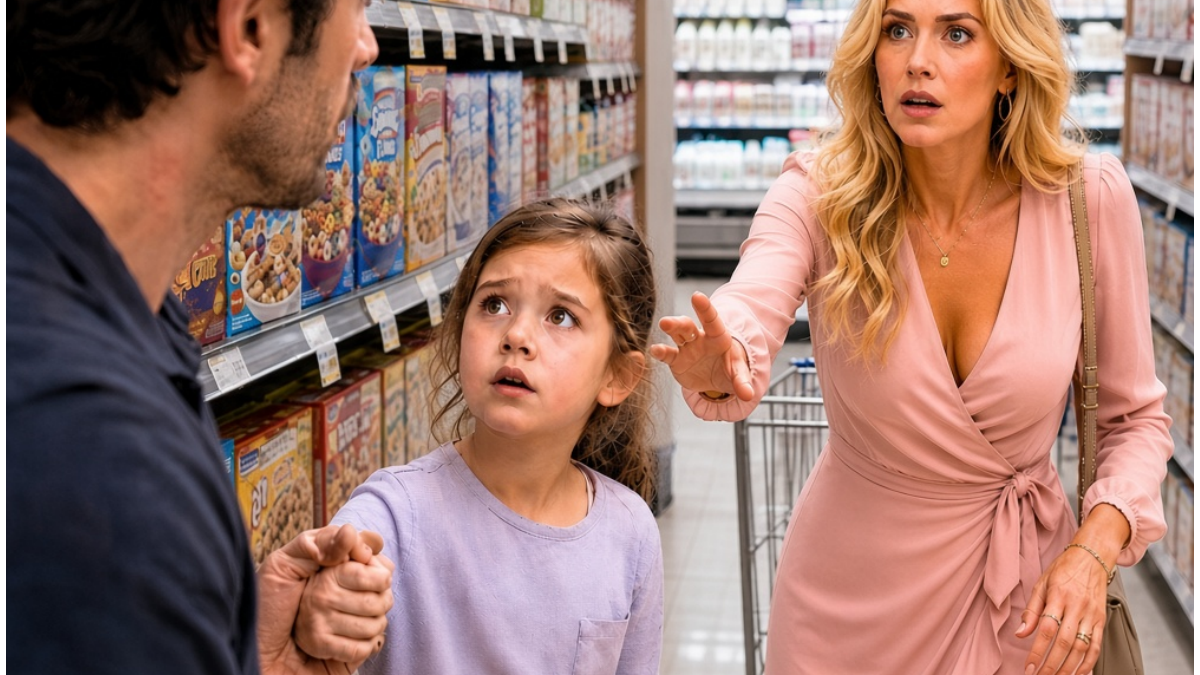
Hey, my name is Simon Blake. I’m 32 and for the last seven years, I’ve worked as a paramedic in Asheville, North Carolina, which mostly means I spend my nights keeping strangers alive long enough to hand them off to someone with better equipment than mine.
You learn fast in that job that the worst nights rarely send a warning firSt. Mine started on an ordinary Monday in the cereal aisle of a grocery store with a stranger’s hand sliding into mine like it had been reaching for it its whole life.
I was standing in front of the granola trying to remember if I already had honey at home when I felt it.
Small fingers, warm, certain wrapping around three of mine without asking permission. And then Mrs. Ferris said, “Dogs can’t ever have grapes.
Like, not even one.” And I told Ruby, but she didn’t believe me. So, can we get the sugar cereal this time?
The one with the toy inside since I was right about the grapes, and she wasn’t.
The voice belonged to a girl, maybe six. Ponytail coming loose on one side, eyes locked on the shelf like she’d already rehearsed the argument twice in the car.
She wasn’t looking at me. She didn’t need to. Whoever she thought I was, she’d already decided the conversation had been going on for 5 minutes.
I should have said something the second I felt her hand. Instead, I stood very still because pulling away felt like it might scare her, and staying quiet felt like a small lie I hadn’t agreed to tell.
“They’re about to page for closing soon.” I kept my voice easy. “You might want to grab your mom firSt.” That’s when she looked up.
Really looked. I watched her whole face rearrange itself. Confusion first, then something like polite embarrassment.
The kind kids get when they realize they’ve made a mistake in front of an adult and aren’t sure how much trouble that buys them.
She let go of my hand like it had gone cold in her palm. “You’re not my dad.
My dad,” she said it quietly, like she was the one who owed the apology.
Then almost to herself, we always split up here. Mom gets the yogurt. I wait by the cereal because dad always.
She stopped. Something crossed her face fast enough that I almost missed it. A flinch gone before it fully landed, like her mouth had started down a road her brain didn’t want to finish walking.
She looked at her shoes instead. I crouched down so I wasn’t looming over her.
Kept enough distance that she wouldn’t feel cornered. I’m Simon. What’s your name? Ivy. She said it like a fact she wasn’t sure was still relevant.
Well, Ivy, I’m not your dad, but I promise I’m not a stranger danger situation either.
Where’s your mom right now? She pointed toward the dairy case, and I could see a woman’s shape moving fast between the end caps, calling a name that hadn’t reached us yet.
I stood back up, gave a little room the way you learn to when a kid’s already spooked, and waited.
A cart clipped the display at the end of the aisle hard enough to send a stack of granola bars sliding across the floor.
Ivy, the single syllable cracked down the middle. She didn’t stop to fix what she’d knocked over.
She dropped to her knees in front of her daughter. Hands moving fast over her shoulders.
Her hair checking for something invisible. The way people check for things when panic outruns thought.
I’m okay, Mom. I just thought he was. Ivy didn’t finish that sentence either. The woman looked up to thank me.
I could see the words already forming. The automatic gratitude of a mother whose kid had wandered 10 ft in a grocery store and lived to tell about it.
Then her eyes reached my face and the words simply stopped arriving. She didn’t blink.
Her mouth stayed open around a shape that never became a sound. Whatever color had been in her face when she rounded that corner left it slowly, not all at once.
The way it happens when your body hasn’t caught up yet with what your eyes just told it.
Ma’am, you okay? She didn’t answer. She was still looking at me like I’d said something in a language she used to speak fluently and had spent a long time trying to forget.
Her hand found Ivy’s shoulder and gripped it, not gently. We have to go. She wasn’t talking to me.
Not really. Her voice had gone thin and faSt. Right now, baby, come on. But we didn’t get the now, Ivy.
She was already moving, half pulling Ivy by the hand, leaving the cart, the granola bars still scattered across the floor, a canvas bag hanging half open from the child’s seat.
Something slid out of it as she turned the corner too fast, a small brown wallet, and neither of them noticed.
I called after her, but she was already gone, and the automatic doors up front were sighing shut behind two people who just looked at my face like it belonged to someone they’d buried.
I stood there holding a bag of granola I didn’t need anymore. Staring at a wallet on the floor of the cereal aisle.
With no idea yet how much that one dropped wallet was about to cost me in sleep, I picked it up between the cereal and the crackers, feeling like I’d stolen something, even though I obviously hadn’t.
Small, brown, worn soft at the fold. A driver’s license behind scratched plastic. Claire Bennett, an address 20 minutes from my apartment.
A photo that didn’t do her panic justice. Behind the license, tucked into the billfold, a photograph had been trimmed down small enough to fit.
The kind people still carry when they don’t trust a phone to survive as long as the memory should.
Clare, younger, laughing. A little girl who had to be Ivy, maybe three in the picture, riding on someone’s shoulders, and the someone, dark hair, a jaw I recognized from every mirror I’d ever owned.
A smile that dropped my stomach in a way I didn’t have a name for yet.
I want to be clear, I didn’t think ghoSt. I’m not a ghost person. Seven years of pulling people out of car wrecks and bathtubs and one memorable kitchen fire teach you the universe doesn’t usually bother with symbolism.
It teaches you that coincidences look bigger up close than from far away. And this one was close enough to touch.
I should probably explain quickly who I am outside of that aisle. I grew up in Hendersonville with a mother named Joyce who never once let the word adopted feel like a smaller kind of family.
And a father who died of a heart attack when I was 22. Young enough that I still catch myself dialing his old number on certain anniversaries.
I got engaged once at 28 to a woman named Paige who told me not unkindly that I was better at other people’s emergencies than I was at my own life.
She wasn’t wrong. I’d been alone since. Not lonely exactly, just unbothered by the idea of changing it, like a stain on a shirt you only wear at home.
It hadn’t occurred to me I might be missing something specific until a six-year-old put her hand in mine like she’d done it a hundred times before.
I could have mailed the wallet back. Could have dropped it at customer service and let some overworked teenager handle the reSt. Instead, I put it in my glove compartment and told myself I’d drive it over after my next shift, which was less about good manners than it was about the photograph I couldn’t stop replaying.
My partner Theo noticed before I said a word, which is one of the more annoying things about working 60-hour weeks beside the same person for 4 years straight.
We were restocking the rig outside the station, counting gauze we’d counted a thousand times before.
When he said without looking up, “You’ve checked your phone six times in 10 minutes, and it hasn’t made a sound once.
It’s nothing. It’s never nothing when you say it that faSt.” He tossed me a roll of tape.
“You look like you saw a dead man walking.” I didn’t answer that, mostly because I wasn’t sure yet how close he’d landed to the truth.
And some things you don’t say out loud until you’ve said them to yourself firSt. Clareire Bennett’s house sat at the end of a short gravel drive.
Porch light already on, though it wasn’t quite dark. A tricycle abandoned on its side in the yard like it had been dropped midthought.
I sat in the car longer than I want to admit. Ivy answered before I’d even finished knocking, which meant either she’d been watching the driveway or six-year-olds just move that faSt. It’s the serial guy,” she announced to the house at large, delighted, like I was a package she’d been expecting.
Clare appeared behind her a second later. Hair scraped back in a quick knot. A smear of flour along one forearm, like she’d abandoned a recipe halfway through.
The second Ivy shouted, “My arrival.” The same thing happened to her face that had happened in the store, only slower this time.
Like she’d had two days to brace for it, and it still wasn’t enough. You found my wallet.
Not really a question, more like she needed to say something ordinary out loud before she could handle anything else.
It was on the floor by the cereal. I would have called, but there wasn’t a number, just I held it out.
The card. She took it without quite meeting my eyes. And for a second, none of us said anything, which is a strange kind of quiet to stand inside on someone’s porch at 6:30 on a Wednesday.
You can come in. She sounded almost annoyed at her own manners. I owe you a coffee at leaSt. Ivy hasn’t stopped talking about the serial guy since Monday.
It’s Simon. I know. Ivy’s been saying it since Monday like it might wear out.
A small unwilling smile. She corrected me twice on the pronunciation. I don’t know what she thought I was going to do with it.
The kitchen smelled like cinnamon. School papers stacked on one end of the table. A crayon drawing taped crooked to the fridge.
Dinosaurs mostly. One in a hat. Ivy climbed onto a stool and narrated the drawing whether anyone asked her to or not.
And for a few minutes it was almost easy. Three people in a kitchen. Coffee going.
A kid explaining why the purple dinosaur was secretly the boss of the others. Then Ivy said, “No particular weight to it.
The way kids drop the heaviest things without noticing the size of them. You look like my dad.”
Clare’s hand stopped halfway to the pot. Ivy, what he does? She looked at me, considering the way she might size up a new kind of dog.
Not exactly. Dad’s laugh was different. But your face is the same shape. I didn’t know where to put my eyes.
So I looked at Clare, who’d gone very still by the counter, mug forgotten in her hand.
My husband died. The words arrived before I could ask, before I’d even decided whether asking was allowed.
11 months ago, car accident out on Old Haywood Road. Flat practiced. The way you say a fact you’ve repeated to insurance companies and school counselors and well-meaning strangers until the words stop belonging to the event and just become sounds you make with your mouth.
His name was Owen. The road name snagged somewhere at the back of my mind.
A loose thread I couldn’t follow to anything solid. We’d worked too many wrecks along Old Haywood over the years for one stretch of highway to narrow itself down to a single night.
So, I let the feeling pass without chasing it. I’m sorry. Everyone’s sorry. Not unkind about it, just tired in a specific way I recognized from families in the back of my rig.
The tired that shows up after the worst part is already over. And you still have to keep living through the part where people say sorry.
She set the mug down without drinking from it. I keep looking at you and my brain won’t stop trying to make it make sense.
Owen never knew of any brothers, no cousins that looked anything like him. He was She stopped started again.
He never knew his birth family adopted as a baby. It used to bother him more than he let on, not knowing where his face came from.
And now a stranger walks into my grocery store wearing it. Something shifted under my ribs I didn’t have a word for yet.
Somewhere between recognition and vertigo. I’m adopted, too. The words were out before I’d fully decided to say them out loud.
The kitchen went quiet in a way that had nothing to do with Ivy, who’d moved on to describing what the purple dinosaur ate for breakfaSt. oblivious, still narrating her own small world, while two adults stood very still around a coincidence neither of them had asked for.
Clare’s face did something complicated. Hope and fear arriving at the same moment and cancelelling each other into something closer to panic.
You should go. Her voice had gone quiet. Not cruel, just done. I’m sorry. This is I can’t.
Not tonight. I stood to leave, and on my way past the counter, I tore the corner off an old grocery receipt and wrote my number on the back of it, setting it down without making anything of it.
In case you want to talk, no pressure either way, she didn’t reach for it while I was still in the room.
I sat outside her house a long time before I trusted myself to drive. Then I called my mother because some nights you need the one person who’s never once lied to you, even about the hard things.
Mom, did I have a twin? Joyce didn’t answer right away. And in the silence, I heard a chair scrape back on her kitchen floor 200 m away.
The sound of someone sitting down before saying something they’d carried too long standing up.
Where’s this coming from, Simon? Just answer me, please. There was another baby. Her voice had gone careful, choosing each word like it might break something if she picked wrong.
A boy. The agency told us the birth mother couldn’t keep either of you. There were two approved families that year, but neither of us had been cleared to adopt twins, so they’d already decided to place you separately before anyone signed anything.
We were told you had a brother somewhere. I never learned what your brother’s adoptive parents were told, or if they were told anything at all.
I’ve spent 32 years telling myself it wasn’t my choice to make and 32 years not quite believing that.
A pause. I always meant to tell you once you were old enough to ask the right question.
I suppose you just did. I don’t remember exactly what I said back. I remember standing in my kitchen an hour later, phone still warm in my hand, staring at nothing, feeling like the floor of my life had quietly been swapped for something structurally different while I wasn’t looking.
Theo found me distracted again the next shift. Only this time, he didn’t let it go with a joke.
We were parked outside a Waffle House at 2:00 in the morning, waiting on a call that hadn’t come yet.
And he just said, “You going to tell me or am I guessing for the next 6 hours?”
So I told him, “All of it. The aisle, the wallet, the photograph, Joyce’s phone call.”
Theo listened without interrupting, which for Theo is close to a religious event. And after a second, he said, “So somewhere out there is a woman raising your possible twin brother’s kid, and the kid already likes you.”
That’s not I stopped because it also wasn’t not that. It’s complicated. Everything’s complicated at 2:00 a.m. in a Waffle House lot.
He handed me the last of his hash browns without being asked, which from Theo is basically a wedding vow.
Doesn’t mean you get to sit on it. Go find out for real. You’re not the kind of guy who leaves a wound open just because closing it might hurt worse.
Clare called 11 days later, which I know because I’d started marking them without meaning to.
Ivy won’t stop asking about you. No preamble like we’d been midcon conversation the whole time.
I told her that wasn’t a good enough reason to call a grown man out of nowhere.
And she said, quoting directly, “That’s a mom reason, not a real reason. A breath, almost a laugh.
She’s not entirely wrong. I have questions, too. I just don’t know how to ask them without sounding like I’ve lost my mind.”
We started slow coffee that turned into a Saturday at the park. Ivy narrating the animal kingdom from the top of a slide.
Clare watching me with an expression I couldn’t quite read. Somewhere between studying and softening, she told me about Owen in pieces.
The way you hand someone a puzzle a few edges at a time instead of the whole box.
He’d worked logistics for a shipping company. He hung off key on purpose to make Ivy laugh.
He used to say that not knowing his birth family had taught him to build the one he wanted instead of waiting to inherit it.
And Clare repeated that line now with a look like she wasn’t sure if it made any of this easier or so much worse.
Diane called while we were still at the park, and Clare’s posture changed the second she saw the name light up her screen.
She stepped a few feet away to answer, but the wind carried enough. No, Diane, I haven’t forgotten the anniversary.
A pause. I know what you think Ivy meant. Longer pause, her jaw tightening. He’s a friend.
I don’t owe you a full report on my friends. When she came back, her face wore that careful, calm people put on over something still shaking underneath.
Owen’s mother, in case I hadn’t guessed, watches Ivy three afternoons a week. Loved him more than anything on this earth.
And she’s decided you’re either a scam or a ghoSt. And honestly, I’m not sure which one scares her more.
She rubbed her forehead. The anniversary is in 3 weeks. She wants a gathering at her place.
I haven’t told her about you yet. Not really. And I don’t know how to start that sentence without it sounding insane.
The following Sunday, Clare showed me a video on her phone unprompted like she’d decided something overnight.
Owen at a birthday party two years back. Paper crown clearly meant for Ivy sitting crooked on his head, singing along badly on purpose.
Laugh loud and easy in a way that made my chest ache with a grief that wasn’t technically mine to carry.
His voice wasn’t mine. That was the strange mercy of it. Different pitch, a faint accent from somewhere in the Midwest I didn’t have.
But the way he tilted his head when he laughed, the way his hand rested flat on the table like he was studying something that wasn’t there.
Those were mine, too. Or I was his, depending which direction you wanted to run the math.
I keep waiting to feel like this is wrong, Clare said, watching my face instead of the screen.
Looking at you and feeling something. It should feel like a betrayal or a bad joke or both.
Mostly, it just feels like the universe left a door open I didn’t know I was allowed to walk through.
She set the phone face down on the cushion between us, like she needed it out of the room to finish the thought.
What if I’m only doing this because you look like him? What does that make either of us?
I let that settle a moment before I answered. There’s a way to know for sure.
Not the looking like him part. The rest of it. I’d looked into it more than I wanted to admit, alone in my apartment at odd hours.
The medical examiner’s office may still have a sample preserved from Owen’s autopsy. As his spouse, you could ask whether one exists, and what it would take to release it.
It wouldn’t be a guess anymore. It would just take you asking the question. She went quiet long enough that I thought I’d overstepped then.
And if it says no, if this is just a cruel coincidence wearing my husband’s face, then we’ll know that, too.
I reached over and took her hand. Not the practiced kind of touch I use on strangers in the back of an ambulance.
Something with no training behind it at all. Either way, Clare, I’m not going anywhere.
That part isn’t waiting on a lab result. She looked at our hands a long moment, then up at me, and for one suspended second, I thought she might close the distance herself.
Instead, she pulled back, gentle, apologetic. Not yet. I need to know which grief I’m standing in firSt. I understood.
It didn’t make it easier. 2 days later, Clare called to say the medical examiner’s office had confirmed a sample still existed.
It took another week of paperwork. The examiner’s sign off, then approval from the estate’s representative before the sample was transferred under chain of custody to an accredited private laboratory.
I gave my own sample that same week, and after that, there was nothing left to do but wait.
The gathering was Clare’s idea, small, just her, Ivy, her friend Nadine, and me. A low stakes dinner to prove to herself, I think, that I could exist in her house without the sky falling in.
Nadine brought an elaborate dessert with a drizzle on top, and Ivy, who ate like every meal was a negotiation, decided that night she was brave enough to try it.
I noticed before Clare did, which is either the worst or the most useful thing about doing this job for seven years.
Iivey’s voice thickened mid-sentence, her hand rising to her throat like she was trying to clear it.
Hives climbed her neck fast enough to watch it happen in real time. Claire, I was already moving, already at Iivey’s eye level, already asking her to look at me.
Breathe slow. Tell me if her throat felt tight. Does she have any allergies you know of?
Not that we’ve ever, Clare’s voice cracked on the word. Panic climbing faSt. She’s never had a reaction.
Nothing. I don’t even know what’s in that, Naen. What’s in that? The bakery box said there could be walnut crosscontamination, Naen said white-faced, already grabbing her phone.
“Oh my god, I didn’t even think. Call 911 now.” I kept my voice level because someone in the room had to be.
Iivey’s breathing had gone shallow and wet sounding, eyes wide and scared in a way I never wanted to see on a face that small.
I got her sitting upright, checked her airway, talked her through slow breaths in a voice I’d used a thousand times before and never once meant this much.
You’re okay, Ivy. Look at me. Count with me. 1 2 3. Good girl. You’re doing great.
Clare knelt beside us. One hand gripping Ivy’s, the other gripping my arm hard enough to bruise, and I didn’t tell her to let go.
The ambulance took 9 minutes, which is either fast or an eternity, depending entirely on whether the emergency belongs to you.
I rode in the back, not as crew, just as the man who wouldn’t let go of a six-year-old’s hand, watching a colleague do exactly what I would have done.
Epinephrine, oxygen, the careful practiced calm of people who’ve learned not to let their faces show what their hands already know.
Iivey’s breathing eased somewhere around the second red light. Clare didn’t stop shaking until we pulled into the ambulance bay.
They kept Ivy for observation, color back in her cheeks within the hour, already asking if she could try a different dessert next time, as if the whole thing had been a minor inconvenience and not the worst 20 minutes of her mother’s life.
Clare sat by the bed, holding her daughter’s hand like she might float away if she loosened her grip.
And I stood near the door because I didn’t know yet what my place in that room was allowed to be.
Diane arrived like weather. I heard her before I saw her. A fast, sharp voice at the nurse’s station demanding which room, and then she was through the door, and then she saw me, and the whole hallway seemed to hold its breath along with her.
She went the color of the walls. Her hand found the door frame like she needed it to stay upright.
Owen. Not a question. Barely even a word. More like something torn loose from a part of her she didn’t have control over.
Diane, this is Simon. Clare stood moved between us without quite meaning to look like a referee, though that’s exactly what she was.
It’s not. I can explain. It’s not what it looks like. What it looks like.
Dian’s voice climbed sharp and shaking. It looks like my son has been dead for 11 months and you’ve gone and found yourself a replacement wearing his face and you brought him to sit at my granddaughter’s hospital bed like this is normal like I’m supposed to just she pressed a hand to her mouth started again lower worse.
You couldn’t even wait for the anniversary. You couldn’t give him that. That’s not fair.
Clare’s voice shook but held. I didn’t go looking for this. It found me in a grocery store.
Same as it’s finding you right now. Found you? Diane laughed. An awful sound with no humor anywhere inside it.
Do you know what it’s like to bury a boy and then have his face turn up at your granddaughter’s bedside like some kind of sick miracle?
Do you have any idea what the paramedics told me that night? How long they worked on him before they Her voice broke entirely?
They said they did everything right, everything by the book, and it still wasn’t enough.
So don’t stand there and tell me the universe is being kind to us, Clare, because the universe already took its shot at kind, and it missed.
I felt the words land somewhere I wasn’t braced for. Old Haywood Road, 11 months, a team that ran the full protocol and still lost him.
I heard myself ask before I decided to. What night was the accident? The exact date?
Diane looked at me like the question itself was an insult, but she answered anyway, maybe out of pure momentum, and the date she gave me was a date I already had memorized because you don’t forget the ones you carry home with you.
I remembered the intersection. I remembered the make of the car. I remembered helping with the extrication, then kneeling on the pavement beside him and doing compressions for 11 minutes while another medic managed the airway.
His face obscured the whole time by blood, the bag valve mask, the cervical collar, and the strobing wash of emergency lights.
Theo hadn’t been on shift with me that night. I’d been paired with a relief medic from another station, someone I never worked beside again.
He’d been brought in unidentified, no wallet or ID at the scene, and I’d gone off shift before the chart was updated, so I never saw a name or date of birth attached to him.
I’d never seen enough of that man’s face to understand why the call had followed me home for a month afterward, not until this exact second, standing in a hospital hallway with his mother’s eyes boring into mine.
I was there. The room went very still. That night, I was one of the paramedics on scene.
Nobody spoke. Ivy, small and briefly forgotten, in the hospital bed, looked between the three adults with the wide, careful eyes of a kid who understands something huge just happened, even without the vocabulary for what it was.
I didn’t know. The words were for Clare, for Diane, for the room, for myself.
I swear to you, I didn’t know. I worked that call and I went home and grieved a stranger for a month without knowing who he was to me.
And it turns out I was grieving my own brother the whole time and none of us, including me, had any idea.
Clare had gone very white. She sat back down slowly, like her legs had simply stopped being available to her.
One hand still holding Ivy’s, the other pressed flat against her own chest like she was trying to keep something inside it from getting out.
Her voice had gone quiet. Not cruel. Entirely wrecked. I need you to leave. Please, Simon.
Not forever. I just can’t hold all of this at once. Not tonight. I didn’t call her for 6 days, which might be the hardest professionalgrade patience I’ve ever exercised in my life.
Theo covered two of my shifts without being asked and didn’t say much about it beyond leaving a six-pack in my fridge with a note that read, “You’re allowed to feel like garbage.
Just don’t feel it alone.” Which is about as sentimental as Theo gets. Joyce called every other day.
Careful, not pushing, just making sure I was eating. The lab results came back on a Thursday.
An email from the private laboratory with a subject line so clinical it felt almost cruel for what it was about to confirm.
I read it standing in my kitchen and had to sit down halfway through the second paragraph.
The two genetic profiles were effectively identical, consistent with monozygotic twins. I stared at the words until they stopped looking like words and just looked like the shape of something I’d been circling my whole life without a name for it.
I drove to Claire’s that same evening without calling first, which isn’t like me, but some things don’t want to wait for permission.
She opened the door before I knocked, like she’d been watching the driveway the way Ivy had that first night.
And for a second, neither of us said anything at all. I got the results.
I know. The lab sent me the authorized copy an hour ago. Her eyes were red, but her voice was steadier than it had been at the hospital.
I’ve been sitting with it, trying to figure out what it changes. Does it change anything?
She thought about that longer than I expected before answering. It changes what I’m allowed to call it.
I kept telling myself this was some kind of haunting grief playing tricks. But you’re not a trick, Simon.
You’re just his brother. His actual real brother who didn’t know he existed until a six-year-old grabbed his hand in a grocery store.
A small wet laugh escaped her. I don’t think that’s a haunting. I think that might be the opposite of one.
I’m not him. It needed saying out loud. For both of us. I need you to know that whatever this is between us, it isn’t about being him.
I don’t hum off key on purpose. I don’t know the first thing about shipping logistics.
If there’s something here, it has to be about me or it isn’t worth having.
I know that. She stepped closer. Close enough that I could see her hands were shaking, though her voice wasn’t.
I think I’ve known it since the hospital, actually. I was just too scared to say it while everything was still on fire.
She looked up at me and this time neither of us pulled back. I’m not choosing you because you look like him.
I’m choosing you because you stayed. Because you told the truth the second you understood it, even though it would have been so much easier not to.
Because Ivy trusted you before any of us had one good reason to. And it turns out she was right.
I kissed her then. Finally. No lightning, no storm, just a quiet kitchen and a dish towel still slung over her shoulder and two people choosing deliberately with every hard fact already on the table between them to walk toward each other.
Anyway, Diane asked to meet me alone a few days later, which took more courage from both of us than either wanted to admit.
We sat across from each other in a diner booth that had clearly seen better decades, and she set an old photograph on the table before either of us had ordered coffee.
Owen, maybe 8 months old, gaptothed and delighted about something just out of frame. I used to catch myself doing this strange thing when he was small.
She wasn’t looking at me. She was looking at the photograph instead, setting the table for one more than we needed.
I’d catch it halfway through and put the extra plate back. And I never once let myself wonder why.
Because wondering felt disloyal, like I was telling him he wasn’t enough family on his own.
She finally looked up. I’m not going to pretend I’m not still angry. Some of that isn’t about you at all.
It’s about a boy I raised from 8 lb and 2 oz who never got to know he had a brother who might have wanted to know.
And I’ll never get to give him that chance now. I’m sorry. I meant it in a way that went past politeness.
Don’t be sorry for existing. She pushed the photograph an inch closer, an offering. Keep it.
He’d have wanted somebody who looks like that to have a picture of him as a baby.
I think he’d have wanted a brother more than he ever let himself say out loud.
Her hand, when it found mine across the table, was steadier than I expected. I loved that boy with everything I had, blood or no blood.
That’s not going to change because you showed up. But there might be room to love you a little too.
Eventually, if you’re patient with an old woman who buried her son and found half a miracle too late for it to be painless.
Joyce drove down the following week with the adoption file on the passenger seat like she needed it within reach.
She apologized without trying to defend the 32 years of silence. And I told her forgiveness wasn’t something I could hand her on the spot, only that we were done building whatever was left of our family around things nobody was willing to say out loud.
She nodded like she’d expected exactly that because she had. The hospital scare, the DNA results, and everything that followed had already pushed the anniversary gathering back by 3 weeks.
When it finally happened, it was quieter than Diane had first imagined it, and I was there, standing a little apart at first, then not so apart once Ivy pulled me by the hand toward the dessert table and announced I made better waffles than anyone in the room, which was both untrue and the nicest thing anyone had said about me in years.
I used to think family was something you were either born into or built by hand, with nothing much in between.
I’ve learned since that there’s a third kind. The kind that finds you sideways through a grocery store aisle and a dead man’s face and a six-year-old brave enough to say the confusing thing out loud instead of swallowing it.
I still don’t have a clean word for what Owen and I were to each other.
Two strangers who shared a birthday and 11 minutes we never got to spend together on purpose.
But I know exactly what I am to Ivy now, even if she’s still the one most days who decides what that word gets to mean.
A year after the cereal aisle, we drove out to the cemetery on a Saturday that smelled like cut grass and rain that hadn’t arrived yet.
Ivy knelt at the headstone first, arranging a fistful of daisies against the base the way she always insisted on doing it, careful, deliberate, like she was setting a table for someone who might actually show up.
Then she stood, brushed the grass off her knees, and walked backward toward us, already talking before she’d fully turned around.
“I told him about the spelling test,” she announced. And that you make waffles better than mom, but don’t tell mom I said that.”
Clare laughed despite herself and wiped her eyes with the back of her wriSt. Ivy reached up and slid her hand into mine.
The same easy certain grip from the cereal aisle all those months ago, like she’d never once doubted it belonged there.
“Come on,” she was already pulling. “You have to say hi, too. That’s the rule now.”
I let her lead me forward.








