A Hungry Woman Was Rejected by the Whole Town—Until a Rich Cowboy Offered Her a New Life
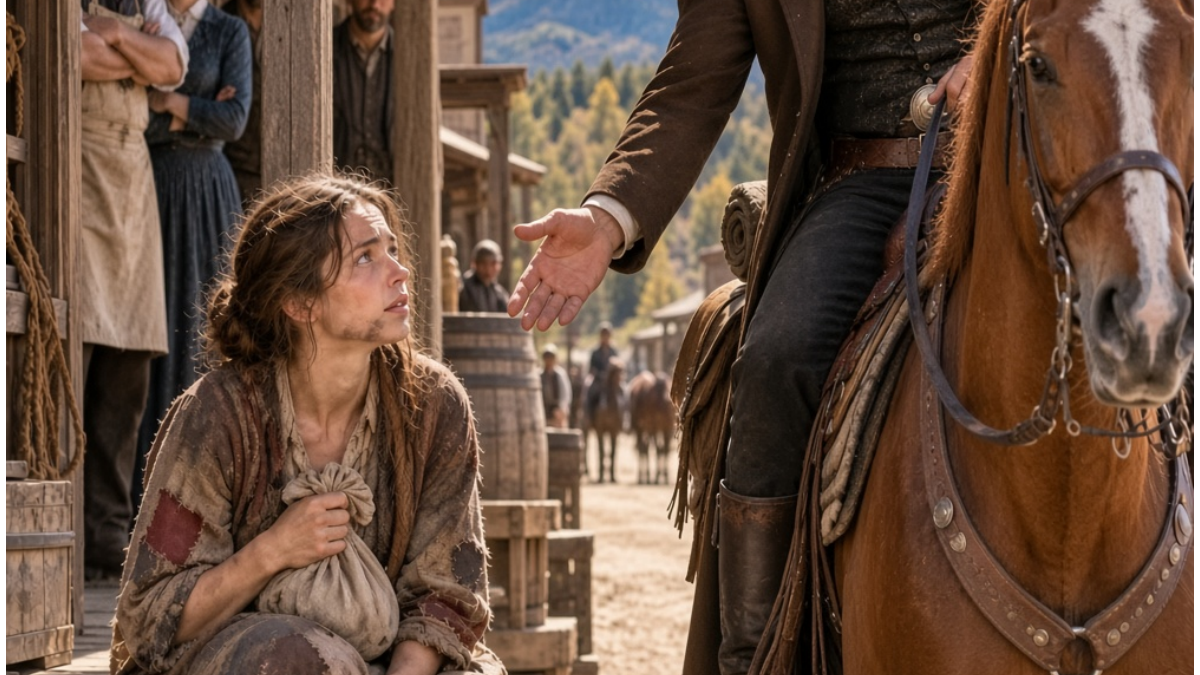
The proprietor’s thick hand shot out and grabbed Rosali’s wrist before she could even finish her sentence.
Get out of my store. His voice was loud enough for every person in the room to hear.
He didn’t whisper it. He wanted witnesses. You come in here looking like that. He flicked his eyes up and down at her patch dress, her worn boots, the careful mending along her collar, and you think I’m going to let you touch my floors?
Get out before I have you removed. Rosalie didn’t move. Sir, I’m not asking for money.
I’m asking to work, I said. Get out. He shoved her toward the door. Not gently.
The kind of shove that said, you are nothing and everyone here agrees with me.
The kind of shove a man gives when he knows nobody in the room will stop him.
Nobody did. If that image just made your blood boil good, because this is a story about what happens when every door gets slammed in your face and the one person who finally opens one turns out to be the last person you expected.
The morning Rosalie Mercer arrived in Cinderidge, Montana territory. The sky was the color of old pewtor, and the wind had teeth.
She stepped off the freight wagon before it fully stopped. The driver hadn’t offered to wait for her, and she landed in the mud with a sound that embarrassed her more than she wanted to admit.
One boot sank. She pulled it free. The satchel she carried in her right hand knocked against her knee and she shifted it to her left without thinking about it because her right hand had been cramping since they crossed the last ridge and she hadn’t said a word about it.
She stood in the middle of the main street of Cinder Ridge and looked at it.
It wasn’t much. Two rows of buildings facing each other across a wide unpaved road that was mostly mud in the middle and frozen ruts at the edges.
A hardware store. A land office. A hotel with peeling paint on the porch columns.
A general store with a handpainted sign, a livery at the far end, a few saloons that didn’t bother advertising themselves because everyone already knew where they were.
Rosalie wasn’t disappointed. She hadn’t expected much. What she’d expected was a position. A woman named Agnes Colton had written to her in April offering work at a boarding house.
Room, meals, wages, reasonable wages, not the kind designed to keep you permanently grateful. Rosalie had written back immediately.
She’d saved every cent she could over the following months and bought her passage weSt. She’d written to Mrs. Coloulton twice more along the journey.
Neither letter had been answered, but the post in those territories was unreliable, and Rosalie had told herself that at least a dozen times on the road.
She walked to the address written on Mrs. Colton’s letter. It was a hardware store.
She stood in front of it for a long moment before going inside and asking the man behind the counter if he knew anything about a boarding house on this lot.
He told her without looking up from his work that the boarding house had closed in June and Mrs. Colton had left the territory.
He seemed to think this was a reasonable thing to tell someone casually. The way you might mention that a particular brand of coffee was out of stock.
Where did she go? Rosalie asked. No idea. Idaho, maybe. Or she went back eaSt. Can’t say.
Rosalie stood there. She had 17 cents in her coat pocket. She had eaten a heel of bread the morning before and shared a cup of broth with a woman on the wagon who felt sorry enough to offer it.
She had been on the road for 11 days, and she was 26 years old, and she was not going to cry in a hardware store in front of a man who wasn’t even paying attention to her.
“Thank you,” she said, and she walked out. She started that afternoon. She went to the hotel first because it seemed the most logical place for a woman who had managed a boarding house back in Ohio and knew how to make a bed and clean a room and manage a kitchen that fed 8 to 12 people three times a day.
The woman at the front desk looked at Rosalie’s dress, the good one, the one she’d worn specifically for this and said they weren’t hiring.
I have experience, Rosalie said, 5 years as managing a boarding house in. We’re not hiring, the woman repeated.
And she said it the way people say things when they’ve already decided they don’t need to explain themselves.
Rosalie went to the laundry next. The owner told her he had no vacancies, but he’d keep her in mind, which meant he had no intention of keeping her in mind at all.
She could hear it in his voice. That particular tone men use when they want you to leave without making a scene.
She tried two more places before noon. A restaurant that was looking for kitchen help told her they’d hired someone that morning.
A seamstress said she worked alone and preferred it that way. Rosalie ate nothing. She told herself she wasn’t particularly hungry, which was a lie she’d gotten quite good at.
The second day was worse because she had started to understand the shape of the problem.
It wasn’t about her experience or her references or whether anyone needed the work done.
It was about how she looked. She could see it happen in real time. A person’s eyes would move from her face to her coat to her patched cuffs to her boots.
And something in their expression would shift just slightly, just enough. Whatever she’d said before, that shift didn’t matter anymore.
There was a ranch outside of town she heard from a woman at the post office that belonged to a wealth wealthy family called the Abbotts.
They were looking for a cook. Rosalie walked four miles in the cold to find out.
The rancher’s wife, a tall woman with a pearl brooch and very clean hands, opened the door and looked at Rosalie for exactly zah, as long as it took her to form an opinion.
I’m afraid we’ve filled the position, she said. She hadn’t. Rosalie knew it from the way she said it.
Too fast, too smooth, already reaching to close the door. Mrs. Abbott, Rosalie said, and she kept her voice level because she’d learned that desperation in a woman’s voice made people pull back further.
I’ve managed a kitchen for 20 people. I can preserve, bake, roast, and I know how to stretch provisions through a winter.
I have references from Ohio. Good day, said Mrs. Abbott and closed the door. Rosalie stood on that porch for a moment longer than she should have.
Then she walked the four miles back. By the third morning, the 17 cents felt like a judgment.
She counted them three times before she got out of the bed she’d rented at a small women’s lodging house, the last night she could afford, and she knew that today something had to change because she had nothing left after this morning to change it with.
She went back to the main street. She passed the general store twice before she went inside.
She didn’t want to go inside. She had walked past it twice because she was still trying to think of something better, and there wasn’t anything better.
The store was busy, three or four customers moving among the shelves. A man behind the counter, heavy set, somewhere near 50, with a gray beard and an apron that had seen better days.
His name was printed above the door, El Foster, General Merchandise. Rosalie waited until there was a gap in the customers at the counter.
Then she walked up and said carefully, “Excuse me, I’m looking for work. Any kind of work, and I’m willing to.”
He looked up. He looked at her the way the others had looked at her.
“We’re not hiring,” he said immediately. “I don’t need wages today,” Rosalie said. She kept her voice quiet and even.
I haven’t eaten since yesterday morning. I’ll scrub your floors, clean your store room, wash windows, whatever you need done.
One meal. Something happened in his face that she would remember for a long time afterward.
Not cruelty exactly, but something worse than cruelty. Something that didn’t even see her as worth being cruel to.
He was annoyed like she was an inconvenience. I don’t run a charity, he said, loud enough for the people nearby to hear.
He seemed to want them to hear. If you can’t afford to be in this town, that’s not my concern.
Now, if you’re not buying something, you need to step aside. Rosalie didn’t move for a second.
That second felt very long. She was aware of the people in the store, a woman with a basket, a young man near the fabric rolls, an older couple by the dried goods, and she was aware that none of them were saying anything.
They were watching in the particular way people watch when they want to observe something without being connected to it.
Of course, Rosalie said, she walked to the door. She opened it and stepped back onto the street where the wind hit her immediately in the face like a reminder.
She made it to the hitching rail before she had to stop. She put her hand on the rough wood because her knees had gone strange, not quite weak, but uncertain, like they’d forgotten they were supposed to hold her up.
She was not going to fall down in the middle of a public street. She was not going to give this town that.
A hand closed around her elbow, firm, not rough. She turned fast, instinctively. She’d learned not to let strangers grab her and found herself looking at a man she didn’t know.
He was tall. Not dramatically tall, just tall in the way some men are, who’ve spent years in the saddle long through the leg, broad through the shoulder, built for the kind of work that doesn’t advertise itself.
He was wearing a coat that had been good quality once, and had since been broken down by weather, and used into something that suited him perfectly.
His hat was dusty. He had dark eyes and a jaw that hadn’t been shaved in a few days.
And he was looking at her with an expression she couldn’t immediately classify because it wasn’t pity.
She’d learned to recognize pity. This wasn’t pity. “You all right?” He said. “I’m fine,” Rosalie said.
She straightened up and removed her arm from his hand with a precision that was meant to communicate exactly how fine she was.
“You don’t look fine,” he said. He said it simply without offense, like it was just an observation he was making about the weather.
I’m steadier than I appear. I don’t doubt it. He glanced at the general store window, then back at her.
He’d seen what happened inside, she realized. Or enough of it. When did you eat last?
Rosalie looked at him. I beg your pardon. It’s not a complicated question. It’s a personal one.
Fair enough. He tilted his head to toward the other side of the street where there was a small establishment with a sign that said meals.
Come eat something. No, Rosalie said. Why not? Because I don’t know you. Garrick Westfall.
He said it like a name, just a name. No particular weight to it. I have a cattle ranch about 6 mi north.
I was in town today picking up a part for a water pump. Now I’m offering you lunch.
That’s very kind, Rosalie said. And she meant it. She genuinely meant it. But I don’t want charity.
Something shifted in his expression. Not irritation, she’d been braced for irritation, but something more like recognition, like she’d said something that made sense to him.
[clears throat] What do you want? He said, work, she said. Honest work for honest pay.
That’s all I’ve been looking for since I got here 3 days ago. He looked at her for a moment.
Not the way the others had looked at her. Not the quick assessment that went from face to clothing to immediate conclusion.
He looked at her, “The way you look at something you’re trying to actually understand.”
“What kind of work?” He said. “Any kind,” she said. And she heard herself say it and caught the desperation starting to creep into the edges of her voice, so she studied it.
“Cooking, housekeeping, bookkeeping. I managed the accounts at a boarding house for 3 years. Laundry, mending, preserving, whatever’s needed.
Bookkeeping,” he repeated. “I’m good with numbers.” He looked at her for another moment, and then something seemed to settle in him.
Some kind of decision reached by a shorter route than she expected. “My housekeeper fell last month,” he said.
Broken wrist and two cracked ribs. “She won’t be able to manage the kitchen or the household accounts until spring at the earlieSt. I’ve got a foreman and 11 ranch hands and a ranch house that’s been running on cold coffee and stubbornness since October.”
Rosalie said nothing. She was listening. “Room and board,” he said. $3 a week, rising to four after a month if it’s working.
Full kitchen access. The housekeeper, Edna, she’s still on the property. She can tell you where everything is.
She just can’t do it herself. Rosalie stared at him. Why? She said, “Because I need the help,” he said.
“And apparently you need the work.” “You don’t know me,” Rosalie said. “You don’t know if I’m reliable.
You don’t know if I’ll take things. You have no reason to trust me.” “No,” he agreed.
“Then why?” Because I watched you walk into that store,” he said quietly enough that she had to lean slightly to hear it and offered to scrub floors for a meal, and Foster threw you out in front of five people, and you walked out with your back straight.
He paused. “That tells me something about who you are.” “The only thing I don’t know yet is whether you can manage a ranch kitchen.”
“I can,” Rosalie said. “Can you ride?” “Well enough,” he nodded once, then gestured at the horses tied to the rail his own.
A large dark ran and a smaller bay tied beside it that he’d apparently been leading.
I brought an extra horse into town for a reason that didn’t pan out. Ride with me and I’ll show you the ranch.
If you don’t like what you see, I’ll bring you back. Rosalie looked at the spare horse.
She looked at him. She thought about the 17 cents. She thought about the women’s lodging house and the room she’d have to vacate by noon.
She thought about the general store in El Foster and the five people who had watched and said nothing.
“Mr. West,” she said. “Garrick’s fine, Mr. Westfall,” she said again firmly, “because she wanted the formality.
She needed the formality to feel like she was walking into this with some kind of ground under her feet.”
“If I come to your ranch and the work is as you’ve described, I will do it well.
You’ll get your money’s worth. And if at any point it becomes clear that this arrangement isn’t appropriate, then you leave,” he said.
“Simple as that.” She held his gaze for a moment longer. Then she nodded. She untied the bay’s reigns and got into the saddle herself.
She didn’t wait for help. She didn’t want help. She hadn’t asked for any. And when she was settled, she looked down at the main street of Cinder Ridge, at the general store window, where she could see L.
Foster watching at the woman with the basket who was still standing near the door.
At the young man who’d looked away. She looked at all of them. Then she turned the horse north.
She didn’t look back. The road out of town followed the creek for the first two miles, then climbed slightly to where the valley opened, and you could see the range stretching north and west under a sky that had gone from pewtor to something almost blue in the afternoon light.
Rosalie noticed this without particularly meaning to she’d grown up around farmland in Ohio and she’d always had an eye for land for what it looked like wellused and what it looked like worked too hard.
This land looked healthy. The fences along the road were in good repair. The creek crossings had proper bridges, not just logs thrown down.
She could see cattle in the far middle distance, well fleshed for October, moving in the unhurried way that meant they weren’t cold or hungry.
“How many heads?” She asked. She hadn’t planned to start a conversation, but the question came out of simple curiosity.
Garrick glanced over. He seemed mildly surprised, or maybe just thoughtful. About 1,800 right now, down from 2,000 in AuguSt. We sold a good-sized lot in September.
Good price, good enough. Not as good as last year, but better than I expected.
The market’s been soft, Rosalie said. Coming off that drought summer, a lot of ranchers moving cattle at the same time drives the price down.
He looked at her more carefully. Now, “You know cattle markets?” “I know how supply and price work,” she said.
“I don’t know cattle specifically, but the principle holds for most things.” He didn’t say anything to that, but she had the sense he was filing it somewhere.
The ranch house came into view around a long bend, and Rosal’s first thought was that it was bigger than she’d pictured bigger than she’d needed to picture, because she’d deliberately not imagined too much.
It was a long, low building with a covered porch running the full front length, and it had been built to last rather than to impress.
There were three outuildings she could see from here, and a barn that that was enormous and looked recently re-roofed.
Two dogs came off the porch at a run, not barking, just curious. “The big one’s Hank,” Garrick said.
“The other one bit me once.” “She’s fine now.” “Fine,” Rosalie repeated. “She bit me because I was reaching into a dark space without looking firSt. That was my fault.
Rosalie studied the second dog, who is now sitting and wagging her tail in a business-like way.
What’s her name? She answers to several things, none of them polite. Edna calls her minnow.
Rosley almost smiled. She didn’t quite allow herself to. A man came around the side of the barn as they dismounted somewhere in his mid-40s, leather-faced, moving with the careful economy of someone whose knees had been complaining for a while.
He had a look about him that said he’d seen enough to stop being surprised by most things.
Tobias, Garrick said, “This is Rosalie Mercer. She’ll be staying on and helping with the house accounts until Edna’s back on her feet.”
Tobias Reic looked at Rosalie the way she’d come to expect people to look at her.
He didn’t miss the dress. He didn’t miss the worn boots. But what came after wasn’t the dismissal she’d learned to anticipate.
It was just assessment. The way you’d look at a new piece of equipment you needed to understand before you could use it.
Can you cook? He said, “Yes, I mean really cook. Not Sunday company cook. Feed 11 men three times a day.
Cook.” “Yes,” Rosalie said. He seemed to find this a reasonable answer. “Good,” he said.
“Because I I’ve been boiling things and it’s not working well for anyone.” “I’ll need to see what’s in the pantry,” Rosalie said.
“I’ll take you in,” Garrick said. The kitchen was large, and it had been once a well-run kitchen.
She could tell by the layout, the arrangement of hooks and shelves, the placement of the stove relative to the workt, the deep bin where the flower would go.
It had been thought through by someone who knew what they were doing. What had happened to it in the weeks since was simply the result of people using a space without understanding how it worked.
The good pans on the wrong hooks, things stored in inconvenient places, the flower bin empty, and the flower bags sitting open on the workt going stale.
Edna Whitmore was sitting in a chair near the kitchen fire with her right arm in a sling and her left hand wrapped around a cup of something hot.
She was 62 and she had the face of a woman who had spent 62 years having opinions about things and not generally keeping them to herself.
She looked Rosie over. You’re younger than I expected, she said. You’re exactly what I expected, Rosalie said.
Edna blinked. Then she laughed a short surprised sound like she’d been caught off guard.
Sit down, she said. I’ll tell you where everything is. Garrick, go away. This doesn’t need you.
Garrick went. Rosalie pulled up a chair and sat across from Edna and got a 40-minute education in the specific logic of how Westfall Ranch’s kitchen and household functioned, where the winter stores were, which suppliers were reliable, and which one had cheated on a dry goods order in August, which ranch hands had particular requirements, what Garrick ate and didn’t eat, and what he’d never complain about, but would quietly not finish.
He won’t tell you if something’s wrong, Edna said. He just won’t eat it, and you’ll see it on the plate.
I’ll watch the plates, Rosalie said. Edna studied her. Where’d you come from? Ohio. I managed a boarding house.
What happened to it? The owner died. His family sold the property. And you came out here for that Colton woman’s position.
Yes. Edna made a sound. Agnes Colton was not a careful planner. I could have told you that.
She shifted her arm slightly and her expression tightened. Not a wse exactly, but close.
How much did Garrick offer you? $3 to start. Four after a month. That’s fair, Edna said.
He doesn’t try to underpay people. It’s one of his better qualities. How many better qualities does he have?
Rosalie asked, and she wasn’t sure why she asked it. Something about Edna’s matter-of-act way of talking invited the same thing back.
Edna considered the question seriously. Several. Also some significant blind spots, but those aren’t my business to tell you about.
Fair enough, Rosalie said. She went to look at the pantry next. She stood in front of it for a long moment, taking stock, not just of what was there, but of what wasn’t, what should have been there by this point in October, what the absence of certain things meant, about how the winter stores had been handled.
The quantities were wrong, not by a little, by a lot. She didn’t say anything about it yet.
She made a mental note of what she saw. A mental note that was precise and orderly, the way she’d always kept track of things by the simple method of caring enough to pay attention.
Then she went to find the floor start dinner because 11 men hadn’t eaten properly in weeks, and that was something she could fix today.
At least she fixed it. She found flour in a secondary storage room that nobody seemed to have thought to check dry and good.
She found salt pork and dried beans and three large onions that were still firm and half a wheel of hard cheese and a jar of preserved peppers someone had made in September and apparently forgotten about.
She lit the stove properly. It had been underdrafted and running cold, and she started beans and made biscuits and fried the pork with the onions until the kitchen smelled like a kitchen should smell.
When she called the hands to supper, 11 men came in and sat down. And the quiet that fell over the table when they tasted the food was the specific quiet that means people are occupied with something they’re actually enjoying.
Tobias ate two servings. Garrick ate everything on his plate. Rosalie ate in the kitchen standing up because she was still figuring out the geography of the place and she needed to think.
After she’d cleaned up and put things in order, she went back to the pantry with a candle and a piece of paper and started writing down what she’d seen.
Garrick found her there at 9. “You should sleep,” he said. “I will,” she said.
“I want to finish this firSt.” He held the candle up slightly and looked at the list she was making, the columns of items, the estimated quantities, the small notes in the margins.
His expression shifted. “What are you doing?” He said. Trying to figure out what happened to your winter supplies.
She said he didn’t respond immediately. You said you bought supplies in August, she said.
There’s not enough in this pantry for 12 men through a Montana winter. Not by a long way.
Tobias handles the ordering, he said. I’m not saying the order wasn’t placed, Rosalie said carefully.
I’m saying what was ordered and what arrived may not be the same thing. She paused.
I’d like to see the invoices. Garrick was quiet for a moment. I’ll find them in the morning, he said.
Thank you. She capped the ink well and folded the paper into her pocket. I’m sorry to alarm you.
It may be nothing. I may have simply underounted. Have you ever undercounted? She thought about it honestly.
Not for a pantry, she said. He held her gaze for a moment. Get some sleep, he said again, and this time it was a little quieter, a little less like an instruction.
She went to the room Edna had directed her to, a small room off the back of the house, plainly furnished with a window that looked toward the barn.
She sat on the edge of the bed and took off her boots slowly because her feet hurt and she’d been on them all day.
She thought about the morning, the general store, the man’s hand on her arm, the bare dismissal of it.
She thought about riding out of Cinder Ridge beside a man she didn’t know, because what else could she have done?
She thought about 17 Cents. She thought about the pantry numbers she’d written down, the way they didn’t add up, the careful, persistent question of where things had gone.
She lay down without fully undressing because she was tired enough that it didn’t matter.
She was asleep in 3 minutes. Outside, the Montana wind pushed against the walls of Westfall Ranch, testing everything it could find, the way wind does in that country, looking for the places that aren’t as solid as they appear.
But the house held. It had been built for exactly this. The invoices were in a wooden box in Garrick’s office, organized loosely by month.
She spent the better part of the next morning going through them. Garrick had set her up at the desk in the office with the box of receipts and his ledger, and then gone out to work because the ranch didn’t stop for paperwork problems, and there were 11 men who needed direction.
Rosalie worked slowly and carefully, the way she always worked when precision mattered. She wrote the invoiced quantities in one column and then beside them what she’d found in the pantry her own count, her own estimates.
The numbers told a story, not a complicated story, a simple and ugly one. 100 weight of salt pork that should have arrived in August Rosali could find 40 lb of it, maybe 45.
600 lb of dried beans. The seller had perhaps 200, and that was being generous.
Four bushels of cornmeal. She found signs of storage for maybe half that amount, and winter hadn’t started yet.
She sat back and looked at the columns. Then she heard the front door open and close, and Tobias’s voice in the hall saying something about a broken axle.
She went out. “Tobias,” she said. He looked at her. The August supply delivery from Kesler Freight, she said.
“Did you see it come in?” Something crossed his face. Not guilt, something else. Discomfort.
I was in the north pasture that week, he said. Billy Crane signed it in.
Where’s Billy Crane now? Left in September, Tobias said. Family matter back in Wyoming. He paused.
Why? Rosalie thought about how to say this. She’d learned over the years that how you said something mattered as much as what you said.
That men who felt accused put up walls, and walls didn’t help anything. I’m trying to reconcile the pantry inventory with the invoices, she said carefully.
There are some gaps I can’t explain yet. I’m just trying to understand them. Tobias looked at her for a moment.
How big of gaps? Large enough that if the winter runs hard, she said, well have a problem.
He was quiet. I’ll find what I can through local suppliers, she said. Before the weather closes in, but I wanted you to know.
He nodded slowly. Tell Garrick tonight, she said. She went back to the desk. She looked at the column that said Kesler Freight.
The name appeared on four separate invoices, August, September, twice in early October, each one substantial.
Each one if her pantry count was right, only partially delivered. Dorian Kesler. She’d heard the name already.
Once in town, when she’d been asking about positions, mentioned passing as a neighboring rancher with significant interests in the valley.
She hadn’t paid particular attention to it then. She paid attention to it now. She wrote the name at the top of a fresh page and beneath it wrote every number from every Kesler Freight invoice.
And then next to each one she wrote what she’d found and at the bottom she totaled what was missing.
She looked at that number for a long time. Then she put the page in her pocket next to last night’s pantry liSt. She went to start the midday meal because 11 men still needed to eat and whatever was happening in the books was not going to solve itself before noon.
And she’d learned long ago that thinking was better done with your hands occupied. She peeled potatoes and thought about numbers.
She made soup and thought about a man named Kesler. She set the table and thought about Billy Crane, who had signed in a delivery and then left for Wyoming in September.
And she thought about the fact that whatever had been paid for and not delivered had to have gone somewhere.
Things didn’t vanish. Numbers didn’t lie. People did. Garrick came in from the north pasture that evening with mud on his coat and a cut on his right hand from a wire repair he hadn’t had help with because two of his regular men had been pulling a bogged heaper out of a creek crossing for most of the afternoon.
He washed up at the basin in the hall and came into the kitchen because the smell of food was direct and clear and his stomach had been reminding him for the last 2 hours that he’d skipped the noon meal.
He stopped when he saw the table. It wasn’t a dramatic setting. It was just supper, a proper supper.
A chicken she’d found in the coupe that hadn’t been laying, and thus had contributed its best to the occasion, with roasted potatoes and preserved beets from a jar in the cellar, and fresh biscuits, and a gravy that smelled like it had actually been made with care.
He sat down. He didn’t say anything. He ate. Rosalie waited until he was halfway through.
“I need to talk to you about the accounts,” she said. He looked up. “I know,” he said.
Edna mentioned you’d been in the records all day. The supplies from Kesler Freight, she said.
She put the paper in front of him. The one with the two columns, the invoices on the left, her inventory on the right.
He picked it up. He read it. The expression on his face changed slowly. The way expressions do when the thing you’re looking at is worse than you prepared yourself for.
This is your count, he said. Yes. Could you? He stopped himself. I counted everything twice, she said.
Including the secondary storage room and the root cellar. These are as close to accurate as I can make them.
He put the paper down. He sat back. He ran his hand across his jaw and the cut on his palm caught the lamplight.
That’s Dorian Kesler’s freight company. He said it wasn’t a question. Yes, I’ve used this for 2 years.
Garrick said never a problem before. The previous deliveries may have been fine, Rosalie said.
Or the short amounts were small enough they weren’t noticed in a full pantry. This season the gaps are too large to absorb.
Garrick looked at her. Why this season? Rosalie thought about it carefully. I don’t know, she said.
Not yet. He picked up the paper again and looked at it. She watched him.
The way his eyes moved across the columns, the way he wasn’t making quick conclusions, the way he was actually thinking.
She’d met men who looked at numbers and immediately started defending themselves or deflecting. And she’d met men who looked at numbers and got angry at whoever showed them the numbers.
Garrick didn’t do either. What do you need from me? He said the contracts, Rosalie said.
Whatever was signed with Kesler Freight and any correspondence, I’ll get them. And I’d like to talk to Tobias about who signed for the deliveries.
Billy Crane signed the August one, Garrick said. Tobias told me tonight. I know, she said.
I asked Tobias this afternoon. He looked at her then, not with surprise exactly, but with something like recalibration.
You’ve been working this all day, he said. It needed working, she said simply. He was quiet for a moment.
Outside, the wind came up faSt. A colder wind than the one that had been blowing since morning, and it moved through the gap under the kitchen door with a specific sound that country people know means the temperature is dropping hard.
We need to get more supplies before the pass is close. He said. “I have a list,” Rosalie said.
“Of course you do.” She pulled the third piece of paper from her pocket. He almost smiled.
“What’s still available this late in the season?” He said, “From town.” Enough. There are two smaller merchants who still have winter stock.
And I think the Hendersons, they are about 8 mi weSt. There was a receipt from them in the box.
Might sell us some of their surplus corn. I know the Hendersons. I can ride out tomorrow.
The list is prioritized, she said. Most important at the top. What we can do without at the bottom.
He took the list and read it. He read it all the way through. This is good work.
He said it’s necessary work. Rosalie said she started clearing plates because she didn’t know how to take the compliment.
And also, she meant what she’d said. It wasn’t a performance. It wasn’t an attempt to impress him.
It was just the logical response to a problem that needed solving. Rosily, he said, she paused.
Thank you, he said plainly. No particular ceremony to it. She nodded and went back to clearing plates, and she didn’t say anything because there wasn’t anything necessary to say, and she’d learned to be careful about filling silence with words that would only clutter it.
Garrick sat at the table a little longer. He looked at the two columns, the promised and the delivered, the gap between them growing clearer the longer he stared.
Someone had been stealing from him, someone he trusted for 2 years. And the woman who had arrived 3 days ago with 17 cents in her coat pocket and no place to sleep had been the one to find it.
He folded the paper carefully and put it inside his coat. Then he went to get the contracts.
The contracts were worse than the invoices. Garrick spread them across the office desks. The following morning, seven separate agreements with Kesler freight dating back 2 years.
And Rosalie sat across from him and read each one while he watched her face and tried to read her the way she was reading the papers.
She didn’t give him much to work with. She read slowly and she read everything, including the fine print that most people skipped because most people trusted that fine print existed to protect them rather than to provide cover for something else.
She had a pencil and she made small marks in the margins, not permanent marks, just light ones, the kind you can erase if you’re wrong.
And when she finished the last page, she set it down and looked at the wall for a moment before she looked at him.
The weight [clears throat] variances, she said. What about them? There’s a clause in every contract that allows for a variance of up to 8% on delivered weight.
She turned the top contract to face him and pointed to the paragraph near the bottom.
Settling in transit natural loss. It’s standard language. I know, he said. My lawyer looked at those when I signed them.
8% on 100 weight of salt pork is 8 lb. Rosalie said 8% on 600 lb of dried beans is 48 lb.
Added across every delivery, every category. And the variance clause alone accounts for she did the arithmetic in her head without apparent effort somewhere around 400 lb of goods that Kesler is legally entitled to come up short on.
Garrick looked at her. But that’s not what happened, he said. No, she said. What happened is that someone used the variance clause as cover and then went well past it.
The actual shortfalls I found are three four times what the clause allows. She paused.
The clause is what makes it look legitimate on paper until someone counts what’s actually in the building.
Billy [clears throat] Crane didn’t count, Garrick said. Or Billy Crane was persuaded not to count carefully, Rosalie said.
The room was quiet for a moment. Outside, they could hear Tobias calling something to one of the hands in the yard.
A voice carrying in cold air, the words too thin to make out. “How do you prove it?”
Garrick said. “I don’t know yet,” Rosalie said. Honestly, I need to see if there’s a pattern across the deliveries that I can demonstrate clearly enough that someone else can follow it.
Numbers tell a story if you arrange them right. But the story has to be airtight or Kesler’s lawyers will find the gap and walk through it.
Kesler has good lawyers, Garrick said. I assumed. Rosalie said. She picked up her pencil again.
Can you get me the original delivery logs? Whatever the driver signs when he drops a load.
Tobias might have them. Some of them. Ask him, she said. And I need the Henderson corn.
I’m riding out there this morning. Take someone with you, she said, and then stopped herself because she’d said it without thinking, and it wasn’t her place to tell him how to move around his own land.
But he didn’t seem bothered by it. Why? Because if Kesler’s been deliberately under supplying you, and he finds out you’ve noticed, I’d rather you not be alone on an empty road,” she said plainly.
He looked at her for a moment with an expression she couldn’t quite read. “All right,” he said.
I’ll take Tobias. He left after breakfaSt. Rosalie went back to the numbers. She worked at the office desk for 3 hours straight building the picture piece by piece.
What was invoiced? What should what should have been delivered accounting for the legitimate variance?
What what she’d actually found in the building. She made three copies of her findings in case something happened to the original.
She wasn’t sure what she thought might happen. She was being careful because the situation called for care and she’d never found a reason not to be careful.
Edna came and stood in the doorway around midm morning with her good arm and her sling and a look on her face that said she wanted to say something.
What? Rosalie said without looking up. Nothing, Edna said. That’s not what your face says.
A short pause. I’ve been here 11 years, Edna said. I’ve looked at those books every month.
I didn’t catch it. Rosalie put down her pencil. She turned to look at Edna properly.
The shortfalls were smaller in the beginning, she said. You said the August delivery was when everything changed.
I didn’t say that. You figured it out from the invoices. The pattern shows it.
Rosalie said the early deliveries were probably accurate or close to it. Whatever Kesler decided to do, he didn’t start doing it until recently.
Fresh eyes are better than experienced ones sometimes because fresh eyes don’t have any reason to assume things are fine.
Edna looked at her for a moment. You’re being diplomatic, Edna said. I’m being accurate, Rosalie said.
She meant it. You weren’t looking for theft because you had no reason to look for it.
I was looking at everything because I didn’t know what was supposed to be normal yet.
Edna seemed to consider this. Then she said, Dorian Kesler has been trying to get Garrick’s north water rights for 3 years.
Rosalie went still. What are the water rights worth? She said to Kesler, “His northern pastures are dry in a drought year.
With those water rights, he could run twice the cattle and survive the kind of summer that would ruin him otherwise.”
Edna shifted her sling slightly. A lot of money. The kind of money that makes a man think about what he’s willing to do.
Has Garrick sold? Not once. He’s turned Kesler down four times that I know of.
And Kesler’s freight company,” Rosalie said slowly, thinking as she spoke, started short-changing deliveries around the same time Garrick last refused him.
Edna’s expression didn’t change, but her eyes sharpened. “I don’t know the exact timing.” “I’ll find it,” Rosalie said, and turned back to the papers.
She heard Edna move away down the hall. She found it 40 minutes later. Garrick’s last written refusal of Kesler’s water rights offer was dated July the 14th.
The first Kesler freight delivery that showed significant shortfalls was the one Billy Crane had signed for in AuguSt. Rosalie sat very still and looked at the dates.
Then she wrote them down side by side at the top of a clean page, and she felt something cold and clear settle over her thinking.
Not fear exactly, but the sensation of understanding something you’d rather not understand. This wasn’t negligence.
This wasn’t opportunistic skimming. This was deliberate. Garrick came back from the Hendersons with a wagon load of corn and the information that the Henderson family had heard something at the last uncount county meeting that Dorian Kesler had been making quiet arrangements with several of the smaller freight outfits in the region effectively giving himself influence over what moved in and out of the valley.
Nobody had thought much of it at the time. Kesler had money and money made arrangements and that was the ordinary course of things.
Rosalie listened to this standing in the yard while Tobias and two of the hands unloaded the wagon and she turned it over in her mind alongside everything she’d found in the papers that morning.
He’s not just stealing your supplies, she said. He’s trying to weaken you before winter.
Garrick looked at her. If your cattle go into winter without enough feed, she said, and the weather runs hard, you lose animals.
Significant losses that costs money and it cost future earning potential and it puts pressure on you that you wouldn’t otherwise have edened position.
He makes another offer for the water rights. Garrick said at a lower price than before, Rosalie said, “And maybe this time you’re in enough trouble that the number starts to look reasonable.”
He was quiet. Tobias had stopped moving boxes and was listening now. He didn’t pretend he wasn’t.
I should ride over and confront him. Garrick said. “No,” Rosalie said immediately. He looked at her.
“No, if you confront him now, he knows you’ve noticed. He stops what he’s doing, hides what he can, and you have my inventory count against his invoices and a freight clause that gives him legal cover for part of the gap.”
She kept her voice level. “You need more evidence than you have. You need the pattern documented clearly enough that he can’t explain it away.
He’s been robbing me since August, Garrick said, and she could hear the anger under the flatness of how he said it.
Not explosive anger, the quieter and more dangerous kind. I know, she said. But being angry at the right moment matters as much as being right.
Tobias looked at Garrick with the expression of a man who had been thinking the exact same thing and was glad someone else said it.
Garrick looked at the ground for a moment. He breathed out through his nose. Fine, he said.
What do you need? More time with the records, she said. And I need to know who else Kesler Freight delivers to whether the same pattern shows up elsewhere.
Why would other ranchers tell us that? They might not, Rosalie said. But if they’ve been shorted and they don’t know why, they might want to know.
He looked at her steadily. You’ve been thinking about this all morning. Yes, she said.
You don’t have to do this, he said. You were hired to manage the household.
The household accounts are part of the household, she said. And whoever’s draining your supplies is going to affect whether we can feed 11 men through February.
She met his eyes. That’s my job. Something in his expression settled the anger still there, but reorganized somehow, put to a different yus.
All right, he said. I’ll make some inquiries. She went back inside. Edna was in the kitchen attempting to peel an apple with her left hand and making a poor job of it.
Rosalie took the apple from her without ceremony and peeled it and handed it back.
Thank you, Edna said. He’s going to want to confront Kesler directly, Rosalie said. Of course, he is.
He’s going to need someone to talk him out of it more than once. That’s been my job for 11 years, Edna said.
Now, I suppose it’s yours, too. Rosalie considered that for a moment. Is he generally reasonable when he’s angry?
Edna bit into her apple and thought about it. He does something with his jaw, she said.
When he’s really angry, not just frustrated, actually angry. There’s a muscle that jumps in his jaw.
When you see that, give him 10 minutes before you say anything important. Good to know, Rosalie said, and went to start dinner.
3 weeks passed. They were the kind of weeks that have a weight and texture to them because a lot happens and very little of it announces itself as significant in the moment.
Later, you look back and realize that was when things changed. But at the time, it mostly felt like work.
Rosalie worked. She reorganized the pantry with a system that made inventory quick and accurate everything labeled quantities recorded on a board inside the door that got updated when something was used.
She repaired three sets of curtains that had been held together with determination and not much else.
She made soap from the stored lard and ash because the ranch was burning through, purchased soap at a rate that made no sense when you had the materials to make your own.
She spent two afternoons going through the household’s clothing and mending what could be mended and setting aside what couldn’t.
And then she spent a Saturday making two of the unusable things into usable things by a method she’d learned from a woman in Ohio who believed that waste was a form of carelessness.
She also kept working on the accounts. The pattern she was building was careful and slow, and she added to it a little every day.
A new delivery log Tobias found in the barn. A receipt from an old order she pulled from the bottom of the box.
A comparison of Kesler’s freight rates with what other companies charged for the same roots.
Each piece was small. Together, they were beginning to make something undeniable. Meanwhile, she cooked three meals a day for 12 people, including herself.
Learned which ranch hands left their plates clean, and which ones had preferences they’d never mention.
Figured out that one of the younger men had been feeding half his supper to the dogs because he’d never learned to like beans and was too polite to say so.
She started making sure there was something at every meal that had nothing to do with beans.
He noticed. “You changed the menu,” he said one evening. His name was Pete. He was 22 and from somewhere in Nebraska, and he had the particular awkwardness of a young man who isn’t sure whether to be grateful or embarrassed.
“I noticed you weren’t eating,” she said. I wasn’t trying to cause trouble. You weren’t causing trouble, she said.
You were going hungry. Those are different things. He looked at her like no adult had ever said that to him before, which might have been true.
She turned back to the stove. Garrick was in the kitchen doorway. She wasn’t sure how long he’d been standing there.
You didn’t have to do that, he said after Pete had gone back to the dining room.
He’s 22 and he’s working 12-hour days since in November. She said he should at least like his food.
Garrick came into the kitchen properly and stood at the counter with his arms crossed.
Watching her stir something that needed stirring. You do that a lot, he said. Notice things people aren’t saying.
People mostly tell you what they need if you watch them long enough. Do they?
What they actually need, she said, not what they ask for. Those are usually different things, too.
He was quiet for a moment. She could feel him thinking or something that felt like thinking from 6 ft away.
What do I actually need? He said. She glanced at him. Right now. Right now.
Someone to check the east fence before this weekend. She said. Tobias mentioned it’s been pulling loose near the creek.
And you should write to your lawyer about the Kesler contracts before you take this any further.
He made a sound that was almost a laugh. That’s not what I meant. I know, she said.
She turned back to the stove. But that’s what I’m answering. He stayed in the kitchen longer than he needed to.
She was aware of it without making anything of it. Or she tried not to make anything of it, which was a different exercise.
Cinder Ridge started talking somewhere around the end of the third week. Rosalie found out the way you always find out about things like that indirectly, through a gap in a conversation, through the specific way someone didn’t say something.
She’d ridden into town with Tobias to pick up a supply order. And at the dry goods counter, she’d overheard two women talking.
Not about her. Not exactly. They’d shifted topics when she came near. The way people do when the topic is you.
She heard Westfall. She heard Kesler. She heard Kesler. She heard something that might have been convenient and something that might have been nobody knows where she came from.
She bought her supplies and kept her face arranged in a particular way she’d learned, which was not quite a smile, and not quite the absence of one, the expression of a person who is paying attention to something more important than what is happening to them.
Tobias was quiet on the ride back. After a while, he said, “You heard them?”
“Yes,” she said. “Pay it no mind. I’m not.” “It’s Kesler,” Tobias said. “Or his people.
He’s been putting it around that you came out here to.” He stopped choosing his words.
That you had a plan. When you came to Cinder Ridge, Rosalie kept her eyes on the road that I saw an opportunity.
Something like that. And what do people think of that theory? Tobias was quiet for a long beat.
Some people think what Kesler tells them. Some people think Garrick’s smart enough to know his own business.
And what do you think? He didn’t answer immediately. She’d noticed he was that way.
He took questions seriously, and he didn’t fill silence with words he hadn’t earned. I think he said finally that you found a theft in the accounts that nobody else spotted in 3 months and you’ve been working from before sunrise to after sunset for 3 weeks and you haven’t asked for one thing that wasn’t in the original agreement.
That’s an observation, she said, not an opinion. My opinion, Tobias said, is that a woman who came here for Garrick’s money would be behaving differently.
Rosalie said nothing to that. They rode the rest of the way home in a silence that was companionable enough.
But that night after dinner, Rosalie sat in her room and did something she’d told herself she wouldn’t do.
She counted her wages 6 weeks in, nearly seven, $3 the first month for this month.
She had more money saved now than she’d arrived with by a long stretch. And she was adding to it carefully, spending almost nothing on herself because there was almost nothing she needed that wasn’t already provided for in the terms of her position.
The number wasn’t large, but it was growing. She sat with it in her lap, the small cloth purse, the coins inside, and she thought about what Tobias had said, and what those women in the dry goods store had almost said, and what Dorian Kesler had apparently been telling people.
She thought about what it meant that she was in this house at all. She thought about Garrick standing in the kitchen doorway, staying longer than he needed to.
She was not going to be the woman those people thought she was. She was also, she admitted to herself in the particular honesty of late at night, not entirely certain that she was in danger of becoming her, which was a different problem altogether, and not one she had time for.
She put the purse away. Garrick rode the east fence himself that Saturday. He came back with a split knuckle from a wire repair, and the report that three sections needed proper attention before the first hard freeze, not just temporary fixing.
He told Tobias, and Tobias organized a work party for Monday, and Garrick came into the kitchen afterward while Rosalie was making biscuits and stood at the counter and watched the process with the particular expression of a man who is thinking about something else.
She let him be. After a while, he said, Kesler made another inquiry about the water rights.
She kept her hands in the dough. Who told you? Henderson. He mentioned it today.
Apparently, Kesler had a conversation with him at the land office last week, asking questions about what Garrick’s uh financial situation might be.
He’s checking whether the pressure is working, Rosalie said. That’s what I think. What did Henderson say that he didn’t know?
Garrick picked up an apple from the bowl on the counter and turned it over in his hands without eating it.
He said it carefully. He’s a careful man. Is he trustworthy, Henderson? Garrick thought about it mostly.
He minds his own business, which means he also doesn’t go out of his way to involve himself in other people’s.
He wouldn’t lie for me, but he wouldn’t report back to Kesler either. Good enough, Rosalie said.
Kesler’s going to move. Garrick said soon. I can feel it. He’ll wait for the passes to close.
Rosalie said, “Once you’re properly cut off for winter, you can’t bring in emergency supplies.
You can’t get help easily. And any significant livestock losses hit harder because you can’t compensate faSt.” She shaped a biscuit without looking up.
If he’s going to apply maximum pressure, he’ll do it when you have the least flexibility.
Garrick set the apple down. How do you know all this? I grew up around farms, she said.
Not cattle crops mostly and pigs. But the principles don’t change. Cash, inventory, and weather.
Those are the three things that can ruin you or save you. And the order changes depending on the year.
We’re in Ohio. She glanced up. He was looking at her with genuine curiosity. Not the polite kind.
Small town southeast of Dayton, she said. My father had 80 acres. Not much by any standard, but it was ours.
Was he said he died when I was 17. The mortgage company took the farm.
She said it simply because it was simply true. It had happened. It was over and she’d had 9 years to arrive at the place where she could state it without it swallowing her.
I worked after that. Various places. Is that when you learned the accounts? I learned the accounts at the boarding house, she said.
I learned to be careful about what I had before the farm was gone. He was quiet for a moment.
The people in this valley, he said. What they’re saying? I know what they’re saying.
It bothers me, he said. She put the last biscuit on the pan. It bothers me too, she said.
But there’s only one way to make it untrue. Do the work, he said. Keep doing the work, she said.
People talk about what they can see. If what they can see is a woman who works, who manages the accounts honestly, who doesn’t take anything that isn’t hers eventually, that becomes the story.
And if it doesn’t, she picked up the pan and turned toward the oven. Then I leave, she said, on my own terms with my wages, and I start over somewhere else.
It wouldn’t be the first time. She said it matterofactly, because she meant it matterofactly.
But when she straightened up from the oven and turned around, Garrick was looking at her with an expression that she hadn’t seen on him before and couldn’t quite classify.
It wasn’t pity. It wasn’t admiration. It was something more complicated than either of those.
You’ve thought about leaving, he said. I think about all my options, she said. It’s practical, not emotional.
Sometimes both, she admitted. He nodded slowly. I don’t want you to leave, he said.
He said it in the flat, direct way he said most things without dressing it up or softening it.
And then he seemed to realize it was a weightier statement than the tone he’d used for it.
And something shifted in his expression. Not because of the accounts, he added. And then he seemed to realize that was somehow worse because now he had to finish the thought or leave it hanging there.
You’ve made this house work better than it’s worked in a while. That matters. Rosalie looked at him steadily.
I appreciate that,” she said. And I stopped. “Garrick,” she said, not unkindly. “Right,” he said.
He picked up the apple again. He took a bite. He chewed. He seemed to find this activity usefully absorbing.
“Right, dinner at the usual time.” 40 minutes, she said. “Good.” He left the kitchen.
She stood at the counter for a moment and looked at the closed door. Then she washed her hands and started on the gravy.
The letter arrived on a Wednesday in late November. It came addressed to Garrick, and he opened it at breakfast and read it once without expression, and then read it again, and his jaw did the thing Edna had described.
Rosalie noticed. She said nothing. After the hands had gone out, and the kitchen was quieter, he came back in and set the letter on the table in front of her.
It was from Dorian Kesler. It was written very politely, the way sharp things are sometimes wrapped in cloth, so you don’t notice until you’re already cut.
It expressed concern, professional concern, neighborly concern about the state of Westfall Range going into the winter.
It referenced obliquely a rumor about supply difficulties and potential losses. It offered graciously to discuss the water rights arrangement once more at a mutually convenient time.
It mentioned almost in passing that it understood Garrick had recently taken on a new household employee from uncertain origins and hoped that the arrangement was working to his satisfaction and that he was receiving good counsel.
Rosalie read it twice. He knows, she said, or he suspects, Garrick said. He knows someone noticed the supplies.
She kept her voice level. The question is how Garrick picked up his coffee cup.
Billy Crane left in September. He said Kesler had to have someone who would sign for the deliveries without counting them.
Billy was that person. Or Billy didn’t know. Rosalie said he was young. He trusted the paperwork.
He signed without checking. And then when someone new arrived and started asking questions. Someone told Kesler.
Garrick said they looked at each other. Who knew you were looking at the accounts?
Garricka said not accusatory. Just thinking out loud. You Edna. She thought Pete was in the kitchen once when I was working at the table.
He wouldn’t have. No, Garrick said. Not Pete. One of the other hands. I don’t know.
He set the cup down. It may not matter. What matters is that Kesler is aware that things aren’t as comfortable as he planned and he’s pushing now because of that.
Rosalie said he’s escalating. Garrick’s jaw did the thing again briefly. What do I do about this letter?
Nothing yet, Rosalie said. Nothing, he repeated. Respond to it. You have to respond, ignoring it looks like weakness, but respond politely and give nothing away.
Thank him for his concern. Say the ranch is operating well. Don’t acknowledge anything about the supplies.
And then and then I finish the documentation, she said. I need two more weeks.
Three at the outside. He looked at her. You’re close. I’m close. She agreed. I have enough to show a pattern.
I don’t have enough that a good lawyer can’t create reasonable doubt. When I’m done, there won’t be reasonable doubt.
Garrick was quiet for a long moment. “All right,” he said. “Two weeks.” He took the letter back and went to write his response.
Rosalie sat at the table a moment longer. Outside, the sky had gone the color of steel wool, and the wind was moving differently than it had that morning heavier, with more intention.
She’d grown up enough around weather to know what that particular sky usually meant. It meant the first real storm of winter was coming.
She looked at her pantry board on the wall, the numbers she’d been tracking daily, the quantities they had now versus what they needed.
Better than it had been when she arrived, not where she wanted it. She got up and put on her coat.
She had three more farms to check for surplus corn before the passes got difficult, and she wasn’t going to do it sitting at a table, waiting for weather that hadn’t arrived yet.
She went to find Tobias. The sky outside pressed down on the valley like a hand slowly closing, patient and cold, and entirely indifferent to the plans of the people below it.
And Rosalie Mercer pulled her coat tight against the wind, and walked to the barn, thinking about numbers and letters, and a man who stayed in the kitchen longer than he needed to, and she put all of it in its proper order in her mind, and kept moving.
She always kept moving. It was the only thing that had ever reliably worked. The storm didn’t announce itself the way storms sometimes do, building slowly on the rise horizon with enough warning that you can finish what you’re doing and get inside.
It came in the night while most of Westfall Ranch was sleeping. And by the time anyone woke to the changed sound of the wind, the first 6 in were already on the ground, and more was coming down hard enough to make the barn lanterns flicker from 30 ft away.
Rosalie was awake before anyone knocked on her door. She’d been lying there listening to the wind change pitch for the better part of an hour, the way it does when there’s real weight behind it.
A lower register, less whistle and more push. The kind of sound that means the weather has committed to something.
She was already dressed when Tobias knocked. Bad one, he said through the door. I know, she said.
I’ll have coffee and food ready in 20 minutes. She heard him move away down the hall, and she tied her boots and went to the kitchen and lit the stove, working by memory in the dark, because she’d learned where everything was, and light cost time.
She had the coffee going and biscuits in the oven before the first gray suggestion of dawn came through the window, and she was thinking about the pantry board, while her hands did the familiar work numbers and quantities, and what 11 men would need if they were going to be working in bad weather for an extended stretch.
The hands came in for breakfast in groups, tracking snow and bringing cold air, and the particular energy of people who know the day is going to be hard before it’s properly started.
She fed them and listened to what they said to each other because they talked freely in the kitchen in the way men do when they don’t think anyone is particularly paying attention, and she learned more from that than from anything anyone told her directly.
The north pasture fence concern came up twice. The second time she heard it, she turned from the stove.
“Which part of the north pasture?” She said. Two of the hands looked at each other.
One of them, an older man named Carl, who’d been on the ranch for 5 years and treated her with the careful neutrality of someone reserving judgment, said, “Section by the ridge line.
Garrick wrote it last week. Said there were posts that needed resetting. Did he reset them?
Plan to send a crew Monday.” Carl looked at his coffee. Monday came and went with the axle problem on the supply wagon.
Rosalie looked at the window. Through it, she could see the snow coming sideways now, the barn barely visible through the white.
“Where’s Garrick?” She said. “Went out an hour ago,” Carl said. “North end.” She kept her expression settled.
“More biscuits,” she said, and turned back to the stove. She waited until the hands had gone out before she let herself think about it clearly.
Garrick riding north alone in this toward a fence section that hadn’t been properly secured on ground that would be turning treacherous under that much snow.
She organized the worry into its practical components and worked from those because worry without direction was useless and she’d learned that young.
2 hours passed, the snow didn’t slow. At 9:00, Tobias came into the kitchen doorway with his hat in his hand and an expression she hadn’t seen on him before, which was the expression of a man who doesn’t want to say the thing he’s about to say.
His horse came back, Tobias said. The kitchen went quiet. Rosalie set down the pot she was holding without him.
Without him. She didn’t waste time on the feeling that moved through her cheSt. She put it somewhere it could wait.
How long has the horse been back? Just now. One of the boys saw her come in through the south gate.
Is she injured? No obvious injuries. Saddle still on. So he didn’t fall getting off, Rosalie said, thinking out loud.
Something spooked her or she pulled loose. She looked at the window again. Which direction was she coming from?
Can’t tell in this. She came in from the south, but she could have circled.
You’re organizing a search party. Already doing it, Tobias said. Taking four men. We’ll work north from the last place he was seen.
Take the lanterns from the barn, she said. All of them and rope as much as you have.
He nodded. Tobias, she said. He paused. Come back with him. He put his hat back on and went out.
Rosalie stood in the kitchen for exactly as long as it took her to understand that standing in the kitchen was not going to help anything, and then she moved.
She went to the office firSt. She pulled out the ranch records, not the accounts, the land records, old survey maps that Garrick kept rolled in a wooden tube on the shelf behind his desk.
She spread them on the desk and found the north pasture section, traced the ridge line with her finger, looked at the terrain markings, old maps, handdrawn, but detailed in the way things were.
When the man who drew them was the one who had to work the land, and couldn’t afford to be wrong about where the drop offs were, she looked at the ridge line.
She looked at the terrain below it, and she remembered something Garrick had mentioned three weeks ago in the kind of off-hand way that people mention things they don’t realize are important.
That there was an old line cabin on the ridge property hadn’t been used in years.
His father had built it before the main ranch house was finished. She found it on the map.
It was northeast of the section where the fence needed work. If a horse spooked in a white out and a man went down, and the man knew his land well enough to know where the shelter was, she rolled the map section and tucked it inside her coat.
She went to the barn and saddled the bay herself because the remaining hands were busy with their own tasks, and she was faster than asking for help anyway.
The horse was not happy about going out and made her feelings known with a series of emphatic sideways steps.
And Rosalie talked to her in a low, steady voice the way she’d learned worked better than anything else with an unhappy animal, and by the time she had the cinch tightened, the bay had committed to going, even if she was going to hold a grudge about it.
Carl appeared in the barn doorway. He looked at the saddled horse. He looked at Rosalie.
“Where are you going?” He said. “Northeast section,” she said. There’s a line cabin on the ridge.
If Garrick knew he couldn’t make it back, that’s where he’d go. Tobias went north.
I know. I’m going northeaSt. Carl looked at her for a long moment. I’ll come with you, he said.
You’ll stay here, she said, and manage the ranch and the other men, because if I’m wrong and Tobias finds Garrick on the north section, someone needs to be here who knows what they’re doing.
She swung up into the saddle, and if I’m right, I’ll send word. Carl looked like he wanted to argue.
Carl, she said, “The feed makes sure the South Barn gets two extra loads today.
The cattle are going to be pushed in by the weather. Don’t wait for someone to ask.”
She didn’t give him time to respond to that. She turned to the bay and rode out into the white.
The cold hit immediately. The particular cold of wind-driven snow that doesn’t just chill you, but works at you, looking for the gap between your collar and your hat, the thin place in your glove.
She kept her head down and let the bay find her footing, not rushing her, because a horse who trusts her feet is more reliable than a horse being pushed in bad weather.
She kept the ridge on her left by feel more than sight. The land rose in a way she’d memorized from the map, and from a month of paying attention to the landscape when she rode out, which she’d done regularly, because she’d learned early, that knowing your ground was its own form of preparation.
The cabin appeared out of the white as a dark suggestion that slowly resolved into walls and a roof and a stove pipe.
The door was closed. She dismounted and tied the bay to the post at the side.
There was a post, which meant the cabin had been used enough at some point to warrant a hitching post, which meant someone had thought it worth the trouble, and she pushed the door open.
Garrick was on the floor, not unconscious. He was sitting up against the far wall with his coat wrapped around himself and his left leg extended at an angle she didn’t like.
There was blood dried and dark at his temple. He’d managed to get a small fire going in the iron stove in the corner which was throwing enough heat to keep the cabin survivable, but not much more.
He looked up when she came in. “Rosaly,” he said. He said it the way a person says something they weren’t sure they were going to hear themselves say.
“Are you conscious?” She said. She came to him and crouched down and put her hand on his jaw and turned his face toward what light there was, checking his eyes.
Obviously, he said, “Humor me.” His pupils looked even. His color was bad, but not the specific bad.
That meant something serious was happening inside his skull. What day is it? Wednesday. What’s my name?
Rosalie Mercer. You arrived with 17 cents and you’ve been reorganizing my life ever since.
He stopped. His jaw tightened. My leg. I can see that. She moved down and looked at the leg without touching it yet.
The angle was wrong, but not catastrophically wrong. Not the kind of break where bone had done something irreversible.
What happened? The north fence, the post gave. The ground underneath was softer than I expected.
The freeze hadn’t set it solid. I went down an embankment. He breathed carefully. Clara, the horse, she spooked when I fell.
I couldn’t hold the rains. She came home, Rosalie said. That’s how we knew. Good horse, he said.
Usually. Can you put weight on it? No. Did you try a pause? Yes. She sat back on her heels and thought.
I have the bay outside, she said. Tobias is searching north section with four men.
I need [clears throat] to signal them. There’s a horn in the chest, he said.
My father kept one here. Old habit from when the ranch was smaller, and everybody worked closer together.
She found it in the chest by the wall, a long tin horn dented, the kind that had been used for a lot of years.
She went to the door and blew it three times. Paused. Three times again. The signal for found him that Tobias would know because she’d thought to ask him what their signals were before she rode out.
A conversation that had taken 45 seconds and which now mattered considerably. She came back in and closed the door against the wind.
“You came northeast,” Garrick said. He was watching her with an expression she recognized. The one where he was trying to understand something.
“Tobias went north. I looked at the map, she said. The terrain between the fence section and the north open country, there’s nowhere to shelter.
But the cabin was on the ridge survey, and I thought she stopped. I thought if you knew your land, you’d know where to go.
I barely made it, he said. Quarter mile more and I don’t know. She sat down on the floor across from him because there was nowhere else to sit and she wasn’t going to stand over him like she was managing the situation.
Even though she was managing the situation. “Tobias will come when he hears the horn,” she said.
“We’ll get you home on a sled if we have to. The leg can be set properly once you’re inside.”
He nodded. The fire popped. “How long have you been out here?” She said. “Since before sunrise, roughly.”
He shifted slightly and his jaw tightened, but he didn’t make a sound. I had time to think about what about a number of things.
He looked at the stove. About the fact that if id fixed that fence on Monday the way I’d planned, none of this would have happened.
Yes, she said. He glanced at her. Most people would have said it wasn’t my fault.
Most people weren’t looking at your face, she said. You already know it was a combination of circumstance and a decision you made.
I’m not going to tell you otherwise. He was quiet for a moment. The northern gates, he said.
She looked at him. Something in his tone had changed. What about them? When I was riding out this morning before the snow got bad.
I passed the north gate on the way to the fence section. His eyes were steady on the stove.
It was open. Rosalie went still. Who opened it? It’s padlocked from the inside. He said it takes a key.
I have one. Tobias has one. The spare is in the office. I’ll check the office key when we get back.
She said the gate was open. He said again. The cattle in the north pasture 300 head.
Maybe more. He didn’t finish the sentence. He didn’t need to. In a storm like this, with the gate open, cattle would drift.
They would follow the wind because that’s what cattle do when they’re frightened and cold.
They move, and without a fence to stop them, they move a long way before anyone can turn them.
And north of that gate was open country, exposed ridge country, the kind of terrain that could kill a cow that couldn’t find shelter and couldn’t find feed.
And Kesler’s properties began four miles north. The full shape of it came together in Rosal’s mind with the specific cold clarity of a thing you understand a moment too late to prevent but early enough to potentially limit.
Garrick, she said, I know, he said. It wasn’t an accident. No, he said it wasn’t.
He tried to stand up and his leg refused and he made a sound that was partly pain and partly the frustration of a man who has never liked being prevented from handling his own probleMs. She was beside him immediately, not catching him.
He wasn’t falling, but close enough that he had something solid to stabilize againSt. “You’re not going anywhere,” she said.
“Those cattle are my problem right now,” she said. “Not yours.” He looked at her from very close.
There was a cut above his left eyebrow she hadn’t noticed before. Small and already crusting over, and his face had the tight look of someone managing pain on a budget.
“You can’t turn 300 cattle in a blizzard,” she said. “Maybe not by myself,” she said.
“Tobias is coming.” And Carl’s at the ranch with four hands. They don’t know the north country the way.
I read the survey map, she said. I know where the sheltered ground is. There’s a southern pasture section in the old records lower terrain, protected from the ridge wind.
If we can turn them south instead of letting them drift north, they’ll follow the grade naturally.
He stared at her. You read the survey maps, he said. I read everything in the office, she said.
I told you numbers tell a story if you arrange them right. Maps tell a story too.
Outside she heard the sound of horses Tobias and his men coming from the north guided by the horn signal.
She stood up. Stay here. She said that is not a suggestion. Rosalie Tobias will stay with you until you can be moved.
She said I’m taking the other men south to set up on the south trail with whatever feed we can get on a wagon.
We’ll use the lead mayor. What’s her name? The bay mother. Duchess. He said slightly distracted by the pace of what she was saying.
Duchess, she’ll lead the herd if anything will. She was already at the door. Well use lanterns on the south trail.
Give the cattle something to follow. That could work, he said. She heard the reluctant respect in it and also the fact that he wasn’t entirely certain, which was honeSt. Or it might not.
It might not, she agreed. But it’s the best option we have. She opened the door.
Tobias was there, snowcovered, eyes already scanning her for information. He’s alive, she said. Legs broken, cut on the head.
He’s stable. He stays here until we can rig a sled. I need two men to stay with him and two men to come with me.
Tobias looked past her at Garrick. Do what she says, Garrick said from the floor.
Tobias looked back at Rosalie. Tell me what you need, he said. The next 4 hours were the hardest Rosalie had worked in her life, and she had a long list of hard work to compare them to.
She rode back to the ranch with two of Tobias’s menanders and a younger hand called Rey, who was 24 and had grown up on ranches and moved in the saddle like he’d been born there.
And she hit the yard at a speed that brought Carl off the porch faSt. She told him in 60 seconds.
He didn’t ask questions. He started moving. They had the feed wagon loaded and the lead mayor Duchess hitched to it inside 20 minutes, which was faster than it should have been possible, but wasn’t because Carl had been running ranch logistics for 5 years and knew where everything was and how to get it onto a wagon without a meeting about it.
Pete helped. So did a hand named Duncan, who was supposed to be fixing a frozen water line, but abandoned it when he heard what was happening.
Rosalie pulled Duchess’s halter rope herself and checked the mayor’s feet all four quick looking for ice pack in the shoes.
She found it on the left front and cleared it with a pick from the barn.
Duchess stood for this with a patience that suggested she’d done it before and understood the purpose.
She’s calm, Pete said watching. She needs to be, Rosalie said. She straightened up. She’s going to walk into a lot of frightened cattle and she needs to stay calm.
You think that’ll actually work? Pete said the lead mayor thing. I think cattle that are cold and scared need something to follow.
Rosalie said and Duchess is what they know better than any of us. She didn’t tell him she wasn’t sure.
There was no useful purpose in that information right now. She climbed onto the wagon bench because the bay needed rest and the wagon was going to the south trail anyway.
Carl took his horse. Anders and Ray flanked the wagon. Duncan, she called. Ma’am, when Tobias gets Garrick back to the house, you find Doc Riley in town if you have to ride for him yourself.
Broken leg, head wound. He’s been in the cold for hours. She looked at him directly.
Don’t wait to be asked. “Yes, ma’am,” Duncan said, and he meant it. She clicked to the horse, pulling the wagon, and they moved out.
The South Trail was in the ranch records as a cattle route that Garrick’s father had used before the north pastures were fully fenced, a natural grade that followed the contour of the land south and slightly west, protected on the east by a long ridge and open enough on the west to allow movement.
Rosalie had found it in a set of handwritten notes tucked tucked into the back of the oldest ledger written in a hand she didn’t know and she’d copied the relevant sections onto a piece of paper because she had no way of knowing at the time that she’d need it.
She had the paper in her coat now. They found the trail by feel and by the way the ground behaved under the horse’s feet.
The grade she’d read about was real, a gentle, consistent drop that the wagon took without strain.
She had Anders right ahead with a lantern and told him to stay visible and to keep moving south slow enough to be followed.
The cattle found them before she found the cattle. She heard them first, the low collective sound of a large group of animals in distress, moving without direction, the sound carrying strange through the storm.
She stood up on the wagon bench against all common sense and looked north and could see in the shifting white a dark mass moving.
Too fast, moving with the wind, which meant north, which was the wrong direction. We have to get ahead of them, she said to Carl.
The wagon can’t, not the wagon, she said. Duchess. She climbed down from the wagon bench while it was still moving.
She did this poorly, catching her coat on the bench corner and nearly going down on one knee before she caught herself, which was not graceful, and she unhitched Duchess from the lead rope and got up on the mayor’s back without a saddle because there was no time for a saddle.
Duchess accepted this with what Rosalie could only describe as professional tolerance. “Good girl,” Rosalie said, and she meant it.
She took Duchess north and east, circling wide enough to get ahead of the moving herd, and she could feel the mayor’s reaction to the other cattle.
Not fear, something more like recognition, the particular attentiveness of an animal that knows her role.
Rosalie kept her hand steady on the halter rope, and talked to the mayor in a low, constant voice.
Not specific words, just the tone, just the steadiness. The herd’s leading edge hit them at a chaos of cold breath and noise and the sharp smell of frightened animals, and Duchess planted herself.
She didn’t bolt. She stood in front of 200 cattle in a blizzard. And she was the thing they knew, the thing that meant feed and routine, and the known world, and the cattle at the front slowed because of her.
The cattle behind the front slowed because the cattle in front slowed. It wasn’t clean.
It wasn’t quick. The herd had momentum and direction and cold fear working against any one small mayor.
The animals at the edges kept drifting north and ray rode hard to push them back.
Carl took the west side. Anders brought the lantern south and called out and the sound and the light and the steady presence of Duchess began slowly and then with more conviction to turn the mass of the herd south down the grade toward shelter.
Rosalie rode Dutch Duchess back and forth in front of the herd for what felt like an hour and might have been 40 minutes, and it was the most physically demanding thing she’d done on a horse since she was a child.
Her hands were numb inside her gloves. Her face was past the point of feeling the cold because the cold had simply become the permanent condition.
She didn’t think about Garrick in the cabin. She didn’t think about Kesler. She didn’t think about 17 Cents or Cinderidge or what anyone was going to say tomorrow.
She thought about the cattle. She thought about the grade of the land and where the sheltered pasture was on the map she’d memorized and how far the lead animals had to go before the terrain itself would do the work.
She thought about Duchess who was holding. She thought just keep going. One by one and then by dozens and then by what felt like hundreds, the cattle moved south.
It was past midnight when she got back to the ranch house. She didn’t know this precisely, but she knew it was late because the fire in the kitchen had been banked low, and everything had that specific quality of a house where people have been awake past their capacity for it.
She went in through the kitchen door and stood there for a moment, dripping snow, and she felt the heat of the room hit her face and realized she could feel her face again, which was both good and painful simultaneously.
Edna was in the chair by the kitchen fire. She had her sling and her cup, and she was awake.
He’s upstairs, Edna said. Doc Riley came, legs set, head wounds clean. He’s running a fever, but really doesn’t think it’ll run hot.
Good, Rosalie said. She went to the stove and poured the last of the coffee, which was thick and bitter and had been sitting for hours and was perfect.
The cattle, Edna said. “Most of them,” Rosalie said. “We lost some to the north.
When it clears, well get a count.” She drank the coffee. “Tobias has men watching the south pasture tonight.
How many men do you have watching it? All of them. Edna was quiet for a moment.
Duncan told me what happened with the gate. Yes, Dorian Kesler opened that gate. Or someone who works for him did, Rosalie said.
Or someone who takes his money did. It comes to the same thing. Edna looked at her with the expression of a woman who has had 62 years to develop opinions about how things work and what people are capable of.
This isn’t going to stop, she said. Not with a gate and some missing supplies.
This is the kind of man who keeps going. I know, Rosalie said. Are you afraid?
Rosalie thought about that honestly. She was tired. Tired all the way down in her bones in the places fatigued lives when it’s not just about being awake.
She was cold even inside the kitchen. Her right knee had found something to hit on the wagon and was making its opinion known.
She was 26 years old and she had ridden a horse without a saddle into a blizzard to turn a cattle herd.
And the man who’d hired her was upstairs with a broken leg and a fever.
Not of Kesler, she said. What then? Rosalie looked at her coffee cup. That I’ll get this wrong, she said.
That I’ll miss something in the evidence and he’ll slip through. That it won’t be enough.
Is it enough what you have almost? Rosalie said, I needed two more weeks. I have maybe one now.
Edna nodded slowly. What do you need? The delivery logs from AuguSt. Rosalie said. Tobias said somewhere in the barn.
I need to find them before anyone else does. If Kesler had someone on this property, there may have been access to things I don’t know about.
I know where Tobias keeps his copies, Edna said. His copies. Tobias keeps copies of everything.
Edna said it with a slight defensive pride that told Rosalie this was something she’d probably advised him to do.
Has for years. He doesn’t trust that things will stay where they’re put. Rosalie stared at her.
Where? There’s a tin box under the loose board in the tack room. Edna said.
Third stall from the door, right side. Rosalie put down her coffee cup. Rosalie, Edna said.
It’s the middle of the night. It’s still snowing. I know, she said. She picked up her coat from where she’d just put it.
The barn is 50 yard from this kitchen. Edna looked at her for a long moment with the expression of a woman who recognizes a certain kind of determined stupidity because she has engaged in it herself on multiple occasions.
Take the good lantern, Edna said. The one by the door. The other one smokes.
Rosalie took the good lantern and went back out into the snow. The barn was warm by comparison without outside, the heat of the animals, and the packed hay creatings its own climate.
She found the third stall and the loose board without trouble. It gave under her boot heel the way a loose board does when someone stepped on it regularly with a specific given spring that’s different from a floorboard just going bad.
The tin box was there. She sat down in the straw with the lantern beside her and opened it.
Tobias had copies of every delivery log from the past 18 months. He’d written notes in the margins of some of them discrepancies he’d noticed and not been sure were significant enough to mention.
Questions [clears throat] about quantities, a note dated September that said simply Kesler short again, third time this season.
Tell G. And underneath it, a second note in smaller writing told G. Said check with Tobias at the next delivery.
Next delivery didn’t happen. Rosalie sat in the straw in the middle of the night in a Montana barn while the storm moved over the ranch, and she read every page of that tin box.
When she was done, she sat for a moment and looked at the lantern. She had enough.
She had more than enough. Tobias’s copies cross-referenced with her own documentation, the invoices, the dated letter of Garrick’s refusal, the delivery logs, and now Tobiate’s own handwritten observations spanning months.
There was no gap large enough for a lawyer to drive anything through. She put the papers back carefully, closed the box, and replaced the board.
She carried the lantern back to the ranch house through the snow, and she went upstairs for the first time since she’d arrived because she needed to.
She knocked on the door of the room she’d been told was Garrick’s. A pause.
“Come in,” he said. His voice was rough. She opened the door and stepped in just far enough to be in the room without being in the room.
He was in the bed with the leg elevated on folded blankets and his color was bad and there was a glass of water on the nightstand he probably hadn’t touched and a lamp turned low.
He looked at her. You turned them, he said. Most of them, she said. We’ll count properly when it clears.
He nodded. His eyes were too bright. The fever the gate, he said. I know, she said.
I have what I need to make the case, Garrick. The delivery records, Tobias’s notes, all of it.
I just need you to trust me a little longer. He was quiet. You gave me one chance when nobody else would, she said.
Give me one more. He looked at her from across the dim room, the fever in his face, and the cut above his eye, and the particular exhaustion of a man who has spent the day fighting his own land, and lost that specific round.
“All right,” he said. She nodded once. “Drink the water,” she said. He reached for it.
She closed the door and went back down the stairs and into the kitchen where Edna had fallen asleep in the chair and the fire had gone lower.
She added two pieces of wood, the exact right amount to last until morning without requiring attention.
She sat down at the kitchen table with the papers from her coat and the notes from the tin box.
And she started writing the final account, the complete story, organized and documented, beginning with July 14th and ending with tonight.
Outside the storm began slowly and without announcement to run out of what it had.
The snow thinned. The wind dropped a register. By 4 in the morning, when Rosalie finally put down her pencil and looked up, the silence outside was the silence of aftermath rather than ongoing disaster.
She looked at what she’d written. 53 pages. She stacked them neatly and tied them with the string she kept in her pocket because she always kept string in her pocket.
It was one of those habits so old she couldn’t remember acquiring it. She put her head down on her arms at the kitchen table.
She was asleep before she could think of a reason not to be. She woke up at the kitchen table with her cheek on her arm and the morning light coming through the window at a low flat angle.
That meant it was still early, maybe 6:00, maybe a little paSt. The fire had held through the night.
The two pieces of wood had been exactly right, and the kitchen was warm and smelled like woodsm smoke and the cold air seeping under the door.
Her neck hurt, her knee hurt, her right hand was stiff from writing 53 pages in the middle of the night, and when she flexed it, the joints protested in the specific way that told her she was going to be feeling last night for several days.
She sat up and looked at the stack of papers tied with string, still there.
She put her hand on them for a moment. The way you put your hand on something you want to make sure is real.
Then she got up and started the stove for breakfaSt. Edna came in at 6:30 already dressed, her sling adjusted over her good coat as though she had somewhere to be.
How’s the fever? Rosalie said down, Edna said. I checked him at 5. He’s sleeping properly now.
Not the restless kind. Good. Tobias counted 80 cattle lost to the north section last night.
Edna said it plainly. The way you deliver bad news when softening it doesn’t serve anything.
Could have been worse. A lot worse. A lot worse. Rosalie agreed. She cracked eggs into a pan and didn’t say what she was thinking, which was that 80 cattle in one night was exactly the kind of loss that would have hit Garrick.
Hard enough to make Dorian Kesler’s next offer look reasonable, particularly if the winter had continued to drain the inadequate supplies she’d found when she arrived.
The plan had been patient and layered underfill the stores through summer and fall, then trigger the livestock loss in the first hard storm, then arrive with an offer before the man had time to recover his footing.
It was smart, smart. It was also the kind of plan that only worked if nobody noticed the pieces before they came together.
Somebody had noticed. Docy left instructions, Edna said. She sat down carefully, protecting her arm.
He’ll come back in 3 days unless we send for him sooner. Garrick’s to stay off the leg for 2 weeks minimum.
He won’t like that. He’s already said several things about it, Edna said. I told him the leg would tell him what it liked regardless of his opinion.
And then I closed the door. Rosalie put the eggs on a plate. She set it in front of Edna and then made a second plate for herself and sat down across from her with the coffee between them.
I found Tobias’s copies, she said. Edna looked up. In the tack room, the tin box.
I know what’s in that box, Edna said carefully. I know what Tobias has been keeping.
Why didn’t you? Because I didn’t know if it amounted to anything, Edna said. Because Tobias wasn’t certain enough to make an accusation against a man like Kesler on the strength of some margin notes about short weights.
She looked at her eggs. Because I’m 62 years old with a broken wrist, and there are things I can do and things I cannot.
Together, it’s enough. Rosalie said what Tobias kept and what I documented and the dated correspondence.
It’s enough, Edna. Edna was quiet for a long moment. Then she said, “What are you going to do with it?”
“There’s a cattleman’s association meeting in Cinder Ridge.” Rosalie said, “When is it?” “First week of December,” Edna said.
“10 days.” “Is Kesler expected? He never misses it. He uses it to remind everyone he’s the largest operator in the valley.”
Rosalie drank her coffee. Then that’s when, she said. Garrick came downstairs on the fourth day.
He did it with a crutch that Tobias had fashioned from a good piece of ashwood and a length of leather.
And he did it slowly and with the expression of a man who has lost an argument with his own body and is refusing to make peace with it.
Rosalie heard him on the stairs from the kitchen and she went to the doorway and watched him reach the bottom landing.
He looked at her. Don’t, he said. I wasn’t going to say anything, she said.
Your face was going to say something. My face is just a face, she said.
Sit down. I’ll bring your breakfast in here. He made it to the kitchen table and sat down with a controlled, careful movement, and she put coffee in front of him and went back to the stove.
She could feel him looking at the stack of papers on the end of the table.
She’d kept them there because the office felt felt too far from where she was working, and she’d been adding to them every day since the storm.
Small additions, additional evidence cross-referenced. Can I read it? He said, “That’s the copy I made for you,” she said.
The original is with Tobias. He pulled the stack toward him and untied the string and started reading.
She made breakfaSt. He read for 45 minutes without saying anything. She put food in front of him and he ate without looking up, which she took as a compliment to both the breakfast and the documents.
When he reached the final page, he sat back and looked at the ceiling for a moment, the way he did when he was processing something he didn’t want to say wrong.
The freight workers, he said, the ones who diverted the supplies. Do we know who they are?
Three names, she said. Tobias recognized them from the delivery records. Two of them are still in the area.
And you think they’d talk? I think they were probably told this was a simple business arrangement, Rosalie said.
Divert some goods. Don’t ask questions. Collect the payment. I don’t think they were told it was part of a plan to ruin a man’s ranch.
She paused. People do things for money that they wouldn’t do if they understood what the money was buying.
When they find out some of them have a problem with it, and if they don’t, then we have everything else, she said.
The freight workers are supporting evidence. The core is the documents. Garrick looked at the stack of papers.
Rosalie, he said. She looked at him. This took you what, 6 weeks? While running the household and managing the winter stores and riding out in a blizzard to find me and turn 300 cattle?
She shrugged, which she immediately recognized was an inadequate response. So she added, “It needed doing.
That’s what you always say.” Because it’s always true. He was looking at her with that expression again.
The one she’d been careful not to make anything of. The one the one that showed up when he thought she wasn’t paying attention, which was never because she paid attention to everything.
When I wrote out that morning, he said, “Before the storm came in, I’d [clears throat] been thinking about you.
She didn’t say anything. Not about the accounts, he said. Not about the ranch. Garrick, she said.
I’m going to say this once, he said. And then, if you want me to not say it again, I won’t.
She put down the dishcloth. She turned and looked at him properly. I don’t know what I was expecting when I offered you that position, he said.
I told myself it was practical. And it was practical. But that’s not the whole of it.
He held her gaze. You know that. I know that something has developed between us, she said carefully.
That isn’t the same thing as knowing what to do with it. What are you afraid of?
She thought about it honestly, the way she always tried to think about hard things.
That everyone who looked at me when I rode out of Cinderidge besides you, that they were right, she said, “Not about my intentions.
I know my own intentions, but that it looks exactly like what they said it looked like, and that nothing I do will change that.
And that you’ll spend the rest of your life with with with people thinking your wife married you for your ranch.
The word wife dropped into the kitchen and neither of them moved for a moment.
I’m not there yet, she said. I just want to be clear about what I’m afraid of.
That’s what I thought, he said. But I want to be clear about something, too.
He leaned forward slightly, both hands on the table, the crutch against the chair beside him.
I don’t care what people in this valley think. I know you don’t, she said.
That’s easier when it’s your reputation, he absorbed that. Fair, he said. She picked up the dishcloth again.
Let [clears throat] me do what I need to do first, she said. Let me finish this.
And then she stopped. And then he said, not a question. Just the acknowledgement that there was a then, which was more than there had been a month ago.
Eat your breakfast, she said. He picked up his fork. She went to see the freight workers herself.
Tobias offered to come. She [clears throat] told him no, partly because she thought two people would feel like pressure and one person felt like a conversation and partly because she needed to understand these on her own terms before she stood up in front of a room full of a cattleman and told a story that had to be airtight.
The first man, a broad-shouldered redhead named Gus Merkel, lived in a rooming house on the south end of Cinder Ridge.
He opened the door when she knocked and looked at her without recognition. My name is Rosalie Mercer, she said.
I work for Westfall Ranch. I’d like to talk to you about a freight delivery you handled in AuguSt. Something moved across his face that wasn’t quite fear and wasn’t quite guilt but lived in the neighborhood of both.
I don’t know what you’re talking about, he said. You signed a secondary transfer receipt for a load of salt pork and dried goods that was originally invoiced to Westfall Ranch.
She said the receipt is dated August 19th. Your signature is on it. Silence. Can I come in?
She said. He stepped back from the door. She sat in the only chair in the room that didn’t have something on it.
And he sat on the edge of his bed and looked at the floor between his feet.
I was told it was a legitimate rerouting, he said. Buyer changed, load gets redirected.
Happens all the time. Except the original buyer paid for it in full, Rosalie said, and didn’t know the reroute was happening.
More silence. Who hired you? She said, not who gave you the job. Who hired you specifically for this?
He looked up. I’ll lose work in this valley if I you’ll lose a great deal more if this goes to a territorial judge and your signed receipt is entered as evidence of theft by conspiracy.
Rosalie said she kept her voice level and not unkind because she wasn’t trying to frighten him into something.
She was trying to give him accurate information. Ah, I’m not here to make trouble for you, Mr. Merkel.
I’m here to make trouble for the man who used you without telling you the full picture.
He looked at her. Dorian Kesler, he said quietly, like saying it took something. Did Kesler approach you directly?
His man did. Fellow named Colem works Kesler’s South operation. Did Colem explain why the load was being redirected?
Said it was a contract dispute. Merkel said Westfall owed Kesler money and this was a legal collection of goods in lie of payment.
That’s not true. Rosalie said there’s no outstanding debt. Westfall Ranch paid every invoice in full.
He was quiet again. I have a family, he said. I know, she said. I’m not asking you to say anything publicly unless you choose to.
But I am asking you to write down what you just told me and sign it and let me keep that document.
She paused. If this goes the way I think it will, you may not need to say anything at all.
But if you’re willing to say something, it matters. Gus Merkel looked at the floor for a long time.
Then he said, “You got paper?” She had paper. She always had paper. The second freight worker was harder.
His name was Leonard Puit, and he’d heard something Rossy suspected. Between the time she left Merkel’s rooming house and the time she knocked on his door an hour later, the kind of thing that Travels Fest in a small town when people are watching for it, he denied everything.
He did it loudly and with some energy, and she stood in his doorway and let him talk himself out.
And when he was done, she said simply that she had his signed receipt, too, and she left.
She didn’t need him to admit anything. She had enough without him. What she needed now was to think about the meeting.
She walked back through Cinder Ridge in the gray December afternoon, 10 days since the storm.
The snow settled and hardened into the cold permanence of a Montana winter, and she felt the town around her in a way she hadn’t felt it since she’d arrived.
The storefronts, the hitching posts, the dry goods counter where she’d heard her name almost spoken, the hotel that had turned her away, the general store with L.
Foster’s sign above the door. She didn’t look away from any of it. She’d learned in the weeks at Westfall Ranch that the version of herself who’d stood at that hitching rail about to fall over was the same version of herself who’d sat in a barn at midnight reading delivery logs.
And the same version who’d ridden into a blizzard on a bearback mayor to turn a cattle herd.
Not a different person. The same one, just with different circumstances. Circumstances changed. People mostly didn’t unless they worked at it.
She bought two things at the dry goods store, not Fosters, the other one smaller, run by a woman named Clara Yant, who had always been polite without being warm.
And she rode back to the ranch and spent the evening preparing. The cattleman’s meeting was held in the large back room of the Cinderidge Hotel, which was the only space in town big enough for 20 odd men, and their particular need to arrange themselves by status.
Rosalie had learned this from Edna, who had learned it from 11 years of managing the aftermath of these meetings.
She arrived 15 minutes early. This was deliberate. She wanted to be there before the room filled, so that her presence wasn’t an entrance, just a fact.
She sat at the side table where she’d been told the meeting secretary usually worked, and she set her papers on the table in front of her, and she folded her hands, and she waited.
Men came in. Some looked at her, some didn’t. Henderson from the west property gave her a nod that was careful and neutral, and she returned it the same way.
Two men she didn’t recognize sat at the far end and spoke quietly and occasionally glanced her direction.
And she didn’t look at them directly because she’d found that people who want to make you nervous succeed better if you let them know they’ve got your attention.
Dorian Kesler arrived at 8 minutes past the hour. He was a large man, not fat, just large, the kind of large that carries its own authority, wide through the shoulders and substantial through the middle, and carrying himself with the ease of someone accustomed to rooms adjusting to him rather than the other way around.
He had a gray beard, well-kept, and a coat that had cost more than Rosalie had made in 3 months, and he moved through the room greeting people with the comfortable fluency of a man who had been doing this for a long time.
He saw Rosalie, his greeting of the man he’d just reached finished without interruption, but something in his eyes sharpened and steadied in a way that told her he’d registered her presence and was deciding how to calibrate to it.
He took a seat at the main table. He didn’t acknowledge her further. Tobias came in behind a group of ranchers from the North Valley and found a seat where he could see both the main table and Rosalie, and they exchanged a look that communicated nothing specific and everything necessary.
The meeting was called to order by a man named Aldis Perch, who served as the association president, largely by virtue of having been the most organized person willing to do it for 15 years.
He was thin and efficient and ran a meeting like a man who had other things he’d rather be doing, which meant he moved through business quickly and without sentiment.
He got through the ordinary business in 40 minutes water rights disputes between two northern properties, a road maintenance question, the state of a shared cattle trail that needed grading in the spring.
Rosalie sat through all of it with her hands folded and her papers in front of her in her face, arranged in the way she’d learned, attentive but not anxious, present but not performing.
When the ordinary business was done, Aldis Perch was closing his ledger. Rosalie stood up.
Mr. perch. She said, “I have a matter to bring before the association.” The room turned.
She had expected this. The particular quality of 20 men’s attention when a woman they weren’t expecting to hear from speaks with a clear voice and doesn’t apologize for it.
Dorian Kesler leaned back in his chair and crossed his arms, and his face arranged itself into the expression of a man who is tolerating something he considers beneath his time.
The chair recognizes. Perch looked at her. Your name, ma’am? Rosalie Mercer. I’m employed at Westfall Ranch.
Garrick couldn’t come himself, said a voice from the far end. She didn’t look to see who.
Mr. Westfall is recovering from injuries sustained in the storm of November 23rd, she said.
Broken leg and a head wound. He asked me to represent the ranch’s interests here tonight.
She watched several people in the room recalibrate. Not all of them, but enough. What’s your matter?
Hir said. She picked up her papers. Westfall Ranch has been the subject of a systematic theft conducted through Kesler Freight over the period of August through November of this year.
She said the theft involved the deliberate underdel of purchased supplies feed preserved goods grain with the difference being diverted to third party buyers.
The total value of stolen goods is approximately $900 at current prices. The room was not quiet.
It wasn’t loud either. It was the specific sound of people who have things they want to say and are temporarily choosing not to.
Kesler uncrossed his arMs. That’s a serious accusation, he said. His voice was measured not defensive, not aggressive, calibrated somewhere in between against a company I own.
I’d want to understand the basis. Of course, Rosalie said she had expected exactly this.
The basis is 53 pages of documented evidence that I’m happy to walk through in detail.
Walk through it then, Kesler said. He said it with a slight smile that was designed to communicate that he found this amusing, that he considered it manageable, that he had no particular concern about a woman with a stack of papers.
She opened the first page. Westfall Ranch placed supply orders with Kesler Freight in June, July, August, September, and October of this year.
She said, “I have copies of all invoices signed by Garrick Westfall and by the Kesler Freight office, respectively.”
She held up the relevant pages. I also have a complete inventory of what was actually present in Westfall Ranch’s storage facilities when I arrived in October, which I conducted myself within the first week of my employment.
She set the inventory count on the table in front of her and turned it so the room could see the columns.
The difference between what was invoiced and what was present, she said, cannot be accounted for by the variance clause in the freight the freight contracts.
Even at maximum allowable variance, the actual shortfall is three to four times what the contract permits.
Inventory counts are imprecise, Kesler said. Storage loss, spoilage. I counted twice, Rosalie said, different days.
The numbers were consistent. She turned to the next section. I also have the original delivery logs from August through October, including copies maintained separately by Westfall Ranch’s foreman, Tobias Reic, who has kept independent records of every delivery for the past 3 years.
Tobias, from his seat at the side, produced his own folder and held it up briefly.
Several people in the room looked at him. He looked back at them without expression.
The delivery logs show a consistent pattern, Rosalie said. Every Kesler freight load to Westfall Ranch since August has been signed as delivered in full, while the actual quantities were significantly below the invoiced amount.
The signature on three of the five August and September deliveries belongs to a former ranch hand named Billy Crane who left the property in September.
Men move around, Kesler said. They do, Rosie agreed. I also have secondary transfer receipts for portions of the diverted goods.
She set Gus Merkel’s written statement on the table and two copies she’d made copies last night sitting at the kitchen table, her hand aching so that one could circulate.
One of the freight workers involved has provided a signed account of being hired by a representative of Dorian Kesler to redirect supplies originally invoiced to Westfall Ranch.
The room changed. It changed in the specific way rooms change when something moves from being a dispute between parties to being a fact that other people have to locate themselves relative to.
She could see it happening. The small adjustments in posture, the looks exchanged between men who had been buying supplies from Kesler Freight.
Kesler’s face had not changed. She gave him that he was controlled. One freight worker with a grievance.
He said, “That’s your evidence? That’s supporting evidence?” She said, “My core evidence is the documented pattern of invoices, delivery logs, and inventory cross-referenced over 5 months.”
“The freight worker’s account explains the mechanism. It isn’t required to establish the theft,” she paused.
“But it helps explain why, why,” Kesler repeated. “The dates,” she said. She pulled out the page she’d been most careful about, the one with the two dates side by side, clean and clear.
Garrick Westfall’s final written refusal of Dorian Kesler’s offer to purchase Westfall’s North Water rights is dated July 14th of this year.
She held up the letter Garrick’s copy which he’d given her to bring tonight. The first Kesler freight delivery showing significant shortfalls is dated August 19th.
She set the delivery log beside the letter, 5 weeks apart. The room was silent now, real silence.
The kind that means people are thinking rather than waiting to speak. That’s coincidence, Kesler said.
But the calibration of his voice had shifted barely, she heard it. The north gate of Westfall Ranch was opened from the inside during the storm of November 23rd, Rosalie said, while Garrick Westfall was injured on the north fence, and the ranch was managing a weather emergency.
300 cattle were pushed toward Kesler’s northern property line by the open gate and the storm.
She looked at him directly for the first time since she’d started speaking. That gate requires a key.
The spare key was taken from the ranch office at some point in the past month.
We believe it was taken by the same individual who reported Westfall’s supply situation to Kesler’s operation.
You [clears throat] can’t prove I can prove the gate was open, she said. I can prove the key was missing.
I can prove the timing. I cannot prove who physically opened it. Not yet. She held his gaze.
But I can prove that Dorian Kesler had a clear financial motive to weaken Westfall Ranch before winter.
That his freight company systematically underdelivered supplies beginning 5 weeks after his final rejected offer.
And that the result had the cattle been lost and the winter stores been as inadequate as they were when I arrived would have been exactly the kind of pressure that might make a man consider selling what he’d refused to sell four times.
The silence held for 3 seconds. Then Henderson said from his seat, “I’d like to see those documents.
I have copies for any member of the association who wants them,” Rosalie said. She set a stack on the edge of the table.
12 copies. She’d been up until 2 in the morning making them. Several men reached for them.
Kesler stood up. “This is outrageous,” he said. “And now the control was cracking slightly at the edges, not because he was a man who lost his temper easily, but because he was a man who was accustomed to rooms that bent toward him, and this room was not bending.
You’re a hired woman who arrived in this town 2 months ago with nothing. Nobody knows where you came from.
Nobody knows your character. And you stand here accusing a man who has operated honestly in this valley for 15 years.
I was poor when I arrived, Rosalie said. Her voice was steady. The room went quiet again.
I arrived in Cinderidge in October with 17 cents, she said. Mr. Foster asked me to leave his store when I offered to scrub his floors for a meal.
Several people in this room were there. She didn’t look at Foster, who was not a cattleman, but had apparently attended as a guest, seated at the far end.
She could feel him in the room regardless. I have not denied being poor. I am not rich now.
Neither of those things changes whether the numbers in these documents are accurate. She opened the ledger to the comparison page, the invoices on the left, the inventory on the right, the missing totals at the bottom.
These numbers are accurate, she said. Anyone in this room who wants to verify them against Westfall’s original invoices and Tobias Reic’s independent delivery logs is welcome to do so.
I’ll provide everything I have. She looked at Aldis Perch. That’s my matter, she said.
She sat down. The room erupted, not violently. This was a room full of men who were mostly trying to figure out what was true rather than trying to cause a scene, but it was loud and simultaneous and went in several directions at once.
Perch banged his table twice with his gavel and restored something resembling order and then the question started and they came at her fast and she answered each one directly and without embellishment and when she didn’t know something she said she didn’t know it which she’d found was more convincing than pretending certainty she didn’t have.
Tobias answered questions about the delivery logs. Merkel’s written account got passed around the room and read by several men who then looked at Sus with a particular expression of people doing a recalculation.
Kesler’s lawyer, he’d brought one which Rosalie had assumed he would, which was why she’d made 12 copies of every asked sharp questions about the inventory methodology, the chain of custody for the documents, the reliability of a single freight worker’s statement.
Rosalie answered everyone. She was not a lawyer. She had not been trained for this.
She had been trained by years of making sure the numbers were right and the records were kept and nothing got lost in the gap between what was said and what was documented because she’d learned early that the gap was where things always went wrong.
She did not win the room cleanly. Winning rooms cleanly wasn’t how this worked. What happened instead was slower and more durable.
Five men left the meeting with copies of her documents and the evident intention of going through them carefully.
Henderson said publicly that his own freight records were going to be reviewed now that he’d seen Westfall’s pattern and that he thought two other valley ranchers ought to do the same.
Perch said the association would be requesting formal response from Kesler Freight within 30 days.
Kesler left before the meeting officially closed. He did it without apparent hurry, with his lawyer beside him, and his face had returned to the controlled expression he’d arrived with.
But his two business partners, who’d come with him, stayed an extra 10 minutes, talking to Henderson, and Rosalie watched that from across the room, and understood what it meant.
Tobias appeared at her elbow. “You all right?” He said quietly. “Yes,” she said. She was stacking her remaining copies.
Her hands were steady, which she was grateful for because they hadn’t entirely felt like her own hands for the past hour.
“You did well,” he said. “It’s not done,” she said. “No, but you moved it.”
She looked at the room men still talking, the document circulating, the association secretary writing something down that would go into the formal record.
She thought about Garrick at the ranch with his leg elevated and Edna sitting with him, probably telling him things he didn’t want to hear in the blunt way she had of delivering information.
She thought about what she’d said. I was poor when I arrived. I have not denied being poor.
Neither of those things changes whether the numbers are accurate. She’d meant it the way she’d said it, simply factually, without performance.
But she knew it had landed as something more than that because truth had await when it was delivered without apology and the room had felt it.
She put on her coat. Foster was near the door. He saw her coming and something happened in his face.
Not quite shame, not quite apology. Something that was working toward both without having arrived.
Miss Mercer, he said. She stopped. He was looking at her the way a man looks when he has to do something he’s been putting off.
What you did for Westfall Range, he said. What you just did in there. He stopped.
Try it again. I want to apologize for how I in the store. She looked at him steadily.
I appreciate that, she said. She meant it. Not warmly. There was a difference between accepting something and being warmed by it, but genuinely.
An apology offered honestly was worth taking honestly. I was wrong, he said. Yes, she said.
She left it there because adding anything else would have made it about her generosity rather than his accountability and it wasn’t her place to manage how he felt about his own behavior.
She pulled her coat collar up and walked out of the hotel and into the December dark.
The cold hit her face and she stood on the hotel porch for a moment and breathed it in and looked at the main street of Cinder Ridge, which was mostly quiet at this hour, the lit windows of the saloons at the far end, the empty hitching posts, the general store dark.
She thought about the first time she’d stood on this street, the 17 cents, the worn through boots, the hitching rail.
She thought about a hand on her elbow that she’d almost pulled away from. She walked to where she’d tied her horse and got up and rode back through the the dark toward Westfall Ranch.
And the cold was the kind of cold that reminds you that you’re alive and specific and present in a particular moment of a particular life.
And she felt it all the way through her coat, all the way down behind her.
The lights of Cinder Ridge stayed lit. She didn’t look back. She had somewhere to be.
The consequences came in stages, the way most real things do, not all at once, not cleanly, but in the slow accumulating way of a debt being paid out over weeks.
The formal complaint was filed with the territorial land and commerce office 10 days after the cattleman’s meeting carrying the signatures of Garrick Westfall, Tobias Reic, and four other valley ranchers who had reviewed Rosalie’s documents and found upon checking their own freight records discrepancies they hadn’t previously thought to question.
Henderson was one of them. He’d been shorted on two grain deliveries in September and hadn’t noticed because the shortfalls were inside the variance clause and he’d trusted the paperwork.
The way you trust something you’ve never had reason not to truSt. Kesler’s lawyer filed a counter response within the week.
It was thorough and professionally argued and attacked the methodology of Rosali’s inventory count, the reliability of Gus Merkel’s signed account, and the chain of custody for Tobias’s delivery logs.
It was the response of a man with good legal resources and the determination to use them.
It wasn’t enough. The territorial investigator who came out in late December spent 3 days at Westfall Ranch reviewing every document Rosalie had compiled and then spent 2 days at Kesler’s operation asking questions that Kesler’s lawyer kept on trying to intercept and redirect.
The investigator was a thin, patient man named Arlo Hatch, who had been doing this work for 11 years and had the specific quality of someone who became more attentive the harder people tried to manage him.
He found the secondary ledger. It was in Kesler’s freight office maintained by a bookkeeper who had been recording the diverted goods under a separate account that used company names Rosalie hadn’t seen before.
Shell arrangements, two of them set up specifically to receive and resell the redirected supplies.
The bookkeeper, when presented with the territorial investigator’s formal authority and the alternative of being named as a co-conspirator, provided a complete account of how the arrangement had worked.
It turned out Billy Crane hadn’t been bribed. He’d simply been careless and trusting, the way young men sometimes are when someone older and more authoritative tells them the paperwork is fine and all they have to do is sign.
He’d moved to Wyoming for a family reason that turned out to be for a family reason that turned out to be a genuine family reason.
And when the investigator tracked him down and explained what his signatures had been used to accomplish, he was angry in the specific way of someone who has been made into a tool without being told.
He came back to Cinderidge voluntarily to give his account. Kesler’s business partners that the two who had stayed after the cattleman’s meeting to talk to Henderson had already begun quietly distancing themselves by then cancelling contracts, declining meetings, finding reasons to not be publicly associated with Kesler Freight’s operations.
They were the kind of men who followed money and influence and had the instincts to recognize when those things were moving away from a particular direction.
The formal ruling came in February. Kesler freight was found to have engaged in systematic fraudulent underd delivery across seven client accounts over 6 months.
The total value was considerably more than the $900 Rosalie had documented for Westfall Ranch Loan Closer alone closer to 4,000 across all affected parties once the other ranchers records were factored in.
Kesler was ordered to make full restitution. His freight operation was suspended pending further review, and his attempt to acquire Westfall’s North Water rights was formally noted in the record as context for the scheme’s apparent motive.
He didn’t go to prison. The territorial law was what it was, and his lawyers were expensive, and the gap between what was provable and what was punishable left him bruised, but standing.
But his standing in the valley didn’t recover. Ranchers remembered things like this. The kind of trust that gets broken in a room full of peers in front of documents that anyone could read and verify.
That kind of trust doesn’t come back just because the formal process has run its course.
Kesler’s influence over the Cinderidge area faded across the following year with the quiet permanence of something that had simply stopped being viable.
He never made another offer for the Northwater rights. Garrick was off the crutch by mid January, walking with a slight hitch that the doctor said would ease over time and that Garrick said didn’t bother him and that Tobias said had better not bother him because there were fences to check.
The leg had healed straight. The cut above his eye left a small scar that he seemed entirely unbothered by and that Edna said gave him character which made him look at her the way he looked at things he wasn’t sure how to respond to.
The ranch went through the rest of the winter on the supplies Rosalie had secured in November tight in February when the cold ran long but manageable.
They lost no more cattle after the night of the storm. The 80 head they’d lost to the north were found on Kesler’s boundary by the investigator’s team during the formal proceeding, still alive, and returned, all 80.
Garrett came into the kitchen the morning after the cattle were brought home and stood at the counter and looked at his coffee cup for a long moment before he looked at her.
I owe you something, he said. You owe me my January wages, she said. Tobias has the ledger.
That’s not what I mean. She put down the dishcloth. She turned and looked at him properly.
I know what you mean, she said. He had the expression he got when he was going to say something he’d organized carefully.
She’d learned to recognize it by the slight pause before he spoke. The way he breathed.
“I want to offer you a permanent share in the ranch,” he said. “Not wages.
A genuine stake documented legally. Yours regardless of anything else,” she looked at him. “No,” she said.
He was quiet for a moment. “Why?” “Because I cannot stand in front of this valley and accept a financial share in Westfall Ranch,” she said.
“Not after everything that’s been said about why I came here. Not while there is any version of the story in which Dorian Kesler’s accusations have even a shadow of truth.
She held his gaze. That’s not about pride. It’s about something mattering more than money.
He studied her face. What matters more? He said being someone I can recognize, she said.
When I look at myself, he was quiet for a longer moment this time. Then what do you want?
He said, not challenging, actually asking. She’d thought about this across the winter months, in the early mornings before the house woke up, in the particular quiet of late nights when the accounts were done, and she had nothing left to do but think.
She’d thought about what the woman who arrived with 17 Cents had wanted, and whether that woman and the woman standing in Garrick Westfall’s kitchen in February were the same person or different ones.
They were the same one. That was the answer she kept arriving at. There’s a building in Cinder Ridge, she said.
On the street behind the hotel. It’s been empty since summer. The owner moved eaSt. It’s the right size for a kitchen and six rooMs. He looked at her.
A boarding house, he said. A boarding house with a kitchen that serves meals to anyone who comes in, she said.
Travelers, people looking for work. People who arrive with no particular plan and need somewhere to start.
She paused. I have enough saved for the first 2 months lease. I’d need a small loan to cover the renovation and the initial food stores.
I’ll give it to you, he said immediately. You’ll lend it to me, she said with a payment schedule.
Written down Rosalie. Written down, Garrick. She met his eyes. I’ll pay every cent back.
That’s not negotiable. He looked at her for a long moment with the expression she’d learned meant he understood something he hadn’t fully understood before.
All right, he said, written down, she nodded. And after, he said. After she said, “I build something that’s mine and then we’ll talk.”
He picked up his coffee cup. He drank. He seemed to be working out whether to say something else.
“I can wait,” he said finally. “I know you can,” she said. “That’s one of your better qualities.”
He almost smiled. She went back to the stove. “Spring came to Cinder Ridge the way it always came to Montana,” reluctantly in stages.
The cold holding on past its welcome before finally releasing its grip on the ground.
The snow went from white to gray to wet to gone over the course of 3 weeks, and the creek ran loud with it, and the mud on the main street was significant and unavoidable, and everyone walked through it anyway.
Rosalie opened the boarding house on the 1st of April. She had scrubbed every surface herself, repaired the windows, painted the kitchen ceiling the color of good cream, hung a sign above the door that said simply Mercers, and below it in [clears throat] smaller letters, meals, and rooMs. She had four guests the first week.
A cook who showed up every morning at 5:30 who was young and serious and had the specific hunger of someone who knew what they wanted to do and just needed the chance.
And a system for the books that Edna, who had come down to look the place over and pronounce her verdict, which was that the kitchen was welldesigned, and the rooms were plain in a way that suggested honesty said was the best household accounting system she’d seen in 62 years, which was high praise from Edna.
And both of them knew it. Rosalie worked 7 days a week for the first month.
She didn’t mind it. There was a particular satisfaction in working hard for something that was entirely legally documentably yours.
Something that didn’t depend on anyone else’s generosity or stability or continued goodwill. She had thought when she was younger that this kind of independence was a consolation prize for people who hadn’t found another way.
She understood now that she’d had it exactly backward. This was the thing, the foundation.
Everything else you built on top of it was sturdier for it. She hired the cook full-time in May.
She kept a particular rule from the first day, and she never bent it. Anyone who came in hungry was fed firSt. The accounting happened after.
She’d had exactly one argument with a guest who objected to this policy, and she’d explained it calmly and without apology, and the guest had not changed her mind and had left, and Rosalie had watched them go without regret.
She rode out to Westfall Ranch on a Saturday in June. Not because she’d been avoiding it.
She’d seen Garrick twice in town over the spring. Brief conversations, the ordinary business of two people whose lives had practical overlap.
But this was the first time she’d ridden out to the ranch since she’d left it in March to start the boarding house.
And she was aware of what the visit meant. He was fixing a fence on the east line.
Of course he was. She dismounted and tied her horse to a post and walked along the fence line to where he was working and he heard her coming or heard the horse more likely and looked up from what he was doing.
He looked at her. She looked at him. Still need somebody who can manage a household, she said.
He set down the wire tool he was holding. “No,” [clears throat] he said. Her expression shifted.
“I’ve had someone managing the household since March,” he said, and he took two steps toward her.
What I don’t have is somebody to manage me. She looked at him steadily. That’s a significant job, she said.
I know, he said. I’m not easy. No, she agreed. You’re not. Neither are you.
No, she said. I’m not. He was close now. Close enough that she had to look up slightly, which she didn’t mind the way she might have minded at once.
I want to ask you something, he said. I know what you want to ask.
Will you let me ask it anyway? She considered this. Yes, she said. He asked.
She said yes. They were married that July in Cinderidge in the small ceremony of two people who are not interested in ceremony Tobias and Edna as witnesses, the territorial judge who came through on his regular circuit.
A few people from town, including Henderson and his wife, and notably Clara Y from the dry goods store.
The hotel provided a room for the meal after because it was the largest space available and because the hotel’s new management had decided apparently to be better than its previous management.
Rosalie kept ownership of Mercers. This was in the marriage agreement written down and signed the same way the loan repayment had been written down and signed.
Rosalie was particular about documents, which Garrick had accepted as a defining feature of her character, and which he had privately come to consider one of the things he admired most about her, though he hadn’t said this yet, and she hadn’t asked.
She paid back the last of the loan in AuguSt. She handed him the final payment at the kitchen table of the ranch house, which was also her kitchen table now.
And she set the receipt in front of him and asked him to sign it, and he signed it.
And she kept the seat in the same place she kept all her important documents.
Edna, who was present for this, said, “You’re the most organized person I’ve ever met.”
“I grew up learning what happens when things aren’t documented.” Rosalie said, “The farm, Edna said.”
The farm. Rosalie said. They both understood what that meant without saying more about it.
Westfall Range ran well that year. The supply contracts were rebuilt from scratch with three different freight operations.
No single one of them carrying enough of the ranch’s business to make manipulation worthwhile.
Tobias implemented a delivery verification system that Rosalie had designed simple, quick, and requiring two signatures on every receipt.
It took four extra minutes per delivery and had prevented two accidental shortfalls and one deliberate one in the first 6 months, the last of which the freight company had corrected immediately when confronted with the signed documentation.
Rosalie expanded Mercers in the fall two more rooms, a larger kitchen table that could seat 12, a policy of offering 2 days of paid kitchen work to anyone who arrived in town looking for employment and hadn’t found it yet.
She had herself some experience with that particular situation. And she thought about it when she set the policy.
And she thought about it every time someone came in through the door with a bag that had seen better days and a face that had been told no a few too many times.
She fed them first, asked their story afterward, not because she’d forgotten what it felt like to be on the other side of a closed door.
She hadn’t forgotten and she didn’t intend to, but because she’d found that people who were hungry couldn’t really hear anything else, and what she had to offer them past the meal was more useful to people who could actually listen.
She had been 26 years old with 17 cents and nowhere to be, and she had been wrong about very few things in her assessment of that situation.
The town had been as unwelcoming as it looked. The position had been as gone as she feared.
The options had been as thin as she’d counted. What she’d been wrong about was what the situation meant about what came next.
She had thought standing at that hitching rail, her knees going uncertain, her last 17 cents in her coat pocket, that this was the end of something.
The [clears throat] final evidence of a particular verdict that the world had been delivering to her since the mortgage company took the farm when she was 17.
It hadn’t been the end of anything. It had been a Tuesday in October 1,887 and a hand on her elbow and a question she’d almost refused to answer and the whole long ordinary difficult work of building something out of what she had instead of mourning what she didn’t.
She had married the richest rancher in the valley. But she had done it after she’d built her own business with her own wages, and after she’d stood in front of 20 men with her documents and her clear voice, and refused to apologize for being the person she was, and after she’d ridden a bearback mare into a blizzard to turn a cattle herd, and then sat in a barn at midnight reading delivery logs by lantern light because [clears throat] the work needed doing, and she was the one who could do it.
The richest rancher in the valley was hers. Westfall Ranch was, in the ways that mattered, partly hers, too.
But those had never been the victory. The victory was something older and quieter than any of that.
The knowledge carried in her bones like the memory of that cold October street, that she had arrived with nothing and built something real, and that nobody had given it to her, and that nobody could take it.
Years later, people in Cinderidge remembered her in different ways, depending on who was doing the remembering.
Some remembered the woman who’d exposed Dorian Kesler. Some remembered the boarding house and the standing policy about feeding people firSt. Some remembered the most organized set of ranch accounts anyone in the valley had ever audited.
What Rosalie remembered when she thought about all of it was simpler than any of those things.
She remembered the feel of 17 cents in her coat pocket and the specific weight of having nothing and the way that weight had clarified rather than crushed what she understood about herself.
She had always known what she was made of. She just needed the worst circumstances of her life to stop arguing about it and find








