“YOU’RE NOT WHAT I ORDERED”, THE DUKE SAID — SHE HANDED BACK HIS RING AND WALKED OUT
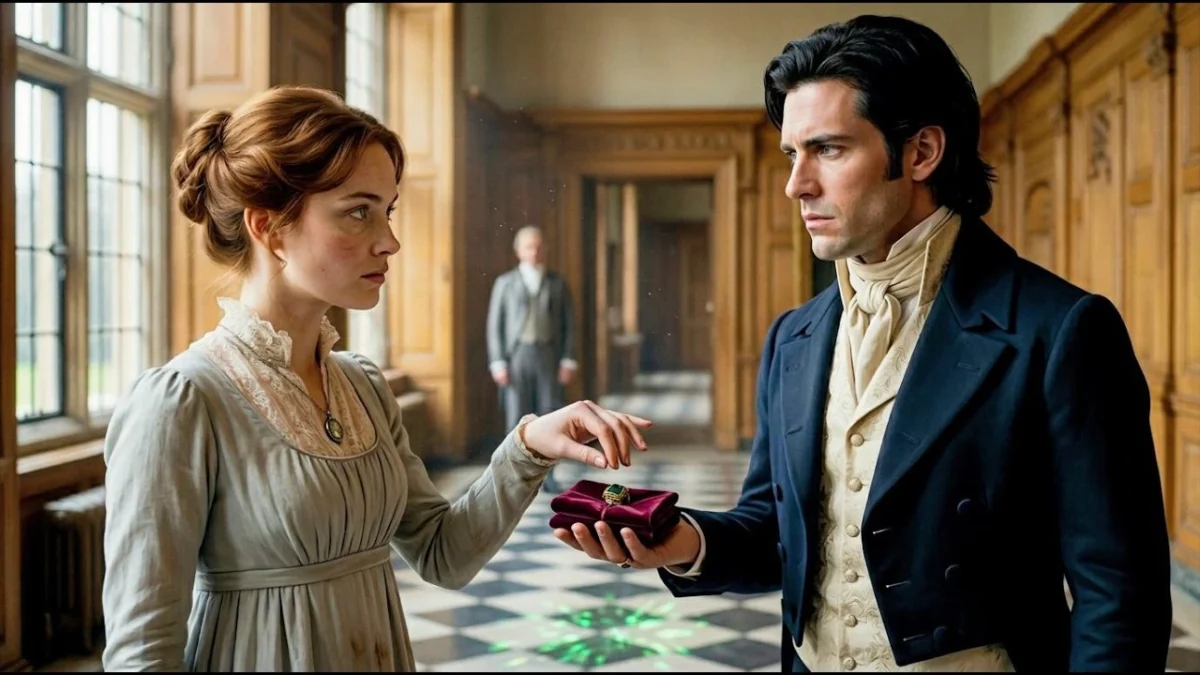
“YOU’RE NOT WHAT I ORDERED”, THE DUKE SAID — SHE HANDED BACK HIS RING AND WALKED OUT
You’re not what I ordered, the Duke of Ashkam said. Evangeline Marchmont did not flinch.
The ring lay between them on a velvet cloth, the precise color of old burgundy, a heavy old thing, gold cradling a square emerald, set to announce ownership.
The emerald caught the light from the tall mullied window, and threw a small green lozenge onto the marble floor between her boots and his, a pool of light that trembled each time a footman moved in the doorway.
She had traveled 4 days to reach this hall. Her hem carried two counties of mud, sharp, pale chalk below Winchester, and darker clay from the Hampshire border above.
Her hair had been pinned three times since the final change of horses, and pinned poorly, because the ladies maid her uncle had promised, had not, in the event, been sent.
She had not been permitted to change her traveling clothes. She had not been offered water.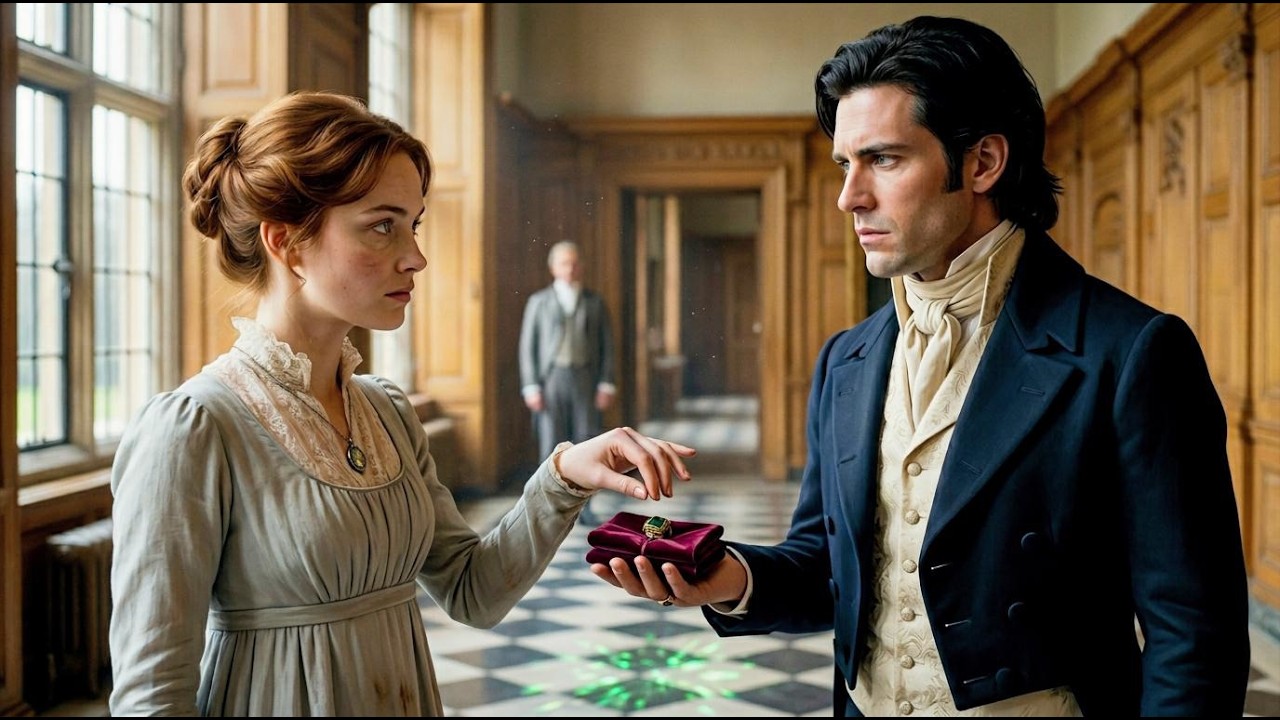
A duke’s household had four footmen, a steward, and a housekeeper, and not one of them had thought to treat her as a guest.
The absence of welcome had told her, before any sentence of his did, what the interview was going to be.
She looked at the Duke across the two yards of marble. He was tall. She had expected him to be tall.
Her uncle’s solicitor had mentioned it twice, as though it were a selling point on a pedigree horse.
But she had not expected the quality of the stillness he stood in. He did not fidget.
He did not shift his weight to the other foot. He waited, one hand rested lightly on the dark, polished table beside him, the other hanging open at his side.
He had the look of a man who had said the sentence and was waiting to see which species of animal the woman opposite him turned out to be.
The sort that wept, the sort that pleaded, the sort that argued. He was not yet taking a guess.
She discovered within herself a fourth species he had not allowed for. She reached forward, not for the ring, past it.
Her fingers moved steadily. The trembling she had expected to announce itself did not come.
She took the velvet cloth by its corner, folded it neatly over the ring, as one folds a napkin for a guest who will not stay for pudding, and placed the entire bundle back into the Duke’s open hand.
The gold clicked once against his signate as she let go. “Then you may keep it,” she said.
“I am not what I ordered either.” She turned. The hall was long, and the black and white marble rang under her boots.
Behind her, the steward, a slim man in a puter gray coat, made a small strangled sound as though someone had pulled a string at the base of his throat.
The housekeeper on the staircase dropped her folded lemons. Eva did not look back. The iron banded doors at the end of the hall were open, and beyond them the drive gleamed wet, where a thin spring rain was falling onto the gravel.
She heard the Duke’s boots behind her before she reached the doors. He did not call out.
He did not run. He walked long measured strides that somehow closed the distance faster than shouting would have done.
He called out just as she stepped under the portico, not raised, not needing to be raised.
He called her madam, which is what a gentleman calls any woman whose identity has disappointed him.
Ava kept walking. The gravel bit into the thin soles of her boots. Four days of coaches had worn them and the rain was finishing what the roads had begun.
She reached her hired shays and put her hand on the door. Behind her his voice corrected itself.
Miss Marchmont. That stopped her. Not the sound of his voice, the fact that until that moment he had not used her name, her own name in his mouth was a concession.
She turned slowly. He stood at the edge of the gravel, the rain darkening his dark hair at the temples.
6 feet and more of him. His shoulders filled the doorway behind him the way a door is filled by a door.
Gray eyes the color of wet slate. A mouth that had probably been pleasant once when it had been permitted to smile.
He observed that she had not let him explain. She answered pleasantly that she had not because she found the phrase, “I am not what you ordered.”
Reasonably complete on its own. His jaw set. He began to say that what he had spoken had been, and she cut him off without unkindness.
Accurate, she suggested, or rude. Both, in her experience, could live together. A vein showed in his temple.
The spring rain sifted down between them, silver threads on dark wool. Behind him, the steward had appeared in the doorway, putated, narrow-faced, his hands folded in front of him in a way that suggested they were usually folded elsewhere and had only recently been deprived of their occupation.
His eyes were on Ava, like a cat’s on a door latch. The Duke suggested, with what he evidently considered a gesture of consiliation, that she at least come inside.
They could speak. A carriage would be sent for her in the morning, a proper one.
She inclined her head in the sparse courtesy of a woman who did not require any carriage he could send.
She had one already, she answered, and a destination. She baited him, “Good day.” She climbed into the shayes and closed the door herself.
She did not slam it. That was important. She knew it would matter later to be able to tell herself she had walked out in the manner of a woman who had decided, not a woman who had fled.
The leather of the seat was damp under her. The straw on the floor smelled of other people’s journeys.
A cobweb, freshly made, trembled in the corner of the window where the glass met the frame.
She fixed her eyes on it as a small boat fixes on a distant lighthouse.
The coachmen, who had been listening to the scene the way coachmen are always listening, clucked to the horses without being told, and they moved off through the curtain of rain toward the gate house and the road beyond.
The gravel crunched under the wheels in a long, unhurried protest, as though the drive itself were reluctant to let a carriage leave Ashkam on those terms.
Through the small rear window, Eva watched the Duke grow smaller. He did not move.
The pewtor coated steward came out and spoke beside him, a hand rising and falling in a gesture that from this distance looked remarkably like reassurance.
Around them the manor stood stone-like against the spring sky. Three stories of honeycoled ashla, the ropes of wisteria on its south front still bare, but threaded with the first bruised purple of a bud about to open.
And for a moment the whole grand front of Ashkam seemed a stage with two actors on it, the woman in the carriage being given her last view of a play she had refused to act in.
Then the lane dipped and the house was gone behind a hedro, and the cobweb in her window gave one last tremor and parted, and the journey was no longer a leaving, but a going.
Her mind quieted by a degree. She had not known until then that the leaving had been louder in her head than the going would be.
Eva’s fingers found the worn silver locket at her throat. The chain was thin and the catch a little loose, but her thumb knew the shape of the engraving without needing to see it.
A primrose. Her father had had it made for her mother. He had given it to Eva in the last month of his life, unclasping it from her mother’s throat while her mother still wore it.
You take care of this now, he had said. She had been 19. She was 24.
She discovered as the shayes rattled onto the high road that her hands were shaking.
That was permitted. It had been permitted for the last 40 minutes of the last 4 days.
She folded her hands on her lap. She waited for it to pass. It did not for some time.
The village of Ashkam under hill lay two mi from the mana gates. The shaes brought her to the rose and compass inn which was brick-fronted climbing rose wreathed and not expecting any guest beyond the Tuesday mail coach.
Mrs. Kle, the inkeeper’s wife, put a hand on her broad hip at the sight of Eva stepping down in her traveling clothes in a spring shower.
Dear me, miss, you’ve had a journey. I’ve had several. Parlor or private? Private, please, and a bath if it can be managed.
Also some tea and a pen. Mrs. Kle, a woman who had heard many things come out of carriages in her life, nodded without remark.
The blue room. Nell take you up. Charlie this to the boy by the door.
Run down to Mrs. Phillips and tell her I’ve need of her daughter for a turn of hot water.
The blue room was small, sloped, whitewashed, with a bowed window that looked onto a yard of cobbles and a single pear tree not yet fully in leaf.
Somewhere below, a cart was being unloaded. Somewhere above, two of the inn’s chambermaids were arguing cheerfully about a sheet.
The afternoon light came slanting through the walked glass in bars and picked out the patchwork quilt on the narrow bed.
Every square of it mismatched. Every square of it faded to the same honest gray brown that was Eva’s whole afternoon.
Eva sat on the edge of the bed without taking her bonnet off and drafted three letters in her head before she wrote any of them.
Her traveling trunk had not come in. She had only the small vel at her feet, and in it a change of linen, a hairbrush, a traveling Bible her mother had given her before her marriage, and a clean handkerchief.
The smallness of the inventory struck her in passing as the truest accounting of her life, of a lease that was half full, half of that half being other women’s inheritances.
The first to her uncle, Sir Horus, I have arrived. The Duke has rejected the match.
Do not expect me at your house. I shall write again when I have arrangements.
The second to her old governness, Mrs. Hartle in Bath, now a milliner’s widow. May I impose for a fortnight or two while I consider the third to be sent to the man she had just walked away from.
I am not what you ordered. I hope it costs you. I hope it costs whoever told you what to order.
I hope someday you are grateful I walked. She wrote only the first two. She sealed them.
She rang the bell. The putwer coated steward in the drawing room of Ashkam Manor at that same hour was being very carefully hospitable to his employer.
A decanter of cherry had been produced. A small fire, though the evening was mild, crackled in the great for the Duke’s convenience.
Nister Parish had been Ashkham’s steward for 14 years, had trained under the previous duke, had closed the books on the previous duke, had opened them again for this one, and he understood the delicate management of a nobleman whose plans had just collapsed.
The most regrettable incident, your grace, yet one could not have anticipated it. Could one not?
Parish considered the Sherry decanter. The young lady was, I confess, a surprise to me as well.
So Horus’s correspondence led us to expect a delicate pause, a somewhat different person. The portrait you showed me was a lie.
I beg your grace’s pardon. You showed me a miniature of a fair-haired, pale young lady with a fashionable bearing.
The woman who stood in my hall is not that woman. I have eyes. Parish.
I have used them for 31 years. A poor likeness, your grace, these country painters.
She did not look like a poor likeness of the miniature. She looked like an entirely different person.
Parish smiled tightly. The smile of a man who has arranged many inconvenient things in his life and been thanked for most of them.
The Marchmont family, your grace, is, how shall I put it? Complicated. Sir Horus has two nieces in his household.
He wrote concerning one. He may have sent the other. Maxwell set down the sherry he had not touched.
Which was I supposed to receive? Parish hesitated as a man hesitates who has not yet decided which lie is the cheaper.
Miss Cordelia, your grace, the younger, the fairer, and the one who arrived, Miss Evangelene, the elder.
I had understood she was considered unsuitable, some irregularity, I was led to believe, in her upbringing since the baron her father’s death.
What irregularity? I do not have the particulars, your grace. I confess I thought the matter closed when the miniature came, and indeed the matter is not closed.
The Duke stood. He was not a shoutter. He had never been a shoutter, but when he rose to his full height in that drawing room, the air thinned slightly around him, and Parish’s smile faded at the edges.
Find me the particulars. Find me the correspondence. I will see every letter Sir Horus has sent this house in the last 12 months.
Of course, your grace. It shall be attended to tonight. Tonight, your grace. Maxwell walked to the window.
The rain had thinned to a mist that silvered the lawn, and in that mist the cedars on the west drive stood like a procession of dark, patient figures that had seen worse afternoons than this, and said nothing about them.
The steward’s reflection hovered in the glass behind his own, narrower, putcoated, mouth composed. Maxwell did not turn.
It struck him, watching the two faces superimposed in the rain blurred window, that he had never in 14 years examined Parish the way a landowner is supposed to examine his steward.
His father had hired the man. His father had trusted the man. That had been at various times reason enough for both Maxwell and the late Duke to overlook a certain slipperiness in the man’s handling of minor affairs.
Minor affairs, he was beginning to understand, sometimes grew into the sort that walked up a drive in the rain and back down it again.
Somewhere below the slope of the hill was the village. And in the village the rose and compass, and in the rose and compass a woman who had placed a velvet cloth folded over an emerald ring into his hand and walked out of his house as though she were the one finishing the interview.
He had handed over the letter of contract that afternoon. He had slid the ring across the table toward her.
He had looked up and he had said before thought could catch speech, “You’re not what I ordered.”
He had said it because the miniature in his waist coat pocket, he could feel it now, its cold edge against his chest, was not this woman.
He had said it because he was tired, and because his father had been gone 11 months, and because the marriage had been negotiated over those months to settle the estate, and he had begun to believe he knew who would walk into this hall.
A fair, pale, composed girl with an upbringing suitable to a duchess. He had prepared the sentences that one used for such a meeting.
He had rehearsed them privately in the course of a solitary ride out to the edge of the park, where he had always, as a boy, rehearsed the sentences he was afraid to forget.
He had prepared a tone that was dignified without being cold, a remark about her journey, a compliment directed at her mother’s taste in bonnets, a second remark that established his expectations of the marriage without announcing them as expectations.
He had not prepared sentences for a tall, rain, greeneyed woman with sunbr hands and a mouth that made you want to apologize before you had done anything wrong.
And so, at the exact moment an apology was required, his mouth had chosen disdain.
He saw the sentence again now, as though a footman were carrying it in front of him on a salva.
He saw behind it the small green lozenge of light the emerald had thrown across the marble floor, and he saw her hand, small, strong, inked at the knuckles of the second finger from recent writing, folding the cloth over it.
He saw her walk away. He had not moved until her carriage was on the drive.
He had not known until he saw her back that a back could communicate a whole legal judgment without a word spoken.
He turned from the window. Parish. Your grace. Where has she gone? I do not know your grace.
Find out. The next morning was clear. Spring in earnest, head rose thick with the first green, cherry and flower over the churchyard wall.
A thrush absolutely committed to some decision in the elm by the inn. The smell of the village came through her open window in a kind of layered report.
Woods smoke from the kitchen chimneys first, then the warm yeast breath of the baker’s oven and the far side of the green, then further out the mingled sweetness of lilac and lambs from the lanes.
Somewhere a blacksmith had begun his morning. Somewhere a hen was explaining herself to the village.
Eva, who had slept poorly and then well, washed her face in cold water from the basin Nell had filled before dawn, pinned her hair without the help of a mirror she trusted, and looked at her reflection in the dimpled bowed glass above the wash stand, for as long as she needed to be certain the face she wore was hers, and not as in the last 5 years someone else’s cast off.
She came down the stairs in her only other gown, a plain gray wool that had survived the coach better than her traveling coat, and took her breakfast in a nook by the window.
Miss Kle brought bread, butter, and new churned and still sweet, and a pot of tea so strong the spoon nearly stood in it.
Now, fetch you more hot water upstairs, Miss. And I’ve had a word with Mrs.
Phillips. She can spare you a laundry turn at the back of the house if you have things that need Mrs.
Kle glanced at the door as it opened and closed herself off. Miss Greavves, come in.
Come in. A small bird-like woman in a school mistress’s dark popplin stepped into the parlor and took off her bonnet with the air of one performing a minor domestic right.
She had rather sharp brown eyes and a sharper nose, and the upright bearing of a person who has spent 20 years holding the attention of 40 children.
Miss Greavves offered a compact apology and stated her business. Her tom had been sent down from the school with the measles and half the older girls with him.
She found herself without a reader for the infant class, and the vicar’s wife was at her sisters in Chicha.
She paused. Her sharp eyes had found Eva. Greetings were exchanged. Upon learning that Eva was a Miss Marchmont, taking a room at the inn, Miss Greavves hesitated for a beat, the length of an adjustment, then made her proposal without ornament.
3 hours at the infant’s class, a shilling, and tea, her humble request of a passing stranger, who she hoped would forgive the presumption.
Eva, who had not yet spent her last 10 shillings, and did not especially require a new one, discovered that she was about to say yes.
She had not had anything to do for 4 days. She had not had anything to do for 3 hours teaching the alphabet to other people’s small children was not nothing.
It was a thing. She would do it. Eva agreed. Miss Greavves thanked her, issued the address, nine at the school room across from the church, and swept out as she had swept in.
Mrs. Kle poured more tea. The school mistress, the inkeeper’s wife, observed approvingly, was a woman who did not waste time.
Ava agreed that she saw as much, and when Mrs. Kle asked how she meant to spend her afternoon, she looked out at the cherry in bloom, the thrush, the sky with its casual unduklike kindness, and said she would walk if the rain held off.
It held off. By 11, she had spent 3 hours in a room full of children between 4 and 7, teaching them the sounds the letter C could make.
She had read aloud from a primer. She had mediated a dispute over a wooden counter.
She had tied back the hair of a small, solemn girl who had been crying into her slate.
She had learned that the infants of Ashkam under Hill considered the letter Q deeply unfair, and had been pleased to be given permission to think so, as long as they did not let it affect their copy box.
At noon, Miss Greavves brought her a cup of tea and a round of buttered bread and a shilling, and told her, without elaboration, that if she was still in the village on Thursday, she should be very grateful.
Eva said she would be. The school mistress asked with the minimum phrasing the question required where she came from and whether she was going on.
Sorry, Eva answered, “And she was considering.” Miss Greavves did not press. A person who has kept 40 children from asking most of their questions learns not to ask most of hers and simply confirmed Thursday 9.
Eva walked back to the end through the village the long way past the smithy and the chandlers and a bow-fronted habeddashes whose proprietor was arranging a display of spring ribbon.
The smith was chewing a gray cob in the yard of his forge. A small knot of children had gathered at a respectful distance to watch him, and one of them, a boy of about five, with a startlingly serious face, lifted his hand to Eva as she passed, as though she were an old acquaintance of his, who needed reassurance of her welcome.
She lifted hers back. A woman she did not know nodded good morning to her at the pump.
A boy touched his cap. Three women at the churchyard gate were arguing pleasantly about a marriage in the next parish.
One was of the opinion the bride was marrying beneath herself. A second was of the opinion nobody in that family had ever on examination turned out to be quite so grand as they had been supposed.
The third was sorting out a basket of sprats and not offering an opinion, but clearly preparing to deliver one when she was ready.
Eva walked past them and realized halfway along the lane that she had not once thought of the Duke of Ashkam in 3 hours.
The thought of him when it arrived arrived without the sharp edge it had had the day before.
She could carry it now the way one carries a stone in a pocket, conscious of its weight, neither dismayed by it nor in love with it.
That, she thought, was a form of progress that lasted until the rose and compass came into view.
In its yard, a tall horse, chestnut, long-legged, expensive, was being walked out by a groom who was not one of the inns.
The groom wore a livery the color of polished puter. Eva stopped briefly at the corner by the saddlers and took stock.
Her bonnet was straight. Her gloves were not new, but they were clean. A small smudge of chalk from a child’s slate had printed itself on the back of her left hand.
She wiped it off on the hedge with the calm efficiency of a woman who had long ago stopped requiring perfection in her turnout before she consented to be seen.
She did not turn. A wrecker, her grandmother used to say her grandmother had been famously a wrecker.
The parish still spoke of her does not turn. A wrecker walks in. She walked in.
He was in the parlor standing at the window with his hands clasped behind him.
He turned at the sound of the door. He had not evidently sat down while he waited.
His coat was brushed. His crevat was simple. His boots had been attended to a man who was dressed with care for an interview he is not sure how to conduct.
Miss Marchmont, your grace. I came. He stopped. I owe you an apology. You do?
Yes. There was a small, breathable silence. Eva took the bonnet off her head and set it on the side table.
She did not invite him to sit. He did not sit. I was misled, he said.
Concerning who was coming. I had been shown a portrait that did not resemble you.
The name on the contract did not correspond to the name on the portrait, and neither corresponded to the woman who walked into my hall.
I have spent the night finding out why. Have you? I have not finished finding out.
I came to tell you what I know so far, and to beg your pardon for what I said.
Eva sat because her knees were suddenly less reliable than they had been in the schoolroom.
She did not offer him a chair. He remained standing. I know, she said slowly, that my uncle, Sir Horus, has two nieces in his house.
I am one of them. My cousin Cordelia is the other. I know that negotiations were conducted by my uncle’s solicitor.
I know that I was put in a coach 4 days ago and told the journey was arranged.
I know I was not shown the contract. I know. I was told the Duke had chosen to meet me, not that he had chosen me.
He I had been told the choice was Cordelia. Yes, you knew that. I suspected it.
My uncle’s household is not one in which I am trusted with particulars. I was given a gown of my cousins to travel in.
It did not fit, which is why I am wearing my own now. And I was told to be pleasant and brief and to agree to everything.
I did not know I had been substituted. I knew I had been sent in a direction.
The Duke was silent for a long moment. Then he said, “Why did they substitute you?”
“I do not know.” “A guess? My cousin refused to come.” Eva met his eyes.
That is the simplest explanation. Cordelia does not do things she does not wish to do.
She is a beautiful girl with a small fortune of her own and a spoiled temper, and she would not have wanted to travel 4 days to meet a duke who might disappoint her.
I would have been sent because someone had to be sent. I was the household’s convenience.
You were not told, I take it, that you were traveling as your cousin. No, my uncle is not subtle, but he is not stupid.
A lie that would be exposed at the first dinner is not a lie he troubles to tell.
He told me to travel to Ashkam and meet the Duke and do as I was bid.
I believe he expected me to be sent back within an hour. Which said the Duke dryly is what I did.
Which is what you did. Yes. Another silence. The dust moes in the window slanted between them in the thin spring sun.
Miss Marchmmont, your grace, would you have stayed? Eva’s hand found the primrose locket at her throat.
She looked at him steadily. If the portrait had been of me and I had come as myself, would you have sent me away?
His jaw worked. He did not answer at once. This, she thought, at least was a point to him.
He did not rush into a polished sentence. He let the silence sit. I do not know, he said finally.
I would like to say no. I think I think I would have been a fool.
But I cannot tell you what I would have done because I did not do it.
I said what I said. I have thought about it all night and I cannot pretend that the sentence arrived unbidden.
I had expectations that was stupid and I spoke them. At least said Eva, you are honest about the stupidity.
Yes. Go home your grace. Think about what else you have ordered that you should not have.
When you know you may come back. He looked at her. He had expected, she thought, to be thrown out or taken back.
He had not expected to be given an instruction. Very well, he said. Good day, Miss Marchmont.
Your grace. He left. Through the bow window, she watched him mount the chestnut and ride out of the yard.
The groom in put livery followed. She touched the locket. She discovered her hand was steady.
She ordered another pot of tea. He rode back over Asham Hill at a walk.
The track was soft with the night’s rain, and the chestnut knew the way, and Maxwell needed the time.
The hedros were already well into green, he noticed, as though the last fortnight of weather had conferred in private, and agreed to accelerate the season.
A bullfinch scolded him from a hawthornne at the style. A hair broke from the edge of a plowed field, and ran in a long, straight line until it remembered to turn.
He let the chestnut walk. He had not, in the 11 months since taking up the estate, spent 10 minutes alone with his own thoughts on horseback, without a baiff’s letter to answer when he returned.
And he discovered in this unscheduled half hour, a curious sensation, an echoey largeness, like a great room emptied of its furniture that he did not immediately identify.
He identified it as he reached the boundary stone. Doubt. He had written out with the certainty that the morning’s conversation had ended badly.
He was riding back with a question under the certainty, whether badly on her scale had been as bad as badly on his.
He passed the boundary stone at the edge of the park and dismounted at the stableard rather than the drive, handed the reigns to the headgroom without a word, and went into the house through the kitchen door.
Mrs. Venick, the housekeeper was at the long table needing dough. Your grace go on.
Anne is ironing in the still room. Cook is in town. If you are looking for Mr.
Parish, he is in the estate office. I’m not looking for Mr. Parish. I’m looking for my mother’s writing desk.
Mrs. Fenick’s hands paused. In the dressing room off the green chamber, your great where it has always been.
Thank you. He went up the service stair. It was a liberty he had not taken in months.
The green chamber had been his mother’s and had not been opened since her death 5 years before.
The desk was a delicate walnut thing on spindly legs, its drawers lined with pale silk.
He had remembered sometime in the night that his mother had kept her particular correspondence in it, and that one particular correspondence had concerned, he was almost certain now, the Marchman family.
He opened the drawers. He found in the third one down a bundle of letters tied with a faded ribbon.
He untied them in his lap and read them through by the windows light in order.
The first was from his father, the late Duke, to his mother, dated summer of 1811.
Eva would have been 16. My dearest, I am just returned from Ashburn. Sir Horus’s household is as lively as ever, which is to say he drinks too much, and his wife has ordered a new music room.
But the elder niece, Evangelene, you would take to her at once, my love. She has taken over the accounts for her father’s home farm since the baron’s illness has confined him to his chair, and she does it with a quiet competence that made the land agent weep.
She is a plain spoken girl, but not coarse. She has a grave face until she laughs, and then the room stops.
I think of Maxwell often. I shall make inquiries. Maxwell read that sentence twice. He set the letter down.
He read the next and the next. His mother’s handwriting joined his father’s. The marchment match had been discussed, kept in view, carefully not pursued, because his father had died before Maxwell had come home from the peninsula, and his mother had followed a year later, and the house had gone silent.
The ribbon round the bundle was faded because it had not been untied in 5 years.
The last letter in the bundle was from his mother to herself. A note, not a letter.
It was undated, but in a hand already thin with the illness that would take her by the following autumn.
Speak to M about the Marchment Girl when he is home. His father’s judgment on this was very particular.
E, not C. He put the letters down. He held the ribbon. He went down to the estate office.
The ribbon stayed in his hand the whole way. A small faded silk thing that carried in its ordinary frailness a weight he had not been prepared for.
Halfway down the stairs, he stopped and put his other hand flat against the panled wall to steady himself, not with grief, but with the peculiar embarrassment of a man who has spent 11 months thinking himself in charge of a house, and has discovered at the end of that 11 months that the house has in fact been running him instead.
His father had chosen a woman for him. His mother had kept the choice alive.
Another man had erased it. And he, the sole person who could have corrected the erasure, had failed to look in the one drawer where the truth had been left plainly for him to find.
Parish was at the great oak desk, inkwell open, pen in hand, ledger before him.
He looked up and smiled, the tight smile Maxwell had learned to watch for. Maxwell opened without preliminary.
He asked who had negotiated the match, Parish answered, as Parish had always answered uncomfortable questions with a sentence that began with a carefully phrased concession and ended with the blame resting on a solicitor in Surrey.
Maxwell listened to the sentence to its end. Then he set his mother’s bundle of letters on the desk between them, untied the faded ribbon, and in six sentences recited back to the steward the relevant portions of the late Duke’s summer of 1811 correspondence, the three pages of his mother’s subsequent notes, and the final undated slip with its instruction, E not C.
Parish put down his pen very carefully. He confessed with the expression of a man who had rehearsed the expression in a looking glass, that he had not been privy to any such distinction, and that the correspondence from Sir Horus’s solicitor had plainly named Miss Cordelia.
Maxwell asked to see it. Parish’s hand moved to a leather folio on the desk.
His fingers moved slowly. Maxwell had spent three years in the army and two years administering an estate, and he had learned in both how to watch a man’s hands.
The folio, when it was opened, rustled in the manner of a folio whose contents had been recently reordered.
The letter the steward produced named Miss Cordelia Marchment. Maxwell read it, folded it, set it aside, and asked for the earlier letter, the first one in which either niece’s name appeared.
Parish hesitated a beat too long. Which pocket? Maxwell said. I beg your pardon, your grace.
Which pocket is the letter you do not want me to see? Parish went very still.
He was a man of 52 who had outlived three dukes in that office, and the stillness that settled over him now was the stillness of a man choosing which of several paths of retreat remained open.
He answered that the letter must have been misplaced. Maxwell did not believe him. He said so, not loudly.
There was nothing in his tone a servant in the corridor would have been able to report as an outburst, but plainly enough that Parish, after a further stretch of silence, unbuttoned his coat and withdrew from the inner breast pocket a folded paper which had no business being on his person.
He laid it on the desk. Maxwell unfolded it. It was a letter from Sir Horus’s solicitor dated the previous summer, naming Miss Evangelene Marchmont, elder daughter of the late Baron Winthrop, as the proposed subject of the negotiation.
In Parish’s hand in ink, the word Evangelene had been crossed through and Cordelia written above it.
The alteration was neat. It had been made, Maxwell thought, with the tranquil concentration of a man who had not expected anyone to ask to see the original.
Explain this. Parish did not speak. Maxwell did not fill the silence for him. He had learned from the peninsula the particular weight of a silence deliberately not answered.
It fell on the person who owed the answer, and did not lift until he spoke.
He watched Parish’s jaw work. He watched the steward’s hands, one on the desk, one at his coat lapel, declined to settle.
In the corridor, a maid passed, her feet quick on the flagstones. Beyond the window, a pair of swallows were at some business above the stable.
Why? Maxwell said at last. Parish swallowed. He offered in a small, prepared voice that Miss Cordelia’s dowry was larger.
Maxwell observed that the estate did not need a larger dowy. The estate was solvent as Parish knew since Parish kept the books.
Parish attempted a second explanation concerning the material difference. Maxwell cut it off with the single word again.
Why? A silence followed, a long one. Then, in the small voice of a man who has rehearsed the true sentence in case the true sentence ever became necessary, Parish admitted at last, Miss Cordelia’s mother was a second cousin of his.
Maxwell sat on the edge of the desk. The spring sun through the window was catching the letter, making Parish’s alteration stand out black against the faded original ink.
The word evangelene struck through and above it the word Cordelia in a tidy unhurrieded hand.
The whole small crime of a steward’s afternoon summed up in two penstrokes. He repeated the phrase your cousin aloud, not as a question, but as a registering.
Parish confirmed it in a voice that had now gone entirely dry. His mother’s sister’s child.
Maxwell stated back to him plainly what he had done. Substituted the name of the woman Maxwell’s own mother had asked him to marry with the name of his own cousin’s daughter for that cousin’s family’s advancement.
Parish began the sentence that would have partly excused it. Maxwell heard him out only far enough to see where the sentence was bending.
It bent toward the second reason, which Parish, with the reluctance of a man forced to part with a private opinion he had carried with some satisfaction, finally articulated, that Miss Evangelene would have been, in his respectful judgment, a very effective duchess, and would have taken an interest in matters customarily left to the steward.
The Duke looked at him for a long moment. He did not permit his face to change.
He discovered that the anger he had expected to feel, the anger he had been carrying up the stairs to this interview like a blade, had thinned in the handling of it into something harder and cooler and more decisive.
“Go,” he said. Parish began to protest. Maxwell did not permit the protest. He instructed the steward in four flat sentences to pack his things, to leave the house before dusk, to take what was his and nothing else, and to be out of the county by the following evening, under pain of a charge of fraud that Maxwell would bring personally.
The letter of formal dismissal, he added, would be sent on. He did not raise his voice.
He did not stand. He was finished with the conversation before Parish had finished the first syllable of his next apology.
And Parish, to his credit, he had served this family for 14 years, and knew the difference between an invitation to plead and the absence of one, went.
By 3:00, Parish was gone from Ashkam Mana. Maxwell stood at the window of the empty estate office and watched the smaller of the two caracles recede down the drive.
The puter livery of the departing groom looked in the afternoon’s sharp new sun like tarnished silverware on its way out to be sold.
The oak desk behind him felt oddly larger than it had that morning. Without the steward’s narrow figure hunched over it, the whole room had the dishonored grandeur of a room whose occupant has finally been asked to vacate after a tendency that went on too long for the sake of politeness.
Maxwell crossed to the ledges on the shelf, the estate accounts, 14 years of them, and set his palm flat on the leather spines.
He felt, for the first time since his father’s death, that they were his, not inherited.
His, to balance or unbalance, as he chose. He had instructed Mrs. Fenick to have the Southside cottage prepared, swept and aired, fresh linen on the two good beds.
A small fire kept in the kitchen for Mrs. Yarrow to find in the morning.
Then he called for his horse. The rose and compass was quiet in the afternoon.
The tap was empty. The son had drawn the regulars out to the orchards to help with the lamming’s aftermath.
Ava was at the parlor table with a folded slate, working through the next week’s schoolroom exercise at Miss Greavves’s request.
She had ink on her second finger. He came in without his hat. Mrs. Cle in the passage did not speak.
Ava looked up. Your grace. He asked if he might come in. She answered dryly that he already was.
He closed the door behind him. He sat this time without being asked in the chair across from her.
His father had intended her. He said then without preamble. Ava set the pen down.
He laid out what his mother’s correspondence had made plain. His father had met her at Ashburn in 1811 when she had been 16 and keeping her father’s home farm through his illness.
His father had written to his mother about her. They had discussed the match. They had not raised it with him because he had been on the peninsula and they had not known whether he would come back.
When his father had been taken by illness, his mother had held the matter. She had thought there was more time.
She had left a note in her desk before her own death. The instruction was that he should marry Evangelene Marchmond, not Cordelia.
His steward had substituted her cousin’s name to advance his relation. That was the whole story.
The color left Eva’s face. She had not expected this. She had prepared herself for many possibilities that morning, and none of them resembled this.
She repeated the sentence aloud that his father had met her as though she had to turn it in her hand to be sure of its weight.
He confirmed it plainly. At Ashburn, the summer of 1811. His father had written of an elder niece who ran the farm books.
She said the late Duke’s name softly. He had come to her uncle’s house for 3 days.
She had shown him the South Meadow drainage sketches she had done. She had been 16.
She had thought it was she had thought he had been being kind. He had been being kind, Maxwell told her.
He had also been watching her. He had been his father. Eva sat back in her chair.
She looked at the slate. She looked at the window. She looked at her hands.
One of them rose to the primrose locket and stayed there. The Duke waited. He had learned in the last 12 hours something about not rushing.
My uncle. Eva spoke at length. My uncle knew. Your uncle solicitor knew. Whether your uncle directly.
My uncle knew. My aunt knew. Cordelia. Her voice sharpened. Cordelia knew. Perhaps not. They knew your grace.
They knew for how many years? Five, six, that my future was settled with your father and that I was never told.
They sent me in a coach without a contract to meet a man who thought he had ordered my cousin.
They did this on purpose. This was not an accident of household laziness. This was contempt.
Yes, I am not. She stopped. I am not surprised. I should like to be.
I cannot be. That is the saddest thing I have said aloud in some time, Miss Marchmont.
Yes, I owe you a second apology, a more particular one. For for all the years I did not come looking.
I was in Spain and then I was in mourning. And I did not ask the questions I should have asked when I came home.
If I had, you would not have spent 5 years in that house. You did not know I was there.
I should have. My mother asked me to marry you. I should have asked who you were before another letter could arrive.
Eva wiped her eyes. It was quick. She did not want it to be remarked on.
He did not remark on it. She thought afterwards that she might forgive him for that alone.
Your grace. Yes. I am going to have to think. I know. I am going to ask you to leave me to think for a day at least.
Yes. I will write you in the morning. I will wait. He stood at the door.
He paused. He said without turning round. My mother liked you very much from my father’s description.
I wish I wish I could have had some of her sentences before I opened my mouth yesterday.
So do I. Your grace. He nodded. He left. She wrote him the next morning as promised.
A single line on in paper delivered by Charlie the boot boy. I shall stay in the village a fortnight.
I make no further promises. Em. He wrote back within the hour. I ask for new promise.
I ask for the fortnight. A. She pinned the note to the frame of her looking glass.
She went to teach the infants the letter D. Word traveled as word in a village will.
By the end of the day, Ashcom under Hill had two competing stories. That the Duke had sent away his bride for being plain, and that the steward, Mr.
Parish had been turned out for a fraud the parties would not describe but had clearly something to do with the bride.
By the end of the week the two stories had merged into one inaccurate but surprisingly charitable narrative which was that the Duke had rescued Miss Marchmont from a bad match contrived by his wicked steward and was now waiting as a gentleman ought for her to decide whether she could forgive him.
The school children stared at her the first 3 days, then stopped because she was more interesting as a teacher than as a rumor.
Miss Greavves, who had a fixed dislike of gossip, simply said nothing and kept her at the school a second week when Tom did not recover on schedule.
Mrs. Kle refused to charge her a fortnight’s room rent after the first night’s discount, saying in her broad, cheerful way that Ashkham guests paid half during a season of bad fortune.
Eva did not argue with her because she had worked out by then that she could not pay the full fortnight’s rent without writing to Mrs.
Hartle in Bath, and Mrs. Hartle’s answer had not yet come. Her uncle’s answer, however, had, and it arrived in the unloly manner that letters of that kind arrive.
A post rider clattered into the yard on a Monday morning with a mud spattered satchel and a voice horse with his own importance.
And the letter in question came in with the parish ones, a square of coarse paper folded three times, sealed with Sir Horus’s bors head crest in wax so thick it had cracked across the middle in transit.
Mrs. Plague brought it up with the morning’s tea and stood a moment at the window, ostensibly arranging a curtain that did not need arranging, while Eva broke the seal.
Inkeepers, like coachmen, were always listening. The letter from Sir Horus arrived by the Monday Post 5 days after the confrontation.
It was four sides of close writing, an impressive performance from a man who, in Eva’s recollection, had never written more than a page in his life.
Its contents were outrage, accusation, scandal, demand. He knew, he wrote, that she had gone to Ashkam Manor and said things she had no right to say.
He knew she had made herself a spectacle in a provincial village. He demanded her immediate return to his house before her aunt took to her bed from the shame.
He enclosed a draft for the coach fair. She was, he concluded, not to speak to the Duke again under any circumstance.
Eva read the letter twice. Then she walked to the inn’s writing desk, took up the pen, and composed her reply.
It was the shortest letter of her life, and she was rather proud of it.
Uncle, your draft is returned. I shall not be coming back. I have learned from a source, I believe, that my uncle, the late Duke of Ashkam, intended a match with me on his own initiative in 1811, and that this intention was concealed from me for the subsequent 5 years, for reasons I now understand.
I shall address you further through an attorney when I have engaged one. Evangelene, she gave the letter to the afternoon post.
She returned her uncle’s draft in the same envelope. She paid Mrs. Cle a second week’s rent with the last of her own money.
At the end of the second week, her uncle arrived in person. The carriage clattered into the rose and compass yard at dusk, all over mud, the horses foaming in the traces.
Sir Horus’s great red face framed in the lowered window. Where is she? Mrs. Kle, who had brought out a lantern, considered him with interest.
Where is who, sir? My niece, Miss Marchmont. I know she is here, woman. Do not toy with me.
I have a Miss Marchmont taking a private room, sir. Whether she is at liberty to see you depends on her, not me.
I am her uncle. I have rights in her. That, said Mrs. Kle, thoughtful, is not entirely how rights work in this country, sir, but I shall leave it to the lady.
She went inside. She came out 10 minutes later. Eva was behind her in her gray wool, her hair freshly pinned, her hands folded in front of her.
Uncle, get into the coach. No, Evangelene, I am happy to speak with you in the parlor.
I am not happy to be taken anywhere. Mrs. Kle has kindly offered her private sitting room.
You may come in, or you may stand in the yard. Either is acceptable to me.”
Sir Horus descended from the carriage in a manner that suggested he had not descended from a carriage at another person’s convenience in 15 years.
He came into the parlor, his red face stood out violently against the whitewashed walls.
Mrs. Kle, invited by the lift of Eva’s eyebrow, remained in the passage with the door a jar, polishing, it turned out, a put tankered that did not need polishing.
He began with the inevitable speech. Her behavior was disgraceful. She had brought scandal on the family.
Her aunt was prostrated. She was to come home at once. Eva listened to the whole of it without interrupting.
She had been the silent recipient of such speeches for 5 years, and had learned that they ran themselves out if one did not feed them, faster than they did if one answered.
When he had finished, she informed him in a voice no louder than the one he had used at supper on any Tuesday in her childhood that the subject under discussion was not her behavior.
The subject was why, for 5 years, he had kept from her a marriage proposal from the late Duke of Ashkam, and why, having arranged that she be substituted for Cordelia, he had sent her 4 days in a hired coach to meet the new Duke without the protection of a signed contract.
Sir Horus attempted briefly to deny the existence of any such proposal. Eva informed him that the Duke had produced his father’s correspondence and his mother’s notes, and that the solicitor’s first letter naming her plainly had been discovered in Mr.
Parish’s pocket. He had been paid, she did not doubt, for the negotiations, and the only reason to conceal such a match from its object was to profit from substituting another in her place, which, for reasons best known to his solicitor’s cousinhood with Mr.
Parish, he had. So Horus opened his mouth. He closed it. He opened it again.
My girl, I am not your girl. He changed tac. He attempted, pitched in the voice of the avankunular practical man, to explain that the Duke of Ashkin was a hard man, a cold man, and that she would not have been happy, and that Cordelia would have known how to He did not finish the sentence because Eva finished it for him.
How to spend his money for them, she said. Cordelia would have been wet clay in his hands, and he would have eaten well at a ducal table for the next 30 years.
She knew why he had done it. He need not explain. She then asked him to leave.
He attempted a threat concerning what he would tell the world. She cut it off at its third word.
The only person dishonored in this matter, she told him, was her. The Duke’s steward had confessed.
The Duke had dismissed him. She was, as it happened, under the informal protection of Ashkam.
If her uncle wrote a single letter of slander, she would set an attorney on him, and he would find her signature at the end of her first letter meant what it said.
She wished him a good afternoon. He stared at her, red-faced, collar, dwarfed oddly by the low ceiling of the parlor.
She was taller than he was when he was in a temper. She had not known this.
She had known him all her life as the man at the end of the table.
She had never known until this moment that if she stood straight, he did not reach her cheekbones.
He turned on his heel and left. The carriage departed in as much splash as it had arrived.
Mrs. Kle in the passage went on polishing her tankered for a further half minute before she said to no one in particular, “Well, that was a thing.”
Eva discovered that her knees were trembling. She sat on the parlor bench. She set her forehead on her folded hands for perhaps 10 seconds.
Then she straightened, rubbed her palms on her gown, and said to the tankered, “Mrs.
Cle, miss, I should like a brandy. Just a small one, please.” I should think so, Miss.
She got it. It was disgusting. She drank it anyway. The note arrived by the morning post.
Miss Marchmont, I have heard of last night’s visitor. I should like to invite you to take tea at the manor at 4 this afternoon.
Mrs. Fenick will be present as chaperon. The doors of the withdrawing room will be open.
You may leave at any moment of your own choosing. A carriage will call. I shall understand entirely if you refuse.
Ava considered. She wrote back. I accept. I shall walk. Do not send a carriage.
She walked. It was two miles by the lane, and she took them at her own pace, in her gray wool, the primrose locket at her throat, the last of the morning’s rain drying off the hedros as she passed.
At the gate of the park, the gatekeeper lifted his hat to her without remark, as though she were expected, which she was.
She walked up the drive she had left a fortnight ago on a spring shower.
The gravel was dry now. The doors of the hall were open. Mrs. Fenick was waiting for her at the foot of the staircase in a plumb colored gown that indicated a formal afternoon.
The housekeeper curtsied. Eva, who had not been curtsied to by a housekeeper for 5 years, inclined her head in answer.
If you would follow me, miss. The withdrawing room was southacing, flooded with late afternoon sun, its long windows thrown up to the garden.
There was a tea table set with a white cloth, the silver polished to a surgical finish, a vase of hawthorne in flower at the center.
The Duke stood with his back to the fireplace. He was in a dark blue coat, the same coat he had worn to the inn, and a fresh crevat.
Miss Marchmont, your grace, please sit. She sat. Mrs. Fenick sat by the window with her knitting.
The Duke brought the tea himself and poured. It was very like him, she thought, to do the thing a duke did not do.
His father, she thought, would have done the same. He set the pot down. He had asked her here, he began, because there was a conversation they had not yet had.
He should have had it a fortnight ago in his hall. He had failed her a fortnight ago.
He did not wish to fail her twice. She signaled with the smallest inclination that he might proceed.
He then made, with the air of a man who had rehearsed the sentence privately until it had arrived at something close to its proper shape, a small declaration.
He was not, he said, about to ask her to marry him. He wished to be plain on the point.
If he asked her today, it would only be because he was aware she had been publicly humiliated, and he felt he should offer some reparation of form, and she would be entitled to say yes out of exhaustion and convenience, which was not the marriage he wished.
He did not wish to marry her because his father had asked him to, or because his steward had tricked him, or because her uncle had insulted her.
He should wish to marry her if and when he had come to know her well enough to wish it on his own account.
And he wished her to know him on hers. That is a long sentence, your grace.
I confess I have rehearsed it. It shows, but I do not say that unkindly.
A corner of his mouth moved. The first thing she had seen from him that resembled the ghost of a smile.
She had not known until she saw it that she had wanted to see it.
“He had a proposal,” he said, which was not that proposal. And he laid out in a manner as careful as a surveyor going over a boundary line the offer he had prepared.
The south lodge of the estate had been standing empty for 8 months. It was small but respectable.
It had its own staff, a cook and a maid, both honest, both old servants of his mothers.
He should like to offer it to her for 4 months, on the condition that she accept a small wage and the position of his steward in training.
The estate was without a steward, as she knew. He would not appoint a new one lightly.
He wished, for the interim, to rely on her particular competence in certain estate matters, which he had neglected for longer than he could defend.
She asked Levy whether he wished to employ her. He confirmed that he wished to employ her, and that he wished to do so publicly, both for her protection and for his own instruction.
She would be paid. She would have her own rooms. She would sit at his table when he entertained his tenants, and she would attend him in the estate office three mornings a week.
At the end of 4 months, she might go where she pleased. She might also at any time during those four months tell him to stop visiting the estate office.
And marriage, she said, I will not ask you during those four months. I should like to earn by then the right to ask.
Eva stirred her tea. She set the spoon down. She looked at him. He looked back.
The late sun came through the windows in sheets of yellow warmth. Mrs. Fenick’s knitting needles clicked peacefully.
On the wage, Eva said, “1 a year.” “Done.” “With the understanding that I shall dismiss any groom or footman of this house who is rude to me twice.”
Done. And that you shall not write to my uncle without telling me. Done. And that you will answer at any time any question I ask you about the running of this estate, however small.
Done. Then I accept. She held out her hand. It was not the sort of thing a lady did.
She did it anyway. He took it. His hand was warm, hers cooler, both with calluses in places a duke and a lady were not supposed to have them, and shook it once firmly, as one businessman to another.
Mrs. Fenick at the window turned her work and permitted herself a small, satisfied smile at her knitting.
The South Lodge was a low beaned whitewashed three-bedroom cottage with a view of the South Park and a stone flagged kitchen floor that had been scrubbed once a week for 40 years.
The cook, Mrs. Yarrow, produced for Eva on the first evening, a raised pork pie that was considered in the household her signal welcome.
The maid, Annie, came from the village and had been at the school the week before.
She took Eva’s boots to be cleaned and said shily that she had thought at the time that Miss Marchmont taught the sounds of s very clearly.
Eva wrote a letter that night to Mrs. Hartle in Bath, telling her the imposition was no longer required, and a second letter to a country attorney in Chicha, whose name Mrs.
Kle had supplied, asking for advice on the matter of her uncle. In the morning she rode up to the manor.
Her own small bay was lent to her from the stable and the headgroom touched his cap as though she had always been of the household and entered the estate office at 8.
The Duke was already at work. He pushed a ledger across the desk without ceremony.
Here the South Valley tenants, there has been flooding. Three farms are in Aras. I do not know which of the Aras are the flooding’s fault and which of the farmers.
Have you been to the South Valley this spring? No. Then we shall go. I cannot tell from a ledger what a man owes who has been under 3 ft of water for a month.
Today? Today? They went today. The Duke on his chestnut, Ava on her bay. They were gone 5 hours.
They came back wet to the knees on both sides with a plan for the South Valley that included a drainage scheme Ava had sketched on the back of a letter from the Earl of Casebrer and a reduction of a rears for two of the three farms and a firm warning to the third.
Maxwell sat at the office desk that evening reading her handwriting and made himself smile in a private way in the light of the lamp.
By the end of the first week, she had seen every tenant on the south side of the estate, and had consumed an inadvisable quantity of small beer.
By the end of the second, she had discovered a discrepancy in the estate timber accounts, but could only be explained by a fiddle of parishes going back 3 years, and had written the Duke a short memorandum on the subject.
The Duke read the memorandum twice. He said at the end of it, “If you will ever agree to marry me, I should very much like it to be a condition of the marriage that you continue to do this work.”
Eva looked up. “You said 4 months?” “Four months? Yes, I am talking, I hope, about after the 4 months.”
“Then you still have,” said Eva, picking up her pen. “3 months and 3 weeks and 4 days.”
Noted. Speaking of which, Mr. Halt at Thorn Farm has a SA that has lost its piglets two years running, and he believes he knows why, but he does not know who to tell.
I have told him to write a letter to the London Veterinary Society. Can you frank it for him?
I can. Thank you. He franked the letter. She left. He watched her ride out through the stable yard and thought for the first time in many months that the estate felt from within its own office like a place that was alive.
The library at Ashka Mana was a long narrow room on the west side of the house, its shelves to the ceiling, its fireplace at the far end, its single long table flanked by two leather chairs and one good lamp.
It had in Parish’s tenure been used as an overflow for estate papers. In the third week of Eva’s employment, she asked whether she might tidy it.
She was given permission. She was given, in fact, a free hand. She worked at it on evenings when there was nothing to do at the lodge with Annie and one of the housemates.
By the fourth week, she had turned up on the third shelf to the left of the fireplace a bound manuscript in the late Duke’s hand.
Notes for a gentleman’s tour of the estate with attention to its drainage. It was 20 years old.
It was in places better than anything written on English drainage in the interim. She brought it to Maxwell in the evening and sat across from him at the long table with the single lamp between them and read passages to him aloud.
He had come to the library by habit. She had come because she was tidying.
They had come together on that evening and the next and the next because some conversations are started on one evening and require another.
It rained the third evening, a steady, peaceful spring rain on the windows, and the room was warm, and the lamp was low.
And he told her, at some point, between the drainage of the south valley and the replanting of the Eastwood, about his mother’s last year, and she told him, at some point between the Eastwood and the Lost Sa about her father’s last winter.
Neither of them spoke of the ring. Neither of them spoke of the hall. They were past those doors.
On the fourth evening, a month and some days into her four-month engagement, the manor’s doorner sounded at 10:00 in the evening.
Mrs. Fenick came to the library with her face arranged for bad news. Your grace, a carriage at the door.
At this hour, Miss Cordelia Marchmont, your grace, and her mother. Eva closed the manuscript in her lab.
She sat very still for a count of three. She instructed Mrs. Fenick to show the visitors into the drawing room, said without looking at Maxwell that she would receive them, and when Maxwell began the protest she had expected, cut him off with the firmness of a woman who had decided what the evening required.
One minute alone with them, she told him, then he was to come in. He looked at her.
He was learning even then to recognize the expression. He agreed one minute and she rose and crossed the corridor to the drawing room on legs that were almost entirely her own.
Her aunt was dressed for a ball. Her cousin Cordelia was dressed for a funeral.
Black silk, a single jet brooch, her pale hair arranged in the current style. Both of them were standing.
The housekeeper had not offered either of them a chair. It was an unthinkable breach in any other house.
In this one, on this night, it read as an instruction. Aunt Cordelia. Her aunt performed the small fluttering motion, half embrace, half pose, that had opened every confrontation of Eva’s childhood.
She greeted Eva with endearments. She referred to the journey. She referred to the uncle’s state of health, which was declining, as it always declined in the presence of difficulty.
She indicated that they had come to fetch her. Eva declined to be fetched. Her aunt began to elaborate.
Eva did not permit the elaboration. Cordelia stepped forward instead. Her eyes were large and pale and well-trained.
Her voice, when she used it, was a cultivated near whisper that had undone a number of young men in Surrey.
She had known nothing, Cordelia assured her cousin. She swore she had known nothing. She had been told she was too delicate to travel.
She had been furious about it, Eva must believe. She had wanted to meet him.
She had been given to understand the matter had been settled, and she was to come next, and so on, in the variations of innocence a girl of 20 could produce, when she had been coached by her mother on the drive from Surrey.
Eva let the speech run itself out. Then she reminded Cordelia of a ball at the Vincent the previous December, at which Cordelia had worn a green silk.
At that ball, Cordelia had informed her friend Ellen in Eva’s hearing that she was going to be a duchess by midsummer.
That remark had been made 3 months before any coach had been ordered for Eva.
A small silence followed. Her aunt’s fluttering faltered. Cordelia blinked slowly, prettily, and did not answer.
Eva did not press the silence. She observed only that Cordelia had known. She might not have known everything.
She had certainly known she had been promised a duke. And Eva was quite sure she had known that the Duke in question was Ashkam and that Eva was the elder and had not been told anything.
She had not wondered. She had arranged her silk. Eva, you cannot prove. I do not need to prove it.
I’m not prosecuting you. I’m declining to receive you. It is not the same thing.
Her aunt rallied. Evangelene, the Duke is in the next room. The effect of this on the two of them was educational.
Cordelia’s composure slipped a quarter inch. Her aunt’s fluttering accelerated. A moment later the door opened and Maxwell stepped in.
He was not, Eva observed with pleasure, out of breath. And he was not, despite everything, smiling.
Mrs. Marchmmont. Miss Marchmod. Good evening. Your your grace. I believe there has been some confusion about who is welcome in this house.
Allow me to clarify. Miss Evangelene Marchmont is under my protection and my employment. Any approach to her will be made through me.
You have arrived at this door without invitation at 10 at night. I shall have the housekeeper show you to rooms at the village inn at my expense for a single night.
You will leave Ashkcom under Hill tomorrow. You will not return. You will not write.
You will not send Sir Horus. You will not send an intermediary. If you attempt to arrange a meeting with Miss Marchmont in London or Bath or any other place in England, I shall hear of it and I shall intervene personally.
I trust I make myself plain. Your grace, we are her family. You are the family that substituted her.
You are not her family in any sense that requires my protection of you. Good night.
Mrs. Fenwick will see you out. Mrs. Fenick saw them out. Cordelia did not look at Eva as she passed her in the doorway.
Her aunt tried a last fluttering remark, and Maxwell did not hear it. The carriage departed.
The front door shut. The house settled. In the drawing room, Eva found that her hands were quite steady.
She turned to Maxwell. Thank you. I was, he said, very nearly rude. You were, I would say, almost exactly rude enough.
Was it too much? No. Your grace, Maxwell. Maxwell. My uncle will send no more letters.
My aunt will send no more carriages. Cordelia will accept, I expect, the offer she has already had from the vicar of Mapatan and will be a vicar’s wife before Miklness.
My side of this is over. Yes, which means I have no further reason in terms of of circumstance to remain under your employment.
Evangeline, I’m speaking practically. You are speaking, I think, rather more than practically. I should I should like to return to the lodge tonight if you will not mind.
I will not mind. Will you come to the library in the morning all the same?
Yes. At 8. At 8. He walked her to the front door. He did not offer her his arm.
She did not take it. The moon was up over the park and the drive was silvered.
And one of the grooms had already brought her bay round from the stable. He helped her into the saddle.
Her ankle brushed his shoulder as he turned away. He felt it. She felt it.
Neither of them remarked on it. She rode home alone through the park. The night jars were out in the beachwood.
Somewhere beyond the south lodge, a cuckoo, very early for the year, gave one long astonished note and was still.
She let herself in at the cottage door. Annie had backed the fire. She sat in front of it until it was embers.
Some weeks later, the day after the fourth month ended, Maxwell stood in the library on the first warm morning of early June.
Eva entered at her usual hour in her own green walking gown that had finally replaced the gray wool of April.
She had the previous week’s accounts in her hand. He wished her a good morning.
She returned it. He asked in the formal way he had about the small preliminaries when he was nervous, whether she had a quarter of an hour.
She said she had. He invited her to sit. She sat. He remained standing. The four months were finished, he said.
She confirmed that they were. He should like, he went on to ask a question he had been holding for the whole of them.
She already knew what it was. She said so with her eyes. Evangeline, will you marry me?
She waited. She said quietly that he had not brought a ring. He had, he answered, but not the one.
He should like, if she would let him, to say his terms first. Terms of his own, yes, she had had hers for 4 months, and he should like to speak his now.
She gestured that he should. He took a breath. She had not until that moment seen him nervous.
I should like for you to continue to run the estate books with me. I should like for your signature to have the same weight as mine on all matters concerning tenants, improvements, and the household.
I should like our children, if we have any, to be raised with the understanding that their mother’s competence is not less than their fathers.
I should like, when I am away on business in London or elsewhere, for decisions to be yours and not to be referred.
I should like to know that the South Lodge will always be yours, whatever happens between us.
For I cannot promise to be a perfect husband, and you should always have a place to go if I am not.
I should like to be permitted, if you find it permissible, to love you in a great many of the ways that are not very dignified in a duke.
I should like most of all to ask your forgiveness every morning for the rest of my life for the first sentence I ever spoke to you.
Though I know a good marriage does not require it. Eva listened to the whole of this.
She did not look away. When he had finished, she put her hands flat on the table.
She was, she discovered, not quite breathing. She replied with the calm of a woman who had in fact thought about what her answers would be to each of his terms as he had spoken them point by point.
On the matter of his first sentence, she would accept an apology once, not every morning.
She would not be married to a man who was perpetually on his knees. On the matter of the South Lodge, accepted, though she did not intend to need it.
On the matter of signatures and children and competence, accepted without remark, and then on the matter of love, her voice caught.
A small catch she did not quite manage to hide, and she told him, in the shape of the first unprepared sentence of the morning, that she should like him to know that she loved him.
She had loved him, she thought, from some evening in this room. Perhaps the evening of the drainage manuscript, perhaps the evening of his mother’s last note.
Perhaps the evening. It did not matter which. She told him he might ask her now.
He came round the table. He produced from his pocket a small plain gold band, older, softer, scratched, a narrow thing, a working ring.
It had been his mother’s. He said she had worn it every day of her life beneath her court ring.
She had said the court ring was for company and this was for her. He asked her again.
She answered yes. He slid it onto her finger. It was a little loose. She would have it fitted.
He kissed her not as a man kisses in a novel, but as a man who has walked three miles and arrived.
And she kissed him back. And the library, which had been cold and cluttered in April, was warm and airy in June, and outside the long windows the Hawthorne was in its last blossom.
Mrs. Fenick, who had been coming down the corridor with a tray of tea, stopped at the library door, turned around, and went back to the kitchen, saying pleasantly to nobody in particular, that the tea could wait a quarter of an hour.
They were married in the small parish church of Ashkam under Hill on the last day of July.
It was a private wedding. No London invitations, no London papers. Miss Greavves, the school mistress, stood up with Eva because Eva had no one from her uncle’s side who was welcome at it.
The vicar, who had known Maxwell as a boy, remarked at the wedding breakfast that there were very few dukes whose wives arrived at the altar, having already cleared three fraud cases and a drainage scheme, and very few brides, who looked so entirely at ease.
The emerald ring, the old heavy gold and emerald thing that Eva had folded back into Maxwell’s hand on a wet spring afternoon, was melted down a week later.
The gold was used to pay for a new roof on the village schoolhouse. The emerald was set into a small pendant and given to Miss Greavves, who protested for two days, and then wore it on her coat every Thursday for the rest of her life.
The velvet cloth, folded and pressed, was returned to the linen cupboard at the manor and became over time a small duster for the library lamp.
In October, Eva was in the library one afternoon, bent over a tenant ledger, when Maxwell came in with a letter from Mrs.
Fenwick. She has only just left us. She is already bored. She says she is tempted to come back for a week at Christmas if there is a corner where she may be useful, because her sister’s household in Devon has no grasp of how to run a linen cupboard.
Tell her, said Eva, to come for the whole month. I shall need her for the Christmas accounts.
She will be pleased. Evangeline. Yes, it is raining again. She looked up. The long windows showed a soft October shower.
The hed rose dark with wet. The hawthornne long past its flower. The year moving on.
The fire had been lit. The single lamp burned on the table between them. On her finger.
Her mother-in-law’s plain gold band caught the lamplight. “Yes,” she said. “So it is.” She laid her pen down.
He came round the table. He did not speak. He stood beside her chair with his hand on her shoulder, his thumb just touching the edge of the primrose locket at her throat.
And they watched the spring rain they had both first seen from opposite sides of a hall grow into an autumn rain that neither of them had to weather alone anymore if you stayed with Eva from the first sentence to the last.
Thank you. Adrienne’s Fireside Stories publishes a new long- form Regency romance every week. If that’s your kind of evening, consider subscribing and drop a comment below telling me the line Eva said that you most wish you had been standing beside her to hear.
Until next time, be kind to your letters and gentle with your locksmiths. Good night.








