“Your Mother Asked Me to Find You,” She Whispered — The Duke Froze When He Saw What She Held
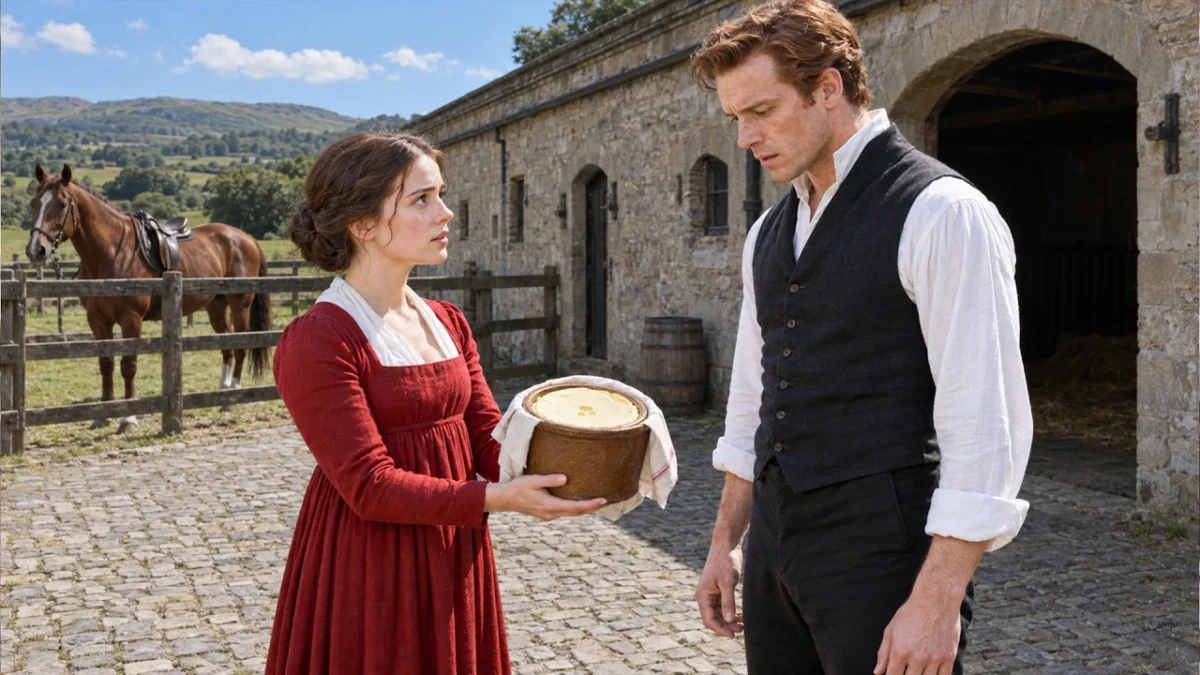
“Your Mother Asked Me to Find You,” She Whispered — The Duke Froze When He Saw What She Held
The harvest ball at Larchbridge was older than the house it was danced in. The house had been pulled down and put up again twice since anybody could remember.
But the ball went on always on the last Thursday of September. Always with the long windows open to the terrace, whatever the weather did.
That year the weather did rain. It came in off the downs in the afternoon and settled.
By 9 the gravel was a shallow river. The carriages came up the drive with their lamps swimming.
The whole county walked in over straw laid down by the grooms, then shook itself like a wet dog in the hall.
Inside the hall was so full of light it hurt. There were candles in the sconces, candles on the stairs, a great branched stand of them at the turn where the musicians sat.
The wax smell lay over everything else. It lay over the rain, the wet wool, the hot bodies of a whole county that had been dancing since the light went.
The floor gave a little under them. You could feel it in the walls if you stood with your back against one, which is what the girl in the passage by the service stair had been doing since the dancing began.
Nobody looked at her. There was no cruelty in it. She stood in the one place in the house where a person is expected to be standing and waiting for somebody.
And so the eye slid off her and found the chair beside her instead. She wore a dark cloak that had dried in ridges.
Her boots had come a long way. Under her arm, held against her ribs with both hands, was a rush basket with a cloth over the top of it, and she kept the cloth in place with her thumb.
She had been traveling so long she had stopped counting the days. She’d gone south in a carrier’s cart, then on the mail, then when the money went on her feet.
She had slept in barns twice, and in a chair at an inn once. In all that time she had not taken the cloth off the basket, except to wet it.
Her name was Leah Felhurst. She was 2 and 20. She had never in her life seen a room so full.
What surprised her was not the size of it, but the noise. It was not like a fair or a market.
It was like water, a steady roar, with the music laid on top. A footman had told her to wait.
He had told her kindly enough in the patient voice of a man who knew she had come to the wrong door and would find it out for herself soon enough.
That had been before the dancing started. Since then he had gone past her with trays, and twice their eyes had met, and the second time he had said, without stopping, that his grace did not see anybody on the night of the ball.
She had said she would wait. He had gone away with his tray held over his head.
So she waited. She watched the dancers come apart and go back together at the end of the hall.
She watched an old gentleman fall asleep in a chair with his mouth open and nobody wake him.
She watched a young woman in blue lose a shoe and laugh about it. The whole set stopped while a man went down on his knee to put it back.
She thought without bitterness that nothing of hers had ever been dropped and picked up by anybody.
She only thought it and let it go. She had come a long way to do a small thing, and she meant to do it, and the rest was weather.
A little after midnight, a woman came down the passage from the other end, and stopped and looked at her properly.
She was somewhere past 50 in gray silk, with the kind of jewelry that is not new and is not meant to be.
She had the Duke’s own coloring about her hair or what was left of it.
She looked at the cloak and the boots and the basket and last of all the face.
You are the person who came to the gate, she said. They told me there was somebody.
I am Lady Adelina. This is my brother’s house. Was my brother’s house. What is it you want?
I have a thing to give the Duke, my lady. Give it to me. I can’t do that.
Lady Adelina smiled. It was a pleasant smile, and she’d been using it for years, the way a woman uses a good pair of gloves.
You have come a distance, she said. I can hear the north in you before you have said six words.
You have been badly used by somebody, I expect, and you have been told that a great house is where one goes about it.
That is generally not true, but I am not unkind. She opened the small bag at her wrist.
There is a village in at the bottom of the hill. Let me pay for your bed and the coach home, and you will feel differently about all of it in the morning.
Leah looked at the money. She had exactly as much of her own left as would buy her a hot dinner, and after that she did not know.
She had thought about that a good deal on the road at night, when there was nothing else to think about.
The strange thing was how little it weighed against the other thing now that she was standing here.
That’s generous, she said. I’ll not take it. Why not? Because then I’d have taken something from this house, and I’ve come to give something to it, and the two won’t sit together.”
Something happened in the older woman’s face then. Not anger. Something quicker and further back, gone almost before it arrived, and what replaced it was the good glove of a smile again.
“What is in the basket?” She said. “Butter,” said Leah. Lady Adelina laughed once, and it was not unkind either, and that was somehow worse.
“Of course it is,” she said. “Wait here,” she went. The dancing changed. Leah stood with her back to the wall and felt the floor working through it.
She thought about the dairy at home, the door shut, the slate slabs drying out with nobody to wet them.
She thought about the cows. She wondered who was milking them tonight and whether the Braithweight lad had remembered that the near one kicked.
She shut her eyes for a moment. That was a mistake because that was the moment the passage went quiet.
There were men coming down it. She heard the difference before she saw anything. It was the particular hush a great many people make when they stop talking at the same moment for the same reason.
Then take it up again in a lower key. She opened her eyes. The crowd at the end of the passage had opened.
A man was coming through it. People turned to him as he came, then were turned away from without rudeness, and without much notice either.
He was younger than she had expected and taller, and his hair was the color of a fox in winter, that deep red brown that looks black by candle light until the light comes at it sideways.
His coat was very plain for a house like this. He had a glass in his hand that he had not drunk from.
When he came to the mouth of the passage, he stopped and looked at her and his eyes were a clear light blue and there was nothing in them.
My aunt tells me there is a girl at the back stairs who will not be sent away.
He said, “She says you have brought me butter. I have your grace. Then I shall have it sent to the kitchens with my thanks, and you shall have your supper, and the gig will take you down to the village.”
He said it the way a man reads out a list. He had turned half away already.
“Good night.” She had rehearsed it for 11 nights, and the words had got worn smooth, and now that she needed them, her throat had closed over the lot.
What came out was not the speech. It was lower than she meant, barely more than breath, and the music covered most of it, but he was near enough that it reached him.
Your mother asked me to find you. He stopped. He did not turn round at once.
She watched his shoulders under the plain coat, and thought at first that he simply had not understood her, that her voice had made nonsense of it, and she opened her mouth to say it again.
Then he turned. He came back two steps and stood over her. The emptiness had gone out of his face.
Something much worse had come into it. Something shut in a cupboard a long time that did not like the light.
Say that again. He said, “Your mother asked me to find you. She asked me to put a thing in your hand myself and not to give it to anybody else.
Whatever they said to me and whatever they offered, her thumb was still on the cloth.
She was months dying, and she said it more than once so I’d have it right.”
My mother, he said, has been de@d since I was 11 years old. She died at Ketadale on the second Sunday after Easter.
It was raining. She said your name twice and then she said mine and then she asked for the window opened and I opened it.
He looked at her while the ball roared away behind him. Then he said quite evenly, “You are either a very stupid woman or a very wicked one.”
And held out his hand for the basket. She did not give him the basket.
She set it on the window ledge beside her, where the candlestand threw a decent light, and she took hold of the cloth in both hands, and folded it back off the top.
Inside was a brown croc, the kind the North Country sells butter in, packed level to the rim with salt, butter gone the color of old ivory from the keeping, and pressed into the flat of it, deep and clean, was a word.
It was not a word that meant anything. The letters were the wrong way round and they were also in the wrong order and they had been cut by somebody who had never once thought about the fact that a mark prints backwards.
Under them in the same clumsy hand was a small four-legged scratch that was meant to be a horse and was not.
The Duke stood quite still. She had expected shouting. She had braced herself for it on the road for a fortnight.
What she got was a tall man standing perfectly still in a passage with a glass in his hand, looking down into a pot of butter.
Behind him the county danced. The rain came off the roof in a sheet past the black window.
1 second. 2 seconds. Three. The glass went down onto the ledge so hard she thought it would break.
He put out his hand towards the croc and did not touch it. His hand was not steady.
He took it back, closed it, put it behind him. When he spoke, his voice had been got under control by main force.
It came out almost gentle. That frightened her far more than shouting would have done.
Where did you get that? She gave it me. She made the butter and I printed it and she watched me do it from the chair because by then she couldn’t stand at the slab.
She said I was to take it to Larchbridge. She said if they wouldn’t let me in, I was to sit down at the gate till they did.
Leah looked up at him. Your grace. I have no idea in the world what that word says.
Nobody at home does either. There’s market women in three towns been buying that mark off her for as long as I can remember, and it never meant a thing to any of us.
No, he said, “It wouldn’t.” He put his finger out at last, not to the butter, but to the rim of the croc, and left it there a moment, steadying himself against a pot of butter.
“I cut that when I was seven,” he said. For her birthday with my own knife out of a bit of pear wood the carpenter gave me.
Everybody in the house told me afterwards that it was cut wrong. It would have to be done again, they said by somebody who knew how.
She would not have it done again. He was not looking at Leah anymore. She said it would print quite well enough.
She said the dairy at Larchbridge had never yet had a mark of its own, and now it had.
Behind them. The music stopped. There was applause, and it went on and on, and neither of them heard it.
He let her stay. He said four words to the housekeeper over her head, and none to her.
A room and food. Then he went back into the noise and danced twice more.
Once with the wife of a man who bred sheep, once with a girl who had just come out.
The county agreed afterwards that his grace had been in unusually good spirits. Leah was taken up two flights of back stairs to a small square room with a bed in it and a jug and basin on a stand.
She lay down in her clothes on top of the counterpane and slept as though she had been struck.
She woke at 4 because she always woke at 4 and lay in the dark working out where in the world she was.
The rain had stopped. There was no sound in the whole house except a shutter somewhere taking the wind.
In Ketadale at this hour she would have been pulling her boots on with her eyes shut.
The strangeness of having nothing to do with her hands got her up off the bed.
She went down the back stairs in her stockings, with her boots in her fist, and out of a side door into a yard she had never seen by daylight.
The yard was very grand and very quiet. She found the brew house by the smell of it, and the laundry by the coppers.
At the far corner, past a wall of cut stone, stood a low building with a slate roof and a wooden latch on the door.
It faced north the way every good dairy in England faces north. The latch had not been lifted in a long while.
It gave with a scrape that went round the whole yard. She stood in the doorway with the cold coming out at her and knew the smell of the place before she could see a thing in it.
Stone and white wash and old milk. A dairy never loses that. You can shut one up for half a lifetime and it will still tell you what it was.
There was gray light enough by then to see. Down the length of the room ran two slate slabs on low brick supports.
Under the window was a stone trough for the water to run through. Above them, a shelf held the cheese molds, still standing upside down, furred with dust.
Everything else in the room was rubbish. Hampers were stacked to the ceiling along the far wall.
A sati with a broken leg lay on its side across the trough. Somebody had been storing apples on the near slab years ago, and the mice had taken all but the seeds.
Leah stood in the middle of it and looked at what there was to do.
Then she put her boots down, took off her cloak, and hung it on the door, dragged the seti off the trough, and got the hampers away from the window.
There was a pale in the corner, and a scrubbing brush with most of its bristles gone.
She started on the nearest slab. Cold water, no soap. That was how you did it, and how you had always done it.
The slate came up under her hands the way she knew it would, blue black and sweating.
She got her weight into the brush and worked from the far end down towards herself.
She was singing under her breath without knowing that she was. Nobody has done that in this house since I was a girl,” said a voice behind her.
The housekeeper stood in the doorway with a candle she no longer needed. She was a square, plain, elderly woman in black, with her keys on her belt and her cap already straight at that hour.
Her name was Mrs. Wan, and she had come to Larchbridge as a nursery maid a very long time ago.
She was not looking at Leah. She was looking at the slab and at the wet ark of it and at the water running away down the trough as it had been built to do.
I’m sorry, Leah said. I had no business in here. I woke and couldn’t lie still.
You have scrubbed a dairy slab before. I have done little else since I was nine.
Mrs. Wan came in. She set the candle on the shelf among the molds and looked round the room like a woman coming into a church she used to attend.
They stored the apples in here now, she said. The hampers and the Christmas things.
I have asked three times to have it cleared, and I have been told three times that there is no call for a dairy at Larchbridge because the butter comes up from the home farm, which is perfectly true, and has nothing whatever to do with it.
She put her hand flat on the cold slate. Her grace used to work in this room in the mornings with her sleeves pinned back.
The old Duke thought it a piece of madness. She said she had been brought up to it in her father’s house and would not give it up for anybody living.
Mrs. Woran, said Leah, how did she hold a knife? The housekeeper looked round at her.
Only I’ve been asked once already tonight to prove a thing I can’t prove, Leah said.
And I’ll be asked again before breakfast. I’d rather find out now if I’m the fool.
How did she hold a knife? In her left hand, said Mrs. Wan, and everything else in her right, which used to make people stare.
She cut her thumb, doing it the summer before she went away. Just here. She held up her own left hand and drew a line across the pad of the thumb with a finger.
It went white afterwards, and never browned again with the rest of her. Leah sat down slowly on the edge of the slab she had been scrubbing.
She put her wet hands in her lap. For the first time since a wet Sunday in April, she cried and could not stop it and made no sound about it.
“There you are then,” said Mrs. Wan. After a while, I heard what you said in the passage.
So did half the kitchen. I did not believe it. And I have been walking about ever since not believing it.
And here I am at 5:00 in the morning with a candle in a room that has been shut up for 20 years.
The Duke sent for her at 9. The room was a library, a real one, the kind that gets used.
Books stood out of their places. The fire had been lit early. The great table by the window was covered with maps of his own land with pins stuck in them.
He had not been to bed. His coat from the night before hung over the back of a chair.
He stood there in his shirt sleeves, which no gentleman does at 9:00 in the morning with a stranger in the room.
He did not appear to know it or to care. The croc stood on the table in front of him with the cloth folded beside it.
The print was not in the room. The print was in Leah’s pocket because she had decided on the stairs that she would not bring it out until she was asked for it.
“Sit,” he said. She sat. He stayed standing, which put him between her and the light.
You will tell me the whole of it, he said, from the beginning and slowly and you will understand that I have been offered my mother before in various shapes by various people.
There was a woman at Bath who wished me to know that she received messages from her.
There was a man in town with a lock of her hair to sell. There have been letters every few years since I was a boy, so take your time.
I have had a great deal of practice at this. Then you’ll be quick at it, said Leah, and you’ll know inside the minute, and we’ll neither of us waste the morning.
Something moved at the corner of his mouth. Not a smile. Nowhere near a smile.
The almost of one, and it was gone before it had properly arrived. Begin, he said.
She told it plainly because she had nothing else to tell it with. There was a house at the top of Ketadale in West Mulland, the last before the road gives up and turns into a track.
It had a buyer at one end, a dairy at the other, two rooms in the middle.
A woman had come to it in winter a very long time ago, with a box and no history, and had taken it, and had let the Dale think whatever it liked.
The Dale thought a good many things for the first year and then got used to her.
She was called Mrs. Mard after the hill behind the house. She said she was a widow.
Nobody asked her anything further because she was so plainly not going to answer. She was no good at it.
Leah said that’s the part folk never believe. She was no good at any of it for a long while.
She burnt everything she cooked for a 12-month. She was frightened of the cow. There’s a woman still living down the dale who was sent up to show her how to set a fire.
She came home saying the poor creature had been got at by somebody because she had lovely hands and couldn’t do a hands turn with them.
And then she learned. She learned it hard and fast because there was nowhere else in the world for her to go.
By the time I knew her, she was the best buttermaker at that end of the county, and the market women fought over her pounds on a Saturday.
And you, he said, where do you come into it? My father had the holding below hers.
He died when I was eight, and my mother the winter after of the same thing.
And there were no folk of ours left to take me. Leia said it flatly.
She had said it many times and got the sting out of it. I was to go to the workhouse at the market town.
She came down the dale in the snow and stood in our kitchen and said she’d have me.
They asked her what she wanted with me. She said she wanted somebody to talk to.
That was a lie. She hardly talked at all. She wanted somebody to teach and she’d nobody to teach and I think she’d have gone out of her mind without it.
He had turned away to the window at some point and she had not seen him do it.
What did she teach you? Butter cheese reading out of a book of sermons and another of poems.
And I’d have liked the poems a deal better if she hadn’t made me learn the sermons first.
How to speak so folk listen instead of looking over your head. How to keep a dairy so clean you could put a baby down on the slab.
Leah stopped and thought how to stand still when you’re told something hard. She was very strict about that.
She said the ones who can’t stand still get eaten. He said nothing. The fire took a log down with a small collapse.
There is a stone in the church at the end of this avenue, he said at last.
Her name is cut in it with my father’s name under it. I have stood in front of that stone more times than I can tell you on her birthday.
Every year of my life since I was 11. I go alone and I send the groom back with the horses and I have never once been able to say a word to it.
He turned round. And you are sitting in my library telling me it is a lie cut in stone.
I’m telling you she’s buried at Ketadale in the corner by the wall under a board, said Leah.
Because a stone takes half a year to come up the dale, and we’ve only just had the board painted.
It says Mard on it. That’s all it says. I didn’t know there was another name to put on it until she told me at the end.
We’ll take a very short break. If you don’t want to miss new stories, please subscribe to the channel.
And while we rest here for a moment, there is something I have wanted to tell you about.
For years, you have asked me for a longer story. So, I wrote one, three complete novels.
One family, 26 years, one promise. The Duke’s Promise Trilogy by Gary Peton. And because so many of you listen instead of reading, the complete audio books come included.
More than 24 hours in this same voice you are listening to right now. You can get it exclusively at timelesslobooks.com.
And if you’re watching on your TV, just point your phone camera at the code.
You will also find the link at the top of the description and in the pinned comment.
Now settle back in. Our story is waiting. He walked out of the library without another word to her and without his coat, and Mrs.
Watthan, who was coming along the passage with the breakfast things, stood flat against the wall to let him by and stayed there after he had gone, with the breakfast things going cold in her hands.
Leia heard the side door. From the library window, she watched him go down the avenue between the limes, bareheaded in September, at a walk that was not quite a walk.
She understood where he was going. She had the sense to stay where she was.
He was gone the best part of the morning. When he came back, his boots were ruined, and there was a green stain on one knee of his breaches, as though he had knelt on grass, and his face had a nothing in it.
He sent for his aunt instead of for Leah. That conversation took place behind a shut door at the other end of the house, and nobody heard any of it.
Which was a pity because everything that came afterwards came out of that half hour.
What Leah did, meanwhile, was go back to the dairy and finish the slabs. She simply could not sit in a strange room with her hands empty while other people decided what she was.
By the middle of the afternoon, both slabs were wet and clean. The trough ran.
The molds stood washed in a row. The hampers were out in the yard in a stack that two-footmen walked past four times without touching.
A kitchen maid brought her bread and cold mutton, then stayed to watch her, scaldled the churn.
She asked whether it was true that the girl had come from the top of the world.
Leah said that it was more or less and that it was colder up there and the bread better.
Lady Adelina came at 5 when the light was going amber along the yard wall.
She came alone without a shawl, which meant she had not meant to come this far when she set out.
She stood in the doorway of the dairy and looked at the slabs and the trough, the row of clean molds.
Last of all, she looked at the girl standing at the end of the room with her sleeves pushed up past the elbow.
You have been busy, she said. There’s now else to do. No, I suppose there is not.
She came in a little way carefully, as though the floor might be wet, which it was.
I shall not insult you by offering you money again. That was a mistake and I saw it the moment it left my hand.
I am going to tell you two things instead and then I am going to ask you one question and I would be obliged if you would think before you answer it.
Go on then. The first thing is this. Whatever you have or have not brought into this house, my nephew was a child of 11 who asked for his mother every single night for a year.
He stopped eating. He had to be carried about by a footman like a much younger boy.
We very nearly lost him altogether. I am the woman who sat up with him, not his father.
His father went to town. A voice did not rise. You have been in the house since midnight and you have already put him on his knees in a church.
I want you to know the size of what you are handling. Leah put down the cloth she was holding.
And the second thing the second thing is that I am told there is a house in West Mand and land with it and that the old woman left the whole of it to you.
Lady Adelina smiled the pleasant smile. That is not an accusation. It is a fact and facts have to be said out loud in the end.
So I would rather say it in a dairy than let somebody else say it at a dinner table.
Now here is my question. If my nephew were to tell you tomorrow that he believed every word and gave you £100 and his thanks and a carriage to the north, would you go?
No, said Leah. Why not? Because she didn’t ask me to bring him a pot of butter.
Leah looked at her steadily. She asked me to find him. I’ve not found him yet.
I found where he lives. Lady Adelina stayed in the dairy doorway. Then she said, “You are going to do a great deal of harm, and I do not think you know it.”
She went away across the yard with her skirt held up out of the wet.
It was the last civil thing she said to Leah for a month. He came out himself at 8 the next morning.
Leah was already in the yard with her cloak on and the basket over her arm.
She had settled it with herself in the night. She had done what she was sent to do, and the rest was his business.
The gig was waiting. What she had not expected was the Duke standing beside it in a great coat with a val on the step and a groom holding two saddle horses behind him.
You are going home, he said. Good. So am I. Or rather, I am going to West Miland, which is not the same thing.
I would be obliged if you would let me travel with you. I do not know the road.
I do not know the Dale and I do not know the name of a single person in it.
He looked at her directly. I am asking I am aware that I have not asked anybody for anything in some years and that I may make a poor fist of it.
You’ve made a fair fist of it. Then may I come? It’s a public road, said Leah.
You’d get there whether I said I or no. That is not an answer. No, she agreed.
Come then. They were 5 days on the road. He could have done it in three, and she knew it because he changed horses at every stage and paid for speed without once asking what it cost.
And yet every afternoon he stopped early. She worked out why at the second inn.
He was frightened not of the road or of what he would find, but of arriving, which is a different fear altogether, and a much older one.
A man who has been walking towards the same closed door since he was 11, does not run the last mile.
The evenings fell into a shape. They would eat in the in parlor at a table by the fire with the door open because he would not sit in a room with the door shut.
Afterwards, he would say, “Tell me something.” She would tell him one thing, “Only one.”
She did not ration him on purpose at first. She did it because that was how she had been given the woman herself in pieces over years, and it was the only way she knew to hand her on.
She told him about the brown hen that was allowed in the kitchen, and no other.
She told him about the winter the Beck froze, and they carried water up from the bridge in a milk can on a sled.
His mother swore in French going up the last pitch, then apologized to the hill.
She told him that the woman could not sing a note in tune and sang anyway, always the same four songs, always at the churn, and that Leia could not now churn butter without hearing them.
“What songs?” He said. “You’ll hear them. I can’t sing either. It’ be a mercy to nobody in this room.”
He laughed. It was a short, rusty noise. He looked as surprised by it as she was.
The inkeeper’s wife looked up from the other end of the parlor to see who was laughing in a room with the Duke of Treham in it.
On the fourth evening he stopped her with his hand flat on the table. You have not told me anything she said about me, he said in 5 days.
Not a word. That is deliberate. It is. Why? Because there’s not much of it, said Leah.
And when I’ve given it to you, it’s gone. And then I have nothing left to give you at all.
He sat back. The fire moved outside. Somebody was walking a horse up and down the yard.
The sound went away, came back, went away again. Then keep it, he said, until I ask for it in the right place.
Not in a parlor off the London road. They came into the dale on the fifth afternoon in that bright hard northern light that comes after rain with the fells going up on either hand in rust and bracken running wet.
He had said nothing for an hour. The road climbed, turned, gave up being a road.
The last house stood where the track began, low and long and whitewashed. A buyer was built onto the near end, a dairy onto the far one.
There was a rowan by the door. Behind it, the fell went straight up into nothing at all.
The Duke got down and stood in the middle of the track and looked at it and went on looking.
How many rooms? He did not take his eyes off the house. Two? Three if you count the dairy.
And she did. She had 30 at Larchbridge. He said she had a suite of four for her own use and a woman whose whole employment was her hair.
He said it as though he were reading it off a wall. There is a smell of cows.
There’s a cow. Yes. He looked at the biodor and at the muck rake leaning beside it.
I see that now. The dale came to look at him within the hour. Because a dale always does.
And by dark the whole of it knew that Mrs. Mardell’s lass had brought back a gentleman from the south who had stood in the road with his hat in his hand and gone white.
What the Dale made of it was its own affair. What it did was practical.
The Braithweight woman from the third house down came up with a pan of broth and a loaf and stayed to light the fire because the house had been shut a fortnight and the chimney would smoke otherwise.
She looked the Duke over while she did it the way you look over a tub at a sail.
You’ll be her lad then, she said. I am her son. I well she set the pan on the crook and wiped her hands.
She had a way of standing with one foot turned out you and all. Then she went home and shut her door.
She told her husband that the poor creature had his mother’s feet and no more sense than a calf in a lane.
Afterwards she cried into the fire for the best part of an hour where nobody could see her.
He would not sleep in the house. He walked down to the inn at the foot of the dale that first night and walked back up in the morning.
He did that every night he was there. He never once said why. Leah never once asked.
The mornings were hers. She had two cows to see to a dairy that had stood a fortnight and a buyer to muck.
And she got up at 4 out of habit and went at it. On the second morning she came out with the yolk on her shoulders and found the Duke sitting on the wall by the buyer door with his coat folded beside him waiting.
I should like to be useful, he said. And I am aware that I am not.
Tell me what to do and I will do it badly. So she told him he carried water.
He was strong and he was quick to learn and he did not talk while he worked which in Leia’s book put him above most men she had met.
He scolded the pans wrong and she showed him once and he never did it wrong again.
He was frightened of the near cow which she thought a credit to his judgment since the near cow was a devil.
By the end of the week, he could strip a quarter properly. The day he got a pale out of that cow without being kicked, he sat back on the stool with his forearm across his knee and the light on his face.
He looked so nearly happy that Leah had to turn away and busy herself with nothing.
On the Thursday, she churned. She had not meant to make a performance of it.
It was simply Thursday, and Thursday was churning day, and she had milk standing. She set the churn up in the dairy, with the door propped for the light, and turned, and the butter came in its own time as it does.
She gathered it, and washed it. She worked it on the slab with the wooden hands, salted it, pressed it down into the croc.
Then she took the print out of her apron pocket. He had been standing in the doorway the whole while.
He had not said anything for an hour. She looked at him with the print in her hand and said, “I’ll leave it plain if you’d rather.”
“No,” he said. “Do it as she did it.” So she flowered it and set it and gave it the knock with the heel of her hand that a prince needs.
Then she lifted it. There in the butter was the word backwards and crooked with a horse under it.
He came and looked down at it. I gave her that on a Tuesday, he said.
Her birthday was a Tuesday that year. I’d been soaring at it for a fortnight in the gun room.
The carpenter finished the handle because I could not get it round. I cut my thumb and bled on it, and she washed it out in the trough herself.
You will find the mark at the corner there. He touched the wood without taking it.
She said, “Thank you.” As though I had given her the estate. My father said at dinner that her duchess had no business with a butterprint.
She said very pleasantly that she had no business with a great many things and had learned to be grateful for the few she had.
He stopped. I did not understand that until this week. She kept it above the slab, said Leah.
On a nail. It’s the only thing in that house that hung on a nail of its own.
He put both hands flat on the slate on either side of the croc and bowed his head and stood like that.
Leah went out, shut the door behind her, and watched the fell until her hands were cold.
When she came back in, he had washed the wooden hands and put them straight in the rack.
That was not where they lived. She did not correct him, then or ever. The letters came out on the last evening.
She had known about the box since she was a girl. It lived under the bed in the small room, a Japanned tin box with a bad hinge.
The rule about it had been simple. It was not hers to open, and when the time came, she would know what to do with it.
She had never once looked inside. On the last evening, she pulled it out and set it on the table by the candle, and pushed it across to him.
She said the box was for you, if you ever came, and if you never came, it was to go on the fire without being read, and she made me promise that twice.
Leah sat down opposite him. You came, so it’s yours. He turned it round first and looked at the bad hinge and at the initials painted on the lid.
Then he opened it. Leah got up to leave and he said, “Stay!” In a voice with nothing of the Duke in it.
So she stayed and sat by the fire with her back half turned to give him what privacy a room that size allows.
There were two bundles in the box. The first was thin and tied with tape.
It was letters she had written and never sent. One every year on his birthday from the first year to the last.
Most of them broke off in the middle of a sentence. The second bundle was thick and tied with string.
Those were letters she had sent. They had all come back, and not a seal on them was broken.
Under both bundles, loose face up, was a single half sheet in another hand.
He read it twice. Then he read it aloud, very steadily, which was the worst thing he could have done to himself, and he did it anyway.
He is settled. He has been ill and is now better. Nothing can be gained now by raising it all again, and a great deal can be lost.
And if you have any love for him at all, you will let him be.
Do not write to the boy. Write to me if you must write to anybody.
He put the sheet down. It is my aunt’s hand. I said Leah. I thought it might be.
She wrote that in the summer I was 12. He was looking at the fire.
I remember that summer very well. I remember that I stopped asking. Everybody said how much better I was and I was better.
I had understood at last that the asking was what made the house so unhappy.
If I stopped, they would be kind to me again. He said it without any weight at all.
They were kind to me again. It worked. I have been getting things by not asking for them ever since.
Leia did not say anything. There are moments when a person needs a witness and not a friend.
And she had been taught the difference by the woman whose chair he was sitting in.
After a while, he said, “She wrote to me every year.” “She did, and they went back unopened.”
So she thought I had done it. “She never said that to me,” said Leah carefully.
“Not in those words. What she said was that she’d had nothing to bring you.
She said it that way more than once, that she’d nothing of her own that wasn’t the houses, and nothing to put in your hand worth your trouble.
That a woman who comes back with empty hands is only asking to be forgiven, and she’d not do that to you.”
Leah looked up and then in April she got the print down off the nail and put it in my lap and said, “There I’ve one thing.
It was his before it was mine. Take it to him.” The Duke sat with his hands hanging between his knees and wept without any noise, the way men weep, who learned young that noise brings people.
Leah got up, crossed the room, sat down on the settle beside him. She took his hand and held it in both of hers.
She did not say it was all right because it was not. She did not say anything at all.
His fingers closed round hers hard enough to hurt and she let them. The fire went down.
The rain started on the roof. Somewhere down the dale, a dog barked twice at nothing, then gave it up.
Neither of them moved until the fire needed making up. There is a thing I must tell you, she said at last.
And I’d sooner tell you here than have it told you by somebody else. Tell me, then the house and the land are mine.
She had them from her own money, whatever that was. And before she died, she had the school master up and the braithweights in to see her sign.
And she left me the lot. I’ve not touched a stick of it since. I didn’t ask for it, and I didn’t want it, and I’d have said no if she’d asked me first, which is likely why she never asked me.
Leia made herself look straight at him. Your aunt knows, she told me in the dairy.
And I’ll not pretend it looks well because it doesn’t. No, he said it looks exactly like the thing it is not.
Take it, he turned his head. Take it, she said again. It’s yours by rights or your families, and I’d rather hand it over in this kitchen tonight than be picked at over it for the rest of my life.
I’d be sorry. I’d be sorryer than I can say. But I’d rather No, said the Duke.
Your grace. She gave it to you. He stood up and went to the window and stood with his back to the room.
Every single thing that woman owned in her life was given to her by somebody else and taken away again by somebody else.
She died in a house with two rooms in it, bought with her own money, given to the person she chose.
It is the only free act I know of in the whole of her history.
His voice had gone very quiet. I will not undo it. Not for my family, not for my own comfort, and not for yours.
The letter from Larchbridge came the next morning, brought up the Dale by a lad on a pony, who had ridden from the market town, and wanted to see the gentleman everybody was talking about.
It was from Mrs. Wam, and it was written in a hand that had been taught late and taken great pains ever since, and it said what it had to say in 11 lines.
Lady Adelina had sent for the family. The cousins were coming from three counties. A man of business had come down from town and was lodged in the blue room and had been twice to the church to look at the stone.
What was being said about the girl from the north? Said Mrs. Wan. She would not put on paper.
The Duke read it standing in the doorway with the light behind him. Then he folded it and put it in his breast pocket and said, “How soon can your cows be left?”
“Wednesday. The Braithweights will take them.” “Then we go Wednesday,” he said. And I will tell you now what you are walking into because I will not have you find it out at a dinner table.
They cannot take the house from you. They can do something a great deal worse than that.
They can make certain that from this autumn onward there is not a market in the north of England where a woman can sell butter under that mark without somebody at the next stall saying what you are.
Leah stood in the door of her own dairy with a scalding cloth in her hand.
I, she said, I’d worked that out on the road down. He crossed the yard to her.
He did not say anything clever because there was nothing clever to say, and he was not a man who reached for people.
He took her hand out of the wet cloth and held it. He looked at the state of it, turned it over, palm up, and closed his own hand round it.
Then he put it back where he had found it. “Wednesday.” Then, he said, and went down the dale to the inn, and Leia stood in her own doorway afterwards, with the cloth going cold in her hand.
They came back to Larchbridge on a Monday evening in the middle of October with the limes turning and the drive full of carriages that had no business being there out of season.
Leah counted four before she stopped counting. There were lights in rooms she had not known the house had.
A footman came down the steps at a run, then saw who was in the gig, and slowed to a walk before he reached it.
Mrs. Wan met them in the side passage, which was not where a housekeeper meets a duke.
She had the keys in her fist to stop them speaking. “They dine at 7,” she said.
“All of them.” Her ladyship has had the long table opened out which has not been done since your father’s funeral, and the gentleman from town is placed at her right hand.”
She looked at Leah. “And there is a place laid for you, my girl, which is not kindness.
You are meant to sit through it.” “Then I’ll sit through it,” said Leah. “You do not have to,” said the Duke.
I know I don’t. She was looking at the floor, working it out, and when she looked up, her face had settled.
But if I eat my supper in the kitchen tonight, that’s the story. The girl who wouldn’t come to the table.
I’d rather be looked at than talked about behind a door. She untied her cloak.
Is there water in that room upstairs? I have 5 days of road on me.
She came down at 7 in the gray stuff gown she had traveled in, washed and pressed by a laundry maid who had done it without being asked and would not be thanked for it in front of anybody.
She had the croc under her arm. The dining room at Larchbridge was 40 ft long, and the table ran nearly the whole of it, and there were 16 people at it, and every single head turned as she came in.
She had been told once in a dairy at the top of a dale, how to stand still when she was told something hard.
She stood still now, and walked the length of the room, and sat down, where the footman drew out her chair.
The soup went round, the fish went round. Nobody spoke to her at all for the best part of an hour.
The talk went over her head in both directions about a bridge in Hampshire, a bishop, somebody’s roof.
It was all perfectly pleasant. It was the most frightened she had been in her life.
Lady Adelina put her glass down at the end of the second course. Well, she said, we had better do this since we are all here.
The table went quiet. It was the quiet of a field before weather. My nephew has been in the north, she said.
Some of you will have heard why. I will put it as gently as I can.
Then the gentleman on my right will put it as it will be put elsewhere.
I would rather this house heard both versions from its own family than a garbled one out of the county.
She turned her head. Sir, if you please. The man from town did not stand up.
He had a neat, tired, kindly face, and he had said the same sad thing in a great many dining rooms and was in no hurry about saying it again.
There was a woman, he said, who had lived alone in West Miland for a very long time.
Under a name not her own. Her state of mind in her last years was not known to anybody who could speak for it.
In her last weeks she had signed away everything she possessed to a girl who lived in her house, cooked her food, and had the keeping of her.
The girl had then traveled the length of England with a story about a duke.
I say nothing against the young woman, he finished. I have not spoken to her.
I say only that this is a thing that happens and that it happens most often exactly like this.
The house is generally small. The witnesses are generally neighbors, and the person who benefits is generally the one who was kind.
There, said Lady Adelina. That is what it looks like from the outside. I’m sorry, child, but you would better know it.
Leia put both hands in her lap under the cloth. May I have a plate?
She said, “And a knife.” Somebody laughed once further down the table and stopped. Lady Adelina lifted her chin at the footman.
A plate came and a butter knife with it. The room watched a girl in a gray gown take the cloth off a brown croc in the middle of a duke’s dinner table.
“This is butter I made on the Thursday before last,” she said. Her voice was not loud.
“It reached the end of the table because she had been taught how to do that.
It’s from a cow that kicks and it’s salted heavier than you’d like it down here and it’ll keep till lady day, which is the whole of its virtue.
I’ll ask nobody to eat it. I want you to look at the top of it.”
She turned the croc so that the length of the table could see. Into the flat of the butter was pressed a word with no meaning in it, the letters backwards and out of order, and under the word a four-legged scratch.
“Can anybody here read that?” Said Leah. “Nobody answered her.” The man from town leaned forward and looked at it properly and frowned and sat back.
No, said Leah. Nor can I, and nor can any woman in any market I’ve stood in since I was 9 years old.
That’s been on every pound of butter that came out of that house for as long as I’ve been alive, and not a living soul in the north of England knows what it says.
She took the print out of her pocket and laid it on the cloth face up where the candles were.
It says it plain on the wood. It only comes out backwards because it was cut by a boy of seven.
He didn’t know that a mark prints the wrong way round. He was told by everybody in his father’s house that it would have to be done again properly.
The word on the pearwood, cut crooked, deep and clear, was mama. The Duke sat where he was with his eyes on the pear wood.
Lady Adelina was looking at the print, and her face had gone a color that did not belong to the room.
I never knew what it said, Leah went on. Not till a fortnight since, when a man told me in a passage by a back stare.
If I’d got that woman’s land out of her by kindness and lies, sir, I’d have had the wit to find out first what I was carrying.
I came the length of England with a word in my pocket that I couldn’t read because she asked me to, and because she was the only body in this world that ever wanted me.
The door at the end of the room had opened during that. Mrs. Wan had come in with the coffee things and had stopped and was standing with the tray in her hands like a woman turned to salt.
Put that down before you drop it, said Lady Adelina, not unkindly. Mrs. Wan put the tray down.
Then she walked the whole length of that dining room past the cousins and the gentlemen from town, and she picked up the print and turned it over in her hands.
She was not a woman who made scenes. She had been in service since she was 12, and she had never in her life spoken at that table.
“There is a nick out of this corner,” she said, “where the knife went through into his thumb.”
Her grace washed the blood out of it herself at the trough in the dairy, because the nursery maid was crying too hard to be any use, and the nursery maid was me.”
She set it down again gently. It hung on a nail above the slab. When she went away, it was gone off the nail, and we thought it had been thrown out with the rest.
I am sorry, my lady, but that is the truth, and I have wanted somebody to ask me for 20 years.
The candles wanted snuffing. Nobody snuffed them. Aunt, said the Duke. He had not raised his voice all evening.
He did not raise it. Now, “What was the last thing you wrote to my mother?”
Lady Adelina looked down the table at him. For a moment, Leia thought she would simply refuse.
“The whole room would get up and go through to the drawing room, and the thing would be left to rot where it lay.”
“You have the letter,” said Lady Adelina. “I have it in my pocket. I would rather have it from you.”
Then you are cruel and you come by it honestly. She folded her napkin in half and in half again and set it beside her plate.
I wrote that you were settled, that you had been ill and were now better, that nothing could be gained by raising it again and a great deal lost.
I wrote that if she had any love for you at all, she would let you be.
Her voice was quite steady. I wrote that she was not to write to the boy.
She was to write to me if she must write to anybody. And did she?
Every year on your birthday for 11 years and then she stopped. Something happened at the corner of the older woman’s mouth and was put down again.
I did not open the last four. I have them still. They are in the bottom of my workbox in this house.
And I have known exactly where they were every hour of every day since. One of the cousins said, “Good God, Adelina,” in a voice of real shock, and was ignored by everybody.
“Why,” said the Duke. “Because you were 11, and you had stopped eating.” For the first time the pleasantness went out of her face altogether, and what was underneath it was old and frightened and plain.
Because your father had washed his hands of the whole business and gone to town, and there was nobody in this house but me.
Because I sat up with you. Because you asked me every night for a year whether she was coming.
And I could not go on saying, “I do not know.” And one night I said, “No, she is not.
She is de@d.” And you slept. She put her hand flat on the cloth. And after that it could not be undone.
That is the honest answer. Not because of the money and not because of the name.
Because I would have had to tell a child that I had lied to him.
And I could not do it. And every year that went by made it a larger thing until it was this size.
She looked around the table at her family. And because if she came back, she said, “You would not have needed me.
I have not been needed by anybody else in my life. Not once. You may all do what you like with that.”
Nobody did anything with it. The clock on the chimney piece went on, and the gentleman from town studied the cloth in front of him, and one of the cousins drank off a glass of wine rather fast.
The Duke stood up. There will be no question raised about the house at Ketadale, he said.
“Not by me, not by my family, not by anybody acting for my family now or after I am de@d.
My mother bought it with her own money and left it where she chose, and it was the only free choice anybody let her make.
“Sir, you will be paid for your journey, and you will go home in the morning.”
“Your grace,” said the man from town, and inclined his head, and looked on the whole relieved.
“That is the easy half, he turned. The other half is that this story has been in three counties since the week I left, and stopping it in this room stops nothing at all.
So, it will be stopped where it is being told. The stone in the church here is wrong, and it will come down, and the new one will say where she is buried, and what name she used.
I will be in the market at the town below Ketadale on the first Saturday I can get there.
I will stand at that stall from the opening of it. The mark on that butter will be the mark of my mother’s dairy and of mine.
Any man in England who wishes to say that this girl cheated an old woman out of a hillside may come and say it to me while I am standing there.
He sat down again. It had all been said in the tone of a man giving directions about a gate.
Leah got up. She had no business standing while the Duke sat, and she knew it, and she did it anyway, at a table with 16 people at it.
I’d have never got that back, she said. Not in my life. I could have stood in that market till I was an old woman and told the truth every Saturday and the story would have outlived me because a girl says a thing once and a county says it forever.
She looked down the length of the table at him. You can do it in an afternoon.
I want it said out loud in front of your family that I know the difference between what I can do for myself and what I can’t.
I can’t do that, and I’m not too proud to be glad of it. Sit down, child, said Lady Adelina very quietly.
Please, you have won. I’ve not won out, said Leah. There’s nobody in this room won anything tonight.
The gentleman from town went at 8 the next morning, and seemed glad to go.
The cousins went over the 3 days after that by degrees. Something had happened in that house that nobody wished to name at breakfast, and none of them stayed long enough to be asked.
By Friday, there was nobody at Larchbridge, but the family that lived in it, which was a duke, an aunt, and a girl from West Miland, who had not yet been told whether she was going home.
Lady Adelina came to the dairy on the Friday afternoon. She had a workbox under her arm.
I am not going to apologize to you, she said. You would have to accept it and then we should both have to be comfortable and I am not equal to that.
She set the box down on the clean slate. There are four letters in here that were sent to me and never opened.
They are his. I have carried them up and down that passage twice this morning, and I cannot walk into a room with them, and I am too old to pretend that is anything but cowardice.
Will you give them to him? Leah dried her hands on her apron. I’ll not, she said.
The older woman’s head came up. I’ll walk as far as the door with you, said Leia.
And I’ll open it. But you’ll put them in his hand yourself, my lady, because he’s had one woman’s letters kept off him by somebody who meant well, and he’ll not have another thing handed to him secondhand.
While I’m stood in the house, Lady Adelina looked at her. Something moved in the hard old face.
It came up crooked and ugly, and it was the first honest thing she had shown anybody in that house in 20 years.
You are exactly like her, she said. I disliked her enormously. I She’d have said the same of you.
They walked up together. Leia opened the library door and did not go in. She shut it behind them.
Then she went back down to the dairy and worked until the light went and never asked either of them a single question about what was said in that room.
He came to find her at dusk. The dairy was clean by then, the slabs wet, the trough running, the molds in a row, and a rush light burning on the shelf because the days were getting short.
Leah was pressing the last of the Thursday butter into a bowl with the wooden hands, and she did not stop when he came in, because she was not going to spoil a bowl of butter for anybody.
They are the same letter, he said. All four, different years, different weather, the same letter.
Are you well? Are you happy? There is a woman here who keeps my house and reads better than I taught her.
Do not trouble to answer. That’s her, said Leah. Yes, he came and stood at the end of the slab.
My aunt is going to stay in this house. I have thought about it for 4 days, and I can see no other honest end to it.
She has nowhere else that is hers, and sending her away would be a great deal easier on me, and no use to anybody.
So, she will sit at my table, and I shall be civil to her, and she will have to live inside being forgiven, which I think is the heaviest thing I could possibly have done to her.
I take no pleasure in it. I want you to know that I know what it is.
I know what it is, said Leah. Come here and hold this bowl. He held the bowl.
She scraped the hands clean and set them in the water. She rinsed her fingers to dried them on the cloth at her waist, took the bowl back off him.
Then she looked at him properly, which she had been avoiding since the dining room.
“Say it, then,” she said. You’ve been carrying it up and down that passage and all.
I am going to ask you to marry me, said the Duke of Treham. I am aware of exactly how it will look.
I am going to do it anyway. I have spent my life not asking for things and getting them, and I find that I would rather ask for this and be refused.”
The rush light went on burning. Down in the yard. Somebody dropped a pale and swore at it.
It’ll look like you paid me for the butter, said Leah. It will. And half the county will say I walked the length of England for it.
They will say that for about a year, he said, and then they will say that the duchess keeps her own dairy as the last one did, and they will find it charming because people always do in the end.
I am not offering you protection from being talked about. There is none, and you would not take it if there were.
What are you offering me, then? He put his hands flat on the slate on either side of the bowl, which was a thing she had seen him do in another dairy at the top of England.
Ketadale is yours and stays yours and is never spoken of again as anything else.
This room is yours. I want it working by the spring, and I have no idea how, and I do not want to be told how.
You will go north when the cows want you, and I will come with you when I can, and when I cannot, you will go without me, and come back when you are ready.”
He stopped. “And I am in love with you. I had not expected it, and I did not deserve it.
It happened somewhere between the fourth day on that road and the fifth when you would not tell me what she said about me.
That is all of it. There is nothing else in the offer. Leah put the bowl down.
Not next year, she said. I beg your pardon. You’ll be told to wait a 12 month for the look of it and for your aunt and for the county and because there’s a stone to set in April.
And I’ll not do it. Her chin was up. I’ve had one woman in my life spend 20 years waiting for the right moment to come home, and it never came.
And she died at the top of a dale with the door shut. I’ll not start my life off the same road.
If you mean it, Reynold, then we’ll be married before the leaves are off that avenue.
It was the first time she had used his name. He heard it land.
Something went out of his face that had been in it since he was 11 years old.
What came in instead was so plain and so young that she had to reach out and take hold of the front of his coat.
Before the leaves are off, he said, “I then say it again.” “Rynald,” said Leah.
He kissed her there in a cold room that smelled of stone and white wash and old milk with his hand at the back of her head.
Her fingers stayed shut in his coat. A bowl of salt butter went quietly to waste on the slab beside them.
They were married in the church at the end of the avenue on the last Thursday, but one before the frost.
The stone that said the wrong thing was still in the wall beside the altar.
He would not have it taken out in a hurry and done badly. Mrs. Waran cried from the beginning of the service to the end of it.
Lady Adelina sat in the family pew with her back very straight. She signed her name as a witness in a hand that shook.
She went home, took to her bed for 2 days, came down on the third, and asked the new duchess whether the dairy would want more slate.
The stone was set at Ketadale in April in a wind that came off the fell hard enough to take a hat down the dale.
It says where she is buried and both her names, the one she was born with and the one she chose, and under them it says that she taught.
The Dale turned out for it. The Braithweight woman stood at the back with her arms folded.
She told anybody who would listen that the lass had done right and that she had said so from the first.
That was not true, and it was allowed to stand. He kept the print. It hangs on a nail above the slab in the dairy at Larchbridge, where it hung before he was born.
The butter that goes to market from that house is marked with a word that reads backwards and means nothing to anybody who has not been told.
There is butter of that mark on the table at Larchbridge every day of the year.
It was on the table at Ketadale on the day the stone was set. It was on the table the following summer on the morning his son was born when the Duke ate a great deal of it and did not notice that he was eating.
He never got to say a word to his mother. That was the part that did not mend and was not going to.
He had come into that dale a fortnight too late by any measure you like.
There was no arranging of it. No stone, no wedding, no mark on any butter in England could put him in a room with his mother for 5 minutes.
He knew it. Leah knew that he knew it. Now and again, for the rest of his life, she would come into the dairy and find him standing in front of the nail with his hands behind his back, saying nothing.
She learned what to do about it. She would go in and stand beside him and take his hand and say nothing either until he was ready to come away.
The cradle stood in the dairy doorway that first summer in the shade where the draft came cool off the slabs, and the mother could see it from the churn.
The whole household came out at one time or another to look into it and go away again.
Mrs. Wan, who had carried a boy about this house like a much younger child a very long time ago, came out twice a day and pretended both times to be on her way to the laundry.
And on the last Thursday of September, the house filled up again because the harvest ball at Larchbridge is older than the house it is danced in.
The county came in out of the rain and shook itself like a wet dog in the hall.
The candles went up the stairs. The floor gave a little under the dancing. Sometime after 11, a woman came to the gate on foot with a basket.
She was brought as far as the passage by the service stair. She stood there with her back against the wall, waiting for somebody to notice her.
Nobody had to. The duchess had given orders about that in June, and the orders were plain, and the footmen had them by heart.
Anybody who comes to this house with something in their hands is to be brought to me, whatever the hour and whatever the night, and whatever they look like when they come.
So he went and fetched her. She was brought along the passage past the dancing and out of the noise into a cold, clean room at the corner of the yard.
A rush light was burning there. A young woman in a plain gown stood at a slate slab with her sleeves pushed back past the elbow.
Come in, said Leah. Sit yourself down. Let’s have a look at what you’ve brought.
Thank you for listening to the story all the way to the end. If you would like to support the channel and keep these stories free for everyone, my new trilogy, The Duke’s Promise, is out now.
Over 600 pages and more than 24 hours of narration in this same voice that you will not find anywhere else.
It is waiting for you at timelesslobooks.com. And if you’re watching on your TV, just point your phone camera at the code.
Please tell us which city you’re watching from and what the story made you feel.
Don’t forget to subscribe so you won’t miss new stories. As always, thank you for being








