“You’d Better Pray,” the Gunslinger Told Calamity Jane… She Smiled: “I Don’t Pray for de@d Men”
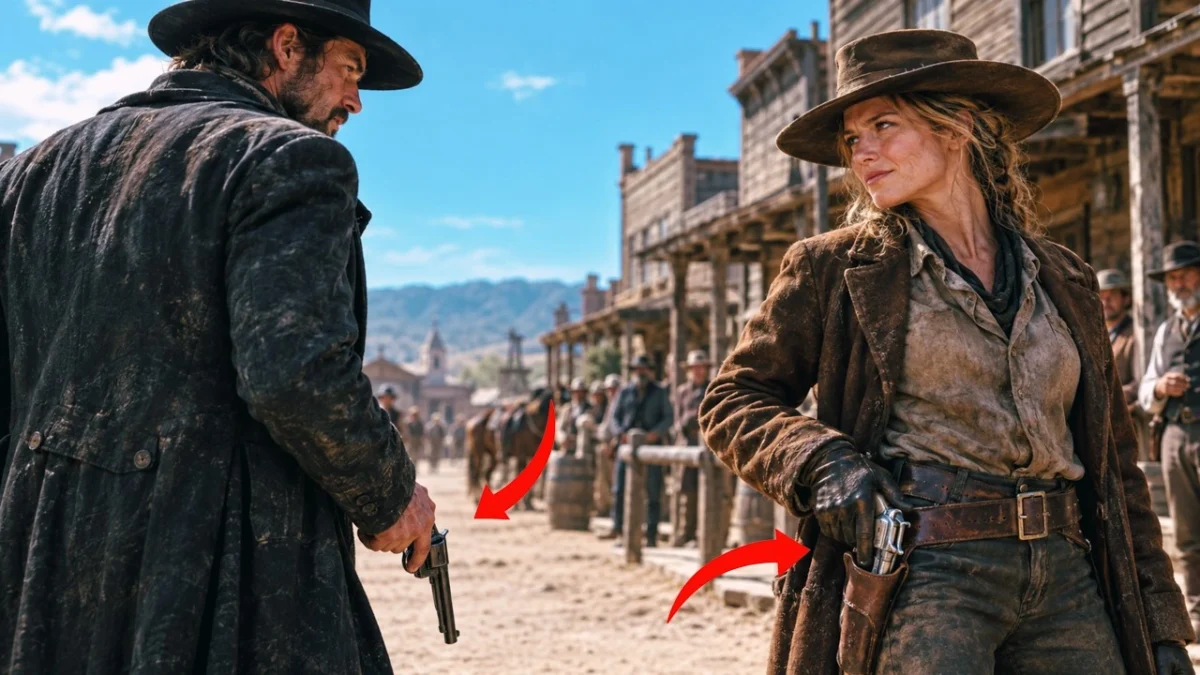
“You’d Better Pray,” the Gunslinger Told Calamity Jane… She Smiled: “I Don’t Pray for de@d Men”
The shot came over the rise ahead of her at a little after 9 in the morning.
One flat crack that rolled off across the grass and did not come back. Calamity Jane stopped walking.
Her team stopped with her. Six yolk of oxen leaning into the chains. And for a moment there was nothing in that whole country but wind and the creek of the wagon settling.
She went up the rise on foot with the whip coiled in her left hand.
400 yd on, the northbound coach stood in the middle of the road with its door hanging open.
The team was standing in harness blowing, not going anywhere. The driver was on the ground beside the front wheel and he was not moving.
And a man on a gray horse was sitting over the express box with his bandana pulled down around his neck drinking from a canteen.
He lowered the canteen. He looked straight up the road at her. She looked straight back.
400 yd was too far to read every feature of his face. It was not too far to know he was studying hers.
He screwed the cap back on the canteen slowly, the way a man does when he is deciding something.
He looked at her. He looked at the wagon behind her and at the long rifle lying across the wagon box.
Then he turned the gray horse north and rode away at a walk. Not a gallop, a walk.
Jane stood on that rise and understood exactly what the walk meant. It meant he was in no hurry at all.
It meant he knew how fast an ox team travels and it meant there were three days of empty road between her and Kuster City and he intended to be waiting somewhere on every one of them.
Before it was over, she would have him at the end of her rifle in the middle of a river.
She would let him go, and letting him go would put a bullet through her arm.
The driver’s name was Ben Toiver, and Jane knew him. Everybody on that road knew everybody, more or less.
The Cheyenne to Black Hills line had been running a little more than a year.
And in that year, the same drivers and freighters and stock tenders had passed each other so many times that they had stopped needing names and started using nods.
Ben Toiver had nodded at Jane perhaps 40 times. Once the previous autumn he had stopped his coach at the Hat Creek crossing, gotten down in the mud and helped her get a wheel out of a hole while six paying passengers complained about the delay, and he had not seemed to care about the complaining at all.
He was lying on his back beside the front wheel with his hand still near the scatter gun that had fallen under the coach.
He had reached for it. That was all. He had seen a lone man in a bandana step out of the drawer with a revolver, and he had done the thing a driver on that line was paid to do, and the man had shot him for it.
Jane took off her hat. She stood there for a while. She did not say anything over him, and she would have told you if you had asked her that she was not much of a hand at saying things over anybody.
Then she went and looked at the express box. It was open and it was empty.
There had not been much in it. As it turned out afterward, the mail pouches had been slit and the letters thrown around in the grass, and whatever the man on the gray horse had been hoping for, he had come out of it with a few hundred and a de@d driver.
She unbuckled the lead horses from the coach and led the whole team off the road onto grass where they could graze.
Because a team left standing in harness in the June sun with nobody coming is a team that suffers and those animals had not done anything to anybody.
She laid Ben Toiver’s coat over his face. She put a rock on each corner of it against the wind.
The next southbound coach would come through by evening. They would find him and they would take care of him.
That was all she could do for him there. What she could do for him anywhere else was stay alive long enough to describe the man on the gray horse to somebody with a badge.
Here is what Martha Jane Canary had to work with, and it was not much.
She was somewhere in her early 20s that summer, depending on which of her own stories you believed.
She had been hauling freight into the Black Hills since the Gold Rush opened them.
Jane was a bullhacker. That did not mean she rode with the freight. It meant she walked mile after mile beside six yolk of oxen.
With a 16 ft whip, she mostly cracked over their heads and almost never laid on them.
15 mi on a good day, ate on a bad one. And the man hunting her had a horse.
She had a sharps rifle on the wagon box. Single shot. Heavy, the kind of rifle men used on buffalo, and it could reach a long way out across open country if you knew how to hold it.
And she did. She had a colt revolver on her hip, which was a good deal less useful to her than the rifle, and which she knew it.
And she had six yolk of oxen, and a wagon full of flower and nails, and window glass for a store in Kuster City, 3 days north.
His name, as it turned out, was Luther Crane. He had been working the roads of the Black Hills since the spring, and nobody on that line had ever seen his face, and lived to describe it.
He could not know how much he had seen from that rise. Perhaps nothing, perhaps enough.
A man in his line of work does not stake his neck, and perhaps a rider could cover in one morning what an ox team might need two days to cross.
He could be anywhere ahead of her, any draw, any cut bank, any bend in the road.
She would not see him until he wanted to be seen. But she had worked out something else on that rise, watching him ride away at a walk.
He had not come at her. He had looked at her, and he had looked at the sharps lying across the wagon box, and he had turned and left.
400 yd of open grass between them. And he had decided he did not want to cross it because out in the open at a distance that rifle belonged to her.
So he was not going to come to her in the open. He was going to wait for her somewhere close.
The Cheyenne River crossing was 6 mi on and there was a stage station there built the year before with a stock tender and a corral and a solid roof.
Every freighter on that road stopped at the Cheyenne River station, which was exactly why Jane did not.
She knew that river. She had crossed it in every season it had, and she knew that a mile and a half upstream from the station, there was an old buffalo ford, where the bottom was gravel, and the water, even in the June rise, came no higher than the oxen’s bellies.
Hardly anybody used it anymore. The road had moved to the station. She took the team off the road at the Cottonwoods and brought them up the riverbank, and she crossed at the old ford a little before noon, walking in the water beside the lead yolk with the whip over her shoulder.
The oxen came up out of the river on the north bank, streaming water, and she got the wagon onto dry ground, and she took the sharps down off the wagon box.
Then she stood beside the rear wheel and waited because she knew what was going to happen next.
It took about 20 minutes. The gray horse came along the south bank at a hard trot.
He had been waiting at the station. He had waited through the time an ox team takes to cover 6 milesi and she had not come.
And he had come looking. He saw her. He saw the wagon already across, already on dry ground, already out of his reach, and he made the mistake that impatient men make at rivers.
He did not look for the ford. He did not follow her tracks down to the gravel.
He put the gray horse straight into the river, right where he was, where the June water ran deep and brown and fast, and he came across at her with a rifle in one hand.
The bank dropped out from under the horse three strides in. The gray went into the saddle skirts and started swimming, and Luther Crane was sitting a swimming horse in the middle of the Cheyenne River, water to his belt, rains in one fist and a Winchester in the other, trying to bring a rifle to bear from a saddle that was rolling under him like a boat.
He got it up anyway. He was 60 yards out and grinning. At 60 yards, Jane finally saw his face clearly.
She would know it anywhere now. You’d better pray, he said. Jane put the sharps to her shoulder.
She smiled at him. I don’t pray for de@d men. It was not bravado, and Luther Crane understood that in about the time it takes to read this sentence.
He could not plant his feet. He could not steady the rifle. He could not turn quickly.
He could not even get down off the horse without going into the river. Jane stood on dry ground.
He sat 60 yard out on a swimming horse. If she pulled the trigger, the advantage was entirely hers.
She did not squeeze. She would have told you afterward that it was because of the horse.
The gray’s head was straight in front of him, stretched out low over the water the way a swimming horse holds it.
And at 60 yards on a moving river, she was as likely to put a ball through the animal as through the man.
And she was not going to kill a swimming horse to get to the fool sitting on it.
Crane read her face for about 3 seconds. Then he hauled the gray around. The horse turned gladly.
It had not wanted to be in that river any more than he did, and it swam him back to the South Bank and scrambled out streaming water and stood there shaking itself.
And Luther Crane sat on it soaked to the chest and looked across at her.
He did not say anything else. He did not need to. They both knew where things stood.
He could not come to her in the open, and she could not stay in the open forever.
Sooner or later, that road went somewhere narrow. He turned the gray and rode off downstream toward the station, toward the road crossing, where he could get over the river the way sensible people did.
Jane watched him go. The man she had just called de@d, was still very much alive for now.
She put the sharps back on the wagon box. Her hands, she noticed, were perfectly steady.
They started shaking about a mile later and did not stop until she made camp.
She made the afternoon camp in the open with the wagon between herself and every direction she could not see, and she did not sleep much, and she was on the road again at first light.
The second day was worse because nothing happened for most of it. Nothing happened for 6 hours.
She walked beside the team through country that rolled and dipped, and every dip was a place a man could be lying in the grass, and every cutbank was a place a man could be standing behind.
She looked at everyone. She could not help looking, and everyone was empty, which was not a relief because it only meant he was somewhere else.
In the middle of the afternoon, she came over the last rise above Dry Fork.
There was a road ranch at Dryfork, a log house, a corral, a well, and a shed kept by a Swede named Anders Linkfist, who sold hay and coffee and a place to sleep to anyone going up or down that road.
Jane had stopped there a dozen times. Linkfist always came out to meet a freight wagon when it came over that rise, because freighters buy hay, and hay was how Anders Linkfist lived.
Jane stopped the team at the top of the rise. The ranch was 200 yd below her.
There was smoke from the chimney. There were two relay horses in the corral. Everything looked the way it always looked, except that Ander’s linfist did not come out.
She stood there for a full minute. The door stayed shut and tied behind the shed where you would only see it from exactly where she was standing.
And nowhere lowered down was a gray horse. He had ridden wide around her and gotten there first, and he had had most of the day to set himself up.
Jane found out afterward how it had been. He had come in at noon, polite and dusty, and asked for coffee.
There were two travelers already there waiting on the next northbound coach. A drummer named Merritt Oaks who sold patent medicine out of a sample case and a man named Yeum who was going up to de@dwood to open a laundry on Main Street and had been on the road for 3 weeks.
Crane had drunk his coffee. Then he had put a revolver on the table and told all three of them to sit down on the floor against the back wall.
He was not going to shoot them unless he had to. He told them that he was a practical man.
All he needed was for the freight wagon to pull up in front of that house like it always did.
And the woman walking beside it to come up to the door like she always did, and for her to be 6 ft away when she did it.
6 ft was his range. She did not come up to the door. She sat down in the grass at the top of the rise with the sharps across her knees and she waited.
It was the longest hour of Luther Crane’s life and he told Linkfist so and after a while he stopped being polite about it.
A little after 4 he did the only thing left to him. He came out the back of the house and ran for the shed where he could get a line on the rise.
The sharps went off like a door slamming in a church. The ball took a piece out of the shed wall about a foot in front of his face and Crane went down behind the wood pile and stayed there and the two of them began trading fire across 200 yd of open grass.
She had one shot at a time and a long reload. He had a Winchester that fired as fast as he could work the lever.
He put his rounds into the grass around her and into the wagon and into the flower sacks piled in the wagon box, and the flower came out of the holes in white puffs every time he hit one.
She stayed low behind the wagon box and the flat shelf of rock at the crest of the rise, and she did not waste a single round.
She had taken the oxen off the chain and turned them loose down the far side of the rise before she ever sat down to wait, well out of any line of fire, and they were grazing a quarter mile away, as though none of it had anything to do with them, which was the most sensible thing anybody did that afternoon.
It was Yeum who changed it. While Crane was behind the wood pile with his attention on the rise, the laundryman got up off the floor of that house, walked to the front door, opened it, and walked straight up the road toward the wagon with his hands empty and held out from his sides.
He did not run. He had worked 3 years on the railroad grade in the Sierra before he ever came east.
And he had learned there that a man who runs gets shot at and a man who walks mostly does not.
Crane saw him and did not fire. Jane saw that too and filed it away.
Ye come came around behind the wagon box and crouched down beside her and said very calmly in English that was better than hers that the man had loaded 11 cartridges into that rifle at the table and that there were no more in his coat because he had watched him turn the pockets out.
He had fired three since the revolver he had not reloaded in front of anybody and whatever was in the saddle bags on the gray horse.
Yeum could not say. Then he said that Mr. Lindfist had been hit in the shoulder when he tried to get to his shotgun and that Mr.
Oaks had fainted and that Mr. Oaks was probably the lucky one. Jane asked him why he had come out.
He said that he wanted to go to de@dwood and open a laundry and that the man behind the wood pile was the only thing standing between him and it.
Eight left. Jane made him use them. She did it the only way she could with a single shot rifle against a repeater.
She gave him something to shoot at. She moved, showed him her hat at one end of the wagon box, then fired from the other.
Made him think she was coming down the slope, then stayed exactly where she was.
And every time Luther Crane put a round into the grass where she had been a moment before, “Ye said the number quietly, the way a man counts change.”
“Five,” Yeum said. Later four, then three. When the count reached two, Yikum stopped counting.
Crane had understood what was happening. He had two rounds left in the rifle, and he was pinned behind a wood pile 200 yd from a woman with a buffalo gun and a man counting his bullets.
He did the only sensible thing left to him. He ran for the gray horse.
He fired both rounds as he went and one of them went through the wagon box and through the meat of Jane’s left arm above the elbow and the other one went somewhere up into the sky and he was on the gray and around behind the shed and gone north up the draw before she could get the sharps reloaded with one working hand.
She sat down in the dirt behind the wagon. Ye come tore the sleeve off his own shirt and tied up her arm with it and did it well.
Merritt oaks woke up and Linfist came out of the house holding his shoulder and swearing in Swedish, which Jane said later was the most cheerful thing she had heard in two days.
Nobody was de@d. That was the part she kept coming back to. A man with a Winchester had shot into that ranch and that wagon for the better part of an hour, and nobody was de@d.
But he was not finished. The rifle was empty now. What was left in the saddle bags on that gray horse nobody knew, and tomorrow she would be one day’s walk from the stage company’s office, and the deputy there, and everything that went with it.
Tomorrow he would have to come to her and he would have to come close.
Before we go on, here is what that road actually was because it is the reason a single man could terrorize it.
The Cheyenne to de@dwood stage line opened in 1876, running coaches male and gold between the railroad at Cheyenne and the new gold camps of the Black Hills.
For years, it was one of the most dangerous roads in the West. Holdup men called road agents worked it constantly.
In March of 1877, a gang stopped a coach near de@dwood and killed the driver, Johnny Slaughter.
Calamity Jane herself was real, and she really did work that country as a bullhacker, hauling freight to the camps.
But Luther Crane, Ben Toiver, Dry Fork, and everything in this story are fiction. On this channel, we use stories to show how the West actually worked.
Now, back to the road. On the third morning, she walked the team north with her left arm tied against her body, and about 2 hours short of noon, she came down to the mouth of Red Canyon.
The road ran through it. There was no other way. It was a long narrow run between red rock walls, and there were a hundred places inside it where a man could stand in the rocks and wait for a wagon to come within 6 ft.
He was in there. She did not need to see him to know it. She stopped the team a/4 mile short of the canyon mouth on flat open ground with nothing on it higher than the grass.
And she turned the wagon broadside to the canyon and she sat down behind the wheel with a sharps and she waited again.
Here is what she was waiting for and Luther Crane knew it just as well as she did.
The northbound coach was due through Red Canyon in the middle of the afternoon. It would carry a driver, and on a road like this, there was a good chance a shotgun messenger would be riding beside him.
The moment that coach came up behind her, she was not a woman alone on a road anymore.
So he could not wait for her in the canyon. If he waited, he lost.
He had until the middle of the afternoon to come out of those rocks and cross a quarter mile of open grass at her.
And he knew exactly what that open grass meant because he had learned it at the river.
But he also knew what he had done at Dry Fork. He had seen her left arm fold against her body as he rode away.
A sharps fires once. After that, it has to be opened, loaded, and closed again, and that takes two good hands.
If he could make her waste that one shot, she would never get the second one in before he crossed the rest of the ground.
By noon, the red walls were throwing heat back at her like an oven. Sweat had soaked through the sleeve Yikum had tied around her arm, and every heartbeat pushed a dull throbb up above the elbow.
The sharps felt twice as heavy as it had the day before. That was when he came.
He came out of the canyon, mouth on foot, leading the gray, and he tied the horse to a cedar at the edge of the rocks, well back, where nothing could reach it.
Then he started walking across the grass toward her with a revolver in his hand.
Whatever had been in those saddle bags, it had been enough to load a revolver.
He walked the way a man walks when he has decided that walking is the only thing left.
She let him come 300 y 200. She had the sharps up on the wagon wheel and he was walking straight into the front side of it.
And every step he took made the shot easier, and every step he took also brought him nearer to the range of the revolver in his hand.
She could fire once, miss, and she would have to lower the rifle, open the breach, find a cartridge, load it, close it, and the hammer, all with one good hand.
He would not give her that time. 150 yards. He fired the revolver. It was much too far for a pistol, and he knew it.
The shot fell well short and kicked up a spurt of dirt a long way in front of the wagon.
He was trying to make her fire. She did not fire. 100 yards. He fired again, wide.
She heard it go past somewhere off to her right. She did not fire. 80.
The third shot hit the wagon box a foot from her head and threw splinters across her face and she did not move.
70. He stopped walking. He stood there in the open grass at noon with the sun straight overhead and nowhere to go.
And he looked at her down the barrel of that rifle. And for the first time since the river, Luther Crane looked afraid.
You told me you don’t pray for de@d men, he called. That’s right. Then who’s going to pray for you?
He brought the revolver up. One shot. It came off the wagon wheel with a sound that went all the way to the red rock walls and back.
And Luther Crane went down in the grass and did not get up again. The northbound coach found her at a little before 3.
The driver was a man named Hal Bristo who had known Ben Toiver for 8 years and the messenger was sitting beside him on the box with a shotgun across his knees and they came up the road behind her to find a freight wagon standing broadside on the road with a woman sitting against the wheel.
She had brought the gray horse out from the cedar and given it water from her own barrel, and it was standing quietly beside the oxen, perfectly unharmed, which Jane pointed out to Bristo as though it was the most important fact of the day.
Luther Crane was still lying in the grass where he had fallen, under her blanket.
Bristo and the messenger lifted him across the gray saddle between them. Then the coach door opened and Yikkum stepped down into the grass.
He had been waiting at Dryfork for exactly this coach. He looked at the wagon and at her arm and at the gray horse, and he nodded once.
The way a man nods when a column of figures comes out right. I am still going to de@dwood, he said.
Jane told him she had never doubted it. She walked into Kuster City that evening beside her team with the gray horse tied behind the wagon and the coach riding slow behind all of it because Hal Bristo would not leave her.
The stage agent in Kuster City took her statement the next morning and sent word down the line about Ben Toiver, Luther Crane, and the Gray Horse.
Weeks later, after the company had confirmed the killing and Crane’s part in it, $200 reached Jane as a reward.
She used part of it to pay for Ben Toiver’s burial in Cheyenne. What remained went to his sister in Nebraska, and Jane never told anybody how much that was.
Years later, stories would gather around Martha Jane Canary, the way stories gathered around almost every famous figure of the frontier.
Some she encouraged herself, others grew in the retelling, but Jane did not talk much about Red Canyon afterward.
If someone asked, she reduced 3 days of fear to a few plain words. A man had told her to pray.
She had told him she did not pray for de@d men. And in the end, she had been right.
Much of what people remember about Calamity Jane belongs to the legend she helped build.
The scouting, the romances, the fearless riding, the dime novel heroine. She told those stories loudly and often, and she sold them, and she let them grow until nobody could tell anymore where she stopped, and the legend started.
One of the real jobs behind the legend was far less glamorous. Walking beside an ox team on dangerous roads mile after mile with a whip over her shoulder and a rifle on the wagon box.
That is not a legend. That is a job. And it is worth remembering that the most dangerous thing on that road was not a gunfighter.
It was the distance. Three days on foot with a man on a horse who could be anywhere.
The road was real. The Cheyenne to de@dwood stage line ran from 1876 to 1887, and road agents robbed it again and again.
Driver Johnny Slaughter really was killed by road agents near de@dwood in March of 1877.
A stage station stood at the Cheyenne River crossing built in 1876 and Red Canyon was a real and feared stretch of that road.
Calamity Jane was real. Martha Jane Canary arrived in the Black Hills in 1876 and worked as a bullhacker hauling freight to the mining camps and she spent the rest of her life telling stories about herself that historians still argue about.
Everything else in this episode is fiction. Luther Crane, Ben Toiver, Anders, Lindfist, Yekum, Merritt Oaks, Hal Bristo, and the Dry Fork Road Ranch were created for this story, and no record describes Calamity Jane in any of these events.
Here is the one I want your answer on. At the river, she had him.
60 yards. A man on a swimming horse, a rifle already on her shoulder. She let him go because she would not risk the horse.
That choice later put a bullet through her arm and nearly cost her life. Right call or should she have taken the shot?
Tell me in the comments. And one more piece of history before you go. By 1878, the stage company was running an ironplated treasure coach nicknamed the Monitor, built to carry Black Hills gold out to Cheyenne.
That September, road agents robbed a coach at Canyon Springs Station. Anyway, and much of that gold was never seen again.
If you want a hand in the next episode, the membership button under this video does something specific.
Members get early access to new stories and members name the characters. There is a woman in the next one who does not have a name yet.
One of you is going to give her








