“You Will Regret This Marriage,” the Duke Said at the Altar — She Smiled: “I Never Regret”
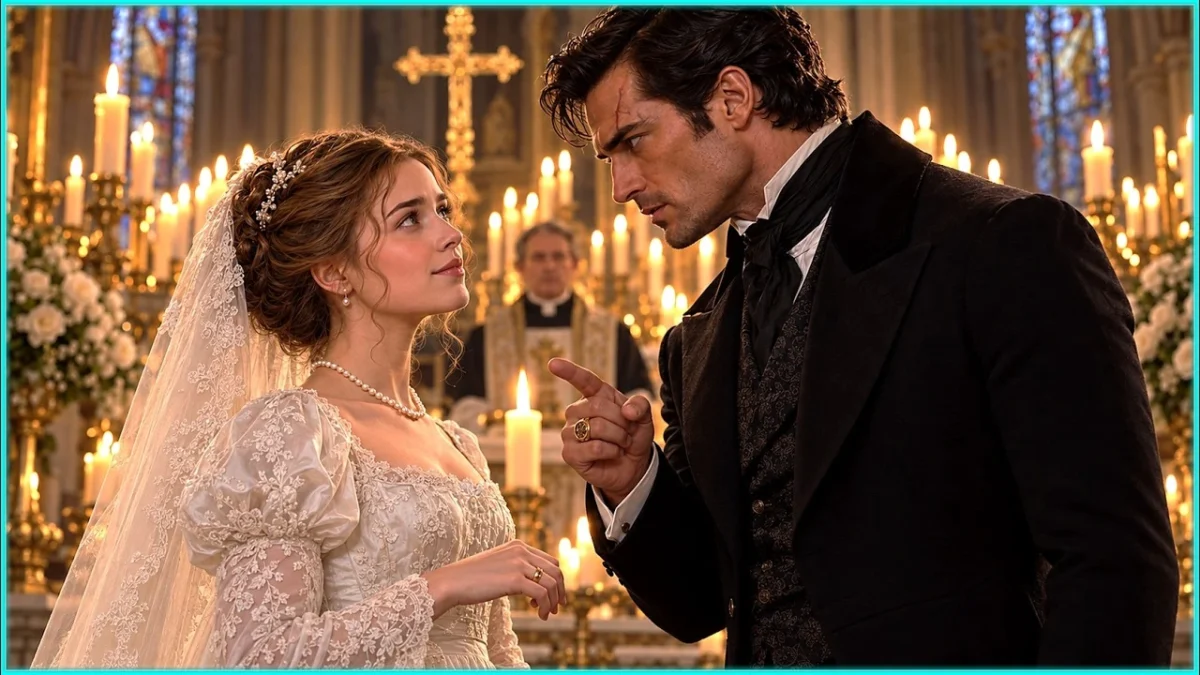
“You Will Regret This Marriage,” the Duke Said at the Altar — She Smiled: “I Never Regret”
You will regret this marriage,” the Duke said low enough that the words fell between them alone, meant for no year but hers.
He stood at the altar of St. Edmunds, with the candlelight sliding along the hard line of his jaw, and he watched the woman beside him for the flinch he had learned to expect from everyone who came too near.
It did not come. Nicola Ingpen turned her head a fraction, and the veil of Honatan lay shivered against her cheek, and she smiled at him.
Not a nervous smile, not the trembling curve of a bride handed over like a parcel of silver plate.
It was a smile with a mind behind it, level and amused and entirely her own.
“I never regret,” she said. “It is a habit I have never had the leisure to acquire.”
The Duke of Dunlay, Lizard, though few living souls used the name, felt something shift beneath his ribs, some plate of ice grinding against another, and he did not care for the sensation at all.
He had come to this church having decided precisely how the day would proceed. He would say the words, she would say the words.
The register would be signed. The debt his late father had incurred would be discharged by the terms her uncle had drafted, and the two of them would go on to live at opposite ends of a very large house until death or indifference dissolved the arrangement.
He had planned for a bride who wept, or a bride who sered, or a bride who looked at his estate and his title and saw only the size of the prize.
He had planned for a stranger. He had not planned to be looked at. The bishop droned onward.
The Duke gave his responses in a voice that had frozen better men than the clergymen, and Nicola gave hers in a clear control to that carried to the back pews, where the curious of three counties had gathered to watch the cold Duke of Dunlay take a wife.
He heard the whispers running along the aisles like water under ice. Poor creature. Did she not know?
They said he drove his first betrothed to break the engagement and flee to her aunt in Bath.
They said he had not smiled since the winter his brother died. They said a great many things, and most of them were true, and the Duke had long ago stopped troubling to correct any of it.
Let them believe him carved from the same granite as his ancestors to it was easier than the alternative, which was to be seen.
The ring went onto her finger. Her hand did not shake. His did very slightly, and he despised it.
“You may salute the bride,” the bishop said. The Duke bent. He meant it to be nothing a formality, a pressure of cold lips against a colder cheek, the whole transaction sealed and done.
But at the last instant she tilted her face so that her eyes met his near enough now that he could see they were not brown as he had assumed from across a candleit chapel, but a deep riverine hazel shot through with gold.
And there was in them not the fear he wanted, not the ore he expected, but a spark of pure unrepentant challenge.
Courage, your grace, she murmured for him alone. It is only a kiss. You have survived worse men than me.
He kissed her cheek. He straightened. And for the length of a single breath, the Duke of Dunlay forgot the words of the response he was meant to give next, which had not happened to him since he was 9 years old, and forgetting his catechism under his father’s flat, disappointed stare.
They walked back down the aisle together as man and wife, and the organ thundered, and the assembled gentry rose in a rustle of silk and speculation, and the Duke stared straight ahead at the great doors, and the gray afternoon beyond them, and thought, “I have made a serious.”
He did not yet know of what kind. The wedding breakfast was held at her uncle’s house, a narrow, overwarm establishment in the good part of the town where Sir Marcus Inpen conducted the business of turning other men’s misfortunes into his own comfortable income.
It was Sir Marcus who had held the notes of hand against the late Duke.
A mountain of them accumulated across the lost hard years of an old man’s failing judgment.
And it was Sir Marcus who had proposed, with the oily delicacy of a man who has already decided the answer, that the whole embarrassing matter might be settled far more agreeably by a union than by a court.
His niece, he had said, a well-b bred girl, a troll headstrong, but of impeccable blood on her mother’s side, a duchess in want of nothing but a duke.
The Duke had signed because the alternative was to see Dunlay sold out from under the 200 families who depended on it.
And a Duke of Dunlay did not permit that. Whatever the cost to himself, the cost to himself he had always been willing to pay.
He was practiced at it. He stood now against the penel wall of Sir Marcus’s dining room with a glass of indifferent wine he did not drink, and watched his wife.
She was working the room. There was no other phrase for it. She moved among her uncle’s guests, the merchants and the minor gentry, and the two or three genuine peers Sir Marcus had managed to lure with the promise of watching a ducal wedding, and she left each of them a little brighter than she had found them.
He watched her make a nervous young clergyman laugh. He watched her draw out a deaf old doagger with a patience that was not performed.
He watched her deflect with three light words and a smile an impertinent question about whether she was not afraid of her new husband’s reputation.
And he saw the questioner, a fat man in a pus waste coat, retreat in confusion, unsure whether he had been answered or dismissed.
She was the Duke conceded to himself formidable. He had expected a debtor’s niece, a girl schooled to gratitude and glad of rescue.
He had been handed instead a woman who moved through her uncle’s grasping little world, as though she had long since taken its measure, and found it wanting, and who was even now, he realized, watching him back, she crossed the room to him.
The guests parted for her, and she came to stand at his side with a glass of the same wine, and she looked out at the gathering as he did, so that they stood shoulderto-shoulder like two strangers sharing the view from a window.
You have not spoken to a single person, she observed. I have nothing to say to any of them.
No, she agreed. I don’t imagine you do. My uncle’s friends are not on the whole worth the breath, but you might have spoken to me.
We are married, the Duke said. There is a great deal of time ahead in which to speak, and very little worth saying.
She laughed. It was a low, surprised sound, as though he had said suinly funny rather than merely cold.
And he found he’d not know how to respond to being laughed at by a woman who was not afraid of him.
Fear he could navigate. Fear had rules. Do you know Nicola said, “When my uncle told me I was to marry the Duke of Dunlay, I was warned of a great many things.
That you were proud, that you were bitter, that you had a tongue like a January wind and had frozen off a betrothel and half a dozen friendships.
I was told to expect a man made entirely of ice. She turned her head and looked up at him, and the gold in her eyes caught the candle light, but nobody warned me you would be a coward about a wedding breakfast that I confess I did not foresee.
The Duke set his glass down on the sideboard with a click. Beg your pardon, he said, and his voice could have etched glass.
You needn’t. I only observe that a man who will stare down a bishop and a church full of gossips seems oddly unwilling to make conversation with the woman he has just married.
One might almost think you afraid of her. She sipped her wine unhurried. I am the least frightening thing in this room.
Your grace. You might practice on me. He looked down at her for a long moment.
Somewhere in the crowded overwarm room, Sir Marcus was laughing too loudly at his own joke, and the fat man in the pews waste coat was telling someone about his hunters, and the whole tedious machinery of the wedding ground on around them.
And the Duke of Dunlay, who had not been surprised by anyone in 9 years, was surprised.
“You are impertinent,” he said. “I am honest,” said Nicola. “You will find, I think, the two are very often mistaken for one another by people who prefer to be lied to.
I had rather hoped a duke would know the difference. She smiled again, that level, unafraid smile.
But it is early days. I shall not lose hope of you yet. He should have crushed it.
He had the words. He always had the words. The flat glacial phrases that ended conversations and sent people away with their eyes stinging.
He had used them on better and kinder people than the woman beside him. He opened his mouth to use them now.
“We leave for Dunlay within the hour,” he said instead. The roads are poor after the rain.
I trust you are packed. I have been packed since Tuesday, said Nicola. I do not care for delay.
It gives one’s enemies time to think, and she touched his sleeve, the briefest pressure of gloved fingers on black superfine, gone before he could decide whether to object, and turned back to the room to make her farewells.
The Duke watched her go, and told himself, with the firmness of long practice, that nothing had changed.
He had married a stranger for the good of his people as his rank required.
He would house her, clothe her, give her the freedom of his estate and the protection of his name, and he would keep to in his own heart and every other living soul the wall he had spent 9 years building stone by patient stone.
She was clever very well. The world was full of clever people, and he had frozen out cleverer than Adetto’s niece with a quick tongue.
In a month she would tire of trying to Thor him. In a year she would have her own life at one end of the great house and he would have his solitude at the other.
And that would be the whole of it. He had planned it so. He believed it more or less until they were 3 hours out of town in the ducal traveling coach with the rain drumming on the roof and the light failing and she fell asleep.
He had expected her to talk. He had braced himself for it, for the whole long journey of gentle, prying conversation that would end, as such things always did in his making himself unpleasant enough to secure his peace.
Instead, she had asked him two or three genuinely interesting questions about the drainage of the low fields at Dunlay.
She had it emerged, read something on the subject, and remembered it. And when he had answered in monosyllables, she had simply nodded, taken a small book from her reticle, and read by the swaying light of the coach lamp until her eyes grew heavy, and the book slid down against her knee.
Now she slept with her head tipped against the squab, the fine lace of her traveling bonnet crushed.
One gloved hand loose in her lap, and the Duke of Dunlay sat in the dark and looked at his wife because there was nothing else to look at and no one to see him do it.
She did not look formidable, asleep. She looked young, younger than the composed woman who had told a bishop’s church full of gossips to mind their business with a single arched brow.
There was a faint line between her fair brows even in sleep, as though some care followed her even there.
And the Duke found himself wondering unwillingly what a girl schooled in Sir Marcus Ingpen’s grasping house had learned to fear, and what she had learned to hide it behind, and whether the level courage she had shown him at the altar was armor or truth, as with his own coldness.
A little of both. He did not want to wonder these things. Wondering was the first small crack through which the world got in, and he had sealed himself against the world for good reason.
He looked away from her out at the streaming dark and the black shapes of the hedros and set his jaw and reminded himself that he had told her plainly before God and the bishop and three counties worth of witnesses that she would regret this.
I never regret she had said the rain fell. The coach rolled on toward Dunlay toward the great cold house where he had learned at 9 years old to need no one.
And Lizard, Duke of Dunlay, sat in the dark beside his sleeping wife, and was afraid, genuinely, coldly afraid, in a way he had not been in years, that for once in her impertinent life the woman might be telling the exact and complete truth.
When the coach lurched into a rut, she stirred and did not wake, and her loose hand slid across the small distance between them, and came to rest, quite by accident, against the back of his own.
He looked down at it. He did not move it away. He told himself this was only because to move would wake her, and the roads were poor, and she had been packed since Tuesday, and deserved her sleep, and none of it, not one particle of it, had anything to do with the strange, unwelcome warmth of a stranger’s fingers resting trustingly against his in the dark.
He was still telling himself that when the lights of Dunlay rose out of the rain ahead of them, and the great gates swung open, and he brought his wife home to a house that not known warmth in nine long years.
Dunlay received its new mistress the way it received everything, in silence and with a chill the fires could not entirely dispel.
The Duke handed his wife down from the coach into a great flagged hall where the servants had been arranged in two rows by Mrs.
Dier, the housekeeper, a woman of iron rectitude, who had run the house since before the Duke could walk.
40 faces turned toward the new duchess in the light of the branched candalabra, and the Duke braced without quite knowing that he did it for the moment when the servants careful blankness would meet whatever his bride showed them and take their permanent measure of her.
Servants knew. Servants always knew faster than their betters and more honestly. Nola put back her crushed bonnet and looked at the two long rows of them, and she did not do what a duchess was supposed to do, which was to incline her head and pass along the line with a word or two for the senior staff before retiring, exhausted and grand, to her rooms.
She stopped in front of the smallest housemaid at the end of the row, a girl of perhaps 14, who was swaying on her feet with the latness of the hour and the terror of the occasion.
You have been standing here a very long while waiting for us. Nicola said, I am sorry for it.
The roads were poor. She looked up and down the rose. You have all been standing a very long while.
I shall learn every one of your names. I promise you. But I will not learn them tonight by keeping you from your beds.
So I shall be brief. I am glad to be here. I mean to be useful.
And I should think none of us will suffer for a hot supper and a warm fire after such a day.
She turned to Mrs. Dyier. Is there hot supper for them? Mrs. Dyier, who had not been asked a question of that particular kind in 30 years of service, blinked.
There is bread and cold meat set by your grace. And the fires banked. Then let the fires be built up, and something hot found, and my thanks to the kitchen for waiting up.
She smiled at the housekeeper, not the cool social smile she had used on her uncle’s guests, but something warmer and more level.
You have kept this house beautifully, Mrs. Dyier. I have never seen flags so clean.
I shall want to learn how you manage it when you can spare an hour to teach me.”
And she moved down the line after all, but slowly, and she looked at each face as she passed it, as though it were worth looking at, and by the time she reached the top of the stairs, the whole hall had changed its temperature in a way that had nothing to do with the fires.
The Duke stood in the middle of it and watched his household, his silent iron household that had not warmed to anyone since his mother died, though a full degree in the space of 5 minutes, and he did not know whether to be impressed or alarmed, he settled, as he generally did on cold.
“You need not caught my servants,” he said when he had followed her up and dismissed the footmen at her door.
“They are paid. Their loyalty is not in question.” Nola paused with her hand on the door of the Duchess’s apartments, his mother’s old rooms aired and swept, but unmistakably a museum of a woman 9 years de@d.
I did not caught them, she said. I thanked them. There is a difference, though, I grant you it is one your whole house appears to have forgotten.
She looked at him then, and some of the lightness went out of her face, and what replaced it was not unkind, but very direct.
You keep them cold on purpose. I see that you keep everyone cold on purpose, and I dare say you have your reasons, and in time perhaps you will tell me what they are, or perhaps you will not.
But they are people, your grace, not furniture, and I will not live in a house where the smallest housemmaid faints from standing for the honor of two strangers who could not trouble to say good evening.
If that offends you, I am sorry for it. I shall go on doing it regardless.
She went into the room and shut the door gently and left the Duke of Dunlay standing in the corridor of his own house dismissed.
He did not sleep well. He told himself it was the journey. Their first proper battle came the second night at dinner.
The Duke dined as he had dined for 9 years alone and in state at one end of a table built to seat 40, with a single branch of candles and the length of polished mahogany stretching away into darkness, and a footman stationed at the door like a sentry over a tomb.
It suited him. It had always suited him. He had taken a certain grim satisfaction in the absurdity of it.
One cold man at the head of a table meant for a family that no longer existed, as though the emptiness were a thing he had earned and meant to keep.
On the second night, he came down to find the table changed. The 40 ft of mahogany had been shortened to a small round table set intimately before the fire laid for two, with the good candles and a bowl of the last autumn roses, and Nicola already seated, and the footman looking as though he did not know whether he was to be hedged for it.
What? Said the Duke from the doorway in a voice that had frozen better rooms.
Is this dinner? Said Nicola. I found the great table melancholy. One cannot digest at 40 ft.
The food is stone cold by the time it has walked the length of the room, and one has to shout to be heard, and there is no one to shout to, which I imagine is rather the point.
But I did not care for it. So I Mrs. Dier bring in the small table.
Do sit down your grace. The soup is actually hot, which I am given to understand has not happened in this house since the old duke’s time.
I dine, the Duke said, at the head of my own table, as my father did, and his father.
Your father, Nicole observed, dined alone at the head of that table. For how many years?
And your grandfather? A whole dynasty of men eating cold soup in the dark at 40 paces from the nearest human soul and calling it dignity and each of them I have no doubt quite certain that the arrangement was ancient and sacred and could not possibly be otherwise.
It is not sacred lizard. It is only a very large table and a very sad habit, and I have moved it.
And if you truly wish to eat cold soup alone in the dark, you have only to say, and I shall have it moved back and dine here by myself in the warmth.
And think of you fondly down there in the shadows. She unfolded her napkin, but that would be foolish, and neither of us is a fool, whatever else we are.
Sit down. The soup is getting cold and has waited 9 years to be eaten hot.”
The Duke stood in the doorway a long moment, and the footman held his breath, and the fire crackled, and every instinct of 9 years told him to freeze her out, to insist on the great table, to establish now and for all time that this was his house, and it would run in his way.
He had won a hundred such battles. He had never lost one. He crossed the room and sat down at the small table across from his wife in the warmth, and he told himself it was because the alternative was undignified, a duke arguing with the seating, not because the roses smelled of a summer he had forgotten, or because the candlelight on her face was the first warm thing he had wanted to look at in 9 years.
The soup, he conceded when he had tasted it, is hot. There, said Nicola with maddening satisfaction.
You see how little it costs in the end to be warm. You have only got out of the way of it.
And she smiled at him across the small table, and the Duke ate his hot soup in the fire light, and did not, though he would not have admitted it under torture, entirely wish himself back in the dark.
The great table was never restored. He noticed over the weeks that he stopped noticing its absence, and then that he could not remember why he had ever wanted it, and then much later that the memory of 9 years of dining alone in the dark, had become a thing he could hardly believe of himself.
Like the memory of an illness after one is well, the days that followed settled or failed to settle, into a shape the Duke had not foreseen, he had imagined a wife who kept to her wing, and troubled him not at all.
What he had acquired, it transpired, was a wife who was everywhere. She was in the stables at 7 in the morning, having discovered that the headgroom’s boy had a gift for the sickly mare no one else could manage, and having decided that this was interesting.
She was in the still room with Mrs. Dyier, learning, apparently in earnest, how the flags were kept so clean.
She was in the long gallery reading the labels on the portraits of his ancestors and she was in the Munament room which no one used.
Going through the estate accounts with a throne of real concentration and she was the Duke discovered this on the fourth morning and stopped de@d in the doorway of his own stewards office sitting across the desk from Perin his steward discussing the drainage of the low fields.
Ah said Nicola when she saw him she did not look guilty. She never looked guilty.
Your grace, Mr. Perne has been explaining to me why the low fields flood, and I can confess I do not understand why nothing has been done about it, since the remedy seems both obvious and cheap.
Perhaps you can enlighten me, Perin, a good man who had served the estate for 20 years, and had learned to say as little as possible to the Duke, looked as though he wished the floor would open.
The remedy, the Duke said with dangerous calm, requires an easement across Colonel Harding’s land, and Colonel Harding, and I do not speak.
Whyever not, that is not your concern. It is my concern if 200 acres of your tenants best grazing goes underwater every spring, because two grown men will not exchange a civil word, she set down the drainage map.
But I see I have overstepped. Mr. Perin, thank you. You’ve been very patient with my questions.
Your grace.” And she rose and inclined her head with perfect, maddening courtesy, and left them.
And the Duke was aware, furiously aware, that she had made him look small in front of his own steward, and had done it so gracefully that he could not even take her to task for it without confirming the impression.
He found her that evening in the small drawing room, the one his mother had used, where she had, he noted, with a fresh spasm of irritation, caused the good candles to be lit, and a fire built up, and had installed herself her book, and a work basket, as though the room were hers, which supposed with cold logic it now was.
You will not, he said, interfere with the management of my estate. Nicola looked up from her book.
I would not dream of managing your estate, your grace. I have no wish to.
It is a very large estate and I am sure you manage it admirably in every particular except the ones you refuse to attend to out of pride.
She marked her place with a finger. The low fields flood because you will not speak to your neighbor.
Half the tenants at the north end burn green wood because the cppus that should supply them was let go to ruin the year your brother died and no one has ordered it cut back since.
The roof of the arms house your grandfather built leaks directly onto the bed of an 80-year-old woman named Mrs.
Cole, who has not liked to complain because she is frightened of you. These are not matters of estate management, your grace.
They are matters of ordinary human decency, and they have been neglected, and I have noticed, and I mean to see them mended with your leave, or without it.
I should very much prefer with the Duke stared at her. You have been here 5 days, six.
And it is remarkable, is it not? What a person can learn in six days simply by talking to people and listening to what they say.
You should try it. You own all this and you know less of what happens under your own roof than I have learned in less than a week.
And the ree forgive me for I am about to be honest again and you dislike it.
So the reason is that everyone here is too frightened of you to tell you anything true.
You have built yourself a wall and it keeps out the pain you are so determined not to feel.
And it also keeps out the leaking roof and the flooding fields and the frightened old woman.
And one day if you are not careful it will keep out everything and you will die behind it.
Very grand and very cold and entirely alone and you will have called it dignity.
The fire cracked in the great outside the autumn wind moved in the great trees of the park.
The Duke of Dunlay stood in his mother’s drawing room and felt the wall he had spoken of.
The wall he had built stone by patient stone across nine years. Take the full weight of a blow struck by a woman who had known him six days and had with appalling accuracy described the exact shape of his life.
“You know nothing about me,” he said. His voice was not quite steady, and he hated that too.
No, Nicole agreed, and to his astonishment, the anger had gone out of her, and what was left was gentle and worse than the anger.
I know almost nothing about you, Lizard. I know that a man does not become as cold as you’ve made yourself without having once been terribly warm and been terribly hurt for it.
I know that you married me to save 200 families you have never let yourself love out loud.
And I know that you carry your de@d brother’s watch because I have seen you take it out three times in six days and look at it when you think no one is watching and put it away again as though it burned you.
She rose and set her book aside and crossed the room to him and she did not touch him.
But she stood close enough that he could have counted the gold flex in her eyes.
I do not mean to wound you. I mean the opposite. But I will not pretend not to see, and I will not be frightened of you, and I will not stop caring about your leaking roofs and your flooding fields and your frightened old women simply, because caring is inconvenient to a man who has decided to feel nothing now.
Will you go and see Kunnel Harding, or shall I? The sheer effronttery of it, the drainage, the de@d brother’s watch, the flooding fields, and the impossible woman standing in his mother’s drawing room ordering him to make peace with a neighbor he loathed, and did something in the Duke that had held firm for 9 years.
He did not laugh, he had nearly forgotten how, but something moved in his chest that was the ghost of the impulse, and it terrified him more thoroughly than tears could have.
“You would truly go yourself,” he said to Harding. If I refused, I would be in the gig by 9 tomorrow, said Nicola.
I am very good with disagreeable men. I was raised by one. I should have your easement signed by lunchon and conal half in love with me by tea, and you would be spared the whole tedious business of speaking to him at all, which I imagine is precisely the sort of arrangement you would ordinarily prefer.
She tilted her head. But it would cost you something. All the same, it would cost you the truth about yourself, which is that you would rather send your wife to do a hard human thing than do it yourself.
And I do not think your grace, that you are truly a man who prefers to be spared.
I think you have only forgotten that you are not.” She let that sit. Then she stepped back and picked up her book again and returned to her chair by the fire as though nothing at all had passed between them and left him standing in the middle of the room with his brother’s watch, a de@d weight in his waste coat pocket, and his whole carefully frozen life cracking quietly all around him.
He went to bed and lay awake a long time. In the morning before he could talk himself out of it.
Before Nicola had come down, the Duke of Dunlay ordered his horse saddled and rode alone the four miles to Harding’s house to make peace with a man he had not spoken to in six years over a drainage easement because his wife had told him he was a coward if he did not.
And because he admitted it to no one, least of all himself, some small, buried, 9 years silent part of him wanted for the first time in longer than he could remember, to prove to somebody that he was not.
He did not entirely understand yet that the somebody was her. Connell Harding, it transpired, had spent 6 years believing the Duke blamed him for the accident that had killed the Duke’s brother, and the Duke had spent six years believing the colonal blamed him.
And in the whole of that time, neither man had said a word to test the belief.
Because grief and pride together make a silence that grows thicker every year it is left alone.
They said the words now. It was not easy. The Duke was very bad at it, and the colonel was not much better, and there was a dreadful quarter of an hour in the colonel’s study during which both men stared at the fire and spoke in the clipped, half-finished sentences of Englishmen approaching, feeling.
But it was said the colonel had not blamed him. The colonel had grieved with him from four miles off in a silence exactly as proud and exactly as lonely as the Duke’s own.
And when at last the Duke rose to go, the easement signed and folded in his breast pocket, the old soldier gripped his hand with a strength that said more than either of them had managed aloud.
“Your Duchess,” Harding said gruffly at the door. “You did not send her. You came yourself.”
“That’s well. That’s a good sign, my boy. Your father never came himself for anything in his life.
The Duke rode home through the bright cold morning with the easement over his heart and the Connell’s words turning over in his mind, and he was aware, with an emotion he could not name, that the day looked different than it had in six years.
The hedgeos were the same. The light on the low fields was the same, but he had done a hard human thing, and the sky had not fallen, and there was in his chest a strange, unfamiliar lightness that he distrusted profoundly, and did not for once entirely wish to be rid of.
He found Nicola in the stable yard when he rode in a plain wool gone with her sleeves pushed back, coaxing a mash into the sickly mare with her own hands.
She looked up at the sound of his horse, and she took in his face, and the easement she could not possibly have seen, and she knew.
“You went,” she said. “I went.” She did not gloat. He had braced for triumph, and got instead a smile that started small and grew until it lit her whole face, a smile of such sudden, unguarded joy on his behalf that the Duke had to look away from it toward the mayor, because a man could not be looked at like that, and remain entirely made of ice.
Good, Nicola said softly. Oh, that is good. Was it very dreadful? Extremely. And are you glad you did it?
He considered the question with the seriousness it did not perhaps deserve. The low fields will drain, he said at last.
The tenants will keep their grazing. Harding and I, he stopped. He was not a man who finished such sentences.
It is done, he said. That is enough. But it was not enough for her, and they both knew it, and she let it go with a mercy he had not expected, and did not, he suspected, deserve.”
Thus began the strangest season of the Duke of Dunlays life. He would not have called it happiness.
He would not, at that stage, have called it anything at all. He had no vocabulary for the thing that was happening to him, having spent 9 years methodically forgetting the words.
But the house changed, and he changed within it, so gradually that he could not afterward have named the day the frost broke.
She got the copus cut back, and the tenants at the north end burned dry wood.
She got Mrs. Cole’s roof mended, and went herself to sit with the old woman while the Thatchers worked, and came home with three of Mrs.
Cole’s receipts for cordials, and a great deal of local gossip that she deployed at dinner with such wick accuracy that the Duke once actually laughed.
A short rusty bark of a sound that startled them both into silence, after which Nicola looked at him across the candle lit table with an expression of such careful tender hope that he had to put down his fork.
There was a day late in that season that the Duke marked ever afterward as the day he first understood what she had made of him, though he did not confess it to her until years later.
It was the harvest fair in the village that lay at Dunlay’s gates a small muddy cheerful affair of ribbon sellers and prize marrows and a fiddler on the church steps the sort of thing the Duke had not attended in his life having always sent his stward with the customary purse and stayed away himself because a cold man at a fair only spoils it for everyone.
Nicola informed him over breakfast that they were going. I do not go to fairs.
The Duke said, “You have never been to a fair,” Nicola corrected. “There is a great difference.”
“A man cannot dislike a thing he has never tried. That is not dislike. It is only fear wearing dislikes coat, and you have far too much of that coat in your wardrobe already.
We are going.” Your tenants have been holding this fair on your land for 200 years and paying to the last farthing for the privilege.
And it will do them a great deal of good to see that their landlord is a man and not a gargoyle.
And it will do you a great deal of good to be seen as one.
Wear the blue coat. It is less funeral. He went. He told himself it was to keep the peace and wore the blue coat and stood at the edge of the green in the thin autumn sun, feeling every inch the gargoyle she had accused him of resembling.
While the fair went silent and weary around him, the way every room had gone silent and weary around him for 9 years, and then Nicola took his arm and walked him into the middle of it, and simply refused to let it be silent.
She admired the prize marrow. She lost deliberately and with great drama a wager to the blacksmith over a game of Skittles, and paid it in pennies with such good humor that the whole crowd laughed.
She bought a length of ribbon from a widow whose stall no one else was troubling, and made sure the county saw her do it.
And all the while she talked to the Duke, turned to him, drew him in, asked his opinion of the marrow, and the skittles, and the fiddler’s tune, so that the tenants watching saw not a gargoyle standing apart, but a man his own wife plainly delighted in.
And being a warm-hearted people who had feared their landlord for years and would infinitely rather have loved him, they took the hint with pathetic eagerness.
By afternoon, a farmer had ventured to ask the Duke’s advice about a layox, and the Duke, who knew a great deal about oxen, had answered, and the farmer had not fled.
By dusk, the fiddler had struck up a country dance, and Nicola had looked up at her husband with a wicked light in her eye and said, “You will not dance.
I know you will not. You have decided you cannot, which is a different thing, and I shall not tease you into it, because a man should be allowed one cowardice per fair.”
And the Duke of Dunley, purely and entirely to prove her wrong, which she had known he would, had taken his wife out onto the trampled green in the last of the light, and danced stiffly and badly.
And to the open astonishment of 200 tenants, while she laughed up at him, breathless and glad, and the whole village watched their frozen duke turn human before their eyes.
Riding home in the dark, mud to the knees and a bought ribbon in Nicola’s hair, the Duke said, “You planned all of that.
The marrow, the Skittles, the dance. You planned it before we left the house. I planned the marrow and the Skittles.”
Nola admitted. The dance you did entirely yourself and it was very bad and I have never in my life been so happy to be proved right about a man’s cowardice.
They love you now. You know your people. They have wanted to for years. You only had to let them.
She was quiet a moment and then more softly. It is the same thing I keep telling you my love.
In every way I can find. You were never truly cold. You were only frightened.
And you dressed the fear in a very fine cold coat. And everyone believed the coat, including you.
But I have seen you dance a country dance in the mud to spite your wife, and I shall never believe the coat again.”
He did not answer her. He did not have the words. But he reached across the dark of the gig and took her hand, mud and ribbon and all, and held it the whole way home, and she let him, and that was answer enough for both of them.
They sparred. That never stopped. He came to depend on it, though he would not have admitted that either.
She had a quick ranging mind and a memory like a steel trap and no patience whatever for K.
And she would take a lazy opinion of his and turn it over and find the soft place in it and press until he was forced either to defend it properly or abandon it.
And the exercise was so unlike anything in his ordinary life where no one dared contradict him that he found himself to his private astonishment saving up thoughts across the day to try on her at dinner.
She read everything. She argued about the drainage and the corn laws and the education of the tenant children and whether the new curit sermons were too long.
And she was wrong about a good many things and right about more of them than he was comfortable admitting.
And when she was wrong and he proved it, she conceded with a good grace that shamed him because he had never in his life conceded a point to anyone.
You are enjoying yourself. She accused him one evening over a disputed point of history.
You have been arguing the wrong side of that for 10 minutes purely for the pleasure of it.
I know that face now. You have a great many faces your grace and most of them are lies.
But that one is true and it means you are enjoying yourself and would rather die than say say so.
I would rather die. The Duke agreed gravely than say so. And Nicola laughed, the lows, surprised laugh he had heard first at their wedding breakfast, and the Duke looked at his wife in the candle light, and felt the ice groan and shift somewhere deep below the waterline, and was afraid, and did not for once retreat.
He learned her, too, in that season, though she guarded herself more closely than she pretended.
He learned that the level courage she wore was in part exactly what she had told him at the altar.
It was. She genuinely did not indulge in regret, having decided long ago that it was a luxury for people with something to spare, and in part it was armor hammered out over years in her uncle’s grasping house, where a girl without money or a mother had learned that the only power available to her was her own composure, and had made herself unassailable, because to be assailable was to be at the mercy of Sir Marcus Ingpen and his friends.
He learned that she had been going to be sold off long before he came along.
That Sir Marcus had had a candidate, a rich, unpleasant widowerower of 60, and that Nicola had faced that prospect with the same level smile she gave everything, and had been, when the Duke’s debts changed her uncle’s arithmetic, quietly and immensely relieved to be handed instead to a cold stranger of 9 and 30 rather than a cruel one of 60.
So you see, she told him one night lightly when the wine and the fire and the late hour had loosened her a little more than usual.
You were not from my side of it so very poor a bargain. I know the whole county pies me, the cold duke and the debtor’s niece.
But I had seen the alternative lizard, and the alternative had wet lips and 40,000 a year and buried two wives already, and I would have gone to him with my chin up and never let him see me weep, because that is what I do.
And instead I got you. She looked into the fire. A cold house and a colder husband, everyone said.
But the house was only cold because no one had troubled to warm it. And the husband, she stopped and glanced at him, and something flickered across her face that he had not seen there before.
A flash of genuine uncertainty in the woman who was never uncertain. The husband is a work in progress, she finished more lightly, and looked back at the fire.
The Duke sat very still. He was aware that she had told him something true and costly, and that she had covered it at the last with a gest because she was, for all her courage, as frightened of being seen as he was, and the recognition moved him more than any confession could have.
Nicolad, her name. He had used it perhaps three times since the wedding, and each time it felt like stepping onto ice he was not certain would hold.
She looked at him. You were not a poor bargain, the Duke said and stopped because he did not have the rest of the sentence or he had it and did not dare.
And the two of them sat in the fire light with the unfinished thing hanging between them like a held breath and neither of them reached for it.
And the moment passed, and the fire settled, and Nicola rose and said good night in a voice not quite her own, and left him alone.
He sat up a long while after she had gone. He took out his brother’s watch and looked at it as he did.
But for the first time in 9 years, the grief that came with it was not the only thing that came.
There was something else now running alongside the old pain like a warmer current in cold water.
And he turned the watch over in his hands and made himself look at the new thing squarely, because Nicola had taught him without ever quite meaning to that a man who would not look at his own heart was a coward, and he found that he no longer wished to be one.
He was the Duke acknowledged to himself in the small hours of a cold autumn night in danger of falling in love with his wife.
The knowledge should have appalled him. For 9 years he had ordered his whole existence around the single principle that to love was to be handed sooner or later.
The unbearable, that his mother had died and his brother had died and his father had frozen him out long before that, and that the safest life was the one that needed no one, cuz what one did not have could not be taken away.
He had built the wall for good and sufficient reasons. And here was this impossible woman, 6 weeks married to him, dismantling it stone by stone with her level eyes and a quick tongue and her infuriating, undeniable kindness.
And the terrible thing, the thing that kept him awake was that he did not want to stop her.
He wanted God help him to be warm again. He did not know how to tell her.
He was nine and 30 years old and a duke and the master of 200 families fortunes, and he did not have the first idea how to say to his own wife that she had thawed a heart.
He had believed frozen past saving. Because the words that came were all too large or too small.
And because this was the coward in him, the last stubborn stone of the wall, because she had never said that she loved him either.
And a man who has been frozen for 9 years does not easily risk the last warmth he has on the chance of being turned away.
So he said nothing that night and told himself he would find the words in time.
He did not know that time was shorter than he thought. He did not know that a letter was already on the road from town in Sir Marcus Inkpen’s grasping hand that would test everything the winter had begun to build that would take the fragile unspoken thing between him and his wife and hold it to the fire to see whether it was true metal or only the wishful gilding of a lonely season.
He went to bed at last with his brother’s watch under his pillow and his wife asleep at the far end of the house.
And for the first time in 9 years, the Duke of Dunlay fell asleep, not glad to be alone.
The letter came on a gray morning in the third week of November, and the Duke knew from the set of Nicolola’s shoulders, before she had read past the first line, that it was from her uncle, and that it was bad.
He had come to read her now, in the way one reads a language learned late, and loved the better for the labor.
He knew the small line that came between her brows when she was working something difficult.
He knew the particular stillness she went into when she was hurt and did not wish it seen.
He knew that the more level her voice became, the more it was costing her.
Her voice, when she looked up from Sir Marcus’s letter, was very level indeed. My uncle sends his felicitations, she said, and reminds me that the settlement your late father agreed included a clause I had not been told of, whereby a further sum falls due to him upon the first anniversary of the marriage, a sum which he is grieved to report, the estate cannot presently meet, and which he would be most reluctant to enforce, save that his own affairs have taken a turn, and he finds himself regrettably in need.
She folded the letter along its original creases with great care. He suggests delicately that if the money cannot be found, other arrangements might be discussed.
He is, he assures me, my devoted uncle in all things. The Duke held out his hand.
She hesitated, a real hesitation. The first he had seen in her over any matter of business, and then gave him the letter, and he read it.
And the cold that came over him was not the old defensive cold of the frozen years, but something newer and far more dangerous, the cold of a man who has found after long absence, a thing worth protecting, and has just been threatened over it.
The letter was worse than she had said. So Marcus had, with the oily precision of his kind, laid a trap in the marriage settlement, a contingent sum buried in a clause the Duke’s grieving, failing father had signed without reading.
That fell due now, and that the estate, still recovering from the old duke’s debts, genuinely could not pay without selling land, and beneath the demand for money ran a second, filthier current, half stated it in the way such men always halfstate their threats so as to keep their hands clean.
A suggestion that if the Duke found the sum inconvenient, Sir Marcus might be persuaded to make trouble of another sort, to spread it about the county, that the marriage was a sham, a mere detailes transaction, that the duchess had been sold, and was unhappy and illy used by a cold husband.
He could not touch the marriage it was made, but he could touch her name and her peace, and the fragile new standing she had built for herself at Dunlay, and he was letting them both know that he would, unless he was paid.
He does this. Nicola said quietly into the silence. It is how he lives. He finds the soft place and he presses it.
He did it to my father before he died and to my mother’s people and to a dozen others.
I ought to have foreseen it. I did foresee it in a way. I told you at the wedding that delay gives one’s enemies time to think.
I only did not think he would move against you. Against me? Yes, I am used to that.
But you have done nothing but pay his cursed debts. And now he she stopped and the level voice cracked just once on the last word and she turned her face to the window so he would not see.
I am sorry, she said to the glass. I have brought this to your door.
You married me to be rid of my uncle and instead I have brought him inside your gates.
And the Duke of Dunlay, watching his wife stand with her back straight, and her chin up and her whole formidable composure trembling on on the edge of tears.
She would rather die than shed in front of him, felt the last stone of the wall come loose and fall.
He crossed the room. He did not plan it. If he had planned it, he would have stopped himself.
He came and stood behind her and put his hands on her shoulders. The first time he had touched her, truly touched her since the cold formal kiss at the altar, and he felt her go rigid with surprise, and then slowly, by degrees, lean back the smallest fraction against him, as though she had been holding herself upright alone for so long that she had forgotten there might be anything to lean on.
You have brought nothing to my door, the Duke said, but yourself. And that is the only thing that has come through these gates in 9 years that I would not at any cost give back.
He turned her gently so that she faced him, and he made himself hold her eyes, though every frozen instinct of 9 years screamed at him to look away.
Your uncle has made two mistakes, Nicola. The first, that he believes I care for the money.
I do not. Land can be sold. I would sell the last acre of Dunlay before I would let that man touch you and count it cheap.
The second mistake is graver. He believes he is threatening a cold marriage of convenience, a sham, as he calls it, a husband who does not care for his wife, who might be frightened into paying to avoid the scandal of an unhappy match, his hands tightened on her shoulders.
He does not know that he is threatening the one thing in the world I have left to lose.
Nicola went very still. The gold in her eyes was bright with tears she had not shed, and she searched his face with an expression he had never seen on her.
The composed, unassalable woman looking for once entirely unguarded, entirely uncertain, entirely young. Lizard, she said, “What are you telling me?”
He had never been good with the words. He was not good with them now.
But he had learned from her that a man who would not look at his own heart was a coward.
And he found that whatever else he was, whatever he had been for 9 years, he did not wish in this of all moments to be a coward in front of her.
I am telling you, the Duke said that at the altar I warned you that you would regret this marriage.
I meant it. I believed I had nothing to offer any living soul but cold and distance in a great empty house.
And I thought it only fair to warn you. His voice was not steady, and he let it not be.
I was wrong. I was wrong about a great many things, but chiefly I was wrong about myself.
You told me our first night here, that a man does not grow as cold as I had made myself without having once been terribly warm and terribly hurt for it.
You were right. My mother died when I was a boy, and my brother when I was a man, and my father taught me from the cradle that to need anyone was to be at their mercy.
And I built a wall and I lived behind it for 9 years and called it dignity exactly as you said.
He drew a breath. And then a woman I did not want and did not choose walked into my house and thanked my housemmaids and mended my roofs and argued with me about drainage and would not would not be frightened of me.
And stone by stone she pulled the whole wall down and I let her because for the first time in 9 years I did not wish to be cold.
He lifted one hand and very carefully as though she might break or he might touch the line between her brows that came when she was troubled and smoothed it with his thumb.
I love you, Nicola. I have been trying to find the words for a month and could not because I am a coward about the only things that matter and because you had never said it either, and a frozen man does not easily wager his last warmth on being turned away.
But your uncle has forced my hand, and I find I am glad of it, because I would rather say it now badly, than have you go one more hour believing you brought nothing to my door but trouble.
You brought me back to life. Whatever it costs to keep you, I will pay it gladly to the last Acra and the last breath.
That is what I am telling you. For a moment she did not speak. The gray November light lay across her face, and the fire murmured in the great, and somewhere below in the great house a door closed, and a servant’s feet went by, and the whole ordinary world went on around the two of them standing very close together in the small drawing room that had been his mother’s and was now hers.
And then Nola Ingpen, Nicola, Duchess of Dunlay, did the thing he had least expected, which was that she began very quietly to laugh, even as the tears she had held all morning finally spilled over and ran down her face unheeded.
“Oh,” she said, and pressed the back of her hand to her mouth, and laughed again, helplessly through the tears.
“Oh, you impossible, impossible man. Do you know how long?” She stopped and shook her head and reached up and took his face between her two hands.
And the Duke, who had not let anyone hold his face since his mother was alive, stood and let her.
I told you at the altar that I never regret. Do you remember? You warned me I would ru this marriage.
And I smiled and said, “I never regret.” And it was true, Leard. It was true.
But I will tell you the whole of it now. I did not regret it because I had already decided in the space of that one look you gave me across the candle light that I would make you love me if it took me the rest of my life.
I had spent my whole life being handed to men who did not see me.
And there you stood so certain you were made of ice, so certain you had nothing to give.
And I looked at you and I thought, “No, not that one. That one has a heart in there somewhere, buried under 9 ft of frost, and I mean to dig it out if it kills me.”
She laughed again and cried and did not let go of his face. I never regret my love because I never from the very first intended to.
You did not choose me, but I chose you. I have been choosing you every single day since.
And I will go on choosing you when my uncle and all his letters are dust.
And if you had waited one hour longer to say those words, I should have said them to you myself and been very cross about having to go first.
The Duke of Dunlay looked at his wife, his fierce, unafraid, impossible wife, who had walked into a frozen house and chosen of all the men in England, the coldest of them, and set herself to th him out of sheer, stubborn, magnificent will.
And he did the thing he had wanted to do since a gray afternoon at the altar of St.
Edmunds, and had not known he wanted, had not let himself want until this moment.
He kissed her. Not the cold formality of the wedding, not the pressure of a stranger’s lips against a cheek.
He gathered her in both arms, all the frozen years going up like frost in sunlight.
And he kissed his wife as a man kisses the one warm thing in a cold world.
And Nicola made a small sound against his mouth that was half a sob and half a laugh and holy glad, and kissed him back and held on.
When at last they drew apart breathless foreheads resting together, the Duke found that he was not afraid.
It was the strangest sensation. For 9 years, fear had been the floor he stood on, the thing beneath everything, and it was simply quietly gone.
“Your uncle,” he murmured against her hair. “Yes,” said Nicola, and he felt her gather herself, felt the composure come back, but a new composure now, one with him inside it rather than shut out.
She drew back and looked up at him, and the level courage was in her eyes again, but warmed now, shared, “Uncle, yes, we must deal with my uncle.”
And she smiled, the level, unafraid, entirely dangerous smile he had first seen at the altar.
As it happens, my love, I know a very great deal about my uncle. I have been gathering it my whole life.
Sit down. Let me tell you exactly how we are going to ruin him. The plan that Nicola laid out that afternoon over the cold lunch and neither of them ate was of a cleverness the Duke could only admire.
She knew her uncle. That was the whole of it, and it was everything. She had spent a girlhood watching Sir Marcus Singh conduct his business from the corner of rooms he thought are too young or too female to understand, and she had understood all of it, and forgotten none.
She knew that his fortune was not the solid thing he pretended, but a lattice of debts and favors and half-leggal maneuvers held together by his reputation, and that reputation, the reputation of a shrewd, respectable man of business whom the county’s gentry trusted with their money, was the one asset he could not afford to lose.
“He threatens my name,” she said, “because he believes I have only my name, and that a woman’s name is a fragile thing easily broken.
He is not wrong about most women in most cases. The world is arranged so.
But he has made an error of arithmetic, my love, and it is this. He threatens the name of a duchess whose husband is a duke and who between them command a great deal more than he does.
Money, yes, but more than money standing the ear of every family in three counties.
His whole fortune depends on being thought respectable by exactly the people who will now, if we choose, be dining at this table.
He has brought a paint knife to a house full of swords, and he has done it because he could not imagine that the cold Duke of Dunlay would ever trouble to defend his deptor’s niece.
She looked at him, and the smile sharpened. He does not know you have Thor.
Let us not tell him until it is too late for him to be sorry gracefully.
They did not pay. That was the first thing, and the hardest for the Duke, whose every instinct was to make the ugly thing go away with money and never speak of it again.
But Nicola was firm, and she was right. A man like Sir Marcus, once paid, was never done.
Pay him this year, and he would find a new clause, a new turn in his affairs, a new soft place to press.
For as long as there was money at Dunley, and a niece he could use as the lever.
The threat had to be ended, not deferred. So instead, the Duke did three things at his duchess’s direction over the fortnight that followed, and did them with a cold, methodical thoroughess that Nicola watched with an admiration she did not trouble to hide.
First he consulted his own lawyers, not the aging family solicitor, who had let his father sign the ruinous clauses unread, but a sharp young man in town whom Nicola had heard well spoken of, and set them to the marriage settlement with instructions to find every floor.
They found several. The contingent clause Sir Marcus was relying on had been so greedily drafted, so plainly designed to extract more than the original debt, that a competent court would very likely have struck it down as unconscionable.
And so Marcus, who knew this better than anyone, had been gambling that the Duke would pay rather than face the scandal of a lawsuit.
The Duke, advised by his wife, called the gamble. He had the lawyers draft a letter cold, precise, and utterly without fear, informing Sir Marcus that the clause would be contested in open court, that the whole history of the debt and its manufacturer would be laid before a judge, and that the Duke of Dunlay looked forward to the county’s attention to the matter with the greatest possible equinimity.
Second, and this was pure Nicola, they went into society. The cold Duke of Dunlay, who had not accepted an invitation in 9 years, accepted every invitation the county, and brought his duchess, and the two of them together were, the word ran ahead of them, delighted, a revelation.
The frozen Duke Thor, the DTO’s niece, a wit, and a beauty who had plainly done the impossible, and warmed him.
They were the talk of every drawing room from the cathedral town to the coast and everywhere they went.
Nicola, with the lightest possible touch, let it be known. Never in so many words, always in the spaces between them, how devoted she was, how happy, how entirely the mistress of Dun lay in her husband’s heart.
She spoke warmly of her family, only to note with a small, sad, perfectly judged reticence that her uncle, Sir Marcus, had unfortunately fallen into the difficulties of late, and that she did so hope he would come about, though, of course, one heard such worrying things about his affairs.
She said it kindly. She said it to exactly the three or four people in the county whose opinion of a man’s creditworthiness could make or unmake him, and she watched the words do their work.
There was one evening in particular at Colonel Harding’s table that decided the matter in the county’s mind, and the Duke remembered it long after.
The Colonel, a warmer man since the peace between them, and delighted to be host to the reconciled Duke, had gathered the leading families of the district.
Among them, a Mrs. Fenwick, a sharp tonged, well-connected dedger, whose approval was worth more than a banks, and whose disapproval had ended more than one family’s welcome in the county.
It was Mrs. Fenwick over the second course who decided to test the new Duchess in the way such women test with a question sheathed in sugar.
I confess Duchess, she said into a lull she had engineered so that the whole table might hear.
We were also very curious about you. One heard such varied accounts of the match that it was arranged rather suddenly that there were, shall we say, considerations of business behind it.
I do hope you will forgive an old woman her plain speaking, but the county does so love to know how its great romances came about.
The table went still. The Duke felt the old cold rise in him, the instinct to freeze the woman where she sat with three flat words, and he felt to a newer thing a fierce protectiveness that wanted to rise and end the impertinence on his wife’s behalf.
But Nicola beside him laid her fingers lightly on his sleeve, wait and set down her glass, and smile at Mrs.
Fentwick with every appearance of warm delight, as though the old woman had paid her a compliment.
“Oh, but I shall tell you gladly,” Nicolas said, “for the true account is far better than the varied ones, and I am tired of the county having only the dull version.
Yes, there were considerations of business. My husband’s late father had fallen into debt to my uncle.
I shall not pretend otherwise, for everyone at this table knows it, and I have never seen the use of pretending to people who already know.”
And a marriage was proposed to settle the matter, and I was, in the plainest terms part of the bargain.
She said it without a flicker, and the table held its breath at her frankness.
“Now I might have come to Dunlay a martyr, and let the county pity me, and made a long career of being the poor sacrificed bride.
It is a very comfortable role. A woman may dine out on it for 30 years.
But I looked at my husband across the altar, Mrs. Fenwick, and he was so certain he was doing me a wrong, so certain he had nothing to offer, that he actually warned me at the altar before the bishop, that I should regret marrying him.
A ripper went round the table. This was better gossip than any of them had hoped for.
And I thought, how absurd. Here is a man who would sell his last acre before he would fail his tenants, who came himself to make peace with a neighbor rather than send a servant who carries his de@d brother’s watch next to his heart, and he believes himself worthless.
And I decided then and there that I would spend my life proving him wrong, because a bargain, Mrs.
Fenwick, is only a cold thing if both parties keep it cold. I had no intention of keeping mine cold.
I never do things by halves. She lifted her glass and turned it, so the candle light caught it, and looked not at Mrs.
Fenwick now, but down the table at her husband plainly before them all. So yes, it began as business, and it has become the great good fortune of my life.
You may tell the county I said so. You may tell them I would make the same bargain tomorrow, and count myself the winner of it, and that any woman who pies me has not the least idea what she is talking about.
There was a silence, and then Colonel Harding thumped the table and declared it the best thing he had heard said in his own dining room in 40 years.
And the table laughed and warmed, and Mrs. Fenwick, who was sharp, but not at bottom, unkind, and who knew when she had been thoroughly and gracefully bested, inclined her head to the duchess with genuine respect and cell.
I see the varied accounts were all quite wrong, and the true one puts them to shame.
You will do very well in this county duchess. Very well indeed. And that more than any lawyer’s letter ended Sir Marcus Singpen’s power to touch his niece’s name.
Cuz after that evening there was not a family in three counties that did not know the Duke and Duchess of Dunlay were a love match told from the Duchess’s own lips at Colonel Harding’s table.
And no whisper Sir Marcus could purchase would ever outrun it. The Duke had said nothing through the whole of it.
He had only watched his wife defend their marriage before the county with the same level unafraid courage she had shown him at the altar and turn a deed’s poison into their own best advertisement and lay claim to him publicly and without shame as the good fortune of her life.
And riding home that night he had found at last part of the words he had been failing to find for a month.
You said in there he began that it began as business and became the great good fortune of your life.
Did you mean it, Nicola? Or was it strategy the county to persuade your uncle to defeat?
It was both, said Nicola honestly, out of the dark of the carriage. Nearly everything true is also, if one is clever, useful.
But it was true first, Lizard. It was true long before it was useful. I have been meaning to tell you so for weeks, and could not find the moment, and then that dreadful, splendid woman handed me one on a plate, and I took it, because I am not such a fool as to waste a gift.
A pause. I did rather hope you were listening. I was listening, said the Duke.
Third, and the Duke insisted on this himself over Nicola’s protests, because there was one part of the business he would not delegate.
He wrote to Sir Marcus directly, not the lawyer’s letter, his own. He wrote that he knew precisely what Sir Marcus was, and precisely what he had attempted, and that he was neither frightened nor for sale.
He wrote that the claws would be contested and defeated, and that Sir Marcus’s reputation, which the Duke now understood to be the whole of the man’s fortune, would not survive the county, learning that he had tried to extort his own niece’s husband.
And then he wrote the part that was not strategy, the part that was simply true, because he had learned from his wife that a man should say the true thing plainly.
You made an error, sir, that I will do you the courtesy of explaining since you will not otherwise understand it.
You believed you were threatening a marriage of convenience, a cold arrangement, a sham, a wife her husband would pay to be spared trouble over.
You could not conceive of anything else because you have never in your grasping life valued a human soul above a sum of money.
And a man cannot see in others what he has murdered in himself. So I will tell you what you could not imagine.
I love my wife. She is worth more to me than every acre of Dunlay and every guinea in England.
And there is no sum you can name and no scandal you can raise that will move me by the breath of a hair because you are threatening me with the loss of my money.
And I have already decided that I would give all of it cheerfully. Before I would give you one moment’s power over her peace.
You have no lever, sir. You never had one. You were pressing on a soft place that has become entirely because of her the strongest thing I own.
Contest the clause if you dare. I shall enjoy the court exceedingly. He showed the letter to Nicola before he sent it.
She read it standing by the fire. And when she came to the middle of it, her hand rose to her mouth.
And when she had finished, she did not speak for a moment. And then she folded it and gave it back to him and said in a voice not entirely steady.
You have learned to say the true thing plainly. After all, I am undone. Send it, my love, before I make you keep it forever.
He sent it. Sir Marcus Ingpen was not a brave man. Men who live by pressing on the soft places of others rarely are because their whole trade depends on their victims being more frightened than they.
Faced with a duke who would not be frightened, a lawsuit he would lose, and a county already beginning to whisper about his affairs, whispers he could trace if he tried, no source he could confront.
He did the only thing his kind ever does. He folded. A letter came within the fortnight.
All injured dignity and wounded feeling, protesting that he had been quite misunderstood, that he had never intended the smallest discourtesy, that of course he would not dream of contesting anything, that he wished only the happiness of his dear niece and her distinguished husband.
He withdrew the demand. He did not, the Duke noted, apologize. But then, a man like Sir Marcus was constitutionally incapable of apology, and it did not matter.
The threat was ended, not deferred. Ended. He will not trouble us again, Nicola said, reading the cringing letter with an expression the Duke could not quite read.
He knows now that the lever is gone. There is nothing here he can use.
She set the letter down, and to the Duke’s surprise, there was no triumph in her face, only a kind of weary sadness.
He is the last of my mother’s family, you know, such as he is. When my mother died, he took me in, and I have never been able to decide whether it was duty or the calculation that a well-b bred niece might one day be worth something to trade.
Both, I expect. He is not a monster, lizard. He is worse than a monster.
He is a man who might have loved the people God gave him, and chose money instead every time, until there was nothing left in him that could choose otherwise.
She looked up. I do not hate him. I used to. But I look at what you were, a man who had frozen himself for good reasons, out of grief and fear.
And I look at what he is, a man who froze himself out of greed.
And I think the difference between you was never the frost. It was that when the Thor came, you let it.
He never will. The Duke came and stood beside her at the fire, and after a moment he put his arm around her, and she leaned into him without hesitation now, the way she had not been able to that first gray morning.
And they stood together and watched the flames. I nearly did not, he said. Let the Thor come.
If you had been one degree less stubborn, Nicola, if you had frightened one inch that first week when I gave you every reason to, I should have frozen you out with the rest of the world and never known the difference and lived and died behind my wall, exactly as you warned me, and called it dignity to the end.
You would not have frozen me out, said Nicola, with perfect certainty. I would not have let you.
I am extremely stubborn, my love, and I had made up my mind about you at the altar, and I am never wrong about the things I have made up my mind about.”
She turned her face up to his, and the fire light was warm on it, and the level, unafraid, entirely beloved smile was there.
“Well, almost never.” “I was wrong about the drainage of the low fields that once, and I have never entirely forgiven you for proving it,” the Duke laughed.
The real laugh now, the one that came easily these days, that had come back to him along with everything else.
And bent and kissed his wife in the firelight of the room that had been his mother’s and was hers, and outside the November dark drew in around the great house of Dunlay, and for the first time in 9 years, there was not a cold room in it.
But there remained one thing unfinished between them one small unclosed door, and the Duke became aware of it only slowly.
In the tender weeks that followed, as a man newly alive to feeling becomes aware of a draw he had not felt when he was numb.
She had told him at the altar and since that she never regretted that she had chosen him, that she loved him.
She had said it plainly, and he believed her, and it had remade his life.
But there was a shadow that crossed her face sometimes in unguarded moments over the cradle empty nursery wing once over a letter from an old school friend a shadow of some old wound she had never named some place where even Nicola’s magnificent courage had built its own quiet wall.
And the Duke of Dunlay, who had learned from her that a man should not leave the true and difficult things unsaid, resolved that he would not leave that door closed either, however long it took, however carefully it had to be opened.
She had thored him. He would spend the rest of his life if he had to, returning the gift.
Winter came down hard on Dunlay that year, snow lying deep in the park, and the great trees black against the white, and the house that had been cold for 9 years was warm through every room.
The Duke had never known such a season. He had not understood in his frozen years that a house could be a living thing, that it could hold laughter the way a cup holds wine, that servants who were thanked would give back tenfold what servants who were only paid gave grudgingly.
Dunlay under Nicola’s hand was a different house and the Duke moved through it a different man and he caught sight of himself sometimes in the long gallery mirrors a man who smiled now who stopped to speak to the stable boy about the sickly mayor now recovered who read aloud to his wife by the fire of an evening and argued with her happily about everything under the sun and did not always recognize the stranger looking back and was glad of him.
There was a night that winter when the snow shut the roads entirely and the house was cut off from the world for the better part of a week and the Duke discovered that a man could be perfectly absurdly happy to be imprisoned provided he was imprisoned with the right person.
They read to one another. They played at cards for impossible stakes. Nicola won the county of Yorkshire from him one evening and the moon the next and held him solemnly to the debt.
They talked as they had never quite talked before. In the long lamp evenings with the world blotted out by white, and the Duke found himself telling her things he had told no one of his mother, whom he had scarcely dared to remember for 9 years, and of the boy he had been before the frost, and of his brother, and the accident, and the terrible silent years after.
He had thought the telling would cost him more than he could pay. He found instead that saying the true things plainly to a woman who would not flinch from them made them lighter as though grief shared were grief halved in earnest and not merely in the proverb.
“You have never said any of this aloud,” Nicole observed softly one such night curled against him before the fire with the snow ticking at the black glass.
“Not once in all these years, have you?” There was no one to say it to, the Duke said, and I did not wish to.
To speak of them was to feel it. And to feel it was unbearable. So I made myself stop feeling and it worked.
Nola, that is the terrible thing. I could never make anyone understand. It worked. I did not hurt anymore.
I also did not live, but I had decided that was a fair price. And I paid it for 9 years and called it wisdom.
And now he considered it honestly turning it over in the firelight. Now I feel everything.
He said, “The grief still that has not gone, and I begin to think it never will, and I begin to think it should not, but everything else with it.
All the things I traded it away to be rid of.” You cannot, it seems, freeze out only the pain, and keep the rest.
It is all one water, and it all freezes together, and it all thaws together.”
He looked down at her. You thought it all. I did not ask you to.
I fought you every step, and you did it anyway. And I am Nicola. I am so grateful I do not have the words for it.
And I have been trying to find them for weeks. And the closest I can come is that a week snowed into a house with you is worth more to me than 9 years of the peace I had before.
And I would not trade one for the other if you offered me a thousand years of the peace.
She did not answer at once. When he looked down, he found that his level, unflinching wife had tears standing in her eyes, and that she was for once letting him see them.
You have found the words,” she said unsteadily. “You keep insisting you cannot, and then you say things like that, and I do not know what to do with you.”
She pressed her face against his shoulder. 9 years of frost, and it turns out the man underneath is a poet who only wants thawing.
“It is very unfair, lizard. You might have warned me. I should have prepared my heart.”
“I did warn you,” said the Duke gravely. At the altar. I told you that you would regret this marriage.”
And Nicola laughed, the low, glad, surprised laugh he had first heard at their wedding breakfast and never tired of, and lifted her wet face and said, “So you did.”
And I told you I never regret and I was right and you were wrong and I intend to remind you of it every day for the rest of our lives.
And she did, and he was glad of it every single day to the very end.
But the shadow he had marked on Nicolola’s face did not go away, and one evening and in the deep of winter, he found the door to it.
They were in the small drawing room after dinner, snow ticking against the black windows, and Nicola had a letter, another from her old school friend, the Duke saw, a Mrs.
Havers who wrote from Yorkshire, and he watched his wife read it, and watched the shadow cross her face, the one he had learned to look for.
And this time he did not let it pass. Nicola, he said, what is it that grieavves you in your friend’s letters?
You have had three from her this winter, and each one leaves you sad, and you fold away and speak of something else, and I have let you, because I am learning slowly when to press and when to wait.
But I do not think this is a thing to wait on any longer. Tell me, whatever it is.
She was quiet for a long moment. He watched her decide, watch the old instinct rise, the instinct of the girl in Sir Marcus’ grasping house, who had learned that to show a wound was to hand someone a weapon, and watched her, with visible effort, set it down.
She had taught him to say the true thing plainly. He saw her resolved to take her own medicine, and he loved her in that moment, past all speaking.
She writes of her children, Nicola said, at last. She has four now. The youngest is newly walking.
She does not mean anything by it. She is the kindest woman alive and she has no notion.
She folded the letter carefully along its creases the way she folded everything that cost her.
Lizard, there is a thing I have not told you because I did not know how and because because I am a coward too about the things that matter exactly as you were.
When my uncle was arranging to sell me to the widowerower, the one with 40,000 a year and two de@d wives, there was a physician he brought to examine me.
As one exams may before purchase. He was a coarse man and he did not trouble to be gentle in what he said.
And what he said was that I was that it was unlikely I should ever.
She stopped. Her chin was up. Her voice was very level and the Duke saw exactly what the levelness was costing her and did not interrupt.
That I should very likely never bear a child. She finished. He could not be certain.
Such men never can. But he thought it likely from from an illness I had as a girl, a fever nearly killed me.
And so you see, when you married me, you married not only a debtor’s niece, but very possibly a barren one, and you did not know it, and I have carried it all this year like a stone, because Dunlay needs an hair, and I may not be able to give you one.
And I did not know how to tell you that the wife who talked so freely of saying the true thing plainly had been keeping the truest and hardest thing of all locked away where you could not see it.
The snow ticked against the windows, the fire settled, and the Duke of Dunlay looked at his wife.
His brave, unbard, magnificent wife, who had faced down a bishop and a cruel uncle and a whole county of gossips without a tremor, and who had carried this alone in silence all through the long thawing of his heart, terrified that the one thing she could not command by will and wit would be the thing that lost her the love she had won.
And he understood at last and completely what her courage had always been made of, and what it had always cost.
He came and knelt by her chair. It was not a graceful thing. He was a tall man and 9 and 30 and it was not a posture Dukes assumed.
But he knelt so that his eyes were below hers and she had to look down at him and he took both her hands in his and held them.
Nicola, he said, look at me. I want you to hear this and I want you to believe it and if you do not believe it tonight, I will say it to you every night until you do.
Are you listening? Yes, she whispered. When I married you, the Duke said, I believed I would live and die alone.
I had made my peace with an empty house and a frozen heart and a title that would pass.
When I was gone to a cousin I have met twice, I did not marry you for an air.
I did not marry you for anything. I married you to pay a debt and save my tenants.
And I expected nothing. And I wanted nothing because a man who wants nothing cannot be disappointed.
And then you gave me the one thing I had stopped believing was possible for me in this life.
You gave me back my heart. You walked into a de@d house and you brought it to life.
And you brought me to life. And there is not morning I wake now that I do not thank God quietly so as not to alarm you since you would tease me for it.
That Sir Marcus Singpen was a greedy fool who gambled his niece against my father’s debts.
His hands tightened on hers. Do you imagine? Do you truly imagine that I would weigh that against the chance of a child?
Do you think me the man I was a year ago who valued a title and an estate above a living soul?
You cured me of that, Nicola. You with your leaking roofs and your frightened old women and your talk of a man dying grand and cold and alone and calling it dignity.
There is a cousin who will have Dunlay if we have no son. And he is a perfectly decent young man.
And I do not care. Do you hear me? I do not care one particle because Dunlay is a house and you are my wife and I will not trade an hour of your company for the whole line of Dunlay until the last generation.
She was weeping now openly the tears she had held for a year running down her face and she did not turn away to hide them and that that she let him see her weep moved him more than anything she had ever done.
And here the rest the Duke went on more gently. That physician was a coarse man hired by your uncle to appraise you like livestock.
And he said himself he could not be certain. And I would not trust such a man to tell me the time of day, let alone the future of your body and our life.
Perhaps he is right. Perhaps we shall have no children, and we shall grow old together in this house, just the two of us arguing about drainage, and it will be a good life, a full life, more than I ever thought to have.
And perhaps he is wrong, as such men so often are. And one day there will be a child in the empty nursery wing, and we shall be astonished and undone with joy.
I do not know which. No one does. But I know this, Nicola, and I want it to be the last thing you fear about me, and the first thing you are certain of.
You are not on trial in this house. You are not a mare to be appraised, nor a debt to be discharged, nor a womb to be filled.
You are my wife whom I love chosen as you told me you chose me every day.
And I will go on choosing you if we are blessed with 10 children or none.
And there is nothing nothing that you could tell me that would make me love you less.
Do you understand? You need not carry the stone anymore. Give it to me. I am strong enough.
You made me so. For a long while she could not speak at all. She slid from the chair down onto her knees before the fire so that they were level.
The two of them kneeling together on the hearthrug like penitence. And she put her arms around his neck and pressed her wet face into his shoulder.
And the Duke held his wife while she wept out a year of silent fear and held her while the weeping eased and held her still when it had passed.
Because he found that he did not wish to let go, and she did not ask him to.
“I have never told anyone,” she said at last into his shoulder, her voice muffled and small in a way he had never heard it, not once.
Not my friend, not anyone. I have carried it alone since I was 17. When my uncle meant to sell me to the widowerower, I thought I thought, well, at least he has his hairs already from the de@d wives, so it will not matter.
And I schooled myself not to mind the way I schooled myself not to mind everything.
And then you came and it was not a bargain anymore. It was it was you.
And I found I minded terribly because for the first time in my life, I had something I could not bear to lose.
And could not command by being clever or brave. I have been so frightened, Lizard.
I who am never frightened. I have been so frightened all year that the day you learned the truth would be the day you stopped.
Never, said the Duke into her hair. Do you hear me? Never. On any day of any year, for the rest of our lives.
Never. And Nicola drew back and looked at him. Her face ruined with weeping and more beautiful to him than it had ever been.
And she gave a small wet hicoping laugh, the ghost of the level, unafraid laugh he had first heard at their wedding breakfast.
Come back to her even now. And she said, “Do you know at the altar you warned me I would regret this marriage, and I told you I never regret, and everyone thought me a fool, and everyone pied me the debtor’s niece sold to the cold duke.”
And I sit here on your hearthrug a year later with my face all over tears, having just told you the worst thing I know about myself.
And do you know what I feel my love? Do you know what I feel having risked the whole of it?
Tell me, said the Duke. I never regret, said Nicola. And this time when she said it, the words were not armor and not a challenge and not even courage.
They were simply wholly true, and she was smiling at him through her tears, the way she had smiled at him across the candlelight of St.
Edmunds a year ago, the smile with a whole heart behind it. I have never, from the first moment I laid eyes on you, regretted one single thing, and I never shall.
The Duke of Dunlay gathered his wife into his arms before the fire and kissed her, and outside the snow came down soft and steady over the great park, filling in the black tracks of the winter birds, laying its white piece over field and cop ice, and the mended roof of Mrs.
Cole’s cottage and the drained low fields where the water no longer stood. And inside, in the small, warm room that had been his mother’s and was now hers and would be, he thought, whatever came.
The beating heart of a house brought back to life. The two of them held one another and let the fire burn down, and neither of them that night or ever after regretted anything at all.
The years came to Dunlay gently after that, the way spring comes to a valley that has known a hard winter, not all at once, but sure and warm and complete.
The county, which had gathered at St. Edmunds, to pity the detattors, niece, married to the coldest man in three shires, was obliged to revise its verdict entirely, and did so with the shameless enthusiasm of people who have discovered that a happy ending is far better gossip than a tragic one.
The Duke and Duchess of Dunlay, it was universally agreed, were the great love mav match of the district.
Had anyone ever seen a man so changed? Had anyone ever known a house so transformed?
The frozen Duke Thored clean through, they said, and it was that clever, warm-hearted duchess who had done it.
And had you heard she’d got old Connell Harding and the Duke to be the best of friends again after 6 years of silence and had mended the armchouse and had the whole estate flourishing and made the man laugh actually laugh at the harvest dinner where he stood up and gave a speech and named his wife the best thing that had ever come through Dunlay’s gates in front of 200 tenants without a scrap of shame.
It was the county agreed. Quite the most romantic thing that had happened in living memory, and everyone claimed to have predicted it, and no one had.
The Duke let them talk. He had spent 9 years caring nothing for what the county said, and he found he cared nothing still, except that it pleased Nicola to be loved by her neighbors, and what pleased Nicola pleased him.
They did not for a long time know whether the coarse physician had spoken true.
Two years passed and three and the nursery wing stayed empty, and the Duke watched his wife face the passing months with a courage that no longer had to be secret because she no longer carried it alone.
She grieved quietly in the way of women who hope each season and are disappointed.
But she grieved with her hand in his, and he had learned to hold it, and to say the true thing plainly, which was that he did not love her one grain the less, and never would, and that their life was full and good exactly as it was, and it was full, and it was good.
They traveled. They built a school for the tenant children, which had been Nicola’s project from her second week at Dunlay, and became the pride of the county.
They argued about everything happily to the ends of their days, and the servants grew used to the sound of the Duke and Duchess disputing some fine point of history or agriculture at the top of the great staircase, and then coming down to dinner arm in-armm, both certain they had won.
And then in the fourth year, when they had long since made their piece with the empty wing and stopped counting the seasons, Nicola came to him one gray morning in the small drawing room, and there was a shadow on her face that he had learned long ago to look for and never let pass.
Lizard, she said, sit down. There is a thing I must tell you, and I do not I do not quite know how, and I am for once in my life entirely at a loss, and I need you to sit down.
He sat. His heart had gone still and cold with the old fear. The fear that something had come to take her from him.
Illness or grief or the world’s ordinary cruelty. “Tell me,” he said. “Whatever it is, we will face it together.
We always have.” And Nola looked at him, and the shadow broke. And what came up beneath it was a light he had never seen on her face in all their years.
A light of pure disbelieving, overwhelmed joy, the joy of a woman who has been braced hope for so long.
That hope itself when it finally comes arrives like a blow. The coarse physician, she said, and her voice was not level at all, not in the least, and her hands were shaking.
And the Duke rose without knowing he had risen, was wrong, my love, he was wrong.
I have been to see a better man, a kind man in town, and he is certain, and I am Lizard.
In the spring there is to be, we are to have. And she could not finish it, and she did not have to.
And the Duke of Dunlay crossed the room and caught his wife in his arms as her knees gave under the weight of the joy.
And the two of them held one another in the small warm room and wept.
Both of them without shame for the child that was coming to the house that had been de@d and was so gloriously so completely alive.
The boy was born in the spring as the low fields greened and the copus budded a squalling red furious scrap of a thing with his mother’s stubborn chin.
The nurse swore his father’s forbidding scowl, and the Duke of Dunley, who had knelt by his wife’s door through a long night that took 9 years off his life, praying to a god he had ignored for a decade, held his son for the first time in the gray light of mourning, and discovered that a heart he had thought Thor to its limit could open further still and further without end.
They named him for the Duke’s brother. It was Nicola who suggested it, and the Duke, who had carried his de@d brother’s watch for 13 years, and looked at it in secret, and put it away as though it burned him, took the watch out that morning, and did not put it away burning, but laid it gently in the great cradle beside his sleeping son, and stood a long time looking at the two of them together, the small living boy, and the small de@d man’s watch, and felt the last old grief of his life finally lay itself down and rest.
He would have liked you, the Duke said to his wife that night, the baby asleep between them.
My brother, he was the warm one when we were young before before everything. He would have looked at you and known in a moment what took me half a year to see, and he would have teased me without mercy for being so slow about it.
He would have liked you enormously. He paused. He would have liked who I am with you.
I have not been ashamed to be alive in a good many years now, Nicola, and it is your doing and his, and I wanted you to know that I know it.”
Nicola reached across the sleeping child and took her husband’s hand. There were more children in the end, a daughter two years after the sun, with her father’s dark eyes and her mother’s ungovernable tongue, and a second boy after that.
But it was that first night, the three of them together in the candle light, that the Duke came back to again and again in memory across the long good years that followed, as the truest hour of his life.
He grew old at Dunlay, in time, as men do, and Nicola grew old beside him, and they were, to the astonishment of the young people of the county, who could not imagine that anyone so venerable had ever been young or fierce, or the great scandal of a wedding, still plainly and unashamedly in love.
The Duke’s hair went gray and then white. His temper, which had once frozen a whole household, mellowed into a dry, gentle wit that his grandchildren adored and were not in the least frightened of, because the frost was long gone, and the children knew only the warmth.
Nicola’s beauty changed, but did not fade. The level unafraid gaze that had met his warning at the altar met the whole world still to the end.
And there was not a soul in three counties who did not know that to have the Duchess of Dunlays friendship was to have a friend for life.
And to have her disfavor was a thing best avoided at all costs. On the 50th anniversary of their marriage, the family gathered at Dunlay children and grandchildren by then the first of the great grandchildren.
And there was a great dinner in the hall where a frightened housemaid had once nearly fainted from standing.
And the Duke, very old now, and leaning on a stick, rose at the head of the table to speak, as he always spoke at such times of his wife.
You have all heard the story, he said in the dry, warm voice they all loved, of how your grandmother came to Dunlay.
You have heard how I stood at the altar of St. Edmunds, a cold and foolish man of 9 and 30.
So certain I had nothing to give any living soul that I turned to my bride, a woman I had never troubled to know, and warned her, “If you please, that she would regret marrying me.”
He paused and looked down the long table, past the candles and the silver, and the faces of five decades of the life she had given him, to where Nicola sat at the far end, small and white-haired and straightbacked, and watching him with the gold still bright in her eyes.
I meant it as a kindness. It was the coldest thing I ever did, and I meant it as a kindness, which tells you everything about the man I was.
And do you know what your grandmother did? She smiled, said the eldest granddaughter, who had heard the story a hundred times and loved it more each time.
She smiled. The Duke agreed. This whole cathedral full of people watching, and her greedy uncle rubbing his hands, and the coldest man in England warning her off.
And she looked at me with a smile that has warmed every day of my life since, and she said four words.
He lifted his glass, his old hand, not quite steady, toward the far end of the table, toward the woman who had walked into a de@d house half a century before, and refused, simply refused to be frightened of the frost.
She said, “I never regret, and she never has. 50 years and every hard thing this life could bring us.
And I have watched her more closely than I have watched anything on this earth.
And I tell you before all of you that it is the truest thing I know.
She never has, and neither from the day she taught me how to be alive, have I?
He steadied his voice. To your grandmother, who chose me when I could not have chosen myself.
Everything I am, I am because a spirited woman looked at a frozen man and decided against all sense that he was worth the thawing.
Do not any of you settle for less than that in this life. And if you should be lucky enough to find it, do not be as slow as I was to know it when it comes.
The family drank, and there were tears, and there was laughter, the way there always was where Nicola was.
And when the toasts were done, and the young people had drifted off to their dancing, the Duke of Dunley crossed the length of the great warm hall slowly on his stick to where his wife sat, and he bent, his old bones protesting, exactly as they had that long ago day, when he knelt by her chair, and he offered her his hand, as he had not quite offered it that gray afternoon at the altar, when it had trembled, and he had despised it for trembling.
Nicola took it. Her hand was thin now and spotted with age, and it did not shake, and it never had.
“Well, your grace,” she said, looking up at him with the smile she had given him across the candlelight of St.
Edmunds a lifetime ago, unchanged, unbowed, and entirely her own. “Was I right?” “You were right,” said the Duke of Dunlay, who had been wrong about exactly one thing in the whole of his long life, and had spent 50 grateful years being glad of it.
“You were right, my love. You were right about everything. You always were. And he raised her hand to his lips in the warm fire light of the house she had brought back to life and kissed it and did not let it go.








