You Need a Woman Like Me, the Apache Woman Said — The Cowboy Never Forgot It
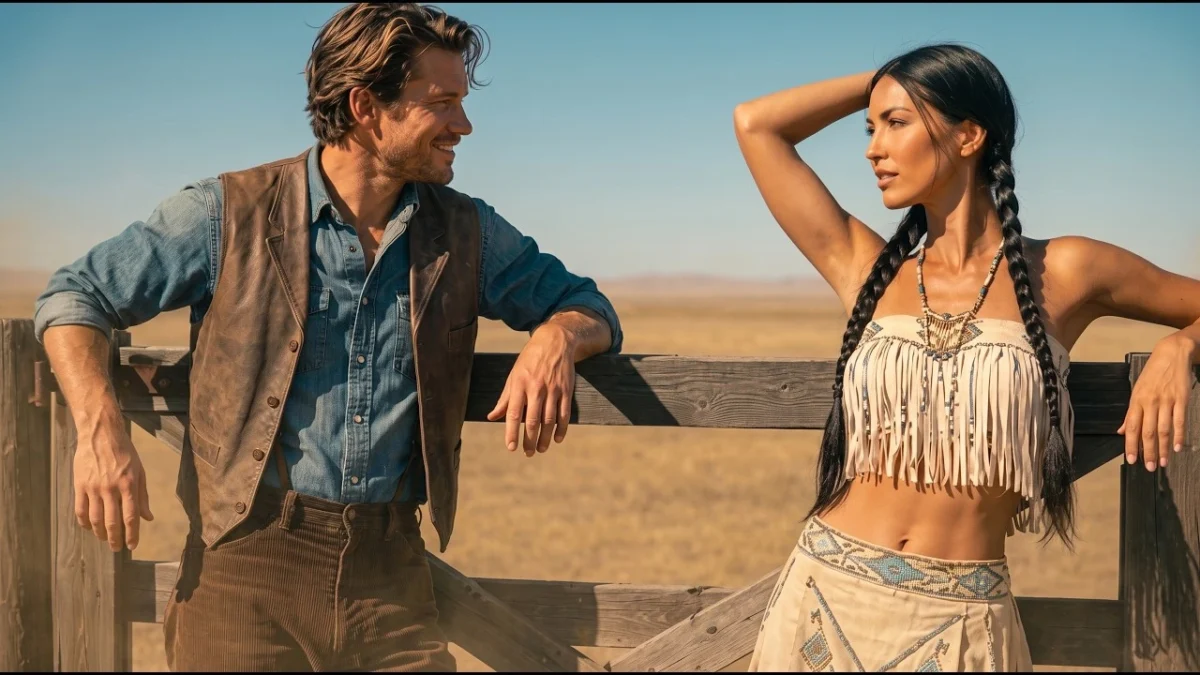
You Need a Woman Like Me, the Apache Woman Said — The Cowboy Never Forgot It
Trapped beneath a fallen tree in a rocky Arizona ravine, she screamed, and what happened next would change both their lives.
The scream came again, thinner this time, swallowed fast by red stone walls that gave nothing back but silence.
A riderless horse burst past on the rim of the ravine above, wild-eyed, stirrups slapping empty against its flanks, and any sensible man crossing the Whetstone Mountains alone that spring would have taken the frightened animal as warning enough to turn the other way.
Levi Calloway was not that kind of sensible. Thirty-one years old, driving a small string of horses south toward Cottonwood Bend to sell before the season turned, he had spent his whole life being the sort who rode toward a sound rather than away from it.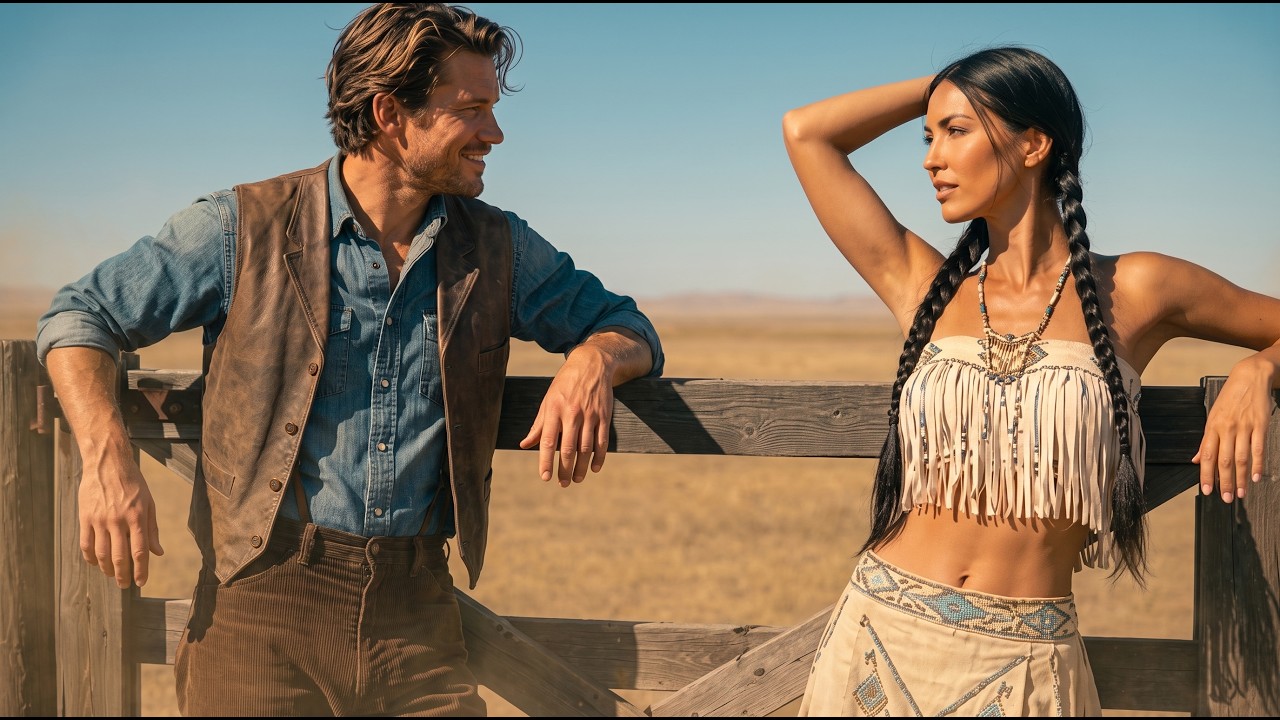
He reined in hard, listened for the cry to come a third time, and when it did, left the string ground-tied on the rim and went down into the rocks on foot, boots skidding on loose scree, one hand out for balance against the canyon wall.
What waited at the bottom was a young Apache woman pinned from the waist down beneath a fallen cottonwood, her horse having lost its footing on the same loose stone and thrown her hard into the very de@dfall it had been trying to clear.
Dust caked the side of her face where she had fought and failed to drag herself free.
Her dark eyes came up sharp and furious rather than pleading, the look of someone who expected the worst from a stranger and meant to meet it fighting, not weeping.
Levi didn’t ask her name. He didn’t ask what had happened, or who she was, or what business a lone rider had this deep into Chiricahua Apache country.
He dropped to his knees in the loose rock beside her and started working, testing the angle of the trunk, judging what could be levered and what had to be cut clean through.
The ravine itself seemed to work against him from the first minute. Loose scree shifted underfoot every time he shifted his weight to get better purchase on the trunk, and twice a fresh slide of pebbles came down from above and forced him to stop and steady himself before he could go on.
The cottonwood had fallen at an angle that pinned her legs but left her torso free, which he understood, once he’d caught his breath enough to think clearly, was the only reason she was still conscious and arguing with him in a language he couldn’t understand rather than lying still beneath the whole crushing weight of it.
He worked fast and he worked careful in equal measure, because a man in too much of a hurry could bring the rest of the de@dfall down on top of her just as easily as free her from it, and slow was the only speed that wouldn’t risk making things worse.
It took the better part of two hours. He hacked through the thickest branches with the hand axe from his saddle roll until his palms split and bled inside his gloves.
He packed loose stone under the trunk inch by inch, building himself leverage the same patient way he’d once seen his own father coax a stuck wagon wheel free of a Texas mudhole.
He braced his boots wide, set his whole back and shoulders against a de@dweight of cottonwood that did not want to move, and heaved until his vision swam at the edges, and still the log held.
He rested only long enough to catch his breath, then went at it again, and the third time the trunk finally groaned sideways far enough that she could drag her legs clear of it.
She didn’t cry out when she moved them. She only lay still a long moment, breath ragged and shaking, testing whether anything underneath had broken before she let him help her sit up against the rock.
Levi uncorked his canteen and held it out at arm’s length, palm turned up, an offer rather than a demand.
She drank slow and careful, watching him over the rim of it the whole time, the wary drinking of someone who had learned young not to trust easy comfort.
When she finally lowered the canteen, a small, exhausted smile changed her whole face. “Dyani,” she managed, her voice rough with dust and screaming.
“My name is Dyani.” Levi barely had time to answer before the drum of hooves rolled down off the canyon rim above, six riders, then eight, bows already half-drawn, closing off the ravine’s one easy way out.
Thirty-one years of hard frontier lessons pressed Levi to reach for the pistol riding his hip.
He didn’t. The stillness in which Dyani held herself was plainer than any words could have managed, proof enough that drawing a weapon here would be the worst mistake of his life, so instead he came to his feet slow, both hands open and empty at his sides, and let whatever was coming come.
Dyani moved first, fast and low, a stream of words in a language Levi couldn’t follow a syllable of, one hand raised toward the riders and the other still braced against the rock where he’d just pulled her free.
The lead rider’s bow came down. Then another’s, and another’s, word passing horse to horse in a tongue Levi didn’t understand at all, though the change moving across their faces was plain enough to read: astonishment first, and close behind it, something that looked almost like respect.
Only once every bow was fully lowered did Dyani turn back to him, that same tired half-smile returning.
Her breath was still ragged. “I am the niece of Chief Tazhi. These are my uncle’s own men, they came looking for me the moment my horse ran back to camp without me on it.”
She studied him a long moment, the unhurried way a person studies someone who has just spent two hours of his own strength on a total stranger, expecting nothing in exchange for it.
“My uncle will want to thank you. Will you come?” If a story about two strangers from two very different worlds is the kind you love watching unfold, tap Join beside the channel name and become a channel member.
Levi rode behind the escort toward camp turning the whole strange hour over in his mind, boots still damp from the ravine, palms stinging raw beneath his gloves.
Thirty-one years in this territory and he had never once heard so much as a rumor of a village tucked into these particular folds of stone.
The trail Dyani’s uncle’s men took him along wound through a stretch of canyon country that looked, from the outside, like nothing but rock and creosote and hard climbing, no smoke, no dust, no glint of metal to betray a living soul anywhere near it, which he understood by the time they crested the last rise was very much the point.
A people who had survived soldiers and settlers alike for generations did not build their homes where a stranger’s careless glance might find them by accident.
The Apache camp sat in a wide, well-watered bend of a canyon Levi had ridden past a hundred times in his life without once suspecting anyone lived within five miles of it, and that alone made plain just how little the maps he’d grown up trusting actually knew about this country.
Wickiups stood in loose, unhurried rows beneath a stand of sycamores, brush-and-hide domes catching the late sun in warm gold streaks, cook-fires threading smoke straight up into an evening gone perfectly still.
Children stopped a game of chase to stare at the tall stranger leading his string of horses in behind Dyani’s escort.
Dogs circled him twice before deciding, on their own authority, that he wasn’t worth barking at further.
Chief Tazhi came to meet them at the edge of camp himself rather than sending for Levi to be brought before him, a broad, deliberate man with silver threading his black hair, eyes that missed nothing as they took Levi’s measure from boots to hat.
When Dyani finished the story of the ravine, gesturing once toward the raw, torn blisters already rising across Levi’s palms, the chief crossed the last few feet between them and gripped his forearm in both hands, an old greeting Levi didn’t know the shape of but understood completely all the same.
“You will eat with us tonight.” Chief Tazhi’s English was worn smooth from long years of trading with men out of Cottonwood Bend and the mining camps beyond it, and it wasn’t phrased as a question.
Levi, who had planned on riding back to his horses alone in the falling dark, because riding on had always seemed the polite thing a stranger did, found himself grinning despite the deep ache already settling into his shoulders.
He stayed. He ate strips of roasted meat and something sweet and fibrous he couldn’t name off a woven plate passed hand to hand around a fire shared by thirty people who treated the stranger among them as no strange thing at all.
When full dark came down over the canyon, someone laid a bedroll for him near the chief’s own fire before he could reach for his own gear, unasked, and nobody so much as glanced twice at the man sleeping among them.
Not everyone in that camp welcomed him easily, and Levi felt the difference plainly by the second morning.
An older warrior named Klo, who had fought settlers and soldiers both in years Levi could only guess the shape of, watched him across the cook-fires with an expression that gave away nothing warm at all.
Klo gave him little directly beyond a short, cool nod, but Levi caught him more than once bent low and urgent toward two of the younger men, and though he couldn’t follow a single word of it, he understood the argument’s outline well enough from a lifetime spent in rooms where he wasn’t fully welcome.
A debt owed a man for freeing Dyani from under a fallen tree was one thing.
Trusting that same man with anything beyond it was another matter entirely, and Levi decided, watching Klo’s guarded eyes across the fire that first morning, that the older warrior wasn’t wrong to hold the line so carefully.
A stranger was still a stranger, however useful his kindness had proven. Dyani found him at sunrise working a cottonwood splinter out from under his thumbnail with a knife point, and she settled beside him on the flat rock without asking permission, the easy way of someone who had already decided the two of them were past needing it.
“My uncle says you may stay a few days, if you want to learn something instead of only carrying a story back to town.
Most white men who pass through only ever want the story.” Levi turned the offer over in his mind exactly as long as it took her to finish the sentence.
He had horses waiting to sell in Cottonwood Bend, a ranch two days south that wasn’t going to run itself, and not one single reason a careful man could name for staying in an Apache camp learning things no book back home had ever thought to teach him.
“Reckon I’ve got time to learn something,” he heard himself answer, and the warmth in her smile made plain it was the only answer that would have satisfied her.
She put him with a lean, quick-eyed tracker named Ahiga that same morning, and within the hour Levi understood he had spent thirty-one years on this land reading maybe a tenth of what was actually written across it.
Ahiga crouched over a patch of bare, sun-baked ground that looked to Levi’s untrained eye like nothing at all, and traced a shallow depression with one finger, a deer, moving at an easy walk through gesture and a handful of borrowed English, favoring its left foreleg slightly, passed sometime after the morning dew but well before the sun climbed high enough to bake the print’s edges hard.
He showed Levi how a bent blade of grass, sprung only halfway back upright, marked exactly how many hours had passed since something brushed through it.
He showed him how a scuffed stone’s direction, the depth and spacing of a track, could reveal whether whatever made it moved calm or ran scared, and how the wind carried scent in ways a rider could use as easily as sight, once he learned to pay it proper attention.
Levi had tracked plenty of stray cattle across his own family’s range and had thought himself reasonably capable at it.
By noon he understood he had only ever managed to read about a fifth of the page.
That afternoon, Ahiga walked him a mile up-canyon to a shallow blind of woven brush overlooking a game trail, and the two of them waited nearly two hours in patient silence before a small band of mule deer came down to water at the seep below.
Ahiga never raised the bow he carried. He only watched, and let Levi watch beside him, until the deer had drunk their fill and moved on unbothered, and only then, in his slow careful English, did he lay out the reason why: a hunter who took only what his people needed that season left the herd stronger for the next one, the same lesson his own father had taught him at this same blind years before.
Levi thought of the wide, careless cattle drives back home, herds pushed hard for a single season’s profit with barely a thought spared for the next, and kept his own thoughts to himself, only nodding, turning the lesson over slow in his mind the whole walk back down to camp.
On the third evening, an elder named Sehi took Dyani and two younger women out toward a stand of agave on the sun-facing slope above camp, and Dyani waved Levi along without asking whether he wanted to come, which by then he understood was simply how invitations worked here.
Sehi showed him the deep, stone-lined pit where agave hearts had roasted three full days and nights under packed earth and coals until the tough, spined plant turned sweet and fibrous enough to eat, the same slow method her own grandmother had used, and her grandmother before that one.
She pulled a yucca plant free by its roots with practiced ease and showed him how to pound the fibrous root into a lather that worked better on hair and hide alike than anything sold off a shelf in the Cottonwood Bend mercantile, then split the tough outer leaves into cordage strong enough to lash a shelter frame, or weave into sandals that would outlast a hard season of walking.
Beside her, a young mother worked a length of soft-tanned hide over a slender wooden frame, building a cradleboard for the infant sleeping against her back, her hands moving through a pattern so old and so practiced she never once glanced down to check her own work.
Sehi worked the yucca fiber between her weathered hands the entire time, unhurried, her words carrying no unkindness at all when at last they came.
“You settlers dig up the ground looking for gold, and we have always found everything we truly needed already growing on top of it.”
Levi turned the coarse fiber over in his own clumsy hands and found he had no honest argument left to offer against that at all.
The fourth evening, the whole camp gathered around the central fire the way it had every clear night since Levi’s arrival, but this night carried a different weight to it, an anticipation he could feel in the way the children settled early and the older men leaned forward off their heels.
An elder Levi hadn’t yet met, a small, straight-backed woman introduced simply as Dyani’s grandmother, began a low, rhythmic cadence that needed no translation to carry its own gravity across the circle.
Dyani leaned close, translating the gist of it under her breath, a story of the stars scattered overhead, each cluster carrying its own name and its own old lesson, one group of them remembered as a line of sisters who had once crossed this very desert on foot rather than submit to a marriage none of them wanted, walking until the sky itself lifted them up rather than let them be taken.
The fire popped and settled. Nobody hurried the telling. Levi found himself leaning forward with the rest of the circle, caught by a story that had nothing at all to do with him and everything to do with the country he’d spent his whole life riding across without ever once wondering what it remembered.
Afterward, sitting a little apart from the fire while the camp settled toward sleep, Dyani explained that a story like her grandmother’s wasn’t only entertainment for a long evening.
It was how the old lessons got carried forward without ever being written down, courage, and refusal, and the cost of choosing your own path against what everyone around you expected.
Dyani traced a finger absently through the dust between them. “We don’t write things on paper the way your people do.
We write them into the sky, and into the rock, and into children who grow up hearing it passed down the same way a hundred times before they’re old enough to understand why it matters.”
Levi thought of his own upbringing, sparse on story and long on chores, and felt for the first time in longer than he could remember something close to envy.
On the fifth evening, Dyani led him alone up a narrow side canyon where a spring ran clear and cold over red stone worn smooth by more centuries than either of them could rightly guess at.
The canyon had a name, one that meant roughly the place where the sisters wept, after two sisters generations back who had sheltered there through a hard winter and lived only because that spring never once ran dry, not even in the driest years anyone still living could remember.
Every wash and rise of stone in this country carried a story like it, names layered over names going back further than counting, so that a person walking this land wasn’t only crossing rock and dust but walking straight through the accumulated memory of everyone who had ever needed that particular shade, that particular spring, that particular hard-won path across the stone.
Dyani watched the last light fade gold and then rose across the canyon wall above them.
“You’ve spent your whole life fighting this land. We’ve spent generations learning from it instead.”
Levi laughed, low and honest. “Reckon I’ve still got plenty left to learn, then.” Dyani looked at him a long moment in the fading light, weighing something behind her dark eyes Levi couldn’t quite name yet.
“You need a woman like me.” Heat climbed straight up Levi’s neck into his face before he could stop it.
“To keep me out of trouble?” She laughed outright, the sound of it carrying warm off the canyon walls.
“To remind you that strength was never only about carrying a rifle. It’s knowing when to trust something you can’t fully explain yet.”
She meant it plain, without a trace of flirtation dressing it up, and somehow that plainness landed on Levi harder than any coy remark ever could have managed.
He walked back down to camp beside her in a silence that felt, for the first time in his life, like it was saying something rather than simply filling the space where words belonged.
On the sixth day, with rain threatening low over the mountains and the whole camp’s usual outdoor work moved under cover, Dyani sat him down beside her at a half-finished burden basket and tried, with visibly strained patience, to teach him the coil-and-stitch technique her own hands had known since before she could properly walk.
His first attempt came out lopsided and loose enough to leak grain through its own seams.
His second wasn’t much better. Dyani laughed at him more than once, unguarded and genuine, and made him start over a third time from the base rather than let him patch the mistake, insisting a basket built on a crooked foundation would only ever disappoint whoever trusted it to hold something precious.
Levi thought, working the willow strips slow and clumsy under her correcting hands, that she might have been talking about more than baskets, and found he didn’t mind the lesson one bit either way.
He left on the morning of the seventh day with the string of horses he’d nearly forgotten he was driving toward Cottonwood Bend, Chief Tazhi’s parting handshake firm and warm, Klo’s nod from across the camp a fraction less guarded than it had been a week before, and Dyani walking beside his horse all the way to the canyon mouth without either of them quite managing to say the thing sitting unspoken in the space between them.
“Come back,” she offered simply when the trail forked and there was no more excuse left for walking together, “if you want to learn more than tracking and yucca root.”
Levi looked down at her from the saddle a long moment. “I expect I will,” he managed, and meant it more fully than he’d meant almost anything in a good long while.
Real stories like this one, built on kindness first and everything else after, are why this channel exists.
If you want more of them, become a channel member, tap Join beside the channel name.
He came back within the month, and then again before the next one had fully turned, and it wasn’t long before the ride north to Chief Tazhi’s canyon became less an occasional detour and more simply a fixed part of the shape of Levi’s life.
He brought flour and coffee and a length of good rope the first time back, a small folding knife and a bolt of red trade cloth the second, and every time he rode in Dyani had something waiting in return, a woven burden basket, deer hide tanned soft as cloth, a jar of mesquite-bean syrup that Levi’s own late mother would have traded her best laying hens for, had she lived to taste it.
The Apache brought blankets and leatherwork and dried herbs down to the Cottonwood Bend mercantile now and again too, when the season allowed the trip, and slowly, almost without either side quite deciding to let it happen, an easy commerce grew up between the camp and the town that had never once existed there before Levi rode down into that ravine.
One visit fell during the hard rains of late summer, the wash running high and brown and the whole canyon smelling of wet creosote and turned earth, and Levi arrived soaked through to the skin only to find the camp had already strung a dry shelter for his horses before he’d so much as dismounted, word of a lone rider on the flooded trail having reached them well ahead of him.
Another visit landed square in the middle of harvest, mesquite pods gathered by the basketful and ground fine for flour, and Levi spent two full days with his sleeves rolled up working the grinding stones alongside the camp’s women, earning more laughter at his clumsiness than actual flour, though by the second afternoon his rhythm had steadied enough that Sehi allowed, grudgingly, that he might yet make a passable grinder of mesquite meal.
A third visit caught the whole camp in the grip of an early frost that had no business arriving so soon in the season, and Levi rode back to his own ranch and returned two days later with every spare blanket and length of canvas his small operation could spare, arriving well ahead of any thanks he might have expected and wanting none at all.
The seasons themselves became a kind of shared calendar between the two of them, marked less by a settler’s paper almanac than by what the land itself was doing at any given time.
Spring meant the agave stalks shooting skyward almost overnight, sweet and ready for harvest before the summer heat turned them bitter and tough.
Early summer meant the mesquite pods ripening heavy and gold along the wash, and the whole camp turning out together to gather them before javelina and deer could strip the branches bare first.
Monsoon season meant washes that ran bone dry eleven months of the year suddenly roaring brown and dangerous within an hour of a distant storm, and Levi learned early and the hard way never to make camp in a dry wash bed no matter how flat and inviting the ground looked, a lesson Ahiga had tried gently to teach him and a flash flood eventually taught him properly.
Autumn meant the deer moving down out of the high country ahead of the first real cold, and winter meant long slow evenings around the fire, mending tools and telling stories and waiting out weather that made the mountain trails too dangerous to risk.
Levi found himself, without ever quite deciding to, marking his own ranch’s year by that same rhythm rather than the calendar hanging in his kitchen, and found the change suited him better than he ever would have guessed it could.
Winter that first year tested the friendship in a way neither of them had expected it to be tested.
A hard sickness moved through the camp in the coldest months, the kind that settled into children’s chests and would not let go, and Levi rode north through freezing rain the moment word reached his ranch, bringing every blanket, every ounce of willow bark and store-bought medicine he could gather on short notice from Cottonwood Bend’s one reluctant druggist.
He stayed four full days that visit, splitting firewood and hauling water and sitting up through two of the worst nights beside Sehi and Dyani both, doing whatever small, unglamorous labor freed the camp’s own healers to do the harder work only they knew how to do.
He wanted no thanks and expected none. It was that visit, more than any single kind word exchanged before or after it, that finally settled whatever doubt Klo had been carrying about the settler who kept riding north for reasons that had nothing to do with profit.
The friendship between Levi and Dyani deepened the same unhurried way the seasons themselves changed.
He taught her, in exchange for everything she had shown him, how to read the brand marks scarred into a stray steer’s hide and how to gentle a spooked colt without ever once raising a hand to it, patience traded plain for patience.
She taught him which plants along the wash could break a fever and which could kill a careless man just as fast, which birdcalls meant rain rolling down off the mountains within the hour and which meant nothing worth minding at all.
They argued, more than once, about small things that mattered a great deal in the moment and nothing at all a week later, whose way of reading a coming storm was more reliable, whose people held the better claim to knowing this particular stretch of desert, and Levi came to understand, turning those small arguments over on the long rides home, that he had never once in his whole life enjoyed being wrong about something quite so much as he enjoyed being wrong in front of Dyani.
Somewhere in the second summer, without either of them quite marking the exact day it started, Dyani began teaching him words rather than only lessons, the name for the mountain that guarded the canyon’s mouth, the word for the particular gray-gold light that fell across the desert in the hour before full dark, the word her people used for a debt that could never fully be repaid and so was better simply carried forward as gratitude instead.
Levi butchered every one of them at first, his tongue clumsy around sounds his own upbringing had never trained it to make, and Dyani corrected him each time with a patience that never once curdled into mockery, though she laughed plenty along the way.
He taught her, in trade, a handful of the rougher cattleman’s English he’d grown up with, words no proper schoolteacher would have approved of, and delighted openly in how quickly and precisely she learned to use them at exactly the moments that would fluster him most.
It became, without either of them naming it so plainly, its own private language built from both their worlds at once, spoken nowhere else and understood by no one else, and Levi came to think of it, turning the thought over on his long rides home, as about as close to a promise as two careful people could make without yet putting the word to it out loud.
It was on an evening in early autumn, the two of them settled on the flat rock above the same spring where she’d first named the thing he needed a woman like her for, that Levi finally gave voice to what he’d been carrying unspoken for the better part of a year.
He didn’t dress it up with a speech. He simply reached over, slow and certain the same way he’d once reached for the branches pinning her beneath that fallen tree, and took her hand in both of his.
“I’ve been riding two days each way to bring you flour and rope. We both know a man doesn’t do that for flour and rope.”
Dyani didn’t pull her hand back. She turned it over instead so their palms met properly, and studied their two joined hands a long quiet moment before lifting her eyes to his.
“No,” she agreed softly. “He doesn’t.” Neither one put the word love to it out loud that evening, not yet, but neither needed to.
It had already settled into the space between their joined hands, plain and undeniable as the spring running cold beside them.
Dyani came south to Levi’s own ranch for the first time that same spring, riding in beside him openly in broad daylight rather than meeting only in the canyon where no settler eyes could find them, and Levi understood, watching her take in the modest house and the leaning barn and the dry stretch of range he’d built up alone across three lonely years, that she had chosen deliberately to be seen.
She walked his fence lines with him and named plants along the wash he’d ridden past a thousand times without ever once learning what they were called or what they were good for.
She met his nearest neighbors, the Hendricks family two miles east, and old Ruth Hendricks, who had buried a husband and outlived two hard winters alone on that same stretch of range, took one long look at Dyani’s steady hands and her level, unflinching gaze and pronounced her, within the hour, entirely too sensible a woman to be wasted on a man as stubborn as Levi Calloway.
Not every neighbor along that road proved half so welcoming. But Ruth’s easy blessing mattered to Levi more than he let on, a first small proof that his own corner of this country might yet learn to make room for the shape his life was becoming.
Not everyone watching this friendship grow into something more was glad to see it. Back in Cottonwood Bend, a shopkeeper named Otis Pruett had never once had a kind word for Apache trade, even the trade that filled his own till, and he made a point of grumbling so loud half the mercantile heard him whenever Levi came through with goods bound for the canyon.
“Man’s got no business playing at being one of them,” he groused to anyone who’d stand still long enough to listen, arms crossed hard over his apron.
A few ranchers around town took up the same tune, exactly as Pruett had hoped they would.
One refused Levi’s hand outright at the feed store. An old riding acquaintance crossed the street rather than pass close by him.
Word came back more than once, secondhand and stinging, that certain families had taken to calling him an Apache-lover behind his back, the words plainly meant to shame a grown man out of his own choices.
Levi heard every bit of it and kept right on riding north to the canyon exactly as often as he always had, because he’d decided somewhere along the way that a man who let a shopkeeper’s narrow opinions steer his life had never truly been free to begin with.
Dyani carried her own weight of quiet disapproval too, though she rarely let it show plainly.
A distant cousin of her mother’s, visiting from a camp two days’ ride to the south, sat her down outright one evening with a hard truth: that she was setting a poor example for the younger women watching her, that generations of hard-won caution about settlers deserved better than being set aside for one man’s blistered hands and easy manner.
Dyani heard the criticism out fully, the way her own people’s custom demanded a hard truth be heard before it could be properly met, and answered it evenly, without raising her voice, caution earned by hard experience was worth keeping, she granted, but judging every settler by the worst of them was its own kind of blindness she didn’t intend to practice.
The cousin left two days later unconvinced, and Dyani let her go unconvinced rather than chase an agreement that wasn’t hers to force.
Not every doubt in her own camp resolved as neatly or as quickly as Klo’s had.
She carried that unresolved weight quietly, the same way Levi carried his, and neither one ever expected the other to carry it alone.
The suspicion cut in both directions, and Levi felt the weight of that too. Klo, softened considerably across two full seasons, nonetheless pulled Chief Tazhi aside more than once with hard questions about what exactly this settler intended by such repeated visits, honest friendship, or something closer to the old pattern of men who took first and sought forgiveness never.
Chief Tazhi met each hard question the same patient way every time, by pointing to what Levi had actually done across those two seasons rather than what he might someday decide to do instead.
Fair trade, honestly kept. A hand extended in genuine curiosity rather than false charity. Respect shown plainly to an old tracker’s teaching, to an elder’s patient hands working yucca fiber, to a chief’s own authority over his people and his niece.
“Watch a man across many moons, not his first kind gesture,” the chief counseled Klo, “and you will know soon enough what he truly is.”
By the second autumn, even Klo had taken to greeting Levi by name rather than by a wary nod, and that quiet shift, more than anything spoken aloud around either fire, carried its own proof that two careful worlds were slowly learning to trust one another.
Klo tested him plainly, once, sitting the two of them down alone by the horse pens and pressing him outright, through halting English and Dyani translating the rest, on what Levi meant to do the day this friendship stopped being convenient, the day drought or hard winter or trouble with the army made an alliance with the Chiricahua Apache a costly thing for a settler rancher to keep.
Levi took the question seriously enough to think a long while before he gave it an answer.
“I mean to keep riding north, same as I have been, convenient or not, because I gave my word and my word doesn’t come with conditions attached to it.”
Klo studied him a long moment more, weighing the answer the same unhurried way his people weighed most things worth weighing, and then he nodded once, short and final, and never raised the question again.
Word of the friendship reached beyond Cottonwood Bend in time, and not everyone who heard it reacted the way Otis Pruett did.
A young doctor newly arrived in the territory, curious rather than scornful, rode out to the canyon twice that second year to trade what medical knowledge he had for what Sehi and the camp’s own healers could teach him about the plants growing wild across country his medical schooling back East had never once prepared him to understand.
A rancher’s wife three spreads over, hearing the ugly talk secondhand at church, quietly began buying her winter blankets from the Apache traders at the mercantile instead of ordering them by catalog from Tucson, and offered no explanation to anyone who wondered why.
Small kindnesses, none of them loud, added themselves up slowly against the loud unkindness of men like Pruett, and it was that slow accumulation, more than any single dramatic reversal, that eventually tipped the whole town’s quiet opinion.
Matters came to something of a head one late afternoon when Otis Pruett, emboldened by a few too many customers nodding along with him at the counter, aired his ugly opinion straight to Levi’s face in the middle of the crowded mercantile, loud enough that half of Cottonwood Bend heard it plainly.
He called Dyani a savage. He said it ugly, the way small men voice cruel things when they mistake volume for courage, and something in Levi’s chest went cold and very still.
He didn’t raise a fist, though every instinct in him wanted to badly. He set his purchases down slow and deliberate on the counter and looked Pruett de@d in the eye.
“The woman you’re speaking of taught me more about honor and patience and plain human decency in one season than this whole town managed to teach me across thirty-one years of living in it.
Keep your opinion of her. I’ll keep the woman.” He walked out without waiting on an answer, his voice having carried to every corner of that store.
A few men in there never did warm to him afterward, but most of Cottonwood Bend, in the slow unhurried way small towns eventually come around to sense, decided there was a good deal more wisdom in Levi Calloway’s quiet conviction than in Otis Pruett’s loud contempt.
Trade kept moving between the camp and the town all the same. The ugly talk, given enough seasons, mostly wore itself down to nothing at all.
If watching two stubborn, hard-headed people fall for each other slow and steady is your kind of Wild West story, tap Join beside the channel name and become a channel member today.
By the time three full years had turned since the morning Levi first heard Dyani’s cries carry up out of that ravine, Chief Tazhi had long since stopped treating him as a visitor and started treating him plainly as family, and the small ranch Levi had built up south of the mountains had become something neither of them could have quite pictured that first autumn.
Levi and Dyani built a trading post together where his land met the old southern trail, a long low building of adobe and timber with a wide covered porch where Apache blankets and finely worked baskets hung for sale beside settler tools and bolts of cloth, where fine Chiricahua beadwork sat easy on the same shelf as good honest rancher leatherwork, neither one crowding the other out of its rightful place.
They named it Harmony Crossing, and the name fit it a good deal better than either of them had quite expected when they first put it to words together on that same porch, still half-built, the summer they raised it.
Raising it had been its own small proof of everything the two of them had been building toward.
Levi’s neighbors came out with lumber and their own two hands, Ruth Hendricks chief among them, and Chief Tazhi sent a dozen of his own strongest men down from the canyon to set the heavy roof beams and lay the adobe walls thick enough to hold cool through the worst of a desert summer.
Ahiga’s father taught two of Levi’s ranch hands how to properly cure the leather they’d be selling off the shelves before the first season was out.
Sehi walked the finished porch on opening day and ran one weathered hand along a roof beam some Apache stranger’s labor had helped set in place.
Her look toward Dyani needed no translation at all, the look of a woman who had lived long enough now to see something she had once thought impossible standing solid in front of her.
Travelers making their way through southeastern Arizona in the years that followed learned to stop at Harmony Crossing not only for supplies but for the plain sight of it, Apache families and settler families trading goods and gossip and easy laughter side by side across the same wide porch, children of both worlds chasing each other through the same dusty yard as though the old line between them had simply never existed at all.
Sehi still brought her yucca cordage to sell there most every season, her hands slower now but no less sure of themselves.
Ahiga’s own son had grown into as fine a tracker as his father had ever been, and taught what he knew to any curious settler boy who thought to ask him properly and respectfully.
Klo, grey through the hair now and long past his old wariness, could often be found on that same porch of an evening trading old stories with ranchers who’d once crossed the street rather than walk near Levi at all, and not one soul left in the county thought that particular friendship worth remarking on anymore.
On a typical market morning at Harmony Crossing, the porch filled with a rhythm neither settler custom nor Apache custom could have produced entirely on its own.
Ranch wives haggled cheerfully over the price of a fine woven basket while their children traded marbles and dares with Apache boys who’d ridden down from the canyon with their fathers’ trade goods.
A cavalry supply wagon might sit parked beside a string of pack horses loaded with hide and cordage, the soldiers and the Apache traders keeping a wary but perfectly workable truce across the yard between them.
Dyani kept the books for the Apache side of the trade herself, a skill she’d taught herself out of stubborn necessity in the post’s first hard year, and more than one settler customer learned quickly enough that she drove a harder, fairer bargain than Levi ever managed on his own.
Levi, for his part, had picked up enough of Dyani’s language by then to greet Apache customers properly in their own tongue, clumsy but sincere, and the effort earned him more goodwill across that porch than any amount of settler charm could have managed by itself.
A pair of travelers resting their horses in the shade of the porch one warm afternoon wondered aloud to Levi, grey just beginning to touch his own temples by then, Dyani’s hand resting easy and familiar in his, what exactly a man had to do to build a life as settled and as good as the one he plainly had.
Levi considered the question a good long moment, the same unhurried way he considered most things worth answering honestly, and glanced over at Dyani before he gave them any kind of answer at all.
“I got lucky enough, once, to pull a woman free from under a fallen tree.
And smart enough, after that, to listen to every single word she’s ever given me since.”
Dyani laughed at that, soft and warm, the very same laugh that had first caught somewhere deep in his chest beside a spring three long years and one entirely changed life ago, and neither one of them bothered explaining any further, because the travelers, watching the two of them together on that porch, understood the whole of it plainly enough without another single word needing to pass between anyone.
Chief Tazhi lived long enough to see Harmony Crossing through its first decade, riding down from the canyon most seasons to sit on that same porch and watch his niece run a business that neither settler law nor Apache custom had ever quite imagined a woman doing so plainly and so well.
Late in his own life, sitting easy in the shade with a cup of trade coffee going cold in his hand, he confided in Levi that he had worried the day he first sent his men down into that ravine that a settler’s gratitude would prove thin and temporary, the kind that faded the moment the debt felt paid.
He was glad, he confided further, more than once before he was through, to have been wrong about that particular worry for as long as he’d lived to watch it proven wrong.
Levi never forgot hearing it. He carried the old chief’s words the same careful way he’d once carried Dyani up out of that ravine, gently, and like something worth protecting.
Sehi outlived the chief by several more seasons, still walking the Harmony Crossing porch on market mornings well into her final years, still correcting Levi’s clumsy grasp of yucca cordage every chance she got, still reminding anyone who’d listen that the settlers had finally learned to stop digging for what was already growing plainly on top of the ground.
Klo’s grandchildren grew up running that same porch alongside settler children whose own grandparents had once crossed the street rather than shake Levi’s hand, and not one of them thought to wonder why the two peoples traded so easily under that one long roof, because for them, unlike for the generation before, it had simply always been so.
Sometimes the greatest love stories of the frontier were never born from grand rescues or desperate last stands at all.
Sometimes they were born from nothing grander than a man who chose to ride toward a stranger’s cry instead of away from it, and a woman brave enough to show him, plainly and without apology, exactly what kind of man he still had it in him to become.
Levi liked to sum up the whole of it, whenever anyone wondered aloud, in fewer words than the story properly deserved, that he’d once been pulled toward a sound in a ravine he had no good reason to enter, and had spent every year since finding new reasons to be glad he went down into it anyway.








